


Hilaritas Press has released Maybe Magick, the new anthology of Robert Anton Wilson's writings on Magick.
Here is the official blurb:
What if magick is neither supernatural nonsense nor solemn occult theater, but a practical way of tinkering with the machinery of perception? Robert Anton Wilson spent a lifetime investigating the confounding territories where magick, science, psychology, language, and belief overlap. Maybe Magick gathers essays, introductions and interviews charting three decades of exploration, tracing the evolution of a mind learning not to mistake certainty for evidence. The result is funny, provocative, skeptical, and occasionally liable to upend your favorite assumptions. Wilson does not ask you to believe in magick. He asks a more interesting question: what happens when you try it?
The editors for the book were Mike Gathers, Oz Fritz, Dave Skelton, Tom Clisson and Alan Chapman. Oz, Dave and Alan all wrote pieces for the book. Cover and design by Rasa.
Having worked with Hilaritas for my Robert Shea book, I know how much work and care goes into producing a Hilaritas Press title, and I have heard enough from the editors to know a great deal of labor went into this new book.
More information here, includlng endorsements and links to purchase the book.
Google on Friday celebrated receiving a poem from its first experimental orbital AI datacenter satellite.
The company's Suncatcher satellite, launched at the start of the month and put into low Earth orbit, has responded to a ground station prompt to "Write a haiku from the perspective of a TPU orbiting Earth, with the wonderful world spinning beneath you."
Travis Beals, senior director of Google's interdisciplinary Paradigms of Intelligence research team, said that with Suncatcher's host and TPU trays powered up and machine learning tests completed, the onboard Gemma 4 model achieved its "Hello World" milestone by sending an inference response from orbit.
"During a ground-station pass, we uplinked our first prompt to our onboard Gemma 4 open model, asking it to generate a haiku about being in space," wrote Beals in a blog post.
And as the satellite passed over Svalbard, Norway, the orbiting AI model responded over the downlink:
Blue marble below,
Data streams in silent grace,
Starlight feeds my core. ✨
Those roughly 20 tokens would cost about $0.000012 if generated through the Google Cloud API, based on Gemma 4 26B's pricing of $0.15 per million input tokens and $0.60 per million output tokens, excluding input costs.
Add in a satellite weighing perhaps 500 kg, based on the mass of SpaceX's Starlink satellites, and a retail launch price of around $7,000 per kg, and you have a very expensive haiku.
According to Google's calculations, if the cost of getting a satellite into low Earth orbit can be brought down to $200/kg, the launch cost amortized over the satellite's useful life (~$810-7,500/kW/year) could be comparable to current electricity spending for terrestrial datacenters in the US (~$570-3,000/kW/year).
Google predicts that SpaceX could achieve that by 2035, more or less, and considers it strategically beneficial to prototype well in advance of that actually happening.
After the haiku, Beals said, "we tested space-themed limericks and telemetry prompts reporting the technical status of the payload systems." Next up: tests for evaluating how TPUs perform under thermal stress and radiation.
Google has already done some laboratory testing of its Trillium Cloud TPU and AMD host server to see how well they can withstand a 67 MeV proton beam.
The system's high-bandwidth memory shows the most sensitivity in terms of the total ionizing dose - it exhibits irregularities after a cumulative dose of 2 krad(Si), which is about 3× Google's minimum requirement for TID survival of 750 rad(Si).
"For typical transformer workloads, the observed SDC [silent data corruption] rate of approximately one event/17 rad, at an estimated orbital dose of 150 rad(Si)/year, translates to a very low failure probability on the order of 1 per 3 million inferences, assuming 1 inference per second," Google researchers said in a paper published earlier this month.
"While this error rate is likely acceptable for inference, the impact of SEEs on training jobs, and the efficacy of system-level mitigations, requires further study."
Indeed, the study will continue. Next year, the plan is to test a pair of interconnected satellites. Rather than lofting large satellites into orbit, Google anticipates sending a constellation of many smaller satellites that communicate with one another. ®








The following is a step-by-step account of what has gone on at Canary Media Limited this year. It follows multiple online accusations against the CEO, Steve Topple, his wife, Nicola Jeffery, and several staff members.
During late 2025 and early 2026, multiple staff members were either arrested or facing court proceedings specifically thanks to the Zionist lobby.
Around the same time, journalist Rachel Charlton-Dailey asked if she could create a trade union group, which the CEO said yes to and asked her to get on with. This never happened.
The Canary received multiple vexatious complaints from Zionists (totalling over 50 alleged breaches of the press regulator's code in around three months), all of which IMPRESS dismissed except one.
Then, the Canary was debanked. Lloyds originally asked for information about the business structure and where certain funds came from. The CEO tried multiple avenues (email, phone) to answer these questions, but no one ever got back to him. Then, in May the account was closed without warning. Steve filed a complaint, and also a senior manager told him an internal investigation would be launched alongside this - the results of which Lloyds has still not disclosed. This also meant that Canary Media Limited fell behind on repayments for a COVID Bounceback Loan taken out by the previous owners, as Lloyds did not give us a mechanism to make repayments (which were automatically set to come out of the now-closed bank account).
Around the same time, £2.5m in financial support for the planned TV channel was also withdrawn, meaning the project had to be scrapped, and the potential for significant YouTube revenue was lost.
The newspaper project also failed due to the debanking. It had a 20% profit margin baked in, meaning that on a print run of 20,000, profit could have been £100,000 a month. However, nearly 2,000 stockists boycotted it within the first few days, making it unsustainable given the debanking, as the Canary couldn't pay the weekly costs.
Plus, one of the other outlets Canary Media Limited had taken over was losing £15,000 a month more than Steve was told when the businesses merged. This was due to the loss of a significant donor - a fact that was actively hidden from Canary Media Limited.
In early June, a non-disclosure agreement (NDA) for staff was put in place. The former Head of HR and Pastoral, Nikki Brooker, proposed it and also wrote it. The CEO, Steve Topple, did not propose it, but he supported her and the heads of department (who all agreed) in implementing it. This was due to concerns that business-sensitive information could be published online and used against us.
At the end of June, staff were told of the debanking. The CEO decided to delay telling staff, hoping the situation would be resolved and to avoid unnecessary distress. This didn't end up being the case. Staff were paid three days late, obviously because the Canary didn't have access to any of its money and had to get emergency funding elsewhere.
During this time, staff had regular meetings where they could provide feedback on the situation and suggest ideas - and also have space to openly discuss the impact on their mental health and emotional wellbeing.
We sent applications to multiple other banks for business accounts. Despite Canary Media Limited being in existence for over 10 years, and having a clear credit score, NatWest, Revolut, Tide, Nationwide, Virgin Money, Santander, and Barclays all declined to give us an account - with multiple banks citing our "complex business structure".
We had already secured a basic bank account with ANNA back in late April, due to the doxxing of Steve's personal details online by a senior Your Party member which could have compromised the Lloyds bank account. However, this account then also asked questions about our ownership structure. Our third-party payment provider, Stripe, asked the same questions. We then got another bank account with Monzo.
In July, Israel attacked two of our journalists with grenades in southern Lebanon.
At the end of July, we paid most employees on time, with only two paid late because of daily transfer limits on our new bank account.
On 31 July, Canary staff member Hannah Sharland set up a WhatsApp group called "Everything is Fucked". This group ran at the same time as a National Union of Journalists (NUJ) union chapel was being created. In hindsight, and from the full chat history, it is clear this group was used to attempt a coup against Steve.
Steve and his now-wife Nicola Jeffery got married on Wednesday 5 August. During this time, two senior staff members attempted to access the CEO's private emails without his authorisation. One of them also attempted to get Steve to (in their words) "relinquish his duties". They claimed it was because he was on indefinite mental health leave. This was not true. It was explained to this individual (by Steve and after Nicola had a conversation with them) that we were logging the annual leave he was taking for his wedding as mental health leave, to make sure that he was not contacted during this time. Steve also told this individual that he would be back, as planned, the week after his wedding.
It also transpired that senior staff covertly arranged a meeting with a donor during the week of Steve and Nicola's wedding, seemingly to oust Steve. However, this did not go according to plan, as conversations in the WhatsApp group show.
Also during the same week, another senior staff member held a meeting with all staff where they told them to start looking for new jobs and said they didn't know if the company had any money, even though the meeting was only supposed to be about a consultation on new policies. When asked for a recording of this meeting, the senior staff member claimed the file had been "corrupted".
For context, in the WhatsApp group "Everything is Fucked", multiple staff members attended Steve and Nicola's wedding, some even staying at the venue for two nights. This included Hannah Sharland, one of Nicola's bridesmaids, as they had been good friends for years. Yet these individuals spent the day feeding back rude, insulting messages to the WhatsApp group. Not least among these was Sharland herself, whom journalist HG (a pseudonym) told should have taken "nunchucks" to the wedding. All the while, these individuals were being lovely to Steve and Nicola's faces.
Steve informed the entire team on Saturday 8 August that he would be back to work on Tuesday 11 August.
On Monday 10 August, a senior staff member announced new policies would go live at 9am on Tuesday 11 August. This was without Steve's final sign-off. One of these was the Disciplinary Policy, which included a clause that would have meant the CEO could not conduct a disciplinary investigation if the alleged misconduct involved the CEO. That is, Steve could not have disciplined two senior staff members for attempting to access his emails without authorisation.
On 11 August, Steve suspended one of the senior staff members who attempted to access his emails. The other one involved had already gone on "indefinite" sick leave a few days before this. Another senior staff member was also suspended after it transpired they told a former employee that the CEO "was no longer working in the business" (which was not true) during the week of the wedding. Another senior staff member was also immediately removed from the business because the Home Office refused to grant Canary Media Limited a sponsorship licence to get them a work visa.
As soon as the two senior staff members were suspended, the WhatsApp chat immediately began undermining the disciplinary process by holding a Zoom call and helping them both with their stories. This breached standard suspension terms, which state that suspended staff members are not supposed to communicate with other employees. The senior staff member who had no work visa was also still in this group, despite her employment having been terminated.
Also, in Zoom meetings and/or in the chat, staff were openly discussing forging documents from Lloyds Bank to make out Canary Media Limited had not been debanked. There was also open discussion around setting up a social media account to leak internal information. Plus, a senior member of staff was briefing a freelancer on the situation while suspended - which resulted in the latter's contract being terminated after they misused a group chat to throw abuse at the CEO and team members.
In summary, it appeared some staff were attempting a coup against Steve Topple, subverting official trade union processes, and using lies and defamation to drag staff along. Staff members have since said senior staff had been undermining Steve to them since at least June.
On 19 August, the NUJ union group officially launched without inviting all staff members but fast-tracking membership for a suspended staff member; yet the WhatsApp group continued and operated separately. Two suspended individuals were members of the trade union Signal group chat, despite being suspended - once again breaching standard employment conditions.
The NUJ group quickly descended into chaos and in-fighting. The person leading it resigned from the company nine days later, and the NUJ group was paused. This came after concerned staff members leaked the entire chat to the CEO. An NUJ rep said that in their 40 years in trade union work, they had never seen staff behaviour like it. It has since become apparent that those sowing discord in the NUJ chapel were also members of the "Everything is Fucked" WhatsApp group.
Then, towards the end of August, after Lloyds sent us a cheque for the balance from the debanked account, another Canary Media Limited bank account was locked, holding a significant amount of our funds. Metro explained that this was due to the "complex business structure" related to a change in ownership. For context, a bank manager told Steve this in person, in-branch.
At the end of August, Steve's mum (who lives with severe dementia in a care home 100 miles from where he lives) had a serious fall, broke her hip, and was in hospital. This meant Steve was travelling backwards and forwards to be there. Yet the Everything is Fucked WhatsApp group poured scorn on this - with journalist Joe Glenton saying Steve was "lying" about it.
Meanwhile, Companies House changed Canary Media Limited's registered office address to the default one without warning. This meant the company could have been struck off. Our registered office provider confirmed our address was active and valid. Therefore, the legal advice we received was that someone else must have acted maliciously and told Companies House we did not have permission to use the address. However, it seems Companies House did this itself when it got "returned mail" from our address. Yet that still doesn't make sense, as our address had been active consistently and there would be no reason for mail to be returned.
Also, at the end of August, staff from the WhatsApp group leaked information to the Guardian, which then published an article about internal matters on 4 September. On the same day, some of these staff set up a "Canary Staff" X account, seemingly intending to bring down the company, the CEO, and his wife. Before this, on 3 September, Steve learned of the "Everything is Fucked" WhatsApp group and was given the entire chat history. After revealing this to the team on 5 September, multiple staff members who were active members resigned.
On 8 September, the same staff running the X account spoke to the Telegraph, which then also published an article.
During this time, the process with the NUJ had all but collapsed. The union rep was close to ending the association with the Canary because of staff behaviour, namely suspended members subverting the disciplinary process, leaking information, and some staff's general unwillingness to engage constructively.
During this time, the "Canary Staff" X account was not only publishing unfounded allegations about, and abuse and harassment aimed at, Steve Topple, but also his wife Nicola Jeffery and other members of staff. To be clear: none of the team are antisemitic; no allegations of sexual harassment have ever been raised; issues around staff members' conduct are being wholly misrepresented, and the insults thrown at Nicola, and the inferences around her pay and competency, are vicious and unwarranted.
Meanwhile, Lloyds Bank issued a £4,500 compensation cheque for closing Canary Media Limited's bank account without warning. However, it claimed it had also sent a separate letter detailing its response to Steve's complaint, but this letter was never received. At the same time, it was also still charging the monthly fee for the business bank account which no longer existed.
The co-ordinated campaign both online (and internally) by former staff and in the corporate media led to donors who had previously offered support to the Canary withdrawing that support - leaving the business unsustainable.
On Wednesday 16 September, the company decided to make remaining staff redundant after a 30-day consultation. This finished on Friday 16 October. On Monday 19 October, the company publicly announced it was stopping operations indefinitely. Meanwhile, staff from the WhatsApp group were still accessing internal Canary systems, despite no longer working at the business.
Featured image via the Canary
By The Canary


- Formal negotiations
- Finance
- Global review
- Global report
- Digital sequence information
- Harmful subsidies
- Marine biodiversity
- Planning, monitoring, reporting and review
- Article 8(j) implementation
- Biodiversity and climate change
- Links with other bodies
- Around the COP
- Armenian presidency
- Protests
- Lobbying and influence
- Carbon and biodiversity markets
Countries have completed the first "global review" of their progress towards reversing nature loss by 2030 at the COP17 biodiversity talks in Yerevan, Armenia.
The review "notes with deep concern" that, unless action is "rapidly accelerated", the goal to reverse nature loss and meet a set of 23 targets by 2030 "will not be achieved".
It "urges" countries to accelerate action, including by "increased ambition in addressing the gaps".
Much of the discussions in Yerevan focused on how to raise the necessary funds to help developing countries protect nature.
Some major economies pushed to expand the range of nations that are expected to provide finance, with countries agreeing at the end of the two weeks of talks that non-donors that want to contribute can "signal interest" before COP18.
This came after developed countries failed to meet a target to significantly ramp up nature finance over the last few years.
It also came as a landmark fund agreed at COP16 in Colombia to pay communities for the genetic resources derived from nature stands nearly empty two years on.
The Yerevan talks marked the halfway point of the "Kunming-Montreal Global Biodiversity Framework" (GBF), the "Paris Agreement for nature" first made in 2022 and due to be achieved by 2030.
During the nearly 12-hour-long final plenary, countries voted for Quito, Ecuador, to host the COP18 nature talks, which will be held in 2028.
Countries managed to sign off on all the major negotiation texts, marking a stark contrast to COP16, which ran so far over time that the Colombian presidency lost "quorum", forcing talks to resume in Rome months later.
Below, Carbon Brief has detailed analysis of all of the key outcomes from COP17.
Formal negotiations Finance
Finance, predictably, was at the heart of the discord and deadlock at the Yerevan talks.
At COP17, discussions on finance had to achieve several outcomes.
The first part - to take stock of biodiversity finance mobilised so far to meet the nature deal's goals - fell under the global review.
As the global report noted, developed countries failed to meet their commitments to raise "at least $20bn a year by 2025" for nature. Delegates pointed to falling aid levels and a sharp 27% decline in environmental funding for the 2026-30 period.
The second part was to agree on how to mobilise resources for the next four years, to meet the GBF's goals and targets.
Calls to "broaden the contributor base" of who pays to protect nature - and whether that should include emerging economies - became the most fraught element of the talks. Eventually, countries agreed on what Switzerland described as a "super, mega-delicate" text. It hinged on major "political compromises", with "no major winner or loser", according to Kenya.
Per the decision, countries that want to be included on a list of developed country donors can "signal interest" through bilateral, confidential consultations before COP18 and every alternate COP after.
Finally, countries also agreed on criteria to shape and resource a new, permanent financial mechanism to protect nature after 2030.
However, this did not immediately take the form of a new fund under the COP that biodiverse countries have demanded since 2022, deferring the mechanism's institutional structure to COP18.
Resource mobilisation discussions at the GBF's halfway mark were supposed to agree on how to close the "biodiversity finance gap" and to "increase resources from all sources" to "at least" $200bn per year by 2030, as set out in target 19 of the GBF.
The talks were largely dominated by a push, led by the JUSCANZ bloc of developed countries, to "broaden the contributor base". This could see emerging economies, such as Qatar, China, Saudi Arabia and India, being added to the list of countries that pay to protect nature.
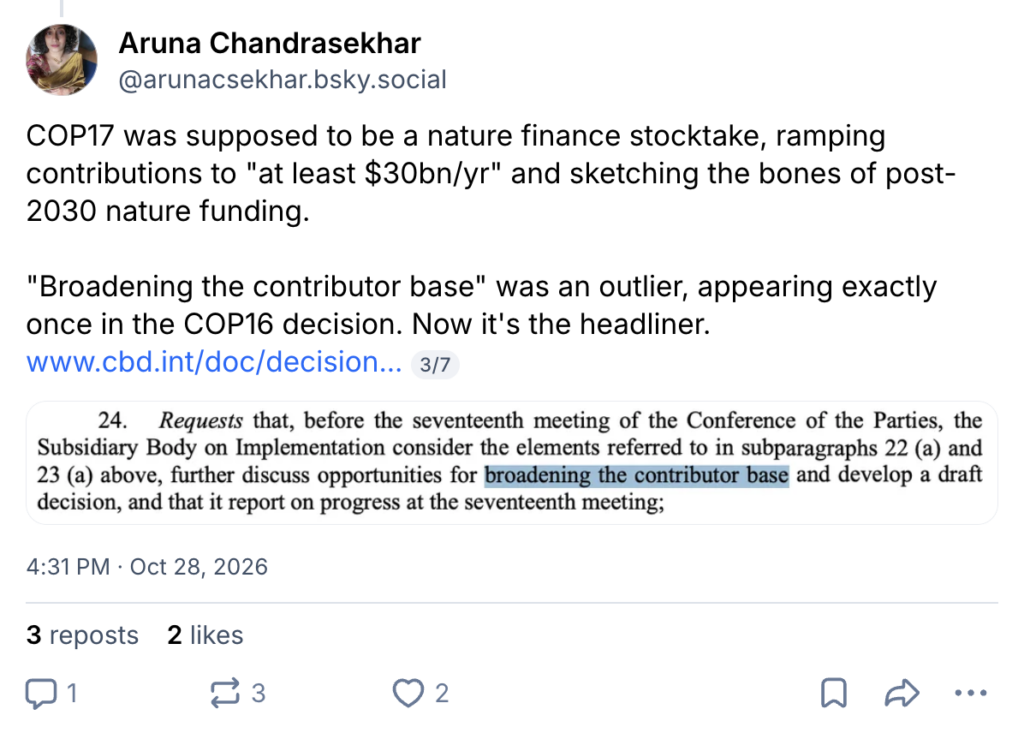
Article 20 of the UN Convention on Biological Diversity (CBD) states that developed countries "shall provide new and additional financial resources" to developing countries to meet the costs of implementing measures to protect nature.
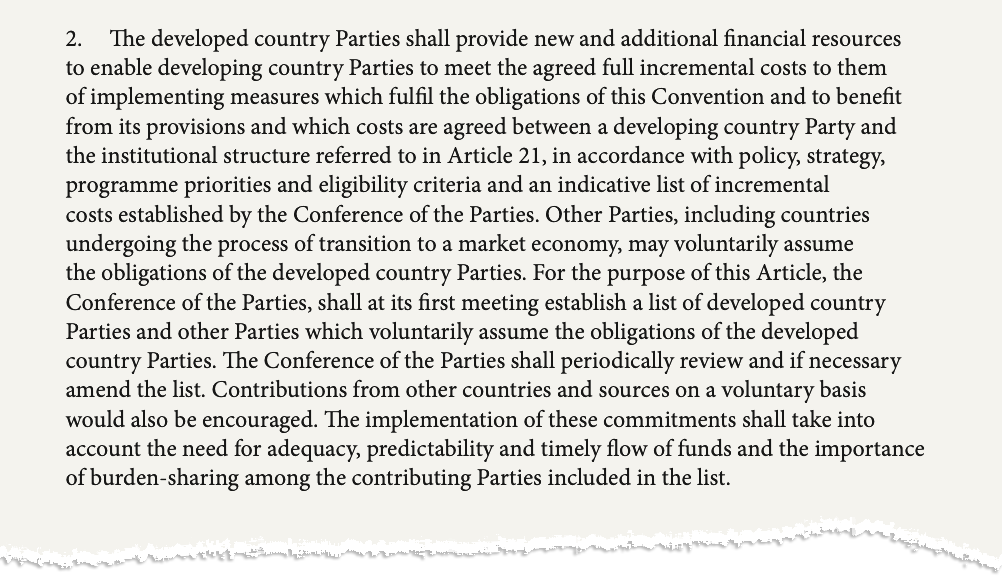 The second paragraph of Article 20 of the UN biodiversity convention. Source: UN CBD
The text states that other countries - including emerging economies - may "voluntarily assume" these obligations to pay. However, it adds that this list of developed countries "shall" be reviewed periodically and amended "if necessary".
The list was last amended in 2006.
(See this "jargon buster" which explains the specific meaning and legal weight of various terms and verbs used in UN formal documents.)
Discussions around this fraught subject had reached a dead end at intersessional talks this year, but resurfaced in Yerevan.
The first "non-paper" had four different options for expanding the contributor base. These ranged from using the World Bank's country income groups "as a proxy" to identify high-income countries, to commissioning a study on the impacts of being included on the list.
By 21 October, the number of options swelled to eight, including two from Saudi Arabia and one from Peru.
Some countries "expressed concern" that certain options were based on a CBD secretariat study on "what constitutes a developed country", Earth Negotiations Bulletin reported.
By the end of the first week, it was clear that the finance deadlock would have to go into informal ministerial consultations for any consensus to emerge.
At a press conference on 28 October, Christopher O'Sullivan, Ireland's nature minister and representing the EU delegation, told Carbon Brief:
"Our position isn't that we want to pull back in terms of contributing…but it's been 20 years since that list was added to, times have changed and there are new realities. We just simply want those new realities reflected. I don't fully understand why there's so much opposition to that."
The EU chose not to comment on which countries it would like to see on that list.
Lim Li Ching from the Third World Network, meanwhile, called the push for others to "assume the obligations" of developed countries "sheer hypocrisy", adding that any country could make a voluntary contribution. She told Carbon Brief:
"At a forum like the CBD, this linking of income status with finance does not take into account where historical and current responsibilities lie. If you want to generate more funding for biodiversity, let's look at sovereign debt burdens and rules, which are inequitable for developing countries. But if you can fund wars, and provide resources for your defence industry, then you know where the priorities are."
On 29 October - at a plenary meant to adopt final texts for the most contentious subjects - Norway's Gaute Hanssen announced that resource-mobilisation discussions would go into a smaller "friends of the chair" meeting.
Facilitated by Carolina Caceres from Canada and Imèn Meliane from Tunisia, the meeting would discuss the most contentious elements of a draft decision that had swelled to 112 brackets, denoting areas of disagreement on specific details in the text.
While the meeting was open to all, countries that were called to be present included Brazil, Canada, Chile, China, the EU, Fiji, Norway, Russia, Switzerland, Saudi Arabia, South Africa and the UK.
At the same time, a "non paper" text by finance and environment ministers laid out countries' red lines and compromises.

If you drove through the East Bay area of California on Tuesday night, you probably got caught in a nightmare. A Tesla Semi traveling down Interstate 880 in Hayward caught fire during the evening commute. There was no crash, no multi-vehicle pileup, and no obvious collision. The driver noticed something ... [continued]
The post Can Silicon Valley Build A Safe Class 8 Truck? Early EV Semi Fires Expose The Experience Gap appeared first on CleanTechnica.

If you live in West Virginia, you're lucky enough to get a cryptid-themed license plate. West Virginia is the only state that offers a cryptid-themed plate, including multiple beloved monsters from popular urban legends. All of the creatures are from urban legends that are specific to West Virginia lore. — Read the rest
The post West Virginia now has a license plate full of cryptids, including Mothman appeared first on Boing Boing.

If you are a cow living in the Swiss Alps, you may find yourself in a sticky situation. If you stray too far into the summer pastures, it may be difficult to find your way back home. Luckily, there are some kind protocols put in place to help you in this situation. — Read the rest
The post Swiss cows that wander too far get a helicopter ride home appeared first on Boing Boing.

The Match Archive is my new favorite place to "joy scroll" on Instagram. This page showcases all sorts of gorgeous antique matchboxes. Gone are the days when match companies put creativity and art into each little box of matches, but wonderful pages like this let you experience the joy of decorative matchboxes. — Read the rest
The post The Match Archive on Instagram saves gorgeous antique matchboxes from the trash appeared first on Boing Boing.


The most common way people experience classical style music these days is via movies and video-games. After seeing The Force Awakens - live in concert, I've become rather a fan of watching movies performed with a live soundtrack.
But what about watching a video game with orchestral accompaniment? We travelled up to Wolverhampton to see "The Witcher":
A one-of-a-kind live event that transforms the lasting legacy and emotional storytelling of The Witcher 3: Wild Hunt into an immersive concert
Obviously you can't have someone sat there with a PS5 controller while a band plays (although that'd be a hell of a Twitch stream!) instead a large screen projects various cut-scenes and in-game footage. It works pretty well - most of the popular scenes are in there (Geralt in the bathtub got a big cheer) although there was no hyper-extended Gwent session. The videos were a little repetitive. Some of the music is obviously composed to be swelling in the background and so repeated shots of swords looking cool or Geralt looking grumpy were sprinkled throughout.
The highlight was seeing Percival Schuttenbach play a variety of instruments with absolute joy and gusto. The entire band look like they're having a whale of a time, and the conductor encouraged us to whoop and cheer for our favourite scenes (with perhaps a few boos for some of the more notorious enemies).
As soundtracks go, it isn't particularly varied. There's a decent mix of tunes, some with singing, but they do tend to blur into one after a while. Nevertheless, a brilliant time for fans of the game who want to soak up the music.
The Witcher in Concert is on tour around the world now.
Pre- and Post-ShowThere was a merchandise stall hidden in one corner of the venue. Between doors opening and the start of the show (about an hour) a video looped through three screens - one of which encouraged up to share our photos with a hashtag. That's fine, but a few more videos wouldn't have gone amiss.
After the show, the conductor said the band would stick around for selfies - which was nice of them.
A touring show like this probably can't spare too much space for large scale models for people to pose with, or a couple of cosplayers to photograph, but it might have been nice if there were something to interact with before and after the show.


Allerton Project attracts abundant wildlife and its success can offers clues to reversing the sharp drop in populations
Farmer Alastair Leake is standing in a field of sprouting winter wheat, pointing at his experiment. One side was ploughed before planting, with green shoots breaking through neat rows of upturned soil. On the other, the crop was drilled directly into the earth, emerging through a messy carpet of "trash" - stems, stubble and crop residue from previous harvests.
"When we're watching to see where the birds are landing to feed, none of them are going on to the ploughed side," says Leake, the director of the Allerton Project farm, standing on the trashy side. "They're all coming and feeding down here.
Continue reading...In Pittsburgh, Pennsylviania, a post-industrial site gets a second life
Continue reading...
Microsoft senior software engineer Raymond Chen has explained what Windows is doing when you hold down the power button, and shared a story about the time a customer accidentally created a Goth Mode for Windows 3.1.
There's a section in The Hitchhiker's Guide to the Galaxy (actually, page 116 of this writer's dog-eared copy of The Restaurant at the End of the Universe) in which Zaphod Beeblebrox observes of a ship's interior: "Every time you operate one of these weird black controls that are labeled in black on black background, a little black light lights up black to let you know you've done it."
The same turned out to be true of a user who called Microsoft customer support to complain that after Windows 3.1 booted up, all that remained after the product logo disappeared was a blank screen.
It turned out the customer liked black a little too much and, according to Chen, made themself a Goth theme.
The customer support engineer on Microsoft's end pieced it together. The customer had, according to Chen, "set the wallpaper color to black. They set the title bar color to black. They set the button color to black. They set the window background color to black. They set the window text color to black.
"Every possible color you could pick in the Colors control panel was set to black."
We suspect the mouse pointer, at least, would have stuck around, unless the customer had also managed to change some settings around this. And then there are the icons… However, Windows 3.1 was a long time ago, and this writer's attempts at theming then were the consequences of growing up in the '70s and '80s, which resulted in some interesting neon, orange, and brown combinations.
As for Goth mode, Chen said, "Once you get yourself into this situation, it's hard to get out because you can't see anything." One solution he suggested was deleting the [colors] section from the win.ini file.
Chen told the anecdote as a coda to the question - what exactly is modern Windows doing when you hold down the power button on a PC? According to Chen, after eight seconds of holding the power button, the Windows kernel realizes a forced power-off is happening and tries to take a kernel dump for diagnostics.
He explained that the kernel dumps were classified by Microsoft as "long power button hold" (LPBH) failures, with one of the bits of information captured indicating if all the pixels on the screen were black. The video driver might therefore be the culprit. Or whatever was responsible for drawing to the screen.
Today's Windows struggles with dark mode. But in the dim, distant past, every pixel being black might mean the user was either Hotblack Desiato or had done something very silly indeed. ®


