
At Metamorphika Studio, 171 Morning Lane, London E9 6LH (tickets here)


Psychic Defence at Ridley Road Social Centre, 2020
Andrew O'Hagan's novel 'Mayflies' (2020) is his well-observed take on the theme of a group of young friends meeting up again in later life, in this case music and film-obsessed Scottish teenagers in the mid-1980s who bond over a weekend in Manchester and whose later lives aren't quite the adventures they hoped for.
I can only assume there is something of O'Hagan's own youth in this, and it is centred around some real events - the main one being the Factory records 'Festival of the Tenth Summer' held on 19 July 1986 at the Greater Manchester Exhibition (GMEX) Centre to mark the anniversary of the two famous Sex Pistols gigs at the city's Lesser Free Trade Hall in June and July 1976.
The bands playing at the 1986 event included several founded by people who had been at one or both of the Pistols gigs, including The Smiths, The Fall and New Order (one of the characters in 'Mayflies' mistakenly mentions Magazine playing, they had split up by this point, but Pete Shelley of the Buzzcocks was on the bill). O'Hagan describes the Fall's Mark E Smith as 'the Fine Fare Baudelaire... sloping about the stage. He didn't sing the words, he inebriated them'. He also enthuses over peak era Smiths, 'romantic and wronged and fierce and sublime, with haircuts like agendas'.

On the night before, the Shop Assistants played at the International in Anson Road, Manchester and O'Hagan gives a good account of the indie-pop vibe: 'She swayed with composed embarrassment, the sort of embarrassment all members of small independent bands had then, a form of shyness, or stage absence, that seemed to go well with their accidentally perfect tunes'
There is also a visit to the pre-acid house Hacienda with dancing to 'Candyskin' by the Fire Engines.
Thirty years later, dancing at a wedding, narrator James is less enthusiastic: 'It used to be so natural, dancing. Because the music defined you and the heart was in step. Then it leaves you. Or does it? Saturday night changes and your body forgets the old compliance. You're not part of it any more and your feet hesitate and your arms stay close to your sides. It's there somewhere, the easy rhythm from other rooms and other occasions, and you're half convinced it will soon come back. It's not the moves - the moves are there - but your connection to the music has become nostalgic, so the body is responding not to a discovery but to an old, dear echo'.
I'm not sure that it is inevitable that music becomes less exciting as you get older - you can discover whole new genres that you previously overlooked - but perhaps it is true that much music becomes part of your past and can never be heard for the first time again.

From 'Luton Street Press' (December 1975), an alternative take on the 12 days of Christmas:

the 12th day of Christmas we wish that we could see
12 nurseries playing
11 troops deserting
10 streets for squatting
9 lanes for cycling
8 food co-ops sharing
7 adventure playgrounds growing
6 workers' factories
5 free schools
4 fare-less buses
3 veggie caffs
2 street theatres
and a free pardon for Ronnie Lee'
'Luton Street Press' was published by people around Partisan Books, a mid-1970s radical bookshop at 34 Dallow Road, Luton. The list reflects things that those involved were actually trying to make happen - they set up a food co-op, claimants union, a Dallow Hills Adventure Playground, and organised childcare through their Luton Women's Action Group and Luton Men Against Sexism.
Ronnie Lee was one of 14 peace activists acquitted of charges in 1975 under the Incitement to Disaffection Act 1934 for distributing leaflets produced by the British Withdrawal from Northern Ireland Campaign (BWNIC) encouraging soldiers not to serve in the army there. Lee had been involved in the Luton bookshop, and indeed lived upstairs there for a while, but at this point was in prison for taking parts in an an animal rights raid on Oxford Laboratory Animal Colonies in Bicester. Upon release he set up the Animal Liberation Front.

Listings from Luton Street Press, December 1975. These include jam sessions at Farley Hill community centre organised by Refleks, who were involved in setting up the 33 Arts Centre in the town. Anybody recongise the bands? I believe 'English Assassins' included Ian Gibbons who was in later line ups of the Kinks.
(I have written about Partisan Books in Luton here before. I recently met up with Brian Douieb and Liz Davies - aka Liz Durkin- who set up the bookshop and they told me some more stories as well as sharing some great printed materials from the time, so will be writing up some more about this. They have the first three copies of Luton Street Press, does anybody know if there were any more?)
More Luton stuff:
Marsh House Luton - from punk to henge
How it all began (for me): a School Kid against the Nazis in Luton 1979/80
Luton Nuclear Disarmament Campaign go to Greenham Common 1980The Luton Riots of 1981 - 'Brixton comes to Bedfordshire'
The Hunger Strike, the Irish War and an English Town
Partisan Books: a Luton 1970s radical bookshop
For my country: UK Decay, punk and the war poets
Crass, Poison Girls, UK Decay in Luton, 1979
Karma Sutra, Luton anarcho-punk and hunt sabbing
Clubbing in Luton 1984-6
Dole Days in Luton: unemployed protests, 1985
Luton Punk Squat Party 1985 - with Karma Sutra
We are Luton - opposing the English Defence League in 2012
'Angry White People' book review (in Datacide magazine)
Irish Artists for Palestine have issued a powerful statement in solidarity with the pro-Palestinian prisoners on hunger strike in Britain. It is signed by most of the great Irish musicians active today (Kneecap, Fontaines DC, Mary Wallopers, Christy Moore, The Pogues, Kevin Rowland, David Holmes), as well as writers and other cultural figures (including Sally Rooney, Annie Mac and Aisling Bea):
'We, Irish Artists for Palestine, write to express our solidarity with the political prisoners currently engaged in hunger strike within British prisons. Their decision to place their bodies on the line is a profound act of resistance — one that echoes the long histories of both Irish and Palestinian political prisoners who have used hunger strike as a non-violent act of sacrifice to assert their dignity in the face of state violence and repression. This collective protest is the largest hunger strike in British prisons since the 1981 hunger strikes, and it demands urgent public attention.
The prisoners — Qesser Zuhrah, Teuta Hoxha, Heba Muraisi and Kamran Ahmed (the Filton 24), Amu Gib, Jon Cink, Umer Khalid and Lewie Chiaramello (Brize Norton 5) - have been incarcerated by the state without trial for allegedly protesting Israel's genocide in Gaza, in which the British government has been actively complicit. Some individuals have been imprisoned for over a year without trial and it will be up to two years before they are heard. This is a grotesque violation of the UK's standard pre-trial custody time limit of six months.
Prisoners have now entered their fifth week without food. Their bodies are deteriorating, with five hospitalisatjons so far and, the risks to their lives are escalating rapidly. Throughout this period. their basic rights have been heavily restricted and their demands have gone unanswered. Mainstream media outlets remain silent on the issue and there has been little to no coverage of this protest or of their demands.
The hunger strikers have five demands:
1. End to all prison censorship and withholding of all letters, phone calls and books
2. Immediate bail for an Palestine Action prisoners currently held in UK prisons
3. Right to a fair trial for all Palestine Action prisoners held in UK prisons
4. Deproscription of Palestine Action and the removal of its terror classification
5. Shutdown of all Elbit Systems sites and subsidiaries in the UK
We, the undersigned, call on the Prime Minister Keir Starmer and Justice Secretary David Lammy. MPs and public representatives across Britain and Ireland to take immediate action, using all parliamentary and civic channels available to ensure these demands are addressed with urgency and transparency.
We demand that media organisations uphold their duty to the public by reporting the hunger strike, as well as the demands of the hunger strikers, to the public at this critical stage.
We believe this state repression is unfolding within a wider global crackdown and criminalisation of the Palestine solidarity movement. Increasingly, artists, activists and other dissenting voices are being censored, silenced, or smeared with baseless 'terror' allegations as a means of suppressing political expression. These systemic and structural efforts to marginalise dissent affect all of us — not only those targeted at the moment.
Our solidarity with the hunger strikers is rooted in our broader commitment to freedom and justice for the Palestinian people who have faced seventy eight years of occupation and over two years of genocide in Gaza. There are currently 3,368 Palestinian prisoners being held hostage in Israeli prisons under administrative detention, without a trial.
We stand with the hunger strikers, Palestinian hostages and with all those who continue to struggle for freedom and justice in Palestine.
In Solidarity,
Irish Artists for Palestine

 (note - many other artists have signed since above list was first published)
Update:
Hundreds of people protested in support of the hunger strikers at the Ministry of Justice in London last night (23 December 2025), before staging an impromptu march round central London streets.

Irish supporters of Palestine have been prominent in these London protests - the 'Support the Hunger Strike - do not let them die' banner was from 'The Irish Brigade', while another banner featured the slogan 'Tiocfaidh ar la - our day will come - support the hunger strikers' with Irish and Palestinian flags. Sadly there are echoes of the 1981 Irish hunger strike with British politicians refusing to act as prisoners become seriously ill, content to label them as 'terrorists' - in the current cases, people who have been accused of largely symbolic acts of criminal damage without a gun, bomb or even fire in sight.


I was moved by 'Gay if you don't', a 'List of things that were 'Gay' in School' inscribed on aluminium. It's a long list, to quote just a few examples:
HAVING YOUR RIGHT EAR PIERCED HAVING YOUR LEFT EAR PIERCED HAVING NICE HAND WRITING HAVING SHORT HAIR HAVING LONG HAIR WEARING A GAP HOODIE WEARING PINK WEARING SKINNY JEANS WEARING TROUSERS THAT WERE TOO SHORT WEARING A VEST WEARING A BLAZER WEARING SHORT SHORTS WEARING WHITE SOCKS WITH BLACK TRAINERS WEARING BLACK SOCKS WITH WHITE TRAINERS
BEING PASSIONATE ABOUT ANYTHING ACKNOWLEDGING YOUR MUM AT THE SCHOOL GATES ACCIDENTLY CALLING THE TEACHER MUM GIVING SOMEONE A CHRISTMAS CARD HAVING A RING FINGER LONGER THAN YOUR INDEX FINGER

Recently Nigel Farage has been accused by some of his former school'mates' of terrible racist abuse of pupils at Dulwich College. Some of his apologists have claimed that it should all be forgotten as it was so long ago - or even questioned whether these witnesses could really recollect what was said in the late 1970s. But nobody on the receiving end of bullying and abuse at school ever forgets such words no matter how many years go by. McLeod's list reminded me of incidents at my school in Luton - like the boy being homophobically teased as 'ballet boy' because his sister had a dance magazine delivered with the paper round (he was outed by paper boy). Dancing, or seemingly even your sister dancing, was definitely 'a thing that was gay in school'.

Trackie McLeod, Infrared (speakers were playing Showtex 'FTS' while I was in there)

Portrait of the artist in trackie (source)
I went to see Luton punk band UK Decay at a rare hometown gig at the Luton Hat Factory arts centre last Saturday (8/11/2025). As expected a peak of their set was their 1980 song 'For my country' with its chorus 'for the honour, I don't ask why, it's my pleasure, my honour to die, for my country.'
The song riffs on Wilfred Owen's First World War poem 'Dulce et Decorum Est' which contrasts the reality of soldiers 'guttering, choking, drowning' in a gas attack with 'The old Lie: Dulce et decorum est pro patria mori' ('It is sweet and fitting to die for one's country').
The poetry of Owen, Siegfried Sassoon and other First World War poets had a big impact on the first punk generation. Penny Rimbaud of Crass has credited Benjamin Britten's War Requiem (1962), which set Owen's poems to music, as a key influence on his pacifism. But I think most of us probably encountered these poems in school and/or through Brian Gardner's anthology 'Up The Line To Death: The War Poets 1914-1918', first published in 1964 and reissued in a 1976 paperback edition. A lot of punk anti-war sentiments were expressed through an imagery from this time, and UK Decay's song is a good example from its lyrics to its sleeve.


This was largely an anti-heroic poetry, grounded in the lived experience of the First World War trenches and sceptical of the glories expounded by armchair generals and propagandists. How different from today when once again militarism is simply equated with heroism and few in the public eye are brave enough to question the uncritical celebration of the armed forces (see for instance the hounding of any TV presenter who doesn't wear a poppy in November). I have no doubt there have been soldiers who have performed heroic deeds - which I would define as going beyond the expected boundaries of your role and putting yourself at risk in order to save other people's lives. But nobody gets to be a hero just by virtue of their job title, and I certainly wouldn't classify shooting unarmed demonstrators in Derry in 1972 as heroic, or more recently executing unarmed captives in Afghanistan or sexually abusing women in Kenya. If it is an 'old lie' that dying for your country is an honour, it is even more of a lie that killing for your country is honorable too.
[the gig was great by the way, sometimes seeing a band many years after their heyday can be a bit sad, but in this case it felt like UK Decay managed to reconjure up a community with lots of people coming from different places to catch up with each other and perhaps with their younger, maybe more hopeful selves. I saw many people I haven't seen in the flesh for years including people from most of the Luton bands of that punk and post-punk/proto-goth period (let's say 1978-85) including Pneu Mania, Dominant Patri, Karma Sutra, Passchendale (another WW1 reference), Party Girls, Rattlesnakes etc. not to mention the legendary Switch Club]
More Luton stuff:
Marsh House Luton - from punk to henge
How it all began (for me): a School Kid against the Nazis in Luton 1979/80
Luton Nuclear Disarmament Campaign go to Greenham Common 1980The Luton Riots of 1981 - 'Brixton comes to Bedfordshire'
The Hunger Strike, the Irish War and an English Town
Partisan Books: a Luton 1970s radical bookshop
Luton Street Press 1975 - a radical paper
Crass, Poison Girls, UK Decay in Luton, 1979
Karma Sutra, Luton anarcho-punk and hunt sabbing
Clubbing in Luton 1984-6
Dole Days in Luton: unemployed protests, 1985
Luton Punk Squat Party 1985 - with Karma Sutra
We are Luton - opposing the English Defence League in 2012
'Angry White People' book review (in Datacide magazine)
Sorry to hear of the passing today of D'Angelo. Quite a lot of obituaries focusing quite rightly on his sexy neo-soul, but some tough politics in there too. His 2010 album 'Black Messiah' is a classic of radical black liberation theology, the track '1000 deaths' including a sample from murdered Chicago Black Panthers leader Fred Hampton:
'Because the people that we're asking for peace
They′re a bunch of megalomaniac war-mongers and they don't even understand what peace means
But we′ve got to fight 'em, we've got to struggle with them
To make them understand what peace means'

D'Angelo, 1974-2025
The message is always the same - 'too many' black or brown faces in one place is a problem, the sub text that only white faces really belong.
So yes once again this great 1978 track, and indeed album, is painfully topical: 'Handsworth Revolution' by Birmingham reggae band Steel Pulse.
'Handsworth means us the Black people, we're talking now... Babylon is fallingIt was foolish to build it on the sandHandsworth shall stand, firm, like Jah rockFighting backWe once beggars are now choosersNo, no intention to be losersStriving forward with ambitionAnd if it takes ammunitionWe rebel in Handsworth revolution'


Seeing Steel Pulse in Llandudno 1980
Steel Pulse were stalwarts of Rock Against Racism gigs and festivals in the late 1970s, I saw them in Llandudno in north Wales in 1980 playing at the Labour Party Young Socialists conference - an early gig for me as I was still at sixth form. The LPYS was dominated at the time by 'Militant' trotskyists and indeed I was semi-recruited to them for a short time at that conference where it was revealed to me that they were a 'secret' organisation infiltrating the Labour Party, the Revolutionary Socialist League. Yes I sold their paper for a little while outside Luton Arndale Centre by Don Miller's bakers but I found them politically turgid and soon moved on. But the cultural programme at that conference was quite eye opening and a bit more interesting than speeches from Militant leaders Ted Grant and Peter Taaffe - 7:84 Theatre Company performing their play 'Sus' and also in the Astra Theatre, Steel Pulse, donning white hoods to perform 'Ku Klux Klan' and singing of revolution in Handsworth...
'Forward Ever, and Backward Never'


As the 1980s ground on, many of these centres closed or were scaled back due to funding cuts. One example of this was the Leicester Unemployed Workers Centre (upstairs at 138 Charles Street), where among other things meetings were held in 1984/85 in support of striking miners. In March 1987 council plans to reduce the scope of the centre led to a month long occupation.
I visited the occupation and recently came across this leaflet in an old diary, setting out the basic demands: 'We, some of the unemployed users feel this is reducing the limited facilities available for the unemployed people of Leicester... Basically we want the Unemployed Workers Centre to be run by the unemployed for the unemployed'. Another occupation leaflet quoted in Workers Press article below, says 'We are oppressed by property and the human lottery of unemployment' and criticises decisions made by people 'with no personal experience of long-term unemployment and without consultation with the "experts" (the unemployed)'.

According to a report in Counter Information, occupiers set up 'a free food kitchen and workshops, with the result of more people than ever using the centre'. There were tensions between occupiers and what Counter Information describe as 'trade union bureaucrats and Labour Party hacks' and I remember there was some discussion about whether decisions in the occupation should be just for the unemployed or whether paid workers at the centre could be involved. There were also some of the problems familiar to anybody who has been involved in organising open access spaces - one person had to be evicted for stealing from the occupation fund and a woman occupier was sexually assaulted. The occupation seems to have finished on 7 April 2025, by which point around 30 people were involved according to local paper the Leicester Mercury. The centre continued afterwards until at least 1990.

Counter Information, July 1987

Workers Press, 14 March 1987

Workers Press, 21 March 1987

Other 1980s Leicester bits...
I had some close friends living in Leicester in the 1980s and spent quite a bit of time there. It had a radical bookshop, Blackthorn Books, with a cafe in the basement (Bread & Roses) and I recall a lot of us hanging out there in 1985 as there was a threat of it being attacked by the British National Party on the day before a planned Bloody Sunday demonstration in the city. The next day (3/2/1985) the Bloody Sunday event went ahead and was followed by a picket of Leicester prison in support of Irish Republican prisoners (see full report of this here).
The following year one of the Unilever animal rights trials was held in Leicester and I went to to the prison to visit one of those jailed, the late Gari Allen. Also in 1986 (20th January), I noted that I had 'Shouted abuse at my second cabinet minister in 4 days, when I joined a demo of about 200 people outside Leicester Poly where Keith Joseph [Thatcher's education secretary] was visiting'. A few days earlier I had heckled Thatcher herself when she was on a visit to Luton.
Leicester visits also sometimes involved dancing at the university student union Mega Disco or the Leicester Poly equivalent, and I remember seeing Chumbawamba's Danbert Nobacon playing in the uni's Mandela Bar, singing a song in support of the Silentnight strikers. The latter dispute, involving bed makers at factories in Lancashire and Yorkshire, was one of the longest strikes in British history lasting from June 1985 to April 1987.

The 2025 London anarchist bookfair crossed the river into South London for the first time since it started in the early 1980s and having been to many of them I have to say this was a very good one. Location was the Leake Street railway tunnel by Waterloo station, famous for its graffiti so aesthetically appropriate. Lots of stalls lining both side of the tunnel, and a busy crowd.


Kae Tempest
Some amazing live performances - I saw the mighty Kae Tempest doing a pop up spoken word only set in the tunnel, including 'These are the Days' and 'Hyperdistillation' from the new album ('Self Titled') with its observations of contemporary London:
'I watch it flow, the old riverEmpty penthousesBut still the lone figure slept out the whole winterAnd died before springPassersby saw, but felt sureThey were not like himLife by numbersLooking for the punchlinesOnly getting punchesCrunches in the morningLunches in the boardroomNumbness in the courtroom'
Later at the after party in 26 Leake Street anarcho punk band The Mob played a rare gig followed up by Roni Size (Paul Simenon from The Clash was also supposed to be doing a DJ set in the afternoon, did that happen? I also missed Kildren and Anarchistwood).

The Mob's 'Let the Tribe Increase' (1983) is one of my favourite albums from the 80s anarcho-punk scene and I regret never seeing them at the time. Mark Wilson still sounds great and sadly the lyrics are still too topical. 'No Doves Fly Here', a 1982 single on Crass Records, seemed to imagine the aftermath of the nuclear war we all feared. But with the ongoing massacre in Gaza we don't have to imagine terrible scenes of devastation, they are happening in front of our eyes:
'The buildings are empty and the countryside is wastelandIt never was beforeAnd we never asked for warThe playgrounds are empty and the children limbless corpsesThey never were beforeAnd they never asked for warNo-one is moving and no doves fly here'
As for 'Witch Hunt', 40+ years later we are most definitely still living with the English fear. A week before and just round the corner I had found myself stuck in a crowd of far right nationalists swarming over the area on their Tommy Robinson/Elon Musk rally and sadly they don't seem to be going away any time soon.
'Stubbing out progress where seeds are sownKilling off anything that's not quite knownSitting around in a nice safe homeWaiting for the witch hunt
Still living with the English fearWaiting for the witch hunt, dear'
With the Mob's Mark Wilson now heavily involved with Bristol area space Rockaway Park, it felt like a bit of a Bristol takeover with Roni Size finishing off the night. I last saw him in 1999 in a tent at Reading Festival, still riding high after winning the Mercury Prize for the New Forms album. He dropped plenty of that in Leake Street and it still sounds fresh. Could have done with a bit more low end on the sound system, but hey I can never get enough bass. Great drum and bass set anyway.

Roni Size
Banners from Black Lodge Press:


'Everything for Everyone'
Oh yes and I did pick up usual collection of printed material and tote bags, including this book from the Minor Compositions stall - Brian Massumi's 'Toward a Theory of Fascism for Anti-Fascist Life. A Process Vocabulary'


According to Socialst Action around 20,000 people took part in the march, with up to 60,000 in the park ('60,000 rock the bomb, 13 May 1983). I must have been near the front of the march because I remember seeing The Damned play (including Smash it Up and Love Song) and I know that a lot of people missed them as the march was still coming into the park. That left a lot of disgruntled punks moaning and throwing mud at other acts.
The festival also featured Clint Eastwood and General Saint, Hazel O'Connor, Madness and the Style Council. I was excited by the latter as I had been to the Jam's last London gig at Wembley in the previous December, and this was the first London outing for Weller's new band. They played two numbers, which were to be their first two singles - 'Speak Like a Child' and 'Money go Round'.

Style Council on stage in Brockwell Park, May 1983

'Let Europe Dance. Our Future in Nuclear-Free'

The festival was sponsored by the left wing and soon to be abolished Greater London Council, who put on some great festivals in London parks in that period
More details at https://www.ukrockfestivals.com/glc-peace-festivals.html

Aaron Trinder's 'Free Party: a folk history' is a documentary telling the story - or at least some of the stories - of the 1980s/90s free party scene. There is a particular focus on the crossover with the earlier free festival /traveller movement, cross pollinated at Glastonbury and giving rise to Castlemorton in 1992 and much more besides. Interesting interviews feature with people involved at the time with sound systems including Spiral Tribe, Circus Warp, Bedlam and Nottingham's DiY. These help us to see free parties in a longer term historical context - for instance people involved with DiY had previously been involved in hunt sabbing and anarchist activism; Steve Bedlam remains active today with Refugee Community Kitchen.
A recent online fundraiser for the film, with the aim of securing a wider release, featured some additional material including a discussion between Aaron and artist Jeremy Deller. The latter mentions going to Reclaim the Streets parties and reflects on the wider politics of free parties and raves:
'that's what's dangerous when things get joined up. Which never really happened with punk, punk was burnt out so quickly, like two years - gone. Then it was just like bands with Top of the Pops. Dance music affected the whole country, it linked up with other people, so it was massively political. The songs weren't necessarily but it was the context of what you were doing, and who you were meeting and how you got there. In a way they were more scary, they weren't protest songs but protest behaviour... it's what the state really really fears, it's people meeting up, forming groups, then those people form bigger groups, it's something you can't really control',
Luton Henge Festival last month (29 July 2025) marked the opening of Luton Henge, a landscaped space featuring a circle of eight chalk stones that will serve as an outdoor venue for social and cultural events. The festival included music and dance, with Laura Misch playing her saxophone in the sunset. While I was there Bird Rave were doing their thing, dancing in feathered headdresses to classic rave tunes like 'Voodoo Ray' in bird inspired moves that they call 'dancefloor ornithology'. Anyway it was great fun.

Capoeira display
The location by Marsh House at the Leagrave end of town is significant, located as it is near to the source of the River Lea and the ancient earthwork of Waulud's Bank. It is also a place linked to Luton's subcultural history. The green barn just about still stands where Crass, Poison Girls and Luton punk band UK Decay played in 1979, and where people also put on jazz funk dances in that period (as recalled by Fahim Qureshi, see below).

I missed Crass, but it was here around the same time that I saw my first punk gig. From 1977 to at least 1984 there was an annual late summer one day Marsh House Festival. 16 year old me cycled over in 1979 and saw UK Decay and Pneu Mania, as well as 'Stevie's band', a scratch band made up of members of both bands who did a version of YMCA. Also on the bill were local rock band Toad the Wet Sprocket, Arcadaz (jazz/funk band), and acoustic singers Clive Pig and Heinrich Steiner.

'About 1500 people were entertained at the peak of the six hour concert which featured six local bands, solo singers and the White Dwarf Disco' all 'on a stage provided by Vauxhall Motors' (Luton News, 30 August 1979)


'yes, finally in the whole of desolate/boring Luton, people have finally done something positive'. A review of the 1979 Marsh House UK Decay/Pneu Mania gig from Stevenage based fanzine 'Cobalt Hate' no.1)
I know I was there in 1983 with The Pits, Click Click (post punk electronica) and Passchendale, kind of Houghton Regis Killing Joke. In the following year my friends Luton anarcho-punk band Karma Sutra played along with their St Albans counterpart Black Mass, Harlow punk leftists the Newtown Neurotics, Snatch and Nick the Poet. It poured with rain towards the end and loads of us got up on the stage for shelter and joined in singing with Attila the Stockbroker.

1984 Marsh House Festival flyer
Marsh House was originally a farm house for Marsh Farm - the land on which the Marsh Farm council estate was built in the 1960s. In the 1990s, Luton free party collective Exodus started off on this estate and Glenn Jenkins and other people who had been involved in Exodus helped save Marsh House after it was boarded up and threatened with demolition in the 2000s. It now acts as a hub for various community projects, including a music studio.
For me, Marsh House was primarily a place where I went to summer holiday open access playschemes as a kid, charging around the ramshackle adventure playground (getting temporarily banned for stone throwing), bouncing on inflatables and playing softball by the river. I now know that some of the people who ran those playschemes were part of the local radical/alternative art scene some of whom had previously been involved with Luton Arts Lab and Reflex collective and went on to found the 33 arts centre which gave me a later education in experimental film and theatre- but that's another story.

Marsh House today
Revoluton Arts who put on the Henge festival and are based at Marsh House are a descendent of these multi-faceted efforts to make things happen in my home town. They have done some interviews with people involved in some of these past projects, interesting to hear Fahim Qureshi (who I remember from the anti-racist movement of that time), Glenn Jenkins and Linda 'Muddie' Farrell (who worked on playschemes and helped set up 33) talk about the River Lea and its wildlife. Guess I followed that river down to London but never stop Luton.

Bird Rave
As for the stone circle, I used to be cynical about contemporary efforts to recreate ancient looking monuments but I have seen the Brockley stone circle on Hilly Fields near where I live now become a focus in the south london park where it dates back only to 2000. At the end of the day the combination of stone, sky and people is as real today as it ever was. Build it they will come.
More Luton stuff:
How it all began (for me): a School Kid against the Nazis in Luton 1979/80
Luton Nuclear Disarmament Campaign go to Greenham Common 1980The Luton Riots of 1981 - 'Brixton comes to Bedfordshire'
The Hunger Strike, the Irish War and an English Town
Partisan Books: a Luton 1970s radical bookshop
Crass, Poison Girls, UK Decay in Luton, 1979
Karma Sutra, Luton anarcho-punk and hunt sabbing
Clubbing in Luton 1984-6
Dole Days in Luton: unemployed protests, 1985
Luton Punk Squat Party 1985 - with Karma Sutra
We are Luton - opposing the English Defence League in 2012
'Angry White People' book review (in Datacide magazine)
I really enjoyed 'Out to the Dancers', a conversation between Emma Warren and Ezra Collective's Femi Koleoso at the South Bank Centre's Purcell Room, centred around what dancing means to them in different ways (8 August 2025).

A key theme was around inclusivity - who gets to dance, how and where? In answer to the opening question, 'What makes a great time on the dance floor?', Femi expanded on Emma's ingredients of space and sound by adding inclusivity - 'I think dancing is like almost a human expression of feeling welcomed. And it's very difficult to dance, if you don't feel welcome somewhere.... I think if you can make people feel included, they dance'.
As a young black man growing up in London Femi has of course had a particular experience of what welcome means. As he recalled, planning for a night out was always accompanied by the nagging worry of whether he and all his friends would actually get in. There was an interesting discussion about doors, Emma talking of the excitement of the bass rattling of the door as you approach it, 'the door as a kind of holder of the sound' promising how you will soon be feeling the music inside. Femi said that he hated that very moment, carrying with it the threat of rejection at the final hurdle after all the queuing. No wonder he said he preferred dancing outside with one less door to negotiate.
Interesting to see how this perspective plays out in Ezra Collective's approach to performance - 'the party starts on stage and everyone's invited' with a conscious effort to make people in the audience feel included, something I really felt when I saw them.
The talk was part of the South Bank's summer programme 'Dance your way home', inspired by Emma's book of the same name and featuring a month of dance-themed events. In fact while the talk was going on hundreds of people were dancing on the riverside terrace outside to Deptford Northern Soul Club.


'Out to the Southbank dancers' - Emma Warren's mini-zine for the events
Looking forward to reading Emma's new book on youth clubs, out soon.
(thank to Jools for photo of Emma and Femi)

Jordan Uncovered is a small exhibition of personal photos of first wave punk icon Jordan (Pamela Rooke, 1955-2022), put together by Andrew James and Darren Coffield. Working at Sex in the Kings Road, starring in Derek Jarman's Jubilee, and managing Adam and the Ants, Jordan was one of the people who in effect created the punk look, at least in its 1970s London incarnation. Sometimes its not the people in the bands who are the most influential in defining a subcultural aesthetic, it's also the faces in the scene and that was certainly the case with Jordan. Later in life she returned to her love of animals and became a veterinary nurse on the south coast.


 Jordan and Jarman
The exhibition is at Colony Room Green in Heddon Street, Mayfair, a basement bar reviving the original Colony Room Club which closed in 2008. There's lots of memorabilia from the famous Soho Bohemian drinking den, with some drinks still on sale at 2008 prices. A friendly place for a drink in this part of town.
Exhibition closes 22 August 2025

Lewisham protest, 1 August 2025
In the past few weeks many 'Stop Starving Gaza' pots and pans protests called by the Palestine Solidarity Campaign have been held around the UK:
'Palestinians in the Gaza Strip are starving to death due to Israel's blockade - a blockade designed specifically to use starvation as a weapon of war and of genocide. We've all seen the haunting images of Palestinian adults and children reduced to skeletons, the exhausted people holding empty pots and pans waiting for any small amount of food aid available, and cruelly, often meeting their deaths this way. Nearly 1,000 Palestinians have been shot to death by Israeli soldiers whilst queuing for food' (PSC)
I took part in one in Lewisham, South London where a 200+ people turned out and banged pans in solidarity with Gaza. On the same day (1 August 2025), Georgina Cook took part in a similar event in Hastings, and at her substack she has reflected on this kind of public gathering:
'It sounds the alarm. Turn's pots and pans, the very tools that should prepare nourishment, into instruments of protest against weaponised hunger. It alerts our neighbours and community that plenty of people oppose this weaponisation of hunger, as they do the wider genocide that it's part of, despite the involvement and/or complicity of our governments and media [...]
'The simple act of showing up with a saucepan might not stop a genocide, but it reminds us that we're not as alone or as powerless as so many of us feel. It creates a moment where the silence around atrocity gets punctured by the clatter of kitchen utensils'
As Georgina mentions, historian Matthew Kerry has written of the radical history of this practice which in its modern form he traces back to 1970s Chile:
'Pots and pans are some of the least offensive objects in the kitchen, yet their very mundanity and the ease with which they can be employed by anyone to contribute to a deafening wall of noise make them a media-friendly, uncomfortable reminder of the collective conscience and a challenge to the voice of the state. Pot-banging is malleable to different political contexts, from dictatorships to democracies, as well as spatial performances, including refuge or confinement in the home [...] Despite attempts to quash noisy protests, the history of pot-banging and its radical mundanity suggests the clanging discordant beat of pots and pans will echo on. (Radical Objects: the Pot and Pan, History Workshop, 2024)
Banging pots has also been a feature of protests in Myanmar against the military government that took power in a coup in 2021 where punks formed a collective named Cacerolazo after the Spanish name for this kind of protest (the name derived from Spanish word for "casserole"). As a form of protest it is particularly associated with women in Latin America and women. A 2002 manifesto of the Housewives Union in Argentina (Sindicato de Amas de Casa de Santa Fe) argued at a time of economic crisis and austerity:
'Although women have always been involved in the popular struggle, from the Indigenous and slave rebellions at the time of the Conquest, to the movement of the mothers during the dictatorship, to today's "cacerolazo," we have not been listened to and our demands have been postponed in the name of "more urgent" needs. Other women in Latin America and in the world are banging their pots not only in support of the Argentinian people but on their own behalf, because beyond national realities, we women have needs and demands which bring us together as sisters'.
Commenting on this manifesto, Krista Lynes remarks 'The cacerolazo is thus a special drumbeat—a beat that announces through the mundane materiality of kitchen tools the publicity of the private in the face of the privatization of the public sphere' (quoted in Feminist Manifestos: a Global Documentary Reader, edited by Penny A. Weiss, 2018). In the case of Palestine today today though we have to raise noise against something more - the extinction of both the private and the public sphere through starvation, slaughter and destruction.


(photos from Stop Starving Gaza protest at Lewisham Clock Tower, 1 August 2025)
In response to such racist intrusion and killjoy tactics of the police, black youths have taken up the challenge. In Handsworth, Birmingham, several people were injured following a sell out appearance of sugar Delroy Wilson at the Rebecca club. 900 fans were turned away, but many remained at the club in the hope they might be allowed in. The police were called and a battle began. At least 14 police officers were reported injured following the battle' (Socialist Challenge - International Marxist Group, 9 June 1977)

Daily Worker Carnival Dance at Hoxton Baths with 'Real Red Band', December 1931:

Also from 1931, 'Great Boxing Night Revels' at New Greenwich Baths with 'South East London's Finest Dance Floor' and 'the Varsity Revels Band'. Plus Hackney National Unemployed Workers Movement social and dance at Holcroft Road school; Woodcraft Dance at Savoy Ballrooms in Dalston (presumably liked to radical scouting alternative the Woodcraft Folk) [source Daily Worker, 12 December 1931)

From 1934 - Young Communist League Flannel Dance at Bermondsey Library, Spa Road; Relief Committee for the Victims of German Fascism dance at Conway Hall; League Against Imperialism and Negro Welfare Association Social and Dance at the Pindar of Wakefield in Grays Inn Road. Plus some Eisenstein film nights. Also an advert for Nanking Chinese Restaurant at 4 Denmark Street, off Charing Cross Road 'the place for internationalists'
 See also: Anarchist Dances in London, 1890s-1910s
London Life cover, 31 December 1966
London Life was a mid-1960s what's on magazine that for a little while replaced the Tatler to reflect a shift away from conservative posho style guide towards a more socially democratic swingin' London - tellingly by the end of the 1960s it had reverted to its former name and to being a conservative posho etc.
'Discotheques' were included in the listings, still quite a new phenomenon in UK so with the helpful explanation that these were 'Informal nightclubs and restaurants with dancing, usually to gramophone records. Some discothèques feature musicians from time to time'. Most of these don't sound too appetising, a lot of gambling and no doubt overpriced drinks (overpriced for the time - a goldfinger cocktail at the Hilton for 35p sounds very reasonable now!). Still wouldn't mind a time machine to check out the Flamingo or to see Francoise Hardy at the Savoy in January 1966.

London Life, 29 January 1966
And what of Samantha's in New Burlington Street, described in 1966 as 'London's first psychedelic club' promising to 'create atmosphere with machines' for people who 'want to be taken out of their minds as if they had taken LSD'. All with a talking dummy called Samantha and a dancefloor with 'powerful strobe lighting, which throws malevolent screens of speckled rays over the dancers' while 'a projector in the ceiling imprints vivid coloured slides over the contorted bodies of the music seekers'.

London Life, 12 November 1966

1891 - Concert and Ball at the Commonweal Club, 273 Hackney Road, E2

1898 - Soiree and dance at the Athenaeum Hall, 73 Tottenham Court Road organised by the Freedom Group

1899 same venue, American Anarchist Emma Goldman along with the Slavonic Tambouritza Quartet

1908 - concert and social at the the Socialist Hall, Wimbledon on behalf of veteran anarchist Frank Kitz

1909 - Concert and Ball at the Workers Friend Club and Institute, 165 Jubilee Street E1 - Arbeter Fraint ("Worker's Friend") was a Yiddish language anarchist paper associated with Rudolf Rocker.

1913 - Anarchist Education League social and dance at Central Labour College, Penywern Road SW5 (Earls Court) with palmistry and games as well as dancing
(these flyers and many other treasures to be found in the Max Nettlau papers at the Institute for Social History online archive)

'The Well Hung art exhibition' is a celebration of queer occult-themed art downstairs at Atlantis bookshop by the British Museum in London.


(spot Austin Spare original)

Exhibition closes 5 July 2025

An antifascist prisoner in pre-trial detention in Hungary has begun a hunger strike. Maja T. was extradited from Germany in June 2024 accused of taking part in an alleged attack on neo-Nazis at the far-right 'Day of Honour' commemoration in Budapest in 2023. They have been held in solitary confinement ever since - seemingly due to them identifying as non-binary.
Budapest Antifascist Solidarity Committee has published Maja's statement:
'My name is Maja. Almost a year ago, I was unlawfully extradited to Hungary. Since then I have been held here in inhumane prolonged solitary confinement. Yesterday, on 4 June 2025, a decision was to be made on my application to be transferred to house arrest. This decision was postponed. The last applications for transfer to house arrest were rejected. I am no longer prepared to endure this intolerable situation and wait for decisions from a justice system that has systematically violated my rights over the last few months. I am therefore starting a hunger strike today, 5 June 2025. I demand that I be transferred back to Germany, that I can return to my family and that I can take part in the trial in Hungary from home.
I can no longer endure the prison conditions in Hungary. My cell was under video surveillance 24/7 for over three months. I had to wear handcuffs outside my cell at all times for over seven months, sometimes even in my cell, whether I was shopping, making Skype calls or during visits.

The prison guards inspect my cell every hour, even at night, and they always switch on the lights. I have to endure intimate body searches, during which I have to undress completely. Visits took place in separate rooms, where I was separated from my family, lawyers and official representatives by a glass partition. During cell checks, the prison guards left a complete mess behind. The structural conditions prevent me from seeing enough daylight. The tiny courtyard is made of concrete and is spanned by a grid. The temperature of the shower water cannot be regulated. My cell is permanently infested with bedbugs and cockroaches. There is no adequate supply of balanced and fresh food.
I am also in prolonged solitary confinement. I had no contact with any other prisoners for almost six months. To this day, I see or hear other people for less than an hour a day. This permanent deprivation of human contact is deliberately intended to cause psychological and physical harm. That is why the European Prison Rules of the Council of Europe provide for 'at least two hours of meaningful human contact per day'. That is why 'prolonged solitary confinement', the confinement of a prisoner for at least 22 hours a day for more than 15 days, is considered inhumane treatment or torture according to the United Nations' Nelson Mandela Rules. Here in Hungary I am buried alive in a prison cell and this pre-trial detention can last up to three years in Hungary.

I should never have been extradited to Hungary for these reasons. The Berlin Court of Appeal and the LINX special commission of the State Criminal Police of Saxony planned and carried out the extradition, deliberately bypassing my lawyers and the Federal Constitutional Court. On 28 June 2024, a few hours after my extradition, the Federal Constitutional Court ruled that I could not be extradited for the time being. On 6 February 2025, it ruled that my extradition was unlawful. Since then, none of those responsible have been held accountable. There has been no justice for me so far.
With my hunger strike, I also want to draw attention to the fact that no more people should be extradited to Hungary. Zaid from Nuremberg, who is acutely threatened with extradition to Hungary, is currently in particular need of this attention. I declare my solidarity with all anti-fascists who are being persecuted in the Budapest case'.

'Anitfascism is self-defence'


A 'Soli Rave' for Maja in Berlin, November 2024

Colin Jerwood, 1962-2025
Sorry to hear about death of Colin Jerwood, lead singer with Conflict. I saw them at various places in the 1980s including Thames Poly, the Ambulance station (Old Kent Road) and Bowes Lyon House in Stevenage. A band of contradictions sometimes to be sure (what was that about using the SAS 'Who dares wins' logo never mind some later stupid remarks) but in those 1980s days nobody else could express our rage against the machine quite like them and they played countless benefits. As Crass slowed down there was a period in which they were the leading band in the anarcho-punk scene as it headed from pacifism to class war, giving lots of bands their first releases on their Mortarhate label including several great compilations.

Conflict - To a Nation of Animal Lovers (I used to have poster from this on my wall)
I think it's fair to say that Colin wasn't all talk either, I believe he was active in the Animal Liberation Front at one time and not averse to getting stuck in to fascists. In Ian Glasper's anarcho punk book there's an account of what happened at the seminal 1982 gig at the Zig Zag squat in Westbourne Park, where Crass, The Mob and other bands played. According to Andy Martin from The Apostles, who also played that day, a group of right wing skinheads turned up with the result that; "this Asian lad - he was probably the only audience member not of white Caucasian origin - was being brutally kicked and punched by all these fascist thugs… that's right five onto one. And what were the other members of the 500-strong audience doing while this was happening? They had formed a wide circle around the scene and watched in play out… that's right, these anarchist pacifist rat-bags stood and watched five fascists beat up a 15-year-old Asian boy… In case you're wondering what happened next, yes, we did surge forward to come to the lad's aid, but before we could involve ourselves, both Penny and Andy (yes, from Crass) had jumped between us and grabbed the two biggest skinheads, and shoved them to one side of the hall. Colin Jerwood of Conflict confronted the others with less reasonable force, and threatened to put them all in hospital. Those three fascists virtually wet their knickers at the prospect' (The Day the Country Died: a history of anarcho-punk 1980-1984).
This flyer is from what may have been last time I saw them, at Clarendon Ballroom in Hammersmith playing for anti-apartheid in 1986, others mentioned on the flyer include Icons of Filth, Exit Stance and Liberty


'For Peace!' is an interesting exhibition at Four Corners gallery in Bethnal Green, based around material from the archive at MayDay Rooms. The focus is very much on the more radical end of peace and anti-militarist movements - not simply calling for an absence of conflict but challenging the existence of the military and the state's weapons of mass destruction which tick along beneath the radar of mainstream political discourse. Was anybody ever asked for instance whether we wanted a continuing massive US military base at Lakenheath in Suffolk?
From this perspective the efforts of the Greenham Common and Faslane peace camps set up in the 1980s are seen as central, installing themselves at what is perhaps the real heart of the state - less Whitehall than the fenced off compounds behind which it accumulates its missiles.

Abolish War! - Greenham common women's peace camp
.JPEG)
The Faslane peace camp was set up in 1982 at the Royal Naval base in Scotland that is home to Britain's nuclear weapons-armed submarines
There is archive material from the direct action end of the 1950s/60s movement against the bomb (Committee of 100 and Spies for Peace) and from some less well known 1980s/90s activists such as those who opposed the 'nuclear colonialism' of testing sites and weapons bases.

'The peasants are revolting Ma'am' - a group of women protestors described in the Sun as a '15-strong feminist brigade' climbed over the wall into Buckingham Palace grounds in 1993 in solidarity with the Western Shoshone people whose land in the Nevada Desert was used as a testing ground for American and British nuclear weapons.

'Women working for a nuclear-free and independent Pacific' - a 1980s benefit at the Old White Horse in Brixton (later Brixton Jamm). The Rongelap survivors were those still living with the radioactive aftermath of the 1950s H Bomb tests in the Pacific.
There is also an emphasis on solidarity movements such as the Troops Out Movement who campaigned for British withdrawal from Ireland from the 1970s to the 1990s

1980s Southwark Troops Out Movement meeting - SNOW venue refers to 'Squatters Network of Walworth'

Campaign for Nuclear Disarmament against Trident missiles and a flyer for the 1983 'Festival for the Future' in Bristol
For Peace! at Four Corners from 9 to 24 May 2025
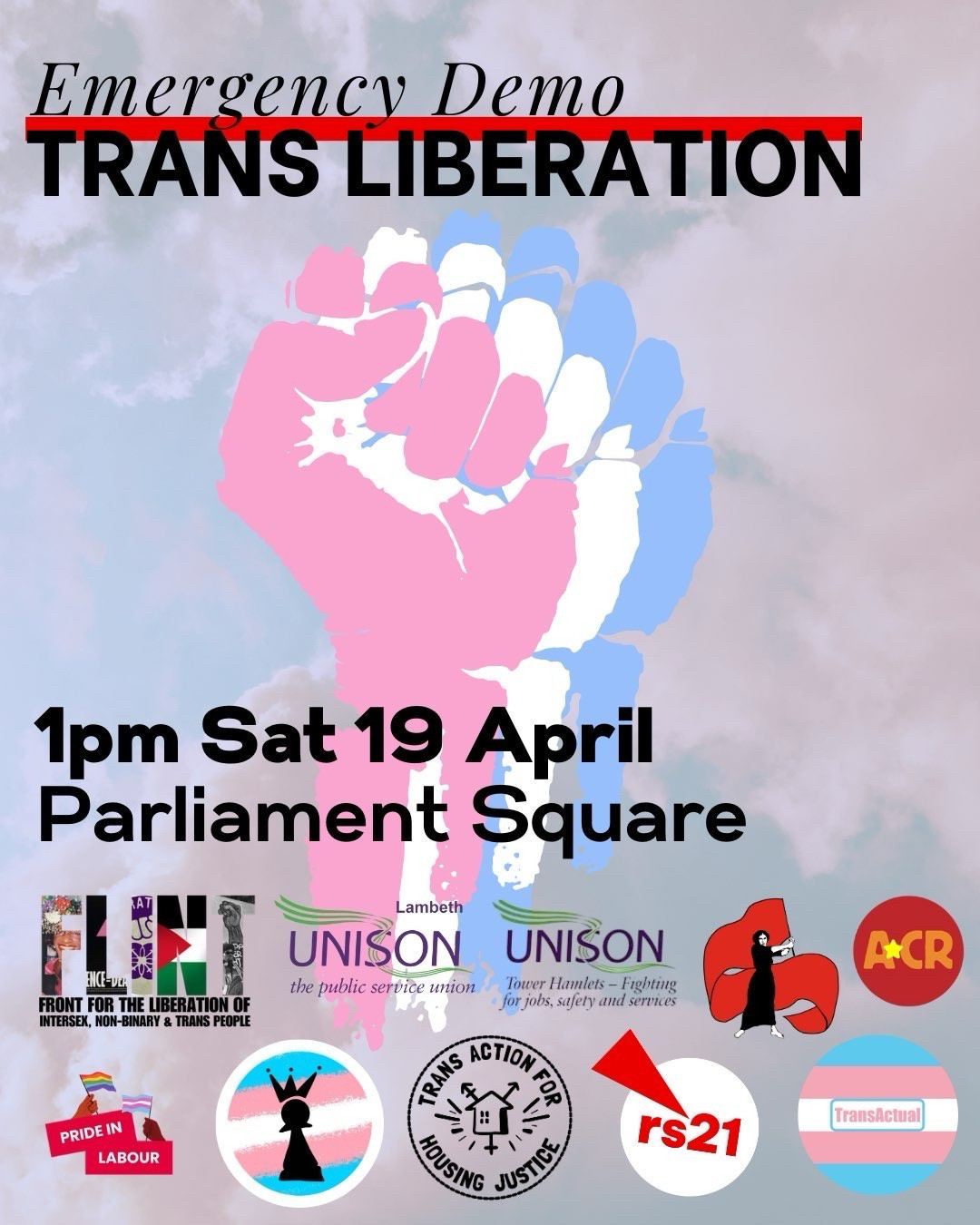
The demonstration started in Parliament Square but soon overspilled it as there wasn't room for the growing crowd.

It finished with speeches in a crowded St James Park (the first time I've been in a demo in this Royal Park).

Along the way there was a river of creative signs and chants, plus a little mobile sound system pumping out gabber and drum & bass. Anyone who thinks that the Supreme Court represents any kind of final settlement of this issue can forget it. Things are just getting started...

see previously: In defence of Billy Bragg and trans rights


