
Google Cloud has revealed that the cause of the October 20 outage in its europe-west-2-b availability zone was a 'misconfiguration' of its systems that meant its emergency generators didn't start.
The outage at the London facility caused service interruptions at outfits including Lloyds, HSBC, Royal Mail, and Revolut.
In a November 4 update to its service status page, Google explained what went wrong.
"The site relies on a 2N utility power architecture — where the facility has complete duplicate power paths for every critical load — backed by a central high-voltage generator bank managed by a dual-redundant Programmable Logic Controller (PLC)," Google revealed.
The facility gets its juice from two independent utility feeders, which Google calls "A" and "B". There's also a "standby utility connection configured for manual campus-wide transfer during maintenance operations or emergency events."
Google says the root cause of the incident was failure in an external underground cable through which its power supplier brings 'leccy to its bit barns.
That cable connects to primary feeder A and it broke at a time when feeder B wasn't working.
"Circuit breaker feeder B was physically opened to allow for corrective repairs following issues identified during a quarterly generator load test on 14 Oct 2026," Google admitted. "Consequently, primary utility feed A was supporting the total critical load while the feed B breaker remained in an open position to allow repairs to be conducted on the B feeder pathway."
That shouldn't be a problem for a top-tier operator like Google, which knows it needs to install backup sources of electricity like uninterruptible power supplies (UPS) and on-site generators.
Indeed, europe-west-2-b employs UPSes that Google says can keep things up and running for five minutes if the availability zone loses its connection to the grid.
The UPSes worked, but a "voltage-sensing design flaw and PLC misconfiguration prevented the facility's generator plant from receiving an automatic start signal to assume the critical load."
Google's UPSes therefore ran out of juice, but its generators didn't start. The rest is history.
The search giant has figured out that its PLCs weren't set up to handle the conditions it faced on this fateful day.
"PLC logic indicated that a healthy utility source was available, even though the primary and secondary distribution feeds were de-energized, and did not issue a start command to the generator plant," the status update reveals.
Once Google was able to reconnect to its power utility, it reprogrammed the PLC so it wouldn't make the same mistake again.
The Big G has since made many changes to the electrical setup at europe-west-2-b and says it's tested them and that they all work.
It's also given itself two action items, one of which it describes as a "Communications Enhancement" that will see it "bolster notification speed by developing an automated alert-to-communication mechanism for location-impacting incidents."
The other is to "expand platform-wide testing outcomes for infrastructure-level events."
Once Google gets that done, perhaps it will be able to handle outages better - and if not, at least advise customers about its troubles more quickly. ®
VMware appears to have made a concession to European regulators by extending the life of its low-end vSphere Standard and Enterprise Plus products.
The virtualization pioneer quietly announced the extension in the November 4 blog post in which it announced a new low-end product called vSphere Express, which The Register reported yesterday.
We based our report about vSphere Express on an interview, and on material provided by VMware - which sent a version of the blog post linked to above.
The version we saw did not include the following paragraph, the contents of which were not mentioned in our interview:
"Furthermore, for customers in countries in the European Economic Area, vSphere Standard version 8 and vSphere Enterprise Plus version 8 will remain available for sale until October 31, 2027, and will have Extended Support included in any active subscriptions to those offerings until the earlier of the applicable subscription end date or October 31, 2028."
The latter date is more than a year past the October 11, 2027, end-of-general-support date for the more capable vSphere 8 and Cloud Foundation 5.x products.
"This has the potential to be a positive development for organisations within the European Economic Area," independent analyst Michael Warrilow told The Register. "It could provide them up to an extra 12 months to transition vSphere 8 to VCF 9 and/or migrate workloads to another platform."
Warrilow thinks European users should seek "absolute clarity" from VMware about the specifics of its offer.
"What level of extended support will be provided and what longer-term commitments will need to be made? I cannot find any of that detail," he wrote.
A reminder: VMware has promised in the past to make patches available for users who choose to persist with perpetual licenses instead of moving to its preferred subscriptions. The Broadcom business unit later paused patch downloads for months, claiming it needed to adjust its website to make them possible.
Warrilow wonders why VMware will keep selling vSphere Standard only in Europe and suggested "regulatory muscle" is the reason.
Regulators around the world cleared Broadcom's acquisition of VMware. In Europe, authorities have since revisited the matter.
Lobby group Cloud Infrastructure Services Providers in Europe (CISPE) has succeeded in having the European Commission open an antitrust investigation into whether VMware's channel changes inappropriately shaped the cloud infrastructure provider market. The Register understands CISPE feels regulators are receptive to its arguments.
In the Netherlands, local courts enforced a VMware support contract of the sort that Broadcom has tried to walk away from at other users.
Warrilow wonders if VMware might now change its policy regarding vSphere Standard in other countries.
"The subsequent question is how can organisations in other regions get the same concessions from Broadcom? I would encourage them to amplify their voice by rallying industry associations and user groups to the cause whilst lobbying the regulators in their jurisdiction."
Overall, however, he thinks VMware's decision isn't enormously impactful.
"Ultimately, all it does is buy a little more time to upgrade or migrate," he wrote.
It may not even do that, as The Register often heard that VMware seldom issued quotes for vSphere Standard or Enterprise Plus.
Paul Turner, chief product officer for VMware's Cloud Foundation Division, told The Register that inappropriate incentives for channel partners caused that situation, and that VMware later fixed it.
Continental users will be hoping VMware got that effort right. ®
When The Register writes about professional certifications offered by vendors, we often receive comments arguing that such credentials are nowhere near as valuable as real-world experience. Now, Microsoft has acknowledged there's some merit in that argument.
Redmond revealed its stance last week in a post from general manager for content and insights Cameron Percy, who observed: "For years, people have asked for a simpler way to prove the skills they use in the flow of work, without stepping away to prepare for another test."
Microsoft's response is the "Pro Badge," a new form of credential that Percy wrote "works alongside Microsoft Certifications."
"Certifications show that you can solve problems in a role or field. Pro Badge shows how you use a specific product in your everyday work. Together, they give a more complete picture of what you can do."
"Instead of capturing skills on a single test day, this approach keeps pace with your work and the products you use," Percy added. "It gives you a current, verified signal of what you can do, at no cost and without a separate exam or study guide."
The first Pro Badge is for GitHub Copilot. To earn it, users need only visit learn.github.com and sign in with their GitHub account.
Going through those steps fires up a "proficiency engine" that Microsoft says "gets to work analyzing relevant product usage signals and evaluating them against a defined proficiency framework." Percy's post says it "systematically uses evidence from everyday product use to calculate and automatically update your proficiency level."
Microsoft offers five levels of proficiency: beginner, intermediate, proficient, advanced, and expert. To earn a Pro Badge, users must reach the proficient level.
A beginner has had "first contact" with GitHub and "understands what Copilot is, where it can be used, and how it might fit into everyday development workflows."
An intermediate user is "familiar with web-based collaboration features, core IDE features, model management, agent configuration, customization options, and techniques for managing context."
To score the Pro Badge, users will need to demonstrate "practical ability to work on projects" and use GitHub "across typical scenarios, demonstrated through consistent hands-on usage across multiple repositories and extended periods."
"A Proficient user can use many web and IDE features, select appropriate models, and apply customizations to tailor Copilot for specific project needs. They have experimented with extended features and are aware of extensibility/integration options."
At the time of writing, Redmond hasn't defined expert or advanced proficiency. It has published more criteria for the first three levels here.
Microsoft has kindly integrated GitHub's learning site with LinkedIn, which it owns, so users can add Pro Badges to their profiles.
Percy's post suggests Microsoft has other Pro Badges in the works.
Elsewhere, Microsoft makes it plain that Pro Badges won't replace its other credentials.
"GitHub Verified Proficiency is part of Microsoft Pro Badge, a new credential type designed to recognize skills as they are applied in the flow of work," explains a page offering detail of the new cred. "It does not replace certifications or Microsoft Applied Skills. It adds a third signal: how skills show up through everyday product use."
The Register welcomes comment on this new approach to professional credentials. ®
The impact of the midterm election result is going to be felt for years, to be sure. But some of the effects will be far more swift than that, likely kicking off right after the new Congress is sworn in. We're mere hours removed from the election, with some votes still being tallied, but already some in the media are handicapping who in the administration will remain in their positions and who will not, either because an angry Trump searching for a scapegoat fires them, or through impeachment efforts. Many people think that a third Trump impeachment will be the focus. I don't. And I hope that's not the route the Democrats go, though not every Techdirt writer agrees with me. I guess I'm just not all that excited to watch J.D. Vance walk into a room while Hail to the Chief plays behind him, even temporarily.
I much prefer the government go after the many valid targets for impeachment that currently sit in Trump's cabinet. And, given that both Trump and Vance are currently blaming the Iran not-a-war for the GOP loss, Pete Hegseth seems like a likely candidate to be the first to go.
Pentagon chief Pete Hegseth faces impeachment accusations when Congress returns after the midterm elections and others, including President Donald Trump, could be investigated for alleged misconduct as Democrats return to power.
There are all kinds of reasons to impeach Hegseth. His injection of Christian nationalism into the DoD is plainly unconstitutional. He's currently running a war with Iran that is without Congressional authorization and has resulted in the cavalier bombing of such dastardly targets as Iranian schoolgirls. He is almost certainly personally responsible for the murder of human trafficking victims as part of his campaign to lob bombs at boats off the coast of South America because they might be running drugs. In quick order, the military under Hegseth also managed to double-tap strike its victims in these boats to ensure the victims couldn't seek justice.
Thomas Massie already has articles of impeachment for Hegseth written. But Hegseth is also an easy target for Trump to fire, which may happen before any impeachment efforts can really get kicked off. It's not like Trump would lose much in firing Hegseth. He wasn't qualified for the position to begin with.
And neither is the other likely target of impeachment efforts: RFK Jr. The number of justifications for impeaching Kennedy are legion. He's completely failed in his role, preferring to run podcasts and host cooking shows instead of doing his job. Measles, screwworms, pertussis are all on the rise under his failed leadership. The medical community is in full revolt over his vaccine policies. He's hiding data from the public as to the results of his disaster of a tenure at HHS.
Like Hegseth, Kennedy already has impeachment articles filed against him that are ready to go.
Rep. Haley Stevens, D-Michigan, filed impeachment accusations against Health Secretary Robert F. Kennedy Jr. in December. Stevens accused Kennedy of freezing or canceling billions of dollars in research, firing health advisers and spreading conspiracy theories.
"Robert F. Kennedy Jr. has imperiled the health and safety of the American people, eroded public confidence in the nation's public health institutions and stalled decades of scientific and medical progress," Stevens wrote in the resolution.
Kennedy's ouster from HHS is long, long overdue.
None of this should be misconstrued to suggest that Democrats should take a page from Trump's playbook and go on a revenge tour. But dismantling the corrupt, inept regime at the Secretary level makes all the sense in the world. Both Hegseth and Kennedy have been absolute disasters for the country on a variety of levels. Allowing them two more years to continue to harm the country is plainly unacceptable. And, importantly, there are Republicans that would be likely allies to impeachment efforts of both of them.
The project of American restoration has to start now. Tearing down the House of MAGA must begin, brick by brick.
Perhaps then, and only then, we can truly be great again.
Google-owned autonomous cab company Waymo has revealed it will stop allowing Uber users to book its robo-cabs, hours before the OG rideshare giant made a case for all autonomous vehicle fleet operators to use its platform instead of creating their own.
This slow-motion fender bender played out across Wednesday, starting with Waymo Co-CEO Tekedra Mawakana telling Bloomberg that her company would end a partnership that saw it work exclusively with Uber in Austin and Atlanta.
Mawakana said Waymo wasn't happy about the fact that when users of Uber's app requested a ride in one of its robo-cabs, they weren't guaranteed to get one.
News of that break-up came on the same day that Uber announced its quarterly results. As is common on such occasions, the company published remarks [PDF] its execs intend to make during an earnings call.
CEO Dara Khosrowshahi used those remarks to promote the idea that Uber is the natural home for robotaxi fleet operators, because it already delivers around 30 percent higher trips per vehicle per day compared to apps run by autonomous cab companies. He said that higher utilization rate, plus use of shared charging and maintenance infrastructure, can deliver "higher fleet profitability even after paying Uber's marketplace fee."
"As autonomous technology becomes more widely available, we believe this ability to commercialize vehicles profitably will become an increasingly important source of competitive advantage and value capture."
The two events are deliciously ironic, because Uber is arguing the scale of its platform makes it the ideal host for third-party players - just as Google does with its search, app store, and YouTube services. Left unsaid is that the two companies hold concerningly dominant positions in their respective markets.
Khosrowshahi also outlined more ways Uber intends to strengthen its position, including by putting around 2,000 robo-cabs on the road in 2027, before "a much larger commercial ramp beginning in 2028." That plan means Uber will run some cars itself and rely on third-party robo-cab operators who allow bookings on its app.
"Importantly, building a broad ecosystem does not mean spreading our resources evenly," the CEO explained. "We intend to maintain an open platform while concentrating capital, integration resources, and hands-on deployment support behind a smaller group of partners with the clearest paths to commercial scale and attractive economics at maturity."
Or in other words, as Uber uses more robo-cabs, it will try to maximize profits.
Uber users booked $59.8 billion worth of services in its third quarter, up 20 percent year-over-year. The company recognized $14.75 billion of that as revenue, a ten percent improvement.
Rideshare accounted for $29.5 billion of bookings and $7.5 billion of revenue. Delivery services brought in $5.5 billion of revenue on $28.5 billion of bookings.
No wonder Khosrowshahi wants more robo-cabs: they'll boost Uber's more lucrative business.
The company might need that boost because Australia's High Court yesterday decided [PDF] that the company must pay AU$81 million ($57 million) in State payroll taxes because the fees paid to rideshare drivers are effectively wages. While the case considered Uber's activities in one of Australia's six States, all of them charge payroll tax. The case is one of many around the world in which courts have found gig workers should be treated as employees for legal and tax purposes. The High Court is Australia's highest judicial authority and like-minded jurisdictions around the world are aware of its decisions, potentially making more trouble for Uber further down the road. ®
Meta has acquired AI coding startup Conductor, signaling interest in applying AI to software engineering tasks.
Charlie Holtz, the startup's co-founder and CEO, made the announcement in a blog post. He also revealed that the company's hosted Conductor Cloud, a sandbox for hosted agents, will go read-only on November 13 and shut down on November 20.
Conductor, the eponymous company's macOS app for running multiple coding agents simultaneously in isolated copies of Git projects, will continue working for the next few months, and the biz expects to provide a way to transfer Conductor Cloud workspaces to local machines.
But in early 2027, Conductor will no longer receive new models or critical bug fixes.
A Meta spokesperson confirmed that the acquisition will strengthen the company's developer-oriented AI capabilities but declined to elaborate further. Perhaps Conductor will play nicely with Muse Code, Meta's recently introduced coding agent.
Having spent heavily on strengthening its AI research lab, Meta has moderated its appetite for big acquisitions since April when China blocked its $2 billion offer for Manus AI, a developer of software agents.
Meta's other acquisitions this year, Moltbook, Assured Robot Intelligence, and Stilla, are also AI-oriented but more modest in scope.
The Conductor deal comes without an announced price, and follows in the footsteps of Meta regaining credibility as a model provider: Llama 4 disappointed but Meta's recent Muse Wonder and Spark models rank respectably among the top LLMs at the moment.
In Meta's most recent conference call for investors [PDF], CEO Mark Zuckerberg said his company aims to provide AI agents that non-technical people can deploy for business tasks.
"What we see is a lot of people are actually using Muse today to help run especially small businesses," he said. "And we think that there's both an opportunity to help create an agent that people use to really enable them to automate and do a lot of the parts of spinning up a small business that are just kind of difficult and time-consuming but aren't the core thing that a person is trying to do."
Meta's AI strategy, as Zuckerberg describes it, is focused on collecting transaction fees from businesses for enabling agentic commerce, selling advanced AI capabilities to developers in the form of model access or tokens, charging for Muse to automate business tasks, and applying AI to personalize and improve results from ads.
It's a good time to run an AI-related startup, as leading model companies seek to add value beyond offering AI models. Models themselves have become commoditized to the point that only a few leading model makers can get away with charging a premium. In an effort to maintain that lead, top model makers have been purchasing innovation (and talent) while they are still flush with investor funds.
On Wednesday, OpenAI said it plans to acquire Pierre Computer Company, maker of distributed storage service Code Storage and open-source developer tools. And a few months earlier, the ChatGPT maker snapped up Ona, which makes cloud development environments for agents.
Anthropic's most recent developer tools deal involved Stainless back in May. Its purchase of Opaque Systems, which offers confidential computing technology, could also be squeezed into the developer tool category.
At some point, when it becomes clearer what kinds of AI services people will pay for, startup acquisitions may become more focused. But for the moment, with software development being the most successful use of AI, makers of AI-oriented developer tooling have a shot at a glorious exit. ®
The size of the Democrats' victory Tuesday night shattered records and even the most optimistic expectations, handing the party a governing mandate with a clear demand for change.
But what do voters want that change to look like? This week on The Intercept Briefing, politics reporter Jessica Washington and managing editor Maia Hibbett break down Tuesday night's election and hear from voters in Maine, Michigan, and Texas about what drove them to the polls in the midterms that saw a so-called "blue tsunami."
"The rich get richer, the poor get poorer," said one voter in Maine. In Michigan, a voter told The Intercept that politics "feels like a game that the rich play sometimes." A Texas voter expressed anger that President Donald Trump was "spending taxpayer money to renovate the White House and turn it into this gold sanctuary."
Frustration with wealth inequality and money in politics came up again and again in The Intercept's conversations with voters. So did a desire for more social welfare spending, Medicare for All, freedom for Palestinians — and responses to transphobic and Islamophobic fearmongering on the campaign trail.
"When Democrats win so far across the board, you can make an argument that any faction of the Democratic Party has the mandate," said Hibbett, "because Democrats of all stripes won Tuesday night."
In any case, the results indicated a clear disapproval of the way the Trump administration is governing and the use of fearmongering as a tactic of distraction.
"One lesson maybe for Democrats is there's no point in attempting to placate people when it comes to bigotry," said Washington. "The thing that'll motivate voters is if you can convince them that you're going to make their lives better, not if you can convince them that you're playing the middle on an issue of civil rights."
For more, listen to the full conversation of The Intercept Briefing on Apple Podcasts, Spotify, YouTube, or wherever you listen to podcasts.
TranscriptBruce Bryan: We're just hoping that people step up and tell Washington to go fuck itself.
Jessica Washington: Welcome to the Intercept Briefing. I'm Jessica Washington, politics reporter at The Intercept.
Maia Hibbett: And I'm Maia Hibbett, managing editor here.
JW: Over the past few days, Intercept reporters hit the ground in key states to speak to voters about the issues driving them to the polls. We went to Texas.
Jermiah Robinson: The food prices, for one, and the gas prices.
Darryl Moore: Gotta work two jobs just to make it.
Tiffany Williams: I never really understood, like, how important it is for the minority to vote.
Lenna Tasby: This election is important because this election is going to make or break whether we have a vote or not. There's a reason why they're shutting down these polling places.
Intercept reporter Akela Lacy: What are the issues that motivated you this cycle?
Charles Senter: Well, I love Trump.
Helen Dexter: Red ticket all the way. The stop of the Muslim influx.
Lenna Tasby: If you're spending taxpayer money to renovate the White House and turn it into this gold sanctuary, that's money that can be used for our military veterans. That's money that can be used to help with this homeless population. The government needs to be held accountable.
MH: We heard from voters in Michigan.
Erin Horne: The election this year is very critical because Trump's got two more years.
Zouheir Alawieh: Our democracy is in danger.
Noora Iskander: I believe in Medicare for All. People have a right to self-determination, especially in Palestine.
Wendy: There's a lot of concern about, of course, the economy, but the data centers, our children's education.
JW: And we spoke to voters in Maine.
Intercept reporter Noah Hurowitz: What mattered to you as a voter this election?
Tyler Echard: Cost for the most part. Everything keeps going up.
Bryan Golay: The rich get richer, the poor get poorer. At least 30 years ago, there was like a veneer of caring, and now there's just blatant corruption and greed.
JW: So Maia, what a night.
MH: Yeah, it's honestly embarrassing if you're a Democrat and you did not win. They swept the House and the Senate by just about the biggest margins that the pollsters could have predicted. So luckily, the audience I'm concerned about, the pollsters, can rest easy. As of 11:00 a.m. [ET] on Wednesday morning, they had 228 seats in the House, Democrats did. They only needed 218 for a majority, so obviously that is more, and they're expected to pick up some more seats as some more races get called. They had 54 seats in the Senate, which means that they have a big enough margin that they can't be stopped from legislating by one lone senator, if one senator wanted to gum things up.
JW: And not at all surprising. The White House tried to spin Republican losses on Trump not being on the ballot and the quality of candidates, despite the fact that Trump repeatedly said at rallies across the country, "Pretend I'm on the ballot."
Donald Trump: We're going to ask you to pretend I'm on the ballot, because when I'm on the ballot, this has nothing to do with ego, I just get 49.2 percent more vote. And if we get even a good percentage of that, we'll have the biggest victory that you've ever seen.
MH: He's saying, "We'll have the biggest victory ever" — and it was a very historic night. I think people will hear the word "historic" a lot in the coverage in the coming days because of this huge blue wave, not the kind of history Trump wanted, but also because there are some really surprising major firsts.
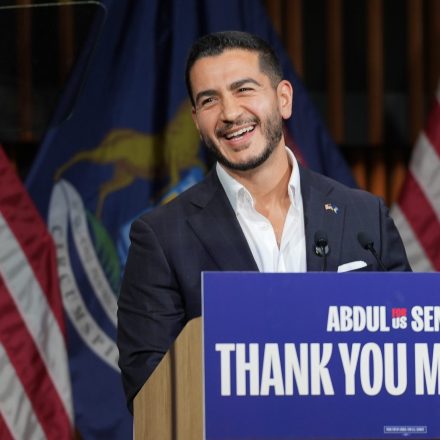
One of them was that last night, very early, like at 2:30 a.m. [ET], Abdul El-Sayed became the winner of the Senate race in Michigan, which means he will be the first ever Muslim U.S. senator.
 Related
Abdul El-Sayed Wins Senate Seat With Pro-Palestine Campaign
Abdul El-Sayed (acceptance speech): To all the kids who watched this last month, to all the parents who struggled to explain why the president openly mocked someone for their name or how they pray, let them know tomorrow that the bad guys lost.
JW: That race was filled with Islamophobia, both in the primary and in the general election. His Republican opponent, Mike Rogers, just peddled in a million different Islamophobic tropes. Voters told our colleague, Matt Sledge, who was out in Michigan speaking with them, that they really didn't like hearing all of this hate speech.
Zouheir Alawieh: They don't have any programs for our economy, for our health, for our future. So that's why they are attacking us as Muslims and as human beings.
Tea Edwards: Just, like, all of the Islamophobic hate campaigns that have been going around will probably sway a few people. The people who are actually researching what will be good for communities I think will see right through it.
MH: This was a campaign that was defined by so much panic about El-Sayed being Muslim. The race ended 25 years after 9/11, and there were all of these really kind of vitriolic Islamophobic tropes. It reminded me a lot of the campaign against [Mayor] Zohran Mamdani here in New York last year. There's all this fear of the left and this fearmongering suggesting that there's no way a Muslim candidate could represent American interests.
And of course, one of the big differences between El-Sayed and Mamdani is that El-Sayed is not a socialist.
JW: Say that again for the people in the back, because they are not going to believe you. El-Sayed has described himself as a capitalist who understands how capitalism works, so definitely not a socialist.
I've heard him described as much more of a [Sen. Elizabeth] Warren than someone in the Bernie Sanders mold.
MH: But he still faced millions of dollars in outside spending in this race, mostly because of his stance on the United States relationship to one other country.
We've heard in some of these deep-blue districts in the House races where socialists were elevated in the primaries, there was a lot of rhetoric on opposing Israel's genocide in Gaza and fighting U.S. weapons flows to Israel. But it's pretty rare to hear that from a U.S. Senate candidate, and now from a senator-elect.
JW: It also caused some really ugly drama with his former primary opponent, Haley Stevens.
MH: Do you want to try to recap that as fast as we can, or should I?
JW: I'll get started and see if you can add in anything that I miss.
 Related
Radical Centrists Like Haley Stevens Are the Real Extremists in the Democratic Party
So essentially, on the Friday right before [Election Day], Haley Stevens released a statement condemning an ad that was not even created by the El-Sayed campaign, calling on him to condemn the ad, which he did disavow. She also asked him to take back his statements on Israel.
Now, things seemed fine for a second. Haley Stevens had all of these Democratic surrogates going on air saying that she promised to support him. While Haley Stevens's staffers were at an event for El-Sayed, Haley Stevens popped up at an event supporting the Republican candidate, Mike Rogers, giving him her endorsement.
Maia, is there anything that I missed in that?
MH: Jessie, I think the only thing you missed was just how baffling and strange this episode was. So you mentioned this ad that kicked it off. It was produced by this outside group Rebellion PAC, which is the group headed by Cenk Uygur, who some listeners might know from The Young Turks. He is also famously Hasan Piker's uncle.
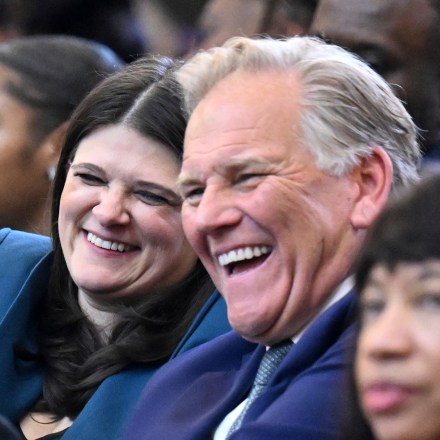
Haley Stevens, as she was struggling to explain why she switched from El-Sayed to the Rogers camp, kept citing Hasan Piker and the "uncle." It was this kind of almost incomprehensible move where Anderson Cooper, the CNN host, was pressing her at one point, saying, well, you cite his affiliation with Hasan Piker and this part of the Democratic Party you don't like, but you knew about this before — so what changed?
It really seemed strange. So we sent Matt Sledge out in Michigan to ask some voters what they thought of it, and if they thought that this was a politically savvy move that would have any resonance. And here's what they said.
Kathleen Britton: I'm so disappointed in Haley Stevens. I gave her serious consideration during the primary.
 Related
Haley Stevens Destroyed Her Political Career for Absolutely Nothing
Jesse Craft: She fought against Mike Rogers, then said somehow he earned her vote. I don't really understand it. I kinda think it's career-ending for her.
Wendy: How embarrassing to use an African American church. How embarrassing for you to use our votes and then disregard them because of your own personal issues.
Intercept reporter Matt Sledge: So you don't think it's gonna help Mike Rogers?
Kathleen Britton: I do not.
Erin Horne: No, I think she actually helped Abdul.
[Break]
JW: Maia, before the break, you started talking about money and politics, and I want to get into how that shaped the midterms. Last week, we talked about how this election cycle became the most expensive on record. Midterms ad spending is expected to reach north of $11.6 billion. Mega-donors overwhelmingly gave to Republican candidates, including Elon Musk, who spent nearly $450 million, with large sums of that directed at boosting Ken Paxton in Texas, who, by the way, lost to James Talarico. Now, for context, the next highest donors under Musk are a Republican couple [Richard and
Elizabeth Uihlein] who spent $150 million, mostly in Wisconsin and Illinois.
Jesse Craft: We all see where money is coming from. It's coming from very, very wealthy billionaires. I don't think we should be able to buy elections.
Tea Edwards: Politics, it just feels like a game that the rich play sometimes. Kind of feels hopeless when you're just looking at all of these people and corporations giving money to each other.
MH: You hate to see Elon Musk throw away almost half a billion dollars. It only leaves him so many billions to go.
JW: Heartbreaking.
MH: But, I mean, in Texas, as you mentioned, that money really did not pan out. It didn't seem to sway voters. It seemed like if anything from the voters who talked to our reporters in Texas, in Michigan, and in Maine, which we'll get to later, people were really mad about outside election spending and don't like the idea that billionaires or corporations can buy their elections.
 Related
Anti-Trans Panic Couldn't Save Republicans in Deep-Red Texas
And in Texas, a lot of that money went to propping up this anti-trans panic campaign that Paxton was running. But all that money was not enough to save Paxton from James Talarico. Paxton was a pretty bad candidate: He was mired in too many scandals to keep track of, including a 2015 grand jury indictment on felony securities fraud charges.
In 2020, eight of his top deputies reported to the FBI that he was potentially abusing his office to do favors for a donor and friend. And just earlier this year, he offered a plea deal in a child sex abuse case that seemed to anger Texans and voters.
Remember, this is the era of the Epstein files and people being very concerned about child sex abuse. It did not seem like the wisest calculation for Paxton to offer this while running for Senate.
JW: As it turns out, there is not enough money in the world to buy Ken Paxton out of being Ken Paxton and voters recognizing that. But Republicans tried this cycle to spend big on transphobia and to blanket the airwaves with these anti-trans advertisements.
Elon Musk's Texas PAC spent $78 million on anti-transgender ads in Texas, which actually accounted for nearly half of all ad spending in support of Paxton. Republicans' big play in Texas was transphobia — and that play failed.
While clearly it didn't sway the election, some of those messages did appear to trickle down to voters. Our colleague, Akela Lacy, talked to voters in Dallas and the surrounding areas, and she did come across some voters who said they wanted to support Talarico or even some voters who did support Talarico but were concerned about his stance on trans rights, an issue that Republicans really fearmongered on this cycle yet again after doing it in 2024.
Akela Lacy: When you said you saw some stuff about James Talarico that made you unsure about voting for him, can you say more about that? What did you see, and what's your impression of him?
Jermiah Robinson: I think I seen something about the LGBTQ+ community? I mean, I don't really care about it, but I don't know. People were saying a lot of bad stuff. I think they said something about him —
Canvasser: Encouraging sex change.
Jermiah Robinson: Yeah, on the children. I don't really stand for that.
Maia Hibbett: The watchdog group Media Matters also put together a montage that showed just how much Republicans really leaned into this transphobic rhetoric.
Danielle Buck: He wants to trans our kids. He believes that there are six genders.
Andrew Kolvet: They wanna indoctrinate your kids. They wanna trans your kids.
Adam Sosnick: They're gonna trans your kids. They're gonna Talarico your kids.
Donald Trump Jr.: Trans kids back in school, trans agendas back in school, in your classrooms, with your children.
JW: Clearly, some of that rhetoric did trickle down to voters based on Akela's conversations, and some people even believed the misinformation being spread in those ads.
But fearmongering was just clearly not persuasive enough to distract people from their lived reality, and that lived reality is that gas prices are up, rent is unaffordable, and grocery prices are up.
 Related
Right-Wing Trans Hate Comes for the WNBA
I think one lesson maybe for Democrats is, there's no point in attempting to placate people when it comes to bigotry. The right can and will distort your messages, and so you can stand in your values or not, but the thing that'll motivate voters is if you can convince them that you're going to make their lives better, not if you can convince them that you're playing the middle on an issue of civil rights.
MH: We saw a parallel to this in some ways in Michigan as well, where a lot of the Republican argument was based on this perception of Islamophobia and fearmongering. Ultimately, that was not enough to elevate Mike Rogers over Abdul El-Sayed. In Texas, there's also, of course, the strong anti-immigrant sentiment that Republicans frequently run on, and I think the statewide results showed us that that narrative really fell apart this cycle.
JW: To your point, clearly, attacks on trans people, attacks on immigrants didn't work in Texas. Democrats had an amazing night. Gina Hinojosa toppled three-term incumbent Gov. Greg Abbott. The state has not had a Democratic governor since 1990.
"Attacks on trans people, attacks on immigrants didn't work in Texas."
MH: And speaking of toppling long-term incumbents that have been hard to get out of office, our colleague Noah Hurowitz was in Maine, where Troy Jackson defeated Susan Collins last night after many Democratic attempts to get her out of office.
This issue of disillusionment with money and politics came up quite a bit when he was talking to Maine voters.
Sharon McDonnell: It's immoral. It is immoral to have people worried about their fuel and have that much money coming into this. It's just wrong.
"The amount of money is more than I will probably make in my lifetime, spent in this election."
Tyler Echard: The amount they spent on just mailers, not handed at the door but in the mail, is especially, it seems, on the Republican side of things, has been absolutely insane. The amount of money is more than I will probably make in my lifetime, spent in this election.
Charlie Dingman: It's been extraordinary in Maine, the amount of spending in this race, particularly in the Senate race. I think there's a lot of fatigue. I think people are tired of it. I have had some conversations with voters at the doors that lead me to think that the extremely negative and extremely untruthful ads may be backfiring.
JW: It seems like those ads backfired. The last voice you heard was Charlie Dingman, Maine Democratic Party chair.
Collins campaigned on her record of securing federal investments for state infrastructure, such as rural hospitals, and she really prided herself on being a moderate Republican who apparently breaks rank with President Donald Trump. But the reality of the situation is quite different.
 Related
Lockheed Martin Showered Susan Collins With Cash as F-35 Program Hit Turbulence
The Congressional Quarterly Roll Call found that her votes aligned with Trump 90 percent of the time in both of the president's first and second terms, and voters really noticed that. They understood the difference between what she said she was, a political moderate, and her voting record, which aligned with the really far-right Donald Trump. And that's something that Noah heard from voters as well.
Sharon McDonnell: She has had this persona of moderate cross-party stuff that's just really eroded. If you read every article about her, it's like, "Moderate Susan Collins." Like, wait a minute, she's voted with Trump. She hasn't used her power.
Susan Collins "has had this persona of moderate cross-party stuff that's just really eroded."
MH: Collins really used that line about her being a moderate and being an independent voice in Washington as a go-to for her campaign.
In past cycles, it has worked. As we alluded to a little bit earlier, the Democrats have mounted challenges against her before. In 2020, they ran a candidate named Sara Gideon, who looked somewhat likely to oust Collins. And I think this cycle, there were a lot of reasons for Democrats to be nervous about this race.
Troy Jackson, the nominee, is a former state senator, and he ran on lowering costs, really centering working-class interests. But he had jumped into the race kind of hastily. If you remember Graham Platner, Jessie, he was the former nominee for Senate in Maine for the Democratic Party, and he was really considered a rising star, but had to drop out because of a series of scandals, and Jackson had to jump in last minute and fill his place.
But ultimately, Jackson pulled it off.
Troy Jackson (acceptance speech): We did it. Working people did it.
JW: Clearly, Jackson had a disadvantage going into this race. There were people who complained and said that he wasn't as charming as Platner, he wasn't as polished. But in this election, the ideas and running on affordability seems to have won the day in Maine and really throughout the country.
Collins had a reputation of delivering for the state, but clearly that wasn't enough to overcome this blue wave across the country and some frustrations with Collins as well.
But Maia, taking a step back to look at the full scope of Democratic wins, what do you make of their gains on Tuesday? Are there other races that stood out to you? What stood out to you overall?
MH: Well, there's the spin about the spin, which is that everybody is going to be framing this election and these results in their own interests. When Democrats win so far across the board, you can make an argument that any faction of the Democratic Party has the mandate, because Democrats of all stripes won Tuesday night.
 Related
The Progressive Agenda: End Iran War, Rein in AI, Get Dems to Actually Do Something
But to my view, it's hard to see how this is a world where there isn't a clear demand for some kind of transformational change. So I'm wondering what Democrats do with their mandate now, especially as we think ahead to 2028.
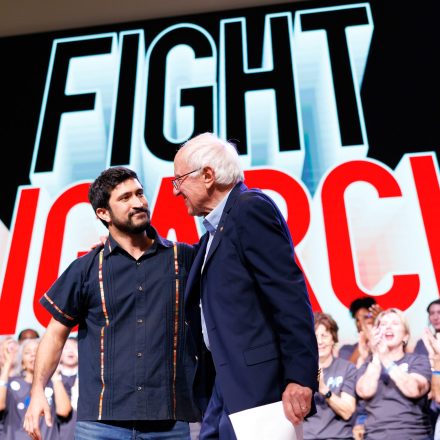
If you recall 2020 and the last time the U.S. elected a Democratic president, you might remember that the Biden campaign was the sort of centrist, moderate return to normalcy choice, but they got there after a lot of left momentum in the primary and a really serious showing of support for Bernie Sanders, who remains one of the most popular politicians in the country.
Once Biden got into office, he arguably tried to give some of that kind of left, dare we say, populist economic message some service. There was the Build Back Better plan that had a lot of social safety net spending and Covid relief. There were climate infrastructure projects. There was the elevation of Lina Khan [to Federal Trade Commission chair].
For a little while, Biden was getting called the most progressive president since FDR, and then he threw it all away supporting the genocide in Gaza and really lost the support of the left, and then lost the support of the country when he was kind of visibly melting on the debate stage and refusing to drop out of the race.
So I'm curious what Democrats have learned from the Biden years and how that will convert into the next congressional term and the next presidential election.
JW: It really feels like I've lived a million lives in between now and that debate that really tanked Joe Biden's entire political career at the end there.
I will say to your point, we're already seeing Hakeem Jeffries, who's likely to be the House Speaker, calling for unity and saying that people don't want to fight. But you don't really get a blue wave like this or a political wave like this when people don't want to fight.
Clearly, there's anger at Republicans. There's anger at the cost of living. There's anger at the war. If Democrats don't deliver, they're likely to see a red wave come the next cycle.
 Related
The Supreme Court Ends Multiracial Democracy as We Know It
But I did want to take just a little bit of a step back and talk about Black voters and what's happened in the aftermath of the Supreme Court voting rights decision. Black voters in this election really delivered historic victories in southern states for Democrats, but Black representation in Congress thus far appears to have been slightly reduced in this election. Now, for those who remember our discussion earlier this year about the Supreme Court decision to gut the Voting Rights Act, there were a lot of deep concerns that the decision would crater Black political representation, and so far that hasn't come to bear, but it's worth paying attention to in cycles that are less blue, where we've seen really massive redistricting.
I will shout out, there was one historic victory for Black Americans: Keisha Lance Bottoms, the former Atlanta mayor, won her race for governor, becoming the first Black female governor in the country.
MH: We've talked a lot about these historic wins, but we would be remiss to not mention a close call in Florida, where Angie Nixon narrowly lost.
Nixon is a Black woman who's a member of the Democratic Socialists of America and had a really shocking primary upset when she defeated the establishment favorite to get the Democratic nomination. The Democrats didn't invest very much in her Senate race in Florida. The conventional wisdom says Florida's not flippable, but conventional wisdom also says that South Carolina's not flippable — and they did that.
"The conventional wisdom says Florida's not flippable, but conventional wisdom also says that South Carolina's not flippable — and they did that."
Nixon ended up coming within about 2 [percentage] points to Ashley Moody, the Republican incumbent, who just won a full term after being appointed to hold the seat that used to belong to [Secretary of State] Marco Rubio. A lot of people on the left side of the Democratic Party are wondering what would have happened if Democrats had invested in a DSA candidate running statewide in Florida, which is kind of a crazy statement to make if you think of just two years ago.
JW: I mean, I listened to her [concession] speech, she is an incredible speaker, but obviously, that's not enough to win elections. You need money, clearly, and investment from the party.
We're going to leave it there, but there is so much more election coverage you can follow at theintercept.com.
That does it for this episode.
We want to hear from you. Tell us what you're following or want to see more coverage of. Email us at podcasts@theintercept.com, or leave us a voice mail at 530-POD-CAST, that's 530-763-2278.
This episode was produced by Laura Flynn. Chelsey B. Coombs is our social media producer. Ben Muessig is our editor-in-chief. Maia Hibbett is our managing editor. Thank you to all of our reporters who worked late on election night: Matt Sledge, Akela Lacy, Noah Hurowitz, Jonah Valdez, and Austin Campbell, and the rest of our team.
Nara Shin is our copy editor. William Stanton mixed our show. Legal review by David Bralow.
Slip Stream provided our theme music.
This show and our reporting at The Intercept do not exist without you. Your donation, no matter the amount, makes a real difference. Keep our investigations free and fearless at theintercept.com/join.
And if you haven't already, please subscribe to The Intercept Briefing wherever you listen to podcasts. Do leave us a rating or a review; it helps other listeners find our reporting.
Until next time, I'm Jessica Washington.
MH: And I'm Maia Hibbett.
The post How Democrats Changed Everything appeared first on The Intercept.
AI has become a juggernaut, driving technical strategy in the tech sector and outside of it. With the worldwide server market growing 30 percent in a single year to hit $122.6bn in the first quarter of 2025, IDC now feels safe recategorizing AI-driven investment "from cyclical to durable".
The analyst company expects inference to account for over 70 percent of computing demand by next year, adding that it's growing fastest at the edge.
Why enterprises are building their ownAll this investment in AI infrastructure might once have come mainly for hyperscalers, but that's changing quickly. Adoption is spreading quickly beyond public cloud service providers into enterprise environments, IDC adds. They're eager to run agentic AI in-house.
There are plenty of reasons for companies to own their own AI infrastructure rather than offloading it to the cloud. One of these is data control, especially in regulated sectors such as finance, healthcare, manufacturing, and the public sector that have sovereign data requirements. Another revolves around the need for predictable costing from tokens delivered on tunable in-house systems.
So what should companies look for in a supplier? Delivery speed will be a powerful driver for many who are under the gun to deliver AI initiatives for the business, especially during periods of constrained memory and CPU supply. Life cycle services will also come near the top of the list, for companies that need help managing everything from the power through to the reasoning LLM models and the workloads that use them. That need for expertise is unlikely to stop; companies will undergo changes in AI strategy as they get to grips with a still-evolving technology.
From the desk to the datacenterASUS expects this AI surge to continue in the datacenter, but elsewhere too, specifically in edge locations (especially industrial use cases) and at developers' desks, as the applications that will power the enterprise get made. It wants to be top of peoples' list for hardware and services at all these places along the AI continuum.
At NVIDIA's GTC show in Berlin on Oct 21-22, it announced a full-stack AI offering that it's calling its Enterprise Agentic AI Solution. It's three-layer affair, featuring:
ASUS AI Server and Infrastructure: Its selection of AI servers, including several new units.
ASUS AI Software Stack: Its software for integrating and controlling AI workflows.
ASUS AI HUB: A services operation that ties it all together.
These bring together some existing assets that ASUS had for enterprise AI users, along with some new ones. The time is right for an end-to-end offering with new hardware because of the way the market is shifting, say ASUS execs.
"ASUS servers help enterprises build high-performance agentic AI infrastructure capable of supporting both complex task execution and large-scale AI agent deployment, accelerating enterprise adoption of agentic AI," says Paul Ju, senior vice president and head of infrastructure solution BG at ASUS.
While generative AI initially spiked demand, the advent of agentic AI has sent compute demand into overdrive. Ju explains that the focus is expanding from the GPU.
"Historically, AI servers have been optimized primarily around GPU compute. But as enterprise AI shifts toward agentic AI, workloads increasingly revolve around a continuous 'agent loop' that is heavily CPU-dependent," he says. That loop takes in task planning, code execution, external tool invocation, and reflection or correction work.
The CPU's increased role in this execution work is creating bottlenecks in conventional AI servers, he adds.
The first such sticking point is single-thread performance, which leaves GPUs idling while they wait for CPUs to complete. The second lies in memory bandwidth. When this is managed on a per-core basis, it can slow things down when many agents run at once.
The multi-die design of many CPUs also penalizes them in AI environments, because accessing data across dies introduces latency, Ju argues. CPUs with cores and cache on different dies suffer latency when data has to cross between them. Maintaining cache coherency exacerbates that problem.
Finally, there's a security risk: a lack of hardware level sandbox isolation on some CPUs make it possible for prompt injection to reach core systems, he warns.
Customers also bring their own challenges as they grapple with different applications for AI. Enterprises evaluating AI server options have to match their server platforms to the projected AI workload profiles, Ju adds. Training a supervised learning model to batch-classify insurance claims takes different technical resources to running a low-latency reasoning employee chatbot.
What ASUS took to BerlinASUS wants to help customers solve problems like these wherever they come up. With this in mind, the company had plenty of goodies for onlookers at GTC.
Starting at the datacenter, the company announced both single and full-rack systems built around the NVIDIA HGX Rubin NVL8 eight-GPU server board. It has a 3U hybrid-cooled system, the XA NR11-E12L, along with the 2U 100 percent liquid-cooled XA NR11-E12, both targeting large AI reasoning workloads.
The two Rubin units target different use cases. The 3U hybrid liquid cooling system uses direct-to-chip liquid cooling on the 8GPU baseboard, along with air-cooled dual Xeon 6 chips on a sled. The company pegs this as the easy transition path into AI factory hardware. The 2U unit, with its 100 percent liquid cooling, is tailored for maximum PUE and compute density. It also uses a cable-free board-to-board design to keep its footprint low.
The kit will be speedy, too, with NVIDIA HGX Rubin offering 800Gbit of integrated bandwidth per GPU.
ASUS is promoting the serviceability of these units through their use of tool list CPU and GPU sleds. It claims up to a 50 percent time saving on maintenance operations for these units, meaning less downtime per service and ultimately a lower total cost of ownership.
Delivered fast for NVIDIA HGX RubinASUS is structuring its hardware proposition around speedy delivery so that customers can get hardware up and running to support their AI initiatives. That speed comes from validation carried out before delivery with the help of a pre-validated rack reference architecture.
NVIDIA MGX Server for flexible buildsIn keeping with its focus on multiple designs for the right AI workload, ASUS also supports NVIDIA's modular MGX Blueprint for server builds. The selling point here is flexibility with a mixture of GPUs, CPUs, and networking options for enterprise inference, agents, and visual computing. This is the modular route for workloads that don't need the power of an 8-GPU HGX baseboard, and it covers a large gamut of enterprise inference and agentic use cases.
ASUS showcased MGX servers including the 6U XA P8A-E14AXL with its eight liquid-cooled NVIDIA RTX PRO 6000 Blackwell Server Edition GPUs. A 2U sibling, the XA P4N-E2, sports NVIDIA Vera processors for agentic work.
Solutions for the edge and developersThe ASUS booth also featured the ExpertCenter Pro ET900N G3, powered by the GB300 Grace Blackwell Superchip developer desktop with 748GB of coherent memory, and the Ascent GX10 based on NVIDIA DGX Spark for agentic work. Also on show were the ProArt GR1X Mini PC and ProArt P16 and P14 laptop - the first laptops powered by NVIDIA RTX Spark - aimed at both developers and creators.
For edge installations, it showed the PE3000N, its rugged NVIDIA Jetson T5000-based edge-AI computer aimed at use cases including industrial environments. Announced a year ago, this delivers up to 2,070 FP4 TFLOPS of peak AI performance with 128GB of memory. Targeted at industrial AI environments was the PE6000G, a workstation-grade AI and simulation platform.
Rehearsing the AI factory in a digital twinEquipment only supports an AI factory when there is power to run it. ASUS has been taking steps with NVIDIA as a partner here, adopting its DSX AI Factory platform with digital twin system for laying out hardware and power in AI factory environments. DSX supports equipment using the NVIDIA Vera Rubin processor line, which supports dry coolers and a lower PUE with a 45 degree centigrade warm water inlet.
ASUS configured racks become simulation-ready assets inside DSX, adopting its OpenUSD shared file format. That covers engineering data alongside the geometry for measuring real power draw and cooling requirements.
ASUS wanted to target cooling as part of the original design plan for the AI Factory, not as a facility afterthought. So, the DSX partnership allows implementation teams to model water temperature, flow, pressure, CDU placement, and piping within the digital twin model. They translate information from the planning resources that go around this, such as the NVIDIA Omniverse DSX Blueprint framework, using the ASUS Infrastructure Deployment Center.
Faster to build, easier to runThe digital twin system isn't just for design and setup. It's supposed to keep working after go-live so that AI factory operators can simulate changes before touching hardware. The ASUS Control Center monitors the infrastructure while DSX exchange links IT and operational technology data. Operators can validate changes in the simulation before flipping the switch to go live.
ASUS' goal here is clear: to assist enterprise customers as they tackle in-house AI opportunities while acknowledging that the performance profile and physical locations of their workloads will vary. As companies continue to evolve their understanding of AI and where it fits within the organization, they will need to be agile in how they plan and nurture their infrastructure from the datacenter out to the edge, and to the developer's desk.
The Berlin announcements tie it together in a neat package for organizations that need help with their agentic aspirations.
Learn More about ASUS NVIDIA HGX Rubin NVL8 Systems: XR R1I12B-M1BLFS | ASUS Servers
Sponsored by ASUS
A last minute attempt to throw the midterm election into chaos failed. Leading up to this point, the signs were never good in the Magic 8 Ball way. The Trump administration wants people to believe California was overrun with non-citizen voters. The facts, however, refuse to comply with the narrative.
This particular ship has been sinking for a couple of weeks now. The DOJ delivered an accusation before it even delivered a list. It claimed — absolutely without facts in evidence — that there were at least 20,000 "illegal" voters in California. And by "illegal," the administration definitely meant "brown people we'd like to expel from the country."
California pushed back. First, it questioned the claim and received no definite answer. Then the administration reluctantly admitted — as it has in other states — that its first allegation may have been overstated. But rather than pull back and reassess, the DOJ went the other way.
I assure you that I am not making this next part up: it delivered a thumb drive containing a list of the 20,000 "illegal voters," along with a password written on a Post-It note… you know, the way aging parents handle login info for their cable TV-provided email accounts.
Then the state sued the DOJ, right after the DOJ demanded California investigate each and every one of these 20,000 allegations within 48 hours of being thumb-drived. Other voters sued the DOJ as well, which set it up for the string of extremely speedy failures it recently experienced.
Things already looked bad for the DOJ when its DHS-aided raids in California resulted in the arrests of 28 "illegal" voters — this in a state that has 23 million registered voters. Not content with this failure, the DOJ then claimed California election officials just weren't doing enough and demanded they do all the heavy lifting while the DOJ pursued its minuscule number of prosecutions.
With the mid-term election just a couple of days away, the courts moved speedily to handle this bullshit. As Chris Geidner reports, the first thing the DOJ did with the clock counting down to "FLIP EVERYTHING" time is shoot itself in the face while attempting to shoot itself in the foot:
A Justice Department lawyer on Monday admitted in court that it was "fair" to say that the Trump administration's list of "likely noncitizen" voters has a high error rate.
The shocking admission from Assistant U.S. Attorney Kenneth Kao came in a hearing in a lawsuit brought last week by unions representing election workers and civil rights organizations over the Trump administration's threatened prosecution of those election workers and other related conduct.
Yep, that's the way the DOJ does business under Trump's control: You fuck up until you're forced to admit you've fucked up. Firings and forced resignations ensue. New sychophantic rubes are pressed into service. Rinse and repeat.
But what's really enjoyable about this is how fast the DOJ (and the administration overseeing it) lost at every single level of the federal court system after making this admission. Geidner has reproduced the entire timeline, which is truly a sight to behold.
At 10:10 pm (ET), the federal court handling the lawsuit denied a request for a stay of its order. This led immediately to the administration running its election interference campaign to the next two levels of the court system, hoping against hope that at least one set of judges would give the DOJ permission to fuck with midterm elections in Calfornia. No dice.
[UPDATE, 4:00 p.m. ET November 3: After a flurry of activity in the U.S. Court of Appeals for the Ninth Circuit since Judge Thompson denied DOJ's motion for a stay of her TRO, a 6-5 limited en banc panel of the appeals court issued an order Tuesday that stays Thompson's TRO pending the Justice Department's appeal of it at the Ninth Circuit.]
[UPDATE, 6:15 p.m. ET November 3: The plaintiffs are seeking full court en banc review at the Ninth Circuit, arguing, "Federalism principles of the highest order, embedded in our Constitution, require correction of this erroneous decision by the full Court."]
Meanwhile, the administration was trying to secure a parallel victory in the highest court in the land, pursuing its appeal of an earlier rejection of the DOJ's lawsuit against California — one that demanded election officials "segregate" any ballots that might be related to the DOJ's admittedly highly erroneous list of 20,000 voters.
The Supreme Court couldn't be bothered. Its rejection failed to state if it was less than impressed with the administration's lack of subtlety when it came to its own election-rigging efforts:
[Update, 6:05 p.m: The Supreme Court quickly rejected [Solicitor General John] Sauer's request on Monday evening — before any opposition was even sought or filed… There were no noted dissents.]
So, if you're following along and can read a clock, you're seeing something rather remarkable: an administration being shut down by three consecutive levels of the federal court system in less than 24 hours.
And that means California doesn't have to do any of the bullshit the DOJ demanded and then sued about. It also means the DOJ doesn't actually have any illegal election dirt on 99.9999% of California's voters and we wouldn't be shocked at all if it doesn't have any dirt on the 28 people it managed to round up during its statewide sweep.
Orders for what one official called a "national no enforcement day" began circulating on Monday inside U.S. Immigrations and Customs Enforcement.
Handed down through ICE's Enforcement and Removal Operations division through internal group chats and verbal commands, the directive called for a halt to all immigration enforcement operations on Election Day, according to ICE officials across the country who spoke to The Intercept.
"We were told all operations are canceled for Election Day."
"We were told all operations are canceled for Election Day," said one ICE immigration official, who operates in the south and requested anonymity to protect their livelihood. "Word of mouth from our first-line supervisors, no official email notice."
According to multiple ICE officials who spoke to The Intercept, the orders were handed down quietly to avoid media attention.
"Yesterday was the least amount of activity observed from ICE ERO throughout the entire year so far," said Sherman Austin, the creator of StopICE.net, a crowdsourced platform tracking reported ICE activity across the United States. "You can kind of tell like from the morning. Usually, ICE gets started really early, and there's a huge spike in activity between 5 a.m. and 10 a.m. That spike wasn't there on Election Day."
Another ICE official, who works in the Great Lakes region, confirmed the orders ahead of Election Day, referring to it as "National No Enforcement Day."
 Related
Inside ICE, Officials Question String of Trump Admin "Midterm Panic Moves"
"We were told to do 'admin' shit," the official said. They said that ICE deportation officers who regularly do street-level operations were diverted to administrative office work: "I'll be drinking coffee at the office for the first time in a year."
In total, ICE officials working in four areas of responsibility — ICE's jurisdictional regions — coving parts of the northeastern, midwestern, northern, and south-central U.S. regions told The Intercept that they had received orders to stand down on Election Day.
"Something Unusual Was Going On"StopICE, the tracking website, which has roughly half a million subscribers, did record some ICE activity on Election Day, according to Austin, although most of the reports stemmed from sightings unrelated to any immigration enforcement activities.
 Related
"Offensive Driving": ICE's Deadly Weaponization of Vehicles Against Civilians
"There were a few reports that came in about ICE being at usual spots like the jails," Austin said, "or seen driving in certain areas in in the city, but it wasn't the same type of activity that's usually seen on the site. It was pretty clear that something unusual was going on."
AntiFreeze, another crowdsourced ICE-tracking platform that allows users to report and receive real-time alerts about ICE raids, also saw abnormally low levels of ICE activity on November 3, according to Josh, the creator and developer behind the site, who requested to keep his last name anonymous.
"On Election Day, our network only logged about 56 reported ICE sightings nationwide, which is one of the quietest Tuesdays we've ever seen," Josh said. "We did get about three sightings that did report ICE activity near polling stations, but most of the reports were observations of vehicles associated with ICE. We barely got any reports about actual ICE arrests yesterday."
Local activists also observed a low level of ICE activity on the street level.
"There was no evidence of street abductions," said an activist working with the rapid-response network in Minnesota's Twin Cities.
 Related
In California's Central Valley, ICE Swung a Red District Blue
"ICE, in some capacity, was still out and about, but we did not see any reports of off-the-street detainments by ICE or attempts at detainments," said the activist, who said they got word of ICE arrests at jails, but not targeted operations among the general public. "There were a lot of folks, probably more than usual, observing, and so I think we can be pretty confident that this wasn't due to lack of observation."
Leo Martinez, who volunteers with VC Defensa in Southern California, told The Intercept that no one in his rapid-response group reported any sightings of ICE activity on Tuesday.
It is still unclear exactly where the orders to halt immigration enforcement operations on Election Day originated from, although some ICE officials believe the orders stemmed from ICE Enforcement and Removal Operations leadership — and not directly from the White House.
"Nobody from the SDDO level" — a reference to Supervisory Detention and Deportation Officer, part of ICE's upper management — "expected it to happen until the very last moment," said another ICE official familiar with the matter. "But I think some of us caught on that senior leadership was making this call with fears of us being at the polls."
The official said, "It's crazy that The White House didn't catch on."
The post ICE Was Secretly Ordered to Stop All Immigration Raids on Election Day appeared first on The Intercept.
If you share content using public iCloud links, Apple could soon be looking over your shoulder and checking for "harmful content." The iBiz announced plans to moderate publicly accessible iCloud share links in version 27.3 of iOS, iPadOS, macOS, and visionOS on a support page published on Tuesday. To clarify, this applies only to iCloud content shared via links created to be accessible to anyone, as opposed to content shared directly with other people.
"Items shared using Anyone with the Link will be checked by Apple for harmful content," Apple explained on the new help page without bothering to define what harmful content means. Based on the wording, it appears those checks will apply to all iCloud items shared using "Anyone with the Link," which Apple says it can also access. The company hasn't explained how the checks will work.
The share-with-anyone option removes end-to-end encryption from the shared item, Apple said, even if Advanced Data Protection, Apple's optional end-to-end encryption feature for supported iCloud data, remains enabled for the account.
"If you try to upload harmful content, Apple reserves the right to move, refuse, modify, remove, or delete the content at any time," the help page continues, adding that the iMaker may also block or disable accounts associated with harmful content.
The company also said it reserves the right to involve law enforcement when necessary, suggesting that its undefined "harmful content" category could include child sexual abuse material (CSAM), malware, and other potentially unlawful content.
Without a proper definition of what it defines as harmful, however, iCloud users are essentially left at Apple's mercy: If it chooses to continue to bend the knee to the Trump administration, for example, content deemed objectionable by the standards of political figures could end up wiped out.
Apple also hasn't explained whether human moderators, automated systems, or both will be responsible for identifying and removing so-called harmful content, or whether any decisions will be left to AI, which can easily be fooled into making a bad moderation call.
The scanning of such content, as mentioned above, begins with version 27.3 of Apple's various OSes, which were released to developers in beta on Tuesday, with a general release expected in December.
Apple didn't respond to questions for this story. ®
As of Tuesday, developers can explore expanded Siri AI integration for their Apple platform apps through beta releases of iOS 27.3, iPadOS 27.3, macOS 27.3, and visionOS 27.3. Next spring, nearly three years after announcing plans for deeper third-party Siri integration, Apple expects to begin accepting App Store submissions using the new capabilities.
"This developer beta offers a sneak peek at Siri AI app intents for developers," Apple said in a developer news post. "With this early Developer Preview, your app can work directly with Siri AI, giving you a first look at new ways to reach and serve your customers."
Anything is likely to be an improvement. Apple's Siri, a voice-activated assistant service, dates back to 2011 and gained limited third-party app access in 2016. In 2024, it became an interface for interacting with Apple Intelligence, its suite of generative AI features.
Apple Intelligence has not been very intelligent - several advertised Siri capabilities were delayed, so much so that Apple was sued in 2025 over allegations of misleading marketing. After a shakeup of Apple's machine learning group in December 2025, Siri and Apple Intelligence received a makeover at Apple's Worldwide Developers Conference in June.
"Before this year, Siri was a timer with a voice," said Roberto Gutierrez, Apple platforms staff engineer at a media company and author of the e-book On-Device Intelligence, in an email to The Register. "Weather, alarms, calls. Anything past that was a coin toss.
"On the developer side, SiriKit covered a handful of domains and Shortcuts only worked if users memorized the phrase. Siri AI is the first version that understands context and can chain actions across apps. That's a real change."
There is a catch, however, Gutierrez observed. Siri AI is available in a limited number of languages and regions. Support for Traditional Chinese is expected by the end of 2026, and EU availability remains a matter of negotiation - Siri AI is unavailable on iOS, iPadOS, and watchOS in the bloc as Apple works through interoperability concerns under Europe's Digital Markets Act.
"Apple is working constructively with the EU in an attempt to find a path forward," the company said last month without committing to any concessions.
Gutierrez said that he expects opening Siri to third-party developers will be useful to some extent.
"Siri can only do what apps expose through App Intents, and SiriKit is on its way out," he said. "If your app's main actions aren't exposed, the new Siri can't see you. The bigger shift is letting Claude, Gemini and others plug in. Developers already choose between three options for every AI feature: Apple's system model, an open model through MLX, or a cloud API. Siri is heading the same way. It doesn't need to be the smartest model. It needs to be the best router. That's the right call."
Apple has made choosing between those three options more difficult by failing to publish benchmarks that show how its Foundation Models compare with open-weight alternatives.
The biz has published measurements of how its third-generation Foundation Models compare to their 2025 predecessors. But the company's commitment - to "[share] more details on our latest foundation models, including updated evaluations and benchmarks, in a technical report later this summer" - remains unfulfilled so far as we're aware.
Gutierrez ran his own benchmarks to compare Apple's iOS system model (FM system, ~3B) to several open-weight models that are suitable for use on-device.
"On an A17 Pro iPhone running iOS 26, I tested Apple's system model against Qwen3 1.7B and 4B, Llama 3.2 3B and Gemma 3 4B on a structured-output task," he said. "Speed: Apple's model ran at about 149 tok/s, roughly 3x the fastest open model (Qwen3 1.7B, about 46)."
Quality, he said, was a tie, with every model passing five typed checks. But memory, he said, was where Apple's models had an advantage.
"The system model's weights live outside your app's memory budget," he explained. "My app peaked at 12 MB during inference. An open 4B model costs 2.4-2.7 GB, and a 2.4 GB model plus your app plus a WebView is a crash report. So yes, it's competitive, and on iPhone it's the default I'd recommend. If you want your own model, Qwen3 1.7B is the one."
But Gutierrez urged Apple to publish proper competitive benchmarks. "Their numbers compare against their own previous models," he said. "Developers aren't choosing between Apple 2025 and Apple 2026. We're choosing between Apple, Qwen and a cloud API. I had to build my own harness to answer a question Apple could settle with one table."
The absence of competitive model metrics is not the only gap. Apple has also failed to accommodate web apps.
"Web apps are locked out," said Gutierrez. "Foundation Models is a Swift API (and now Python). No JavaScript, no WebKit. A PWA's only option is to ship its own model into the browser and pay the full memory bill inside a WebView."
And bringing your own model may pose performance problems. "On an A17 Pro iPhone, the 3-4B open models pushed the phone into 'fair' thermal state and dropped to 12-24 tok/s," he said. "In practice, your own model on iPhone means ~2B or smaller."
With Siri AI unavailable on iPhones, iPads, and Apple Watches in the EU (and its rollout in mainland China subject to regulatory requirements), developers may need a fallback for global apps to handle regional restrictions. Apple's Private Cloud Compute offers eligible developers access to Foundation Models, Gutierrez observed, though it requires membership in the App Store Small Business Program, fewer than two million first-time App Store downloads across their apps, and the necessary entitlement. ®

This article is republished from The Conversation under a Creative Commons license. Read the original article.
On the evening of Oct. 11, just weeks before the 2026 midterm elections, a federal judge ordered the Trump administration to stop airing taxpayer-funded television advertisements praising President Donald Trump.
Yet two of the ads continued running past the court's deadline, including during broadcasts of "60 Minutes" and "ABC World News Tonight."
The commercials in question aired in violation of a decades-old congressional prohibition against using federal money for unauthorized publicity and propaganda. Yet Republican congressional leaders did little to stop the president's ad spending. That left outside organizations and a political candidate to challenge them in federal court.
The episode illustrates a larger development in Trump's second presidency. Across disputes involving federal spending, government agencies and military operations, the administration has asserted authority that is either restricted by law or that the legislative branch has reserved for itself.
But responsibility for enforcing those limits is increasingly falling to organizations, institutions and individuals outside of the legislative branch.
As a scholar of the American presidency and deliberative democracy, I pay close attention to how the nation's chief executive exercises power and communicates with the public.
When presidents are allowed to break rules and disregard democratic norms without consequence, I worry that citizens will grow cynical and lose faith in the idea of self-government.
As this happens, citizens may come to see the law as something that applies selectively, depending on who holds power, and lose confidence in the institutions responsible for holding their leaders accountable.
They may also begin to accept the absence of accountability as a normal feature of political life, weakening the public expectations on which democratic government depends.
Practical immunityCongress is not the only branch of government demurring from holding the president accountable.
In July 2024, the Supreme Court provided presidents sweeping protection from criminal prosecution for actions taken in office under the "core constitutional powers" of the position.
In "Trump v. United States," the court held that former presidents cannot be criminally prosecuted for actions taken under powers the Constitution gives exclusively to the president. Along with this "absolute immunity," the justices also granted "at least presumptive immunity" for other official acts.
In their decision, the court's conservative majority extended the meaning of official conduct to the "outer perimeter" of presidential responsibilities and prohibited courts from examining a president's motives when determining whether an act was official.
The ruling only addressed criminal liability and did not curtail Congress' constitutional authority to investigate presidential conduct, control federal spending, enact statutory restrictions and, in serious cases, pursue impeachment.
Yet the Republican majority in Congress has largely declined to exercise these powers against Trump, in areas ranging from declaring war to spending money.
Their acquiescence is helping create a new form of official protection, which I call "practical immunity." In using this term, I am borrowing from the work of scholars who study abuse in the American penal system.
Those thinkers argue that legal obstacles, institutional hesitation and political incentives sometimes make it difficult to hold public officials accountable, even when the law suggests there has been illegal conduct.
That is what appears to be increasingly happening now with Congress, the courts and the president.
When Congress stops defending its lawsThe television ads case illustrates the conundrum of practical immunity.
In opposing the temporary restraining order, the Trump administration's attorneys did not contest the argument asserted by the plaintiffs - Common Cause and two unions - that the expenditures violated federal appropriations law. Instead, they said the plaintiffs lacked standing to sue. They also argued that the case was moot because the advertising campaign was ending.
Those arguments failed in court. Yet the administration's defense demonstrated how elusive enforcing a law can be when Congress fails to assert its constitutionally granted role, even when the underlying legal restriction is clear. To win, a plaintiff must establish a concrete injury and persuade a judge to intervene. While this happens, the disputed conduct often continues.
In this case, the president went on spending public money in violation of the law. The GOP-led Congress, meanwhile, remained silent, even though its own role was being usurped.
Another boundary that Trump has repeatedly tested is the so-called "power of the purse", which is among the legislative branch's most important constitutional responsibilities. Presidents may spend federal money only for purposes Congress has authorized. The Impoundment Control Act of 1974 protects lawmakers' decisions against presidential efforts to ignore congressional appropriations.
In September 2026, Trump's administration canceled more than US$800 million in congressionally approved spending for immigrant services, climate change and civil rights for minority groups. The cancellation was done through a maneuver known as a pocket rescission. The administration timed its action to make it difficult for Congress to consider or stop the rescission. The Government Accountability Office - an independent agency that examines how taxpayer dollars are spent - said tactics like these violate federal law.
When this happened, a few members of Congress tried to intervene and stop the rescission, but the Republican majority blocked their efforts.
The collapse of institutional rivalryThe separation of powers divides authority among the legislative, executive and judicial branches of government to prevent too much power from becoming concentrated in any one place.
The architects of the Constitution anticipated that officials in different branches would compete to preserve their authority. In Federalist No. 51, James Madison argued that maintaining the balance established by the separation of powers depended on the ambitions of public officials coming into conflict. Members of Congress could be expected to resist presidential encroachments because those encroachments diminished their own power.
Fierce partisanship has complicated this arrangement.
Legal scholars Daryl Levinson and Richard Pildes have shown how political competition mostly now happens inside and between parties, rather than among branches of government. When one party controls Congress and the presidency, legislators may become more invested in advancing their party's agenda than they are in defending their institution's constitutional authority.
Trump's influence over Republican voters intensifies these incentives. Lawmakers who oppose him risk public ridicule, primary challenges and diminished political support. Defending congressional authority may therefore carry greater immediate - and personal - political costs than allowing presidential power to expand.
The result is a political system in which a president can act in ways that may violate federal law, undermine democratic norms and encroach on Congress' constitutional authority.
Madison's constitutional design assumed that public officials would defend the powers entrusted to them. The danger to the American constitutional system emerging in Trump's second term is that congressional leaders have begun to regard those powers as expendable, allowing the president to exercise authority under conditions of practical immunity. He faces little fear of meaningful institutional consequences.
Stephanie A. (Sam) Martin is the Frank and Bethine Church Endowed Chair of Public Affairs at Boise State University
Now that Democrats have secured earth-shattering wins in both chambers of Congress, the party's progressives are sending a message to their more moderate leaders: It's time to deliver for voters who are demanding meaningful action.
"Even where the candidate wasn't a self-described progressive, progressives won big last night," said Congressional Progressive Caucus Chair Greg Casar, D-Texas, during a press call on Wednesday. "Across the country, so-called moderate candidates ran on ending forever wars," he added, pointing out that Democrats went after the GOP for voting down congressional attempts to stop President Donald Trump's unpopular military actions — efforts that the progressive caucus had organized.
With comfortable majorities in both chambers — 54 seats in the Senate and 237 in the House, as of 4:30 p.m. ET Wednesday — Democrats now have the legislative breathing room to deliver on their promises to reduce the cost of living, root out government corruption, and end Trump's failed war in Iran.
But they'll have to notch these achievements under an angry lame-duck president who vowed last night — via a Truth Social post of one of his signature red hats — to wield his veto against the new class of Democrats. The current Democratic leaders in each house of Congress, Sen. Chuck Schumer and Rep. Hakeem Jeffries, both have long track records of sparring with the left. And which of their goals will progressives prioritize when their ranks swell come January?
"We will have an H.R. 1 through 10 that focuses on costs and healthcare and corruption," Casar said Wednesday, referring to the first 10 House resolutions he wanted to see his party push. "Every single week, we should now be sending a bill to Donald Trump's desk that is overwhelmingly popular with the American people, that cracks down on corporate greed, that cracks down on price gouging, that cracks down on big money and politics."
 Related
Lesson From Lansing: To Win in Swing Districts, Fight Data Centers
To Will Lawrence, a co-founder of the Sunrise Movement and a former member of the Democratic Socialists of America who beat Republican incumbent Rep. Tom Barrett in a Michigan swing district on Tuesday, the Democrats' historically successful night translates into a responsibility to achieve transformative change.
"It's undoubtable that this was a sweeping mandate around the entire country," said Lawrence, who ran a campaign focused on his opposition to data centers, a notoriously unpopular area of tech development that the left has pushed Democrats to oppose.
"Every year, we see record-breaking numbers for the most expensive races in history by the millions."
The outsized influence of the artificial intelligence industry is another critical area for progressives to tackle, Rep. Summer Lee, D-Pa., told The Intercept. She said that she and other progressives will push legislation to end the outside influence of billionaire and super PAC money in elections, including her bills to ban super PACs and overturn the Citizens United Supreme Court decision.
"Every year, we see record-breaking numbers for the most expensive races in history by the millions," Lee said. "In the 120th Congress, I look forward to our party recognizing the detrimental impact of special interests and billionaire influence in our politics, whether it be from crypto or AI or AIPAC."
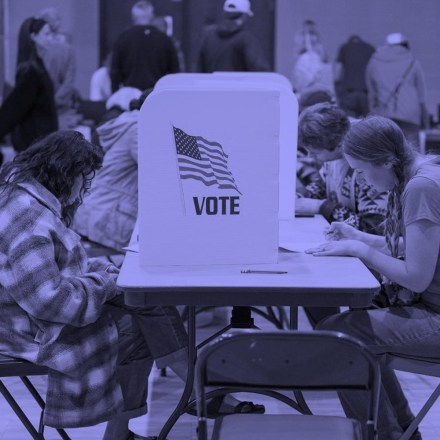 Related
How AIPAC and AI Spent Their Money This Midterm Election
Other progressive priorities include passing policies like Medicare for All, ending corporate corruption, and investing in affordable housing. The ideas are tenets of the redistributive platform popularized by Sen. Bernie Sanders, I-Vt., who rallied voters across the country to "fight oligarchy" earlier this year and helped elevate many of this cycle's upstart candidates.
On Wednesday, progressives did not yet seem prepared to commit to which single issue they would push for first. Asked by The Intercept about their Day-One priorities when they return to Congress, Casar said progressives planned to keep up the legislative pressure throughout the two years of the coming congressional term.
The Working Families Party, which backed Lawrence and often works to push Democrats to the left, saw Tuesday's results as a sign that "voters want Democrats to stop the buildout of data centers and rein in the AI industry," said Ravi Mangla, the group's spokesperson. Like the congressional progressives, WFP cited a range of priorities for the years to come: guaranteeing healthcare and low-cost childcare, lowering housing costs, and providing more union jobs to American workers.
In fact, candidates who signed onto a promise to push a suite of pro-labor policies organized by labor leaders in swing states were among the Democrats' biggest winners on Tuesday night. Signatories to the "Contract with Working America" included Troy Jackson, who toppled three-decade incumbent Republican Sen. Susan Collins in Maine; James Talarico, who flipped the Texas seat for the first time in almost 40 years; and Gina Hinojosa, who ousted 10-year incumbent Republican Texas Gov. Greg Abbott.
Jackson pointed to the pledge during his victory speech in Maine on Tuesday night and thanked the union members who canvassed for him.
 Related
Troy Jackson Ousts Susan Collins in Maine, Replacing 30-Year Republican Senator With a Progressive
"On Labor Day, brothers and sisters, I stood before you and I made a pledge to working Mainers," Jackson said to cheers at his election night party in Portland. "And I'm going to keep that promise. Because I am a union member tonight. I'll be a union member when I walk into that Senate chamber."
"The way things are set up in our economy right now, the money is just moving up and concentrating at the top, and squeezing the people at the bottom," said Maine AFL-CIO President Cynthia Phinney. Her organization helped develop the labor platform Jackson signed onto, and she said they "fully anticipate that we're going to need to continue to organize around these issues that matter to the folks who voted for him, and a lot of folks who didn't vote for him."
Referring to Hinojosa, Rep. Delia Ramirez, D-Ill., noted that Latino voters "delivered a gubernatorial seat in Texas," as well as a U.S. senator. Ramirez, who has introduced a bill to abolish the Department of Homeland Security, argued that her party should not lose sight of outrage over violent immigration enforcement.
"Shame on us Democrats if we again do not meet the moment when it comes to immigration and when it comes to justice as it pertains to ICE and CBP and DHS," Ramirez told The Intercept.
Rep. Pramila Jayapal, D-Wash., pointed out that the issues that defined this cycle were often first championed by progressives.
"We were the first to fight back against the war in Iran. We were the first to call out corruption on so many levels. We were the first to push to rein in ICE and CBP, a shift that really drove a lot of Latino voters across the country that mattered in this election," said Jayapal. "Hopefully, this puts to rest the idea that you can't be a progressive and win with your ideas in any district in the country."
If history is any guide, it won't. As the wins rolled in on Tuesday night, Jeffries, the next likely speaker of the House, threw cold water on the idea that the vote marked a seismic rebuke of the Republican Party's way of doing things, saying the results were "patriotic," not "partisan."
On Wednesday, Jeffries said voters had chosen Democrats "because they want to see a dramatic change in direction."
"I agree, and I'll go one step further," Casar said. "The American people delivered a demand for bold change."
The post The Progressive Agenda: End Iran War, Rein in AI, Get Dems to Actually Do Something appeared first on The Intercept.

US federal court have overwhelmingly ruled (10,000 orders and counting) that migrants are — just like natural-born citizens — entitled to constitutional rights. Among them is the right to due process. This means that detained migrants have a right to a hearing to see whether they can be held in custody until a hearing on the issue. And that issue is whether or not they can be held indefinitely.
The courts have said migrants have rights, far more often than not. The Trump administration has sought to counter this with an extremely novel interpretation of immigration laws that have been on the books for decades, claiming there's ultimately no difference between someone caught crossing the border illegally (who can be detained and deported without worrying about the Constitution) and someone who has been in this country for months or years and poses no actual flight risk, much less a threat to public safety.
Since it's not on the right side of the law, the party of "law and order" has encouraged ICE to thwart the law and/or flat-out ignore court orders. ICE has made it a habit to immediately move detainees from detention center to detention center in hopes of preventing their cases from being heard. Not only does it distance migrants from their legal representation, it keeps the venue in permanent flux, which means habeas petitions are doomed to fail because they were filed in place other than where the rights violation took place (the location of the arrest).
ICE also tends to route most detainees to large concentration camps in Texas and Louisiana because they're ultimately overseen by the Fifth Circuit Appeals Court, which has (now) repeatedly decided migrants don't have rights.
Apparently, the usual ICE bullshit isn't working well enough or often enough. Now, the administration is straight up mocking the 10,000+ decisions in favor of due process rights by deliberately targeting migrants who have been freed from detention by federal court orders.
Immigrants who have been granted release from detention after winning habeas corpus petitions in court are being re-arrested by US Immigration and Customs Enforcement (ICE).
The Guardian has identified at least 20 cases nationwide relating to people who were detained after being released on habeas corpus petition in the last year, according to court records, attorneys and media reports.
Twenty cases may seem like an immeasurable drop in the bucket compared to the nearly 100,000 habeas petitions that have been filed since Trump's assault on migrants began early last year. But it's also an obvious undercount. This determination relies on what can be gleaned from court records, which means there are likely hundreds of "re-detainees" who haven't been able to file a motion due to ICE's deliberate attempts to separate migrants from their rights and representation.
And this effort is amazingly brutal. No normal human being would consider this to be acceptable US government behavior. But this is something the psychopaths and sociopaths running the GOP are willing to do to indulge the whims of their preferred demagogue.
And in Minnesota, seven immigrants were re-detained before even exiting the Whipple federal building detention facility on the outskirts of Minneapolis, as first reported by MPR.
"I don't think being taken out of a building and directly into the arms of four or more officers complies with the court's order," Daniel Suitor, attorney to two of the men, said in a phone interview .
In Louisiana (Fifth Circuit, yo!), immigration officials were held in contempt after re-arresting a single migrant three times after he'd been granted release by federal judges. More of the same is going on in Minnesota (see above) and Pennsylvania.
Not only are migrants being re-arrested immediately after securing their release via court orders, but they are increasingly being deported to countries with which they have no ties. Cruelty on top of cruelty on top of hideous displays of inhumanity. That's just the day-to-day operations of our current administration, one completely consumed by hatred and capable of little more than inflicting whatever pain it can until it runs out of time… or victims.
We have all wanted to learn a language at some point but it's hard to get started. Some language learning tools can be complicated and very time-consuming. But with uTalk, you'll be speaking keywords and phrases in no time, and will start to see the results straight away. It helps you overcome the language barrier challenge by helping you learn real, practical vocabulary in a wide variety of languages from any device that you choose. uTalk's language programs let you listen to native speakers who are recorded in uTalk's recording studio and feature independently verified translations so you'll be able to navigate through your next vacation like a real local. Get 2 languages for $30, 6 languages for $50, or all 100+ languages for $69.97.

Note: The Techdirt Deals Store is powered and curated by StackCommerce. A portion of all sales from Techdirt Deals helps support Techdirt. The products featured do not reflect endorsements by our editorial team.
Last week, Ofcom, the UK regulator in charge of all this stuff, released its "rapid assessment of highly effective age assurance at 16." That came right on the heels of its quietly released (only because the law required it) report showing that the Online Safety Act's duty of care wasn't actually having any noticeable impact on kids' access to "harmful content."
Even as the Online Safety Act was being rolled out after years of debate, UK politicians started whining and screaming that they had to follow other countries towards banning kids from social media entirely. Ofcom is supposed to help put together a plan for such a social media ban by the end of the year, with implementation set for next spring. As part of this, Ofcom was tasked with reviewing the state of technology that can determine whether someone is under or over 16, and in doing so basically confirmed what many activists have been pointing out all along: if you're putting an explicit age limit on social media, you are requiring kids to hand over private information and put themselves at risk.
The report includes this handy chart, which basically notes that if you're trying to determine if someone is between the age of 16 and 18, you're really talking about having them hand over private information:

That first column on the left is the telling one. That's the one that says there are only four(ish) "highly effective" means of doing age assurance… and basically all of them are actually "send private info to a company." The first two are obvious: uploading a photo ID or banking info, both of which are incredibly risky, especially since you'll be uploading them to companies which are clear targets for hackers. The third one is really the same thing, because even as "digital identity services" are coming online with the goal of doing the ID part as a third party and then issuing some sort of "old enough" / "too young" token, those services are still getting that information via the uploading of private info.
But it's the last one that's the funniest. For years, age verification providers have insisted that no one would have to upload private info, because they could estimate your age just based on scanning your face. But we've always called bullshit on that. Such scanning may be able to tell the difference between a 50-year-old and a 15-year-old but it's effectively useless for determining the difference between a 15-year-old and a 17-year-old.
And Ofcom kinda admits that. It still lists facial age estimation as "highly effective," but only with that parenthetical caveat. And the full paper concedes that the technology falls apart for exactly the kids closest to the age line:
The margin of error for facial age estimation becomes more significant for the ages closest to the target age gate (16 in this case). For example, if the facial age estimation algorithm is accurate within two years for children aged 15, it could estimate them as aged 17. This could result in significant numbers of children under 16 gaining access to services or functionalities that are restricted. It could also result in a 17-year-old being denied access if they are estimated to be 15, unless they use another method. However, this is only likely to affect users who are close to the target age, as most adults offered this method would be estimated to be clearly above 16.
So, yes, if you're much older, perhaps a facial scan gets you onto a website without uploading your ID. But if you're anywhere near 16, you're basically out of luck, because Ofcom's fix for the margin of error is to kick anyone who looks young-ish over to a different method… and a different method is always going to be "upload an ID."
In order to account for the margin of error in a facial age estimation algorithm, services should implement a 'challenge age' (sometimes known as a 'buffer age'). A challenge age approach is widely used in an offline context when selling age-restricted products like alcohol in retail environments, for instance, through the retailing strategy 'Challenge 25.' In this approach, anyone who appears to the provider of restricted products to be under the age of 25 should be challenged to provide acceptable ID proving that they are over the age of 18 if they wish to buy alcohol.
Of course, requiring kids to upload their photo IDs or banking info is going to be difficult given that many kids… don't actually have photo IDs or banking info at age 16. Ofcom argues that 89% of 16-year-olds have a passport while 19% have a provisional driving license. But passports also aren't the kind of ID that kids regularly have at the ready any time they're reaching an internet service. Perhaps I'm out of touch with the youth of the UK, but I'd be surprised to find many of them regularly have passports at arms length most of the time.
The likely result is forcing more kids to get IDs at younger ages than they would otherwise need them, again creating privacy questions for those kids. Either way, teenagers are in for a lot of "your papers please!" and Ofcom says so pretty directly:
Our preliminary assessment suggests that 16- and 17-year-olds are more likely than users of other ages to need access to a photo ID document. Of the methods listed as capable of being highly effective at 16, a photo ID will likely be needed at some point in the process. This is either because the method itself requires a photo ID, because ownership of a photo ID is part of the underlying process for accessing another method (such as opening a bank account or using a digital identity service), or because a 16- or 17-year-old will most likely fall within the challenge or buffer age for facial estimation methods and be asked to prove their age with a secondary method.
In other words, what UK politicians (and plenty of "child safety activists") are demanding here is that a bunch of kids have to give up their privacy and hand over documents that can put them at risk. For their safety. At a time when there remains little to no evidence that barring kids from internet services will actually improve their safety.


For some drivers, horsepower is the be-all and end-all, and for others, horsepower decides very little about how much they enjoy their car on an ordinary day. Much of the driving happens in slow traffic and supermarket car parks, with the odd motorway on weekend trips. That doesn't mean there's no enjoyment to be found while driving.
The upgrades that make driving more enjoyable are usually the ones that make that time behind the wheel better. While some of them cost less than a tank of fuel, others take a bit of saving.
Tyres Before Anything ElseA good set of tyres from a premium manufacturer lets a car drive more quietly on the motorway and take a wet roundabout with more traction. Plenty of owners replace worn tyres like-for-like without much thought.
A premium set of tyres is an expensive first purchase, and sometimes it's worth starting from the inside and working your way outward. Quality tyres can have a night-and-day effect on how driving feels, so they're not a bad place to start if the budget permits it.
Getting the Driving Position RightSeats are always about personal tastes and preferences, and many drivers put up with a position that's nearly right for a very long time. Before spending anything, try exploring the adjustments the car already has. The steering column moves in and out and up and down on most modern cars, and many seats have a cushion that tilts or extends.
Where the seats themselves are tired, a specialist trimmer can retrim worn leather or install a new material of your choosing. Some owners go further and swap in the sports seats. That's a bigger piece of work, with wiring for heating and side airbags involved, so it's a project for someone who specialises in this line of work.
The Wheel in a Driver's HandsThe steering wheel gets handled more than anything else in the car. Every junction, turn, and every parking manoeuvre goes through it, so a rim that's gone shiny and smooth with wear gets noticed on every drive.
Enthusiasts who want something more personal look at custom steering wheels, where the owner chooses the rim shape and the covering. Perforated leather on the sides improves grip, smooth leather or carbon fibre across the top and bottom keeps it sleek, and a flattened base makes getting in and out of a low car a little easier.
Small Interior Details That Change the MoodFor some drivers, changing the interior trim has been on their minds since their very first drive. The dashboard inserts and the surround around the gear selector are in sight the whole time the car is moving, and swapping glossy plastic for carbon fibre gives the cabin a more expensive look without touching anything mechanical.
It's very tempting to do the whole cabin at once. Starting with the pieces closest to the driver makes more sense; the passenger side can come later.
The Walk Back to the CarEnthusiasts glance back at their car after locking it, and what they notice is the exterior styling. Carbon fibre mirror caps and a gloss-black grille are an easy place to start. They don't take long to install, and they change the face of the car the same afternoon, which is a lot of visual return for a modest job.
A front splitter and a rear diffuser go a little further, giving a standard model the stance of something higher up the range. Seeing the car on the driveway with both fitted is a real lift for most owners.
Quality varies between suppliers. Photos of finished cars on real driveways say a lot about how evenly the weave lines up under the lacquer, and a decent warranty on the parts is worth asking about before buying.
Where to StartEveryday enjoyment comes from the most frequent interactions drivers have with their car, so the best upgrades are the ones that are visible on the most ordinary journeys. Try starting while in the driver's seat with the engine off, have a look around, and notice which parts of the cabin you'd like to customise.
Don't forget to confirm compatibility with the exact model and year before ordering anything, and leave any work involving airbags or wiring to an approved fitter.
Alex Karp, CEO of US spy-tech company Palantir, used this week's historic US midterm election results to claim an unlikely mantle for a military software supplier: pioneer of an antiwar movement.
Palantir's Q3 revenue rose 96 percent year-on-year to $2.31 billion, although its shares fell 8 percent following the results, which it reported on Tuesday as US voters were delivering a resounding defeat for Republicans in the voting booth. For Karp, the figures represented "the reality that this moment has become a real focal point of understanding" and might help explain "what is happening in our society."
From the CEO's perspective, they not only reflected the company's financial performance, but also its overall "mission."
"That mission reason is we support your alpha [above average performance], we support your sovereignty. We support the war fighter. We are delighted that we can support the war fighter even more because we're making so much money. But we believe we have a moral imperative to be the dominant player in our industry," he told investors.
For Karp-watchers, this is familiar self-serving shtick: turn Palantir's work for military and intelligence customers into a moral crusade, and goad its critics along the way.
"There's this larger question of what does it mean to have a business that was built around what we believed and believe now is the most important mission in the world, supporting our war fighters, [and] bringing them home," he said.
None of this stops him presenting Palantir as a force for peace. "We see ourselves as the pioneers of a genuine and viable antiwar movement," he wrote in his shareholder letter.
He expanded on the point during the Q3 earnings call. "Our products are built to avoid war, meaning the adversary knows that they will have such pain inflicted upon them that, in fact, it's not worth going to war and also to create social cohesion because we're going to bring back our troops healthier, safer, undamaged and that makes our society much more effective," he said.
That antiwar pitch sits awkwardly alongside Karp's $1 million donation in December 2024 to MAGA Inc., the super PAC supporting Donald Trump. Trump subsequently launched a US military operation in Venezuela and went to war with Iran, repeatedly promising the latter conflict would be short-lived as it dragged on. Karp did not address either topic on the call.
Elsewhere, Karp claimed that Palantir "built products that would protect civil liberties and stop terrorism. If you don't stop terrorism, you're going to get a radical fringe on the right. If you stop terrorism without rights, none of us wants that."
That civil liberties pitch also invites scrutiny of Palantir's longstanding relationship with US Immigration and Customs Enforcement (ICE), whose treatment of people it targets and detains has drawn criticism from US judges.
Karp seems to enjoy the circus of controversy he and his colleagues have created. He also offered investors this insight: "The future is becoming the present and the present is now." Whatever that future holds, he seems confident Palantir has a moral imperative to invoice it. ®
 Musk's Starlink Eyes Buying Boost Mobile In Doomed Bid To Dominate Smartphones [ 04-Nov-26 1:28pm ]
One cornerstone of Elon Musk's fraud-packed SpaceX IPO prospectus includes the claim that they'll extremely quickly (as in a year or two) boost Starlink subscriber totals from 13 million to something closer to 300 million. Given the network's congestion problems and physics constraints, that's simply not realistic. Also: more users means even greater capacity problems and weird network restrictions.
To try and goose growth, Starlink has recently been making it clear they'd like to try and get into the cellular and smartphone business. But the actual plan is, as with all things Musk, a misleading, hot mess.
A key part of Starlink's plan includes plunking down thousands of meshed femtocells installed on customer rooftops alongside existing LEO satellite dishes, something one telecom analyst recently stated was "one of the top three dumbest ideas in my four decades of being in this industry."
In part because the femtocell installations are just logistically annoying and complicated, and will further will eat up capacity on the increasingly congested network (recall that Starlink customers in some areas already face "congestion fees" as high as $1500).
To goose growth Starlink and SpaceX have been gobbling up valuable wireless spectrum (with the help of Trump FCC boss Brendan Carr). They are also apparently in conversations to buy Echostar's Boost Mobile prepaid brand:
"SpaceX has held talks with telecom firm EchoStar in recent months about launching its own signature wireless service through a deal with the company, the report said, citing people familiar with the negotiations. The move would support the Elon Musk-led company's plans to build a hybrid satellite-terrestrial mobile network through Starlink Mobile, combining its satellite constellation with ground-based infrastructure to challenge US wireless giants AT&T, Verizon and T-Mobile."
One problem? Boost mobile is just a mobile virtual network operator (MVNO). It's primarily just customer-facing retail artifice that runs on the back of existing AT&T and T-Mobile networks; neither of which is keen to have their cozy regional telecom dominance disrupted. To actually compete, Musk and Starlink would still need to invest hundreds of billions of additional dollars in a high-powered 5G network over the next decade. And even then there's no guarantee of success.
You might recall that Boost Mobile was offloaded to Echostar as part of that doomed first-term Trump administration effort to approve the Sprint-T-Mobile merger, then hide its labor and competition impact by pretending that Dish Network would build a successful replacement 5G network. That of course never happened; the real impact was mass layoffs, higher prices and worse service for everybody.
I should note that the Trump FCC under Brendan Carr not only launched a fake "investigation" into Dish to try and force it to offload much of its spectrum to AT&T and Musk, but recent reporting suggests the Trump administration threatened Charlie Ergen with additional scrutiny if he didn't ramp up his donations to Trump's ballroom. So there's entire layers of grift going on here.
Regardless: U.S. telecom is just generally a shitty market to try and disrupt. It's extremely expensive and time consuming, and at every turn you're likely to get creatively ratfucked by giants like AT&T and Verizon, whose political influence over Republicans historically rivals Musk's. Again, even traditionally staid and bullish telecom trade mags have expressed concerns that Starlink's smartphone push is doomed.
I think this mostly all exists as a way for Starlink to hoard valuable spectrum and goose stock valuations. There may be some people at Starlink who have convinced themselves this will actually work (the fact SpaceX has been lobbying for phone unlocking rules suggests some potential earnestness), but U.S. telecom history is littered with these sorts of half-assed disruption efforts that routinely go nowhere.
I'm not prone to believe things that come out of the mouths of Verizon executives, but in this case I think Verizon CEO Dan Schulman is correct when he states it would cost SpaceX something akin to $300-$500 billion and five years build a network capable of really competing with cellular giants.
And that's just network infrastructure; you still need to convince users to sign up, provide a quality experience, and provide useful customer support (something Musk companies historically aren't interested in). While fending off the political machinations of AT&T, Verizon, and T-Mobile, who all but own the legislature in most states after a generation of lobbying and campaign contribution.
The Musk cult and our shitty corporate press will spend the next few years enamored with the fiction that "Musk is disrupting smartphones," but this mostly just reads as further stock-fluffing performance by a man with more money than sense.
Haley Stevens Destroyed Her Political Career for Absolutely Nothing [ 04-Nov-26 7:00pm ]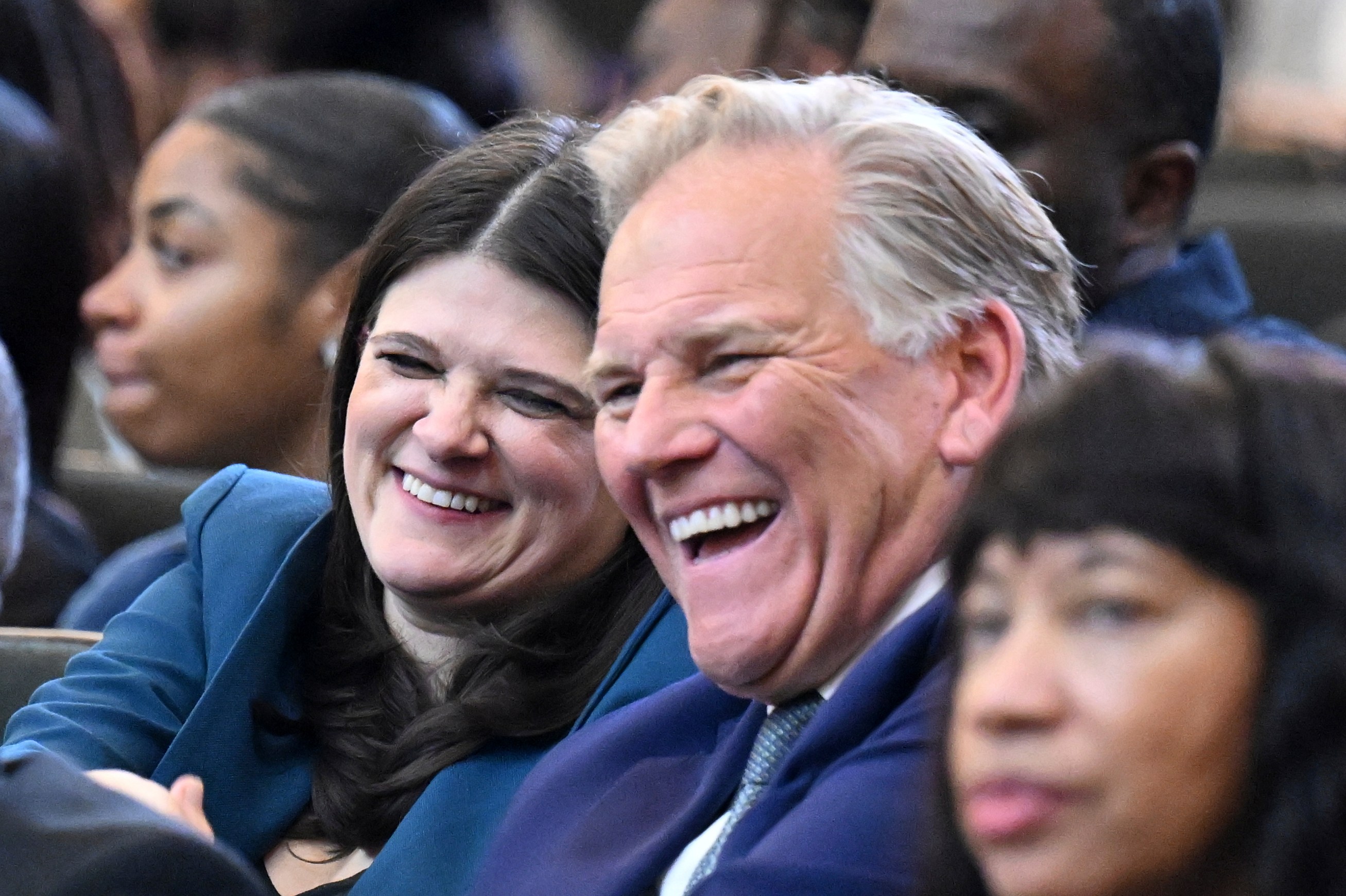 Rep. Haley Stevens, D-Mich., and Michigan Republican Senate candidate Mike Rogers attend a service at Perfecting Church, on Nov. 1, 2026, in Detroit. Photo: Jose Juarez/AP Photo
Abdul El-Sayed handily defeated Republican Mike Rogers for Senate in Michigan early Wednesday morning, retaining Democratic control of the seat and solidifying the party's Senate majority. To become the first Muslim elected to the U.S. Senate, the former public health official overcame rampant, bipartisan Islamophobia and bigotry. For the country, and the Democrats, to move forward, we must cast it out of public life forever.
The Michigan Democrat's victory felt almost like an afterthought compared to the upset Senate victories won by Democrats in South Carolina and Texas. The 2026 midterms were a referendum on President Donald Trump and his control of the GOP, and voters delivered their verdict, turning control of both houses of Congress over to the opposition party.
Related
Abdul El-Sayed Wins Senate Seat With Pro-Palestine Campaign
But we should neither forget nor forgive how we got here. El-Sayed faced an uphill battle from the beginning, which included a protracted, venomous primary, and the call was often coming from inside the house.
No detractor was as vicious as his former primary opponent Rep. Haley Stevens, whose eleventh-hour betrayal of her party's nominee — she formally switched her endorsement to Rogers on Sunday — was a transparent attempt to turn the seat red.
Backlash was swift and harsh and came from all corners of the party. Sen. Chuck Schumer, the powerful leader of the Senate who has made little secret of his disagreements with El-Sayed on Israel, called Stevens's actions "a despicable betrayal." Michigan Democratic Rep. Debbie Dingell and state Sen. Mallory McMorrow, who finished third in the primary, went as far as to express personal concern for Stevens.
And Rep. Nancy Pelosi, D-Calif., just days after implying El-Sayed and New York City Mayor Zohran Mamdani were antisemites for opposing ethno-supremacy in Israel, said Stevens chose "to dangerously betray Michigan families' healthcare, freedoms, and future with her horrific endorsement of Mike Rogers."
In the 48 hours-plus since she threw in with Rogers — which increasingly seems like it was motivated primarily out of spite when she was boxed out of a Sunday campaign event with Rep. Jim Clyburn, D-S.C., in Detroit — Stevens embarked on a media tour of justification that got weirder and weirder.
A 15-minute, rambling interview with Anderson Cooper on CNN Sunday night didn't provide insight into her motivations, or much else; on Monday evening, Stevens followed up with a long statement posted on X owning the decision to destroy her political career with the Democratic Party. She also denied that her fiancé, political donor Jason Turkish, played any role in the endorsement: "I made this decision, and I am proud of it. Do not question my independence simply because you disagree with my conclusion."
Related
Radical Centrists Like Haley Stevens Are the Real Extremists in the Democratic Party
Congressional staffers to Stevens resigned en masse on Sunday, and former campaign aides told the Washington Post that they had to run defense to keep Turkish — who had endorsed Rogers before Stevens did — out of the spotlight and marginalize his influence.
"Any campaign staff being directly quoted in this article, I was made miserable by working with them," Stevens told the Post in response, adding, "I have nothing else to say about the campaign at this time."
But a singular explanation of Stevens's decision lets Democrats off the hook far too easily for the anti-El-Sayed campaign waged by leaders in the House and Senate. For the party to move forward after the midterms, the Democrats need to take a hard look in the mirror and purge institutionalized Islamophobia from their ranks.
They can start with their friends in the media. The Atlantic's Jonathan Chait, in a screed published Sunday, whined that "during the same period of time that El-Sayed has been winking at a political movement inflected with anti-Semitism, he has been targeted by a political message that is not merely inflected with racism but saturated with it."
We should get ready for a long overdue, but almost certainly painful, intraparty debate on how Democrats policed dissent in their own ranks.
Political commentator Van Jones noted on X ahead of Election Day that "the Republicans are conducting a campaign of blatant anti-Muslim fear mongering." But in the same post, he also argued El-Sayed's "refusal to outright denounce" a little-seen ad produced by an outside PAC — an ad which El-Sayed distanced himself and his campaign from — tying the rise of grocery costs to U.S. support for Israel was comparable.
"Something is going horribly wrong in the Senate race in Michigan," Jones added huffily. "And I am going to keep calling it out."
Related
Lesson From Lansing: To Win in Swing Districts, Fight Data Centers
After last night's massive blue wave, it should be undeniable that the left was a major factor in flipping the House and Senate. That means the party's progressive wing can now credibly claim a seat at the governing table without compromising on domestic or foreign policy. We should get ready for a long overdue, but almost certainly painful, intraparty debate on how Democrats policed dissent in their own ranks in this election, and how to disentangle leadership from unconditional support for Israel.
There's always the possibility that the party's centrist wing comes together with the left and repairs the damage. A good first step would be for leadership to make clear that Stevens, and anyone else who indulged in anti-Muslim arguments to score political points, has torched any possible future in the Democratic Party. Any advocacy or lobbying group that offer Stevens or her ilk safe political harbor should also be blacklisted.
 Related
Democrats, Don't Mess This Up
Party discipline applied to the treacherous center doesn't appear to be the top priority for House Minority Leader Hakeem Jeffries, the presumptive next speaker, who devoted his first remarks after the election to downplaying partisanship in this "patriotic moment."
But without backup from party leadership, El-Sayed will continue to be met with hostility. On Wednesday morning, CNN asked fellow incoming Texas Sen. James Talarico if he would "stand up" to El-Sayed and other, unnamed left-wing members of his caucus. To his credit, Talarico demurred from directly challenging his fellow future senator. Still, it's a sign of a long battle to come.
The question for "unity"-caping Democrats remains: Who will they rally around — and who will be left out in the cold?
The post Haley Stevens Destroyed Her Political Career for Absolutely Nothing appeared first on The Intercept.
Fedora 45 is finally finished and fit [ 04-Nov-26 6:59pm ]Fedora 45 is here, after not one but two week-long delays as the team found last-minute issues. Although both the original and second announcements were irksomely non-specific, in general we prefer this "when it's ready" approach to the rigid calendar-based schedule that Canonical favors for Ubuntu. It includes six main editions, five immutable desktop variants, and 12 "spins" with different GUIs.
The combined version 45 release notes detail some of the bigger individual component changes and note the hardware requirements. The recommended spec is now a 2 GHz quad-core CPU with 8 GB of RAM and 20 GB of disk space, and at least 1024×768 graphics. Fedora 45 supports most display adapters, but 3D acceleration may not work on older GPUs, including Intel models prior to GMA9xx, Nvidia models prior to NV30 (GeForce FX5xxx series), and AMD Radeon models prior to R300 (Radeon 9500).
We took a quick look at the beta back in September, focusing on its new next-generation text console, which is a welcome change. We especially liked the ability to zoom in and out on the text console on the fly, which is something we've missed since the superb "Laptop Ultravision" for DOS, about a third of a century ago. (The company is long gone, but we found a downloadable version for all you DOS users.)
The desktop flagship editions are Workstation 45, which comes with GNOME 51 "A Coruña", and Fedora KDE Plasma Desktop, with KDE Plasma 6.8. We covered some of the new features in GNOME 51 when we looked at the Ubuntu 26.10 beta, and those changes apply here too - notably, improvements in the Settings app, but removal of some older Nvidia GPU support.
Both the big names are Wayland-only environments now, but by our reckoning, X11 fans have seven of the 12 official spins to choose from: Xfce, Cinnamon, MATE, i3, LXQt, LXDE, and Sugar (SOAS) all still use X.org if you prefer. There is also a combined What's New page for all the Atomic Desktops, Fedora's immutable variants - the main shared feature here being the new web-based installer.
The new version of main Fedora is accompanied by Fedora Asahi Remix 45 for Apple Silicon Macs. This is a more notable release than the cross-platform editions, as Asahi 45 brings initial support for M3-based Macs as well as M1 and M2 kit. As The Reg described in September, though, the M3 support is preliminary and limited - for instance, it excludes the M3 Ultra. If you have an M3 Mac, for now, you're better off sticking to macOS.
The most important changes in Fedora 45 are under the hood, which is what the Red Hat release announcement focuses on. It now uses RPM version 6.1, with enhanced package signature checking, and blocks the vendor of packages silently changing. The GNOME keyring now uses the oo7 secrets manager. Support for two old VPN plugins has been removed, because the packages were unmaintained.
A feature that we are happy to see land at last is better support for Red Hat's Stratis next-generation storage subsystem. We gave a potted overview of Stratis 3.3 back in 2022: it was on version 3.3 back then. It's the same main Stratis version 3.9 we saw in Fedora 44, but the installation program now has support for installing Fedora 45 on Stratis storage.
Stratis is Red Hat's rival to OpenZFS. The plan is that Stratis offers similar features and resilience to ZFS, especially in the field of copy-on-write snapshots and simple multi-device logical volume management, but built from all-GPL code. Rather than a whole new filesystem, Stratis integrates XFS, LVM, and the kernel device-mapper functionality. Stratis 1.0 appeared in Fedora 29 eight years ago, and Fedora 45 has version 3.9.3. It's good to see it finally making real progress: if nothing else, we've seen Btrfs irretrievably corrupt a full volume far too many times to ever trust it again, so an alternative is very welcome.
When we looked at Fedora 44, we noted the difficulty of doing custom disk partitioning. It was there, but very well-hidden. Now, the installer can launch the Cockpit web-management tool to make it easier to set up your drives however you want.
An interesting side-effect of the delayed release is that Fedora 45 ships with kernel 7.2 - specifically, version 7.2.15, which is the last release of this short-term series. In other words, it's an end-of-life kernel version. It's an amusing contrast to its near-contemporary Ubuntu 26.10, which shipped with a pre-release kernel. Our test Ubuntu box was automatically upgraded to the release version by the background automatic updates process, but to our surprise, it didn't receive the kernel update for over a week. This shouldn't be a problem: unlike Ubuntu, Fedora releases routinely receive updates to whole new kernel versions, so we're sure Fedora 45 users will get kernel 7.3 very soon.
We upgraded the same test machine on which we tried GNOME 48 in Fedora 42 early last year. You can skip one Fedora release on upgrade, but not two, so we had to go via Fedora 44 — which took some time, and threw up a minor packaging glitch, but it got there. The result runs surprisingly well, although this 2008 machine is well below the recommended spec. ®
Turn your home into a giant crane game with this open source robot [ 04-Nov-26 6:35pm ]Your new robot servant doesn't have to look anything like a person or walk on two legs. In fact, it might just be a claw that hangs from the ceiling instead.
That's the future envisioned by Nathaniel Nifong, founder of Neufangled Robotics, and its Stringman robot. Put simply, Stringman is an AI-equipped claw suspended from four strings running through the corners of a room (up to 10 meters diagonally). Two motorized anchors adjust the lengths of the strings to move the claw around the room, from ceilings up to 4 meters high down to the floor to pick stuff up. With a payload capacity of around 2 kg, depending on its position, Stringman can move items to designated locations - like a toy box - and perform tidying tasks.
Stringman can also be manually controlled if you'd prefer to play a room-sized crane game by yourself.
According to Stringman's documentation site, the device is currently a public prototype that "can self-calibrate in a new room and run policies, but is not yet reliable enough to be called a home appliance."
That said, demonstration videos on the website show it in action, and it's neat to watch.
Stringman is shown picking up laundry and dropping it in a basket, putting Lego bricks and other kids' toys back where they belong, and generally zooming around rooms and demonstrating its agility. One could imagine a properly trained Stringman could even grab the remote you left on the other side of the living room and drop it in your waiting hand if you're that incredibly lazy.
"Our mission is to give people an organized home," Neufangled says on its future roadmap page. "We prioritize robots that are narrowly effective at something that helps today rather than a general purpose robot that may be in development for years."
The company further describes its goal as designing robots that are low cost and capable of doing things that people hate to do - e.g., pick up after a messy toddler - and making a robot that can do that while camouflaging itself into the home "as well as possible."
As long as you think a foot-long claw robot hanging from the corner of the ceiling is camouflaged, this is the robot for you.
Neufangled lists Stringman for $795, which is a lot to ask for a public prototype that isn't reliable enough to be called a home appliance yet. Luckily for those who're interested in this sort of niche home automation, it's fully open source, too.
"A complete Stringman is three Raspberry Pis on your Wi-Fi network," the documentation site reads: One in the gripper, and two in the corner anchor mounts that store line reels and have cameras to track the claw's location as it moves around the room. A third camera mounted on the claw provides visual feedback. Oh, you'll also need a dedicated PC or Mac to run the robot's motion-control software.
As for Stringman itself, to build your own, you'll need a 3D printer, a supplier to manufacture the PCBs, motors, Raspberry Pis, and other components listed in the bill of materials. You'll also need to follow the guides on the documentation site to get it up and running, calibrate it for your space using printed markers, set up drop-off points using visual tags, and program it to perform tasks.
But is it safe? One could imagine getting tangled in the lines if you get in Stringman's way. Nifong admits that can happen, writing in the documentation that he has walked into the lines himself without injury.
"I live with two of these, and I've walked into the lines before. It's startling, but harmless — they're light and they give," he writes. According to the robot's website, it has a tension limit of 28 newtons, or around six and a quarter pounds of force. If that limit is reached, all of the lines relax and can be pulled loose.
Those who want to play with a simulated Stringman can do so on Stringman's web portal, which includes options to connect to a personal machine over LAN, the cloud, or a simulated version. Hopefully it's easier to work with than an arcade claw. ®
Nintendo's main Switch cartridge supplier is leaving the ROM business [ 04-Nov-26 6:39pm ]
French Blood Banks Hit Alongside Cyberattack On European Supermarkets [ 04-Nov-26 7:05pm ] AMD Expects To Outsell Intel For the First Time [ 04-Nov-26 7:05pm ]
God of War Laufey is delayed until May 20 [ 04-Nov-26 5:50pm ]
Lesson From Lansing: To Win in Swing Districts, Fight Data Centers [ 04-Nov-26 5:15pm ]When progressive Will Lawrence beat two moderates in a Michigan congressional primary earlier this year, some Democrats were worried about his ability to win one of the nation's most evenly divided districts.
Early Wednesday morning, Lawrence claimed victory over Republican Rep. Tom Barrett. (National news organizations such as The Associated Press had not called the race as of Wednesday morning.)
A national swing in favor of Democrats helped him — but so did a campaign that leaned heavily on opposition to data centers to
situate Lawrence as a populist instead of an extremist.
Data centers were on voters' minds everywhere, but they rarely dominated a race as much as the 7th Congressional District of Michigan. Lawrence vocally opposed data center construction almost as soon as he began running last year. A series of proposed hyperscale developments in and around Lansing pushed the issue into the limelight.
A month and a half before the election, Lawrence announced a data center platform calling for a moratorium on new development, environmental regulations, and a national jobs program to replace work taken away by artificial intelligence.
Related
Abdul El-Sayed Wins Senate Seat With Pro-Palestine Campaign
As progressives take stock of the 2026 midterms, Lawrence's approach points one way forward for their wing of the Democratic Party. Lawrence's opponent tried to turn his time as an environmental activist into a liability, but in an interview with The Intercept, Lawrence said his background primed him to come down on the same side as the public on a red-hot issue like data centers.
"I fought against Wall Street landlords trying to kick people out of their homes. I fought against oil companies who are polluting our air and water," he told The Intercept in an interview last month. "So for me, this was not the first time that I've stood on the line against a corporate behemoth like this."
From Sunrise to CongressLawrence is a co-founder of the Sunrise Movement, which had one of its most famous moments when its youth activists marched into the office of then-House Speaker Nancy Pelosi to push for the Green New Deal with Rep. Alexandria Ocasio-Cortez, D-N.Y., by their side in 2018.
Data centers and AI were remote issues for voters then, but they were starting to bubble up in the public consciousness by the time Lawrence announced his run for Congress in August 2025.
 Related
AI Tried to Buy the Midterms — Then the Lobby Learned Everyone Hates AI
Two months later, one of his first moves as a candidate was to visit public meetings in two small townships in Michigan to express his opposition to proposed data center developments.
As a former member of the Democratic Socialists of America, he drew skepticism from many observers over his ability to win the primary in a district that narrowly voted for Donald Trump in 2024. They were equally skeptical of his ability to beat Barrett, a Republican who tried to play up his moderate bona fides in the race's final weeks. Barrett was one of a handful of Republicans to vote in favor of a resolution to end the Iran war, for instance.
Lawrence had some major liabilities in a purple district, including tweets where he wrote "fuck the nuclear-family home" and told then-Democratic Sen. Joe Manchin in a song to "hurry up and die."
While Barrett leaned on those posts and Lawrence's time with the DSA to cast his opponent as an extremist, the young progressive had a card up his sleeves in the form of the data center issue.
It is the rare cause that leaps across party lines to unite Republicans and Democrats who are just as worried about water sources drying up and ceaseless buzzing sounds.
 Related
The AI Doomsday Future Is Not Inevitable
At an October 5 city council meeting in the quaint town of Mason, where a developer has proposed a hyperscale data center on a plot of picturesque farmland, Democrats and Republicans alike said they were outraged. Some residents said they would sell their house and leave town if the development is built.
In a sign of how politically charged the issue has become, many of the speakers were candidates for office angling for votes. Lawrence had dropped by himself a few weeks before. His first television ad centered on his opposition to the Mason project.
Karl Sime, a Mason resident who crisscrossed the area on behalf of Democratic candidates, told The Intercept last month that "100 percent" of voters were angry about the data center proposed for the swath of farmland just outside city limits.
"Sometimes they'll just say it unprovoked," he said. "You can see the body language just dramatically change into anger."
Republican CountermovesLawrence was hardly the only candidate who tried to tap into opposition to data centers. Some Republicans tried to catch the wave as well.
 Related
How a Small Kansas City Became a Critical Hub for Trump's Deportation Regime Against Its Will
Barrett voted for the One Big Beautiful Bill, which included tax breaks that could benefit rural data center developers. But as the danger he faced in the election became clear, he proposed legislation in Congress that would ban local officials from signing non-disclosure agreements with developers and would allow local communities to set regulations on data centers without federal interference.
Some voters said they wanted to see candidates take a harder stance in favor of regulation, however. At the City Council meeting last month, Doug DeLind said he was left shaking his head at neighbors who had yard signs opposing data centers and supporting Barrett.
DeLind, a sculptor who lives near the proposed data center, said that Barrett's position was that "we're going to leave it up to the local communities, but we're not going to provide any federal protection or any guidelines to what a data center can do."
Although Mason faces a more imminent possibility of a massive data center, Americans across the country are worried about having one in their backyard. Multiple surveys showed a remarkable shift in public opinion on the subject over the past year. Half of Americans oppose a data center being built within 3 miles of their house, according to a recent Politico poll.
 Related
Francesca Hong's Loss in Wisconsin Is a Win for AI Data Centers — for Now
In recent months, data centers became a signature issue for Democrats with progressive pasts trying to recast themselves as populists. Sherrod Brown, the party's Senate candidate in Ohio, and Texas gubernatorial candidate Gina Hinojosa also staked their campaigns on opposition to data centers. Both won.
"The playbook was listening to voters. I think voters across ideologies were speaking with one voice, and I think their opponents were some of the people most willing to silence voters and accept industry cash instead," said Alex Bores, who became a national figure by arguing for stricter AI regulations during a failed New York congressional primary bid earlier this year.
As candidates ran away from data centers, the artificial intelligence industry's most powerful super PAC stopped intervening in close races. An Intercept analysis found that the well-funded Leading the Future super PAC network, which is aligned with OpenAI, largely stopped spending in competitive general election races.
It lost in the one state where it did place a big bet, South Carolina. Incumbent Sen. Darline Graham, a Republican, fell to challenger Annie Andrews.
Bores, who now leads a pro-AI regulation group called Who Decides, said he was not surprised to see candidates increasingly market themselves as AI skeptics.
"I think it's overdue. I think candidates and elected officials are catching up to where the electorate is, across parties," Bores told The Intercept. "It is remarkable the agreement that voters have around wanting guardrails to protect us from the most powerful and fastest moving technology of our lifetime. Democracy is sometimes slow, but only so much."
This story was supported by a grant from the Tarbell Center for AI Journalism.
The post Lesson From Lansing: To Win in Swing Districts, Fight Data Centers appeared first on The Intercept.
Boffins use machine-learning tricks to create a starlight dimmer switch [ 04-Nov-26 6:03pm ]Scientists have developed a way to remove starlight from telescope images that improved sensitivity to faint exoplanets by up to 15 times in tests on James Webb Space Telescope data.
A team led by Northwestern University's Rodrigo Ferrer-Chavez combined a physics-based telescope model with optimization techniques used in machine learning to subtract unwanted starlight.
Directly imaging exoplanets remains difficult because their host stars' glare can overwhelm their faint light. Existing techniques subtract modeled or reference starlight, but tiny changes in telescope optics can leave residual glare that hides planets.
The team's Physics-based Learning for Imaging Planets (FLIP) framework models how light passes through the telescope, adjusts for optical imperfections, and simulates the glare to be subtracted.
Applied to observations from Webb's Near-Infrared Camera (NIRCam), FLIP produced the first image of the known giant planet 51 Eridani b at an infrared wavelength of 4.3 micrometers, where conventional processing had failed. Tests showed sensitivity improvements of two to 15 times over conventional techniques, according to the Nature paper.
"This is the first time, to our knowledge, that such an approach has demonstrated substantially improved sensitivity on real, on-sky coronagraphic imaging. Our framework can be extended to other current and future ground-based and space-based observatories… potentially relaxing the unprecedented stability requirements needed to make these a success," the paper says.
Further work includes reducing computational demands and developing ways to handle the much larger data volumes produced by ground-based observations.
The researchers hope further development and testing will bring direct images of Earth-like planets closer, while reducing the extent to which tiny telescope instabilities obscure them. ®
Japanese Bank to Stop Allowing ATM Cards, PCs For Account Access [ 04-Nov-26 5:50pm ]
Bare metal boom: On-prem server sales for HPC and AI up 20% this year [ 04-Nov-26 5:30pm ]On-premises high-performance compute (HPC) is still in demand, according to Hyperion Research, which estimates the market is expanding at almost 20 percent year-on-year, often driven by requirements for AI processing.
What Hyperion calls the "on-premises HPC and AI-for-Science" server market showed significant growth in the first half of 2026, with revenues hitting $16.5 billion, up 19.9 percent.
However, the analyst says unit shipments over the same period grew only 4.4 percent, meaning that systems are carrying a higher price tag due to greater use of costly components such as GPUs and other accelerators, not to mention the effects of higher memory costs, which have tripled or quadrupled since last year.
Its tracking of the HPC market is based on multiple surveys conducted of both buyers and suppliers, the firm says. The latest data shows a major change in the overall HPC market growth, heavily driven by a combination of the use of AI, large language models (LLMs), and purchases of large GPU/accelerator-based systems.
This trend was noted a couple of years ago, with Omdia reporting in 2024 that revenue growth from server sales was racing ahead of actual units shipped, as customers prioritized investment in highly configured server clusters for AI.
Much of that spending was by hyperscalers and cloud providers, seeking to profit from selling AI services to enterprise customers, but Hyperion's figures focus on on-prem shipments, showing that many enterprises prefer to do their processing in-house.
According to Hyperion, Dell has now surpassed HPE as the biggest HPC vendor, with server revenues of $4.2 billion for the first half of 2026. HPE, which picked up supercomputing specialist Cray for $1.3 billion in 2019, had long been pack leader in the global HPC arena in terms of market share and revenue.
The figures put Dell on a 24 percent share, while HPE is not far behind on 21 percent. Lenovo and China-based Sugon trail behind at 4 percent share each, while 45 percent of the market is just labelled as "others" by Hyperion. This includes names such as Bull, which re-emerged from the shadows of Atos this year, plus Supermicro, Penguin Computing, and NEC.
The HPC infrastructure market is inherently cyclical. HPE recognized significant revenue in 2025 with sales of multiple exascale-class leadership machines, but procurement of that scale is intermittent and doesn't necessarily come along every year, Hyperion notes.
"Organizations and institutions are continuing to invest in their advanced computing infrastructure due to both replacing aging machines and the desire to adopt AI into their workflows to support their businesses and missions," said Hyperion Research CEO Earl Joseph.
"The growth reflects both a nominal increase in units being purchased and significant increases in system prices."
HPC systems are considered the backbone for many AI and AI-related applications, which has driven the overall HPC market to a new growth level, Joseph added. ®
VMware returns to low-end server virtualization with 'vSphere Express' [ 04-Nov-26 5:01pm ]As first reported by The Register, VMware has returned to the low-end server virtualization market with a product called "vSphere Express."
The product will run on up to 128 processor cores and includes vMotion to allow live migration of VMs, automated restart of failed VMs, a distributed switch, rapid non-disruptive patching, and support for physical and virtual trusted platform modules.
"We have been listening to the market at the low end, and they want a basic core server virtualization platform," said Prashanth Shenoy, vice president of product marketing in Broadcom's VMware Cloud Foundation (VCF). He explained that each instance of vSphere Express will be discrete, meaning it won't be possible to manage them centrally.
"This is tested for small implementations," he told The Register. "We do not want a customer to run this on thousands of cores." Shenoy said the vSphere Foundation (VVF) enterprise virtualization product, and Cloud Foundation (VCF) private cloud suite, are appropriate for users with more complex needs. vSphere Express will, however, match the release cadence of VVF and VCF.
Under Broadcom's ownership, VMware has enormously reduced the number of resellers in its channel program, meaning it no longer has partners who are a good fit for this product.
The virtualization giant will therefore sell vSphere Express through its distributors, most of which now operate cloud marketplaces at which affiliated resellers can acquire software - an arrangement channel folk call "two tier distribution."
We asked VMware to tell us the price it will charge for vSphere Express.
A spokesperson told us it will offer a per-core subscription license at a price "significantly lower" than VVF or VCF but declined to quote a dollar amount. "We encourage interested customers to reach out to their local reseller for information related to pricing and subscription terms," the spokesperson wrote.
VMware has also bulked out VVF and VCF a little, by adding disaster recovery and policy-based networking for virtual private clouds that it previously sold as add-ons. Shenoy pitched the additions as demonstrating VMware's intention to add value to VVF and VCF, in part by ensuring the bundles include tools that users are likely to consider represent essential functionality.
The Broadcom business unit will also add new features, such as native AWS S3-compatible object storage for its VSAN virtual storage. That update, due in calendar Q1 of 2027, means VSAN will become a more convenient platform on which to store the unstructured data that AI workloads rely on, therefore boosting the utility of VMware's AI Factory.
VMware also plans to make its AI Factory easier to implement.
"The idea is to focus more on AI, less on setup," Shenoy said.
Analysis: A welcome low-end return faces an uncertain receptionVMware's return to the low-end server virtualization market may not be well-received, because it has largely ignored users of its existing low-end vSphere Standard product for the last few years, and irritated many by insisting they upgrade to the more expensive and complex VCF.
The virtualization giant also cast aside thousands of resellers.
When The Register chats with members of the VMware community, we often hear that trust in the vendor has diminished.
Your correspondent therefore feels that vSphere Express will get a mixed reception.
Many vSphere Standard users will welcome a more appropriate and affordable upgrade option, especially as it means they won't need to learn new skills.
Other users and former partners will wonder if, having been bitten by Broadcom once, they should now be a little shy of vSphere Express.
Broadcom shareholders should be enthusiastic, as VMware's decision not to sell to the low end of the market blocked its onramp to new users. The chips 'n' code shop now has another way to get VMware growing, if it can restore trust. ®
Redditor uses AI to get Switch games running natively on Apple TV [ 04-Nov-26 5:15pm ]
Bluetooth is going to get a lot faster in 2027 [ 04-Nov-26 5:14pm ]
Elon Musk spent nearly $500 million on the midterms and lost big-time [ 04-Nov-26 5:01pm ]
Americans overwhelmingly voted against data centers in the midterms [ 04-Nov-26 3:28pm ]
US gov IT worker pleads guilty to sending Top Secret files to Ethiopia [ 04-Nov-26 3:39pm ]He swore an allegiance to the US, but he was working for someone else. An IT specialist who worked across US government departments and held Top Secret clearance has pleaded guilty to transmitting sensitive documents to Ethiopia.
Abraham Teklu Lemma, 53, admitted to the espionage offenses and agreed to a prison term between 120 and 262 months, the Justice Department confirmed on Tuesday.
A naturalized citizen of the US, Lemma, of Maryland, had worked for the US government in different capacities and across different teams, including for the National Reconnaissance Office, State Department (DoS), and Justice Department (DoJ), between 2019 and 2023.
These roles included working evening hours as an IT help desk technician at the DoS as of 2021, and daytime work at the DoJ as a contract management analyst, according to court documents.
Lemma had what's known as "downdraft" authority, which is to say that he was permitted to move classified files between classified systems, and unclassified files from classified to unclassified systems.
Crucially, he was only allowed to access classified files on non-DoS systems with written approval that it was part of his official duties, and worked in a Sensitive Compartmented Information Facility (SCIF) - a secure workplace built for handling classified files.
The criminal complaint [PDF] initially stated that the alleged offending began in July 2022, although the DoJ more recently claimed that it began in 2021.
It claims Lemma was caught trawling "several" non-DoS classified portals and accessed intelligence reports without the proper authorization to do so.
On various occasions, Lemma, who had held Top Secret security clearance since 2020, copied information from at least 133 intelligence reports without need-to-know authorization, according to court documents.
Prosecutors claimed that the man downloaded more than 100 documents, burned them to CD/DVDs, and deleted their classification markings.
The material Lemma was copying was at the Secret and Top Secret levels, but burned onto discs with green labels, which are approved for employees and are supposed to signify the contents of the discs relating to unclassified material only.
Lemma would allegedly take these discs at the end of his shift and exit the SCIF with them tucked into his jacket pocket.
On other occasions, he was observed looking at classified material on his PC, then taking handwritten notes before folding the paper and again storing it in his pocket. This continued until around August 2023.
Prosecutors claimed that Lemma began transmitting information to Ethiopian officials via an encrypted messaging app in or around August and September 2022, weeks after the alleged offending began.
The files included documents, photographs, notes, maps, and information relating to Ethiopia, and officials would ask Lemma to provide details about command centers, logistics centers, military compounds, and other matters.
Communications also covered geopolitical topics, referencing "situations" in an unspecified African country that shares a border with Ethiopia to gain an advantage, and rebel groups involved in conflict with Ethiopia.
Lemma's messages also included encouragement to take action against paramilitary groups that were in conflict with Ethiopia on multiple occasions, say prosecutors.
According to the complaint, one of Lemma's messages said: "We have to finish these people once and for all, otherwise there will never be peace in Ethiopia." Later that day, on December 18, 2021, he wrote: "Please send dro[nes]," after sharing additional information.
Announcing the guilty plea on Tuesday, the Justice Department said many of Lemma's contacts were senior Ethiopian officials across political, military, and intelligence branches of the government.
Lemma was also accused of storing copies of classified files on his own storage drives, which prosecutors claim were accessed remotely by Ethiopian officials numerous times between April and June 2023.
The man was additionally caught making several bank deposits exceeding $66,000 throughout the time he was working on behalf of foreign officials.
On one occasion, he was observed "angrily discouraging" bank staff from filing a currency transaction report after trying to deposit a sum greater than $10,000.
"Despite swearing an oath to defend the Constitution of the United States, Abraham Lemma betrayed our country by committing espionage on behalf of the Ethiopian government," said Roman Rozhavsky, assistant director at the FBI's Counterintelligence and Espionage Division.
"By his own admission, Lemma provided classified national defense information to Ethiopian officials, who then used it in military operations during an ongoing conflict. This guilty plea should serve notice that the FBI and our partners will work tirelessly to stop foreign intelligence services, and anyone who decides to work with them, against the interests of the United States." ®
HP Inc has hired former GSK boss Emma Walmsley to plot its course through choppy PC and print waters.
Walmsley spent eight years as the boss at pharma biz GSK and further back in time held various marketing and general management positions at L'Oreal. She has no track record running a tech company, though she was on Microsoft's board.
"Throughout the process, Emma stood out for the strength of her leadership experience across multiple industries, the clarity of her strategic thinking and her ability to translate customer insights into new growth," said Chip Bergh, chair of HP's board.
In the first nine months of HP's fiscal 2026, revenue had jumped 10 percent year-on-year to $44.5 billion. The print business shrank in that time and PCs generated the growth. However, amid a memory crunch with supplies dwindling, analysts are forecasting PC market contraction in terms of unit sales.
Global PC shipments slumped 20 percent in Q3 as DRAM shortages forced up prices and customers opted instead to sweat their assets rather than replace their fleet of computers. Things aren't expected to improve in the final three months of 2026.
One beacon of hope for all PC makers was AI, yet many customers aren't buying into the story for various reasons.
Walmsley previously said that during her time at the top of GSK she created a "totally different company, in platform, in momentum, in talent, in culture," she told the FT. "I think in time… it will be recognized." She also dealt with activist investor Elliot Management, which operates in the tech industry and called for her to reapply for the CEO role at GSK, claiming her lack of science background was an issue.
Walmsley said: "HP is an iconic company with a defining role in shaping the future of work on a global scale. I'm excited to join the team and, together, move forward with clarity and conviction. We will focus on harnessing the power of the AI era and putting HP's creativity and innovation to work to unlock new sources of growth and deliver lasting value for our customers, shareholders, partners and people."
Employees will be crossing their fingers that their new boss doesn't borrow from the playbook of her predecessor - who hotfooted it to PayPal in February - by running multiple redundancy rounds, and shareholders will hope their stock price show sustainable improvement. If not, Walmsley may have to manage more interest from activist investors at the latest corporation she is running. ®
Datacenter restrictions found broad support among candidates for governor in this week's US midterm elections, with nearly all those examined by Data Center Watch backing bans, pauses, or tighter development rules.
Data Center Watch, which tracks grassroots opposition to compute sheds across America, examined the public positions of 74 selected candidates across the 36 states that elected governors in the midterm elections on November 3.
It found that 43 percent of those candidates supported a ban or moratorium on new projects, while another 51 percent backed further regulation or conditional development. Only about 5 percent had no stated public position.
Support for bans or moratoriums crossed party lines, although it was more common among the Democratic candidates examined (60 percent) than Republicans (30 percent).
Candidates from both major parties backed restrictions in eight states: Maryland, Maine, Michigan, New Hampshire, Ohio, Oregon, Wisconsin, and Texas.
Texas has experienced a boom in data campus development recently, thanks to its ample energy resources and light-touch regulations, although outgoing governor Greg Abbott ordered a pause earlier this year while audits of energy and water use were carried out. Democrat Gina Hinojosa defeated Abbott in Tuesday's election and will take office in January.
Those positions matter to developers because governors can shape state regulation, energy policy, and permitting, although approval powers vary by jurisdiction.
However, temporary pauses and targeted construction restrictions do not necessarily amount to opposition to all datacenter development.
AI-related campaign spending has also come under scrutiny. Guardrails Alliance, a labor-backed pressure group, described Leading the Future, a super PAC network opposing AI regulation, as "largely a non-factor" in the elections. It alleged the network avoided the most competitive races because "they know their money is politically toxic."
Anti-datacenter sentiment has grown in the US in response to the facilities popping up in people's backyards, often without them having any say in the process.
A Gallup survey earlier this year discovered that more than 70 percent of Americans would be against the construction of one in their neighborhood, while a Pew Research Center survey found that Americans increasingly believe datacenters are bad for the environment and blame them for rising household energy bills.
Pew also found that advertisers spent almost $12 million on Facebook and Instagram political ads mentioning datacenters between July 27 and October 24. Among those running in October through the study's cutoff, 57 percent opposed datacenters and just three percent supported them.
Common themes included corporate interests, energy use, environmental effects, and water consumption. ®


