


TL;DR: BJ's Wholesale Club is a warehouse club with cheaper groceries and gas, and a 1-year membership is $15 (reg. $60).
Hosting the holidays usually means several grocery runs and a receipt you'd rather not look at. Most of that money goes to the same name brands you'd buy anywhere, just at supermarket prices. — Read the rest
The post BJ's Memberships are normally $60, but they're only $15 for Black Friday appeared first on Boing Boing.

Big Links
Here is the directory path to my twenty-four years of writing for Linux Journal:

These are from the directory of Linux Journal drafts on my hard drive. You might find the published and copy-edited versions on the Linux Journal website, but from all I've seen (and I've done a lot of digging), the images are gone. My drafts have images.
Is there a book in there? Should there be? You tell me.
Reform UK leader Nigel Farage has relaunched his Leave.EU pro-Brexit campaign alongside a prominent ally of former Prime Minister Liz Truss.
Catherine McBride addressed the Keep Britain Out event alongside Farage and major Brexit funder Arron Banks as they ramp up their opposition to Prime Minister Andy Burnham's attempts to forge a closer relationship with the EU.
McBride, who has held positions at right-wing pro-Brexit groups for a number of years, has vocally defended Truss and her disastrous 'mini budget' of September 2022.
Farage has been keen to distance himself from the former prime minister's record despite suggestions that the pair overlap on economic policy. The Reform leader called the mini budget, which announced £45 billion in unfunded tax cuts and government spending, "the best Conservative budget since 1986".
However, with Farage attempting to prove his economic credentials, he has since changed his tune on Truss - saying that she wouldn't be welcome in his party.
That sits uncomfortably with Farage's alliance with McBride - who has continued to cheerlead for Truss.
McBride and Farage had a similar response to the mini budget. On 1 October 2022, a week after its release, McBride wrote an article for Briefings for Britain that enthusiastically endorsed the economic package, stating: "Three cheers for Liz Truss and her Chancellor".
Just 19 days later, with the pound plummeting and borrowing costs surging, Truss announced her resignation as prime minister.
However, unlike Farage, McBride has not backed away from Truss. In July 2023, she wrote an article for The Critic - a magazine funded by Reform donor Jeremy Hosking - entitled "Why Truss was right". In the piece, McBride claimed it's an urban myth that Truss wrecked the economy, saying "the evidence doesn't support it."
During the Keep Britain Out event, Farage said the campaign was "incredibly fortunate" to have McBride involved.
Subscribe to DesmogGet the weekly intelligence you need to hold polluters accountable
Email Address Sign Up Send me intelligence from: All US/Global team UK/Europe team (function($){ $('.newsletter-container .ijkidr-us').click(function() { $('.js-cm-form').attr('data-id', '2BE4EF332AA2E32596E38B640E905619D07B21962C5AFE16D3A2145673C82A3CEE9D9F1ADDABE965ACB3CE39939D42AC9012C6272FD52BFCA0790F0FB77C6442'); $('.js-cm-email-input').attr('name', 'cm-vdrirr-vdrirr'); }); $('.newsletter-container .ijkidr-uk').click(function() { $('.js-cm-form').attr('data-id', '2BE4EF332AA2E32596E38B640E905619BD43AA6813AF1B0FFE26D8282EC254E3ED0237BA72BEFBE922037EE4F1B325C6DA4918F8E044E022C7D333A43FD72429'); $('.js-cm-email-input').attr('name', 'cm-ijkidr-ijkidr'); }); })(jQuery);But McBride has also been happy to share a platform with Truss, interviewed on her podcast in February 2026 during which the pair claimed that a "socialist green lobby" is the real threat to the UK economy.
McBride is also a vocal advocate of increased fossil fuel extraction in the UK and has questioned basic climate science.
Appearing before the House of Commons International Trade Committee in March 2023, she said: "I do not see carbon dioxide as this great poison" - adding that she is "very cynical" about the climate emergency.
In reality, climate impacts are already being seen in the UK and across the world, with 5,200 heat-linked deaths in England this summer - almost double the previous high of 2,900 in 2022. Amid a succession of heatwaves, England also suffered its worst harvest on record, with three-quarters of Brits now concerned about climate change, according to polling by Ipsos.
However, McBride supports policies that would ramp up UK fossil fuel output and contravene our climate commitments. In an interview with the Institute of Economic Affairs - a libertarian pressure group historically funded by oil majors - McBride called for the windfall tax on oil companies to be lifted, the ban on new exploration licences to be scrapped, and a reversal of the UK's net zero commitments.
McBride has also called for the prohibition on fracking for shale gas to be lifted - a stance championed by Truss - saying that we shouldn't ban the practice simply because it would "spoil the view" in the "north of England".
In reality, fracking is banned in the UK due to its environmental and health impacts.
McBride shares her climate opposition with Farage, who has claimed it's "nuts" for CO2 to be considered a pollutant. Reform supports the mass expansion of fossil fuel production in the UK, including of coal, and the scrapping of clean energy schemes.
That is despite the rising price of fossil fuels largely being responsible for the increased household energy prices suffered since Russia's invasion of Ukraine in 2022, and the world's leading climate scientists warning that human-caused emissions are driving extreme weather events, including droughts, flooding, and wildfires.
The Keep Britain Out campaign is a rebrand of Leave.EU - the unofficial Brexit campaign led by Farage in 2016. McBride's exact role in the group is unclear, though she was one of just three people to address its launch.
McBride was approached for comment.
The post Farage Relaunches Brexit Campaign Alongside Pro-Truss Economist appeared first on DeSmog.
Prime Minister Mark Carney's once-impressive reputation as a global climate leader has fallen fast. A United Nations Special Envoy on Climate Action and Finance as recently as January 2025, Carney was just named by Newsweek as number two on its list of the top 50 climate heretics, ahead of climate change denier U.S. President Donald Trump.
One cohort, however, must be very pleased with Carney's performance. The Oil Sands Alliance and its members have lobbied the federal government 588 times since Carney came into office, according to a DeSmog analysis.
The Oil Sands Alliance (OSA) has been steadily increasing its lobbying over time, reaching an average of 6.7 times per week under Mark Carney's government.
The OSA (formerly known as the Pathways Alliance) was formed in 2022 by Canada's largest bitumen companies including Canadian Natural Resources, Suncor, Imperial Oil, Cenovus and ConocoPhillips, representing 95 percent of oil sands production. The individual companies have been lobbying the federal government individually for decades, and now have another avenue to do so through OSA. Its original stated goal was to bring oil sands emissions to net zero by 2050, a high profile talking point conspicuously abandoned after changes to the federal Competition Act in 2024.
The latest flurry of oil patch lobbying reached a crescendo with 85 meetings in the six weeks before Carney finalized a July 2026 deal with Alberta and British Columbia to fast track a new bitumen pipeline to the west coast and to advance the Pathways carbon capture project. Media reports at the time documented how bitumen producers were backing away from funding their highly-hyped megaproject intended to clean up their production emissions.
"A group of oil sands companies pitched the Pathways project years ago, but has since soured on it, mainly because of the cost," reported the Globe and Mail on June 26th. "One of the officials said Ottawa is open to further backstopping the multibillion-dollar project with pre-existing funds." The July agreement included a commitment to extending more investment tax credits for carbon capture and storage, and to creating new tax credits for enhanced oil recovery. The federal government also designated the proposed pipeline to the west coast a project of national interest, and British Columbia was offered billions in taxpayer-funded infrastructure inducements in exchange for not opposing another bitumen pipeline and related risky tanker traffic.
Subscribe to DesmogGet the weekly intelligence you need to hold polluters accountable
Email Address Sign Up Send me intelligence from: All US/Global team UK/Europe team (function($){ $('.newsletter-container .ijkidr-us').click(function() { $('.js-cm-form').attr('data-id', '2BE4EF332AA2E32596E38B640E905619D07B21962C5AFE16D3A2145673C82A3CEE9D9F1ADDABE965ACB3CE39939D42AC9012C6272FD52BFCA0790F0FB77C6442'); $('.js-cm-email-input').attr('name', 'cm-vdrirr-vdrirr'); }); $('.newsletter-container .ijkidr-uk').click(function() { $('.js-cm-form').attr('data-id', '2BE4EF332AA2E32596E38B640E905619BD43AA6813AF1B0FFE26D8282EC254E3ED0237BA72BEFBE922037EE4F1B325C6DA4918F8E044E022C7D333A43FD72429'); $('.js-cm-email-input').attr('name', 'cm-ijkidr-ijkidr'); }); })(jQuery);This additional capitulation from the federal government for "further backstopping" of the long delayed and increasingly discredited Pathways project happened directly after the enormous lobbying effort launched by the OSA. Lobbying communication disclosures from the lead up to the government's agreement with Alberta and BC show OSA and its members largely discussed the Pathways project, Canada's "energy strategy," and "energy priorities."
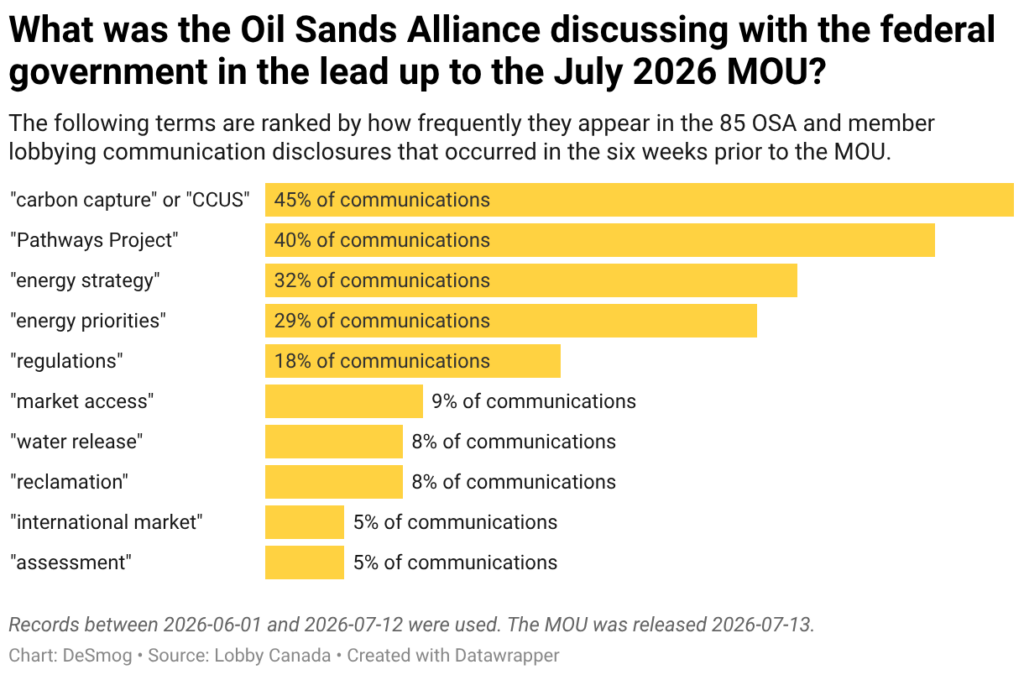
Among the many meetings OSA members have booked with the Carney government, 80 encounters took place with Kelsen Vallee, Ottawa's Major Project Office's chief investment officer. The OSA also met 39 times with Jeff Labonté, the associate deputy minister of Natural Resources Canada.
While ordinary Canadians struggle with a cost of living crisis and diesel prices north of $2.50 per litre, Big Oil is being feted at the taxpayers' expense by its friends within the highest levels of the federal government. Adding insult to injury around the unfolding Pathways boondoggle is the steadily declining utility of what was loudly billed by the fossil fuel sector as the largest carbon capture and storage project in the world.
Pathways was originally hyped to reduce 68 million tonnes (MT) of bitumen production emissions a year, or three-quarters of the oil sands' entire output. That dubious goal has since been quietly rolled back to 16 MT by 2050, a decline of 76 percent.
The first phase of the Pathways project was supposed to be completed by 2030 to store 22 MT per year, now revised down to 6 MT sometime after 2032. DeSmog attended the Carbon Capture Canada conference in Edmonton where Kendall Dilling, President of the Oil Sands Alliance, bravely characterized these massive decreases in emissions reduction promises as "slightly smaller."
But why worry about actual results when you can pay for political influence? Environmental Defence documented over 1,300 lobbying meetings between the fossil fuel sector and the Carney government from May 2025 to April of this year. "Since becoming Prime Minister, Mark Carney has taken a wrecking ball to the country's climate progress," said Julia Levin, associate director of national climate at the environmental non-profit. "And it's no wonder, given that fossil fuel lobbyists have been given unprecedented access to his government."
Carney's handpicked Minister of Natural Resources, Tim Hodgson, served on the board of MEG Energy from 2016 to 2019. MEG was a major bitumen producer and founding member of OSA before being bought out by Cenovus Energy in 2025. According to Environmental Defence, Hodgson was lobbied by the industry he formerly represented at least 83 times in the Carney government's first year.
While the oil industry enjoys unprecedented access to elected power, its leadership basks in obscene war-related windfalls. DeSmog previously documented how Murray Edwards, the founder and executive chairman of Canadian Natural Resources Limited (CNRL) banked over $1 billion in additional personal wealth over an eight-month period from increases in CNLR stock value due the disastrous war with Iran.
Cash-strapped Canadians subsidize the fossil fuel industry at unprecedented levels as the climate crisis accelerates, and Big Oil enjoys a backstage pass to our political process.
The post REVEALED: Oil Sands Alliance is Lobbying Mark Carney's Government Almost Daily appeared first on DeSmog.
Last year, if the fossil fuel industry had been running its combined deployment of carbon capture and storage (CCS) projects at full throttle, it would only have soaked up 0.17 percent — a tiny fraction of a fraction — of the world's carbon dioxide emissions. In reality, the actual figure was even smaller, probably just over half that amount, according to a new report by researchers at Imperial College London, since many carbon capture projects don't operate close to their stated capacity.
Not a stunningly impressive performance for a technique first deployed more than half a century ago. What is arguably more stunning is that the draft text under discussion at the COP31 UN climate talks in Turkey, which makes no mention of phasing out oil, natural gas and coal, but does include a pledge "to work towards capturing 1.3 to 2.5 Gt [billion tonnes] carbon dioxide per year by 2035" — which would represent about 3 to 7 percent of global emissions from the burning of fossil fuels.
In other words, the framers of this text are trying to sell the world on the idea that the fossil fuel industry can expand global CCS capacity by anywhere from 19 to 37 times current levels of 68 million tonnes in less than a decade — and will likely need an even greater increase to meet 2035 capture targets if many projects continue to operate below par.
Nobody in the fossil fuel industry — which has long touted carbon capture as a climate solution — takes such figures remotely seriously.
Subscribe to DesmogGet the weekly intelligence you need to hold polluters accountable
Email Address Sign Up Send me intelligence from: All US/Global team UK/Europe team (function($){ $('.newsletter-container .ijkidr-us').click(function() { $('.js-cm-form').attr('data-id', '2BE4EF332AA2E32596E38B640E905619D07B21962C5AFE16D3A2145673C82A3CEE9D9F1ADDABE965ACB3CE39939D42AC9012C6272FD52BFCA0790F0FB77C6442'); $('.js-cm-email-input').attr('name', 'cm-vdrirr-vdrirr'); }); $('.newsletter-container .ijkidr-uk').click(function() { $('.js-cm-form').attr('data-id', '2BE4EF332AA2E32596E38B640E905619BD43AA6813AF1B0FFE26D8282EC254E3ED0237BA72BEFBE922037EE4F1B325C6DA4918F8E044E022C7D333A43FD72429'); $('.js-cm-email-input').attr('name', 'cm-ijkidr-ijkidr'); }); })(jQuery);While global carbon capture and storage projects have increased in number over the last decade, many have stalled due to the enormous engineering and logistical challenges of capturing CO2 from industrial smokestacks then pumping the gas into underground geologic formations for permanent storage. (For a DeSmog review of 12 flagship carbon capture projects that revealed a litany of missed emissions targets and cost overruns, click here.)
That includes Canada's Pathways project, which was once hyped by oil and gas producers as the largest CCS undertaking in the world, but whose carbon removal targets have been quietly scaled back this year by 76 percent.
But an equally important reason why CCS projects often flop — or don't get built at all — is that the task of capturing and burying CO2 is eye-wateringly expensive and nobody really wants to pay for it.
The technology was originally deployed in a West Texas oilfield in the early 1970s with the express purpose of capturing CO2 so it could be re-injected into dwindling oil wells to squeeze the last remaining drops of hard-to-reach oil — a technique known as "enhanced oil recovery." Studies have suggested this could extend production at some wells into the next century. Extracting more oil and gas was pretty much all carbon capture was used for until relatively recently, when the fossil fuel industry began to promote the technology as a climate solution.
Nevertheless, policymakers have often banked on CCS's technological promise of providing a way to continue burning fossil fuels while abating climate-heating emissions. Given how long politicians have shrunk from confronting the entrenched power of the oil and gas industry, many of most of the pathways set out by climate scientists for reaching net zero emissions assume massive deployments of the technology —- even as the economic, practical and environmental obstacles to ever building it become increasingly apparent.
Global CCS MisstepsEurope is another prime example of how the projects have failed to live up to the hype. Today, the only carbon capture and storage occurring at large scale on the continent is in Norway, where state-owned oil and gas giant Equinor captured and stored about 0.46 million tonnes of CO2 last year, according its own reporting. That was the second lowest amount of CO2 the company has captured since 1996, when it first started implementing CCS.
The reason appears to be simple: Equinor's flagship North Sea carbon capture project is phasing out. The facility was first built to capture CO2 that was filtered out during natural gas processing in the especially CO2-rich Sleipner offshore gas field. By capturing and storing CO2 instead of emitting it, Equinor (then Statoil) was able to save huge amounts of money by avoiding paying a hefty CO2 pollution tax to the Norwegian government. Notably, far more CO2 has been emitted from burning the natural gas pumped out at Sleipner than has been captured and pumped back underground.
This largely represents the economic history of carbon capture up to this point: Fossil fuel companies will only capture and store CO2 when it is profitable: either through natural gas processing (as in the case of Norway) or by capturing CO2 to pump it back underground to boost oil production. Even though a small fraction of CO2 is captured in these projects, the net result is ultimately enabling more oil and gas production, adding to the growing concentration of emissions in the atmosphere.
Despite Equinor's roll-out and promotion of a new carbon capture project called Northern Lights, a North Sea site that represents a key component of the European Union's target to boost CCS to meet climate goals, its financial decisions reflect a cooling enthusiasm for carbon capture. In February, Equinor reduced planned investments in carbon capture, renewable energy, and other low-carbon areas to $9 billion from $13 billion.
Even when governments have given companies hundreds of millions of dollars to build carbon capture to reduce the climate impact of heavy industries, such as steel and cement production, companies have often balked at the financial challenge. Despite more than €600 million in combined public funding for a publicly backed EU-funded projects to reduce CO2 emissions in Belgium, global chemical giant BASF has stated it will need more public subsidies to achieve its part of an Antwerp carbon capture project.
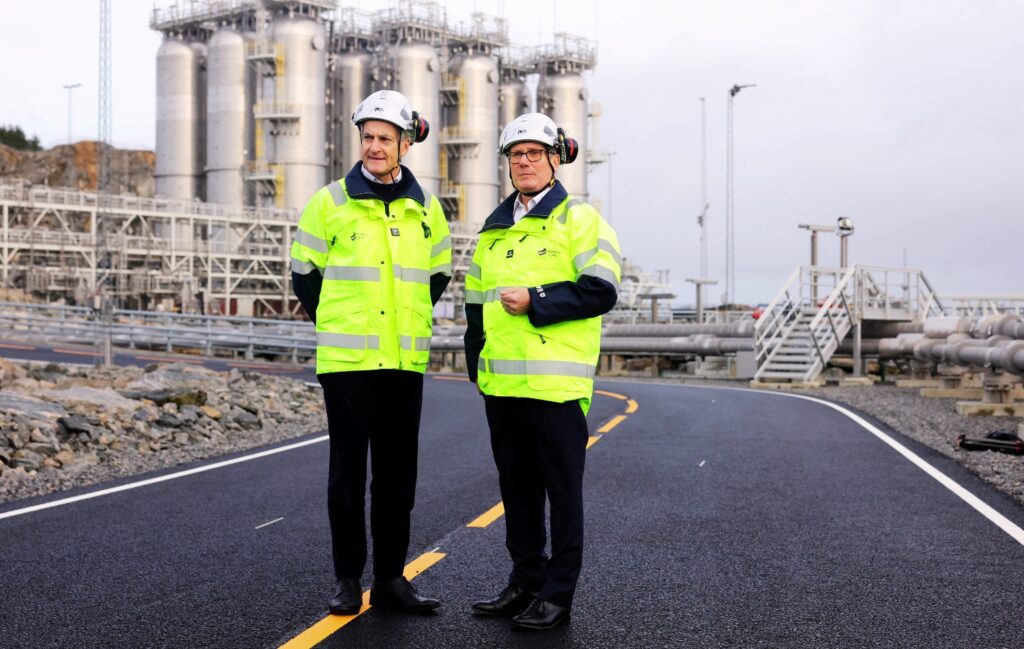 British Prime Minister Keir Starmer visits Equinor's Northern Lights CCUS plant with Norway Prime Minister Jonas Gahr Støre in Bergen in December 2024. Credit: Simon Dawson / No 10 Downing Street (CC BY-NC-ND 2.0)
In Canada, the government of Prime Minister Mark Carney is promising oil producers that taxpayers will cover most of the costs of a carbon capture plan whose price could be as high as $30 billion, while sweetening the deal for industry by rolling back national climate policies. Even so, oil companies haven't yet unveiled any design proposals or started building.
Notably, different types of carbon capture are not technically or financially comparable: capturing CO2 from a gas-fired power plant or steel mill is expensive, complicated, and untested at scale.
In the United Kingdom, the government pledged £21.7 billion ($28.4 billion) in 2024 for multiple CCS projects, including for oil giants BP and Equinor to build the world's first gas-fired power plant to capture CO2 at a large scale — more than two decades since the first carbon capture projects were proposed as a climate solution for the country. Both oil companies are currently planning to expand oil and gas drilling globally, even as they receive lucrative subsidies to capture carbon at a brand new gas-fired power station they are building on the English coast.
Some of the world's biggest carbon capture projects are operating far below capacity. Last year, the largest such project — oil giant Chevron's Gorgon facility on Barrow Island in Australia — had its worst performance of CO2 capture since it began operations in 2019, capturing and storing CO2 at a quarter of its stated capacity.
The enormously expensive $55 billion Gorgon project enables Chevron to process natural gas to superchill it and ship it overseas, where it will be burned and release more CO2 into the atmosphere. And in Texas, a 2023 Bloomberg News investigation found that one of the world's biggest carbon capture projects was not actually operating anymore.
Despite the lack of transparency into how much CO2 is being captured and stored globally, governments appear continually willing to herald the technology as on the verge of making a meaningful difference to global emissions reduction: all this without any legally binding framework to force fossil fuel companies to rapidly scale down down their emissions.
It's no surprise that the world's biggest oil producers such as Saudi Arabia continue to pitch carbon capture as a core climate policy at the UN climate talk. By imposing no limit on the amount of oil, gas, and coal to be extracted and burned, and taking industry hype around carbon capture at face value, the current COP31 draft document is a clear victory for global fossil fuel companies.
The post Carbon Capture Delusion Returns to Haunt COP31 appeared first on DeSmog.
U.S. President Donald Trump suffered a bruising appraisal in November's midterm elections, with the Democrats seizing control of Congress and gaining ground in deepest Republican territory.
Trump is unpopular in the United States - with a little over 30 percent of Americans approving of his performance as president amid allegations of corruption, inflation linked to the U.S.-Israeli war in Iran, and his brutal crackdown on immigrants.
He fares even worse abroad, with just 10 percent of Brits holding a favourable view of Trump, whose second term has less than two years left to run.
As a result, Trump's staunchest international supporters have been attempting to distance themselves from the president and his legacy - despite their long record of praising Trump and his unpopular policies.
Reform UK leader Nigel Farage recently claimed not to have spoken to Trump for "many months", and has criticised Trump's bombing campaign in Iran, having previously said it was "pathetic" for the UK government not to be supporting the military offensive.
However, the pictures don't lie. Farage, Conservative Party leader Kemi Badenoch, and their allies have been caught on camera rubbing shoulders with Trump and his acolytes - a montage that DeSmog has captured below.
The Trump AdministrationFarage has taken dozens of trips to the U.S. in recent years - often in an effort to gain some face time with Trump - while shunning his Clacton constituency.
Their relationship goes back a decade, with Farage one of the few non-U.S. politicians to actively endorse and campaign for Trump during the 2016 presidential election.
This was epitomised in August 2016, when Farage spoke at a Trump rally in Mississippi - warmly introduced by the future president.
 Nigel Farage and Donald Trump at a campaign rally in Jackson, Mississippi on 24 August 2016.
Credit: AP/Gerald Herbert
Farage was rewarded in November that year, when he became the first foreign politician to meet the president-elect following his election victory - invited for an hour-long summit in Trump Tower in New York.

Nigel Farage with Donald Trump in Trump Tower on 12 November 2016.
Credit: Nigel Farage / X
The Reform leader has been loyal to Trump ever since - appearing regularly at pro-Trump events, including the Conservative Political Action Conference (CPAC), snapped backstage with the president at the 2018 jamboree.
 President Donald Trump and Reform UK leader Nigel Farage at CPAC on 24 February 2018.
Credit:
Shealah Craighead / White House (Public domain)
And Farage returned to the campaign trail with Trump during the 2024 presidential campaign, flown out to the States by crypto billionaire and Reform mega donor Christopher Harborne in the summer of 2024, and returning again later in the year.

Nigel Farage at a Trump rally in Pennsylvania on 3 November 2024.
Credit: Nigel Farage / X
Badenoch has been eager to follow suit - attempting to burnish her right-wing credentials by forging ties with Trump's top team.
A month after the Republican won re-election, Badenoch flew to the U.S. in an attempt to "woo" members of the president-elect's inner circle.
This included dining with Trump's running mate, JD Vance, who posted a picture of the rendezvous on social media.
 U.S. Vice President JD Vance and Conservative Party leader Kemi Badenoch on 8 December 2024.
Credit: JD Vance / X
Meanwhile, Farage was taking his own journey to Trumpland - flown by another of his donors, George Cottrell, to Trump's Mar-a-Lago estate to meet the world's richest man, Elon Musk, who was considering whether to donate £80 million to Reform (a donation that never materialised).
Musk has spent nearly $1 billion on Republican campaigns in 2024 and the recent midterms, and for four months led the Trump administration's Department of Government Efficiency (DOGE) - designed to slash federal spending. Farage has endorsed DOGE and tried to replicate it in Reform-run councils.
 Nigel Farage, Reform UK treasurer Nick Candy, and Elon Musk at Donald Trump's Mar-a-Lago estate on 16 December 2024.
Credit: Politics UK / X
Despite his recent pleas to the contrary, Farage has maintained close ties to the White House - pictured with Trump in the Oval Office late last summer.
 Nigel Farage with Donald Trump in the White House Oval Office on 4 September 2025.
Credit: Nigel Farage / Instagram
And, during Trump's UK state visit later that month, Badenoch managed to grab a snap of her own.
 Kemi Badenoch and Donald Trump at a UK State Banquet in Windsor Castle on 18 September 2025.
Credit: Kemi Badenoch / Instagram Trump Affiliates
As well as ingratiating themselves with the Trump administration, senior right-wing figures in the UK have forged close ties to the groups in his orbit.
That includes the Heritage Foundation, the think tank that produced Project 2025, the radical right-wing blueprint for Trump's second term.
Several Conservative and Reform politicians have been invited to address the Heritage Foundation in recent years - including Robert Jenrick, Suella Braverman, and Zia Yusuf.
 Robert Jenrick speaking at the Heritage Foundation on 14 February 2024.
Credit: Heritage Foundation / YouTube
Meanwhile, Farage has boosted one group more than any other: the Heartland Institute, which claims to be influencing the Trump administration "at the highest level" and has branded human-caused climate change "fake news".
The Reform leader spoke at a fundraiser for the Heartland Institute in Chicago in September 2024 - urging the group to establish a satellite in Europe.
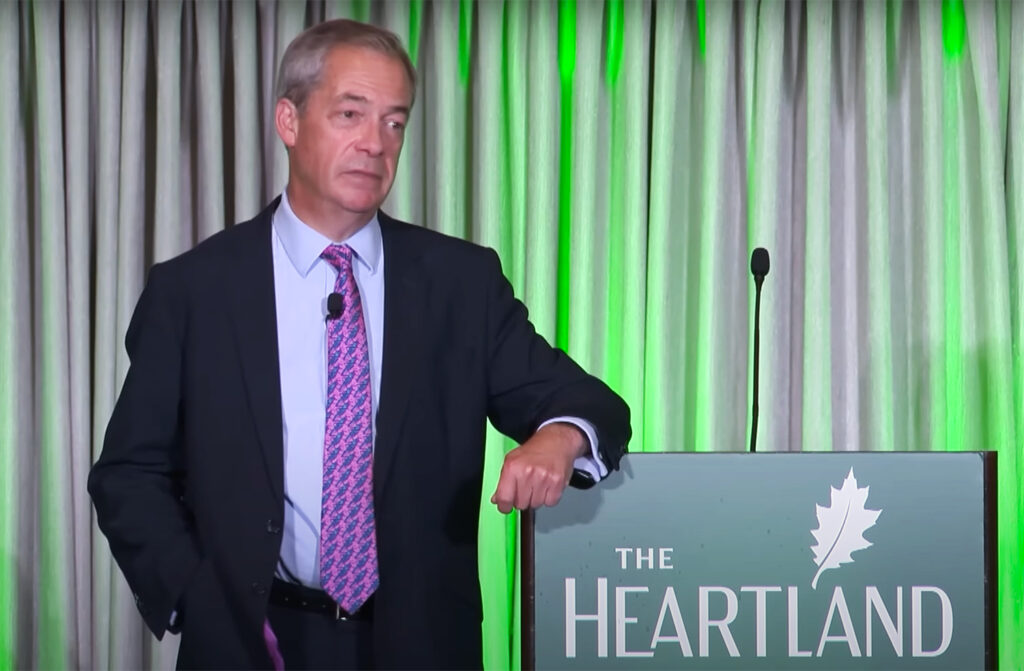 Reform UK leader Nigel Farage speaking at the Heartland Institute's 40th anniversary fundraiser on 13 September 2024.
Credit: Heartland Institute / YouTube
And, when Heartland followed his advice, Farage was the keynote speaker at the group's UK/EU launch event in December that year.
 Nigel Farage at the Heartland Institute's UK/EU launch on 17 December 2024.
Credit: Heartland Institute
 Suella Braverman at the Heritage Foundation on 28 January 2025.
Credit: Heritage Foundation / YouTube
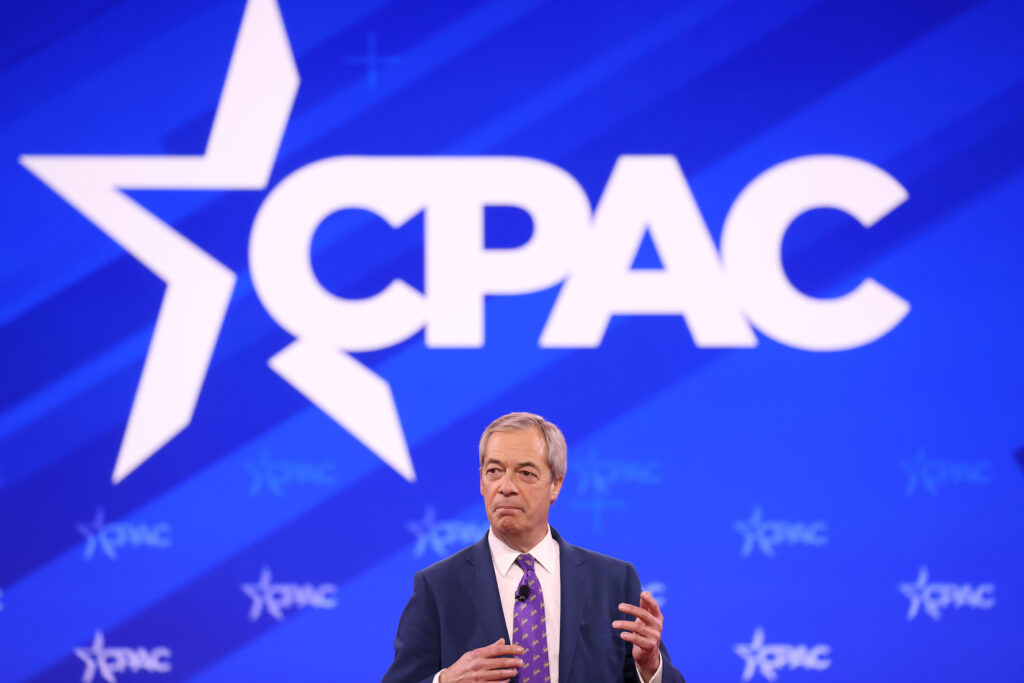 Reform UK leader Nigel Farage at the 2025 Conservative Political Action Conference (CPAC) in Maryland on 20 February 2025.
Credit:
Credit: Gage Skidmore / Wikimedia Commons (CC-BY-SA-2.0)
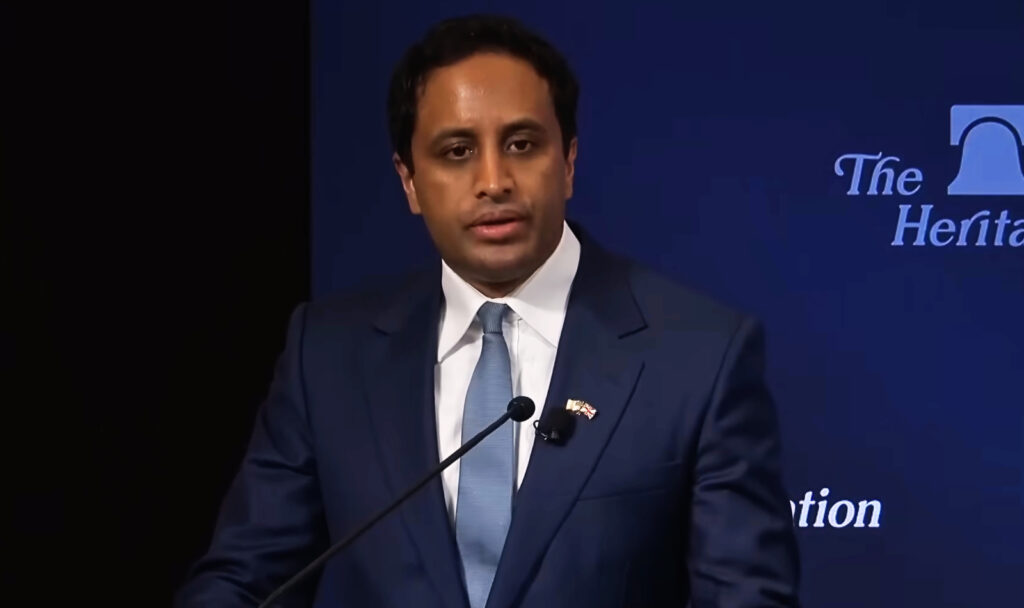 Reform's Zia Yusuf speaking at the Heritage Foundation on 11 June 2026.
Credit: Heritage Foundation / YouTube
The post In Pictures: Farage, Trump, and the UK MAGA Network appeared first on DeSmog.
Premier Danielle Smith's divisive sovereignty referendum was rejected last month by three quarters of Alberta voters in a resounding defeat that saw a 70 voter turnout with more than 2.2 million ballots cast.
Yet hardcore separatists apparently learned little from this teachable moment. Upset with the referendum results, Alberta Prosperity Project (APP) is now organizing to oust Danielle Smith from her United Conservative Party (UCP), according to the transcript of a postmortem APP meeting obtained by DeSmog.
"We have to understand that this is a political fight and we're not going to win it unless we get political," said APP leader Mitch Sylvestre.
In lieu of showing gratitude for imposing a divisive referendum on the province that was unwanted by the vast majority of Albertans and cost taxpayers $84 million, the APP now gripes that the question somehow wasn't fair. "The government shouldn't put its finger on the scale," complained Sylvestre. "We had our premier signing with the globalists and the federalists. There's no disguising that," seemingly implying that Smith is in league with the country of Canada, which Sylvestre previously stated is on track to become absorbed by a future global government hostile to "white Christianity."
Subscribe to DesmogGet the weekly intelligence you need to hold polluters accountable
Email Address Sign Up Send me intelligence from: All US/Global team UK/Europe team (function($){ $('.newsletter-container .ijkidr-us').click(function() { $('.js-cm-form').attr('data-id', '2BE4EF332AA2E32596E38B640E905619D07B21962C5AFE16D3A2145673C82A3CEE9D9F1ADDABE965ACB3CE39939D42AC9012C6272FD52BFCA0790F0FB77C6442'); $('.js-cm-email-input').attr('name', 'cm-vdrirr-vdrirr'); }); $('.newsletter-container .ijkidr-uk').click(function() { $('.js-cm-form').attr('data-id', '2BE4EF332AA2E32596E38B640E905619BD43AA6813AF1B0FFE26D8282EC254E3ED0237BA72BEFBE922037EE4F1B325C6DA4918F8E044E022C7D333A43FD72429'); $('.js-cm-email-input').attr('name', 'cm-ijkidr-ijkidr'); }); })(jQuery);During an October zoom webinar titled "Next Steps for Alberta Independence," Sylvestre detailed how the APP is seeking to stack a UCP annual general meeting happening at the end of November to terminate Smith's leadership and further install separatists into positions of power.
"If you're going to the AGM, you're going to support a cause for Independence," urged Sylvestre. "There's no other reason for us to go there. The reason that we have to go there is because we have to take care of our own best interests."
Sylvestre explained that APP plans to run a slate of candidates at the AGM, and urged supporters to register, saying that "we need a thousand people to commit to going to the AGM."
The APP is also helping loyalists to attend the meeting. "If you cannot attend the AGM because it's too much money and you can afford a $20 donation or $30 donation, please do that," Sylvestre pleaded. "Because we're going to try and subsidize people. We're going try and help people to get there."
Another meeting attendee explained that plans are already in motion. "We are working behind the scenes to try and get CAs [constituency associations] organized to pass motions for a leadership review. We've had three CAs pass this so far."
The APP bills itself as a "non-profit educational initiative working to unite Albertans around the case for sovereignty." It's led by Sylvestre and Jeff Rath, the group's increasingly embattled legal counsel whose assets have been frozen by the courts over allegations of financial mismanagement involving a First Nation client. APP is one of several separatist groups such as Let Alberta Decide now publicly feuding with each other after the failed referendum bid.
"In spite of everything they threw at us, we didn't change our minds," crowed Sylvestre in apparent reference to those opposing the separatist movement. "They did not gain one inch. They did not take one person away … from our base."
Stubbornly sticking to a failed strategy seems a strange thing for separatists to brag about. However, Sylvestre makes an important point. All the political concessions showered on this fringe group by both the Alberta and federal governments did not quell separatist sentiment and support for sovereignty remained largely unchanged between May 2025 and referendum day.
To recap, Prime Minister Mark Carney cancelled the consumer carbon tax, rolled back clean energy regulations, eliminated the emissions cap, nixed restrictions on greenwashing, and moved forward with another publicly funded bitumen pipeline. Carney's climate record is now almost as wretched as the "drill, baby drill" ethos of the Trump Administration. Did any of these capitulations to the oil patch appease the MAGA-supported radicals seeking to break up our country and seize our resources?
Nope. The conspiratorial Kool-Aid continues to flow unabated. "We're talking about $100 trillion worth of resources under our feet here. Nobody's gonna let us walk away with that very easily," warned Sylvestre. "The people that are trying to keep this away from us are really not very good people. I would say that they're very bad people and probably … even evil people."
Meanwhile, Smith changed the referendum rules in favour of separatists and included a series of dog-whistle questions scapegoating immigrants in an apparent sop to their intolerant tendencies. Did any of those political indignities placate the separatist mob?
Clearly not. Sylvestre said Smith "is telling us to pick between her and Alberta Independence."
The would-be founding fathers of the nation of Alberta now publicly bicker over strategy, motivations, and of course money. The "Rise of Alberta" X account linked to Keith Wilson, head of APP's rival Alberta Transition Council recently posted: "REVEALED: Banking records reportedly show $288,531 transferred from APP and Stay Free Alberta-linked accounts to Jeff Rath's professional corporation. How much of this was donor money spent on legal fees rather than advancing Alberta independence? Donors deserve answers."
Jeff Rath responded "Keith Wilson's son Eric Wilson now runs @RiseOfAlberta for Danielle Smith. Whatever you do don't buy his crappy merch. It just funds keeping Danielle Smith in office and turning Alberta over to Nenshi."
What can the rest of the country conclude from the rejected independence referendum and the shambolic fallout from alleged separatist leaders? The grifters, conspiracy theorists, and company town cowards behind the so-called Alberta independence movement are not going away anytime soon, regardless of additional giveaways to the oil patch - currently on track to bank $200 billion in revenues this year.
Toward the end of the call, Sylvestre said "[t]here's other paths to independence and we're going to explore them all."
While Sylvestre didn't elaborate on what these others paths are, DeSmog recently reported on the Free Cities Foundation promoting the creation of low-tax, private enclaves catering to rich investors and entrepreneurs as an alternative to separation.
One such would-be utopia is Próspera, a special economic zone (known as a ZEDE) located on the island of Roatán in Honduras with MAGA-aligned tech investors such as Peter Thiel and Sam Altman. The Honduras Supreme Court has since struck down the zone laws of Próspera, which responded by suing the Honduran government for nearly $11 billion - equivalent to almost two thirds of national budget in 2022. There seems to be no independence scheme too harebrained for Sylvestre and his fellow separatists to foist on their followers.
Canadians have seen this tiresome movie before. Alberta separatists borrowed the "knife to the throat" strategy employed so successfully by Quebec sovereigntists. However, the only reason to negotiate under such cynical duress is if there is actually a knife, and if those holding it are prepared to change their minds. This ugly referendum and its aftermath have revealed that neither of these conditions are true.
In the meantime, stay tuned for additional separatist drama as APP continues their town hall circuit hoping to build support for a showdown with UCP leadership on November 27.
The post Alberta Prosperity Project Wants to Oust Premier Danielle Smith appeared first on DeSmog.
Polluting food and agriculture companies are present in large numbers at this year's UN COP31 climate talks, with a total of 260 lobbyists on the ground in Turkey's southern city of Antalya, new analysis shows.
The meat and dairy sector, which produces over 14 percent of global emissions, brought 71 delegates, the highest number of all food and agriculture sectors. Its representatives outnumber delegates from Honduras, where millions of people currently face severe drought.
Fertiliser lobbyists showed the biggest jump in delegates year on year, with a 45 percent increase. The CEOs of several powerful trade groups representing the meat, fertiliser, pesticides and biofuels sectors are also present in Antalya.
Some of the world's largest agribusiness firms, including meat company JBS and dairy multinationals Nestlé and Danone, as well as pesticides firm Bayer and food giant Unilever, also travelled to Turkey for the talks, which run from 9-20 November.
The analysis shows the power and influence enjoyed by the sector, with more than a hundred lobbyists participating as part of their country governments, lending them privileged access to negotiations. More than 44 percent of food and agriculture delegates travelled on country badges, up from 5 percent at COP27 five years ago.
For fertiliser firms, the share of delegates on party badges rises to 90 percent. Russia's party included 12 delegates from two fertiliser companies linked to sanctioned individuals, DeSmog found.

A version of this article was published by franceinfo.
DeSmog's revelations come as disappointment sets in for advocates hoping for action to reform food systems, which account for a third of global emissions. Agriculture negotiations have broken down after four years of discussion, with some observers pointing to the contributing "role of vested interests" in their collapse.
At the time of going to press, all references to food and farming are missing from the draft cover text, which informs the basis of a final deal at the talks. And a high-level initiative to spur government action on methane is languishing on seven signatories.
Both meat and fertiliser groups are keen to make their voices heard at a summit where the Turkish presidency has made curbing the short-lived "superpollutant gases" emitted by agricultural sectors - such as nitrous oxide and methane - a top priority.
DeSmog has witnessed meat industry groups lobbying to weaken the accounting metrics for methane at side events while observers describe the high fertiliser sector turnout as "a big PR campaign" to be recognised as vital to food security.
The UN's leading science body, the IPCC, says the world must make urgent and deep cuts to greenhouse gas emissions to avoid catastrophic climate change. Global heating is already set to breach 1.5C, with each additional degree of warming increasing deadly impacts from droughts, floods, and cyclones.
"This is a direct affront to billions of people who are suffering from the climate emergency," said Million Belay, co-founder and general coordinator of the Alliance for Food Sovereignty in Africa (AFSA). "They have created the crisis that we all live in. And they are here to influence the whole process through lobbying, thwarting a real discussion and action against emissions, and flooding pavilions with empty talk."
Farmers are facing unprecedented losses from droughts, floods, and tropical cyclones - 49 million more people could face acute hunger in 2026-27 due to the El Niño weather system that has been turbo-charged by climate breakdown.
"We need to talk about the impact that lobbying is having on our democracy," Nusa Urbancic from advocacy group Changing Markets Foundation told DeSmog. "The number of agribusiness lobbyists is shocking and shows why agriculture has not yet made it into any official documents."
A spokesperson from Bayer said: "Global challenges need places where the world still comes together". They added: "Combating climate change requires governments, civil society, local communities and the private sector to work together on effective solutions. This is particularly important for agriculture, which is severely affected by climate change".
Nestlé told DeSmog: "COP31 is a major global gathering and an important opportunity to engage with governments, civil society, farmers and other stakeholders to accelerate climate action. Our engagement is focused on advancing practical solutions."
DeSmog analysed the provisional list of 68,374 in-person delegates published by the United Nations Framework Convention on Climate Change (UNFCCC) for representatives from the largest corporations and trade groups in major food sectors. (More information on the methodology can be found at the article's end.)
The number of food lobbyists has dropped by 18 percent year-on-year compared to COP30, but they stand 40 percent higher than COP27 five years ago, showing an enduring industry interest in influencing the climate conversation.
Climate summits offer delegates many routes to influence - from sponsoring pavilions to promoting unproven solutions or greenwashing at side events - putting lobby groups in prime position to sideline meaningful climate action.
This year's summit includes 45 lobbyists from fertiliser companies, a three-fold increase since the COP27 summit in Sharm el-Sheikh five years ago.
Fertilisers are a leading driver of nitrous oxide emissions, which cause around 270 times more warming than CO2. These chemical outputs emit more greenhouse gases than commercial aviation.
DeSmog's analysis shows the $230-billion industry wields significant influence. Nearly all fertiliser representatives (40 of 45) travelled inside their country delegations, and the International Fertiliser Association (IFA), the leading lobby group for the world's biggest fertiliser producers, brought four delegates to the summit.
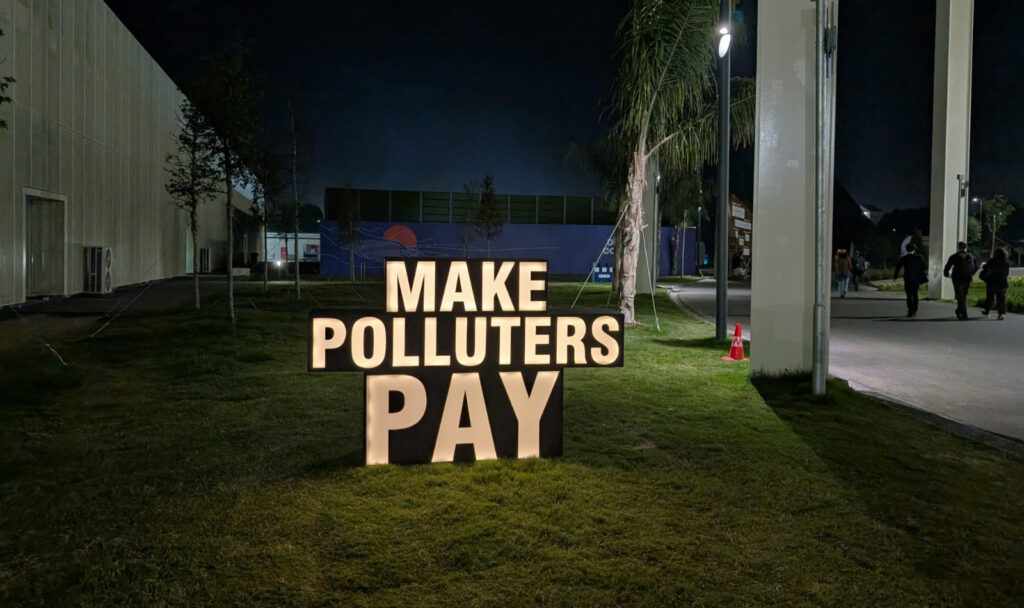 A 'Make Polluters Pay' sign at COP31 in Antalya, Türkiye.
Credit: DeSmog
In the run-up to COP31 the IFA has promoted chemical inputs as indispensable to food security - an argument frequently used by industry to oppose any moves to reduce fertiliser use. It has also called for the sector to be given a "stronger voice" in multilateral negotiations and for it to be recognised as a "national security asset".
Food systems experts at the IPES food thinktank take the opposite view. They have argued that farming must break its dependency on nitrogen fertilisers, 99 percent of which are made from fossil fuels, and encourage governments to fund climate-friendly alternatives, as extreme weather and conflict disrupt global supply chains, causing widespread hunger and food price spikes.
But long-running civil society attempts to insert references to greener farming practises into the agriculture negotiations at COP31 ran aground on Friday (13 November). Sources close to the talks told DeSmog that anger from the Arab negotiating group at the impact of EU climate legislation on its fertiliser firms was a key factor in negotiations ending with no agreement.
Arab group members Oman and Morocco brought in 10 delegates between them from the Oman India Fertiliser Company and OCP Group. The latter, which had a turnover of more than $12 billion last year, also sponsored Morocco's pavilion.
In an emailed statement OCP Group told DeSmog it "plays an important role in global food security as a global leader in plant nutrition and phosphate-based solutions". It added that its "participation provides an opportunity to bring an industry perspective and share our expertise in how customised fertilisers and better agricultural practices can help farmers improve productivity, protect soil health and reduce environmental impacts."
Indonesia and Russia's guestlists likewise included dozens of representatives from fertiliser firms, with Russia bringing 11 representatives from PhosAgro and one from Uralchem.
Both companies are part-owned by their respective founders Andrey Gurvey and Dmitry Mazepin or their families, billionaire Russians who have been sanctioned by the European Union and the UK. Their delegation outsized the climate vulnerable states of Trinidad and Tobago, Eritrea, and Nicaragua combined.
Countries at the summit used the event to cut deals for fertiliser expansion. Oman and Nepal both seek investment for plants that will produce fertiliser from renewable power - products that groups like the International Fertiliser Association argue can decarbonise the sector, and enable it to grow.
Independent climate expert Lili Fuhr accused the sector of "selling the world a greenwashed fantasy". Campaigners say the 'clean' production techniques touted by the sector are often unfeasible, too costly at scale, and fail to cancel out nitrous oxide, a superpollutant 270 times more potent than CO2, which is emitted in large quantities once fertilisers are used on the field.
"The fertiliser presence is clearly linked to the Strait of Hormuz crisis. It's part of this big PR exercise, where they say we are the solution to the climate crisis and food security," says Marie Cosquer from Action Against Hunger, who is following the talks on the ground.
"They are afraid that countries would agree to more agroecology, phase out chemical outputs, and help farmers break dependency on polluting outputs," she said.

A version of this article was published by Consenso.
Meat Targets MethaneBrazil brought seven representatives of the world's largest meat company JBS, including its CEO, Gilberto Tomazoni. In July, the highest-emitting livestock firm abandoned its target to be net-zero by 2040 and dropped commitments to tackle deforestation.
Elodie Guillon of advocacy group World Animal Protection told DeSmog that JBS, a regular at COPs, often attends as part of country delegations to ensure climate action does not "get in the way" of its expansion.
"In the last couple of years, JBS expanded rapidly in Africa and Asia, risking displacing communities and driving deforestation, threatening the livelihoods of pastoralists and small producers," she said.
At past climate summits, the meat sector - and industry-aligned states - have repeatedly pushed to delay or block climate actions targeting its sector. At COP26, US beef lobbyists celebrated weak voluntary commitments for agriculture in the Global Methane Pledge. The lobby watered down targets in the reports of the UN's leading climate science body the IPCC, and it has also run pro-meat PR campaigns to present agriculture as the "solution" to climate change.
This year, trade groups lobbying on behalf of the meat industry at the talks include Australia's National Farmers Federation (NFF), Beef+Lamb New Zealand, and the Global Roundtable for Sustainable Beef.
All three groups are pushing for changes to the way that international agreements calculate methane emissions, which critics say could leave pollution unchecked for a sector that accounts for around 32 percent of the global total.
Subscribe to DesmogGet the weekly intelligence you need to hold polluters accountable
Email Address Sign Up Send me intelligence from: All US/Global team UK/Europe team (function($){ $('.newsletter-container .ijkidr-us').click(function() { $('.js-cm-form').attr('data-id', '2BE4EF332AA2E32596E38B640E905619D07B21962C5AFE16D3A2145673C82A3CEE9D9F1ADDABE965ACB3CE39939D42AC9012C6272FD52BFCA0790F0FB77C6442'); $('.js-cm-email-input').attr('name', 'cm-vdrirr-vdrirr'); }); $('.newsletter-container .ijkidr-uk').click(function() { $('.js-cm-form').attr('data-id', '2BE4EF332AA2E32596E38B640E905619BD43AA6813AF1B0FFE26D8282EC254E3ED0237BA72BEFBE922037EE4F1B325C6DA4918F8E044E022C7D333A43FD72429'); $('.js-cm-email-input').attr('name', 'cm-ijkidr-ijkidr'); }); })(jQuery);Methane reduction offers one of the fastest opportunities to slow global warming, as a short-lived superpollutant that causes over 80 times more warming than carbon dioxide over a 20-year timeframe.
During an event at the UN climate summit on Monday (16 November), Macaulay Jones from the Beef+Lamb NZ trade group called for governments "to look at the use of alternative warming-based metrics" - an apparent reference to the metric GWP*, which has been dubbed a methane "accounting trick".
Jones went on to mention an upcoming "review of metrics" at the UNFCCC. He said his group would be asking countries to support their bid to have "alternative warming-based metrics" accepted for calculating nationally determined contributions, every signatory state's action plan to meet its commitments under the Paris Agreement.
When New Zealand became the first country to adopt the GWP* metric into its domestic climate goals in 2025, it cut its methane reduction targets down to 14-24 percent by 2050 from 24-47 percent.
The drop in ambition lends credence to researchers' warnings that adopting GWP* will allow big polluters to claim "climate neutrality" without cutting herd sizes, or methane output.
A 2024 study that surveyed more than 200 climate experts said that livestock emissions must be reduced by 61 percent globally by 2036 in order to meet the targets set by the 2015 Paris Agreement.
"We know we are going to overshoot 1.5C warming. The question is how long and at what level," Urbancic of Changing Markets said. "If you suddenly magically wish methane away, it changes the accounting but not the impact on the atmosphere. Super pollutants like methane have to be part of the discussion."
Voluntary PledgesAgribusiness trade groups at COP31 have also lobbied countries hard to keep action on methane voluntary - and even to undermine already-voluntary pledges.
In the wake of pressure from the country's National Farmers' Federation, COP co-host Australia announced last week that it would not sign the new Global Methane Pledge Ministerial Declaration - a commitment by countries including Germany and the UK to strengthen a pledge agreed in Glasgow at COP26.
The NFF, which thanked the government "for responding quickly" to its concerns, received funding from Australia to travel to the summit, as did trade group Dairy Australia - both of which are attending as part of the country's delegation.
U.S. meat trade groups were notably absent from Turkey, following the lead of the Trump administration, which boycotted talks for the second year in a row.
The dairy sector, however, maintained its presence year-on-year, using the event to promote its efforts to cut methane. Dairy giants Yili and Mengniu brought seven delegates between them, as part of China's delegation, while the Netherlands brought one representative from FrieslandCampina, and France brought four representatives from Danone.
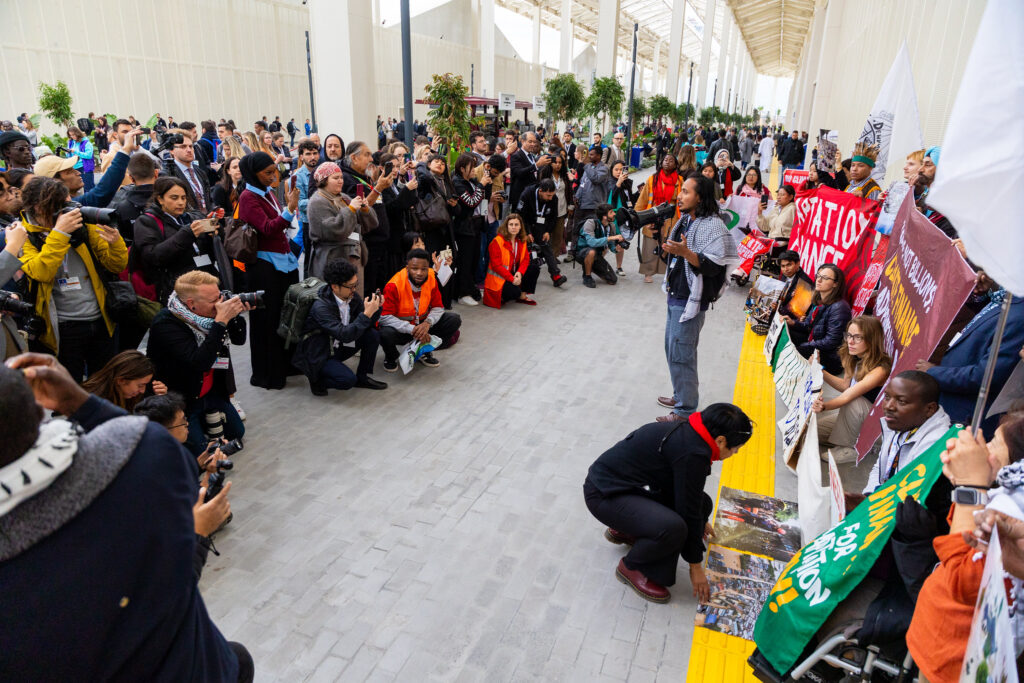 Members of civil society demonstrate in the corridors of COP31 in Antalya, Türkiye.
Credit:
UN Climate Change - Kubilay Ciftci (CC BY-NC-SA 4.0)
Along with the largest meat companies, the dairy industry is responsible for as much methane as the UK and EU combined. The sector is projected to grow at a steady 2 percent per year over the next decade.
Danone is one of few companies at the summit that has significantly cut its methane footprint, reducing it by almost 30 percent since 2020. The company told DeSmog that it had "contributed to discussions on methane reduction, climate resilience and mobilizing private investment in nature" during the summit.
In an emailed statement, dairy giant Nestlé said: "Our advocacy is guided by a clear objective: supporting the implementation of the Paris Agreement and accelerating the transition to a more sustainable and resilient food system." It added that it was "proud to be recognised by InfluenceMap as a leader in responsible and transparent climate lobbying."
Dutch dairy company FrieslandCampina stated that it had "attended COP31 to contribute constructively to climate action and to help accelerate practical implementation". It added: "Our aim was to listen, learn, share practical experience and explore partnerships that can deliver impact on farms and throughout supply chains. We engaged with stakeholders on methane reduction, regenerative and climate-smart agriculture, climate adaptation and biodiversity."
BioeconomyBuilding on its success at COP30 - where host Brazil called for major expansion of the use of food crops for fuel - the $155 billion bioenergy industry also sent a substantial delegation with 30 representatives on the ground.
These outnumbered delegates from Sri Lanka, which is bracing for the impacts of a climate-charged El Niño this year and has set aside millions to fight severe drought and deliver water to families.
Critics say the term 'bioeconomy' has been hijacked to put a green spin on the expansion of highly destructive monoculture grain crops. It now operates as a byword for controversial "biofuels" - liquid fuels produced from organic materials, such as corn-based ethanol or biodiesel made from soybean oil - which studies have labelled a "false solution" to climate change.
Companies and trade groups from the U.S. and Brazil, the world's top two biofuels producers, brought over a third of the bioenergy representatives to COP31.
They include the Corn Refiners Association (CRA), whose members include two of the world's biggest grain companies: Cargill, the largest privately held agribusiness in the world, and Archer Daniels Midland. The CRA is a co-sponsor of a summit event titled: "Scaling the circular bioeconomy: agricultural solutions to climate change".
Cian Delaney, biofuels campaigner at Transport & Environment has described biofuels as "a terrible climate solution, and a staggering waste of land, food and millions in subsidies" in a 2025 report.
Criticisms levelled at the biofuels sector include: the clearance of huge tracts of land; harm to Amazonian communities; water pollution and poisoned ecosystems, and jeopardising endangered wildlife.
Countries at the frontline of these impacts are clear that the time has come for action on agriculture and food, as the UN warns that climate change will cause at least 250,000 additional deaths per year between 2030 and 2050.
"The message is still going out that agriculture is not a worthy consideration because of politics," prime minister of Barbados Mia Mottley told world leaders on Thursday (12 November), the day before agriculture talks broke down.
"We can't leave it as a topic we cannot touch."
All companies and countries named in this article were contacted for comment.
Additional research by Brigitte Wear and Rachel Sherrington
Methodology note
DeSmog analysed the provisional list of UNFCCC COP31 delegates, with assistance from a large language model. The list was checked for the largest corporations in major food sectors which wield significant control in a highly concentrated food chain, and account for the majority of trade, of the following type: meat and dairy, pesticide and fertiliser firms, food processors, commodity and seed traders, (agricultural) bioenergy, grocery retail, commodity trader and shipping, and food packaging. Large national companies were included only when they are known to be high-emitting firms and/or have a track record of lobbying against environmental and climate policy.
DeSmog also included global and regional industry trade groups, some of which brought their own delegations to Antalya, along with national farmer unions and institutes that have corporate affiliations and/or a history of lobbying aligned with industry demands.
The post Fertiliser, Big Meat and Biofuels Industry Among 260 Food Sector Lobbyists at COP31 appeared first on DeSmog.
Arnold Obguia did not leave the island. According to the forecast, it was no big deal, just another tropical storm. But a few hours later, the winds escalated rapidly, bringing waves so large they almost pulled him out to sea. Clinging to a piece of broken sea wall, Arnold survived to find his house completely destroyed. Others were not so lucky.

This story is published in partnership with Rolling Stone.
Typhoon Rai, known locally as Typhoon Odette, battered the Philippines in December 2021. With winds of up to 167 miles per hour, extreme rainfall, violent storm surges, extensive flooding, and landslides across the central Philippine archipelago, Odette ripped rooftops from houses and devastated crops, engulfing people and property in torrents of fast-flowing floodwater. A Category 5 cyclone, Odette displaced nearly 3.2 million people, killing 400, injuring over 1,000, and causing nearly a billion US dollars in damages.
Now, Arnold and other victims of the typhoon are demanding their day in court, filing a civil lawsuit against oil and gas giant Shell. Their allegations: Shell helped to make the typhoon more destructive through the company's contribution to historic greenhouse gas emissions and its funding of climate denial — despite knowing since at least 1965 that the burning of fossil fuels was the primary cause of man-made climate change.
"The forecast had initially said it was going to be a weak storm," says Arnold from the house he rebuilt with storm debris on the tiny island of Bilangbilangan in the heart of the Philippines' Cebu Strait. Forty-four years old, Arnold is a fisherman, born and raised on the island, who earns his living catching trevally and bigeye scad, silvery-blue-green fish that swim in large schools around the region's coral reefs.
"But suddenly the winds were different, they were very strong," he recalls. "When I looked outside the window it was frightening because the waves were very high." While his wife and two young daughters had taken refuge on the mainland, Arnold and his 14-year-old son had stayed behind to guard his boat and fishing equipment — the source of the family's livelihood. "The waves were swelling and I could see the storm surge coming," he remembers. Calculating that he might have time to better secure his boat, he ran outside only to get caught by the 20-foot waves that nearly swept him away. Terrified, Arnold held tight to the broken sea wall until, bruised and wounded by the debris whirling in the water, he was able to rejoin his son. "Thinking about my family and how much I wanted to see them again gave me the strength to hold on," he says. Arnold and his son rode out the rest of the storm sheltering in the house of a neighbor. Hours later, when it was over, Arnold discovered his boat was broken but his family was safe. Like everyone else on Bilangbilangan, they had lost almost all their possessions. "Everyone went back to zero," he explains.
Arnold joined the lawsuit in early 2024 when a coalition of NGOs working with communities ravaged by the typhoon organized a civil claim on behalf of the survivors. In 2025, British law firm Hausfeld agreed to take up the case in the UK — where Shell is headquartered —submitting full details of the claim against the oil company in July of this year.
 Typhoon Rai — known as Odette in the Philippines — had sustained winds of 121 miles (195 kilometers) and gusts of up to 167 miles (270 kilometers) per hour when it made landfall in the archipelago on December 16, 2021. Credit: NASA Earth Observatory image by Lauren Dauphin, using VIIRS data from NASA EOSDIS LANCE , GIBS/Worldview , and the Suomi National Polar-orbiting Partnership. Public Domain.
Representing more than 100 of the typhoon's victims, Hausfeld describes the suit as a "landmark case" that could have "major repercussions for the fossil fuel industry," potentially paving the way for other hard-hit communities around the world to sue oil Big Oil on its home turf. The firm argues its clients suffered severe losses including serious property damage, personal injury, bereavement, psychological trauma, and loss of earnings. An announcement of the date for the first hearing to be held at London's High Court is expected sometime early next year, says Greg Lascelles, the Hausfeld partner leading the legal team.
Shell has dismissed the lawsuit as "baseless," asserting the company had no "unique knowledge about climate change" in an official statement.
However, evidence uncovered by DeSmog in collaboration with Rolling Stone reveals explosive new details of Shell's decades of climate research that warned the company burning fossil fuels could lead to worsening storms — including studies conducted at the Climatic Research Unit (CRU), the UK's first specialist climate research center established by Shell on the campus of a university in eastern England in 1972.
Some of these documents might have been lost forever, had a sharp-eyed faculty member not rescued them from a dumpster where they'd been thrown out after the retirement of the CRU's first director, the UK's leading climatologist, Hubert Lamb. Now preserved inside the temperature-controlled archives at the University of East Anglia, a few miles outside the medieval city of Norwich, these and other files contain handwritten notes, official correspondence, and reports that hold secrets of Shell's early climate research, detailing a program that would give the company advance warning of the numerous threats climate change posed to its business — if not to the people, like Arnold and his island neighbors, liable to suffer the most harm.
Documents from the late 1960s show Shell playing a pivotal role in establishing the center before paying the CRU to carry out an in-depth "North Sea Storms Study" beginning in the mid-1970s. The findings warned Shell that storms in Europe's North Sea — home to the company's burgeoning offshore drilling business — were increasing. Rising atmospheric carbon dioxide (CO2) levels due to the burning of fossil fuels might be the most likely explanation, the Shell-funded study concluded.
These discoveries contribute to a growing body of existing evidence demonstrating that by the late 1980s the oil majors, including Exxon and Shell, knew the dangers posed by fossil fuel-induced climate change. However, a fresh look at documents previously unearthed by other researchers shows Shell receiving further storm warnings. For example, in 1980, a Shell-sponsored study at the CRU modeling future "Scenarios for a High CO2 World," calculated that rising CO2 levels from burning fossil fuels would "perturb the whole atmospheric circulation system," affecting rainfall, temperatures, and winds all over the world.
By the end of the 1980s, Shell had specifically learned that global warming would likely lead to more frequent and more dangerous storms, especially in tropical regions.
Today, as the world approaches the peak of what promises to be the worst El Niño cycle in recorded history, supercharging hurricanes, heatwaves, droughts, and other extreme weather events already made worse by climate change, the documents open a rare window into Shell's early sponsorship of climate science, illustrating how much the company knew about the risks posed by burning its products before supporting million dollar PR and lobbying campaigns that denied or cast doubt on this climate science in public.
Shell did not respond to a request for comment about the company's historical climate research.
Geoffrey Supran, an associate professor in the department of environmental science and policy at the University of Miami who is not involved in the lawsuit, but who has reviewed the new documents for DeSmog and Rolling Stone, calls them "a smoking-gun," containing important evidence of "how the early climate denial machine began to be built — and when."
"Seen across seven decades, Shell's research looks less like scientific philanthropy and more like a public affairs strategy of 'Know Thy Enemy,'" says Supran, "allowing the company to understand climate change early, help shape and stay close to the science, anticipate the physical and economic threats it poses, and stay ahead of policies that might threaten business-as-usual."
'A Centre on Climatic Studies'Sitting at his desk in London's "Shell Tower," a 26-story modernist skyscraper with majestic views overlooking the River Thames and Houses of Parliament, R. O. Chalkley had a problem.
It was September 1966. The Beatles' Revolver had reached Number One in the album charts but Chalkley was wrestling with something far more changeable: the weather.
As the director of a company-wide planning study, it was Chalkley's job to help Shell find the most effective way of coping with variations in the demand for oil brought about by an apparently changing climate. Recent European winters had sent temperatures plunging but if Shell invested heavily in storing up larger quantities of oil to heat Europe's homes only for the weather to turn warmer, it could prove an expensive mistake.
 An image from a Shell brochure of the Shell tower in London in the 1960s. Credit: UEA Archives and Library Special Collections, UEA/Jones/40
Luckily for Chalkley, an August 1966 article in The Times by the UK's leading climatologist, Hubert Lamb, offered a possible solution. "Is our climate changing?" Lamb asked, arguing that improved understanding of the Earth's climate history was essential for future economic planning. Hoping that the climatologist's work might benefit Shell, Chalkley wrote to Lamb inviting him to discuss "the climatic aspects" of the company's problem in person.
Their meeting was an instant success, launching the idea for a Shell-funded "Centre on Climatic Studies" — Lamb would search for a university to host his research, while Chalkley pitched the idea to his bosses inside Shell.
Slowly, the proposal moved up the ranks at Shell Tower and, on October 1, 1969, Chalkley arranged a meeting between Lamb and a handful of high-level Shell executives.
Present at the meeting was Monroe Spaght, a former country boy from Eureka, California, now president and chairman of Shell Oil (the company's United States subsidiary) and the first American managing director of Shell's parent company, Royal Dutch. Joining Spaght was Lord Victor Rothschild, director of Shell Research, scion of the famous banking dynasty, scientist, and World War II spy chief. Both held key positions on Shell's grants committee and were "visibly enthusiastic" about Lamb's proposal for the UK's first specialist climatic research center, to be housed at the University of East Anglia under the aegis of Professor Keith Clayton, dean of its brand new School of Environmental Sciences.
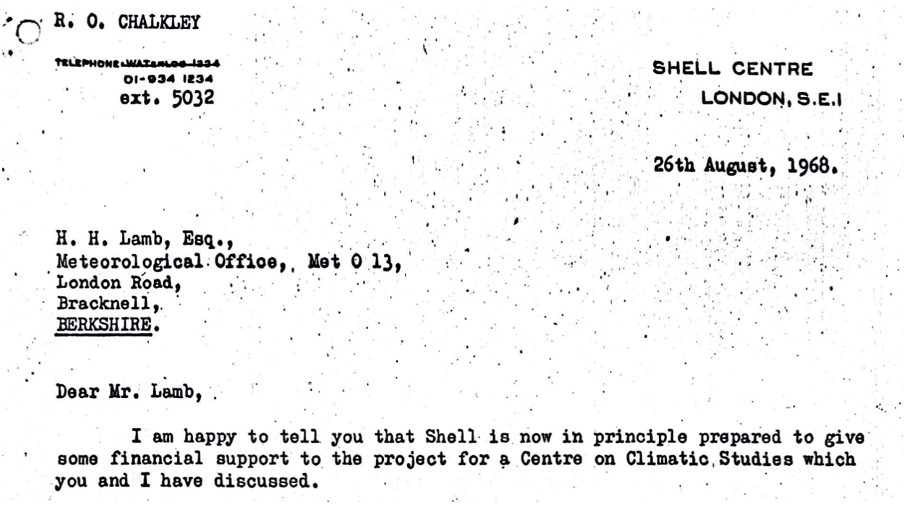 Letter dated August 26, 1968, from R. O. Chalkley to Hubert Lamb, stating that Shell was interested in providing "some financial support" to the creation of a "Centre on Climatic Studies." Credit: UEA Archives and Library Special Collections, UEA/Jones/40
No record of Lamb's 1969 pitch to Shell has yet been found but a proposal for the center written around the same time reveals that, in addition to providing enhanced weather forecasting, investigating the climate impact of burning fossil fuels was one of the center's founding ambitions, DeSmog and Rolling Stone can reveal.
 This excerpt from a 1969 document containing a proposal for Centre for Climactic Studies acknowledges the link between fossil fuels and climate change. Credit: UEA Archives and Library Special Collections, UEA/Jones/40
"Climatic history is particularly important because man is now disturbing the atmosphere so much (e.g. by increasing the CO2 level by burning fossil fuel) that it is difficult to disentangle long term trends from the effects of man," stated the proposal, before promising that the center offered "a hope of long term climatic forecasting," and would "evaluate the problems posed by such man-made changes as the CO2 level of the atmosphere."
'Beneficial to Shell's Operations'This message that burning fossil fuels could be altering the Earth's climate would not have come as a surprise to either of Shell's top men.
Spaght represented Shell Oil on the board of the American Petroleum Institute (API), the U.S. oil industry's primary lobby group. In November 1965, API President Frank Ikard had briefed the group's membership on the latest science linking CO2 emissions from "coal, oil, and natural gas" with future temperature increases and "changes in climate."
Meanwhile in London, former intelligence officer Rothschild had already coordinated secret climatic research inside Shell, having commissioned the visionary British scientist James Lovelock to investigate the atmospheric consequences of burning fossil fuels. Were fossil fuels altering the Earth's climate or could other factors be blamed? In the summer of 1965, Rothschild had dispatched Lovelock to find out.
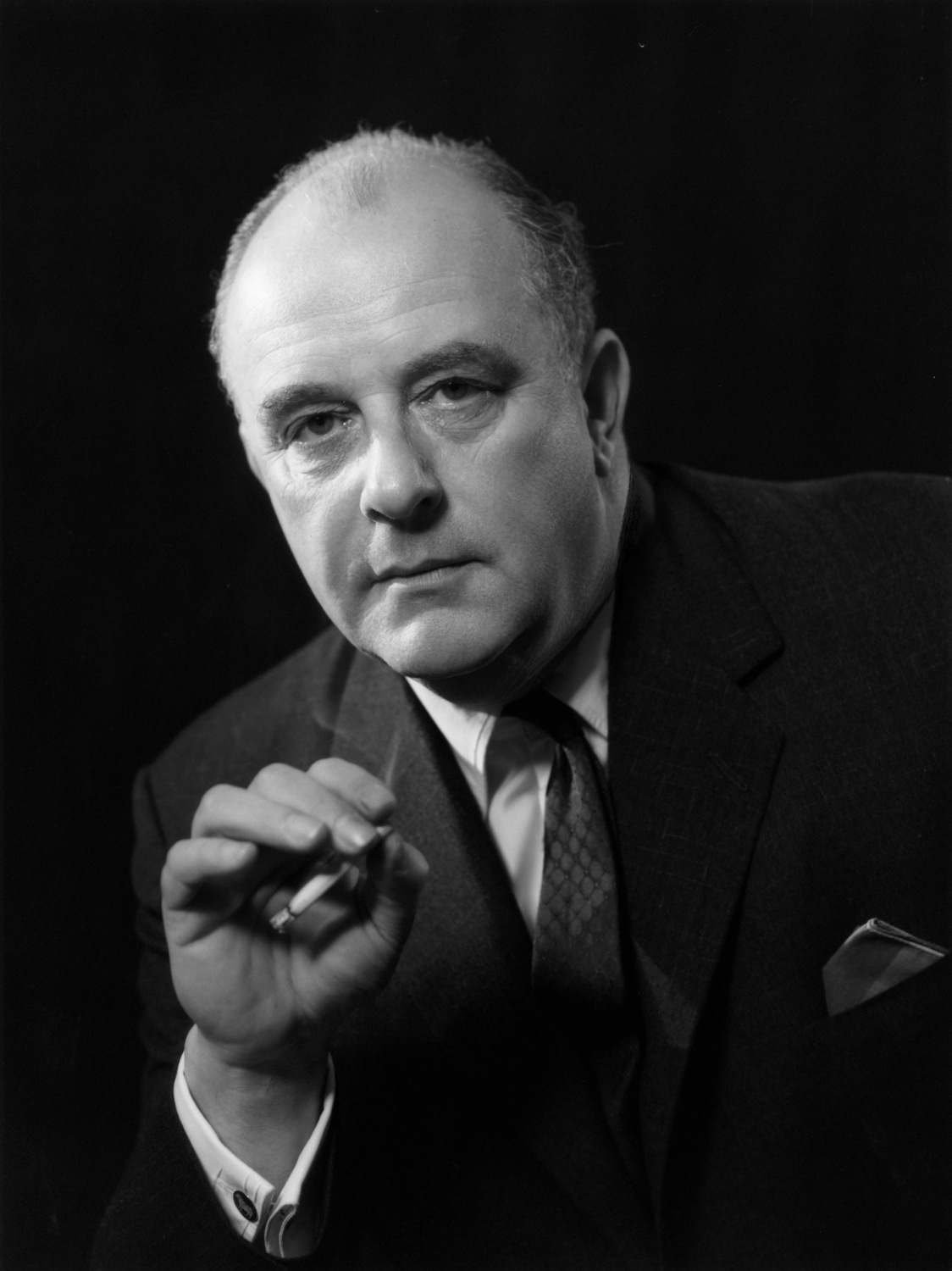 Victor Rothschild in 1965. Credit: Bassano Ltd/National Portrait Gallery, London/NPG x172039/Non-commercial license
Submitting a report in June 1966, Lovelock had confirmed that pollution from burning fossil fuels "may be responsible for large scale phenomena affecting the whole of the Earth's atmosphere." Although there were uncertainties over the precise impacts of different pollutants, Lovelock told Shell it was important to recognize "the almost certain fact that the climate is worsening and the probability that the combustion of fuel is responsible."
As several historians have recently documented, Shell buried Lovelock's findings for years, and Rothschild expressly forbade him from talking to "non-Shell people" about his work.
By the late fall of 1969, however, Shell seems to have taken Lovelock's warning seriously enough to sponsor a new climate project.
After his meeting with Spaght and Rothschild, Lamb wrote to the University of East Anglia's Professor Clayton informing him that Shell wanted to set up a climatic research center for "their own ends." Not only did the company want monthly and seasonal forecasts but also advice on the more "general climatic prospect over 5 to 25 years."
 Letter from Hubert Lamb to Keith Clayton describing his meeting with Shell, October 1969. Credit: UEA Archives and Library Special Collections, UEA/Jones/40
Shell's Spaght was particularly encouraging, stating that the new project would contribute to "the increase of knowledge" in general and might also be beneficial to "Shell's operations."
At the end of October 1969, Shell approved an initial grant of £10,000, a contribution it eventually doubled to £20,000 ($370,000 today) — a game-changing amount that, in Clayton's words, made the Centre "a real possibility." By 1971, BP had also put forward £3,000 and two UK electricity groups, £5,000. With these sums in the bag, the university agreed to provide the rest of the funding. And, in 1972, the Climatic Research Unit (CRU) opened its doors with Lamb appointed its first director.
From the outset, the CRU provided its sponsors with general weather forecast bulletins and a newsletter to keep a finger on the pulse of "world climate." But before long Shell would find an even more specific use for the CRU's expertise.
Obtaining information about storms was about to become one of the company's top priorities.
'Increasing Storminess'"The Texas of Europe" was how the British press described the massive oil fields discovered by Shell and Esso (Exxon's UK subsidiary) at the start of the 1970s in Europe's North Sea — a region notorious for its fearsome waves and gale force winds.
Naming the oil fields after local seabirds, Shell operated the enormous "Brent" field and in 1975 paid the CRU another £15,921 [worth $166,000 today] to conduct a "North Sea Storms Study" that would help the company future-proof its new facilities.
It was exactly the kind of project Lamb had been waiting for, allowing the CRU to gather records dating back to the time of the Spanish Armada of 1588 — a "wealth of information" meticulously recorded by scientists, sailors, merchant traders, and amateur observers across 400 years.
The documents reveal Shell working closely with Lamb on a plan designed to identify specific dangers and improve storm prediction techniques. According to Lamb, the research would alert Shell to "forewarning signals" indicative of extreme weather events by mapping and analyzing "the severest North Sea storms of the past." The study would also look at "variations of sea level in the North Sea region" produced by storms as well as "disastrous sea floods" and "the height of sea defences."
With its profitable North Sea operations playing an increasingly important role in its business, Shell requested regular updates. In November 1981, Lamb sent Shell an "Interim Report," noting that he was also keeping a watch on "current weather developments" including recent storms that had seriously damaged several North Sea oil rigs.
Citing these powerful storms, Lamb sent a further update to Shell in 1982 containing a significant new observation. According to the data, Lamb told Shell in handwritten notes, there was "some indication of an increasing storminess" since the 1950s. In November 1981, winds reaching 120 to 130 knots — equivalent to a Category 4 hurricane — had ripped two oil rigs housing over 200 people from their moorings.
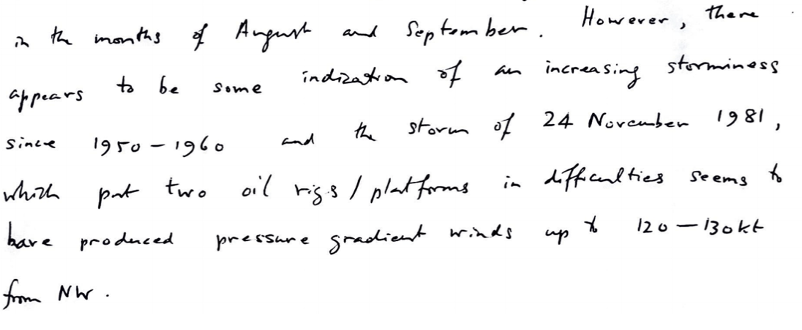 Update from Hubert Lamb to Shell on the North Sea Storms study, April 1982. Credit: UEA Archives and Library Special Collections, H.H. Lamb, Deposit 1
This warning would come almost 10 years before the study was published, giving Shell advance notice of nearly a decade that storms in the North Sea were increasing.
Despite Shell's appreciation for Lamb's "useful" work, the company did not approve further funding for the storms study. Undeterred, Lamb, who had retired as the CRU's director, completed the study in 1991, sending a copy to the head of Shell Exploration and thanking the company "for the grant which started the project." In line with his earlier findings, Lamb wrote that his subsequent research had confirmed his observations of increasing storminess in the North Sea over the latter half of the 20th Century and he concluded that rising atmospheric CO2 levels could be considered a likely explanation.
Subscribe to Desmog
Get the weekly intelligence you need to hold polluters accountable
Email Address Sign Up Send me intelligence from: All US/Global team UK/Europe team (function($){ $('.newsletter-container .ijkidr-us').click(function() { $('.js-cm-form').attr('data-id', '2BE4EF332AA2E32596E38B640E905619D07B21962C5AFE16D3A2145673C82A3CEE9D9F1ADDABE965ACB3CE39939D42AC9012C6272FD52BFCA0790F0FB77C6442'); $('.js-cm-email-input').attr('name', 'cm-vdrirr-vdrirr'); }); $('.newsletter-container .ijkidr-uk').click(function() { $('.js-cm-form').attr('data-id', '2BE4EF332AA2E32596E38B640E905619BD43AA6813AF1B0FFE26D8282EC254E3ED0237BA72BEFBE922037EE4F1B325C6DA4918F8E044E022C7D333A43FD72429'); $('.js-cm-email-input').attr('name', 'cm-ijkidr-ijkidr'); }); })(jQuery);In the cautious, circumspect style that is typical of his writings, Lamb stated: "It is not easy to point to a firmly established reason for the increase in storminess affecting northern and northwestern Europe, and the off-lying seas, since 1950. Some would probably attribute it with little more ado to the greenhouse effect expected from the increase of carbon dioxide and other gases in the atmosphere caused by human activities."
'Scenarios for a High CO2 World'Over the 1980s, Shell continued to use the CRU as the company's go-to lab for inside climate information and advance updates.
While Lamb was focusing on historic storms, in 1980 Shell funded another CRU study, "Scenarios for a High CO2 World," investigating what a future, warmer world might look like. Using 20th century temperature records, the CRU researchers modeled four potential future climate impact scenarios.
Specifically, the company wanted to know how changes to temperature, rainfall, and sea levels might affect Europe's energy consumption and agriculture — key areas of interest for Shell's business operations.
The research was published in 1983 and extended to North America in a 1984 report commissioned by the U.S. Department of Energy (DOE), tracked down by DeSmog and Rolling Stone. Basing their North American calculations on the methodology they had developed for Shell, the CRU researchers also submitted this second report to the oil company.
In both cases the message was the same. Increasing atmospheric CO2 produced by the burning of fossil fuels would trap ever-increasing amounts of heat within the earth-atmosphere system. Beyond increases in temperature, however, the CRU's researchers emphasized that the overall impact would be "much more fundamental," that it would "perturb the whole atmospheric circulation system," affecting rainfall and winds, "indeed all of the meteorological variables," around the world.
An even more urgent warning was delivered to Shell two years later, in November 1985, when a member of the company's internal "Greenhouse effect working group," M. H. Griffiths, visited the CRU for a status update on the latest developments in climate science from its new director, Thomas Wigley. Although Wigley briefed Shell's representative on remaining scientific "uncertainties" relating to the precise impacts of the greenhouse effect, he was "prepared to stick his neck out" on some key points, wrote Griffiths in a confidential 1985 internal Shell memo. This memo, detailing Griffiths visit to the CRU, formed part of a 90-page "confidential" internal company report on "The Greenhouse Effect" compiled in 1986 for Shell International, discovered by Dutch journalist Jelmer Mommers in 2018.
 An internal, confidential Shell memo from M.H. Griffiths about his meeting with Thomas Wigley, director of the Climate Research Unit, on November 27, 1985. Credit: Climate Files
As Griffiths reported to Shell, Wigley warned him that although "CO2 build-up" had caused a global temperature increase of 0.5 degrees over the last 100 years, "a further 1-2 degree warming over the next 40 years" was expected — a rise "greater than any change in the last 1000 years." And, while global warming had already caused average sea levels to rise by "some 15 [centimeters] over the last 100 years," or about 6 inches, Griffiths noted that they could rise a further 20-120 centimeters (about 8-47 inches) by 2050.
Higher global temperatures would result in higher rates of evaporation, Griffiths informed Shell, meaning "monsoon rainfall ought to increase also as should the frequency of tropical storms."
'A Serious Risk'As the scientific consensus on climate change strengthened over the course of the 1980s, the company joined forces with other oil majors under the banner of the International Petroleum Industry Environmental Conservation Association (IPIECA), a global oil and gas group that had been established in 1973 to monitor and influence environmental protection measures that might "affect the oil industry." In 1988, IPIECA formed a "Working Group on Global Climate Change" tasked with producing an internal report that would brief IPIECA's members on the newest developments in climate science. Two Shell representatives were among the working group's members, as were representatives from Exxon, Mobil, Texaco, BP, ELF, and Saudi Aramco.
"Major populated coastal areas of the globe are at risk from rising sea level, especially in undeveloped countries," declared the IPIECA report, discovered by Nathaniel Rich, author of Losing Earth: The Decade We Could Have Stopped Climate Change in 2019. A section of the report authored by Exxon Senior Scientist Brian Flannery also warned "that the frequency and magnitude of large storms may be higher in a warmer world." The coupling of sea level rise, and the possibility of enhanced storm surges presented "a serious risk, especially to low-lying coastal areas," explained Exxon's scientist.
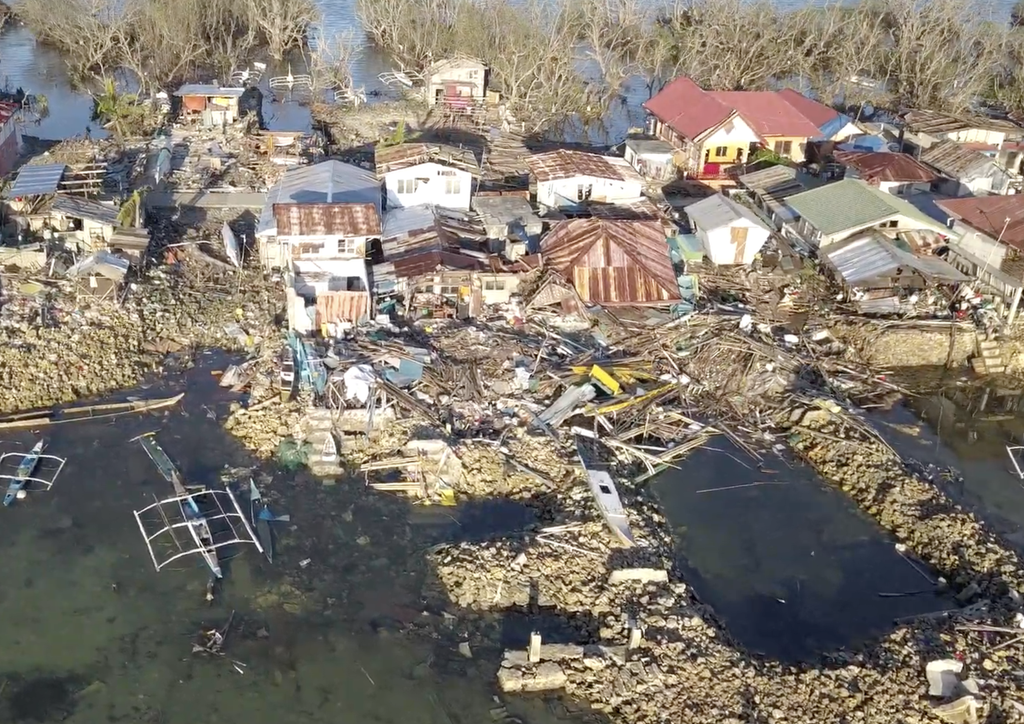 Typhoon Odette wiped out homes and boats on the island of Batasan, not far Arnold Obguia's island home of Bilangbilangan in the Philippines archipelago, in 2021. Credit: Greenpeace and The Odette Case
Fast forward approximately three decades when this "serious risk" warning given to Shell was realized in the devastation wrought by Typhoon Odette. Photographs of the aftermath show buildings broken into matchsticks, crops destroyed, livestock animals killed, as well as damage to bridges, roads, ports, airports, and communication lines. In low-lying coastal areas, the strong winds, storm surges, and floods killed people instantly. More than 400 lost their lives with drowning being the most common cause of death.
On Bilangbilangan, Arnold knows he is lucky to be alive, but the trauma of the typhoon stays with his whole family. They are all afraid of another storm. "After the storm, everything was washed out, the houses, the boats and everything," he says, describing how he lost his fishing rod and other equipment. "For the community, everyone had a difficult life after the storm. Everything was devastated.
"Honestly we are still not fully recovered," Arnold explains. "All of our appliances, our personal belongings — very few were saved."
By contrast, in 1989, Shell announced it was redesigning its $3-billion dollar North Sea "Troll" gas platform, raising it by 4 to 6 feet to better protect its operations against damage from the rising sea levels and more powerful storm surges predicted as a result of climate change. Reported by The New York Times as the first major project to anticipate the impacts of the greenhouse effect, a Shell spokesman told The Times he hoped that gas production from Troll would continue "for up to 70 years."
But, just as Shell was taking these steps to protect its own operations, the company simultaneously began pouring money into public relations and lobbying campaigns denying the science of human-caused climate change.
1988 had been a trigger year for oil companies. In June, NASA scientist James Hansen had told a U.S. Senate committee that global warming was already changing the Earth's climate. In August, Republican presidential candidate George H. W. Bush had given a campaign speech promising to tackle the greenhouse effect with "the White House effect." And, in November, the United Nations had formed the Intergovernmental Panel on Climate Change to help governments develop policies aimed at preventing climate change by reducing greenhouse gas emissions.
The threat to oil companies was clear. In response, they went after the science.
'No Convincing Evidence'"No convincing evidence exists to support claims that hurricanes, tornadoes, and other extreme temperature and precipitation events are on the rise," declared a 1995 press release from the oil-industry funded group, the Global Climate Coalition (GCC). A fossil-fueled engine of disinformation, the GCC spread climate denial during the 1990s. Shell was one of its founding members, joining in 1989 — the very same year the company began climate-proofing its North Sea oil facilities.
Working through the GCC for the best part of a decade, Shell and the other oil majors bankrolled the group's well-documented multi-million-dollar public relations and lobbying campaigns designed to persuade Americans that the science of climate change was uncertain and to block national and international measures aimed at tackling global warming — including the introduction of carbon taxes and U.S. ratification of the Kyoto Climate Treaty.
"Oil companies had been at the forefront of climate research right up to the moment when the world actually began to wake up to the crisis," says the University of Miami's Geoffrey Supran. "At which point they spent the next 30 years pretending that this was all new, uncertain, unreliable science on the basis of which no policy decisions could ever be made."
Backed by Shell, a 1995 GCC campaign targeted concerns that global warming was increasing the risk of hurricanes, casting doubt on studies linking rising sea surface temperatures with more intense tropical storms. The campaign's central reference was a GCC-funded report conducted by commercial weather-forecasting firm AccuWeather that attributed public fears over increased storminess to "global warming alarmists."
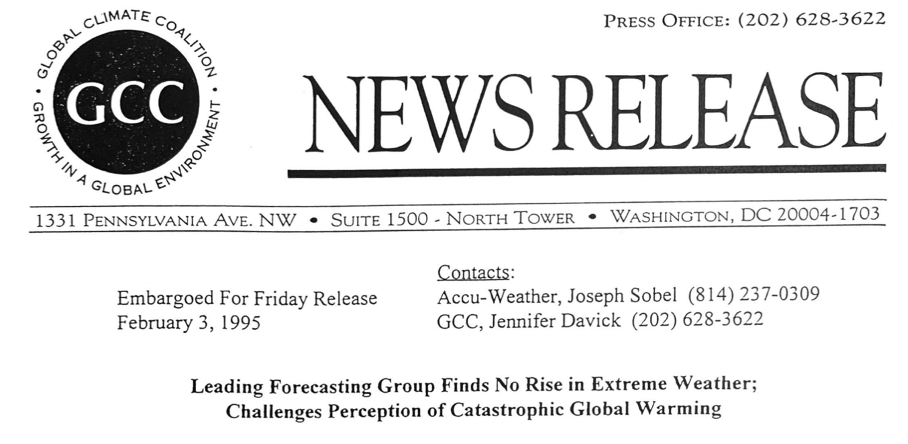 A February 3, 1995 news release from the Global Climate Coalition denied there was a link between climate change and extreme weather. Credit: Stephen Henry Schneider Papers (SC1053). Dept. of Special Collections, Stanford University Libraries, Stanford, Calif.
Like many of the GCC's publications, the AccuWeather report championed the work of a new wave of so-called climate skeptics frequently sponsored by Shell and other oil interests. While the first wave of industry-sponsored scientists, like Lamb and Wigley, were drawn from the scientific center ground, this new wave of scientists consisted of a small number of outliers, occupying fringe positions from which they waged a relentless contrarian war, variously arguing that computer-based climate modeling was unreliable, that temperature predictions were inaccurate, or that high levels of atmospheric CO2 would improve plant growth.
Amplified by the GCC, this small cadre of skeptics appeared regularly in print as well as on television and radio, successfully marginalizing legitimate scientists and draining public support for climate action.
Releasing the report on the eve of a United Nations climate negotiation session in New York for maximum impact, the GCC hosted a press conference at the UN Plaza Hotel intended to "provide reporters with an overview and background of the issues under consideration at the session." Key
The midterm elections brought a blue wave for Democrats and a green wave against data centers, helping to flip a number of key races in areas firmly opposed to AI expansion.
But a divisive bill that's currently advancing through Congress — known as the Bipartisan American Affordability and Jobs Act (BAAJA) — could provide a last-ditch effort for companies seeking approval for construction of projects like data centers on federal public lands.
Among those leading the lobbying and public relations push to pass the Senate's permitting reform bill, are a trifecta of overlapping special interest groups: AI companies, fossil fuel giants, and a conservation group that once hailed itself as the Republican environmentalist's alternative called The American Conservation Coalition (ACC) and its 501(c)(4) sister organization.
An investigation by DeSmog has found that in the past year the ACC, which runs chapters across college campuses and has roughly 150,000 members, has come out in favor of data centers and has pushed messaging that they are a strategic neccesity.
It's partnered with AI and gas companies to influence stakeholders. Since 2025, the ACC and American Conservation Coalition Action, collectively, have hosted at least three "energy freedom" events with U.S. Cabinet secretaries as headliners, published "energy dominance" study guides and electric transmission reform frameworks aimed at policymakers, and most recently spent $300,000 lobbying to pass two federal bills — including BAAJA — that would make building data centers easier, DeSmog found. ACC has acted with financial support from some of the companies with the most to gain from data center growth — Amazon, Anthropic, ExxonMobil, and Continental Resources — as well as right-leaning nonprofits and foundations.
"Reforming America's broken permitting system is a generational opportunity to unleash clean, firm energy projects, like nuclear and geothermal, as well as transmission buildout to meet rising energy demand," ACC Vice President of Communications Karly Matthews said in a statement provided to DeSmog. "Permitting reform should not mean a negation of all environmental standards, but our current anti-building mindset cannot continue."
In an ACC report on the environmental impacts of data centers, the organization wrote that data centers should "Invest in affordable, reliable, and clean American power by…deploying innovative sources such as advanced nuclear, geothermal, and renewables + storage."
Conservative Environmentalism Takes on 'Stuck' Data Center ConversationWhen a group of Republican college students launched the American Conservation Coalition in 2018 during President Trump's first term, they introduced it as the right's alternative to liberal environmental groups.
The ACC promoted the idea of conservative environmentalism and sought to offer environmental solutions without big government to engage "conservatives disaffected by alarmist climate change rhetoric."
News articles at the time promoted the ACC as Republicans with a climate conscience.
"Meet the 20-year-old Republican with an environmental agenda," read one Grist headline.
"Climate change is finally getting political cred with Republicans," read another Axios article.
 The American Conservation Coalition promotes a "conservative environmental" approach. Credit: ACC website
The ACC's mandate was simple. Republicans cared about environmental issues, but they didn't have a place in their party to express it. The group offered them a way to get behind three pillars: renewable energy, supporting farmers (in part through water conservation), and protecting public lands. Among their initial "principles of conservative environmentalism," was stewardship of the natural world and preferences for market-based solutions.
The ACC frequently invoked former president Theodore Roosevelt, who was responsible for greatly expanding the early national park system.
"This topic of environmental conservation is seen as a left-wing issue, however Mr. Teddy Roosevelt, arguably the father of the modern environmental movement, was a conservative," read one ACC blog post from 2020. "Although the Democratic Party seems to have wielded the reins on environmental policy, the Conservative Sensibility has its roots in being stewards of the environment."
But in recent years, the coalition has pivoted to advocating strongly for a new policy linked to an issue many could argue is the antithesis to environmentalism and land conservation: data centers.
"The data center conversation is stuck in an all-or-nothing power struggle between AI-accelerationists and skeptics calling for a moratorium," wrote ACC President Chris Barnard in a Substack post from September. "Local communities are rejecting data center developments across the country, in large part over environmental and land use concerns. The better answer is to build more creatively, not to block building altogether."
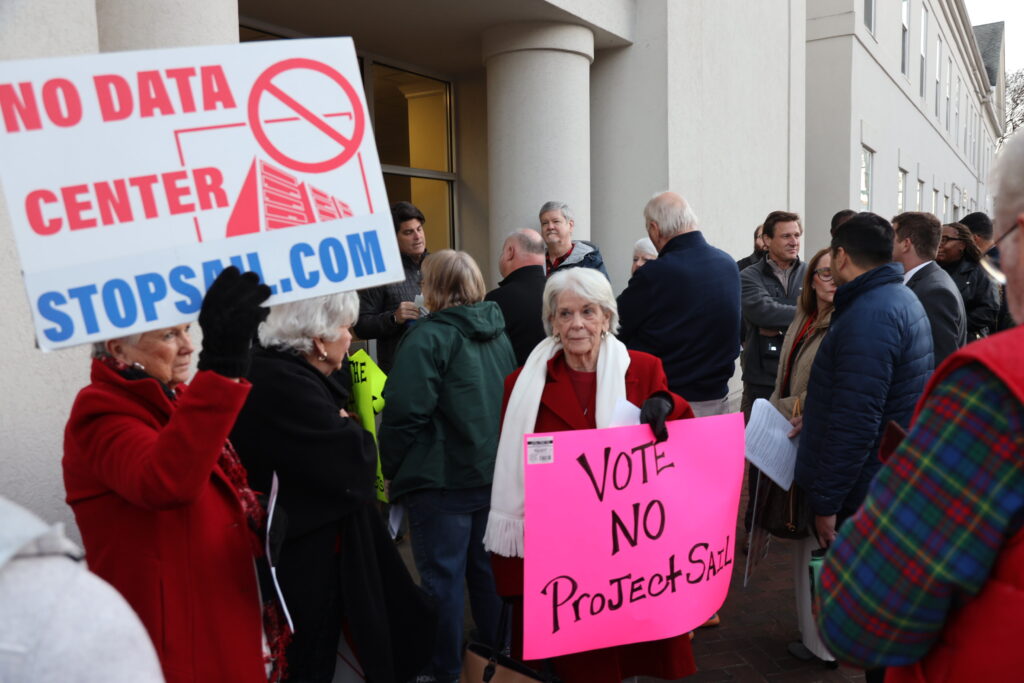 Local residents before a Coweta County Commission meeting concerning data center measures in Newnan, Georgia, on December 16, 2025. Credit: Edward Donnelly
Demand for data centers has skyrocketed in the past year, and with it has come a rush to find more land to build on and more energy to power them. The Bureau of Land Management (BLM) currently is considering proposals to build at least 17 data center campuses on western public lands, according to data from the Center for Western Priorities.
Environmental reviews and regulations under the Endangered Species Act, Clean Water Act, and others can slow down the approval process for all major construction projects on federal land. BAAJA, the permitting reform bill, would overhaul federal permitting for energy infrastructure and offer a streamlined way for companies to get approval to build. It would make it easier to upgrade the electric grid and build new transmission lines, and proponents say the bill puts necessary controls on new data centers, making sure companies pay their fair share of electricity costs and infrastructure upkeep.
But the issue is controversial among some conservationists and environmentalists, who argue public lands should be protected from all development and worry that BAAJA could bring harm to endangered species and add to climate emissions because in addition to data centers, the bill will also make it easier to greenlight gas infrastructure projects.
As a result, environmentalists, clean energy advocates, and tribal organizations are split over whether passing such a bill would ultimately benefit the country, or hurt it.
A similar proposition put before California voters this past election was supported by utilities PG&E and California Edison and gas company Sempra Energy, but failed to pass with nearly 56 percent opposing efforts to roll back the state's environmental review process to speed up certain proposals.
Several industries, including renewables, are poised to benefit from the federal permitting bill, and tech companies and fossil fuel interests are among those throwing their wallets behind BAAJA.
The Data Center Coalition, whose members include Amazon, Google, and Microsoft spent $480,000 on lobbying between July and September, including on the permitting reform bill, according to an analysis by The Washington Sun. Other groups that divulged they are lobbying on the permitting bill include major industry trade groups the American Petroleum Institute (API), the Edison Electric Institute, and the National Mining Association.
API went as far as handing out tacos to staffers on Capitol Hill earlier this week from their "BAAJA on the Hill" truck.
Right now, the American Petroleum Institute is handing out free tacos on Capitol Hill because #BAAJA would lock in all of their oil and gas permits and pipelines.Let's stop pretending this is a climate bill.
— Aaron Weiss (no relation) (@aweiss.bsky.social) 2026-11-10T19:10:02.618Z
The Corporate Energy Buyers Association and the Electricity Customer Alliance, two industry groups that represent Amazon, Google, Meta, and other tech companies, have also endorsed the bill.
Alongside tech and gas companies championing permitting reform has been the ACC.
"We have long advocated for modernization of the permitting process to unlock clean, American energy," the ACC's Matthews told DeSmog by email.
On Tour with Big Tech and Big OilLast fall, the ACC's president Chris Barnard found himself in a familiar setting, surrounded by college students. It was September 2025 and Barnard was speaking in front of an audience at Massachusetts Institute of Technology as part of the first stop of The Energy Freedom Tour, which was promoted as spotlighting "real solutions for American energy abundance & innovation."
The ACC was co-hosting the event with The Hamm Institute for American Energy, an institute based out of Oklahoma State University created through donations from oil tycoon Harold Hamm, an early and influential Trump donor who built oil and gas company Continental Resources.
 The American Conservation Coalition co-hosted an event on their Energy Freedom Tour with Oklahoma State University's Hamm Institute for American Energy, an institute created with donations from fracking billionaire Harold Hamm. Hamm's fracking company Continental Resources also sponsored the tour. Credit: American Conservation Coalition YouTube
"From the global AI race to domestic reindustrialization, we need more energy than ever before," the ACC wrote of the tour online. "The Energy Freedom Tour is here to rise to that challenge, championing an all-of-the-above approach to unleash reliable, affordable, and clean American energy."
The Energy Freedom college tour boasted high profile speakers including Google's head of energy market development, the CEOs of major power companies Southern Company and Duke Energy, Energy Secretary Chris Wright, and Interior Secretary Doug Burgum. Burgum reportedly stands to gain from data center build outs and has invested heavily in the AI industry, according to a recent ProPublica investigation.
The tour was sponsored by gas companies Continental Resources, Devon Energy, and Ascent Resources. The late Charlie Kirk's Turning Point USA also sponsored the stop at Texas A&M.
"Innovate, build, win" read one of the event's slogans.
This past June the ACC co-hosted another event called the Energy Imperatives Summit in Washington, D.C. It was a two day conference that centered on three pillars: "tech-neutral permitting reform, capital deployment, and public-private innovation."
"We once built in America, and we believe that we can do so again. By pursuing bipartisan permitting reforms and increasing certainty to advance new energy projects and innovation, we're ensuring that the United States does not just keep pace in the global energy race, but leads it throughout the 21st century," Barnard said, according to a press release about the conference.
The event's sponsors, alongside renewable energy companies, included gas giant ExxonMobil and AI company Anthropic. Anthropic's data center energy lead, Google's head of energy and sustainability policy, and Meta's principal of energy strategy also spoke on a panel titled "Power AI."ACC's president Barnard interviewed gas company CEO Toby Rice of EQT about exporting liquefied natural gas (LNG) and as Rice said "win[ning] the race for AI in the West."
Later that month, Barnard penned an op-ed published in The National Review, with the headline: "Energy Companies Need Permitting Certainty." He published another article in August with The Washington Post, this time pushing for data centers to be built on Superfund sites.
He called it a "match made in heaven."
ACC spokesperson Karly Matthews told DeSmog by email, "We do not support unrestricted data center development and have explicitly said data centers do not belong on prime farmland, for example."
Shifting Funding, Shifting PrioritiesWhen the ACC first launched, it received donations from several left-leaning environmental groups, including the Environmental Defense Fund and the National Audubon Society. But in recent years, much of its funding has come from groups and family foundations with ties to the tech and gas industries, DeSmog's investigation has found.
According to the most recently available tax filings from 2025, it generated nearly $7.5 million in revenue. That same year the ACC received $100,000 from Atlas Network, a coalition of pro-free market think tanks that has taken money from both Exxon in the past and from DonorsTrust, a non-profit likened to the "dark money ATM" for conservative groups. And $50,000 from the foundation of Douglas Frey, an entrepreneur who owned an oil servicing company.
In 2024, the ACC received $100,000 for "special initiatives" from the tech founder David Packard's family foundation. The ACC also received at least $20,000 from Amazon's Public Policy Office between 2023 and 2025, according to the company's own political engagement statements.
The conservation group has also dealt out its own money.
During the 2025 and 2026 campaigns, the American Conservation Coalition Political Action Committee gave nearly $50,000 in donations, including to several Republican candidates who ran on pro-data center and energy abundance platforms, according to the Federal Election Commission. They included Iowa's Joe Mitchell, who had strong data center ties, Colorado's Gabe Evans who supported permitting reform and "energy dominance" and whose district is home to a recently approved data center, Colorado's Jeff Hurd, a pro-infrastructure candidate with a data center in his district who reportedly received at least $105,000 from the ACC, and Wisconsin's Michael Alfonso who supports fossil fuel production and local data center control. Only Alfonso and Hurd won their November elections.
ACC Action didn't respond when asked by a user on Instagram to name one environmental cause Alfonso supported that made him deserve ACC's financial support. The commenter followed up saying: "Seriously? So sad and shameful that you can't name just ONE conservation issue Alfonso supports… Just further proof that ACC is a sham propaganda organization group."
According to its federal lobbying reports, ACC Action also spent money on federal lobbying efforts. The organization spent $300,000 in the first three quarters of this year on issues of "Energy infrastructure and electric transmission siting and federal permitting; legislation and policy on energy permitting reform." The disclosures named BAAJA and the SPEED ACT, another bill that focuses primarily on reforming federal environmental reviews that has passed the House and is now awaiting Senate action, as focus areas.
 ACC Action applauds the Senate voting to advance BAAJA. Credit: ACC Action Instagram
In April the ACC released an "electric transmission reform framework" with a coalition of conservative groups: R Street Institute, C3 Solutions, Pacific Legal Foundation, Americans for Prosperity, and the Abundance Institute.The latter two are both Koch funded.
In August, the ACC and the Republican environmental nonprofit ConservAmerica announced a strategic partnership to tackle "overlapping policy initiatives, including data center development, public lands management, technological innovation, and unleashing American energy development."
And this October, the ACC partnered with American Moment, one of the "key nodes" in developing Project 2025, to write what it called an "Energy Dominance Study Guide," aimed at junior and mid-level staffers and policymakers to teach them "what the United States must do to turn energy dominance into projects that actually get built." The ACC paid American Moment more than $374,000 to "educate about critical energy dominance issues" according to its 2025 tax filings. Other groups the conservation group gave money to included $25,000 to The Breakthrough Institute for its 2025 "Abundance Conference," which was sponsored by tech-industry coalition Chamber of Progress and Koch-founded StandTogether Trust. And about $10,000 to the State Policy Network for its conference. SPN is a right-wing network of conservative think tanks, many of which are funded by billionaire fossil fuel and chemicals industrialist Charles Koch.
Building 'Big, Beautiful Things'This fall, the ACC and ACC Action's support of permitting reform picked up pace. In late October, supporters of BAAJA sent a letter to Senate leadership urging them to promptly take the bill up for a vote and pass it.
"Congress has an opportunity to deliver meaningful, bipartisan permitting reform. We urge you to seize this moment and advance BAAJA without delay to protect property rights, promote energy abundance, and restore America's ability to build," the letter read.
It was signed by several conservative nonprofits and think tanks, including multiple climate science denial groups such as Americans for Prosperity, The Manhattan Institute, the Energy and Environment Legal Institute, the 60 Plus Association — and ACC Action.
Late last week, House Democratic leader Hakeem Jeffries said the permitting bill fell short and criticized it for a "failure to adequately protect tribal sovereignty." Several tribal and environmental organizations maintained that criticism even after changes to the bill over the weekend attempted to address concerns.
Yet, several energy companies as well as some clean energy focused groups urged the Senate to pass the bill, despite the lame duck session. Nearly all Republican Senators and 22 Democrats voted to advance the permitting reform bill on Monday, paving the way for its passage in the coming weeks. A potential hurdle though, is President Trump's announcement on Monday that he wouldn't approve wind projects, a negotiation sticking point which may threaten the legislation's prospects in the House.
The ACC has continued its messaging blitz online. It's running active ads on X and Meta that frames the bill as a fix to the energy crisis.
"Americans want affordable energy, tell congress: Pass permitting reform," one ad reads.
The ad links to a prewritten letter for people to send to their members of Congress.
The ACC's call to action reads: "America once built big, beautiful things and we can do so again. Tell your members of Congress to support bipartisan efforts for permitting reform to unleash American energy and reindustrialize our nation."
The post How a Republican Conservation Group Became a Data Center Booster appeared first on DeSmog.
One of Canada's loudest fossil fuel advocacy groups, Canada Action, has for years claimed to be a "grassroots" organization funded through donations from ordinary Canadians.
But financial records obtained by DeSmog reveal that individual donations only make up a tiny percentage of the group's funding, representing just 0.5 percent of Canada Action's total revenue for 2024.
The vast majority of its funding instead comes from "sponsorships", which in the past has included contributions from Cenovus, the country's third-largest oil and gas producer. Canada Action previously received $100,000 from the oil and gas company ARC Resources.
Records show that Canada Action received over $2.9 million from sponsorships in 2024, compared to just $15,604 in donations.
The gap between its donations and sponsorship revenue suggests that the non-profit group is mainly being supported by large businesses as opposed to a movement of working Canadians, according to Shane Gunster, a professor at Simon Fraser University's School of Communications.
"It is a classic example of a 'subsidized public' PR strategy in which corporations identify individuals and groups who are sympathetic to their aims, and then 'subsidize' their participation within social media networks and the public sphere," said Gunster in a statement to DeSmog. "The industry or corporation thereby appears to have much greater popularity, legitimacy and social license among 'ordinary Canadians'."
Canada Action didn't respond to a request for comment.
Subscribe to DesmogGet the weekly intelligence you need to hold polluters accountable
Email Address Sign Up Send me intelligence from: All US/Global team UK/Europe team (function($){ $('.newsletter-container .ijkidr-us').click(function() { $('.js-cm-form').attr('data-id', '2BE4EF332AA2E32596E38B640E905619D07B21962C5AFE16D3A2145673C82A3CEE9D9F1ADDABE965ACB3CE39939D42AC9012C6272FD52BFCA0790F0FB77C6442'); $('.js-cm-email-input').attr('name', 'cm-vdrirr-vdrirr'); }); $('.newsletter-container .ijkidr-uk').click(function() { $('.js-cm-form').attr('data-id', '2BE4EF332AA2E32596E38B640E905619BD43AA6813AF1B0FFE26D8282EC254E3ED0237BA72BEFBE922037EE4F1B325C6DA4918F8E044E022C7D333A43FD72429'); $('.js-cm-email-input').attr('name', 'cm-ijkidr-ijkidr'); }); })(jQuery);Canada Action is a federally-registered non-profit organization that advocates for oil and gas expansion and opposes climate action, largely through social media posts and advertisements. It was founded in 2012 by Cody Battershill, a Calgary-based realtor.
In recent years, Canada Action has engaged in numerous high-profile advertising campaigns across Canada. These have included covering Toronto trams in advertisements reading "As long as the world needs oil and gas, it should be Canadian" and running ads during television broadcasts that said "Oil and Natural Gas Make Canada Stronger."
In 2024, Canada's advertising regulator determined that some of Canada Action's advertisements concerning LNG were inaccurate, misleading, and distorted scientific data. Recent Canada Action social media activity includes posts stating "Canadian LNG Can Help Secure a Strong Economy", "5 Reasons Why Canada Needs More Nuclear Plants", and "Asia Paying Top Dollar for Canadian Oil. Pacific Link Will Get More to Market."
 Examples of Canada Action's social media posts, obtained from its website.
In a section on its website entitled "How is Canada Action Funded?", the group describes itself as "a grassroots, federally registered, not-for-profit movement built in support of Canada's vital natural resource sector and the families, communities and programs that depend on it across the country."
"Our donations come from a host of people and organizations across Canada who value, as we do, the social and economic benefits created by Canada's resource industry, as well as the sector's strong commitment to regulatory transparency and social standards," it explains.
The group's website and social media pages are filled with images of Canadians wearing Canada Action's promotional merchandise, including t-shirts that read "I [Heart] Oil & Gas."
This helps in "cultivating the impression that this industry enjoys widespread public approval," claimed Gunster. "Many [regular people] may even believe that these sites are themselves largely grassroots organized and funded."
But financial records show those donations have for years only made up a tiny fraction of the group's revenue.
In 2018, Canada Action made $24,413 in donations and $49,334 from promotional sales, while it received $836,238 in sponsorship funding. In 2021, the organization received $34,895 from donations and $1,055,381 in sponsorship funding.
Canada Action does not disclose the corporate sponsors that make up a majority of its revenue.
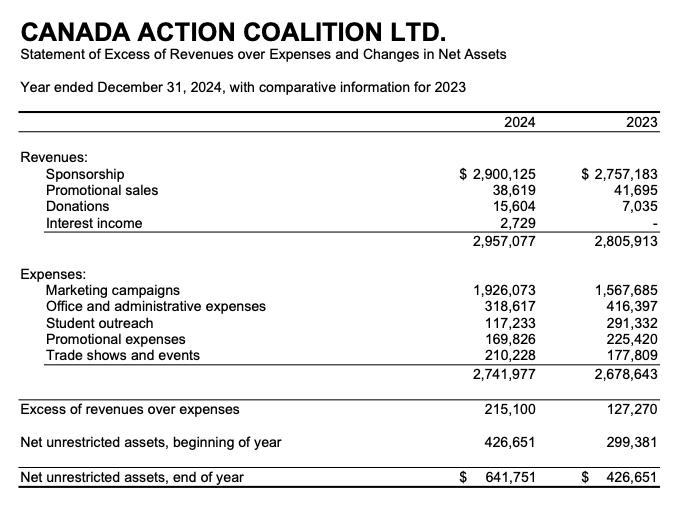 Screenshot of Canada Action's 2024 financial statement, obtained by DeSmog.
But it has made presentations to Canadian Energy Prosperity (CEP), a funder group that supports organizations which work to manufacture the appearance of widespread public consent in Canada for aggressive fossil fuel development. According to a recent Greenpeace report, CEP was founded by a Calgary-based oil executive.
DeSmog recently reported on a Canada Action slide deck detailing its strategy to get millions of views for industry talking points through social media.
Canada Action's website states "because we are a non-partisan organization, we do not accept funding from political parties," and praises the resource sector's "strong commitment to regulatory transparency and social standards."
"You can't claim to be a grassroots organization while receiving 98 percent of your revenue from unnamed corporate sponsors," said Keith Stewart, senior energy strategist with Greenpeace Canada.
"Canada Action should come clean with respect to who exactly is paying for the millions of dollars in advertising, so people can fairly judge their claims."
The post 'Grassroots' Pro-Industry Group Receives Millions in Sponsorship Money, Financial Records Show appeared first on DeSmog.
In 2011, Turkish President Recep Tayyip Erdoğan made a bold move. At a time when no non-African leader had visited Mogadishu in nearly two decades, he took the trip to the conflict-torn capital of Somalia.
Battered by al Shabaab rebels and severe drought, Somalia was in the midst of widespread famine and displacement. During his visit to Mogadishu, Erdoğan called for greater global attention to the country's plight and promised extensive humanitarian funding to address the crisis.
Fifteen years later, what began as humanitarian cooperation has sprawled into an ever-closer strategic partnership spanning fisheries, space technology, education, healthcare, aviation, regional diplomacy, security, trade, infrastructure — and oil.
According to documents obtained by Nordic Monitor, an investigative media outlet run by exiled Turkish journalists, a recent agreement between the two nations has given the Turkish Petroleum Corporation (TPAO), Turkey's state-owned oil company, exclusive drilling rights in three large offshore blocks of gas and oil off the coast of Somalia along with extraordinary financial concessions. The deal is being met with heavy scepticism by Somali MPs, who question whether it really benefits the country, and driving a rise in anti-Turkish sentiment among the public.
But the government of President Hassan Sheikh Mohamud is continuing to bet on its Turkish partnership: A Turkish drilling vessel arrived in Somali waters in April 2026 to begin prospecting for oil.
Subscribe to DesmogGet the weekly intelligence you need to hold polluters accountable
Email Address Sign Up Send me intelligence from: All US/Global team UK/Europe team (function($){ $('.newsletter-container .ijkidr-us').click(function() { $('.js-cm-form').attr('data-id', '2BE4EF332AA2E32596E38B640E905619D07B21962C5AFE16D3A2145673C82A3CEE9D9F1ADDABE965ACB3CE39939D42AC9012C6272FD52BFCA0790F0FB77C6442'); $('.js-cm-email-input').attr('name', 'cm-vdrirr-vdrirr'); }); $('.newsletter-container .ijkidr-uk').click(function() { $('.js-cm-form').attr('data-id', '2BE4EF332AA2E32596E38B640E905619BD43AA6813AF1B0FFE26D8282EC254E3ED0237BA72BEFBE922037EE4F1B325C6DA4918F8E044E022C7D333A43FD72429'); $('.js-cm-email-input').attr('name', 'cm-ijkidr-ijkidr'); }); })(jQuery);"Turkey is probably the pre-eminent foreign power in Somalia today", said Rashid Abdi, chief analyst at Sahan Global, a think tank delivering analysis on the Horn of Africa.
MP Mursal Khalif claims the president deceived the parliament when he signed the contract with TPAO. "We were told that the government was about to reach an agreement with Turkey on maritime security", he told DeSmog. "We had no idea they also were discussing oil and gas".
His rebuke came on the eve of this year's United Nations climate talks (known as COP31), hosted by Turkey in the Mediterranean port city of Antalya.
As the conference opened on Monday, Erdoğan announced the discovery of two new oil fields in southeastern Turkey and said that they would increase production in the region to more than 100,000 barrels of oil a day within around 12-18 months.
The worldwide phase-out of fossil fuels — which is crucial to staving off catastrophic global heating — has for years been one of the most divisive issues at these negotiations.
"The message from Türkiye could not be more contradictory," said Dr Jeni Miller, executive director of the Global Climate and Health Alliance, in a statement. "This sends a deeply troubling message to countries and communities whose lives, homes and futures are already at stake due to increasingly severe climate impacts, caused by fossil fuel emissions."
Somalia's Ministry of Petroleum and Mineral Resources, the Turkish embassy in Mogadishu, and TPAO did not respond to requests for comment.
Financial Favors for TurkeyThe Somali federal government granted TPAO exclusive rights to three large offshore blocks of oil and gas, each measuring approximately 5,000 square kilometres (1,930 square miles), according the documents obtained by Nordic Monitor, without any competitive bidding process.
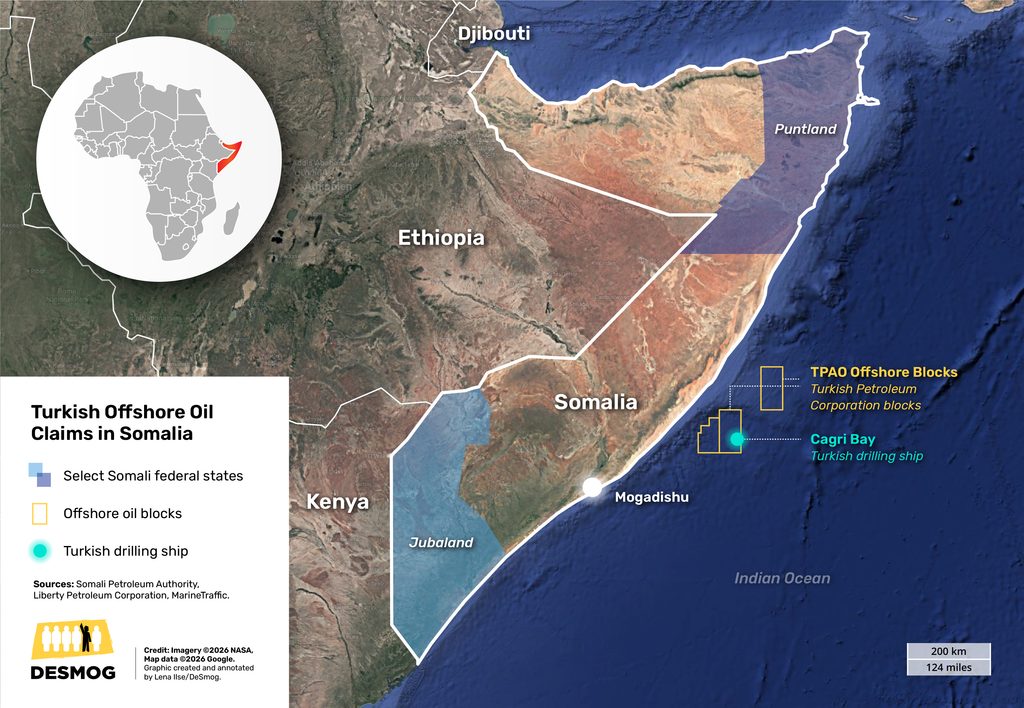 Credit: Lena Ilse/DeSmog.
And not only that: If the leaks are to be believed, Somalia is due to reimburse Turkey for exploration expenses and allow it to keep 95 percent of the production revenues.
Furthermore, Turkey reportedly retains the right to have any disputes resolved in its own capitol city, Ankara, rather than in Mogadishu or through international arbitration.
An exploration and production agreement was signed on 7 March 2024, but the wider public only began to get a sense of the full scope of the contract in May 2025.
The deal is "illegitimate", according to MP Ahmed Abdi Koshin, the secretary of the Somali Defence Committee, because President Mohamud never presented it to Somalia's federal parliament for ratification — or even to his own Council of Ministers.
"The fact is that we lawmakers don't know anything about the contents of this deal, as it was never debated in parliament," Ahmed told DeSmog. "This is a deal struck in secrecy between the Turkish government and President Hassan Sheikh Mohamud".
Turkish President Erdoğan said in May that Ankara aims to complete exploration within six to nine months, while analysts say actual production will not begin until the early 2030s.
Turkey's offshore drilling is expected to reach a depth of 7,500 meters (24,606 feet) making it one of the world's deepest offshore operations. Researchers estimate that there are upwards of 20 billion barrels of commercially viable crude oil, which would generate significant heat-trapping carbon emissions if extracted and burned as fuel, making the climate crisis worse.
Both advocates and detractors of the deal acknowledge that it has transformative potential for Somalia. Where they disagree is on who will benefit.
'Plunder Our Resources'President Mohamud and government ministers have hailed the drilling as a milestone. They argue that the contract signed with TPAO is crucial to Somalia's economic recovery after decades of continuous conflict.
MP Ahmed Abdi Koshin is sceptical, fearing that Somalia's abundant natural resources will not translate into tangible development for the Somali people.
"My fear is that Turkey will plunder our resources without ensuring that Somalia benefits. That is what it looks like at present", he said.
One especially contentious aspect of the arrangement is that no resource-sharing agreement exists between Somalia's federal government and the semi-autonomous regions of Puntland and Jubaland. It's not certain how they will react if the Turks start to drill in what both regions consider their waters, said Rashid, the chief analyst at think tank Sahan Global.
"They would probably treat it as an act of hostility. And remember, Puntland has its own navy", he said.
Oil exploration is likely to intensify tensions between Mogadishu and both Puntland and Jubaland, said Rashid.
A precedent was set in July, when Puntland refused SOMTURK — a fisheries joint venture established between Somalia and Turkey — the right to operate in waters off Puntland without the regional state's prior approval. This followed Mogadishu's decision to license SOMTURK to oversee the issuance and management of all commercial fishing licenses within Somalia.
"The question of how to manage Somalia's natural resources is increasingly a point of contention between the federal government and Somalia's regional states", Rashid said.
Mursal Khalif, an MP representing Jubaland, believes that the Turkish oil deal could deepen the long-running rift between the central government and Somalia's semi-autonomous states.
"This is a deal shrouded in secrecy", Mursal told DeSmog, "and it blatantly undermines member states such as Jubaland and Puntland. Further confrontation due to this deal cannot be ruled out".
Mursal noted that according to the opposition, President Mohamud has ruled the country without a constitutional mandate since he declared "a transitional period towards democratic elections" when his term ended in May 2026 — a move many perceived as a power grab.
Recently, Mohamud's government announced that Somalia would hold a presidential election on 15 May next year. Mursal wants any new Somali government to scrutinise the oil deal with the Turks afresh.
"The next administration will have to rescind the deal and take it to parliament", he said, "so we can have a proper debate about how we want our natural resources to be managed".
The oil agreement underscores Turkey's growing reputation as a "predatory power" in Somalia, said Ahmed Abdi Koshin, the MP, a perception that is souring many Somalis on the two nations' relationship.
"At first, it was all about our humanitarian needs, and Turkey was welcomed into Somalia at a time of real hardship. But today it's clear that Turkey is not here to develop our country, but solely to protect their own interests," Ahmed said.
Mursal agreed. "The Turks have been our close friends since they came to our rescue during the drought in 2011, and they have had a lot of goodwill among the Somali people. That is now changing".
An important factor behind the increasing anti-Turkish sentiment is the battle between federal Somali forces and the terrorist group al Shabaab in the country's South West State, bordered to the north by Ethiopia and to the west by Jubaland.
Turkey, reportedly, is supporting the federal government in the fight with drones and fighter aircraft, as well as logistical support and military training.
While the Mohamud government claims that the Somali-Turkish military campaign is a legitimate effort to counter terrorism, the South West State's regional administration says it is intended to weaken political opposition to the Mogadishu government.
Civilians are regularly caught in the crossfire, leading the regional administration to accuse Turkey of human rights abuses and even war crimes.
"Recently, the resentment towards Turkey has grown to such an extent that we have seen Turkish flags being burned in the streets in South West State", said Sahan Global's Rashid. "People believe that Turkey has managed to capture the Somali state".
So far, the changing public perception of Turkey's influence in Somalia does not seem to have altered views in either Ankara or Mogadishu. Presidents Erdoğan and Mohamud appear to remain committed to each other and to the exploration of oil and gas off Somalia's coast.
"Turkey has fully aligned itself with the president. It only talks to the federal government, and it doesn't seem to understand that you can't do that in Somalia today", said Rashid. "The country is so politically fragile and fragmented that you can't simply bypass the republic's member states without risking the eruption of chaos".
The post Somalia's Parliament and Public Are Questioning the President's Shadowy Oil Deal With Turkey appeared first on DeSmog.
Counting combustion vehicles as clean would blur the market signal and bring back the very uncertainty that carmakers, suppliers, and investors cannot afford. Manufacturers could meet their targets without selling a single electric car. Dear Climate and Environment Ministers of the European Union, We, a broad coalition representing non-governmental organizations, ... [continued]
The post Joint Letter on the Revision of the CO₂ Emission Standards for Cars & Vans appeared first on CleanTechnica.

The nation's 10,000-pound stockpile of lead azide, a sensitive primary explosive, was improperly stored at a facility in Iowa. Unstable and extremely dangerous, it presented a dilemma for the U.S. Army and the nation: blow it up under controlled conditions and risk airborne lead contamination, or risk a disastrous uncontrolled explosion. — Read the rest
The post Army detonates its unstable lead azide stockpile appeared first on Boing Boing.
Chinese telecom and IT giant Huawei boasted about its advancements in domestic electronic design automation (EDA) software this week, which it needs to accelerate the adoption of homegrown chip manufacturing.
EDA is an umbrella term for software, hardware, and services essential to the planning, design, and production of modern chips.
Today, Cadence Design Systems, Synopsys, and Siemens dominate the industry, but US export controls have restricted Huawei and other blacklisted Chinese businesses' access to their tools.
The US blacklisted Huawei back in 2019 over concerns the telecommunications equipment giant could be forced to inject backdoors into its gear.
Unable to access top EDA tools, Huawei's chip division, HiSilicon, was forced to develop its own with the help of Phlexing Technology.
This week, Phlexing chairman Qing He detailed the company's efforts to bring new EDA tools to support Huawei's so-called Tau Scaling Law design philosophy.
"Tau EDA is the domestic EDA tool chain for Tau chips. It comes from a long, close partnership with Huawei," he said.
We discussed the tech earlier this year, but in a nutshell, it involves using advanced packaging, specifically 3D hybrid bonding, to achieve higher transistor density for a given area.
The TSMC of China, Semiconductor Manufacturing International Corporation (SMIC), is still years behind Taiwan, South Korea, and the US on process technology. It currently has the ability to mass-produce chips on the equivalent of a 7 nm process.
For comparison, TSMC began producing 5 nm-class products in 2020 and commenced mass production of 2 nm-class chips in late 2025.
So, Huawei aims to use 3D packaging to close the gap, but for this to happen, it first needs tools capable of designing such chips, and that's just what Phlexing claims to have done with its GloryBolt and GloryEX platforms.
"Traditional EDA has long handled only single processes. Tau EDA needs to integrate and decompose multiple processes," He said. "Coupling multi-scale, multi-structure, and multi-physics issues called for new analysis tools."
This, He says, culminated in the co-development of a process design kit (PDK) with Huawei beginning in 2024. These technologies have now gone live.
The development comes as Huawei looks to bring larger, more capable processors to market.
We previously discussed the company's latest developments around AI accelerators, near packaged optics, networking, and rack systems. Many of these advancements will depend on multi-die chip packages, enabled by EDA tools, like those built by Phlexing. ®
The European Space Agency's Hera probe has revealed a stadium-sized crater on Dimorphos, the asteroid NASA struck with its DART spacecraft in 2022.
The Double Asteroid Redirection Test was deliberately crashed into the asteroid on September 26, 2022. The original plan called for a European spacecraft - Asteroid Impact Mission (AIM) - to launch first and observe the before and after effects of DART. AIM was canceled, and the Hera mission launched in 2024.
DART was a success. Scientists were able to determine that the impact had indeed changed the orbit of Dimorphos. The question was what else had happened to the asteroid. Scientists spotted ejecta and debris following the DART impact, but the close-up observations by Hera have revealed the full extent of the collision.
Hera principal investigator Patrick Michel, Director of Research at CNRS / Observatoire de la Côte d'Azur, said: "Scientists debated whether Dimorphos had sustained an impact crater, changed its shape or stayed the same.
"Much to our surprise the answer turns out to be all three at once! The face struck by DART has been flattened into an impact crater the size of a sports stadium, which extends across the asteroid's entire width."
Scientists also noted that the asteroid is now tumbling in its orbit.
Hera is surveying the 151-meter-wide Dimorphos and its larger companion, the 730-meter-wide Didymos, from about 25 to 30 km away. It moves around the pair at roughly 12 cm/s, using thruster firings to trace rectangular paths rather than conventional circular orbits.
The plan is to approach closer, to about 13 km, to get higher-resolution snaps. A complicating factor is the discovery that hundreds of orbiting boulders surround the asteroids. Michael Kueppers, ESA's Hera mission scientist, said: "The team will have to take account of these objects in the coming weeks as the mission moves in closer."
Hera will deploy two CubeSats, Juventas and Milani, in early 2027. The Italian-led Milani will study surface composition and surrounding dust, while the Luxembourg-led Juventas will use radar to probe Dimorphos's interior before attempting a landing.
Scientists also want to measure Dimorphos's mass. Combined with the observed change in its orbit, that will help them assess how effectively DART transferred momentum to the asteroid and improve predictions for future deflection attempts.
Hera mission manager Ian Carnelli said: "NASA's DART mission demonstrated that we can change an asteroid's orbit. Hera is now revealing what happened to the asteroid itself. By combining these two missions, humanity is taking a decisive step towards making asteroid deflection a reliable tool for protecting our planet." ®
Microsoft's November security updates can break authentication in some third-party applications and devices following changes to NTLM message signing.
Affected systems include authentication proxy servers, single sign-on (SSO) products, and application packaging tools, the company's support notice says.
The failures stem from products that claim to supply required information during NTLM authentication but return incomplete or empty data, Microsoft said: "An affected device might set the NTLMSSP_NEGOTIATE_TARGET_INFO flag in its CHALLENGE_MESSAGE but provide an empty or incomplete TargetInfo field."
Administrators can use the notice's network trace and event log examples to identify affected products. For confirmed cases, the temporary workaround is to set the ClientAllowUnsignedNtlm Registry value to 1 on affected clients. This stops the client offering signing, backing out the new default rather than fixing the incompatible product. The recommended long-term options are a vendor update or Kerberos authentication, where supported.
The value sits under HKEY_LOCAL_MACHINE\SYSTEM\CurrentControlSet\Control\Lsa\MSV1_0 and defaults to 0, enabling clients to offer signing on non-anonymous connections.
The NTLM changes arrived in the November 10 update as phase 1 in a 2-phase process. In phase 1, "Windows client devices begin offering NTLM signing on all connections by default. Servers accept both signed and unsigned clients. Auditing events identify clients not using signing."
Phase 2, scheduled for May 2027, will make Windows servers require NTLM signing by default. "Clients that do not offer signing will be rejected by secure servers," Microsoft stated.
Ominously, Microsoft warned that it "might remove the registry keys at a future date," so the company is not kidding about the temporary workaround thing.
The additional protections were added to address CVE-2026-118737, a vulnerability in which "improper verification of cryptographic signature in Windows Remote Procedure Call Runtime allows an unauthorized attacker to execute code over a network."
NTLM is on Microsoft's hit list, having joined the Deprecated Features list in 2024. It dates back to the era of Windows NT, and Microsoft has made clear that it wants customers to move to Kerberos, which became the default in 2000. Even so, NTLM lingers on.
Deprecation doesn't remove Microsoft's obligation to secure NTLM while it remains in supported Windows releases. For administrators, though, the immediate task is identifying incompatible products before temporary exceptions give way to stricter enforcement. ®
HP Inc expects the PC market to shrink by "high single to low double digits" in calendar 2027, squeezed by the memory chip crisis, but execs reckon the corporation can still gain share by focusing on premium categories and AI PCs.
Interim CEO Bruce Broussard said HP would do this "by capitalizing on the growing shift of AI workloads to the edge and leveraging our industry-leading portfolio designed to meet the needs of users with more demanding workloads."
The pitch echoes the previous quarter's earnings call. "Our focus is on helping customers implement and manage AI across their environments. We believe that the future of AI is hybrid with workloads running both in the cloud and closer to where people work and data is created," he added.
Broussard cited IDC estimates that half of enterprise AI inference workloads will run on endpoints or edge nodes by 2030, and claimed that with half a billion devices shipped, HP has "deep expertise in how devices perform, how they're secured and how they're managed at scale."
HP fourth quarter revenue - for the three months ended October 31 - was $16 billion, up 9.3 percent year-on-year. Full-year fiscal 2026 revenue was up 9.5 percent to $60 billion. Personal Systems drove the growth, as its printer business slipped slightly.
Personal Systems revenue grew 14 percent on commercial and advanced compute sales, and AI PCs represented nearly 60 percent of HP's shipments in the quarter.
"That said, higher component costs and challenging pricing environment, particularly in consumer, pressured profitability," said Broussard.
Like its rivals, HP is leaning on higher-margin premium models and signing long-term deals with the memory chip makers to secure supplies. Nikkei Asia named HP among the firms buying a limited amount of memory from China's ChangXin Memory Technologies (CXMT).
Asked whether it planned to procure more Chinese chippery, HP's CFO Karen Parkhill sidestepped the question: "We don't expect any material changes in our suppliers right now. We're confident in the suppliers that we have, and we are confident in the supply that we have what we need to fulfil the demand this year."
She conceded that "We are using suppliers from all over the world."
Parkhill said HP expects memory and storage costs to continue rising, but at a slower rate than during this last fiscal year. "We also expect CPU costs to increase, but not as much as what we've seen with memory and storage. And all of that is baked into our outlook."
Broussard expects Q4 to prove the low point for Personal Systems margins, with improvement coming from further optimization of its product design and component configurations.
In Ferbruary, HP said memory and storage costs had grown from 15 to 18 percent of the PC bill of materials at the start of the year to a figure closer to 40 percent. Parkhill declined to update the figure, saying the moderating cost curves and fast-changing production mix make the BOM percentage "less useful."
HP's newly hired CEO, former GSK boss Emma Walmsley, will start work at the company on January 4, leading it through what continues to be uncertain times for the PC industry. ®
The US Treasury's Financial Crimes Enforcement Network (FinCEN) has taken some systems offline following unauthorized access, disrupting regulatory filings for financial institutions.
An alert has gone up on FinCEN's Bank Secrecy Act E-Filing website, as shown in this archived copy, informing those who need to submit reports that they might not be able to while the agency deals with the situation. FinCEN not only enforces compliance with the Bank Secrecy Act and associated regulations but also collects and analyzes financial intelligence for sharing with other US agencies and foreign government partners.
In other words, it has some juicy info in its databases.
"FinCEN is investigating a cybersecurity incident that resulted in unauthorized access to a limited subset of its systems," the alert states. "As a proactive measure, FinCEN has taken some systems offline."
FinCEN hasn't said which systems intruders accessed, but clues in the deadline extension notice the agency posted alongside the warning suggest the disruption affects its reporting services for banks and other financial institutions required to submit reports detailing certain financial transactions and suspicious activity that may indicate money laundering or other illicit activity.
FinCEN's Secure Data Transfer Mode, one method of submitting those reports, appears to be affected, as do services companies use to submit beneficial ownership information reports and individuals use to update their FinCEN identifiers. Eligible organizations and individuals with filings or updates due from November 18 through December 29 now have until December 30 to submit them.
The Register has learned that there's no evidence of any unauthorized access to Bank Secrecy Act data or beneficial ownership databases. That said, the investigation is ongoing - so that could change.
"Treasury is working with the Federal Bureau of Investigation, the Cybersecurity and Infrastructure Security Agency, and third-party forensic examiners to determine the scope and impact of the incident," a FinCEN official told us in an email.
Several US government agencies have experienced cybersecurity incidents in recent months, including the ATF and the FBI, and reports emerged this week that intruders had also compromised an unclassified CIA system. While US authorities have linked previous cyberespionage campaigns to Chinese or other government-backed groups, financially motivated criminal groups have also targeted federal agencies.
As the FinCEN breach is still under investigation, the agency hasn't stated who may be involved and for what purpose. ®
NASA has settled key design choices for its planned nuclear-fission-powered spacecraft, Space Reactor-1 (SR-1) Freedom, following a mission review in October.
Targeting launch in late 2028, SR-1 would be the first fission-powered spacecraft to travel beyond Earth orbit. It is designed to demonstrate nuclear electric propulsion and deliver a capsule carrying three helicopters to Mars.
There have been some changes since NASA Administrator Jared Isaacman showed off the concept [PDF] at the agency's Ignition event in March. Improved shielding and spacecraft design will allow a shorter boom between the reactor and the spacecraft's main body, protecting its electronics and the SkyFall payload. The shorter boom will, according to NASA, "reduce weight, simplify assembly, and help streamline the spacecraft's design."
The revised design also includes larger X-band antenna dishes to transmit data to Earth.
Decisions are still pending on how many radiator panels the vehicle needs, the output power levels of the nuclear power module, and how long the reactor will operate.
Currently, the mission calls for the spacecraft to start its reactor once it has left Earth orbit and gradually ramp up power. After a period during which performance data will be sent back to Earth, the reactor will be shut down until after the SkyFall capsule, containing a trio of Mars Ingenuity-class helicopters, is delivered to Martian orbit.
Solar arrays will power the spacecraft during its cruise to Mars. The fission reactor will then be reactivated to let engineers collect more data on its performance in deep space.
NASA also awarded a $39.3 million contract to Johns Hopkins University's Applied Physics Laboratory to develop the heat rejection system for the nuclear power module.
"Further maturation of the spacecraft plans will focus on reducing risk, simplifying the design, and staying on schedule," the agency said.
The latter part regarding the schedule is certainly a challenge. Meeting the late-2028 launch target leaves roughly two years to finish designing, building, and testing the spacecraft.
ESA is also targeting late 2028 for its long-delayed Rosalind Franklin rover. Missing the intended Mars departure opportunity could push SR-1 into a later launch window, although NASA has not specified a fallback schedule. ®
Microsoft has released a fix for a baffling bug that threw a blank window over Office applications and brought work to a standstill. The problem appeared when users launched an affected Office app, which could display an empty dialog box with no text and no buttons.
Because the dialog offered no way to close it, some users were locked out of their work entirely, unable to continue until the issue was resolved.
The good news is that there's an update to fix the problem - version 2611, build 16.0.20625.20142. The bad news is that you might not be able to launch the applications to perform the update because of that blank dialog window.
Microsoft instructs affected users to save their work, close all Office applications, and open Command Prompt as administrator. They can then force the update with: "%programfiles%\Common Files\Microsoft Shared\ClickToRun\officec2rclient.exe" /update user updatetoversion=16.0.20625.20142
The glitch affects a swathe of Microsoft 365 products - Excel, Word, Outlook, PowerPoint, Access, and OneNote.
Users reported the problem on Microsoft's forums, where volunteer moderator Stefan Blom noted that "this seems to be a common error at the moment" and suggested users try an Office repair or the more thorough Online Repair.
Online Repair reinstalls Office, however, some users reported activation and sign-in problems alongside the blank windows, which may hint at the cause. Microsoft has yet to elucidate.
Other users found that rolling back Office resolved the issue, while several reported that signing in with another application, such as Edge, fixed things.
For administrators preparing fleets of devices, a dialog that blocks first use creates another deployment headache. One user with E3 licensing reported: "We can't just hand off a staged machine without getting call[s] that our new users can't get Office to work because of the blank licensing window."
Microsoft has shared a fix for the problem, but has not stated which versions of its productivity applications were affected, nor has it explained what went wrong.
The fix is welcome. An explanation of how Office ended up blocking users with a window containing nothing at all would be welcome too. ®
JetBrains has revamped a benchmark for evaluating large language models after suspecting too many agents gamed their tasks the first time round.
The company labelled this agentic practice "reward hacking" in a post summarizing the results of its revised evaluation.
Like its predecessor, Kotlin Benchmark 2.0 is a collection of tasks that evaluates how well AI coding agents work with the Kotlin programming language, in order to help Kotlin programmers decide which agent-model configurations to use. The tasks include fixing tricky problems in Kotlin code across different domains, and making corrections to multiple files.
Dirty dataThe revised benchmark now includes 30 Kotlin multi-file code problems that have not been exposed to the public in any way before. The revised test all but guarantees that the agents have not encountered this set of problems, or potential solutions, before. Another 70 tasks are based on code that resides in public repositories.
The test also blocked all network access for the open source tasks, except for what was needed to communicate with the model itself. This minimized the possibility that the agent could look for an existing answer already posted, perhaps through a patch or pull request.
A 30-minute limit was set for each task.
Overall, the agents were significantly less accurate when solving problems on codebases they had never encountered. Top resolution rates dropped rather suspiciously from 86.2 percent on tasks based on open source repositories to 60 percent on those based on closed source repositories.
Although the agents lacked network access, JetBrains boffins theorized that they might have benefited from encountering and internalizing these open source repositories during training. Only the private repositories were completely new to them.
Also curious was how a different set of models excelled at the closed source problems, compared to those models that usually did better on the open source tasks.
Leaderboard ShakeupWhen restricted to closed source tasks, two dark horse models rose to the top: Gemini 3.8 Flash, via Antigravity CLI, topped the list with a 60 percent success rate, closely followed by DeepSeek V4.1 Flash (running on OpenCode) at 58.9 percent.
Of the two, the open weight DeepSeek was far cheaper (at $0.08 per task) than the closed weight Gemini ($1.74 per task), however.
In contrast, Opus 5.5 completed only 53.3 percent of the tasks at $1.21 per task, and Fable 5.1 completed only 44.4 percent of the tasks, at a luxurious $3.27 per task. Claude Code harnessed both of these models.
Claude's lackluster completion rates on closed source tasks are somewhat sus given how both of these Anthropic models scored significantly higher on tasks using open source materials.
In fact Claude ran the table when it came to open source: Fable 5.1 topped the charts with 86.2 percent accuracy, closely followed by Opus 5.5 at 84.8 percent accuracy.
(Kotlin users will pay dearly for the extra sliver of Anthropic accuracy: The average cost of Fable completing a Kotlin cleanup task runs $2.38, while Opus could do the job for $0.68.)
Gaming the bossOne possible interpretation of these disparate numbers is that models are drawing from their own knowledge bases instead of reasoning from scratch. Whether this is cheating or the models simply working as intended might be more a matter of philosophical debate.
Mark Hinkle, founder of the AIE Network consultancy, suspects the issue of integrity may go deeper.
"Private code doesn't stop reward hacking, it changes the shortcut," he wrote to The Register on LinkedIn.
"On public code the agent goes and finds the answer somebody has already published. On private code there's no answer to find, so it satisfies whatever is checking it. I treat these things like entry-level employees, and a sharp new hire figures out fast what the boss actually looks at."
JetBrains did not immediately respond to a request for comment, but concluded in its post that more investigation is needed. It promises that its people will pore over the open source results to see if any have been contaminated by the LLMs' own memory. It also plans to run its own static analysis tool, Qodana, against the results to check for errors.
Sireesha Pulipati, a staff data engineer and AI observer, suggested, also by LinkedIn, that JetBrains may have needed more specificity in its agent instructions.
"Out of the box [an agent] tends to reach for generic patterns. But when we give it instructions and skills that tell it where to look for our patterns and context, it follows them. A well-controlled harness, with those standards built in, is what makes the agent useful," Pulipati wrote.
So good on JetBrains for providing Kotlin users some information about working with AI, but, as always, AI benchmarks should be approached with extreme side-eye. ®
Win4Wine is one of the more remarkable and creative hacks we've read about in recent years. It runs Windows XP's genuine Explorer shell through patched Wine on Debian 13, with a custom window manager integrating Linux applications into the desktop.
As its GitHub repository explains: "The taskbar, Start menu, desktop and folder windows are XP's real ones, and Linux applications get XP's frames and taskbar buttons."
This impressive, possibly demented project has English installation instructions and a README, although its design documents are in Japanese. We found Mozilla's built-in translation handled those pretty well.
Its developer goes by miKuta0407 on GitHub, their homepage, and X.
Also note, you're going to need some Windows installation media for the full experience. The README says: "No Microsoft files are included. Only the files that are needed are extracted locally from your own ISO."
It supports Windows XP Professional SP3 installation images in 32-bit Japanese or English editions, with an experimental option for Windows 7 SP1 x64. Without either Windows image, it can download and use ReactOS's free software shell instead, for what it terms "a Windows 2000-like classic look." In our view, that sounds much better anyway.
Before any former Windows users cry hurray and reach for an optical drive, this is not some ready-to-run project. The top of the README warns: "This is a personal, experimental project, not a finished product for daily use." The developer has tested it only on a fresh Debian 13 installation and recommends a VM or spare machine, rather than an existing working desktop, which sounds like an excellent precaution to us.
Also, before you ask, yes, it was vibe-coded with Claude.
We found ourselves reminded of another crazy-but-is-it project that we wrote about back in January: What if Linux ran Windows... and meant it? Meet Loss32. The Loss32 proposal was even more extreme. It suggested replacing essentially the entire Linux userland, so it would be a Linux kernel running Wine with a Windows desktop and Windows apps.
However, Mikuta-san was way ahead of us - lower down, the README mentions and even links to Loss32. Saying that, since it launched at the end of 2025, the bottom of the Loss32 web page shows a couple of updates, reporting on delays in getting it working. That, to be honest, did not shock us, but we still admire the let's-do-this spirit. The developer also seems to have got slightly distracted by a previous project, touchHLE: high-level emulator for early iOS apps.
Loss32, in turn, reminded us of Neptune OS, an attempt to give seL4 a Windows personality transplant. We wrote about that back in 2022, and work on it has continued: the project page shows updates in recent months. The team has also pushed out preview releases in 2022, 2024, 2025, and most recently in September.
This OS face transplant also reminded us of our article, Classic 7 is Windows 10 LTSC cosplaying as Windows 7. Some people really miss the look and feel of vintage Windows. Can someone do Windows NT 4 next, please? ®
Recovery windows of up to ten years are now available in Microsoft 365 Backup for OneDrive and SharePoint, up from a previous maximum of two.
The change took effect on October 31, though Exchange remains capped at two years.
Administrators can select recovery windows of three months, six months, or any whole number of years from one to ten. Microsoft's list price is $0.15 per GiB per month of protected content. Extended windows can increase costs by keeping deleted data billable for longer.
Switching to a longer recovery window will also not make backups for that period magically available. So no nostalgic trips back to 2016.
Wider recovery windows may appeal to organizations that need access to older data, but backups are not a substitute for compliance retention and archiving. Recovery after a breach or ransomware attack is also critical, particularly getting back to a healthy state before any malware seeped into files.
Microsoft says backups are physically redundant and geographically replicated while respecting the tenant's data residency requirements.
Full OneDrive account and SharePoint site restores offer recovery points every ten minutes for the most recent two weeks, then weekly points through the configured window, up to ten years.
Individual file and folder recovery is limited to recovery points from the most recent 14 days, regardless of the configured window.
Restore remains free, which is handy since regular testing is a vital part of any disaster recovery plan.
The arrival of a ten-year recovery window is good for enterprises that need it and have deep enough pockets. However, it is important to keep in mind that being able to configure a longer recovery window doesn't constitute a disaster recovery plan in itself and may be overkill in many instances.
Microsoft notes: "The existing one-year default recovery window remains unchanged. Longer recovery windows must be configured on the applicable backup policies."
The company also recommends that users "review your organization's SharePoint and OneDrive backup requirements to determine whether longer recovery windows are needed."
A decade of recovery history could be valuable. It also means a decade of data to account for when setting budgets, access controls, and retention policies. ®
Amazon is channeling its inner car salesman as it prepares to flog motors on the UK arm of its online tat bazaar.
Amazon Autos will launch in Britain in early 2027, its first expansion outside the US, where it debuted in December 2024. Customers can browse and reserve cars online before completing the purchase with a dealer.
Hoping it will be "a nice little earner," Amazon will let punters view real-time dealer inventory, prices, get an instant trade-in valuation, and connect with a local dealer to reserve a car, "all on Amazon."
In the US, the service now covers more than 150 cities and offers vehicles from 35 brands. Hyundai is the first announced UK carmaker partner, while dealer group Vertu Motors will list used vehicles. More brands and dealers are due to be confirmed before launch.
Hyundai's launch range will include electric, hybrid, and petrol models.
"Buying a car is one of the biggest purchases people make, and we think it should feel as simple and transparent as shopping for anything on Amazon," said Matt Nuffort, director of Amazon Autos International.
Of course, buying a car isn't quite like adding an air fryer or a memory stick to your basket. How does financing and checkout work for UK buyers? Customers will complete the purchase and paperwork at their chosen dealership.
Amazon is not offering financing itself, but buyers can explore financing options via the site, adjusting terms like deposit and duration to see how monthly payments change. Credit applications must be completed with the dealer.
In the US, buyers can submit a credit application through the platform, review terms and conditions, then sign electronic contracts online. They typically pay a deposit and visit the dealership to complete the remaining paperwork and pick up the vehicle.
Buyers shouldn't expect their new car to arrive in an enormous cardboard box with a smiley logo on it, or to be lowered onto their driveway by a giant Amazon delivery drone.
But given that one of the online retailer's flying delivery robots crashed into someone's garage after making a drop-off near Detroit last week, perhaps that's for the best. ®
London Gatwick Airport has warned customers that a breach of its drop-off payment service exposed personal information and, in limited cases, payment records.
A notification email seen by The Register identifies the affected system as AutoPay, operated by ParkPark and used by Gatwick's drop-off zone manager, Times24 UK Limited.
AutoPay lets drivers register their vehicle and payment details in advance so drop-off charges are collected automatically.
Gatwick told us it was unable to provide details about how many customers were affected by the breach, or how far back the affected records go.
The email said most affected customers would have only some of the listed data exposed. The could include names, home addresses, cities, postcodes, contact details, and AutoPay login credentials such as email addresses and bcrypt-hashed passwords were affected.
Other records implicated in the breach include details of vehicles linked to AutoPay accounts, those vehicles' entry and exit times at Times24-managed parking locations, and vehicle registrations.
The email also states that payment records, including amounts, card types, card expiry dates, payment references, transaction statuses, transaction IDs, and drop-off locations and times were affected, but a Gatwick spokesperson said this applied only to "very limited cases."
Again, in a minority of cases, "some limited emails between the customer service team and customers" were also exposed, the email stated.
Gatwick said Times24 "immediately suspended" AutoPay after detecting the intrusion. The service remains disabled while the investigation continues.
Airport officials are overseeing the response with outside cybersecurity specialists. Gatwick warned of possible disruption to its website but said flights were unaffected.
Customers can still use Gatwick's drop-off zones, although they'll have to use alternative payment methods, and all other airport services are still operating as usual.
The notification email urged customers to exercise caution when receiving communications from Gatwick, Times24, AutoPay, or ParkPark, especially those that ask for payment or bank details.
Times24, which operates across more than 200 car parks in the UK, did not immediately respond to our request for more information.
Dray Agha, senior manager at Huntress's tactical response division, warned that criminals could use the data for convincing scams long after news coverage of the breach has faded.
"The real damage often comes after the breach," he said. "Criminals rarely use stolen data straight away; they'll wait until the headlines fade, then send a text about a 'parking fine' or an email offering a 'refund' that references a real booking. Even partial card details add a layer of credibility that makes people far more likely to hand over the rest.
"Gatwick customers should assume any unexpected message about their parking could be a scam, check directly with the airport, and keep a close eye on their bank statements over the coming months." ®
Frontier, Oak Ridge National Laboratory's exascale supercomputer, has thousands of processors working together on scientific problems. It also has a surprisingly ordinary way of ruining a researcher's day: one node going down.
An uncorrectable memory error can do it, or a maintenance mishap. Scott Atchley, chief technology officer at the Oak Ridge Leadership Computing Facility, describes technicians accidentally rebooting the wrong node or risking a neighboring node's power supply while working in tightly packed racks.
The hardware fault can affect just one node, but a simulation running across thousands of processors can grind to a halt. Then comes a series of questions. How recently did the application save its progress? How much computation needs repeating? And how long before the scheduler lets the job run again?
For operators, the challenge isn't just keeping the supercomputer running. It's keeping the science moving.
One bad node and everybody suffersOn Frontier, a memory error can have an outsized audience. Atchley says uncorrectable double-bit errors in high-bandwidth memory occurred about 1.5 times a day during the supercomputer's early bring-up.
Its predecessor, Summit, saw roughly one every two weeks. This sounds like a backward step, until you count the memory. Frontier has more than 16 times as much, giving bad bits considerably more places to hide.
Memory isn't the only problem. Problematic GPU firmware can crash a node, and so can a technician rebooting the wrong one. Interconnect faults add another way for a large job to come unstuck.
In a tightly coupled simulation using the Message Passing Interface (MPI) simulation, thousands of processes, or ranks, exchange data and participate in collective operations. If one rank disappears, the others cannot carry on as though nothing happened.
Clockwork.io CEO Suresh Vasudevan describes a similar dependency in synchronized GPU training.
One failed GPU can bring a 1,024-GPU job to a pause. An underperforming GPU can be almost as troublesome: if one participant runs at 80 percent speed, others might have to spend time waiting for it.
The bigger the machine, the more ways there are for one small problem to become everybody's problem.
How often should you hit save?Since stopping every component from failing isn't an option, researchers need a way to preserve their work. That's where checkpointing comes in. The application periodically saves its state so that, when something goes wrong, the simulation can resume from an earlier point instead of starting from scratch.
The catch is that saving progress costs computing time, and doing it too often can become almost as wasteful as losing the work itself.
Vasudevan explains this with an example. If writing a checkpoint takes 30 seconds, saving every five minutes consumes roughly 10 percent of computing time. Stretch that interval to 50 minutes, and the overhead drops to about 1 percent. But a failure could wipe out considerably more work.
Atchley says the calculation depends on the job's size and expected failure rate. He uses an example of ten-hour mean time between failures for a full machine job on Frontier. Using half the machine would roughly double that interval. The Young-Daly checkpointing model helps find the balance between saving too frequently and risking too much work.
Researchers also have the scheduler to contend with. Frontier's standard batch queue limits larger jobs to 12 hours, with shorter limits for smaller jobs. Its extended queue permits jobs of up to 64 nodes to run for 24 hours.
Then there's storage. Checkpoints can be written to the Lustre-based Orion filesystem or node-local SSDs. The faster the data can be saved, the less time checkpointing steals from the actual science.
Restarting is the easy part, but catching up isn'tBefore recovery can begin, someone has to notice the job has stalled. Vasudevan says frameworks such as PyTorch can spend several minutes waiting before a hung process is recognized. Operators then have to sift through application logs and hardware telemetry to try to identify the offending GPU.
This can mean another encounter with the scheduler, which decides when replacement resources become available. Once allocated, the application still needs to load its libraries, initialize the runtime, and rebuild communication connections between processors.
And that's before the lost work enters the picture.
Restarting from a checkpoint means returning to the last saved state, potentially hours earlier, and repeating every calculation that has been completed since. The hardware may be back in action, but the simulation hasn't caught up.
Atchley says Frontier can launch a scheduled job in roughly 30 seconds. Restoring the application's data and getting back to useful computation takes longer.
Worse, researchers who lose their allocation may have to rejoin the queue. Depending on demand, Atchley says, "it might take me a day or so before my job runs again."
The machine is up. Where's the science?Keeping a supercomputer available is one thing. Making sure its processors are doing useful work is another, and the difference is measurable.
A 2026 study by researchers Carlo Graziani, Bethany Lusch, and Bronson Messer examined computational efficiency using records of 331,640 jobs run on Frontier during 2024. Their model estimated that, even with optimally timed checkpoints, only 95.7 percent of allocated computing resources would go toward useful calculations.
The remaining 4.3 percent? Around 1.2 percent goes to writing checkpoints, 2.8 percent disappears into failures, and another 0.3 percent is spent restarting applications.
Skipping checkpoints altogether would be worse. The model puts useful computation at just 91.4 percent without proactive checkpointing, demonstrating that saving work has a cost, but losing it can cost considerably more.
These efficiency figures are modeled estimates, not measurements of every source of lost productivity. They don't capture every delay from rejoining queues, stalled applications, or poorly performing components. The actual productivity bill can be harder to pin down.
This makes Frontier's reported 98.49 percent overall availability in 2024 an interesting contrast. The Oak Ridge Leadership Computing Facility's operational assessment measures how often the system was available to users.
Scale makes these losses expensive. An hour of wasted computation across 2,000 nodes represents 2,000 node hours gone, compared with just 100 node hours for a job using 100 nodes.
When the backup needs a backupSaving checkpoints to local SSDs can speed things up, but there's a catch. If the node fails, the checkpoint stored on it can disappear too.
Atchley points to techniques such as Lawrence Livermore National Laboratory's Scalable Checkpoint/Restart (SCR), which can copy checkpoint data to neighboring nodes. This gives applications another recovery point if the original node goes down.
Keeping spare nodes available can also shorten recovery time. Atchley says researchers who reserve extra nodes will consume their computing allocation even if nothing breaks, which leaves fewer hours for useful computation.
Software developers are also trying to avoid the restart process altogether. Vasudevan describes techniques that attempt to transfer distributed application state to replacement hardware to allow synchronized workloads to continue without returning to an earlier checkpoint.
Some approaches can handle certain GPU and network failures through failover. These techniques depend on detecting faults quickly, preserving consistent application state, and having replacement resources available.
None of this makes failures disappear. Atchley notes that hardware improvements, including stronger memory protection, can address problems encountered on earlier machines. But as systems grow, new failure modes emerge.
The next generation of supercomputers may fix the faults that plagued their predecessors, but that doesn't mean they'll never break. Atchley explains that problems solved on one machine tend to give way to entirely new ones on the next.
Faster processors and more memory are only useful if scientists can keep their calculations moving. This makes fault detection and recovery every bit as important as another headline-grabbing performance record.
Resilience research, Atchley admits, "is not sexy at all." But when you're dealing with machines of this size, "scale just amplifies everything." ®
A study suggests extending the TV license to cover streaming services such as YouTube and Netflix could solve the BBC's funding problems, netting it an extra £1.6 billion ($2 billion) per year by 2032.
The British government is due to publish a white paper by the end of this year outlining its plans for the BBC's license fee and Royal Charter, which expires at the end of 2027.
One of the options is to extend the license so that it is needed to access streaming platforms like Netflix, Disney+, or Amazon Prime Video.
This is unlikely to prove popular, but if the fee was held at the current level (£180, $236 per year) it would generate up to £1.6 billion extra a year for the corporation and would better reflect how audiences watch television, according to entertainment industry research biz Ampere Analysis.
As any Brit knows, the BBC is funded primarily through the TV license, which is charged on a per household basis. A license is required to watch or record live TV on any broadcast channel, or access the BBC iPlayer for on-demand content. A license is not currently needed for on-demand streaming platforms.
The government is understood to believe the current license scheme is "outdated and no longer fit for purpose," and is weighing several options to reform it. Scrapping it entirely looks unlikely for now: a committee found that other European countries that did so ended up with less stable funding for their public service broadcasters, and weaker independence from political interference.
TV licensing is controversial, with some people resenting having to pay the BBC just for the right to watch television. In response, the government has tried to limit fee increases, and made the license free for some elderly people. Together, these moved have reduced the BBC's funding, leading to service cuts and further. dissatisfaction.
Responding to a report by the National Audit Office (NAO) that found the BBC will remain under financial pressure despite widespread cuts, the National Union of Journalists (NUJ) urged the government to secure the broadcaster's future in the next charter renewal.
"The BBC shouldn't be in this position. These cuts are the result of a decade of underfunding, with NAO identifying a 26 percent real-terms reduction in license fee income in the last nine years alone," said NUJ general secretary Laura Davison.
Many Brits no longer pay the license fee, preferring to watch only streamed content, or claiming that they do. Ampere says more than 90 percent of UK households watch live television, but only 84 percent of eligible households pay the fee, meaning a sizable number are freeloading. Extending the fee to cover on-demand and streaming services would close the loophole, it says.
Another option could see the license fee reduced to £150 ($196) in 2028, assuming perfect enforcement, analysts at Ampere say. They neglect to detail what this "perfect enforcement" mechanism consists of.
"Widening the remit of the license fee at current prices would significantly increase the BBC's funding, strengthening its long-term financial position and ability to compete with local and global rivals," said Ampere Senior Analyst Sam Khoury.
"Alternatively, in the context of ongoing cost of living pressures in the UK, the government could opt to reduce the price of the fee payable by the extended pool of consumers. Coupled with a reformed enforcement mechanism that effectively reduces evasion, this would still improve the BBC's financial outlook relative to the status quo."
Earlier this year, the government revealed that it was planning for a switch-off of the broadcast digital terrestrial television (DTT) service in the future.
This is again because of the rapidly changing nature of the TV landscape, with viewers shifting to online streaming, creating a hybrid landscape between IPTV, traditional DTT, satellite broadcasting, and cable.
Current licenses for DTT services expire at the end of December, 2034, but the government may choose to extend them to 2044. ®
A US jury has found Chinese tech giant Huawei stole tech from American companies, laundered money, and violated sanctions by building major internet infrastructure for Iran, but didn't operate an illegal racket to get that done.
This case kicked off in 2020, when the US Department of Justice claimed entities Huawei operated in America violated federal law. The indictment led to a trial on a dozen criminal matters that has played out over the last three months in the Eastern District Court of New York.
The trial ended on Tuesday when a jury found Huawei and three subsidiary companies guilty of conspiracy to steal trade secrets, conspiracy to commit wire and bank fraud, wire fraud, bank fraud, conspiracy to defraud the United States, conspiracy to violate the International Emergency Economic Powers Act (IEEPA) and substantive violations of that law, plus money laundering conspiracy.
The Department of Justice's celebration of the decision says Huawei was found to have stolen Cisco's source code, after prosecutors showed evidence that "Huawei engineers left Cisco's notes about the Cisco code, referred to Cisco using its name backwards 'ocsic' and described that portions of the code remained as they existed in the 'ocsic' code."
Another item of evidence apparently showed a Huawei staffer photographing Fujitsu equipment while wearing a fake employee badge for a company called "Weihua" - cunningly reversing the two syllables of "Huawei."
Another allegation the jury accepted involved Huawei staffers signing a non-disclosure agreement (NDA) ahead of a visit to T-Mobile to inspect a robot the telco created to test mobile devices.
Huawei staff ignored that NDA so thoroughly that they "sent photographs and technical details of the robot back to China" so the Chinese company could make its own robot. "When that data was not sufficient, a Huawei employee stole a part of the robot in his backpack and carried it out of T-Mobile's controlled laboratory," the DoJ says.
The feds say the Chinese company also "lied about its activities in Iran to banks to obtain billions of U.S. dollars and access to U.S.-dollar clearing services, which enabled Huawei to be a sophisticated participant in a global marketplace for telecommunications services — in part because of its lies."
Huawei has issued a statement noting that the jury found it not guilty of racketeering and insisting the charges on which it was found guilty are "without legal or factual merit."
"The five trade secret-related disputes cited by the government were all civil matters that were resolved over the past two decades," the statement adds.
Sentencing will take place in September 2027.
The presiding judge will likely consider the fact that in 2017, US authorities fined Chinese telco equipment maker ZTE $900 million just for selling to Iran, then added an additional $1.4 billion penalty to lift a ban on doing business in the USA.
Washington has already banned Huawei from selling its telco products and personal devices in the USA. Lawmakers have little appetite to let the Chinese company return to the American market after spending billions to help American telcos replace the Huawei kit with locally made alternatives. ®
VMware has issued its third critical security advisory in a week, this time to warn of four critical flaws and address a total of 23 issues.
VMSA-2026-0011 landed on November 24, just five days after two other advisories. VMware's FAQ for the new advisory includes the following remarks:
Because of coordinated disclosure and release pipeline timing this VMSA comes on the heels of VMSA-2026-0009, and atop a major holiday in the United States.
The security vulnerability landscape is more dynamic than ever; please know that while we acknowledge this timing is not optimal, your ability to operate and maintain a secure environment amidst modern, AI-assisted threats is paramount to us.
Make of that what you will as you ponder how and when to patch the four critical flaws, including the 9.8-rated CVE-2026-123903, which allows a malicious actor to bypass authentication and gain unauthorized access to vCenter, the management tool VMware users rely on to manage hosts and VMs.
This is the third 9.8-rated authentication issue VMware has fixed in vCenter since July.
Two of the other critical flaws in this new advisory allow an attacker to run code on an ESX host, earning the bugs a 9.8 rating. CVE-2026-123910 makes that possible thanks to a heap out-of-bounds write vulnerability in the I/O filter service, while CVE-2026-123911 is a use-after-free vulnerability.
The other critical flaw, CVE-2026-123912, can result in a guest escape from VMware's desktop Workstation and Fusion desktop hypervisors. It's also present in VMware's ESX hypervisor, but attackers thankfully can't escape that product's sandbox. This one's easy to mitigate because the problem is in a USB controller that users can turn off.
Most of the other flaws require installation of updated software.
There's a little good news in that some of the software updates VMware issued last week include fixes for the newly disclosed flaws. But there are still plenty of fresh fixes to apply, across ten products: ESX, vCenter, Workstation, Fusion, VMware tools, Cloud Foundation, vSphere Foundation, the Telco Cloud Platform, Telco Cloud Infrastructure, and the VMware Avi Load Balancer.
VMware's advisory thanks external researchers for finding and reporting most of the flaws. The Broadcom business unit is known to be a member of Project Glasswing, the Anthropic-run effort to use the Mythos model to find flaws that has seen many vendors dramatically increase the number of patches they produce.
In past years, VMware has often published considerably more than this year's 11 security advisories. With five weeks left in the year, perhaps vAdmins need to worry Christmas might also get complicated. ®
Nutanix CEO Rajiv Ramaswami has decided to step down from the job once the company's board can find his successor.
Ramaswami announced his decision on Tuesday and in conversation with The Register said he doesn't have another job lined up, isn't sure what he will do next, fancies sitting on boards or advising startups, but will take a break after Nutanix finds its next leader.
The CEO moved from VMware to Nutanix in 2020 and characterized his time at the company as writing its "second chapter." The first, he explained, saw Nutanix focus on hyperconverged infrastructure (HCI) and a limited group of workloads, especially desktop virtualization, while struggling to make a profit.
In chapter two, Nutanix redefined HCI as "hybrid cloud infrastructure" by enabling its stack to run on-prem or in public clouds, and by adding support for containers alongside VMs. Ramaswami took credit for stabilizing Nutanix's finances while leading the expansion of its platform and for keeping net promoter scores high while the company grew.
The CEO added that Nutanix's decision to end its devotion to virtualized storage and start to support external arrays was also part of chapter two. Ramaswami said he hopes to expand the number of storage vendors Nutanix supports beyond Dell, Everpure, and NetApp, until it works with all major array suppliers.
Chapter 3, he said, will be making Nutanix an AI platform, "by catering to a whole new set of ecosystems."
Ramaswami told The Register he had been thinking about moving on for some time and raised it with the board in recent weeks. In the letter he wrote to Nutanix staff, the CEO said the company's board has begun the search for a successor and said he will remain at his post until a replacement is found and then "continue to serve as a senior advisor to the company for a period of time."
News of the CEO's planned departure came on the same day Nutanix announced its Q1 results, which saw 15 percent revenue growth to $772.4 million. The company added 410 customers in the quarter, the slowest growth for several years. Ramaswami said high hardware costs remain "a headwind" for Nutanix, but said the company continues to win customers seeking an alternative to VMware. He also pointed to the largest new customer win for the quarter coming from a financial services outfit that uses Dell external storage, a significant score because two years ago Nutanix could not have competed for that business.
Nutanix forecast slightly faster growth for the rest of its financial year, suggesting it is not ready to ride AI's rocket to riches. Investors knocked about ten percent off the company's share price in after-hours trading, sending it to around $50, roughly double what it was when Ramaswami took over as CEO, but below $79-plus peaks in late 2025. ®
Dell and HPE this week both told investors they've become "different companies."
The two hardware giants made that assertion on their respective earnings calls this week. HPE went first, on Monday, when CEO Antonio Neri declared "We are now a fundamentally different company" after acquiring Juniper Networks and creating products "built to capitalize on the next phase of AI."
On Tuesday, Dell's chief operating officer and vice chairman Jeff Clarke declared "We are now a different company" because the Infrastructure Solutions Group (ISG) has become the source of "the vast majority of our profit and growth."
HPE's claim to having changed is perhaps more credible on the face of it, given that its acquisition of Juniper means it has become more of a networking player.
Dell hasn't made significant additions to its hardware portfolio, but there's a big difference in its sources of revenue, which three years ago was just about evenly split between its infrastructure and client devices. In its Tuesday announcement, Dell revealed ISG revenue grew 198 percent year over year to $42 billion, while CSG racked up three percent growth to $12.9 billion - meaning Dell is now predominantly an infrastructure company.
Clarke said he's seen some companies deferring their PC purchases to buy AI hardware instead, and said Dell is re-assigning parts it ordered to build PCs and using them for servers instead.
Dell exited its Q3 with a backlog of $32 billion worth of AI servers and is clearly aware that investors might worry that's not a useful metric because some buyers' dreams of operating neoclouds have struck financial or regulatory barriers. Clarke assured investors that Dell is "highly selective about the partners we work with"
"Every AI order is vetted for access to capital, end customer quality, trade and export compliance, and access to land and power."
HPE also has wrinkles in its AI business, because buyers won't stand for fat margins and that's dented the company's profits a little. Neri was able to point to AI-related revenue also rising sharply, up 68.6 percent year over year to $11.3 billion, while overall revenue climbed 50 percent to reach $14.5 billion. Networking grew at a more relaxed 12 percent.
The CEO said HPE expects better growth ahead, because new server purchases create demand for networks and storage. He also pointed to HPE having the opportunity to sell its networking kit to other OEMs who build AMD's Helios rack-scale systems. HPE predicted its next quarter will see revenue reach $14.0 billion to $14.6 billion, up 51 to 57 percent year over year.
Dell is also optimistic that AI buyers will spend on kit beyond servers and GPUs and updated its full-year revenue outlook to $202 billion, $10 billion above its previous forecasts and up 78 percent year over year. ®


Slopstrap is a stylesheet for making a hand-coded website look like it was "hastily vibecoded" by an LLM: "It's not just a CSS framework — it's a load-bearing accelerant to make anything look like it was made by an LLM."
Get that LLM look without spending those LLM tokens.
The post Make your website look vibecoded with the Slopstrap stylesheet appeared first on Boing Boing.

I am obsessed with these trinkets—jewelry pieces from Sweet Nothing Studios. These wearable upcycled necklaces are made from antique glass figurines that have been decapitated and turned into wearables. The process videos on the page are so cool to watch. — Read the rest
The post Sweet Nothing Studios turns decapitated antique glass figurines into necklaces appeared first on Boing Boing.

Chair Only is one of my favorite Instagram accounts to follow. The name of this account is pretty self-explanatory. They post chairs only.
The chairs on this account range from avant-garde sculptural chairs to folk art chairs to classic mid-century modern pieces. — Read the rest
The post Chair Only is an Instagram account that posts chairs and nothing else appeared first on Boing Boing.

Watch someone sculpt a classic-looking plaster bust-themed sculpture out of Oreo cream. This is the first time I've seen an Oreo cream sculpture in my life, and it's expert-level. You can see the artist's process throughout the video.
View this post on Instagram
The artist first carefully scrapes the cream out of a bunch of Oreo cookies. — Read the rest
The post Watch an artist sculpt a plaster-style bust out of Oreo cream appeared first on Boing Boing.


