

Imagine Max, a well-trained border collie, manages to ignore a squirrel in the park when his owner tells him to sit. His owner says, "Max, stop chasing that squirrel and sit down," and Max obeys. Can dogs learn and understand words the way humans do?
A new study found dogs like Max may have learnt the names of objects (like a squirrel) from overhearing their owners talking. The study is the latest to try and understand whether intelligent dogs and humans can have real conversations.
A widely reported case in 2004 brought this question into the spotlight. Rico, an eight-year-old border collie, was the first dog who demonstrated under experimental conditions that he knew the names of over 200 different toys.
 Border collie with food enrichment toy. Used with permission
Words as labels
Border collie with food enrichment toy. Used with permission
Words as labels
Dogs like Rico seem different to other ones. Scientists have a name for them: label-learner dogs. They seem so exceptional, it's easy to wonder if they're learning words in a similar way to humans. Research is starting to give us some answers. But first, it's important to understand how these dogs have been studied.
In 2004, researchers, including myself, wanted to make sure Rico wasn't simply reacting to subtle, unconscious signals from people. So Rico was tested in a room where he couldn't see anyone. He still fetched the correct toys upon hearing the command "Fetch, xy". That meant he was not using visual cues from his owner.
The next big question was whether Rico could learn new name-object combinations the way young children do. Children often learn new words through a process called fast mapping. They hear a new word, look at the options and figure out what it must refer to. For example, if a child knows what "blue" means but not "olive," and you show them a blue object and an olive-green one, they'll probably choose the olive-green one when you ask for "olive".
Working it outRico showed something similar in his behaviour. When researchers placed a brand-new toy among familiar ones and asked for a name he had never heard before, he picked the new toy. He even remembered some of these new name-object pairs weeks later. That means Rico could pick up new names for things without seeing people point at them or look at them or give any other obvious hints.
He just heard a new name and figured out what it referred to.
It seems that there is a group of gifted dogs that have realised that objects have names. These dogs appear to have an exceptional ability to learn the names of many objects. Like Rico's ability to learn names through a process of elimination, these dogs can also learn independently, without needing additional cues to identify the object being named.


 Listening to what you have to say. Used with permission
IQ tests for dogs
Listening to what you have to say. Used with permission
IQ tests for dogs
But what is it that makes these dogs gifted in this way? To explore this question, my colleagues and I recently studied a group of these unusually talented dogs, of various breeds (border collies, mixed breeds, a Spanish water dog and a pug). Many label-learner dogs are border collies but lots of other breeds seem to have this ability too.
 Border collie with more advanced food enrichment toy. Used with permission
My colleagues and I gave them a set of cognitive puzzles to solve. Each dog completed eight tasks designed to measure curiosity, problem solving, memory, learning ability and their ability to follow human communicative cues like pointing or gazing. A second group of dogs - matched by age, sex and breed - (and without any special name-learning skills) took the same tests so we could compare the two groups.
The label-learner dogs consistently showed three key traits. They were obsessed with new objects. They showed strong, selective interest in particular items. And they were better at controlling their impulses when interacting with objects. However, more research will need to investigate whether these traits appear naturally in some puppies or whether they can be shaped through training as a dog grows.
The findings may eventually lead to something like a puppy "IQ test" that identifies young dogs with the potential to learn many object names. This could help trainers select dogs well suited for important roles such as assisting people with sight or hearing impairments or supporting police work.
Toddlers are more capableBut does this all now mean dogs learn words like children do? After all the new paper about overhearing used a approach designed to study understanding in human toddlers.
The answer is: not quite. Children learn thousands of words, and they do it rapidly and flexibly. Even at 18 months, children don't just match a word to whatever they see at the moment.
They can understand what an adult intends to talk about by realising when a person is referring to something that isn't there. For example, if a parent says, "Where's the teddy we played with this morning?" even though the teddy is not in the room, the child may still understand what the parent means and go look for it. Children use shared context to understand others.
Even the highly skilled label-learner dogs seem to struggle to understand object-name links this way.


 Paying attention to what you are saying. Used with permission.
Dogs process words differently
Paying attention to what you are saying. Used with permission.
Dogs process words differently
Although there is ample evidence that dogs seem specifically adapted to human use human given gestural communicative cues, like pointing and gazing, when it comes to "word-learning" the evidence we have is just that dogs can form object-name associations. We also know that some dogs can acquire hundreds of these associations or might have understood a rule that objects have names.
This is not comparable to word learning in children. By around age two, typical English-speaking children learn approximately ten new words each day, reaching an average vocabulary of about 60,000 words by the age of 17.
When they learn words, children apply rules and principles. Their language acquisition is based on the understanding of others as "intentional beings", that other people have goals and intentions. They recognise that when someone talks, points or gestures, they are trying to share an idea, ask for something, or draw attention to something. For example, when a parent says "Look at the dog!" the child typically understands that the parent wants them to notice the dog, not that the words are just random sounds.
However, there is currently no conclusive evidence to suggest that this core principle underpins dogs' interactions with humans.
Dogs are amazing learners, but their abilities are not the same as human language learning. They learn names for objects, not language.

This article is republished from The Conversation under a Creative Commons licence. Read the original article.
 Lifestyle
'Man's best friend': a relationship on the move
byKate Viscardi 26 August 2025
Lifestyle
'Man's best friend': a relationship on the move
byKate Viscardi 26 August 2025
 Community
Why your dog has evolved to love you
byMartin Waller 28 August 2021
Community
Why your dog has evolved to love you
byMartin Waller 28 August 2021
 Culture
Chief Mouser Larry and the surprising power of political pets
byProf Philip Howell 8 August 2024
Culture
Chief Mouser Larry and the surprising power of political pets
byProf Philip Howell 8 August 2024
 Featured
Secrets to a happy, healthy dog: tips for longevity
byDr Jacqueline Boyd 26 August 2024
More from East Anglia Bylines
Featured
Secrets to a happy, healthy dog: tips for longevity
byDr Jacqueline Boyd 26 August 2024
More from East Anglia Bylines
 Friends of Bylines Network
There has never been a greater need for grassroots journalism that investigates the stories that really matter, holds power to account and champions the voices of everyday citizens. We are proudly powered by volunteers but what we do isn't free.
STAND WITH US for independent, citizen-led journalism that makes democracy stronger, and you will even get some exclusive benefits.
BECOME A FRIENDThe post How much can dogs really understand us? first appeared on East Anglia Bylines.
 Hacking conference Def Con bans three people linked to Epstein [ 18-Feb-26 10:04pm ]
GameHub Will Give Mac Owners Another Imperfect Way To Play Windows Games [ 18-Feb-26 10:05pm ]
Arms Trade Corruption Tracker exposes NATO's 'highest-profile corruption scandal' [ 18-Feb-26 9:17pm ]
Hacking conference Def Con bans three people linked to Epstein [ 18-Feb-26 10:04pm ]
GameHub Will Give Mac Owners Another Imperfect Way To Play Windows Games [ 18-Feb-26 10:05pm ]
Arms Trade Corruption Tracker exposes NATO's 'highest-profile corruption scandal' [ 18-Feb-26 9:17pm ]
Arms Trade Corruption Tracker (ATCT) have exposed reported Elbit contract suspensions at the behest of NATO's Support and Procurement Agency (NSPA). In a decision taken last year, the NSPA took action to suspend over a dozen contracts linked to the Israeli arms company after anti-corruption investigations involving former NSPA staff.
They add that:
not all investigations appear to link directly to Elbit but details are still emerging.
ATCT further added, in a 'spicy detail', that the US had coincidentally dropped its investigation into some of those implicated. This came two weeks after a meeting between US President Trump and Turkish President Erdogan. Funnily enough, one of the investigations dropped refers to a Turkish officer formerly employed by NSPA.
Once again, the right-wing US President appears to be choosing to cover up corruption, as opposed to trying to tackle it.
Elbit — NATO's 'highest-profile corruption scandal'#UnravellingTuesday: Israeli arms giant Elbit Systems faced reported contract suspensions from NATO's Support and Procurement Agency (NSPA) in relation to several anti corruption investigations involving former NSPA staff. New case link below. pic.twitter.com/W67cfTcTJt
— Corruption Tracker (@ArmsTradeCT) February 17, 2026
ATCT reported that the contracts were suspended by NATO in July 2025 following four investigations into possible corruption. These investigations involved eleven suspects and stated that 'not all cases appear to directly involve Elbit'. They further stated that the evidence of corruption gathered represents:
the highest-profile corruption scandal the Alliance [NATO] had faced since its founding.
The Corruption Tracker website has published a detailed timeline outlining the countries, weapons, and equipment linked to the suspended contracts. The investigations implicate arms sellers, naming Israel's Elbit Systems and its subsidiary Orion Advanced Systems, as well as Global Defence Logistics (GDL) and an unnamed Italian company. The contracts reportedly involve officials in Israel, Italy, Turkey, Romania, and Luxembourg, who appear positioned to benefit financially.
ATCT stated:
Authorities from the US, Romania, Belgium and the Netherlands had been investigating eleven suspects accused of bribery, accepting bribes, money laundering and illegal kickbacks, tied to military procurement contracts awarded between 2015 to 2024.
A wave of arrests followed across Spain, Romania, Belgium and the Netherlands. Yet despite the scale of the investigation and the seriousness of the charges, the consequences proved remarkably limited. None of the detainees served more than six months in prison. Most were released under conditional liberty, while others ultimately saw the charges against them dropped altogether.
Referring to the meeting between Trump and Erdogan, and subsequent shady actions taken, ATCT added:
The case took a dramatic turn in early July 2025. Just two weeks after the US and Turkish presidents met on 25 June 2025 at the Hague NATO Summit - and only two days before the extradition of suspects was due to take place - the US abruptly withdrew all charges. Those cleared included Manousos Bailakis and Ioannis Gelasakis, accused of bribing a NATO Support and Procurement Agency (NSPA) official, as well as Scott Everett Willason alleged to have paid bribes, and Ismaïl Terlemez, accused of accepting them in order to steer NATO procurement decisions in favour of Willason's client portfolio.
Suggesting internal whistleblowers are facing typical abuse and negative consequences as a result of raising concerns about internal corruption, they added:
Whilst the US step away, the rest of us must step upThe fallout did not stop with the suspects. Inside the alliance, senior officials began raising alarms of their own. The NSPA's Director of Human Resources and its Chief Audit Executive and Head of Investigations flagged internal corruption and wrongdoing within NATO's structures. Their interventions came at a cost: both saw their positions either suspended or left unrenewed.
The US and its "diplomatic might" sit under the control of a shameless, unrestrained leader who has made clear he will pursue financial gain at any cost. However, the ATCT point out that the US shows precious little concern for corruption. Instead, Trump seems happy for it to continue, leaving smaller countries in the alliance with the huge responsibility of exposing such a sinister web of corruption.
They added:
With Washington stepping away from the case, responsibility for its resolution now rests with Dutch, Belgian and Romanian authorities, who continue to handle the remaining proceedings. Questions remain about accountability at the highest levels of the alliance.
Since the deliverables under these contracts lead to the mutilation, trauma, and deaths of innocent civilians, conducting this investigation is essential in the interest of humanity.
Arms trade corruption investigator Andrew Feinstein spoke to the Canary about the clear corruption within the report from ATCT, stating emphatically:
Powerful elite might delay justice, but they cannot prevent it indefinitelyElbit is one of the deadliest company's on the planet. It is central to Israel's genocide in Gaza.
Israel is both a materially & morally corrupt country.
This is seen most explicitly in its defence sector of which Elbit is a leading part. The company is the corrupt fulcrum at the heart of this murderous country.
We have to face it: the US has abandoned justice and fully descended into a dog-eat-dog mentality where the richest and strongest are always right. Even though they're so evidently and deplorably wrong.
These findings support yet another call for the UK to disentangle itself from US-led foreign policy rather than risk being dragged into its consequences. The powerful may delay justice, but they cannot prevent it indefinitely. After all, history books will not look kindly on those who permit corruption. Particularly when its consequences include civilian deaths in Gaza and throughout the Global South and Middle East.
We must demand that our government suspend all contracts with Elbit Systems now. Citizens must insist on a thorough and independent investigation into the relationship between Elbit and government officials. There are already serious concerns already raised about transparency and political conduct under the government of Keir Starmer, specifically in relation to Israel.
Therefore, there is ample reason to insist on scrutiny here at home as well.
You can read the Corruption Tracker's full investigation and findings here.
Featured image via Twitter
Tony Blair says his favourite film is Schindler's List. No, really. [ 18-Feb-26 7:28pm ]
Former PM, genocide supporter and on-the-loose war criminal Tony Blair has said another ridiculous thing — it must be a day ending in a 'Y'. The hyper-wealthy friend of a cast of dictators, maniacs and war criminals to rival the steering committee of SPECTRE reckons his favourite film is Schindler's List.
The 1993 film centres on the Nazi Holocaust and contains powerful lessons from history…
Not a single fucking one of which Big Tony has grasped in any way whatsoever given he has signed up to the ethnic cleansing of Gaza. Blair was one of the first names on the list for Donald Trump's Board of Peace initiative.
Blair said the film's greatest lesson for him was
You cannot be a bystander.
To which we must say 'Jesus, Mary and Joseph, what on earth are you talking about, you rictus-grinned narcissist prat?'
He added that not being a bystander:
can lead you to right judgments and wrong judgments but it is not just your job to look after your country… you owe some responsibility to the bigger world.
Hmm…
Tony Blair — like a bad smellTo be fair Blair has never been a bystander when it comes to war, invasion and empire. He's usually been an enthusiastic participant. The interview was part of an interview series which nobody wanted or needed, but Channel 4, in their infinite middle class wisdom, decide to make anyway… head-in-hands…
The general public are less inclined to see Blair on TV:
Imagine watching Schindler's List and your takeaway is that you should participate in the next genocide you see pic.twitter.com/TR3eYFw3xN
— Council Estate Media (@cem_uk_) February 17, 2026
One Blair fan described the ex-PM as:
an absolute utter fucking piece of Shit.
Say what you feel, mate.
Tony Blair is an absolute utter fucking piece of Shit.
He was happy to see hundreds of thousands of people die for a lie in Iraq and he was happy to see people murdered in Gaza. And yet he's sitting here talking about Schindler's list never again it meant to be never again for… https://t.co/SbsOdGuJzi
— Hussain "Hoz" Shafiei (@HussainShafiei) February 17, 2026
Another discouraged us from watching the series with reference to Blair's famously terrifying Christmas card:
You don't need to watch The Tony Blair Story. You just need to google "Narcissistic Sociopath" who poses for a Christmas card like it's a fight outside a Wetherspoons at 2am and leave it at that.#LeaveItTony pic.twitter.com/kuKiTNYtBs
— Niecy O'Keeffe (@NiecyOKeeffe) February 17, 2026
Someone else said that given Blairite ghoul John Rentoul has endorsed the film it was probably about as veracious as Flat Earth Theory:
if John "Blairite truths are eternal" Rentoul has seen your Tony Blair documentary and liked it, it may be something of a whitewash pic.twitter.com/oJUMsJeFg9
— Jack FR (@FrayneJack34043) February 16, 2026
Another was buzzing for Series Two which will presumably see Blair in a war crimes court. We hope and pray:
I'm looking forward to Series 2 of The Tony Blair Story.
The one where he and Alastair Campbell are tried in The Hague for war crimes, and the Dr Kelly 'suicide' files they had put away for 70 years, to be released many years after their deaths, are released to the public. pic.twitter.com/9dHcToibmD
— MacPhisto (@BulletBlueSky2) February 18, 2026
In fact — big shocker — the war crimes thing was something of a theme:
Tonight 9pm The Tony Blair Story.
The only Tony Blair Story I want to see is when he's sharing a cell with Radovan Karadzic.— Ragged Trousered Philanthropist (@alfienoakes63) February 18, 2026
Another X user made the connection with, ahem, current events in the Massive Nonce… sorry… Labour Party:
It's an Epstein Files who's who in The Tony Blair Story on Channel 4 tonight
Charley Crockett Announces New Album Age of the Ram [ 18-Feb-26 9:36pm ]
Texas Sues TP-Link Over China Links and Security Vulnerabilities [ 18-Feb-26 9:35pm ]
Google presses play on 30-second Gemini musical slop generator [ 18-Feb-26 9:24pm ]If you've ever wanted to make music but have neither the talent nor the inspiration, Google has the AI tool for you. Gemini will now generate a 30-second song for you directly from a text prompt, photo, or video. …
Humanity has "lost the fight against climate change". [ 18-Feb-26 9:09pm ]
Watch Lana Del Rey Put Her Head in an Oven in "White Feather Hawk Tail Deer Hunter" Video [ 18-Feb-26 9:15pm ]
AI Is Starting to Show an Impact in Early-Career Jobs, Irish Government Says [ 18-Feb-26 9:05pm ] Greenland's Freaky Ice Plumes May Be Fueled by Wild, Pasta-Like Churning [ 18-Feb-26 9:05pm ] Steven Soderbergh Is Still Disappointed That 'The Hunt for Ben Solo' Didn't Happen [ 18-Feb-26 9:00pm ]
Is your startup's check engine light on? Google Cloud's VP explains what to do [ 18-Feb-26 9:07pm ] A startup called Germ becomes the first private messenger that launches directly from Bluesky's app [ 18-Feb-26 8:57pm ]
Study of 12,000 EU Firms Finds AI's Productivity Gains Are Real [ 18-Feb-26 9:05pm ]
ShinyHunters allegedly drove off with 1.7M CarGurus records [ 18-Feb-26 8:40pm ]CarGurus allegedly suffered a data breach with 1.7 million corporate records stolen, according to a notorious cybercrime crew that posted the online vehicle marketplace on its leak site on Wednesday.…
FDA deletes warning against using bleach to "cure" autism [ 18-Feb-26 8:42pm ]
At his Senate confirmation hearing, Robert F. Kennedy Jr. praised the Trump administration's search for COVID treatments during the first term, which he said included "even chlorine dioxide." Chlorine dioxide is industrial bleach. The FDA has warned since 2010 that the substance, marketed under the friendly name "Miracle Mineral Solution," "causes serious and potentially life-threatening side effects." — Read the rest
The post FDA deletes warning against using bleach to "cure" autism appeared first on Boing Boing.
Lego stuffed an entire computer into a standard brick [ 18-Feb-26 8:34pm ]
Lego discontinued Mindstorms at the end of 2022. Here's what replaced it: a custom chip smaller than a pencil eraser inside a standard-sized 2-by-4 brick.
The SMART Brick houses an LED array, accelerometer, light and sound sensors, a miniature speaker, an analog synthesizer, a battery with wireless charging, and copper coils made from 100-micron wire. — Read the rest
The post Lego stuffed an entire computer into a standard brick appeared first on Boing Boing.
Criminal defense lawyers launch tracker to catalog DOJ's most absurd prosecutions [ 18-Feb-26 8:24pm ]
A D.C. jury recently acquitted Sean Charles Dunn of charges stemming from throwing a sandwich at a federal immigration officer. Another D.C. jury acquitted Jacob Samuel Winkler, a homeless man accused of pointing a laser at Marine One. Grand juries across the country have been refusing to return indictments that federal prosecutors request. — Read the rest
The post Criminal defense lawyers launch tracker to catalog DOJ's most absurd prosecutions appeared first on Boing Boing.
An Electric Chevy BrightDrop Van For 50% Off? [ 18-Feb-26 8:29pm ]The other day, watching the below video, there was a little excitement to find out about an electric RV, but that quickly turned to dismay to find out it uses a gas generator to provide extra electricity. The RV in question is the 2026 Entegra Electric Class A Motorhome, which ... [continued]
The post An Electric Chevy BrightDrop Van For 50% Off? appeared first on CleanTechnica.
5 soundbites from James Hansen's latest warning [ 18-Feb-26 6:16pm ]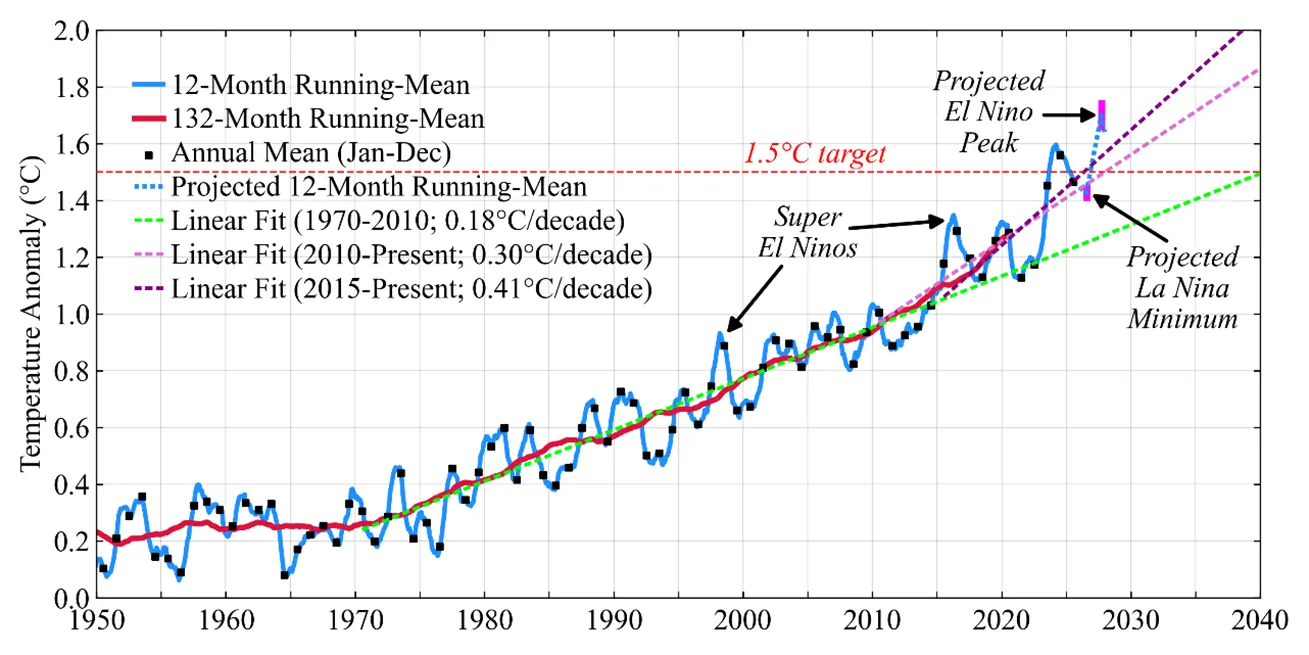
James Hansen released his latest insights the other day. Reading them, I wondered how digestible the information is to the average person going about their day.
So, below I created a short summary where the headings are simple soundbites anyone can repeat at rally, birthday party, or wherever.
I also drafted an email, Bluesky post and text message. Feel free to copy and share Hansen's valuable information with a broader audience.
This is a bit of an experiment for me. Let me know what you think.
Hansen's article organized into five soundbites:1. Global warming is happening faster.
For decades, the Earth warmed at a steady, predictable rate. Most people assume that pace hasn't changed, but Hansen's data shows that since 2010, the speed of warming has increased by about 50%. We have moved out of a period of steady rise and into a phase of acceleration. As Hansen directly states in the report: "We are now in the period of accelerated global warming."
2. Cleaner air is making the ocean hotter.This sounds counterintuitive, but for years, heavy shipping fuel created sulfate pollution in the air that reflected sunlight away from the Earth, acting like a giant shade for the ocean. In 2020, new regulations cleaned up that fuel. While this was positive for air quality, it removed that protective shade. Without those particles to bounce heat back into space, the oceans are now absorbing solar energy much faster than before.
3. We have already passed the 1.5°C limit.World leaders still talk about keeping 1.5°C alive as a future goal. Hansen argues that based on the physics of the heat already trapped in our system, we have already reached that milestone. He states: "The 1.5°C limit is deader than a doornail." We are now on a fast track toward 2°C much sooner than official models originally predicted.
4. The Earth is holding onto twice as much heat.For a stable climate, the amount of energy the Earth takes in from the sun should roughly equal the amount it sends back out into space. Hansen's research shows that the energy imbalance has nearly doubled in just the last decade. The planet is soaking up excess energy, and that heat is being stored directly in our oceans.
5. Natural cooling cycles are no longer working.In the past, natural weather patterns like La Niña would temporarily lower global temperatures. However, the background warming is now so intense that even these cooling phases are seeing record-high temperatures. The natural cycles of the Earth are being overwhelmed by greenhouse gases, meaning the cool years of the future will likely be hotter than the warm years of the past.
Tools to help share the info:
Email DraftSubject: Important update on climate acceleration
Hi [Name],
I've been reading some recent analysis from James Hansen—the scientist who originally testified to Congress about the greenhouse effect in the '80s—and his latest report is significant. I am sharing a few key takeaways that help explain why global heating is accelerating.
- Since 2010, the rate of warming has increased by about 50%. Hansen notes: "We are now in the period of accelerated global warming."
- Ironically, cleaning up shipping fuel pollution removed a layer of particles that were reflecting sunlight away from the Earth. Without that shade, the oceans are absorbing heat much faster.
- Hansen suggests we have already moved past the 1.5°C goal. We are now likely on a path to 2°C much sooner than expected.
- Natural cycles that used to cool the planet are being overwhelmed by the sheer volume of trapped heat.
I found this helpful for making sense of the current climate data. Here's a link to Hansen's article.
Best,
[Your Name]
BlueSky Post
James Hansen's latest update is a wake-up call. Since 2010, warming has accelerated by 50%. Hansen: "The 1.5°C limit is deader than a doornail." We're on a fast track to 2°C; even natural cooling cycles can't offset the trapped heat.
https://jimehansen.substack.com/p/another-el-nino-already-what-can
Personal Text Message
I recently looked into a report by James Hansen regarding new climate data. Essentially, his research shows that global warming has accelerated by 50% since 2010. He says the 1.5°C goal is effectively behind us and we are approaching 2°C more quickly than anticipated. I thought you might find this interesting given recent trends. https://jimehansen.substack.com/p/another-el-nino-already-what-can
Thank you for reading.
My name is Sarah and I run Collapse2050 by myself. It is a passion project to explore humanity's frightening future - a topic traditional media ignores.
The site is free for all, as I believe this information shouldn't be locked behind a paywall. I also don't accept corporate advertising so I remain totally free to tear the kleptocracy a new one.
To fund this site, I depend on the kindness of strangers. Paid subscribers and one-time contributors to help me cover hosting and production costs.
Thank you.
Sarah
Gemini can now generate a 30-second approximation of what real music sounds like [ 18-Feb-26 8:44pm ]Google has announced that using its newly incorporated Lyria 3 model, Gemini users will be able to generate 30-second music tracks based on a prompt, or remix an existing track to their liking. The new model builds on Gemini's pre-existing ability to generate text, images and video, and will also be available in YouTube's "Dream Track" feature, where it can be used to generate detailed backing tracks for Shorts.
Like some other music generation tools, prompting Gemini doesn't require a lot of detail to produce serviceable results. Google's example prompt is "a comical R&B slow jam about a sock finding their match," but after playing with Lyria 3, you can definitely get more granular about individual elements of a track — changing the tempo or the style of drumming, for example — if you want to. Outside of text, Gemini can also generate music based on a photo or video, and tracks can be paired with album art created by Google's Nano Banana image model.
Google says that Lyria 3 improves on its previous audio generation models in its ability to create more "realistic and musically complex" tracks, give prompters more control over individual components of a song and automatically generate lyrics. Gemini's outputs are limited to 30-second clips for now, but given how Google's promotional video shows off the feature, it's not hard to imagine those clips getting longer or the model getting incorporated into other apps, like Google Messages.
Like Gemini's other AI-generated outputs, songs made with Lyria 3 are also watermarked with Google's SynthID, so a Gemini clip can't as easily be passed off as a human one. Google started rolling out its SynthID Detector for identifying AI-generated content at Google I/O 2025. The sample tracks Google included alongside its announcement are convincing, but you might not need the company's tool to notice their machine-made qualities. The instrumental parts of Gemini's clips often sound great, but the composition of the lyrics Lyria 3 produces sounds alternately corny and strange.
If you're curious to try Lyria 3 for yourself, Google says you can prompt tracks in Gemini starting today, provided you're 18 years or older and speak English, Spanish, German, French, Hindi, Japanese, Korean or Portuguese.
This article originally appeared on Engadget at https://www.engadget.com/ai/gemini-can-now-generate-a-30-second-approximation-of-what-real-music-sounds-like-204445903.html?src=rss
Judge Highlights Government Fuckery In Ruling Over Migrant Detainees' Due Process Rights [ 18-Feb-26 7:56pm ]The ICE surge in Minneapolis, Minnesota was instigated by a far-right click bait artist and encouraged by the president's portrayal of Somali immigrants as "garbage" people from a "garbage" country. And those were some of the nicer words Trump used to describe the people his agencies would be hunting down first.
Several weeks later, a draw-down has begun, prompted by two murders committed by federal officers, an inability to obtain indictments against protesters, and every narrative about violence perpetrated by federal officers disintegrating the moment the government was asked to provide some evidence of its claims to the court.
Hundreds of judges in hundreds of immigration cases have found that the government has routinely violated the due process rights of the immigrants it has arrested. This dates all the way back to the beginning of Trump's second term, but months of roving patrols by masked men with guns has created a massive influx of cases courts are still trying to sort out. But one thing is clear: the government will do anything it can to keep the people it arrests from availing themselves of their constitutional rights.
This starts with the arrests themselves, which most often occur without a judicial warrant. The same goes for the invasion of people's houses and places of business. With the Supreme Court giving its tacit blessing to casual racism (the so-called "Kavanaugh stops"), anyone who looks less than white or whose English has a bit of an accent is considered reasonably suspicious enough to detain.
The government has been on the losing end of hundreds of cases involving due process rights. This decision [PDF], coming to us via Politico's Kyle Cheney, details the massive amount of constant movement this government engages in to keep people separated from their rights and physical freedom.
It opens with this:
Immigrations and Customs Enforcement ("ICE") recognizes that noncitizen detainees have a constitutional right to access counsel. But in recent weeks, ICE has isolated thousands of people—most of them detained at the Bishop Henry Whipple Federal Building—from their attorneys. Plaintiffs, who are noncitizen detainees and a nonprofit that represents noncitizens, have presented substantial, specific evidence detailing these alleged violations of the United States Constitution. In response, Defendants offer threadbare declarations generally asserting, without examples or evidence, that ICE provides telephone access to counsel for noncitizens in its custody. The Plaintiffs' declarations provide specifics of the opposite. The gulf between the parties' evidence is simply too wide and too deep for Defendants to overcome.
It's not like ICE can't provide detainees with access to attorneys or respect their due process rights. It's that they choose not to, now that Trump is in charge. The access is theoretically possible. It's just being purposefully denied. And it's not even just being denied in the sense that phone call requests are being refused. People detained by ICE are placed into a constant state of flux for the sole purpose of making it as difficult as possible for them to avail themselves of their rights.
The devil is in the details. And the court brings plenty of those, all relating to the administration's "Operation Metro Surge" that targeted Minneapolis, Minnesota:
Detainees are moved frequently, quickly, without notice,and often with no way for attorneys to know where or how long they will be at a given facility. (ECF No. 20 ("Boche Decl.") ¶¶ 9, 13, 18; ECF No. 24 ("Edin Decl.") ¶ 6; Heinz Decl. ¶ 5 (explaining that of eleven clients initially detained at Whipple, ten were transferred out of the state within twenty-four hours); Kelley Decl. ¶ 19.) Once a person has been transferred out of Minnesota, "representation becomes substantially more difficult"—attorneys must secure local counsel to sponsor a pro hac vice application and navigate additional barriers.
This is a key part of the administration's deliberate destruction of constitutional rights. Moving people quickly helps prevent habeas corpus motions from being filed, since they need to be filed in the jurisdiction where they're being held. If detainees are shifted from place to place quickly enough, their counsel needs to figure out where they're being held and hope that their challenge lands in court before their clients are moved again. And with the Fifth Circuit basically codifying the denial of due process to migrants, more and more people arrested elsewhere in the nation are being sent to detainment centers in Texas as quickly as possible.
All of this is intentional:
Defendants transfer people so quickly that even Defendants struggle to locate detainees. Often, Defendants do not accurately or timely input information into the Online Detainee Locator System. This prevents Minnesota-based attorneys from locating and speaking with their clients.The locator either produces no search results or instructs attorneys to call for details, referencing a phone number that ICE does not answer. Often, Defendants do not update the locator until after detainees areout of state. Attorneys frequently learn of their client's location for the first time when the government responds to a habeas petition.
These are not the good faith efforts of a government just trying to get a grasp on the immigration situation. These are the bad faith efforts of government hoping to violate rights quickly enough that the people it doesn't like will be remanded to the nearest war-torn nation/foreign torture prison before the judicial branch has a chance to catch up.
There's more. There's the phone that detainees supposedly have access to for their one phone call. It's the same line used to receive calls for inmates, so that means lawyers calling clients back either run into a busy signal or a ringing phone that detainees aren't allowed to answer and ICE officers certainly aren't interested in answering.
Lawyers seeking access to their clients have been refused access. In some cases, they've been threatened with arrest by officers simply for showing up. Even if they happen to make it inside the Whipple Detention Center, ICE officers and detention center employees usually refuse them access to their clients.
And when people try to work within the unconstitutional limitations of this deliberately broken system, they're mocked for even bothering to avail themselves of their rights.
When an attorney told an agent that she sent a copy of a releaseorder to the specified email address, the agent laughed and said "something to the effect of 'yeah we really need to get someone to check that email.'"
To sum up, the government is exactly what the court thinks it is: a set of deliberate rights violations pretending it's a legitimate government operation that's just trying to do the best it can in these troubling times:
It appears that in planning for Operation Metro Surge, the government failed to plan for the constitutional rights of its civil detainees. The government suggests—with minimal explanation and even less evidence—that doing so would result in "chaos." The Constitution does not permit the government to arrest thousands of individuals and then disregard their constitutional rights because it would be too challenging to honor those rights.
The administration has long lost the "presumption of regularity" that courts have utilized for years while handling lawsuits and legal challenges against the government. It no longer is considered to be acting in good faith in much of the country (Fifth Circuit excluded, for the most part). This is the "rule of law" party making it clear that it will only follow the rules and laws it likes. And it will continue to do so because courts can't actually physically free people or force the government to respect their rights. The Trump administration is fine with losing in court and losing the hearts and minds of most of America as long as those in power keep getting to do what they want.
Brendan Carr's Abuse Of FCC 'Equal Opportunity' Rule Completely Blows Up In His Face [ 18-Feb-26 6:53pm ]Yesterday we noted how CBS fecklessly tried to prevent Stephen Colbert from broadcasting an interview with Texas Democratic State Representative James Talarico. Which, as you've probably already seen, resulted in the interview on YouTube getting way more viewers than it would have normally, and Texas voters flocking to Google to figure out who Talarico is:
This may end up being a massive own goal for the Trump administration.
— Laura Bassett (@lebassett.bsky.social) 2026-02-17T23:15:21.231Z
In short, Brendan Carr's continual threats and unconstitutional distortion of the FCC's "equal opportunity" rule (also known as the "equal time" rule) resulted in a candidate getting exponentially more attention than they ever would have if Brendan Carr wasn't such a weird, censorial zealot.
If only there was a name for this sort of phenomenon?
Despite a lot of speculation to the contrary, there's no evidence the GOP specifically targeted Talarico in any coherent, strategic sense. This entire thing appears to have occurred because CBS lawyers — focused on numerous regulatory issues before the Trump administration, didn't want to offend the extremist authoritarian censors at Trump's FCC. It's always about the money.
CBS (and ABC, NBC, and Fox) have been lobbying the FCC for years to get ride of rules preventing them from merging. CBS (read: Larry Ellison) has managed to get his friend Trump conducting a fake DOJ antitrust inquiry into Netflix's planned acquisition of Warner Brothers, so they can then turn around and buy Warner (and CNN) instead. They'll need to remain close with the administration for that to work out.
CBS tried to do damage control and claim they never directly threatened Colbert, but you can tell by the way they're being a little dodgy about ownership of those claims (demanding no direct attribution to a specific person "on background") they likely aren't true:
Phil Gonzalez from CBS, welcome to the Verge's background policy www.theverge.com/policy/88000…
— nilay patel (@reckless.bsky.social) 2026-02-17T23:16:07.640Z
Colbert's response to the claim he wasn't threatened was… diplomatic:
Amusingly some of the news outlets covering this story (like Variety here) couldn't be bothered to even mention that CBS has numerous regulatory issues before the Trump FCC, which is why they folded like a pile of rain-soaked street corner cardboard at the slightest pressure from the Trump FCC.
As we've noted repeatedly, Brendan Carr has absolutely no legal legs to stand on here. His abuse of the equal opportunity rule is equal parts unconstitutional and incoherent. CBS (and any other network with bottomless legal budgets) could easily win in court (I wager they could even get many lawyers to defend them pro bono), but Ellison (and his nepo baby son) have a much bigger ideological mission in mind.
Daily Deal: Luminar Neo Bundle [ 18-Feb-26 6:48pm ]The Luminar Neo Bundle includes a one time purchase of the software, an introductory course on how to use it, and 6 add-ons. Luminar Neo is an easy-to-use photo editing software that empowers photography lovers to express the beauty they imagined using innovative tools. Luminar Neo was built from the ground up to be different from previous Luminar editors. It keeps your favorite LuminarAI tools and expands your arsenal with more state-of-the-art technologies and important changes at its core. Meanwhile, the recognizable Luminar design is retained, making Neo simple to use and fun to explore. It's on sale for $69.97.

Note: The Techdirt Deals Store is powered and curated by StackCommerce. A portion of all sales from Techdirt Deals helps support Techdirt. The products featured do not reflect endorsements by our editorial team.
Ohio Newspaper Removes Writing From Reporters' Jobs, Hands It To an 'AI Rewrite Specialist' [ 18-Feb-26 8:35pm ]
The Hydrogen Workshop Transit Agencies Actually Need [ 18-Feb-26 8:18pm ]On March 20, 2026 in Mississauga, Ontario, CUTRIC is hosting a hydrogen fuel cell bus readiness workshop sponsored by Mississauga's transit agency, MiWay. The framing is straightforward. As Canada moves toward a greener future, agencies are invited to prepare for the arrival of hydrogen buses on site. The assumption is ... [continued]
The post The Hydrogen Workshop Transit Agencies Actually Need appeared first on CleanTechnica.
I Didn't Want to Make This Video. [ 18-Feb-26 8:19pm ]
Rustic, Refined: Eastern Spirit's Bold Moto Guzzi California Café Racer [ 18-Feb-26 4:16pm ]
Andrew Yang Warns AI Will Displace Millions of White-Collar Workers Within 18 Months [ 18-Feb-26 8:05pm ]
The 'Game of Thrones' Prequel Play Is Officially Happening [ 18-Feb-26 8:00pm ] Microsoft's Glass Chip Holds Terabytes of Data for 10,000 Years [ 18-Feb-26 7:55pm ]
Bad Bunny to Star in New Residente-Directed Film Porto Rico [ 18-Feb-26 7:25pm ]
25,000 back calls for NatureScot to end controversial guga hunt [ 18-Feb-26 6:30pm ]
More than 25,000 people have now signed a petition calling on NatureScot to stop licensing the controversial guga hunt. And pressure continues to mount on Scotland's nature agency.
The guga hunt - killing young gannetsEach autumn, a group of men from the Isle of Lewis travel to the remote uninhabited island of Sula Sgeir to capture and kill flightless gannet chicks ("guga") for food. The hunters use poles to dislodge the young birds from the cliffs and then batter them to death.
The activity is part of a historical tradition and takes place under authorisation from public body NatureScot. The agency decides whether to grant a licence each year there's an application, subject to conservation tests.
Protect the Wild created the petition. It argues that NatureScot is failing to meet evidential thresholds when issuing these licences and should not continue authorising the guga hunt.
Mounting public pressure recently prompted NatureScot to issue a public statement. It acknowledged the "strong feelings" about the guga hunt and confirmed that its board is considering people's concerns.
In its statement, NatureScot said:
We understand there are strong feelings about the guga hunt, and that some people will disagree with it taking place. The hunt is recognised in law under the Wildlife and Countryside Act…Our role is to make licensing decisions based on the most recent scientific evidence.
NatureScot confirmed that in 2025 it reduced the permitted take from 2,000 birds to 500 following survey data collected after avian flu outbreaks. And it said that it granted a licence on the condition that the hunters killed the birds "humanely".
Insufficient monitoringBut Protect the Wild says the Sula Sgeir gannet colony remains in decline and that allowing even a reduced guga hunt risks further damage. It also questions how NatureScot can guarantee the killing is humane when it does not directly monitor the process.
Devon Docherty, Scottish Campaigns Manager at Protect the Wild said:
Sula Sgeir is now the only Special Protection Area for gannets in Scotland that has fallen below its official citation level.
NatureScot continues to grant licences knowing the gannet colony is vulnerable, the hunt harms other breeding seabirds, and that they cannot verify whether the chicks are killed humanely - they simply take the hunters' word for it.
With tens of thousands of people now calling for it to stop, the continued licensing of the guga hunt is becoming increasingly difficult for NatureScot to justify.
NatureScot has stated that if a new licence application is received for 2026, it will be brought before its Board for decision.
Protect the Wild says it will continue urging NatureScot to reject future licence applications. And it's calling on the Scottish government to remove the legal exemption that allows the guga hunt to take place.
Featured image via John Ranson / the Canary
By The Canary
Ramadan in Gaza two years after the war: fasting among tents and suffering amid rubble [ 18-Feb-26 6:04pm ]
Two years after a war that left widespread destruction across the Gaza Strip, Ramadan returns amid an extremely complex humanitarian crisis. Feelings of joy at the arrival of the holy month are mixed with grief, displacement and the collapse of basic services.
The population welcomes Ramadan burdened by loss. Longstanding traditions have been replaced by tents and queues for aid.
Ramadan in Gaza — a pressing humanitarian situationMore than two million Palestinians are living in severe hardship. There are acute shortages of food and drinking water, and purchasing power has fallen to unprecedented levels amid widespread unemployment. A large segment of the population now relies on soup kitchens and relief aid to meet daily needs. Even then, supplies cover only a fraction of demand.
The health sector faces serious challenges. There are ongoing shortages of medicines, medical supplies and laboratory materials. These gaps threaten to increase health risks during the holy month, particularly for chronically ill patients, children and the elderly.
Medical authorities warn of the consequences of continued restrictions on humanitarian supplies. Ramadan is traditionally a season of solidarity and support, yet conditions remain dire.
Modest meals and absent ritualsEach evening, families gather for modest iftar meals. These are often limited to bread, vegetables and whatever relief supplies are available. Before the war, the holy month was marked by large family feasts. Extended families rarely gather now. Many have been scattered by displacement and the loss of their homes.
Street decorations and festive lanterns have largely disappeared. Children no longer roam markets buying Ramadan lights. Instead, small temporary lamps replace traditional decorations.
Some families craft handmade ornaments inside their tents. It is a small attempt to preserve the spirit of the month despite harsh conditions.
Mosques between destruction and temporary alternativesMany mosques were damaged during the war. Some remain completely out of service, depriving residents of a central part of Ramadan.
In response, residents have set up temporary prayer spaces inside tents or damaged schools. Prayers are performed with whatever resources are available. Despite ongoing security concerns and tensions, many remain determined to perform Taraweeh prayers. For some, these rituals provide rare moments of peace amid instability.
Childhood in Gaza looks different this year. Children who have lost homes or family members play between rows of tents. They carry simple lanterns made from available materials.
They try to recreate the joy they associate with Ramadan, even while surrounded by rubble.
Parents strive to create moments of warmth within the family. They prepare simple meals together or organise small group prayers to maintain social bonds.
Between the 'yellow line' and the expanding buffer zoneRamadan's arrival coincides with ongoing changes on the ground. These shifts have altered Gaza's demographic map.
A 9 February report by the Euro-Mediterranean Human Rights Observatory described what it called a "silent and slow genocide." It said this goes beyond bombardment to include structural changes. According to the report, the buffer zone is expanding along the so-called "yellow line," dividing the Strip into two areas. Israel controls land to the east, which the report says represents more than half of Gaza's territory.
The line, previously expected to remain fixed, has reportedly advanced around 1.5 kilometres into residential areas. Additional neighbourhoods have been annexed, forcing more families to flee.
Ramadan in Gaza, between loss and resilienceRamadan in Gaza this year is not only a month of worship. It is also a test of resilience.
Homes have been destroyed, families dispersed and daily life remains under pressure. The holy month feels very different from before the war. Yet residents continue to observe Ramadan as best they can. They stress that its spirit lies in patience and solidarity rather than outward celebration.
Between forced hunger and religious fasting, Gazans are redefining Ramadan. Even amid devastation, many see it as a space for hope and quiet endurance.
Featured image via Aljazeera
By Alaa Shamali
Another shade of blue? Nine ex-Reform councillors defect to Restore [ 18-Feb-26 5:28pm ]
Seven Kent County councillors and two North Northamptonshire County Councillors have joined Restore Britain. Reform UK previously expelled six of them.
Most of these were thrown out of Reform UK when @LeaderofKCC had her meltdown in the 'suck it up' cabinet meeting and the video was leaked. https://t.co/w5NmJN5AH8
— Reform Party UK Exposed
This military expert says UK leaders should be afraid to discipline Special Forces for war crimes [ 18-Feb-26 4:43pm ]
Serious UK prime ministers should be afraid to discipline special forces troops over war crimes because they are so popular with the public. That's according to Dr. Simon Anglim, who wrote a lengthy essay on the UK's new ranger and special operations units.
The essay makes a range of (in fairness, very interesting) points about shadowy deployments overseas — including to Ukraine. But the King's College War Studies lecturer — yes, it's the KCL War Studies people again — also warned that the current Haddon-Cave inquiry into war crimes in Afghanistan could have serious implications for the use of UK Special Forces (UKSF).
UKSF is distinct from the ranger units and remains heavily protected from even basic democratic scrutiny. The government refuses to comment on what they do — even in parliament.
It's a distinctly British practice. None of our major allies refuse point blank to comment on their special forces operations. Yet we do. As the now-defunct Remote Control project pointed out in a 2016 report:
this blanket opacity policy is not standard practice, and the UK is lagging behind its allies on transparency over its use of Special Operations Forces (SOF). The US, Australia, and Canada are all more transparent about their deployment of SOF than the UK.
The practice is also deeply undemocratic:
This leaves the British public, and the parliament that represents them, among the least-informed of their foreign allies about the government's current military activities in places like Syria and Libya stymying informed debate about the UK's role in some of the most important conflicts of our age.
So what's happening then?
Special Forces afraid of the lightAnglim said the threat of accountability over the Afghan allegations was "a shadow hanging over UKSF":
The ongoing Inquiry, presided over by Lord Justice Haddon-Cave, investigating allegations that UKSF members committed unlawful killings in Afghanistan in 2010.
Ireland legacy allegations were also an issue. The SAS investigation:
runs concurrently with the Northern Ireland Coroner's ruling that soldiers of 22 SAS were 'not justified' in killing three members of the Irish Republican Army in an ambush at Clonoe in Northern Ireland in 1992, and the stream of further allegations of unlawful conduct it has set off.
As Anglim pointed out, the cases are sub judice — ongoing — currently. But he expressed a concern they:
could strengthen demands for UKSF to face greater Parliamentary scrutiny, possibly via a Select Committee similar to the one overseeing Intelligence.
Clearly, public scrutiny is a terrifying prospect.
Scrutiny and pressureThis, Anglim said, could result in political pressures which might limit the use of SF:
Given the potential for security breaches and increased hostile scrutiny, this may have a freezing effect on future UKSF deployments and could alter the relationship between the Directorate and its political masters.
Presumably by 'hostile scrutiny' he means from the press and public. Anglim suggested he might write about it more once the cases are resolved:
but it is worth noting that, given their high status with the British public, no serious Prime Minister would want to impose collective punishment on Britain's Special Forces and besides, they are too valuable as national assets to do this too severely if at all.
Anglim makes some very good points in his essay. He is also the definition of an establishment academic. He has worked with the US Department of Defence (currently ridiculously rebranded as the Department of War), the Sultanate of Oman, various establishment think-tanks and has given evidence on readiness to the defence committee.
Here he is talking about how Covid and Brexit affected the military:
But his warnings that some sort of basic accountability could reduce Britain's ability to conduct secret military operations are telling. As with all things the British establishment says you must turn them upside down to understand them.
Public and journalistic scrutiny are good, actually, because they are a threat to the British ruling class's hunger for war, war-profits — and for staying close to US imperial foreign policy whatever the cost and whoever is president. The more scrutiny, then, the better. And if 'serious' prime ministers would be afraid of the light of said scrutiny, let's hope for an 'unserious' one.
Featured image via the Canary
By Joe Glenton
Palestine Action defendants have aggravated burglary charges dropped [ 18-Feb-26 4:36pm ]
Eighteen defendants from Palestine Action have now been acquitted of aggravated burglary. Earlier this month, a jury cleared six of the Filton24 of aggravated burglary, while leaving the charges of criminal damage and violent disorder undecided. These charges are in relation to direct-action taken targeting Israeli arms company, Elbit Systems in Bristol.
Middle East Eye reported that:
Palestine Action targetingFollowing the decision to drop the charges, five of the defendants - William Plastow, Ian Sanders, Madeline Norman, Julia Brigadirova and Aleksandra Herbich - were granted conditional bail.
Plastow, Sanders and Norman have been held on remand for the longest period of the 18- spending 18 months in prison. Birgadirova and Herbich has been imprisoned since November 2024.
Bail applications for another eight defendants will be held on Friday.
Today's announcement comes as the prosecution have "reconsidered the sufficiency of the evidence". This move appears to suggest it would be unlikely to achieve the guilty verdicts it is clearly aiming for. However, at this late a stage in a criminal case, the prosecution could not just drop the aggravated burglary charge against the remaining defendants. This left it no option but to concede defeat on that charge if it wished to change course.
Consequently, concerns have resurfaced that the prosecution and government could reconsider their strategy and pursue different charges with a stronger likelihood of conviction.
Victory: for nowAll of the Filton24 were acquitted of aggravated burglary. SAY IT. https://t.co/ohMIDuUYVb
— Huda Ammori (@HudaAmmori) February 18, 2026
The Palestine Action defendants have received popular support amongst pro-Palestinian activists and groups. In fact, many pensioners across the country have been seen risking arrest for daring to show public support for then proscribed Palestine Action (PA). The direct-action group has protested against Israel's settler colonialism for many years, and its members have long sought to call attention to those arming the Zionist entity. The case against them refers to a break-in near Bristol of an Elbit Systems site known to be providing arms and supplies to Israel.
Citizens across the UK have taken to protests in every city since October 7th, 2023, making it clear that the majority of British people do not support the ongoing genocide in Gaza. Moreover, leading Holocaust scholars across the globe and the International Court of Justice in The Hague have identified this as a genocide, while the International Criminal Court has moved forward with arrest warrants at the direction of Prosecutor Karim Khan.
We wrote a few days ago on the court ruling that the proscription of Palestine Action, brought because of their acts of protest, was deemed disproportionate. Yet little has really changed, as Skwawkbox wrote:
The decision was made by a panel of judges who all have strong links to Israel, underscoring just how far the Starmer regime overstepped human rights legislation. It is almost certain to try to appeal, despite the exposed web of lies it created to try to justify the ban.
Nevertheless, people are rightfully celebrating this reprieve across social media:
Victory after victory … what an incredible start to Ramadan, the month of victory https://t.co/zrI9NkAiNi
— Fahad Ansari
Google digs deep to power AI expansion with 150 MW geothermal deal [ 18-Feb-26 7:41pm ]Datacenter power consumption has surged amid the AI boom, forcing builders to get creative in order to prevent their capex-heavy bit barns from running out of steam. But at least in some parts of the world, the answer to abundant clean energy may be hiding just a few thousand feet below the surface of the earth.…
Copilot spills the beans, summarizing emails it's not supposed to read [ 18-Feb-26 7:32pm ]The bot couldn't keep its prying eyes away. Microsoft 365 Copilot Chat has been summarizing emails labeled "confidential" even when data loss prevention policies were configured to prevent it.…
DARPA's autonomous missile-firing missile advances toward flight tests [ 18-Feb-26 7:07pm ]It's taken about five years, but DARPA's missile-launching missile has become the government's latest experimental X-plane and is advancing toward flight testing.…
Cyberpunk platformer Replaced has once again been delayed [ 18-Feb-26 7:06pm ]The long-awaited cyberpunk platformer Replaced just got hit with a short delay. The pixel-art game was supposed to come out on March 12, but will now be released on April 14. That's just a month, which isn't that big of a deal considering this game has been on our radar for five years.
Why the delay? Developer Sad Cat Studios notes that the game is "technically finished" but the team needs a few more weeks for polish. The company says it wants the day-one release to be "polished, stable and true to the vision" of the original concept. This is something to be commended, in my opinion, given the sad state of many game launches in recent years.
— REPLACED (@REPLACEDGame) February 18, 2026
This is just the latest delay for the game. However, previous delays have been for a very good reason. The development team had to relocate from Belarus to Cyprus after Russia invaded Ukraine in 2022.
Replaced is an absolutely gorgeous-looking 2.5D platformer set in a dystopian alternative 1980s America. You play as an AI unwillingly trapped in a human body. There looks to be plenty of cinematic action, with a blurb promising a combination of "precise melee strikes with satisfying ranged attacks."
The game will be available for Xbox Series X/S, Xbox One and PC via Steam, Epic Games Store, GOG and the Microsoft Store. It'll also be a day-one Xbox Game Pass release.
This article originally appeared on Engadget at https://www.engadget.com/gaming/cyberpunk-platformer-replaced-has-once-again-been-delayed-190621246.html?src=rss

