A story from the old Soviet Union, written by the Russian writer Vladimir Dudintsev, still teaching us things today. And here is a written version from a 2013 post.
Some 50 years ago, I received as a Christmas present a book titled "Russian Science Fiction." All the stories in that book made a deep impression on me, but there was one that has remained in my mind more than the others; a curious story titled "A New Year's Tale".
I was, maybe, 12 at that time and, of course, I couldn't understand everything of that story and I didn't pay attention to the name of the author. But, as time went by, I didn't forget it; rather, it became entrenched in my mind, progressively acquiring more meaning and more importance. I reread it not long ago, and it came back to my mind during a recent trip to Russia. So, let me tell you this story as I remember it.
"A New Year's Tale" tells of one year of life of the protagonist, a researcher in a scientific laboratory somewhere in the Soviet Union. Dudintsev manages to tell the story without ever giving specific details about anything: no place names, no names of the characters, not even of the protagonist. It is a feat of literary virtuosity; it gives the story an atmosphere of a fairy tale but, at the same time, it is very, very specific.
It took me time before I could understand the hints that Dudintsev gives all over the text, but after many trips to Russia, everything fell in place. It is curious how Dudintsev managed to catch so well the atmosphere of a research lab in the Soviet Union; he was not a scientific researcher. But that's what makes a great storyteller, after all: understanding what one is describing - and feeling something for it.
The story starts with a debate - rather, a quarrel - that the protagonist has with someone termed "a provincial academic" (we are not told his name). This provincial academic should be nothing more than a nuisance, but the protagonist can't avoid engaging in the debate. He understands that he is losing time, that he should be doing something more useful, more important. But he just can't sit down and do his job.
While the protagonist is entangled in this useless quarrel, the chief of the laboratory (again, we are not told his name) dabbles in archeology and one day he tells his coworkers of some work of his somewhere in the Caucasus, where they found an ancient tomb. There was an owl engraved on the tombstone and an inscription that they could decipher. It says "...and the years of his life were 900...."
Now, what could that mean? Could the man buried there have lived 900 years? No, of course not. But then, what does the inscription mean? Well, someone says, that must mean that this man spent his life so well and so fully that it was like his years had been 900.
The discussion goes on. What does it mean to live such a full life? The researchers try to find an answer but, at some moment, they hear the voice of someone who usually keeps silent at these reunions. We are told that he is from far away, not Russian, that is. We can imagine that this man doesn't have a Russian name, but we are not told names. So, he is an outsider and he comes with a completely different viewpoint; he is "the foreign scientist" even though in the old Soviet Union, theoretically, there was no such distinction. "You see, comrades," he says, "it is very simple. To live a full life, you must always choose the greatest satisfactions, the highest joys you can find."
At this point, we hear the voice of the political commissioner of the lab. Apparently, there was usually someone in the scientific academies in the Soviet Union who was in charge of making sure that Soviet Scientists would not fall into doing decadent capitalist science. So, he stands up and he tells the foreign scientist, "Well, comrade, don't you think one should also work for the people or something like that?" And the foreign scientist answers, "You are so backward, comrade. Don't you understand? The greatest satisfaction, the highest joy one can have in life is exactly that: working for the people!"
After that the discussion is over, the protagonist of the story reflects on the words of the foreign scientist and he resolves to start doing something serious in his life. He decides to start doing experiments, advance his theory. We are not told exactly what he is doing, but we understand that he is working on something important; research that has to do with capturing and storing solar light. And he manages to work on that for some time. Then, his colleagues bring to him another paper written by his provincial antagonist. So, he feels he has to answer that, and then the provincial academician writes a response.... and the protagonist finds himself entangled again into this argument.
Things are back to the silly normalcy of before, but then something happens. The protagonist finds that he is being stalked. Someone, or something, is following him all the time. When he sees it in full he discovers that it is an owl. A giant owl, almost as big as a man, looking at him. He thinks it is a hallucination, which of course it must be. But he keeps seeing this owl over and over.
So, the protagonist goes to see a doctor and he tells him of the owl. The doctor pales. After a thorough physical examination, the doctor tells him: "you have one year to live, more or less." We are not told of what specific sickness the protagonist suffers. He asks, "but why the owl?" And the doctor answers, "we are studying that. You are not the only one. The owl is a symptom." Then, the doctor looks at the protagonist straight in his eyes and he says, "I can tell you something. Those who see the owl, have a chance to be saved."
In the meantime, there had been a long discussion between the protagonist and the foreign scientist, the one who had so well silenced the political commissioner. So, the foreign scientist had told to the protagonist his story, obliquely, yes, but clearly understandable. His fellow countrymen had not liked the idea that he had left the country to become a scientist. They are described as gangsters and criminals, but we have a feeling that there was something more at stake than just petty crimes. This man had made a choice and that had meant to make a clean break from his country and his culture; it had meant to accept the new Soviet Communist society. Now, he was spending his time in this new world trying to get his "greatest satisfactions and highest joys" by working for the people. And, because of that, his former countrymen had condemned him to death. So, he had changed his name and his identity, and he had even surgically changed his face to become unrecognizable. But he knew that "they" were looking for him and they would find him at some moment.
So, the destiny of the protagonist and of the foreign scientist are somehow parallel, they both have a limited time. After having seen the doctor, the protagonist understands the situation and he rushes to search for the foreign scientist. They can work together, they can join forces, in this way, maybe they can.... but in horror, he discovers that the foreign scientist has been killed.
In panic, the protagonist desperately looks for the notes he had collected over the years. But the cleaning lady tells him that she had used them to start the fire in the stove. She had no idea that they could have been important. The protagonist feels like he is walking in a nightmare. Just one year and he has lost his notes. He starts from scratch.... his great discovery.... how can he do? Yet, he decides to try.
He becomes absorbed in his work. He works harder and harder. Staying in the lab night and day and, when he goes home, he keeps working. His colleagues note the change; they are surprised that he doesn't react anymore to the attacks of the provincial academician, but he doesn't care (which is, by the way, a good lesson on how to handle our modern Internet flames). He still sees the owl; always bigger and coming closer to him, the owl has become something of a familiar creature, almost a friend.
Then, someone appears. It is a woman, described as having "well-formed shoulders" (of course, we are not told her name!). The protagonist recognizes her. It is not the first time he has seen her. He remembers having seen her with the now dead foreign Scientist.
The protagonist has no time for a love story. He has to work. He tries to ignore the woman but he is also attracted to her. He can concede her just a few words. Ten minutes, maybe. So they talk and the woman tells him. "It is you, I recognize you! You can't fool me!" The protagonist remembers something that the foreign scientist had told him; that he had his face surgically changed to escape from his enemies. Now, this woman thinks that the protagonist is really her former lover, who changed again face and appearance and didn't tell that not even to her.
The protagonist tries to deny that he is the former lover of the woman but, curiously, he doesn't succeed, not even to himself. In a way, he becomes the other, acting like him in his complete immersion in his work. The protagonist discovers that the foreign scientist had assembled a complete laboratory at home, much better than the lab at the academy. So he moves there, with the woman with the well-formed shoulders (and the owl comes, too, perching on a branch just outside the window). Then, the protagonist even discovers that the foreign scientist was secretly copying his notes and he gave them to the woman, who has kept them for him. With these notes, he can gain months of work. Maybe he can make it in one year, maybe.....
The last part of the story goes on at a feverish pace. The protagonist becomes sicker and sicker; to the point that he has to stay in bed and it is the woman with the well-formed shoulders who takes up the work in the lab. And the owl perches on the bed head. But they manage to get some important results and that's enough to catch the attention of the lab boss. He orders everyone in the lab to come there and help the protagonist (and the woman with the well-formed shoulders) to move on with the experiments.
In the final scene, the year has ended and we see the protagonist in bed, dying. But his colleagues show him the results of the experiment: something so bright, so beautiful, unbelievably bright and beautiful. We are not told exactly what it is, anyway it is a way to catch sunlight in a compact form: a new form of energy, a new understanding of the working of the sun - we don't know, but it is something fantastic. Even the owl looks at that thing, curious. The protagonist hears the sound of bells from the window. A new year is starting. We are not told whether he lives or not, but in any case, it is a new beginning and, whatever it happens, they'll tell of him that the years of his life had been 900.
And here we are. You see, it is a magic story. It keeps your attention; you want to know if the protagonist lives or not and you want to know if he manages to make his great discovery. But it is also the story of the life and of the mind of scientists that I think is not easy to find in novels or short stories. It is curious that Dudintsev did so well because, as I said, he wasn't a scientist, he was a novelist. But he managed to catch so incredibly well the life of a scientist - of a scientist working in the Soviet Union, yes, but not just that. Dudintsev's portrait of science and scientists goes beyond the quirks of the old Soviet world.
Yes, in Soviet science there were things that look strange for us, such as having a political commissioner in the lab to watch what scientists are doing. But that's just a minor feature and today in the West we have plenty of different -- and heavier -- constraints on what we do that don't involve a dumb political commissioner. The point is that scientists often work as if their life were to last just one year; at least during the productive time of their life; when they are trying to compress each year as if it were to be 900 years long. It is their lot: the search for the discovery, being so deeply absorbed in their work, being remote from everyone else; obsessed with owls that they alone can see.
And yet, Dudintsev's story is so universal that it goes beyond the peculiar mind of scientists. It is the story of all men, all over the world, of what we do and how we spend our life. And the key of the story is the woman with the well-formed shoulders. She recognizes her former lover in the protagonist, or she feigns to recognize him. It is him or it is not him - we are not told, but it doesn't matter. What matter is her devotion to her man. It is so touching: you perceive true love in this attitude. In the end, that's the key to the whole story: whatever we do in life, we do it for those we love.
Some of us are scientists, some aren't. But it is not a piece of bad advice to live your life as if you wanted each year to be 900 years long. And every new year is a new beginning.
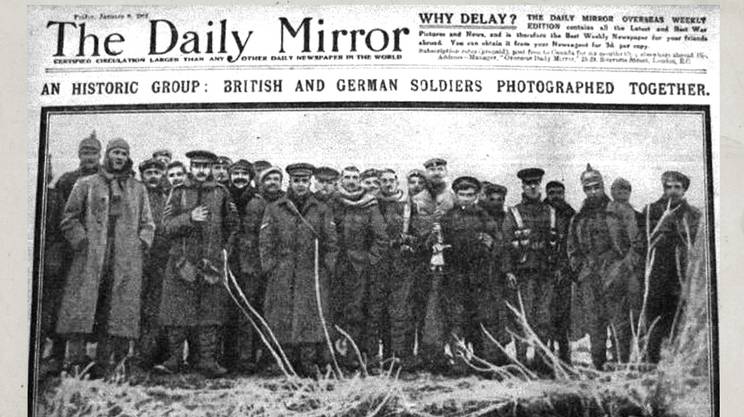
Christmas of 1914: soldiers from opposite sides met in a friendly manner across the front line. It was a moment in which for a short time the Christian message of love managed to overcome the message of hate that came from national governments. It was just a brief moment for a deed that surely didn't go unpunished, later on. But it was highlighting a deep contradiction that was prefiguring the final collapse of the church, but that would take another century or so. It is coming now.
Sometimes, life is like watching the long needle of an old mechanical watch. No matter how carefully you eye it, it doesn't seem to move -- time seems to be frozen. Then, you look at something else, and when your glance is back to the watch, the needle has moved. Time has passed, and that moment will never come back.
Sometimes, you have the same sensation with history. For a long time, everything seems to be frozen and nothing changes then, suddenly, everything has changed and the world is a different one. It has happened in this 2020 that, suddenly, changed everything, and the world of one year ago will never come back.
I already noted how some institutions have been shattered at their foundations by the COVID crisis of 2020. One was the university, destroyed by the sudden discovery that it was an expensive machine that produced nothing useful for the state. Another illustrious victim is starting to crumble: it is the Church. Primarily, the Catholic Church in its claims of universality, but all Christian Churches have been affected by a crisis that left them stunned, suddenly realizing that they had nothing to say and nothing to do about a disaster that seemed to affect everybody.
The collapse of the university and of the Church is all the more remarkable considering how old they are. The University in Europe has about one thousand years of history -- more if we consider the Islamic versions. The Christian Church is even older than that: it started existing in a recognizable form almost two thousand years ago. Yet, nothing is eternal in human history. Everything moves, changes, crumbles, disappears, is reborn, and disappears again. It is true for empires, and also for institutions that seem to be stronger than even empires: churches, temples, sects, and ideologies. Even the Gods die and are reborn, it is one of their characteristics.
And so, look at the Christian Church in Europe. It was born as the reaction to a state -- the Roman one -- that was crumbling, starting around the 3rd century AD. The Roman state was based on military might -- that was too expensive for the new times. Gradually, the Church replaced the Roman state, mirroring the older institution in a new form, more compatible with the epoch we call the "Middle Ages." The Church didn't govern on the basis of military force, it delegated it to local warlords while trying to reduce their power as much as possible. As all human construction, it was far from being perfect, but it generated an age of relative peace and the end of the worst flaws of the older Roman world: the slavery of millions, the oppression of women, the emphasis on military power, the inequality of the few versus the many, the cruelty of the arena games.
The reign of the Christian Church lasted for several centuries, nearly a millennium. Then, the giant wheel of history made one of its turns. The printing press appeared in the 15th century, the brainchild of a man named Gutemberg who probably would never have imagined what he was creating: nation-states. These were new creatures that had never existed before. Their organization was not anymore based on money, like in the Roman state. And not even on a shared religion and a sacred language (Latin), as it was the case for the Christian Church. Nation-states were based on their national language: an invention of the printing press that created bonds among the people who could understand each other, opposed to those whom they could understand. It was a re-edition of the old Greek concept of the barbarophonoi, those who speak bar-bar, the barbarians. But the new barbarians were not anymore the inhabitants of remote lands, bad-smelling and dressed in animal skins. They were your neighbors who happened to live just on the other side of an imaginary line called "national border." Those some neighbors whom the Church had been telling you to love as yourself, but whom now the state instructed you to hate and despise.
And so there started a conflict that's lasting to this day. As for many features of history, things move slowly, but the fall of Christianity was unavoidable. It all started with the great convulsions of the age we call "renaissance," supposed to replace the earlier "dark ages." It truly started with a bang, the extermination of hundreds of thousands of European women, accused of being witches. Not only the nation-states succeeded in enlisting the Church in the task of helping with the extermination. With the so-called "enlightenment," we saw one of the greatest successes of propaganda in history: not only the Church was accused of a mass extermination that the Church had never approved, but people's perception was modified in such a way to push back the age of witch-hunting to the Middle Ages - turned by propaganda into a "dark age" of superstition and violence. But the Church was not a woman-killing machine, it never had been. It was the state who wanted more cannon fodder for its armies and so it needed to enslave women and turn them into child-bearing machines. But the force of propaganda is enormous, it is one of the wheels that push history forward.
The witch-hunting age, mostly the 16th and 17th centuries, was one of the factors that shattered the unity of the Christian Church. Then, there came the reformation, then the age of colonization when, again, the states managed another master stroke of propaganda, being able to convince everyone that it had been the Church pushing for enslaving and exterminating non-European people.
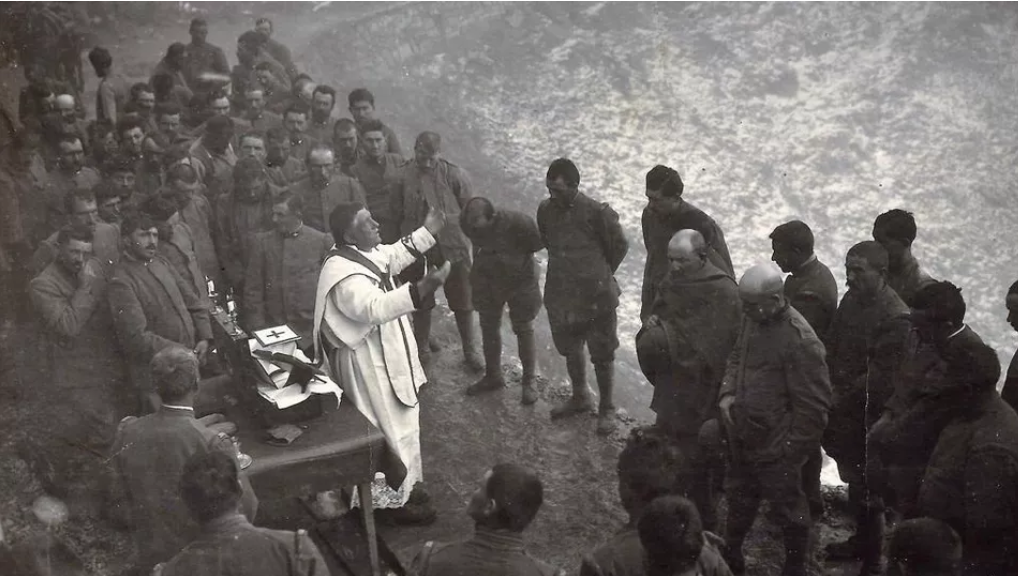
 Then, there came the 20th century and the age of the European civil wars where, again, the Church found no role and nothing to say on an event that was shattering its very foundations of a universal institution. I wrote an entire book on how people's faith was affected by this tremendous contradiction: Christians were fighting each other all over Europe and, on both sides of the front line, Christian priests were blessing young men to go killing other young men on the other side (you see, in the figure, an Italian military chaplain blessing Italian soldiers before).
  The Church barely survived this tremendous blow, but more were to come. Once, a Japanese friend of mine told me something like "I always found it weird how every week Europeans collect in churches to eat God together." A flash of how strange some things appear when seen from another viewpoint. And, yet, this Japanese man was right: this is one of the elements of the Church rituals. A Church is like a state in many ways: it has rituals just like the state does. The state has military parades, the church has religious processions. The state enlists young men as soldiers, the Church enlists them as choirboys. The state vaccinates children, the Church baptizes them. The state taxes people, the Church asks them for alms. And much more. The Church may ask you to eat the body of the son of God who sacrificed himself for his love for humankind, just like the state may ask you to send your son to die on some remote mountains to show his love for that section of humankind that you call the "nation."
You may see all this as a symmetric battle, but the two sides are not equivalent in power. As I said, the Church had started as an alternative to the crumbling Roman states, but it was to be expected that the wheel would turn around. The State is now much more powerful than the Church and the sermons of the priest had no way to compete with the state news services. It was all going to happen and it happened.
It is curious that such an old and resilient institution was demolished by such a humble creature as a virus labeled SARS-Covid2. But that was how it happened. It was another master stroke of propaganda that worked beautifully. Faced with a greatly exaggerated, although real, threat, the Church found nothing to say, nothing to object, nothing to propose. It meekly submitted to the superior power of the state.
So, in Italy, this Christmas the state ruled that the traditional midnight mass was to be held at 8 pm. Of course, it is hard to believe that a virus would infect people at midnight but not at 8 pm. One could also say that, while nobody can say at what time Jesus Christ was born (probably not even on the day we call "Christmas"), it was the job of the Church and not of the state to decide on this point. But the Church was totally silent and it bowed down to the state. It had already bowed down on many other things. The images of Italian police stopping the celebration of a mass during the lockdown of March was seen by everybody and condemned by almost nobody. On visiting a church, you would find someone at the entrance pointing a laser gun at your forehead. You saw the benches with places crossed with red tape. Instead of holy water fountains, you would find bottles with disinfecting solutions. People hiding their faces in front of God just like Adam had been hiding in the Garden of Eden. And, finally, the final insult was the virtual mass, with the priest turned into a 2D image confined in a little square on a screen, virtually blessing virtual believers.
It was a sacrilege, it was the desecration of a place that, so far, had managed to resist, at least in part, the state's power. And it was, basically, the end of an age. Anything you believe in must be eventually be kept alive by practice. Practice is based on rituals, the Christian church has been existed for so many centuries because among other things, as my Japanese friend said, people would collect every week to eat God together. It may have been silly from a Far-Eastern viewpoint, but it was a ritual. And all rituals are collective -- they have them also in the Far East, even though they don't eat their Gods in the form of wafers.
Without the rituals, or with the rituals compressed on a screen, the structure ceases to exist. It is just like the university: it is no more a university when teachers and students are reduced to 2-dimensional creatures inhabiting a small square of a screen. Without the meeting of people whom we call the "congregation" and that in earlier times was called the "ecclesia," the Church is mute, the faith is gone, the faithful are disbanded, the holy places are desecrated. And that's what's happening and everything that happens happens because it had to happen.
And now? The story will keep going in circles as it has always done. The new state-sponsored rituals to fight the pandemic are triumphant, but there will be new cycles and the triumphant nation-states will see their doom, one day or another, just as the mighty Roman Empire saw its doom -- it happened because it had to. The great wheel of history is turning. It will keep turning.
According to the social media single track vehicle dynamics authorities (Do-Little Talk-a-Lots and Stale Cliché Curators, the lot of them), I'm doing everything wrong! They don't know what I'm doing, so clearly I must not know what I'm doing, either! Appeal of authority gets far more approval from the uninvolved!
Modern motorcycle design has evolved itself into a corner - they can't go accelerate or decelerate any harder without flipping, or corner any harder without running out of clearance. Any changes to one or more areas to improve one aspect will result in an overall loss of performance. Tires are optimized to accelerate or brake, not both, leading to cooling events. Suspension has to be optimized for load transfer extremes. All the above leads to both slow roll response and high polar inertia about the longitudinal axis. And that results in terrible aerodynamics. ALL of the above problems can be successfully addressed IF you discard the original configuration and derive a functionally superior configuration that isn't recognizable.
Here are the old problems (And causes):
- Stoppies (High CG, short WB)
- Wheelies (High CG, short WB)
- Lean angle limitations (Oversized rear tires)
- Roll rate limitations (High CG)
- Suspension sub-optimization (High CG, short WB)
- Tire sub-optimization (High CG, short WB)
- Aerodynamic sub-optimization (High CG, short WB)
- Long WB, low CG, linked brakes
- Long WB, low CG, 2WD
- 2WS, appropriate tire selection
- 2WS, low CG
- Long WB, low CG
- 2WD, 2WS, linked brakes, long WB
- Long WB, low CG
1. Pretty obvious, really. If load transfer under braking can't flip the bike, then there must still be some load on both tires. The lower the CG, the less load transfer, and the more both wheels will do the work. It also means that trail braking will be a lot more effective as the tire's loads transfer from braking to cornering.
2. Also obvious. Pretty much opposite of the above, just a lot more difficult to implement with internal combustion engines. The solution to that problem will be addressed later...
3. Not obvious, at least with the 2WS part. The tire part ought to be obvious: With 2WD and linked brakes, a big fat rear tire is no longer necessary or even desirable. A narrow tire at both ends provides enough footprint area.
With 2WS, the cornering forces become much less perpendicular to the CG, reducing lean angle quite a bit (Simple trigonometry, if you must). If 2WS were taken to an extreme, changing the vehicle into a purely 2-tracked vehicle known as a "Di-cycle", NO lean angle involved in cornering. That isn't practical for obvious reasons, but steering the rear wheel in the same direction of the turn at any ratio much over 25 % contributes to the same effect, thus reducing lean angle.
Both the narrower rear tire and 2WS effects greatly offset the negative effects of lower CG on lean angle. No, this isn't in any of the books. Yet.
4. Not as obvious as it ought to be, sort of: Obviously, the reduced polar moment both makes changing lean angle easier and. importantl, makes stopping changes to the lean angle easier. Less obviously, the lower the CG, the greater the lean angle changes with displacement of the contact patch relative to the CG. 2WS normally wouldn't help at all with a high CG in that regard, since most of the effort in counter-steering is exerted in overcoming wheel inertia - but with the lower CG and increased displacement effect, countersteering becomes a LOT faster with the same effort.
5. Extreme load transfer is no longer happening, which means that a suspension range and rate to accommodate those extremes is no longer required. And with less suspension travel comes less sag under cornering, thus improving ground clearance and allowing an even lower CG. Lower CG and long WB, and less travel also means drastically reduced chassis pitching to bump response, acceleration, and braking, resulting in far greater chassis stability. And greater chassis stability reduces the appeal of pointlessly playing around with dive/squat/"Anti(x)" geometry.
6. With 2WD, linked brakes, 2WS, low CG, and long WB, both tires are working all the time. There are no "Break times" for cooling down then requiring warming back up to optimum temperature. And since extreme load transfer isn't happening anymore, much lower tire pressures (With the obvious benefit of a larger footprint) are both possible and desirable without incurring stability and control issues. Having interchangeable front and rear wheels and tires is a welcome benefit. I doubt that existing tires are close to optimized for such implementation, but the choice of racing slick tires with different compounds and carcass stiffness is a huge help.
7) Obvious: Much lower frontal area results in less drag. Really. No kidding.
The rationale (And obvious physics) behind all 7 points above have guided the design of my next racer. All 7 points are necessary, if not convenient, to work. I'm not going to go any faster by attempting to minimize existing problems with current configurations - I want to go a LOT faster by completely eliminating those problems with a completely new application.
No, not all 7 points need to be applied to less demanding recumbent (AKA, "FF") motorcycles, any more than the old van I use to haul the racer to the track needs to be optimized for track use, either. And, no, I don't expect said social media authorities to accept them either - they are too invested in rationalizing their lazy design choices and gossiping - I'm never going to see any of them or their work at any race track.
So, what else is it good for? Well, electric motorcycles exhibit a LOT of functional shortcomings relative to their internal combustion relatives. Horseless carriages were terrible cars - gasless motorbikes make terrible motorcycles. But a lightweight streamlined low CG, 2WS, 2WD one would solve range, speed, cost, packaging, and weight issues while providing uncommonly high comfort, performance and protection - right now. Truly effective regenerative braking is only possible with that configuration. With 2WS and 2WD - and smart steering control - it would be possible at a stop to steer both wheels to the side to some degree and balance the bike without human intervention - no dippy outriggers necessary. And park it by lowering it all the way onto an integrated stand. Wind gust response would be counteracted by that smart 2WS. Etc... - the design and dynamic potential is mind-blowing. None of that is in the books, or gossiped about by said intellectually paralyzed "Social media authorities". Yet.
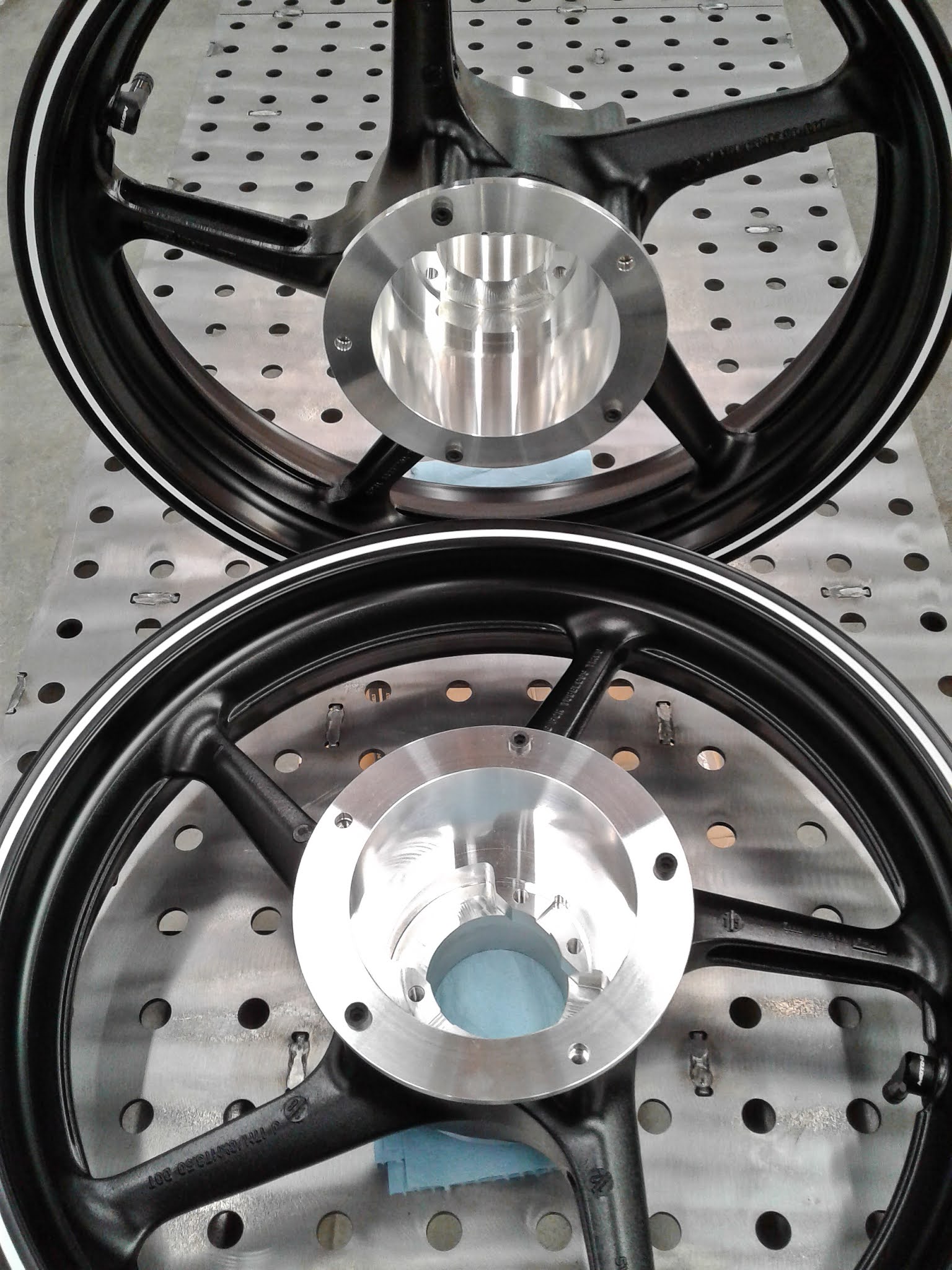
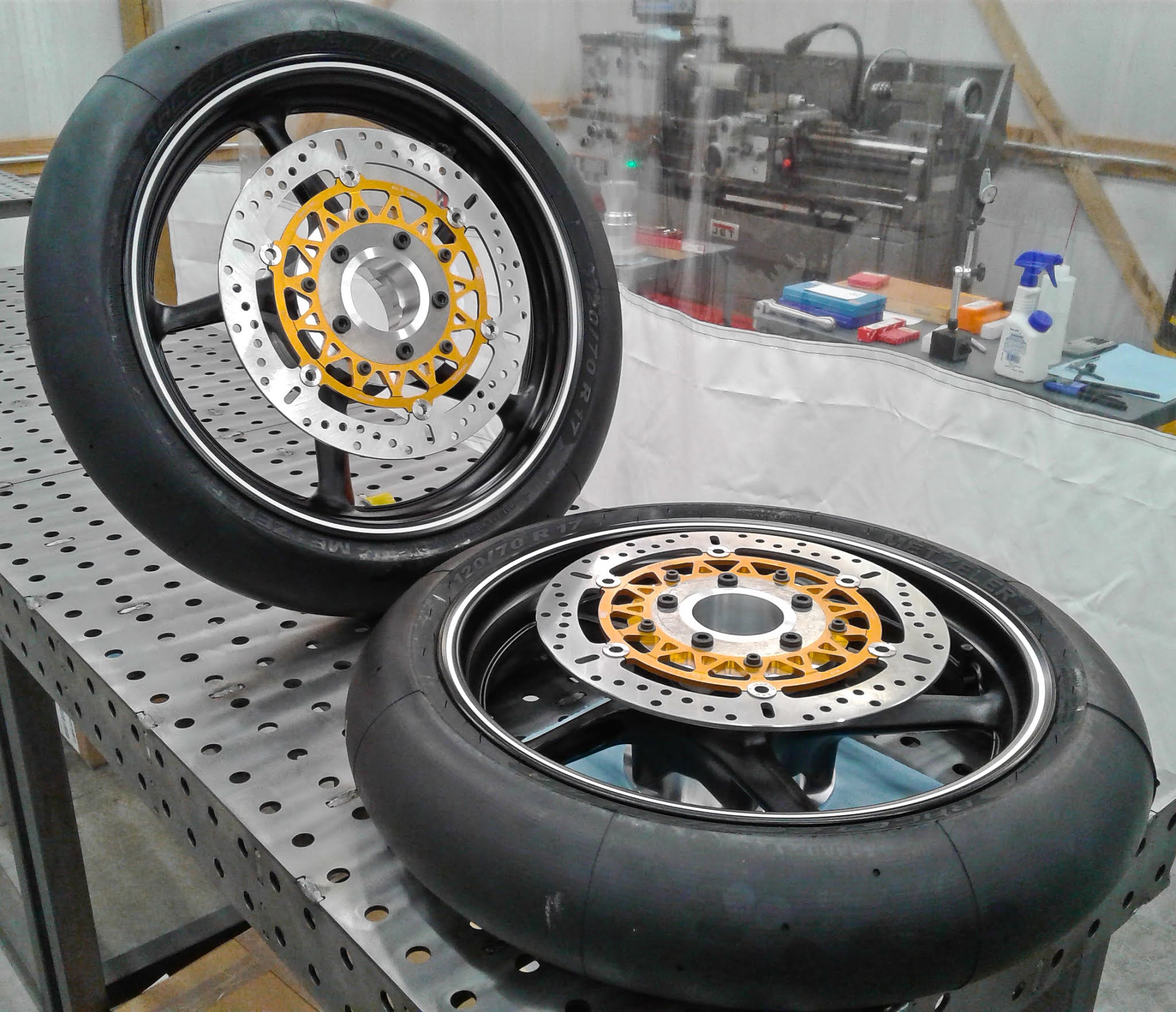
In the mean time, work is progressing nicely on the next racer. Got questions? You know how to reach me. Got gossip? You know where to go.
As we approach the end of this unbelievably horrid year, my greetings are more muted.
I wish all of you a happy time, whether you're with friends, family or on your lonesome. There are better times to come (and undoubtedly worse times, too). Make the most of what you have and be careful. Stay safe.
This day last year (Christmas Eve in south eastern Australia) it was hot and smoky:
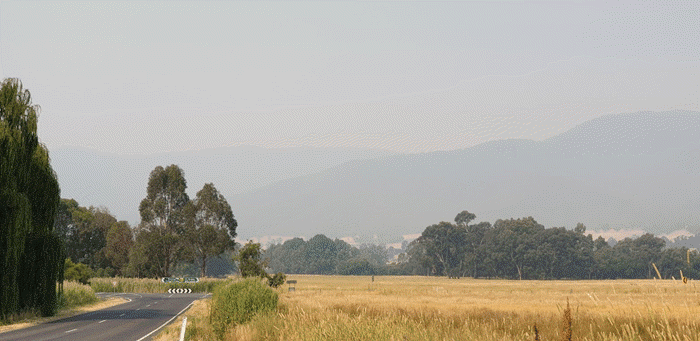
This year there's no smoke, just clear skies and a gentle summer breeze blowing. Lovely.
In closing, here's a pic of one of the friends I made this year.


The "hydrogen economy" is like a zombie: no matter how many times it is slain, it keeps coming at you. Like a Hollywood zombie movie, hydrogen seems to exert a tremendous fascination because it is being sold to people as a way to keep doing everything we have been doing without any need for sacrifices or for changing our ways. Unfortunately, the reality is not a movie, and the reverse is also true. Hydrogen is a pie in the sky that delays the real innovation that would make it possible to phase out fossil fuels from the world's energy mix. (image source)
This is a re-worked and updated version of a post that I published in 2007, in Italian, during one more of the periodic returns of the "hydrogen economy," a fashionable idea that leads nowhere. For more technical information on the hydrogen scam, see the exhaustive treatment by Antonio Turiel in three posts on his blog "Crash Oil", in Spanish, "The Hydrogen Fever" One, two, and Three
Confessions of a Former Hydrogenist
Posted by Ugo Bardi
 Quite a few years ago (maybe too many) I was involved in research on the hydrogen economy. It was in 1981 when I arrived in Berkeley, in California, to do a post-doc stage at the Lawrence Berkeley Laboratory. At that time, the worst of the first major oil crisis was over, with the highest historical values of prices had been in 1979. The oil prices were going down, but the shock was still felt, and everywhere in the US and in the world it was a flourishing of research projects dedicated to new forms of energy.
In Berkeley, I worked for more than two years on fuel cells; the technology that was to be used to transform hydrogen into electricity and that was - and still is - essential to the concept of "hydrogen-based economy" (The idea was already well known in the 1980s, Rifkin didn't invent anything with his 2002 book). It was an interesting field, even fascinating, but very difficult. The idea was to study the "core" of the device, the catalyst. How it worked and what could be done to improve its performance. I think we did some good research work, although we found nothing revolutionary.
With the end of my contract at the Lawrence Berkeley Lab arriving, I started looking for a job. I remember that I was told that there was someone in Vancouver, Canada, a certain Geoffrey Ballard, who had set up a company dedicated to developing new fuel cells. I vaguely thought about sending him a resume but, eventually, I didn't. Ballard's firm, at that time, was little more than a garage with some enthusiasts working on strange contraptions inside. Not the kind of thing that promised a bright future for a researcher.
It was a mistake on my part. Later on, as you may know, Ballard's team improved the fuel cell design that had been developed earlier on by NASA with the Gemini program. The result was a major advance; it made possible the first fuel-cell bus in the world (1993). That led to Ballard being nominated "hero of the planet." In the 90s it occurred to me several times that if in 1982 I had sent that resume to Ballard, maybe I could have been one of the developers of what - at the time - seemed to be the revolution of the century: the polymer membrane fuel cell (PEMFC), the device that would have made possible the hydrogen-based economy: clean prosperity for everyone. I would have made a lot of money, too!
But, as it has often happened to me in my life, I found myself in the wrong place and out of sync with the rest of the world. By 1982, when I was looking for a job, oil prices had already fallen sharply. The interest in alternative energies had waned and, with the foresight typical of human beings, the research centers created during the oil crisis, in the 1970s, were being closed. There was little room, as a result, for a fuel cell expert. The best I could find in the US was an offer to work in a research center in Montana. It did not attract me so much and, in the end, I decided to return to Italy. There, I tried to set up a research program on the fuel cells, but nobody was interested (again, the typical foresight of human beings). So after a few years, I moved to different subjects.
In the meantime, the interest in new forms of energy waxed and waned with the vagaries of oil prices. In 1991, the first gulf war was already an alarm bell, but the 9/11 attacks of 2001 made it clear to everyone that the supply of crude oil to the West was not guaranteed as it had seemed to be earlier on. Then, there came Jeremy Rifkin's book "The Hydrogen Based Economy," published in 2002, which had a huge success. For a few years, the idea became extremely popular.
Even though I had not been working on fuel cells in Italy, Rifkin's success caused me to be shining of reflected light. It turned out that I was one of the few researchers in Italy having some hands-on experience with fuel cells and with the concept of the hydrogen economy. I was invited to speak at conferences and public presentations and some people even started calling me "Professor Hydrogen."
I must admit that, in the beginning, I spoke as if I really believed in the idea of the hydrogen-based economy, and maybe I did. But, gradually, I started having serious doubts and I became a skeptic, a "former hydrogenist" just like several of my colleagues. There are many little stories I could tell you on this subject, but let me mention just one.
I think it was in 2004 or 2005 when an Italian company based in Tuscany developed a hydrogen car and organized a presentation for the president of the Tuscan regional government. I was invited to attend the demonstration as the local fuel cell expert.
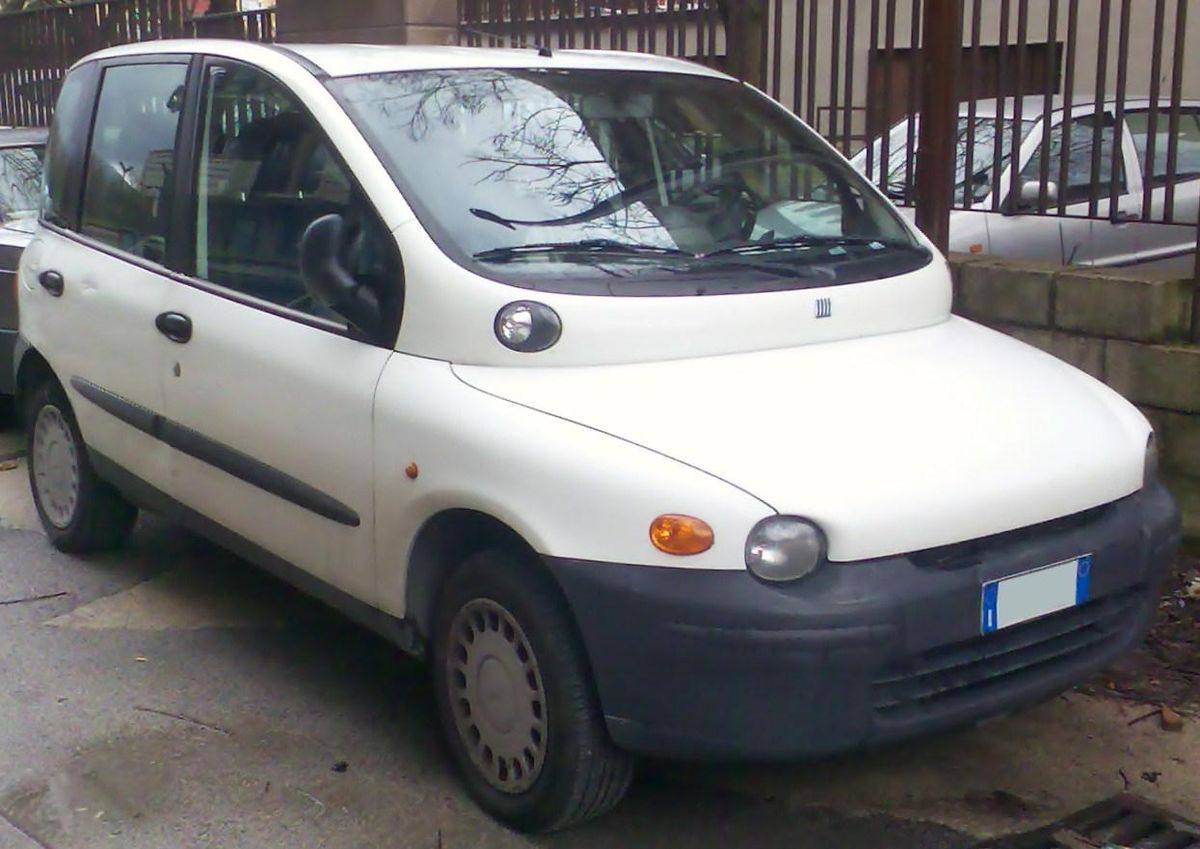 So, I showed up in the courtyard of the Tuscan government building where a truck had unloaded the car. It turned out to be a modified Fiat Multipla that you may know as having been awarded the 2014 prize for the ugliest car ever made. Of course, the ugliness of the car was not a problem, but the whole idea was. It was not a fuel cell car, but simply an ordinary car fitted with two compressed hydrogen cylinders under the body. The hydrogen went directly to the carburetor to operate the internal combustion engine.
 Before the President appeared, I had a chance to drive that car. I managed to make a full tour of the courtyard of the building, but it was like riding an asthmatic horse. When the President showed up, he clearly had no idea of what was going on and what he was supposed to do. He sat at the wheel, drove the car for a few meters in heavy bumps, then he gave up and just sat there for a while in order to be photographed by the journalists. Then he left. The day after, the newspaper showed the photos of the president driving the "hydrogen car" and then the car itself disappeared forever in the dustbin of history.
But it was not this unfortunate adventure that led me to change my mind on hydrogen. It was the continuous and shameless hype associated with it. I even had a chance to meet Rifkin in person in 2006 at a conference that I had organized in Tuscany. Not that I expected him to be an expert in technical details, but it seemed clear to me that he had no idea of what he was talking about. When he was asked technical questions, all he could answer was something like "have faith" and then change the subject.
As I started being more and more bothered by the hype on hydrogen, soon I saw what the real problem was. Back in the 1980s, in Berkeley, we already knew that the critical feature of fuel cells of the kind that can work near room temperature (called PEM, polymer electrode membrane cells) is the need for a catalyst at the electrodes. Without a catalyst, the cell just doesn't work and the only catalyst that really works is platinum.
Of course, platinum is expensive and its cost typically makes about 50% of the cost of the whole fuel cell. But the cost is not the main problem, as I discovered when I started getting involved with studies on mineral depletion. If you were to replace the current vehicles with fuel cells, there would be no way to produce enough platinum from mines for the task (for details, you can see this 2014 article of mine).
Indeed, the two years I had spent at Lawrence Berkeley Lab were dedicated to finding ways to use less platinum, or something else in place of platinum, on the electrodes of the cell. It wasn't just me working on it, it was a whole research group, one of the several engaged on the subject.
There are several tricks you can play to reduce the platinum loading in fuel cells. You can use small particles and exploit their large surface to volume ratio. But small particles are highly active, they move, react to each other to form larger particles, and, eventually, your electrode no longer works. Of course, there are tricks to stabilize small particles: one of the things I worked on was platinum alloys. At times, the alloys seemed to be little miracles, leading to great hopes. But the problem was that the alloys worked fine only for a while, then they de-alloyed and good night. Not easy to use them for something that you expect to work on a commercial vehicle for at least ten years.
Today, the problem has not been solved. I looked at a recent review on this subject and I saw that people are still struggling with the same problems I had worked on while a young postdoc in Berkeley: reducing the platinum loading on the electrode by using alloys. I am sure that good progress has been made in nearly 40 years, but technological progress is subjected to diminishing returns, just like many human activities. You can move forward, but the farther you go, the more expensive it becomes. And no way has been found, so far, to replace platinum with some other metal in room temperature fuel cells.
So, without a substitute for platinum, the hydrogen-based economy remains a pie in the sky. After 40 years of talking about "modern" fuel cells (the PEM kind) they are still mainly used for prototypes or toys. There is one commercial hydrogen car, the Toyota Mirai, but it is an expensive and exotic entity in a world where lithium-ion batteries provide the same performance at a much lower cost. That doesn't mean there don't exist niche markets for hydrogen as an energy source, but it is hard to see it as a general use technology. Hydrogen powered planes are a possibility, but they are also an engineering nightmare. Perhaps a good use for hydrogen could be powering marine vessels, although they may be too expensive for this purpose. As energy storage systems, coupling electrolysis and fuel cell systems may do the job, but they are more expensive than batteries and their cycle efficiency is also much smaller.
So, what's left of the grand idea of a "Hydrogen Based Economy"? What remains of the promise of a prosperous world where hydrogen would have allowed us to keep running around in our shiny cars and have all the energy we need? Very little. Nowadays, hydrogen seems to be enjoying a renaissance, at least in terms of the surrounding hype, this time with the label of "blue hydrogen." This is hydrogen that should be created from fossil fuels, while the carbon generated in the process should be captured and stored underground. Not so exciting: it is just a way to make it possible for the fossil fuel industry to keep going for a while longer.
And why "blue" hydrogen? Ah.... well, that's the miracle of our times: propaganda. Karl Hove had understood it so well when he said that "nowadays we create our own reality." It is so powerful that it can turn hydrogen blue and you can read here how this miracle was performed. But it will be harder to create platinum that is just not there.
as I delved more and more in the details of the idea, and I started studying research
reflected Not to say anything bad about Ballard (1932-2008), who I think was a good person by all means. But, maybe calling him "hero of the planet" was a bit of an exaggeration. Apart from that, however,
When the "hurricane Rifkin" began in 2002, I was one of the few people in Italy who really had practical experience on the technical concepts of fuel cells and the hydrogen economy. They invited me to conferences to talk about it. For a time I also spoke well about it, although without great enthusiasm. Today, after thinking about it, I think that devoting my life to hydrogen and fuel cells would not have been a great idea. In fact, I think it would have been a bad idea. I'm not the only one who thinks so. Over the years, I met several people who dedicated years of their life to fuel cells and hydrogen but then left the field, disappointed. We are the "repentant hydrogenists", people who worked on hydrogen technologies and maybe even believed the promise of the hydrogen-based economy but who then realized that - although not exactly a hoax - it is such a difficult thing and distant in time that it has no relevance for the solution of current problems.
There are many problems with the concept of "hydrogen economy" but one of the main ones is the conversion of hydrogen into useful energy - that is, electricity. Doing it with a thermal engine is possible, but the efficiency is terribly low. So the concept revolves a lot around the possibility of using fuel cells that promise much greater efficiencies. But things are not easy.

John 3:16 is one of the most memorized verses in the Bible..
"For God so loved the world, that He gave His only begotten Son,
that whoever believes in Him, should not perish but have everlasting life." (NKJV)
Let us thank God for His love, revealed through His Son - Jesus Christ with a "wider" perspective this Christmas.
Between the end of September and the end of November this year, Horsham briefly had a pop-up cycle lane, created in the space of less than a day by the addition of some bolt-down plastic wands and painted markings, converting one lane of our four/five lane wide inner ring road into a cycle lane.

The Albion Way pop-up lane. Note that, thanks to a watering down of the original scheme, it only went in one direction, and was therefore unlikely to attract people who weren’t already inclined to cycle here before the protection was added.
The reaction to this scheme (and the others across the major towns and cities of West Sussex) was predictably vitriolic and the County Council, whose commitment to active travel is as shallow as a film of diesel on a puddle, rapidly announced they were removing every single one of them – spitefully, even the one that didn’t reduce capacity for motoring.
The opposition to this lane from people driving in the town centre – whose journeys were now sometimes taking longer than before – involved a great deal of what can only be described as selective concern. ‘Concern’ for the safety of people cycling at junctions like the one pictured in the photograph above – concern for safe cycling that has evaporated now that the scheme has been removed. ‘Concern’ that the cycle lane was ‘causing’ pollution (spoiler alert – none of the pop-up cycle lane schemes in West Sussex actually made any difference to air quality) – a concern that manifested itself only in a demand the road should revert to being entirely dominated by private motor vehicles in order to ‘solve’ the problem, and not in anything as meaningful as actually reducing the amount of driving, or stopping altogether. As with the ‘concern’ for the safety of people cycling, don’t bank on these same people raising the issue of air pollution any time soon, unless another opportunity arises from them to shamelessly use it as an argument for prioritising their driving at the expense of modes of transport that don’t pollute.
But the most obviously superficial ‘concern’ was for the emergency services, who were apparently going to get stuck in the congestion ’caused’ by the cycle lane. In turn this would lead, inevitably, to houses burning down, criminals escaping, and people dying in the back of ambulances unable to get to hospital in time.
This was all complete nonsense, of course, because the new arrangement was an obvious and objective improvement for the emergency services. It replaced two potentially clogged lanes of motor traffic (with no way through for an emergency vehicle) with a coned-off open lane that people cycling could easily move out of, if required. Far from being a potential disaster, the new lane provided an easy route for the emergency services to zoom past any stationary motor traffic, getting their patients to hospital, or to the scene of a crime or a fire, far faster than they would do without it.

It is immediately obvious that the cycle lane is exactly the same width as the previous general traffic lane, and consequently an easy way for the emergency services to bypass any static motor traffic.
Shamefully, these bogus ‘concerns’ were reported as apparent fact, without any kind of correction or clarification, in an editorial by the local newspaper celebrating the decision to remove the lane –
“the traffic piled up in the halved capacity for motorists – leading to jams, congestion, pollution and a fear that emergency vehicles would be unable to make headway in a hurry”
Quite why a newspaper which claims to be reputable and trustworthy chose to regurgitate this easily-disprovable silliness about delay to the emergency services even after the decision to remove the lane had already been taken is, frankly, a mystery – not least because the benefits to the emergency services of this lane being in place had already been pointed out to their reporters, several times. (And the newspaper’s offices are actually located on this road – the building next to the giant multi storey car park in the video below – so it wouldn’t have been at all difficult for them to conduct some on-the-ground research).
Needless to say, a few days after this was printed, the pop-up lane was gone, and with the November lockdown ending, the road is once again stacked with two parallel queues of motor vehicles at every traffic light – two queues that will be very difficult for the emergency services to negotiate.
When this road had a pop-up bike lane, people complained it would delay the emergency services, even though the emergency services could use the lane to bypass queues. Now the lane has gone, ambulances *are* going to be delayed, and yet there's complete silence. Funny that. pic.twitter.com/PLCAOSueku
— Mark Treasure (@AsEasyAsRiding) December 4, 2020
Naturally, you might expect that those people who were genuinely concerned about delay to the emergency services would be even more concerned now, given that the lane that allowed the emergency services to bypass queues has gone, replaced, all too frequently, with static motor vehicles. But just as the road has reverted to being entirely dominated by cars, so we seem to have reverted to not caring at all about delays to the emergency services, or indeed to not caring about air quality, or about the safety of the children attempting to cycle around a town that remains unremittingly hostile to their mode of transport – children who, for the first time ever, I saw choosing to cycle on this road.

We won’t be seeing this again any time soon – nor will be seeing any concern for the safety of this boy, now that the lane has gone
The case of the equally short-lived pop-up lane on Kensington High Street presents remarkable parallels. Notably, the space occupied by the pop-up lane, now removed amid claims that it apparently ’caused’ congestion, despite carrying thousands of people a day, has been replaced by intermittently parked-up motor vehicles.
So you take away a safe cycle lane used by thousands a day so a few 'entitled' SUVs can park restricting the entire lane anyway
 Zotter Chocolate Christmas 2020 Selection [ 04-Dec-20 1:30pm ]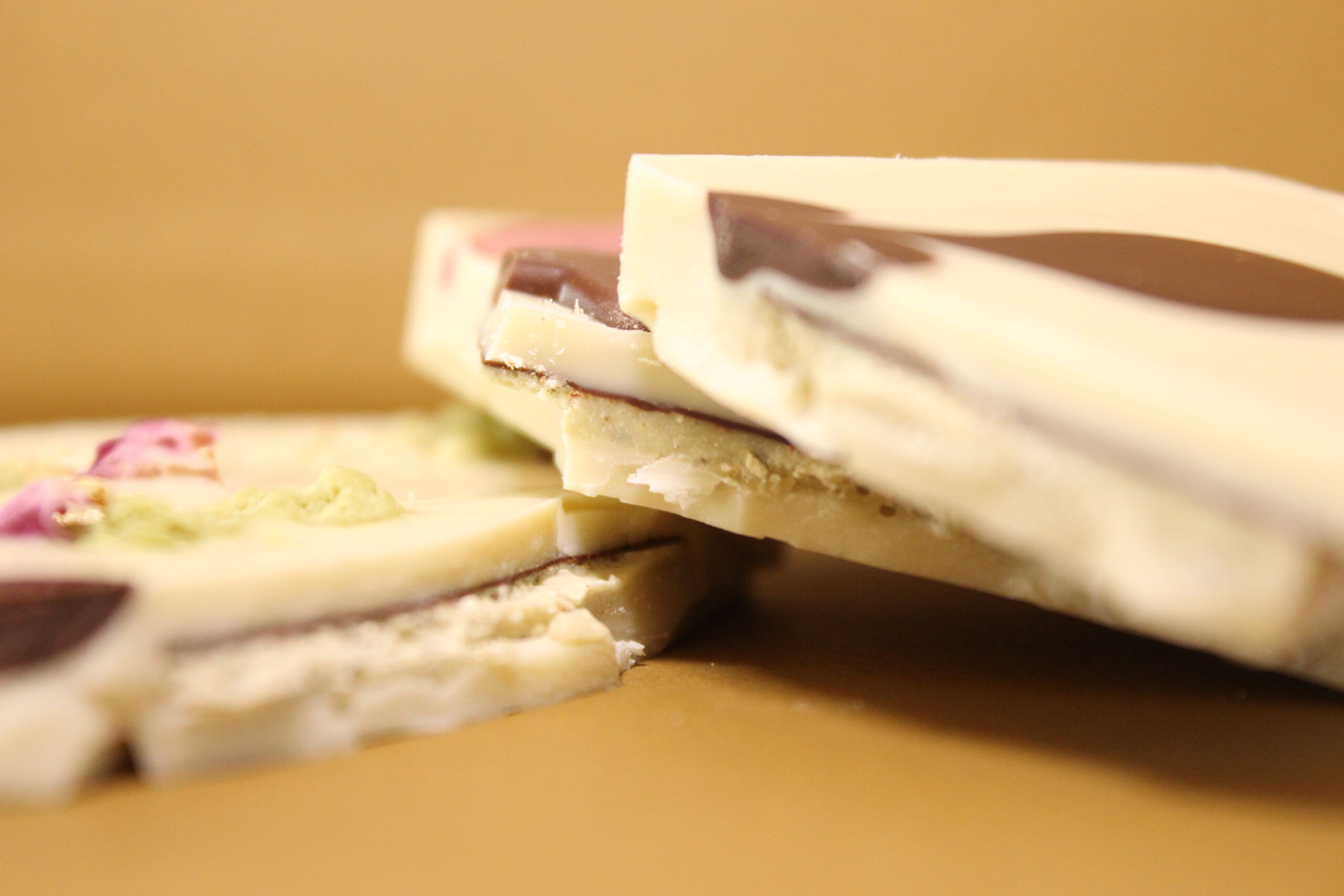
It’s fair to say that 2020 hasn’t been the best year for most of us. I’m sure you’re looking forward to it being over as much as I am, and what better way to celebrate the end of a terrible year than by treating yourself to some great Zotter Chocolate.
When I’m looking to cheer myself, I’ll usually go for filled or flavoured chocolates more than single origin, high cocoa percentage craft chocolate. It’s quite easy to end up just buying cheep chocolate and feeling guilty, but Zotter is one chocolate maker that lets me satisfy my cravings in the knowledge that I’m getting the best quality, ethically sourced bean-to-bar chocolate at the same time. I’ve reviewed several of their chocolates before, and even visited the factory a few years ago – something I would highly recommend once we can all travel again!

With that in mind, I hit up the Zotter website and bought myself a little selection of Christmas themed chocolates to lift my spirits. Here’s what I ended up with.
Star With Almond PralineZotter’s Mi-Xing Bar range allows you to create your own large chocolate slabs in a huge variety of shapes and flavours. You can choose your base couverture, add fillings and toppings and really make it your own. For the lazy (like myself), they also have a “Best Of” selection of pre-designed slabs, and that’s what we have here.
There’s certainly a lot going here in this chocolate star – so much so that it’s practically a meal in itself. This is a raspberry, caramel and white chocolate couverture star with almond praline with mini cinnamon chocolate stars, cacao nibs covered in white chocolate, crispy passion fruit chocolate pieces, green tea leaves.

What I like best about this is that each bite is gives you a slightly different combination of flavours. At 100g it’s the size of a large chocolate bar, but it’s so much more interesting. And I guess you could also put it on top of your Christmas Tree (well out of reach of small, hungry children of course).
Vegan Heart With Hemp PralineZotter have a lot of options for vegans, but I thought I’d go for one of the more unusual ones with this heart.

The underlying coconut flavour is quite strong in this one, and for my tastes it’s just a little bit too strong and I didn’t get a lot of flavour from the hemp. I did like the raspberry mini hearts and I think this would have worked very well with a more of that raspberry flavour. It’s just a touch too coconutty for my own tastes, and I think if I’d designed it myself I would have gone for a different base couverture.
Still. What could be more 2020 than eating your own broken heart?

Zotter Chocolate Hand Scooped Bars
These filled bars are probably what Zotter is most famous for. They come in a vast range of weird and wonderful flavours, several of which I’ve reviewed here over the years. I picked out a few from their Christmas range to try.

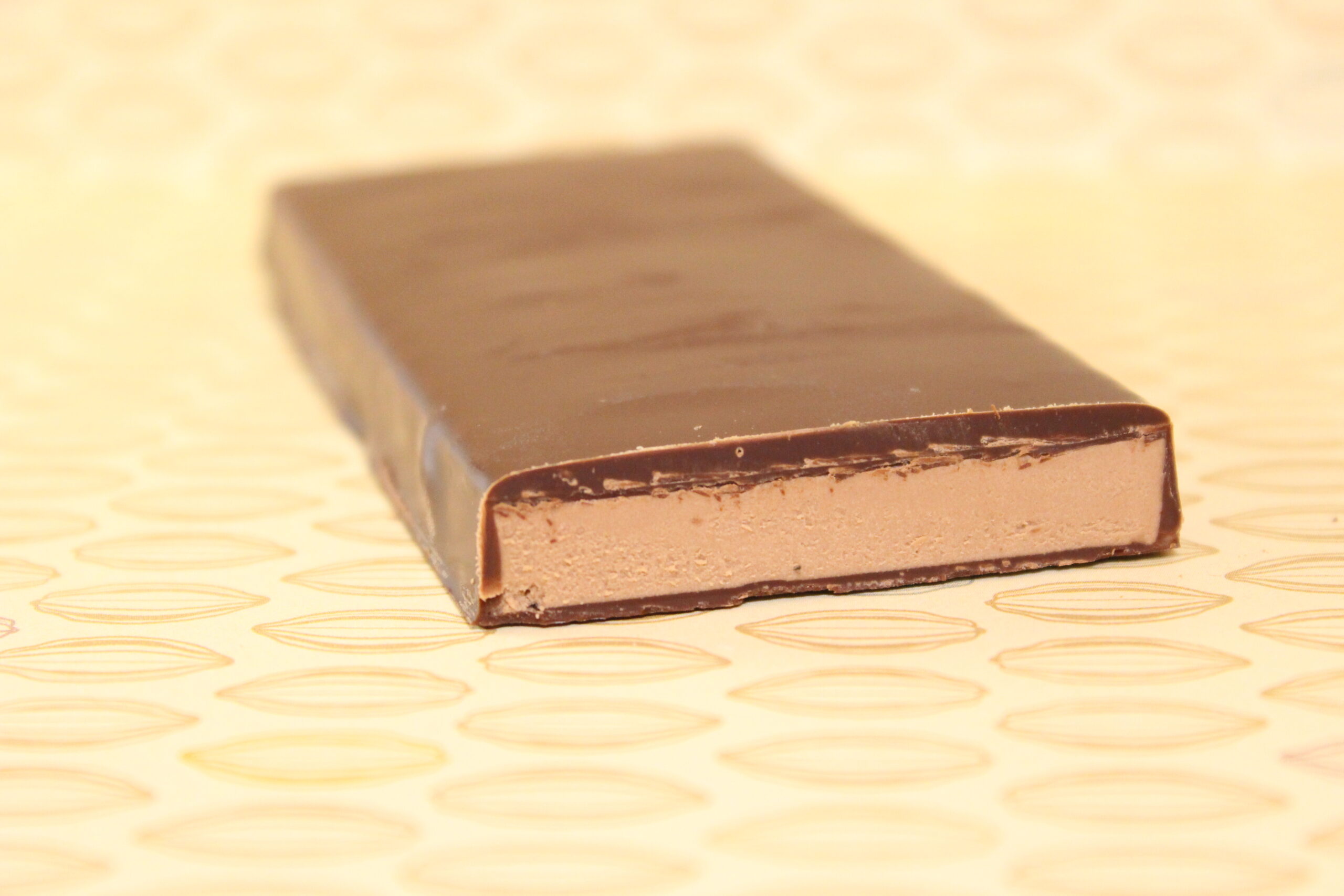
White chocolate mousse with a white chocolate coating tastes exactly like you think it might. It’s creamy, sweet, soft and smooth. In terms of flavour, it’s very simple but it’s also more than a little addictive. White chocolate fans will love it.

The name doesn’t give much away, but this bar has a marzipan and red wine filling that strongly evokes Christmas for me. The red wine flavour is strong, but balanced well with the marzipan so neither gets lost. I suspect such a strongly flavoured chocolate might be polarising, but I love it.
Fröhliche Weihnachten (Spiced Marzipan on Cinnamon Praline)Another marzipan filling, this time with a hint of cinnamon spice and a subtly crunchy praline. The flavour is much less intense than the previous bar, making it very easy to eat the whole bar in 2 minutes flat. Ask me how I know.
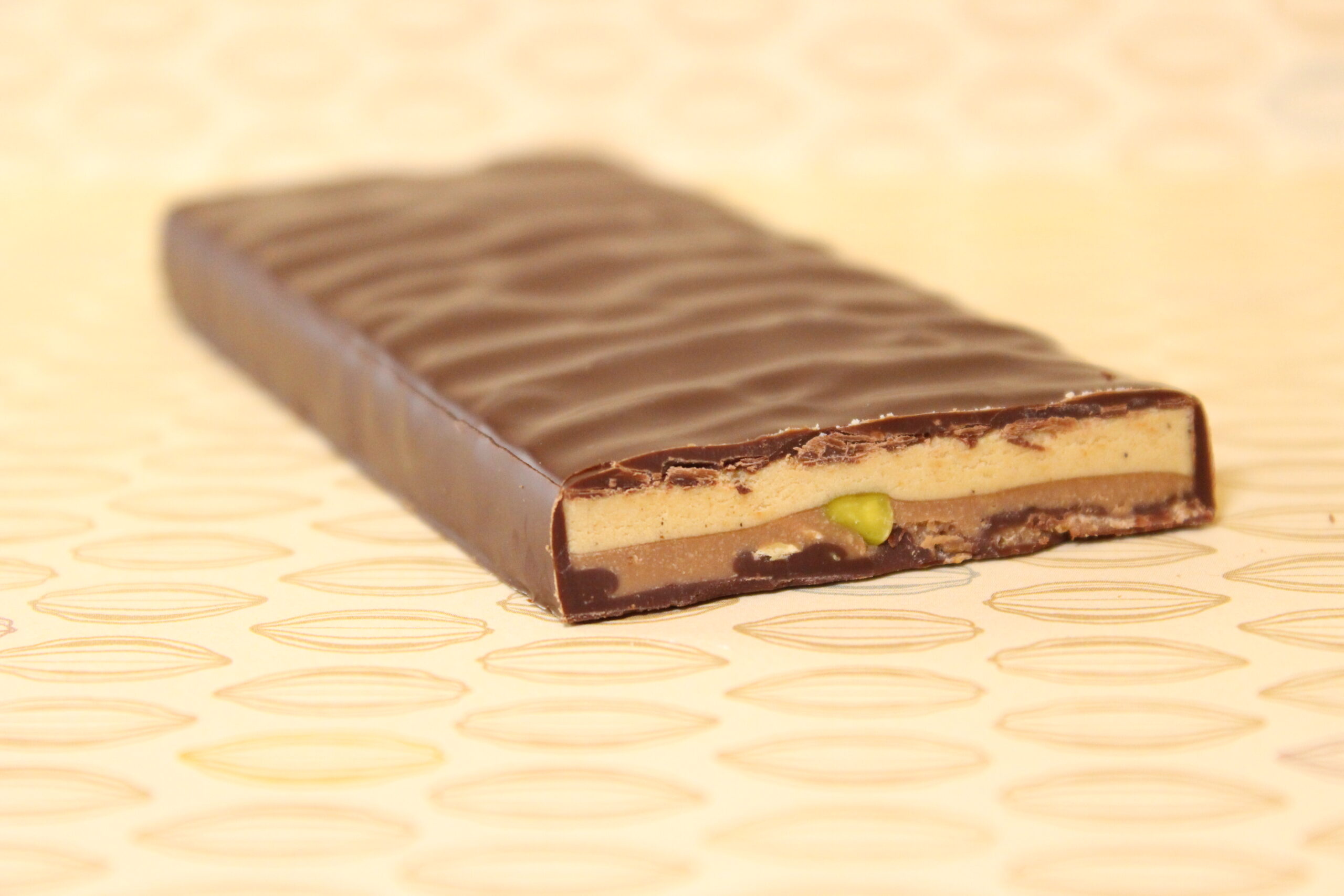
Aus der Weihnachtswerkstatt (From The Christmas Workshop)French white nougat with pistachios and hazelnuts in 60% dark milk chocolate. Who doesn’t love a good nougat? This one is a soft, whipped nougat with plenty of flavour and crunch from the nuts. There’s a lovely subtle honey flavour underlying the nuttiness and the whole thing works exceptionally well with the rich dark milk chocolate coating.

A blend of butter caramel and praline with small crunchy caramel crisps in 50% milk chocolate. The filling for this one looks like the mousse-style fillings of the other bars, but it has a strong buttery caramel flavour. There’s a hint of nuttiness in the flavour and a nice little crunch to the texture. Again very well matched flavours, although this one is just a little too sweet for my own tastes. Of course, I still ate the entire bar in no time at all.
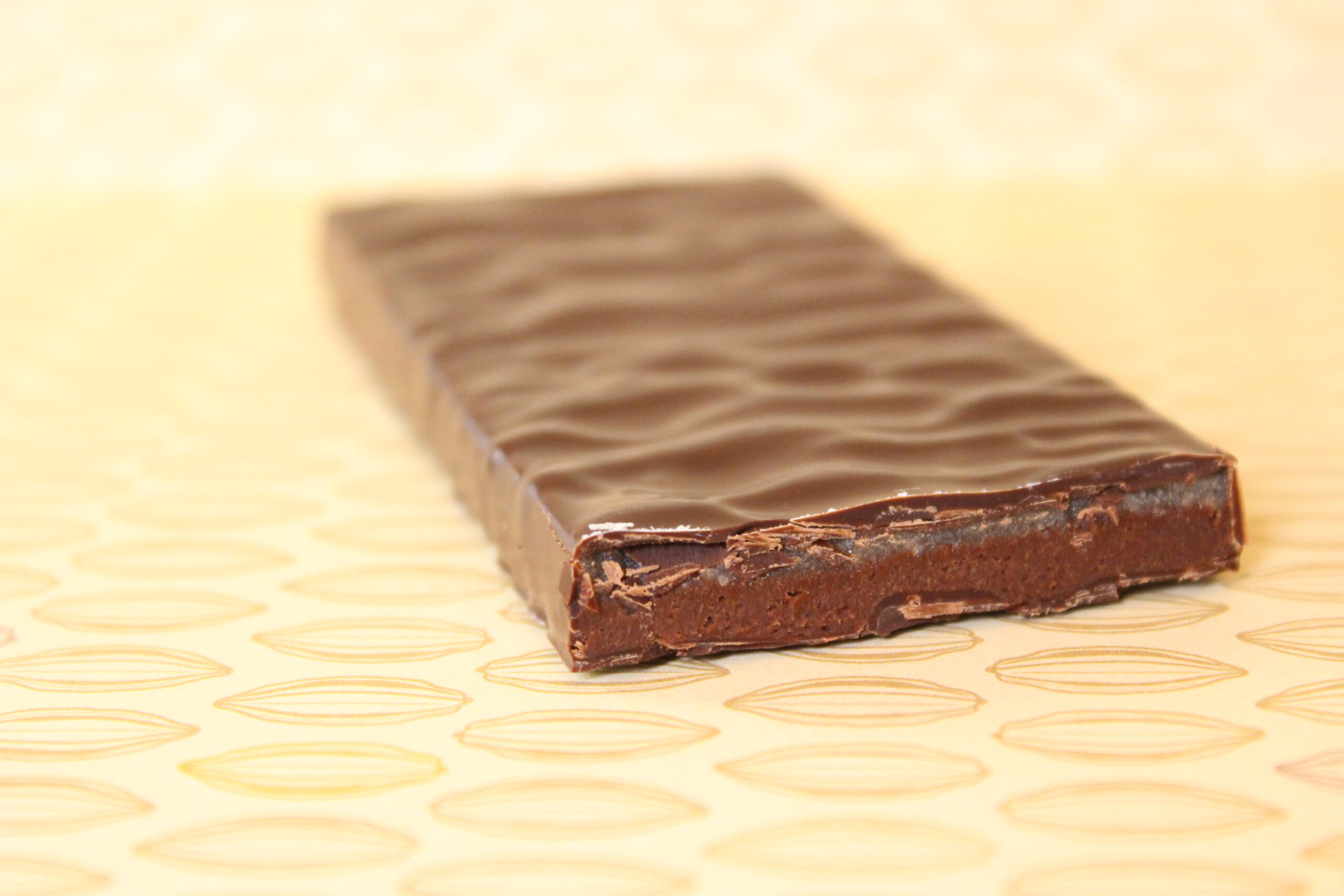
Glücksbringer (Lucky Charm)A sweet 40% milk chocolate mousse with 60% dark milk chocolate coating. Very simple flavours here, but they work so well. The best part of this bar though is the texture. The soft creamy mousse filling is reminiscent of a Milky Way bar, but obviously done much, much better. The chocolate shell is thick enough to give a decent crunch when you bite into it before the mousse melts in the mouth. Perfect execution.
Overall, I’m very happy with my choices here, but the truth is that Zotter’s selection is so big that they have something to suit every taste and mood. Whether it’s as a gift to someone you love, or a treat for yourself you can’t really go wrong. When I ordered, international shipping was free for orders over 35 Euros and everything arrived in perfect condition in less than a week.
Zotter Chocolate Christmas Photo Gallery









 Information
- Buy it online from:
- Contains dark chocolate, milk chocolate, other types, white chocolate (50, 60% cocoa solids).
- Filed under austria, christmas, zotter.
The post Zotter Chocolate Christmas 2020 Selection appeared first on Chocablog.
I’ve long held the suspicion that the use of ‘encouragement’ in relation to cycling is a classic example of a weasel word. It’s a word that sounds positive (after all, who could possibly object to cycling being encouraged?) – but that, when it comes to its use in practice, amounts to an abdication of responsibility. ‘Encouragement’ involves persuading people to do something, and… that’s about it. We want you to cycle, but we’re going to do very little to help you. In fact, we might even ‘encourage’ you to cycle while we are actively making things worse.
‘Encouraging people to cycle’ has become the stock phrase of councils and authorities that want to sound like they’re in favour of cycling, but don’t want to actually enable it. Councils who might like the idea of more people spontaneously choosing to cycle on their roads, but aren’t at all keen on having to do anything to all to help them to do so – hard, uncomfortable political decisions like reallocating road space away from motor traffic, or filtering residential streets to make them safe enough to cycle on.
So it’s not at all surprising that two prominent Conservative politicians who have been campaigning to remove an objectively successful protected cycle lane on Kensington High Street are, of course, in favour of ‘encouragement’.

At first glance, you might think that politicians who were genuinely ‘strongly in favour of encouraging active travel’ wouldn’t be writing letters urging a council to remove a protected cycle lane that has seen a near three-fold increase in cycling levels, and that greatly reduces crash risk on a road with an appalling collision record. You certainly wouldn’t expect them to be stating how strongly in favour of encouraging active travel they are, in the very same letter calling for the removal of that protected cycle lane – which it should be stressed is (while it lasts) the only one in the entire borough. How can that possibly make sense?
Of course, there is no contradiction here. ‘Encouragement’ sounds nice, but when politicians say they are ‘strongly in favour of encouraging active travel’, it’s quite clear that the phrase doesn’t commit them to do anything at all that will actually make a difference. They say ‘strongly in favour of encouraging active travel’, but what they actually mean is ‘strongly in favour of persuading you to cycle, but without doing anything to help you.’
In much the same way, politicians can say they are ‘strongly in favour of encouraging children to eat healthily’, while voting against free school meals. With a moment’s scrutiny, ‘encouragement’ quickly becomes meaningless.
As if to remove any doubt about how keen they are on ‘encouraging’ cycling, here are the same two politicians celebrating the decision to remove the lane, while simultaneously urging the council to find ‘other ways encourage cycling’.
Thank you to @RBKC & @jthalassites for listening to residents & residents associations & acting to remove a cycle lane that wasn't working for most local people & businesses. @FelicityBuchan is right to urge the Council to find other ways to encourage cycling & active walking. pic.twitter.com/3j4v012NVI
— Tony Devenish (@Tony_Devenish) November 30, 2020
Naturally, these ‘other ways to encourage cycling’ aren’t spelt out. And why would they be? That’s not the job of an encourager. The limit of their ambition is to be in favour of you cycling if that’s something that you want to do, and to attempt to persuade you to do it if you don’t want to. Cycling is your choice.
That’s what ‘encouragement’ amounts to. It means nothing, and that’s why it gets used so often in relation to cycling. You’re on your own.
What can I say? This is climate change.

Figure 1 | November mean temperature anomaly Australia. Source: Bureau of Meteorology
We're in the midst of a La Niña so it's not meant to be hot like this, let alone the hottest November in the record.
Okay, for the purists and deniers instead of saying this *is* climate change let me say this is *expected* with climate change. No, it's really not expected. It's just what's happening.
How about this is *consistent with* climate change. Is it really? Is this really expected this year, in 2020, when emissions are lower because of the COVID-19 pandemic, when there's a La Niña?
I must ask you, what the heck will be "consistent with" or "expected" for the rest of this decade?
The Bike at the End of the Universe: Gloria's Rogers Bespoke [ 13-Nov-20 4:45pm ]
Six years ago in Adelaide during the Tour Down Under we had the pleasure and honour of meeting local frame builder JR of Rogers Bespoke and photographing his first build. Today we feature what may be his last custom bicycle — for his fiancé Gloria.

The TDU is the first leg of the UCI World Tour, held in Adelaide’s searingly-hot summer. Hardly a holiday for the pros. It is for fans, though, who converge on the South Australian capital to enjoy a weekend of racing and to celebrate the cycling community.

In January during the Tour Ebenezer Place in downtown Adelaide is the place to meet. It’s a small strip of cafés and small shops which, in 2014, included the Treadly Bike Shop — the best LBS in South Australia and a hub for the local scene.

It was outside Treadly that I met James Alderson by his moniker JR. Or rather, I met Proto, his first handmade frame, a matte black track frame with a gold retro-inspired downtube logotype. Even standing still, the bike silently screamed like a Hemi-6.

Over the years since, we’ve featured many of JR’s builds and admired the finish of his frames, from the cyclocross bike that was a collaborative work with artist Sam Songailo, a tourer built for Sam Neeft of Treadly, to the production-style Ronin bikes.

There are more than a few Ronin riding around today underneath highly impressed owners. The quality of construction is up there with the world’s best handmade steel road-riding frames and, what’s more, they’re Australian-made.

James recently made the decision to move on from the custom frame building scene and sold off all of his tooling to focus on other avenues. He didn’t call his enterprise Rogers Bespoke for nothing — he’s hinted at work in the motorcycle arena.

Today we’re honoured to feature the last Rogers to leave the workshop, built for none other than his partner Gloria, who James will be marrying in less than two weeks. It’s to replace her own faithful steed and will carry her for many more years of commuting.

Gloria rode her last bike everyday for eight years, so JR built her something that will withstand heavy duty riding. It’s a utilitarian but comfy commuter with 32c Panaracer rubber, mounts for fenders, a 1×11 SLX groupset and Chris King and Thomson hardware.

The paint, however, ain’t utilitarian, it’s out of this world. It’s a pearl bomb effect applied by motorbike painter Daniel Stone, who painted every one of JR’s frames bar two. As far as I’m concerned, and I’m sure Gloria will agree, this is where dreams come from.
The Spoken would like to congratulate Gloria and James on their engagement and wish them good luck for the future!
Follow Rogers Bespoke on Instagram for updates. Big thanks to James Raison for the amazing photos.

The post The Bike at the End of the Universe: Gloria’s Rogers Bespoke appeared first on The Spoken.
Congratulations to the people of the USA, who turned out in record numbers and finally got rid of Donald Trump, his family and the various remaining hangers on who've occupied the White House for the last (almost) four years.

There has been much celebration in the media, dancing in the streets, hope on Twitter and mockery on SNL. It seems surreal to celebrate a return to sanity. What this to-ing and fro-ing shows is both the fragility and the strength of democracy.
March toward reality or away from it?Now I hate to be a wet blanket but I have to say while this was a terrific result, the march away from reality isn't over. There are populists rearing their heads all over the world, some of whom, like Trump, express views reminiscent of the worst leaders of the twentieth century.
We've seen how easy it is for a wannabe dictator to be elected leader and wreak havoc, including in what is arguably still the most powerful nation in the world today. This week's drawn out US elections demonstrated the fragility. Can you imagine any other country where a person like Donald Trump had 71 million people voting for him as President? If the answer is "yes", you see what I mean. Boris Johnson and Scott Morrison might not behave quite as badly as Donald Trump; however, if the UK and Australian governments were not parliamentary systems and were structured in the same way as the US, perhaps they would be every bit as bad. (Scott Morrison is an evangelical tongue-talker and has fairly close links to Qanon. His government is as inept and corrupt as we've seen for a while. I'll leave it to UK readers to comment on Boris' shortcomings.)
What I fear is similar to the concerns I have in Australia when it comes to COVID19. If you let your guard down you may end up with the world dropping into the agnotological abyss. Not just Dunning Kruger land but deep conspiracy nuttery. More on that in a minute.
So many pandemic experts, and boomer bashersHere in Australia after a scary community outbreak and too many deaths, we've all but got rid of the corona virus - COVID-19. About the only place it's still showing up is in people arriving here from other countries. Those people are already in quarantine and will remain isolated until they get a clean bill of health. Yet as we've seen here in my home state of Victoria, it takes but one transmission beyond quarantine and the virus can run rampant in the community. The more doughnut days we have, the greater the risk we'll become complacent. (A doughnut day is a day with no new cases. A double doughnut day is a day with no deaths and no new cases.)
On the topic of COVID-19, I've been surprised at the number of people who accept (and research or write about) climate science who have bought into epidemiology and public health discussions. I should be more specific. Naturally COVID19 is on everyone's mind so of course it's normal to talk about it. No, what I really mean is how quite a number of people appear to be putting themselves forward as experts and analysts, jumping from climate science to epidemiology and virology. The temptation to do so is undeniable. The risk is that one ends up taking a position without being privy to sufficient facts, without having the depth and breadth of knowledge and experience.
The hottest arguments are around models and lockdowns. Models, well that's understandable. Pretty well all sciences use models. Lockdowns not so much. That's getting into a complicated mix of virology, epidemiology, public health, behavioural science, other social sciences, history, economics and ideology.
Some people have very strong views about what they're prepared to do to stop the virus spreading. I've come across a few people on the internet who would readily trade all boomers, in fact anyone older than 50, for their daily latte, mocha, espresso or flat white from their favourite barista. They'd rather see their parents dead than wear a mask.
I was a bit dismayed to be blackballed by a popular cartoonist, First Dog on the Moon, for a response I made to a Covidiot the other day (shades of Scott Adams). The person I was replying to (not the cartoonist) was of the view they'd rather risk another outbreak of the virus than wait just one more day to hear about loosening of our four months of restrictions. The cartoonist, who up till then followed me and whose cartoons are often terrific (if condescending), jumped into the exchange and told me not to be so patronising to the covidiot, then promptly blocked me for this response. It reminded me that one must be cautious about applying the halo effect. Just because someone agrees with climate scientists it doesn't mean they will agree with experts in other fields such as virology, epidemiology, public health, disease control, behavioural science or economics.
Our civilisation is fragileLots of little signs such as the Trump phenomenon and unexpected reactions to the pandemic, have made me more acutely aware of how fragile is civilisation. It's dawned on me that when it comes to the sort of changes we'll need to make to cope with climate change, we'll not just have to deal with normal deniers, we'll have to deal with people who might accept the science but who who cannot tolerate any constraints, however short-lived and temporary, on their individual freedoms. This will include not only libertarians, it will also include some progressives. It's one thing to talk the talk, we must be aware that not everyone can walk the walk.
Election denial is the same as climate science denialWhile rational people can argue the best response to a pandemic (live with it, eradicate it, try to control it, have lockdowns in fits and starts, let the oldies die, wait for a vaccine, let everyone get it and the fittest survive, hope for eventual and magical herd immunity etc), there will probably always be deniers around. I haven't been to deniersville much this year. I did pop over before writing this article. What I found was election denial is as rampant and idiotic as climate science denial. The little conspiracy theorists at WUWT are convinced the US election results will be overturned as soon as the fraud is discovered. It reminds me how global warming will stop as soon as someone discovers how everyone around the world who recorded weather for the past 150 years or so managed to fiddle the numbers.
Well, that was a bit of a ramble, wasn't it. If it's disjointed that's because I'm out of practice, or that's my excuse for now. If it sounds like a whinge, then parts of it are and it feels good to get things off my chest. If you're keen for me to get back to climate science, I plan to. So much has happened this past year with ENSO, the Arctic and Antarctica, coral reefs, record-breaking temperatures, hurricanes and typhoons, wildfires and floods, and so much more, including deniers being paid far too much for jobs they can't do at NOAA.
Watch this space!
From the thoughts at WUWTBefore you go, do you want to see what's up at WUWT? Nothing much has changed. Charles Rotter, who I think has taken over from Anthony Watts (I could be wrong), is one of the election deniers and has opened an open thread on the US elections with these words:
Most of our readers realize that today's media pronouncements are meaningless and we are in for a month or more of lawfare.
His invitation to conspiracy nutters was quite fruitful, yielding comments such as:
Mario Lento November 7, 2020 at 2:36 pm
Well a recount of fraudulent ballots might not be enough. We need to also figure out which ballots are bogus, and that will be more difficult.
John Galt III November 7, 2020 at 6:36 pm
I'm a chief election judge and Joe's Party committed fraud on a pre-planned, systematic and industrial scale.
Timothy R Robinson November 7, 2020 at 3:49 pm
With Biden's declining health, we don't need to worry about him reaching the white house. Kamala will be sure he isn't sworn in.
Many other things I could say, but the electorate will have final say in December.
Curious George November 7, 2020 at 3:16 pm
Biden decided to take an initiative and declared himself President without waiting for courts. Welcome to Banana Republic USA.
MarkG November 7, 2020 at 5:15 pm
Why are you so desperate to push Biden into the White House right this minute?
Is it because you know that there's no way to hold the fraud together until January?
All it takes is for a few fraudsters to get arrested, and the others will start turning each other in to avoid jail time.
The Mallow Tailor Chocolates [ 05-Nov-20 7:49pm ]
It’s been a while since I’ve done a full-on chocolate review, but when Kate and Janet from The Mallow Tailor got in touch and asked if I’d like to try some of their filled chocolates, I couldn’t say no. After all, it’s 2020 and I deserve a little more quality chocolate in my life.
As is often the case, it turns out that saying yes to chocolate was a good decision on my part.

Based in the Brecon Beacons area of South Wales, The Mallow Tailor specialise in beautiful chocolates filled marshmallow, caramel and fruit ganaches. And as you can see, first impressions are very good!
Filled Chocolates
I decided to cut into one of the chocolates to get a better look and was rewarded with this glorious sight.
This is the Salted Caramel in a dark chocolate shell and as you can see from the photos, it has the perfect consistency. The filling is smooth, sweet and perfectly gooey. It’s the kind of chocolate you need to be a little careful with. Bite into it without thinking, and and you’re going to end up with caramel all over your clothes.
Luckily, I’m an expert caramel consumer with many years experience and hardly made any mess. Much.

The chocolate has a strong resemblance to Paul A Young‘s famous salted caramel, both in appearance and flavour. That’s no bad thing, of course. The one thing that sets Paul’s chocolates apart though, is his choice of chocolate that perfectly complements the fillings. This Mallow Tailor can’t quite match that, and the dark chocolate shells do have a noticeable cocoa flavour
Next up was a raspberry ganache in white chocolate. Again, the filling was wonderfully smooth with a subtle but well balanced flavour. I particularly liked the balance of sweetness in this one; something that’s quite difficult to get right in a white chocolate.

The Lime Ganache in a dark chocolate shell is another well balanced chocolate. The lime is zesty and zingy, but doesn’t overpower the chocolate. This is the flavour that worked best for me with the Belgian dark chocolate that The Mallow Tailor are using.

I could tell the box wasn’t going to last long, so decided to plough on with my scientific endeavours and stuff my face some more. The Marshmallow in a milk chocolate shell was surprisingly good. I wasn’t expecting much from a mallow filled chocolate, but I can see why this is their signature creation. The filling had a nice soft texture and a very pleasant vanilla flavour that worked well with the choice of chocolate.
Finally I tried the Caramallow; a combination of salted caramel and marshmallow. I was at first expecting this to be some kind of mixture of the two fillings; a foamy caramel of some sort. Instead, we have two distinct layers in a dark chocolate shell. It’s a pretty good combination, although I think personally I do prefer the flavours separately.
Stollen Slab
Also included in my little care package was this interesting little bar. Kate calls it a “deconstructed stollen” covered in milk chocolate. I’m told that it’s made with raisins, cranberries and fresh nutmeg which are steeped in Barti rum and combined with big chunks of marzipan. And I love it. I do have a bit of a thing for marzipan in chocolate, and that’s what has had me nibbling on this bar throughout the day.
I’m so pleased to have discovered The Mallow Tailor, particularly at a time when we could all use a bit of a chocolate pick-me-up. At the start of another lockdown in the UK, we should all be thinking about supporting small local businesses, but it’s also a great time to show the ones we love that we’re thinking of them. And what better way than with the gift of chocolate.
Information- Buy it online from:
- Contains dark chocolate, milk chocolate, white chocolate.
- Filed under caramel, lime, marshmallow, marzipan, raspberry, salted caramel, stollen, the mallow tailor, uk.
The post The Mallow Tailor Chocolates appeared first on Chocablog.
Scarfolk & Environs: Road & Leisure Map for Uninvited Tourists [ 05-Nov-20 10:20am ]
AVAILABLE NOWA large format map that comes in a bespoke folder, with a Scarfolk visa and souvenir postcard. A limited-edition (1st 1000 orders only), web-exclusive version also includes a Scarfolk bookmark made of genuine imitation leather. (Available from Herb Lester Assoc., Waterstones, Foyles, Blackwells, Book Depository)
It was entirely predictable that the recent review of the Highway Code, which includes a rephrasing of the advice on ‘two abreast’ cycling, would provide fruitful material for lazy opinion columnists and shock jocks, respectively filling newspaper pages and the air waves with confected outrage and re-heated clichés about selfishness, self-righteousness, and whining about how frustrating it is to be stuck behind a bunch of lycra-clad, testosterone-fuelled Bradley Wiggins wannabees riding five abreast, for twenty miles down winding country lanes, with a hundred cars queuing behind… (yes, yes, we get the idea).
What I find remarkable about these discussions is the brazenness with which an intrinsically selfish demand – that other people should travel in single file, unable to easily talk to each other, look at one another, and engage in a natural human way, purely for the convenience of someone driving a far larger (and typically empty) vehicle – is presented as being entirely reasonable.
To see how odd this is, we only need to reframe this demand from one being made by motorists of cyclists, to one being made by cyclists of pedestrians.
How reasonable would it be for me to demand that people walking on shared use paths should do so in single file, the person behind staring fixedly at the back of their companion, purely for my convenience and to avoid any delay to my journey as I pedal along? And not just that, how would it sound if I described pedestrians walking side-by-side (or even, gasp, three or four abreast!) as selfish, thoughtlessly causing frustration to cyclists? I’m sure you would agree that it would sound deeply entitled, and frankly ridiculous. But this is precisely the logic of those motorists who routinely make exactly this kind of demand.
It’s not hard to imagine other ‘reasonable’ demands by motorists that suddenly become deeply unreasonable, once those demands are being made by people cycling. One occurred to me by chance last week.
Behind the local Sainsbury’s, there’s a shared use path that runs into the town centre. It’s not a particularly good path, but it’s an important connection for people that know about it, and thankfully it has street lighting, which is necessary for several reasons, not least among them being that it doesn’t feel particularly socially safe without it. (The rear of the supermarket is a large, oppressive brick wall, and the path isn’t overlooked).
The evenings have drawn in quickly, and after a long hot summer I am now using this path in the dark. Last week, one of the street lamps wasn’t working, and this meant I had to cycle through a patch of darkness. And it just so happened that on this particular evening, concealed within that patch of darkness, there were two pedestrians lurking (or more accurately, just walking home, minding their own business).
Because the path isn’t busy at the best of times, I have to admit that I was complacent when I was cycling along, and simply wasn’t expecting anyone to be there in the darkness. However, I wasn’t so complacent that I was going to cycle into anyone, or anything (I have a pretty good reason not to cycle into people or things – namely that I would get hurt myself), and as soon as my headlight beam illuminated them, I was able to respond, easing off and steering around them, without any alarm, bar a mild bit of surprise that there were people there that I hadn’t anticipated.
For the briefest of moments, a thought – a selfish thought – flashed through my head that these people could have made themselves more easy for me to see. Perhaps some brighter coloured clothing, or some reflectives, or even a torch. It was pitch black, and they did seem to be wearing dark clothing.
But of course – just as with a demand that people should walk around in single file so I am not held up while cycling – that would be a ridiculous expectation. They were just walking in the town centre, on a path away from any roads, and it simply shouldn’t be necessary to change the clothing they are wearing, or add hi-viz or lights, merely so that idiots on bikes don’t crash into them on a shared path.
For the minutes remaining on the rest of my journey, I pondered the absurdity of writing a letter to the local paper asking, “as a cyclist”, for thoughtless pedestrians to “make themselves seen!” on shared use paths. I could even throw in an anecdote about how so many pedestrians have the temerity to be “invisible”, about how I’m always nearly having an accident because of them, and add in some language about how “irresponsible” it is of people to just walk around in ordinary clothes without making any effort to prevent cyclists from riding into them in the dark.

Such a letter would undoubtedly provoke a strong reaction. A cyclist, a self-righteous cyclist no less, demanding that ordinary citizens make accommodations for his dangerous behaviour! But again, this is the kind of letter that motorists write all the time, without even any apparent reflection on the selfishness of this kind of demand. Their expectation is that the people they are putting at risk should “make themselves seen”, and that to do otherwise is irresponsible.
Indeed, this goes beyond mere letter writing – the whole philosophy of people walking and cycling “making themselves seen” is embedded in mainstream road safety, reflected (excuse the pun) in the kind of advice that local authorities and police forces pump out at this time of year.
As the nights start to draw in, here are some tips for a safe evening journey from @SussexSRP:
Wear bright or reflective clothing when dark
When crossing, never assume you have been seen
If cycling, make sure you have working front and back lights#BeBrightBeSeen— Horsham District Council (@HorshamDC) October 24, 2020
Now the clocks have gone back the evenings are getting darker a lot earlier. I'm amazed at the number of cyclists around who are all but invisible!! Lights are a legal requirement and bright clothing & a helmet are a very good idea for your survival… #BeSeen pic.twitter.com/gJJ6AfUGWc
— Sgt Olly Tayler (@DC_PoliceBiker) October 27, 2020
By analogy, I wonder how far I would get suggesting that “invisible” pedestrians should consider luminous yellow jackets “a very good idea for their survival” when being menaced by people cycling who aren’t bothering to ride to the conditions.
An even more extreme example would be me arguing that people walking should wear helmets to protect their heads, in the event that I crash into them when cycling. I could even garnish that demand with a suggestion that helmetless pedestrians are actually being irresponsible for not protecting their brains, or even some guilt-mongering about how a cyclist would feel if a pedestrian they hit died because they weren’t wearing a helmet.
Sounds selfish, if not callous, right? Welcome to the world of motoring, where advising people to wear safety equipment to “protect themselves” from the consequences of bad driving is… extremely normal.

Cartoon by Beztweets
One final form of this double standard (there will undoubtedly be many others). Take the ubiquitous demand that cyclists should always use “the perfectly good cycle path”, rather than sharing (or more accurately attempting to share) with motor traffic on the road. Let’s skip over the fact that no-one in their right mind would choose to “share” with sociopathic motorists if this cycle path was indeed “perfectly good”, and again consider what a pedestrian-cyclist form of this argument would take.
Imagine a road with a shared use footway on one side of it, and a pedestrian-only footway on the other, and then imagine me, a cyclist, demanding that pedestrians walk on the “perfectly good” footpath on the other side of the road, rather than walking on the shared use footway that I regularly cycle on, getting in my way, and holding me up. Again, I could garnish this with some suggestions about how it would be “so much safer” for them to use the pedestrian only footway, and that I can’t understand why they would put themselves at risk on the shared use side, when there is a safer option on the other side of the road. Yes, it might be more inconvenient for you as a pedestrian, but don’t you care about your safety? Don’t you worry about me cycling into you?
I've been thinking about this tweet a lot. Imagine how silly it would sound to suggest that people shouldn't walk in cycle-ped shared space areas, and that they should have to use the pedestrian-only pavements that are "just for them"

We always tend to trust and believe in things that we can see right? "Seeing is believing"
What if I told you that the one Person who understands everything you are going through is Someone you cannot really see?
The familiarity with this Person is so profound - the depth with which He understands us is so great. He knows our strengths and weaknesses. He sees us through and through. He has also understood suffering on an intense, personal level like no other. Jesus was a Man of Sorrows. Excruciating. Overwhelming. Crushing sorrow.
He is ready to comfort you and be with you during your times of absolute sorrow.
He meets us at our "rock bottom" and gives us grace to see it through. He doesn't ask you to "snap out of it" or to "figure it out" on your own.
His presence is silent but felt nevertheless - even in the blazing fiery trials that we go through.
Depression can chase us away from God. It can make us run in the opposite direction, hide in a corner to nurse our wounds or pick our scabs. Even in our negative thoughts and "feeling low" moments if we choose to sing - we start off.
"Lord you seem so far away,
a million miles or more it feels today.
And though I haven't lost my faith
I must confess right now
that it's hard for me to pray..."
- (Don Moen)
But later find that we cannot really mean it and continue singing the chorus from our hearts..
Are you feeling low today dear friend? Is it like a regular "blah" mood for you today? Are you worried for no tangible reason at all?
I hope this picture will come to your memory during those moments so that you can see Someone apart from yourself in the fire. Cuddle up closer to the Savior now- the slain Lamb of God who understands.
Cast all your cares on Him because He cares for you and would never give up on you..
ROMANS 8:18
For I consider that the sufferings of this present time are not worthy to be compared with the glory that is to be revealed to us
(Just in case you would like to sing the rest today!)
--- Lady at bus stop, a few months ago.
You might think it bad taste to talk about vaping in the middle of a pandemic, and you'd be right. But this hasn't stopped a slew of public health bodies, politicians, and activists from doing just that, so I see no reason to unilaterally disarm.
I've been meaning to blog about vaping for a while. My Twitter feed sometimes seems to be about little else, rather to my embarrassment whenever I scroll through it. So I'll start by explaining why it matters to me. As with many vapers, my story begins with smoking.
To cut that long story short: I smoked, first a pipe then cigarettes, from my early twenties to my late fifties. I tried to quit many times. The annual ratchet of tax rises in the Budget reliably brought on another attempt. Surely I'll stop, I told myself, when they're over 50p a pack! Not even the £10 pack did the trick. Neither did Allen Carr's book, willpower, shame, and the pub smoking ban. One day about ten years ago I saw an electronic cigarette in a petrol station, and bought it. It was shaped like a cigarette and had a tip that glowed when you drew on it. After buying a few of these and finding it inconvenient when they ran down I soon was ordering the same brand with rechargeable batteries and replaceable cartridges. I was still smoking cigarettes, but a bit less than before, and the ecig made pub conversations much more convivial and less often interrupted than they'd become. The kick was feeble, the nicotine faint, the taste indifferent, but it was better than nothing.
Then a student in a mid-morning break at Napier showed me a more advanced e-cig, with a refillable tank, and told me where to get them. That very lunchtime I hastened over the hill to Emporium Vapour at Gorgie Road, and bought a starter kit. Within weeks, and without trying, I'd gone from smoking a pack of cigarettes a day to a pack a month. I went from tobacco flavours to fruit, menthol, spearmint... eventually settling on Kiwi and Strawberry, a half dozen tiny bottles of which I've just ordered. I smoked what turned out to be my last cigarette in the early hours of New Year's Day, 2016. Vaping had succeeded where decades of New Year resolutions had failed.
In the meantime, I'd been through the battle over the EU's Tobacco Products Directive, which saw concerted efforts to ban or severely restrict vaping and frantic, largely self-funded efforts by vapers to save it. We all learned a lesson in how EU laws are made. The vaunted principles of transparency, evidence, proportionality and subsidiarity didn't, let's say, stand out. The outcome was some pointless, petty and harmful regulation that wasn't as bad as we'd feared - and thousands more people in Britain who hated the EU and were active, informed and outspoken about it on social media. I'm not saying it swung the referendum, but it can't have helped.
The real threat to vaping, however, came from the United States. As long as vaping was a hipster fad, it could be fought by ridicule and junk science, of which there was plenty. The typical experiment involved burning out ecig coils and forcing mice to breathe the resulting toxic smoke for a month. The results of the mouse autopsies could then be turned into excited press releases and even more excitable headlines.
Another line of attack was that the vaping industry - or, absurdly, the tobacco industry - was 'targeting kids'. In US usage, 'kids' can mean anything from toddlers to graduates, but let's be generous and assume it meant in this case teenagers. The massed ranks of mom and pop businesses and evangelical ex-smoker start-ups that made up Big Vape in those days were allegedly targeting teenagers with 'kid-friendly' flavours: sweet and fruit flavours, sometimes with names reminiscent of the kind of candies actual kids like. 'Gummy bears' was a common talking point. The slogan, repeated to this day, was 'Flavours hook kids'. The claim makes sense until you give it a moment's thought.
When you do give it a moment's thought, you recall that teenagers are anxious to put away childish things, to take on the trappings of adulthood as quickly they can, and to defy the conventions and pieties of the adult world as annoyingly as they can. This is, of course, one reason why they smoke cigarettes. If you wanted to appeal to teenagers, your ideal vape flavour branding would be redolent of tobacco harvested by slaves, shipped by pirates, imported by smugglers and smoked by highwaymen.
The real 'target' (i.e. market) for fruit and sweet flavoured vapes was people like me: adult smokers and ex-smokers and would-be ex-smokers. Smokers who take up vaping usually start with imitations of their familiar tobacco flavours, but fairly soon (perhaps because the imitations are not all that convincing - copying tobacco flavour has turned out to be surprisingly difficult) move on to sweet and fruit flavours. If these flavours are presented as having the generic tastes of sweets they enjoyed in childhood (and may not have tasted since, for the sake of their teeth or their waistlines) all the better -- it adds a touch of harmless nostalgia.
And that market - unlike the pocket-money, illegal market of high-school students - is huge. But open-tank vaping doesn't appeal to all of them. If only there was a product as convenient as cigarettes! A start-up company set out to design just that, and succeeded. Juul is a slim device with a USB-cable rechargeable battery and replaceable cartridges of liquid. It gives the same instant nicotine kick as a cigarette. So I'm told - thanks the above-mentioned petty EU regulations, the high-nicotine pods aren't available here.
The trouble with Juul was that these devices really did appeal to teenagers, mainly if not wholly the very teenagers who would otherwise have been (or indeed already were) smoking cigarettes. Juul and similar devices are easy to conceal, almost undetectable in discreet use, and leave no tell-tale smell. This duly set off a moral panic - at the same time as the prevalence of actual cigarette smoking among teenagers dropped to a historic low. The 'Flavours hook kids' nonsense has driven ban after ban on flavoured vaping liquids. This was (and is) bad enough.
Then came disaster.
Cannabis use is illegal in the US at a federal level, but in the past decade some states have legalised it: first for medicinal use, then recreationally. The possibility of vaping cannabis didn't escape attention, and was soon realised. Legal weed stores sell an eye-watering variety of vape pens and cartridges, as well as cannabis cakes, candies and for all I know actual leaf. Because it's legal in some places but not in others an illegal market soon sprang up. Some of the criminal entrepreneurs supplying it found that they could cut cannabis-based oils with thickening agents, one of them Vitamin E acetate. This turned out to be deadly. More and more people were rushed to hospital, and scores have died, with severe lung injuries. The source of the problem was soon exposed by the legal cannabis industry. It was obscured at first because the victims had often been vaping cannabis illegally (because of their age or location) and admitted only to 'vaping' or even, more alarmingly, to 'juuling'. Blood tests, however, soon showed what they'd been vaping. It wasn't nicotine.
The lie ran around the world before the truth got its boots on. Certain US public health authorities, notably the Centers for Disease Control, did their utmost to warn against 'vaping' and 'e-cigarette use' in general and almost nothing to warn against vaping illegal cannabis in particular. The misconception, to put it no more strongly, persists and is reinforced by various public health authorities, lazy journalists, and anti-vaping activists to this day.
That's why the little old lady at the bus stop kindly advised me to go back to smoking.
An interview with Naomi Klein in Earth Island Journal this week confirmed what I've been thinking for some time: The Big Green Groups in the environmental movement are almost as problematic as climate deniers. As Klein puts it:
I think there is a very a deep denialism in the environmental movement among the Big Green groups. And to be very honest with you, I think it's been more damaging than the right-wing denialism in terms of how much ground we've lost. Because it has steered us in directions that have yielded very poor results.
Maybe it's because I spent about four years dueling with stupid in North Idaho, but I have to admit some amusement with the recent what-went-wrong analysis of the climate battles in Obama's first term. A recent study (140-page pdf) by a Harvard researcher puts a lot of the blame on the Big Green groups based in Washington, DC and their blindness to the swift radicalization of the Republican Party and their inability to counter it. Indeed, the concentration of policy wonk generals calling the shots in DC without sufficient resources being put into the necessary grassroots army across the country was a fatal flaw that was glaringly obvious from Coeur d'Alene.
It probably shouldn't have required a Harvard political scientist to do so, but researcher Theda Skocpol provides a clear-eyed explanation of how things went wrong, culminating with the Tea Party summer of 2009. It was entirely too easy for Big Greens to dismiss the rantings of right-wingers in flyover states — what with all their misspelled signs and all the Jon Stewart ridicule — but the truism that all politics is local was lost on Big Greens whose strategy was based on coalitions with (selective) Big Businesses far from that summer's town hall shouting matches.
As Skocpol is quoted in a brief Washington Post interview:
Theda Skocpol: Climate-change denial had been an elite industry for a long time, but it finally penetrated down to conservative Republican identified voters around this time. That created new pressures on Republican officeholders and candidates. And I don't think most people noticed that at the time. …
… I think a lot of environmental groups were under the impression that the Republican Party is a creature of business, and that if you can make business allies, you can get Republicans to do something. But I don't think the Republican Party right now is mainly influenced by business. In the House in particular, ideological groups and grassroots pressure are much more influential. And in the research we've done, the two big issues that really revved up primary voters were immigration and the EPA.
The fact that much of the white-hot rhetoric was directed at health care reform served only to mask the equally hot anger at legendary evils of EPA overreach. Indeed, the terms "cap and trade" and "scientific consensus" were no less threatening than Obama's death panels. The DC leadership of the Big Green groups should maybe have gone to an Idaho town meeting or two rather than climate conferences in Copenhagen.
The folks at Grist have provided some superb analysis of the analysis, but I'm hoping that the lessons aren't lost. For one thing, foundation funders and big enviro thinkers could start re-emphasizing grassroots capacity in locations other than big blue cities where the Big Green groups are headquartered.
Furthermore, enviros can't be missing in action on important issues related to climate. This exchange closes out the interview and, with a week or two into my new role with a new group, it doesn't bode well.
Washington Post: The Sandy relief bill is going through the House [on Tuesday], and almost no environmental groups weighed in on that. That's shocking to me. Here we are, a large group of people in New York and New Jersey that environmentalists want to connect to climate change, and the groups aren't there. Why not?
Theda Skocpol: So you do have to build broader coalitions. That was one of the things that health reformers did this time around. They buried hatchets and forged ties with groups they needed to, like medical providers, and reached out to small businesses. Health care reformers spent years talking about what went wrong, what they could do differently. But that also took 15 years, from 1994 to when health care finally made it over the top. I'm not sure climate can wait 15 years.
All I know is if another opportunity comes along to get legislation through Congress, those that are prepared are going to be the ones that will be take advantage. And that's what I don't see yet. I haven't been impressed by the inside-the-movement post mortems I've read. I don't see any thought that there will have to be a lot of rethinking for that to happen.
Indeed, as the House of Representatives was voting on amendments to the delayed Sandy relief legislation, the sacrificial cuts — given up at the altar of the Tea Party gods of debt ceilings, deficit reductions, fiscal cliffs, and deadbeat deadlines — came from $150 million in oceans and coastal programs, and a particularly unlucky wildlife refuge in Connecticut.
Yeah. Like we're ready to fight any climate battles any time soon.
I’m supposed to be writing about the upcoming election right? Because my job as an American citizen at this pivotal moment in our nation’s history is to help spread all the psychological warfare tactics being deployed by all sides to get us to be afraid and either vote or not.
Screw that. By the way: Vote! That’s all I’m going to say right now. It’s not that I’m not busy with local politics (hence the silence on this blog). Rather, it’s that I suspect that your adrenal glands are getting worn out by the psywar, so I wanted to give you a little respite. Over the last month, I’ve read two very different visions of space for the 21st Century, and I wanted to share them.
One is the US Space Force’s “Capstone Publication”: Doctrine for Space Forces. It’s an interesting mix of apparently thoughtful “how do we fight a war in space” analysis (which happens to be useful for SFF types at least), combined with a certain amount of macho posturing and “boots in the sky rhetoric,” to make it look like they’re more than a bunch of satellite jockeys working from home and keeping their cats off their laptops. Which I’m sure they are. This is good stuff to read if you’re interested in the putative realities of warfighting in near-Earth orbit and how it fits together with all the other various and diverse ways we have of hurting each other. But much of it is perhaps too familiar for precisely those reasons.
On the other side is something (apparently) completely different: JP Aerospace, aka “America’s Other Space Program,” a little outfit in the Sacramento area that seems to be developing its space hardware as a non-profit running on donations and contracts. The JP is John Powell, and I’m a bit late to his game. For the last 20 years or more, he’s been promoting what he calls “The Airship to Orbit Program” (you can buy his 2008 book at his website. Or Amazon–it comes out of the same warehouse. It’s worth reading, not just for the program, but if you want to learn about all the upper layers of our atmosphere). His vision of how to get to orbit is a slower, safer, three-step operation using ginormous airships.
Stage one is an A-shaped “Ascender” that’s around 900 feet long. The arms of the A are helium or hydrogen-filled polypropylene balloons inside a wing-shaped nylon sleeve, while the crossbar of the A has a couple of electric-powered high altitude propellers. It’s a semi-blimp with a keel that’s a large carbon fiber space frame truss, while the top of the wing-bag is a carbon fiber deck that mounts thin solar panels and carries the pipes and pumps for moving the lifting gas between internal gas bags. Semi-blimp means its halfway between a blimp (which has no hard internal structure other than the nose cone and possibly fins) and a dirigible, which has a full internal structure. Or you could call it a keeled airship. This beast can carry about 20 people up to 140,000 feet in about two hours. Basically, the Ascender takes off, points its nose up 70 degrees (it’s basically a huge, slow flying wing) and ascends to 60,000 feet on buoyancy alone. At that point, the wings and propellers take over so that it can fly the rest of the way up. It has to be so huge and light to fly at high altitude in very thin air.
At 140,000 feet (space officially starts around 330,000 feet up), the Ascender docks with Stage 2: Dark Sky Station. This is a starfish shaped, rigid-keeled airship/station. Each arm of the star is around 2 miles long, and it can house 100-200 people indefinitely with resupply. Its gasbags are inflated with hydrogen, but there’s so little oxygen at this elevation that combustion is not an issue. The Dark Sky Station (dark because the sky is black at this elevation) is a combination tourist attraction, transshipment hub, and research center. People visit to see the sights, drop a paper airplane, catch Stage 3 to orbit, or go up there to do astronomy, aerobiology, or unload cargo that needs to go to orbit whatever. It’s a commercial venture.
Stage 3, the Orbital Airship, is assembled at the Dark Sky Station and flies to orbit. This is another A-shaped, keeled airship, except each wing is around 6000 feet long and there’s no cross-bar. It has electrical propulsion units (design TBA, but anything from VASIMR to advanced ion is possible), and it’s so large because it has to fly in *really* thin air. It climbs to 270,00 feet on a mixture of buoyancy and wing lift. Above that, level, it flies using its wings for lift, gradually picking up speed (over most of a day or 5) at the top of the atmosphere until it achieves orbital speed at 17,500 mph and is flying on propulsion alone. At that point, its job is to either rendezvous with a spacecraft or space station or possibly release satellites. To get back down to the Dark Sky Station, the orbital airship merely tips its nose up, and its enormous surface area acts as a really nice, gradual aerobrake without heating too hot. It drops and slows until it can match velocity with the DSS and do it again. This ship is not designed to ever land. To fly at that altitude, the gas bags are about the consistency of vegetable bags at the grocery store, and the nylon skin is not much thicker. It would break apart in the lower atmosphere, but it can get lift out of what would have been a decent vacuum at sea level in the 19th century. It’s also so big and ponderous that even a simple turn would take something like an hour to execute. This flies like an oil tanker, not a jet fighter.
Now about the practicalities: JP has flown over 100 development missions consisting of balloon rigs and sounding rockets, and built Ascenders up to 160 feet long for the USAF, so he’s not blowing smoke. He’s designed high altitude propellers and demonstrated that they work on rigs launched up to 100,000 feet. He’s flown a number of small dark-sky stations (10-30′ wide) and demonstrated that the five-armed starfish is the most stable design. He’s recycling a lot of the same designs and technology for all three designs, and he’s testing them out as he gets funds to fly missions with his crew of merry space pioneers. One of his basic workhorse designs, the two-balloon, two propeller “tandem” design was developed and flown for around $30,000. While he ran his company on government contracts prior to the 2008 crash, he’s currently running the whole thing as a non-profit. He’ll haul your stuff up into the upper atmosphere for quite affordable rates (or free if it fits in a ping-pong ball), and he does several launches a year, testing his technology a piece at a time and flying other people’s stuff to pay the way.
A couple of other design challenges: how can balloons fly at Mach 22 (escape velocity), and what happens when something hits an airship?
Balloons flown by the NASA and the USAF have already gone Mach 10 in the high atmosphere/near Earth orbit, so it’s not impossible. No one apparently knows if a balloon with mile-long wings can pull off the stunt, but our intuitions about friction and lift get weird in near-vacuum conditions.
The other common concern is “what if it gets a hole?” And the simple answer is this isn’t a problem. The gas is in multiple bags, not one . This is a normal dirigible design going back a century. The problem with having one gas bag per wing is that gas can slosh around, and once it gets to one end and the ship goes vertical, things get hairy. Blimps have multiple gas bags inside the outer envelope as do dirigibles. They also normally have air ballast bags inside them to keep the gas where it belongs (outside air performs the same function as water ballast in a submarine).
Anyway, getting back to safety, if a gas bag gets holed, it can be replaced in flight. They’ve been testing having large gas bags on reels and unreeling them as they get inflated. It works well enough. Another line is the WW I bombing of London by Zeppelins. It took some time to figure out how to shoot down the dirigibles. The problem wasn’t hitting them with bullets, it was that the bullets simply passed through, rather than igniting the hydrogen inside. The holes leaked slowly enough that the airships didn’t go down, and sometimes the bags could simply be patched in flight. The Zeppelins weren’t shot down until the British figured out special incendiary bullet pairs to pierce the bags and physically ignite them from the inside. Then, once they got the right fuel-air mixture from the holed bags, the hydrogen finally ignited and brought down the Zeppelin.
In the case of a meteor hitting an orbital airship at Mach whatever, the space debris passes right through, and the crew patches up the hole. The ship’s shape is inflated by nitrogen (at very low pressure, I suspect), so it’s a matter of patching holes and replacing stuff. The carbon fiber truss is probably also fairly easy to replace, and it looks like the ships will have multiple trusses per keel. According to his book (and the enclosed pictures), a 100 feet of the truss he uses as airship keels weighs around 20 lbs. Having multiple trusses and carrying spares on the ship isn’t that hard. Patching it in a freezing vacuum gets interesting, but that’s not the same as the shuttle breaking up over Texas.
So that’s two visions of space overall. On one side, we have a very colonialist take of shredding treaties and militarizing space before the other side does it to us. Which sounds depressingly familiar, but I’m a well enough trained nationalist to feel a faint patriotic stirring at the thought of boots in the sky. On the other side, we’ve got this scrappy little outfit with a really different take on how to get to orbit, that’s shoestringing successes at a tiny fraction of what the rocketeers are charging to light candles and launch stuff. They may be dreamers, kind of goofy, and definitely not suits, but they’re getting stuff done for cheap, which is more than we can say for most aerospace companies.
These worlds aren’t mutually exclusive: JP Aeronautics did build its early Ascenders under contract to the Air Force. In the book Powell says that the biggest Ascender he built for the USAF was destroyed because the officer in charge ordered them to fly the airship in a high wind (which the prototype wasn’t designed to handle at that early stage). The resulting fiasco destroyed the airship, after which the USAF cancelled the contract and JP figured out how to launch balloons in high winds regardless. However, in an interview, Powell says that some of his work was given to the military and ended up in places he doesn’t know about. So it’s possible that the USAF (or even the Space Force) is flying ultra-high altitude airships based on JP Aeronautics designs. They may even be manned observation platforms. After all, even the Stage One Ascender is designed to operate at 140,000 feet, while the SR-71 allegedly has a ceiling of 85,000 feet and the U2 operates below 70,000 feet. Yes, these airships are slow. However, they don’t have a lot of metal in them or much that can burn, so it’s not clear to me how you track or even shoot one down. If a missile puts a hole in an airship that’s 900 feet long, unless it shatters all the keel, it probably can just be patched in flight.
But I think the vision of JP Aeronautics is a bit closer to sustainable than the jet, rocket, and missile crew are. While the airships would need square miles of plastic sheeting, they’re low-energy and electric-powered. In the worst case scenario, they can be inflated with hydrogen too. Figure out a way to make them out of sustainable materials and they can still fly. It’s a lot harder to do that with a metal and ceramic rocket.
Couple these airships with Brian McConnell and Alex Tolley’s spacecoach, and you’ve got the rudiments of a sustainable solarpunk space transportation system. And perhaps that’s an alternative vision you can play with for a bit, before descending back into the high stress memescape the politicos want our day to day lives to be.
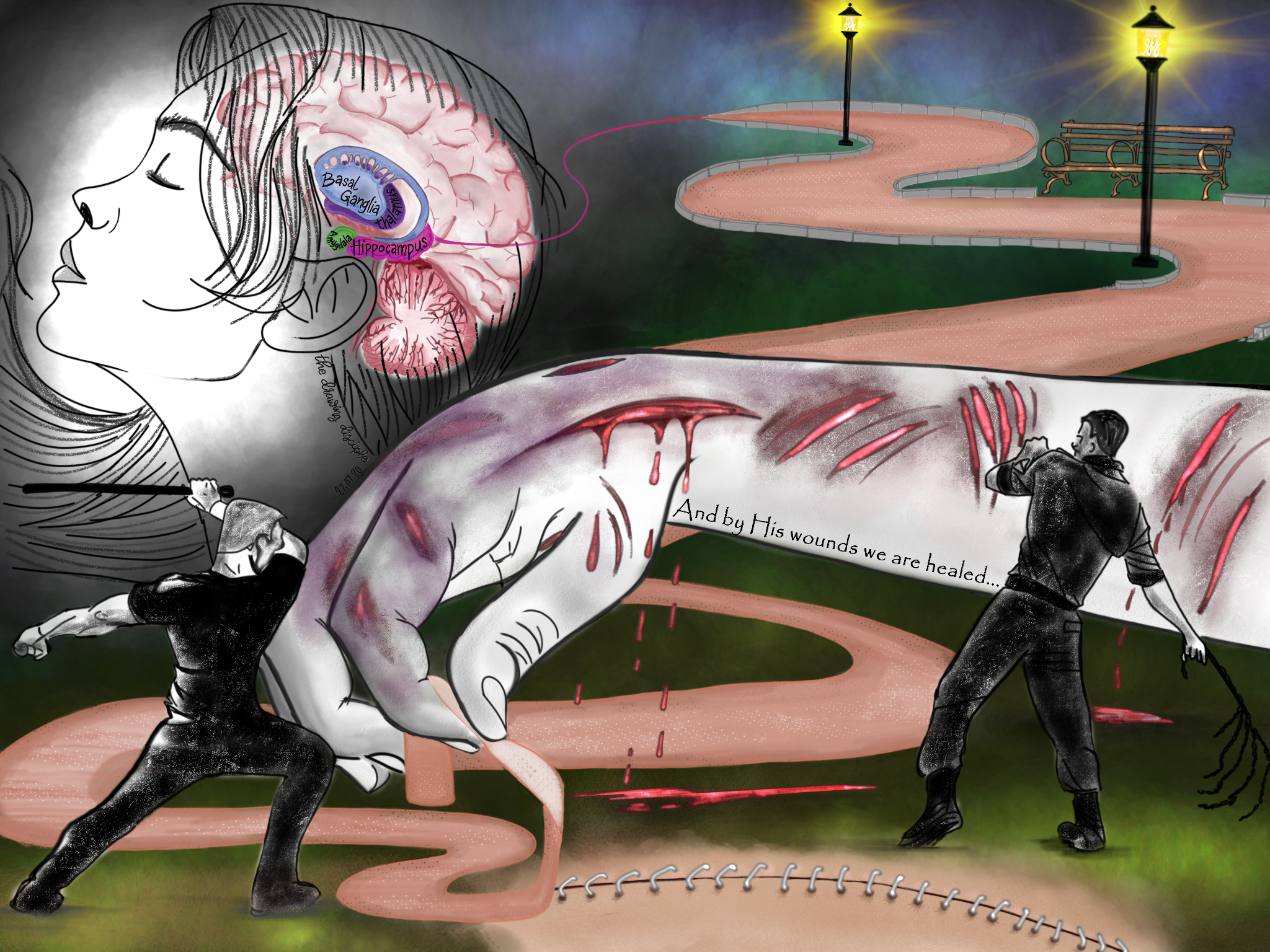
I dare you to decipher what this means! Take your time... :P
(I did hear a couple of versions already, so I am bracing myself for more..)
For those of you who are wondering, "What in the world was she thinking??"…
Read on..
As mentioned in my profile, I enjoy drawing pictures from song lyrics, Bible verses, Quotes from books etc.. This particular Abstract Art was inspired by a combination of the first two mentioned above and a little bit of my medical knowledge .. :)
The Hippocampus is where all our memories are stored.. (FUN FACT #1)
Take a walk down memory lane today and you will see that you have scars from wounds both old and new… Wrong choices, Guilty pleasures, falling for temptations, repetitive sins.. Secret sins that stain scarlet have scarred us all ..
Wounds like these may or may not heal over time.. If there's a chance at complete healing it would be because of a Savior who was wounded for us. (1 Peter 2:24; Isaiah 53:5)
Imagine the contrast in that.. Sounds like acupuncture in one person heals another.. :P (to put it in the mildest sense ever..!)
Well the point I'm trying to make here is… Forgiveness is what heals you..
Allow Him to forgive you..
Allow your own self to forgive you..
Do not be too hard on yourself...
Jesus has forgiven me.. He healed me and gave me that chance to hope again… believe again…
And He will most gladly do the same for you - all you need to do is ask..
Find the song that inspired me and the story behind it here:
Danny Gokey - Tell Your Heart To Beat Again (Live)
The lyrics of the song goes like this:
You're shattered
Like you've never been before
The life you knew
In a thousand pieces on the floor
And words fall short in times like these
When this world drives you to your knees
You think you're never gonna get back
To the you that used to be
Tell your heart to beat again
Close your eyes and breathe it in
Let the shadows fall away
Step into the light of grace
Yesterday's a closing door
You don't live there anymore
Say goodbye to where you've been
And tell your heart to beat again
Beginning
Just let that word wash over you
It's alright now
Love's healing hands have pulled you through
So get back up, take step one
Leave the darkness, feel the sun
'Cause your story's far from over
And your journey's just begun
Tell your heart to beat again
Close your eyes and breathe it in
Let the shadows fall away
Step into the light of grace
Yesterday's a closing door
You don't live there anymore
Say goodbye to where you've been
And tell your heart to beat again
Let every heartbreak
And every scar
Be a picture that reminds you
Who has carried you this far
'Cause Love sees farther than you ever could..
In this moment heaven's working
Everything for your good
Tell your heart to beat again
Close your eyes and breathe it in
Let the shadows fall away
Step into the light of grace
Yesterday's a closing door
You don't live there anymore
Say goodbye to where you've been
And tell your heart to beat again
Your heart to beat again
And so my dear friend.. Hope in the Lord - He is able to restore you..
He has been doing it for years.. Trust Him on this..
DM if you'd like me to send you the original for prints.. :)
And I would love to hear your interpretation of the art in the comments below... There's a chance that you might notice something I didn't.. ;)
I've reverted it to a standard theme so you'll find some things missing (like the menu).
It might be a while before I work this out, along with working out where to take blogging from here on in.
Till then, take care of yourself.
Glastonbury 2019 preview playlist + ten alternative must sees [ 17-Jun-19 9:11pm ] Yes, we've kind of shut up shop. But we have some pre-hiatus commitments to honour, and Drowned in Sound is off to Worthy Farm again this year for arguably the world's biggest festival. Rather than just preview the big acts (you know who The Killers are, right?) we thought that we would do a list of ten things to do that capture the holistic spirit of the festival for you to discover if you are going for the first time, or for those who have been before and just want to spread their wings a little further.
First, though, a playlist, to get you in 'the mood'
10 alternative must dos at the Glastonbury Festival
Step back in time at The Rocket Lounge
When the headline acts finish at Glastonbury, the party is only just beginning. For many people, the late night entertainment in the South-East 'Naughty Corner' is their actual highlight of the festival. And with good reason - the sheer number of extraordinary venues for clubbing with a unique visual and experiential twist is beyond compare. However, one of my favourite late night areas is a little Fifties-themed bar and diner located in The Unfairground, just as you come into the late night area. It's a place you can step away from the festival and dance all night to early rock and roll classics, alongside excellent sets from live blues, R&B and rock and roll bands. This year's line-up includes the terrific Son of Dave, New York Brass Band and Pronghorn. It may be one of the smaller late-night areas but it's one not to be forgotten, which is the reason I make sure I visit it at least once a year.
Block9 and NYC Downlow - Apocalyptic DiscoOn the other hand, if you want the truly huge and awe-inspiring late night experience at Glastonbury, there are few things to beat Block9. Set amongst a gigantic post-apocalyptic cityscape with trains embedded in buildings and gouts of flame bursting out everywhere, you can find the fantastic NYC Downlow with brilliant disco-inflected sets from the likes of Prosumer, The Black Madonna and Erick Morello. It's easy to get lost for a whole evening here, then to come out only to be staggered again by the sheer visual drama of the venue. Seriously, even if you don't come to stay for the music you simply have to see Block9, especially given that this year they are doing an interactive visual artwork based on post-truth and the 'fake news' era.
The Crow's NestRight at the top of the whole festival - past The Park stage and up a treacherous hill (which has claimed many in the mud, including myself) is one of Glastonbury's true hidden gems - The Crow's Nest. Run by those lovely chaps from Heavenly Records, this tiny venue sits at the highest point of the whole festival, affording tremendous views across the whole site and arguably the best point to get the sheer scale of the whole festival. Not only that, but there is a cracking little bar there and the venue plays host to a series of secret gigs throughout the whole weekend. Rumours are usually flying about but the actual line-up doesn't get announced until the day itself, and even then there is usually a tantalising 'special guests' mentioned on there.
The Rabbit HoleSlightly further down the hill, just at the top of the Park Stage is one of the hardest places to locate in the actual festival. My advice is to look for the rabbit, though the actual entrance to the venue only opens at night and at an undetermined time. Queues can be long to get in, but once you have scampered - Alice in Wonderland-style - through a tunnel, you find yourself in a surreal, psychedelic environment where costumed characters serve you gin from teapots and DJs and live bands keep you entertained. It takes a specific effort to track it down and get in (and if you don't at first succeed; try, try, try again is my tip!) but once there, you have an experience like no other.
Brothers and West HoltsOnce I have unpacked my tent and sorted out my temporary home for the weekend, my first port of call is the Brothers Cider bar by the West Holts stage. I don't know why, but it's just a tradition I have. But there is something magical about that first drink of the festival being some damn strong and damn sweet pear cider as the flags flicker in the breeze and the hum of humanity and the chatters of excitement start to build. Even better is having the chance to hear some glorious world music and hip-hop on the West Holts stage over the weekend - possibly my favourite overall stage at the festival. Headliners this year include Jon Hopkins, Wu Tang Clan and Janelle Monae (who played one of the best gigs I've ever seen on this stage in 2011) but also keep an eye out for the excellent Mauskovic Dance Band, Hollie Cook. The Turbans, Lizzo, Slowthai and Jeff Goldblum. Yes, THAT Jeff Goldblum!
Pilton Palais Cinema TentThough the sheer amount of music makes your head spin at Glastonbury (and there is never enough time to see everything you want) there are occasionally moments where you need to take a couple of hours out to recover your senses and reset your compass. And one of my favourite places to do this is at the Pilton Palais Cinema Tent. Located up at the north-east corner of the site Near Pedestrian Gate C, it is a rough-and-ready tent (no chairs, bring your own) but it continually plays both new and classic films throughout the festival starting from the Wednesday. Impressively, they tend to have films still currently out at the cinema including this year where they have Dexter Fletcher's magnificent Rocketman, as well as going beyond that with a unique preview of Jim Jarmusch's The Dead Don't Die and a Bohemian Rhapsody singalong. Also on this year are Monty Python's Life of Brian, Pulp Fiction, Run Lola Run and Avengers: Endgame. Watch out for special guests introducing the films too - one of my most magical Glastonbury moments was having Studio Ghibli's incandescent My Neighbour Totoro introduced in 2016 by Tilda Swinton. If you need a break from the madness, this is the place to go…
Healing and Craft Fields…or maybe here instead? Located over the railway track and up towards the south-east of the site is a stunning area that encapsulates the origins of the festival as a meeting for travellers and hippies. Set over two fields are a series of craft workshops with such things as blacksmithery, woodwork, basket weaving, arts and crafts and jewellery making that allow you to take part in traditional crafts and to learn about trades handed down through generations. Cross over into the next field and you will find areas for meditation, yoga workshops, massage tents, tepees and a strong focus on themes of environmentalism and caring for the planet. It has a stunning sense of calm and quiet about it to the point where you can almost forget that the biggest festival in the world is going on around you, but it is wonderful for clearing the head and soul after a heavy night on the cider. Also make the time to visit the Stone Circle adjacent to it, but don't expect any peace there - it is a raucous gathering for drummers, party-goers and the chemically charged over the whole weekend, but the sight of it is worth seeing at least once over the weekend.
Lost Horizon SaunaOk, Glastonbury is often muddy. And though there are showers at the Kidz Field and the Greenpeace stage, they can have long queues. So most of the time, you just accept that… let's just say, you won't be at your freshest over the weekend. Big deal, we're all in the same boat. But if you do want something a little different or if you cannot go another day without being clean - body and soul - then the Lost Horizon Sauna is one of the most unique experiences you can have at the festival. Located at the top of the tepee field, it is an oasis of calm and tranquillity where you can shower, have a sauna and plunge pool and relax in a jacuzzi whilst drinking herbal tea and smoothies, all to the sound of acoustic acts. It is an additional cost of £15 per person and it can be a trek if you are on the other side of the site, but it is something you will never forget and a couple of hours that leave you feeling like a completely different person. Plus, the general ethos is that clothes=bad there, so you find everyone wandering around in the nude generally. And being naked whilst looking down at the festival below brings you that bit closer to the original hippie energy of its earliest days.
Greenpeace Stage DJ SetsThe Greenpeace area is located just to the left of the rail track as you head towards the South East corner and often I've taken a detour and ended up staying all night. The reason is that the Greenpeace stage is one of the best places in the festival to spend the evening. By day they have countless excellent displays and talks on preserving the planet, often with enormous animatronic figures of whales and polar bears, as well as a skatepark and some of the best food in the festival. By night, the place comes alive with DJs and special guests. Those announced to play there in 2019 include Norman Jay, Oh My God! It's the Church, Crazy P, Rob Da Bank, She Drew the Gun, Boy Azooga and Elvana - Elvis Fronted Nirvana (who really have to be seen to be believed). But also watch out for special guest late-night DJ sets. Thom Yorke has rocked up there in the past and in 2017, Jarvis Cocker played one of the most memorable DJ sets I've ever seen, including making the whole place go utterly ballistic when he dropped 'Stayin' Alive'. Day and night, it's the beating heart of the twin-faces of environmental activism and music that underpins the whole ethos of the festival.
See One Big Pyramid SetOk. I know that the stock response to anyone moaning about the headline names on the Glastonbury line-up is 'but there is so much more to see than just the main stage' but there really is nothing on earth like a proper Pyramid Stage gig that truly catches fire. The sheer scale of the crowds, the knowledge that you are being watched across the globe and the absolute sense of camaraderie is something that you really have to experience at least once during the festival. From Jay Z slaying the doubters in 2008, to the raw brilliance of Neil Young and the transcendent spiritual experience that was Blur's astonishing set in 2009, to Stevie Wonder in 2010, Arcade Fire in 2014 and Radiohead in 2017, The Pyramid Stage has given some of the finest headline shows of my time going to festivals. And you don't have to see a headliner there to get the magic - I can think of Scissor Sisters and Shakira in 2009, B.B. King in 2011, Elvis Costello in 2013, The Libertines, Burt Bacharach and Patti Smith in 2015 and being utterly magnificent during the daytime. And that's without the famous "Legends" slot which frequently brings one of the biggest crowds of the weekend - Tom Jones with the hits in 2009, Dolly Parton owning it in 2014, Lionel Richie impeccably bringing the sun in 2015 and Barry Gibb and Chic bringing a tremendous party in 2017. However much you might prefer the music on the other stages, try to get to at least one Pyramid Stage show over the weekend to experience the unique spell that a show on that scale can bring.
Photo by Gary Wolstenholme
 A Different Kind Of Weird: dEUS on The Ideal Crash [ 29-May-19 9:43am ] For once, Tom Barman is apprehensive. Not about tonight's dEUS show, but the two-hour DJ set he's been booked to play at the official after party. "What has happened in the past is this miscommunication with people," he explains as we lounge on a terrace in the late afternoon sunshine. "They expect me to play rock, and then I play electro." Electro? "Yeah, deep house, techno, drum'n'bass, indie house, glitch, trap, whatever you want. It's just fucking dance music. But then they ask for R&B, so I tell them to go to the supermarket, where you can hear R&B twenty-four-seven. Nothing against R&B by the way, but I just don't play it, you know?"
Nothing is ever straightforward in the world of dEUS, but for once they're taking pause to celebrate their legacy and the love fans have for the album that's come to define them. March saw the 20th Anniversary of The Ideal Crash, and alongside the now de riguer re-mastered re-issue - complete with demos, B-sides, and rarities - they decided to tour it, playing all ten tracks in full and in order, followed by an assortment of their other greatest hits. Tonight is the second of three sold-out shows in Utrecht - they also have eight in a row at Brussels' Ancienne Belgique alongside dates all across Europe and a summer of festival action. In total they'll play 34 concerts, quite an impact for something that was initially conceived as more of a low key jaunt.
"A gift," says Barman of the reaction, but then The Ideal Crash has always stood out as being special. The title, taken from the Alain de Botton novel Essays In Love, references the personal turmoil Barman and violinist and keyboardist Klaas Janzoons were going through - both were dealing with serious heartbreak - but also the difficulty that came with replacing two original members. The band decamped to Spain for over a year and, despite various tensions simmering in the background, their time in Ronda, a dramatic old mountaintop town famous for the Puente Neuvo stone bridge where their management had bought a hotel, proved fruitful.

They returned with a record where every song goes in a different direction, delighting, exploring, and confounding expectation at every turn. The Ideal Crash was also the point where dEUS left behind the chaos and the skewed mix of styles that had made their early releases vibrate with energy. Gone were the skeletal blues, howling guitars, and crashing, angry slabs of noise, and in place of Beefheart, Zappa, Tom Waits, and the jazz greats, inspiration was taken instead from Air, Beck, and Mercury Rev's "Deserters Songs". But despite being somewhat more rounded, it remained unmistakably dEUS - "Just a different kind of weird," according to Barman.
This softer, more mature sound was supposed to help dEUS break the mainstream but, exhausted and on edge from years on the road and internal strife, the stress of the subsequent tour broke the band instead. All five retreated to normal life, and by the time they properly reconvened five years later, their sound - and lineup - had changed once again. Yet The Ideal Crash has endured, both in terms of its influential legacy and as the moment in time where they chose greatness on their own terms, and trusted their instincts; "We were so proud of it when we finished, we just knew," says Barman.
"You just make albums, and you work, and then twenty years later you find out a particular one really meant something to people," he adds. "I'm just happy to hear those songs still stand up." They certainly do; to witness some middle-aged fans defiantly lose their shit to 'Instant Street', 'Everybody's Weird', and the title track is to realise just how affecting dEUS' music really was and, despite little commercial success, how far and wide it spread. Such realisations are also behind a documentary they're filming on tour, one that will feature the life stories of their fans more than the band themselves.
"I wanted dEUS to be a vehicle for people to talk about their own lives over the past twenty years, to talk about something that's nothing to do with us," he explains about the plan he conceived just before the tour. "I think it can become something really sweet and personal, something very special." There's little doubt that, in keeping with their cultural impact and near thirty-year career, it'll turn out to be something very special indeed.
DiS: I know you're not particularly big fans of nostalgia and the like. When did you start thinking about doing this for The Ideal Crash?
Tom Barman: About a year ago, but we don't really see it as nostalgia. It's more a gift to people who see it as nostalgia, which is basically the people in the room; the fans. I can speak for Klaas too; we don't have the feeling that we're making an extra effort, that it's like: "Oh, look at us playing those old songs." You know, four or five of those songs are on our setlist anyways.
So to us, this feels like a gift, and a gift that gives us something too, which is love - people are listening and enjoying it. Sorry, it sounds so corny, but that's the way I see it now after fifteen shows. Nostalgia doesn't even come into the equation.
And everyone agreed? Everyone was like: "Yeah, let's do this! Let's tour the album!"?
TB: Yeah. I think they asked for it for Worst Case Scenario too [their debut album, which was released in 1994].
Klaas Janzoons: This one is a nice one to deal with. With Worst Case Scenario, I don't think we'd be able to play songs like 'Mute'.
TB: 'Mute' or 'Shake Your Hip'.
Those would be a bit trickier I imagine.
KJ: We have songs on that album [Worst Case Scenario] that we've never played, so this one works. It is strange for us to play the same set every night though.
TB: But we enjoy it.
KJ: Yeah, we enjoy it too. In the beginning, I was a bit afraid of how it was going to be, but then we have these dancers...they give it this extra thing. It's like a piece of theatre almost. So it's not exactly the same every time, and you look forward to the point when they come on. It's nice.
TB: A punter in Austria put it really spot on. He said: "Knowing beforehand..." - and I don't know if he read it on the Internet or I said it on stage, like we're going to play it from one to ten - but he said: "a kind of calm came over me, and it made me doubly capable of just enjoying it because I knew what was going to happen." And I agree that that would be kind of boring to build your career on, doing that every time, but for one tour, I went like: "Gee, thank you. I never saw it that way, and that makes sense." It's like: "I know what's going to come, give it to me, I'm here, I'm listening." And that's it - there's kind of zen quality to that.

Have you been surprised by the reaction to it? Because you're now adding more and more dates, right?
TB: There's like five, maybe six added on, yeah. But I am surprised, in a good way. You know, you just make albums, and you work, and then twenty years later you find out a particular one really meant something to people. The confessions that we're doing, the documentary - I haven't seen any yet but I hear the stories, and they are proof of that.
I was also genuinely surprised because it's a very raw album, it's a very harsh album at times. So, when people come [to the shows], and they're thirty-two, and they go "I was twelve when this came out", you go "Woah!"
I always find it kind of ironic that with these classic album reissues, a lot of the time the response and the acclaim is way bigger second time around. And probably more lucrative as well.
TB: Well, we could have played and toured more [at the time], but as you know Craig [Ward] was leaving the band…More lucrative? Probably. In Belgium yes, because eight times at Ancienne Belgique is five times more than the three times we did it [in 1999]. But this is a small tour really. And as Klaas keeps on repeating, and rightfully so, back in 1999 that was some tour. So it's not like this is way bigger or anything - it was pretty big back then too.
KJ: The old albums are more popular in general, so people are more willing to come to concerts of the old stuff.
Touring classic albums has become a thing though. Alongside the re-issues and special editions.
TB: It is a fad, but when you're in it, it feels right. As long as you don't do it for two years straight.
KJ: I think it's normal because it's a part of people's lives, so it's a nostalgic thing for them. Even if we make our best album ever now, people will always want to hear those old songs; maybe more than the new ones. That's how it is with all bands that have a long career.

Looking back at the 18 months or so you had in Spain writing and recording, what are your memories and recollections of that time?
TB: For me, mostly good. Klaas had a bit of a dark period, which he will gladly talk about.
KJ: Of course. Half living in Spain at that age was like paradise, all the songs and the beautiful, old, historic city.
It is a beautiful part of the world.
KJ: And the nature is incredibly beautiful. At that age, being able to do that, like a holiday slash work thing? A lot of people at that age are still in a day job, so it was fantastic. But it had its downside. I lost my girl at that time because I was away half the time; that's how life goes, but that was pretty hard for me.
Being far from home and family is never easy at the best of times.
KJ: Yeah. I did suffer sometimes with a bit of homesickness.
TB: Homesickness or melancholy. But I loved it! Of course, there were moments where things weren't great, you know? But the kind of lovesickness I felt was before we went to record. That happened in 2007, so for me, it was just cleansing. And also, I discovered myself to be getting more and more interested in the production side and listening to takes. That side of recording was new to me.
What else was new was confessional lyrics, digging into yourself and getting it out of your own life. There used to be kind of a stew on the first two records - a stew of personal things, things that I'd stolen, experimental stuff, experimental poetry, and suddenly I just went like...It just flooded out of me. So, for many reasons, it was a very exciting time.

Which song on the record is your personal favourite?
TB: 'Let's See Who Goes Down First'.
KJ: Which is a funny thing, because I remember having to fight for that song to be on the album!
TB: Yeah. But it was...it came a long way. How we play it now, I love it, especially because it's like dEUS in a nutshell. It starts very poppy, and carefree, yet ends in sheer fucking existential agony. [Laughs] Which, I think, kind of sums us up.
Related to that, do you have a favourite lyric? Or a line where you feel you nailed whatever it was that you were trying to express
Tom: Yeah, from 'Magdalena'. "But I'm feeling good / And if you don't exist / You're still one illusion / That I can't resist". That line. That sums it up because that's basically what love is — kind of a beautiful illusion.
Having seen the show a few times now, I've been really struck how faithfully you've managed to recreate all the songs. Was that quite hard to do on a technical level, like getting all the guitar tones right for every single song and easily flipping from one to the next?
TB: Oh yes! But all because I'm not from the school who thinks that the best versions are the ones you do after you record the album. I go with the best version on the album. Meaning, you work hard on that, you get it right, so why change it? You fucking already worked a year and a half to get it like that, why would you change it? You could have different accents, and you can make things longer - which we do by the way - but we're an art rock band, meaning it's not like a blues or jazz band where that was the spur of the moment thing and then on stage, in The Hague or in fucking New York, it's going to be something completely different.
We are not that. We are building layers of stuff that we worked on and sweated on, so when it's there, we are happy with it, and that's the way we are going to play. That's how I see it.
You have a new guitarist now [Bruno de Groote, who joined early last year, replacing Mauro Pawlowski], and three members who weren't around when you made this album as well.
TB: Bruno had a big job, but the others have listened to the record a lot over the last ten years or so. I mean, for some songs, I had to study it again, just like Klaas had to or Steph [Misseghers, drummer]. You know, 'Let's See Who Goes Down First', we hadn't played that for eighteen years, so there you go.
But those parts are the way they are, and you make things longer, you make an intro longer…we've changed 'Magic Hour' a bit. We have a new ending for 'Let's See Who Goes Down First'. That's just a luxury you take because you enjoy playing it so much so you think: "Let's make it longer and make it even more exploding at the end. With Viking shouts. [Shouts]"
It works, though.
TB: It's my favourite moment!

I'm intrigued by the dancers and the theatrical aspect to the show, which I know is something you dabbled with early on in your career.
TB: We dabbled a lot! In the video for 'Turnpike', and of course for 'Instant Street'.
But, it's still like: "Oh wow, they've got dancers!"
TB: It was my idea twenty years ago, but it was Steph's idea now. He went: "How about the dancers?" And I went: "Man, that's insane, we can't afford that." But the idea stuck. And then I came up with the idea, why don't we ask Ann [Van de Broek, choreographer and artistic director] who was there twenty years ago? She's a great woman, she's a great choreographer, and she has a network. So we thought: "Why don't we work - for financial reasons, mostly, but also for the excitement and that homegrown kind of thing - with locals?" And it still cost us quite an amount of money, but it's worth it because as Klaas says, it's like this fresh influx of talent.
And it's great for the fans. By now, people know because they've seen something on YouTube or whatever, but a lot of people are still surprised and going: "What the hell's going on?"
You have just one dancer touring with you, right?
TB: Just one, just Nik [Rajsek]. He's always drilling the locals.
So in every city, you've got a new set of dancers?
TB: Yeah. Basically, we have Anne - she is the moon. Then we have two satellite choreographers; one who travels with us - Nik - and a second satellite in every city. Let's call him number three. Number three picks the students, and he drills them a day before we arrive, and on the day itself when we play. And that's it.
That must add a certain element of excitement, like with every new crew you're not quite sure exactly how it's going to go.
TB: Well, that's Nik's stress of course, but Nik is very professional. And especially because he was thrown into this bus with twelve strangers and he was accepted, he was cool, he was fun.
KJ: We are almost a community, you know? Just from this tour.
TB: Actually, I'm gonna have a hard time doing without in the future, but that's where it's related. Maybe we won't do without.
Maybe you can always have dancers.
TB: Yes, now we have the network. The network is sorted.
I'm also intrigued by the idea behind the documentary that you're doing around the tour.
TB: Well, so are we!
Because you don't want anyone talking about the band or the music per se. It's just about their own lives over the last twenty years, right?
TB: That's what I'm saying, but people end up doing that anyway, so you can shout as much as you like, "We don't want you to talk about that!" But people show up for that reason, so they have particular memories that they want to share. I haven't seen any of it, but I think this is the kind of documentary that will make itself, in the sense that those confessions are going to drive where it goes. But I just wanted dEUS to be a vehicle for lives.

For people's stories of life and love?
TB: Yeah, but I mean people come there, they talk about something that's nothing to do with us; about how they met their wife, why they got divorced, whatever. dEUS is just a vehicle for what we are going to have as stories. I think we're going to intercut that with exciting live footage as well, but that's just a half page 'Note of Intent'; the rest we'll have to see.
KJ: People talk to us, and that's where we mentioned the nostalgia thing coming up. When people come and talk to us after the show, they always go: "You can't believe how much that album meant to me!" and then tell us about their lives. So, this is actually just what they are doing to us all the time. The good idea is to record it, because you can't believe the things they say. And it's not about us - our music was just the vehicle.
TB: It's also embracing the fact of getting older, and you as a band with your audience. And it can become something very sweet, and hopefully not too...you know? I'm not going to edit it because I might censor things that may be good. It may become something really sweet and personal, with us as the motor for it, the propeller.
Do you have like a working title for it?
TB: Yes. Only 'Cause Of Love: Confessions To dEUS. That's a line from 'Put The Freaks Up Front'.
I was chatting to Fleur [Boonman, the film director and documentary maker] in London the other night, and she said that some of the stuff she'd recorded already was incredible.
TB: That's what it is. They all start talking about dEUS, then Fleur tries to lead it to being about them, and they either take the bait or they don't - you're not going to force people. But maybe some stuff about the band is also nice. That's why I'm not going to be involved in it, because if somebody says something really beautiful and flattering about the band, I might say: "Oh, come on. That's a bit much!" you know?
But maybe it is really beautiful, and maybe it is time to embrace that. dEUS documentaries have always been, if I may say so myself, brutally fucking honest about the fights, about the commercial underachievement, and all that negative stuff. Bands usually paint the nicest picture, but we were always the champions of: "look how fucked up we are." Maybe it's time to have something really nice, that's all I'm saying.
I think you deserve that.
TB: Yeah well, we'll see. We'll see.
The Ideal Crash (20th Anniversary Edition) is out now via Universal Music Belgium. For more information about dEUS, including current tour dates and ticket info, please visit their official website.
All Photo Credits: Joao MB Costa
 Way Out East: DiS Does Sharpe Festival 2019 [ 21-May-19 12:59pm ] Amidst the many panels and workshops at Bratislava's Sharpe Festival, one stood out. Titled "Good-hearted Promotion or Downright Spam", it looked at the role of PR in the digital age and how artists - and, indeed, labels and journalists - could benefit from the services of a seasoned professional. A key issue for many in attendance was how to break through online noise, and how to achieve traction - and exposure - beyond their own borders. There is, of course, no easy answer. "Be truthful in your art and your message," says Poland's Gabriela Szuba, a promoter and booking manager. "Work hard…and be good!" adds Richard Foster, PR manager at Rotterdam's WORM and acclaimed journalist, a somewhat self-evident exhortation but one that rings true.
And yet the sad reality is that for many bands - not just the ones performing here - neither of those things are guarantees of success. Nothing is. Sharpe draws the majority of its artists from Eastern and Central Europe but despite the talent on show - and we witness some incredible sets - a viable, sustainable career in music seems to be an almost impossible dream for many; virtually everyone we talk to has a day job or side hustle to pay the bills. One can't shake the feeling that if some of these acts hailed from Hackney or Williamsburg they'd have a fighting chance but when you're from, say, Ljubljana or Kiev, an indifferent shrug from the West is a more likely reaction (unsurprisingly, only two UK publications have bothered to make the trip).
It's a shame as most of the artists playing are significantly better than the trust fund kids and cool haircut brigade that clog up many Ones To Watch and Hot Lists in the UK. Inventive too, with Ukrainian duo Ptakh_Jung being a case in point. Their dark swirls of noise blend elements of post-rock, electronica, and ambient soundscapes, and are backed by arresting, futuristic visuals. It's all very cinematic and dystopian - a bit Aphex-Twin-meets-Ennio-Morricone - and the sensory overload they conjure is impressive. More than anything, you get the sense they've thought deeply about their music and what they want to convey; the slow build tension and intricate layers sound like the fruits of countless hours spent honing and tweaking.
Slovakia's own Möbius are another band whose music literally demands attention. Their instrumental doom/stoner sludge hybrid rock is Sun O))) levels of loud, and extremely heavy; just like Stephen O'Malley, the guitarist employs huge amounts of low end and reverb to create great slabs of noise that shake you to your very bones. "Evokes images of huge caverns slowly collapsing around you," says one comment on their Bandcamp page, an apt description for a band playing songs called 'Eternal Weeping In Agonies' and 'All Who Drink From The Abyss Experience Complete Oblivion'. And while there is an enveloping, crushing quality to the sound, a sonic death grip that draws you in gradually to its colossal embrace, there's also some groove buried in the murk; not for them endless repetition or noise for it's own sake.

Market, a five-piece hailing from Prague, have pursued the cerebral route, blending a dizzying array of styles and motifs into something that could be labelled improvisational jazz indie. Elements of rock, hip hop, Zappa and Beefheart stick out, while the vocals recall King Krule's woozy, stream-of-consciousness thoughts on love and romance. It's an intoxicating brew, with enough solid ideas to make the more outré moments - the quintet frequently swap instruments; some songs stop and start inexplicably - seem more like avant-garde exuberance than fatal flaws. It's refreshing at least to see a band dare to fail with some big ideas and the chops to execute them, rather than simply adding the odd flourish to standard indie fare and thinking they're clever.
That being said, there are also plenty of bands at Sharpe following more traditional paths and doing a mighty fine job of it. Austrian duo MOLLY walk the line between shoegaze and dreamy, ambient pop, effortless switching between soaring, sky-high guitars and quiet grace. "Glittering" is a good way to describe their music; some of their riffs positively shimmer, while even the noisier moments are done with subtlety and beauty. Melby, from Sweden, deal in breezier fare, their airy, semi-psychedelic folk-pop an enchanting way of opening proceedings on the Friday night. They run through most of their debut record, None of this makes me worry, and it's easy to see why various blogs have been charmed by the Stockholm-based quartet.
Question is, what comes next? How do indie bands like this evolve their sound and get bigger and better without losing whatever it was that made them noteworthy to begin with? Slovenia's Koala Voice are a band who've wrestled with precisely this conundrum. Three albums in, their carefree indie pop sounds a little grittier, a little rougher around the edges. There's a punkier, more boisterous attitude to their work now, but it suits them; the new material sounds like a band freed from the constraints of trying to second guess what might be successful and just having a blast.
Such a description could also be applied to Bristol's SCALPING, who deliver a pulverising late-night Friday set and look like they love every minute of mayhem they serve up. Ostensibly a live techno-punk band, they've also been pegged as being "challengingly innovative". Certainly, there's nothing standard about their screaming techno, squelching bass, and post-rock time signatures; throw in some math rock swagger and you've got apocalyptic and insanely catchy bangers that sound like Factory Floor trying out blackened post-punk. It's intense and mesmerizing in equal measure, and helped along by arresting, Blade Runner-style visuals projected onto the backdrop.
Tucked away in a side room - officially designated as The Library - one can discover a quieter side of Sharpe. Sponsored by Sofar Sounds, a series of special guests play short acoustic sets to a seated audience; the hook is the artists are not announced in advance. However, we're lucky enough to be tipped off that local heroes The Ills - a band we've been championing for a number of years now - will be performing, so we nab a front-row seat early for this rare event.
Their soaring post-rock soundscapes translate surprisingly well to acoustic guitars, the power of their riffs replaced by delicacy and nimbleness. Songs still have a euphoric quality, but the melodies - and the sheer prettiness - of some of the guitar lines really stand out. If someone was unfamiliar with their work, they'd be hard pushed to guess that this was not their normal modus operandi - they really are that good. A highlight is 'I Am My Own Weakness, Darling', taken from recent record Disco Volante / Mt. Average - aided on vocals by another local, Dominik Prok of 52 Hertz Whale, it's a dark, brooding tale, Prok stalking through the audience, singing a capella.

It's a poised, serene twenty-minutes, and a lesson for anyone reluctant to step outside their comfort zone. It's also one of the best sets we witness all weekend, topped only by another band we've championed before, Rotterdam's The Sweet Release Of Death. Late on Saturday they deliver a taut, fizzing thirty-minute blast that's as powerful and energetic as anything we witness. 'Post Everything' highlights everything that makes them great; earworm riffs, spacious, sky-high arpeggios, and motorik drums defiantly build into a swirling crescendo that cuts out just as it threatens to spin out of control; one part noise-pop, two parts post-punk.
New track 'Sway', taken from their forthcoming record, is precisely the sort of anthem that needs to be experienced ear-bleedingly loud, a shattering song that nonetheless has an infectious groove buried amid the maelstrom. And through all this there's vocalist and bassist Alicia Breton Ferrer, a stoic, deadpan presence, the calm amid the storm. It's as tight as I've seen them; not a moment or note is wasted, their whip-smart new material sounding lean and streamlined.

As with many of the artists playing here, they deserve wider acclaim than they'll probably get - certainly, they're every bit the equal of those in the UK riding the coattails of punk rock's surge in popularity. They wouldn't be out of place halfway up the bill at All Points East say, or Primavera Sound - as for some of the nonsense hyped here, well, it makes you wonder why such bands bother. Sharpe is an event that aims to redress this balance, and after two editions, its ethos and credentials are beyond reproach - they really do know their music out here. The hope is that more and more people - and the industry at large - will start paying attention and cast their ears eastwards, for if it's quality they're after, rich rewards await.
Sharpe Festival takes place in Bratislava, Slovakia, at the end of April. For more information about the festival, including dates and tickets for the 2020 edition, please visit their official website.
Photo Credit Banner (The Sweet Release Of Death): Ondrej Irša
All Other Photos: Credit As Indicated
 25 years of SPOT Festival: DiS Picks Its Best 11 [ 21-May-19 10:34am ] May being the month of showcase events, DiS headed over to the city of Aarhus in Denmark for SPOT Festival. Celebrating its 25th anniversary this year, SPOT has firmly established itself as one of the leading events of its kind. Attracting a global audience of fans and delegates along with an array of the best musical talent Scandinavia has to offer, it's become known as the Nordic South By Southwest for a good reason.
Taking place across numerous venues in and around the city over the first weekend in May, we found ourselves veering off the beaten track in search of hidden gems as well as focusing on the more traditional venues. Such exploration led us to a recording studio, a bowling alley, a late night cabaret bar, a gazebo on the market square, and the city's dockland area (several times), formerly home to its industrial heartland.
With such a diverse selection of artists to choose from and less than forty-eight hours in which to do so, here are eleven of the best acts we saw over the course of the weekend.

Aage Hedensted Kinch has been a mainstay of the Danish underground music scene for a number of years now having played in numerous bands and been a go-to person for overseas touring acts looking for shows. However, his current outfit Catch The Breeze might just be his finest outlet to date.
Playing in a tiny gazebo at the Klosterport on the city's market square, his band make an incendiary racket that brings curious passers-by to the front of its entrance (there is no stage as such) in droves, including two highly intoxicated characters that threaten to steal the show courtesy of the Bez style dance moves they throw throughout the set.
As the name suggests, Catch The Breeze make a beautiful noise that sits between classic early 90s shoegaze and the more recent Krautrock-infused spate of neo-psychedelia that's had a resurgence in recent years. Playing a set of material almost exclusively taken from last year's excellent Glow, they're an early revelation that sets the scene (and indeed, the standard) for the next two days.
ColliderCollider are a very interesting band, not least due to the fact their music is so spontaneous and makes them impossible to compartmentalize or categorise. Musically they're like the centre point of an axis created by My Bloody Valentine, The Raincoats and Jethro Tull, as unimaginable as that may seem. Hailing from Copenhagen, the four-piece have worked and played with Thurston Moore and that tutelage has served them well if their forty-five minutes long set is anything to go by.
Woozy, reverb-laden guitars fill the mix while Marie Nyhus Janssen and Troels Damgaard-Christensen's swooning harmonies have an air of Bilinda Butcher and Kevin Shields about them. However, proceedings take an unexpected discourse when Janssen whips out the saxophone and flute at regular intervals to create post-punk, jazz-tinged odysseys. Suitably aided and abetted by the taut rhythm section of Mikkel Trojborg Fink and Johan Polder, their sense of unpredictability is what makes them such a breath of fresh air and ultimately, captivating outfit.
Dark TimesOslo based trio Dark Times have been around for the best part of a decade and yet, as with many of the band's visceral contemporaries, now seems the right time more than ever for the world to hear their wares.
Having put out their first recordings in 2011 before releasing debut LP Give three years later, it's been an uphill struggle for one of Norway's most outspoken, feminist punk bands. Nevertheless, 2018's excellent follow-up Tell Me What You Need - released on Norwegian independent Sheep Chase Records - has undoubtedly put them on the map, and deservedly so, as both their performances at SPOT evidently highlight.
DiS was particularly impressed by their mid-afternoon slot for Tapetown at Lydhavnen recording studios near the city's docklands. Blasting through ten songs in just under half an hour, we're suitably reminded of Bikini Kill, Action Pact, Dirt and Vice Squad in equal measures.
D/Troit
We've been long-standing fans of D/Troit and in particular, their label Crunchy Frog Recordings for a number of years now. 2019 also marks the 25th anniversary of the label's existence and having been a pivotal heart of Denmark's independent music scene, it's heartwarming to see so many people turn out for their birthday afterparty at Sway.
Imagine a collaboration between The Blues Brothers and Searching For The Young Soul Rebels era Dexy's Midnight Runners and you're somewhere near D/Troit's ballpark. Funk driven blues and soul are the names of the game here, and their high energy set understandably fills the dancefloor and indeed part of the stage too.
Energetic frontman Toke Bo Nisted is a focal point, his soulful voice and exquisite dance moves rightly earning the plaudits, while drummer Stefan Cannerslund Andersen is a machine of sorts, keeping time throughout the band's set and more often than not, becomes the driving force in each of their ten, deftly delivered numbers.
Linn Koch-EmmeryStockholm based singer-songwriter Linn Koch-Emmery might just be the finest Swedish musical export this decade. You may remember Linn's twin sister Lea from the vastly underrated Kid Wave, formerly signed to Heavenly Recordings. Linn's musical lineage is of a similar trajectory but aims even more directly for the jugular, which is just the tonic on this cold and windy Saturday night.
Playing a nine-song set of no-nonsense indie rock that's partially indebted to the golden age of Creation Records and 4AD - we pick out a couple of glorious moments in 'Forever Sounds' and 'Waves' for instance that remind us of Teenage Fanclub and The Breeders respectively - but has both eyes firmly fixated on the future. She's another revelation that will surely become a household name over the coming months.
MankindWhen things go wrong they go spectacularly wrong, as was the case with Mankind earlier in the day. Travelling from their native Stockholm by road in singer Arthur Onion's car, it breaks down en route leaving bass player Fredrik Diffner stranded in the process. Most bands would have just given up at that point yet instead of feeling sorry for themselves, Mankind borrowed a friend's vehicle and arrived at SPOT slightly later than scheduled.
Which, as it happens, turned out to be the best thing they could possibly do. Despite being bassless, their Saturday teatime set at Lydhavnen as part of the Tapetown Sessions was delivered impeccably considering it was mostly improvised around what they could play being a member down.
Frontman Onion has an air of Mac DeMarco or Ty Segall about him, particularly in his vocal delivery while songs like 'Ghost' and 'My Luck Will Change' convey a playfulness reminiscent of Deerhunter or Room On Fireera Strokes, which explains why producer Gordon Raphael is so keen to work with them.
TearsHaving emerged from the same garage punk scene as Yung (whose Mikkel Silkjaer Holm plays drums with them this evening), Tears make an unholy racket that's frenetic yet also gratifyingly endearing in its execution.
Regulars on the Aarhus circuit for a number of years now, Tears is essentially the brainchild of Jeppe Gronbaek, a musical chameleon of sorts whose output ranges from furious post-punk to melancholic guitar ballads, sometimes during the same couplet.
Unsurprisingly playing to a large crowd as part of the Shordwood Records event at Knud's Kiosk in the heart of Aarhus' docklands area, even the arrival of snow (YES SNOW! IN MAY!) throughout their set doesn't deter the raucous excitement both on and off stage as band and crowdsurfers brave the weather conditions over yonder to engage in the time of their lives.
The Broken BeatsKim Munk is something of a local legend around these parts, having formed The Broken Beats twenty years ago. Over that time, they've also had almost as many members as The Fall, with a staggering 56 musicians having passed through their ranks since 1999!
They've also put out six albums and constantly toured around Europe while Munk has written musical pieces for theatre, film, and fellow artists as well as playing in any number of other bands on the side. So it shouldn't come as too much of a surprise that he's a bit of a perfectionist when it comes to combining his music with live performance.
Which serves us well for this intimate MTV curated show in the extremely plush Scandic Hotel. Having recently signed to Target Records with four single releases planned for later this year, The Broken Beats' set combined old and new material that reminded us of Pulp, The Divine Comedy, or even Scott Walker at his most sophisticated.
The Entrepreneurs
Having first witnessed The Entrepreneurs, a Copenhagen-based trio, at 2016's Roskilde Festival, it's heartening to see how far they've progressed in the three years since. While the rough and ready elements that stood out during that Roskilde performance remain an omnipresent feature of the band's make-up, they've added a polished sheen that should stand them in good stead for their inevitable sojourn into international territories.
February's ace debut LP Noise & Romance fully encapsulated their nascent fusion of elegant songwriting and experimental noise rock, but it's in a live setting where everything really clicks. Playing in a seated auditorium might not seem like the ideal setting, particularly when the aversion is to stand up and throw one's self around like a loon from the off, yet there's something quite beguiling about these surroundings. Not least because they're undoubtedly a sign of things to come, for on this form, The Entrepreneurs trajectory can only lead one way and that is upwards.
A simply majestic performance from one of Denmark's finest bands.
Twin DiveThe word "potential" is often overused when it comes to art and music, but in this case, it merely illustrates the tip of the iceberg. Initially a duo comprised of Robert Jancevich (vocals and guitar) and Ragnard Gudmunds (drums), the addition of Charlotte Mortensen on bass two months has added a whole new dimension to what Twin Dive describe as their "cosmopolitan rock and roll" sound.
Playing the Klosterport on Friday afternoon, their set also coincides with a torrential downpour, yet that doesn't deter a stream of punters and onlookers from staying put until the bitter end. Musically, their output veers between Band Of Skulls and The Kills territory to heavier moments when we're reminded of Smashing Pumpkins or Screaming Trees.
Recent single 'Joy Will Follow' understandably receives a hero's reception, but with more 45s set to follow throughout the course of the year, we're predicting big things for this Aarhus-based trio in the none distant future.
ZRNFormerly known as Zeroine, this duo - now going by ZRN - have been on our radar for a long time. Ever since 2014's excellent 'Animous' single in fact, so it's been a long wait to finally get to witness them in the flesh.
Playing an experimental noise set this evening, Stine Beck and Christian Sindling Soendegaard's potent mix of drones, electronic beats, and fuzz pedal infused guitar proves a laconic cocktail for those who've veered off the beaten track to witness their performance at the tiny Studio 02K on Sydhavnen in the city's docklands.
People sit on the floor cross-legged while shards of noise build then eclipse around them. It's a dazzling sonic melange so aptly fitting for this kind of setting. Let's hope another five years don't pass before we meet again.
SPOT Festival takes place early every May, in Aarhus, Denmark. For more information about the festival, including dates and tickets for the 2020 edition, please visit their official website.
Photo Credit Banner: Morten Rygaard
Catch The Breeze Photo Credit: Per Bergmann
D/Troit and The Entrepreneurs Photo Credit: Tricia Yourkevich
Online Mystery Chocolate Tasting With Chocolate Ecstasy Tours [ 19-Jul-20 5:27pm ]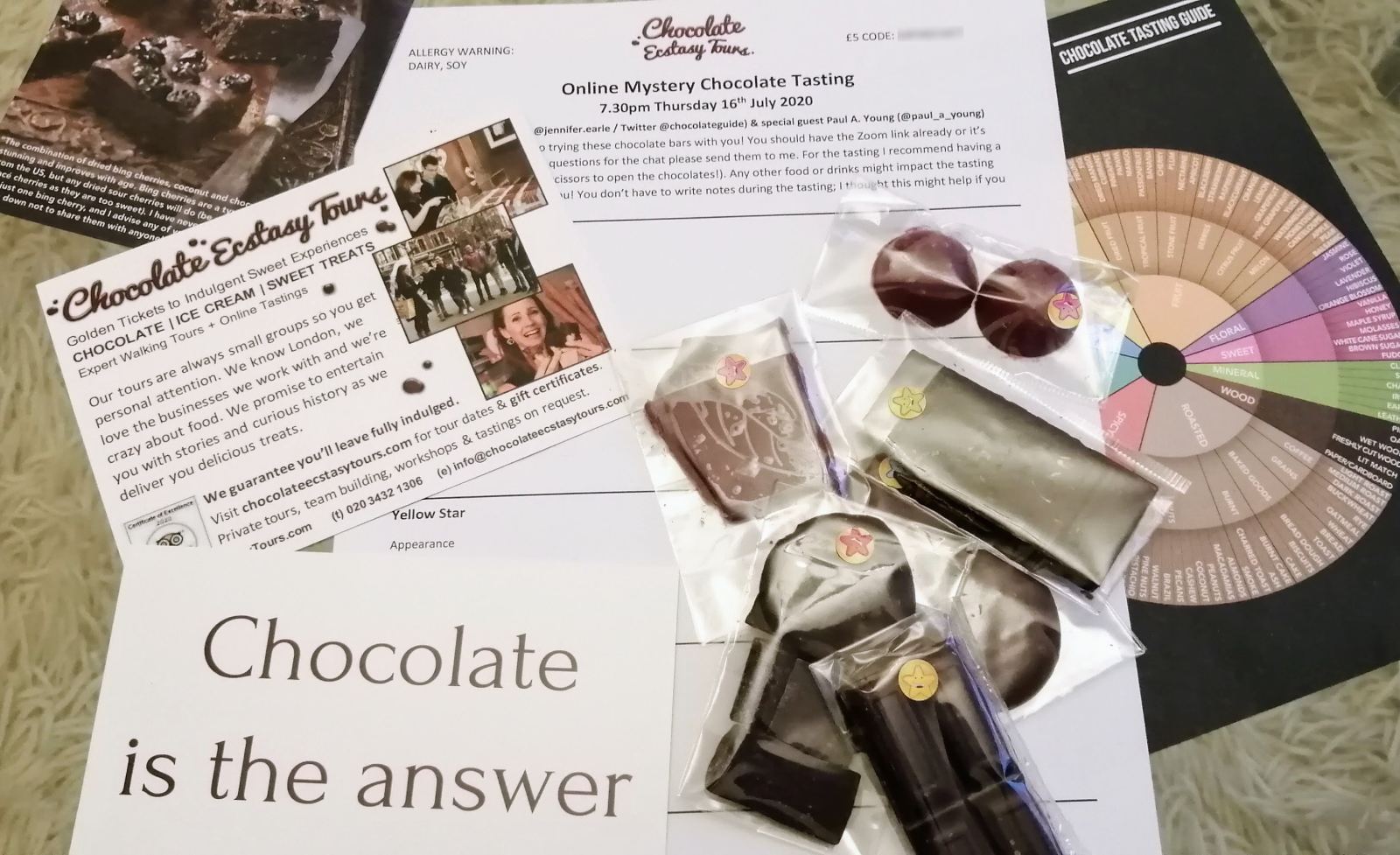
Regular readers will know I’m a big fan of Jennifer Earle’s Chocolate Ecstasy Tours; walking tours of some of London’s best chocolate shops and sweet treat establishments.
Unfortunately, the current pandemic has meant that these tours have had to go on hold, and Jen has had to look for other ways to keep the spirit of the tours going, while giving a much needed boost to some of the smaller chocolatiers and chocolate makers who have struggled during the lockdown period. To that end, she has come up with a couple of great ideas for finding great chocolate without ever leaving the comfort of your home.
First up, Jen has created a directory of online sellers, an extensive list of small producers in the UK who are selling sweet treats and baked goods online. It’s a great place to find a chocolate gift for a loved one or a pick-me-up for yourself!
More recently, she has introduced a new and exciting idea, the Online Mystery Chocolate Tasting, and she was kind enough to send me a tasting pack for the latest tasting.
When you sign up for an Online Mystery Chocolate Tasting, you’ll be sent one of these packs in the post and a link to join the Zoom videoconferencing event via email. One of the great things about the tastings is that anyone can join the Zoom event and watch along, but obviously you’re only going to get the full experience if you have the tasting pack.

On this occassion, Jen had invited master chocolatier Paul A Young along to talk about the chocolates as we tasted them. Although structured, the discussion was quite informal and conversational. Paul gave some insights on how he uses particular flavour profiles in his own work, and after tasting and discussing each piece of chocolate, Jen revealed what it was and gave plenty of background information about the maker.

In our case, all the producers were British bean-to-bar chocolate makers, but it’s important to note that there will be different chocolates – and types of chocolate – for each tasting event. Otherwise, of course, it wouldn’t be a mystery! If you are looking to find out more about the chocolates, or have specific dietary requirements, then you can drop Jen an email beforehand just to check the chocolates in your chosen session are suitable.

While the video chat was limited to Jen and Paul, the rest of us were able to make comments via the Zoom chat as well as give quick feedback via the “Thumbs Up” feature. This was a great way to involve everyone while avoiding any chaos that may have resulted from everyone being allowed to speak. There were over 70 people in the call, so this was probably for the best!
I really enjoyed the format of this online tasting, and thoroughly recommend it to anyone who loves chocolate. It’s a great little gift, or something to do as a couple on the sofa (the tasting packs contain enough chocolate for two) and you can engage as much or as little as you are comfortable with. I really appreciated the fact that anyone can come along and join in, and Jen has also made the video from this tasting available in full. You can watch it below.
At the time of writing, the next tasting event is August 12th 2020 with Bettina Campolucci Bardi of Bettina’s kitchen. Tasting packs cost £19.95 and you can purchase yours here.
Information- Filed under chocolate ecstasy tours, jennifer earle, paul a young.
The post Online Mystery Chocolate Tasting With Chocolate Ecstasy Tours appeared first on Chocablog.
Galaxy Vegan Chocolate [ 09-Feb-20 8:55pm ]
It's been a while since I've looked at any mass market confectionery chocolate, but these new Galaxy Vegan chocolate bars really caught my eye when they were announced recently.
In theory, creating vegan chocolate is easy. All dark chocolate should be dairy free and therefore vegan. But if you want to replicate the sweetness and creaminess of a milk chocolate, it's a lot more difficult.
There are a few options that manufacturers can use to replace the milk in milk chocolate, but they all have drawbacks. A common one is rice flour, but if you'd ever tried a pure rice milk chocolate, you'll know it doesn't really taste much like milk chocolate. Rice lacks the creaminess or the fat content to give that satisfying milk chocolate flavour and mouthfeel.
Some manufacturers use oat or almond flours, but they have drawbacks of their own, not least of which is the fact that they add a distinct flavour to the chocolate.
One dairy alternative that we don't see very often is hazelnut paste. Of course, there are many chocolate products that contain hazelnuts, including everything from Nutella to high end gianduja, but it's rarely marketed as a vegan milk chocolate alternative.
For these new Galaxy Vegan bars, Mars has opted to use a combination of hazelnut and rice flour to replace the dairy. Hazelnuts have a high fat content, which is great for replicating the mouthfeel of milk chocolate, but they do also have a strong flavour. I suspect that's one of the reasons why rice has been used as well in the chocolate recipe. The hazelnut gives creaminess, but the rice helps to offset the flavour and give the chocolate "body". Hazelnut paste is a thick liquid at room temperature, so if too much were used, the chocolate would end up very soft.
So how well does it work in these bars?To my surprise, very well indeed.
There are three flavours in the range; Caramelised Hazelnut, Caramel & Sea Salt and Smooth Orange. There's no "unflavoured" option, likely because they're all going to taste of hazelnuts to some extent. They are smooth and creamy, and you might never guess they were dairy free if you hadn't been told.
I particularly liked the Smooth Orange, but other friends who sampled them preferred the Caramel & Sea Salt.
For a product that I'd class as a "supermarket chocolate", these are a great choice for vegans and non-vegans alike. You pay a little more than a standard Galaxy bar, but you're getting a large (100g) bar and a product with a very clean ingredients list. There's no palm oil or shea, and only natural flavourings and a little sunflower lecithin added.
I'm sure the increased price and the very fact that it says "Vegan" on the front will annoy some, but I'd be quite happy to eat any of these, which is more than I can say for most confectionery chocolate these days.
InformationThe post Galaxy Vegan Chocolate appeared first on Chocablog.
Chocolate Society Hot Chocolate Shaker [ 03-Dec-19 10:53am ]
Until a few days ago, I didn’t realise how much I needed a hot chocolate shaker in my life. This little plastic cup from The Chocolate Society has changed the way I make hot chocolate for good.
What is a hot chocolate shaker? Put simply, it’s just a cup with a lid that allows you to make a perfectly smooth hot chocolate by shaking chocolate with hot milk or water. The simple act of shaking helps the drink form an emulsion much more effectively than stirring or whisking.

If you try to shake a hot drink in a normal jar or bottle however, you’re more than likely going to be faced with an explosion of hot liquid. The problem is that heat from the liquid causes the air in container to expand rapidly, effectively turning the whole thing into a hot chocolate bomb. It’s not something I recommend trying at home.
Al Garnsworthy at The Chocolate Society thought about this problem and came up with a fantastically elegant solution; an expanding rubber lid that pops up when the pressure inside the jar increases. It’s a simple idea, but it works incredibly well.


There’s also a few other design features that make this a must-have device for any hot chocolate lover. Most importantly is the way the lid firmly seals onto the jar. Let’s not forget you’re going to be shaking a container full of hot liquid, so it’s absolutely vital that lid stays firmly in place when shaking. I was a little nervous the first time I tried the shaker, but I needn’t have worried. As long as you’re careful to make sure the lid is nice and tight, the seal is good and strong.
After a couple of seconds shaking, the lid pops up. After about 10 seconds shaking, your hot chocolate is ready.

The other nice design touch is the jar is insulated with a double wall, meaning it stays cool to the touch at all times. It’s made from a very strong plastic and feels like it can take a lot of abuse and keep going for years. It’s dishwasher safe, but because there’s no nasty residue, it’s really easy to wash by hand too.

But the best thing about the Hot Chocolate Shaker is the quality of the drink it makes. With traditional hot chocolate making methods, I always find some residue at the bottom of the mug or pan I’m making it in, even after thorough whisking. Every time I’ve tried the shaker, I’ve produced a perfectly smooth drink with no residue at all. It actually tastes better because more of the chocolate is emulsified and less is left behind.
I know there are fancy hot chocolate making machines on the market at the moment, and I’ve not tried any of those. They may be wonderful and produce an even more satisfying experience, but I love the simplicity of my hot chocolate shaker. I can take it to work, heat some milk in the microwave and make myself a fast and delicious drink that’s as good as any I’ve had.
It’s currently on sale for under £20, which is great deal for such an effective kitchen gadget. If you love hot chocolate or know someone who does, do yourself a favour and pick one up.
My hot chocolate shaker was provided free of charge for review by The Chocolate Society.
Information- Buy it online from:
- Filed under chocolate society, hot chocolate, hot chocolate shaker.
The post Chocolate Society Hot Chocolate Shaker appeared first on Chocablog.

"You cannot always live on the mountain top,but when you walk through the valley,the memory of the mountain will sustain youand give you strength to carry you through.."
- Ravi Zacharias (The Grand Weaver)Buy your copy here :)
DM for original work - if you would like to see this in print...
The Pool Melbourne
We had a fabulous time, chatting all the way. It was 7thJuly 2020 and the coronavirus lockdown was starting to lift, but everyone was still being cautious. It was such a joy to be out with a friend again enjoying the English summer at its peak. Did I mention it was raining?
Melbourne HallBy the time we had returned to Melbourne we were soaked and hungry, but the pubs and cafes were still closed. We bought some sandwiches and tea from a bakery and sheltered from the rain under the marketplace pavilion. 'Pavilion' is maybe not the best description but I am at a loss. There were 4 benches facing outwards from the stone centre, the marketcross built in 1889, and a roof over us held up by wooden posts on each corner. We enjoyed sitting in the dry and watching the cars passing by, with a hot drink and some deep discussions, oblivious to the constant downpour.
The market crossMy friend told me about Professor Jem Bendell and 'Deep Adaptation'. Bendell promotes the idea that we are already too far along the climate change route to prevent societal collapse, and that we should focus on enjoying the important things in life for the remaining years.
It doesn't resonate with me. Rapid globalisation has created some big issues for the planet and I think most people recognise that in the core of their being without spending too much time on the over-whelming evidence supporting it, when they could be focusing on the solutions. I just don't accept the 'we are doomed' conclusion, which isn't new and has been pushed for the last 30 years or more. Plus define 'doomed', because it could be anywhere on a scale from a financial recession to extinction, and the most probable outcomes are somewhere between the two.
There is plenty of evidence that indicates doom isn't upon us which I will touch on. I also feel that nothing positive will emerge from that kind of despair. People need hope and there is genuinely a lot to be hopeful for, though I may struggle to get it all in one post, so maybe this is the start of a new series of posts.
I read a few of Bendell's blog posts and watched a couple of youtube videos. I was surprised that one of the proposals was that people concerned about climate change go through a stage of despair followed by a stage of prepping for collapse. I have been through those stages, but I always felt this was a complete anomaly in the UK. Even my friend sitting with me in the rain, who has supported the climate change movement for at least the last 15 years that I have known her, has not experienced that and we know no one else who has. If you have then please do get in touch either in response to this post or by private message to me. For me the stage after prepping is a deep understanding and knowing that there is a lot of hope and optimism for the future.
There is no disputing that there are some climate facts behind Bendell's work, however I feel there are also some simplifications and a denial of progress and human nature, which skew his conclusion of collapse. There is a big difference between fact and theory or projections. Even with regard to facts they can look different dependent on what side of them you come from (your natural bias) and of course they can change with time. For instance the World population is a fact, but the figure changes daily. What I am saying is that nothing is fact and everything is in flux and in particular anything predicated on human behaviours and reactions. Experts struggle to predict next week's weather, so looking further in the future is unreliable. Anything can happen today that could change everything tomorrow… and it frequently does.
What I didn't like about this Deep Adaptation video on youtube is the comment below it that states:
As Dr. Bendell notes, there will be a tendency to want to reject his conclusions in Deep Adaptation since to accept them is so life changing in its repercussions.You may also want to dismiss Deep Adaptation because you simply disagree with their conclusions, but with this sentence Bendell has dismissed every argument against his theory as coming from someone 'in denial'. In addition he talks about the middle classes in his posts, and maybe he means that middle class society is collapsing and if it is hurray, because I am all for a classless society. However it does seem to overlook that it is the working class who are the collective power behind change (as well as being the least burden on the climate) and that there is a lot missing from this research if large parts of the population are overlooked.
My friend took from Bendell that collapse is inevitable, so stop worrying and spend the remaining years on things that have meaning for you. The perception being that Collapse means an end of life/ mass extinction event, rather than an end of a way of life such as a breakdown of current societal norms. Collapse represents fear, and just the word pulls the mind into a fear-driven frenzy where logic and reason jump ship and denial seems like a viable option. So let's replace 'Collapse' with 'Change'. There will be changes, there has to be changes in our society and history shows that there always have been changes.
Tobacco smoke is a killer, and in order to persuade people to quit smoking every packet has a disturbing image of the damage it has inflicted on some smokers. It looks pretty scary and if I were a smoker I would think that I was damned to die of some horrible lung disease or cancer before too long. The emphasis on the worst case scenario is aimed at scaring people into changing their smoking habit. For some people it makes the future look hopeless, so they may as well continue to enjoy smoking as they will be dead soon anyway. And yet we all know of someone who smoked until they were 80 with no sign of ill affect at all. How can that be? Maybe that future is not written in stone?
We are focusing on the worst case scenario for a smoker. That's what we are doing with climate change too. This may scare us into changing our lifestyles or putting legislation in place and on the whole it has had that effect. However it can also cause people to become paralysed by fear or believe any efforts are futile. But there are other ways for positive change to come about and it is far better that we enjoy and embrace those changes because then they will be changes that are here to last.
I was given a book for Christmas "The Uninhabitable Earth - A story of the future" by David Wallace-Wells. It's a shocking title but drew me in with the promise of an envisioned future. I only made it to page 44 and the weight of all the depressing, boring facts and figures that were being driven down to make you feel the full weight of hopelessness was enough. So I skipped to the back to see what the bright future might look like, but it was pretty much more of the same. Now if you have more stamina than me and have read this book in its entirety then please do enlighten me about the good parts that I have missed, or even shout up just to let me know you have not died of despair. I am a solutions person. I wanted to find someone who could envision the future for us and see the solutions - what is the use banging on about the same old stuff?
Wallace-Wells message is the equivalent of the stark image of lung cancer on a cigarette pack, I guess I have grown numb to it. Whereas the solutions such as banning smoking from public spaces worked just as well but without the fear factor. Providing solutions for people is a lot more empowering than just painting a bleak picture and leaving them paralysed. Obviously the fear factor is better for selling books…
Now I don't deny that there is evidence that looks pretty bleak for the planet, but that evidence has been around for years. The Uninhabitable Earth has been compared to the Silent Spring by Rachel Carson published in 1962 and there has not been a silence regarding environmental damage in the years in between. I remember the mistake of bringing study material, Limits to Growth: The 30 Year Update, with me on holiday in 2006 and I sure felt the despair that Bendell talks about then!
The 30 year update was written in 2004 and the data used was from the years preceding that, and, well, things change. I think we only have to look at the growing proportion of renewables in the electricity grid in the UK to see that things change. Or the consistent tightening of energy efficiency targets in Building Regulations. Or the energy efficiency labels for cars, homes and white goods, with the commitments to phase out petrol cars completely. Standards are consistently being raised and maybe progress has started slow, but momentum is growing. The growth in globalisation completely over-shadowed the gains made until recently, and now there are more and more positive reports emerging. It's clear that our perceptions and understandings of where we are need to change constantly and be open to the improvements we see, not just the devastation being caused.
There is definitely a delayed response in the updated facts being interpreted, understood and then disseminated and grasped by the wider community. Population growth is a good example of that and I would urge anyone who hasn't yet seen the fantastic explanation by the late Hans Rosling back in 2013 to watch it. Even though the facts and figures have moved on already and there was more good news about population growth slowing further in the news this week. The message is clear that population is still increasing, but it is no longer accelerating. The continuing growth is down to the increase in life expectancy of people already alive, and is no longer due to birth rate which has dropped considerably (see below).
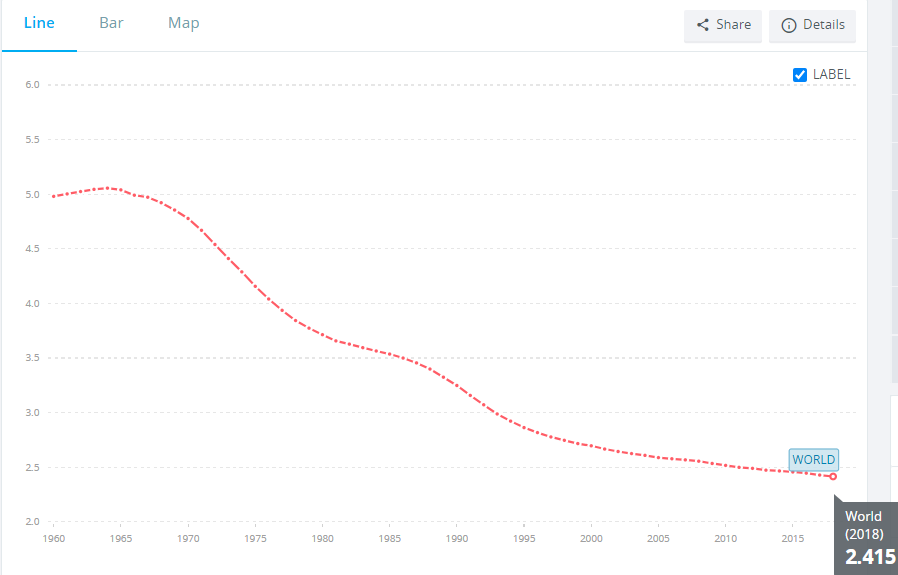
World fertility rates (births per woman), The World Bank,
Birth rate is a clear area where the actual changes have to be taken by individuals. Yes education and access to contraception are vital to enable that, but couples have chosen to move away from the large families of their parents and grandparents. Who would have thought it was possible to change that on a global scale?
The coronavirus pandemic predictions were bleak in the UK. Maybe they needed to be to prod our slow and bumbling government into action. However the 250,000 - 510,000 deaths predicted for the UK on the 16th March by Neil Ferguson's Imperial College team were based on the worst case scenario. That worst case scenario may have been fairly accurate based on the information available at the time and the assumptions made. Those assumptions can make an enormous difference. That's why there will be several scenarios run for different assumptions. The worst case is the do nothing scenario, the best case is that all infections are tracked and everything is under control, which was equally as unlikely in the UK as the worst case, however not totally impossible.
It is the same with the impacts of climate change, there is a range of 'likely' outcomes based on how much or little action is taken to reduce carbon emissions and mitigate the impact. My concern is that human nature seems to be misunderstood in modelling and some of the positive changes happening now are overlooked.
Most of the constructs which govern our society and dictate the actions of the majority are beliefs, traditions or habits. For instance families were large because they were for our ancestors and our neighbours, because there was and still is a belief perpetuated by religion that contraception is bad and because people weren't educated on the choices they had or choices weren't widely available. The barriers that needed to be broken weren't physical (although it all came down to a physical barrier at the basic level J).
Back to coronavirus, the decision of when to lockdown and how far to go, was a human one that made a significant difference on the overall impact of the virus. If you were calculating this based on monetary costs alone then you would not expect a lockdown to be implemented, because the economic risk was enormous and the probability of stopping the virus spreading seemed slim. Those most at risk were the weak and frail members, not the productive worker members of society. Boris Johnson certainly preferred the do nothing approach to start with, talking about 'herd immunity'.
However this was out of kilter with the rest of human nature, which is to protect and care for loved ones. Many companies had already started to voluntarily shut down offices and ask their staff to work from home a few weeks prior to the government instigated lockdown. The pressure for the government to act on behalf of society was immense and of course they had to go with it. So who would you say made the decision in the end? Was it the politicians or was it forced by public opinion? Where does the power really lie?
Whilst there are some people who did not stick to the lockdown rules, the vast majority did. The vast majority have tried to take care of themselves, their loved ones and their community by following government advice, however confusing and pointless some of it seemed at times. This human effect has made a difference. This community response has shifted the outcome away from the worst case prediction. The power of this human response and its influence on decision-makers was under-rated. Similarly Bendell and others mistakenly believe that the natural instinct for humans is to protect only themselves at all costs, but it never has been. We are social animals.
When I read The 5 Stages of Collapse by Dmitry Orlov he discussed a tribe that had lost this community instinct to protect others. It was most disturbing to read of parents with no regard for their off-spring and the extreme conditions that had brought this shift in culture about. It is an anomaly that is so alien to our current culture. I can understand that writing in the age of Brexit the feeling of division and disdain for others was at its peak. However the lockdown has brought a blossoming of communities, just as social interaction and national pride were buoyant during the 2012 Olympics and Queen's Jubilee celebrations. We can choose whether we foster and promote feelings of despair, isolation and fear of others OR encourage community spirit and camaraderie. I know which I prefer.
Another very positive change for the future is the new generation. My climate change fear years were during a time when the Baby Boomers were the dominant decision makers, with their focus on growth. Now 20 years later it is my generation that are taking up the reigns and the focus has moved more to sustainability and there has been a shift in gear. In 20 years' time the decisions will be made by a new generation who have lived through lockdown, protested for Black Lives Matter and get their news from social media, rather than mainstream media. Growth at all costs will no longer be on the agenda. I could argue that we are already there, as for most of the world growth has been demoted and saving lives has become far more important when faced with a pandemic. Money is bailing out people and businesses not financial intuitions - that's an incredible shift away from austerity.
Most of the solutions we need to transition to a low carbon sustainable lifestyle are already available. Many are underway and building up momentum. Just like the shift seen in population growth, individual change is not only possible but is in motion. Your choices have made it so. As shown with lockdown, the people have immense power to instigate the changes needed and are already surging ahead of government legislation.
Over the next few posts I will write you that positive future that I know to be true, with examples of low carbon successes.
The Infamous Class 3 School Illustration (1976-1979) [ 24-Jul-20 9:30am ]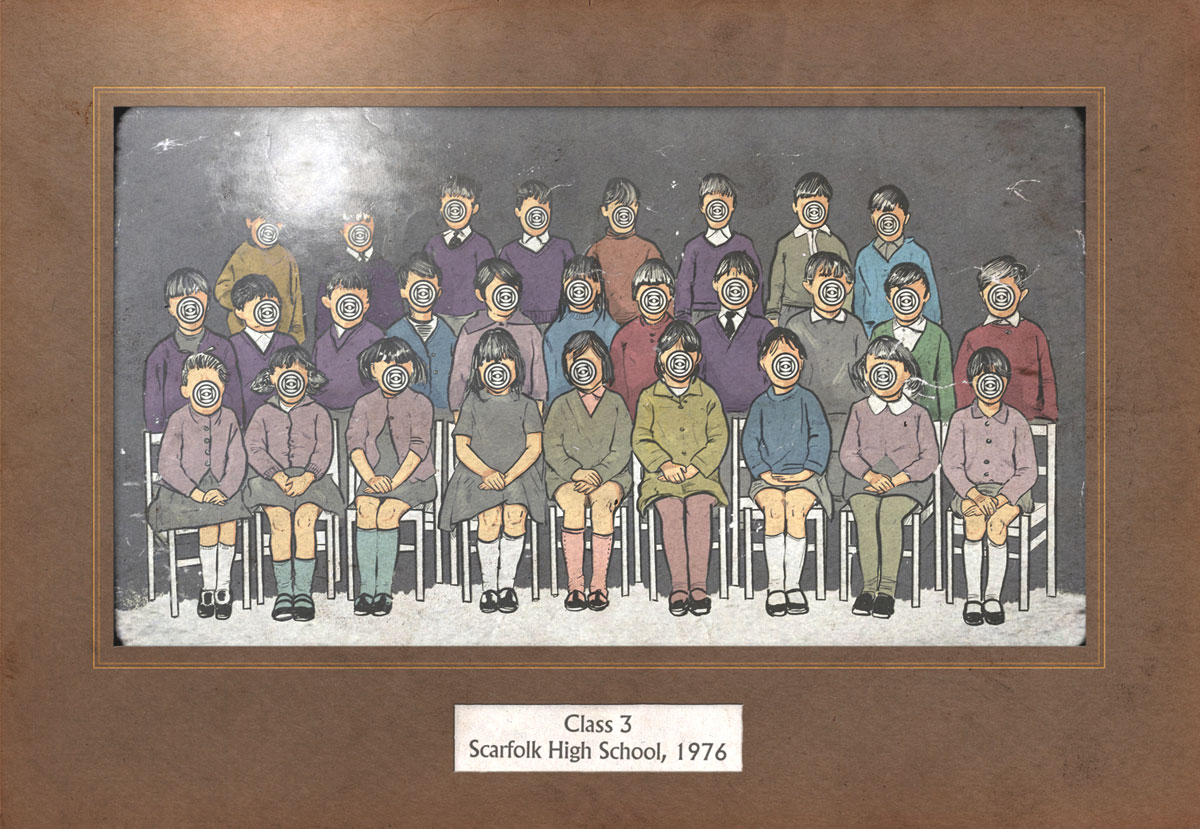
On 7 September, 1976, dozens of children, including every single pupil from class 3, Scarfolk High School, vanished on their way to school. A police operation was launched but no clues were ever found. The children were pronounced dead the following Monday, a mere three days later.
Every year thereafter, the police commissioned their sketch artist to draw, in the style of a school photograph, how the missing children might have looked (albeit with their faces removed) had they not disappeared in mysterious circumstances. This was sent to the bereaved parents of class 3 at an exorbitant cost of £31.25.
In the 1979 class sketch, one parent noticed a small label on one of the faceless figure's clothes that contained a code word only their child could have known.
Under mounting pressure from parents, the police eventually raided their artist's studio and found 347 children in his cellar where many had been held captive for several years. The police immediately seized and confined the children as evidence in a crime investigation, which, after much dithering, ultimately never went to court leaving the families no choice but to pursue a private prosecution against the kidnapper.
As the children had already been pronounced dead and the cost of amending the relevant paperwork was high, they were given away as prizes in the Scarfolk police raffle, which helped pay the legal fees of their sketch artist, who, it turns out, was the son of Scarfolk's police commissioner.

Christ is the break-through the wall of darkness that holds you back from a God who is waiting for you on the other side..

I'd like to call this one "REDEMPTIVE ART" simply because this was painted on a torn canvas that I chose to "redeem".. (I stuck a board canvas onto the stretched canvas to create the 3D effect)

"He shall cover you with His feathers, And under His wings you shall take refuge..."
Original idea credits to my dear friend Rini Bejoy... :)

Memories of a place dear to my heart.. with my kindred spirits... :)

"I will give you a new heart and put a new spirit in you; I will remove from you your heart of stone and give you a heart of flesh."
Have you had your heart transplant done yet?The Greatest Cardiothoracic SurgeonIs just a prayer away.. :)

"Prone to wander.. Lord I feel it... Prone to leave the God I love..."- based on the song "Come thou fount of every blessing"

Sometimes, life makes you walk the plank of Faith.. You feel like you are at the edge of a cliff.. You can already hear the sound of crashing waves.. All your options have run out..
You have reached your final limit... You need to take your stand..Make the decision.
And in all that fear and utter hopelessness, we forget to see the bigger picture of life... The one that has God in it...

Don't ever forget in times like these...That Jesus is forever faithful..
No matter how fatal the fall may seem.. Remember you can always choose to fall into His hands..&He will never let you go..
That GOD ANSWERS PRAYERS..
Whether it be a YES, NO or WAIT..
The answer will always be there..

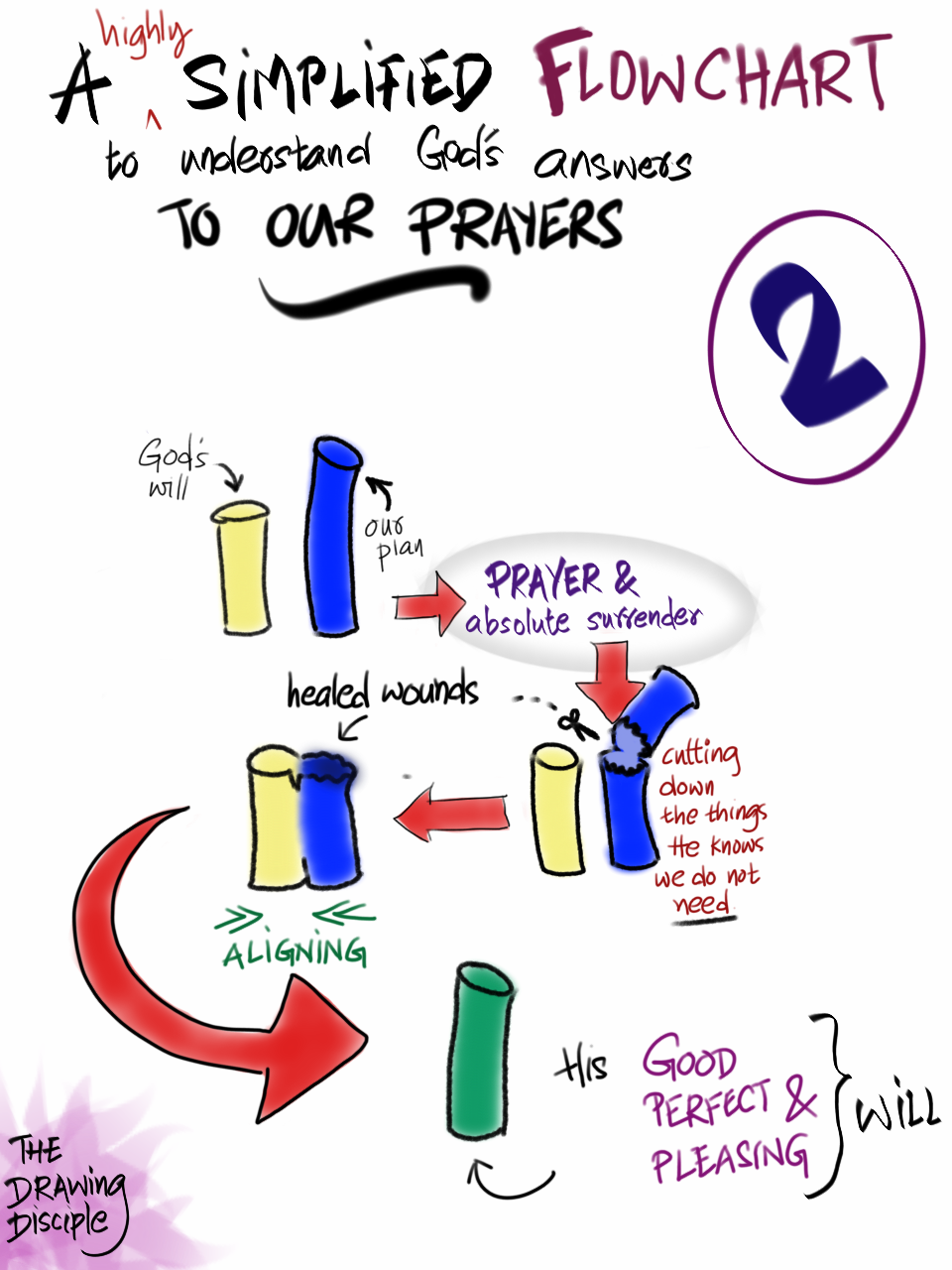
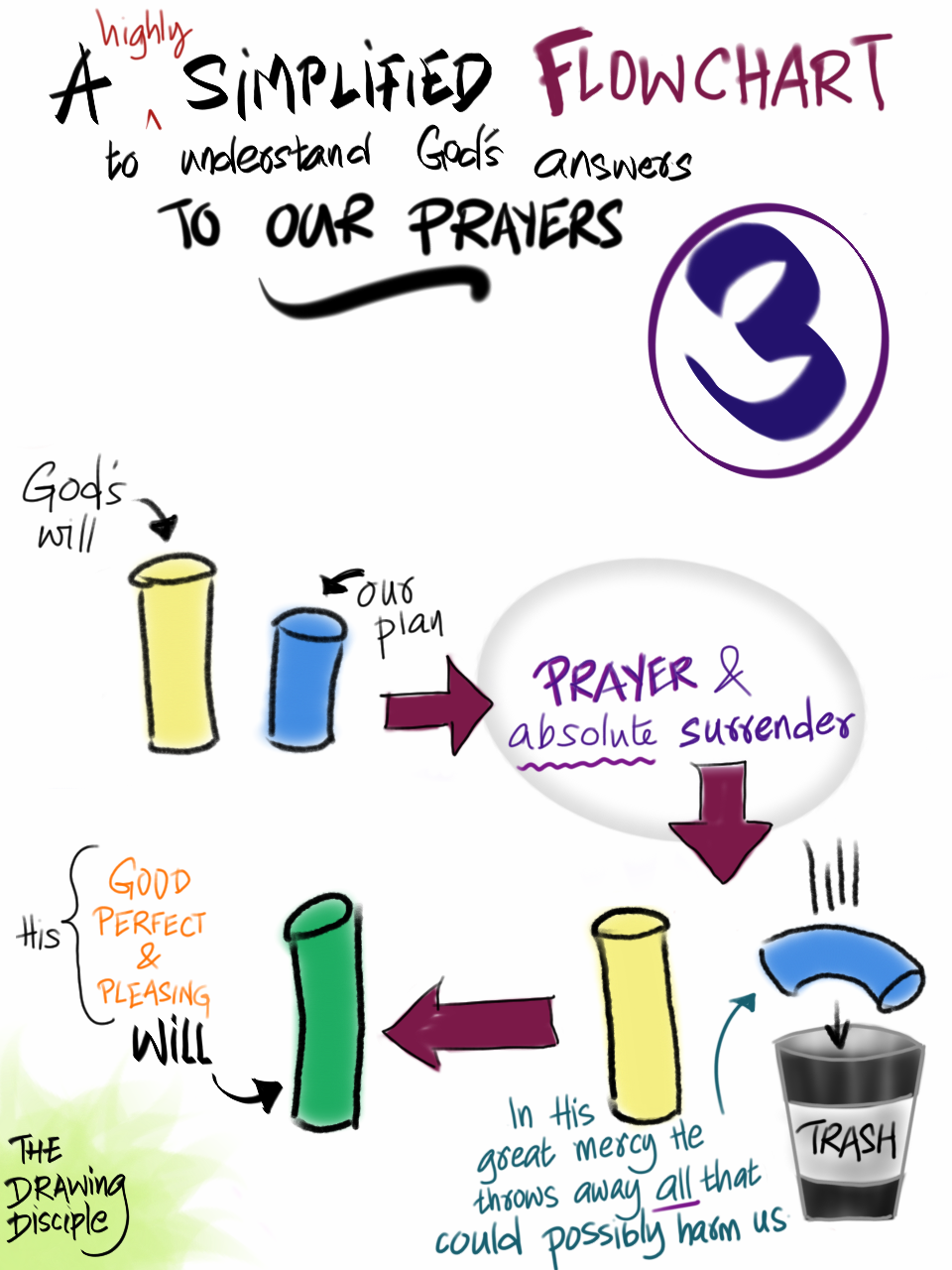
Note: The time duration at the step named "Prayer and absolute surrender" can range from a few minutes to many years and decades.It shows our silent agreement to what the Lord has decided for us leading to the subsequent steps as seen in the flowcharts above.

"For The Lord is my towerAnd He gives me the powerTo tear down the works of the enemy
In a difficult hourHe will crush the devourerAnd bring the powers of darknessUnderneath my feet...."
-Hillsongs United

"Behold, You desire truth in the innermost being,
And in the hidden part You will make me know wisdom."
Ps 51:6 (NASB)
ISAIAH 42:16
I will lead the blind by a way they did not know;
I will guide them on paths they have not known.
I will turn darkness to light in front of them
and rough places into level ground.
This is what I will do for them,
and I will not forsake them.
Ever felt like the directions in your life are all messed up?Like there are no proper 'sign boards' and you seem to be aimlessly wandering?Cling on to this promise... your real breakthrough might be just around the corner... Do not give up just yet.. His right hand is never too short to reach yours.. And the Lord will never fail to perfect that which concerns you... (Psalm 138:8)

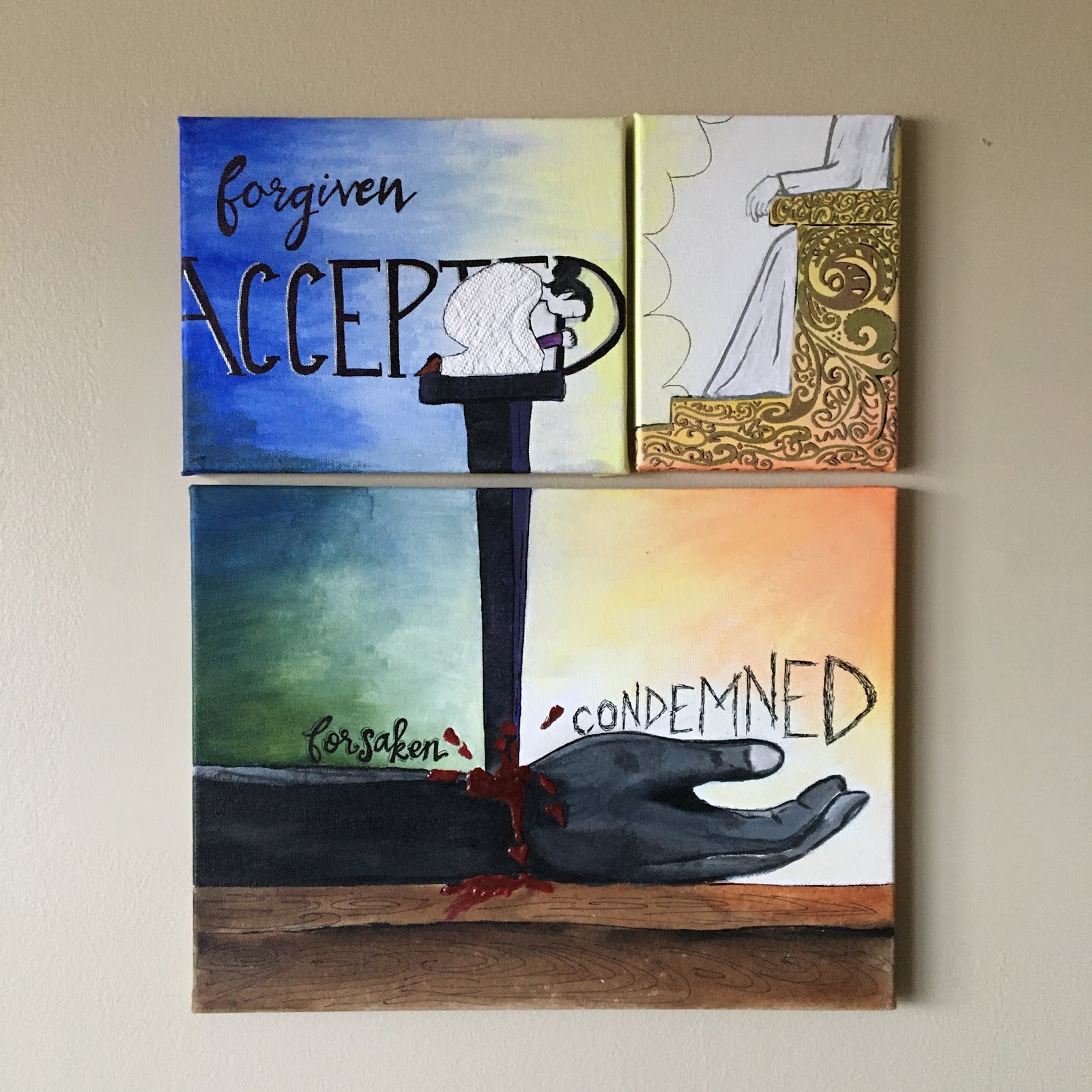
I have always felt these words belonged to different canvases. We were totally out of the picture, but God in His great mercy chose to paint another canvas, so that He could add us to the final bigger work of art!
This piece is based on the song "Amazing love".. by songwriter Billy James Foote and performed by different artists from around the world..
"I'm forgiven because you were forsaken
I'm accepted, You were condemned
I'm alive and well
Your spirit is within me
Because you died and rose againAmazing love, how can it be
That You, my King, should die for me?
(Amazing love)
Amazing love, I know it's true
And it's my joy to honor You
In all I do, to honor You"
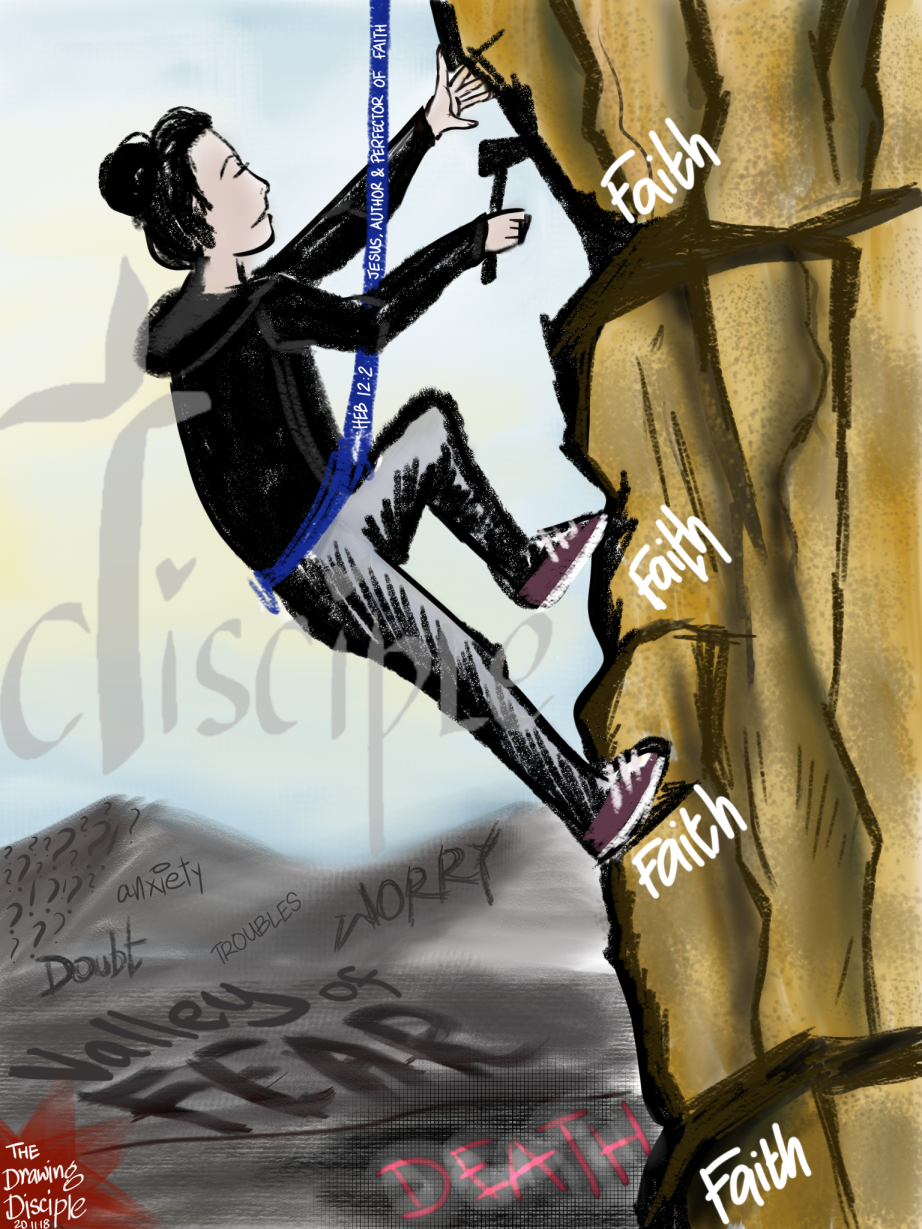
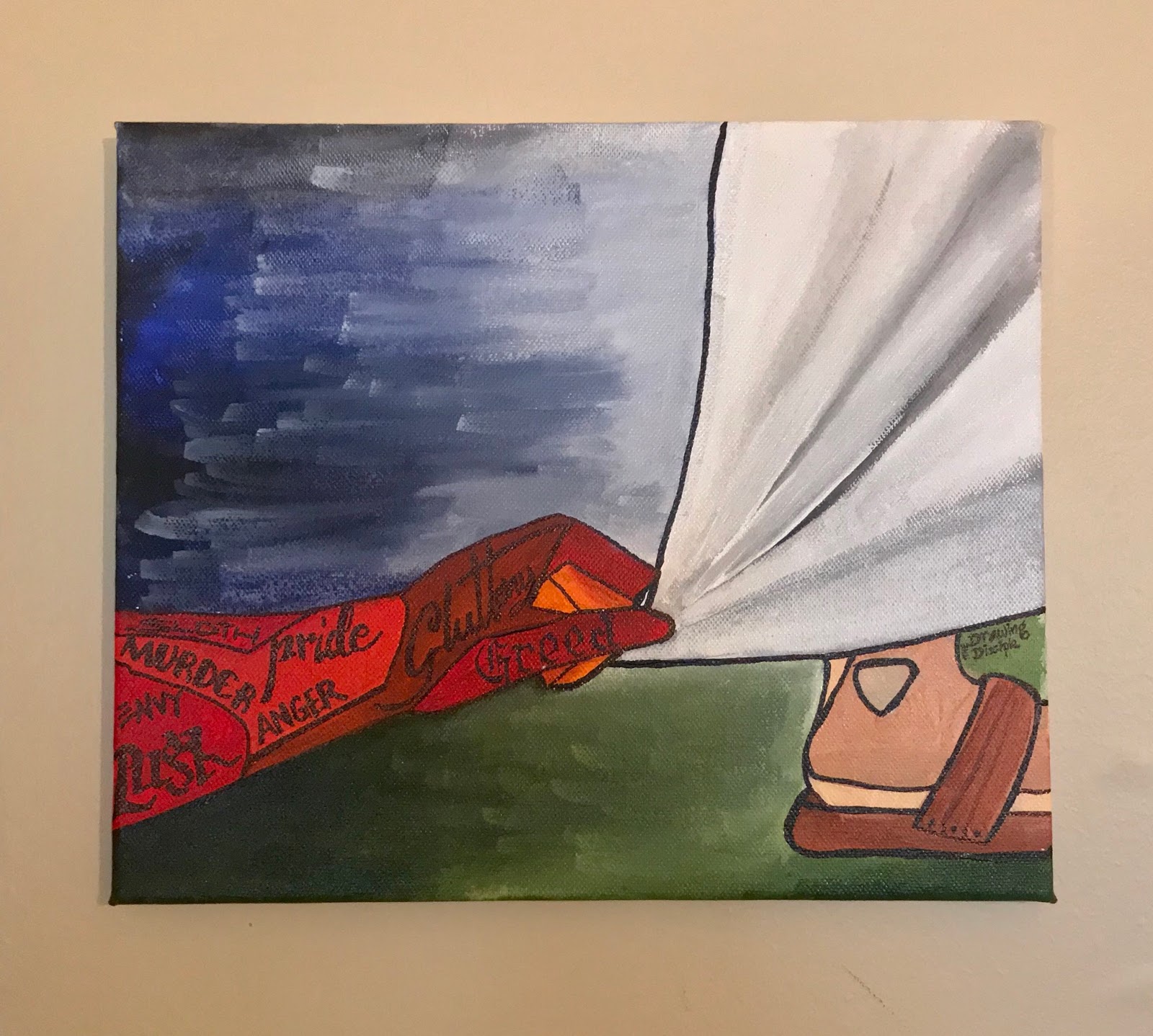
"If only I may touch His garment, I shall be made well."
Experimenting with canvas...
This is a picture that I have always wanted to draw. The inspiration is from the story of the woman who had an issue of increased bleeding since 12 years. (Matthew 9:20-22 NKJV)
It depicts a faith that is so simple.. that appears so naive that the world may consider it dumb or even foolish.
Oh but the power of that simple act of faith! Let it inspire us to believe like a child.. and trust like a baby at it's mother's bosom.. that even the reaching out to Jesus with a humble and contrite spirit..Is all that is needed to be healed and be made complete today.

RESTful APIs are everywhere. This is funny, because how many people really know what "RESTful" is supposed to mean?
I think most of us can empathize with this Hacker News poster:
I've read several articles about REST, even a bit of the original paper. But I still have quite a vague idea about what it is. I'm beginning to think that nobody knows, that it's simply a very poorly defined concept.
I had planned to write a blog post exploring how REST came to be such a dominant paradigm for communication across the internet. I started my research by reading Roy Fielding's 2000 dissertation, which introduced REST to the world. After reading Fielding's dissertation, I realized that the much more interesting story here is how Fielding's ideas came to be so widely misunderstood.
Many more people know that Fielding's dissertation is where REST came from than have read the dissertation (fair enough), so misconceptions about what the dissertation actually contains are pervasive.
The biggest of these misconceptions is that the dissertation directly addresses the problem of building APIs. I had always assumed, as I imagine many people do, that REST was intended from the get-go as an architectural model for web APIs built on top of HTTP. I thought perhaps that there had been some chaotic experimental period where people were building APIs on top of HTTP all wrong, and then Fielding came along and presented REST as the sane way to do things. But the timeline doesn't make sense here: APIs for web services, in the sense that we know them today, weren't a thing until a few years after Fielding published his dissertation.
Fielding's dissertation (titled "Architectural Styles and the Design of Network-based Software Architectures") is not about how to build APIs on top of HTTP but rather about HTTP itself. Fielding contributed to the HTTP/1.0 specification and co-authored the HTTP/1.1 specification, which was published in 1999. He was interested in the architectural lessons that could be drawn from the design of the HTTP protocol; his dissertation presents REST as a distillation of the architectural principles that guided the standardization process for HTTP/1.1. Fielding used these principles to make decisions about which proposals to incorporate into HTTP/1.1. For example, he rejected a proposal to batch requests using new MGET and MHEAD methods because he felt the proposal violated the constraints prescribed by REST, especially the constraint that messages in a REST system should be easy to proxy and cache.1 So HTTP/1.1 was instead designed around persistent connections over which multiple HTTP requests can be sent. (Fielding also felt that cookies are not RESTful because they add state to what should be a stateless system, but their usage was already entrenched.2) REST, for Fielding, was not a guide to building HTTP-based systems but a guide to extending HTTP.
This isn't to say that Fielding doesn't think REST could be used to build other systems. It's just that he assumes these other systems will also be "distributed hypermedia systems." This is another misconception people have about REST: that it is a general architecture you can use for any kind of networked application. But you could sum up the part of the dissertation where Fielding introduces REST as, essentially, "Listen, we just designed HTTP, so if you also find yourself designing a distributed hypermedia system you should use this cool architecture we worked out called REST to make things easier." It's not obvious why Fielding thinks anyone would ever attempt to build such a thing given that the web already exists; perhaps in 2000 it seemed like there was room for more than one distributed hypermedia system in the world. Anyway, Fielding makes clear that REST is intended as a solution for the scalability and consistency problems that arise when trying to connect hypermedia across the internet, not as an architectural model for distributed applications in general.
We remember Fielding's dissertation now as the dissertation that introduced REST, but really the dissertation is about how much one-size-fits-all software architectures suck, and how you can better pick a software architecture appropriate for your needs. Only a single chapter of the dissertation is devoted to REST itself; much of the word count is spent on a taxonomy of alternative architectural styles3 that one could use for networked applications. Among these is the Pipe-and-Filter (PF) style, inspired by Unix pipes, along with various refinements of the Client-Server style (CS), such as Layered-Client-Server (LCS), Client-Cache-Stateless-Server (C$SS), and Layered-Client-Cache-Stateless-Server (LC$SS). The acronyms get unwieldy but Fielding's point is that you can mix and match constraints imposed by existing styles to derive new styles. REST gets derived this way and could instead have been called—but for obvious reasons was not—Uniform-Layered-Code-on-Demand-Client-Cache-Stateless-Server (ULCODC$SS). Fielding establishes this taxonomy to emphasize that different constraints are appropriate for different applications and that this last group of constraints were the ones he felt worked best for HTTP.
This is the deep, deep irony of REST's ubiquity today. REST gets blindly used for all sorts of networked applications now, but Fielding originally offered REST as an illustration of how to derive a software architecture tailored to an individual application's particular needs.
I struggle to understand how this happened, because Fielding is so explicit about the pitfalls of not letting form follow function. He warns, almost at the very beginning of the dissertation, that "design-by-buzzword is a common occurrence" brought on by a failure to properly appreciate software architecture.4 He picks up this theme again several pages later:
Some architectural styles are often portrayed as "silver bullet" solutions for all forms of software. However, a good designer should select a style that matches the needs of a particular problem being solved.5
REST itself is an especially poor "silver bullet" solution, because, as Fielding later points out, it incorporates trade-offs that may not be appropriate unless you are building a distributed hypermedia application:
REST is designed to be efficient for large-grain hypermedia data transfer, optimizing for the common case of the Web, but resulting in an interface that is not optimal for other forms of architectural interaction.6
Fielding came up with REST because the web posed a thorny problem of "anarchic scalability," by which Fielding means the need to connect documents in a performant way across organizational and national boundaries. The constraints that REST imposes were carefully chosen to solve this anarchic scalability problem. Web service APIs that are public-facing have to deal with a similar problem, so one can see why REST is relevant there. Yet today it would not be at all surprising to find that an engineering team has built a backend using REST even though the backend only talks to clients that the engineering team has full control over. We have all become the architect in this Monty Python sketch, who designs an apartment building in the style of a slaughterhouse because slaughterhouses are the only thing he has experience building. (Fielding uses a line from this sketch as an epigraph for his dissertation: "Excuse me… did you say 'knives'?")
So, given that Fielding's dissertation was all about avoiding silver bullet software architectures, how did REST become a de facto standard for web services of every kind?
My theory is that, in the mid-2000s, the people who were sick of SOAP and wanted to do something else needed their own four-letter acronym.
I'm only half-joking here. SOAP, or the Simple Object Access Protocol, is a verbose and complicated protocol that you cannot use without first understanding a bunch of interrelated XML specifications. Early web services offered APIs based on SOAP, but, as more and more APIs started being offered in the mid-2000s, software developers burned by SOAP's complexity migrated away en masse.
Among this crowd, SOAP inspired contempt. Ruby-on-Rails dropped SOAP support in 2007, leading to this emblematic comment from Rails creator David Heinemeier Hansson: "We feel that SOAP is overly complicated. It's been taken over by the enterprise people, and when that happens, usually nothing good comes of it."7 The "enterprise people" wanted everything to be formally specified, but the get-shit-done crowd saw that as a waste of time.
If the get-shit-done crowd wasn't going to use SOAP, they still needed some standard way of doing things. Since everyone was using HTTP, and since everyone would keep using HTTP at least as a transport layer because of all the proxying and caching support, the simplest possible thing to do was just rely on HTTP's existing semantics. So that's what they did. They could have called their approach Fuck It, Overload HTTP (FIOH), and that would have been an accurate name, as anyone who has ever tried to decide what HTTP status code to return for a business logic error can attest. But that would have seemed recklessly blasé next to all the formal specification work that went into SOAP.
Luckily, there was this dissertation out there, written by a co-author of the HTTP/1.1 specification, that had something vaguely to do with extending HTTP and could offer FIOH a veneer of academic respectability. So REST was appropriated to give cover for what was really just FIOH.
I'm not saying that this is exactly how things happened, or that there was an actual conspiracy among irreverent startup types to misappropriate REST, but this story helps me understand how REST became a model for web service APIs when Fielding's dissertation isn't about web service APIs at all. Adopting REST's constraints makes some sense, especially for public-facing APIs that do cross organizational boundaries and thus benefit from REST's "uniform interface." That link must have been the kernel of why REST first got mentioned in connection with building APIs on the web. But imagining a separate approach called "FIOH," that borrowed the "REST" name partly just for marketing reasons, helps me account for the many disparities between what today we know as RESTful APIs and the REST architectural style that Fielding originally described.
REST purists often complain, for example, that so-called REST APIs aren't actually REST APIs because they do not use Hypermedia as The Engine of Application State (HATEOAS). Fielding himself has made this criticism. According to him, a real REST API is supposed to allow you to navigate all its endpoints from a base endpoint by following links. If you think that people are actually out there trying to build REST APIs, then this is a glaring omission—HATEOAS really is fundamental to Fielding's original conception of REST, especially considering that the "state transfer" in "Representational State Transfer" refers to navigating a state machine using hyperlinks between resources (and not, as many people seem to believe, to transferring resource state over the wire).8 But if you imagine that everyone is just building FIOH APIs and advertising them, with a nudge and a wink, as REST APIs, or slightly more honestly as "RESTful" APIs, then of course HATEOAS is unimportant.
Similarly, you might be surprised to know that there is nothing in Fielding's dissertation about which HTTP verb should map to which CRUD action, even though software developers like to argue endlessly about whether using PUT or PATCH to update a resource is more RESTful. Having a standard mapping of HTTP verbs to CRUD actions is a useful thing, but this standard mapping is part of FIOH and not part of REST.
This is why, rather than saying that nobody understands REST, we should just think of the term "REST" as having been misappropriated. The modern notion of a REST API has historical links to Fielding's REST architecture, but really the two things are separate. The historical link is good to keep in mind as a guide for when to build a RESTful API. Does your API cross organizational and national boundaries the same way that HTTP needs to? Then building a RESTful API with a predictable, uniform interface might be the right approach. If not, it's good to remember that Fielding favored having form follow function. Maybe something like GraphQL or even just JSON-RPC would be a better fit for what you are trying to accomplish.
If you enjoyed this post, more like it come out every four weeks! Follow @TwoBitHistory on Twitter or subscribe to the RSS feed to make sure you know when a new post is out.
Previously on TwoBitHistory…
New post is up! I wrote about how to solve differential equations using an analog computer from the '30s mostly made out of gears. As a bonus there's even some stuff in here about how to aim very large artillery pieces.https://t.co/fwswXymgZa
— TwoBitHistory (@TwoBitHistory) April 6, 2020
-
Roy Fielding. "Architectural Styles and the Design of Network-based Software Architectures," 128. 2000. University of California, Irvine, PhD Dissertation, accessed June 28, 2020, https://www.sciencedirect.com/science/article/pii/S0315086011000279. ↩
-
Fielding, 130. ↩
-
Fielding distinguishes between software architectures and software architecture "styles." REST is an architectural style that has an instantiation in the architecture of HTTP. ↩
-
Fielding, 2. ↩
-
Fielding, 15. ↩
-
Fielding, 82. ↩
-
Paul Krill. "Ruby on Rails 2.0 released for Web Apps," InfoWorld. Dec 7, 2007, accessed June 28, 2020, https://www.infoworld.com/article/2648925/ruby-on-rails-2-0-released-for-web-apps.html ↩
-
Fielding, 109. ↩
Beer Mats of the 1970s [ 28-Jun-20 12:11pm ]The pubs will reopen in a few days. Every day this week we will post a 1970s beer mat from the Scarfolk council archives. Collect them all!