
 Photo [ 05-Jul-21 3:13pm ]
 Jan Faye, The Reality of the Future — An Essay on Time, Causation and Backward Causation (Odense University Press) / Who is afraid of the Causal-General Approach? [ 04-Jul-21 9:05pm ]
"Faye's book is, without doubt, an important contribution to the theory of causality. It is meant not merely to reconstruct or to react to existing scientific knowledge but “to outline the conceptual foundations of new scientific knowledge". In that sense, it stands in the tradition of classical essays concerning natural philosophy and metaphysics. Faye's aim is nothing less than to give us a comprehensive characterisation of the conceptual and logical features of the direction of causation (including a coherent notion of backward causation) and, what is more, to give us an understanding of how causation is related to energy and time. The monograph is original to a very large extent; sometimes provocative (for more traditional accounts). It contains eight chapters, an introduction, conclusion, and a helpful index. In the following, we briefly mention the content of Faye's book and point out those of his claims which seem to demand further clarification. Chapter I deals with 'The puzzles about backward causation'. However, Faye's theory of backward causation is not a really shocking one - no fortune-tellers, no altering the past, nor shooting someone's own grandfather. Even if there were instances of causal relationship directed against the temporal order of events of the system under consideration, the kind of involved particles is limited to hypothetical quantum-mechanical objects ("advanced particles") only. Moreover, those objects would not be able to interact (at least not directly) with the "normal particles" of the world. This topic is considered in more detail in the last two Chapters VII (The advanced particles'), VIII (‘The theories of tachyons and their interpretations') and in the Conclusion. Naturally, telling stories about backward causation is not the ultimate goal of Faye's considerations. Chapter I revisits a representative sample of arguments against backward causation to see whether it is ruled out by any of the aprioristic reasons stated so far. Faye's conclusion is straightforward: backward causation is conceptually possible”
Jan Faye, The Reality of the Future - An Essay on Time, Causation and Backward Causation. Odense University Studies in Philosophy vol. 7. © 1989 by Jan Faye and Odense University Press. Photoset and printed by AiO Tryk as ISBN 87 7492 710 8. ISSN 0107 7384.
Who is afraid of the Causal-General Approach?
Philosophers have struggled with understanding the direction of time for centuries. No common notion is available even today. There are those who think of time's arrow in terms of objective becoming. They hold that since fundamental laws of nature are time-invariant, allowing processes to be symmetric in time, it must be some kind of objective becoming that tailors these processes in one direction. On this perspective the orientation of causal processes are parasitic on objective becoming. Becoming is ontic prior to causation. This view fares well with substantivalism but not with relationalism, since, ex hypothesis, becoming are not reducible to any relation between events. Nonetheless, some philosophers urge to bring in objective becoming in a relativistic framework partly because they don't see the possibility of physics to describe the necessary asymmetry as an intrinsic feature of the causal processes.
The major part of philosophers and physicists agree that causal processes do not exhibit an intrinsic arrow in virtue of certain nomological features, i.e. they believe that the asymmetry is not internal to the processes themselves. But they also reject the idea that the observed causal asymmetry is due to an objective becoming as vacuous or incoherent. Objective becoming is incompatible with relationalism if it cannot be reduced to features of the causal processes or features of the laws of physics, and relationalism is traditionally regarded as the ontological foundation of relativity theories - although today this is more controversial. These philosophers and physicists are still looking to physics to find a proper way of describing the causal asymmetry in spite of the fact that they deny that there exist intrinsically asymmetrical causal relations. The upshot is that they find various physical arrows of time but all of them, or nearly all of them, are due to an asymmetric distribution of boundary conditions. They argue that any asymmetrical causal relation consists in either a contingent asymmetry in the distribution of boundary conditions or in an anthropocentric projection. The basic laws of physics are symmetric in time and provide no help in marking out the direction of physical processes.
Apparently, we are left with two alternative approaches to a causal asymmetry: becoming or boundary conditions. One has little if no place in physics (as Dorato points out), whereas the other yields mostly an extrinsic asymmetry. Such an asymmetry may, however, not even in fact coincide with time's arrow. In my opinion, however, there is a third alternative: The basis of the arrow of causation rests on an intrinsic, non-relational physical property of a process that makes an instance of it a temporally asymmetric cause of an effect.
Caural Shares a DizzyingMixtape of Mashed-up"Holograms" [ 13-Jul-23 5:42pm ]Photo ALEX MASTOON
It’s hard to believe now that loop conductors like Flying Lotus and Four Tet headline festivals and high-cap venues, but the early ’00s was dominated by truly underground tracks within the sprawling hip-hop scene and cutting-edge electronic community. While DJ Shadow and other crate-digging, sample-threading producers broke through to a broader audience on the backs of waning trends like trip-hop and downtempo, difficult-to-pin-down artists like Prefuse 73, Daedelus, and El-P shaped their respective sounds in relative obscurity on such dearly missed imprints as Chocolate Industries, Mush and Definitive Jux.
“Just like skateboarding,” says Zachary Mastoon, “we early beat-makers were a community of weirdos finding ourselves — punks exploring, falling down, scraping our arms and knees — and not too many people gave a shit about it.”
That’s one of the reasons why Mastoon offed his Caural alias in 2009, only to reemerge in recent years with new music for a generation raised on Adult Swim and Low End Theory. Not to mention plenty of social media platforms that cultivate subcultures on the same playing field as pop music.
With his second EP of the year on the way soon (Thank Your Demons, due out September 1 on Caural’s own Prism92 imprint), we asked the Hudson Valley-based producer to share an exclusive mix and look back on his entire career, including his formative years as an jazz musician, Asphodel intern, and Teenage Mutant Ninja Turtles character (no, really)….
Let's start with a little background. What's one of your earliest memories of connecting with music on a deeper level?
My earliest memories of music were forged on monolithic IMF speakers my father had set up in our living room. I would sit and stare at the art on these gatefold jackets of whatever vinyl was spinning on the turntable, and it was in this way that the connection between sound and visuals was first made for me. I utterly fell in love with music as this all encompassing, visceral experience.
Was anyone else in your family involved with music or the arts, or did your parents simply have a killer record collection?
My mom was a painter and grew up playing the piano; we had an out-of-tune Gulbransen in between those speakers that I'd bang on as a kid. It was always a running joke in our family that — despite his taste — my audiophile dad was tone deaf. He had been going to jazz sets in his hometown of Chicago since his teens, and my mom brought all types of rock, classical and opera into the mix, so their vinyl collection was eclectic and amazing. Aside from early MTV, the records I grew up listening to were an enormous inspiration for me.
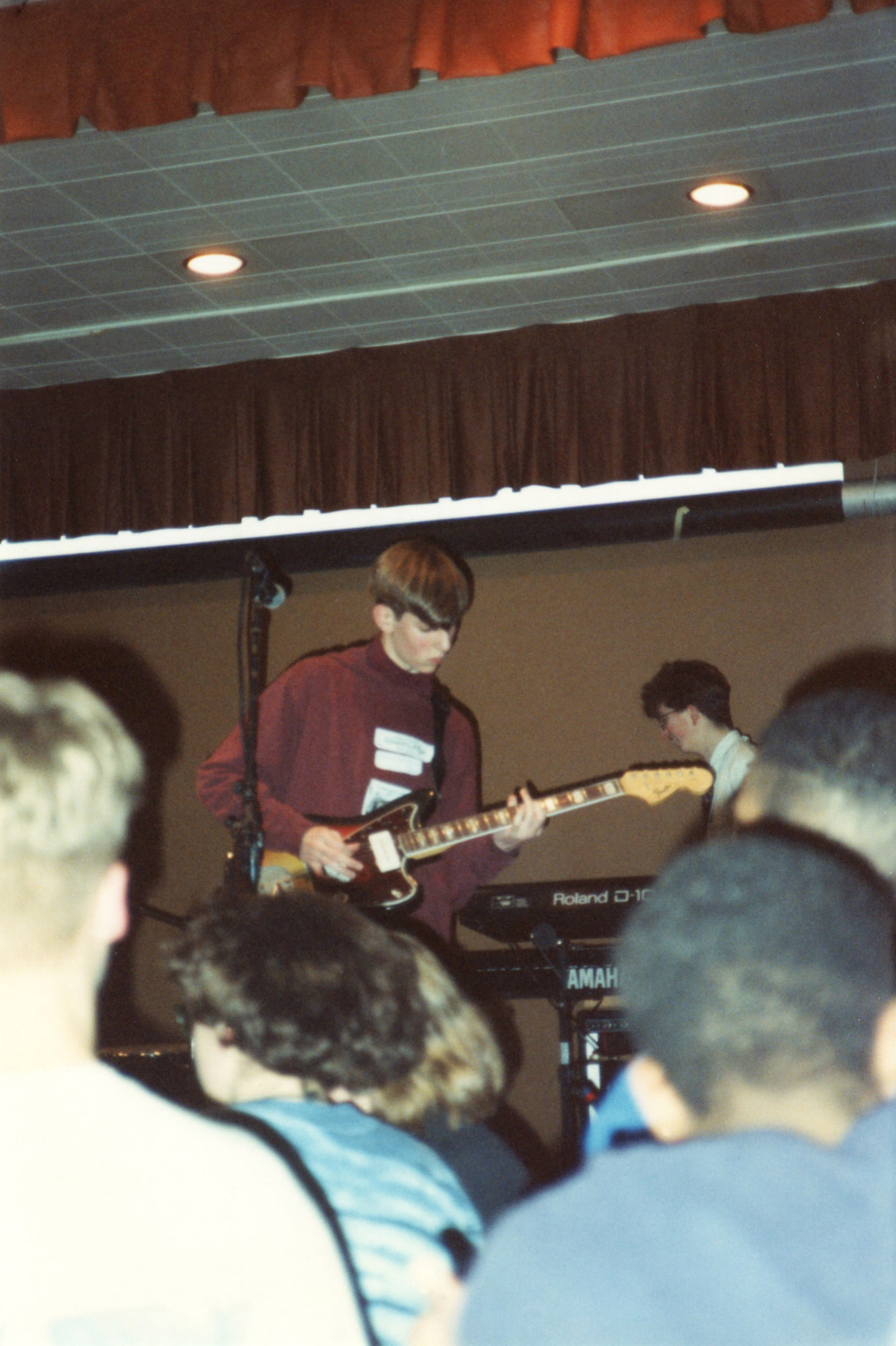
Was Transmission your first proper music project? How did you first cross paths with Stuart Bogie and the rest of that band?
I grew up across the street from Stuart, and he was my first and best friend before I could really walk or talk. When I was 3, my uncle bought me a drum set to piss off my parents, and I had a Casio PT-80 and acoustic guitar when I turned 6. So, as soon as we were able, Stuart and I would record music together in my basement. We called ourselves The Ultraviolets.
From these early tapes on through junior high, it was just the two of us. We did a concert in Joshua "Kit" Clayton's basement when I was in eighth grade as Stuart and His Neighbor, but Stuart soon met Andrew Kitchen (our drummer) in marching band, who then recruited his friend Eric Perney to quickly learn and play bass.
Transmission (which my mother named as a joke) became a more formal incarnation of our joint musical trajectory.
You guys were skateboard buddies too, right? Can you talk a little bit about how it was a major bridge to discovering everything from punk to hip-hop in the pre-Spotify days?
As kids in the suburbs — especially in the early ’80s — we had no real exposure to hip-hop outside of movies like Beat Street and Breakin', but skateboarding had small reflections of its spirit; there was movement, visuals (the graphics on the boards, and the imagery in magazines like Thrasher and Transworld), fashion, and a like-minded community exploring an art form.
I knew skaters who liked punk, rap and metal, and I knew skaters who listened to new wave and house. Ultimately, skate culture was less a gateway to certain genres than it was to a sense of belonging. It told us it was okay to be different, and it instilled a fearlessness that informed our lives as artists. After all, you can't really be afraid to fuck yourself up if you are going to do it right.
Was there any skate video in particular that exposed you to a ton of rad music?
Honestly, it's funny. I remember watching Bones Brigade (I was 7 years old), but I don't remember any music.
I do remember Thrashin' having a Circle Jerks song and an awkward performance by the Red Hot Chili Peppers, but I wasn't running out to go buy those tapes quite yet.
Did you originally think you were going to be an experimental / jazz musician rather than a solo producer?
When I was really young, I was kinda just hoping to be a guitarist in a rock band. I guess the desire to be a producer sprung from wanting more out of live performance, but the fact is that collaboration always leads to something greater than I could ever dream up myself, especially in jazz and improvisational music.
What was your major at Wesleyan? Studying under Anthony Braxton must have been eye-opening to say the least….
I studied jazz guitar at Wesleyan, but left for NYU about a month into my second semester. Anthony Braxton was beyond influential. His “Materials of Jazz Improvisation” class was crucial for me as an artist, but it was less about his music than his imaginative notation and philosophy.
He was my faculty advisor, and I remember telling him the courses I was planning to take in addition to solo guitar and gamelan orchestra: astronomy, Buddhism, and a class on African-American literature. He looked at me dead in the eyes, laughed, and said, “Wonderful, it’s all music!”
You interned at Asphodel in the late '90s — right around the time they were working with everyone from Diamanda Galas to DJ Spooky. What did you take away from that experience on both a creative and professional level? Did it make you want to double down on your own work?
In 1997, I found We’s As Is album at a record store, and it absolutely blew me away; it still does. The fact that the folks at Asphodel saw my gushing email and invited me on board absolutely changed my life. Creatively, working there opened me to the idea of dismissing genre altogether while still maintaining a cohesive sound and approach.
Professionally, I was meeting artists, DJs, and just hearing so much music I wouldn’t have heard otherwise. It was truly another extension of my education, and drove me to start "square-pushing" myself.
Was one of the things you liked about sampling / producing music that it gave you the freedom to be a one-man band in a way?
Oh absolutely. In junior high, I fell in love with the music of My Dad Is Dead, and actually sent him a typewritten letter. At the time, he was doing everything himself, and I asked him how; he actually responded to me! This was in the late ’80s, when my little sampler didn’t yet exist and making records alone was far more expensive and complicated, but his album The Taller You Are, The Shorter You Get showed me it was possible, and I couldn’t wait…
My earliest memory of discovering your music was reading a Turntable Lab recommendation for Stars On My Ceiling in 2002. I feel like that was a very special time — a turning point for turntablism, underground hip-hop, and instrumental beats. In a lot of ways, labels like Chocolate Industries and Mush set the stage for everything from Alpha Pup to Brainfeeder to the club night that brought it all together: Low End Theory. I know this is a complicated, loaded question, but what's your perspective on that time period and how things evolved between your early albums and Mirrors For Eyes, your last proper Caural LP?
I truly agree that time was special, and it’s more than just my own nostalgia and gratitude for having been a part of it.
When I started using the Yamaha SU700 in 1999, I admit I was being experimental for experimentation’s sake. Listening back now to my first record on Toshoklabs — yeah, it was fucking weird. But I think the more I explored, the more I was able to find my own voice. We all did, and it’s magical that it happened: people using machines to take music apart and rebuild it again had such wildly different results, and spawned so many directions in music.
Being on a label like Chocolate Industries where Prefuse 73 would remix my material, or my name would be next to Souls of Mischeif, Tortoise, El-P or Mos Def? As someone just starting out, I felt I had already made it. And the connection with the Los Angeles scene was immediate for me as well. I was in touch with Teebs on MySpace early on, and Ras G would come to my first shows out there and stand right in front.
Spinning records at Sketchbook (a precursor to Low End Theory) also changed what I wanted to hear, and took my music to a new place. Take (now Sweatson Klank) brought the night to NYC, and he and I would take turns playing the weirdest bangers we could find to sometimes empty rooms. This was not yet popular music!
So, from album to album, there was a natural evolution for me in tandem with the scene itself. I don’t think Mirrors For Eyes is my favorite or even best album, but I can map out how and why I got there.
Why did you decide to largely step away from Caural in 2009? Did it feel like that kind of music had hit its peak on some levels, as new generations began to discover artists through MP3 blogs rather than magazines?
A lot of things were happening simultaneously to be honest. As the sound grew in popularity, the proliferation of new tools to make it — along with the internet to spread it — oversaturated everything. To me, the "beat scene" absolutely peaked and imploded, and everyone started sounding the same.
Personally, I was also feeling limited by the very tool that once gave me so much freedom. With the single exception of "Sorry, Underground Hip-Hop Happened Ten Years Ago," I was a stubborn dinosaur who rejected the idea of using a computer to continue on. As someone who grew up playing guitar and drums, I needed an instrument to be tactile and real, not colorful, impersonal blocks on a screen.
I was performing on my sampler live along with another Chicago producer named K-Kruz (this material was later compiled as Handmade Evil) but, when it was eventually stolen from my apartment, I was just like, fuck it.
Was Handmade Evila reaction to the digital turn beat-driven music has taken in recent years — a way to show you can make killer tracks with nothing but a Yamaha SU700 and an MPC?
As a perk for a Boy King Islands Kickstarter, I compiled lost demos and alternate takes of songs for our supporters; this collection was released a few years later by Youngbloods as Pastels. Anyway, digging through sketches on my hard drive inspired me to do the same for Caural, but the music that truly stuck out for a coherent release was the last live recordings before things were brought to a close in 2009.
Maybe it was an unintentional fuck you to what I thought I was leaving behind forever, but instead it became a record of a time I'd look back on fondly.
One artist who showed how big this kind of music could be was DJ Shadow. He actually dropped his last record in the style of Endtroducing… (The Private Press) the same year as Stars on My Ceiling. Looking back now, does it feel like heady, sample-driven beats hit a peak around that time in terms of its potential and audience?
Yes and no. I remember Endtroducing… first coming out, and it was wonderful. A lot of those early Mo’ Wax and Ninja Tune records had a clear route from hip-hop instrumentals, but with added freedom to stretch out since they were made without an MC in mind.
The more we got away from loops and appropriating larger motifs from others, the more expansive our possibilities became, but we needed that time to get where we are now.
Before we get into your other projects, I've gotta ask: How did you end up landing a voiceover gig for Teenage Mutant Ninja Turtles? Are you psyched about the new movie from a nostalgic standpoint since it appears that Seth Rogen grew up with those characters as well?
Haha, oh man. I had done a lot of acting growing up, and when I told my dad I wanted to major in acting at NYU, he said, "What are you going to minor in — 'Do you want fries with that?'" So, those dreams were dashed for a time.
When I moved back to Brooklyn, a friend of a friend was doing work in cartoons and gave me tips on how to make a demo. I landed a pilot at 4Kids Entertainment that went nowhere, but when I was recording my lines, one of the producers approached me to read for another character on another show. And so I became Dr. Chaplin on Teenage Mutant Ninja Turtles.
To be honest, my sister was more a fan of the half-shelled heroes than I was, but props to Seth Rogen for giving it another life in theaters!
Did you launch Prism92 in 2013 to give yourself more creative freedom and a platform for projects outside Caural?
Prism92 became the de facto imprint for really anything I was doing and releasing myself. Prism was an art gallery where I grew up in Evanston that doubled as an all ages venue for high school bands like mine. It was where we all cut our teeth and sold our tapes, and it was a fertile ground for dreaming. It shut down at the end of 1991, and so in naming my little label Prism92, I meant to symbolize the next phase of those dreams, however they took shape.
Speaking of, what's the story with Original Ultraviolets? Was it the main collaborative outlet for you and Stuart between the '80s and early '00s?
So The Ultraviolets was our duo beginning when I was 6, and we had a handful of recordings scattered across cassettes mostly lost or taped over by Bogie's brother. I also accidentally taped over an entire catalog of our material thanks to auto reverse on a friend's tape deck….
Anyhow, Transmission enveloped us in high school and continued without me in Ann Arbor and San Francisco with Colin Stetson, but Stuart and I would always mess around with different ideas, including his short-lived Egyptian Brain Surgery project. When I moved back to Brooklyn in 2003, Stuart opened his Williamsburg apartment to me while he was on tour with Antibalas. When he'd drop back in town, we'd press record on new material for fun on a Tascam 8 track, with vocals in the bathroom and any instruments set-up in our cramped railroad living room.
Through Google, we found there was another band called The Ultraviolets, but we were named 20 years before! Thus, The Original Ultraviolets. For its release, I did final mixes years later from the original reel-to-reels, and scoured unmarked cassettes in the Bogie family's basement for our childhood's surviving music.
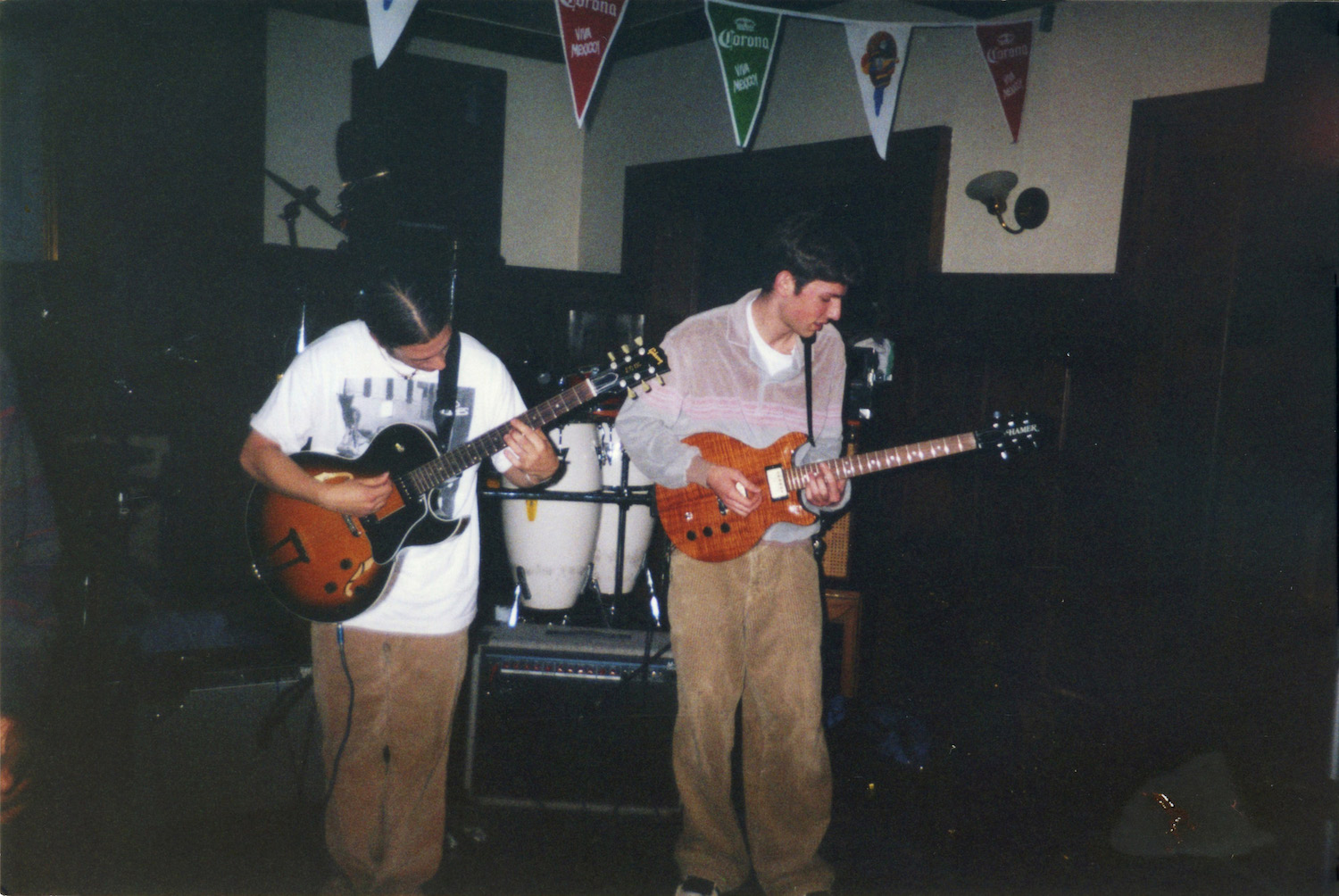
Boy King Islands has a similar back story right — a duo (with Jason Hunt, in this case) with roots that reach back into the '90s?
I met Jason in 1991 when he was playing in a different band on the same bill as Transmission. He and his bandmates joined us on horns for our first recording and a handful of shows, but they were really doing their own rock thing. When Transmission left me behind for college – and Jason and his pals kicked out their singer Billy Melody – I stepped in, and we largely did a live hip-hop thing inspired by The Roots.
Years later – after becoming Diverse's backing band and recording an album that was thankfully shelved – I was living with Jason in Evanston. This was now 2002. Numero Group's co-founder Rob Sevier was running a small label called Wobblyhead, and approached me about doing a My Bloody Valentine cover for a seven inch series he was putting together. Well, I enlisted Jason on some additional guitar, and that song – “The Girl With The Stained Glass Eyes” – became the first Boy King Islands song.
What made you want to start working on Caural material again?
Honestly I can thank my wife Alex. In many ways, she turned me back into myself.
How did you and Alex meet? When did you start discussing the ideas that would become Word is Bond?
Our story is crazy — you ready? So, I was Busdriver's touring DJ for a couple of years and, as was customary at the time, I was his top MySpace friend. Well, Alex's brother told her to check him out cause we were soon gonna play Miami with Deerhoof and Harlem Shakes. In doing so, she saw my photo, and added me. This was late 2006.
The venue for the performance changed and we never met, but years later, I saw her on a little MySpace status feed and reached out. This began a digital courtship that turned into a long-distance relationship, a couple breakups, and a magical marriage.
We began collaborating on videos a couple years in, but Word Is Bond was entirely her baby. I stepped in to help with the screenplay, ghost-write raps, produce, cast and compose.
Is homophobia something you witnessed firsthand throughout your years as a producer, and a big reason why you felt the need to help tell that story?
As a heterosexual cis male growing up in the ’80s, homophobia was nothing but normalized. The "f" word was casually tossed around in movies; people played a game called "smear the queer" in elementary school; I knew absolutely no one until college who came out; and frankly I had never been exposed to anything outside of my standard vanilla crushes on girls.
As I grew up, luckily my eyes opened wider, and suddenly I was like, “Woah, none of this is cool.” Whether it was on the screen, on the radio, or in person, the utter machismo "no homo" bullshit became such an ignorant and unfunny joke, and now the veil has been removed on so much more of the hatred driving us apart.
Alex's brother and many of her friends are in the LGBTQ+ community and, as her partner, I was happy to support both her vision in bringing their stories to life, and strengthening my own empathy as an ally.
Did working on Word is Bond — seeing how well Alex’s visual language melded with your music — lead to your work on "Us in Octaves"?
A: Alex and I do nearly everything together. We used to butt heads a little more when we met thirteen years ago, but now we may as well share a brain. So, when she had an idea for another music video for me, it was an immediate yes.
What's the back story behind “Us in Octaves”, the two-part music video you’re unveiling soon?
When we left Los Angeles in 2019, we were working full-time in film in the Hudson Valley. I finally had time to return to music late that fall, and “Ceremony” was the first song I finished. We met a dancer at a screening of Word Is Bond in Harlem, and he and his friend were the original two man cast set to shoot in March of 2020. We all know what happened then.
Two years later, when we escaped upstate New York and were ready to revisit the idea, everything changed. She and I brought on a fantastic DP named Jaan Utno who worked with us as a gaffer on Word Is Bond and, in the casting process, she found muses in Madison Wada and Robyn Ayers.
Our shot list was enormous, and it was the most art department-heavy project we did together. So when she started editing, it naturally became a two-part story: there was just too much to say.
Are you planning on doing a full movie together at some point?
I am already helping her develop a feature script…. Stay tuned!
Dakou sounds like a natural progression of your work as Caural and a live musician. Did it feel like dipping your toes back into a world you sorely missed, making another EP (Thank Your Demons) come together even more naturally?
Thank you! Dakou, Thank Your Demons, and material I am working on now for a full length next year all feel like I have picked up where I left off, but as a fuller and changed person. All along, I had been relegating styles and even instruments to different projects and aliases. Maybe because I feared they wouldn't fit together?
Whatever the case, in returning to music — honestly through Alex kindly forcing me to soundtrack Word Is Bond — I realized that my sound is less a style to put in a box than it is me using everything I have to articulate whatever comes through me.

You also released a digital version of your remix compilation last month. Does that feel like the final word on a very specific period of your solo career?
Oh yes! Remix Tape — also released as a limited cassette — compiles almost all of the remixes I made between 2003 and 2008. I left off an embarrassing one unknowingly done at the wrong speed for Miho Hatori, but most everything else that wasn't already stolen for another one of my releases made the cut.
A lot of energy went into these works and often pulled me away from my own material, so in hindsight this collection feels like a lost album.
What can we expect from you next? Is another solo album on the way at some point, or are you more interested in pursuing a film composer path right now?
A little bit of both to be honest. Life has constantly pulled me in different directions, and I have always gone towards what feels best. I am finishing a sound mix on a short documentary right now, and am eager to get back to work on my next album. I will say that I've become a lot more intimately involved with the art around my music lately, so I aim to continue more of a multi-disciplinary approach to any and all of this.
Let's say someone has never heard your music before. What are five tracks that best represent the range of your work as both a solo and collaborative artist, and why?
1. Caural, “Sorry, Underground Hip Hop Happened Ten Years Ago”
This exercise in OCD levels of organization and collage got me invited to a speaking engagement at Princeton (woo!), and was the craziest shit I have ever done. Like, ever. I took well over 400 samples of the word "yo" from across my rap albums, and spent a couple of months painstakingly building each Frankenstein measure of the song. All of my music as Caural involves intense sound editing, organization, and collage, but this piece is really a broken magnifying glass held to my process.
2. Caural, “Transition Suite Part 2: Papillon”
A tune I made with the dueling saxophones of Stuart Bogie and Colin Stetson for Mirrors For Eyes. I've always loved the way this turned out. It feels live, and was also one of the few times I used my own electric guitar on a Caural track.
3. Boy King Islands, “I Talk To The Wind”
I worked at a second record label in the early 2000s: Coup D'Etat (J-Live, Paul Barman, Rasco, etc.). My then boss, Howard Wulkan, asked me to watch his cat Pokey in his Manhattan duplex one weekend. He had a studio in the basement, and I cranked out the vocals, guitars and bass for this tune in a day; I recorded the drums back in Chicago, and Jason's wife Beth played the almost imperceptible Rhodes. It's one of my favorite (mostly) solo things I've done in the rock realm, and I'm embarrassed to admit that – until hearing King Crimson's original – I thought that Opus 3 wrote this song.
4. Caural, “Clear Vinyl”
Still one of my most streamed songs 20 years later, likely because of its inclusion in a skate video backing the street skate pioneer Rodney Mullen. I loved making this rock song out of almost entirely shoegaze samples. It snaps, if I do say so myself.
5. Caural, “Enneagram”
I still love drum & bass. When I was touring with Busdriver, I played a version of his song "Wormholes" in double-time with the famous Amen break (if you don't know it, it's basically the electric guitar to the rock music of jungle). Enneagram – a completely live, improvised drum & bass tune in this spirit – stands out for me as an example of the hardware sampler as a live instrument.
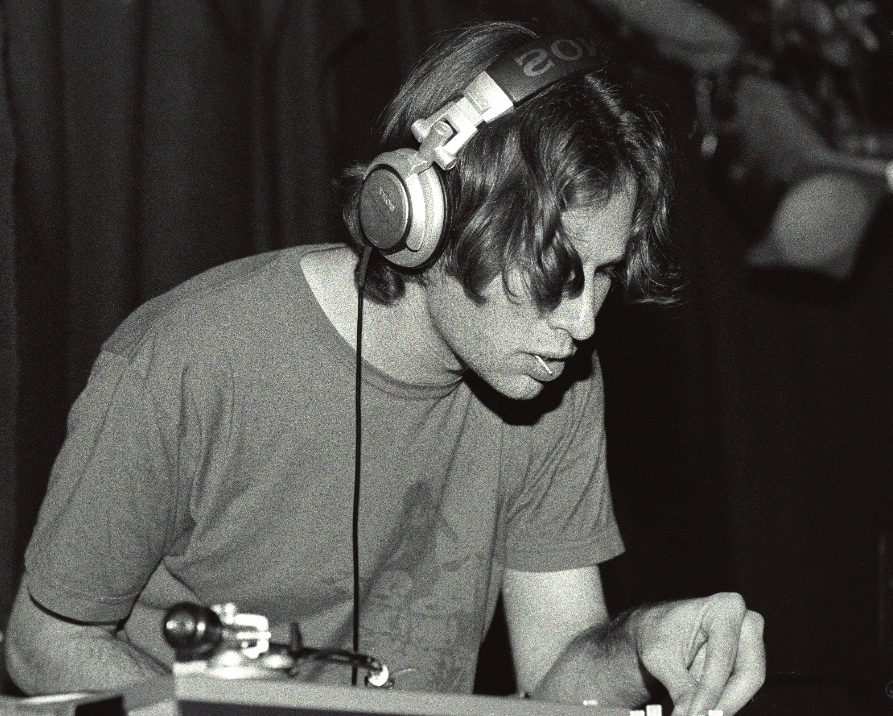
Finally, tell us about the “Holograms” mix you made for us. In a lot of ways, it feels like a reflection of everything we just discussed — a full-circle journey of someone who's been greatly impacted by music on a personal and creative level for decades….
In curating “Holograms” — almost all imaginary collaborations meant in some cases to be slightly absurd — I joined together main themes from my so-far two releases this year. The first — from the spirit of Dakou ("cut out") — was to highlight inspirations of mine: crate-dug gems I wanted to place within a framework of hip-hop. I have found there are such through lines connecting grooves across genres, and for someone to stumble across mangled cassettes with no context of their history or culture — as was the case in China that spawned the title Dakou — music presents itself as itself, leaving the listener to draw their own connections.
The second theme came from Remix Tape, and from that time in my musical life. Some of these tracks were on constant rotation in my early DJ sets, while others were ideas never brought to fruition — either by me, or in some cases by colleagues of mine. But in layering them with acapellas, I also wanted to give a nod to the mashup: an enormous fad of the time which was fun and endearing while simultaneously just kinda horrible. But in a positive light, I think of remixes themselves as holograms: the meshing of waves (in this case, sound) creating a version of the object impossible without the other.
Music is math, isn't it?
TRACKLISTING:1. We – Flutesque – Incursions In Illbient (Asphodel)
1. 1991 – High-End – High Tech High Life (Opal Tapes)
1. (Christian Ministry Truck Stop Tape Intro)
1. Miles Davis – Gingerbread Boy – Miles Smiles (Columbia)
1/2. Aaliyah – Rock The Boat (Acapella) – Aaliyah (Blackground Records)
2. GB – The Roman numeral 3 – Absence of Color Phase I & II (Sound In Color)
3. Dimlite – Last Repetitions Piece/Lorraine For The World – Cookie & Brownie EP 3 (Astrolab)
3. Beastie Boys – Body Movin' (Acapella) – Hello Nasty (Capitol)
3. (Excerpt from Dirty Thoughts – Documentary)
4. Slum Village – Look of Love – Fantastic Vol. 1 (Counterflow)
5. Dabrye – Hyped Up Plus Tax (Outputmessage Remix) – Payback (Ghostly)
6. Painted Cakes – Moving On – Painted Cakes (Self-Released)
7. Push Button Objects – 360 Degrees (Beatapella) – 360 Degrees Remixes (Chocolate Industries)
7. Clipse – Wamp Wamp (What It Do) (Acapella) – Wamp Wamp (What It Do) (Star Trak Entertainment)
7. Herbie Hancock – Sleeping Giant – Crossings (Warner Bros)
8. Ammoncontact – Let The Rhythm Mysticism – Dublab Presents: In The Loop 3 (Plug Research)
8. Ford & Lopatin featuring Tamaryn – Flying Dream (Acapella) – Snakes/Flying Dream (Mexican Summer)
9. Ramsey Lewis – My Love For You – Funky Serenity (Columbia)
9. Opus 3 – It's A Fine Day (Acapella) – It's A Fine Day (PWL International)
10. Kutmah – Warm Like The Sunshine – Warm Like The Sunshine (Poo-Bah Records)
11. Knxwledge – thedaysbefore – Buttrskotch (Leaving Records)
11. Stevie Wonder – Tuesday Heartbreak – Talking Book (Motown)
12. Danny Breaks – The Jellyfish – Another Dimension (Alphabet Zoo)
12. Missy Elliot – Get Ur Freak On (Acapella) – Get Ur Freak On (Elekrtra)
13. Collin Walcott – Prancing – Cloud Dance (ECM)
13. Nas – It Aint' Hard To Tell (Acapella) – It Ain't Hard To Tell (Columbia)
13. Kraftwerk – The Robots – Man Machine (Capitol)
14. Sea Level – Midnight Pass – Cats On The Coast (Capricorn Records)
14. Quincy Jones – Midnight Soul Patrol – I Heard That!! (A&M Records)
15. Diverse featuring Lyrics Born – Explosive (Caural Remix – Instrumental Version) – Remix Tape (2003 – 2008) (Prism92)
15. Mobb Deep – Shook Ones Pt. 2 (Acapella) – Shook Ones Pt. 2 (Loud Records)
16. (Excerpt from Busdriver live at Irving Plaza – unreleased)
16. John Klemmer – Poem Painter – Barefoot Ballet (ABC Records)
17. Caural – One Day It'll All Make Cents (unreleased)
18. Jean Luc-Ponty – Imaginary Voyage Part IV – Imaginary Voyage (Atlantic Records)
19. K-Kruz – Slip Away – Time EP (Organik Recordings)
19. Mos Def – Mathematics (Acapella) – Ms. Fat Booty / Mathematics (Rawkus Records)
20. Sweatson Klank – Not The Same – Collage Dropout (Self-Released)
21. Jeff Beck – The Golden Road – There And Back (Sony)
Eluvium Shares the StoriesBehind (Whirring Marvels In) Consensus Reality [ 26-May-23 4:40am ]Rather than let a debilitating level of arm and shoulder pain get in the way of his latest Eluvium LP, Matthew Cooper found a way to meld traditional melodies with electronic flourishes and ragged algorithms. Not to mention appearances by members of the American Contemporary Music Ensemble (better known as ACME), Golden Retriever and the Budapest Scoring Orchestra.
In the following exclusive feature, Cooper takes a long, in-depth look in the mirror and reveals the musical and conceptual roots of the entire record, from singing resonators to the eternal struggle between man and machine — something that’s hit new heights in recent years, for better or for worse….
 “Escapement”
An escapement is a mechanism in a timepiece that catches and releases at a set amount in order to mark time passing. I was attracted to employing this theme of the machinery that marks our personal slow march towards decay and considered the clock as an early form of robotics.
An escapement is also the term used for a mechanism in a piano that pulls the hammer back into place after it hits the string. Thematically, it was nice that the term also referenced the keyboard — at which so much of my writing is done.
Yet with this album, I would have to somewhat leave this method of writing behind in search of other forms of composition. Allowing myself to open up to more modern musical technology and compositional methods in order to navigate my own body showing its own signs of time…. Specifically the slow and frustrating healing of a shoulder injury.
“Swift Automatons”This music is meant to offer a snapshot of an ever-continuous speeding up of the automation and machinations of things from post-birth of the clock to now and beyond, the many mutations of the robotic, and the effect it has on us and perhaps our evolution. I like to think of it as a sort of "industrial revolution" theme.
Many layers of violin parts had to be recorded to get this piece to work which I reinforced with synths and pianos to get things as pointed and quickly shifting as possible. Ben Russell was kind enough to indulge trying to make it happen and I'm incredibly thankful for his patience and agility and energy.
"Vibration Consensus Reality(for Spectral Multiband Resonator)"
This was probably the first piece of music written for the album and perhaps the center from which everything else was built. The music was written freehand around the "singing" of a particular resonator I was working with at the time.
Ben Russell returns with the violin parts and Ben Shafer on horn duties. At the very end, you can hear the violinist catching his breath from the performance of the final passage. I'd cut it from the violin part and scooted it further down the recording to be deleted but ultimately forgotten to pull it out of the recording while mixing it.
When I heard it again it surprised me and I decided it conveyed something special and human and decided to keep it in. I half-joked with Ben about crediting him with "breathing" on the record, which he thought was a funny thing to be credited for.
It is quite possibly my favorite piece of music I've ever written. The resonator singing makes me think of the HAL9000 a little bit, but I consider the music around it to be very human and emotive, and in that way it feels like a gentle duet between human and machine.
"Scatterbrains"The title of this piece is meant to be suggestive of a mass inability to think straight brought on by an unending consumption of media and information. A miasma of varying thoughts that don't quite tie together in any sensible manner.
Its origins actually come from visits to a shelter of trees on the edge of a precipice that I visit regularly with my dog. There are eagles usually nesting there and the wind howls through it often. The wind is such a peaceful presence and I've thought of how it feels as though it takes my thoughts away and scatters them out across the land below, leaving me mindless and at rest.
The music is a mixture of these two considerations. Jonathan Sielaff was kind enough to perform the bass clarinet solo for this recording. He brought a beautiful touch to it.
"Phantasia Telephonics"The first half of this piece was written using somewhat traditional synthesizer and sequencer techniques and automation, and applying similar methods to the piano. The second half was written with a focus on the Make Noise René (named after René Descartes, a philosopher who is known for his "mind / body problem", which is reflected in the device's "Cartesian" mapping of a sequencer). The outgoing sequence was run through a shifting tape delay to create a reflection of itself which is scattered, shattered, and refracted.
By design, this is the only track on the album performed entirely by synthesized and virtual instrumentation. (There are no orchestral instruments implemented.) It might perhaps seem an odd thing to do (and may even be impossible to tell for many), but I wanted this to be a point in the album where reality becomes more disoriented (within its overarching technology / human narrative) and try to invite an internal discussion of what is real / not real, important / unimportant in a creative experience. And what that, in turn, meant to me (and possibly other listeners).
Choosing to keep it entirely synthesized instrumentation seemed like an interesting way to implement this. The track was also a compositional turning point for what methods were being employed in writing the album due to the physical constraints I had been experiencing with my left shoulder and arm. So in some ways, I think I wanted to pay homage to this.
I'm not sure if it was purely for self-satisfaction or some form of intentional personal bemusement, but initially I did not intend to tell anyone about this. Instilling purposeful quiet brokenness, perhaps?
“I'm naturally drawn towardsworking things until they tie together
in strange, unique ways”
I wanted this album to have a lot of conceptual and mechanical push and pull and blending between what we deem "technology" and what we would consider more "human". Or perhaps simply "natural", or even "reality". This piece is meant to act as a bit of a doorway towards this breaking point, narratively speaking. Whereas the tracks that came before are suggestive of a more rudimentary or primitive mechanical world (and our harnessing of those mechanics), this track leans towards things starting to be a bit more confusing.
At least, this is what I tell myself. I really don't know if any of this matters or translates to the listener. I just do it because I enjoy puzzling out things like this and searching for ways that make all these parts come together into a particular form and narrative. I'm naturally drawn towards working things until they tie together in strange, unique ways and complete a specific narrative. It probably makes things more complex than they need to be, but the mixture seems to stimulate a pleasing variety of thoughts.
 Photo by Jeannie Lynn Paske
"The Violet Light"
Photo by Jeannie Lynn Paske
"The Violet Light"
Ben Russell appears again here to beautifully translate the violin lines. I think this piece was, in part, originally a sketch for a film score I'd worked on. We'd ended up using something else instead. Then it kept popping back into my life, shuffling itself into randomized playlists on my computer. So I started messing with it and adding to it until it eventually morphed into this piece.
This title is a reference to the color of the sky in T.S. Eliot's The Waste Land. The "violet hour" is the sun setting and most would suggest a poetic representation of fading away. To me, this imagery inspired thoughts of not just an individual growing old, but also perhaps humanity itself.
"Void Manifest"The main musical theme from “Void Manifest” had been a work in progress for quite a while, but it just felt like something that no matter how much it was worked on just wasn't fitting into the musical or narrative world of this album. I couldn't figure out the missing thread until one day while out walking and listening I heard a secondary theme present itself to me in a repetitive syllabic motif.
It occurred to me this could be a voice. I began looking for language to use for the lyrical content and decided it would be interesting to algorithmically pull words from the years of notes of jumbled and scribbled down notions, ideas, theories and concepts that I had been considering while working on the album, which had become a bit of a maddening blend of sought after meanings, inspirations and various discourse.
Charlotte Mundy gracefully agreed to work with me to create the vocal recordings, which involved a mixture of singing and other noises. Her willingness and openness was a godsend, and her translation of the work made it truly come alive.
"Clockwork Fables"This track is a return to musical phrases originally presented in "Phantasia Telephonics". It was developed from meddling around with that theme and composed for player-piano. The title is a reference to my narrative suggestion from the beginning of the album being considered from a perspective of old stories from a long time ago… a melody for "old-timey stuff".
“Mass Lossless Interbeing”This piece originates from a sketch I created for a gallery installation. The interactive installation was a somewhat awkwardly held together and unique use of technology, presented in a manner to be interacted with one on one and allowing a space for the viewer to find tranquility within themselves.
It was later reconstructed for orchestra and electronics, and presented here as a representation of the wanting we tend to try to fulfill with technology. The title speaks to the concept of coding representing our connectedness with all things. A bit of a mixture of both purity in genuine emotion and tongue-in-cheek snake oil.
There is a tiny moment right at the end that I took from my sessions with Charlotte where she was making various vocal screams and screeches and noises and one of them sounded almost like an internet dial-up sound to me. It seemed like a nice touchstone to finish the piece.
“A Floating World Of Demons”I have no idea why but I’ve always pictured giant robotic creatures and people working in harmony during a harvest across acres of farmland. A strange blend of the paintings of Jean Giraud and Jakub Ró?alski. The title is meant to suggest a dream-like world of immeasurable beauty and wonder, slowly being destroyed by its inhabitants. It is also a nod to a Carl Sagan book.
"Endless Flower""Endless Flower" is essentially a paean for the universe, intertwined with the beckoning of the human spirit. The orchestra is blended with layers of synths all playing the same lines together. The piano notes are performing inhumanly fast.
If you listen carefully you can hear Charlotte and I both screaming at the end. The piece is inspired by a deep yearning to forever push forward in search of a source of our indescribable feelings that resonate within all of us. A glimpse of our harnessing of technology (with its inherent risks) in this search. A song for a never-ending love affair with life itself, no matter how strange.
Bikini Kill SlayPalace Theatre [ 24-Apr-23 2:44pm ]Words + Photos ANDREW PARKS
“Bikini Kill was very difficult,” Kathleen Hanna said in a self-titled interview a decade ago. “Not just because the four of us have very different personalities; the reception we got was very confusing. People either loved us or hated us in a way that bordered on violence.”
Elsewhere in the conversation, Hanna elaborated on how and why the band came to an abrupt end in 1997: “It started feeling like it was ramping up to the point that some crazy person was going to shoot me onstage. I felt like everybody expected me to be this über-confident feminist and write these anthems, but I didn't really know who I was anymore.”

What a difference two decades has made — at least in terms of how the punk-rock pioneers are viewed by the general public. While they received a disturbing amount of death threats and backhanded compliments during their mid-’90s heyday, Bikini Kill are now revered as the high water mark of the riot grrrl movement they helped shape beginning with their self-released demo Revolution Girl Style Now. Its prickly halfway point (“This is Not a Test”) sounded like a lit match sandwiched in between a stormy “New Radio” and “Don’t Need You” at Palace Theatre last Thursday night. One that’s about to be tossed into a tall pile of dry wood dusted in gasoline, as thousands of fans step towards the flames.
Which makes perfect sense given the State of Things. As Hanna pointed out several times throughout the 90-minute show — their first in St. Paul since the Clinton administration — Bikini Kill’s reunion isn’t a nostalgia trip so much as a necessary call for us all to fight a world on fire together. Hanna and her instrument-swapping bandmates (co-founders Kathi Wilcox and Tobi Vail, along with touring guitarist Sara Landeau) don’t just sound like a well-oiled war machine these days. Their raw message of self-reliance and female empowerment in the face of a faltering patriarchy is as relevant as it’s ever been.

Which isn’t to say that Hanna and Vail — the band’s sometime lead singer, who stepped in to slay tracks like “I Hate Danger,” “Tell Me So” and “Hamster Baby” — tried to draw a dividing line between Us and Them with 25 songs that snake and snarl around hooks that get straight to the heart of the matter. If anything, Bikini Kill are determined to spark an intergenerational stand against all the forces that are wary of true progress.
That includes anyone who has written off Generation Z as lazy, entitled or lacking substance. Hanna was particularly incredulous while recalling that common refrain out loud, giving fans born after the band’s first rodeo credit for educating her on matters of intersectionality and demanding more from an establishment that continues to fail us in more ways than one.
In that way, this show’s warm and welcoming vibe proved we’re all rebel girls now — no matter what age, gender or group. Turns out we all need each other, after all.

New Radio
This Is Not a Test
Don’t Need You
Alien She
Feels Blind
I Hate Danger
In Accordance to Natural Law
Carnival
Resist Psychic Death
I Like Fucking
Capri Pants
Outta Me
For Only
DemiRep
Reject All American
Jigsaw Youth
Sugar
Rah! Rah! Replica
Hamster Baby
Tell Me So
Magnet
Lil’ Red
Suck My Left One
ENCORE:
Double Dare Ya
Rebel Girl
 patten Shares the SequelTo His Atomoxetine Mix [ 24-Apr-23 1:47pm ]
Considering how conceptual and one-of-a-kind Damien Roach’s latest patten LP is — Mirage FM is the first album made from text-to-audio AI samples — it shouldn’t come as a surprise that his Needle Exchange debut is a waking dream as well. We’re talking a wide-ranging set that somehow connects the dots between everything from Jesus Piece and Roy Davis Jr. to Ariana Grande and Actress.
Here’s what the London producer had to say about “TimeSwamp,” the long-awaited sequel to his mind-altering Dummy mix from a decade ago:
The second of an open series started in 2013. The first one went out 10 years ago via Dummy Magazine. I'm into the idea of an osmosis between things distilled to the exact point of contact. Like the lightest but most precise & radically transformative touch possible. Beware, all those who enter the TimeSwamp.
Solange – Cranes In The Sky (2016)
My Bloody Valentine – To Here Knows When (1991)
Burial – South London Boroughs (2016)
Fleetwood Mac – Everywhere (1987)
Drexciya – Bang Bang (1997)
Thomas Mapfumo – Shumba (1981)
Jesus Piece – Lucid (2018)
Roy Davis Junior – Gabriel (1996)
Flanafi – CP2YSA (follow it back) (2022)
JPEGMAFIA – DD Form 214 (2018)
Simon and Garfunkel – For Emily, Whenever I May Find Her (Live) (1969)
Diptera – Silver (2018)
Steve Reich – Tehillim I. Psalms 19:2-5 (1981)
George Benson – Give Me The Night (1980)
Death Grips – Bubbles Buried in This Jungle (2016)
Voice Actor – Blip (2022)
Tirzah (feat. Coby Sey) – Devotion (patten RE-EDIT [Unreleased]) (2020)
Brooke Candy – Cum (SOPHIE remix) (2019)
Cocteau Twins – Fifty-Fifty Clown (1990)
Messiaen – Éclairs sur l'au-delà; XI (1991)
Actress – Purple Splazsh (2010)
Ariana Grande – Shut Up (2020)
Kleenex – Nighttoad (1977)
Dif Juz – Love Insane (1985)
Philip Glass – Floe (1982)
Jeff Mills – Gamma Player (1995)
Jaylib – Champion Sound (2003)
Sade – Love Is Stronger Than Pride (1995)
Joe Jackson – Stepping Out (1982)
Autechre – V-PROC (2003)
Jai Paul – Vibin' (2019)
Mr. G – Daily Prayer (2012)
BADBADNOTGOOD – In Your Eyes (feat. Charlotte Day Wilson) (2016)
Frank Ocean – Little Demon (feat Skepta, Arca remix) (YouTube rip) (2019)
Huerco S. – Plonk VI (2022)
Egyptian Hip Hop – Strange Vale (2012)
Hani Rani – F Major (2020)
Chaka Khan – I Feel For You (1984)
Dimzy – Always Win (2018)
Helen – Motorcycle (2015)
Four Tet – And They All Look Broken Hearted (2003)
Jim O'Rourke – And I'm Singing (2001)
Tyler, The Creator – She (2011)
Arthur Russell – Lucky Cloud (1986)
Battles – Race Out (2007)
St. Vincent – The Party (2009)
Goldie – Inner City Life (1994)
Nirvana – Negative Creep (1989)
Grouper – Call Across Rooms (2014)
Oval – Bloc (1998)
Chynna – Practice (2017)
The xx – Fantasy (2009)
Stereolab – Cybele's Reverie (1996)
Kelis – Milkshake (2003)
Jane Birkin – Jane B (1969)
John Williams – The Fortress of Solitude (1978)
 How to Write, Interview with Skinner Darkly [ 30-Jul-23 2:37am ]
I got an emailed question about my novel Spacetime Donuts from a fan of mine, who prefers to be known as Skinner Darkly. I said, hell, let’s make it an online interview, haven’t done one of those for a couple of months. So here you are. I’m publishing it here, and on Medium. This time […]
The post How to Write, Interview with Skinner Darkly first appeared on Rudy's Blog.
Podcast #114. "Who Do You Love" [ 19-May-23 5:09pm ]May 19, 2023. This story relates to the death of my wife Sylvia. I read it an SF in SF event in January, 2023, and it was recorded by Rusty Hodge for SomaFM. The story appeared as online text in Nature Futures on Feb 15, 2023. Press the arrow below to play Rusty’s recording of […]
The post Podcast #114. "Who Do You Love" first appeared on Rudy's Blog.
Shirley Interview: AI, ChatGPT, and Consciousness [ 12-May-23 8:09pm ]Most of the material in this blog post is drawn from an email interview of me by my old pal John Shirley, for the terrific new ezine Instant Future , run by Brock Hinzmann and John. As is my usual fashion, for my blog-post version I added some images that may seem to have no […]
The post Shirley Interview: AI, ChatGPT, and Consciousness first appeared on Rudy's Blog.
Roadtrip To Encinitas [ 30-Mar-23 2:29am ]The grief is still quite harsh; it comes and goes. But it’s getting better. A couple of weeks ago, alone in the supermarket I was still lost in a haze of regret. All the things I didn’t do, or did wrong. Even though, in her last months, Sylvia told me, "I forgive you for anything […]
The post Roadtrip To Encinitas first appeared on Rudy's Blog.
The Potential Privacy Problems With YouTube's Family Plan "Suggestion Leakage" [ 16-Aug-23 7:02pm ]I love YouTube. I consider it to be a wonder of the world for an array of reasons. Its scale is — well, the technical term is “mindbogglingly enormous.” I subscribe to YouTube Premium (primarily to obliterate the ads — I don’t use ad blockers), and as far as I’m concerned it’s the best streaming service value on the planet. If I had to choose one streaming service only — it would be YouTube Premium, undoubtedly. I have something approaching 7000 favorited videos on YT, and I sometimes imagine that there’s a whole cluster in a dark corner of a Google data center singularly devoted to managing my giganormous watch history.
Does YT have problems? Yup. Some YT creators have to deal with inappropriate strikes and takedowns — I’ve tried to assist a bunch of these users with these sorts of disruptions over the years. Some people complain of bad video suggestions pushing them in dark directions — though this has never been an issue for me — the suggestions I get are generally great, though I do take time to train the algorithm as to what I do and don’t like. If you just use YT not-logged in and/or don’t train, you’ll probably get less favorable results. Basically that’s your choice.
Obviously, no technology is perfect, and at YT’s scale even if only a tiny fraction of suggestions are problematic, it can still be a large number in absolute terms. That’s life. I still love YouTube.
There’s an oddity though with YT that I think is worth mentioning. It’s not a big concern in the scheme of things, but it really shouldn’t be happening.
This relates to the YouTube Premium “Family Plan” that lets you bundle multiple separate Google accounts in a household together so that they all have the benefits of Premium, at a better price than each subscribing to Premium separately. Under FP, each of the associated accounts is free of ads, etc., but is still separate — with their own YT play history, etc. — and can view different content simultaneously (normally, a Premium account can only view content on one device at a time).
But a strange thing can happen with Family Plan. The videos being watched by one account on the plan can affect the suggestions on other accounts on the plan, even though they should be entirely separate in this particular respect.
This is most often noticed when a topic starts to pop up in the suggestions for one FP member that are totally odd for them — for example, a subject that they never view videos about. And it turns out — if the members of the FP compare notes — that some other member of the plan was watching videos on that topic, and the YT videos/channels being watched by FP member A are showing up in the suggestions for FP member B. And so on.
Most of the time this isn’t a serious concern, and can even be interesting in terms of surfacing new topics. But of course there are intrinsic privacy considerations as well. It isn’t good policy for the YT viewing habits of different family members to be intermingled in that way, without their specifically asking for such sharing. The potential family problems that could occur as a result in some cases are fairly obvious.
This has been going on with Family Plan for years, and I’ve brought this up with Google/YT myself in the past. And the responses I’ve always gotten back have either been that “it can’t happen” or “it shouldn’t happen” and … that’s pretty much where it’s been left hanging each time.
But it does still happen (I have a new report just this morning) and yeah, it really shouldn’t.
Again, not an enormous problem in the scheme of things, but not trivial either, and it’s something that definitely should be fixed.
–Lauren–
Artificial Intelligence at the Crossroads [ 13-Jul-23 5:24pm ]Suddenly there seems to be an enormous amount of political, regulatory, and legal activity regarding AI, especially generative AI. Much of this is uncharacteristically bipartisan in nature.
The reasons are clear. The big AI firms are largely depending on their traditional access to public website data as the justification for their use of such data for their AI training and generative AI systems.
This is a strong possibility that this argument will ultimately fail miserably, if not under current laws then under new laws and regulations likely to be pushed through around the world, quite likely in a rushed manner that will have an array of negative collateral effects that could actually end up hurting many ordinary people.
Google for example notes that they have long had access to public website data for Search.
Absolutely true. The problem is that generative AI is wholly different in terms of its data usage than anything that has ever come before.
For example, ordinary Search provides a direct value back to sites through search results pages links — something that the current Google CEO has said Google wants to de-emphasize (colloquially, “the ten blue links”) in favor of providing “answers”.
Since the dawn of Internet search sites many years ago, search results links have long represented a usually reasonable fair exchange for public websites, with robots.txt (Robots Exclusion Protocol) available for relatively fine-grained access control that can be specified by the websites themselves, and which at least the major search firms generally have honored.
But generative AI answers eliminate the need for links or other “easy to see” references. Even if “Google it!” or other forms of “more information” links are available related to generative AI answers at any AI firm’s site, few users will bother to view them.
The result is that by and large, today’s generative AI systems by their very nature return essentially nothing of value to the sites that provide the raw knowledge, data, and other information that powers AI language/learning models.
And typically, generative AI answers (leaving aside rampant inaccuracy problems for now) are like high school term papers that haven’t even included sufficient (if any) inline footnotes and comprehensive bibliographies with links.
A very quick “F” grade at many schools.
I have proposed extending robots.txt to help deal with some of these AI issues — and Google also very recently proposed discussions around this area.
Giving Creators and Websites Control Over Generative AI:
https://lauren.vortex.com/2023/02/14/giving-creators-and-websites-control-over-generative-ai
But ultimately, the “take — and give back virtually nothing in return” modality of many AI systems inevitably leads toward enormous pushback. And I do not sense that the firms involved fully understand the cliff that they’re running towards in a competitive rush to push out AI systems long before they or the world at large are ready for them.
These firms can either grasp the nettle themselves and rethink the problematic aspects of their current AI methodologies, or continue their current course and face the high probability that governmental and public concerns will result in major restrictions to their AI projects — restrictions that may seriously negatively impact their operations and hobble positive AI applications for users around the world long into the future.
–Lauren–
Thoughts on AI Regulation [ 29-Jun-23 5:56pm ]Greetings. The excellent essay:
https://circleid.com/posts/20230628-the-eu-ai-act-a-critical-assessment
(by Anthony Rutkowski) serves to crystallize many of my concerns about the current rush toward specific approaches to AI regulation before the issues are even minimally understood, and why I am so concerned about negative collateral damage in these kinds of regulatory efforts.
There is widespread agreement that regulation of AI is necessary, both from within and outside the industry itself, but as you’ve probably grown tired of seeing me write, “the devil is in the details”. Poorly drafted and rushed AI regulation could easily do damage above and beyond the realistic concerns (that is, the genuine, non-sci-fi concerns) about AI itself.
It’s understandable that the very rapid deployments of AI systems — particularly generative AI — are creating escalating anxiety regarding an array of related real world controversies, an emotion that in many cases I obviously share.
However, as so often happens when governments and technologies intersect, the potential for rushed and poorly coordinated actions severely risks making these situations much worse rather than better, and that’s an outcome to be avoided. Given what’s at stake, it’s an outcome to be avoided at all costs.
I don’t have any magic wands of course, but in future posts I will discuss aspects of what I hope are practical paths forward in these matters. I realize that there is a great deal of concern (and hype) about these issues, and I welcome your questions. I will endeavor to answer them as best I can.
–Lauren–
A Proposal for "Enhanced Recovery Services" for Locked Out Google Accounts [ 24-May-23 5:09pm ]This post could get very long very quickly, so instead I’m going to endeavor to keep this introductory discussion brief, with an array of crucial details to come later.
In my recent posts:
An Example of a Very Sad Google Account Recovery Failure — and How It Affects Real People
https://lauren.vortex.com/2023/05/17/google-account-recovery-failure-sad
and:
Potentially Serious Issues with Google's Announced Inactive Accounts Deletion Policy
https://lauren.vortex.com/2023/05/16/google-inactive-accounts-deletion
(and frankly, in many related postings over many years in this blog and other venues), I discussed the continuing problems of honest Google users being locked out of their Google accounts, often with a total and permanent loss of all their data (Gmail, photos, Drive files, etc.) that they entrusted to Google.
These lockouts can occur for an array of reasons — problems with login credentials, third-party hacking of accounts including (but not limited to) malware, Google believing that violations of its Terms of Service have occurred, and many other events.
Each of these is an entire complex topic area that I won’t detail in this post.
But the bottom line is that many Google users who feel that they have done nothing wrong find themselves locked out of their accounts — and crucially — their data at Google, and are unable to successfully navigate the existing largely automated account recovery procedures that Google currently provides.
Generally speaking, once a user who has been locked out of a Google account reaches this point, they are, to use the vernacular, SOL — there’s no way to proceed. Usually their data, no matter how important and precious to their lives, is lost to them forever.
To be sure, sometimes the failure to recover a Google account is rooted in the failure of users to provide or keep up to date the recovery information that Google requests for the very purpose of easing account recovery paths.
But the reality is that many users forget about keeping these current, or are reluctant to provide phone numbers and/or alternative email addresses (if they even have them) in the first place. That’s just the way it is.
And ultimately, even at Google’s enormous scale of users who use its services for free, there is something inherently wrong about honest users who lose so much of their lives — that Google has encouraged them to entrust to Google — when an unrecovered account lockout occurs.
Over and over again — in a manner reminiscent of the film “Groundhog Day” — desperate Google users who have been locked out have asked me if there was someone they could pay to help them? Isn’t there some way, they ask, for Google to do a deeper dive into the circumstances of their lockouts, the users’ official government IDs for proof, and other methods to authenticate them back into their Google accounts — as can be done at virtually all financial institutions and most other firms.
Right now the answer is no.
But the answer should be and could be yes, if Google made the decision — by no means a trivial one! — to provide the means for such “enhanced recovery services” for Google Accounts, which in some cases (e.g., when a user is indeed at fault as the root cause of the lockout) could be chargeable (that is, paid) services as a means to help defray the additional costs involved.
This is a very complicated area with an array of trade-offs and nuances. It’s likely to be highly controversial.
But as far as I’m concerned, the status quo of how Google account recoveries work (or fail) is no longer acceptable, especially in the current regulatory and political environment.
In future discussions, I will detail my thinking of how “enhanced recovery” for Google accounts could be accomplished in practice, and how it would benefit Google’s users, Google itself, and the wider global community that depends upon Google.
Take care, all.
–Lauren–
An Example of a Very Sad Google Account Recovery Failure — and How It Affects Real People [ 17-May-23 3:21pm ]UPDATE: 24 May 2023: A Proposal for "Enhanced Recovery Services" for Locked Out Google Accounts
– – –
All, I am doing something in this post that I’ve never done before over these many years. I’m going to share with you an example of what Google account recovery failure means to the people involved, and this is by no means the worst such case I’ve seen — not even close, unfortunately.
I mentioned yesterday in my other venues how (for many years) I’ve routinely tried to informally help people with Google account recovery issues, because the process can be so difficult for many persons to navigate, and frequently fails. The announcement yesterday of Google’s inactive account deletion policy that I blogged about then:
https://lauren.vortex.com/2023/05/16/google-inactive-accounts-deletion
triggered an onslaught of concerns that for a time made my blog inaccessible and even delayed inbound and outbound email processing.
I’m going to include below most of the text from messages I received today from one of my readers about a specific Google account recovery failure — and how that’s affecting a nearly 90-year-old woman. I’ll be anonymizing the message texts, and I’ve of course received permission from the sender to show you this.
Unfortunately, this example is all too familiar for me. It is very much typical of the Google account recovery problems that Google users, so dependent on Google in their daily lives, bring to my attention in the hope that I might be able to help.
I’ve been discussing these issues with Google for many years. I’ve suggested “ombudspeople”, account escalation and appeal procedures that ordinary people could understand, and many other concepts. They’ve all basically hit the brick wall of Google suggesting that at their scale, nothing can be done about such “edge” cases. I disagree. In today’s regulatory and political environment, these edge cases matter more than ever. And I will continue to do what I can, as ineffective as these efforts often turn out to be. -L
– – – Message Text Begins – – –
Hi Lauren, I tried to help a lovely neighbor (the quintessential “little old lady”) recently with her attempt to recover her legacy gmail account. We ultimately gave up and she created a second, new account instead. She had been using the original account forever (15+ years) and it was created so long ago that she didn’t need to provide any “recovery” contacts at that time (or she may have used a landline phone number that’s long been cancelled now). For at least the last decade, she was just using the stored password to login and check her email. When her ancient iPad finally died, she tried to add the gmail account to her new replacement iPad. However, she couldn’t remember the password in order to login. Because the old device had changed and she couldn’t remember the password and there was no back channel recovery method for her account, there was no way to login. I don’t know if you’ve ever attempted to contact a human being at google tech support, but it’s pretty much impossible. They also don’t seem to have an exception mechanism for cases like this. So she had to abandon hopes of viewing the google photos of her (now deceased) beloved pet, her contacts, her email subscriptions, reminders, calendar entries, etc.
I understand the desire to keep accounts secure and the need to reduce customer support expenses for a free service with millions of users. But it’s also frustrating for end users when there’s no way to appeal/review/reconsider the automated lockout. She’s nearly 90 years old, so I find it remarkable that she’s able to use the iPad. But it’s difficult to know what to say to someone like this when she asks “what can we do now” and there are no options…
I recognize that there are many different kinds of google users. Some folks (like journalists, dissidents, whistleblowers, political candidates, human rights workers, etc.) need maximum security for their communications (and their contacts). In these cases, it makes sense to employ multifactor authentication, end-to-end encryption, one time passwords, and other exceptional privacy and security features. However, there are a great many average users who find these additional steps difficult, frustrating and (esp. in the case of elderly people who aren’t necessarily very technology savvy), sometimes bewildering. It’s tough to explain that your treasured photos can’t be retrieved because you’re not the sort of user that google had in mind. Not everyone is a millennial digital native who finds this all obvious.
– – – Message Text Ends – – –
–Lauren–
Potentially Serious Issues with Google's Announced Inactive Accounts Deletion Policy [ 16-May-23 7:52pm ]UPDATE: 24 May 2023: A Proposal for "Enhanced Recovery Services" for Locked Out Google Accounts
UPDATE (17 May 2023): An Example of a Very Sad Google Account Recovery Failure — and How It Affects Real People
– – –
Google has announced that inactive personal Google accounts will be removed and all of their data deleted after two years, after a number of emailed reminders:
https://blog.google/technology/safety-security/updating-our-inactive-account-policies/
Right now I’m only going to thumbnail some potentially serious issues with this policy. They deserve a much more detailed examination that I will address when I can, but there are many associated concerns that Google did not address publicly, and these matter enormously because Google is so much a part of so many people’s lives around the planet.
– Will account names become available for reissuing after an account is deleted? Google policy historically has been that used account names are permanently barred from reissuing. I am assuming that this is still the case, but I’d appreciate confirmation. This would be the best policy from a security standpoint, of course.
UPDATE (17 May 2023): I’ve now received confirmation from Google that account names will not be reissued after these account deletions. Good.
– Given the many ways that users can lose access to their Google accounts, including password and other authentication confusion, lockouts in error due to location login issues, and many other possibilities related to authentication and account recovery complexities, I am not convinced that deleting user data after two years of inactivity is a wise policy. While keeping the data around forever is impractical, two years seems very short from a legal standpoint in an array of ways, even if routine user access is blocked after two years of inactivity. While many users locked out of their accounts simply create new accounts, many still have crucial data in those “trapped” accounts, and most users unfortunately do not use the “Takeout” facilities Google provides to download data while accounts are still active.
– The impact on user photos and public YouTube videos are especially of concern. Many popular and important YouTube videos are associated with very old accounts that are likely effectively abandoned. The loss of these public videos from YouTube could be devastating.
UPDATE (17 May 2023): While their original announcement yesterday said that YouTube videos would be deleted when accounts were deleted under this policy, Google has responded to concerns about YouTube videos and has now made a statement that “At this time, we do not plan to delete accounts with YouTube videos.” Obviously this leaves some related open questions for the future, but is still great news.
– Many people use Google accounts for logging in to non-Google sites via federated login (“Login with Google”) mechanisms. While Google says these logins will continue to constitute activity, many of these accounts are likely fairly old and their associated users may not have used them for anything directly on Google for years (including reading emails). If they also have not been logging on to those third party sites for extended periods, when they do try again they’re likely to be quite upset to find their Google accounts necessary for access have been deleted.
I could go on but for now I just wanted to point out a few of the complex negative ramifications of Google’s policy in this regard, irrespective of their assertion that they’re meeting “industry standards” related to account retention and deletion.
As it stands, I predict that a great many people are going to lose an enormous amount of data due to this Google policy — data that in many cases is very important to them, and in the case of YouTube, often important to the entire world.
–Lauren–
How Google Broke Chrome Bookmarks Sync [ 12-May-23 5:27pm ]UPDATE (15 May 2023): And … about 48 hours after this original post, bookmarks starting successfully syncing in full to my tablet, after months of failing totally (despite my many best efforts and every sync trick I know). Coincidence? Could be. But I’ll say “Thanks Google!” anyway.
– – – – – –
Greetings. Recently I asked around for suggestions to help figure out why (after trying all the obvious techniques) I could no longer get my Chrome bookmarks to sync to my primary Android 13 tablet.
Now, courtesy of a gracious #Mastodon user who pointed me at this recent article, I have the answer as to the why. But there’s no apparent fix. Bookmark sync is now broken for power users in significant ways:
https://www.androidpolice.com/google-chrome-bookmark-sync-limit/
In brief, Google appears to have imposed (either purposefully or not) an undocumented limit to the number of bookmarks permitted to be synced between devices. If you exceed that limit, NO bookmarks appear to usually sync — you can end up with no bookmarks at all on most affected devices.
In my case, my Android 13 phone is still syncing all bookmarks correctly, while my tablet has no bookmarks, and shows the “count limit exceeded” error in chrome://sync-internals that the above article notes.
The article suggests that the new undocumented limit is 100K for desktops and 20K for mobile devices. It turns out that I have just over 57K bookmarks currently, so why the limit is exceeded on the tablet and not on the phone is a mystery. But having ZERO synced bookmarks on the tablet is a real problem.
Yeah, there are third party bookmark managers and ways to create bookmark files that could be viewed statically, but the whole point of Chrome bookmark sync is keeping things up to date across all devices. This needs to work!
And if you feel that 57K bookmarks is a lot of bookmarks — you’re right. But I’ve been using Chrome since the first day of public availability, and my bookmarks are the road maps to my use of the Net. For them to just suddenly stop working this way on a key device is a significant problem.
I’d appreciate some official word from Google regarding what’s going on about this. Have they established new “secret” limits? Is this some sort of bug? (The error message suggests not.) Please let me know, Google. You know how to reach me. Thanks.
–Lauren–
Big Tech Needs to Vastly Improve Their Public Communications — or Potentially Face a Political Train Wreck Over AI (and More) [ 11-Apr-23 7:29pm ]In several of my past recent posts:
The "AI Crisis": Who Is Responsible?
https://lauren.vortex.com/2023/04/09/the-ai-crisis-who-is-responsible
State and Federal Internet ID Age Requirements Are Hell-Bent on Turning the Internet Into a Chinese-Style Internet Nightmare
https://lauren.vortex.com/2023/03/23/government-internet-id-nightmare
Giving Creators and Websites Control Over Generative AI
https://lauren.vortex.com/2023/02/14/giving-creators-and-websites-control-over-generative-ai
and others in various venues, I have expressed concerns over the “perfect storm” that is now circling “Big Tech” from both sides of the political spectrum, with both Republicans and Democrats proposing (sometimes jointly, sometimes in completely opposing respects) “solutions” to various Internet-related issues — with some of these issues being real, and others being unrealistically hyped.
The latest flash point is AI — Artificial Intelligence — especially what’s called generative AI — publicly seen mainly as so-called AI chatbots.
I’m not going to repeat the specifics of my discussions on these various topics here, except in one respect.
For many (!) years I have asserted that these Big Tech firms (notably Google, but the others as well to one degree or another) have been negligently deficient in their public communications, failing to adequately assure that ordinary non-technical people — and the politicians that they elect — understand the true nature of these technologies.
This means both the positive and negative aspects of tech. But the important point is that the public needs to understand the reality of these systems, and not be misguided by misinformation and often politically-biased disinformation that fill the information vacuum left by these firms, often out of a misguided and self-destructive fear of so-called “Streisand Effects”, which the firms are afraid will occur if they mention these issues in any depth.
It is clear that such fears have done continuing damage to these firms over the years, while robust public communications and public education — not looking down at people, but helping them to understand! — could have instead done enormous good.
I’ve long called for the hiring of “ombudspersons” or liaisons — or whatever you want to call them — to fill these important, particular communications roles. These need to be dedicated roles for this purpose.
The situation has become so acute that it may now be necessary to have roles specific to AI-related public communications to help avoid the worst of the looming public relations and political catastrophes, that could decimate the positive aspects of these systems, and over time seriously damage the firms themselves.
But far more importantly, it’s society at large that will inevitably suffer when politics and fear win out over a true understanding of these technologies — how they actually impact our world in a range of ways — again, both positive and negative, both now and into the future.
The firms need to do this now. Right now. All of the greatest engineering in the world will not save them (and us!) if their abject public communications failures continue as they have to date.
–Lauren–
The "AI Crisis": Who Is Responsible? [ 09-Apr-23 8:00pm ]There is a sense of gathering crisis revolving around Artificial Intelligence today — not just AI itself but also the public’s and governments’ reactions to AI — particularly generative AI.
Personally, I find little blame (not zero, but relatively little) with the software engineers and associated persons who are actually theorizing, building, and training these systems.
I find much more blame — and the related central problem of the moment — with some non-engineers (e.g., some executives at key levels of firms) who appear to be pushing AI projects into public view and use prematurely, out of fear of losing a seemingly suddenly highly competitive race, in some cases apparently deemphasizing crucial ethical and real world impact considerations.
While this view is understandable in terms of human nature, that does not justify such actions, and I fear that governments’ reactions are heading toward a perfect storm of legislation and regulations that may be even more problematic than the premature release of these AI systems has been for these firms and the public. This may potentially set back for years critical work in AI that has the potential to bring great benefits (and yes, risks as well — these both come together with any new technology) to the world.
By and large the Big Tech firms working on AI are doing a negligent and ultimately self-destructive job at communicating the importance — and limitations! — of these systems to the public, leaving a vacuum to be filled with misinformation and disinformation to gladden the hearts of political opportunists (both on the Right and the Left) around the planet.
If this doesn’t start changing for the better immediately, today’s controversies about AI are likely to look like firecrackers compared with nuclear bombs in the future.
–Lauren–
Building the infrastructure for low carbon steel [ 20-Apr-23 9:55pm ]Most of the largest European steelmakers are planning for the conversion to the use of hydrogen rather than coal. This article looks at the efforts of Salzgitter, the second largest German manufacturer, to decarbonise its production capacity. The rapidly developing plans involve the construction of 'direct reduction' furnaces, electric arc furnaces, the supply of hydrogen and the purchase of higher quality iron ore from Canada.

By 2025 Salzgitter intends to have an output of 1.9 million tonnes of steel made using hydrogen. Its total production at the moment is about 7 million tonnes. (World production of steel, mostly in China is just under 2 billion tonnes). Salzgitter's full conversion to hydrogen and electric arc furnaces is planned by the mid 2030s.
Direct reduction using hydrogen
Most new steel ('primary' steel, not scrap metal recycled in an electric arc furnace) is made in blast furnaces in which iron ore is mixed with coking coal. The coal both heats the ore and strips it off the oxygen in the ore, leaving raw iron. About two tonne of CO2 emissions result from each tonne of new iron produced, meaning that steel contributes about 8% of total global emissions.
Hydrogen can replace coal, dramatically reducing CO2 output from steel production. The process is called 'direct reduction' of iron or DRI. We know DRI is highly likely to work because a very similar process is used in some parts of the world, including India and Iran, that uses syngas (H2 and carbon monoxide) made from natural gas. Almost 40 projects in Europe are now planning to shift to pure hydrogen DRI, which will emit only water. (By the way, there's been very little progress in the UK compared to the rest of Europe). A DRI plant produces a form of iron, which is then converted to steel in an electric arc furnace.
Salzgitter
Salzgitter makes steel in the town of the same name in Lower Saxony in central Germany, close to Hanover. The business is sited there because of the existence of a local iron ore seam that is no longer mined. The huge furnaces on the site are responsible for about 1% of Germany's total emissions.
The steel producer began work on low carbon steel making in 2015, testing out hydrogen production made with local renewable electricity. One critical step it took in mid 2022 was to commit over €700 million to the first phase of its full decarbonisation. This commitment was made on the basis that German governmental support would also be forthcoming. The company's contribution was eventually upped to over €1 billion.
Recent events
The last few weeks and months have seen an extraordinary flurry of announcements from Salzgitter covering funding, electricity and hydrogen supply and iron ore provision. The planning and preparation for the conversion to DRI have taken sudden leaps forward.
· Funding. The German government and the state government of Lower Saxony promised around a billion Euros for the first phase of the project on 18th April 2023. The intention is to convert about 1.9 million tonnes of production capacity to hydrogen DRI by the end of 2025. The total cost for this part of the decarbonisation is expected to be almost 2 billion Euros, or about a billion Euros per million tonnes of yearly steel output. (This is roughly equivalent to the expected investment cost per tonne of steel at H2 Green Steel, the new company using hydrogen in northern Sweden). For this money, the owners will get two direct reduction and three new electric arc furnaces.
· On 20th April Salzgitter and Iberdrola Deutschland announced that the steel company would take the output of 114 MW of Iberdrola's new offshore wind farm 'Baltic Eagle' that is schedule to go online at the end of 2024. The output from these turbines will provide approximately half a terawatt hour of output, which is probably about 7% of the Salzgitter's first phase needs.
· Salzgitter and gas distribution company VNG said on 17th April that they were jointly investigating the connection of Salzgitter into the planned European hydrogen grid that will allow production in low cost locations to be brought in a pipeline to the DRI plant.
· In February, the steel company and Canadian iron ore producer Baffinland announced plans to work together to deliver iron ore to the DRI plant. DRI requires ore with higher concentrations of iron than are typically currently used in most world steel making. Baffinland, partly owned by competitor steel company ArcelorMittal, has ore that reaches over 66% iron content. The announcement of the cooperation with Baffinland comes after an investigation with the world's largest ore producer, Rio Tinto, in 2022 that perhaps has concluded that most of its output does not meet the quality required for DRI.
· In early 2022, Salzgitter and German utility company Uniper agreed to supply hydrogen from a proposed new hub at the port of Wilhelmshaven. This will both use electrolysers to make H2 from offshore wind but also convert ammonia shipped into Germany back into hydrogen. Uniper is also planning a hydrogen-making plant in the port of Rotterdam district using offshore wind electricity that will connect into the European gas grid to supply Salzgitter.
The last few weeks have seen much commentary on the withering of 'hydrogen hype' as the difficult realities of conversion become clearer across multiple industries. Salzgitter's growing commitment to full decarbonisation and the development of a full supply chain for iron ore and hydrogen suggests that at least the steel industry is moving ahead rapidly, probably made more confident by the EU's Carbon Border Adjustment Mechanism.
Steel is likely to be most important single user of H2, with a probable demand of at least 150 million tonnes a year after full decarbonisation. (Most forecasts see a total need for hydrogen of around 500 million tonnes in 2050, although the total amount used for electricity 'storage' is still very unclear).
One concern must persist. Salzgitter is not in the best location for either iron ore or cheap hydrogen. My guess is that, as H2 Green Steel In Sweden says, it will be far better to be in an area with either very cheap renewable electricity - which Germany is not - and close to high quality ore. Once again, German locations fall short. Salzgitter's inland location creates a further disadvantage.
In any event, government support for the transition is probably vital. The German state and Lower Saxony are putting up about 50% of the required capital investment and most other steel producing countries look as though they expect to fund similar amounts across Europe. Those of us who live in Britain should be deeply concerned at the apparent block on grants to UK steel producers to ease the transition to hydrogen.
Humility: An Essential Value [ 22-Jun-23 2:00pm ]Humility, a designer's essential value—that has a nice ring to it. What about humility, an office manager's essential value? Or a dentist's? Or a librarian's? They all sound great. When humility is our guiding light, the path is always open for fulfillment, evolution, connection, and engagement. In this chapter, we're going to talk about why.
That said, this is a book for designers, and to that end, I'd like to start with a story—well, a journey, really. It's a personal one, and I'm going to make myself a bit vulnerable along the way. I call it:
The Tale of Justin's Preposterous PateWhen I was coming out of art school, a long-haired, goateed neophyte, print was a known quantity to me; design on the web, however, was rife with complexities to navigate and discover, a problem to be solved. Though I had been formally trained in graphic design, typography, and layout, what fascinated me was how these traditional skills might be applied to a fledgling digital landscape. This theme would ultimately shape the rest of my career.
So rather than graduate and go into print like many of my friends, I devoured HTML and JavaScript books into the wee hours of the morning and taught myself how to code during my senior year. I wanted—nay, needed—to better understand the underlying implications of what my design decisions would mean once rendered in a browser.
The late '90s and early 2000s were the so-called "Wild West" of web design. Designers at the time were all figuring out how to apply design and visual communication to the digital landscape. What were the rules? How could we break them and still engage, entertain, and convey information? At a more macro level, how could my values, inclusive of humility, respect, and connection, align in tandem with that? I was hungry to find out.
Though I'm talking about a different era, those are timeless considerations between non-career interactions and the world of design. What are your core passions, or values, that transcend medium? It's essentially the same concept we discussed earlier on the direct parallels between what fulfills you, agnostic of the tangible or digital realms; the core themes are all the same.
First within tables, animated GIFs, Flash, then with Web Standards, divs, and CSS, there was personality, raw unbridled creativity, and unique means of presentment that often defied any semblance of a visible grid. Splash screens and "browser requirement" pages aplenty. Usability and accessibility were typically victims of such a creation, but such paramount facets of any digital design were largely (and, in hindsight, unfairly) disregarded at the expense of experimentation.
For example, this iteration of my personal portfolio site ("the pseudoroom") from that era was experimental, if not a bit heavy- handed, in the visual communication of the concept of a living sketchbook. Very skeuomorphic. I collaborated with fellow designer and dear friend Marc Clancy (now a co-founder of the creative project organizing app Milanote) on this one, where we'd first sketch and then pass a Photoshop file back and forth to trick things out and play with varied user interactions. Then, I'd break it down and code it into a digital layout.
 Figure 1: "the pseudoroom" website, hitting the sketchbook metaphor hard.
Along with design folio pieces, the site also offered free downloads for Mac OS customizations: desktop wallpapers that were effectively design experimentation, custom-designed typefaces, and desktop icons.
From around the same time, GUI Galaxy was a design, pixel art, and Mac-centric news portal some graphic designer friends and I conceived, designed, developed, and deployed.
 Figure 2: GUI Galaxy, web standards-compliant design news portal
Design news portals were incredibly popular during this period, featuring (what would now be considered) Tweet-size, small-format snippets of pertinent news from the categories I previously mentioned. If you took Twitter, curated it to a few categories, and wrapped it in a custom-branded experience, you'd have a design news portal from the late 90s / early 2000s.
We as designers had evolved and created a bandwidth-sensitive, web standards award-winning, much more accessibility-conscious website. Still ripe with experimentation, yet more mindful of equitable engagement. You can see a couple of content panes here, noting general news (tech, design) and Mac-centric news below. We also offered many of the custom downloads I cited before as present on my folio site but branded and themed to GUI Galaxy.
The site's backbone was a homegrown CMS, with the presentation layer consisting of global design + illustration + news author collaboration. And the collaboration effort here, in addition to experimentation on a 'brand' and content delivery, was hitting my core. We were designing something bigger than any single one of us and connecting with a global audience.
Collaboration and connection transcend medium in their impact, immensely fulfilling me as a designer.
Now, why am I taking you down this trip of design memory lane? Two reasons.
First, there's a reason for the nostalgia for that design era (the "Wild West" era, as I called it earlier): the inherent exploration, personality, and creativity that saturated many design portals and personal portfolio sites. Ultra-finely detailed pixel art UI, custom illustration, bespoke vector graphics, all underpinned by a strong design community.
Today's web design has been in a period of stagnation. I suspect there's a strong chance you've seen a site whose structure looks something like this: a hero image / banner with text overlaid, perhaps with a lovely rotating carousel of images (laying the snark on heavy there), a call to action, and three columns of sub-content directly beneath. Maybe an icon library is employed with selections that vaguely relate to their respective content.
Design, as it's applied to the digital landscape, is in dire need of thoughtful layout, typography, and visual engagement that goes hand-in-hand with all the modern considerations we now know are paramount: usability. Accessibility. Load times and bandwidth- sensitive content delivery. A responsive presentation that meets human beings wherever they're engaging from. We must be mindful of, and respectful toward, those concerns—but not at the expense of creativity of visual communication or via replicating cookie-cutter layouts.
Pixel ProblemsWebsites during this period were often designed and built on Macs whose OS and desktops looked something like this. This is Mac OS 7.5, but 8 and 9 weren't that different.
 Figure 3: A Mac OS 7.5-centric desktop.
Desktop icons fascinated me: how could any single one, at any given point, stand out to get my attention? In this example, the user's desktop is tidy, but think of a more realistic example with icon pandemonium. Or, say an icon was part of a larger system grouping (fonts, extensions, control panels)—how did it also maintain cohesion amongst a group?
These were 32 x 32 pixel creations, utilizing a 256-color palette, designed pixel-by-pixel as mini mosaics. To me, this was the embodiment of digital visual communication under such ridiculous constraints. And often, ridiculous restrictions can yield the purification of concept and theme.
So I began to research and do my homework. I was a student of this new medium, hungry to dissect, process, discover, and make it my own.
Expanding upon the notion of exploration, I wanted to see how I could push the limits of a 32x32 pixel grid with that 256-color palette. Those ridiculous constraints forced a clarity of concept and presentation that I found incredibly appealing. The digital gauntlet had been tossed, and that challenge fueled me. And so, in my dorm room into the wee hours of the morning, I toiled away, bringing conceptual sketches into mini mosaic fruition.
These are some of my creations, utilizing the only tool available at the time to create icons called ResEdit. ResEdit was a clunky, built-in Mac OS utility not really made for exactly what we were using it for. At the core of all of this work: Research. Challenge. Problem- solving. Again, these core connection-based values are agnostic of medium.
 Figure 4: A selection of my pixel art design, 32x32 pixel canvas, 8-bit palette
There's one more design portal I want to talk about, which also serves as the second reason for my story to bring this all together.
This is K10k, short for Kaliber 1000. K10k was founded in 1998 by Michael Schmidt and Toke Nygaard, and was the design news portal on the web during this period. With its pixel art-fueled presentation, ultra-focused care given to every facet and detail, and with many of the more influential designers of the time who were invited to be news authors on the site, well... it was the place to be, my friend. With respect where respect is due, GUI Galaxy's concept was inspired by what these folks were doing.
 Figure 5: The K10k website
For my part, the combination of my web design work and pixel art exploration began to get me some notoriety in the design scene. Eventually, K10k noticed and added me as one of their very select group of news authors to contribute content to the site.
Amongst my personal work and side projects—and now with this inclusion—in the design community, this put me on the map. My design work also began to be published in various printed collections, in magazines domestically and overseas, and featured on other design news portals. With that degree of success while in my early twenties, something else happened:
I evolved—devolved, really—into a colossal asshole (and in just about a year out of art school, no less). The press and the praise became what fulfilled me, and they went straight to my head. They inflated my ego. I actually felt somewhat superior to my fellow designers.
The casualties? My design stagnated. Its evolution—my evolution— stagnated.
I felt so supremely confident in my abilities that I effectively stopped researching and discovering. When previously sketching concepts or iterating ideas in lead was my automatic step one, I instead leaped right into Photoshop. I drew my inspiration from the smallest of sources (and with blinders on). Any critique of my work from my peers was often vehemently dismissed. The most tragic loss: I had lost touch with my values.
My ego almost cost me some of my friendships and burgeoning professional relationships. I was toxic in talking about design and in collaboration. But thankfully, those same friends gave me a priceless gift: candor. They called me out on my unhealthy behavior.
Admittedly, it was a gift I initially did not accept but ultimately was able to deeply reflect upon. I was soon able to accept, and process, and course correct. The realization laid me low, but the re-awakening was essential. I let go of the "reward" of adulation and re-centered upon what stoked the fire for me in art school. Most importantly: I got back to my core values.
Always StudentsFollowing that short-term regression, I was able to push forward in my personal design and career. And I could self-reflect as I got older to facilitate further growth and course correction as needed.
As an example, let's talk about the Large Hadron Collider. The LHC was designed "to help answer some of the fundamental open questions in physics, which concern the basic laws governing the interactions and forces among the elementary objects, the deep structure of space and time, and in particular the interrelation between quantum mechanics and general relativity." Thanks, Wikipedia.
Around fifteen years ago, in one of my earlier professional roles, I designed the interface for the application that generated the LHC's particle collision diagrams. These diagrams are the rendering of what's actually happening inside the Collider during any given particle collision event and are often considered works of art unto themselves.
Designing the interface for this application was a fascinating process for me, in that I worked with Fermilab physicists to understand what the application was trying to achieve, but also how the physicists themselves would be using it. To that end, in this role,
I cut my teeth on usability testing, working with the Fermilab team to iterate and improve the interface. How they spoke and what they spoke about was like an alien language to me. And by making myself humble and working under the mindset that I was but a student, I made myself available to be a part of their world to generate that vital connection.
I also had my first ethnographic observation experience: going to the Fermilab location and observing how the physicists used the tool in their actual environment, on their actual terminals. For example, one takeaway was that due to the level of ambient light-driven contrast within the facility, the data columns ended up using white text on a dark gray background instead of black text-on-white. This enabled them to pore over reams of data during the day and ease their eye strain. And Fermilab and CERN are government entities with rigorous accessibility standards, so my knowledge in that realm also grew. The barrier-free design was another essential form of connection.
So to those core drivers of my visual problem-solving soul and ultimate fulfillment: discovery, exposure to new media, observation, human connection, and evolution. What opened the door for those values was me checking my ego before I walked through it.
An evergreen willingness to listen, learn, understand, grow, evolve, and connect yields our best work. In particular, I want to focus on the words 'grow' and 'evolve' in that statement. If we are always students of our craft, we are also continually making ourselves available to evolve. Yes, we have years of applicable design study under our belt. Or the focused lab sessions from a UX bootcamp. Or the monogrammed portfolio of our work. Or, ultimately, decades of a career behind us.
But all that said: experience does not equal "expert."
As soon as we close our minds via an inner monologue of 'knowing it all' or branding ourselves a "#thoughtleader" on social media, the designer we are is our final form. The designer we can be will never exist.
Leary, Mondo2000, and TESCREAL [ 21-Aug-23 5:28pm ]Propaganda poster by Ed Reibsamen with a little help from Midjourney
by Aragorn Eloff
There’s been a lot written lately about the so-called TESCREAList ideology that is currently hegemonic in the Silicon Valley tech circles frequented by people like Elon Musk and Peter Thiel. TESCREAL stands for transhumanism, extropianism, singularitarianism, cosmism, rationalism, effective altruism and longtermism – terms that are probably at least intuitively familiar. Reading recent critical descriptions of this facile, elitist ideology, which is driving a lot of the hype around machine learning, I’m struck by how familiar it all seems. Listening to a podcast on 60s psychedelia on my run this morning, it suddenly all made sense.
It turns out you can trace a pretty direct line back from TESCREAL ‘philosophers’ like Kurzweil and Bostrom to Wired magazine and the extropians mailing list, and from there to the legendary Mondo2000 magazine – a 90s tech-enthusiast counterculture publication from California put together by old sixties heads enthused by nascent technologies like the web, VR and ‘nootropics’. Indeed, 1992’s Mondo 2000: A User’s Guide to the New Edge, a gorgeous typographic mess of glossy 3d graphics and paeans to the coming techno-singularity, feels almost like a secret peek into the TESCREAL gang’s wildest fantasies, although regulars like Douglas Rushkoff, Mark Dery and Bruce Sterling were admittedly far more interesting than the current dreck. Mondo 2000 was, in turn, the successor to the less glossy High Frontiers and Reality Hackers, 80s publications that mixed cyberpunk and surrealism with phone phreaking and experimental music. And then, of course, there was the psychedelic enthusiasm, particularly the strong echoes of one Timothy Leary.

As a diligent student at the Hofmann and McKenna school for young dropouts in the early 90s, I devoured all the Tim Leary books I could get my hands on. Classics like Psychedelic Prayers, High Priest and The Psychedelic Experience, but also an oddly singular text titled Neuropolitics: The Sociobiology of Human Metamorphosis, published in 1977. The book was written while Leary was languishing in jail for his psychedelics advocacy, and marks a shift in attention away from LSD and towards quintessentially TESCREAList topics like space migration, life extension and so forth. Indeed, Tim essentially argues in the book that by the year 2000 we’ll all be immortals travelling through space and indulging in increasingly exotic pleasures while expanding our intelligence using computers and smart drugs. As a useful heuristic, he coined some acronyms that are particularly revealing: SMI2LE (Space Migration, Intelligence Increase, Life Extension), HOME (High Orbit Mini-Earths) and HEAD (Hedonic Engineering And Design).
Essentially then, Tim Leary, psychologist and psychedelics guru, synthesised a fairly significant chunk of the philosophy that would become TESCREALism while sitting in his prison cell, undoubtedly fantasizing about the great outdoors and all the experiences he was missing out on. My fellow students and I also spent a fair amount of time in the early 90s learning how to SMI2LE and use our HEADs while gazing up into the stars waiting for our new HOMEs to be ready. In retrospect it was in large part a naive fantasy fueled in no insignificant part by prodigious consumption of 5-HT2A receptor agonists.
There is a grain of intuitive truth to Leary’s dreams, of course -—we could and should try to enrich life in whatever way we can – but when divorced from the messiness of real life in all its social, political and ecological complexities, SMI2LE, like TESCREALism (and, yes, like Fully Automated Luxury Communism) is the kind of indulgent hopium that’s fine, perhaps even vital, when you’re 16, but probably not when you’re a billionaire with immense economic and political power seeking to enact your juvenile fantasies at the expense of the rest of the world. More importantly though, the TESCREALists are far, far more boring than Leary and the Mondo crowd. We could do a lot better.
The post Leary, Mondo2000, and TESCREAL appeared first on Mondo 2000.
From: Members Correspondence <MembersCorrespondence@tfl.gov.uk>
Sent: Thursday, July 27, 2023 1:01:52 PMTo: Members Correspondence <MembersCorrespondence@tfl.gov.uk>
Subject: Update from Transport for London
Good afternoon
I'm writing to let you know that the sentencing hearing of TfL and Tram Operations Limited (TOL) by the Office of Rail and Road (ORR) concluded today in connection with the 2016 Sandilands tragedy. The ORR prosecuted TfL and TOL for an offence under the Health and Safety at Work, etc Act 1974. TfL and TOL pleaded guilty at the earliest opportunity. TfL and TOL were ordered to pay fines.
TfL Commissioner, Andy Lord, Lilli Matson, Chief Safety Health and Environment Officer, Glynn Barton, Chief Operating Officer and Mark Davis, General Manager for London Trams were present throughout the three day hearing and were deeply moved and saddened hearing the devastating impact of the tragedy on those who were injured and the families of those who lost their lives.
On behalf of TfL we apologise for this tragedy and for the pain, distress and suffering that all those affected have endured and continue to endure. None of us can begin to appreciate the enormity of the loss suffered by the families and friends of Dane Chinnery, Donald Collett, Robert Huxley, Philip Logan, Dorota Rynkiewicz, Philip Seary and Mark Smith or the impact on the lives of the many who suffered injury. Every passenger on the tram that morning entrusted their safety to us but we failed them and for that we are truly sorry. We remain committed to providing support to anyone who needs it.
We accepted responsibility promptly and we did everything possible to ensure the right support was quickly in place to help all those affected. Since 2016, we have delivered an extensive programme of major industry-leading safety improvements to the tram network. We have worked closely with the independent Rail Accident Investigation Branch (RAIB) and the ORR to introduce a new safety regime and implement all measures that were applicable to our tram network. Alongside TOL, we have been at the forefront of implementing innovative technology on the Croydon tram network to address the RAIB's recommendations and to improve safety for customers and staff. This includes implementing speed restrictions, additional signage for drivers, measures to improve visibility, measures to combat driver fatigue and distraction, an automated braking system, and improved emergency evacuation procedures and risk assessments.
We continually review our network and work with the wider tram industry to ensure we are running the safest possible service for our customers - and to ensure that such a tragedy can never happen again.
Kind regards
Kirsten
Kirsten
Government Relations
Transport for London

A ghostly image of Margherita Sarfatti (1880-1961), a remarkably interesting Italian intellectual, known mostly because she was the lover of the Duce, Benito Mussolini, at the beginning of his career. She might have been much more than just a lover, and she may have played an important part both in Mussolini's successes and in his eventual downfall. Margherita Sarfatti makes a cameo appearance in my novel "The Etruscan Quest" and, here, I expand my interpretation of her role in history by proposing that she may have been one of the causes, perhaps the main one, of the doom of her former lover. Of course, I cannot prove this interpretation, but I can at least say that it cannot be disproven, either. As for many things in history, truth is now with the ghosts who lived the events that we read about. So, why not try to ask them?
Ah.... sorry, Ugo, I didn't want to scare you.
No... no, I am not scared. Just a little surprised. Who are you?
Don't you recognize me? I know that I am all white and a little transparent, but maybe you can.
Hmmm.... not sure. Did we ever meet before?
In a way, yes. I am a character in your novel, "The Etruscan Quest" Actually, not just a character. But I do appear in your story.
Now that I look at you, well, maybe yes. You look like... a lot like.... a portrait I saw. Are you Margherita Sarfatti?
Yes! That was very good, Ugo!
Well, as I said, I am surprised, but I do recognize you. It is a pleasure to meet you, Donna Margherita.
You don't have to call me 'Donna Margherita.' Just Margherita is fine. Where I am now, certain things are not important.
I imagine not. But I hope you were not displeased by what I wrote about you in my book.
Not displeased, Ugo. I liked what you wrote. So, I thought I could pay you a visit.
Ah... thanks, Margherita. It was a pleasure to write about you. Although, of course, it was just a cameo role in my novel.
I know. Yes, but it was nice of you. You wrote good things about me. Though, I think you were missing something.
Mmm.... maybe I understand. But I didn't know if I had the right answer to the questions I had.
Well, now you can ask me. Wouldn't you?
Yes, it is a remarkable chance. Even though I guess you are just a mental projection of mine.
Maybe. Or maybe I am a real ghost; how can you tell?
Whatever you are, Margherita, there is this nagging question that I have had in mind for a long time. And I think I can ask you about it. What happened to Mussolini that made him change so much in the 1930s? I mean, from a shrewd leader to a stumbling boor? How did he get involved in this mad idea of rebuilding the Roman Empire?
And, Ugo, if you are asking me, I think you believe I have the answer, right?
Well, yes. After all, you were placed in a position where you could know things nobody else knew. The lover of the Duce; you had access to the highest ranks of the government. And you were even received by President Roosevelt in 1934.....
But if I am just a projection of your mind.....
You are teasing me, Margherita.
Ah, sorry, Ugo. Well, after all, it doesn't matter if I am a ghost or just part of your mind. You never know what the boundaries of one's mind are. And in Hades, we may know things that living people can't know. So, let me see if I can answer your question. For that, I have to start from the beginning. And, please understand that this story is still painful for me. So far, I never told it completely to anyone.
It is an honor, Margherita. I appreciate it.
Thanks, Ugo. I know that you do. So, you know that I was Mussolini's mistress for more than 20 years; from when he was an unknown journalist up to when he became the "Duce degli Italiani". He changed so much in those 20 years. And then he dumped me for a younger woman. I think it was in 1932 that he met her, Claretta Petacci was her name. See? Even as a ghost, you can be upset. That is why ghosts are said to howl in desolate places, clank chains, and things like that. I am not doing anything like that, but if I remember this story.... well. Think about how many things I did for Benito. I found money for him, invented slogans for him, taught him how to deal with powerful people, even table manners. And do you know who invented the term "Duce"?
But wasn't it invented by Gabriele D'Annunzio?
Yes, D'Annunzio used it. But the idea that Benito should use it as a title was mine. And it was so successful! Incredibly so. By the 1930s, everyone was using it in Italy. And that was bad for several reasons. Anyhow, let me go back to your question. Yes, Mussolini was a shrew leader when he became Prime Minister in 1922. Everything he touched seemed to be a success. And then, everything changed. But to explain how it happened, I must tell you a few things about earlier times. First of all, do you know that Mussolini was a shill for the British Secret Service?
It is known. Historians agree that he was paid by the British as a propagandist to push Italy into the war against the Central Empires.
Yes, he did. And have you ever wondered why the British came to choose him?
Good point, Margherita. I hadn't thought about this.
Well, you should have. The story is that in 1912 I met Benito for the first time when he was the director of the "Popolo d'Italia." He was a fascinating man; he had an inner force; unusual. I have to tell you that I fell in love with him. Desperately in love, it happens. But I also thought that all that force could be directed to something useful. So, in 1914, when the Services contacted me....
The British Secret Service? But why you, Margherita?
Shouldn't it be obvious? Don't you know that I can speak five languages?
Yes, I knew that, but....
My family. They were international bankers, industrialists, traders... We had connections everywhere. And you also know that we were a Jewish family.
I knew that, too.
Well, so, no surprise that I had many connections. In business, and also in politics. So, you could say that I was a shill for the British, too. But don't misunderstand me. I am Italian; I did what I did because I thought that it could help Italy -- but also Britain. Britain and Italy were sister countries at that time. I saw nothing wrong with helping the British get a little help from Italy in their fight against Germany. And so I told them of this young journalist, a smart man, a person who could help them.
I see.... this is not written in the history books.
Of course not. But if you ask yourself the right questions, you can find good answers. Benito spoke no English; he wasn't known at all outside Italy. He was, by all means, a small player in the great game. There had to be a good reason why the Services looked for him.
And that was you, Margherita. I am amazed, but it sounds true.
Indeed, Ugo, indeed. Benito accepted to work for the British. He did that for the money, but it was also a shrewd decision for him. He knew that he could use the support of the Services to make a political career in Italy. Shrewd and lucky at the same time. You know that he was drafted into the army in 1915, right?
I know, yes. He wrote a diary of his experience in the war.
The army treated him as a useful asset -- they didn't want him to die. So, they sent him to a quiet area of the front. But it was still dangerous, and he was lucky enough that he was wounded by an Italian gun that exploded near him. It gave him the fame of a war hero. Shrewd and lucky, as I said.
Yes. Lucky, but only up to a certain point.
Ah, in life, it is not such a good thing to be lucky. If you are, you arrive to think that you deserve to be lucky.... and that's what happened to Benito. But let me go in order. You know what happened after the war was over, right?
Of course I know. The years of civil strife, then the March on Rome. Mussolini taking power....
Yes. And the Services played a role in that, too. Obviously, they didn't want Italy to fall into the hands of the Bolsheviks, and they didn't want it to collapse again into statelets. We arrived close to that. So, they helped Benito to take over. It was part of my task, too. You know, my family was rich, but still I needed money. And the Services were not stingy. They understood that Benito badly needed me to set up his plan.
You won't find that written in the history books.
No, of course not. But there are many things not written in history books that are true, nevertheless. But let me continue. The March on Rome was a success; the King of Italy made Benito Prime Minister, then he gradually gained more and more power. Things were going well. Italy was recovering from the disaster of the Great War, the economy was expanding, the civil strife had disappeared, and many good things were done by the Fascist government. Yes, they had not been light-handed when they took power, but it could have been much worse. I had no official position in the government, but as the Duce's lover, I had a lot of influence in many things. And I could indulge in my passion: art. I was collecting artwork, setting up a coterie of top-level artists; I could say that life for me was fine in the best of words, or almost so. And I was still in love with Benito. Yet, I could see that something was not so well. Dark clouds at the horizon, if I am to use the imagery I read in your novel.
Oh... sure, in my novel, there is a discussion on the haruspices being able to interpret the signs in the sky.
Yes. I could say that I was seeing ominous signs in the sky. At some point, I started thinking that there was something wrong with the whole story. Simply said, Benito was gathering too much power. There was this idea that "Mussolini is Always Right" -- it started as a joke, but then people started believing in it for real. And then there were the elections of 1929, where there was only one party you could vote for, and there was a "yes" already printed on the ballot. No wonder the Fascists won with more than 99% of the votes. But that wasn't the way to go. It was a dangerous road, too much power in the hands of a single person. I tried to tell Benito, but he won't listen to me. By this time, he was already changing. He had always been.... how to say, "strong-willed," maybe. By then, he was simply stubborn and believing only in himself.
The way he is often described....
He had not always been like that, Ugo. But yes, things were going down a slippery road. In parallel, there was that odious man, Adolf Hitler, who was taking power in Germany. And the British were starting to understand that, with Mussolini, they had created a golem that they couldn't control anymore. Do you know the story of the Golem, right?
Of course. The monster created by the Rabbi of Prague.
So it is. When people have power, they tend to create monsters that they can't control. Maybe I had that power when I created the Duce...
Margherita, I do think you did that with good intentions....
.... and the road to hell is paved with good intentions. Anyway, let me continue with the story. In 1932, I turned 50, and I discovered that I had become too old for Benito. He was three years younger than me. He met that woman, Clara Petacci, and he wasn't interested in me any longer. But that wasn't the worst thing. I was losing him -- sometimes he was still listening to me, but mostly he would just do what he wanted. Any idiocy that came to his mind was immediately hailed by his coterie as a great strategic insight. And he was fascinated by that other golem in Germany, Hitler. At that time, I met my contacts in the Services, and they told me about their plan. Just like the Rabbi of Prague destroyed his golem, the British had concocted a plan to destroy the golem called Benito Mussolini.
Ah... Margherita, that sounds fascinating. And what was the plan?
It was simple, but well thought out. These people, you could say that they were evil, but you can't say they are not smart. So, they started with the fact that Italy had a small colony in the Horn of Africa, Somalia; they had conquered it in the 19th century. But the region also had a British colony and a French one. And the only African land that was not in European hands, Ethiopia, was right there, at the border with Somalia. It was still ruled by the king of kings, the Negus Neghesti. Italy had tried, once, to expand in Ethiopia, but they had been defeated at the battle of Adua, back in 1886.
I know this story. I guess the Italians wanted revenge for that defeat, right?
Yes, there was this idea of getting revenge, but it wasn't considered an important thing. Ethiopia had never been part of the propaganda baggage of the Fascist party. Benito barely knew it existed, and he had never mentioned the story of Adua in his writings. It was something dormant. I would call it a dormant evil. But the British had focused on that. I think they specialize in evil. See, the idea was to convince Benito to seek revenge for the defeat of Adua.
And how would that be useful to them?
Simple, as I said. The idea was to push the Duce to attack Ethiopia. And for that, he would have had to assemble a large force: men, equipment, and resources committed to a remote land. Then, of course, the Ethiopians would resist, and Italy would be forced to commit even more resources to the task. And, while the fight was going on, the British would intervene with a naval blockade. They could do that easily; the British rule the waves, don't they? No way for the Italian navy to contest that. And, without the possibility of resupplying the army in Ethiopia, the Italians would have had to surrender. Maybe the British would have graciously intervened to save the poor Italians from being exterminated by the angry Ethiopians. And that was the basic idea: the Duce would lose face; then, he would have had to resign. Job done.
The Perfidious Albion; as they say about Britain.
Indeed, perfidious. But that's the way they operate. There is a reason why Britain has been ruling the waves for so long. There are things I know that you can know only from this side.... But I think it is better if I don't tell you. Anyway, let me continue with this story. I thought the plan was elegant. It implied some bloodshed, of course, but it might have prevented a much worse disaster later on. So, I enthusiastically accepted to cooperate. And you may ask now who had this idea of the new Roman Empire that would be created by the conquest of Ethiopia.
I can guess that, Margherita.....
Yes. I concocted this absurd idea that Italy could rebuild the Roman Empire by conquering a country that had never been part of the Roman Empire. I thought of it mostly as a joke, but people believed it! It was all over the place. Everyone was saying that, and everyone was convinced of that. You have that thing you call "Ngrams," don't you?
We have that. I am surprised that you know about that, Margherita.
Why surprised? We ghost know a lot of things. But never mind that. You can use Ngrams to see how certain ideas penetrate the public consciousness. And if you look up the word "Ethiopia," you'll see how it picked up interest all of a sudden around 1932. At my time, I didn't need Ngrams. I was one of the sources of this propaganda operation and I could see how things were moving. I had the Italian secret service passing to me their reports. They were going to the Duce, too, but he wouldn't read them, and if he did, he didn't care so much. But I did. The idea of attacking Ethiopia truly exploded with the public. You have a term for this kind of thing, right?
Yes, we call them "psyops."
That is a nice term. We didn't have it, but we knew how to set certain things in motion. I was not the only one working at that, of course. The British government did a good job by signing a memorandum of understanding with the Italians, where they said that if Italy attacked Ethiopia, Britain wouldn't move a finger to help the Ethiopians. The Perfidious Albion, indeed. Anyway, I do think I played a role in convincing Benito that conquering Ethiopia was a good idea. I even hinted that he could become the new Roman Emperor. 'Benito Caesar,' or something like that. And I think he believed me! How silly men can be! I wrote a lot of propaganda to favor the intervention; you can still find what I wrote. You have this thing you call "The Web."
Yes, Margherita. I read something you wrote about Ethiopia. I commented by saying that it was the best piece of propaganda ever written.
That was kind of you.
No.... you were really great. Although I would say....
.... a little evil, maybe?
I wouldn't say exactly that, but....
Ah... Ugo, I am ashamed of some of the things I wrote. But I did believe that I was acting for a good purpose. Anyway, I was heavily engaged in this propaganda operation. In a sense, it was fun: these things get you engrossed. I even went to meet President Roosevelt in 1934. You may have wondered how it was that he received me as if I were a head of state, even though I had no official role in the Italian Government. It was because of the plan. In 1934, it was in full swing, and Roosevelt wanted to know about it from me. Not that I was the only source of information for him. But he asked me a lot of things, and I understood that there were things that I had not been told about the plan. Much darker things than what I knew. But Roosevelt didn't tell me much. I was dismissed, and I went back to Italy. I went to see Benito, and he was suspicious about me, about the British, about the Americans, about everyone. It was a critical moment...
Maybe you could have told him about the plan?
Sure: the perfect way to have me shot by a firing squad as a traitoress. But I could have done that if I thought he would have believed me. But, no. He has already arrived at the stage where he would believe only the things he wanted to believe. I found that my propaganda operation had gone so well that it had affected him, too. He was convinced that Italy could become an Empire again by conquering Ethiopia. Fully convinced. He had swallowed that, as they say in Britain, "lock, stock, and barrel." In a sense, it was a success for me. But it was one of those successes that count as defeats. That day, I saw myself as a relic. Whatever I had done was done; from then on, there was nothing anymore I could do. I remember I left Benito's Palace, "Palazzo Venezia," thinking I would never set foot there again. And I didn't. I came to know that he had instructed the guards at the entrance to deny me entrance if I were to appear.
Again, Margherita, a fascinating story. But the plan didn't work as it was supposed to work, right?
No, it worked exactly the way it was supposed to work. Just not the way I was told it would. In 1935, Italy attacked Ethiopia, and the war started. I was expecting -- hoping -- that the British navy would start the blockade, but I knew that the plan was more devilish than that. The British did nothing to help the Ethiopians, but they enacted economic sanctions against Italy. It had no effect on the war, but it was as if they wanted Italians to get mad at them. And they succeeded at that: The Italians were raving mad at the British. You should have been there to understand.
I read something about that, yes.
Then, Ethiopia surrendered in 1936, and the king of Italy became "Emperor of Ethiopia," and no one found that silly. It was an incredible success for Benito. He was loved, adored, nearly worshipped. People really believed that Italy had become an Empire again. And that Italians were going to trash those decadent plutocracies of Northern Europe, including their Jewish masters.
It was hard on you, right?
Yes, even though I had converted to Christianity, I was still considered a Jew. Even by Benito himself. You know what he wrote about me? That I was smelling bad because I was a Jewess.... that kind of man, he was.
I am sorry about that, Margherita.
You don't have to be sorry, Ugo. It is the way things went. Anyway, the naval blockade of Ethiopia was still part of the plan; it was just postponed. It was enacted in 1941, after Italy declared war on France and Britain. And things went as planned. Italy had 250,000 troops in Ethiopia, they couldn't be resupplied from the mainland. They soon surrendered; what else could they have done? An easy victory for the British, and a terrible loss for Italy. Those troops could have changed how the war went if they had been available in Europe.
So, it was a plan.... I hadn't thought about that, but it makes a lot of sense. It was a truly devilish plan by the Perfidious Albion.
Yes, you see, they didn't just want to get rid of Mussolini. They wanted to destroy him and make sure that Italy was thoroughly destroyed, too. No more a threat to the British Empire. It worked incredibly well. Of course, it was possible only because Benito was so dumb. But it was not just him. You see, propaganda is a beast that's nearly impossible to control. You sell dreams to people, and people become enamored with their dreams. And every attempt to wake them up fails or, worse, makes them angry at you.
I know. You risked your life in 1938.
Yes, it was very hard for me. With the racial laws, I was targeted directly as a Jew. Fortunately, I could run away from Italy fast enough. And you may wonder how I could do that.
Your friends in the British Secret Service, right?
Yes. They helped me run away to France and from there to Argentina. They gave me a pension, and the agreement was that I shouldn't tell anything to anyone about the plan. The Italians agreed that that was the best way to get rid of me. Better than a bullet into my head -- it could have raised suspicions. And it was fine for me, too. Even if I had told the story of the plan, who would have believed me? I can do that only now, when I am a ghost. I was lucky, most of the Italian Jews were not so lucky. My sister Nella was deported to Auschwitz in Germany, and she was killed there.
I am sorry about that. But can I ask you a question, Margherita?
Of course, you can.
Did you really believe in what you were doing, Margherita? I mean, propaganda? Or was it because you were....
.... paid?
Yes, I mean, I don't want to offend you, but....
Let me answer you with another question, Ugo. I know that your career was as a scientist, right?
Right.
And you were paid to be a scientist, right?
Of course, yes.
But you believed in science, right?
I still do, Margherita..... Even though....
I understand. I know something about what's happening in your world. Yes, and I am sorry for the people like you who believed in science and were so badly betrayed by it. It was the same for me with Benito and the Fascist party. But, in the beginning, I believed in him. I deeply believed that Italy needed a man like him. How things change! He changed so much. It was as if a cancer devoured him from the inside. Yet, something of the old Benito remained. And, in a way, I can understand how that woman, Petacci, loved him to the point of following him to the end. A sad story; she didn't have to. I am sorry for her. But so things are. Sooner or later, everyone ends up where I am, in Hades.
Yes, you know, Margherita. I was wondering. It is not often that I see ghosts... are you some kind of....
You make me laugh, Ugo. No, I am not a psychopomp. I am not announcing your death!
Ah... that's nice to know!
I am happy to see that you are relieved! Anyway, it was a pleasure to speak with you. I understand that you are writing another novel, right?
Yes, it is about Mata Hari.
Oh, such a nice woman. I met her a few times here in Hades.
The way you say it, it seems that Hades is a nice place.
Not really, You'll find it boring, I think.
Well, so things are, I guess.
So things are. And have nice writing, Ugo. Maybe Mata Hari will come to visit you as a ghost, too. Let me disappear the way ghosts know how to do.......
______________________________________________________________________

Ugo Bardi's novel, "The Etruscan Quest," was published in 2023 by "Lu::Ce Edizioni". The story told in the novel takes place during the time of Fascism in Italy, and it touches many of the elements of madness that overcame the country at that time. Margherita Sarfatti, a real historical figure, makes a cameo appearance in the novel.
Here is Sarfatti's text that I described as "The Best Piece of Propaganda Ever Written"
More details about the Italian adventure in Ethiopia can be found in this post and this one.
This post was in part inspired by a conversation with Anastassia Makarieva
 泥中乃蓮 emerging from my long-neglected Japanese calligraphy. The symbol on the bottom is my kao (花押) which is a kind of kanji signature derived from my first name Joichi (穰一).
Thick Nhat Hahn, one of my favorite Buddhist monks, often said, "No Mud, No Lotus." This is very similar to the saying, deichuunohasu (泥中乃蓮, でいちゅうのはす), which translates to "lotus in the mud." In Buddhism, the mud symbolizes suffering and darkness, from which emerges the lotus flower. Without the mud, the lotus would not emerge. There are sutras and meditations where one imagines oneself as the seed of the lotus emerging out of the mud.
Recently I've been studying and practicing Japanese tea ceremony, and one of the key elements of the tea room and the ritual is to choose a hanging scroll, often with something written on it by a monk. In my group, I have started exchanging seasonal Zen sayings and proverbs before tea sessions as a way to study both tea and Japanese. I've also started practicing my Japanese handwriting and calligraphy, which is in an abysmal state.
This week's proverb was "泥中乃蓮" which is seasonal because this is the week that lotuses are to begin opening according to the Japanese seasonal calendar. (It looks like the lotus blooming at the temple next door is already over. I guess we need to adjust the calendar for climate change.)
As I repeatedly wrote the proverb in my slowly improving, long-neglected handwriting, the characters emerged from my brush like the lotus trying to grow out of the mud. Along with the characters emerged a resonance with my own life which feels like a lotus trying to emerge from the mud of the last few years. It is also a societal metaphor for our society trying to come together around a common purpose and harmony in the midst of a truly mud-like moment in history.
And with this vision, I start this morning with a new metaphor and image to meditate on as we attempt to emerge from this submergence.

Watch it here.
This is courtesy the FaceBook page (which I hope you can access) of the Archives Numérique du Cinéma Algérien, who say about it:
"Alors voici un document extrêmement rare et inédit sur internet: il s'agit d'un large extrait d'un scopitone de Cheikha Remitti tourné très probablement au début des années 1970 et dans lequel elle interprète le morceau "Aïn Kahla".Nous sommes très heureux de partager avec vous ce document qui nous parait tout à fait exceptionnel.Si vous reconnaissez le lieu de tournage n'hésitez pas à nous l'indiquer. S'agit-il de l'ouest algérien, d'un village du nord marocain, difficile à dire... MAJ 22h08 : le film aurait été tourné à Debdou à l'est du Maroc, un grand merci à Nehams Ta pour la recherche

During the siege of Florence, in 1530, Michelangelo Buonarroti was actively fighting with the Florentine army. When the city fell, he was in danger, but someone hid him in town in a secret room under the Santo Spirito Church. This hiding place was not rediscovered until the 1970s, when the drawings he made during his period there were rediscovered. It is not open to the public, but I had a chance to visit it a few years ago. It is impressive to see the trapdoor built nearly 500 years ago still perfectly functioning, hidden under a heavy cabinet. And when you walk into the secret room, you can see Michelangelo's drawings on the walls, the sensation is that he had just left, a few days before. If you can see those drawings, and also other masterpiece by Michelangelo, it is a merit of the "Condottiere" Malatesta Baglioni who avoided a bloodshed by forcing Florence to surrender.
During the War of the League of Cognac (1526-1530), the condottiere Malatesta Baglioni was hired by the Florentine Republic to defend the city against the Imperial Army. In 1530, he switched sides. He ordered to turn the cannons of his army against his employers and to open the doors of the city to the besiegers. It was a quick fall for the Florentine Republic that from that moment ceased to exist forever.
It was a typical behavior of mercenary armies, one of the reasons why they have bad fame from the time of Machiavelli's "The Prince." (1517). Machiavelli didn't see the siege of Florence in 1530 (he died in 1527), but what he wrote was prophetic.
"Mercenaries and auxiliaries are useless and dangerous, and any ruler who relies on them to defend his state will be insecure and in peril ... Why? Because they have no affection for you, and no reason to go to battle except the small wages you pay them, and those aren't enough to make them willing to die for you!Correct, but wait one moment. Does that mean that mercenary armies are an evil to be stamped out from the surface of the Earth? If we look at the details, Malatesta Baglioni switching sides in 1530 was not so much a "betrayal" as a masterpiece of diplomacy. It came one week after the main army of the Florentine Republic was decisively defeated by the Imperials at Gavinana. At that point, the war was over, Florence had lost. And Baglioni acted in consequence. He avoided further bloodshed and, among other things, if you can still see the city of Florence in its full Renaissance glory, it is because the agreements that led to the surrender in 1530 were honored by all the parties involved. The city was not sacked, and the citizens' lives were spared.
Not that mercenaries won't occasionally engage in sacking cities and massacring civilians (there are a few examples in history) but, on the whole, they professionals, interested mainly in making money. If you can pay them to fight, you can also pay them to stop fighting. That's unlike the behavior of soldiers of national armies, often motivated by propaganda to hate their enemies. They will often fight to the end, which is bad for them and for everyone.
So, let's try to compare the actions of Malatesta Baglioni with those of a much more recent mercenary condottiere; Yevgeny Prighozyn, and his "Wagner" troops. There is a clear similarity between Baglioni turning his cannons against Florence and Prighozyn leading his tanks against Moscow. In both cases, we have a mercenary captain betraying his employers.
Baglioni acted on the perception that the Florentine Republic was already defeated, and he was correct. The Florentines didn't attempt to resist, choosing instead the path of least damage. Prighozyn may have acted on the basis of a similar perception, but he was completely wrong. We may speculate that he was banking on promises that he would be helped by forces inside or outside Russia if he were to switch sides. Maybe he expected a major Ukraine offensive, or an uprising in Moscow, or something else. But, as they say, the best plans of mice and men often gang agley. We'll never know for sure who pushed Prighozyn to rebel but, whoever they were, they betrayed him and left him and his soldiers alone against a much more powerful enemy: the whole Russian army.
The interesting part of this story is how the attempted uprising was relatively bloodless. Prighozyn's men found themselves facing annihilation a few hundred miles from Moscow. Even if their boss hadn't told them to turn tail, they would have surrendered. That must have been clear to the Moscow authorities, too, and they didn't try to annihilate the mercenary column. They have better uses for a few thousand trained soldiers than exterminating them. The whole story ended, if not satisfactorily for everyone, at least without bloodshed.
This is the good thing about mercenary armies. They are, in a sense, a step in the direction of purely robotic armies which will be the only ones fighting in the future. Robots don't fight for glory or for "the country;" they fight because they are programmed to fight. And their programmers probably think and behave like the "condottieri" of mercenary armies: they care mostly for money. War is never a good thing, but if it can be a little less bloody, it is at least an improvement.

The acrylic plexiglass dome of a modern submmersible is a technological marvel, but it is also extremely dangerous. A small crack and it is gone. It is what happene
In his "The World Until Yesterday," (2012) Jared Diamond tells how he seriously risked his life having boarded a boat managed by an incompetent crew. It is a story that resonates with that of the recent case of the wreck of the Titan submersible and its passengers. How could it be that they had accepted to embark on such a risky enterprise is hard for most of us to understand, and paying a lot of money for it, too. It can only be explained by considerations about how the mind of rich and powerful people works.
In Diamond's book, you can find a fascinating discussion of how traditional societies deal with risk. Diamond makes a convincing argument that our ancestors, just like people living in modern traditional societies, were much more careful, even paranoid, in comparison with most of us. He tells us how his Papua friends spent an inordinate amount of time discussing whether a broken twig they had found was the result of someone having been there before or just an effect of the wind. It is paranoia, yes, but if they reason in this way, it must be because that attitude helped their ancestors to survive.
Now, think of our society. It is true that we encourage risk-taking. It has a logic. Risks are risks, but the rewards you can reap in our world are enormously larger than anything a person living in a tribal society could hope to obtain. By acting crazy, you may become the local big man, maybe, but the rewards are not so large: there is no money to accumulate in a small village
But, in our world, rewards can be enormous if you are enormously lucky. Think of Benito Mussolini: an elementary school teacher who barely escaped death in the trenches of WWI. Then he set up a political party, and he launched his followers marching on Rome. They could have been crushed by the Italian army and Mussolini himself was ready to escape to Switzerland. But the King of Italy refused to give the order and then Mussolini became the absolute ruler of Italy for more than 20 years. It is true that eventually his luck ran out but, from a genetic viewpoint, he was hugely successful. Some sources say he had at least 11 illegitimate children, plus five legitimate ones.
I think it is not just a question of having been lucky, once. Mussolini came to think that his luck was not just a random event, but a feature of their life. You can read of this attitude in the diary that Mussolini's son-in-law kept. He truly thought he was infallible and even immortal. Late in his career, Mussolini thought he could get away with murder -- actually with genocide. He did, until he didn't anymore.
There are other cases of rulers who interpreted their luck as a manifestation of supernatural benevolence toward them by the almighty powers. Hitler was another case; he too barely survived the trenches of WWI, and it is said that he thought he was immortal. Until he discovered he wasn't. Probably, Saddam Hussein reasoned in the same way when he launched the ill-fated attack on Kuwait in 1991.
The case of the four rich passengers who boarded the Titan submarine in 2023 is probably similar. They people may have been thinking they were immortal, enough to make them engage in this reckless idea. Apart from the human tragedy of their death, the point this story raises is that they may well be representative of the elites ruling us today. They are reckless and convinced to be always right and even immortal. It is a deadly combination for people who control enormously powerful weapons: from nuclear warheads to propaganda. Deadly for them, but not just for them.

And now, no more shall my prophecy peer forth from behind a veillike a new-wedded brideBut it will rush upon me clear as a fresh wind blowing against the sun's uprising so as to dash against its rays, like a wave, a woe far mightier than mine. No more by riddles will I instruct you. And bear me witness, as, running close behind, I scent the track of crimes done long ago. For from this roof never departs a choir chanting in unison, but singing no harmonious tune; for it tells not of good.
Aeschilus, Agamemnon

RIP my old pal Otis Grand (on left), who passed away on June 7in London. Me in the middle, on vocals, on the right, Walid Boustany. We got our start playing 'unplugged,' in 1973. then got a full, electrified group going called Bliss Street Blues Band. On harmonica, George Bisharat, AKA Big Harp George. Bass: Todd/Craig Lichtenwalner. Drums, Raja Kawar.
Then we dispersed, Otis ended up in London, eventually started his own band, and was such a prodigious talent that he was voted 'Best UK Blues Guitarist' seven years running (1990-1996) by the British Blues Connection magazine. (After 7 years, his name was retired.) He issued lots of recordings, they are easy to track down. I'll have more to say about Otis in future.
The 2WS/2WD system for the next racer is assembled and on the bench!


The engine is out of the donor bike. It is smaller in every dimension, 5 lbs. lighter, and over twice the horsepower of the EX500 engine in the last racer.

The engine goes up on the bench as soon as the left side gets cut down - have to make room for the front wheel drive belt by removing the stator (Done), turning down the alternator rotor (Done), and cutting down the alternator cover (Done). The starter remains.
Speaking of engine weights, a number of engines have gone across my shop scale over the years:
Kawasaki KX500 - 60 lbs.Kawasaki EX500 - 126 lbs.Ducati 999S - 153 lbs.H-D 883 4 speed - 185 lbs.H-D 1340 Evo 5 speed - 215 lbs.Honda CBX - 215 lbs.KTM 890 - 121 lbs.
This is the first bike project of mine where the frame wasn't built first. The 2WS/2WD system was challenging enough to get the drive and suspension designed and built first - what a friend calls the fancy bracket which holds it all together (The "Frame") designs itself and gets built next. Building the frame last delays that motivating milestone: Sitting on it for the first time and imagining what it must be like to ride while making silly engine noises.

Watching a pile of components grow while hoping the TI-36X button pusher entered the right numbers so they'll all bolt together the first time is a little stressful. Going from idea to geometry to drawing to fabrication to final assembly to testing is an intense path to travel; creation and motion makes life more like living. Sometimes work, no matter how fun the results might be, is still work - the potential reward sometimes seems eternally distant to the point of despair. Burnout!
After a demanding day at work, even more work out in the shop doesn't sound like my idea of fun. But why not just take a break, go out to the shop, crank up the Bluetooth speaker, and relax? Oh look - there's the "To Do" list on the markerboard - it never loses arguments. Might as well go clean off the mill table for the next job since we're out here. Then square up and bolt down the vise. Go ahead and center that part, stick the probe in the spindle, and zero out the DRO - that forgotten playlist on the speaker is far from over and I forgot how much I liked that - I hope the neighbors like it as well. Since you know where you are, pilot drill it, then get the boring head in the spindle and the boring bit trued up. I'll bet that first pass cuts right! Hey, the calculator says there's only 9.1 passes left! Now get the identical part for the other end loaded for tomorrow, but why not give it a head start this time? Oh look - that one's also done now! Now I get to do one of my favorite things: Erase that nagging line from the "To Do" list off the markerboard. Winning!
And that is happening a lot more now. And when the frame gets done, I'll still get to sit on it. This time, testing it will happen a lot sooner after that....

The different Names of our living God embed beautiful and precious promises in them.
Have you experienced the providence of your Jehovah Jireh?
Has the unexplainable peace of Jehovah Shalom quietened your deepest anxieties?
Have you brought your broken hearts and crushed spirits to Jehovah Rapha who can heal you physically, spiritually, mentally, and emotionally?
The eyes of El-Roi search the whole earth in order to strengthen the hearts of those committed to Him.
How have you lifted the banner of Jehovah Nissi in your battle against the world today?
In the person of His only Son, Jesus Christ, Jehovah Tsidekenu offers righteousness to all who believe.
Do we look forward in faith, to the time when we can live together with Jehovah Shammah in all His glory?
Imagine the power in a name.
Is it not amazing how He communicates with us even through His name? These are but a few of the many names of God found in the pages of the Bible, that sparkle like a star-studded sky. They spur our hearts to seek Him and renew our desire to put a face to these names.
His Face. To these Names.
:)
Using High Dynamic Range (HDR) iPhone Footage in Premiere Pro 2.3.2 [ 20-May-23 12:52am ]
iPhone videos shot in High Dynamic Range (HDR) would look blown out when edited in Premiere Pro. (Newer iPhones shoot in HDR mode by default now.) This was screwing up iPhone-user YouTubers, including myself. There were tons of not-too-useful videos on how to work around this, including selling you plugins and LUTs. In February 2023, Adobe fixed this by adding tone mapping so most of these “fixes” are mostly no longer helpful.
More detail followed by a How-To with images:
Newer iPhones now support Higher Dynamic Range (HDR) video, which has a “larger color space” and allows whites to be whiter and a broader range of colors making videos more vibrant than standard monitors and videos in Standard Dynamic Range (SDR).
The problem is that not all cameras, editors and displays support HDR, and the tools are just starting to support HDR.
Color spaces are standardized to be consistent across devices. The common color space standard for video is Rec. 709, which is what Adobe Premiere uses as a default. There is a different color space called Rec. 2100, which is a larger color space that supports HDR, unlike Rec. 709. If you record with the HDR setting on the iPhone, it will record in Rec. 2100.
The problem was that if your timeline on Premiere Pro was set to Rec. 709 and you added a clip recorded in Rec. 2100, the images looked blown out and saturated because the colorspace was too big and didn’t “fit” inside Rec. 709. You needed to either “map” Rec. 2100 to Rec. 709 and shrink the color space to fit in Rec. 709 or edit the entire video in Rec. 2100 by setting the color space to Rec. 2100.
Some people got thrown off because if you tried to edit a Rec. 2100 sequence with a normal display setting (your computer is default sRGB which is the computer equivalent of Rec. 709), the Rec. 2100 images would look blown out and weird on your display (even though they are actually fine on the sequence.) To properly edit Rec. 2100 videos, you must set your display settings in Premiere to map or recognize the Rec. 2100 settings in preview mode.
Lastly, even if you set the sequence to Rec. 2100 and the preview in the edit to Rec. 2100, if the export is set to Rec. 709, you would end up with the same blown-out image in the exported file. So the key to doing a proper HDR video is to shoot with HDR on, make sure your sequence is set to Rec. 2100 and your export is set to Rec. 2100. If you want to edit and export in Rec. 709 (normal video color space), just make sure you set tone mapping on and set your sequence and export to Rec. 709.
Luckily, if you set tone mapping on, any videos you put into your sequence will automatically map to whatever color space you edit. Also, if you choose New Sequence From Clip, the sequence will properly default to the color space that your clip is in.
How To Post iPhone HDR Videos to YouTube or Vimeo

Go to Settings->General on Premiere Pro and ensure that Display Color Management and Extended dynamic range monitoring are on. This is required to view Rec. 2100 HDR videos in Premiere Properly. If you don’t set these, they may look blown out when you try to edit them.
 If you record a video with HDR on and examine it in QuickTime, for example, you should see the color space as Rec. 2100. (In this image: Transfer Function: ITU-R BT.2100 (HLG)) Import this into Premiere Pro 23.2 or later.
 Right-click this clip and select New Sequence From Clip.

Right-click the sequence in the project pane and select Sequence Settings.

Observe that Working Color Space is Rec. 2100 HLG. (HLG stands for hybrid log-gamma.) The Video Previews Codec should be Apple ProRes 422 HQ. This is the compression standard (codec) that supports HDR. This shows that the sequence is the same setting as the HDR media. Depending on the source resolution, the size may be HD or 4K.
Go to export, select QuickTime as the format, and ensure your color space is set to Rec. 2100 HLG.

If you export this and upload to YouTube or Vimeo, they should both recognize that they are HDR and display with high dynamic range for users able to view them. You will see “HDR” on the settings gear. It can take a few minutes for Vimeo and YouTube to process the HDR part.
See my sample video on YouTube and Vimeo. See, for example, how much brighter the whites in the video are than the white of the web page if you are viewing on an HDR compatible display. (Embedding HDR didn’t seem to work for me.)
If you instead would like to post as a normal video without HDR…
Ensure your Sequence’s color space is set to Rec. 709 and that Auto Tone Map Media is set on.
 Then make sure that you select Rec. 709 in the Export settings.
Enjoy!
£10 for the day, with a great range of authors, plus workshops and exhibitions: details and bookings here.
 Moniack Mhor is Scotland's creative writing centre, located in a spectacular landscape in Inverness-shire. I've taught there before, with Mike Cobley, and it was great. But a residential week or long weekend isn't for everyone, which is why Moniack Mhor offers 'Moniack in a Month': courses held over Zoom, with one evening workshop a week for four weeks, plus one-to-one tutorial sessions and guest events.
I'm delighted to say that bookings are now available for an online course on writing science fiction which I'll be teaching this September. Details are here. The wonderful Justina Robson has kindly agreed to be our Guest Reader.
Review Sacred Rites by Antero Alli [ 11-Apr-23 4:38am ]Sacred Rites: Journal Entries of a Gnostic Heretic
Antero Alli
Falcon Press
2023
review by R.U. Sirius

Antero Alli has been a master at gifting others with their presence in the moment and in the world as it is… and the world that we feel and imagine, although he is too humble to make such claims. His ritual journal entries bring to life the personal and group dynamics of some of his "sacred rites." Herein Alli takes us with him as he dances on light and falls, stumbles and hurts, rises with great inner strength and then backs off and makes space for the others to struggle and play with their own angels, demons, ancestral Jungian archetypes, mutable gendered forms, true memories and conjured reflections and refractions of their personal and group experiences past and present.
Who else has shared hir journey into a sort of embodiment of depth psychology married to the theatrical and cinematic artistry of a unique individual mind? Did Gurdjieff leave behind such generous notes? Did Artaud ever climb out of his own tortured mind to guide others into a theater of revelation and share the results? I think not.
As a lonely writer and minor league media trickster playing and toiling in the fields of counterculture and model agnosticism — I am jealous of those who got to be present for Alli's physically active deep soul uncoverings — these experiences that he calls Sacred Rites. I always intended to join one of these experiences but time was my master and my excuse. I was a busy little beaver playing in McLuhans spider web of endless mediations where I have amused and (I hope) occasionally informed others while eking out a bare livelihood feeding and housing my own brief experiment in embodiment. I now understand that this experiment would have been more successful if I had allied with him for an experience or two.

When I first met Antero way back in the 1980s we were both working and playing under the influence of the neuro-political and exo-psychological maps provided by Timothy Leary and Robert Anton Wilson. Leary brought us the theory of the minds' evolution in tandem with biology and technology (tools). Bob Wilson gave it clarity and a heart. Antero Alli took the mind and the heart of Leary/ Wilson theory and gave it a body. He brought with him an influence from Jerzy Grotowski and his paratheatrical theories. As Alli writes, Paratheatre was "combining methods of physical theatre, modern dance, vocalization, and standing Zazen to access the internal landscape of forces in the Body – the impulses, emotions, sensations, tensions, and other autonomous forces – towards their spontaneous expression in movement, vocal creations, symbolic gesture, characterization, and asocial interplay."
What a lovely contribution from E.C.C.O (Earth Coincidence Control Office) to bring Alli's unique imprint into alignment with this relatively obscure path. Here, in Sacred Rites, Alli's interior observations hide within them a map to the work he has been doing for some 46 years. It's all here. How to create asocial interplay. How to conjure and embody visions and insights through the use of archetypes. How to move people from their stuck places. It's not a cool cerebral picture. There's a lot of howling, weeping. I would venture that there's even some gnashing of teeth. Alli brings you inside these sessions and this text will leave you wanting more. Fortunately, the work will continue. Read the book and find out.
The post Review Sacred Rites by Antero Alli appeared first on Mondo 2000.

This is an amazing song (found on Nash's 1973 album, Wild Tales) that I only just learned about, thanks to a brilliant book I recently finished, We Gotta Get Out of This Place: The Soundtrack of the Vietnam War, by Doug Bradley & Craig Werner. Graham Nash actually attended the Winter Soldier Investigation organized by the Vietnam Veterans against the War (VVAW) in Jan-Feb 1971, where he witnessed this testimony from Scott Camil: "I was a sergeant attached to Charley 1/1...My testimony involves burning of villages with civilians in them, the cutting off of ears, cutting off of heads, torturing of prisoners, calling of artillery on villages for games, corpsmen killing wounded prisoners, napalm dropped on villages, women being raped, women and children being massacred."
If you've not seen the Winter Soldier movie, you must, it is essential. Check it out here.
# [ 13-Mar-23 10:57am ]
Samsung cameras claim to produce incredibly high-detailed photos, even at night. One example they use is shots of the moon. However, as this reddit user shows, they are in fact using onboard AI / machine learning to superimpose existing high definition moon images onto the low-definition images actually taken by users. Samsung is faking the moon.
Samsung “space zoom” moon shots are fake, and here is the proof
# Crochet enthusiasts asked ChatGPT for patterns. The results are... [ 28-Feb-23 8:20pm ]

Crochet enthusiasts asked ChatGPT for patterns. The results are 'cursed' | ChatGPT | The Guardian
A typical crochet pattern resembles coding in its own way, with abbreviations and punctuation marks denoting the creation process. "Ch" is used to denote "chain", and "sc" is "single crochet", for example. Meanwhile, an asterisk (*) implies an instruction should be repeated and brackets [] are used to separate repeatable steps in the instructions.
Woolner was impressed to find that ChatGPT returned comprehensive instructions that resembled a typical pattern. Following the pattern exactly, they created what was described as an "AI-generated narhwal crochet monstrosity". Woolner said although the product was anatomically disturbing, it was impressive the language-learning tool created a pattern that actually yielded a sea creature.
"The consensus among people who have seen it is that it looks wrong and ugly, but also very cute," they said. "It came out shockingly very accurate while still being very, very wrong. It's a weird mix, kind of an uncanny valley."
Handsome BoyModeling SchoolReveal New Album,Music To Drink Martinis To [ 27-Feb-23 5:10am ]Handsome Boy Modeling School have quietly released their first batch of new material in nearly two decades. Now streaming via your favorite DSP and featuring guest spots from Justin Warfield and Emi Meyer, “How Does It Feel?” and “Case Study” are taken from Music To Drink Martinis To, a long overdue mini-LP underwritten by the Louisville brand Ford’s Gin.
No really; you can buy it alongside a bottle now.

To be honest, the pairing makes perfect sense. Prince Paul and Dan the Automator’s tongue-in-cheek project has always had a man-about-town bent — a sound that was deeply sartorial years before men’s fashion was democratized by style blogs, street photographers and Instagram.
Or as Prince Paul said in a rare interview a few years ago, “We were wearing Euro fitted suits back in the '90s, when everybody else was wearing baggy clothes. Now everybody's wearing fitted suits! That's why we're thinking of bringing the school back. People gotta get back to the basics of handsomeness."
Pedro Vian & ManaCollide on Cascades,Experimental Set [ 06-Feb-23 5:59am ]Words + Mix PEDRO VIAN + MANA
Our mix reflects the same attitude we had during the recording of Cascades. We put our broad taste in music together in one constant flow of sensitiveness and melancholic hyperbole….
Sofie Birch & Antonina Nowacka – Behind The Hill
Holy Similaun – Mode Det Flios On
Kenji Kawai – Street Of Hallucination
Curd Duca – singing stone ( pythagorean )
Bellucci – Can Be scary
Riccardo Sinigaglia – Urbana 1987
Christos Chondropoulos – First Love Fereter
Silvia Kastel – Spoons
Mana – Eye To Eye
Laila Sakini – Fleur D'Oranger ( Rise )
Autumn Fair – Halloween In The Garden
Hiroshi Yoshimura – Water Music
Valentina Magaletti – A Queer Anthology of Drums
African Head Charge – Family doctoring
Benjamin Lew – Profondeurs des eaux des laques
Carmen Villain – CV x Actress
Characi – Jim O'Rourke 6 Seconds Over Sheffield Mix
Nuno Canavarro – BLU TERRA
Duma – Cape to Cairo
Pedro Vian and Mana recently dropped their first record on Modern Obscure Music / Lucia Dischi. Stream it in full below, and look out for a rare live appearance from the duo on March 23 in Berlin.
 Rival Consoles Makes Us aRestless Techno Mix [ 06-Feb-23 5:23am ]
Words + Mix RYAN LEE WEST
Photo DAN MEDHURST
With this mix, I wanted to explore the kind of techno that I love and listen to at home. Tracks which are slightly industrial and stark, yet addictive and upbeat.
I generally like techno to have proper urgency and momentum to it — with quite heavy synths — but I also love contrasts, so I included enough warmth and playfulness across different genres to keep things unpredictable and joyful.
Datasette – mechanical advantage
Randomer – Running dry
Schwefelgelb – wie viel haut
Skee Mask – Korarchaeota
Joy Orbison – 2m3 2U
Delay grounds – Marcelo's whistle
Thomas R – moon roof
Blawan – Justa
Modeselektor – mean
Schwefelgelb – einer macht den twist
Kangding Ray – superverde
Leon Vynehall – sugar slip (the lick) sheds sugarDUB remix
Tensal – back to Birmingham
Daphni – cherry
Delay grounds – wood building
Max William – resilience
Caterina Barbieri – At your gamut
Rival Consoles’ latest Erased Tapes LP, ‘Now Is’, is streaming in full below along with several other key selections from the London producer’s back catalog.



 !K7 Shares a Short DocOn Theo Parrish'sDetroit Forward Mix [ 29-Nov-22 8:31pm ]
When Theo Parrish sat down to curate and sequence his contribution to !K7’s iconic DJ-Kicks series, he treated its 19 tracks as a fully invested survey of the city that’s as much a part of him as music itself.
“Detroit creates, but rarely imitates,” Parrish says in his track notes, “Why? We hear and see many from other places do that with what we originate. No need to follow. Get it straight.
He continues, “In the Great Lakes there's always more under the surface — more than what appears to penetrate the top layer of attention and recognition. What about those that defy tradition? Those that sidestep the inaccurate definitions often given from outside positions? This is that evidence. Enjoy.”
To help put his sprawling 90-minute set in perspective, here is a 15-minute film that shares the stories behind a few of its exclusive songs……
 FaltyDL On… The SongsThat Shaped Him, FromDJ Shadow to Frank Zappa [ 11-Nov-22 4:29pm ]
Soundtrack of Our Lives is a recurring feature where we ask our favorite artists to process their past via their favorite records. On deck this week: FaltyDL, the elusive producer who just released a doozy of a record (A Nurse to My Patience) that’s been described as his “biggest departure yet”….
The Record I Most AssociateWith 'A Nurse to My Patience'
I immersed myself in a few artists while recording this album. Talking Heads, The Cure, Brad Laner, Muzz…. To be honest I listened to folks who ended up featuring on my album. I also wrote Stay Close to Music (Transgressive, 2022) for Mykki [Blanco] simultaneously, so that may be the closest thing emotionally to my album for me.
Over the years, one thing has become apparent: I have zero idea when my muse will show up. The best I can do is listen to a lot of music and hope to get inspired.
The Record I RightfullyJudged By Its Cover
Headless Heroes of the Apocalypse (Atlantic, 1971) by Gene McDaniels. I bought this album first on CD at Cutlers Music in downtown New Haven, where I am from. They didn't have any ‘listening stations’, so it was a purchase purely because of the cover and the name. I knew this album had a power to it just by looking at it.
I later came to find out its status as a holy grail of samples for hip-hop. You will just put a track on and go, ‘That's from this song?!’ And Gene's attitude toward sampling was elevated. He loved being sampled and repurposed. Very rare for his generation.
The Record That Made MeWant to Be a Musician
Frank Zappa’s Freak Out! (Verve, 1966). I don't think I understood the record or even liked it very much, but it sure impressed my dad. When my dad, a psychiatrist, would put on a record and look so passionately astounded by the music, it was pretty clear how much he respected musicians. If I could become a professional musician he might just be that proud of me.
Of course he would have liked whatever I did, but it was fuel for years. He wanted to be a movie critic and write poetry, but took the 'easy' route by becoming a doctor. What? I fully understand how difficult it is to be a full-time musician and TBH, it's probably harder than going to school for a number of years.
The Record That Made MeWant to Become a Producer
Endtroducing (Mo’ Wax, 1996). I couldn't understand the drums on this album as a kid. I had no concept of chopping up breaks. I thought DJ Shadow was just an incredible drummer! I had to figure out what he was doing. I opened for him years later and handed him a thumb drive of tunes. Was very full circle.
The Record I've Bought ForFriends Because It's That Good
Amen Andrews vs Spac Hand Luke (Rephlex, 2006). I've bought four copies of this record and gifted three. I told Luke [Vibert] how much I liked it and he gave me all this unreleased Amen Andrews, some of which I ended up releasing on my label Blueberry Records!
I don't know what gifting an album looks like in 2022. No one I know plays records anymore. Maybe I just make a friend a playlist?
 The Record I Wish I'd Written
There are so many, but my head will explode if I allow myself to get that competitive. I have to realize that no one can do what anyone else does quite the same. And there is no correct way to do something and no right or wrong either. Work on a tune for 10 years or 10 minutes; it's still a unique object with loads of meaning. Plus version one always has the best energy!
The Record ThatNearly Drove Me to Tears
Listening back to Silver Jews makes me cry. With the hindsight of knowing what David Berman was going through, it’s just so sad. Their music sounds like a pure transfer of energy. Most of his lyrics are just him dissing himself. It's kind of wild.
I hope to be that transparent with my songwriting at some point, but keep it together mentally and stay healthy. There has to be a connection there.
The Record ThatDrove My Parents Crazy
Squarepusher’s Go Plastic (Warp, 2001) coincided with a new stereo in my childhood room. It broke my parents’ brains. Over and over again that record shared my house.
The Record I PlayAt Least Once a Week
While recording my album, and basically through the entire first year of the pandemic, I didn't stop listening to the debut album by a band called Muzz. I had collaborated with the singer Paul Banks on a track for my album, and he had just released this new project. It hit a chord in me I hadn't tickled in years. No one was going to clubs really so it fit perfectly in my morning routine in the studio. Light shining in, hot coffee, and this album got me through many months.
There are two or three lyrics on that album which send me into my feelings pretty hard. "Don't call me stupid." "Picking up work in the city." I dunno; it just really made me feel understood in some way? I think that's the best thing music can do. Just make you feel seen.
FURTHER LISTENING
Free Will, Immortality, and Sylvia [ 09-Mar-23 5:47am ]This post is based on an email interview that my long-time corrspondent Giulio Prisco made with me for his own website, Turing Church. Born in Italy, Giulio now lives in Budapest with his Hungarian wife. GP1: Let's start with Juicy Ghosts. Your concept of lifebox immortality proposes a deep database on a person, coupled to […]
The post Free Will, Immortality, and Sylvia first appeared on Rudy's Blog.
Sylvia Bogsch Rucker, 1943-2023 [ 06-Feb-23 4:52pm ]My wife Sylvia died on January 6, 2023. We had a memorial service for her at St. Luke's Episcopal Church in Los Gatos on February 4. It was a beautiful service. At Sylvia's request we draped her quilts over the pews. We had a big crowd, over 130 people in the little church, everyone brimming […]
The post Sylvia Bogsch Rucker, 1943-2023 first appeared on Rudy's Blog.
Painting A Lot. Family. [ 11-Dec-22 10:33pm ]I'm done with space paitnings for now. I sold my now-finished New Glasses to my nephew Hans von Sichart. It's a very nice painting; I put in a whole extra day on it, sharpening it up. Hans came to our house to pick it up; it was nice to see him, had been nearly ten […]
The post Painting A Lot. Family. first appeared on Rudy's Blog.
Notes From The Underground [ 27-Oct-22 4:35am ]"Ahna bogbog du smeepy flan," as the prehistoric Egyptian potter says in my ultrapunk 1983 story "Buzz." I finished a big new painting, Space Jellies. I started out with the dark blak/purple background, then put on small stars by flicking my thumb across paint-laden brushes. The yellow-orange pattern is a kind of shape I like […]
The post Notes From The Underground first appeared on Rudy's Blog.
Cosmic Cliff [ 24-Sep-22 4:10pm ]Still flipping out on clouds after Sweden. One of those full-on “glory” sunrises here in Los Gatos, with those rays…odd looking split in the middle. Uncool to paint such scenes, I suppose, but might be fun to try. Can always throw in some UFOs. Once a painting teacher decreed or pleaded with me: “Don’t do […]
The post Cosmic Cliff first appeared on Rudy's Blog.


