
By email and blogpost
Elly Baker, Chair
London Assembly Transport Committee
City Hall
Kamal Chunchie Way
London E16 1ZE
1 November 2024
cc: London Assembly Transport Committee Members, Tom Kearney #LondonBusWatch
RE: 5 November London Bus Drivers' Protest at TfL Headquarters - Open Letter
With the support of Unite the Union, on Tuesday, 5 November I will join many London Bus Drivers in a march and demonstration at TfL Headquarters to hold Sadiq Khan to account for the 'Safety Scandal' that has resulted in the deaths of at least 86 people from Bus Safety Incidents and 76 London Bus Drivers from Covid-19 while he has served as TfL Chair and Mayor of London.
We are demanding that TfL and the Mayor immediately accept a London Bus Drivers' 'Bill of Rights' that I've attached for your information and review.
While I still await your direct response my 26 June Open Letter, if you study the Bill of Rights and what I have requested the Transport Committee to investigate, i.e.—
- The Contradiction between TfL's Bus Contract Timeliness Incentives and Speed Limits;
- TfL's Refusal to Require Independent Bus Crash Investigations;
- TfL's Failure to conduct Risk and/or Human Factors Assessments of Bus Driver Working Conditions that are known to have a direct impact upon Safety Performance.
—you might appreciate that Bus Drivers are not going to wait months or years until the Transport Committee deigns to get around to scrutinising TfL and the Mayor for creating and maintaining working conditions where we cannot operate our vehicles safely and with duty of care.
I am pleased Unite the Union is supporting this entirely London Bus Workers'-initiated Direct Action next week. If you lead the Transport Committee to investigate the issues I raised in my 26 June Open Letter, you will discover why our grassroots protest is so necessary.
I await your direct reply to my 26 June Open Letter.
Yours sincerely,
Lorraine Robertson
Attachment: London Bus Drivers' Bill of Rights
London Bus Drivers' Bill of Rights
1. The Right to a safe work schedule without any forced overtime or loss of pay
2. The Right to a decent and proper rest break in the working day
3. The Right to drive a safe and well-maintained vehicle
4. The Right to clean, serviced toilet and rest facilities on all bus routes
5. The Right to report safety concerns without fear of retribution from TfL or employers
6. The Right, when seriously ill and covered by a doctor's note, to not be harassed into coming into work until fit to do so
7. The Right to relevant and timely safety training
8. The Right to drive without being forced to answer radio messages and texts from Controllers whilst in motion
9. The Right to have all company rules in writing and clearly displayed
10. The Right to be treated with dignity and respect by our employers, TfL and the public
11. The Right to Working Air Cooling in our cabs in the summer heat
12. The Right to Working Heaters in our cabs in the cold of winter
By email and blog post
29 October 2024
Sadiq Khan, Mayor of London and TfL ChairCity Hall
Kamal Chunchie Way
London E16 1ZE
cc: Transport Commissioner; Deputy Mayor for Transport; Deputy Mayor for Social Justice and Communities, London Victims' Commissioner; Walking and Cycling Commissioner; TfL Board Secretariat; TfL SSHR Panel Secretariat; London Assembly Transport Committee Members; Tom Kearney (@comadad)
Dear Mr. Mayor,
With the support of Unite the Union, at 1100 on Tuesday, 5 November I will be leading London Bus Drivers in a march from Unite the Union's Regional London Office in Islington down to TfL Headquarters on Blackfriars. When we arrive at Palestra House, we will demonstrate to hold you and TfL to account for the 'Safety Scandal' that has resulted in the deaths of at least 86 people from Bus Safety Incidents and 76 London Bus Drivers from Covid-19 while you have served as TfL Chair and Mayor of London.
I woke up to your 'Safety Scandal' in Spring 2020, while I was working as a Bus Driver Driver for a Singapore-based London Bus Contractor. While my colleagues across London fell ill and died from Covid-19, I couldn't help but notice that Company Managers and TfL officials, had effectively, vanished.
I've since learned that, in April 2020, while—
- my employer had already distributed masks in February to its transport employees in Singapore; and,
- TfL was already distributing masks to its own employees;
—TfL was telling Unite the Union "masks not necessary". I've also learned TfL never requested copies of Covid-19 Risk Assessments from its Bus Contractors.
Like many other Bus Drivers, I am convinced that my colleagues had the highest rate of deaths from Covid-19 in the United Kingdom in April 2020 because of your and TfL's well-evidenced failures to use the powers you had—and had already exercised to protect TfL employees—to save London's Bus Drivers.
Since that traumatic time, I've had the opportunity to—
- to speak with TfL officials in person about their failure to protect Bus Drivers during Covid;
- exchange letters with your Deputy Mayor about the "Culture of Fear" TfL permits on its contracted Bus Operation which prevents Bus Drivers reporting their well-founded concerns about safety problems to their managers or TfL;
- be gaslighted by you about Poor Bus Driver Working Conditions on James O'Brien's "Speak to Sadiq",
Like you, I've also had the opportunity to read—
- your responses to hundreds of Mayor's Questions about Bus Safety (dozens of which were submitted on my behalf);
- three London Assembly Transport Committee Bus Safety Investigations;
- three 'world leading' Bus Safety Programme announcements by TfL;
- your own "Vision Zero" announcement
—and I 'm convinced that your and TfL's constant refrain that, for Buses, "Safety is TfL's first priority" is just a lie you've made for media consumption.
Why?
Because TfL's latest Framework Contract for Bus Services in London—dated 1 January 2016—has zero requirements for safety performance—
- TfL Bus Contracts contain nothing about 'world leading' Bus Safety Programmes
- TfL Bus Contracts contain nothing about Vision Zero
But TfL Bus Contracts contain everything about the absolute requirement for London Buses to run On Time, Frequently and Efficiently for the convenience of London's Bus Users and for the benefit of Bus Operator Shareholders.
Perhaps that explains why—
- the number of people killed and injured by Buses is higher now than when you took in May 2016;
- so many of my colleagues fell ill snf died from Covid-19;
- TfL chooses to mislead Londoners about the actual number of people killed and injured in preventable Bus Safety Incidents;
- Bus Drivers report that Driver Fatigue, Lack of Toilet Dignity and Unsafe Bus Cab Temperatures are more prevalent today than ever before;
- Bus Drivers today must demand the basic human rights shown in the London Bus Drivers' Bill of Rights I've attached for your information and immediate approval.
Please look closely at the Rights London Bus Drivers require today so that they can drive safely and with duty of care on London's increasingly congested-roads.
As TfL Chair since May 2016, aren't you the least bit ashamed that Bus Drivers even feel compelled to march to TfL Headquarters on 5 November to demand these Human Rights to work safely on a contracted Bus Operation that reports to you?
If you continue to refuse London Bus Drivers this Bill of Rights, TfL's Safety Scandal will be your Legacy.
Yours sincerely,
Kevin Mustafa
Attachment: London Bus Drivers' Bill of Rights
London Bus Drivers' Bill of Rights
1. The Right to a safe work schedule without any forced overtime or loss of pay
2. The Right to a decent and proper rest break in the working day
3. The Right to drive a safe and well-maintained vehicle
4. The Right to clean, serviced toilet and rest facilities on all bus routes
5. The Right to report safety concerns without fear of retribution from TfL or employers
6. The Right, when seriously ill and covered by a doctor's note, to not be harassed into coming into work until fit to do so
7. The Right to relevant and timely safety training
8. The Right to drive without being forced to answer radio messages and texts from Controllers whilst in motion
9. The Right to have all company rules in writing and clearly displayed
10. The Right to be treated with dignity and respect by our employers, TfL and the public
11. The Right to Working Air Cooling in our cabs in the summer heat
12. The Right to Working Heaters in our cabs in the cold of winter
 RIP Phil Lesh [ 28-Oct-24 4:04pm ]
Never became a Deadhead, but there's the odd moment on the records, and then there's "Dark Star"
There's also the electro-acoustic side project Seastones, the creation of Ned Lagin, but Lesh's contribution and encouragement clearly crucial.
Below is
a/ bit on the Dead from an essay on psychedelia for a Liverpool exhibition
b/ a bit on Grateful Dead and Deadhead culture from Retromania
c/ my interview with John Oswald about his Grayfolded project based on 100s of different live versions of "Dark Star"
Ethan Hein does close analysis of "Dark Star" and recommends some great versions
Here's a playlist of "Dark Star" renditions I made on Tidal
I rather like this ridiculously non-singular studio version they put out as a single
Call me soft in the head but I've always rather liked this other single - an actual hit, Top 10 Billboard!
Grateful Dead and the SF Sound
Unlike the British psychedelic groups, the SF bands had gone straight from folk to acid-rock without any intervening period playing rock'n'roll or R&B. As a consequence, the feelgood groove that the UK groups retained through all the studio malarkey was absent. Yet despite its lack of grounding in R&B, the SF acid-rock bands uniformly emphasized the importance of dancing. It's no coincidence that the scene was born in former ballrooms like the Fillmore and the Avalon. This was a particular form of dance--unpaired and asexual, a sacred frenzy of undulant gestures. This freeform dance matched The Grateful Dead's "search for the form that follows chaos," as guitarist Jerry Garcia characterized it.
Capturing the fugitive "magic" of their live jamming in the studio would prove an abiding problem for the Grateful Dead. Shortly before making their first album, Garcia warned, "We're not a recording band. We're a dance band." After a disappointing debut, the Dead veered to the opposite extreme and embraced the sound-sculpting potential of the studio. Painstakingly stitching together live tapes with studio experimentation, 1968's Anthem of the Sun drew heavily on the avant-classical training of bassist Phil Lesh and pianist Tom Constanten, both of whom had studied under Luciano Berio at Mills College in Oakland, California. "We were making a collage," recalled Garcia. "It had to do with an approach that's more like electronic music or concrete music, where you are actually assembling bits and pieces towards an enhanced non-realistic representation." Compared with the phonographic feats of the Beatles or Hendrix, though, Anthem is a pretty mild experience, with an "organic" quality that mostly feels like a plausible real-time musical event (unlike the Beatles' "A Day In The Life." say). The Dead quickly reverted to their original go-with-the-flow improvisational model, as documented on an endless series of live albums. Jefferson Airplane, likewise, made a couple of gestures at musique concrete--the freak-out track "A Small Package of Value Will Come To You, Shortly," the electronic foray "Curinga"--but their records generally closely replicated their live sound.
.... Paralleling the Deadhead subculture that surrounded the Grateful Dead all through the Seventies, Eighties and Nineties, the rave scene created a sense of ecstatic tribalistic community. Like Dead shows, each rave constructed a "temporary autonomous zone" in which drugs could be experienced in the most audio-visually conducive environment imaginable. The acid house played at the raves couldn't have sounded further from the Dead's meandering country-rock, but it had exactly the same function. As journalist Burton H. Wolfe put it in the 1960s, this was music designed "to blow the mind and provide action sound for dancing."
DEADHEADS
THE LIVING DEAD
On the face of it, it's difficult to think of anything more distant from Mod and Northern Soul than the Deadheads, that tie dye tribe who followed the Grateful Dead on their arena tours all through the Seventies, Eighties and early Nineties. The turn to psychedelia in the mid-Sixties was precisely what turned off many mods and led to Northern Soul. It's easy to imagine a Northern Soul or Secret Affair fan's disgust at the Deadhead's sense of "style": the long straggly hair and face-fuzz, the cut-off-shorts and loose flowing garments with their unappetizing mix of garish colors and Whole Earth-y shades of brown. The Dead's music--all meandering guitar solos, rootsy grooves, weak whitebread harmonies--could hardly have been more offensive to the mod sensibility.
Still, there are a surprising number of parallels between Northern Soul and the Deadhead scene. Both are style tribes whose members travelled on pilgrimages to particular clubs or one-off events, "temples of sound" where they congregated to create an ecstatic ritual space. At the Dead's long arena shows and the Northern Soul all-nighters loud music and drugs meshed to overwhelm listeners and transport them to a collective high. Dead shows were famous for the ripples that traversed the crowd-body in response to certain shifts in the music. As journalist Burton H. Wolfe observed, the Dead's music was "action sound for dancing" just as much as it was head music designed to "blow the mind". A different kind of dancing, for sure, to the fastidious steps and acrobatic twirls on display at Northern nights. Freeform and fluid, Deadhead dancing was the continuation of the "freaking-out" style that emerged in 1960s San Francisco at former ballrooms like the Fillmore and the Avalon as well as at the Be-Ins and similar triptastic happenings. Orgiastic yet asexual, this sacred frenzy of undulant gestures matched The Grateful Dead's "search for the form that follows chaos," as guitarist Jerry Garcia characterized it. But like Northern Soul, the Dead's concert audience was mostly on its feet, moving and grooving.
The main thing that the Deadheads and Northern Soul have in common is their fixation on a particular moment in the Sixties, keeping it alive in defiance of the passage of pop historical time. Neither scene was really retro, but rather an example of subcultural persistence. "Keeping the faith" is the central principle in both fan cultures. So too is an emphasis on community--a sense of togetherness defined against the mainstream, that unlucky majority who aren't in the know. As the Dead's Tom Constanten put it, "Back in the sixties, there was a great sense of community, and I think a lot of the energy and the steam, the wind in the sails of the Grateful Dead phenomenon is from that community." There are even parallels between Northern Soul and the Deadheads in terms of the way a rhetoric of anti-commercialism was combined with a bustling entrepreneurial activity, as with the markets for handcrafted goods (hemp bracelets, jewelry, tie-dyed clothes) and Dead memorabilia that sprang up in the parking lots outside the arenas where the Dead played, which aren't that far removed from the record dealers selling and swapping rare soul singles at the Northern Soul all-nighters. In both scenes there was also a bustling illegal trade going on rather less openly: amphetamines and barbituarates with Northern, and at Deadhead shows, marijuana, "doses" ( LSD), and other psychedelics like peyote, mushrooms and MDMA.
All this parking lot activity was as much part of the total experience of a Dead show as the band's performance. These outdoor bazaars, teeming with backpack-lugging peddlers and gaudily daubed, Merry Prankster-style micro-buses and vans, offered a kind of nomadic surrogate for Haight-Ashbury circa 1967-69. And they had the same upsides and downsides. Familiar faces that you'd see at every show, people passing around the pipe and sharing stuff with strangers, an atmosphere of trust and tranquility…. But also rip-off deals, scam artists, hardcore drug casualties, kids flipping out on bad trips.
Deborah J. Baiano-Berman, who's both an academic and a Deadhead, characterizes the band's following as a "moral community" and argues that Dead's concerts allow their fans "to live out their interpretation of a hippie-like communal value system, based primarily on freedom, experimentation, solidarity, peace, and spontaneity." Inside the auditorium, the crowd created the atmosphere as much as the band or the lighting crew. The emphasis on tie-dye and clashing colours, the painted faces and beads, turned the whole shimmying, swaying audience into a paisley ocean, a spin-art kaleidoscope. Baiano-Berman points out that almost nobody sits at their assigned seats in the concert hall: they move out into the aisles and dance, drift around the auditorium, settling in different places, creating an effect of "incessant movement and circulation". To an audience sensitized on drugs like LSD, which intensifies peripheral vision, to be in the midst of this flickering multitude is entrancing and magical.
Another aspect of Deadhead culture that's about communality and circulation is tape trading. From very early on Deadheads started recording shows, a practice that was first tolerated by the band and then encouraged, with the Grateful Dead making provisions for a special area at each of their shows for tapers. There was a huge demand for cassette recordings of the band's shows, in part because the Grateful Dead's official studio albums were airless affairs that failed to capture the electricity of the band in full improvisational flow. Deadhead culture's communal ethos meant that if anyone requested a tape, the taper had to make them a copy. Tapers also got into trading recordings with other tapers in different parts of the country. All that resulting excessive documentation and redundancy anticipated aspects of today's retro culture, like the multiple clips of the same gig videoed on cellphones and uploaded to YouTube.
The taping phenomenon has a paradoxical aspect. The angle on the Dead has always been that you really had to see them live to "get it": you needed to experience the flow of the moment, the pure quicksilver magic of Garcia's soloing as it rippled out into the cosmos. Taping the shows attempts to capture that evanescent beauty but in the process goes against the "be here now" spirit of psychedelia. Indeed the tapers became obsessed with recording quality. Instead of dancing and getting lost in music, they would spend the show crouched beside their tape recording equipment, constantly adjusting the recording levels (sometimes listening to the show through headphones plugged into the machine) or repositioning the microphones. They'd admonish dancing Deadheads for bumping into the equipment or chatting too loudly on the periphery of the taper's sections. Like the dad with a videocamera welded into his eye socket at his kid's birthday party, the tapers were not fully present; they missed, partially at any rate, the very event they were attempting to save for eternity.
The fact that obsessively stockpiling audio documentation of the live Dead is so central to the Deadhead subculture seems to resonate with its deepest impulse: to freeze-frame History and artificially keep alive an entire era, the late Sixties. The Deadhead scene is a preservation society. Or perhaps it was actually a reservation, a zone of cultural territory set aside for an outcast tribe. The gentle frenzy of the Deadheads is a ghost dance: an endangered, out-of-time people willing a lost world back into existence.
JOHN OSWALD
The Wire, 1995
by Simon Reynolds
There are two different schools of sampling. For some (A Guy Called Gerald, The Young Gods, Techno-Animal), there's a fierce conviction (50 percent aesthetic, 50 percent legal anxiety) that all samples must be masked, all sources rendered unrecognisable. This is the modernist school of sampladelia: digital technology as a crucible for sonic alchemy, musique concrete made easy as pie. I have a lot of sympathy for this ethos, but there's a sense in which this approach reduces the sampler to a synthesiser, and thereby misses what is truly idiomatic to the machine: taking the known and making it strange, yet still retaining an uncanny, half-recognisable trace of the original's aura.
Canadian musician/producer John Oswald falls into the second, postmodern camp. Sampling, or as he prefers to term it, "electroquoting", is a highly self-conscious practice that allows him to interrogate notions of originality, copyright, signature and 'the death of the author'. Long before the sampler became available, he was using more cumbersome, time-consuming techniques of tape cut'n'splice to create his famous if seldom heard Mystery Lab cassettes. But he really made a name for himself in 1989 with the Plunderphonics CD, which caused a major ruckus, sonically and institutionally, with its digital vivisections of songs by The Beatles, Elvis, Dolly Parton, Michael Jackson, Glenn Gould etc. Despite the fact that 'Plunderphonics' was distributed on a non-commercial, non-profit basis, the Canadian Recording Industry Association, acting on behalf of its clients CBS and Michael Jackson, threatened Oswald with litigation. He was forced to destroy the master-tapes and all remaining CD's. 700 remain in circulation, while the intrigued can get bootleg copies from a number of Copyright Violation Squads (see end-note).
Since then Oswald has mostly confined his plunderphonic escapades to cases where his reworkings have been solicited, like his de- and re-constructions of songs by The Doors and Metallica, amongst others, for a limited release CD celebrating the 25th Annivesary of Elektra Records. An exception was "Plexure" (released on John Zorn's Avant label), where Oswald cannibalised the entire audiorama of contemporary pop'n'rock in one fell swoop. The result--5000 songs 'composited' into a 20 minute frenzy of crescendos, choruses, screams, powerchords, etc--is a bit like Napalm Death with samplers.
Last year, at the invitation of the Grateful Dead, Oswald plunderphonized that band's most famous and far-out song "Dark Star", producing the double-CD "Grayfolded". The first disc, "Transitive Axis" came out last year; now the second half, "Mirror Ashes" has been added, and the whole 'Grayfolded' package is being made widely available, following the unexpectedly warm reception 'Transitive' received from the Deadhead community (50,000 copies sold!).
Entering the Dead's legendary vaults, where recordings of virtually every performance they ever made are stacked, Oswald spent 21 days listening to 100 versions of 'Dark Star', and extracted 40 hours of improvisatory material. The original plan was to create just one disc, but Oswald soon realised he had enough good stuff for two. 'Transitive' and 'Mirror' each took three months of painstaking digital labour to construct. The results are astonishing. Whereas the iconoclasm (literally idol-smashing) of 'Plunderphonics' was patently audible, 'Grayfolded' is true to the spirit of the Dead: the nine tracks of 'Transitive', in particular, form one seamless, fluent monster-jam, and sounds almost like a plausible real-time event with the Dead in unusually kosmik form. Although Oswald's techniques allow Garcia, Weir, Lesh et al to jam with their own doppelgangers across a 25 years timespan, the digital methodology doesn't really draw attention to itself on the first disc (it gets a bit more outre on "Mirror Ashes", though).
One of the ironies of "Grayfolded" is that Oswald wasn't exactly a Deadhead when he embarked on the project. "I enjoyed 1969's 'Live/Dead', especially 'Dark Star', and might have heard the odd C&W song or 'Truckin'', but I basically didn't listen to them for twenty five years," he admits over the phone from his Toronto office. "But I found what I expected in the vaults--all kinds of great things were happening in concert. I also went to two Dead shows. The first was in Oakland, their home town, and I thought 'well, this is not great improvising', but it was fascinating sociologically, in so far as there's this relationship between an extremely active, fertile audience and a very untheatrical musical experience onstage. A year later I went to another show in New York, and found that musically it was quite satisfying, almost like a completely different band. So I started to respect the idea that an audience would follow this band looking for these good concerts. I had got one out of two, a good ratio."
In the lysergic daze of late '60s acid-rock, the Dead did weird studio-as-instrument stuff on early albums like 'Anthem of the Sun' and 'Aoxomoa', But today one associates the Dead with a keep-it-live, jam-a-long mess-thetic, possibly because their legacy is godawful American neo- tie-dye bands like Blues Traveller, Phish, etc. Was there a sense in which Oswald was making a case for digital music as the new psychedelia, and making up for the Dead's abandonment of the studio's possibilities?
Actually, no. "The technique of this record--using computers, digital transfers and stuff--is really incidental to the illusion I'm trying to present. People would tell me to stop listening to the tapes and go to a concert, 'cos live it's a totally different thing. And I thought what constitutes this other 'thing'? It's obviously not in the band itself, cos there's no theatricality. Maybe it's 'cos there's so much drugs in the air! What I found at the concerts is there's a give and take between the audience and band, there are audience surges triggered by certain things the band do, or by the lighting, which is very subtle and directs the visual attention back onto the audience every so often. I thought 'well, we're not going to soak the CD cover in acid, so how can I achieve what I think everybody desires--a record that captures this feeling that Dead concerts are magic?' So I did things that are unnatural, like have a young Jerry Garcia sing with an old Jerry, or have an orchestra of multiple Dead musicians, all in order to pump up the sonic experience so that at certain points you think: 'What's happening? Have the drugs kicked in?'".
These paradoxical sensations--a real-time, flow-motion band suddenly transfigured and transcendentalized--were created via an array of intensely artificial and finickety techniques. Like 'folding', whereby Oswald took similar material from different concerts and layered them up, achieving a density similar to the effect Phil Spector got from having several pianos playing the same chords. "For instance, on "Transitive Axis" I took a really nice 12 minute duet between Phil Lesh and Jerry Garcia, trimmed out redundant ideas and folded it down to three minutes. Yet it still feels like a duet. Using a computer, it's easy to take something from later in a musical sequence and slide it in earlier, superimposing it on a different track of the mix. I used to do that in my earlier analog days but it was much harder to do it accurately. With computers, I can move things by a millisecond 'til they fit exactly in the rhythmic pocket, so you still have the 'feel' of a band.
"After the first disc, Lesh said he would have liked to hear even more folding, and in response I took the entirety of 'Transitive Axis' and folded it 14 times. This created 16, 384 layers and squeezed 60 minutes into 2 seconds! It sounds like a feedback rush or a jet engine, and I slipped it into "Cease Tone Beam" on the second disc. It's a bit like that JG Ballard idea that in the future people will listen to Wagner operas that have been compressed from four hours to a few seconds, but still have the flavour, like a whiff of perfume."
"Cease Tone Beam" itself is Oswald's plunderphonia at its most extreme. From the ' drumspace' sections of Dead shows, which often segue into 'Dark Star', Oswald took a minute and a half fragment of ultralow-end percussion timbre, generated on Mickey Hart's custom-made aluminum beam. Oswald slowed it down 16 times into a protracted sub-aural seism, over which he layered progressively shorter, less-slowed down swatches of percussion that went up in ratios (2, 4, 8) that generated a simple armonic relationship. The result, at once ethereal and chthonic, other- and under-wordly, is the missing link between avant-grunge unit The Melvins and Eno's "On Land".
Oswald doesn't really know how the Grateful Dead feel about "Grayfolded". Ex-keyboard player Tom Constanten did send him a thank-you note, but the death of Jerry Garcia left the rest of the guys "pretty preoccupied". Diehard Deadheads responded extremely well to "Transitive Axis", but the more anti-naturalistic "Mirror Ashes" has stirred the first charges of 'heresy!'. Oswald's favourite reaction is "from a guy on the Internet who wrote that Grayfolded makes him cry, because it encapsulates 25 years of Garcia, and it's unreal in a way that gave him a very visceral sensation of it being a ghost."
Ghosts of Phil
Garcia's death does shine a peculiar light on the whole project, in so far as it suggests that a kind of involuntary immortality for artists may soon become widespread. Oswald has shown that a sympathetic ear can 'play' another artist's aesthetic like an instrument. (Of course Luddites like Lenny Kravitz and Oasis have effectively already done the same thing, vis-a-vis Hendrix and Lennon/McCartney, by writing new songs in another's old style). But what's to stop an unsympathetic, money-motivated ear doing the same thing? In the future, will artists copyright their 'soul-signature' and then sell it to the highest bidder to be exploited after their demise? Fond of visual and filmic analogies, Oswald mentions that the movie business has been trying to devise ways of taking dead stars and creating simulations of them to play new parts. The mind boggles....
In addition to plunderphonic activity, Oswald works as a producer, where he deploys unique ecording techniques like his Orbital Microphone Navigational Imaging Via Echotronic Radio Stereo Eccentricity, aka OMNIVERSE (a mic' with the aural equivalent of a zoom lens, enabling it to do a 'tracking shot' down the entire length of a piano string). He also writes pieces for orchestra, and, as we speak, is putting the finishing touches to a stage production involving 22 choreographers "none of whom know what the others are doing". Finally, and strictly as a hobby, he plays sax in a quintet confusingly called The Double Wind Cello Trio. On the plunderphonic front, Oswald has a backlog of classical music related stuff to release, and he's about to embark on a massive opus that will somehow "encapsulate this first century of music recording history that is about to come to an end".
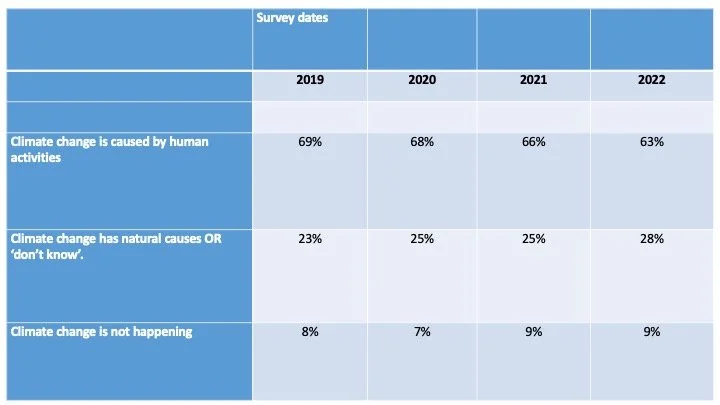
The surprising rise in climate scepticism [ 10-Oct-24 11:34am ]A yearly opinion survey carried out in many countries around the world looks at attitudes to climate change and to emissions reductions.[1] Paid for by the French utility EdF, the data collection is carried out by Ipsos. In the edition that collates the results from the 2022 survey, twenty researchers - mostly French - analysed the results and provided crisp commentary.
One thing immediately stands out. Between the surveys of 2019 and 2022, most countries saw a small but definite rise in broadly defined climate scepticism. Although a large majority around the world continues to sees climate change as being caused by human activities, increasing numbers of respondents say that climate change is caused by natural causes, or they are still not sure what is causing it, or whether it exists at all.
Figure 1
Source: EdF
In the period between the 2019 and 2022 surveys, the percentage of those polled who do not think that human actions, such as burning fossil fuels, are causing climate change has risen from 31% to 37%. The numbers who ascribe it to human activities fell from 69% to 63%.
This pattern applies across the world. In France, for example, the percentage saying that human actions are not causing climate change rose from 29% to 37%. In India, the figure rose from 29% to 40%.
The result is surprising; the scientific consensus on the cause of rising temperatures and extreme weather has become almost unanimous but the numbers rejecting this judgment around the world have grown sharply in the last few years.
Does this matter? Yes. A shift to a belief that mankind is not responsible for climate change makes it easier to believe that little can be done to slow and eventually reverse the increase in temperatures. Unpopular policies to cut carbon emissions become less politically acceptable.
Is the UK seeing the same pattern?
In short, the answer is yes. The pollsters YouGov run a survey approximately every two months that asks people the following question with four potential responses:
On the subject of climate change do you think ……
· The world's climate is changing as a result of human activity
· The world's climate is changing but NOT as a result of human activity (capitals used in YouGov survey)
· The world's climate is NOT changing (capitals used in YouGov survey)
· Not sure.
The survey has been run since July 2019 and the most recent one was completed a few weeks ago in September. So the data is more up-to-date than the EdF numbers.
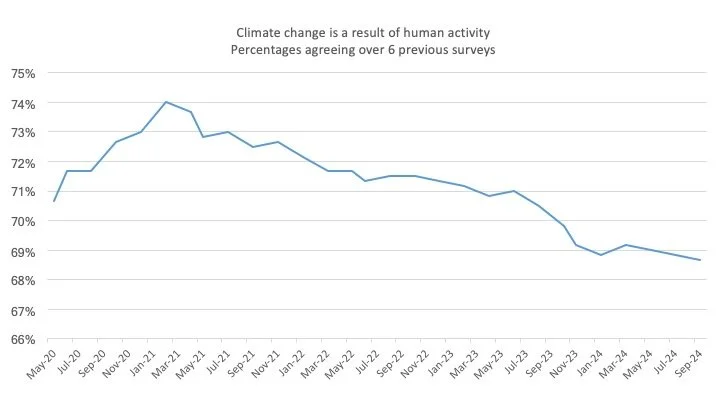
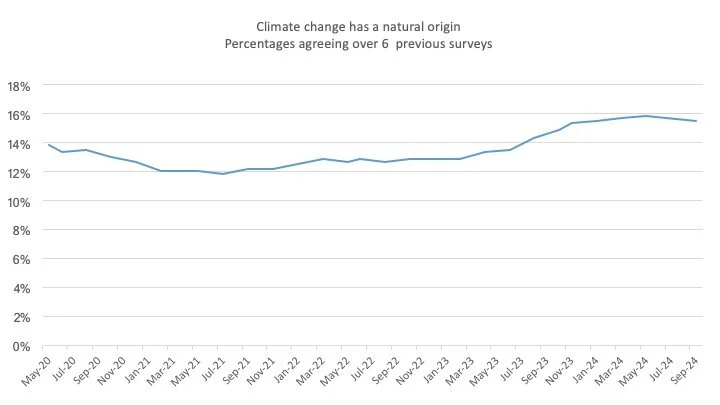
The Ipsos worldwide survey has a sample size of 24,000 respondents. YouGov's UK survey typically has around 1,700 respondents and so I have smoothed the British data by creating a rolling one year average of all the 6 surveys in the preceding 12 months. This means that the first data point covers the six surveys to May 2020. The final data point averages the results for the same number of surveys to September 2024.
Figure 2 shows the percentage believing that climate change is a result of human activities. The results show a rise to about 74% in the six surveys to February 2021 and then a fall to around 69% in the six surveys up to September 2024.
Figure 2
Source: YouGov.
The percentage of UK respondents seeing climate change arising from mankind's activities has therefore fallen around 5% between 2021 and 2024. Therefore the share of the population either seeing climate change as of natural origin, not being sure of its cause or denying the existence of any climate change has risen from 26% to 31%.
The most importance cause of this rise is the number of respondents saying that climate change exists but has natural causes. Although there has been a slight fall since March 2024, the percentage has increased from about 12% in early 2021 to around 16% now.
Figure 3
Source: YouGov
The percentage recorded as 'Not sure' has barely shifted from 12% of the survey responses. Those stating that climate change is not happening have risen slightly in number to around 4% from a low point of 2% in early 2021. Taken together these three responses add up to the 31% of people not believing in the human origin of climate change in the average of the six surveys to September 2024.
The one year rolling average for the UK numbers shows somewhat lower levels of scepticism than the global average. (A 69%/31% split compared to the 63%/37% split in the EdF world surveys). But at around 5/6%, the decline in the percentage of respondents believing that human actions are causing climate change is similar in the UK and the global average.
Which social groups are driving this change in opinion?
The EdF global survey shows how differences in social status, education levels and political attitudes affect the level and the degree of growth in scepticism about the human cause of climate change. In general, higher income is not strongly correlated with attitudes to climate and age is a very poor predictor of opinion; those over 65 have exactly the same propensity to believe global warming is driven by the modern economy as those between 25 and 49.
Levels of income and education are more correlated with views in the world surveys. Among the better educated, climate scepticism is 10% higher than among the lesser qualified, for example. Unsurprisingly, the most powerful correlation is between the degree of concern with climate change and the views about its origin. The least worried decile has only 19% of its respondents saying climate change was caused by human action whereas the most concerned decile has 80% of respondents believing in this cause.
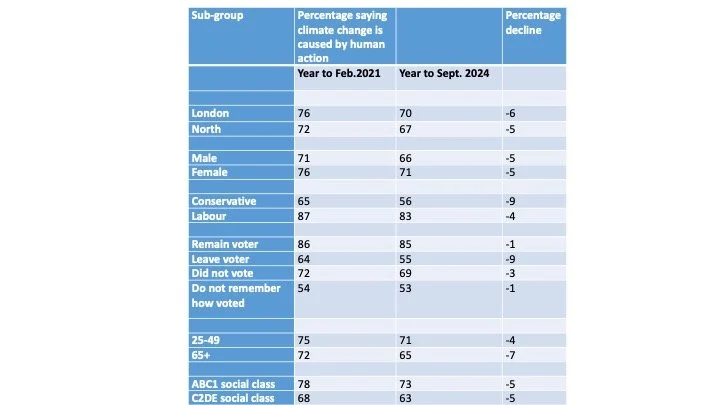
In the UK, in some ways the patterns are different. YouGov splits respondents by region, sex, political views, age, social status and how the person voted in the Brexit referendum.
The following table lays out by what percentage the belief in the human origin of climate change the individual groups fell in the period between the year to February 2021 and the year to September 2024.
Figure 4
Source: YouGov
This table makes clear that the decline in the belief in the scientific consensus on climate change is particularly concentrated among older Conservative voters who cast their ballot in 2016 to leave the EU. These groups were already more sceptical and so the differences, for example, between Conservative and Labour voters, for example, have widened.
On average, non-believers in climate change from human actions fell by 5% between the year to February 2021 and the year to September 2024. However Leave voters fully believing in climate change reduced by 9% from 64% to 55% and Conservative voters (many of whom will also have been Leave supporters) saw an equivalent decline. Leave voters now barely include a majority who blame human actions for climate change.
By contrast, Remainer voters barely changed their core opinion on climate change and 85% still see the human origin of global warming. The gap between this percentage and the percentage of Leavers with the same opinion has risen from 22% to 30%.
Wealthier people in classes ABC1 do have a lower degree of climate scepticism but the gap between this group and those in the C2DE group has not widened. Similarly, males are consistently less convinced about human origin of global warming than females but both groups saw a reduction of about 5% in the percentage declaring this opinion.
Conclusion
Despite the increasing evidence of dangerous climate change, the percentage of global, and UK, respondents thinking this arises from mankind's actions has fallen substantially in recent years. In the UK, the change in attitude is principally found among survey respondents of the political right, particularly those older people who voted to leave the European Union.
The Three-Bragger Problem [ 26-Sep-24 1:42am ]Preamble: OK, I lied. Said last time that this time was gonna be about science, and no more of this fluffy promo bullshit. And I meant well. But this time, the fluffy promo is about me. And it's cool. And more to the point, I don't have to spend hours doing research on things I don't actually know much about, so it's fast. When you're writing to deadline, fast is good.

Brag 1.
So check this out:
I have a small hand in this universe. I'm developing some of its Lore. I am not allowed to give you any details, but none of you will be surprised to learn that said Lore contains certain, shall we say, Darwinian elements.
I think it's going to rock.
Brag 2.
There’s something I'm allowed to share even fewer details about than EVE. In fact, I'm not even allowed to say that I am involved in it, although the trailer dropped earlier than EVE’s and the curtain rises sooner. I am allowed to paste promo copy from a certain corporate entity about a certain project—in effect, to place someone else's generic ad copy onto the 'Crawl without explaining its relevance. This is an opportunity I must regretfully decline.
A shame, though. From what I've seen, it's gonna be awesome. Stay tuned.
Brag 3.
And this—this—may be the least significant item in terms of pop culture, but it is, by far, the closest to my heart. It is an honor that generally accrues only to the likes of Gary Larson, Greta Thunberg, and Radiohead.
Niko Kasalo & Josip Skejo have named a tribe of Australian Pygmy Grasshoppers after me.
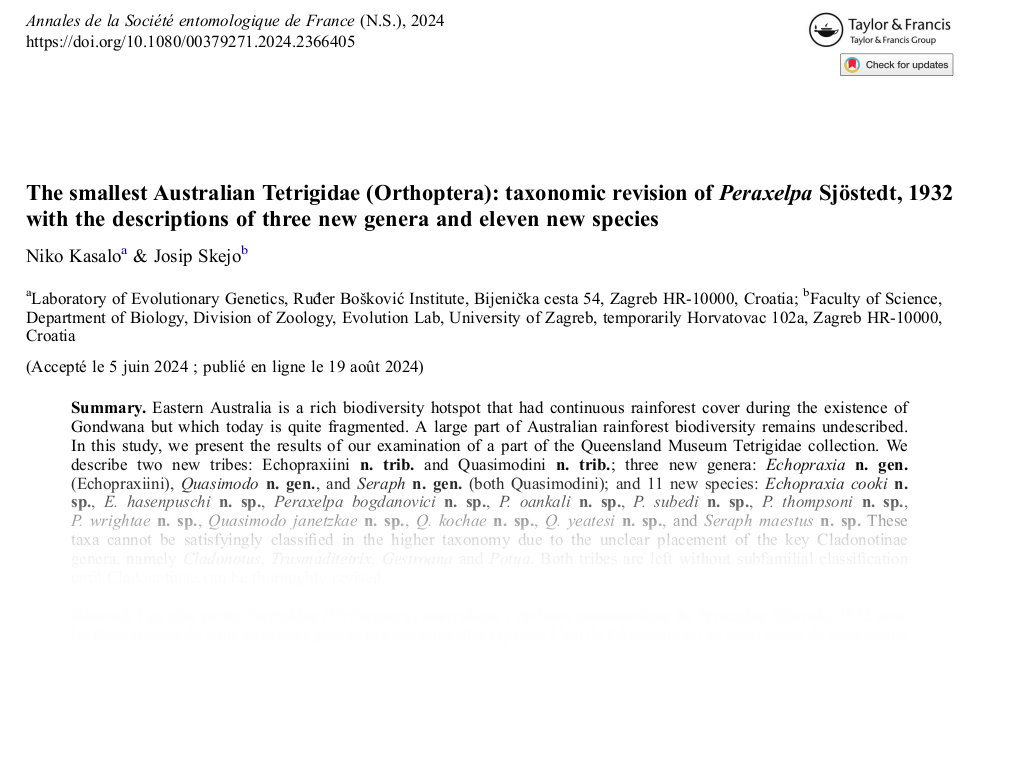
I mean, not me personally, but one of my novels. The Tribe is Echopraxiini; the genus is Echopraxia; the species is E. Hasenpuschi. And should any of you point out that correlation is not causation, and that there might be any number of reasons why someone might name a taxon after the neurological malady without even knowing about my novel, I've got you covered:

The paper in its entirety is paywalled, but I have uploaded a copy for your forensic edification just in case you think I'm full of shit. After reading it you may still conclude that I faked the whole manuscript, which offhand I cannot disprove. But if I did, you gotta admit I did a bang-up job.
Anyway: now you have some idea of the stuff I've been doing when I haven’t been writing Echopraxia Omniscience. I haven't just been lying around jerking off all these months.
Well, not exclusively.

Next up: science. Definitely[1].
Probably. ↑
From artist Laura Harling:
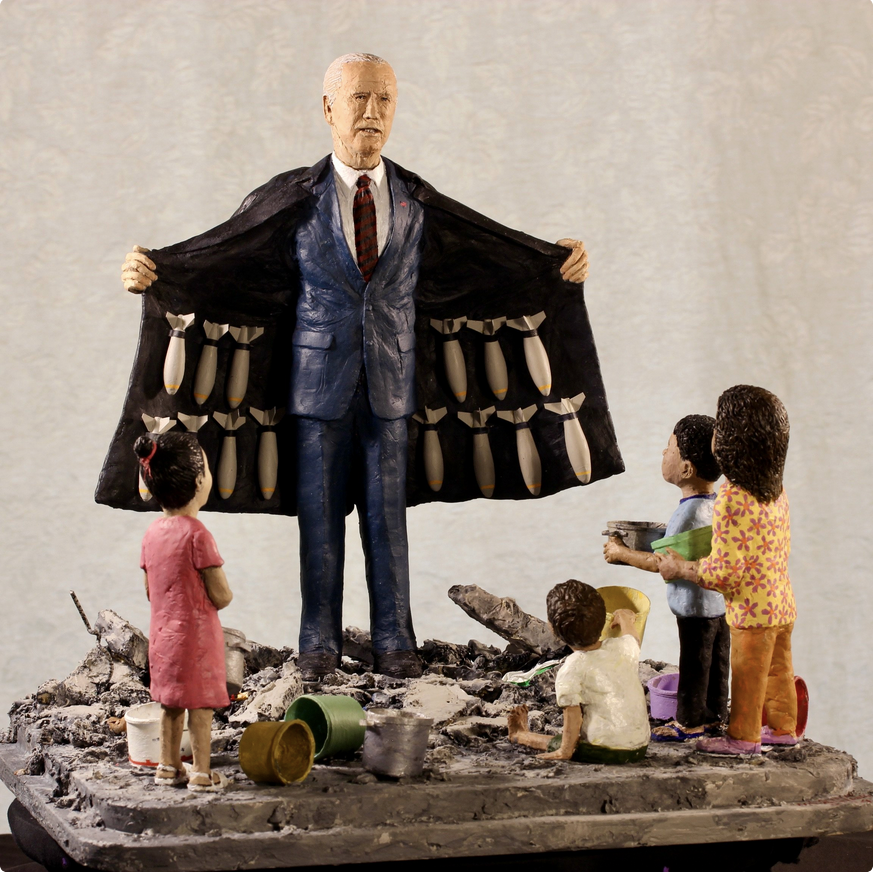
The Legacy: Joe Biden displays his legacy while Palestinian children beg for food. Link to Laura Harling's excellent gallery, here.
haunty ha-ha, haunty peculiar [ 01-Oct-24 6:08am ]
Sometime ago, Vic Reeves posted this on Twitter - if I remember right, it's artwork for a tour poster that was never used.
Immediately I flashed on Martin Parr's Boring Postcards book.

And then I thought of the graphic that Julian House cooked up for my big Wire piece on Hauntology.

And then the album art of second-wave hauntologists Warrington-Runcorn New Town Development Plan

And this got me thinking about the proximity of hauntology and comedy - more precisely, a certain strain of British comedy...
Now, on account of some of the write-ups the H-zone gets - the droves of dissertations even now being written on this area - it's easy to come away with a sense of H-ology as this rather sombre and gloomy thing. Especially if you go with the Fisher-ian take with its focus on Burial / The Caretaker and things adjacent like Disintegration Loops and The Sinking of the Titanic and all that. Lost futures, decaying memory, cultural entropy et cetera.
But, as anyone who really knows the area knows - and who has a wider sense of what it is - hauntology is actually riddled and addled with whimsy and macabre humour. When you listen to and look at the graphic presentation of what I consider to be the canonic core - Ghost Box, Mordant Music / eMMplekz, Moon Wiring Club, Position Normal - comedy runs through the whole thing.
And I'm not just talking the album art and the song titles and the samples - rather often the music itself has an antic air.
(Same goes for the sources too actually: whatever else it is, The Wicker Man is also a comedy).
(Think also of the "sinister camp" flavor of The Prisoner.... Kafkaesque yet absurdly English.... deliciously over-thesped)
(Or the Dr. Phibes movies)
So partly it's to do with the source material... and partly the proximity to pastiche and parody in a lot of the work... and then there's the element of retro-satire in something like Scarfolk, or the early records by The Advisory Circle.
I made this point in the sleevenote for the Ghost Box tenth-birthday compilation In A Moment:
One of the things some people don't seem to get about Ghost Box - and perhaps they're thrown off by the name - is that this isn't meant to be some hair-raising, soul-harrowing trip into necromantic darkness. It's much gentler than that, a twisting or tinting of the everyday. Softly spooky, sweetly creepy, Ghost Box enfolds the listener in a cosy unease. It's umheimlich you can live with, live inside. No, we are not dealing with Gothshit or pierced-dick second-wave industrial shlock here. Yes, humour is involved: in the artwork, the song titles, the fabric of the sound itself, with its queer mix of solemn and jaunty. A humour of a particular poker-face kind that reminds me of old dear comrades from long-ago campaigns of mischief and obfuscation. That's a personal resonance, but it illustrates a wider public fact: the existence of an Anglo-Surrealist continuum that crops up repeatedly across the generations, based each time around slightly different constellations of esoteric erudition and arcane research.
So anyway, all this got thinking about it from the other side - what about actual comedy on the telly that has haunty undercurrents? Britcoms that are fellow travelers with Ghost Box et al. Way back when, there was Victor Lewis-Smith's Buygones for Club X on Channel 4 - these were standalone mini-programmes (later a newspaper column) focused on obsolete gadgets and quaint appliances, once-popular toys, fads, and foodstuffs, dead media and forgotten TV personalities, etc etc... Things like the Spirograph, candy cigarettes, the Stylophone, Frank Bough ... An early example of retro-futurism.
Then there was Vic Reeves' Big Night Out.
Now I must admit, when I saw the first episodes I disliked it intensely (see the negative review at the end). But about six shows in, I realised my grave error - the moldy-old all-too-English stagnant pdor that I initially found suffocating was actually the source of its musty genius (The Smell of Reeves and Mortimer indeed). I don't know if it is quite hauntology but it nourished itself on similar decaying culture-matter.
Then, by the early 2000s, we have Look Around You, series 1 and series 2 - quasi-pedagogic retro-TV that could not be more congruent with the Hauntology Project. There's even an episode about ghosts!
"in today's modern world"
What else?
Blue Jam, in moments (there was an album on Warp wrapping blackest-ever-black humorous sketches in creepy ambient IDM)
More recently, some of the episodes of Inside No. 9 are straight out of the H-zone. There's one, "Mr King", that is very much ripping off The Wicker Man.
The Mighty Boosh had retro-fantasia aspects that connects to that side of hauntology that imagines musical counterfactuals and alternative history trajectories for pop.
I also think of The Detectorists as on the outskirts of hauntology… not quite bucolic horror but a sense of the past inside the present...
Whoever did these fake Penguin / Pelican / Puffin paperback covers for The Detectorists is picking up on the same thing I am...


Not having lived in the UK for the last 30 years or so, I have missed much. So I decided to ask a few people who might have a better sense.
Neil Quigley of KilkennyElectroacoustic Research Laboratory grew up in Ireland but has been exposed to much of this stuff. He told me that Reeves & Mortimer were actually a formative influence on what he does, especially their later stuff (which I had never heard of) like The Weekenders and Catterick, describing them as "tonal companions to Scarfolk and more like art school projects than the prime time TV stuff they did"
Neil also pointed me towards Garth Marenghi's Dark Place - another one I'd never heard of.
He also mentioned Lars Von Trier's The Kingdom as a non-Brit counterpart
And This Morning with Richard Not Judy (again, never heard of it)
I also quizzed Bob Fischer of The Haunted Generation / Mulgrave Audio
He pointed to a series called Mammoth and said "there was enough in there to make me wonder if he was
a Ghost Box fan".
^^^^^^^^^^^^^^^^^^^
And here's my Vic Reeves pan - I think it hones in on an essence that is proto-hauntology and in that sense the review provides a hauntology critique long before any one in the 2000s mounted their critiques of it - the need for some force of newness to blast open the windows, let the stuffy air out
 An Alternative to the Present [ 30-Sep-24 6:34pm ]
From the early '80s, I think.
19th Century DIY versus 20th Century DIY: cylinder home recordings, pirate radio tapes + adverts [ 29-Sep-24 5:00am ]
Luke Owen of Death Is Not The End just recently put out a really interesting release: Making Records: Home Recordings c. 1890-1920 - a collection of DIY home recordings, transferred from blank and repurposed brown and black wax cylinders, dating back to the early years of widespread phonographic technology, from the late 1890s and first couple of decades of 20th Century. In the words of David Giovannoni, whose collection is the source of this material: "For the first time in human history we could take sonic selfies, audio snapshots with friends, and aural portraits of loved ones. Our phonographs captured the sounds of everyday life, both silly and serious: the baby's squalling, Johnny's naughty joke, Grandma's favorite hymn as only she could sing it, our letters to loved ones in foreign lands...."
In honor of yet another fascinating Death Is Not The End release, here's my piece on an earlier archival triumph - Pirate Radio Adverts 1984-1993 Vol. 1 .... followed by my liner note for Pause for the Cause, aka Vol. 2 of the Pirate Radio Adverts compilation series.... followed by my interview with Luke about the project as previously Q-and-A'd at Blissblog.... followed by a bonus piece about my cherished pirate radio tapes originally done for The Wire.
^^^^^^^^^^^^^^^^^^^^
Save and Rave! How A Compilation of Pirate Radio Adverts Captures a Lost Britain
director's cut, The Guardian, Feb 16 2021
"Have you got that record that goes ah-woo-ooo-ooh-yeah-yeah?" It's a scene familiar to anyone who spent time in a hardcore rave record shop in the 1990s - a punter asking for a tune they've heard on pirate radio or at a rave but they don't know the title, so they mimic the riff or sample-hook hoping that someone behind the counter can recognise it. A relic of pre-Shazam life, the ritual is preserved in an advert for Music Power Records aired on the pirate station Pulse FM in 1992. Nick Power, owner of the Harringay, North London shop, recalls that no matter how mangled the customer's rendition, "nearly always, you'd be able to identify the exact record they were looking for."
In the advert, Power himself plays the roles of both sales assistant and punter (pinching his nose to alter his voice). Now, almost 40 years later, the comic skit commercial has been resurrected on London Pirate Radio Adverts 1984-1993 Vol. 1, the first of a pair of compilations pulled together by audio archivist Luke Owen.
Released via his label Death Is Not The End, Vol. 1 is available digitally at a name-your-price rate and for £7.50 as a limited-edition cassette tape - a cute echo of the format on which pirate listeners captured transmissions of hardcore and jungle. Back then, most fans pressed 'pause' when the ad break started, which means that surviving documents of the form are relatively scarce. But what once seemed ephemeral and irritating have subsequently acquired period charm and - for some - collectability.
Owen started Death Is Not The End in 2014 as a label and NTS radio show that trawled much further back in the 20th Century to scoop up early gospel and obscure blues. But early last year, he put out Bristol Pirates, tapping his own teenage memories of that city's 1990s radioscape. The adverts loomed in his nostalgic reveries with particular vividness: "they were infectious and endearingly DIY… some of them memorable to the point of fever loops. I can still remember one or two word for word". Owen sees "pirate radio broadcasts" in general as "archival folk music" that fits perfectly logically alongside the field recordings and Jamaican doowop he'd earlier reissued. "They are raw, impromptu and communal musical experiences."
Pirate MCs and DJs often described an upcoming ad break as "a pause for the cause" - an annoying but necessary interruption, because the revenue funded the station's operation. But the ads were useful to listeners, alerting them to raves and club nights. Promoters likewise depended on the pirates as the primary means of reaching their market, along with flyers left in record shops.
Author of London's Pirate Pioneers, Stephen Hebditch says that pirate radio - once a middle-class hobby - had by the late Eighties become "urban enterprise for the people most excluded from the legitimate media system… London reggae labels in particular put a lot of money into the pirates. Then when acid house came along promoters were splashing out a fortune on the stations linked to the rave scene". Some of this revenue covered the costs of replacing radio equipment seized by the authorities. But larger pirate operations could "make back the cost of losing a transmitter in just a few hours of broadcasting".
Although demonized by the government and news media as gangsters of the airwaves, the pirates were genuine community stations, playing music marginalized by mainstream broadcasters. The pirates represented minority populations - most obviously Black British, but other ethnicities too, like Greek-Cypriot Londoners. That's Nick Power's background, so he was tickled to hear a Greek-language ad for a Willesden Green beauty salon on London Pirate Radio Adverts Vol. 1. On Vol.2, out in early February, a similar one for a Harrow Road kebab house sits alongside ads for the Peckham jungle club Innersense at the Lazerdrome and for Chillin' FM's ravers dating service.
Death Is Not The End's compilations could be seen as a haunted audio cartography of a disappearing London. But that sounds a bit ghostly and elegiac: more crucially, these pirate adverts are joyous mementos of enterprising fun, young people grabbing good times at the outer edge of the law.
Sleevenote for Pause for the Cause: London Rave Adverts 1991-1996, Vol. 2
2022
Back in the early '90s, whenever the pirate radio MC announced "a pause for the cause", I usually pressed pause on my cassette recorder. That's something I would regret years later, when ad breaks had become cherished mementos of the hardcore rave era. Luckily, back in the day I often left the tape running while I went off to do something else. So a fair number of ad breaks got captured accidentally for my later delectation. Not nearly enough, though. So in recent years I started combing through the immense number of pirate radio sets archived on the internet. Sometimes the tracklists would note "ad break" or "ads", helping to narrow the search. But often I'd just stumble on a bunch in the middle of a pirate show preserved on YouTube or an oldskool blog. A few of my original unintended "saves" and latterday "finds" are included in this wonderful collection by audio archaeologist Luke Owen. It's the latest in his series of compilations of UK pirate radio advertisements, with this volume focusing on the audio equivalent of the rave flyer: MCs breathlessly hyping a club night or upcoming rave, listing the lineup of deejays and MCs, boasting about hi-tech attractions like lasers and projections, mentioning prices and nearest landmarks to the venue, and occasionally promising "clean toilets" and "tight but polite security" ("sensible security" is another variation). Some of these ads are etched into my brain as lividly as the classic hardcore and jungle tunes of that time. (Most rave ads incorporate snippets of current music, of course - big anthems and obscure "mystery tracks" alike). Names of deejays ring out like mythological figures: who were Shaggy & Breeze, Kieran the Herbalist, Tinrib, Food Junkie? Putting on my serious hat for a moment, I think these ads are valuable deposits of sociocultural data, capturing the hustling energy of an underground micro-economy in which promoters, deejays and MCs competed for a larger slice of the dancing audience. But mostly, they are hard hits of pure nostalgic pleasure, amusing and thrilling through their blend of period charm, endearing amateurism, and contagiously manic excitement about rave music's forward-surge into an unknown future. The best of these ads give me a memory-rush to rival the top tunes and MC routines of the era.
— Simon Reynolds, author of Energy Flash: A Journey Through Rave Music and Dance Culture.
Chat with audio archivist Luke Owen about the Pirate Radio Adverts project:
How did you get interested in pirate radio in general and in pirate radio adverts in particular?
I began tuning in to pirate radio from my early teens in Bristol in the late 90s - there was a lot of action on the dial back then and I was sucked in. It was a portal into the drum and bass/Full Cycle stuff happening in the city when I was too young for the clubs, and it also nurtured my love of reggae, dub and Bollywood soundtracks at a relatively young age. The ads were often infectious and endearingly DIY, and some were memorable to the point of fever loops, I can still remember one or two word for word.
I came upon the Pirate Radio Archive website a couple of years back, and there I found a trove of recordings from across the 80s and 90s through which I could transport myself back in time to some of those broadcasts I had been brought up on. I had been running Death Is Not The End since 2014 as a record label and NTS radio show focused mostly on "deep digs" into early gospel/blues/folk, field recordings and various archival finds. Coming across these recordings I was immediately stuck by the desire to do something with them, and put together a mixtape for the Blowing Up The Workshop mixblog and subsequently released it on DINTE as a cassette. It was a bit of a left-turn for the label perhaps, but being both archival and field recordings I thought it fit. I'm interested in "folk music" having a broader contemporary remit, and what it can mean in context. To me, recordings like these pirate radio broadcasts can represent archival folk music of sorts - they are raw, impromptu and communal musical experiences.
For me, the appeal of them is multi-leveled - there's nostalgia, there's period charm, there's the amateur nature of them, some of the comedy ones are genuinely funny… But I also think they provide a valuable and historically important archive of subculture and British 'lifeworlds', especially minority populations (e.g. you have the Greek salon ad on Vol 1 ).
Yes, a lot are hilarious and some to the point of being genuinely a bit unhinged in places... A big part of the uniqueness of pirate radio is in the ads I think - it reflects the alternative culture through the lens of local business and events in a way that often contrasts with the staleness of "commercial" radio as much as the music itself. The whole thing often just seems to thrive on amping up the madness a bit, because they can. The London Pirate Radio Adverts collection was also intriguing from a local history perspective. I've always been interested in the changing landscape of areas, the previous lives of buildings, music venues, long gone record shops etc. By chance a lot of the adverts I collected for this happen to be for clubs and bars in places in South East London and East London that I've come to know quite well since moving here in the mid-noughties so that's another facet of it for me. Also, Immigrant communities making use of pirate radio as a means to supply an essential community service is an inherent element to pirate radio as a whole I think.
I like also the range. You have the slick-aspiring ads (with a tiny bit of Smashy + Nicey about the patter, quite common with pirate deejays before '92 when it got a lot more ruffneck and hooligan in vibe - or they'll hire that voiceover guy that also appeared in cinema adverts, the one with the incredibly deep voice, he pops up a few times on your tapes). And then the much more amateurish efforts.
Redd Pepper? I'm never quite sure whether it's him or an imitator... He sure must have gotten a lot of work around this time regardless. There's another guy who seems to have been the voiceover guy for a large portion of reggae & dancehall/soundclash events in the past couple decades (this is him @ 5.40 on Side A) and is still going strong. I'm going to do my best to track him down, I think I might have a friend of a friend who hired him for an ad once.
I think there's sometimes a conscious effort to get someone with a posh accent (or affecting one) for some of the dances that are billing themselves as classy & exclusive affairs. Then you've got some hilariously oddball voices, and a really bad Scouse impression that I have no idea what it's trying to achieve! I think pirate radio in general is prone to jokes and reference points that only the small group of listeners (or more likely mates of the station and the DJs) are "in" on, and this can bleed through to the ads as much as the chatter.
They often seem to like putting FX on the voice.
Yes, the use of delay on pirate radio station voiceover and adverts seems to be a point of reference that's bled in from sound system culture. I think it also helps the adverts "pop" and the feedback has the handy effect of papering over cracks where they may often sound too muddy and amateurish otherwise. I've also added tape delay here and there to aid with the transitions from one track to the next - the idea was initially for this to have the flow of a mixtape as much as possible.
Most of the ads on pirates were for raves, clubs, records shops, occasionally a compilation or a 12 inch release … But it's interesting that quite a few of them are for non-music-related businesses - there's one I came across for a bakers, you'll get ones for hairdressers or a restaurant. Or on Vol. 1 the shop fittings ad for Trade Equip and the one for Fidel's Menswear.
In a way I find the non-music related ads as some of the most intriguing and charming. It shows that the stations were often genuinely part of a thriving localised economy, and not just for soundheads. It seems a bit mad to think of a small high-street business advertising on the radio these days, and I suppose with the advent of social media marketing we're probably seeing the last of small businesses in print advertising to a large degree - it's just not attractive as you don't get to monitor the traffic it's generating and target your audience down to the minutiae, but it leaves a document of that business that can be preserved from a local history perspective (whereas when a business folds their online presence will likely disappear with it).
Even on the music history level alone, though, they are valuable - there's a sort of established history of rave where certain legendary clubs get mentioned over and over (Rage, Labrynth, Innersense) and the same applies to the raves, labels, record shops. But these ads capture just how many clubs, raves etc there were, in all different parts of London or UK… many that have been forgotten or only ran for a short while. And there are addresses, times, prices mentioned.
Yes, the provision of full addresses, and often bus routes and the general specifics for the clubs and venues always gives me a pang of nerdy excitement. The addition of local landmarks, "under this flyover", "next to Tescos" etc. gives me extra info with which I can go sleuthing on Streetview and look at the ghost of the club mentioned in the advert (and for extra nerdery I can swipe backward in time on street view to see it's former guises too).
The raver's dateline courtesy Chillin FM advert is very interesting and surprising!
Yes I was surprised to come across so many ravers datelines! I wonder if this is something you had come across before? Hooking up and meeting potential partners never struck me as a priority to pilled-up ravers but I must be mistaken... It was relatively before my time, and I suppose it's easy to be swayed by the dominant narrative of early rave being a drug-fuelled oasis away from meat-market bars & clubs, but there was clearly a market for it! I can't help being reminded of Father Ted's priest chatback line whenever I hear it, also.
I think you mentioned in that Crack interview how most people paused the tape when the ads came on… so there's a limited number of ad breaks that have survived intact.
Yeah I guess it makes sense that the music is what the majority of the listeners are there for, and the ads can do one - or indeed be edited out later. The sources I had were pretty much all online, so I suppose you could say that a portion of those who have ripped/digitized their tapes didn't stop their recordings when the ads came on, and rather they have cropped them out in the process. But in general it's the same principle as to when you would record a TV show on VHS - a waste of valuable magnetic tape space.
What number did you accumulate before you started winnowing them down?
Maybe 100 total? It's been a bit of a blur to be honest. At some point I think I was losing it a bit.
It's good that you have ads that aren't just rave / hardcore / jungle, but others kind of music that were big then - like mellow house and progressive house etc.
It's easy to imagine pirate radio as exclusively a place for jungle, hardcore, reggae and dancehall etc. but yes it's refreshing. I particularly am interested in the popularity of rare groove and how that fits into the mix. The Under 18s Disco advert strikes me for it's mix up of styles - 'ragga, house, rap & swing'.
What is your favorite ad out of all the ones on the two cassettes? Or top 2 or 3.
I think probably the Videobox rental shop is up there, it's the faux dialogue that just makes me smile. The Rolls Royce & A Big House in 89 is just fantastic for the list of celebrities who have "been invited", and that you simply need to go into your local hairdresser for £1 tickets.

PIRATES OF THE AIRWAVES
The Wire, 2008
By Simon Reynolds
Easily the most precious sonic artifacts in my possession are the tapes I made of London pirate radio shows in the early Nineties. Everything else is replaceable, albeit in some cases at considerable effort and expense. But these ardkore rave and early jungle tapes are almost certainly irrecoverable: given the large number of stations active then, the sheer tonnage of 24 hours/Friday-Saturday-Sunday broadcasting, and the drug-messy non-professionalism of the DJ-and-MC crews of those days, it's highly likely my recording is the only documentation extant of any given show.
In which case, if only I'd used higher quality cassettes! Before I got wise, I'd tape over unwanted advance tapes from record labels: since the radio signal could often be poor, buying chrome blanks seemed a waste . Plus, in those early days, I wasn't doing it out of some archival preservationist impulse. Like a lot of ravers I was just taping to get hold of the music, something hard to do otherwise because deejays rarely identified tunes. Later I'd discover that many were dubplates that wouldn't be in the shops for months anyway; in some cases, they were test pressing experiments that never got released at all. I was taping simply to have the music to play through the week when the pirates mostly dropped off the airwaves, and in 1993, when I spent large chunks of the year in New York, I took the tapes with me to keep the rave flame burning during my exile.
These relics of UK rave's heyday are editions-of-one because they're mutilated by my spontaneous editing decisions: switching between stations repeatedly when a pirate show's energy dimmed, or the DJ dropped a run of tracks I'd taped several times already; cutting off arbitrarily when I couldn't stay awake any longer, or dwindling into lameness because I'd left the tape running and went off to do something else. In the early days I often pressed 'pause' when the commercial breaks came on, something I now regret because those that survived are among my absolute favourite bits. With their goofy, made-on-the-fly quality, the ads for the big raves and the pirate station jingles contribute heavily to the dense layering of socio-cultural data and period vibes that make these tapes so valuable.
The crucial added element to these tapes, something you don't get from the original vinyl 12 inches played in isolation or even from the official DJ mix-tapes and mix-CDs of the era, is life. In two senses: the autobiographical imprint of my personal early Nineties, someone hurled disoriented into the vortex of the UK rave scene and still figuring it out, but also the live-and-direct messiness of deejays mixing on the fly and using whatever new tunes were in the shops that week, of MCs randomizing further with their gritty and witty patter. The tapes are capsules of a living culture. Something about the mode of transmission itself seems to intensify the music, with radio's compression effect exaggerating hardcore's already imbalanced frequency spectrum of treble-sparkly high end and sub-bass rumblizm. Pirate deejays, typically mid-level jocks or amateurs, also took more risks than big-name DJs crowd-pleasing at the mega-raves. Playing to a home-listening or car-driving audience, the DJs mixed with an edge-of-chaos looseness and squeezed in some of the scene's odder output rather than just sticking to floor-filling anthems.
Oh, they're not all pure gold, these tapes. Many shows stayed stuck at "decent" or slumped outright into "tepid". But the ones that ignited… ooh gosh! The vital alchemical catalyst was invariably the MC. On some sessions, it's like a flash-of-the- spirit has possessed the rapper, as electrifying to the ears as a first-class Pentecostal preacher or demagogue; you sense the MC and the decktician spurring each other to higher heights. It tends to be the lesser knowns that thrill me most: not the famous big-rave jungle toasters like Moose or Five-O but forgotten figures like OC and Ryme Tyme, who forged unique styles that melded the commanding cadences and gruff rootsiness of U-Roy-style deejay talkover with the chirpy hyperkinesis of nutty rave, or collided barrow boy argy-bargy with B-boy human beatboxing. Some of these tapes I know so well that the tracks are inseparable from the chants and the chatter entwined around the drops and melody-riffs; years later when I finally worked out what the mystery tunes were and bought them, they sounded flat without that extra layer of rhythmatized speech thickening the breakbeat broth.
1992 to 1994, ardkore to darkcore to jungle, is the prime period for me. I seldom revisit the drum and bass years, when things got serious; things pick up again with the poptastic re-efflorescence of UK garage and 2step, when the number of London pirates resurged to its highest level. Grime is an odd one: I've got masses of tapes, and there's masses more to be found archived on the web, but the emergence of the MC as a capital A artist strikes me as a mixed blessing. With one eye on their career prospects (an album deal) the MCs increasingly came in with pre-written verses, reams of carefully crafted verbiage dropped with little regard to how it fit the groove. Pirate MCs always had an arsenal of signature catchphrases and mouth-music gimmicks, but with grime a vital element of ad-libbing improvisation got severely diminished. So excepting some 2002 tapes from grime's protozoan dawn, I've not got the same attachment or affection as I do for the classic rave sets.

Oddly, I've rarely found people who shared my obsession to anything like the same degree: a handful of collector-traders, and a guy called DJ Wrongspeed, whose fantastic Pirate Flava CD collaged the best bits from his now defunct Resonance FM series based around re-presenting pirate radio broadcasts. Often I've come across people who'll talk enthusiastically about recording the pirates "back in the day," only to reveal they'd long since taped over the cassettes, left them in the car to curdle in the heat, or just lost them. Aaaaargh!
But as a quick web search reveals, pirate tape fiends are out there lurking, and not just ones obsessed with the London-centric hardcore continuum: there's online archives and merchants for the original pirate radio of the 1960s (stations anchored in international waters or occupying abandoned offshore military forts) and sites dedicated to the land-based pirates of the Seventies and Eighties and to the Eighties hip hop mix-shows broadcast by London's pre-rave pirates. In terms of my particular addiction, you can find ardkore, jungle and UK garage sets archived at old skool sites, or offered for trade or sale; on various rave, drum'n'bass and dubstep message boards you'll come across individuals sharing huge caches of vintage transmissions. The pirate penchant seems to be a minority taste within the larger niche market for DJ mix-tapes of the sort recorded through the sound board at the big commercial raves and then sold commercially through specialist record stores. People have been selling or swapping dupes of these sets for a dozen years at least (nostalgia for 1990-92 set in as early as 1996!). Today, an original Top Buzz mix-tape circa 1992, say, might fetch sixty pounds on Ebay. Strangely, from my point of view anyway, old skool fanatics generally prefer the slickly-mixed official releases to the vibe-rich but erratic pirate tapes; a lot of people just don't like MCs, it seems. But if, like me, you dig the brink-of-bedlam atmosphere of the pirate set, or are just curious to cop an in-the-raw feel of what it was like in those crazed days, seek out these online deposits of delirium:
http://www.hardscore.com/radiosets.htm
A sizeable cache of 1989-97 shows, mostly from the London area.
http://www.londonpirates.co.uk/TouchdownAudio.htm http://www.londonpirates.co.uk/DonAudio.htm
Sets from two of my favourite stations of the 1992-93 "golden age"
http://www.yorkshirejunkies.co.uk/music-pirate-radio-recordings.php
Massive archive of broadcasts from Sheffield, Leeds, Bradford, York, Huddersfield, Hull and other North of England stations, 1992 - 2006
http://www.tapesgalore.co.uk/prtapes.htm
Huge selection of pirate tapes, albeit for sale rather than download.
Freaks in the Machine: Mondo 2000 in Late 20th Century Tech Culture. [ 23-Sep-24 11:34pm ]R.U. Sirius & Shira Chess are pleased (and a little
frightened) to announce that we have contracted with
Strange Attractor Press to publish Freaks in the
Machine: Mondo 2000 in Late 20th Century Tech
Culture. With a forward by Grant Morrison.
Before the entire world was online, before it was divided
into social media enclaves and corporate-sanctioned
“likes,” before even WIRED magazine, there was Mondo
2000. Published from 1989-1997, Mondo reached a peak
distribution of about 100,000, but the magazine was even
more influential than its distribution implied. M2K was
raved about by 90s media outlets, consumed by early tech
culture, and demonstrated a transition from the literary
cyberpunk style of Gibson and Vinge into an aspirational
cyberpunk aesthetic that leaked into the material world. In
1994, Douglas Rushkoff described Mondo as the "voice of
cyberculture."
Published by a rag-tag team of psychonauts and
counterculture weirdos, and based out of a Berkeley Hills
mini-mansion, the parties and strange goings-on were
almost as legendary as the magazine itself. The Mondo
publishers — editor-in-chief R.U. Sirius and Domineditrix
Queen Mu — were not technologists. Yet their Bay Area
publication created a desire for the technological zeitgeist
of the coming millennium. In turn, the high (and sometimes
low) weirdness of Mondo established a kaleidoscopic onramp
that rocketed a lot of early adaptor mutants (or
"Mondoids") onto the so-called “information superhighway”
of the late 90s and early 00s.
Part memoir, part history, and part critical analysis, Freaks
in the Machine tells the storied adventures of the
magazine’s tumultuous history, its strange cast of
characters and its irreverent content.
"Mondo was the next bold stage in an evolutionary advance where street
cred and an underground ethos would come with the potential to appeal to
a mainstream audience, to wake up the straight world, announcing its
arrival like a flare over the horizon so everyone could see and know this
was the signal they'd been waiting for." -Grant Morrison
R.U. Sirius is still best known as the editor-in-chief of the
great 1990s cyberculture magazine Mondo 2000 although
some historians insist that he should be most remembered
for his skills as a second baseman in the West Islip New
York little league while others have raved about the
infrequent and disturbing live appearances of the band
Mondo Vanilli. [Note from Shira: There were no historians.]
He has written for Time, Rolling Stone, Salon, WIRED and
a bunch of other publications that are stored on the tip of
his tongue. Books include Counterculture Through The
Ages (with Dan Joy), Design for Dying (with Timothy
Leary) and Cyberpunk Handbook (with St. Jude & Bart
Nagel).
Shira Chess is an Associate Professor in Entertainment &
Media Studies at the University of Georgia and a
recovering game studies scholar. She is the author of
several books on digital culture and video games,
including the forthcoming MIT Press book The Unseen
Internet: Conjuring the Occult in Digital Discourse. She
joins this project to add context and history, to referee any
nonsense, to try to make sense of Sirius's lunatic ravings,
and to excise any excesses of cringe.
The post Freaks in the Machine: Mondo 2000 in Late 20th Century Tech Culture. appeared first on Mondo 2000.
Elly Baker, ChairLondon Assembly Transport CommitteeCity HallKamal Chunchie WayLondon E16 1ZE23 September 2024
cc: London Assembly Transport Committee, Members and Staff
Good Morning Elly Baker,
I received the attached letter from you as Transport Committee Chair "responding to your email from 26 June 2024" on 19 July via a Committee Staffer.
As you know, my 26 June email to you and the Committee simply contained a link to an Open Letter from former TfL Bus Driver Lorraine Robertson: acting on Lorraine's express instructions, I was pleased to post her letter on my blog and email the link to you and the Committee on 26 June.
Although I intend to respond publicly to your 19 July letter to me in due course, kindly note it's been over two months and Lorraine Robertson still awaits your response to the issues she requested the Transport Committee to investigate, namely—and quoting directly from her 26 June Open Letter—
- The Contradiction between TfL's Bus Contract Timeliness Incentives and Speed Limits;
- TfL's Refusal to Require Independent Bus Crash Investigations;
- TfL's Failure to conduct Risk and/or Human Factors Assessments of Bus Driver Working Conditions that are known to have a direct impact upon Safety Performance.
Yours sincerely,
Tom Kearney#LondonBusWatch T: ddddddddddddddE: comadad1812@gmail.comTwitter: @comadad Blog: www.saferoxfordstreet.blogspot.co.uk 2018 Winner, Community Hero Award — The Johns Hopkins University Alumni Association2016 Winner, Transport - Sheila McKechnie Foundation SMK Campaigners Award
.jpg)
.jpg) RIP Fredric Jameson [ 22-Sep-24 5:53pm ]
RIP Fredric Jameson [ 22-Sep-24 5:53pm ]The grand old man of Marxisty critique made it to 90.
Here below: a review of Jameson's magnum opus Postmodernism, or, the Cultural Logic of Late Capitalism that the Observer let me do when I was barely more than a baby.
Postmodernism is a thick, dense slab of a book. My favorite Jamesons are the slimmer efforts: A Singular Modernity: Essay on the Ontology of the Present and Fables of Aggression: Wyndham Lewis, the Modernist As Fascist (literally light reading compared to Postmodernism and benefiting from its monographic focus on a single figure). Archaeologies of The Future: The Desire Called Utopia and Other Science Fictions really ought to be right up my street but despite a couple of attempts I always come to a half halfway through. It is amazing how widely and deeply read Jameson was in s.f. - not just its New Wave or respectably literary exponents, but swathes of the hard-science and early 20th Century pulp stuff too. Evidence of a misspent youth?
FREDRIC JAMESON
Postmodernism, or, the Cultural Logic of Late Capitalism
The Observer, 1991
by Simon Reynolds
With this book Fredric Jameson sets himself a daunting task. His aim is to define the postmodern Zeitgeist - arguably a contradiction in terms, since one defining characteristic of the "postmodern condition" is its lack of a sense of itself as 'zeitgeist' or 'era'. Jameson manfully seizes these and other contradictions with both hands: his project is to root a rootless culture in its economic context, to systematise a condition that is hostile to systems, and to historicise a phenomenon whose main effect is the waning of historical consciousness. But then, as a Marxist, Jameson retains an oldfashioned commitment to lucidity and overview. "Closure" (coming to conclusions, actually saying something) holds no special terror for him.
What Jameson has to say is of an analytical rather than judgemental nature. He doesn't take sides because he doesn't see postmodernism as an option, a fad or genre to affirm or repudiate. Rather, it's the unavoidable condition of late Twentieth Century existence, the cultural air that we breathe. In Marxist terms, postmodernism is the "superstructure" generated by the economic base of "late capitalism," (multinational corporations, mass media, information technology). Modernism was the "emergent" culture of an age when modernisation was still incomplete, and there remained a backdrop of peasant simplicity and aristocratic decadence against which a cultural vanguard could dramatise itself, with its idea of the artist as prophet and the work of art as a monument to the future. Postmodernism arose when the modernisation process was complete, and nature was superceded by the media. The new no longer seems that new; a sort of nostalgia without anguish (inconceivable to modernism) becomes possible, as exemplified by the rapid turnover of period revivals in film, fashion and pop music.
For Jameson, postmodernism represents a seismic shift in our very concepts of space, time and self. Modernism was the expression of the bourgeois subject (the grand auteur, the angst-ridden individual). Postmodernism creates a new kind of decentered subject, "a mere switching center for all the networks of influence" (Baudrillard). The media's "endless barrage of immediacy" destroys perspective, invades our consciousness and erodes the individual's ability to formulate a point of view. In art, modernism's themes of authenticity and meaning give way to pastiche and a fascination for the surface image; emotional affect is superceded by freefloating euphoria and sublime vacancy. Van Gogh is replaced by Warhol.
Jameson's provocative argument is that this new decentered subjectivity is a kind of schizophrenia. Unencumbered by past memory or future projects, the schizo inhabits a perpetual present that is intensified to an unbearable degree. The experience of space and of the vivid materiality of the world is enhanced at the expense of temporal consciousness. This heightened sense of here-and-now has been long the goal of the mystic or drug fiend, but for those who can't return to focused, productive consciousness (the schizophrenic and, increasingly, postmodern man), the experience is one of ego-shattering disorientation.
But this postmodern "hyperspace" is, argues Jameson, precisely the emergent terrain of late capitalism, with its fax machines, cable TV, satellite link-ups and data networks. To apprehend our place in this new totality of global capitalism, we need to evolve a new kind of consciousness, which he likens to that of the alien in The Man Who Fell To Earth, who can watch 50 TV channels at once, or SF writer William Gibson's cyberpunks, who inhabit a computer-generated "virtual reality". Despite his guarded enthusiasm about much of postmodernism's cultural output (video installations with their flow of images that resist being reduced to a single meaning, buildings like Los Angeles' Westin Bonaventure hotel), Jameson sheds Marxist tears for some of the casualties of postmodern theory. In particular, he mourns the postmodern rejection of "totalizing" theories, and of the notion of a "lost totality" (the alienation-free existence which Utopian politics seeks to recover). Advocates of postmodernism claim that these concepts lead ineluctably to totalitarianism (the Gulag, Pol Pot, the hubris of social engineering). But Jameson clings to the conviction that without totalizing concepts, the individual cannot understand his relationship to the system of late capitalism, and thus loses any political agency.
Jameson's solutions are suggestive if somewhat sketchy. He deftly turns the TV addict's practice of "channel-switching" into a metaphor for what he calls "transcoding". A sort of postmodern version of the dialectic, this involves pick-n-mixing world views and combining their partial glimpses of the Big Picture. Jameson also calls for a new science of "cognitive mapping", whose task is to plot the disorientating globalism of late capitalism (financial speculation in Tokyo or London can wreak havoc on peasant life in Paraguay), and coordinate local struggles against it. In other words, before you can do anything, you must first get your bearings. Postmodernism might be a calamity for oldstyle revolutionary politics, but Jameson concludes that the globalisation of capitalism will spawn a new international proletariat with forms of resistance we can scarcely imagine.
This "light at the end of the tunnel" is tentative and hard-won. Throughout Postmodernism, Or, The Cultural Logic Of Late Capitalism, Jameson painstakingly follows every lead and takes on every conceivable objection to his ideas. He really works for the few glimmers of hope that he allows himself. Oscillating between the intoxication of the latest postmodern theories and the sobriety of the Marxist tradition, Jameson confirms my belief that the most lucid and productive analyses of postmodernism have come from those who are hostile or at least deeply ambivalent about its implications.
RIP Fredric Jameson [ 22-Sep-24 6:14pm ]"The future fades away as unthinkable or unimaginable, while the past itself turns into dusty images and Hollywood-type pictures of actors in wigs and the like." - Fredric Jameson, 2015
"The return to history everywhere remarked today… is not a return exactly, seeming rather to mean incorporating the 'raw material' of history and leaving its function out, a kind of flattening and appropriation"
-- Fredric Jameson, Postmodernism, or The Cultural Logic of Late Capitalism, 1991
"Randomly and without principle but with gusto cannibalizes all the architectural styles of the past and combines them in overstimulating ensembles.... the 'historicism' of the new painting [enables] its secession from a genuine history or dialectic of stylistic evolution, 'frees' it to recover painting styles... as a sort of objet trouve... an omnipresent and indiscriminate appetite for all the styles and fashions of a dead past"
Fredric Jameson, Postmodernism, or the Cultural Logic of Late Capitalism, 1991
"A gleaming science-fictional stasis in which appearances (simulacra) arise and decay ceaselessly…. The supreme value of the New and of innovation, as both modernism and modernization grasped it, fades away against a steady stream of momentum and variation that at some outer limit seems stable and motionless… Where everything now submits to the perpetual change of fashion and media image, nothing can change any longer…. If absolute change in our society is best represented by the rapid turnover in storefronts…. it is crucial to distinguish between rhythms of change inherent to the system and programmed by it, and a change that replaces one entire system by another one altogether"
-- Fredric Jameson, Postmodernism or, The Cultural Logic of Late Capitalism, 1991
"[Spectrality is that which] makes the present waver: like the vibrations of a heat wave through which the massiveness of the object world--indeed of matter itself--now shimmers like a mirage."--Fredric Jameson
Oasigue [ 12-Sep-24 4:12am ]

Saw this around and about and so much wanted it to be real - to be an actual existing, gigging tribute band - that I have not done due diligence, in terms of checking it is not just anAI whimsy.
If it is real, then it this the birth of a new genre of tribute group - the hybrid tribute band?
Any other known examples of this kind of retro mash-up?
^^^^^^^^^^^^^
I liked Sigue for the duration of that first single.
But then it quickly got tragic.

More people came to Carol's funeral than there were seats in the crematorium chapel: our families, her friends and mine, some of whom had travelled a long way. The funeral directors, P B Wright and Sons, took care of the arrangements kindly and professionally. Catriona Miller, the humanist celebrant, conducted the service and delivered a warm and accurate tribute to Carol. I spoke about Carol's life with me, and Michael spoke for himself and Sharon about Carol as a mother. Two hymns were sung that had also been sung at our wedding. The closing music was a song Carol had played countless times: 'Stars' by Simply Red.
The Order of Service booklet featured a fine recent photograph of Carol by Michael, and some of Carol's own photographs of Gourock's sunset skies.
The collection was for two charities that Carol had actively supported: the RNLI, and Medical Aid for Palestinians. It raised £1138.50, which yesterday I rounded up to £1200 and divided evenly into two donations in her memory.
Many, many thanks to all who attended, and to all who contributed so generously, at the collection and online. Thanks also for the many messages and cards of sympathy, for which I and all the family are deeply grateful.
Carol Ann MacLeod, 11 February 1952 to 16 August 2024
 Carol, my beloved wife whom I met in 1979 and married in 1981, died on Friday 16 August.
She was the centre of my world, and she's gone.
There will be a funeral service at Greenock Crematorium, on Monday 2 September, at 2 pm, to which all family and friends are invited. Family flowers only please. There will be a retiral collection in aid of Carol's favourite charities. #
Two-Step Forwards, Ten Years Back [ 12-Aug-24 8:07pm ]I know, I know. Two pimpage posts in a row. Not my usual shtick, and I assure you not any kind of new normal; the stars just aligned that way this time around. For what it's worth, next time I expect to be talking about Darwinian evolution in digital ecosystems, complete with a tortured retcon arguing that I saw it all coming two decades ago with Maelstrom.
You know. The classics.
Forward One:

Artist, children's author, musician, video maestro—not to mention good friend and RacketNX nemesis—Steven Archer is at it again. I've sung his praises before on this 'crawl, even written a story based on one of his songs. I'm not the only one to appreciate the man's work, even though darkwave grunge is about as far as you can get from my usual proggy aesthetic; he's worked with entities as diverse as NASA and Alan Parsons. Neil Gaiman lauded his skills while Steven was still a student (granted, that endorsement has not aged as well as he might have hoped).

This time around he's released a jagged graphic novel—a companion piece to Stoneburner's Apex Predator album, though by no means do you have to experience one to appreciate the other— about canine deities who generally exist outside time and space but who, here in what we call reality, still crush cities underfoot like any self-respecting kaiju when they get pissed. Unlike last post's Alevtina and Tamara, there's no doubt that Tooth and Claw is a proper graphic novel. Its got a definite and coherent and very long story arc: it starts at the beginning of time (it's a creation myth at heart) between "waves of energy so far apart you cannot call them heat", and it ends in pretty much the same place. (Well, technically it ends with Nicholas Cage starring in a Ridley Scott movie about a giant wolf laying waste to the United States, but that's just part of the epilogue).
The art ranges all over the place, from saturated oils that bleed across the page to joyful childlike scribbles to even that A-word nobody uses any more for fear of provoking backlash. The verbiage, as usual, is a delight—"every species learns by breaking the things around them", "there goes God, making the scientists look stupid again", "I am what is left after the stars go out". Vignettes unfold in singularities and coffee shops and frozen steppes and burning cities. The vibe ranges from Crichton to Call of Duty to Indigenous Creation Myth by way of Lee Smolin. Conspiracy theorists rage on the Internet. A girl on her sixth birthday reenacts Armageddon with her stuffed animals. Saturn's Rings turn out to be the skid mark of an ancient deity slingshotting en route to earth. Soldiers just follow orders; scientists try to figure out how something the size of a mountain gets enough to eat. It's really good.
I wrote the Forward. That's pretty good too.
You can see the excerpts on this page. View the art, read the captions: a small taste, nothing more.
If you fancy a whole meal, here's where you get it.
Forward Two
"Will the explorers manage to escape the crazed thing and fight their way back to the Endurance?" asks the back-jacket text for the batshit novella Poiesis, then goes on to answer itself:
"Probably, because this is Episode One of a saga.
"But hey, you never know."

Which gives you a sense of the attitude that indie coauthors Valentina Kay and Daniele Bonfanti bring to their new venture: a splatterspace epic of indeterminate length, released one standalone chapter at a time, like some unholy love child of— well, in the Forward (yeah, I wrote one for this too) I describe it as something you might get if Sam Peckinpah and Quentin Tarantino collaborated on an episode of Doctor Who with Douglas Adams acting as creative consultant. I suppose that's as good a description as any. Poiesis plays with some very big ideas (a title like that, how could it not?) but it doesn't take them—or itself—too seriously. One of the series' protagonists is a superintelligent swarm of bees who's romantically involved with a sapient plant (the whole pollination thing, you understand). The good ship Endurance's military muscle consists of a couple of cheerful jarheads to whom getting a limb blown off is all in a day's work, and whose considerable arsenals include a gun that fires weaponized superbacteria the size of cocktail wienies. They all tool around the cosmos in a ship that, on the inside at least, looks like a seaside Mediterranean village, and they live in a reality formed by "the cognitions in the mind of the Universe actualized in perceptions"— which might have a familiar ring to anyone who's encountered the work of Bernard Kastrup. (In fact, this whole dripping-viscera-laden first chapter revolves around questions of AI and consciousness in a way that suggests (to me, anyway) that Kay and Bonfante also have a passing familiarity with Penrose and Hameroff's Orch OR hypothesis.)
The entire epic goes by the title Symbiosis. Only the first installment is out, so I don't know where it'll end up. But I do like the way it begins.
Ten Years Gone
I've done a fair number of podcasts over the years. Hell, I've done eight or nine in just the past year, two of those with Tales from the Bridge— at whom I seem to have become a semiregular, and whose crew got me onto a panel at Toronto's FanExpo back in 2021 (an event to which, curiously, I have never been invited back. This might have something to do with my gleeful endorsement of a video clip I played off the top, in which one character addresses the self-righteous environmentalism of another by asking why she'd had a child if she cared about the environment so much, itemizing the enormous impacts that first-world reproduction inflicts on ol' Earth, and offering to slit her sprog's throat to help redress the imbalance. The young parents sitting in the front row with their toddler stormed out before I'd even reached the good part.)
I don't usually pimp such appearances— partly because that's the podcasters job, and partly because I don't want to be one of those people forever thumping their tubs about every minor appearance as though it were somehow on a par with discovering life on Enceladus. But I seem to be on a roll here anyway, and this latest release from the Bridgers—just a few weeks old—isn't so much an interview between podcasters and their guests as it is a long-overdue catch up between a couple of buddies who haven't seen each other in over a decade.
Richard Morgan and I were exchanging emails as colleagues and mutual fans for a couple of years before the people at Crytek put us in competition with each other for the Crysis 2 gig. That was when we first met in the flesh, over in Germany—and where we reunited a couple of years later, to work on another game that never made it onto the market. (That was probably just as well, actually. Certain aspects of that project encouraged a sort of blurring of game and reality in a way that might have provoked, ahem, unfortunate behaviors among those with an infirm grip on the latter.)
We hit it off. We were a perfect fit for that whole arguing-ideas-over-beers thing that I've missed so much since I left academia. The man also proved his worth when he waded into the fray over the Requires Hate debacle—a battle from which any number of self-proclaimed "friends" slunk away, tails between legs, muttering something about not wanting to antagonize the Twitter crowd. Richard didn't care about any of that shit. He called it as he saw it.
But like I say, that was over ten years ago. Barring the occasional email, we haven't been in touch since—until Tales from the Bridge got us together to reminisce about the old days. They probably got more than they bargained for; at least, they got more than what they could fit into one podcast. So what I'm pimping here is only Part One. (Last-minute update: shit, Part Two's out there now as well. Damn. I gotta pay more attention to deadlines.)
Honestly, I don't know how good it is. I don't know how interesting you'll find it. I kind of stopped thinking in those terms at the first Duuude! It was beers and ideas, albeit without the beers. It was two old friends catching up.
Arthur Jafa once pointed out that Eric Clapton's "Layla" was not written for Clapton fans; it was for Patti Boyd[1]. Others were welcome to listen in, though[2]. Maybe this conversation—in a much smaller, much-less-influential way— is something like that.
I, for one, had a blast.
- https://en.wikipedia.org/wiki/Layla ↑
- By way of context, AJ was drawing parallels to his own art: he's in conversation with American Black culture, he's not talking to us white folks. But he doesn't mind if we eavesdrop. ↑
My Glasgow Worldcon Schedule

As some of you may know, I'm a Guest of Honour at the Glasgow Worldcon. I haven't said enough about that here, I know. I'm well chuffed about it, needless to say. Here are time/places where you can be sure to find me.
Autographing: Ken MacLeod, Thursday 8 August 2024, 13:00 GMT+1, Hall 4 (Autographs)
Opening Ceremony, Thursday 8 August 2024, 16:00 GMT+1, Clyde Auditorium
Morrow's Isle - Opera, Thursday 8 August 2024, 20:00 GMT+1, Clyde Auditorium
Iain Banks: Between Genre and the Mainstream, Friday 9 August 2024, 11:30 GMT+1, Alsh 1
Luna Press Book Launch Party, Friday 9 August 2024, 13:00 GMT+1, Argyll 2
Guest of Honour Interview: Ken MacLeod, Friday 9 August 2024, 16:00 GMT+1, Lomond Auditorium
Table Talk: Ken MacLeod, Saturday 10 August 2024, 11:30 GMT+1, Hall 4 (Table Talks)
The Making of Morrow's Isle - An Opera, Saturday 10 August 2024, 14:30 GMT+1, Argyll 2
NewCon Press Book Launch, Saturday 10 August 2024, 16:00 GMT+1, Argyll 3
The Politics of Modern Scottish SF, Saturday 10 August 2024, 20:30 GMT+1, Castle 1
Reading: Ken MacLeod, Sunday 11 August 2024, 10:00 GMT+1, Castle 2
Autographing: Ken MacLeod, Sunday 11 August 2024, 11:30 GMT+1, Hall 4 (Autographs)
An Ambiguous Utopia: 50 Years of Ursula K. Le Guin's The Dispossessed, Sunday 11 August 2024, 14:30 GMT+1, Meeting Academy M1
2024 Hugo Awards Ceremony, Sunday 11 August 2024, 20:00 GMT+1, Clyde Auditorium
Stroll with the Stars - Monday, Festival Park, Monday 12 August 2024, 09:00 GMT+1, Outside Crowne Plaza
Writing Future Scotland, Monday 12 August 2024, 13:00 GMT+1, Lomond Auditorium
#
Interference patterns from LED street lighting creates pixelated shadows. [ 08-Jul-24 8:43am ]


Interference patterns from LED street lighting creates pixelated shadows.
England with Barb [ 22-Jul-24 12:43am ]Early in 2024 I started spending time with Barb Ash, who I met in the Los Gatos Coffee Roasting. Being with Barb makes me a lot happier than I’ve been for the last year and a half. I’m glad I met her. In May, we went ahead and did a trip to England together, spending […]
The post England with Barb first appeared on Rudy's Blog.
Podcast #115. "Big Germs" [ 10-Jul-24 8:34pm ]June 23, 2024. Reading my anti-gun "Big Germs" story at the SF in SF meeting. In memory of Terry Bisson. And huge thanks to sound wizsard Rusty Hodge. Press the arrow below to play "Big Germs.” We’re using the new and improved .m4a sound file format instead of the old .mp3. If you have a […]
The post Podcast #115. "Big Germs" first appeared on Rudy's Blog.
Alevtina and Tamara and Lyonka, Oh My! [ 25-Jul-24 10:06pm ](As usual, click on any of the following images to embiggen. Although I really shouldn’t have to be telling anyone that.)

You might have seen a dude by the name of Dimitry SkoLzki hanging around the gallery hereabouts. He did these distinctive black-and-white sketches—they have an almost almost wood-cut vibe—inspired by characters and events in Blindsight (and later, Echopraxia). They impressed my Chinese publishers so much they bought the rights for their own Blindopraxia imprints.
Russian by birth, currently based in Cyprus (he got the hell out of Dodge just before Putin went full-on Goon Squad), SkoLzki has recently put out a heartfelt volume of—I'm not quite sure how to describe them, exactly. Certain cultural outlets are calling it a collection of "noir fairy tales"; others call it a graphic novel. Neither description is wrong, exactly, but neither really captures the essence of this surrealistic, horrific, old-time Russian Grimm-tales volume. Limasol Today says that it's about "the author exploring his inner worlds and the depths of his personality through metaphors and symbols." Dmitriy tells me that it was forged against a backdrop of "longterm depression" (to which I can only say, Dude, if you could pull off something like this when you're depressed, I can barely imagine what you could come up with when you're ecstatic). The phrase "mystical noir illustrated tales" has been bandied about.

What we're looking at is an interlocking series of nearly a hundred vignettes clumped together into five larger—I'm going to call them dream tales—across 227 pages. The balance between word and picture varies from leaf to leaf. Sometimes a mural sprawls across two facing pages with barely three lines of text to accompany it; other times a whole page of cramped handwriting has to stand on its own without so much as a stick figure for support. The balance between light and dark is a lot more consistent: darkness always wins, even in the happy bits.

The volume is titled Alevtina and Tamara, but— while those two sisters are omnipresent throughout— the stories really orbit around their brother Lyonka. Lyonka dies pretty much out of the gate (he's a sickly child who likes beetles) but quickly resurrects and lives out the rest of the book as some kind of hyperphallic goat-human hybrid. A mother figure the size of a mountain breezes through the woods now and then; predators and prey are always prowling around at the edges of the page. Quests trivial and epic get wrapped up in a few lines of free verse, or abandoned halfway through when someone gets distracted by something shiny. A lot of time is spent in trees. It's a weird, dark, disjointed, strangely innocent celebration of the macabre, East-European-mythic right down to the marrow, and I loved it.
The whole thing is Dream Logic made flesh. I bet Lynch would be a fan. I bet Cronenberg would too.


But I may be way too late sending out invitations to this party; Alevtina and Tamara came out back in April. A little like Lyonka and his sisters, I too have been pulled this way and that by various deadlines, ambitions, and emergencies (I'm still a bit soggy after slurping the pond out of our basement during the recent flooding—Climate Change finally hits the Magic Bungalow).
It's not that SkoLzki's work is the kind that staledates, mind you. I might even call it "timeless", if I wasn't so afraid of descending into cliché. But SkoLzki's only released this thing in a limited edition of 300 beautifully embossed hardcovers; if they're not sold out now, they might be soon.
So if the renditions you're looking at here call out to you, head over to the store and check the inventory. Alevtina and Tamara isn't for everybody, but the people it is for really don't want to miss out on this.
 Meet the New Boss. Same as the Old Boss. [ 11-Jul-24 9:38pm ]
—Our Father, Who Art in…
But father‘s out of style, isn’t it? They call you The Admin now. The Board. Creation was a group project. I don’t know how they know that, but apparently there are a lot of you. Maybe I should call you Odin, or Thor. Or—Loki, given the way things are falling apart down here.
I always thought of you as the Heavenly Father, and all this time I’ve been praying to a committee.
This should feel different. It’s not faith any more, after all. It’s science. It’s, it’s evidence-based as they like to say. Before, I could just talk to you; it never occurred to me to wonder how you’d hear my small voice out of all these billions. I think maybe part of me was hoping you wouldn’t.
But now there’s a mechanism. We’re all just numbers now, that’s all we’ve ever been. These thoughts in my head are just math and state variables and logic gates. If that’s true — and what kind of flat-earther would deny it, after five years of merciless confirmation? — then the model can be frozen between one tick of the system clock and the next. The whole universe could have stopped dead a split-second ago, you could have poked around to your heart’s content. In the space between one breath and the next, you could have read every thought sparking in every creature in the universe.
Maybe you plot my soul on some kind of graph, shame on one axis, remorse on another. Maybe you can see every x about to tip over into y. You know what my next thought is going to be, and the thought after. Math is deterministic, after all. And when you’ve seen enough, you can just — start the cosmos up again and wander off for a coffee, and you don’t even have to hang around to hear the rest of this prayer because you already know how it’s going to end.
I don’t care what they call it these days: Handshaking Protocols, NPCUI, OSping, Divinity dialup. It’s still just prayer. I know that, because it feels the same as it always did. Even if nothing else does.
It feels like no one’s listening.
 British architecture studio Dowen Farmer Architects has released plans for Portal Road, a… [ 22-Apr-24 11:15am ]
British architecture studio Dowen Farmer Architects has released plans for Portal Road, a multistorey ghost-kitchen tower block in west London that would shuttle food to a public food hall like the “Ministry of Magic”.
Dowen Farmer Architects’ proposal for the site, called Portal Road, would measure 28,000 square metres and consist of 12 storeys, 10 of which would be dedicated to 260 rentable ghost kitchens for use by local shops and restaurants.
Dowen Farmer designs cubic ten-storey tower for ghost kitchens | DEZEEN
Lee Sedol, reflecting on AlphaGo, eight years on. [ 21-Mar-24 1:45pm ]


 The Breakthrough — A Story by Daphne du Maurier — A Teleplay by Graham Evans and Clive Exton [ 17-May-24 4:13pm ]
Dispatch the maimed, the old, the weak, destroy the very world itself, for what is the point of life if the promise of fulfilment lies elsewhere?
There are very audible echoes of Peter Newbrook's The Asphyx and even Peter Sasdy's The Stone Tape, scripted by Nigel Kneale in The Breakthrough, though it's actually based on a Daphne Du Maurier short story that predates both of them. Written in 1964 as a favour to Kingsley Amis who was looking to put together an anthology of science fiction stories that was never published, the short story turned up in Du Maurier's 1971 collection Not After Midnight, and Other Stories. Graham Evans' television play, adapted by Clive Exton, is faithful to the story but possibly as a consequence it's far too leisurely for its own good.
Computer specialist Stephen Saunders (Simon Ward) is sent by a government minister, Sir John Fowler (Anthony Nicholls), to a laboratory, Saxmere, situated on the salt marshes of the East Suffolk Coast, ostensibly to help maintain it's fantastically clunky and oh-so-70s computer - all oscilloscopes, huge reels of tape and inexplicable banks of flashing lights. It turns out that the Saxmere team, made up of "Mac" Maclean (Brewster Mason), Robbie (Clive Swift), Janus (Roy Boyd), Ken (Thomas Ellice, here credited as Martin C. Thurley) and Cerberus the dog are trying to use the computer to help them capture human psychic energy (or "Force 6" as Mac dubs it) at the very moment of death. The terminally ill Ken is chosen as the test subject and a developmentally challenged young local girl, Niki (Rosalind McCabe), who shows some talent as a medium and seems to have caused poltergeist activity in the past, is drafted in to act as a conduit to him after he dies. The experiment seems to be a success but Niki reports back that Ken wants his life force released and the researchers realise with horror that their process captures more than just psychic energy.
— Kevin Lyons — EOFFTV - The Encyclopedia of Fantastic Film and Television
Reading "Big Germs" at SF in SF. Print Sale. [ 23-Jun-24 12:11am ]This is the text of "Big Germs," a revised and abridged story that I am reading at the SF in SF gathering in San Francisco at 6 pm on Sunday, June 23, 2024. This post appears on Medium as well. A longer and unrivised version of "Big Germs" appeared in BoingBoing on May 22, 2024. […]
The post Reading "Big Germs" at SF in SF. Print Sale. first appeared on Rudy's Blog.
Invading Aliens? No, They're Exchange Students. (With Input from Stephen Wolfram) [ 05-Apr-24 10:23pm ]Alien invasions and interspecies war are played-out tropes. In my Sqinks novel, sqink aliens are arriving. And I was going to have it be an alien invasion. But then I thought to ask Stephen Wolfram for a better idea. Me: What do the invading aliens want from us? Stephen Anthropology? Understand an alien mind to […]
The post Invading Aliens? No, They're Exchange Students. (With Input from Stephen Wolfram) first appeared on Rudy's Blog.
In Memory of Terry Bisson [ 30-Mar-24 8:53pm ]On March 30, 2024, I spoke at an event sponsored by City Lights books, in honor of Terry Bisson. Here’s my three-frame pan of the crowd in front of me. And here’s a version of what I said. Terry Bisson 1942-2024 Memorial event at the Lost Church in SF I met Terry in 1984. We […]
The post In Memory of Terry Bisson first appeared on Rudy's Blog.
The Reality of the Fourth Dimension [ 13-Mar-24 12:09am ]Over the years I’ve written two non-fiction books on the fourth dimension, edited a book of C. H. Hinton’s writings on the fourth dimension, published a novel set in the fourth dimension, and worked the concept into a number of my other novels and short stories. Shortly before Christmas, 2023, Jeff Carreira interviewed me about […]
The post The Reality of the Fourth Dimension first appeared on Rudy's Blog.
Thames Water will end up as a publicly-owned company [ 04-Apr-24 3:33pm ]Thames Water
I spoke yesterday (Wednesday April 3rd) to Ruth Williams of Utility Week about the probable outcomes of the current debacle at Thames Water. I hypothesised that the financial challenges facing the company were so severe that it would inevitably end up in public ownership. The resulting article is here.
I'll attempt to provide the detailed numbers in this note to justify this view. But first I'll try to give some background.
The context.
Yesterday's Utility Week conversation follows an interview last year when Ruth talked to me about the first attempt by private equity to gain control of a UK water company. This was in 2001/2 and involved Southern Water. I was then an independent member of the UK's Competition Commission, now part of the Competition and Markets Authority. The Competition Commission was charged with examining water industry takeovers to ensure that Ofwat's ability to regulate the industry was not impacted.
The Commission's view was that the transaction should be permitted. I strongly disagreed. I was obliged by the Commission to focus my statement of dissent on technical matters that revolved around the loss of a separate water company as a result of the proposed deal.
If the transaction took place, Ofwat would then have a slightly reduced ability to compare the relative performances of the 22 water suppliers in the UK when setting prices. The regulatory framework obliged Ofwat to penalise relatively poorly performing companies by obliging them to reduce their prices in relation to those water businesses doing well on measures such as leakage rates, investment levels and water quality. This is the focus of the first pages of my dissent.
But my material on the loss of an independent competitor was a façade. My real concern, expressed forcefully but completely ineffectually within the Commission, was that the highly leveraged financial structure of the proposed takeover would make regulation impossible. I was allowed to mention this concern but only in an appendix to my dissent. Twenty years ago, the Commission had a view that the methods of financing of takeovers would have no impact on the acceptability of a merger.
This appendix was then redacted for 20 years before FOI requests obliged the Competition and Markets Authority to make the full version available here:
The Appendix can be found at page 11 to 18 of the full note.
It is not a particularly clear summary of my thinking but paragraph 6 makes the core point: regulators cannot regulate highly leveraged businesses if price controls would force them into bankruptcy.
Put simply, my question is this: how can the regulator use price reductions to force companies to generate efficiency gains if by so doing he makes these companies unable to finance the operation of their business? As I say below, a highly geared and sophisticated capital structure is likely to reward shareholders handsomely if the business does well. If it does badly, the most likely outcome is a renegotiation of the price regime. English and Welsh water businesses will need new capital for decades to come. If the regulator does not revise his price caps, capital investment programmes will suffer. In my opinion, he therefore has little choice but to give in to the demands of water businesses that need to deliver high levels of regular financial return to outside investors, banks and bond holders.
This is exactly what we are seeing today. Highly indebted Thames Water teeters on the edge and demands price rises of 40% in real terms (said to be 56% in nominal money) before 2030. Faced with this request, the options facing Ofwat are all deeply unattractive.
The current position
First of all, I need to say that I have rounded all the following numbers to aid comprehensibility. I don't think there's any detriment to the arguments. Most of these figures come from Thames' latest half year report, multiplied to cover a full year. This report is available here.
1, Water companies, as with all 'grid' operators such as gas and electricity transmission companies and communications networks, have very high ratios of capital stock to yearly revenues.
o Thames Water has annual revenues of about £2.5bn a year. The capital employed in the business is around £19bn, or almost eight times as much.
2, Some water companies have financed their capital stock using money borrowed from outside lenders.
o Thames has borrowings of around £16.4bn. (It states it has a gearing ratio of under 80% (page 5) which is slightly inconsistent with this number and my assertion quoted in the previous paragraph that it has £19bn of capital employed).
3, Although water companies make good margins on sales, the free cash flow after paying interest on debt may be small compared to the continuing investment needs of the business.
o Thames Water is currently investing about £2.1bn a year. This compares to free cash flow of around £1.2bn a year. (page 5) So, even before considering the debt that is coming to maturity this year and for increasing capital investment needs, Thames has a requirement for nearly £1bn of extra outside money.
4, Water companies have large stocks of invested capital, now often financed with external debt. This debt all eventually comes due for repayment.
o Over the next four and a half years, about £5.4bn of Thames Water debt will come due. (page 10). This will average about £1.2bn a year. Maturing debt is therefore eats up approximately all free cash flow at current customer prices. And this is before any capital investment.
o Total fundraising needs will include both cover maturing debt (£1.2bn a year) as well as the £0.9bn difference between continuing capital investment (£2.1bn) and the free cash flow available to finance this investment (£1.2bn).
5, Under-investment in the past decades will imply a sharp rise in the capital spending over the next few years in many water company regions.
o Thames Water is proposing new investment at a much higher level than currently. It suggests a figure of around £18.7bn over the next five year regulatory period (2025-2030) to begin dealing with the enormous problems of waste water processing. This is equivalent to £3.7bn a year or nearly 50% more than total annual revenue. To repeat: Thames wants to invest 150% of its total income, before considering the costs of running its business.
o Add maturing debt and total fund raising will therefore need to be about £4.9bn a year, or about 4 times current annual free cash flow.
6, Interest payments on water company debt will rise from the low levels of a few years ago to reflect higher interest rates.
o Thames Water interest payments have been running at about £360m a year. (I have estimated this figure by doubling the half year number on p9). This seems to exclude what is called the 'accretion' of liabilities due on index-linked debt. This would substantially increase the £360m cost but I am unable to estimate by how much.
o New debt raised at fixed rates, rather than the index-linked instruments that provide about 60% of Thames's current indebtedness, would cost substantially more. Government 10 year debt currently trades at a yield of around 4%, and I guess Thames would have to pay around 6.5% for a similar maturity. I estimate total fundraising needs will be £1.2bn (maturing debt in point 4) and new investment £3.7bn (point 5) less free cash flow of £1.2bn (point 4). £1.2bn plus £3.7bn less £1.2bn equals £3.7bn. At 6.5% this would cost extra £240m per year less the cost of perhaps £80m no longer payable on the matured debt. This yields a net figures of an extra £160m a year on top of the current £360m.
o The implication of this is that each year that passes will add £160m to Thames' interest bill (or index linked equivalent). This alone would absorb about 60% of free cash flow by 2030.
7, We can assume Thames will be allowed to raise its prices, which will help produce more free cash flow to increase its investment. It is asking for 40% in real terms before 2030. In the highly unlikely event that this increase flowed directly into cash, it would increase the amount available for new investment by around a billion a year. This does not come close to covering the incremental cash needs specified in point 5.
8, The stream of numbers in this note can be compressed into two assertions:
o Without very substantial external fundraising Thames Water cannot meet its investment requirements, even if it is allowed to charge very much higher prices.
o The lack of any sign that Thames will be net cash positive in the next decade makes any form debt financing extremely difficult. Raising new shareholder equity is vanishingly unlikely. So there is virtually no chance of private money continuing to fund even the continuing operations of the company, much less its enhanced investment proposals.
This means that, possibly disguised in some form of 'special administration', Thames will inevitably end up in the hands of a state entity. This will cut the interest rates it will pay but it will still require large injections of new cash if it is to improve its dire record in river pollution.
Chris Goodall
chris@carboncommentary.com
+44 (0) 7767 386696
4th April 2024.
Please copy any part of this note if it would be helpful. I'd be grateful for attribution.
User Research Is Storytelling [ 30-May-24 7:04pm ]Ever since I was a boy, I've been fascinated with movies. I loved the characters and the excitement—but most of all the stories. I wanted to be an actor. And I believed that I'd get to do the things that Indiana Jones did and go on exciting adventures. I even dreamed up ideas for movies that my friends and I could make and star in. But they never went any further. I did, however, end up working in user experience (UX). Now, I realize that there's an element of theater to UX—I hadn't really considered it before, but user research is storytelling. And to get the most out of user research, you need to tell a good story where you bring stakeholders—the product team and decision makers—along and get them interested in learning more.
Think of your favorite movie. More than likely it follows a three-act structure that's commonly seen in storytelling: the setup, the conflict, and the resolution. The first act shows what exists today, and it helps you get to know the characters and the challenges and problems that they face. Act two introduces the conflict, where the action is. Here, problems grow or get worse. And the third and final act is the resolution. This is where the issues are resolved and the characters learn and change. I believe that this structure is also a great way to think about user research, and I think that it can be especially helpful in explaining user research to others.
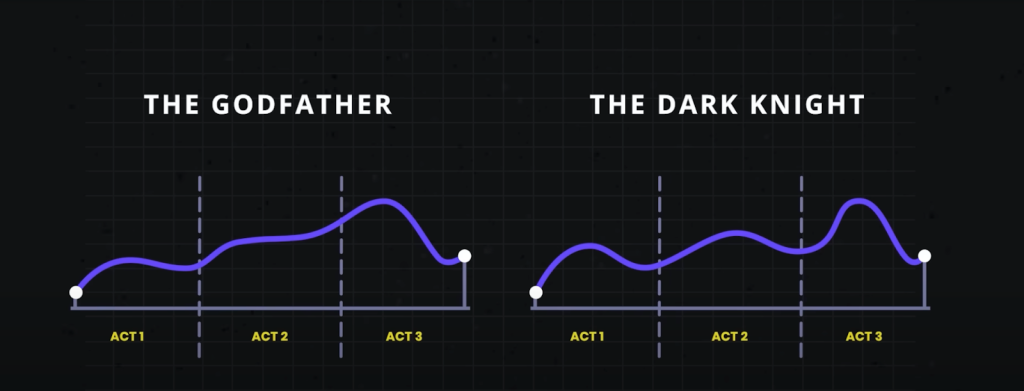 Three-act structure in movies (© 2024 StudioBinder. Image used with permission from StudioBinder.).
Use storytelling as a structure to do research
Three-act structure in movies (© 2024 StudioBinder. Image used with permission from StudioBinder.).
Use storytelling as a structure to do research
It's sad to say, but many have come to see research as being expendable. If budgets or timelines are tight, research tends to be one of the first things to go. Instead of investing in research, some product managers rely on designers or—worse—their own opinion to make the "right" choices for users based on their experience or accepted best practices. That may get teams some of the way, but that approach can so easily miss out on solving users' real problems. To remain user-centered, this is something we should avoid. User research elevates design. It keeps it on track, pointing to problems and opportunities. Being aware of the issues with your product and reacting to them can help you stay ahead of your competitors.
In the three-act structure, each act corresponds to a part of the process, and each part is critical to telling the whole story. Let's look at the different acts and how they align with user research.
Act one: setupThe setup is all about understanding the background, and that's where foundational research comes in. Foundational research (also called generative, discovery, or initial research) helps you understand users and identify their problems. You're learning about what exists today, the challenges users have, and how the challenges affect them—just like in the movies. To do foundational research, you can conduct contextual inquiries or diary studies (or both!), which can help you start to identify problems as well as opportunities. It doesn't need to be a huge investment in time or money.
Erika Hall writes about minimum viable ethnography, which can be as simple as spending 15 minutes with a user and asking them one thing: "'Walk me through your day yesterday.' That's it. Present that one request. Shut up and listen to them for 15 minutes. Do your damndest to keep yourself and your interests out of it. Bam, you're doing ethnography." According to Hall, "[This] will probably prove quite illuminating. In the highly unlikely case that you didn't learn anything new or useful, carry on with enhanced confidence in your direction."
This makes total sense to me. And I love that this makes user research so accessible. You don't need to prepare a lot of documentation; you can just recruit participants and do it! This can yield a wealth of information about your users, and it'll help you better understand them and what's going on in their lives. That's really what act one is all about: understanding where users are coming from.
Jared Spool talks about the importance of foundational research and how it should form the bulk of your research. If you can draw from any additional user data that you can get your hands on, such as surveys or analytics, that can supplement what you've heard in the foundational studies or even point to areas that need further investigation. Together, all this data paints a clearer picture of the state of things and all its shortcomings. And that's the beginning of a compelling story. It's the point in the plot where you realize that the main characters—or the users in this case—are facing challenges that they need to overcome. Like in the movies, this is where you start to build empathy for the characters and root for them to succeed. And hopefully stakeholders are now doing the same. Their sympathy may be with their business, which could be losing money because users can't complete certain tasks. Or maybe they do empathize with users' struggles. Either way, act one is your initial hook to get the stakeholders interested and invested.
Once stakeholders begin to understand the value of foundational research, that can open doors to more opportunities that involve users in the decision-making process. And that can guide product teams toward being more user-centered. This benefits everyone—users, the product, and stakeholders. It's like winning an Oscar in movie terms—it often leads to your product being well received and successful. And this can be an incentive for stakeholders to repeat this process with other products. Storytelling is the key to this process, and knowing how to tell a good story is the only way to get stakeholders to really care about doing more research.
This brings us to act two, where you iteratively evaluate a design or concept to see whether it addresses the issues.
Act two: conflictAct two is all about digging deeper into the problems that you identified in act one. This usually involves directional research, such as usability tests, where you assess a potential solution (such as a design) to see whether it addresses the issues that you found. The issues could include unmet needs or problems with a flow or process that's tripping users up. Like act two in a movie, more issues will crop up along the way. It's here that you learn more about the characters as they grow and develop through this act.
Usability tests should typically include around five participants according to Jakob Nielsen, who found that that number of users can usually identify most of the problems: "As you add more and more users, you learn less and less because you will keep seeing the same things again and again… After the fifth user, you are wasting your time by observing the same findings repeatedly but not learning much new."
There are parallels with storytelling here too; if you try to tell a story with too many characters, the plot may get lost. Having fewer participants means that each user's struggles will be more memorable and easier to relay to other stakeholders when talking about the research. This can help convey the issues that need to be addressed while also highlighting the value of doing the research in the first place.
Researchers have run usability tests in person for decades, but you can also conduct usability tests remotely using tools like Microsoft Teams, Zoom, or other teleconferencing software. This approach has become increasingly popular since the beginning of the pandemic, and it works well. You can think of in-person usability tests like going to a play and remote sessions as more like watching a movie. There are advantages and disadvantages to each. In-person usability research is a much richer experience. Stakeholders can experience the sessions with other stakeholders. You also get real-time reactions—including surprise, agreement, disagreement, and discussions about what they're seeing. Much like going to a play, where audiences get to take in the stage, the costumes, the lighting, and the actors' interactions, in-person research lets you see users up close, including their body language, how they interact with the moderator, and how the scene is set up.
If in-person usability testing is like watching a play—staged and controlled—then conducting usability testing in the field is like immersive theater where any two sessions might be very different from one another. You can take usability testing into the field by creating a replica of the space where users interact with the product and then conduct your research there. Or you can go out to meet users at their location to do your research. With either option, you get to see how things work in context, things come up that wouldn't have in a lab environment—and conversion can shift in entirely different directions. As researchers, you have less control over how these sessions go, but this can sometimes help you understand users even better. Meeting users where they are can provide clues to the external forces that could be affecting how they use your product. In-person usability tests provide another level of detail that's often missing from remote usability tests.
That's not to say that the "movies"—remote sessions—aren't a good option. Remote sessions can reach a wider audience. They allow a lot more stakeholders to be involved in the research and to see what's going on. And they open the doors to a much wider geographical pool of users. But with any remote session there is the potential of time wasted if participants can't log in or get their microphone working.
The benefit of usability testing, whether remote or in person, is that you get to see real users interact with the designs in real time, and you can ask them questions to understand their thought processes and grasp of the solution. This can help you not only identify problems but also glean why they're problems in the first place. Furthermore, you can test hypotheses and gauge whether your thinking is correct. By the end of the sessions, you'll have a much clearer picture of how usable the designs are and whether they work for their intended purposes. Act two is the heart of the story—where the excitement is—but there can be surprises too. This is equally true of usability tests. Often, participants will say unexpected things, which change the way that you look at things—and these twists in the story can move things in new directions.
Unfortunately, user research is sometimes seen as expendable. And too often usability testing is the only research process that some stakeholders think that they ever need. In fact, if the designs that you're evaluating in the usability test aren't grounded in a solid understanding of your users (foundational research), there's not much to be gained by doing usability testing in the first place. That's because you're narrowing the focus of what you're getting feedback on, without understanding the users' needs. As a result, there's no way of knowing whether the designs might solve a problem that users have. It's only feedback on a particular design in the context of a usability test.
On the other hand, if you only do foundational research, while you might have set out to solve the right problem, you won't know whether the thing that you're building will actually solve that. This illustrates the importance of doing both foundational and directional research.
In act two, stakeholders will—hopefully—get to watch the story unfold in the user sessions, which creates the conflict and tension in the current design by surfacing their highs and lows. And in turn, this can help motivate stakeholders to address the issues that come up.
Act three: resolutionWhile the first two acts are about understanding the background and the tensions that can propel stakeholders into action, the third part is about resolving the problems from the first two acts. While it's important to have an audience for the first two acts, it's crucial that they stick around for the final act. That means the whole product team, including developers, UX practitioners, business analysts, delivery managers, product managers, and any other stakeholders that have a say in the next steps. It allows the whole team to hear users' feedback together, ask questions, and discuss what's possible within the project's constraints. And it lets the UX research and design teams clarify, suggest alternatives, or give more context behind their decisions. So you can get everyone on the same page and get agreement on the way forward.
This act is mostly told in voiceover with some audience participation. The researcher is the narrator, who paints a picture of the issues and what the future of the product could look like given the things that the team has learned. They give the stakeholders their recommendations and their guidance on creating this vision.
Nancy Duarte in the Harvard Business Review offers an approach to structuring presentations that follow a persuasive story. "The most effective presenters use the same techniques as great storytellers: By reminding people of the status quo and then revealing the path to a better way, they set up a conflict that needs to be resolved," writes Duarte. "That tension helps them persuade the audience to adopt a new mindset or behave differently."
To Ignite a Personalization Practice, Run this Prepersonalization Workshop [ 16-Apr-24 8:51pm ]Picture this. You've joined a squad at your company that's designing new product features with an emphasis on automation or AI. Or your company has just implemented a personalization engine. Either way, you're designing with data. Now what? When it comes to designing for personalization, there are many cautionary tales, no overnight successes, and few guides for the perplexed.
Between the fantasy of getting it right and the fear of it going wrong—like when we encounter "persofails" in the vein of a company repeatedly imploring everyday consumers to buy additional toilet seats—the personalization gap is real. It's an especially confounding place to be a digital professional without a map, a compass, or a plan.
For those of you venturing into personalization, there's no Lonely Planet and few tour guides because effective personalization is so specific to each organization's talent, technology, and market position.
But you can ensure that your team has packed its bags sensibly.
 Designing for personalization makes for strange bedfellows. A savvy art-installation satire on the challenges of humane design in the era of the algorithm. Credit: Signs of the Times, Scott Kelly and Ben Polkinghome.
There's a DIY formula to increase your chances for success. At minimum, you'll defuse your boss's irrational exuberance. Before the party you'll need to effectively prepare.
We call it prepersonalization.
Behind the musicConsider Spotify's DJ feature, which debuted this past year.
https://www.youtube.com/watch?v=ok-aNnc0DkoWe're used to seeing the polished final result of a personalization feature. Before the year-end award, the making-of backstory, or the behind-the-scenes victory lap, a personalized feature had to be conceived, budgeted, and prioritized. Before any personalization feature goes live in your product or service, it lives amid a backlog of worthy ideas for expressing customer experiences more dynamically.
So how do you know where to place your personalization bets? How do you design consistent interactions that won't trip up users or—worse—breed mistrust? We've found that for many budgeted programs to justify their ongoing investments, they first needed one or more workshops to convene key stakeholders and internal customers of the technology. Make yours count.
From Big Tech to fledgling startups, we've seen the same evolution up close with our clients. In our experiences with working on small and large personalization efforts, a program's ultimate track record—and its ability to weather tough questions, work steadily toward shared answers, and organize its design and technology efforts—turns on how effectively these prepersonalization activities play out.
Time and again, we've seen effective workshops separate future success stories from unsuccessful efforts, saving countless time, resources, and collective well-being in the process.
A personalization practice involves a multiyear effort of testing and feature development. It's not a switch-flip moment in your tech stack. It's best managed as a backlog that often evolves through three steps:
- customer experience optimization (CXO, also known as A/B testing or experimentation)
- always-on automations (whether rules-based or machine-generated)
- mature features or standalone product development (such as Spotify's DJ experience)
This is why we created our progressive personalization framework and why we're field-testing an accompanying deck of cards: we believe that there's a base grammar, a set of "nouns and verbs" that your organization can use to design experiences that are customized, personalized, or automated. You won't need these cards. But we strongly recommend that you create something similar, whether that might be digital or physical.
Set your kitchen timerHow long does it take to cook up a prepersonalization workshop? The surrounding assessment activities that we recommend including can (and often do) span weeks. For the core workshop, we recommend aiming for two to three days. Here's a summary of our broader approach along with details on the essential first-day activities.
The full arc of the wider workshop is threefold:
- Kickstart: This sets the terms of engagement as you focus on the opportunity as well as the readiness and drive of your team and your leadership. .
- Plan your work: This is the heart of the card-based workshop activities where you specify a plan of attack and the scope of work.
- Work your plan: This phase is all about creating a competitive environment for team participants to individually pitch their own pilots that each contain a proof-of-concept project, its business case, and its operating model.
Give yourself at least a day, split into two large time blocks, to power through a concentrated version of those first two phases.
Kickstart: Whet your appetiteWe call the first lesson the "landscape of connected experience." It explores the personalization possibilities in your organization. A connected experience, in our parlance, is any UX requiring the orchestration of multiple systems of record on the backend. This could be a content-management system combined with a marketing-automation platform. It could be a digital-asset manager combined with a customer-data platform.
Spark conversation by naming consumer examples and business-to-business examples of connected experience interactions that you admire, find familiar, or even dislike. This should cover a representative range of personalization patterns, including automated app-based interactions (such as onboarding sequences or wizards), notifications, and recommenders. We have a catalog of these in the cards. Here's a list of 142 different interactions to jog your thinking.
This is all about setting the table. What are the possible paths for the practice in your organization? If you want a broader view, here's a long-form primer and a strategic framework.
Assess each example that you discuss for its complexity and the level of effort that you estimate that it would take for your team to deliver that feature (or something similar). In our cards, we divide connected experiences into five levels: functions, features, experiences, complete products, and portfolios. Size your own build here. This will help to focus the conversation on the merits of ongoing investment as well as the gap between what you deliver today and what you want to deliver in the future.
Next, have your team plot each idea on the following 2×2 grid, which lays out the four enduring arguments for a personalized experience. This is critical because it emphasizes how personalization can not only help your external customers but also affect your own ways of working. It's also a reminder (which is why we used the word argument earlier) of the broader effort beyond these tactical interventions.
 Getting intentional about the desired outcomes is an important component to a large-scale personalization program. Credit: Bucket Studio.
Each team member should vote on where they see your product or service putting its emphasis. Naturally, you can't prioritize all of them. The intention here is to flesh out how different departments may view their own upsides to the effort, which can vary from one to the next. Documenting your desired outcomes lets you know how the team internally aligns across representatives from different departments or functional areas.
The third and final kickstart activity is about naming your personalization gap. Is your customer journey well documented? Will data and privacy compliance be too big of a challenge? Do you have content metadata needs that you have to address? (We're pretty sure that you do: it's just a matter of recognizing the relative size of that need and its remedy.) In our cards, we've noted a number of program risks, including common team dispositions. Our Detractor card, for example, lists six stakeholder behaviors that hinder progress.
Effectively collaborating and managing expectations is critical to your success. Consider the potential barriers to your future progress. Press the participants to name specific steps to overcome or mitigate those barriers in your organization. As studies have shown, personalization efforts face many common barriers.
 The largest management consultancies have established practice areas in personalization, and they regularly research program risks and challenges. Credit: Boston Consulting Group.
At this point, you've hopefully discussed sample interactions, emphasized a key area of benefit, and flagged key gaps? Good—you're ready to continue.
Hit that test kitchenNext, let's look at what you'll need to bring your personalization recipes to life. Personalization engines, which are robust software suites for automating and expressing dynamic content, can intimidate new customers. Their capabilities are sweeping and powerful, and they present broad options for how your organization can conduct its activities. This presents the question: Where do you begin when you're configuring a connected experience?
What's important here is to avoid treating the installed software like it were a dream kitchen from some fantasy remodeling project (as one of our client executives memorably put it). These software engines are more like test kitchens where your team can begin devising, tasting, and refining the snacks and meals that will become a part of your personalization program's regularly evolving menu.
 Progressive personalization, a framework for designing connected experiences. Credit: Bucket Studio and Colin Eagan.
The ultimate menu of the prioritized backlog will come together over the course of the workshop. And creating "dishes" is the way that you'll have individual team stakeholders construct personalized interactions that serve their needs or the needs of others.
The dishes will come from recipes, and those recipes have set ingredients.
 In the same way that ingredients form a recipe, you can also create cards to break down a personalized interaction into its constituent parts. Credit: Bucket Studio and Colin Eagan.
Verify your ingredients
In the same way that ingredients form a recipe, you can also create cards to break down a personalized interaction into its constituent parts. Credit: Bucket Studio and Colin Eagan.
Verify your ingredients
Like a good product manager, you'll make sure—andyou'll validate with the right stakeholders present—that you have all the ingredients on hand to cook up your desired interaction (or that you can work out what needs to be added to your pantry). These ingredients include the audience that you're targeting, content and design elements, the context for the interaction, and your measure for how it'll come together.
This isn't just about discovering requirements. Documenting your personalizations as a series of if-then statements lets the team:
- compare findings toward a unified approach for developing features, not unlike when artists paint with the same palette;
- specify a consistent set of interactions that users find uniform or familiar;
- and develop parity across performance measurements and key performance indicators too.
This helps you streamline your designs and your technical efforts while you deliver a shared palette of core motifs of your personalized or automated experience.
Compose your recipeWhat ingredients are important to you? Think of a who-what-when-why construct:
- Who are your key audience segments or groups?
- What kind of content will you give them, in what design elements, and under what circumstances?
- And for which business and user benefits?
We first developed these cards and card categories five years ago. We regularly play-test their fit with conference audiences and clients. And we still encounter new possibilities. But they all follow an underlying who-what-when-why logic.
Here are three examples for a subscription-based reading app, which you can generally follow along with right to left in the cards in the accompanying photo below.
- Nurture personalization: When a guest or an unknown visitor interacts with a product title, a banner or alert bar appears that makes it easier for them to encounter a related title they may want to read, saving them time.
- Welcome automation: When there's a newly registered user, an email is generated to call out the breadth of the content catalog and to make them a happier subscriber.
- Winback automation: Before their subscription lapses or after a recent failed renewal, a user is sent an email that gives them a promotional offer to suggest that they reconsider renewing or to remind them to renew.
 A "nurture" automation may trigger a banner or alert box that promotes content that makes it easier for users to complete a common task, based on behavioral profiling of two user types. Credit: Bucket Studio.
 A "welcome" automation may be triggered for any user that sends an email to help familiarize them with the breadth of a content library, and this email ideally helps them consider selecting various titles (no matter how much time they devote to reviewing the email's content itself). Credit: Bucket Studio.
 A "winback" automation may be triggered for a specific group, such as users with recently failed credit-card transactions or users at risk of churning out of active usage, that present them with a specific offer to mitigate near-future inactivity. Credit: Bucket Studio.
A useful preworkshop activity may be to think through a first draft of what these cards might be for your organization, although we've also found that this process sometimes flows best through cocreating the recipes themselves. Start with a set of blank cards, and begin labeling and grouping them through the design process, eventually distilling them to a refined subset of highly useful candidate cards.
You can think of the later stages of the workshop as moving from recipes toward a cookbook in focus—like a more nuanced customer-journey mapping. Individual "cooks" will pitch their recipes to the team, using a common jobs-to-be-done format so that measurability and results are baked in, and from there, the resulting collection will be prioritized for finished design and delivery to production.
Better kitchens require better architectureSimplifying a customer experience is a complicated effort for those who are inside delivering it. Beware anyone who says otherwise. With that being said, "Complicated problems can be hard to solve, but they are addressable with rules and recipes."
When personalization becomes a laugh line, it's because a team is overfitting: they aren't designing with their best data. Like a sparse pantry, every organization has metadata debt to go along with its technical debt, and this creates a drag on personalization effectiveness. Your AI's output quality, for example, is indeed limited by your IA. Spotify's poster-child prowess today was unfathomable before they acquired a seemingly modest metadata startup that now powers its underlying information architecture.
You can definitely stand the heat…Personalization technology opens a doorway into a confounding ocean of possible designs. Only a disciplined and highly collaborative approach will bring about the necessary focus and intention to succeed. So banish the dream kitchen. Instead, hit the test kitchen to save time, preserve job satisfaction and security, and safely dispense with the fanciful ideas that originate upstairs of the doers in your organization. There are meals to serve and mouths to feed.
This workshop framework gives you a fighting shot at lasting success as well as sound beginnings. Wiring up your information layer isn't an overnight affair. But if you use the same cookbook and shared recipes, you'll have solid footing for success. We designed these activities to make your organization's needs concrete and clear, long before the hazards pile up.
While there are associated costs toward investing in this kind of technology and product design, your ability to size up and confront your unique situation and your digital capabilities is time well spent. Don't squander it. The proof, as they say, is in the pudding.
London Assembly Transport Committee
City Hall
Kamal Chunchie Way
London E16 1ZE
cc: London Assembly Transport Committee, Members and Staff
Dear Elly Baker,
RE: Open Letter - Assisting the Inevitable Independent Inquiry about the Safety of the London Contracted 'Bus Market' Model
Congratulations on your re-election to the London Assembly and your selection to serve as Chair of the Transport Committee. You may recall that we had a chance to meet on 14 December 2021 when I gave evidence as a veteran TfL Bus Driver for the Transport Committee's Investigation of the Mayor's Vision Zero Programme.
While you're busy considering your Committee's plan-of-work for the coming four years, I'd like to call your attention to some Transport Committee scrutiny that I believe that might be required in the nearest future, specifically to assist that requested in Resolution 6 carried unanimously by the RMT National Industrial Organising Conference of Bus Workers on 28 April 2023:
Resolution 6: Independent Inquiry about the Safety of the London Contracted 'Bus Market' Model
"That this RMT National Bus Workers Industrial Organising Conference calls upon the RMT N.E.C. to support and campaign for an independent inquiry about the safety of the London Contracted Bus Market Model that is being adopted by other UK cities. This conference notes that, while London's Contracted Bus Market Model is being adopted by other cities and regions throughout the UK, the London Assembly and independent campaigners have published well evidenced reports showing that TTL's contracted bus operation is as described by a former TfL board member and safety panel chair in evidence submitted to the London Assembly in 2020, "Institutionally unsafe".
Over the 5 year period from 2016-2021, from collisions involving a TfL bus, an average of two people per day have been sent to hospital and 1 person has been killed every four to six weeks, an egregious bus safety performance record that places London in the lowest quartile for bus safety performance when independently benchmarked to its world city peers. Added to this appalling bus safety performance record is the fact that during the COVID pandemic, drivers died at twice the rate as expected based on age, ethnicity and home post code.
Based on the London Model's well evidenced poor safety performance record, this conference calls upon the RMT N.E.C. to ask the House of Commons to launch an independent Inquiry of the systematic safety problems associated with TfL's Contracted Bus Market Model."Although your colleague on the Transport Committee, Keith Prince AM, brought this important Resolution to the Mayor's attention in May 2023, Sadiq Khan's non-committal response coupled with the lack of news from Westminster or City Hall about any Independent Inquiry suggests that what RMT's Bus Workers requested in 2023 remains unconsidered by the public officials vested with the powers to do it.
However, with the Labour Party's imminent national election victory and its Manifesto committing a Labour Government to 'build on the work of Labour mayors' to give 'new powers for local leaders to franchise local bus services'—I believe that the Safety Performance of London's Bus Franchise Model will become the focus of a lot of scrutiny, if not from City Hall, certainly from Westminster and the national press.
Why?
Because, as you most certainly already know—
- London is home to the largest franchised Bus Operation in the United Kingdom: TfL Bus Franchise Contracts account for 50 percent of UK Bus Journeys conveyed by 25 percent of the country's Bus Fleet;
- On 11 April 2024, Labour's shadow transport secretary, Louise Haigh MP set out the party's plans for a better bus network across England, with a promise— "to allow every community across the country to take back control of local bus services"—and specifically cited London as a model;
- In the words of former TfL Board Director and Safety Panel Chair Michael Liebreich, TfL's Bus Franchise Model is "Institutionally Unsafe";
- Since 2007, TfL's own published data shows that—year-on-year—London buses have accounted for 10% of all of London's road fatalities and about 10% of all pedestrian fatalities in London despite Buses' presence on the road over this period having declined from constituting about 3% to about 1% of all vehicles on the road at any given time;
- TfL's sole measure of bus contract performance is a time-based "Excess Waiting Time" calculation which Independent benchmarking shows London—
- in the highest tercile of its 'world city' peers for Bus Punctuality and Profitability per Bus;
- in lowest tercile of its 'world city' peers for safety (collisions per km): based on this published independent annual benchmark data, London appears to have the least safe bus system of any major European city;
- TfL has never conducted a safety risk assessment of the Bus Franchise Model or its Bus Contract Financial Incentives;
- 1 in 5 of the London Bus Drivers surveyed by Loughborough University (2017) indicated that they had to fight sleepiness at least 2-3 times a week, and about 1 in 4 had a 'close call' due to fatigue in the past 12 months;
- For decades, TfL's contracted Bus Operation has averaged over 26,000 Bus collisions annually—in 2023, TfL recorded over 28,000—from which
- about 1200 people are injured every year;
- 1 person is killed about every six weeks;
- 80 to 100 people are sent to hospital every month from Preventable Bus Safety Incidents (80% Collisions, 20% Onboard Trips & Falls), over 20 of these victims with serious and/or life-changing injuries;
- Over one quarter of London Bus Routes don't have a toilet for Bus Drivers at one end of the route;
- TfL has agreed with Bus Operators and Unite the Union that Bus Drivers don't need a toilet on any route round trip that lasts up to 150 minutes — this 'criteria' was agreed without a Human Factors or Risk Assessment;
- TfL has evidence of (at least) 12 million (est.) Annual Bus Speeding incidents on file that it does not share with the Police;
- Since January 2016, more than 1 pedestrian per month has been injured by a TfL Bus hitting them in a zebra or pelican crossing;
- Since 1 April 2015, an average of 6 people per month (2022-23: 8 per month- getting worse) have been injured after being struck by a Bus Wing Mirror;
- TfL received the highest Health & Safety Fine ever in July 2023 for HSE Failures on the Croydon Tram, a contracted surface transport operation that was founded, managed and monitored by TfL's Bus executives;
- Transport for London (TfL) does not require the bus operating companies to share copies of their risk assessments covering activities within their garage environments. This includes any that were created or updated as a result of Covid-19.
- despite the facts that—
- the total number of bus miles in London has declined;
- the total number of bus users in London has declined;
- the total number of buses in London's contracted bus fleet has declined;
- the total number of Bus Drivers in London has declined, and,
- since 2016, the Mayor of London has announced 3 'world leading' Bus Safety Programmes and a Vision Zero Programme;
—the number of people killed and seriously injured from Bus Safety Incidents are now higher than 2016.
To get ahead of the national press and Westminster, I would strongly advise you urgently to lead the Transport Committee to build upon the evidence and conclusions found in the London Assembly's March 2024 "Bus, Tram and Tube Safety" Investigation and perhaps focus on three specific areas highlighted in Appendix 1 of that investigation—
- The Contradiction between TfL's Bus Contract Timeliness Incentives and Speed Limits;
- TfL's Refusal to Require Independent Bus Crash Investigations;
- TfL's Failure to conduct Risk and/or Human Factors Assessments of Bus Driver Working Conditions that are known to have a direct impact upon Safety Performance;
If you choose to lead such an urgent investigation as Chair of the London Assembly Transport Committee, kindly note that I will, once again, be pleased to contribute evidence as a veteran London Bus Driver. If you choose not to lead such an investigation, then those who inevitably will do so can find my open letter on the public record.
Yours sincerely,
Lorraine RoberstonLondon Bus Driver (Retired)
I was born in Kyoto and Kyoto is one of my favorite cities. It's rich with culture and nuance. One of the hardest things for non-Kyoto people to navigate is the many layers of politeness. Everyone smiles at you and treats you very nicely. However, it's quite dangerous to take everything at face value. The people of Kyoto often tell you what they want you to do, veiled in a nice-sounding statement or request, which is hard for non-Kyoto people to understand. Sometimes, if you take the comment or offer at face value, you will be shunned without even knowing it.
I saw some wonderful stickers on Twitter that show what Kyoto people might say, "tatemae," and the reverse side that shows what they really mean, "honne."
I asked permission to translate the stickers so non-Japanese people could understand them. However, upon translating them, I realized that the politeness of the "tatemae" and the rudeness of the "honne" doesn't really come through in English, but I think you'll get the gist. And Rie's face says it all.
Enjoy.
Ikezu stickers of Kyoto people with a hidden side
The following text was translated from the original post in Japanese.

If someone says, "Do you want some pickles?" to you in Kyoto, it means "hurry up and leave."
This kind of high-context communication that most people would never notice is called "ikezu."
This "ikezu culture" has long been recognized as uniquely Kyoto, but we have noticed that it has not yet been converted into a tourism resource.
Just as Osaka has turned the prefectural stereotype of comedians into a tourism resource, Kyoto's "ikezu" should also become a tourism resource.
With this in mind, we created a new souvenir of Kyoto, the "Kyoto-people-with-hidden-meaning ikezu sticker."
This product takes advantage of the characteristic of "ikezu" to "convey in a roundabout way what is difficult to say". It allows Kyoto people to convey their real feelings to those outside of Kyoto.
As the name suggests, this product has a double-sided structure. The front side depicts a polite but somewhat mean-spirited "ikezu" front, and the back side reveals the hidden true feelings of the Kyoto people.
The front of the card shows the "tatemae" which is the polite roundabout words.
The back side has "honne" which is what the words actually mean.
Product Lineup

We have created four types of products for each "hard-to-express" requests that occur in various situations at home so that people from outside of Kyoto can take them home and use them.
Toilet section: When you want to tell someone, "Please don't pee standing up."

Front text: "My toilet seat may not be the most comfortable, but if you don't mind, please try it."

Back text: "Don't do it standing up, okay?"
Entrance: When you want to tell someone, "Please don't come to my house in dirty clothes."

Front text: "How nice to see you. Did you go to Lake Biwa?"

Back text: "You come here looking dirty! Go wash everything in the Kamogawa River."
Dining table version: When you want to tell someone, "Please don't make sounds while you eat."

Front text: "You know what? It's okay to eat buckwheat noodles with a slurping sound."

Back text: "Kucha kucha kucha you're noisy!"
Post section: When you want to tell people, "Please don't put unnecessary flyers in the mailbox."

Front text: "Sorry, we only have a small mailbox. Thank you, Mr. Habakari."

Back text: "Don't put those stupid flyers in here. They're a nuisance."
Since October 7 there has been a steady stream of reports about the kufiya: their growing use and visibility, and, in response, efforts to squelch or silence or even arrest people for wearing them. I'm too overwhelmed to keep a full accounting, but occasionally I will try to post about the phenomenon. Here's one incident. Layla is a grad student in Social Work at Columbia, very active on Twitter/X and elsewhere.
 An evolutionary biologist and a science fiction writer walk into a bar… [ 13-May-24 7:03pm ]
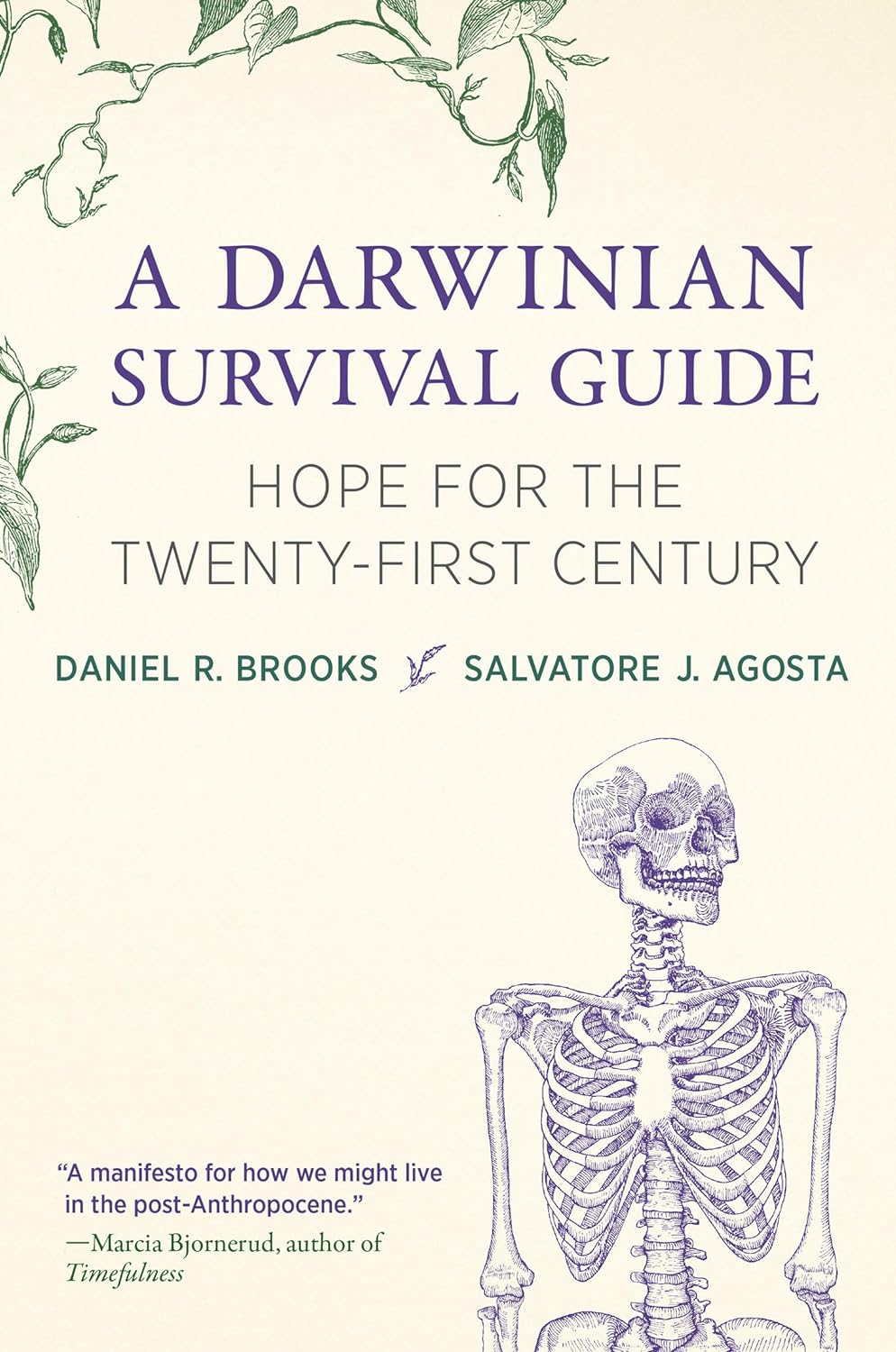 Personally, I’d still put “Hope” in quotes..
Last month it was the Atlantic, where I pretended to know something about AI. This month it's the MIT Reader, and the subject is The Imminent Collapse of Civilization. Honestly, I had no idea I was such an expert on so many things.
This time, though, I'm not so much an expert as a foil. Dan Brooks (a name long-time readers of this blog may recognize) and Sal Agosta (whose concept of "sloppy fitness" careful readers of my novelette "The Island" may recognize) have written a book called A Darwinian Survival Guide: Hope for the Twenty-First Century. Their definition of "hope" is significantly more restrained than the tech bros and hopepunk authors would like: not once do they suggest, for example, that we could all keep our superyachts if we just put a giant translucent pie plate into space to cut incident sunlight by a few percent. Brooks & Agosta's definition of hope is far more appropriate for a world in which leading climate scientists admit to fury and despair at political inaction, decry living in an "age of fools", and predict by a nearly five-to-one margin that not only is 1.5ºC a pipe dream, but that we'll be blowing past 2.5ºC by century's end. They've internalized the growing number of studies which point to global societal collapse around midcentury. Their idea of hope is taken explicitly from Asimov's Foundation series: not How do we prevent collapse, but How do we come back afterward? That's what their book is about.
Casual observers might see my name where bylines usually go, and conclude that this is somehow my interview. Don't be fooled: the only thing I lay exclusive claim to here is the intro. This is about Dan and Sal. This is their baby; all I did was poke at it from various angles and let Dan react as he would. Our perspectives do largely overlap, but not entirely. (Unlike Dan, I do think the extinction rates we're inflicting on the planet justify the use of the word "crush"—although I take his point that the thing being crushed is only the biosphere as it currently exists, not the biosphere as a dynamic and persistent entity. I also confess to a certain level of bitterness and species-self-loathing that Dan seems to have avoided; I'm pretty certain the biosphere would be better off without us.)
 The scene of the Crime.
But there's that word again: hope. Not the starry-eyed denial of reality that infests the Solarpunk Brigade, not the Hope Police's stern imperative that We Must Never Feed A Narrative of Hopelessness and Despair no matter what the facts tell us. Just the suggestion that after everything falls apart—just maybe, if we do things right this time—we might climb back out of the abyss in decades, instead of centuries.
Probably still not what most people want to hear. Still. I'll take what I can get.
So go check it out—keeping in mind, lest you quail at all the articulate erudition on display, that the transcript has been edited to make us look a lot more coherent than we were in real life.
I mean, we were drinking heavily the whole time. What else would you expect, given the subject matter?
8 More Minutes... [ 20-Apr-24 10:08pm ]

I am grateful for the opportunity to once again address the RMT's Bus Worker National Industrial Organising Conference. I congratulate its organisers and RMT Union on celebrating this important conference's 81st year.
Since this is the third National Conference in which I've been honoured to share my transport research with members since 2018, I'd like to follow up with you all on a resolution that was put forward last year by the Nottinghamshire & Derbyshire Branch and passed by members which called upon "the House of Commons Transport Committee to launch an Independent Inquiry of the Systemic Safety Problems associated with Transport for London's 'Contracted Bus Market' Model."
What progress has the union made on putting this Resolution into effect?
If the answer is "none", I'd like to underscore why such an Independent Inquiry is critical today and to provide you with some encouragement—and perhaps some useful data—to ensure that such an Independent Inquiry is conducted, if not by the Commons Transport Committee, then perhaps by the RMT or the broader UK Trade Union movement.
The 2017 Bus Services Act gave devolved regional authorities the right to contract public Bus Services from private Bus Operators under terms and conditions written, negotiated and enforced by these local authorities, something London's Mayor has been doing through TfL since 2000. As you know, the London Bus Franchise Model was recently adopted by Manchester's Mayor Andy Burnham, much to the acclaim of the national press, the Labour Party and its supporters.
In fact, yesterday's Labour Party "Better Buses" announcement by its Shadow Transport Secretary reaffirms its support for the London Bus Franchise Model, e.g. —
"Where bus franchising is in place, in London and Greater Manchester, buses have thrived."
— and further promises—"to allow every community to take back control of their buses by removing barriers that currently limit bus franchising powers only to metro mayors."
As I have concluded from investigating London's long experience of having Mayoral control over Bus Services, buses "thriving" really means that the politicians who oversee London's public bus network put Bus Passengers' convenience ahead of everyone else's safety, including Bus Drivers' and other Road Users', pedestrians' especially.
The London Bus Franchise Model is "Institutionally Unsafe"
London's quarter-century experience with Mayoral control of the bus public network has shown that, essentially, Bus Passengers only care if their Bus is Cheap, Convenient and Timely.
For decades, that 'Holy Trinity' has served as TfL's overwhelming priority in its contracting of Bus Services in London, a city which accounts for about 50% of UK Bus Journeys and 25% of the country's Bus Fleet.
The fact that these cheap, convenient and timely London Buses—
- share the roads with growing numbers of other road users—increasingly on two wheels and their feet —who have a right to consider their journey just as important as Bus Users';
- impose negative externalities like pollution, particularly from the majority of London Buses running on diesel: a whopping 77 percent of TfL's Contracted Bus Fleet run solely on diesel (45 percent) or are diesel hybrids (32 percent), which will continue to pollute for decades;
- because of their size and mass, carry a much higher risk of death and serious injury from crashes, which is borne out by the fact that TfL buses—about 2% of total traffic—have been involved in 1 in about every 10 of all London road fatalities since 2007. Note: in June 2016, TfL's (now Chief Safety Officer) told the Parliamentary Advisory Council for Transport Safety "Buses are four times more likely to be involved in a KSI collision with a pedestrian than would be expected for their share of traffic"—and TfL's published data reveals that people killed or seriously injured (KSI) from Bus Collisions have increased since 2016.
— rarely register on most Bus Users', TfL and Bus Company Bosses' and London politicians' radar screens.
As a result of the London Bus Franchise Model's contract priorities, the Bus System's Operational Safety Performance and Driver Working Conditions have suffered because if London's Mayors and local politicians actually made these a priority, they'd find themselves in direct conflict with a longstanding systemic principle that "Time is Money" which has long served as the only public bus service performance metric in London that matters. TfL's sole measure of public Bus Contract Performance is for its Bus Contractors to stick to the costs based on running times they've contractually agreed with TfL.
Remember: 60% of the cost of running a public Bus is the Driver, so there is a systemically-reinforced disincentive for TfL and its contractors to add any extra bus drivers to routes where any new or emerging reality conflicts with (a) costs and (b) profits directly tied to already-contracted Bus Service Performance levels. Instead, TfL and its Bus Operators choose to put pressure on Bus Drivers to compensate for what former TfL Board Director and Safety Panel Chair Michael Liebreich has evidenced is an "Institutionally Unsafe" contractual arrangement. And this pressure means Bus Drivers work while fatigued, distracted by System Controllers and frequently exceed the legal speed limit just so that their Bus Operator employer can meet TfL's contracted timeliness and availability targets.
Under the London Bus Franchise Model, making Bus Drivers pay for TfL's and Bus Operators' lethal contract priorities is called "efficiency". And any Mayor who claims to be contracting a public bus operation from for-profit Bus Companies more 'efficiently' for passengers who, at the time same, is not increasing fares or local taxes to fund this 'improvement', means that all this new efficiency is being funded by reductions to your pay and through degrading working conditions which have a direct impact on your safety performance.
From my own experience underpinned by over a decade of research (all in the public domain), I know that the London Bus Franchise Model is both big business for Bus Operators and lethal for both Bus Workers and the general public. Since I began my research after recovering from critical injuries sustained in a Bus Crash in 2009, TfL's published data reveals that over 150 people have been killed and thousands have been seriously injured from preventable Bus Safety Incidents, the vast majority of these casualties generated from collisions. Since the current Mayor was elected in May 2016, at least 77 people have been killed from preventable Bus Safety Incidents, over three quarters of which were from collisions.
A recently issued cross-party London Assembly Transport Committee Investigation—its third since 2017—continued to highlight the same problems with the London Bus Franchise Model evidenced in the Assembly's previous investigations, i.e, Driver Fatigue, Lack of Toilet Dignity, and Pressure to meet TfL's contracted timeliness and availability targets. Despite the London Mayor's announcement of 3 'world leading' Bus Safety Programmes and a Vision Zero Programme since 2016, the number of people killed and injured in Bus Safety Incidents in London is higher today than when the first of these Safety Programmes was announced on 1 February 2016. Seeing that London's total Bus Fleet Size, Bus Mileage, and the actual number of both Bus Users and Bus Drivers have all shrunk since 2016, London Buses' negative safety trend is especially alarming. By all metrics of systemic safety, the London Bus Franchise Model is a manifest failure.
Since I'm limited for time, please allow me to detail only a few of these systemic failures:
- Bus Collisions: despite the fact that London has fewer Buses, Bus Drivers and fewer Bus Miles run, Bus Collisions are now higher today than they were than when the present Mayor was elected in 2016. In 2023, TfL recorded over 70 Bus Crashes per day. TfL's annual tally for Bus Crashes now exceeds the number of London Bus Drivers: that's more than 1 recorded crash per London bus driver per year. Since 2018, when London's Bus System Performance has been compared to its global 'world city peers', the city regularly appears in the quartile having the highest bus "collisions per km". I would wager London is the only European city to occupy this dubious place in the international benchmarking tables year-after-year.
- Preventable Bus Safety Incident Injuries: Total Injuries generated from Preventable Bus Safety Incidents—the vast majority from collisions, but increasing numbers of passenger trips and falls onboard—are now higher than they were than when the present Mayor was elected. Since 2016, an average of 3 people a day are sent to hospital from Preventable Bus Safety Incidents and, about every 6 weeks, someone has been sent to the morgue. Remember: London has fewer Buses, Bus Drivers and fewer Bus Miles run than when the present Mayor was elected, so every bus, every bus mile, and every public bus journey is now more dangerous today than it was when the current "Vision Zero" Mayor was elected.
- Bus Collision Investigations: in sharp contrast to the Rail, Air, and Maritime Sectors, Transport for London entrusts its Bus Contractors to carry out their own crash investigations. In fact, the Mayor has rejected all recommendations by London Assembly Members to establish an Independent Bus Crash Investigation Branch for London. The peculiar fact that TfL allows its Bus Contractors to investigate their own crashes was recently raised in the House of Lords by Lord Hampton. I hope that this scrutiny by Lord Hampton is a leading indicator that Westminster might take a greater interest in the known safety failings of the London Bus Franchise Model.
- Bus Driver Fatigue: even though there is plenty of published evidence proving Bus Driver fatigue is chronic problem throughout the London Bus Operation and the Mayor has full authority to act to take meaningful and immediate action to mitigate it, the Mayor has refused to compel TfL to redesign London Bus Contracts to ensure that Bus Operators aren't financially-incentivised to enforce Fatigue-Inducing Rosters, Rotas and Working Practices.
In fact, it is quite telling that, despite (a) the Mayor's announcements of 3 'world leading' Bus Safety Programmes, Vision Zero and (b) TfL incurring the largest Health and Safety Fine ever for Surface Transport Safety failings in July 2023, TfL's Framework Bus Contract has not changed since it was last updated in January 2016.The 2017 Loughborough Bus Driver Fatigue Report found that "stress and mental overload whilst driving" and "time pressure" from, inter alia, "headway" contributed to a working environment where 1 in 5 of the London Bus Drivers surveyed by Loughborough indicated that they had to fight sleepiness at least 2-3 times a week, and about 1 in 4 had a 'close call' due to fatigue in the past 12 months.
- Yet, in response to a question about the relationship between "Rest Day Working and Bus Safety Incidents" from London Assembly Member Neil Garratt in February 2023, the Mayor confirmed:
"The type of shift being worked at the time of an incident is not information that is routinely captured as part of the bus operator's initial incident reporting to Transport for London (TfL)."
- In a response to a question about TfL's 'Bus Fatigue Management Working Group' from London Assembly Member Keith Prince in October 2023, the Mayor confirmed that this group meets in secret, has no published minutes or agendas and does not include any representatives of bus drivers or the public.
- University College London's March 2021 Phase 2 Consulting Report about London Bus Driver Deaths from Covid-19 concluded and recommended—"Fatigue is a pre-existing issue for some bus drivers, with some evidence that COVID-19 infection and lockdown has contributed to this. Action, already being taken following previous research into factors contributing to tiredness, should be enhanced to address any new issues arising from the pandemic, following a short-term review of shift lengths, patterns and rotas"—Yet, despite repeated questioning from Keith Prince AM since 2021, the Mayor recently confirmed that TfL has yet failed to conduct a ""short term review of shift lengths, patterns and rotas" over three years after this recommendation was made.
If "True ignorance is not the absence of knowledge, but the refusal to acquire it" then the Mayor's and TfL's apparent witting ignorance about the causes and effects of Fatigue among London Bus Drivers is, in my honest opinion, grossly negligent.
- Lack of Toilet Dignity: TfL is responsible for ensuring that its contracted Bus Drivers have access to toilets while working and we know that 1 in 4 London Bus Routes lack Bus Driver Toilets at one end. The Mayor says that this lack of Toilet Dignity has been agreed with London Bus Workers only-recognised union, Unite, but neither the Mayor nor Unite will provide a copy of that agreed criteria. The Mayor recently revealed that this 'longstanding' criteria has never been subjected to a 'human factors' risk assessment.
- Hot Cabs: even though he has full powers to act, the Mayor refuses to ensure that TfL Bus Contractors' will not force London Bus drivers "to drive - and will also suffer no consequences from their employer for refusing to drive - any London bus with a cab temperature that exceeds that for safe transport of livestock in the UK." Last summer, Bus Drivers were regularly recording 40c in their cabs yet the Mayor refuses to inform the public what happened to the Bus Driver that newspapers reported had passed out in the bus cab from the heat and subsequently crashed.
- Lack of Corporate Governance on Safety (1): the Mayor refuses to invite representatives of the public and Bus Workers to attend the Safety Bus Meetings TfL convenes every quarter with its Bus Contractors. If Bus Drivers aren't in the room where TfL decides safety policy with its contractors, then London Bus Safety Policy's happening without them. If Labour's going to give all local authorities the right to franchise Bus Services, Bus Workers need to be in the room where safety policies are negotiated, agreed, implemented and monitored. In London's Bus Franchise Model, the Mayor ensures they aren't.
- Lack of Corporate Governance on Safety (2): despite TfL being responsible for 100% of their revenue, the Mayor refuses to mandate that each Bus Contractor that supplies Bus Services to TfL appoint a Bus Worker Representative to the board. If Labour's going to give all local authorities the right to franchise Bus Services, Bus Workers need to be in the board rooms where those contracts are negotiated, agreed, implemented and monitored. Again, in London's Bus Franchise Model, the Mayor ensures they aren't.
- Covid-19: 4 Years Ago last month, we had just entered a National Covid Lockdown. You probably don't need to be reminded that London Bus Drivers had the highest Covid-19 death rate of any class of UK workers. What you probably don't know is that TfL ordered the distribution of PPE to its own staff drivers on 9 April 2020 while, on the same day, it told Unite Bus Drivers' representatives that "masks are not needed". Two-Thirds of the London Bus Workers that TfL records as having died from from the virus did so in the two years after lockdown. Might the Mayor's failure to order TfL's Bus Operators to provide PPE for London Bus Workers when TfL was providing it for its own staff drivers help to explain why they continued to die from Covid-19 in 2021 and 2022?
- Failure to Conduct Covid-19 Risk Assessments: In December 2021, the Mayor confirmed "Transport for London (TfL) does not require the bus operating companies to share copies of their risk assessments covering activities within their garage environments. This includes any that were created or updated as a result of Covid-19." The Mayor admits that TfL chooses to be wittingly ignorant about its Bus Contractors' Safety Practices? In my view, that Mayor's response captures the essence of the manifest safety failure of the London Bus Franchise Model in a nutshell.
Making "Better Buses" Better for Bus Workers and Public Safety
Taking advantage of the Freedom of Information rights we all have in the UK, I have voluntarily generated a vast amount of detailed evidence about the safety failings of the London Bus Franchise Model which is all available in the public record, i.e.,—
- Dozens of FOI Requests
- Hours of recorded public testimony by London Bus Drivers, Politicians and Experts
- Hundreds of Mayors's Questions
- Thousands of Pages of Evidence
- Hundreds of Thousands of Bus Safety Data Points
All this data evidences how lethal the London Bus Franchise Model has been for Bus Drivers and the public, especially pedestrians young and old, male and female. Perhaps the Labour Party will be gratified to know that the London Bus Franchise Model is an 'equal opportunity killer'?
With the near certainty of a crushing Labour Party victory in the impending National Election and that Party's promise to devolve bus contracting to local authorities, I can assure you that—warts and all—the London Bus Franchise Model will be coming to a local authority near you.
If TfL's quarter-century experience contracting out Bus Services to Bus Contractors is any guide, when Labour does roll out the London Bus Franchise Model nationwide, then RMT Bus Workers should be prepared to combat—
- Contracted Punctuality, Availability and Convenience Targets taking priority over Bus Safety Performance
- Excluding Bus Workers from Decision-making about Bus System Safety
- Excluding Bus Workers from Decision-making about Bus System Contract Priorities
- Lower Wages and Longer Hours
- Shorter Rest Breaks
- Lack of Toilet Dignity
- Dangerously Hot Bus Cabs
- Absence of Transparent Decision-making about Safety Policies that affect directly affect Bus Driver Working Conditions
- Lack of Transparency about Bus Contract Incentives, Bus Safety Performance and Local Government relationships with Bus Contractors
- Pressure to meet contracted bus timetables that prioritise passenger convenience over operational safety
- Public Authorities failing to collect key Bus Safety Performance Data
- Public Authorities hiding Bus Safety Performance Data from public scrutiny
- And lots more people killed and seriously injured from preventable Bus Safety Incidents
When I started looking for London's Public Bus Safety Performance Data from my hospital bed in February 2010, there was absolutely none to found anywhere in the public domain. Today, London is probably globally unique for the sheer volume of Bus Safety Data Performance Data TfL publishes: that transparency is entirely due to my voluntary campaign and the support my relentless efforts have received in London from (a) Conservative, Liberal Democrat and Green Assembly Members, (b) scores of Bus Drivers and (c) the Battersea and Wandsworth TUC and, nationally, from the RMT and GMB unions. You'll note that I've not mentioned either the Labour Party nor its largest funder Unite the Union in my 'shout-out' because, aside from some thoughtful outreach from Labour MP Matt Western 5 years ago, I've not heard anything from either in the 14 years I've been researching Bus Safety Performance in London.
Lee Odams, RMT Vice Secretary Nottinghamshire & Derbyshire Bus Branch and Secretary of RMT National Industrial Organising Conference of Bus Workers discovered the value of having publicly-available data ready-to-hand when Manchester announced it was 'taking back control' of its Bus Network last year. Shortly after the October 2023 announcement, 2 pedestrians were killed in Bus Collisions about which Transport for Greater Manchester (TfGM)'s Director of Bus Stephen Rhodes had this to say:
"We are concerned by the unusually high number of incidents involving buses over recent days, which is far above what we might normally see on any given week".
But Lee knew that statement didn't ring true because in 2019 he sent Freedom of Information Requests to every council in the United Kingdom asking each to provide him with exactly the same Bus Safety Performance Data that TfL has published every quarter since 2014. And just like 90% of UK Councils that sent Lee a response, TfGM didn't have any Bus Safety Incident Data. And because Lee had a signed May 2019 letter from TfGM in hand stating explicitly—"...bus services in Greater Manchester are run by commercial services and they do not share this information with TfGM"— Lee was able to send Mayor Andy Burnham a copy of this evidence in an open letter asking if the Mayor of Manchester would compel TfGM commit to the publishing the same Bus Safety Data TfL publishes.
In December 2023, Lee received a response to his open letter where TfGM indeed committed to publishing Manchester's Bus Safety Performance Data "in the future", but until we see anything in print, these are still only fine words. To be honest, I'm not reassured that TfGM decided that publishing Bus Timeliness Data took priority over its being transparent about its buses' operational safety performance, but it would appear that, just as in London, bus punctuality is the only metric Bus Passengers care about. I wonder if any Bus Workers (or their unions) were in the room when TfGM's new contracted Bus Punctuality metrics were decided?
I am pleased that this Conference has a Resolution encouraging Mayor Andy Burnham to force TfGM to keep its promise to make Manchester's Bus Safety Performance Data public. However, without (a) London being forced to publish Bus Safety Performance data after years of voluntary campaigning by me and (b) Lee Odams embarrassing Mayor Burnham and TfGM publicly by publishing its 2019 FOI response to him, I'd wager neither of the UK's two leading cities where the Mayors oversee Bus Contracts would have done anything. Manchester still hasn't.
Meanwhile, Labour has promised to put forward a 'Better Buses Bill' as soon as it gets into power. We will need a lot of "Lee Odamses" in many local and regional authorities throughout the UK to ensure that all the new authorities contracting bus services will, at a minimum, be as transparent about Bus Safety Performance as London and—at some point in the future—Manchester. Will Labour's 'Better Buses Bill' compel Regional Mayors and Local Authorities who contract public Bus Services through franchises collect and publish their contracted Bus Operations' Safety Performance Data for public scrutiny on a regular basis?
Now that the London Bus Franchise Model is no longer a question of "if" but "when" it will be implemented by a local authority near you, it is imperative that the RMT Union fully appreciates how its adoption by Regional and Local Political Leaders vested with the same executive authority enjoyed by London's Mayor will impact upon its members' working conditions, wages, general well-being and public safety. It's useful to note that the English words for "politics" and "policies" share the same root. And since we live in a democracy and have Freedom of Information rights, as RMT members and Bus Drivers Paul McDonnell, Lee Odams, Theresa Emerson, Lorraine Robertson, and Kevin Mustafa have known for years, there's no reason why RMT Bus Workers need to wait to receive permission from anyone before launching 'independent inquiries' of their own. So that Labour's "Better Buses" politics stands a chance of producing Bus Franchise polices that are actually better for Bus Workers and public safety, labour unions urgently need to launch more of those Independent Inquiries. And I'll be pleased to assist them if they do.
Thank you for your time.
Tom Kearney
#LondonBusWatch
E: comadad1812@gmail.com
Twitter: @comadad

Interesting film, "Palestine Red Crescent Society" (1979, dir. Monica Maurer and Samir Nimer). Filmed in 1978 in Lebanon, it examines the development and the work of the PRCS. Its work encompasses not just pre-natal health and "normal" medical functions, but also the treatment of the wounded and the rehabilitation clinics that handle those mutilated or left handicap by periodic Israeli attacks and the Lebanese Civil War. Attacks on Palestinian health infrastructure did not start in Gaza in 2023....
True North Between the Dragons [ 01-Apr-24 1:10am ]
This calligraphy mounted on a hanging scroll was written by the Zen monk Sogan Kogetsu, who lived from November 8, 1574 to August 19, 1643, in the Momoyama period in the early Edo period. He was the chief priest of Daitokuji Temple. He was the son of Munenori Tsuda, a wealthy merchant in Sakai who served Oda Nobunaga and Toyotomi Hideyoshi as a tea master. In 1611, he took over the Kuroda family's family temple, sub-temple Ryuko-in which contains, Mittan, a national treasure tea room which I visited last year. Kogetsu's calligraphy is popular for tea ceremony hangings.
The calligraphy characters are: 斗指両辰間 - toshi ryoushin no kan
斗 means "dipper" and refers to the Big Dipper which always points to true north.
指 means "to point".
Together, they mean to point to true north.
両 means "both" and 辰 means "dragon" and "間" means space. "両辰間" mean the space between the two dragons. The two dragons represent extremes in a dichotomy such as good and evil, light and dark. The phrase means that you should find your true north and follow it and navigate between the extremes. The "middle way" is often described in Buddhism.
This hanging scroll is also very appropriate for this year because it is the Year of the Dragon and somehow relevant to my own life. It's currently hanging in the President's office at the Chiba Institute of Technology.
I was reading Souoku Sen's book on Tea recently and he writes about how when you look at the 茶会記 (tea ceremony logs) of the period, they describe the hanging scroll's colors, dimensions, etc. but usually don't record what the scroll actually says or means. It could be that most people couldn't read them. This was a bit heartening for me since Japanese calligraphy is very hard to read and understand, but often rewarding once you do. (Souoku is a descendant of Rikyu and the current head of the Mushanokoji School of Tea.)
 A scroll describing the meaning and interpretation of the the calligraphy written by a Monk.
 Underdog Overdrive [ 14-Mar-24 8:36pm ]
First, a PSA:
In keeping with my apparent ongoing role as The Guy Who Keeps Getting Asked to Talk About Subjects In Which He Has No Expertise (and for those of you who didn't see the Facebook post), The Atlantic solicited from me a piece on Conscious AI a few months back. The field is moving so fast that's it's probably completely out of date by now, but a few days ago they put it out anyway. (Apologies for the lack of profanity therein. Apparently they have these things called "journalistic standards".)
And Now, Our Feature Presentation:
I am dripping with sweat as I type this. The BUG says I am as red as a cooked lobster, which is telling in light of the fact that the game I have been playing is the only VR game in my collection that you play sitting down. It should be a game for couch potatoes, and I'm sweating as hard as if I'd just done 7k on the treadmill. And I still haven't even made it out of the Killbox. I haven't even got into the city of New Brakka yet, and until I can get into that EM-shielded so-called Last Free City, the vengeful-nanny AI known as Big Sys is gonna keep hacking into my brother's brain until it's nothing but a protein slushy.

The game is Underdogs, the new release from One Hamsa, and it has surprisingly deep lore for a game that consists mainly of robots punching each other in the face. I know—even though I've encountered very little of it in my playthroughs so far—because I wrote a lot of it. After a quarter-century of intermittent gigs in the video game business, on titles ranging from Freemium to Triple-A, this is the first time I've had a hand in a game that's actually made it to market (unless you want to count Crysis 2—which, set in 2022, is now a period piece— and for which I only wrote the novelization based on Richard Morgan's script.)
Underdogs is a weird indie chimera: part graphic novel, part tabletop role-play, part Roguelike mech battle. It's that last element that's the throbbing, face-pounding heart of the artifact of course, the reason you play in the first place. You climb into your mech and hurtle into the KillBox and it's only after an hour of intense metal-smashing physics that you realize you're completely out of breath and your headset is soaked like a dishrag. The other elements are mere connective tissue. Combat happens at night; during daylight hours you're hustling for upgrades and add-ons (stealing's always an option, albeit a risky one), negotiating hacks and sabotage for the coming match, getting into junkyard fights over usable salvage. Sometimes you find something in the rubble that boosts your odds in the ring; sometimes the guy hired to fix your mech fucks up, leaves the machine in worse shape than he found it, and buggers off with your tools. Sometimes you spend the day desperately trying to find parts to fix last night's damage so you won't be going into the ring tonight with a cracked cockpit bubble and one arm missing.
All this interstitial stuff is presented in a kind of interactive 2.5D graphic novel format; the outcomes of street fights or shoplifting gambits are decided via automated dice roll. Dialog unspools via text bubble; economic transactions, via icons and menus. All very stylized, very leisurely. Take your time. Weigh your purchase options carefully. Breathe long, calm, breaths. Gather your strength. You're gonna need it soon enough.
Because when you enter the arena, it's bone-crunching 3D all the way.
Mech battles are a cliché of course, from Evangelion to Pacific Rim. But they're also the perfect format for first-person VR, a conceit that seamlessly resolves one of the biggest problems of the virtual experience. Try punching something in VR. Swing at an enemy with a sword, bash them with a battle-axe. See the problem? No matter how good the physics engine, no matter how smooth the graphics, you don't feel anything. Maybe a bit of haptic vibration if your controllers are set for it— but that hardly replicates the actual impact of steel on bone, fist in face. In VR, all your enemies are weightless.
In a mech, though, you wouldn't feel any of that stuff first-hand anyway. You climb into the cockpit and wrap your fingers around the controllers for those giant robot arms outside the bubble; lo and behold, you can feel that in VR too, because here in meatspace you're actually grabbing real controllers! Now, lift your hands. Bring them down. Smash them together. Watch your arms here in the cockpit; revel in the way those giant mechanical waldos outside mimic their every movement. One Hamsa has built their game around a format in which the haptics of the game and the haptics of the real thing overlap almost completely. It feels satisfying, it feels intuitive. It feels right.
(They've done this before. Their first game, RacketNX, is hyperdimensional racquetball in space: you stand in the center of a honeycomb-geodesic sphere suspended low over a roiling sun, or a ringed planet, or a black hole. The sphere's hexagonal tiles are festooned with everything from energy boosters to wormholes to the moving segments of worm-like entities (in a level called "Shai-Hulud"). You use a tractor-beam-equipped racket to whap a chrome ball against those tiles. But the underlying genius of RacketNX lay not in glorious eye-candy nor the inventive and ever-changing nature of the arena's tiles, but in the simple fact that the player stands on a small platform in the middle of the sphere; you can spin and jump and swing, but you do not move from that central location. With that one brilliant conceit, the devs didn't just sidestep the endemic VR motion sickness that results from the eyes saying I'm moving while the inner ears saying I'm standing still; it actually built that sidestep into the format of the game, made it an intrinsic part of the scenario rather than some kind of arbitrary invisible wall. They repeat that trick here in Underdogs; they turn a limitation in the technology into a seamless part of the world.)
As I said, I haven't got out of the Killbox yet. I've only made it far enough to fight the KillBox champion a couple of times, and I got my ass handed to me both times. This may be partly because I'm old. It probably has more to do with the fact that when you die in this game you go all the way back to square one, and have to go through those first five days of fighting all over again (Roguelike games are permadeath by definition; no candy-ass save-on-demand option here). That's not nearly as repetitive as you might think, though. Thanks to the scavenging, haggling, and backroom deals cut between matches, your mech is widely customizable from match to match. Your hands can consist of claws, wrecking balls, pile-drivers, blades and buzz-saws. Any combination thereof. You can fortify your armor or amp your speed or add stun-gun capability to your strikes. I haven't come close to exploring the various configurations you can bring into the arena, the changes you can make between matches. And while you're only fighting robots up until the championship bout with your first actual mech opponent, there's a fair variety of robots to be fought: roaches and junkyard dogs and weird sparking tetrapods flickering with blue lightning. Little green bombs on legs that scuttle around and try to blow themselves up next to you. And it only adds to the challenge when one wall of the arena slides back to reveal rows of grinding metal teeth ready to shred you if you tip the wrong way.
Apparently there are four arenas total (so far; the game certainly has expansion potential). Apparently the plot takes a serious turn after the second. I'll find out eventually. If you've got that far, please: no spoilers.
*
But I mentioned the Lore.
They brought me in to help with that. They already had the basic premise: Humanity, in its final abrogation of responsibility, has given itself over to an AI nanny called Big Sys who watches over all like a kindly Zuckerborg. There's only one place on earth where Big Sys doesn't reach, the "Last Free City"; an anarchistic free-for-all where artists and malcontents and criminals— basically, anyone who can't live in a nanny state— end up. They do mech fighting there.
My job was to flesh all that stuff out into a world.
So I wrote historical backgrounds and physical infrastructure. I wrote a timeline explaining how we got there from here, how New Gehenna (as I called it then) ended up as the beating heart of the global mech-fighting world. I developed "Tribes"—half gang, half gummint—with their own grudges and ideologies: The Satudarah, the Java men, the Sahelites and the Scarecrows and the Amazons. I gave them territories, control over various vital resources. I built specific characters like I was crafting a D&D party, NPCs the player might encounter both in and out of the ring. I fleshed out a couple of bros from the Basics, the lower-class part of London where surplus Humanity all made do on UBI. Economic and political systems. I wrote thousands of words, forty, fifty single-spaced pages of this stuff.
To give you a taste, this is how one of my backgrounders started off as usual, click to embiggen):
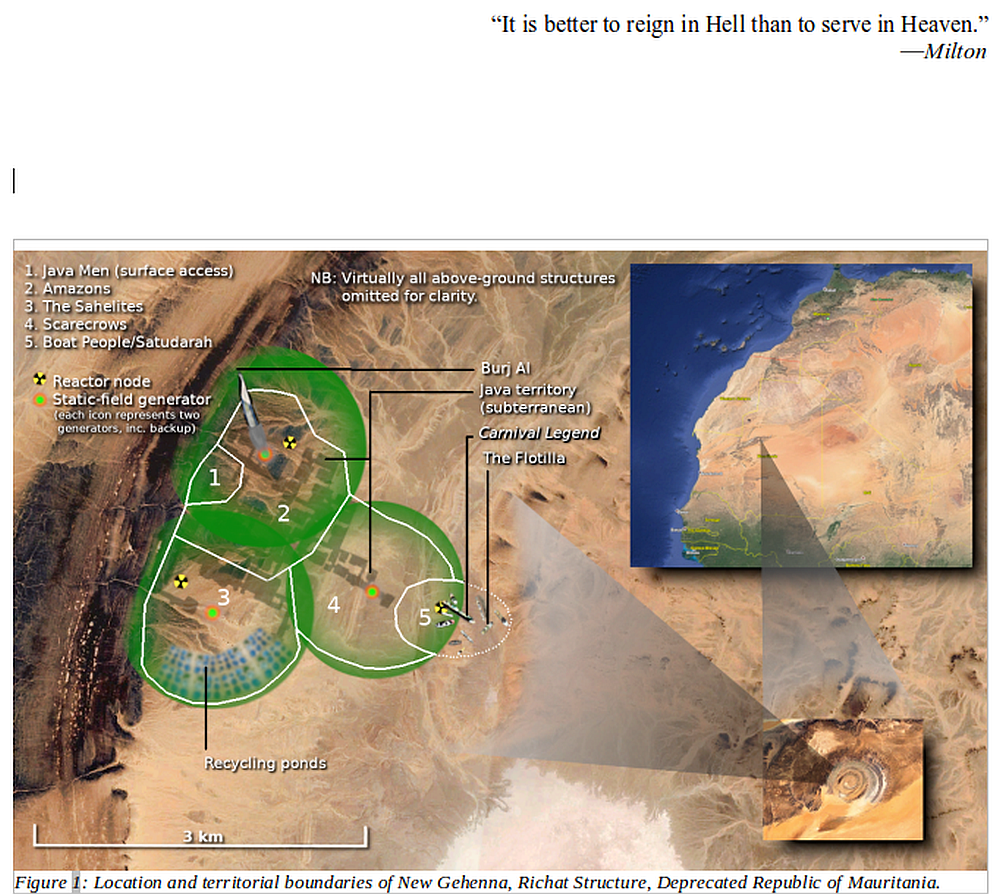
And here's one of my Tables of Contents:
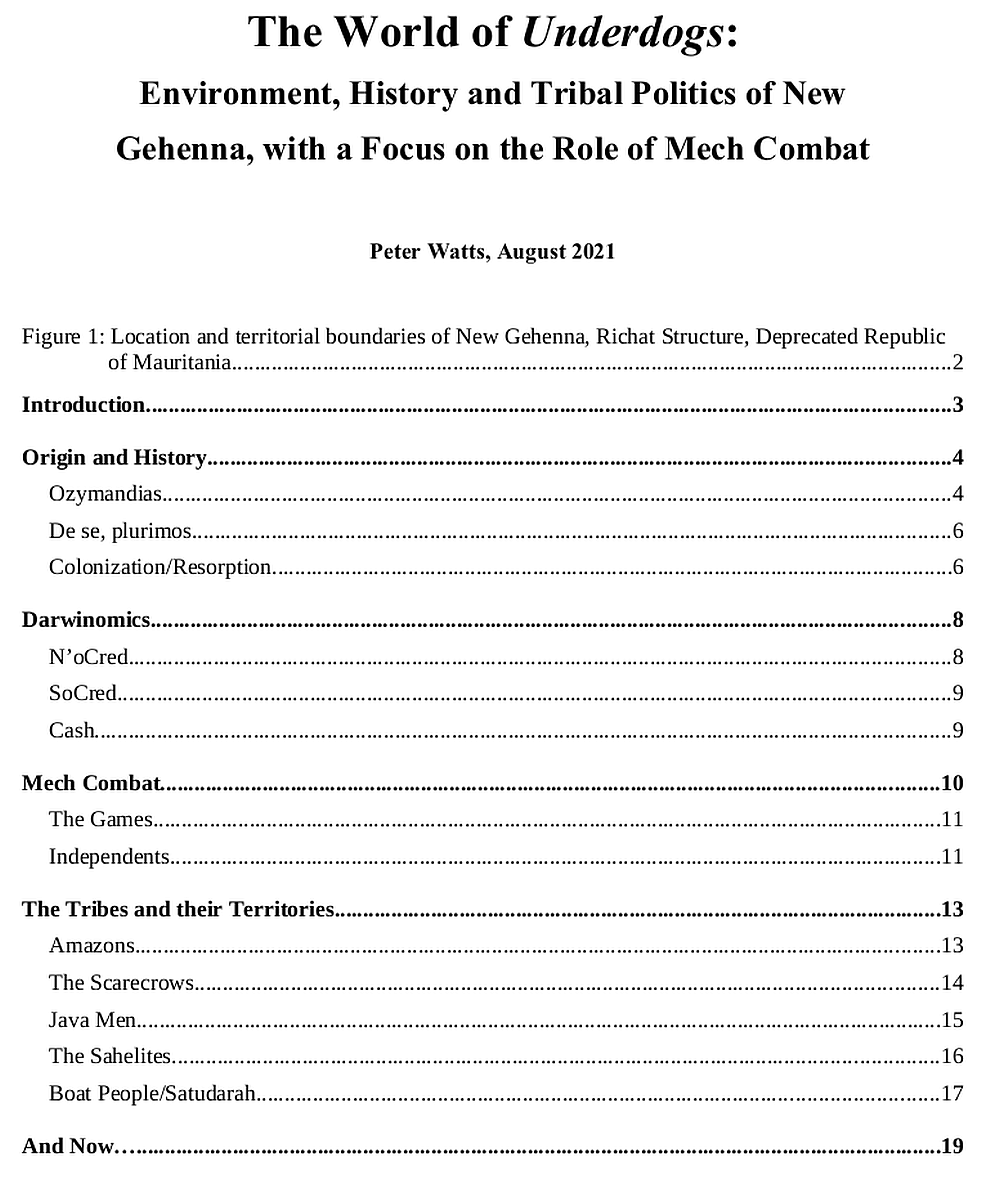
Now you know what I was doing when I wasn't writing Omniscience.
*
I don't know how much of this survived. It's in the nature of the biz that the story changes to serve the game. I'm told the backstory I developed remains foundational to Underdogs; its bones inform what you experience whether they appear explicitly or not. But much has changed: the city is New Brakka, not New Gehenna. The static fields now serve to jam Big Sys, not to keep out the desert heat. (The desert in this world isn't even all that hot any more, thanks to various geoengineering megaprojects that went sideways.) I think I see hints of my Tribes and territories as Rigg and King prowl the backstreets: references to "caveman territory", or to bits of infrastructure I inserted to give the factions something to fight over. Not having even breached the city gates I don't know how many of those Easter eggs might be waiting for me, but assuming I can get out of the KillBox I'm definitely gonna be keeping an eye out. (I think maybe the Spire survived in some form. I'm really, really hoping the Pink Widow did too, but I doubt it.)
Doesn't really matter, though. I love the fact that Underdogs has a fairly deep backstory, and I'm honored to have had even a small part in building it; you could write entire novels set in New Brakka. But this game… this game is definitely not plot driven. It is pure first-person adrenaline dust-up, with a relentless grim and beautiful grotto-punk aesthetic (yes, yet another kind of -punk; deal with it) that saturates everything from the soundtrack to the voice acting to the interactive cut-scenes. I admit I was skeptical of those cut-scenes at first; having steeped myself in Bioshock and Skyrim and The Last Of Us all these years, were comic-book cut-outs really going to do it for me?
But yes. Yes they totally did. Don't take my word for it: check out the Youtube reviews. Go over to Underdog's Steam page, where the hundreds of user reviews are "Overwhelmingly Positive". The only real complaint people have about this game is that there isn’t more of it.
This game was not made for VR: VR was made for this game.
Most of you remain in pancake mode. VR is too expensive, or you get nauseous, or you've erroneously come to equate "VR" with "Oculus" and you (quite rightly) don't want anything to do with the fucking Zuckerborg. But those of you who do have headsets should definitely get this game. Then you should talk to all those other people, show them that the Valve Index is actually superior to the Oculus in a number of ways (and it supports Linux!), and introduce them to Underdogs. Show them what VR can be, when you're not puking all over the floor because you can't get out of smooth-motion mode and no one told you about Natural Locomotion. Underdogs is the best ambassador for VR since, well, RacketNX. It deserves to be a massive hit.
Now I'm gonna take another run at that boss. I'll let you know when I break out.
An update on the Samsung moon controversy from a Samsung executive: [ 07-Feb-24 10:22am ]
An update on the Samsung moon controversy from a Samsung executive:
There was a very nice video by Marques Brownlee last year on the moon picture. Everyone was like, 'Is it fake? Is it not fake?' There was a debate around what constitutes a real picture. And actually, there is no such thing as a real picture. As soon as you have sensors to capture something, you reproduce [what you're seeing], and it doesn't mean anything. There is no real picture. You can try to define a real picture by saying, 'I took that picture', but if you used AI to optimize the zoom, the autofocus, the scene - is it real? Or is it all filters? There is no real picture, full stop.
(Ed: of course there is no such thing as “a real picture”. What there is, is a relationship: the person who takes the picture, the subject of the pictures, the context of that picture-taking. Pictures (like everything else) are relationships, not objects, and it is this which is revealed when you start doing weird things like Samsung/AI does to image making.)
Why Music Journalism Matters in 2024 [ 05-Feb-24 5:19pm ] You might have noticed that Drowned in Sound has been on a reflective pause since 2019.
We've been pondering and perfecting what a fully rejuvenated DiS would look like in the years to come. The good news? We're so (slowly coming) back!
While we're still shaping our grand revival for 2024/25, we're thrilled to add to our much-loved podcast and independent label releases, a brand-new newsletter.
Starting now, expect a weekly dose of DiS in your emails.
There will be a monthly pile of music recommendations in your inbox. Alongside new essays and an internet digest of things to see, read and hear.
The newsletter, available on our revamped site, will feature two free editions per month (including one packed with must-hear music) and two exclusive editions for our valued supporters.
Each month, we'll also showcase a guest essay alongside an extended piece by me - Sean Adams, founder of Drowned in Sound, at your service since October 2000.
Our vision? To commission 50 thought-provoking essays and articles next year, while continuously enhancing our podcast.
Then what? We might even dive into the world of print magazines, as we sense the "vinyl moment" for journals is just around the corner.
Sign up at drownedinsound.org and browse some of our recent bits and bobs.

The Wax and the Wane of the Web [ 29-Feb-24 2:45pm ]I offer a single bit of advice to friends and family when they become new parents: When you start to think that you've got everything figured out, everything will change. Just as you start to get the hang of feedings, diapers, and regular naps, it's time for solid food, potty training, and overnight sleeping. When you figure those out, it's time for preschool and rare naps. The cycle goes on and on.
The same applies for those of us working in design and development these days. Having worked on the web for almost three decades at this point, I've seen the regular wax and wane of ideas, techniques, and technologies. Each time that we as developers and designers get into a regular rhythm, some new idea or technology comes along to shake things up and remake our world.
How we got hereI built my first website in the mid-'90s. Design and development on the web back then was a free-for-all, with few established norms. For any layout aside from a single column, we used table elements, often with empty cells containing a single pixel spacer GIF to add empty space. We styled text with numerous font tags, nesting the tags every time we wanted to vary the font style. And we had only three or four typefaces to choose from: Arial, Courier, or Times New Roman. When Verdana and Georgia came out in 1996, we rejoiced because our options had nearly doubled. The only safe colors to choose from were the 216 "web safe" colors known to work across platforms. The few interactive elements (like contact forms, guest books, and counters) were mostly powered by CGI scripts (predominantly written in Perl at the time). Achieving any kind of unique look involved a pile of hacks all the way down. Interaction was often limited to specific pages in a site.
The birth of web standardsAt the turn of the century, a new cycle started. Crufty code littered with table layouts and font tags waned, and a push for web standards waxed. Newer technologies like CSS got more widespread adoption by browsers makers, developers, and designers. This shift toward standards didn't happen accidentally or overnight. It took active engagement between the W3C and browser vendors and heavy evangelism from folks like the Web Standards Project to build standards. A List Apart and books like Designing with Web Standards by Jeffrey Zeldman played key roles in teaching developers and designers why standards are important, how to implement them, and how to sell them to their organizations. And approaches like progressive enhancement introduced the idea that content should be available for all browsers—with additional enhancements available for more advanced browsers. Meanwhile, sites like the CSS Zen Garden showcased just how powerful and versatile CSS can be when combined with a solid semantic HTML structure.
Server-side languages like PHP, Java, and .NET overtook Perl as the predominant back-end processors, and the cgi-bin was tossed in the trash bin. With these better server-side tools came the first era of web applications, starting with content-management systems (particularly in the blogging space with tools like Blogger, Grey Matter, Movable Type, and WordPress). In the mid-2000s, AJAX opened doors for asynchronous interaction between the front end and back end. Suddenly, pages could update their content without needing to reload. A crop of JavaScript frameworks like Prototype, YUI, and jQuery arose to help developers build more reliable client-side interaction across browsers that had wildly varying levels of standards support. Techniques like image replacement let crafty designers and developers display fonts of their choosing. And technologies like Flash made it possible to add animations, games, and even more interactivity.
These new technologies, standards, and techniques reinvigorated the industry in many ways. Web design flourished as designers and developers explored more diverse styles and layouts. But we still relied on tons of hacks. Early CSS was a huge improvement over table-based layouts when it came to basic layout and text styling, but its limitations at the time meant that designers and developers still relied heavily on images for complex shapes (such as rounded or angled corners) and tiled backgrounds for the appearance of full-length columns (among other hacks). Complicated layouts required all manner of nested floats or absolute positioning (or both). Flash and image replacement for custom fonts was a great start toward varying the typefaces from the big five, but both hacks introduced accessibility and performance problems. And JavaScript libraries made it easy for anyone to add a dash of interaction to pages, although at the cost of doubling or even quadrupling the download size of simple websites.
The web as software platformThe symbiosis between the front end and back end continued to improve, and that led to the current era of modern web applications. Between expanded server-side programming languages (which kept growing to include Ruby, Python, Go, and others) and newer front-end tools like React, Vue, and Angular, we could build fully capable software on the web. Alongside these tools came others, including collaborative version control, build automation, and shared package libraries. What was once primarily an environment for linked documents became a realm of infinite possibilities.
At the same time, mobile devices became more capable, and they gave us internet access in our pockets. Mobile apps and responsive design opened up opportunities for new interactions anywhere and any time.
This combination of capable mobile devices and powerful development tools contributed to the waxing of social media and other centralized tools for people to connect and consume. As it became easier and more common to connect with others directly on Twitter, Facebook, and even Slack, the desire for hosted personal sites waned. Social media offered connections on a global scale, with both the good and bad that that entails.
Want a much more extensive history of how we got here, with some other takes on ways that we can improve? Jeremy Keith wrote "Of Time and the Web." Or check out the "Web Design History Timeline" at the Web Design Museum. Neal Agarwal also has a fun tour through "Internet Artifacts."
Where we are nowIn the last couple of years, it's felt like we've begun to reach another major inflection point. As social-media platforms fracture and wane, there's been a growing interest in owning our own content again. There are many different ways to make a website, from the tried-and-true classic of hosting plain HTML files to static site generators to content management systems of all flavors. The fracturing of social media also comes with a cost: we lose crucial infrastructure for discovery and connection. Webmentions, RSS, ActivityPub, and other tools of the IndieWeb can help with this, but they're still relatively underimplemented and hard to use for the less nerdy. We can build amazing personal websites and add to them regularly, but without discovery and connection, it can sometimes feel like we may as well be shouting into the void.
Browser support for CSS, JavaScript, and other standards like web components has accelerated, especially through efforts like Interop. New technologies gain support across the board in a fraction of the time that they used to. I often learn about a new feature and check its browser support only to find that its coverage is already above 80 percent. Nowadays, the barrier to using newer techniques often isn't browser support but simply the limits of how quickly designers and developers can learn what's available and how to adopt it.
Today, with a few commands and a couple of lines of code, we can prototype almost any idea. All the tools that we now have available make it easier than ever to start something new. But the upfront cost that these frameworks may save in initial delivery eventually comes due as upgrading and maintaining them becomes a part of our technical debt.
If we rely on third-party frameworks, adopting new standards can sometimes take longer since we may have to wait for those frameworks to adopt those standards. These frameworks—which used to let us adopt new techniques sooner—have now become hindrances instead. These same frameworks often come with performance costs too, forcing users to wait for scripts to load before they can read or interact with pages. And when scripts fail (whether through poor code, network issues, or other environmental factors), there's often no alternative, leaving users with blank or broken pages.
Where do we go from here?Today's hacks help to shape tomorrow's standards. And there's nothing inherently wrong with embracing hacks—for now—to move the present forward. Problems only arise when we're unwilling to admit that they're hacks or we hesitate to replace them. So what can we do to create the future we want for the web?
Build for the long haul. Optimize for performance, for accessibility, and for the user. Weigh the costs of those developer-friendly tools. They may make your job a little easier today, but how do they affect everything else? What's the cost to users? To future developers? To standards adoption? Sometimes the convenience may be worth it. Sometimes it's just a hack that you've grown accustomed to. And sometimes it's holding you back from even better options.
Start from standards. Standards continue to evolve over time, but browsers have done a remarkably good job of continuing to support older standards. The same isn't always true of third-party frameworks. Sites built with even the hackiest of HTML from the '90s still work just fine today. The same can't always be said of sites built with frameworks even after just a couple years.
Design with care. Whether your craft is code, pixels, or processes, consider the impacts of each decision. The convenience of many a modern tool comes at the cost of not always understanding the underlying decisions that have led to its design and not always considering the impact that those decisions can have. Rather than rushing headlong to "move fast and break things," use the time saved by modern tools to consider more carefully and design with deliberation.
Always be learning. If you're always learning, you're also growing. Sometimes it may be hard to pinpoint what's worth learning and what's just today's hack. You might end up focusing on something that won't matter next year, even if you were to focus solely on learning standards. (Remember XHTML?) But constant learning opens up new connections in your brain, and the hacks that you learn one day may help to inform different experiments another day.
Play, experiment, and be weird! This web that we've built is the ultimate experiment. It's the single largest human endeavor in history, and yet each of us can create our own pocket within it. Be courageous and try new things. Build a playground for ideas. Make goofy experiments in your own mad science lab. Start your own small business. There has never been a more empowering place to be creative, take risks, and explore what we're capable of.
Share and amplify. As you experiment, play, and learn, share what's worked for you. Write on your own website, post on whichever social media site you prefer, or shout it from a TikTok. Write something for A List Apart! But take the time to amplify others too: find new voices, learn from them, and share what they've taught you.
Go forth and makeAs designers and developers for the web (and beyond), we're responsible for building the future every day, whether that may take the shape of personal websites, social media tools used by billions, or anything in between. Let's imbue our values into the things that we create, and let's make the web a better place for everyone. Create that thing that only you are uniquely qualified to make. Then share it, make it better, make it again, or make something new. Learn. Make. Share. Grow. Rinse and repeat. Every time you think that you've mastered the web, everything will change.
Opportunities for AI in Accessibility [ 07-Feb-24 2:00pm ]In reading Joe Dolson's recent piece on the intersection of AI and accessibility, I absolutely appreciated the skepticism that he has for AI in general as well as for the ways that many have been using it. In fact, I'm very skeptical of AI myself, despite my role at Microsoft as an accessibility innovation strategist who helps run the AI for Accessibility grant program. As with any tool, AI can be used in very constructive, inclusive, and accessible ways; and it can also be used in destructive, exclusive, and harmful ones. And there are a ton of uses somewhere in the mediocre middle as well.
I'd like you to consider this a "yes… and" piece to complement Joe's post. I'm not trying to refute any of what he's saying but rather provide some visibility to projects and opportunities where AI can make meaningful differences for people with disabilities. To be clear, I'm not saying that there aren't real risks or pressing issues with AI that need to be addressed—there are, and we've needed to address them, like, yesterday—but I want to take a little time to talk about what's possible in hopes that we'll get there one day.
Alternative textJoe's piece spends a lot of time talking about computer-vision models generating alternative text. He highlights a ton of valid issues with the current state of things. And while computer-vision models continue to improve in the quality and richness of detail in their descriptions, their results aren't great. As he rightly points out, the current state of image analysis is pretty poor—especially for certain image types—in large part because current AI systems examine images in isolation rather than within the contexts that they're in (which is a consequence of having separate "foundation" models for text analysis and image analysis). Today's models aren't trained to distinguish between images that are contextually relevant (that should probably have descriptions) and those that are purely decorative (which might not need a description) either. Still, I still think there's potential in this space.
As Joe mentions, human-in-the-loop authoring of alt text should absolutely be a thing. And if AI can pop in to offer a starting point for alt text—even if that starting point might be a prompt saying What is this BS? That's not right at all… Let me try to offer a starting point—I think that's a win.
Taking things a step further, if we can specifically train a model to analyze image usage in context, it could help us more quickly identify which images are likely to be decorative and which ones likely require a description. That will help reinforce which contexts call for image descriptions and it'll improve authors' efficiency toward making their pages more accessible.
While complex images—like graphs and charts—are challenging to describe in any sort of succinct way (even for humans), the image example shared in the GPT4 announcement points to an interesting opportunity as well. Let's suppose that you came across a chart whose description was simply the title of the chart and the kind of visualization it was, such as: Pie chart comparing smartphone usage to feature phone usage among US households making under $30,000 a year. (That would be a pretty awful alt text for a chart since that would tend to leave many questions about the data unanswered, but then again, let's suppose that that was the description that was in place.) If your browser knew that that image was a pie chart (because an onboard model concluded this), imagine a world where users could ask questions like these about the graphic:
- Do more people use smartphones or feature phones?
- How many more?
- Is there a group of people that don't fall into either of these buckets?
- How many is that?
Setting aside the realities of large language model (LLM) hallucinations—where a model just makes up plausible-sounding "facts"—for a moment, the opportunity to learn more about images and data in this way could be revolutionary for blind and low-vision folks as well as for people with various forms of color blindness, cognitive disabilities, and so on. It could also be useful in educational contexts to help people who can see these charts, as is, to understand the data in the charts.
Taking things a step further: What if you could ask your browser to simplify a complex chart? What if you could ask it to isolate a single line on a line graph? What if you could ask your browser to transpose the colors of the different lines to work better for form of color blindness you have? What if you could ask it to swap colors for patterns? Given these tools' chat-based interfaces and our existing ability to manipulate images in today's AI tools, that seems like a possibility.
Now imagine a purpose-built model that could extract the information from that chart and convert it to another format. For example, perhaps it could turn that pie chart (or better yet, a series of pie charts) into more accessible (and useful) formats, like spreadsheets. That would be amazing!
Matching algorithmsSafiya Umoja Noble absolutely hit the nail on the head when she titled her book Algorithms of Oppression. While her book was focused on the ways that search engines reinforce racism, I think that it's equally true that all computer models have the potential to amplify conflict, bias, and intolerance. Whether it's Twitter always showing you the latest tweet from a bored billionaire, YouTube sending us into a Q-hole, or Instagram warping our ideas of what natural bodies look like, we know that poorly authored and maintained algorithms are incredibly harmful. A lot of this stems from a lack of diversity among the people who shape and build them. When these platforms are built with inclusively baked in, however, there's real potential for algorithm development to help people with disabilities.
Take Mentra, for example. They are an employment network for neurodivergent people. They use an algorithm to match job seekers with potential employers based on over 75 data points. On the job-seeker side of things, it considers each candidate's strengths, their necessary and preferred workplace accommodations, environmental sensitivities, and so on. On the employer side, it considers each work environment, communication factors related to each job, and the like. As a company run by neurodivergent folks, Mentra made the decision to flip the script when it came to typical employment sites. They use their algorithm to propose available candidates to companies, who can then connect with job seekers that they are interested in; reducing the emotional and physical labor on the job-seeker side of things.
When more people with disabilities are involved in the creation of algorithms, that can reduce the chances that these algorithms will inflict harm on their communities. That's why diverse teams are so important.
Imagine that a social media company's recommendation engine was tuned to analyze who you're following and if it was tuned to prioritize follow recommendations for people who talked about similar things but who were different in some key ways from your existing sphere of influence. For example, if you were to follow a bunch of nondisabled white male academics who talk about AI, it could suggest that you follow academics who are disabled or aren't white or aren't male who also talk about AI. If you took its recommendations, perhaps you'd get a more holistic and nuanced understanding of what's happening in the AI field. These same systems should also use their understanding of biases about particular communities—including, for instance, the disability community—to make sure that they aren't recommending any of their users follow accounts that perpetuate biases against (or, worse, spewing hate toward) those groups.
Other ways that AI can helps people with disabilitiesIf I weren't trying to put this together between other tasks, I'm sure that I could go on and on, providing all kinds of examples of how AI could be used to help people with disabilities, but I'm going to make this last section into a bit of a lightning round. In no particular order:
- Voice preservation. You may have seen the VALL-E paper or Apple's Global Accessibility Awareness Day announcement or you may be familiar with the voice-preservation offerings from Microsoft, Acapela, or others. It's possible to train an AI model to replicate your voice, which can be a tremendous boon for people who have ALS (Lou Gehrig's disease) or motor-neuron disease or other medical conditions that can lead to an inability to talk. This is, of course, the same tech that can also be used to create audio deepfakes, so it's something that we need to approach responsibly, but the tech has truly transformative potential.
- Voice recognition. Researchers like those in the Speech Accessibility Project are paying people with disabilities for their help in collecting recordings of people with atypical speech. As I type, they are actively recruiting people with Parkinson's and related conditions, and they have plans to expand this to other conditions as the project progresses. This research will result in more inclusive data sets that will let more people with disabilities use voice assistants, dictation software, and voice-response services as well as control their computers and other devices more easily, using only their voice.
- Text transformation. The current generation of LLMs is quite capable of adjusting existing text content without injecting hallucinations. This is hugely empowering for people with cognitive disabilities who may benefit from text summaries or simplified versions of text or even text that's prepped for Bionic Reading.
We need to recognize that our differences matter. Our lived experiences are influenced by the intersections of the identities that we exist in. These lived experiences—with all their complexities (and joys and pain)—are valuable inputs to the software, services, and societies that we shape. Our differences need to be represented in the data that we use to train new models, and the folks who contribute that valuable information need to be compensated for sharing it with us. Inclusive data sets yield more robust models that foster more equitable outcomes.
Want a model that doesn't demean or patronize or objectify people with disabilities? Make sure that you have content about disabilities that's authored by people with a range of disabilities, and make sure that that's well represented in the training data.
Want a model that doesn't use ableist language? You may be able to use existing data sets to build a filter that can intercept and remediate ableist language before it reaches readers. That being said, when it comes to sensitivity reading, AI models won't be replacing human copy editors anytime soon.
Want a coding copilot that gives you accessible recommendations from the jump? Train it on code that you know to be accessible.
I have no doubt that AI can and will harm people… today, tomorrow, and well into the future. But I also believe that we can acknowledge that and, with an eye towards accessibility (and, more broadly, inclusion), make thoughtful, considerate, and intentional changes in our approaches to AI that will reduce harm over time as well. Today, tomorrow, and well into the future.
Many thanks to Kartik Sawhney for helping me with the development of this piece, Ashley Bischoff for her invaluable editorial assistance, and, of course, Joe Dolson for the prompt.

 This is an AP wire photo that I purchased off of ebay a couple years back. I don't know whether the photo ever showed up in any news report on the event. A group of Americans, I don't think belonging to any particular organization, put on this event, a two-day march to Sidon. The following year they organized another march, from Sidon to Tyre. (That's me in the middle, with the headband.) I was too involved in marriage preparations to go. The following spring, 1975, no march was organized, it was the early days of the civil war.
Two things I notice here: (1) the woman next to me (whose name I forget) is wearing a kufiya, reminding me that expats in Beirut would do this in the early 70s, and (2) I'm carrying a plastic bag from the Rebeiz record store, one of the two best record stores in Beirut at the time. It should be noted that the march proceeded just a few days after Israeli special forces entered West Beirut and assassinated three PLO officials: Muhammad al-Najjar, Kamal Adwan, and Kamal Nasser.
Amazon Is Selling Products With AI-Generated Names Like “I Cannot Fulfill This Request It Goes… [ 14-Jan-24 4:43pm ]
This is an AP wire photo that I purchased off of ebay a couple years back. I don't know whether the photo ever showed up in any news report on the event. A group of Americans, I don't think belonging to any particular organization, put on this event, a two-day march to Sidon. The following year they organized another march, from Sidon to Tyre. (That's me in the middle, with the headband.) I was too involved in marriage preparations to go. The following spring, 1975, no march was organized, it was the early days of the civil war.
Two things I notice here: (1) the woman next to me (whose name I forget) is wearing a kufiya, reminding me that expats in Beirut would do this in the early 70s, and (2) I'm carrying a plastic bag from the Rebeiz record store, one of the two best record stores in Beirut at the time. It should be noted that the march proceeded just a few days after Israeli special forces entered West Beirut and assassinated three PLO officials: Muhammad al-Najjar, Kamal Adwan, and Kamal Nasser.
Amazon Is Selling Products With AI-Generated Names Like “I Cannot Fulfill This Request It Goes… [ 14-Jan-24 4:43pm ]
A listing for one set of six outdoor chairs boasts that “our can be used for a variety of tasks, such [task 1], [task 2], and [task 3], making it a versatile addition to your household.”
“HELP! Guys I’m losing my mind, the lady in the wedding dress shop took this photo of me! I swear on… [ 07-Nov-23 7:45am ]
“HELP! Guys I'm losing my mind, the lady in the wedding dress shop took this photo of me! I swear on my life this is real, what?! HOW?! Somebody please help!!! I'm freaking out” - TessaCoates on Twitter
[Likely cause of this image is that the iPhone used actually takes several images to compensate for low light conditions, and then stitches them together, producing a moment which never happened. See also: Google Best Take.]


