
 The Pace of Governance
Michael Pollan: Congratulations on the book. It is very rare that a book can ignite a national conversation and you’ve done that. I was watching CNN on Monday morning and they did a whole segment on “abundance” — the concept, not your book. They barely mentioned you, but they talked about it as this meme. It has been mainstreamed and at this point it’s floated free of your bylines and it has its own existence in the political ether. That’s quite an achievement, and it comes at a very propitious time. The Democratic Party is flailing, in the market for new ideas and along comes Abundance. The book was finished before Trump took office and it reads quite differently than it probably would have had Kamala Harris won. It’s kind of an interesting head experiment to read it through both lenses, but we are in this lens of Trump having won.
Ezra Klein: One of the questions I’ve gotten a lot in the last couple of days because of things like that CNN segment is actually, what the hell is happening here? Why is this [book] hitting the way it is? The kind of reception and interest we’re getting inside the political system — I’ve been doing this a long time, this is something different. And I think it’s because the sense that if you do not make liberal democracy — and liberals leading a democracy — deliver again, you might just lose liberal democracy, has become chillingly real to people.
And so this world where Joe Biden loses for reelection and his top advisor says, “Well, the problem is elections are four-year cycles and our agenda needs to be measured in decades” — the world where you can say that is gone. You don’t get decades. If you don’t win on the four-year cycle, your agenda is undone and you’ll have serious conversations about what elections look like in the future at all.
Pollan: But a lot of what you’re proposing is going to take a while, building millions of new units of housing.
Klein: No.
Pollan: How do you demonstrate effectiveness within the frame of —
Klein: This is a learned helplessness that we have gotten into. We built the Empire State Building in a year. When Medicare was passed, people got Medicare cards one year later. It took the Affordable Care Act four years. Under Biden, it took three years for Medicare to just begin negotiating drug prices. We have chosen slowness. And in doing so we have broken the cord of accountability in democracy. The Bipartisan Infrastructure Bill’s median road completion time is 02027. That’s not because asphalt takes six years to lay down. The reason we didn’t get rural broadband after appropriating $42 billion for it in 02021 isn’t because it takes that long to lay down broadband cable. It doesn’t. It’s a 14-stage process with challenges and plans and counter-proposals. We have chosen slowness because we thought we had the luxury of time. And one of the parts of this book that is present, but if I were rewriting it now, I would write it more strongly, is we need to rediscover speed as a progressive value.
The idea that government delivers at a pace where you can feel it? That’s not a luxury; that’s how you keep a government. And so, this thing where we've gotten used to everything taking forever — literally in the case of California high-speed rail, I think the timeline is officially forever. In China, it’s not like they have access to advanced high-speed rail technology we don’t, or in Spain, or in France. You’re telling me the French work so much harder than we do? But they complete things on a normal timeline. We built the first 28 subways of the New York City subway system in four years; 28 of them reopened in four years. The Second Avenue Subway, I think we started planning for it in the 01950s. So it’s all to say, I think this is something that actually slowly we have forgotten: speed is a choice.
We need to rediscover speed as a progressive value. The idea that government delivers at a pace where you can feel it is not a luxury; it’s how you keep a government.
Look, we can’t make nuclear fusion tomorrow. We can’t solve the hard problem of consciousness (to predict a coming Michael Pollan work), but we can build apartment buildings. We can build infrastructure. We can deliver healthcare. We have chosen to stop. And we’ve chosen to stop because we thought that would make all the policies better, more just, more equitable. There would be more voice in them. And now we look around. And did it make it better? Is liberal democracy doing better? Is the public happier? Are more people being represented in the kind of government we have? Is California better? And the answer is no. The one truly optimistic point of this book is that we chose these problems. And if you chose a problem, you can un-choose it. Not that it’ll be easy, but unlike if the boundary was physics or technology, it’s at least possible. We made the 14-stage process, we can un-make it.
 The Environmental Questions of our Age
Pollan: You talk a lot about the various rules and regulations that keep us from building. But a lot of them, of course, have very admirable goals. This is the environmental movement. These were victories won in the 01970s at great cost. They protect workers, they protect the disabled, they protect wetlands. How do you decide which ones to override and which ones to respect? How does an Abundance agenda navigate that question?
Derek Thompson: It’s worthwhile to think about the difference between laws that work based on outcomes versus processes. So you’re absolutely right, and I want to be clear about exactly how right you are. The world that we built with the growth machine of the middle of the 20th century was absolutely disgusting. The water was disgusting, the air was disgusting. We were despoiling the country. The month that Dylan Thomas, the poet, died in New York City of a respiratory illness, dozens of people died of air pollution in New York City in the 01940s and it was not front page news at all. It was simply what happened. To live in the richest city, in the richest country in the world meant to have a certain risk of simply dying of breathing.
We responded to that by passing a series of laws: the Clean Air Act, the Clean Water Act, the National Environmental Protection Act. We passed laws to protect specific species. And these laws answered the problems of the 01950s and the 01960s. But sometimes what happens is that the medicine of one generation can yield the disease of the next generation. And right now, I think that what being an environmentalist means to me in the 02020s is something subtly but distinctly different from what being an environmentalist meant in the 01960s.
 Demonstrators at the first Earth Day in Washington, D.C., April 22 01970.
There was a time when it was appropriate for environmentalism to be a movement of stop, to be a movement of blocking. But what happened is we got so good at saying stop, and so good at giving people legal tools to say stop, and so efficient at the politics of blocking, that we made it difficult to add infill housing and dense housing in urban areas, which is good for the environment, and build solar energy which is good for the environment, and add wind energy, which is good for the environment, and advance nuclear power.
We have to have a more planetary sense of what it means to be an environmentalist. And that means having a new attitude toward building.
We made it harder to do the things that are necessary to, I think, be an environmentalist in the 02020s, which is to care for global warming, to think about, not just — in some ways we talk about the tree that you can save by saying no to a building that requires tearing down that tree, forgetting about the thousands of trees that are going to be killed if instead of the apartment building being built over that tree, it’s built in a sprawling suburban area that has to knock down a forest. We have to have a more planetary sense of what it means to be an environmentalist. And that means having a new attitude toward building.
We need to embrace a culture of institutional renewal and ask: what does it really mean to be an environmentalist in the 02020s? It means making it easier to build houses in dense urban areas and making it easier for places to add solar and wind and geothermal and nuclear and maybe even next-generational enhanced geothermal. We need to find a way to match our processes and our outcomes. The Clean Air and Water Act worked in many ways by regulating outcomes. “This air needs to be this clean. This tailpipe cannot have this level of emissions.” That is an outcome-based regulation. What NEPA and CEQA have done is they have not considered outcomes. They are steroids for process elongation. They make it easier for people who want to stop states and companies from doing anything, enacting any kind of change in the physical world, to delay them forever in such a way that ironically makes it harder to build the very things that are inherent to what you should want if you are an environmentalist in the 02020s.
That’s the tragic irony of the environmentalist revolution. It’s not what happened in the 01960s. I don’t hate the environmentalists of the 01960s and 01970s; they answered the questions of their age. And it is our responsibility to take up the baton and do the same and answer the questions for our age, because they are different questions.
 Growth, Technology, & Scientific Progress
Pollan: So I came of age politically in the 01970s, long before you guys did — or sometime before you did. And there was another very powerful meme then called “Limits to Growth.” Your agenda is very much about growth. It’s a very pro-growth agenda. In 01972, the Club of Rome publishes this book. It was a bunch of MIT scientists who put it together using these new tools called computers to run projections: exponential growth, what it would do to the planet. And they suggested that if we didn’t put limits on growth, we would exceed the carrying capacity of the earth, which is a closed system, and civilization would collapse right around now. There is a tension between growth and things like climate change. If we build millions of new units of housing, we’re going to be pouring a lot of concrete. There is more pollution with growth. Growth has costs. So how does an Abundance agenda navigate that tension between growth and the cost of growth?
 World3 Model Standard Run as shown in The Limits to Growth. Model by Kristo Mefisto
Klein: I’ve not gotten into talk at all on the [book] tour about really one of my favorite things I’ve written in the book, which is how much I hate the metaphor that growth is like a pie. So if you’ve been around politics at all, you’ve probably heard this metaphor where it’s like they’ll say something like, “Oh, the economy’s not... You want to grow the pie. You don’t just want to cut the pie into ever smaller pieces as redistribution does. Pro-growth politics: you want to grow the pie.”
If you grow a pie —
Pollan: How do you grow a pie?
Klein: — which you don’t.
Pollan: You plant the pie?
Klein: As I say in the book, the problem with this metaphor is it’s hard to know where to start because it gets nothing right, including its own internal structure. But if you somehow grew a pie, what you would get is more pie. If you grow an economy, what you get is change. Growth is a measure of change. An economy that grows at 2% or 3% a year, year-on-year, is an economy that will transform extremely rapidly into something unrecognizable. Derek has these beautiful passages in the book where it’s like you fall asleep in this year and you wake up in this year and we’ve got aspirin and televisions and rocket travel and all these amazing things.
And the reason this is, I think, really important is that this intuition they had was wrong. Take the air pollution example of a minute ago. One thing we now see over and over and over again is that as societies get richer, as they grow, they pass through a period of intense pollution. There was a time when it was London where you couldn’t breathe. When I grew up in the 01980s and 01990s outside Los Angeles, Los Angeles was a place where you often couldn’t breathe. Then a couple of years ago it was China, now it’s Delhi. And it keeps moving. But the thing is as these places get richer, they get cleaner. Now, London’s air is — I don’t want to say sparkling, air doesn’t sparkle and I’m better at metaphors than the pie people — but it’s quite breathable; I’ve been there. And so is LA, and it’s getting cleaner in China. And in the UK, in fact, they just closed the final coal-powered energy plant in the country ahead of schedule.
Progressivism needs to put technology much more at the center of its vision of change because the problems it seeks to solve cannot be solved except by technology in many cases.
I think there are two things here. One is that you can grow — and in fact our only real chance is to grow — in a way that makes our lives less resource-intensive. But the second thing that I think is really important: I really don’t like the term pro-growth politics or pro-growth economics because I don’t consider growth always a good thing. If you tell me that we have added a tremendous amount of GDP by layering coal-fired power plants all across the country, I will tell you that’s bad. If we did it by building more solar panels and wind turbines and maybe nuclear power, that would be good. I actually think we have to have quite strong opinions on growth. We are trying to grow in a direction, that is to say, we are trying to change in a direction. And one of the things this book tries to do is say that technology should come with a social purpose. We should yoke technology to a social purpose. For too long we’ve seen technology as something the private sector does, which is often true, but not always.
The miracles of solar and wind and battery power that have given us the only shot we have to avoid catastrophic climate change have been technological miracles induced by government policy, by tax credits in the U.S. and in Germany, by direct subsidies in China. Operation Warp Speed pulled a vaccine out of the future and into the present. And then, when it did it, it said the price of this vaccine will be zero dollars.
There are things you can achieve through redistribution. And they’re wonderful and remarkable and we should achieve them. But there are things you can achieve, and problems you can only solve, through technology, through change. And one of the core views of the book, which we’ve been talking a bit less about on the trail, is that progressivism needs to put technology much more at the center of its vision of change because the problems it seeks to solve cannot be solved except by technology in many cases.
Pollan: There’s a logic there though. There’s an assumption there that technology will arrive when you want it to. I agree, technology can change the terms of all these debates and especially the debate around growth. But technology doesn’t always arrive on time when you want it. A lot of your book stands on abundant, clean energy, right? The whole scenario at the beginning of the book, which is this utopia that you paint, in so many ways depends on the fact that we’ve solved the energy problem. Can we count on that? Fusion has been around the corner for a long time.
Klein: Well, nothing in that [scenario] requires fusion. That one just requires building what we know how to build, at least on the energy side.
Pollan: You mean solar, nuclear and —
Klein: Solar, nuclear, wind, advanced geothermal. We can do all that. But Derek should talk about this part because he did more of the reporting here, but there are things we don’t have yet like green cement and green fuel.
Pollan: Yeah. So do we wait for that or we build and then —
Thompson: No, you don’t wait.
Pollan: We don’t wait, no?
Thompson: Let’s be deliberate about it. Why do we have penicillin? Why does penicillin exist? Well, the story that people know if they went to medical school or if they picked up a book on the coolest inventions in history is that in 01928 Alexander Fleming, Scottish microbiologist, went on vacation. Comes back to his lab two weeks later, and he’s been studying staphylococcus, he’s been studying bacteria. And he looks at one of his petri dishes. And the staphylococcus, which typically looks, under a microscope, like a cluster of grapes. (In fact, I think staphylococcus is sort of derived from the Greek for grape cluster.) He realizes that it’s been zapped. There’s nothing left in the petri dish. And when he figures out that there’s been some substance that maybe has blown in through an open window that’s zapped the bacteria in the dish, he realizes that it’s from this genus called penicillium. And he calls it penicillin.


Left: Sample of penicillium mold, 01935. Right: Dr. Alexander Fleming in his laboratory, 01943.
So that’s the breakthrough that everybody knows and it’s amazing. Penicillin blew in through an open window. God was just like, “There you go.” That’s a story that people know and it’s romantic and it’s beautiful and it’s utterly insufficient to understand why we have penicillin. Because after 13 years, Fleming and Florey and Chain, the fellows who won the Nobel Peace Prize for the discovery of and nourishing of the discovery of penicillin, were totally at a dead end. 01941, they had done a couple of studies with mice, kind of seemed like penicillin was doing some stuff. They did a couple human trials on five people, two of them died. So if you stop the clock 13 years after penicillin’s discovery, and Ezra and I were medical innovation journalists in the 01940s and someone said, “Hey folks. How do you feel about penicillin, this mold that blew in through a window that killed 40% of its phase one clinical trial?” We’d be like, “Sounds like it sucks. Why are you even asking about it?”
But that’s not where the story ends, because Florey and Chain brought penicillin to America. And it was just as Vannevar Bush and some incredibly important mid-century scientists and technologists were building this office within the federal government, a wartime technology office called the Office of Scientific Research and Development. And they were in the process of spinning out the Manhattan Project and building radar at Rad Lab at MIT. And they said, “Yeah, we’ll take a look at this thing, penicillin. After all, if we could reduce bacterial infections in our military, we could absolutely outlive the nemesis for years and years.” So, long story short, they figure out how to grow it in vats. They figure out how to move through clinical trials. They realize that it is unbelievably effective at a variety of bacteria whose names I don’t know and don’t mean grape for grape clusters. And penicillin turns out to be maybe the most important scientific discovery of the 20th century.
It wasn’t made important because Fleming discovered it on a petri dish. It was made real, it was made a product, because of a deliberate federal policy to grow it, to test it, to distribute it. Operation Warp Speed is very similar. mRNA vaccines right now are being tried in their own phase three clinical trials to cure pancreatic cancer. And pancreatic cancer is basically the most fatal cancer that exists. My mom died of pancreatic cancer about 13 years ago. It is essentially a kind of death sentence because among other things, the cancer produces very few neoantigens, very few novel proteins that the immune system can detect and attack. And we made an mRNA vaccine that can attack them.
Why does it exist? Well, it exists because, and this is where we have to give a little bit of credit if not to Donald Trump himself, at least [Alex] Azar, and some of the bureaucrats who worked under him, they had this idea that what we should do in a pandemic is to fund science from two ends. We should subsidize science by saying, “Hey, Pfizer or Moderna or Johnson & Johnson, here’s money up front.” But also we should fund it — and this is especially important — as a pull mechanism, using what they call an advanced market commitment. “If you build a vaccine that works, we’ll pay you billions of dollars so that we buy it out, can distribute it to the public at a cost of zero dollars and zero cents. Even if you’re the ninth person to build a vaccine, we’ll still give you $5 billion.” And that encourages everybody to try their damndest to build it.
So we build it, it works. They take out all sorts of bottlenecks on the FDA. They even work with Corning, the glass manufacturer, to develop these little vials that carry the mRNA vaccines on trucks to bring them to CVS without them spoiling on the way. And now we have this new frontier of medical science.


Left: A mural in Budapest of Hungarian-American biochemist Katalin Karikó, whose work with Drew Weissman on mRNA technology helped lay the foundation for the BioNTech and Moderna coronavirus vaccines. Photo by Orion Nimrod. Right: President Donald J. Trump at the Operation Warp Speed Vaccine Summit, December 02020.
Pollan: Although it’s in jeopardy now. Scientists are removing mRNA from grant applications —
Klein: That is a huge —
Thompson: Total shanda.
Klein: That is a shanda, but also an opportunity for Democrats.
Pollan: How so?
Klein: Because Donald Trump took the one thing his first administration actually achieved and lit it on fire. And appointed its foremost — I feel like if I say this whole sequence aloud, I sound insane — and appointed the foremost enemy of his one actually good policy to be in charge of the Department of Health and Human Services. And also: it’s a Kennedy.
Pollan: I know, you couldn’t make this shit up.
Klein: Look, there is a world where Donald Trump is dark abundance.
Pollan: Dark abundance, like dark energy.
We’re not just hoping technology appears. Whether or not it appears is, yes, partially luck and reality, but it’s also partially policy. We shift luck, we shift the probabilities.
Klein: Yes. And it’s like: all-of-the-above energy strategy, Warp Speed for everything, build everything everywhere, supercharge American trade, and no civil liberties and I’m king. Instead, he hates all the good stuff he once did or promised. Trying to destroy solar and wind, destroyed Operation Warp Speed and any possibility for vaccine acceleration. And you could just go down the line.
And what that creates is an opportunity for an opposition that isn’t just a defense of American institutions as they existed before. One of the most lethal things the Democrats ever did was allow Donald Trump to negatively polarize them into the defenders of the status quo. What it allows now is for an opposition party to arise, yes, as a resistance to what Donald Trump is trying to do to the federal government, but is also a vision for a much more plentiful future. And that’s plentiful, materially, but plentiful scientifically. The thing that Derek, in that beautiful answer, is saying in response to your very good question, to put it simply, is that we’re not just hoping technology appears. Whether or not it appears is, yes, partially luck and reality — whether or not the spore blew in on the heavenly breeze — but it’s also partially policy. We shift luck, we shift the probabilities.
Democrats have these yard signs which have been so helpful for our book. They always say, “We believe in science.” Don’t believe in science, do science and then make it into things people need. We focus a lot in the back half of the book on the way we do grant work and the NIH because it’s really important. No, it shouldn’t be destroyed. No, the scientists shouldn’t all be fired or unable to put the word mRNA in their grant proposals because the people who promised to bring back free speech are now doing Control+F and canceling grants on soil diversity because Control+F doesn’t know the difference between DEI “diversity” and agricultural soil “diversity.”
But it’s also not good that in virtually every study you run of this, the way we do grant making now pushes scientists towards more herd-like ideas, safer ideas, away from daring ideas, away from things that are counterintuitive. A lot of science requires risk and it requires failure. And the government should be in the business of supporting risk and failure. And by the way, we give Democrats a lot of criticism here, but this is a huge problem that Republicans have created and that they perpetuate.
Great science often sounds bizarre. You never know what you’re going to get from running shrimp on a treadmill. We got GLP-1s because somebody decided to start squeezing the venom out of a lizard’s mouth and seeing what it could do. And nobody thought it was going to give us GLP-1s. And they didn’t even realize for a long time really what they had. You need a system that takes science so seriously, that believes in it so much that it really does allow it to fail. And so when Donald Trump stands up there and is like, “We're making mice transgender” — which, one: we’re not. But two: maybe we should?
Pollan: San Francisco answer.

The first monograph on goldfish published in Europe.

Stefan Sagmeister looks at the world from a long-term perspective and presents designs and visualizations that arrive at very different conclusions than you get from Twitter and TV news.
About Stefan Sagmeister
Stefan Sagmeister has designed for clients as diverse as the Rolling Stones, HBO, and the Guggenheim Museum. He’s a two time Grammy winner and also earned practically every important international design award.
Stefan talks about the large subjects of our lives like happiness or beauty, how they connect to design and what that actually means to our everyday lives. He spoke 5 times at the official TED, making him one of the three most frequently invited TED speakers.
His books sell in the hundreds of thousands and his exhibitions have been mounted in museums around the world. His exhibit ’The Happy Show' attracted way over half a million visitors worldwide and became the most visited graphic design show in history.
A native of Austria, he received his MFA from the University of Applied Arts in Vienna and, as a Fulbright Scholar, a master’s degree from Pratt Institute in New York.

The first full-length work of apiculture published in English.
Abstract
This article takes data surrounding last week's announcement of the first SMR farm in Ontario, Canada to assess whether this new approach to nuclear shows any signs of reducing costs below the level of larger reactors and renewable generators. In brief, the conclusion is that it does not.
SMRs
A small number of experimental SMRs have been built or are under construction in Russia, China and Argentina.[1] The history of these reactors has been full of delays and huge cost overruns.
Nevertheless recent months and years have seen an explosion of interest in constructing new reactors, often to serve specific customers with a high and consistent power need such as the operation of data centres. The International Atomic Energy Agency reported that there are 80 different designs and design concepts for new types of SMRs around the world although no formal decisions had then been taken to proceed with any new projects. Many commentators see SMRs as a realistic route to decarbonising electricity production; in its recent report, the UK's Tony Blair Institute wrote that 'The new generation of small modular reactors offers hope for the renaissance of nuclear power'.[2]
We saw a big step forward last week with the final governmental approval given for the construction of the first SMR farm at an existing nuclear reactor site in Ontario, Canada. The information released when the announcement was made gives us useful information about the possible cost of SMRs. Despite the upbeat press releases from participants in the project, the numbers provided will not increase optimism about the future of this route to a zero carbon energy system.[3]
The plans
The Darlington project plans to eventually put 4 SMRs, each of 300 MW capacity, onto the site. The Ontario government estimates the project's total cost at 20.9 billion Canadian dollars (CAN$) and is supporting it financially. Expressed in US dollars, the price is about $15bn at early May 2025 exchange rates for a total of 1.2 gigawatts of electricity.
The technology provider is GE Hitachi using its BWRX 300 boiling water reactor, a simplified version of the company's full scale nuclear plants. The BWRX 300 has been identified as one of the lowest cost competitors in the race to dominate the SMR industry and the design is one of those currently being evaluated in the UK as a potential recipient of substantial government support. GE Hitachi claims numerous advantages over other SMR technologies, including lower steel and concrete costs, passive cooling and the use of well-understood and widely available nuclear fuel.
Groundwork has been underway for more than 2 years near the existing Darlington nuclear power station in readiness for the formal safety approval finally given in April 2025. Construction is projected to be completed in 2030.[4] In a challenge to the widespread view that SMRs will be simple to construct, one of the challenges facing the first Darlington reactor is creating a tunnel to carry cooling water that will stretch for 3.4 kilometres with a diameter of 6 metres.[5]
The costs of building and operating the SMRs in Ontario.
Capital cost
The first reactor to be built is projected to have a cost of 6.1bn CAN$ (about US$4.4bn). Additional infrastructure will be needed at the site that will be shared between this SMR and the three equivalents that will be eventually built there. The capital cost of these shared facilities is separately budgeted at 1.6bn CAN$ (about US$1.15bn).
The total budget for the entire 4 reactor site is 20.9bn CAN$ (about US$15bn). So the three SMRs to be installed after the first reactor are projected to cost a total of about 13.2bn CAN$, or 4.4bn CAN$ each, a roughly 28% reduction on the 'first of a kind' (FOAK).
The cost per kilowatt of capacity for the first reactor (excluding the price of the shared services is about 20,300 CAN$, or US$14,600. Taken together, all four come in at about US$12,900.
Just a year ago, the Institute for Energy Economics and Financial Analysis (IEEFA) published a report on SMRs that showed 2020 forecast for a kilowatt of capacity for a BWRX 300 of just under US$2,900 for an 'nth of a kind' reactor.[6][7] This number was expressed in 2023 dollars to account for inflation. The suggested cost of the first Darlington, Ontario reactor is thus about five times the projected NOAK cost in 2020, just five years ago. (However this comparison could be considered unfair to the GE Hitachi reactor because it compares NOAK and FOAK budgets).
The IEEFA report also provides high and low cost estimates from 2023 for the BWRX 300 reactor from external sources. The low figure is just over US$7,400 and the high number is around US$12,350. Thus the Ontario cost for the first of the four reactors is almost 19% above the 'high' estimate from just two years ago and almost double the 'low' forecast.
As an aside, GE Hitachi in 2020 was estimating its reactor could be constructed in 24-36 months. The building work at the Darlington site commenced in autumn 2022 and is projected to finish in 2030, and therefore is scheduled to take at least 7 years.
Costs compared to renewables
How do the costs per kilowatt of capacity compare to solar and wind equivalents? The Ontario government says that it estimates that the 1.2 GW to be eventually provided in SMR capacity could be replaced by about 8.9 GW of solar and wind power. As far as I can see, it has not split this number between the two renewable sources of electricity.
In the UK, and using capacity factors appropriate to southern England, it would take about 10 GW of solar farms to create an equivalent amount of annual electricity to 1.2 GW of nuclear.[8] Given that Darlington, Ontario sits at a latitude of about 43 degrees north - equivalent approximately to Marseille - compared to London, England at 51 degrees average solar productivity will be probably be higher at the Canadian location.
So let's assume that 8.9 GW of solar PV in Ontario would provide the same amount of power as the Darlington reactors. This would cost no more than about US$9bn in the UK today, and probably much less by the time the reactors are constructed. In other words, solar alone would be less than half the capital cost of the four SMRs to provide the same amount of electricity. (However the province of Ontario does make the valid point that solar PV would probably require far more new grid capacity. It would also need long term storage). But the conclusion has to be that SMRs, at least as shown by the GE Hitachi prices, are not likely to be cheaper to construct than solar or wind.
Comparison with other nuclear sources
Equally important, are SMRs going to be cheaper than full-scale large nuclear reactors?
The new European Pressurised Reactor (EPR) at Flamanville on the Normandy coast of France was connected to the grid in late 2024. The estimated cost of this reactor is about €19.1 billion, or about US$21.5 million.[9] At maximum capacity it produces just over 1.6 gigawatts of electricity, compared to the 1.2 GW projected for the four SMRs at Darlington, Ontario.
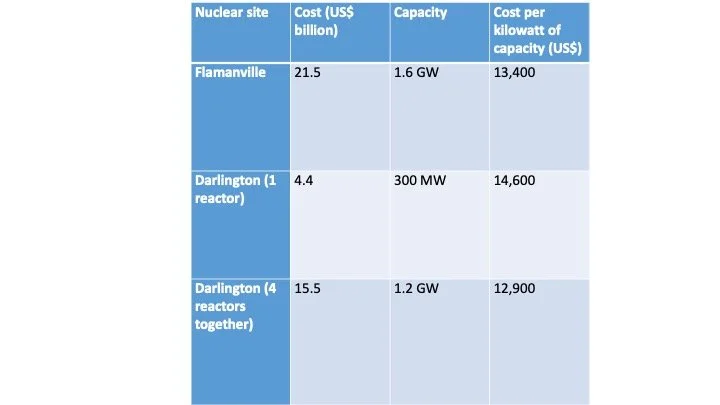
Thus the hugely expensive and long-delayed reactor at Flamanville, the fourth EPR to be completed in the world, was cheaper to construct than the estimates for the first SMR at Darlington and only marginally more expensive than the projected costs for the eventual group of 4 reactors when expressed as capital cost per kilowatt of capacity.
Do SMRs offer savings in operating costs over large nuclear power stations and renewable plants?
Most sources suggest that SMRs will have operating costs at roughly the same level as large nuclear plants per unit of capacity. However we cannot know this with any more certainty than the comparison of capital costs.
One careful piece of academic research put it as follows: ..it is expected that O&M and fuelling costs will be very similar to that of LRs.[10] This conclusion was reached some years ago and estimates may now be out of date. However I have seen no data suggesting that SMRs will be cheaper to operate than larger nuclear power plants.
The operating costs include nuclear fuel, which needs to be regularly but infrequently fed into the reactor. At current uranium prices, fuel is unlikely to be a significant portion of total costs.
More important is the cost of staff and here the limited evidence is that SMRs will require more people than larger reactors. Ontario predicts that 2,500 people will work on the SMRs at the Darlington site when the 4 reactors are complete. By comparison, Sizewell B, an existing nuclear power station in the UK, employs about 900 workers and has approximately the same annual output as the 4 reactor Canadian site will have.[11]
However if we optimistically assume that the SMRs will cost the same to run as larger nuclear sites how will they compare with solar? The US Energy Information Agency writes that the cost of running a nuclear power plant is around $22 per megawatt hour of output, or 2.2 cents per kilowatt hour. Fuel is about 0.61 cents per kilowatt hour with operations at around 0.95 cents and maintenance at 0.64 cents.
Most estimates for the operating costs of full-size solar parks are around US$15 per kilowatt of capacity per year. A solar park in Ontario is likely to produce at least 900 kWh per kilowatt annually, implying a cost of around 1.67 cents per kilowatt hour for total operating costs. The conclusion has to be that SMRs are therefore very unlikely to be cheaper to run than large solar farms in the same area as the new nuclear site.
Summary
The data provided by the press releases announcing the world's first new generation SMR park give us some information about costs. Of course we cannot know whether these estimates will be correct. But If they are actually achieved, SMRs will be only marginally cheaper than the current generation of large nuclear power stations. Operating costs will be similar to their larger cousins but possibly much more.
Solar and wind parks are likely to be less expensive in both capital and operating terms. Capital costs for solar may be no more than half the figure for the Darlington project and operating costs around three quarters of the level of SMRs.
By itself, this information does not imply that the rush towards SMRs is misplaced. They may offer cheaper grid connections and will be better at providing power directly to 24 hour electricity customers. But the arguments advanced by commentators such as the Tony Blair Institute need to adjusted recognise that there is no evidence today that SMRs will reduce electricity costs compared to continuing rapid investment in wind and solar.
May 11th 2025
[1] https://www.iaea.org/topics/small-modular-reactors
[2] https://institute.global/insights/climate-and-energy/the-climate-paradox-why-we-need-to-reset-action-on-climate-change
[3] https://news.ontario.ca/en/release/1005889/ontario-leads-the-g7-by-building-first-small-modular-reactor
[5] Same as reference 3 above.
[6] https://ieefa.org/sites/default/files/2024-05/SMRs%20Still%20Too%20Expensive%20Too%20Slow%20Too%20Risky_May%202024.pdf
[7] The 2020 figure appears to have been derived from this GE Hitachi web page and adjusted for inflation - https://www.gevernova.com/content/dam/gepower-nuclear/global/en_US/documents/product-fact-sheets/GE%20Hitachi_BWRX-300%20Fact%20Sheet.pdf
[8] Assuming a capacity factor of 90% for the SMR and 11% for UK solar.
[9] https://www.lemonde.fr/les-decodeurs/article/2024/05/09/les-derapages-de-l-epr-de-flamanville-en-graphiques-le-cout-multiplie-par-six-la-duree-du-chantier-par-quatre_5480745_4355771.html
[10] https://www.sciencedirect.com/science/article/abs/pii/S0301421517300538?fr=RR-2&ref=pdf_download&rr=93da6ca1cd7fe1fc
[11]https://www.bbc.com/news/articles/c93qz4dlqlgo#:~:text=Work%20on%20the%20construction%20of,literally%20from%20the%20ground%20up%22.

It was at the invitation of The Long Now Foundation that I visited Mount Washington for the first time as a graduate student. Camping out the first night on the mountain with my kind and curious Long Now friends, I could sense that the experience was potentially transformative — that this place, and this community, had together created a kind of magic. The next morning, we packed up our caravan of cars and made our way up the mountain. I tracked the change in elevation out the car window by observing how the landscape changed from sagebrush to pinyon and juniper trees, to manzanita and mixed conifer, and finally to the ancient bristlecone pines. As we rose, the view of the expansive Great Basin landscape grew below us. It was then that I knew I had to be a part of the community stewarding this incredibly meaningful place.
I’d entered graduate school following an earlier life working on long-term environmental monitoring networks across the U.S. and Latin America, and was attracted to the mountain’s established research network. My early experiences and relationships with other researchers had planted the seeds of appreciation for research which takes the long view of the world around us. Now, as a research professor at the Desert Research Institute (DRI) and a Long Now Research Fellow, I’m helping to launch a new scientific legacy in the Nevada Bristlecone Preserve. Of course, no scientific legacy is entirely new. My work compiling the first decade of observational climate data builds on decades of research in order to help carry it into the future — one link in a long line of scientists who have made my work possible. Science works much like an ecosystem, with different disciplines interweaving to help tell the story of the whole. Each project and scientist builds on the successes of the past.
Unfortunately, the realities of short-term funding don’t often align with a long-term vision for research. Scientists hoping to answer big questions often find it challenging to identify funding that will support a project beyond two to three years, making it difficult to sustain the long-term research that helps illuminate changes in landscapes over time. This reality highlights the value of partnering with The Long Now Foundation. Their support is helping me carry valuable research into the future to understand how rare ecosystems in one of the least-monitored regions in the country are adapting to a warming world.


Left: The Sagebrush East Weather station is a key monitoring post within the NevCAN network. Photo by Anne Heggli. Right: Anne Heggli, Bjoern Bingham and Greg McCurdy working on upgrading one of the 8 stations that make up the NevCAN network. Photo by Scotty Strachan.
The Nevada Bristlecone Preserve stretches across the high reaches of Mount Washington on the far eastern edge of Nevada. Growing where nearly nothing else can, the bristlecone pines (Pinus longaeva) that lend the preserve its name have a gnarled, twisted look to them, and wood so dense that it helps protect the tree from rot and disease. Trees in this grove are known to be nearly 5,000 years old, making them among the oldest living trees in the world. Because of the way trees radiate from their center as they grow, adding one ring essentially every year, scientists can gain glimpses of the past by studying their cores. Counting backward in time, we can visualize years with plentiful water and sunlight for growth as thicker, denser lines indicating a higher growth rate. Trees this old provide a nearly unprecedented time capsule of the climate that produced them, helping us to understand how today’s world differs from the one of our ancestors.


L: The view from the mine site midway up Mt. Washington, looking west. Photo by Anne Heggli. C: View from the Montane station looking at Mt. Washington. Photo by Dan McEvoy. R: The field crew uploading gear to upgrade the highest elevation station in Nevada in the subalpine region of Mt. Washington. Photo by Bjoern Bingham.
This insight has always been valuable but is becoming even more critical as we face increasing temperatures outside the realm of what much of modern life has adapted to. My research aims to provide a nearly microscopic look at how the climate in the Great Basin is changing, from hour to hour and season to season. With scientific monitoring equipment positioned from the floor of the Great Basin’s Spring Valley up to the peak of Mount Washington, our project examines temperature fluctuations, atmospheric information, and snowpack insights across the region’s ecosystems by collecting data every 10 minutes. Named the Nevada Climate-Ecohydrological Assessment Network, or NevCAN, the research effort is now in its second decade. First established in part by my predecessors at DRI along with other colleagues from the Nevada System of Higher Education, the project offers a wealth of valuable climate monitoring information that can contribute to insights across scientific disciplines.
Thanks to the foresight of the scientists who came before me, the data collected provides insight across ecosystems, winding from the valley floor’s sagebrush landscape to Mount Washington’s mid-elevation pinyon-juniper woodlands, to the higher elevation bristlecone pine grove, before winding down the mountain’s other side. The data from Mount Washington can be compared to a similar set of monitoring equipment set up across the Sheep Range just north of Las Vegas. Here, the lowest elevation stations sit in the Mojave Desert, among sprawling creosote-brush and Joshua trees, before climbing up into mid-elevation pinyon-juniper forests and high elevation ponderosa pine groves.
Having over 10 years of data from the Nevada Bristlecone Preserve allows us to zoom in and out on the environmental processes that shape the mountain. Through this research, we’ve been able to ask questions that span timelines, from the 10-minute level of our data collection to the 5,000-year-old trees to the epochal age of the rocks and soil underlying the mountain. We can look at rapid environmental changes during sunrise and sunset or during the approach and onset of a quick thunderstorm. And we can zoom out to understand the climatology by looking at trends in changes in precipitation and temperature that impact the ecosystems.


L: Anne Heggli working analyzing the snowpack from a snow pit measurement. Photo by Elyse DeFranco. C: Anne Heggli, Greg McCurdy and Bjoern Bingham working and enjoying lunch while upgrading the Montane station on Mount Washington. Photo by Dan McEvoy. R: Anne Heggli jumping for joy at Sagebrush West station that the team is putting the necessary time and upgrades into the NevCAN transect. Photo by Bjoern Bingham.
Scientists use data to identify stories in the world around us. Data can show us temperature swings of more than 50 degrees Fahrenheit in just 10 minutes with the onset of a dark and cold thunderstorm in the middle of August. We can observe the impacts of the nightly down-sloping winds that drive the coldest air to the bottom of the valley, helping us understand why the pinyon and juniper trees are growing at higher elevation, where it’s counterintuitively warmer. These first 10 years of data allow us to look at air temperature and precipitation trends, and the next 20 years of data will help us uncover some of the more long-term climatological changes occurring on the mountain. All the while, the ancient bristlecone pines have been collecting data for us over centuries — and millennia — in their tree rings.
The type of research we’re doing with NevCAN facilitates scientific discovery that crosses the traditional boundaries of academic disciplines. The scientists who founded the program understood that the data collected on Mount Washington would be valuable to a range of researchers in different fields and intentionally brought these scientists together to create a project with foresight and long-term value to the scientific community. Building interdisciplinary teams to do this kind of science means that we can cross sectors to identify drivers of change. This mode of thinking acknowledges that the atmosphere impacts the weather, which drives rain, snow, drought, and fire risk. It acknowledges that as the snowpack melts or the monsoonal rains fall, the hydrologic response feeds streams, causes erosion, and regenerates groundwater. The atmospheric and hydrological cycles impact the ecosystem, driving elevational shifts in species, plant die-offs, or the generation of new growth after a fire.
💡To learn more about long-term science at Mount Washington, read Scotty Strachan's 02019 essay on Mountain Observatories and a Return to Environmental Long Science and former Long Now Director of Operations Laura Welcher's 02019 essay on The Long Now Foundation and a Great Basin Mountain Observatory for Long Science.To really understand the mountain, we need everyone’s expertise: atmospheric scientists, hydrologists, ecologists, dendrochronologists, and even computer scientists and engineers to make sure we can get the data back to our collective offices to make meaning of it all. This kind of interdisciplinary science offers the opportunity to learn more about the intersection of scientific studies — a sometimes messy process that reflects the reality of how nature operates.
Conducting long-term research like NevCAN is challenging for a number of reasons beyond finding sustainable funding, but the return is much greater than the sum of its parts. In order to create continuity between researchers over the years, the project team needs to identify future champions to pass the baton to, and systems that can preserve all the knowledge acquired. Over the years, the project’s technical knowledge, historical context, and stories of fire, wildlife, avalanches, and erosion continue to grow. Finding a cohesive team of dedicated people who are willing to be a single part of something bigger takes time, but the trust fostered within the group enables us to answer thorny and complex questions about the fundamental processes shaping our landscape.
Being a Long Now Research Fellow funded by The Long Now Foundation has given me the privilege of being a steward of this mountain and of the data that facilitates this scientific discovery. This incredible opportunity allows me to be a part of something larger than myself and something that will endure beyond my tenure. It means that I get to be a mentee of some of the skilled stewards before me and a mentor to the next generation. In this way we are all connected to each other and to the mountain. We connect with each other by untangling difficult scientific questions; we connect with the mountain by spending long days traveling, camping, and experiencing the mountain from season to season; and we connect with the philosophy of The Long Now Foundation by fostering a deep appreciation for thinking on timescales that surpass human lifetimes.
 Setting up Alicia Eggert’s art exhibition on the top of Mt Washington. Photo by Anne Heggli.
To learn more about Anne’s work, read A New Tool Can Help Protect California and Nevada Communities from Floods While Preserving Their Water Supply on DRI’s website.
This essay was written in collaboration with Elyse DeFranco, DRI’s Lead Science Writer.

Eighth instalment in our series of extremely small and free-form cryptic crossword puzzles, themed on our latest essay.

Papal elections begin, in 2025 and 1268.

In the 19th century, dyed ostrich feathers were haute couture, adorning the hats and boas of fashionistas on both sides of the Atlantic. Whitney Rakich examines the far-reaching ostrich industry through a peculiar do-it-yourself-style book: Alexander Paul's The Practical Ostrich Feather Dyer (1888), a text interleaved with richly colored specimens.

Aby Warburg spent his life finding forms that could hold their own against the flow of time. All the while, as Kevin Dann explores, he was churning on the brink of madness with the sense that he himself was changing — into a terrifying animal. What kind of history would a werewolf write?

Images gathered during a survey by Ferdinand V. Hayden, who was responsible for the designation of Yellowstone as a national park.

Woodcut knots likely inspired by Mamluk decorative metalwork.
 When Mates Make Books [ 04-May-25 12:50am ]
Brutalism / Botany interface [ 02-May-25 8:56pm ]
When Mates Make Books [ 04-May-25 12:50am ]
Brutalism / Botany interface [ 02-May-25 8:56pm ]

This whole Brutalism thing has gotten a bit of out of hand now.... they are scraping the barrel bottom, I think.
Mind, you, these photographs are cool in a J.G. Ballard, The Drowned World, London-gone-tropical kind of way..


Via Hoxton Mini Press which fairly places it as a product (cute little logo though)
Talking about Brutalism... what did people make of The Brutalist? I watched it on the airplane, which is ridiculous - seat-back screen versus the widescreen, Dolby-sound grandeur of imagery and music that it is all about. Despite these reductions, I was really into it until about two-thirds of the way through when a plot twist occurs that seemed ludicrous and after that the whole thing seemed to cop out, or crap out....

2 special screenings of a new LOST LANDSCAPES film by Rick Prelinger will be on Wednesday 12/3/25 and Thursday 12/4/25 at the Herbst Theater. Long Now Members can reserve a pair of tickets on either night!
Each year LOST LANDSCAPES casts an archival gaze on San Francisco and its surrounding areas. The film is drawn from newly scanned archival footage, including home movies, government-produced and industrial films, feature film outtakes and other surprises from the Prelinger Archives collection and elsewhere.

A 1925 Soviet Children's book about a little screw whose importance is overlooked.
A past gone mad, part 397 [ 29-Apr-25 12:08am ]
Glenn Gregory subbing
Named after Bowie's worst single (at least of the 1970s... he surely out-did it in the post-Let's Dance era)
Marc Almond, Clem Burke (RIP), Glen Matlock, and Gary Kemp have been accomplices in the past.
Reef? Replenish? There's a market for a 30th Anniversary tour?!? Tour, meaning multiple dates around the country!
(I cannot even remember who Reef ever were in the first place)

The Gang of 2 celebrate Entertainment!'s 45th anniversary - actually the 46th, but who's counting...
40th Anniversary of what? The Wedding Present's existence? That silhouette figure composited out of album covers.....
Rounding out this round-up....
Goodness, a mega box set of Swing Out Sister's second phase career, when pop success was quite a long way back in the rear view mirror....
SWING OUT SISTERCertain Shades Of Limelight27 June 20258CD

Swing Out Sister Celebrate Their Sophisticated Sound with New 8CD Box Set: Certain Shades Of Limelight
Cherry Red Records proudly announces the release of Certain Shades Of Limelight, a beautifully curated 8CD box set celebrating the vibrant and soulful evolution of iconic British pop sophisticates Swing Out Sister. Spanning the years 1994 to 2004, this definitive collection captures a golden decade of musical exploration, refinement, and reinvention.
cc: Mayor of London; Transport Commissioner; Deputy Mayor for Social Justice and Communities, London Victims' Commissioner; Walking and Cycling Commissioner; TfL Board Secretariat; TfL SSHR Panel Secretariat; London Assembly Transport Committee Members; House of Commons Transport Committee Members; Sharon Graham - Unite the Union; Eddie Dempsey - RMT Union; Gary Smith - GMB Union; Barry Gardiner-MP; Tom Kearney (@comadad)
Dear Mr. Deputy Mayor,
Thank you for your delayed 11 March 2025 response (attached) to my 10 December 2024 Open Letter to the Mayor of London urging him to act immediately in support of the London Bus Drivers' Bill of Rights Campaign.
That TfL's franchised Surface Transport Operation is "institutionally unsafe", is not an "assertion": it is a fact evidenced by (a) Justice Fraser's 27 July 2023 Sentencing Remarks (b) thousands of pages of documents released through Mayor's Questions and Freedom of Information Requests and—most importantly—(c) the lived experiences of thousands of Bus Drivers who work today in conditions that compromise their safety, dignity, health and wellbeing. It is also evidenced by TfL's own published Bus Safety Performance Data, which clearly shows that 2024 was the most lethal year from preventable Bus Safety Incidents since 2009.
The existence of Legislation, Policies and various London-wide and Local Agreements which touch upon the issues raised by the Bus Drivers Bill of Rights, as you've outlined, is not in dispute. But please allow me be clear: it is TfL's longtime failure to (a) monitor the enforcement and/or (b) permit the outright ignorance—of the protections offered from these by the holders of London's Bus Franchise Contracts that serves as the catalyst for this long-overdue Campaign. While TfL and its Chair do nothing but gaslight the public, Bus Drivers report well-evidenced unsafe conditions brought about by, inter alia, Excessive Fatigue, Unsafe Scheduling, Poor or No Access to Welfare Facilities, Broken Speedometers, Defective Mirrors and a Toxic Culture in which Bus Drivers who raise safety concerns are victimised or disciplined by their employers. Our concerns do not arise from rare events: they are frequent systemic problems that cannot be brushed aside by the City Hall with references to existing frameworks over which TfL—as London's sole public bus franchise contractor—claims it has control but clearly chooses not to have any accountability.
The Bill of Rights is not theoretical wishlist: it's reasonable and practical response developed solely by London Bus Drivers to a broken system—
London Bus Drivers' Bill of Rights
1. The Right to a safe work schedule without any forced overtime or loss of pay 2. The Right to a decent and proper rest break in the working day 3. The Right to drive a safe and well-maintained vehicle 4. The Right to clean, serviced toilet and rest facilities on all bus routes 5. The Right to report safety concerns without fear of retribution from TfL or employers 6. The Right, when seriously ill and covered by a doctor's note, to not be harassed into coming into work until fit to do so 7. The Right to relevant and timely safety training 8. The Right to drive without being forced to answer radio messages and texts from Controllers whilst in motion 9. The Right to have all company rules in writing and clearly displayed10. The Right to be treated with dignity and respect by our employers, TfL and the public11. The Right to Working Air Cooling in our cabs in the summer heat 12. The Right to Working Heaters in our cabs in the cold of winter
If the protections we demand you claim are already in place for Bus Drivers were working in practice, there would be no need for this Campaign. But they are not—and the rising anger among London's Bus Drivers makes that clear.
You cite TfL's engagement with Unite. While that relationship is important, it cannot be used as a shield against the voices of drivers themselves, who are constantly proving to us that their concerns are not being heard or addressed by anyone, include those within Unite structures who are empowered to act. Our Campaign has emerged from the ground up because the existing mechanisms you cite as mitigants have obviously—and perhaps deliberately?—failed to deliver any meaningful positive change for decades.
On TfL Surface Trasport, Vision Zero will remain an empty slogan until the people responsible for delivering it—London's Bus Drivers—are (a) Provided with the Rights, Protections, and Working Conditions to which you already agree they are entitled and (b) Protected by having those Rights reflected in TfL's Framework Bus Services Contract. TfL acting on our Demand is not a matter of Public Relations: it is a matter of Public Safety on which TfL is clearly failing.
We are calling on you and the Mayor to meet with a delegation of Bus Drivers and Campaign Representatives in a Public Forum—like the London Assembly or House of Commons Transport Committees—to agree (a) a timeline where TfL will to write the Bus Drivers' Bill of Rights into its Framework Bus Contract and (b) how TfL plans to enforce and monitor these Rights being respected and adhered to by its Franchised Bus Operators This meeting will need to be televised and recorded for public scrutiny. We are not asking for what already exists. We are demanding what has never been delivered by TfL, its Franchised Bus Contractors or Unite the Union: a Safe, Respectful, Transparent and Accountable Working Environment for those who keep London moving on the UK's largest and longest-running Franchised Public Bus Network.
I look forward to your response.
Kindly note that I have copied the Mayor, some relevant City Hall and TfL Executives, the London Assembly and Commons Transport Committee Members and some UK Bus Workers' Union leaders to this email.
Yours sincerely,
Kevin MustafaCampaign Lead, Bus Drivers' Bill of Rights Campaign

 Old Is The New New [ 27-Apr-25 2:39am ]
This boutique front snapped on a recent jaunt to London - or was it taken in NYC? - at any rate, their slogan "Old Is The New New" reminded me of a London vintage store called Pop Boutique that I once spied, whose pitch to consumers was:
"Don't follow fashion. Buy something that's already out of date."
But the pro-vintage sentiment above has an eco-fashion tinge - recycling garments is not only cool and requires a sophisticated eye, a finely-tuned sensibility - but it might just be planet-saving too.
C.f. the campaign against fast fashion, the ultra-wasteful turnover of trends and outfits, as campaigned against by Farmer Alex (with his "Slowing Down Fashion" documentary of a few years ago) among others.
Spring Eases In [ 02-Apr-25 7:50pm ]text text text text text text text text text text text text text text
The post Spring Eases In first appeared on Rudy's Blog.
Quintana Roo & the Yucatan [ 20-Jan-25 7:06pm ]In January, 2025, my girlfriend Barb Ash and I took a two-week trip to Quintana Roo and the Yucatan in Mexico. The hand of the woman sitting in front of me on the plane looked like an alien flesh-crab. Those nails! What if it hopped loose and scuttled around? The spacetime of air travel is […]
The post Quintana Roo & the Yucatan first appeared on Rudy's Blog.
Embry's Death. Christmas 2024. [ 30-Dec-24 6:47pm ]And now came bad news from Louisville. My big brother Embry was suddenly dying of cancer. It came on very quickly. I flew back to Louisville, with my son Rudy Jr. along, and we had a chance to say our goodbyes to Embry. He was very weak. It was good to be together. I held […]
The post Embry's Death. Christmas 2024. first appeared on Rudy's Blog.

Melody Maker, June 18 1986

David Thomas at the first Carrot Festival, Warsaw, Poland - Melody Maker April 18 1987


Pere Ubu at the second Carrot festival in Budapest, Hungary


Melody Maker, April 2 1988

Finally, in 2002, I got to meet the great man. I was in the U.K. for the summer to research Rip It Up and Start Again - after various unsuccessful efforts, I got a call rather peremptorily summoning me to Brighton the next day. Bird in hand, I thought - I hastened down there with some hastily prepared questions. The encounter was one of the more cantankerous interviews I've done - but in some ways that it made more interesting than a straightforward "here's how we formed, then we made our first record" type data-dollop. We got into debating the history and philosophy of rock - class dynamics - America versus England. A rather bristly, frictional dialogue. We were in a pub near the sea front and at a certain point, he said, "I'm going to talk to my friends" and went over to a barstool and chatted to an old geezer with a dog. I went for a slash and then on the way back, I thought, "Shall I say goodbye? Nah!". Caught the train back. So not the most cordial of encounters, but I'm glad I did it. And whoever said visionary geniuses had to be sufferable?
Below is the tided-up Q and A of our chat.
I read this memoiristic essay by Charlotte Presler about Cleveland in the Seventies and she said that everybody in the scene was from an upper middle class background. Or even upper class.
"I'm not sure who was from upper class, but certainly we're all from very strong middle class families. My dad was a professor. I had an academic upbringing and certainly an academic path was indicated. I was extremely bright, in the top one percent in my class."
Presler also said that most of the people weren't actually musicians primarily, that they came to it from other areas, like art or writing. Did you ever toy with other art forms apart from music?
"Nothing else particularly interested me. I was always interested in sound, and then shortly after that I became interested in rock music, and ever since I haven't been interested in doing anything else. Everything else is an inferior byproduct along the evolutionary path to rock music, which is the only true artform. We were all taken with the expressive capabilities of sound and rock music was the form that was making the most inventive and expressive use of that medium.
Is it true that the first album you bought was Trout Mask Replica by Captain Beefheart?
"No--the first album I bought was Zappa's Uncle Meat, then I bought Hot Rats. Then Trout Mask and Strictly Personal. All this was within about three weeks. The gang I hung around with in high school was really into Uncle Meat. "
Beefheart was a protégé of Zappa's at that point?
"In Zappa's version of history, yeah! We liked Uncle Meat because we were in high school and in high school you're into Surrealism and Dadaism. Uncle Meat was making use of interesting sounds. Zappa never moved beyond that, his appeal was always directed at high school students. Absolutely Free was all that hippy stuff--we weren't particularly taken by that. Hippy was pretty passé even then. We were two or three years post-hippy, and that two or three years was pretty significant. We felt hippies were pretty useless as any sort of social happening."
Zappa's always struck me as kinda cynical and sneery, whereas Beefheart seems more… humanist, maybe. Not a misanthrope.
"Beefheart was certainly much more angular. We liked hard music. Or at least I did. I was more Midwestern oriented--I liked MC5, Stooges, and all that Sixties garage stuff like Question Mark and The Music Machine. Beefheart is very close to that sort of approach.. At that time if you were looking for electronic sounds there was Terry Riley, Beaver & Krause, Silver Apples, and all the German stuff. All of that was a component of bands like MC5. There's always been a relationship between hard Midwest groove rock and pure sound. So it was natural for us to do that."
So is that the genesis of "avant-garage" as a concept? The Stooges started out doing abstract noise stuff with a Fluxus/Dada edge, using vacuum cleaners and the like. Then they turned into a primal hard rock band. They got less experimental as they went along.
"Avant garage was much later. We got tired of not having a pigeonhole so in 1979, one of our friends was doing an art exhibition at Cleveland Stadium of garages--literally a collection of fronts of garages. I don't know how he got them. He might have even called it the Avant-Garage Exhibition. . We thought that was a good name so we stole it, but only because we got tired of all the silly labels. This thing of pigeonholing and calling things by generic names is in rock terms a fairly recent event. In our formative years nobody did that, which is why nobody thought it was that weird that Jimmy Hendrix opened for the Monkees. The last time I saw the Stooges they were opening for Slade. This notion of the latest trend was always a fabrication of the English punk movement. When our parents or friends would ask what kind of music we played we'd say, 'we're kind of underground'. Which mean only that we couldn't play and nobody came to see us. And then everybody was also into film, so in early 1977 somebody started talking about it as New Wave. But we always saw ourselves in the mainstream tradition of rock music."
So you didn't particularly like the term "New Wave"?
"It's an Anglo-European obsession with being new. We knew we were different."
Oh, so Ubu weren't motivated particularly by that proto-punk sort of disgust with what rock had degenerated into during the early Seventies?
"Not at all. This is more or less an invention of the punk music press. The early Seventies was one of the highlight periods in rock music. There was more innovation between 1970 and 1974 than ever before. There wasn't this narrow vision that has come to characterize things since. The only frustration was that we couldn't get gigs. Only the copy bands were getting any jobs, the cover bands. But then after we stopped whining and moaning, we figured there are tons of bars, so there must be somewhere we could play. Then we got off our butts and found this wretched little sailor's dive in an industrial part of town, the Pirate's Cove. And started playing there.
So what makes the early Seventies the peak of rock creativity as far as you're concerned?
"Eno. Amon Duul and Neu!. Kevin Ayers, The Soft Machine. The Incredible String Band. The Stooges' Funhouse. John Cale. Things were beginning to move and accelerate. Maybe people didn't notice it underneath all the other stuff, but it was moving. Sabbath was too derivative of the blues. There's a real difference between Midwestern rock and that kind of heavy rock. It's really night and day. Midwestern rock is all based on a flowing riff pattern, not a ba-domp-ba-domp. We liked groove rock that had the minimum of changes in it. Tom Herman's famous defining line was that he judges guitar parts by how little he has to move his fingers. That's a pretty Midwestern concept.
If the first half of the Seventies was so great, though, why was there a need for punk?
"I may exaggerate because so many people dump on it."
Cleveland was supposed to have extremely progressive taste--to have the largest concentration of adventurous listeners in between the East Coast and the West Coast. How come?
"Marc Bolan was considered in Cleveland to be conceptual art, because of the sickness of his world view and the weird envelope of sound he was working with. All his teen girlie stuff seemed to be very conceptual because nobody in his right kind would do it seriously. There's always been a struggle in Cleveland, a dynamic between the Midwestern oriented people and the Anglophile people. West Siders are always Anglophile. They're all Eastern European immigrants, Lithuanian and Hungarian and Polish. Cleveland was the largest Hungarian-speaking city outside of Budapest for decades. These Eastern European immigrants were, working class, white socks, accordions and so on, and that was of course considered to be the uncool side of town. And we were on the East Side where all the liberals and the blacks were. East Side was considered to be the coolest part of town, but of course as time went on I discovered that in fact the West Side was cooler! I don't know what made them Anglophiles. It's not my problem! But the Kinks and Syd Barrett were just massive on the west side of Cleveland, and the Bowie stuff. The East Side tended to be more black people and English people. The black people were into black music and the whites tended toward Velvet Underground, MC5, and Zappa. The thing that bound the two sides of the city was The Velvet Underground--that was the current, the universal language. Everybody understood the Velvets, and we on the East Side were particularly Velvets orientated. The East Side was much harder."
Was Cleveland as grim and industrial in those days as the legend has it?
"I suppose so, but we didn't sit there saying, 'Gee, this is grim'. The river caught fire once--so? It's a heavy industrial town. The mayor's hair caught fire in the Seventies but nobody ever tells you about that."
So where did the bohemian, or nonconformist, or unusual people gather?
"Cleveland was a town of record stores. That's why it was the birthplace of rock music in 1951. Alan Freed was in a record shop, the same shop that everyone in Ubu ended up working in at one time or another: Record Rendezvous. He noticed all these white kids getting off on 'race records' so he started doing hops. Everybody who was in a band worked at a record store and all the record stores competed against each other to have the most complete catalogues. To have everything of everything. There was a lot of specialized interest. That's why the worldwide Syd Barrett Appreciation Society was in Cleveland. There were these strong cliques of people. It was a real hothouse environment. There was only 100 people—musicians, girlfriends, sound guys who were your friends—and everybody knew what you were doing. Everybody was competing to be the best. There weren't any places to play, so your reputation would be based on the five shows a year you could play somewhere. Which meant that everyone was very well-rehearsed. The Electric Eels, who everyone thought were totally anarchistic—well, they were indeed totally anarchistic, but they rehearsed too. Way more than any similar band would have. Everyone took it pretty seriously."
The Drome--that was the hippest record store of all of them, right?
"It was the store that picked up on the beginnings of the English punk stuff and the weird American stuff like the Residents and MX-80. John Thompson, who owned it, was extremely supportive of local bands. He'd have bands play in his store.. The other stores were owned by fifty year old men, so none of them had the same focus, or they were stuck in the hippy thing. Johnny was really into used car commercials and he'd build these television gameshow sets—he was totally nuts. We lived together for a long time and the whole house was violent pink and festooned with gameshow sets and cut-out characters.. He had a very modern, American vision of things—that's where the concept of Datapanik came from. Johnny and I came up with that in 1976, this doctrine about Data Panic where all information had become a drug-like substance, in and of itself meaningless, and the only thing that mattered was data flow. I have to admit immodestly these ideas were far ahead of their time."
So he was one of those catalyst figures, who don't make music themselves but they foster and direct the energy.
"Robert Wheeler, who's our current synthesizer player, and is a generation younger than me, told me he went into Drome when he didn't know about anything and he picked up our single "30 Seconds Over Tokyo". This is just when it had first come out. And Johnny said, 'you can buy that for $1.50 but instead you could take that $1.50 and go see the band play tonight at the Pirate's Cove.' This was his attitude—and this bad commercial vision was the reason for the Drome's downfall a few years later. Johnny would rent this radio theater, the WHK auditorium--an old radio theater from the 1930s that had been abandoned and was on the edge of the ghetto. And this was where the first Disasterdromes took places--shows he'd put on with Ubu, Devo, Suicide, and other bands from other towns. He said the motto is, 'We call it disaster so nothing can go wrong'. Bums and winos would be coming in and lurking in the shadows. Somebody lit fire to the sofa. Stuff was always going wrong and people were always complaining to him. After the first one like that he decided to call it Disasterdrome, so you won't be disappointed. Free the consumer from the burden of anticipation. 'No, it's not going to be any good, it's going to be a disaster'. They were extremely popular."
You were one of the few members of Pere Ubu who never lived in the Plaza, the building co-owned by Allen Ravenstine?
"I lived with a girlfriend there--it was her place. Everybody who lived there was a writer, an artist or a musician. It was the red light street on the edge of the ghetto. The ghetto started one street over. It wasn't scary, but you had to be careful, you couldn't wander around blithely at night."
Early on you went by the name of Crocus Behemoth!
"I had a girlfriend who was in the Weathermen or the White Panthers or something. She was very much taken with the Detroit MC5 thing. All the people on the fringe of the political underground always had pseudonyms. At the time I was writing for a local paper, Scene, and I was writing a whole lot, so I had a bunch of pseudonyms., The way they'd come up with pseudonyms was they'd just open up a dictionary and put their finger on a word, so she opened a dictionary and put her finger on Crocus and then on Behemoth. That was the name for the writing I did that was most popular so I was sort of known by that."
What kind of writing was it?
"I was a rock critic. Endless bands, endless reviews. I didn't have any theories--some things I liked and some things I didn't like. Eventually I got to be thinking, if I'm so smart I can do this--music--better. And I did. I didn't have any dreams of being a rock critic--I became a writer because I'd dropped out of college and I knew this guy who'd been at the college paper who was the editor of Scene, so I got a job doing art layout. Then they needed somebody to copyedit. Soon I was rewriting so much of the stuff they said we can all save ourselves some time if you just review the stuff yourself. I had no particular desire. It was just a job I could get."
Calling the band Pere Ubu… you were a big fan of Alfred Jarry?
"Not a big fan. I'm aware of what he did. All that Dada and surrealist stuff is the stuff you do in high school. After high school it doesn't have much relevance to anything. Jarry's theatrical ideas and narrative devices interested me."
Didn't you have this thing called the Theory of Spontaneous Similitude that was related to Pataphysics?
"Maybe. Spontaneous Similitude just grew out of a joke, although I suppose it has a serious core. You could complete the phrase, "I am like…" with the first thing that comes into your head and it still makes sense. Which is not much of an idea but it has a certain relationship to the Surrealists and Dadaists. For human beings there's no alternative to meaning. That's the serious point of it: there is no such thing as non-meaning for humans, so if you say "I am like…" and fill it in with anything, a listener will make some sense out of it because there is no alternative. That's clearly the foundational element of sound as an artistic force. Any sound you hear, there is no alternative but to figure it out."
Wasn't there a kind of split down the middle of Ubu between the weirdo "head" elements (your voice and Ravenstine's synth), which were kind of un-rock, and the more straight-slamming physicality of what the guitar, bass and drums were doing, which rocked hard?
"Why is there a split? You want there to be a split but there isn't one. How many minutes ago did we talk about the genesis of the Midwestern sound? That it's a combination of pure sound elements and hard rock. We don't see that they're separate. This is a corollary of the inability of most foreigners to understand the nature of rock music. You want this separation of what you would call pop versus what you would call serious art. There wasn't a separation as far as we were concerned. We liked Marc Bolan as much as we liked Lou Reed,. One wasn't intrinsically more serious than the other. This idea of pop versus art was alien to us."
So you thought what you did would be embraced and you'd end up on Top Forty radio?
"We thought we were the mainstream. That's not the same as being popular. What we were doing was mainstream, what the Rolling Stones and Toto were doing was weird and experimental—40 or 50 year old men going on about teenage girls. That's weird. What we were doing was aspiring to a mature fully-realized artistic form that spoke for ordinary people and their lives."
Oh, so the idea of being deliberately esoteric or avant-garde had no interest, was redundant, as far as you were concerned?
"We were making popular music. That's why we did singles. Whether people liked it or not was not our problem. In the pure, platonic meaning of the word, we were pop."
Well, Ubu were pretty popular at one point, I guess.
"Nah, nobody's ever liked us."
But in the UK, around the first couple of albums and tours, you had droves of people coming to the shows. There was a big buzz about Ubu in 1978.
"Only because of herd mentality. That's not cynical, it's realistic. We were on the edge of being popular but we were fundamentally incapable of being popular, because we were fundamentally perverse and uninterested. This is the strength of our upbringing. This is why all adventurous art is done by middle class people. Because middle class people don't care. 'I'm going to do what I want, because I can do anything else better and make more money than this'. If you sit down and make a list of the people you consider to be adventurous in pop music, I'd bet you lots that the vast majority of them are middle class."
What about the Beatles?
"Do you really think The Beatles were working class? Really? The Beatles were not working class. The Rolling Stones…. Sit down and make a list."
Well I agree with you to the extent that the traditional slant of looking at rock as an essentially working class thing… it's not total bunk, but it has been woefully exaggerated thing. Art students and university students have always played a big part in rock history. At least from 1963 onwards.
"The notion of street credibility is a recent aberration. It's all designed to create commercial niche markets. Since punk this compartmentalization has been designed to aid advertising executives to target their products at the market. That's not what music and art is about."
So presumably you had no time for the Clash going on about tower blocks and kids on the street.
"That's alien stuff. That's your problem. All this is nothing to do with rock music. It has to do with the aberrations of European social structures. To do with a guy wanting to sell clothes. From the beginning punk rock was designed as a commercial exercise to create a market. This is the reason why it's weird when it came to America, because what was going on in America was things like Television, Pere Ubu, The Residents, MX-80. It was operating on a totally different level than the Sex Pistols. Our ambitions were considerably different than the Sex Pistols. Our ambitions were to take the art form and move it forward into ever more expressive and mature fields, with the goal of creating the true language of human consciousness. To create something worthy of William Faulkner and Herman Melville. What was the damn ambition of the Sex Pistols?"
But don't you think a lot of rock music is about baseness and vulgarity?
"It's about vulgarity if you think ordinary people are vulgar. I don't think so. I think the poetry of the ordinary man is great. If you believe that art forms or social progress must be frozen in aspic and maintained at its adolescent, easily manipulated stage, then sure you're right. But there are a lot of us who feel folk music should aspire and evolve to greater things. The best way of keeping something manipulable is keeping it at its adolescent stage. Because adolescents are the most gullible sons of bitches on the entire planet. You can get a kid to do anything. So if you want marketing, yeah, let's keep it all about how blue jeans and spiky hair is going to make you different. If you want that kind of world—that's the world you got. Punk music won. But that's not what we were trying to do. We exist in a different place. One of us lives in a real world and one of us lives in a fantasy world. Well maybe you live in the real world and we live in a fantasy world, or maybe we live in the real world. It's a question of what you want and what you get.
"There's all sorts of kinds of music and ways people appreciate music. To some people it's nothing more than a soundtrack to a mating ritual. To others it's a language of poetry and vision. Not everybody has to pursue poetry and vision through the same medium. Some understand things visually or conceptually. The world would be an unpleasant place if Pere Ubu was the only kind of music you could listen to, because frankly it's hard work sometimes and that's the way we make it, so that it's hard. I don't sit around listening to our music, it's impossible. Because it requires you to sit there and listen submit to it, and to be engaged in it. It doesn't make good background music."
I get the distinct sense that you don't much care for the English approach to rock, but at the same time Pere Ubu were much better received in the UK.
"Only because of the size of the country. I think the English are the most civilized of all the Europeans. They're responsible for most good stuff. But you wouldn't have this confusion if we were talking about reggae or Chinese folk music. Nobody would in their right mind argue an English band could play African tribal music as well as African tribal people. So where do you get this idea that English people can play rock music--the folk music of America-- in any authentic way? Some years ago a magazine paid me to go to Siberia to see what was going on and I met [Russian rock critic] Artemis Trotsky. He said, 'The most ordinary amateur garage band in America has more authenticity and fire and soul than the most adventurous band from England because they're playing the music of their blood.'"
Hmmm, do you really think rock music is folk music? It's so heavily filtered through the mass media. Bands learn from recordings much more than from their geographical neighbours. It's mass culture, not community music. Folk music doesn't change that much or that fast, whereas look how insanely rapidly rock mutated and diversified in just a couple of decades.
"Both your points are baloney. Folk music is passed from one generation to another. It doesn't matter if the medium of its passing is a record, the nature of it is that it's a passage. And involved in any folk music is a series of common themes and obsessions. Well that's certainly true of rock music, where people write songs that are continuations of other people's themes. Images are created---seminal things like Heartbreak Hotel. That image has possessed writers endlessly from the moment it was heard. I've written probably a dozen songs based on Heartbreak Hotel. Read Greil Marcus's Mystery Train, it's all about this passing on of communal images. The notion of being down by the river, the railroad, the worried man. The worried man stretches back hundreds of years. 'Worried Man Blues' by the Carter Family from 1920 probably has roots back in Babylonia. You're confused by the commercial exploitation of the medium, which has nothing to do with the reality of the its function. Because a folk music is of the people. In any bar you can find ordinary musicians playing rock music of such high quality that it puts to shame stuff from other countries. That's because it's in their blood."
Americans don't have a "blood"! The USA is an unsuccessful melted melting pot.
"Yes we do. Only recently since Oprah Winfrey and the doogooders have taken over has it been less successfully melted. I would argue that, compared to everybody else, it's totally melted. It has to do with the New World versus the Old World, disposing of the Old World's nationalistic and socialistic prejudices. This notion that you reject the past and throw yourself into the modern, into the future, is at the same time the strength and the weakness of America. Once Edison invented the phonograph, Elvis was only a matter of time. Edison invented rock music, he created the magnetic age in which we still live. Robert Johnson wouldn't have been anything without a microphone--music became intimate, you could create quiet songs, the singer could be perceived as a mortal individual with hopes and dreams. All this is fundamental to the creation of rock music. Also fundamental is the American landscape. It's a music of perspective and space. That's why all rock has to do with the car. In Europe they had iambic pentameter, in America they had the automobile. All of sudden the ordinary man had a poetic vehicle."
But wasn't there a period when Pere Ubu itself tried to break with rock'n'roll? Starting with New Picnic Time and intensifying with the Art of Walking and Song of the Bailing Man, it got pretty abstruse and un-rock.
"We got abstract, but you're assuming that everything has to say exactly the same all the time. The road has no end. The road is a Moebius strip. We're obsessed with not repeating ourselves. One of our abstract albums might have been us looking at a glass from the bottom, but if you're going to know what a glass is then at some point you're going to have to look at it from that perspective. One album that everyone considers abstract —Art of Walking—was to create an image of water going down a drain. The idea was to define the meaning of the song by coloring in everything but the thing you're talking about. We're obsessed with always pushing it, looking at the bottom of the glass. But you don't want to look at the bottom of the glass if you want a pop career. Well we don't care. We're middle class. We don't care. We're free."
There was a point in the later Pere Ubu where you imagery shifted from "industrial" to pastoral.
"That's not Pere Ubu, that's my solo work. That was because people came along and said you write songs about cars. I'm a perverse sort of person so I'll say, 'Okay, I'll write a bunch of songs about pedestrians and call my band The Pedestrians'. I'm going to do whatever I want. I always look for the other side of the coin. Whatever everybody is saying is true is probably not. It's never let me down."
On the Art of Walking, you have that line about "the birds are saying what I want to say". Have you ever listened to Oliver Messaien? He did all these symphonies based on his transcriptions of bird songs.
"I don't pay attention to instrumental music. Music exists for the singer. The only exception is the instrumental in the middle of a show where the singer can get a drink and go to the bathroom. That's the sole purpose of instrumentals."
That's bit of a limited view--I mean, oops, there goes most of jazz, nearly all classical, a fair bit of African music…
"Yeah. Because those were inferior evolutionary forms. Since Thomas Edison invented rock the whole point of music is the singer…. I'm a contrarian, I'm going to stick to my own silly path."
Have you never been interested in doing abstract stuff with your voice?
"I did that a lot in the beginning—that's why you can't hear anything I'm singing because I was totally obsessed with the abstract. I had all sorts of rules I would follow because I was obsessed with not ripping off black music. Like Brian Wilson, I wanted to create a white soul music. I had rules where I would refuse to bend a note or extend a syllable past one beat. Until I realized I'd made my point, and it was limiting to keep going. I like there to be words and meaning."
I think you once said that Pere Ubu became obsessed with not repeating Dub Housing, the second album?
"No, we're obsessed with not repeating ourselves in general. But this particular incident occurred after Dub Housing. Our manager was very successful, he had just signed up Def Leppard. And he said to us, 'All you have to do is repeat the same album two or three times and you'll be stars.' And I said, 'What if we can't repeat it? What if we don't know what we did? What if we don't want to?'. And our big time manager said, 'As long as you make good albums you'll get signed. But you'll never be successful'. Our eyes all lit up and we said, 'That sounds pretty good!'"
As a product builder over too many years to mention, I've lost count of the number of times I've seen promising ideas go from zero to hero in a few weeks, only to fizzle out within months.
Financial products, which is the field I work in, are no exception. With people's real hard-earned money on the line, user expectations running high, and a crowded market, it's tempting to throw as many features at the wall as possible and hope something sticks. But this approach is a recipe for disaster. Here's why:
The pitfalls of feature-first developmentWhen you start building a financial product from the ground up, or are migrating existing customer journeys from paper or telephony channels onto online banking or mobile apps, it's easy to get caught up in the excitement of creating new features. You might think, "If I can just add one more thing that solves this particular user problem, they'll love me!" But what happens when you inevitably hit a roadblock because the narcs (your security team!) don't like it? When a hard-fought feature isn't as popular as you thought, or it breaks due to unforeseen complexity?
This is where the concept of Minimum Viable Product (MVP) comes in. Jason Fried's book Getting Real and his podcast Rework often touch on this idea, even if he doesn't always call it that. An MVP is a product that provides just enough value to your users to keep them engaged, but not so much that it becomes overwhelming or difficult to maintain. It sounds like an easy concept but it requires a razor sharp eye, a ruthless edge and having the courage to stick by your opinion because it is easy to be seduced by "the Columbo Effect"… when there's always "just one more thing…" that someone wants to add.
The problem with most finance apps, however, is that they often become a reflection of the internal politics of the business rather than an experience solely designed around the customer. This means that the focus is on delivering as many features and functionalities as possible to satisfy the needs and desires of competing internal departments, rather than providing a clear value proposition that is focused on what the people out there in the real world want. As a result, these products can very easily bloat to become a mixed bag of confusing, unrelated and ultimately unlovable customer experiences—a feature salad, you might say.
The importance of bedrockSo what's a better approach? How can we build products that are stable, user-friendly, and—most importantly—stick?
That's where the concept of "bedrock" comes in. Bedrock is the core element of your product that truly matters to users. It's the fundamental building block that provides value and stays relevant over time.
In the world of retail banking, which is where I work, the bedrock has got to be in and around the regular servicing journeys. People open their current account once in a blue moon but they look at it every day. They sign up for a credit card every year or two, but they check their balance and pay their bill at least once a month.
Identifying the core tasks that people want to do and then relentlessly striving to make them easy to do, dependable, and trustworthy is where the gravy's at.
But how do you get to bedrock? By focusing on the "MVP" approach, prioritizing simplicity, and iterating towards a clear value proposition. This means cutting out unnecessary features and focusing on delivering real value to your users.
It also means having some guts, because your colleagues might not always instantly share your vision to start with. And controversially, sometimes it can even mean making it clear to customers that you're not going to come to their house and make their dinner. The occasional "opinionated user interface design" (i.e. clunky workaround for edge cases) might sometimes be what you need to use to test a concept or buy you space to work on something more important.
Practical strategies for building financial products that stickSo what are the key strategies I've learned from my own experience and research?
- Start with a clear "why": What problem are you trying to solve? For whom? Make sure your mission is crystal clear before building anything. Make sure it aligns with your company's objectives, too.
- Focus on a single, core feature and obsess on getting that right before moving on to something else: Resist the temptation to add too many features at once. Instead, choose one that delivers real value and iterate from there.
- Prioritize simplicity over complexity: Less is often more when it comes to financial products. Cut out unnecessary bells and whistles and keep the focus on what matters most.
- Embrace continuous iteration: Bedrock isn't a fixed destination—it's a dynamic process. Continuously gather user feedback, refine your product, and iterate towards that bedrock state.
- Stop, look and listen: Don't just test your product as part of your delivery process—test it repeatedly in the field. Use it yourself. Run A/B tests. Gather user feedback. Talk to people who use it, and refine accordingly.
There's an interesting paradox at play here: building towards bedrock means sacrificing some short-term growth potential in favour of long-term stability. But the payoff is worth it—products built with a focus on bedrock will outlast and outperform their competitors, and deliver sustained value to users over time.
So, how do you start your journey towards bedrock? Take it one step at a time. Start by identifying those core elements that truly matter to your users. Focus on building and refining a single, powerful feature that delivers real value. And above all, test obsessively—for, in the words of Abraham Lincoln, Alan Kay, or Peter Drucker (whomever you believe!!), "The best way to predict the future is to create it."
Last week the UK government effectively nationalised the blast furnaces at Scunthorpe on the north-east coast of England. These furnaces are the last sites in the UK that can manufacture iron from ore as a precursor to the production of virgin steel. The emergency legislation will help to keep open this important source of local employment and industrial activity.
Nevertheless, I argue that it was an expensive and unnecessary move. Instead of making new virgin steel, the UK should concentrate on recycling the large amounts of old scrap steel that are exported from this country for reprocessing around the world. The owners of Scunthorpe already have plans to switch to using steel using electricity and scrap. Of critical importance to any plan, the price of electricity used for electric arc furnaces needs to be roughly the same as in competitor countries, necessitating a substantial subsidy. Without it, UK steel-making cannot hope to be financially self-reliant. Other countries do this and without financial support, the UK cannot hope to be competitive.
Basic numbers
The most recent data from industry body UK Steel gives the following figures for the UK's consumption and production of steel. These figures relate to 2023. In 1970, the peak year for the country's steel production, the number was five times higher.
UK Production of steel - 5.6 million tonnes, of which 4.5 million tonnes came from blast furnaces
UK Demand for steel - 7.6 million tonnes
So about 2m tonnes of steel had to be imported in 2023. This number probably rose in 2024 after the closure of the blast furnaces at Port Talbot but the figures are not publicly available yet.
But at the same time as importing 2m tonnes of finished metal, the UK collected about 10.5 million tonnes of scrap steel, almost three million tonnes more than total steel demand in the country. Some scrap was used in the existing electric arc furnaces here but most was exported; about 8.5m tonnes of scrap was sent abroad for reprocessing elsewhere back into new steel. (Some of this new steel will have eventually come back to the UK). This makes the UK the world's second largest exporter of scrap steel for recycling. Expressed in per capita terms, the country is the top source of used steel.
Put another way, the country's exports of scrap, which can be easily recycled in electric arc furnaces, alone exceeded its total demand for the metal. There is no need for blast furnaces, such as the ones in Scunthorpe, for the UK to build self-sufficiency in steel production. This has been a consistent worry expressed over recent weeks with many expressing a view that the UK needed to retain the capability to make steel from iron ore in blast furnaces. But simply keeping used steel available for recycling in the UK would provide enough of the metal for the country's needs.
It may be worth noting that many other countries restrict or block the export of steel scrap in order to ensure adequate supplies for recycling in local electric arc furnaces.
What is stopping the UK switching from blast furnaces to make the metal, rather than using scrap steel?
· Large electric arc furnaces (EAFs) for recycling steel are expensive to construct. The EAFs to be constructed by Tata Steel at Port Talbot in South Wales are projected to cost around £1.25bn for a projected capacity of 3m tonnes a year (or potentially around 40% of the UK's total steel needs). The government has committed £500m to assist the transition there from blast furnaces to EAFs.
British Steel (owned by Jingye of China) has stated that the cost of creating two new EAFs on the north east coast will also be about £1.25 billion. The projected total capacity doesn't appear to have been published but based on the Tata numbers we can perhaps assume a similar figure of about 3m tonnes a year.
· UK electricity costs are higher than nearby countries. Even after the government intervention to reduce the costs of electricity transmission to steelworks, one recent study suggests that the British steel industry pays £66 a megawatt hour (MWh) compared to £50 in Germany and £43 in France.[1] Because electric arc furnaces use about 0.5 MWh per tonne of steel output, these higher costs can mean a handicap of £11.50 a tonne of steel from an EAF. At current finished steel prices of around £500 a tonne ($660), this imposes a burden of over 2%. In a low margin industry such as steelmaking, this difference is significant.
· Falling UK demand for steel has imposed an additional weight on investment enthusiasm. Investing £1.25bn in a shrinking market looks a dangerous decision to take. On the other hand, some demand increases are likely in future; wind turbine columns alone might add 1m tonnes a year to UK needs.
· EAFs need far fewer employees per tonne of output, making it politically difficult to allow the closure of a major source of local employment in Scunthorpe. And any new EAFs in that part of the UK will take several years before they begin to hire permanent staff.
The advantages of using EAFs rather than keeping the Scunthorpe blast furnaces open
· EAFs use local scrap metal, reducing the amount exported.
· The UK scrap also contains other metals, such as copper, increasing its value and reducing the need to import materials.
· EAFs produce much less local air pollution than the older steel-making method.
· The carbon footprint of EAFs is about one sixth of steel originating in blast furnaces. The figures will depend on the fossil fuel intensity of the electricity used but most sources estimate a footprint of about 0.35 tonnes of CO2 per tonne of steel, compared to about 2 tonnes from the blast furnace route. Replacing the 2023 4.5 million tonnes of steel with EAF output would save about 7.4 million tonnes of CO2 or just under 2% of UK emissions.
· Potentially the economics of using scrap could be better. The open market scrap price is around $350 per tonne, equivalent to £263 today, or just over half the value of a tonne of steel in the UK. The price of raw materials is likely to be more stable, avoiding the need to have to buy much coking coal and iron ore on international markets.[2]
· EAFs can help stabilise the electricity market, using power mostly at times when the wind is blowing and not at times of scarcity. Unlike blast furnaces, EAFs can decide when to operate. While not a trivial exercise, steel-making can adjust its demand to match national supplies of electricity.
In summary, both industrial strategy and carbon reduction aims should push us towards EAFs rather than keeping open the Scunthorpe blast furnaces. It makes very little sense to spend large sums keeping the furnaces open rather than sponsoring the building of new EAFs when the UK has such abundant supplies of metal for recycling and the carbon footprint benefits may be equal to at least one per cent of the UK emissions. This is not to dismiss the profound social consequences of the reduced employment prospects for steelworkers in the Scunthorpe area.
[1] https://www.uksteel.org/electricity-prices
[2] EAFs use some iron ore and some coal but in much smaller quantities than blast furnaces.
Seventh instalment in our series of extremely small and free-form cryptic crossword puzzles, themed on our latest essay.

In 1902, a woman named Mary MacLane from Butte, Montana, became an international sensation after publishing a scandalous journal at the age of 19. Rereading this often-forgotten debut, Hunter Dukes finds a voice that hungers for worldly experience, brims with bisexual longing, and rages against the injustices of youth.

Lynn J. Rothschild is a research scientist at NASA Ames and Adjunct Professor at Brown University and Stanford University working in astrobiology, evolutionary biology and synthetic biology. Rothschild's work focuses on the origin and evolution of life on Earth and in space, and in pioneering the use of synthetic biology to enable space exploration.
From 2011 through 2019 Rothschild served as the faculty advisor of the award-winning Stanford-Brown iGEM (international Genetically Engineered Machine Competition) team, exploring innovative technologies such as biomining, mycotecture, BioWires, making a biodegradable UAS (drone) and an astropharmacy. Rothschild is a past-president of the Society of Protozoologists, fellow of the Linnean Society of London, The California Academy of Sciences and the Explorer’s Club and lectures and speaks about her work widely.

Photographs of the life-size doll that Kokoschka had made to resemble his ex-lover Alma Mahler.
The demonstration started in Parliament Square but soon overspilled it as there wasn't room for the growing crowd.

It finished with speeches in a crowded St James Park (the first time I've been in a demo in this Royal Park).

Along the way there was a river of creative signs and chants, plus a little mobile sound system pumping out gabber and drum & bass. Anyone who thinks that the Supreme Court represents any kind of final settlement of this issue can forget it. Things are just getting started...

see previously: In defence of Billy Bragg and trans rights
isolatedmix 131 - Illuvia: Mauna Kea [ 19-Apr-25 4:03am ]
There's a certain feeling that creeps in when listening to Illuvia. A delicate suspension between rhythm and atmosphere, where the weight of a breakbeat never overwhelms the stillness it moves through.
Since debuting as Illuvia on ASIP with Iridescence of Clouds back in 2021, Ludvig Cimbrelius has steadily carved out his own temporal rift in the world of ambient and jungle- a sound that sidesteps nostalgia and instead uncovers a forgotten future buried deep in the recesses of our collective memory.
With such a history on the label going back to our earliest of releases and our 7th vinyl press (as Purl, alongside Lav) it may not feel like it, but this is actually the first time Ludvig has appeared on an isolatedmix, despite the close ties and inspiration of this Portals mix from God Is No Longer A DJ.
Both across his latest release, Earth Prism, and Iridescence of Clouds, he introduced a world of ambient lovers to weightless pads combined with chopped breaks, barely tethered to gravity, and melodies that seemed to shimmer. It was both an echo of something familiar and an entirely new dialect, not strictly jungle, not wholly ambient, not liquid in the traditional sense, but unmistakably Illuvia.
This new mix is a continuation of those worlds. Or maybe a glance sideways into a parallel one. Illuvia's approach has always been about restraint and resonance: every snare hit is softened by reverb, every progression feels like it's been carved out of silence.
For those who have followed his trajectory through ASIP and beyond, this is another precious window into Ludvig's meticulous and emotive world. And for those new to it, welcome.
Embed Block Add an embed URL or code. Learn more~
Illuvia: 'Mauna Kea'
When preparing to leave what has been my home for the past three years and setting sail towards a different continent, I realized that some of the old hard-drives I have been carrying around would not make the trip with me. A move like this one marks a new beginning; when it comes to my music, I usually attempt to go through what I can easily access in my archives and feel out what calls for being salvaged and shared in some form. The rest will remain disconnected from the digital cloud, destined to slowly disintegrate (perhaps to be dug up by archeologists in some distant future?).
In my search, I discovered the first demo tracks I had sent to Ryan back in 2019, as well as a track called 'Where Clouds Dissolve Into Sky' - the first idea I took down for Illuvia's debut on ASIP. That title eventually morphed into the album name, while the track itself remained a beautiful idea that didn't quite reach all the way. It had something special, just like the raw demo versions that were either refined or completely reimagined on their way to release.
After collecting the ones that felt too radiant to fade, I began to feel for ways that these odd pieces could flow together into a continuous mix - and naturally an Isolatedmix as most of them were directly or indirectly connected to my albums on ASIP. Slowly, a path emerged, leading deeper into the heart of Illuvia. In the process, I couldn't hold back impulses to add some new layers and bending a few of the tracks pretty far from the shapes I had found them in - all to make things flow together more cohesively.
When listening to the first version of 'Mauna Kea', I was surprised by how alive it all felt to me, and decided that I wanted to try to compile this work as an album too, dispersing more of the tracks and alternate versions that didn't find a place in the mix. I had hoped to complete both renditions of this retrospective before taking off, but I ran out of time, and so the album version might come along later. For now, I am happy to be able to share this continuous 78 minute trip through the ambient clouds and elemental beats of Illuvia.
- Ludvig (Istanbul, March 2025)
astrangelyisolatedplace · isolatedmix 131 - Illuvia: 'Mauna Kea'Listen on Soundcloud the ASIP Podcast or the 9128.live iOS and Android app .
Tracklist:
01. Via I (Dream Fragment)
02. Where Clouds Dissolve Into Sky
03. Nirmala Sundari
04. Abyssal Plains
05. Mauna Loa
06. A New Tomorrow (Origin)
07. Mauna Kea
08. Light Within Shadow
09. Snow Melt From My Heart
10. State of Emergence (Origin)
11. Violet Rays
12. Chiara (Intro)
This mix is also available as a release on Illuvia's Bandcamp page to enjoy in high quality download formats and individual tracks, including a limited CDr run.
An homage to CCO with Christian Kleine's new album and a limited 7" lathe cut [ 18-Apr-25 5:37pm ]
Christian Kleine's Electronic Music From The Lost World 1998-2001 Vol.2 is out today on gatefold pink 2LP. But not to overshadow this moment, we also have another special item as part of this release dropping shortly...
I probably don't need to wax lyrical about the impact and role of City Centre Offices in my journey. You can connect the dots easily given the name and artists on the label, and go deeper with my interview with Thaddi Herrmann.
Outside of the artists and genre-defining output, the 7" releases from the label were undoubtedly one of the biggest influences on my obsession with vinyl and the DIY aesthetic. Minimal in design, striking colors and cute random stickers made these 7"s an instant collectible - although at the time, they probably felt much more lo-fi and budget given this was the heyday of vinyl production for emerging independent electronic music. I hate to imagine how cheap these were to make back then compared to today.
So when Christian's return to the label was in discussion and further digs into his DAT archives, I had the idea to pay homage to one of his earliest labels and one of my favorites with a copycat 7" lathe.
Mimicking the design to the finest detail, I enlisted Robyn at Red Space Records to cut a 7" transparent lathe (currently in production), ordered a replica sticker approach for the front, and designed a bunch of different color labels to placed randomly on each copy to replicate further the strong aesthetic that formed over time on the CCO roster.
Electronic Music From The Lost World: 1998-2001 (Vol.2) by Christian Kleine" target="_blank">Available now on Bandcamp, just 50 copies were made due to the DIY nature of lathe cuts and assembly. I know many people won't be able to get their hands on this special edition, but simply trying to scale something that takes time and is focused on quality can be very hard nowadays.
The two tracks, "Beyond Repair (Version)" and "Wonder Var" will remain exclusive to the 7" for the time being. Mastered by the man who did all of CCO's early mastering, LOOP-O.
7" mock for illustrative purposes (the sleeves will be in perfect condition, don't worry).


Images from a ritual practised for 127 generations.

It is an honour to be invited to address the 82nd RMT Bus Workers' National Industrial Organising Conference (NIOC).
This is the fourth Conference I've attended since 2019 and it's a pleasure to be in Exeter as your guest this morning. For those of you who don't know me, I'm a self-employed London businessman who, in my free time, campaigns to improve Transport for London's "institutionally unsafe" Franchised Bus System, which, in my view, is precisely the Negligent Public Bus Contracting Model this Government will take nationwide if its Buses Bill passes unamended through the House of Commons.
At last year's pre-election NIOC at Cleethorpes, I asked a question:
Will Labour Unions make Labour's "Better Buses" Plans 'better' for Bus Workers and Public Safety?
Since the Government's Buses Bill has just completed its passage through the House of Lords after having the only amendments that dealt with improving safety and Bus Driver Working Conditions rejected by the Minister, I regret to inform you all that the answer to that question today is a resounding No. Please note that these 4 rejected Amendments were proposed by a single Cross-Party Lord—Lord Hampton. Since no substantive Amendments intended to improve Bus Driver Working Conditions or Safety were proposed, co-sponsored by or even supported by Labour Party Lords, after all the excellent Resolutions I've seen passed by RMT Bus Worker NIOCs over the years, what just didn't happen in the Lords on the Government's Buses Bill provokes one to ask: just exactly who does the RMT think its friends are in Westminster?
As it passes from the Lords to the Commons, the Government's Buses Bill is, as of today, silent about the many concerns about Bus Safety and Poor Working Conditions these conferences have raised year after year. However, if the RMT and other Bus Workers' Labour Unions mobilise quickly, the Government's Buses Bill doesn't have to be silent about improving Bus Safety and Bus Driver Working Conditions.
I think we can all agree that the Government's Bus Services [No. 2] Bill is an important piece of legislation. We all hope it will herald a significant increase in the provision of public bus services across the country. But it is also an important bill in terms of the nature of those bus services and, whether they will—as a first priority—be safe and permit Bus Drivers to perform their jobs exercising Duty of Care for their passengers and other road users.
With this goal in mind, prior to the Buses Bill entering the Lords, Lord Hampton consulted with several London Bus Drivers, former TfL Board Director and Safety Panel Chair, Michael Liebreich and myself, to propose 4 Amendments that would begin to address the Bill's silence on Bus Safety and the Poor Bus Driver Working Conditions.
The 4 Amendments were as follows—
Amendment 1. Confidential Safety Reporting — that any Bus Operator running a Public Bus Service enabled by the Bill be subscribed to a Confidential Safety Reporting Scheme like CIRAS or its equivalents. Thanks to a campaign I initiated in 2014, TfL agreed to fund CIRAS to extend its contracted Bus Drivers access to CIRAS in early 2016.During the debates that took place in the Lords from mid-December until earlier this month, the Government's Junior Transport Minister—Lord Peter Hendy—claimed to welcome interventions on matters of safety from the Lords, yet, he, on behalf of the Government, still rejected all of Lord Hampton's Safety Amendments.
Amendment 2. Bus Safety Incident Reporting — that any Public Transport Authority (PTA) taking control of its Public Bus Services through franchising or direct ownership will be obligated to publish its Bus Safety Performance Data every quarter. Thanks to my successful campaigning backed by Conservative, Liberal Democrat and Green Party London Assembly Members, TfL has been reluctantly publishing its Bus Safety Performance Data since 2014.
Amendment 3. Bus Driver Hours — that the Working Hours of Bus Drivers should conform to those of UK Lorry Drivers. Amendment 4. Safety Qualifications of Public Transport Authority Officials — that any Public Transport Authority Official made responsible for Franchising Public Bus Services under the Act will possess basic IOSH and/or NEBOSH certifications.
Why?
After all, Transport for London—the largest and longest-running PTA Bus Franchise Operation in the United Kingdom-has—please allow me to repeat myself—funded its contracted Bus Drivers' access to Confidential Safety Reporting—specifically CIRAS—since 2016, and TfL has published granular Bus Safety Incident Data every Quarter since 2014.
During the debates in the Lords, Lord Hendy even mentioned that, following London's good example, both Transport for Greater Manchester (TfGM) and Transport for Wales (TfW) have subscribed to the Confidential Safety Incident Reporting Service, CIRAS. The Minister did not make it clear if those PTAs' prudent actions applied to Bus Drivers, and I'd recommend RMT verify the Minister's public statement. Do TfGM's and TfW's subscriptions to CIRAS, like TfL's, apply to these PTAs' contracted Bus Drivers? This is not a minor point: for years, TfL offered its Tube and Train Drivers access to CIRAS, but, alarmingly, TfL did not extend its CIRAS subscription to cover its contractors' Bus and Tram Drivers.
The Minister also mentioned that, following London's good example—and, I hasten to add, only following direct pressure from RMT Bus Branch Secretary Lee Odams—TfGM apparently now publishes its Bus Safety Performance Data. Again, I think it'd be worth the RMT's time to investigate the veracity of Lord Hendy's public statement, because I can't find any Bus Safety Performance Data on both the TfGM and BEE Network websites.
So why did the Junior Transport Minister, on behalf of the Government, reject the inclusion of (a) Confidential Safety Reporting for Bus Drivers and (b) Compelling Local Authorities to publish Bus Safety Performance data into its Buses Bill?
On driver hours, a lorry driver in the UK is restricted to 90 hours of driving in a two-week period, but bus drivers in the UK are permitted (and often do) 130 hours. How can this number of hours behind the wheel be safe?
As for mandatory safety qualifications for those handing out and managing franchises, these are not expensive or time-consuming courses—in fact many of our trade unions offer them to members for free. So why not ensure that those Local and Regional Council Authorities contracting, managing and enforcing the Bus Franchises this Bill will make possible will be trained in the safety implications of their work?
Why are Lord Hendy and the Government so reluctant to support having long-established best safety practices long in place in the Rail, Air and Maritime Sectors appear in the Buses Bill?
Well, the new bus services that will be rolled out across the country are to be based on the London Bus Franchise Model. But the fact is—and as I've underscored every time I've addressed these events—the London Bus Franchise Model has a chronic and well-evidenced safety problem.
Last year, at least 16 people were killed 'by or on' London public buses in preventable safety incidents (mostly crashes, the balance from onboard falls), the highest figure since 2009.
 Chart: Courtesy of Michael Liebreich
TfL's death-by-bus figure is certainly higher: the STATS19 data produced by the Met Police and published by the DfT does not include deaths inside buses or on private land, such as bus garages or depots. Transport for London keeps its own figures for the number of people actually killed 'on or by a bus'—which are higher—but for its own—untransparent—reasons, TfL fails to reconcile its actual bus fatality data with STATS19's undercount.
Nonetheless, from the data TfL's been compelled to publish, we know:
- Since 2014, about 1 in 10 deaths on the roads of London have involved TfL buses, a fleet that constitutes—corrected for mileage buses cover—about 1 percent of the vehicles on London's roads at any time.
- International benchmarking undertaken by Imperial College consistently finds London in the lowest third of comparators for bus safety every year, suggesting that London has been— for years—the worst Bus Safety Performer in Europe.
- In 2023 and based on STATS19 (undercount) data, TfL says that there were 258 people killed and seriously injured by buses in London—that is 258 families put through unimaginable trauma. Trust me, I know personally what that entails. In 2017, TfL says that there were 259 people killed and seriously injured by buses in London. After 6 years of a Vision Zero Programme much-touted by Lord Hendy's boss, the Senior Minister of Transport Heidi Alexander when she served as London Mayor Sadiq Khan's Deputy Mayor for Transport from 2018-2021, TfL's own published data shows, despite a reduction in total Bus Mileage, Buses and Bus Drivers, casualties from Preventable Bus Safety Incidents are now higher today than when Mayor Khan took office in 2016.

NB: TfL put the dotted line there to distract you...2024 TfL Bus Deaths are 77% higher than 2022!
Thanks to the data transparency that my public campaigning has forced on the UK's largest and longest running PTA Bus Franchiser, for every Injury reported on TfL's Franchised Bus Network since 2014, we know the Date, Location (by Borough), Bus Route, Bus Operator, Bus Garage of Operator involved in the incident, the Severity of the Injury and also the Sex, Age Group and Transport Mode of the Victim.
While TfL's published Bus Casualty data does not represent a perfect or even necessarily complete set of preventable casualties "by or on a TfL bus" for over the past decade, it is still substantially more robust than anything the DfT collects or publishes about Casualties from Preventable Bus Safety Incidents. Nonetheless, the flawed undercount the DfT chooses to publish should still ring alarm bells for us.
Based on the DfT's published data, Buses and Coaches kill pedestrians at a substantially higher rate than either these vehicles' numbers or presence (i.e., mileage run) on UK roads would predict. For the period 2019-2023—the last period for which DfT has published data—
- Buses and Coaches have killed, on average, about 20 pedestrians per year;
- Buses & Coaches have accounted for 3.4% of Total Pedestrian Fatalities in the United Kingdom but only account for 0.34% of the total number of vehicles in the UK and only 0.57% of the total vehicle miles in the UK;
- Accordingly, based on analysis of DfT's published data—Bus & Coach Lethality is 10 times higher than what these vehicles numbers on the road would predict and more than 5 times higher when these vehicles presence is corrected for their mileage;
Lord Hampton's Amendment would have made publishing of 'TfL-style' granular Bus Safety Performance Data about every UK public bus a legal obligation for any PTA adopting the London Bus Franchise Model, but Lord Hendy, on behalf of the Government, opposed it.
Why?
Well, I suspect it's because the London Bus Franchise Model was, essentially, created and perfected under Lord Peter Hendy's leadership when he served as TfL's Managing Director for Surface Transport (2001-2006) and then as London's Commissioner of Transport (2006-2015). A bus contracting system that I think can safely be called the Minster's 'Legacy' is a Bus Franchise Model that financially rewards bus companies for vehicle-miles driven ("mileage"), timeliness and speed, but not for safety, while failing to ensure decent working conditions for drivers.
It's a bus contracting system that produces these poor safety outcomes through faulty design, a system described by former TfL Board Director and Safety Panel Chair Michael Liebreich as "institutionally unsafe". London Bus Drivers' categoric rejection of this unsafe model is evidenced today in their increasingly-public demands for the Mayor to amend TfL's Framework Bus Contract to include a Bus Drivers Bill of Rights that, I think we'd all agree, are just human rights.
London Bus Workers' Bill of Rights
1. The Right to a safe work schedule without any forced overtime or loss of pay2. The Right to a decent and proper rest break in the working day3. The Right to drive a safe and well-maintained vehicle4. The Right to clean, serviced toilet and rest facilities on all bus routes5. The Right to report safety concerns without fear of retribution from TfL or employers6. The Right, when seriously ill and covered by a doctor's note, to not be harassed into coming into work until fit to do so7. The Right to relevant and timely safety training8. The Right to drive without being forced to answer radio messages and texts from Controllers whilst in motion9. The Right to have all company rules in writing and clearly displayed10. The Right to be treated with dignity and respect by our employers, TfL and the public11. The Right to Working Air Cooling in our cabs in the summer heat 12. The Right to Working Heaters in our cabs in the cold of winter
I note that two Resolutions that will be voted at this Conference directly address the Bus Drivers Bill of Rights and, if these are passed, I know London's Bus Drivers would very much appreciate RMT's public support for their demands for the Mayor to amend TfL's Framework Bus Contract to include these Rights.
During the Buses Bill debates in the Lords, Lord Hendy repeatedly claimed that the DVSA and the Traffic Commissioners provide adequate safety regulation of bus operators and services.
Let us examine the Minister's claim: the DVSA's remit does not cover bus operations or operators: it licenses vehicles and drivers. The Traffic Commissioners do licence bus operators, but their total annual budget, nationwide, amounts to less than £1.8 million. Simply put, Transport Commissioners have no resources to undertake bus crash investigations, and no resources to engage with the bus industry on safety improvements. In their latest annual report, the Traffic Commissioners admit to failing on seven out of the twelve measures in their Service Level Agreement, and they describe the difficulty in recruiting and retaining staff. To me, it appears that the Transport Commissioners represent a demoralised and failing service, and I would encourage the RMT to ask MPs to scrutinise the Government's position with direct reference to Lord Hendy's recent statements to the Lords.
If the Government had really wanted to turn this catastrophic situation around—other than increasing the budget of the Traffic Commissioners by an order of magnitude—a good starting point would have been for the Government to have supported including Lord Hampton's Four Amendments, i.e,—
(i) Confidential Safety Reporting; (ii) Timely and Accurate Safety Data Publishing by PTAs; (iii) Limiting bus driver hours; and, (iv) Ensuring Public Officials those designing, awarding and enforcing bus franchise contracts had safety qualifications
—in its Buses Bill.
However, after listening carefully to the debate, and considering Lord Hendy's summary rejections of Lord Hampton's 4 Safety Amendments, I think you'll agree with me that that this Government must use its Buses Bill to go much further on Bus Safety.
There is currently no independent national agency that's responsible for investigating Public Bus Crashes, and for a Public Transport Mode, that makes the UK Bus Sector's lack of independent safety oversight 'worst in class'. Rail has the Rail Accident Investigation Branch. Air has the Air Accidents Investigation Branch. Shipping has the Marine Accident Investigation Branch. Bus crashes are investigated by the bus operators themselves, unless someone is killed, in which case the Police and Coroners step in, but their interest is only in establishing liability. There is no systematic learning from bus crashes, aimed at improving bus safety year by year.
Let me give you a recent example of how systemic learning from bus crashes is being missed. Recently, the mainstream media was filled with reports about the trial and conviction of a 76-year-old London Bus Driver for killing an 83 year-old pedestrian in near Woolwich Arsenal Tube in September 2021. Thanks to the Bus Casualty Data TfL has published since 2014, we know that the incident occurred on 11 September 2021 and involved a Route 291 Bus operated by Go Ahead London under franchise to TfL.
The press coverage of the trial reported that the jury was told —
'Traffic collision experts concluded that the Bus Driver began turning while his view was obscured by another bus'
and "a pillar inside the bus also created a blind spot but the driver could have moved his head and upper body to look around it".
You got that right?
- a "turning bus"
- "obscured vision"
- a "pillar inside the bus" that "create a blind spot" that required the driver "to move his head and upper body to look around it" to see a pedestrian crossing the road in a designated pedestrian crossing.
- the unrelenting pressure from iBus Controllers on the Bus Driver to be timely and fast
- the Driver might haven't had access to a toilet for hours;
- the well-evidenced possibility that this 76 year-old driver might have been suffering from fatigue;
After the press reports about the Bus Driver's trial, Keith Prince asked the Mayor to identify (a) the make and model of the Bus "with the blind spot" involved and (b) how many of this model were now serving in London's Franchised Bus Fleet. The Mayor was transparent enough to identify the exact make and mode of the bus—an ADL Enviro400—but he refused to provide the actual number serving in TfL's fleet, instead 'sign-posting' Keith to a useful page on the TfL Website that contained comprehensive data about TfL's Bus Fleet.
After accessing the data on that page, I understand why the Mayor was reluctant to provide this information directly to the Assembly Member:
Out of the total fleet of TfL Buses (8776), 2819 (32%) are ADL Enviro400s, so we know that 1-in-3 TfL Buses have the same Blind Spot that allowed Go Ahead London Bus Driver to kill a pedestrian on 11 September 2021. Looking more closely at London's Bus Fleet Data, 4901 (56%) of TfL Bus Fleet are ADL Enviro Models (i.e., 200 or 400), so I'd presume the "blind spot" is a feature of the older ADL models (200s) too. On this basis, I think it's logical to deduce that more than half of London's Bus Fleet have the same Blind Spot that appears to have been a causal factor in a London Bus Crash that killed a pedestrian in September 2021.
Sentencing the Bus Driver at the Old Bailey last month, the BBC reports the Judge said the incident was a "momentary error" and 76 year-old Bus Driver did not intend to hurt, let alone kill, the 83 year-old pedestrian. The Bus Driver was then convicted of causing death by careless driving and sentenced to 15 months' custody, suspended for two years, 12 days of rehabilitation activity and was disqualified from driving for three years. A London Bus Driver will spend his remaining few years on earth being punished after being blamed for killing someone as the result of a known systemic safety problem.
In principle, an Independent Crash Investigator would have identified the known Blind Spot—found in over half of the Buses in London's Franchised Bus Fleet today—decades ago after the first similar crash involving that Bus Model. That Independent Investigator's report would have identified the Blind Spot as a systemic issue that required immediate mitigation and that, no doubt, would have inspired further investigations as to how a known safety hazard was deliberately designed into a British public bus. Instead, because there was no blame-free Independent Investigation—as would been conducted the Rail, Air or Maritime sectors—this known danger is now present in over half of London's Franchised Bus Fleet and will continue to be ignored as it has been for decades. Without an Independent Bus Crash Investigator, a Bus Driver was blamed for—just like in the Croydon Tram Crash—an "accident waiting to happen". In my honest opinion, the RMT would be well advised to explore Lord Hendy's and London Bus Executives' connection to that "institutionally unsafe" Surface Transport Operation too. An acorn does not fall from the tree.
Since TfL's casualty data published since 2014 shows an average of at least 1 person a day is sent to the hospital from a Bus Collision, lethal crashes like that 11 September 2021 fatal collision are inevitable. Before we allow the Commons to pass a bill that proliferates new London-style bus services around the country, we should be mandating the appointment of independent inspectors to investigate any death involving a bus, with a view to learning from each and every one and eliminating their causes.
There is already a good recent Parliamentary precedent for such prudent action. Under the Automated Vehicles Bill 2024, the Secretary of State was mandated to appoint inspectors to investigate autonomous vehicle incidents. These vehicles, and hence incidents involving them, don't even exist yet. But bus crashes do exist and, as we have seen, they already take a terrible toll in terms of killed and seriously injured.
Lastly, unions should be pushing to make it illegal for any PTA to enter into a Bus Franchise Contract with a bus operator that includes explicit financial rewards for timeliness and speed or penalties for late operation or excess wait time. These are the contracts TfL has had in place with its Bus Franchises since 2001 and they are obviously lethal. TfL's Bus Franchise Contracts—which pressurise Bus Drivers to drive at speeds beyond those that traffic conditions comfortably allow—only sometimes adjusted for the need for smooth driving, stops and time to provide mandated levels of service for wheelchair users and others of restricted mobility—are "institutionally unsafe". In other words, it doesn't matter how well-meaning or well-trained its participants may be, these Bus Franchise Contracts are inevitably going to result in deaths and serious injuries.
I am pleased to see all 4 of Lord Hampton's Amendments have appeared as Resolutions to be voted on at this year's NIOC.
I note that a recent RMT Press release reported that 80% of Bus Workers surveyed wanted access to a confidential Incident Reporting System.
I am also pleased to see a Resolution here today calling for RMT's Executive "to actively campaign for the creation of an Independent Bus Crash Investigation Unit based on the models that have served the Rail, Air and Maritime Sectors for decades."
I'd also like to highlight that same RMT recent press release reported that 90% of Bus Workers surveyed support the creation of an independent bus accident investigation branch, similar to that which exists in rail.
If these 5 Resolutions are passed today—and I hope they will be—the RMT faces a massive challenge to get these 5 Amendments into the bill because, based on Lord Hendy's actions in the Lords, a Labour Party Government with a 157-seat majority actively opposes seeing substantive Bus Safety and Safe Bus Driver Working Conditions Protections in its Buses Bill.
In this regard, an action in by Lord Hampton in the Lords might just provide us with some limited hope that opposing the Government's 'negligent' position on Bus Safety can win. At the Bill's final stage in the Lords—and I assume motivated by the Government's continued rejection of his 4 Amendments—Lord Hampton proposed a fifth Bus Safety Amendment—
"Implementing a Vision Zero programme" "The Secretary of State must work with bus service providers, trade unions, professional bodies, and appropriate training institutions to implement a Vision Zero programme within the bus sector, modelled on best practice in the industry, with the aim of eliminating serious injuries in the course of bus operations."
Although Lord Hendy swiftly indicated the Government's opposition to this Amendment, Lord Hampton insisted upon a vote, and it won by a safe margin of 240 to 148. Note: not a single Labour Peer voted in favour of Lord Hampton's "Implementing a Vision Zero programme" Amendment.
So, for now—and no thanks to the Labour Party—"Safety" does appear on the face of the Buses Bill in a Vision Zero Amendment that, unlike Lord Hampton's 4 rejected Safety Amendments, doesn't really commit a reluctant Government to do anything substantive. I will be very curious to see how a Labour Government that is clearly opposed to defending Public Safety and Bus Driver Working Conditions in its Buses Bill will attempt to kill this "Implementing a Vision Zero programme" Amendment in the Commons.
Given Lord Hendy's role (a) in overseeing the creation of the 'institutionally unsafe' Bus Franchise System that we have endured in London since 2001 and (b) in pushing his Government's intention to get this Bill on the statute books as quickly as possible, I have no doubt that the RMT Executive will face highly-choreographed resistance from Senior Transport Minister Heidi Alexander and Junior Transport Minister Peter Hendy to dissuade even Labour Party MPs who should know better from supporting these 5 Amendments that put Safety on the face of the Government's Buses Bill.
It is imperative that RMT join with other Bus Workers' Unions to make as much noise as they can about London's Poor Bus Safety Performance record and well-evidenced Poor Bus Driver Working Conditions and let the UK public know that the well-evidenced Safety Scandal that is TfL longest-running Franchised Bus System represents a stark warning of what will happen across the country if Labour MPs fail to compel their Government to put protecting Public Safety and Bus Driver Working Conditions on the face of their Government's Buses Bill.
The RMT's 25 March press release—"Underpaid, Overworked, Ignored—RMT members demand urgent reform for bus industry"—is an excellent start. But letters, briefing notes and requests for meetings with Labour MPs who expect your union funds to help win their seats need to be sent from the RMT now. The RMT's best chance to "urgently reform the bus industry" lies in its ability to convince a majority of Labour MPs to go against their Ministers and Party and get 5 Amendments—
- Confidential Safety Reporting
- Bus Safety Incident Reporting
- Limiting Bus Driver Working Hours
- Safety Qualifications of PTA Officials
- Creation of Independent Bus Crash Investigation Branch
As London's well-documented and painful experience proves, lives and livelihoods will depend on the RMT's success in preventing this Labour Government from Nationalising London's Negligent Bus Franchise Model.
Thank you for your time.
Tom Kearney
#LondonBusWatch
E: comadad1812@gmail.com
Twitter: @comadad
Bluesky: @comadad.bsky.social

Pamphlets on sea beasts produced for the International Fisheries Exhibition of 1883.
As the press release put it: 'Every item you purchase, every donation you make, goes towards helping Sue Ryder support people through the most difficult time of their lives. Whether that's dealing with the grief of losing a loved one or a terminal illness, your contribution can directly help fund the care and support the charity offers.' A worthy cause which I'm more than happy to promote.
I bought a copy of Longitude by Dava Sobel, a book I'd always meant to read, and did over the next couple of days. Highly recommended, and duly passed on to another keen reader.
-7936.jpg)
-7969.jpg)
-8115.jpg)
Got the frame far enough along to install the upper A-arms and dummy shocks (Half travel length). Next steps: Finishing the frame with a lot of triangulation and finishing the steering system. The lower suspension arm (Left side) is laterally located by Watt's linkages (Not shown) to the right side lower tube. Two wheel drive and two wheel steering in the 21st century requires a far different design approach - 19th century technology doesn't work.

Another surprise video - wasn't involved with the production - still glad to see it out there. Has the typical mix of enthusiastic comments and stupid comments:
Next one should be more fun when it's done - no other reason to do it...


