

Attend live on Wed, Mar 18, 02026 at 7:00PM PT
at Cowell Theater in Fort Mason Center
Tickets on sale soon
Melody Jue is Professor of English at the University of California, Santa Barbara. Her research and writings center the ocean humanities, science fiction, media studies, science & technology studies, and the environmental humanities.
Professor Jue is the author of Wild Blue Media: Thinking Through Seawater(Duke University Press, 2020), which won the Speculative Fictions and Cultures of Science Book Prize, and the co-editor of Saturation: An Elemental Politics (Duke University Press, 2021) with Rafico Ruiz. Forthcoming books include Coralations (Minnesota Press, 2025) and the edited collection Informatics of Domination (Duke Press, 2025) with Zach Blas and Jennifer Rhee.
Her new work, Holding Sway, examines the media of seaweeds across transpacific contexts. She regularly collaborates with ocean scientists and artists, from fieldwork to collaborative writings and other projects. Many of her writings are informed by scuba diving fieldwork and coastal observations.
Attend live on Tue, Jan 27, 02026 at 7:00PM PT
at Cowell Theater in Fort Mason Center
Tickets on sale soon
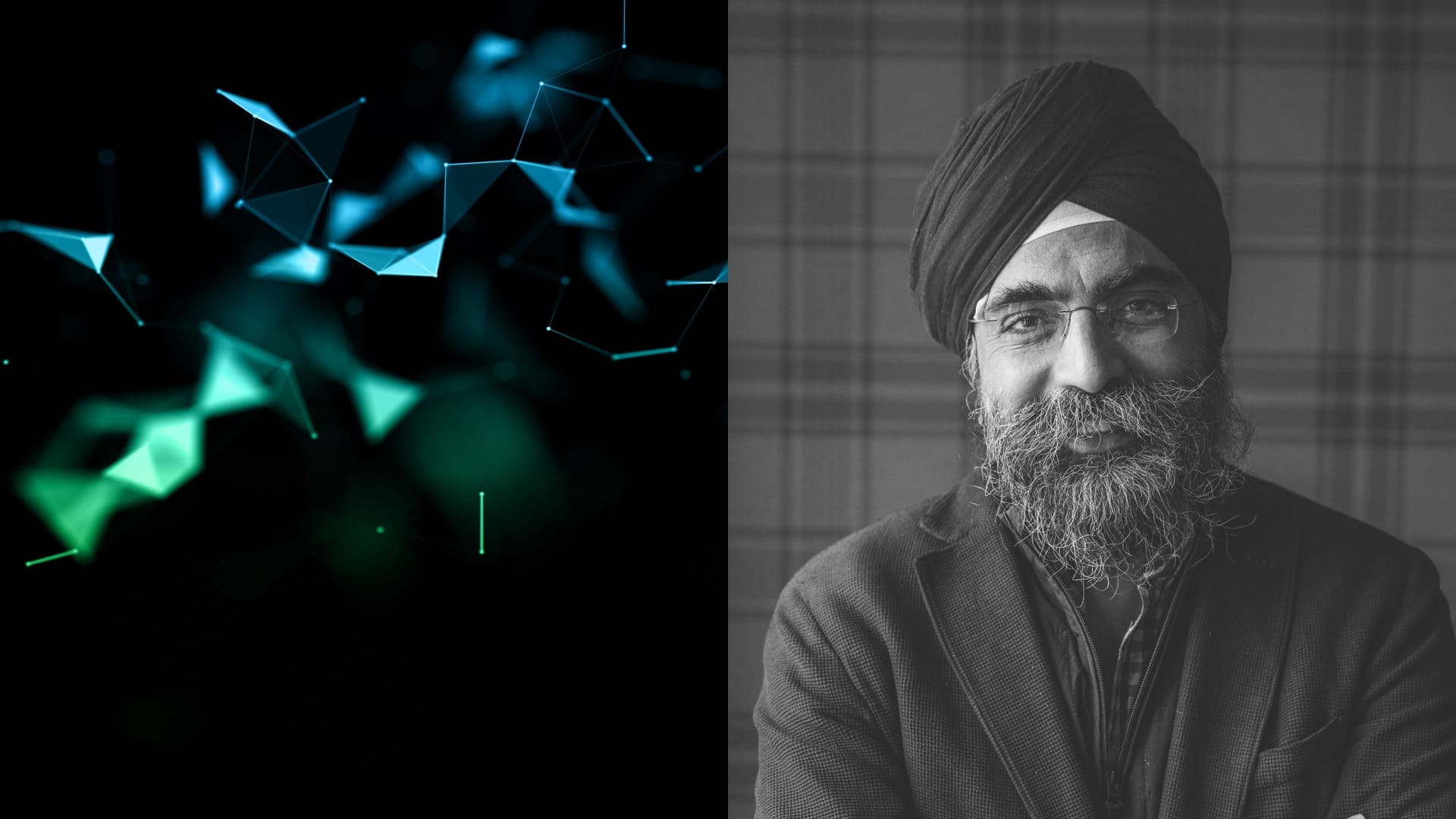
Indy is co-founder of Dark Matter Labs and of the RIBA award winning architecture and urban practice Architecture00. He is also a founding director of Open Systems Lab, seeded WikiHouse (open source housing) and Open Desk (open source furniture company).
Indy is a non-executive international Director of the BloxHub, the Nordic Hub for sustainable urbanization. He is on the advisory board for the Future Observatory and is part of the committee for the London Festival of Architecture. He is also a fellow of the London Interdisciplinary School.
Indy was 2016-17 Graham Willis Visiting Professorship at Sheffield University. He was Studio Master at the Architectural Association - 2019-2020, UNDP Innovation Facility Advisory Board Member 2016-20 and RIBA Trustee 2017-20.
He has taught & lectured at various institutions from the University of Bath, TU-Berlin; University College London, Princeton, Harvard, MIT and New School. He is currently a professor at RMIT University.
He was awarded the London Design Medal for Innovation in 2022 and an MBE for Services to Architecture in 2023.

London Life cover, 31 December 1966
London Life was a mid-1960s what's on magazine that for a little while replaced the Tatler to reflect a shift away from conservative posho style guide towards a more socially democratic swingin' London - tellingly by the end of the 1960s it had reverted to its former name and to being a conservative posho etc.
'Discotheques' were included in the listings, still quite a new phenomenon in UK so with the helpful explanation that these were 'Informal nightclubs and restaurants with dancing, usually to gramophone records. Some discothèques feature musicians from time to time'. Most of these don't sound too appetising, a lot of gambling and no doubt overpriced drinks (overpriced for the time - a goldfinger cocktail at the Hilton for 35p sounds very reasonable now!). Still wouldn't mind a time machine to check out the Flamingo or to see Francoise Hardy at the Savoy in January 1966.

London Life, 29 January 1966
And what of Samantha's in New Burlington Street, described in 1966 as 'London's first psychedelic club' promising to 'create atmosphere with machines' for people who 'want to be taken out of their minds as if they had taken LSD'. All with a talking dummy called Samantha and a dancefloor with 'powerful strobe lighting, which throws malevolent screens of speckled rays over the dancers' while 'a projector in the ceiling imprints vivid coloured slides over the contorted bodies of the music seekers'.

London Life, 12 November 1966
Picture this: You're in a meeting room at your tech company, and two people are having what looks like the same conversation about the same design problem. One is talking about whether the team has the right skills to tackle it. The other is diving deep into whether the solution actually solves the user's problem. Same room, same problem, completely different lenses.
This is the beautiful, sometimes messy reality of having both a Design Manager and a Lead Designer on the same team. And if you're wondering how to make this work without creating confusion, overlap, or the dreaded "too many cooks" scenario, you're asking the right question.
The traditional answer has been to draw clean lines on an org chart. The Design Manager handles people, the Lead Designer handles craft. Problem solved, right? Except clean org charts are fantasy. In reality, both roles care deeply about team health, design quality, and shipping great work.
The magic happens when you embrace the overlap instead of fighting it—when you start thinking of your design org as a design organism.
The Anatomy of a Healthy Design TeamHere's what I've learned from years of being on both sides of this equation: think of your design team as a living organism. The Design Manager tends to the mind (the psychological safety, the career growth, the team dynamics). The Lead Designer tends to the body (the craft skills, the design standards, the hands-on work that ships to users).
But just like mind and body aren't completely separate systems, so, too, do these roles overlap in important ways. You can't have a healthy person without both working in harmony. The trick is knowing where those overlaps are and how to navigate them gracefully.
When we look at how healthy teams actually function, three critical systems emerge. Each requires both roles to work together, but with one taking primary responsibility for keeping that system strong.
The Nervous System: People & PsychologyPrimary caretaker: Design Manager
Supporting role: Lead Designer
The nervous system is all about signals, feedback, and psychological safety. When this system is healthy, information flows freely, people feel safe to take risks, and the team can adapt quickly to new challenges.
The Design Manager is the primary caretaker here. They're monitoring the team's psychological pulse, ensuring feedback loops are healthy, and creating the conditions for people to grow. They're hosting career conversations, managing workload, and making sure no one burns out.
But the Lead Designer plays a crucial supporting role. They're providing sensory input about craft development needs, spotting when someone's design skills are stagnating, and helping identify growth opportunities that the Design Manager might miss.
Design Manager tends to:
- Career conversations and growth planning
- Team psychological safety and dynamics
- Workload management and resource allocation
- Performance reviews and feedback systems
- Creating learning opportunities
Lead Designer supports by:
- Providing craft-specific feedback on team member development
- Identifying design skill gaps and growth opportunities
- Offering design mentorship and guidance
- Signaling when team members are ready for more complex challenges
Primary caretaker: Lead Designer
Supporting role: Design Manager
The muscular system is about strength, coordination, and skill development. When this system is healthy, the team can execute complex design work with precision, maintain consistent quality, and adapt their craft to new challenges.
The Lead Designer is the primary caretaker here. They're setting design standards, providing craft coaching, and ensuring that shipping work meets the quality bar. They're the ones who can tell you if a design decision is sound or if we're solving the right problem.
But the Design Manager plays a crucial supporting role. They're ensuring the team has the resources and support to do their best craft work, like proper nutrition and recovery time for an athlete.
Lead Designer tends to:
- Definition of design standards and system usage
- Feedback on what design work meets the standard
- Experience direction for the product
- Design decisions and product-wide alignment
- Innovation and craft advancement
Design Manager supports by:
- Ensuring design standards are understood and adopted across the team
- Confirming experience direction is being followed
- Supporting practices and systems that scale without bottlenecking
- Facilitating design alignment across teams
- Providing resources and removing obstacles to great craft work
Shared caretakers: Both Design Manager and Lead Designer
The circulatory system is about how information, decisions, and energy flow through the team. When this system is healthy, strategic direction is clear, priorities are aligned, and the team can respond quickly to new opportunities or challenges.
This is where true partnership happens. Both roles are responsible for keeping the circulation strong, but they're bringing different perspectives to the table.
Lead Designer contributes:
- User needs are met by the product
- Overall product quality and experience
- Strategic design initiatives
- Research-based user needs for each initiative
Design Manager contributes:
- Communication to team and stakeholders
- Stakeholder management and alignment
- Cross-functional team accountability
- Strategic business initiatives
Both collaborate on:
- Co-creation of strategy with leadership
- Team goals and prioritization approach
- Organizational structure decisions
- Success measures and frameworks
The key to making this partnership sing is understanding that all three systems need to work together. A team with great craft skills but poor psychological safety will burn out. A team with great culture but weak craft execution will ship mediocre work. A team with both but poor strategic circulation will work hard on the wrong things.
Be Explicit About Which System You're TendingWhen you're in a meeting about a design problem, it helps to acknowledge which system you're primarily focused on. "I'm thinking about this from a team capacity perspective" (nervous system) or "I'm looking at this through the lens of user needs" (muscular system) gives everyone context for your input.
This isn't about staying in your lane. It's about being transparent as to which lens you're using, so the other person knows how to best add their perspective.
Create Healthy Feedback LoopsThe most successful partnerships I've seen establish clear feedback loops between the systems:
Nervous system signals to muscular system: "The team is struggling with confidence in their design skills" → Lead Designer provides more craft coaching and clearer standards.
Muscular system signals to nervous system: "The team's craft skills are advancing faster than their project complexity" → Design Manager finds more challenging growth opportunities.
Both systems signal to circulatory system: "We're seeing patterns in team health and craft development that suggest we need to adjust our strategic priorities."
Handle Handoffs GracefullyThe most critical moments in this partnership are when something moves from one system to another. This might be when a design standard (muscular system) needs to be rolled out across the team (nervous system), or when a strategic initiative (circulatory system) needs specific craft execution (muscular system).
Make these transitions explicit. "I've defined the new component standards. Can you help me think through how to get the team up to speed?" or "We've agreed on this strategic direction. I'm going to focus on the specific user experience approach from here."
Stay Curious, Not TerritorialThe Design Manager who never thinks about craft, or the Lead Designer who never considers team dynamics, is like a doctor who only looks at one body system. Great design leadership requires both people to care about the whole organism, even when they're not the primary caretaker.
This means asking questions rather than making assumptions. "What do you think about the team's craft development in this area?" or "How do you see this impacting team morale and workload?" keeps both perspectives active in every decision.
When the Organism Gets SickEven with clear roles, this partnership can go sideways. Here are the most common failure modes I've seen:
System IsolationThe Design Manager focuses only on the nervous system and ignores craft development. The Lead Designer focuses only on the muscular system and ignores team dynamics. Both people retreat to their comfort zones and stop collaborating.
The symptoms: Team members get mixed messages, work quality suffers, morale drops.
The treatment: Reconnect around shared outcomes. What are you both trying to achieve? Usually it's great design work that ships on time from a healthy team. Figure out how both systems serve that goal.
Poor CirculationStrategic direction is unclear, priorities keep shifting, and neither role is taking responsibility for keeping information flowing.
The symptoms: Team members are confused about priorities, work gets duplicated or dropped, deadlines are missed.
The treatment: Explicitly assign responsibility for circulation. Who's communicating what to whom? How often? What's the feedback loop?
Autoimmune ResponseOne person feels threatened by the other's expertise. The Design Manager thinks the Lead Designer is undermining their authority. The Lead Designer thinks the Design Manager doesn't understand craft.
The symptoms: Defensive behavior, territorial disputes, team members caught in the middle.
The treatment: Remember that you're both caretakers of the same organism. When one system fails, the whole team suffers. When both systems are healthy, the team thrives.
The PayoffYes, this model requires more communication. Yes, it requires both people to be secure enough to share responsibility for team health. But the payoff is worth it: better decisions, stronger teams, and design work that's both excellent and sustainable.
When both roles are healthy and working well together, you get the best of both worlds: deep craft expertise and strong people leadership. When one person is out sick, on vacation, or overwhelmed, the other can help maintain the team's health. When a decision requires both the people perspective and the craft perspective, you've got both right there in the room.
Most importantly, the framework scales. As your team grows, you can apply the same system thinking to new challenges. Need to launch a design system? Lead Designer tends to the muscular system (standards and implementation), Design Manager tends to the nervous system (team adoption and change management), and both tend to circulation (communication and stakeholder alignment).
The Bottom LineThe relationship between a Design Manager and Lead Designer isn't about dividing territories. It's about multiplying impact. When both roles understand they're tending to different aspects of the same healthy organism, magic happens.
The mind and body work together. The team gets both the strategic thinking and the craft excellence they need. And most importantly, the work that ships to users benefits from both perspectives.
So the next time you're in that meeting room, wondering why two people are talking about the same problem from different angles, remember: you're watching shared leadership in action. And if it's working well, both the mind and body of your design team are getting stronger.

Melody Maker, November 18, 1989
BLACK SABBATH
The Complete 70's Replica CD Collection 1970-78
(Sanctuary Records)
Uncut, 2001
by Simon Reynolds
The mystery of the riff--so crucial to rock, so oddly neglected by critics. Or perhaps not so strangely, given that riffs are almost impossible to write about: just try explaining why one monster-riff slays you where another one fails to incite. Riffs just seem to bypass the aesthetic faculties altogether and go straight to the gut. A killer riff is by definition simplistic--which is why self-consciously sophisticated rock tends to dispense with them altogether in favor of wispy subtleties. Riff-based music seems lowly, literally "mindless" because it connects with the lower "reptilian" part of the cerebral cortex which governs flight-or-flight responses, the primitive emotions of appetite, aversion, and aggression.
Talking of reptiles, Black Sabbath--perhaps the greatest riff factory in all of rock---irresistibly invite metaphors involving dinosaurs. For a group that wielded such brontosauran bulk, though, Sabbath were surprisingly nimble on their feet. Listening to this box-set, which comprises all eight albums of the classic Ozzy-fronted era, I was surprised how fast many of their songs were, given the Sabs' reputation as torpid dirgemeisters for the downered-and-out.
Even at their most manic, Sabbath always sound depressed, though. Rhythmically as much as lyrically, Sabbath songs dramatise scenarios of ordeal, entrapment, affliction, perseverance in the face of long odds and insuperable obstacles. Tony Iommi's down-tuned distorto-riffs--essentially the third element of the awesome rhythm section of Bill Ward and Geezer Butler--create sensations of impedance and drag, like you're struggling through hostile, slightly viscous terrain. Joe Carducci, Sabbath fiend and theorist supreme of rock 's "heavy" aesthetic, analyses about how bass, drums, and guitar converge to produce "powerfully articulated and textured tonal sensations of impact and motion that trigger hefty motor impulses in the listener." But let's not discount Ozzy's role: his piteous wail is one-dimensional, sure, but it sounds utterly righteous in this abject context. And he's effectively touching on forlornly pretty ballads like "Changes" too.
With a few exceptions (Lester Bangs, notably) the first rock-crit generation abhorred Sabbath. Criticism typically lags behind new art forms, appraising it using terminology and techniques more appropriate to earlier genres. So the first rock critics, being postgraduates in literature, philosophy, and politics, treated songs as mini-novels, as poetry or protest tracts with tasteful guitar accompaniment. Expecting rock to get ever more refined, they were hardly gonna embrace Sabbath's crude putsch on Cream, which stripped away all the blues-bore scholarship and revelled in the sheer dynamics of heaviosity. Riff-centered rock--Zep, Mountain, ZZ Top, Aerosmith---was received with incomprehension and condescension. But while Seventies critical faves like Little Feat and Jackson Browne have sired no legacy, over the long haul Sabbath's originality and fertility have been vindicated by the way their chromosones have popped up in US hardcore (Black Flag/Rollins were massively indebted), grunge (Nirvana = Beatles + Sabbath x Pixies), and virtually every key phase of metal from Metallica to Kyuss/Queens of the Stone Age to Korn. Sabbath are quite literally seminal.
Sabbath dressed like hippies: check the groovy kaftans and loon pants in the inner sleeve photos of these CDs, which are miniature simulacra of the original gatefold elpees. And they clearly hoped to contribute to the post-Sgt Pepper's progressive tendency: hence pseudo-pastoral interludes like the flute-draped "Solitude," an idyll amidst Master of Reality's sturm und drang. But critics deplored them as a sign of rock's post-Sixties regression , mere lumpen bombast fit only for the moronic inferno of the stadium circuit, and as a symptom of the long lingering death of countercultural dreams. In retrospect, with Sixties idealism seeming like a historical aberration, Sabbath's doom 'n' gloom seems more enduringly resonant, tapping into the perennial frustrations of youth with dead-end jobs from Coventry to New Jersey: headbanging riffs and narcotic noise as a cheap-and-nasty source of oblivion. Sabbath's no-future worldview always becomes extra relevant in times of recession, like the economic down-slope looming ahead of us right now. Looking back, the much-derided Satanist aspects seem relatively peripheral and low-key, especially compared with modern groups like Slipknot. In old TV footage of Sabbath, the group seem almost proto-punk, their sullen, slobby demeanour recalling The Saints on Top of the Pops. There's little theatrics, and the music is remarkably trim and flatulence-free.
But then no one really goes on about Iommi's solos, do they? The riffs are what it's all about, and Sabbath's productivity on that score is rivalled only by AC/DC. "Sweet Leaf", "Iron Man", "Paranoid", "Children of the Grave," "Wheels of Confusion", the list goes on. So we're back with the mystery.... just what is it that makes a great riff? Something to do with the use of silence and spacing, the hesitations that create suspense, a sense of tensed and flexed momentum, of force mass motion held then released. If I had to choose one definitive Sabbath riffscape, I'd be torn between the pummelling ballistic roil of "Supernaut" and "War Pigs", whose stop-start drums are like slow-motion breakbeats, Quaalude-sluggish but devastatingly funky. "War Pigs" is that rare thing, the protest song that doesn't totally suck. Indeed, it's 'Nam era plaint about "generals gathered... like witches at black masses" has a renewed topicality at a time when the military-industrial death-machine is once more flexing its might.
^^^^^^^^^^^^^^^^^^^
This is my favorite
I remember this came on the radio once when we were in the car. I turned up the volume and started air-drumming to those great breakbeat-like rolls. And then - a second after Ozzy's voice came in, like it was the final straw - this indignant voice piped up from the back seat: "This is the WORST music in the world!!!". Kieran, aged 11, sounding genuinely appalled. I drily replied, "no, this is in fact one of the most purely powerful pieces of recorded rock, actually". He wasn't having it.
Mind you, I would probably have felt the same at his age.
Well, more to the point, I felt the same when I was about 18. Not based on any deep exposure. Passing hearing of "Paranoid". Mostly just postpunk indoctrination, high-minded disapproval of all things metal.
Then two things changed my mind: I read that Black Flag were fans of Black Sabbath, which explained the grueling dirge of "Damaged I"
And then my friend Chris Scott played me one of their albums - maybe the Greatest Hits. "Iron Man" was the one that turned my head around.
And then "War Pigs".
Over time I've come to really like the dreamy hippie-ish side to Sabbath
What were they going for here? Santana? Something from the San Francisco scene?
It actually reminds me a bit of "Maggot Brain" by Funkadelic
And then this pretty instrumental
And this is a beautiful ballad
^^^^^^^^^^^^^^^^^
The first time I paeaned Sabbath was indirectly, via the greatest of their epigones: Saint Vitus

January 16 1988
Discovered much later that Born Too Late - which is not only epigonic but an analysis of the epigone mindstate - was produced by Joe Carducci. Whose analysis of "heavy" is unbeaten - check this piece, spun off Rock and the Pop Narcotic but not an extract, with some great probing into the Sabbath riff-and-rhythm engine.
And who opined that "Supernaut" is the most physically dynamic and potent example of recorded rock
I could have sworn I spoke to one of Saint Vitus on the phone for a piece on STT and its late 80s splurge out into heavy, proggy, jammy-bandy expansiveness - but all I can find is this small patch of exaltation, quote-free

Another Sabbath-related speck of writing is this piece on the unfortunately named 1000 Homo DJs aka Al Jourgensen who covered "Supernaut". He does address the isssue of the name in the conversation.

How weird to think I spoke to Mr Ministry on the phone
I wonder what Mr Carducci would have made of this cover? I'm sure he would have disapproved of the inelastic rhythm section (a drum machine?) and diagnosed it as a typically top-heavy misunderstanding of rock music - taking it to be all about attitude rather than phatitude. Literally top-heavy: all noise and distorted vox, no bottom. Fatally lite and devoid of heaviness.
In that sense almost as bad as British things like The Cult and Grebo.
He would further have diagnosed the Wax Trax thing as bound up with a fatal Chicago failing of Anglophilia - projecting to London to bypass New York.
I have strayed far from Ozzy...
Repeated exposure on the radio here in LA over the years has made me a fan of this, even though it's clean frantic high-energy style is a million miles from the Sabbath dirge style.
I'm sure Carducci thought this was a terrible waste of Ozzy's wail.
Good news/no news:
The latest endoscopy procedure went smoothly. There are signs of irritation in my fundus (part of the stomach lining) but no obvious ulceration or signs of cancer. Biopsy samples taken, I'm awaiting the results. (They're testing for celiac, as well as cytology.)
I'm also on the priority waiting list for cataract surgery at the main eye hospital, with an option to be called up at short notice if someone ahead of me on the list cancels.
This is good stuff; what's less good is that I'm still feeling a bit crap and have blurry double vision in both eyes. So writing is going very slowly right now. This isn't helped by me having just checked the page proofs for The Regicide Report, which will be on the way to production by the end of the month.
(There's a long lead time with this title because it has to be published simultaneously in the USA and UK, which means allowing time in the pipeline for Orbit in the UK to take the typeset files and reprocess them for their own size of paper and binding, and on the opposite side, for Tor.com to print and distribute physical hardcovers—which, in the USA, means weeks in shipping containers slowly heading for warehouses in other states: it's a big place.)
Both the new space operas in progress are currently at around 80% complete but going very slowly (this is not quite a euphemism for "stalled") because: see eyeballs above. This is also the proximate cause of the slow/infrequent blogging. My ability to read or focus on a screen is really impaired right now: it's not that I can't do it, it's just really tiring so I'm doing far less of it. On the other hand, I expect that once my eyes are fixed my productivity will get a huge rebound boost. Last time I was unable to write or read for a couple of months (in 2013 or thereabouts: I had Bell's Palsy and my most working eye kept watering because the eyelid didn't work properly) I ended up squirting the first draft of novel out in eighteen days after it cleared up. (That was The Annihilation Score. You're welcome.)
Final news: I'm not doing many SF convention appearances these days because COVID (and Trump), but I am able to announce that I'm going to be one of the guests of honour at LunCon '25, the Swedish national SF convention, at the city hall of Lund, very close to Malmö, from October 1th to 12th. (And hopefully I'll be going to a couple of other conventions in the following months!)
Lover's jungle!
Yeah yeah I know "Uptown Ranking'" is not Lovers
It's more like Swaggers
Why on earth would you wanna dirge this out? What a silly man he is
From sustainable and low-alcohol tipples to Snoop Dogg and Dr Dre's surprisingly sippable bottle, these are the gins worth your time - and tonic
• The best tinned drinks for summer
Gin and tonic has been a mainstay of British drinking culture since the 17th century, when its initial medicinal use soon turned recreational. It has seen several notable explosions in popularity over the years. The effects of the 18th-century "gin craze" were famously immortalised in Hogarth's satirical artwork Gin Lane - though some might say worse crimes have been committed in the name of gin more recently.
A centuries-old ban on small-scale distilling was finally lifted in the UK in 2009, fuelling a huge boom in "craft gin" and record sales between 2015 and 2019. It also led to an incredible variety of bottles, flavours and colours, which were sometimes more weird than wonderful: Vegemite or Jaffa Cake gin, anyone?
Continue reading...

A trick film in the peepshow vein, involving magnification and mites on a block of cheese.
The Energy Institute recently published its updated energy report, the 2025 Statistical Review of World Energy, showing data through the year 2024. In this post, I identify trends in the new data that I consider worrying. These trends help explain the strange behaviors that we have been seeing from governments recently.
[1] The world’s per capita affordable supply of diesel has been declining, especially since 2014.Because of it is high energy density and ease of storage, diesel is important in many ways:
- Diesel powers a substantial share of modern agricultural equipment.
- Diesel is the fuel of the huge trucks that carry goods of all kinds.
- Diesel powers much of the world’s construction and earth-moving equipment.
- Diesel (and other similarly energy-dense but less refined fuels) allows long-distance transport by ship.
- Diesel is widely used in mining.
- Diesel powers some trains, provides backup electricity generation, and powers some irrigation pumps.
 Figure 1. Chart showing the level of per-capita diesel consumption, relative to the per-capita consumption in 1980. Amounts are based on Diesel/Gasoil amounts shown in the “Oil-Regional Consumption” tab of the 2025 Statistical Review of World Energy, published by the Energy Institute.
Figure 1 suggests that the supply of diesel started being constrained during the 2008-2009 recession. The decrease became more pronounced starting in 2014, which was when oil prices fell (Figure 12). In fact, this downward trend since 2014 continued into 2024. The constraint in diesel production/consumption comes through oil prices that fall too low for the producers of diesel. If prices rise, they don’t stay high for very long.
If there isn’t enough diesel, cutbacks in some applications will be needed. One new workaround for the inadequate supply of diesel seems to be a reduction of international trade through tariffs. If goods can be produced closer to where they are purchased, then perhaps the economic system can accommodate the declining availability of the diesel supply a little longer.
It should be noted that jet fuel consumption is also constrained. The type of oil used is quite similar to diesel. Transferring the transportation of goods from trucks and ships to jet aircraft is not a solution!
[2] Copper supply seems to be constrained.There has been much discussion of transitioning to the use of more electricity and less fossil fuels. This would require both a greater build out of electricity transmission systems and more use of electric cars. Each of these uses would require more use of copper. Electric cars are reported to each require 40kg to 80kg of copper, while cars with internal combustion engines use only 20kg of copper. Building charging stations for all these cars would further add to copper needs, as would adding new transmission lines to carry the higher total electricity supply.
 Figure 2. World copper production, based on data of the 2025 Statistical Review of World Energy, published by the Energy Institute.
Figure 2 shows that even with the expected increase in demand for copper resulting from a shift toward electrification, total world extraction of copper has remained relatively flat. A major issue is that it takes a very long time to build a new copper mine. Worldwide, the average time to new production is 17.9 years. For this reason, a temporary increase in price cannot be expected to drive up production very quickly. If diesel is used in extracting copper, and diesel’s consumption is constrained, the restricted diesel supply can also be an issue in expanding the copper supply.
The new tariffs on copper, announced by President Donald Trump, seem to be intended to drive industries that use copper to look for substitute minerals. With a very long lag, the tariffs might also lead to an increase in copper production. Tariffs have more staying power than volatile price changes. There doesn’t seem to be a quick solution, however.
[3] Platinum extraction also seems to be constrained. Figure 3. World production of platinum and palladium (which is closely related) based on data of the 2025 Statistical Review of World Energy, published by the Energy Institute.
Platinum currently has a wide variety of applications, including use in catalytic converters, jewelry, medicine, and industry.
Some people are also hopeful that platinum will enable the wide use of hydrogen fuel cells to help meet the world’s demand for electrical power in a way that doesn’t require burning fossil fuels. In fuel cells, platinum acts as a catalyst, enabling the separation of hydrogen and oxygen molecules in water through a chemical process, rather than combustion.
One issue mentioned in the lack of growth in platinum production is persistently low prices. New mines will not be opened unless it is clear that production will be profitable. Another source indicates that the largest producing country, South Africa, has been having problems with electrical supply and rail transportation. These problems, in turn, seem to be related to South Africa’s dwindling coal supply. Its peak coal production took place in 2014. We should not be surprised if South Africa continues to have problems producing platinum in the future.
[4] Up until this report, the Statistical Review of World Energy has used an optimistic approach to quantifying the benefits of intermittent renewable electricity.The traditional method of evaluating energy products involves analyzing the amount of heat produced in combustion. In past years, the Statistical Review of World Energy used a method that essentially assumed that the intermittent electricity produced by renewable sources (including hydropower) completely substitutes for the equivalent dispatchable electricity generated by fossil fuels. I think of this as the “wishful thinking” methodology.
The current methodology gives renewables less credit, recognizing the fact that intermittent sources substitute primarily for the fuel that electricity generating plants would use. It is becoming increasingly clear that intermittent power doesn’t work very well on a stand-alone basis. Many types of workarounds, including batteries and backup fossil-fuel generation, are required to supplement it.
The new methodology gives about 22% more credit to nuclear power than the old method. Nuclear power can be counted on 24 hours per day. Also, like fossil fuel generation, it provides the necessary inertia (the energy stored in large rotating components such as generators, which allows the power system to maintain a steady frequency) to keep electricity moving through transmission lines. Without sufficient inertia, electrical outages similar to that recently experienced in Spain, are likely.
The revised methodology seems to align better with the methods used by the US Energy Information Administration and the International Energy Agency. In the past, it has been confusing with major agencies using different methodologies.
[5] With the new methodology, there are significant changes in patterns from past reports.With the new methodology, the percentage of energy generated directly by fossil fuels is higher than many of us remember from past reports. Now, the portion of fossil fuel consumption that comes directly from fossil fuel generation has been reduced from 94% in 1980 to 87% in 2024. Using the old methodology, the fossil fuel percentage in 2024 would have been 81%.
 Figure 4. Fossil fuel energy as share of total energy generation based on data of the 2025 Statistical Review of World Energy, published by the Energy Institute.
Figure 5 shows the history of non-fossil fuel types of energy, as percentages of total world energy supply. It should be noted that even these types of energy require some use of fossil fuels. Such fuels are used in the initial construction of the devices, for their maintenance, for energy storage, and for transportation (or transmission) to where the energy product is used.
 Figure 5. Non-fossil fuels as share of total energy supply based on data of the 2025 Statistical Review of World Energy, published by the Energy Institute.
Figure 5 shows that the share of energy produced by “Nuclear” hit a peak of 7.6% in 2001, and it has been declining ever since. “Hydroelectric” has grown a bit over the years relative to world energy supply.
“Geo, Biomass, Other” as a share of world energy supply has been relatively flat in recent years. It includes biomass in the form of ethanol and biodiesel, which are non-electricity forms of renewable energy. It also includes electricity from geothermal generation, and from burning wood chips and sawdust.
The only real “winner” in recent years has been “Wind + Solar.” As of 2024, this category amounts to 2.9% of world energy supply. It certainly cannot, by itself, power an economy like the one we have today. Section 7 of this post explains a bit more about this issue.
[6] The sad state of nuclear generation deserves a discussion of its own.There seem to be many factors underlying the substantial decline in nuclear electricity, as a share of total energy supply, between 2001 and 2013:
- There were three major accidents at nuclear power plants, leading to worries about the safety of nuclear generation (Three Mile Island, 1979; Chernobyl, 1986; and Fukushima, 2011).
- The pricing scheme for wind and solar generally gives “priority” to wind and solar. This leads to negative wholesale prices for electricity at some times, and very low prices at other times, for nuclear power plants. This pricing scheme tends to make nuclear power plants unprofitable. I expect that this lack of profitability has been a major issue in the recent decline of nuclear generation.
- There doesn’t seem to be enough uranium produced to support much more nuclear generation than is used today. The US has been using down-cycled nuclear bomb material, but that is now becoming exhausted. See my earlier post.
- Uranium prices never bounce very high for very long. If prices were a lot higher over the long term, more uranium mines might be opened, and more uranium extracted.
- Opening a new mine often involves lag times of 10 to 15 years, making any ramping of uranium production a slow process.
There is also the issue of financing any shift to nuclear electricity. Upfront costs are huge, but nuclear power plants (with proper fossil-fuel-based maintenance) can operate for 60 to 80 years. As limits on fossil fuels are reached, building all these plants, using large amounts of fossil fuels, seems likely to reduce fossil fuels energy available for other uses. This makes financing a major challenge.
[7] The recent annual rising trend of 0.2% in per capita consumption of energy looks vulnerable to disruption by any economic problem that arises. Figure 6. World energy consumption by type of energy based on data of the 2025 Statistical Review of World Energy, published by the Energy Institute.
A major reason why energy consumption keeps rising is because, as population rises, there is a need for more food, housing, and transportation for this larger population. The consumption of energy products allows people to meet these needs. In fact, every aspect of GDP depends upon energy consumption.
 Figure 7. World per capita energy consumption based on data of the 2025 Statistical Review of World Energy, published by the Energy Institute.
Figure 7 indicates that world energy supply per capita rose between 1965 and 1979. It remained relatively flat between 1979 and 2002 and then rose quite rapidly until 2008. Since then, its growth rate has again been essentially flat. Fitted trend lines show what these growth trends have been:
 Figure 8. Similar to Figure 7, with exponential trend lines fitted for time periods noted in text.
I have written recently about the huge US government debt increase since 2008 that has tended to prop up both the US and world economies. With all this “support” since 2008, the fact that world per capita energy consumption growth has only risen by 0.2% per year is frightening. With the high level of debt, there is a danger that there will be another major recession that could bring huge financial difficulties. At some point, higher debt levels become unsupportable. Thus, what is really an energy crisis can “morph” into a financial crisis.
 Figure 9, One-year increase in total world energy consumption based on data of the 2025 Statistical Review of World Energy, published by the Energy Institute.
The types of events that have brought energy consumption down in the past are quite varied, as shown on Figure 9. Note that the lows keep getting lower. There is a danger that another recession-type event could come along and push the world economy toward a long-term downtrend in energy supply per capita.
[8] China plays a huge role in the world’s energy consumption. As resource limits are hit, China has the potential to pull the world economy down with it.China energy consumption (Figure 10) follows a very different pattern from world energy consumption (Figure 6).
 Figure 10. China’s energy consumption by fuel based on data of the 2025 Statistical Review of World Energy, published by the Energy Institute.
There are several important things to notice about China’s energy pattern:
(a) China’s energy consumption is heavily dominated by coal.
(b) There was a sharp expansion in China’s energy consumption, starting about 2002. This is related to China joining the World Trade Organization (WTO) in December 2001. On Figure 8, we noted 2.0% annual world per capita energy consumption growth between 2002 and 2008, which was far greater than in either the period before 2002 (at 0.2%), or the period after 2008 (at 0.2%). This shifting pattern was largely driven by China’s spurt in energy consumption after joining the WTO.
(c) China’s energy consumption has been growing more rapidly than that of the rest of the world. This is closely related to China’s becoming the leading manufacturer for the world economy, at the same time most of the wealthier countries have been moving manufacturing to lower-cost areas (ostensibly to reduce CO2 emissions).
(d) China’s energy consumption now plays an outsize role in the future of the world economy. In 2024, China consumed 27% of the world’s energy supply. This is more energy than that consumed by the US (16%) and the EU (9%) combined.
(e) With this energy dominance, any stumble in the world’s supply of fossil fuels and other mineral resources will affect China.
One area where China is running into limits is with respect to oil supply. China imports most of its oil. Comparing 2024 to 2023, China’s total oil consumption decreased by 1.4%. Its diesel consumption decreased even more, by 2.8%.
As the leading manufacturer of the world, China has been consuming huge amounts of minerals such as copper. This Copper Council report seems to indicate that China uses about 56% of the world’s copper supply. If there is a shortage of copper, China will be affected.
We can look at energy consumption growth on a per capita basis. Not surprisingly, China’s rapid growth has pulled down per capita energy consumption growth elsewhere.
 Figure 11. Energy consumption per capita, separately for the World, China, and the World excluding China, based on data of the 2025 Statistical Review of World Energy, published by the Energy Institute.
The pattern shown in Figure 11 is disturbing. Outside of China, energy consumption per capita has been falling for a long time. The rest of the world, to a significant extent, has lost its ability to manufacture the goods needed for its own people. China’s energy consumption per capita is now reported to be on a par with Europe’s, but China, too, faces issues as it encounters resource limits of many kinds.
No wonder there is conflict among nations! Every country would like limited resources. If one country has more, other countries will get less.
[9] Inflation-adjusted oil prices have bounced around, rather than following a consistent upward pattern. This limits their long-term impact on production. Figure 12. Average annual inflation-adjusted oil prices based on data of the 2025 Statistical Review of World Energy, published by the Energy Institute.
Commodity prices of all kinds seem to be influenced by many temporary situations, including debt availability and concerns about war. Higher prices do induce short-term changes that can influence supply of some energy products. For example, when oil prices are high, more production of diesel can economically be achieved by “cracking” long molecules of very heavy oil to produce shorter diesel-length molecules. When oil (and diesel) prices are low, this conversion process starts to be money-losing.
Thus, as we saw in Figure 1, diesel production increased between 1994 and 2008, in line with rising oil prices (Figure 12). Conversely, diesel barely held steady between 2008 and 2014. After 2014, when oil prices were clearly lower, diesel production fell significantly.
A major problem in creating greater mineral supplies for the long term is that new mines of all types take many years to develop. So does opening a completely new oil field. Prices tend not to stay high enough, for long enough, to encourage opening new mines and new oil fields. We see this pattern repeatedly, in diverse areas, including oil, copper, platinum and uranium, holding down the supply of these mineral resources.
Over the long term, affordability seems to play a larger role than rising demand in the prices of commodities, holding prices down. As a result, it is low prices that seem to lead to the falling production of commodities.
[10] ConclusionThis analysis confirms what I have shown earlier: The world economy is hitting energy limits in many ways.
I have written about the world’s diesel and jet fuel shortage in the past. Updated data from the 2025 Statistical Review of World Energy confirms that the world’s diesel supplies are not rising sufficiently to keep pace with world population growth. I believe that the shortage of diesel, and perhaps of oil in general, underlies the push toward more tariffs. One effect of tariffs may be to reduce the amount of long-distance shipping.
The 2025 Statistical Review of World Energy includes data for a few minerals that will likely be used if there is a transition away from fossil fuels. Of the minerals shown in the report, copper and the platinum group seem to be the most limited in supply. The relatively flat production at a time when demand should be expected to be rising gives us a clue that limits are being reached. Unless someone can figure out a way to get prices to stay at a significantly higher level, low supply of these minerals is likely to remain a long-term problem.
The overall energy supply does seem to still be rising slowly, but progress in transitioning to non-fossil fuels is painfully slow. We hear much talk about ramping up nuclear electricity production, but my analysis suggests that such a transition will be difficult, at best.
There is a great deal more analysis that can be done with the new data. I expect to be looking at this data in more detail in future posts.


When I wrote this snider review of the dirty old man's memoir I'd clean forgotten that if nothing else he had made the best Stone-involved record of the last - well now it would 3 and a half decades - but in 1990 just a decade.
This and "Start Me Up", the last great actual Rolling Stones record, were released the same year.
 A tribute-ary of History [ 12-Jul-25 4:43pm ]
Field Music are one of those bands I don't have much of a fix on - I'd sort of mentally filed them as the kind of group Pitchfork habitually gives a good review to, alongside I dunno The Microphones / Mount Eerie
(Actually looking into it they've had some pretty mixed reviews from P-Fork and they seem like are more like a British Dirty Projectors if anything).
At any rate, not sure I've ever knowingly heard Field Music but this morning I read a poignant account about how in order to make ends meet as a band they've opened up a sideline as a Doors tribute band.
After getting a disapproving response from a fan, one of the brothers involved wrote this rebuttal / rationale:


Streaming is one of the main culprits when it comes to the non-viability of being a professional musician. Here's an interesting piece from Ryan Dombal at Hearing Things (the new magazine venture by a bunch of former Pitchfork people) on why they have decided to have no more truck with Spotify (mostly the truck seems to have been doing article-related playlists through them). Instead they are having truck with Apple and Tidal.
I subscribe to Tidal, having grown addicted to their superior audio as an erstwhile contributor given a complimentary sub - nice while it lasted). I do have a vestigial Spotify account, which I never use as a daily listener. But because a bunch of playlists based around books of mine are up there I don't really want to close it down - the links are still out there in the printed books.
Still, perhaps going forward though I should only do playlists through Tidal and Apple (I believe you don't have to subscribe to Tidal to listen it, just put up with the ads - same as with Spotify. Don't know about Apple). Or even do a playlist through YouTube, which has the added enhancement of visuals a lot of the time.
None of these places are recompensing musicians the way they used to be and should be. But they don't seem to be actively Satanic to quite the same extent.


Spin, October 1998
VARIOUS ARTISTS
Nuggets II: Original Artyfacts From the British
Empire & Beyond
Uncut, 2001
Lenny Kaye's 1972 anthology Nuggets was a
rock archivist's masterstroke, a feat of canon rewriting that deposed the post-Sgt Pepper's aristocracy and
elevated the forgotten garage punks of the mid-Sixties, from The Seeds to
Chocolate Watchband. Rhino's 1998 four-CD update of Nuggets
dramatically expanded the original double LP.
Now this latest instalment
extends the Nuggets premise beyond the USA to
encompass the one-hit-wonders and never-wozzers of mid-Sixties Britain: that
all-too-brief golden age of amphetamine-cranked R&B and mod-on-LSD that's
roughly bookended by "My Generation" and Cream's Disraeli Gears. Just the names of
these long-lost groups--Dantalion's Chariot, Wimple Winch, Rupert's People, The
Idle Race--induces a contact high, before you even play the discs.
Back then, singles made their point and left. This short 'n' sweet succinctness
allows the compilers to cram 109--that's one hundred and nine--tracks
into four discs. Here's just a handful of gems.
Tintern Abbey's "Vacuum Cleaner", with the saintly-sounding David MacTavish singing a proto-Spacemen 3 love-as-drug/drug-as-God lyric ("fix me up with your sweet dose/now I'm feeling like a ghost"), splashy cymbals, and a billowing solo of controlled feedback.
Them's "I Can Only Give You Everything": Van in I'm-A-Man mode, awesomely surly and swaggering.
The Sorrows's "Take A Heart": a Brit-Diddley locked groove of tumbling tribal toms and spaced-out-for-intensified-effect guitar-riffs.
The Eyes's "When The Night Falls" takes that drastic use of silence and suspense even further: powerchords like Damocles Swords, caveman tub-thumping, tongues-of-flame harmonica, and an insolent you-done-me-wrong/go-my-own-way vocal.
Fire's "Father's Name Was Dad," a classic misunderstood teen
anthem: society gets the blame and the kid surveys Squaresville from a lofty
vantage, cries "I laugh at it all!"
One group stands out as a "why?-why?!?-were-they-never-MASSIVE?" mystery.
Not The Creation, and not The Action--both had terrific songs but were a little characterless.
No, I'm talking about John's Children's. Their two offerings here are astoundingly deranged, the monstrously engorged fuzzbass like staring into a furnace, the drums flailing and scything like Keith Moon at his most smashed-blocked.
"Desdemona" features the then shocking chorus "lift up your skirt and fly", daft lines about Toulouse-Lautrec painting "some chick in the rude" plus the stutter-bleat of a young Bolan on backing vox.
"A Midnight Summer's Scene" captures mod
sulphate-mania on the cusp of mutating into flower power acid-bliss: it's a
febrile fantasy of Dionysian mayhem in an after-dark park, maenad hippy-chicks
with faces "disfigured by love", strewing "petals and
flowers," prancing the rites of Pan.
John's Children's merger of cissy and psychotic highlights the major difference
between American garage punk and British "freakbeat" (as reissue
label Bam Caruso dubbed it for their illustrious Rubble
compilation series). The Limey stuff is way fey compared with the Yanks. You
can hear a proto-glam androgyny, a "soft boy" continuum that takes in
Barrett and Bolan, obviously, but also the queeny-dandy aristocrat persona of
Robert Plant.
At the same time, because these bands were schooled in R&B
and played live constantly, the music has a rhythmic urgency and aggressive
thrust that gradually faded over subsequent decades from the psychedelic
tradition (think of Spiritualized's drum-phobic ethereality). This, though, was
music for dancing as much as wigging out.
Nuggets II isn't solid gold.
There's a slight surfeit of boppy shindig-type rave-ups and sub-Yardbirds blues
that just ain't bastardized enough. Personally I crave more tunes with truly
over-the-top guitar effects, aberrant bass-heavy mixes, phased cymbals, drastic
stereo separation, and other psych-era cliches.
The "British Empire" part of the subtitle allows in Australia's The Easybeats (godstars for the duration of "Friday On My Mind") while the "Beyond" pulls in groovy Latin American acid-rockers Os Mutantes.
But to be honest, a lot of the Commonwealth-and-beyond stuff just ain't that hot. And inevitably one could compile another 2-CDs out of heinous omissions. Forget the quibbles, though, this box is a treasure chest of vintage dementia.
^^^^^^^^^^^^^
Pointedly not reviewed: Nuggets 3, which was a selection of 80s-onwards garage revivalism.

As Chinese immigration to California accelerated across the 19th century, the hairstyle known as the queue — a long, braided pony tail — became the subject of white Americans' fascination, disgust, and legal regulation. Sarah Gold McBride explores why hair served as an index of political subjecthood, and how the queue exposed cracks in American norms regarding gender, economy, and citizenship.
“One of the peculiar things about the 'Net is it has no memory. (…) We’ve made our digital bet. Civilization now happens digitally. And it has no memory. This is no way to run a civilization. And the Web — its reach is great, but its depth is shallower than any other medium probably we’ve ever lived with.” (Kahle 01998)

In February 01998, the Getty Center in Los Angeles hosted the Time and Bits: Managing Digital Continuity conference, organized by the founders and thinkers of two non-profit organizations established two years earlier in San Francisco: the Internet Archive and The Long Now Foundation, both dedicated to long-term thinking and archiving.
The Internet Archive has since become a global example of digital archiving and an open library that provides access to millions of digitized pages from the web and paper books on its website. The Long Now Foundation’s central project involves the design and construction of a monumental clock intended to tick for the next 10,000 years, promoting long-term thinking alongside its lesser-known archival mission: the Rosetta Project.
The Time and Bits: Managing Digital Continuity conference brought together these organizations to discuss what the Internet Archive’s founder, Brewster Kahle, referred to as “our digital bet”: a digital-only novel form of civilization with no history, posing challenges to the preservation of its immaterial cultural memory. Discussions at the conference raised concerns about the longevity of digital formats and explored potential archival and transmission solutions for the future. This foresight considered the ‘heritage’ characteristics of the digital world, which were yet to be defined as such on a global level. It was not until 02003 that UNESCO published a charter advocating for “digital heritage conservation”, distinguishing between “digital-born heritage” and digitized heritage (UNESCO 02003, Musiani et al. 02019). The Getty Center conference thus emerges as a precursor in the quest to preserve both digital data and analog information for future generations. This endeavor, the chapter argues, aligns with the longue durée, a conception of time and history developed by French historian Fernand Braudel during World War Two (Braudel 01958).
While the Internet Archive has envisioned such a mission through the continuous digital recording of web pages and the digitization of paper, sound, and video documents into bits format, The Long Now Foundation’s Rosetta Project began to take shape during the ‘Time and Bits’ conversations, offering a different approach to data conservation in an analog microscopic format, engraved on nickel disks.
Taking the 01998 gathering of the Internet Archive and Long Now Foundation as a starting point, this chapter aims to examine the challenges and strategies of ‘digital continuity management’ (or maintenance). It proposes to analyze the different ways these two case studies envision archiving and transmission to future generations, in both digital and analog formats — bits and nickel, respectively — for virtual web content and physical paper-based materials.
Through a comparative analysis of these two non-profit organizations, this chapter seeks to explore various archiving methods and tools, and the challenges they present in terms of time, space, innovation, maintenance, and ‘continuity’. By depicting two distinct visions of the future of archiving represented by these organizations, it highlights their shared mission of safeguarding, sharing, and providing universal access to information, despite their differing formats.
The method used for this analysis combines theoretical, comparative, and qualitative studies through an immersive research process spanning over three years in the San Francisco Bay Area. This process involved conducting interviews and participant observations during seminars, talks, and meetings held by both The Long Now Foundation and at the Internet Archive. Additionally, archival research was conducted online, using resources such as the Internet Archive’s Wayback Machine and The Long Now Foundation’s blog dating back to 01996, as well as on-site at The Long Now Foundation.
This chapter adopts a multidisciplinary approach conjoining history, media, maintenance, and American studies to analyze the challenges faced by these two organizations in transmitting both material and intangible cultural heritage (UNESCO 02003).
The first part of this chapter concentrates on the future of archives and their longevity, a topic that was discussed during the 01998 Time and Bits conference. It suggests a parallel with the Braudelian longue durée perspective, which offers a novel understanding of time and history.
The second part focuses on digital transmission in ‘hard-drive form’ using the example of the Internet Archive and its Wayback Machine, comprising thousands of hard drives. The final segment of this chapter discusses the analog archival format chosen by The Long Now Foundation, represented by the Rosetta Disk, a small nickel disk engraved with thousands of pages of selected texts. This format is likened to a modern iteration of the Egyptian Rosetta Stone for preservation into the long-term future.
“Time and Bits: Managing Digital Continuity”…and maintenance in longue durée“How long can a digital document remain intelligible in an archive?” This question, asked by futurist Jaron Lanier in one of the hundreds of messages posted on the Time and Bits forum that ran from October 01997 until June 01998, underscores not only concerns about the future ‘life’ of digital documents at the end of the 01990s, but also their meaning and understanding in archives for future generations. These concerns about digital preservation were central to discussions at the subsequent Time and Bits conference organized a few months later in February 01998 at the Getty Center in Los Angeles by the Getty Conservation Institute and the now defunct Getty Information Institute, in collaboration with The Long Now Foundation.
The Long Now Foundation, formed in 01996, emerged from discussions among thinkers and futurists who later became its board members. This group included Stewart Brand, recipient of the 01971 National Book Award for his Whole Earth Catalog and co-founder of the pioneering virtual community, the WELL, created in the 01980s (Turner 02006), engineer Danny Hillis, British musician and artist Brian Eno, technologists Esther Dyson and Kevin Kelly, and futurist Peter Schwartz (Momméja 02021). Schwartz, in particular, is the one who articulated the concept of the ‘long now’ as a span of 20,000 years — 10,000 years deep into the past and 10,000 years into the very distant future. This timeframe coincides with the envisioned lifespan of the monumental Clock being constructed by the foundation in West Texas. The choice of this specific duration marks the end of the last ice age about 10,000 years ago, a period that catalyzed the advent of agriculture and human civilization, with some scholars even identifying it as the onset of the Anthropocene epoch. Indeed, a group of scientists extends their analysis beyond the industrial era, which has generally been studied as the beginning of this human-induced transformation of our biosphere, considering the origins of agriculture as “the time when large-scale transformation of land use and human-induced species and ecosystem loss extended the period of warming after the end of the Pleistocene” (Henke and Sims 02020). For the founders of The Long Now Foundation, this 10,000-year perspective must therefore be developed in the opposite direction, towards the future (hence the expected duration of the Clock) forming the ‘Long Now’.
The paper argues that ‘long now’ promoted by the organization can be paralleled with the concept of longue durée put forth by Annales historian Fernand Braudel. Braudel began elaborating the idea of longue durée during his time as prisoner of war in Germany. For five years, he diligently worked on his PhD dissertation, La Méditerranée et le monde méditerranéen à l'époque de Philippe II (Braudel 01949). It was during his internment that Braudel developed the concept of the ‘very long time’, a temporal construction that provided him solace from the traumatic events he experienced in the ‘short time’ and helped him gain insight into his condition by situating them on a much broader time scale (Braudel 01958). With newly stratified temporalities ― from the immediate to the medium to the very long term ― Braudel succeeded in escaping the space-time of which he was a prisoner, a ‘here’ and ‘now’ devoid of meaningful perspectives when a longer ‘now’ would liberate him from the present moment. Longue durée was thus imagined as a novel long-term approach to history, diverging from traditional narratives that focused on brief periods and dramatic events, such as wars. This is what Braudel referred to as “a rushed, dramatic narrative” (Braudel 01958). A second, longer type of history, based on economic cycles and conjunctures, was described by Braudel as spanning several decades, while longue durée offered a novel type of history that transcended events and cycles, extending even further to encompass centuries ― although the French historian refrained from specifying an exact timeframe.
Longue durée, alongside its modern Californian counterpart, the ‘long now’, prompts us to reconsider our understanding of history in time as a means to encapsulate events far beyond our lifetimes. Braudel insisted historians should incorporate longue durée into their work and rethink history as an ‘infrastructure’ composed of layers of ‘slow history’.
Given this perspective, how can we archive and transmit fast traditional history within the context of longue durée? In his foreword to the Time & Bits report, Barry Munitz, president and CEO of the J. Paul Getty Trust, explained the initiative behind the conference:
We take seriously the notion of long-term responsibility in the protection of important cultural information, which in many cases now is recorded only in digital formats. The technology that enables digital conversion and access is a marvel that is evolving at lightning speed. Lagging far behind, however, are the means by which the digital legacy will be preserved over the long term (Munitz 01998).
The two organizations selected for this chapter offer two distinct, yet complementary, visions of how archiving and transmitting should be approached, now and for the longue durée, in digital and analog formats.
Digital transmission in ‘hard-drive form’: The Wayback Machine and the Internet ArchiveAddressing the “problem of our vanishing memory” was a focal point of the Time & Bits conference encapsulated by Internet Archive founder Brewster Kahle’s question: “I think the issue that we are grappling with here is now that our cultural artifacts are in digital form, what happens?” (Kahle 01998). As noted by Stewart Brand, Kahle also pointed out that “one of the peculiar things about the 'Net is it has no memory. (…) We’ve made our digital bet. Civilization now happens digitally. And it has no memory. This is no way to run a civilization. And the Web—its reach is great, but its depth is shallower than any other medium probably we’ve ever lived with” (Kahle 01998).
As a way to resolve this ‘digital bet’ and the pressing need for ‘digital continuity’, Brewster Kahle embarked on a mission to archive the web on a massive scale, giving rise to the Internet Archive and its Wayback Machine: an archive comprising 20,000 hard drives and containing 866 billion web pages as of March 02024.
Like The Long Now Foundation, the Internet Archive is a non-profit organization founded in 01996 in San Francisco. In fact, both entities once occupied adjacent offices in the Presidio. Their missions can also be put in parallel: whereas The Long Now Foundation promotes long-term thinking through projects like the construction of a Clock and the preservation of foundational languages and texts of our civilization in analog form through the Rosetta Disk, the Internet Archive digitizes and archives analog documents and records digital textual heritage through its Wayback Machine.
The Internet Archive embarked on its mission with an imperative to save internet pages, immaterial data composed of bits, which had not previously been archived: “We began in 01996 by archiving the internet itself, a medium that was just beginning to grow in use. Like newspapers, the content published on the web was ephemeral ― but unlike newspapers, no one was saving it” (Internet Archive 02024). Despite the transient and intangible nature of web pages, the Internet Archive remains committed to this mission, continuing to archive internet pages in a digital format to this day, with the ambition to remain open and collaborative, “explicitly promoting bottom-up initiatives intended to revalue human intervention” (Musiani et al. 02019).
Brewster Kahle, who could be regarded as the first digital librarian in history, promotes “Universal Access to All Knowledge” and “Building Libraries Together”. These missions, as explained during the Internet Archive's annual celebration on October 21, 02015, at its headquarters in San Francisco, highlight the organization’s commitment to a wide array of digital content, including internet pages, books, videos, music, and games. Therefore, the internet appears as a “heritage and museographic object” (Schafer 02012), with information worth saving and protecting for the future. While the Library of Congress recently acknowledged the significance of Twitter content as a form of heritage (Schafer 02012), the Internet Archive has been standing as an advocate for the preservation and transmission of digital heritage as early as the 01990s. UNESCO further validated this recognition in 02003 by acknowledging the existence of “digital heritage as a common heritage” through a charter on the conservation of digital heritage (Musiani et al. 02019) where resources are ‘born digital’, before being, or even without ever being, analog:
Digital materials encompass a vast and growing range of formats, including texts, databases, still and moving images, audio, graphics, software, and web pages. Often ephemeral in nature, they require purposeful production, maintenance, and management to be retained. Many of these resources possess lasting value and significance, constituting a heritage that merits protection and preservation for current and future generations. This ever growing heritage may exist in any language, in any part of the world, and in any area of human knowledge or expression (UNESCO 02003).
The Internet Archive’s mission aligns perfectly with this definition, providing open access to documents that are "protected and preserved for current and future generations”, echoing once again The Long Now Foundation’s own mission. However, the pursuit of "universal access to all knowledge" raises questions about the quality or "representativeness of the archive" (Musiani et al. 02019) in the face of the abundance and diversity of the sources and formats available.
For instance, the music section of the Internet Archive connects visitors to San Francisco’s local counterculture history with a vast collection of recordings from Grateful Dead shows (17,453 items) that fans contributed to the organization in analog formats for digitization. This exchange has not only allowed the band’s fan community to flourish but has also bolstered the group’s the popularity: “they started to record all those concerts and you know, there are I think 2,339 concerts that got played by the Grateful Dead (…) and all but 300 of those are here in the archive” (Barlow 02015). In this way, the Internet Archive confirms its role as a universal collaborative platform and effectively contributes to a “new era of cultural participation” (Severo and Thuillas 02020), one that is proper to Web 2.0 but which the non-profit has been championing since the 01990s.
However, for the Internet Archive, and digital technology in general, to truly guarantee the archiving of human heritage ‘for future generations’ over the years, whether initially analog or digital, it is imperative to continuously improve and update storage formats and units to combat obsolescence and adapt to evolving technologies:
Of course, disk drives all eventually fail. So we have an active team that monitors drive health and replaces drives showing early signs for failure. We replaced 2,453 drives in 02015, and 1,963 year-to-date 02016… an average of 6.7 drives per day. Across all drives in the cluster the average ‘age’ (arithmetic mean of the time in-service) is 779 days. The median age is 730 days, and the most tenured drive in our cluster has been in continuous use for 6.85 years! (Gonzalez 02016)
If “all contributions produced on these platforms, whether amateur or professional, participate in the construction and appropriation of cultural and memorial heritage” (Severo and Thuillas 02020), reliance solely on digital technology poses a substantial challenge to the preservation of our cultures in longue durée. Aware of the inherent risks associated with archiving both analog and ‘digital heritage’ on storage mediums with limited lifespans, the Internet Archive must make the maintenance and replacement of the hard drives that comprise its Wayback Machine a constant priority.
From stone to disk: the Rosetta Project through time and spaceTo embody Braudel’s notion of ‘slow history’ and foster long-term thinking among people, The Long Now Foundation envisioned not only a monumental Clock as a time relay for future generations, but also a library for the deep future, soon materializing as an engraved artifact: The Rosetta Disk.
As explained by technologist Kevin Kelly, the concept of a miniature storage system comprising 350,000 pages of text engraved on a nickel disk, measuring just under eight centimeters in diameter, was proposed by Kahle during the Time and Bits: Managing Digital Continuity conference, “as a solution for long-term digital storage (…) with an estimated lifespan of 2,000–10,000 years” (Kelly 02008). These meeting discussions thus led to the emergence of the Rosetta Project within The Long Now Foundation, drawing inspiration from the Rosetta Stone. The final version of the Rosetta Project’s Disk was unveiled in 02008: 14,000 pages of information in 1,500 different languages (Welcher 02008). Crafted in analog format, it was conceived as the solution to the ever-changing landscape of digital technologies.
While the Internet Archive possesses infinite possibilities for archiving, The Long Now Foundation’s analog choice demands a thoughtful selection of texts to be micro-engraved onto the disk. The foundation decided to focus on several texts, both symbolic and universalist, such as the 01948 Universal Declaration of Human Rights, along with Genesis, chosen for its numerous translations. Materials with a linguistic or grammatical vocation, such as the Swadesh list — a compendium of words establishing a basic lexicon for each language — were included, as well as grammatical information including descriptions of phonetics, word formation, and broader linguistic structures like sentences.
Unlike Kahle's digital and digitized heritage project, the Foundation’s language archive is exclusively engraved, accessible only through a microscope. Such an archive is thus a finite heritage, with no scope for future development beyond the creation of new disks displaying new texts. While the Internet Archive and its Wayback Machine are constantly evolving, updated through constant digitization and the preservation of new web pages, the format and size of the nickel disk remain immutable.
To ensure the long-term survival of this archive, the foundation has embraced the “LOCKSS” principle — Lots of Copies Keep Stuff Safe — and has opted to duplicate its Rosetta Disk. By distributing these duplicates worldwide, the project stands a greater chance of lasting in longue durée: “this project in long-term thinking would do two things: it would showcase this new long-term storage technology, and it would give the world a minimal backup of human languages” (Kelly 02008).
The final version of the Rosetta Disk, containing 14,000 micro-engraved pages, was presented at the Foundation's headquarters in 02008. “Kept in its protective sphere to avoid scratches, it could easily last and be read 2,000 years into the future” (Welcher 02008). Beyond its resilience within the timeline of the Long Now, the analog Rosetta Disk aspires to endure across space as well. Remarkably, as the Foundation had been developing its project since 01999, they were contacted by the European Space Agency (ESA) and the Rosetta Mission team which, coincidentally, was working on the launch of an exploratory space probe aptly named Rosetta. The Rosetta probe was launched on March 2, 02004, aboard an Ariane 5G+ rocket from Kourou, with the mission of studying comet 67P/Churyumov-Gerasimenko (‘Tchouri’) located near Jupiter. On board the probe was the very first version of the Rosetta Disk, less comprehensive than the version unveiled in 02008, nevertheless containing six thousand pages of translated texts.
ConclusionOn November 12, 02014, over a decade after its departure from Earth, the Rosetta probe finally reached Comet Tchouri. Upon arrival, it deployed its Philae lander onto the comet’s surface, where, despite unexpected rebounds, it eventually stabilized itself to conduct programmed analyses. Nearly two years later, on September 30, 02016, the Rosetta module, with the Rosetta Disk on board, joined Philae on Tchouri, thus marking the conclusion of the mission: “With Rosetta we are opening a door to the origin of planet Earth and fostering a better understanding of our future. ESA and its Rosetta mission partners have achieved something extraordinary today” (ESA 02014). Through a space mission focused on the future with the aim of better understanding the Earth's past, the Rosetta Disk fulfilled its project to become an archive in longue durée, transcending temporal and spatial boundaries.
Almost ten years later, both the Rosetta Disk and the Internet Archive, through a selection of books and documents from its datasets, became part of an even larger spatial archive which also includes articles from Wikipedia and books from Project Gutenberg, all etched on thin sheets of nickel. The Arch Mission Foundation’s Lunar Library successfully landed on the Moon on February 22, 02024, thus reuniting for the first time the two non-profits’ archival materials in a cultural and civilizational preservation project, built to remain on the Moon surface throughout the longue durée.
The Time and Bits: Managing Digital Continuity conference did not present a single solution to the challenges of digital archives and data transmission. Instead, it offered a range of options and tools for web archives, digital data, and analog documents to address our ‘digital bet’. The two cases presented appear as two faces of the same disk — digital and analog — with a shared conservation objective: providing different means to consider longue durée and ensure archival continuity and maintenance in the long term. This continuity extends not only through time, but also across space, placing “digitally-born heritage” (Musiani et al. 02019) and more traditional forms of heritage on equal footing.
From the “creative city” (Florida 02002) of San Francisco, both organizations have managed to extend the boundaries of the “creative Frontier” (Momméja 02001), not only physically and digitally, but also through longue durée and space. From hard drives to disks, they offer a new form of coevolution between humans and machines, a ‘post-coevolution’ aimed at transmitting our cultural heritage to future generations through bits and nickel.
ReferencesBrand, Stewart. 01999. The Clock of The Long Now: Time and Responsibility. New York: BasicBooks.
The European Space Agency. 02002. “Rosetta Disk Goes Back to the Future.” The European Space Agency. December 3.
https://web.archive.org/web/20240423005130/https://sci.esa.int/web/rosetta/-/31242-rosetta-disk-goes-back-to-the-future.
———. n.d. “Enabling & Support – Rosetta.” The European Space Agency. https://web.archive.org/web/20240423005544/https://www.esa.int/Enabling_Support/Operations/Rosetta.
———. n.d. “Rosetta – Summary.” The European Space Agency. https://web.archive.org/web/20240423004357/https://sci.esa.int/web/rosetta/2279-summary.
———. n.d. “Where Is Rosetta?” The European Space Agency. https://web.archive.org/web/20240423003218/https://sci.esa.int/where_is_rosetta/.
Florida, Richard. 02002. The Rise of the Creative Class: And How It’s Transforming Work, Leisure, Community and Everyday Life. New York, NY: Basic Books.
Gonzalez, John. 02016. “20,000 Hard Drives on a Mission.” Internet Archive Blogs. October 25. https://web.archive.org/web/20240423002926/https://blog.archive.org/2016/10/25/20000-hard-drives-on-a-mission/.
Henke, Christopher R, and Benjamin Sims. 02020. Repairing Infrastructures the Maintenance of Materiality and Power. https://web.archive.org/web/20240423002248/https://direct.mit.edu/books/oamonograph/4962/Repairing-InfrastructuresThe-Maintenance-of.
Internet Archive. 02015. “Building Libraries Together, Celebrating the Passionate People Building the Internet Archive.” Internet Archive, San Francisco, October 21. https://archive.org/details/buildinglibrariestogether2015.
Internet Archive. 02024. “About the Internet Archive.” Internet Archive. https://web.archive.org/web/20240423001744/https://archive.org/about/.
Kahle, Brewster. 02011. “Universal Access to All Knowledge.” San Francisco, November 30. https://web.archive.org/web/20240423001555/https://longnow.org/seminars/02011/nov/30/universal-access-all-knowledge/.
Kahle, Brewster. 02016. “Library of the Future.” University of California Berkeley, Morrison Library, March 3. https://web.archive.org/web/20240423001315/https://bcnm.berkeley.edu/events/109/special-events/1004/library-of-the-future.
Kelly, Kevin, Alexander Rose, and Laura Welcher. “Disk Essays.” The Rosetta Project. https://web.archive.org/web/20240422235700/https://rosettaproject.org/disk/essays/.
Kelly, Kevin. 02008. “Very Long-Term Backup.” The Long Now Foundation. August 20. https://web.archive.org/web/20240423000131/https://longnow.org/ideas/very-long term-backup/.
The Long Now Foundation. “Time and Bits: Managing Digital Continuity.” 01998. February 8.https://web.archive.org/web/20240423001231/https://longnow.org/events/01998/feb/08/time-and-bits/.
MacLean, Margaret G. H., Ben H. Davis, Getty Conservation Institute, Getty Information Institute, and Long Now Foundation, eds. 01998. “Time & Bits: Managing Digital Continuity.” [Los Angeles: J. Paul Getty Trust].
Momméja, Julie. 02021. “Du Whole Earth Catalog à la Long Now Foundation dans la Baie de San Francisco : Co-Évolution sur la “Frontière” Créative (1955–2020).” Paris: Paris 3 – Sorbonne Nouvelle. https://theses.fr/2021PA030027.
Musiani, Francesca, Camille Paloque-Bergès, Valérie Schafer, and Benjamin Thierry. 02019. “Qu’est-ce qu’une archive du Web?” https://books.openedition.org/oep/8713/.
The Rosetta Project. n.d. “Disk – Concept.” The Rosetta Project. https://web.archive.org/web/20240423002348/https://rosettaproject.org/disk/concept/.
———. n.d. “The Rosetta Blog.” The Rosetta Project. https://web.archive.org/web/20240423002731/https://rosettaproject.org/blog/.
———. n.d. “The Rosetta Project, A Long Now Foundation Library of Human Language.” The Rosetta Project. https://web.archive.org/web/20240423003014/https://rosettaproject.org/.
Schafer, Valérie. 02012. “Internet, Un Objet Patrimonial et Muséographique.” Colloque Projet pour un musée informatique et de la société numérique, Musée des arts et métiers, Paris. https://web.archive.org/web/20240423012521/http://minf.cnam.fr/PapiersVerifies/7.3_internet_objet_patrimonial_Schafer.pdf.
Severo, Marta, and Olivier Thuillas. 02020. “Plates-formes collaboratives : la nouvelle ère de la participation culturelle ?” Nectart 11 (2). Toulouse: Éditions de l’Attribut: 120– 31. https://web.archive.org/web/20240423003238/https://www.cairn.info/revue-nectart 2020-2-page-120.htm.
Turner, Fred. 02006. From Counterculture to Cyberculture: Stewart Brand, the Whole Earth Network, and the Rise of Digital Utopianism. Chicago: University of Chicago Press.
UNESCO. 02004. “Records of the General Conference, 32nd Session, Paris, 29 September to 17 October 02003, v. 1: Resolutions.” UNESCO. General Conference, 32nd,0 2003 [36221]. https://web.archive.org/web/20240423004242/https://unesdoc.unesco.org/ark:/48223/pf 0000133171.page=81.
_
"Time, bits, and nickel: Managing digital and analog continuity" was originally published in Exploring the Archived Web during a Highly Transformative Age: Proceedings of the 5th international RESAW conference, Marseille, June 02023 (Ed. by Sophie Gebeil & Jean-Christophe Peyssard.) Licensed under CC-BY-4.0.
Hauntology Made Easy [ 06-Jul-25 12:01am ]
Product description:
Hauntology - a massive 3.2Gb of organic electronic music samples from acclaimed composer and producer Si Begg. The library is full of amazing abstract, melodic and percussive loops as well as weird effects, sweeps and tonal textures.
Via Dissensus's 0Bleak in this thread
Here is what Si Begg says about the library:
The aim of this library was to make a range of usable tools that could create the electronic sounds I heard and loved as a kid. Whether it be the quirky off-beat bleeps and bloops of Delia Derbyshire at the BBC Radiophonic Workshop, the dystopian soundscapes of John Carpenter or the early film scores by the likes of Tangerine Dream, these are the sounds that soundtracked many of my favourite films and TV shows, scaring and delighting me in equal measure. Often these kinds of recordings were made on a shoestring budget with idiosyncratic equipment that would drift in tuning or distort unexpectedly, but these are the very faults and errors that gave them such character and I've tried not to make things too "perfect" or clean to retain that feel. The sounds have been culled from a variety of sources, old reel to reel tapes of my own early experiments, more recent sessions using half broken, dusty old synths with crackling pots and experiments with circuit bent effects units. They are raw, untamed electronics, curated into a fully usable format to add some organic textures to what can, sometimes be a sterile experience with modern computer based recordings.
Ironies abound... "raw, untamed" sounds served up to you on a "curated", easy-to-use platter, a palette of "dusty" sounds you can use de-sterilize your recordings
Seem to remember enjoying some of Si Begg's tunes in the late 90s - quirky, glitched-out, proto-wonky, with whimsical titles like "Blue Arsed Fly"
Seems to have been doing soundtracks in recent years


A crop circle sighting tinged with Christian morality.


