


"RoomDiffusion," a proposed AI scheme that might act as your interior designer for your home,
https://arxiv.org/pdf/2409.03198v1
In this report, we introduce RoomDiffusion, an industry model applied to interior decoration design scenarios, which outperforms all existing open-source models.
Our report details the construction process of the RoomDiffusion model, the evaluation methods used, and the performance comparison with open-source models. We also hope that our technical report can provide a reference for the open-source community and foster more rapid and valuable development in the field of interior decoration design.
#Holly Herndon & Mat Dryhurst on Artificial Psychedelia
*Starmirror AI public space installation. I reckon that's gonna be hard to beat for weird.
Timber structures built by pre-humans

Dear ThingsCon friends,
In just four weeks, we'll kick off TH/NGS 2025, our annual gathering exploring this year's theme: Resize < Remix < Regen.
This week brings exciting updates: our closing keynote speaker, three new workshops, exhibition details, and a final reminder that early bird tickets end this Sunday, November 16.
Closing keynote: Matt JonesWe're delighted to announce Matt Jones as our closing keynote speaker. Throughout his career—from BERG to Google, Lunar Energy, and now as Head of Design - AI at Miro—Matt has consistently offered playful incisive perspectives on our relationship with technology.
 The plenary program
Alongside our keynotes, the plenary program will feature:
- Student Project Pitches - Three selected projects presenting their innovative work
- Exhibition Talks - Short presentations diving into the vision and design behind selected exhibited works
 New Workshops Announced
Our program continues to take shape with approximately 14 workshops and sessions, plus exhibition talks, student showcases, and more.
Last week we introduced five workshops covering Creating physical manifestations of our digital waste, People's AI infrastructures & Mud batteries, The politics of design, Making AI chairs, and Design artefacts for magic.

Home - a private place for everyone? Seemingly harmless smart home sensors and
their impact on privacy for secondary users


Anticipatory Design: Bringing the power of foresight into everyday practice
by Susan LK Gorbet, Matt Gorbet
Save on your ticket—early bird pricing expires November 16.Secure your spot!
We can't wait to see you at TH/NGS 2025!
Warm regards,
The ThingsCon Team
Inside Ananya Panday's First Home in Mumbai Designed by Gauri Khan
Modern Bollywood celebrity home with an interior designed by the designer wife of a Bollywood celebrity.
#
 Why oil prices don't rise to consistently high levels [ 19-Aug-25 3:45pm ]
The supply and demand model of economists suggests that oil prices might rise to consistently high levels, but this has not happened yet:
 Figure 1. Average annual Brent equivalent inflation-adjusted crude oil prices, based on data of the 2025 Statistical Review of World Energy, published by the Energy Institute. The last year shown is 2024.
In my view, the economists’ model of supply and demand is overly simple; its usefulness is limited to understanding short-term shifts in oil prices. The supply and demand model of economists does not consider the interconnected nature of the world economy. Every part of GDP requires energy consumption of some type. The price issue is basically a physics issue because the world economy operates under the laws of physics.
In this post, I will try to explain what really happens when oil supply is constrained.
[1] Overview: Why Oil Prices Don’t Permanently Rise; What Happens InsteadMy analysis indicates that there are three ways that long-term crude oil prices are held down:
(a) Growing wage and wealth disparities act to reduce the “demand” for oil. As wage and wealth disparities widen, the economy heads in the direction of a shrinking middle class. With the shrinking of the middle class, it becomes impossible to bid up oil prices because there are too few people who can afford their own private cars, long distance travel, and other luxury uses of oil. Strangely enough, this dynamic is a major source of sluggish growth in oil demand.
(b) Politicians work to prevent inflation. Oil is extensively used in food production and transport. If crude oil prices rise, food prices also tend to rise, making citizens unhappy. In fact, inflation in general is likely to rise, as it did in the 1970s. Politicians will use any method available to keep crude oil prices down because they don’t want to be voted out of office.
(c) In very oil deficient locations, such as California and Western Europe, politicians use high taxes to raise the prices of oil products, such as gasoline and diesel. These high prices don’t get back to the producers of crude oil because they are used directly where they are collected, or they act to subsidize renewables. My analysis suggests that indirectly this approach will tend to reduce world crude oil demand and prices. Thus, these high taxes will help prevent inflation, especially outside the areas with the high taxes on oil products.
Instead of oil prices rising to a high level, I expect that the methods used to try to work around oil limits will lead to fragility in many parts of the economic system. The financial system and international trade are particularly at risk. Ultimately, collapse over a period of years seems likely.
Underlying this analysis is the fact that, in physics terms, the world economy is a dissipative structure. For more information on this subject, see my post, The Physics of Energy and the Economy.
[2] Demand for oil is something that tends not to be well understood. To achieve growing demand, an expanding middle class of workers is very helpful.Growing demand for oil doesn’t just come from more babies being born each year. Somehow, the population needs to buy this oil. People cannot simply drive up to a gasoline station and honk their horns and “demand” more oil. They need to be able to afford to drive a car and purchase the fuel it uses.
As another example, switching from a diet which reserves meat products for special holidays to one that uses meat products more extensively tends to require more oil consumption. For this type of demand to rise, there needs to be a growing middle class of workers who can afford a diet with more meat in it.
These are just two examples of how a growing middle class will tend to increase the demand for oil products. Giving $1 billion more to a billionaire does not have the same impact on oil demand. For one thing, a billionaire cannot eat much more than three meals a day. Also, the number of vehicles they can drive are limited. They will spend their extra $1 billion on purchases such as shares of stock or consultations with advisors on tax avoidance strategies.
[3] In the US, there was a growing middle class between World War II and 1970, but more recently, increasing wage and wealth disparities have become problems.There are several ways of seeing how the distribution of income has changed.
 Figure 2. U. S. Income Shares of Top 1% and Top 0.1%, Wikipedia exhibit by Piketty and Saez.
Figure 2 shows an analysis of how income (including capital gains) has been split between the very rich and everyone else. What we don’t see in Figure 2 is the fact that total income (calculated in this way) has tended to rise in all these periods.
Back in the 1920s (known as “the roaring 20s”), income was split very unevenly. There was a substantial share of very wealthy individuals. This gradually changed, with ordinary workers getting more of the total growing output of the economy. The share of the economy that the top earners obtained hit a low in the early 1970s. Thus, there were more funds available to the middle class than in more recent years.
Another way of seeing the problem of fewer funds going to ordinary wage earners is by analyzing wages and salary payments as a share of US GDP.
 Figure 3. Wages and salaries as share of US GDP, based on data of the US Bureau of Economic Analysis.
Figure 3 shows that wages and salaries as a percentage of GDP held up well between 1944 and 1970, but they have been falling since that time.
Furthermore, we all can see increasing evidence that young people are not doing as well financially as their parents did at the same age. They are not as likely to be able to afford to buy a home at a young age. They often have more college debt to repay. They are less able to buy a vehicle than their parents. They are struggling to find jobs that pay well enough to cover all their expenses. All these issues tend to hold down oil demand.
Since 1981, falling interest rates (shown in Figure 6, below) have allowed growing wage disparities to be transformed into growing wealth disparities. This has happened because long-term interest rates have fallen over most of this period. With lower interest rates, the monthly cost of asset ownership has fallen, making these assets more affordable. High-income individuals have disproportionately been able to benefit from the rising prices of assets (such as homes and shares of stock), because with higher disposable incomes, they are more able to afford such purchases. As a result, since 1981, wealth disparity has tended to increase as wage disparity has increased.
[4] Governments talk about the growing productivity of workers. In theory, this growing productivity should act to raise the wages of workers. This would maintain the buying power of the middle class. Figure 4. Productivity growth by quarter, relative to productivity in the similar quarter one year earlier, based on data of the Bureau of Labor Statistics, as recorded by the Federal Reserve of St. Louis in its data base. The last quarter shown ends June 30, 2025.
Figure 4 shows that productivity growth was significantly higher in the period between 1948 and 1970 than in subsequent years. Figure 2 shows that before 1970, at least part of the productivity growth acted to raise the incomes of workers. More recently, productivity growth has been lower. With this lower productivity growth, Figure 2 shows that wage-earners are especially being squeezed out of productivity gains. It appears that most of the growth attributable to productivity gains is now going to other parts of the economy, such as the very rich, the financial sector, and the governmental services sector.
The changes the world has seen since 1970 are in the direction of greater complexity. Adding complexity tends to lead to growing wage and wealth disparities. Figure 4 seems to indicate that with added complexity, productivity per worker still seems to rise, but not as much as when the economic system grew primarily due to growing fossil fuel usage leveraging the productivity of workers.
Figure 4 shows data through June 30, 2025. Note that productivity in the latest period is lower than in earlier periods, even with the early usage of Artificial Intelligence. This is a worrying situation.
[5] The second major issue holding oil prices down is the fact that if crude oil prices rise, food prices also tend to rise. In fact, overall inflation tends to escalate.Oil is extensively used in food production. Diesel is used to operate nearly all large farm machinery. Vehicles used to transport food from fields to stores use some form of oil, often diesel. Transport vehicles for food often provide refrigeration, as well. International transport, by jet or by boat also uses oil. Companies making hybrid seeds use oil products in their processes and distribution.
Furthermore, even apart from burning oil products, the chemical qualities of petroleum are used at many points in food production. The production of nitrogen fertilizer often uses natural gas. Herbicides and insecticides are made with petroleum products.
Because of these considerations, if oil prices rise, the cost of producing food and transporting it to its destination will rise. In fact, the cost of transporting all goods will rise. These dynamics will tend to lead to inflation throughout the system. When oil prices first spiked in the 1970s, inflation was very much of an issue, both for food and for goods in general. No one wants a repetition of a highly inflationary scenario.
Politicians will be voted out of office if a repetition of the oil price spikes of the 1970s takes place. As a result, politicians have an incentive to hold oil prices down.
[6] Oil prices that are either too high for the consumer or too low for the producer will bring the economy down.We just noted in Section [6] that oil consumers do not want the price of oil to be too high. There are multiple reasons why oil producers don’t want oil prices to be too low, either.
A basic issue is that the cost of oil production tends to rise over time because the easiest to extract oil is produced first. This dynamic leads to a need for higher prices over time, whether or not such higher prices actually occur. If prices are chronically too low, oil producers will quit.
A second issue is the fact that many oil exporting countries depend heavily on the tax revenue that can be collected from exported oil. OPEC countries often have large populations with very low incomes. Oil prices need to be high enough to provide food subsidies for an ever-growing population of poor citizens in these countries, or the leaders will be overthrown.
 Figure 5. OPEC Fiscal Breakeven prices from 2014, published by APICORP.
Figure 5 shows required breakeven prices for oil producers in the year 2014, considering their need for tax revenue to support their populations, in addition to the direct costs of production. The current Brent Oil price is only about $66 per barrel. If the breakeven price remains at the level shown in 2014, this price is too low for every country listed except Qatar and Kuwait.
No oil exporting country will point out these price problems directly, but they will tend to cut off oil production to try to get oil prices up. In the recent past, this has been the strategy.
OPEC can also try a very different strategy, trying to get rid of competition by temporarily dumping stored-up oil onto the market, to lower oil prices to try to harm the financial results of its export competition. This seems to be OPEC’s current strategy. OPEC knows that US shale producers are now near the edge of cutting back greatly because depletion is raising their costs and reducing output. OPEC hopes that by obtaining lower prices (such as the $66 per barrel current price), it can push US shale producers out more quickly. As a result, OPEC hopes that oil prices will rebound and help them out with their price needs.
I have had telephone discussions with a former Saudi Aramco insider. He claimed that OPEC’s spare capacity is largely a myth, made possible by huge storage capacity for already pumped oil. It is also well known that OPEC’s (unaudited) oil reserves appear to be vastly overstated. These myths make the OPEC nations appear more powerful than they really are. OECD nations, with a desire for a happily ever after ending to our current oil problems, have eagerly accepted both myths.
To extract substantially more oil, the types of oil that are currently too expensive to extract (such as very heavy oil and tight oil located under metropolitan areas) would likely need to be developed. To do this, crude oil prices would likely need to rise to a much higher level, such as $200 or $300 per barrel, and stay there. Such a high price would lead to stratospherically higher food prices. It is hard to imagine such a steep rise in oil prices happening.
[7] The third major issue is that politicians in very oil deficient areas have been raising oil prices for consumers through carbon taxes, other taxes, and regulations.Strangely enough, in places where the lack of oil supply is extreme, politicians follow an approach that seems to be aimed at reducing what little oil supply still exists. In this approach, politicians charge high taxes (“carbon” and other types) on oil products purchased by consumers, such as gasoline and diesel. They also implement stringent regulations that raise the cost of producing end products from crude oil. California and many countries in Western Europe seem to be following this approach.
With this approach, taxes and regulations of many kinds raise oil prices paid by customers, forcing the customer to economize. Some of the money raised by these taxes may go to help subsidize renewables, but virtually none of the additional revenue from consumers can be expected to go back to the companies producing the oil.
I would expect these high local oil prices will slightly reduce the world price of crude oil because of the reduced demand from areas using this approach (such as California and Western Europe). Demand will be reduced because oil prices will become unaffordably high for consumers in these areas. These areas are deficient in oil supply, so there will be much less impact on world oil supply.
Refineries in China and India will be happy to take advantage of the lower crude oil prices this approach would seem to provide, so much of the immediately reduced oil consumption in California and Western Europe will go to benefit other parts of the world. But the lower oil world oil prices will also act to inhibit future world oil extraction because the development of new oil fields will tend to be restricted by the lower world oil prices.
The lower crude oil prices will be beneficial in keeping world food price inflation and general inflation down worldwide. Some oil may be left in place, in case better extraction techniques are available later, especially in the areas with these high taxes. With less oil supply available, the economies of California and Western Europe will tend to fail more quickly than otherwise.
Unfortunately, so far, these intentionally higher oil prices for consumers seem to be mostly dead ends; they encourage substitutes, but today’s substitutes don’t work well enough to support modern agriculture and long-distance transportation.
[8] Politicians at times have reduced oil demand, and thus oil prices, by raising interest rates.One way to reduce oil prices has been to push the economy into recession by raising interest rates. When interest rates rise, purchasing power for new cars, and for goods using oil in general, tends to fall. Recession seems to happen, with a lag, as shown on Figure 6. Recessions on this figure are noted with gray bars.
 Figure 6. 3-month and 10-year secondary market Treasury interest rates, based on data of Federal Reserve System of St. Louis. The last month shown is July 2025.
Increasing interest rates has led to several recessions, including the Great Recession of 2007-2009. A comparison with Figure 1 shows that oil prices have generally fallen during recessions.
[9] The climate change narrative is another way of attempting to reduce oil demand, and thus crude oil prices.The wealthy nations of the world have been spreading the narrative that our most serious problem is climate change. In this narrative, we can help prevent climate change by reducing our fossil fuel usage. This narrative makes trying to work around a fossil fuel shortage a virtue, rather than something that needs to be done to prevent calamity from happening. However, when we examine CO2 emissions (Figure 7), they show that world CO2 emissions from fossil fuels have not fallen because of the climate change narrative.
 Figure 7. World CO2 emissions from fossil fuels based on data of the 2025 Statistical Review of World Energy, published by the Energy Institute. Advanced Economies are members of the Organization for Economic Development (OECD). The latest year shown is 2024.
Instead, what has happened is that manufacturing has increasingly moved to the less advanced economies of the world. There is a noticeable bump in CO2 emissions starting in 2002, as more coal-based manufacturing spread to China after it joined the World Trade Organization in very late 2021.
The climate change narrative has made it possible to “sell” the need to move away from fossil fuels in a less frightening way than by telling the public that oil and other fossil fuels are running out. However, it hasn’t fixed either the CO2 issue or the declining supply of fossil fuels issue, particularly oil.
[10] The danger is that the world economy is growing increasingly fragile because of long-term changes related to added complexity.Shifting manufacturing overseas only works as long as there is plenty of inexpensive oil to allow long-distance supply lines around the world. Diesel oil and jet fuel are particularly needed. The US extracts a considerable amount of oil, but it tends to be very “light” oil. It is deficient in the long-chain hydrocarbons that are needed for diesel and jet fuel. In fact, the world’s supply of diesel fuel seems to be constrained.
 Figure 8. World per capita diesel supply, based on data of the 2025 Statistical Review of World Energy, published by the Energy Institute.
Without enough diesel, there is a need to move manufacturing closer to the end users. But what I have called the Advanced Nations (members of the OECD, including the US, most countries in Europe, and Australia) have, to a significant extent, moved their manufacturing to lower-wage countries. Fossil fuel supplies in countries that have moved their manufacturing offshore tend to be depleted. Trying to move manufacturing back home seems likely to be problematic.
The world economy is now built on a huge amount of debt. All this debt needs to be repaid with interest. But if manufacturing is significantly constrained, there is likely to be a problem repaying this debt, except perhaps in currencies that buy little in the way of physical goods.
When oil supply is stretched, we don’t recognize the symptoms. One symptom is refinery closures in some oil importing areas, such as in California and Britain. This will make future oil supply less available. Other symptoms seem to be higher tariffs (to motivate increased manufacturing near home) and increasing hostility among countries.
[11] Both history and physics suggest that “overshoot and collapse over a period of years” is the outcome we should expect.Pretty much every historical economy has eventually run into difficulties because its population grew too high for available resources. Often, available resources have been depleted, as well. Now, the world economy seems to be headed in this same direction.
The outcome is usually some form of collapse. Sometimes individual economies lose wars with other stronger economies. Sometimes, wage disparities become such huge problems that the poorer citizens become vulnerable to epidemics. At other times, unhappy citizens overthrow their governments. Or, if the option is available, citizens might vote the current political elite out of power.
Such collapses do not happen overnight; they are years in the making. Poorer people start dying off more quickly, even before the economy as a whole collapses. Conflict levels become greater. Debt levels grow. Researchers Turchin and Nefedov tell us that food prices bounce up and down. There is no evidence that they rise to a permanently high level to enable more food to be grown.
Anthropologist Joseph Tainter, in the Collapse of Complex Societies, tells us that there are diminishing returns to added complexity. While economies can temporarily work around overshoot problems with greater complexity, added complexity cannot permanently prevent collapse.
[12] We need to beware of “overly simple” models.The models of economists and of scientists tend to be very simple. They do not consider the complex, interconnected nature of the world economy. In fact, the laws of physics are important in understanding how the world economy operates. Energy in some form (fossil fuel energy, human energy, or energy from the sun) is needed for every component of GDP. If the energy supply somehow becomes restricted, or is very costly to produce, this becomes a huge problem.
As I see it, the supply and demand model of economists is primarily useful in predicting what will happen in the very short term. It doesn’t have enough parts to it to tell us much more.
For any commodity, including oil, storage capacity tends to be very low relative to the amount used each year. Because of this, commodity prices tend to react strongly to any fluctuation in presently available supply, or projected supply in the future. The supply and demand model of economists primarily predicts these short-term outcomes.
For the longer term, we need to look to history and to models that consider the laws of physics. These models seem to suggest that collapse will take place over a period of years, as the more vulnerable parts of the system break off and disappear. Unfortunately, we cannot expect long-term high prices to solve our oil problem.
We still hear assertions that adding renewables to the grid has increased the UK's electricity costs. I looked at two sources of data and plotted one against the other to test whether there's any truth in this.
1, The 'next day' electricity price for each hour in the period from 1st January 2025 to the early days of August 2025.[1] That's about 220 days, covering the coldest period of the year and the heat of the summer. (In the UK, electricity prices are highest in the winter and fall to lower levels in the summer because demand is much lower). The source for this data was the research group Ember.
2, The percentage share of wind and solar electricity in total generation in each of the 220 or so days. The source was the GB network operator, NESO.
The analysis seeks to show whether or not days of high electricity price are associated with large or small shares of renewables[2] in total generation. For each day, I plotted the average hourly price of electricity against the share of solar and wind in that day's total electricity generation. If more renewables adds to costs, the price of electricity should be higher when wind and solar are abundant.
Of course that is not the case; a day with wind or sun (or both) typically has a lower hourly average electricity price. And the differences are substantial, as the chart below shows. On average, if modern renewables provided 20% of the electricity in a particular day during this 7 month period, the price would be about £128 per MWh. A 50% day typically resulted in a £73 price, or £55 lower per MWh. A 50% rather than 20% renewables share is associated with a decline of over 40% in the wholesale price in the period I studied.
Figure 1
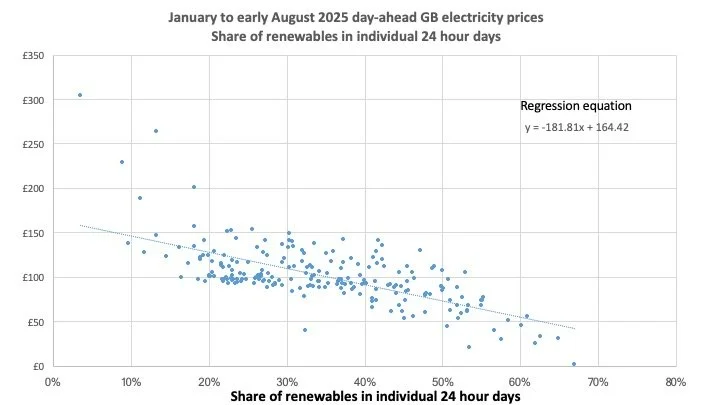
I have based this estimate on simple linear regression (a 'trendline') [3]. This is an unsophisticated approach, particularly since the chart shows that the correlation between renewables and price may not be properly linear. The visual evidence is that very low renewables shares (experienced mostly in a still January) are associated with particularly high prices that are well above the estimate produced by the regression analysis. In addition, days of very high renewables penetration as seen in the summer months seem to have lower prices than expected. These days sometimes saw wind and solar providing more than 50% of total power generation and prices far below the level projected by the regression line.
Another criticism that might be made of this regression analysis is that mixes months of typically high prices (January to March) with a period of much lower prices (April to August). If the winter had low winds, and the summer had high solar output, the apparent fall in price as a result of high renewables share would actually be caused by inter-seasonal variations, not the direct effect of increased wind and solar.
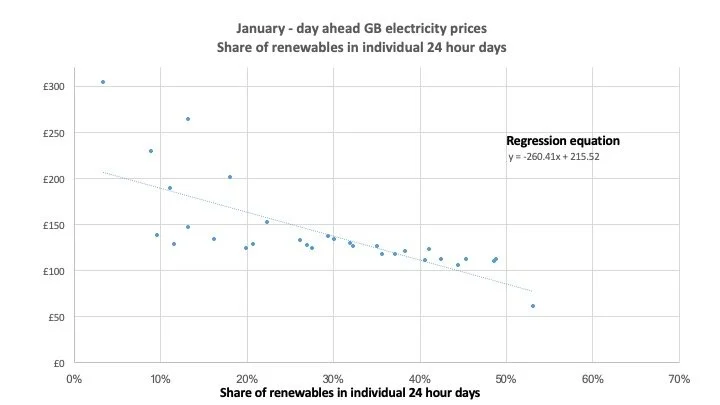
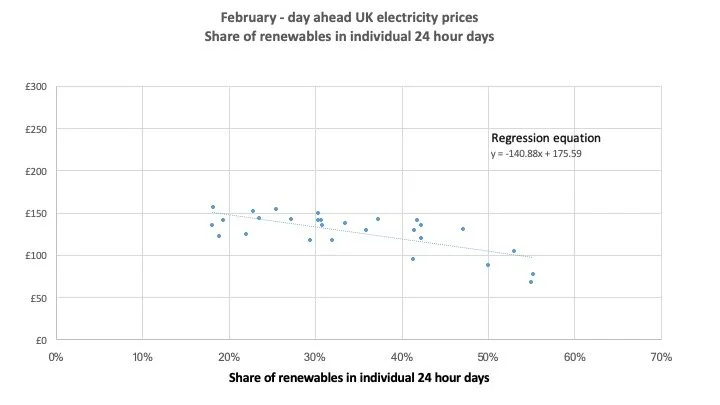
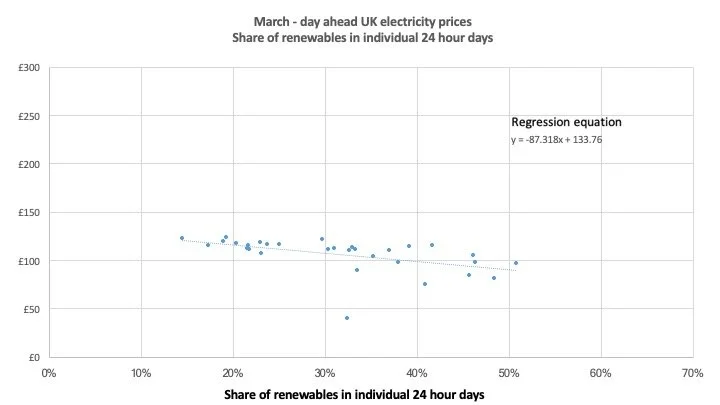
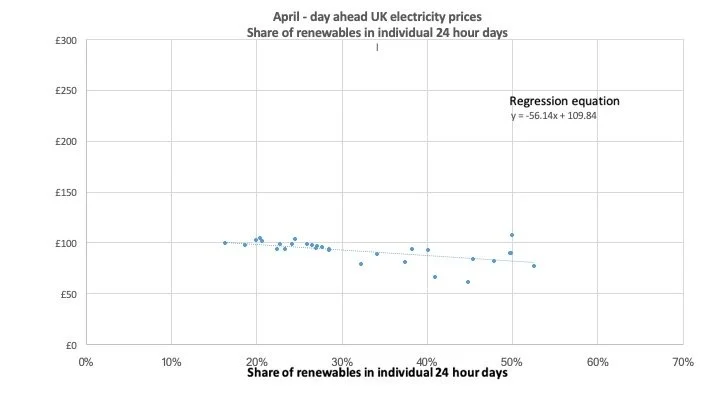
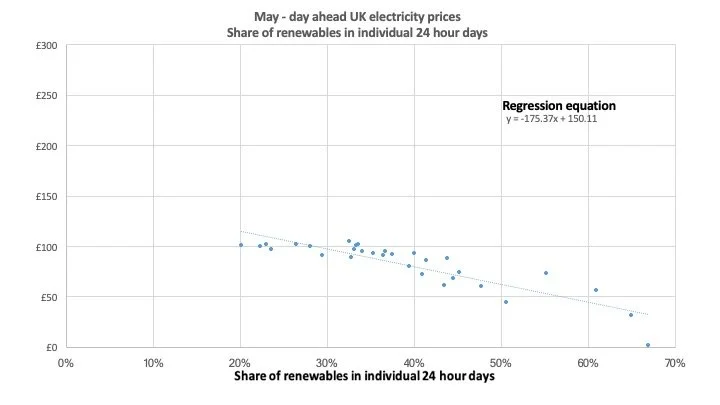
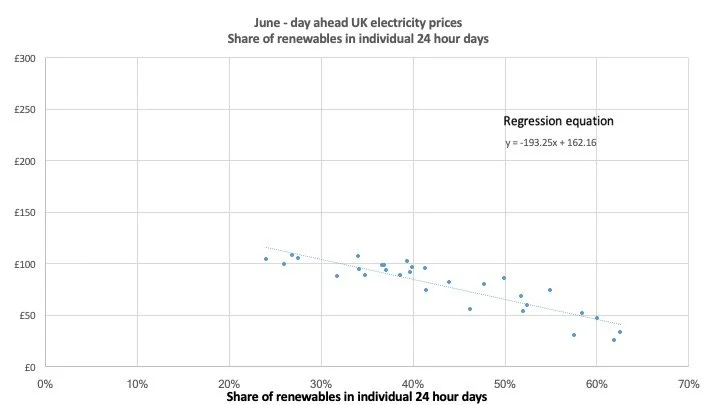
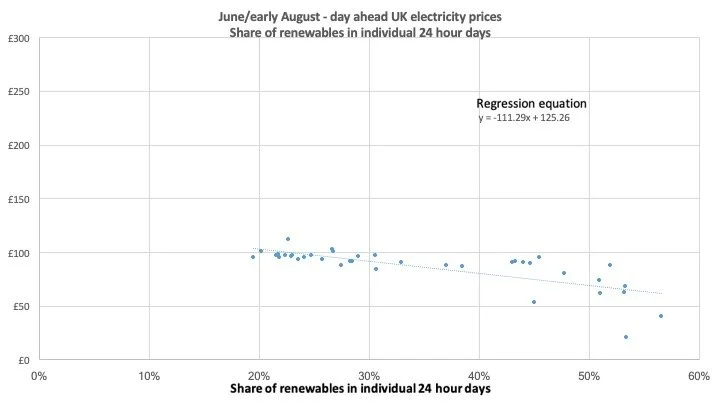
But, very largely, that is not what happened. The following 7 charts examine the relation between wind and solar percentage and the day-ahead price in each month of the period studied. In every month, higher renewables penetration is associated with lower prices. The fall in price as renewables move from 20% to 50% of total generation in each month is generally not quite as large as the main chart suggests but the effect of high wind and solar is still substantial.
In March and April, the fall in wholesale electricity price as a result of a 50% renewables share compared to a 20% share was £29 and £19 per MWh respectively. These were the low months; in May and July the figures were £58 and £64 respectively. January showed the largest effect of of a fall of £87 per MWh resulting from a renewables increase from 20% to 50% of all power production.
More renewables on the GB grid unambiguously reduces the wholesale price, typically by a large percentage. Absent any other effect as the UK continues to add wind and solar, power prices will come down sharply. This is, of course, what we have seen already in many countries around the world.
Figure 2
[1] The 'day ahead' price of electricity is the auction price agreed between suppliers and purchasers of electricity for power to be delivered the following day. I couldn't find an accurate figure but the estimates I came across suggested this market represents about 20% of all wholesale electricity transactions.
[2] I use the word 'renewables' in this note to refer to wind and solar output and do not include hydro or biomass or other low carbon sources of electricity.
[3] The equation for the trendline is shown on each chart. Please contact me for any other details you want.
Sourced in "It's Over" by The Funk Master - main sample is at 1.56 - "not a little girl anymore / used to be the one I adore / but there's plenty more fish in the sea / for meee".
Also used is "too many times you made the plunder by tellin' me / You'll be with me"
Amazing how Chris Mack turns that "be with me" into this sensually sinister loop...
Vocal science! Vocal sorcery!
The mood and feel of the original is completely transformed
The track's slinky-and-twitchy production is incredible: a sort of sublime fussiness, a palsied panache.Those dramatic slashes of.... strings? .... are like intensifications of the way staccato strings are used in Chic to slice across the soundscape.
It's avant-pop where the avant and the pop are equally strong
Flipside also fabulous
What do you know, the Funk Master tune was actually a Top Ten hit in the UK
Chris Macfarlane, true hardcore hero and Exhibit A in the Case for Nuumological Continuumity
A playlist I made of his entire uuurrrvvvv (near as dammit anyway - 164 tunes + remixes) running through hardcore, jungle, UKG, 2step
Wonder what he's doing now...
Block to the Future [ 17-Aug-25 7:44pm ]"It may be that Britain - and much of Europe - is in a similar moment to that described by Clark just before 1848: on the edge of a new kind of society we don't yet have the language to describe. It feels frightening because without that language it is impossible to have coherent dreams of the future. To build a better world, you need an idea of what should change and how.
And one of the things preventing that may be our obsession with constantly replaying the past. In the present age, the fog of experience has been thickened by the mass of recorded data that allows the recent past to be endlessly replayed, refusing to fade away. A constant loop of nostalgia - music, images, films and dreams from the past. It is another block to the future. And it is also the way this series is made. My bad."
Adam Curtis talking about his new-ish program Shifty
"You have this constant pantomime of hysteria which screws with your idea of time and yet it's almost like you're treading water. Nothing is actually happening. No one actually comes up with anything new. There are now four films being made about The Beatles. Four major movies about The Beatles. That's like people in the 1960s listening to a musical from the time of Queen Victoria. It's extraordinary! We're trapped!"
"Taylor Swift is such a prim 1950s, almost Doris Day figure. That's not to diss any of what she's saying but it's quite held together in time and I don't think that expresses now."
"What you're left with now is this weird psychodrama-scape of everyone knowing that everyone is performing. The real self has completely disappeared deep within your and my minds and you'll never find it."
Adam Curtis also talking up and around his new-ish program Shifty
I really enjoyed 'Out to the Dancers', a conversation between Emma Warren and Ezra Collective's Femi Koleoso at the South Bank Centre's Purcell Room, centred around what dancing means to them in different ways (8 August 2025).

A key theme was around inclusivity - who gets to dance, how and where? In answer to the opening question, 'What makes a great time on the dance floor?', Femi expanded on Emma's ingredients of space and sound by adding inclusivity - 'I think dancing is like almost a human expression of feeling welcomed. And it's very difficult to dance, if you don't feel welcome somewhere.... I think if you can make people feel included, they dance'.
As a young black man growing up in London Femi has of course had a particular experience of what welcome means. As he recalled, planning for a night out was always accompanied by the nagging worry of whether he and all his friends would actually get in. There was an interesting discussion about doors, Emma talking of the excitement of the bass rattling of the door as you approach it, 'the door as a kind of holder of the sound' promising how you will soon be feeling the music inside. Femi said that he hated that very moment, carrying with it the threat of rejection at the final hurdle after all the queuing. No wonder he said he preferred dancing outside with one less door to negotiate.
Interesting to see how this perspective plays out in Ezra Collective's approach to performance - 'the party starts on stage and everyone's invited' with a conscious effort to make people in the audience feel included, something I really felt when I saw them.
The talk was part of the South Bank's summer programme 'Dance your way home', inspired by Emma's book of the same name and featuring a month of dance-themed events. In fact while the talk was going on hundreds of people were dancing on the riverside terrace outside to Deptford Northern Soul Club.


'Out to the Southbank dancers' - Emma Warren's mini-zine for the events
Looking forward to reading Emma's new book on youth clubs, out soon.
(thank to Jools for photo of Emma and Femi)

Three "Rights" listed in the London Bus Drivers Bill of Rights —
- The Right to a safe work schedule without any forced overtime or loss of pay
- The Right to a decent and proper rest break in the working day
- The Right to be treated with dignity and respect by our employers, TfL and the public
— underscore the extent to which the system in which TfL negotiates, agrees and enforces its Bus Performance Contracts is broken. But there's something deeply broken about a Public Surface Transport System the compels its own workers to be complacent about Fatigue even before they start the job.
Among TfL's Bus Contractors a Fatigue-inducing Practice of forcing new Bus Drivers to sign away their right to a legal 48-hour working week has been quietly normalised. Drivers are compelled to give up this right—not after settling in and understanding the full implications of the job—but on Day One, during their Induction.
And the form they're made to sign leaves no room for debate.
This sounds reasonable at first glance, but if you bother to take a closer look, the cracks in the façade will quickly appear. The form doesn't ask for consent — it assumes it. There is no box to tick "NO," no space provided for the Driver to object and no explanation is provided for what this 'agreement' actually means in practice. It is a pre-written obligation that's disguised as a choice. And the timing? Just as the hopeful new recruit walks into the job for the first time."As an Employee of [INSERT TfL BUS OPERATOR NAME HERE] , I agree of my own free will and individual choice to opt out of the average maximum working week of 48 hours contained within the Working Time Regulations 1998. If you wish to withdraw from this agreement, please speak to the Trainer on your Induction."
This document doesn't only reflect bureaucratic complacency: it is coercion wearing a smile.
The Illusion of "Free Will" to choose Working Hours.
The document's phrasing is deliberate: "I agree of my own free will and individual choice." This is legal theatre. A performance designed to bypass the spirit of worker protections by putting the burden of refusal on the most vulnerable: new Bus Driver hires.
This form: which asks New Bus Driver Hires to opt out of the legal 48-hour weekly working limit is given to the prospective employee before he or she even officially starts, usually a few days or a week ahead of his or her induction day. On Induction Day, the Operators assiduously check if all pre-employment forms—including this one—are completed and signed. If anything is missing, your application may be paused or even stopped altogether. For some documents, Bus Operators might offer assistance. But with this one, the approach is more blunt: "Sign it, and if you want to opt back in later, sort it out after you've started."
"I understand that this agreement will continue unless I decide to terminate it by giving four weeks notice in writing addressed to my Operations Manager."
In plain English: if you don't want to agree now, you're either out of the running — or locked in for four weeks of whatever hours the company demands—with no guarantees of ever receiving a manageable schedule.
This is not informed consent. This is institutional pressure hiding behind a paper shield.
A Legal Loophole Becomes Standard Operating Procedure.The Working Time Regulations 1998 were designed to protect workers from burnout and exploitation. At their heart is the 48-hour average weekly limit — a safeguard for both physical and mental health. But these regulations include an "opt-out" clause that employers can use — provided the worker consents.
And therein lies the catch. Consent should be both informed and voluntary. But in TfL's dark corner of the UK transport industry, consent is to a signature at the end of a line you cannot edit. It has become so normalised that many Drivers no longer question it. They simply accept that if they want the job, they sign the form — and brace themselves for 50, 55, or even 60-hour weeks, often with unpredictable shifts and only the bare minimum of legal rest between them.
No Perks. No Overtime Pay. No Choice.
A Broken Industry Founded Upon Broken Promises.
Bus driving is already one of the most demanding jobs in London. Drivers manage thousands of passengers a day, navigate unpredictable traffic, deal with verbal abuse and threats, and are still expected to maintain perfect punctuality despite impossible schedules. It's no wonder the industry is facing a recruitment and retention crisis.
And yet, instead of addressing these systemic issues — poor pay, long hours, safety risks, understaffing — TfL's solution has been to permit its Bus Contractors to lean harder on the people who show up every day. This opt-out form is a symptom of a deeper systemic disease: tt reveals how TfL contracts its Bus Contractors to treat time, energy, and health as infinite resources that they can consume without human costs so that Bus Users are satisfied and Bus Companies are profitable. The opt-out form shows how easily "choice" becomes manipulation when the power dynamics are skewed entirely in favour of the unaccountable. And this form proves that exploitation doesn't start after a London Bus Driver gets behind the wheel: it starts the moment he or she is handed a pen.
The Fight for Change Begins with Awareness.
If the Mayor and TfL are serious about fixing London's well-evidenced record of failing Bus Safety Performance, they must start with Transparency. The Mayor and TfL must prevent Bus Contractors from pretending that this opt-out form is a fair agreement. They must stop Bus Operators from assigning "free will" to Bus Drivers decision to sign it when they know it's anything but. And the Mayor, TfL and the Bus Operators must stop expecting workers to sacrifice their wellbeing in Silence. London's 'world leading' Public Bus Network only runs because of its Drivers. Without them, the city doesn't move. The least these Drivers deserve is respect: and that starts with giving them a real choice about their working hours, not a rubber stamp that condemns them to a working life hobbled by Fatigue.
When 'Protection' Becomes Permission.
The pressure for Bus Drivers to sign the opt-out of a 48-hour week is a systemic fact, and the implications upon Working Conditions are serious: yet it appears Unite has complacently allowed this opt-out clause to thrive without any challenge.
No formal objection. No legal pushback. No 'grassroots' campaign from Unite to demand a restructured, transparent opt-in system.
If Unite truly represented the interests of its Bus Workers, it would demand:
- That all Working Time Agreements present a real choice: with a clear 'yes or no' checkbox.
- That opting in or out does not affect Bus Workers' Job Offers or Career Progression.
- That Bus Drivers can challenge unrealistic rotas without the fear of being disciplined or isolated by their managers.
When Unite the Union—the very institution that's meant to stand up for London's Bus Workers—has complacently accepted the Employer's line for decades, then something is deeply broken...and unjust.
The reality: before a London Bus Driver even starts up an engine, he or she is already being asked to surrender a fundamental workplace right: not through open dialogue, but through a form that's presented to him or her as a perfunctory formality.
The message is clear: if you want the job, you'll play by the rules that are already well stacked against you. And if those rules exhaust you, or endanger your well-being or others in your bus or on the road? That's your fault: you've already signed away your leverage.
What makes the current situation worse is the silence from those who should be shouting the loudest. A Union that turns a blind eye, or worse, plays along, isn't protecting anyone. It's simply helping to keep TfL's contracted 'Killing Machine' running day-in, day-out.
This isn't about paperwork: it's about power. And until the Mayor and TfL start asking the right questions—and demanding real accountability from Bus Operators and Unite the Union—Bus Drivers will keep being pressured to drive fatigued and powerless to change things.
And increasing numbers of lives and livelihoods will be lost as a result of a Franchised Public Bus Operation—under the complete control of the Mayor of London—that refuses to make Driver Welfare and Public Safety a Priority.
One of the things I've found out the hard way over the past year is that slowly going blind has subtle but negative effects on my productivity.
Cataracts are pretty much the commonest cause of blindness, they can be fixed permanently by surgically replacing the lens of the eye—I gather the op takes 15-20 minutes and can be carried out with only local anaesthesia: I'm having my first eye done next Tuesday—but it creeps up on you slowly. Even fast-developing cataracts take months.
In my case what I noticed first was the stars going out, then the headlights of oncoming vehicles at night twinkling annoyingly. Cataracts diffuse the light entering your eye, so that starlight (which is pretty dim to begin with) is spread across too wide an area of your retina to register. Similarly, the car headlights had the same blurring but remained bright enough to be annoying.
The next thing I noticed (or didn't) was my reading throughput diminishing. I read a lot and I read fast, eye problems aside: but last spring and summer I noticed I'd dropped from reading about 5 novels a week to fewer than 3. And for some reason, I wasn't as productive at writing. The ideas were still there, but staring at a computer screen was curiously fatiguing, so I found myself demotivated, and unconsciously taking any excuse to do something else.
Then I went for my regular annual ophthalmology check-up and was diagnosed with cataracts in both eyes.
In the short term, I got a new prescription: this focussed things slightly better, but there are limits to what you can do with glass, even very expensive glass. My diagnosis came at the worst time; the eye hospital that handles cataracts for pretty much the whole of south-east Scotland, the Queen Alexandria Eye Pavilion, closed suddenly at the end of last October: a cracked drainpipe had revealed asbestos cement in the building structure and emergency repairs were needed. It's a key hospital, but even so taking the asbestos out of a five story high hospital block takes time—it only re-opened at the start of July. Opthalmological surgery was spread out to other hospitals in the region but everything got a bit logjammed, hence the delays.
I considered paying for private private surgery. It's available, at a price: because this is a civilized country where healthcare is free at the point of delivery, I don't have health insurance, and I decided to wait a bit rather than pay £7000 or so to get both eyes done immediately. It turned out that, in the event, going private would have been foolish: the Eye Pavilion is open again, and it's only in the past month—since the beginning of July or thereabouts—that I've noticed my output slowing down significantly again.
Anyway, I'm getting my eyes fixed, but not at the same time: they like to leave a couple of weeks between them. So I might not be updating the blog much between now and the end of September.
Also contributing to the slow updates: I hit "pause" on my long-overdue space opera Ghost Engine on April first, with the final draft at the 80% point (with about 20,000 words left to re-write). The proximate reason for stopping was not my eyesight deteriorating but me being unable to shut up my goddamn muse, who was absolutely insistent that I had to drop everything and write a different novel right now. (That novel, Starter Pack, is an exploration of a throwaway idea from the very first sentence of Ghost Engine: they share a space operatic universe but absolutely no characters, planets, or starships with silly names: they're set thousands of years apart.) Anyway, I have ground to a halt on the new novel as well, but I've got a solid 95,000 words in hand, and only about 20,000 words left to write before my agent can kick the tires and tell me if it's something she can sell.
I am pretty sure you would rather see two new space operas from me than five or six extra blog entries between now and the end of the year, right?
(NB: thematically, Ghost Engine is my spin on a Banksian-scale space opera that's putting the boot in on the embryonic TESCREAL religion and the sort of half-baked AI/mind uploading singularitarianism I explored in Accelerando). Hopefully it has the "mouth feel" of a Culture novel without being in any way imitative. And Starter Pack is three heist capers in a trench-coat trying to escape from a rabid crapsack galactic empire, and a homage to Harry Harrison's The Stainless Steel Rat—with a side-order of exploring the political implications of lossy mind-uploading.)
All my energy is going into writing these two novels despite deteriorating vision right now, so I have mostly been ignoring the news (it's too depressing and distracting) and being a boring shut-in. It will be a huge relief to reset the text zoom in Scrivener back from 220% down to 100% once I have working eyeballs again! At which point I expect to get even less visible for a few frenzied weeks. Last time I was unable to write because of vision loss (caused by Bell's Palsy) back in 2013, I squirted out the first draft of The Annihilation Score in 18 days when I recovered: I'm hoping for a similar productivity rebound in September/October—although they can't be published before 2027 at the earliest (assuming they sell).
Anyway: see you on the other side!
PS: Amazon is now listing The Regicide Report as going on sale on January 27th, 2026: as far as I know that's a firm date.
Obligatory blurb:
An occult assassin, an elderly royal and a living god face off in The Regicide Report, the thrilling final novel in Charles Stross' epic, Hugo Award-winning Laundry Files series.
When the Elder God recently installed as Prime Minister identifies the monarchy as a threat to his growing power, Bob Howard and Mo O'Brien - recently of the supernatural espionage service known as the Laundry Files - are reluctantly pressed into service.
Fighting vampirism, scheming American agents and their own better instincts, Bob and Mo will join their allies for the very last time. God save the Queen― because someone has to.

Jordan Uncovered is a small exhibition of personal photos of first wave punk icon Jordan (Pamela Rooke, 1955-2022), put together by Andrew James and Darren Coffield. Working at Sex in the Kings Road, starring in Derek Jarman's Jubilee, and managing Adam and the Ants, Jordan was one of the people who in effect created the punk look, at least in its 1970s London incarnation. Sometimes its not the people in the bands who are the most influential in defining a subcultural aesthetic, it's also the faces in the scene and that was certainly the case with Jordan. Later in life she returned to her love of animals and became a veterinary nurse on the south coast.


 Jordan and Jarman
The exhibition is at Colony Room Green in Heddon Street, Mayfair, a basement bar reviving the original Colony Room Club which closed in 2008. There's lots of memorabilia from the famous Soho Bohemian drinking den, with some drinks still on sale at 2008 prices. A friendly place for a drink in this part of town.
Exhibition closes 22 August 2025

Lewisham protest, 1 August 2025
In the past few weeks many 'Stop Starving Gaza' pots and pans protests called by the Palestine Solidarity Campaign have been held around the UK:
'Palestinians in the Gaza Strip are starving to death due to Israel's blockade - a blockade designed specifically to use starvation as a weapon of war and of genocide. We've all seen the haunting images of Palestinian adults and children reduced to skeletons, the exhausted people holding empty pots and pans waiting for any small amount of food aid available, and cruelly, often meeting their deaths this way. Nearly 1,000 Palestinians have been shot to death by Israeli soldiers whilst queuing for food' (PSC)
I took part in one in Lewisham, South London where a 200+ people turned out and banged pans in solidarity with Gaza. On the same day (1 August 2025), Georgina Cook took part in a similar event in Hastings, and at her substack she has reflected on this kind of public gathering:
'It sounds the alarm. Turn's pots and pans, the very tools that should prepare nourishment, into instruments of protest against weaponised hunger. It alerts our neighbours and community that plenty of people oppose this weaponisation of hunger, as they do the wider genocide that it's part of, despite the involvement and/or complicity of our governments and media [...]
'The simple act of showing up with a saucepan might not stop a genocide, but it reminds us that we're not as alone or as powerless as so many of us feel. It creates a moment where the silence around atrocity gets punctured by the clatter of kitchen utensils'
As Georgina mentions, historian Matthew Kerry has written of the radical history of this practice which in its modern form he traces back to 1970s Chile:
'Pots and pans are some of the least offensive objects in the kitchen, yet their very mundanity and the ease with which they can be employed by anyone to contribute to a deafening wall of noise make them a media-friendly, uncomfortable reminder of the collective conscience and a challenge to the voice of the state. Pot-banging is malleable to different political contexts, from dictatorships to democracies, as well as spatial performances, including refuge or confinement in the home [...] Despite attempts to quash noisy protests, the history of pot-banging and its radical mundanity suggests the clanging discordant beat of pots and pans will echo on. (Radical Objects: the Pot and Pan, History Workshop, 2024)
Banging pots has also been a feature of protests in Myanmar against the military government that took power in a coup in 2021 where punks formed a collective named Cacerolazo after the Spanish name for this kind of protest (the name derived from Spanish word for "casserole"). As a form of protest it is particularly associated with women in Latin America and women. A 2002 manifesto of the Housewives Union in Argentina (Sindicato de Amas de Casa de Santa Fe) argued at a time of economic crisis and austerity:
'Although women have always been involved in the popular struggle, from the Indigenous and slave rebellions at the time of the Conquest, to the movement of the mothers during the dictatorship, to today's "cacerolazo," we have not been listened to and our demands have been postponed in the name of "more urgent" needs. Other women in Latin America and in the world are banging their pots not only in support of the Argentinian people but on their own behalf, because beyond national realities, we women have needs and demands which bring us together as sisters'.
Commenting on this manifesto, Krista Lynes remarks 'The cacerolazo is thus a special drumbeat—a beat that announces through the mundane materiality of kitchen tools the publicity of the private in the face of the privatization of the public sphere' (quoted in Feminist Manifestos: a Global Documentary Reader, edited by Penny A. Weiss, 2018). In the case of Palestine today today though we have to raise noise against something more - the extinction of both the private and the public sphere through starvation, slaughter and destruction.


(photos from Stop Starving Gaza protest at Lewisham Clock Tower, 1 August 2025)
For starters, there is the theme tune.
An instrumental that lies somewhere between UKG and Deep Tech - it sounds a bit like if an Eski-era grime producer decided to make a house track.
Then there's some of the musical guests on the show, who have either been pure Nuum - Craig David - or Nuum-adjacent (Katy B, Tinie Tempah).
The guests chosen often seem to come from around that 2010-2011 moment - which must be when the typical contestant on the show would have been 9 or 10. Perhaps there's a sort of nostalgia appeal for the contestants, a flash back to watching Channel U or listening to your older brother or sister's music. Although quite a few of these artists would have been on the Top of the Pops.
And then there is the fact Chris & Kem from the third season of Love Island, revealed an ability to rap in the Talent Show episode of that 2017 season. This resulted in their recording a not-bad at all grime-ish single that incorporates Love Island-slang and which reached #15 in the charts and
"Little Bit Leave It" came out on Relentless, the UK garage label. Nuumy!
Stormzy also made a non-musical appearance in the 2017 season, with a video clip apologizing for a tweet about one of the prominent female contestants and also giving some tips to Kem & Chris ("I can give you advice about the raps - you can't use the phones")
Certain contestants over the years have actually been performers in "urban" bands as singers or backing dancers (e.g Cach, from the winning couple this year).
^^^^^^^^^^^^^^^^^^
How about that season finale then?
They should really have bent the rules and allowed two girls to count as a couple, given that Toni and Shakira were clearly the stars of the season and theirs is the true love story here.

Toni has the best tone and cadence since Liza Minelli.

In another era, some impresario would have spotted Shakira's incandescence and whisked her off to Elstree - or more likely, given her gumption, she'd have made her own way to Hollywood, like Cary Grant et al did. There she'd have been screen-tested and put through the studio system finishing school (what a shame though for elocution to override that delicious accent) and emerged as a star.

If she can half-way act, it could still happen.
More likely, in this day and age, she'll be famous for being herself, a public personality.
With any luck, she'll drift from entertainment into politics and sort out all our problems.
regurgitating a past that never existed / regurgitating a critique that's 14-years--old (at a bare minimum) [ 07-Aug-25 3:53am ]Martin Ingle oblivious to the irony of banging on about an already banged-to-bits critique
"regurgitating a past that never existed" - apart from that being a contradiction in terms (if it never existed, it could never be consumed in the first place, let alone puked up again for the re-eating), if that is actually what is going on, then it would be quite an interesting state of affairs. Unprecedented, even!
In response to such racist intrusion and killjoy tactics of the police, black youths have taken up the challenge. In Handsworth, Birmingham, several people were injured following a sell out appearance of sugar Delroy Wilson at the Rebecca club. 900 fans were turned away, but many remained at the club in the hope they might be allowed in. The police were called and a battle began. At least 14 police officers were reported injured following the battle' (Socialist Challenge - International Marxist Group, 9 June 1977)

There is currently what amounts to a “war” between the U.S. federal and state governments against specific Chinese drone makers, with the big target being DJI. And a major issue has been what would happen if the many organizations — law enforcement, search and rescue, other public safety, farmers, utilities, on and on — couldn’t continue to obtain or use the DJI drones in particular that they have depended on for years.
And the discussion has been largely theoretical for most of this period because DJI drones, repairs, parts, and service have continued to be available. But now that’s changing and moving beyond the theoretical and into real world effects, and yeah the situation is deteriorating even faster than even most pessimistic observers anticipated.
I’m not going to try review here all the deep details of how we got to this point, except to note that there are multiple aspects. Confusion over rapidly changing tariff rates is one factor. There have been claims that DJI drones have, or maybe in the future could have security issues, though this has never been demonstrated — apparently DJI has passed every security audit conducted on their products.
Many observers have long suspected that what’s really going on is politically-motivated protectionism from politicians in both parties, because the organizations that buy DJI drones apparently consider them to be more affordable, reliable, and rapid to obtain compared with currently available U.S. made alternatives. And remember we’re not talking just about little DJI drones you can hold on your hand, they also have very large drones that farmers use to spray crops, and big drones that can lower or gather heavy payloads in rescue situations in isolated, rugged areas and so on.
But now, with this confluence of factors, including U.S. Customs reportedly pretty much choking off the supply of DJI products into the U.S., we’ve reached a point where the rest of the world can buy these advanced DJI drones, including new ones just recently released and others likely to be very soon released, but the U.S. is cut off. The supply of DJI products has dried up in the U.S. Out of stock virtually everywhere. Repairs are reportedly taking longer, and parts are difficult or impossible to obtain.
DJI is still trying to get a government agency to do the security review mandated by the National Defense Authorization Act as passed by Congress, and the deadline that would trigger an associated DJI drone ban is at the end of this year. The whole situation is completely nuts.
In Florida, the state government ordered official usage of DJI drones stopped. That means grounding 200 million taxpayer dollars of drones used for police work, fire fighting, mosquito control and more. And the state is apparently only willing to provide a tenth of that much to replace them with U.S. made drones that are typically many times more expensive than DJI drones, and sometimes take months rather than days to obtain.
In some states 90% of public safety drones are DJI. Their drones are known to be exceptionally reliable. An Orlando police department indicated that they had five failures of “approved” U.S. made drones over a year and half, but no failures among the DJI drones they’d been using.
We could keep going through the statistics and more of these cases but you get the idea. We all want a strong domestic drone industry, but agencies and other groups who rely on DJI drones in the U.S. are being cut off from vital technology that the rest of the world can still easily obtain. There haven’t been publicly demonstrated security problems with DJI drones despite the alarmist hype from the politicians.
This entire mess does appear to be politically driven and BOTH parties are to blame. These politicians need to stop this craziness, because they’re not just putting important U.S. businesses and other organizations at risk with this drone ban nonsense, they’ll be putting U.S. lives at risk as well. That’s irresponsible and it really needs to stop, RIGHT NOW!
–Lauren–
isolatedmix 134 - Artefakt [ 04-Aug-25 12:01am ]
The Dutch duo of Robin Koek and Nick Lapien, known together as Artefakt, have long been shaping their own atmospheric corner of techno. Bridging the meticulousness of academic sound design with an ever-present emotive pulse, their work has resonated deeply across releases for labels such as Delsin, Semantica, Field Records, and their own De Stijl imprint.
They've always struck a balance between abstraction and function, a rare knack for making club-appropriate music that still rewards deeper, solitary listening. That tension surfaced memorably in tracks like "The Fifth Planet" or "Somatic Dreams," but perhaps most personally, in "Entering The City", a track that found its way into my Reflection on 2017 mix and still holds that special late-night gravity for me, many years on.
Their contribution to the isolatedmix series lands as an expansive meditation on contrast and communion. As the duo describe it:
"This recording came together for us imagining being in spaces of sonic isolation - conversing with each other and through this act of exchange, unfolding a dynamic landscape. This emerges as an auditory refuge where we become the waves. As we navigate this appearing structure, we re-anchor ourselves as listeners, embracing the ephemeral and reconciling with strangeness to find solace in deviation.
The mix also draws from a lifelong inspiration that runs as a thread through our own music - the contrasts between natural textures, organic decay and fractal blooming sounds set against the quantization, designed function and electric qualities of the built city and the futures they represent, captured in musical imagination. The mix invites listeners to dwell in this synthesis of spaces, discovering connection within isolation."
This is Artefakt working in longform and dictating progression, where subtle shifts feel tectonic and sequences unravel like a conversation across timezones. There's techno here, but blurred through the lens of wide-angle composition - a unique trance-like state that mimics their unique dance-floor rituals.
astrangelyisolatedplace · isolatedmix 134 - ArtefaktListen on Soundcloud, the ASIP Podcast or the 9128.live iOS and Android app.
~
Artefakt Bandcamp | Soundcloud | Instagram
Pete Shelley tribute
Pitchfork, December 8 2028
by Simon Reynolds
The first and only time I saw Buzzcocks play live was in 2012, at the Incubate festival in Holland. They seemed an incongruous choice for a festival otherwise dedicated to experimentalism and dark cutting-edge fare. Although I love the band's late-1970s output, I never would have actively sought out their live incarnation as a pop-punk legacy act; it was exactly the sort of nostalgia-appealing operation that would usually earn my stern disapproval. It was mild curiosity, really, that drew me into the big hall—only to be stunned by the power and glory of the noise wrought by the worse-for-wear-looking survivors on the stage.
Classic after classic smashed into the crowd's collective face like surf. I found myself doing something embarrassingly close to a pogo. It was wonderful, every bit of it—even a strange new mid-section to "Harmony In My Head" that involved Steve Diggle delivering a kind of quasi-insurrectionary rap. This appeared to bemuse Pete Shelley as much as the audience and prompted him to gasp into the mic, "What the fuck was that?". I had turned up expecting something rote and stale; instead I was jolted alive.
Whenever I listen to Buzzcocks' music, what always strikes me is how modern it still sounds. But that is actually how it works with true innovation. No matter how much time passes—decades during which a breakthrough is assimilated and worn out by repetition, whether by others or by the artist repeating themselves—something of that initial shock of the new rings out and cuts through. And if you think about it, nearly everything handed down to us as "classic" was, in its own time, a break with tradition.
Buzzcocks severed ties with the blues-rooted rock of the early '70s. No Chuck Berry chug for them: instead, Shelley cited Can's Michael Karoli as his favorite guitarist and said that his idea of a great solo was John Lennon's abstract noise eruptions on Yoko Ono's "Why." The name Buzzcocks could almost be onomatopoeia for the noise made by Shelley and rhythm guitarist Diggle: a serrated surge, at once coarse and sleek, with a hint of kinky mischief. Shelley and the band's original singer Howard Devoto found that name from the chance conjunction of words in a magazine headline about the buzz-worthy TV show "Rock Follies," rock-biz satire featuring a tough-girl singer who cheekily addresses everyone as "cock."
Although they were in the original core cluster of groups that invented UK punk, Buzzcocks would always be an anomaly within that movement—misfits among the misfits. There had never been words, a voice, a personality, like this in rock before. Shelley sang love songs when every other major punk vocalist rejected them as trivial next to political themes, or—if they did deal with desire and heartbreak—laced the words with spite and hostility. The aggression in Buzzcocks was all in the sound; the animating spirit was sensitive, open-hearted, vulnerable. There's a lovely clip of Shelley circulating on the internet, interviewed by a TV documentary crew in 1977 when punk gigs in Britain were getting banned by local councils and picketed by hordes of outraged citizenry. Twinkling and grinning adorably, the singer is incredulous at the idea that he could be deemed "vile and obscene."
When punk evolved into post-punk, Buzzcocks didn't fit there either. Although Shelley was well-read and philosophically searching, and although the group's graphic presentation was arty and stark, their tunes and riffs went straight for your pleasure centers; the words were direct, colloquial, accessible to all. Nor did Buzzcocks have much truck with the militancy or didacticism of the post-punk era. The band's politics were personal, verging on private—to do with radical honesty, the struggle to be an individual, to disentangle oneself from games and masks and role-play.
"I think people need a new way of living—inside themselves," Shelley offered gently, when asked about the idea of a political movement by TV interviewer Tony Wilson. People generally assume that Peter McNeish renamed himself Shelley after the Romantic poet, but in that same TV mini-doc about Buzzcocks, Wilson says that Shelley was the name that his parents would have given Peter if he'd been a girl.
That invocation of the she that he might have been connects to a genuine innovation that Shelley introduced to rock and that reflected his fluid sexuality: the deliberate use of gender non-specific pronouns in love songs, something that would hugely influence later lyricists like Morrissey. "There isn't any implied gender in our songs now because we think it's boring singing about one thing when it could apply to both sexes," Shelley told the music paper Sounds in 1977. "Our songs our bisexual."
This elasticity of gender and sexual attraction was one aspect of Shelley's desire to invent a new kind of love song. In a 1978 interview with NME, he described himself as "a modern romantic… trying to find out what modern romance is.. I'm trying to find something new… All the old kinds of romance are self-destructive because they don't take account of realities." On the Buzzcocks' debut album, Another Music From A Different Kitchen, "Fiction Romance" was about the gap between the entrancing dreams propagated by movies and magazines and the aching mess of real-life desire: "I love this love story/That never seems to happen in my life."
Shelley's solution was a radical mundanity, using pained humor to sketch scenarios of humiliation, inadequacy and shortfall, coupled with melody that promised resolution or transcendence. Again, this tension between romance and reality points ahead to groups like Orange Juice and the Smiths. In the Buzzcocks' case, the delicate balancing act between beauty and bathos was never more (im)perfect than on the group's second and third singles: the perpetual unfulfillment of "What Do I Get?" (the answer: sleepless nights in an empty bed), the amorous asymmetry of "I Don't Mind" ("this pathetic clown''ll keep hangin' around, that's if you don't mind").
Although "Ever Fallen In Love (With Someone You Shouldn't've)" continues the theme and is a fan favorite as well as Buzzcocks's biggest UK chart hit, this triptych of anti-romantic love songs is really completed by "You Say You Don't Love Me." The aim here is clarity achieved through a kind of positive disillusionment, serene acceptance of things as they are: "I don't want to live in a dream, I want something real… Though I've got this special feeling, I'd be wrong to call it love/For the word entails a few things that I would be well rid of." In interviews, Shelley talked of his new approach: starting out as friends and hoping romance would grow, rather than falling head over heels and then trying to turn that idealized half-figment of a person into a friend and companion.
In the punk and new wave era, people who would never have previously been considered to be pop star material—on account of their looks or their vocal inadequacies—became household names. Part of the shock of Buzzcocks was the sheer ordinariness of Pete Shelley materializing in the glitzy TV context of "Top of the Pops." With his open-neck button-shirts and slightly shaggy hair, he looked like neither a punk nor a pop star, but more like an office clerk on his lunch break. And he sang like one too.
Shelley might never have become the band's lead singer and lyricist if Howard Devoto had stayed in Buzzcocks. Like Bernard Sumner following the death of Ian Curtis, Shelley took on the frontman role because he and the other members of the band figured it would be easier for an insider to take over singing duties rather than accommodate a new person who might have his own ideas.
But Shelley would have already been a historically significant figure in British punk even if he'd never sung a single tune or written a line of lyric. It was he and Devoto who arranged for the Sex Pistols to play their debut Manchester gig at the Lesser Free Trade Hall on June 4 1976: a much-mythologized event said to have seeded the city's entire punk scene, sparking the careers of Joy Division, the Fall, and Morrissey.
It was also Shelley who persuaded his dad to take out a loan for 250 pounds, the decisive investment in the recording and pressing of Buzzcocks' Spiral Scratch EP, which the band and manager Richard Boon put out on their own New Hormones label. Released in February 1977, Spiral Scratch would be the beacon that mobilized the DIY hordes of punk and post-punk Britain and beyond, inspiring outfits like Desperate Bicycles, Scritti Politti, and Swell Maps to demystify and democratize the means of musical production. Do-it-yourself and release-it-yourself was seen as a righteous war waged against the apathy and ennui so acutely anatomized by Devoto in his lyrics for "Boredom," Spiral Scratch's killer track.
By the time of the EP's release, though, Devoto was bored of punk itself and left the band, taking with him an epic guitar riff generously gifted him by Shelley that would eventually serve as the hook of "Shot By Both Sides," the debut single of his new group Magazine. Shelley and Buzzcocks, meanwhile, decided that persevering on their own regional independent label was not viable and they signed with the major United Artists. In swift succession, over just two compressed and hectic years, there followed the immaculate debut album Another Music in A Different Kitchen and its uneven but endearing follow-up Love Bites (both released in 1978), then the underrated third album A Different Kind of Tension the following year. The last of these was overlooked in its own time, as the rapidly evolving UK scene left Buzzcocks behind.
There was also a string of eight perfect singles, starting with "Orgasm Addict" (a hilarious masturbation anthem that was, in fact, construable as "vile and obscene"). Together these made up Singles Going Steady, the greatest "greatest hits" LP this side of the Supremes, even if most of the inclusions had barely been hits. I vividly remember the disbelief, aged 16, when the gorgeous melodic swirl of "Everybody's Happy Nowadays" and the glittering chimes of "Harmony In My Head" both failed to pierce the Top 20.
In punk-pop perfection terms, Buzzcocks were rivalled only by the Undertones and there was a feeling, albeit a minority viewpoint, that they were the era's Beatles, or should have been. Each single deserved to go straight in at Number One. But there was more to Shelley than power pop, as was revealed on the second side of Singles Going Steady, dedicated to the group's B-sides. These grew steadily less straightforward, culminating in "Why Can't I Touch It," nearly seven minutes of loping almost-funk and radically stereo-separated guitar-slashes, and "Something's Gone Wrong Again," which resembles suspended-animation Stooges, glistening with a coat of frost. The entire second side of A Different Kind of Tension was a Shelley mini-concept album, permeated with existential doubts and askew with a disassociated feeling influenced by LSD. And 1980's "Are Everything," one of the first-phase Buzzcocks' last singles, was even more psychedelic: Shelley took acid for every stage of the process, from recording to mixing, hoping for the rush of revelation to overcome him.
But it wasn't a case of Buzzcocks getting weirder as Shelley expanded his horizons: he'd always had an experimental streak. A few years before punk, Shelley recorded several albums worth of abstract electronic music and some of this 1974 material saw belated release in 1980 as the album Sky Yen. Another 1980 side project was The Tiller Boys, in which Shelley partnered with a Manchester teenager called Eric Random to record the clangorous Neu!-like stampede "Big Noise From the Jungle", which became a favorite on John Peel's BBC radio show. Both Sky Yen and "Big Noise" bore a relationship to a pair of "theoretical groups" Shelley had conceptualized in the years before Buzzcocks: a heavy, hypnotic Krautrock-inspired project called Smash and an electronic entity known as Sky. Unlike Smash, Sky actually "became real… but consisted solely of me," Shelley recalled to Trouser Press in 1983. Made at home with hand-built oscillators and cheap-and-nasty organs, Sky's squalls of abstract electronic noise couldn't have been further from the prim precision and candied catchiness of "Ever Fallen In Love" . Any Buzzcocks fans who splashed out for Shelley's solo album were likely mystified.
When Shelley and Devoto first met it was actually through the Electronic Music Society at the Bolton Institute of Technology in Greater Manchester, where they both studied: Devoto was looking for someone to soundtrack a film he was making. "Peter was an electronics engineer and he was into computers even at that stage," Devoto told me in 2003. With this deep and long-established interest in electronic music and technology, it's hardly surprising that Shelley was quick to notice the potential of the affordable synths and drum machines that became available in the last few years of the '70s.
After the band split up exhausted in 1980, Shelley started working on a solo album with Martin Rushent, the producer who had crucially shaped the Buzzcocks' raw-but-glossy sound on record. The result was the pioneering synth-pop single "Homosapien," yet another in the long line of Shelley should-have-been-a-smash songs (although this time the problem was a BBC ban, on account of its impishly suggestive homo-erotic lyric), and a 1981 album of the same title that blended synths and drum machines with electric guitars. Another parallel universe / alternate history scenario tantalizes here: a world where Shelley pipped the Human League to the post (they also worked with Rushent, to massive success) or became a kind of one-man Pet Shop Boys. You could even imagine a Buzzcocks that didn't split but embraced electronics, gradually becoming a New Order-like force.
Instead, after a couple more unsuccessful electro-pop solo records, Shelley joined with the other ex-Buzzcocks to reform the group along their classic lines. They released their fourth album Trade Test Transmissions in 1993, the first in a series of half-a-dozen albums that were solid but never quite ignited the old spark. In 1994, at fanboy Kurt Cobain's invitation, they toured with Nirvana, a preview of the next 20 or so years of sustained live work.
In the days following Cobain's suicide in April 1994, Shelley—an early adopter of the internet—could be found on a bulletin board of the now-defunct Compuserve commiserating with fans and sharing his very recent memories of hanging out with Kurt. He cycled between self-reproach for not being able to help the troubled singer and deliberately irreverent comments intended to deflate overly pious laments for the fallen rock savior—attitudes he clearly felt missed the point of punk and of Cobain himself.
Shelley's own aim was to be exactly the same size as life, and somehow put that across onstage or on record, despite the inherent artifice of being a performer. That was his interpretation of what punk represented—the artist as unheroic hero, on the same level as the fans. Approachable, unassuming, self-deprecating, Shelley lived out that ideal until the end.

Centuries before photography froze the world into neat frames, scientists, poets, and artists streamed transient images into dark interior spaces with the help of a camera obscura. Julie Park explores the early modern fascination with this quasi-spiritual technology and the magic, melancholy, and dream-like experiences it produced.

A modernist manifesto inspired (controversially) by the Tupi people of Brazil.

Commemorative featuring illustrations of pageants, costumes, and fireworks, later further illustrated by a separate artist, with floral motifs.

Female astronomical first, in 2025 and 1787.
We all want to prevent children from being harmed on the Internet, but exactly how to do this without creating even more problems for them and for adults has turned into quite a complicated and political situation.
There have been broad concerns that various website age verification systems could be privacy invasive, ineffective, and in some cases actually might cause even more harm to children than not having the verifications there in the first place. And now with more and more of these systems appearing — the Supreme Court just declared them legal for states to require for commercial porn sites — we’re starting to see various of these predictions coming true.
Remember that age verification systems — whether for porn sites, or social media sites, or pretty much any site like the situation in China where virtually all Internet usage can be tracked by the government — doesn’t only affect children and teens. No matter your age, you have to prove you’re an adult for access. And that opens up tracking possibilities that many politicians in both parties would love to have here in the U.S, with various state and federal legislation already in place or in litigation. And this quickly creates a situation where your basic privacy involving what sites you visit, what topics you research, what videos or podcasts you view or listen to, on and on, may be seriously compromised in ways never possible before now.
There have already been breaches of age verification systems that publicly exposed users’ identity credentials, a treasure trove for crooks. We can reasonably expect directed hacking attacks at these systems as they expand, and if history is any guide many will be successful. Some of these systems use government credentials, some require credit cards, some are using systems to estimate your age from your face, or by how long you’ve been using a particular email address, and so on.
Many adults who don’t want to hand over a credit card or their driver’s license — and their privacy — to these firms have already found various bypass mechanisms, and it appears that — as expected — kids are already WAY AHEAD of adults at this.
A broad age verification law just took affect in the UK a handful of days ago and is already being widely breached, with it trivially easy to find public discussions with users trading bypass hints and tricks. The degree to which these systems are political theater is emphasized by rules that for example order sites not to tell users that they could use VPNs to bypass the checks in many cases — as if VPNs haven’t been used to bypass geographic restrictions for many years — and most age verification systems are geographically based.
But it actually gets even more bizarre. Some of these age verification systems do indeed try to estimate your age from your face as seen on your camera. Of course if you don’t have a camera on your device or don’t want your face absorbed by these systems you’re out of luck in this respect. For that new UK age verification system, kids very quickly realized they could use a video game that generates very realistic faces to bypass the age verification system. And of course as the nightmarishly advanced AI-based video generation systems continue to evolve — we know where this is headed.
The worst part about all this is that age verification systems broadly applied as some politicians desire, not only have the potential to cut children off from the ability to access crucial information about their own health and safety in cases of abuse, but could actually drive children to all manner of disreputable sites — the kind that can pop up and vanish quickly — that could potentially do them real harm but will never abide by age verification rules.
Age verification seems like an obvious solution to a range of Internet-related problems. But the reality is that many observers feel that it creates more problems than it solves, creating new hacking opportunities and privacy risks, and that in many cases the kids will find ways to bypass it anyway. When trying to fix a complicated problem on the Internet, or anywhere else, the first step probably should be, “Try not to make things even worse.” An idea worth keeping in mind.
–Lauren–
Barbara Tucker diva loop - brilliantly stuttered and ghostified - is taken from what might well be my favorite house track that isn't by Todds Terry or Edwards
sourced deeper
Daily Worker Carnival Dance at Hoxton Baths with 'Real Red Band', December 1931:

Also from 1931, 'Great Boxing Night Revels' at New Greenwich Baths with 'South East London's Finest Dance Floor' and 'the Varsity Revels Band'. Plus Hackney National Unemployed Workers Movement social and dance at Holcroft Road school; Woodcraft Dance at Savoy Ballrooms in Dalston (presumably liked to radical scouting alternative the Woodcraft Folk) [source Daily Worker, 12 December 1931)

From 1934 - Young Communist League Flannel Dance at Bermondsey Library, Spa Road; Relief Committee for the Victims of German Fascism dance at Conway Hall; League Against Imperialism and Negro Welfare Association Social and Dance at the Pindar of Wakefield in Grays Inn Road. Plus some Eisenstein film nights. Also an advert for Nanking Chinese Restaurant at 4 Denmark Street, off Charing Cross Road 'the place for internationalists'
 See also: Anarchist Dances in London, 1890s-1910s
A Split Second / A Taste of Sugar / Erotic Dissidents
Sin, London
Melody Maker, January 21 1989
by Simon Reynolds

A Conventional Boy is the most recent published novel in the Laundry Files as of 2025, but somewhere between the fourth and sixth in internal chronological order—it takes place at least a year after the events of The Fuller Memorandum and at least a year before the events of The Nightmare Stacks.
I began writing it in 2009, and it was originally going to be a long short story (a novelette—8000-16,000 words. But one thing after another got in the way, until I finally picked it up to try and finish it in 2022—at which point it ran away to 40,000 words! Which put it at the upper end of the novella length range. And then I sent it to my editor at Tor.com, who asked for some more scenes covering Derek's life in Camp Sunshine, which shoved it right over the threshold into "short novel" territory at 53,000 words. That's inconveniently short for a stand-alone novel this century (it'd have been fine in the 1950s; Asimov's original Foundation novels were fix-ups of two novellas that bulked up to roughly that length), so we made a decision to go back to the format of The Atrocity Archives—a short novel bundled with another story (or stories) and an explanatory essay. In this case, we chose two novelettes previously published on Tor.com, and an essay exploring the origins of the D&D Satanic Panic of the 1980s (which features heavily in this novel, and which seems eerily topical in the current—2020s—political climate).
(Why is it short, and not a full-sized novel? Well, I wrote it in 2022-23, the year I had COVID19 twice and badly—not hospital-grade badly, but it left me with brain fog for more than a year and I'm pretty sure it did some permanent damage. As it happens, a novella is structurally simpler than a novel (it typically needs only one or two plot strands, rather than three or more or some elaborate extras). and I need to be able to hold the structure of a story together in my head while I write it. A Conventional Boy was the most complicated thing I could have written in that condition without it being visibly defective. There are only two plot strands and some historical flashbacks, they're easily interleaved, and the main plot itself is fairly simple. When your brain is a mass of congealed porridge? Keeping it simple is good. It was accepted by Tor.com for print and ebook publication in 2023, and would normally have come out in 2024, but for business reasons was delayed until January 2025. So take this as my 2024 book, slightly delayed, and suffice to say that my next book—The Regicide Report, due out in January 2026—is back to full length again.)
So, what's it about?
I introduced a new but then-minor Laundry character called Derek the DM in The Nightmare Stacks: Derek is portly, short-sighted, middle-aged, and works in Forecasting Ops, the department of precognition (predicting the future, or trying to), a unit I introduced as a throwaway gag in the novelette Overtime (which is also part of the book). If you think about the implications for any length of time it becomes apparent that precognition is a winning tool for any kind of intelligence agency, so I had to hedge around it a bit: it turns out that Forecasting Ops are not infallible. They can be "jammed" by precognitives working for rival organizations. Focussing too closely on a precise future can actually make it less likely to come to pass. And different precognitives are less or more accurate. Derek is one of the Laundry's best forecasters, and also an invaluable operation planner—or scenario designer, as he'd call it, because he was, and is, a Dungeon Master at heart.
I figured out that Derek's back-story had to be fascinating before I even finished writing The Nightmare Stacks, and I actually planned to write A Conventional Boy next. But somehow it got away from me, and kept getting shoved back down my to-do list until Derek appeared again in The Labyrinth Index and I realized I had to get him nailed down before The Regicide Report (for reasons that will become clear when that novel comes out). So here we are.
Derek began DM'ing for his group of friends in the early 1980s, using the original AD&D rules (the last edition I played). The campaign he's been running in Camp Sunshine is based on the core AD&D rules, with his own mutant extensions: he's rewritten almost everything, because TTRPG rule books are expensive when you're either a 14 year old with a 14-yo's pocket money allowance or a trusty in a prison that pays wages of 30p an hour. So he doesn't recognize the Omphalos Corporation's LARP scenario as a cut-rate knock-off of The Hidden Shrine of Tamoachan, and he didn't have the money to keep up with subsequent editions of AD&D.
Yes, there are some self-referential bits in here. As with the TTRPGs in the New Management books, they eerily prefigure events in the outside world in the Laundryverse. Derek has no idea that naming his homebrew ruleset and campaign Cult of the Black Pharaoh might be problematic until he met Iris Carpenter, Bob's treacherous manager from The Fuller Memorandum (and now Derek's boss in the camp, where she's serving out her sentence running the recreational services). Yes, the game scenario he runs at DiceCon is a garbled version of Eve's adventure in Quantum of Nightmares. (There's a reason he gets pulled into Forecasting Ops!)
DiceCon is set in Scarfolk—for further information, please re-read. Richard Littler's excellent satire of late 1970s north-west England exactly nails the ambiance I wanted for the setting, and Camp Sunshine was already set not far from there: so yes, this is a deliberate homage to Scarfolk (in parts).
And finally, Piranha Solution is real.
You can buy A Conventional Boy here (North America) or here (UK/EU).
"The cracked music archivist" [ 26-Jul-25 12:11am ]Kieran Press-Reynolds, in his Pitchfork column Rabbit Holed, interviews "Music Place, the bonkers archivist fighting against the sterility of music rec hubs today, creating a cursed but beautiful 'breadcrumb trail' across scenes and languages"

Attend live on Tue, May 5, 02026 at 7:00PM PT
Tickets on sale soon
Bayo Akomolafe (Ph.D.) is a philosopher, writer, activist, professor of psychology, and executive director of The Emergence Network. Rooted with the Yoruba people, Akomolafe is the father to Alethea and Kyah, and the grateful life-partner to ‘EJ’. Essayist, poet, and author of two books, These Wilds Beyond our Fences: Letters to My Daughter on Humanity’s Search for Home (North Atlantic Books) and We Will Tell our Own Story: The Lions of Africa Speak, Bayo Akomolafe is also the host of the online postactivist course, ‘We Will Dance with Mountains’. He currently lectures at Pacifica Graduate Institute, California and University of Vermont, Burlington, Vermont as adjunct and associate professor, respectively. He sits on the Board of many organizations, including Science and Non-Duality and Local Futures. In July 2022, Dr. Akomolafe was appointed the inaugural Global Senior Fellow of the Othering and Belonging Institute at UC Berkeley. He has also been appointed Senior Fellow for The New Institute in Hamburg, Germany. Dr. Bayo hopes to inspire what he calls a “diffractive network of sharing” and a “politics of surprise” that sees the crises of our times with a posthumanist lens.

Attend live on Tue, Apr 7, 02026 at 7:00PM PT
at The Interval at Long Now
Tickets on sale soon
Katie Paterson (born 1981, Scotland) is widely regarded as one of the leading artists of her generation. Collaborating with scientists and researchers across the world, Paterson’s projects consider our place on Earth in the context of geological time and change. Her artworks make use of sophisticated technologies and specialist expertise to stage intimate, poetic and philosophical engagements between people and their natural environment. Combining a Romantic sensibility with a research-based approach, conceptual rigour and coolly minimalist presentation, her work collapses the distance between the viewer and the most distant edges of time and the cosmos.
Katie Paterson has broadcast the sounds of a melting glacier live, mapped all the dead stars, compiled a slide archive of darkness from the depths of the Universe, created a light bulb to simulate the experience of moonlight, and sent a recast meteorite back into space. Eliciting feelings of humility, wonder and melancholy akin to the experience of the Romantic sublime, Paterson’s work is at once understated in gesture and yet monumental in scope.
Katie Paterson has exhibited internationally, from London to New York, Berlin to Seoul, and her works have been included in major exhibitions including Turner Contemporary, Hayward Gallery, Tate Britain, Kunsthalle Wien, MCA Sydney, Guggenheim Museum, and The Scottish National Gallery of Modern Art. She was winner of the Visual Arts category of the South Bank Awards, and is an Honorary Fellow of Edinburgh University


