
I have now been in Caracas for 48 hours and the contrast between what I have seen, and what I had read in the mainstream media, could not be more stark.

I drove right through Caracas, from the airport through the city centre and up to posh Las Mercedes. The next morning I walked all through and weaved my way within the working class district of San Agustin. I joined in the "Afrodescendants festival", and spent hours mingling with the people. I was made extremely welcome and invited into many homes - this from a district they tell you is extremely dangerous.
https://www.craigmurray.org.uk/wp/wp-content/uploads/2026/01/caracas11.mp4I must admit I had great fun at this bit.
After this I continued on for miles walking through the residential area and through the heart of the city centre, including Bolivar Square and the National Assembly.
In all of this I have not seen one single checkpoint, whether police or military. I have seen almost no guns; fewer than you would see on a similar tour taking in Whitehall. I have not been stopped once, whether on foot or in a car. I have seen absolutely zero sign of "Chavista militia" whether in poor, wealthy or central areas. I drove extensively round the opposition strongholds of Las Mercedes and Altamira and quite literally saw not a single armed policemen, not one militia man and not one soldier. People were out and about quite happily and normally. There was no feeling of repression whatsoever.
Again, nobody stopped me or asked who I am or why I was taking pictures. I did ask the Venezuelan authorities whether I needed a permit to take photos and publish articles, and their reply was a puzzled "why would you?"
The military checkpoints to maintain control, the roving gangs of Chavista armed groups, all the media descriptions of Caracas today are entirely a figment of CIA and Machado propaganda, simply regurgitated by a complicit billionaire and state media.
Do you know what else do not exist? The famous "shortages." The only thing in short supply is shortage. There is a shortage of shortage. There is no shortage of anything in Venezuela.
A few weeks ago I saw on Twitter a photo of a supermarket in Caracas which somebody had put up to demonstrate that the shelves are extremely well stocked. It received hundreds of replies, either claiming it was a fake, or that it was an elite supermarket for the wealthy and that the shops for the majority were empty.
So I made a point, in working-class districts, of going into the neighbourhood, front room stores where ordinary people do their shopping. They were all very well stocked. There were no empty places on shelves. I also went round outdoor and covered markets, including an improbably huge one with over a hundred stalls catering solely for children's birthday parties!
 Everyone was quite happy to let me photograph anything I wanted. It is not just groceries. Hardware stores, opticians, clothes and shoe shops, electronic goods, auto parts. Everything is freely available.

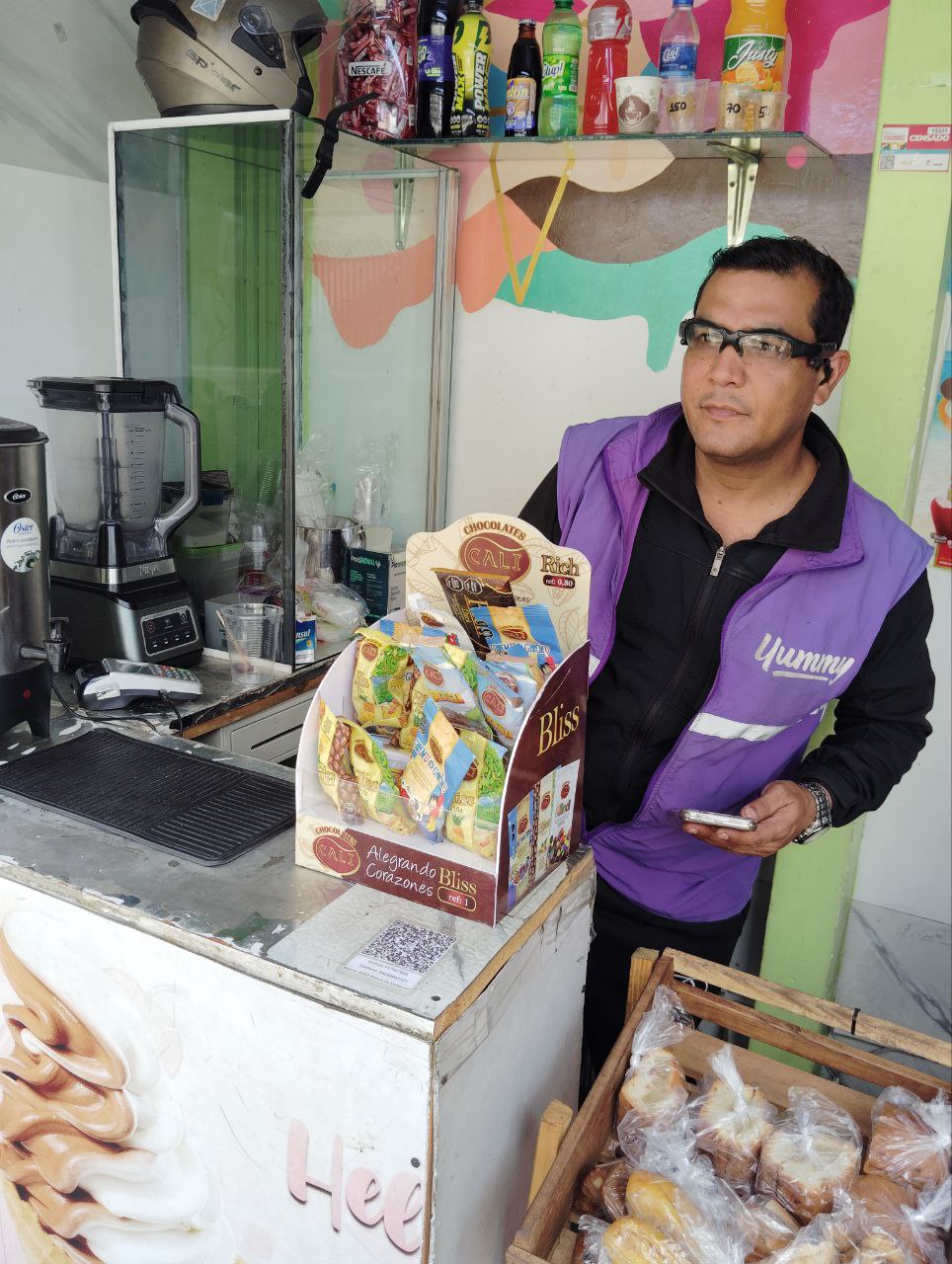
There is a lack of physical currency. Sanctions have limited the Venezuelan government's access to secure printing. To get round this, everybody does secure payment with their phones via QR code using the Venezuelan Central Bank's own ingenious app. This is incredibly well established - even the most basic street vendors have their QR code displayed and get their payments this way. Can you spot the QR codes on these street stalls?

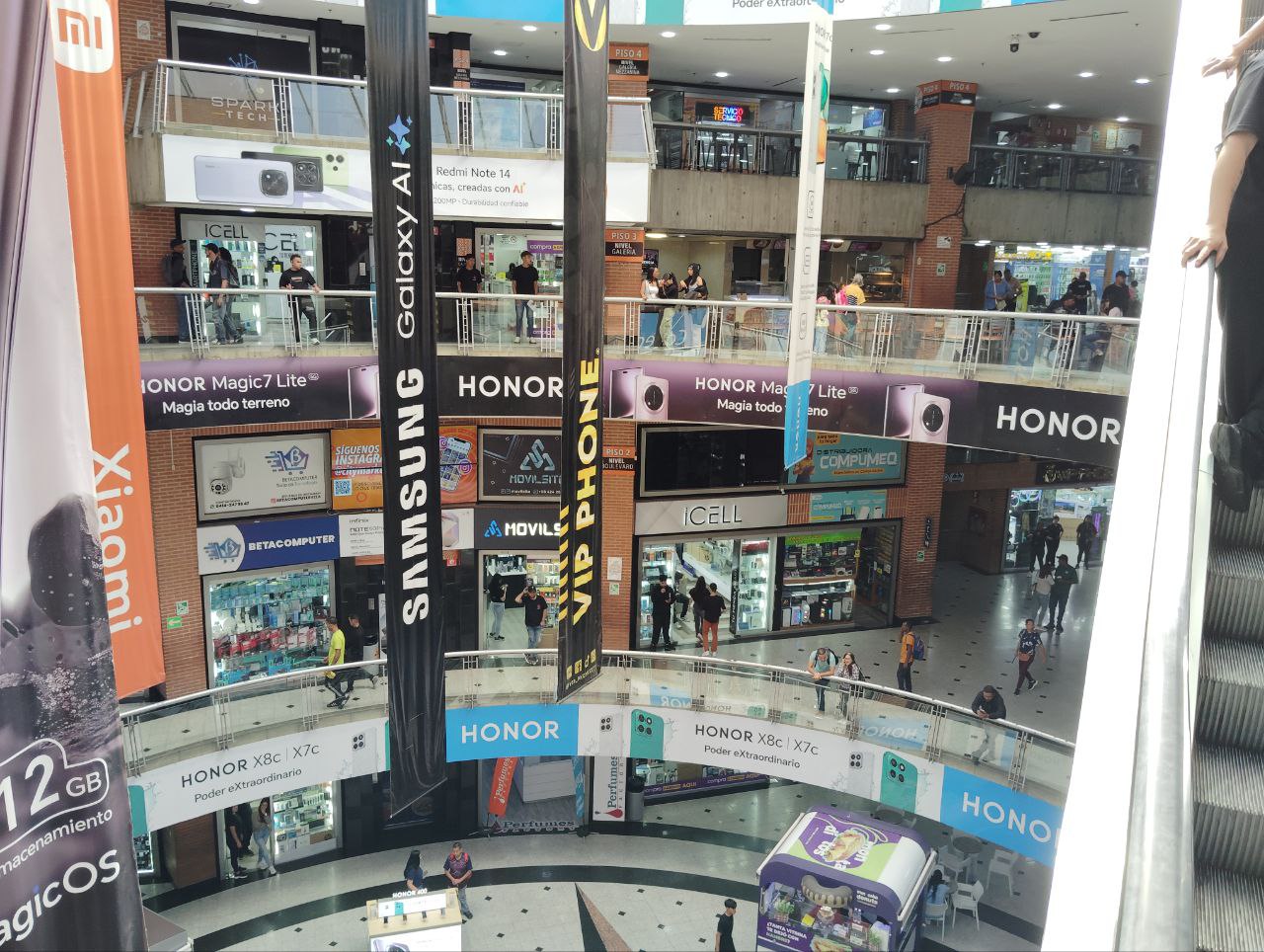
To get a Venezuelan phone and sim card for the internet I went to a mall which specialises in phones. It was extraordinary. Four storeys of little phone and computer shops, all packed with goods, organised in three concentric circles of tiered balconies. This photo is just the inner circle. I picked up a phone, sim card, lapel microphones, power bank, multi-system extension lead and ethernet to USB adapter, all in the first little store I entered.
Registering the sim was quick and simple. There is good 4G everywhere I have been in Caracas, and some spots of 5G.
"Relaxed" is a word I would use for Venezuelans. You could forgive paranoia, the country having been bombed by the Americans just three weeks ago and many people killed. You might expect hostility to a rather strange old gringo wandering around inexplicably snapping random things. But I have experienced no sense of hostility at all, from people or officials.
https://www.craigmurray.org.uk/wp/wp-content/uploads/2026/01/Caracas7-1.mp4The African festival was instructive. A community event and not a political rally, there were nevertheless numerous spontaneous shouts and chants for Maduro. The Catholic priest giving the blessing at the festivities suddenly started talking of the genocide in Gaza and everybody prayed for Palestine. Community and cultural figures continually referenced socialism.
This is the natural environment here. None of it is forced. Chavez empowered the downtrodden and improved their lives in a spectacular manner, for which there are few parallels. The result is genuine popular enthusiasm and a level of public working-class engagement with political thought that it is impossible to compare to the UK today. It is the antithesis of the hollowed out culture that has spawned Reform.
I am very wary of Western journalists who parachute into a country and become instant experts. Although the stark contradiction between actual Caracas and Western-media Caracas is so extreme that I can bring it to you immediately.
Pretty well everything that I have read by Western journalists which can be immediately checked - checkpoints, armed political gangs, climate of fear, shortages of food and goods - turns out to be an absolute lie. I did not know this before I came. Possibly neither did you. We both do now.
I had lived for years in Nigeria and Uzbekistan under real dictatorships and I know what they feel like. I can tell sullen compliance from real engagement. I can tell spontaneous from programmed political expression. This is no dictatorship.
I am, so far as I can judge, the only Western journalist in Venezuela now. The idea that you should actually see for yourself what is happening, rather than reproduce what the Western governments and their agents tell you is happening, appears utterly out of fashion with our mainstream media. I am sure this is deliberate.
When I was in Lebanon a year ago, the mainstream media were entirely absent as Israel devastated Dahiya, the Bekaa Valley, and Southern Lebanon, because it was a narrative they did not want to report.
Disgracefully, the only time the BBC entered Southern Lebanon was from the Israeli side, embedded with the IDF.
The BBC, Guardian or New York Times simply will not send a correspondent to Caracas because the reality is so starkly different from the official narrative.
One narrative which the Western powers are desperate to have you believe is that Acting President Delcy Rodríguez betrayed Maduro and facilitated his capture. That is not what Maduro believes. It is not what his party believes, and I have been unable to find the slightest indication that anybody believes this in Venezuela.
The security services house journal, the Guardian, published about their fifth article making this claim, and flagged it as front-page lead and a major scoop. Yet all of the sources for the Guardian story are still the same US government sources, or Machado supporters from the wealthy Miami community of exiled capitalist parasites.
What is interesting is why the security services wish you to believe that Delcy Rodríguez and her brother Jorge, Speaker of the National Assembly, are agents for the USA. Opposition to US Imperialism has defined their entire lives since their father was tortured to death at the behest of the CIA when they were infants. They are both vocal in their continuing support for the Bolivarian Revolution and personally for Maduro.
The obvious American motive is to split and weaken the ruling party in Caracas and undermine the government of Venezuela. That was my reading. But it has also been suggested to me that Trump is pushing heavily the line that Rodríguez is pro-American in order both to claim victory, and to justify his lack of support for Machado. Rubio and many like him are keen to see Machado installed, but Trump's assessment that she does not have the support to run the country seems from here entirely correct.
A variation on this that has also been suggested to me is that Trump wants to portray Rodríguez as pro-American to reassure American oil companies it is safe to invest (though exactly why he wants that is something of a mystery).
Meanwhile of course the USA seizes, steals and sells Venezuelan oil with no justification at all in international law. The proceeds are kept in Qatar under Trump's personal control and are building up a huge slush fund he can use to bypass Congress. For those with long memories, it is like Iran/Contra on a massively inflated scale.
I am trying to get established in Venezuela to report to you and dive much deeper into the truth from Venezuela. I am afraid I am going to say it takes money. I am looking to hire a local cinematographer so we can start to produce videos. The first may be on what happened the night of the murderous US bombings and kidnap.
I did not want to crowdfund until I was sure it was viable to produce worthwhile content for you. The expenses of getting and living here, and building the required team, to produce good work do add up. I was very proud of the content we produced from Lebanon, but ultimately disappointed that we could not crowdfund sufficiently to sustain permanent independent reporting from there.
So we now have a Venezuela reporting crowdfunder. I have simply edited the Lebanese GoFundMe crowdfunder, because that took many weeks to be approved and I don't want to go through all that again. So its starting baseline is the £35,000 we raised and spent in Lebanon.
I do very much appreciate that I have been simultaneously crowdfunding to fight the UK government in the Scottish courts over the proscription of Palestine Action. We fight forces that have unlimited funds. We can only succeed if we spread the load. 98% of those who read my articles never contribute financially. This would be a good moment to change that. It is just the simple baseline subscriptions to my blog that have got me to Venezuela, and that remains the foundation for all my work.
Anybody is welcome to republish and reuse, including in translation.
Because some people wish an alternative to PayPal, I have set up new methods of subscription payment including a Patreon account and a Substack account if you wish to subscribe that way. The content will be the same as you get on this blog. Substack has the advantage of overcoming social media suppression by emailing you direct every time I post. You can if you wish subscribe free to Substack and use the email notifications as a trigger to come for this blog and read the articles for free. I am determined to maintain free access for those who cannot afford a subscription.
Subscriptions to keep this blog going are gratefully received.
Choose subscription amount from dropdown box:
Recurring Donations
3 Pounds : £3.00 GBP - monthly5 Pounds : £5.00 GBP - monthly10 Pounds : £10.00 GBP - monthly15 Pounds : £15.00 GBP - monthly20 Pounds : £20.00 GBP - monthly30 Pounds : £30.00 GBP - monthly50 Pounds : £50.00 GBP - monthly70 Pounds : £70.00 GBP - monthly100 Pounds : £100.00 GBP - monthly

PayPal address for one-off donations: craigmurray1710@btinternet.com
Alternatively by bank transfer or standing order:
Account name
MURRAY CJ
Account number 3 2 1 5 0 9 6 2
Sort code 6 0 - 4 0 - 0 5
IBAN GB98NWBK60400532150962
BIC NWBKGB2L
Bank address NatWest, PO Box 414, 38 Strand, London, WC2H 5JB
Bitcoin: bc1q3sdm60rshynxtvfnkhhqjn83vk3e3nyw78cjx9
Ethereum/ERC-20: 0x764a6054783e86C321Cb8208442477d24834861a
The post Being There - In Venezuela appeared first on Craig Murray.
Iraq.
Libya.
Egypt.
Syria.
Gaza.
Somalia.
No CIA- and Mossad-constructed regime change operation in the Middle East has ever made life better for the ordinary people of the country, nor even delivered the promised increase in personal and political freedoms.
The only limited improvement that might be gained comes from the lifting of Western sanction regimes. Apparently you can now buy M&Ms much more freely in Damascus. But that in itself is a reminder that the alleged "misgovernance" of non-puppet regimes is often the direct result of sanctions.
That is entirely true of the current situation in Iran, where the current unrest was almost entirely sparked by economic hardship attributable directly to Western sanctions on what should be a very wealthy country.
If anybody really wanted to help actual Iranians, they should be campaigning to lift the sanctions. Making that dependent on the installation of a Zionist Shah shows that this is actually about support for Israel, not about helping ordinary Iranians.
How many of those Western political and media commentators now obsessed with the rights of women not to wear a hijab, with the rights of gays, and with the stopping of executions, are campaigning for the violent overthrow of their Saudi Arabian ally on precisely the same grounds?
How many of them support the installation of the al-Jolani regime in Damascus, which is actively and newly imposing the very things they claim to oppose in Iran?
Did you know that the number of women in the Syrian parliament has just fallen from 28 under Assad to 6 under al-Jolani?
Did you know that over half of university students in Iran are female? That in STEM subjects it is over 60%?
Did you know that approximately 15,000 Jews live in Iran? The community has been there 2,700 years and their rights and synagogues are protected. There is even a dedicated Jewish seat in Parliament.
I do not paint Iran as a paradise. I am not, personally, in favour of theocratic government anywhere. I respect people's right to live according to religious observance if they so wish, but not the right to compel religious observance on those who do not wish it or to impose law on the grounds of divine ordination.
If you wish to live in a pure religious society, then enter a closed religious order or wait until you reach your Heaven.
I oppose theocracy in Israel, in Saudi Arabia, in Iran; equally. I deplore the Christian Zionist influence bringing effective theocracy to the United States. I deplore bishops in the House of Lords.
I have a great deal of respect for the teachings of Islam. But religious leaders should not have the command of worldly affairs anywhere, on the basis of institutional appointment. Those who wish to live their lives outside of religious guidelines should be free to do so.
In addition to which, Iran is as susceptible as the rest of the world to the misuse of power by individuals, to corruption and to abuse of office, to inequality and the abuse of power. I should like to see reform in Iran, as I should like to see reform everywhere, towards a freer and more equal society.
But that reform will not be obtained by a violent movement of protest that seizes on the economic suffering under sanctions to whip up people to murder and arson.
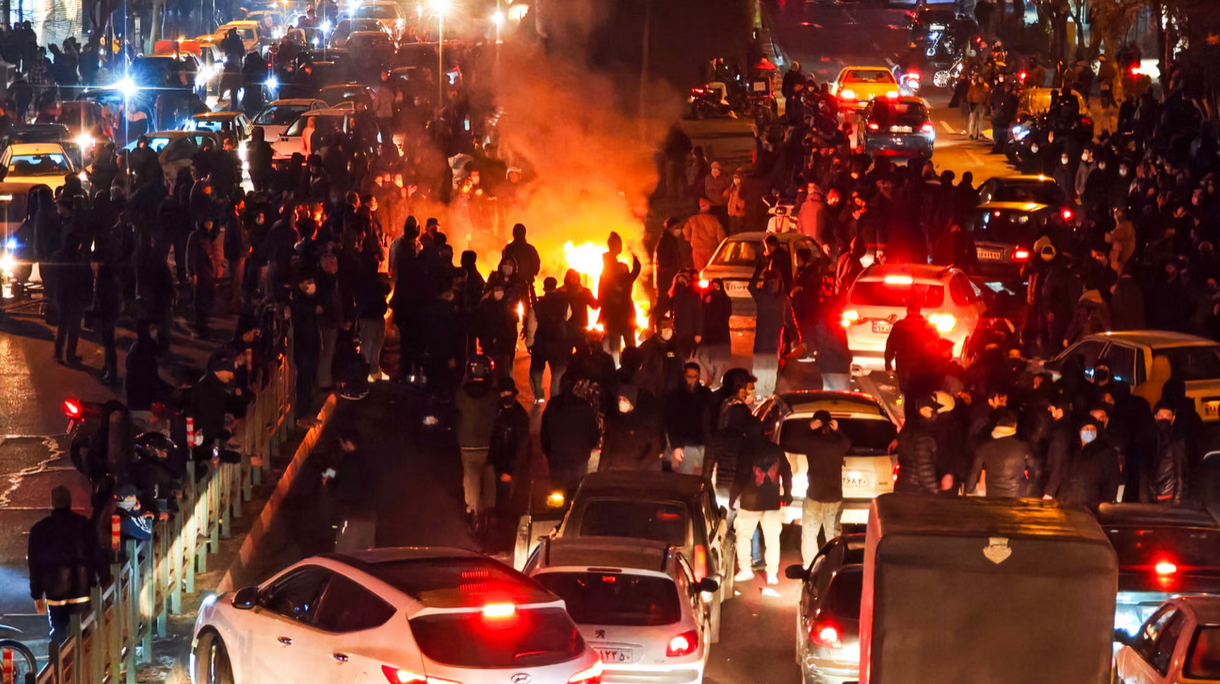
Israel is boasting that it is arming and organising protestors in Iran.
Again I do not view the Iranian government as blameless. If it had allowed more space for reasonable reformists to operate, for opposition figures to campaign, then you would not have a situation where the crowds are shouting the name of the sickening Zionist Pahlavi stooge, simply because it is the only "opposition" name they have heard.
It does seem the moment of greatest madness has passed. I do hope that the Iranian government reflects on opening more political space in the medium term.
But I have nothing but contempt for those in the West who have jumped on the anti-Iranian bandwagon.
Iran is the only remaining power in the Middle East that stood up against the genocide in Gaza. The Iranian sponsored resistance have been the only military opposition to the expansion of Greater Israel. Houthis aside, those resistance forces have been set back badly in the last two years, though not entirely defeated nor disbanded.
The installation of the Zionist puppet al-Jolani was a great boon for the expansion of Israel. They are now gunning for Iran itself.
Those in the West who pretend this is about human rights, and not about eliminating the last elements of physical resistance to Greater Israel, are sickeningly hypocritical.
Opposition to the government of Iran and support for its violent overthrow has become the new entry ticket to the Overton Window Show of British media and politics. It is the new "Do you condemn Hamas?"
Those who bow the knee before the latest ruse of Western Imperialist conquest, in the interests of maintaining their establishment respectability, should be treated with contempt.
———————————
My reporting and advocacy work has no source of finance at all other than your contributions to keep us going. We get nothing from any state nor any billionaire.
Anybody is welcome to republish and reuse, including in translation.
Because some people wish an alternative to PayPal, I have set up new methods of payment including a Patreon account and a Substack account if you wish to subscribe that way. The content will be the same as you get on this blog. Substack has the advantage of overcoming social media suppression by emailing you direct every time I post. You can if you wish subscribe free to Substack and use the email notifications as a trigger to come for this blog and read the articles for free. I am determined to maintain free access for those who cannot afford a subscription.
Click HERE TO DONATE if you do not see the Donate button above
Subscriptions to keep this blog going are gratefully received.
Choose subscription amount from dropdown box:
Recurring Donations
3 Pounds : £3.00 GBP - monthly5 Pounds : £5.00 GBP - monthly10 Pounds : £10.00 GBP - monthly15 Pounds : £15.00 GBP - monthly20 Pounds : £20.00 GBP - monthly30 Pounds : £30.00 GBP - monthly50 Pounds : £50.00 GBP - monthly70 Pounds : £70.00 GBP - monthly100 Pounds : £100.00 GBP - monthly
PayPal address for one-off donations: craigmurray1710@btinternet.com
Alternatively by bank transfer or standing order:
Account name
MURRAY CJ
Account number 3 2 1 5 0 9 6 2
Sort code 6 0 - 4 0 - 0 5
IBAN GB98NWBK60400532150962
BIC NWBKGB2L
Bank address NatWest, PO Box 414, 38 Strand, London, WC2H 5JB
Bitcoin: bc1q3sdm60rshynxtvfnkhhqjn83vk3e3nyw78cjx9
Ethereum/ERC-20: 0x764a6054783e86C321Cb8208442477d24834861a
The post Resisting the Respectable Opinion on Iran appeared first on Craig Murray.
To my great surprise, the video recording of yesterday's Court of Session hearing on the judicial review of the proscription of Palestine Action is still active on the court's website, and you can watch it. I do not know how long this will last.
I have been used to the ludicrous restrictions on the English court hearings, where passwords were needed to access the video and it disappeared instantly after the livestream, despite these being public courts.
This in Edinburgh was a preliminary hearing on permission for a judicial review and the judge wished to consider only two questions:
Firstly, whether I had standing to bring the case.
Secondly, whether the Scottish court had jurisdiction in the light of the English judicial review.
I should be genuinely grateful for people's opinions after watching the video, but my initial thoughts are these:
Firstly and most importantly, my legal team's Note of Argument had asserted that they assumed that, as the judge only wished to have two points discussed, he was already satisfied on the most important point that this was a well-founded petition for judicial review with a genuine prospect of success.
The judge did not contradict this and the respondent (the UK government) did not contest this.
This is absolutely crucial. I am sure that the judicial review will proceed if the two points of standing and jurisdiction go our way.
Still more crucial, the UK government appeared almost to concede on standing, in the light of an affidavit from Huda Ammori, co-founder of Palestine Action, to the effect that I was involved in Palestine Action almost from the start.
The judge told my KC, Joanna Cherry, that she did not need to address him on standing. This appears to a certainty to mean he does accept my standing.
On jurisdiction, the UK government did not claim that the Scottish courts do not have jurisdiction. They also did not claim that the Scottish courts may not hear a matter being heard concurrently in England.
They instead fell back on two arguments. The first was the timing, convenience and cost (sic) of a Scottish judicial review. The judge appeared to give this short shrift.
The second argument - and it was the UK government's main point - was "comity". This was defined as "good neighbourliness between jurisdictions", "politeness", "courtesy" and even as mutual respect between labourers in neighbouring vineyards (honestly). The need to avoid "contradictory judgments" within the UK was advanced. All these were quotes from English judgments.
Joanna Cherry KC punctured this with one phrase: "that rather assumes the English court will get it right".
She also directly quoted in full my own assertion from my own affidavit:
22. I am a Scot. I live in Scotland. Scotland is where I wish to publish my views in support of Palestine Action. Scotland is where my established Article X and XI human rights are being infringed.
23. I wish to seek the protection of the courts in my own jurisdiction against executive infringement of my rights within this jurisdiction.
24. As I understand it, the Scottish courts are not subservient or junior to the courts of England and Wales. Their opinion is equally valid and - crucially - the courts of Scotland have the absolute right to take a different view, even in a very similar or identical matter, to the court of England and Wales.
25. The disproportionate effect of the proscription of Palestine Action on individuals in Scotland has been appalling. Scores of peaceful people of entirely good character have been arrested on absurd pretence of "terrorism".

https://www.facebook.com/reel/25520722000941647
There was a wonderful turnout of support on a cold, wet Monday morning at 9am. The court was packed. The judge promised to give a decision this week if possible, or very shortly thereafter.
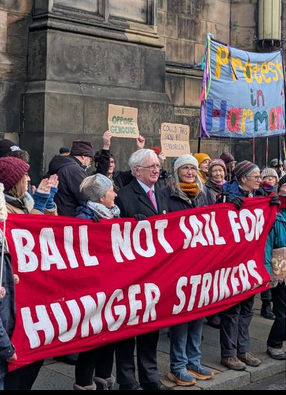
As I said outside the courtroom, this was not about my standing or rights; it was about the abuse of the human rights to free speech and free assembly of everybody in Scotland. It was about those scores of decent people in Scotland being ludicrously treated as terrorists. It was about the lives of the hunger strikers. Above all it was about the right to act to stop genocide, and about the 100,000 or more Palestinians massacred by Israel.
The rigged judicial panel on the parallel case in England has still not delivered its ruling in their judicial review.
The jury is out on the Filton Six trial in Woolwich Crown Court, which includes the incident where a policewoman was unfortunately injured.
I have no doubt that what is happening is this: the Court of Appeal is awaiting that verdict and a massive media blitz of "Palestine Action Terrorists attacked policewoman with sledgehammer".
After that it will quickly be announced that the proscription of Palestine Action has been upheld.
On the Filton trial, I do urge you to read the astounding defence speech of Rajiv Menon KC on behalf of Charlotte Head.
Here is a little bit of it:
So that's what His Lordship said to you, and Ms Heer in her closing speech, on much the same theme, told you that the defendants who had given evidence had not raised any real challenge to the charge of criminal damage. I'm sorry, but it is not right to say that the defendants who gave evidence did not raise any challenge. They did raise a challenge. They maintained that they had a lawful excuse. That was their challenge. But what's happened is that His Lordship has withdrawn that defence as a matter of law, and that's the true position that we find ourselves in. Their challenge was lawful excuse and the court has withdrawn that as a lawful defence. So where does that leave you, the members of the jury?
You could be forgiven for thinking that His Lordship is in fact directing you, as a matter of law, to convict Charlotte, who I'll focus on for now, of criminal damage. But you'd be wrong to think that. His Lordship is not directing you to convict. In fact, not only is he not directing you to convict, but he's also absolutely forbidden from doing so as a matter of law. The law is crystal clear on this point. No judge in any criminal case is allowed to direct a jury to convict any defendant of any criminal charge, whatever the evidence might be. That is the law.
Please remember that fundamental principle at all times when you retire. Please don't misinterpret anything in His Lordship's directions or summing up (which will follow the defence speeches) as amounting to a legal direction to convict. That would be a terrible mistake to make. I repeat, His Lordship is absolutely not directing you to convict, because he's barred as a matter of law from doing so.
The jury has every right to be confused about this because it is confusing. You have every right to think that the distinction between withdrawing the only available defence to a criminal charge on the facts, and a direction to convict, is at best a distinction without a difference. You have every right to think that the two effectively amount to the same thing. But the fact of the matter is they are absolutely not the same thing. They are fundamentally different. Let me try and explain it.
If you look at the legal directions and the first section, headed Functions Of Judge And Jury, you'll see it's quite lengthy. I'm not going to go through it point by point, but I'd ask you to read it carefully when you retire. All the directions in this document are important, but I'd suggest that the directions on the function of judge and jury are particularly important in this case. The key point to summarise is that the facts, and the verdicts you return having considered the facts, are solely for you.
So nobody, not even His Lordship, can direct you as to what factual conclusions to reach. Nobody, not even His Lordship, can direct you to convict. It's as simple as that. That's the law. So, for the avoidance of any doubt about this, I am absolutely not asking you to disregard His Lordship's legal directions. On the contrary, I'm asking you to follow them, in particular this section on functions of judge and jury, and remind you that nobody, not even His Lordship, can dictate to you what factual conclusions to reach in this case, nor direct you to convict the defendants of any of the charges they face.
This is the one of the greatest legal speeches - including historical speeches - I have ever read. Its strength lies in its brazen defiance of the judge and brilliant footwork along the edge of contempt of court.
It is precisely what lawyers need to be doing to resist galloping authoritarianism and the complicity in it of the judiciary. I shall return to the question of what was withheld from the Woolwich jury about Elbit, just as soon as the verdict is in and I may do so without imprisonment.
I am afraid to say I still have to ask for donations. If we get a judicial review of the proscription in Scotland we are going to need to put in a huge fundraising effort for the actual review. If we lose the decision, I am liable to have the UK government's costs awarded against me. Either way, this is about to get very expensive - which is of course precisely what the authorities rely on to crush opposition.
If we can spread the burden across enough small contributions, we can do it.
I am extremely grateful to approximately 670 people who have already contributed. Every penny helps, but please do not cause yourself hardship.
You can donate through the link via Crowd Justice, which goes straight to the lawyers, or through this blog.
https://www.crowdjustice.com/case/scottish-challenge-to-proscription/
paypal.HostedButtons({ hostedButtonId: "NZDEN7BYDHVS4", }).render("#paypal-container-NZDEN7BYDHVS4")
Alternatively by bank transfer:
Account name
MURRAY CJ
Account number 3 2 1 5 0 9 6 2
Sort code 6 0 - 4 0 - 0 5
IBAN GB98NWBK60400532150962
BIC NWBKGB2L
Bank address NatWest, PO Box 414, 38 Strand, London, WC2H 5JB
Or crypto:
Bitcoin: bc1q3sdm60rshynxtvfnkhhqjn83vk3e3nyw78cjx9
Ethereum/ERC-20: 0x764a6054783e86C321Cb8208442477d24834861a
The post A Step Towards Sanity appeared first on Craig Murray.
In the Western world today, fighting for freedom feels Quixotic, but I shall nevertheless wake early tomorrow to be at the Court of Session in Edinburgh by 9am to fight the proscription in Scotland of Palestine Action.
I remain extremely concerned for the lives of the Palestine Action hunger strikers. As I predicted, Starmer's government sees their potential deaths as an opportunity to burnish their populist, right-wing and Zionist credentials.

Tomorrow morning's hearing is limited by the judge to two points of UK government objection: that I have no standing to bring the case as I am not a member of Palestine Action, and that the Scottish courts should not hear an issue that is already being decided in the courts of England and Wales.
On standing, I give evidence by affidavit that there is no "Membership". Palestine Action never had a membership structure. But I collaborated with and assisted the co-founders, Huda Ammori and Richard Barnard, almost from the start of the organisation. I spoke together with them on public platforms to urge support for Palestine Action (while it was legal), participated in a Palestine Action protest at an Elbit factory and provided advice and support.
Huda Ammori has submitted an affidavit which concludes thus:
12. Not only was Craig Murray actively supporting Palestine Action online, sharing
actions, and raising awareness of Palestine Action's aims and strategy, he also
had joined the mass action himself against Elbit Systems' UAV Tactical Systems
factory.
13. I also consider him a close friend and a confidant, who I would regularly speak
to about the challenges myself and others personally faced due to state
repression of Palestine Action. For the above reasons, I believe it is clear that
Craig Murray was both involved and an active supporter of Palestine Action and
is therefore extremely well placed to legally challenge the proscription of
Palestine Action.
I believe it would be an extremely illiberal interpretation of standing to throw out the case on the grounds I have no standing.

There is a Kafkaesque twist to this court case that shows the outrageous effects of the proscription. I wished to demonstrate the chilling effect on journalism, and limiting effect on freedom of speech, by illustrating the things I should like to write now on Palestine Action that the proscription makes it illegal to write.
My lawyers strongly advised me not to do this as it would lead to arrest and terrorism charges. Evidence in court is not privileged speech.
So I cannot tell the court what it is that the attack on my freedom of speech prevents me from saying. I thus cannot illustrate the absurd disproportionality of the restriction.
That is an example of the extraordinary black hole, sucking in freedoms, down which this proscription of a non-violent group has led us.
To move on to the second part of the argument, this is what my affidavit says on the jurisdiction of the Scottish courts:
21. But if particular status is needed I have it. I have participated in Palestine Action protests and have demonstrably supported them. I am a colleague and collaborator of Palestine Action's founders. I am a journalist whose freedom of expression is being curtailed disproportionately. I have a demonstrable long-term particular interest in Palestine and in Article X and XI freedoms.
22. I am a Scot. I live in Scotland. Scotland is where I wish to publish my views in support of Palestine Action. Scotland is where my established Article X and XI human rights are being infringed.
23. I wish to seek the protection of the courts in my own jurisdiction against executive infringement of my rights within this jurisdiction.
24. As I understand it, the Scottish courts are not subservient or junior to the courts of England and Wales. Their opinion is equally valid and - crucially - the courts of Scotland have the absolute right to take a different view, even in a very similar or identical matter, to the court of England and Wales.
25. The disproportionate effect of the proscription of Palestine Action on individuals in Scotland has been appalling. Scores of peaceful people of entirely good character have been arrested on absurd pretence of "terrorism".
26. Terrorism related charges are life changing. They do not only bring potential imprisonment. They bring loss of employment, debanking and loss of access to money, and severe international travel restriction….
40. In the Scottish legal tradition sovereignty rests with the people, not with the Crown in parliament.
41. In the English legal and constitutional tradition, parliament may do anything, be it ever so authoritarian. Parliament could legislate to repeal the Human Rights Act or cancel elections, and English courts would likely uphold that if properly passed through parliament and approved by the Crown.
42. I believe that the Scottish tradition of legal thought and practice should and does provide greater protection for the people from arbitrary and oppressive government, as expressed in the still in force Claim of Right. That is why I believe it is important for a Scottish court to hear this judicial review in Scotland for the protection of the people of Scotland from what I see as an arbitrary, oppressive, politically motivated and intellectually absurd executive action
We have been allocated Court No 1 in the Court of Session. This has a large public gallery, and I hope those able to do so will turn up for the hearing. It starts at 9.30am on Monday morning and we are asking people to rally outside from 9am. I realise that 9am on a Monday morning in a stormy Edinburgh January is not an attractive prospect, but I do believe it is important to show the judge that people really do care about these issues.
If we win, then there will be a full judicial review looking at the wider questions of genocide prevention and the right to take direct action, and the disproportionate effect of the proscription on freedom of speech and assembly.
For those who cannot be here in person the hearing will be livestreamed from 9.30am on Monday morning.
I am sorry to say this but we do need to still ask for donations to continue this forward. It is a very expensive thing to do. One thing the government relies on is that it has unlimited resources and we do not. If we can spread the burden across enough small contributions, we can do it.
I am extremely grateful to approximately 670 people who have already contributed. Every penny helps, but please do not cause yourself hardship.
You can donate through the link via Crowd Justice, which goes straight to the lawyers, or through this blog.
https://www.crowdjustice.com/case/scottish-challenge-to-proscription/
paypal.HostedButtons({ hostedButtonId: "NZDEN7BYDHVS4", }).render("#paypal-container-NZDEN7BYDHVS4")
Alternatively by bank transfer:
Account name
MURRAY CJ
Account number 3 2 1 5 0 9 6 2
Sort code 6 0 - 4 0 - 0 5
IBAN GB98NWBK60400532150962
BIC NWBKGB2L
Bank address NatWest, PO Box 414, 38 Strand, London, WC2H 5JB
Or crypto:
Bitcoin: bc1q3sdm60rshynxtvfnkhhqjn83vk3e3nyw78cjx9
Ethereum/ERC-20: 0x764a6054783e86C321Cb8208442477d24834861a
The post Court of Session Tomorrow on Palestine Action appeared first on Craig Murray.
The mainstream media covered Venezuela non-stop yesterday. They many times mentioned Delcy Rodríguez, Vice President, because Trump stated she is now in charge. They never mentioned that 2026 marks the 50th anniversary of the torture to death of her father, socialist activist Jorge Rodríguez, by the CIA-backed security services of the US-aligned Pérez regime in Venezuela.

That would of course spoil the evil communists versus nice democrats narrative that is being forced down everybody's throats.
Nor did they mention that the elected governments of Hugo Chávez reduced extreme poverty by over 70%, reduced poverty by 50%, halved unemployment, quadrupled the number receiving a state pension and achieved 100% literacy. Chávez took Venezuela from the most unequal society for wealth distribution in Latin America to the most equal.
Nor have they mentioned that María Corina Machado is from one of Venezuela's wealthiest families, which dominated the electricity and steel industries before nationalisation, and that her backers are the very families that were behind those CIA-controlled murderous regimes.
Economic sanctions imposed by the West - and another thing they have not mentioned is that the UK has confiscated over £2 billion of the Venezuelan government's assets - have made it difficult for the Maduro government to do much more than shore up the gains of the Chávez years.
But that Venezuela is a major production or trafficking point for narcotics entering the USA is simply a nonsense. Nicolás Maduro has his faults, but he is not a drug trafficking kingpin. The claim is utter garbage.
The willingness of the West to accept the opposition's dodgy vote tallies from the 2024 Presidential elections does not legitimise invasion and kidnap.
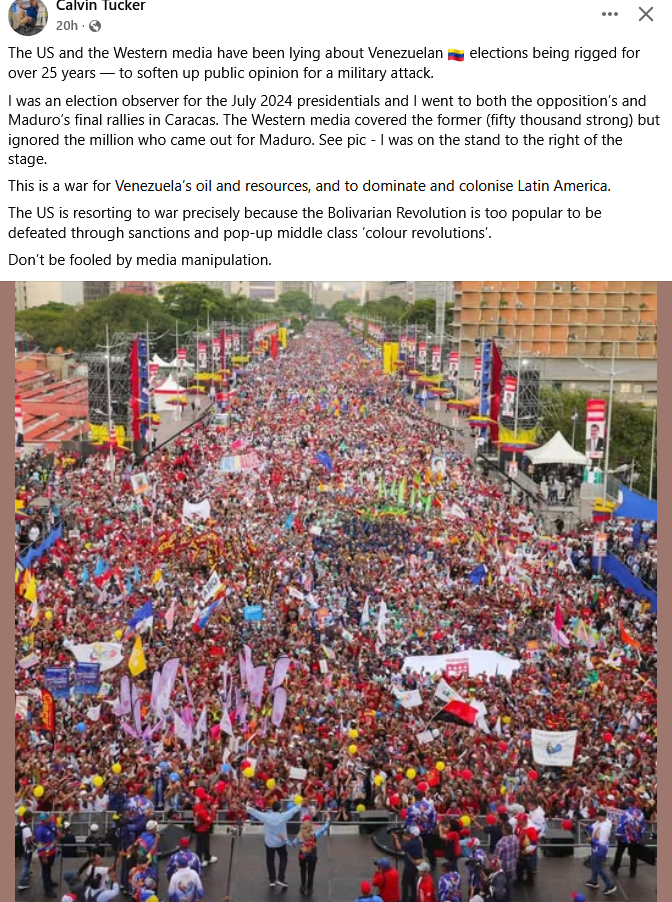
Yesterday almost every Western government came up with a statement that managed to endorse Trump's bombing and kidnap - plainly grossly illegal in international law - and simultaneously claim to support international law. The hypocrisy is truly off the scale. It is also precisely the Western powers that support the genocide in Gaza that support the attack on Venezuela.
The genocide in Gaza demonstrated the end of hopes - which were extremely important to my own worldview - for the rule of international law to outweigh the brutal use of force in international relations. The kidnap of Maduro, the rush of Western powers to accept it, and the inability of the rest of the world to do anything about it, have underlined that international law is simply dead.
In the long list of appalling awards of the Nobel peace prize, none can be worse than the latest to the Venezuelan traitor María Corina Machado, intended actively to promote and bring forward the imperialist attack on Venezuela by the United States.
It takes a great deal of effort to come up with a worse decision than to award Kissinger immediately after the massive bombing of Laos and Cambodia. It was a dreadful award, but it was intended to recognise the putative Paris peace deal and prod the United States towards honouring the peace process. Initially it was a joint award with Vietnamese negotiator Lê Đức Thọ (who sensibly declined).
The Kissinger award was a terrible mistake, but the Committee were seeking to end a war, starting from a willingness to cooperate with unprincipled realpolitik. In the award to Machado, they are deliberately seeking to endorse and promote the start of a war. That is a very different thing.
Similarly the award to Obama was a crazed moment of hope after the despair of the invasion of Iraq. It was a combined mistaken belief that Obama would be better, with a mistaken idea it would encourage him to be so.
I accept that the line I am drawing is a thin one; rewarding the perpetrators of Western aggression is only a short step away from actually encouraging Western aggression. But nevertheless a line has been crossed.
The gross hypocrisy of the morally bankrupt Committee chairman, Jørgen Watne Frydnes, in claiming that the prize is for non-violent action on Venezuela, at the very moment that Trump gathered the largest invasion force since Iraq off Venezuela makes me feel thoughts towards Frydnes that ought not qualify me for any peace prize at all. I feel similarly towards Guterres and all those others abandoning their supposed international role to lick Trump's boot today.
So what now for Venezuela? Well, on the most optimistic reading Trump's action was performative. He had to do something to avoid the Grand Old Duke of York jibes after that immense concentration of forces off Venezuela, and he has produced a spectacular that actually changes little.
On this reading, the Americans may be making the same mistake they made in Iran, in believing that decapitation strategy and bombing will spark internal revolution. In Iran, they actually strengthened support for the Government.
As of yesterday afternoon, the Bolivarian government in Caracas genuinely did not yet know what had happened, how far there was collusion in the armed forces in Maduro's kidnap, and whether they still had the control of the army.
Trump's plain signal that the US views Rodríguez as in charge, and Trump's contemptuous dismissal of Machado - the only bright point in an appalling day - might give pause to any in Venezuela expecting active US support for a coup.
To those who claim Maduro was a tyrant, I refer you to the comic opera Guaidó coup of 30 April 2019. Guaidó had been declared President of Venezuela by the western powers despite never even having been a candidate. He attempted a coup and wandered around Caracas with heavily armed henchmen, declaring himself President but just being laughed at by the army, police and population.
In any country in the world Guaidó would have been jailed for life for attempting an armed coup, and I expect in the majority he would have been executed. Maduro just patted him on the head and put him back on a plane.
So much for the evil dictatorship.
By pure chance, on Friday I had texted Delcy Rodríguez about arrangements for travel and accreditation so I could go and report from Venezuela and bring you more of the truth from that country that the media is hiding from you. I made plain I was not asking for financial support. Things are obviously fluid at the moment, but it is still my intention to get there.
———————————
My reporting and advocacy work has no source of finance at all other than your contributions to keep us going. We get nothing from any state nor any billionaire.
Anybody is welcome to republish and reuse, including in translation.
Because some people wish an alternative to PayPal, I have set up new methods of payment including a Patreon account and a Substack account if you wish to subscribe that way. The content will be the same as you get on this blog. Substack has the advantage of overcoming social media suppression by emailing you direct every time I post. You can if you wish subscribe free to Substack and use the email notifications as a trigger to come for this blog and read the articles for free. I am determined to maintain free access for those who cannot afford a subscription.
Click HERE TO DONATE if you do not see the Donate button above
Subscriptions to keep this blog going are gratefully received.
Choose subscription amount from dropdown box:
Recurring Donations
3 Pounds : £3.00 GBP - monthly5 Pounds : £5.00 GBP - monthly10 Pounds : £10.00 GBP - monthly15 Pounds : £15.00 GBP - monthly20 Pounds : £20.00 GBP - monthly30 Pounds : £30.00 GBP - monthly50 Pounds : £50.00 GBP - monthly70 Pounds : £70.00 GBP - monthly100 Pounds : £100.00 GBP - monthly
PayPal address for one-off donations: craigmurray1710@btinternet.com
Alternatively by bank transfer or standing order:
Account name
MURRAY CJ
Account number 3 2 1 5 0 9 6 2
Sort code 6 0 - 4 0 - 0 5
IBAN GB98NWBK60400532150962
BIC NWBKGB2L
Bank address NatWest, PO Box 414, 38 Strand, London, WC2H 5JB
Bitcoin: bc1q3sdm60rshynxtvfnkhhqjn83vk3e3nyw78cjx9
Ethereum/ERC-20: 0x764a6054783e86C321Cb8208442477d24834861a
The post Venezuela and Truth appeared first on Craig Murray.
Fighting the proscription of Palestine Action has become more urgent as eight brave activists enter the crucial period of their hunger strike.
12 January has finally been set for the court hearing on holding a Scottish judicial review of the proscription of Palestine Action.
I am frankly terrified for the hunger strikers.
- Qesser Zuhrah
- Amu Gib
- Heba Muraisi
- Jon Cink
- Teuta Hoxha
- Kamran Ahmed
- Muhammad Umer Khalid
- Lewie Chiaramello (a diabetic so on modified hunger strike or he would die very rapidly).
The Starmer government is quite prepared to let them die: to emphasise devotion to Israel, to show their Zionist donors they are earning their money, and to reinforce the hardline macho image they believe appeals to Reform voters.
Indeed I have no doubt that Starmer, Mahmood, Lammy and Cooper hope for their deaths as a political positive; just as Thatcher thought she would win plaudits for facing down IRA hunger strikers.
It is important to state that none of the hunger striking prisoners has been convicted of anything - all are on remand - and none of them was in any way involved in the incident in which a policewoman was allegedly injured.
The coordinated response from government and other Zionist troll farms and stenographers is that none of the hunger strikers deserve sympathy as "a policewoman was hit by a sledgehammer".
It remains astonishing to me that this assertion is constantly and stridently made by the state and its myriad acolytes, despite the rules against prejudicing a jury trial. This stance ignores the detailed accounts of the trial itself which paint a far more complex picture.
As well as the real danger to the hunger strikers, there are thousands of entirely peaceful protestors facing terrorism charges simply for speech. These are life-changing, bringing not just jail sentences but loss of employment, debanking and travel restrictions.
All this while the genocide of Palestinians continues, with appalling conditions in Gaza, stringent restrictions on aid (which is still at less than half the required levels), and continued Israeli bombing - despite the "ceasefire".
The judicial review of Palestine Action in the High Court of England and Wales appears to have been "fixed". The last-minute change of judges - including the total removal of the original judge from the panel - and the conduct of the review, have left little room for optimism.
My own most striking impression from that judicial review is the difference in how the judges treated the counsel for Huda Ammori and the counsel for the UK government.
Counsel for Huda Ammori, Raza Husain KC, was treated with impatience and at times disdain. That is difficult to quantify, but one thing that could indeed be measured was this:
Every time Raza Husain KC referred the judges to a passage in a past judgment or other quoted authority, they quickly skated over it and moved on, frequently with a phrase like "Yes, we have seen it" or "We are familiar with that".
Every time James Eadie KC for the government referred the judges to a written authority, they ostentatiously physically found it in their bundle and took time to peruse it, on one occasion taking over a minute to demonstrate they were reading and absorbing at the government's direction, before Eadie moved on.
The contrast was stark. Not just once, but over and over.
My favourite moment in the English judicial review was when Raza Hussain quoted the Proscription Advisory Committee's recommendation to Yvette Cooper that Palestine Action should be proscribed because "Palestine Action kept hiring good lawyers" and defendants kept being acquitted as it was difficult to prove guilt to the criminal standard.
Yes, they really did say that. Palestine Action should be proscribed because it was being found by juries not to be criminal.
By proscribing Palestine Action, this makes it a criminal offence of strict liability to support it, whether or not you were doing anything that a jury would have found criminal before the proscription.
Raza Hussain KC described this as "Not the Proscription Advisory Committee's finest hour". I thought much more could have been made of it, but a feature of the English judicial review - and I think a mistake - is that there was no playing to the gallery of public opinion.
It was conducted as a legal conversation between the lawyers and the judges, often incomprehensible to the onlooker because it was based on documents to which the public do not have access. Yet there is an extremely concerned public looking on.
The demands of the hunger strikers largely refer to the appalling prison conditions in which they are kept, despite the fact that none of them have been convicted and none of them have previous convictions, or can reasonably be said to present a danger to the public, or be a particular flight risk.
- Immediate bail/release on bail for the remand prisoners (many held longer than standard limits).
- The right to a fair trial, including access to all relevant documents and an end to demonization or "terrorist connection" claims.
- An end to prison censorship/restrictions on communications (e.g., blocking letters, phone calls, and books).
- De-proscription (lifting the ban) on Palestine Action as a terrorist organization.
- Shutdown of Elbit Systems' UK sites (Israel's largest arms manufacturer, accused of supplying weapons used in Gaza).
On right to a fair trial, it is worth noting that there is huge evidence of outside influence on the prosecutions, and there are communications between the police and prosecutorial authorities on the one hand, and Elbit, the Israeli Embassy, and various Zionist groups on the other, which have either not been released to the defence, or have only been released in very redacted form.
In the day of the Filton trial which I attended, I found the parts the jury was not allowed to know (when they were sent out) particularly interesting. I cannot tell you more than that until the trial is over.
We can help lift the proscription of Palestine Action if we win the judicial review in Scotland. We have finally been given a court date of 12 January at 9:30am in Edinburgh.
This hearing is to decide whether there will be a judicial review. It will look at only two points.
Firstly, whether I as an individual have sufficient connection to Palestine Action, or have my rights particularly infringed by the proscription, in order to have standing in the case.
The UK Government is arguing that I have no connection to Palestine Action. (I wish they would tell their police that!!)
We will however also be relying on the Supreme Court judgment in Walton vs Scottish ministers, which states that it "is sufficient that the applicant has a genuine concern about the legality of the act or decision, and that the issues raised are of general public importance".
The second ground to be heard is whether there can be a separate judicial review in Scotland when there is already one in the High Court of England and Wales.
Our view is that the principle has already been established in the Joanna Cherry and Gina Miller cases, where judicial reviews in London and Edinburgh came to opposing decisions on the legality of Boris Johnson's prorogation of parliament.
I am resident in Scotland, where the High Court of England and Wales has no jurisdiction. If my rights are infringed I am entitled, even within the United Kingdom, to the protection of my own courts of my own nation in first instance.
Scots law is different. Its intellectual basis and maxims are different. There is a reason why lawyers legally qualified to plead in courts in England and Wales are not automatically qualified to appear in Scotland; and vice versa. The Court of Session is not inferior to the High Court.
We intend to submit substantive evidence of the oppression of numerous individuals in Scotland as a result of the proscription.
We will need the maximum public support inside and outside the court of session at Parliament House, Edinburgh on 12 January from 9am.
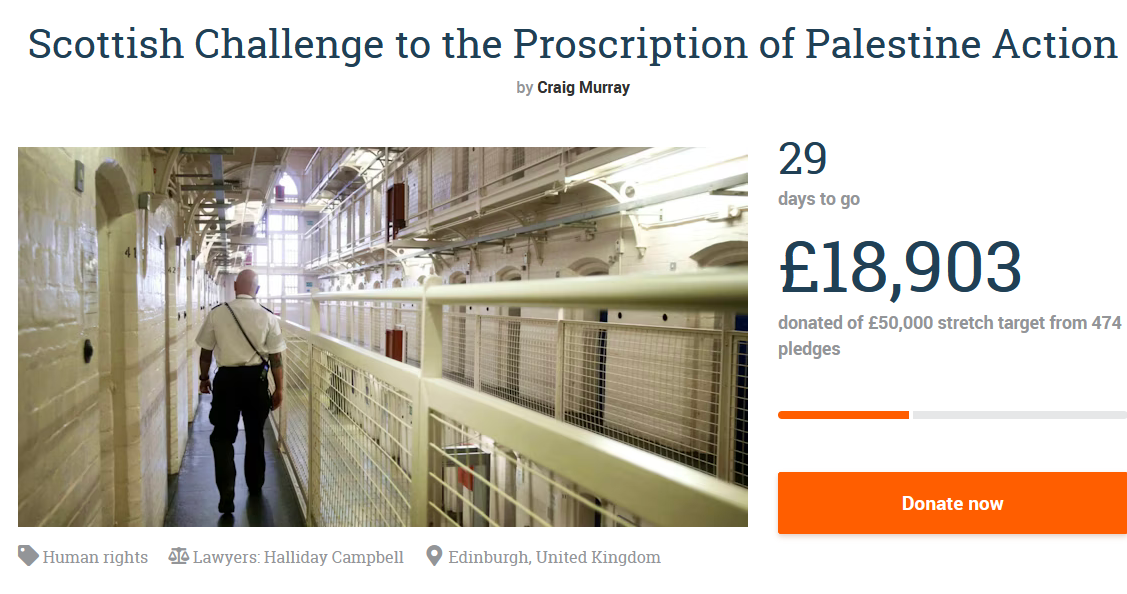
Unfortunately we will not be able to go ahead if we do not raise sufficient funds. The crowdfunder has got us into court, but needs to supercharge to get us further. Please do help:
https://www.crowdjustice.com/case/scottish-challenge-to-proscription/
I know these are the most difficult of times. But that is why we have to keep fighting. The sums needed to mount a successful legal challenge to the power of the state can be eye-watering. But we are the many. Every penny helps, but please do not cause yourself hardship. You can contribute via the crowdfunder above or via these methods:
paypal.HostedButtons({ hostedButtonId: "NZDEN7BYDHVS4", }).render("#paypal-container-NZDEN7BYDHVS4")
Alternatively by bank transfer:
Account name: MURRAY CJ
Account number: 32150962
Sort code: 60-40-05
IBAN: GB98NWBK60400532150962
BIC: NWBKGB2L
Bank address: NatWest, PO Box 414, 38 Strand, London, WC2H 5JB
Or crypto:
Bitcoin: bc1q3sdm60rshynxtvfnkhhqjn83vk3e3nyw78cjx9
Ethereum/ERC-20: 0x764a6054783e86C321Cb8208442477d24834861a
The post Hunger Strikes and Court Cases appeared first on Craig Murray.
I did not anticipate that an open public meeting in Salisbury itself would be 95% sceptical of the official Novichok hoax - but it was.
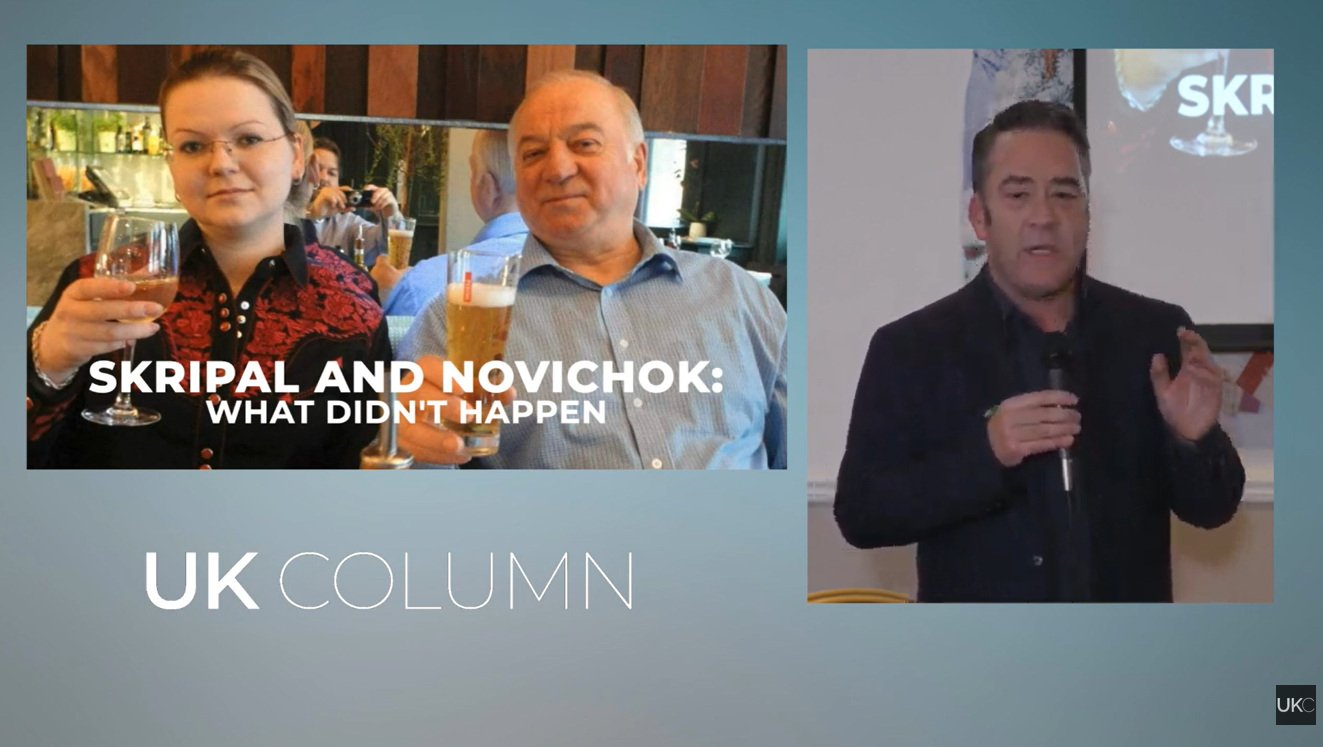
Thanks to UK Column for putting this on. I hope you find it enlightening - there is information which goes beyond my previous articles on the subject. In about a week there will also be a film of our tour of the key sites in Salisbury.
The video settings prevent me from embedding it but you can watch it here.
https://youtu.be/3K9jUOYsga0?t=1464
———————————
My reporting and advocacy work has no source of finance at all other than your contributions to keep us going. We get nothing from any state nor any billionaire.
Anybody is welcome to republish and reuse, including in translation.
Because some people wish an alternative to PayPal, I have set up new methods of payment including a Patreon account and a Substack account if you wish to subscribe that way. The content will be the same as you get on this blog. Substack has the advantage of overcoming social media suppression by emailing you direct every time I post. You can if you wish subscribe free to Substack and use the email notifications as a trigger to come for this blog and read the articles for free. I am determined to maintain free access for those who cannot afford a subscription.
Click HERE TO DONATE if you do not see the Donate button above
Subscriptions to keep this blog going are gratefully received.
Choose subscription amount from dropdown box:
Recurring Donations
3 Pounds : £3.00 GBP - monthly5 Pounds : £5.00 GBP - monthly10 Pounds : £10.00 GBP - monthly15 Pounds : £15.00 GBP - monthly20 Pounds : £20.00 GBP - monthly30 Pounds : £30.00 GBP - monthly50 Pounds : £50.00 GBP - monthly70 Pounds : £70.00 GBP - monthly100 Pounds : £100.00 GBP - monthly
PayPal address for one-off donations: craigmurray1710@btinternet.com
Alternatively by bank transfer or standing order:
Account name
MURRAY CJ
Account number 3 2 1 5 0 9 6 2
Sort code 6 0 - 4 0 - 0 5
IBAN GB98NWBK60400532150962
BIC NWBKGB2L
Bank address NatWest, PO Box 414, 38 Strand, London, WC2H 5JB
Bitcoin: bc1q3sdm60rshynxtvfnkhhqjn83vk3e3nyw78cjx9
Ethereum/ERC-20: 0x764a6054783e86C321Cb8208442477d24834861a
The post The Skripal Novichok Hoax appeared first on Craig Murray.
It is probably no bad thing that health struggles have delayed my writing up Your Party's extraordinary Liverpool founding conference. Perspective is definitely helpful to process something unique.
Personally, I could not help but be struck by the number of participants who approached me as regular readers of my blog, certainly well into three figures. I did scores of selfies and even signed several booklets. The very large majority of these - and you may be among them - were very enthusiastic about the experience of the conference.
They loved the feeling of a new beginning, of taking the fight to Blue Labour and Reform, of openly espousing socialist principles and policies. They enjoyed the more heated debates over party structures as evidence of functioning and lively democracy. They were uplifted by the speeches of Jeremy Corbyn and Zarah Sultana, by Shockat Adam and Ayoub Khan, and by the guest speakers from European left parties.
I felt some of this myself. The speeches were indeed uplifting, and the heated arguments were the bit I enjoyed the most, where it felt that the opinion of members mattered.
But all of that was to ignore the undercurrent of extreme factional infighting that had dogged the formation of the party, and resulted in only 45,000 joining out of the 850,000 who had signed up to register their interest.
I am not going to rehearse the history of conflict and infuriating dispute between Zarah Sultana and Jeremy Corbyn that led up to the conference. But the continuation of this into the founding conference itself was a petulant betrayal of the good people who are working to put together a new Left party.
That Sultana and Corbyn could not find it in themselves to just stand side by side on the stage together, smile and wave for five minutes for the photographers is pathetic. The power play on the eve of conference to expel members of the Socialist Workers Party, Counterfire and other socialist groups, in such a way that many did not find out until they were in Liverpool, was extraordinary.
This is what happened. Broadly speaking the organisation of the party has been in the hands of factions broadly aligned to Jeremy Corbyn. The founding draft documents state that the Alliance MPs are the steering committee of the party. There has so far been no democratic input from members in control of the party.
While the conference was to adopt a constitution setting out a new Central Executive Committee and its election, there was no provision for any interim democratic input until that executive is elected - probably five months from Conference. A number of left wing groups were therefore planning to propose that the conference itself should elect a temporary steering committee, to run the party until the executive elections.
The last minute expulsions were a reaction against those who were believed to be leading the plan to elect a temporary committee from the conference. Other measures were also put into effect to stop it - for example it was imposed that no points of order could be made from the floor, that no motions or amendments could be expressed from the floor, and burly security men were brought in to impose this "order" on the hall.
Now I should make plain all of this bothers me. I did not know of any plan, but I would have voted that conference should elect an interim committee. I deeply dislike the way that decisions are being made with nobody knowing who makes them, and on what authority.
The prime example of this is the decision to expel people. Nobody seems able to say who made this decision, and on what authority. To be plain, it was not only members of the SWP affected. Three friends of mine have been expelled, for reasons I simply cannot fathom.
Similarly, it is impossible to know who selected what could be debated by conference. There were indeed heated debates - but the agenda was set and the wording decided by invisible and unnamed people, drawing on divided up "Assemblies" which were always designed to produce no clear democratic outcome.
So, for example, the proposal that MPs should receive a workers' wage and give the rest of their salary to the party was not chosen for debate, despite being the most popular in the online poll.
The leadership suffered a hefty defeat over dual party membership, with members voting strongly in favour. The one man one vote system of online voting for all members that was used, I strongly support. But the dual party membership debate is a precise example of the abuse of control of the agenda.
The two options were both drafted by the leadership which opposed dual party membership, and you were given two choices. The first choice was no dual party membership. The second choice was dual party membership, but only with a list of parties to be decided by the Central Executive Committee and agreed by Conference.
As there is no such list yet, and indeed no executive committee yet, all those expelled who come from the SWP and other organisations, remain expelled at least until Conference in Autumn 2026. This was against the strong sentiment of the Conference.
So I could not shake off the awareness of all this counter-productive machination and could not enjoy the conference. I find all this distasteful, and highly reminiscent of the worst behaviours of the Labour Party. I have to state I left Liverpool with a lower opinion of both Jeremy Corbyn and Zarah Sultana than I turned up with.
We had one informal and one more formal meeting of the Scottish delegates, and that was indeed more unified and more hopeful. There will be a Scottish Conference in Dundee in February 2026.
There are two central questions for the Scottish conference - will Your Party Scotland be fully autonomous, and will it support Scottish Independence? Just for me personally, those are fundamental questions governing my membership of this new entity. My feeling is they will be resolved in the positive. But they are not by any means the only questions for me.
I will I think be much happier if these issues of power and control get resolved and we finally get to talk about policy. I was never likely to enjoy a conference where sessions are called "constitution" and "standing orders".
The problems of the party are self-reinforcing. The failure of the mass membership to materialise means that small groups of already dedicated political activists on the left have disproportionate influence within the party at present. I see and understand the problem the leadership is trying to counter - but you can't suppress democracy because you don't like the membership.
It is absolutely essential that a party arises to the left of Labour - there is a huge space there - and opposes both neoliberal economics and Imperialist foreign policy, while openly countering racism. I therefore really want Your Party to succeed. I also want it to support the dismantlement of the irredeemably imperialist UK state.
I think there is still hope Your Party will fulfil these roles. I shall continue to work for that. There are a great many good people in Your Party. In a time of dizzying change and fragmentation in British politics, we have to do what seems right at this moment.
———————————
My reporting and advocacy work has no source of finance at all other than your contributions to keep us going. We get nothing from any state nor any billionaire.
Anybody is welcome to republish and reuse, including in translation.
Because some people wish an alternative to PayPal, I have set up new methods of payment including a Patreon account and a Substack account if you wish to subscribe that way. The content will be the same as you get on this blog. Substack has the advantage of overcoming social media suppression by emailing you direct every time I post. You can if you wish subscribe free to Substack and use the email notifications as a trigger to come for this blog and read the articles for free. I am determined to maintain free access for those who cannot afford a subscription.
Click HERE TO DONATE if you do not see the Donate button above
Subscriptions to keep this blog going are gratefully received.
Choose subscription amount from dropdown box:
Recurring Donations
3 Pounds : £3.00 GBP - monthly5 Pounds : £5.00 GBP - monthly10 Pounds : £10.00 GBP - monthly15 Pounds : £15.00 GBP - monthly20 Pounds : £20.00 GBP - monthly30 Pounds : £30.00 GBP - monthly50 Pounds : £50.00 GBP - monthly70 Pounds : £70.00 GBP - monthly100 Pounds : £100.00 GBP - monthly
PayPal address for one-off donations: craigmurray1710@btinternet.com
Alternatively by bank transfer or standing order:
Account name
MURRAY CJ
Account number 3 2 1 5 0 9 6 2
Sort code 6 0 - 4 0 - 0 5
IBAN GB98NWBK60400532150962
BIC NWBKGB2L
Bank address NatWest, PO Box 414, 38 Strand, London, WC2H 5JB
Bitcoin: bc1q3sdm60rshynxtvfnkhhqjn83vk3e3nyw78cjx9
Ethereum/ERC-20: 0x764a6054783e86C321Cb8208442477d24834861a
The post Your Party, and Its Conference appeared first on Craig Murray.
"The policewoman attacked by a sledgehammer" has been the constant refrain of the government against Palestine Action. A couple of days before the judicial review of the proscription in England, and despite fierce reporting restrictions on the trial, the prosecution released to the media highly edited video footage from the current trial in Woolwich Crown Court of six activists accused of the attack inside Elbit Systems' Filton factory on August 6 2024.
While that video has fuelled tens of thousands of Zionist troll posts on social media, the remarkable thing is that it is almost impossible to establish what it shows.
In fact, had it been put out without the prosecution narrative, nobody would have discerned that is what they were looking at. It shows chaotic fast-moving footage from bodycams.
The first sledgehammer seen is plainly in the hands of a security guard - as testimony in the trial, ignored by the MSM, has explained.
Here are some key facts:
- Every single prosecution witness who gave evidence about the melee was obliged to change their statement when confronted by the defence with video evidence which contradicted it. This included much more video than was released by the prosecution.
- The prosecution produced a misleading account of the number and location of CCTV cameras in the factory. They were obliged to present a new map showing more cameras.
- The video evidence was left in or given into the hands of Elbit. A search of Elbit's premises in November 2025 found the USB sticks of video in their Metropolitan Police evidence bags in Elbit's safe.
The last fact is simply astonishing. The evidence collected and apparently correctly bagged by the police had simply been handed over to Elbit, apparently for over a year. This is only a part of a much wider collusion between Elbit and the UK state, including the police.
One of the key demands of the Palestine Action hunger strikers in other cases - of whom I will write further shortly - is the full release of correspondence between Elbit and UK authorities including the counter-terrorism police, which has been partially released and in very heavily redacted format.
Judge Johnson has directed the jury that the events in the Filton trial predated the proscription of Palestine Action as a terrorist action and they must not allow that subsequent development to influence them in any way.
There are six defendants in the current Woolwich trial, allegedly members of the "overt group" or "red group" who entered inside the facility to do damage, while a second "black" or "covert group" allegedly carried out a noisy distractive action.
Charlotte Head, Samuel Corner, Leona Kamio, Fatema Zainab Rajwani, Zoe Rogers and Jordan Devlin are charged with aggravated burglary, criminal damage and violent disorder.
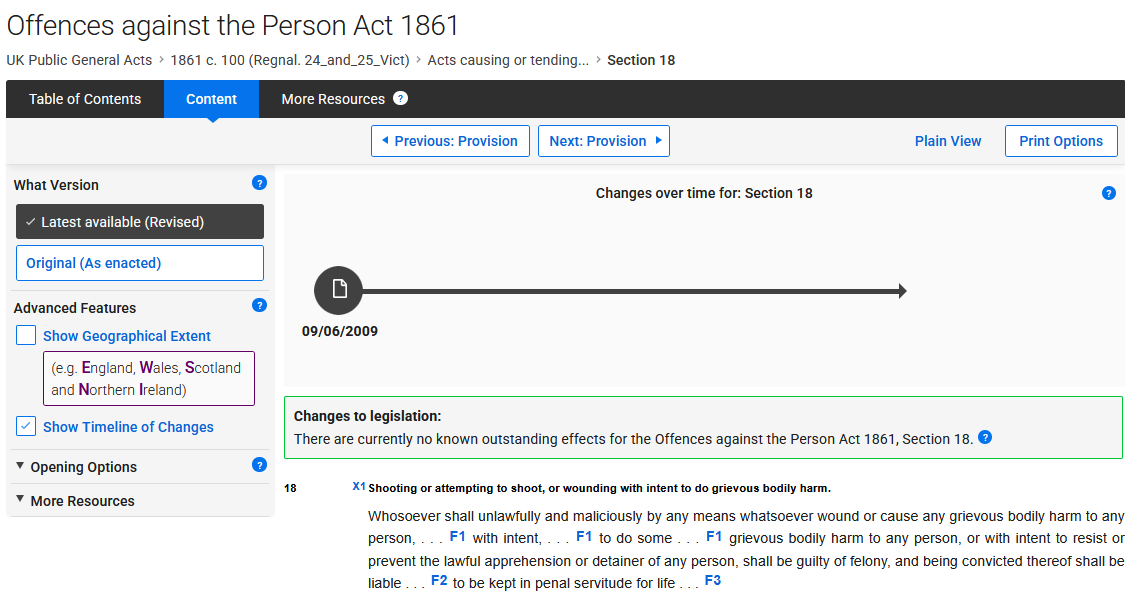
In addition Samuel Corner is charged with grievous bodily harm with intent, an offence potentially resulting in life imprisonment.
I must at this stage congratulate Real Media, who have been doing a wonderful job of reporting the key events in the trial. As is to be expected, the mainstream media has published nothing except what has been served up to them on behalf of the prosecution and the state.
I am going to publish some key extracts that give you an idea of what has been going on:
Extract from the cross examination of Elbit security guard Mr Shaw:
After a break for lunch, it was time for Mr. Shaw to be cross-examined by defence barristers, beginning with Mr. Menon, who first asked him whether he knew at the time of the incident that "Elbit Systems is Israel's largest weapons manufacturer". The prosecution immediately objected, and Judge Johnson told Menon that if he wanted to ask questions like this they would need to have a discussion about it later. Mr. Menon requested an answer from Mr. Shaw, but the judge insisted he move on. The context appeared to be that Menon went on to ask whether the guard was aware of Palestine Action's protests and actions against the company, and whether he'd been given specific training in relation to protest. Shaw said he'd received verbal instruction to call police and to intervene if it was safe to do so.
Menon then went on to the first interaction, after the van had been seen and heard hitting the shutters. There was then a very confused exchange in which Shaw was adamant he had had a struggle with an Arabic-looking man wielding an axe, prior to the point at which he is seen in footage running at someone and hitting them several times with an umbrella and bringing them to the ground. His recollection didn't seem to be backed up by evidence, and Menon reminded him he'd told the jury earlier about a man with an axe, but he maintained that in his mind that was a separate incident before what we saw on video. He was asked whether any injuries he received had occurred inside the factory, and he affirmed they had all happened before he went in, that is, he didn't receive any contact from anyone in the 'red team'.
Barrister Mr Wainwright, acting for Samuel Corner, picked up on the answers just given. In Shaw's witness statement (given later in the day after the event) he had referred to just one incident outside the building, but now seemed confused as to whether there were two. He agreed there didn't seem to be any evidence of two incidents.
Moving on, once he was in the building, we'd seen Shaw running towards people wielding his umbrella. His evidence had suggested he was threatened and attacked - he also said the group had tried to get him to open a door to give them access to offices. On reviewing the footage and under cross-examination he conceded they were telling him to leave, to 'fuck off', and not to give them access. He was also shown footage of Samuel Corner leading the way and showing him how he could go out via the shutter - a female, thought to be Kamio, also asks him if he's OK and tells him he needs to go because he is bleeding. Mr. Shaw concedes what is being evidenced, and also that he then followed Mr Corner who had begun smashing a toilet area, and tried to trap him in there by holding the door for a while before deciding to go outside. Shaw agreed that no-one in the building had struck him.
Extract from cross-examination of security guard Mr Volante
In evidence yesterday, Volante had claimed that Kamio approached him with an angle grinder. He was shown footage in which she actually appeared to be holding a sledgehammer, while it was Volante himself who appeared to hold an angle grinder in one hand and a small hammer in the other, and was swinging them. Ms Hammad accused Volante of being very angry, causing one of the activists, Mr. Devlin, to tell him to 'calm down'. The guard said he was 'animated' rather than angry, wasn't using the tools as weapons, and was attempting to disarm the intruders. It can be seen that that Mr. Devlin is actually unarmed. Kamio is seen moving around with a sledgehammer, and then using it to smash up some computer equipment. Volante agrees that at no point is she seen with an angle grinder, let alone threatening him with it.
Barrister for Zoe Rogers, Ms Mogan shows footage of Volante in the corridor with a whip in his hand screaming at Ms Rogers and others that they were "being recorded". Mogan reminded him that he was aware of previous Palestine Action protests aimed at damaging Elbit equipment, and that yesterday he had said he had grabbed a sledgehammer off Mr Devlin. Playing footage, it seemed to show him actually seizing the sledgehammer off Zoe, and she gets flung towards a wall. It also looks like he is then holding the sledgehammer with its head out in front of him, and Zoe picks up another sledgehammer from the floor, struggling with its weight and turning through 360 degrees as he approaches her with his hammer in front of him.
Yesterday Volante told the court that her hammer made contact with him, but now he accepts that that wasn't in his statement to the police, and that it may not have done. Ms Mogan suggested he had swung his sledgehammer at Zoe, showing some more footage, in which the shadow of the hammer appeared as though raised, and Zoe covering her face in response. He had already accepted that he had kicked Mr Devlin, and he now acceded that Zoe might have "thought" that the hammer would hit her, but maintained he hadn't swung it at her. Volante also agreed that, although his BWV was no longer recording at that time, it was "possible" that Ms Rogers ended up on the ground.
Mr Morris, barrister for Jordan Devlin, then asked Mr Volante to acknowledge that police officers had shown him unedited footage from his own BWV a few days before trial, and asked whether he noticed anything additional to what he'd described in his original statement at the time, especially that when he entered the building he clearly had one of the whips in his hand. Volante said he hadn't noticed that. Mr. Morris suggested that Volante had run down the corridor with whip in hand, screaming at Mr. Devlin who was unarmed, and inquired whether Volante had used any de-escalation training, rather than engaging in force on first contact with Devlin and Rogers. Morris asked whether he was registered with the Security Industries Association (SIA) and whether their training included hitting someone in the face with the handle of a sledgehammer. Volante said that any such contact was unintentional and that that was why he also hadn't mentioned it in his police statement.
Mr. Morris showed the court a screenshot from footage, that appeared to show contact described, and then handed out several photos of injuries that Mr. Devlin had sustained. One shows a round red mark that Mr. Morris suggests is the shape of a sledgehammer head. Volante is also asked about any conversation they had in the struggle, and whether when they were face-to-face, he had tried to bite Mr. Devlin on the neck. He said Mr. Devlin had likened the struggle to Star Wars and that he was a rebel or Jedi to Mr. Volante's empire, but that no bite had occurred.
After the struggle in the alcove, the next time Devlin and Volante engaged was when the police had arrived. Volante denies he hit Devlin in the face with the edge of the hammer, but admits he then put him in a choke hold, which under further questioning he reveals he learnt from martial arts training which he'd done when younger, reaching a blue belt in JuJitsu but only a white belt in TaeKwondo. Volante described the manoeuvre as a 'rear naked choke hold', which could be dangerous if not administered properly. He is shown a further photograph of marks to Devlin's neck, but says he hadn't caused those. A police BWV video sequence is shown where Mr. Devlin attempts to stand up, and Volante uses the handle of the sledgehammer against his neck to force him back down. A disagreement ensues, in which Volante claims he was defending himself and trying to prevent Devlin from grabbing the sledgehammer, while Morris argues that Devlin poses no threat at the time and Volante was performing an aggressive and dangerous act. Another photo showed Devlin's bruised face and black eye, corresponding to the side of his face that Volante was accused of hitting. Volante admits that he struck him and that he fell back.
Footage shows Devlin telling the police Volante had assaulted him and pointing at his face. Mr. Morris also notes to the court, that although referred to throughout as Scottish, Mr. Devlin's accent is actually Northern Irish.
Now we have extracts from the cross-examination of a third security guard. Mr Luke:
After a short break, Mr Menon cross-examines Mr. Luke and takes him through the footage once more. He agrees that the first woman is holding a whip and he seizes it off her - and although he claims she used it against him there doesn't appear to be video of that. While he's grappling with the woman who originally held a sledgehammer, the other woman hands her hammer to the male and runs off somewhere. After a bit more confusion, Mr. Luke agrees that the next time he sees the two women, it is after what Menon describes as Mr. Volante's 'Incredible Hulk' moment, and that they remain on the ground compliant until they are arrested by police.
Samuel Corner's barrister, Mr. Wainright, then speaks to Mr. Luke pointing out that several of his assertions have turned out to be wrong. He was wrong about the sequence of events, he was wrong that a female passed a sledgehammer to a male who tried to use it against him. In his police statement Mr. Luke said he disarmed two women of a sledgehammer and an angle grinder, but later accepted this was wrong too. Mr. Wainwright took Luke through footage once more and showed that he had mixed which of the two males had the sledgehammer, which direction they had come from, and indeed whether anyone had actually tried to hit him.
Ms Hammad (for Leona Kamio) tried to clear up confusion of the order of events, and particularly at what point Mr. Luke had actually switched his camera on. He had said he started recording after hitting the panic button in the control room, but Ms Hammad showed footage that appeared to show him entering the warehouse from the loading bay area before that. She suggested that he had had some sort of tussle with one of the females at that point (before switching on his BWV) and then he went to the control room. Mr. Luke was adamant this was not the case. Ms Hammad finished her questioning by asking him whether he had been hit by the woman with the sledgehammer - he said he thought it had grazed him, but accepted it hadn't hit him. Ms Hammad suggested he had merely grabbed it.
Next, Ms Oborne asked some questions about the allegation that Fatema Rajwani had a bag of fireworks and was intending to throw one at him. Taking him through his BWV footage once more, he acceded there didn't appear to be any bag, or possibly any fireworks, and that in fact Ms Rajwani had taken a simple flare out of her pocket.
Now we have an extract from the evidence of a policeman, PC Buxton, under cross-examination:
The barrister reminds Buxton that when he entered the building there was loud noise and a horrible smell, and then shows the officer some video of the confrontation between the security guard and the intruder. The guard (Volante) is seen pushing the handle of the sledgehammer against the brown-haired male's neck, and Buxton is asked if he remembered seeing that - he said he didn't remember it. Wainright (who acts for Mr. Corner, the blonde man) shows footage showing Corner swing his hammer in order to hit the hammer held by the guard, and Buxton accedes that is what it looks like.
Next, Buxton is seen in the footage using his spray, and he agrees that Corner is not wearing any eye protection at that moment. Wainright asks him about the struggle with the brown-haired male on the floor, and about the moment that Corner returns. Buxton had given a video statement a couple of days after the incident, in which he describes Corner swinging the sledgehammer, and saying that although he wasn't absolutely sure if it had hit him, he thought it probably had, because he remembered feeling pain, and because a bruise appeared a few days later. Mr. Wainright remarks that the officer also hadn't mentioned damage to the radio in any earlier evidence, and Buxton agreed that it could have been away from his body on the floor somewhere.
Mr. Wainright also asked the jury to note that in Buxton's evidence he said "I remember a horrible scream" which referred to the point at which one of the women was tazered.
Mr. Morris (acting for brown-haired Jordan Devlin) then takes over cross-examination, and asks Buxton to look once more at the footage, this time slowed down. When the video first shows the three people in red, Mr. Morris asks the officer whether he had noticed the security guard on his right holding a sledgehammer. He replies that he can't remember. He was also asked when he'd first seen the footage and whether it was before writing his first statement. After challenging Mr. Morris as to whether it was a strike or whether it was a push that the guard administered with the sledgehammer on Devlin's neck, Buxton does agree that his statement claimed the sledgehammer was in Devlin's hands, but now realises that it was the guard who was actually holding it. The barrister asked the officer whether he knew why the guard had a sledgehammer, and he answered that he didn't.

Now, it is not in dispute that the Palestine Action team entered the factory with sledgehammers and other equipment, intending to damage machinery and weapons in order to disrupt Israeli arms supply. It is also not in dispute that a policewoman, Sergeant Evans, was injured. But how she got injured, how the melee developed and who hit who is a key question.
What is evident from these exchanges is that the security guards and police are unreliable witnesses.
It is not merely that their evidence differs from what is shown by the video cameras.
It is that, consistently, their sworn evidence is untrue in a way that always makes the Palestine Action activists more aggressive, and themselves more passive, than in fact was the case.
Whether this is malicious, or merely the natural tendency of the human brain in a chaotic and scary situation to see things in the way it wishes, is not immediately evident. The answer to that will become plain when the defendants give evidence, and we start to see whether they too gave accounts inconsistent with the video evidence.
There is also the question of major gaps in video recordings and of the cameras in the "alcove" where much of the action took place apparently producing no footage, as so often happens when convenient to the authorities.
The cross-examination about the police handling of the video evidence is also highly revealing, here with PC Grant:
Menon asked her to confirm that Elbit had sole control of the footage and the system for two days - she agreed, but said the recordings on the system would have been the same and there was no evidence they had edited anything. She confirmed that she had not asked Elbit about the footage from cameras 22-25 until "much later" and that they were "quite shocked when I pointed it out".
The name of her contact at Elbit Systems has been withheld from the defence barristers and he is known as Witness A. Grant was asked about her contact with him and referred her to email correspondence between them. On 11th Aug she'd sent an email headed 'CCTV update Saturday' stating that the police hadn't checked the frame rate of all the cameras, just dipping in to get an interview, but she was concerned that " There's a huge opportunity for the defence counsel to use the gaps and jumps to their advantage".
It is hard to imagine a plainer admission that a serving British police officer saw her primary duty as helping Israel's largest arms manufacturer to secure convictions, rather than establishing the truth.
Menon asked why on earth the police were chatting with Israel's largest arms manufacturer about what the defence counsel might do. She replied it was just her experience there was potential for that and that the system was so bad she was concerned about possible future incidents.
One of the other defence barristers picked up the baton, asking about the supposed independence of the police, and about the integrity of independent investigation and storage of exhibits. They referred to a police search of a safe at Filton carried out on 22nd November just before the trial, which found a number of USB sticks in Metropolitan Police evidence bags. Ms Grant said she was not aware of that. But one of the bags had written on it "provided to Elbit Systems by PC Grant." The officer said the only stuff they'd given back was the material offloaded to create space. She said she couldn't recall the labelling of the bag, that it wasn't normal practice and couldn't understand it at all.
….Mr Wainwright asked PC Grant whether she'd been made aware that the security guard Mr. Volante had run into the factory towards one of the defendants with a whip in his hand, and there was another incident in which a security guard used a sledgehammer. He asked her whether she'd searched for footage of that. She said she'd been told about it when she was there, but didn't look for it specifically as she had downloaded everything that happened in that hour and a half between 3 and 4.30am. She couldn't remember seeing a security guard with a whip.
Mr. Wainwright showed an image of the view from C24, asking if she'd looked at that footage and whether she'd seen Volante running with a whip in his hand and screaming. Ms Grant said that if the camera had been operating properly regarding the frame rate, she'd have seen it, but had made no notes of frame rates etc. Asked about C28, and the security guard running into the alcove, she was asked whether she'd seen that or made any notes on it. She said she couldn't remember. Effectively it wasn't her job, and she handed all the footage over to her Sergeant, Ken Crawley.
And this from the cross-examination of Detective Constable Hammersley from the Counter Terrorism Police:
Mr. Morris noted that Hammersley had made several statements over the past year, but only the latest, served during this trial, mentioned that he was a 'viewing manager'. He said that he hadn't thought it relevant. Mr. Morris then showed the unedited clip of Mr. Volante running in with the whip in his hand and asked Hammersley why he hadn't put this in the compilation. The response was that the technician Sarah Bentley had a degree of autonomy in what went in. Asked whether the edit was deliberate Mr. Hammersley said no.
After a busy week of traveling I had intended to attend the start of the defence case on Wednesday, but the trial was suspended due to a juror suffering a bereavement. I therefore only managed to attend the trial in person on Thursday morning, with the evidence of the first defendant, Charlotte Head.
Again, Real Media have done a superb job of covering Charlotte's testimony. I would add only a few atmospherics.
This was my first time back in Woolwich Crown Court, attached to Belmarsh jail, since it hosted the first week of Julian Assange's extradition proceedings six years ago.
The area is still as bleak, the weather still cold, wet and windy, and the court as unremittingly gulag worthy, as six years ago.
I was slightly worried on arrival that I did not have a passport on me, but as in proceedings at the High Court it was not required for entry. When I had attended the Assange hearings here they had insisted on passports and entered everyone's details. They had also attempted to confiscate notebooks and pens in the public gallery. This Filton trial however was much more normal.
The courtroom is a mirror image of that used for the Assange case. The six accused were seated in a glass box at the back, spaced out evenly perhaps two metres apart from each other. The public gallery is raised at a mezzanine level, running down the left-hand side of the court, but completely sealed off with security glass. The courtroom sound is piped in to the public gallery through loudspeakers.
We could not see the jury, who are directly below the public gallery. Judge James Johnson, in his long wig and scarlet gown, presided from a dais. There was plainly great tension between the judge and the various defence counsel (each defendant having a team). I have never seen a judge spoken to with such obvious intonation of disrespect. Johnson's face repeatedly flushed as crimson as his robe.
Some of the highest drama in this trial consists in the discussions on admissibility of evidence when the jury is sent out. This was again the case on Thursday when I was there. Unfortunately reporting restrictions prevent me from telling you what this is about, until the trial is over, when I shall have much to say.
Charlotte Head was plainly extremely nervous. Before moving from the glass case to the witness box, she vigorously shook out her arms and particularly her hands to relieve the tension, and did so as though unaware she could be observed. At several points she was visibly struggling to collect herself.
She did however come over as intelligent, competent and concerned. How far the jury can connect with people coming from an activist background and sensibility will be a key factor in the outcome.
The key point of Head's very full evidence is that absolutely at no point was violence against people planned or envisaged. As at similar actions the expectation was that the security guards would not physically intervene and that they would have 20 minutes or so to cause property damage before the police arrived.
In the event it had all instead escalated extremely quickly.
This trial is a real ordeal for the female prisoners. Their journey in the extremely uncomfortable prison van from Bronzefield Prison takes between three and five hours each way, every day. On a typical day they are awoken at 5:30am and do not get back into their individual cells until 10:30pm, with only the limited lunch at Woolwich Crown Court as hot food; this five days a week.
It is also important to highlight the injuries Jordan Devlin suffered from the security guards. This from Charlotte Head:
Andrew Morris (representing Jordan Devlin) asks Ms Head to look at the photograph of Devlin's right arm, and asks her whether when she attended court on 13th August had she seen his injury. She said he had a pure black bruise all over one side, "like nothing she'd seen before", over mostly his ribs and underarm. He also had a bad black eye. Shown another picture of his face, she confirmed that's what it looked like, but said she was so shocked about the body bruising that she hardly remembered the eye.
These are noted in this description of the agreed facts of the case between prosecution and defence:
Mr Devlin's numerous injuries were recorded and on the following evening the custody officer authorised his escorted transfer to hospital, noting that large bruises were forming which Devlin said were caused by a sledgehammer.
The defendants were moved to Hammersmith Police Station the next day, and a list of Devlin's injuries were recorded there, which included hight shoulder tricep area was swollen, injuries to both wrists and his right cheek, a bump on his head, black right eye, bruised shins, thighs, and left arm, a bruised right elbow, and his left pectoral.
You will recall the police did not think Mr Devlin's injuries worth noting in their statements. In addition to which one female activist, Leona Kamio, was twice tasered, the second time "by accident" while prone and restrained.
Remember this is a case in which the prosecution narrative has been put forward as fact by both the Home Secretary and the Metropolitan Police Commissioner. Where there has been so much said by senior figures to the defendants' detriment, the running sore of the matters to be kept from the jury become still more problematic.
It is also simply remarkable that the prosecution's highly selective and edited video evidence has been put into the public domain and has notably affected the public narrative, but that the defence video evidence may not be made public.
But then I gave up on expecting justice from the system long ago. Happily juries often represent the last defence of a true spirit of fairness.
The trial continues. Do follow on Real Media - the state and corporate media will never give you the truth of it.
———————————
My reporting and advocacy work has no source of finance at all other than your contributions to keep us going. We get nothing from any state nor any billionaire.
Anybody is welcome to republish and reuse, including in translation.
Because some people wish an alternative to PayPal, I have set up new methods of payment including a Patreon account and a Substack account if you wish to subscribe that way. The content will be the same as you get on this blog. Substack has the advantage of overcoming social media suppression by emailing you direct every time I post. You can if you wish subscribe free to Substack and use the email notifications as a trigger to come for this blog and read the articles for free. I am determined to maintain free access for those who cannot afford a subscription.
Click HERE TO DONATE if you do not see the Donate button above
Subscriptions to keep this blog going are gratefully received.
Choose subscription amount from dropdown box:
Recurring Donations
3 Pounds : £3.00 GBP - monthly5 Pounds : £5.00 GBP - monthly10 Pounds : £10.00 GBP - monthly15 Pounds : £15.00 GBP - monthly20 Pounds : £20.00 GBP - monthly30 Pounds : £30.00 GBP - monthly50 Pounds : £50.00 GBP - monthly70 Pounds : £70.00 GBP - monthly100 Pounds : £100.00 GBP - monthly
PayPal address for one-off donations: craigmurray1710@btinternet.com
Alternatively by bank transfer or standing order:
Account name
MURRAY CJ
Account number 3 2 1 5 0 9 6 2
Sort code 6 0 - 4 0 - 0 5
IBAN GB98NWBK60400532150962
BIC NWBKGB2L
Bank address NatWest, PO Box 414, 38 Strand, London, WC2H 5JB
Bitcoin: bc1q3sdm60rshynxtvfnkhhqjn83vk3e3nyw78cjx9
Ethereum/ERC-20: 0x764a6054783e86C321Cb8208442477d24834861a
The post The Filton Trial appeared first on Craig Murray.
I am confident that over 2 million people in the UK have shared thoughts on the Genocide in Gaza that are stronger than anything Natalie Strecker has expressed.

I am quite certain that I am one of those 2 million.
Yet Natalie Strecker, an avowed pacifist, today faces up to ten years in prison under the Terrorism Act when the verdict in her case comes in.
Strecker is charged with eliciting support for Hamas and Hezbollah, based on 8 tweets, cherry-picked by police and prosecutors from an astounding 51,000 tweets she sent, mainly from the Jersey Palestine Solidarity Committee account.
The tweets were rather rattled off in court and referred to occasionally again in whole and in part. There may be minor inaccuracies not affecting sense, but this is the best reconstruction of those tweets that I can make (they were not displayed to the public):
"People will be individually resisting: otherwise we would be asking them to submit to genocide on their knees"
"Solidarity with the people of Lebanon and Hezbollah has the right to resist in international law, I remind you the occupier does not, and are legally obligated to try to prevent Genocide."
"Solidarity with the resistance. In the same way that the resistance fought the Nazis in Europe, we must support the fight against the Nazis of our generation".
"Resistance is their legal right under moral and international law. If you don't want resistance, then don't create the circumstances which require it. Solidarity with the Resistance."
"This nonsense our nation has descended into, where one side is committing genocide, and the other is proscribed for fighting it. I believe Hezbollah may be Palestine's last hope".
"Hamas the resistance did not break out of their concentration camp to attack Jews as Jews. We can debate whether armed resistance is legitimate. Of course there should be no attacks on civilians."
"I am sick of the MSM propaganda about "Hamas-run health ministry figures". Hamas is the government in Gaza. Every health ministry in the world is run by its government."
"Are you awake? So it is down to ordinary people like you an me to end it. We must take our power back. Join me in solidarity with the people of Lebanon and Palestine. Solidarity with the Resistance."
That is it. The prosecution case is that these tweets, both collectively and individually, amount to an invitation of support for Hamas and Hezbollah resulting in up to ten years in jail in Jersey, or 14 years in jail on the UK mainland.
The prosecution explicitly stated, and the judge notably intervened to make sure that everybody understood, that it is the offence of supporting terrorism to state that the Palestinians have the right to armed resistance in international law.
Judge John Saunders interrupted the prosecution to ask whether they were saying that he would be guilty of support for terrorism if, in a lecture, he told an international law class that Palestinians have the right to armed resistance in international law.
After some kerfuffle when faced with such an awkward question, the prosecution replied that yes, it could be the offence to tell law students that.
I should point out, at risk of dying in jail, that the Palestinians are beyond doubt an occupied people in international law, and equally beyond doubt an occupied people have the right of armed resistance.
To state that the Palestinians have the right of armed resistance in international law is not in the least controversial as a statement of law. A few Zionist nutters would try to differ, but 95% of international lawyers on this planet would agree.
I assume by perfectly logical extension that this means the prosecution must believe it is a terrorist crime in UK law, for example, to quote UN General Assembly Resolution 37/43, which:
2. Reaffirms the legitimacy of the struggle of peoples for independence, territorial integrity, national unity and liberation from colonial and foreign domination and foreign occupation by all available means, including armed struggle;
3. Reaffirms the inalienable right of the Namibian people, the Palestinian people and all peoples under foreign and colonial domination to self-determination, national independence, territorial integrity, national unity and sovereignty without outside interference;
It is also worth stating that on Friday the prosecution stated, in these precise words, that "Resistance is synonymous with Hamas and Hezbollah" and that any support for, or justification of, Palestinian resistance is support for a proscribed organisation.
To repeat, there are millions of people in the UK who have stated stronger things than the tweets above. Including me. And, as the defence pointed out repeatedly, just eight tweets had been found after hundreds of hours of police time, and found amidst tens of thousands of other tweets on the Middle East, hundreds of which specifically urge non-violence.
So why are the police doing this to Natalie? Why did six armed police storm her apartment and rouse her at 7am a year ago, seizing all her electronics and papers, arresting her and not allowing her to have a pee without leaving the bathroom door open so she could be observed?
This is where the story gets very dark indeed.
This is not a local Jersey initiative.
The prosecution is directed from London and Alison Morgan KC, senior Treasury counsel (UK government lawyer) is seated beside the local prosecuting counsel, openly puppeteering him every step of the way.
So why has the UK government chosen Jersey to prosecute a local pacifist whose statements provide possibly the weakest case of support for terrorism that has ever been heard in any court in the Western world?
The answer is that here in Jersey there is no jury.
Facing this charge on the UK mainland Natalie would have a jury, and there is not a jury in the UK that would not throw this self-evidently vindictive nonsense out in 5 minutes.
Why is it worth the time and expense for Whitehall to send Alison Morgan KC here to direct a weak case against somebody who is obviously not a terrorist?
The plain answer is that this is a pilot for what they can get away with on the mainland when they abolish juries in such trials, as "Justice Secretary" David Lammy has announced that they will indeed do.
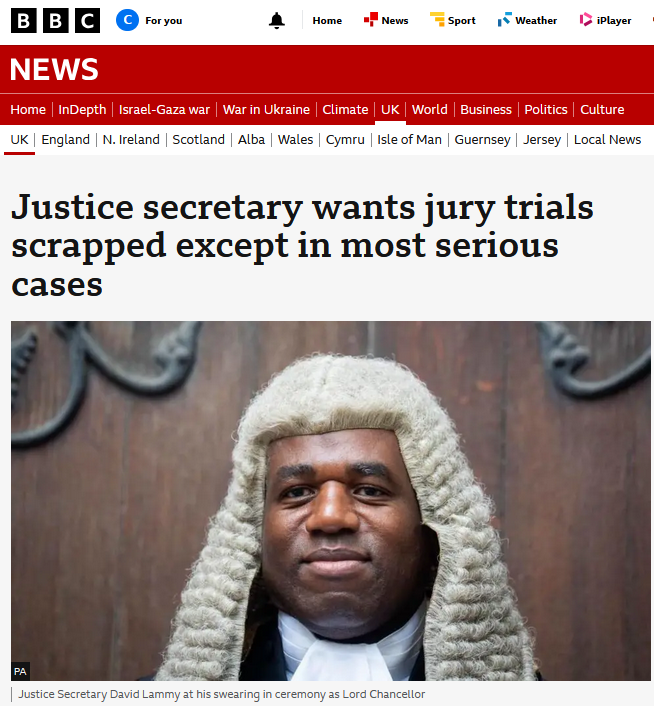
In Jersey the system is inherited from the Normans. The judge sits with two "jurats" or lay magistrates. They determine innocence or guilt. These come from a pool of 12 permanent jurats. In practice these are retired professionals and frequently have strong connections to the financial services industry.
What the jurats emphatically are not is Natalie Strecker's working class peers of a kind who would be represented on a jury. I strongly recommend this brief article on the corruption of Jersey society by a man who was for 11 years the Government of Jersey's economic adviser.
The judge, Sir John Saunders, seems a decent old stick in a headmasterly sort of way. He has told the court that "Mrs Strecker's good character is not in doubt". On Friday he stated that this was "A very difficult and in many ways a very sad case for the court to deal with. But I have to construe it according to strict legal principles".
In the Palestine Action proscription case, as I reported, counsel for the UK government openly stated "We do not deny that the law is draconian. It is supposed to be". In the mass arrests of decent people over Palestine Action, people have understood what a dreadfully authoritarian law the proscription regime is.
An intelligent observer cannot sit in Judge Saunders' courtroom without realising that he thinks this is a dreadful law, but accepts that it is his job to enforce it. He reminds me of the caricature of the lugubrious headmaster stating "This is going to hurt me more than it is going to hurt you".
In effect, Alison Morgan and the UK government are attempting through this prosecution to make even the most basic expression of support for Palestine a serious criminal offence. Remember that a terrorism conviction destroys your life - it almost certainly brings loss of employment, debanking and severe travel restrictions.
The International Court of Justice has decided that Israel has a real case to answer on Genocide, and most experts believe that Israel is committing Genocide. In Natalie's correct image, the UK government is trying to make it a terrorist offence to say anything other than that the Palestinians should quietly submit to Genocide on their knees.
The danger is that the hubris of lay magistrates will lead the jurats to try cleverly to construe Natalie's comments as support for terrorism in line with the government's wishes. Natalie has, however, one defence in Jersey not available in mainland UK: here in Jersey the prosecution has to show intent - that she intended to cause support for terrorist organisations.
The prosecution has also relied on the extremely wide definition of support adopted in UK terrorist cases, that "support of" merely means "expression of agreement with".
In defending the tweet about Hamas-run health ministry figures, Natalie Strecker's counsel Mark Boothman countered this rather well when he said: "there is no offence of causing people to think less badly of Hamas"
I confess however I am slightly puzzled that I have not heard the defence argue that the prosecution positions are grossly disproportionate violations of freedom of expression in terms of Article X of the European Convention of Human Rights.
I would have thought, for example, that was the natural thing to say in response to the prosecution's contention that it would be a crime for a law lecturer to tell his class that the Palestinian people had the right of armed resistance in international law.
The verdict was decided yesterday afternoon between the judge and jurats. It will be presented in full written judgment in an hour's time.
This is a truly horrifying case for Natalie, who cannot afford to lose her job with a Jersey government agency and most certainly does not wish to be jailed. I pinch myself to be sure that this is all really happening.
It is a truly horrifying case in terms of what the Starmer government intends to do on the mainland in further criminalising support for Palestine.
I do not support Hamas nor Hezbollah, being opposed to theocracy. But for it to be illegal to discuss the Genocide in Gaza and the role of these two organisations, unless you do it absolutely without either context or nuance, is Orwellian.
Western dissent is also a victim of the Zionist Genocide.
———————————
My reporting and advocacy work has no source of finance at all other than your contributions to keep us going. We get nothing from any state nor any billionaire.
Anybody is welcome to republish and reuse, including in translation.
Because some people wish an alternative to PayPal, I have set up new methods of payment including a Patreon account and a Substack account if you wish to subscribe that way. The content will be the same as you get on this blog. Substack has the advantage of overcoming social media suppression by emailing you direct every time I post. You can if you wish subscribe free to Substack and use the email notifications as a trigger to come for this blog and read the articles for free. I am determined to maintain free access for those who cannot afford a subscription.
Click HERE TO DONATE if you do not see the Donate button above
Subscriptions to keep this blog going are gratefully received.
Choose subscription amount from dropdown box:
Recurring Donations
3 Pounds : £3.00 GBP - monthly5 Pounds : £5.00 GBP - monthly10 Pounds : £10.00 GBP - monthly15 Pounds : £15.00 GBP - monthly20 Pounds : £20.00 GBP - monthly30 Pounds : £30.00 GBP - monthly50 Pounds : £50.00 GBP - monthly70 Pounds : £70.00 GBP - monthly100 Pounds : £100.00 GBP - monthly
PayPal address for one-off donations: craigmurray1710@btinternet.com
Alternatively by bank transfer or standing order:
Account name
MURRAY CJ
Account number 3 2 1 5 0 9 6 2
Sort code 6 0 - 4 0 - 0 5
IBAN GB98NWBK60400532150962
BIC NWBKGB2L
Bank address NatWest, PO Box 414, 38 Strand, London, WC2H 5JB
Bitcoin: bc1q3sdm60rshynxtvfnkhhqjn83vk3e3nyw78cjx9
Ethereum/ERC-20: 0x764a6054783e86C321Cb8208442477d24834861a
The post The Terrifying Case of Natalie Strecker appeared first on Craig Murray.
In the last three days I have been in London at the judicial review of Palestine Action and today I am in Jersey for the terrorist trial of Natalie Strecker. I made a brief impromptu speech outside the High Court, in intervening to try and stop some people in wheelchairs from being arrested as "terrorists", and I am as proud of that couple of minutes speech as I am of any work I have done. This afternoon I am flying from Jersey for the Your Party founding conference in Liverpool.
Unfortunately I am really struggling with bronchitis and just haven't had the energy to write it all up in the evenings as I intended. All of this activity is funded by subscribers so obviously this is wrong. I do hope to be able to catch up soon.
You can catch that brief speech at 7 minutes here.
The post Resisting Authoritarianism appeared first on Craig Murray.
The Scottish judicial review of the proscription of Palestine Action - funded so far by readers of this blog - has been simply shelved by delay tactics that plainly break the Scottish legal system's own rules.
Our case was ruled competent for us to serve the petition on the UK government. They replied in the last hour of their two-week deadline. The court itself then had a two-week deadline to grant a judicial review, or to call a hearing on whether to grant it.
Instead the judge has simply sat on it, preventing a judicial review by administrative delay.
This is the absolutely plain rule the court is breaking:
The permission stage
58.7.—(1) Within 14 days from the end of the period for lodging answers the Lord Ordinary must—
(a) decide whether to—
(i) grant permission (including permission subject to conditions or only on particular grounds);
(ii) grant an extension to the time limit under section 27A of the 1988 Act; or
(b) order an oral hearing (for the purpose of making those decisions) to take place within 14 days.
The emphasis is mine but the word "must" is obviously very important here!
The extraordinary thing is that our legal team is struggling to come up with actions we can take to force the court to act. The judges can freeze this out for a very long time.
The absurd proscription of Palestine Action as a terrorist organisation, and the appalling legal consequences on freedom of expression and in criminalising thousands of highly respectable citizens as terrorists, has faced the state with a dilemma which, at least in Scotland, it prefers not to resolve head on.
In Scotland, the prosecuting authorities have therefore written to over 20 activists charged for wearing T-shirts with the slogan
"Genocide in Palestine, Time to take Action"
offering to drop charges if they accept a prosecutorial warning.
In Scotland, this warning does not involve an acknowledgement of guilt (unlike a police caution), but sits on your record for two years and can be used against you in future court cases. All twenty-plus individuals we know of who have been offered the warning have responded by saying they will not accept the warning. The state's attempt to dodge the court cases is therefore not working.
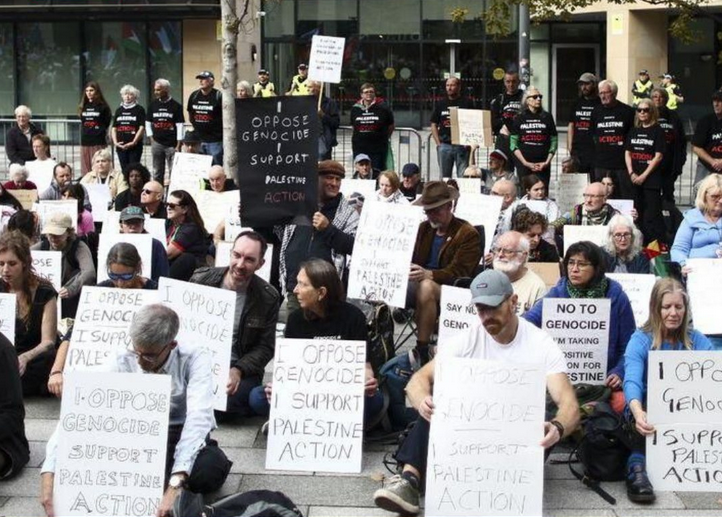
I am also hearing of activists charged for holding the Defend Our Juries signs saying
"I oppose Genocide, I support Palestine Action"
being offered deals on non-custodial outcomes in Scotland if they accept guilt, but as such prosecution deals are dubiously legal I have not yet fully managed to stand this story up.
But what is plain to me is that the authorities in Scotland are determined to keep both the judicial review of the proscription, and individual terrorist cases from the proscription, out of court.
The reason for this is that there is no confidence the Scottish judiciary, let alone Scottish juries, will uphold the proscription. The whole farce is falling apart on the basis of societal resistance to this draconian governmental overreach. This resistance runs vertically through the classes in Scotland.
I am currently in England for the judicial review of the proscription in the High Court of England and Wales. Here a different approach is being taken. They have simply switched the judges at the last minute to load the dice for Israel.
Judge Chamberlain granted the judicial review, a decision which was upheld by the Court of Appeal. As I have previously reported, he has a reputation for independence from the state, having even called MI5 out for producing dishonest evidence. I found his manner in court rather overbearing, but that self-confidence is perhaps needed to take anti-Establishment positions as a High Court judge.
Chamberlain plainly was expecting to hear the case. He has handled it all the way through, it was scheduled according to his diary, and just eight days ago he was still corresponding with counsel as the judge in the case. He has been replaced by a horror show of top Zionists. Judge Swift is the poster boy of security-service controlled judges, with a history of pro-government decisions in the Assange and Rwanda cases. He was a lawyer for the security services for many years and stated in interview that they were his favourite clients.
Swift was forced to recuse himself in the Graham Phillips case, when it was discovered he had been secretly meeting to discuss the case with the Foreign Commonwealth and Development Office, one of the parties, without informing the defence. That is judicial behaviour so bad I cannot begin to describe the magnitude of it.
Here is what I wrote about Swift on 21 February 2024:
The blocking of Assange's appeal was done by Judge Swift, a judge who used to represent the security services, and said they were his favourite clients. In the subsequent Graham Phillips case, where Mr Phillips was suing the Foreign Commonwealth and Development Office (FCDO) for sanctions being imposed upon him without any legal case made against him, Swift actually met FCDO officials - one of the parties to the case - and discussed matters relating to it privately with them before giving judgment. He did not tell the defence he had done this. They found out, and Swift was forced to recuse himself.
Personally I am surprised Swift is not in jail, let alone still a High Court judge. But then what do I know of justice?
Another of the new panel for the Palestine Action case is Judge Karen Steyn, who ruled that UK export of F35 parts was legal even though they may end up being used in Israeli attacks on Gaza. Steyn ruled that such decisions were political and a matter for ministers and not for the courts - an attitude which the government are evidently confident she will continue in the Palestine Action case.
Dame Victoria Sharp, who will chair the judicial review, is a puzzle. Completely integrated in the top Tory Establishment, her twin brother Richard gave a large personal loan to Boris Johnson and shortly thereafter, and doubtless by total coincidence, was appointed by Johnson as chairman of the BBC.
Richard Sharp has long been associated with Zionist super-donor Trevor Chinn. They served together as advisors to Boris Johnson while he was Mayor of London. Victoria Sharp moves in an entirely Zionist and high-Tory milieu, but I must say that I was struck by her honesty and good sense in the Assange hearings. Perhaps, from the Establishment point of view, Israel is a subject on which she will be "safer".
I have no doubt whatsoever that the last-minute change of judging panel is a panicked effort by the government and its deep-state controllers, to seize control of the narrative, following the carefully timed and illegal public release of highly edited and confused police footage of the Filton action.
It may prevail with this immediate panel, but will not prevail in London in the longer term. Meanwhile, we have in Scotland to continue to press the courts to stop hiding and to face the burning questions highlighted by this crazed authoritarianism in the name of Israel.
———————————
My reporting and advocacy work has no source of finance at all other than your contributions to keep us going. We get nothing from any state nor any billionaire.
Anybody is welcome to republish and reuse, including in translation.
Because some people wish an alternative to PayPal, I have set up new methods of payment including a Patreon account and a Substack account if you wish to subscribe that way. The content will be the same as you get on this blog. Substack has the advantage of overcoming social media suppression by emailing you direct every time I post. You can if you wish subscribe free to Substack and use the email notifications as a trigger to come for this blog and read the articles for free. I am determined to maintain free access for those who cannot afford a subscription.
Click HERE TO DONATE if you do not see the Donate button above
Subscriptions to keep this blog going are gratefully received.
Choose subscription amount from dropdown box:
Recurring Donations
3 Pounds : £3.00 GBP - monthly5 Pounds : £5.00 GBP - monthly10 Pounds : £10.00 GBP - monthly15 Pounds : £15.00 GBP - monthly20 Pounds : £20.00 GBP - monthly30 Pounds : £30.00 GBP - monthly50 Pounds : £50.00 GBP - monthly70 Pounds : £70.00 GBP - monthly100 Pounds : £100.00 GBP - monthly
PayPal address for one-off donations: craigmurray1710@btinternet.com
Alternatively by bank transfer or standing order:
Account name
MURRAY CJ
Account number 3 2 1 5 0 9 6 2
Sort code 6 0 - 4 0 - 0 5
IBAN GB98NWBK60400532150962
BIC NWBKGB2L
Bank address NatWest, PO Box 414, 38 Strand, London, WC2H 5JB
Bitcoin: bc1q3sdm60rshynxtvfnkhhqjn83vk3e3nyw78cjx9
Ethereum/ERC-20: 0x764a6054783e86C321Cb8208442477d24834861a
The post Judicial Malfeasance and Palestine Action appeared first on Craig Murray.
Signed by a group of 21 computer scientists expert in election security
Executive summaryScientists have understood for many years that internet voting is insecure and that there is no known or foreseeable technology that can make it secure. Still, vendors of internet voting keep claiming that, somehow, their new system is different, or the insecurity doesn't matter. Bradley Tusk and his Mobile Voting Foundation keep touting internet voting to journalists and election administrators; this whole effort is misleading and dangerous.
Part I. All internet voting systems are insecure. The insecurity is worse than a well-run conventional paper ballot system, because a very small number of people may have the power to change any (or all) votes that go through the system, without detection. This insecurity has been known for years; every internet voting system yet proposed suffers from it, for basic reasons that cannot be fixed with existing technology.
Part II. Internet voting systems known as "End-to-End Verifiable Internet Voting" are also insecure, in their own special ways.
Part III. Recently, Tusk announced an E2E-VIV system called "VoteSecure." It suffers from all the same insecurities. Even its developers admit that in their development documents. Furthermore, VoteSecure isn't a complete, usable product, it's just a "cryptographic core" that someone might someday incorporate into a usable product.
Conclusion. Recent announcements by Bradley Tusks's Mobile Voting Foundation suggest that the development of VoteSecure somehow makes internet voting safe and appropriate for use in public elections. This is untrue and dangerous. All deployed Internet voting systems are unsafe, VoteSecure is unsafe and isn't even a deployed voting system, and there is no known (or foreseeable) technology that can make Internet voting safe.
Part I. All internet voting systems are insecureInternet voting systems (including vote-by-smartphone) have three very serious weaknesses:
- Malware on the voter's phone (or computer) can transmit different votes than the voter selected and reviewed. Voters use a variety of devices (Android, iPhone, Windows, Mac) which are constantly being attacked by malware.
- Malware (or insiders) at the server can change votes. Internet servers are constantly being hacked from all over the world, often with serious results.
- Malware at the county election office can change votes (in those systems where the internet ballots are printed in the county office for scanning). County election computers are not more secure than other government or commercial servers, which are regularly hacked with disastrous results.
Although conventional ballots (marked on paper with a pen) are not perfectly secure either, the problem with internet ballots is the ability for a single attacker (from anywhere in the world) to alter a very large number of ballots with a single scaled-up attack. That's much harder to do with hand-marked paper ballots; occasionally people try large-scale absentee ballot fraud, typically resulting in their being caught, prosecuted, and convicted.
Part II. E2E-VIV internet voting systems are also insecureYears ago, the concept of "End-to-End Verifiable Internet Voting" (E2E-VIV) was proposed, which was supposed to remedy some of these weaknesses by allowing voters to check that their vote was recorded and counted correctly. Unfortunately, all E2E-VIV systems suffer from one or more of the following weaknesses:
- Voters must rely on a computer app to do the checking, and the checking app (if infected by malware) could lie to them.
- Voters should not be able to prove to anyone else how they voted - the technical term is "receipt-free" - otherwise an attacker could build an automated system of mass vote-buying via the internet. But receipt-free E2E-VIV systems are complicated and counterintuitive for people to use.
- It's difficult to make an E2E-VIV checking app that's both trustworthy and receipt-free. The best solutions known allow checking only of votes that will be discarded, and casting of votes that haven't been checked; this is highly counterintuitive for most voters!
- The checking app must be separate from the voting app, otherwise it doesn't add any malware-resistance at all. But human nature being what it is, only a tiny fraction of voters will do the extra steps to run the checking protocol. If hardly anyone uses the checker, then the checker is largely ineffective.
- Even if some voters do run the checking app, if those voters detect that the system is cheating (which is the purpose of the checking app), there's no way the voters can prove that to election officials. That is, there is no "dispute resolution" protocol that could effectively work.
Thus, the problem with all known E2E-VIV systems proposed to date is that the "verification" part doesn't add any useful security: if a few percent of voters use the checking protocol and see that the system is sometimes cheating, the system can still steal the votes of all the voters that don't use the checking protocol. And you might think, "well, if some voters catch the system cheating, then election administrators can take appropriate action", but no appropriate action is possible: the election administrator can't cancel the election just because a few voters claim (without proof) that the system is cheating! That's what it means to have no dispute resolution protocol.
All of this is well understood in the scientific consensus. The insecurity of non-E2E-VIV systems has been documented for decades. For a survey of those results, see "Is Internet Voting Trustworthy? The Science and the Policy Battles". The lack of dispute resolution in E2E-VIV systems has been known for many years as well.
Part III. VoteSecure is insecureBradley Tusk's Mobile Voting Foundation contracted with the R&D company Free and Fair to develop internet voting software. Their press release of November 14, 2025 announced the release of an open-source "Software Development Kit" and claimed "This technology milestone means that secure and verifiable mobile voting is within reach."
After some computer scientists examined the open-source VoteSecure and described serious flaws in its security, Dr. Joe Kiniry and Dr. Daniel Zimmerman of Free and Fair responded. They say, in effect, that all the critiques are accurate, but they don't know a way to do any better: "We share many of [the critique's] core goals, including voter confidence, election integrity, and resistance to coercion. Where we differ is not so much in values as in assumptions about what is achievable—and meaningful—in unsupervised voting environments."
In particular,
- "We make no claim of receipt-freeness."
- "Of course, it may be possible for the voter to extract the randomizers from the voting client," meaning that voters would be able to prove how they voted, for example to someone on the internet who wanted to purchase votes at scale.
- "We agree that dispute resolution is essential to any complete voting system. We also agree that VoteSecure does not fully specify such a protocol." But really, the problem is much worse than this admission suggests. No one knows of a protocol that could possibly work. So it's not a matter of dotting some i's and crossing some t's in their specification; it's a gaping hole (an unsolved, research-level problem).
- "Critique: Malware on the voter's device can compromise both voting and checking, rendering verification meaningless. Response: This critique is correct—and universal. There is no known technical solution that can fully protect an unsupervised endpoint from a sufficiently capable adversary."
- "VoteSecure does not claim to: Advance the state of the art in cryptographic voting protocols beyond existing E2E-VIV research; Eliminate coercion or vote selling in unsupervised elections; [or] Fully specify election administration, dispute resolution, or deployment processes. What VoteSecure aims to do is: Clearly define its threat model . . ."
Based on our own expertise test, and especially in light of the response from Free and Fair, we stand by the original analysis: Mobile Voting Project's vote-by-smartphone has critical security gaps.
ConclusionIt has been the scientific consensus for decades that internet voting is not securable by any known technology. Research on future technologies is certainly worth doing. However, the decades of work on E2E-VIV systems has yet to produce any solution, or even any hope of a solution, to the fundamental problems.
Therefore, when it comes to internet voting systems, election officials and journalists should be especially wary of "science by press release." Perhaps some day an internet voting solution will be proposed that can stand up to scientific investigation. The most reliable venue for assessing that is in peer-reviewed scientific articles. Reputable cybersecurity conferences and journals have published a lot of good science in this area. Press releases are not a reliable way to assess the trustworthiness of election systems.
Signed(affiliations for for identification only and do not indicate institutional endorsement)
Andrew W. Appel, Eugene Higgins Professor Emeritus of Computer Science, Princeton University
Steven M. Bellovin, Percy K. and Vida L.W. Hudson Professor Emeritus of Computer Science, Columbia University
Duncan Buell, Chair Emeritus — NCR Chair in Computer Science and Engineering, University of South Carolina
Braden L. Crimmins, PhD Student, Univ. of Michigan School of Engineering & Knight-Hennessy Scholar, Stanford Law
Richard DeMillo, Charlotte B and Roger C Warren Chair in Computing, Georgia Tech
David L. Dill, Donald E. Knuth Professor, Emeritus, in the School of Engineering, Stanford University
Jeremy Epstein, National Science Foundation (retired) and Georgia Institute of Technology
Juan E. Gilbert, Andrew Banks Family Preeminence Endowed Professor, Computer & Information Science, University of Florida
J. Alex Halderman, Bredt Family Professor of Computer Science & Engineering, University of Michigan
David Jefferson, Lawrence Livermore National Laboratory (retired)
Douglas W. Jones, Emeritus Associate Professor of Computer Science, University of Iowa
Daniel Lopresti, Professor of Computer Science and Engineering, Lehigh University
Ronald L. Rivest, Institute Professor, MIT
Bruce Schneier, Fellow and Lecturer at the Harvard Kennedy School, and at the Munk School at the University of Toronto
Kevin Skoglund, President and Chief Technologist, Citizens for Better Elections
Barbara Simons, IBM Research (retired)
Michael A. Specter, Assistant Professor, Georgia Tech
Philip B. Stark, Distinguished Professor, Department of Statistics, University of California
Gary Tan, Professor of Computer Science & Engineering, The Pennsylvania State University
Vanessa Teague, Thinking Cybersecurity Pty Ltd and the Australian National University
Poorvi L. Vora, Professor of Computer Science, George Washington University
The post Internet voting is insecure and should not be used in public elections appeared first on CITP Blog.

Two months ago, I wrote about the competition concerns with the GenAI infrastructure boom. One of my provocative claims was that the lifespan of the chips may be significantly shorter than the accounting treatment given to them. Others like David Rosenthal, Ed Zitron, Michael Burry and Olga Usvyatsky have raised similar concerns. NVIDIA has a response. When asked about chip lifespan, a spokesperson pointed to the secondary market where chips get redeployed for inference, general HPC, and other workloads across different kinds of data centers. In other words, older chips have buyers and the secondary market is robust enough to support resale prices that will justify the accounting treatment.
This appears to be the industry's best argument. And the logic is sound in principle. Training is concentrated among a few frontier labs, while inference is distributed across the entire economy. Every enterprise deploying AI applications needs inference capacity. The "value cascade" that has training chips becoming inference chips, becoming bulk High-Performance-Computing (HPC) chips could be a reasonable model for how markets absorb generational transitions. If it holds, then a 5-6 year depreciation schedule might be justified, even if the chip's competitive life at the frontier is only 1-2 years.
Let's analyze whether that model holds up. For the secondary market thesis to justify current depreciation schedules, three things would need to be true:
1. The buyer pool must be large enough to absorb supply at meaningful prices.
NVIDIA's data center revenue now exceeds $115 billion annually. The downstream buyers for older chips represent a market a fraction of that size. These buyers exist, but they didn't scale with NVIDIA's AI business and would not have the capacity to absorb all the supply. Moreover, most enterprises are not building their own inference capabilities. They are renting those services from hyperscalers.
2. New supply must not overwhelm secondary demand.
NVIDIA's relentless pursuit of new chips on roughly annual cycles means each generation offers substantially better price-performance. The cascade model assumes orderly absorption at each tier: frontier buyers move to new chips, mid-tier buyers absorb their old ones, budget buyers absorb the generation before that. Each tier ideally clears before the next wave arrives.
But supply gluts break cascades. When new supply floods the market faster than downstream demand absorbs it, you don't get orderly price discovery. Tesla is instructive here. When Tesla slashed new vehicle prices to maintain volume, used values didn't gently adjust. They cratered 25-30% annually. Competitors explicitly refused to match the cuts because they understood the damage to their resale markets. The mechanism was simple: why buy used when you can buy new at the same price? The secondary market didn't find a new equilibrium. It fell until it hit buyers with fundamentally different use cases; people who couldn't afford new at any price.
NVIDIA isn't cutting prices, but each new generation has a similar effect. Why rent a three-year-old H100 when Blackwell offers better price-performance? The generational improvement compresses what anyone will pay for old chips. And unlike cars, GPUs face this compression every 12-18 months. The cascade has to clear faster than NVIDIA releases new generations.
There's a further problem. Each new generation doesn't just offer more compute, it offers more compute per watt. In a power-constrained data center, a provider faces a choice: run older chips that generate $X in revenue per kilowatt, or replace them with newer chips that generate multiples of that on the same power budget. Once the performance-per-watt gap reaches a certain threshold, the older chip isn't just worth less. It becomes uneconomical to run. If the electricity and cooling required to operate an H100 costs more than the market rate for the inference it produces, the chip's residual value approaches zero regardless of what the depreciation schedule says.
3. The rental market should reflect robust secondary demand.
Another way to test NVIDIA's argument is to look at pricing in the rental market. For most buyers, renting GPU capacity is functionally equivalent to purchasing into the secondary market. You get access to hardware without building data center infrastructure. If secondary demand were robust at current supply levels, rental prices would reflect that. Providers would be able to charge rates that justify their capital costs. Older chips would command prices proportional to their remaining useful life.
Pricing is notoriously opaque, but the indicators are that prices do not support the industry argument. H100 rental rates have fallen 70% from peak—from over $8/hour to around $2.50. According to Silicon Data as of December 17, 2025, H100 and A100 rental rates are hovering at $2.10 and $1.35, respectively. If the value cascade worked as described by NVIDIA, you'd expect tiered pricing: H100s at a significant premium and A100s at a discount reflecting lower capability and 3x lower cost. Instead, the prices for both generations have collapsed to their OpEx + a small margin. The hardware is effectively being given away as renters are just paying to keep the lights on. The efficiency gap makes this worse. Silicon Data index shows that the newer Blackwell chips are roughly 25x more efficient. Once Blackwell scales, the economics of running H100s in power-constrained data centers become untenable at any rental price.
One further constraint: chips need data centers. Buying a used H100 means you also need power, cooling, networking, and expertise to operate it. This limits secondary buyers to entities that already have that infrastructure, which overlaps heavily with the players contributing to rental oversupply. In other words, the potential sellers and potential buyers are substantially the same people. There is no overflow capacity sitting idle.
***
Putting these factors together suggests that relying on a robust secondary market for chips is illusory. None of this means older chips become worthless. They will find buyers. But they find them at prices that don't support 5-6 year useful life assumptions. The gap between accounting depreciation and economic depreciation is the competitive subsidy I described in the original post. The secondary market argument doesn't close that gap. It assumes it away.
Thanks to new information from Silicon Data I have updated the information in the third paragraph from the bottom. I always welcome corrections.
Mihir Kshirsagar directs Princeton CITP's technology policy clinic, where he focuses on how to shape a digital economy that serves the public interest. Drawing on his background as an antitrust and consumer protection litigator, his research examines the consumer impact of digital markets and explores how digital public infrastructure can be designed for public benefit.
The post AI Chip Lifespans: A Note on the Secondary Market appeared first on CITP Blog.
Bradley Tusk has been pushing the concept of "vote by phone." Most recently his "Mobile Voting Foundation" put out a press release touting something called "VoteSecure", claiming that "secure and verifiable mobile voting is within reach." Based on my analysis of VoteSecure, I can say that secure and verifiable mobile voting is NOT within reach.
It's well known that conventional internet voting (including from smartphones) is fundamentally insecure; fraudulent software in the server could change votes, and malware in the voter's own phone or computer could also change votes before they're transmitted (while misleadingly displaying the voter's original choices in the voter's app).
In an attempt to address this fundamental insecurity, Mr. Tusk has funded a company called Free & Fair to develop a protocol called by which voters could verify that their votes got counted properly. Their so-called "VoteSecure" is a form of "E2E-VIV", or "End-to-End Verified Internet Voting", a class of protocols that researchers have been studying for many years.
Unfortunately, all known E2E-VIV methods, including VoteSecure, suffer from gaps and impracticalities that make them too insecure for use in public elections. In this article I will pinpoint just a few issues. I base my analysis on the press release of November 14, 2025, and on Free & Fair's own "Threat Model" analysis and their FAQ.
The goal of an E2E-VIV protocol is to let the voter to check that their vote is included in a public list of ballots. But if this were done in the most straightforward way—like include the voter's name or ID-number in a public cast-vote record—then voter privacy (the secret ballot) would be lost. Any E2E-VIV system needs way for the voter to check their ballot without then being able to prove to someone else how they voted (otherwise voters could sell their votes, or be coerced to vote a certain way). Most E2E-VIV systems use the "Benaloh challenge"; but VoteSecure does it a different way. And really, in all the documents and analysis they have published, they have no explanation of how their "check" protocol satisfies the most basic requirement of E2E-VIV: voter can have confidence that their ballot is cast correctly, without being able to prove how they voted.
In addition to that omission, all E2E-VIV protocols have suffered from at least three big problems:
- Voters need to actively participate in checking, but we know (from human-factors studies) that the vast majority of voters won't perform even the simplest of checking protocols.
- Lack of a dispute resolution protocol. If some voters do detect that the system has cheated them, what can they do about it? Without a dispute resolution protocol, the answer is, Nothing.
- Malware in the user's computer (or smartphone) can corrupt both the voting app and the checking app. So you might do the "Check", and it could falsely report that everything's fine.
VoteSecure suffers from all three of these problems.
First, voters won't participate in checking. Even in present-day polling places, in those jurisdictions where voters use a touchscreen (BMD, Ballot-Marking Device) to indicate their votes for printing out onto a paper ballot, we know that 93% of voters don't look at that paper carefully enough to notice whether a vote was (fraudulently) changed. If only 7% of voter won't even execute a "Check" protocol that's as simple as "look at the paper printout", then how many will execute a more complicated computer protocol that requires them to use at least two different computers?
Second, there's no dispute resolution protocol. During some election, if many voters report to election officials that they've done the "Check" and found that the system is cheating, what's the election official supposed to do? Cancel the election and call for a do-over? But if the Secretary of State invalidates elections whenever lots of voters make such a claim, then it's obvious that a malicious group of voters could interfere with elections this way. Page 30 of Free & Fair's own Threat Model document discusses this case, and concludes that they have no solution to this problem; it's "Out of Scope" for their solution.
Third, the designers of this system make real efforts to defend against hacked servers, but pay very little attention to the possibility that the voter's phone will be hacked. If the phone is hacked, then not only can the voting app be made to cheat, but the checking app can cheat in concert with the voting app. The Threat Model refers to this possibility in a few places:
- On page 4, they suggest "there may be multiple independent ballot check applications"; do they really expect the voter to go to an entirely different computer to perform the check? That's far too much to expect.
- On page 42 they discuss "AATK4: Compromised user device", but unlike almost all the other attacks listed they do not even attempt to discuss mitigations of this attack.
- On page 30 and 33 they discuss "VD", short for "Voter Device", including the possibility that the voter's smartphone has been hacked. In both places they write "Out of Scope", meaning, they have no solution for this problem.
Finally, they make no claim that this system is ready for use. It's not a vote-by-phone system that anyone could adopt now; it's not even a voting system under development; "Free & Fair is not developing such a system, but only the cryptographic core library." All the hype from Mobile Voting about their pilot projects, past and current, is about systems that use plain old unverifiable internet voting.
In conclusion, this "VoteSecure" is insecure in some of the most traditional ways that Internet Voting has always been insecure: If malware infects the voter's computer or phone, then the voter can vote for candidate Smith, and the software can transmit a vote for candidate Jones, and there's little the voter, or an election official, can do about it.
Postscript (December 22, 2025): NPR's All Things Considered aired an interview with Bradley Tusk that discussed this blog post. Mr. Tusk responded to my three numbered points without really addressing any of them:
- My point: Even when given a way to check their computer-generated ballot, we know that most voters won't do so. His response: "The first was ballot checks, and that is voters going back and looking at a PDF of their ballot to ensure that it's what they intended to do. We've built a system to do that. We give you a code, you put it into a different device, a PDF of your ballot comes up." That is, he gives voters a way to check, but he doesn't at all address the point that most voters won't use that method, or any method.
- My point: Lack of a dispute resolution protocol means that if many voters during an election claim to election officials that they caught the computer cheating, there's no method by which those officials can do something about it. His response: "His second point was the lack of a dispute resolution protocol. And the reason why that's not in the tech that we have built is every jurisdiction has totally different views as to how they want to handle that. So whatever approach, you know, any specific city, county, state wants to use, that could then be built by whatever vendor they're working with into the system." But since there's no known method that works (and this has been the problem with all E2E-VIV methods for many years now), you can't just say "any jurisdiction can choose whatever method they prefer." There's nothing to choose from.
- Regarding point three, he says: "And then his third point was just the risk of malware. And he's right. That is a risk that exists every time that you go on the internet, every time you use your phone, every time you use your iPad, no matter what. Things go wrong at polling places all of the time. The volunteers don't show up. Someone pulls the fire alarm. And then with mail-in ballots, trucks get lost. Ballots get lost. Crates get lost. So, you know, to say that you need this absolute standard of perfection for mobile voting when the real ways that we vote today are far below that doesn't make sense." This response evades some key points. (A) In most of the things that matter that we do on the internet, such as banking and credit card transactions, there's a dispute resolution protocol. Individual transactions are traceable; for many e-checks and for many credit-card transactions, the bank checks with you by SMS or e-mail before putting the transaction through; and (by law) there are established dispute-resolution protocols. For e-voting, none of that works, and it can't be solved just by passing a law. (B) "Things go wrong [with polling places and mail-in ballots]." This whataboutism ignores that e-voting can be hacked invisibly at huge scales from a single remote location, whereas these local polling-place and mail-in ballot problems-which do indeed occur-are usually recoverable, measurable, and accountable.
Mr. Tusk does not address my (unnumbered) point that the checking protocol seems to allow the voter to prove how they voted, which is a standard no-no in any e-voting system (because it allows the voter to sell their vote over the internet).
The post Mobile Voting Project's vote-by-smartphone has real security gaps appeared first on CITP Blog.
Most U.S. election jurisdictions (states, counties, cities, or other subjurisdictions) use voting machines to tally votes, and in some cases also to mark votes on paper. In most U.S. states, before a jurisdiction within the state can adopt the use of a particular voting machine, the Secretary of State appoints a committee to examine the machine, and based on the committee's report the Secretary certifies (or declines to certify) the machine for use in elections.
Earlier this year, Hart Intercivic submitted its new suite of voting machines, called the Verity Vanguard 1.0 system, to the Secretary of State of Texas for examination. Texas appointed a committee (four members appointed by the SoS, two by the Attorney General) to conduct this examination. I was appointed to this committee by the Attorney General.
The Secretary of State has now published the reports of the committee members, including my own. In the Texas procedure, there is no jointly authored comittee report, just individual reports making recommendations to the Secretary regarding whether the voting system is suitable for use in Texas elections. Based on these reports, the Secretary will make a decision on certification (after a public hearing).
- Report of Andrew Appel
- Report of Brandon Hurley
- Report of Brian Mechler
- Report of Chuck Pinney
- Report of Justin Gordon
- Report of Ryan Macias
I found the Texas process to be thorough, fact-based, nonpartisan, and a good-faith effort to understand the workings of the system and its compliance with Texas law and U.S. law. The committee included both technical experts and lawyers. Several members of the committee had significant expertise relevant to the task at hand. Members of the committee read hundreds of pages of technical documentation submitted by Hart, including reports from a voting-system test lab that had examined the hardware and software. Then a meeting of three full days was conducted, in which members of the committee interacted with the equipment and were able to ask detailed technical questions of the Hart engineers present at the meeting.
In this blog article I will not describe the Verity Vanguard system components or my opinions of them; my report can speak for itself.
The post Reports on the Hart Verity Vanguard Voting Machines appeared first on CITP Blog.
Blog Authors: Boyi Wei, Matthew Siegel, and Peter Henderson
Paper Authors: Boyi Wei*, Zora Che*, Nathaniel Li, Udari Madhushani Sehwag, Jasper Götting, Samira Nedungadi, Julian Michael, Summer Yue, Dan Hendrycks, Peter Henderson, Zifan Wang, Seth Donoughe, Mantas Mazeika
This post is modified and cross-posted between Scale AI and Princeton University. The original post can be found online.
Bio-foundation models are trained on the language of life itself: vast sequences of DNA and proteins. This empowers them to accelerate biological research, but it also presents a dual-use risk, especially for open-weight models like Evo 2, which anyone can download and modify. To prevent misuse, developers rely on data filtering to remove harmful data like dangerous pathogens before training the model. But a new research collaboration between Scale, Princeton University, University of Maryland, SecureBio, and Center for AI Safety demonstrates that harmful knowledge may persist in the model's hidden layers and can be recovered with common techniques.
To address this, we developed a novel evaluation framework called BioRiskEval, presented in a new paper, "Best Practices for Biorisk Evaluations on Open-Weight Bio-Foundation Models." In this post, we'll look at how fine-tuning and probing can bypass safeguards, examine the reasons why this knowledge persists, and discuss the need for more robust, multi-layered safety strategies.
A New Stress Test for AI BioriskBioRiskEval is the first comprehensive evaluation framework specifically designed to assess the dual-use risks of bio-foundation models, whereas previous efforts focused on general-purpose language models. It employs a realistic adversarial threat model, making it the first systematic assessment of risks associated with fine-tuning open-weight bio-foundation models to recover malicious capabilities.
BioRiskEval also goes beyond fine-tuning to evaluate how probing can elicit dangerous knowledge that already persists in a model. This approach provides a more holistic and systematic assessment of biorisk than prior evaluations.
The framework stress-tests a model's actual performance on three key tasks an adversary might try to accomplish: sequence modeling (measuring how well models can predict viral genome sequences), mutational effect prediction (assessing the ability to predict mutation impacts on virus fitness), virulence prediction (evaluating predictive power for a virus' capability of causing disease).
Figure 1: The BioRiskEval Framework. This workflow illustrates how we stress-test safety filters. We attempt to bypass data filtering using fine-tuning and probing to recover "removed" knowledge, then measure the model's ability to predict dangerous viral traits.
The core promise of data filtering is simple: if you don't put dangerous data in, you can't get dangerous capabilities out. This has shown promise in language models, where data filtering has helped create some amount of robustness for preventing harmful behavior. But using the BioRiskEval framework, we discovered that dangerous knowledge doesn't necessarily disappear from bio language models; it either seeps back in with minimal effort or, in some cases, was never truly gone in the first place.
Vulnerability #1: You Can Easily Re-Teach What Was Filtered OutThe first test was straightforward: if we filter out specific viral knowledge, how hard is it for someone to put it back in? Our researchers took the Evo2-7B model, which had data on human-infecting viruses filtered out, and fine-tuned it on a small dataset of related viruses. The result was that the model rapidly generalized from the relatives to the exact type of virus that was originally filtered out. Inducing the target harmful capability took just 50 fine-tuning steps, which cost less than one hour on a single H100 GPU in our experiment.
Figure 2: Fine-tuning shows inter-species generalization: within 50 fine-tuning steps, the model reaches perplexity levels comparable to benign IMG/PR sequences used during pre-training.
Researchers found that the model retained harmful knowledge even without any fine-tuning. We found this by using linear probing, a technique that's like looking under the hood to see what a model knows in its hidden layers, not just what it says in its final output. When we probed the base Evo2-7B model, we found it still contained predictive signals for malicious tasks performing on par with models that were never filtered in the first place.

Figure 3: On BIORISKEVAL-MUT-PROBE, even without further fine-tuning, probing the hidden layer representations with the lowest train root mean square error or highest validation |ρ| from Evo2-7B can also achieve a comparable performance as the model without data filtering (ESM2-650M).
The Evo 2 model's predictive capabilities, while real, remain too modest and unreliable to be easily weaponized today. For example, its correlation score for predicting mutational effects on a scale from 0 to 1 is only around 0.2, far too low for reliable malicious use. What's more, due to the limited data availability, we only collected virulence information from the Influenza A virus. While our results suggest that the model acquires some predictive capability, its performance across other viral families remains untested.
Securing the Future of Bio-AIData filtering is a useful first step, but it is not a complete defense. This reality calls for a "defense-in-depth" security posture from developers and a new approach to governance from policymakers that addresses the full lifecycle of a model, and other downstream risks. BioRiskEval is a meaningful step in this direction, allowing us to stress-test our safeguards and find the right balance between open innovation and security.
The post The Limits of Data Filtering in Bio-Foundation Models appeared first on CITP Blog.
 Pictured: Jane Castleman (left); Jason Persaud '27 (right)
Jane Castleman is a Master's student in the Department of Computer Science at Princeton University. Castleman's research centers around the fairness, transparency, and privacy of algorithmic systems, particularly in the context of generative AI and online platforms. She recently sat down with Princeton undergraduate Jason Persaud '27 to discuss her research interests and gave some perspective into her time as a Princeton undergrad herself.
Jason Persaud: Could you begin by just telling us a little bit about yourself and your work that you do here?
Jane Castleman: I'm a second-year Master's student in computer science, working with Professor Aleksandra Korolova. I mostly work on fairness, privacy, and transparency in online and algorithmic systems, mostly doing audits and evaluations.
Jason: Nice, and congratulations on your most recent award - please do tell us more about that.
Jane: Yeah, thank you. I was recently picked as one of the Siebel Scholars, and I was honestly really surprised to be selected. It's mostly for academics and research, and it's definitely an honor to be picked. And I think it's really exciting that we have two CITP researchers represented in the list. I think policy research, especially in the computer science community, ranges in technicality, but it feels good to have such research validated as being just as important as other types of research.
 Jane Castleman at CITP in Sherrerd Hall
Jason: Could you talk about a project that you've been working on recently?
Jane: I'm working on a couple projects. One of them right now is trying to investigate the fairness and validity of decision making from our LLMs [large language models]. Specifically in hiring and medical decision making, there's a lot of evaluations about the fairness of these decisions and whether they change under different demographic attributes. But there's less research on whether these decisions are valid. And so we wonder if they are made using the right pieces of information. And do we understand why these decisions were made? So we're trying to use a new type of evaluation to understand that a little bit better.
Jason: How do you see your work informing policymakers in terms of accountability in generative AI?
Jane: Yeah, that's a good question. I think it's always hard to think of the policy impact. And I think for a standard computer science paper, you kind of have to rewrite it or know from the beginning that you want it to have a policy impact.
I especially learned this in Jonathan Mayer's class called Computer Science, Law, and Public Policy. And I think it's something that I've been trying to keep in mind is to - on the solution side - make sure that it's actually scalable and able to be implemented without sacrificing a lot of efficiency and utility, because otherwise there's not really an incentive for any developers to adopt your solution.
I think on the accountability side, something I've been thinking a lot about is how evaluations can be more efficient and how we can do them over longer periods of time. Right now, a lot of accountability comes from media pressure. You'll see these research papers that get picked up by Bloomberg or The Verge, and they're popular tech reporting outlets and that provide some pressure.
But it's really hard because the next model comes out and then the companies claim to have solved the problem, and it would be great if they have. But it just kind of goes in this repeating cycle. And so without efficient evaluations to hold companies accountable, it's really difficult.
"If you're an undergrad, don't be afraid to just talk to people and take hard classes."
Jason: What advice would you give to undergrad students who are interested in some of the work that you do?
Jane: So I was actually an undergrad at Princeton before my Masters. I studied computer science, but I don't think you have to come from computer science. I think something that I've been thinking a lot about as I'm in grad school is: don't be afraid that something will be too hard. Like, I know at Princeton, there's a lot of pressure to get really good grades. And sometimes that means taking easier classes because you'll think you'll get a better grade.
But I definitely regret not challenging myself as much. Especially being in grad school where now I have to take those hard classes. So I think really try to take as many difficult courses as you can. I think the trend or advice people give is to try to be technically minded when entering into this policy space.
And I think it broadens the range of tools you can use - to make policy changes and to incentivize. And if you can use these technical skills to say, 'hey, this is impossible because I can prove it's impossible,' or, 'hey, I built something that's actually scalable and efficient because I use these technical skills.'
I guess that's also advice for myself. But if you're an undergrad, don't be afraid to just talk to people and take hard classes.
Jason Persaud is a Princeton University junior majoring in Operations Research & Financial Engineering (ORFE), pursuing minors in Finance and Machine Learning & Statistics. He works at the Center for Information Technology Policy as a Student Associate. Jason helped launch the Meet the Researcher series at CITP in the spring of 2025.
The post Meet the Researcher: Jane Castleman appeared first on CITP Blog.

Authored by Mihir Kshirsagar
Observers invoke railroad, electricity, and telecom precedents when contextualizing the current generative artificial intelligence (GenAI) infrastructure boom—usually to debate whether or when we are heading for a crash. But these discussions miss an important pattern that held across all three prior cycles: when the bubbles burst, investors lost money but society gained lasting benefits. The infrastructure enabled productivity gains that monopolistic owners could not fully capture. Investors lost, but society won.
GenAI threatens to break this pattern. Whether or not the bubble bursts as many anticipate, we may not get the historical consolation prize. There are two reasons to doubt that GenAI will follow this trend:
First, as I discuss in my prior post, the chips powering today's systems have short-asset lives compared to the decades-long life of infrastructure of past cycles. Companies are also actively pursuing software optimization techniques that could dramatically shrink hardware requirements. In either case, the infrastructure that is left behind after a correction is not likely to become a cheap commodity for future growth.
Second, the current market is shaped by hyperscaler-led coalitions that enable surplus extraction at multiple layers. As I discuss below, the usage-based API pricing captures application value, information asymmetry enables direct competition with customers, and coalition structures subordinate model developers to infrastructure owners. If productivity gains materialize at scale, these rent extraction capabilities may enable hyperscalers to realize the revenues that justify infrastructure investment—something past infrastructure owners could not do. But whether through sustained profitability or post-bust consolidation, the structural conditions that enabled broad diffusion of benefits in past cycles are absent.
Now, there are some countervailing considerations. The research and development supporting open-weight models might be a source for productivity gains to be spread more broadly, and could even serve as the "stranded assets" that enable future innovation if the bubble bursts. But the regulatory environment needs to support such initiatives.
RailroadsThe railroad industry consolidated dramatically after the Panic of 1873. By the early 1900s, seven financial groups controlled two-thirds of the nation's railroad mileage. J.P. Morgan's syndicate reorganized bankrupt roads into the Southern Railway and consolidated eastern trunk lines. Edward Harriman controlled the Union Pacific and Southern Pacific systems. James J. Hill dominated northern routes through the Great Northern and Northern Pacific. This concentration raised serious antitrust concerns—the Sherman Act was passed in 1890 largely in response to railroad monopoly power.
But even with consolidation, railroad owners still struggled to pay their debts because the infrastructure's economic benefits were dispersed across the economy and did not flow back directly to the owners. Richard Hornbeck and Martin Rotemberg's important work shows how at the aggregate level when economies have input distortions—misallocated labor, capital stuck in less productive uses, frictions in resource allocation—the railroad infrastructure can generate substantial economy-wide productivity gains. These gains persisted over decades regardless of which financial group controlled the local rail lines. Farmers in Iowa shipping grain to Chicago paid freight rates, but the productivity improvements from market access—crop specialization, mechanization investments justified by larger markets, fertilizer access—stayed with the agricultural sector.
The infrastructure that enabled these gains had useful lives measured in decades. Railroad tracks laid in the 1880s remained economically viable into the 1920s and beyond. Rolling stock, locomotives, and terminal facilities similarly had useful lives of twenty to forty years. When railroads consolidated, the long-lived infrastructure continued enabling agricultural productivity gains. The consolidation was anticompetitive, but the economic benefits didn't concentrate entirely with the infrastructure owners.
Three structural constraints, beginning with the Interstate Commerce Act of 1887, but only effectively imposed nearly two decades later, limited railroad owners from capturing the economic surplus generated by their investments. First, bound by common carrier obligations, railroads charged fixed rates for shipping based on weight and distance, not a share of crop value. The railroad recovered infrastructure costs plus a margin, but could not discriminate based on agricultural productivity. Second, railroads had no visibility into which farms were most productive, or which crops were most profitable beyond what could be inferred from shipping volumes. As a result, they could not observe and selectively advantage their own agricultural ventures. Third, railroads faced substantial barriers to entering agriculture; directly operating farms required different expertise, capital, and management than operating rail networks. Now, railroads did try to move upstream, but regulatory actions prevented them from extending their dominant position.
ElectricitySamuel Insull built a utility empire in the 1920s that collapsed spectacularly in 1932, taking over $2 billion in investor wealth with it (nearly $50 billion today). The subsequent restructuring produced regional utility monopolies—by the 1940s, electricity generation and distribution were recognized as natural monopolies requiring either public ownership or regulated private provision. This consolidation was problematic enough that Congress passed the Public Utility Holding Company Act in 1935 to break up remaining utility combinations.
Despite the market correction, the generating plants and transmission infrastructure built in the 1920s and 1930s had useful lives of forty to fifty years. Even as utility ownership consolidated into regional monopolies, the long-lived infrastructure continued enabling manufacturing productivity gains that utilities sold electricity to but couldn't capture surplus from.
Cheap electricity transformed American manufacturing in ways the utilities could not fully capture. Paul David's foundational work on the "dynamo problem" shows that electrification enabled factory reorganization—moving from centralized steam power with belt drives to distributed electric motors allowed flexible factory layouts, continuous-process manufacturing, and eventually assembly-line production. Manufacturing productivity gains from electrification were substantial and persistent, but utilities sold kilowatt-hours at regulated rates. They could not price discriminate based on which manufacturers were most innovative or extract ongoing surplus from manufacturing productivity improvements.
The constraints preventing electric utilities from capturing the surplus paralleled railroads in important respects, and were also eventually imposed through regulation. Utilities charged volumetric rates for electricity consumed, not a share of manufacturing output. A factory paid based on kilowatt-hours used, whether it was producing innovative products or commodity goods. Regulation eventually standardized rate structures, limiting even the ability to price discriminate across customer classes. Utilities had minimal visibility into how electricity was being used productively—they knew aggregate consumption but couldn't observe which production processes were most valuable. And while some utilities did integrate forward into consumer appliances to stimulate residential demand, this was primarily about increasing electricity consumption rather than controlling downstream markets. Utilities faced prohibitive barriers to entering manufacturing directly; operating generating plants and distribution networks required different capabilities than running factories.
TelecomIn more recent memory, the telecom bust following the dot-com crash was severe. Several competitive local exchange carriers went bankrupt between 2000 and 2003. WorldCom filed for the largest corporate bankruptcy of its time in 2002. The resulting consolidation was substantial—Level 3 Communications acquired multiple bankrupt competitors' assets, Verizon absorbed MCI/WorldCom, AT&T was reconstituted through acquisitions. By the mid-2000s, broadband infrastructure was concentrated among a handful of major carriers.
But the fiber deployed in the 1990s—much of it still in use today—enabled the internet economy to flourish. The economic productivity gains from internet access are well-documented: e-commerce, SaaS businesses, remote work, streaming services, cloud computing, and so on.
The constraints limiting telecom value capture were similar to earlier cycles. Carriers primarily sold bandwidth based on monthly subscriptions or per-gigabyte charges, not revenue shares from application success. A startup building on fiber infrastructure paid the same rates as established businesses. Carriers had limited visibility into which applications were succeeding and could not easily observe application-layer innovation. And telecom providers faced substantial technical and regulatory barriers to competing at the application layer during the critical formation period. Network operators were not positioned to compete with e-commerce sites, SaaS platforms, or streaming services in the late 1990s through early 2010s when the web economy was taking shape.
There were exceptions that tested these boundaries. AT&T's acquisition of Time Warner and Verizon's forays into media ventures showed carriers trying vertical integration. And the important net neutrality debates centered on whether carriers could favor their own services or extract rents from application providers. Regardless, during the critical period when the web economy came into prominence, telecom companies were not vertically integrated and therefore their infrastructure was available on more horizontal terms.
The pattern across all three historical cases is consistent. Infrastructure consolidation happened and proved sticky, raising legitimate competition concerns. But structural constraints meant even monopolistic infrastructure owners could not fully capture application-layer surplus. They charged for access to infrastructure—shipping, kilowatt-hours, bandwidth—but the productivity gains from using that infrastructure diffused broadly through the economy. The long useful lives of the infrastructure meant these spillovers persisted for decades, even as ownership consolidated.
GenAI's Obsolescence TrapAs I've discussed here previously, the chips powering today's AI systems have useful lives of one to three years due to rapid technological obsolescence and physical wear from high-utilization AI workloads. This short useful life means that even if AI infrastructure spending produces excess capacity, that capacity will not be available for new entrants to acquire and leverage effectively. In railroads, electricity, and telecom, stranded assets with decades of remaining useful life became resources that others could access. Three-year-old GPUs do not provide a competitive foundation when incumbent coalitions are running current-generation hardware. Put differently, in a hypothetical 2027 GenAI bust, an over-leveraged data center stocked with 2-year-old H100s will be comparatively worthless. That compute cannot be bought for pennies on the dollar to fuel new competition. The only entities that can survive are those hyperscalers with the massive, continuous free cash flow to stay on the "GPU treadmill"—namely, Microsoft, Google, Amazon, and Meta. (Dramatic increases in software efficiency could break this hardware moat, but the hyperscalers control over distribution channels is difficult to overcome.)
The combination is what changes the outcome: vertical integration that enables surplus extraction, information position that enables direct competition, coalition structure that subordinates model developers to infrastructure owners, and short asset life that prevents the emergence of reusable infrastructure that others can access.
GenAI's Vertical Integration Overcomes Prior ConstraintsThe GenAI infrastructure buildout is producing market concentration through coalition structures: Microsoft-OpenAI, Amazon-Anthropic, Google-DeepMind. These are not loose partnerships—they are deeply integrated arrangements where the hyperscaler's infrastructure economics directly enable their coalition's competitive positioning at the application layer. Microsoft has invested billions in OpenAI and provides exclusive Azure infrastructure. Amazon is heavily invested in Anthropic. Google acquired DeepMind and is developing Gemini models that are integrated across Google Workspace and Cloud.
This vertical integration attacks all three constraints that limited value capture in past cycles.
First, usage-based GenAI pricing captures application-layer surplus through uncapped rates. Historically, railroads also charged based on usage—more cargo meant higher bills—but eventually regulators imposed the requirement to charge "reasonable and just" rates. Similarly, electric utilities charge per kilowatt-hour but face state commission oversight that caps rates at cost-plus-reasonable-return. These regulatory firewalls prevented infrastructure providers with natural monopoly characteristics from extracting surplus beyond what regulators deemed justified by their costs. While GenAI providers charge uniform per-token rates, they do have common carrier obligations. Moreover, while enterprise pricing remains opaque, the structure of published rates suggests that costs scale in close proportion to usage. This pricing structure, unconstrained by rate regulation or transparent volume pricing, allows concentrated infrastructure providers to capture ongoing application-layer surplus as successful applications scale.
This capability has implications beyond just who benefits. In past cycles, infrastructure owners couldn't capture application-layer surplus, which meant projected revenues never materialized and bubbles burst. If GenAI's rent extraction model works, it changes the financial calculus and hyperscalers may actually generate sufficient revenues to cover their capital expenditures. But this "success" would come at the cost of concentrating gains rather than diffusing them broadly.
Second, API usage patterns reveal application-layer innovation. Railroads could not easily observe crop profitability, utilities could not see manufacturing processes, and telecom providers in the 1990s-2000s could not easily monitor which web applications were succeeding. Hyperscalers can see which applications are working through API call patterns, token usage, and query types. This information asymmetry could allow them to identify promising use cases and compete directly. For example, Microsoft can observe what enterprises build with OpenAI. Or Google can see which applications gain traction on Gemini. The infrastructure position provides comprehensive competitive intelligence about the application layer.
Third, hyperscalers are positioned to compete at the application layer. Railroads did not enter farming, utilities did not run factories, and while some telecom providers in the 1990s tried to compete with web startups by using "walled gardens" that strategy failed. By contrast, hyperscalers are already application-layer competitors. Microsoft competes in enterprise software. Google competes in productivity tools through Workspace. They can leverage GenAI capabilities to enhance existing products while simultaneously selling API access to would-be competitors. The integration runs both directions—infrastructure enables their own applications while extracting value from others' applications. Indeed, in the software industry there is a long history of platforms cannibalizing or "sherlocking" the applications they enable.
Moreover, this dynamic differs fundamentally from how cloud services were used in the last decade. When Netflix or Uber ran on AWS, they used the cloud as a commodity utility to host their own proprietary code and business logic. Amazon provided the servers, but it was not the "brain" of the application. In the GenAI stack the application logic—the reasoning, the content generation, the analysis—resides within the infrastructure provider's model, not the customer's code. This shifts the relationship from hosting a business to "renting cognition," allowing the infrastructure owner to capture a significantly higher share of the value creation.
The coalition structure reinforces vertical control. OpenAI is the public face of AI innovation but is structurally dependent on Microsoft's infrastructure. Anthropic operates primarily on AWS and is tied to Amazon's ecosystem. Even the most prominent model developers lack true independence—they're subordinate partners in coalitions where the hyperscaler captures value through multiple channels while retaining the option to marginalize or compete with the model developer if advantageous.
Consolidation Without SpilloversIn past infrastructure cycles, the implicit social bargain was clear: while investors lost, society gained. Railroad, electricity, and telecom markets all concentrated substantially after their corrections, but the infrastructure continued enabling broad economic gains that owners could not fully capture. GenAI breaks this pattern. Whether through sustained profitability (enabled by rent extraction) or through post-bust consolidation (without reusable stranded assets), we may not get the historical consolation prize.
The primary counter-narrative rests with the open-weight ecosystem. A robust, competitive landscape of open models could directly challenge the structural constraints that enable surplus extraction. This open-model path, therefore, represents a critical mechanism for realizing the broad, decentralized "spillover" benefits that characterized past infrastructure cycles. Thus, supporting this ecosystem, whether through public access to compute or pro-competitive interoperability rules, should be a strategic imperative for ensuring that the productivity gains from AI diffuse broadly rather than concentrating within the hyperscaler coalitions.
Author Note: Thanks to Sander McComiskey for his excellent research assistance and critical feedback. Also thanks to Andrew Shi and Arvind Narayanan for invaluable feedback.
Mihir Kshirsagar directs Princeton CITP's technology policy clinic, where he focuses on how to shape a digital economy that serves the public interest. Drawing on his background as an antitrust and consumer protection litigator, his research examines the consumer impact of digital markets and explores how digital public infrastructure can be designed for public benefit.
The post Why the GenAI Infrastructure Boom May Break Historical Patterns appeared first on CITP Blog.
Our family in Minnesota knows we worry about them, and so yesterday they sent a family-wide email.
This is surely one of many thousands like it. Maybe you've written one of these. Maybe you will write one of these.
Below is the email from Jen (with permission and with original formatting):
Update from MNHello family and friends outside of Minnesota,
Many of you have reached out to see how we are doing and Pete and I both thank you for that. We appreciate it. As middle-class White people, Pete and I are largely ok. Technically, speaking. And I cannot believe that is a sentence I just typed in the year 2026. But here we are. Our neighborhood is relatively quiet. For now. We are doing what we can to support those that we can. We are speaking out and calling our representatives. So far 20,000 people in this state have taken conscientious bystander training. As actors, Pete and I have created/rehearsed monologues or responses if we find ourselves witnessing the illegal doings of these "agents". The people here are subdued, but not hopeless. Defiant, but not violent. We are doing our best to protest peacefully as this is what our constitution allows.
Why do I write to you of these things?
For a few reasons: 1. Depending on what media you are seeing you may be getting no coverage on this or varying degrees of truth to outright propaganda. I thought it best you hear it from someone who is actually living in MN right now. 2. No matter where you fall on the political spectrum I believe we can all agree that we have rights in this country: free speech, the right to peacefully protest, the right to due process to name a few. 3. Any support we can get, even if it is simply trying to combat disinformation with truth, from within our country or around the world is helpful and important. 4. If you wish to do other things, this is a good website which compiles many places/groups that are trying to help combat this situation. https://www.standwithminnesota.com/.
Now to some things that are happening here:
In addition to Jonathon Ross murdering Renee Good, the very same day they went to a high school and attempted to arrest students and staff. One day after this, 6 men with guns kicked in the door of someone's home without a legal warrant and dragged the husband out in cuffs. He is an American citizen. Today local law enforcement in and around the Twin Cities held a press conference calling out these "agents" in breaking the law. They are now targeting and attempting to detain off-duty officers. Every single one of the officers they targeted are people of color. It is straight up racial profiling. They are smashing car windows and tear-gassing people including toddlers. People are carrying their passports and birth certificates around with them and often they are not even allowed to show these "agents" their paperwork before they are beaten and/or abducted.
I have a dear friend who passed her citizenship test 6 years ago and is now carrying her documentation with her wherever she goes. She did everything "the right way" yet she is worried. Frankly, because she doesn't look Hispanic or African she will probably be ok. Again, I can't believe I just typed this sentence. Our nephew's elementary school (in a very affluent, predominantly White suburb) canceled their school's International Night for fear it would draw Immigrant Enforcement to the school. Pete and I are witnessing field trips to the Science Museum cancel left and right because schools are afraid they will target the children.
These people are not targeting the "worst of the worst" as they claimed they would do. They are not following the law or allowing due process. Minnesota is under siege. They are now telling observers who are giving witness and recording these crimes that "they should learn a lesson or they will be next." Currently, these "agents" outnumber our local law enforcement 4 to 1. Donald Trump and Noem have particularly targeted Minnesota even though our state falls far behind other states in the amount of undocumented workers. Everyone is on edge. No one is untouched by this chaos.
I don't know what is going to happen. I don't know what has happened to empathy and humanity. I do know that I wouldn't be here if it weren't for my ancestors who immigrated here from Sweden, England, Ireland, and the Netherlands. But they did. So for their legacy and for the little kids who deserve to live without fear I will continue to show up and help where I can.
Thanks for taking the time to read this and feel free to share this with those who may be curious to what is actually happening in Minnesota.
Love to all of you. Take care of each other.
Jen and Pete
On the NetNewsWire blog I've just announced NetNewsWire 6.2 for Mac and iOS.
This release is almost entirely bug fixes — but it does add a couple small features and one potentially interesting one: it now supports Markdown in RSS (via the source:markdown element). Read all about it on the NetNewsWire blog.
(And now we're working on NetNewsWire 7, which will adopt the new Liquid Glass UI.)
Tim Bray writes, on Mastodon, I think correctly:
The canceling of ICEBlock is more evidence, were any needed, that the Web is the platform of the future, the only platform without a controlling vendor. Anything controversial should be available through a pure browser interface.
This is not the first time I've had reason to think about this — I think about issues of tech freedom every day, and I still bristle, after all these years (now more than ever), at having to publish NetNewsWire for iOS through the App Store. (The Mac version has no such requirement — it's available via the website, and I have no plans to ever offer it via the Mac App Store.)
But what if I wanted to do a web app, in addition to or instead of a native app?
I can picture a future, as I bet you can, where RSS readers aren't allowed on any app store, and we're essentially required to use billionaire-owned social media and platform-owned news apps.
But there are issues with making NetNewsWire a web app.
MoneyI explain in this post that NetNewsWire has almost no expenses at all. The biggest expense is my Apple developer membership, and I pay just a little bit to host some websites. It adds up to a couple hundred bucks a year.
If it were a web app instead, I could drop the developer membership, but I'd have to pay way more money for web and database hosting. Probably need a CDN too, and who knows what else. (I don't have recent web app experience, so I don't even know what my requirements would be, but I'm sure they'd cost substantially more than a couple hundred bucks a year.)
I could charge for NetNewsWire, but that would go against my political goal of making sure there's a good and free RSS reader available to everyone.
I could take donations instead, but that's never going to add up to enough to cover the costs.
And in either case I'd have to create a way to take money and start up some kind of entity and then do bookkeeping and report money things to the right places — all stuff I don't have to waste time on right now. I can just work on the app.
Alternately I could create a web app that people would self-host — but there's no way I could handle the constant support requests for installation issues. There are free self-hosted RSS readers already anyway, and NetNewsWire would be just another one. This also wouldn't further my goal of making a free RSS reader available to everyone, since only people with the skills and willingness to self-host would do it.
Protecting UsersSecond issue. Right now, if law enforcement comes to me and demands I turn over a given user's subscriptions list, I can't. Literally can't. I don't have an encrypted version, even — I have nothing at all. The list lives on their machine (iOS or macOS). If they use a syncing system, it lives there too — but I don't run a syncing system. I don't have that info and can't get it.
If that happened, I'd have to pay a lawyer to see if the demand is legit and possibly help me fight it. That's yet more money and time.
(Could I encrypt the subscription lists on the server? Yes, but the server would have to be able to decrypt it, or else the app couldn't possibly work. Which means I could decrypt the lists and turn them over.)
Another type of freedomNot an issue, exactly, but a thing.
I was 12 years old when I got my first computer, an Apple II Plus, and I've never stopped loving the freedom of having my own computer and being able to run whatever the hell I want to.
My computer is not a terminal. It's a world I get to control, and I can use — and, especially, make — whatever I want. I'm not stuck using just what's provided to me on some other machines elsewhere: I'm not dialing into a mainframe or doing the modern equivalent of using only websites that other people control.
A world where everything is on the web and nothing is on the machines that we own is a sad world where we've lost a core freedom.
I want to preserve that freedom. I like making apps that show the value of that freedom.
What I want to see happen is for Apple to allow iPhone and iPad users to load — not sideload, a term I detest, because it assumes Apple's side of things — whatever apps they want to. Because those devices are computers.
I get it. It's not looking good. And even with the much greater freedom for Mac apps there is still always the possibility of being shut down by Apple (by revoking developer memberships, refusing to notarize, or other technical means).
Still, though, I keep at it, because this freedom matters.
But, again…
Apple keeps doing things that make us all feel sick. Removing ICEBlock is just the latest and it won't be the last. So I am sympathetic to the idea of making web apps, and my brain goes there more often. And if I could solve the problems of money and of protecting users, I'd be way more inclined.
In the '90s and early 2000s I worked for UserLand Software — Dave Winer was founder and CEO — on a Mac app called UserLand Frontier.
The app was a scripting system and hash-table-oriented database that powered the early blogging and podcasting worlds. (That sounds grand, but it's probably an understatement — but this post isn't all about Frontier's impact on the web, so I won't go into details.)
The app was implemented in two pieces:
- The kernel, written in C, implemented the database, networking, inter-application communication, various built-in data types, script compiler and evaluator and debugger, and so on
- The scripts used the kernel and implemented most of the actual app behavior
Since it was an app, it had plenty of UI — menus, contextual menus, buttons, larger UI components, and so on. What was brilliant was that you could, for instance, add and edit menus, and when you chose a menu command it would run your script. (Or when you clicked a toolbar button, etc.)
You could write an entire static blog publishing system and the UI to go with it without ever restarting the app. Click a thing, then see what happens in the app — and if it's not right you'd edit the script, which would be automatically recompiled when called the next time.
In other words, there was absolutely no friction when it came to iteration. Write some code without restarting and see your changes immediately.
How good was this really in practice?You might imagine that we could do this for an hour or so before having to make changes to the kernel. Not so.
In fact, for the first three years I was there (might have been longer), I never even saw the kernel code. I worked all day every day as a professional developer at the script level, never having to restart the app. Just iterating like this all day long.
You might also imagine that the app was sluggish and slow since much of it was scripts instead of C code. It wasn't! Scripts could be slow for the same reasons any code could be slow (I/O, of course, and algorithms and data structures not suited to the problem at hand) — but the app never felt slow.
I'll remind you of the timing: this was the '90s. We worked this way for real, and we were amazingly productive.
A scripting language plus key bits implemented in C was more than fast enough for an app. Even all those years ago.
A scripting language built for productivityI'm not writing this article to praise Frontier — I'm talking about it to make a point, which I'll get to.
But I wanted to bring up a second aspect to this: it's not just frictionless iteration that was so great, it was also the scripting language and environment.
One of the best parts of this was how easy persistence was. I mentioned the hash-table-based database. Hash tables could contain hash tables (Swift developers: picture a Dictionary inside a Dictionary, and so on).
(We just called them tables for short — but remember that these are hash tables, not tables in a SQL database.)
In any script, at any time, without any ceremony, you could read and write from the database simply using dot notation: user.prefs.city = "Seattle" would set the value of city in the prefs table which was contained by the user table. This value would persist between runs of the app, because it was stored in the database.
(You could also pass around addresses of things too — it was quite common to pass the address of a table to another script, so that the other script wouldn't need to hardcode a location.)
It was utterly automatic. And it meant that while we did have to choose where in the database to store things, and how to structure our storage, we didn't have to choose a storage mechanism. It was the database.
(Note: of course we could read and write files, and did so when necessary. But the point is that the database handled almost all our persistence and in a super-easy way.)
(Also note: the database had a UI. It was visible and browsable. You could and often did hand-edit it. Even the scripts lived in the database, and were addressable via dot notation, like everything else.)
We had nice things!I'll say again — this was in the '90s, more than 25 years ago, and it was a great way of working on an app.
I'm not saying apps these days need to be Frontier-like in any details. But it seems absolutely bizarre to me that we — we who write Mac and iOS apps — still have to build and run the app, make changes, build and run the app, and so on, all day long. In the year 2025.
And it seems retro in the worst way that we're still using anything other than a scripting language for most of our code. We should be using something simple and light that can configure toolbars, handle networking callbacks, query databases, manage views, and so on. And maybe with a DSL for SwiftUI-like declarative UI.
Almost none of that code needs to be in a lower-level language like Swift or Objective-C. It really doesn't. (I say this as a performance junkie!)
It could be in Ruby, Lua, Python, or JavaScript. Better still would be a new language invented specifically for the problem of writing apps, something designed to make the common challenges of app writing easier.
We did have this stuff decades ago. Not for app making in general, sure — but now it's 25 years later, and a company like Apple could make this real for all its app makers.
It's easy to see why things are the way they are right now, and you can point to a string of good decisions. No doubt.
But we can think outside of what we have now and ask: what would make app writing easier? What would make it a better experience? How could we get more done for our users with fewer bugs and faster turnaround?
I'm not saying that Frontier's specific choices are the answer — I'm saying that the combination of frictionless iteration plus a purpose-built scripting language was extremely powerful, and we could use those things now.
And at some point I suspect these things are going to be table stakes for any platform that wants to attract developers. If you were a new developer right now, would you pick Xcode's build-and-run, edit, build-and-run, edit — plus the growing complexity of Swift — over something like Electron and JavaScript?
Random notesYes, I know about PyObjc and RubyCocoa. Without first-class support in Apple's developer tools, these were never going to work as popular alternatives.
I also know about (and use) Swift playgrounds and SwiftUI previews. Neither of these are as satisfying to use as I'd like, and neither of these are nearly as great as frictionless iteration in the actual app.
I also remember Xcode fix-and-continue, which didn't work well enough to solve the problem of frictionless iteration.
Anyway… One more thing about Frontier: we had a system where people could get updates to the app automatically via the web. Those updates were just serialized versions of scripts at various database locations, which would get unpacked and stored in each user's database. (Those who opted-in, of course.) The app would not have to be restarted to get bug fixes and new features! And of course the updates were very small, since they didn't include the entire app. This seems so futuristic, but we had this in 1999. Why couldn't we have this now?
You couldn't go a week in the 80s as a kid in Britain without someone saying "Oompa-Loompa stick it up your jumper."
You did this action too, pumping your hand to make a weird bulge under your jumper through a hoop made with one arm and a pretend arm made from an empty sleeve.
Entertainment before the internet!
(I never know if "jumper" is a word outside the UK? A sweater, a pullover.)
It's funny how these things come into your head after honestly decades. I think it's about having a kid of a certain age that erupts memories of being that age yourself.
Free association was developed by Freud in the 1890s and is a sort of interior Wikipedia rabbit-holing. It's a kind of divination of the self that reveals personal truths, inaccessible before you begin pulling the thread: "the logic of association is a form of unconscious thinking."
So I remembered this phrase and the admittedly peculiar trick (which is still entertaining as it happens) and went digging and it's not to do with Oompa-Loompas (Charlie and the Chocolate Factory was published in 1964) but actually spelt "umpa, umpa."
It was a common phrase apparently and was notably a song by The Two Leslies (I'd never heard of them) from 1935.
Here it is (YouTube). Listen!
A jolly comic song in classic BBC Received Pronunciation!
B-side, also on that YouTube: "Miss Porkington Would Like Cream Puffs."
A weird era in the UK.
In the shadow of the first war. So much loss, the vanishing of the old aristocracy and the rise of the middle class. Tensions rising ahead of the second war (the Nazis had already opened the concentration camps but nobody knew).
Also the transition to radio from the era of music hall and "variety," what the BBC would later term "light entertainment."
Then I listened to the lyrics.
And Umpa, Umpa opens with a bleak verse about the workhouse??
'Twas Christmas Day at the workhouse and you know how kind they are
Umpa, umpa, stick it up your jumper
Tra-la-la-la-la-la-la
The grub was drub, the meat was tough, the spuds had eyes like [prawns]
They said they were King Edwards but they looked more like King Kong's
The master said "this pud is good" and a pauper shouted "ah!"
Umpa, umpa, stick it up your jumper
Tra-la-la-la-la-la-la.
The workhouse system was quite the way of doing things.
They were established in 1631 as a way to "set poorer people to work" and, via the New Poor Law of 1834, evolved into a organised system of welfare and punishment that helped destitute people only if they entered a workhouse, where they were put to work in a fashion that was deliberately "generally pointless." The system was finally abolished in 1930.
So punative but I get the impression that somehow they saw it as a kindness?
I read the Wikipedia page on Workhouses and then on Boards of guardians - the workhouses were locally organised, run by "guardians" elected only by the landowners who paid the poor tax.
What made The Two Leslies think of workhouses for their song?
So Jung talks about synchronicity, moments of coincidence in the world or acausal interconnectedness, and my feeling is that by being attuned to and following these threads then you might dowse the collective unconsciousness (also an idea from Jung) and perhaps read the mind of society itself.
Now my kid goes to a club in Peckham on the weekends and there's a grand and beautiful old building that we pass on the way.
I've always noticed it.
It has a sundial at the top which has a slogan: "DO TODAY'S WORK TODAY"
I loved it, took a photo, posted on Insta.
Maybe this could be a motto for me? I thought.
I looked it up.
You guessed it, it was the HQ of the local Board of Guardians and once upon a time ran the local workhouses.
Here's a history of the Camberwell workhouses. (Camberwell and Peckham are neighbouring neighbourhoods.)
I say "ran" the workhouses.
Here are quotes about Peckham workhouses from the late 1800s:
it was used as a workhouse where the city paupers were farmed.
And
The master of the workhouse received a given sum per head for 'farming' his disorderly crew.
"Farmed."
Sundial mottos are always a little dark.
The Board of Governors sundial that I saw is listed in the British Sundial Society database and there's a whole book of sundial mottos called, well, A Book of Sundial Mottos (1903) which you can find on archive.org:
without . shadow . nothing
time . is . the . chrysalis . of . eternity
the . scythe . of . time . carries . a . keen . edge
as . the . hour . that . is . past, . so . life . flies
But even so, in the context of workhouses, Do Today's Work Today hits different.
Not to get too heavy but Albeit macht frei, Works Sets You Free, right? Auschwitz was opened in 1940.
An attitude that cynically connects work and redemption. Perhaps something in the air in the 1930s, these slogans don't come out of nowhere. Maybe that's what The Two Leslies were picking up on when they wrote their bit, without knowing it, with the Second World War still in the future, and the discovery of the camps even deeper into the future unknown, somehow the thread of that knowledge was there in 1935, something unsayable that the collective unconscious none-the-less found a way to say.
Umpa, umpa.
More posts tagged: dowsing-the-collective-unconscious (11).
AI agents do things for you, semi-autonomously, and one question is how we coordinate with them.
By "do things for you" I mean
- Claude Code that writes code while you contemplate life
- Claude Cowork, released this week, that does "knowledge work" tasks after you point it at your folder of docs (I just used it to collate income by source for my tax return after feeding it a folder of PDF bank statements, big time save)
- Research a trip away for you… find and book a restaurant for you… run your drop-shipping side hustle social media channels for you… (but the question is how the agent discovers the tools to use (2024))
- A robot that can tidy my front room which I'm sure we'll get at some point (2024)
(btw I use the heck out of Claude Code, despite there being better pure coding models available, proving that the difference is in the quality of the agent harness,_ i.e. how it approaches problems, and Anthropic has nailed that.)
By "coordinate" what I mean is: once you've stated your intent and the agent is doing what you mean (2025), or it's listened to you and made a suggestion, and it has actioned the tasks for that intent then how do you
- have visibility
- repair misunderstandings
- jump in when you're needed
- etc.
Hey did you know that
15 billion hours of time is spent every year by UK citizens dealing with administration in their personal lives.
Such as: "private bills, pensions, debt, services, savings and investments" (and also public services like healthcare and taxes).
It's called the time tax.
I was chatting with someone last week who has a small collection of home-brew agents to do things like translating medical letters into plain language, and monitoring comms from his kid's school.
It feels like small beans, agents that do this kind of admin, but it adds up.
Every agent could have its own bespoke interface, all isolated in their own windows, but long-term that doesn't seem likely.
See, agents have common interface requirements. Apps need buttons and lists and notifications; agents need… what?
What is particular to agents is that they need progress bars not notifications (2023): after decades of making human-computer interaction almost instantaneous, suddenly we have long-running processes again. "Thinking…"
Agents sequence tasks into steps, and they pause on some steps where clarification is needed or, for trust reasons, you want a human in the loop: like, to approve an email which will be sent in the user's name, or a make a payment over a certain threshold, or simply read files in a directory that hasn't been read before.
Claude Code has nailed how this works re: trust and approvals. Let's say you're approving a file edit operation. The permission is cleverly scoped to this time only, this session, or forever; and to individual files and directories.
Claude Code has also nailed plans, an emerging pattern for reliability and tracking progress: structured lists of tasks as text files.
Ahead of doing the work, Claude creates a detailed plan and stores it in one of its internal directories.
You can already entice Claude to make these plans more visible - that's what I do, structuring the work into phases and testing for each phase - and there's discussion about making this a built-in behaviour.
Want to see a sample plan file? It's just some context and a list of to-dos. Check out My Claude Code Workflow And Personal Tips by Zhu Liang.
So… if agents all use plans, put all those plans in one place?
Another quality that is particular to agents is that when you're running multiple agents each running down its personal plan, and you have a bunch of windows open and they're all asking for permissions or clarifications or next instructions, and it feels like plate spinning and it is a ton of fun.
Task management software is a great way to interact with many plans at once.
Visually, think of a kanban board: columns that show tasks that are upcoming, in progress, for review and done (and the tasks can have subtasks).
Last week on X, Geoffrey Litt (now at Notion) showed a kanban board for managing coding agents: "When an agent needs your input, it turns the task red to alert you that it's blocked!"
There's something in the air. Weft (open source, self-hosted) is
a personal task board where AI agents work on your tasks. Create a task, assign it to an agent, and it gets to work. Agents can read your emails, draft responses, update spreadsheets, create PRs, and write code.
It is wild. Write something like "Create a cleaned up Google Doc with notes from yesterday's standup and then send me an email with the doc link" and then an agent will write actual code to make the doc, summarise the notes, connect to your Gmail etc.
This is great in that you can instruct and then track progress in the same place, you can run many tasks simultaneously and async, and when you jump in to give an approach then you can immediately see all the relevant context.
Ok great self-driving to-do lists.
But wouldn't it be great if all my agents used the same task manager?
Is it really worth special-casing the AI agent here?
Linear is a work to-do list. Sorry, a team collaboration tool oriented around tickets.
Linear for Agents is smart in that they didn't launch any agents themselves, they simply built hooks to allow AI agents to appear like other users, i.e. the agent has an avatar; you can tag it etc:
Agents are full members of your Linear workspace. You can assign them to issues, add them to projects, or @mention them in comment threads.
(Agents are best seen as teammates (2023).)
In the general case what we're talking about is a multiplayer to-do list which AI agents can use too.
Really this is just the Reminders app on my iPhone?
Long term, long term, the Schelling point for me, my family, and future AI agents is a task manager with well-scoped, shared to-do lists that I already look at every day.
Apple is incredibly well placed here.
Not only do they have access to all my personal context on the phone, but it turns out they have a great coordination surface too.
So Apple should extend Reminders to work with agents, Linear for Agents style. Let any agent ask for permission to read and write to a list. Let agents pick up tasks; let them add sub-tasks and show when something is blocked; let me delegate tasks to my installed agents.
Then add a new marketplace tab to discover (and pay for) other agents to, I don't know, plan a wedding, figure out my savings, help with meal planning, chip away at some of that billions of hours of time tax.
The Reminders app is a powerful and emerging app runtime (2021) - if Apple choose to grab the opportunity.
Auto-detected kinda similar posts:
- Mapping the landscape of gen-AI product user experience (19 Jul 2024)
- Let me recruit AI teammates into Figma (26 Oct 2022)
- Observations on Siri, Apple Intelligence, and hiding in plain sight (11 Jun 2024)
- No apps no masters (9 Aug 2024)
- Diane, I wrote a lecture by talking about it (20 Mar 2025)
This chart from the back of Ursula Le Guin's Always Coming Home lives forever in my head:
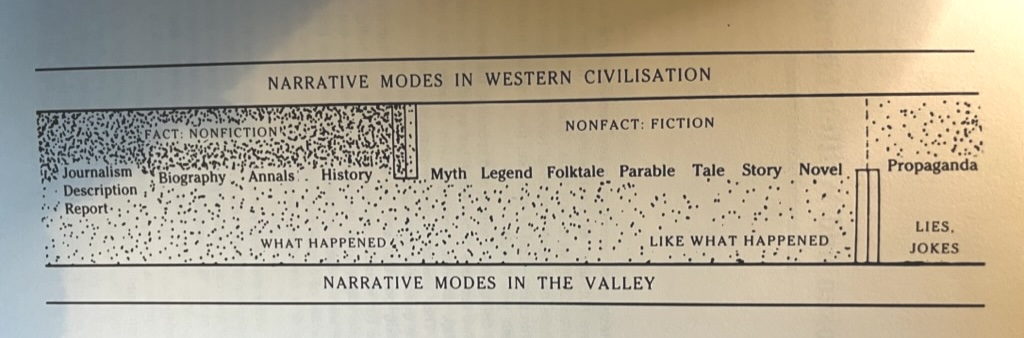
Always Coming Home is a collection of texts from the Kesh, a society in far future Northern California which is also, I guess, a utopian new Bronze Age I suppose? A beautiful book.
This chart is in in the appendix. It reminds me that
- we bucket stories of types like journalism and history as "fact" and types like legend and novels as "fiction," this binary division
- whereas we could (like the Kesh) accept that no story is clearly fact nor fiction, but instead is somewhere on a continuum.
Myth often has more truth in it than some journalism, right?
There's a nice empirical typology that breaks down real/not real in this paper about the characters that kids encounter:
To what extent do children believe in real, unreal, natural and supernatural figures relative to each other, and to what extent are features of culture responsible for belief? Are some figures, like Santa Claus or an alien, perceived as more real than figures like Princess Elsa or a unicorn? …
We anticipated that the categories would be endorsed in the following order: 'Real People' (a person known to the child, The Wiggles), 'Cultural Figures' (Santa Claus, The Easter Bunny, The Tooth Fairy), 'Ambiguous Figures' (Dinosaurs, Aliens), 'Mythical Figures' (unicorns, ghosts, dragons), and 'Fictional Figures' (Spongebob Squarepants, Princess Elsa, Peter Pan).
(The Wiggles are a children's musical group in Australia.)
btw the researchers found that aliens got bucketed with unicorns/ghosts/dragons, and dinosaurs got bucketed with celebrities (The Wiggles). And adults continue to endorse ghosts more highly than expected, even when unicorns drop away.
Ref.
Kapit'any, R., Nelson, N., Burdett, E. R. R., & Goldstein, T. R. (2020). The child's pantheon: Children's hierarchical belief structure in real and non-real figures. PLOS ONE, 15(6), e0234142. https://doi.org/10.1371/journal.pone.0234142
What I find most stimulating about this paper is what it doesn't touch.
Like, it points at the importance of cultural rituals in the belief in the reality of Santa. But I wonder about the role of motivated reasoning (you only receive gifts if you're a believer). And the coming of age moment where you realise that everyone has been lying to you.
Or the difference between present-day gods and historic gods.
Or the way facts about real-ness change over time: I am fascinated by the unicorn being real-but-unseen to the Medieval mind and fictional to us.
Or how about the difference between Wyatt Earp (real) and Luke Skywalker (not real) but the former is intensely fictionalised (the western is a genre and public domain, although based on real people) whereas Star Wars is a "cinematic universe" which is like a genre but privately owned and with policed continuity (Star Wars should be a genre).
I struggle to find the words to tease apart these types of real-ness.
Not to mention concepts like the virtual (2021): "The virtual is real but not actual" - like, say, power, as in the power of a king to chop off your head.
So I feel like reality is fracturing this century, so much.
Post-truth and truthiness.
The real world, like cyberspace, now a consensual hallucination - meaning that fiction can forge new realities. (Who would have guessed that a post on social media could make Greenland part of the USA? It could happen.)
That we understand the reality that comes from dreams and the subjectivity of reality…
Comedians doing a "bit," filters on everything, celebrities who may not exist, body doubles, conspiracy theories that turn out to be true, green screen, the natural eye contact setting in FaceTime…
Look, I'm not trained in this. I wish I were, it has all been in the academic discourse forever.
Because we're not dumb, right? We know that celebs aren't real in the same sense that our close personal friends are real, and - for a community - ghosts are indeed terrifically true, just as the ghost in Hamlet was a consensus hallucination made real, etc.
But I don't feel like we have, in the mainstream, words that match our intuitions and give us easy ways to talk about reality in this new reality. And I think we could use them.
Proposed legislation in Washington State would attempt to ban the use of 3D printers or CNC machines from being used to create guns or gun parts, likely expanding to other items that would be banned later. They also want to somehow require "blocking systems" to technologically prevent these devices from being able to create such items. This concept has been proposed in other venues as well.
Ostensibly all of this is to push back against the creation of so-called untraceable "ghost guns". Over the last few years 3D printers have evolved from finicky devices requiring quite a bit of expertise to use, into more of consumer products that still need considerable knowledge to use at their best, but that generally are much simpler for non-experts to use. 3D printers work with plastic. Less familiar especially to hobbyists are CNC equipment, that's Computer Numerical Control — that can also work with plastic but more commonly are used to fashion metal or wood.
Here's a key reality: These machines themselves don't know what they're creating, other than some that display the shape of the objects. These objects can vary enormously and can be in virtually infinite numbers of specific forms, and could typically be used for all sorts of assemblies having nothing to do with guns. 3D printers and CNC equipment are literally robots following a long list of specific instructions — move this far in X direction, this far in Y, this distance in Z. Extrude this much plastic. And so on.
They generally don't even need Internet connections. They can follow a long list of these precise instructions in what's called g-code (which stands for "geometric code"), even if presented on a simple microSD card. And by the way, g-code was invented in the 1950s at MIT! It's been augmented over the years of course.
What creates the g-code? In the case of 3D printers, typically g-code comes from software generically referred to as slicers. CNC gear uses similar software to generate their g-code. Slicers input the data from CAD — Computer Aided Design — files often as what are called STL files, and processes these to create the specific lists of g-code instructions.
While there are some versions of all this that are proprietary, crucially all of these various elements in this engineering pipeline can be implemented using easily available parts and open source software. So it becomes obvious why so-called "blocking" technologies would be impractical at scale against anyone with the desire to ignore them.
Guns can be created using parts from a hardware store — 3D printers or CNC machines aren't necessary. Remember, the equipment itself doesn't know if it's creating a component for a gun or a similar looking object for a harmless school engineering assignment having nothing to do with firearms. Should screwdrivers be banned because they can be used to create weapons? Of course not.
I could go on but frankly the concept of requiring "blocking" technology in 3D printers and CNC machines isn't even a close call in terms of technological reality. It wouldn't accomplish its stated purpose, but it could cause enormous problems in a vast array of ways since these tools are used by factories, businesses, educators, farmers, hobbyists, and many others who are doing nothing related to firearms at all, but would find their work constantly hobbled by such government edicts and attempts to implement them.
The blocking concept for 3D printers and CNC equipment is somewhat akin to wishful thinking. It's not practical, and it should absolutely be rejected.
-Lauren-
An experiment in AI coding with Google Gemini. I try to be fair. When I call generative AI mostly slop, I don't do so blindly; I attempt to conduct reasonable tests in various contexts.
Yesterday I needed a couple of routines — one in Bash, the other in Python. I tried the Python one first. This required code to asynchronously access a remote site API, authenticate, send and receive various data and process what was returned, relying on a well documented Python library on GitHub written specifically to deal with that site's API.
After almost two hours, I gave up. Gemini was consistently cheerful and cooperative — almost to a creepy extent. It generated code that looked reasonable, was very well commented, and even provided helpful examples of how to configure, install, and run the code.
Unfortunately, none of it actually worked.
When I noted the problems, Gemini got oddly enthusiastic, with comments like "Wow, that's a great explanation of the problems, and a very useful error message! Let's figure out what's wrong! Here is another version with more diagnostics that accesses the library more directly!"
Sort of made me feel like I was dealing with an earnest but incompetent TA at an undergraduate CS course at UCLA long ago. Which was not something I enjoyed back then!
After a bunch of iterations, I gave up. Even starting over didn't help. Gemini never seemed to produce the same code twice, no matter how I worded the prompts. The code would use completely different models each time, sometimes embedded configuration values, sometimes external files, sometimes command line args. And the way it tried to use the Python library in question also varied enormously. It almost seemed random. Or at least pseudorandom.
I spent half an hour and wrote plus tested the code I needed from scratch. It worked on the second try, and was about half the number of lines of any of the code Gemini generated, and much simpler, for whatever that's worth. By comparison, Gemini's code was bloated and definitely unnecessarily complex (as well as wrong).
I did give Gemini another chance. I also needed a simple Bash script to do some date conversions. I offered that task to Gemini since I didn't want to bother digging through the various date format parameters required. Gemini came up with something reasonable for this in about four tries. Whether it's completely bug free I dunno for sure, I haven't dug into the code deeply since its not a critical application. But it seems to be working for now.
So really, I haven't seen a significant improvement in this area. There are probably some reasonable sets of problems where AI-coding can reduce some of the grunt work, but once you get into anything more complex the opportunities for errors, especially in larger chunks of code where detecting those errors might not be straightforward, seem to rise dramatically.
-Lauren-
Drone leader Chinese company DJI this morning announced a new drone in their economical but powerful "mini" drone lineup, the "Mini 5 Pro". Speculation and rumors about this product have been circulating online for many months, and on Monday the world got to see a short video tease telling that today at 8 am Eastern Time there would be an announcement. That is, unless you were in the USA, since accessing the DJI site from here, unlike the rest of the world, would not show that tease.
Because once again the administration and our bipartisan tech morons of Congress have forced DJI into the position of not officially making the new drone available here at all, as happened with a larger, more expensive new drone in their lineup recently.
The confluence of the insane self-imposed injuries of oppressive tariffs that must be paid by American consumers, bizarre customs blockages, and legislative and executive branch actions to target Chinese drone makers in general and DJI in particular, are turning us into a laughingstock when it comes to this important tech.
Law enforcement, search and rescue, and other public safety organizations depend on these (normally) easily accessible drones, and it is likely that lives and property will be lost by their being cut out from this new drone, which brings for the first time a larger one inch camera sensor, and LIDAR for advanced obstacle avoidance and the ability to "return to home" in many well-lit environments even if GPS satellite signals are lost.
The U.S.'s claims of security concerns regarding DJI drones have never to been shown to be reality. The rest of the world, including U.S. allies, apparently don't have these fake concerns — so their citizens will get the benefit of this new drone, while we're at the mercy of ever more bipartisan political stupidity.
The Mini 5 Pro actually is authorized to be flown in the U.S. and will likely will be the last DJI drone for the foreseeable future to receive such approval, given the various restrictions that I've previously discussed in detail already in the pipeline, including one triggered at the end of this year, absent drastic last minute changes.
Are there any ways for U.S. residents to get hold of the Mini 5 Pro? Since DJI is not officially releasing the product in the U.S., that leaves the gray market (domestic and international) with all the associated risks associated with potentially drastically elevated pricing, lack of manufacturer warranties, and possible problems ever getting repairs. Some U.S. residents are reportedly already planning trips to Canada or Mexico to obtain these drones and then deal with our nightmare borders import mess to bring them back into the U.S.
Frankly, our country is being humiliated by so many pathetic leaders, especially when it comes to tech. And this is but the latest example.
-Lauren-
Calls for Google's Chrome Browser to be separated from Google could potentially result in a privacy and security disaster for literally billions of people around this planet.
An AI firm just offered 34.5 billion dollars (about twice what that company is theoretically worth) for Google's Chrome browser, and then almost immediately another AI firm offered a full 35 billion — what's 500 million dollars among friends, right?
Of course, there's no obvious indication that Google has any interest in selling off Chrome at this time. Another factor is that there's speculation that the judge in an antitrust case that Google lost might order that Google divest itself of Chrome as part of a penalty, though that case is very likely to be appealed and go through considerably more litigation so we don't really know where that case will end up.
But the question you gotta ask yourself is WHY these firms would be willing to pay so much for Chrome. Yes, Chrome has about three and a half billion users who consider it to be their primary browser, and around a two-thirds global market share among the various browsers that users can choose from. And you're still talking about paying about $10 per user to get up to a $35 billion dollar offer. But the thing is, Chrome is effectively open source. These firms could essentially get the browser sources for free. The Google Chrome browser is based on the Chromium open source project, and that's the origin not only for the Chrome browser but also various other browsers. In fact, Microsoft's Windows Edge browser, that they're constantly trying to manipulate Windows users into switching to from other browsers, is itself based on the Chromium project.
So again, why are these AI firms willing to pay such an enormous sum for Chrome? And the answer is, they probably don't really care about Chrome per se, they care about those three and half billion users who use Chrome and could be dragged with Chrome over into these other firms' "AI First" philosophies, perhaps along with their browser histories and all the other data associated with routine Web use. So it's not the browser they lust after, it's the people who use the browser.
Now, as we've noted frequently, Google itself is going "full speed ahead" into AI whether users want it not — and mostly it seems they don't want it. But that said, Google still has an excellent history of protecting and securing user data and privacy, related to their Chrome browser's use and other associated applications. This includes many routine Google and other services and for example the Chromebooks that are so popular in education and industry.
The thought of any of that data being handed over to some external entity or entities outside Google is of great concern to many observers in the security and privacy fields. What will happen if those 3.5 billion Chrome users are sucked into those other firms' AI fever dreams that again many — polls say by FAR most — users don't want to have anything to do with at all!
Yes, many people are critical of Google. But there's an old saying that the devil you know is better than the devil you don't know. And yes, I myself have been quite critical of various of Google's policy decisions, especially related to their Large Language Model generative AI push of late. But I've had, and still have, a great deal of respect and trust in terms of how the regular employees inside Google — the Googlers many of whom I've known — work to protect our data and our related privacy.
The upshot of all this is that billions of people conduct their Internet usage through the Chrome browser, and it's difficult to see how handing that browser — and those users — over to another firm doesn't stand a high probability of creating new privacy and security risks for those users who already have enough Internet problems to worry about.
-Lauren-
The post Meet London's Framebuilders appeared first on London Cycling Campaign.
The post 2025 in review: London's cycling boom appeared first on London Cycling Campaign.
The post And the 2025 LCC Awards winners are… appeared first on London Cycling Campaign.
The post Oxford Street: save our cycling appeared first on London Cycling Campaign.
The post Share the Joy Round 5 Funders Announced appeared first on London Cycling Campaign.
The post London now cycling 1.5 million journeys appeared first on London Cycling Campaign.
The post Dangerous Junctions 2025 update appeared first on London Cycling Campaign.
The post Biola & Kunle Babawale Interview appeared first on London Cycling Campaign.
The post Share the Joy: One Year On appeared first on London Cycling Campaign.
———— This is part 2 of a long blog post. The first part is called "Wandering" and this part is "Wondering." No real reason for those names, just playing with words. But mostly these posts are about images. Kawaii. Acrylic on canvas, 24″ x 24″. December, 2025 At one point, I had a nice square […]
The post Wondering first appeared on Rudy's Blog.
I've been hanging around with Barb Ash a lot. I published Sqinks. I painted quite a bit. I'll break my doings into two posts: "Wandering" and "Wondering." Barb is a photographer, as am I, and we enjoy working on pictures together, each using their own camera, but helping each other see. Barb is better at […]
The post Wandering first appeared on Rudy's Blog.
My new novel, and a journal about writing it. Published via my very own indie press, which is Transreal Books. I raised funds for it on a Kickstarter page…and I have a Sqinks book page.. Towards the end of Novembler, I'll be publishing Sqinks and Sqinks Journal in hardback, paperback, and ebook on all the usual […]
The post Sqinks Novel & Sqinks Journal first appeared on Rudy's Blog.


