
director's cut of piece in the The Guardian, roughly a year ago - with the follow-up blog pieces below
I started blogging in 2002. Prior to that I'd operated a website for around six years, but what grabbed me about blogging was the speed and the responsiveness - the way blogs picked up on what other blogs posted and responded almost in real time. I wanted to jump right into the midst of this crackling synergy between blogs. So I did.
The blogging circuit I joined was just one corner of an ever-growing blogosphere. Even within music, my blog's primary focus, there was a whole other - and larger - network of MP3 blogs. Still, my particular neighbourhood was bustling all through the 2000s. Out of its fractious ferment emerged cult figures like K-punk, a.k.a Mark Fisher, one of the most widely read and revered left-wing thinkers of our time, and the prolific architecture critic and author Owen Hatherley. Then there were those like me who fit a different archetype: already a professional writer but who relished the freedom of style and tone offered by blogging.
Today, there are still plenty of active music blogs. They encompass established critics like Richard Williams, anonymous unknowns unloading a lifetime's knowledge and passion such as Aloysius , K-punk-descended blogs like Xenogothic that move fluently between pop culture and theory, and the amiable anecdotes and keen observations of musicians like Wreckless Eric.
What's changed - what's gone - is inter-blog communication. The argumentative back-and-forth, the pass-the-baton discussions that rippled across the scene, the spats and the feuds - these are things of the past. If community persists, it's on the level of any individual blog's comment box. I prize the unusual perspectives and weird erudition of my regular commenters, while wondering why so few of them operate their own blogs.
It's easy to pinpoint what caused the fall-off: social media. On Facebook, once copious bloggers craft miniature essays to an invited audience only. Twitter - at least when it was good - supplied even more instant feedback for rapid-fire opinionators. There are other rival repositories of bloggy informality, like podcasts. Just generally there's more news 'n' views bombarding us than ever. Now wonder the blogs have been shunted to the side.
I miss the interblog chatter of the 2000s but in truth, connectivity was only ever part of the appeal. I'd do this even if no one read it. Blogging, for me, is the perfect format. No restrictions when it comes to length or brevity: a post can be a considered and meticulously composed 5000-word essay, or a spurted splat of speculation or whimsy. No rules about structure or consistency of tone. A blogpost can be half-baked and barely proved: I feel zero duty to "do my research" before pontificating. Purely for my own pleasure, I do often go deep. But it's nearer the truth to say that some posts are outcomes of rambles across the archives of the internet, byproducts of the odd information trawled up and the lateral connections created.
"Ramble" is the right word. Blogging, I can meander, take short cuts, and trespass into fields where I don't belong. Because I'm not pitching an idea to a publication or presenting my credentials as an authority, I am able to tackle subjects outside my expertise. It's highly unlikely I could persuade a magazine to let me write an essay comparing Bob Fosse and Lenny Bruce https://shockandawesimonreynolds.blogspot.com/2022/03/showbiz-against-showbiz-bob-lenny.html
or find a thread connecting Fellini's Amarcord, Wes Anderson's The French Dispatch, and Tati's Playtime
https://retromaniabysimonreynolds.blogspot.com/2022/05/decline-of-wes-or-three-movies-three.html
In recent months, I've ruminated about Wiki-Fear and the sticky way that upsetting information attaches itself to favorite artists and their music, remembered the suggestive Flake commercials of my youth, https://hardlybaked2.blogspot.com/2023/10/flakeatio.html
looked at fame-as-royalty and royalty-as-celebrity via Dame Edna Everage and Clive James
https://shockandawesimonreynolds2.blogspot.com/2023/08/grotesque-with-gratitude-rip-edna-barry.html, and a dedicated a brief blog to a single scene in the film Charlie Bubbles involving Albert Finney protractedly masticating a bacon sandwich https://hardlybaked2.blogspot.com/2023/06/chew-very-much.html
As those examples show, one of the great thing about blogging for a professional journalist is that you can write about topics that aren't topical. You are unshackled from release schedules. An old record or TV program you've stumbled upon, or simply remembered, is fair game. YouTube's arrival in 2005 brought a new dimension to blogging. The two go together so well because they are both handmaidens of 21st Century archive fever, instruments of the atemporal culture brought about by the internet, social media, and streaming.
The motto at the top of my primary outlet Blissblog https://blissout.blogspot.com/ twists Tricky lyric's "my brain thinks bomb-like". My brain thinks blog-like: the digressive rhythms, the lurching between tones, it's how my mind moves, when it's not behaving itself in print. I realized that I had, if not a problem, then perhaps some kind of disorder, when I started to spin off satellite blogs, initially dedicated to specialized zones of my brain (the books Energy Flash, Retromania, Shock and Awe) but soon splintering to encompass particular obsessions and modes. Probably the most enjoyable to write - maybe to read too, although I couldn't say - is Hardly Baked 2 https://hardlybaked2.blogspot.com/. Fragmented fumbles towards a thesis, sometimes based around ancient pop videos, occasionally entirely pictorial, these posts are, as the blog name makes clear, unfinished work. Often they're completed, or expanded beyond anything I could have dreamt, by the comments below. But at the moment of posting, I've no idea whether this one will spark a discussion or plop into the void.
Freedom and doing it for free go together. I've resisted the idea of going the Substack or newsletter route. If I were to become conscious of having a subscriber base, I'd start trying to please them. And blogging should be the opposite of work. But if it's not compelled, blogging is compulsive: an itch I have to scratch. And for every post published, there's five that never get beyond notepad scrawls or fumes in the back of my mind.
I can't imagine ever stopping blogging. Perhaps eventually there'll just be a few of us still standing. But I'm heartened that some of the younger generation have caught the bug - including my own son Kieran Press-Reynolds, who operates his own outlet and contributes to the collective music blog No Bells
https://nobells.blog/babyxsosas-houseparty/
^^^^^^^^^^^^^^^^^^^^^^^^^
The Guardian asked me to write about blogging.
One thing I observe is that although the freedom and fun offered by the format endures, the inter-blog communication of the heyday has faded away. At least, in this particular corner of the 'sphere.
Blogging has become more of a solitary activity. A blogpost will be sparked by something "out there," or by something within, but rarely in response to another blog.
This reminded me that the last time I did a bit of meta-blogging - the 20th anniversary rumination of a year ago - I'd intended to do a follow up: a tribute to the blogs of yesteryear, nodes in a network that once crackled like the synapses of an ever-growing mega-brain. Here, belatedly, is a sketch towards such a memorial.
In the beginning... what sparked my interest was a bunch of blogs and blog-like entities whose existence I noticed around 2000 or so. There was Tom Ewing's outlets New York London Paris Munich and Freaky Trigger, Tim Finney's Skykicking, Jess Harvell's blogs (Let's Build A Car, Technicolor, Rebellious Jukebox, others still?). Then there was Alastair Fitchett's webzine Tangents, featuring contributors like Kevin Pearce (under the name John Carney, for reasons unknown). And Robin Carmody's website Elidor (later on he blogged at House At World's End and Sea Songs and also here).
All sorts of oddball characters sprouted up around then, offering skewed perspectives and obsessive accumulations of knowledge. There was Josh Kortbein (who still maintains Joshblog). Scott of Somedisco. David Howie aka I Have Zero Money. Others still.
So the scene was bubbling before I jumped into the fray in October 2002. Still, it's fair to say that the launch of Blissblog had an accelerant effect. I must have been one of the first pros to start a music blog, although I'd had a website since 1996.
Another accelerant was the excitement about grime - at that point such an emergent sound it wasn't even known as grime yet. Wot-U-Call-It represented probably around 70% of the spur for me to start the blog - at the time I was largely taken out of journalistic commission by Rip It Up and Start Again and I desperately wanted to shout about this latest insurgency from the nuum zone. But I also just fancied having an opinions outlet - fancied joining in the arguments. Skiving off work while staying sat in front of the screen, in those first three years of blogging I generated probably a book's worth of text even while writing a not-short book on postpunk.
Everyone knows about K-punk and Woebot (at the start known as That Was A Naughty Bit of Crap) (and which went away, then came back, then went away, came back and then went away yet again - but currently still exists). (And who remembers woebot.tv?)
There was also Luke Davis's heronbone (urgent dispatches from the frontlines of grime, but also poetry and psychogeography), Silverdollarcircle (similarly pirate radio focused), Martin Clark's Blackdown, John Eden at Uncarved, Paul Meme's Grievous Angel....
(A precursor to this kind of nuum-oriented bloggige was turn-of-millennium webzine Hyperdub, launched by Kode9 well before the label of the same name, and a place where Mark Fisher did some of his earliest public writing about music (under the name Mark De' Rosario) alongside UKdance forum stalwart Bat, Kevin Martin, Kodwo Eshun, and indeed myself. The Hyperdub archives used to be maintained by bloggish entity Riddim.ca, but have now sadly disappeared. A couple of the proto-K-punk's pieces can be found here, though.)
Adjacent to this cluster but pursuing his own obsessions (Cabaret Voltaire, bleep, etc) and probably more aligned with dubstep than grime, there was Nick Edwards's once-prolific, long-shuttered Gutterbreaks. Then there was History Is Made At Night, an archaeology of rave and club lore - and the interface between dance culture and politics - maintained by Neil Transpontine to this day. And the bashmentological analyses of scholar Wayne Marshall at Wayne & Wax.
Getting deeper into the 2000s, the sporadic but extensive posts of Leaving Earth, by the enigmatic Taninian, claimed treasure in underappreciated genres like wobble and skwee, reassessed The Rave LP, and lost me a little with the paeans to postdubstep-as-revolution. Other electronic-music slanted blogs came and went - Acid Nouveaux, Mentasms, Sonic Truth, Mutant Technology, Drumtrip, Musings of a Socialist Japanologist, Tufluv, World of Stelfox, MNML SSGS - saying interesting things for a year or two before going silent. Probably the most impressive of the second wave of electronic music oriented blogz was Adam Harper's Rouge's Foam.
Rewind a bit: by the mid-2000s, the scene was cleaving between the grimy nuum end of things and the poptimistic cru, each represented by a forum, although neither was as monolithically committed in stance or subject matter as the other might like to make out. Still, you could have good arguments about these kinds of issues with the likes of Zoilus (aka Carl Wilson), Utopian TurtleTop. Koganbot, Nick Southall's Auspicious Fish, Jane Dark's Sugarhigh. Less-good arguments with others.
Anti-rockist (OG anti-rockist 4 life) but in an orbit of his own: Momus, elegant and incisive public essayist rather than blogger per se, but hosting a lot of action in the comments. The blog was once called Click Opera, I believe.
When grime faded as a conversation-starter and centripetal agent, hauntology - for a while, for some - provided a new focus....
Now there was a bunch of blogs whose preexisting obsessions with retro design, vintage TV, bygone modernist aesthetics, and sundry musty esoterica placed them in proximity to the H-zone, among them Toys and Techniques, Feuilleton, Rockets and Rayguns, Dispokino, I Hate This Film, and The Sound of Eye. Then there was collective blog Found Objects.
There was another and quite separate gaggle that included Kid Shirt (aka Kek-W), An Idiot's Guide To Dreaming (aka Loki aka Saxon Roach) and Farmer-Glitch (aka Stephen Ives) who could be considered fellow-travelers, albeit approaching the H-zone from a different angle: that esoterrorist thread running from Coil-y industrial to the eldritch fringes of rave and UK techno (The Black Dog and that sort of thing). Funnily enough, their very proximity made them sniffy about the H-word - both as concept and in terms of the output getting bigged up. Some of this blog cluster generated its own wyrdtronic output, via alter-egos like IX-Tab, Hacker Farm, Kemper Norton....
Other bloggers stepped into the sonic fray: Gutterbreaks became Ekoplekz and half of eMMplekz, Woebot became a musical as well as textual entity, and K-punk created a bunch of audio essays/ sound artworks.
While Mark Fisher was a pillar of our end of the scene, K-punk also played a central role in a separate circuit of renegade-academic and philosophy-politics blogs. Not a neighbourhood I frequented much, but Alex Williams at Splintering Bone Ashes had some things to say while Steven Shaviro still does The Pinocchio Theory.
Quite a lot of people on this circuit became authors (and /or fulfilled other functions) within the Zer0 / Repeater empire: Xenogothic's Matt Colquhoun, Robin James of It's Her Factory, Dominic Fox of Poetix.
Others came to the imprints via different paths: Carl Neville aka the Impostume, Phil Knight with his mystifyingly closed-and-erased The Phil Zone and later ceased-but-not-deleted The Interregnum Navigation Service. Owen Hatherley of Sit Down Man, You're a Bloody Tragedy and The Measures Taken, Alex Niven of The Fantastic Hope, Rhian E. Jones with Velvet Coalmine. There was a cluster of collective blogs oriented around decades - the '70s, '80s, '90s - that involved many of these people and lively places they were for a while.
And then there were those who pursued their own completely personal path into the scene (and out again), helped in some cases by geographical distance - operating in a completely different hemisphere. Anwen Crawford (another who mystifyingly deleted their back pages - in this case fangirl), Sam Macklin a.k.a connect_icut with Bubblegum Cage III, Geeta Dayal with The Original Soundtrack (now she has a Patreon), Jon Dale with Worlds of Possibility and Attic Plan and Astronauts Notepad, Sam Davies's Zone Styx Travelcard, Aaron Grossman's Airport Through the Trees, Graham Sanford's Our God Is Speed, Tim 'Space' Debris's Cardrossmaniac2, W. David Marx's Néojaponisme, Oliver Craner, Beyond the Implode, Baal at Erase the World, Tom May's Where Shingle Meets Raincoat, Seb's And You May Find Yourself... , Dan Barrow's porridge-free zones The End Times and A Scarlet Tracery....
Some of these bloggers were already writing in "proper" publications; some started after blogging....
It was interesting to see who out of the already-renowned professionals jumped into the fray and those who stayed aloof. For a virtuoso ranter like Neil Kulkarni, blogging was a natural playpen. Ian Penman seemed unleashed by the format, frothing torrentially at The Pill Box - until he stopped, abruptly, for "reasons unknown". Chuck Eddy is a copious blogger at Eliminated For Reasons of Space. David Stubbs has blogged sporadically over the years; Richard Williams does it more regularly at The Blue Moment. Both these Melody Maker legends, though, are more like online essayists; they don't display that driveling incontinence that is the hallmark of the born-to-blog.
But there were other pros who seemed to disdain the thought of writing for free. One or two seemed faintly t
hreatened by the blogs, the jabbering panoply of amateurs crowding out the main signal.There were various alternatives to blogs that went through vogues - livejournals and tumblrs - but I never really cathected with either of these mode-zones, couldn't see what they brought that was a bonus.
And today... As I say in the column, there's still loads of blogs - loads of specifically music blogs or mostly-music blogs. Some started relatively recently, like the sporadic but very interesting Aloysius, the work of Dissensus bod Mvuent, and Infinite Speeds, a Substack by Vincent Jenewein exploring interfaces between philosophical concepts and the materialities of electronic sound + rhythm. Others, I'm unclear when they started but they have entered my ken only recently, like Lost Tempo (another Substack), the work of regular commenter Matt M. And I see that ex-editor of The Wire Derek Walmsley, who used to have a blog back in the 2000s, recently started a new one: Slow Motion.
There are generation-or-two-below-me oriented entities somewhere between a one-person magazine and a collective blog. Like Joshua Minsoo Kim's Toneglow (another Substack). Like No Bells. To which my own flesh-and-blood contributes, while also operating his own KPRblog (currently surveying 2023 in music).
So I wind to a close, with so many names unmentioned.
Forgive me - it's almost certainly by accident.
^^^^^^^^^^^^^^^^^^^^^^^^^
Xenogothic with some thoughts on blogging.
Among many other things, Matt talks about blogs operated by musicians, by the likes of Deerhunter and Phil Elverum, as a whole other field of bloggy action. I suppose Momus's Click Opera, mentioned in the previous Blissblog post about blogs then and now, counts in this category. In an earlier longer version of the Guardian column, I did link to a currently active music-maker blog that I enjoy: Wreckless Eric's Ericland.
I have been going back and adding more blogs and bloggers that I remembered from the olden days to that post. But there are still swathes of blogging that I didn't cover - even within the music blogging arena.
For instance, I don't talk about MP3 blogs. But then they were never something I got into. The free MP3s seemed as unenticing as the flexi singles attached to fanzines back in the day. And the textual element rarely seemed as interesting as the output of the blogs I considered my true neighbours.
There was a whole other phase of hyperactive blogging I clean forgot about - all the blogs associated with hypnagogic pop and that late 2000s / early 2010s emergence of largely-online DIY micro-genres like witch house and vaporwave. Blogs such as 20 Jazz Funk Greats and Visitation Rites and Gorilla vs. Bear and Rose Quartz that would be shepherded for a while under the Pitchfork-hosted mantle of Altered Zones. I tried to evoke its neophiliac fever in this piece:
On Altered Zones and its constellation of blogs, the flow is relentless: What matters is always the next new name, the latest micro-genre, another MP3 or MediaFire. Artist careers likewise are a continuous drip-drip-drip of releases, a dozen or more per year—there's no reason to edit or hold back, every reason to keep one's name out there. Stimuli streams in, largely via the Web; creativity streams out, largely via the Web. Today's musician is a pure screen, a switching center for all the networks of influence.... This scene is about being engulfed and enthused, carried along by the currents of the new. Drifting not sifting.
Another huge wave of blog energy - and one that had a huge effect on me, albeit not necessarily for the good - was the whole-album sharing blogs. Some of these didn't just offer an album cover image and a link to Rapidshare / Megaupload / Mediafire, but had proper textual content: well-written and informative, if rarely polemical or argument-starting. Serious curatorial activity, as undertaken by the likes of Mutant Sounds, Continuo's, Twice Zonked!, A Closet of Curiosities... I wrote about that scene in this piece for The Wire on "sharity" blogs. Even interviewed a couple of figures behind blogs. That scene is much declined from its height but there's sharity soljas out there still, digging strange shit up...
Yet another still active sub-subculture of music blogging: the "imaginary albums" blogs. This overlaps with the sharity in so far as they sometimes - not always - share their recreation of the rumored but never released album. Some of these blogs generate an enormous amount of counterfactual text, as discussed in this essay of mine on alternative history and music:
Fans for years have been creating unfinished or unreleased albums like Beach Boys's Smile, Hendrix's First Rays of the New Rising Sun, The Beatles's Get Back, the Who's Lifehouse - using bootlegs, demos, out-takes... Today there is a whole realm of blogs dedicated to this practice - Albums That Never Were, A Crazy Gift of Time, Albums That Should Exist, Albums I Wish Existed… Usually they create fake artwork for the counterfactual albums.
Some of these blogs, such as Strawberry Peppers, don't stop at creating imaginary albums and record covers - they write incredibly detailed and extensive alternative histories of worlds where the Beatles didn't split up, or where David Bowie joined the Rolling Stones, or where the Soft Machine's Kevin Ayers, Robert Wyatt and Daevid Allen don't leave the band, or alternate timelines where Syd Barrett stayed in Pink Floyd. A kind of counter-discographical mania erupts.
^^^^^^^^^^^^^
In addition to Xenogothic, there's been some other post-Guardian-piece posts - a few from blogs I know well (like Feuilleton), most from blogs I'd never come across before: Torpedo The Ark, Bhagpuss, The Sphinx. Somewhere amidst all that chatter I gleaned that there's been unconnected blog talk going on too, at The Lazarus Corporation, at Velcro City Tourist Board, and in a piece about the internet getting weird again by Anil Dash for Rolling Stone.
Danny Thompson worked with a host of people, including a stint in Pentangle, but for many of us he is inseparable from the name John Martyn - and revered as the co-author of "Go Down Easy", "I'd Rather Be The Devil", "Solid Air", "Couldn't Love You More", "Glistening Glyndebourne"....
Here by way of indirect tribute are three pieces about Martyn in which Thompson flits into view here and there. Most prominently in the first one, a Blissblog recollection about about the only time I ever saw Martyn live - in New York, just months before he died, with Thompson by his side, the only other person on the small stage with him - which doubled as an obituary. The fond bond between the two was very evident that night.
There is also a short piece about "I'd Rather Be The Devil" and a longer piece about Solid Air as a Desert Island Disc written for the 2007 book Marooned (Phil Freeman's unofficial sequel to Stranded).
John Martyn RIP
Blissblog, January 31st 2009
RIPs appear here quite regularly. Rock is long in the tooth; musicians you admire, whose music you've grown up with, seem to be popping their clogs with mounting frequency. Usually I feel sad for a bit, in a fairly removed sort of way... then life's petty urgencies resume. But this week's big one, I must admit, has hit me quite hard. It's cast a shadow over the last few days. It feels a lot more personal somehow.
It struck me that I might possibly have listened to John Martyn more than any but a handful of other musicians. Actually I can't think of who else I'd have listened to more, over such a sustained period. The Smiths? Love? But if you broke it down, it would be Solid Air and One World that accounted for 95 percent of that lifetime of Martyn listening. Those two albums have been such a large and constant presence. They keep coming back, or rather, they don't go away, whereas there's other central artists, deep deep favourites, where there are long periods of mutual leave-taking (Can, for instance--I seem to be taking a breather from them, for some reason just don't feel the urge, but I know the time will come again.) (Another example: postpunk, which dipped away for much of the Eighties and almost all of the Nineties). But John Martyn… it barely took me a minute to settle on Solid Air as my desert island disc when asked to contribute to Marooned. It was my first choice, and then to do it proper I thought up some other candidates (closest contender being Rock Bottom). But it was always going to be Solid Air, partly because the "desert island" scenario suggested it somehow, but also because of its inexhaustibility as a record.
Strangely, though, when I think of John Martyn's music, I don't think of personal memories particularly. Some records evoke times of your life: Head Over Heels and Sunburst and Snowblind, the debut Smiths album, those records remind me with incredible vividness of a student bedsit in north Oxford, the yearnings and miseries of that time; "Thieves Like Us" carries with it the flush of romance remembered; there's plenty more examples. But with most music, the memories carried are memories of the music itself, if that makes sense. When you're a music fiend, that function of commemoration or life-soundtracking or "our song" that perhaps remains prominent for the more casual listener, it really fades away. You might say that music's life eclipses your own, or it becomes one with it, or it fills in the holes. Music doesn't serve as a mirror for narcissistic identification so much as a means of leaving one's self behind. A favourite record, then, might be more like gazing at a landscape, the kind of place you'd revisit at different stages of your life. A perennial source of wonder. (This is why I'm not a huge fan of memoiristic criticism: oh, it can be done well, but even at its best it doesn't really tell you anything about the music; that one individual's memories adhere to a piece of music in a particular fashion doesn't have any relation to what I or anybody else might get out of the record or glom onto it, experientially. Although it's also true that the narcissistic projection towards a song/album/group that music arouses so potently can make it feel like those life-experiences somehow inhere to the music).
But back to John Martyn--another strange thing is that I'd never gone to see him perform live. This despite being a fan since 1985 (when I'd taped Solid Air off David Stubbs--cheers David!--having been intrigued by this Barney Hoskyns interview with Martyn that compared Solid Air to Astral Weeks--cheers Barney!). The opportunity just never presented itself , and I'd never felt tempted to seek it out. I guess the sense you got was that after the 1970s heyday Martyn onstage was likely to be... variable. He'd be playing with bands composed of younger musicians, a modern soft-rock/AOR-ish sound like on those post-Grace and Danger Eighties albums, you heard tell of the keyboard sound being thin and digital-synth nasty. It seemed to promise disappointment. Anyway, I've always been more of a records man; I just don't have that compulsion to witness everybody whose music I love perform live at least once.
But late last year I heard that John Martyn was playing in New York. (I have to thank Rob Tannenbaum for the tip off, I'd have completely missed it otherwise--cheers Rob!). October the 9th, at Joe's Pub--less than ten minutes away. And not only playing in New York, virtually round the corner, but playing with Danny Thompson. So I had to go, even though this was the night before we flew off to London for the annual see-the-folks-and-friends vacation, there was packing to be done that night, an early rise the next day.
I got there and found quite a long line to get in, which surprised me, as I'd always had the impression Martyn wasn't really known in this country. And nor was it the case that the line was entirely composed of British expats. I ran into a friend-of-a-friend, an experimental musician (of the academic kind) who I'd not have particularly expected to be a John Martyn fan. We positioned ourselves near the bar with good sight-lines of the stage.
Joe's Pub is not a pub at all, but a sort of nightclub/performance space attached to The Public Theater on Lafayette. It's the sort of place where you'd expect, oh, Norah Jones to play; it's got a bit of an acid jazz/downtempo/Giant Steps type vibe to it. The last thing I saw there was ages ago: Herbert and Dani Siciliano doing the full chanteusy-meets-clickhouse thing. Anyway, there was this small, scarlet curtain at the back of the stage, which just seemed like part of Joe's plush cabaret-ish décor. All of a sudden there's a ruffling with the curtain, the suggestion of struggle and kerfuffle behind it, almost a Tommy Cooper/Morecambe & Wise-esque effect. And then, with evident difficulty Big John and his wheelchair were maneuvered through the red fabric and onto the tiny stage. I might be misremembering it but I think they actually had to wheel him on backwards. At any rate, it wasn't a dignified entrance.
First impression was of a ruin of a man. Magnificent, maybe, but definitely a ruin. In fact what I couldn't help thinking of was the sketch in Monty Python's The Meaning of Life ... the monstrously obese diner who eats so much he explodes. Martyn's face had this sagging quality, it seemed to droop and merge into the sprawl of his torso.
They opened, I think, with "Big Muff". It was great, totally different from the One World recording naturally (no drummer, just John and Danny), loose and swinging. I can't remember the exact sequence of songs, but at some point early in the set, they did "Sweet Little Mystery", Martyn's voice this immense blubbery ache of sound, a beached whale of bluesiness, bedraggled and beseeching. But apart from "Mystery" from Grace and Danger and "Muff" from One World, everything else was from Solid Air: "Jelly Roll Blues", "May You Never" (which got a cheer), the shatteringly tender imploring of "Don't Want To Know", "Solid Air" itself, maybe another one or two I'm forgetting. It was almost a Don't Look Back, except the order was scrambled and they didn't do "Go Down Easy", to my chagrin. The friend-of-a-friend pointed out how different the guitar tunings on each song were from the recorded versions.
Indeed between the songs there was some tuning-tweaking going on. There was also banter. But Martyn's speaking voice was so slurred, plus he was sat slightly far back from the mic (fine for singing but not for stage patter) that it was all completely indecipherable. He told jokes but through his bleary, sodden mumble they became abstract jokes. You could pick up the cadence and the timing of joke-as-pure-form, almost to the point of getting the comedic pay-off when the punchline came. But the actual content was lost. I picked up one or two lines: one involved a man going into a bar, another one was about penguins. I think he might also have cracked his post-amputation standard about having promised the promoter not to get legless, boom boom.
But I did manage to catch it clear when he apologized for the set being below par--"that's just the way it goes sometimes". At which Danny Thompson leaned over and gave him a kiss on the top of his balding head, affectionate yet reverent. I also just about made out what Martyn said before they launched into what turned out to be the final song: something like "this is by a gentleman called Skip James, who doesn't deserve to have his song murdered." It was "I'd Rather Be the Devil" of course and it made me wonder what other examples there are of a great artist--a writer and performer of brilliant original material--whose absolute greatest recording and signature song in live performance is a cover of someone else's song. (From the rock era obviously; there's loads of examples from the era when singers did standards, didn't write their own songs, etc). Of course to call it a "cover" is to underplay the amount of reinvention imposed on the original (which must be why John changed the title from "Devil Got My Woman", a bit of justified arrogance there: took your song, made it my song, whatchu gauna dee aboot it, eh?). So "Devil", live at Joe's Pub: not as torrential and tectonic as Live At Leeds, not quite the exquisitely wrought aquamiasma of Solid Air. But I wasn't disappointed. Oh no. Stole my breath away it did.
And then they were off, John wheeled backwards through the red curtain with the same awkward strenuosity it had taken to get him onstage in the first place (apparently he'd reached 20 stone in his last year). Semi-apologising for the brevity of the set as they shuffled off, Danny Thompson explained that the gig was kind of impromptu: John was coming to New York to visit a hospital to get a new prosthesis fitted, and they thought "why not?".
So, my first and only John Martyn Live Experience. I walked home aglow, much earlier than I'd expected (just as well with the flight) but not dissatisfied, not in the least. I meant to blog it after we got back from London but the moment passed. Now the man has passed and the moment seems right.
^^^^^^^^
Picking my favorite record of all time, identifying the album that means the most to me, singling out the one I could least bear to never, ever hear again - such a task would surely make my head explode. But the desert island scenario (and I'm curious: who came up with this conceit first, historically?) actually makes narrowing things down much easier. Something with a very particular bundle of attributes would be required, a tricky-to-find combination of consoling familiarity and resilient strangeness. You'd need a record that could retain the capacity to surprise and stimulate, to keep on revealing new details and depths despite endless repetition. But it couldn't be too out-there, too much of an avant-challenge, because solace would after all be its primary purpose. Which in turn would mean that the selection would have to feature the human voice, as a source of comfort and surrogate company - a criterion that sifts out many all-time favorites that happen to be all-instrumental (Aphex Twin's two Selected Ambient Works albums, Eno records like On Land and his collaboration with Harold Budd The Plateaux of Mirror). But, equally, songs alone couldn't sustain me on the island - I'd need some element of the soundscape, the synesthetically textured...food for the mind's eye...something to take me out and away.
Four albums sprang to mind based around a framework of songs-plus-space (or songs-in-space, or maybe even songs versus space). (Actually, there's a fifth album in this vicinity, but Lester Bangs bagged it last time around: Astral Weeks). All are from roughly the same period in rock history - the early Seventies - and all can be characterized as post-psychedelic music in some sense. Tim Buckley's Starsailor is just too wild, too derangingly strange; its restlessness would stir me to rage against the limits of confinement, rather than adopt a sensible stoicism, and its eroticism would be no help at all. Robert Wyatt's Rock Bottom is rich and lovely, but the album's emotionally harrowing arc (it was made shortly after the fall that left him paralyzed from the waist down) might be too wearing for someone in such dire straits; even its ecstasy is on the shattering side. Stormcock is brilliant and beautiful, but Roy Harper's diatribes wouldn't warm my lonely soul, and besides, it only consists of four long tracks, all pretty much chipped from the same block of sound.
So my choice is John Martyn's Solid Air. There's something about this album that suggests "island music." And I don't just mean that it came out on Island - probably the most highly-regarded record label on Earth at that point, a haven for the visionary, the esoteric, the not-obviously-commercial. The other day I was searching through my stuff for a review I wrote a long time ago of the reissue of another John Martyn record (1977's One World, which is hard on the heels of Solid Air as much-loved album/potential D.I.D.), only to be pleasantly ambushed by the opening lines:
John Martyn was a castaway on the same hazy archipelago of jazzy-folky-funky-blues as other burnt-out hippy visionaries of the Seventies (V. Morrison, J. Mitchell, etc.)
Ha! That list should have included T. Buckley, R. Wyatt, N. Drake (a close friend of Martyn's and the inspiration/addressee of Solid Air's title track), and probably quite a few others too. "Archipelago" still seems like the right metaphor. These artists didn't belong to a genre, each of them had their own distinct sound, but there's enough proximity in terms of their sources, approaches, and vibe, to warrant thinking of them as separate-but-adjacent, a necklace of maverick visionaries sharing a common climate.
The cover of Solid Air invites aqueous reverie. A hand passing through sea-green water leaving an after-trail of iridescent purple ripples, the effect is idyllic on first glance. But then you notice that the image is a circle of color on a black background, introducing the possibility that we're inside a submarine looking through a porthole, and the hand's owner is outside, drowning. Solid Air's title track, we'll see, is about someone who's figuratively drowning, unable to resist the downward currents of terminal depression. One of the best songs is called "Dreams By The Sea," which might resonate for a homesick castaway, except these are "bad dreams by the sea."
Water flows through the entire John Martyn songbook, from "The Ocean" to his delightful cover of "Singin' in the Rain," while two of his post-Solid Air album covers feature images of the sea. 1975's Sunday's Child shows the bearded bard standing in front of crashing surf, while One World's cover is a painting of a mermaid diving up out of the waves and curving back into the ocean, her arched body trailing a glittering arc of sea-spray and flying fish. In that review, I dubbed the album "a Let's Get it On for the Great Barrier Reef," a comparison inspired mainly by the reverb-rippling aquafunk of "Big Muff" and "Dealer," two songs that mingle the language of sex and drugs such that you're not sure what brand of addiction they're really about. One World's final track, the nearly nine minutes of almost-ambient entitled "Small Hours," was recorded outdoors beside a lake.
Solid Air, though, has just one song that actively sounds aquatic, "I'd Rather Be The Devil," a cover of Skip James' "Devil Got My Woman." After almost 15 years of loving Martyn's version, I finally heard the original "Devil" in the movie Ghost World, where this out-of-time specter of a song harrows the teenage soul of heroine Enid. Most songwriters would have flinched from attempting such an unheimlich tune, but Martyn's cover is so drastic it fleshes this skeletal blues into virtually a brand-new composition: imagine the clavinet-driven funk of Stevie Wonder's "Superstition," if it actually sounded superstitious, witless and twitchy with dread. "I'd Rather Be The Devil" starts as a sickening plunge, a dive into seductive but treacherous waters. Roiling with congas and clavinet, the glutinously thick groove rivals anything contemporaneous by Sly Stone or Parliament-Funkadelic. Martyn moves through the music like a shark. Lyric shards come in and out of focus: "my mind starts a-rambling like a wild geese from the west," "stole her from my best friend...know he'll get lucky, steal her back." But mostly Martyn's murky rasp fills your head like a black gas of amorphous malevolence. The song part of "Devil" gives way to a descent-into-the-maelstrom churn, a deadly undertow of bitches-brew turbulence. Then that too abruptly dissipates, as though we've made it through the ocean's killing floor and reached a coral-cocooned haven. Danny Thompson's alternately bowed and plucked double bass injects pure intravenous calm; John Bundrick's keys flicker and undulate like anemones and starfish; Martyn's needlepoint fingerpicking, refracted through a delay device, spirals around your head in repeat-echoed loops of rising rapture. This oceanic arcadia is something music had touched previously only on Jimi Hendrix's Electric Ladyland with the proto-ambient sound-painting of "1983...(A Merman I Should Turn To Be)/Moon, Turn The Tides...Gently Gently Away."
Listening to this split-personality song - glowering storm-sky of dark-blue(s) funk/shimmering aquamarine utopia - it's hard to believe that only a few years earlier John Martyn had been a beardless naïf with an acoustic guitar, plucking out Donovan-esque ditties like "Fairytale Lullaby" and "Sing a Song of Summer." What the hell - more precisely, what kind of hell - happened in between?
Arriving in London from his native Scotland in the mid-Sixties, John Martyn hung out at the city's folk cellars, learning guitar technique by sitting near the front and closely watching the fingers of Davy Graham and Bert Jansch. Soon he was performing at spaces like Les Cousins and Bunjie's himself. He signed to Island (one of the first non-Jamaicans on the label) and in October 1967, aged nineteen, released his debut album London Conversation - fetching but jejune Brit-folk. Like many of his contemporaries, he gradually fell under the spell of jazz, especially John Coltrane and Pharoah Sanders. He later described Impulse as the only truly pure label in the world. The Tumbler, from 1968, featured the flautist and saxophonist Harold McNair, while The Road To Ruin, his second collaboration with wife Beverley, involved jazz players Ray Warleigh, Lyn Dobson and Dudu Pukwana. But neither of these records really transcended an additive, this-plus-that approach; they fell short of a true amalgam of folk and jazz. It's not known if Martyn learned and drew encouragement from, or even heard at all, the voyages of Tim Buckley, who was on a very similar trajectory from pure-toned folk troubadour to zero-gravity vocal acrobat deploying the voice-as-instrument. But Martyn did talk in interviews about digging Weather Report (particularly the colorized electronic keyboards of band leader Joe Zawinul) and Alice Coltrane (he called her "my desert island disc" but didn't specify which particular disc of hers he had in mind!). A less-likely influence was The Band's Music From Big Pink, especially the Hammond organ sound, which he mistook for electric guitar, and described as "the first time I heard electric music using very soft textures, panels of sound, pastel sounds". He and Beverley Martyn made one album, Stormbringer, in Woodstock and New York City, with some members of The Band playing. But that was something of an aberration in the general drift of his music towards a jazzed fluidity. The ideal of a "one world" music possessed the imagination of many at this time - Can and Traffic, Miles Davis and Don Cherry - and throughout this period, at the cusp between the Sixties and the Seventies, Martyn was also listening to Indian classical, high-life, and Celtic music. (He would later record an electric version of the Gaelic air "Eibhli Ghail Chiun Chearbhail.") This all-gates-open receptivity was part of Martyn's refusal, or more likely inability to tolerate divisions, his compulsive attraction to thresholds and in-between states. And it would culminate in the untaggable and indivisible alloy of folk and jazz, acoustic and electric, live and studio, songform and space, achieved on Solid Air. "I think that what's going to happen is that there are going to be basically songs with a lot of looseness behind them," he told Melody Maker at the end of 1971, less than a year before recording the album.
As jazz entered Martyn's musical bloodstream, it affected not just his songwriting and approach to instrumentation, but his singing too. The clear diction of folk gave way to slurring that turned his voice into a fog bank of sensuality tinged with menace. Folk privileged words because of the importance it placed on messages and story-telling, but Martyn had come to believe that "there's a place between words and music, and my voice lives right there." One characteristic Martyn mannerism - intense sibilance - can be heard emerging in his cover of "Singin' In the Rain" (on 1971's Bless the Weather, the immediate precursor to Solid Air), where "clouds" comes out as "cloudzzzzzzz," a drunken bumble bee bumping against your earhole.
If Martyn's music grew woozy "under the influence" of jazz, during this period he was equally intoxicated by...well, intoxicants. The ever more smeared haziness of his voice and sound owed as much to the drugs and drink entering his biological bloodstream; dissolution and the dissolving of song-form went hand in hand. Martyn had always felt the bohemian impulse (he'd gone to art school in Glasgow looking for that lifestyle, only to leave after a few months, disappointed) and on his debut album he sang the traditional folk tune "Cocain." But with its jaunty lyrics about "Cocaine Lill and Morphine Sue," the song sounds like it was recorded under the effect of nothing more potent than cups of tea. Bless the Weather, again, is the moment at which the music first really seems to come from inside the drug experience. "Go Easy" depicts Martyn's lifestyle - "raving all night, sleeping away the day...spending my time, making it shine...look at the ways to vent and amaze my mind" - but it's "Glistening Glyndebourne" that hurls you into the psychedelic tumult of sense impressions. The title sounds like it's about a river, and the music scintillates with dashes and dots of dancing light just like a moving body of water, but it's actually inspired, bizarrely, by an opera festival in a stately home near where Martyn then lived; the suited formality of the upper class crowds provoked him to reimagine the scene.
"Glistening Glyndebourne" was also the track that first captured what had become the signature of Martyn's live performances, his guitar playing through an Echoplex. It seems likely that he was, unconsciously or not, looking for a method of recreating sonically the sense of the dilated "now" granted by drugs. Martyn initially turned to the machine thinking it could provide sustain (a quest that had previously and briefly led him to attempt to learn to play a jazz horn). He quickly realized that the Echoplex wasn't particularly suited to that task, but that he could apply it to even more impressive and fertile ends. Set to variable degrees of repeat-echo, the machine fed the guitar signal onto a tape loop that recorded sound-on-sound; the resulting wake of sonic after-images enabled Martyn to play with and against a cascading recession of ghosts-of-himself, chopping cross-rhythms in and out of the rippling flow. The Echoplex appeared in discreet, barely-discernible form on Stormbringer's ""Would You Believe Me," but "Glistening Glyndbourne" was something else altogether. Its juddering rush of tumbling drums and Echoplexed rhythm guitar was the dry run for "I'd Rather Be The Devil."
Solid Air starts with "Solid Air," twinkles of electric piano and vibes winding around Martyn's close-miked acoustic guitar and bleary fug of voice. For most of my years of loving this album I never knew the song was about, and for, Nick Drake, and I almost wish I could un-know that fact (especially as I've always secretly felt that Martyn deserved the mega-cult following that his friend and Island label-mate has, as opposed to his own loyal but medium-sized cult). But the phrase "solid air" still retains its mystery. Listening to it just now it suddenly flashed on me that "solid air" sounds like "solitaire," raising the possibility that it's a punning image of the lonely planet inhabited by the melancholy Drake, cut-off from human fellowship as surely as any desert island castaway. More likely, though, is that lines like "moving through solid air" attempt to evoke what depression feels like, suggesting both the character in Talking Heads' "Air" who's so sensitive he can't even handle contact with the atmosphere, and someone trying to make their way through a world that seems to have turned viscous. The song, written over a year before Drake committed suicide, is at once an offer of help, an entreaty, and a benediction: "I know you, I love you...I could follow you - anywhere/Even through solid air." Sung with a sublime mixture of maudlin heaviness and honeyed grace, it's a huge bear-hug to someone in terrible pain. But, with the advantage of hindsight, it also feels like a lullaby - rest in peace, friend.
There's a symmetry to the way Solid Air is constructed. Side Two starts like the first side, with a soft, slow whisper of a tune gently propelled by Danny Thompson's languid but huge-sounding double-bass pulse. In texture, tone and tempo, "Go Down Easy" is very much a sister-song to "Solid Air," but this time the air is thick not with melancholy but with a humid sexuality that's oddly narcotic and ever so slightly oppressive. It's a kind of erotic lullaby: the title/chorus seems logical enough, the kind of thing lovers might say, until you actually contemplate it, and then it sounds more appropriate to an agitated animal being quelled or a child being calmed down at bed time. "You curl around me like a fern in the spring/Lie down here and let me sing the things that you bring," croons Martyn, drawing out the chorus "go down easy" into a kind of yawn of yearning, as he draws his lover into a space where breath becomes tactile and intimacy almost asphyxiating.
On Solid Air, John Martyn is a hippie with a heart of dark, equally prone to brawling and balladeering, his voice constantly hovering between sweet croon and belligerent growl. In an interview, he talked about wanting to be "a scholar-gentleman...I'm interested in spiritual grace," and this side of Martyn - the idealist, albeit one whose ideals his all-too-human self tended to fail - comes through in songs like "May You Never" and "Don't Want to Know." The former (his most well-known song, widely covered, mostly famously by Eric Clapton) is a good will message or blessing to a friend; that empty social formality ("best wishes") fleshed out with specifics, bad things to be warded off ("may you never lay your head down without a hand to hold," "may you never lose your woman overnight"). An anti-hex, if you will. Lines like "you're just like a great big sister to me" and "you're just like a great big brother to me" show that this song's domain is agape as opposed to the eros of "Go Down Easy." Eros, in Martyn's world, is the danger emotion, the destabiliser, source of addiction and division (stealing your best friend's woman in "I'd Rather Be The Devil").
If Martyn had only ever recorded delicately pretty, heartfelt songs like "May You Never" and "Don't Want To Know", he might have been as big as, oh, Cat Stevens or James Taylor (although his thumpingly physical and rhythmic acoustic guitar playing always put him several cuts above the singer-songwriter norm). "Don't Want to Know" is an even more desperate attempt to ward off malevolent forces with a willed withdrawal into blissful ignorance: Martyn says he doesn't "want to know one thing about evil/I only want to know about love." It's a kind of shout-down-Babylon song (even though his voice is at its softest), with a strange apocalyptic verse about how he's waiting for planes to fall out of the sky and cities to crumble, and lines about how the glimmer of gold has got us all "hypnotized". Martyn often talked about wanting to leave "the paper chase" behind, move out to the country, live a purer lifestyle. But if this song envisages corruption as an external contaminant that you can escape by putting distance between yourself and it, "I'd Rather Be The Devil" and its own sister-song "Dreams By The Sea" treat evil as an intimate. In "Devil," it's inside his lover, his best friend, and most of all himself ("so much evil," moans Martyn midway through the song), while in "Dreams", a song fetid with sexual paranoia, he goes from imagining there's "a killer in your eyes" to a "killer in my eyes." The track is tight, strutting funk, Martyn's "Shaft"-like wah-wah coiling like a rattlesnake. At the end, it's like the fever of jealousy and doubt ("Nah no nah no/It can't be true...Nah no nah no/It's not the way you are") breaks, and the track unwinds into a lovely, forgiving coda of calm and reconciliation, laced with trickling raindrops of electric piano. There's one more pair of songs on Solid Air, and in these Martyn figures as incorrigible rogue rather than demon-lover. Side One's "Over The Hill" is deceptively spring-heeled and joyous, its fluttery prettiness (mandolin solo courtesy Richard Thompson) disguising the fact that Martyn here appears as a prodigal rolling-stone returning in disgrace. "Got nothing in my favor," he blithely admits, while flashing back to Cocain Lil with a line that confesses "can't get enough of sweet cocaine." Babylon's own powder, coke is a drug that stimulates desire for all the other vices, from sex to booze. "The Man In The Station," on the opposite side of the album, catches the roving minstrel once again wending his way back to the family hearth, but this time he seems less cocksure and more foot-sore, ready to catch "the next train home." These two coming-home songs would sound especially right on the island, where I'd need music that both acknowledged the fact of isolation while offering consolation for it. The album ends with "The Easy Blues," really two songs in one: "Jellyroll Baker," a cover of a tune by acoustic blues great Lonnie Johnson and a Martyn concert favorite whose blackface bawling is the only bit of Solid Air I could happily dispense with, and then the light cantering "My Gentle Blues" which almost instantly flips into a sweetly aching slow fade, draped with a poignant (if dated) synth solo played by Martyn himself.
I've sometimes argued in the past that rock's true essence is juvenile, a teenage rampage or energy flash of the spirit that burns brightest in seemingly artless sounds like '60s garage punk or '90s rave. Solid Air, though, is definitely adult music. Crucially, it's made by an adult who hasn't settled down, who's still figuring stuff out; his music shows that growing pains never stop.
This aspect of Solid Air also owes a lot to its historical moment: Martyn as open-hearted hippie emerging from the Sixties adventure to confront the costs of freedom (the problem of being in a couple but remaining fancy-free; drugs as life-quickening versus drugs as "false energy" or numbing tranquiliser).
Solid Air is post-psychedelic also in the sense I mentioned earlier. These are songs, like the self that sings them, blurring at the edges and melting into something larger. This expanse was designated "space" by the cosmic rock bands of the era, but Martyn's utopian image of healing boundlessness was "the ocean." In "Don't Want To Know," the vengeful verse about cities a-crumbling ends with the wistful yet mysterious line "waiting till the sea a-grow": a mystical image of world destruction as world salvation, perhaps, as though unity will only come when the continents (gigantic islands, if you think about it) drown in the sea of love.
The oceanic, "only connect" impulses of Sixties rock were political and musical at the same time. In the Seventies, these twin dreams collided with political reality and with a music industry that was becoming more market-segmented, and less of an anything-goes possibility space. By the end of the Seventies, Island's Chris Blackwell would inform Martyn that his meandering muse had driven him into a niche marked "jazz," a pigeonhole that every fiber in the singer's artistic being revolted against.
Only a few years earlier, in happier times, Blackwell produced Martyn's #2 masterpiece, One World, its title track a disillusioned hippie's plea as plaintively poignant and ardently apolitical (because seeking to abolish politics?) as Lennon's "Imagine" or "One Love" by Martyn's labelmate Bob Marley. But the track's sentiment is also a musical ideal, the call for a "one world" music being made by many at the time (see Miles Davis' Pangaea, named after the original supercontinent that existed some 300 million year ago).
Martyn had already reached it on Solid Air: a body music that feeds the head, a sound woven from the becoming-jazz of folk, the becoming-electric of jazz, the becoming-acoustic of funk (not that Martyn, an earthy fellow, would ever use such Deleuzian jargon). The schizo-song of "I'd Rather Be The Devil" is where it all comes together, while coming apart. Sonically traversing the distance from the Mississippi levee work-camps in which the young Skip James toiled to Miles Davis' In a Silent Way, "Devil" captures the ambivalence of "blue": the color of orphan-in-this-world desolation, but also of back-to-the-womb bliss. The two halves of "Devil", like the play of shadow and light across the whole of Solid Air, correspond to a battle in John Martyn's soul - between sea monster and water baby,danger and grace.
^^^^^^^^^^^^^^^^^^^^^^
"I'd Rather Be The Devil" for The Wire's cover story on cover versions, November 2005
"Devil Got My Woman" (Skip James, rec. 1931)
Blues might be the most worn-out (through over-use and abuse), hard-to-hear-fresh music on the planet, but James' original "Devil" --just his piteous keening voice and acoustic guitar--still cuts right through to chill your marrow. The lyric surpasses "Love Like Anthrax" with its anti-romantic imagery of love as toxic affliction, a dis-ease of the spirit (James tries to rest, to switch off his lovesick thoughts for a while, but "my mind starts a-rambling like a wild geese from the west"). Most singers would flinch from taking on this unheimlich tune. But John Martyn, reworking (and renaming) it as "I'd Rather Be The Devil" on Solid Air (Island, 1973) not only equals the original's intensity but enriches and expands the song, stretching its form to the limit. It starts as a sickening plunge, a dive into seductive but treacherous waters. Roiling with congas and clavinet, the band's surging aquafunk rivals anything contemporaneous by Sly Stone or P-Funk; Martyn moves through the music like a shark. Lyric shards come into focus now and then--"so much evil", "stole her from my best friend… know he'll get lucky, steal her back"--but mostly Martyn's murky rasp fills your head like this black gas of amorphous malevolence. Then suddenly the bitches-brew turbulence dissipates; ocean-as-killing-floor transforms into a barrier reef-cocooned idyll. Danny Thompson's bass injects pure intravenous calm, keyboards flicker and undulate like anemones, Martyn's needlepoint fingerpicking spirals in Echoplexed loops of rising rapture. Sonically traversing the distance from the Mississippi levee work-camps in which the young James toiled to Miles Davis' In a Silent Way, "I'd Rather Be The Devil" captures the ambivalence of "blue": the colour of orphan-in-this-world desolation, but also of back-to-the-womb bliss. The two halves of Martyn's drastic remake also correspond to a battle in the singer's soul--between monster and water baby, danger and grace.
^^^^^^^^^^^^^^^^^^^^^^
Oneohtrix Point Never
Village Voice, July 6, 2010
by Simon Reynolds
Daniel Lopatin, the young man behind the spacey and spacious mindscapes of Oneohtrix Point Never, operates out of a cramped bedroom in Bushwick. Most of it is taken up by vintage Eighties synthesizers, rhythm boxes, and assorted sound-processing gizmos, plus a gigantic computer monitor. Every inch of surface area is covered with tsotchkes: a Tupac mug, little sculpted owls, John and Yoko kissing on the sleeve of "Just like Starting Over". Besides the computer, a stack of tomes represent upcoming areas of research for the erudite, philosophy-minded Lopatin: a guide to Alchemy & Mysticism, a lavish book on ECM Records, Ray Kurzweil on The Singularity. Most intriguing, though, are the notes posted above his work-space: maxims, self-devised or sampled from thinkers, that are midway between Eno's Oblique Strategies and those embroidered homilies people once stuck on their kitchen walls.
"Do More With Less (Ephemeralize)" is fairly self-explanatory. The more opaque "'Linear' -- Kill Time vs. 'Sacred'" is clarified by Lopatin thusly: "People think killing time is bad, you should be productive --but when music is at its most sanctified, it's a total time kill." There's something in Hebrew and Cyrillic that nods to Lopatin's Russian Jewish background. Most revealing of these "little critical reminders" is "N.W.B.", which stands for "Noise Without Borders". "Everything is noise," elaborates Lopatin, whose yellowish hair and reddish beard mesh pleasingly with his off-purple flannel shirt and kindly, dreamy green eyes. "Noise can be sculpted down to become pop; pop can be sculpted down into noise. But it's also to do with the idea of not having genre affiliations".
Oneohtrix Point Never emerged out of the noise underground, but for a long while Lopatin felt like an outcast among the outcasts. The ideas he was developing--bringing in euphonious influences from Seventies cosmic trance music and Eighties New Age, creating atmospheres of serenity tinged with desolation--went against the grain. "My shit wasn't popping off at all", he laughs. This was 2003-2005, when Wolf Eyes defined the scene with their rock 'n 'roll attitude. Lopatin and a handful of kindred spirits such as Emeralds felt a growing "boredom with noise, a sense we'd done it: we get this emotion." Around 2006, the scene began to shift slowly in their direction. "We were all talking about Klaus Schulze," he recalls of the gig where he first bonded with Emeralds. He notes also the huge clouds of pot smoke pouring from vans outside the venue, Cambridge, MA's Twisted Village. "Drugs!" is his answer when asked about how the noise scene reached its current ethereal 'n' tranquil state-of-art. "Noise, at the end of the day, is headspace music. Drugs are a big part of getting into that experience, from a playing side, and from a fan/listener perspective too."
A flurry of Oneohtrix releases plus collaborative side projects such as Infinity Window made Lopatin a name to watch. But it was last year's Rifts--a double CD for Carlos Giffoni's No Fun label pulling together a trilogy of hard-to-find earlier releases--that propelled him to underground star status. U.K. magazine The Wire anointed Rifts the #2 album of 2009. The CD also sold out its two thousand pressing, making it a blockbuster success in a scene where the majority of releases come out in small runs anywhere from 300 to 30 copies. Rifts was further disseminated widely on the web, talked about and listened to with an intensity that sales figures don't reflect.
Another profile-raising "hit" for Lopatin was Sunsetcorp's "Nobody Here"-- a mash-up of Chris DeBurgh's putrid "The Lady in Red" and a vintage computer graphic called "Rainbow Road," that has so far received 30,000 YouTube hits. Lopatins calls his audio-video collages "echo jams": they typically combine Eighties sources (a vocal loop from Mirage-era Fleetwood Mac, say, with a sequence from a Japanese or Soviet hi-fi commercial) and slow them down narcotically (an idea inspired by DJ Screw). Lopatin collated his best echo jams on the recent Memory Vague DVD. His Eighties obsession also comes through with the MIDI-funk side project Games, a collaboration with Joel Ford from Brooklyn band Tiger City. (Ford also lives in a room at the other end of the Bushwick apartment). Lopatin plays me a new Games track that sounds like it could be a Michael McDonald song off the Running Scared O/S/T and says "We want people to be playing this in cars."
In what is simultaneously a further step forward and another step sideways, the new Oneohtrix album Returnal is released this month on the highly respected experimental electronic label Mego. Although Lopatin's preoccupations with memory are similar to the label's most renowned artist Fennesz, sonically Returnal has little in common with Mego's glitchy past. Yet Returnal is a departure for Lopatin, too. Several tracks adhere to the classic OPN template established by tunes like "Russian Mind' and "Physical Memory": rippling arpeggiations, sweet melody offset by sour dissonance, grid-like structures struggling with cloudy amorphousness. But the most exciting tunes are forays into completely other zones.
Opening with the sculpted distortion-blast of "Nil Admirari" is a fuck you to those who have Lopatin pegged as "that Tangerine Dream guy". It's also a concept piece, a painting of a modern household, where the outside world's violence pours in through the cable lines, the domestic haven contaminated by toxic data: "The mom's sucked into CNN, freaking out about Code Orange terrorist shit, while the kid is in the other room playing Halo 3, inside that weird Mars environment killing some James Cameron-type predator."" At the opposite extreme, the title track is an exquisitely mournful ballad redolent of the early solo work of Japan's David Sylvian. Lopatin's vocals have featured occasionally before as Enya-esque texture-billow but never so songfully as on "Returnal" (qualities that emerge even more strongly on the forthcoming remix/cover voiced by Anthony Hegarty).
Finally, most astonishingly, is "‡Preyouandi∆", the closing track: a shatteringly alien terrain made largely out of glassy percussion sounds, densely clustered cascades fed through echo and delay. On first listen, I pictured an ice shelf disintegrating, a beautiful, slow-motion catastrophe. This "blues for global warming" interpretation turns out to be completely off-base, but "‡Preyouandi∆" is the sort of music that gets your mind's eye reeling with fantastical imagery.
Both "Returnal" and "‡Preyouandi∆" contain textural tints that explicitly echo the hyper-visual sounds and visionary concepts of Jon Hassell, who back in the 1980s explored what he called "4th World Music": a polyglot sound mixing Western hi-tech and ethnic ritual musics. "I wanted to make a world music record," says Lopatin. "But make it hyper-real, refracted through not really being in touch with the world. Everything I know about the world is seen through Nova specials, Jacques Cousteau and National Geographic." He explains that the stuff that indirectly influenced Returnal were things like the unnaturally vivid and stylized tableaus you might see in that kind of documentary or magazine article--a 100 Sufis praying in a field, say. "So I'm painting these pictures, not of the actual world, but of us watching that world."
Oneohtrix Point Never, Elizabeth Fraser
"Tales from the Trash Stratum"
[from Pitchfork end of year tracks blurbs 2021)
The original "Trash Stratum" on 2020's Magic Oneohtrix Point Never entwined distortion and euphony in fairly familiar Dan Lopatin fashion. This year's drastic reinvention lovingly collages '80s production motifs: pizzicato string-flutters as fragrant as Enya, blobs of reverb-smudged piano that evoke Harold Budd, high-toned pings of bass that could be The Blue Nile or Seventeen Seconds Cure. It's like Lopatin is a bowerbird building a glittering nest to attract a mate - and succeeds in reeling in the onetime Cocteau Twin. Fraser's contributions - ASMR-triggering wisps of sibilant breath, chirruping syllables from a disintegrated lullaby - are closer to a diva's warm-up exercises than an actual aria, and sometimes you long for her to take full-throated flight into song. But it's lovely to hear the Goth goddess brought into the glitchy 21st Century.
Queries + replies from / for Amanda Petrusich and her New Yorker profile of Lopatin
1. Dan's work is really conceptual, but I'm also curious how it lands on you as MUSIC -- how you see it fitting in amongst his genre peers, and also his predecessors? My sense is that he's not the first artist to do some of these things, but there's something about his work that feels really special.
Dan is one of the pioneers and exemplars of what I call conceptronica. Sometimes with that not-quite-a-genre (it's more like a mode of operation) the framing can be a bit overbearing. Occasionally he's veered too far that way. But unlike many of those who operate like that (i.e. with a highly articulated rationale pitched to the audience and to critics) , at its best his music has an element of sheer beauty and emotional pull to it that transcends, or just bypasses, the verbalization. I'm thinking of pieces like "Physical Memory", which just aches with feeling.
I'm not even sure I can pinpoint what the emotions are - often it's like strange new affects of the future.
But then something like his most famous eccojam, "Nobody Here" - the emotion here is human and relatable. He's said it's about his own loneliness in New York, having recently moved there. Which is not the emotion in the original song, a romantic ballad. But somehow he was able to take that little vocal sliver and repurpose it, in combination with that early computer graphics animation in the video. I don't think there's any element in "Nobody Here" that sonically or visually was generated by him, it's all found material, but out of it he created something new and emotionally resonant.
When he first came along he was identified with this scene that some called hypnagogic pop and then later chillwave was the term used for the more song-oriented stuff out of that area. So he would be bracketed with artists like James Ferraro and Emeralds - a lot of the emphasis was recycling Eighties mainstream pop or rehabilitating New Age music. When I tried to pinpoint what defined this wave of artists I came up with this idea that it was Pop Art meets psychedelia. So, reusing detritus from mass culture, but shot through with this hallucinatory quality.
In some ways, although he uses older musical material or references it, Dan's ancestors aren't so much in music but in the visual arts - the Appropriation Artists in particular, which is essentially Pop Art part 2..
2. I'm super interested in an idea you write about a lot in "Retromania," that the Internet has left everything essentially untethered to space and time, and therefore we're moving laterally, and not backwards, when we recycle or reappropriate or repatriate or recontextualize ideas from the past. I'm curious what you think might be dangerous -- if anything! -- about this new way of consuming culture?
I don't know if it's dangerous - it's disorienting for someone like me who grew up with ideas of progress and sort of construable linear evolution for music and culture, in which some things get definitively superseded and you move on to the next stage, ideally at exhilarating speed. That was my outlook and my expectation growing up, but it might already have been a somewhat old-fashioned sort of modernism even then - those ideas lingered far longer in popular music than they did in art and architecture.
Dan has some great quotes that I used in Retromania (from the original interview I did with him for Village Voice) to do with how we're living in a time of reprocessing culture, this enormous junk heap of material left over from the 20th Century, it's an aftermath phase of salvage and tinkering and recycling.
That said, there are clearly plenty of new technological things happening that are creating new cultural forms or the potential for them. At the time of writing Retromania I didn't realise how much Auto-Tune would become a creative tool and lead to all this completely new-sounding music, particularly in hip hop but also on the experimental fringe. The voice became the field of action in terms of experimentation. (Dan's done quite a bit of stuff in that vein, whether it's things like "Sleep Dealer" or the vocal entity created for Garden of Delete)
And then there's AI.
So maybe that archival moment that was happening in music in the 2000s (and also in art - reenactments, what Claire Bishop recently wrote about in terms of research based art), maybe that has passed. It was a temporary phase created by the way that the Internet, YouTube etc seemed to erupt into existence and suddenly we were all sitting amidst this enormous cultural junkheap, It was irresistible to explore and excavate. Overpowering in terms of its claims on our attention and how creative people's imaginations were affected. Indeed, there was a kind of helplessness to it, I think.
That is still going on, there's a lot of archival based work, revivalism, pastiche - but there are things that are happening, enabled with newer technology, that result in the genuinely unforeheard.
3. This is kind of a weird one, but does it feel, to you, like Dan has invented something new, some new idiom or sound?
I think he has, in moments, particular tracks. There's a lot of referencing and recycling - the whole hypergrunge idea was very clever.
But something like "‡PREYOUANDI∆" - I can hear faint echoes of earlier artists (like a bit of Jon Hassell maybe) but it's really like nothing I've heard.
Even "Physical Memory", while you might think vaguely of Tangerine Dream and Klaus Schulze, it doesn't really sound much like those groups. It's probably more inspired by an idea of the analogue synth epic, these very long electronic mindscapes that could sometimes take up the whole of one side of an LP.
A lot of what has fascinated Dan is older futurisms - the pathos of new technology that gets obsolesced but also might contain dormant possibilities that were passed over too quickly at the time in the onrush of development. You can hear all these echoes or reactivations of 1980s early digital textures and effects.
So the whole idea of the future and the new is sort of simultaneously jettisoned, or questioned, and yet still has this pull, still continues to have this hold on the imagination .

As AI use spreads further into the creative industries, platforms like Bandcamp must be bold in their efforts to sort the good faith from the bad, argues Erick Bradshaw
Since its founding in 2008, Bandcamp has become an invaluable resource for musicians, from bedroom producers to pop stars, as a host for the streaming and buying of their work. With artists and labels selling a wide range of physical products in addition to every major digital format, Bandcamp is the closest thing to a globe-spanning independent record store. In 2022, founder Ethan Diamond sold Bandcamp to Epic Games, who then sold it to music licensing company Songtradr the following year. Despite these corporate turnovers, the site has not changed much: the Covid-era artist-benefiting Bandcamp Fridays still occur regularly and editorial wing Bandcamp Daily publishes new features, lists and scene guides every weekday. (Full disclosure: I am a Bandcamp Daily contributor.)
While it may be a closed environment, these elements contribute to a healthy ecosystem for artists and fans alike. When fraudulent goods are introduced, it is tantamount to an attack on the entire business model, a threat to the wellbeing of the marketplace. Such doubt becomes a poison, a virus. AI-generated music is that poison. Spotify has been plagued by an influx of AI-generated music that is streamed by bot farms to generate royalties for the perpetrator. This act of "polluting the algorithm" degrades the experience for everyone and funnels money away from where it is most needed.
In a post published on 13 January, entitled "Keeping Bandcamp Human", the company stated that "musicians are more than mere producers of sound. They are vital members of our communities, our culture, and our social fabric. Bandcamp was built to connect artists and their fans, and to make it easy for fans to support artists equitably so that they can keep making music." This was the argument at the centre of the platform's decision to prohibit music generated wholly or in substantial part by AI, which has been met with some resistance by those for whom AI is an integral part of their practice.
Process music, systems music, cybernetic music, player pianos, samplers, emulators, AutoTune, advanced software plug-ins - algorithms have been part of music creation for decades. Parameters are established, instructions are given and music is produced. But imagine doing that on a near-infinite basis and seeding it through every platform on the planet, like a digital kudzu vine. "Make any song you can imagine" promises the company motto of AI-powered music generation platform Suno. At what point did we decide that music made, or at the very least, shaped by humans was not enough?
There are tried and tested ways of making songs in real time without the need for AI. Songs, especially those written by bands or collaborations between individuals, are formed in the heat of the moment, through jamming or working on variations of a theme as a song is hammered into place. This is also true with electronic instruments: sometimes the twist of a knob can radically alter the trajectory of a song. Free improv, the most blatantly "organic" music, is almost completely based upon these principles. The physical space, the smell in the room, the hand slipping from sweat - all of these things make the music live in the present, sound waves moving through the air at that particular moment. Why waste your time creating something, spending time working on it, making mistakes, learning from those mistakes, using those mistakes, turning the mistake into the essence of the work itself, if you can rely on the likes of Suno? Unless, of course, you are invested in the messy business of being a human.
Parsing the meaning and intent from AI proselytizers can be difficult, but, much like the software systems themselves, they use this to their advantage. This is why making a straightforward counterargument is sometimes the best thing to do: just cut through the bullshit. Is it worth the ravaging of our physical world and psychic landscape to satisfy the tech classes' lust for co-opting the imaginations of their customers? It's a perverse bargain, and the only people who benefit are a tiny cabal of so-called angel investors. It may seem grandiose to say that the "training" of LLMs over the last decade amounts to nothing less than the intellectual theft of the entire human race, but why not lay it out in such explicit terms?
The use of generative AI in the arts is a hammer in search of a nail. Does the songwriting industry need to be "disrupted"? Do people need to write songs in the style of Max Martin, Linda Perry or Jack Antonoff? At some point, a vibe coder will hit Send on a prompt that will contain references, perhaps even finely-tuned preferences, to emulate The Shaggs, US Maple, Arthur Doyle, Yoko Ono or Ghédalia Tazartès. The question remains: Why? It doesn't negate the inherent value of the thing, but it does open up Pandora's box, and lets the curses stream forth.
It is possible to be sympathetic to forms of generative art and still decry their effect on the creative ecosystem. Generative AI's ability to create infinite reproductions of material fuels the transformation of art into content, and while some may quibble that generative AI features already exist in music making, for instance in software plug-ins, surely it's necessary to draw a line in the sand, even if that line risks excluding the few instances of genuinely creative uses of AI.
Will errors be made in the scrubbing of AI-generated music from Bandcamp? Most likely, but this is an e-commerce site, not air traffic control or heart surgery. Moreover, this music will continue to exist, whether on YouTube or Spotify, platforms that have long shed any pretence of prioritising artists over profit. Bandcamp must protect itself from chicanery.

In the first essay of a short series exploring Bandcamp's ban on AI-generated music, Vicki Bennett argues that the platform's decision rests on the belief in a stable binary between computer and human made music
On 13 January 2026, Bandcamp published "Keeping Bandcamp Human", declaring that "music and audio that is generated wholly or in substantial part by AI is not permitted on Bandcamp", alongside a strict prohibition on AI-enabled impersonation of other artists or styles. The post invites users to report releases that appear to rely heavily on generative tools, and it explicitly reserves the right to remove music "on suspicion of being AI-generated".
It frames the stakes in language that is hard to argue with: music as "human cultural dialogue", musicians as "vital members of our communities… our culture… our social fabric". The intention reads as protective: a platform built on direct artist support resisting an industrial shift in which generative systems turn music into an infinitely scalable by-product.
But the policy hinges on a category that cannot sit still: "AI music."
"AI" currently operates as a single alarm word for a sprawling range of tools, techniques, and infrastructures. Bandcamp's policy phrase - "wholly or in substantial part" - leans on exactly this flattening, implying a measurable cut-off point. Yet contemporary music-making already runs through predictive and algorithmic processes - pitch correction, time-stretching, transient detection, beat mapping, generative "assist" features buried inside plug-ins, to name a few. Some of these are marketed as AI today; many will become ordinary defaults tomorrow.
The result is a verification fantasy: the belief that a stable binary can be policed in sound; that an audible threshold exists for "synthetic" or "other". It promises certainty at a moment where certainty is eroding elsewhere too - images, voices, provenance, identity, authorship. It also underestimates how frequently practice collaborates with systems: tools, interfaces, archives, defaults and so on. Music reaches listeners through networks before it reaches them through ears, and those networks are already doing editorial work.
Bandcamp's policy is responding to a genuine structural threat: volume. Automated production changes the ratio of noise to signal. An already difficult discovery environment gets overwhelmed. Public hostility toward what is surfacing in feeds sits inside this dynamic, and it is understandable. Yet what most people encounter as "AI aesthetics" arrives pre-edited, boosted by ranking systems and controversy. The fear is real; the surface it attaches to is already curated. Bandcamp is trying to resist becoming a landfill.
The popular caricature of generative music imagines a one-way transaction: input a prompt, receive a track, publish it. That behaviour exists, and it has consequences. Yet another relationship exists too: immersive, dialogic use where the system becomes a site for discovery rather than a shortcut to a predetermined end. Bandcamp's policy language does not distinguish between these modes; it relies on a broad label and a suspicion threshold.
Generative music has existed for a long time - and not only in the contemporary sense of "model output." Long before large-scale machine learning, artists worked with systems that generate: rule-based procedures, chance operations, constrained scores, stochastic logics, feedback structures, and mechanical or computer-assisted processes. "Generation" reads as a recurring method for distributing agency across humans, tools, rules, and time.
Conlon Nancarrow's Studies For Player Piano are canonical precisely because they make a non-human musical capacity audible: tempo ratios and so on that bodies cannot reliably execute held in place by a mechanised system that does not "interpret". In White-Smith Music Publishing Co v Apollo Co (1908), the US Supreme Court held that music rolls for player piano were not "copies" of sheet music under the law at the time, in part because they were not intelligible to humans as notation. The ruling was later superseded, yet the impulse is instructive: authorship gets tethered to human legibility until technology breaks the tether. This is where the AI debate loses grip. It assumes automation erases authorship.
The more useful question is simpler: what is the role of the author under these conditions? Authorship cannot be considered merely writing, composing, playing any more: the actual practice of making shifts toward interaction, recombination, and editorial agency. The author's presence shows up in how a system is framed and interfered with: what is fed in, what is refused, and so on. In that sense, authorship becomes legible through constraint design and editorial decision making.
Moreover, the "humanity" of the author does not disappear when sound is synthesised or interfered with. It is disclosed through the interference itself: through the deliberate destabilising of sources, the creation of density, the building of "audio mulch" where recognition becomes unstable. That compositional stance sits uneasily with a suspicion-based regime that treats ambiguity as evidence. A policy that encourages judgement-by-vibe pushes complex work towards safer surfaces.
So, what is done with what is present, and with what consequences? A genuine public need exists - protection from impersonation and spam - and Bandcamp's prohibition on impersonation speaks directly to that need. But the broader prohibition targets a moving label and risks producing an optics economy where surface signals are designed to avoid suspicion.
Likewise, the discourse around exploitation needs refinement. Artists are being scraped and stolen from; this is real. But the temptation is to treat it as unprecedented and to call the entire field "the same". What about sampling and collage, which have lived inside those tensions for a long time? A platform policy anchored to a broad label cannot resolve that deeper political economy, and it may distract from where power is actually concentrating. So the question returns, sharpened: who benefits when the category "AI music" becomes the organising principle?
Bandcamp's cultural value has never been limited to commerce. For many, it is still the only workable route for sales and finding the appropriate networks. It functions as an informal archive of tags, micro-genres, and unclassifiable edges: the long tunnel of browsing, the rooms inside rooms, the productive disorientation of finding something you didn't know existed. A suspicion-driven policy makes that ecology more fragile by treating complex processes as a moderation problem rather than as a musical method.
The current moment is already a collision point: economic decisions, artistic freedom, quality, taste, and infrastructural control pressing into the same narrow space. Bandcamp's attempt makes that collision visible. The next step requires definitions that track behaviour rather than vibes, and governance that can resist flooding without shrinking the field of permissible experimentation. Otherwise, the platform preserves "human creativity" as a slogan while narrowing the conditions under which complex, process-driven work can survive.
Tool use will evolve fast. Model output will be run through "human filters"; many artists will train models on their own archives, treating the model as an extension of an already established editing practice. Authorship will not disappear in these workflows. It will become harder to locate through surface cues, and more important to understand through process. The responsibility now is to keep editing, with our eyes and ears wide open.

Philip Brophy analyses Colin Stetson's use of the saxophone's physical dimensions to evoke the disturbed voices and bodies of Texas Chainsaw Massacre (2022) and Hereditary (2018)
As with all post-2010 franchise reboots, Texas Chainsaw Massacre (2022) spins itself dizzy with reflexive stylistics, revisionist story lines and ideological closure. Musician and composer Colin Stetson's distinctly live improvisations of acoustic and processed brass and woodwinds are exploited for sensational affect. When Leatherface first dons his freshly dead mother's peeled face, Stetson deploys a growl deep from the bowl of what sounds like his baritone sax ("Sunflowers", the opening track on the LP release).
Part death metal aping, part psychotic impression, it highlights a key aspect of all monster figurations: the sound of their voice. Much of Stetson's cues for Texas Chainsaw Massacre combine vague vocal tones with breathy sustains, each overlaid with overtones and submerged in reverberant fog. In violent outbursts like "Sledgehammer", the score feels cognisant of Tobe Hooper and Wayne Bell's 'meat industry metalzak' for the original Texas Chainsaw Massacre. Stetson carves, sculpts and moulds his compound acoustics with greater turmoil.
Stetson thematically has directed his instrumental performances across the well known New History Warfare volumes (2007, 2011, 2013). He needn't have pointed out these pieces are recorded live and unedited: they throb with his circular breathing, muscular lungs, and immersion in the swirling sonorum he expels from his mouth. In an unlikely musical merger of Philip Glass arpeggios, 'acoustic acid' pulsations and inchoate metal vocalisations, the trilogy swells with a surprisingly emotional undertow. Like much of Stetson's work, New History Warfare is emotionally hot and performatively anguished. Most 'dark industrial' work in this terrain I find highly affected and closer to cabaret than anything else, but Stetson's grounding in the visceral dynamics of his physical instrumentation colours his compositions and recordings with convincing appeal.
I wonder how many filmmakers have temped their films during editing with tracks by Colin Stetson? His records supply emotional outbursts of debilitating affect which many a director might seek as an appropriate tenor for their hand-wringing tales of woe (a trope too many horror and sci-fi movies embrace). And here's the rub: Stetson's music alone conjures these ecstatic states of demolition and destitution, but when combined with visuals intent on evoking identical feelings in a viewing audience, the resulting audiovision can become overbearing, muddled and unintentionally caricatured.
I wonder how many directors realised this, and resolved to pull back the soundtrack to soften its bombast? The contrast between experiencing Stetson's score in the Texas Chainsaw Massacre and auditing it in isolation on record is stark. This is a generalisation, but the more sonically adventurous a score, the more likely a movie tends to limit its organic energy, as if the music is an untamed entity to be collared. The LP is like a portrait of Leatherface: traumatised, trapped and taunted as if caged in a hellish unending franchise of horror replications.
Three other Stetson scores perform identically: Color Out Of Space (2019), Uzumaki (2024) and Hold Your Breath (2024). Their music alone conveys far more than their accompanying films. Hold Your Breath is an especially lost chance to highlight Stetson's voice, considering it focuses on a Creepy Pasta-style 'Grey Man' whose lore has psychologically infected a woman and daughter struggling to keep their Dust Bowl ranch going during the 1930s climate devastation. The film abounds with some great sound design and voice editing which foregrounds the palpable psychoacoustics of diseased lungs and vocal deterioration. But Stetson's metallic human tones and breathy granularity are plastered almost indiscriminately, like the showy CGI dirt storm clouds and artsy defocused cinematography.
To play devil's advocate: is the problem that Stetson's emotionally 'hot' music is a liability due to his inability to rein it in and properly service the film's narrative? Man, that's such a conservative view, which cinema continually upholds. A director not the composer is the one tasked with resolving and incorporating such intense energies (visually, performatively, sonically); they can experiment with pushing things or choose to pull back. Stetson's first major score commission for Ari Aster's Hereditary (2018) clarifies the benefits in perceptively handling powerful music like Stetson's within a film's narrative world.
Hereditary is as showy with its aesthetic gambles as the other films mentioned here. The opening camera creep into a model of a family house raises a reference flag to Stanley Kubrick's The Shining (1980), whose overhead camera tracks Jack Torrance (Jack Nicholson) roaming the snowed-in hedge maze: the optics are of an animatronic doll in a diorama. His positioning throughout the film had repeatedly alluded to his withering self being a figurine sinking into a dimension governed by ghostly usurpation. Hereditary's story layers this theme onto the dysfunctional family's teenage son, Peter (Alex Wolff). But relevant here is how Stetson's music accompanies that dollhouse opening. A spindly melody from his bass clarinet symbolically traces the claustrophobic contours of the dollhouse bedroom.
Something else floats in the background here and elsewhere in the film: distant harmonics, resonant notes and whirring altissomo squeaks, like chamber music being played in the distance. This vague wallpaper of domesticity - classical, mannered, cultured - is not film music in the normative sense. Rather, it scores how music indifferently occupies familial space, simultaneously placating and irritating a family group (convened with frailty by artist mom Annie - Toni Collette - and psychologist dad, Steve - Gabriel Byrne). Their interactions for the first half of the film are disturbingly devoid of connection; the indistinct musical smearing connotes the absence of emotion. This application of Stetson's pre-storm calm (beautifully apparent on his 2016 release, Sorrow: A Reimagining of Gorecki's 3rd Symphony) is cogently mixed into the film's deliberately empty atmospheres of the deadening household and its dark wooden interiors. The sound of the outside world rarely enters, leaving the household devoid of 'live' acoustics bar the muted taps of a ticking clock. This allows the music to similarly signify that all human progress is halted - and for sudden noises to aggressively startle.
The first sign of the domain's incursion by malevolent spirits occurs when young Charlie (Milly Shapiro) spies laser-like shimmers of blue light swimming across her bedroom ("Charlie"). Stetson layers the earlier snarling bass clarinet line atop a high-pitched bass pulse and multiple bell-ringing drones. Timbres morph as various elements cycle hurriedly and rise in volume before fading away. The impact is as full as any Hollywood orchestral bombast, but the detailing is crisp and lean, not thick and bloated. Film music orchestrations carry on the questionable tradition of being blasted in sound stage hangars; Stetson's scores are always studiophonic. The Hereditary score is a dark doppelgänger of symphonic grandeur, as Stetson employs his wind instruments to perform like soaring strings, gulping cellos and haunting plucks. It's a masterful move, using the vulgarity of saxophones - bass, baritone, contrabass - to simulate the symphonia of a traditional orchestra.
In the memorable scene where Charlie suffers anaphylactic shock as Peter desperately drives her to hospital, her breath is mixed like a guttural vocal track atop Stetson's backing. His sound palette accentuates the mechanics of breath in relation to his instrumental arsenal. Multitracked clicks, taps, spits, coughs and blows rattle and excite Stetson's instruments, as if they are fretfully possessed by sonic poltergeists. That Stetson's unique percussiveness and its rippling noisescapes are welcomed onto Hereditary's soundtrack is a testament to Aster's grasp of the film score's outer limits of sonority. In fact, one can interpret Peter as a human who is slowly transformed into a vessel: the music blows and hums through his hollowed being just like Stetson's aural imaging of Peter. The film's closing theme ("Reborn") uses Stetson's technique of emotive deconstruction from Sorrow, here applied to the euphoric moments of something like Strauss's Alpine Symphony (1915). The impact is like feeling the full spectrum of emotions occurring simultaneously. Post-human transcendence breathed onto the soundtrack.
Wire subscribers can read Philip Brophy's original Secret History of Film Music columns from the 1990s online in the digital archive. Previous instalments of this column published on The Wire website can be found here.
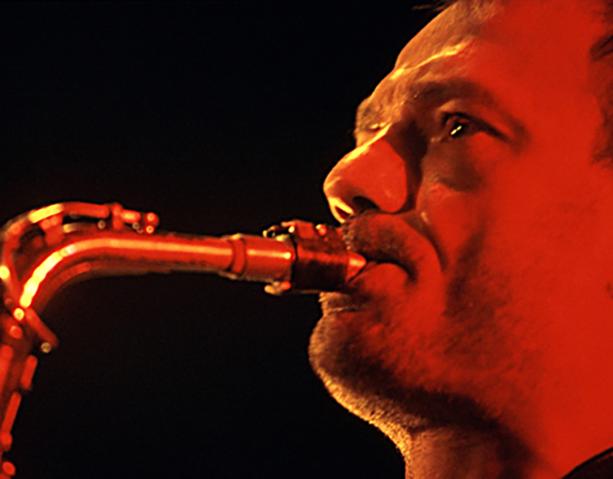
In The Wire 503/504, Seymour Wright appraises the hardcore saxophony of French musician Jean-Luc Guionnet
Jean-Luc Guionnet
Per Sona
Empty Editions DL/LP
L'Épaisseur De L'Air Live
Potlatch CD/DL
French multi-instrumentalist, composer, philosopher and visual artist Jean-Luc Guionnet has been a globally influential figure for several generations of creative peers. He is also one of the great living saxophonists, with an alto voice that uniquely consolidates strands of the instrument's sonic and conceptual history into something powerfully distinct, rigorous, instantly recognisable and future-fit.
In 2021, after 30 odd years of solo performance, he released his first full-length alto saxophone solo recording on Los Angeles label Thin Wrist. Recorded in a semi-open barn in 2018 in Brittany, L'Épaisseur De L'Air (The Thickness Of The Air) was concerned fundamentally with the texture, materiality and ideas of saxophone, sound and space. Here, four years on, are two more solo alto recordings. Though not officially released as a pair, they appeared almost simultaneously. One offers two live realisations of the L'Épaisseur De L'Air material on the French label Potlatch, the other private studio recordings made in Hong Kong and released via Empty Editions.
These sets consolidate Guionnet's voice in documentary form, containing years of situated work. Here, it's possible to hear his playing as the kernel/nexus of a sort of Francophone school of saxophone innovators that includes Daunik Lazro, Christine Abdelnour, Stéphanes Rives, Bertrand Denzler, Patrick Martins, Pierre Borel and Pierre-Antoine Badaroux. It is also possible to find traces of other alto techniques: the M-Base ways of Steve Coleman and Gary Thomas, the lyrical power of Arthur Blythe, the whimper-gnash of Anthony Braxton's Composition 99G, Arthur Jones's Scorpio.
A consistent ambiguity and variety of scale twists, inflates and crushes complex sonic details, dense knots, abrupt nothingnesses across the two discs. Both recordings document astonishingly visceral and cerebral instrument technique, into which musical/philosophical traditions are tied very tight: the saxophone stuff, plus for example study with Iannis Xenakis, workshops with Don Cherry, deep engagement with philosophy (a dialogue with tools in the ideas of Gilbert Simondon in particular feels at the tip of saxophone-homunculic fingers and tongue), mark-making and lines - are all in here, bound up with haptic ways of getting at, and beyond, the saxophone as technology, or back, via bagpipes and other ancient breathed-into, manually worked tools of transformation.
Dedicated to Miguel Garcia, L'Épaisseur De L'Air Live includes two longish in concert solos recorded in Montreuil, in the eastern suburbs of Paris - the first in summer 2024, the second in winter 2023. The alto saxophone fizzes, furry, flinty, furied, fuzzy, hard and soft, large and small sounds accruing and decaying in and out of phase with the force and stress Guionnet applies. The Parisian ghost fuel of the saxophone - from Adolphe Sax's speculative patent to Lester Young's memory palace (and absinthe) - are part of the air through which he forces his ideas, via the horn, into the ears of his listeners.
The longer first piece evolves episodically, in slabs, trickles and eruptions/implosions of ideas as sound that grow, decay and grow again as mouldy blooms, alto alliums of bulbous, pungent forces that sizzle and linger. The heavy, hot sonic reactions that begin the second shorter piece collapse into a long dusty tail of embers. The liveness is salient - we can hear the rooms, the other people there, making and listening, the world in this music.
Per Sona presents 11 exquisite studio solos recorded in Hong Kong, all of them short - between 90 seconds and seven minutes, almost miniature études. These are close, detailed recordings of close, detailed sounds: pied sounds that contain pockets and layers of different types of sonic activity, in different places in the saxophone, mouth and ear at once. Rippling sounds made up of multiple bits emerge out of simultaneous interactions and qualities of the saxophone qua machine. The first piece is a series of giant ascending blocks of complex sonic chunks; the second a cloud-cypselae, blown almost ney-like across reed/mouthpiece tip; the third a columella of growl about which the piece spirals. Sounds of skeleton-feathered lichens ripple in the final track's nutty sonic butter - halfway in, a gargle ends with spat-breath of husk.
In accompanying notes, Guionnet writes, tellingly, of the saxophone, "It was invented; invent music for it in return; always remember that when it falls, its fall does not sound like a saxophone. If it happened to fall, it makes the muffled sound of a ductile metal sheet, or of a bad hardware shop; its body is not sonorous - in which it is a machine; virtually, see by playing it the three dimensions of the metamorphoses of the air column, under the influence of the action; an unstable regime once grasped, maintain it by going with the wave." This gives a sense of the intellectual and physical stuff of the work at play here. "By whom sounds what?" he concludes, "Through what sounds who? Person/per-sonare or this mask which carries in my place a mask that does not belong to me… nor to it." Per Sona is an amplifier, definer and representer of character, identity.
Utterly hardcore and grown up in its humble enquiry and challenge, this is essential 21st century saxophony.
This review appears in The Wire 503/504 along with many other reviews of new and recent records, books, films, festivals and more. To read them all, pick up a copy of the magazine in our online shop. Wire subscribers can also read the issue in our online magazine library.
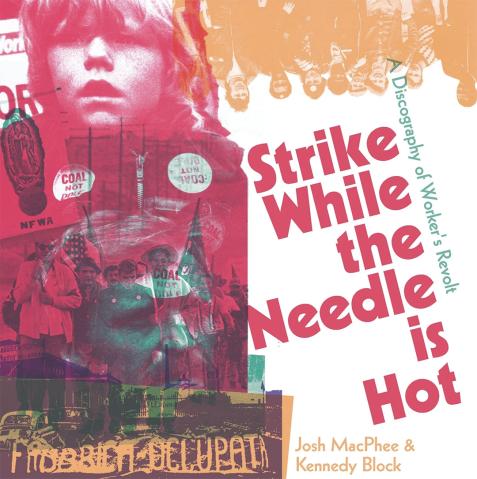
In an extract from his new book, co-authored with Kennedy Block, Josh MacPhee outlines the role of workers' songs and the making of records in supporting labour movements in the US
If producing a record is a tactic, and winning a strike is the goal, then what is the strategy? From studying these records, it's clear that the hopes for them are sometimes singular, other times multiple, often overlapping, and almost always clearly understood and articulated by the workers and unions.The records more often than not speak for themselves when you listen to them, but as most are quite hard to find, or in languages many of us don't speak, it's worth trying to lay out some of the intentions for the vinyl here.
There are two dominant reasons these records are produced: first, to raise public awareness of a strike, and second, to raise money to support the strike (and the strikers, who are by definition out of work and not being paid) - this latter reason is particularly acute for the wildcat strikes, where workers are not getting any support from an official union strike fund. That said, there are plethora of other intentions you can find for these records: to document a struggle after the fact, ie, a "proof of existence"; to build capacity amongst the workers and their supporters - for example, learning how to work together, organising and accomplishing increasingly complex projects, etc; as an extension of this, to build confidence amongst workers by creating "permanent" documents of their struggle; to use as a tool to connect to other workers, often in different industries but facing similar macro economic pressures; and to reach audiences that might not read a pamphlet or a long-format political treatise, but are more than happy to pick up a record they might enjoy.
A handful of records even come out of the practice of militant research, developed by the Facing Reality group in Detroit in the 1940s and 50s, then lifted up and expanded on by autonomous Marxists in Italy in the 1960s. The idea is simple: rather than prioritising academic pursuits by outsiders, workers know their workplaces best, and can participate in the study of their own struggles, and learn from similar studies by workers in other struggles.
While the music and production of these records is surprisingly eclectic, there are some things most have in common. As we'll see, if workers' action produces a record, it is almost always a 7″ single, either because the strike committee doesn't have the resources to produce something of a larger scope, or simply because most strikes don't last long enough to collect material to fill a full LP. The length of a 7″ single is roughly a third of an LP, and its packaging half the size and a fraction of the cost, and thus demands fewer resources to produce. In the pop music market, many singles were released in blank white sleeves, or with "company" sleeves that advertised the record label rather than the specific release. You'll find few of these here. Even if the format was small in stature, it was taken full advantage of. Almost all strike records came in picture sleeves, and many in gatefold sleeves - a double wide cover folded in half, giving the workers/union/solidarity committee twice the space to share information about the strike. In addition, it was not uncommon for the records to have additional information slotted into the sleeves: lyric sheets for sing-alongs, petitions to sign, even some oversized posters which could be hung up in apartments, or brought out to a picket line.
These documents are likely as illustrative of a particular struggle as any union newspaper or pamphlet, and sadly haven't been given their due importance in research on worker organisation. That said, this publication is at best a cursory overview of the field, a road-map to where we might look and dig deeper in the future. I'm interested in the use of vinyl records as a form of agitprop - as can be exhaustively seen in my previously produced An Encyclopedia of Political Record Labels. The effects of my fetish for vinyl shouldn't be understated. Beginning in the late 1970s, and gaining serious steam by mid 1980s, the cassette became a much cheaper and more versatile tool for political organising.
If we had included cassettes and CDs here, the size of this book might have doubled, at least. Both formats are much easier to produce than vinyl, and much cheaper, especially in smaller runs. There are likely many, many homemade cassettes created by workers' strike committees that weren't distributed beyond the picket line. I've been able to find a half dozen without really spending much time looking. But what little research I've done has made it clear that a focus on cassettes and CDs is really another project altogether, and I stand by the decision to use vinyl as a curatorial tool here. Ideally someone else will pick up the thread and follow up with a deep dive into worker-produced cassettes and CDs. But for me, and in this book, the vinyl record functions as both a marker of financial investment and a commitment to mass distribution.
Co-editor Kennedy Block and I propose there are several ways to read this book. To look at any particular entry drops you into a specific strike, more than likely a fight that has been forgotten, at least by those who weren't active participants. Like the records themselves, the entries are modest time capsules, historical markers of punctuated class struggle. But when taken together, they tell a larger story, one of an arc of global conflict, of the gains of workers in the 1960s and 70s, and the re-entrenchment of capital in the '80s. We see fights for wages, shorter hours, and even worker ownership and control eclipsed by increasingly immiserated demands for factories not to shutter and pits not to close.
It's a little brutal to listen to - in recorded real time - utopia slide into desperation, to see how neoliberalism stomped on the neck of hope for meaningful and fulfilling work, replacing it with a panicked need of workers to keep a roof over their heads. It is likely no coincidence that the tectonic shifts towards neoliberalism in workers' perceptions of what their struggles could accomplish appear to run parallel to another big shift, this one sonic. The earliest records you'll find in this book tend towards sounding like direct decendents of old left workers' choruses with their martial songs and anthems (a couple even include a version of "l'Internationale"). Over the course of the 1970s we see a shift towards the inclusion of more pop idioms into the music, first in the form of folk, and then rock, reggae, and finally hiphop (or at least pop rap). While on the surface this may seem a natural progression, it exposes a much deeper and more complex process at work.
While the labour music of the 19th and early 20th century might not be the most exciting to our contemporary ears, it developed out of generations of working class organisation, both in the workplace but also the community. Songs such as "l'Internationale" and "The Red Flag" weren't just sung on picket lines, but in union halls, at pubs, worker's funerals, and solidarity marches. As there was little class mobility in the world, children would learn the songs from their parents, and in turn pass them down to their kids. So the shift towards pop music (primarily Anglophone pop) was not simply a stylistic one, but a shift in relationship to the songs themselves. Labour songs are a social form, to be performed and listened to in a community context. Pop music is a commodity, to be sold to individuals, who develop personal relationships to the music.
This is likely why some of the later records come off as strange, or even worse, completely corny. The records fail musically, as well as fail to give voice to any sense of a coherent working class. And this was one of the projects of neoliberalism, the bio-political replacement of any sense of collective working class identity with the atomised consciousness of individual consumers. We're not labour historians, but hope something can be learned from the stories these records tell us.
The last 15 years have seen a huge upswing in militant labour organising in the United States, from the Republic Windows and Doors occupation in Chicago in 2008 to the huge gains made by domestic workers across the country (such as the rise of Domestic Workers United and their successful fight to pass a New York State Domestic Workers Bill of Rights in 2010), to the increasingly successful campaigns to organise workplaces like Starbucks (Starbucks Workers United) and Amazon (Amazon Labor Union, affiliated with the Teamsters). Music and audio documentation haven't been a memorable part of these struggles so far, but in the social media-dominated attention economy we live in, it doesn't take much to imagine how music could play a larger role in publicising worker action and encouraging broad support. But even if we set aside these larger promotional concerns for a moment, the records in this book exude the sheer joy of workers singing and marching together, fusing solidarity, and taking their lives into their own hands.
This is an edited extract from the introduction of Strike While the Needle Is Hot: A Discography of Workers' Revolt by Josh MacPhee & Kennedy Block, published by Common Notions Press.
You can read Dave Mandl's review of the book in The Wire 503/504. Pick up a copy of the magazine in our online shop. Subscribers can also read the review and the entire issue online via the digital library.
To make sense of ongoing tech revolutions, a new generation of musicians is making music that metabolises electronic processes through analogue forms, argues Ryan Meehan
The progressive music scene turns to the future in a foul mood. It was detectable in the air last October, as the audience gathered for the first of the evening's two sold out Autechre shows at Brooklyn Steel in north Williamsburg. Here, in the omphalos of the newly-minted Commie Corridor was a display of cultural force every bit as robust as the political one which had recently vaulted socialist Zohran Mamdani to the Democratic nomination (and, in short order, the mayoralty). So why, then, as the Rochdale duo took the stage in their preferred semi-darkness, was the atmosphere cut with an unmistakable current of dread? Perhaps it was the uneasy stagecraft of the Gaza truce, still fresh, or the unreconstructed decorum of post-pandemic concertgoers unable to handle their doses (and sometimes their bodily functions). Perhaps it was a suggestion hardwired into the music itself that, outside these walls, there was a vision of the future taking hold (remember the Artificial Intelligence series?) for which we weren't entirely prepared.
Futurists though they remain, the future Autechre first portended is now largely history. Cloned sheep, Clippy the Microsoft assistant, and the like. Their vanguardist rhythms, swinging like sonic battering rams in 4-D, recede into the foundations of the world to come. Instead, as we attain the quarter century, artists are staking out a vital new position within the looming crisis of the digital as it develops in the here and now.
This tendency takes for granted the dynamic and space-bending possibilities of electronic composition, and accepts them not as grounds for abandoning the field, but as a sporting challenge to their own analogue rhythms. At a time when complex computers and their pitchmen lay claim to as much of communicative life as they can, this metabolic tendency in music emerges as one possible response - not theoretical, but organic; not doctrinaire, but instinctively oppositional. If the metabolic coheres as a specific answer, perhaps it's to the question as to why the world has got so weird lately, and what of that weirdness plays back to us in our music.
Weirdness, of course, can be a source of delight. In 2025, few bands were as weirdly delightful onstage as Fievel Is Glauque, the jazz-pop ensemble shifting around the duo of American keyboardist Zach Philips and Belgian vocalist Ma Clément.
The rare progressive band whose precision feels spontaneous and vice versa, FIG's baroque, fleetfooted compositions hit like bursts of sunshine in a funhouse mirror. Core to their sound is a downright algebraic approach to rhythm, massaged across the instrumentation generally, though special plaudits go to recurring bassist Logan Kane and many-handed drummer Gaspard Sicx.
Another provisional quality of metabolism: though its freneticism can seem to dialogue with digitality, the music itself is produced primarily by hand. This isn't mainly a declaration of Luddism (though maybe it is also that) so much as a reclamation of terrain by enfleshed bodies in the production of what makes those bodies move. Nor is it an aesthetic of purity. Fievel's last album, Rong Weicknes (2024), was recorded "live in triplicate", its final tracks spliced together from overlapping takes à la Teo Macero. That the band commits to re-confecting this sound live (and live previews of new material place their upcoming album high among the most anticipated of 2026) emphasises a concern with human, rather than machine potential. With the serene bounce of a surrealist tour guide, Clément sings faster than you can think, her poetry the kind a computer could only spit out by mistake.
In metabolic songcraft, the glitch, long a point of fascination in digital aesthetics, migrates to a motif of human breakdown under the pressures of the mediated grid.
On the left, attention has turned increasingly to passages in Marx regarding capital's potential to develop beyond the resource capacities of earth - what proponents of degrowth call the metabolic rift. In the last decade, art's attempts to encompass climate change as a subject have found themselves stranded - often frustratingly so - in the passive, the local, and the melancholically topical. A crop of new artists on London's AD 93 label has obvious recent antecedents - the fetid Zappa splatter of Geordie Greep's projects, the high watermarks of Tom Skinner's influence within The Smile - but at its most caustic, this pod-born sound suggests an aesthetic rift to measure up to the deep-tissue wrenching of the planetary one underway.
Brooklyn band YHWH Nailgun is the label's latest rising star, porting their youthful current into sludgy contortions that bring to mind images of ceremonial emetics. And while their mixture of propulsive rhythms (courtesy of the reabsorbed kitsch of Sam Pickard's rototoms) and effects-bent melodies recall Braxton-era Battles to this elder millennial ear, that band's use of digital instruments had the flavour of liberation. The Nailgun, by contrast, sound penned in - all but strangled by the imminent cyborg dawn.
For my money, though, the most promising of this corridor of metabolists are Still House Plants, whose incantatory vocal lines and decaying guitar riffs tilt just off-axis over beats whose cracked precision would sound looped if you couldn't see David Kennedy playing them up close and personal.
Irregular tempos and faltering structures seemed designed in advance to resist algorithmic training. As climate politics endures historic setbacks in the West, nascent popular outrage at the AI data centre boom's resource intensity (alongside outcries against music's unique role within the data regime) may provide a previously listless creative counterforce with a potent new metaphor for attack.
Some warriors in this emergent battle are happier than others. A founder of Darkside, one of metabolism's most direct precursors, guitarist Dave Harrington applies the intricate compositional style he first refined beside Nicolas Jaar's minimal post-dub atmospherics to his second band's cheekily analogue arrangement.
Taper's Choice styles itself as a supergroup (just about all of its elements of style are overtly over-styled) looking to supercharge the high-participation jam scene from its progressive fringe. Last year, the ensemble - which includes Real Estate bassist Alex Bleeker, Arc Iris keyboardist Zach Tenorio Miller, and Vampire Weekend drummer Chris Tomson - released their first proper studio album, after a compilation of songs ('concrèted', one imagines, in a method not dissimilar to Fievel's) and a string of - what else? - live tapes. A mixture of balloon bounce and rapid-eye flutter, Prog Hat holds an affinity for the gentle dislocation of 70s jazz fusion. Is it a stretch to compare its supple geometry and bold colour to that other, utopian metabolism, of Tange and Kurokawa? Harrington conducts the marathon-like "Dave Test" with an eye for microstructure, all thrashed into shape by Tomson's relentless stamina. If Taper's swings, it's at a rate your feet must first calculate to catch up to.
Which returns us to Autechre, and the ambiguous future of the human-technology interface, in which music is both figure and ground. A surging appetite for vanguardist rhythms perhaps only awaits the breaking of a figurative dam, the blowing of a metaphorical pipeline, that the metabolic turn can provide. For this generation, it may be that the pessimism of the intellect is a precondition for a renewal of the optimism of the will. Time and again, where democracy elevates a new political regime, its success can depend on the rise of a cultural one in tandem. Will metabolism play such a role? Predictions are a parlour game, but those that clamour for shibboleths of a "left with no future" will at the very least have to dance to the reality shifting beneath our feet, and contend with the eternal truth of Michael Crichton's Jurassic Park - that life finds a way.
You can read more critical reflections on underground music going into 2026 in The Wire 503/504. Wire subscribers can also read the issue in our online magazine library.

In his latest Secret History of Film Music column, Philip Brophy explores how the signifiers of Black musics in Swarm are fragmented to indicate its main character's psychosis
What does it mean to compose music today? Is composed music a creative act or a procedural action? An original expression or a contextual response? A conceptual performance or an industrial gameplay? And if it is one or the other, how do we perceive it as positive or negative? I'm perennially excited by these notions - especially when a film score sends my head spinning into their interrogative possibilities. Michael Uzowuru's score for the Prime mini-series Swarm (2023) spun my head considerably.
The premise is stark. Dre (Dominque Fishback) is a rabid fan of Ni'jah (a twisted simulacrum of Beyoncé and her Beyhive fanbase). She embarks on a killing spree, targeting people on social media who hate on Ni'jah. Graphically unsettling and tonally diffuse, Dre's picaresque journey turns Dante's Inferno upside down and pumps it full of Black aspirationalism to exploding point. Created by Donald Glover and Janine Nabers (whose previous series Atlanta is a meltdown of Samuel Beckett, Melvin Van Peebles and OutKast), Swarm pulls an even tighter focus on the sociocultural complexities of Black music, here pivoting from the hemmed-in machismo of trap and rap to the goddess hysteria of R&B and pop.
Ni'jah's songs are sung and written by Kirby Lauryen, with selected co-writing and production spread between Glover and Uzowuru, among others. Childish Gambino touches are evident, and all tracks are skilled parodies of digital soul, gushing with stacked harmonies. "Something Like That" collapses digital simulations of vocal cooing with gospel-tinged organs and percussive thrumming a la Kate Bush's ethnographic backings. Kirby's AutoTuned lines layer female and male tones in a heady pansexual mix. "Agatha" harks back to seminal Timbaland productions for the late Aaliyah, awash in slurred breathiness and lo-fi Ngoni licks. "Big World" fuses microhouse and elegant sophistico vocals. The bouncy Vocoder jaunt of "Adventure" conjures a trappy limo party as remembered by college grads. "Hahaha" and "Sticky" are pumped with multi-genre crosswired stylistics, making both hard to characterise.
Scattered across the series's seven episodes in disruptive edits and interrupted passages, these songs point to the magical breath of Ni'jah, who has the mystical power of a Black diva to excite her 'swarm' of fans. But unlike (for example) the soaring positivity of Hollywood's flirtations with Black goddess music - from The Bodyguard (1992) to Glitter (2001) to Sparkle (2012) to Trap (2024) - Swarm posits Ni'jah's songs as a type of 'broken' soul music. The polyglottic gumbo of ballads and anthems for Ni'jah do not shy away from how the spiritual Beyoncés and heartache Kanyes of the world produce music that is stylistically fractured, compositionally kaleidoscopic, digitally processed and authorially aggregate. 'Broken' soul describes equally this technological shift, its marketplace redefinition, and the psycho-therapeutic aspect of how fandom now links to these mystical figures with impossibly affective voices.
At the core of Swarm's broken world is the psychotic character Dre. Dominique Fishback's stellar performance (maddeningly numb and unpredictable) breaks the series's narrative momentum continually, pushing the shared notion of 'serial' story and 'serial' killer into hitherto unexplored territory. Uzowuru's score is a selective rearrangement and reconstitution of the sonic shards of Ni'jah's songs. Sometimes they seem to be literal fragments from the songs, but mostly they are echoes of recognisably similar elements: single sounds from drum machines, single chords from digital keyboards, processed textures of clipped vocal utterances. An aural ouroboros is formed: the score comes from the songs which are studio-composed from the type of sonics of the score. This acousmatic mirage evokes the bond between Ni'jah and Dre - who in the first episode makes it clear: "Ni'jah knows what we're thinking and she gives it a name."
With this declaration, Dre is defending Ni'jah to the sleazy boyfriend of her tweenhood friend, Marissa, with whom she now shares an apartment. Dre's announcement triggers an ungainly sound: a badly sampled vinyl scratch of an indiscernible source. This squawk is a sonicon for Dre's cracked personality. Like Grand Mixer DXT's trademark scratch of the Vocodered "fresh", it is her call sign. Uzowuru uses it to forecast Dre's loss of control and unmitigated rage; it will progressively increase in presence and density in the score as the story lurches into widening expanses of psychotic violence. (To my mind it also recalls the pitch-wheel bending of Major Lazer's "Pon de Floor", the basis of Beyoncé's "Run The World (Girls)".)
When Marissa decides to shift out of their apartment and live with her boyfriend, Dre's world falls apart. The squawk sample increasingly and erratically haunts the soundtrack, variously merged with kalimbas, cellos, noise drones and symphonies of swarming bees. All of Uzowuru's 'cues' are tied to Dre. Accordingly, they are weird sonic collages desperately trying to pass themselves off as 'music', just as Dre masks as sane, always hiding her murderous bent behind inscrutable logic and motives. In fact, each episode takes place in a different time in a different state, presenting their chapters as spatio-temporal ruptures in Dre's life as she obsessively tracks Ni'jah's tour schedule in the deluded belief that one day she and Ni'jah will be besties. Dre's outward appearance, her living conditions, her employment situation all make her nearly unrecognisable in each episode. Uzowuru's score placement is moulded by these ruptures.
In a radical move that these days seems far more commonplace in television than cinema, Swarm is a meta-textual labyrinth engineered less by plot and character and more by chance and psychosis. Squiggles, not arcs; lesions, not persons. Episode 6, "Fallin' Through The Cracks", is a sharp send up of long-running tabloid true crime shows like The First 48 and Snapped. It has no tonal connection with the series, and uses none of the actors, nor any of Uzowuru's music. Episode 5, "Girl, Bye", paints an unexpected and unsettling portrait of Dre's childhood and her relationship to Marissa. A single cue by Uzowuru is sounded right near the end of the mostly silent episode. All the other episodes possess their own equilibrium of song tracks, music cues, and sono-musical collages. The viewer/auditor is refused any thematic musical flow to aid in riding the emotional tides and sociopathic waves of Dre.
The final episode, "Only God Makes Happy Endings", devolves into the ecstatic, sensual world of Ni'jah's music, shifting from her disembodied voice to her performative body, when Dre finally gets up close to her idol. Weirdly - magically, even - Uzowuru's music becomes the world of Ni'jah as embodied within Dre's schismatic and dissociative headspace. From awkward squawks of scratched audio to the glistening symphony of 'devangelical' music, Swarm's soundtrack stitches together the titbits megastar divas disseminate to their swooning fans: 'broken' soul for Dre's broken mind.
Wire subscribers can read Philip Brophy's original Secret History of Film Music columns from the 1990s online in the digital archive. Previous instalments of this column published on The Wire website can be found here.
From the mainstream to the margins, bands were once again in decline in 2025, writes Antonio Poscic
For several years, the supposed death of the band has been cropping up in state-of-the-nation style music discourse. The obvious culprit? Financial hurdles of the sort that even successful bands can no longer overcome. This autumn, Garbage vocalist Shirley Manson launched a diatribe against the unsustainable realities of touring. Meanwhile, UK post-punk four piece Dry Cleaning were forced to postpone their US concerts due to "increasingly hostile economic forces".
Ignoring the rockist winds that circulate the topic alongside the alleged downfall of guitar music, the cultural decline that band-made music suffered in the mainstream is clear by looking at the 2025 streaming charts. Here, groups are few and far between, relegated to the lower tiers, while higher placed entries are either legacy acts (The Rolling Stones, Coldplay) or K-pop groups.
Around them is a sea of solo projects, across genres from hiphop, to electronic music, to bro country, for which musicians are often motivated to present as cultural icons and social media influencers. Going at it solo, it would seem, is both more profitable and better suited to social currents. However, blaming harsh economic environments alone can obscure the nuances of the situation.
In a 2012 letter announcing the dissolution of his Chicago Tentet, Peter Brötzmann lambasted "the everlasting critical economic situation, actually with no expectation for better times", musing on how "the financial situation forms and builds sometimes the music". He closes the announcement with a dejected rhetorical question: "Who can afford to travel with a quintet nowadays?" Surveying the landscape of experimental music 13 years after Brötzmann's letter, the sobering answer is, not that many. For the 2025 edition of The Hague festival Rewire, one of experimental music's flagship European festivals, only a fraction of the immense lineup was occupied by bands, even with the definition of the term stretched to its extremes. Further out, the pattern repeats at Utrecht's Le Guess Who? and Kraków's Unsound.
Meanwhile, outside the big names (eg Jazzfest Berlin), free jazz and improvisation focused events across Europe are forced to balance their rosters by relying on ad hoc groups. Even avant rock and more audacious metal festivals, such as Roadburn in Tilburg, whose bread and butter are bands, have begun to rely on solo projects.
But, in the same letter, Brötzmann pointed out an overlooked tendency working against experimental bands: the rote and patterns that settle in over time. "Hanging together for such a long time - with just a couple of small changes - automatically brings a lot of routine," he writes, "for my taste it is better to stop on the peak and look around than gliding down in the mediocre fields of 'nothing more to say' bands." Does the dissolution of the band prompt greater creativity among its ex-members?
If economic challenges brought the band down to its knees, technology gave it a hard kick. Home studio hardware and software, digital workstations and programming languages free artists from the power dynamics and creative restrictions characteristic of bands. Some of the essays in Routledge's 2024 volume The Ontology Of Music Groups make the case that intra-group relationships can stifle innovation and creativity, and point out that social structures that emerge in a band are often patriarchal in nature, and eventually collapse under the prevailing influence of its most prominent members.
Bedroom pop and black metal led the way, showing the potential for one person, DIY projects to result in a myriad of stylistic permutations, while being conducive to unorthodox experiments and accessible to more marginalised people. Furthermore, the solo practitioner need not pay for prohibitively expensive rehearsal spaces, and much could be achieved even during Covid lockdowns, using the internet as a tool for dissemination. Comparing The Wire's 2025 Releases of the Year chart with those from 2020, 2015 and 2010 shows the decline in the representation of bands in the latest lists, especially when excluding long-established groups like Stereolab, Tortoise and The Necks.
In theory, the current hyper-local music landscape, shaped by the financial and administrative difficulties associated with touring and encompassing everything from rap micro-scenes in various US cities to sound art communities in Eastern Europe, could present ideal conditions for the formation of bands. But local showcases for up and coming musicians that are open to outfits from the region and beyond, such as Zavod Zavod Za Eksperimentalni Zvuk's Čuješ?! Drugačije in Zagreb, tend to feature very few.
Much of the music performed on the night of Čuješ?! Drugačije's 2025 edition fits the 'this could have been a band' category - we hear vague avant, prog and post-rock forms meshed with abstract electronics - but the bill shows exclusively solo acts and duos, and is staged in a small and cosy art gallery, not a traditional concert venue. Between sets, the musicians connect and exchange ideas. You can almost sense a network of kindred projects, each of them with its own story, becoming a surrogate for the camaraderie and collectivism found in bands - without any of the compromises?
There is a hint of what a post-band world might look like in the still-emerging fad of cloud rock that, given the current rate of change, might already be over. Amorphous and difficult to define, this variant of alternative rock occupies a hazy dimension between shoegaze, dream pop, post-rock, hiphop and post-internet niches. Artists such as ML Buch, James K, ssaliva and Tom Boogizm's Rat Heart belong to this particular music, definable through mood rather than style, gesturing broadly towards a rock aesthetic while expanding the vernacular beyond the traditional band.
Reflecting on the success that the likes of Geese and caroline have enjoyed throughout 2025 in their particular niches, it's obvious that the demand for band music still exists. And if we recognise the millions of Spotify plays attracted by the AI slop of Velvet Sundown as a pilot project, then we can expect the industry to increasingly rely on technofeudalism's latest force-fed solution for all problems, generative AI, to flood the supply side. In fact, the unscrupulous types found in the tech industry are already hard at work, drafting licensing agreements with the global music brands like Warner, Universal and Sony that would allow them to use generative AI to create all the band music they could ever want while bypassing all the annoying needs of human beings that the form entails.
The music business has never been particularly fair or caring towards artists, but the AI-fuelled divide feels deeper and harsher than ever before. In an optimistic scenario, this moment could mark a turning point, one in which musicians return to bands out of spite, repurposing the basic human connections that exist within a group into acts of revolt. Unmediated by technology, the band becomes a symbol of everything that AI isn't: creative, messy and human.
You can read more critical reflections on the state of underground music in 2025 in The Wire 503/504. Wire subscribers can also read the issue in our online magazine library.

The music industry's uptake of AI complicates the boundaries between listener, artist and music in troubling new ways, argues DeForrest Brown, Jr
Automating ourselves out of existence is trending.
Our habit of referring to music as an aesthetic object has guided a widespread shift in the way we experience a musician's workflow as recorded audio. The conversation around - as opposed to resistance against - music streaming services largely focuses on the accessibility and fungibility of music that far exceeds the capacity of our collective attention spans. Without much headroom, sound circulates as editable waveforms in a loop that does not require interpretation or participation. This de-centering of the musician's workflow enables large streaming catalogues to be animated by AI-enabled virtual instruments and protocols that subvert authorship - partially to the comfort of the listener, who is no longer burdened by the intentions or emotions of any given song or album's author. In this sense, platforms such as Spotify, TikTok, and AI-generated music systems act as quasi-sovereign actors, shaping which cultural narratives circulate and which are excluded, functioning as vectors of soft power across global audiences.
The automation of music did not begin with artificial intelligence or streaming, but with a quiet social agreement that sound could be managed like inventory. In 1998, in the beginning pages of More Brilliant Than The Sun: Adventures In Sonic Fiction, Kodwo Eshun outlined a transatlantic logistics and distribution system of physical music and ephemeral culture. "As a US or Euro import, a test pressing, a white label DJ promo, a double pack, a triple pack or a 10", the single is the rare object that everyone wants, that most people never get to see," he wrote. "The 12" is the hardback of music, the ltd-edn run of 2000 copies that sells out in three days, never to be seen again." Eshun's description of a pre-internet network of music circulating among DJs, journalists, and eventually the consumer, resembles that of book publications where reissues in different formats determine the overall availability of music in the public sphere.
Much thought has been put into unlocking the algorithmic function of Spotify's 'black box' that begets both curated and assembly line-like 'playlists' that replaced, or for now, operate in parallel with weekly album releases. Much less thought has been put into why we create music within this specific age of post-internet, end-stage capitalism where music has been normalised into sono-semiotic databases.
In reality, sound is not measured in decibels or beats per minute, but is instead experienced in real time as an unfiltered acoustic phenomenon. Songwriting marshals sounds in a supposedly organised fashion that leads the mind along a linear path within a specific span of time. Within that time, a song could technically do or be anything within the limits of what has been recorded, mixed and mastered in the moments prior to reaching a listener's ears. And yet, much music adheres to a standard of chorus-verse-chorus-bridge-chorus among other logical variations.
Spending time with music and its surrounding mediasphere, I began to notice a pattern in the way music is being released and consumed: a quasi-reciprocal choreography between artists (creator) and audience (consumer). This customisable relationship of give-and-receive operates in an ambient commons that in many ways resembles and represents the tastes and imaginations of everyday society. Loops of attention and algorithmic recommendation function as a form of soft power, subtly dictating what is culturally legible, while the infrastructure of streaming itself - code, metadata, and interface design - acts as governance, shaping behaviour and influence beyond explicit human intervention.
In January 2023 an online publication titled "After the Creative Economy" by Yancey Strickler, co-founder of Metalabel and former CEO of Kickstarter, critiqued the revenue-focused ecosystem defining the "creative economy", where attention online is monetised rather than cultivated. He reproached the way in which digital music distribution has been entirely geared around revenue with less focus on the process of creation. Digital music distribution, he argued, prioritises commodification over creation: "Everyone treated music as this infinite resource to be endlessly commoditised and sold, but nobody thought about the conditions of the musicians who made it, where new music came from, or how it was meant to be financed." What we've seen of the creative economy has in many ways illustrated cultural dependence on corporate-controlled platforms: artists and audiences alike become enmeshed in systems whose governance is algorithmic and opaque, while the infrastructure of distribution itself posits a governing architecture that subtly choreographs participation, labour and value.
Imagining a music industry without people has been a recurring thought of mine since the emergence of vaporwave, a digital-native non-genre that metabolised nostalgia for late 1990s and early 2000s retail, pop and cyber culture. Vaporwave did not produce new music per se, but instead reimagined existing commercial audio production and consumption, accelerating them into sample packs of metamodernist aesthetics to vibe to. Pre-digital generations tend to be nostalgic for iconic, socially shared moments in music history, while post-digital generations desire playback as affirmation of music's aesthetic potential for the future.
This future-oriented nostalgia has reshaped music distribution: 'old music' from pre-file sharing eras now outsells new music, signalling a potential post-internet scarcity of music that has not already been archived within the circulatory system of physical recording formats - or, further still, a scarcity of collective memory not indexed by platforms. For example, Oneohtrix Point Never's Tranquilizer salvaged digitised sample CDs of 1990s commercial muzak, while the sibling duo Chuquimamani-Condori and Joshua Chuquimia Crampton's Los Thuthanaka infused self-released, unmastered CD-Rs with ancestral wisdom and ceremonial textures, actively resisting algorithmically curated flows rather than supplying them.
Instrumentalising artificial intelligence has become a nonspherical approach to culture production and distribution in the absence of object-permanence in an online marketplace. Holly Herndon and Mat Dryhurst have used their own online ecosystem of the Interdependence podcast as well as two major art exhibitions at the Serpentine Gallery in London and the KW Institute for Contemporary Art in Berlin as a way to organise and publicly build a ledger of the ever-changing landscape of AI specific technology and its effects on musical expression.
For more than a decade, the two have advocated for the use of laptops and other computerised instruments to be considered legitimate modes of creative cultural production while also using the podcast industry, art world and speculative economics to demonstrate the potential benefits of advanced technology and other vapourware in their prototype stages. "AI is a deceptive, over-abused term. Collective Intelligence (CI) is more useful," Herndon suggested in a tweet later quoted by Jacobin: "It's often just us (our labour/data), in aggregate, harnessed to produce value by a few, who maybe have an easier time acting with impunity because we are distracted by fairytales about sentient robots." The article goes on to explore another observation of Herndon's in which AI music is described as an evolution of audio samples that should be imagined as a "recording technology 2.0".
Inside the digital audio workstation (DAW), the logic of a recording technology 2.0 intensifies. Suno, an emerging generative AI platform designed to create music from text prompts, entered a landmark partnership with Warner Music Group. This acquisition addressed prior copyright disputes while also establishing a framework for fully licensed AI music models similar to a previous deal WMG made with the personalised soundscape app Endel in 2019. A recording music 2.0 might allow users to describe genre, tempo, mood and instrumentation without real world acoustic resonance into fully realised tracks or stems based on legal intellectual property and behavioural metadata that can then be mixed, edited and exported in standard audio formats compatible with DAWs and DJ software for further processing and analysis.
The CDJ as a prosumer player device could potentially standardise workflow into a "prosumptive listening", in which Suno and AlphaTheta facilitate a parallel domain of performance, where authorship dissolves into prompts, skill into compatibility, and listening into metrics. As of 18 December, Universal Music Group entered into a partnership with cloud-based music creation platform Splice, to offer prosumers AI-powered virtual instruments and workflows trained on UMG's entire catalogue of over seven million recordings and compositions. With minimal human input, this potential experimentation with platform convergence places a new emphasis on how intellectual properties might be distributed and valued between creator and consumer, if at all.
Music has always been haunted by the tension between creation, distribution and consumption. From Kodwo Eshun's rare vinyl to Spotify's algorithmic playlists to AI generated tracks, the evolution of music reflects shifts in cultural and economic priorities. The question is not whether automation will replace human creativity, but how we choose to participate in a culture industry that increasingly blurs the lines between audience, creator and product.
You can read more critical reflections on the state of underground music in 2025 in The Wire 503/504. Wire subscribers can also read the issue in our online magazine library.
DIY online radio stations allow humanity and personality to surface in a tide of soulless and reductive algorithmic playlists, argues Paul Rekret in The Wire 503/504
For all their horrors, the Covid years were oddly good for radio. With gigs shuttered and the usual circuits of nightlife abruptly choked off, artists and audiences moved online in search of somewhere to gather. Live sets were broadcast from bedrooms, performances surfaced from empty venues, local scenes tried to keep themselves going through the ether.
DIY online stations didn't suddenly emerge during the pandemic. The 2010s had their benchmarks: Amsterdam's Red Light Radio (now gone), London's NTS (long since outgrown its Dalston cubbyhole), and New York's The Lot (still recognisable from its early days). But around the lockdowns of 2020-21, dozens of small stations appeared or flourished and have carried on since, from Clyde Built Radio in Glasgow to Budapest's Radio Lahmacun or Seoul Community Radio, forming a loose but persistent network through which underground music continues to circulate.
They survive through volunteer labour and improvised arrangements: intermittent broadcasts, borrowed rooms, a corner of a cafe or a market stall. The remit is whatever sits outside the cleansed margins of the dominant culture, "music misfits, amateurs, and seasoned DJs", as Clyde Built Radio puts it. A minor infrastructure, but one in which local underground cultures quietly persist.
Meanwhile, music is drawn ever deeper into platform capitalism's limitless digestive system, in which everything is processed into frictionless, mildly flavoured playlists; musical wallpaper, as one description has it, but with the walls closing in. Enough has been written about what this has meant for artists and listeners: the recursive shaping of taste, incomes collapsing, the sorting and harvesting of data through interfaces increasingly less like portals and more like chutes.
What these small stations offer isn't only the presence of a human voice rather than an algorithmic proxy - "no playlists, no ads, just the people", to borrow Bristol based Noods Radio's phrasing. Again and again, producers and hosts describe the space itself as crucial: the low-level drift of people coming and going, an unexpected conversation with someone finishing a set, the idle time before another begins. In the context of ever more solitary, smooth and inward online music consumption, such spaces become an increasingly important wayward impulse, even if a fragile one, that keeps slipping out of the platform's prescribed channels.
The boundary between mainstream and alternative cultures, however it's understood, has thinned further as more of social life is subsumed into the circuits of a few monopolistic tech firms. Bandcamp's sale to Epic Games in 2022, absorbed with barely a ripple, made this plain. Stations depend on the very machinery that might one day render them obsolete: social media's opaque visibility regimes, cloud platforms whose terms shift without warning, digital archives whose survival hinges on conditions no one local can influence.
All of which places today's DIY stations in a longer, bittersweet lineage: the recurring struggle between autonomous cultural practices and the forces that seek to regiment, rationalise and monetise them. The ham radio enthusiasts forced off the dial by regulators in the 1920s; the format-radio monocultures that smothered unaffiliated broadcasters in mid-century America; the stifling of freeform FM by the 1970s; the pirates that threaded across Europe, moving through whatever cracks regulators and the police had not yet sealed. The antagonists have changed, but the basic plot remains.
Economic survival, always precarious, has become still more so. Running costs accumulate, revenue rarely does. Many stations endure only through their attachment to other small institutions, cafes, bars, art spaces, themselves little more secure. EHFM is entwined with Ground Floor cafe in Edinburgh; Noods operates from Mickey Zoggs; Slack's is woven into the Lubber Fiend venue in Newcastle. In the wider context of rising rents and dwindling jobs, none of this is guaranteed. Yet the sheer abundance of such stations, and the social worlds that gather around them, should give one pause. With so many alternatives already in existence, the idea of paying for yet another streaming subscription seems rather perverse.
This essay appears in The Wire 503/504 along with many more critical reflections on 2025. To read them, pick up a copy of the magazine in our online shop. Wire subscribers can also read the issue in our online magazine library.

In The Wire 503/504, Lucy Thraves argues that luxury labels and conglomerates are keen to purchase some avant garde glory, but at a cost to experimental music and the ecosystem that supports it
In March 2025, the UK experimental music scene was pleasantly surprised when London venue Cafe Oto got a mention at the Oscars. Daniel Blumberg, who won an Oscar for the score for The Brutalist, used his acceptance speech to pay tribute to the East London venue and its community of "hard working, radical musicians, who've been making uncompromising music for many years" (the soundtrack features the likes of Seymour Wright, Evan Parker and Steve Noble). Six months later, the composer walked the runway for designer label Miu Miu, prompting fashion magazine A2Z to praise him for "[infusing] the runway with introspection and avant garde energy".
Whatever avant garde energy is, high fashion wants it. The last few years have seen a growing number of designer brands working with experimental music or musicians. In 2022, radio platform NTS partnered with designer denim brand Diesel to launch TRACKS, a series of parties, events and discussions that would allow Diesel to harness NTS's community-making infrastructure and leftfield musical nous. In April this year, Berlin label Pan, who have released the likes of Beatrice Dillon, Iggor Cavalera and Slikback, teamed up with Nike - a company recently valued at $31 billion - to launch a new trainer. Cellist Oliver Coates and former Wire cover star Arca scored a Dior show in 2022. Another former Wire cover star, Dean Blunt, soundtracked Burberry's 2024 show.
Obviously fashion and pop music go hand in hand, enjoying a nearly symbiotic relationship as cultural expressions. But a burgeoning relationship between high fashion and experimental music is troubling, most obviously because the economic and social forces underpinning the two are so drastically imbalanced. What could multibillion dollar companies possibly want with precarious, awkward, typically anti-capitalist music cultures? Unless it's… precisely those qualities.
High fashion understands that 'avant garde energy', which we presumably should understand to mean a combination of cool, authentic and novel, is born from an ethics of anti-commercialism and political integrity. In creative scenes more broadly, artists' ability to protest, propose counter ideologies and offer ways of thinking and being outside of the dominant culture is always in tension with the economic demands of their self-reproduction, meaning that pockets of radical culture are increasingly hard won, and appear increasingly rare in their commitment to independence and integrity.
Naturally, a company that exists to sell wildly expensive shoes, coats or bags cannot truly claim such integrity for itself, but that doesn't stop it from trying. As part of capitalism's ever intensifying search for new ways to sell and people to sell to, the marketeers of luxury are attempting to metabolise dwindling scenes of real creativity in their pursuit of the niche and cutting edge - without contributing anything meaningful to the landscapes that give rise to these cultures in the first place.
Some might argue that commercial partnerships of any kind work by bestowing exposure on the scenes they exploit. But is this true? Shortly after the Oscars mention, a Cafe Oto staff member mentioned to a Wire colleague that the rush of exposure had done nothing for ticket sales: it's not obvious that interest translates into material gains. Nor is it obvious that any resulting engagement would be useful. If the people buying the Pan x Nike trainer are turned on to the label's output, will they come to that culture with an attitude that goes beyond acquiring a certain musical taste in the same way that you might acquire a new coat? This is not to denigrate the buyers themselves, but to criticise the ways that capitalism forces us to behave, turning us not into listeners, but into consumers.
By accepting these parasitic partnerships, radical cultures risk letting themselves get caught up in a logic of elitism: luxury taste for luxury clothes. And as the desire for luxury creeps further into the domain of ordinary life via social media campaigns and endorsements by supposedly relatable celebrities and influencers, it's not hard to see how the avant garde could be co-opted to support the toxic ideology at the heart of high fashion: that an individual's expensive taste and purchasing power makes them better than everyone else.
However it chooses to present itself, high fashion peddles commodity fetishism, while experimentalism peddles the opposite, producing nothing easily captured, understood, replicated or marketed. It relies on engaged and passionate people working together in spite of economic and social conditions that are often hostile to their own reproduction. So it may look and feel good when it gets to strut down the catwalk - but it should keep in mind what it stands to lose.
This essay appears in The Wire 503/504 along with many more critical reflections on 2025. To read them, pick up a copy of the magazine in our online shop. Wire subscribers can also read the issue in our online magazine library.
London's extensive railway infrastructure is both a refuge for DIY nightlife and under threat from gentrification, writes Deborah Nash in The Wire 503/504
London can be as fluid as the River Thames in its restless movement of traffic and people, its soaring constructions and expanding demolitions. Beneath this charged surface, writes Laura Grace Ford in her zine collection Savage Messiah, "You can hear deserted places, feel the tendrils creeping out across the abandoned caverns, the derelict bunkers and broken terraces…." These spaces are reshaped by music, and among them you will find the tapped energy of the Victorian railway arch, of which there are many, both sides of the river.
Acting as a brake in the ceaseless ebb and flow of commerce, the archways on these transit routes come with a readymade darkness and genuinely shadowy ambience, sending out siren calls to the experimental and the underground, and they are still - more than 150 years after their fabrication - places where interesting things happen.
At Elephant & Castle station on Elephant Road, South East London, is a string of graffitied arches that are home to small businesses like TR Autos. Occupying arches four and five is Corsica Studios, founded by Amanda Moss and Adrian Jones, who moved the club here in 2002 after losing their premises in Corsica Street, North London, from which the venue draws its name. "This is the third arch I've worked in, in my 20 years of night club management," Corsica venue manager Jamie Shearer tells me. "It feels underground, dingy, off the grid." "It feels like you're in a basement, even though you're not in a basement," adds Laura Krull, who has worked at the club for four years.
We are standing in the main studio, where the walls are pitch-black panelling and plasterboard; there's a heavy duty pipe running through and a loaded lighting rig; behind me is a bar and a smaller dancefloor next door, with the green room upstairs. Shearer says that Jones and Moss would be amazed if they had known Corsica Studios would last 23 years in this location. The club has an impressive rollcall of acts absorbed into the fabric of its walls. "One time, Faust put a smoke bomb on the stage and the whole place had to be evacuated, mid-gig," Shearer recalls. Faust, none the wiser, continued performing through the smoke. "The whole point is escapism," concludes Shearer.
All this is set to change in March, when Corsica Studios closes to accommodate the surrounding developments already underway in Elephant & Castle. The strip of arches run as a distinctive, archaic seam through Elephant Road (now Elephant Central) but they are described by architectural firm Allies and Morrison, involved in the redevelopment of the area, as an "impermeable eastern perimeter to the site". Their masterplan is to open up the "Piccadilly of the South" to a "colony of shops, restaurants and cafes" with some "affordable" housing included in the residential developments. The Corsica Studios website is at pains to shift perceptions away from assumptions of all-out commercial pressure. "Nothing lasts forever," the statement begins, but it is difficult to be optimistic amid such blandification and identikit constructions, found everywhere. The anodyne is taking over. Where will the wildness go?
Not so far away, down a similar side street that straddles Loughborough Junction station, there is a long line of buddleia-crowned railway arches mostly given over to motor repairs, but also housing the performance venue Spanners. Intimate in scale, almost chapel-like, it is a shallow arch painted bright yellow on the outside that can pack in a crowd, with the concomitant ease of transport links that such locations provide, even as it retains a rough, independent, truly hidden quality other arches lack.
Many small venues were shaped by the rise of the superclubs of the previous century, sometimes becoming one themselves. The long established gay nightclub Heaven is one of these - it has been unfolding itself beneath Charing Cross railway station since 1979. Changing ownership has done little to dent the club's loud, proud, rainbow-hued identity, and even the souvenir shop next to its archway entrance, selling London totes and tacky shades, seems just another extension of Heaven's camp spirit. "That club was brilliant," recalls Leigh Bowery's collaborator and widow Nicola Rainbird, who frequented Heaven in the 1980s. "All those lasers - which are like all the sequins in the world!"
With its similarly impressive lighting rig playing over exposed brickwork and a 1000 capacity is The Steel Yard, a tidy polished set of three arches on a lane leading to the river, skirting Cannon Street railway bridge, itself built on the site of a tenth century steelyard in the City, London's oldest quarter. "We're open to everything," says Charlie from the events team. "It's a question of what can fill the space. To get the right sort of atmosphere, you really need 700 people."
"Edginess, no-frills, chic industrial": these words monetise the viaduct arch as a place to snack on counterculture, but they can also warp the setting, turning it into corporate event hires or tourism. The Leake Street graffiti tunnel beneath Waterloo station is a noisy palimpsest of layered words and images. Set in the arches and sharing the tunnel is The Vaults, an immersive theatre company. "We want talented artists from every vocation to… make stuff that is challenging, accessible and imaginative," proclaims the venue's website. "We are unparalleled, we are unexpected and we are under your feet." But this venue-landlord's decision to change the use of its tunnels in 2024, leading to the demise of the well-regarded Vault festival, London's premier fringe theatre outlet, seems at odds with its mission statement. The graffiti overload, the loud, in your face edginess suddenly feels fake. It makes me want to run under a railway bridge and scream like Sally Bowles.
This essay appears in The Wire 503/504 along with many more critical reflections on 2025. To read them, pick up a copy of the magazine in our online shop. Wire subscribers can also read the issue in our online magazine library.

Traditional instruments, folk cultures and mythic ideas of futurity offer slip roads exiting AI's highway to a hollow future, argues Daryl Worthington in The Wire 503/504
"This system will take your ancestral traditions and twist 'em indigenous", raps billy woods on "Make No Mistake" from Golliwog. Raising questions about where the boundaries of tradition are drawn, that line seems to get longer through repeat listens.
Time doesn't move sequentially on Golliwog. The record opens with a back-spinning sample, swiftly followed by an incessant tick-tock. The tracks feel time-dilated, with warm soul, jazz and R&B instrumentation hitting disturbed beats as woods seemingly folds eras into each other. Across the album, deep histories of colonialism are meshed with their contemporary ramifications. Meanwhile, gruesome and supernatural imagery shares ground with 1990s horrorcore groups such as Geto Boys or Gravediggaz, but with woods the gap between allegory and reality is less clearly demarcated, reinforcing the sense that he is threading linkages forwards and back through history.
The nonlinear temporalities Golliwog inhabits resonate with other corners of underground music in 2025. Refugees Of The Symbolic Network by Egypt born, London based artist Cerpintxt takes works by Arabic poets - Palestinian Izz al-Din Manasirah and Assyrian Iraqi Sargon Boulus - and deconstructs them through effects and cut-up techniques. A small ensemble improvise through the distorted texts, all broadcast through a simulation of the reverb in the King's Chamber of the Giza pyramid. Cerpintxt's music evokes a garbled lament linking past to present against systems that exclude.
Where Cerpintxt and woods make era-spanning palimpsests mapping oppressive systems, others have found euphoric possibilities when the past leaks into the present. Many of the songs on Beirut based sextet SANAM's Sametou Sawtan see vocalist Sandy Chamoun borrow texts, including two from 12th century Iranian poet and mathematician Omar Khayyam. They are sung over radiant music propelled by guitars, synths, buzuq and drums. Like woods and Cerpintxt, SANAM's music sits far outside the recycled aesthetics of folk revivalism.
On the Chinabot album 〽 Japanese producer KASAI builds from the tradition of minyo. He writes songs that celebrate his day jobs - care worker and garbage collector - and criticise financial capitalism's failings. Influenced by singeli and awa odori dance troupe Kokesaku, the album's jubilantly off-kilter production reinforces KASAI's handling of minyo as ongoing rather than timestamped.
All these artists' works are more nuanced than simply updating old idioms or adding a folky veneer to new ones. They don't separate traditional and contemporary, instead stressing that tradition doesn't mean relics, but continuities where the present co-exists with the past.
Rasheedah Phillips's 2025 book Dismantling The Master's Clock dissects "western temporal norms which privilege progress and futurity", arguing these were a tool of European colonialism. For Phillips, founder of the interdisciplinary practice Black Quantum Futurism with Camae Ayewa/Moor Mother, the arrow of time that can't reverse course "locks us into the present".
By exploring conceptions of space-time in African societies and quantum physics, Phillips shows that less rigid, nonlinear understandings of time exist, and can be emancipatory. Her focus is on Black communities and the specific oppression they face under current regimes. But Phillips offers a guide to think more broadly beyond linear history.
Binarising traditional and contemporary perpetuates a linear idea of time marching along a single line of progress. Contemporary music utilising older instruments or idioms isn't new or unusual, and when it's anachronistic it only reinforces the idea of a linear history. Cerpintxt, KASAI, SANAM and woods don't deal in anachronisms but continuums - they signal the ongoing evolution of traditions as opposed to ruptures, a present evolving from the past rather than then and now as discreet entities.
Nonlinear timelines are reflected in Brìghde Chaimbeul's Sunwise. Her music's focus is the Highland small pipes. Close your eyes, and the blankets of luminous drones and repeating melodic phrases almost evoke pads and arpeggiators in synth music. Chaimbeul brings the lineage she's working with into a wider dialogue, showing it's more than a local anomaly. It's both a precursor and contemporary to the stories of minimalism and drone.
Elsewhere, Sheffield based Emergence Collective deploy an array of early music instruments. Their minimalist, pattern based music is built from an improvisation practice that strives to be accessible by bypassing virtuosity and learnt repertoires. Their music exists within multiple traditions, but there's a sense they're striving to democratise the means of production. The result on Swimming In The Early Hours is a constantly evolving music that breaks the notion that traditional means unchanging.
Similarly forward-facing temporal distortions occur in Weston Olencki's Broadsides. One of the most startling sees banjo fed through machine learning algorithms, extending bluegrass standards out into mesmerizing permutating patterns. As Olencki explained in The Wire 500, they're trying to break the banjo free from the colonialist histories embedded in it "to see if there's a futurism to this thing".
At a moment when we're facing the AI revolution, music that destabilises ideas of linear progress provides a useful counter. These artists are far from retreating from the present, but their work makes the future look a lot less straightforward. Instead of single lanes hurtling towards a fixed horizon they present roundabouts with multiple exits. At a time when progress points to AI slop, music that complicates forward motion is vital.
This essay appears in The Wire 503/504 along with many more critical reflections on 2025. To read them, pick up a copy of the magazine in our online shop. Wire subscribers can also read the issue in our online magazine library.

In The Wire 503/504, Xenia Benivolski writes that as the speed of events and information flows increases, drone based slowness offers another mode of perception
The prehistory of drone music begins with the recognition of sound as a temporal event. In ritual, chant and natural acoustics, drones mark ambience and continuity. Ancient instruments such as horns and bells produce extended vibrations that transform time into a perceptual field, and this stretching of temporal experience is as much social as musical. These instruments and others have proliferated into the rhythms of the human world. Each moment of sustain provides a window into what infinity might be, and in a sense, a base note to reality.
Sometimes this moment takes shape in literal ways: for me it's taking hangover naps at La Monte Young and Marian Zazeela's Dream House while seeking refuge from the scorching sun of Lower Manhattan. Or on a plane, sitting with your ear pressed against the window, listening to its engines, feeling like a flimsy little speck in a big loud universe. Almost always, a drone bumps against some sort of border between an inside and an outside that you have to mentally overcome in order to allow your mind to touch the humming current and fill in the blanks. Maryanne Amacher defined this by treating the listener's perception as the compositional site, the "third ear", where the active listener is an experimenter. You could say the same about Pauline Oliveros and many others of that generation who worked with extended improvisation and deep listening where the politics of sustained listening resist the fragmentation of sound and experience.
Information, true and false, is manufactured at neck-breaking speed. As one advert blends into another, a horrifying news story is blocked by a pop-up, and on top of it an online digital productivity ad. We ignore the noise, but it doesn't disappear. It fades into the background with all the other noises, the ones we've already put away. Works that feature wind, children and rivers are all over my devices, in my ears, as if trying to reassemble the texture of physical reality as opposed to the frantic haptic continuum that haunts us.
Catherine Christer Hennix, Cosey Fanni Tutti and other composers who populate my playlist link tone to perception. Suddenly it seems that time doesn't advance. It pools in certain scenarios, drains in others. So lately I've been gravitating towards artists and composers who sustain sound. Listening to the long notes in Sarah Davachi's music brings a memory: I'm doing the dishes while looking out of the window in the spring. The eye follows a mundane scene while the mind syncs with the slow modulation of tone, and the distinction between environment and composition fades. In such moments, time seems to stretch to stillness.
A contemporary turn in music to a sort of slowness is audible in the works of Davachi, Lucy Railton, Catherine Lamb, Lawrence English, and Kali Malone and Drew McDowall's recent Magnetism. The drone absorbs noise without cancelling it, integrating ambient sound, interference and nuance. Composition collapses into impossible chaos, then the chaos flattens into a note, perhaps a single drone: some form of reality.
In the mid-20th century, drones re-emerged as part of a broader response to industrial acceleration and the politics of perception. After the Second World War, sound artists and composers used duration to counter the compression that characterised mass communication and the automated society. The same continuous tone that evokes meditation has its evil twin in the endless hum of drones in Gaza, the mechanical resonance of generators in Beirut, and the punishing dial tone of tinnitus.
Modernity has introduced new forms of sustained sound. Jordan Tannahill's novel The Listeners describes a mysterious hum that binds together a group of strangers who cannot identify its source. It's difficult to identify the source of the hum, because every environment hums, so the phenomenon becomes a form of communion. Hydrofields, electrical lines and data servers that sustain daily life produce an uninterrupted haptic soundscape, an endless clang. To hear them is to hear an index of the present.
It's been said that time slows down when you experience a life changing event; the moment is fractal, both compressed and suspended into infinity. Perhaps the base frequency of the world is modulating, and in the process, reshaping continuity itself.
This essay appears in The Wire 503/504 along with many more critical reflections on 2025. To read them, pick up a copy of the magazine in our online shop. Wire subscribers can also read the issue in our online magazine library.

Far beyond novelty or experiment, 2025 was the year that crossover projects rejected genre labels for endless sonic possibilities, writes Stewart Smith in The Wire 503/504
From Chris Williams and Lester St Louis in the US, to Pat Thomas and XT in the UK, improvised music is plugging in, literally and figuratively, to electronic currents from the club to conservatory. Cross-genre experiments have been happening for decades, but this is something new, going beyond fusion or hybridity. We're seeing musicians with knowledge of multiple idioms taking real risks by exploding hierarchies between genres, performing in different spaces and correcting imperialist narratives.
In January 2025, I was blown away by Ambrose Akinmusire's Honey From A Winter Stone. I'd dug the trumpeter-composer's 2018 album Origami Harvest, where his jazz ensemble played off Kool AD's rhymes and Mivos Quartet's strings, but this was on another level. Its constituent elements - Akinmusire's exploratory trumpet, vocalist Kokayi's freewheeling reflections on Black male identity, Sam Harris's elegant piano, chiquitamagic's synth colours and grooves, Justin Brown's intricate drumming, Mivos's new music textures - are fully integrated into a visionary whole.
Akinmusire's masterpiece is part of a wider conversation. A key question for jazz artists engaging with hiphop is how to maintain the spontaneity of improvised music within the recursive structure of the beat. Yet as hiphop has got noisier and more psychedelic, the possibilities for improvisors have opened right up. Embracing this are WRENS, the quartet of Ryan Easter on trumpet and vocals, Elias Stemeseder on synths and una corda piano, Lester St Louis on cello and electronics, and Jason Nazary on drums and synths. Their album Half Of What You See moves freely from deconstructed rhythms and percolating funk to beatless atmospherics, as acoustic extended techniques meld seamlessly with woozy electronics. As on Nazary's 2021 album Spring Collection, or his collaborations with Saint Abdullah, the line between live playing, processing and production is deliciously blurred.
St Louis is one half of a formidable partnership with trumpeter Chris Williams. Stark Phenomena, their debut as HxH, is a beautifully realised journey into post-rave electroacoustic music, combining the timbral exploration of free improvisation with luminous synths, humid reverb and grainy static. The pair also have production credits on Pink Siifu's BLACK'!ANTIQUE, bringing the trippy haze of HxH to the beatless coda of "(8)". Williams has contributed to several of the rapper's projects, but his role goes way beyond that of guest jazzer to reflect the interdisciplinary practice of HxH, his solo release Odu: Vibration II, and the Brooklyn supergroup History Dog.
The latter unit's bassist Luke Stewart is also a member of Irreversible Entanglements, who have been central to this international community. Moor Mother might be their most prominent member, but saxophonist/synth player Keir Neuringer dropped one of the year's finest albums in The Burning Bright Light, a collaboration between his group Dromedaries and writer/artist/activist Alex Smith aka Alexoteric. Informed by cyber/solarpunk and Black queer culture, Smith brings an Auto-Tuned lyricism to wild cosmic jazz.
Moor Mother's 2020 collaboration with billy woods was a key marker in the ongoing conversation between improvised music, underground hiphop, electronics and noise. She also worked with Austrian drummer-producer Lukas Koenig, appearing on his 2023 album 1 Above Minus Underground alongside Nappy Nina, MC dälek, Elvin Brandhi and Chris Pitsiokos. Moor Mother and dälek contributed to RYOK, by Koenig, Audrey Chen and Julien Desprez's synapse-frying trio Mopcut.
Together with Peter Kutin, Koenig and Brandhi form PLF, whose Skreamerz splices mutant strains of trap, noise, punk and improvisation. Brandhi is part of an outward looking wing of UK experimentalists dissolving the barriers between improvisation, noise and electronic music. Brilliant pianist Pat Thomas is also an inspired electronic musician, from his 'klangfarbenmelodie in the dancehall' junglism of the 1990s, to his recent scatterArchive albums using IRCAM TimeStretch software. On Reality Is Not A Theory, his duo album with Mark Fell, he situates piano within his collaborator's teeming percussive timbres, showing a masterful understanding of electroacoustic textures, from King Tubby to Stockhausen.
Thomas's [Ahmed] bandmate Seymour Wright is also pushing things forward with projects, including XT, his electroacoustic duo with drummer Paul Abbott. On 2023's Deorlaf X, they incorporated Chicago house into free improvisation, while 2024's YESYESPEAKERSYES saw them collaborate with Kavain Wayne Space, aka RP Boo. Last year's album with sound artist Anne Gillis moves away from club forms, yet it continues their interest in "potential" sounds. There's deep respect for tradition, but that focus on sound, rather than genre, is what makes this new music so exciting. The possibilities are endless.
This essay appears in The Wire 503/504 along with many more critical reflections on 2025. To read them, pick up a copy of the magazine in our online shop. Wire subscribers can also read the issue in our online magazine library.


The London based MayDay Rooms' anarcho-punk archive is a valuable resource for radical cultures and politics today, writes Seth Wheeler in The Wire 503/4
Flicking through the pages of an old diary, Dunstan Bruce, former Chumbawamba vocalist and now frontman for the agitational post-punk trio Interrobang‽, pauses. "This will give you an idea of how immersed we all were in the wider anarchist scene in the 1980s," he says, running his finger down the diary's fading gridlines.
The yellowing pages are divided into hand drawn columns: dates, venues, ticket prices, local contact numbers. Under "security", the annotations harden up. For anti-fascist benefits, security was always marked as essential. "It was a very different time," Bruce reflects. "Gigs were often war zones - the far right were very active."
Chumbawamba's tour diary. Photo by Seth Wheeler
We're standing in the Fleet Street offices of MayDay Rooms founded over a decade ago as "an archive, resource and safe haven for social movements, experimental and marginal cultures and their histories". Its holdings form a vast paper topography of refusal over 100,000 flyers, bulletins, pamphlets and minutes tracing the history of the anti-authoritarian left. Much of the material is British but threaded with transnational currents: together they form a living diagram of insubordination as it travelled the world.
While open to researchers and the public, MayDay Rooms' main aim is to connect this material to current struggles, teasing out what lessons recent ones may hold for militants today. Its free programme of screenings, workshops and discussions extends the archive outward: archive as feedback loop, not mausoleum.
While historians accept punk injected new energy into Britain's ageing anarchist milieu at the end of the 1970s, this convergence largely remains under-documented in the archive. Beyond the odd leaflet or review, anarcho-punk's effect on anarchist practice has largely escaped the record. To counter this, MayDay Rooms has issued a call for materials - zines, flyers, minutes, posters - to trace how sound and political action co-evolved: what anarcho-punk did to politics, and what politics it created. Among the first to respond were former members of Chumbawamba, whose origins lie in that milieu.
By the time The Sex Pistols imploded in 1978, much of the press had declared punk dead. For those who had only just swapped flares for safety pins, this closure felt premature. Taking "Anarchy In The UK" not as irony but as directive, thousands began to organise. At the centre of this stood Crass. The Epping based art collective were the first to fuse punk's anti-authoritarian energy with a DIY sensibility. Crass's self-organised tours reached beyond the rock circuit into squats, working men's clubs and village halls, extending punk's reach outside the metropolitan grid. Their self-released records unfolded into manifestos, essays and posters, transforming the LP into a portable agit-prop device that many would emulate. Crass's Bullshit Detector compilations - which Penny Rimbaud has called his proudest achievements - were crucial for this emerging network. "Many early Chumbawamba members featured on Bullshit Detector," Bruce notes. "We tried to contact others on that release to build a national network, so as not to squander this opportunity."
The anarcho movement was built through friendships made at gigs. Beside the amps, trestle tables overflowed with animal liberation leaflets, prisoner solidarity appeals and picket announcements. "Pen pals were really important," declares Bruce, leafing through old correspondence. "You'd swap tapes, book tours, offer floors. These contacts became the backbone of the movement." Bands adopted Crass's austere visual grammar: stencils, projections, slogans collapsing poetry and polemic. Performances became calls to mobilisation. By the early 1980s, anarcho-punk formed an archipelago of resistance sustained by squatting and dole autonomy.
Soon the energy spilled onto the streets. Crass helped coordinate the proto-Occupy Stop The City protests in 1983-84, that blockaded London's financial district. "We attended the first one in 83," Bruce recalls, "then we organised the Leeds one in 84. Hundreds came out." Zines provided another infrastructure. "Our first fanzine was called The Obligatory Crass Interview," he smiles.
The first anarchist bookfair, held at the Wapping Autonomy Centre - funded by sales of a Crass and Poison Girls split single - made visible the generational encounter between punks and older anarchists. Within a few years the anarcho-punk scene had revitalised an ageing libertarian left, reanimating feminist, anti-militarist, squatting and ecological circles. Its graphic and political energy soon bled into new formations, notably Class War, who recruited from within punks' ranks.
"Chumbawamba had an intimate relationship with Class War," Bruce notes. "For a couple of years we were basically their in-house band in Leeds. In the early years, we were much more concerned with single issue politics, taking our lead from Crass, whose makeshift anarchism could broadly be understood as a mixture of Quakerism, pacifism and a commitment to individual liberty. At that time we were playing benefits and engaged in direct action against the arms industry, against animal testing and the like - much like everyone else who had been turned onto the ideas of Crass. However, the second and third generation of anarcho-bands that quickly followed them shared a more developed understanding of anarchism. By the time the miners' strike came around, many of them, including ourselves, had rejected Crass's pacifism and the wilful minoritarianism of the scene. We had moved toward a more combative, class-conscious form of politics."
The conditions that allowed anarcho-punk to flourish - cheap housing, lenient squatting laws and welfare benefits adequate to live on - have since been dismantled. "We took the dole as a full-time wage underpinning our activism," Bruce says. "We pooled our resources; that money powered the band and our printing press in the squat basement. We printed leaflets for local campaigns and activist groups."
The questions the movement posed remain urgent. How might a generation facing ecological collapse, genocide and economic precarity reinvent circuits of solidarity? How can it buy time to experiment outside of waged labour? What role could music play in collective refusal? "We were an anarchist affinity group first," reflects Bruce, "part of a generation lucky enough to live off a functioning benefit system. We just happened to use music as our main form of propaganda. Anarcho-punk wasn't a soundtrack to revolt - it was a form of revolt. Its organisation prefigured the world we wanted: mutual aid, direct democracy, collective action."
Bruce opens a box labelled 'Dissenting Anarchist Ephemera 1980s'. Beneath a pile of pamphlets lie handwritten minutes from a Stop The City planning meeting at London's key anarcho-punk venue, Old Ambulance Station. The notes include "Crass suggests..." recommendations, demonstrating that bands were regarded as politically sovereign, equal to the activist collectives beside them.
Alongside MayDay Rooms, 56a infoshop in South London also holds a large archive of anarcho-punk materials for the public to view and engage with; this has been carefully stewarded by the artist/writer and activist Chris Jones and a host of volunteers. Sealed Records, the brainchild of Sean Forbes (of Wat Tyler and Hard Skin) and Francisco 'Paco' Aranda, are also redressing this subterranean history, reissuing early demos and lost recordings from the anarcho-punk scene, and presenting these alongside reproductions of zines and flyers that help to establish their social context. A recent reissue of a 1983 demo by The Passion Killers (the proto-Chumbawamba band featured on Bullshit Detector) has been warmly received among veterans of the movement and new audiences alike.
In today's underground, anarcho-punk endures - mutated, partial, yet alive. Gigs remain self-organised in basements, social centres and DIY venues, acting as benefits and platforms. At the broader register of pop consciousness, politically charged performances - like Kneecap's unapologetic solidarity with Palestinian liberation - suggest that live music still offers an entry point into progressive struggle. "The unresolved question," says Bruce, "is how music can become a strategy again."
The anarcho-punk archive offers a working hypothesis: when music detaches from commodity logic and reattaches to social purpose, it becomes infrastructure, the connective tissue through which radical movements coalesce and alternative futures are rehearsed. Against the backdrop of today's crises, the task remains the same: to transform music into militant organisation, a building block for a kinder, more equitable world.
A version of this essay appears in The Wire 503/4. Wire subscribers can also read it in our online magazine library.
Today's web is not always an amiable place. Sites greet you with a popover that demands assent to their cookie policy, and leave you with Taboola ads promising "One Weird Trick!" to cure your ailments. Social media sites are tuned for engagement, and few things are more engaging than a fight. Today it seems that people want to quarrel; I have seen flame wars among birders.
These tensions are often at odds with a site's goals. If we are providing support and advice to customers, we don't want those customers to wrangle with each other. If we offer news about the latest research, we want readers to feel at ease; if we promote upcoming marches, we want our core supporters to feel comfortable and we want curious newcomers to feel welcome.
In a study for a conference on the History of the Web, I looked to the origins of Computer Science in Vienna (1928-1934) for a case study of the importance of amiability in a research community and the disastrous consequences of its loss. That story has interesting implications for web environments that promote amiable interaction among disparate, difficult (and sometimes disagreeable) people.
The Vienna CircleThough people had been thinking about calculating engines and thinking machines from antiquity, Computing really got going in Depression-era Vienna. The people who worked out the theory had no interest in building machines; they wanted to puzzle out the limits of reason in the absence of divine authority. If we could not rely on God or Aristotle to tell us how to think, could we instead build arguments that were self-contained and demonstrably correct? Can we be sure that mathematics is consistent? Are there things that are true but that cannot be expressed in language?
The core ideas were worked out in the weekly meetings (Thursdays at 6) of a group remembered as the Vienna Circle. They got together in the office of Professor Moritz Schlick at the University of Vienna to discuss problems in philosophy, math, and language. The intersection of physics and philosophy had long been a specialty of this Vienna department, and this work had placed them among the world leaders. Schlick's colleague Hans Hahn was a central participant, and by 1928 Hahn brought along his graduate students Karl Menger and Kurt Gödel. Other frequent participants included philosopher Rudolf Carnap, psychologist Karl Popper, economist Ludwig von Mises (brought by his brother Frederick, a physicist), graphic designer Otto Neurath (inventor of infographics), and architect Josef Frank (brought by his physicist brother, Phillip). Out-of-town visitors often joined, including the young Johnny von Neumann, Alfred Tarski, and the irascible Ludwig Wittgenstein.
When Schlick's office grew too dim, participants adjourned to a nearby café for additional discussion with an even larger circle of participants. This convivial circle was far from unique. An intersecting circle-Neurath, von Mises, Oskar Morgenstern-established the Austrian School of free-market economics. There were theatrical circles (Peter Lorre, Hedy Lamarr, Max Reinhardt), and literary circles. The café was where things happened.
The interdisciplinarity of the group posed real challenges of temperament and understanding. Personalities were often a challenge. Gödel was convinced people were trying to poison him. Architect Josef Frank depended on contracts for public housing, which Mises opposed as wasteful. Wittgenstein's temper had lost him his job as a secondary school teacher, and for some of these years he maintained a detailed list of whom he was willing to meet. Neurath was eager to detect muddled thinking and would interrupt a speaker with a shouted "Metaphysics!" The continuing amity of these meetings was facilitated by the personality of their leader, Moritz Schlick, who would be remembered as notably adept in keeping disagreements from becoming quarrels.
In the CaféThe Viennese café of this era was long remembered as a particularly good place to argue with your friends, to read, and to write. Built to serve an imperial capital, the cafés found themselves with too much space and too few customers now that the Empire was gone. There was no need to turn tables: a café could only survive by coaxing customers to linger. Perhaps they would order another coffee, or one of their friends might drop by. One could play chess, or billiards, or read newspapers from abroad. Coffee was invariably served with a glass of purified spring water, still a novelty in an era in which most water was still unsafe to drink. That water glass would be refilled indefinitely.
In the basement of one café, the poet Jura Soyfer staged "The End Of The World," a musical comedy in which Professor Peep has discovered a comet heading for earth.
Prof. Peep: The comet is going to destroy everybody!
Hitler: Destroying everybody is my business.
Of course, coffee can be prepared in many ways, and the Viennese café developed a broad vocabulary to represent precisely how one preferred to drink it: melange, Einspänner, Brauner, Schwarzer, Kapuziner. This extensive customization, with correspondingly esoteric conventions of service, established the café as a comfortable and personal third space, a neutral ground in which anyone who could afford a coffee would be welcome. Viennese of this era were fastidious in their use of personal titles, of which an abundance were in common use. Café waiters greeted regular customers with titles too, but were careful to address their patrons with titles a notch or two greater than they deserved. A graduate student would be Doktor, an unpaid postdoc Professor. This assurance mattered all the more because so many members of the Circle (and so many other Viennese) came from elsewhere: Carnap from Wuppertal, Gödel from Brno, von Neumann from Budapest. No one was going to make fun of your clothes, mannerisms, or accent. Your friends wouldn't be bothered by the pram in the hall. Everyone shared a Germanic Austrian literary and philosophical culture, not least those whose ancestors had been Eastern European Jews who knew that culture well, having read all about it in books.
The amiability of the café circle was enhanced by its openness. Because the circle sometimes extended to architects and actors, people could feel less constrained to admit shortfalls in their understanding. It was soon discovered that marble tabletops made a useful surface for pencil sketches, serving all as an improvised and accessible blackboard.
Comedies like "The End Of The World" and fictional newspaper sketches or feuilletons of writers like Joseph Roth and Stefan Zweig served as a second defense against disagreeable or churlish behavior. The knowledge that, if one got carried away, a parody of one's remarks might shortly appear in Neue Freie Presse surely helped Professor Schlick keep matters in hand.
The End Of Red ViennaThough Austria's government drifted to the right after the War, Vienna's city council had been Socialist, dedicated to public housing based on user-centered design, and embracing ambitious programs of public outreach and adult education. In 1934 the Socialists lost a local election, and this era soon came to its end as the new administration focused on the imagined threat of the International Jewish Conspiracy. Most members of the Circle fled within months: von Neumann to Princeton, Neurath to Holland and Oxford, Popper to New Zealand, Carnap to Chicago. Prof. Schlick was murdered on the steps of the University by a student outraged by his former association with Jews. Jura Soyfer, who wrote "The End Of The World," died in Buchenwald.
In 1939, von Neumann finally convinced Gödel to accept a job in Princeton. Gödel was required to pay large fines to emigrate. The officer in charge of these fees would look back on this as the best posting of his career; his name was Eichmann.
Design for AmiabilityAn impressive literature recounts those discussions and the environment that facilitated the development of computing. How can we design for amiability? This is not just a matter of choosing rounded typefaces and a cheerful pastel palette. I believe we may identify eight distinct issues that exert design forces in usefully amiable directions.
Seriousness: The Vienna Circle was wrestling with a notoriously difficult book—Wittgenstein's Tractus Logico-Philosophicus—and a catalog of outstanding open questions in mathematics. They were concerned with consequential problems, not merely scoring points for debating. Constant reminders that the questions you are considering matter—not only that they are consequential or that those opposing you are scoundrels—help promote amity.
Empiricism: The characteristic approach of the Vienna Circle demanded that knowledge be grounded either in direct observation or in rigorous reasoning. Disagreement, when it arose, could be settled by observation or by proof. If neither seemed ready to hand, the matter could not be settled. On these terms, one can seldom if ever demolish an opposing argument, and trolling is pointless.
Abstraction: Disputes grow worse when losing the argument entails lost face or lost jobs. The Vienna Circle's focus on theory—the limits of mathematics, the capability of language—promoted amity. Without seriousness, abstraction could have been merely academic, but the limits of reason and the consistency of mathematics were clearly serious.
Formality: The punctilious demeanor of waiters and the elaborated rituals of coffee service helped to establish orderly attitudes amongst the argumentative participants. This stands in contrast to the contemptuous sneer that now dominates social media.
Schlamperei: Members of the Vienna Circle maintained a global correspondence, and they knew their work was at the frontier of research. Still, this was Vienna, at the margins of Europe: old-fashioned, frumpy, and dingy. Many participants came from even more obscure backwaters. Most or all harbored the suspicion that they were really schleppers, and a tinge of the ridiculous helped to moderate tempers. The director of "The End Of The World" had to pass the hat for money to purchase a moon for the set, and thought it was funny enough to write up for publication.
Openness: All sorts of people were involved in discussion, anyone might join in. Each week would bring different participants. Fluid borders reduce tension, and provide opportunities to broaden the range of discussion and the terms of engagement. Low entrance friction was characteristic of the café: anyone could come, and if you came twice you were virtually a regular. Permeable boundaries and café culture made it easier for moderating influences to draw in raconteurs and storytellers to defuse awkward moments, and Vienna's cafés had no shortage of humorists. Openness counteracts the suspicion that promoters of amiability are exerting censorship.
Parody: The environs of the Circle—the university office and the café—were unmistakably public. There were writers about, some of them renowned humorists. The prospect that one's bad taste or bad behavior might be ridiculed in print kept discussion within bounds. The sanction of public humiliation, however, was itself made mild by the veneer of fiction; even if you got a little carried away and a character based on you made a splash in some newspaper fiction, it wasn't the end of the world.
Engagement: The subject matter was important to the participants, but it was esoteric: it did not matter very much to their mothers or their siblings. A small stumble or a minor humiliation could be shrugged off in ways that major media confrontations cannot.
I believe it is notable that this environment was designed to promote amiability through several different voices. The café waiter flattered each newcomer and served everyone, and also kept out local pickpockets and drunks who would be mere disruptions. Schlick and other regulars kept discussion moving and on track. The fiction writers and raconteurs—perhaps the most peripheral of the participants—kept people in a good mood and reminded them that bad behavior could make anyone ridiculous. Crucially, each of these voices were human: you could reason with them. Algorithmic or AI moderators, however clever, are seldom perceived as reasonable. The café circles had no central authority or Moderator against whom everyone's resentments might be focused. Even after the disaster of 1934, what people remembered were those cheerful arguments.
"Language is not merely a set of unrelated sounds, clauses, rules, and meanings; it is a totally coherent system bound to context and behavior." — Kenneth L. Pike
The web has accents. So should our design systems.
Design Systems as Living LanguagesDesign systems aren't component libraries—they're living languages. Tokens are phonemes, components are words, patterns are phrases, layouts are sentences. The conversations we build with users become the stories our products tell.
But here's what we've forgotten: the more fluently a language is spoken, the more accents it can support without losing meaning. English in Scotland differs from English in Sydney, yet both are unmistakably English. The language adapts to context while preserving core meaning. This couldn't be more obvious to me, a Brazilian Portuguese speaker, who learned English with an American accent, and lives in Sydney.
Our design systems must work the same way. Rigid adherence to visual rules creates brittle systems that break under contextual pressure. Fluent systems bend without breaking.
Consistency becomes a prison
The promise of design systems was simple: consistent components would accelerate development and unify experiences. But as systems matured and products grew more complex, that promise has become a prison. Teams file "exception" requests by the hundreds. Products launch with workarounds instead of system components. Designers spend more time defending consistency than solving user problems.
Our design systems must learn to speak dialects.
A design dialect is a systematic adaptation of a design system that maintains core principles while developing new patterns for specific contexts. Unlike one-off customizations or brand themes, dialects preserve the system's essential grammar while expanding its vocabulary to serve different users, environments, or constraints.
When Perfect Consistency FailsAt Booking.com, I learned this lesson the hard way. We A/B-tested everything—color, copy, button shapes, even logo colors. As a professional with a graphic design education and experience building brand style guides, I found this shocking. While everyone fell in love with Airbnb's pristine design system, Booking grew into a giant without ever considering visual consistency.
The chaos taught me something profound: consistency isn't ROI; solved problems are.
At Shopify. Polaris (https://polaris-react.shopify.com/) was our crown jewel—a mature design language perfect for merchants on laptops. As a product team, we were expected to adopt Polaris as-is. Then my fulfillment team hit an "Oh, Ship!" moment, as we faced the challenge of building an app for warehouse pickers using our interface on shared, battered Android scanners in dim aisles, wearing thick gloves, scanning dozens of items per minute, many with limited levels of English understanding.
Task completion with standard Polaris: 0%.
Every component that worked beautifully for merchants failed completely for pickers. White backgrounds created glare. 44px tap targets were invisible to gloved fingers. Sentence-case labels took too long to parse. Multi-step flows confused non-native speakers.
We faced a choice: abandon Polaris entirely, or teach it to speak warehouse.
The Birth of a DialectWe chose evolution over revolution. Working within Polaris's core principles—clarity, efficiency, consistency—we developed what we now call a design dialect:
ConstraintFluent MoveRationale
Glare & low lightDark surfaces + light textReduce glare on low-DPI screens
Gloves & haste90px tap targets (~2cm)Accommodate thick gloves
MultilingualSingle-task screens, plain languageReduce cognitive load
Result: Task completion jumped from 0% to 100%. Onboarding time dropped from three weeks to one shift.
This wasn't customization or theming—this was a dialect: a systematic adaptation that maintained Polaris's core grammar while developing new vocabulary for a specific context. Polaris hadn't failed; it had learned to speak warehouse.
The Flexibility FrameworkAt Atlassian, working on the Jira platform—itself a system within the larger Atlassian system—I pushed for formalizing this insight. With dozens of products sharing a design language across different codebases, we needed systematic flexibility so we built directly into our ways of working. The old model—exception requests and special approvals—was failing at scale.
We developed the Flexibility Framework to help designers define how flexible they wanted their components to be:
TierActionOwnership
ConsistentAdopt unchangedPlatform locks design + code
OpinionatedAdapt within boundsPlatform provides smart defaults, products customize
FlexibleExtend freelyPlatform defines behavior, products own presentation
During a navigation redesign, we tiered every element. Logo and global search stayed Consistent. Breadcrumbs and contextual actions became Flexible. Product teams could immediately see where innovation was welcome and where consistency mattered.
The Decision LadderFlexibility needs boundaries. We created a simple ladder for evaluating when rules should bend:
Good: Ship with existing system components. Fast, consistent, proven.
Better: Stretch a component slightly. Document the change. Contribute improvements back to the system for all to use.
Best: Prototype the ideal experience first. If user testing validates the benefit, update the system to support it.
The key question: "Which option lets users succeed fastest?"
Rules are tools, not relics.
Unity Beats UniformityGmail, Drive, and Maps are unmistakably Google—yet each speaks with its own accent. They achieve unity through shared principles, not cloned components. One extra week of debate over button color costs roughly $30K in engineer time.
Unity is a brand outcome; fluency is a user outcome. When the two clash, side with the user.
Governance Without GatesHow do you maintain coherence while enabling dialects? Treat your system like a living vocabulary:
Document every deviation - e.g., dialects/warehouse.md with before/after screenshots and rationale.
Promote shared patterns - when three teams adopt a dialect independently, review it for core inclusion.
Deprecate with context - retire old idioms via flags and migration notes, never a big-bang purge.
A living dictionary scales better than a frozen rulebook.
Start Small: Your First DialectReady to introduce dialects? Start with one broken experience:
This week: Find one user flow where perfect consistency blocks task completion. Could be mobile users struggling with desktop-sized components, or accessibility needs your standard patterns don't address.
Document the context: What makes standard patterns fail here? Environmental constraints? User capabilities? Task urgency?
Design one systematic change: Focus on behavior over aesthetics. If gloves are the problem, bigger targets aren't ""breaking the system""—they're serving the user. Earn the variations and make them intentional.
Test and measure: Does the change improve task completion? Time to productivity? User satisfaction?
Show the savings: If that dialect frees even half a sprint, fluency has paid for itself.
Beyond the Component LibraryWe're not managing design systems anymore—we're cultivating design languages. Languages that grow with their speakers. Languages that develop accents without losing meaning. Languages that serve human needs over aesthetic ideals.
The warehouse workers who went from 0% to 100% task completion didn't care that our buttons broke the style guide. They cared that the buttons finally worked.
Your users feel the same way. Give your system permission to speak their language.
"Australia has so much solar that it's offering everyone free electricity"
This is not the gift of a government. This is the gift of the sun. And it has some really interesting implications… #actuallyexistingsolarpunk
Solar tech is falling in price so fast that in many and increasing numbers of places we can have this kind of "free energy". It's hard to get your head around at first, but once those electrons are moving they really are "free" in the best sense, and you might as well use them for something (including storage for later, yes).
Ben Jones wrote about this as "the magic lump of possibility" - the period of negative pricing when the sun is shining, when you can get so much done for free.
Ben pointed out in that piece that the price of solar panels is getting so low, that you can buy a panel for just twice the price of a wooden fencing sheet the same size:

In fact, this is already happening, as the FT reported last year. Once you factor in the savings on an electricity bill, it is already cheaper in the Netherlands and Germany to install solar PV panels as garden fencing, than to use wood:

This is #actuallyexistingsolarpunk: the realisation that the tools we already have to hand are far more transformative, and more ecologically beneficial in every sense, than all the speculation around novel digital technologies:
"Actually existing AI" is a phrase I use a lot, to separate reality from hype. "Actually existing solarpunk" is one I might start using. Because I genuinely believe that a general energy transition is *more possible* than general artificial intelligence, and more exciting and more equitable.
But there's more. Firstly, there are really interesting things happening around solar, driven by and shaping this transition, which you can meaningfully participate in. For example, balcony solar. This is solar at the scale not of a rooftop, or a garden, but a small apartment.

I've used the microtransformers built for balcony solar installations in my solar panel artworks. This means they plug directly into the local network, without batteries or the grid, and power the gallery, institution, or site hosting them (in this case, an archeological site):

In New York, the brilliant Solar Power for Artists is creating tiny window mounts for solar panels, accessible even to those who rent:

In that post about possibility, Ben talks about massive off-grid solar for direct use as one of the features of the coming transition - but there's another aspect, which is more relevant to the point of the gift of the sun: you don't have to be a prepper and go off-grid, or wait for governments to do something. We can do it together. We can form our own energy communities.
Energy communities are when a group of people get together to make their own power. You invest together in a renewable energy plant - could be solar, wind, hydro, or even storage, like a battery site. It's owned by the community, the community sells that power to the grid and gets money off their bills, and sells the excess. My friends at Hyperion Solar Community in Athens are a good example.
It's not really about selling the excess: it's about combating energy poverty and increasing energy democracy, while actually and actively changing the energy mix, and building community. It's a nascent political form within the transition, and it's #actuallyexistingsolarpunk: not just technology, but a shift in how we live. We can redistribute power.
I'm helping to start an energy community where I live. You can too. We all can. I don't think solar panels will magically save us: I do think that the more of us actively engaged in the transition has benefits for the planet and our communities which will help us face an uncertain future. This is one way to do it.
The Regicide Report, the last novel in the main Laundry Files series, is coming out on January 27th in the US (from Tor.com Publishing) and the UK (from Orbit).


If you want to order signed hardcovers, contact Transreal Fiction in Edinburgh. (I believe Mike is currently willing to send books to the USA, but don't take my word for it: check first, and blame Donald Trump if there are customs/tariff obstacles.)
Audiobooks: there will be audio editions. The Audible one is showing a January 27th release date on Amazon.com; Hachette Digital will be issuing one in the UK but it's not showing up on Amazon.co.uk yet. (For contractual reasons they're recorded and produced by different companies.)
Ebooks and DRM: The ebook will be available the same day as the hardcover. Tor.com does not put DRM on their ebooks, but it's anybody's guess whether a given ebook store will add it. (Amazon have been particularly asshole-ish in recent years but are promising DRM-free downloads of purchases will be available from late January.) Orbit is part of Hachette, who are particularly obstreperous about requiring DRM on everything electronic, so you're out of luck if you buy the Orbit edition. (I could tell you how to unlock the DRM on purchases from the UK Kobo store, but then my publisher would be contractually obliged to assassinate me. Let's just say, it can be done.)
What next?
The Regicide Report is the last Bob/Mo/Laundry novel. It's set circa March-May 2015 in the time line; the New Management books are set circa November 2015 through May 2017, so this one slots in before Dead Lies Dreaming.
There may be a Laundry Files short story collection, and/or/maybe including a final New Management novella (it's half-written, but on "hold" since mid-2024), at some point in the future. But not this year or next. (I'm taking time off to get back in touch with space opera.)
None of the above precludes further Laundry Files novels getting written, but it's up to the publishers and market forces. If it does happen, I expect they'll be set in the 2020s in the internal chronology, by which time the Laundry itself is no more (it's been superseded by DEAT), and we may have new protagonists and a very new story line.
No, but really what's next?
I don't know for sure, but I'm currently working on the final draft of Starter Pack, my Stainless Steel Rat homage, and planning yet another rewrite of Ghost Engine, this time throwing away my current protagonists and replacing them with the ones from Starter Pack (who need another heist caper). Do not expect publication before 2027, though! I'm also awaiting eye surgery again, which slows everything down.
It's been years and years since I last went trawling for webcomics worth reading, so it's time for an update: obviously online search is pretty much useless, but we ought to be able to crowdsource something here.
I keep a separate browser window for webcomics; here's a selection of my currently-open tabs, excluding syndicated stuff that shows up in newspapers. (So no "This Modern World" or "The Far Side".) What am I ignoring? Preferably new in the past decade, which rules out old-timers like "Digger" or "Girl Genius" (arguably I should have ommitted QC and xkcd too, but they're favourites of mine).
Questionable Content has been first on my daily reading list for a long time ... almost 20 years? It's Jeff Jacques' "internet comic strip about friendship, romance, and robots ... set in the present day and pretty much the same as our own except there are robots all over the place and giant space stations." And more plot threads than I can possibly summarize, given that it's a sprawling soap opera unfolding at roughly 250 strips per year.
Saturday Morning Breakfast Cereal which, despite the name, comes out almost every day, is the antithesis of QC: every daily strip is a standalone, and it has an alarming tendency to lob philosophical hand grenades at entire fields of scientific endeavour. By Zack Weinersmith, who's also written some good books.
xkcd is the third classic, by sometime NASA robot guy Randal Munroe; like SMBC it tends to focus on the sciences, with a distinctly whimsical take on things. Should need no introduction, but if you don't already know, it's where those stick figure science comics come from ...
Kill Six Billion Demons Less of a single strip at a time webcomic and more of an episodic graphic novel, KSBD is distinctly Japanese/Hindu/Chinese/Hellish in tone: it seems to follow the travails of an American female student called Alison who winds up in hell, befriends demons, gets caught up in a holy war to end the universe, and ascends towards godhood, but that's kind of selling it short. Come for the amazing artwork, stay for the batshit theology. By Abbadon.
Pepper & Carrot by David Revoy is thematically the exact antithesis of KSBD: P&C is set in a very kitsch, cozy, D&D style generic fantasy world. Pepper is a young and less-than-competent student of witchcraft, and Carrot is her one-brain-cell ginger cat (and hapless familiar): they get in trouble a lot. (Spin-offs: if you want to dip in to a one-shot rather than a serial, there's Mini-Fantasy Theatre--same character but every story is self-contained.)
Runaway to the Stars is an extremely crunchy hard SF slice-of-life serial by Jay Eaton, following Talita (an alien centaur-oid alien fostered by humans) and her friends. Did I say "crunchy"? The world-building is extreme. (And you'll never think catgirls are sexy again!)
Phobos and Deimos A differently-crunchy solarpunk story about a girl from Mars who, exiled by an invasion, ends up as a refugee on Earth, where she has to make a new life for herself and grapple with the culture shock of attending high school in Antarctica as a 'fugee.
RuriDragon an online manga set in a Japanese high school, following student Ruri Aoki, who wakes up one day and notices horns have started growing from her head. When she asks her mother about it, mum confesses that her father was a dragon ... RuriDragon was serialized in Weekly Shōnen Jump magazine in 2022; this is an unofficial fan translation. (It follows Japanese formatting conventions, so read it from the top down and right-to-left or the dialog won't make much sense.)
SideQuested by AlePresser & K.B. Spangler is a web serial/graphic novel in progress set in a slightly less generic fantasy realm than Pepper & Carrot (this one shows some signs of Xianxia/cultivation influences). It focusses on the adventures of an extremely sensible level-headed librarian-in-training girl named Charlie, who clearly has absolutely no magical abilities whatsoever--until one day her absentee father turns up with some unexpected news: he's the King's Champion, her mother is a foreign princess, and she's needed at Court because the King's head-in-the-clouds son Prince Leopold is being a problem and her father needs her to sort him out in a hurry ...
Eldritch Darling Nothing to see here, just your usual webcomic about an eldritch horror from beyond spacetime who falls in love with a lesbian. H. P. Lovecraft would not approve!
Unspeakable Vault of Doom is an irregular series of extremely goofy web strips that H. P. Lovecraft would definitely disapprove of, not least because he occasionally features in it, along with his more notorious creations!
Finally, two from the cheesecake dimension:
Oglaf is almost invariably NSFW, rude, and very, very funny. Weekly, started out 20 years ago as an attempt to do bad D&D porn then kind of wandered off topic, and these days there's only about an 80% probability that any given weekly strip will include explicit sex scenes, stabbings, or jokes.
Grrl Power (Caution: author has a severe male gaze problem) As the "about" page says: A comic about super heroines. Well there are guys too but mostly it's about the girls. Doing the things that super powered girls do. Fighting crime, saving the world, dating, shopping, etc. There are also explosions, cheesecake, beefcake, heroes and villains, angels and demons, cyborgs, probably ninjas, and definitely aliens. Lots and lots of aliens. Some of whom are only visiting Earth as sex tourists ...
And that's my round-up!
Your turn. What web comics do you frequent new webcomics that aren't on this list?
It should be fairly obvious to anyone who's been paying attention to the tech news that many companies are pushing the adoption of "AI" (large language models) among their own employees--from software developers to management--and the push is coming from the top down, as C-suite executives order their staff to use AI, Or Else. But we know that LLMs reduce programmer productivity-- one major study showed that "developers believed that using AI tools helped them perform 20% faster -- but they actually worked 19% slower." (Source.)
Another recent study found that 87% of executives are using AI on the job, compared with just 27% of employees: "AI adoption varies by seniority, with 87% of executives using it on the job, compared with 57% of managers and 27% of employees. It also finds that executives are 45% more likely to use the technology on the job than Gen Zers, the youngest members of today's workforce and the first generation to have grown up with the internet.
"The findings are based on a survey of roughly 7,000 professionals age 18 and older who work in the US, the UK, Australia, Canada, Germany, and New Zealand. It was commissioned by HR software company Dayforce and conducted online from July 22 to August 6."
Why are executives pushing the use of new and highly questionable tools on their subordinates, even when they reduce productivity?
I speculate that to understand this disconnect, you need to look at what executives do.
Gordon Moore, long-time co-founder and CEO of Intel, explained how he saw the CEO's job in his book on management: a CEO is a tie-breaker. Effective enterprises delegate decision making to the lowest level possible, because obviously decisions should be made by the people most closely involved in the work. But if a dispute arises, for example between two business units disagreeing on which of two projects to assign scarce resources to, the two units need to consult a higher level management team about where their projects fit into the enterprise's priorities. Then the argument can be settled ... or not, in which case it propagates up through the layers of the management tree until it lands in the CEO's in-tray. At which point, the buck can no longer be passed on and someone (the CEO) has to make a ruling.
So a lot of a CEO's job, aside from leading on strategic policy, is to arbitrate between conflicting sides in an argument. They're a referee, or maybe a judge.
Now, today's LLMs are not intelligent. But they're very good at generating plausible-sounding arguments, because they're language models. If you ask an LLM a question it does not answer the question, but it uses its probabilistic model of language to generate something that closely resembles the semantic structure of an answer.
LLMs are effectively optimized for bamboozling CEOs into mistaking them for intelligent activity, rather than autocomplete on steroids. And so the corporate leaders extrapolate from their own experience to that of their employees, and assume that anyone not sprinkling magic AI pixie dust on their work is obviously a dirty slacker or a luddite.
(And this false optimization serves the purposes of the AI companies very well indeed because CEOs make the big ticket buying decisions, and internally all corporations ultimately turn out to be Stalinist command economies.)
Anyway, this is my hypothesis: we're seeing an insane push for LLM adoption in all lines of work, however inappropriate, because they directly exploit a cognitive bias to which senior management is vulnerable.
So: I've had surgery on one eye, and have new glasses to tide me over while the cataract in my other eye worsens enough to require surgery (I'm on the low priority waiting list in the meantime). And I'm about to head off for a fortnight of vacation time, mostly in Germany (which has the best Christmas markets) before coming home in mid-December and getting down to work on the final draft of Starter Pack.
Starter Pack is a book I wrote on spec--without a contracted publisher--this summer when Ghost Engine just got a bit too much. It's a spin-off of Ghost Engine, which started out as a joke mashup of two genres: "what if ... The Stainless Steel Rat got Isekai'd?" Nobody's writing the Rat these days, which I feel is a Mistake, so I decided to remedy it. This is my own take on the ideas, not a copy of Harry Harrison's late 1950s original, so it's a bit different, but it's mostly there now and it works as its own thing. Meanwhile, my agent read it and made some really good suggestions for how to make it more commercial, and "more commercial" is what pays the bills so I'm all on board with that. Especially as it's not sold yet.
Ghost Engine is still in progress: I hit a wall and needed to rethink the ending, again. But at least I am writing: having working binocular vision is a sadly underrated luxury--at least, it's underrated until you have to do without it for a few months. Along the way, Ghost Engine required me to come up with a new story setting in which there is no general AI, no superintelligent AI, no mind uploading to non-biological substrates, and above all no singularity--but our descendants have gone interstellar in a big way thanks to that One Neat Magictech Trick I trialed in my novella Palimpsest back in 2009. (Yes, Ghost Engine and Starter Pack are both set very loosely in the same continuum as Palimpsest. Or maybe it's more accurate to say that Palimpsest is to these new novels what A Colder War was to the Laundry Files.) So I finally got back to writing far future wide screen space opera, even if you aren't going to be able to read any of it for at least a year.
Why do this, though?
Bluntly: I needed to change course. After the US election outcome of November 2024 it was pretty clear that we were in for a very bumpy ride over the next few years. The lunatics have taken over the asylum and the economy is teetering on the edge of a very steep precipice. It's not just the over-hyped AI bubble that's propping up the US tech sector and global stock markets--that would be bad enough, but macro policy is being set by feces-hurling baboons and it really looks as if Trump is willing to invade Central America as a distraction gambit. All the world's a Reality TV show right now, and Reality TV is all about indulging our worst collective instincts.
It's too depressing to contemplate writing more Laundry Files stories; I get email from people who read the New Management as a happy, escapist fantasy these days because we've got a bunch of competent people battling to hold the centre together, under the aegis of a horrific ancient evil who is nevertheless a competent ancient evil. Unfortunately the ancient evil wins, and that's just not something I want to explore further right now.
I'm a popular entertainer and it seems to me that in bad times people want entertainments that take them out of their current quagmire and offers them escape, or at least gratuitous adventures with a side-order of humour. I'm not much of an optimist about our short-term future (I don't expect to survive long enough to see the light at the end of the tunnel) so I can't really write solarpunk or hopepunk utopias, but I can write space operas in which absolutely horrible people are viciously mocked and my new protagonists can at least hope for a happy ending.
Upcoming Events
In the new year, I've got three SF conventions planned already: Iridescence (Eastercon 2026), Birmingham UK, 3-6 April: Satellite 9, Glasgow, 22-24 May: and Metropol con Berlin (Eurocon 2026), Berlin, 2-5 July. I'm also going to try and set up a reading/signing/book launch for The Regicide Report in Edinburgh; more here if I manage it.
As during previous Republican presidencies in the USA it does not feel safe to visit that country, so I won't be attending the 2026 worldcon. However the 2027 world science fiction convention will almost certainly take place in Montreal, which is in North America but not part of Trumpistan, so (health and budget permitting) I'll try to make it there.
(Assuming we've still got a habitable planet and a working economy, which kind of presupposes the POTUS isn't biting the heads off live chickens or rogering a plush sofa in the Oval Office, of course, neither of which can be taken for granted this century.)
So, I'm cross-eyed and typing with one eye screwed shut, which sucks. Seeing an ophthalmologist tomorrow, expecting a priority referral to get the other eyeball stabbed. (It was not made clear to me at the time of the last stabbing that the hospital wouldn't see me again until my ophthalmologist referred me back to them. I'm fixing that oversight—hah—now.)
Anyway, my reading fatigue has gotten bad again, to about the same extent it had gotten to when I more or less stopped reading for fun and writing ground to a halt (because what do you spend most writing time doing, if not re-reading?). So don't expect to hear much from me until I've been operated on and ideally gotten a new set of prescription lenses.
Book news: A Conventional Boy is getting a UK paperback release (from Orbit), on January 6th 2026. And The Regicide Report, the 11th and final book in the main Laundry Files series, comes out on January 27th, 2026 in hardcover and ebook—from Orbit in the UK/EU/Aus/NZ, and from Tor.com in the USA.
Note that if you want a complete run of the series in a uniform binding and page size you will need to wait until probably January 6th-ish, give or take, in 2027, then you'll need to order the British paperbacks because There is no single US publisher of the series. The first two books were published by Golden Gryphon (who no longer exist), then it was picked up by Ace in hardcover and sometimes paperback (The Nightmare Stacks never made it into paperback in the USA as the mass market distribution channel was imploding at the time), then got taken on by Tor.com from The Delirium Brief onwards, and Tor.com don't really do paperbacks at all—they're an ebook publisher who also distribute hardcovers via original-Tor. I sincerely doubt that a US limited edition publisher would be interested in picking up and repackaging a series of 14 novels (and probably a short story collection that doesn't exist yet), some of which have been in print for 25 years. I mean, a complete run of the British paperbacks is more than a foot thick already and there are two books still to go in that format.
(Ordering the books: Transreal Books in Edinburgh will take orders by email and will get me in to sign stock, but is no longer shipping to the United States—blame Trump and his idiotic tariff war. (Mike is a sole trader and can't afford the risk of doofuses buying a bunch of books then refusing to pay the import and duty fees. Hitherto books were duty-exempt in the US market, but under Trump, who the hell knows?) I believe amazon.co.uk will still ship UK physical book orders to the USA, but I won't be signing them. If you're in North America your next opportunity to get anything signed is therefore to wait for the worldcon in 2027, which I believe is locked in now and will take place in Montreal.)
What happens after these books is an open question. As I noted in my last update, I'm working on two space operas. Or I would be working if I could stare at the screen for long enough to make headway. If the eyeball fairy would wave a magic wand over my left eye, I could finish both Starter Pack (a straightforward job—I have edit notes) and Ghost Engine (less straightforward but not really impossible) by the end of the year. But as matters stand, you should consider me to be off sick until further notice. Talking about anything that happens after those two is wildly ungrounded speculation: lets just say I expect a spurt of rebound productivity once I have my eyes working appropriately again, and I have some ideas.
For the same reason, blogging's going to be scarce around these parts. So feel free to talk among yourselves.
Edit: remaining cataract not bad enough for surgery—yet—but my prescription has changed (in both eyes). New glasses coming in a week or two: I'm not pushing on the surgery because eye surgery is not on my list of happy fun recreational activities. So normal service should resume by mid-November-ish.
Meanwhile I'm working on another big idea for blogging, riffing off the idea that nation-states are the products of (or are generated as a by-product of) secular religions. It's easiest to see if you look at your neighbours' weirdnesses: Americans, contemplate the British monarchy (hereditary theocracy that supplants the papacy as intercessionary with Jesus, how much clearer could it be than that?); Brits, look to the USA (holy scripture written down in that constitution, daily prayers pledge of allegiance in schools, and all the flag-shagging). Or Israel, and the whole "holy land/chosen people" narrative underpinning political zionism. Patriotism is an affirmation of religious zeal. In this reframing, extremist nationalism is religious evangelism. Now ask, what are the implications, looking forward?
It's my 61st birthday this weekend and I have to say, I never expected to get to be this old—or this weirded-out by the world I'm living in, which increasingly resembles the backstory from a dystopian 1970s SF novel in which two-fisted billionaires colonize space in order to get away from the degenerate second-hander rabble downstairs who want to survive their John W. Campbell-allocated banquet of natural disasters. (Here's looking at you, Ben Bova.)
Notwithstanding the world being on fire, an ongoing global pandemic vascular disease that is being systematically ignored by governments, Nazis popping out of the woodwork everywhere, actual no-shit fractional trillionaires trying to colonize space in order to secede from the rest of the human species, an ongoing European war that keeps threatening to drag NATO into conflict with the rotting zombie core of the former USSR, and an impending bubble collapse that's going to make 2000 and 2008 look like storms in a teacup ...
I'm calling this the pivotal year of our times, just as 1968 was the pivotal year of the post-1945 system, for a number of reasons.
It's pretty clear now that a lot of the unrest we're seeing—and the insecurity-induced radicalization—is due to an unprecedented civilizational energy transition that looks to be more or less irreversible at this point.
Until approximately 1750, humanity's energy budget was constrained by the available sources: muscle power, wind power (via sails and windmills), some water power (via water wheels), and only heat from burning wood and coal (and a little whale oil for lighting).
During the 19th century we learned to use combustion engines to provide motive power for both stationary machines and propulsion. This included powering forced ventilation for blast furnaces and other industrial processes, and pumps for water and other working fluids. We learned to reform gas from coal for municipal lighting ("town gas") and, later, to power dynamos for municipal electricity generation. Late in the 19th century we began to switch from coal (cumbersome, bulky, contained non-combustible inclusions) to burning fractionated oil for processes that demanded higher energy densities. And that's where we stuck for most of the long 20th century.
During the 20th century, the difficulty of supporting long-range military operations led to a switch from coal to oil—the pivotal event was the ultimately-disastrous voyage of the Russian Baltic fleet to the Sea of Japan in 1906, during the Russo-Japanese war. From the 1890s onwards Russia had been expanding into Siberia and then encroaching on the edges of the rapidly-weakening Chinese empire. This brought Russia into direct conflict with Japan over Korea (Japan, too, had imperial ambitions), leading to the outbreak of war in 1905—when Japan wiped out the Russian far-eastern fleet in a surprise attack. (Pearl Harbor in 1941 was not that surprising to anyone familiar with Japanese military history!) So the Russian navy sent Admiral Zinovy Rozhestvensky, commander of the Baltic Fleet, to the far east with the hastily-renamed Second Pacific Squadron, whereupon they were sunk at the Battle of Tsushima.
Rozhestvensky had sailed his fleet over 18,000 nautical miles (33,000 km) from the Baltic Sea, taking seven months and refueling numerous times at sea with coal (around a quarter of a million tons of it!) because he'd ticked off the British and most ports were closed to him. To the admiralties watching from around the world, the message was glaringly obvious—coal was a logistical pain in the arse—and oil far preferable for refueling battleships, submarines, and land vehicles far from home. (HMS Dreadnought, the first turbine-powered all-big-gun battleship, launched in 1905, was a transitional stage that still relied on coal but carried a large quantity of fuel oil to spray on the coal to increase its burn rate: later in the decade, the RN moved to oil-only fueled warships.)
Spot the reason why the British Empire got heavily involved in Iran, with geopolitical consequences that are still playing out to this day! (The USA inherited large chunks of the British empire in the wake of the second world war: the dysfunctional politics of oil are in large part the legacy of applying an imperial resource extraction model to an energy source.)
Anyway. The 20th century left us with three obvious problems: automobile driven suburban sprawl and transport infrastructure, violent dissatisfaction among the people of colonized oil-producing nations, and a massive burp of carbon dioxide emissions that is destabilizing our climate.
Photovoltaic cells go back to 1839, but until the 21st century they remained a solution in search of very specific problems: they were heavy, produced relatively little power, and degraded over time if left exposed to the sun. Early PV cells were mainly used to provide power to expensive devices in inaccessible locations, such as aboard satellites and space probes: it cost $96 per watt for a solar module in the mid-1970s. But we've been on an exponential decreasing cost curve since then, reaching $0.62/watt by the end of 2012, and it's still on-going.
China is currently embarked on a dash for solar power which really demands the adjective "science-fictional", having installed 198GW of cells between January and May, with 93GW coming online in May alone: China set goals for reaching net-zero carbon emissions by 2030 in 2019 and met their 2030 goal in 2024, so fast is their transition going. They've also acquired a near-monopoly on the export of PV panels because this roll-out is happening on the back of massive thin-film manufacturing capacity.
The EU also hit a landmark in 2025, with more than 50% of its electricity coming from renewables by late summer. It was going to happen sooner or later, but Russia's attack on Ukraine in 2022 sped everything up: Europe had been relying on Russian exports of natural gas via the Nordstream 1 and 2 pipelines, but Russia—which is primarily a natural resource extraction economy—suddenly turned out to be an actively hostile neighbour. (Secondary lesson of this war: nations run by a dictator are subject to erratic foreign policy turns—nobody mention Donald Trump, okay?) Nobody west of Ukraine wanted to be vulnerable to energy price warfare as a prelude to actual fighting, and PV cells are now so cheap that it's cheaper to install them than it is to continue mining coal to feed into existing coal-fired power stations.
This has not gone unnoticed by the fossil fuel industry, which is collectively shitting itself. After a couple of centuries of prospecting we know pretty much where all the oil, coal, and gas reserves are buried in the ground. (Another hint about Ukraine: Ukraine is sitting on top of over 670 billion cubic metres of natural gas: to the dictator of a neighbouring resource-extraction economy this must have been quite a draw.) The constant propaganda and astroturfed campaigns advocating against belief in climate change must be viewed in this light: by 2040 at the latest, those coal, gas, and oil land rights must be regarded as stranded assets that can't be monetized, and the land rights probably have a book value measured in trillions of dollars.
China is also banking on the global shift to transport using EVs. High speed rail is almost always electrified (not having to ship an enormous mass of heavy fuel around helps), electric cars are now more convenient than internal combustion ones to people who live in dense population areas, and e-bikes don't need advocacy any more (although roads and infrastructure friendly to non-motorists—pedestrians and public transport as well as cyclists—is another matter).
Some forms of transport can't obviously be electrified. High capacity/long range aviation is one—airliners get lighter as they fly because they're burning off fuel. A hypothetical battery powered airliner can't get lighter in flight: it's stuck with the dead weight of depleted cells. (There are some niches for battery powered aircraft, including short range/low payload stuff, air taxis, and STOVL, but they're not going to replace the big Airbus and Boeing fleets any time soon.)
Some forms of transport will become obsolescent in the wake of a switch to EVs. About half the fossil fuel powered commercial shipping in use today is used to move fossil fuels around. We're going to be using crude oil for the foreseeable future, as feedstock for the chemical and plastics industries, but they account for a tiny fraction of the oil we burn for transport, including shipping. (Plastic recycling is over-hyped but might eventually get us out of this dependency—if we ever get it to work efficiently.)
So we're going through an energy transition period unlike anything since the 1830s or 1920s and it's having some non-obvious but very important political consequences, from bribery and corruption all the way up to open warfare.
The geopolitics of the post-oil age is going to be interestingly different.
I was wrong repeatedly in the past decade when I speculated that you can't ship renewable electricity around like gasoline, and that it would mostly be tropical/equatorial nations who benefited from it. When Germany is installing rooftop solar effectively enough to displace coal generation, that's a sign that PV panels have become implausibly cheap. We have cars and trucks with reasonably long ranges, and fast-charger systems that can take a car from 20% to 80% battery capacity in a quarter of an hour. If you can do that to a car or a truck you can probably do it to a tank or an infantry fighting vehicle, insofar as they remain relevant. We can do battery-to-battery recharging (anyone with a USB power bank for their mobile phone already knows this) and in any case the whole future of warfare (or geopolitics by other means) is up in the air right now—quite literally, with the lightning-fast evolution of drone warfare over the past three years.
The real difference is likely to be that energy production is widely distributed rather than concentrated in resource extraction economies and power stations. It turns out that PV panels are a great way of making use of agriculturally useless land, and also coexist well with some agricultural practices. Livestock likes shade and shelter (especially in hot weather) so PV panels on raised stands or fences can work well with sheep or cattle, and mixed-crop agriculture where low-growing plants are sheltered from direct sunlight by taller crops can also work with PV panels instead of the higher-growing plants. You can even in principle use the power from the farm PV panels to drive equipment in greenhouses: carbon dioxide concentrators, humidifiers, heat pumps to prevent overheating/freezing, drainage pumps, and grow lamps to drive the light-dependent reactions in photosynthesis.
All of which we're really going to need because we've passed the threshold for +1.5 °C climate change, which means an increasing number of days per year when things get too hot for photosynthesis under regular conditions. There are three main pathways for photosynthesis, but none of them deal really well with high temperatures, although some adaptation is possible. Active cooling is probably impractical in open field agriculture, but in intensive indoor farming it might be an option. And then there's the parallel work on improving how photosynthesis works: an alternative pathway to the Calvin cycle is possible and the enzymes to make it work have been engineered into Arabidopsis, with promising results.
In addition to the too-many-hot-days problem, climate change means fluctuations in weather: too much wind, too much rain—or too little of both—at short notice, which can be physically devastating for crops. Our existing staple crops require a stable, predictable climate. If we lose that, we're going to have crop failures and famines by and by, where it's not already happening. The UK has experienced three of its worst harvests in the past century in this decade (and this decade is only half over). As long as we have global supply chains and bulk shipping we can shuffle food around the globe to cover localized shortfalls, but if we lose stable agriculture globally for any length of time then we are all going to die: our economic system has shifted to just-in-time over the past fifty years, and while it's great for efficiency, efficiency is the reciprocal of resilience. We don't have the reserves we would need to survive the coming turbulence by traditional means.
This, in part, explains the polycrisis: nobody can fix what's wrong using existing tools. Consequently many people think that what's going wrong can't be fixed. The existing wealthy elites (who have only grown increasingly wealthy over the past half century) derive their status and lifestyle from the perpetuation of the pre-existing system. But as economist Herbert Stein observed (of an economic process) in 1985, "if it can't go on forever it will stop". The fossil fuel energy economy is stopping right now—we've probably already passed peak oil and probably peak carbon: the trend is now inexorably downwards, either voluntarily into a net-zero/renewables future, or involuntarily into catastrophe. And the involuntary option is easier for the incumbents to deal with, both in terms of workload (do nothing, right up until we hit the buffers) and emotionally (it requires no sacrifice of comfort, of status, or of relative position). Clever oligarchs would have gotten ahead of the curve and invested heavily in renewables but the evidence of our eyes (and the supremacy of Chinese PV manufacturers in the global market) says that they're not that smart.
The traditional ruling hierarchy in the west had a major shake-up in 1914-19 (understatement: most of the monarchies collapsed) in the wake of the convulsion of the first world war. The elites tried to regain a degree of control, but largely failed due to the unstable conditions produced by the great depression and then the second world war (itself an emergent side-effect of fascist regimes' attempts to impose imperial colonial policies on their immediate neighbours, rather than keeping the jackboots and whips at a comfortable remove). Reconstruction after WW2 and a general post-depression consensus that emerged around accepting the lesser evil of social democracy as a viable prophylactic to the devil of communism kept the oligarchs down for another couple of decades, but actually-existing capitalism in the west stopped being about wealth creation (if it ever had been) some time in the 1960s, and switched gear to wealth concentration (the "he who dies with the most toys, wins" model of life). By the end of the 1970s, with the rise of Thatcherism and Reaganomics, the traditional wealthy elites began to reassert control, citing the spurious intellectual masturbation of neoliberal economics as justification for greed and repression.
But neoliberalism was repurposed within a couple of decades as a stalking-horse for asset-stripping, in which the state was hollowed out and its functions outsourced to the private sector—to organizations owned by the existing elites, which turned the public purse into a source of private profit. And we're now a couple of generations into this process, and our current rulers don't remember a time when things were different. So they have no idea how to adapt to a changing world.
Cory Doctorow has named the prevailing model of capitalist exploitation enshittification. We no longer buy goods, we buy services (streaming video instead of owning DVDs or tapes, web services instead of owning software, renting instead of buying), and having been captured by the platforms we rent from, we are then subject to rent extraction: the service quality is degraded, the price is jacked up, and there's nowhere to go because the big platforms have driven their rivals into bankruptcy or irrelevance:
It's a three stage process: First, platforms are good to their users; then they abuse their users to make things better for their business customers; finally, they abuse those business customers to claw back all the value for themselves. Then, they die.
This model of doing business (badly) is a natural consequence of the bigger framework of neoliberalism, under which a corporation's directors overriding duty is to maximize shareholder value in the current quarter, with no heed to the second and subsequent quarters hence: the future is irrelevant, feed me shouts the Audrey II of shareholder activism. Business logic has no room for the broader goals of maintaining a sustainable biosphere, or even a sustainable economy. And so the agents of business-as-usual, or Crapitalism as I call it, are at best trapped in an Abilene paradox in which they assume everyone else around them wants to keep the current system going, or they actually are as disconnected from reality as Peter Thiel (who apparently believes Greta Thunberg is the AntiChrist.)
if it can't go on forever it will stop
What we're seeing right now is the fossil fuel energy economy stopping. We need it to stop; if it doesn't stop, we're all going to starve to death within a generation or so. It's already leading to resource wars, famines, political upheaval, and insecurity (and when people feel insecure, they rally to demagogues who promise them easy fixes: hence the outbreaks of fascism). The ultra-rich don't want it to stop because they can't conceive of a future in which it stops and they retain their supremacy. (Also, they're children of privilege and most of them are not terribly bright, much less imaginative—as witness how easily they're robbed blind by grifters like Bernie Madoff, Sam Bankman Fried, and arguably Sam Altman). Those of them whose wealth is based in ownership of fossil fuel assets still in the ground have good reason to be scared: these are very nearly stranded assets already, and we're heading for a future in which electricity is almost too cheap to meter.
All of this is without tackling the other elephant in the room, which is the end of Moore's Law. Moore's Law has been on its death bed for over a decade now. We're seeing only limited improvements in computing and storage performance, mainly from parallelism. Aside from a very few tech bubbles which soak up all available processing power, belch, and ask for more, the all you can eat buffet for tech investors is over. (And those bubbles are only continuing as long as scientifically naive investors keep throwing more money at them.)
The engine that powered the tech venture capital culture (and the private equity system battening on it) is sputtering and dying. Massive AI data centres won't keep the coal mines running or the nuclear reactors building out (it's one of those goddamn bubbles: to the limited extent that LLMs are useful, we'll inevitably see a shift towards using pre-trained models running on local hardware). They're the 2025 equivalent of 2020's Bored Ape NFTs (remember those?). The forecast boom in small modular nuclear reactors is going to fizzle in the face of massive build-out of distributed, wildly cheap photovoltaic power plus battery backup. Quantum computing isn't going to save the tech sector, and that's the "next big thing" the bubble-hypemongers have been saving for later for the past two decades. (Get back to me when you've got hardware that can factor an integer greater than 31.)
If we can just get through the rest of this decade without widespread agricultural collapses, a nuclear war, a global fascist international dictatorship taking hold, and a complete collapse of the international financial system caused by black gold suddenly turning out to be worthless, we might be pretty well set to handle the challenges of the 2030s.
But this year, 2025, is the pivot. This can't go on. So it's going to stop. And then—
So, in the past month I've been stabbed in the right eye, successfully, at the local ophthalmology hospital.
Cataract surgery is interesting: bright lights, mask over the rest of your face, powerful local anaesthesia, constant flow of irrigation— they practically operate underwater. Afterwards there's a four week course of eye drops (corticosteroids for inflammation, and a two week course of an NSAID for any residual ache). I'm now long-sighted in my right eye, which is quite an experience, and it's recovered. And my colour vision in the right eye is notably improved, enough that my preferred screen brightness level for my left eye is painful to the right.
Drawbacks: firstly, my right eye has extensive peripheral retinopathy—I was half-blind in it before I developed the cataracts—and secondly, the op altered my prescription significantly enough that I can't read with it. I need to wait a month after I've had the second eye operation before I can go back to my regular ophthalmologist to be checked out and get a new set of prescription glasses. As I spent about 60 hours a week either reading or writing, I've been spending a lot of time with my right eye screwed shut (eye patches are uncomfortable). And I'm pretty sure my writing/reading is going to be a dumpster fire for about six weeks after the second eye is operated on. (New specs take a couple of weeks to come through from the factory.) I'll try cheap reading glasses in the mean time but I'm not optimistic: I am incapable of absorbing text through my ears (audiobooks and podcasts simply don't work for me—I zone out within seconds) and I can't write fiction using speech-to-text either (the cadences of speech are inimical to prose, even before we get into my more-extensive-than-normal vocabulary or use of confusing-to-robots neologisms).
In the meantime ...
I finished the first draft of Starter Pack at 116,500 words: it's with my agent. It is not finished and it is not sold—it definitely needs edits before it goes to any editors—but at least it is A Thing, with a beginning, a middle, and an end.
My next job (after some tedious business admin) is to pick up Ghost Engine and finish that, too: I've got about 20,000 words to go. If I'm not interrupted by surgery, it'll be done by the end of the year, but surgery will probably add a couple of months of delays. Then that, too, goes back to my agent—then hopefully to the UK editor who has been waiting patiently for it for a decade now, and then to find a US publisher. I must confess to some trepidation: for the first time in about two decades I am out of contract (except for the UK edition of GE) and the two big-ass series are finished—after The Regicide Report comes out next January 27th there's nothing on the horizon except for these two books set in an entirely new setting which is drastically different to anything I've done before. Essentially I've invested about 2-3 years' work on a huge gamble: and I won't even know if it's paid off before early 2027.
It's not a totally stupid gamble, though. I began Ghost Engine in 2015, when everyone was assuring me that space opera was going to be the next big thing: and space opera is still the next big thing, insofar as there's going to be a huge and ongoing market for raw escapism that lets people switch off from the world-as-it-is for a few hours. The Laundry Files was in trouble: who needs to escape into a grimdark alternate present where our politics has been taken over by Lovecraftian horrors now?
Indeed, you may have noticed a lack of blog entries talking about the future this year. It's because the future's so grim I need a floodlight to pick out any signs of hope. There is a truism that with authoritarians and fascists, every accusation they make is a confession—either a confession of something they've done, or of something they want to do. (They can't comprehend the possibility that not everybody shares their outlook and desires, to they attribute their own motivations to their opponents.) Well, for many decades now the far right have been foaming about a vast "international communist conspiracy", and what seems to be surfacing this decade is actually a vast international far-right conspiracy: from Trump and MAGA in the USA to Farage and Reform in the UK, to Orban's Fidesz in Hungary, to Putin in Russia and Erdogan in Turkey and Modi's Hindutva nationalists in India and Xi's increasingly authoritarian clamp-down in China, all the fascist insects have emerged from the woodwork at the same time. It's global.
I can discern some faint outlines in the darkness. Fascism is a reaction to uncertainty and downward spiraling living standards, especially among the middle classes. Over the past few decades globalisation of trade has concentrated wealth in a very small number of immensely rich hands, and the middle classes are being squeezed hard. At the same time, the hyper-rich feel themselves to be embattled and besieged. Those of them who own social media networks and newspapers and TV and radio channels are increasingly turning them into strident far-right propaganda networks, because historically fascist regimes have relied on an alliance of rich industrialists combined with the angry poor, who can be aimed at an identifiable enemy.
A big threat to the hyper-rich currently is the end of Moore's Law. Continuous improvements in semiconductor performance began to taper off after 2002 or thereabouts, and are now almost over. The tech sector is no longer actually producing significantly improved products each year: instead, it's trying to produce significantly improved revenue by parasitizing its consumers. ("Enshittification" as Cory Doctorow named it: I prefer to call the broader picture "crapitalism".) This means that it's really hard to invest for a guaranteed return on investment these days.
To make matters worse, we're entering an energy cost deflation cycle. Renewables have definitively won: last year it became cheaper to buy and add new photovoltaic panels to the grid in India than it was to mine coal from existing mines to burn in existing power stations. China, with its pivot to electric vehicles, is decarbonizing fast enough to have already passed its net zero goals for 2030: we have probably already passed peak demand for oil. PV panels are not only dirt cheap by the recent standards of 2015: they're still getting cheaper and they can be rolled out everywhere. It turns out that many agricultural crops benefit from shade: ground-dwellers coexist happily with PV panels on overhead stands, and farm animals also like to be able to get out of the sun. (This isn't the case for maize and beef, but consider root vegetables, brassicae, and sheep ...)
The oil and coal industries have tens of trillions of dollars of assets stranded underground, in the shape of fossil fuel deposits that are slightly too expensive to exploit commercially at this time. The historic bet was that these assets could be dug up and burned later, given that demand appeared to be a permanent feature of our industrial landscape. But demand is now falling, and sooner or late their owners are going to have to write off those assets because they've been overtaken by renewables. (Some oil is still going to be needed for a very long time—for plastics and the chemical industries—but it's a fraction of that which is burned for power, heating, and transport.)
We can see the same dynamic in miniature in the other current investment bubble, "AI data centres". It's not AI (it is, at best, deep learning) and it's being hyped and sold for utterly inappropriate purposes. This is in service to propping up the share prices of NVidia (the GPU manufacturer), OpenAI and Anthropic (neither of whom have a clear path to eventual profitability: they're the tech bubble du jour—call it dot-com 3.0) and also propping up the commercial real estate market and ongoing demand for fossil fuels. COVID19 and work from home trashed demand for large office space: data centres offer to replace this. AI data centres are also hugely energy-inefficient, which keeps those old fossil fuel plants burning.
So there's a perfect storm coming, and the people with the money are running scared, and to deal with it they're pushing bizarre, counter-reality policies: imposing tariffs on imported electric cars and solar panels, promoting conspiracy theories, selling the public on the idea that true artificial intelligence is just around the corner, and promoting hate (because it's a great distraction).
I think there might be a better future past all of this, but I don't think I'll be around to see it: it's at least a decade away (possibly 5-7 decades if we're collectively very unlucky). In the meantime our countries are being overrun by vicious xenophobes who hate everyone who doesn't conform to their desire for industrial feudalism.
Obviously pushing back against the fascists is important. Equally obviously, you can't push back if you're dead. I'm over 60 and not in great health so I'm going to leave the protests to the young: instead, I'm going to focus on personal survival and telling hopeful stories.
Based on a cocktail called the bees' knees, this winter warmer will put a bit of sunshine into your evening
This drink is full of ginger spice and aromatics from both the honey and the London dry gin. The fresher it is, the better, so don't keep the syrup for longer than two days. I'm pretty particular about citrus shelf life, too, so always squeeze it fresh and never keep it overnight or, heaven forbid, even longer.
Ross Finnegan, bar manager, The Palomar, London W1
Continue reading...Pandan leaf brings fragrant southern Asian sweetness to a mix of rice gin, white vermouth and green chartreuse
At Bun House Disco, we're all about bringing the vibrancy of late-night 1980s Hong Kong to Shoreditch, east London, and paying homage to a time when the island came alive after dark. In that same spirit, our cocktail list nods to the classics, but also features all sorts of Chinese and Asian ingredients and spices.
Serves 1
Linus Leung, Bun House Disco, London E2
Continue reading...A sweet and sparkly way to use up cocktail cherries at the 19th hole
If, like many people, you've got an opened jar of cocktail cherries in the fridge after the festivities, here's a very classy way to use up some of the syrup.
Emilio Giovanazzi, head bartender, The American Bar, Gleneagles, Auchterarder, Perthshire
Continue reading...A booze-free mocktail that uses lemon juice to bring a bright sharpness to the earthy sweetness of beetroot and sumac
Traditionally, shrubs are made with vinegar, but for this one we use lemon juice to bring a bright sharpness to the base syrup, because it balances the earthy sweetness of the beetroot and sumac. A 0% gin brings some botanical notes to proceedings, but the syrup also works wonderfully just topped with soda water. You'll need to start the syrup a day ahead.
Connor Wilson, head chef, The Kirkstyle Inn, Slaggyford, Northumberland
Continue reading...Gather your friends and raise a glass to the year gone by with recipes from Thomasina Miers, Honey & Co and Benjamina Ebuehi
When it comes to throwing parties, the world falls into two quite distinct camps: those who love to do so, and those who would rather do almost anything else. Getting organised early is key, and finding a few delicious recipes to start the proceedings will amuse your guests while you try to keep the show on the road.
Continue reading...An old fashioned with a batty backstory
Legend has it that in 1920 Bhupinder Singh, the maharaja of Patiala, was determined that his cricket team would triumph over a visiting English team. To gain the upper hand, he hosted a grand party the night before the match at which he served his guests Patiala pegs, famously generous four-finger whisky pours traditionally measured from pinky to index finger. Unsurprisingly, the English players overindulged, leaving them very hungover and, inevitably, defeated the next day, and the legend of the Patiala peg was born. This Punjabi kind-of old fashioned is inspired by Singh's drink. At the restaurant, we serve it from a bespoke five-litre bottle, but we've adapted the recipe to make it more suitable for a domestic environment.
James Stevenson, beverage director, Ambassadors Clubhouse, London W1
Continue reading...Clementines and cranberries sing Christmas carols in this classy festive premix
This is a home-friendly version of one of the drinks on our new cocktail menu. It's a batch premix that's packed with the flavours of Christmas, making it ideal for a festive party. Save the excess cordial for breakfast drinks or for puddings, or for another round of bikinis.
Tibor Krascsenics, group beverage director, La Petite Maison, London W1
Continue reading...Unique, tested gift ideas for every budget - from stocking stuffers to splurges - to cover every recipient and scenario
Every holiday season, I envision a sunny Saturday when I can peacefully pursue aisles as I select the perfect gift for my loved ones. And every year, I run out of time, often doling out an impersonal gift card or a wad of cash to the people closest to me.
We want to save you that time with this mega gift guide: a one-stop shop for gifts and stocking stuffers in all of these categories: home, sleep, travel, tech, kitchen, food and drink, fitness, camping and outdoors, clothing, beauty, games, kids and pets.
Continue reading...Unleash your inner mixologist this Christmas with these awesome agave spirits, from sustainable to smoky to margarita-ready
• 'Dreamy in a dirty martini': the best vodkas, tested
Across North America, Mexican spirits have always been big - tequila even overtook whiskey as the US's second biggest spirit in 2023 - but it's taken the UK a little longer to catch on.
Now, though, premium Mexican spirits are on the rise, and we are surely in our agave era. Celebs are bringing out agave-based drinks by the crate-load (shout out to Rita Ora, Kendall Jenner and Nick Jonas), spicy margs have their own merch, and even Waitrose reported an 86% increase in sales of tequila last year.
Continue reading...A margarita dressed in a red vermouth coat with white tequila trimmings … ho ho ho
This smoky, deep-red cocktail takes its cue from our Latin roots, but with a seasonal twist. The mix of mezcal, tequila and vermouth is warming and vibrant, while pomegranate and rosemary lend a winter accent that makes it as fitting for a Christmas gathering as for a relaxing night in.
Maria Yanez and Carlos Socorro, Tiny Wine, London W1
Continue reading...Experts weigh in on if the traditional remedy of whisky, honey, lemon and hot water can actually help your cold
The hot toddy has a reputation as a folk remedy for illness. And if you're sick, a steaming cup of whisky, honey, lemon, and water can sound like a lot more fun than crackers and broth.
But what about the alcohol? Here's what experts say about hot toddies and colds.
Continue reading...
I have now been in Caracas for 48 hours and the contrast between what I have seen, and what I had read in the mainstream media, could not be more stark.

I drove right through Caracas, from the airport through the city centre and up to posh Las Mercedes. The next morning I walked all through and weaved my way within the working class district of San Agustin. I joined in the "Afrodescendants festival", and spent hours mingling with the people. I was made extremely welcome and invited into many homes - this from a district they tell you is extremely dangerous.
https://www.craigmurray.org.uk/wp/wp-content/uploads/2026/01/caracas11.mp4I must admit I had great fun at this bit.
After this I continued on for miles walking through the residential area and through the heart of the city centre, including Bolivar Square and the National Assembly.
In all of this I have not seen one single checkpoint, whether police or military. I have seen almost no guns; fewer than you would see on a similar tour taking in Whitehall. I have not been stopped once, whether on foot or in a car. I have seen absolutely zero sign of "Chavista militia" whether in poor, wealthy or central areas. I drove extensively round the opposition strongholds of Las Mercedes and Altamira and quite literally saw not a single armed policemen, not one militia man and not one soldier. People were out and about quite happily and normally. There was no feeling of repression whatsoever.
Again, nobody stopped me or asked who I am or why I was taking pictures. I did ask the Venezuelan authorities whether I needed a permit to take photos and publish articles, and their reply was a puzzled "why would you?"
The military checkpoints to maintain control, the roving gangs of Chavista armed groups, all the media descriptions of Caracas today are entirely a figment of CIA and Machado propaganda, simply regurgitated by a complicit billionaire and state media.
Do you know what else do not exist? The famous "shortages." The only thing in short supply is shortage. There is a shortage of shortage. There is no shortage of anything in Venezuela.
A few weeks ago I saw on Twitter a photo of a supermarket in Caracas which somebody had put up to demonstrate that the shelves are extremely well stocked. It received hundreds of replies, either claiming it was a fake, or that it was an elite supermarket for the wealthy and that the shops for the majority were empty.
So I made a point, in working-class districts, of going into the neighbourhood, front room stores where ordinary people do their shopping. They were all very well stocked. There were no empty places on shelves. I also went round outdoor and covered markets, including an improbably huge one with over a hundred stalls catering solely for children's birthday parties!
 Everyone was quite happy to let me photograph anything I wanted. It is not just groceries. Hardware stores, opticians, clothes and shoe shops, electronic goods, auto parts. Everything is freely available.

There is a lack of physical currency. Sanctions have limited the Venezuelan government's access to secure printing. To get round this, everybody does secure payment with their phones via QR code using the Venezuelan Central Bank's own ingenious app. This is incredibly well established - even the most basic street vendors have their QR code displayed and get their payments this way. Can you spot the QR codes on these street stalls?


To get a Venezuelan phone and sim card for the internet I went to a mall which specialises in phones. It was extraordinary. Four storeys of little phone and computer shops, all packed with goods, organised in three concentric circles of tiered balconies. This photo is just the inner circle. I picked up a phone, sim card, lapel microphones, power bank, multi-system extension lead and ethernet to USB adapter, all in the first little store I entered.

Registering the sim was quick and simple. There is good 4G everywhere I have been in Caracas, and some spots of 5G.
"Relaxed" is a word I would use for Venezuelans. You could forgive paranoia, the country having been bombed by the Americans just three weeks ago and many people killed. You might expect hostility to a rather strange old gringo wandering around inexplicably snapping random things. But I have experienced no sense of hostility at all, from people or officials.
https://www.craigmurray.org.uk/wp/wp-content/uploads/2026/01/Caracas7-1.mp4The African festival was instructive. A community event and not a political rally, there were nevertheless numerous spontaneous shouts and chants for Maduro. The Catholic priest giving the blessing at the festivities suddenly started talking of the genocide in Gaza and everybody prayed for Palestine. Community and cultural figures continually referenced socialism.
This is the natural environment here. None of it is forced. Chavez empowered the downtrodden and improved their lives in a spectacular manner, for which there are few parallels. The result is genuine popular enthusiasm and a level of public working-class engagement with political thought that it is impossible to compare to the UK today. It is the antithesis of the hollowed out culture that has spawned Reform.
I am very wary of Western journalists who parachute into a country and become instant experts. Although the stark contradiction between actual Caracas and Western-media Caracas is so extreme that I can bring it to you immediately.
Pretty well everything that I have read by Western journalists which can be immediately checked - checkpoints, armed political gangs, climate of fear, shortages of food and goods - turns out to be an absolute lie. I did not know this before I came. Possibly neither did you. We both do now.
I had lived for years in Nigeria and Uzbekistan under real dictatorships and I know what they feel like. I can tell sullen compliance from real engagement. I can tell spontaneous from programmed political expression. This is no dictatorship.
I am, so far as I can judge, the only Western journalist in Venezuela now. The idea that you should actually see for yourself what is happening, rather than reproduce what the Western governments and their agents tell you is happening, appears utterly out of fashion with our mainstream media. I am sure this is deliberate.
When I was in Lebanon a year ago, the mainstream media were entirely absent as Israel devastated Dahiya, the Bekaa Valley, and Southern Lebanon, because it was a narrative they did not want to report.
Disgracefully, the only time the BBC entered Southern Lebanon was from the Israeli side, embedded with the IDF.
The BBC, Guardian or New York Times simply will not send a correspondent to Caracas because the reality is so starkly different from the official narrative.
One narrative which the Western powers are desperate to have you believe is that Acting President Delcy Rodríguez betrayed Maduro and facilitated his capture. That is not what Maduro believes. It is not what his party believes, and I have been unable to find the slightest indication that anybody believes this in Venezuela.
The security services house journal, the Guardian, published about their fifth article making this claim, and flagged it as front-page lead and a major scoop. Yet all of the sources for the Guardian story are still the same US government sources, or Machado supporters from the wealthy Miami community of exiled capitalist parasites.
What is interesting is why the security services wish you to believe that Delcy Rodríguez and her brother Jorge, Speaker of the National Assembly, are agents for the USA. Opposition to US Imperialism has defined their entire lives since their father was tortured to death at the behest of the CIA when they were infants. They are both vocal in their continuing support for the Bolivarian Revolution and personally for Maduro.
The obvious American motive is to split and weaken the ruling party in Caracas and undermine the government of Venezuela. That was my reading. But it has also been suggested to me that Trump is pushing heavily the line that Rodríguez is pro-American in order both to claim victory, and to justify his lack of support for Machado. Rubio and many like him are keen to see Machado installed, but Trump's assessment that she does not have the support to run the country seems from here entirely correct.
A variation on this that has also been suggested to me is that Trump wants to portray Rodríguez as pro-American to reassure American oil companies it is safe to invest (though exactly why he wants that is something of a mystery).
Meanwhile of course the USA seizes, steals and sells Venezuelan oil with no justification at all in international law. The proceeds are kept in Qatar under Trump's personal control and are building up a huge slush fund he can use to bypass Congress. For those with long memories, it is like Iran/Contra on a massively inflated scale.
I am trying to get established in Venezuela to report to you and dive much deeper into the truth from Venezuela. I am afraid I am going to say it takes money. I am looking to hire a local cinematographer so we can start to produce videos. The first may be on what happened the night of the murderous US bombings and kidnap.
I did not want to crowdfund until I was sure it was viable to produce worthwhile content for you. The expenses of getting and living here, and building the required team, to produce good work do add up. I was very proud of the content we produced from Lebanon, but ultimately disappointed that we could not crowdfund sufficiently to sustain permanent independent reporting from there.
So we now have a Venezuela reporting crowdfunder. I have simply edited the Lebanese GoFundMe crowdfunder, because that took many weeks to be approved and I don't want to go through all that again. So its starting baseline is the £35,000 we raised and spent in Lebanon.
I do very much appreciate that I have been simultaneously crowdfunding to fight the UK government in the Scottish courts over the proscription of Palestine Action. We fight forces that have unlimited funds. We can only succeed if we spread the load. 98% of those who read my articles never contribute financially. This would be a good moment to change that. It is just the simple baseline subscriptions to my blog that have got me to Venezuela, and that remains the foundation for all my work.
Anybody is welcome to republish and reuse, including in translation.
Because some people wish an alternative to PayPal, I have set up new methods of subscription payment including a Patreon account and a Substack account if you wish to subscribe that way. The content will be the same as you get on this blog. Substack has the advantage of overcoming social media suppression by emailing you direct every time I post. You can if you wish subscribe free to Substack and use the email notifications as a trigger to come for this blog and read the articles for free. I am determined to maintain free access for those who cannot afford a subscription.
Subscriptions to keep this blog going are gratefully received.
Choose subscription amount from dropdown box:
Recurring Donations
3 Pounds : £3.00 GBP - monthly5 Pounds : £5.00 GBP - monthly10 Pounds : £10.00 GBP - monthly15 Pounds : £15.00 GBP - monthly20 Pounds : £20.00 GBP - monthly30 Pounds : £30.00 GBP - monthly50 Pounds : £50.00 GBP - monthly70 Pounds : £70.00 GBP - monthly100 Pounds : £100.00 GBP - monthly

PayPal address for one-off donations: craigmurray1710@btinternet.com
Alternatively by bank transfer or standing order:
Account name
MURRAY CJ
Account number 3 2 1 5 0 9 6 2
Sort code 6 0 - 4 0 - 0 5
IBAN GB98NWBK60400532150962
BIC NWBKGB2L
Bank address NatWest, PO Box 414, 38 Strand, London, WC2H 5JB
Bitcoin: bc1q3sdm60rshynxtvfnkhhqjn83vk3e3nyw78cjx9
Ethereum/ERC-20: 0x764a6054783e86C321Cb8208442477d24834861a
The post Being There - In Venezuela appeared first on Craig Murray.
Iraq.
Libya.
Egypt.
Syria.
Gaza.
Somalia.
No CIA- and Mossad-constructed regime change operation in the Middle East has ever made life better for the ordinary people of the country, nor even delivered the promised increase in personal and political freedoms.
The only limited improvement that might be gained comes from the lifting of Western sanction regimes. Apparently you can now buy M&Ms much more freely in Damascus. But that in itself is a reminder that the alleged "misgovernance" of non-puppet regimes is often the direct result of sanctions.
That is entirely true of the current situation in Iran, where the current unrest was almost entirely sparked by economic hardship attributable directly to Western sanctions on what should be a very wealthy country.
If anybody really wanted to help actual Iranians, they should be campaigning to lift the sanctions. Making that dependent on the installation of a Zionist Shah shows that this is actually about support for Israel, not about helping ordinary Iranians.
How many of those Western political and media commentators now obsessed with the rights of women not to wear a hijab, with the rights of gays, and with the stopping of executions, are campaigning for the violent overthrow of their Saudi Arabian ally on precisely the same grounds?
How many of them support the installation of the al-Jolani regime in Damascus, which is actively and newly imposing the very things they claim to oppose in Iran?
Did you know that the number of women in the Syrian parliament has just fallen from 28 under Assad to 6 under al-Jolani?
Did you know that over half of university students in Iran are female? That in STEM subjects it is over 60%?
Did you know that approximately 15,000 Jews live in Iran? The community has been there 2,700 years and their rights and synagogues are protected. There is even a dedicated Jewish seat in Parliament.
I do not paint Iran as a paradise. I am not, personally, in favour of theocratic government anywhere. I respect people's right to live according to religious observance if they so wish, but not the right to compel religious observance on those who do not wish it or to impose law on the grounds of divine ordination.
If you wish to live in a pure religious society, then enter a closed religious order or wait until you reach your Heaven.
I oppose theocracy in Israel, in Saudi Arabia, in Iran; equally. I deplore the Christian Zionist influence bringing effective theocracy to the United States. I deplore bishops in the House of Lords.
I have a great deal of respect for the teachings of Islam. But religious leaders should not have the command of worldly affairs anywhere, on the basis of institutional appointment. Those who wish to live their lives outside of religious guidelines should be free to do so.
In addition to which, Iran is as susceptible as the rest of the world to the misuse of power by individuals, to corruption and to abuse of office, to inequality and the abuse of power. I should like to see reform in Iran, as I should like to see reform everywhere, towards a freer and more equal society.
But that reform will not be obtained by a violent movement of protest that seizes on the economic suffering under sanctions to whip up people to murder and arson.

Israel is boasting that it is arming and organising protestors in Iran.
Again I do not view the Iranian government as blameless. If it had allowed more space for reasonable reformists to operate, for opposition figures to campaign, then you would not have a situation where the crowds are shouting the name of the sickening Zionist Pahlavi stooge, simply because it is the only "opposition" name they have heard.
It does seem the moment of greatest madness has passed. I do hope that the Iranian government reflects on opening more political space in the medium term.
But I have nothing but contempt for those in the West who have jumped on the anti-Iranian bandwagon.
Iran is the only remaining power in the Middle East that stood up against the genocide in Gaza. The Iranian sponsored resistance have been the only military opposition to the expansion of Greater Israel. Houthis aside, those resistance forces have been set back badly in the last two years, though not entirely defeated nor disbanded.
The installation of the Zionist puppet al-Jolani was a great boon for the expansion of Israel. They are now gunning for Iran itself.
Those in the West who pretend this is about human rights, and not about eliminating the last elements of physical resistance to Greater Israel, are sickeningly hypocritical.
Opposition to the government of Iran and support for its violent overthrow has become the new entry ticket to the Overton Window Show of British media and politics. It is the new "Do you condemn Hamas?"
Those who bow the knee before the latest ruse of Western Imperialist conquest, in the interests of maintaining their establishment respectability, should be treated with contempt.
———————————
My reporting and advocacy work has no source of finance at all other than your contributions to keep us going. We get nothing from any state nor any billionaire.
Anybody is welcome to republish and reuse, including in translation.
Because some people wish an alternative to PayPal, I have set up new methods of payment including a Patreon account and a Substack account if you wish to subscribe that way. The content will be the same as you get on this blog. Substack has the advantage of overcoming social media suppression by emailing you direct every time I post. You can if you wish subscribe free to Substack and use the email notifications as a trigger to come for this blog and read the articles for free. I am determined to maintain free access for those who cannot afford a subscription.
Click HERE TO DONATE if you do not see the Donate button above
Subscriptions to keep this blog going are gratefully received.
Choose subscription amount from dropdown box:
Recurring Donations
3 Pounds : £3.00 GBP - monthly5 Pounds : £5.00 GBP - monthly10 Pounds : £10.00 GBP - monthly15 Pounds : £15.00 GBP - monthly20 Pounds : £20.00 GBP - monthly30 Pounds : £30.00 GBP - monthly50 Pounds : £50.00 GBP - monthly70 Pounds : £70.00 GBP - monthly100 Pounds : £100.00 GBP - monthly
PayPal address for one-off donations: craigmurray1710@btinternet.com
Alternatively by bank transfer or standing order:
Account name
MURRAY CJ
Account number 3 2 1 5 0 9 6 2
Sort code 6 0 - 4 0 - 0 5
IBAN GB98NWBK60400532150962
BIC NWBKGB2L
Bank address NatWest, PO Box 414, 38 Strand, London, WC2H 5JB
Bitcoin: bc1q3sdm60rshynxtvfnkhhqjn83vk3e3nyw78cjx9
Ethereum/ERC-20: 0x764a6054783e86C321Cb8208442477d24834861a
The post Resisting the Respectable Opinion on Iran appeared first on Craig Murray.
To my great surprise, the video recording of yesterday's Court of Session hearing on the judicial review of the proscription of Palestine Action is still active on the court's website, and you can watch it. I do not know how long this will last.
I have been used to the ludicrous restrictions on the English court hearings, where passwords were needed to access the video and it disappeared instantly after the livestream, despite these being public courts.
This in Edinburgh was a preliminary hearing on permission for a judicial review and the judge wished to consider only two questions:
Firstly, whether I had standing to bring the case.
Secondly, whether the Scottish court had jurisdiction in the light of the English judicial review.
I should be genuinely grateful for people's opinions after watching the video, but my initial thoughts are these:
Firstly and most importantly, my legal team's Note of Argument had asserted that they assumed that, as the judge only wished to have two points discussed, he was already satisfied on the most important point that this was a well-founded petition for judicial review with a genuine prospect of success.
The judge did not contradict this and the respondent (the UK government) did not contest this.
This is absolutely crucial. I am sure that the judicial review will proceed if the two points of standing and jurisdiction go our way.
Still more crucial, the UK government appeared almost to concede on standing, in the light of an affidavit from Huda Ammori, co-founder of Palestine Action, to the effect that I was involved in Palestine Action almost from the start.
The judge told my KC, Joanna Cherry, that she did not need to address him on standing. This appears to a certainty to mean he does accept my standing.
On jurisdiction, the UK government did not claim that the Scottish courts do not have jurisdiction. They also did not claim that the Scottish courts may not hear a matter being heard concurrently in England.
They instead fell back on two arguments. The first was the timing, convenience and cost (sic) of a Scottish judicial review. The judge appeared to give this short shrift.
The second argument - and it was the UK government's main point - was "comity". This was defined as "good neighbourliness between jurisdictions", "politeness", "courtesy" and even as mutual respect between labourers in neighbouring vineyards (honestly). The need to avoid "contradictory judgments" within the UK was advanced. All these were quotes from English judgments.
Joanna Cherry KC punctured this with one phrase: "that rather assumes the English court will get it right".
She also directly quoted in full my own assertion from my own affidavit:
22. I am a Scot. I live in Scotland. Scotland is where I wish to publish my views in support of Palestine Action. Scotland is where my established Article X and XI human rights are being infringed.
23. I wish to seek the protection of the courts in my own jurisdiction against executive infringement of my rights within this jurisdiction.
24. As I understand it, the Scottish courts are not subservient or junior to the courts of England and Wales. Their opinion is equally valid and - crucially - the courts of Scotland have the absolute right to take a different view, even in a very similar or identical matter, to the court of England and Wales.
25. The disproportionate effect of the proscription of Palestine Action on individuals in Scotland has been appalling. Scores of peaceful people of entirely good character have been arrested on absurd pretence of "terrorism".

https://www.facebook.com/reel/25520722000941647
There was a wonderful turnout of support on a cold, wet Monday morning at 9am. The court was packed. The judge promised to give a decision this week if possible, or very shortly thereafter.

As I said outside the courtroom, this was not about my standing or rights; it was about the abuse of the human rights to free speech and free assembly of everybody in Scotland. It was about those scores of decent people in Scotland being ludicrously treated as terrorists. It was about the lives of the hunger strikers. Above all it was about the right to act to stop genocide, and about the 100,000 or more Palestinians massacred by Israel.
The rigged judicial panel on the parallel case in England has still not delivered its ruling in their judicial review.
The jury is out on the Filton Six trial in Woolwich Crown Court, which includes the incident where a policewoman was unfortunately injured.
I have no doubt that what is happening is this: the Court of Appeal is awaiting that verdict and a massive media blitz of "Palestine Action Terrorists attacked policewoman with sledgehammer".
After that it will quickly be announced that the proscription of Palestine Action has been upheld.
On the Filton trial, I do urge you to read the astounding defence speech of Rajiv Menon KC on behalf of Charlotte Head.
Here is a little bit of it:
So that's what His Lordship said to you, and Ms Heer in her closing speech, on much the same theme, told you that the defendants who had given evidence had not raised any real challenge to the charge of criminal damage. I'm sorry, but it is not right to say that the defendants who gave evidence did not raise any challenge. They did raise a challenge. They maintained that they had a lawful excuse. That was their challenge. But what's happened is that His Lordship has withdrawn that defence as a matter of law, and that's the true position that we find ourselves in. Their challenge was lawful excuse and the court has withdrawn that as a lawful defence. So where does that leave you, the members of the jury?
You could be forgiven for thinking that His Lordship is in fact directing you, as a matter of law, to convict Charlotte, who I'll focus on for now, of criminal damage. But you'd be wrong to think that. His Lordship is not directing you to convict. In fact, not only is he not directing you to convict, but he's also absolutely forbidden from doing so as a matter of law. The law is crystal clear on this point. No judge in any criminal case is allowed to direct a jury to convict any defendant of any criminal charge, whatever the evidence might be. That is the law.
Please remember that fundamental principle at all times when you retire. Please don't misinterpret anything in His Lordship's directions or summing up (which will follow the defence speeches) as amounting to a legal direction to convict. That would be a terrible mistake to make. I repeat, His Lordship is absolutely not directing you to convict, because he's barred as a matter of law from doing so.
The jury has every right to be confused about this because it is confusing. You have every right to think that the distinction between withdrawing the only available defence to a criminal charge on the facts, and a direction to convict, is at best a distinction without a difference. You have every right to think that the two effectively amount to the same thing. But the fact of the matter is they are absolutely not the same thing. They are fundamentally different. Let me try and explain it.
If you look at the legal directions and the first section, headed Functions Of Judge And Jury, you'll see it's quite lengthy. I'm not going to go through it point by point, but I'd ask you to read it carefully when you retire. All the directions in this document are important, but I'd suggest that the directions on the function of judge and jury are particularly important in this case. The key point to summarise is that the facts, and the verdicts you return having considered the facts, are solely for you.
So nobody, not even His Lordship, can direct you as to what factual conclusions to reach. Nobody, not even His Lordship, can direct you to convict. It's as simple as that. That's the law. So, for the avoidance of any doubt about this, I am absolutely not asking you to disregard His Lordship's legal directions. On the contrary, I'm asking you to follow them, in particular this section on functions of judge and jury, and remind you that nobody, not even His Lordship, can dictate to you what factual conclusions to reach in this case, nor direct you to convict the defendants of any of the charges they face.
This is the one of the greatest legal speeches - including historical speeches - I have ever read. Its strength lies in its brazen defiance of the judge and brilliant footwork along the edge of contempt of court.
It is precisely what lawyers need to be doing to resist galloping authoritarianism and the complicity in it of the judiciary. I shall return to the question of what was withheld from the Woolwich jury about Elbit, just as soon as the verdict is in and I may do so without imprisonment.
I am afraid to say I still have to ask for donations. If we get a judicial review of the proscription in Scotland we are going to need to put in a huge fundraising effort for the actual review. If we lose the decision, I am liable to have the UK government's costs awarded against me. Either way, this is about to get very expensive - which is of course precisely what the authorities rely on to crush opposition.
If we can spread the burden across enough small contributions, we can do it.
I am extremely grateful to approximately 670 people who have already contributed. Every penny helps, but please do not cause yourself hardship.
You can donate through the link via Crowd Justice, which goes straight to the lawyers, or through this blog.
https://www.crowdjustice.com/case/scottish-challenge-to-proscription/
paypal.HostedButtons({ hostedButtonId: "NZDEN7BYDHVS4", }).render("#paypal-container-NZDEN7BYDHVS4")
Alternatively by bank transfer:
Account name
MURRAY CJ
Account number 3 2 1 5 0 9 6 2
Sort code 6 0 - 4 0 - 0 5
IBAN GB98NWBK60400532150962
BIC NWBKGB2L
Bank address NatWest, PO Box 414, 38 Strand, London, WC2H 5JB
Or crypto:
Bitcoin: bc1q3sdm60rshynxtvfnkhhqjn83vk3e3nyw78cjx9
Ethereum/ERC-20: 0x764a6054783e86C321Cb8208442477d24834861a
The post A Step Towards Sanity appeared first on Craig Murray.
In the Western world today, fighting for freedom feels Quixotic, but I shall nevertheless wake early tomorrow to be at the Court of Session in Edinburgh by 9am to fight the proscription in Scotland of Palestine Action.
I remain extremely concerned for the lives of the Palestine Action hunger strikers. As I predicted, Starmer's government sees their potential deaths as an opportunity to burnish their populist, right-wing and Zionist credentials.

Tomorrow morning's hearing is limited by the judge to two points of UK government objection: that I have no standing to bring the case as I am not a member of Palestine Action, and that the Scottish courts should not hear an issue that is already being decided in the courts of England and Wales.
On standing, I give evidence by affidavit that there is no "Membership". Palestine Action never had a membership structure. But I collaborated with and assisted the co-founders, Huda Ammori and Richard Barnard, almost from the start of the organisation. I spoke together with them on public platforms to urge support for Palestine Action (while it was legal), participated in a Palestine Action protest at an Elbit factory and provided advice and support.
Huda Ammori has submitted an affidavit which concludes thus:
12. Not only was Craig Murray actively supporting Palestine Action online, sharing
actions, and raising awareness of Palestine Action's aims and strategy, he also
had joined the mass action himself against Elbit Systems' UAV Tactical Systems
factory.
13. I also consider him a close friend and a confidant, who I would regularly speak
to about the challenges myself and others personally faced due to state
repression of Palestine Action. For the above reasons, I believe it is clear that
Craig Murray was both involved and an active supporter of Palestine Action and
is therefore extremely well placed to legally challenge the proscription of
Palestine Action.
I believe it would be an extremely illiberal interpretation of standing to throw out the case on the grounds I have no standing.

There is a Kafkaesque twist to this court case that shows the outrageous effects of the proscription. I wished to demonstrate the chilling effect on journalism, and limiting effect on freedom of speech, by illustrating the things I should like to write now on Palestine Action that the proscription makes it illegal to write.
My lawyers strongly advised me not to do this as it would lead to arrest and terrorism charges. Evidence in court is not privileged speech.
So I cannot tell the court what it is that the attack on my freedom of speech prevents me from saying. I thus cannot illustrate the absurd disproportionality of the restriction.
That is an example of the extraordinary black hole, sucking in freedoms, down which this proscription of a non-violent group has led us.
To move on to the second part of the argument, this is what my affidavit says on the jurisdiction of the Scottish courts:
21. But if particular status is needed I have it. I have participated in Palestine Action protests and have demonstrably supported them. I am a colleague and collaborator of Palestine Action's founders. I am a journalist whose freedom of expression is being curtailed disproportionately. I have a demonstrable long-term particular interest in Palestine and in Article X and XI freedoms.
22. I am a Scot. I live in Scotland. Scotland is where I wish to publish my views in support of Palestine Action. Scotland is where my established Article X and XI human rights are being infringed.
23. I wish to seek the protection of the courts in my own jurisdiction against executive infringement of my rights within this jurisdiction.
24. As I understand it, the Scottish courts are not subservient or junior to the courts of England and Wales. Their opinion is equally valid and - crucially - the courts of Scotland have the absolute right to take a different view, even in a very similar or identical matter, to the court of England and Wales.
25. The disproportionate effect of the proscription of Palestine Action on individuals in Scotland has been appalling. Scores of peaceful people of entirely good character have been arrested on absurd pretence of "terrorism".
26. Terrorism related charges are life changing. They do not only bring potential imprisonment. They bring loss of employment, debanking and loss of access to money, and severe international travel restriction….
40. In the Scottish legal tradition sovereignty rests with the people, not with the Crown in parliament.
41. In the English legal and constitutional tradition, parliament may do anything, be it ever so authoritarian. Parliament could legislate to repeal the Human Rights Act or cancel elections, and English courts would likely uphold that if properly passed through parliament and approved by the Crown.
42. I believe that the Scottish tradition of legal thought and practice should and does provide greater protection for the people from arbitrary and oppressive government, as expressed in the still in force Claim of Right. That is why I believe it is important for a Scottish court to hear this judicial review in Scotland for the protection of the people of Scotland from what I see as an arbitrary, oppressive, politically motivated and intellectually absurd executive action
We have been allocated Court No 1 in the Court of Session. This has a large public gallery, and I hope those able to do so will turn up for the hearing. It starts at 9.30am on Monday morning and we are asking people to rally outside from 9am. I realise that 9am on a Monday morning in a stormy Edinburgh January is not an attractive prospect, but I do believe it is important to show the judge that people really do care about these issues.
If we win, then there will be a full judicial review looking at the wider questions of genocide prevention and the right to take direct action, and the disproportionate effect of the proscription on freedom of speech and assembly.
For those who cannot be here in person the hearing will be livestreamed from 9.30am on Monday morning.
I am sorry to say this but we do need to still ask for donations to continue this forward. It is a very expensive thing to do. One thing the government relies on is that it has unlimited resources and we do not. If we can spread the burden across enough small contributions, we can do it.
I am extremely grateful to approximately 670 people who have already contributed. Every penny helps, but please do not cause yourself hardship.
You can donate through the link via Crowd Justice, which goes straight to the lawyers, or through this blog.
https://www.crowdjustice.com/case/scottish-challenge-to-proscription/
paypal.HostedButtons({ hostedButtonId: "NZDEN7BYDHVS4", }).render("#paypal-container-NZDEN7BYDHVS4")
Alternatively by bank transfer:
Account name
MURRAY CJ
Account number 3 2 1 5 0 9 6 2
Sort code 6 0 - 4 0 - 0 5
IBAN GB98NWBK60400532150962
BIC NWBKGB2L
Bank address NatWest, PO Box 414, 38 Strand, London, WC2H 5JB
Or crypto:
Bitcoin: bc1q3sdm60rshynxtvfnkhhqjn83vk3e3nyw78cjx9
Ethereum/ERC-20: 0x764a6054783e86C321Cb8208442477d24834861a
The post Court of Session Tomorrow on Palestine Action appeared first on Craig Murray.
The mainstream media covered Venezuela non-stop yesterday. They many times mentioned Delcy Rodríguez, Vice President, because Trump stated she is now in charge. They never mentioned that 2026 marks the 50th anniversary of the torture to death of her father, socialist activist Jorge Rodríguez, by the CIA-backed security services of the US-aligned Pérez regime in Venezuela.

That would of course spoil the evil communists versus nice democrats narrative that is being forced down everybody's throats.
Nor did they mention that the elected governments of Hugo Chávez reduced extreme poverty by over 70%, reduced poverty by 50%, halved unemployment, quadrupled the number receiving a state pension and achieved 100% literacy. Chávez took Venezuela from the most unequal society for wealth distribution in Latin America to the most equal.
Nor have they mentioned that María Corina Machado is from one of Venezuela's wealthiest families, which dominated the electricity and steel industries before nationalisation, and that her backers are the very families that were behind those CIA-controlled murderous regimes.
Economic sanctions imposed by the West - and another thing they have not mentioned is that the UK has confiscated over £2 billion of the Venezuelan government's assets - have made it difficult for the Maduro government to do much more than shore up the gains of the Chávez years.
But that Venezuela is a major production or trafficking point for narcotics entering the USA is simply a nonsense. Nicolás Maduro has his faults, but he is not a drug trafficking kingpin. The claim is utter garbage.
The willingness of the West to accept the opposition's dodgy vote tallies from the 2024 Presidential elections does not legitimise invasion and kidnap.
Yesterday almost every Western government came up with a statement that managed to endorse Trump's bombing and kidnap - plainly grossly illegal in international law - and simultaneously claim to support international law. The hypocrisy is truly off the scale. It is also precisely the Western powers that support the genocide in Gaza that support the attack on Venezuela.
The genocide in Gaza demonstrated the end of hopes - which were extremely important to my own worldview - for the rule of international law to outweigh the brutal use of force in international relations. The kidnap of Maduro, the rush of Western powers to accept it, and the inability of the rest of the world to do anything about it, have underlined that international law is simply dead.
In the long list of appalling awards of the Nobel peace prize, none can be worse than the latest to the Venezuelan traitor María Corina Machado, intended actively to promote and bring forward the imperialist attack on Venezuela by the United States.
It takes a great deal of effort to come up with a worse decision than to award Kissinger immediately after the massive bombing of Laos and Cambodia. It was a dreadful award, but it was intended to recognise the putative Paris peace deal and prod the United States towards honouring the peace process. Initially it was a joint award with Vietnamese negotiator Lê Đức Thọ (who sensibly declined).
The Kissinger award was a terrible mistake, but the Committee were seeking to end a war, starting from a willingness to cooperate with unprincipled realpolitik. In the award to Machado, they are deliberately seeking to endorse and promote the start of a war. That is a very different thing.
Similarly the award to Obama was a crazed moment of hope after the despair of the invasion of Iraq. It was a combined mistaken belief that Obama would be better, with a mistaken idea it would encourage him to be so.
I accept that the line I am drawing is a thin one; rewarding the perpetrators of Western aggression is only a short step away from actually encouraging Western aggression. But nevertheless a line has been crossed.
The gross hypocrisy of the morally bankrupt Committee chairman, Jørgen Watne Frydnes, in claiming that the prize is for non-violent action on Venezuela, at the very moment that Trump gathered the largest invasion force since Iraq off Venezuela makes me feel thoughts towards Frydnes that ought not qualify me for any peace prize at all. I feel similarly towards Guterres and all those others abandoning their supposed international role to lick Trump's boot today.
So what now for Venezuela? Well, on the most optimistic reading Trump's action was performative. He had to do something to avoid the Grand Old Duke of York jibes after that immense concentration of forces off Venezuela, and he has produced a spectacular that actually changes little.
On this reading, the Americans may be making the same mistake they made in Iran, in believing that decapitation strategy and bombing will spark internal revolution. In Iran, they actually strengthened support for the Government.
As of yesterday afternoon, the Bolivarian government in Caracas genuinely did not yet know what had happened, how far there was collusion in the armed forces in Maduro's kidnap, and whether they still had the control of the army.
Trump's plain signal that the US views Rodríguez as in charge, and Trump's contemptuous dismissal of Machado - the only bright point in an appalling day - might give pause to any in Venezuela expecting active US support for a coup.
To those who claim Maduro was a tyrant, I refer you to the comic opera Guaidó coup of 30 April 2019. Guaidó had been declared President of Venezuela by the western powers despite never even having been a candidate. He attempted a coup and wandered around Caracas with heavily armed henchmen, declaring himself President but just being laughed at by the army, police and population.
In any country in the world Guaidó would have been jailed for life for attempting an armed coup, and I expect in the majority he would have been executed. Maduro just patted him on the head and put him back on a plane.
So much for the evil dictatorship.
By pure chance, on Friday I had texted Delcy Rodríguez about arrangements for travel and accreditation so I could go and report from Venezuela and bring you more of the truth from that country that the media is hiding from you. I made plain I was not asking for financial support. Things are obviously fluid at the moment, but it is still my intention to get there.
———————————
My reporting and advocacy work has no source of finance at all other than your contributions to keep us going. We get nothing from any state nor any billionaire.
Anybody is welcome to republish and reuse, including in translation.
Because some people wish an alternative to PayPal, I have set up new methods of payment including a Patreon account and a Substack account if you wish to subscribe that way. The content will be the same as you get on this blog. Substack has the advantage of overcoming social media suppression by emailing you direct every time I post. You can if you wish subscribe free to Substack and use the email notifications as a trigger to come for this blog and read the articles for free. I am determined to maintain free access for those who cannot afford a subscription.
Click HERE TO DONATE if you do not see the Donate button above
Subscriptions to keep this blog going are gratefully received.
Choose subscription amount from dropdown box:
Recurring Donations
3 Pounds : £3.00 GBP - monthly5 Pounds : £5.00 GBP - monthly10 Pounds : £10.00 GBP - monthly15 Pounds : £15.00 GBP - monthly20 Pounds : £20.00 GBP - monthly30 Pounds : £30.00 GBP - monthly50 Pounds : £50.00 GBP - monthly70 Pounds : £70.00 GBP - monthly100 Pounds : £100.00 GBP - monthly
PayPal address for one-off donations: craigmurray1710@btinternet.com
Alternatively by bank transfer or standing order:
Account name
MURRAY CJ
Account number 3 2 1 5 0 9 6 2
Sort code 6 0 - 4 0 - 0 5
IBAN GB98NWBK60400532150962
BIC NWBKGB2L
Bank address NatWest, PO Box 414, 38 Strand, London, WC2H 5JB
Bitcoin: bc1q3sdm60rshynxtvfnkhhqjn83vk3e3nyw78cjx9
Ethereum/ERC-20: 0x764a6054783e86C321Cb8208442477d24834861a
The post Venezuela and Truth appeared first on Craig Murray.
Fighting the proscription of Palestine Action has become more urgent as eight brave activists enter the crucial period of their hunger strike.
12 January has finally been set for the court hearing on holding a Scottish judicial review of the proscription of Palestine Action.
I am frankly terrified for the hunger strikers.
- Qesser Zuhrah
- Amu Gib
- Heba Muraisi
- Jon Cink
- Teuta Hoxha
- Kamran Ahmed
- Muhammad Umer Khalid
- Lewie Chiaramello (a diabetic so on modified hunger strike or he would die very rapidly).
The Starmer government is quite prepared to let them die: to emphasise devotion to Israel, to show their Zionist donors they are earning their money, and to reinforce the hardline macho image they believe appeals to Reform voters.
Indeed I have no doubt that Starmer, Mahmood, Lammy and Cooper hope for their deaths as a political positive; just as Thatcher thought she would win plaudits for facing down IRA hunger strikers.
It is important to state that none of the hunger striking prisoners has been convicted of anything - all are on remand - and none of them was in any way involved in the incident in which a policewoman was allegedly injured.
The coordinated response from government and other Zionist troll farms and stenographers is that none of the hunger strikers deserve sympathy as "a policewoman was hit by a sledgehammer".
It remains astonishing to me that this assertion is constantly and stridently made by the state and its myriad acolytes, despite the rules against prejudicing a jury trial. This stance ignores the detailed accounts of the trial itself which paint a far more complex picture.
As well as the real danger to the hunger strikers, there are thousands of entirely peaceful protestors facing terrorism charges simply for speech. These are life-changing, bringing not just jail sentences but loss of employment, debanking and travel restrictions.
All this while the genocide of Palestinians continues, with appalling conditions in Gaza, stringent restrictions on aid (which is still at less than half the required levels), and continued Israeli bombing - despite the "ceasefire".
The judicial review of Palestine Action in the High Court of England and Wales appears to have been "fixed". The last-minute change of judges - including the total removal of the original judge from the panel - and the conduct of the review, have left little room for optimism.
My own most striking impression from that judicial review is the difference in how the judges treated the counsel for Huda Ammori and the counsel for the UK government.
Counsel for Huda Ammori, Raza Husain KC, was treated with impatience and at times disdain. That is difficult to quantify, but one thing that could indeed be measured was this:
Every time Raza Husain KC referred the judges to a passage in a past judgment or other quoted authority, they quickly skated over it and moved on, frequently with a phrase like "Yes, we have seen it" or "We are familiar with that".
Every time James Eadie KC for the government referred the judges to a written authority, they ostentatiously physically found it in their bundle and took time to peruse it, on one occasion taking over a minute to demonstrate they were reading and absorbing at the government's direction, before Eadie moved on.
The contrast was stark. Not just once, but over and over.
My favourite moment in the English judicial review was when Raza Hussain quoted the Proscription Advisory Committee's recommendation to Yvette Cooper that Palestine Action should be proscribed because "Palestine Action kept hiring good lawyers" and defendants kept being acquitted as it was difficult to prove guilt to the criminal standard.
Yes, they really did say that. Palestine Action should be proscribed because it was being found by juries not to be criminal.
By proscribing Palestine Action, this makes it a criminal offence of strict liability to support it, whether or not you were doing anything that a jury would have found criminal before the proscription.
Raza Hussain KC described this as "Not the Proscription Advisory Committee's finest hour". I thought much more could have been made of it, but a feature of the English judicial review - and I think a mistake - is that there was no playing to the gallery of public opinion.
It was conducted as a legal conversation between the lawyers and the judges, often incomprehensible to the onlooker because it was based on documents to which the public do not have access. Yet there is an extremely concerned public looking on.
The demands of the hunger strikers largely refer to the appalling prison conditions in which they are kept, despite the fact that none of them have been convicted and none of them have previous convictions, or can reasonably be said to present a danger to the public, or be a particular flight risk.
- Immediate bail/release on bail for the remand prisoners (many held longer than standard limits).
- The right to a fair trial, including access to all relevant documents and an end to demonization or "terrorist connection" claims.
- An end to prison censorship/restrictions on communications (e.g., blocking letters, phone calls, and books).
- De-proscription (lifting the ban) on Palestine Action as a terrorist organization.
- Shutdown of Elbit Systems' UK sites (Israel's largest arms manufacturer, accused of supplying weapons used in Gaza).
On right to a fair trial, it is worth noting that there is huge evidence of outside influence on the prosecutions, and there are communications between the police and prosecutorial authorities on the one hand, and Elbit, the Israeli Embassy, and various Zionist groups on the other, which have either not been released to the defence, or have only been released in very redacted form.
In the day of the Filton trial which I attended, I found the parts the jury was not allowed to know (when they were sent out) particularly interesting. I cannot tell you more than that until the trial is over.
We can help lift the proscription of Palestine Action if we win the judicial review in Scotland. We have finally been given a court date of 12 January at 9:30am in Edinburgh.
This hearing is to decide whether there will be a judicial review. It will look at only two points.
Firstly, whether I as an individual have sufficient connection to Palestine Action, or have my rights particularly infringed by the proscription, in order to have standing in the case.
The UK Government is arguing that I have no connection to Palestine Action. (I wish they would tell their police that!!)
We will however also be relying on the Supreme Court judgment in Walton vs Scottish ministers, which states that it "is sufficient that the applicant has a genuine concern about the legality of the act or decision, and that the issues raised are of general public importance".
The second ground to be heard is whether there can be a separate judicial review in Scotland when there is already one in the High Court of England and Wales.
Our view is that the principle has already been established in the Joanna Cherry and Gina Miller cases, where judicial reviews in London and Edinburgh came to opposing decisions on the legality of Boris Johnson's prorogation of parliament.
I am resident in Scotland, where the High Court of England and Wales has no jurisdiction. If my rights are infringed I am entitled, even within the United Kingdom, to the protection of my own courts of my own nation in first instance.
Scots law is different. Its intellectual basis and maxims are different. There is a reason why lawyers legally qualified to plead in courts in England and Wales are not automatically qualified to appear in Scotland; and vice versa. The Court of Session is not inferior to the High Court.
We intend to submit substantive evidence of the oppression of numerous individuals in Scotland as a result of the proscription.
We will need the maximum public support inside and outside the court of session at Parliament House, Edinburgh on 12 January from 9am.

Unfortunately we will not be able to go ahead if we do not raise sufficient funds. The crowdfunder has got us into court, but needs to supercharge to get us further. Please do help:
https://www.crowdjustice.com/case/scottish-challenge-to-proscription/
I know these are the most difficult of times. But that is why we have to keep fighting. The sums needed to mount a successful legal challenge to the power of the state can be eye-watering. But we are the many. Every penny helps, but please do not cause yourself hardship. You can contribute via the crowdfunder above or via these methods:
paypal.HostedButtons({ hostedButtonId: "NZDEN7BYDHVS4", }).render("#paypal-container-NZDEN7BYDHVS4")
Alternatively by bank transfer:
Account name: MURRAY CJ
Account number: 32150962
Sort code: 60-40-05
IBAN: GB98NWBK60400532150962
BIC: NWBKGB2L
Bank address: NatWest, PO Box 414, 38 Strand, London, WC2H 5JB
Or crypto:
Bitcoin: bc1q3sdm60rshynxtvfnkhhqjn83vk3e3nyw78cjx9
Ethereum/ERC-20: 0x764a6054783e86C321Cb8208442477d24834861a
The post Hunger Strikes and Court Cases appeared first on Craig Murray.
I did not anticipate that an open public meeting in Salisbury itself would be 95% sceptical of the official Novichok hoax - but it was.
Thanks to UK Column for putting this on. I hope you find it enlightening - there is information which goes beyond my previous articles on the subject. In about a week there will also be a film of our tour of the key sites in Salisbury.
The video settings prevent me from embedding it but you can watch it here.
https://youtu.be/3K9jUOYsga0?t=1464
———————————
My reporting and advocacy work has no source of finance at all other than your contributions to keep us going. We get nothing from any state nor any billionaire.
Anybody is welcome to republish and reuse, including in translation.
Because some people wish an alternative to PayPal, I have set up new methods of payment including a Patreon account and a Substack account if you wish to subscribe that way. The content will be the same as you get on this blog. Substack has the advantage of overcoming social media suppression by emailing you direct every time I post. You can if you wish subscribe free to Substack and use the email notifications as a trigger to come for this blog and read the articles for free. I am determined to maintain free access for those who cannot afford a subscription.
Click HERE TO DONATE if you do not see the Donate button above
Subscriptions to keep this blog going are gratefully received.
Choose subscription amount from dropdown box:
Recurring Donations
3 Pounds : £3.00 GBP - monthly5 Pounds : £5.00 GBP - monthly10 Pounds : £10.00 GBP - monthly15 Pounds : £15.00 GBP - monthly20 Pounds : £20.00 GBP - monthly30 Pounds : £30.00 GBP - monthly50 Pounds : £50.00 GBP - monthly70 Pounds : £70.00 GBP - monthly100 Pounds : £100.00 GBP - monthly
PayPal address for one-off donations: craigmurray1710@btinternet.com
Alternatively by bank transfer or standing order:
Account name
MURRAY CJ
Account number 3 2 1 5 0 9 6 2
Sort code 6 0 - 4 0 - 0 5
IBAN GB98NWBK60400532150962
BIC NWBKGB2L
Bank address NatWest, PO Box 414, 38 Strand, London, WC2H 5JB
Bitcoin: bc1q3sdm60rshynxtvfnkhhqjn83vk3e3nyw78cjx9
Ethereum/ERC-20: 0x764a6054783e86C321Cb8208442477d24834861a
The post The Skripal Novichok Hoax appeared first on Craig Murray.


