
 A local's guide to Queenstown and Arrowtown: 'Like walking on to a film set' [ 21-Nov-25 2:00pm ]
Ridiculously picturesque, with award-winning eateries and bars, the New Zealand South Island towns have more to offer than just adventure sports, restaurateur Penelope Johnson says
I've lived in Arrowtown/Kā-muriwai for 13 years. It's beautifully preserved - like walking on to a film set in the gold mining days, but with Queenstown international airport at our doorstep.
Arrowtown is slower than Queenstown/Tāhuna. It's 20 minutes away and there's a real desire to keep that slow pace, though we welcome New Zealand/Aotearoa tourists as much as international guests.
Continue reading... Exercise can be 'frontline treatment' for mild depression, researchers say [ 10-Feb-26 11:30pm ]Biggest improvements seen in young adults and new mothers, with group activities of most benefit
Aerobic exercise such as running, swimming or dancing can be considered a frontline treatment for mild depression and anxiety, according to research that suggests working out with others brings the most benefits.
Scientists analysed published reviews on exercise and mental health and found that some of the greatest improvements were observed in young adults and new mothers - groups that are considered particularly vulnerable to mental health problems.
Continue reading... Office buzz: UK employers turn to beehives to boost workplace wellbeing [ 08-Feb-26 12:34pm ]Providers report rise in demand as companies seek mental health benefits and increased sense of community
In a growing number of workplaces, the soundtrack of the lunch break is no longer the rustle of sandwiches at a desk, but the quiet hum of bees - housed just outside the office window.
Employers from Manchester to Milton Keynes are working with professional beekeepers to install hives on rooftops, in courtyards and car parks - positioning beekeeping not as a novelty but as a way to ease stress, build community and reconnect workers with nature in an era of hybrid work and burnout.
Continue reading... Ultra-processed foods should be treated more like cigarettes than food - study [ 03-Feb-26 5:00am ]UPFs are made to encourage addiction and consumption and should be regulated like tobacco, say researchers
Ultra-processed foods (UPFs) have more in common with cigarettes than with fruit or vegetables, and require far tighter regulation, according to a new report.
UPFs and cigarettes are engineered to encourage addiction and consumption, researchers from three US universities said, pointing to the parallels in widespread health harms that link both.
Continue reading... 'It's such a complex little area': how to really look after your wrists [ 24-Jan-26 7:00pm ]The structure of wrists mean we have the capacity to do both handstands and neurosurgery. A lot can go wrong
It's a bad time of year for wrists. Parents - and sometimes grandparents - full of enthusiasm and holiday cheer hop on their child's new scooter or bike, keen to show said child how great the new toy is, and forget that gravity isn't as kind to the body when we're older. Falls happen, and wrists often take the brunt.
"It's got its own name: 'fall on an outstretched hand'," says Brigette Evans, an occupational therapist at Bathurst Hand Therapy. As we fall, our instinct is to put our arms out in front of us to protect our body, face and head, and the wrist takes a lot of that force.
Continue reading...
Report says common agricultural policy provides 'unfair' levels of support to unhealthy, meat-heavy diets
Beef and lamb receive 580 times more in EU subsidies than legumes, a report has found, despite scientists urging people to get more of their protein from less harmful sources.
Analysis by the charity Foodrise found the EU's common agricultural policy (CAP) provides "unfair" levels of support to meat-heavy diets that doctors consider unhealthy and climate scientists consider environmentally destructive.
Continue reading...While most hybrids are said to use one to two litres of fuel per 100km, a study claims they need six litres on average
Plug-in hybrid electric cars (PHEVs) use much more fuel on the road than officially stated by their manufacturers, a large-scale analysis of about a million vehicles of this type has shown.
The Fraunhofer Institute carried out what is thought to be the most comprehensive study of its kind to date, using the data transmitted wirelessly by PHEVs from a variety of manufacturers while they were on the road.
Continue reading...Extinction Rebellion says some members have been visited by agents claiming to be FBI amid Trump's threats toward liberal groups
Environmental group Extinction Rebellion said on Wednesday it was under federal US investigation and that some of its members had been visited by FBI agents, including from the agency's taskforce on extremism, in the last year.
Asked for comment, the FBI said it could neither confirm nor deny conducting specific investigations, citing justice department policy.
Continue reading...22 February 2001: How the Guardian first covered the national crisis that unfolded as a result of the virus that spreads like wildfire
An outbreak of the highly infectious animal transmitted foot-and-mouth disease in the UK was one of the worst in the world. Roughly 6 million cattle, sheep, and pigs were culled, and mass funeral pyres became a striking image of the British countryside. Rural communities were shut off, tourism devastated, and movement across the countryside severely restricted. The crisis was so serious that the 2001 UK general election had to be postponed.
Continue reading...Forth River, Ligoniel, north Belfast: A riverfly monitoring survey involves rapt focus on these tiny creatures, whose presence is an indicator of water health
I wish I'd worn kneepads. But then I hadn't imagined that a riverfly monitoring survey would require this much genuflection. Like the followers of an undine creed, we kneel on the riverbank, bent over the Forth's secrets. What is her message? How do we understand it?
With me are Patricia Deeney and Geoff Newell, conservation officers from Belfast Hills Partnership (BHP), an environmental charity, and we're in a wooded glen below Wolf Hill, close to the former mill village of Ligoniel. Like many community groups and angling clubs, BHP uses the riverfly survey (a citizen science protocol) to monitor local rivers.
Continue reading...
Delayed by KTM's financial challenges, the 990 Duke R is finally here. Starting from the base of the 990 Duke, the R model is enhanced all the way through. Refinement in each and every key area of the machine adds up to a whole that is greater than the sum of its parts - it's a different machine, and KTM reflects this by granting the Duke R a different nickname, "The Punisher."
KTM brought motojournalists to the Palm Springs area for a two-day introduction of the Duke R. KTM's Media Relations and R&D Manager Chris Fillmore, a former Supermoto National Champion, had a prototype similar to the Duke R and talked company management into letting him race it as a wild card in the Super Hooligan class at the 2024 MotoAmerica Mid-Ohio round. Fillmore wrestled and slid the beast around at the front of the field, and had such a good time that he wanted part of the 990 Duke R intro to take place on the track.
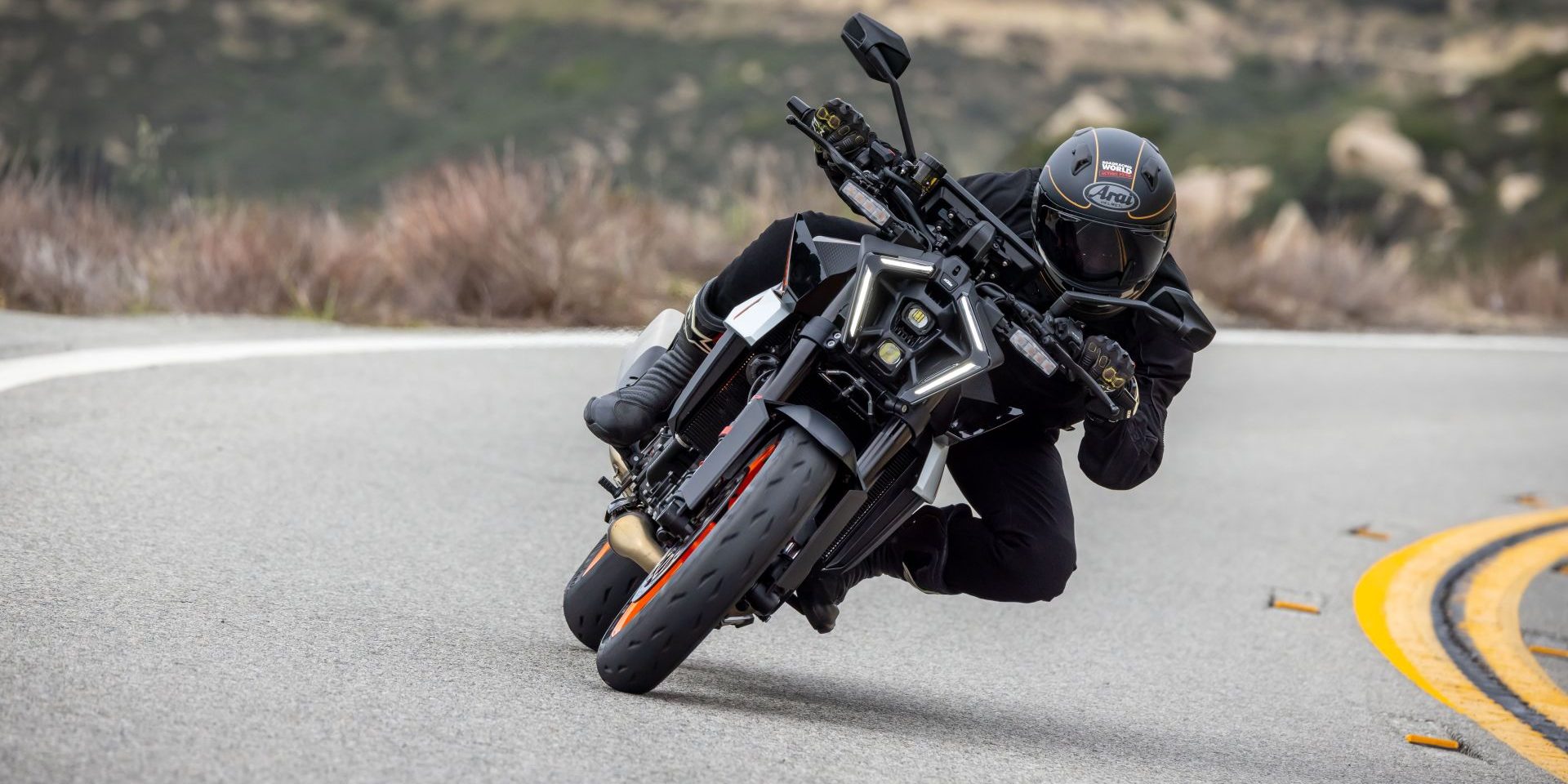 The 2026 KTM 990 Duke R on the street near Idyllwild. Photo by Simon Cudby/courtesy KTM.
So the first day was riding the Duke R through the mountains up above Palm Springs, through the town of Idyllwild, and the second day took place at Chuckwalla Valley Raceway, sharing the circuit with Dale Keiffer's Racer's Edge track day.
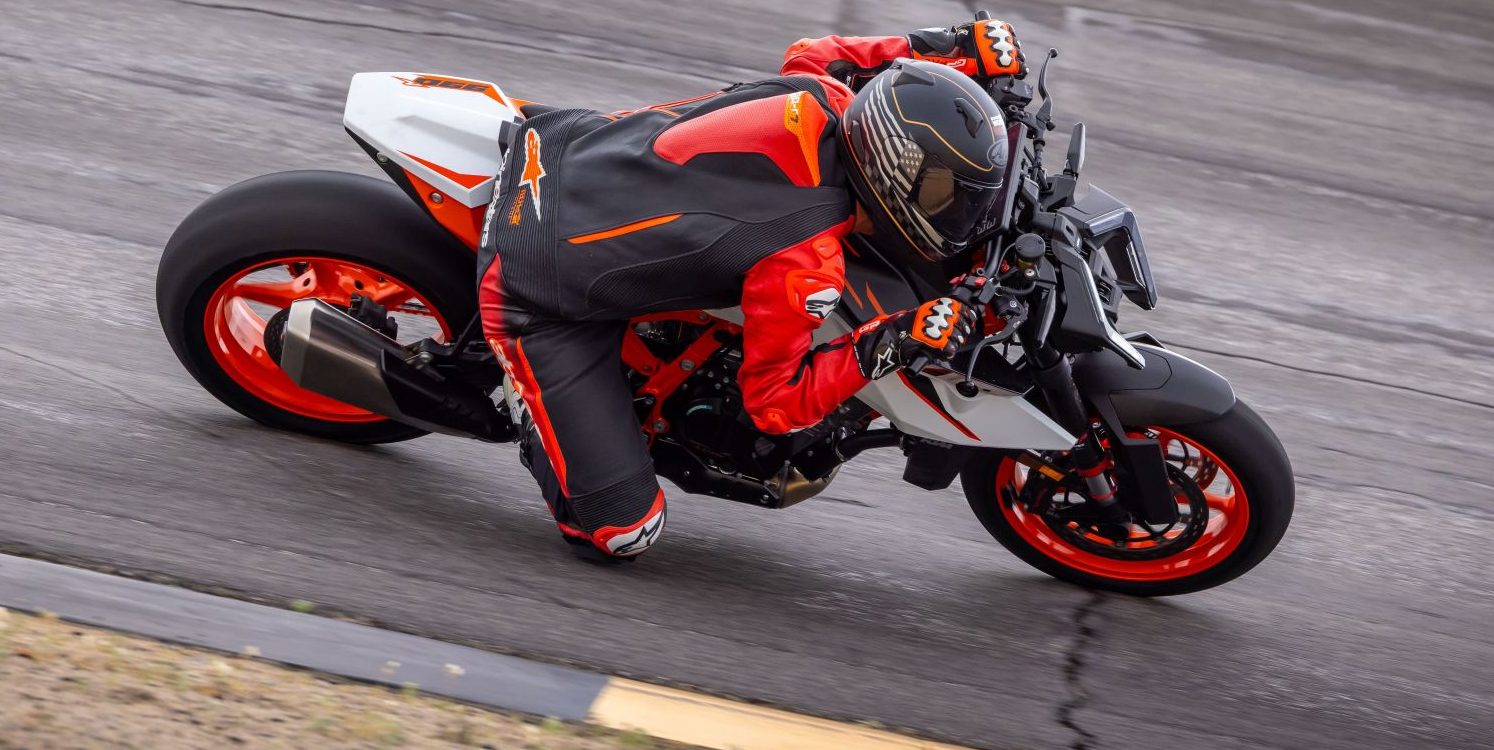 The 2026 KTM 990 Duke R on the track at Chuckwalla Valley Raceway. Photo by Simon Cudby/courtesy KTM.
I'd ridden the 990 Duke on the track and on the street, so I was able to develop a back-to-back comparison between it and the Duke R. Short answer - it is definitely different, more capable, sharper in every way.
990 Duke R Technical Specifications
The Duke R shares its core with the Duke, starting with the 947 cc four-stroke, DOHC parallel-Twin LC8c engine with a bore and stroke of 92.5 mm by 70.4 mm. New mapping boosts power to a claimed 126.09 bhp and torque to 78.2 lbs.-ft. The engine is a stressed member of the chassis, and plays another important role in the behavior of the bike. It weighs 125.6 pounds, making it the most compact twin in its class, KTM says.
Bolted to the tubular steel frame are upgraded suspension components front and rear. A new forged aluminum triple clamp holds a pair of 48 mm WP Apex inverted open-cartridge forks, now adjustable for rebound, compression and preload. The change at the rear may be the most significant: the WP Apex monoshock offers high- and low-speed compression damping adjustment along with rebound and preload adjustment, and it operates through a linkage rather than being bolted directly to the swingarm. This allows KTM to get the progressive action it wants mechanically.
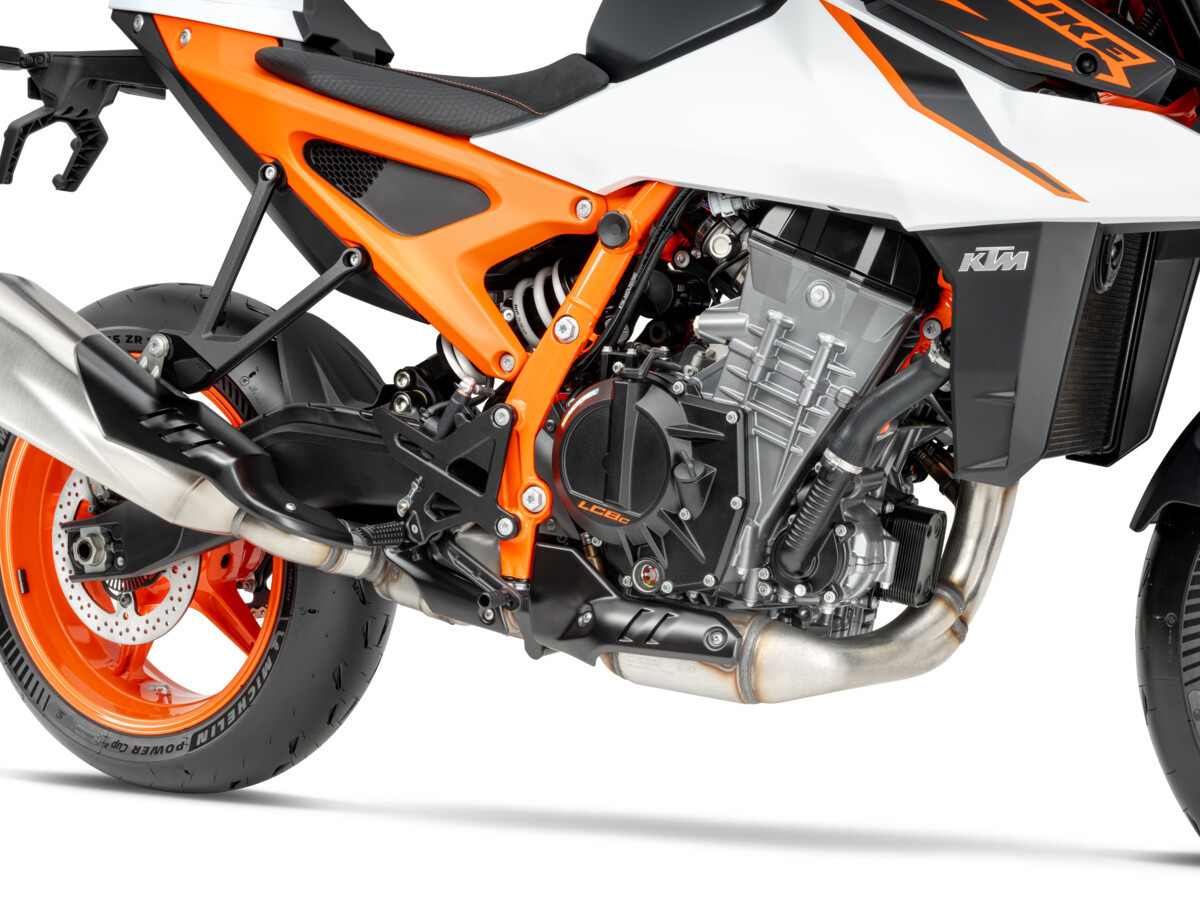 990 Duke R engine is hot-rodded version of the 947cc twin of the 990 Duke. Linkage now connects the WP Apex shock to the swingarm. Photo courtesy KTM.
Brakes are upgraded as well, with four-piston Brembo Stylema radial-mounted calipers now operating on 12.6-inch discs in front and a single Brembo caliper mated to a 9.44-inch disc at the rear. A Brembo MCS master cylinder is adjustable for ratio, and the ABS system has four settings - Cornering, Sport, Supermoto and Supermoto+, which all offer different degrees of intervention front and rear.
Ergonomics are more aggressive, with a higher seat, higher and more rearward footpegs and a handlebar that is lower. And talk about aggressive - the Duke R doesn't come stock with passenger pegs or a passenger seat!
The Duke R features a new 8.8-inch TFT dash that offers customizable split screen functionality and is actually touch-sensitive, even through gloves. Standard features include four ride modes, including a new Custom option, and include traction control and wheelie control. The optional Track Mode incorporates slip angle control, five-level anti-wheelie control, launch control, and a quickshifter is available as either an individual add-on or as part of the Tech Pack, which has all of the Track Mode features as well as engine braking and cruise control. The package is rounded out by Michelin Power Cup 2 track-oriented DOT tires, orange wheels from the 1390 Super Duke R EVO and a color scheme from the 2011 990 Super Duke R.
Riding The 990 Duke R
You definitely notice the higher seat height when you swing a leg over the Duke R, but once aboard, the riding position feels roomy and comfortable. As I always mention, Dukes have a unique riding position, one that strikes a balance between sportiness and comfort, and it's one that I like a lot. Pulling into Palm Springs morning traffic, I noticed that the quickshifter was slick and precise, the seat comfortable and there was little vibration.
Onto Highway 243, where the pavement shifted from recently paved and smooth to not-so-recently paved, the Duke was in its element. I used Track and Sport riding modes, settling on Sport mode as it allowed a bit more nuance in the application of throttle, which I find useful on twisty roads where mid-corner course corrections are part of the game. The increased fork stiffness was noticeable, but the big difference to me was the increased sophistication of the rear suspension action. Over frost heaves (and yes, it snows up there!) the rear did a much better job of absorbing sharp-edged bumps, and if I were riding the bike only on the street, the standard suspension settings would serve nicely as they are. There was no shortage of power for street riding, and more than enough brakes.
On the track, especially at Chuckwalla, there was still plenty of power - the bike never felt breathless on the relatively short straights, and there was plenty of punch coming out of corners. With Dunlop slicks installed, it was all about lean angle and mid-corner speed, and the Duke R was more than comfortable being ridden this way. I added preload to the rear to help minimize some of the weight transfer coming out of corners, and I spent most of the time in Track Mode for a sharper throttle response - I mean, isn't that what a big twin is about, torque and punch?
The other thing I noticed was the sheer flickability of the bike through transitions and into corners. The center of gravity is raised, there are no aero appendages to weigh down the steering inputs, and the bike transitions quickly and with very little effort. I just put in lap after lap, session after session, and I thought toward the end of the event that this was a bike you really could take out for every session on a track day - and be ready to do it again the next day.
Suggested retail is $13,399.
The post Intro: KTM 2026 990 Duke R, A.K.A. "The Punisher" appeared first on Roadracing World Magazine | Motorcycle Riding, Racing & Tech News.
The WorldSBK and WorldSSP riders in Australia took part in the annual Chevron photoshoot ahead of the first round of the season
In a surprise late addition to the 2026 grid, Tommy Bridewell and Superbike Advocates Racing throw their hat into the ring in WorldSBK's 2026 season!
Opinion Fifty years ago this month, I touched a computer for the first time. It was an experience that pegged the meter for me like no other - until last week.…
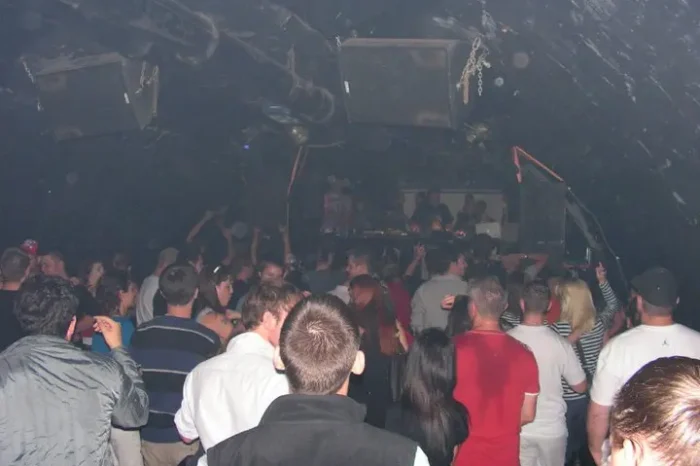
In this month's antidote to the algorithm, Christian Eede shakes tQ with the heavy sounds of 90s and 00s Slovakian techno, and the scene around the U.Club (pictured below)
Any discussion about the history and evolution of techno over the past near-four decades will always naturally be dominated by two cities: Detroit and Berlin. For a period of around 10 years, though, beginning in the mid-90s, the capital of Slovakia, Bratislava, became a vital outpost for an austere, industrial-edged take on the genre that was cultivated at the now-closed U.Club.
Opened in 1993 by Tibor Holoda, the venue was situated inside a former underground nuclear bunker that was built by the ruling Communists to prepare for the possibility of Cold War-era apocalypse....
The post Organic Intelligence LIII: Slovakian Techno appeared first on The Quietus.
Poland's Ministry of Defence has banned Chinese cars - and any others include tech to record position, images, or sound - from entering protected military facilities.…

The Hen Ogledd family keeps on expanding - the group's sound, likewise. But more than anything, Discombobulated sounds like the present, finds Jeanette Leech
Image by James Hankins
Hen Ogledd's Discombobulated is in the radical mould of music that tackles the now. Unconcerned that references may go out of date, the timelessness of their sound comes in documenting the present, rather than in seeking to transcend (or ignore) it. Lyrically, Discombobulated celebrates dissent with all the force of the protest tradition in folk music; musically, the album glues together sounds and genres to evoke the chaos of today.
Hen Ogledd is the project of Dawn Bothwell, Rhodri Davies, Richard Dawson and Sally Pilkington. The first releases were just Dawson and Davies; since then,...
The post Ancient to the Future: Discombobulated by Hen Ogledd appeared first on The Quietus.
Wet fields drive away rodents, leaving barn owls without much prey, but gulls of all kinds are attracted by the water
The Somerset Levels flood regularly - but this year, after very heavy winter rains, the fields and moors are overflowing with water. So what effect does this have on wintering birds?
Like most extreme weather events, there are winners and losers. Huge flocks of gulls are gathering in the flooded fields to feed, with scarcer Mediterranean and little gulls joining the regular black-headed, herring and common varieties. These have attracted a white-tailed eagle from the Isle of Wight reintroduction project, although it does not appear to have caught any victims yet.
Continue reading...

Voka Gentle
Domestic Bliss
Greek mythology, Kraftwerk synths and Jude Law wend their way through the trio's follow-up to 2021 album Writhing!
Domestic Bliss by Voka Gentle
Ten thousand years ago, a man died in what would become Somerset. His bones waited in a cave until 1903, when they were discovered and given a name: Cheddar Man. Now he's the subject of a song by Voka Gentle, who use his story to contemplate what we're doing to the places where people have lived for millennia. "Let's say the sea levels rise and we lose north Somerset, which, by the way, is looking increasingly likely…" William J Stokes's voice is dry, conversational, with the studied neutrality of a local news presenter. Beneath it, the music...
The post Voka Gentle - Domestic Bliss appeared first on The Quietus.
Dr. Vinay Prasad is currently the FDA's top vaccine regulator. He's also one of many medical goons hand-picked by RFK Jr. to help lead his decidedly anti-vaxxer movement. In fact, the last time we discussed Prasad, it was over his selective censorship attempts at avoiding public criticism for his anti-vaxxer nonsense. If you show clips of Prasad spewing his anti-vaxxer views to critique them, he'll have your YouTube channel axed. If you show those same clips to praise his nonsense, you get to continue on unmolested.
He's an asshat, in other words. An anti-science, anti-medicine asshat. And he's also someone who is unilaterally keeping us from making progress on vaccines, apparently out of pure joy in exercising such power.
Moderna is producing a new influenza vaccine, this one utilizing mRNA technology, a la the COVID vaccine. Moderna sent an application to the FDA for a review of the vaccine it has produced, as well as the data from the trials the company conducted to demonstrate its efficacy. We learned last week that the FDA flatly refused to review any of this data.
In a news release late Tuesday, Moderna said it was blindsided by the FDA's refusal, which the FDA cited as being due to the design of the company's Phase 3 trial for its mRNA flu vaccine, dubbed mRNA-1010. Specifically, the FDA's rejection was over the comparator vaccine Moderna used.
In the trial, which enrolled nearly 41,000 participants and cost hundreds of millions of dollars, Moderna compared the safety and efficacy of mRNA-1010 to licensed standard-dose influenza vaccines, including Fluarix, made by GlaxoSmithKline. The trial found that mRNA-1010 was superior to the comparators.
Moderna said the FDA reviewed and accepted its trial design on at least two occasions (in April 2024 and again in August 2025) before it applied for approval of mRNA-1010. It also noted that Fluarix has been used as a comparator vaccine in previous flu vaccine trials, which tested vaccines that went on to earn approval.
This looks for all the world like Moderna did what it was supposed to do in getting the proper sign-offs from the FDA to conduct its trials. Prasad himself sent the refusal notice to Moderna, however, and cited within it that the trials Moderna conducted, which were signed off on by the FDA, were not appropriate. The letter didn't bother to indicate why.
But in a letter dated February 3, Vinay Prasad, the FDA's top vaccine regulator under the Trump administration, informed Moderna that the agency does not consider the trial "adequate and well-controlled" because the comparator vaccine "does not reflect the best-available standard of care."
In its news release, Moderna noted that neither the FDA's regulation nor its guidance to industry makes any reference to a requirement of the "best-available standard of care" in comparators.
Everyone at Moderna was understandably confused. The company has already reached out asking to meet with the FDA, ostensibly to sit down in a conference room with them, look them in the eye, and ask "wut?".
The answer is unlikely to be satisfying. And it should be quite alarming to the rest of us. That's because the rejection of a review of all of this data reportedly came from Prasad and Prasad alone, over the objections of his own scientists at the FDA.
Vinay Prasad, the Trump administration's top vaccine regulator at the Food and Drug Administration, single-handedly decided to refuse to review Moderna's mRNA flu vaccine, overruling agency scientists, according to reports from Stat News and The Wall Street Journal.
Stat was first to report, based on unnamed FDA sources, that a team of career scientists at the agency was ready to review the vaccine and that David Kaslow, a top career official who reviews vaccines, even wrote a memo objecting to Prasad's rejection. The memo reportedly included a detailed explanation of why the review should proceed.
According to those same sources, Prasad's reason for refusing to review Moderna's vaccine makes little sense. The story goes like this. As Moderna was seeking guidance for its trials for the vaccine, it chose a currently licensed flu vaccine against which to compare its own vaccine. At one point, the FDA suggested a different comparative vaccine be used. Moderna declined that suggestion and moved forward with the comparative vaccine it originally chose. Despite that difference the FDA reviewed the company's plans for its trial on several occasions and at no point suggested its choices were a show-stopper.
That's it. That's the whole thing. Prasad is claiming that the choice Moderna made for a comparative vaccine, for which the company received only mild feedback from the FDA, is why the FDA is refusing to review this mRNA flu vaccine entirely.
Because that reasoning is almost certainly bullshit. As evidence of that, these same sources from within the FDA offered up this:
This wasn't enough for Prasad, who, according to the Journal's sources, told FDA staff that he wants to send more such refusal letters that appear to blindside drug developers. The review staff apparently pushed back, noting that such moves break with the agency's practices and could open it up to being sued. Prasad reportedly dismissed concern over possible litigation. Trump's FDA Commissioner Marty Makary seemed similarly unconcerned, suggesting on Fox News that Moderna's trial may be "unethical."
The explanation here is remarkably simple. This current government is being run by anti-vaxxers. And these anti-vaxxers are particularly anti-vaxxer-y about mRNA vaccines. And so folks like Prasad are throwing up every roadblock they can dream up to make it as difficult as possible to get new vaccines utilizing new technology approved. Or, as in this case, even reviewed.
Now, if that reads like the opposite of scientific progress to you, give yourself a gold star, because you're right. Thomas Jefferson once said "I tremble for my country when I reflect that God is just" when, hypocritically, discussing slavery in America. I think we should tremble for our country as well when I reflect that we are getting sicker as a nation, given that we have morons at the helm of the nation's health.
With features like Live Timing, Rider Tracking and live commentary, the WorldSBK app is a must-have to follow the 2026 season!

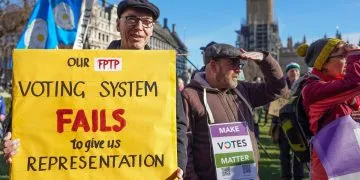
We are reaching a tipping point. Around the world, democracy is under assault from a combination of disinformation on social media, an emboldened far-right and economic inequalities fuelling dissatisfaction with the status quo. Outdated institutions are dying hard and fast, and Westminster's voting system is one of them.
Academics and elections experts are issuing increasingly stark warnings that First Past The Post (FPTP) is now under unprecedented strain, with Britain's sixty-year trend away from a two-party electorate coming to a head. Rock-bottom public trust - the legacy of Conservative austerity and infighting - is combining with multi-party politics to create the perfect storm that threatens to further destabilise our democracy and cause chaos for our country.
In the 1950s, Labour and the Conservatives won 95% of the vote combined. At the last general election we won just 58% between us - and this fragmentation has continued to accelerate since then. The era of two-party politics is not coming back. As progressives we must be clear-eyed about what this means: Westminster's electoral system is not fit for the 21st century, but Labour can and must be.
Democratic legitimacy under strainDisproportionate elections go hand-in-hand with public dissatisfaction with democracy - and 2024 was the most disproportionate election in British history. Unusually, public trust in government in 2024 did not see the boost typically associated with a general election. At the last election, Labour played the hand we were dealt - and played it well. We won a majority on a highly efficient 34% share of the vote. But it is not sustainable or democratic for governments to continue to be elected on ever-smaller fractions of the popular vote.
Nor do we have the luxury of time on our side. As many have pointed out, our majority in 2024 was large but precarious. When no party is reliably polling above 30%, one or two percentage points here or there at the next election will make the difference between continuity and chaos - and that's no basis for a stable political system. With the populist right on the march, it's not just the progressive legacy of this government on the line - it's our democracy, shared prosperity and the rights we have taken for granted.
The progressive case for reformSo how should progressives respond? We must embrace those values of fairness, democracy and equality that underpin our movement. Every time a Labour government has introduced modern parliaments in the UK, across Scotland, Wales, Northern Ireland and in the London Assembly, we have opted for Proportional Representation. It is past time we sought a system for Westminster that is more suited to Britain's modern multi-party electorate. To do otherwise would be to wed ourselves to the managed decline and inevitable failure of First Past The Post, and risk being caught on the wrong side of its distorting effects in the process.
There is now a wealth of evidence that fair, proportionate parliaments deliver more stability, with governments lasting on average four years longer than under FPTP, and ministers and Prime Ministers serving years longer in their posts. Last month, business leaders joined growing calls for electoral reform in the Financial Times, because they can see that political instability and economic instability go hand-in-hand. The very spectre of a Farage-led Reform majority government - only conceivable because of FPTP - has already damaged negotiations with the EU.
Across Europe and around the world, most developed social democracies use proportional representation, and see higher levels of investment in public services, more women and ethnic minorities represented in parliament, and better workers' rights as a result. This is not a coincidence. If governments are elected by a majority of voters, they have a vested interest in keeping millions of people happy by creating broad-based economic policies that benefit most of the population.
Lessons from reforming democraciesProgressives have trod this path before us. New Zealand switched from First Past The Post to the proportional Additional Member System in the 1990s. Rather than fracturing, since then our sister party there has thrived. The New Zealand Labour Party went on to win an outright majority under Jacinda Ardern with over 50% of the vote. Voters still have a local MP, but they get regional MPs as well that ensure every voter is equal, and parliament accurately reflects the democratic will of the people.
The public are more in favour of electoral reform than they have ever been. Now, 60% support a change in the voting system, including a majority of voters among all parties. I'm proud to be among the members of the All-Party Parliamentary Group for Fair Elections, which is calling on the government to take the first step and lead this debate by setting up a National Commission on Electoral Reform. Labour has the chance to lead this change, and unite the country, our party and progressives behind democratic renewal. But there is no room for complacency.
Jenny is Labour MP for Suffolk Coastal. The article was originally published by Labour for Proportional Representation. It is republished from the Progress blog.
More from East Anglia Bylines
 Party politics
Blocs not parties: the case for a new politics
byStephen McNair 4 January 2026
Party politics
Blocs not parties: the case for a new politics
byStephen McNair 4 January 2026
 Democracy
Is Proportional Representation really too great a risk for Starmer?
byMarc Ainge 9 February 2025
Democracy
Is Proportional Representation really too great a risk for Starmer?
byMarc Ainge 9 February 2025
 Democracy
Revealed: the ten most surprising facts from the 2024 election
byProf Tim Bale 17 December 2025
Democracy
Revealed: the ten most surprising facts from the 2024 election
byProf Tim Bale 17 December 2025
 Democracy
Billions voted in 2024, but cracks are showing in global democracy
byEast Anglia Bylines 7 July 2025
Democracy
Billions voted in 2024, but cracks are showing in global democracy
byEast Anglia Bylines 7 July 2025
 Democracy
Electoral reform is the key to Social Democratic renewal
byJenny Riddell-Carpenter 19 February 2026
Democracy
Electoral reform is the key to Social Democratic renewal
byJenny Riddell-Carpenter 19 February 2026
 Bylines Network Gazette is back!
With a thematic issue on a vital topic - the rise child poverty, ending on a hopeful note. You will find sharp analyses on the effect of poverty on children's lives, with a spotlight on the communities that are on the front line of deprivation, with personal stories and shared solutions. Click on the image to gain access to it, or find us on Substack.
Journalism by the people, for the people.
The post Electoral reform is the key to Social Democratic renewal first appeared on East Anglia Bylines.
The first media day of the year is in the books with plenty of spicy quotes coming from Phillip Island…
One thing is clear: Either you are in lockstep with the US pro-fossil fuel energy policy, or you are the enemy and will pay the price. Created in the 1970s after the OPEC oil embargoes, the International Energy Agency was designed to collect data on who was producing oil and ... [continued]
The post IEA Focus On Clean Energy Gives US Officials Heartburn appeared first on CleanTechnica.
Check out some incredible numbers provided by Brembo about the challenges of Phillip Island
Abandoned beaches, public health warning signs and seagulls eating human waste are now features of the popular coastline in New Zealand
A tide of anger is rising in New Zealand's capital, Wellington, as the city's toilets continue to flush directly into the ocean more than two weeks after the catastrophic collapse of its wastewater treatment plant.
Millions of litres of raw and partially screened sewage have been pouring into pristine reefs and a marine reserve along the south coast daily since 4 February, prompting a national inquiry, as the authorities struggle to get the decimated plant operational.
Continue reading...
Washington, DC — A broad coalition of health and environmental groups sued the Environmental Protection Agency today over its illegal determination that it is not responsible for protecting us from climate pollution and its elimination of rules to cut the tailpipe pollution fueling the climate crisis and harming people's health. The case, ... [continued]
The post Sierra Club, Partners Sue EPA Over Illegal Repeal of Climate Protections appeared first on CleanTechnica.
The updates are projected to save Oregonians hundreds of dollars each month on utility bills SALEM, Ore. — Today, the Oregon Building Code Division's Residential and Manufactured Structures Board (RMSB) voted to approve a package of updates to the state's residential energy code, including a requirement that new homes be built ... [continued]
The post Oregon Adopts New Building Codes to Reduce Energy Costs and Increase Energy Efficiency in Newly Constructed Homes appeared first on CleanTechnica.
Weakening the hydrogen framework would threaten climate goals, grid stability, and the investment certainty needed to build a truly sustainable hydrogen market. 2025 marked an important milestone for EU hydrogen policy: with the entry into force of the Delegated Regulation (EU) 2025/2359 ('Low-Carbon fuel Delegated Act'), the EU hydrogen regulatory ... [continued]
The post Green NGOs & Renewable Fuel Producers: Commission Must Resist Pressure to Reopen the Rules Governing Renewable Hydrogen appeared first on CleanTechnica.
At my last job, at Audible (hi Audible folks, if you're reading this!), I led the effort to port our remaining Objective-C to Swift. When I started that project, Objective-C was about 25% of the code; when I retired it was in the low single digits (and has gone even lower since, I've heard).
Why do this? It was working code! Don't we all know not to rewrite working code?
Why get rid of Objective-CWell, we knew a few things: one was that our Objective-C code was where a lot of our crashing bugs and future crashing bugs (and bugs of all kinds) lived.
So it was working code, yes, but we knew there were crashes hidden in there, and that some of those crashes were ambush hunters, playing the long game, waiting for years before pouncing. Best just to rewrite it all in Swift, the safer language.
A second thing we knew was that having to interoperate between Swift and Objective-C is a huge pain. It often means dumbing-down the Swift code and not using modern features, which limited our options for good Swift code.
And a third thing we knew was that very few of our engineers had a background writing Objective-C. Maintaining that code — fixing bugs, adding features — was more expensive than it was for Swift code. (Duh, right? When you have many engineers working on a project, it's best if the language you use is one everybody knows well.)
Not that this went perfectlyThis is still risky, by the way. Rewriting code is always risky.
At one point I was responsible for a bug where we sent an integer to some API and it should have been a boolean — because the original code was using NSNumber and it wasn't obvious which it should be. This caused a partial outage of push notifications, which I estimated (very roughly) to have cost the company a few hundred thousand dollars.
(Really? A little bug like this? NS-fucking-Number cost all this money? Yes. Audible scale may not be Facebook scale, but it's far beyond the scale of indie apps. Before Audible I always worked for smaller companies with smaller audiences — working on something with many millions of users was enlightening and terrifying.)
But here's the thing: this proved my point. Someone trying to maintain that code as Objective-C might have easily made the same mistake and caused the same outage. The Swift code we replaced it with is type-safe: it's unmistakably and clearly a boolean and not an integer (once we fixed it; other way around at first). Replacing Objective-C code with Swift is clearly a win.
Goodbye to all those square bracketsI didn't count how many hundreds of thousands of lines of Objective-C my project was responsible for rewriting (and sometimes just deleting). It was a lot. Multiple entire apps could fit in those lines-of-code counts.
And if you look at NetNewsWire's code, you see that it's almost entirely Swift, with just a little Objective-C for the various parsers and FMDB. It's not just a Swift app but a modern Swift app that uses async await and structured concurrency. (Mostly modern — there's still some code to update to async await. Work continues.)
I say all of the above to show that I'm not stuck in the old ways; I'm not the guy insisting on the supremacy of Objective-C despite the obvious evidence against. I'm the guy who got rid of Objective-C — with glee and (oops, sorry Audible marketing team for the screwup) wild abandon!
I want you to know all the above in advance because in my next post I'm going to talk about how I wrote some new code in Objective-C and loved it.
2026 is upon us at Phillip Island, so let's take a dive into the key numbers from last year's incredible visit Down Under
I just caught up on comments under an article I wrote several days ago, "Is Tesla Really In Trouble This Time?" There were many great comments from readers, but a few jumped out at me to stimulate this followup piece. The first one came from vensonata, who wrote: "The combined ... [continued]
The post Tesla Market Cap More Than Market Cap of Toyota, BYD, GM, Ford, Hyundai, Kia, Mercedes-Benz, Stellantis, Geely, Ferrari, BMW, Volkswagen Group, Honda, Nissan, Renault, XPENG, and NIO Combined appeared first on CleanTechnica.

On 25 February 2026, the European Commission is expected to formally present the Industrial Accelerator Act, a comprehensive proposal designed to accelerate the decarbonisation of energy-intensive industries, secure strategic supply chains, and rebuild manufacturing competitiveness amid mounting external challenges.
Behind the familiar language of climate transition and industrial resilience, however, lies something far more unsettling.
The Industrial Accelerator Act is not simply another technocratic adjustment within the routine choreography of Brussels policymaking, nor merely a regulatory attempt to smooth the frictions of a volatile global market.
Rather, it embodies the emerging ideological and geopolitical rupture within the European project itself, signalling that the continent has, albeit belatedly, that the post-Cold War settlement, which subordinated production to finance, economic planning to the whims of the free market, and sovereignty to supranational institutions dictated by the whims of Washington, is no longer sustainable under conditions of intensifying fissures.
The Industrial Accelerator Act: the end of financialisation?For three decades, the European Union has determined its economic constellation on a fragile architecture of external guarantees provided by the rules-based order, with the US at its helm. Cheap energy flowed from Russia's abundant gas reserves, manufacturing networks extended into China, and the wider Eurasian periphery and security concerns were largely outsourced to the US.
This model, often celebrated as the triumph of liberal internationalism and popularised by figures such as Francis Fukuyama as the "End of History," was framed as the final stabilisation of the global order following the collapse of socialism in Eastern Europe.
The European Union presented itself as the laboratory of a post-political future: a space in which conflicts would be neutralised through procedure, and the market would quietly perform the task once reserved for political struggle. The violence of history, we were told, had been domesticated.
This apparent stability concealed profound contradictions. Europe's eventual transition toward a post-industrial economy was less a transcendence of its industrial preponderance than its externalisation. Manufacturing did not disappear; it was offshored.
The era of financialisation masked a structural fragility, substituting speculative expansion and asset inflation for productive renewal. Economic integration concealed asymmetries of power, while global value chains obscured the geopolitical dependencies within them. Europe increasingly occupied the position of the consumer within a system whose productive core and strategic leverage were located elsewhere.
PermacrisesThe crises of the 21st century have progressively exposed this settlement as contingent and unstable.
The financial crash of 2008 revealed the systemic risks of an economy oriented solely toward financial accumulation rather than industrial resilience.
The pandemic exposed the brittleness of global supply chains, as shortages of essential goods demonstrated the strategic costs of outsourcing critical production.
The war in Ukraine shattered longstanding assumptions about energy security and forced Europe into a rapid and costly restructuring of its economic model at the behest of US imperatives.
Simultaneously, the US returned to large-scale industrial policy, crystallised in the Inflation Reduction Act, made clear that even proponents of neoliberalism had abandoned their own orthodoxy. China's ascent in renewable energy, battery production, advanced manufacturing, and critical mineral processing further underscores that control and guidance over production remain the decisive axis of power in the current world-system.
In this context, the Industrial Accelerator Act can be understood as the first attempt to reconstruct the material basis of European autonomy in global affairs.
Reconstructing autonomy via the Industrial Accelerator ActPushed forward by French Commissioner Stéphane Séjourné and supported by a broad coalition of industry leaders, the proposal deploys a suite of mechanisms: European preference in public procurement, low-carbon labelling for steel and cement, fast-track permitting for decarbonisation projects, and caps on foreign direct investment in emerging strategic sectors (notably a 49% limit on non-EU ownership in key greenfield investments) to foster a durable industrial ecosystem capable of sustaining a necessary ecological transition and geopolitical power.
While recent drafts have introduced flexibility, allowing "trusted partners" (such as the UK or Japan) to qualify under delegated acts and softening rigid origin thresholds to avoid immediate supply-chain ruptures, the core intent remains unmistakable: to create lead markets for cleaner, more resilient EU-made products and to prevent the hollowing-out of strategic industries by external actors.
If implemented with sufficient ambition, the Industrial Accelerator Act could underpin a genuine reindustrialisation: millions of skilled jobs in retrofitted steel mills, battery gigafactories, and hydrogen infrastructure; reduced exposure to geopolitical coercion; and a decarbonisation pathway that strengthens rather than undermines social models.
Yet the path is fraught. Internal divisions persist, between free-trade-oriented member states wary of Single Market fragmentation, industries concerned about cost increases, and those demanding bolder action. Compatibility with WTO rules remains contested, and the success of delegated acts that define thresholds and "trusted partners" will determine whether the policy is inclusive or exclusionary.
What is Europe to become?Above all, the Industrial Accelerator Act signals a deeper ideological shift.
Europe is moving, however unevenly, from a post-historical illusion of triumphant liberalism, marked by an era of uncontested American hegemony, to an increasingly multipolar arrangement, though not in the way we expected. it.
The Industrial Accelerator Act reflects Europe's attempt to navigate this contradiction. It seeks to preserve openness while constructing resilience, to maintain integration while rebuilding production. But this effort is haunted by internal tensions. The European Union is not a unified state but a heterogeneous formation. Some member states fear protectionism; others demand more radical intervention. The result is a policy that oscillates between ambition and hesitation.
This hesitation is itself revealing. Europe does not yet know what it wants to become. It oscillates between the desire to remain within the Atlanticist world-system and the necessity of sovereignty. It fears both dependency and conflict. The Act therefore embodies a form of strategic ambiguity, an attempt to act without fully acknowledging the implications of one's actions.
The presentation on 25 February will mark not the conclusion of a legislative process, but the opening of a larger contest: whether Europe can summon the political will to reclaim the material basis of its independence, or whether it will once again defer to external forces the question of who controls its destiny. The Industrial Accelerator Act is the first gesture in that uncertain process.
Featured image via the Canary
The #19 will make history with his next win, as he looks to pass Max Biaggi for the honour of being WorldSBK's oldest race winner
The WorldSBK Predictor game is back once again in 2026 for every round offering a variety of exclusive prizes won by correctly guessing that Round's pole-setting time!
Indian think tank the Council for Research on International Economic Relations has found AI is not an immediate threat to the nation's IT services sector.…

Apple employees have a nickname for the company's latest gadget: the "eyes and ears" of the iPhone. It's a disc packed with two cameras and three microphones — you clip it to your collar or wear it around your neck, and it watches and listens to the world around you all day long, feeding everything to Siri. — Read the rest
The post Apple's building a wearable panopticon and calling it Siri appeared first on Boing Boing.


