I was First Secretary at the British Embassy in Warsaw 1994-98. While that was a long time ago, I knew personally many of the people at the heart of the current crisis, such as Donald Tusk and Radek Sikorski.
1) The first thing to say about Poland is the the current crisis is unlikely to turn violent, certainly not in a sustained way. There will be a lot of yelling and name calling and a lot of references to obscure old feuds and scandals, but Poland is not Ukraine or even France, and will muddle through as usual with some kind of woolly compromise to see us through the next few years.
General Jaruzelski, the last major leader under Communism, used to be the neighbour who shared the boundary fence at the bottom of my garden. He oversaw martial law and a secret service which was pretty vicious - but looking back with the perspective of history, the remarkable thing is not how much, but how little, violent repression was used against Solidarnosc in 1980 to 1983. Some 120 people were killed and thousands imprisoned, but for a revolution that triggered world-shaking political change that is remarkably restrained.
Then with Walesa in power as President, Jaruzelski used to go about Warsaw quite openly, and I would say "Dzien Dobry Panie Generale" to him in the mornings as he walked past my gate. Violence is not natural in Polish politics.
2) The second thing to understand is that Polish politics is split between the right and the nationalist right. The left is now almost insignificant - the mildly social democratic Nowa Lewica is a small junior partner in Tusk's governing coalition and polls about 8%. That is pretty well the only "left". Elements of the governing Civic Coalition - such as Foreign Minister Radek Sikorski, are very right by British standards. Sikorski was in the Bullingdon Club with Osborne and Johnson and is a bit to the right of either on social or economic policy.
The opposition nationalist right are socially conservative and religious: abortion remains the touchstone defining issue, which directly relates to the current dispute about the Constitutional Tribunal. There is no significant economic division between the right and nationalist right, with the latter perhaps slightly more socially minded in matters like welfare spending.
It is a great mistake to try to shoehorn the divisions into a classic economic policy related party alignment of left and right, or even into the liberal vs populist model. Poland is sui generis, a thing unto itself.
3) The crisis about the Constitutional Tribunal is Superficially Meta. It is about the composition of the Constitutional Tribunal rather than any case currently before the Court. But it has become the totem of the deep divisions in Polish society.
Poland has a hybrid system that is neither an executive presidency nor a parliamentary democracy. The power of legislative initiative lies with the Parliament (Sejm) and the Prime Minister appointed by the Sejm. But the President has an active power of veto and controls important appointments.
The Constitutional Tribunal ensures the constitution is properly followed and thus judges disputes between the President, Prime Minister and Sejm. The tribunal also ensures that the rights of citizens enshrined in the constitution are respected. It also - and this is a major difference from the UK where there is no such judicial power - ensures Polish legislation is compatible with international law and Poland's treaty relations.
The most important recent decision of the Constitutional Tribunal was naturally on abortion, which it limited in 2020 by abolishing the health related exemption which had provided for most abortions. The history of abortion in Poland is again very strange to a non-Pole. When I was in Poland in the mid 1990s it had both the highest rate per capita of Catholic church attendance in the World and arguably the highest abortion rate per capita in the World. It is a complex subject for another day.
4) As usual in Poland, both sides are entirely unreasonable. At the moment Poland has a PiS (Nationalist right) President Nawrocki versus a right Civic Coalition Prime Minister Tusk. The longstanding problem with the Constitutional Tribunal is that its members must be appointed by the Sejm but sworn in by the President. When neither are prepared to compromise - frequently the case - this has led to impasse after impasse.
The immediate crisis began on 30 October 2026 when Judge Anna Korwin-Piotrowska — elected by the present Sejm majority but never sworn in by Nawrocki — ordered the suspension of Tribunal President Bogdan Święczkowski (a PiS appointee) and declared herself in charge. Tusk's government then deployed riot police to secure the building in support of her move; Nawrocki abandoned a trip to Senegal to return, and PiS supporters gathered outside. Each side accused the other of a coup.
The conflict dates back to 2015 but every legacy media account I have seen gives a false account of how it started.
In 2015 the right Civic Platform government, a direct predecessor of Tusk's coalition, knew it was losing power. It therefore sought to pack the Constitutional Tribunal. It appointed five new judges. Three of these fell due just before Civic Platform left power, but it also passed a law allowing it to appoint in advance two further judges whose terms fell due under the incoming PiS government. Civic Platform thus attempted to appoint five new judges, to attempt to limit the scope of the incoming PiS Sejm and Presidency.
The new PiS government immediately sought to cancel the appointment of all five new judges and appoint its own judges in their place. This was indeed of dubious legality. But in truth it was a reaction to a profoundly undemocratic action by Civic Platform to pack the court with its own supporters as it left power which, while it may have been legal, was outrageous.
The Constitutional Tribunal itself eventually decided that the first three Civic Platform judges were appointed legitimately, and that the next two Civic Platform judges whose appointments should have fallen due outwith that Sejm's term were not legitimate. They therefore also approved two of the PiS judges.
This was an obviously correct decision which the politicians had been incapable of agreeing. But it was Civic Platform not PiS which first tried to fix the court, a point completely misrepresented in current legacy media accounts and by the European Commission.
Subsequently the PiS made further changes to the composition and powers of the Constitutional Tribunal, which were ruled illegal by the European Court of Justice, the judicial body of the European Union.
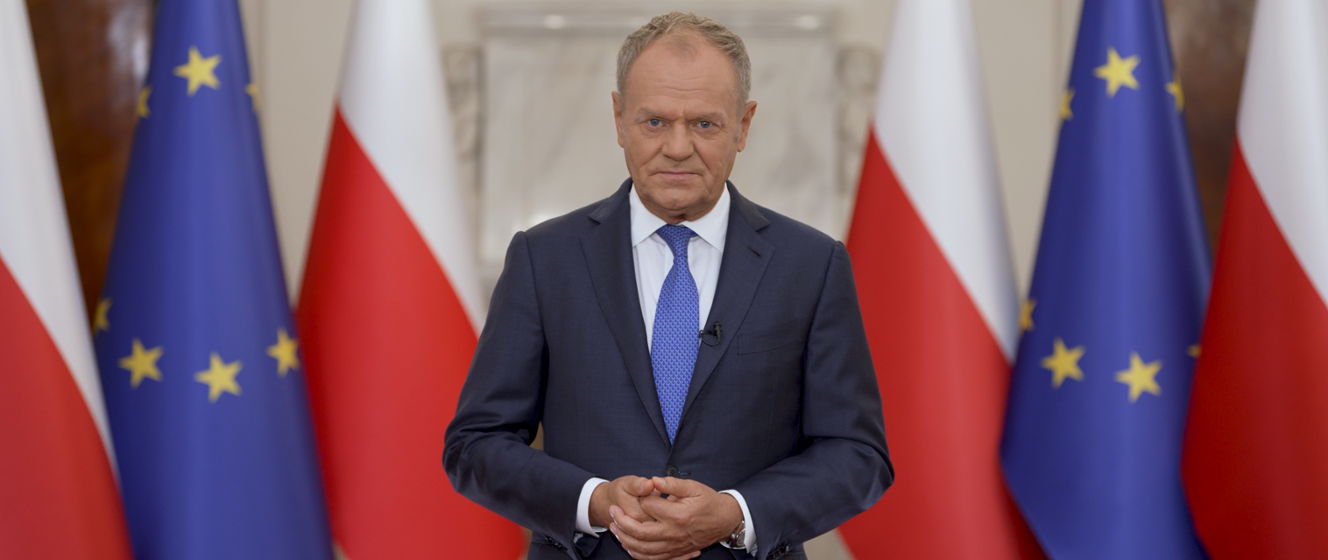
5) The EU is at the heart of the division. Donald Tusk himself has tried to spin the conflict this way. His address to the nation after his coup was made in front of a plethora of Polish and EU flags. He had repeatedly claimed over the previous two days that the PiS was seeking to take Poland out of the European Union. The PiS counter that Donald Tusk wishes to join the Euro, the European Central Bank and transfer Poland's gold reserves to the EU (which the pre-coup Constitutional Tribunal would seek to bloc).
Both sides have a point. Donald Tusk would like to join the Euro, and frequently said so in the past - though joining the Euro does not actually entail transferring Poland's substantial gold reserves. The PiS would like to leave the EU. But neither side currently has their inward desire as a stated official objective, because both positions are unpopular.
PiS President Nawrocki's senior adviser on EU affairs is Jacek Saryusz Wolski, a man with whom I worked closely on Polish EU accession. For decades in the national and European parliament he was the face of Polish EU enthusiasm. Saryusz Wolski is however now deeply disillusioned that the EU of von der Leyen, Merz, Macron and Kallas is not the body he dreamt of. He views the present EU asvdeeply undemocratic and overbearing. He has, in short, gone through exactly the same transformation in his views on the EU as I have.
The EU was seen as central to Polish nationalist identity because it guaranteed Polish independence, which give Poland's traumatic history of occupation and foreign domination was central. EU membership led to two decades of outstanding economic growth, But a number of factors have eroded the EU sheen with time. These include a fear of German domination. the EU's social liberalism and the undemocratic nature of EU institutions.
When I knew them in the old days, I would have thought it impossible that Jacek Sarusz Wolski would be on a eurosceptic nationalist right while Radek Sikorski would be on an opposing europhile right. The opposite was plainly the case back then. To understand the switching of allegiances you need to consider something western legacy media is blithely ignoring; the centrality of Ukraine to current events in Poland.
6) Ukraine is central to this. Simply put, the nationalist right has had its full of Zelensky, whereas Tusk is a devotee of the von der Leyen/Kallas/Merz war hawk line.
For British people, Ukraine is another "far away country of which we know nothing". To Poles it is a neighbour, of which they know a very great deal indeed. Poland probably houses more Ukrainian refugees than any other state, both in absolute numbers and per capita. Part of the antipathy from the nationalist right is anti-immigrant resentment.
But Ukraine really is an extremely corrupt state, and the Poles understand this very well. Poles contribute to the vast sums which the EU has poured into the Zelensky regime, and Poles also have a close-up view of Ukrainian regime aligned figures in supercars buying top end properties. Ukrainians are the largest foreign buyers of Polish real estate. This is simply true.
Foreign Minister Radek Sikorski ended up on the Civic Coalition side of the equation, because his primary loyalty is, and always was, to NATO, as befits a member of the Bullingdon Club and husband of crazed Russophobe Anna Applebaum.
A combination of events in Ukraine and the advent of President Nawrocki have caused a shift of the nationalist right to a much more sceptical position on Ukraine. Nawrocki is of a younger generation of politician - he is 43 and was only 15 when I left Poland. But his entire professional career prior to becoming President was connected to World War II commemoration.
Zelensky had been given Poland's highest award. The Order of the White Eagle. Nawrocki cancelled the award and made Zelensky return it, due to Ukrainian official commemoration of Nazi allied figures and units who had participated in the massacres of Poles during World War II. Other senior Ukrainians also returned their Polish decorations. That is a pretty startling diplomatic split, hugely under-reported in the West.

The most prestigious Ukrainian TV production at this moment is "Winged Lions", a series about the Galician Division which was formed in the First World War to fight primarily against Poland. This was not only in the field against Poland as a second front in Poland's defining national war against the Soviet Union in 1921, it was also the predecessor of the Galician Brigade of the Waffen SS - the continuing commemoration of which is a running sore between the two countries.
To add insult to injury the series is filmed in the former major Polish city of Lvov.
Naturally at time of war Ukrainian nationalism is running amok, and its insensitivity and - in Polish eyes - ingratitude towards Polish sensibility is a real problem.
Poland is itself a traumatised state. The Poles lost their state completely in the eighteenth century. Polish states re-emerged at times under French and Soviet domination, but I broadly accept that, apart from 1919 to 1939, a truly sovereign Polish state did not return until the 1990s.
Add to that the fact that until 1946 Western Ukraine was a part of Poland and integral to Polish identity. Lvov was a major centre of Polish architecture and culture. It is hard to find a fitting simile, but to Poles it is as though Canterbury and Norwich, Kent and East Anglia, were taken from the English by France in the 1940s.
There is no serious movement to reopen boundary questions, not least because so much of Poland was Germany until 1946. But the fact that the parts of Poland where the Ukrainians massacred tens of thousands of Polish civilians, are now Ukrainian territory, naturally has an impact on the Polish psyche.
7 This was an attempted coup. That is a fair description. All Hallow's Eve is a massive thing in Poland. People return to their ancestral graves and light candles in red glass lanterns, keeping vigil. Families leave the cities and return to ancestral villages to do this. It is an official Catholic church festival, so naturally it is disproportionately PiS supporters who are occupied in this. Choosing the Friday a day before All Hallow's Eve to move physically against the Constitutional Tribunal was clearly a deliberate tactical choice when the least resistance might be expected.
It also has the classic ingredient of a coup that President Nawrocki had just left the country on an official visit.
Nawrocki's decisiveness in turning around the Presidential plane and returning to Warsaw, forcing his way through the cordon of riot police around the Constitutional Tribunal, has changed the situation on the ground towards him.
There is the fog that surrounds highly contested events in real time. It is widely claimed that Tusk attempted to have Nawrocki's plane denied landing at Warsaw airport. It is hard to judge yet if this is true.
It is also widely claimed that major portions of the massed riot police Tusk put around the Constitutional Tribunal displayed no numbers and did not speak Polish. I am not inclined simply to dismiss this, because there are so many eye witness reports, including from Polish MPs and MEPs.
Widely circulated footage allegedly showing German police convoys inside Poland is hotly disputed. Again a little time may be needed to determine the truth.
What does appear highly probable is that the European Commission had advance notice of the coup, because the speed with which they jumped in to support Tusk and Pietrowska's takeover of the Constitutional Tribunal was remarkable, given the complexity of the situation. Personally I cannot see any argument whatsoever that Pietrowska's action was legal.
8 I expect this to fizzle out. It may appear like the most massive bust-up, but I know many of these people and they all know each other. The bitterness does not really extend far into personal relationships.
Tusk probably expected to win control of the streets with his riot police and because his supporters are very much urban. A much higher proportion of the Polish population lives in rural areas than is the western norm, and that is where the strength of the PiS lies. It is therefore much harder for the nationalist right quickly to mobilise an urban crowd than for Tusk's right, even when it isn't All Hallow's Eve.
But PiS supporters did turn out to confront the riot police, whereas there has been a distinct lack of people pouring onto the streets to support Tusk.
So far it seems Tusk's gambit has failed spectacularly. He is left in the position of appearing to have attempted to use physical force and the riot police, against the Tribunal and the President, on behalf of van der Leyen, Merz and EU interests which are a cipher for Germany.
The videos of German police convoys add to this impression, irrespective of whether they are genuinely in Poland or not. The extraordinary footage of the police on All Saint's Day leading away in handcuffs, from the grave of their two year old child, the husband of popular nationalist right journalist Danuta Holecka, is an image that will haunt Tusk's future. Nothing could be more shocking to Polish sensibility. The official explanation of a traffic violation is extraordinary. It could of course just have been apolitical and coincided with the capital's events, but the damage is done (and anyway I doubt it).

The Constitutional Tribunal ruling from 2020 on abortion has been followed as law in Poland, irrespective of who has been in power and irrespective of what the European Court of Justice and European Court of Human Rights have said. So in spite of all the wrangling, it is not a dead institution.
We will see how the power struggle plays out. My expectation is that it will calm down, there will be long-running inquiries but nobody will go to jail. I do expect that Tusk, the EU and Zelensky are all weakened by this, and it has been a good weekend for the PiS.
When I was in Poland, I immersed myself in the culture and language, and spent time in every single region. I had learnt the Polish language including at the Catholic University of Lublin and in Sopot. I believe I was the only western diplomat to predict correctly that Kwasniewski would defeat Walesa in the 1996 election. My Ambassador sent an urgent telegram to London to contradict my final campaign report because it said Kwasniewski would win. I knew because I had a real knowledge of provincial Poland that other Warsaw focused western diplomats lacked.
But while I have a deep love for Poland and its people, I very seldom write about its politics or its politicians, because frankly I find both exasperating. Polish poIitics consists almost entirely of unreasonable men with foolish opinions yelling at each other about points tangential to their real disagreements. I do hope that my explanation of current events is helpful to your own thoughts on the matter.
—————————————-
Anybody is welcome to republish and reuse my work, including in translation.
My work has no funding at all except for your subscriptions. If you already subscribe, I would be grateful if you could check if your subscription is still active. Over 80% of my subscriptions lapse when debit or credit cards expire: the systems do not warn you.
Because some people wish an alternative to PayPal, I have set up additional new methods of subscription payment including Patreon account and a Substack account, if you wish to subscribe that way. The content will be the same as you get on this blog. Substack has the advantage of overcoming social media suppression by emailing you direct every time I post. You can, if you wish, subscribe free to Substack and use the email notifications as a trigger to come to this blog and read the articles for free.
I am determined to maintain free access for those who cannot afford a subscription.
Choose subscription amount from dropdown box:
Recurring Donations
3 Pounds : £3.00 GBP - monthly5 Pounds : £5.00 GBP - monthly10 Pounds : £10.00 GBP - monthly15 Pounds : £15.00 GBP - monthly20 Pounds : £20.00 GBP - monthly30 Pounds : £30.00 GBP - monthly50 Pounds : £50.00 GBP - monthly70 Pounds : £70.00 GBP - monthly100 Pounds : £100.00 GBP - monthly

PayPal address for one-off donations: craigmurray1710@btinternet.com
Alternatively by bank transfer or standing order:
Account name
MURRAY CJ
Account number 3 2 1 5 0 9 6 2
Sort code 6 0 - 4 0 - 0 5
IBAN GB98NWBK60400532150962
BIC NWBKGB2L
Bank address NatWest, PO Box 414, 38 Strand, London, WC2H 5JB
Bitcoin: bc1q3sdm60rshynxtvfnkhhqjn83vk3e3nyw78cjx9
Ethereum/ERC-20: 0x764a6054783e86C321Cb8208442477d24834861a
The post The Crisis In Poland appeared first on Craig Murray.
Huge thanks to November's sponsor, Byron Windhorst, who has asked me to post the following:
Many of the climate articles featured here find their way to the Climate Catastrophe Group on Facebook, which covers extreme weather events and related science. We have over 4,000 members but would warmly welcome new ones, who are keen to engage and participate.
 "Junk debt rout sparks 'bloodbath' for credit investors.
"A prolonged rout in the riskiest parts of the global market for junk debt is sending shockwaves through credit markets, driving some of its most active investors to steep losses as lenders lose faith in the world's most vulnerable corporate borrowers."
https://www.ft.com/content/fdc9a85d-d2c4-465f-99ca-609d68b6d443
 "Investors pull billions in funds from Binance after record $6.3bn hack…
"The hack came as many observers expressed worries that the ever-expanding capabilities of artificial intelligence models could compromise cryptography and IT security protocols. Bitcoin plunged nearly 5% after the news of the hack, while ethereum dropped nearly 6% and BNB, native to Binance, tumbled nearly 10%."
 "North Korea's Hackers Supercharge Crypto Heists With AI Skills.
"The North Korean group accused of the world's largest-ever crypto heist is a state-sponsored collective of elite hackers, groomed from an early age to hunt for "big game." Artificial intelligence has now provided them with a powerful new tool to swell Kim Jong Un's coffers and fund his military expansion."
 "AI boom comes with a debt bomb: Magnificent Seven borrowing surges 45% to $578 billion.
"The artificial intelligence (AI) boom is pushing some of the world's biggest technology companies deeper into debt, with borrowing by the Magnificent Seven rising nearly 45 per cent to $578 billion by mid-2026, according to a report by SBI Research."
 "These firms you've never heard of are feeding fears the AI bubble could burst…
"Names like CoreWeave and Nebius are familiar to the tech set in San Francisco and Silicon Valley. These data centre companies, known as neocloud firms, run large warehouses packed with expensive computers, which they lease to major AI developers like Anthropic, OpenAI and Meta."
https://www.bbc.co.uk/news/articles/cje36degrgv5o
 "From securitisation to spreads, AI bust could look a lot like the GFC…
"As projects get completed and become hyperscaler ROU assets and liabilities, the SPV typically restructures its liabilities into 144A bonds… The bonds are sold to sophisticated investor… Students of the GFC would be familiar with securitisation issues. The sophisticated buyers of debt like to spice up their returns through derivatives. This is already well under way."
 "Nearly 1 billion oil barrels drained from global inventories since Hormuz disruption, ADNOC CEO says.
"Speaking at the opening of the Adipec energy conference in Abu Dhabi, Sultan Al Jaber, the CEO of Abu Dhabi National Oil Co. (ADNOC), warned that the conflict has severely eroded the world's energy supply buffers and exposed major structural weaknesses in global supply chains."
 "Oil Prices No Longer Follow Headline.
"Brent crude remains above $116 despite recovering Gulf oil exports, as escalating tanker attacks, soaring freight costs and insurance premiums sustain a hefty war risk premium. The global oil supply cushion has largely disappeared, with physical market tightness, diesel shortages and prolonged disruptions keeping prices elevated."
https://oilprice.com/Energy/Oil-Prices/Oil-Prices-No-Longer-Follow-Headlines.amp.html
 "Qatar LNG carrier struck by 'unidentified objects' in Gulf.
"A Qatari tanker has been hit by "unidentified objects" while sailing in the Gulf, the Qatar Gas Transport Company (Nakilat) said, the latest attack on commercial shipping since the US-Israel war on Iran began in February."
https://www.aljazeera.com/news/2026/11/1/qatar-lng-carrier-struck-by-unidentified-objects-in-gulf
 "Negotiators 'braced for worst' over US-Iran talks to reopen strait of Hormuz.
"Indirect talks in Doha ran into a third day on Sunday with Qatar trying to negotiate the release of more than $6bn in Iranian assets, which could lead to the reopening of the strait of Hormuz and the restart of negotiations on Iran's nuclear programme."
 "Diplomats warn that renewed conflict would be even more damaging than previous rounds of fighting…
""We are very confident that . . . the second round will be more dangerous, more destructive and it will lead to nowhere," said Egyptian foreign minister Badr Abdelatty on Saturday. "We are extremely worried," he added."
https://www.ft.com/content/efaa2962-1acb-45cf-afb4-d0088f0a1046
 "The US-China trade war seems to have subsided - but the sense of calm is misleading.
"Under the radar, the world is marching toward an economic war of potentially epic proportions, one that, history suggests, could well spill over into the real thing… neither China nor the US has done anything to establish the mutual assurances that could limit the outbreak of new hostilities."
https://www.theguardian.com/world/2026/nov/01/us-china-trade-war-trump-xi
 "Trump administration promises US farmers $15 billion in weeks before the midterms…
"Besides the more than $15 billion worth of payments and initiatives announced by Trump's Department of Agriculture, the agency plans $13.8 billion in safety net program payments for eligible producers for the 2025 crop year, offsetting shortfalls for farmers who grow key crops such as corn, soybeans, wheat and rice."
 "America's Debt Just Crossed a Line Not Seen Since WWII.
"U.S. publicly held debt hit 100.03% of GDP in fiscal 2026, the first time it exceeded the economy's size since 1946. Washington paid $1.052 trillion in net interest during fiscal 2026, nearly $2.9 billion daily, surpassing national defense spending of $965 billion."
https://247wallst.com/investing/2026/10/31/americas-debt-just-crossed-a-line-not-seen-since-wwii/
 "'Sharper, longer slowdown' predicted for [Australia's] economy as fifth interest rate hike looms…
"The RBA is widely expected to hit mortgage holders with a fifth rate hike on Tuesday, in a move that will push the cash rate to its highest since 2008 amid rising worries the economy could even be tipped into recession."
 "Bank of England explores easing key limit on riskier mortgage lending.
"The Bank of England is exploring one of the biggest reforms of its mortgage rules in more than a decade, opening the door to a surge in riskier lending in response to calls from the government and industry to boost home-ownership."
https://www.ft.com/content/78363dc1-90fa-4a10-b84a-69be3d749f42
 "'Debt is too big, population too old': Economist Kenneth Rogoff says Europe is dying a slow death…
"The big change has been the normalisation of interest rates. During the 2010s, almost everyone in the economics profession, at central banks and on Wall Street, including prominent economists such as Larry Summers and Paul Krugman, argued that interest rates would never be high again."
 "Clashes Erupt Again in France, After Festive Start to Day of Protest.
"Hundreds of thousands of people poured into the streets of French cities again on Saturday for protests that began with the festivity of a Halloween parade but gave way to darker scenes of clashes between demonstrators and the police."
https://www.nytimes.com/2026/10/31/world/europe/france-protests-clashes.html
 "Europe protests: Unrest spreads to Germany, Portugal and Switzerland.
"Looting, clashes with police, hundreds of arrests: many of yesterday's cost of living protests across Europe descended into unrest for a third weekend in a row. Rioters wearing masks attacked police and looted shops in Frankfurt - including a gun store."
https://www.channel4.com/news/europe-protests-unrest-spreads-to-germany-portugal-and-switzerland
 "Tensions high in Poland as Donald Tusk accused of 'constitutional coup'…
"The latest round in this long-running drama began when Nawrocki refused to accept constitutional court judges appointed by parliament, the standard procedure, while Swieczkowski declined to allow the new judges enter the court."
 "Russian strikes leave thousands without power in Ukraine, says Zelenskyy…
""Overnight alone, our energy infrastructure came under Russian attack in four regions: Dnipro, Vinnytsia, Zhytomyr, and Khmelnytskyi. Substations, transformers, and power lines that supply electricity to our people's homes were targeted, Zelenskyy wrote on social media."
 "Ukraine defies Trump to resume attacks on Russian oil refineries…
"Russian state media said on Sunday Ukrainian long-range drones had set fire to the Kstovo refinery in Nizhny Novgorod oblast overnight, soon after a major strike against another big refinery in Samara oblast, owned by the Russian state energy giant Rosneft."
https://www.theguardian.com/world/2026/nov/01/ukraine-defies-trump-resumes-attacks-russian-oil
 "Russia forced to ship grain via Arctic as Black Sea battles rage.
"Russia is testing exporting grain through the Arctic port of Murmansk, thousands of kilometres from the farms where it is grown, as Ukraine's drone campaign has all but cut off its traditional route via the Black Sea."
https://www.ft.com/content/50aeab56-c5e3-44c5-9117-8fadc2f980fb
 "South Korean soldier found dead at frontline post near North Korea…
"The incident comes amid heightened inter-Korean tensions following a landmine explosion in the Demilitarized Zone in late September that injured three South Korean soldiers. Seoul blamed Pyongyang, which denied responsibility."
 "China's manufacturing activity returned to contraction in October as domestic and overseas demand weakened.
"The official manufacturing purchasing managers' index (PMI) fell to 49.3, while the nonmanufacturing PMI, covering services and construction, dropped to 49.7, the National Bureau of Statistics said Saturday."
 "As Chinese tourists stay away, airlines cut back 700,000 seats on Japan routes.
"Airlines are set to slash nearly 700,000 seats on routes between China and Japan this winter as diplomatic tensions continue to dampen travel demand, according to data from British aviation firm OAG."
 "Taiwan says China harassing shipping with east coast patrol.
"The China Coast Guard is harassing shipping with its latest patrol off Taiwan's east coast and trying to exert a fictional jurisdiction, the Taiwanese Coast Guard said, adding it had sent its own ships to keep watch."
https://www.japantimes.co.jp/news/2026/11/01/asia-pacific/taiwan-china-harassing-shipping/
 "Thai border with Cambodia to remain shut amid concerns…
"Speaking on the programme Talk with PM Anutin on Saturday, Mr Anutin said there was no timeline for reopening the border and no indication that bilateral relations would return to their previous level soon. He cited unresolved land and maritime boundary issues, transnational scam operations and the safety of Thai citizens."
 "Bangladesh workers clash with police in protests over low pay.
"Dozens of garment workers in Bangladesh clashed with police in the capital Dhaka as they protested against low pay and the rising cost of living. The textile industry is the backbone of the country's economy."
 "Five people were killed in two separate incidents in India's northeastern state of Manipur, police said on Sunday, as fresh ethnic violence erupted in the conflict-hit region.
"Three men from the Kuki tribal group were killed in an exchange of gunfire between "unidentified armed miscreants" in the state's Noney district on Saturday, according to a police statement."
 "Pakistan warns Afghanistan of 'unbearable punishment' as clashes persist along border.
"Fresh border clashes and a civilian casualty temporarily shut the Torkham crossing, leaving Pakistan-Afghanistan tensions high despite a construction halt agreement and U.S. backing for Islamabad's cross-border security concerns."
 "Azerbaijani border quards neutralize armed intruder on Iran border…
"In accordance with the requirements of Azerbaijan's Law on the State Border, officers used firearms to detain the individual, who had ignored their lawful orders. The border violator was neutralised. The Iranian side was informed of the incident through border representative channels."
https://news.az/news/azerbaijani-border-quards-neutralize-armed-intruder-on-iran-border
 "A source in Syria's intelligence revealed to SANA on Sunday that a terrorist plot targeting the Homs refinery in central Syria has been thwarted.
"The Homs refinery, along with the Baniyas refinery, plays a crucial role in securing petroleum derivatives for the domestic market… Authorities did not reveal who was behind the plot."
 "After EU rebuff, how Turkey is courting Egypt for maritime deal…
"Turkey's Defense Ministry on Wednesday reiterated that Ankara was ready to sign a maritime delimitation agreement with Egypt, echoing a similar statement by Turkish Defense Minister Yasar Guler last week."
https://www.al-monitor.com/originals/2026/10/after-eu-rebuff-how-turkey-courting-egypt-maritime-deal
 "Israel Condemns Turkey-Libya Maritime Deal and Backs Greek Sovereignty.
"Israel has strongly condemned the controversial maritime agreement between Turkey and Libya, declaring that it lacks legal validity and reaffirming its support for Greece's sovereignty and sovereign rights in the Eastern Mediterranean."
https://greekreporter.com/2026/11/01/israel-condemns-turkey-libya-maritime-deal/
 "At least eight Palestinians killed in Israeli attacks across Gaza…
""It's hard to remember a day gone by when we haven't reported on deadly attacks across the Gaza Strip," said Al Jazeera's Hani Mahmoud, reporting from Gaza City. "In the last couple of hours, a group of law enforcement officers patrolling al-Mawasi … to protect displaced civilians was targeted. Five policemen were killed instantly."
 "Yemeni government forces seize strategic positions in al-Jawf.
"Yemen's internationally recognised government says its forces have recaptured military positions and strategic heights east of al-Hazm, the capital of the northern governorate of al-Jawf, while fighting continues to deepen the humanitarian crisis in the besieged city of Taiz."
 "Drone strike kills 12 civilians collecting grain in Ethiopia's Tigray region.
"At least 12 civilians were killed and several others injured in a drone strike in Ethiopia's northern Tigray region Friday while collecting grain spilled from a truck damaged in an earlier attack, local authorities and hospital sources confirmed Saturday."
 "Sudan's power grid nears collapse as drone strikes blamed on RSF target electric stations…
"The attacks have disrupted electricity and water supplies, halted business activity and forced residents to rely on costly alternatives, driving up prices. The Sudan Doctors Network warned the outages endanger hospitals, dialysis centers and blood banks, and threaten the cold storage needed for medicines and vaccines."
 "Ebola Fatality Rate Tops 50% After Hundreds of Deaths Added to Congo Toll…
"The revision comes as health authorities continue to report dozens of new infections a day from an epidemic that has spread to eight provinces and 67 health zones. It is the largest Ebola outbreak in Congo's history and the largest globally after the 2013-2016 epidemic in West Africa."
 "Algeria is sending troops to Niger for the first time in decades - what's at stake.
"Securing energy interests provides an immediate justification for military intervention, but it does not fully explain the strategic stakes. Sonatrach, Algeria's national oil and gas company, is exploring the Kafra oil block in the Agadez region of Niger… Niger is also a key link in the planned trans-Saharan gas pipeline project."
 "The Sahel, a new front in the rivalry between Algeria and Morocco…
"Rabat and Algiers are deploying competing strategies of influence in the region… Diplomacy, security, infrastructure, energy, trade and religion: the region has become a new arena where the two North African states seek to consolidate their positions amid rapid geopolitical shifts."
https://www.middleeasteye.net/news/sahel-new-front-rivalry-between-algeria-and-morocco
 "Venezuelan army strike on Colombian rebel camp leaves 19 dead.
"At least 19 people have died following an attack by the Venezuelan armed forces on an encampment belonging to Colombian rebels inside Venezuela, an NGO and sources close to the operation reported."
https://www.trtworld.com/article/f4ae01775881
 "Colombia at Risk of Default Without a Fix, Restrepo Tells Semana…
"Colombia is at risk of default if Congress fails to approve a fiscal adjustment bill, Vice President José Manuel Restrepo said in an interview with local magazine Semana, warning that the country faces a severe economic crisis without the proposed measures."
 "Falklands tensions spur fishing 'free-for-all' in south Atlantic.
"Friction between the UK and Argentina over the Falkland Islands has led to a fishing "free-for-all" in the south-west Atlantic, as foreign fleets take advantage of the region's failure to jointly manage stocks of squid, hake and other marine wildlife."
https://www.ft.com/content/f58e93ef-cf97-4d5d-b4b1-9d0f6aa75218?syn-25a6b1a6=1
 "Global Smartphone Shipments Fall 20% in 3Q26 to Lowest Third-Quarter Level Since 2013.
"Global smartphone shipments fell 20% year-on-year (YoY) to 254.7 million units in 3Q26, according to Omdia, marking the lowest third-quarter shipment volume since 2013. Rising smartphone prices continued to weigh on consumer demand, particularly in emerging markets."
As a reader-funded publication, your one time and regular donations help keep this site going. If you value this work, please share it far and wide and consider a Patreon subscription or a one time Paypal donation. You can also support this work by buying a virtual coffee. Thank you!
You can read the previous "Economic" thead here. I'll be back tomorrow with an "Economic" thread.
The post 2nd November 2026 Today's Round-Up of Economic News appeared first on Climate and Economy.
Disruption to winds above Arctic threatens to alter weather patterns across parts of continent in coming weeks
The stratospheric polar vortex over the northern hemisphere is facing the prospect of an unusually early weakening. Forecast models suggest it could weaken significantly over the next 10 days, when it would typically be strengthening.
A major sudden stratospheric warming (SSW) event is possible. This could influence weather patterns in the following weeks, increasing the likelihood of persistent areas of high pressure across the mid-latitudes and colder conditions weeks later.
Continue reading...
From the department of "pointless but still cool" comes word of some kit being repurposed as a terminal for AI agents.
AWS developer advocate Darko Mesaroš has connected a teletype to a modern command-line interface to revel in the delight of interacting with today's AI technology via a combination of a DECwriter and fanfold paper, or the display and keyboard of a computer whose heyday ended 40 years ago.
Mesaroš' project involved AWS Kiro, a Command Line Interface (CLI) and agentic coding service. We would, however, contend that this is more about seeing what retro hardware can be made to do.
Two problems needed solving: getting data to and from the teletype, and formatting the output to work on a piece of kit from another era of computing. He used Hayes modem emulation to deal with the serial connection, and Agent Client Protocol (ACP) for working with Kiro.
Mesaroš used a WiModem232 for the former. The device emulates a standard Hayes-compatible modem and, according to Mesaroš, "Folks initially used this to connect Commodore 64s to BBSes in the modern era" (he started his computing journey with a Commodore 64). The latter, getting the Kiro CLI to work on a Teletype, was a little more complicated. Kiro's CLI isn't really suitable for a teleprinter capable of 30 characters per second, after all.
A simple Rust application took Kiro's output (obtained via ACP) and turned it into something that a teletype, or dumb terminal, could handle.
As we said, seemingly pointless, but making it work required knowledge of Rust, competence with containers, an understanding of ACP, and more than a little creative thinking. So, while one might argue it is pointless from a technical perspective, it is wonderfully educational otherwise.
The repository is available and focuses on Kiro for obvious reasons (Mesaroš is an AWS developer advocate after all), but in a chat with The Register, Mesaroš said the concept was portable. He said, "Any coding assistant or any harness that supports ACP, this should work, right? I built it for Kiro, but it uses the standard ACP protocol, so I could easily plug in Claude Code or Codex. Anything that basically can serve as an ACP server should be perfectly fine.
"Blessed be the standards, right?"
There might be some issues. "The biggest problem with this thing is that it doesn't really handle packet drops at all," he explained. "Like, if you drop packets, they're just gone. There're no retries. It's just spitting information out."
And then there is buffering. Or the lack of it. Mesaroš said, "There's actually no buffering happening here. Literally, it just comes down through the fire hose through this serial device, and the bottleneck itself is the serial device."
Mesaroš had toyed with using the GPIO pins on a Raspberry Pi, but settled on the serial device instead, since everything worked "out of the box." "It's kind of cheating," he admitted, "but it's also kind of good."
Mesaroš collects vintage hardware, with a stash that ranges from home computers made by Commodore and Sinclair, to a 1974 Data General Eclipse minicomputer and a plethora of Sun hardware. And, of course, an old Decwriter. He is also a dab hand with the soldering iron, having learned the skills to keep old hardware operational. Unlike today's equipment. "I have this big peeve over modern computers, where you just can't fix them," he said, "and it feels like such a waste of resources that when my MacBook dies I just have to drill a hole through it so nobody steals my data, and throw it away."
As for Kiro-TTY - or accessing a coding assistant or agent over serial using a decades-old device - he wrote on his blog, "This absolutely serves no purpose."
However, it did provide a novel way of working out how the ACP protocol worked. Perhaps not so usefully, it also taught the developer how to debug serial connectivity.
"And in general it helps me stretch what I can do in the current age of AI coding, and keeps my curiosity alive."
The destination might be pointless from a modern perspective, but the journey getting there is anything but. ®
Capitalism can seem so perverse. Take Microsoft, which is celebrating record financial performance by inviting 60,000 employees to consider continuing their careers outside the company. Voluntary redundancy may seem to make sense when a company's running out of cash, but Microsoft is dripping with the stuff.
It was a very good fiscal '26 at Redmond. Its Azure business is up over 40 percent, it's has 30 million paid seats on CoPilot, revenues are through the roof, and it has so much moolah it returned $10.2 billion to shareholders in the form of dividends and share repurchases.
This latter move probably soothed CEO Satya Nadella, who suffered, due to the vagaries of C-suite reimbursement and incentive packages, a 6 percent cut in his pocket money. But as he's also a stockholder with about 0.01 percent of the company, his share of the cash return presumably eased the pain.
He won't have been offered redundo. Jenkins, the large wheelbarrow if you please.
Microsoft, then, can afford all its employees, each who contributes about $1.5 million to SatNad's bottom line. The "massive efficiencies and ROI of AI" make a great line for a company flogging magic LLM juice, but the evidence remains elusive. AI is, of course, still the reason. Nothing else matters these days. It's just that it's not today's AI.
Among all the fulsome figures, analysts noted that Microsoft's capital expenditure wasn't as spendy as expected. Quite a lot has been pushed into next calendar year, not because it's not there to be spent - Microsoft could build a 1:1 scale model of the Vatican filled with robot priests if it wanted - but because so much it wanted to mash the Buy Now button for was "Out of stock. More expected soon."
This is bad. MS added 88 datacenters in its most recent full financial year. That's not enough datacenters for a cloud business expected to grow by half again in 2027, and hugely not enough to do the other thing. Lags in the cadence of deforestation, dewatering and detonation of the planet can't be tolerated. Thus there are contracts signed to get things back on track PDQ, with mucho, mucho, mucho sponduiks.
Microsoft is hinting, those selfsame analysts say, that it will have to go to the debt market and go into "negative free cash flow" territory in 2028. In other words, as well as spending its own bank, the company will be taking out massive loans.
This is why Billy and Bhavya Dev have to go. The cost of borrowing depends on the financial health of the borrower, and that boils down to how much profit you're making from the money you earn. A big round of redundancies, which are very costly in themselves, sits on the books of the year they happen. The hole in expenditure left by the vanished salaries lives on. The capital must flow.
Will this work? Last week, we listed the reasons why it might not — price competition between rivals and increasingly powerful local and open weight models, supply side shortages, you know the litany by now. This week is Groundhog week, with fresh stories singing the same songs from different choirs.
Any sensible soul, especially developers sitting on the sharp end of AI's forcible insertion into their working lives, will know how uncertain the job market is. Voluntary redundancy is a very high stakes bet, and the game is very different if you're in an organization that's going downhill and may need to get rid of you later with far less cash available than if you're nominally making $1.5 million in a place whose biggest problem is that it physically can't move into a bigger shell.
On average, only 5 percent or so of those offered voluntary redundancy take it, which Microsoft HR will have factored in. It's cold outside and snug within, so that may be on the high side. The biggest knock-on of such schemes is cultural, with only the very confident moving on out, a disproportionate loss of talent and role models. Hey, the cost of doing business, right?
For those who do decide to leave and watch the fireworks from outside the tent, part of the deal is career development resources. Sounds great, if anyone knows what technical careers will look like if either AI works and does indeed do all the work, or it fails and the global financial system throws a humongous wobble. Or anything in between.
So, here's an exercise in very dark humor quite fitting for the Halloween season. Ask your favorite AI what careers will be available for coders made redundant by AI. It will give you a long and plausible list. Then ask it - and yourself - why AI won't be able to do any of those jobs too. Buying a truck and a wrench and calling yourself a plumber is probably safest. Nobody will ever want AI to fix their toilet. ®
From feeding schoolchildren to recycling tyres, these entrepreneurs are challenging stereotypes while solving social and environmental problems
Africa is thought to have a higher proportion of female entrepreneurs than any other continent and yet many still struggle to access financing. Four business leaders from Nigeria, Uganda, Kenya and Malawi tell us about the inspiration behind their success - and the challenges women still face.
Continue reading...

Alex Maiolo salutes the visionary musician and "The Originator" of techno who died on Saturday night
Juan Atkins was born in Detroit, Michigan in 1962. His parents split when he was a teen. The plan was for him and his father to move to California, but his grandparents made the case for them to take up residence down the street in the Detroit suburb of Belleville. This was only the first time Juan's grandmother, Lily, had a direct effect on the history of electronic music.The second was when she helped the 15-year-old buy a monosynth. Already playing in funk bands, Atkins took note of Bernie Worrell's work in Funkadelic. Apparently Lily could absolutely tear it up on the Hammond B3 she...
The post Remember Them: The Incalculable Legacy of Juan Atkins appeared first on The Quietus.
Thu 1: There comes a day when you look at an old pair of trainers, perhaps several, and think "I've loved you but you're worn beyond repair so you've got to go, now hop into this black binliner", something I did today alongside half a broken office chair.
Fri 2: The last time I saw my balconysquirrel this season.
Sat 3: Ooh I got a Beatrix Potter 50p in my change. Oh I've already got a Benjamin Bunny, they're nothing special. (I still haven't seen any of the new animals)

Sun 4: There always seem to be three number 72 buses on the stand just to the north of Hammersmith Bridge, the drivers twiddling their thumbs for over 20 minutes until their timetabled departure time, which does suggest somebody official contracted a much too generous vehicle allocation.
Mon 5: A sign on the door of Sapphire Court, a Stratford apartment block decanted in August last year, reads "Do not enter the building under any circumstances". It's amazing how many groundstaff in hi-vis it takes to stand around outside structurally deficient flats in case they collapse, but that's modern building standards for you.

Tue 6: Seen near Sutton station, this cobblers sign with inconsistently awful apostrophes. What made them write Repair's but also Repairs? What made them write Key's but not Fob's? (still, at least they dodged batterie's, trophie's and glas's)
Wed 7: Nextdoor's builders spent the day bashing a door-sized hole in their brick wall, so I'm glad I went out to Newbury Park and Abbey Wood, what a racket.
Thu 8: As my followers on Bluesky will already be aware, today I visited nine different postcode districts (E3 E15 E20 E10 IG2 IG3 RM6 RM8 RM7) whilst travelling on only two trains and no buses.

Fri 9: West Ham and Bromley-by-Bow stations have gained new digital advertising screens, and what grates isn't that they exist but the carousel of welcome messages suggesting we should all be excited/happy/grateful they've appeared.
Sat 10: A small child threw a prolonged tantrum because the front seats on the 307 bus were occupied, so I vacated mine because I was getting off two stops later, but what I wanted to say to her father was "you've got a spoilt precocious brat there and you need to learn to say no to her".

Sun 11: This is a photo of the Thames at Strand-on-the-Green at low tide. I also went to Plumstead but I won't subject you to that.
Mon 12: The Radio 4 quiz pilot 'Your Number's Up' must be coming back because they're seeking audience members again, which is excellent but I think it's someone else's turn to squeeze into a Bloomsbury pub cellar for two hours.
Tue 13: It's sad to see Gabriels Wharf sealed off and emptied out, kicking out all the independent traders, some of whom have been there over 30 years. Something fundamentally temporary will replace it because the not-for profit deeds insist, or in projectspeak (sigh) the site will be "entering a new chapter with a refreshed meanwhile use".

Wed 14: This spraypainted gate in Parish Lane, Penge, may be the best representation I've ever seen of "Beware of the dog".
Thu 15: Here's a truly excellent thing - Local Wikipedia, courtesy of Ed Jefferson. You enter a place or postcode and it presents a short list of locally-relevant Wikipedia pages (usually within 1-3 miles). Obviously I checked home first, then other homes... and yes, the possibilities for local research are multitudinous!
Fri 16: Got the new Richard Osman out of the library - normally they have no spare copies for months. We Chase Shadows is amusingly adequate.

Sat 17: Hall Place in Bexley probably has the best topiary in London, a fabulous line of heraldic beasts with assorted sculptured yews behind. Unless of course you know better.
Sun 18: Spotted a huge film crew in and around the block where Slough House is fictionally based, which must be for Slow Horses but could be for either series 7 or series 8, both of which are being filmed back to back.
Mon 19: Getting off the bus in my Dad's village was particularly awkward because there were two wheelchairs in the aisle and I had a suitcase. The driver rolled his eyes and smiled as I finally escaped, as if this kind of thing happens all the time.

Tue 20: For my Dad's birthday cake I brought out our longstanding collection of plastic numbers. Alas it wasn't possible to make 88, but in good news it would be possible to make every other age up to 100. I eventually compromised by using a silver '18' and hiding the 1 behind the 8.
Wed 21: In gossip over lunch, my niece's two-month old baby has already been to his first pumpkin patch and sat on his first tractor, but that's Norfolk for you.
Thu 22: I enjoyed (but was disturbed by) the Channel 4 documentary 'The Experiment', in which Nazi opinions on disabled people were dressed up as a cost-cutting residential home and visitors were asked what they thought. Lesson learned - it can be very hard to see through well-marketed cruelty.

Fri 23: Hurrah, I've discovered another super-traditional suburban baker selling old school cakes and pastries for next to nothing. It's Mr Bunns Bakery on Chadwell Heath Lane, not far from the Crossrail station, who do absolutely massive Belgian buns for £1.70 (see photo, pound coin for scale). The icing was super thick and I struggled to finish it in one sitting, and maybe next time an Eccles cake or a hunk of lemon sponge.
Sat 24: Ooh, the long-awaited letter is finally here! Oh, I wasn't expecting that choice! Obviously option 2 (except BestMate will persuade me probably option 1).

Sun 25: Seen in Harmondsworth churchyard, a freshly-filled grave topped with floral tributes in the shape of a white van and a chainsaw. Rest in peace Derek.
Mon 26: My neighbours have an extractor fan with an incredibly long time setting, and I only realise how low-level distracting it is when it turns off and suddenly my flat's properly quiet again.
Tue 27: An unnerving moment on the Jubilee line as the man next to me suddenly folded up his copy of Metro into a bowl shape so his wife could be sick into it.

Wed 28: Supermarket update: Tesco have changed the branding of their budget-priced thick-sliced Toastie loaf. Well it surprised me.
Thu 29: According to today's RAJAR data, the 10 most-listened-to programmes on BBC Sounds are The Archers, Whodunnits (R4E), Desert Island Discs, I'm Sorry I Haven't A Clue, Drama on 4, In Our Time, Just A Minute, Friday Night Comedy, Sounds of the 60s (R2) and Today. The most-listened to podcasts are Newscast, Limelight and Americast.

Fri 30: Croydon's Whitgift Centre is bleak these days isn't it? Now plainly much too large to support the number of stores who want to trade there. Still, at least they're trying with a few Christmas decorations.
Sat 31: If you enjoyed Hallowe'en being on a Saturday, either for maximum social potential or because it was easier to avoid, be aware it won't be happening again until 2037.
As robotaxis continue trials in London, an independent research group thinks the UK needs to answer some serious questions before heading any further down the road.
To kick off, the sovereignty question, or "Will Britain become dependent on autonomous vehicle services for any key activities and what fallback options will exist if a supplier fails or withdraws?" as the Institute for Driverless Transport (IfDT) puts it.
Another question concerns employment: "To what extent does professional driving form part of the UK's employment safety net and how will this function be recreated if demand for professional drivers is significantly reduced?"
The objective for IfDT — an independent UK research and convening body focused on the consequences of autonomous vehicles — is to cast the net a bit wider than simply thinking about whether the software is sufficient to navigate London's wiggly streets and narrow alleys.
The research draws on work with operators trying to bring AVs to London and the regulators responsible for policy. It also relied on more than 30 conversations with councils, operators, industry, unions, charities, insurers, lawyers and universities.
James Hutt, IfDT co-founder, said: "What struck us most in the interviews was how far this reaches: into jobs, public services, the built environment and national resilience. The people who know those areas best are rarely part of the conversation about AVs.
"Our next step is to bring funding and researchers together with the businesses and public bodies that need answers. If you can fund research or offer a place to test it, we would like to hear from you."
In August, Transport for London (TfL) granted private hire licences to autonomous vehicle operators provided that a human driver is present during journeys.
Wayve and Uber have since launched self-driving rides in the UK capital, with 15 electric Ford Mustangs, equipped with the Wayve AI driver, set to pick up passengers with a safety driver on board.
UK company Wayve also demoed a Nissan LEAF, running the Wayve AI Driver using NVIDIA DRIVE Hyperion with self-driving equipment built more closely into the car's design.
IfDT points out that Waymo and Baidu are also preparing services for London, while Uber, Pony.ai and Verne have begun testing in Manchester.
The research organization said UK authorities still need to answer a long list of questions in order to shape long-term infrastructure plans for local areas and prepare for AI's impact on the labor market.
The question of who needs to do this also remains unanswered, as the IfDT asks:
"Which are the key public bodies that should already be anticipating the impact of AVs on their own work and who within those organisations should lead a response?"®
Nanjing Iron & Steel Co., Ltd. (NISCO) has worked with Huawei and ecosystem partners to commercially deploy the world's first steel model powered by swarm intelligence - the YuanYe Steel Large Model (YuanYe) - across multiple scenarios at scale. This helps NISCO transition its core operations from relying on experience to being powered by data and intelligence collaboration.
As a traditional manufacturer navigating the challenges of transformation and cost efficiency, NISCO has built a robust digital and intelligent foundation by adopting industry-leading products including Ascend, Kunpeng, Huawei Cloud Stack, and Pangu models. By embedding AI into every core stage of production - ironmaking, steelmaking, rolling, and quality inspection - NISCO is forging green and high-end AI-powered super steel plants.
Unlike general-purpose monolithic models, YuanYe innovatively fuses multiple AI models with the steel industry's metallurgical mechanism models to create a dual-drive, multi-model cluster architecture. This architecture features a "right brain" for probabilistic computing and a "left brain" for precise and scientific decision-making. Powered by massive amounts of sensing data aggregated from millions of operational technology (OT) data points across 26 business domains, NISCO has achieved real-time digital twin mapping within its intelligent operations center, laying solid data and scenario foundations for YuanYe. This enables the entire steelmaking process to become not only visible, but also capable of precise control and intelligent assessment. Now 100 percent of NISCO's key equipment is connected and digitally controlled and its new product R&D cycles have been shortened by 50 percent, reducing annual costs by over CNY100m (approx. US$15m).
As the model continues to iterate, NISCO had launched 25 business agents by October 2026. These agents cover a wide range of scenarios, from visual quality inspection and process optimization to production scheduling and operations management, setting a new benchmark for digital and intelligent steel transformation.
Breakthroughs in four core scenarios: YuanYe redefines traditional operations for significant safety, efficiency, and quality gainsIn the ironmaking stage, AI makes traditionally invisible blast furnaces transparent. YuanYe leverages blast furnaces' internal sensor data and metallurgical mechanism analysis to perform real-time dynamic simulations of the ironmaking process. Assisted by furnace temperature prediction and health diagnosis models, furnace operators can predict temperatures and identify issues two hours in advance, with over 90 percent accuracy. This shifts furnace operations from reactive post-event remediation to proactive pre-control, increasing prime-grade molten iron yield by over 10 percent while significantly cutting unit energy consumption.
In the rolling stage, AI drives precise predictions and codifies expert experience to enhance the operational stability of steel rolling and secure leadership in product quality. To tackle the highly dynamic and complex operating conditions during the rolling process, YuanYe's rolling-force prediction model achieves millisecond-level response, narrowing the thickness tolerance to ±0.2 mm and reducing the steel thickness deviation to 1.9 percent to reach a world-leading standard. The rolling-force hit rate has jumped from 88 percent to 98 percent, supporting a steady annual output of over 2.5 million tons of steel plates and increasing the overall yield rate by 0.5 percent. Enhanced dimensional precision and physical-chemical stability allow NISCO's products to meet demanding steel specifications across diverse applications, ranging from mega stadiums and oil pipelines to 10,000-ton cruise ships and LNG storage tanks.
In quality inspection, the synergy between robots and AI models serves as a discerning "eagle eye", doubling metallographic inspection efficiency. During metallographic inspection for finished steel, the integrated smart metallographic inspection system built on YuanYe has achieved full-process automation, covering sample grinding and polishing, image acquisition, and smart grading. Inspection accuracy has risen to over 95 percent, while per-sample inspection time has been shortened from 10 minutes down to 3-5 minutes. This 80 percent increase in overall inspection efficiency frees human operators to focus on anomaly analysis and high-level decision-making.
In the energy and environmental control stage, NISCO leverages the YuanYe architecture to develop the S-Link Intelligent Agent for Gas and Flue Gas Sulfur Control. Integrating 602 process parameters alongside multi-modal image and knowledge capabilities, the agent achieves a smart closed loop across source prediction, process optimization, and end-of-pipe compliance. By combining mechanism inversion with time-series forecasting, it issues precise sulfur-risk warnings one hour in advance, achieving a sulfur prediction accuracy of over 95 percent. Operational optimization algorithms then calculate the optimal gas blending scheme within seconds. Finally, game-theoretic models dynamically allocate emission quotas, slashing natural gas co-firing consumption by nearly 50 percent. This has reduced downtime caused by emission exceedance by over 25 percent, and delivered more than CNY600,000 (approx. US$90,000) in annual economic benefits - securing both environmental compliance and drastic cost reduction.
Li Jinyan, General Manager of the Digital and Intelligent Integrated Development Department and Director of the AI Research Institute at NISCO, said: "Digital and intelligent transformation is inherently human-centric. Its purpose is not to replace people, but to unleash human potential. Our goal is to lift employees out of the endless sea of data, empowering them to direct their creative energy toward work of higher value." To date, NISCO has deployed over 300 AI models across its plants, alongside more than 1,000 low-code agents and lightweight applications built independently by frontline employees.
As Cheng Yongfu, Senior Industrial Solution Expert at Huawei's Steel & Non-ferrous BU, noted: "The real value of industrial AI can only be realized when it expands from single-point applications to comprehensive integration with production, operations, and management, which can unlock sustained, scalable empowerment."
Looking ahead, as model deployment expands and computing demands continue to grow, NISCO will team up with Huawei and other partners to explore the construction of dedicated data centers for smart steel plants. Centered on the AI-native three-tier architecture (AI-native OS, AI-native factory, and AI-native enterprise) and powered by the YuanYe model, NISCO is accelerating high-quality steel development, aiming to provide a replicable and scalable benchmark for the digital and intelligent transformation of the global steel and manufacturing industries.
Supplied by Huawei
Welcome to Monday morning, an occasion The Register marks with a new instalment of "Who, Me?" It's our reader-contributed column in which you confess to workplace mistakes and share your escapes from subsequent scrapes.
This week, meet a reader we'll Regomize as "Gordon" who told us he once worked as an engineer at a major semiconductor corporation.
Gordon rose to become manager of an engineering team which worked on a very popular PC chipset. One of the chaps on this team wasn't pulling his weight, so Gordon got the job of telling him to improve, or leave.
"In all fairness, he was a nice guy but not a great engineer and needed to be better," Gordon told The Register.
Not long after that moment of managerial unpleasantness, Gordon's team got the job of doing a full backup of the chipset's "production stepping" - the silicon equivalent of a minor point release. The idea was to create a detailed record that could be used as a restore point.
"This was not a nightly backup, but a purposeful backup to retain a snapshot of the entire cleaned-up design database for future cases where we might need to spin another stepping quickly," Gordon explained.
Gordon told his underperforming colleague to do the backup. "Because I was overworked, I did not think this through," he told The Register.
The at-risk worker quickly proved why he was under the pump by deciding the backup wasn't necessary until the team completed the next stepping - but didn't tell anyone about that plan.
Before that next stepping was done, the employee's past indiscretions caught up with him and he was let go.
The story now fast-forwards six years, to a moment when Gordon learned that a customer wanted to buy the old chipset design so they could make a radiation-hardened version to use on satellites.
The major semiconductor company liked the sound of that, and asked Gordon to find the backup.
"My colleague and I then pieced together what had happened," he wrote. "Being good engineers, we said nothing. We searched through old nightly backup tapes until we found bits and pieces of different steppings of the design database and copied them all to one place, then handed this off to the customer."
To this day, Gordon doesn't know if the customer was able to produce a useful chip from the bits of backup he cobbled together.
"Did they realize they received bits and pieces of two slightly different databases? Did they care? Was the project canceled before anyone realized it?"
"From then on, I was more careful about who I assigned the task of creating restore backups for each design project," he told The Register. "And I kept a record of the emails requesting backups and confirmation that backups had been done."
Have you given a job to the wrong person? Or given clients slightly dodgy data? In either case, click here to send email to Who, Me? We would love to tell your tale on a future Monday. ®
A designer named Marcin Wichary has revealed the story of how he freaked out a decent slab of the world's Firefox-using population with Pac-Man.
Wichary has held senior design roles at Figma, Medium, and Google. As he wrote here, in 2010 Google decided to celebrate the 30th anniversary of Pac-Man by changing its logo at Google.com to a playable version of the game.
The Google of 2010 could still mention its motto of the time, "Don't be evil," without making anyone who heard it guffaw incredulously. The company's frequent changes to the logo on its homepage - called Google Doodles, and which persist to this day - were still a notable part of net culture.
Wichary got the job of building the playable logo, and tweaking Pac-Man to replace its usual maze with a course that instead navigated around the letters GOOGLE.
"It was, frankly, a terrifying proposition," Wichary wrote. "The homepage was then a very important destination, and my job title was only adjacent to 'software engineer.' But I started researching the game and recreating it all in HTML and CSS."
Google wanted a full Pac-Man experience, including sound, "because so many of Pac-Man's sounds are beyond iconic: the starting melody, the waka-wakas, the death jingle."
Wichary began work before Google sought permission from Pac-Man's owner Namco, because the search giant was "planning to wow them with a close-to-finished doodle."
"The project was … going really well. I had fun coding the game and we seemed to have fun playing it. Namco eventually got onboard, too," he wrote.
Google liked the game work so much, higher-ups decided it would be a great idea to have it start automatically if visitors to google.com stayed idle for ten seconds.
The designer liked that idea. "If there was anything scary about it at the time, it was only the thought of my code getting even more exposure - but I wasn't worried about distraction, since the homepage was not a destination page you would ever linger on."
What Google didn't realise was that some people lingered on the home page without ever knowing they were there.
Those people used the Firefox browser with an extension called CoolPreviews that let users hover over a link to see a preview of a web page.
"The extension would quietly start at the same time Firefox was opened," Wichary explained. "And it would immediately, in the background, invisibly and unbeknownst to the user, open a website."
That website was Google's home page, which now featured an auto-playing and version of Pac-Man that CoolPreviews users simply did not expect.
Which explained why, not long after setting the Pac-Man doodle live, Google received plenty of praise, but also reports about computers making strange noises due to CoolPreviews invisibly opening the noisy game.
"I pushed a patch within hours," Wichary wrote, explaining that he added a mute button and a requirement to click something to make the game and its noises start. CoolPreviews couldn't make those clicks, so the phantom Pac-Man sounds went away.
"Ironically, I don't believe we ever heard of normal people being bothered by the autoplay - it seemed that indeed, few people stayed on the homepage for 10 seconds doing absolutely nothing," Wichary wrote.
"The funny thing is that emergency live-patching [the] internet's at the time most valuable homepage was perhaps the scariest part of that day for me, but that completely went over my sleep-deprived head," he added.
Google changed Wichary's title after this incident. His post shows an image describing him as "User experience designer. The Michael Bay of doodles." ®

From avant garde beginnings to ambient endings, Cluster reconfigured rock music as much as Kraftwerk, says Toby Manning.
In the late 70s and early 80s, British music took a distinctly European turn, from Bowie's "Heroes" in 1977 to Ultravox's 'Vienna' in 1981, peaking with Kraftwerk's 'The Model' hitting UK no. 1 during the same year. Whether it was the after-effects of the EEC referendum or a growing anti-Americanism in the wake of Watergate and Vietnam, this new Europeanism temporarily sidelined music's traditional Transatlantic passage for the artier terrain over the Channel. Chart hits like Visage's 'Fade To Grey' in 1980, The Passions' 1981 'I'm In Love With A German Film Star', or The Mobiles' 'Drowning in Berlin' from the same year...
The post A Form of Utopianism: Cluster's Sowiesoso at 50 appeared first on The Quietus.
"In CIA jargon, a 'useful idiot' means somebody who is working for them but doesn't know it. My involvements with controversial politics have left me with one lasting legacy. Whenever I suspect that I am taking myself or my theories too seriously, I stop and ask myself, 'Have I become a useful idiot yet?'"1
UN-backed report finds even temporary rises above Paris agreement target could cause harm to glaciers and polar ice sheets
Earth's icy regions face such dangerous melting that global heating should be brought back below 1C after an inevitable period of overshooting global temperature targets, a UN report has found.
Permanent and widespread losses of snow and ice expose a "persistent myth" that overshooting the 1.5C target of the Paris climate agreement - to 2C or 3C - could be manageable or even preferable to urgent cuts to emissions, the report found.
Continue reading...Inkpen and Combe, Berkshire: If the price goes down, the village WhatsApp group lights up
Beyond the reach of the gas mains, there is tension about the coming winter. Many rural homes have an open fire or wood burner, but most rely on kerosene oil for hot water and heating. Since the US-Iran war began, its cost has more than doubled. Currently, 1,000 litres (lasting 10-12 weeks) is £1,219. A year ago, it was £549. Seasoned wood is in demand.
We watch the oil price rise, with none of the consumer protections afforded to gas customers. If the price per litre drops, as during the June ceasefire, the village WhatsApp group lights up.
Continue reading...
A hot toddy might make you feel toasty, but drinking in cold conditions can be risky
Hot toddies, red wine, a dram of whisky: alcohol has long been a go-to remedy for keeping warm. But while a drink might make you feel warmer, does it actually help? "There's a perception of warmth, but in reality, it doesn't occur," says Winston Morgan, professor of toxicology, equity and inclusive practice at the University of East London.
Alcohol affects the body's temperature-regulating system. Our core body temperature is controlled by the hypothalamus, a region of the brain that helps regulate how we respond to changes in temperature. When we get too hot, blood vessels near the surface of the skin widen, a process known as vasodilation. This allows more warm blood to flow close to the skin, where heat can escape into the surrounding air. When we get too cold, the opposite happens. The blood vessels narrow, or constrict, reducing blood flow to the skin and helping to conserve heat.
Continue reading...

Pete Paphides reaches for the Gaviscon as he considers national identity, large plates of fried food, and what would be on the playlist were he celebrating British culture on the airwaves
Pete Doherty eating his breakfast at the Dalby Cafe, via Instagram
It's been ten years since, over a Muswell Hill cuppa, my pop-loving compañero Bob Stanley floated a theory that was, on the face of things, a mite fanciful. He suggested that a key factor in the outcome of the 2016 referendum on leaving the EU was the similarity between the words 'Brexit' and 'breakfast'. Bob contended that those of us who wanted Britain to remain in the EU didn't have a comparably snappy word to which we could align our...
The post How Pete Doherty's Mega-Breakfast Predicted GB News Radio appeared first on The Quietus.

Here's everything our Subscribers had last month, including over four hours of listening treasure in the multi-platform playlist
It's that time of the month when we take the heavy lifting from our Subscribers' ears and keep them on top of all that is new and good in tQ's world. Before we give the Subscriber and Subscriber Plus tier members the links to their playlist on the various streaming platforms, here's a bit of a catch-up on what we've sent out to our top two subs tiers in October. In the Low Culture Podcast, John and Luke discussed the original 1954 film that kicked off the Godzilla series, as well as the recent Godzilla Minus One. The Low Culture Essay was on...
The post Subscriber Exclusive Playlist & Perks Round-up: October 2026 appeared first on The Quietus.

The Last Path
Blunt Synopsis
Formerly known as Bad Amputee, trio from the north-east of England take things slow. Real slow
Blunt Synopsis by The Last Path
When the sort of music The Last Path play really lands, the secret to it doing so is in how it just teeters on the absolute precipice of unsalvageable dourness. Guitars that sound innately metallic, not as in the genre but evocative of a large amount of lead ingots plummeting from the sky onto rural limestone. Vocals that draw out nigh on every vowel sound, not for melismatic or otherwise showy reasons but just to figuratively look you in the eye and say, "I'll finish singing this line when I'm ready, thanks".
Blunt Synopsis is the second album...
The post The Last Path - Blunt Synopsis appeared first on The Quietus.
This story was co-published with Rolling Stone.
In Ohio's rural southeastern corner, Marietta College geology professor David Jeffrey was among the residents worried that industry activity in America's booming natural gas region could be polluting their drinking water. That's "the biggest fear," he said at an August meeting with top Ohio officials.
When Jeffrey and residents from advocacy groups Buckeye Environmental Network and Washington County for Safe Drinking Water met with Ohio officials, those state officials repeatedly assured residents that despite the up to 1.4 billion gallons of oil and gas wastewater injected in underground wells in their county and across Ohio each year, the state was unaware of any resulting drinking water contamination there.
"We would have heard about it," Mary Mertz, director of the Ohio Department of Natural Resources (ODNR), which oversees both aspects of Ohio's environment and its oil and gas industry, told residents in the August 17 virtual meeting.
"No one has called us that I'm aware of," said Eric Vendel, ODNR's oil and gas division chief. "We have a water investigation form that can be filled out and we would have my team down there and investigate the water."
What officials did not tell the group that day is that five years earlier, the state did receive a call and, on Vendel's orders, investigated a drinking water well for oil and gas wastewater contaminants in eastern Ohio, roughly 80 miles away from Washington County. Independent experts say the results are consistent with fracking wastewater contamination. Despite that and the water well's location near two oil and gas wastewater injection wells, ODNR concluded fracking wastewater was not to blame, according to documents DeSmog and Rolling Stone obtained via public records request.
Subscribe to DesmogGet the weekly intelligence you need to hold polluters accountable
Email Address Sign Up Send me intelligence from: All US/Global team UK/Europe team (function($){ $('.newsletter-container .ijkidr-us').click(function() { $('.js-cm-form').attr('data-id', '2BE4EF332AA2E32596E38B640E905619D07B21962C5AFE16D3A2145673C82A3CEE9D9F1ADDABE965ACB3CE39939D42AC9012C6272FD52BFCA0790F0FB77C6442'); $('.js-cm-email-input').attr('name', 'cm-vdrirr-vdrirr'); }); $('.newsletter-container .ijkidr-uk').click(function() { $('.js-cm-form').attr('data-id', '2BE4EF332AA2E32596E38B640E905619BD43AA6813AF1B0FFE26D8282EC254E3ED0237BA72BEFBE922037EE4F1B325C6DA4918F8E044E022C7D333A43FD72429'); $('.js-cm-email-input').attr('name', 'cm-ijkidr-ijkidr'); }); })(jQuery);ODNR spokesperson Andy Chow told DeSmog and Rolling Stone: "When administrators were meeting with representatives in Washington County, they were discussing matters related to injection wells located in Washington County. ODNR stands by the comments made by its administrators."
Concerns over polluted drinking water cross political and social divides, perhaps nowhere more so than rural Washington County. As intensely salty wastewater pushed below ground resurfaces, residents and officials have injected the issue into the already bitterly divided Ohio governor's race. Susan Vessels, a Republican official in Washington County, recently appeared alongside Democratic gubernatorial candidate Dr. Amy Acton because of Acton's pledge to pause new wastewater wells in this densely drilled area. "We have a chance to prevent the worst from happening, and we need to act now," Acton told DeSmog and Rolling Stone.
"Drinking water is not political and it is my hope Ohioans will come together across party lines on this issue."
Susan Vessels, Marietta City Council President
Ohio ranks in the top 10 nationally for both oil and gas production. Fracking can occur within 100 feet of a school or rural home, and operators have been able to tap the gas-rich Marcellus and Utica formations by drilling directly beneath water reservoirs and state parks. But in order to maintain that production, the industry has to offload the tidal wave of toxic wastewater — rich in salts, carcinogens, heavy metals, and radioactive elements — that surfaces in the weeks and years that follow drilling an oil or gas well.
That wastewater gets pumped into injection wells deep below ground, where impermeable geological layers are supposed to keep it from leaking into oil and gas wells or drinking water supplies. Washington County, whose 19 injection wells outnumber all of Pennsylvania, has received complaints of this wastewater, or brine, flooding nearby oil and gas wells, according to the New York Times.
Now, an hour and a half drive north, in the town of Coshocton, Ohio, records show evidence of a family's drinking water polluted by high levels of the same types of salts found in fracking wastewater.
"This is different"In early November 2021, Bill Burgan, an eastern Ohio water well driller, called ODNR to complain about water from a 360-foot well he had drilled in 2017 for the Fisher family in Coshocton, according to ODNR documents. At the beginning of 2021, their water had become salty and corrosive. Not only did it leave a salty taste in the mouth, but it caused their hot water tanks to rust out prematurely. The couple had replaced two tanks in four years. Within weeks, the newest one became coated in an unidentifiable white precipitate.
"Sometimes we drill through pockets of salt," said Burgan, president of American Drilling and Pump Service, in an interview with DeSmog and Rolling Stone this summer outside his Stone Creek, Ohio, shop. "But this is different, it's fracking waste."
Burgan told DeSmog and Rolling Stone, and, separately, ODNR according to public records, that he expressed concern that the Fishers' drinking water well became impacted by an oil and gas wastewater injection well located less than two miles from the family's home and operated by a Texas-based company called Buckeye Brine. The local community vigorously opposed Buckeye Brine's installment of the injection well, where since 2014 the company has injected over 400 million gallons of waste.
After receiving Burgan's complaint, ODNR swiftly launched an investigation that agency geologist Tamara Richards said "will focus solely on contaminants associated with oil and natural gas exploration and production," according to public records.
The state's results indicate signatures of possible drinking water pollution from oil and gas wastewater, according to independent experts who reviewed the findings. Ohio's final report on the incident, completed in January 2022, found two separate indicators of potential fracking wastewater contamination — total dissolved solids, and chloride — in the Fisher family's water. Both tested at more than five times the U.S. Environmental Protection Agency (EPA) limits. ODNR also tested for sodium, which lacks a formal EPA limit but has a threshold, as high levels can cause unpleasant taste and health problems for diabetics. In the Fishers' water, sodium was 17 times the EPA threshold.
According to Jeffrey, the Marietta College geologist, high levels of total dissolved solids, chloride, and sodium also are found in the sea of fracking wastewater pumped into injection wells like the one operated by Buckeye Brine.
However, ODNR concluded there was "no evidence of an oilfield related impact" and pinned the cause of the contamination on a sandstone layer called the "Big Injun" that the agency, without providing any data, stated "appears to be" naturally salty and surrounded part of the family's water well.
But Jeffrey said testing done by the state did not look at enough parameters to determine that the contamination was natural and not from fracking wastewater. "It seems ODNR is either stonewalling, misdirecting, or just doesn't know what they are doing," he told DeSmog and Rolling Stone.
In a separate case that would unfold over a year after ODNR tested the Fishers' water, the agency was considering whether leaking injection wells or else the "Big Injun" sandstone formation might be contaminating conventional oil and gas wells in Athens County, just west of Washington County. This time, ODNR concluded the impacts "cannot be plausibly explained" by the sandstone formation due to its unique brine signature, citing a "June 2, 2020 technical analysis prepared by ALL Consulting." The agency added that impacts from this natural layer would have been consistent from the start, and "it is unlikely" they would have appeared only after the injection well operator began working. ODNR ultimately suspended the permit for a set of three injection wells that were eventually shut in for leaking fracking wastewater. ODNR has not yet replied to questions regarding this case.
When asked about the state's findings in Coshocton and their scientific evidence, Burgan was dismissive. "They are covering it up," he said, "because they are making too much money off of this."
Oil and gas companies pay Ohio five cents a barrel to dispose of in-state wastewater, and 20 cents for wastewater imported from other states. Much of the waste injected comes from neighboring West Virginia and Pennsylvania. With at least a billion gallons of waste injected every year, that income translates to an average of $2.4 million annually for state coffers, according to state documents.
"The ODNR Division of Oil and Gas Resources Management uses evidence and facts, testing, and the latest technologies to evaluate complaints of brine migration" and "stands by the results of its investigation," said ODNR spokesperson Chow.
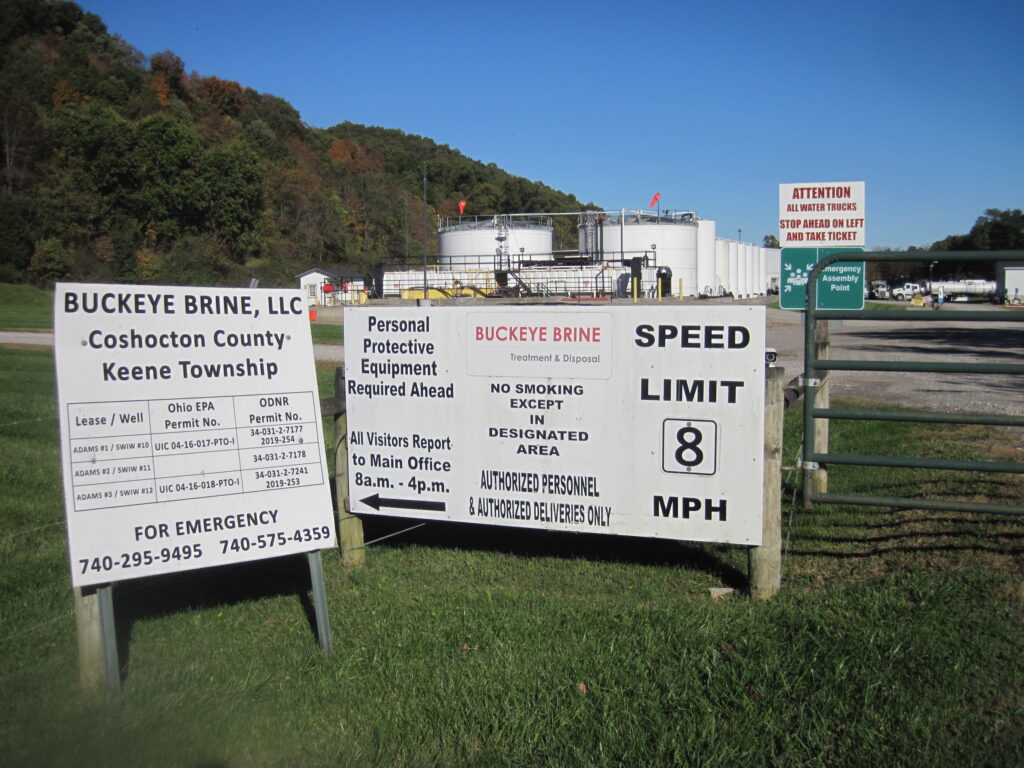 The entrance to Buckeye Brine's injection well facility in Coshocton, Ohio. Credit: Justin Nobel/DeSmog
But ODNR did not investigate the Buckeye Brine injection well, subject of the original complaint, or any other injection wells. It did investigate "producing oil and gas wells within a one-half mile radius" of the family's home.
After Burgan's company reached out, we "contacted ODNR and ODNR was not interested in any further efforts on the matter," said Susie Patterson, the manager at Buckeye Brine, by email. Patterson said groundwater monitoring wells installed in 2019 and sampled quarterly showed "no indication of contamination by oilfield substances," or that "the water was not fit for consumption due to contaminants," and pinned issues with the Fishers' well on the water well driller.
"The wells were drilled much deeper than surrounding wells producing good drinking water," said Patterson. "It is Buckeye's opinion that the driller was trying to justify to the well owner the bad wells."
The Fishers declined to participate in the story.
The Oil and Gas Industry's Trillion-Gallon ProblemAcross America, over one trillion gallons of oil and gas wastewater are generated every year — enough to fill a line of waste barrels to the moon and back 28 times. Nearly all of this waste — 96 percent — will be injected deep into the earth at disposal injection wells.
Given the oil and gas industry's reliance on injection wells as a critical means of disposal for a dangerous waste stream, analysts have referred to injection wells as a linchpin to the sound operation of the entire oil and gas industry. Disposal of oil and gas wastewater is the industry's "Achilles' heel," said Ted Auch, a researcher at the oil and gas industry watchdog Fieldnotes. A 2021 Rice University Center for Energy Studies report stated that if the industry did not have injection wells to rely on for waste disposal, the "resulting economic impacts would be profound — and likely, existential."
The United States has more than 181,400 oil and gas wastewater injection wells, but as industry leaders testified at the Texas state capitol in August, lack of space to store this toxic brine already is threatening to curtain oil and gas production in Texas' productive Permian Basin. Even where it has been stored, increasing evidence shows the wastewater is not always staying put.
Injection has proven particularly problematic in Ohio, where state regulators have halted operations at over half a dozen injection wells, citing concerns that fracking wastewater has leaked and has traveled up to five miles underground to contaminate conventional oil and gas wells. ODNR noted in a 2023 letter to DeepRock Disposal Solutions, a southeast Ohio company formerly run by the chair of the state senate's energy committee, that such incidents pose a risk to public health and drinking water too.
In Texas, wastewater shot down injection wells has burst back to the surface at old oil and gas wells, at times generating 100-foot geysers of brine in the desert, and Inside Climate News reported that oilfield waste has contaminated drinking water sources in the heart of West Texas oil country. Reporting by ProPublica revealed the situation is similar in neighboring Oklahoma, where regulators have clashed over how far to rein in the injection industry, despite state evidence showing drinking water sources polluted with contaminants consistent with oilfield waste.
Independent scientists raise the question of whether other oil and gas states may be facing similar problems.
"We have always been concerned as environmental scientists and geologists in this area that there is no underground containment in these [injection] wells," said Jen Bowman, a water chemistry expert and the director of environmental programs at Ohio University, in Athens. "What so many folks in this area don't understand, our underground layers are just rock layers so there is no magic underground lake where you are getting water from, and there is no magic underground storage container where the waste is going." Injecting millions of gallons of waste at high pressure means contamination miles from the site of injection is inevitable, she said.
"This is not a good plan or disposal mechanism for potentially dangerous materials," Bowman told DeSmog and Rolling Stone, "especially given that people rely on groundwater in so much of rural Ohio."
The concern about drinking water in Washington County is exactly what motivates Susan Vessels, the Republican president of the Marietta City Council. She has led the council in writing a resolution, passed last October, urging Ohio state legislators to introduce legislation imposing a three-year moratorium on new wastewater injection wells in Washington County. More recently she has crossed the political aisle when Amy Acton, the former state health director, came to Marietta last month as part of her gubernatorial campaign. Acton supports Vessels' proposed moratorium and is facing an ugly, expensive race against billionaire Vivek Ramaswamy.
Acton told DeSmog and Rolling Stone that the fight over injection wells and drinking water contamination comes down to ensuring a better future for Marietta and all of Ohio.
"That is why I am committing to a three-year moratorium on wastewater injection wells in Washington County," said Acton. "I'm fighting against the corruption in our Statehouse and the cost of that corruption that we pay for. We must act to protect our resources and our drinking water." Ramaswamy's campaign has not replied to questions.
"Drinking water is not political," said Vessels, "and it is my hope Ohioans will come together across party lines on this issue."
In an op-ed, she took to task the GOP contender Ramaswamy, who called people "whiners" for raising concerns about clean water, energy use, and other issues as proposals for AI data centers arrive in Ohio.
"I think they are full of shit, and that is point-blank my opinion."
Phillip Johnson, Washington County water well driller
Washington County water well driller Phillip Johnson said he has drilled hundreds of private water wells in the region. He disagreed with the state's conclusion that brine from the sandstone formation caused the Fisher family well's contamination.
"I think they are full of shit, and that is point-blank my opinion," he said.
Johnson said that if the sandstone formation was the cause of the salt contamination in the Fishers' drinking water, then the salty taste should have been there from the beginning, and not strengthened over time as the couple reported, according to ODNR documents.
"Just because you drill 1,000 wells and everything works fine, it just takes one well to not work right for there to be a problem," said Johnson. "It is nature, if you pump something down under pressure, the path of least resistance is up."
"I am all for drilling oil and gas," he added, "but fresh natural water is the most essential natural resource there is, in this country, the state, anywhere in the world, and if you contaminate it, you essentially ruin everything."
Dominic DiGiulio, a retired EPA scientist with a doctorate in geoscience and decades of experience investigating the movement of underground fluids, provided another assessment of the state's conclusions in the Coshocton case.
"The ODNR's logic for stating that the domestic well is partially screened in the Big Injun formation is flawed," said DiGiulio, who also previously consulted for government agencies and NGOs. "ODNR does not provide compelling evidence."
The post Ohio Denies Evidence of Fracking Waste in Drinking Water. Its Own Records Show Otherwise. appeared first on DeSmog.
At a Tuesday campaign rally for Republican Senate candidate Ken Paxton in Lubbock, Texas, President Trump announced the U.S. Environmental Protection Agency's (EPA) proposal to roll back a Biden-era methane rule, setting up a likely future showdown in how the agency oversees climate pollution under the Clean Air Act.
The proposal marks a break from the agency's previous approaches to greenhouse gas regulation by maintaining that — for now — the EPA still has the authority to regulate climate pollution from the oil and gas industry, though it might revisit this decision later. With affordability top of mind for many midterm voters, however, the President framed the move in economic terms.
"Tonight I'm officially terminating Biden's expensive and unnecessary methane regulations," Trump announced to the crowd, located near the oil-rich Permian Basin. The new plan would loosen federal requirements for oil and gas operators to detect and repair leaks, ease restrictions on gas flaring, and eliminate the Super Emitter Program, a third-party monitoring and reporting system designed to identify major releases of methane, known as a climate super pollutant.
Trump said the proposal, which addressed a 2024 rule known as OOOOb/c, would "save consumers and energy producers $45 billion in costs, unlock vast quantities of Texas natural gas, and produce 210 million barrels of oil." Under President Biden, the EPA estimated the rule would prevent the release of 58 million tons of methane and 16 million tons of volatile organic compounds (VOCs), leading to major public health and climate benefits. Climate change already is raising costs for American households by an estimated $400 to $900 annually, according to a 2025 Brookings report.
Trump's Lubbock announcement follows a series of sweeping deregulatory moves by the EPA in which the agency has stated it does not have the authority to regulate the greenhouse gas emissions that cause climate change under the Clean Air Act. EPA's most notable decision came in February when the agency rescinded the 2009 endangerment finding, the U.S. government's scientific finding that greenhouse gases harm human health and the environment and the legal basis for its rules addressing climate change. More recently, the EPA stated in September that it would no longer limit climate pollution for power plants, a move which would likely extend the lifespan of coal-fired power plants.
In the wake of these decisions, however, legal experts and environmental advocates say that the EPA is attempting to assert power unevenly. On the one hand, the agency says it lacks the legal authority to regulate greenhouse gas emissions from cars, trucks, power plants, and industrial sources under the Clean Air Act. On the other, the latest EPA proposal relies on, in some cases in the same section of, the Clean Air Act to regulate methane, a greenhouse gas, from the oil and gas industry.
In its latest proposed rule, the EPA addresses this tension, acknowledging that "stakeholders have also raised concerns" about the agency's authority to regulate the oil and gas sector's greenhouse gas emissions under the landmark air pollution law. Depending on the agency's final handling of the issue with fossil fuel-fired power plants, the EPA states it could then use a "future rulemaking" to resolve the issue in the oil and gas sector. (The EPA is accepting public comments on its proposed repeal of its authority to regulate greenhouse gas emissions for fossil fuel-fired power plants until Nov. 2.)
Subscribe to Desmog
Get the weekly intelligence you need to hold polluters accountable
Email Address Sign Up Send me intelligence from: All US/Global team UK/Europe team (function($){ $('.newsletter-container .ijkidr-us').click(function() { $('.js-cm-form').attr('data-id', '2BE4EF332AA2E32596E38B640E905619D07B21962C5AFE16D3A2145673C82A3CEE9D9F1ADDABE965ACB3CE39939D42AC9012C6272FD52BFCA0790F0FB77C6442'); $('.js-cm-email-input').attr('name', 'cm-vdrirr-vdrirr'); }); $('.newsletter-container .ijkidr-uk').click(function() { $('.js-cm-form').attr('data-id', '2BE4EF332AA2E32596E38B640E905619BD43AA6813AF1B0FFE26D8282EC254E3ED0237BA72BEFBE922037EE4F1B325C6DA4918F8E044E022C7D333A43FD72429'); $('.js-cm-email-input').attr('name', 'cm-ijkidr-ijkidr'); }); })(jQuery); Attacking EPA's 'flawed legal basis'In 1999, the oil and gas industry's largest trade group, the American Petroleum Institute (API), organized a meeting over whether it should "coordinate a multi-industry, trade group response" to the threat of what it called EPA's "flawed legal basis" for regulating greenhouse gas pollution, including carbon dioxide and methane, under the Clean Air Act. In 2024, the API filed a legal challenge over the OOOOb/c rule, which was eventually consolidated into a lawsuit with states and other industry trade groups. That suit has been paused while the agency reconsiders the rule.
Parts of the oil and gas industry have flagged this distinction in how the Trump EPA is handling two different greenhouse gases under the same law. Shortly after the EPA repealed the endangerment finding, the Domestic Energy Producers Alliance (DEPA), an oil and gas trade association founded by fracking magnate and Trump donor Harold Hamm, wrote a letter to the EPA, thanking the agency for "restoring the rule of law." The group called out "methane and other greenhouse gas emission requirements for the oil and gas sector" among its examples of "major regulations based on the Endangerment Finding."
 A flare burns over oilfield infrastructure in West Texas' Permian Basin in 2020. Credit: Justin Hamel/DeSmog
A few months later, after the agency published an update on its proposed reconsideration of the OOOOb/c methane rule, DEPA wrote in an internal newsletter that EPA "does not explain its legal reasoning for continuing to regulate methane emissions when it has found that it does not have the authority to regulate carbon dioxide (CO2) emissions from vehicles and has proposed it does not have the authority to regulate power plants' CO2 emissions."
On Tuesday in Corpus Christi, the president called out Hamm by name at another midterms rally shortly before the one announcing the methane rule rollback. "Harold Hamm is here, the great oilman," said Trump, looking around the audience. "Hi, Harold."
'The Very Definition of Arbitary'Legal experts and environmental advocates say the EPA's inconsistency leaves unresolved important legal questions about the federal government's authority to regulate climate pollution, potentially keeping the door open to upend federal methane regulation entirely.
"Treating similar pollutants under the same statute differently, with no stated reason or evidence, is the very definition of arbitrary and capricious decision making," said Alejandro Camacho, a law professor at the University of California, Los Angeles.
Camacho argues that if the EPA adopts a broad theory limiting its authority over greenhouse gases, it must explain why that theory doesn't also undermine its authority to regulate methane. "States have already sued over the power plant repeal, as have health and environmental groups, and they can and should attack this inconsistency too," he added.
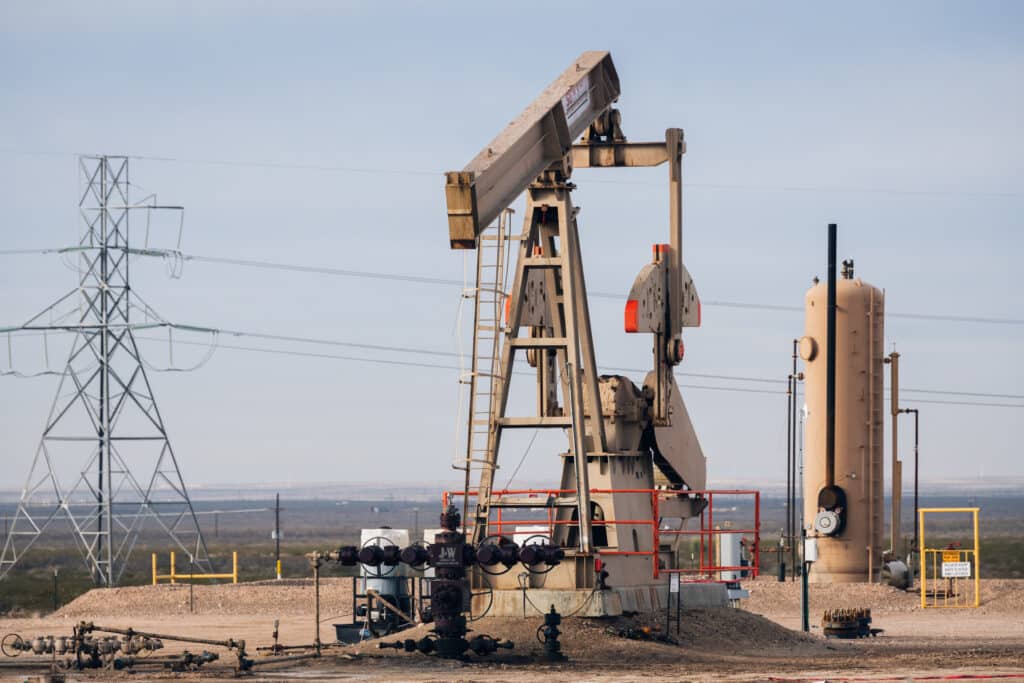 A lone pumpjack in Loving County, Texas, in the Permian Basin. Credit: Justin Hamel/DeSmog
The EPA's proposal nods to the industry's questioning of its authority and points to the agency's history of handling the oil and gas sector separately, "but the agency hasn't explained how it will navigate it," said Rosalie Winn, senior director and lead counsel on methane and clean air policy for the Environmental Defense Fund.
Mary Sasso, an attorney for the Clean Air Task Force, said the agency's decision to defer the question could leave the future of methane regulation uncertain. "I think that there's very real concerns that we could see changes to EPA's interpretation of its own authority finalized in some type of regulation that would be really damaging for public health and the environment," she said.
Camacho agrees, and warned that the deferral could foreshadow future agency backtracking. "The deferral is less a reasoned distinction than a placeholder for the next rollback," he said.
The administration also argues that the proposed changes will reduce regulatory costs, encourage domestic energy production, and help lower prices for consumers. "Since day one, President Trump has been putting real money back into the hands of American people by putting American energy back in the hands of the American workers, businesses, and communities," said Interior Secretary Doug Burgum in a press statement about the proposal.
Consumer savings uncertainAlthough the EPA estimates that the proposed rollback to the methane rule would save consumers tens of billions of dollars, the relationship between domestic production and consumer prices is more complicated, according to the U.S. Energy Information Administration. In an emailed response to DeSmog, the EPA said its estimate reflected the anticipated cost oil and gas operators would save by not having to comply with regulations, their excess profits, and consumer savings. The proposed rule reflects this calculation in its Regulatory Impact Analysis section, but does not provide further details on how the agency determined these figures. These figures are not independently established consumer savings.
"As much as it would be easy to paint oil executives as cartoonish villains hiking prices while families suffer, individuals have little to no control over benchmark oil prices," said Kelly Mitchell, the executive director of the oil and gas watchdog Fieldnotes.
"The administration may claim that new rules will incentivize new production, bringing online supply to counter the barrels trapped behind the Strait of Hormuz," Mitchell said. "However, these new rules are primarily designed to help operators of marginal wells — wells that produce fewer than 15 barrels per day."
 Flaring methane gas in the Permian Basin, Texas. Credit: Justin Hamel/DeSmog
Mitchell questioned whether the benefits of the rollback would reach consumers, arguing that changes would primarily reduce costs for oil and gas operators without guaranteeing lower prices at the pump. "We're left with an outcome where oil companies get to war profiteer, avoid using any of those profits to clean up a major pollution source, and fail to reduce prices. Now they have the gall to look us in the eyes and tell us this is a gift to the American consumer."
Since rescinding the endangerment finding, the EPA no longer accounts for the cost of harms from additional climate pollution — only the economic harms — which does not figure into the new rule's estimated savings. Meanwhile, in a study recapping the last decade of climate-induced health harms, the Lancet reported a record high of 710,000 heat-related deaths in 2023 — and almost 72 percent of them caused by climate change.
The proposed rule places particular emphasis on a class of low-producing facilities known as marginal wells, which typically produce relatively small amounts of oil and gas. The Trump administration alleges that regulations established under the previous administration stymied these wells. "Under crooked Joe Biden, 'Dumocrats' crushed the small oil and gas operators," Trump said during the rally Tuesday. "There are small operators, they're great operators too, I know so many of them — with crippling regulations and methane that caused prices to skyrocket."
The EPA says many of these wells are family-owned operations that struggle with the costs of complying with Biden-era standards, but an Environmental Defense analysis found that nearly half of all marginal wells are owned by just 93 corporations.
The proposed methane rule reconsideration is the latest development in a broader campaign to weaken federal methane protections under the purview of Aaron Szabo, a former registered lobbyist for a member of a major trade group pushing for these rollbacks. Earlier this month, Szabo stepped down as the head of the EPA Office of Air and Radiation. Last month, DeSmog reported that members of the oil and gas industry had simultaneously voiced public support for federal methane rules while covertly working to "eviscerate"them during the second Trump administration, according to an investigation published by Fieldnotes.
The proposed changes to the OOOOb/c methane rule are not yet final. The EPA says it will provide at least 45 days for public commentafter publication in the Federal Register, including a public hearing.
The post President Trump Unveils EPA's New Contradictory Methane Proposal at Campaign Rally appeared first on DeSmog.
Two directors of GB News, which has loudly advocated for the new Rosebank and Jackdaw oil and gas fields, hold shares in the firms behind the projects.
Sir Paul Marshall, a millionaire hedge fund boss who also owns The Spectator magazine, and Lord (Theodore) Agnew of Oulton, a Conservative peer and donor, sit on the board of All Perspectives Ltd, the holding company of GB News.
Marshall is also one of its two principal funders, pumping money into the loss-making right-wing outlet.
GB News - which employs Reform UK leader Nigel Farage and former Tory Cabinet minister Jacob Rees-Mogg - has strongly supported new North Sea drilling, with presenters recently calling Rosebank "a no-brainer" that should be approved "instantly".
The Labour government last week approved the development of the Jackdaw gas field near Aberdeen and is expected to make a decision on Rosebank soon.
Rosebank would create an estimated 250 million tonnes of carbon dioxide (CO2) emissions over its 10-year lifetime, roughly 70 percent of the UK's total annual emissions. The oil and gas field near the Shetland Islands is 80 percent owned by Adura, an "independent joint venture" by the fossil fuel giants Equinor and Shell that also owns the Jackdaw site.
At the end of June, Marshall's hedge fund Marshall Wace held $16.3 million (around £12.3 million) of stock in Shell, according to its latest filings to the U.S. Securities and Exchange Commission.
Meanwhile, Lord Agnew is a shareholder in Equinor, owning a stake in the company worth at least £100,000 according to his parliamentary register.
DeSmog first revealed Marshall Wace's huge fossil fuel portfolio in 2023, which increased to $2.8 billion (£2.1 billion) in the first quarter of this year.
One of Marshall Wace's biggest backers, U.S. private equity giant KKR, is itself a major investor in fossil fuels.
Subscribe to DesmogGet the weekly intelligence you need to hold polluters accountable
Email Address Sign Up Send me intelligence from: All US/Global team UK/Europe team (function($){ $('.newsletter-container .ijkidr-us').click(function() { $('.js-cm-form').attr('data-id', '2BE4EF332AA2E32596E38B640E905619D07B21962C5AFE16D3A2145673C82A3CEE9D9F1ADDABE965ACB3CE39939D42AC9012C6272FD52BFCA0790F0FB77C6442'); $('.js-cm-email-input').attr('name', 'cm-vdrirr-vdrirr'); }); $('.newsletter-container .ijkidr-uk').click(function() { $('.js-cm-form').attr('data-id', '2BE4EF332AA2E32596E38B640E905619BD43AA6813AF1B0FFE26D8282EC254E3ED0237BA72BEFBE922037EE4F1B325C6DA4918F8E044E022C7D333A43FD72429'); $('.js-cm-email-input').attr('name', 'cm-ijkidr-ijkidr'); }); })(jQuery);"GB News has gone way beyond just covering the Rosebank decision. Presenters repeatedly attacked the energy secretary for considering rejecting it, and demanded that the government 'drill baby drill'," said Richard Wilson, director of the campaign group Stop Funding Heat.
"The public deserves to know when the people overseeing a TV station have a financial stake in the outcome it's pushing for".
Wilson also pointed out that media regulator Ofcom requires "due impartiality" from broadcasters on live policy decisions, potentially including the approval of specific oil fields.
"It's time for Ofcom to take action," he said. "In the meantime, it's vital that advertisers continue to steer clear of GB News".
Paul Marshall and Marshall Wace declined to comment. GB News and Lord Agnew were approached for comment.
GB News's 'Rosebank-tinted' CoveragePresenters and guests on GB News have vocally backed the Rosebank and Jackdaw projects.
On 26 October, Rees-Mogg, who lost his seat at the 2024 general election, was asked for his view on Rosebank, replying: "Oh, drill, baby drill. We should get on with it as fast as possible," adding that the UK should also overturn its ban on fracking for shale gas.
On 19 August, GB News presenter Andrew Pierce interviewed Reform's deputy leader Richard Tice about the two projects, saying: "If both of them were given the go-ahead, wouldn't that instantly create some of the extra fuel security, energy security we need, apart from the revenue for the Exchequer?"
Tice replied, "Of course. Both should be given the go-ahead instantly," adding that the government should grant new North Sea exploration licences, which would break its 2024 manifesto commitment.
On 22 October, Pierce himself called Jackdaw "brilliant" and said it was "madness" for Labour MPs to oppose Rosebank.
GB News political editor Christopher Hope has also made the case for Rosebank, remarking on 26 October: "We're buying in the oil and gas we would take from Rosebank. Anyway, why not make it in [the UK] and get tax revenue from that asset?"
A few days earlier, on 16 October, he said: "It seems like a no-brainer to many, but not on the left of politics."
 GB News presenter and former Conservative MP Jacob Rees-Mogg.
Credit: GB News / YouTube
Last week, the GB News website ran an opinion article by Russell Borthwick, the chief executive of Aberdeen and Grampian Chamber of Commerce, headlined: "Jackdaw approval is a victory for common sense. Now it's Rosebank's turn."
As DeSmog has documented, GB News has long backed new fossil fuels and attacked climate action. It has also given a platform to climate science deniers, including from the Global Warming Policy Foundation (GWPF), a pressure group that says more CO2 emissions would be a "benefit to the planet".
Marshall has also personally criticised policies designed to reduce greenhouse gas emissions, claiming in a speech to the Alliance for Responsible Citizenship (ARC) conference in February 2025 that the world has been infected by a "climate derangement syndrome". He said "our economic prosperity and our people's livelihoods" are being sacrificed "all for the sake of making some fractional changes to the level of CO2 in the atmosphere".
In reality, reaching net zero emissions is predicted to cost only a fraction of UK GDP, while the extreme weather events caused by climate change could have a dramatic impact on the global economy.
Marshall's Spectator magazine, edited by former Conservative Cabinet minister Michael Gove, has also strongly supported new North Sea drilling.
A piece last week by anti-net zero columnist Ross Clark hailed Jackdaw as "a small victory for common sense" but lamented that Labour will not approve Rosebank so long as the UK keeps its net zero targets.
The Spectator's "gossip columnist" Steerpike also last week accused Labour MPs of "throwing a tantrum over Jackdaw", and concluded: "It has taken years, and so much time has been wasted, but at least the most obvious decision facing the country has finally been made. The question is whether Burnham will be brave enough to approve Rosebank as well."
The Spectator was approached for comment.
The post Two GB News Directors Have Investments in Oil Companies Behind Rosebank and Jackdaw appeared first on DeSmog.

Ultimately, it'll be a lack of food that ends civilization. There are many ways we get there - nuclear winter, drought, fossil fuels depletion - but that's not the point of this article. Rather, I want to know what I become when I am starving. I want to know what my neighbors become.
In the past, many believed humans were innately savages, and when the veneer of safety and comfort was eroded the remaining beast was permitted to appear. Once this occurs, survival needs replace moral rationality, steering the average person to murder and cannibalism.
Others believe humans are innately good, confounding morality with instinct. How can this be true when we seem to be governed by evil and selfish people? Perhaps the average person is "good" only because of where they fit in the social order. Given the right circumstances, do we all end up murdering each other for the last morsel of food?
To learn about the savage within, I looked at history starting with the Minnesota Starvation Experiment. Conducted during WWII, this research selected healthy men and put them through a semi-starvation period. Participants lost 25% of their body weight.
The subjects grew increasingly isolated, apathetic, and irritable, becoming obsessed by food. They experienced emotional blunting, cognitive dissonance, depression, and pessimism. Interpersonal relationships broke down.
They guarded their resources, licked their plates clean, and became aggressive. Some violently turned on themselves.
The key finding was that savagery wasn't a consistent outcome of starvation. Instead, apathy, social disconnection, and obsession were the common denominator.
The Siege of LeningradDuring WWII, Germany blockaded Leningrad for 872 days. Approximately one million citizens died from exposure, starvation, or disease.
As with the Minnesota Starvation Experiment, the common response was apathy and social atrophy. Both psychologically and physically. In a desperate attempt to survive, the body consumed itself, as autopsies showed organs shrank, including livers by 2/3 and hearts by 1/3.
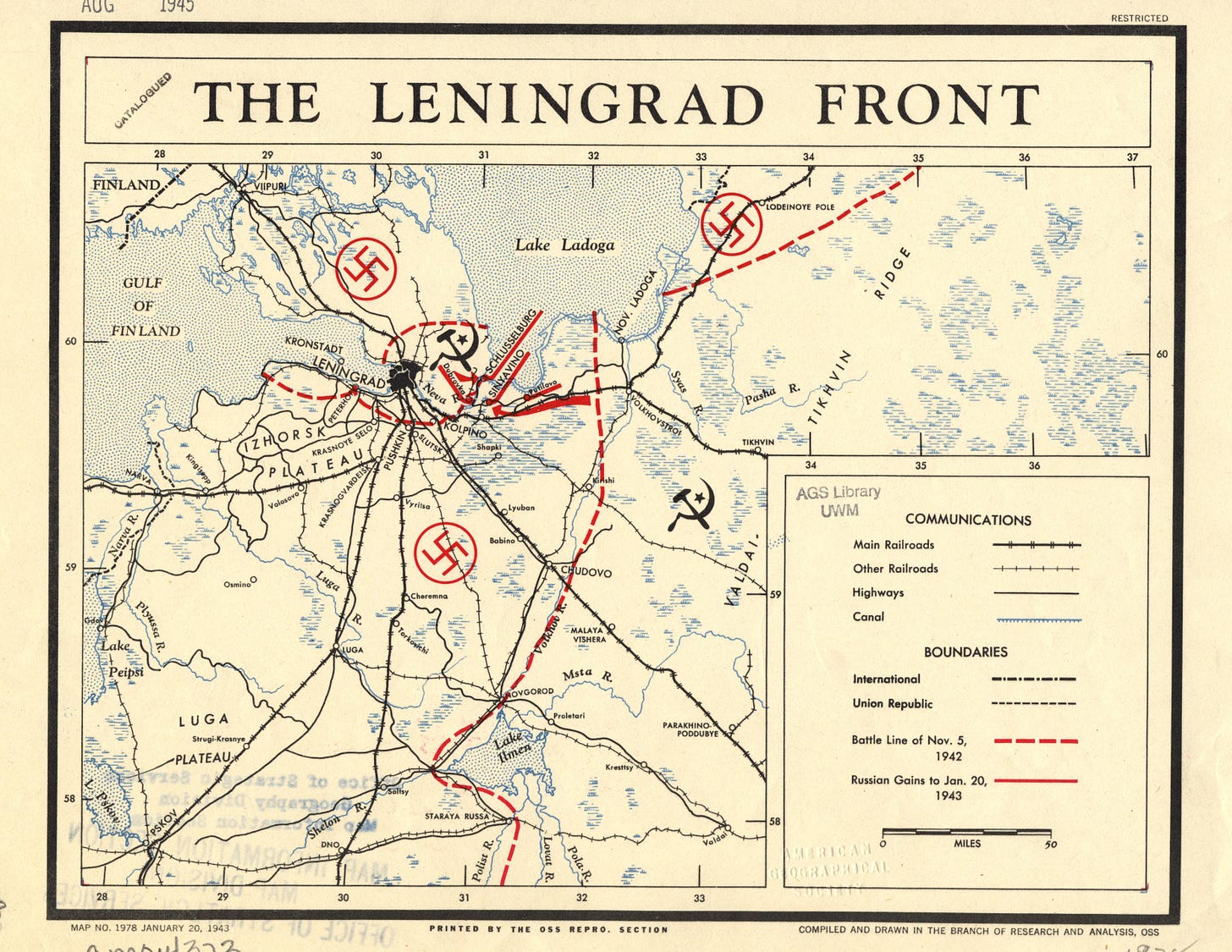
Lidiya Ginzburg, a survivor, literary critic, and author of the Blockade Diary, observed that starvation caused an "alienation of the body," where the conscious splits from the physical form, viewing the body merely as a manifestation of a hostile outside world.
As food = energy, starvation leads to a state of chronic exhaustion, explaining why most victims react passively becoming inured to death. Without the drive for self-preservation, murder and cannibalism disappear from the range of options. Instead, with the breakdown of social norms and lack of individual energy, the response to a neighbor's suffering was distance:
"Every day she sees heavily swaddled figures swaying along the narrow footpaths. She can recognize the goners from their shuffling gait, and every day she worries whether to follow them or pass them by. The moment that they fall is the worst. They crumple and drop. She wants to stop—it's the humane thing to do—but she has no strength to help them. So she tries to make her way past them, stepping around them, not over them, and never looking at the pile of cloth itself, lest an arm reach up or a pair of eyes implore."
During the Siege of Leningrad, people lay in bed next to the corpses of their family members, too weak to move them, and sometimes deliberately kept the bodies in the apartment simply to use the deceased's ration cards to prolong their own lives. The psychological blunting was a defense mechanism to avoid breaking down completely.
Once a source of social cohesion, food became an isolating experience. Yet, despite the social breakdown, most citizens simply faded into the night rather than turn to violence.
The savage fewAs with any form of disarray, there is a minority that do the unthinkable. Often opportunistic, paired with cognitive dissonance. Sometimes premeditated.
Hunger-induced madness can push ordinary people to acts of barbarism. During the Holodomor of 1932-1933, over 2,500 people were convicted of cannibalism.
Approximately 69% of the accused were women, mostly aged 17 to 50, and were predominantly widows, single mothers, or divorced individuals lacking a support system. The acts of cannibalism they committed were the human psyche collapsing under the weight of incomprehensible trauma.
Anna Ivanivna Storcheus's husband and three children died of starvation before her eyes. Anna killed and ate her fourth and final child, a girl named Nadiia. Was Anna a victim or a murderer? Many historians acknowledge people like Anna were not inherently evil. Rather, a form of psychosis becomes the maladaptive coping mechanism for some experiencing complete psychological and social destruction.
The Algonquins referred to this experience as "Wendigo psychosis", explaining paranoia, anxiety, hallucinations, and an impulse to consume human flesh during periods of starvation or social isolation.
What distinguishes the Siege of Leningrad from other similar experiences of extreme deprivation is Leningrad was a city with a set of social norms. When the setting is more isolated, and few are watching, are people more willing to break taboos?
Almost mythological, the story of the Donner Party is a classic example of what can happen to small groups, distant from broader social oversight.
The Donner Party was a group of American pioneers stranded by heavy snow in the Sierra Nevada mountains during the winter of 1846-1847. Patrick Breen, an Irish immigrant who survived with his wife and all seven of his children, kept a detailed diary, documenting the psychological collapse of the group.
Initially, the group attempted to maintain normalcy. They built makeshift shelters and slaughtered their remaining oxen and cattle, preserving the meat in the freezing weather. As the snow deepened and the food vanished, the typical signs of deprivation and isolation began to set in. Breen's entries reflect a systematic breakdown of norms. The taboo against consuming companion animals fell first:
"Mr. Curtis remarked that in the oven was a piece of the dog, and we could have it. Raising the lid of the oven, we found the dog well baked, and having a fine savory smell. I cut out a rib, smelling and tasting, found it to be good, and handed the rib over to Mr. McCutchen, who, after smelling it some time, tasted it and pronounced it very good dog."
As the weeks dragged on, the members of the party began to boil and eat the ox hides that previously served as their roofs and blankets. When the hides ran out and individuals began dying of starvation and hypothermia, the surviving members transitioned to survival cannibalism. Breen's diary entries from February 1847 were blunt, highlighting his own decline:
February 26, 1847: "The Donnos told the California folks that they commence to eat the dead people 4 days ago, if they did not succeed that day or the next in finding their cattle then under ten or twelve feet of snow…"
This was a capitulation to reality. A survival mechanism, with some refusing to participate.
Similarly, in 1972 a group of Uruguayan rugby players were stranded in the Andes after their plane crashed. Their 72 days in an extreme environment led to pragmatic savagery.
Dr. Roberto Canessa, a 19-year-old medical student at the time who later became a pediatric cardiologist, framed the decision to consume the dead not as a descent into savagery, but as a rational necessity. In his memoir, I Had to Survive, Canessa notes the conflict the group faced when confronted with starvation:
"Our story became world famous because of how we survived: by eating those who had died. It was, by far, our most eccentric idea, one that was simultaneously simple and audacious, and perhaps inconceivable. Hunger demands, above all else, to be satisfied."
They ate their friends, teammates, and family members. The desecration of the dead was unthinkable, so the decision was reframed and compartmentalized. "Harmonizers" within the group helped alleviate the psychological tension by reframing the consumption as something similar to the Holy Communion. A gift from the dead to the living. Indeed, many explicitly gave permission to others that they be consumed if they died first.
This is where a nuance must be presented, as explained by Canessa:
"Cannibalism is when you kill someone, so technically this is what is known as anthropophagy. I've had these discussions for 40 years. I don't care. We had to eat dead bodies, and that's it."
Notably, they didn't survive as individuals degrading to barbarism. Rather, they redefined a new shared moral framework based on their predicament, and it was social cohesion and teamwork that helped them survive.
Sign up for Collapse 2050The unspoken truth about humanity's frightening future.
Subscribe .nc-loop-dots-4-24-icon-o{--animation-duration:0.8s} .nc-loop-dots-4-24-icon-o *{opacity:.4;transform:scale(.75);animation:nc-loop-dots-4-anim var(--animation-duration) infinite} .nc-loop-dots-4-24-icon-o :nth-child(1){transform-origin:4px 12px;animation-delay:-.3s;animation-delay:calc(var(--animation-duration)/-2.666)} .nc-loop-dots-4-24-icon-o :nth-child(2){transform-origin:12px 12px;animation-delay:-.15s;animation-delay:calc(var(--animation-duration)/-5.333)} .nc-loop-dots-4-24-icon-o :nth-child(3){transform-origin:20px 12px} @keyframes nc-loop-dots-4-anim{0%,100%{opacity:.4;transform:scale(.75)}50%{opacity:1;transform:scale(1)}} Email sent! Check your inbox to complete your signup.No spam. Unsubscribe anytime.
The transition from pragmatism to murderThere's clearly a difference between eating someone who has already died vs killing someone to consume, the latter being more of an exception. Still, there are documented cases of both reluctant and opportunistic cannibals trying to survive in isolated, harsh conditions.
Courts have ruled that the temporary "suspension" of civilization does not permit a temporary suspension of civility. In 1884, R v Dudley and Stephens (Britain) ruled definitively that necessity is never a defense for murder. The legal doctrine established in this case dictates that the sanctity of human life is absolute and cannot be quantified, traded, or sacrificed, no matter how extreme the survival imperative.
Shipwrecked and adrift in the Atlantic for weeks in a rowboat, Captain Thomas Dudley and mate Edwin Stephens made the decision to kill a cabin boy who appeared already close to death. Dudley and Stephens murdered the boy to drink his blood and eat his flesh.
Dudley recounted:
"I took out my knife—first offering a prayer to God to forgive us for what we were about to do and for the rash act, that our souls might be saved—and I said to the boy, 'Richard, your time has come.' The boy said, 'What me, Sir?' I said, 'Yes, my boy.'"
Upon their rescue and return to England, the men made no secret of what they did, genuinely believing that the unspoken "law of the sea" and the dire necessity of their circumstances justified the murder. However, the British courts demonstrated that the law cannot be expected to bend to extraordinary circumstances.
Clearly, there's a degree of proportionality to survival, and there's a vast divide between murdering an almost dead person to live another week and building a system of violence and oppression to control resources. For some, distance from civilization provides the opportunity to grasp power and resources through cruelty.
In 1629, the Batavia, belonging to the Dutch East India Company, wrecked near Western Australia. What happened to the survivors shows how fast a small isolated society suffering from a shortage of food can be turned into a murderous autocracy.
Two hundred survivors landed on Beacon Island with under-merchant Jeronimus Cornelisz. Prior to the wreck, Cornelisz had plotted to steal the ship and its cargo of silver and sandstone blocks. His plot was exposed and he feared rescue would lead to his execution, so seized tyrannical control over the survivors. He planned to prevent rescue and cull the survivors to preserve food and water.
By creating a lethal "in-group" that did his bidding, Cornelisz slaughtered over half the survivors, seizing resources and diverting threats to his control.
"The strongest were killed at night, their throats cut. Others were taken out on rafts and drowned. The sick and lame were also targeted. Then people were murdered at random, with many forced to kill other survivors to save their own lives. Total obedience was a person's only chance of survival. Cornelisz's men raped any woman they chose."
How was one man able to turn another group into savages?
As we've seen many times in history, given the right circumstances, a small group of ordinary people turned ruthless by a charismatic dictator can be used to murder, rape, extort the majority. This is important to recognize, as today we observe the world speed-walking to fascism while asking "why isn't anyone doing anything?"
According to social psychologist James Waller, the normalization of savagery among ordinary people exploits those with a predisposition towards conformist ethnocentrism, as opposed to psychopathy as one might expect.
Similarly, Christopher Browning's book "Ordinary Men: Reserve Police Battalion 101 and the Final Solution in Poland" found that the group of men who made up this battalion were not ideological fanatics. Rather, they were conformists. Despite receiving permission to opt out, the vast majority still resorted to savagery, executing innocent civilians en masse.
Browning's explanation was simple:
"To break ranks and step out, to adopt overtly nonconformist behavior, was simply beyond most of the men. It was easier for them to shoot."
To cope, the perpetrators rationalized their actions. Propaganda helped reframe their actions as "acts of justice". Alcohol abuse helped them forget, while compartmentalization placed their victims outside the battalion's circle of human obligation.
Humans are frighteningly good at creating out-groups to rationalize horrific abuses of other humans. During the Rwandan genocide, Hutu extremists killed about 800,000 Tutsis and moderate Hutus. They weren't killing alien strangers, rather they were friends, neighbors, and even extended family.
State propaganda had reframed the mind to view Tutsis as "cockroaches" and their eradication as communal work. The readily available machete became the weapon of choice.
"The club is more crushing, but the machete is more natural. The Rwandan is accustomed to the machete from childhood. Grab a machete—that is what we do every morning."
The killing was systematic and pragmatic, aiming to eradicate entire bloodlines.
"Saving the babies, that was not practical. They were whacked against walls and trees or they were cut right away."
Like in Poland, conformity to the group, the promise of material greed (plundering the victims' property), and the absolution provided by state effectively removed the cognitive barrier that typically halts the decline into savagery.
This cognitive dissonance bleeds into the victim population, with a minority of the targeted effectively assisting the perpetrators. In "The Drowned and the Saved", Primo Levi explained how Chaim Rumkowski, the Jewish elder of the Łódź Ghetto during WWII, wielded dictatorial power over his fellow Jews. He helped Nazis by organizing deportations to death camps, eventually, despite his assistance, becoming a victim himself.
Deprivation, power, and the suspension of morality sadly lead some to betray their peers. However, contradictory to what British courts found with R v Dudley and Stephens, it is difficult to comprehend from the comfort of modern civilized society.
Levi suggests:
"It is a judgment that we would like to entrust only to those who found themselves in similar circumstances and had the opportunity to test for themselves what it means to act in a state of coercion… The condition of the offended does not exclude culpability, which is often objectively serious, but I know of no human tribunal to which one could delegate the judgment."
Given this, how does one separate victim collaboration from crimes against humanity committed by Nazis, who also argued that fear for their lives forced them to follow orders. The Nuremberg Trials exposed this excuse as unacceptable. Despite the extraordinary circumstances, and inability to fully comprehend the mindset of the Nazi soldier, the individual was not excused for their savagery.
Why we're blind to civilizational collapseAnd why when we do see it, we fail to act.Morality of eating humansDespite the plentiful supply of living and dead humans throughout historical famines, cannibalism is rare and universally taboo. Why do civic norms outweigh the survival imperative in many cases, despite the extreme circumstances? Why do some, no matter the cost, refuse to break the taboo?
Morality is often the social manifestation of evolutionary imperatives, either biological or social. Some part of our success as a species can be explained by our reluctance to see each other as a source of food.
Recent epidemiological models reveal that human cannibalism trades long-term survival costs for immediate sustenance. When humans eat humans, risks of prion diseases such as Kuru rise. This risk compounds with frequency. Cooking reduces the risk, but not entirely.
Also, hunting other humans provides a negative energy ROI. It is usually more calorically profitable to target unsuspecting flora or fauna. For this reason, most cases of cannibalism involve the already dead.
Finally, humans are a social species with evolutionary success highly connected to our ability to organize. Social cohesion across hundreds or thousands of people, most of which are relative strangers, requires trust. Trust in rules. Trust in aversion to violence. Trust you won't become your neighbor's next meal.
Combine these biological and social characteristics and it is clear the taboo against cannibalism isn't arbitrary. Indeed, cannibalism is maladaptive and any populations that ate each other died off from disease or an inability to organize.
If human survival relies on the biological and social rejection of cannibalism, the true threat during civilizational collapse is not a neighborhood of bloodthirsty savages. The threat is the isolating apathy of starvation. We will likely not eat our neighbors. We will simply lack the calories to intervene when an opportunistic tyrant decides to exploit them.
I'd love to hear your thoughts on this subject. How will people change as infrastructure collapses, disasters overwhelm, and famine sets in?
Sign up for Collapse 2050
The unspoken truth about humanity's frightening future.
Subscribe .nc-loop-dots-4-24-icon-o{--animation-duration:0.8s} .nc-loop-dots-4-24-icon-o *{opacity:.4;transform:scale(.75);animation:nc-loop-dots-4-anim var(--animation-duration) infinite} .nc-loop-dots-4-24-icon-o :nth-child(1){transform-origin:4px 12px;animation-delay:-.3s;animation-delay:calc(var(--animation-duration)/-2.666)} .nc-loop-dots-4-24-icon-o :nth-child(2){transform-origin:12px 12px;animation-delay:-.15s;animation-delay:calc(var(--animation-duration)/-5.333)} .nc-loop-dots-4-24-icon-o :nth-child(3){transform-origin:20px 12px} @keyframes nc-loop-dots-4-anim{0%,100%{opacity:.4;transform:scale(.75)}50%{opacity:1;transform:scale(1)}} Email sent! Check your inbox to complete your signup.No spam. Unsubscribe anytime.
Thank you for reading.
My name is Sarah and I run Collapse2050 by myself. It is a passion project to explore humanity's frightening future - a topic traditional media ignores.
The site is free for all, as I believe this information shouldn't be locked behind a paywall. I also don't accept corporate advertising so I remain totally free to tear the kleptocracy a new one.
To fund these articles, I depend on the kindness of strangers. Paid subscribers and one-time contributors to help me cover research and production costs.
Thank you.
Sarah

I'll always remember that opening underwater feeling of Joachim's 'You Don't Fool Me' and the bells of Markus' 'Regensburg'… Well, you know we love full circle moments here, especially when they involve artists and records that played such an important part in the inspiration behind ASIP.
Markus Guentner and Joachim Spieth both appeared on the original Kompakt Pop Ambient compilation in 2001, a series that heavily influenced ASIP and remains a personal favorite to this day. So, 25 years later, it's rather special to welcome them both together as one for an isolatedmix.
Both artists have followed their own paths since those early Kompakt days, but their shared history eventually led to a series of collaborations, including Overlay, Conversion, and contributions to Markus' own Kontrapunkt album here on ASIP. Both have also contributed to the isolatedmix series individually too, as despite all these years passing, it's refreshing to hear such a consistent style and depth to their productions to this day - a signature sound that many artists would strive for.
For this isolatedmix, Markus and Joachim revisit their collaborative work, bringing together tracks and remixes that connect the different projects. It's a fitting opportunity to look back at where it all began, how their musical relationship has developed, and what might come next.
We caught up with them both to discuss their early Pop Ambient days, working together, and making music 25 years on.
~
It's now been three years since your collaborative album Overlay was released. Looking back at that record from where you are today, what do you hear in it that perhaps wasn't obvious to you when you were making it?
J: I actually find *Overlay* to be relatively timeless; it could just as easily be released today. That may be partly because, for this project, we settled on a few cornerstones of our musical upbringing without making them a major topic of discussion during the actual creative process. After all, the starting point—or premise—of this collaboration was our shared passion for sound and the desire to finally try making music together after knowing each other for so long. And I think the results reflect that.
M: Yes, right … somehow "Overlay" is kinda timeless … but on the other side, we talked a lot about what and how we can do things together, where do we wanna go when we make music together. And we had this idea really quickly of bringing our musical background together … what we always loved … but not making a copy of it, just translating that influences our way of making things. And I'd say that "plan" really worked. You can hear a lot of influences on that album. Now, after three years (or better, 4-5 years with all the conversations, composing, producing) it's still something i'd do the same way.
Markus, you've been part of ASIP for a long time now. You both arrive at this collaboration with your own histories and approaches — where did you first recognize something in each other's music that felt compatible? Was it always the Pop Ambient connection? As that feels a million miles away from where your music is now.
Well, ok, of course the first touching-point is our shared history on Kompakt. But, in the beginning of Pop Ambient or "The early Kompakt Years" we didn't know each other in person. Sure, I listened to Joachim's stuff (and really loved it) … but it was never an obvious connection. And after a few years (when Joachim started AFFIN) we finally got in contact. So, Joachim asked me about an album (which i made … Crystal Castle) … and still (back then) it wasn't a thing (or even an option) to do stuff together … but somehow we connected more and more over the years. We had some conversations on the phone, email etc … but a few years ago we made regular appointments with videocalls … and I think that changed a lot !!! Because we talked about so much stuff (not just music) for hours and hours. The connection became much more personal … and we realised during these chats, that our history, our taste in music, our understanding in certain things is very close. And then, everything became obvious !!! Of course we should work together, of course we should do some music together. And yes, it's absolutely so far away from the early Pop Ambient stuff … but, we grew … we had our experiences … We've seen a lot of things. Not together, everyone had his own experience … but somehow it was the same experience … and that is what the collaboration and the work together makes it weirdly special.
When you're working together, are you conscious of who is bringing what to a piece, or is the aim to reach a point where that distinction disappears?
J:The exact percentage of input each person contributes to a given track—or what is actually audible in the finished piece—is really a secondary matter; the process itself is what's truly compelling. Moreover, we've established a relationship built on trust; beyond the Guentner/Spieth project, we make a great many decisions together—not just musical ones, but also those regarding Affin's visual identity. We constantly bounce ideas off each other—asking things like "What do you think? Does that sound good? Does it look good?" Since we've been holding regular video calls for several years now, there is a high level of ongoing dialogue across a wide range of topics, and through that, you naturally develop a feel for what works—for that shared vision and sense of cohesion.
M: Exactly, most times we're like: ok, let's start with something … what's your opinion on trying this and that … but hey, just try !!! and sometimes someone is sending an idea … and the other one is working with that out of nowhere. And it's so wild to see and realise that most times (i'd say around 95%) we're on the same level. Getting something from the other to work with just feels natural … not really thinking about: uhm, is that something Joachim could like? It's way more: ok, nice, i can work with that, bring my "voice" into this. And in the end, there's always an agreement on what we did with the material.
How has the way you work together changed since Overlay? Has familiarity made the process easier, or does a good collaboration still need a certain amount of friction or uncertainty to produce something worthwhile?
In recent years, we've also produced albums as a trio with artists like Pepo Galán and zakè; furthermore, we released the *Conversion* album last year as our second Guentner/Spieth collaboration. I'd say that, overall, the process has increasingly taken on a life of its own.
We sometimes surprise each other when one of us shows up with something finished, but we've never reached a point where our ideas were completely at odds... It's as if there's a kind of antenna transmitting signals in both directions—and it transmits reliably.
M: Nothing more to say about … absolutely right !!!
Have you found yourselves taking anything from the collaboration back into your respective solo work?
J: I think this happens subconsciously—almost certainly. With every collaboration, you learn something new and discover aspects you might not have found on your own; this expands the realm of possibilities, both musically and—surely—technically. Beyond that, we're constantly exchanging ideas about solo projects and each other's new remixes; things are always in flux, both within specific projects and on a broader level. From my perspective, a very productive connection has solidified over time—one whose foundation was originally laid with Kompakt and our first releases, as that was the path through which we learned about each other and eventually established direct contact.
M: Well, I absolutely think it happens … There is always something you hear and work in the back of your mind when you do a collaboration. But as Joachim said, it's more subconscious. Not like: oh, i need to take that idea … or, he made it this or that way, i need to do the same. But something is always happening and you take that with you.
What can this mix communicate about the relationship between two artists that an original collaboration perhaps can't?
J: The mix serves as a review of what has been achieved so far—an overview, a snapshot, a sort of bird's-eye view—that came together after a period of quiet. The project is currently on hiatus; we haven't been working on new material continuously for the past three years—rather, there are active phases and periods of rest.
Furthermore, the mix broadens the scope to include our wider circle and other formats—such as the track we contributed to the *Kontrapunkt* album on ASIP, as well as remixes where friends interpreted the project from their own perspectives. This made the process of creating the mix an interesting one, and we feel the result flows beautifully. It's a lovely way to wrap up this chapter.
M: Exactly … At first, this mix shows our collaborative musical work (besides from remixes, the work for AFFIN, etc.). But it also shows the connection between the collabs and the different albums way better, than just listening to the one or the other album. You get a better understanding of all the connections that happen between these.
Markus is celebrating 25 years since his debut album, In Moll, recently. You've both been making and releasing music for long enough to have watched ambient and deeper electronic music move through several different periods of attention and interpretation. Do you feel differently about making this kind of music now than you did ten or twenty years ago?
M: In the end, not that much. The way I want to make music is still the same. I never chased any trend or thought that I should sound like something or someone else. Of course, over all this time you grow, get inspired by other things, learn something new, get rid of old stuff or behaviours. But the freedom to do what you want to do is stll present.
J: I think the technical toolkit has changed fundamentally—which is, after all, a natural process or form of progress over such a long period. As for one's attitude toward music—or love for it—nothing has changed. However, the ways of making oneself heard in the market have changed radically, forcing you to constantly re-evaluate and find new paths to gain an audience. Not everything that has happened alongside the digitalization of the music industry has been positive. Yet, the drive to make emotions audible remains.
Your two tracks on Pop Ambient "You Don't Fool Me" and "Regensburg" were so definitive for that compilation series, and similarly, it's 25 years since that compilation was released. Wolfgang had his own interpretation of Pop Ambient back then, but I'm
curious what it represented to you. Was it simply a home for these pieces at the time, or did being part of that series begin to shape how you thought about your own music? Do you think "Pop Ambient" exists in the same way today?
J: That's an interesting question. It's clear that we were pleasantly surprised back then by the wave of momentum that built up after the first *Pop Ambient* release came out. You could sense a real spirit of new beginnings on many levels. At the same time, we were very young, and everything had a fresh, exciting dynamic—we had no prior experience, nothing to compare it to... we simply approached our favorite label, they liked our music, and then it all just happened...
It certainly wasn't just a matter of having our music released by a particular label. Looking back at that time, comparing it to the present doesn't really make sense. The reason is simple: a quarter of a century lies between then and now, and just as we have evolved as artists during that period, the environment surrounding Kompakt has also developed and changed...
If you think about ASIP, a direct comparison from the label's inception to the present day would be hard to imagine. The same applies to Affin…
M: I remember sitting in Wolfgang's office when he mentioned the idea of doing the Pop Ambient series because of our (and of course, dettinger, lohmann, etc.) tracks. So it was not just a home, it was the beginning of something … something we've been actively a part of. So that was very very special at that time. I'm not that sure, if Pop Ambient still exists in the same way, well, thb, i can't just because of the long time … music changed, people changed. And for me (because i'm not an "active member" anymore) i can't really tell if it's still the same. But in the end i think it's not better or worse … it's just different.
If Overlay documented the beginning of something between you, where do you feel that collaboration sits now? Is there a sense of a continuing body of work taking shape, or is it more interesting to leave each encounter open-ended and see what happens next?
M: A lot of chats and talkings happen about the collab. But we try not to put any pressure on ourselves. The fun thing is, that we somehow always know in which direction we're heading. So in the end we're completing each other unspokenly.
J: In principle, the outcome is still open, but I think the parameters—the coordinate system, so to speak—have already been defined to a certain extent... We'll see where the next phase of work takes us, and see when that happens :-)
astrangelyisolatedplace · isolatedmix 136 - Guentner & SpiethListen on Soundcloud, the ASIP Podcast or the 9128.live iOS and Android app.
Tracklist:
1. Vanish
2. Prologue
3. Nukleus
4. Morphia
5. Mutuus
6. Apastron
7. Kari
8. Scope (Abul Mogard Rework)
9. Valenz (Galán / Vogt Rework)
10. Veil
11. Cipher
12. Overlay Variation 1
13. Genesis
14. Chrysalis
15. Nukleus (Rafael Anton Irisarri Rework edit)
16. Vortex
17. Overlay Variation 2
18. Praeludium
https://affinmusic.de/booking-guennter-spieth/
https://guentnerspieth.bandcamp.com/
https://linktr.ee/guentnerspieth
Google's AI summary is punching a huge hole in their own profits - is this good?
Sign up here to get an email whenever First Dog cartoons are published
Get all your needs met at the First Dog shop if what you need is First Dog merchandise and prints
A Guardian investigation has found that despite a recommendation to slow down, leading shipping companies continue to travel above advised speeds in a key habitat for cetaceans
Marine biologist Alice Barbarioli waits with her camera trained on the horizon. A few minutes earlier, the hydrophone beneath the Pelagos research vessel detected codas - the sequence of clicks sperm whales use to communicate.
The sperm whale reveals its head and dorsal fin as those onboard the vessel in the Pelagos sanctuary, a conservation area established to protect marine mammals in the north-western Mediterranean, rush to take photos and note the rhythm of its breathing. After a few minutes, the animal arches its back, and begins to head back into the depths of the sea. They wait to catch a glimpse of its tail.
Continue reading...
As debate and legal argument continue over the extent to which developers of large language models are entitled to feed the world's data into their systems without paying for it, India's government has come up with an idea to regulate and secure the flow of information.
India's motive is to create AI models trained on local data, because it thinks offshore model-makers won't be motivated to address the nation's issues or to ensure owners of data stay in control.
The scheme India's Ministry of Electronics and Information Technology (MeitY) thinks can make that happen is called the "Data Empowerment and Protection Architecture (DEPA) for AI Training."
As described by Professor Ajay Kumar Sood, Principal Scientific Adviser to the Government of India, DEPA means "the model travels to the data, rather than the data travelling to the model."
The scheme envisions "Training Data Providers" (TDPs) - examples of which include hospitals, banks, and government agencies - sharing anonymized and encrypted data with a "Data Exchange Platform" (DEP).
Entities called "Training Data Consumers" (TDCs) access the data stored at the DEPs to train their models.
DEPs will operate what MeitY calls "hardware-based Secure Data Environments" in which "data remains encrypted and isolated even during processing." They also enforce rules set by TDPs that describe how TDCs can use data.
MeitY's DEPA framework [PDF] says this scheme means "Differential privacy techniques are systematically applied to prevent the model from learning or revealing individual specific information," adding "All activities inside the secure data environments are immutably logged for audit purposes, ensuring that the process is both secure and transparent."
India's government already operates several data exchanges, but it is unclear how much work remains to make DEPA a reality.
Once DEPA is working, MeitY envisions model-makers will use it to do things like "unlock currently fragmented health data to power breakthroughs in AI-driven diagnostics, drug discovery, and public health management."
The optimism extends to financial services. India is home to literally thousands of banks, and MeitY thinks "DEPA can enable secure sharing of diverse financial data, potentially extending formal credit to 400 million underserved individuals and MSMEs and fueling next-generation fintech innovation."
India's government has long believed that if financial services companies can lend to more people, it will boost economic development.
"Similarly, in Education, DEPA can overcome data interoperability challenges to enable AI-powered personalized learning for millions and create portable skill credentials essential for a future-ready workforce of its 250 million students in a $29 billion EdTech sector," the framework states. "The successful adoption of DEPA Training across these domains is the essential catalyst for realizing India's vision of inclusive growth and responsible AI leadership on the global stage."
While the purpose of the framework is to build Indian AIs for Indians, the document also has half an eye on the nation's international standing.
"DEPA is India's contribution to global science diplomacy, advancing the efforts of institutions such as the World Bank and the United Nations to shape a more inclusive and responsible global AI ecosystem," the framework states.
It also makes several mentions of digital public infrastructure (DPI), an idea pioneered by India that involves government funding creation of tools like the Unified Payments Interface payment systems and the Bharat Taxi zero-commission ride-sharing platform, to ensure Big Tech companies don't dominate the local market.
India also uses its DPI as a diplomatic tool, by giving it away to friendly nations. ®
Google has revealed some of its Asian customers - almost certainly Chinese e-tailers - are buying fewer ads.
Speaking on Alphabet's Q3 earnings call last week, chief business officer Philipp Schindler addressed the slowdown in ad sales growth with the following remark: "In retail, some of our APAC advertisers were impacted by the EU eliminating its de minimis exemption."
That's a reference to the European Union's changes to import duties, which saw the bloc introduce a temporary €3 customs duty for every consignment valued at under €150 imported from outside the EU.
The EU previously operated the de minimis exemption that Schindler referred to, meaning it collected no import duty on almost 5.9 billion low-value items shipped to the continent in 2025 alone. The new regime aims to protect European retailers from cheap imports.
A great many of those items came from Chinese e-tail giants - the likes of Temu, Shein, and Alibaba - who are thought to account for perhaps ten percent of advertising revenue at Google and Meta.
EU policy has therefore contributed to slower growth at Google.
Huawei's brake pedals reportedly breakHuawei's automotive efforts appear to have driven it into a cul de sac of controversy.
The Chinese tech giant works with a company called Anhui Jianghuai Automobile Group Co. (JAC) under the Harmony Intelligent Mobility Alliance, which aims to produce intelligent cars.
The flagship model produced by Huawei and JAC is a luxury EV called the Maextro V800, which when tested by Chinese automotive review site Dongchedi produced a rather terrifying fault: the brake pedal bracket broke when drivers exerted maximum force during tests to assess the car's ability to decelerate suddenly at 100 km/h.
The site's drivers were still able to stop the car, but rather more slowly than is optimal.
Within days of the review site posting its findings, reports of its work started to disappear from the internet, according to China Digital Times, a US-based outlet that says it publishes independent news on Chinese affairs.
Even some opinion pieces that called for further assessment of the car's safety disappeared, giving rise to theories that Beijing is displeased with negative coverage of its technology champions and automotive industry.
North Korea named as Binance hackerThe USA's Federal Bureau of Investigation (FBI) on Saturday named North Korea's elite cybercrime crew "TraderTraitor" as the source of last week's attack on cryptocurrency exchange Binance.
Cyber-defense company TRM also reached the same conclusion. Its analysts last week declared they have "high confidence" that "on and off-chain intelligence" suggest TraderTraitor did the deed.
"On the evening of October 29, billions of dollars in crypto began leaving wallets belonging to Binance," TRM's analysts wrote. "Within minutes, Binance wallets on the XRP Ledger, Ethereum, Bitcoin, Tron, Solana and four other networks had sent their balances to addresses controlled by a single attacker. A second wave around 23:05 UTC reached Binance wallets on Avalanche and Polygon."
TRM thinks Trader Traitor started its raid 36 hours before the theft. "The attacker's operator wallet received three small withdrawals from Tornado Cash, a service that obscures where crypto comes from, starting the morning of October 28," TRM wrote. "Early on October 29, the operator deployed a first piece of code for the attack and tested it on two wallets. Later that day, it rehearsed the final version on a third wallet, then routed the test funds back to itself. Four hours after that rehearsal, the same code was installed on a Binance hot wallet."
Binance first said the cause of the incident was a single compromised laptop. It has since detected "additional points of breach" but has not offered additional information while it investigates the matter. The crypto exchange continues to reassure users that its platform is safe and that it will make good any losses.
North Korea steals cryptocurrency to fund its government, especially its belligerent defense efforts.
Samsung posts monster profitSamsung last week delivered the monster profits it promised early in October.
The Korean giant announced record Q3 revenue of ₩195.3 trillion ($146.2 billion ) and operating profit of ₩107 trillion ($80 billion).
Samsung's DS division, which covers all its chipmaking efforts, earned over 99 percent of that operating profit and $110 billion of the company's revenue.
The company said its foundry business "experienced a notable revenue and earnings improvement on HBM base-die sales growth" and expects it will notch up "double-digit revenue growth and continued earnings improvement on new mobile products, mass production ramp-up of 4nm NPUs, and expanded memory product sales" in its next quarterly report.
"In 2027, the Business will aim for revenue growth led by 4nm and 2nm advanced nodes based on strong AI and HPC demand. It also expects to strengthen its global supply capabilities with the commencement of operations at its new fab in Taylor, Texas," the company said.
That last item is welcome news as the reason Samsung and other memory-makers are making so much money is shortages mean they can inflate prices. More factories coming online may help to ease price pressures.
Fast-charging batteries set for takeoffDr Rachid Yazami, the scientist who developed the graphite anode that made lithium-ion batteries mainstream, has shown off a new battery design that can achieve 70 percent charge in under four minutes.
In tests of its lithium iron phosphate (LFP) battery cell, Dr Yazami's startup KVI was able to go from 10 percent to 70 percent charge in 3.7 minutes, and to full charge in seven minutes, using "Non-Linear Voltammetry (NLV)" technology that he says "uses a proprietary, stepwise voltage-controlled approach" that "allows the current to respond to the battery's changing electrochemical characteristics" during charging.
"The challenge is not simply to push more electricity into a battery in less time," Dr Yazami said. "It is to understand how the battery responds during charging and use that information to deliver energy more effectively."
Japanese company SkyDrive, which hopes to manufacture electric-powered flying vehicles, has signed up to test the tech. ®
Linus Torvalds has posted the first release candidate for version 7.4 of the Linux kernel and offered his opinion that the project has found a "much healthier model" for using AI.
"This is a *BIG* merge window," he wrote in his weekly state of the kernel update, as it contains almost 20,000 commits compared to the usual ~15,000 that developers submit for a new cut of the kernel.
"I think the reason is the by now obvious one, but I'm actually taking it as a good sign: I'm *much* happier with the flood of AI triggered work going into the merge window than it showing up mainly as extra fixes during the -rc period."
He therefore hopes that the unusually large number of commits "is a sign that the AI fixes are becoming more part of the 'normal development' than a flood of fixes that go into the whole stabilization phase."
"I think that's a much healthier model," he added, before hedging with the observation that "people are expecting 7.4 to be the next LTS [long-term support] release, which is another independent reason why some releases tend larger than others."
"So it may not *just* be the flood of AI patches."
Torvalds also seems not to be completely convinced that all AI submissions are entirely helpful, by describing this release as "Large, and full of fixes for issues found by AI (and more and more the patches have been suggested by AI too, although they often get rewritten)."
AMD GPU register offsets and bit masks make up a third of the changes this time around.
"We've been here before, and I'm sure we'll see it many times again in the future," Torvalds wrote. "Just ignore the noise."
The kernel-watchers at Phoronix rate the major inclusions in Linux 7.4 as improved support for processors from AMD, Apple, and Google. Other additions include some handy tweaks to improve security for virtual machines, support for the Raspberry Pi 10-inch monitor and more work to get Linux running happily on Qualcomm's Snapdragon X2 SoC for PCs. ®