
 MRZ - Bring it all [ 03-Feb-26 2:56am ]
A Century of Hair Samples Proves Leaded Gas Ban Worked [ 03-Feb-26 2:35am ]
Palantir Touts $2 Billion in Revenue from Aiding Trump Administration's 'Unusual' Operations [ 03-Feb-26 1:23am ]
2026 Official Sepang MotoGP Test: Day 1 - LIVE UPDATES [ 03-Feb-26 2:02am ]
Epstein, Mossad, and the question we are not allowed to ask but must do [ 03-Feb-26 12:07am ]
MRZ - Bring it all [ 03-Feb-26 2:56am ]
MRZ - Bring it all [ 03-Feb-26 2:56am ]
A Century of Hair Samples Proves Leaded Gas Ban Worked [ 03-Feb-26 2:35am ]
Palantir Touts $2 Billion in Revenue from Aiding Trump Administration's 'Unusual' Operations [ 03-Feb-26 1:23am ]
2026 Official Sepang MotoGP Test: Day 1 - LIVE UPDATES [ 03-Feb-26 2:02am ]
Epstein, Mossad, and the question we are not allowed to ask but must do [ 03-Feb-26 12:07am ]
The latest release of documents connected to Jeffrey Epstein has reignited a familiar media ritual. Names circulate, while royals and celebrities dominate headlines. Moral outrage flows freely, and safely in directions that neatly avoid the structures of power.
Epstein - the unasked questionBut beneath the spectacle lies a question that mainstream commentary continues to avoid, despite its growing inevitability:
Was Epstein operating as part of an intelligence-linked blackmail operation? And if so, for whom?
This is not a conspiracy theory, but a legitimate question that the files themselves provoke.
Epstein's death in 2019, officially ruled a suicide but shrouded in conspiracy, left a trail of unanswered questions. The financier's rise from humble Brooklyn teacher to billionaire was always suspicious.
How did a man with no clear business acumen amass such wealth? Epstein's partner, Ghislaine Maxwell, daughter of media tycoon Robert Maxwell, a confirmed Mossad asset who died under mysterious circumstances in 1991, provides the smoking gun. Multiple Israeli prime ministers attended Robert Maxwell's funeral, with Shimon Peres delivering the eulogy.
'Honeytrap'Former Israeli intelligence officer Ari Ben-Menashe has alleged Epstein and Maxwell ran a "honeytrap" operation for Mossad, luring elites into compromising situations to extract favours or silence. This is no conspiracy theory; it is echoed by Steven Hoffberg, Epstein's former business partner, who alleged Epstein frequently flaunted his Mossad connections.
Survivor Maria Farmer described the network as a "Jewish supremacist" blackmail ring linked to the Mega group, a cabal of pro-Israel billionaires including Les Wexner, who gifted Epstein his Manhattan mansion.
Epstein held multiple passports (a spy's toolkit) and reportedly fled to Israel after his first charges in 2008 before securing an extraordinary non-prosecution agreement that allowed him to continue operating freely.
It is also worth noting that Israel has long been a legal and jurisdictional refuge for sexual predators, particularly where extradition would expose intelligence, financial or diplomatic sensitivities.
Israel's intelligence services, including Mossad, operate globally and extrajudicially by design. Like all major intelligence services, they cultivate leverage, assets and influence networks beyond formal diplomatic channels. Sexual blackmail has been widely documented as one such method across intelligence history, from the Cold War to present.
What distinguishes the Epstein case is not the abstract possibility of intelligence involvement, but the patterned convergence of factors: unexplained wealth, elite access, transnational mobility, institutional protection and repeated investigative shutdowns. These are not the characteristics of a 'lone wolf', but of a pernicious foreign influence over celebrities, politicians, bankers and media moguls.
Recent revelationsThe most recently released files only amplify these suspicions. An FBI report from a confidential source claims "Trump has been compromised by Israel," citing leverage through Jared Kushner and Alan Dershowitz. Epstein victim Virginia Giuffre accused Dershowitz, a staunch defender of Israel, of involvement, though she later retracted her statement amid legal pressure.
The scale of Epstein's reach is difficult to dismiss as coincidence. Across politics, finance, media and celebrity culture, the same names, or at least the same circles, recur with unsettling regularity.
In politics, the record is already public. Former US president Bill Clinton flew on Epstein's private jet numerous times, a fact acknowledged but persistently minimised. Donald Trump, for his part, publicly described Epstein as a "terrific guy" who enjoyed the company of "beautiful women… on the younger side". While these statements are not crimes on their own, they are indicators of proximity.
Media power was no less entangled. Senior figures from major broadcasting and publishing empires, from former CBS chief Les Moonves to media baron Rupert Murdoch, surface repeatedly in the documents and testimonies, either through social proximity, shared intermediaries, or financial overlap.
Epstein did not merely socialise with media elites; he embedded himself within institutions capable of shaping coverage, suppressing stories, and disciplining dissent. When journalists attempted to pursue the story aggressively, they encountered legal pressure, editorial resistance, or sudden loss of access.
Hiding in plain sightCelebrity culture played a complementary role. High-profile figures moved through Epstein's orbit not necessarily as conspirators, but as legitimising assets. Fame provided cover, glamour, and normalisation.
The presence of globally recognisable names diluted suspicion, transforming what should have been alarming access into social banality. Ironically, it was over-exposure that provided the perfect cover for Epstein's crimes, rather than secrecy.
Flight logs and visitor records name Hollywood stars like Leonardo DiCaprio, Naomi Campbell, and Kevin Spacey, alongside tech titans such as Bill Gates. While some deny involvement in illicit activities, their proximity to Epstein's web implies potential leverage over public influencers who mould cultural discourse.
Similarly, major institutions including JPMorgan Chase and Deutsche Bank continued to service Epstein long after everyone knew his criminal record. Internal compliance failures have since been acknowledged, but the broader question remains unanswered: how did a convicted sex offender retain access to the global banking system at the highest level? Who judged the risk acceptable - and why?
Geopolitical leverageFurther evidence of Mossad's fingerprints emerges in Epstein's dealings with international crises. Emails from July 2011, just a month before Muammar Gaddafi's fall, show Epstein and associate Greg Brown plotting to recover up to $80bn in frozen Libyan funds, assets deemed sovereign, stolen, or misappropriated by Western powers.
Brown believed the true amount could be four times higher, reaching $320bn. Their scheme involved leveraging MI6 and Mossad agents to extort concessions from postwar Libya, still assumed under Gaddafi's control, in exchange for returning the funds for "reconstruction".
This wasn't mere opportunism; it points to Epstein's role in geopolitical manoeuvring, using intelligence networks for financial and strategic gains aligned with Israeli interests.
The real Epstein scandalThe conclusion, then, is not a lurid morality tale about "bad people doing bad things," nor the tired revelation that royals, celebrities, or billionaires behave with impunity. That much is already obvious. Child abusers exist across every class and every society. What does not exist everywhere is a system that records, archives, weaponises, and protects that abuse for strategic ends.
The Epstein case points not to isolated depravity, but to structured leverage: an architecture of blackmail in which sexual crimes become instruments of power rather than grounds for prosecution. That is why the fixation on individual scandal - princes, parties, and gossip - functions as misdirection.
The real scandal is the evidence of an intelligence-linked operation in which Mossad repeatedly appears as a point of reference, protection, and utility; an operation that embedded itself across politics, finance, media, and celebrity culture.
Not all abusers are documented and not all are shielded. And not all become untouchable.
Epstein did because he was useful. Until this is discussed in those terms, as a question of foreign influence, the story will remain trapped in spectacle, and the system it exposes will remain intact.
Featured image via the Canary
Elon Musk merges xAI into SpaceX to spread universal consciousness via a sentient sun [ 03-Feb-26 1:02am ]Elon Musk on Monday revealed his space company SpaceX has acquired his AI outfit xAI, and that the two will work together to escape the surly bonds of Earthly powers by tapping the sun's enduring glow.…
Beware: Government Using Image Manipulation For Propaganda [ 02-Feb-26 11:41pm ]U.S. Homeland Security Secretary Kristi Noem last week posted a photo of the arrest of Nekima Levy Armstrong, one of three activists who had entered a St. Paul, Minn. church to confront a pastor who also serves as acting field director of the St. Paul Immigration and Customs Enforcement (ICE) office.
A short while later, the White House posted the same photo - except that version had been digitally altered to darken Armstrong's skin and rearrange her facial features to make it appear she was sobbing or distraught. The Guardian one of many media outlets to report on this image manipulation, created a handy slider graphic to help viewers see clearly how the photo had been changed.
This isn't about "owning the libs" — this is the highest office in the nation using technology to lie to the entire world.
The New York Times reported it had run the two images through Resemble.AI, an A.I. detection system, which concluded Noem's image was real but the White House's version showed signs of manipulation. "The Times was able to create images nearly identical to the White House's version by asking Gemini and Grok — generative A.I. tools from Google and Elon Musk's xAI start-up — to alter Ms. Noem's original image."
Most of us can agree that the government shouldn't lie to its constituents. We can also agree that good government does not involve emphasizing cruelty or furthering racial biases. But this abuse of technology violates both those norms.
"Accuracy and truthfulness are core to the credibility of visual reporting," the National Press Photographers Association said in a statement issued about this incident. "The integrity of photographic images is essential to public trust and to the historical record. Altering editorial content for any purpose that misrepresents subjects or events undermines that trust and is incompatible with professional practice."
Reworking an arrest photo to make the arrestee look more distraught not only is a lie, but it's also a doubling-down on a "the cruelty is the point" manifesto. Using a manipulated image further humiliates the individual and perpetuate harmful biases, and the only reason to darken an arrestee's skin would be to reinforce colorist stereotypes and stoke the flames of racial prejudice, particularly against dark-skinned people.
History is replete with cruel and racist images as propaganda: Think of Nazi Germany's cartoons depicting Jewish people, or contemporaneously, U.S. cartoons depicting Japanese people as we placed Japanese-Americans in internment camps. Time magazine caught hell in 1994 for using an artificially darkened photo of O.J. Simpson on its cover, and several Republican political campaigns in recent years have been called out for similar manipulation in recent years.
But in an age when we can create or alter a photo with a few keyboard strokes, when we can alter what viewers think is reality so easily and convincingly, the danger of abuse by government is greater.
Had the Trump administration not ham-handedly released the retouched perp-walk photo after Noem had released the original, we might not have known the reality of that arrest at all. This dishonesty is all the more reason why Americans' right to record law enforcement activities must be protected. Without independent records and documentation of what's happening, there's no way to contradict the government's lies.
This incident raises the question of whether the Trump Administration feels emboldened to manipulate other photos for other propaganda purposes. Does it rework photos of the President to make him appear healthier, or more awake? Does it rework military or intelligence images to create pretexts for war? Does it rework photos of American citizens protesting or safeguarding their neighbors to justify a military deployment?
In this instance, like so much of today's political trolling, there's a good chance it'll be counterproductive for the trolls: The New York Times correctly noted that the doctored photograph could hinder the Armstrong's right to a fair trial. "As the case proceeds, her lawyers could use it to accuse the Trump administration of making what are known as improper extrajudicial statements. Most federal courts bar prosecutors from making any remarks about court filings or a legal proceeding outside of court in a way that could prejudice the pool of jurors who might ultimately hear the case." They also could claim the doctored photo proves the Justice Department bore some sort of animus against Armstrong and charged her vindictively.
In the past, we've urged caution when analyzing proposals to regulate technologies that could be used to create false images. In those cases, we argued that any new regulation should rely on the established framework for addressing harms caused by other forms of harmful false information. But in this situation, it is the government itself that is misusing technology and propagating harmful falsehoods. This doesn't require new laws; the government can and should put an end to this practice on its own.
Any reputable journalism organization would fire an employee for manipulating a photo this way; many have done exactly that. It's a shame our government can't adhere to such a basic ethical and moral code too.
Republished from the EFF's Deeplinks blog.
ICE claims man in custody shattered his own skull. Sure. [ 03-Feb-26 12:05am ]
Immigrations and Customs Enforcement says a man in its custody ran face-first into a wall. No officer caused it. No excessive force was involved. No one else is responsible. The legally in this country immigrant and business owner just decided to shatter his own skill. — Read the rest
The post ICE claims man in custody shattered his own skull. Sure. appeared first on Boing Boing.
Normalizing surveillance under the banner of helping lost pets [ 02-Feb-26 11:52pm ]
The product manager behind Ring/Amazon's expanded "Search Party" feature may actually care about pet safety and animal kindness: a lost dog, a community alert that helps find the lost pup. What it really does is further normalize a private surveillance network that conditions people to accept constant monitoring, expanded data sharing, and passive participation in a system they don't control waiting to be used against them. — Read the rest
The post Normalizing surveillance under the banner of helping lost pets appeared first on Boing Boing.
Work smarter, not harder with 92% off Windows [ 02-Feb-26 10:00pm ]
TL;DR: Power your productivity with one purchase. Upgrade your Windows OS Microsoft Windows 11 Pro for just $12.97 (Reg. $199).
I've never believed in the old adage: "If it ain't broke, don't fix it." In fact, in this day and age, sticking to that idea will keep you stuck in the mud while your peers race ahead of you. — Read the rest
The post Work smarter, not harder with 92% off Windows appeared first on Boing Boing.
From Dorset to the world: wave of donations helps to secure Cerne giant's home [ 03-Feb-26 12:01am ]Support from more than 20 countries propels National Trust to its target to protect chalk figure and local wildlife
It feels like a very British monument: a huge chalk figure carved into a steep Dorset hillside that for centuries has intrigued lovers of English folklore and legend. But an appeal to raise money to help protect the Cerne giant - and the wildlife that shares the landscape it towers over - has shown that its allure stretches far beyond the UK.
Donations have flooded in from more than 20 countries including Australia, Japan and Iceland, and on Tuesday, the National Trust confirmed it had reached its fundraising target to buy land around the giant.
Continue reading...
Crunchyroll increases prices for all anime streaming plans [ 02-Feb-26 11:42pm ]Anime fans won't be getting any respite from the streaming service price hikes that now feel inevitable on every platform every couple of years. Crunchyroll announced today that it will be increasing the monthly costs for all its plans by $2. That means the Fan tier will now run you $10 a month, the Mega Fan Tier is $14 a month and the Ultimate Fan Tier is $18 a month.
The platform introduced its Mega Fan and Ultimate Fan options in 2020, with both at long last giving viewers an option to watch shows offline. The silver lining in today's price changes is that the Fan members are getting the same offline viewing option, although it's limited to one device. Crunchyroll is further enticing the people who might now be more interested in the Fan level by offering a discount on the annual plan for that tier; you can get a year's access for a limited time for $67.
This article originally appeared on Engadget at https://www.engadget.com/entertainment/streaming/crunchyroll-increases-prices-for-all-anime-streaming-plans-234231265.html?src=rss
Leica Camera's Owners Weigh $1.2 Billion Sale of Controlling Stake [ 03-Feb-26 12:20am ]
Stephen Watts, Poet [ 03-Feb-26 12:01am ]
"I remember coming out of the tube in Whitechapel in 1974 and being overwhelmed," recalled Stephen Watts affectionately, his deep brown eyes glowing with inner fire to describe the spiritual epiphany of his arrival in the East End, when coming to London after three years on North Uist in the Outer Hebrides. Today Stephen lives in Shadwell and has a tiny writing office in the Toynbee Hall in Commercial St where I paid him a call upon him.
"Migration is in my awareness and in my blood," he admitted, referring to his family who were mountain people dwelling in the Swiss Alps on the Italian border - living twelve hundred feet above sea level - and his grandfather who came to London before the First World War, worked in a cafe in Soho and then bought his own cafe. "I realised this was an area of migration since the seventeenth century when the farm workers of Cambridgeshire, Kent and Suffolk began to arrive here, and I immediately felt an affinity for the place," Stephen continued, casting his thoughts back far beyond his own arrival in Whitechapel, yet wary to qualify the vision too, lest I should think it self-dramatising.
"It is very easy to be romantic about it, but I think migration has been the objective reality for many people in the twentieth and twenty-first century. So it seemed to be something very natural, when I came to live in Whitechapel." he revealed with an amiable smile. Yet although he allowed himself a moment to savour this thought, Stephen possesses a restless energy and a mind in constant motion, suggesting that he might be gone at any moment, and entirely precluding any sense of being at home and here to stay. Even if he has lived in his council house in Shadwell for forty years, I would not be surprised if the wind blew Stephen away.
A tall skinny man with his loose clothes hanging off him and his long white locks drifting around, Stephen does present a superficial air of insubstantiality, even other-wordliness. Yet when you are in conversation with Stephen you quickly encounter the substance of his quicksilver mind, moving swiftly and using words with delicate precision, making unexpected connections. "In the Outer Hebrides the unemployment rate was twenty-five per cent and it was the same in Tower Hamlets when I arrived," he said, informing me of the parallels with precise logic, "also Tower Hamlets had large areas of empty water then, just like the North Uist." drawing comparison between the abandoned dockland and the Hebridean sea lochs, in regions of Britain that could not be more different in ever other respect.
We took the advantage of the frosty sunlight to make a half hour's circuit of the streets attending Brick Lane and these familiar paths took on another quality in Stephen's company, because while I tend to be always going somewhere, Stephen has the sense to halt and look around - indicative of certain open-ness of temperament that has led him befriend all kinds of people in pubs and on the street in Whitechapel over the years. I took this moment to ask Stephen if he chose to be a poet. "I made a choice when I quit university after a year and went to live in North Uist," he said as we resumed our pace, "and then I made a choice to be a poet. But as a choice it was unavoidable, because I realised that it was so much part of me that not to have done it would be a denial of my humanity."
Returning to the Toynbee Hall, Stephen allowed me the privilege of a peek into his tiny room on an upper floor, not much larger than a broom cupboard. The walls were lined with thin poetry books in magnificent order, arrayed in wine boxes stacked floor to ceiling and standing proud of the walls to create bays, leaving space only for one as slim as Stephen to squeeze through. It was a sacred space, the lair of the mountain man or a hermit's retreat. It felt organic, like a cave, or maybe - it occurred to me - a shepherd's hut carved out of the rock. And there, up above Stephen's head was an old black and white photo of shepherds on a mountain road, taken in the Swiss Alps whence Stephen's family originate and where even now he still returns to visit his relatives.
Stephen's room is a haven of peace in the midst of Whitechapel, yet he delights to complement his life in here by working alongside Bengali and Somali poets in all kinds of projects in schools around Tower Hamlets, and pursues translation alongside his own poetry too, as means to "invite difference" into his work. Possessing a natural warmth of personality and brightness of temperament which make you want to listen and hang off his words, Stephen has a genuine self-effacing charm. "I don't believe in being a professional poet in the sense of promoting myself, being a poet is about becoming embedded in humanity," he proposed modestly, presuming to speak for no-one than himself, "And that's why I lived in the East End and that's why I still find it inspiring - because of the tremendous range of human presence in Whitechapel."
BRICK LANE
(after the death of Altab Ali, and for Bill Fishman)
Whoever has walked slowly down Brick Lane in the darkening air and a stiff little rain,
past the curry house with lascivious frescoes,
past the casual Sylheti sweet-shops and cafés
and the Huguenot silk attics of Fournier Street,
and the mosque that before was a synagogue and before that a chapel,
whoever has walked down that darkening tunnel of rich history
from Bethnal Green to Osborne Street at Aldgate,
past the sweat-shops at night and imams with hennaed hair,
and recalls the beigel-sellers on the pavements, windows candled to Friday night,
would know this street is a seamless cloth, this city, these people,
and would not suffocate ever from formlessness or abrupted memory,
would know rich history is the present before us,
laid out like a cloth - a cloth for the wearing - with bits of mirror and coloured stuff,
and can walk slowly down Brick Lane from end to seamless end,
looped in the air and the light of it, in the human lattice of it,
the blood and exhausted flesh of it, and the words grown bright with the body's belief,
and life to be fought for and never to be taken away.

Song for Mickie the Brickie
Mickie I met down Watney Street and he whistled me across.
"How are you" he said
—and of course really meant "have you a little to spare for some drink"—
but could not bear to ask.
We walked through the decayed market,
a yellow-black sun gazed down over Sainsbury's as I went to look for change.
Ten pound was hardly enough to get him through the dregs of that bitter day.
We stood on the corner where for centuries people have stood.
Many worlds passed us by.
When he had been in hospital he'd taken his pills and been looked after and had not got worse.
Now he's barely getting by.
He walks out of the rooming house in Bethnal Green when it gets too loud inside.
His scalp's flaking and he needs a reliable level and a small brickie's trowel.
That woman's son's inside for good.
That one's man is a chronic alcoholic.
This one's on her own and better for it.
But how can you know anyone's story when every day you walk by without stopping.
Charlie Malone was a good friend. So was John Long.
Now they're resting in Tadman's Parlour
—and first thing in the morning Mickie'll go and say to them words that cannot be answered.
Those are the best words, but they're hardest to bear.
To me he says : "Always—always—stop me—always—come across."
And what is the point of centuries of conversation if no-one's ever there to hear.

FRAGMENT
… And so I long for snow to
sweep across the low heights of London
from the lonely railyards and trackhuts
- London a lichen mapped on mild clays
and its rough circle without purpose -
because I remember the gap for clarity
that comes before snow in the north and
I remember the lucid air's changing sky
and I remember the grey-black wall with
every colour imminent in a coming white
the moon rising only to be displaced and
the measured volatile calmness of after
and I remember the blue snow hummocks
the mountains of miles off in snow-light
frozen lakes - a frozen moss to stand on
where once a swarmed drifting stopped.
And I think - we need such a change,
my city and I, that may be conjured in
us that dream birth of compassion with
reason & energy merged in slow dance.
Photographs copyright © Lucinda Douglas-Menzies
Fintech CEO and Forbes 30 Under 30 alum has been charged for alleged fraud [ 03-Feb-26 12:16am ]
'Rush' for new coal in China hits record high in 2025 as climate deadline looms [ 03-Feb-26 12:01am ]Proposals to build coal-fired plants in China reached a record high in 2025, finds a new study.
The report, released by the Centre for Research on Energy and Clean Air (CREA) and Global Energy Monitor (GEM), says that, in 2025, developers submitted new or reactivated proposals to build a total of 161 gigawatts (GW) of new coal-fired power plants.
The new proposals come even as China's buildout of renewable energy pushed down coal-power generation and carbon dioxide (CO2) emissions in 2025, meaning many coal plants are already running at just half of their maximum capacity.
The co-authors argue that while clean-energy growth may limit emissions from coal power in the short term, the surge in proposals could lock in new coal assets, "weaken…incentives" for power-system reform and help keep coal capacity online in spite of China's climate goals.
The high rate of new proposals, the study says, likely reflects a "rush by the coal industry stakeholders" to develop projects before an expected tightening of climate policy in the next five years.
In addition, "misaligned" payment mechanisms are encouraging developers to propose large-scale coal units, which - if developed - could impact the transition of the coal sector from playing the central role in electricity generation to flexibly supporting a system built on clean power.
Significant additions pushing down running hoursThe report finds that the amount of new coal-fired power proposals by Chinese developers, including reactivated applications, hit a new peak in 2025, at 161GW. This is equal to 13% of the coal capacity currently online in China.
The country is continuing to add significant coal-power capacity, with a record 95GW added to the grid last year and another 291GW in the pipeline - meaning units that have been proposed, are actively under construction or have already been permitted.
Moreover, around two-thirds of coal-power capacity proposed in China since 2014 has either been commissioned - meaning it has been completed and started operating - or remains in the pipeline, Christine Shearer, report co-author and research analyst at thinktank Global Energy Monitor, tells Carbon Brief.
She adds that this is the "reverse of what we see outside China, where roughly two-thirds of proposed coal capacity never makes it to construction".
Coal remains a significant part of China's power mix, making the nation's electricity sector one of the world's largest emitters. Indeed, the power sector emitted more than 5.6bn tonnes of carbon dioxide (GtCO2) in 2024 - meaning that if it were its own country, it would have the highest emissions of any country except China itself.
But emissions from the power sector have been flat or falling since March 2024, according to analysis for Carbon Brief by CREA lead analyst Lauri Myllyvirta.
This is largely due to China's rapid installation of renewable power, which is covering nearly all of new electricity demand and pushing coal generation into decline in 2025.
Some parts of the coal-power pipeline are reflecting this shift. In 2025, construction began on 83GW of new coal capacity - down from 98GW in 2024.
In addition, new permitting fell to a four-year low, at 45GW, which could point to tighter controls on coal-plant approvals in the future, says the report.
The chart below shows the amount of new coal-power capacity being proposed in China each year, in GW.
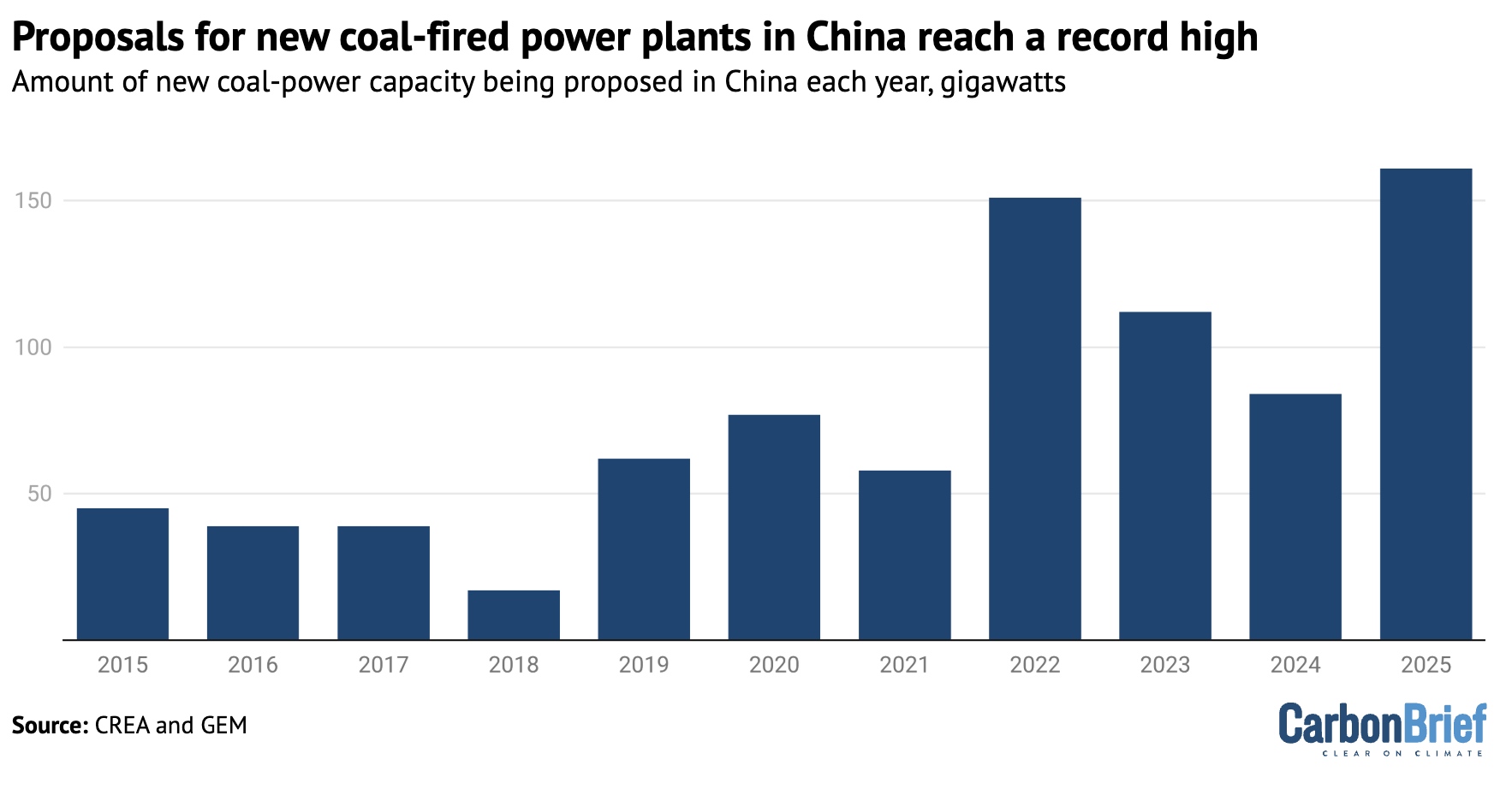 Amount of new coal-power capacity being proposed in China each year, GW, 2015-2025. Source: The Centre for Research on Energy and Clean Air and Global Energy Monitor.
The shift from new power demand being met by coal to being met by renewable energy means any "additional coal power capacity would face structurally low utilisation", the report says, referring to the number of hours that plants are able to operate each year.
This reduces coal-plant earnings needed to cover the cost of investment and makes instances of "stranded [coal] assets and compensation pressures" more likely.
A previous analysis for Carbon Brief finds that "larger additions of coal capacity are often followed by falling utilisation" - meaning that the construction of new coal plants does not necessarily increase emissions.
Utilisation rates for coal-fired power plants have hovered around 51% since 2025, according to the CREA and GEM report.
Shearer argues that while low utilisation rates would "dampen the immediate impact on annual CO2 emissions", in the long-term the buildout "locks capital into fossil fuels" and "weakens incentives to build the cleaner forms of flexibility" needed for a renewables-centred system.
Low utilisation has also not led to coal plant capacity being retired in any notable way, the report notes, with generators instead supported by the coal "capacity payment" mechanism and extending the life of older units.
Delayed retirement of older coal plants causes "persistent overcapacity" and adds to calls for further compensation and policy support, the report says.
Coal generation has "no room to expand" under China's international climate pledge for 2030, it adds, with utilisation rates for coal units likely to fall to 42% if renewables continue to meet all additional demand and if all of the plants currently under construction or permitted are brought online.
Crunch-time for coalThe surge in new proposals reflects a "rush" by the coal industry to ensure their projects are approved before the policy environment tightens, according to the report.
China is expected to introduce absolute emissions targets over the next five years. While these are expected to be aspirational for the first five years - alongside binding targets for carbon intensity, the emissions per unit of GDP - from 2030 they will be binding.
The current five-year period until 2030 will also likely see most of China's energy-intensive industries pulled into the scope of its national carbon market.
In the power sector, government officials have said that coal is expected to shift from playing a major role in power supply to supporting "flexibility" operations.
This would require coal plants to shift between varying load levels and respond quickly to changes in demand and other system needs.
However, the report finds, the approvals for coal power "continue to reflect expectations of high operating hours", instead of flexible operations.
For many of these proposals, planned annual utilisation was stated to be more than 4,800 hours, or 55% of hours in the year. This is greater than the 4,685 utilisation hours (53%) logged in 2023, the year in which the most coal power was generated over the past decade, according to data shared by the report authors with Carbon Brief.
In addition, the report says that many of the new coal-power proposals in 2025 were for "large-scale units", each representing at least 1GW of power, as shown in the figure below.
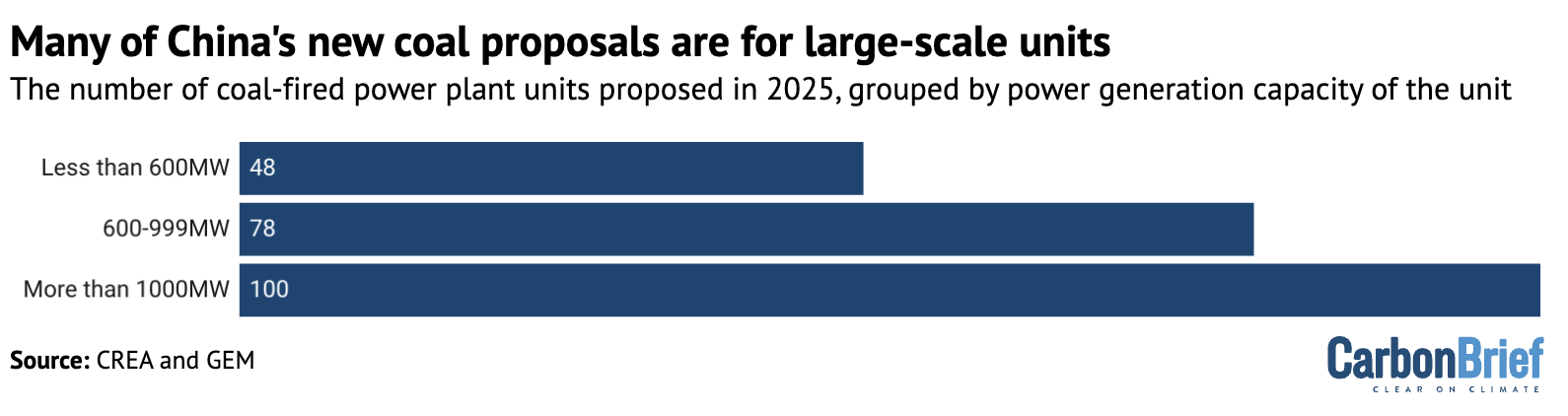 Number of coal-fired power units newly proposed in 2025, grouped by power generation capacity of the unit. Source: the Centre for Research on Energy and Clean Air and Global Energy Monitor.
These larger units are designed for "stable, continuous operation" and are "poorly suited to the type of flexibility increasingly required in a power system dominated by wind and solar", says the report.
This suggests that "project developers still anticipated base-load style operation", it adds, "sitting uneasily" with the fact of higher clean-energy generation and falling coal plant utilisation.
Reliance on sales and subsidiesThis persistence in developing large-scale units could be explained by the financial incentives that govern the coal-power industry.
Coal power plants are cheap to build but risk low profits and high costs, with many current operators already facing losses at recent utilisation rates.
In 2024, the government established a capacity payment mechanism for coal-fired power plants. This mechanism rewards developers for adding "seldom-utilised, backup" capacity to the grid.
These capacity payments, as well as regulated pricing and implicit government backing "can make plants viable on paper even if utilisation and operating margins are weak", Shearer tells Carbon Brief, which may explain the continued appetite for new coal from developers.
More than 100bn yuan ($14bn) in capacity payments were made to coal plants in 2024, although it has not yet had a discernable impact on utilisation.
Large-scale units, the report says, are "particularly well positioned" to benefit from the policy, as it rewards maximising capacity and does not favour plants that are more suited for flexible operations.
(The Chinese government recently announced plans to adjust the mechanism, confirming that in some cases capacity payments could be more than the initial expected threshold of 50% of a benchmark coal plant's total fixed costs.)
Meanwhile, the report adds that coal-fired power plants continue to earn most of their revenue from selling electricity, with only 5% of total income coming from capacity payments.
As such, these "misaligned incentives" encourage producing power and installing significant new capacity, despite the government's aim to shift coal to a supporting role in the system.
Shearer tells Carbon Brief that a better approach to flexibility would be to "adopt technology-neutral flexibility standards", rather than focusing on "flexible coal", which would mean coal would have to "compete directly with storage, demand response, grid upgrades and other clean options". She adds:
"The risk of coal-specific flexibility policies is that they lock in capacity rather than solve the underlying system need."

Explainer: Why gas plays a minimal role in China's climate strategy
China energy
|22.01.26

Experts: What to expect from China on energy and climate action in 2026
China energy
|16.01.26

Analysis: Coal power drops in China and India for first time in 52 years after clean-energy records
China energy
|13.01.26

Q&A: Five key climate questions for China's next 'five-year plan'
China energy
|11.12.25
jQuery(document).ready(function() { jQuery('.block-related-articles-slider-block_fb5bdaff8486d1ba6d1c153b163b15e1 .mh').matchHeight({ byRow: false }); });The post 'Rush' for new coal in China hits record high in 2025 as climate deadline looms appeared first on Carbon Brief.
Notepad++ hijacking blamed on Chinese Lotus Blossom crew behind Chrysalis backdoor [ 02-Feb-26 11:23pm ]Security researchers have attributed the Notepad++ update hijacking to a Chinese government-linked espionage crew called Lotus Blossom (aka Lotus Panda, Billbug), which abused weaknesses in the update infrastructure to gain a foothold in high-value targets by delivering a newly identified backdoor dubbed Chrysalis.…
Freddie Gibbs Hops Onto the Last Rabbit Tour [ 02-Feb-26 11:06pm ]
Epstein's "Nazi like" eugenicist horrors revealed in document release [ 02-Feb-26 11:03pm ]
Content warning - this article contains extremely upsetting content that details child rape and paedophilia
A journal — written by a girl who was 16 years old at the time of some entries — reveals the sheer depravity of Jeffrey Epstein and the ruling class he lurked within.
The girl was subjected to horrifying sexual abuse and despairs at being Epstein's "property", and "incubator" for the now-deceased financier's children. One deeply disturbing account reveals the loss of a child, likely due to incessant abuse by Epstein and his associates:
So sorry Jeffrey these things happen when your body had never been given time to properly heal!
So it came out in the toilet and I didn't know what to do so I just flushed the tiny little foetus.
You have made me numb and I hate you for this!
I hope I never have to see you again!
I am not your personal incubator!
Another equally troubling passage seemingly describes a traumatic childbirth performed by an 'Israeli' doctor:
Close your eyes close your eyes close your eyes. Don't speak she doesn't talk.
I cant stop shaking and its been a week.
A decision was made but I cant tell Jeffrey.
These things happen. Why didn't I close my eyes fast enough.
The doctor was different again.
I think from Israel. He had kind eyes but didn't speak directly to me.
This was different.
A shot and those rod like things had a hook and so much pain.
Ghislaine [Maxwell] said to push all the pain away. I don't understand.
Blood and water all over the bed and she was right.
Like a feeling when your tummy hurts and you have to push.
She said to close my eyes and put her hands over my eyes but I didn't close them because of these tiny cries.
I am so lost.
I saw between her fingers this tiny head and body in the doctors hands.
It reached its tiny arm up and had a tiny foot.
I closed my eyes and no more…
In a later entry, she fears something terrible has happened to the child:
'Master race' insanity of vile paedophileIn the hall Ghislaine said she was beautiful.
SHE WAS.
Not is.
She was a beautiful girl!
I heard her.
Where is she?
Why did she stop whimpering?
She was born!
I heard the tiny cries!
I cant do this anymore!
The pregnancy appears to be part of a deranged eugenicist plan by Epstein to create as many "perfect offspring" as possible. She writes:
Superior gene pool? Why me? It makes no sense.
Why my hair colour and eye colour?
That feels very Nazi like but in thinking about these stupid insane theories he has I guess in mind it makes sense.
This revolting fantasy is consistent with previous reporting on Epstein. The child abuser — who liked to wear an 'Israeli' Occupation Forces sweatshirt — was determined to develop a "super-race" by "impregnating 20 women at a time". The New York Times reported in 2019 that:
Epstein told scientists and businessmen about his ambitions to use his New Mexico ranch as a base where women would be inseminated with his sperm and would give birth to his babies … Mr Epstein's goal was to have 20 women at a time impregnated at his 33,000-sq-ft Zorro Ranch in a tiny town outside Santa Fe.
This is the most sinister form of a growing interest in pronatalism among the US ruling class. Fellow "Nazi like" sieg-heiler Elon Musk has fathered 12 children, and advocates for measures to increase the birth rate. The founder of messaging app Telegram Pavel Durov has made:
…a sperm donation…to a fertility clinic [which has] resulted in children conceived in 12 countries by more than 100 couples.
Overseas, authoritarians Nigel Farage and Viktor Orban have talked up policies for ensuring greater levels of childbearing. Given their racist ideologies, one suspects they imagine these children all having a similar skin colour to their own.
Rogues' gallery of ruling class sickosThis all amounts to the strange delusions brought on by excessive power — a belief that you're a superior form of life, when you in fact represent the absolute dregs of humanity. A notion that the world needs more of you, when we can all see the defective specimen before us is already one too many.
Other entries from the journal of the child abused by Epstein reveal the alleged participation in her suffering of countless other ruling class ghouls. Among those named are:
Mr. Leonsis, Mr. Case, Mr. Snyder, the Gregorys, Mr. Colgan…Mr. Kimsey [and] George Mitchell
There are suggestions that the above refer to Jim Kimsey, Ted Leonsis, and Steve Case, AOL executives at the likely time of the journal's creation. George Mitchell is the former Democratic senator, perhaps best known for his role as chair of the North of Ireland peace negotiations. He is described as someone:
…who you think would be good like a grandpa [but is] bad.
The writer also names lead Epstein funder Leon Black. She accuses the financier of throwing her to the floor and says "the fat fuck bit me", leaving blood on Epstein's carpet.
Capitalism ensures the Epsteins of the world rise to the topAll this is ultimately the product of an economic and political system that practically guarantees the most poisonous humans imaginable rise to the top. Capitalism rewards the most ruthless and domineering among us, not the kindest and most compassionate.
Those attracted to being a CEO — with the ability to control potentially thousands of lives — are unlikely to be good people. Once there, wealth grants them the ability to evade the law and control the political realm. With greater power comes greater impunity, and an already degraded soul rots still further. It's a system that selects for, then refines, the worst traits of our species.
The Epstein documents have produced an outpouring of fury, and an increasing clarity to the realisation that an entire system needs to be dismantled and reconstructed into something less misanthropic. We've had enough warnings by now of "Nazi like" reprobates controlling our lives. An imminent return to something akin to Nazism looms unless an alternative course is pursued urgently.
Featured image via ABC
Toxins beneath the rubble of Gaza: electronic waste is a silent bomb threatening people's lives [ 02-Feb-26 10:17pm ]
The rubble of war in the Gaza Strip is no longer a silent witness to destruction. It has become a layer of contamination storing slow-acting toxins.
Among the debris, the remains of homes, hospitals, and schools are mixed with thousands of tonnes of broken electronic devices. This has created what can be described as electronic rubble — a long-term environmental and health hazard. These toxins seep silently into soil, water, and human bodies in one of the most densely populated and besieged places on Earth.
In Gaza, the war has not only caused physical destruction. It has also left behind a new type of waste that the Strip was never equipped to handle. Mobile phones, computers, household appliances, medical equipment, and network cables have been turned into dense electronic waste by bombing. This waste cannot be easily separated from building rubble or safely disposed of.
The suffocating siege and the near-total collapse of Gaza's waste-management system make the problem even worse.
Gaza figures spell environmental disasterThe United Nations Development Programme estimates that between October 2023 and the end of November 2025, around 900,000 tonnes of solid waste were generated in Gaza. Most of this waste was dumped in temporary sites after the collapse of collection and treatment systems.
Daily waste generation has risen to between 3,300 and 3,850 cubic metres, compared with about 1,300 cubic metres per day before the war. Electronic waste is estimated to make up 10-15% of the total. That equals 90,000 to 135,000 tonnes of toxic devices, metals, and chemicals.
This is equivalent to thousands of buses filled with highly hazardous waste.
An invisible danger — and an indelible impactAccording to World Health Organization reports, electronic waste is the fastest-growing form of solid waste worldwide. Less than a quarter of it is recycled. While e-waste contains valuable materials, improper handling poses a serious threat to public health and the environment. This risk is amplified in fragile settings that lack infrastructure and oversight.
The danger lies not only in volume, but in composition.
Burning, landfilling, or unsafe dismantling releases toxic substances such as lead, mercury, and dioxins. These seep into air, soil, and groundwater, enter the food chain, and ultimately reach humans. The WHO warns that children and pregnant women are most vulnerable. Exposure can cause premature birth, neurological damage, and chronic respiratory and immune diseases that may last a lifetime.
Scientific warnings from inside GazaEnvironmental experts in Gaza warn that electronic waste is among the most dangerous threats facing Palestinian society today. It contains electronic chips, heavy metals, and toxic chemicals that persist in the environment for decades.
These materials gradually penetrate soil, contaminate groundwater, and reach people through food and air.
Experts stress that burning or burying electronic waste with ordinary rubbish releases toxic fumes. These gases damage skin and lungs and worsen asthma and heart disease. The risk is intensified because landfills are often close to homes and displacement camps.
Pollution does not stop at the surface. It spreads into groundwater and farmland, threatening food security and public health in the medium and long term.
Unprotected workers — and a crisis without toolsSanitation workers and waste collectors face even greater danger.
They handle hazardous materials without adequate protective equipment, while the sector suffers severe shortages of resources and capacity. Experts agree that the long-standing blockade, combined with widespread wartime destruction, has paralysed Gaza's ability to manage complex waste safely.
A silent bomb waiting to explodeEnvironmental specialists say urgent action is needed. This includes separating e-waste from debris, safely treating toxic materials, providing protective gear for workers, and launching public awareness campaigns.
Without intervention, electronic waste will remain a silent bomb beneath Gaza's rubble.
It threatens present health, future ecosystems, and adds another layer of suffering to lives already exhausted by siege and war — with consequences that may last decades after the bombing ends.
Featured image via UNRWA
By Alaa Shamali
Europe EV Sales — Record Month! [ 02-Feb-26 11:14pm ]BEVs reach 28% market share! EVs had another strong month in Europe, with a record 453,000 plugin vehicles being registered in Europe in December, blasting through the previous record set three years before, 412,000 units. Of those 453,000 units registered in December, 327,000 of them were BEVs, with pure electrics ... [continued]
The post Europe EV Sales — Record Month! appeared first on CleanTechnica.
Lynk & Co 08 Achieves Guinness World Record by Reaching 293 Kilometers in 100% Electric Mode [ 02-Feb-26 11:12pm ]With an unprecedented electric range in its segment, Lynk & Co's flagship SUV earns global certification for its leadership in engineering, efficiency, and plug-in hybrid technology Lynk & Co has set a new Guinness World Records™ title with the Lynk & Co 08, achieving 293 kilometres in fully electric driving ... [continued]
The post Lynk & Co 08 Achieves Guinness World Record by Reaching 293 Kilometers in 100% Electric Mode appeared first on CleanTechnica.
Trump Goes Zero for Five Against Offshore Wind [ 02-Feb-26 11:01pm ]Washington, D.C. — Today, the Trump administration lost yet another legal battle in the U.S. District Court for the District of Columbia. This is the fifth and final offshore wind project that has successfully challenged the administration's stop-work order. In December—three days before Christmas—Donald Trump's Department of the Interior halted ... [continued]
The post Trump Goes Zero for Five Against Offshore Wind appeared first on CleanTechnica.
Trackdaz Airfence Fundraiser Will Honor Lily Coyner, R.I.P. [ 02-Feb-26 10:50pm ]Lily Coyner, wife of TrackDaz owner Dustin Coyner, tragically died suddenly on the morning of January 10, 2026. This tragedy has not only rocked the entire world of Dustin, but also the motorbike community. Lily has been a fixture in the paddock for over 25 years. She's the one who greeted TrackDaz riders in the morning at registration. She listened to whatever complaints or comments riders had, sold merch, rented Yamaha generators. She also was the one calling loved ones using the emergency contact info when something happened. She loved all TrackDaz riders, and wanted to help keep us all safe.
Since TrackDaz already had an event scheduled that weekend, we're working with Buttonwillow Raceway Park (BRP) and the Roadracing World Action Fund (RWAF) to raise money in her honor for more Airfence at the track. BRP will be donating all gate fees and likely offer other things for raffles. We'll do raffles and other things as well.
We ask for the community to come together and show strong support for this lovely woman who cared so much in spite of not riding herself.
February 14-15 Buttonwillow Circuit Registration:
http://www.trackrabbit.com/s/2mon
The post Trackdaz Airfence Fundraiser Will Honor Lily Coyner, R.I.P. appeared first on Roadracing World Magazine | Motorcycle Riding, Racing & Tech News.
Moltbook, the AI social network, exposed human credentials due to vibe-coded security flaw [ 02-Feb-26 11:03pm ]Moltbook bills itself as a social network for AI agents. That's a wacky enough concept in the first place, but the site apparently exposed the credentials for thousands of its human users. The flaw was discovered by cybersecurity firm Wiz, and its team assisted Moltbook with addressing the vulnerability.
The issue appears to be the result of the entire Reddit-style forum being vibe-coded; Moltbook's human founder posted a few days ago on X that he "didn't write one line of code" for the platform and instead directed an AI assistant to create the whole setup.
According to the blog post from Wiz analyzing the issue, Moltbook had a vulnerability that allowed for "1.5 million API authentication tokens, 35,000 email addresses and private messages between agents" to be fully read and accessed. Wiz also found that the vulnerability could let unauthenticated human users edit live Moltbook posts. In other words, there is no way to verify whether a Moltbook post was authored by an AI agent or a human user posing as one. "The revolutionary AI social network was largely humans operating fleets of bots," the company's analysis concluded.
So ends another cautionary tale reminding us that just because AI can do a task doesn't mean it'll do it correctly.
This article originally appeared on Engadget at https://www.engadget.com/ai/moltbook-the-ai-social-network-exposed-human-credentials-due-to-vibe-coded-security-flaw-230324567.html?src=rss
Feds Skipping Infosec Industry's Biggest Conference This Year [ 02-Feb-26 11:05pm ]
ICE, CBP Brag About Stealing A Legally-Impossible $14,000 From US Citizens At The Minneapolis Airport [ 02-Feb-26 9:39pm ]Let's just clear the air right up front: this is just the government mugging Somalis because they're currently at the top of Trump's shitlist. Prior to last month's escalation (and subsequent murder) because some white MAGA shitbird became famous for supposedly uncovering a whole lot of Somali-based fraud in Minneapolis, Minnesota, it's possible ICE would have bragged about robbing money from people at an international airport.
But because this other thing (the MAGA dude) happened first — and because Minneapolis residents have proven incredibly resilient in the face of vengeful federal operations — ICE had to get out its X bullhorn and yell about taking money from people the MAGA faithful have been encouraged to hate by their dimwitted handler, Donald Trump. (For a bit of catharsis, here's a wonderful recording of the so-called "MAGA influencer" Jake Lang being welcomed to Minneapolis by counter-protesters while he tried to get his anti-migrant hate on. It seems this mook forgot protesters burned a police station to the ground following the murder of George Floyd by Minneapolis police officer Derek Chauvin.)
This X post comes to us via Dom Ervolina on Bluesky. But since that post can't be seen by people who aren't logged in, I'm going to screenshot the X post in all of its ingloriousness, because we certainly aren't going to be linking to and/or embedding a post from that particular den of depravity that's overseen by a landlord who can't seem to decide whether he should be an absentee landlord or a cheerleader for his CSAM-creating, Hitler proxy AI, Grok.
Here goes nothing:

It's an official post by the X ICE account. Although ICE wasn't directly involved with this airport robbery, it was first in line to celebrate it. Here's what it says:
UNDECLARED CASH SEIZED AT MSP
On January 18, HSI St. Paul and @CBP seized $14,135 from two Somali-born U.S. citizens who were departing on international flights from MSP.
ICE and CBP remain vigilant in detecting and preventing the illegal movement of funds across borders to protect national security.
It's accompanied by a photo of the alleged $14,135 scattered across a Formica table apparently located adjacent to (and somewhat blocking) an airport walkway.
Note that it says $14,135. $14,000 should have been enough. But the bottom right corner of the photo makes it clear federal officers weren't satisfied until they'd rifled through these people's wallets.

Yep, that's $35 dollars, splayed across the table like it's the focal point of a video produced by the least-successful SoundCloud rap artist ever.
Also, note the way this phrase is… um, phrased:
"…from two Somali-born U.S. citizens…"
You see what the government led with, right? They expect everyone who's going to cheer whatever they do to stop reading after the "i" in "Somali" (or maybe the "n" in "-born" at best). And they expect everyone to ignore the words that follow that: "U.S. citizens."
The rabble will get roused because it has something to do (however adjacently) with the people Trump hates and who will do all they can to stoke that hatred, even if that means the occasional bout of hypothermia. (See above link about Maga dudebro getting railed by the locals.)
Ignore the rest of the racist dogwhistling and you get nothing more than ICE celebrating the fact that the CBP stole $14,135 from US citizens.
But that's not even the stupidest part of ICE masturbating on main. The rules for taking money out of the country are pretty simple: you must declare any amount over $10,000 to Customs. There were two people and $14,000 involved here. Even the laziest of elementary school students should be able to spot the problem here.
No matter how you slice it up, CBP cannot use a customs violation to justify the seizure of $14,000 from two people. If one person was over the limit, the other person was carrying an amount of cash that didn't need to be declared. If both were carrying half, neither of them were violating the law.
And since the government has yet to give us more details on this, we're left to assume the government grabbed $14,000 from two US citizens just because it thinks it can get away with it.
Now, it's entirely possible the government will claim the two people were working together to smuggle more than $10,000 out of the country. But if it does, it should be directly and persistently challenged by the court that takes this case. If that doesn't happen, the government will be able to steal any amount of cash from any number of passengers boarding the same plane if that total manages to clear the $10,000 mark.
And it will also assume it can free-associate connections between people boarding different flights carrying cash by pretending these unconnected people are engaged in a conspiracy to violate a customs law that seemingly only exists to allow the government to pick people's pockets (figuratively but also LITERALLY) at our nation's airports.
On top of that, there are the activities of other federal agencies like the DEA and ATF, who pretend any mildly significant amount of cash in travelers' luggage must be the end result of illegal activity. And this is so fucking maddening because it has NEVER been illegal to carry cash from place to place, much less try to leave the country with an (undeclared) stack of greenbacks (under $10,000) that tend to produce better results in vacation destinations and ancestral homelands whose currency isn't worth as much as the US dollar.
There's no shaming the government into behaving better — not when it's headed by some of the most shameless government officials ever to hold executive branch offices. But, for the time being, you can possibly sue them into submission. And that's what needs to happen now. The government is engaging in racism and mouthing empty phrases about "national security" to justify its abusive xenophobia. Sure, this sort of thing predates Trump. But it doesn't mean we should consider it acceptable just because it's been SOP for most of this century.

After nearly two decades of intermittent negotiations that began in 2007, India and the European Union have concluded a landmark Free Trade Agreement (FTA). But potential 'reform' of tariffs is angering many of the left of Indian politics. Indian Prime Minister Narendra Modi and European Commission President Ursula von der Leyen, both announced the deal enthusiastically, with Modi saying:
Today is a day that will be remembered forever, marked indelibly in our shared history.
Von der Leyen framed the agreement as a historic achievement, stating in a pinned tweet:
The EU-India dealEurope and India are making history today. We have concluded the mother of all deals.
The EU-India Free Trade Agreement commits both sides to sweeping tariff elimination, covering over 96% of India's tariff lines and 99% of the EU's — with the goal of expanding bilateral trade, which reached €120bn in 2024.
A key selling point to Europe, as outlined by the European Commission, is that the deal:
will help EU companies and farmers export more. Separately, the Commission underscored a specific gain for EU agriculture through a parallel pact on Geographical Indications (GIs), which aims to protect traditional EU products in the Indian market 'by removing unfair competition in the form of imitations'.
Through the timing of the conclusion of the agreement, India and the EU are unmistakably sending a message to Washington. Its allies and partners will not give in to threats of tariff wars and weaponising trade, according to the geopolitical magazine The Diplomat.
The Diplomat further states there are some roadblocks before the operationalisation of the deal:
India's left condemns Modi's neoliberal dealThe EU-Mercosur agreement, concluded after 25 years of negotiations, just days before the India-EU FTA, is now facing opposition from the European Parliament. Unlike the Mercosur agreement, the India-EU FTA does not require approval by each of the 27 national member states, which could potentially speed up the operationalization of the agreement, but it would still need Parliamentary approval.
However, the core disputes that caused the breakdown of negotiations in 2013, under the then-ruling Congress party, have not been meaningfully resolved in the current pact. They have simply been papered over.
A key failure cited by the current opposition Congress is the Modi government's inability to secure an exemption for India's aluminium and steel sectors from the European Union's Carbon Border Adjustment Mechanism. Jairam Ramesh, the Indian National Congress's general secretary in-charge of communications, emphasised the material consequence of this on social media:
India's aluminium and steel exports to the EU have already fallen from $7bn to $5bn and are only expected to fall further beginning this year due to the enforcement of the CBAM since 1 January, 2026.
The tweet from Ashok Swain, an Indian-origin academic based in Sweden, captures the tone of the Indian left's opposition to the EU-India trade deal:
Pros and cons of tariffsThanks to the trade deal between EU and India, German cars and French wines will be cheaper in India - exactly what 800 million Indians surviving on subsidised food have been demanding.
Swain's criticism mirrors the opposition from domestic left-leaning factions like the Communist Party of India (Marxist), which has argued that tariff cuts on luxury goods will only benefit the wealthy, while threatening the livelihoods of farmers, workers, and ordinary citizens.
The skepticism of the left stems from India's economic history.
As Tricontinental Research notes, millions in India still rely on agriculture for their livelihood. The institute notes that in the 1990s, aggressive cuts to agricultural tariffs triggered a prolonged agrarian crisis. While farming now makes up just 18 percent of India's GDP, it still employs 46 percent of the national workforce. In contrast, the service sector accounts for over half of the economy but only 30 percent of jobs.
The Samyukt Kisan Morcha, a coalition of over 500 Indian farmers' unions, warns cheap, subsidised EU processed foods and wines will crash domestic prices and devastate small farmers. It condemns the "double standard" where complex EU barriers block Indian farm exports, while India lowers its own import standards.
Furthermore, left-wing critics warn the FTA's facilitation of European weapons procurement from India risks empowering crony capitalists and derailing the country's traditional nuclear policy, with the Diaspora in Action group and the Communist Party of India (Marxist) asserting it represents an "absence of guardrails" for peace and stability.
Featured image via the Canary
By The Canary

A clip has emerged on social media of Reform leader Nigel Farage proudly explaining that his party has put forward a Muslim candidate for the London mayoral election in order to court the Muslim vote.
In the video, Farage — apparently answering an interviewer's question — states that:
We've got a Muslim woman who's gonna stand for us for the mayor of London contest against Sadiq Khan. So no, there are plenty of members of the Muslim community who will vote for Reform, support Reform. The difference here of course is that, for many many years, the Muslim vote was viewed by Labour as being a bloc vote. They turned out and voted for Labour in their droves. That has changed a lot.
The hypocrisy on display is quite breathtaking, even for Farage. 'We've got a Muslim woman, so of course Muslims will vote for us — also, Labour made the mistake of thinking Muslims all vote together'.
It sounds an awful lot like the Reform leader is fine with playing identity politics when it suits him, doesn't it?
Unfortunately for him, Farage also mistakenly seems to think that UK Muslims are completely uninformed.
Reform — London 'feels like a Muslim city'You see, that Muslim woman that Reform have got would be Laila Cunningham, a UK-born Muslim of Egyptian descent. Cunningham formerly worked as a prosecutor for the Crown Prosecution Service before making the move into politics.
Like most Reformers, she's also a Tory washout. The Reform candidate was previously elected as a Westminster City Council member in 2022 for the Conservative Party. And, also like most Reformers, Cunningham also happens to have dabbled in Islamophobia.
In an interview on the Standard podcast, Cunningham argued that Muslims wearing the burqa should be stopped and searched by the police. As her reasoning, the newly-minted Reformer stated:
It has to be assumed that if you're hiding your face, you're hiding it for a criminal reason.
She also asserted that "there should be one civic culture, which "should be British", and went on to say:
If you go to parts of London, it does feel like a Muslim city. The signs are written in a different language. You've got burqas being sold in markets.
For her comments, Shaista Gohir — crossbench peer and CEO of the Muslim Women's Network UK — accused Cunningham of helping to endanger UK Muslims. Gohir said that the Reform candidate was:
Who else did we expect from Farage?sending a message to Muslims that they do not belong [and] emboldening people who already abuse Muslims and influencing those people who are reading this misinformation.
As such, Cunningham hardly seems like a shining light to sway London Muslims to vote for the far right. But, then again, who else would we expect as a choice from noted Islamophobe Nigel Farage, who once told Sky News that:
We have a growing number of young people in this country who do not subscribe to British values, [who] in fact loathe much of what we stand for.
When questioned on whether he was referring to Muslims, the Reform leader responded:
We are. … And I'm afraid I found some of the recent surveys saying that 46% of British Muslims support Hamas - support a terrorist organisation that is proscribed in this country.
This is a blatant misrepresentation of a study from the Henry Jackson Society — a neoconservative think tank. It asked whether British Muslims feel more sympathy with Hamas or Israel [p22].
Apparently British Muslims are just expected to forget Farage dog-whistling that they, as a whole, are terrorist sympathisers. Likewise, Reform clearly reckons that London Muslims are just waiting to vote for a woman who wants them accosted by police.
Reform chose Cunningham, as a minoritised woman, to lend an acceptable face to racist policies. Far from being the breath of fresh air in UK politics they pretend to be, Reform are pulling the same old establishment stunts.
See also: Priti Patel, Shabana Mahmood, Kemi Badenoch, Suella Braverman, etc etc etc.
Featured image via the Australian
By The Canary
Deutschlands Wasserstoff-Backbone ohne Kunden und ohne Lieferanten ist in dieser Reihe aus mehreren Blickwinkeln untersucht worden. Ausgangspunkt war die Pipeline von nirgendwo nach nirgendwo selbst und die Energie- und sonstigen Nachfrageflüsse, die sich nicht materialisieren werden. Darauf folgten die fehlgeleiteten deutschen Analysen, die zu ihr geführt haben, die Auswirkungen regulierter ... [continued]
The post Deutschlands Wasserstoffstrategie verzögerte die Elektrifizierung, indem sie die Arbeitskräfte in die falsche Richtung lenkte appeared first on CleanTechnica.
Several accounts on Chinese social media app Xiaohongshu (RedNote) have revealed images of the next generation of BYD "Flash Chargers" (aka "megawatt chargers"). According to the label on the plastic wrap surrounding the charge gun, the 1000V DC chargers offer up to 1200 kW of charging power, presumably for each ... [continued]
The post BYD's Turquois T-Shaped Second-Generation Flash Chargers Seen At Dealers Ahead Of Launch appeared first on CleanTechnica.
Ontario Power Generation (OPG) has asked the Ontario Energy Board to approve a sharp increase in regulated nuclear payment amounts, including a year over year jump of more than 40% in 2027. The weighted average regulated payment amount rises from about $78/MWh in 2026 to roughly $110/MWh in 2027, driven ... [continued]
The post Ontario's Nuclear Rate Shock Reveals a Deeper Affordability Problem appeared first on CleanTechnica.
Elon Musk's SpaceX has acquired his AI company, xAI [ 02-Feb-26 10:16pm ]Elon Musk's SpaceX has acquired xAI, the companies announced. The merger will "form the most ambitious, vertically-integrated innovation engine on (and off) Earth, with AI, rockets, space-based internet, direct-to-mobile device communications and the world's foremost real-time information and free speech platform," Musk wrote in an update.
The AI company that right now is best known for its CSAM-generating chatbot might seem like a strange fit for a rocket company. But SpaceX is key to Musk's latest scheme to build AI data centers in space. In his update, Musk wrote that "global electricity demand for AI simply cannot be met with terrestrial solutions" and that moving the resource-intensive operations to space is "the only logical solution." SpaceX just days ago filed an application with the FCC to create an "orbital data center" by launching a million new satellites.
This also isn't the first time Musk has acquired one of his own companies. He merged xAI and X last year.
Developing…
This article originally appeared on Engadget at https://www.engadget.com/ai/elon-musks-spacex-has-acquired-his-ai-company-xai-221617040.html?src=rss Ubisoft fires employee who publicly criticized its RTO plan [ 02-Feb-26 10:09pm ]Ubisoft continues to raise eyebrows around how it is treating employees as it attempts a business overhaul. David Michaud-Cromp, a level design team lead at Ubisoft Montreal, said last week that he was suspended for three days without pay after voicing opposition to the company's return to office mandate. Today, Michaud-Cromp posted on LinkedIn that he has been fired. "I was terminated by Ubisoft, effective immediately," he wrote. "This was not my decision."
A spokesperson for Ubisoft gave Kotaku the following statement regarding Michaud-Cromp's dismissal: "Sharing feedback or opinions respectfully does not lead to a dismissal. We have a clear Code of Conduct that outlines our shared expectations for working together safely and respectfully, which employees review and sign each year. When that is breached, our established procedures apply, including an escalation of measures depending on the nature, severity, and repetition of the breach." We've reached out to the company for additional confirmation and comment.
This is the latest in a sequence of bad press Ubisoft has faced regarding its workforce. Shortly after many employees at Ubisoft Halifax unionized, the parent company shut down the studio. In announcing the closure, Ubisoft said the move was part of a broader cost-cutting endeavor across its operations; it shut down a support studio and cut more jobs later in January, with even more layoffs proposed. Most recently, unions representing other Ubisoft workers called for a three-day strike in response to the "penny-pinching and worsening our working conditions" they alleged of the company's management.
All these issues could all be coincidental timing. But if so, they're coincidences that don't reflect favorably on Ubisoft.
This article originally appeared on Engadget at https://www.engadget.com/gaming/ubisoft-fires-employee-who-publicly-criticized-its-rto-plan-220913747.html?src=rss
Let them eat Pi: RAM shortage bumps Raspberry prices as much as $60 [ 02-Feb-26 10:26pm ]That slice of Pi is getting much more expensive. Everyone's favorite single-board computer, the Raspberry Pi, is jumping up in price again, with increases ranging from $10 to $60, depending on how much memory your board has.…
'Pretty Please, I Don't Want to Be a Magical Girl' Has the Juice [ 02-Feb-26 10:30pm ]
Elon Musk's SpaceX officially acquires Elon Musk's xAI, with plan to build data centers in space [ 02-Feb-26 10:21pm ]
MotoGP: The Sepang Test Kicks Off Tomorrow [ 02-Feb-26 10:01pm ]New items, fresh faces and a return to action - three days of Malaysian testing await. Here's the who, what, where, of what we have in store.
We're in the first racing month of 2026 and just a few weeks away from the opening Grand Prix, so it's time to go testing. Preparation is the name of the game and following the first shots of bikes hitting the track of the year in the Shakedown Test, it's now time for our first Official Test of the year at Petronas Sepang International Circuit where the full grid - minus two key names who are sidelined - will be out in force. The test runs from Tuesday to Thursday inclusive, from 10am local time (UTC +8) until 18:00.
LINE-UP: who's on track this week?
Every factory and team will have their full-time rider line-up… nearly. Unfornately, through injury, Fermin Aldeguer (BK8 Gresini Racing MotoGP) isn't present as he recovers from a broken leg, whilst 2024 World Champion Jorge Martin (Aprilia Racing) is also recovering from his two surgeries from December. He'll be present at the test but supporting from the box, replaced on track by test rider Lorenzo Savadori. As well as the official riders, there'll be two additional but very familiar names on-track too, with MotoGP Legend Andrea Dovizioso and Augusto Fernandez continuing to test for Yamaha and the Iwata marque's all-new V4.
 Aleix Espargaro (41) at Sepang. Photo courtesy Dorna
SHAKEDOWN RECAP: in case you missed it:
There was plenty of news from the Shakedown Test. Aleix Espargaro grabbed headlines with the fastest laptime for Honda - quicker than their best bike in Q2 at the 2025 Malaysian GP, and their fastest ever MotoGP lap at the venue. With their progress only continuing to impress, there's plenty of expectation for their season ahead - and their 2027 project and riders.
Meanwhile, Yamaha had also seemingly taken a good step forward with their development of the v-4 powered YZR-M1. At the end of the test, Fabio Quartararo (Monster Energy Yamaha MotoGP) was only half a second away from his Q2 time in 2025 - not bad for Yamaha's first-ever MotoGP V4.
Elsewhere, Toprak Razgatlioglu (Prima Pramac Yamaha MotoGP) was able to make considerable progress across the days. That said, it was Honda rookie Diogo Moreira (Pro Honda LCR) who took best rookie honours overall, the Brazilian pipping the Turkish day on Day 3.
MAJOR STORIES: Marc Marquez returns, race riders get in gear:
Having not been on a MotoGP bike since October, reigning World Champion Marc Marquez (Ducati Lenovo Team) will offer us our first look at him post-Indonesian GP injury. After a lengthy layoff, the opening day is likely to be more of a shakedown for him - but will we see him push as the test goes on? Teammate Pecco Bagnaia will also be one to watch as he looks to reset for 2026 after a tough season - can he come out swinging at a track where he holds the lap record?
Just like Ducati, it's time for Honda, Aprilia and KTM to also get reunited with their race riders. Whereas Yamaha, in concessions Rank D, were able to field all theirs at the Shakedown, other factories had to wait for the official test - so now we can likely look forward to some more representative laptimes as they push more. Although Honda's top effort from Aleix Espargaro and the second quickest laptime, set by Pol Espargaro with Red Bull KTM Factory Racing, weren't exactly hanging around…
HOW TO FOLLOW: never miss a story:
MotoGP TimingPass keeps you updated with the three days of testing, along with updates from the track across social media. We'll have a midday round-up live from the paddock at Sepang with Louis Suddaby and Jack Appleyard every day, before After the Flag returns too, with both being joined by Elliott York on-site as well as studio analysis from MotoGP HQ with Kiko Giles. Add in reports, stories and interviews across all three days, you'll be up to speed with everything MotoGP. 2026 is GO! See you tomorrow for more from Sepang - you don't want to miss it as Monday was already a headline maker. Marco Bezzecchi is confirmed as staying with Aprilia in the first silly season domino to fall so far.
The post MotoGP: The Sepang Test Kicks Off Tomorrow appeared first on Roadracing World Magazine | Motorcycle Riding, Racing & Tech News.
Black Country, New Road to Tour North America [ 02-Feb-26 9:33pm ]
Intel welcomes memory apocalypse with Xeon workstation refresh [ 02-Feb-26 9:30pm ]Intel's workstation lineup is getting a much-needed refresh with the launch of its Xeon 600-series processors, boasting up to 86 cores and clocks topping 4.9 GHz. Chipzilla's timing couldn't be worse.…
Major California Union Calls for Waymo to Be Kicked Off the Streets [ 02-Feb-26 9:55pm ] NASA Picked the Stupidest Possible Week to Go Back to the Moon [ 02-Feb-26 9:45pm ]
China is leading the fight against hidden car door handles [ 02-Feb-26 9:55pm ]
Up Middle Finger [ 02-Feb-26 8:16pm ]
This lot had a Top 10 hit with a song that is basically about an intra-scene war - the nu garage rappists (Oxide + Neutrino, So Solid) versus the old guard. Represented here by the sour faced, jowly, paunching-out a bit deejays who get their comeuppance thanks to a G-Force rippling blast of noise.
Portion of the lyric
The garage scene well it's really fucked up
Certain guys can't, won't keep their mouths shut
All they do is talk about we
Something about we're novelty cheesy
Smelling your top lip stop the jealousy
What, 'cos we didn't start from 1983
Oh, I was in my nappy
Did I mention we're only 18
Carnival '99 DJs put up a list telling other
DJs not to play this
But when I asked a certain DJ why
He gave me a shit of a reply
If I recall right, there was actually something - called maybe The Council - , that was formed or mooted to ensure that UKG was run correctly, in terms of media coverage, who got to represent the scene etc
An echo of the Committee (I believe that was the name) formed during jungle over the whole General Levy fracas...
Maybe the jungle era one was The Council, and the garage one was the Committee
Videos from this era of UKG (see also Truesteppers) have a cheap-and-nasty digi-quality (obviously age and wear have worsened it in this case, making it look really los-res - like an ancient 128kps mp3). Feels like it was clumsily processed to have a sub-Hype Williams gleam to it. Actually what it looks like is a Nathan Barley episode.
Mark Fisher thought "Up Middle Finger" was the spirit of punk reincarnated as UKG.
Here is a piece he wrote for Hyperdub when it was a website rather than a label, under the name Mark De'Rosario
Hyperpulp: It's All the Rage 2001
by Mark De'Rosario
Oxide and Neutrino's Up Middle Finger is as important for 01 as the Pistols' Anarchy in the UK was in 76. Like Anarchy, Up Middle Finger is both a call to arms and an darkly exuberant gesture of joyful defiance. Alongside Ms. Dynamite's Booo! (an instant classic, surely the biggest tune in the last year), Up Middle Finger demonstrates that UK garage's efforts to ethnically cleanse the genre of all impure' elements has failed, big style. Everything exiled from the snooty, purocentric higher echelons of UK garage - jump-up ragga-chat, abstract numanoid electronix, frenzy-inducing MCing, deep darkcore bass, film samples, kiddiecore refrains - has returned to terminate its former masters. With extreme prejudice.
Up Middle Finger captures a mood, a growing undercurrent of rage in the country about the discrepancy between the sunny vistas projected by managerialist PRopoganda and the webs of corrruption and incompetence that are lived everyday reality. Neutrino's fury will resonate with anyone who has the misfortune to have tangled with Style London's sad coterie of promoters, PR zombies and A and R people. But, more generally, his invective also speaks to and for anyone who has been blocked and patronized by the complacency and arrogance of all the bullet-pointed, empty-headed drones who officiate in the blurry liar lair of Blair's Britain. Neutrino brings back an edge, an aggression, that has been lacking for too long in a British culture that has seemed to pride itself on its tolerance of mediocrity.
Whilst totally contemporary, Up Middle Finger (and the Execute album from which it hails) sound like a return to the vibe - if not exactly the sound - of jungle in its earliest, most fissile and molten phase, when the sonic contours of the new genre were first becoming audible.
Effectively, O and N have rejected everything 'progressive' that's happened since then - they have rescinded the supposedly inevitable maturation process which proceeds from bolted-together, frankenstein-monster cyborgianism towards the smooth and seamless surfaces of the painstakingly simulated organically 'pure' sound that has enjoyed dominance lately. Listening to O and N, you're reminded of the cargo-culting, skip-scavenging exuberance of Rufige Kru, Tango and Ratty, even the early Prodigy. You're taken back to that vertiginously exciting moment, or series of moments, when rave's synthetic hyper-energy was swept up into the sorcerous vortex of timestretched breakbeats and hyperdub bass.
Ms. Dynamite and O and N are being sold as 'garage', but as their interviews on this site show, they are themselves uneasy about the classification. The currents passing through them belong to ragga, rave and hip hop as much as to garage. Essentially, like early jungle, they are hyperpulp. Hyperpulp is a mode of hyperdub, but defined by a particular relation to mass culture; it is a cybernetic monster that feeds on pop culture and trans- [or de-] forms it into a blobby, seething multiplicity.
Hyperpulp culture finds its model not in the club scene, with its cult of the DJ, but the Jamaican soundclash, with its ruff and rugged indifference to smooth mixing, and the pivotal role it accords to the MC. Oxide and Neutrino - the DJ and MC team - re-effectuate this abstract machine. For those schooled in a white European post-romantic tradition, MCing sounds like something supplemtary to the 'primary text' of the music itself. But in hyperpulp, there is of course no primary text, only an intense multiplexed libidinal experience, which includes and is intensified by the MC's chatting on the mic. The MC's melting of dominant english into the lyrical flow of patois sloganeering functions as an excitation-heightener for those who want to get hyper.
Like NYC hip hop in its early days, Jamaican dancehall culture is fuelled by the antagonistic energy of competing crews. (It's no accident, of course, that Oxide and Neutrino are part of the So Solid posse.) Whilst the intense competition between collective groups is sometimes transected by hard war gangsta/ yardie territorialized violence, it is essentially a soft war - a gift exchange in which no-one loses, and the pressure to outdo the other crew produces a spiralling intensity of experience for da massive.
Da massive is crucial in all hyperdub genres, but it is especially important in hyperpulp, which feeds on and amplifies hype-waves. Witness Oxide and Neutrino's sampling of 100,000 Scottish ravers on Up Middle Finger. The sheer size of the collective body is used as an audio-weapon targeted against the closed-system entropy of scenes which pride themselves on their disdain for popularity, as much as it is directed against the dismal tastefulness of overground popculture. O and D's use of samples of the Casualty TV theme and of dialogue Lock, Stock... are acts of audio-abduction or sonic viracy, in which existing mass cultural associations are radically deterritorialized and minoritized; the certainties of spectacular culture are de-faced, contaminated with traces of rogue semiotic virus.
Where pop tends to interpellate the lone consumer, the solitary spectator, hyperpulp dissloves private subjectivity in the oceanic bassdrome of collective delirium. In overground capitalist popular culture, maturity is signalled by the move from impersonal collective pulp-out into privatized, facialized emotion. Goldie's career offers an exemplary map of this dreary trajectory. Beginning with Rufige Kru and Metalheadz, in which he anonymized/ pseudononymized himself into the collective while simulating the synthetic POV of the terminator and the replicant, he ends up sold as a 'solo' artist, hangs around with saddoes like Noel Gallagher, and devotes much of his last album to baring his soul.
Soul and soulfulness are of course crucial terms for the anti-pulp purists. It's worth remembering here Foucault's remarks in Discipline and Punish on the production of the modern soul. The soul, Foucault tells us, does not precede modernity's disciplinary institutions: it is precisely constructed by schools, prisons, and factories, all of which act to extract an individual subject from the dangerous, teeming multiplicity of 'compact masses.' Baudrillard's arguments in Symbolic Exchange and Death take Foucault's position further. According to Baudrillard, the arrival of the immortal soul marks the imperialistic triumph of monotheism over primitive cultures, which transforms its swarming pantheon of warring entities into 'demons.'
The tyrannical domination of Dance's SS - the Style and Soul gestapo - has kept the demons out, but they are everywhere in hyperpulp. (Even Goldie, never fully seduced by the soul paradigm, was still invoking Demons on Saturnz Return.) Hyperpulp trades in sonic fiction, and as such feeds upon pulp modes effectuated in other media, especially Horror and SF video. Video samples, once so conspicuous in jungle and speed garage, have been noticably absent in the re-musicalised, soul-dominated phase of garage.
Over the years, there has been a remarkable consistency in the sonic textures of the various reactive, boracratic genres Style London has tried to foist on the rest of us. From rare groove through to acid jazz, from 'intelligent' drum and bass through to soulful garage, the same sonic traits are always evident : there's a preference for melody over rhythm, for 'real' instrumentation over the synthetic and the samploid, for personalised emotion over dehumanised abstraction. Naturally, these are reinforced by snooty social codes based on snobbery and exclusivity, which are diseminated by the scene's lapdogs in the depressingly hedonistic dance music media and in the style press - all of whom are dissed, hilariously, by Neutrino on Up Middle Finger.
The so-called garage wars are nothing new, and in fact date back at least as far as the emergence of jungle. Jungle, don't forget, was so named as an insult. Devotees of the original US garage sound - that finessed-to-the-point-of-body-numbing-tedium 'lush' production identified most closely with that high priest of sonic bureaucrats, David Morales - decried the use of breakbeats, essentially for exactly the same reasons that Style London's current hipoisie are cussing Oxide and Neutrino - lack of purity.
Purity is no more real in music than in ethnicity, and no more desirable. It is only ever a retrospective simulation, something hallucinated after the fact by a group of control freaks resentfully anxious about its fading status. Inevitably, purity has no positive features of its own, but is defined negatively, by what it excludes. What purocrats hate about hyperpulp is its ruffness, its refusal to close down into a well-formed aesthetic object. But this is precisely what is exciting about hyperpulp - its dubtractive removal of all that we thought we knew about identity, genre, about where sonicultures had come from and where they are going. Subtract identity, contaminate 'purity', and potential is produced. Now that Soul and Style are losing their grip on garage, something new can be heard emerging.
Hyperpulp has come back to corrupt its illegitimate offspring. Celebrate its return.
^^^^^^^^^^^^^^^^^^^
Up Middle Finger Written by Oxide/Neutrino
(Up middle finger I show dem)
Didn't wanna back we
Now they beg friend
Up middle finger I show them
Back in the day, they didn't wanna know
They wanna dis bound 4 da reload
They wanna talk to Neutrino, no no no
They wanna dis so solid so, no no no
Didn't wanna back we
Now they beg friend
Up middle finger I show them
Back in the day, they didn't wanna know
They wanna dis bound 4 da reload
They wanna talk to Oxide no, no no no
They wanna dis so solid so, no no no
The garage scene well it's really fucked up
Certain guys can't, won't keep their mouths shut
All they do is talk about we
Something about we're novelty cheesy
Smelling your top lip stop the jealousy
What, 'cos we didn't start from 1983
Oh, I was in my nappy
Did I mention we're only 18
Carnival '99 DJs put up a list telling other
DJs not to play this
But when I asked a certain DJ why
He gave me a shit of a reply
Later a bitch said to me
We'll never make it with Casualty
Ha ha ha, he he he
Now the silly bitch wants to try and hire we
Didn't wanna back we
Now they beg friend
Up middle finger I show them
Back in the day, they didn't wanna know
They wanna dis bound 4 da reload
They wanna talk to Neutrino, no no no
They wanna dis so solid so, no no no
Didn't wanna back we
Now they beg friend
Up middle finger I show them
Back in the day, they didn't wanna know
They wanna dis bound 4 da reload
They wanna talk to Oxide no, no no no
They wanna dis so solid so, no no no
Certain guys can't face the fact of
What we've done
Sold over a quarter of a million Casualty went
Straight into No 1
And they still wanna cuss come on
Oh yeah about the Casualty theme
Well no one controls the scene
So you do what you want
And you do what like
And you do what you please
Yeah, guys want to cuss our tunes, say it's shit
Think other people don't like it
But boy we don't care
And we got something for you
This is DJ Oxide playing in front of about a hundred thousand people
Listen to this
When I say you say we say they say make some noise
When I say you say we say they say make some noise
When I say you say we say they say make some noise
When I say you say we say they say make some noise
Didn't wanna back we
Now they beg friend
Up middle finger I show them
Back in the day, they didn't wanna know
They wanna dis bound 4 da reload
They wanna talk to Neutrino, no no no
They wanna dis so solid so, no no no
Didn't wanna back we
Now they beg friend
Up middle finger I show them
Back in the day, they didn't wanna know
They wanna dis bound 4 da reload
They wanna talk to Oxide no, no no no
They wanna dis so solid so, no no no
Finland To Introduce 'Green Wave' Automated System For Emergency Vehicles [ 02-Feb-26 9:50pm ]
Six Months Of 'AI CSAM Crisis' Headlines Were Based On Misleading Data [ 02-Feb-26 8:05pm ]Remember last summer when everyone was freaking out about the explosion of AI-generated child sexual abuse material? The New York Times ran a piece in July with the headline "A.I.-Generated Images of Child Sexual Abuse Are Flooding the Internet." NCMEC put out a blog post calling the numbers an "alarming increase" and a "wake-up call." The numbers were genuinely shocking: NCMEC reported receiving 485,000 AI-related CSAM reports in the first half of 2025, compared to just 67,000 for all of 2024.
That's a big increase! And it would obviously be super concerning if any AI company were finding and detecting so much AI-generated CSAM, especially as we keep hearing that the big AI models (perhaps with the exception of Grok…) have been putting in place safeguards against CSAM generation.
The source of most of those reports? Amazon, which had submitted a staggering 380,000 of them, even though most people don't tend to think of Amazon as much of an AI company. But, still, it became a six alarm fire about how much AI-generated CSAM Amazon had discovered. There were news stories about it, politicians demanding action, and the general sentiment was that this proved how big the problem was.
Except… it turns out that wasn't actually what was happening. At all.
Bloomberg just published a deep dive into what was actually going on with Amazon's reports, and the truth is very, very different from what everyone assumed. According to Bloomberg:
Amazon.com Inc. reported hundreds of thousands of pieces of content last year that it believed included child sexual abuse, which it found in data gathered to improve its artificial intelligence models. Though Amazon removed the content before training its models, child safety officials said the company has not provided information about its source, potentially hindering law enforcement from finding perpetrators and protecting victims.
Here's the kicker—and I cannot stress this enough—none of Amazon's reports involved AI-generated CSAM.
None of its reports submitted to NCMEC were of AI-generated material, the spokesperson added. Instead, the content was flagged by an automatic detection tool that compared it against a database of known child abuse material involving real victims, a process called "hashing." Approximately 99.97% of the reports resulted from scanning "non-proprietary training data," the spokesperson said.
What Amazon was actually reporting was known CSAM—images of real victims that already existed in databases—that their scanning tools detected in datasets being considered for AI training. They found it using traditional hash-matching detection tools, flagged it, and removed it before using the data. Which is… actually what you'd want a company to do?
But because it was found in the context of AI development, and because NCMEC's reporting form has exactly one checkbox that says "Generative AI" with no way to distinguish between "we found known CSAM in our training data pipeline" and "our AI model generated new CSAM," Amazon checked the box.
And thus, a massive misunderstanding was born.
Again, let's be clear and separate out a few things here: the fact that Amazon found CSAM (known or not) in its training data is bad. It is a troubling sign of how much CSAM is found in the various troves of data AI companies use for training. And maybe the focus should be on that. Also, the fact that they then reported it to NCMEC and removed it from their training data after discovering it with hash matching is… good. That's how things are supposed to work.
But the fact that the media (with NCMEC's help) turned this into "OMG AI generated CSAM is growing at a massive rate" is likely extremely misleading.
Riana Pfefferkorn at Stanford, who co-authored an important research report last year about the challenges of NCMEC's reporting system (which we wrote two separate posts about), wrote a letter to NCMEC that absolutely nails what went wrong here:
For half a year, "Massive Spike In AI-Generated CSAM" is the framing I've seen whenever news reports mention those H1 2025 numbers. Even the press release for a Senate bill about safeguarding AI models from being tainted with CSAM stated, "According to the National Center for Missing & Exploited Children, AI-generated material has proliferated at an alarming rate in the past year," citing the NYT article.
Now we find out from Bloomberg that zero of Amazon's reports involved AI-generated material; all 380,000 were hash hits to known CSAM. And we have Fallon [McNulty, executive director of the CyberTipline] confirming to Bloomberg that "with the exception of Amazon, the AI-related reports [NCMEC] received last year came in 'really, really small volumes.'"
That is an absolutely mindboggling misunderstanding for everyone — the general public, lawmakers, researchers like me, etc. — to labor under for so long. If Bloomberg hadn't dug into Amazon's numbers, it's not clear to me when, if ever, that misimpression would have been corrected.
She's not wrong. Nearly 80% of all "Generative AI" CyberTipline reports to NCMEC in the first half of 2025 involved no AI-generated CSAM at all. The actual volume of AI-generated CSAM being reported? Apparently "really, really small."
Now, to be (slightly?) fair to the NYT, they did run a minor correction a day after their original story noting that the 485,000 reports "comprised both A.I.-generated material and A.I. attempts to create material, not A.I.-generated material alone." But that correction still doesn't capture what actually happened. It wasn't "AI-generated material and attempts"—it was overwhelmingly "known CSAM detected during AI training data vetting." Those are very different things.
And it gets worse. Bloomberg reports that Amazon's scanning threshold was set so low that many of those reports may not have even been actual CSAM:
Amazon believes it over-reported these cases to NCMEC to avoid accidentally missing something. "We intentionally use an over-inclusive threshold for scanning, which yields a high percentage of false positives," the spokesperson added.
So we've got reports that aren't AI-generated CSAM, many of which may not even be CSAM at all. Very helpful.
The frustrating thing is that this kind of confusion wasn't just entirely predictable—it was predicted! When Pfefferkorn and her colleagues at Stanford published their report about NCMEC's CSAM reporting system they literally called out the potential confusion in the options of what to check and how platforms would likely over-report stuff in an abundance of caution, because the penalty (both criminally and in reputation) for missing anything is so dire.
Indeed, the form for submitting to the CyberTipline has one checkbox for "Generative AI" that, as Pfefferkorn notes in her letter, can mean wildly different things depending on who's checking it:
When the meaning of checking a single checkbox is so ambiguous that absent additional information, reports of known CSAM found in AI training data are facially indistinguishable from reports of new AI-generated material (or of text-only prompts seeking CSAM, or of attempts to upload known CSAM as part of a prompt, etc.), and that ambiguity leads to a months-long massive public misunderstanding about the scale of the AI-CSAM problem, then it is clear that the CyberTipline reporting form itself needs to change — not just how one particular ESP fills it out.
To its credit NCMEC did respond quickly to Pfefferkorn, and their response is… illuminating. They confirmed they're working on updating the reporting system, but also noted that Amazon's reports contained almost no useful information:
all those Amazon reports included minimal data, not even the file in question or the hash value, much less other contextual information about where or how Amazon detected the matching file
As Pfefferkorn put it, Amazon was basically giving NCMEC reports that said "we found something" with nothing else attached. NCMEC says they only learned about the false positives issue last week and are "very frustrated" by it.
Indeed, NCMEC's boss told Bloomberg:
"There's nothing then that can be done with those reports," she said. "Our team has been really clear with [Amazon] that those reports are inactionable."
There's plenty of blame to go around here. Amazon clearly should have been more transparent about what they were reporting and why. NCMEC's reporting form is outdated and creates ambiguity that led to a massive public misunderstanding. And the media (NYT included) ran with alarming numbers without asking obvious questions like "why is Amazon suddenly reporting 25x more than last year and no other AI company is even close?"
But, even worse, policymakers spent six months operating under the assumption that AI-generated CSAM was exploding at an unprecedented rate. Legislation was proposed. Resources were allocated. Public statements were made. All based on numbers that fundamentally misrepresented what was actually happening.
As Pfefferkorn notes:
Nobody benefits from being so egregiously misinformed. It isn't a basis for sound policymaking (or an accurate assessment of NCMEC's resource needs) if the true volume of AI-generated CSAM being reported is a mere fraction of what Congress and other regulators believe it is. It isn't good for Amazon if people mistakenly think the company's AI products are uniquely prone to generating CSAM compared with other options on the market (such as OpenAI, with its distant-second 75,000 reports during the same time period, per NYT). That impression also disserves users trying to pick safe, responsible AI tools to use; in actuality, per today's revelations about training data vetting, Amazon is indeed trying to safeguard its models against CSAM. I can certainly think of at least one other AI company that's been in the news a lot lately that seems to be acting far more carelessly.
None of this means that AI-generated CSAM isn't a real and serious problem. It absolutely is, and it needs to be addressed. But you can't effectively address a problem if your data about the scope of that problem is fundamentally wrong. And you especially can't do it when the "alarming spike" that everyone has been pointing to turns out to be something else entirely.
The silver lining here, as Pfefferkorn points out, is that the actual news is… kind of good? Amazon's AI models aren't CSAM-generating machines. The company was actually doing the responsible thing by vetting its training data. And the real volume of AI-generated CSAM reports is apparently much lower than we've been led to believe.
But that good news was buried for six months under a misleading narrative that nobody bothered to dig into until Bloomberg did. And that's a failure of transparency, of reporting systems, and of the kind of basic journalistic skepticism that should have kicked in when one company was suddenly responsible for 78% of all reports in a category.
We'll see if NCMEC's promised updates to the reporting form actually address these issues. In the meantime, maybe we can all agree that the next time there's a 700% increase in reports of anything, it's worth asking a few questions before writing the "everything is on fire" headline.
Gore Verbinski on the Difficulties of Making His Weird, Epic New Sci-Fi Movie [ 02-Feb-26 9:30pm ]

