
Researchers say sediment changes due to waste dumping and coastal erosion intensified by climate breakdown
As much as half of some British beaches' coarse sediments consist of human-made materials such as brick, concrete, glass and industrial waste, a study has found.
Climate breakdown, which has caused more frequent and destructive coastal storms, has led to an increase in these substances on beaches. Six sites on the Firth of Forth, an estuary on Scotland's east coast joining the River Forth to the North Sea, were surveyed to better understand the makeup of "urban beaches".
Continue reading...With government action stalled and living in 'inhumane' conditions, families in San José are making plans to relocate
In Emilio Peña Delgado's home, several photos hang on the wall. One shows him standing in front of a statue with his wife and oldest son in the centre of San José and smiling. In another, his two sons sit in front of caricatures from the film Cars. For him, the photos capture moments of joy that feel distant when he returns home to La Carpio, a neighbourhood on the outskirts of Costa Rica's capital.
Delgado migrated with his family from Nicaragua to Costa Rica when he was 10, as his parents sought greater stability. When he started a family of his own, his greatest hope was to give his children the security he had lacked. But now, that hope is often interrupted by the threat of extreme weather events.
Continue reading...
Toynbee's "A Study of History" remains a solid explanation for the met historical cycles that shape the rise and fall of civilizations.
https://en.wikipedia.org/wiki/A_Study_of_History
As meta histories go, this one's not bad and seems to be reasonably accurate in broad brush strokes.
According to Toynbee there are only four remaining "civilizations": Western, Islamic, far Eastern and Hindu. Each existing and extinct civ goes through a predictable cycle of growth and decay:
Challenge and Response- causing the birth of a civilization. For the West that would be the "stimulus of new ground" caused by barbarian volkwanderung at the end of Hellenic Civilization (fall of the Roman Empire).
Cultural growth - led by a creative minority that spurs a civilization to greater heights of artistic, scientific, cultural, economic and political advancement. The majority willing emulates this creative minority. For the West, this stage stared in the so-called Dark Ages and really gathered steam during the Renaissance, Age of Exploration and birth of Science.
A Time of Troubles - when war and the struggle for power leads to destruction of cultural creativity as the leading minority stops being creative and becomes a dominant minority which forces the majority to obey without meriting obedience. The West has seen a time of troubles since the Napoleonic Wars through the World Wars and the Cold War. We can see the continued mutation of the new dominant minority as the uber rich establish an oligarchy which controls the economy and the political process.
Creation of a Universal State - as one competitor (like Rome) achieves total dominance and defeats all rivals to create an empire encompassing its civilization. In the West that is obviously the United States.
Cultural decay - the establishment of a Universal State creates an alienated internal proletariat resentful of being under the thumb of the dominant minority and an external proletariat of barbarians. Such hordes would have to be created by catastrophic climate changes turning those now living within the borders of the American empire into hordes of refugees (which was what many of the barbarians migrating into the Roman empire were). The refugees from Syria entering Europe to escape ISIS and war, which was caused by a prolonged drought, which in turn was caused by climate change may be the first of many.
(YOU ARE HERE)
A Universal Church - created by the alienated internal proletariat as an outlet for its dissatisfaction with its political and economic lot under the dominant minority. It's no accident that Christianity spread through the Roman Empire via slaves, the poor, women and other oppressed minorities and disenfranchised.
Fall of the Universal State - As Toynbee noted, a universal state empire is not a golden age so much as an Indian Summer, a brief rally in an inevitable downward spiral. As the empire finally unravels politically, militarily and economically the external proletariat launches another volkwanderung and the internal proletariat creates a Universal Church which then forms the chrysalis of the next civilization.
submitted by /u/celtic1959[link] [comments]
Watched an interesting documentary on the Bronze Age collapse of 1177 bc.
It was our first age of globalization with multiple civilization, empires, kingdoms and city states all interconnected by trade (especially the tin and copper used to make bronze - the "oil" of their age.
There were as many geopolitical players in the Bronze Age (Hittites, Egyptians, Myceneans, Assyrians, Elamites, Mitanni, Kassites, etc.) as there are today (USA, EU, Russia, OPEC China, Japan India, South Korea, etc.) with interconnected trade routes and sophisticated supporting webs of financial institutions and diplomatic correspondence stretching from Cornwall to Cyprus to Afghanistan.
Like our world it was a multi-polar world with a few super powers (like USA and Egypt), whose collapse was triggered by climate change (natural global cooling then, man-made global warming today) causing megadroughts, famine and climate refugees (aka the Sea Peoples) leading to a chain rection systems collapse across half the globe.
Key parallels include:
Climate Change and Resource Scarcity: Severe, prolonged drought and environmental shifts forced agricultural failures and triggered mass migration (e.g., the "Sea Peoples").
Systemic Interdependence and Cascading Failure: The highly globalized, interdependent nature of the Mediterranean meant that the collapse of one region (e.g., the Hittites) triggered a domino effect across the entire system.
Economic and Political Instability: Widespread disruption of trade routes, economic decline, and internal rebellion destabilized heavily fortified, wealthy cities.
Overextension and Social Unrest: Similar to modern times, elites in the Late Bronze Age faced increasing challenges in maintaining order as crises deepened, sometimes leading to a lurch toward more authoritarian control.
Migration and Conflict: The era saw massive demographic shifts and "invasions" or migrations, often interpreted as refugees fleeing environmental or economic collapse.
What was most interesting is who actually survived the collapse and why.
Essentially Egypt, though battered and shrunken in power, was the only Bronze age civilization to emerge whole after the collapse. The assured water supply of Nile River valley made its agriculture relatively resilient in the face of climate change and its relative isolation shielded it from the worst of the refugee hordes (with Ramses III winning a great victory over the invading Sea Peoples).
The current version of Egypt is America, whose assured water supply of the Great Lakes and Mississippi river system makes us relatively resilient against climate change. Bordered by two oceans and deserts to the south, America is nearly as well situated against mass influx of refuges as Egypt was (a mass migration of millions of refugees would not survive the trek across northern Mexico).
Physically America is as difficult to invade as ancient Egypt and our geography will blunt the worst effects of climate change. IOW, we will still have food when the rest of the world is going hungry or starving.
So don't be surprised if after the digital age collapse of 2077 ad that America is the only nation still standing.
"History Doesn't Repeat Itself, but It Often Rhymes" - Mark Twain
submitted by /u/celtic1959[link] [comments]
New Mario sports games typically only come around once in a generation. So to get a fresh installment of tennis featuring a deep roster of characters this early in the Switch 2's lifecycle is rather exciting. And after getting a chance to play Mario Tennis Fever prior to its official release on February 12, the best entry to the franchise yet might only be a couple of weeks away.
Once again, Mario Tennis Fever relies on the series' familiar mix of topspin, slice and flat (power) shots used in previous games. The big new mechanic for this title is that instead of Zone Shots from Mario Tennis Aces, you can equip each character with a different racket, similar to how you can choose between a range of vehicles in Mario Kart. Every racket features a different special ability that you can charge up by rallying back and forth. When the gauge is full, you can unleash a Fever Shot to potentially devastating results.
 The Fever Shot is just one of the special abilities from the 30 different rackets available in Mario Tennis Fever.Sam Rutherford for Engadget
For example, the Fire Racket turns the ball into a fireball that leaves multiple embers on the court. If your opponent gets burned, they will slowly lose health, which will make them move slower or knock them out (but only temporarily) if you're playing doubles. Alternatively, the Pokey Racket can summon the giant cactus monster it's named after onto the court, which not only blocks your view but gets in the way as you chase down shots. And just like the game's large stable of characters (38 in total), there are almost just as many different Fever Rackets (30) to choose from.
The thing I like most is that compared to special shots in previous titles, Fever Shots have built-in counterplay. Zone Shots from Mario Tennis Aces sometimes made it feel like you were playing a fighting game as people battled to conserve meter, while signature moves in Mario Tennis: Ultra Smash often turned into automatic points. If someone sends a Fever Shot at you, you can send it back simply by returning the ball before it bounces. This naturally sets up some frenetic sequences as characters try to volley back and forth without letting the ball hit the ground in order to prevent the Fever Shot from taking effect on their side of the court. This is exactly the kind of chaos that makes Mario Tennis so fun — it just feels a bit more balanced now.
 Pokey is here to be a thorn on your court. Nintendo
That said, if you prefer a different kind of mayhem, there are also new Wonder Court Matches, which borrow the titular blue flower seeds from Mario's most recent 2D platformer. This game mode nixes Fever Rackets in favor of changing up the rules of the sport on the fly in weird and unexpected ways. Don't be surprised when you have a hard time hitting seeds with your shots to activate wondrous effects while spike balls get tossed at you or a parade of piranha decides to have a party on top of the net.
Unfortunately, I wasn't able to play Mario Tennis Fever's Adventure mode, which is a bit of a shame as I've heard that it's deeper and more fleshed out. This is a welcome upgrade from the somewhat thin single-player campaign from Aces. Thankfully, the game still supports motion controls for younger players or anyone who'd rather swing a virtual racket instead of mashing buttons. I also appreciate that Nintendo is making it easy to get into multiplayer matches, as the game supports both online matches (ranked and unranked) and local wireless connectivity (LAN). For the latter, you can also use the Switch 2's Game Share feature to send the title to other nearby systems so people can try out Mario Tennis Fever for themselves, even if they don't own a copy.
 Wonder Court Matches are another new way to upend the rules of Mario Tennis. Nintendo
So if you're like me and you've always preferred sports games that are more bombastic instead of realistic, Mario Tennis Fever ($70) is shaping up to be a real grand slam. Pre-orders are live now ahead of the title's official release on February 12.
Even in 2026, VR still feels like tech that isn't quite ready for prime time. When Nintendo released the original Virtual Boy way back in 1995, it was hard for my 10-year-old brain to comprehend a 3D console with a bipod, a facemask and a monochrome red display. Then, when you factor in weak sales that led to the system being discontinued after only a year, you end up with a gadget that felt more like a mythical creature than something you could actually buy. But that's changing later this month when the Virtual Boy returns as an add-on for the Switch 2. After getting an early demo of Nintendo's new accessory, I can confirm that this thing feels just as weird and quirky as it did when it first came out more than 30 years ago.
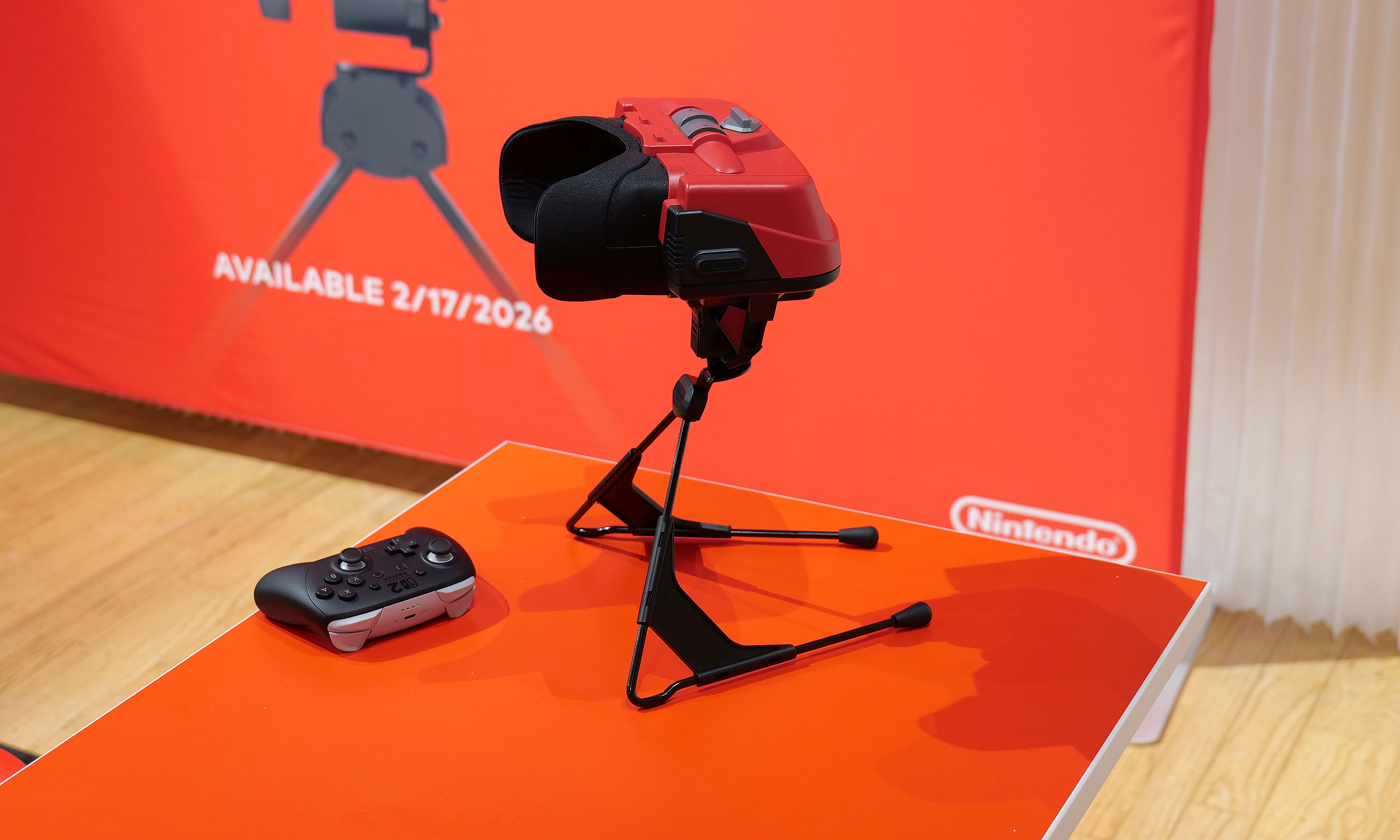 The biggest difference on the new model is that it uses the Switch 2's screen as its main display and processor. Sam Rutherford for Engadget
The most impressive thing about the revamped Virtual Boy is how much it looks and feels like the original. It still features that classic red and black color scheme along with a stand for propping it up. The biggest difference is that instead of having a built-in display, there's a slot where you can slide in a Switch 2 (with its Joy-Con detached). This brings several advantages: Since the Switch 2 has its own battery, there's no need for cords anymore. It also means you don't have to worry about swapping in individual game carts, as software can be downloaded directly from Nintendo's online store. Graphics also look much sharper than I remember, though I admit that could just be me getting old. Finally, instead of reviving the Virtual Boy's archaic gamepad, Nintendo smartly opted to let us use the Switch 2's current lineup of controllers. The end result is a design that's faithful to the original but doesn't suffer from many of the pitfalls that plagued so many 90s gadgets — like tangled wires, awkward controls and fuzzy displays.
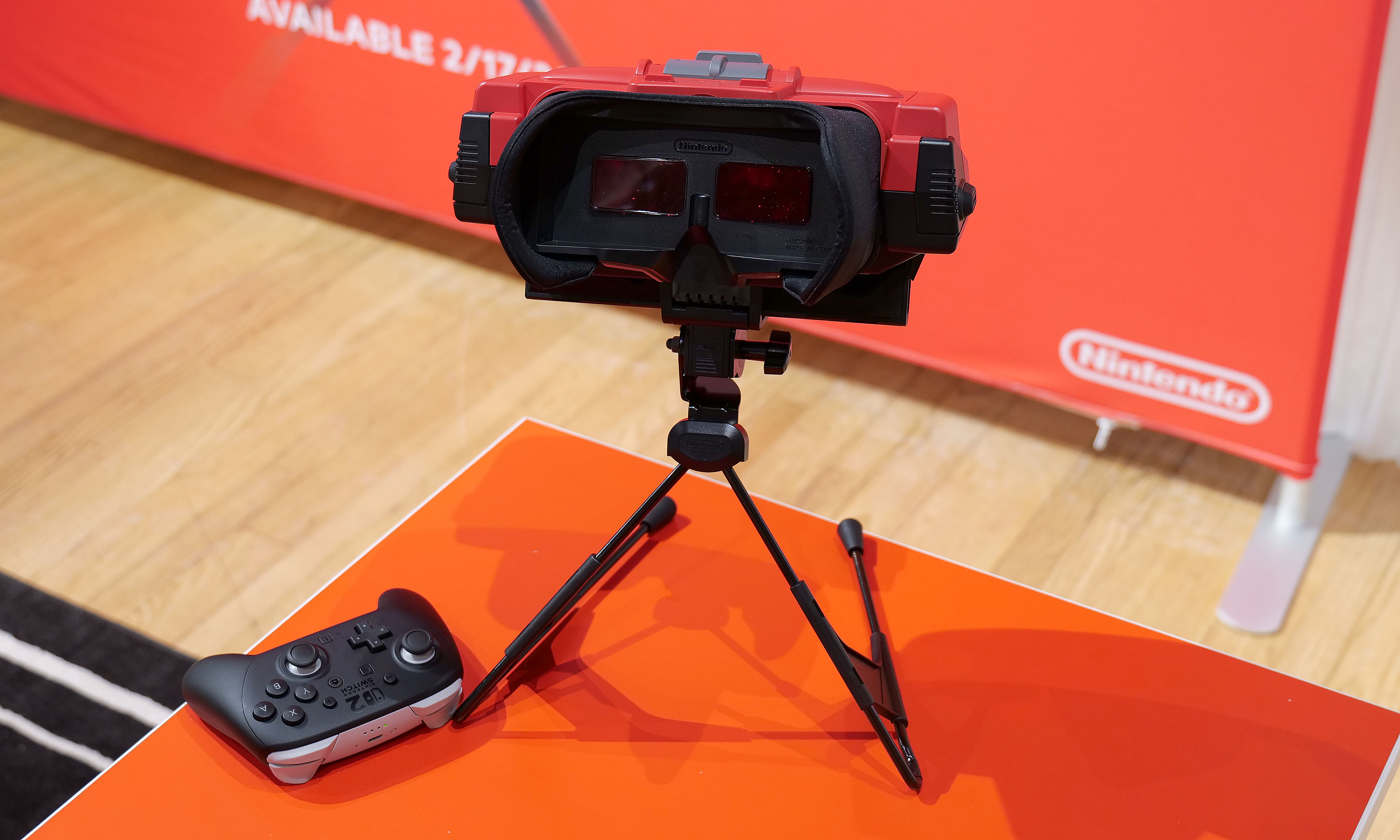 One thing Nintendo didn't change is Virtual Boy's monochrome red visuals. Sam Rutherford for Engadget
However, even with a fair bit of modernization, it's hard to prepare your mind for the journey back in time that happens when you actually use it. Unlike every other contemporary VR headset, you still don't strap the new Virtual Boy onto your face. Instead, you have to adjust its bipod so that its facemask is level with your face and then you kind of just lean in to immerse yourself in a world where red is the only color. It's definitely a bit awkward, but it works. Nintendo even included a way to adjust IPD, so visuals look just as crisp (if not moreso) as they did on the original.
That said, the clunkiest thing about the Virtual Boy is its games. While Nintendo updated its exterior and internals, the company didn't really mess with its software — for better and worse. This means you get a relatively unadulterated look at where people thought VR was headed 30 years ago, which becomes immediately evident as soon as you boot into one of the console's first seven games. Galactic Pinball is slow and trying to time when to hit the flippers to prevent the ball from getting past you is an exercise in frustration. Meanwhile, Red Alarm feels like a cheap port of Battlezone, just with a vaguely Arwing-shaped plane instead of a tank. And once again, the pacing on this aerial shooter is glacial. Then there's 3D Tetris, which just kind of hurts your head as you try to drop pieces from a top-down perspective while the entire stage pivots around and never stops moving. The only title that really stands out is Virtual Boy Wario Land, which was and still is the best game on the entire platform.
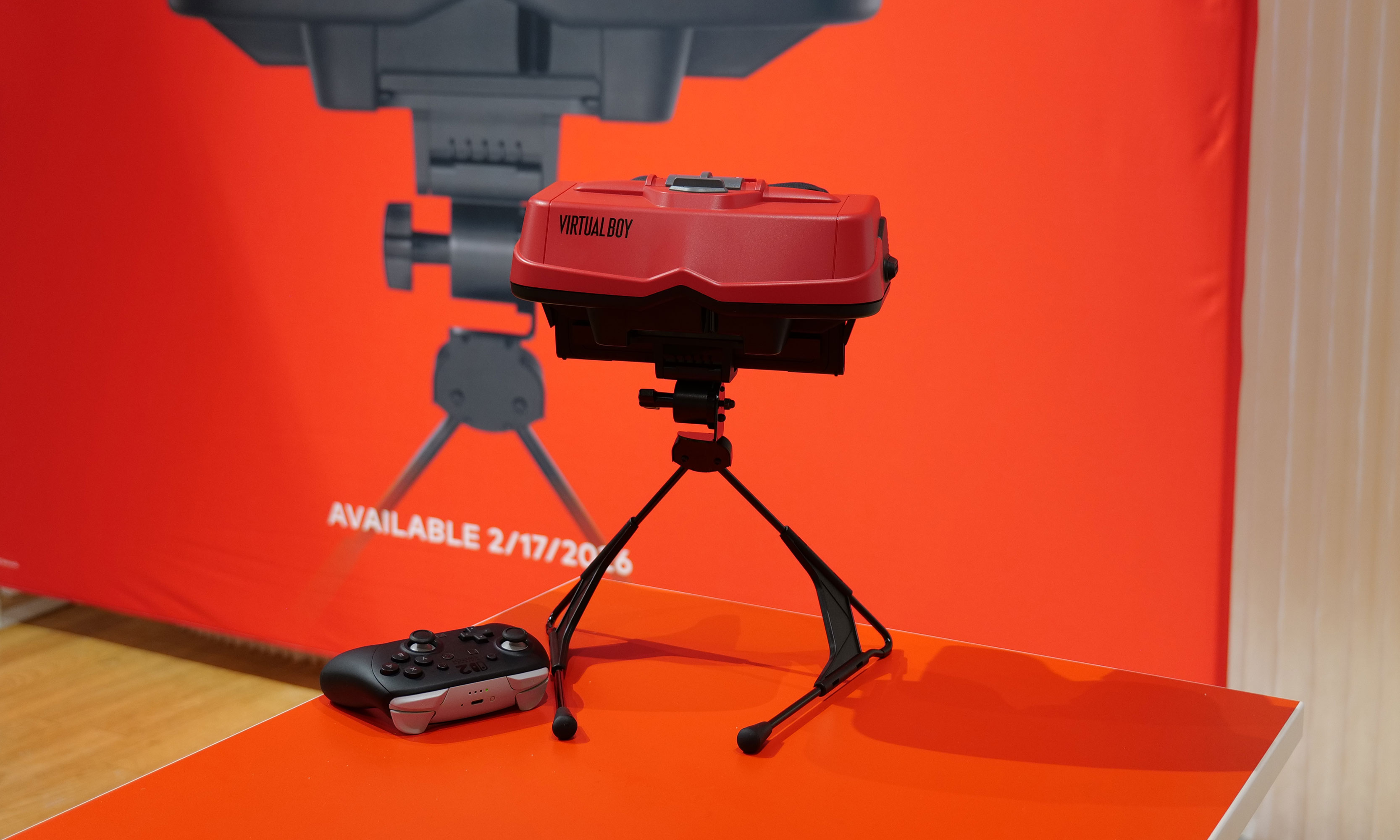 There's no getting around it, the Virtual Boy's bipod is just kind of awkward.Sam Rutherford for Engadget
After playing with the revamped Virtual Boy for just under half an hour, it's just as eccentric and ungainly as the original was three decades ago. But you know what, I wouldn't have it any other way because this thing is just as much of a time capsule as it is a nostalgic revival of a forgotten system. And if you want to experience a hazy concept of what people thought the future was going to be, there still isn't anything like the Virtual Boy.
The Virtual Boy add-on for the Switch 2 officially goes on sale on February 17 for $100, with the caveat that buyers will need an active Nintendo Switch Online + Expansion pack membership. Also, in addition to the seven games available at launch, Nintendo is planning to add nine more throughout the year including Mario's Tennis and previously unreleased titles such as Zero Racers and D-Hopper.
This article originally appeared on Engadget at https://www.engadget.com/gaming/nintendo/the-switch-2s-virtual-boy-is-a-tribute-to-nintendos-wackiest-console-140000003.html?src=rssNASA started making the final preparations for the Artemis 2 mission in early January, with the hopes of opening its launch window as soon as February 6. After issues showed up during the mission's wet dress rehearsal in the early hours of February 3, however, the agency had to push back its earliest launch opportunity to March.
"With more than three years between SLS launches, we fully anticipated encountering challenges. That is precisely why we conduct a wet dress rehearsal. These tests are designed to surface issues before flight and set up launch day with the highest probability of success," NASA administrator Jared Isaacman said on X.
During a wet dress rehearsal, the spacecraft to be used for a mission is loaded with propellants to simulate the actual preparations and countdown to liftoff. NASA explained that Artemis 2's Space Launch System, which was already on the launch pad, suffered from a liquid hydrogen leak that its engineers spent hours troubleshooting. They were ultimately able to fill all the rocket's tanks and started the countdown to launch. But with approximately five minutes left in the countdown, the ground launch sequencer automatically stopped due to a spike in the spacecraft's liquid hydrogen leak rate.
The agency admits that it has other issues to fix, based on what happened during the rehearsal. It has to make sure that the cold weather doesn't affect the mission's equipment during the actual launch in the same way it did in testing . The Orion crew module's hatch pressurization process took longer than expected, and that should must not happen on launch day. NASA also has to troubleshoot the audio communication channels for its ground teams after they dropped several times during the rehearsal. Artemis' ground crew will review data from the wet dress rehearsal and address the aforementioned problems. NASA then has to conduct another test to confirm that they were taken care of before announcing the mission's launch window.
This article originally appeared on Engadget at https://www.engadget.com/science/space/nasa-moves-artemis-2-launch-to-march-after-hydrogen-leak-during-testing-140000351.html?src=rssNASA completed a wet dress rehearsal for the Artemis II mission in the early morning hours on Feb. 3. To allow teams to review data and conduct a second wet dress rehearsal, NASA will now target March as the the earliest possible launch opportunity for the Artemis II mission.… pic.twitter.com/jSnCUPLQb6
— NASA (@NASA) February 3, 2026
Longtime HP CEO Enrique Lores is decamping for a top job at PayPal, handing the reins to an interim chief while the business hunts for a permanent successor.…
Chagossian people would be allowed to fish in area that has teemed with life since ban was introduced in 2010
One of the most precious marine reserves in the world, home to sharks, turtles and rare tropical fish, will be opened to some fishing for the first time in 16 years under the UK government's deal to hand back the Chagos Islands to Mauritius.
Allowing non-commercial fishing in the marine protected area (MPA) is seen as an essential part of the Chagossian people's return to the islands, as the community previously relied on fishing as their main livelihood. But some conservationists have raised the alarm, as nature has thrived in the waters of the Indian Ocean since it was protected from fishing.
Continue reading...
If you've been inside all winter gaming then it might be time to upgrade your gear. Right now, the 8Bitdo Pro 3 Bluetooth Controller is available for just over $48, down from $70. The 31 percent discount is the lowest price we've seen yet for the controller. Notably, the sale is only available on the Gray model.
The new 8Bitdo Pro 3 came out in August and offers TMR Joysticks with a 12-bit ADC sampling chip. It also has a Trigger Mode Switch, 2 Pro paddle buttons and swappable magnetic ABXY buttons for moving between the Switch and Xbox layouts. Plus, it has an integrated charging dock.
This 8Bitdo controller is compatible with Apple, SteamOS, Android devices, PC, Switch, and Switch 2 devices.
Follow @EngadgetDeals on X for the latest tech deals and buying advice.
This article originally appeared on Engadget at https://www.engadget.com/deals/the-8bitdo-pro-3-bluetooth-controller-is-down-to-a-new-all-time-low-143036684.html?src=rss
French police raided Elon Musk's X offices in Paris this morning as part of a criminal investigation into alleged algorithmic manipulation by foreign powers.…

French judges have issued 'arrest summonses' for two French-Israeli women who travelled to Israel to block aid to Gaza.
Nili Kupfer-Naouri founded and runs the 'charity' 'Israel Is Forever'. The group says it exists to foster the "mobilisation of French-speaking Zionist forces". Another women, known so far only as 'Rachel T', acts as spokesperson for the far-right extremist 'Tsav9' group, which regularly attacks aid trucks at the Gaza border. Even the US has sanctioned it. The 'charity' called for volunteers to support Tsav9's blockade. Both women were born in France but now live in Israel.
Israel is manufacturing famine in GazaIsrael has repeatedly used settler groups and other civilians as a human shield to distance itself from accusations of directly blocking aid. However, the mobs enjoy access to military-only roads and occupation forces supposedly 'escorting' aid trucks do nothing to prevent the attacks.
Kupfer-Naouri confirmed that a summons had been issued for her in an interview with a pro-Israel 'news' site. She complained that it meant she wouldn't be able to visit France any more because she doesn't want to go to prison:
The risk is that I won't be able to set foot in France anymore because I have no intention of going to French jail, whether in police custody or otherwise.
She described the arrest orders as "antisemitic madness" and said that three other members of her 'charity' had been interrogated by French police. And, she also complained that the summonses would mean French occupation war criminals would be unable to visit family in France:
What's serious is that it would set an unfortunate precedent for all our Franco-Israeli soldiers who participated in the 'war of redemption' [extremist language for the Gaza genocide] and who want to visit their families in France.
Yes, that's what's 'serious'.
More whining'Rachel T' whined that the judges had acted for "radical pro-Palestinian" complainants than for the demand of Zionist groups for an apology from left-wing MPs from the La France Insoumise (France Unbowed) party, which has vocally opposed Israel's genocide in Gaza:
I note that French justice is quicker to deal with a complaint filed by a radical pro-Palestinian organization than with those filed by Avocats Sans Frontières and the OJE [European Jewish Organization] against apologies for terrorism made by LFI [La France Insoumise, radical left] MPs.
'Avocats Sans Frontières' translates as 'lawyers without borders', but the French group is unconnected to the international human rights group Lawyers without Borders. The French group sent a delegation to Israel in December and told French media that Israel is not an apartheid country.
The summonses were issued after formal complaints were filed by a number of pro-Palestine and anti-genocide groups. While arrest warrants have to be approved by the French 'National Anti-terrorism Prosecutor', 'investigating judges' can issue arrest summonses directly. Unlike warrants, they do not automatically mean provisional detention of the suspect. In principle, these summonses apply throughout the EU.
Featured image via the Canary
By Skwawkbox

On 26 January, Immigration and Customs Enforcement (ICE) agents wrestled nurse Alex Pretti to the ground and shot him multiple times in the back. The killing was caught on camera by several bystanders, providing various angles. The Trump regime initially defended the use of lethal force, with key advisor Stephen Miller describing Pretti as an "assassin". Trump and others around him would later backtrack following massive public backlash.
Now, it looks like the ICE agents involved could potentially face consequences:
ICE: prosecution for the shooters?The doc, obtained by TMZ, lists "multiple gunshot wounds" as the cause of death … and under the section "how injury occurred" medical examiner Dr. Andrew Baker wrote, "Shot by law enforcement officer(s)." pic.twitter.com/E4pPflJ2Zf
— TMZ (@TMZ) February 2, 2026
The shooting is now officially classed as a homicide. The medical examiner has listed the cause of death as "multiple gunshot wounds". Under the section "how injury occurred", Dr. Andrew Baker stated "shot by law enforcement officer(s)".
Pretti was shot by ICE on 26 January 2026, only 11 days after another altercation with ICE in which he suffered a broken rib, with the Canary previously reporting:
about a week before his death, he suffered a broken rib when a group of federal officers tackled him while he was protesting their attempt to detain other individuals.
The conclusion by medical examiners now leaves the door open for prosecution of the agents involved in the killing. This could set a new precedent for further scrutiny of ICE's activities:
Sounds like the federal agents that killed him should go to jail for 25+ years https://t.co/8qnYKeKBci
— Polling USA (@USA_Polling) February 2, 2026
Featured image via France24
By Antifabot

According to doorstep polling from the Green Party, Reform are currently in the lead in Gorton & Denton. While this obviously wouldn't be the desirable outcome, they're also saying Labour are a distant third. And this could mean the Greens will benefit from any tactical voting which takes place:
PollingThe Green Party have shared doorstep data with me from across Gorton and Denton.
They say it shows:
Reform - 39%
Greens - 34%
Labour - 21%
Their data shows Reform 5 points ahead and Labour in a poor third place.
— Owen Jones (@owenjonesjourno) February 2, 2026
As Owen Jones highlighted, Reform also have Labour in third place:
The Reform Party's own data has the Greens in second place right now:https://t.co/A2Jqo9jSC3
— Owen Jones (@owenjonesjourno) February 2, 2026
It's important to remember these things can shift massively in response to a good campaign, with the key example being the 2017 election (the biggest vote share swing in Labour's history).
While the polling we have currently suggests Reform will win, the bookies think the Greens have it:
The bookies currently have the Greens as the strong favourite to win the by-election.
But that'll only pan out if the Greens can convince voters that it's voting Labour which risks a Reform victory. pic.twitter.com/44R7uWR45x
— Owen Jones (@owenjonesjourno) February 2, 2026
Polling is a snapshot of the moment; bookies have to to predict the future lest they lose money (not that they always get it right).
Given the polling, the Greens are saying they're the only realistic option for people who want to keep Reform out:
It's all to play for but it's clear Labour have blown it.
Only the Greens can stop Reform. https://t.co/IZ2E8zIqnM
— Zack Polanski (@ZackPolanski) February 2, 2026
This is especially true as both Your Party and the Workers Party have pulled out of the race:
Sounds right enough
Axios: 1 big thing: 3 historic shifts. It begins,
"You can only fully understand politics, business and your own anxiety in 2026 by reckoning with the three, once-in-a-generation shifts unfolding at once, Jim VandeHei and Mike Allen write in a "Behind the Curtain" column:
- The ideologies, tactics and tone of governance.
- The lightning-fast advancements in AI.
- The overnight transformation of how our realities are shaped."
Proton VPN is running a solid deal right now, dropping its two-year Proton VPN Plus plan to $2.99 per month. That works out to $72 billed upfront for the first 24 months, which represents a 70 percent discount compared to its regular pricing.
We've rated Proton VPN highly thanks to its strong privacy credentials, transparent nonprofit backing and consistently fast performance. It's one of the services we recommend in our guide to the best VPNs, and this deal also shows up alongside other standout offers in our ongoing roundup of the best VPN deals. It's a good option if you're looking to lock in long-term protection at a lower monthly cost.
In our Proton VPN review, the service impressed us with consistently fast performance and strong privacy protections. We measured average download speeds at 88 percent of our unprotected connection and upload speeds at 98 percent, which is more than enough for 4K streaming, gaming and torrenting. It also unblocked Netflix in every region we tested, and while its Mac and iOS apps aren't quite as polished as the Windows and Android versions, the service is still easy to install and largely set-it-and-forget-it across platforms. We gave Proton VPN a score of 90 out of 100.
Proton VPN Plus is the company's premium tier and includes access to its full server network, which now spans more than 15,000 servers across 120-plus countries. A single subscription covers up to 10 devices at once and unlocks features like NetShield ad and malware blocking, Secure Core "double hop" connections, split tunneling, custom DNS controls and priority customer support. Proton VPN Plus also supports fast P2P traffic on nearly all paid servers and includes VPN Accelerator, which helps maintain high speeds over long-distance connections.
Right now, Proton VPN Plus is discounted to $2.99 per month when you commit to two years, billed as $72 upfront for the first 24 months. After that, the plan renews annually at $83.88. That's a 70 percent discount compared to the standard monthly rate. As with Proton's other paid plans, the subscription comes with a 30-day money-back guarantee, so you can try it risk-free if you're not ready to lock in long term.
This article originally appeared on Engadget at https://www.engadget.com/deals/proton-vpn-two-year-subscriptions-are-70-percent-off-right-now-123000972.html?src=rssLike some sort of corporate Russian doll, SpaceX has announced its acquisition of xAI. The merger will "form the most ambitious, vertically integrated innovation engine on (and off) Earth," according to, well, owner Elon Musk.
The AI company, arguably best known for its ongoing CSAM-generating chatbot controversy, might seem like a strange fit for a rocket company. But SpaceX is apparently key to Musk's latest scheme to build AI data centers in space. There might be an argument for moving the resource-intensive operations to space — but Musk continued.
He also claimed space-based data centers will eventually enable further advances in space travel. "The capabilities we unlock by making space-based data centers a reality will fund and enable self-growing bases on the Moon, an entire civilization on Mars and ultimately expansion to the Universe."
Back on Earth, xAI and X (formerly Twitter) merged last year, which means SpaceX now owns the social network Musk bought in 2022.
— Mat Smith
The biggest stories you might have missed
iPhone Fold rumors: Everything we know so far, including the leaked design
TikTok says it's 'back to normal' after winter storm-related outages
Awesome speed and photo quality.
 TMAEngadget
The Sony A7 V is an imaging powerhouse that brings the speed and precision of its high-end siblings to the enthusiast tier. Thanks to a new 33MP partially stacked sensor, image quality is where it truly pulls ahead, offering best-in-class dynamic range and low-light performance that outclasses 24MP rivals despite the higher resolution. If your primary goal is capturing the perfect still, the combination of accurate AI autofocus and improved color science makes this arguably the best all-around Sony shooter yet.
However, if you're a video-first creator, the A7 V might feel like it's a little behind. While the 10-bit 4K footage is sharp and benefits from impressive AI auto-framing and stabilization, it lacks internal RAW recording, which competitors like the Canon R6 III and Panasonic S1 II now offer. Make sure you check out the full review.
Apple acquires Q.ai for a reported $2 billionAfter Beats, it's the company's second-biggest ever purchase.
It's the time of AI acquisitions, it seems. Even Apple's doing it. Apple has acquired Israel-based startup Q.ai. Although Apple has not disclosed the terms of the deal, The Financial Times reports the arrangement is valued at nearly $2 billion.
Apple hasn't shared specifics on how it plans to leverage the startup, but patents filed by Q.ai focus on integrating its technology into headphones or even glasses, using "facial skin micro movements" to communicate without talking.
This article originally appeared on Engadget at https://www.engadget.com/general/the-morning-after-elon-musks-spacex-is-buying-his-ai-company-xai-121500751.html?src=rss
Today is the day Azure Storage stops supporting versions 1.0 and 1.1 of Transport Layer Security (TLS). TLS 1.2 is the new minimum.…
Polish authorities have cuffed a 20-year-old man on suspicion of carrying out DDoS attacks.…

Keir Starmer notoriously made Peter Mandelson the ambassador to the US. We say 'notoriously' because at the point when Starmer hired Mandelson, he knew he'd maintained a friendship with Jeffrey Epstein after the late paedophile was convicted for sex crimes. As many predicted, this scandal eventually exploded, and in recent days has gone nuclear.
Now, Starmer's MPs are starting to talk about mutiny. As one unnamed MP said to Sky News's Alexandra Rogers:
Mandelson's creatureConsistent failures by Morgan McSweeney have damaged our media operation and left the public unaware of much of what we've achieved in government.
The Mandelson saga has only made things worse, and if Keir doesn't make changes soon, the PLP will.
We've had enough.
Morgan McSweeney is Keir Starmer's chief of staff. As Paul Holden wrote in his book about Starmer's rise to power (The Fraud):
McSweeney is a long-time protégé of Peter Mandelson, the architect of New Labour who, in February 2017, publicly bragged that he was "working every day" to bring down Corbyn's elected leadership.
Holden also reported:
McSweeney joined Labour in the mid-1990s as a receptionist and then a member of the party's media operations. During the 2001 election he was given the task of feeding data into Peter Mandelson's famed Excalibur computer that stored information to be used by the party's rebuttal unit.
This is what Mandelson - the "best pal" of paedophile Jeffrey Epstein - said about McSweeney:
I don't know who and how and when he was invented, but whoever it was . . . they will find their place in heaven.
As Holden detailed, McSweeney used all manner of underhanded tactics to ensure Jeremy Corbyn lost in 2019, and that a malleable alternative took his place. That man was Keir Starmer, and this is what the public think of McSweeney's vision:
Contrary to popular belief, Labour is not struggling in the polls because they're losing votes to Reform. Even if they recovered all the votes lost to Reform they'd still be on just 21%, down double digits since GE2024.
Instead, the bulk of votes lost have been to the LEFT.
— Stats for Lefties

Journalist Don Lemon was arrested as he reported on a gathering protesting the Immigration and Customs Enforcement (ICE) unit in Minnesota. The Associated Press reported that:
The charges stem from Lemon's actions while covering a protest, raising concerns among press freedom advocates about the criminalisation of journalistic activity.
Let's be clear. Don Lemon did not call for unrest. He did not incite violence, organise mass resistance, or step outside the bounds of liberal democratic debate. Instead, his arrest while reporting on a protest exposes a far more uncomfortable reality: power has grown brittle and it now reaches for punishment when scrutiny feels too close.
This moment reveals the authoritarian drift of the Trump administration and, more pointedly, who bears the cost when the states legitimacy comes under pressure.
Don Lemon: when liberal positions become liabilitiesAs a former CNN anchor, Lemon is smack bang in the centre of the political spectrum. Historically, his positions would have registered as unremarkable. Opposition to unaccountable force, scepticism towards militarised policing, and concern over immigration enforcement once formed the backbone of liberal democratic critique. These views alighted with constitutional restrain, not rebellion.
However, something has shifted.
Today, the state increasingly treats scrutiny itself - however mild - as a provocation. As executive power expands and surveillance becomes normalised, even mild dissent now attracts suspicion. Consequently, journalism that merely documents authority - not necessarily agitates against it - is shut down with considerable force.
Crucially, when a Black journalist raises that challenge, institutions rarely interpret it as professional distance. Instead they read it as intent to agitate.
Surveillance disguised as neutralityEditorial scrutiny often presents itself as neutral concern: questions about tone, warnings about objectivity and accusations of advocacy. In practice, however, this scrutiny operates as institutional suspicion.
Neutrality, it seems, remains intact only when journalism aligns with power. When reporting destabilises official narratives, neutrality becomes negotiable. As a result, white journalists benefit from an assumption of detachment, while Black journalists must reportedly demonstrate it.
Because of this imbalance, identical actions generate unequal consequences. The determining factor is not behaviour, but who performs it and what their presence exposes.
Lemon's reporting remained measured, legible, and recognisably liberal. Ironically, that restraint made it more threatening, not less. The state does not fear incoherent outrage. It fears critique that cannot be dismissed as extremism.
The free speech contradictionAt the same time, those in power insist they value free speech. They repeatedly frame dissent as welcome, provided it remains responsible and measured.
Lemon's met those criteria. Nevertheless, coercion followed.
This contradiction matters. A system that claims to prize reason while punishing those who test it does not defend free speech. Instead, it manages it. Calls for civil discourse function less as invitation and more as constraints, allowing speech only when it reassures power rather than interrogates it.
Ultimately, the response exposes fragility, not confidence. A secure system answers criticism. A brittle one suppresses it.
Another consideration of Lemon's arrest is the spatial context. The fact that his arrest took place around a church, a site the state traditionally treats as morally insulated and symbolically untouchable. Religious spaces have long been leveraged by authority to legitimise control, casting state action as protection rather than coercion. When power cloaks itself in religious sanction, scrutiny becomes easier to criminalise.
This is not about faith. It is about how religious symbolism is mobilised to discipline dissent. By framing the site as sacred and the journalist as disruptive, the state redraws space itself as a boundary of obedience. In doing so, it turns moral authority into territorial control, narrowing where journalism is allowed to exist at all.
From scrutiny to criminalisationIn response to Don Lemon's arrest, the Freedom of the Press Foundation said:
Arresting journalists for doing their jobs sets a dangerous precedent and threatens the public's right to know.
Authoritarianism rarely announces itself. Instead it advances through procedure. Laws stretch beyond their original purpose. Reporting blurs into obstruction. Monitoring quietly replaces protection.
When authorities detain or arrest journalists under the language of public order or interference, the message becomes unmistakable: scrutiny itself now constitutes a risk.
This shift intensifies during moments of political anxiety. As legitimacy thins, power prioritises containment over accountability. Accordingly, journalism survives only when it remains predictable, deferential, and safely non-disruptive.
The most serious danger, then, is not radicalisation. Rather, it is anticipatory obedience, the slow internalisation of limits imposed not for accuracy, but for the safety of power.
Lemon has rejected the suggestion that his reporting crossed a line, framing the case as a threat to press freedom:
Race as structure, not sentimentI have spent my entire career covering the news. I will not stop now. In fact there is no more important time than right now, this very moment, for a free and independent media that shines a light on the truth and holds those in power accountable.
Importantly, this is not an argument about identity politics.
Black journalists operate within a historical framework that has long cast Black presence as disruption in public space, political discourse, and intellectual authority. That history does not disappear inside courtrooms or newsrooms. Instead, it reasserts itself through surveillance, suspicion and unequal enforcement.
As a result, the same behaviour produces different interpretations. Surveillance follows the bodies power has always keened to regulate.
A warning, not an exceptionIt would be tempting to treat this case as an aberration, a mistake that institutions can quietly correct. That interpretation would miss the point.
This moment signals a narrowing of legitimate journalism itself. When liberal dissent becomes suspect and calm scrutiny triggers coercion, democratic accountability has already begun to erode.
A free press does not exist to reassure authority. It exists to unsettle it. If that function no longer enjoys protection, particularly for those already over surveilled, then free speech becomes a slogan rather than a practice.
The real question, therefore, is not whether Don Lemon crossed a line.
Instead, it is how narrow the space for journalism has become, if measured critique now invites punishment.
When mild opposition registers as a threat, authoritarianism is no longer approaching. It is already operational.
Featured image via the Canary

The Police Service of Northern Ireland (PSNI) is investigating the potential deployment of Live Facial Recognition Technology (LFRT or LFR) in the Northern Ireland. According to a report in The Irish Times:
The force has set up a Facial Recognition Governance Board which is monitoring programmes elsewhere in the UK and engaging directly with industry providers, though it insists no decision has been taken over whether to deploy the controversial technology.
The PSNI haven't exactly been transparent about such plans up to this point, with no public references to the Facial Recognition Governance Board available online prior to today's revelation. LFRT involves the use of cameras combined with automated facial recognition software to scan and identify faces. The system then matches the results against a police watchlist of wanted persons.
The PSNI say they don't currently use the technology, meaning officers manually operate cameras and examine footage collected. However, they say they are:
PSNI turn to 'Israeli' surveillance tech already in use by British police…monitoring national LFR programmes, including those implemented by the Metropolitan Police, South Wales Police and, most recently, British Transport Police.
At this stage, we are engaging with these programmes and their industry providers solely in order to assess operational feasibility.
A crucial question is whether any of those "industry providers" include Corsight AI, an 'Israeli' firm whose LFRT program has been adopted by British police. This is already a breach of the Palestinian-led Boycott, Divestment and Sanctions (BDS) movement's guidelines. They stipulate no economic dealings with the Zionist entity, or even non-'Israeli' companies which support the terrorist land theft project.
Purchasing Zionist tech is one of the worst imaginable cases of this, as it gives a direct boost to the military-surveillance sector of 'Israel's' economy. Further use of Corsight's product provides funding to, and refinement of, a system used to violate Palestinian rights.
The British government is planning to roll out LFRT systems further, moving from 10 vans to 50 that have the technology installed. Al Jazeera outline how even "Israeli intelligence operatives" have "concerns about its accuracy". This appears to be another case of much heralded AI ending up like the fictional Robocop prototypes shooting themselves in the head.
Big Brother Watch have flagged the unreliability of the dodgy tech, saying it:
…discriminates against women and people of colour. 80% of people misidentified by facial recognition in London in 2025 were Black.
This sort of bias is a commonly recognised flaw of AI platforms.
Misidentification is a crucial flaw which would result in potentially illegal surveillance. If a system incorrectly identifies someone as a suspect on a watchlist, it could result in their data being stored in the system. This would be a breach of the Protection of Freedoms Act 2012, which outlawed the storage of data like DNA and fingerprints from people not convicted of a crime.
A chilling effect on basic rightsBeyond that, use of LFRT in a public space is inherently indiscriminate and likely breaches other laws, such as those relating to freedom of expression and freedom of assembly. Its use at protests will discourage attendance, especially from minoritised communities. Lancashire police are known to have shared footage of disabled people with the Department of Work and Pensions in an attempt to have their benefits stripped.
The above issues have been cited in a challenge to the Met Police's use of facial scanning which has just been heard in the High Court. Big Brother Watch argued that its use amounted to "stop and search on steroids". They cited the case of a man detained for 20 minutes by the cops, despite providing ID to show he'd been falsely identified.
The Met's justification is that London's scale makes tracking suspects too hard:
Locating these individuals within a vast, bustling metropolis is akin to looking for stray needles in an enormous, exceptionally dense haystack.
Though it may currently make mistakes, AI is steadily improving. Its increasing capacity to sift through enormous amounts of data and make sense of it is amounts to a power too excessive to grant to increasingly authoritarian states. When Edward Snowden revealed the extent of the US surveillance apparatus in 2013, he didn't just criticise its immorality. He also lambasted it as ineffective, due to excessive data collection simply adding more hay to the haystack.
In the age of AI, a giant haystack becomes less of an issue. What would previously have required hours of human intervention to interpret can now be churned through and summarised by AI in seconds. Such a power seems too much in the hands of even an accountable state, nevermind an undemocratic and abusive one arresting thousands of innocent people for opposing genocide.
PSNI can't be trusted with mass surveillance powerThe PSNI has played a role in that. In the last week alone it has been shown to have behaved in a discriminatory manner. Internment and collusion are grim historic examples of what happens when police are granted excessive powers.
We could achieve zero crime, but it would require total surveillance and ensure zero freedom. Mass face scanning is a step too far towards the latter, and the PSNI's secretive Facial Recognition Governance Board should rule out its use.
Featured image via the Canary

Documents in the latest Epstein file release show Keir Starmer's disgraced senior adviser Peter Mandelson engaging repeatedly in likely 'insider trading' with Epstein, who was closely and corruptly linked to big banking and big business. At least, that's according to finance expert and investigative journalist Dan Neidle.
A number of commentators have pointed out that the files show Mandelson boasting of persuading Gordon Brown to resign as prime minister, including the Times's Gabriel Pogrund. But, as Neidle pointed out in response, they show far more than that.
Instead, they show Mandelson providing financially sensitive - and potentially highly profitable - insider information to a Wall Street trader:
Mandelson's sickening powerGabriel understates what happened here. We can tell from this version of the same email chain that Mandelson's last email was sent 16:02:52 BST
Brown's resignation was public 19:19 BST.
Implies Mandelson leaked price-sensitive information to a Wall Street insider. https://t.co/bWCjLpaAku pic.twitter.com/nYNLWnENMR
— Dan Neidle (@DanNeidle) February 2, 2026
Knowing that Brown was about to resign - with its likely 'blip' in UK stock market prices - would have given Epstein and anyone else he informed the opportunity to 'sell short'. Short selling involves selling shares a trader doesn't own yet, in the expectation of buying them for a lower price later because of news that shocks the market.
This is not theoretical. In another grossly anti-semitic email thread, Epstein boasts to another Jewish contact that "the Jew make money" by "selling short" while the gentiles - "goyim" - "deal in the real world":

The Times's political editor Steven Swinford and Novara's Aaron Bastani picked up on another email showing Mandelson tipping off Epstein about a coming $500bn bail-out "to save the euro" - and "threatening" then-chancellor Alistair Darling on behalf of a huge bank to reduce a planned tax on bankers' bonuses:
Mandelson was seemingly involved in insider trading, while helping Epstein, and by extension Jamie Dimon, intimidate his colleague, Alistair Darling, over a tax on bankers bonuses.
We've genuinely never seen anything like this in British politics before (on this scale).… https://t.co/nyDCgycEtj
— Aaron Bastani (@AaronBastani) February 2, 2026
The bail-out tip-off would have given Epstein and his coterie the opportunity to buy shares - the opposite of selling short - at the existing price, knowing that news of such a huge bailout would push prices up and create an immediate profit.
Neidle added that the threatening of Darling directly benefited Epstein as well as his banking sponsor:
New Epstein emails show Peter Mandelson secretly advising JPMorgan's CEO on how to fight Labour's 2009 bankers' bonus tax - even suggesting he "mildly threaten" the Chancellor.
Mandelson was Business Secretary at the time.
A year later, he was seeking work with JPM. pic.twitter.com/Nz8o5pN7b4
— Dan Neidle (@DanNeidle) February 1, 2026
Both the short-selling and the bail-out tip-off fall under the category of 'insider trading'. Insider trading is a serious criminal offence. At the time Mandelson was providing this information to Epstein, the criminal penalty was an unlimited fine and up to seven years in prison. The potential prison time has since increased to ten years, but only for offences committed from 2021. The Mandelson emails were in 2009 and 2010.
Police are 'investigating' whether Mandelson's actions are prosecutable. There can be no excuses for failing to charge him.
Featured image via the Canary
By Skwawkbox
AI-pocalypse Barnsley, a town in South Yorkshire, England, best known for coal mining and glassmaking, is being thrust into the limelight as the country's first "Tech Town" - shoehorning AI into everything from local businesses to public services.…
Combined times from morning and afternoon sessions:
David Emmett Tue, 03/Feb/2026 - 12:07
I stared through the windows of the gym at the resort on the shores of Limassol and thought, I don't want to ride today. As I put in time on the treadmill, I watched the wind frantically whip palm tree fronds and pound the surf into the rocks just off the beach, all under a gloomy, dark, foreboding cover of fog and dew. The forecast for the weather up the mountain, where the ride was to take place, was for rain, wind and cold. It was so cold that the photographers were retreating into tents with heaters while waiting for the assembled journalists to ride past.
If I didn't have to ride today, I thought, I probably wouldn't. That was my first thought.
My second thought was, since I do have to ride today, I'm very grateful that I'm riding this bike.
This bike was a 2026 Triumph Trident 800, the successor to the company's 765 R naked roadster. And I was grateful because this bike came standard with all of the electronic safety measures that made riding in such nasty conditions so much safer. Multiple power modes, ABS, traction control, wheelie control - I wanted every one of them while riding through the rain, fog and on the wet mountain lanes that criss-crossed the Troodos Mountains of Cyprus.
Almost all of the 100 miles we covered were in actual rain or on rain-slicked roads, and that was mostly good for evaluating how the bike performed in less-than-optimal conditions. The last 10 miles or so, however, the roads were dry and traffic was light and we got to open the throttle for real. And the Trident 800 delivered exactly what Triumph promised it would. It was quick, light, responsive and planted, and I ended the day wanting more - at least, more of what I experienced in the dry!
Tech Overview
The naked roadster market segment is big and important to Triumph, so much so that it has three different models in the category. The Trident 660, aimed more for the less-experienced rider, underwent significant changes for 2026, and the more track-focused Street Triple 765 RS remains in the lineup. The Trident 800 is designed to fill the gap left behind by the departing Street Triple 765 R. The 765 R leaned more toward the 765 RS in terms of ergonomics, suspension and power delivery; Triumph wanted its replacement to be more Trident, less Street Triple.
To do so, Triumph started with the Trident 660 base - the steel frame and the new triple-throttle body induction setup that the 660 got in its recent upgrade. To that, Triumph added better forks, a smaller rear brake, better brake calipers, a better shock and the all-new engine from the Tiger Sport 800. The liquid-cooled, DOHC, three-cylinder Inline-Four has a bore and stroke of 78.0 mm x 55.7 mm and delivers 113.4 bhp at 10,750 rpm, Triumph says, and 61.96 lbs.-ft. of torque at 8,500 rpm.
That's down about five bhp from the 765 R, but up about three lbs.-ft. of torque, and the torque curve is much flatter than on the 765 R, the company says. That's deliberate - the Trident 800 isn't really aimed at track use, but for everyday riding and enthusiastic canyon carving. In this context, a flat, fat torque curve is a lot more useful and exciting than peakier power delivery. The rest of the Trident 800 echoes this zeitgeist. Compared to the 765 R, the bars are wider and closer to the rider; the seat is incrementally lower; the footpegs are lower and further forward. The suspension is slightly less sophisticated. The swingarm is pressed steel instead of the aluminum alloy unit mated to the 765 R's aluminum twin-spar frame.
The Trident 800's tubular steel frame uses the engine as a fully stressed member; there are mounting points ahead of and behind the cylinder head. Showa 41mm Big Piston split-function forks adjustable for rebound and compression handle suspension duties in the front, a single Showa shock adjustable for preload and rebound damping takes care of the rear. Twin 12.2-inch (310 mm) discs in the front are paired with four-piston radial-mount calipers and steel braided lines; an 8.66-inch (220 mm) disc is mated to a single-piston caliper in the rear. Cornering-sensitive ABS helps prevent panic stops from turning into something worse. Other riding aids include three ride modes - Sport, Road and Rain - each with its own traction control setting. The TC can be switched off entirely. A very welcome feature were the heated grips, as well as a single-button cruise control system. The rider just hits a button and the bike maintains that speed. Easiest one to use ever. And for those who don't like using a clutch, the Trident 800 has clutchless up- and down-shifting.
Riding The Trident 800
The first few miles were on dry city streets, and the Sport setting demonstrated an engine that was responsive and powerful in the midrange, just as Triumph promised, and still stout as the revs rose. Further explorations of the power were cut short by the wet roads, which were dealt with by switching to Rain mode and max TC. This made the bike much easier to handle on slick, narrow roads. The Michelin Road 6 tires performed well in the wet, but every mile contained a handful of little twitches through the bars that let you know that the bike had lost traction for a fraction of a second. The heated grips were awesome (although it was so cold that I was still riding with a pair of electric gloves I'd brought along for the occasion).
Even in this environment, I could tell that Triumph had hit several of its targets for the Trident 800 in the bull's-eye. The riding position was sporty but comfortable, the seat supportive. Vibration was minimal, and the dash remarkably intuitive. While there weren't a lot of electronic rider aid options, the ones that were there were easy to access, and I could quickly configure the dash the way I wanted it. And Triumph's engineers played around a bit with the sound of the bike, giving the rider a throaty induction roar and a bit of pop and burble on off-throttle coasting. I like the way triples sound; I like the way Triumph's triples sound a lot; and this was the best-sounding Triumph triple yet.
When we finally got a bit of clear, dry road, at least it was at the part of the ride with the best roads, at least from a sport riding perspective. Here, with the Trident 800 in Sport mode and the balls of my feet on the pegs, the bike snapped into focus. At anything about 6,000 rpm, the thing punched forward. The chassis felt stiff and composed, easily able to handle the forces the Michelins were loading into it. The suspension felt rigid, and even though it wasn't the most sophisticated, it did the job, striking a nice balance of control and comfort. A lot of bikes in this category have decent suspension, but they are right at the limit of their capabilities in rapid street riding. On the Trident 800, it felt like there was more margin before I hit the limit.
The Trident 800 is aimed at someone who likes the Triumph roadster aesthetic and concept, who isn't headed for the track but who isn't averse to a little hooliganism on the weekends or a long ride up the coast. It feels solid, muscular and at a starting MSRP of $9,995, it feels like there's real value here for the rider who knows what they want and wants what the Trident 800 delivers.
The post World Introduction: Triumph's 2026 Trident 800 appeared first on Roadracing World Magazine | Motorcycle Riding, Racing & Tech News.
The Independent teams feature a host of new faces, each eager to leave their mark on the 2026 season


