
 Bimota presents 2026 factory WorldSBK team ahead of second season [ 03-Feb-26 6:33pm ]
Critical React Native Metro dev server bug under attack as researchers scream into the void [ 03-Feb-26 7:01pm ]
Bimota presents 2026 factory WorldSBK team ahead of second season [ 03-Feb-26 6:33pm ]
Critical React Native Metro dev server bug under attack as researchers scream into the void [ 03-Feb-26 7:01pm ]Baddies are exploiting a critical bug in React Native's Metro development server to deliver malware to both Windows and Linux machines, and yet the in-the-wild attacks still haven't received the "broad public acknowledgement" that they should, according to security researchers.…
Jupiter smaller than thought [ 03-Feb-26 6:12pm ]
The scientific literature was wrong. The school textbooks will have to be replaced. Entire careers were built on falsehoods. New measurements overturn almost 50 years of consensus about the size and shape of the planet Jupiter, the largest in our solar system, which we now know is smaller than previously believed. — Read the rest
The post Jupiter smaller than thought appeared first on Boing Boing.
2026 plans: What's next for Startup Battlefield 200 [ 03-Feb-26 6:57pm ]
Peter Mandelson interview shows the disgraced-Lord hasn't learned a thing [ 03-Feb-26 6:12pm ]
In a new interview with the Times, Peter Mandelson has spoken about his decision to resign from the Labour Party. It's apparent from his latest comments, that the disgraced lord gives no shits about anything besides his own feelings:
Blood brothersEXCLUSIVE
Lord Mandelson interview with @katyballs, who spoke to him both before and after the release of thousands of new Epstein emails
* On resigning from Labour. 'The decision wasn't easy but I feel better for it as I need to reset. I am a New Labour person and always…
— Steven Swinford (@Steven_Swinford) February 2, 2026
Mandelson is currently floundering after the latest instalment of the Epstein Files exposes more details about his relationship to the deceased paedophile.
Bank statements, released in the files, show three unexplained payments totalling $75,000 from Epstein's JP Morgan accounts to Mandelson in 2003 and 2004.
During his tenure as business secretary in 2009, Mandelson allegedly forwarded confidential UK government documents to Epstein. The documents detailed £20bn in potential asset sales. Owing to these revelations, Mandelson is currently under investigation by the London Metropolitan Police for misconduct while in office.
Now, Mandelson has spoken about the latest Epstein Files, as summarised by the Times' political editor, Steven Swinford.
Mandelson refuses to take accountabilityLord Mandelson interview with [Katy Balls], who spoke to him both before and after the release of thousands of new Epstein emails
* On resigning from Labour. 'The decision wasn't easy but I feel better for it as I need to reset. I am a New Labour person and always will be wherever the current party situates itself. But I think I want a sea change. I want to be more an outsider looking in than the other way round. I want to contribute ideas that enable Britain to strengthen and to work for all, in every part of the country'
* On being sacked: 'It felt like being killed without actually dying. It's a unique experience. I mean, I'm navigating the experience because I have really good friends who are helping me do so, starting with Reinaldo more than anyone else'
* Says Epstein is 'muck that you can't get off your shoe… Like dog muck, the smell never goes away'
* On the $10,000 his partner accepted for an osteopathy course while he was business secretary. 'In retrospect, it was clearly a lapse in our collective judgment for Reinaldo to accept this offer. At the time it was not a consequential decision
'The idea that giving Reinaldo an osteopath bursary is going to sway mine or anyone else's views about banking policy is risible.* What drew him to Epstein? 'He was a classic sociopath. Outwardly, completely charming and engaging. He was very clever'
* Mandelson also says Epstein threw good dinner parties. 'I remember one of the two dinner parties of his I went to. I sat next to someone in charge of brain research at Harvard. I was sitting opposite the founders of Google. At the other end of the table was Bill Gates. I think I also brushed past Noam Chomsky on a later date'
* On giving evidence to Congress: 'There is nothing I can tell Congress about Epstein they don't already know. I had no exposure to the criminal aspects of his life'
The public reaction to the article has not been positive, to put it mildly:
The sheer fact Mandelson is still being treated softly enough to do chummy at home interviews is a sign of how untouchable he apparently remains. Guy's under investigation by the Met but gets a magazine profile like he's a game show host https://t.co/pXlU0YbxhP pic.twitter.com/aGnxJgR9yl
— Ross McCafferty (@RossMcCaff) February 2, 2026
Let us no forget that this morning Labour sent out its people to argue there was no need for any kind of investigation into Mandelson and to bat away suggestions he lose his peerage.
Neither line last through lunch!!— Andrew Neil (@afneil) February 2, 2026
And, worryingly, Mandelson appears keen to continue working in the public sphere:
Well, he's not sorryNEW: Mandelson still wanted to come back to civic life as recently as LAST NIGHT.
Iv with @katyballs - this is from their call after he resigned his membership https://t.co/WSViSzJoF1 pic.twitter.com/uZBuXsCKlR— Sam Coates Sky (@SamCoatesSky) February 2, 2026
Given his repeated refusals to apologise, it's clear the disgraced Lord doesn't give a shit about his past with Epstein — beyond the damage it's done to his reputation. Leaving the Labour party appears to be little more than a symbolic gesture — a temporary retreat from the public spotlight, in other words.
Mandelson must now be stripped of his lordship and face criminal scrutiny for what his actions.
Featured image via Epstein Files
By Antifabot
Undercover police spied on anti arms trade campaigners and exaggerated their threat to protect the arms industry [ 03-Feb-26 5:26pm ]
Evidence quoted in an opening position statement released on 2 February by the Undercover Policing Inquiry shows that multiple undercover police officers spied on anti-arms trade campaigners, including Campaign Against Arms Trade (CAAT), because of the financial importance of the industry to the British state.
There are also allegations that risks from protests against Defence and Security Equipment International (DSEI), one of the world's largest arms fairs, were deliberately exaggerated to ensure a repressive police response designed to stifle protest. In fact the biggest risk facing undercover police officers came from uniformed officers. Or, as they euphemistically say, "over-enthusiastic policing".
One report, a 2003 review of HN3 'Jason Bishop' who targeted DSEI protests states that:
Source has been targeted at environmentalist groups who engage in direct action
and/or protest action and a wide range of environmental and political issues. Some of these issues concern or could influence the financial well being of the State, i.e. DSEI.
Another, an interview with HN18 Robert Hastings in 2007, states that police targeted DSEI organising:
because of the high profile nature of the event and the amount of money involved and the embarrassment that would be caused to the government etc.
Additional reporting from HN18 describes the "worst disorder" at DSEI protests as:
Campaign Against Arms Tradefree flowing [marches with] street party gatherings accompanied by a samba band and a sound system.
During the course of the inquiry, CAAT applied for core participant status twice. Once, when the inquiry initially began in 2015, when the inquiry argued there was not substantive proof that CAAT had been spied on.
The second application, made in 2024, was rejected on the grounds that reports were collateral damage due to reporting on another core participant, Emily Apple, who is also currently CAAT's media coordinator, and a CAAT volunteer for some of the period covered by this tranche.
However, as Apple's position statement for Tranche 3, Phase 2 of the inquiry sets out, CAAT was the target of frequent reporting by numerous undercover police officers, some of which pre-dates any reporting on her by undercover officers. Tranche 3 of the inquiry covers police spying from 1993-2008 when the Special Demonstration Squad/Special Duties Squad (SDS) closed.
Apple, who was also a very close friend of Martin Hogbin, the corporate spy who infiltrated CAAT from 1997-2003, is additionally asking the inquiry to investigate the relationship between the policing units and arms trade spies, and whether any of the information reported by Hogbin to BAE Systems ended up with the SDS.
Apple's statement also details the extensive harassment she received from the police, often directed by the SDS, and the intrusive interference in her private life by undercover officers, including buying her then two-week old son a giant polar bear.
Apple, CAAT's media coordinator and core participant, stated:
It is very clear that CAAT and other anti-arms trade campaigns I was involved in were deliberately and intrusively targeted by undercover officers to protect the arms trade, and its value to the state. Street party gatherings were described as 'serious disorder' while little or no investigations were carried out against the arms companies marketing illegal weapons at DSEI.
While some of the events the inquiry is investigating are over 20 years old, this is not a historical issue. We saw yet again at DSEI in September 2025 the lengths the police are willing to go to protect arms dealers, deploying extreme violence - the very picture of 'over-enthusiastic' policing described in the documents - to police our protests. This resulted in the police breaking the wrist of a legal observer, breaking the ankle of another protester, and knocking a third unconscious.
Anti-arms trade campaigners are currently facing unprecedented levels of repression, in particular with the proscription of Palestine Action. There are striking similarities between the exaggerated threats outlined in these documents with the justifications relied upon by this government to target protesters today.
There are serious questions that need answering about the complicity between successive governments, the police and the arms companies to repress our right to protest to protect a trade that is complicit in multiple genocides and human rights abuses.
The inquiry will hear further detailed evidence relating to these allegations on the following dates:
- 23 February - HN3 'Jason Bishop' giving evidence
- 23 March - Emily Apple giving evidence
- 24-26 March - HN18 Robert Hastings giving evidence
You can follow events on the inquiry's YouTube page.
Featured image via the Canary
By The Canary
Tories put forward transphobe to stand in Gorton and Denton [ 03-Feb-26 4:57pm ]
The Conservative Party has announced its pick for the upcoming Gorton and Denton by-election, choosing to stand former police officer and member of the LGB Alliance Charlotte Cadden.
The controversial charity Sex Matters, part of the LGB Alliance, has long drawn criticism for the hate group which works to normalise political attacks against trans people.
As a member of that group, this pick likely signals that the Tories are intending on using trans people as a scapegoat in a culture war.
Glossy slogans with no real solutions for Gorton and Denton- Charlotte served for 30 years as a Police Officer, both for Greater Manchester Police and the Metropolitan Police
- Charlotte is a trustee of the charity Sex Matters, a member of the LGB Alliance Business Forum. She coordinates the Women's Rights Network in Greater Manchester…
— Politics UK (@PolitlcsUK) February 1, 2026
Cadden arguably represents more of the same out-of-touch politics that Gorton and Denton residents have likely had more than enough of. Backed by a party long disconnected from the everyday struggles of working families, Cadden's right-wing campaign likely relies on glossy slogans rather than real solutions. Constituents should watch closely how Cadden plans to tackle rising living costs, crumbling public services, and declining community wellbeing.
In a northern "worker bee" constituency, austerity and underinvestment have hit residents hardest. Manchester voters need leaders who put people above party politics. However, Cadden's connections to Sex Matters and LGB Alliance raise serious questions about whether she delivers for the communities she seeks to represent.
In 2022, Consortium, a coalition of LGBT organisations, told a court that LGB Alliance was set up to:
promote transphobic activity rather than pro-LGB activities.
As usual, the Tories have no ideas beyond peddling hatred against minorities. What they do have is the commitment to making life even more unsafe for trans people.
Culture wars whilst ignoring actual abuseAnd, the Epstein scandal only underscores how safety is threatened. Yet again, recent reports show how men are all too capable of orchestrating the rape and abuse of women and girls for their own gain. Even, at times, with the aid of women themselves. Therefore, it's clear that the real threat comes from those who abuse power, men or women, not from trans people, like mainstream media headlines would have us believe.
Rape/sexual assault is about CONTROL & POWER. Arguments about how it is "biological" make no sense. It has zero to do with sex— it is about having control and power over someone in the most heinous and humiliating way someone could think of, which is by violating their body.
— Lexï
Egypt's secret drone intervention in Sudan revealed [ 03-Feb-26 4:43pm ]
Egypt is running a secretive military intervention in Sudan. Drones are being flown out of an airbase in the Sahara. Egypt is striking Rapid Support Forces (RSF) targets in support of the Sudanese government. The New York Times (NYT) acquired satellite images of the base, which sits close to the Sudanese border, hidden amid a vast agricultural project:
The airstrip sits next to giant crop circles at the edge of the Sahara. Military drones take off over enormous fields of wheat, leaving their covert base for one of the world's biggest drone wars.
The war in Sudan is theoretically between the Arab supremacist RSF and the Sudanese government. But foreign states pursuing their own interests are backing the combatants. The United Arab Emirates (UAE), for example, backs the RSF with arms and equipment. Egypt backs the government, alongside Russia, Turkey, Iran, Saudi Arabia, and Qatar. Israel has backed both sides at different times.
RSF has killed Sudanese civilians in vast numbers. And some estimates say 150,000 people have died and over 10mn have been displaced by fighting.
Egypt upscales its intervention in SudanThe NYT reported on 3 January that:
for at least six months, advanced military drones based at the Egyptian airstrip have been carrying out strikes in Sudan.
The paper said:
Egypt, until recently, was mostly a diplomatic player in Sudan. But the drone activity suggests it has entered the fight alongside Sudan's military, adding yet another layer to a war bursting with foreign powers on either side.
Egypt's weapon of choice reflects a trend in warfare globally. Drones are the order of the day. The NYT said:
The clandestine drone operation offers new evidence of how the civil war in Sudan — racked by famine, atrocities and tens of thousands of deaths — is morphing into a sprawling theater for high-tech drone warfare driven by the interests of rival foreign powers.
Egyptian operations have been impactful enough that RSF has even threatened retribution. But RSF is also using unmanned aerial vehicles (UAVs). Theirs are Chinese-made, but supplied by the UAE. The UAE denies involvement.
Turkish arms, African warsThe Sudanese military uses drones too. Their UAVs are of Turkish manufacture. US officials said Sudanese drones made by Turkish firm Baykar were being flown from Egypt.
The fall of the southern Sudanese city of El Fasher in October 2025 reportedly sparked Egypt into action. The Egyptian government fears an RSF-controlled Sudan.
Egypt is in a precarious position. The country is a recipient of massive investment by UAE, RSF's most important backer:
Egypt's economy is highly dependent on the Emirates, which in 2024 invested $35 billion in a development project on Egypt's Mediterranean coast — the country's largest ever foreign investment.
Since 2018 Egypt has been expanding its airfield 40 miles from the Sudanese border. Turkish drones have been operating from the strip for several years:
But the arrival of Akinci drones last year provided vastly greater capabilities. With a range of more than 4,500 miles, the Akinci can carry at least three times more bombs than the TB2, according to experts. It also costs at least four times more.The NYT added:
By December [2025], at least two Akinci drones were operating from the base and striking targets inside Sudan.Sudan is where regional and global ambitions meet. The three-year-old conflict reflects the present and future of warfare. Advanced drone technology, brutal old-fashioned imperial violence, and proxy war meet in the country's killing fields, backed by self-serving foreign actors vying for influence in Africa and beyond. The war is one of the most grotesque spectacles of our era.
Featured image via the Canary
By Joe Glenton
Next-gen nuclear reactors safe enough to skip full environmental reviews, says Trump admin [ 03-Feb-26 6:40pm ]The Department of Energy says advanced nuclear reactor designs - many of which have so far existed mainly at the experimental, testing, or demonstration stage - generally pose limited environmental risk and can qualify for a streamlined environmental review for future projects.…
Homeland Security is trying to force tech companies to hand over data about Trump critics [ 03-Feb-26 6:35pm ] Skyryse lands another $300M to make flying, even helicopters, simple and safe [ 03-Feb-26 6:21pm ]
Bimota blasts off into 2026 with Bassani and Lowes: "It's going to be an epic season!" [ 03-Feb-26 6:35pm ]Bimota are back for their second season since returning to WorldSBK!
American Football Line Up Sprawling Tour [ 03-Feb-26 6:00pm ]
Judge Censored an ICE Agent's Face Over "Threats." His Info Was a Google Search Away. [ 03-Feb-26 6:04pm ] Federal law enforcement agents stand guard as they are confronted by community members for reportedly shooting a woman in the Brighton Park neighborhood on Oct. 4, 2025, in Broadview, Ill. Photo: Scott Olson/Getty Images
Days before the federal government falsely claimed cellphone-brandishing nurse Alex Pretti was a terrorist plotting a "massacre," a jury in Chicago acquitted Juan Espinoza Martinez on bogus charges of a murder-for-hire plot against then-Border Patrol commander Greg Bovino. A recently unsealed court transcript shows the government used that case to bolster its claims about the dangers of "doxing" Immigration and Customs Enforcement officials. That pretext was used to convince a judge to obscure an ICE agent's face during a public court proceeding when his name, face, employment, and location were publicly listed on his LinkedIn page.
As with its baseless claims about Pretti, the government presented no evidence supporting its proclamations that Martinez, a union carpenter, was a higher-up in the Latin Kings gang with the ability or intent to put out hits on Bovino or other immigration agents. The case against him hinged on ambiguous Snapchat messages that Martinez's attorney called "neighborhood gossip." But the Department of Homeland Security brought its allegations to the public long before it could be tested in court, repeating claims of bounties up to $50,000.
The transcript from a federal court in Chicago, which was recently released pursuant to a motion filed by law firm Mandell PC on behalf of local media outlets, shows how far the hysteria has gone. During an October 20, 2025, hearing in a case challenging immigration enforcement tactics, government lawyers asked for a private conference with Judge Sara Ellis to request the courtroom sketch artist not draw ICE Deputy Field Office Director Shawn Byers.
Government attorneys claimed that, in light of the alleged "bounties" on the heads of ICE agents, Byers had taken extensive precautions to disconnect his identity from his image online to protect himself. When the judge asked for details on the bounties, Department of Justice attorney Samuel Holt responded, "I don't have all the details. My understanding is that I — I think it was a gang bounty."
The judge cleared the courtroom and called Byers in to provide the details about the "threat." Byers first claimed there was a $50,000 "bounty issued by the cartels on me," along with $10,000 "for all my family members." He also said the "credible threat" was out against "all senior ICE officials here in Chicago," where Byers said he was the most senior ICE agent on the ground. Asked when he learned about the bounty, Byer said "It's been about a week or so I believe." Martinez's arrest was announced two weeks earlier, on October 6; no other bounties were publicly reported in the interim. When the judge asked whether these threats were "directed specifically" at him, Byers seemed to walk his claims back, replying, "Well, all senior ICE officials. So it's not just me."
Byers also said he'd taken action to "limit social media exposure" and "reduce the footprint" to avoid his face being connected with his name and that even his appearance in court required "additional precautions."
"You know, my name is out there. I've been doxed as — as recently as over the weekend," Byers told the judge, according to the court transcript. "So my name is out there, but my name has not been connected to my face yet, so that's what I'm trying to prevent from happening."
Despite objections from opposing counsel that court proceedings (and courtroom sketches) should be public, the judge ordered the sketch artist to blur Byers's facial features, concealing his identity. Ellis's compromise, while likely intended as a good-faith effort to balance safety and transparency, nonetheless validated the notion that immigration agents operate under extreme risk, justifying extraordinary protective measures by our legal system. It also effectively brought the masks immigration agents wear on the street into the courtroom.
The judge's compromise validated the notion that immigration agents operate under extreme risk, justifying extraordinary protective measures by our legal system.
Then, while Byers and other witnesses testified, someone apparently Googled his name and informed the judge that a simple search turned up his LinkedIn profile, complete with his photo, his exact job title, and his location in Chicago.
The judge called the parties back into closed session (it's unclear why, given that the false reason for the earlier private sidebar had been exposed).
"I got to say, you know, I feel slightly foolish in trying to protect Mr. Byers when, you know, a simple Google search pulls up his name and his picture," she said, according to the transcript. She also encouraged the attorney to advise the ICE deputy director that his name and photograph were readily available online. "If I could find his picture in two seconds with his name, it just looks a little silly to be asking the courtroom sketch artist to blur his features." Being recognized is "the cost of being a public servant," she continued.
The judge also said moving forward, she would "just be more hesitant to kind of obscure somebody's identity," but did not say she'd be entering any actual sanctions for the half-baked rationale used to convince her to censor the public record.
After some back and forth with the DOJ attorneys about whether Byers's LinkedIn profile contained his actual picture, Ellis confirmed the profile for "Shawn B." did when viewed by someone logged into LinkedIn. (A LinkedIn search for "Shawn Byers ICE" brings up just one profile for a Shawn B., who is listed as currently working as Deputy Field Office Director for ICE in Chicago. It also notes he is a 22-year veteran of the department and contains reposts about ICE removals in Chicago and a hiring notice for GEO Group, the for-profit prison conglomerate contracted with ICE, but no longer contains any profile picture.)
 Related
Trump Calls His Enemies Terrorists. Does That Mean He Can Just Kill Them?
Related
Trump Calls His Enemies Terrorists. Does That Mean He Can Just Kill Them?
Since Byers's manufactured emergency obviously wasn't based on real concerns for his safety, what was the point of the whole sideshow? It was likely intended to feed the narrative that immigration agents face such grave threats that identifying them — in addition to filming their operations, following them to do so, tracking and communicating about their locations and other clearly constitutionally protected conduct — needs to be restrained. It's the same fiction that primes segments of the American public to be receptive to claims that people like Pretti and Renee Good were threatening officers' lives to justify their killings.
In January, Homeland Security Secretary Kristi Noem scolded CBS News' "Face the Nation" host Margaret Brennan for naming Jonathan Ross, the immigration agent who shot and killed Good in Minneapolis. She accused Brennan of "continu[ing] to dox law enforcement," despite acknowledging that Ross's name was already very public, citing unspecified attacks against his family. It's far from the first time Noem and others have claimed that naming or videotaping law enforcement officers is improper, illegal, or even intended to foment violence.
 A masked federal law enforcement agent seen on Oct. 4, 2025, as part of Operation Midway Blitz, an operation designed to apprehend and deport undocumented immigrants, in Broadview, Ill. Photo: Scott Olson/Getty Images
These efforts to chill the work of reporters and ICE watchers have spread beyond immigration enforcement, as we saw from last month's subpoena by the House Oversight Committee of journalist Seth Harp, which was accompanied by a criminal referral to the Department of Justice by Rep. Anna Paulina Luna, a Republican from Florida. Harp was also accused of "doxing" for naming a Delta Force commander involved in the abduction of Venezuelan President Nicolás Maduro, an allegation backed up by unsubstantiated claims that the commander's life was at risk.
The Byers ordeal is an unusually clear example of the current playbook being used to shield administration officials and their foot soldiers from accountability under the guise of protecting public officials' safety.
The notion that naming public officials at the center of major news stories, who very often conceal their identities while carrying out unprecedented law enforcement operations on the streets of our cities, or that simply drawing their faces for the court record is "doxing" or otherwise improper, is a complete Trump administration fabrication. Still, the government is repeating it often enough that it's warping the public's perception of journalism. The Byers ordeal is an unusually clear example of the current playbook being used to shield administration officials and their foot soldiers from accountability under the guise of protecting public officials' safety.

Read Our Complete Coverage
Unmasking ICEThe next time this happens in court, the judge needs to demand specifics, with evidence, about whatever nebulous alleged plots or threats the government is pushing to justify secrecy. With comprehensive studies demonstrating their constant misrepresentations, nothing government lawyers say can be taken at face value. And when it happens outside the courthouse, the media needs to be similarly skeptical and not take the "threats" narrative at face value from an administration with a long, proven track record of misleading the public for its own political ends.
Judges also need to impose significant sanctions on lawyers and witnesses who mislead them, make them pawns in the administration's anti-transparency objectives, and waste their time. Gently reprimanding them in private doesn't cut it, especially when these false, alarmist narratives used in court are then being used to justify ICE killings to the public.
The post Judge Censored an ICE Agent's Face Over "Threats." His Info Was a Google Search Away. appeared first on The Intercept.
CDC Refuses to Take Blame for Measles Spiraling out of Control [ 03-Feb-26 6:30pm ] It's Monster on Monster on Monster in the New 'Monarch' Season 2 Trailer [ 03-Feb-26 6:15pm ]
Climate 'fingerprints' mark human activity from the top of the atmosphere to the bottom of the ocean [ 03-Feb-26 5:32pm ] buradaki/Shutterstock
The world is warming. This fact is most often discussed for the Earth's surface, where we live. But the climate is also changing from the top of the atmosphere to the bottom of the ocean. And there is a clear fingerprint of humanity's role in causing these changes through greenhouse gas emissions, primarily from burning fossil fuels.
Over the last several decades, satellites have monitored the Earth and measured how much heat enters and leaves the atmosphere. Over that time, as greenhouse gas concentrations have increased in the atmosphere, there has been less heat escaping to space, causing an imbalance with more heat being retained.
The consequence is a rapidly heating planet.
The "warming stripes" are one striking and simple way of visually highlighting the resulting variations in Earth's surface temperature using shades of blue and red for cool and warm, with one stripe per year.
One billion individual measurements of a thermometer combine to produce the clearest picture of our warming planet from 1850 to 2025. The last 11 years have been the warmest 11 years on record and this sequence is unlikely to end anytime soon.
 Warming stripes representing changes in global average surface temperatures from 1850 to 2025.
Ed Hawkins / University of Reading, CC BY
Warming stripes representing changes in global average surface temperatures from 1850 to 2025.
Ed Hawkins / University of Reading, CC BY
We recently extended this concept upwards through the atmosphere and downwards into the ocean, although the available datasets are shorter.
Satellites have monitored the temperature of different layers of the atmosphere since 1979. The warming stripes for the troposphere (the lowest layers of the atmosphere, within which commercial flights operate) are very similar to the warming stripes of the surface, with the warmest years predominantly occurring over the last decade. Instead of using surface temperature measurements from thermometers, the atmospheric temperature is measured by instruments on satellites called radiometers that detect how much infrared radiation is emitted from air molecules. These satellite-based estimates help corroborate the surface warming that we have already observed.
Higher up in the atmosphere, the picture changes.
The warming stripes over the upper atmosphere (the part called the stratosphere that's above typical airline cruising height) reveal a cooling trend, with the warmest years around 1980 and the coolest years over the past decade. This feature may appear surprising. If the atmosphere is gaining heat, shouldn't the stratosphere be warming too?
Actually, this feature is a clear fingerprint of how human activities are the direct cause of our changing climate.
 Global temperature change from the top of the atmosphere to the bottom of the ocean.
Ed Hawkins / University of Reading, CC BY
Global temperature change from the top of the atmosphere to the bottom of the ocean.
Ed Hawkins / University of Reading, CC BY
Why is there this pattern of temperature change? The concentrations of greenhouse gases have increased throughout the atmosphere, making the atmosphere more efficient at absorbing and giving off heat. In the lower atmosphere, this effect acts as a blanket, retaining more heat and warming the surface.
Higher up, where the air is thin and very little heat arrives from below, extra carbon dioxide allows the stratosphere to lose more heat to space than it gains, so the stratosphere cools. Another factor is the destruction of stratospheric ozone by substances known as chlorofluorocarbons (CFCs), which produces cooling in the lower stratosphere.
This human-caused fingerprint of a warming troposphere and cooling stratosphere was first suggested by scientists as a consequence of increasing atmospheric carbon dioxide levels in the 1960s, long before the cooling stratosphere was observed. Importantly, this pattern would not be seen if, for example, changes in the sun's brightness were the primary cause of global warming, which instead would lead to warming throughout the atmosphere.
Beneath the surfaceWarming stripes for different depth levels in the ocean reveal a broadly similar warming trend as at the surface, with the warmest years occurring over the past decade. The timing of the warming also suggests the heat moves downwards into the ocean from the surface, again consistent with a human influence.
This uptake of heat by the ocean is important, as otherwise there would be a much greater rise in surface air temperature. Globally, the ocean accounts for around 90% of the extra heat stored by the planet. We also see sea levels rising due to sea water getting warmer and expanding, and because land ice is melting and entering the ocean as extra water.
All these observations tell a very clear story. The burning of fossil fuels increases the amount of greenhouse gases in the atmosphere. The physics of why such an increase should warm the surface was understood in the 1850s, before the warming was observed. And the pattern of change observed from the top of the atmosphere to the bottom of the ocean indicates that greenhouse gas emissions are the dominant cause.
 Past and future 'warning' stripes showing changes in global temperature for two different choices for the future.
Ed Hawkins / University of Reading, CC BY
Past and future 'warning' stripes showing changes in global temperature for two different choices for the future.
Ed Hawkins / University of Reading, CC BY
But, what happens next? Because our emissions are causing the climate to change, our collective global choices about future emissions matter.
Rapid action to reduce emissions will stabilise global surface temperatures but delayed action means worse consequences. Which choice will we make?
Don't have time to read about climate change as much as you'd like?
Get a weekly roundup in your inbox instead. Every Wednesday, The Conversation's environment editor writes Imagine, a short email that goes a little deeper into just one climate issue. Join the 47,000+ readers who've subscribed so far.

Ed Hawkins receives funding from UKRI NERC grants and is supported by the National Centre for Atmospheric Science.
Ric Williams receives funding from UKRI NERC grants and works at University of Liverpool.
How to keep plant-based foods on the table now that Veganuary is over [ 03-Feb-26 5:31pm ] monticello/Shutterstock
Campaigns like Veganuary (an initiative that encourages people to eat a plant-based diet in January) have been hugely successful in raising awareness about the climate and the health benefits of eating this way. However, making the switch longer term is not always easy - especially when there are usually limited meat-free options in workplaces.
For our recent study, my colleagues and I worked with Derek Bell (professor of environmental politics at Newcastle University) to identify public institutions like hospitals, universities and local councils as key players in the move towards a more sustainable food system. They account for a significant amount of the food that is sold in the UK - 5-6% of all food sales or £2.4 billion annually. They can also influence our dietary choices and help shift social norms around food consumption.
However, getting caterers to become more plant-based can be controversial. Some argue that public institutions should not limit our freedom of choice when it comes to what we eat, or that it is insensitive to the cultural preferences of staff and clients.
Our work tries to tackle these concerns. While eliminating or reducing the offering of meat and dairy might limit options, public institutions already limit our choices in various ways to promote health and sustainability. Also, norms and expectations can change. The 2006 public smoking ban initially faced considerable resistance, but support for it has since greatly increased, including among smokers.
Thoughtful cateringWhen introduced thoughtfully, plant-based catering has proved popular. In 2021, New York City Health + Hospitals, the largest municipal health system in the US, made plant-based food the default option for its inpatient meals. Their menus are both nutritionally balanced - assuaging worries about poorly designed vegan and vegetarian menus - and offer users a diverse range of choices. The menu includes Moroccan vegetable tagine, Spanish vegetable paella and a pad Thai noodle bowl.
This shows how plant-based catering can take into account different dietary needs, while respecting a range of cultural backgrounds and not restricting the ability of people to choose. As many as 95% of eligible patients did not request alternative meals, and 90% reported being satisfied. Many patients reported that they would continue to eat vegetarian meals at home. This shows the power of defaults, and the influence public institutions can have on our actions.
 Thoughtful catering takes into account a variety of dietary needs without restricting peoples' choices.
PeopleImages/Shutterstock
Thoughtful catering takes into account a variety of dietary needs without restricting peoples' choices.
PeopleImages/Shutterstock
New York City Health + Hospitals has also shown tangible environmental and economic gains. Its food-related carbon emissions fell by 36%, while food bills also went down: these meals cost roughly 59 cents (£0.43) less per tray than meat-based alternatives.
We're seeing changes happening elsewhere too. In the UK, a growing number of universities are gradually shifting towards more plant-based catering. Sometimes this is being encouraged by students: at the universities of Kent, Lancaster and University College London, student unions have voted in favour of lobbying their university to adopt more sustainable and healthy catering options. In 2021, the four universities in Berlin successfully changed their menus to 68% vegan, 28% vegetarian and just 4% meat dishes. Like the New York City hospitals, they offer a wide range of nutritionally balanced meals with flavours from around the world.
Providing the right kinds of plant-based foods is an effective way of countering worries that people have about the health risks of going vegetarian or vegan, and about restricting their dietary preferences. In short, a well planned menu can keep plant-based foods on the table beyond Veganuary.
Don't have time to read about climate change as much as you'd like?
Get a weekly roundup in your inbox instead. Every Wednesday, The Conversation's environment editor writes Imagine, a short email that goes a little deeper into just one climate issue. Join the 47,000+ readers who've subscribed so far.

Meera Iona Inglis is affiliated with the RSPB. This piece is based entirely on her academic research and is not funded by the RSPB or representative of the organisation's views.
Andrew Walton and Johannes Kniess do not work for, consult, own shares in or receive funding from any company or organisation that would benefit from this article, and have disclosed no relevant affiliations beyond their academic appointment.
Sony's WH-1000XM6 headphones are down to a record-low price [ 03-Feb-26 5:50pm ]Sony's wireless WH-1000XM6 headphones are on sale for $398 via Amazon. This is a record-low price, as it drops $62 from the price tag. The sale applies to all three colorways.
These easily topped our list of the best wireless headphones. They are, in a word, fantastic. The headphones are packed with premium features, like advanced ANC. There are a whopping 12 ANC microphones throughout and a brand-new chip to power the feature. The end result? It successfully blocks background noise at medium and high frequencies, including the human voice.
The sound quality is extremely pleasing to the ears, thanks to new audio drivers and a team of mastering engineers that assisted with tuning. There are perforations in the driver's voice coil, which extends high frequency reproduction.
The design has been upgraded from the previous iteration and we found them extremely comfortable to wear for long periods of time, which is important with headphones. The battery gets around 30 hours, which is a fairly standard metric for this type of thing.
The only real major nitpick here is the original asking price. It's tough to recommend any pair of headphones for $460, but a bit easier at under $400.
Follow @EngadgetDeals on X for the latest tech deals and buying advice.
This article originally appeared on Engadget at https://www.engadget.com/deals/sonys-wh-1000xm6-headphones-are-down-to-a-record-low-price-175038776.html?src=rss
'Vibe Coding Kills Open Source' [ 03-Feb-26 6:20pm ]
Snowflake plugs PostgreSQL into its AI Data Cloud [ 03-Feb-26 6:06pm ]Snowflake is launching a PostgreSQL database-as-a-service within its AI data environment to place transactional workloads alongside analytics and AI under a single set of governance rules.…
Agentic coding comes to Apple's Xcode with agents from Anthropic and OpenAI [ 03-Feb-26 6:00pm ] Gradient's heat pumps get new smarts to enable old building retrofits [ 03-Feb-26 5:56pm ]
I think what scares me most isn't collapse itself, it's how normal everything still feels [ 03-Feb-26 5:50pm ]I don't know if this belongs here or if I'm just overthinking but it's been sitting heavy with me. Day to day life looks fine. I go to work, pay bills, plan things weeks out. I even have some money saved up, which by every "responsible adult" metric means I'm doing okay. Stores are stocked. Apps work. Packages show up on time. From the outside, nothing feels urgent and that's what freaks me out. I'll be sitting on the couch at night playing on my phone, scrolling past headlines about climate, housing, geopolitics, systems clearly under strain, and then immediately see an ad for something pointless and shiny. My brain just switches gears like that's normal. Like none of it is connected.
It feels like we're all living inside this fragile pause. Everything still functions, but only barely, and only because everyone is pretending it will keep functioning forever. There's no dramatic breaking point, just a slow stacking of stressors that never fully resolve.
What messes with me is how good we've gotten at adapting. Higher costs become normal. Shortages become "supply issues." Extreme weather becomes "unusual conditions." Every downgrade gets renamed until it doesn't feel like an emergency anymore.
I don't feel panicked. I feel uneasy. Like I'm watching something important erode in real time while still being expected to care about emails, productivity, and five year plans. I don't know what I'm supposed to do with that awareness. I still have to live my life. But it's hard to fully believe in long term stability when everything feels this conditional.
Maybe collapse doesn't arrive with chaos. Maybe it arrives quietly, disguised as normal, while we scroll and tell ourselves it's probably fine.
submitted by /u/East-Prompt-9954[link] [comments]
MotoGP: M.Marquez Fastest on Day 1 at Sepang [ 03-Feb-26 5:43pm ]Day 1 is in the books with a familiar #93 on top, but there's drama elsewhere as Quartararo crashes and withdraws to recover.
One day into 2026 and there's already plenty to talk about. One is the return of Marc Marquez (Ducati Lenovo Team) as the #93 takes back to the top, first day out for the season. The other is a crash at Turn 5 for Fabio Quartararo (Monster Energy Yamaha MotoGP), after which he's heading home. Initial checks saw him given the all-clear for any fractures and head back out, but after continued pain in his arm and hand, he reports a broken finger and has decided to focus on recovery and sit it out.
Meanwhile, second overall went to Fabio Di Giannantonio (Pertamina Enduro VR46 Racing Team), with Maverick Viñales (Red Bull KTM Tech3) completing the top three.
 Alex Marquez (73) during the first test day at Sepang. Photo courtesy Dorna
DUCATI LENOVO TEAM, PERTAMINA ENDURO VR46 RACING TEAM & BK8 GRESINI RACING MOTOGP:
Any concerns about his injury at the end of 2025 were very quickly banished as Marc Marquez hit the ground running. Steady progress throughout the day culminated in a late burst into P1 with a 1'57.018 - not bad considering the reigning World Champion hadn't visited the track since the same test last season. On the other side of the box and with Davide Tardozzi declaring during the Midday Live that it's a "new Pecco", Francesco Bagnaia (Ducati Lenovo Team) finished in P8 and was 0.702s off his teammate. The double MotoGP World Champion was positive at the end of the day and targets a race simulation on day two.
There was plenty for the Italian marque to be celebrating elsewhere. In stark contrast to 12 months ago when he crashed pulling a wheelie on a slow-down lap and missed the remainder of testing, Di Giannantonio was P2 on his first day of 2026. Making it a Ducati 1-2, the #49's late flurry of laps briefly saw him in P1 but finished 0.256s away from top slot. Teammate Franco Morbidelli rounded out the top ten, taking eight tenths off his morning time in the second session.
Rounding out Ducatis running was the sole Gresini machine of Alex Marquez (BK8 Gresini Racing MotoGP), who topped the opening session but was the only rider in the top 13 who didn't improve in the afternoon. He is the most recent Grand Prix winner in Malaysia, however.
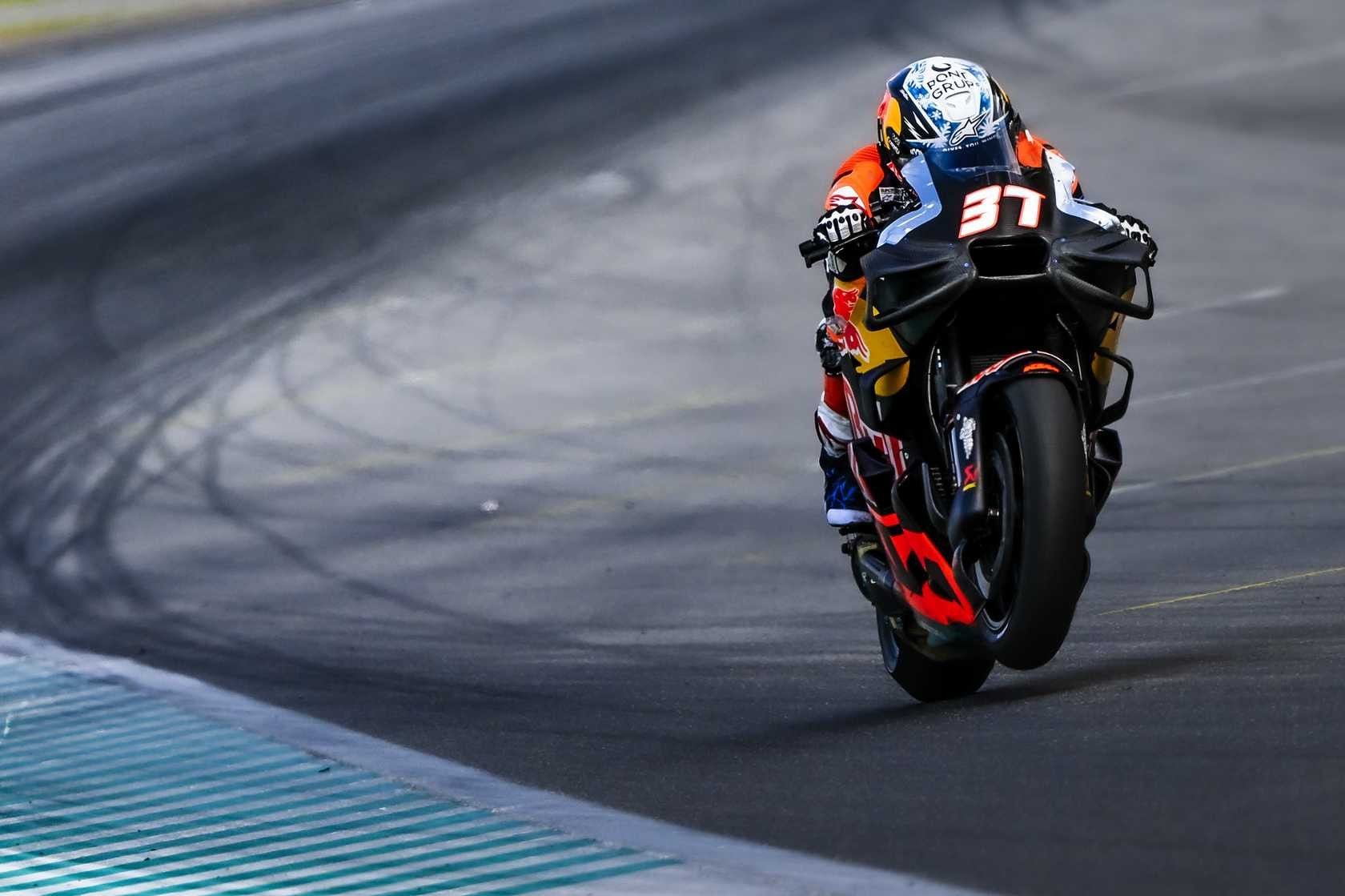 Pedro Acosta (37) during the first test day at Sepang. Photo courtesy Dorna
RED BULL KTM FACTORY RACING & RED BULL KTM TECH3:
Viñales put Red Bull KTM Tech3 in third overall after a late push, in somewhat classic #12 style. He was also glowing about the team and factory's work in his debrief, saying it's the first time in a long time there are really key changes on the table to try. The Austrian factory have a new chassis, new swingarm and aero to try, with Viñales saying he's trying the former on Wednesday.
Enea Bastianini was P12 on the sister Red Bull KTM Tech3, not putting a push in at the end, with Brad Binder just behind him with the #33 Red Bull KTM Factory Racing machine. Pedro Acosta rounded out the Red Bull KTM Factory Racing line-up in P15 as they focused on testing and not pushing for the top.
 Diogo Moreira (11) during the first test day at Sepang. Photo courtesy Dorna
HONDA HRC CASTROL & HONDA LCR:
One of the revelations of day one was the factory Honda outfit of Luca Marini (Honda HRC Castrol) and teammate Joan Mir. Both were building on the work done by the test team in the Shakedown Test to put themselves in the top seven, with Marini just pipping the 2020 World Champion. More than half a second quicker in comparison to last year's corresponding test, Honda's progress is clear for all to see.
Elsewhere for the Japanese giants, it was Johann Zarco (Castrol Honda LCR) who just missed out on a top ten spot by 0.072s to finish in P11. It wasn't the smoothest of days on the other side of the box; Diogo Moreira (Pro Honda LCR) fell at Turn 5 in the morning session and with just one bike at his disposal, spent longer than normal in the garage as it was repaired. He did return to the track but didn't improve his time and will hope that day two brings a good bunch of laps to add to his 26 done today.
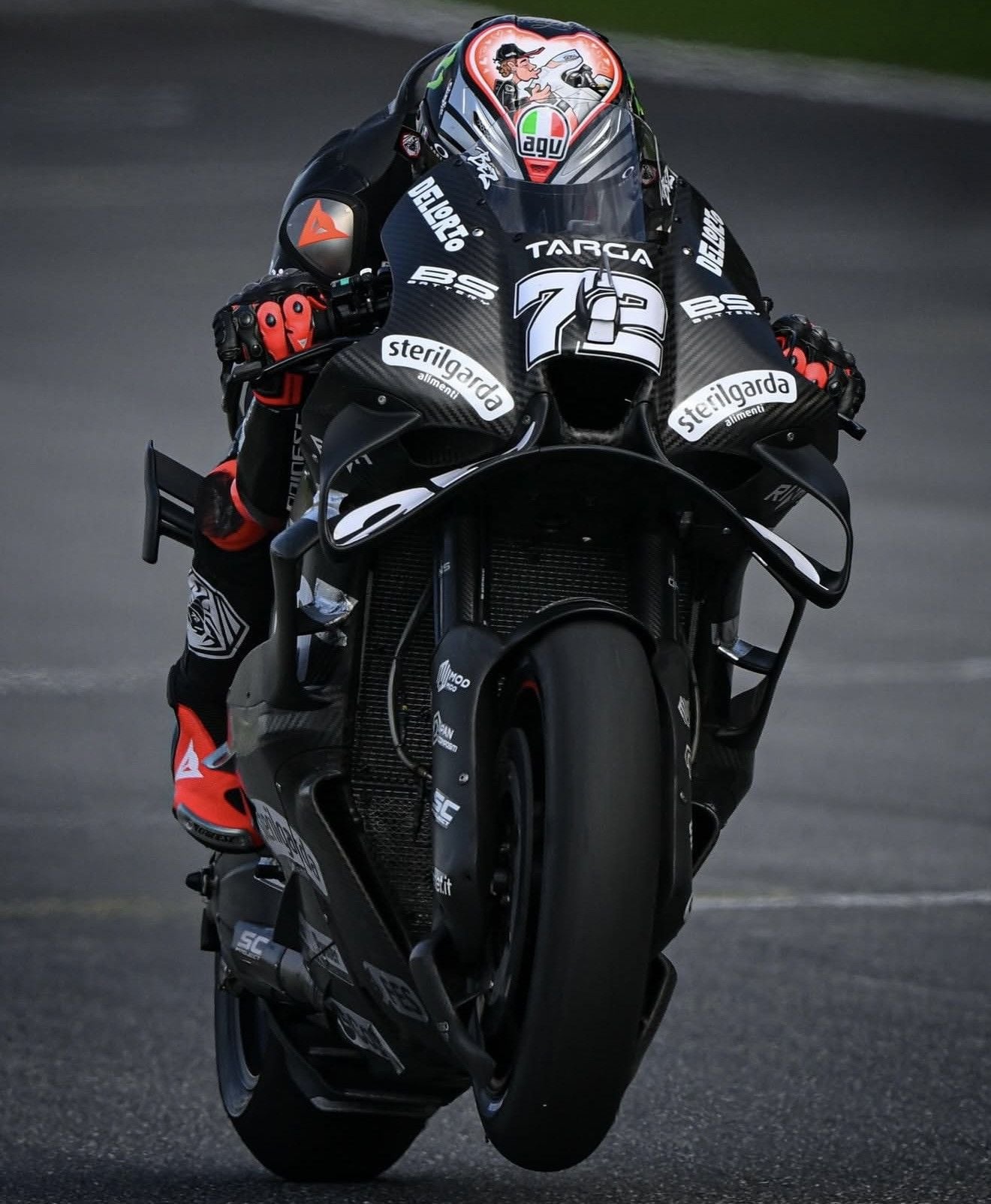 Marco Bezzecchi (72) during the first test day at Sepang. Photo courtesy Dorna
APRILIA RACING & TRACKHOUSE MOTOGP TEAM:
Bezzecchi ended the day at the top Aprilia rider in P5, just over half a second away from Marc Marquez's table-topping time. Overall, the Italian enjoyed a positive day back in the saddle, with Aprilia running several new components, including a new tail unit and larger seat wings, and a new swingarm. With Jorge Martin sidelined, test Rider Lorenzo Savadori picked up the baton to continue his work on several new items, including ergonomic set-ups and general set-up with electronics.
In the Trackhouse MotoGP ranks, 2025 Australian GP winner Raul Fernandez was very upbeat after finishing the opening day of the test without any crashes or injuries - something he's not been able to do in the last two Sepang Test outings. Fernandez said that he confirmed the feelings he had at the end of last year on the 2025 package, before switching to the 2026 RS-GP, and that also birthed plenty of positives on the opening day.
On the other side of the garage, Ai Ogura explained that Tuesday was all about him feeling good on the bike again and getting back up to speed, before the Japanese star gets properly stuck into the nitty gritty of 2026 RS-GP testing on Day 2 in Malaysia.
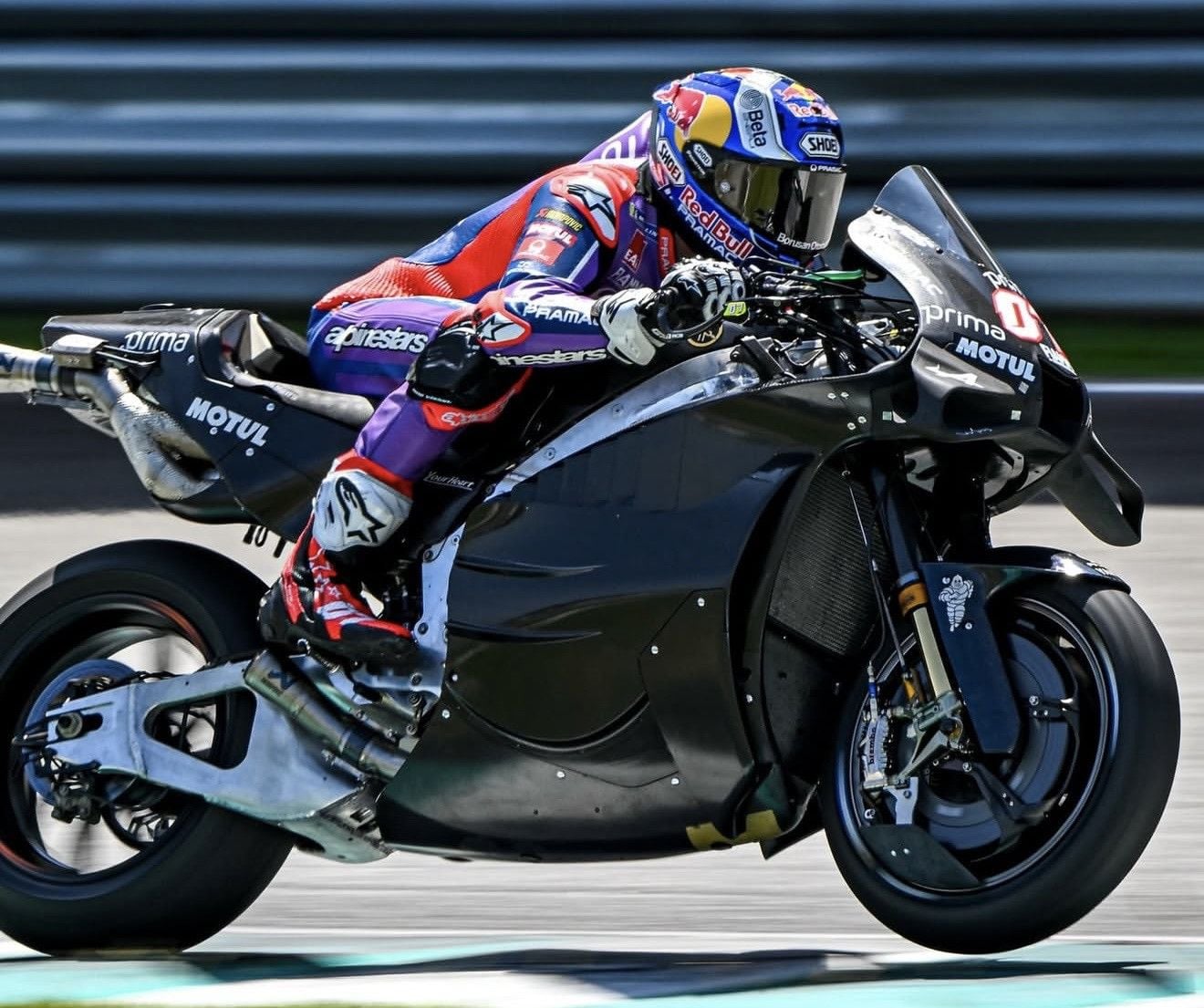 Toprak Razgatlioglu (7) during the first test day at Sepang. Photo courtesy Dorna
MONSTER ENERGY YAMAHA MOTOGP & PRIMA PRAMAC YAMAHA MOTOGP TEAM:
2026 is off to a tougher start. Working overtime to get the V4 as competitive as possible for the season, they'll now be without a key part of the project, Quartararo, after the 2021 World Champion fell at Turn 5 and was taken to the medical centre. Despite 'El Diablo' returning to the track to go P9, he's decided to withdraw from the rest of the test with pain to a finger and scrapes to his arm. It'll be on teammate Alex Rins to shoulder the rest of the test; he was 16th on day one, 1.2s from P1.
In P14, Jack Miller (Prima Pramac Yamaha MotoGP) was the second-busiest Yamaha rider on track - only new teammate Toprak Razgatlioglu set more for the Iwata manufacturer. With his previous V4 experience, the Australian, along with Rins, will now be expected to drive the rest of the test forward.
Razgatlioglu, meanwhile, was joined by the rest of the world's best on-track. Saving his fresh rubber for the rest of the test, the #07 continued to adapt to MotoGP and the life aboard a V4 and Michelins. He experimented with different seats and found a breakthrough in braking late on with rear aero. He also got the chance to follow Marc Marquez out on track, something he said he learnt a lot from and that he aims to repeat on day two - so watch this space.
See you for more on Wednesday as action continues at Sepang!
CombinedPracticeTimes
More from a press release issued by Honda HRC Castrol:
2026 begins in Sepang for Honda HRC Castrol.
Fresh from revealing their 2026 colours, Luca Marini and Joan Mir got straight to work as testing began at the Sepang International Circuit with both sitting comfortably in the top ten.
Amongst the first on track, there was no doubting Luca Marini and Joan Mir's eagerness as the first of three days of testing in Malaysia began. Typical conditions awaited them in Sepang, high temperatures and oppressive humidity adding an extra level of challenge to the first laps of 2026. With 107 laps between the factory pair, it was a positive opening day of what will hopefully be an ambitious season.
Ending the day in sixth overall with a best lap of 1'57.569, Luca Marini was left content with his first steps of the new season. Assessing a number of new parts for his Honda RC213V, Marini managed to get through roughly half of the items on his list for this first test. Marginal gains will be key in finding the last tenths in the final year of the 1,000cc machines, these early runs providing important information for the rest of the season.
Just 0.124s behind his Honda HRC Castrol teammate, Joan Mir was able to set a fastest lap of 1'57.693 to wrap up the opening day in seventh place. Improving grip and trying several new parts will be the #36's main objective for the second day of the test after finding a positive base.
Two more days remain and both Marini and Mir have busy testing schedules to still complete, every lap will be crucial for 2026.
 Luca Marini (10) at Sepang. Photo courtesy Honda HRC Castrol
Luca Marini: "Great to be back on the Honda RC213V, today we had a good day and started where we left off last time out in Valencia. Already we have made progress, and this is a really nice feeling, to straight away be making improvements. The Japanese have done a great job during the winter; a lot of really good pieces have been brought here - more or less everything I asked for in Valencia has arrived. Steps in each direction have helped us, but always more room to improve. Some work to do overnight and see what's possible tomorrow. Really pleased to be back working with everyone in the team."
 Joan Mir (36) at Sepang. Photo courtesy Honda HRC Castrol
Joan Mir: "At the end, I think we continued our progress that we had at the end of 2025 - it's what I was expecting when I arrived here a few days ago. The whole team has been working really hard to provide us with a better package, improving every area a little bit. We are not trying a radically different bike which helps, the base is what we know, and it helps us to be more comfortable straight away. Today we tried a few different pieces and found something quite positive at the end of the day, following the correct path for the start of the year."
More from a press release issued by Monster Energy Yamaha:
Quartararo and Rins End Sepang Test Day 1 in 9th and 16th Place, Quartararo To Sit Out Remainder of the Sepang Test.
Following the Sepang Shakedown Test held last week, the Monster Energy Yamaha MotoGP Team returned to the Sepang International Circuit today to resume their 2026 pre-season programme. Riders Fabio Quartararo and Álex Rins completed the first day of the three-day Malaysia MotoGP Official Test in 9th and 16th place respectively. Following a heavy crash this morning in Session 1, Quartararo will not take part in the remainder of the test due to a broken finger.

Today, Monster Energy Yamaha MotoGP teammates Fabio Quartararo and Álex Rins kicked off the three-day Malaysia MotoGP Official Test in Sepang, placing 9th and 16th respectively on the combined Day 1 timesheets.
On Day 1 of the Sepang Test, Session 1 ran from 10:00-13:00 (GMT+8), followed by Session 2 from 13:20-18:00.
Quartararo's day did not start as planned. He crashed at Turn 8 on lap 9 and had to visite the Clinica Mobile for checks. He returned in the afternoon but suffered a second fall, which briefly interrupted his programme. Despite the setbacks, the Frenchman recovered well, setting a best lap of 1'57.869s to finish eighth in the afternoon session and ninth overall, 0.851s from the top.
Rins enjoyed a solid start in the morning, briefly topping the timesheets at 11:00 with a 1'58.576s before improving further to a 1'58.320s to end Session 1 in sixth place. The Spaniard spent the afternoon analysing components and did not improve his lap time, but his morning effort secured him 16th in the combined standings, 1.302s from first.
Fully supported by Yamaha, Quartararo has decided to sit out the remainder of the Sepang Test and will fly to Barcelona for further medical evaluation in order to be fully fit for the Thailand MotoGP Official Test held from 21-22 February in Buriram.
Tomorrow, the Monster Energy Yamaha MotoGP Team will resume action with Rins for Day 2 of the Sepang Test, again with Session 1 taking place from 10:00-13:00 and Session 2 from 13:20-18:00 local track time. Augusto Fernández will continue the bike development of the new YZR-M1 in Quartararo's absence.
MASSIMO MEREGALLI - Monster Energy Yamaha MotoGP Team Director: "This is, of course, not how we wanted to start the test. Unfortunately, Fabio suffered a severe crash in Session 1 at Turn 5, which has brought his Sepang testing programme to an end. In agreement with Fabio, we decided that taking any additional risks was not worthwhile. Having Fabio back to full fitness in time for the Buriram Test is the priority. Everyone at Yamaha and the entire team wish him a speedy recovery. In the meantime, Augusto Fernández will substitute for Fabio over the next two days in order to complete the plan scheduled for the remainder of the Sepang test."
 Fabio Quartararo (20) at Sepang. Photo courtesy Monster Energy Yamaha.
Fabio Quartararo: "I broke a finger in the crash this morning. I will have a check-up the day after tomorrow in Barcelona. We already tested what we needed to during last week's Shakedown Test. Of course, having two more days would have been helpful for electronics and mapping, but I think we've done enough, so I prefer to sit out the remainder of the test. Together with Yamaha, we decided to stop and focus on recovery so I can be 100% fit again in Buriram."
 Alex Rins (42) at Sepang. Photo courtesy Monster Energy Yamaha.
Alex Rins: "Having already completed the Shakedown Test here last week, today we finished testing the most important items that Yamaha brought here for us to try. It was a good day. We decided to focus on the swingarms, testing three different kinds. It was quite good. Over the next two days, we will focus a bit more on the bike's base set-up. Let's see what lap time we can achieve on the final day."
More from a press release issued by Castrol Honda LCR:
Castrol Honda LCR rider Johann Zarco finished 11th on Tuesday at the Sepang Test.
- Tuesday at the Sepang Test was productive for Johann Zarco and the crew, with 60 consistent laps completed.
- The rider acknowledges that the bike is working well and shows potential, but admits he still needs to feel more comfortable in order to push further.
- The challenges didn't prevent Johann and the crew from focusing on doing a solid job, and the next few days will provide another opportunity to continue improving.
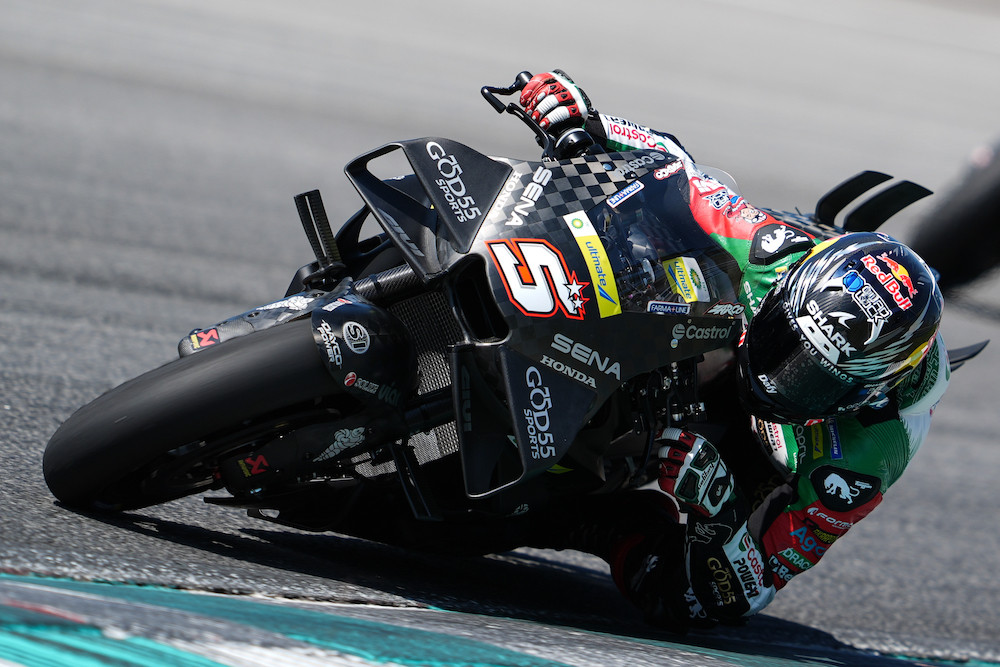 Johan Zarco (5) at Sepang. Photo courtesy Castrol Honda LCR
Johann Zarco 11th - (1'58.140) : "The bike is competitive, and with the new tyre, the lap times are solid. I'm happy with that; today's feelings confirm the bike is good, but I'm not entirely satisfied yet. I still haven't found the level of comfort I need to fully enjoy riding. There's work to be done to find the perfect feeling and maximize my performance. Even though today wasn't my best day, there are still positives, so we'll see tomorrow!"
Johan Zarco (5) at Sepang. Photo courtesy Castrol Honda LCR
Johann Zarco 11th - (1'58.140) : "The bike is competitive, and with the new tyre, the lap times are solid. I'm happy with that; today's feelings confirm the bike is good, but I'm not entirely satisfied yet. I still haven't found the level of comfort I need to fully enjoy riding. There's work to be done to find the perfect feeling and maximize my performance. Even though today wasn't my best day, there are still positives, so we'll see tomorrow!"
More from a press release issued by Prima Pramac Yamaha:
Day 1 of Official Winter Tests in Sepang for Prima Pramac Yamaha MotoGP.
Prima Pramac Yamaha MotoGP completed its first day of the Official Test, focusing on long-run work to evaluate overall bike reliability and tyre consumption. Both riders ran different set-ups across the day, prioritising data gathering over single-lap performance as preparations continue for the coming sessions.

 Jack Miller (43) at Sepang. Photo courtesy Prima Pramac Yamaha
Jack Miller: "It was a busy but decent day. We tried a lot of different set-ups, mainly to understand the positives and negatives of each change and how everything works together — a real cause-and-effect approach. We also tested a few things with the electronics. Test days are always long, sometimes frustrating and sometimes rewarding, but I feel the basic package of the bike is there. It feels like a completely new bike, yet still very much a Yamaha. It hasn't lost the M1's turning ability and the front-end feel is pretty bloody good. There's always room to improve, but at this stage it's already impressive."
 Toprak Razgatlioglu (7) at Sepang. Photo courtesy Prima Pramac Yamaha
Toprak Razgatlioglu: "Today I focused mainly on seat position, because in terms of feeling this is still the area that feels most different from what I was used to. By the end of the day I also tried a higher seat and felt better: the bike was smoother under braking, the rear had more control, and I also felt more confident on the gas in some corners. Tomorrow I may focus more on the handlebar, which still feels a little high at the moment. That's what testing is for — understanding whether I can get the right feeling from set-ups I'm used to, or if I need to adapt my riding style to better match this bike."
More from a press release issued by Pro Honda LCR:
Pro Honda LCR rider Diogo Moreira finished 19th on Tuesday, on the first day of the Sepang Test.
- After the shakedown, Diogo Moreira began the first day of the Sepang Test with positive feelings. In the morning, he showed strong performance, consistently placing in the top 10.
- However, a crash at Turn 5 (without any major consequences for the rider) disrupted his plans, preventing him from pushing for a time attack.
- Moreira completed 39 laps and is focused on continuing his learning and improvement over the next two days of testing.
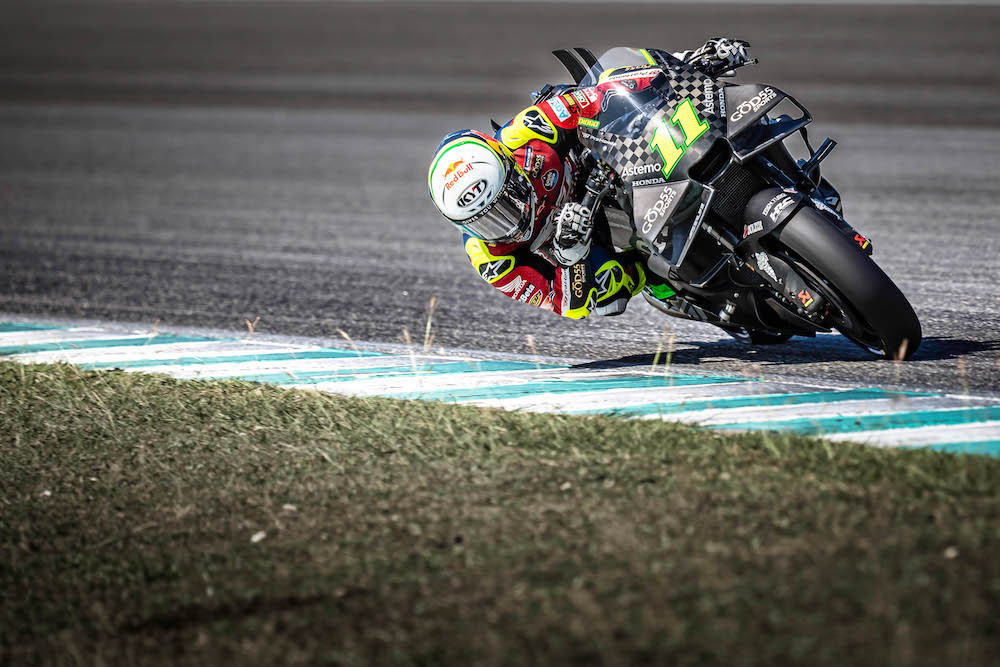 Diogo Moreira (11) at Sepang. Photo courtesy Pro Honda LCR.
Diogo Moreira 19th - (1'58.682): "After four days of pushing and trying to find the limit, there came a point where I had no choice but to crash. I've learned from it; I lost the front end while I was riding at a high speed and couldn't save it. I have a minor bruise, but nothing serious. While the crash threw off our plans, we still had a strong day overall. Looking forward to tomorrow!"
The post MotoGP: M.Marquez Fastest on Day 1 at Sepang appeared first on Roadracing World Magazine | Motorcycle Riding, Racing & Tech News.
Friko Announce New Album, Share Video for "Seven Degrees" [ 03-Feb-26 5:50pm ]
Sit like a scoundrel: the Millennium Falcon pilot chair [ 03-Feb-26 5:11pm ]
Now you can finish those TPS reports in under 12 parsecs!
Please skip the comments about the measurement. I needed a line to open the review. This lovingly obsessive replica of the Falcon's pilot's chairs is beautiful. I do not know if they are comfortable. — Read the rest
The post Sit like a scoundrel: the Millennium Falcon pilot chair appeared first on Boing Boing.
Four months to live: The mum racing to break a world record [ 03-Feb-26 5:36pm ]
Emma Adams has around four months to live. On Saturday, 11 April, the 44-year-old from Shotley Gate, together with her friend and business partner Mandeep Birdy, are attempting to mobilise 10,000 people at Trinity Park to break a UK record.
Eight days later, her daughter Issy turns 18.
She has stage four breast cancer. Two months ago, she had a stable scan. Then everything changed. "All of a sudden, they told me that without chemotherapy, I've got about four months," Emma says.
She has made her choice. No chemotherapy. Instead, she is throwing herself into the biggest project of her life: a world record attempt that will launch Hope to Connect, a dating app born from cancer's loneliness.
"I just want to make my daughter's 18th birthday," Emma says. "I can only work to that time period."
When cancer makes you invisibleThe app Emma and Mandeep are building began with a painful realisation about dating with cancer. "As soon as you tell people you have cancer, they go AWOL," Emma explains. "Even cancer free, I was just ghosted, stood up. Why are there no dating apps for people with cancer?"
Emma met Mandeep, from Felixstowe, through a mutual friend while searching for someone to build it. "My background is in social impact work," Mandeep says. "When we met up, I thought this is something really beautiful we can make together. It was divine timing."
Together, they created Hope to Connect, a dating and friendship app designed to match people by cancer type, stage and distance.
"The app will alleviate loneliness, especially at 3am when you need it most," Emma says. "When chemo side effects are bad, when your white blood cells are low, when you don't recognise yourself any more - you can connect with someone who understands."
'Let's do something crazy'A social media post about Hope to Connect received more than 300 comments from people wishing it already existed. The demand was proven. With the app designed but not yet launched, how do you build awareness?
"When this app goes live, nobody will know about it at first," Mandeep explains. "We need a community beneath us. So we thought, let's do something crazy."
They found their crazy idea in a world record set by a princess in Saudi Arabia: 8,264 people forming a human cancer awareness ribbon. Emma and Mandeep decided to attempt 10,000.
"Imagine: a UK world record that's never been done before, and it happens here," Mandeep says. "This will put a stamp on Suffolk's legacy. It will uplift Ipswich and add to the City of Culture bid as well."

The event will take place at Trinity Park on Saturday, 11 April, with participants arriving from 14:00 for a 15:00 start time. Everyone will wear different colours representing different cancer types. A GPS company will map the ribbon using football pitch paint.
"It'll be a really beautiful, multi-coloured ribbon," Mandeep says. "We're making it into a real community event - vintage cars, motorbikes, food, craft stalls, entertainment."
Where the money goesHope to Connect Limited (company number 16350510) is registered as a for-profit company, with ticket sales funding app development rather than going directly to cancer charities.
Adults pay £9.95, children under 16 pay £4.95. Tickets are non-refundable and non-transferable.
A separate JustGiving campaign directs funds to five cancer charities, including Cancer Support Suffolk and The Harley James Reynolds Fund.
The company plans to donate 10% of future profits to cancer charities.
"We want to fundraise £500,000 for five cancer charities," Emma says. "If we get anywhere near £100,000, that would be incredible."
Can Suffolk deliver?Emma and Mandeep have sold more than 1,000 tickets so far. They need 10,000 people to break the record.
"Our last event was a bingo night with 170 people," Emma says.
They have secured support: event site design, police and ambulance coordination, cables and generators, and 13 corporate sponsors, including Fleximize, where Emma works as a relationship manager.
Emma's entire family is involved: Issy scanning tickets, her brother bringing his tractor, and her parents as marshals. Mandeep's family and friends will also be heavily supporting on the day.
"It's not just us," Emma says. "This is a community and local business event."
Emma acknowledges the uncertainty. "People are cautious - January is the longest month of the year. For people with cancer like myself, where will we be in four months?"
Emma Adams hopes to make her daughter Issy's 18th birthday(Hope To Connect)
A legacy beyond the recordEight days separate the world record attempt from Issy's 18th birthday. Four months separate Emma from what comes next.
She has made her choice about how to spend that time.
"I made the decision not to have chemo," Emma says. "I've been on chemo before - I know how poorly it makes me. I don't want to be poorly until the end.
"I'm such a workaholic - I'm throwing myself into this project."
The uncertainties hang over everything: whether she makes her daughter's birthday, whether the app launches before she passes, whether Suffolk delivers 10,000 people.
"Emotionally, it is tough, but I'm also at peace with my decisions," Emma says. "My focus now is this event. It's very important to me."
The Hope to Connect world record attempt takes place at Trinity Park, Felixstowe Road, Ipswich, on Saturday, 11 April, from 11:00-19:00. Participants must arrive by 14:00 for the 15:00 record attempt. Tickets are £9.95 for adults and £4.95 for children under 16, and are non-refundable and non-transferable.
This article by Ipswich.co.uk is republished under a Creative Commons licence (CC BY-NC-SA 4.0). Read the original here.
More from East Anglia Bylines
 Featured
The trouble with dribbles - a revealing prostate cancer journey
byEast Anglia Bylines 13 November 2025
Featured
The trouble with dribbles - a revealing prostate cancer journey
byEast Anglia Bylines 13 November 2025
 Anglia
The hospital that will change the story of cancer forever
byCraig Brierley 16 July 2024
Anglia
The hospital that will change the story of cancer forever
byCraig Brierley 16 July 2024
 Health
New research identifies early breast and ovarian cancer risk
byEast Anglia Bylines 18 September 2024
Health
New research identifies early breast and ovarian cancer risk
byEast Anglia Bylines 18 September 2024
 Health
Cancer vaccine trials could start in the autumn
byProf Justin Stebbing 13 January 2023
Health
Cancer vaccine trials could start in the autumn
byProf Justin Stebbing 13 January 2023
 Bylines Network Gazette is back!
With a thematic issue on a vital topic - the rise child poverty, ending on a hopeful note. You will find sharp analyses on the effect of poverty on children's lives, with a spotlight on the communities that are on the front line of deprivation, with personal stories and shared solutions. Click on the image to gain access to it, or find us on Substack.
Journalism by the people, for the people.
The post Four months to live: The mum racing to break a world record first appeared on East Anglia Bylines.
Why You Shouldn't Use Google's Chrome "Auto Browse" Agentic AI, or Any Other Agentic AI From Other Firms [ 03-Feb-26 4:07pm ]Various AI firms have launched so-called "AI browsers" and in particular what are called "agentic AI" browser features. And now Google has announced they've made massive AI upgrades to their Chrome browser which is by far the most used Web browser on this planet. And these Google Gemini AI features are becoming available to different classes of users paying or not paying over time, so you may not see some of them yet but you can feel pretty confident that eventually you will.
Frankly, I don't recommend voluntarily using ANY current generative AI products from any firms. Google is indeed trying to push their Gemini AI into everything. But right now I want to warn in particular about what Google is calling Chrome "Auto Browse". This is Google's Gemini "agentic" AI system. And I'll cut right to the chase at the start here, my very strong recommendation is, even more so than with other AI features, that you do not enable Auto Browse, do not use it, do not touch it. And I have the same advice for any other agentic AI systems from other firms.
What these systems do is in various ways take over your Web browsing. The AI literally masquerades as you, using your accounts and other credentials, and clicks its way around the Web to perform actions that normally you would do yourself. The concept is that in theory you could just tell the AI to find the best deal for something on the Web or book your vacation or clean up your duplicate photos or whatever, and the AI agent would run around and do all this for you.
I'm sure you already see why this has so many experts concerned, because we all know how AI systems spout misinformation and get confused, often can be manipulated in nefarious ways by hidden prompts on their inputs and so on. A three year old has more common sense than AI, because these AI systems have NO common sense. And we've already seen stories of people devastated when using these agentic AI systems when the AI deleted all their files or took other just awful actions.
Now, here's the REALLY important part. It might be assumed that if these systems make terrible mistakes on your behalf using your accounts and credentials, that the AI firms would take responsibility. Well, think again. Google for example with their new Chrome Auto Browse pops a warning saying explicitly that actions taken by their AI on your behalf are YOUR responsibility. If the AI screws up, YOU get the shaft.
That's the WHOLE ballgame as far as I'm concerned, and why I don't recommend using agentic AI at all. These systems typically have settings that again in theory are supposed to let you control what sorts of actions they take, what files of yours they have access to and other parameters. Google's for example at this point reportedly is supposed to stop just short of letting the AI click the final BUY NOW button creating a charge on your accounts. And of course they say you should monitor the AI's actions.
This is all basically hogwash. Google must know that most people do not have the background or time to keep track of how these AIs are configured or what they're actually doing, and if you have to monitor the AI to see if it's messing up, much of the whole ostensible purpose is lost from the get go.
There's a lot more technical detail of course. For example, your private browsing activities may be uploaded to Google as part of all this, triggering an array of additional privacy issues.
But as far as I'm concerned, this is a very straightforward decision. Even if Google for example were willing to accept responsibility for errors that Auto Browse makes that could potentially cause enormous problems for users — and AGAIN they're refusing to accept that responsibility — I would not ever want these AI agents performing actions on my behalf — I won't be using them.
If you're willing to let these hallucinating Large Language AI models loose on your phone or desktop computer and let them go merrily clicking around the Web using your accounts and credentials, that's your choice of course, but being a guinea pig for Big Tech AI isn't anywhere on my personal bucket list.
-Lauren-
Is Lead Exposure Really Declining? A Century of Hair Holds the Answer [ 03-Feb-26 5:50pm ]
Sara Weiss' Journeys to the Planet Mars (1903) [ 03-Feb-26 3:28pm ]
A forgotten bridge between Spiritualism and UFO encounters.
Shut Out: Trump's Offshore Wind War now 0 and 5 in Court [ 03-Feb-26 5:46pm ] Heat Pumps: What's the Deal? [ 03-Feb-26 5:05pm ] Time Magazine Breakdown: What is Driving Electric Rates? [ 03-Feb-26 4:48pm ]
The Scourge of Predatory Pricing [ 03-Feb-26 4:25pm ]
For at least a century, a well-established principle has held sway in commerce: You can't discriminate against customers in your pricing. Everybody pays the same price for your product. You can offer a volume or 'last-minute' discount, of course, but that discount has to be available to anyone who buys that volume of your product at that time.
As our economy's accelerating collapse is pushing more and more people into financial precarity, an exception to this principle has been introduced: 'sliding scale' or 'pay what you can afford' pricing. The idea of this is to make your product or service available to more people.
But increasing scarcities and soaring inequality, along with new technologies, are also allowing unscrupulous corporations and individuals to 'rig' markets to exploit the urgent demand for items in short supply. The obvious example of this is ticket scalping by bulk buyers (and now bots) that buy up far more of a scarce item than they want, and then resell the excess at a huge, completely unearned profit.
Likewise, bidding wars are now cropping up in all kinds of different places: Real estate agents use them to drive up prices of scarce properties for personal profit. 'Auctions' have gone from being a mechanism to find appropriate 'market' price levels for goods that have no easily-determinable value, to a method for corporations to gouge customers, most notoriously the online 'auctions' for premium seats on airlines, a disgusting practice that pits customers against each other for deliberately-limited offerings.
The stock market, the real estate market, currency and commodity markets, rare art markets, 'luxury' goods markets, and 'hedging' and 'futures' markets, are now all increasingly volatile (and wildly overvalued), as the few obscenely rich people and corporations have perverted them all into wildly speculative casinos, and openly employ 'pump and dump' schemes and other corrupt practices, now that the possibility of genuine appreciation of long-term value in a collapsing economy has effectively dropped to zero.
If all that wasn't bad enough, the introduction of AI is encouraging and enabling a vastly larger-scale abuse that completely shreds the 'one-fair-price' principle. Led by Google and Apple and other giant tech bro corporations, those who have been mining and selling your personal information to other mostly unprincipled and corrupt vendors and scam artists, are now planning on making what is variously called 'predatory pricing', 'personalized pricing', 'algorithmic pricing', or 'surveillance pricing' to be the prevailing, universal pricing mechanism for everything you buy, weaponizing your personal information against you.
The way this works is that, as soon as you go to a store or a website, the Google Gangsters will send (for a fee) a slew of information about you and your current situation that will enable the vendor to instantly assess and 'personally' price everything in their 'store' to be the absolute maximum price they know they can charge you that you won't, or can't, walk away from. That might be ten times what the guy next to you in line just paid for the same item. This price will be adjusted based on:
- How much you earn, what your credit rating is, when you last received a paycheque, how much debt you're carrying, and otherwise how much you can afford to pay.
- How desperate you are, given the immediate circumstances in your geographical area (weather or natural disaster, need a hotel room or rental car in a faraway city tonight, need medicines or a medical device, need the next flight to see sick family members).
- What your alternatives are (how far would you have to travel to get the same or similar item 'in stock' elsewhere).
- Your ability and willingness to look for alternatives (time of day, your health, geographic location, amount of work to 'shop around').
- Your past buying habits (how and when you buy what kinds of things, and from whom).
- What your competitors are charging (price-fixing in real time).
This 'personalized pricing' isn't even limited to consumer purchases. It can enable oligopolies and cartels to 'coordinate' (fix) wholesale prices, prices that just flow through the retailer and are passed along to you. It can enable employers in an industry, especially a tightly-controlled one, to 'coordinate' (fix) employee wages and share information about individual employees' behaviours and financial situations. (This is often done through industry 'information aggregators' — aka 'price clearinghouses' or 'accountability sinks' — to smokescreen the obvious privacy violations.)
As Matt Stoller explains:
Google [is launching] a new Gemini-powered ad service and open protocol to create personalized surveillance pricing for merchants across the economy. It is, as Google VP Vidhya Srinivasan said, a way to "offer custom deals to specific shoppers who are ready to buy, without having to extend the same thing to everybody." Partners include Walmart, Visa, Mastercard, Shopify, Gap, Kroger, Macy's, Stripe, Home Depot, Lowes, American Express, etc… CEO Sundar Pichai said the company will sell not only marketing, but price coordinating services. In the documentation for the universal commerce protocol, google lists "dynamic pricing" as a key tool for merchants. And Kroger, a partner of Google, already announced it will deploy Gemini, enriched with its own proprietary data, to do consumer pricing.
So, essentially, the Google Gangsters and data brokers are planning to use information they have extracted from you to maximize the price their corporate customers can get away with charging you for everything you buy, and to minimize what employers can get away with paying you.
The 'opportunities' for this new corporate crime are unlimited: Banks could minimize what they pay you on deposits and maximize what they charge you on loans, changing rates on a daily basis depending on what they can get away with as your personal financial situation changes. Chain restaurants could (and Cory says this is now in the works) 'personalize' the price for your meal as you drive up to the pickup window. Landlords could maximize the rent they can charge you based on your personal 'ability to pay', and coordinate with other landlords to lock you in. This can be employed in just about any industry you can imagine.
And of course all this information will be openly shared with your suppliers' and employers' competitors via 'information aggregators', so you won't get any better deal changing suppliers or employers.
It would be easy to chalk this all up to corporate malfeasance (and it's certainly that). But what is driving this imperative is that each of the 'players' in our collapsing economy (declining resources, stagnant production, crumbling infrastructure, massive deregulation, increasing monopolies and oligopolies, increasing population) is searching more and more desperately for ways to continue to tread water and make a profit when everything around them is falling apart.
This is just one more glaring sign that there is no longer enough to go around, and soon there will be even less, so we will have to increasingly squeeze everyone else to have enough for our own needs and comfort.
It's not going to end well.
image by AI; my own prompt
2026 Sepang MotoGP Test Tuesday Round Up: Wasting Laps On Mediums, Yamaha's Misfortune, And Bagnaia Is Back [ 03-Feb-26 5:08pm ]The reigning world champion Marc Márquez the fastest on Day 1 of the first preseason test of the 2026 MotoGP season at Sepang? That's it, call it off, hand him the trophy and move on. Sarcasm? How could you tell?
There is always a lot of excitement about the times set at the Sepang MotoGP test. Understandable, after a long winter without any news. But the times from Sepang are complicated to interpret at best. And the times from the first day of the test triply so.
The bikes rolled out for the start of the morning session in the same trim as the teams packed them away at the end of the Valencia test. The reason for doing that is simple: to stimulate the muscle memory of the riders, remind them of how the bike that last rode felt. The first job of a MotoGP rider at Sepang is to acclimatize yourself to the brutal horsepower and massive speed of a MotoGP bike.
Then, there's the fact that Michelin are forced by contract to bring two different rear compounds to the Sepang test. Pointless, as during the test and on a race weekend, everyone only wants to use the soft rear. So the first day of the test is also used to use up the medium rears the riders hate. They are useful for the basic work of the first day, but when the serious testing starts - that'll be tomorrow, Wednesday - then the teams want as many softs available as possible.
David Emmett Tue, 03/Feb/2026 - 17:08
Fitbit founders launch Luffu, a way to integrate your family's health data [ 03-Feb-26 5:32pm ]Fitbit's founders have a new startup. Two years after leaving Google, James Park and Eric Friedman announced a new platform that shifts the focus from the individual to the family. They say the Luffu mobile app "uses AI quietly in the background" to collect and organize family health information.
"At Fitbit, we focused on personal health — but after Fitbit, health for me became bigger than just thinking about myself," Park said in a press release. The app is particularly focused on the "CEO of the family" — the person who manages appointments, prescriptions and other health-related tasks.
But the definition of family isn't limited to parents raising children. The company sees its tool as especially valuable for caregivers in their 40s and 50s who may be managing the needs of both aging parents and kids. It even tracks pets' health habits.
"We're managing care across three generations — kids at home, busy parents in the middle, and my dad in his 80s who's living with diabetes and still wants to stay fiercely independent," Friedman wrote. "And the moments that matter most are often the most chaotic: a late-night fever, a sudden urgent care visit, a doctor asking questions you can't answer quickly because the details are scattered."
 The app's AI includes a Morning Brief that recaps everyone's health.Luffu
The company claims the app's AI "isn't a chatbot layer." Rather, it serves as a "guardian" — proactively monitoring for changes silently in the background. The AI then provides insights and triggers alerts when something is out of whack. You can also ask the app health data questions using plain language (so, there is some kind of chatbot) and share data with family members.
The company clearly wants to make entering data as easy as possible. Luffu allows family members to log info using voice, text or photos. It integrates with health platforms such as Apple Health and Fitbit. And the company eventually wants to expand into a hardware ecosystem — presumably, devices that make health data collection even easier.
Speaking of data collection, Luffu says, "Users are always in control of exactly what is shared, with whom, and privacy and security are paramount for all family data." In addition, the company told Axios that users can choose whether their data is used to train its AI. On the other hand, Big Tech has repeatedly shown that its most egregious data-collection practices are always wrapped in comforting language. So, at the very least, I'd take their pitch with grains of salt and, most importantly, make sure each family member knows exactly what they're consenting to. After all, this is a for-profit company, and we don't yet know its monetization strategy.
Luffu is currently in a limited public beta. You can learn more and sign up for the waitlist on the company website.
This article originally appeared on Engadget at https://www.engadget.com/mobile/fitbit-founders-launch-luffu-a-way-to-integrate-your-familys-health-data-173251994.html?src=rss The best gifts for coffee lovers in 2026 [ 03-Feb-26 5:00pm ]When it comes to making a great cup at home, us coffee nerds are constantly learning and love to try new things. Whether the person you're shopping for is a newly indoctrinated pour over lover or obsessive over every brewing parameter, we've compiled a list of the best gear for coffee geeks that you can get. Spanning brewing, grinding and, of course, drinking, we've got a range of options that can help the java geek in your life expand their at-home setup or just try something new. And for the person that already has it all, we've got something for them too.
Best gifts for coffee lovers
Check out the rest of our gift ideas here.
This article originally appeared on Engadget at https://www.engadget.com/home/kitchen-tech/the-best-gifts-for-coffee-lovers-in-2026-184515579.html?src=rss How much do VPNs cost? [ 03-Feb-26 5:00pm ]So you've decided you need a virtual private network to hide your browsing activity from your ISP, change your virtual location, stay safe on public Wi-Fi and enjoy all the other benefits. The inevitable next question is: "Should I pay for one? If so, how much?"
All the best VPNs cost money, but it can be hard to tell an overpriced service apart from one that's priced according to its value. On this page, I'll share the costs for top VPN services, calculate the industry average and explain what makes VPNs cost as much as they do. At the end, I'll share a few tips for making a VPN fit your budget.
How much is a VPN?I'd like to start by introducing the complexity of the problem. If you just want the numbers, you'll find those in the sections below.
The main thing that makes VPNs so hard to budget for is that providers aren't always honest about how much they're charging. They rarely lie outright, but they often overcomplicate their pricing structures and hide increases in the fine print.
Let's take CyberGhost as an example, since I just reviewed it. A one-month subscription to CyberGhost costs $12.99 — simple enough. However, you can also get a six-month subscription by paying $41.94 upfront, though the website more prominently calls this "$6.99 per month." Finally, you can pay $56.94 for a 28-month subscription, but only once; after that, it'll be $56.94 for a year.
 These prices are subject to change.Sam Chapman for Engadget
As you can see in the image, the website heavily emphasizes the average monthly price, in text that dwarfs the actual price you'll pay at checkout. This gets even worse with services like NordVPN that have multiple tiers of subscription as well as multiple durations. It's not uncommon to see 10 or more prices quoted for the exact same VPN.
The best way to cut through the confusion and shop on your own terms is to compare different VPNs at the same duration and subscription tier. For example, you could find the cost of one year of the most basic available plan, since most basic subscriptions still include full VPN service. In the next two sections, I'll compare and average the basic tiers of my top seven VPNs at the monthly and yearly levels.
Average monthly cost of a VPNHere's what the best VPNs cost per month. The numbers below are for subscribing to one month at a time, excluding any discounts and special deals.
Proton VPN: $9.99
ExpressVPN: $12.99
Surfshark: $15.45
NordVPN: $12.99
CyberGhost: $12.99
Mullvad: $5.98 (depends on dollar/euro exchange rate)
hide.me: $11.99
Average: $11.77
As you can see, $12.99 is a normal price for one month of a VPN — but the average price is somewhat lower, as several providers sell monthly plans for less. In general, expect to pay in the range between $10 and $13. Companies like Surfshark sometimes inflate their monthly prices in a bid to drive more traffic toward the longer plans.
Mullvad is also an outlier, since you can only ever subscribe to it month-by-month. There are other outliers, such as Astrill, which costs a whopping $30 per month. But the above holds true for all the best-regarded providers.
Average yearly cost of a VPNIf you choose to sign up for a year at a time, you'll probably save money but you'll have to pay more upfront. VPNs offer long-term deals to pump their cash flow and active user numbers. One-year costs for the top seven VPNs are written below as a lump sum, since several of them add extra months to the first subscription period so they can quote a lower monthly price. Since CyberGhost doesn't have a one-year plan, I've replaced it with Windscribe.
Proton VPN: $47.88
ExpressVPN: $52.39 for the first subscription, $99.95 afterwards
Surfshark: $47.85
NordVPN: $59.88 for the first subscription, $139.08 afterwards
Windscribe: $69.00
Mullvad: $71.82 (depends on dollar/euro exchange rate)
hide.me: $54.99
Average: $57.69
For one year of a VPN service, you can expect to pay somewhere between $45 and $70. Note that at least two services, ExpressVPN and NordVPN, raise prices after the first year, so account for that in your budget if you really like them.
Why do VPNs cost so much?The length of the subscription is the biggest factor in determining how much you'll pay. Beyond that, it's all a bit fuzzy. Commercial VPNs are still a relatively new industry, so there's not a lot of standardization in the pricing.
Most of the variation in cost comes from competition: VPNs value themselves lower to offer a better deal than their rivals, or higher if they think they've got a unique differentiator. Astrill gets away with charging $30 a month because of a widespread belief that it's the best VPN for China (in truth, no VPN can be sure of working in China 100 percent of the time).
Another factor that might influence a VPN's price is the cost of maintaining its infrastructure. For each new server location, the provider has to either rent space in an existing data center, build its own physical server farm or set up a virtual server with an IP address from a particular location.
 On Proton VPN, for example, you can switch locations by clicking the name of any country in the list on the left.Sam Chapman for Engadget
Once the locations exist, they have to be maintained, including regular changes to their IP address so firewalls don't identify and block them. Loads at locations need to be balanced between servers and technology has to be upgraded as faster solutions become available.
Since VPNs can have hundreds of server locations, all that upkeep doesn't come cheap, and customers often eat the cost. Factor in the price of extra features outside core VPN functionality and you'll understand why these companies are so desperate for liquidity that they'll offer discounts over 80 percent — as long as you hand over a lump sum right now.
What about free VPNs?VPNs can get pricey, especially if you want high quality. But some VPNs charge nothing at all. Is there any reason not to go with free VPNs every time?
The answer is a pretty clear yes; paying for a VPN is almost always a better idea. When we rounded up the best free VPNs, only three got our unqualified recommendation. All three were paid services with free plans, and all come with strict limitations on server locations, data usage and other privileges.
The unfortunate reality is that free VPNs come with downsides no matter which one you use. Plenty of them are hacked-together apps with little value, thrown together to make a quick buck. Others turn you into the product by selling your data to advertisers or renting out your home IP address. Some drop any pretense and plant malware directly on your device.
These risks, which are often invisible to the end user, are the reason I almost always advise going with a free VPN funded by a paid plan, like Proton VPN, hide.me or Windscribe. Those plans may be restricted, but at least the provider's motives are out in the open: they make money off the paid plan and they want you to switch to it.
How to save money on a VPNIf you've decided to pay for a VPN but want to stretch your budget as much as possible, the tips below can push your cybersecurity dollar a bit farther. To begin with, the general advice on choosing a VPN always applies: read expert opinions, check the reviews and use the free trial to test its speed and security.
Get a long-term plan. If you're confident that you'll actually use the VPN for the whole duration, there's no reason not to go with a 12-month or 24-month subscription. These are win-win deals that genuinely do save you a lot of money overall.
Cancel auto-renewal. VPN accounts are set to automatically renew by default. In some cases, this can inadvertently lock you into a higher-priced long-term plan. I recommend cancelling auto-renew right after subscribing even if you're sure you want to continue. From there, you can create a new account to get the introductory rate again — or go with a different VPN to get a better deal.
Look for resubscription deals. Another perk of cancelling immediately is that the VPN will often try to woo you back with exclusive discounts. Stay strong until your subscription is a month or two from expiring, then look for emails offering better rates.
Wait for seasonal discounts. If you can hold off until November, most VPNs offer steep discounts from Black Friday season all the way through New Year's. Check around other holidays too, as VPNs will take any excuse for marketing; CyberGhost is offering a Valentine's Day deal as I type this. We also keep track of the best VPN deals you can get at any time of the year.
Use the VPN to save money on streaming. Most streaming services are more expensive than VPNs. If you use a VPN to access more content without adding a new streaming subscription, you'll come out ahead. For example, if you only have Netflix but want to watch Schitt's Creek, you can pay $16.99 per month for Peacock without ads — or $9.99 per month for Proton VPN to unblock Netflix Canada, which features that show.
Shop for regional discounts. Like the previous point, this won't save you money on the VPN itself, but might save you enough money on other expenses that you turn a profit. Changing your virtual location can get you discounts on purchases where prices vary by region, especially travel costs.
This article originally appeared on Engadget at https://www.engadget.com/cybersecurity/vpn/how-much-do-vpns-cost-170000567.html?src=rss
YouTube Kills Background Playback on Third-Party Mobile Browsers [ 03-Feb-26 5:50pm ]
CISA updated ransomware intel on 59 bugs last year without telling defenders [ 03-Feb-26 5:17pm ]On 59 occasions throughout 2025, the US Cybersecurity and Infrastructure Security Agency (CISA) silently tweaked vulnerability notices to reflect their use by ransomware crooks. Experts say that's a problem.…
Palantir declares itself the guardian of Americans' rights [ 03-Feb-26 5:08pm ]Opinion Palantir had a whopper of a Q4, showing accelerating revenue growth, beating Wall Street's profit estimates, and enjoying a share price jump of as much as 11% during pre-market trading on Tuesday before coming back down to earth.…


Thousands of miles behind Waymo, whose self-driving taxi cabs are so prolific as to have already entered into the realm of public nuisance, Tesla can't even tell the truth about its "Robotaxi."
Musk recently promised investors that the Tesla self-driving taxi was entering "unsupervised" trials in Austin, Texas. — Read the rest
The post When will Tesla give up on cars? appeared first on Boing Boing.

Shartgate is a reminder that America's political media environment has two different standards, depending on who is in power and which network pretends to be concerned.
An online pearl clutch has rocked the social medias for the last few days. So much so that Snopes had to take a look into the situation. — Read the rest
The post Shartgate: Nothing to see here, please keep voting appeared first on Boing Boing.


