
 There Will Be More EVs (and NEVs) at the Chicago Auto Show 2026 [ 04-Feb-26 4:34am ]
The Chicago Auto Show will return to McCormick Place from February 7 to 16, 2026, with a lineup that underscores the show's evolving role in the US auto market: less about global debuts and more about consumer-ready vehicles, electrification pathways, and hands-on engagement. The small ratio of pure EVs to ... [continued]
The post There Will Be More EVs (and NEVs) at the Chicago Auto Show 2026 appeared first on CleanTechnica.
Yamaha Suspends V4 MotoGP Testing, Quartararo's Technical Issue Under Investigation [ 04-Feb-26 4:30am ]The big news at the Sepang MotoGP test is that Yamaha have put their entire test on hold after Fabio Quartararo suffered a technical problem on Tuesday afternoon. No details off the issue have been confirmed or released, but clouds of white some were seen coming Quartararo's bike as it was sat parked against the barriers.
Earlier, I had seen Yamaha mechanics spending a lot of time ensuring that the cooling system was fully filled, though that is not necessarily proof that this is where the problem is. However, if you are going to run into problems with heat, Sepang is one of the prime candidates for it to happen. Senior management at Yamaha have told the teams that testing with the V4 is to stop until the cause of the problem is identified. The garage doors in Yamaha remain closed.
David Emmett Wed, 04/Feb/2026 - 04:30
Toyota Uses bZ Time Attack Concept to Probe the Limits of EV Racing [ 04-Feb-26 4:08am ]At the 2025 SEMA Show, Toyota presented a battery-electric concept car that signals how the company is thinking about motorsport in an electric future. The bZ Time Attack Concept was developed not as a styling exercise, but as a functional prototype to evaluate how a BEV platform behaves under racing ... [continued]
The post Toyota Uses bZ Time Attack Concept to Probe the Limits of EV Racing appeared first on CleanTechnica.
Global EV Sales Leaders — Top Selling Brands & OEMs in 2025 [ 04-Feb-26 3:49am ]After publishing our report on the top selling EV models in the world in December and 2025 as a whole, as well as an overall report on global EV progress, here's our complementary report on the auto brands and groups leading EV sales around the world. Geely on the Way ... [continued]
The post Global EV Sales Leaders — Top Selling Brands & OEMs in 2025 appeared first on CleanTechnica.
20 Best Selling EV Models in the World in 2025 — Tesla Makes an (Increasingly Rare) #1 + #2 Win [ 04-Feb-26 3:39am ]Regarding December's best selling electric vehicles, the big news is that thanks to a strong month in China, Tesla partly recovered from the hangover on the US market and saw its best sellers return to leading positions. The Model Y (132,327 units, down 3% YoY) won the best seller spot, ... [continued]
The post 20 Best Selling EV Models in the World in 2025 — Tesla Makes an (Increasingly Rare) #1 + #2 Win appeared first on CleanTechnica.
Yamaha misses start of day two at Sepang MotoGP Test: "The team is still investigating" [ 04-Feb-26 3:59am ]
2026 Official Sepang MotoGP Test: Results - Day 2 (Wednesday) [ 04-Feb-26 3:01am ] 2026 Official Sepang MotoGP Test: Day 2 - LIVE UPDATES [ 04-Feb-26 2:00am ]
For once, Supermicro has dodged drama and just delivered datacenters [ 04-Feb-26 2:52am ]In recent years, Supermicro's regulatory filings often have delivered dramas such as losing its listing on the NASDAQ stock exchange, an admission its books may not be accurate, another possible delisting, and missing the AI boom.…
Book review "They poisoned the world: Life & death in the age of Forever Chemicals" [ 04-Feb-26 12:47am ]
Walmart Joins $1 Trillion Club [ 04-Feb-26 3:05am ]
Too much AI for some, too little for others: Why AMD can't win with investors [ 04-Feb-26 2:11am ]Usually diversity is a sign of a healthy and resilient business. But for the folks on Wall Street, the breadth of AMD's portfolio is a bug, not a feature - one that sent the House of Zen's share price down by more than eight percent in after hours trading on Tuesday.…
A video essay to climb out of the rubble of collapse [ 04-Feb-26 1:06am ]
VS Code for Linux may be secretly hoarding trashed files [ 04-Feb-26 12:51am ]Linux users who installed Microsoft's Visual Studio Code as a Snap package may want to check to see whether files they sent to the trash with the app have actually been deleted.…
Not So Fast, Google: That Lenient Monopoly Ruling from Last Year Is Being Appealed [ 04-Feb-26 12:59am ]
So Long, Nelson St Synagogue [ 04-Feb-26 12:01am ]After more than a century of operation, Nelson St Synagogue is to be auctioned off on 12th February. Since part of the roof collapsed at the time of the pandemic in 2020 it has been disused. Click here for details of the auction
Below you can read my account of a visit there in 2012.

Leon Silver
When Leon Silver opened the golden shutter of the ark at the East London Central Synagogue in Nelson St for me, a stash of Torah scrolls were revealed shrouded in ancient velvet with embroidered texts in silver thread gleaming through the gloom, caught by last rays of afternoon sunlight.
Leon told me that no-one any longer knows the origin of all these scrolls, which were acquired as synagogues closed or amalgamated with the departure of Jewish people from the East End since World War II. Many scrolls were brought over in the nineteenth century from all across Eastern Europe, and some are of the eighteenth century or earlier, originating from communities that no longer exist and places that vanished from the map generations ago.
Yet the scrolls were safe in Nelson St under the remarkable stewardship of Leon Silver, President, Senior Warden & Treasurer, who had selflessly devoted himself to keeping this beautiful synagogue open for the small yet devoted congregation - mostly in their eighties and nineties - for whom it fulfilled a vital function. An earlier world still glimmered there in this beautiful synagogue that may not have seen a coat of new paint in a while, but was well tended by Leon and kept perfectly clean with freshly hoovered carpet and polished wood by a diligent cleaner of ninety years old.
As the sunlight faded, Leon and I sat at the long table at the back of the lofty synagogue where refreshments were enjoyed after the service, and Leon's cool grey eyes sparkled as he spoke of this synagogue that meant so much to him, and of its place in the lives of his congregation.
"I grew up in the East End, in Albert Gardens, half a mile from here. I first came to the synagogue as a little boy of four years old and I've been coming here all my life. Three generations of my family have been involved here, my maternal grandfather was the vice-president and my late uncle's mother's brother was the last president, he was still taking sacrament at ninety-five. My father used to come here to every service in the days when it was twice daily. And when I was twenty-nine, I came here to recite the mourner's prayer after my father died. I remember when it was so crowded on the Sabbath, we had to put benches in front of the bimmah to accommodate everyone, now it is a much smaller congregation but we always get the ten you need to hold a service.
I'm a professional actor, so it gives me plenty of free time. I was asked to be the Honorary Treasurer and told that it entailed no responsibility - which was entirely untrue - and I've done it ever since. As people have died or moved away, I have taken on more responsibility. It means a lot to me. There was talk of closing us down or moving to smaller premises, but I've fought battles and we are still here. I spend quite a lot of hours at the end of the week. We have refreshments after the service, cake, crisps and whisky. I do the shopping and put out the drinks. The majority here are quite elderly and they are very friendly, everyone gets on well, especially when they have had a few drinks. In the main, they are East Enders. We don't ask how they come because strictly speaking you shouldn't ride the bus on the Sabbath. Now, even if young Jewish people wanted to come to return to the East End there are no facilities for them. No kosher butcher or baker, just the kosher counter at Sainsburys.
My father's family came here at the end of the nineteenth century, and my maternal grandfather Lewis (who I'm named after) came at the outbreak of the First World War. As a resident alien, he had to report to Leman St Police Station every day. He came from part of the Austro-Hungarian Empire and he came on an Austrian passport, but when my mother came in 1920, she came on a Polish passport. Then in 1940, my grandfather and his brothers were arrested and my grandmother was put in Holloway Prison, before they were all interned on the Isle of Man. Then my uncle joined the British army and was told on his way to the camp that his parents had been released. My grandparents' families on both sides died in the Holocaust. My mother once tried to write a list of all the names but she gave up after fifty because it was too upsetting. And this story is true for most of the congregation at the synagogue. One man of ninety from Alsace, he won't talk about it. A lot of them won't talk about it. These people carry a lot of history and that's why it's important for them to come together.
When Jewish people first came here, they took comfort from being with their compatriots who spoke the same style of Yiddish, the same style of pronunciation, the same style of worship. It was their security in a strange new world, a self-help society to help with unemployment and funeral expenses."
Thanks to Leon, the shul to existed as a sacred meeting place for these first generation immigrants - then in their senior years - who shared a common need to be among others with comparable experiences. Polite and softly spoken yet resolute in his purpose, Leon Silver was custodian of a synagogue that was a secure home for ancient scrolls and a safe harbour for those whose lives were shaped by their shared histories.



Photographs 2 & 3 © Mike Tsang
ICE Is A Paramilitary Force, And Those Don't End Well [ 03-Feb-26 11:45pm ]This article is republished from The Conversation under a Creative Commons license. Read the original article.
As the operations of Immigration and Customs Enforcement have intensified over the past year, politicians and journalists alike have begun referring to ICE as a "paramilitary force."
Rep. John Mannion, a New York Democrat, called ICE "a personal paramilitary unit of the president." Journalist Radley Balko, who wrote a book about how American police forces have been militarized, has argued that President Donald Trump was using the force "the way an authoritarian uses a paramilitary force, to carry out his own personal grudges, to inflict pain and violence, and discomfort on people that he sees as his political enemies." And New York Times columnist Jamelle Bouie characterized ICE as a "virtual secret police" and "paramilitary enforcer of despotic rule."
All this raises a couple of questions: What are paramilitaries? And is ICE one?
Defining paramilitariesAs a government professor who studies policing and state security forces, I believe it's clear that ICE meets many but not all of the most salient definitions. It's worth exploring what those are and how the administration's use of ICE compares with the ways paramilitaries have been deployed in other countries.
The term paramilitary is commonly used in two ways. The first refers to highly militarized police forces, which are an official part of a nation's security forces. They typically have access to military-grade weaponry and equipment, are highly centralized with a hierarchical command structure, and deploy in large formed units to carry out domestic policing.
These "paramilitary police," such as the French Gendarmerie, India's Central Reserve Police Force or Russia's Internal Troops, are modeled on regular military forces.
The second definition denotes less formal and often more partisan armed groups that operate outside of the state's regular security sector. Sometimes these groups, as with the United Self-Defense Forces of Colombia, emerge out of community self-defense efforts; in other cases, they are established by the government or receive government support, even though they lack official status. Political scientists also call these groups "pro-government militias" in order to convey both their political orientation in support of the government and less formal status as an irregular force.
They typically receive less training than regular state forces, if any. How well equipped they are can vary a great deal. Leaders may turn to these informal or unofficial paramilitaries because they are less expensive than regular forces, or because they can help them evade accountability for violent repression.
Many informal paramilitaries are engaged in regime maintenance, meaning they preserve the power of current rulers through repression of political opponents and the broader public. They may share partisan affiliations or ethnic ties with prominent political leaders or the incumbent political party and work in tandem to carry out political goals.
In Haiti, President François "Papa Doc" Duvalier's Tonton Macouts provided a prime example of this second type of paramilitary. After Duvalier survived a coup attempt in 1970, he established the Tonton Macouts as a paramilitary counterweight to the regular military. Initially a ragtag, undisciplined but highly loyal force, it became the central instrument through which the Duvalier regime carried out political repression, surveilling, harassing, detaining, torturing and killing ordinary Haitians.
Is ICE a paramilitary?The recent references to ICE in the U.S. as a "paramilitary force" are using the term in both senses, viewing the agency as both a militarized police force and tool for repression.
There is no question that ICE fits the definition of a paramilitary police force. It is a police force under the control of the federal government, through the Department of Homeland Security, and it is heavily militarized, having adopted the weaponry, organization, operational patterns and cultural markers of the regular military. Some other federal forces, such as Customs and Border Patrol, or CBP, also fit this definition.
The data I have collected on state security forces show that approximately 30% of countries have paramilitary police forces at the federal or national level, while more than 80% have smaller militarized units akin to SWAT teams within otherwise civilian police.
The United States is nearly alone among established democracies in creating a new paramilitary police force in recent decades. Indeed, the creation of ICE in the U.S. following the terrorist attacks of Sept. 11, 2001, is one of just four instances I've found since 1960 where a democratic country created a new paramilitary police force, the others being Honduras, Brazil and Nigeria.
ICE and CBP also have some, though not all, of the characteristics of a paramilitary in the second sense of the term, referring to forces as repressive political agents. These forces are not informal; they are official agents of the state. However, their officers are less professional, receive less oversight and are operating in more overtly political ways than is typical of both regular military forces and local police in the United States.
The lack of professionalism predates the current administration. In 2014, for instance, CBP's head of internal affairs described the lowering of standards for post-9/11 expansion as leading to the recruitment of thousands of officers "potentially unfit to carry a badge and gun."
This problem has only been exacerbated by the rapid expansion undertaken by the Trump administration. ICE has added approximately 12,000 new recruits - more than doubling its size in less than a year - while substantially cutting the length of the training they receive.
ICE and CBP are not subject to the same constitutional restrictions that apply to other law enforcement agencies, such as the Fourth Amendment's prohibition on unreasonable search and seizure; both have gained exemptions from oversight intended to hold officers accountable for excessive force. CBP regulations, for instance, allow it to search and seize people's property without a warrant or the "probable cause" requirement imposed on other forces within 100 miles, or about 161 kilometers, of the border.
In terms of partisan affiliations, Trump has cultivated immigration security forces as political allies, an effort that appears to have been successful. In 2016, the union that represents ICE officers endorsed Trump's campaign with support from more than 95% of its voting members. Today, ICE recruitment efforts increasingly rely on far-right messaging to appeal to political supporters.
Both ICE and CBP have been deployed against political opponents in nonimmigration contexts, including Black Lives Matter protests in Washington, D.C., and Portland, Oregon, in 2020. They have also gathered data, according to political scientist Elizabeth F. Cohen, to "surveil citizens' political beliefs and activities - including protest actions they have taken on issues as far afield as gun control - in addition to immigrants' rights."
In these ways, ICE and CBP do bear some resemblance to the informal paramilitaries used in many countries to carry out political repression along partisan and ethnic lines, even though they are official agents of the state.
Why this mattersAn extensive body of research shows that more militarized forms of policing are associated with higher rates of police violence and rights violations, without reducing crime or improving officer safety.
Studies have also found that more militarized police forces are harder to reform than less-militarized law enforcement agencies. The use of such forces can also create tensions with both the regular military and civilian police, as currently appears to be happening with ICE in Minneapolis.
The ways in which federal immigration forces in the United States resemble informal paramilitaries in other countries - operating with less effective oversight, less competent recruits and increasingly entrenched partisan identity - make all these issues more intractable. Which is why, I believe, many commentators have surfaced the term paramilitary and are using it as a warning.
Erica De Bruin, Associate Professor of Government at Hamilton College
Reform UK treasurer named in Epstein files [ 03-Feb-26 11:14pm ]
Reform UK treasurer and 'property tycoon' Nick Candy appears in the latest Epstein files. More than appears, in fact. Serial child-rapists and Israeli agents Jeffrey Epstein and Ghislaine Maxwell were so enamoured of him that Maxwell was "very disappointed" that Candy didn't let her know he was coming to town.
Furthermore, they were eager to arrange dinner together before he left:

Candy also asked for Maxwell's email address. Afterwards, he received congratulations as (apparently) Maxwell congratulated him on something and gushed about how great it is on "Jeffrey's island":


Candy also received a message from one of Maxwell's friends, whose name is redacted - but may, based on a missed redaction in a different email, be called 'Sarah' — perhaps Sarah Kellen, an interior designer and Epstein associate. 'Sarah' wished Candy "exciting adventures" and hoped to see him again soon, even if he never got to know her surname after their first party meeting:

As Middle East Eye has pointed out:
Kellen was in her early 20s when she met Epstein, and she was named as an unindicted co-conspirator in the 2008 plea deal in which Epstein pleaded guilty to procuring a child for prostitution. But her legal representatives have said Kellen was one of Epstein's victims.
Kellen was seemingly the sender of the 'Ghislaine is disappointed' email at the top of this article.
Harry Eccles, who discovered the emails in the latest release, asked Reform UK for comment. None appears to have been sent. Eccles also pointed out that emails referred to Candy's company selling a property for Epstein and therefore making money from him:
Jed Garfield, is a known associate of Nick Candy.
Here it seems 'Candy' is arranging a first, and second visit to a house with the help of Jed Garfield liaising directly with Jeffrey Epstein pic.twitter.com/c5XnCOVGvQ
— Harry Eccles (@Heccles94) February 3, 2026
And here Epstien and Jobor Y are discussing Candy's tax court case. pic.twitter.com/0u3URlWPkA
— Harry Eccles (@Heccles94) February 3, 2026
The emails also show that Candy had Epstein's personal number:
The above forwarded to Epstein personally pic.twitter.com/ZrmZUvxq35
— Harry Eccles (@Heccles94) February 3, 2026
And they show both that Maxwell was involved in the property discussions. Epstein said he had spoken with Candy himself. In addition, Epstein was a fan of Candy and his brother:
Epstein about Candy: 'no I spoke to him' pic.twitter.com/cKBi6oeqOk
— Harry Eccles (@Heccles94) February 3, 2026
Jeffrey Epstein about the Candy Brothers: 'I like both of those guys' pic.twitter.com/wPS0VEyzo7
— Harry Eccles (@Heccles94) February 3, 2026
And - of course - the disgraced ex-peer and senior Starmer adviser Peter Mandelson had his fingerprints on it, too:
Epstein Residence plans - on the Epstine Library has C Candy (copyright Candy) as the title. pic.twitter.com/22LgL2JVYI
— Harry Eccles (@Heccles94) February 3, 2026
Reform and its treasurer have questions to answer about the association. Somehow it seems unlikely that they will.
Featured image via the Canary
By Skwawkbox
Epstein-linked longevity guru Peter Attia leaves David Protein, and his own startup 'won't comment' [ 04-Feb-26 12:11am ]
DOJ and states appeal Google monopoly ruling to push for harsher penalties against the company [ 03-Feb-26 11:51pm ]Google might have been officially ruled to have a monopoly, but we're still a long way from figuring out exactly what that determination will change at the tech company. Today, the US Department of Justice filed notice of a plan to cross-appeal the decision last fall that Google would not be required to sell off the its Chrome browser. The agency's Antitrust Division posted about the action on X. According to Bloomberg, a group of states is also joining the appeal filing.
At the time of the 2025 ruling, the Justice Department had pushed for a Chrome sale to be part of the outcome. Judge Amit Mehta denied the request from the agency. "Plaintiffs overreached in seeking forced divesture of these key assets, which Google did not use to effect any illegal restraints," Mehta's decision stated. However, he did set other restrictions on Google's business activities, such as an end to exclusive deals for distributing some services and a requirement to share select search data with competitors.
Google has already filed its own appeal over this part of its ongoing antitrust battle. Of course, the tech giant is hoping to get off the hook with fewer penalties rather than the heavier ones the DOJ is seeking.
This article originally appeared on Engadget at https://www.engadget.com/big-tech/doj-and-states-appeal-google-monopoly-ruling-to-push-for-harsher-penalties-against-the-company-235115249.html?src=rss
AI agents can't yet pull off fully autonomous cyberattacks - but they are already very helpful to crims [ 03-Feb-26 11:57pm ]AI agents and other systems can't yet conduct cyberattacks fully on their own - but they can help criminals in many stages of the attack chain, according to the International AI Safety report.…
We're Nowhere Near Ready to Make Babies in Space, Experts Warn [ 04-Feb-26 12:01am ]
India's Varaha bags $20M to scale carbon removal from the Global South [ 03-Feb-26 11:30pm ]
Google Home Finally Adds Support For Buttons [ 03-Feb-26 11:35pm ]
The Scripts for David Lynch's Never-Made Netflix Pitch May Soon Be Published [ 03-Feb-26 11:15pm ]
Scrapping the two-child cap is a step forward, but no panacea for child poverty [ 03-Feb-26 10:16pm ]
Today, 3 February, the Universal Credit (Removal of Two Child Limit) Bill received its second reading in the Commons. This moves it one step closer to realisation, and promises better standards of living for over a million children.
Campaigning organisation the Child Poverty Action Group (CPAG) urged MPs to vote in favour of the bill. The group explained that:
Removing the two-child limit will increase the living standards of 1.6 million children overnight, while also ensuring hundreds of thousands of children are no longer affected in the future. Investing in social security is also highly beneficial for children's health, development, educational and economic outcomes.3 An improved financial situation at home means better developmental outcomes, higher educational attainment and lower health costs in childhood. This leads to greater employment prospects and better health outcomes in adulthood. Public expenditure is therefore lower and tax revenue higher. Tackling child poverty is the right thing to do - for children and their families now and in the future, as well as for our public services and wider economy.
In anticipation of the reading, the government put out an announcement for a new £1bn Crisis and Resilience Fund (CRF). The intention behind the fund is to create a "safety net" to support families with the rising cost of living.
However, the news isn't all good. A Department of Work and Pensions (DWP) impact assessment has recently revealed that over 70,000 households won't receive the full benefit of scrapping the two-child cap.
Crisis and Resilience FundThe government press release called the £1bn Crisis Resilience Fund:
the most significant investment in local crisis support in a generation.
The CRF will launch in April 2026. Local Authorities across England will receive portions of the funding, which will replace both Household Support Fund (HSF) and Discretionary Housing Payments.
The HSF was previously renewed on an ad hoc basis, at the discretion of the government. The press statement called this an "annual cliff-edge funding cycle". In its stead, the CRF forms the first multi-year pot intended for crisis support, confirmed until 31 March 2029:
This will allow the fund to act as a genuine safety net to prevent families from falling into poverty by giving Local Authorities the certainty they need to run long-lasting initiatives targeted at the needs of their local area.
Sabine Goodwin, director of the Independent Food Aid Network, stated that:
Thousands of families missing outThe eagerly awaited Crisis and Resilience Fund is set to be groundbreaking for households living on low incomes in English local authorities. Its newly published guidance outlines the delivery of effective crisis support via prioritised cash payments enabling choice and dignity as well as the need to help residents build financial resilience through bolstered community support.
Taking a cash-first approach to poverty, this multi-year funding pot has the capacity to reduce the number of people having to turn to charitable food providers and to help fulfil the Government's commitment to end mass dependence on emergency food parcels.
A Department of Work and Pensions (DWP) impact assessment has revealed that roughly 50,000 families who are currently affected by the two-child limit won't actually be any better off once the cap is removed in April. This is due to the separate, overall benefit cap, which limits the total amount a single household can receive.
Likewise, another 20,000 families won't receive the full benefit of the two-child cap's removal, as it would take them above the overall limit.
The overall cap is currently frozen, and hasn't increase with inflation since 2023. As things stand, the upper limit on benefits is currently £22,020 for a couple with children.
Worse still, it will remain in place for the coming fiscal year 2026/2027. MPs are only under a statutory obligation to review this limit every 5 years.
'It's not enough'The DWP's assessment underscores a warning issued last week by independent social change organisation the Joseph Rowntree Foundation. It stated that, even in spite of the removal of the two-child benefit cap, 4.2 million kids will still grow up in poverty by 2029.
Iain Porter, a senior policy adviser at the JRF, said:
It's good news that the government has begun the process of reducing child poverty and the removal of the 2-child-limit for Universal Credit is a undoubtedly a step in the right direction.
But on its own it's not enough.
Our analysis shows child poverty will fall sharply in April, but then stall. By the end of the parliament there will still be around 4m children in poverty - unless the government takes additional steps. An immediate and obvious step is to address the damage done by the benefit cap, which leaves families in hardship."
The foundation urged the government to adopt a 'protected minimum floor' for Universal Credit. This would set a limit on payment reductions such as the overall benefit cap or debt deductions. Likewise, the JRF also called for an 'essentials guarantee', ensuring that benefit payments meet a minimum standard of living costs.
The second reading of the Universal Credit Bill brings us that bit closer to seeing the ruinous two-child cap scrapped, as it should have been all along.
However, as the Joseph Rowntree Foundation warned, Labour has much more work to do if they're serious about their plans to tackle child poverty across the UK.
Featured image via Unsplash/the Canary
RCA Relaunches Jive Records [ 03-Feb-26 10:55pm ]
Take-Two hit pause on the Switch 2 port of Borderlands 4 [ 03-Feb-26 10:25pm ]2K owner Take-Two has paused development on Borderlands 4 for the Nintendo Switch 2, the company shared during its Q3 2026 earnings presentation. The Switch 2 port was originally planned to be released on October 3, 2025, a few weeks after the game's September 12 launch on all other platforms, but was indefinitely delayed on September 23.
"We made the difficult decision to pause development on that SKU," Take-Two told Variety. "Our focus continues to be delivering quality post-launch content for players on the ongoing improvements to optimize the game. We're continuing to collaborate closely with our friends at Nintendo. We have PGA Tour 2K25 coming out and WWE 2K26, and we're incredibly excited about bringing more of our titles to that platform in the future."
When the Borderlands 4 Switch 2 port was originally delayed, the game's developer Gearbox shared that the port needed "additional development and polish time" and that it hoped to "better align this release with the addition of cross saves." In Take-Two's Q2 earnings presentation on November 6, 2025, the Switch 2 port was still listed as having a "TBA" release date. The lack of mention in the company's Q3 presentation and Take-Two's comment to Variety pretty much confirm that if a Switch 2 version happens, it won't be anytime soon. The official Borderlands 4 post-release content roadmap currently lists plans for paid and free story DLC and raid bosses, but nothing related to additional ports of the game.
Grand Theft Auto VI's planned November 19 release date is still on the books, however. Rockstar Games' next blockbuster title was originally supposed to be released in fall 2025, before it was delayed to May 2026 last May. The game was delayed a second and final time — at least for now — in November 2025, to its current November 2026 release date.
There's still room for another delay, but in the earnings statement Take-Two projected confidence, sharing that Rockstar would start marketing the game this summer. The franchise remains a cash cow, so it's only natural the company would want to get the rollout of Grand Theft Auto VI right. As part of its earnings presentation, Take-Two shared that Grand Theft Auto V, which was originally released all the way back in 2013, has sold 225 million units.
This article originally appeared on Engadget at https://www.engadget.com/gaming/take-two-hit-pause-on-the-switch-2-port-of-borderlands-4-222546776.html?src=rss
Techdirt Podcast Episode 442: Does AI Remove Or Provide User Agency? [ 03-Feb-26 9:30pm ]On a recent episode of our other podcast, Ctrl-Alt-Speech, Mike was joined by guest host Konstantinos Komaitis for a far-reaching discussion about online speech. One point that was briefly raised in that discussion was the question of whether AI tools are good or bad for user agency, and since Mike and Konstantinos didn't entirely agree, it seemed like a good question to unpack in more detail — and that's exactly what they do on this week's episode of the Techdirt Podcast.
You can also download this episode directly in MP3 format.
Follow the Techdirt Podcast on Soundcloud, subscribe via Apple Podcasts or Spotify, or grab the RSS feed. You can also keep up with all the latest episodes right here on Techdirt.
ICE Director Says Officers Are Now Allowed To Make Arrests Without Warrants [ 03-Feb-26 8:23pm ]The administration's racist goon squads have absolutely been steamrolling the Constitution since Trump's return to office. When ICE et al started roving throughout the nation looking for anyone non-white enough to be foreign, all rights were considered expendable.
The DHS made swift work of the Fifth, Sixth, and 14th Amendments by denying arrestees due process and access to legal representation. Officers grabbed people, sent them far from their home states, and shoved them into planes headed to foreign hellhole prisons as quickly as possible in hopes of nullifying the inevitable legal challenges.
The 14th Amendment got kicked while it was still down when the administration decided birthright citizenship was no longer a thing. And the entire administration simply pretends the First Amendment doesn't apply to anyone who says things or does stuff it doesn't like.
The Fourth Amendment got turned into a doormat last May when the DHS Office of Legal Counsel (usurping the role usually held by the DOJ Office of Legal Counsel) told federal officers they no longer needed judicial warrants to enter homes so long as they could semi-credibly claim the person they were seeking was subject to immigration court order of removal.
Now, ICE is coming for what's left of the Fourth Amendment, as the New York Times reports:
Amid tensions over President Trump's immigration crackdown in Minnesota and beyond, federal agents were told this week that they have broader power to arrest people without a warrant, according to an internal Immigration and Customs Enforcement memo reviewed by The New York Times.
The change expands the ability of lower-level ICE agents to carry out sweeps rounding up people they encounter and suspect are undocumented immigrants, rather than targeted enforcement operations in which they set out, warrant in hand, to arrest a specific person.
"Amid tensions," Polish journalists wrote in late 1939. That bit of coyness aside, there's additional coyness in the memo issued by ICE's acting director Todd Lyons. There's very little in the way of legal citations. But there's definitely a permission slip ICE agents can write for themselves when they head out to terrorize US residents.
Lyons thinks he can redefine legal terms on the fly to allow immigration officers to arrest people without warrants. The memo says "flight risk" (which allows for a warrantless arrest) is not the correct term since it can only be applied after an arrest:
Without explanation, and without any formal policy, ICE previously applied the phrase "likely to escape" as being the equivalent of "flight risk. " This unreasoned position was incorrect. In fact, there are significant differences between the two standards in the immigration regulatory context and immigration officers should avoid conflating them. A flight risk analysis looks at whether an alien is likely to attend future immigration court hearings, appear before ERO as directed, surrender for removal, and comply with other immigration obligations. Flight risk determinations are made after an alien's arrest, where the alien has already been identified, fingerprinted, interviewed, and may have had DNA collected.
That's simply no good for this administration — especially when immigration forces are expected to come up with 3,000 arrests per day. Lyons says (again, without supporting legal citations) that "likely to escape" should be the standard for warrantless arrests, which is a determination agents should be able to make on their own without having to seek an arrest warrant. After all, if they go get a warrant, there's a good chance the person they want to arrest might be a bit more difficult to find.
While the flight-risk analysis assesses whether an already identified and detained alien is likely to comply with future immigration obligations such as court appearances and appearances before ERO , the likelihood-of-escape analysis is narrowly focused on determining whether the person is likely to escape before the officer can practically obtain an administrative arrest warrant, while in the field. This on-the-spot determination as to the likelihood of escape is often made with limited information about the subject's identity, background, or place of residence and no corroboration of any self-serving statements made by the subject.
The goalposts are moved. If an officer thinks a person they just happened to come across while performing an arrest with an actual warrant might not stick around to be arrested later, the officer can just arrest them as well, citing the lowered standard of "likely to escape."
And what makes one "likely to escape" under this arbitrary, completely made the fuck up "legal" standard? Well, it's a fine blend of "anything" and "everything."
The subject's behavior before or during the "encounter," which covers anything from "suspicious behavior" to simply refusing officers' commands to let them in a house (without a warrant) or yank them from a car (without a warrant). For that matter, being in a car is all that's needed to be considered "likely to escape." ("The subject's ability and means to promptly depart the scene.")
Or maybe the "subject" looks like they just may be healthy enough to leave on foot:
The subject's age and health…
Also on the list: documents an officer "suspects" might be fraudulent (with no demand made that officers attempt to verify documents before engaging in a warrantless arrest). The list also says officers can make warrantless arrests if they suspect the person has violated any immigration law, even though they are not required to do anything at all to seek information that might corroborate their suspicions.
The end result is exactly what this administration wants it to be: a blank check for warrantless arrests that can then be justified after the fact by the officers who performed the arrest. And if they happen to be wrong, they'll just cut the person loose, secure in the knowledge they'll never be punished by their superiors, much less held accountable in court now that the Supreme Court has made it impossible to sue federal officers for rights violations.
Given this further erasure of civil rights, one can only assume the coming weeks will bring us DHS/ICE memos declaring the use of private homes as federal operation centers to be well within the confines of the Third Amendment. Perhaps we'll even see some women jailed for attempting to vote during the upcoming midterms. ALL RIGHTS MUST GO!, says the administration proudly hosting this dumpster fire of a civil liberties fire sale. And once again, the party claiming to make America great continues to eliminate all the stuff that makes America America.
Ultra-Processed Foods Should Be Treated More Like Cigarettes Than Food, Study Says [ 03-Feb-26 10:20pm ]

TL;DR: This Headway Premium Lifetime Subscription provides users with unlimited access to over 2,000 text and audio book summaries for just $59.99 (reg. $299.95).
In a world filled with technology and apps built to keep your attention, it can be difficult to switch over to more productive habits. — Read the rest
The post Learn on the go with Headway Premium, now $60 for lifetime access! appeared first on Boing Boing.
December was a Record Month! There were over 2.1 million plugin vehicles registered in December, with both BEVs (+13% YoY) and PHEVs (+6% YoY) rising. With the USA EV market still in hangover mode and China slowing down, it was up to the Rest of the World (+51% YoY) to ... [continued]
The post Global EV Sales Leaders — 2025 Top Markets & Powertrains appeared first on CleanTechnica.
The new FIM Racing Motorcycle Museum (RMM), that was inaugurated in December on the day of the 2025 FIM Awards Ceremony, will officially open to the public on Wednesday 18 February 2026.
Based in Mies, Switzerland, at the site of the previous FIM Headquarters, the RMM takes visitors on a journey through the chronicles of motorcycle racing history, from early classics all the way up to today's cutting-edge machines.
All the motorcycles on display have authenticated race pedigrees and include the 1949 AJS Porcupine that Leslie Graham rode to the first-ever FIM 500cc Grand Prix title, Mike Hailwood's 1967 Honda RC166 and Jonathan Rea's 2016 Kawasaki Ninja ZX-10R that carried him to the second of his six consecutive FIM Superbike World Championship crowns.
Off-road disciplines are also well represented with exhibits including Hubert Auriol's Dakar Rally-winning 1981 BMW R80 G/S, Jordi Tarres' 1989 Beta Zero prototype, Stefan Everts' 2006 Yamaha YZ450F that he raced to the FIM MX1 Motocross World Championship title and the highly-specialised Zaeta DT450RS that Francesco Cecchini clinched the 2019 FIM Flat Track World Championship aboard.
 FIM Racing Motorcycle Museum. Photo by GPagency / courtesy FIM
Bringing the collection all the way up to the present day, visitors will also be able to view 2025 world championship-winning machines ridden by Marc Marquez (MotoGP), Toprak Razgatlioglu (WSBK), Toni Bou (TrialGP), Daniel Sanders (World Rally-Raid), Josep Garcia (EnduroGP), Bartosz Zmarzlik (Speedway) and Romain Febvre (MXGP).
With the exhibits curated around the three main pillars of 'Heroes', 'Technologies' and 'From Race to Road', the RMM is so much more than simply a collection of historic motorcycles and visitors will have the opportunity to discover and explore the breakthroughs in technology, equipment and engineering that have advanced motorcycle racing.
With the exhibits curated around the three main pillars of 'Heroes', 'Technologies' and 'From Race to Road', the RMM is so much more than simply a collection of historic motorcycles and visitors will have the opportunity to discover and explore the breakthroughs in technology, equipment and engineering that have advanced motorcycle racing.
The RMM also features the Paddock Café - a perfect place for enthusiasts to gather and watch racing on a big screen - while the Simulator Zone gives visitors the chance to experience first-hand, albeit virtually, the thrills of top-flight Motocross and Circuit Racing.
 FIM Racing Motorcycle Museum. Photo by GPagency / courtesy FIM
Jorge Viegas, FIM President, stated: "The FIM Racing Motorcycle Museum truly is a remarkable collection, and to walk among the exhibits is to take a journey through the illustrious history of motorcycle racing, from its formative years all the way through to the present day. Much more than just a display of classic machines, the RMM gives visitors a valuable and interactive insight into the heritage of the sports we all love, helping to develop a better understanding of the emotions and innovation involved."
Fabio Muner, FIM Marketing and Digital Director, said: "The FIM is proud to welcome you to the Racing Motorcycle Museum - an immersive space where passion, performance and innovation come to life. Designed for devoted fans, seasoned experts and curious newcomers alike, the museum invites you to explore the rich history, striking beauty and raw exhilaration of motorcycle sport.
"Brought to life with the support of our twenty-seven industry partners, the Canton of Vaud and the Municipality of Mies, this project goes beyond celebrating legendary champions and iconic machines. It also highlights modern technologies and their impact on everyday motorcyclist safety."
The FIM Racing Motorcycle Museum is located at Route de Suisse 11b - Mies, Switzerland, just a short train journey from Geneva. Opening times are from 10:00hrs until 18:00hrs, Wednesday to Sunday.
The post FIM Racing Motorcycle Museum Opens To The Public appeared first on Roadracing World Magazine | Motorcycle Riding, Racing & Tech News.

The Department for Work and Pensions (DWP) has launched a call for evidence in relation to the Access to Work scheme — meaning the time for Disabled people to have their say has is now.
Soaring rejection ratesAccess to work has come under fire in recent months. Most recently, an MP forced the DWP to admit that the number of rejections for the scheme had increased dramatically since Labour took office. The figures show that denials of the vital support had increased by over 20 percent this year. In total, the scheme rejected one in three claims.
As the Canary previously reported:
Access to Work is, in theory, supposed to provide financial support to disabled people to help them get into and stay in work. The fund can be used towards specialist equipment, transport, and support workers. However, as the Canary has reported, the programme has, for a long time, been failing disabled people, and the department is quietly cutting it without any consultation and little transparency.
Of course, this means disabled people are struggling to get into work because of their accommodations can't be met.
Additionally, in November, we reported that:
The founder of an organisation that supports thousands of disabled people in navigating Access to Work has come forward about the underhanded process by which the Department for Work and Pensions (DWP) is making "drastic cuts" to the crumbling scheme.
Importantly, the National Audit Office (NAO) was already investigating the DWP over its Access to Work failures.
This was after the DWP attempted to quietly push through severe cuts to the Access to Work scheme. These would limit funds for specialist equipment. It would also create stricter rules on support worker rates of pay and on awarding job aid support workers.
The changes make it harder for disabled people to find work. Additionally, though, many employed disabled people will find it much harder to keep their jobs.
A failing serviceAs of September, Access to Work had a backlog of 62,000 disabled people in need of support. This didn't include those already in the system who have to reapply yearly or every two years.
Another 33,000 people are waiting to be paid for support which Access to Work has already approved. This backlog is leading to people losing jobs at a time when the government is laying into disabled people — who they claim would rather be on benefits than work.
The government claims this backlog is due to increased demand for Access to Work. It has risen 83% since 2021/22. However, this makes sense because the government has attempted to get more disabled people into work.
Given the scheme's continued failures, it's more important than ever for disabled people to tell the DWP what they think. Labour continues to target disabled communities with unproven work programmes and benefit cuts in its frenzy to force disabled people into unsuitable work.
A fully-funded and functioning Access to Work programme would go a hell of a lot further to help disabled people find and stay in safe, suitable, and rewarding work. Now it's time for disabled people to make it clear that this scheme is the main way the government can support them, which it would do if it were serious about helping disabled people.
The Canary highly recommends that you get involved.
Follow this link to submit your own evidence.
Featured image via UK Parliament
By HG
The cars sat abandoned at the side of the road. Their engines idling, with hazard lights flashing, according to a witness who captured video of the incident on his phone. The occupants of the vehicles had been taken away by Immigration and Customs Enforcement officers late last month in what a local immigrant rights group calls "fake traffic stops." During these encounters, ICE vehicles reportedly employ red and blue flashing lights to mimic those of local law enforcement agencies, duping people into pulling over.
When family members arrived on the scene in Eagle County, Colorado, their loved ones had already been disappeared by federal agents. But what they found inside the vehicles was disturbing: a customized ace of spades playing card — popularly known as a "death card" — that read "ICE Denver Field Office."
"We are disgusted by ICE's actions in Eagle County," Alex Sánchez, president and CEO of that immigrant rights group, Voces Unidas, told The Intercept. "Leaving a racist death card behind after targeting Latino workers is an act of intimidation. This is not about public safety. It is about fear and control. It's rooted in a very long history of racial violence."
During the Vietnam War, U.S. troops regularly adorned Vietnamese corpses with "death cards" — either an ace of spades or a custom-printed business card claiming credit for their kills. A 1966 entry in the Congressional Record noted that due to supposed Vietnamese superstitions regarding the ace of spades, "the U.S. Playing Card Co. had been furnishing thousands of these cards free to U.S. servicemen in Vietnam who requested them."
Official U.S. military film footage, for example, shows ace of spades "death cards" being placed in the mouths of dead Vietnamese people in South Vietnam's Quảng Ngãi province by members of the 25th Infantry Division. Similarly, Company A, 1st Battalion, 6th Infantry of the 198th Light Infantry Brigade left their victims with a customized ace of spades sporting the unit's nickname "Gunfighters," a skull and crossbones, and the phrase "dealers of death." Helicopter pilots also occasionally dropped custom calling cards from their gunships. One particular card read: "Congratulations. You have been killed through courtesy of the 361st. Yours truly, Pink Panther." The other side proclaimed, "The Lord giveth and the 20mm [cannon] taketh away. Killing is our business and business is good."
 A customized playing card left behind after an immigration raid in January in Eagle County, Colo., includes the address of an ICE field office. Photo: Voces Unidas
The cards found in Eagle County harken back to this brutal heritage. The black and white 4×6-inch cards look like an ace of spades with an "A" over a spade in the top left and bottom right corners. A larger ornate black and white spade dominates the center of the card. Above it reads "ICE Denver Field Office." Below it is the address and phone number of the ICE detention facility in nearby Aurora.
Sánchez said his organization took possession of identical cards found in two separate vehicles by two different families. "These were not from a doctored deck of cards. These were designed with this legacy in mind. They were printed on some sort of stock paper and cut in the dimensions of a card," he explained. Basic templates for ace of spaces playing cards are readily available as clip art for purchase online.
A DHS spokesperson told local NBC affiliate 9News that ICE's Office of Professional Responsibility will "conduct a thorough investigation and will take appropriate and swift action." ICE's Denver Field Office did not respond to questions posed by The Intercept about the office's use of the cards, the meaning behind them, and its agents' tactics.
"You realize — of course — that in Spades, the ace of spades is the trump card," said a federal official of the Bridge-like card game, alluding to the possibility that the death card is also an homage to President Donald Trump. That official, who spoke to The Intercept on the condition of anonymity, because they were not authorized to speak to the press continued: "These guys are not too subtle, to be honest."
Sen. John Hickenlooper, D-Colo., recently took to the Senate floor to denounce the use of the malicious ICE calling cards. "They found 'death cards' [left in] the cars of their family members who were taken away by ICE agents," he said. "These cards … have a history of being used by white supremacist groups to intimidate people of color. 'Death cards' is what they call them."
 Related
He Witnessed an Earlier Shooting. Feds Arrested Him at the Scene of Alex Pretti's Killing.
Related
He Witnessed an Earlier Shooting. Feds Arrested Him at the Scene of Alex Pretti's Killing.
Sánchez expressed worry that similar acts of intimidation are happening elsewhere but may not be reported, noting that while Voces Unidas became aware of the death cards in the course of their work, investigating such incidents is not a core focus of his organization, which provides legal assistance to immigrants.
"When people call us, they call us to get an attorney out to them at a detention center," Sánchez explained. "In the process, we sometimes hear about these details. But it isn't a priority. Our job is not to investigate cards. Our job is to provide legal aid." He noted that the community served by Voces Unidas in the western slope of rural Colorado does not trust local law enforcement officers, elected officials, or mainstream human rights groups. "They're calling organizations that they trust. And unless those trusted organizations are doing civil rights reporting or are going in-depth in providing emergency assistance, it's very difficult to find out the details of such incidents," he explained. "So I would be surprised if we're the only community where this has happened. We just might not know it."
Neither ICE nor its parent agency, the Department of Homeland Security, returned a request for comment about the use of the death cards in Colorado or elsewhere in the U.S.
This isn't the first time that immigration agents have used similar imagery during the Trump administration's ongoing deportation campaign. This summer, for example, a Border Patrol agent taking part in immigration raids in Chicago wore the image of a skull with a spade on its forehead affixed to his helmet below another unidentified but apparently unofficial patch. Customs and Border Protection did not respond to a request for comment.
 Related
Judge Censored an ICE Agent's Face Over "Threats." His Info Was a Google Search Away.
Related
Judge Censored an ICE Agent's Face Over "Threats." His Info Was a Google Search Away.
Recently, The Intercept published a guide to official and unofficial patches worn by immigration agents. These included a shoulder patch worn by personnel from the St. Paul, Minnesota Field Office, where Jonathan Ross — the ICE agent who shot Renee Good — works. The St. Paul office's Special Response Team patch was spotted on the camouflage uniform of a masked ICE officer during a raid of a Minneapolis Mexican restaurant last year. The circular patch depicts a bearded Viking skull over an eight-prong wayfinder or magical stave — a Nordic image called a "Vegvisir." The symbol has sometimes been co-opted by far-right extremists.
Another ICE officer in Minnesota was spotted wearing a patch reading "DEPLORABLE," a term some devotees of then-candidate Donald Trump adopted in 2016 after Hillary Clinton said half of his supporters belonged in a "basket of deplorables," since they were "racist, sexist, homophobic, xenophobic, [and] Islamophobic."
ICE and DHS failed to respond to repeated requests for comment about these patches.
The ace card has a long and macabre history. A British tax on playing cards, which specifically required purchasing aces of spades from the stamp office, resulted in the hanging of a serial forger of the "death card" in 1805. Legend has it that "Wild Bill" Hickok held the Dead Man's Hand — aces and eights, including the ace of spades — when he was gunned down in Deadwood in Dakota Territory in 1876. In 1931, murdered Mafia boss Giuseppe Masseria was photographed with the ace of spades clutched in his hand. By that time, it was firmly entrenched in culture as the "death card."
The U.S. use of death cards in Vietnam was immortalized in the 1979 film "Apocalypse Now" in a scene in which Lt. Col. Bill Kilgore, played by Robert Duvall, places unit-branded playing cards, reading "DEATH FROM ABOVE," on the bodies of dead Vietnamese people. During the 2003 invasion of Iraq, the U.S. Defense Intelligence Agency developed a set of playing cards to help troops identify the most-wanted members of the Iraqi government. President Saddam Hussein, who was eventually captured and executed, was the ace of spades.
Last year, the official Instagram account of Border Patrol's San Diego Sector used the 1980 Motörhead song "The Ace of Spades" as the soundtrack of a video of its canines practicing attacks on people. "Our Patrol-K9s are trained to take down violent threats," reads the accompanying caption.
The post Federal Agents Left Behind "Death Cards" After Capturing Immigrants appeared first on The Intercept.
It's hard to imagine something as fundamental to computing as the sudo command becoming abandonware, yet here we are: its solitary maintainer is asking for help to keep the project alive.…

Melinda French Gates, former wife of Microsoft co-founder Bill Gates, confirmed today that she left him over allegations now revealed in the Epstein Files. "I am so happy to be away from all the muck that was there," she told Rachel Martin on NPR's Wild Card. — Read the rest
The post Melinda Gates ended marriage with Bill Gates over Epstein allegations appeared first on Boing Boing.
If you've had trouble using ChatGPT today, you aren't alone. The AI chatbot is experiencing a partial outage for many users this afternoon. Down Detector reports of issues with the service leapt from almost nothing to more than 12,000 around 3PM ET.
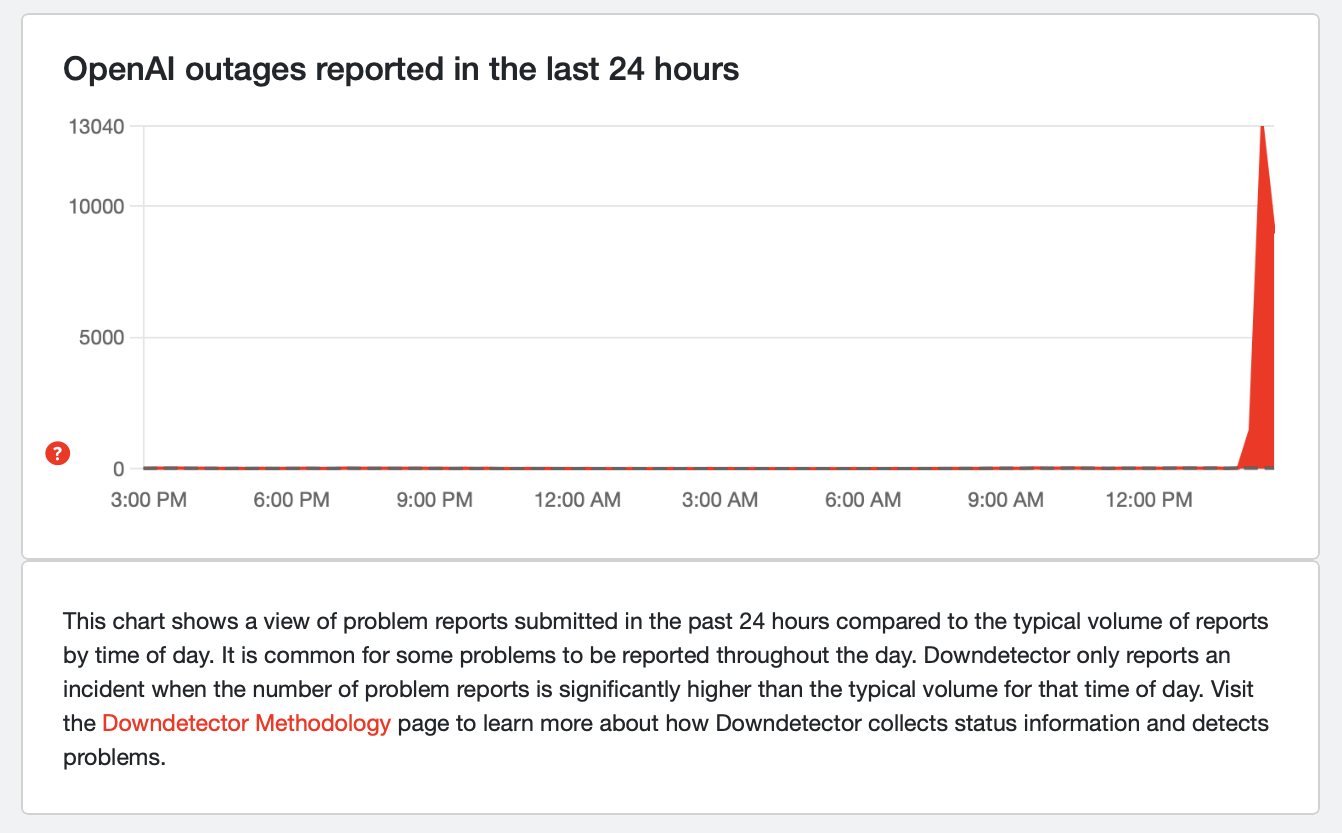 Down Detector
OpenAI issued a status update noting that "elevated error rates" are occurring for ChatGPT and Platform users. All 13 components of ChatGPT are marked as having "degraded performance" on the OpenAI status page. "We are working on implementing a mitigation," the company said, although it didn't provide an anticipated timeline for when the issue might be resolved.
The story is developing…
This article originally appeared on Engadget at https://www.engadget.com/ai/chatgpt-is-down-for-many-users-this-afternoon-210238573.html?src=rss


