
When I try to add a track to my imported playlists I can't? No idea why, and if I switch to the Blackplayer Custom Library my music doesn't even play and all the art vanishes
submitted by /u/vengefullyqueerdragn[link] [comments]
Alex Marquez is currently fastest at noon on the final day of the MotoGP test at Sepang. The Gresini Ducati rider is nearly four tenths clear of the next fastest rider, Fabio Di Giannantonio on Pertamina VR46 Ducati, while Pecco Bagnaia makes it three Ducatis in the top three. The factory Ducati rider is half a second slower than Alex Marquez.
David Emmett Thu, 05/Feb/2026 - 04:00
Canon released its first PowerShot camera back in 1996 with a 0.5-megapixel sensor, helping kickstart the digital photo revolution. To celebrate that 30-year anniversary, the company has unveiled a Limited Edition version of its still-popular PowerShot G7 X III compact camera. It has a few unique touches but is otherwise the same as the original model released nearly seven years ago.
The limited edition model has a new "graphite" color with a knurled front ring designed to exude "luxury and quality," Canon wrote. It also carries 30 year anniversary logo printed on the body "to create a special feeling suitable for limited edition models," the company added in the most Canon-y way possible.
 Canon's Limited Edition PowerShot G7 X III compact cameraCanon
As a reminder, the G7 X III was one of the first cameras announced specifically as a model for vloggers, thanks to its ability to shoot vertical video for Instagram. It features a 20.1MP sensor, flip-up 3-inch touchscreen, 24-100mm f/1.8-2.8 zoom lens and a microphone input. It supports 4K 30 fps video with no cropping and can shoot 1080p at 120 fps. The piece de resistance is direct streaming to YouTube directly over Wi-Fi, then a new thing but now a common feature. It originally retailed for $749.
The G7 X III had been in short supply until recently, but used models became popular with influencers several years ago and started selling way above list price. Possibly because of that viral fame, Canon announced in August 2025 that it was increasing production and the G7 X III started returning to stock a few months later priced at $880.
 Canon's Limited Edition PowerShot G7 X III compact cameraCanon
The Limited Edition G7 X III is selling for a lot more than that at $1,299, though it does come with a limited edition Peak Design cuff wrist strap and 32GB SD card. If you want to one-up the influencers and grab one, shipping will start in April 2026.
Along with the camera, Canon announced a pair of interesting new RF-mount full-frame lenses. The first is the ultra wide angle RF 14mm f/1.4 L VCM prime model priced at $2,599, promising bright, high quality optics. The other is a very interesting $1,899 RF7-14mm f/2.8-3.5 L Fisheye STM zoom lens with up to a 190 degree perspective at the widest setting.
This article originally appeared on Engadget at https://www.engadget.com/cameras/canon-unveils-a-limited-edition-version-of-its-popular-g7-x-iii-compact-camera-040000700.html?src=rss
With 2025 numbers in and the more basic US EV sales reports out, now is the time for one of my favorite topics of exploration — how fast different automakers are electrifying. Yes, it just hit me that we should really do an analysis like this for global sales — ... [continued]
The post Which Automakers Are Electrifying Fastest In USA? appeared first on CleanTechnica.
Yamaha is to continue testing on the final day of the Sepang MotoGP test. The Japanese factory halted all testing activity after Fabio Quartararo's bike had a technical problem in the late afternoon on the first day of the test, Yamahas seeing no track action on day 2. The decision was taken because they feared they could cause a dangerous situation for both their own riders and riders of other teams, Yamaha's technical director Max Bartolini explained on Wednesday.
David Emmett Thu, 05/Feb/2026 - 02:21- Read more about Yamaha To Resume Testing At Sepang After Investigation
- Log in or register to post comments
The Baton Rouge Police Department announced recently that it will begin using a drone designed by military equipment manufacturer Lockheed Martin and Edge Autonomy, making it one of the first local police departments to use an unmanned aerial vehicle (UAV) with a history of primary use in foreign war zones. Baton Rouge is now one of the first local police departments in the United States to deploy an unmanned aerial vehicle (UAV) with such extensive surveillance capabilities — a dangerous escalation in the militarization of local law enforcement.
This is a troubling development in an already long history of local law enforcement acquiring and utilizing military-grade surveillance equipment. It should be a cautionary tale that prods communities across the country to be proactive in ensuring that drones can only be acquired and used in ways that are well-documented, transparent, and subject to public feedback.
Baton Rouge bought the Stalker VXE30 from Edge Autonomy, which partners with Lockheed Martin and began operating under the brand Redwire last week. According to reporting from WBRZ ABC2 in Louisiana, the drone, training, and batteries, cost about $1 million.
 Baton Rouge Police Department officers stand with the Stalker VXE30 drone in a photo shared by the BRPD via Facebook.
All of the regular concerns surrounding drones apply to this new one in use by Baton Rouge:
- Drones can access and view spaces that are otherwise off-limits to law enforcement, including backyards, decks, and other areas of personal property.
- Footage captured by camera-enabled drones may be stored and shared in ways that go far beyond the initial flight.
- Additional camera-based surveillance can be installed on the drone, including automated license plate readers and the retroactive application of biometric analysis, such as face recognition.
However, the use of a military-grade drone hypercharges these concerns. Stalker VXE30's surveillance capabilities extend for dozens of miles, and it can fly faster and longer than standard police drones already in use.
"It can be miles away, but we can still have a camera looking at your face, so we can use it for surveillance operations," BRPD Police Chief TJ Morse told reporters.
Drone models similar to the Stalker VXE30 have been used in military operations around the world and are currently being used by the U.S. Army and other branches for long-range reconnaissance. Typically, police departments deploy drone models similar to those commercially available from companies like DJI, which until recently was the subject of a proposed Federal Communications Commission (FCC) ban, or devices provided by police technology companies like Skydio, in partnership with Axon and Flock Safety.
Additionally troubling is the capacity to add additional equipment to these drones: so-called "payloads" that could include other types of surveillance equipment and even weapons.
The Baton Rouge community must put policies in place that restrict and provide oversight of any possible uses of this drone, as well as any potential additions law enforcement might make.
EFF has filed a public records request to learn more about the conditions of this acquisition and gaps in oversight policies. We've been tracking the expansion of police drone surveillance for years, and this acquisition represents a dangerous new frontier. We'll continue investigating and supporting communities fighting back against the militarization of local police and mass surveillance. To learn more about the surveillance technologies being used in your city, please check out the Atlas of Surveillance.
Reposted from the EFF's Deeplinks blog.
XPENG's sales abroad (outside of China) have been a very strong point of growth for the company in the past year. There are several markets outside of the main auto markets we typically talk about that are eager to electrify and actually doing so quite fast. XPENG is one of ... [continued]
The post Indonesia Gets Its First 480 kW Charging Station — Thanks To XPENG appeared first on CleanTechnica.

They sold us sunrise, draped in stars and stripes,
A gilded lie that crooned of liberty—
That if we bled beneath the factory lights,
The harvest would be ours, eventually.
"Give us your tired," the brazen promise rang,
While slave patrols kept order in the dark;
From the same tree the fruit of freedom hangs,
Each body branded on the nation's heart.
We built the rails, we picked the cotton clean,
We mined the dark and left our fathers there;
Our sweat and blood still oiled the grand machine,
While marble men declared the ledger fair.
The postwar children climbed the gilded rung,
Their houses white, bright futures theirs to keep—
The Dream a hymn upon their grateful tongues,
While others bled to sow what they'd not reap.
A house once thrice a worker's yearly wage
Now asks for six, then eight, to drain us dry;
We followed every rule through every age—
They sold the ladder, told us we could fly.
They swore the cap and gown would set us free,
Would part the gates that labor couldn't breach—
We signed away our futures trustingly
For keys that fit no lock we'd ever reach.
The worker who gave forty years of labor
Now drowns in bills no pension can afford—
He trusted the company, the job, the neighbor,
And died in the ICU's indifferent ward.
They swore our citizenship was ironclad,
Our sacred bill of rights, they guaranteed—
Now sons and daughters, stripped of all they had,
Disappear to cells where shareholders feed.
A child goes hungry for the bottom line
While yachts drift past the bodies in the stream—
Ten men hold more than half of humankind,
And call this plunder the American Dream.
We walked upon the graves and claimed our place,
To raise our steeples over stolen ground—
The Dream required a veil across the face,
Amnesia where the nation's roots were found.
The Dream was never meant for huddled masses,
Just bodies burned to keep the engines hot—
The velvet rope is held by working classes,
For masters safe above the common lot.
And still we stand where fantasy must break,
Where stars and stripes reveal their threadbare seams—
The only freedom left for us to take:
To wake our children from the poisoned dreams.
Google's parent Alphabet is doubling down on generative AI in 2026. On Wednesday's earnings call, the search and advertising giant boosted its full-year capital expenditures target to between $175 and $185 billion, roughly twice what it spent last year.…

Turns out your yawn is doing way more than signaling boredom or fatigue - it's actually reorganizing the flow of fluids in your brain in ways scientists never expected.
Researchers at Neuroscience Research Australia recently placed 22 volunteers in MRI scanners and had them yawn, breathe deeply, and suppress yawns to examine what was actually happening inside their heads. — Read the rest
The post Yawning has an unexpected influence on the fluid inside your brain appeared first on Boing Boing.

There's an obscure federal law that might nullify the TSA's new $45 fee for flying without REAL ID. The Paperwork Reduction Act requires federal agencies to get Office of Management and Budget approval before collecting information from the public. The TSA's fee form? — Read the rest
The post There's an obscure federal law that might nullify the TSA's $45 no-ID fee appeared first on Boing Boing.

This week marks the 50th anniversary of Bill Gates' infamous "Open Letter to Hobbyists," in which the 20-year-old accused early computer enthusiasts of theft for copying his BASIC interpreter. "Most of you steal your software," Gates wrote in 1976. — Read the rest
The post 50 years ago, a 20-year-old Bill Gates called hobbyists "thieves" for sharing software appeared first on Boing Boing.
Three-time (1984-1985-1986) AMA 250cc Grand Prix Champion and WERA Pro Formula 2 Champion Donny Green died February 3rd, at age 64.
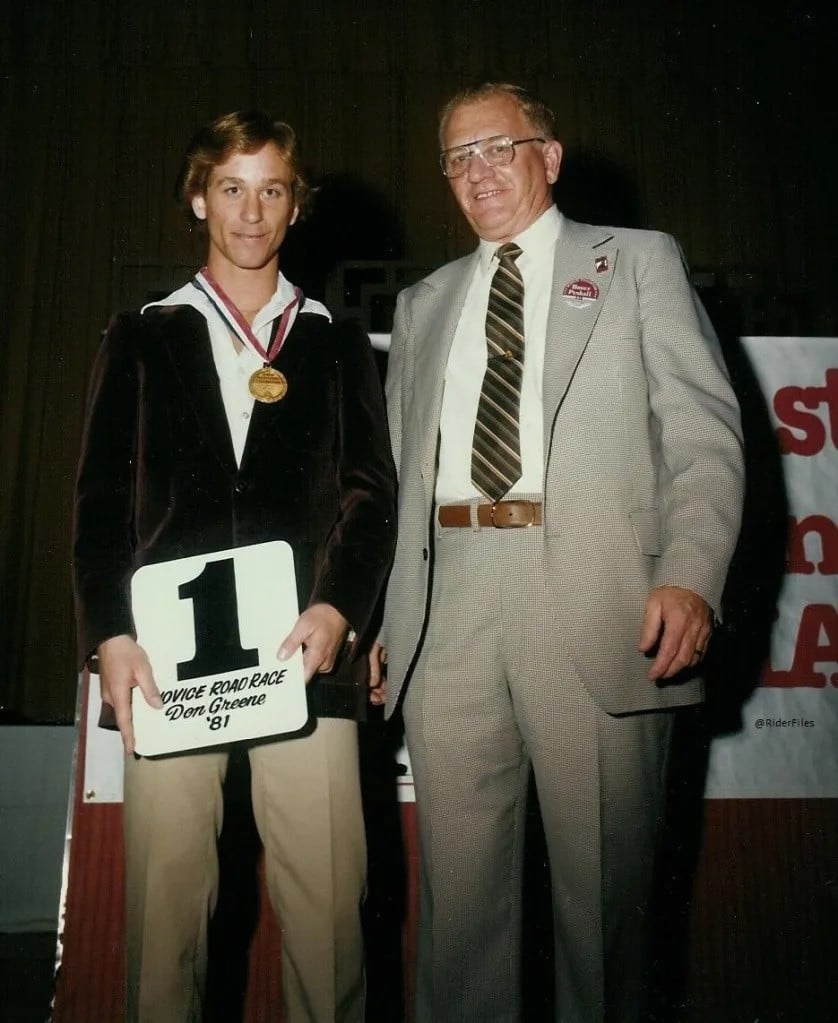 Donny Greene receives his 1981 AMA 250cc Novice #1 plate from AMA Official Bill Boyce. Photo courtesy The Rider Files.
His son Derek wrote on Facebook, "I lost my best friend, father, mentor and idol. He lived larger than life and had an even bigger heart…Thank you for buying my first drum set at 12. Thank you for teaching me good manners. Thank you for teaching me how to ski. Thank you for being there for me when times got tough. I'll always remember calling you after my shows and reflecting on my performance of that night. You always believed in me as I believed in you. You are a legend. I hate cancer and how ugly that disease is…Gone way too soon. You crossed the final finish line tonight as I kissed your forehead and told you, 'I love you dad!' 'Go Greene Go!'"
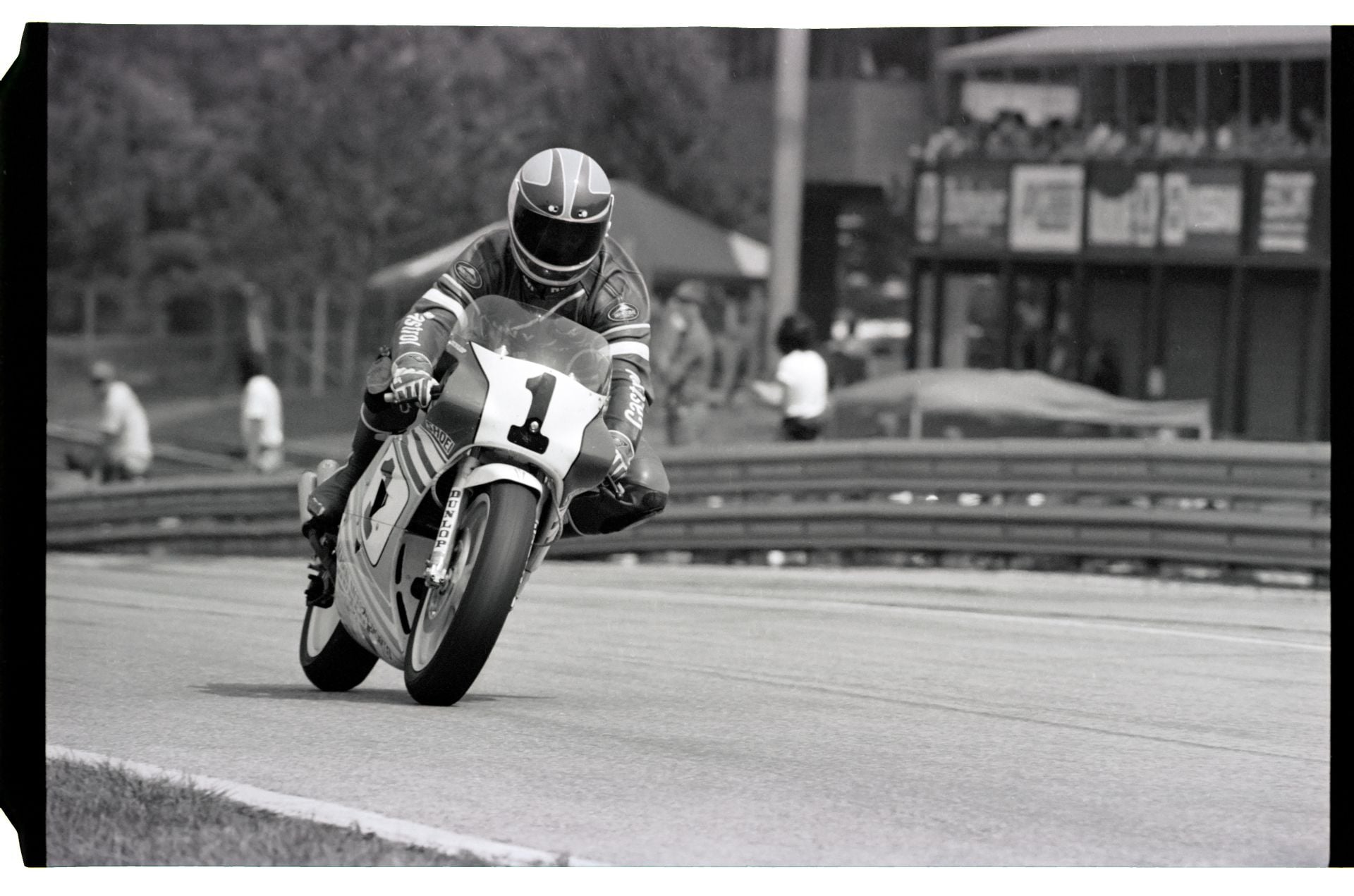 Donny Greene won the AMA 250cc Grand Prix Championship three times. Photo courtesy Rider Files.
Greene also raced and won with Dutchman Racing in the AMA/CCS Endurance Series.
May he rest in peace.
(Additional info will be posted as it becomes available.)
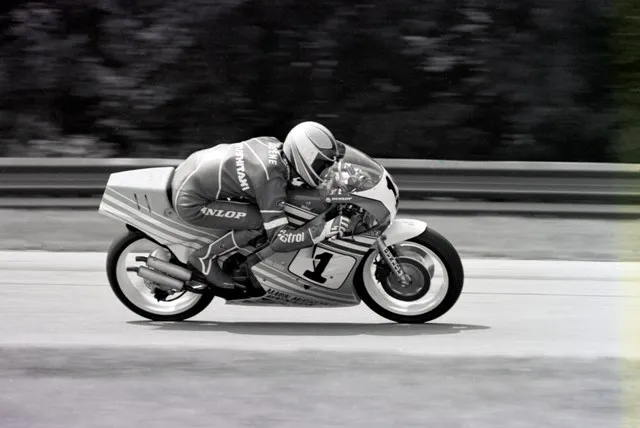 Donny Greene at Mid-Ohio, 1987. Photo by Larry Lawrence/Rider Files.
The post R.I.P.: AMA Formula 2 Champion Donny Greene appeared first on Roadracing World Magazine | Motorcycle Riding, Racing & Tech News.

'ICE' is the acronym for the US Immigration and Customs Enforcement agency. Despite their remit, ICE agents have been running amok in the US, which has resulted in the killings of Nicole Renee Good and Alex Pretti. Other killings behind the scenes have also come to light, with eight people who died under ICE detention. But there's some hope. A video has recently surfaced of a MAGA supporter assaulting a teen protester, only for the Zoomers to give him a kick-in he won't quickly forget.
Middle-aged MAGA gets humiliated by zoomersmuch better angle and footage of the MAGA adult attacking a teen girl before her friends and other student defend her https://t.co/T9DO7DaQeU
— Jules Suzdaltsev (@jules_su) February 3, 2026
At the beginning of the video, we see the middle-aged man lunge at a teenage girl. Eyewitnesses report that he did so with no provocation.
As you can see, the man removes his precious MAGA hat before pushing the young girl down an embankment. Next, she loses balance, and the man throws himself on top of her.
But it doesn't appear he was ready for what happened next.
Zoomers swarm the man, as he swings at another young girl coming in to save her friend. He loses his balance and the kids dive on him, overwhelming him instantly.
Dragging him away from the girl, the teens completely overpower him and beat the shit out of him. The man makes several attempts to break free, but the kids won't let him go.
Finally, seeing a break in the crowd, the man quickly runs to the safety of his SUV (i.e. his 'over-compensation wagon'), with the teens following, making sure the little rat is back in his hole.
It must be embarrassing, assaulting a young girl and then getting your arse handed to you.
This isn't the first instance of the kids taking a stance against ICE and MAGA either:
Students walked out of school at Burnsville High School in Minnesota to protest Trump's ICE gestapo terrorizing their community….the kids are alright

Sentient forehead and Labour big man Wes Streeting has come out swinging for Mandelson. Specifically, he's told the BBC that the key issue is people failed to believe Epstein's victims.
Streeting says Epsteins victims werent believed
The govt appointed Mandelson knowing he'd stayed at Epsteins house after Epsteins conviction for soliciting prostitution from a minor. Its clear Wes & this govt didnt care about Epsteins victims until politically expedient to do so pic.twitter.com/97nvhcPFlp
— Saul Staniforth (@SaulStaniforth) February 4, 2026
The problem is that the people who didn't believe the victims includes the government Streeting is a part of. After all, why would they have promoted Mandelson otherwise, when they knew about his connections to Epstein?
Streeting — the allegationsDon't get me wrong, it's wonderful that Streeting has managed to pull himself away from privatising our NHS to stand up for the victims, but all is not as it seems.
Streeting's Twitter/X history shows that he was silent on Epstein until this morning. This was despite years of actual women coming forward, and the known links between Mandelson and Epstein.
Additionally, it seems Streeting has only mentioned Mandelson himself a few times at first glance. But that doesn't factor in the tweets he's recently deleted:

Since the 'suicide' in prison of serial child-rapist and Israeli spy Jeffrey Epstein, theories about his 'death' have split into two main camps.
One assumes, based on the state editing of CCTV video of the area around his cell on the night in question, that Epstein was murdered so he can be silenced. Another, that Epstein isn't dead, but was instead spirited away. The latest release of Epstein files by the US justice department contains information that appears to support the latter.
Before Epstein's death had been officially reported, an anonymous post appeared on conspiracy site 4Chan on 10 August 2019 from a user who claimed to be a security guard at the prison. The post claimed that Epstein had been "switched out":

Not saying anything after this pls do not try to dox me but last night after 0415 count they took him medical in a wheelchair front cuffed but not 1 triage nurse says they spoke to him. Next thing we know a trip van shows up? We do not do releases on the weekends unless a judge orders it. Next thing we know, he's put in a single man cell and hangs himself? Heres [sic] the thing, the trip van did NOT sign in and we did not record the plate number and a guy in a green dress military outfit was in the back of the van according to the tower guy who let him thru the gate. You guys i am shaking right now but i think they switched him out.
Images released of 'Epstein' also appear to suggest discrepancies in key facial features between the dead body and Epstein photographed while alive:

Another post on the same message board, also before the announcement of Epstein's death, gives details of treatment supposedly administered:

This has long been dismissed as mere 'conspiracy theory'. However, the latest Epstein file release includes information that appears to confirm that prison guard Roberto Grijalva was the person who sent the message to the board before Epstein's death.
Epstein prison whistle blower namedA day after Epstein's death, US Attorney Geoffrey Berman of New York's southern district opened a Grand Jury proceeding. As part of the proceeding, Berman subpoenaed a number of companies — including 4Chan and Citibank — for its user records. The aim of the subpoena was to uncover the identity behind the anonymous post.
The latest release includes bank documents provided by 4Chan in response. In these records, the name of on the response on the user name has been redacted. However, the name on the associated records showing the bank account holder was not removed: Roberto Grijalva.


The idea that a serial child-rapist may still be alive and given refuge in Israel is anything but far-fetched, even if Epstein's status as an Israeli spy is set aside. Although stubbornly ignored by UK state-corporate media, the Israeli regime is currently ignoring well over 2,000 extradition requests for alleged and convicted paedophiles. In April 2025 Shoshana Strook, the daughter of Israel's far-right settlements minister fled to police and asked them to protect her, accusing both her parents and one of her brothers of raping her as a child, over a period of years, and filming the rapes.
Israeli psychotherapist and trauma expert Dr Anat Gur, head of the Bar-Ilan University trauma therapy program, has said that she believes organised child rape in Israel is widespread:
Organized child rape is one of the most horrific things I've encountered. It's likely much more widespread than we think. It's happening in places we least expect.
The latest document release already put beyond reasonable doubt the fact that Jeffrey Epstein was an Israeli intelligence asset. This includes mention of his training as a spy under former Israeli PM Ehud Barak, allegedly one of Epstein's most brutal rapists.
Now, it also validates the 10 August 2019 4Chan post as a legitimate eyewitness account written by a prison officer working on the night of Epstein's 'death'. A witness who says he was removed, without the usual official records. One who believes Epstein was "switched out" and was reporting it immediately, along with the supposed means of suicide, before news of it was in the public domain.
Featured image provided via the Canary
By Skwawkbox
State and federal lawmakers have stepped up their efforts to prevent the creation of 3D printed guns. But Adafruit, a maker of electronics kits, warns that the proposed legislation is so broad it threatens everyone involved in open source manufacturing and technology education.…
The Oligarch Giveth, and The Oligarch Taketh Away
That it's bad
Reason says Trump's wanting to nationalize elections (when he and the GOP are in full power) is not only unconstitutional and wrong on other grounds, but similar to something the Democrats wanted to do five years ago. Looks different to me, but I kinda get their point.
Solar power, electric vehicles (EVs) and other clean-energy technologies drove more than a third of the growth in China's economy in 2025 - and more than 90% of the rise in investment.
Clean-energy sectors contributed a record 15.4tn yuan ($2.1tn) in 2025, some 11.4% of China's gross domestic product (GDP) - comparable to the economies of Brazil or Canada.
The new analysis for Carbon Brief, based on official figures, industry data and analyst reports, shows that China's clean-energy sectors nearly doubled in real value between 2022-25 and - if they were a country - would now be the 8th-largest economy in the world.
Other key findings from the analysis include:
- Without clean-energy sectors, China would have missed its target for GDP growth of "around 5%", expanding by 3.5% in 2025 instead of the reported 5.0%.
- Clean-energy industries are expanding much more quickly than China's economy overall, with their annual growth rate accelerating from 12% in 2024 to 18% in 2025.
- The "new three" of EVs, batteries and solar continue to dominate the economic contribution of clean energy in China, generating two-thirds of the value added and attracting more than half of all investment in the sectors.
- China's investments in clean energy reached 7.2tn yuan ($1.0tn) in 2025, roughly four times the still sizable $260bn put into fossil-fuel extraction and coal power.
- Exports of clean-energy technologies grew rapidly in 2025, but China's domestic market still far exceeds the export market in value for Chinese firms.
These investments in clean-energy manufacturing represent a large bet on the energy transition in China and overseas, creating an incentive for the government and enterprises to keep the boom going.
However, there is uncertainty about what will happen this year and beyond, particularly for solar power, where growth has slowed in response to a new pricing system and where central government targets have been set far below the recent rate of expansion.
An ongoing slowdown could turn the sectors into a drag on GDP, while worsening industrial "overcapacity" and exacerbating trade tensions.
Yet, even if central government targets in the next five-year plan are modest, those from local governments and state-owned enterprises could still drive significant growth in clean energy.
This article updates analysis previously reported for 2023 and 2024.
Clean-energy sectors outperform wider economyChina's clean-energy economy continues to grow far more quickly than the wider economy. This means that it is making an outsize contribution to annual economic growth.
The figure below shows that clean-energy technologies drove more than a third of the growth in China's economy overall in 2025 and more than 90% of the net rise in investment.
 Contributions to the growth in Chinese investment (left) and GDP overall (right) in 2025 by sector, trillion yuan. Source: Centre for Research on Energy and Clean Air (CREA) analysis for Carbon Brief.
In 2022, China's clean-energy economy was worth an estimated 8.4tn yuan ($1.2tn). By 2025, the sectors had nearly doubled in value to 15.4tn yuan ($2.1tn).
This is comparable to the entire output of Brazil or Canada and positions the Chinese clean-energy industry as the 8th-largest economy in the world. Its value is roughly half the size of the economy of India - the world's fourth largest - or of the US state of California.
The outperformance of the clean-energy sectors means that they are also claiming a rising share of China's economy overall, as shown in the figure below.
 Share of China's GDP contributed by clean-energy sectors, %. Source: CREA analysis for Carbon Brief.
This share has risen from 7.3% of China's GDP in 2022 to 11.4% in 2025.
Without clean-energy sectors, China's GDP would have expanded by 3.5% in 2025 instead of the reported 5.0%, missing the target of "around 5%" growth by a wide margin.
Clean energy thus made a crucial contribution during a challenging year, when promoting economic growth was the foremost aim for policymakers.
The table below includes a detailed breakdown by sector and activity.
SectorActivityValue in 2025, CNY blnValue in 2025, USD blnYear-on-year growthGrowth contributionValue contributionValue in 2025, CNY trnValue in 2024, CNY trnValue in 2023, CNY trnValue in 2022, CNY trn EVsInvestment: manufacturing capacity1,64322818%10.4%10.7%1.61.41.20.9 EVsInvestment: charging infrastructure1922758%2.9%1.2%0.1920.1220.10.08 EVsProduction of vehicles3,94054829%36.4%25.6%3.943.0652.261.65 BatteriesInvestment: battery manufacturing2773835%3.0%1.8%0.2770.2050.320.15 BatteriesExports: batteries72410151%10.1%4.7%0.7240.480.460.34 Solar powerInvestment: power generation capacity1,18216415%6.3%7.7%1.1821.0310.8080.34 Solar powerInvestment: manufacturing capacity50670-23%-6.5%3.3%0.5060.6620.950.51 Solar powerElectricity generation4916833%5.1%3.2%0.4910.3690.260.19 Solar powerExports of components6819521%4.9%4.4%0.6810.5620.50.35 Wind powerInvestment: power generation capacity, onshore6128547%8.1%4.0%0.6120.4170.3970.21 Wind powerInvestment: power generation capacity, offshore961398%2.0%0.6%0.0960.0480.0860.06 Wind powerElectricity generation5107113%2.4%3.3%0.510.4530.40.34 Nuclear powerInvestment: power generation capacity1732418%1.1%1.1%0.170.150.090.07 Nuclear powerElectricity generation216308%0.7%1.4%0.2160.20.190.19 HydropowerInvestment: power generation capacity547-7%-0.2%0.3%0.050.060.060.06 HydropowerElectricity generation582813%0.6%3.8%0.5820.5670.510.51 Rail transportationInvestment9021256%2.1%5.8%0.9020.8510.7640.714 Rail transportationTransport of passengers and goods1,0201423%1.3%6.6%1.020.990.9640.694 Electricity transmissionInvestment: transmission capacity644906%1.5%4.2%0.640.610.530.5 Electricity transmissionTransmission of clean power52714%0.3%0.3%0.0520.0460.040.04 Energy storageInvestment: Pumped hydro5375%0.1%0.3%0.050.050.040.03 Energy storageInvestment: Grid-connected batteries2323252%3.3%1.5%0.2320.1520.080.02 Energy storageInvestment: Electrolysers11229%0.1%0.1%0.0110.00900 Energy efficiencyRevenue: Energy service companies6208617%3.8%4.0%0.620.5280030.520.45 TotalInvestments7,198100115%38.2%46.7%7.206.286.004.11 TotalProduction of goods and services8,2161,14322%61.8%53.3%8.226.735.584.32 TotalTotal GDP contribution15,414214418%100.0%100.0%15.4113.0111.588.42 EVs and batteries were the largest drivers of GDP growthIn 2024, EVs and solar had been the largest growth drivers. In 2025, it was EVs and batteries, which delivered 44% of the economic impact and more than half of the growth of the clean-energy industries. This was due to strong growth in both output and investment.
The contribution to nominal GDP growth - unadjusted for inflation - was even larger, as EV prices held up year-on-year while the economy as a whole suffered from deflation. Investment in battery manufacturing rebounded after a fall in 2024.
The major contribution of EVs and batteries is illustrated in the figure below, which shows both the overall size of the clean-energy economy and the sectors that added the most to the rise from year to year.
 Contribution of clean-energy sectors to China's GDP and GDP growth, trillion yuan, 2022-2025. Source: CREA analysis for Carbon Brief.
The next largest subsector was clean-power generation, transmission and storage, which made up 40% of the contribution to GDP and 30% of the growth in 2025.
Within the electricity sector, the largest drivers were growth in investment in wind and solar power generation capacity, along with growth in power output from solar and wind, followed by the exports of solar-power equipment and materials.
Investment in solar-panel supply chains, a major growth driver in 2022-23, continued to fall for the second year. This was in line with the government's efforts to rein in overcapacity and "irrational" price competition in the sector.
Finally, rail transportation was responsible for 12% of the total economic output of the clean-energy sectors, but saw relatively muted growth year-on-year, with revenue up 3% and investment by 6%.
Note that the International Energy Agency (IEA) world energy investment report projected that China invested $627bn in clean energy in 2025, against $257bn in fossil fuels.
For the same sectors as the IEA report, this analysis puts the value of clean-energy investment in 2025 at a significantly more conservative $430bn. The higher figures in this analysis overall are therefore the result of wider sectoral coverage.
Electric vehicles and batteriesEVs and vehicle batteries were again the largest contributors to China's clean-energy economy in 2025, making up an estimated 44% of value overall.
Of this total, the largest share of both total value and growth came from the production of battery EVs and plug-in hybrids, which expanded 29% year-on-year. This was followed by investment into EV manufacturing, which grew 18%, after slower growth rates in 2024.
Investment in battery manufacturing also rebounded after a drop in 2024, driven by new battery technology and strong demand from both domestic and international markets. Battery manufacturing investment grew by 35% year-on-year to 277bn yuan.
The share of electric vehicles (EVs) will have reached 12% of all vehicles on the road by the end of 2025, up from 9% a year earlier and less than 2% just five years ago.
The share of EVs in the sales of all new vehicles increased to 48%, from 41% in 2024, with passenger cars crossing the 50% threshold. In November, EV sales crossed the 60% mark in total sales and they continue to drive overall automotive sales growth, as shown below.
 Production of combustion-engine vehicles and EVs in China, million units. EVs include battery electric vehicles and plug-in hybrids. Source: China Association of Automobile Manufacturers data via Wind Financial Terminal.
Electric trucks experienced a breakthrough as their market share rose from 8% in the first nine months of 2024 to 23% in the same period in 2025.
Policy support for EVs continues, for example, with a new policy aiming to nearly double charging infrastructure in the next three years.
Exports grew even faster than the domestic market, but the vast majority of EVs continue to be sold domestically. In 2025, China produced 16.6m EVs, rising 29% year-on-year. While exports accounted for only 21% or 3.4m EVs, they grew by 86% year-on-year. Top export destinations for Chinese EVs were western Europe, the Middle East and Latin America.
The value of batteries exported also grew rapidly by 41% year-on-year, becoming the third largest growth driver of the GDP. Battery exports largely went to western Europe, north America and south-east Asia.
In contrast with deflationary trends in the price of many clean-energy technologies, average EV prices have held up in 2025, with a slight increase in average price of new models, after discounts. This also means that the contribution of the EV industry to nominal GDP growth was even more significant, given that overall producer prices across the economy fell by 2.6%. Battery prices continued to drop.
Clean-power generationThe solar power sector generated 19% of the total value of the clean-energy industries in 2025, adding 2.9tn yuan ($41bn) to the national economy.
Within this, investment in new solar power plants, at 1.2tn yuan ($160bn), was the largest driver, followed by the value of solar technology exports and by the value of the power generated from solar. Investment in manufacturing continued to fall after the wave of capacity additions in 2023, reaching 0.5tn yuan ($72bn), down 23% year-on-year.
In 2025, China achieved another new record of wind and solar capacity additions. The country installed a total of 315GW solar and 119GW wind capacity, adding more solar and two times as much wind as the rest of the world combined.
Clean energy accounted for 90% of investment in power generation, with solar alone covering 50% of that. As a result, non-fossil power made up 42% of total power generation, up from 39% in 2024.
However, a new pricing policy for new solar and wind projects and modest targets for capacity growth have created uncertainty about whether the boom will continue.
Under the new policy, new clean-power generation has to compete on price against existing coal power in markets that place it at a disadvantage in some key ways.
At the same time, the electricity markets themselves are still being introduced and developed, creating investment uncertainty.
Investment in solar power generation increased year-on-year by 15%, but experienced a strong stop-and-go cycle. Developers rushed to finish projects ahead of the new pricing policy coming into force in June and then again towards the end of the year to finalise projects ahead of the end of the current 14th five-year plan.
Investment in the solar sector as a whole was stable year-on-year, with the decline in manufacturing capacity investment balanced by continued growth in power generation capacity additions. This helped shore up the utilisation of manufacturing plants, in line with the government's aim to reduce "disorderly" price competition.
By late 2025, China's solar manufacturing capacity reached an estimated 1,200GW per year, well ahead of the global capacity additions of around 650GW in 2025. Manufacturers can now produce far more solar panels than the global market can absorb, with fierce competition leading to historically low profitability.
China's policymakers have sought to address the issue since mid-2024, warning against "involution", passing regulations and convening a sector-wide meeting to put pressure on the industry. This is starting to yield results, with losses narrowing in the third quarter of 2025.
The volume of exports of solar panels and components reached a record high in 2025, growing 19% year-on-year. In particular, exports of cells and wafers increased rapidly by 94% and 52%, while panel exports grew only by 4%.
This reflects the growing diversification of solar-supply chains in the face of tariffs and with more countries around the world building out solar panel manufacturing capacity. The nominal value of exports fell 8%, however, due to a fall in average prices and a shift to exporting upstream intermediate products instead of finished panels.
Hydropower, wind and nuclear were responsible for 15% of the total value of the clean-energy sectors in 2025, adding some 2.2tn yuan ($310bn) to China's GDP in 2025.
Nearly two-thirds of this (1.3tn yuan, $180bn) came from the value of power generation from hydropower, wind and nuclear, with investment in new power generation projects contributing the rest.
Power generation grew 33% from solar, 13% from wind, 3% from hydropower and 8% from nuclear.
Within power generation investment, solar remained the largest segment by value - as shown in the figure below - but wind-power generation projects were the largest contributor to growth, overtaking solar for the first time since 2020.
 Value of new clean-power generation capacity, billion yuan, by year added. Source: CREA analysis for Carbon Brief.
In particular, offshore wind power capacity investment rebounded as expected, doubling in 2025 after a sharp drop in 2024.
Investment in nuclear projects continued to grow but remains smaller in total terms, at 17bn yuan. Investment in conventional hydropower continued to decline by 7%.
Electricity storage and gridsElectricity transmission and storage were responsible for 6% of the total value of the clean-energy sectors in 2025, accounting for 1.0 tn yuan ($140bn).
The most valuable sub-segment was investment in power grids, growing 6% in 2025 and reaching $90bn. This was followed by investment in energy storage, including pumped hydropower, grid-connected battery storage and hydrogen production.
Investment in grid-connected batteries saw the largest year-on-year growth, increasing by 50%, while investments in electrolysers also grew by 30%. The transmission of clean power increased an estimated 13%, due to rapid growth in clean-power generation.
China's total electricity storage capacity reached more than 213GW, with battery storage capacity crossing 145GW and pumped hydro storage at 69GW. Some 66GW of battery storage capacity was added in 2025, up 52% year-on-year and accounting for more than 40% of global capacity additions.
Notably, capacity additions accelerated in the second half of the year, with 43GW added, compared with the first half, which saw 23GW of new capacity.
The battery storage market initially slowed after the renewable power pricing policy, which banned storage mandates after May, but this was quickly replaced by a "market-driven boom". Provincial electricity spot markets, time-of-day tariffs and increasing curtailment of solar power all improved the economics of adding storage.
By the end of 2025, China's top five solar manufacturers had all entered the battery storage market, making a shift in industry strategy.
Investment in pumped hydropower continued to increase, with 15GW of new capacity permitted in the first half of 2025 alone and 3GW entering operation.
RailwaysRail transportation made up 12% of the GDP contribution of the clean-energy sectors, with revenue from passenger and goods rail transportation the largest source of value. Most growth came from investment in rail infrastructure, which increased 6% year-on-year
The electrification of transport is not limited to EVs, as rail passenger, freight and investment volumes saw continued growth. The total length of China's high-speed railway network reached 50,000km in 2025, making up more than 70% of the global high-speed total.
Energy efficiencyInvestment in energy efficiency rebounded strongly in 2025. Measured by the aggregate turnover of large energy service companies (ESCOs), the market expanded by 17% year-on-year, returning to growth rates last seen during 2016-2020.
Total industry turnover has also recovered to its previous peak in 2021, signalling a clear turnaround after three years of weakness.
Industry projections now anticipate annual turnover reaching 1tn yuan in annual turnover by 2030, a target that had previously been expected to be met by 2025.
China's ESCO market has evolved into the world's largest. Investment within China's ESCO market remains heavily concentrated in the buildings sector, which accounts for around 50% of total activity. Industrial applications make up a further 21%, while energy supply, demand-side flexibility and energy storage together account for approximately 16%.
Implications of China's clean-energy betOngoing investment of hundreds of billions of dollars into clean-energy manufacturing represents a gigantic economic and financial bet on a continuing global energy transition.
In addition to the domestic investment covered in this article, Chinese firms are making major investments in overseas manufacturing.
The clean-energy industries have played a crucial role in meeting China's economic targets during the five-year period ending this year, delivering an estimated 40%, 25% and 37% of all GDP growth in 2023, 2024 and 2025, respectively.
However, the developments next year and beyond are unclear, particularly for solar power generation, with the new pricing system for renewable power generation leading to a short-term slowdown and creating major uncertainty, while central government targets have been set far below current rates of clean-electricity additions.
Investment in solar-power generation and solar manufacturing declined in the second half of the year, while investment in generation clocked growth for the full year, showing the risk to the industries under the current power market set-ups that favour coal-fired power.
The reduction in the prices of clean-energy technology has been so dramatic that when the prices for GDP statistics are updated, the sectors' contribution to real GDP - adjusted for inflation or, in this case deflation - will be revised down.
Nevertheless, the key economic role of the industry creates a strong motivation to keep the clean-energy boom going. A slowdown in the domestic market could also undermine efforts to stem overcapacity and inflame trade tensions by increasing pressure on exports to absorb supply.
A recent CREA survey of experts working on climate and energy issues in China found that the majority believe that economic and geopolitical challenges will make the "dual carbon" goals - and with that, clean-energy industries - only more important.
Local governments and state-owned enterprises will also influence the outlook for the sector. Their previous five-year plans played a key role in creating the gigantic wind and solar power "bases" that substantially exceeded the central government's level of ambition.
Provincial governments also have a lot of leeway in implementing the new electricity markets and contracting systems for renewable power generation. The new five-year plans, to be published this year, will therefore be of major importance.
About the dataReported investment expenditure and sales revenue has been used where available. When this is not available, estimates are based on physical volumes - gigawatts of capacity installed, number of vehicles sold - and unit costs or prices.
The contribution to real growth is tracked by adjusting for inflation using 2022-2023 prices.
All calculations and data sources are given in a worksheet.
Estimates include the contribution of clean-energy technologies to the demand for upstream inputs such as metals and chemicals.
This approach shows the contribution of the clean-energy sectors to driving economic activity, also outside the sectors themselves, and is appropriate for estimating how much lower economic growth would have been without growth in these sectors.
Double counting is avoided by only including non-overlapping points in value chains. For example, the value of EV production and investment in battery storage of electricity is included, but not the value of battery production for the domestic market, which is predominantly an input to these activities.
Similarly, the value of solar panels produced for the domestic market is not included, as it makes up a part of the value of solar power generating capacity installed in China. However, the value of solar panel and battery exports is included.
In 2025, there was a major divergence between two different measures of investment. The first, fixed asset investment, reportedly fell by 3.8%, the first drop in 35 years. In contrast, gross capital formation saw the slowest growth in that period but still inched up by 2%.
This analysis uses gross capital formation as the measure of investment, as it is the data point used for GDP accounting. However, the analysis is unable to account for changes in inventories, so the estimate of clean-energy investment is for fixed asset investment in the sectors.
The analysis does not explicitly account for the small and declining role of imports in producing clean-energy goods and services. This means that the results slightly overstate the contribution to GDP but understate the contribution to growth.
For example, one of the most important import dependencies that China has is for advanced computing chips for EVs. The value of the chips in a typical EV is $1,000 and China's import dependency for these chips is 90%, which suggests that imported chips represent less than 3% of the value of EV production.
The estimates are likely to be conservative in some key respects. For example, Bloomberg New Energy Finance estimates "investment in the energy transition" in China in 2024 at $800bn. This estimate covers a nearly identical list of sectors to ours, but excludes manufacturing - the comparable number from our data is $600bn.
China's National Bureau of Statistics says that the total value generated by automobile production and sales in 2023 was 11tn yuan. The estimate in this analysis for the value of EV sales in 2023 is 2.3tn yuan, or 20% of the total value of the industry, when EVs already made up 31% of vehicle production and the average selling prices for EVs was slightly higher than for internal combustion engine vehicles.

China energy
|05.02.26
'Rush' for new coal in China hits record high in 2025 as climate deadline looms
China energy
|03.02.26

Explainer: Why gas plays a minimal role in China's climate strategy
China energy
|22.01.26

Experts: What to expect from China on energy and climate action in 2026
China energy
|16.01.26
jQuery(document).ready(function() { jQuery('.block-related-articles-slider-block_c6a9262f1c35c01f898c7be52e312d1e .mh').matchHeight({ byRow: false }); });The post Analysis: Clean energy drove more than a third of China's GDP growth in 2025 appeared first on Carbon Brief.
2025年,太阳能、电动汽车及其他清洁能源技术对中国经济增长的贡献已超过三分之一,并拉动超过九成的投资增长。
中国清洁能源行业产值在2025年达到创纪录的15.4万亿元人民币(约合2.1万亿美元),约占国内生产总值(GDP)的11.4%,该数字相当于巴西或加拿大的经济规模。
Carbon Brief基于官方数字、行业数据及分析师报告进行的最新分析显示,2022年至2025年间,中国清洁能源行业的实际规模几乎翻了一番;若将其视为一个独立经济体,其规模可位列全球第八。
该分析的其他主要成果包括:
- 清洁能源行业支撑中国实现了"5%左右"的GDP增长目标,若排除清洁能源行业,2025年GDP实际增速仅为3.5%。
- 清洁能源产业的扩张速度持续快于整体经济,其年增长率从2024年的12%提升至2025年的18%。
- 电动汽车、电池和光伏"新三样"仍是中国清洁能源经济贡献的核心,创造了约三分之二的增加值,并吸纳了一半以上的行业投资。
- 2025年,中国在清洁能源领域的投资达7.2万亿元人民币(约1万亿美元),约为同期化石燃料开采与煤电投资(2600亿美元)的四倍。
- 尽管2025年清洁能源技术出口保持了快速增长,但对中国企业而言,国内市场在价值规模上仍显著大于出口市场。
这些投向清洁能源制造业的资金,代表着对中国乃至全球能源转型的重大押注,也为政府和企业保持这一发展势头提供了动力。
然而,未来的长期走势仍然存在不确定性,尤其是在太阳能领域。受136号文件下的新定价机制影响,太阳能发电装机增速已有所放缓,而中央政府设定的相关目标也明显低于近几年的实际扩张水平。
如果放缓趋势持续下去,这些产业或将从经济增长的驱动力转变为拖累因素,同时加剧工业领域的"产能过剩"问题,并进一步恶化国际贸易摩擦。
但即便中央政府对清洁能源未来五年的目标设定较为谨慎,地方政府和国有企业的规划与投资力度,仍有可能推动清洁能源产业继续实现显著增长。
本文在此前对2023年和2024年清洁能源经济贡献分析的基础上进行了更新。
清洁能源行业表现优于整体经济中国的清洁能源经济持续高速增长,远超整体经济增速。这意味着它对年度经济增长的贡献尤为显著。
下图显示,2025年,清洁能源技术贡献了中国超过三分之一的GDP增量,并推动了超过90%的新增投资增长。
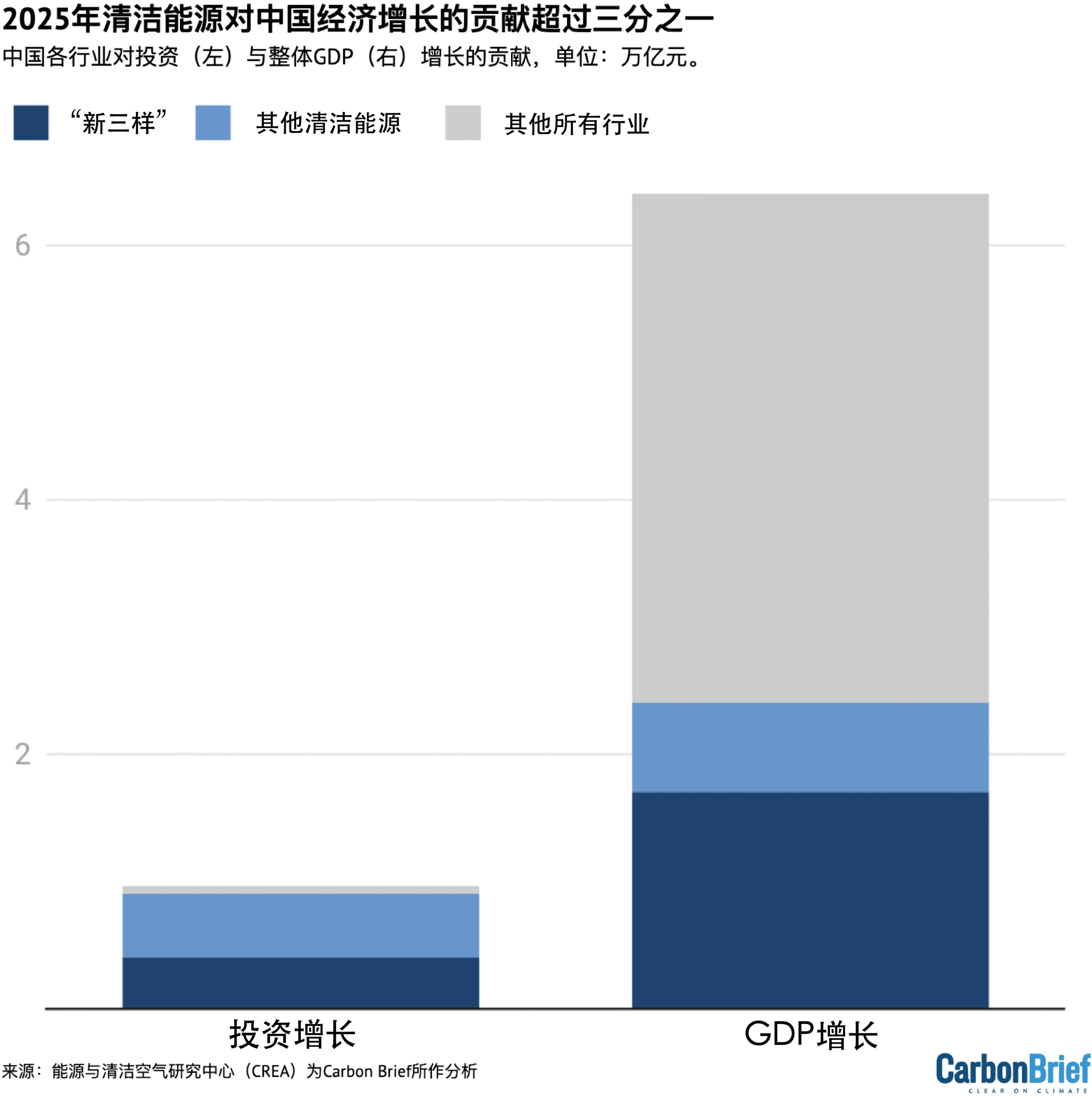 中国各行业对投资(左)与整体GDP(右)增长的贡献,单位:万亿元。来源:能源与清洁空气研究中心(CREA)为Carbon Brief所作分析。
2022年,中国清洁能源经济规模约为8.4万亿元人民币(1.2万亿美元)。到2025年,这一规模几乎翻了一番,达到15.4万亿元人民币(2.1万亿美元)。
这一体量相当于巴西或加拿大的经济总量,使中国的清洁能源产业堪比全球第八大经济体,产值约为世界第四大经济体印度经济总量的一般,也大致相当于美国加利福尼亚州经济规模的一半。
由于清洁能源产业持续跑赢整体经济,其在中国经济中的占比也在不断上升,从2022年占中国GDP的7.3%上升至2025年的11.4%。
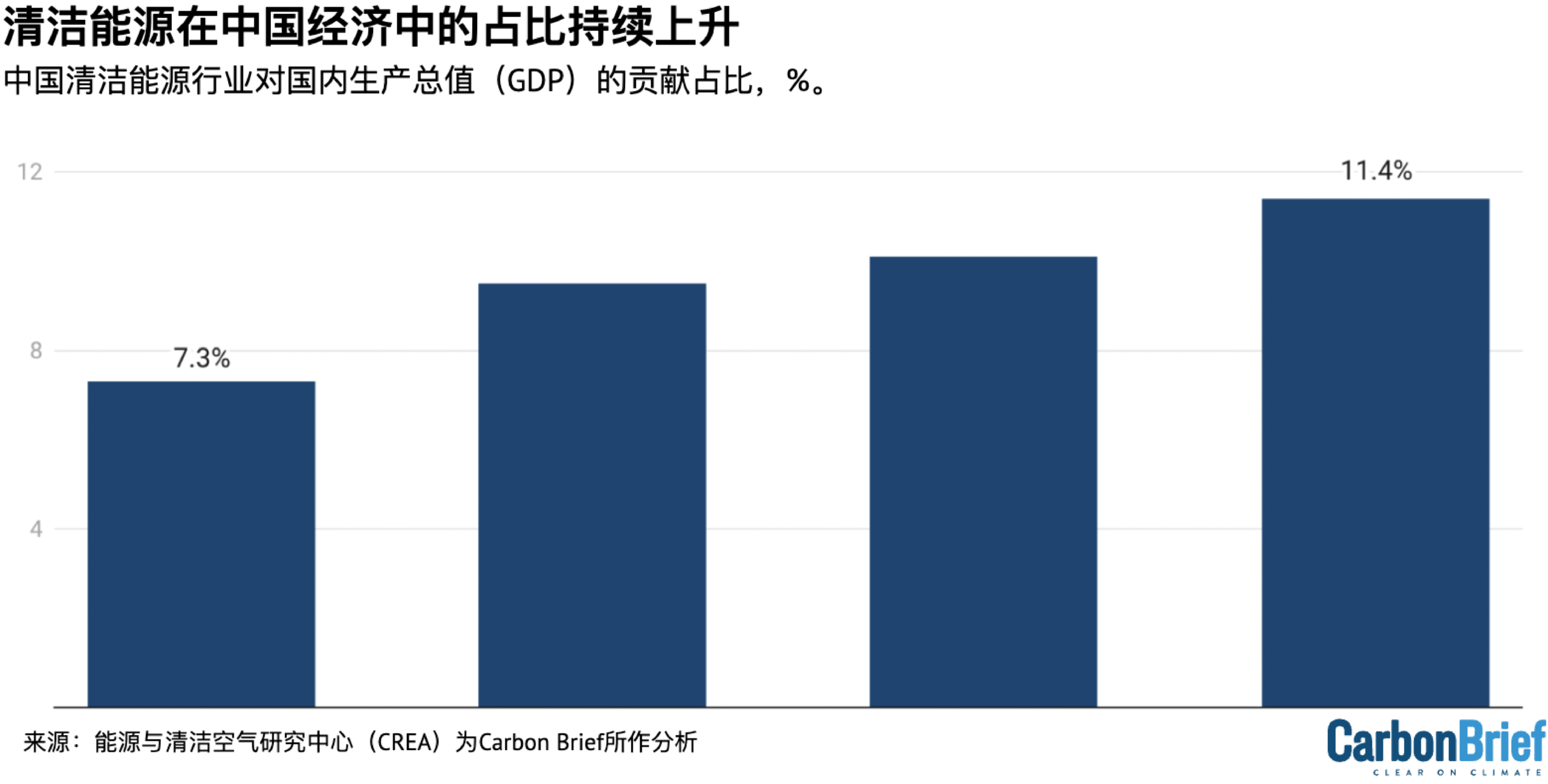 中国清洁能源行业对国内生产总值(GDP)的贡献占比,%。来源:能源与清洁空气研究中心(CREA)为Carbon Brief所作分析。
如果没有清洁能源行业,中国2025年的GDP增速将仅为3.5%,因此,在经济稳定增长为中国首要目标之一的2025年,清洁能源做出了至关重要的贡献。
下表按行业和活动进行了详细分类。
电动汽车和电池是GDP增长的最大驱动力2024年,电动汽车和太阳能是最大的增长驱动力。而到了2025年,电动汽车和电池则占据了主导地位,合计贡献了44%的经济效益,以及清洁能源行业一半以上的增长。这主要得益于产出和投资的同步强劲增长。
在未剔除通胀因素的名义GDP口径下,电动汽车的贡献甚至更为突出。这是因为电动汽车价格同比保持相对稳定,而整体经济仍处于通缩环境中。同时,电池制造投资在2024年下滑后于2025年出现反弹。
下图展示了电动汽车和电池的主要贡献,既反映了清洁能源经济的整体规模,也显示了各子行业对年度增量的具体贡献情况。
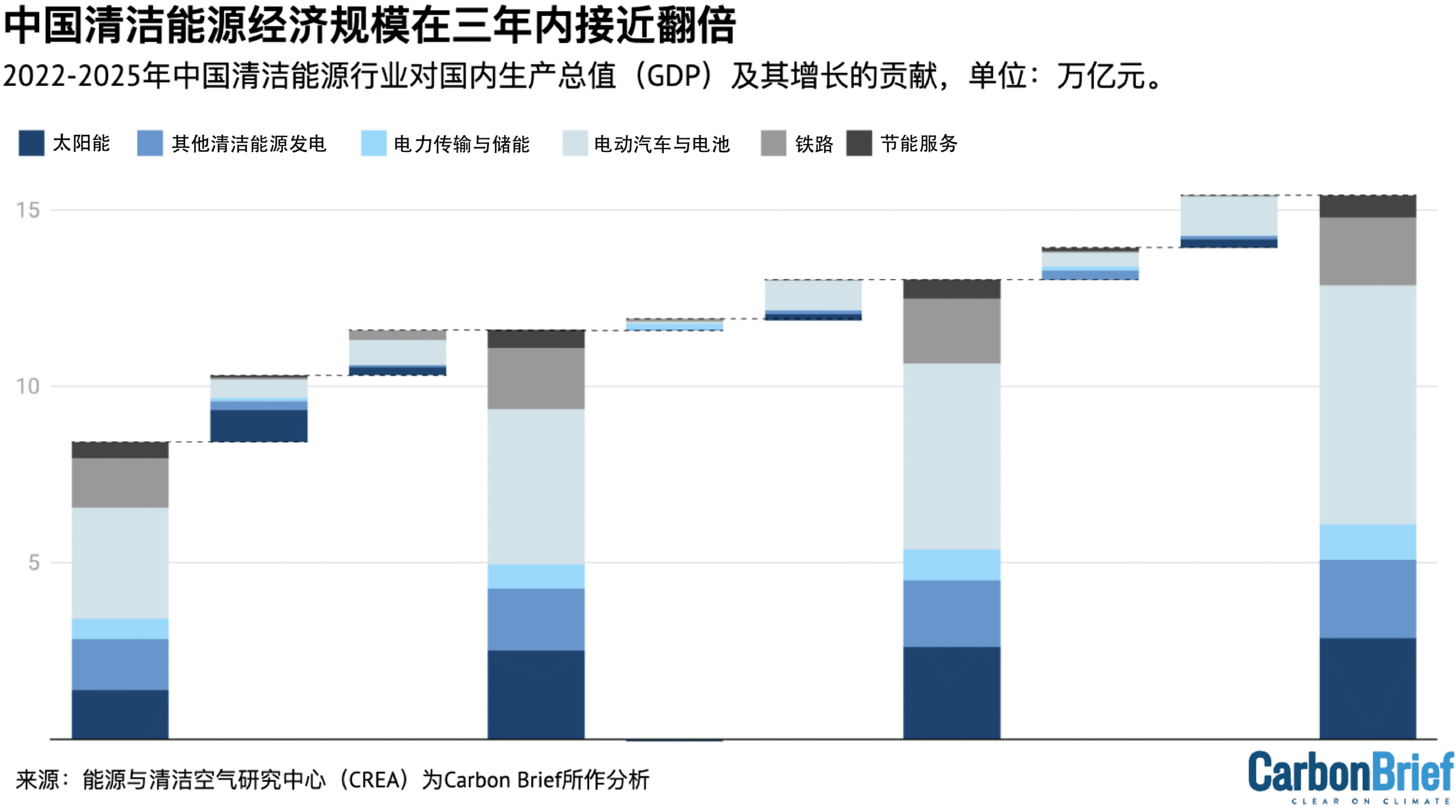 2022-2025年中国清洁能源行业对国内生产总值(GDP)及其增长的贡献,单位:万亿元。来源:能源与清洁空气研究中心(CREA)为Carbon Brief所作分析。
第二大子行业是清洁能源发电、输电和储能,在2025年占清洁能源对GDP贡献的40%,并贡献了清洁能源产业当年约30%的增长。
在电力领域内部,最主要的增长动力来自风电和太阳能发电装机投资的扩大,以及风电和太阳能发电量的增长;其次是太阳能设备及材料的出口。
作为2022-2023年的重要增长引擎,太阳能组件产业链投资在2025年连续第二年下降,这与政府遏制产能过剩和行业"非理性"价格竞争的政策导向一致。
此外,铁路运输约占清洁能源行业总经济产出的12%,但其同比增长相对温和,2025年其营业收入增长3%,投资增长6%。
需要指出的是,国际能源署(IEA)在其《世界能源投资报告》中估计,中国2025年清洁能源投资为 6270亿美元,而化石能源投资为 2570亿美元。
在采用与IEA一致的行业口径进行测算时,本研究对2025年中国清洁能源投资的估计为 4300亿美元,低于IEA的数值。而本文中所呈现的1万亿美元清洁能源投资总规模,并非源于更激进的单项假设,而是由于纳入了更为广泛的产业和活动范围,超出了IEA报告所覆盖的口径。
电动汽车和电池2025年,电动汽车与动力电池成为中国清洁能源经济中最大的贡献部分,约占清洁能源行业总值的44%。
其中,纯电动汽车和插电式混合动力汽车的生产在价值规模和当年增长贡献两方面均居首位,产量同比增长29%。排在其后的是电动汽车制造领域的投资,在2024年增速放缓后,2025年投资规模同比增长 18%
电池制造投资在2024年出现下滑后也迎来反弹,这主要得益于电池新技术的涌现以及国内外市场的强劲需求。电池制造投资同比增长35%,达到2770亿元人民币。
到2025年底,电动汽车在全国汽车保有量中的占比预计达到12%,高于一年前的 9%,而在五年前这一比例还不足 2%。
在新车销售中,电动汽车占比进一步提升至 48%,高于2024年的 41%,其中乘用车电动汽车渗透率已突破50%。2025年11月,电动汽车在当月汽车总销量中的占比更是首次突破 60%,并持续成为拉动整体汽车销量增长的主要动力,如下图所示。
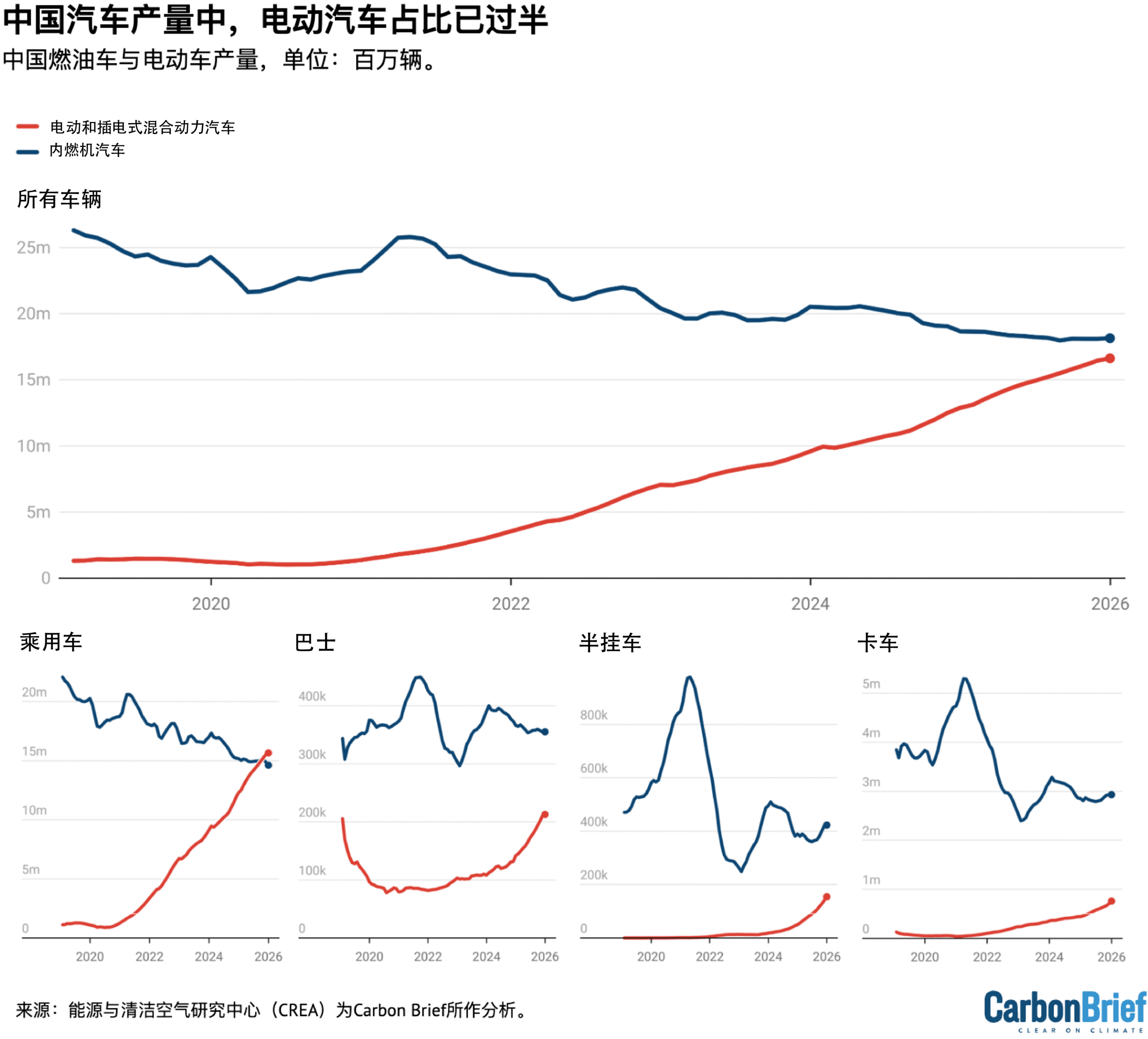 中国燃油车与电动车产量,单位:百万辆。电动车包含纯电动车及插电式混合动力车。数据来源:中国汽车工业协会,经Wind金融终端汇总整理。
电动卡车市场取得突破性进展,其市场份额从2024年前九个月的8%,增长至2025年同期的23%。
政府对电动汽车的政策支持仍在持续,例如,一项最新政策提出,未来三年内充电基础设施规模将接近翻倍,以支撑电动汽车进一步普及。
在电动汽车市场中,出口增速快于国内销售增速,但整体销售仍以国内市场为主。2025年,中国电动汽车产量达到 1660万辆,同比增长 29%。其中,出口约340万辆,占总产量的 21%,但同比增速高达 86%。中国电动汽车的主要出口目的地包括西欧、中东和拉丁美洲。
电池出口额同样实现快速增长,同比上升 41%,成为推动GDP增长的第三大动力来源。电池出口主要流向西欧、北美和东南亚市场。
与许多清洁能源技术价格呈现的通缩趋势不同,2025年电动汽车的平均售价保持稳定,新车型在折扣后的平均加个甚至略有上涨。在全社会工业品出厂价格同比下降 2.6% 的背景下,这意味着电动汽车产业对名义GDP增长的贡献尤为突出。相比之下,电池价格仍延续下降趋势。
清洁能源发电2025年,太阳能发电行业贡献了清洁能源产业总值的19%,为国民经济创造2.9万亿元人民币(约合410亿美元)的价值。
其中,新建太阳能发电厂的投资额达1.2万亿元人民币(约合1600亿美元),是清洁能源发电板块最大的驱动力;其次是太阳能技术出口额和太阳能发电本身创造的电力价值。太阳能制造业投资在2023年产能扩张浪潮结束之后持续下降,至0.5万亿元人民币(约合720亿美元),同比下降23%。
2025年,中国风电和太阳能发电新增装机容量再创新高。全国新增太阳能发电装机315吉瓦,新增风电装机119吉瓦,其中太阳能发电装机容量比全球其他地区总和还要多,而风电装机容量更是后者两倍之多。
在电力投资结构中,清洁能源占发电领域投资的90%,其中光伏一项就占到约50%。在此推动下,非化石能源发电量占全国总发电量的比重提升至42%,高于2024年的 39%。
不过,新出台的新能源定价政策以及相对谨慎的装机目标,也为这一轮增长能否持续带来了不确定性。在136号文件新政策框架下,新建风电和太阳能发电项目需要在电力市场中与既有煤电直接进行价格竞争,而在若干关键制度设计上仍处于相对不利的位置。
与此同时,电力市场本身仍处于建设和发展阶段,这也带来了投资的不确定性。
太阳能发电投资同比增长6%,但期间波动剧烈。开发商赶在新定价政策于6月生效前加速完成项目,第三季度放缓后,在年底再次赶工,以赶在"十四五"规划期内达成目标。
总体来看,太阳能产业整体投资规模与上一年大致持平:制造环节投资下降,被发电侧的增长所抵消。这在一定程度上支撑了制造产能利用率,也符合政府遏制行业"无序竞争"和价格内卷的政策目标。
2025年底,中国太阳能制造产能预计已达到每年1200吉瓦,远超2025年全球新增装机容量约650吉瓦的水平。目前,中国太阳能产业制造能力已显著超过全球市场吸收能力,激烈竞争导致行业盈利水平处于历史低位。
自2024年中期以来,中国的政策制定者已开始正面应对这一问题,包括警示"内卷式竞争"、出台监管措施,并召开行业会议向企业施压。相关举措已初见成效,2025年第三季度行业亏损有所收窄。
2025年,太阳能电池板及组件出口量再创历史新高,同比增长19%。其中,电池片和硅片出口量分别快速增长94%和52%,而电池板出口量仅增长4%。
这反映出,在关税压力上升、更多国家加快本土制造布局的背景下,全球太阳能供应链正日益趋向多元化。然而,由于平均出口价格下跌,以及出口产品结构从成品电池板向上游中间产品转移,出口名义价值反而同比下降了8%。
2025年,水能、风能和核能合计贡献了清洁能源行业总产值的约15%,为中国GDP带来约2.2万亿元人民币(3100亿美元)的增加值。
其中近三分之二(1.3万亿元人民币,1800亿美元)来自水电、风电和核电的发电价值,其余部分则来自新建发电项目的投资。
从发电量增速来看,2025年太阳能发电量增长33%,风电增长13%,水电增长3%,核电增长8%。
在发电投资领域,太阳能仍是价值规模最大的板块(如下图所示),但风电项目在2025年首次成为投资增长的最大贡献者,这是自2020年以来风电投资首次在增量上超过太阳能。
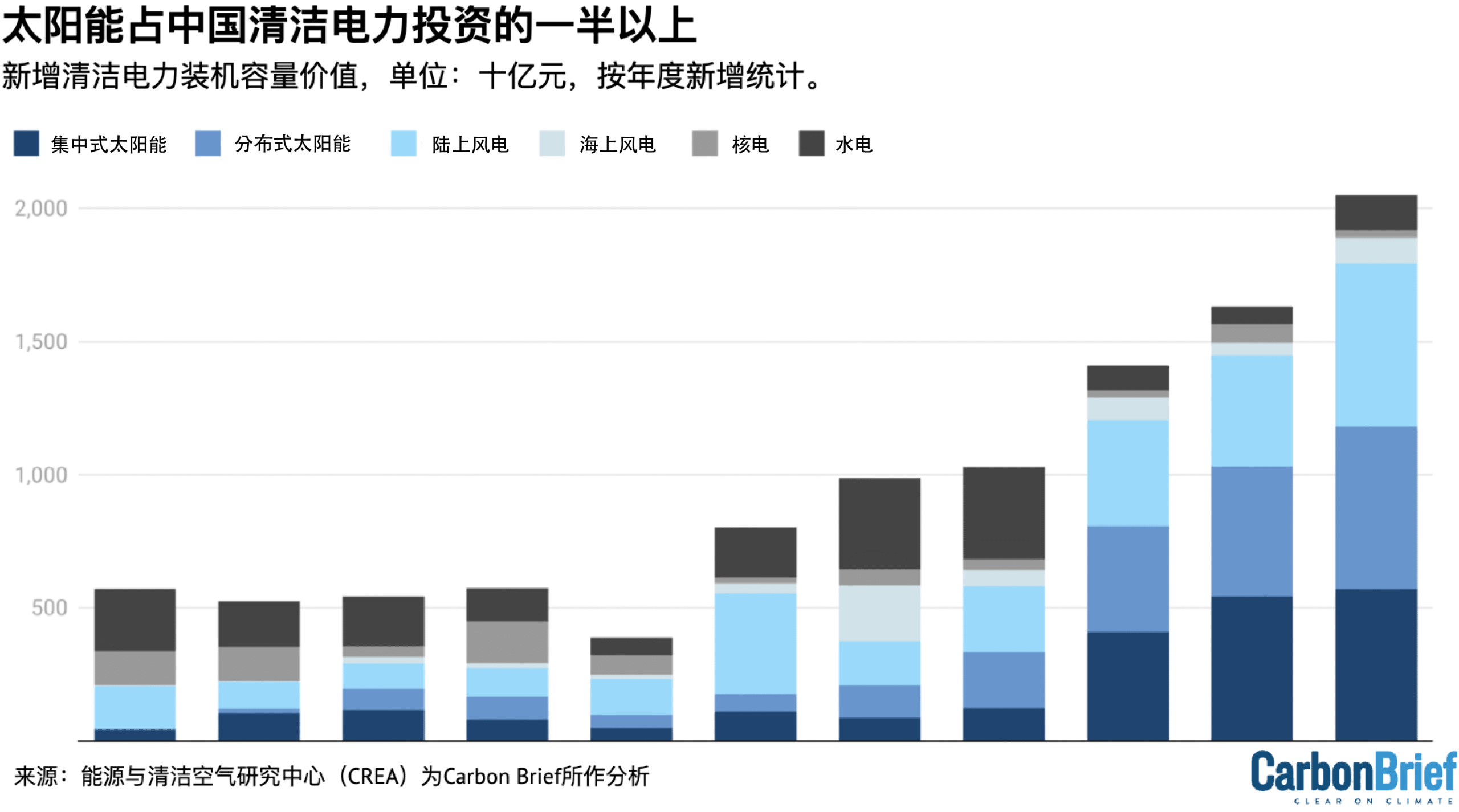 新增清洁电力装机容量价值,单位:十亿元,按年度新增统计。来源:能源与清洁空气研究中心(CREA)为Carbon Brief所作分析。
特别是海上风电装机投资如预期般反弹,在2024年大幅下降后,2025年实现翻倍增长,成为清洁电力投资中的一个亮点。
核电项目投资持续增长,但总体规模仍然较小,2025年投资额约为170亿元人民币。常规水电投资则延续下行趋势,同比下降7%。
储能和电网2025年,输电和储能占清洁能源行业总产值的6%,规模达到1万亿元人民币(1400亿美元)。
其中,电网投资2025年增长了约6%,达到900亿美元。储能投资(涵盖抽水蓄能、新型储能和氢气制备)2025年达到约500亿美元。
新型储能投资同比增长幅度达50%,电解槽投资也增长了30%。受清洁能源发电快速增长推动,清洁能源输送规模预计增长13%。
中国电力储能总装机容量超过213吉瓦,其中新型储能容量超过145吉瓦,抽水蓄能容量为69吉瓦。预计2025年中国新增约66吉瓦新型储能装机容量,同比增长52%,占全球新增装机容量的40%以上。
值得注意的是,下半年新型储能装机增速加快,达43吉瓦,而上半年新增装机容量为23吉瓦。
在政策层面,136号文件规定在5月后取消了新能源配套储能的强制要求,曾一度导致新型储能市场增速放缓,但这一影响很快被"市场驱动型增长"所取代。省级电力现货市场的推进、分时电价机制以及太阳能弃光率上升,共同改善了储能项目的经济性。
到2025年底,中国前五大太阳能制造商均进入了新型储能市场,标志着行业战略的重要转变。
与此同时,抽水蓄能投资保持增长,仅2025年上半年,就有15吉瓦的项目获批,新增3吉瓦抽水蓄能投入运营。
铁路铁路运输占清洁能源行业GDP的12%,其中客货运输收入是最主要的价值来源。行业增长主要来自铁路基础设施投资,2025年同比增长6%。
交通电气化不仅限于电动汽车,铁路客运、货运及相关投资规模也持续增长。2025年,中国高铁总里程约达5万公里,占全球高速铁路总里程的70%以上。
节能服务2025年,节能服务投资强劲反弹。以大型节能服务公司(ESCO)的产值衡量,市场规模同比增长17%,恢复至2016-2020年期间的增长水平。
行业产值也已恢复到2021年的峰值水平,这表明在经历三年低迷后,行业已明显回暖。
行业预测显示,节能服务行业年产值有望在2030年达到1万亿元人民币,而行业经历低迷前曾预期这一目标将在2025年实现。
中国已发展成为全球最大的节能服务公司市场。其投资高度集中于建筑领域,约占业务总量的50%;工业应用占21%,而能源供应、需求侧灵活性与储能相关业务合计约占16%。
中国清洁能源布局的影响中国持续向清洁能源制造业投入数千亿美元,代表着对全球能源持续转型的一项规模巨大的经济与金融押注。
除本文所涵盖的国内投资外,中国企业还在海外制造业领域展开了大规模投资布局,进一步加深了这一押注的全球化属性。
在十四五规划期间,清洁能源产业对中国实现经济增长目标起到了关键作用,在2023年、2024年和2025年分别贡献了约40%、25%和37%的GDP增长。
然而,长期的发展前景仍存在不确定性,尤其是在太阳能发电领域。136文件下新的可再生能源发电定价机制已导致短期投资增速放缓,并显著增加了市场不确定性;与此同时,中央政府设定的清洁电力新增装机目标也相对保守,远低于当前实际增长水平。
2025年下半年,太阳能发电和光伏制造领域的投资均出现下降,尽管从全年来看,发电投资保持了增长。这反映出在当前电力市场制度仍偏向煤电的框架下,清洁能源产业面临结构性风险。
清洁能源技术价格下降幅度显著,以致在未来核算GDP时,这些行业对实际GDP(经通胀或通缩调整后的GDP)的贡献可能会被向下修正。
尽管如此,清洁能源产业在宏观经济中的关键地位,本身就构成了维持这一轮清洁能源发展势头的强烈政策和经济动机。如果国内市场增长出现明显放缓,不仅可能削弱遏制产能过剩的努力,或将迫使更多产能转向出口,从而加剧国际贸易摩擦。
能源与清洁空气研究中心近期针对中国气候与能源领域专家开展的一项调查显示,多数专家认为,在经济和地缘政治挑战加剧的背景下,"双碳目标"及其所依托的清洁能源产业,只会变得更加重要。
地方政府和国企同样将深刻影响该行业的发展前景。在十四五期间,正是地方政府和国企的积极推进,促成了规模空前、且显著超出预期的"风光大基地"建设。
同时,各省在落实新电力市场机制和可再生能源购电合同安排方面拥有较大的自主空间,因此,将于今年发布的十五五规划,将成为决定清洁能源产业中长期走势的关键。
关于数据本文分析尽可能采用已公布的投资与销售数据。若数据不可得,则依据实际数量(如装机容量、汽车销量等)结合单位成本或价格进行估算。
为衡量实际增长贡献,相关数据已按2022-2023年价格进行通胀或通缩调整。全部计算过程与数据来源详见附表。
估算范围涵盖清洁能源技术对上游原材料(如金属、化学品)的需求贡献。
该方法不仅能够反映清洁能源行业对整体经济活动的拉动作用,也能提现其对相关产业活动的带动作用,因此可适用于估算:若该行业未曾增长,经济增速可能降低多少。
为避免重复计算,仅计入价值链中不重叠的环节。例如,电动汽车的生产产值与储能电池的投资额均予计入,但不包含作为上述活动中间投入的、面向国内市场的电池生产价值。
同理,国内市场的太阳能电池板产值已包含在中国光伏发电装机容量的价值中,故不重复统计;然而,太阳能电池板及电池的出口价值则纳入计算。
2025年,两项关键投资指标出现明显背离:据报道,固定资产投资下降3.8%,为35年来首次下滑;而同期资本形成总额虽增速放缓至近年最低,但仍保持2%的正增长。
本研究采用资本形成总额作为投资衡量指标,因其是GDP的组成部分。但由于无法全面追踪库存变动,对清洁能源投资的估算仍基于各行业的固定资产投资数据。
本分析未专门考虑进口因素——其在清洁能源产品与服务生产中所占比例较小且持续下降。这意味着结果可能略微高估对GDP的贡献,但同时低估了对GDP增量的贡献。
例如,中国在电动汽车中对高端计算芯片仍存在较高的进口依赖。一辆典型电动汽车的芯片价值约1000美元,而该类芯片的进口依赖度高达90%,但这仍进展整车生产价值的3%以内。
在某些方面,本研究的估算可能相对保守。例如,彭博新能源财经(BNEF)估计2024年中国"能源转型投资"规模约为8000亿美元。彭博估算的行业覆盖范围与本分析大致相当,但未包含制造业产值。在相同口径下,本研究对应的投资规模约为6000亿美元。
根据中国国家统计局数据,2023年全国汽车产业总产值与销售额合计约11万亿元人民币。本分析估算,同年电动汽车销售额约为2.3万亿元,约占行业总值的20%。当时,电动汽车产量已占汽车总产量的31%,且其平均售价略高于传统燃油汽车。
Analysis: Clean energy drove more than a third of China's GDP growth in 2025
China energy
|05.02.26
'Rush' for new coal in China hits record high in 2025 as climate deadline looms
China energy
|03.02.26
Explainer: Why gas plays a minimal role in China's climate strategy
China energy
|22.01.26
Experts: What to expect from China on energy and climate action in 2026
China energy
|16.01.26
jQuery(document).ready(function() { jQuery('.block-related-articles-slider-block_4a11b3482ebf808c5beb94a5eeae35f3 .mh').matchHeight({ byRow: false }); });The post 分析:清洁能源2025年为中国GDP增长贡献超过三分之一 appeared first on Carbon Brief.
Photographer Patricia Niven and Novelist Sarah Winman made this series of portraits and interviews at the Surma Centre at Toynbee Hall.
"After the Second World War, Britain required labour to assist in post-war reconstruction. Commonwealth countries were targeted and, in what was then East Pakistan (it became Bangladesh after the 1971 Liberation War), vouchers appeared on Post Office counters, urging people to come and work in the United Kingdom, no visa required. The majority of men who came in the fifties and sixties came from a rural background where education was scarce and illiteracy was common. But this generation were hard workers, used to working with their hands, men who could commit to long hours, who had an eagerness to work and a young man's inquisitiveness to see the world: the perfect workforce to help rebuild this nation. And they did rebuild it, and were soon found working in factories and ship yards, building roads and houses, crossing seas in the merchant navy. These pioneers were the men we met at the Surma Centre." - Sarah Winman

Shah Mohammed Ali
I came to this country in November 1961 because my uncle was already living here and inspired me to come. In East Pakistan, I had been working in a shop. I felt life was good. My earliest memory of London was Buckingham Palace. I missed my friends and family but I really missed the weather back home. I became a factory worker, and worked all over the country: a cotton factory in Oldham, a foundry in Sheffield, an aluminium factory in London and Ford motor factory in Dagenham. Ford gave me a good, comfortable life. We had friends all over the country and they would tell us if there was more money being offered at a different factory and then we'd move. I thought I would stay in Britain for four years and then go back home. My heart is in Bangladesh. The roses smell sweeter.

Eyor Miah
I came to this country in September 1965. I had been a student in East Pakistan. Life was hard, my father was a sailor. I read in a Bengali newspaper stories of people travelling and earning money, and I thought that I, too, would like to do that. I wrote to somebody I knew here to help me. It was a slow process, all done by mail, because of course, there was no internet. It took me two years to gain my papers. I didn't mind because I was very determined to achieve.
When I first arrived, I became a machinist in the tailoring industry and I earned £1 and ten shillings a week. My weekly outlay was £1 and the rest I saved. Brick Lane was very rundown then. The Jewish population were very welcoming, probably because they were eager for workers! We would queue up outside the mosque and they would come and pick the ones they wanted. In 1969 I bought a house for £55. Of course, I missed my mother who stayed in Bangladesh, and before 1971 I actually thought I would return to live. After that date though, I felt Britain was my home and life was better here.
After tailoring, I worked in restaurants and then began my own business as a travel agent, set up my own restaurants and grocery shop. I have four children. Life has been good to me.

Rokib Ullah
I came to this country in 1959, because workers were being recruited from the Commonwealth to rebuild after the Second World War. Life in East Pakistan then was good. I was very young and working as a farmer. My fellow countrymen told me about the work in the UK and I came here by air. When I arrived, the airport was so small, not like it is today. And the weather was awful, so bad, not like home, I found that difficult, together with missing my neighbours and friends. I worked in a tyre factory, and then in garment and leather factories. I planned to stay here and earn enough money, and then return to Bangladesh. I am a pensioner now and frequently go back to Bangladesh. It is in my heart. One day I plan to go there forever.

Syed Abdul Kadir
I first came to this country in 1953. I was in the navy in Karachi and I was selected by the Pakistan Government to be in the Guard of Honour in London at the Queen's Coronation. I remember this day very clearly. It was June and the weather was cold. When Queen Elizabeth was crowned the noise was tremendous. There were shouts of "God Save the Queen!" and gun salutes were fired. We marched to Buckingham Palace where more crowds were waiting. The Queen and her family came out on the balcony and the RAF flew past the Mall, and the skies above Victoria Embankment were lit up by fireworks. I feel very lucky to have been part of this, and I still have my Coronation ceremony medal.
Since my first visit, I developed a fondness for the British culture, its people and the Royal Family. I have always believed this country looks after its poor.
I owe the Pakistan Navy for much of my experiences in life and was lucky to travel and to see the world. I actively participated in the 1965 India-Pakistan war and the 1971 Pakistan war and have medals for both.
My family are settled here and my life revolves around grandchildren. I have been coming to Surma since 2004. When someone sees me, they call me "Captain!" We are like a family here.

Shunu Miah
I came to this country in November 1961. Back home, I helped my father farm. It was a good life, still East Pakistan, the population was low, not much poverty, food for everyone: it was a land of plenty. It wasn't a bad life, I was young and was just looking for more. My uncle had been in the UK since 1931, my father since 1946, both encouraged me to come.
Cinema here was my greatest memory. Back home, cinema was rare. Every Saturday and Sunday there was a cinema above Cafe Naz on Brick Lane, or I'd go to the cinema in Commercial Rd, or up to the West End. It was so exciting, the buildings, the underground, the lights! People were friendly and welcoming then. I saw Indian films, but also Samson and Delilah and the Ten Commandments with Charlton Heston.
I have worked at the Savoy Hotel as a kitchen porter and also in cotton factories in Bradford. What did I miss? Family and friends, of course, but also the weather. The smell of flowers, too, they are much stronger back home. I thought I would stay here and work for three or four years, go home and buy land, build a house and live happily ever after. I have helped to build homes for my family in Bangladesh. I have never been able to own a home here.

Abul Azad, Co-ordinator at the Surma Centre.
"These men are very loyal to a country that has given them a home," said Abul Azad, the charismatic project co-ordinator at Surma Centre in Whitechapel. "When they first arrived, living conditions were bad, sometimes up to ten people lived in a room. Facilities were unhealthy, toilets outside, and nothing to protect them from an unfamiliar cold that many still talk about. Most intended to earn money to send back to families, and then return after a few years - a dream realised by few, especially after the settlement of families. Instead they were open to exploitation, often working over sixty hours a week, the consequence of which is clearly visible today in low state pensions, due to companies not paying the correct National Insurance contributions. And most Bangladeshi people don't have private pensions. Culturally, pensions are not of this generation. Their families are their pension - always imagined they would be looked after. But times are changing for everyone."
Surma runs a regular coffee morning, providing support for elderly Bangladeshi people. The language barrier is still the greatest hindrance to this older generation and Surma provides a specialist team ready to assist their needs - both financially and socially - and to provide free legal advice. It is also quite simply a haven for people to get out of the house and to be amongst their peers, to read newspapers, to have discussions, to talk about what is happening here and in Bangladesh.
There is something profound that holds this group together, a deep unspoken, clothed in dignity. Maybe it is the history of a shared journey, where the desire for a better life meant hours of physical hardship and unceasing toil and lonely years of not being able to communicate. Maybe it is quite simply the longing for home, remaining just that: an unrealised dream. Whatever it is - "This is a very beautiful group." said Abul Azad.
Photographs copyright © Patricia Niven
You may also like to take look at these other portraits by Patricia Niven and Sarah Winman
Former Lieutenant Governor Tahesha Way is not the clear front-runner in New Jersey's special congressional election on Thursday. She's seventh in fundraising out of 10 candidates as of last week's Federal Election Commission deadline, and public polling has been sparse. But as the race drew close to the finish line, the Israel lobby made her the beneficiary of a last-minute push.
In the final weeks before the election, an Intercept analysis has found, 30 donors to groups including the American Israel Public Affairs Committee, its super PAC, and Democratic Majority for Israel have poured more than $50,000 into Way's campaign. On Friday, amid the fundraising push and less than a week before the election, DMFI officially endorsed her.
The lobby is known for spending against progressives and the most vocal critics of the state of Israel, but in New Jersey, it appears to be backing one moderate to pick off another. Yet more pro-Israel money in the race comes at the expense of Tom Malinowski, who is no progressive on Israel policy but nevertheless has become the subject of AIPAC ire — marking a reversal for the group, which supported him in 2022.
AIPAC's super PAC, United Democracy Project, has spent more $2.3 million on ads against Malinowski. The ads do not mention Israel but attack Malinowski on immigration, saying he helped fund "Trump's deportation force" because he voted in favor of a 2019 bipartisan appropriations bill that funded the Department of Homeland Security. The majority of Democrats, including many supported by AIPAC, voted for the bill.
In a statement to The Intercept, UDP spokesperson Patrick Dorton made no mention of Malinowski's DHS funding vote. He said Malinowski had fallen afoul of the group's policy priorities by discussing the possibility of conditioning aid to Israel.
"It's our goal to build the largest bipartisan pro-Israel majority in Congress. There are several candidates in this race far more pro-Israel than Tom Malinowski," Dorton said.
 Related
AIPAC Is Retreating From Endorsements and Election Spending. It Won't Give Up Its Influence.
Related
AIPAC Is Retreating From Endorsements and Election Spending. It Won't Give Up Its Influence.
Way and Malinowski are competing in a crowded race in New Jersey's 11th Congressional District to replace former Rep. Mikie Sherrill, who vacated the seat after she was elected governor.
Way and Malinowski's campaigns did not respond to The Intercept's requests for comment.
Also running are Analilia Mejia, the former political director for Sen. Bernie Sanders's 2020 presidential campaign; veteran Zach Beecher; Passaic County commissioner and election lawyer John Bartlett; former Morris Township Mayor Jeff Grayzel; and Essex County Commissioner Brendan Gill.
Way already had substantial support from the Democratic Lieutenant Governors Association, which endorsed her and has spent more than $1.7 million backing her campaign, almost half of what it spent in total last cycle. But even with close to $4 million in outside spending on her side, she has lagged behind her opponents in fundraising. She's raised just over $400,000 — compared to Malinowski's over $1.1 million, more than $800,000 for Gill, and over half a million for Beecher. Bartlett has raised more than $460,000, Grayzel has raised $428,000, and Mejia has raised just over $420,000.
Now, pro-Israel donors who have given to AIPAC to boost other pro-Israel candidates are trying to help Way close the gap. They include retired investor Peter Langerman, who has given $75,000 to AIPAC's United Democracy Project since 2023 and $12,000 to AIPAC since 2022. Another Way donor, Florida loan executive Joel Edelstein, has given $25,000 to UDP since 2023 and $$3,500 to AIPAC since 2022.
Among Way's other donors are Bennett Greenspan, founder of the genealogy company Family Tree DNA, who has given $40,000 to United Democracy Project, $4,000 to DMFI PAC, and $1,250 to AIPAC PAC since 2022. Way donor and New Jersey real estate developer Michael Gottlieb gave $25,000 to UDP in 2023. Another Way donor, founder and former president of Microsoft partner HSO, Jack Ades, has given $10,750 to AIPAC since 2024. Gottlieb and Ades have given to Republican candidates including Reps. Mike Lawler and Elise Stefanik in New York; Rep. Steve Scalise, R-La.; Nikki Haley's presidential campaign; and the Republican group WinRed.
More than half of these contributions all landed on January 14.
More than half of the contributions to Way — $33,000 of the $53,000 in total — all landed on January 14, a common sign that outside groups have sent out a fundraising push to their network.
Another donor to Way's campaign is Joseph Korn, a New Jersey real estate developer who served on the New Jersey board of the Jewish National Fund, a controversial national organization that has funded settler groups in the West Bank.
Way is campaigning on a relatively centrist platform that primarily includes fighting against President Donald Trump's agenda. She's also running on strengthening the Affordable Care Act, ensuring access to reproductive care, protecting democracy and voting rights, and lowering costs without raising taxes, including raising the cap on state and local tax deductions, or SALT. Her website does not mention foreign policy or Israel.
Way is also endorsed by the Congressional Black Caucus PAC; the Democratic Association of Secretaries of State; IVYPAC, which backs candidates who are members of the historically Black Alpha Kappa Alpha sorority; and several other New Jersey organizations.
The Israel lobby's support for Way may not ultimately help its policy priorities. As a recent column in the Forward points out, by pitting Way and Malinowski against each other, AIPAC donors might help a more progressive candidate get elected.
The post AIPAC Donors Flood Last-Minute New Jersey House Pick With Cash appeared first on The Intercept.
Workday is laying off about two percent of its staff in a bid to align its people with its "highest priorities," but at a significant cost to its margins for the quarter and the year, the company announced on Wednesday.…
The AI bot takeover of the internet continues apace, and the latest data suggests the surge is being driven less by model-training scrapes and more by the growing use of AI tools as a stand-in for web search.…

A new study in the British Journal of Sports Medicine states there is no evidence "to justify blanket bans" on trans women from women's sports.
The research found that trans athletes who were born male have no advantage over cis women.
Trans Supreme Court rulingSeveral UK sports associations have banned trans women after the Supreme Court ruled that the legal definition of a woman under the Equality Act is based on biological sex. This includes the Football Association (FA), England Netball, and the England and Wales Cricket Board (ECB). Some sports, such as cycling and triathlon, have introduced open categories for trans athletes.
The International Olympic Committee (IOC) is also attempting to ban trans athletes. The IOC president, Kirsty Coventry, pledged to ban trans athletes in her election campaign.
Earlier this week, the Canary reported on a legal case against an inclusive swimming pond in London. Transphobic pressure group Sex Matters had its legal case against the pond dismissed by the High Court.
In response to the legal case, the City of London Council published research showing that, of 38,000 members surveyed, the vast majority (86%) backed the corporation's trans-inclusive changing policy. This is despite the recent Supreme Court Ruling on biological sex.
'No observable differences'The new study analysed 52 different studies based on 6,485 people, most of whom were transgender.
It found that:
Transgender women might have more muscle mass than cisgender women 1 to 3 years after hormone therapy, but their physical fitness is comparable
Additionally:
Transgender women have significantly greater amounts of body fat than cisgender men but levels comparable to those of cisgender women.
They also discovered that trans women had more lean muscle mass, but "no observable differences" from other women in terms of body strength or VO₂ max — or maximum oxygen consumption. This is a key measure of cardiorespiratory fitness.
When compared to cisgender men, trans women had significantly lower strength and VO₂ max.
The researchers noted that hormone therapy was associated with:
higher amounts of body fat and lower amounts of muscle and less upper body strength 1-3 years after the start of treatment in transgender women, transgender men had less fat, more muscle, and greater strength after hormone therapy.
The researchers concluded that:
The convergence of transgender women's functional performance with cisgender women, particularly in strength and aerobic capacity, challenges assumptions about inherent athletic advantages derived solely from [gender affirming hormone therapy] or residual lean mass differences.
Featured image via Connor Coyne/ Unsplash
By HG
On paper, Positron's next-gen Asimov accelerators, no doubt named for the beloved science fiction author, don't look like much of a match for Nvidia's Rubin GPUs.…
It is no secret that large language models (LLMs) are being used routinely to modify and even write scientific papers. That's not necessarily a bad thing: LLMs can help produce clearer texts with stronger logic, not least when researchers are writing in a language that is not their mother tongue. More generally, a recent analysis in Nature magazine, reported by Science magazine, found that scientists embracing AI — of any kind — "consistently make the biggest professional strides":
AI adopters have published three times more papers, received five times more citations, and reach leadership roles faster than their AI-free peers.
But there is also a downside:
Not only is AI-driven work prone to circling the same crowded problems, but it also leads to a less interconnected scientific literature, with fewer studies engaging with and building on one another.
Another issue with LLMs, that of "hallucinated citations," or "HalluCitations," is well known. More seriously, entire fake publications can be generated using AI, and sold by so-called "paper mills" to unscrupulous scientists who wish to bolster their list of publications to help their career. In the field of biomedical research alone, a recent study estimated that over 100,000 fake papers were published in 2023. Not all of those were generated using AI, but progress in LLMs has made the process of creating fake articles much simpler.
Fake publications generated using LLMs are often obvious because of their lack of sophistication and polish. But a new service from OpenAI, called Prism, is likely to eliminate such easy-to-spot signs, by adding AI support to every aspect of writing a scientific paper:
Prism is a free workspace for scientific writing and collaboration, with GPT‑5.2—our most advanced model for mathematical and scientific reasoning—integrated directly into the workflow.
It brings drafting, revision, collaboration, and preparation for publication into a single, cloud-based, LaTeX-native workspace. Rather than operating as a separate tool alongside the writing process, GPT‑5.2 works within the project itself—with access to the structure of the paper, equations, references, and surrounding context.
It includes a number of features that make creating complex — and fake — papers extremely easy:
- Search for and incorporate relevant literature (for example, from arXiv) in the context of the current manuscript, and revise text in light of newly identified related work
- Create, refactor, and reason over equations, citations, and figures, with AI that understands how those elements relate across the paper
- Turn whiteboard equations or diagrams directly into LaTeX, saving hours of time manipulating graphics pixel-by-pixel
There is even voice-based editing, allowing simple changes to be made without the need to write anything. But scientists are already worried that the power of OpenAI's Prism will make a deteriorating situation worse. As an article on Ars Technica explains:
[Prism] has drawn immediate skepticism from researchers who fear the tool will accelerate the already overwhelming flood of low-quality papers into scientific journals. The launch coincides with growing alarm among publishers about what many are calling "AI slop" in academic publishing.
One field that is already plagued by AI slop is AI itself. An FT article on the topic points to an interesting attempt by the International Conference on Learning Representations (ICLR), a major gathering of researchers in the world of machine learning, to tackle this problem with punitive measures against authors and reviewers who violate the ICLR's policies on LLM-generated material. For example:
Papers that make extensive usage of LLMs and do not disclose this usage will be desk rejected [that is, without sending them out for external peer review]. Extensive and/or careless LLM usage often results in false claims, misrepresentations, or hallucinated content, including hallucinated references. As stated in our previous blog post: hallucinations of this kind would be considered a Code of Ethics violation on the part of the paper's authors. We have been desk -rejecting, and will continue to desk -reject, any paper that includes such issues.
Similarly:
reviewers [of submitted papers] are responsible for the content they post. Therefore, if they use LLMs, they are responsible for any issues in their posted review. Very poor quality reviews that feature false claims, misrepresentations or hallucinated references are also a code of ethics violation as expressed in the previous blog post. As such, reviewers who posted such poor quality reviews will also face consequences, including the desk rejection of their [own] submitted papers.
It is clearly not possible to stop scientists from using AI tools to check and improve their papers, nor should this be necessary, provided authors flag up such usage, and no errors are introduced as a result. A policy of the kind adopted by the ICLR requiring transparency about the extent to which AI has been used seems a sensible approach in the face of increasingly sophisticated tools like OpenAI's Prism.
Jeff Bezos this week continued to dismantle what's left of the Washington Post via another massive round of layoffs that left remaining staff stunned. Among the latest cuts is the elimination of the paper's popular sports desk, scaling back of international and local news, the firing of an untold swath of journalists, and the ending of the paper's book sections, among other major changes.
This comes on the heels of other decisions by Bezos to fire all of the paper's black columnists, turn the op-ed section into pro-corporatist agitprop, censor cartoonists that criticize Jeff, and generally shift the paper's journalistic tone in a more right wing, autocrat-friendly, corporatist direction. You know, like every other major corporate media outlet from CNN to CBS.
Of course, nobody actually wants this. The actual audience for extraction class agitprop is arguably very small and already quite well served. So it's amusing to see WAPO leadership insist that these additional, brutal cuts are necessary because the paper has been losing subscribers and "wants to be competitive":
"Murray acknowledged that the Post has struggled to reach "customers" and talked about the competitive media marketplace. "Today, the Washington Post is taking a number of actions across the company to secure our future," he said, according to an audio recording of the meeting."
Let's be clear: billionaires like Jeff Bezos don't want a functioning press. They want the lazy simulacrum of a functional press that caters to their ideology (more for me, less for you) and protects their interests. As with Larry Ellison's acquisition of CBS and TikTok, and Elon Musk's acquisition of Twitter, it's best to view this as a global project to defang accountability for the planet's richest, shittiest people and corporations.
Former Washington Post editor Marty Baron didn't really mince words about what this means for a once-functional newspaper that, at this point, probably can't be salvaged:
A staggering statement from former Washington Post editor Marty Baron: "This ranks among the darkest days in the history of one of the world's greatest news organizations."
— Ben Mullin (@benmullin.bsky.social) 2026-02-04T14:34:22.001Z
WAPO management insist that they're going to "narrow their focus on politics." By this they mean more of the feckless, "both sides," "view from nowhere" DC gossip reporting you see at other billionaire-owned outlets like Axios, Semafor, and Politico. Glad-handy journalism that's less concerned with the truth than it is appeasing ownership, protecting access, and keeping the ad money flowing.
The kind of wimpy, soft-knuckled cack that can (and repeatedly is) exploited by authoritarian zealots who know these outlets lack the courage to call them out for what they really are. You see, if you're honest about the extremist nature of our unpopular autocratic government, you might lose access, upset paper management, alienate Republican ad viewers, or piss off regulators eyeing your latest merger.
Bezos could fund functional journalism at the Washington Post for decades to come without making a dent in his finances, were that something of actual interest to him. This is a guy who just blew $75 million on a propaganda puff piece kissing the ass of the president's wife. That kind of money could fund most independent newsrooms for the better part of the next decade.
Jeff wants to ensure the administration will pay him to launch his unreliable rockets into space, slather his fledgling LEO satellite network with subsidies, coddle his cloud computing empire, allow him to dominate every last aspect of modern retail, and generally be broadly exploitative in a way that undermines competition, consumers, and labor. He wants, and applauds, Trump's destruction of the regulatory state.
Bezos still "wins" even if the Post doesn't survive his "leadership." At worst (for Jeff) the paper is converted into a sad, pseudo-journalistic simulacrum that exists largely to blow smoke up the ass of wealth and power. At best another major media institution is destroyed, eliminating yet another outlet that used to (admittedly with increasing inconsistency) hold billionaires and corporate power to account.
But it's really something even worse than just rich people destroying journalism to coddle their delicate egos and protect their financial interests. All of this really is part of a broad, multi-generational effort by the extraction class to eliminate checks and balances and accountability, erode informed consensus, befuddle the electorate, and dismantle not just democratic norms, but democracy itself.
And, if you hadn't noticed, it's been a smashing success so far.
If there's a plus side to this mess, it's that Jeff and Elon and Larry's clumsy efforts to dominate and destroy U.S. journalism create vast new opportunities for indie newsletter authors, worker-owned newsrooms, and independent outlets (like Techdirt), to serve a public that's desperate for something tangible, courageous, and real in a sea of bullshit and clumsy artifice. Give them, and us, your time and money.
One month after the Philippines' Land Transportation Office (LTO) began strict enforcement of its ban on light electric vehicles along major Metro Manila roads, officials have been quick to frame the policy as a win for traffic order. Fewer apprehensions are being reported. Selected corridors appear to be moving faster. ... [continued]
The post OPINION: A Month After e-Trike Ban In Manila: Has It Made Manila's Streets Safer? appeared first on CleanTechnica.


