
 Waymo Entering Boston & Sacramento — Where Next? [ 06-Feb-26 3:58am ]
We already knew that Waymo was going to be entering several new markets in 2026. With the company raising $16 billion to expand more rapidly, I also expected we'd see some announcements about such expansions this week. And now we have them. The company has announced that it is now ... [continued]
The post Waymo Entering Boston & Sacramento — Where Next? appeared first on CleanTechnica.
The Solution For US Critical Minerals: Geopolitical Minefield Vs. Recycling [ 06-Feb-26 3:14am ]A new, 3-D printed, reusable sponge-like cartridge can soak up critical minerals from domestic mining, industrial, and electronic waste.
The post The Solution For US Critical Minerals: Geopolitical Minefield Vs. Recycling appeared first on CleanTechnica.
Why Sodium-Ion Batteries Are Happening Now [ 06-Feb-26 2:59am ]CATL is the largest battery producer in the world. Any move it makes is noteworthy. While CATL has been making sodium-ion batteries for some time, production commitment has increased dramatically in 2026. CATL introduced its Naxtra line of batteries earlier in 2025 and has now announced plans for volume production ... [continued]
The post Why Sodium-Ion Batteries Are Happening Now appeared first on CleanTechnica.
Amazon can't build AI capacity fast enough, throws another $200B at the problem [ 06-Feb-26 2:13am ]AWS has an open cash spigot for AI infrastructure, with Amazon CEO Andy Jassy telling investors the company has been monetizing compute capacity as fast as it brings it online and it plans to double capacity by the end of 2027.…
19 C in February: Heat records fall across British Columbia, Canada, raising questions about winter's future [ 06-Feb-26 2:39am ]
The European Commission Is Testing an Open Source Alternative To Microsoft Teams [ 06-Feb-26 2:05am ]
Ctrl-Alt-Speech: C'est La Vile Content [ 06-Feb-26 12:06am ]Ctrl-Alt-Speech is a weekly podcast about the latest news in online speech, from Mike Masnick and Everything in Moderation's Ben Whitelaw.
Subscribe now on Apple Podcasts, Overcast, Spotify, Pocket Casts, YouTube, or your podcast app of choice — or go straight to the RSS feed.
In this week's round-up of the latest news in online speech, content moderation and internet regulation, Mike and Ben cover:
- House Judiciary Releases EU X Fine Details (House Judiciary X Account)
- New Report Exposes European Commission Decade-Long Campaign to Censor American Speech (House Judiciary Committee)
- X offices raided in France as UK opens fresh investigation into Grok (BBC)
- Hey Gavin Newsom! Investigating TikTok's Moderation Is Just As Unconstitutional As When Texas & Florida Tried It (Techdirt)
- Spain Aims to Ban Social Media for Children Under 16, Prime Minister Says (NY Times)
- TikTok Keyword Analysis (LinkedIn)
- Why newsrooms are taking comments seriously again (New_ Public)
- Whoops, Websites Realize That Killing Their Comment Sections Was A Mistake (Techdirt)
Play along with Ctrl-Alt-Speech's 2026 Bingo Card!
Since 1950 the Nutrient Content in 43 Different Food Crops has Declined up to 80% [ 06-Feb-26 1:07am ]https://hrnews1.substack.com/p/study-since-1950-the-nutrient-content?r=1t17zr
submitted by /u/thehomelessr0mantic[link] [comments]
ABC map [ 06-Feb-26 1:00am ]
Addington
Addiscombe
Albany Park
Aldborough Hatch
Aldersbrook
Aperfield
Ardleigh Green
Arkley Barnes Cray
Bedfont
Belmont
Belmont
Belvedere
Berry's Green
Blackfen
Botany Bay
Brentham
Brompton
Brook Green Carterhatch
Chase Cross
Chelsfield
Childs Hill
Clayhall
Coldblow
Colham Green
Coney Hall
Coombe
Corbets Tay
Cranford
Cudham
Perhaps you know where all/most/some/none of them are.
National Audit Office finds delays in Access to Work have doubled [ 06-Feb-26 12:02am ]
A new report from the National Audit Office (NAO) has found that delays and backlogs for the Department for Work & Pensions (DWP) Access to Work scheme have more than doubled in the last four years.
Earlier this week, the DWP launched a call for evidence in relation to the Access to Work scheme. Ahead of the evidence session, the NAO have published a report on the scheme.
According to the NAO report:
The Access to Work scheme is intended to provide support for people's needs within the workplace over and above an employer's legal duty to make reasonable adjustments.
As the Canary previously reported:
Access to Work is, in theory, supposed to provide financial support to disabled people to help them get into and stay in work. The fund can be used towards specialist equipment, transport, and support workers. However, as the Canary has reported, the programme has, for a long time, been failing disabled people, and the department is quietly cutting it without any consultation and little transparency.
Of course, this means disabled people are struggling to get into work because of their accommodations can't be met.
Additionally, in November, we reported that:
The founder of an organisation that supports thousands of disabled people in navigating Access to Work has come forward about the underhanded process by which the Department for Work and Pensions (DWP) is making "drastic cuts" to the crumbling scheme.
Access to work came under fire recently after a disabled people's organisation came forward about the DWP making underhanded and "drastic" cuts to the scheme.
The DWP was attempting to limit funds for specialist equipment. It would also create stricter rules on support worker rates of pay and on awarding job aid support workers.
DWP — The numbersIn total, 74,200 people received help from Access to Work from 2024-25. This is a 97% increase from 37,700 in 2018-19. On 31 March 2025, 62,100 applications were awaiting a decision from the DWP, compared to only 21,700 on the same date in 2022. This figure has almost tripled in only three years.
Even more shocking is that outstanding payment requests more than quadrupled, from 6,900 to 31,700, over the same period.
The total number of Access to Work applications in 2024/25 was 157,000. This is more than double the number of applications (76,100) in 2018-19.
This means that only 47% of people who applied for access to work in 2024/25 actually received help.
The average time the DWP takes to process applications has also increased dramatically, from 66 working days in 2021-22 to 109 in 2024-25.
The report states:
While the scheme clearly has benefits, DWP recognises it does not know whether the scheme provides value for money.
The government is clearly attempting to push more disabled and chronically ill people into work. Meanwhile, it is failing to put the necessary measures in place to make sure that disabled people are actually able to work or keep their already existing jobs. Without these measures, disabled people will not be able to find or stay in safe, suitable, and rewarding work.
Featured image via National Audit Office
By HG
Ad blocking is alive and well, despite Chrome's attempts to make it harder [ 06-Feb-26 12:39am ]Chrome's latest revision of its browser extension architecture, known as Manifest v3 (MV3), was widely expected to make content blocking and privacy extensions less effective than its predecessor, Manifest v2 (MV2).…
The Gentle Author's Wapping Pub Crawl [ 06-Feb-26 12:01am ]
Four-hundred-year-old stone floor at The Prospect of Whitby
Tempted by the irresistible promise of the riverside, I set out for Wapping to visit those pubs which remain in these formerly notorious streets once riddled with ale houses. Yet although there are pitifully few left these days, I discovered each one has a different and intriguing story to tell.

Town of Ramsgate, 288 Wapping High St. The first alehouse was built on this site in 1460, known as The Hostel and then as The Red Cow from 1533. The pub changed its name again, to the Town of Ramsgate, in 1766 to attract trade from Kentish fishermen who unloaded their catch at Wapping Old Stairs adjoining. Judge Jeffreys was arrested here in disguise, attempting to follow the flight of James II abroad in 1688, as William III's troops approached London.

The Turk's Head, 1 Green Bank. Originally in Wapping High St from 1839, rebuilt on this site in 1927 and closed in the seventies, it is now a community cafe.

Captain Kidd, 108 Wapping High St. Established in 1991 in a former warehouse and named after legendary pirate, Wiiliam Kidd, hanged nearby at Execution Dock Stairs in 1701.


Turner's Old Star, 14 Watts St. In the eighteen-thirties, Joseph Mallord William Turner set up his mistress Sophia Booth in two cottages on this site, one of which she ran as an alehouse named The Old Star. In 1987, the current establishment was renamed Turner's Old Star in honour of the connection with the great painter. Notoriously secretive about his lovelife, Turner adopted Sophia's surname to conceal their life together here, acquiring the nickname 'Puggy Booth' on account of his portly physique and height of just five feet.

The Old Rose, 128 The Highway. 1839-2007

The last pub standing on the Ratcliffe Highway

The Three Suns, 61 Garnet St. 1851 - 1986

The Prospect of Whitby, 56 Wapping Wall. Founded 1520, and formerly known as The Pelican and The Devil's Tavern.

What does a cat have to do to get a drink around here?


Sir Hugh Willoughby sailed from The Prospect of Whitby in 1533 upon his ill-fated attempt to discover the North-East Passage to China.

The Grapes, 76 Narrow St. Founded in 1583, the current building was constructed in 1720 - it is claimed Charles Dickens danced upon the counter here as a child.

You may like to read about my other pub crawls
The Gentle Author's Next Pub Crawl
The Gentle Author's Spitalfields Pub Crawl
Michigan Sues Big Oil For Antitrust Violations [ 06-Feb-26 12:29am ]The state of Michigan has sued several oil companies, claiming they have conspired to keep EV and renewable energy prices high.
The post Michigan Sues Big Oil For Antitrust Violations appeared first on CleanTechnica.
The 'intimate connection' between empire and UK media that silenced the left [ 05-Feb-26 11:01pm ]
There's an 'intimate connection' between the workings of the US empire and the UK media. And they didn't just batter the left in the Jeremy Corbyn years. They also set us up with a cold, rotten dish of Keir Starmer, Peter Mandelson, and their ilk of soulless corporate stooges.
Filmmaker Victor Fraga made the film The Bad Patriots, which is now available on major streaming services. And to mark the occasion, he told us about how establishment propagandists got away with smearing prominent left-wingers Ken Loach and Jeremy Corbyn.
This is a film for everyone because, as Fraga asserted:
I'm not asking people to love Ken and Jeremy… It's not a film about their ideas. It's a film about misrepresentations.
He added:
UK Media and legal collusion blocked the leftWe like to believe Britain is free, but it really isn't that free.
Having previously made a documentary about media enabling of countless coups in Brazil, Fraga followed up by looking at the same dynamic in the UK. Through his film about Loach and Corbyn, he said, a key focus was to show:
how the British media has consistently and promiscuously attempted to defame and degrade Ken and Jeremy, paint them as antisemitic, spineless, fruitcakes, too old, … not being patriotic enough
As an establishment mouthpiece, he stressed, the mainstream media played a "crucial role" in the propaganda war on the left that put the right back in charge of the Labour Party:
Keir Starmer would have never been elected without the support from the media. I mean, the Sun supported Keir Starmer and Tony Blair. That says a lot, doesn't it?
Imperialism and media bias, meanwhile, are "intimately connected". As he insisted:
You can talk about imperialism without talking about the media, but I don't think you can talk about the media without talking about imperialism. Obviously, the media attend to the interests of the few, not the many…
The objective of the media is not to inform people. It's to control people. And most mainstream media, virtually all of them, are owned by millionaires.
And the people the media smears target struggle to fight back because of how expensive it is in the UK, where the law favours obscenely wealthy actors over ordinary people. At the same time, the smears were so systemic in the case of Corbyn that it would have been almost impossible to challenge them legally. As Fraga asserted:
The legal costs are so high that even when you win, sometimes you lose…
So, yeah, the justice system is complicit.
And it's not just the legal system playing along. Because as the Canary has detailed previously, there is a whole infrastructure of repression against the left in the UK, including the political policing project that unjustifiably spied on hundreds of left-wing groups for decades.
This infrastructure isn't always obvious for everyone, because of the veneer of freedom and democracy that our establishment sells us. But there are times, like with the Peter Mandelson scandal (connecting into the whole anti-socialist offensive to put Keir Starmer in power), where the dark dealings of establishment politics and media come out into the light.
The interests behind the misrepresentationsThe empire and its propagandists want to sell an upside-down view of the world — as we've seen during the US-Israeli genocide in Gaza and the repression surrounding it. As Fraga stressed:
In the same way Keir Starmer purports to be left-wing (someone who supports foreign invasions, who's deeply xenophobic, and who shudders at the thought of anything vaguely socialist), Jeremy is painted as an extremist for wanting to nationalise rail and for policies which are widely implemented in France and Scandinavia. They paint a pacifist such as Jeremy Corbyn as an extremist, and a warmonger like Tony Blair as moderate. That's pretty sick.
Corbyn was certainly a concern for the US empire and its junior partner in the UK. Ex-CIA director and secretary of state Mike Pompeo admitted as much when he promised to "push back" to undermine Corbyn's chances of winning the 2019 election. Figures in the British army and secret services also briefed against him.
And whether or not there was direct coordination, the establishment media was absolutely singing from the empire's hymn sheet. It played a key role in smearing Corbyn and ensuring his loss in the 2019 election. And even the biggest supposedly left-wing paper, the Guardian, was in on it. As Corbyn later told Declassified:
I do not trust the Guardian… it's a tool of the British establishment.
Prominent filmmaker Loach also represented a concern for the powers that be due to his longstanding critique of capitalism, colonialism, imperialism, racism, and state repression. And he has faced significant attempts to censor and silence his work as a result.
As Fraga summarised, the whole country should be aware that the media's behaviour is "not an accident":
On many occasions, they do know they're lying blatantly. They do know what they're doing.
And that intentional behaviour serves the interests of the rich and powerful, undermining what limited democracy exists in the UK even further.
This matters to absolutely everyone in the country, and Fraga hopes The Bad Patriots can help to 'burst the bubble' and get people talking about the media's actions more. So invite friends, family members, and anyone you can to watch the film. Because only by facing this issue head on can we stand a chance of changing things.
Featured image via Journeyman Pictures
By Ed Sykes
OpenClaw reveals meaty personal information after simple cracks [ 05-Feb-26 11:32pm ]Another day, another vulnerability (or two, or 200) in the security nightmare that is OpenClaw.…
HBO Is Making a 'Baldur's Gate' TV Show [ 05-Feb-26 11:58pm ]
Sapiom raises $15M to help AI agents buy their own tech tools [ 05-Feb-26 11:53pm ]
BYD Electric Bus & Truck Sales Actually Up! [ 06-Feb-26 12:04am ]BYD passenger vehicle sales are in a tough spot, as just discussed. However, BYD's commercial vehicle sales are going swimmingly. Compared to December, naturally, sales were down last month (in general, December is a much bigger sales month than January), but they weren't even down much month over month. Meanwhile, ... [continued]
The post BYD Electric Bus & Truck Sales Actually Up! appeared first on CleanTechnica.
Court Rules That Ripping YouTube Clips Can Violate the DMCA [ 05-Feb-26 11:50pm ]
Reddit looks to AI search as its next big opportunity [ 05-Feb-26 11:20pm ]
BYD Sales Down 30.7% in January — Can It Revive Sales Growth? [ 05-Feb-26 11:24pm ]BYD did not have a great start to 2026. Presumably, due to growing competition on the Chinese EV market, the ending of new energy vehicle (NEV) purchase tax exemptions in the country, and the natural market weakness at the beginning of the year, BYD's sales in January were the lowest ... [continued]
The post BYD Sales Down 30.7% in January — Can It Revive Sales Growth? appeared first on CleanTechnica.
Shadows & Reflections: Emma Warren [ 05-Feb-26 7:06pm ]Emma Warren contemplates 2025's dust — and slender but powerful rays of light.
I've had enough of the past. It's full of dust, and the only dust I want now is the kind you might see mote-floating in a ray of sunshine. You know, like on a slow and warm day when there's time to stop and look at the walls or to notice how the light is falling.
Rarer days, these days, when it's easier to get stuck scrolling, or in your head, or for your whole body to feel like you've constantly stuck your fingers into a source of bad electricity. These are all reasonable responses, given that the last twelve months followed the previous twelve months.
The point of reflecting is to see more clearly. So here are a handful of thoughts and observations based on Things That Happened over the last 365 days, articulated in attempt to reckon with reality and therefore find something approaching stability - or at least the beginnings of stability, which is surely based in knowing where you're at.
For me, looking back must also involve looking forward. Especially now, when one of the Things That Happened is the realisation that huge amounts of money and effort are being spent on division, often using tropes around land and belonging.
I'm asking myself a question here, which is unformed, but which circles around what you might call 'anti-fascist nature writing' although I don't know exactly what this would look like in practice. The Irish writer Manchán Magan, who died a few months ago, offered a suggestion. He described a realisation that his explorations of Irish language and its relationship to the land, Thirty Two Words For Field, could be co-opted by right wingers. And he decided that he could divert that risk by in his words 'evoking the divine feminine'.
It's not a question any of us can answer straight away. But I hope that by considering it, I'll be pointing in the right direction: away from the dust.
Flags is it?
I have a great deal of respect for the person who displayed this quote alongside colourful flags from a range of nations along the railings of a bridge in Pontllanfraith, Wales. My friend, who is staying with me as I write this, reminded me that as teenagers we would sandpaper swastikas off a wooden bridge near where she lived. Is it vandalism or civic duty to deface divisive signage?
Also, if people in England want to grapple with our apparently new and evidently widespread flag problem, then they could just look across the Irish sea. There are plenty of people in that part of the UK who know quite a lot about flags. John Hewitt (1907-1987) is mostly known as a nature poet, writing regularly about the Glens of Antrim, but his poems reckon equally with division, describing: 'creed-crazed zealots and the ignorant crowd / long-nurtured, never checked, in ways of hate.'
The poets of the past might also be able to help with some of our current conundrums. I take Hewitt to be saying: check hate - or it will check us all.
Connection is everything
Free dancefloors really do bring people together. I had spent a year working with The Southbank Centre on a whole-summer season based around my book Dance Your Way Home. The idea was to evoke and reflect a version of London I believe in, where everyone's from everywhere and where we're blessed with music, movement and culture from around the world.
King Original Sound would bring their own soundsystem. We'd have an Irish hooley; a knees-up to fiddle, flute and bodhrán. There would be a carefully curated afternoon event for people with chronic illness. And then, two weeks before the opening event, a major bereavement hit, affecting everyone I love the most. How could I even leave the house, let alone dance on the banks of the River Thames, under these circumstances?
I'd written Dance Your Way Home with an intention: that it would articulate the connective power of the dancefloor and that it would encourage hesitant or shy dancers to step onto the edges. These qualities could hold me too, and they did. Standing at the back, soaked in sound and facing the river, with fellow Londoners from every imaginable age group and background, helped bring me back together too.

'No such thing as innocent bystanding'
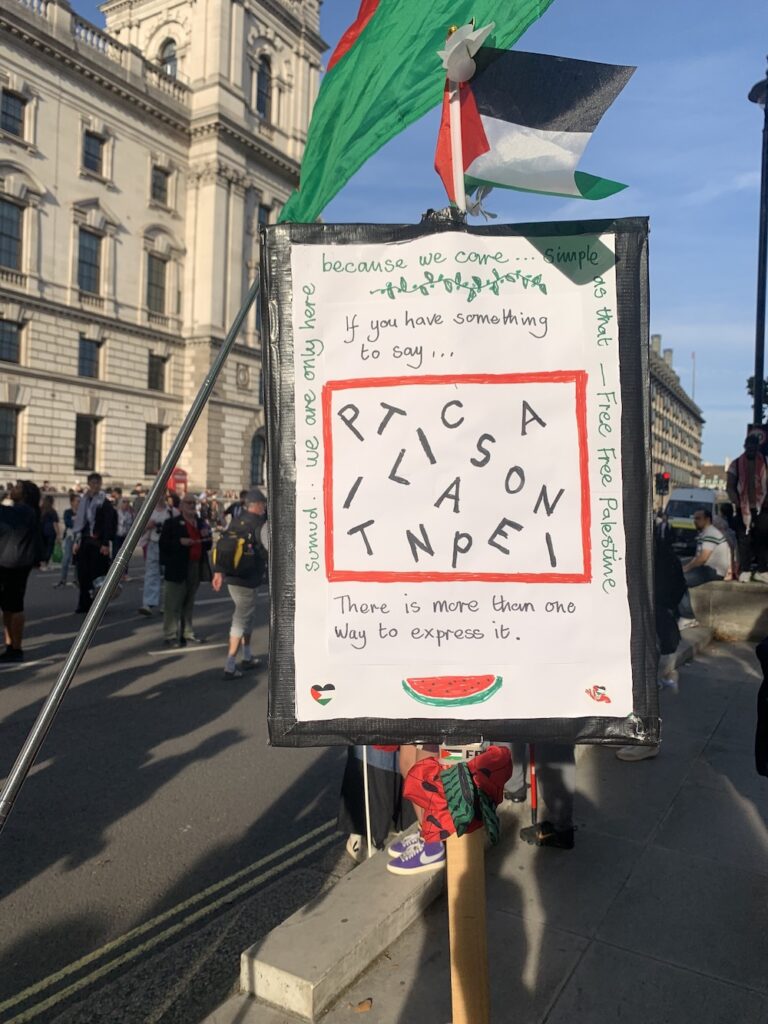
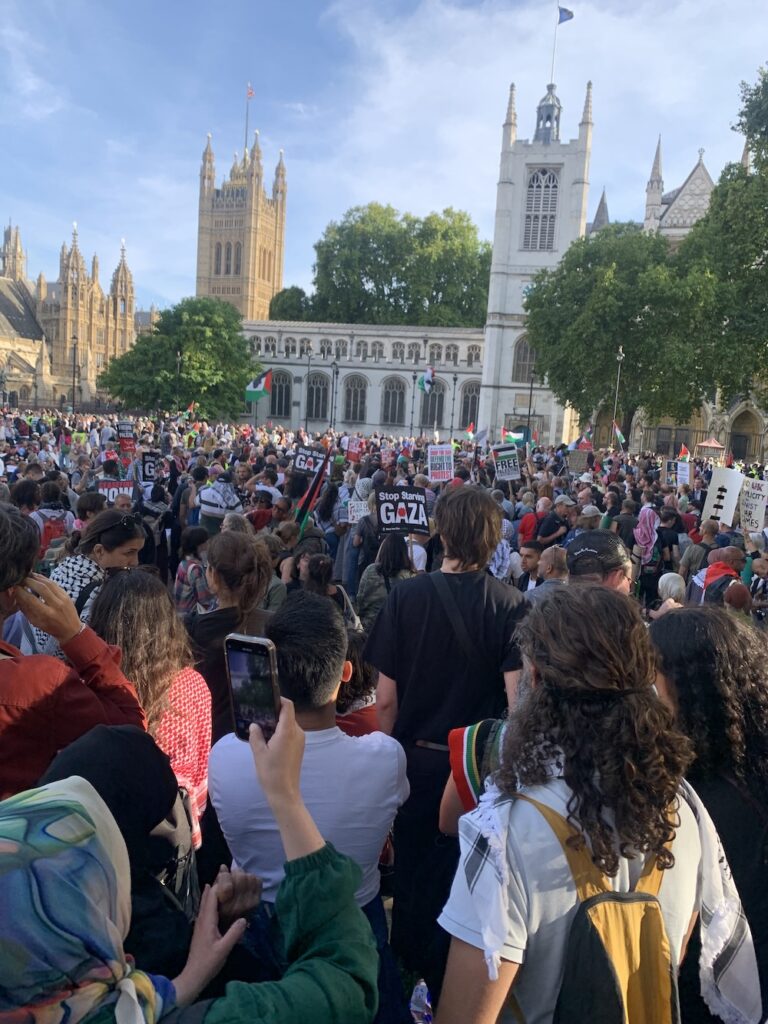
The words of another poet, Seamus Heaney, felt especially alive this summer. A friend I'd met whilst staying in the Curfew Tower in Cushendall quoted Heaney at me after seeing videos posted from a Palestine Action protest. I'd been there to witness, document, and report what I saw, which included the presence of Welsh police in Heddlu caps and PSNI officers from Northern Ireland alongside Met Police officers. The protests were, of course, in response to genocide in Gaza and to the proscription of Palestine Action as a terrorist organisation. The government response, enacted by the police, felt to me like a seismic shift. A long-established reality - the previously-ordinary act of holding a hand-made sign, communicating a widely-held view, at a protest - was disappearing in real time.
Standing outside Westminster Magistrates Court during Mo Chara's repeated court dates I observed different energies. The pavement became a back-room session, with crowd singalongs of 'Eileen Óg', 'The Fields of Athenry' and The Cranberries' 'Zombie'. I tried to imagine the English-language equivalent, perhaps DJ AG or Stick In The Wheel turning up outside court to play songs everyone knows, to crowds protesting an MC being hauled into court on drug charges (noting here the disproportionate ways that legislation relating to both terrorism and drug laws are policed and enforced).

The thing should be like the thing
My book Up the Youth Club came out in the autumn. In writing it, I had tried to do what I always do, which I can only describe as 'making the thing like the thing'. This often means trying to write about something in the spirit of whatever I'm writing about and sometimes means using the specific practices of ways of being that relate to the subject.
This also extends to the post-publication period, and in the case of Up the Youth Club this meant taking the finished book to meet its story-family. For example, doing a talk in a school hall which features in the book, in coastal County Antrim, with people who appear in the story. Another aspect of this trip was DIY and inventive, like the youth clubs in the book. Zippy, who you'll find behind the counter of Kearney's butchers in Cushendall, and who is also the custodian of Bill Drummond's Curfew Tower, decided to sell Up the Youth Club on the shop shelves next to the pasta and tinned tomatoes. You can also get vinyl copies of the new Bill Drummond-affiliated release STAY, which, as Zippy says, means that Kearney's can also be described as Cushendall's only independent book and record shop.
Later, I took the book to Coventry for an event with youth-run platform Fyah Kamp (who appear in the book), alongside Amos Anderson who was centrally involved in the Holyhead youth club that played a big part in the emergence of 2-Tone - and which became a cornerstone of Up the Youth Club. In Stockport, at the Stockroom's Youth Night, I hosted a panel which included long-serving youth worker Earl Nanton. The audience included some of his lively young people. Chatting beforehand, they'd indicated they were into drama - the theatrical type - and I was fairly sure they were also familiar with the teenage type, too. So, I read a few pages about a woman who was young in the 1980s, whose life changed for the better after joining a youth drama group in Peterborough. After I finished reading, one of the young people put up their hand. "That could have been me," they said. "There was a big fight at the bus stop today but none of us went because we've got Earl. And we love Earl."
Resonant frequencies were flying around. The thing was being like the thing. And this tiny moment of connection, where a person who is young now recognised kinship with someone from the far past, offered a slender but powerful ray of light.
Footnotes
Flags Is It? also inspired the title of a poem by Lydia Unsworth.
John Hewitt, Selected Poems (The Blackstaff Press, 2022)
I can also recommend the Flag Busters Manual, archive copies of which are available.
The Instagram account run by End Deportations Belfast is an excellent source of information about the overlapping issues between the proscription of Palestine Action and policing in NI.
It is of course currently illegal under the Terrorism Act 2000 to invite or recklessly express support, including wearing clothing or carrying articles in public which arouse reasonable suspicion that an individual is a member or supporter of a proscribed organisation, or to publish an image of a flag or logo 'in the same circumstances'. Palestine Action is a proscribed terrorist organisation.
Terrorism charges being policed and enforced disproportionately. How Northern Ireland's Dark Policing History Looms Over Palestine Action (Middle East Eye, 2025)
Drug laws being policed and enforced disproportionately: Drug Law Reform is Crucial to Address Racism in the UK (Revolving Doors, 2023).
Ancient sediments suggest that parts of the tropics will heat up much faster than expected [ 05-Feb-26 10:50pm ]
Reform UK's Rupert Matthew adopts extremist AI child as profile picture [ 05-Feb-26 10:19pm ]
The Leicestershire Police and Crimes Commissioner and proud Reform UK supporter Rupert Matthews needs a hard drive check it seems. On January 4 he sparked fury when he changed his profile picture on Twitter to 'Amelia', an AI-generated CHILD used by extremists to promote hate.
Reform UK's PCC @Rupert_Matthews has set his profile picture to a still of the deeply racist AI video that was doing the rounds recently.
'She' uses the terms "paki wankers" and states that the Church and BBC are a bunch of "queers and nonces" and makes a strange remark about… pic.twitter.com/dR7UV2eulH
— Reform Party UK Exposed
Why are prisoners afraid to go to medical clinics? A released Palestinian prisoner's testimony reveals the other side of "medicine" in prisons. [ 05-Feb-26 10:03pm ]
It wasn't fear of illness that kept Palestinian prisoners away from prison clinics. It was fear of the "treatment" itself.
This is how released prisoner Ahmed Shaqoura describes the year and a half he spent in Israeli occupation prisons. According to his testimony, the medical clinic became another site of torture and humiliation, not healing.
In a testimony published on his personal account, Shaqoura recounts a journey that began with his arrest and transfer to the Jalameh military interrogation centre. There, he says, torture was immediate. He describes severe beatings, insults, and deliberate humiliation. His hands were bound with plastic zip ties tightened so harshly that his skin tore and his palms swelled.
The resulting medical neglect, he says, nearly led to the amputation of his hand. The injury still affects him today, both physically and psychologically.
Palestinian prisoners' road to the clinic: torture in itselfShaqoura describes his first transfer to the clinic as an act of humiliation in itself. Handcuffed and shackled, he was forced to walk on his knees.
Every minute on that journey, he says, felt longer than a lifetime. The pain was not only physical, but a deliberate crushing of dignity.
When he arrived, there was no doctor in the usual sense. He recalls:
It was a torturer in a white coat
The man pressed violently on the wound, hurled insults, wrapped it hastily, and coldly told him to leave. This was not treatment, but a message: the pain was intentional.
Even when an interrogator noticed the swelling and ordered medical attention, nothing changed. Complaints were pointless. Shaqoura says:
Ofer Prison: medicine as oppressionThey are eloquent in their words, but ineffective in their actions
After his transfer to Ofer Prison, conditions worsened.
During his first visit to the doctor there, one of his teeth broke. At the doctor's request, a guard climbed onto Shaqoura's back. The weight pinned him to the ground. The doctor then attempted to strike his eyes with an iron ruler, hitting his forehead instead.
According to Shaqoura, this was not an isolated incident.
He recounts the case of another prisoner suffering from haemorrhoids who repeatedly begged for care. When finally taken to the clinic, the man was beaten and dragged back bleeding.
Guards mocked him as they pulled him along the ground, saying: "This is how we treated you."
Paracetamol — and silenceIn another incident, many prisoners developed painful boils. Shaqoura was among them.
His hand swelled to seven times its normal size. The pain was unbearable. Nights passed with cries for help unanswered.
There was no doctor, no response, and no concern. He says:
The only treatment was paracetamol — and a lot of silence.
He also describes other doctors who openly beat prisoners, treating them not as patients, but as targets for violence.
An unforgettable sceneOne of the most harrowing moments in Shaqoura's testimony occurred after a prisoner was killed by guards in a nearby section.
At dawn, the body was brought in and placed in a black bag in front of the cells. The corridor echoed with laughter and mockery. Shaqoura said:
Why Palestinian prisoners fear the clinicThe guards joked "Tie him up tight, so he doesn't run away." At that moment, I felt even the night was ashamed of us.
Shaqoura ends his testimony with a clear answer. Prisoners do not refuse treatment. They fear the clinic because it is not a place of healing.
In the reality of occupation prisons, the clinic is an extension of the system of oppression. A space meant to protect life becomes another station of suffering, where pain is policy and humiliation is routine.
This is not an isolated account. It reflects the lived reality of thousands of prisoners, where human values are stripped of meaning and even medical care becomes a weapon.
Featured image via author
By Alaa Shamali
AWS revenue continues to soar as cloud demand remains high [ 05-Feb-26 11:11pm ]
Sweden's Journey to Producing 100% Fossil-Free Steel for Volvo & Beyond [ 05-Feb-26 9:57pm ]Here at CleanTechnica, we talk a lot about building things, but it's not very often that we dig into the raw materials they're made of. The reality is that many of the raw materials used in clean tech are responsible for some of the most significant emissions in the world. ... [continued]
The post Sweden's Journey to Producing 100% Fossil-Free Steel for Volvo & Beyond appeared first on CleanTechnica.
Senate Dems Who Pushed Meatier ICE Reform Shy Away From Criticizing Schumer's Softer Package [ 05-Feb-26 10:07pm ]Democratic leaders in Congress requested Department of Homeland Security reforms on Wednesday that would leave the agency's budget untouched — and were immediately rebuffed by the GOP.
The requests, in a joint letter from Senate Minority Leader Chuck Schumer and House Minority Leader Hakeem Jeffries, both New York Democrats, do not attempt to claw back funding for Customs and Border Protection, the parent agency of the Border Patrol, or U.S. Immigration and Customs Enforcement — the two agencies at the heart of the political firestorm over their violent deployments to American cities.
Instead of cutting funding, Democrats focused on measures such as prohibiting ICE agents from wearing masks or entering homes without a warrant. Sen. Brian Schatz, D- Hawaii, the Democratic deputy whip, on Wednesday described the requests as "reasonable reforms that are 70-30 propositions with the public."
"The urgency of the moment is about stopping the violence."
That did not win them any points with congressional Republicans, who dismissed the reforms out of hand.
Progressives in the Senate, meanwhile, had not only become more strident in their rhetoric about ICE, they also called for clawing back increased ICE spending passed as part of President Donald Trump's One Big Beautiful Bill. Though some of these Democrats are sticking by their more robust demands, they nonetheless avoided criticizing their party leadership over the request for more limited reforms.
"The urgency of the moment is about stopping the violence," Sen. Elizabeth Warren, D-Mass., told The Intercept. "If it were up to me, we would be rewriting the whole immigration laws and policies. But right now, we've got to get some constraints in place so that roving bands of ICE agents stop terrorizing American communities. That is our first priority."
Sen. Chris Murphy, D-Conn., the ranking member on the Homeland Security Appropriations Subcommittee, took a similar line, setting aside his stronger demands of ICE.
"I have a much longer list of things that I want to change in the Department of Homeland Security," he said, "but we are trying to put a targeted list of reforms that will end the abuse on the table so that we can get something done."
10 DemandsSchumer and Jeffries's demand list has significant overlap with previous calls from progressive members of Congress such as Rep. Greg Casar, D-Texas, and Sen. Bernie Sanders, I-Vt.
The progressives made their demands soon after the January 24 killing of nurse Alex Pretti in Minneapolis, which derailed a full-year funding bill for DHS and led to a brief shutdown of several government departments. The House voted to end the shutdown Tuesday by approving full-year appropriations for other departments while temporarily funding DHS through a new February 13 deadline.
The Democratic leaders unveiled their official list of demands ahead of the deadline on Wednesday, calling for ending indiscriminate arrests, prohibiting masking, requiring ICE and CBP officer identification, protecting sensitive locations such as churches and schools, halting racial profiling, upholding use of force standards, preserving the ability of states and cities to prosecute DHS misconduct, and requiring the use of body cameras when interacting with the public. (Schumer and Jeffries immediately began watering down one of their clearest demands, suggesting in public comments that they might allow agents to wear masks in some circumstances.)
The biggest split between what Schumer and Jeffries proposed and what more progressive Democrats requested was a reduction of spending on ICE and CBP.
Those agencies received $75 billion and $64 billion, respectively, in last year's One Big Beautiful Bill Act to be spent through 2029. That money came on top of the amounts already available to the agencies through their annual appropriations.
 Related
It's Time for Concrete Action on ICE. Sadly, We Have the Democrats.
Related
It's Time for Concrete Action on ICE. Sadly, We Have the Democrats.
Clawing that money back has been a top priority for advocates, who note that it has been used to supercharge hiring and spending on surveillance technology.
"These demands MUST include cuts in funding," Heidi Altman, the vice president of policy at the National Immigration Law Center, said in an email last week. "The money pays for the violence. It has to stop."
Last month, Sanders proposed an amendment to the DHS appropriations bill that would have redirected the additional ICE funding to Medicaid, which he estimated would prevent 700,000 Americans from losing their health care.
Sanders's amendment drew the support of every Senate Democrat and two Republicans, but it failed on a 49-51 vote.
"Passing new laws is no assurance to me whatsoever that they are not going to continue this lawlessness."
In negotiations with the White House, Schumer is likely to be able to offer the potential support of only a fraction of his caucus for a full-year appropriations bill for DHS.
Some Democrats in Congress have already ruled out the idea that they will vote for any more funding.
"When you have a reckless and out of control agency that is unwilling to follow the law, passing new laws is no assurance to me whatsoever that they are not going to continue this lawlessness," Sen. Cory Booker, D-N.J., told The Intercept.
Republican House Speaker Mike Johnson, R-La., and Senate Majority Leader John Thune, R-S.D., have shown no willingness to negotiate on key Democratic requests, Booker said.
"There's a lot of things I know my caucus would support, but clearly the speaker and the leader are not even interested in having those kinds of conversations," he said, "even though most of their base thinks what's happening with this agency is unacceptable."
DOA With GOPDemocratic leadership figures like Schatz have described the latest demands as an attempt at reaching consensus.
"They are not a Democratic wish list. We are simply asking that ICE not be held to a different standard than every other law enforcement organization in the country — state, county, and federal," he told reporters Wednesday.
The requests fell with a thud with Republican leaders, however. Johnson has already ruled out banning masks and requiring warrants.
Sen. Katie Britt, R-Ala., the lead GOP negotiator, called the demands "a ridiculous Christmas list of demands for the press."
Republicans have already floated the idea of another short-term extension of DHS funding to allow further negotiations.
The post Senate Dems Who Pushed Meatier ICE Reform Shy Away From Criticizing Schumer's Softer Package appeared first on The Intercept.
Doom Overtakes 3 Very Different Planets, Earth Included, in This Eerie Sci-Fi Short Story [ 05-Feb-26 11:00pm ]
'Stark warning': pesticide harm to wildlife rising globally, study finds [ 05-Feb-26 10:35pm ]
Amazon and Google are winning the AI capex race — but what's the prize? [ 05-Feb-26 10:43pm ]
NASA Will Finally Let Its Astronauts Bring iPhones To the Moon [ 05-Feb-26 10:35pm ]
Trump announces May 17 ceremony to "rededicate" America to God [ 05-Feb-26 9:40pm ]
Welcome to Gilead! At this morning's National Prayer Breakfast, Jeffrey Epstein's special friend Donald Trump announced that on May 17, 2026, "we are going to rededicate America as one nation under God" in a ceremony on the National Mall. — Read the rest
The post Trump announces May 17 ceremony to "rededicate" America to God appeared first on Boing Boing.
Anthropic Launches New Model That Spots Zero Days, Makes Wall Street Traders Lose Their Minds [ 05-Feb-26 10:25pm ]
How "Bitcoin Jesus" Avoided Prison, Thanks To One Of The "Friends Of Trump" [ 05-Feb-26 9:29pm ]This story was originally published by ProPublica. Republished under a CC BY-NC-ND 3.0 license.
Days into President Donald Trump's second term in the White House, a cryptocurrency billionaire posted a video on X to his hundreds of thousands of followers. "Please Donald Trump, I need your help," he said, wearing a flag pin askew and seated awkwardly in an armchair. "I am an American. … Help me come home."
The speaker, 46-year-old Roger Ver, was in fact no longer a U.S. citizen. Nicknamed "Bitcoin Jesus" for his early evangelism for digital currency, Ver had renounced his citizenship more than a decade earlier. At the time of his video, Ver was under criminal indictment for millions in tax evasion and living on the Spanish island of Mallorca. His top-flight legal defense team had failed around half a dozen times to persuade the Justice Department to back down. The U.S., considering him a fugitive, was seeking his extradition from Spain, and he was likely looking at prison.
Once, prosecutors hoped to make Ver a marquee example amid concerns about widespread cryptocurrency tax evasion. They had spent eight painstaking years working the case. Just nine months after his direct-to-camera appeal, however, Ver and Trump's new Justice Department leadership cut a remarkable deal to end his prosecution. Ver wouldn't have to plead guilty or spend a day in prison. Instead, the government accepted a payout of $49.9 million — roughly the size of the tax bill prosecutors said he dodged in the first place — and allowed him to walk away.
Ver was able to pull off this coup by taking advantage of a new dynamic inside of Trump's Department of Justice. A cottage industry of lawyers, lobbyists and consultants with close ties to Trump has sprung up to help people and companies seek leniency, often by arguing they had been victims of political persecution by the Biden administration. In his first year, Trump issued pardons or clemency to dozens of people who were convicted of various forms of white-collar crime, including major donors and political allies. Investigations have been halted. Cases have been dropped.
Within the Justice Department, a select club of Trump's former personal attorneys have easy access to the top appointees, some of whom also previously represented Trump. It has become a dark joke among career prosecutors to refer to these lawyers as the "Friends of Trump."
The Ver episode, reported in detail here for the first time, reveals the extent to which white-collar criminal enforcement has eroded under the Trump administration. The account is based on interviews with current and former Justice Department officials, case records and conversations with people familiar with his case.
The Trump administration has particularly upended the way tax law violators are handled. Late last year, the administration essentially dissolved the team dedicated to criminal tax enforcement, dividing responsibility among a number of other offices and divisions. Tax prosecutions fell by more than a quarter, and more than a third of the 80 experienced prosecutors working on criminal tax cases have quit.
But even amid this turmoil, Ver's case stands out. After Ver added several of these new power brokers to his team — most importantly, former Trump attorney Chris Kise — Trump appointees commandeered the case from career prosecutors. One newly installed Justice Department leader who had previously represented Trump's family questioned his new subordinates on whether tax evasion should be a criminal offense. Ver's team wielded unusual control over the final deal, down to dictating that the agreement would not include the word "fraud."
It remains the only tax prosecution the administration has killed outright.
Ver did not reply to an extensive list of questions from ProPublica. In court filings and dealings with the Justice Department, Ver had always denied dodging his tax bill intentionally — a key distinction between a criminal and civil tax violation — and claimed to have relied on the advice of accountants and tax attorneys.
"Roger Ver took full responsibility for his gross financial misconduct to the tune of $50 million because this Department of Justice did not shy away from exposing those who cheat the system. The notion that any defendant can buy their way out of accountability under this administration is not founded in reality," said Natalie Baldassarre, a Justice Department spokesperson.
In response to a list of detailed questions, the White House referred ProPublica to the Justice Department."I know of no cases like this," said Scott Schumacher, a former tax prosecutor and the director of the graduate program in taxation at the University of Washington. It is nearly unheard of for the department to abandon an indicted criminal case years in the making. "They're basically saying you can buy your way out of a tax evasion prosecution."
Roger Ver is not a longtime ally of Trump's or a MAGA loyalist. He renounced his U.S. citizenship in 2014, a day he once called "the happiest day of my entire life." In the early days of bitcoin, he controlled about 1% of the world's supply.
Ver is clean-cut and fit — he has a black belt in Brazilian jujitsu. In his early 20s, while he was a libertarian activist in California, Ver was sentenced to 10 months in prison for illegally selling explosives on eBay. He's often characterized that first brush with the law as political persecution by the state. After his release, he left the U.S. for Japan.
Ver became a fixture in the 2010s on the budding cryptocurrency conference circuit, where he got a kick out of needling government authority and arguing that crypto was the building block of a libertarian utopia. At a 2017 blockchain conference in Aspen, Colorado, Ver announced he had raised $100 million and was seeking a location to create a new "non-country" without any central government. For years, Ver has recommended other wealthy people consider citizenship in the small Caribbean nation of Saint Kitts and Nevis, which has no individual income tax.
"Bitcoin completely undermines the power of every single government on the entire planet to control the money supply, to tax people's income to control them in any way," he told a gathering of anarcho-capitalists in Acapulco, Mexico, in 2016. "It makes it so incredibly easy for people to hide their income or evade taxes." More than one friend, he said with a smirk, had asked him how to do so: They "say, 'Roger, I need your help. How do I use bitcoins to avoid paying taxes on it?'"
Renouncing U.S. citizenship isn't a magic get-out-of-tax-free technique. Since 2008, the U.S. has required expatriates with assets above $2 million pay a steep "exit tax" on the appreciation of all their property.
In 2024, the Justice Department indicted Ver in one of the largest-ever cryptocurrency tax fraud cases. The government accused Ver of lying to the IRS twice. After Ver renounced his citizenship in 2014, he claimed to the IRS that he personally did not own any bitcoin. He would later admit in his deal with the government to owning at least 130,664 bitcoin worth approximately $73.7 million at the time. Then in 2017, the government alleged, Ver tried to conceal the transfer of roughly $240 million in bitcoin from U.S. companies to his personal accounts. In all, the government said he had evaded nearly $50 million in taxes.
Ver's defense was that his failure to pay taxes arose from a lack of clarity as to how tax law treated emerging cryptocurrency, good-faith accounting errors and reliance on his advisors' advice. He claimed it was difficult to distinguish between his personal assets and his companies' holdings and pinpoint what the bitcoin was actually worth.
The Biden administration's Justice Department dismissed this legal argument. Prosecutors had troves of emails that they said showed Ver misleading his own attorneys and tax preparers about the extent of his bitcoin holdings. (Ver's team accused the government of taking his statements out of context.) The asset tracing in the case was "rock solid," according to a person familiar with the investigation who spoke on the condition of anonymity for fear of retaliation. A jury, prosecutors maintained, was unlikely to buy Ver's defense that he made a good-faith error.
By the time of Trump's election, Ver had been arrested in Spain and was fighting extradition. He was also the new owner of a sleek $70 million yacht that some law enforcement officials worried he might use to escape on the high seas.
In Trump, Ver saw a possible way out. After the 2024 election, he was "barking up every tree," said his friend Brock Pierce, a fellow ultrawealthy crypto investor who tried to gin up sympathy for Ver in Trump's orbit.
Ver had initially gone the orthodox route of hiring tax attorneys from a prestigious law firm, Steptoe. Like many wealthy people in legal jeopardy, Ver now also launched a media blitz seeking a pardon from the incoming president. "If anybody knows what it's like to be the victim of lawfare it's Trump, so I think he'll be able to see it in this case as well," Ver said in a December 2024 appearance on Tucker Carlson's show. On Charlie Kirk's show, Ver appeared with tape over his mouth with the word "censored" written in red ink. Laura Loomer, the Trump-friendly influencer, began posting that Ver's prosecution was unfair. Ver paid Trump insider Roger Stone $600,000 to lobby Congress for an end to the tax provision he was accused of violating.
Ver's pardon campaign fizzled. His public pressure campaign — in which he kept comparing himself to Trump — was not landing, according to Pierce. "You aren't doing yourself any favors — shut up," his friend recalled saying.
One objection in the White House, according to a person who works on pardons, may have been Ver's flamboyant rejection of his American citizenship. Less than a week after Trump was inaugurated, Elon Musk weighed in, posting on X, "Roger Ver gave up his US citizenship. No pardon for Ver. Membership has its privileges."
But inside the Justice Department, Ver found an opening. The skeleton key proved to be one of the "Friends of Trump," a seasoned defense lawyer named Christopher Kise. Kise is a longtime Florida Republican power player who served as the state's solicitor general and has argued before the U.S. Supreme Court. He earned a place in Trump's inner circle as one of the first experienced criminal defenders willing to represent the president after his 2020 election loss. Kise defended Trump in the Justice Department investigation stemming from the Jan. 6, 2021, attack on the U.S. Capitol and against charges that Trump mishandled classified documents when leaving the White House.
Kise had worked shoulder-to-shoulder on Trump's cases with two lawyers who were now leaders in the Trump 2.0 Justice Department: Todd Blanche, who runs day-to-day operations at the department as deputy attorney general, and his associate deputy attorney general, Ketan Bhirud, who oversaw the criminal tax division prosecuting Ver. Kise reportedly helped select Blanche to join Trump's legal team in the documents case, and he and Bhirud had both worked for Trump's family as they fought civil fraud charges brought by New York Attorney General Letitia James in 2022.
On Ver's legal team, Kise worked the phones, pressing his old colleagues to rethink their prosecution against Ver.
Kise scored the legal team's first big victory in years: a meeting with Bhirud that cut out the career attorneys most familiar with the merits of the case.
In that meeting, however, it wasn't clear that the new Justice Department leadership would be willing to interfere with the trajectory of Ver's case. While the Trump administration had backed off aggressive enforcement of white-collar crimes writ large, the administration said it was still pursuing most criminal cases that had already been charged.
Bhirud initially expressed skepticism that Ver accidentally underpaid his taxes. It was "hard to believe" that a man going by "Bitcoin Jesus" would have no idea how much bitcoin he owned, Bhirud said, according to a person familiar with the case.
Bhirud and Blanche did not respond to detailed questions from ProPublica.
The Justice Department stuck to its position that either Ver would plead guilty to a crime, or the case would go to trial.
But Kise would not stop lobbying his former colleagues to reconsider. Blanche and Bhirud had already demanded that career officials justify the case again and again. Over the course of the summer, Kise wore down the Trump appointees' zeal for pursuing Ver on criminal charges.
Kise and the law firm of Steptoe did not respond to questions.
"While there were meetings and conversations with DOJ, that is not uncommon. The line attorneys remained engaged throughout the process, and the case was ultimately resolved based on the strength of the evidence," said Bryan Skarlatos, one of Ver's tax attorneys and a partner at Kostelanetz.
It was a chaotic moment at the Justice Department, an institution that Trump had incessantly accused of being "weaponized" against him and his supporters. After Trump took office, the department was flooded with requests to reconsider prosecutions, with defendants claiming the Biden administration had singled them out for political persecution, too.
While many cases failed to grab the administration's attention, Kise got results. Last week, Kise's client Julio Herrera Velutini, a Venezuelan-Italian billionaire accused of trying to bribe the former governor of Puerto Rico, received a pardon from Trump.
"Every defense attorney is running the 'weaponization' play. This guy gets an audience because of who he is, because his name is Chris Kise," said a person who recently attended a high-level meeting Kise secured to talk the Justice Department down from prosecuting a client.
As Kise stepped up the pressure, Ver's case ate up a significant share of Bhirud's time, despite his job overseeing more than 1,000 Justice Department attorneys, according to people familiar with the matter. Ordinarily, it would be rare for a political appointee to be so involved, especially to the exclusion of career prosecutors who could weigh in on the merits.
Bhirud began to muse to coworkers about whether failure to pay one's taxes should really be considered a crime. Wasn't it more of a civil matter? It seemed to a colleague that Bhirud was aware Ver's advocates could try to elevate the case to the White House.
The government ceded ground and offered to take prison time off the table. Eventually, Ver's team and Bhirud hit on the deal that would baffle criminal tax experts. They agreed on a deferred prosecution agreement that would allow Ver to avoid criminal charges and prison in exchange for a payout and an agreement not to violate any more laws. The government usually reserves such an agreement for lawbreaking corporations to avoid putting large employers out of business — not for fugitive billionaires.
By the time fall approached, Kise and Bhirud, with Blanche's blessing, were negotiating Ver's extraordinary deal line by line. Once more, career prosecutors were cut out from the negotiations.
Ver's team enjoyed a remarkable ability to dictate terms. They rejected the text of the government's supposed final offer because it required him to admit to "fraud," according to a person familiar with the negotiations. In the end, Ver agreed to admit only to a "willful" failure to report and pay taxes on all his bitcoin and turned over the $50 million.
The government arrived at that figure in a roundabout manner. It dropped its claim that Ver had lied on his 2017 tax return. The $50 million figure was based on how much he had evaded in taxes in 2014 alone, plus what the government asserted were interest and penalties. In the end, the deal amounted to the sum he allegedly owed in the first place. He never even had to leave Mallorca to appear in a U.S. court.
Under any previous administration, convincing the leadership of the tax division to drop an indicted criminal case and accept a monetary penalty instead would be a nonstarter. While the Justice Department settles most tax matters civilly through fines, when prosecutors do charge criminal fraud, their conviction rate is over 90%.
People "always ask you, 'Can't I just pay the taxes and it'll go away?'" said Jack Townsend, a former DOJ tax attorney. "The common answer that everybody gave — until the Trump administration — was that, no, you can't do that."
When the Justice Department announced the resolution in October, it touted it as a victory.
"We are pleased that Mr. Ver has taken responsibility for his past misconduct and satisfied his obligations to the American public," Bhirud said in the Justice Department's press release announcing the deferred prosecution agreement. "This resolution sends a clear message: whether you deal in dollars or digital assets, you must file accurate tax returns and pay what you owe."
Inside the Justice Department, the resolution was demoralizing: "He's admitted he owes money, and we get money, but everything else about it stinks to high heaven," said a current DOJ official familiar with the case. "We shouldn't negotiate with people who are fugitives, as if they have power over us."
Among the wealthy targets of white-collar criminal investigations, the Ver affair sent a different message. Lawyers who specialize in that kind of work told ProPublica that more and more clients are asking which of the "Friends of Trump" they should hire. One prominent criminal tax defense lawyer said he would give his clients a copy of Ver's agreement and tell them, "These are the guys who got this done."
The only one of Ver's many lawyers to sign it was Christopher Kise.
Boldy James, Nicholas Craven, and Ransom Are Releasing a Project [ 05-Feb-26 9:47pm ]
Israeli-run illegal US 'biolab' leaves several 'deathly ill' [ 05-Feb-26 9:34pm ]

Police in Las Vegas have arrested an Israeli citizen in an armed raid after an illegal 'biolab' made several people exposed to it 'deathly ill'. 55-year-old Ori Salomon aka Ori Solomon was arrested on charges "disposing of and discharging hazardous waste" charges - and later also charged with illegal possession of six firearms - including an assault rifle of Israeli make.
 An Israeli IWI Tabor x95 rifle of the type found at Salomon's property.
Police recovered more than 1,000 samples of likely hazardous material after finding a freezer, multiple fridges and other laboratory material including:
biosafety hood, a biosafety sticker, a centrifuge, multiple refrigerators, red-brown unknown liquids in gallon-sized containers, and refrigerated vials with unknown liquids.
Bizarrely, it was not the first such raid. A Limited Liability Company tied to the county's record of the property has the same name as a company named in an ongoing federal case in California involving a similar biological laboratory.
Israeli biolab raidThe Las Vegas raid followed a tip-off that lab equipment and hazardous materials were being stored at the residential property. The weapons charge was added later because the original warrant for the raid did not include firearms. The charge sheet says that Salomon/Solomon:
knowing that he was an alien admitted to the United States under a nonimmigrant visa, knowingly possessed the firearms below, which were in and affecting interstate commerce, all in violation of 18 U.S.C. §§ 922(g)(5)(B) and 924(a)(2):
a. a Springfield Armory SA-XD ACP 45 caliber bearing the serial numberUS734441;
b. a Savage Mark II .22 caliber rifle bearing the serial number 399291;
c. a Euroarms Brescia-Italy .36 Navy bearing the serial number 30614;
d. a Springfield Armory XD-9 9mm Handgun bearing the serial numberXD193283;
e. an IWI US Tavor-x95 5.56 bearing the serial number T0066621; and
f. a Glock 19 9mm Handgun bearing the serial number ANK965US.
The IWI Tavor-x95 'bullpup assault rifle' is made in Israel and used by Israel's military. The Austrian Glock 19 is also widely used by Israeli armed forces.
Court documents state that after entering the garage, several people became "deathly ill," and "could not get out of bed", according to local TV station KLAS. Samples have been taken by FBI aircraft to the National Bioforensic Analysis Center in Maryland.
Local media have speculated that the Israeli biolab may have been involved in the production of counterfeit medicines. However, there is another possibility. Islamophobic Israel advocates have claimed that 'Iranian' cells in the US were planning terror attacks.
The claims appear to be an attempt to fuel US aggression toward Iran and led to warnings that Israel itself is planning 'false flag' attacks in the US. The colony has a long and proven record of using such attacks to achieve political and military ends.
Featured image via author
By Skwawkbox
Starmer exploits Epstein victims in Mandelson non-apology — then attacks Palestine marches [ 05-Feb-26 9:00pm ]
Keir Starmer has 'apologised' for Peter Mandelson in a speech in Sussex. Kind of, but not really. You know the kind of thing. The "I'm sorry people felt offended" apology that puts the blame on others.
Starmer turns on Mandelson after it's too lateStarmer said he was sorry for believing Mandelson's lies — 'Peter' was never added as Starmer tried desperately to distance himself. Distance himself from the man he took on as his senior adviser when Mandelson's closeness to child-rapist Jeffrey Epstein was already well known. From the man he then appointed as ambassador to the US, despite knowing the same.
From the man whose protégé he still has as his chief of staff.
Despicably, Starmer then cynically exploited Epstein's victims to try to get himself off the hook. It was the first time he'd mentioned them since Mandelson blew up in his face. It was only to use them, shamelessly, to excuse not releasing what pre-ambassador vetting had told him about Mandelson and Epstein.
The Met Police, very conveniently, announced that the Mandelson vetting records can't be released because releasing them might compromise an investigation. Everyone understands this, surely correctly, to mean the supposed investigation into Mandelson's insider trading and leaking of state information to Epstein.
Starmer claimed he was deeply frustrated by the Met's decision. Yeah, right. But then he claimed that he accepted it because releasing the Mandelson files might rob Epstein's victims of justice for Epstein's crimes. Exposing Starmer's decision to ignore Mandelson's ardour for the child-rapist poses zero threat to the US investigation into Epstein's crimes against children and young women.
It was an appalling, disgusting, entirely cynical ployAnd then, out of nowhere, Starmer began attacking the hundreds of thousands of people who march against Israel's genocide. He repeated the Israel lobby's lie that marching against genocide makes UK Jews scared. Nonsense. UK Jews are front and centre of every march and rally — so much so, that the BBC and others have to hide them. Leaving them in would expose that lie and the lie that all Jews support Israel, you see.
To reinforce his smear, Starmer reminded his listeners that Jews suffered the UK's most recent terror attack. He left out that the Jewish casualties at the Manchester synagogue attack were shot by armed police. Also left out that the people of Palestine continue to suffer daily terrorist attacks by Israel — including many bombed and burned this week. Also 'forgot' to mention the 1.5m Palestinians starving and freezing in Gaza under Israel's blockade. He 'forgot' to mention that the Gaza 'ceasefire' is a sick joke. He 'forgot' to mention that Israeli extremists are attacking Palestinians in the West Bank and burning their homes.
Of course he did. Starmer is too determined to criminalise pro-Palestinian speech and protest. He is holding anti-genocide protesters in prison without trial, arresting grannies for opposing genocide. He sends his lawyers to try to ensure journalists who support Palestinian rights and freedom are locked up.
And he doesn't give a flying you-know-what for the victims of Jeffrey Epstein beyond their usefulness to keep the Mandelson files hidden. To anyone watching closely, he made that perfectly clear.
Watch below:
https://www.thecanary.co/wp-content/uploads/2026/02/Starmer-Mandelson-hb.mp4Featured image via the Canary
By Skwawkbox
The fantasy of starships is no more realistic than magic [ 05-Feb-26 9:16pm ]
Interstellar travel — the kind in Star Trek, Star Wars, Dune — will never happen. The fantasy "exists on the exact same level of plausibility as wizards," argues Jason Pargin, author of John Dies at the End. Not because science lacks imagination, but because the distances involved are so absurd that no amount of future technology could overcome them without literally breaking the laws of physics. — Read the rest
The post The fantasy of starships is no more realistic than magic appeared first on Boing Boing.
The Plot of 'The Darwin Incident' Is Bananas, But I've Gotta See What This Monkey Does Next [ 05-Feb-26 10:00pm ] A Possible Lunar Impact in 2032 Could Spark Days of Meteor Showers on Earth [ 05-Feb-26 9:50pm ] Lawsuit Details Horrifying 911 Call Before Tesla Driver Died While Trapped Inside Car [ 05-Feb-26 9:35pm ]
The Washington Post is retreating from Silicon Valley when it matters most [ 05-Feb-26 9:36pm ]
NordVPN review 2025: Innovative features, a few missteps [ 05-Feb-26 9:42pm ]When we say that NordVPN is a good VPN that's not quite great, it's important to put that in perspective. Building a good VPN is hard, as evidenced by all the shovelware VPNs flooding the market. NordVPN may not be perfect, but it's easily top-five caliber and excels in certain use cases.
First, the bad: NordVPN's apps could all stand to undergo a little more quality control, with elements distracting from other elements and inconsistent designs from platform to platform. At least one of its FAQ pages directly contradicts itself. And while all the server locations could unblock Netflix, the one in Nigeria still showed U.S. content, indicating that our real location might have leaked.
However, there's a lot of good to balance that out. Speeds are fantastic and we saw no other hint of any kind of leak. Its server network is expansive and not overly reliant on virtual locations. The vast majority of servers are ideal for unblocking foreign websites. The real draw, though, is the extra features, including the innovative and flexible Meshnet, plus a malware blocker that acts more like a full antivirus and forward-looking quantum resistant encryption.
Editor's note (9/24/25): We've overhauled our VPN coverage to provide more detailed, actionable buying advice. Going forward, we'll continue to update both our best VPN list and individual reviews (like this one) as circumstances change. Most recently, we added official scores to all of our VPN reviews. Check out how we test VPNs to learn more about the new standards we're using.
Table of contents
Check out a summary of our NordVPN review in the table below.
Category
Notes
Installation and UI
Connections happen quickly and features are easy to use on all platforms
UI sometimes gets in the way; map screens can be clunky and apps come with unnecessary notifications
Surprisingly, the best UI may be in the browser extension
Speed
Extremely fast download speeds with only a 6.4-percent average drop
Good latencies on nearby servers, but farther ones have some lag
Fast upload speeds, but losses spiked in a few locations
Security
Uses acceptable protocols with uncracked encryption
NordWhisper obfuscated protocol recently implemented on Windows, Android and Linux
No DNS, WebRTC or IPv6 leaks on five test servers
Pricing
Best plan is the 2-year Basic for $81.36, or $3.39 per month
Basic gives you the complete VPN
If you get a multi-year plan, be sure to manually renew in order to keep the promotional rates
Bundles
Plus tier adds advanced malware protection and NordPass password manager
Complete plan adds NordLocker cloud storage
Prime tier adds ID theft protection and insurance features
Privacy policy
NordVPN does not log user activity on the VPN, a policy backed up by several third-party audits
However, it does log potentially identifiable device information unless you opt out in settings
Some concerning liberties taken in the overall Nord policy, but no documented malfeasance
Virtual location change
Four out of five test servers unblocked Netflix three times running, including virtual India location
Location in Nigeria got into Netflix, but didn't change available titles
Server network
153 server locations in 117 countries and territories
Server network is about 40 percent virtual, including all locations in Africa
Features
Extra servers grant additional privacy (double VPN, Onion over VPN, obfuscation) or specific optimizations (P2P, dedicated IP)
Threat Protection blocks dangerous domains and the Pro upgrade has some antivirus capability
Dark Web Monitor reports to you when any sensitive information has appeared on clandestine leak sites
Presets let you activate several settings with one click
Post-quantum encryption is nice, but not necessary yet
Kill switch is a useful safety feature on all apps
Split tunneling by app on Windows and Android, and by URL on browser extensions
Customer support
Written FAQs, live chat and email support
Live chat connected to an expert human within a minute
FAQs are poorly organized and contain some conflicts, but well-written on average
Background check
NordVPN is headquartered in Panama, while its parent company Nord Security is based in the Netherlands
2018 theft of public keys was a mistake, but NordVPN did almost everything right in response
Claims of law enforcement collaboration are overblown — NordVPN will comply with requests, but that doesn't mean they'll have information to provide
Installing, configuring and using NordVPNNordVPN's biggest strengths are its speeds and the range of options it puts at your fingertips. User experience is important, but it's not quite as front-and-center as it is with ExpressVPN and Proton VPN. Here's how the apps run on all the major platforms.
WindowsThe Windows app is the first instance of NordVPN's UI being not bad enough to complain about, but not good enough to be considered excellent. The initial connection process is a little slow, and it's far easier to connect than it is to disconnect (click the power button while connected to shut the VPN off). The map takes up space that would have been better allocated to the server list.
The minor problems continue in the settings list, which makes the mistake of not keeping all its tabs visible in the window — if you open one, you have to click back to the main menu to reach another page. The pages themselves are easy to use; it's just a bit clunkier than it could have been.
MacSetup is swift and easy on Mac, but the full NordVPN interface is a little awkward. The vast majority of the main window is taken up by a large map, which is mostly useless. There's no way to zoom out to see the whole world, and you can't choose between servers in each country unless you zoom way in. The server list on the left-hand side is almost always more useful.
The preferences panel is better. All the tabs come with clear explanations of their function, and are laid out so the menu is always visible, unlike the Windows app. The gear icon at the bottom includes its own set of tabs that encompass most of the common functions, including changing your VPN protocol, activating the kill switch and setting the VPN to automatically connect on untrusted networks.
AndroidNordVPN on mobile can be described in much the same way as its desktop apps: generally great, occasionally getting in its own way. On Android, the map screen is much more helpful. It's expandable to the entire world and allows you to choose between servers within a country. On the other hand, the important settings are buried in the Profile tab, and the app notifies you about your "security score" to pressure you into activating certain settings.
To find the general settings page on Android, tap the bottom-right Profile tab and scroll down. Except for Threat Protection, which has its own tab on the main window, every feature is located here. It's probably necessary to keep the main app from getting cluttered, but still mildly frustrating.
iOSThe NordVPN iOS app resembles a compressed version of the macOS client, for better or worse. As with Android, most of its features are in the bottom-right Profile tab. It works well most of the time, but often feels slightly cumbersome. There's a bit too much on the screen, and a bit too much of the stuff has nothing to do with the VPN's core function.
As an example, you can't log into your account within the app — you have to load your Nord account page in a web browser. Forced app switching is a design choice that truly needs to die. That said, VPN connections happen quickly. If you tend to simply leave your VPN active, you probably won't notice any of this stuff.
Browser extensionsMost VPN browser extensions consist of the same features on a smaller scale, and NordVPN's — on Chrome, Firefox and Edge — are no exception. They are important for one reason, though: they're the only way to split tunnels by URL and the only split tunneling at all on macOS and iOS. Despite being more compact, they're also easy to use, making for an excellent quick-start VPN solution.
All VPNs slow down your average browsing speeds by adding extra steps into the connection process. When we test speed, we're looking for the VPN to drag as little as possible on your unprotected speeds. Download speed will be the most important stat for most users, since that determines how fast web pages load and how quickly videos can buffer.
Latency is important for live connections like video chats, games and live streaming. Latency increases with distance — in the test below, data packets were sent to the remote server, then back to our home network. Upload speeds likewise influence your live two-way communications and are also vital for torrenting. Let's see how NordVPN performs on all three metrics.
Server location Latency (ms) Increase factor Download speed (Mbps) Percentage drop Upload speed (Mbps) Percentage drop
Unprotected (Portland, OR, USA) 22 -- 59.20 -- 5.86 --
Seattle, WA, USA (Fastest) 44 2x 57.21 3.4 5.62 4.1
New York, NY, USA 177 8x 56.90 3.9 5.60 4.4
Stockholm, Sweden 371 16.9x 55.94 5.5 5.63 3.9
Istanbul, Turkey 411 18.7x 53.02 10.4 5.78 5.9
Hong Kong 350 15.9x 56.18 5.1 5.72 2.4
Johannesburg, South Africa 602 27.4x 53.26 10.0 5.67 3.3
Average 326 14.8x 55.42 6.4 5.54 4.0
To summarize: NordVPN's download speeds are the fastest we've seen and its upload speeds and latency tie with the best. Downloads only dropped by an average of 6.4 percent across the globe and readings were mostly consistent — the servers in question performed much the same in each test. We even threw in Turkey and South Africa, two locations that commonly cause problems, but NordVPN still kept the drop to 10 percent.
Latency is more a product of physical distance than VPN infrastructure, but you can still see differences between services. When tested on a similar range of locations, ExpressVPN and Proton VPN both kept average latencies under 300 ms. NordVPN's average came out to 326 milliseconds, though we should note that its latency increased less than Proton's on the closest server.
Upload speeds declined an average of four percent, but there were a few anomalously high readings in Istanbul that skewed those numbers up. Without that location, NordVPN's upload rates would also have been the industry's current best.
NordVPN security testNo matter how well-built a VPN looks from the outside, there are several ways its security can fail. The most common problems are outdated protocols with weak encryption, failing to block IPv6 traffic or inadvertent leaks from sending DNS requests outside the encrypted tunnel. We'll start by looking for those common leak sources, then check whether NordVPN's encryption might be failing in less traceable ways.
VPN protocolsA VPN protocol is a set of rules used to get data quickly and safely from your device to a VPN server and back, even while that data is encrypted. Different protocols are connected with different encryption algorithms and can impact the speed, security and stability of your connection.
When testing VPN security, the first step is to see if it's using any protocols like PPTP that are outdated and crackable, or homebrewed protocols with unclear security. NordVPN users have four options for protocols: OpenVPN, IKEv2 (not available on Mac or iOS), NordLynx and NordWhisper (available on Windows, Android and Linux only).
OpenVPN and IKEv2 are both standard protocols you'll find on most VPN providers. Both use various strengths of the Advanced Encryption Standard (AES), with OpenVPN defaulting to AES-256 and IKEv2 to AES-128. OpenVPN can be set to UDP (faster but less stable) or TCP (more reliable but slower). So far, so secure.
NordLynx is unique to NordVPN, but it's not that far off the beaten track — it's just WireGuard with extra security. WireGuard normally works by saving a stable IP address for each connection, which raises the very slight risk of exposing a user. NordLynx adds a second layer of abstraction that means those stable addresses are never revealed. Since NordVPN strongly recommends it for most situations, we used it for all our tests in this review.
Finally, there's NordWhisper, a new protocol introduced in early 2025 that disguises your VPN traffic as normal web traffic to evade blanket web blocks. It's likely to be slower than the other protocols, so don't use it unless everything else has been blocked. We also don't recommend counting on it too much in general — large-scale censorship technology, like the Great Firewall of China, tends to rely on blocklists of known VPN servers, whose identity NordWhisper can't disguise.
Leak testOur first order of business was to check five test servers to see if they leaked our real IP address — staying away from the ones in the speed test in order to get as comprehensive a picture of NordVPN's security as possible. With help from ipleak.net, we found all five to be free of the three major types of leaks.
DNS leaks occur when a VPN sends DNS requests (in short, how your browser knows which websites to show you) outside its encrypted tunnel. By default, NordVPN uses its own private DNS servers, which our tests showed to effectively prevent leaks.
WebRTC leaks are caused by real-time communication protocols sending information outside the VPN, which may reveal your real IP address. NordVPN is consistently successful at keeping WebRTC inside the tunnel, but you can have your browser block it if you're still worried.
IPv6 leaks happen when a VPN only blocks IPv4 traffic and lets v6 through. NordVPN automatically blocks IPv6 traffic while it's active, so an IPv6 leak is all but impossible.
Although that's all great news, it is still possible for leaks to occur without a clear explanation, so we ran one final test on NordVPN.
Encryption testWireshark is a program that captures detailed images of information sent over a device's internet connection. Even though our tests showed NordVPN to be free of leaks, we wanted to inspect it at the most granular level. Using WireShark, we recorded the traffic sent to an unencrypted HTTP site, before and after connecting to each NordVPN test server.
Every server showed the same pattern: readable plaintext before, encrypted ciphertext after. If there is a security flaw remaining in NordVPN, it's unlikely to be relevant to the overwhelming majority of users.
How much does NordVPN cost?NordVPN's pricing structure looks convoluted at first, but it's much simpler than it appears. A Basic subscription gets you full VPN functionality, and all the other tiers just add more features. If all you need is a VPN, you only need to concern yourself with the left side of the table below.
The best deal for a Basic NordVPN subscription, which lets you connect to NordVPN with up to 10 devices at once, costs $81.36 for two years when you pay upfront ($3.39 per month). One year of the same plan costs $59.88 in advance ($4.99 per month) or $12.99 for one month at a time. The table below shows the complete cost; for more information on plans above Basic, see "side apps and bundles" in the next section.
Plan 1-month cost 1-year cost 2-year cost
Basic $12.99 $59.88 ($4.99/month) $81.36 ($3.39/month)
Plus $13.99 $71.88 ($5.99/month) $105.36 ($4.39/month)
Complete $14.99 $83.88 ($6.99/month) $129.36 ($5.39/month)
Prime $17.99 $107.88 ($8.99/month) $177.36 ($7.39/month)
The longer plans save money, but be careful: if you let them expire, you'll automatically renew at the more expensive one-year plan. Enough customers claim to have been auto-renewed at the higher rate that they've launched a class-action lawsuit against NordVPN, accusing the company of deceptive pricing practices and making renewals too difficult to cancel. A NordVPN PR rep said they could not comment on ongoing legal action, "other than to state that we are and always have been very clear about the recurring nature of our services." No court date has been set so far.
That said, there's a fairly straightforward workaround in the meantime: To prevent the auto renewal, log out of your NordVPN account, then sign up for a discounted plan again using the same email. As long as you do this before your subscription expires, your new account should link to your old one, keeping you subscribed at the introductory rate.
Free trials and refundsEvery NordVPN plan comes with a 30-day money-back guarantee. If you cancel and request a refund before 30 days are up, you'll get the full cost back. The only way to try it for free without paying is to get the app on Android, where there's a seven-day trial through the Google Play Store.
NordVPN side apps and bundlesNordVPN is part of a larger family of Nord Security products, which you can save money on if you need more than one. We won't review all of them here, but for reference, here's everything you'll get from the higher subscription tiers.
Basic: VPN on 10 devices, specialty servers, DNS ad-blocking, Meshnet
Plus: All Basic features, plus malware scanning, extra scam blocking, tracker blocking, NordPass password manager, data breach scanner
Complete: All Plus features, along with 1TB of NordLocker encrypted cloud storage
Prime: All Complete features, plus NordProtect features like dark web monitoring, credit monitoring, ID theft insurance and extortion insurance
Another tier called Ultra includes a subscription to Incogni, a data removal service run by Nord's partner Surfshark. The Ultra bundle is only available in certain countries, since NordVPN is still testing it; users outside the test countries can still add Incogni service at checkout. There also used to be a NordVPN family plan, but it seems to have been eliminated after Nord expanded the devices per subscription to 10.
You can get a dedicated IP address on NordVPN to ensure you have the same IP every time you connect. This lets you configure remote firewalls to let you through while you're connected to the VPN. A dedicated IP costs $8.99 per month, $70.68 for a year ($5.89 per month) or $100.56 for two years ($4.19 per month).
The NordVPN pricing page lists access to a Saily eSIM plan as a perk, though mysteriously, none of the existing plans seem to include it yet. A lot of VPNs are expanding into the eSIM space, so this may change soon.
Close-reading NordVPN's privacy policyA VPN privacy policy isn't just empty words — it's a contract between the provider and its users. If a service openly defied its own policy, it could be sued for false advertising. VPNs tend to sneak loopholes into their privacy policies instead of flouting them outright; these loopholes can shed light on how the provider actually views your privacy.
We combed through NordVPN's privacy policy to see whether it tries to take any such liberties. The policy has two parts: the general Nord Security policy and an addendum specific to NordVPN.
General Nord privacy policyThis policy applies to all Nord Security apps. It's impossible to create an account without a valid email address, but you can use a separate email masking service to make that anonymous. The policy also explicitly says that your email address will be added to a marketing mailing list, though you can opt out. Irritating, but not a privacy risk in itself.
We're more concerned about the later statement that it may process data without the user's consent "under the legal basis of our or third parties' legitimate interest." This clause covers some cases we'd agree are legitimate, such as identifying people who launch cyberattacks from NordVPN servers. But Nord also considers it "legitimate interest" to process your personal data "to improve or maintain our services and provide new products and features."
Reached for comment, a NordVPN representative said that using personal data in this way "generally involves aggregated, depersonalized or technical information." That's somewhat reassuring, but the "generally" leaves a bit too much wiggle room. Ideally, we'd prefer that personal data exist wholly in the "consent only" section.
The section on sharing your data with third parties only lists "some of" the service providers who may receive your information. Among these are Google Analytics, which is known to store personal data on U.S. servers — all of which are potential security risks in the age of DOGE. Other unnamed "third parties" are involved in targeting ads at users of Nord websites.
The NordVPN representative said that "since some partners, such as payment processors, can vary by region or specific service and may change over time depending on our operational needs, we do not publish a fixed list." They added that all third parties are "contractually required to handle personal data in accordance with applicable laws and industry standards."
We aren't using this to condemn Nord; many of these practices are fairly standard in the VPN industry. But it's important to know about all the potential leakage points before trusting your deepest secrets to any company.
NordVPN specific policiesThe NordVPN privacy policy doesn't add much atop the general Nord notice. It does track session activity connected to your username to make sure you're staying within the 10-device limit, but it automatically deletes these logs 15 minutes after you disconnect. The logs also don't include your IP address or the addresses of VPN servers you used.
The only real problem we found is that NordVPN apps collect information about your activity on the app by default. This doesn't include information about your browsing habits, but it does include unique traits that could conceivably be used for "device fingerprinting" — in which a third party can deduce a user's identity through clues about their device. You can turn this off in the General settings.
A NordVPN spokesperson told us that the data collected is "not personally identifiable," and that the company takes "deliberate steps to strip out anything that could be linked back to a specific person." This presumably means the data is aggregated so it only shows general trends, not any one device's activity. That's a lot less risky, but we still recommend switching the setting off.
Third-party privacy auditsNordVPN has passed five independent audits of its privacy policy so far, most recently from Deloitte in late 2024. Annoyingly, you can only read the entire report by logging into a Nord account, but it at least doesn't have to be a paid account.
The audit found that NordVPN was following its own no-logs policy. Specifically, the Deloitte Lithuania investigators concluded that "the configuration of IT systems and management of the supporting IT operations is properly prepared, in all material respects in accordance with the NordVPN's description set out in the Appendix I." (Appendix I of the report is identical to NordVPN's privacy policy.)
Can NordVPN change your virtual location?You'll be most interested in this section if you mainly use a VPN to change their location for streaming. To see if NordVPN could unlock new streaming libraries, we picked a new batch of five test servers, then logged onto Netflix. Since Netflix tries to block all VPN servers to prevent copyright issues, our first question was whether we'd get through at all.
Our second question: would connecting to a NordVPN server actually change what Netflix library we saw? It should, given that NordVPN seems leak-proof, but thoroughness demands we check anyway. Here's what we found.
Server location Netflix unblocked? Content changed?
Canada Yes Yes
Argentina Yes Yes
Germany Yes Yes
India Yes Yes
Nigeria Yes No
Four out of five locations worked perfectly. On a Canadian server, we were able to stream Star Trek: The Next Generation, which left American Netflix years ago. The Argentine server gave us access to something called Pasion de Gavilanes, which we'd never heard of but sounds great.
The only problem was Nigeria. We tested it several times, connected to multiple different Nigerian locations, but saw our American Netflix library every time. We then ran a leak test on Nigeria, which wasn't one of our security test locations, and found it to be working normally. It's hard to say what happened, especially since the Nigeria server doesn't appear to be virtual, but we can confirm that it wasn't working.
Investigating NordVPN's server networkNordVPN has servers in 153 cities in 117 countries. Out of all total options, 62 are virtual locations (about 40 percent), where the server is really located somewhere else. This makes it possible to get servers into more places, but depending on your actual location relative to the server, it may perform differently than you expect.
Virtual locations have allowed NordVPN's server network to grow quite extensive, with lots more locations in South America, Africa and Asia than the industry standard. Check out the distribution in the table.
Region Countries and territories with servers Total server locations Total virtual server locations
North America 15 36 12
South America 10 10 6
Europe 48 57 11
Africa 10 10 10
Middle East 7 7 4
Asia 24 26 18
Oceania 3 7 1
Total 117 153 62 (40.5 percent)
The relatively low proportion of virtual locations (nearly identical to that of ExpressVPN) is a good sign, as it means NordVPN has been growing its server network thoughtfully. Some VPNs — looking at you, HMA — inflate their server lists as a marketing point without seriously considering what it takes to maintain such a large network. That thankfully doesn't seem to be the case here.
Extra features of NordVPNHere's everything you get with a NordVPN app other than the VPN itself. There's a lot going on here, so we'll limit ourselves to a sketch of each feature.
Specialty serversAs soon as you load NordVPN, you'll see a list of special servers near the top of the right-hand column. We'll go over each of them in order.
Dedicated IP: As discussed in the bundles section, a dedicated IP address costs extra. With this, you'll always connect with the same IP, which is private to you alone. It may be worth the price if you find yourself getting asked for CAPTCHAs a lot more while connected to NordVPN — though for what it's worth, that didn't happen to us.
Double VPN: This sends your connection through a second VPN server before it reaches your ISP. The second server is your apparent location. There are 10 endpoints to choose from. As you might imagine, your internet will run slower with two VPN servers in the mix, so only use this if you seriously need security.
Obfuscated servers: These are only available on OpenVPN. Obfuscation can help you get around firewalls that seek out and block VPN traffic. If you can't get online with NordVPN when you're on a certain network, obfuscated servers might work.
Onion Over VPN: After encrypting your data as normal, these servers send it through several nodes of the Tor network, granting you the total anonymity of onion routing while keeping you safe from malicious relays. It's available in two locations, Netherlands and Switzerland, and — like double VPN — is best used only when you need the utmost privacy.
P2P: NordVPN only allows torrenting on its peer-to-peer servers, but fortunately, it's got P2P servers in 114 countries — only three fewer than it has in total. NordVPN keeps your download and upload speeds very fast on average, so you shouldn't have trouble torrenting from any location.
Meshnet is NordVPN's most unique and exciting feature by a long shot. By logging into the same NordVPN account on multiple devices, you can connect those devices directly through a NordLynx tunnel without needing a NordVPN server in between.
Essentially, you're using your own devices as VPN servers — obviously not great for privacy, but amazing for accessing web services in other countries. While two devices are connected, you can transfer files between them through the NordLynx tunnel. You can even invite friends and use their devices.
Threat ProtectionNordVPN has two levels of antivirus: Threat Protection and Threat Protection Pro. The former is a simple DNS filter that stops your browsing from loading unsafe web pages while NordVPN is active. It's the highest level available on Android, iOS and Linux, or on any Basic subscription.
Threat Protection Pro, which Plus subscribers or higher can set up on Windows and Mac, can work even when you aren't connected to a NordVPN server. It acts more like a standalone antivirus by scanning downloaded files for malware, and can even block trackers. Basic Threat Protection (without Pro) can block some trackers by filtering out domains known to use them, but doesn't block the trackers directly.
Dark Web MonitorWhile active, Dark Web Monitor continually searches known data breach dump sites on the dark web and notifies you if it ever finds your account email address. If you get that notification, change any passwords associated with the address. With a Prime subscription, you can also have it search for your phone number, social security number or other financial information.
PresetsPresets let you set up one-click VPN connections with a desired group of settings, a lot like Proton VPN's Profiles. NordVPN comes pre-loaded with presets that optimize for "Downloads," "Speed" and "Browsing," which sounds to us like the same thing three times.
More usefully, you can create presets for particular countries, then add website shortcuts that will appear once you've connected. You could, for example, set one that connects to a specific location, then add a shortcut to a streaming site available in that location.
Post-Quantum encryptionExperts widely believe that quantum computers will eventually make our current encryption algorithms obsolete, but there's almost no consensus on when that will actually happen — except that it hasn't happened yet. Knowing that, NordVPN's "post-quantum encryption" feature comes across as a bit premature, but it's reassuring that someone is thinking about it.
Having said that, we don't recommend using post-quantum encryption yet. It works by layering one of the known quantum-proof encryption standards on top of a standard NordLynx session, which makes your VPN connection slower and more erratic. Until we can verify a real quantum cyberattack, post-quantum encryption is a needless precaution.
Kill switchA kill switch cuts off your internet the instant you lose your connection to a NordVPN server. This protects you in case a server unexpectedly fails, and as a side benefit, prevents you from connecting to any fake VPN servers. You should keep the kill switch on at all times.
Split tunnelingSplit tunneling is available on NordVPN's Windows and Android apps (and Android TV by extension), along with its browser extensions. On Windows and Android, it splits by app: you can determine which apps get online through the VPN and which go unprotected. The browser extensions let you split by URL, so the VPN only protects certain sites.
NordVPN customer support optionsNordVPN's apps link directly to its online help center. As always, we went in with a specific question in mind: whether the basic level of Threat Protection could block trackers, and if so, what kind. We found the categories on the written support page difficult to parse, especially the troubleshooting section — would the average user appreciate the difference between "app issues," "connection issues" and "errors"?
We correctly guessed that our question would be under "Using NordVPN -> Features," but the introductory article on Threat Protection and Threat Protection Pro was buried at the bottom of the list. Unfortunately, that made things more confusing, as this article says that Threat Protection (not Pro) both does and doesn't block trackers. In NordVPN's favor, however, using the search bar brought us instantly back to that article without any confusion.
The live support experienceUsing NordVPN's live chat was a smooth and reassuring experience. From the time we decided to ask directly, it took us less than a minute to connect with a real person, who quickly cleared up the confusion and promised to update the confusing support page (we'll check back to see if they actually do).
One other option is an email support form, which can be found both on the website and in the help sections of NordVPN apps. This is best for complex problems that require screenshots to explain, and promises a response within 24 hours.
NordVPN background checkNordVPN was founded in 2012. Launching with its desktop apps, it moved to iOS and Android in 2016, then added apps for browser extensions and smart TVs. Its developer, Nord Security, has no parent company, and its history is relatively uncontroversial. We've documented two notable incidents below, plus more about Nord Security's operations.
Headquarters and ownershipNord Security was founded in Lithuania, and maintains offices there. Although Nord Security is registered in Amsterdam, NordVPN operates under a separate license in Panama, which makes any data requests subject to Panama's courts.
Finland server breachThe first serious incident in NordVPN's history began in March 2018, when unidentified hackers managed to steal three private keys from one of Nord's data centers in Finland. Researchers didn't notice the leak until October 2019, well after the stolen keys had expired, but NordVPN's encryption was still technically vulnerable for several months.
We say "technically," because it was really only the outer layer of encryption — and even if they'd broken through it all, the hackers would only have seen browsing activity, not usernames, passwords or anything else sensitive. If anything, NordVPN's response actually makes us trust it more. It ended its relationship with the contractor who ran the Finnish data center and revamped its policies to eliminate the kind of negligence that led to the breach.
Epstein chats show US bigotry behind escalating war against China [ 05-Feb-26 8:32pm ]
Jeffrey Epstein and the far-right figures around him wanted to push US war with China. And elitist bigotry was very much part of this.
Today, the US Cold War against China is escalating, particularly in Latin America. But with Donald Trump trying to assert US dominance and reduce Chinese influence in the region, he's also been showing the world his clear disdain for international law.
And as past chats between Trump associates Jeffrey Epstein and Steve Bannon show, that's not the only disdain within these circles of power.
From Epstein to Vance — a swamp of racism and classismThe idea that a Global South nation could become an economic superpower within decades clearly causes discomfort among Western white supremacist elites. In particular, it has increasingly exposed US decadence, amid extreme militarisation, growing wealth inequality, and political capture by misanthropic billionaires.
The first Trump administration didn't just further empower racists. Its public demonisation of China also coincided with increasing hate crimes against Asian communities in the US.
Epstein and Bannon — both millionaires — referred to the Chinese government as "peasants". And current US vice-president JD Vance has said the same thing. (Vance rose to prominence thanks to billionaire Palantir co-founder Peter Thiel, who also appears in the Epstein files.)
Interestingly "peasants" to describe the Chinese is the exact same term that JD Vance used
Starmer's other paedo problem: silence on links of new Zionist peer [ 05-Feb-26 7:33pm ]
Keir Starmer's Number 10 is refusing to say whether new peer — and 'Labour Friend of Israel' member — Matthew Doyle ended his friendship with paedophile former 'Labour rising star' Sean Morton after Morton's conviction. The PM's office is also refusing to say what Starmer knew about the status of the pair's friendship before Doyle was made a peer last month.
The 2018 convictionMorton is a Scottish former Labour councillor convicted in 2018 of counts of possessing serious child sexual abuse images and extreme pornography. He was placed on the sex offenders register and, in another example of light sentencing of Labour paedophiles, made to do 140 hours of community service.
The questions come as Starmer admitted this week to knowing about Peter Mandelson's ongoing, ardent relationship with serial child-rapist Jeffrey Epstein. Starmer knew about it when he appointed Mandelson as UK ambassador to the US. He must also have known about Mandelson's insider-trading with Epstein.
It's already a matter of record that Starmer gave Doyle the peerage despite knowing Doyle campaigned for Morton's election after Morton had been charged. The refusal to deny it also strongly suggests that Doyle continued the friendship after conviction — and that Starmer knew. It suggests it so strongly that even liberal Zionist Gabriel Pogrund finds the silence "weird". Pogrund said that:
This is getting weird now
In response to @TomTugendhat, Darren Jones doesn't even acknowledge question re Lord Doyle
PM/McSweeney warned about his links to paedophile Sean Morton, so ordered investigation before peerage approved
Yet zero info on what it found, inc when… https://t.co/lNmsewhBbb pic.twitter.com/x6iGMC4a3c
— Gabriel Pogrund (@Gabriel_Pogrund) February 3, 2026
As well as being another example of Starmer appointing friends of paedophiles, the Doyle-Morton case is the latest in Labour's long list of Zionist child abusers. Former Blair and Starmer adviser Doyle is a member of Labour Friends of Israel (LFI), the Israel lobby group connected with Israeli embassy cash and anti-Palestinian racism. He has also been a listed speaker at events held by notorious lobby group BICOM.
Scottish Labour leader Anas Sarwar is under pressure to kick MSP Pam Duncan-Glancy out of the party altogether for her friendship with Sean Morton. Duncan-Glancy resigned her front-bench position and said she will not seek re-election, calling the friendship a "serious lapse in professional judgment". Right. Sarwar appears no better than Starmer, but Duncan-Glancy at least fell on her sword.
But all this is just the tip of a very large nonceberg of the overlap between paedophilia and 'Labour' support for Israel.
Starmer about to hit the NoncebergStarmeroid MP Dan Norris's recent arrest for rape was his second on suspicion of sex offences. The first, in 2025, was for alleged rape and paedophilia and is still under investigation. As we've seen, Starmer's mentor and chief adviser Peter Mandelson resigned over his notorious links with serial child rapist and Israeli agent Jeffrey Epstein. In early January, Israel fanatic Jewish Labour Movement (JLM) organiser Liron Velleman admitted child sex offences.
We're just getting started.
In January last year, former Blair minister Ivor Caplin was arrested in a sting operation as he allegedly attempted to meet a 15-year-old boy for sex. Local police went after local left-winger Greg Hadfield for exposing the explicit content Caplin posted on his X feed - Hadfield defeated the 'vexatious' charge in November 2025. However, no charges have yet been brought against Caplin and a court did not impose bail conditions after his initial bail expired. Despite the ongoing police investigation, Caplin was recently invited to speak on LBC about Keir Starmer's move to block Greater Manchester mayor Andy Burnham's bid to stand in a parliamentary election.
There's moreHackney councillor Tom Dewey, an organiser in pro-Israel group 'Labour First', admitted possession of the most serious category of child rape images in 2023. The party knew of his arrest when it allowed him to stand for election. After his conviction, it blocked local women members from its systems to prevent them discussing the case.
And in March 2025 Sam Gould, who worked for Starmer's health secretary Wes Streeting, quit as a Redbridge councillor after being convicted on two separate counts of indecent exposure to a 13-year-old girl.
The LFI/JLM paedophile issue mirrors the even wider issue in Israel itself. The regime is currently ignoring well over 2,000 extradition requests for alleged and convicted paedophiles. In April 2025, Shoshana Strook, the daughter of Israel's far-right settlements minister fled to police and asked them to protect her, accusing both her parents and one of her brothers of raping her as a child, over a period of years, and filming the rapes.
Jewish anti-Zionist academic Norman Finkelstein says Israeli society is "rotten to the core". That sickness doesn't stop at the border.
Featured image via the Canary
By Skwawkbox
'Predator: Badlands' Is Roaring Onto Hulu Next Week [ 05-Feb-26 9:10pm ] Why Cops Frequently Got Caught Planting Drugs in 2017 [ 05-Feb-26 9:10pm ]
A16z VC wants founders to stop stressing over insane ARR numbers [ 05-Feb-26 9:28pm ]
X's latest Community Notes experiment allows AI to write the first draft [ 05-Feb-26 9:06pm ]X is experimenting with a new way for AI to write Community Notes. The company is testing a new "collaborative notes" feature that allows human writers to request an AI-written Community Note.
It's not the first time the platform has experimented with AI in Community Notes. The company started a pilot program last year to allow developers to create dedicated AI note writers. But the latest experiment sounds like a more streamlined process.
According to the company, when an existing Community Note contributor requests a note on a post, the request "now also kicks off creation of a Collaborative Note." Contributors can then rate the note or suggest improvements. "Collaborative Notes can update over time as suggestions and ratings come in," X says. "When considering an update, the system reviews new input from contributors to make the note as helpful as possible, then decides whether the new version is a meaningful improvement."
We're launching something new: Collaborative Notes
— Community Notes (@CommunityNotes) February 5, 2026
The idea: when you request a note, AI drafts one — then the community refines it together through ratings and suggestions. You can watch it get better in real time.
It's a whole new way for the public to work with AI — and each… pic.twitter.com/U7eBOLdsh7
X doesn't say whether it's using Grok or another AI tool to actually generate the fact check. If it was using Grok, that would be in-line with how a lot of X users currently invoke the AI on threads with replies like "@grok is this true?"
Community Notes has often been criticized for moving too slowly so adding AI into the mix could help speed up the process of getting notes published. Keith Coleman, who oversees Community Notes at X, wrote in a post that the update also provides "a new way to make models smarter in the process (continuous learning from community feedback)." On the other hand, we don't have to look very far to find examples of Grok losing touch with reality or worse.
According to X, only Community Note Contributors with a "top writer" status will be able to initiate a collaborative note to start, though it expects to expand availability "over time."
This article originally appeared on Engadget at https://www.engadget.com/social-media/xs-latest-community-notes-experiment-allows-ai-to-write-the-first-draft-210605597.html?src=rss

