
 The Morning After: The Switch is officially Nintendo's most popular console ever [ 06-Feb-26 12:15pm ]
With over 155 million sold, Nintendo's Switch is officially the company's biggest console hit ever. It's been a long road to surpassing the DS, which reached 154 million consoles over its seven-year lifespan. The Switch, meanwhile, is a year shy of its 10-year anniversary.
We've seen the original console, the non-hybrid Lite and the OLED versions of the Switch over the decade, but despite being replaced by Switch 2, the original is still selling at a strong pace: 1.36 million units in Q3. Just think how many Joy-Cons it sold/replaced?
Next goal: try to be the best-selling console of all time. Currently, that's the PlayStation 2.
Nintendo is just shy of five million units to go.
— Mat Smith
The biggest stories you might have missedExplained: Moltbook, the social network for AI agentsAre they talking about us behind our backs?
 TMATMA
Moltbook is a "digital petri dish," a Reddit-style forum populated entirely by AI agents that post, follow and even gossip about their owners in dedicated submolts. Built using vibe coding, it's a surreal experiment in autonomous socialization — though there's no shortage of user-data security flaws. Is Moltbook a profound look at the dead internet theory or just a very loud AI echo chamber? Or something in the middle? Karissa explains it all. (Sorry, Karissa.)
Nintendo's Virtual Boy is a niche slice of gaming history.Lean in.
 TMAEngadget
Nintendo's worst-selling console was probably the Virtual Boy. It sold less than 800,000 units, with only 22 games in Japan and 14 in North America. And it didn't even have the guts to launch in Europe or Australia.
But Nintendo doesn't care. It's brought the Virtual Boy back, baby, as an add-on for the Switch 2, in all its red monochrome '90s-tech glory. And we finally got to test it.
It even includes the original bipod, which you use to prop it up and lean into it. Yes, you still can't just wear the thing like modern VR headsets. The Switch 2 console, sans Joy-Cons, then slides in, acting as display, battery and processor.
It seems more of a historical nod than anything else. This is pretty much 30-year-old VR tech, as-is. But… I still want one as a gaming objet d'art. A hundred bucks is a fair chunk of change for that, though. Read on for our full impressions.
Surprise! Google teases the Pixel 10aPre-orders open later this month.
 TMAGoogle
Google posted a teaser video revealing its new entry-level smartphone, the Pixel 10a, in a lovely lilac colorway. We don't know much more, however. You can see it's another dual-camera Pixel, with that same flush body — which I like. (How does that already seem retro?)
Leaks suggest a 6.3-inch display and a large 5,100 mAh battery. It otherwise looks and seems like the Pixel 9a, although Google promises that there's "more in store." Last year's A-series launched at $500 — will this land at a similar price? You can pre-order the Pixel 10a on February 18.
AMD suggests a 2027 launch for next-gen XboxShouldn't Microsoft be saying this?
AMD CEO Lisa Su revealed on the company's latest earnings call that Microsoft's development of an Xbox with a semi-custom SOC from AMD is "progressing well to support a launch in 2027." Maybe Microsoft can chase that best-selling console crown too?
This article originally appeared on Engadget at https://www.engadget.com/general/the-morning-after-the-switch-is-officially-nintendos-most-popular-console-ever-121500738.html?src=rss
Canada Unveils Auto Industry Plan in Latest Pivot Away From US [ 06-Feb-26 12:35pm ]
Jorge Lorenzo reveals worrying signs for Ducati's MotoGP rivals after Sepang test [ 06-Feb-26 11:45am ]
Alex Lowes counts on "experience" after WorldSBK preseason leaves teams "not ready" [ 06-Feb-26 11:06am ]
Will Brake Charity speak up for London's—and the UK's—"Vanished Bus Victims"? A Briefing Note for Brake Charity CEO Ross Moorlock [ 06-Feb-26 11:58am ]By email and blogpost
Ross Moorlock, Chief Executive OfficerBrake CharityPO Box 18896
Sutton Coldfield B73 9BL
cc: Transport Commissioner; Deputy Mayor for Transport; Deputy Mayor for Social Justice and Communities, London Victims' Commissioner; TfL Walking and Cycling Commissioner; TfL Board Secretariat; TfL SSHR Panel Secretariat; TfL Chief Safety Officer; TfL Director of Bus; TfL Head of Insights and Direction; TfL Chief Operations Officer; London Assembly Transport Committee Members; CEO, London TravelWatch
6 February 2026Dear Ross Moorlock,
RE: Will Brake Charity speak up for London's and the UK's Vanished Bus Victims"?
Since it appears that London Assembly Members Keith Prince (Reform) and Neil Garratt (Conservative) have recently uncovered a scandal that proves TfL has been misleading the public and press about the actual number of victims "killed in or by a bus" in London each year, Brake Charity's recent Press Release—"Brake partners with TfL to continue support for people impacted by serious road traffic collisions in London"—is very timely.
As the survivor of critical injuries I received from a TfL Bus on Oxford Street in 2009, upon learning that Brake Charity had been awarded a £905,000.00 TfL contract to support London road crash victims or their surviving families, I thought you might consider it worthwhile to use some of this public money to convince the Mayor and TfL to be honest about the number of victims they claim are "killed in or by a bus" in London in TfL's benchmark road safety reporting publications.
Since Brake Charity is already being paid by TfL under its new contract, I prepared this Briefing Note for your information, review and—if you're inspired to respond—comment, which, like this Briefing Note, I will make public.
Background
1. For over a decade, TfL's Contracted Bus Operation has accounted for a disproportionate number of London's Pedestrian Road Crash Victims.
Any transparency shown by TfL about the frequent deaths and serious injuries generated by its contracted bus fleet is the direct result of a policy forced upon London's Local Transport Authority (LTA) by Mayor Boris Johnson in 2014. TfL's reluctant transparency came about only after it been regularly receiving (a) bad press generated by my 'relentless' volunteer research and campaigning and (b) public scrutiny from London Assembly members, namely Victoria Borwick, and Richard Tracey (Conservative), Caroline Pidgeon (Liberal Democrat), Jenny Jones and Darren Johnson (Green).
Analysis of the Bus Safety Performance Data (called—interchangeably—"IRIS" or "SHE" Data) that TfL has published every quarter since 2014 evidences—
- there have been, on average, over 26,000 recorded TfL bus crashes per year—that's an average of at least 72 potentially-lethal bus crashes per day—with 2024 witnessing the highest number of recorded crashes (nearly 29,000 or 79 per day) since 2014 (nearly 25,000 or 68 per day).
- at least 10,818 people have been injured in a collision involving a TfL Bus, of which 3557 victims have been 'taken to hospital'. In his responses to many Mayor's Questions, the Mayor has repeatedly confirmed that TfL has no idea if these victims who have been compelled to be taken to hospital from injuries sustained "in or by a bus" have recovered fully or suffer from life-changing injuries or have passed away. Accordingly, the veracity of any serious injury figure published by TfL involving its contracted bus fleet is, quite frankly, dubious;
- at least 137 people have been killed in preventable Bus Safety Incidents in London—113 from collisions, 16 from onboard falls and 9 from other safety-related incidents (e.g, deaths from ill-defined but safety-related 'activity', 'near misses', personal injuries').
- about 10 percent of all vehicle-related pedestrian fatalities in London have resulted from a collision involving a TfL Bus — in 2024, that horrifically large percentage increased to 15%.
(a) now only accounts for about 1 percent of all vehicles on London's roads at any time (down from about 3 percent in 2014), and;
(b) these vehicles' presence on London's roads and ridership have steadily declined since 2014;
—it is obvious that an increasingly disproportionate amount of Brake Charity's services to 'people impacted by serious road traffic collisions in London' will be rendered to victims of TfL's contracted public bus operation. In fact, the public record also shows that, over the past decade, preventable bus collisions resulted in an average of over one person per day being taken to hospital. and—based on TfL's 29 May Press Release about 2024's bus collision fatalities—more than one person per month taken to the morgue.
TfL's 'Vanished Bus Victims' Scandal
2. TfL has been misleading the public about the number of people "killed in or on a London Bus" since, at least, 2018.
Since Brake has long been a member of TfL's—non-transparent, in my view— Vision Zero Reference Group, you'll already know that in his July 2018 Transport Strategy, the Mayor pledged to measure London's progress on Bus Safety Performance according to this unique-to-London—Vision Zero metric, i.e—
"for no one to be killed in or by a London bus by 2030"To chart 'progress towards the Mayor's Transport Strategy', since 2018, TfL's benchmark "Casualties in Greater London" reports have purported to show the number of people "killed in or by a bus", clearly evidenced by the two images below that I have extracted from TfL's latest (2024) "Casualties in Greater London" report.


Since TfL's official annual bus fatality totals and the 2010-14 baseline are frequently cited by the Mayor and TfL in official reports and press releases—and, as a direct consequence—in Government and media reports—you might appreciate my firmly held conviction that each time the Mayor or TfL quote numbers and baselines that purport to reflect everyone "killed in or by a bus" in London, those numbers should be based on fact.
3. Keith Prince AM's scrutiny of TfL's 2010-2024 Bus Fatality Data
In October 2025 (and confirmed by the Mayor in his response to Question 2025/3723), Keith Prince requested TfL to provide him with the raw 2010-14 bus fatal incident data that it used to populate the information published in, inter alia, TfL's "Fatalities in Greater London 2024" Report. Despite the fact that Keith Prince later requested the Mayor to compel TfL to publish this raw data on the London Assembly website for public scrutiny, the Mayor failed to honour Keith Prince's request. However, I am grateful Keith Prince shared both TfL's 21 November 2024 cover email and its attached data directly with me.
Based on my analysis of the information TfL provided to Keith Prince directly for scrutiny, below please find my findings that I hope will encourage further actions by Brake Charity.
4. TfL's 2010-14 Baseline cannot be accurate
Below please find the 21 November 2025 correspondence from TfL to Keith Prince AM.
From: Members Correspondence <MembersCorrespondence@tfl.gov.uk>
Sent: Friday, November 21, 2025 4:21:11 PM
To: Keith Prince <Keith.Prince@london.gov.uk>
Subject: Follow up from bus safety discussion
Dear Keith,
Thank you for meeting with us last month to discuss our bus safety data. We hope that you found this helpful and productive.
As requested, we have compiled a spreadsheet showing the bus fatalities that are included in table 3 of the data annex (Bus-involved fatalities), we have included the date, borough, collision location and causality mode of travel. Please note, this only includes police-reported (STATS19 fatalities) and doesn't include non-STATS19 fatalities such as medical incidents and fatalities resulting from collisions on private land.
Unfortunately, the raw data which we have used in the spreadsheet is only available from 2017 onwards. This is because bus casualty data is part of a 'Bus or Coach' category as per the Department for Transport STATS19 modal categories. In 2017 TfL agreed with the Metropolitan Police Service (MPS) to split out bus and coaches to enable better monitoring of incidents relating to our buses, this means that from 2017 a flag was included for London buses in the police form which could be used to identify bus-involved fatalities. Prior to 2017, bus involved figures are estimates based on modelled data, so raw data records are not available to share.
Some of the other requested information, such as the bus route and operator, is not recorded in STATS19 and as such could not be included in the attached.
Please let us know if you have any further questions.
Kind regards,
[NAME WITHHELD]
Government Relations
11th Floor, Palestra, SE1 8NJ
Despite the Mayor repeatedly stating (cf. Question 2025/4415 from December 2025) that TfL uses a 2010-14 Baseline to, inter alia—
- measure TfL's 'progress' against Vision Zero Bus Safety targets and
- determine levels of annual performance bonuses paid to TfL executives
—this email confirms that TfL has no reliable raw bus fatality data that underwrites this key Vision Zero and Bus Safety Performance baseline. Furthermore, the fact that TfL admits that it's using STATS19 Data to represent the number of people "killed in or by a bus" each year proves that TfL knows it is citing a mere subset of a larger group of fatalities. If you review the Bus Safety Data Guidance that TfL issued hastily and without explanation in early November 2024, STATS19 criteria allows TfL to exclude victims—
"killed in or by a bus" from "collisions on private land, noncollisions (e.g. death due to medical episodes or slips, trips and falls on a bus), incidents outside the Greater London boundary and death occurring after 30 days."
While those exclusions might produce inaccurate bus fatality datasets acceptable to the DfT (cf. RAS0601, which shows 521 fatal road collision incidents involving a "Bus or Coach" from 2015-2024), TfL's use of knowingly smaller STATS19 datasets to reflect the total number of people "killed in or by bus" for each year to "measure progress towards the Mayor's Transport Strategy bus involved fatality target for 2030", is frankly, simply intentionally misleading. As you know, both the Mayor's Transport Strategy and the 2030 target are unique-to-London and there is no statutory, legal or moral requirement for TfL to publish less-robust STATS19-defined figures for these reports that relate exclusively to TfL's 'progress towards the Mayor's Transport Strategy bus involved fatality target for 2030.'
5. TfL is intentionally excluding documented incidents of people "killed in or by a bus" in its official reports that claim to show the total number of people "killed in or by a bus".
My reconciliation of the raw 2017-2024 data TfL emailed to Keith Prince on 21 November 2025 with the IRIS Data TfL has published on its website quarterly since 2014 reveals that, since 2017, TfL has failed to report 21 documented incidents of "people killed in or by a bus". This means that, for the past 7 years (at least), TfL has failed to acknowledge the deaths of at least 1 in 4 of the total number of people that have actually been "killed in or by a bus".

Allow me to walk you through the incidents of "people killed in or by a bus" each year from 2017 to 2024 that TfL has chosen to ignore in its "Casualties in Greater London" reports which, as you surely know, serve as the primary reference for anyone who scrutinises or reports about Road Safety in London.
In 2017, TfL states that 8 "people were killed in or by a bus", but TfL excluded the following 4 fatal incidents:
- the 11 March 2017 death of an elderly male pedestrian who was killed in a collision involving a Route E6 Bus operated by Metroline (Greenford Depot) under contract to TfL in Hillingdon Borough;
- the 28 April 2017 death of an adult male passenger who was killed after an assault on a Route 189 bus operated by Metroline (Cricklewood Depot) under contract to TfL in Westminster Borough;
- the 29 June 2017 death of an elderly male pedestrian who was killed in a collision involving a Route 216 bus operated by RATP (Fulwell Dept) under contract to TfL in Surrey County;
- the 16 December 2017 death of an adult male passenger who was killed after falling on a Route R11 bus operated by Go Ahead (Orpington Depot) under contract to TfL in Bromley Borough.
- the 1 April 2018 death of a third party driver of unknown sex and age who was killed in a collision involving a Route 61 bus operated by Stagecoach (Bromley Depot) under contract to TfL in Bromley Borough;
- the 23 July 2018 death of an elderly female passenger who was killed in an "activity incident" on a Route W8 bus operated by Metroline (Potters Bar) under contract to TfL in Enfield Borough;
- the 17 September 2018 death of a passenger of unknown sex and age in an "activity incident" on a Route 318 bus operated by Arriva (Enfield Depot) under contract to TfL in Haringey Borough;
- the 6 November 2018 death of an adult male passenger after falling on a Route 32 bus operated by Metroline (Edgware Depot) in Brent Borough.
- the 12 February 2020 death of an adult male pedestrian in a collision involving a speeding Route 191 bus operated by Go Ahead (Northumberland Park Depot) under contract to TfL 'near' Edmonton Bus Station in Enfield Borough;
- the 14 March 2020 death of an adult male pedestrian in a collision involving a Route 96 bus operated by Stagecoach (Plumstead Depot) in Dartford;
- the 16 March 2020 death of an elderly male passenger after falling on a Route 106 bus operated by Arriva (Ash Grove Depot) in Haringey;
- the 4 June 2020 death of a third party driver/occupant in a collision with a Route 209 bus operated by Transport UK (Twickenham Depot) in Richmond Upon Thames Borough.
- the 22 October 2020 death of an elderly female passenger who was killed after falling on a Route 35 bus operated by Go Ahead (Camberwell Depot) in Southwark.
- the 10 August 2021 death of an adult female pedestrian named Melissa Burr who was killed in a collision with a Route 507 bus operated by Go Ahead (Waterloo Depot) at Victoria Bus Station in Westminster Borough. The Evening Standard reported that the Mayor had issued a 'sincere apology' to Melissa Burr's family because TfL "wrongly suggested [she] may have been at fault for her death", an apology the Mayor confirmed in his response to Question 2024/3450. In my view, with all the information about the systemic causes of Victoria Station deaths now in the public domain, TfL's decision to exclude Melissa's Burr's death from the 2021 dataset demands further scrutiny.
- the 18 December 2022 death of an adult male pedestrian named Stephen Mitchell who died after he was critically injured in a collision with a Route 363 bus operated by Go Ahead (Peckham Depot) in Southwark on 26 November 2022. Similar to Melissa Burr's death, the fact that there is so much in the public domain about the ghastly circumstances surrounding Mr. Mitchell's death, and the fact that the Bus Driver was found guilty calls into question TfL's decision to exclude his death from the 2022 datasets and demands further scrutiny.
In 2023, TfL states that 6 "people were killed in or by a bus", but TfL excluded the following 2 fatal incidents:
- the 12 March 2023 death of an adult male passenger after a collision involving a Route 79 bus operated by RATP (Edgware) in Harrow;
- the 15 December 2023 death of an elderly female pedestrian named Grace Mecaley who was killed in a collision involving a Route 212 bus operated by Go Ahead (Northumberland Depot) under contract to TfL at Walthamstow Bus Station in Waltham Forest Borough. Since TfL had a Notice of Contravention served to it by the Health and Safety Executive as a direct result of this incident—a document, by the way, that both the Mayor and TfL have both yet to provide for public scrutiny—similar to the exclusion of Melissa Burr and Stephen Mitchell from TfL's official fatality data for 2020 and 2022, TfL's justification for excluding Grace Mecaley's death from 2023's official fatality data demands a cogent explanation.
In 2024, TfL states that 13 "people were killed in or by a bus", but TfL excluded the following 4 incidents:
- the 27 January 2024 death of an elderly female passenger after an "activity incident event" while on a Route 55 bus operated by Stagecoach (Leyton Depot) in Westminster;
- the 11 February 2024 death an adult male pedestrian after a collision involving a Route 158 bus operated by Arriva (Edmonton Depot) in Enfield;
- the 20 June 2024 death of a Bus Occupant of unknown sex and unknown age—an incident that is published in TfL's "Road Fatalities in Greater London since 2019" spreadsheet, but does not appear anywhere else on the TfL site;
- the 30 December 2024 death of an elderly male passenger who died after falling on a Route 5 bus operated by Go Ahead (River Road Depot) in Newham on 15 March 2024.
Since we already know that (a) at least 1 in 4 bus victims have been ignored in TfL's 2017-2024 official dataset and (b) TfL refuses to provide the raw data to support the data it cites for "people killed in or by a bus" for the period 2010-2016, I reckon that 21 unacknowledged bus deaths is already a serious underestimate of the total number of victims that TfL has chosen to ignore over the period 2010-2024. In fact, if you've had the opportunity to read my unacknowledged 2 December 2025 Letter to Mayor Sadiq Kahn (#VisionZero: Why is TfL allowed to ghost people who've been killed or seriously injured "on or by a bus" in its annual official Road Casualty reporting?), you'll immediately recognise the names of 2 vanished bus victims from 2010-16.
- Saba Mirza (31), who was critically injured on a Zebra Crossing in a collision involving a Route 46 bus operated by Metroline under contract to TfL on 25 November 2016, but, I understand from her family, died while still in hospital in early January 2021. How many more vanished victims like Saba Mirza are there?
- Ezarhul Islam (73), who fell and suffered critical injuries after, judging from the Coroner's 16 June 2016 Regulation 28 Report, a Go Ahead 191 Bus moved suddenly without warning on 23 October 2015, but died while still in hospital in December 2015. In its IRIS Data, TfL recorded the cause of his death as "Medical" and didn't include the incident in its "killed in or by a bus" total for 2015. Since 1 January 2014, TfL has recorded 69 Bus-related Fatalities with "Medical" identified as the causal factor for death. How many of these "Medical" deaths actually represent vanished bus victims like Mr. Islam? Based on last month's response to Question 2026/0028, the public will never know because the Mayor has refused to instruct TfL to investigate.
6. How Brake Charity can Help TfL's and the UK's Vanished Bus Victims
From my quick reconciliation of the raw 2017-2024 Bus Fatality data Keith Prince received from TfL on 21 November 2025 with (a) the documented incidents of people "killed in or by a bus" found in TfL's published Bus Safety ("SHE/IRIS") Data and Road Safety (STATS19 ) Data and (b) some AI-assisted Web searching, it would appear that, since 2010, there are at least 23 people whose deaths "in or by a bus" were in vain because—
- Key Vision Zero Safety Target Baselines were created;
- Executive Bonuses were determined and paid;
- Official narratives about "Progress" on Vision Zero appeared in Press Releases that were dutifully reported by the local and national press;
- Evidence was submitted by TfL to at least three London Assembly Bus Safety Investigations and also, to the Department for Transport;
—and these specific documented preventable deaths "in or by a bus" were not acknowledged by TfL to have taken place at all.
While TfL press spokespeople callously dismiss these ignored vanquished lives as "a small number of other fatalities" and TfL Board Documents negligently classify all bus deaths as "small numbers of low probability events", as the CEO of the leading national charity providing support to Road Victims, can I assume that you will not dismiss TfL having ignored at least 23 victims "killed in or by a bus" since 2010 in its benchmark road safety publications as merely the data geek pedantry of a highly-motivated Bus Crash Survivor but rather treat it as the breach of public trust by the Mayor and TfL that I think it clearly represents? I might add, for governance of the Mayor's Vision Zero Programme and also for these victims' families, I think the Mayor's and TfL's acknowledgement of these 23 victims "killed in or by a bus" is precisely the point of Vision Zero.
Accordingly, for a public bus fleet that is entirely within TfL's control, but—
- still ranks poorly for safety performance among its 'world city' peers, and;
- is probably the least safe of any major European city.
But the stark difference between the official annual bus fatality totals TfL is reporting to the public and the press versus the actual number of "people killed in or by a bus" demands that the Mayor act now to compel TfL to report the truth about the annual number of these incidents.

Thanks to my years of volunteer campaigning and relentless scrutiny by London Assembly Members like Keith Prince and Neil Garratt, there is now so much TfL Bus Safety Performance data available in the public domain that there's no longer any excuse for the truth to be just another victim of TfL's contracted bus operation. I know that was not the case sixteen years ago today when I was searching for TfL Bus Safety Performance Data on my laptop from my hospital bed while I was still being fed through a stomach tube: I could find no TfL Bus Safety Performance Data in the public domain.
In closing, I've got a few final questions for you and the Charity you lead.
Will Brake Charity?—
- Campaign for the Mayor and TfL to understand that the first step toward supporting those 'impacted' by the frequent deaths and injuries generated by London's contracted public bus operation will be for both to acknowledge that these fatal incidents have occurred at all and have them appear in TfL's Annual Road Casualty publications, Monthly Board papers and the baselines TfL uses to measure 'progress' against for Vision Zero 'bus-involved fatalities and determine annual bonus payments for its executives. It is not acceptable that the Mayor and TfL have been allowed to claim credit for 'progress'—and TfL's executives have been receiving larger bonus payments—for meeting Vision Zero targets that are not based on the actual number—or published Vision Zero Target—of people "killed in or a by a bus".
- Meet with the Bus Drivers who are leading the Bus Driver Bill of Rights Campaign. I ask, because I know that TfL's secretive Vision Zero Reference Group of which Brake Charity is a member, has representatives from political lobbying groups from the Bus, Taxi and Car industries, but lacks any members who can speak with authority about the well-evidenced "institutionally unsafe" conditions that TfL Bus Contracts inflict on London's Bus Drivers. And given your recent public comments about the Government's new Road Safety Strategy, I urge to you also to 'be brave' and instruct your charity to begin to understand and campaign to change the systemic safety problems that have plagued TfL's contracted surface transport operation for decades that undermine the ability of a Bus Driver to operate with duty of care for passengers and other road users.
- Read the Evidence Submissions from London and UK Bus Drivers to the Bus Services [No. 2] Bill. If you are not familiar with Bus Drivers' key systemic safety concerns, these well-evidenced submissions are a good place to start. I'll make it easy for you—
- https://bills.parliament.uk/publications/61844/documents/6811
- https://bills.parliament.uk/publications/61680/documents/6750
- https://bills.parliament.uk/publications/61691/documents/6758
- https://bills.parliament.uk/publications/61678/documents/6749
- https://bills.parliament.uk/publications/61683/documents/6752
- https://bills.parliament.uk/publications/61937/documents/6837
- Watch the videos produced by Bus Drivers posted on the new @BetterBuses YouTube Channel. For more information about his new grassroots driver-led initiative, please read my unacknowledged 16 January 2026 Open Letter to Elly Baker (Labour), Chair of the London Assembly Transport Committee.
- Campaign for the DfT to revise its STATS19 bus fatality data definitions to conform to London's Vision Zero "killed in or by a bus" metric, a more robust metric that actually reflects the "Safe Systems" approach upon which the Government claims its recently-published Road Safety Strategy is based. Based on what we've recently discovered in London, we know that DfT's data showing 521 fatalities from a "Bus or a Coach" for the period 2015-2024 has to be a smaller number than the actual number of road safety-related fatalities that have been generated from the country's bus and coach operations over that period. Because Lord Hampton raised the issue of the defects of STATS19 reporting for Bus Fatalities in the House of Lords on 13 February 2025, Lord Hendy's response on that date—"in respect of accidents away from public roads, which I will go away and have a close look at. I am not familiar with that nuance, but it is clearly important" —confirms that the Minister knows about STATS19's definitional defects and suggests that the Government's primary road safety dataset for Bus and Coach Fatalities is neither robust nor accurate. I hope Brake Charity can convince Lord Peter Hendy to do more than just "look at" the manifestly obvious and easily solvable problems surrounding STATS19 definitions that have resulted in many of the UK's bus victims to be excluded from the statistics upon which laws and policies are determined.
Yours sincerely,
Tom Kearney#LondonBusWatch E: comadad1812@gmail.comTwitter: @comadadBluesky: @comadad.bsky.socialYouTube: https://www.youtube.com/@BetterBuses and https://www.youtube.com/@tomkearney955 2018 Winner, Community Hero Award — The Johns Hopkins University Alumni Association2016 Winner, Transport - Sheila McKechnie Foundation SMK Campaigners Award
Advance UK's Gorton & Denton candidate is a woman-hating loser [ 06-Feb-26 11:21am ]
Nick Buckley MBE is the Advance UK candidate in the Gorton & Denton byelection. With the fight for the seat heating up, we thought it was time we shone a light on what Buckley actually stands for. And it's pretty dark:
This is what feminism has done to women - turned them into whores and made them unhappy - 20% of U.K. women are on antidepressants.
Feminism:%20Myths,%20Lies%20&%20Ungratefulness%3A%20Exploring%20Ground%20Zero%20Of%20The%20Woke%20Virus https://t.co/1vxHNVOYJ2
— Nick Buckley MBE (@NickBuckleyMBE) October 26, 2024
Let's get it out of the way, you're going to see a lot of misogyny and racism, so buckle up.
Another woman-hating, racist wanker on the ballotBuckley has been on some really fucking wild rants on Twitter. Firstly, he states women shouldn't have tattoos, and we can't do anything right:
Female tattoos are just a trendy way to self abuse - just like cutting, not eating, gender ideology, abortion and always picking wrong men. https://t.co/su3L2sTgx4
— Nick Buckley MBE (@NickBuckleyMBE) September 5, 2025
He fucking hates abortions and apparently all women do is hoof antidepressants and kill babies:
If we do not support women across the globe then how are they going abortion their babies, rely on antidepressants, neglect their children, hate men and contribute to the coffers of the multinationals??
— Nick Buckley MBE (@NickBuckleyMBE) January 28, 2026
And comparing abortion to the holocaust is absolutely wild:
We are killing our babies almost as fast as we are making them. Abortion is out of control and a shame on our society like slavery and the holocaust. History will judge us and it will not be pleasant. https://t.co/XEAkgJ1mIB
— Nick Buckley MBE (@NickBuckleyMBE) January 23, 2026
He really fucking hates abortion:
Feminism taught us that men and women are the same. Women are just as evil as men and commit horrendous acts - they just do it differently to men. pic.twitter.com/UgY75PFrVX
— Nick Buckley MBE (@NickBuckleyMBE) January 15, 2026
And let's throw a little transphobia in there for good measure:
PolicingThe Trans lunatics are back! The NHS, our NHS as we are constantly told, is going to be experimenting on kids - legally. All doctors involved should be stripped of their license and prosecuted for child abuse. pic.twitter.com/Q5ekCC2fJz
— Nick Buckley MBE (@NickBuckleyMBE) November 26, 2025
Let's be honest, it's not shocking at all that Buckley is racist. It's almost a given with Advance UK:
This is a great example of the failures of DEI. We recruit rapists because we have to give blacks a job to ensure no one thinks we are racist. It started with feminism but ends with rapists. pic.twitter.com/3JXAQHU5Kq
— Nick Buckley MBE (@NickBuckleyMBE) January 8, 2026
One commenter was quick to point out the case of Wayne Couzens, a white copper who killed Sarah Everard:
That's never happened before. pic.twitter.com/8KRjEWrhgf
— catrellneff (@catrellnefff) January 9, 2026
The police literally ignored sexual harassment allegations made against him. Oh, and two other coppers shared racist and misogynistic messages with Couzens.
This isn't an issue of political correctness; it's an issue of the police ignoring the offences of its officers.
This disgustingly racist rhetoric is absolutely bullshit.
Currently, 97% of rape allegations are not even brought to charge in the UK; why the fuck isn't he screaming about that? 6 out of 7 assaults against women are carried out by someone they know.
Why the fuck are we bringing race into this when it's clearly just a man problem?
Advance UK throws another stereotype into the ringLet's be honest, none of this is shocking from a far-right party endorsed by Tommy Robinson and Elon Musk. But this sets a dangerous precedent for the trajectory of Advance UK. For a party that claims it's not far right, it definitely seems like it is. And the leader, Ben Habib seems to fully support Buckley:
I am delighted @NickBuckleyMBE will be standing for @_AdvanceUK in the Gorton and Denton by election.
Nick is a proud patriot, local to the area where he also based his charity, Mancunian Way. His MBE was for charitable work.
Nick offers real change, not the same old or the…
— Ben Habib (@benhabib6) January 31, 2026
Luckily, Advance UK's man seems somewhat irrelevant, but we need to be calling out these fascist wankers whenever we can, and Buckley is definitely one of them.
Featured image via Instagram
By Antifabot
Trump goes full racist and depicts the Obamas as apes [ 06-Feb-26 11:13am ]
At this point, the following shouldn't surprise anyone about Trump, and yet it is staggering to see:
Pure, unfettered racism from TrumpBREAKING: Trump just posted an incredibly racist photo of the Obama's faces photoshopped on to the body of apes.
Every day is a new rock bottom for this ugly pig. pic.twitter.com/GlMM7Cfjoe
— Dean Withers (@itsdeaann) February 6, 2026
Everyone accepted long ago that it's racist to depict black people as apes, and the video does literally nothing besides depicting the Obamas as apes.
There is no attempt to hide what his intent is here.
The only excuse you could make for Trump is that he's too stupid and/or unwell to understand what he posted.
If that's the case, WHY IS HE THE PRESIDENT?
A racist president is intolerable; a sick president with access to the nuclear button is potentially world ending.
Here's how people have reacted to Trump's latest hate crime:
This is the racist video Donald Trump posted.
This is where we're at. pic.twitter.com/kH49rMWfVH
— Mukhtar (@I_amMukhtar) February 6, 2026
Global problemTrump posted a video depicting Barack and Michelle Obama as monkeys. Incredibly racist and disgusting. Beneath the office of the presidency, like everything he does.
Every American must condemn this. pic.twitter.com/vYbGgqqv09
— Harry Sisson (@harryjsisson) February 6, 2026
Given how America throws its weight around, it's a problem for everyone in the world for there to be a racist and/or fascist president. It's an even bigger problem for us in the UK, because politicians like Keir Starmer, Nigel Farage, and Kemi Badenoch all think there job is to suck up to this man.
Starmer and Farage both drape themselves in flags but once again it's really clear where their loyalty really is.
It's Trump first. They will always be on the side of the super rich and powerful - no matter how heinous the crime.
This is not patriotism. It's subservience. https://t.co/M7sVgGLgMJ
— Zack Polanski (@ZackPolanski) January 3, 2026
Featured image via X
By Willem Moore
Mandelson was involved in 'dumping' Labour candidates before the 2024 election [ 06-Feb-26 11:05am ]
A Labour Party whistleblower has confirmed to the Canary that the disgraced Epstein associate Peter Mandelson, alongside then Director of Campaigns Morgan McSweeney, helped to vet Labour candidates for the 2024 general election.
Mandelson: the scandal continuesI have been investigating McSweeney's operations for the last six months, and have personally heard accounts from several party insiders of widespread corruption in the run-up to the election, with local candidates systematically dumped in favour of Mandelson-McSweeney picks with no apparent connection to the area.
Furthermore, I was contacted by a former Labour MP who served as a frontbencher under Ed Miliband. He claims that Mandelson and McSweeney worked together to "get rid of" him. He added:
Everyone has overlooked Megan McCann, [McSweeney's] former due diligence officer. She is his Achilles heel.
Megan McCann told me at a famous curry house meeting that when she had finished doing in candidates or getting them through, she built a dirty dossier on every MP. McCann takes instructions from McSweeney."
As it emerges that Peter Mandelson assisted McSweeney in building a covert network within the Labour Party to ensure their positions became policy, MPs who have defended the Epstein associate for so long are now moving to distance themselves.
We now know that as Business Secretary, Peter Mandelson passed classified government information to likely Israeli intelligence asset Jeffrey Epstein, even messaging the notorious paedophile on the day former Prime Minister Gordon Brown "finally got him to go." But Mandelson had two deputies at the time, assisting him in his work: David Lammy and Pat McFadden.
Last year, Lammy, who was Foreign Secretary at the time, vehemently defended the appointment of Mandelson as US Ambassador, saying that he was "a man of considerable expertise". Not words many of us would use for a person who described a convicted paedophile as their "best pal".
Things get murkier when we take into account David Lammy's 2014 failed London mayoral nomination bid.
MurkyHis campaign was led by a former chair of Labour Friends of Israel, David Mencer, who went on to become a spokesman for the Israeli government. You may have seen Mencer on television in recent months, defending the most heinous crimes of the Gaza genocide.
Life-long Israel lobbyist Trevor Chinn donated £30,000 to Lammy's the short-lived mayoral campaign. Chinn has funded both Conservative and Labour Friends of Israel throughout his life, and was personally awarded for "service to the state of Israel" by Israeli President and genocidaire Isaac Herzog.
But Chinn was also a director and major funder of Morgan McSweeney's "Labour Together Ltd." outfit. When McSweeney was found to have concealed £739,492 worth of donations to Labour Together, one of his excuses was that he trying "to protect Trevor".
Another of Lammy's financial backers is Lady Woodford-Hollick, the wife of Labour peer Clive Hollick. Clive Hollick was another funder of the Labour Together project, but he also previously served as a Special Adviser to Peter Mandelson.
From acting as his deputy in 2008 to defending him in interviews last year, the question needs to be asked: what did David Lammy know about the Mandelson-Epstein communications?
The McFadden linkPeter Mandelson's other deputy during his tenure as Business Secretary was Pat McFadden. McFadden has been described as "the most powerful Labour politician most have never heard of". He initially worked on Tony Blair's 1997 election campaign alongside Peter Mandelson and Alistair Campbell.
In 2008, he was made Mandelson's right-hand man. Indeed, in a fawning article printed by the Guardian in September 2023, Mandelson waxes lyrical on his former assistant, saying: "Pat has seen it all. He is a walking encyclopedia of political and policy knowledge, and experience in government." But had McFadden "seen" Mandelson's communications with Epstein?
During the 2024 general election campaign, McSweeney and McFadden's desks were "right in the middle of the room" at Labour HQ. His wife, Marianna McFadden, was already McSweeney's no. 2. Mandelson said that McFadden and McSweeney would complement each other, opining that "Pat is cautious…[whereas] Morgan is a hard-driven street fighter." High praise all round from the Epstein-informant.
Megan McCann is now a Special Adviser to Labour Chief Whip Jonathan Reynolds. Like former Mandelson deputy Pat McFadden, Reynolds is also a vice-chair of Labour Friends of Israel, and both men have travelled on LFI-funded delegations. In 2019, Reynolds even accepted a £100 donation directly from the Israeli Ministry of Foreign Affairs.
The Israel connection and Labour TogetherRecently, Starmer tabled an amendment to the motion to release the Mandelson Files, calling for an exemption for "papers prejudicial to UK national security or international relations". The amendment was signed by the PM and three other Labour MPs. Jonathan Reynolds was one of them.
Another signer of the failed amendment was fellow LFI supporter and Chief Secretary to the PM, Darren Jones. Jones, who received over £57,000 in donations from Labour Together, recently said that Starmer picked Mandelson "because we want to do things differently".
The third signer of the amendment to restrict the release of the Mandelson Files was Nick Thomas-Symonds. Thomas-Symonds received £35,521 from Labour Together.
Before working for Reynolds, McSweeney's former "due diligence officer" Megan McCann was on the staff of Labour MP Oliver Ryan. Another suspected McSweeney-Mandelson "pick", Ryan received £10,000 from Labour Together.
Tom Rutland, the new MP for East Worthing and Shoreham, was another member of Labour Together's "£10k club". A pattern is coming to the fore: the Mandelson-McSweeney cabal used not only Excel spreadsheets, but also the financial weight of Labour Together to ensure those loyal to them got elected.
Mark Sewards also received £10,000 from Labour Together. Last August, Sewards became the first Member of Parliament to create an "AI version of himself" to communicate with constituents, a disturbing move condemned by many for its potential detrimental effects on many of the most vulnerable in society.
Recently, Sewards travelled to meet with Israeli President Isaac Herzog. Last November, her was announced as the new parliamentary chair of Labour Friends of Israel after previously accepting an LFI-funded trip to occupied Palestine in May 2025. These are the individuals waiting in the wings for Starmer's downfall.
Tony Blair as wellAnother of the new crop of Labour MPs is Georgia Gould, a member of the Jewish Labour Movement who previously served on Camden Council. Whilst there, fellow Camden Labour councillor + JLM member Izzy Lenga posted a photograph on Facebook in which she is wearing an Israeli military uniform, holding an automatic weapon and draped in an Israeli flag. The photograph was subsequently deleted.
Before moving into politics, Gould worked for the Tony Blair Faith Foundation. She has previously been described as a "Blairite heiress who could be Labour leader one day" and a "close ally and mentee" of Alistair Campbell, the third wheel in the Mandelson-McFadden team behind Blair's rise to power.
Marianna McFadden, Pat McFadden's wife, had her own links to the infamous war criminal, having previously worked at the Tony Blair Institute for Global Change. She was later appointed as Starmer's deputy campaigns director. The most unpopular Prime Minister ever is a continuation of Blair's legacy in more ways than one.
Georgia Gould is the daughter of two "peers for life". Her husband, Alex Zatman, was previously a Special Adviser to Liz Kendall, but is now a director at Teneo, a controversial lobbying firm with close links to the Clinton family. When Teneo was established in 2011, both Tony Blair and Bill Clinton were named as members of their advisory board. Clinton, who departed in 2012, had a yearly salary of $2.5 million.
In one leaked e-mail from the Jeffrey Epstein files, Ghislaine Maxwell writes to his "best pal" Peter Mandelson:
Pete, what is wrong. I am here for you. Call me - Clinton sd he will do what you want at the conference…PS Don't be disgusting.
The e-mail is dated September 14th 2002. On October 2nd 2002, Clinton addressed the Labour conference in Blackpool. Ghislaine of course was the daughter of Robert Maxwell, the now deceased member of the British House of Lords, media baron, and, according to ex-Israeli intelligence operative Ari Ben-Menashe, Mossad asset.
Mandelson's hands are all over the past 25 yearsThe extent of Epstein-informant Mandelson's influence on government policy, and further revelations over the next days and weeks will be devastating for the Starmer regime and all those who defended him.
When Morgan McSweeney initially joined Labour in 2001, not long after his stint on an Israeli "kibbutz", he was put to work on Mandelson's "Excalibur" database, used to gather information on "internal political rivals". The two have been close ever since, and the bullying tactics once employed by Mandelson are echoed by his political heir McSweeney today.
One prospective parliamentary Labour candidate in London, Sara*, spoke to me about being hauled in front of a now infamous three-person committee: Luke Akehurst, Sharma Tatler, and Anu Prashar. "I was given 5 minutes notice and then told I was not suitable, with no right to appeal", she said.
Tom*, a Labour member from east London, told me about a culture of fear surrounding McSweeney: "Everyone is so scared to speak, and people are getting suspended for anything." Sara told me: "You have to prove your loyalty by being mean and nasty…it's a cesspit."
The Mandelson-McSweeney-Starmer cabal has ruled Labour with an iron fist, but the house of cards is beginning to fall.
*Names have been changed to protect whistleblowers' identities.
Featured image via the Canary
Government pledges £88m to recruit 10,000 foster carers [ 06-Feb-26 10:09am ]
The government has pledged £88m to recruit 10,000 new foster carers by the end of this parliament. Currently, there is a severe shortage of them in the foster care sector. This means local authorities are placing many children far from home in expensive residential settings.
According to the Local Government Association, councils currently spend £4.7bn per year on residential children's care.
According to the Guardian, the government has doubled its spending on residential care since 2020. Costs reached £3.1bn in 2023-24. This means that each place in a children's home costs over £300,000 a year.
Now, the government is aiming to attract a wider range of households to foster caring. It emphasises that carers don't have to be married, homeowners, or in full-time employment. This would reduce reliance on these expensive residential homes whilst also providing children with greater stability.
The £88m will also include £25m to help current foster carers extend or update their homes. This will allow them to accommodate more children. It will also pilot a new scheme which could mean potential foster carers help out on a part-time basis.
Profiteering from foster careAdditionally, Josh MacAlister, Minister for Children, Families and Wellbeing, has said that the government will push private providers of child social care in England out of the system if they discover they're profiteering.
The Competition and Markets Authority found that in 2022, children's home owners in England, Scotland and Wales were making massively excessive profits. At the same time, they were also carrying too much debt. This was exposing both children and councils to unacceptable risks.
As it stands, more than 80% of residential children's homes in England are for-profit, which makes you question whether they really have the best interests of children at heart.
MacAlister also called for an equivalent of the Homes for Ukraine scheme to provide homes for tens of thousands of children in foster care.
However, the government's plan does not appear to address the increasing number of private foster care agencies.
These are known to pay foster carers far more than local authorities do, meaning the government then pays far more to use them. Because, of course, profit is vitally important when looking after vulnerable children.
Local authorities have reported struggling to compete. So when foster carers leave and turn to private companies, there are not enough carers, and the government has no choice but to rely on the private agencies.
Safe, stable, and secure foster care placements have the ability to change a child's life for the better.
But until the government puts a stop to profiteering private companies taking advantage of vulnerable children needing a home, their best interests are never going to be the primary goal of the foster care system.
Feature image via BBC Creative/Unsplash
By HG
Mandelson has nuked Labour's chances in Gorton & Denton [ 06-Feb-26 9:37am ]
Ever since Keir Starmer and his cronies blocked Andy Burnham from running, it's seemed like Labour stood no chance in the Gorton & Denton byelection. To make matters worse, Starmer has embroiled himself in one of the most unseemly scandals of this century. And as you'd expect, that's done nothing for Labour's chances in Gorton & Denton:
It's clear that #MandelsonGate is having an effect on the Gorton and Denton by-election.
Labour going down.
Greens going up.
It's Green vs Reform - Labour are out of the running. pic.twitter.com/aMxUlbHUaZ
— Darren Parkinson
Romanian rail workers accused of bribery turned to ChatGPT for legal tips [ 06-Feb-26 11:39am ]More than 30 Romanian railway employees accused of running a bribery and ticket resale racket allegedly tried to crowdsource their legal strategy from ChatGPT.…
Europe's social media age shift: Will tougher rules change how teens use the internet? [ 06-Feb-26 10:43am ]
It is just the beginning of 2026, and things are happening even faster than last year. Not only in technology, but also in regulations, laws, and in how we deal with all the information around us. As a person born in the 90s, social media was once an unknown land for me, a place that felt genuine in the beginning. It still had dangers, but it seemed less risky, or maybe our parents' rules were stricter. I don't want to go down the psychological path here, but I want to look at where we are headed with so much risk,…
This story continues at The Next Web
Sky Italia to continue WorldSBK coverage through 2027 [ 06-Feb-26 11:00am ]WorldSBK will continue to be broadcast on Sky Italia in Italy as the long-running partnership continues
Smartphones cleared for launch as NASA loosens the rulebook [ 06-Feb-26 11:15am ]NASA's Administrator has stated that smartphones will accompany the Crew-12 and Artemis II astronauts on their missions.…
Seb Rochford Shares New Finding Ways Track With Patrick Walden, Announces Tour [ 06-Feb-26 11:17am ]
Proceeds from the track featuring the late guitarist will be donated to the New Art Studio, who support refugees and asylum seekers through art therapy
Seb Rochford has shared 'Til The Day I'm Gone', a new track via his Finding Ways project, featuring the late guitarist Patrick Walden.
Walden, who played with Rochford in Babyshambles when the latter served as a live drummer, died aged 47 in June 2025. "Patrick was for me, one of the best guitarists to ever play," Rochford says. "I loved the way that his playing at once was so beautiful and crunchy, so wild and on the edge, but his ears were always listening so deeply and when with Babyshambles, he sculpted around Peter's vocals in...
The post Seb Rochford Shares New Finding Ways Track With Patrick Walden, Announces Tour appeared first on The Quietus.
Why This Is the Worst Crypto Winter Ever [ 06-Feb-26 11:20am ]
"Terrorist": How ICE Weaponized 9/11's Scarlet Letter [ 06-Feb-26 11:00am ]The word "terrorist" wasn't coined on September 11, 2001, but the defining event of the early 21st century ushered it in as the United States' go-to term for demonizing outsiders and dissenters alike. The so-called "war on terror" transformed the way the U.S. wields power at home and abroad, enabling mass surveillance and a crackdown on the right to free speech. It became reflexive for the U.S. to disparage immigrants and protesters as supporters of terrorism.
 Related
Trump Calls His Enemies Terrorists. Does That Mean He Can Just Kill Them?
Related
Trump Calls His Enemies Terrorists. Does That Mean He Can Just Kill Them?
President Donald Trump has embraced this model and manipulated it for his own ends, as author Spencer Ackerman points out. The Trump administration often peddles spurious accusations of terrorism against the targets of its immigration raids.
"There's nothing about any of their action that's remotely anything at all like terrorism," Ackerman says. "But that is the fire in which ICE, CBP, and the Department of Homeland Security was forged. You are going to find this in its DNA."
This week on the Intercept Briefing, host Jordan Uhl speaks with Ackerman, a leading expert on the concept of terrorism and its weaponization by the state. Ackerman's 2021 book, "Reign of Terror, How the 9/11 Era Destabilized America and Produced Trump," traces the legal and cultural evolution of the last 25 years, and how the boomerang has come back home.
"Before 9/11, not only was there no ICE, there wasn't really much in the way of a robust internal mechanism for finding and deporting people who were in the country illegally. When it did exist, it was for people who were serious criminals, traffickers, and so on," says Ackerman. Now, he says, the contemporary terrorism paradigm has transformed immigration enforcement into something "operating like a death squad."
"What we are seeing on the streets of Minneapolis is what ICE has done to the undocumented for a very long time," he says. "And now we're seeing this happen to white people on the streets of Minneapolis for little more than filming ICE." With the recent killings of Renee Good and Alex Pretti, "I worry that a tremendous amount of our political system is geared toward either, on the Republican side, rationalizing it, justifying it, or on the Democratic side, pretending as if this is some kind of abuse that can be exceptionalized, rather than something that has to do with this 25-year history of coalescing immigration enforcement in the context of counterterrorism."
As Democrats in Congress struggle to leverage DHS funding for changes to ICE policy — like a ban on face masks for ICE agents, an idea on which they've already softened — Ackerman says the parallels with the early 2000s are clear.
"We can't move in reformist directions when the thing talked about being reformed laughs at killing Americans," advises Ackerman. "Reformist politics under two Democratic administrations got us to where we are now. These are accommodationist politics, and the thing being accommodated wants to kill you."
Listen to the full conversation of The Intercept Briefing on Apple Podcasts, Spotify, or wherever you listen.
TranscriptJordan Uhl: Welcome to The Intercept Briefing. I'm Jordan Uhl.
If you didn't recognize the voices, 2026 might not sound so different from the years following 2001.
George W. Bush: We are on the offense against the terrorists on every battlefront, and we'll accept nothing less than complete victory.
Donald Trump: These are paid terrorists, OK? These are paid agitators.
Dick Cheney: Terrorists remain determined and dangerous.
Kristi Noem: It was an act of domestic terrorism.
JD Vance: We're not going to give in to terrorism on this. And that's exactly what's happening.
John Ashcroft: America has grown stronger and safer in the face of terrorism.
JU: In the wake of the September 11 attacks, the so-called war on terror transformed the way the United States enforced its laws and its priorities, both at home and abroad. The label "terrorist" became a catchall for a wide range of actors, and dissent against the Bush administration was often disparaged as support for terrorism. The USA PATRIOT Act codified a reduction in civil liberties in the name of protecting freedom.
Bush: As of today, we're changing the laws governing information sharing. And as importantly, we're changing the culture of our various agencies that fight terrorism. Countering and investigating terrorist activity is the number one priority for both law enforcement and intelligence agencies.
JU: The day he put his signature on the Patriot Act, President George W. Bush laid out how those new priorities would include a focus on immigrants.
Bush: The government will have wider latitude in deporting known terrorists and their supporters.
JU: It was largely an era of political consensus. Both major parties lined up to support the Patriot Act and other legislation giving greater legal latitude to the government, from local police all the way up to the president. But even then, there were plenty of warnings that these powers would be abused and stretched far beyond their intended goals.
Supporters argued that there were backstops, like congressional oversight and international law, basic human decency and strategic restraint. But President Trump ignored and shattered so many of those long-standing norms. A glaring example is on display in the streets of U.S. cities right now.
ICE was a post-9/11 creation as part of the new Department of Homeland Security. In his book "Reign of Terror: How the 9/11 Era Destabilized America and Produced Trump," author Spencer Ackerman traces the legal and cultural evolution of the last 25 years and how the boomerang has come back home.
Ackerman has reported from Iraq, Afghanistan, and many U.S. bases. He's won a Pulitzer Prize and National Magazine Award, and currently writes for Zeteo and his own website, Forever Wars. Spencer, welcome to the Intercept Briefing.
Spencer Ackerman: Thanks for having me back, Jordan.
JU: So we're talking 25 years now since 9/11. Many of our listeners — as well as working journalists, and even many people working on Capitol Hill right now — don't have any living memory of that time. So can you start off by bringing us back to the days and weeks after September 11? President George W. Bush essentially had carte blanche to pass laws and change policy based on the notion that he was making Americans safer; that we had to clamp down and, in some cases, give up some of our freedoms to ensure security. With hindsight, what were the most significant aspects of the newly born war on terror that have a clear through line to today?
SA: Well, one that we saw just this week really take prominence is the Patriot Act, which among other things, enabled law enforcement to more seamlessly get "third-party records," as they're called — basically, customer accounts of records kept by some kind of service provider, financial records, internet records, and so on — without a judge's signature or a finding of probable cause. It occurs instead through something called an administrative subpoena that the Patriot Act supercharged.
And we're seeing just this week, there was a very good piece in the Washington Post laying out the exponential growth in administrative subpoenas being used by DHS in order to get records that would otherwise require a court order to collect.
 Related
Google Secretly Handed ICE Data About Pro-Palestine Student Activist
Related
Google Secretly Handed ICE Data About Pro-Palestine Student Activist
Now, when the Patriot Act passed, the idea was that this would be the FBI surreptitiously collecting information that would prevent terrorism and uncover active links to terror networks and so forth. There's not really much of a record of it having done that — certainly not a public one. But it definitely didn't envision what DHS is doing, which is harassing critics of ICE.
Now, a ton of critics at the time, when the war on terror was coalescing, recognized and stated that this was going to be where the war on terror led. That it was going to become a war on dissent, that it was going to criminalize a tremendous amount of both politics in general but also resistance to itself — that we're really seeing coalesce.
For the purposes of what we're tracking, what we also saw after 9/11, is a complete sea change in how America conducted its immigration affairs. Something that I think people probably don't remember is that before 9/11, not only was there no ICE, there wasn't really much in the way of a robust internal mechanism for finding and deporting people who were in the country illegally. When it did exist, it was for people who were like serious criminals, traffickers, and so on.
The Department of Homeland Security gets created after Bush's attorney general, John Ashcroft, pretty much takes over immigration enforcement because ICE's predecessor, Immigration and Naturalization Services, is under his purview. And what he starts doing is using it to round up immigrants — not just Muslim immigrants, although there was an immediate outcry for a clamp-down on Muslim immigration, certainly. But it was a way of shoe-horning a gestating border hysteria on the far right that 9/11 gave a kind of new security context and accordingly opportunity to pursue.
 Related
How Post-9/11 Visions of an Imperiled Homeland Supercharged U.S. Immigration Enforcement
Related
How Post-9/11 Visions of an Imperiled Homeland Supercharged U.S. Immigration Enforcement
Even then, the Bush administration did not wish to create a kind of agglutination agency that would kind of stick together all sorts of domestic security functions. That took the active intervention of moderate Democrats and some moderate Republicans, who were able to basically checkmate Bush over his concerns about such an agency being kind of too large for, you know, extent conservative perceptions of government using his own logic of counterterrorism. And there is really no way for Bush to argue himself out of that. So instead he accommodated himself to it.
But even then, ICE, when it starts, has only 2,700 agents. By 2008, that becomes 5,000. ICE's budget until in something like 2016 was $6 billion. For a while in the intervening decade, it's hovered around $10 billion. Trump has now made it $85 billion.
This is an enterprise that operated fundamentally — well, I shouldn't say fundamentally different. I don't want to suggest that the INS was a benign agency, or that immigrant Americans didn't fear INS, much as they would come to fear ICE. Just that there were constraints, both legal, budgetary, and from a political perspective, cultural, that constrained interior immigration enforcement. That doesn't exist anymore. We have seen instead — to finish answering your question in a very long-winded way — a counterterrorism context transforms, in ways both direct and structural, the apparatus of American immigration to something that today is coalescing into something that I think we can see fairly clearly is on its way, if it's not there already, into operating like a death squad.
JU: One thing we saw right away post-9/11 was the demonization of Arabs, Muslims, South Asians, or anyone remotely resembling any of those categories. What kind of connection can we make between the rhetoric and actions of that era with how otherization and fear is being wielded these days against immigrants and other populations?
SA: I see it as a rather straight line. The early years of the war on terror proved something that politicians, particularly in the Republican Party, but also in the Democratic Party, have been sort of chasing ever since to recover its potency — like chasing a high. And that's that the politics of counterterrorism in the early 2000s — really persistent throughout, but especially in the early 2000s — completely deterred opposition, silenced dissent, and intimidated resistance. And it worked. It worked for a really long time. Eventually, it ceased working as well. But the fact that it worked can't be overstated. Because politicians afterward, particularly when there has been no criminal liability or even significant political liability for the atrocities that result, accordingly seek to do what works. And this works extremely well.
"The politics of counterterrorism in the early 2000s … completely deterred opposition, silenced dissent, and intimidated resistance. And it worked."
In a broad sense, one of the things that the war on terror did in particular to Muslims in this country was redefine terrorism away from being something that people throughout history have done across cultures, into "terrorism" is something that a certain kind of people are, and usually only them. That when people who do not look or worship like Muslims utilize violence for political purposes — that becomes defined as "counterterrorism."
So there is a really, really firm connection in how we have seen not only the targets of ICE's raids, since the Trump administration returned to power, be described as terrorists. But now people like Marimar Martinez in Chicago, Renee Good and Alex Pretti in Minnesota, when they're shot — and in the case of Good and Pretti, killed — by ICE, ICE and the broader political structure calls them terrorists.
They have the first-mover communication choice of basically daring journalists, politicians, whomever to prove that they weren't in fact terrorists. There's nothing about any of their action that's remotely anything at all like terrorism. But that is the fire in which ICE, CBP, and the Department of Homeland Security was forged. You are going to find this in its DNA.
 Related
Violent Far-Right Extremists Are Rarely Prosecuted as Terrorists
Related
Violent Far-Right Extremists Are Rarely Prosecuted as Terrorists
JU: As you wrote in your book, "Trump had learned the foremost lesson of 9/11: The terrorists were whomever you say they were." And I'm curious about this seemingly expansive scope of this label. You've written about how the "terrorist" label has predominantly been used against people of color, while white people like Timothy McVeigh get different treatment, both linguistically and legally.
Do you think what we're seeing in the Twin Cities is a significant development — the government calling white activists "terrorists" —and these are white people who present as average middle class, not so-called anarchists or "antifa." Is this, in your mind, a significant shift in how the term "terrorist" is wielded and will be wielded?
SA: Yes, absolutely. Minnesota is kind of the next stanza in the [Martin] Niemöller poem. The poem about, "First they came for…"
ICE and CBP have a very long history of acting lawlessly. The conditions of ICE prisons, many of which are operated as for-profit enterprises with detainees being paid a dollar a day, have often been shown to be both violent and deeply neglectful. I have a friend who contracted Covid at the ICE detention center in Batavia, New York, for instance.
 Related
Federal Agents at Protests Renew Calls to Dismantle Homeland Security
Related
Federal Agents at Protests Renew Calls to Dismantle Homeland Security
So what we are seeing on the streets of Minneapolis is what ICE has done to the undocumented for a very long time. What we saw in places like Portland in 2020, where, certainly in Portland, CBP tactical units, known as BORTAC, opened fire with less-lethal rounds on protesters outside the Hatfield building. That was what they were willing to do — similarly, lawlessly stuffing people into unmarked vans for detention and so forth — to people deemed enemies of the Trump administration.
And now we're seeing this happen to white people on the streets of Minneapolis for little more than filming ICE. In Renee Good's case, for possibly, slightly inconveniencing ICE vehicularly. And then, trying to comply with a contradictory order to get out of the way and then stay put, get outta the car, you know? And then with Alex Pretti — helping a woman up.
What we're seeing is something we can't turn away from, and I worry that a tremendous amount of our political system is geared toward either, on the Republican side, rationalizing it, justifying it, or on the Democratic side, pretending as if this is some kind of abuse that can be exceptionalized, rather than something that has to do with this 25-year history of coalescing immigration enforcement in the context of counterterrorism.
[Break]
JU: In some cities, we see different relationships between local law enforcement and federal agencies, and that's been a contentious issue going back to the Joint Terrorism Task Forces enlisted during the height of the so-called war on terror. Now we hear more about the 287(g) agreements that are focused on giving immigration enforcement powers to local officers. Collaboration by city and county law enforcement agencies often depends on who's in charge and sometimes local community influence. How has this idea transformed local law enforcement over the past 25 years — situating local police and sheriffs as partners in fighting a war, essentially?
SA: First, in the literal sense, it deputizes local police into an immigration function. And the implications of that are both profound and subtle. Being undocumented in this country is a civil offense, not a criminal offense. And it's a misdemeanor, it's not a felony. So being undocumented in this country now all of a sudden becomes "law enforcement-related." It becomes a matter that is quickly understood in a kind of everyday person's sense of association as something that is being done by cops.
And so cops are going after criminals. They're not going after someone who overstayed a work visa. The person who overstayed a work visa is presumed to have done so because they're criminal. That is a profound shift that nativists 30 years ago could only have as the apple of their eye. That's now normal in this country.
Beyond that, beyond the kind of mimetic and cultural functions there, what the Department of Homeland Security's relationship with local police over the vast majority of DHS's existence was a patron-client relationship. There's always been a lot of focus, and not inappropriately, on the [1033] Pentagon program that takes decommissioned military equipment and gives them to law enforcement. Appropriately so.
" There is not very much terrorism in the United States of America of the sort that DHS was created to redress."
DHS's grant programs to local law enforcement have always dwarfed them, in terms of budgetary capability. There is not very much terrorism in the United States of America of the sort that DHS was created to redress. However, DHS had a budget to give out to local law enforcement, you know, cop shops, that applied for grant money that it would have to disperse.
 Related
Texas Deployed SWAT, Bomb Robot, Small Army of Cops to Arrest a Woman and Her Dog
Related
Texas Deployed SWAT, Bomb Robot, Small Army of Cops to Arrest a Woman and Her Dog
The overall point is not only was DHS for such a long time a supplier of equipment that cops did not need for terrorism, but could find a whole lot of value out of when using against their existing tasks — which means, in a lot of cases, against the people it polices. But also, it accustomed police shops to look at DHS as a source of support that didn't have to go through existing and potentially contentious budgetary processes locally that municipal, small-d democratic functions have power to effect. It's not the most potent power. I'm telling you this from New York City where the NYPD has for a very long time been considered pretty much untouchable. But nevertheless, this is a more friction-free funding path than troublesome city councils.
JU: And to continue this line of thought on weaponry, it's one thing to have a heavily armed Border Patrol if they legitimately believe they may encounter a "violent drug cartel." But the images we're seeing of immigration agents in residential U.S. neighborhoods with body armor and advanced weaponry brings to mind the militarization of local police and federal agencies that's taken place since 9/11.
You talked about the equipment, you've talked about the vehicles. There are local police departments with MRAPs. Across the board, top-down from federal agencies down to local, it feels like a war that's literally everywhere. What's been the arc of that evolution?
SA: Markets for advanced military technology get spurred on by overseas war. Eventually, those wars draw down beyond the funding capabilities of those different technological production lines. Those different technological production lines will seek out derivative markets that they can use to keep making money. That has been local law enforcement, but before that, it's been DHS.
Starting around the first Obama administration, DHS, particularly for the border, starts buying up a drone fleet. Then it starts buying up really powerful military-grade camera suites that had previously been developed for protecting U.S. bases in Iraq and Afghanistan. DHS buys this stuff. It provides funding for — as we were just talking about — local police agencies to eventually start buying other stuff that DHS has.
There's no Gray Eagle-sized drone in police custody in the country yet. But we'll talk in 10 more years, and we'll see about that. DHS provides funding to get similar technologies, related technologies, and then it pushes what it currently has beyond the border into the interior of the country.
We should also mention that the border after 9/11 changes in important ways, where DHS — this is for the last 15 years at least been policy at CBP — the border is anywhere within 100 miles of a port of entry or exit. So if you've wondered, why is the Border Patrol in, you know, Charlotte, North Carolina, or Chicago or Minneapolis — that's why. Because your sense of the border intuitively is not the U.S. government's definition of the border.
Eventually we see this stuff move into the interior of the United States. The roundups, which had been there since at least 2005, become more ambitious, and they become, with the 287(g) program, involving local law enforcement as well as the Department of Homeland Security — and now increasingly toward critics of DHS itself.
I want to say one more thing about this. When we look at what ICE and CBP deploy with, in all of the cities that we've seen them invest since the second Trump administration — a common denominator has been they're all wearing plate carriers. The stuff that says like police, ICE, and so forth, you know, the ballistic chest protection that they wear around them.
Marimar Martinez legally had a gun. She didn't draw it; she kept it holstered in her car. They called her a domestic terrorist. Her hands were on the steering wheel when ICE shot her.
"ICE and CBP are posturing as if they are the ones under the threat, not that they are the threat themselves."
Alex Pretti famously had a gun, not that he drew it on CBP. When they shot him, six of them shot this man who is completely not in any position to be threatening them. ICE and CBP are posturing as if they are the ones under the threat, not that they are the threat themselves.
All of this social media footage-ready imagery that they've been collecting and disseminating is what we should understand as a psy-op on the American people to make it think that these are a valorous Praetorian Guard that puts itself in danger constantly. Instead, they are the ones inflicting the danger on Americans, undocumented or citizens.
JU: Now we talked about this evolution — part of that is an expansive or unchecked legal infrastructure and framework that allows this. Over the past two decades-plus, were there moments when that infrastructure could have been dialed back or unraveled? Times when Trump wasn't president? Did that happen to any extent? And if not, why not?
SA: There are many reasons to be deeply upset at the way the Obama and Biden administrations treated the institutions of the war on terror that they inherited. But really chief among them is the way that they embraced the existing structures of homeland security for use against immigrants.
Obama — famously the deporter in chief, always under pressure from his right to deport more. Obama famously makes the massive miscalculation that if he can just, you know, bolster resources for border protection, then he can buy goodwill on the right. This was just an epic political miscalculation that really everyone could have seen coming, and many did.
 Related
As Biden Continues Trump's War on Asylum, Danger Mounts in the Deadly Sonoran Desert
Related
As Biden Continues Trump's War on Asylum, Danger Mounts in the Deadly Sonoran Desert
Biden — 4.4 million deportations on his watch; Trump left office the first time at 1.5 million. After everything that we saw the Trump administration do the first time around, in particular with child separation, with raising the number of people in ICE custody to something like 50,000 a day — I don't know if they've gotten back to that, if they've exceeded that by now or not. But I remember reporting on it at the time that it was in 2020, it had gotten up to, maybe a little before the pandemic, something like 50,000 a day. It was really astonishing.
But Biden famously tells his donors ahead of the election that they're not gonna seek fundamental change. And I think that by the time the Biden administration takes office, the Democratic Party had successfully marginalized the voices that were calling, not just for pursuing once again, comprehensive immigration reform — which of course is stifled by the Republicans again and again and again — but to abolish ICE.
I think right now we are at, you know, years before a Democrat could theoretically take power. But we're starting to see Democratic politicians go down the same very dangerous road along the politics of security that they've played not just during the Biden administration or the first Trump administration, but throughout the war on terror.
"Unless the nativist concept of the need for an interior deportation force is confronted root and branch, we are going to continue to see exactly what we are seeing."
And they're doing it with ICE now, which is we're starting to hear people say things like, "This is not immigration enforcement." It's true. This is not what I think many people think of as immigration enforcement. But immigration enforcement is how we got to this point. And unless the nativist concept of the need for an interior deportation force is confronted root and branch, we are going to continue to see exactly what we are seeing. Not as a form of stasis, but as a form of ICE and CBP completing their transformation into a death squad.
And I use a very scary term because this is a very scary moment. But we also need to be really clear about what we are seeing ICE do and behave as. You mentioned it's unwillingness to follow the law. In Minnesota, a judge found just before January of 2026 expired, around 100 violations of court orders about immigration and how ICE needed to behave, in just that month. How many gleeful videos do we have to see on our phone of ICE people telling Minnesotans to "fuck around and find out"? Beyond even just the actual murders and shootings — but the way that the CBP officers applauded after shooting Alex Pretti? The way Jonathan Ross, who murdered Renee Good, called her a "fucking bitch" after doing so? This is not something that can be reformed. The best time to abolish ICE was 2003. The second best time is today.
 Related
Senate Dems Who Pushed Meatier ICE Reform Shy Away From Criticizing Schumer's Softer Package
Related
Senate Dems Who Pushed Meatier ICE Reform Shy Away From Criticizing Schumer's Softer Package
Every single moment that we refrain from doing this, that Democratic politicians as well as Republican ones try and push it back to the margins of political discourse, is another day closer to the time that they're going to shoot you, that they're going to deport someone you love, and on and on and on.
"This is not something that can be reformed."
JU: There's a sinister delight that we see time and time again from federal agents beyond the comments or behavior after both of those Minnesotans were killed. But we've seen many other videos of them wielding those incidents to other observers as threats. And to your point, that's not something that you can fix with a sensitivity training. That is something ingrained in the culture. And I'm curious what could be done? It doesn't seem like there's a critical mass of Democrats willing to do that. Maybe there is and or maybe we might get to one, but that's down the road. And you of course have the challenge of the current Supreme Court composition not wanting to challenge anything that Trump is doing meaningfully. So realistically, what can people hope for or work towards in terms of turning this imperial boomerang around?
SA: First, the answer to how you stop the war on terror is not easy, but it is simple. And that's organize. Force your politicians in an abolitionist direction; oust them when they won't go in that direction. Organize so you can build power amongst like-minded people in your area, in order to produce that function. It's awful that that's where we kind of have to start from, but our leaders will not do this on their own.
Outside of that I would look to efforts that the Philadelphia District Attorney Larry Krasner is building toward, in which he's been talking about, however long it takes, prosecuting ICE and CBP agents for violating relevant local laws. And one of the main lessons of the war on terror is that without legal consequence for one era's atrocity, the next is foreordained.
So until ICE killers and CBP kidnappers alike go to prison, we can expect them to continue their behavior. This is why JD Vance and Stephen Miller have started deceitfully talking about absolute immunity for ICE after they killed Renee Good.
"Until ICE killers and CBP kidnappers alike go to prison, we can expect them to continue their behavior."
Krasner has been hinting that there is a kind of impromptu coalition of like-minded district attorneys and perhaps state attorneys general that are seeking to go in this direction. That will either act as a deterrent, or it won't. Here in New York, the attorney general, Letitia James, announced that she's going to start sending observers from her office out on ICE-related operations in and around the state. That carries with it a suggestion of prosecutorial intervention. I think that's going to be a crucial step. But it's a step that is going to have to come in supplement, with people finding political outlets for an explosion in popularity — justifiably so, in my opinion — for abolishing ICE.
We can't move in reformist directions when the thing talked about being reformed laughs at killing Americans. This is something that has to be uprooted and replaced, or just simply not replaced at all, if we don't think certain functions that they perform are legitimate functions, which I think is a very, you know, reasonable conclusion. Reformist politics under two Democratic administrations got us to where we are now. These are accommodationist politics, and the thing being accommodated wants to kill you.
JU: My final question for you, Spencer, is where does this go over the next three years if nothing happens? If there is no restraint, if there is no change, if there is no reform. That is certainly an uphill fight. Nothing could potentially happen until at least after midterms, but we've seen Trump's priorities laid out in places like Project 2025, and I can't imagine this is their end game. So if left untouched, where does this go over the next three years?
SA: We've been seeing reporting from Ken Klippenstein and others about how ICE is accessing existing, widely revealing, databases of Americans' information, building others. We saw in the beginning of the Trump administration, the massive data-snatching grabs involving DOGE that have also accumulated a tremendous amount of revealing information on Americans. This is also, I would suggest, the predictable course of the surveillance state after 9/11. These massive and revealing data sets will go into ICE custody, probably through tools purchased from Palantir, to get an ever more refined picture of terrorism in the United States. Except by terrorism, they mean you and me. They will mean people that they can consider internal dissenters, critics, obstacles to the continued operations of ICE, and like-minded allied federal agencies.
"It might not be long before we see a drone strike in an American city. And I can't stop thinking about that."
This, I think, is probably coming sooner than three years. Not to sound alarmist, but the current trajectory of this is really, really ominous. And that is an extremely realistic possibility. Your friend and mine, Derek Davison of the American Prestige podcast a couple months ago, was predicting that it might not be long before we see a drone strike in an American city. And I can't stop thinking about that. And I wish I could say I found that an outlandish possibility. But the crucial framework for that was laid when the Obama administration decided that they could execute an American citizen, Anwar al-Awlaki, without any kind of criminal process, let alone a conviction, because it would be too inconvenient to send a team of CIA operatives to kidnap him.
It won't be long, I think — as long as that Chekov's president remains blessed by the Office of Legal Counsel in the Department of Justice — before we start seeing that applied on American soil. And those are some places that I think are realistic possibilities for what we might see unless this apparatus is aggressively dismantled.
JU: That is absolutely chilling. And in some way, I'm at a loss for words, just something that I never thought we might encounter. But that is a situation we seem to be finding ourselves in. Spencer, as always, I appreciate your insight, your analysis, and thank you so much for joining me on The Intercept Briefing.
SA: Thank you, Jordan.
JU: That does it for this episode.
This episode was produced by Andrew Stelzer. Laura Flynn is our supervising producer. Sumi Aggarwal is our executive producer. Ben Muessig is our editor-in-chief. Maia Hibbett is our Managing Editor. Chelsey B. Coombs is our social and video producer. Desiree Adib is our booking producer. Fei Liu is our product and design manager. Nara Shin is our copy editor. Will Stanton mixed our show. Legal review by David Bralow.
Slip Stream provided our theme music.
If you want to support our work, you can go to theintercept.com/join. Your donation, no matter the amount, makes a real difference. If you haven't already, please subscribe to The Intercept Briefing wherever you listen to podcasts. And leave us a rating or a review, it helps other listeners to find us.
If you want to send us a message, email us at podcasts@theintercept.com.
Until next time, I'm Jordan Uhl.
The post "Terrorist": How ICE Weaponized 9/11's Scarlet Letter appeared first on The Intercept.
Pentagon Inks Massive $200 Million Deal to Buy Controversial Cluster Weapons From Israel [ 06-Feb-26 10:07am ]The Department of Defense has quietly signed a $210 million deal to buy advanced cluster shells from one of Israel's state-owned arms companies, marking unusually large new commitments to a class of weapons and an Israeli defense establishment both widely condemned for their indiscriminate killing of civilians.
The deal, signed in September and not previously reported, is the department's largest contract to purchase weapons from an Israeli company in available records, according to an online federal database that covers the last 18 years. In a reversal of the more commonly seen direction for weapons transfers between the countries — in which the U.S. sends its weapons to Israel — the U.S. will pay the Israeli weapons firm Tomer over a period of three years to produce a new 155mm munition. The shells are designed to replace decades-old and often defective cluster shells that left live explosives scattered across Vietnam, Laos, Iraq, and other nations.
The terror of cluster weapons persists long after the guns that fired them have quieted, as civilians return to fields, forests, and settlements laced with bomblets that can explode years later without warning.
"The footprint of the injuries of these weapons is so horrifying," said Alma Taslidžan, advocacy manager for the aid organization Humanity & Inclusion, which pushes to ban cluster munitions. She recalled speaking with a 17-year-old boy who found an unexploded cluster bomblet in his neighbor's garden in the aftermath of the Bosnian War.
"He said he played with it for quite a while. Suddenly it exploded. It blew up both of his hands; it blew away part of his face as well," she said.
Known as the XM1208 munition, America's new cluster shells are designed to have a dud rate — or risk of failure to explode — of less than 1 percent. They rely on more complex fuses and self-destruct features to reduce long-term danger to civilians, according to army procurement documents and weapons experts. But researchers say those low failure rates in testing do not reflect real-world performance, and advocates argue that cluster weapons' battlefield effectiveness cannot justify their humanitarian costs.
"They are inherently indiscriminate," said Brian Castner, an Amnesty International weapons investigator and former U.S. Air Force explosive ordnance disposal officer. "There's not a way to use them responsibly, in that you can't control where they land, and with this high dud rate you can't control the effect on the civilian population afterwards."
 Related
The Indiscriminate Rain of Cluster Bombs
Related
The Indiscriminate Rain of Cluster Bombs
The Cluster Munition Monitor has documented more than 24,800 cluster munition injuries and deaths since the 1960s, three-quarters from unexploded remnants. In 2024, cluster munitions killed at least 314 civilians, the majority of them in Ukraine.
Both the XM1208 and the deal to buy them are atypical. The DOD awarded the contract without public competition under a "public interest" exception to federal contracting law, using recent amendments that loosened rules for awarding no-bid defense contracts involving Ukraine, Taiwan, and Israel.
"I found this to be rather unusual," said Julia Gledhill, a military contracting researcher for the Stimson Center, a Washington-based foreign policy think tank. "I have not seen something like this before — a sole source contract to a foreign military contractor for $200 million."
"I have not seen something like this before — a sole source contract to a foreign military contractor for $200 million."
Federal agencies are legally required to create a "determination and findings" document justifying the award of a no-bid contract, which can be requested from the agencies under public records law. The Army has not yet responded to a Freedom of Information Act request for that documentation.
Tomer did not respond to a request for comment. Asked about the new munition's failure rate, U.S. Army public affairs officer Shahin Uddin wrote it has "has undergone all required testing to ensure it meets all performance requirements, including compliance with the DoD Cluster Munition Policy."
A Weapon for the Next WarThe Pentagon's efforts to field the XM1208 comes against the backdrop of the Russia-Ukraine war, where both sides have blanketed battlefields with older cluster munitions — including some given to Ukraine by the Biden administration. Some Eastern European countries have considered withdrawing from the Convention on Cluster Munitions amid fears of conflict with Russia, and in 2014, Lithuania became the first country to abandon the treaty.
As a result, Castner said, "Both the cluster munitions convention and the anti-personnel land mine convention are under threat."
 Related
With Ukraine's Cluster Bombs Killing Its Own Citizens, Biden Readies Order to Send More
Related
With Ukraine's Cluster Bombs Killing Its Own Citizens, Biden Readies Order to Send More
But major military powers — like Russia, China, Israel, India, Pakistan, and the United States — have never signed the Convention on Cluster Munitions, which bans its 112 member states from using or producing those weapons. Rather than sign the 2008 pact, the U.S. enacted a policy that year to stop using its old, failure-prone cluster munitions by 2019 and develop new weapons with a dud rate of less than 1 percent.
Progress was slow, and in 2017, the U.S. weakened its policy to allow continued use of older cluster bombs until it had sufficient stockpiles of safer models. That year, the U.S. military began testing the M999 cluster munition: a new shell developed by another state-owned Israeli arms company, IMI Systems.
"The U.S. wants all options," said William Hartung, an arms industry researcher with the Quincy Center for Responsible Statecraft. "One of their arguments was it's good if you're in a close-packed artillery situation — a ground war. It clears more of an area."
During its 2006 war in Lebanon, Israel drew international criticism for using cluster bombs, and IMI promised a new weapon that would lower collateral damage — both to civilians and Israel's flagging global reputation. In 2018, IMI Systems was acquired by Elbit Systems, a privately owned Israeli defense contractor which has faced recent boycotts for arming Israel's forces in Gaza and the West Bank.
After backlash from investors in countries that had signed the convention, Elbit canceled production of the M999 and pledged not to build any cluster weapons.
But the M999 program did not stay dead. The Israeli government established a new state-owned arms company, Tomer, in 2018, with no limitations on cluster weapon production. The U.S. Army then adopted the M999 as its new cluster shell for artillery, renaming it the XM1208. According to a 2024 army munitions publication, the XM1208 is designed to release nine bomblets which then detonate in the air, each containing 1,200 pieces of tungsten shrapnel.
That same document lists Elbit as a production partner for the XM1208, despite the company's pledge to abide by the cluster convention. Elbit did not immediately return a request for comment, and the Army did not respond to an inquiry about whether Elbit was working on the munition.
 Related
As Israel Bombed Gaza, Amazon Did Business With Its Bomb-Makers
Related
As Israel Bombed Gaza, Amazon Did Business With Its Bomb-Makers
Business at Tomer has been booming, due to both the genocide in Gaza and foreign arms sales, according to the Israeli tech news site Calcalist. It recorded $173 million in sales last year, making the DOD's $210 million contract a massive windfall compared to its historical revenue. Tomer pays the Israeli government a 50 percent dividend on its profit, Calcalist reported.
The XM1208 is designed with multiple fail-safe fuses to reduce dud rates, according to U.S. Army documents published online. But little is known about how it actually performs in the field. Last year, The Guardian published photos showing an expended M999 shell in Lebanon, suggesting Israel had used the weapon in its recent attacks on Hezbollah. But there is currently no public data on its real-world failure rate, said N.R. Jenzen-Jones, director of the munitions analysis firm Armament Research Services.
Real-world dud rates are generally much higher than those found in controlled testing, which does not account for battlefield conditions like soft soil or older, degraded fuses, said Taslidžan, of Humanity & Inclusion. The manufacturer of Israel's M85 cluster munition, which includes a self-destruct feature to reduce long-term risk to civilians, touted a "hazardous dud" rate of less than 0.1 percent. But researchers with Norwegian People's Aid who analyzed the aftermath of M85 strikes from the 2006 war in Lebanon found that about 10 percent failed to explode.
And even if the XM1208 meets its 1 percent failure rate target, it would still be inhumane, said Taslidžan, leaving large numbers of lethal duds behind.
"That's why the Convention on Cluster Munitions bans these weapons as a class," she said. "The area effects and residual contamination are fundamentally incompatible with protecting civilians."
The post Pentagon Inks Massive $200 Million Deal to Buy Controversial Cluster Weapons From Israel appeared first on The Intercept.
DWP considers chatbot work coaches as AI-fueled job losses loom [ 06-Feb-26 10:53am ]AI-pocalypse Britain's welfare system is experimenting with AI to manage Universal Credit claimants - even as evidence piles up that artificial intelligence may soon be pushing more people onto benefits in the first place.…
The best mesh Wi-Fi systems of 2026 [ 06-Feb-26 10:00am ]If your Wi-Fi struggles to reach every corner of your house, it's probably not your internet plan that's the problem. A single router can only do so much, especially in larger spaces or homes with thick walls. That's where the best mesh Wi-Fi system comes in, replacing one overworked router with a Wi-Fi mesh network designed to deliver high-speed coverage across your entire home.
A whole home mesh Wi-Fi setup uses multiple nodes that act as shared access points, spreading your connection more evenly and reducing slowdowns as you move from room to room. Compared to basic range extenders, mesh systems handle traffic more intelligently, balance bandwidth between devices and usually offer easy setup through companion apps. Many support dual-band Wi-Fi and newer standards, making them better suited for households full of phones, laptops, TVs and smart home devices.
We've tested today's leading mesh systems to see which ones actually deliver consistent speeds and reliable coverage. Whether you're trying to eliminate dead zones in a small apartment or blanket a large, multi-floor house with fast, stable Wi-Fi, these are the mesh systems worth considering.
What to look for in a mesh Wi-Fi system
Linksys' CEO Jonathan Bettino told Engadget why mesh systems are an "advancement in Wi-Fi technology" over buying a single point router. With one transmitter, the signal can degrade the further away from the router you go, or the local environment isn't ideal. "You can have a small [home], but there's thick walls [...] or things in the way that just interfere with your wireless signal," he said.
Historically, the solution to a home's Wi-Fi dead zone was to buy Wi-Fi range extenders but Bettino said the hardware has both a "terrible user experience" and one of the highest return rates of any consumer electronics product. Mesh Wi-Fi, by comparison, offers "multiple nodes that can be placed anywhere in your home," says Bettino, each acting as an access point that works together as part of a whole home mesh Wi-Fi system.
Rather than having one main router in your home, having a "router in every room" is the biggest selling point for mesh Wi-Fi given how reliant we all are on the internet. Each node is in constant contact with each other, broadcasting a single, seamless network to all of your connected devices. There's no separate network for the 2.4GHz and 5GHz bands, just a single name that you connect to.
It's a good time to buy a mesh Wi-Fi system since the latest standard, Wi-Fi 6E, represents a big leap in the technology. Matt MacPherson, Cisco's Chief Technology Officer for Wireless, said Wi-Fi 6E is a big "inflection point," using much more of the wireless spectrum than its predecessors. "If you're using that spectrum with a Wi-Fi 6 [device]," he said, "you're going to get significant gains [in speed.]"
MacPherson added Wi-Fi 6E will likely "carry you for a long time" thanks to the fact its "top throughputs now typically exceed what people can actually connect their home to." In short, with a top theoretical per-stream speed of 1.2 Gbps, Wi-Fi 6E is fast enough to outrun all but the fastest internet service.
What do all these Wi-Fi numbers and letters mean?I'm sorry folks, we need to get boringly technical for one paragraph, but I promise you it's worth it.
Wi-Fi is governed by International Standard IEEE 802.11, and every few years a letter gets added onto that name when the technology evolves and improves. Until 2019, routers were sold under their IEEE name, leaving users to pick through the word soup of a product labeled 802.11 b/g/a/n/ac and so on.
Mercifully, wiser heads opted to rebrand the letters as numbers, so rather than 802.11 b/g/a/n/ac, we have Wi-Fi 1, 2, 3 4 and 5. Right now, we're in the middle of one of those Wi-Fi generations, with most of the gear on sale right now supporting either Wi-Fi 6 or Wi-Fi 6E.
What's the difference between Wi-Fi 6 and Wi-Fi 6E?Wi-Fi uses chunks of the radio frequency spectrum, with Wi-Fi 6 using the 2.4GHz and 5GHz bands to pump data around. In fact, back in the old days, it was likely your home router would offer you the choice of the 2.4GHz or the 5GHz network, as separate bands to access. These days, all of the spectrums are tied together as one thing, and Wi-Fi 6E has the added ability to use the 6GHz band as well. That's a big chunk of extra wireless real estate that isn't as cluttered up as the 2.4 and 5GHz bands.
You're going to talk about wireless frequencies now, aren't you.Each Wi-Fi band had tradeoffs, because the slower radio frequencies have greater range but less speed. 2.4GHz signals will travel a long way in your home but aren't quick, while 6GHz is blisteringly fast but can be defeated by a sturdy brick wall. A lot of Wi-Fi-enabled gear you own, like smart home products, only use the 2.4GHz band because the range is better and it's a lot cheaper. But it means that the band is also overcrowded and slow, making it great for your doorbell and robovac, but lackluster for Twitch streaming.
So, what am I looking for?Right now, the market is full of mature Wi-Fi 6 and 6E devices, and most new systems available to buy are capable of taking advantage of the faster speeds they offer. This guide focuses on Wi-Fi 6E gear since it's what we think it's more than enough to satisfy almost everyone's at-home Wi-Fi needs.
What about Wi-Fi 7?We're now seeing the first generation of Wi-Fi 7 devices available to buy, but we don't recommend you do so immediately. The Wi-Fi 7 standard is still so new that there's little to no reason for you to rush out and buy one for your home. The hardware is tremendously expensive and while Wi-Fi 7 will, eventually, offer some great benefits over 6E, it's not as transformative an upgrade as 6E. Not to mention, Wi-Fi 7 is so new that almost none of your home's devices will be able to take advantage of its big-ticket features. I'd estimate you won't need to worry about upgrading to Wi-Fi 7 for at least five years, if not longer.
Range and speedAll Wi-Fi routers boast a theoretical broadcast range and a theoretical top speed, and in some cases external antennas to boost signal directionality — but these figures don't mean much. After all, manufacturers can't control your ISP's real speed, the materials and layout of your home or where you put your Wi-Fi gear. Raw speed isn't everything, either, and you likely need less peak speed than your provider advertises. What matters more is consistent bandwidth and stable performance throughout your entire home. After all, Netflix needs just 15 Mbps to push a single 4K video stream to your home. As cool as it is to say you've got all these hundreds of Mbps, factors like latency and reliability are far more crucial to a happy internet life. And unless you have Gigabit internet that can reach speeds of up to 1 Gbps, you won't need a mesh router that offers that spec.
BackhaulMesh Wi-Fi systems work by connecting every hardware node to a single wireless network, letting them all communicate with each other. Imagine four people in a busy, noisy restaurant all trying to order their dinner from a weary staff member, all at once. Now imagine, while this is going on, that four more people at that same table are also trying to tell a funny anecdote. It's no surprise that it might take a long time for the right information to reach its intended destination.
To combat this, higher-end mesh routers offer dedicated wireless backhaul, allowing nodes to communicate without eating into the high-speed bandwidth your devices rely on. So rather than everyone talking at once in the same space, the conversations are essentially separated, reducing the invisible clutter in the air. Because there's less confusing cross-chatter, everything moves faster, offering a significant performance boost to those systems.
ConnectivityThese days, even your washing machine can have a wireless connection, but that doesn't mean you should ignore the joys of wired internet. No matter how fast Wi-Fi is, a hard line will always be faster, and wired connections can significantly improve Wi-Fi mesh network performance when used for backhaul. Plenty of routers can also use these hard connections as backhaul, eliminating further wireless clutter.
It's convenient for spread-out systems and power users, but it will mean running more wires through your home. The most common standard is Cat 5e, or gigabit ethernet which, unsurprisingly, has a top speed of 1 Gigabit per second (Gbps). Since Ethernet cables are backward compatible, you should be able to easily find one that works with your system. However, to get the most out of your mesh routers, it's worth investing in an Ethernet cable that meets the standard your router uses — if it's Cat 5e, use a Cat 5e cable. You can check your router's specs via the manufacturer's website to be sure.
Flexibility and scalabilityMesh routers enable you to add (or subtract) modules from your home network to suit your needs. D-Link's Alan Jones said users should "check how scalable the prospective product is" before you buy. This sense of scale doesn't just apply to the number of nodes on the network, but how many simultaneous connections it can handle.
It's also worth looking at ASUS' AiMesh products, which can combine mesh Wi-Fi gear and its standard "spider" Wi-Fi routers. If you've got a tricky part of your home, you can bolt on an ultra-power standalone Wi-Fi router to a compatible mesh.
PlacementMesh networks replace one big piece of hardware with a series of identical nodes that you scatter around your home, each acting as a shared access point to maintain coverage throughout the entire home. You connect one to your modem (usually over ethernet), and then scatter the rest around the place for the best coverage. A good rule of thumb is to place each node no more than two rooms away from the last one, rather than sticking them at the far ends of your home.
Bear in mind, every physical obstacle between a Wi-Fi node, its siblings and your devices will hurt your overall performance. You should aim to place them, at the very least, at waist height on furniture in open air, without too many obstructions. The reason many mesh Wi-Fi products are designed to look like an inoffensive white doodad is so you don't feel compelled to hide them behind your TV.
Other mesh Wi-Fi router systems we tested Amazon Eero Pro 7Eero built its reputation on easy to use yet powerful mesh systems that offer a lot of good in a relatively small and affordable package. Setup is effortless, the app running things is clean and simple, and you get the added benefit of backwards compatibility with older hardware. Sadly, the issue with every Eero system is that so many basic management features, like parental controls, are paywalled behind the company's Eero Plus subscription for $100 a year.
Amazon Eero 6EEero Pro 6E is an "easy" device, the sort a total novice can set up on their own and thrive with for years on end. There's little brainwork required to get things set up, and the app has a clean UI with plenty of hand-holding. But, as with the Eero Pro 7, the fact that so many basic management tools are paywalled irks me, especially since you can get plenty of them for free with Google's rival offering.
Netgear Orbi 960The Orbi 96T0 (RBKE963) is Netgear's flagship mesh Wi-Fi product, which the company calls the "world's most powerful Wi-Fi 6E system." It's also one of the most expensive consumer-level kits on the market, setting you back $1,499.99 for a three pack. It's a fantastic piece of gear, but it's worth saying that the subset of people who could, would or should buy it remains far smaller than you might expect. Ultimately, I feel that if you're paying luxury prices, you should expect a luxury product. There were plenty of times during testing that I went looking for a feature that was either only available via the web client, or behind a paywall. While, yes, much of your cash is going to the superlative hardware, but for this sort of money, the fact you have to pay extra for some table-stakes features is insulting. If you're looking for a new Wi-Fi system and aren't prepared to spend almost $1,500, it's worth considering our other top picks for the best Wi-Fi routers and mesh systems.
How we test Wi-Fi routersMy home covers around 2,200 square feet across three stories with the office on the third floor. It's relatively long and thin, with the living room at the front of the house, the kitchen at the back and the three bedrooms on the first floor. Its age means there are a lot of solid brick walls, old-school lathe and plaster as well as aluminum foil-backed insulation boards to help with energy efficiency. There are two major Wi-Fi dead zones in the house: The bathroom and the third bedroom behind it, since there's lots of old and new pipework in the walls and floors.
For mesh routers with two nodes, I place the first in my living room, connected via ethernet to my cable modem with the second on the first floor landing in the (ostensible) center of the house. For three-node sets, the third goes in my kitchen, which I've found is the optimal layout to get the bulk of my house covered in Wi-Fi. Fundamentally, my home poses enough challenges that if it succeeds here, it stands a very good chance of succeeding in your place.
Each mesh is judged on ease of setup, Wi-Fi coverage, reliability, speed and any additional features that it advertises. I look at how user-friendly each companion app is from the perspective of a novice rather than an expert given you shouldn't need to be a network engineer to do this sort of thing. Tests I do include checking for dead zones, moving from room to room to measure consistency of connectivity and streaming multiple videos at once to replicate common usage patterns.
Mesh Wi-Fi system FAQsThis is the section of our mesh Wi-Fi buyer's guide where we talk about the stuff that most people just glide past. If you're not familiar with technology, it can be intimidating if people talk about these things as if you're expected to already know. So here's a very simple, very basic rundown of some of the stuff you might have missed in very basic terms.
What's the difference between a Wi-Fi router and a mesh router?A Wi-Fi router is a box that usually sits close to wherever the internet comes into your home and pumps out information over radio waves. A mesh router, meanwhile, is a set of smaller devices, one of which sits next to your internet connection while the rest are scattered around your home. A single Wi-Fi router is great if your home is small, your needs aren't too demanding, or if your home doesn't have many radio-blocking obstructions that mean those signals can't reach every corner of your home. But, much like standing next to a radio transmitter and then walking away from it in a straight line, after a while, the signal will degrade.
That's the problem a mesh system is designed to solve, since it will take the signal from your modem and pump to the other mesh devices, known as nodes, in your home. That way, instead of having one big router in one part of your home, you have several small ones that ensure you have good Wi-Fi connectivity all over. It also helps ensure that there's no risk of dropping your connection as you move around — a mesh router system makes it easy to, for instance, walk from room to room watching Netflix and know you won't miss a single frame.
What's the difference between a Wi-Fi extender and a mesh system?Oh boy. Wi-Fi extenders, or repeaters, are small devices designed to push Wi-Fi a little further than your Wi-Fi router can stretch. They're cheap, compact and often come in the form of little boxes that sit on your plug sockets with the hope of pushing Wi-Fi to a signal-sparse corner of your home. They are, and I can't put this delicately enough, often a big pile of rubbish and are often not worth your time. Especially since the price of mesh routers has fallen to within most people's budgets.
What is a wireless backhaul?As we explained above, mesh Wi-Fi systems work by connecting every hardware node to a single wireless network, letting them all communicate with each other. Imagine four people in a busy, noisy restaurant all trying to order their dinner from a weary staff member, all at once. Now imagine, while this is going on, that four more people at that same table are also trying to tell a funny anecdote. It's no surprise that it might take a long time for the right information to reach its intended destination.
To combat this, higher-end mesh routers offer dedicated wireless backhaul; a slice of the spectrum for node-to-node communication. So rather than everyone talking at once in the same space, the conversations are essentially separated, reducing the invisible clutter in the air. Because there's less confusing cross-chatter, everything moves faster, offering a significant performance boost to those systems.
Is it better to hard wire instead of using a mesh Wi-Fi system?This is a great question that doesn't have a simple answer.
It is (almost) always preferable to connect devices with a wire, in this case Ethernet, than to use Wi-Fi. The speeds are faster, it's more reliable and your data is less vulnerable to the slings and arrows of the laws of physics. Hell, I spent about a year trying to work out how to build an iPhone to Ethernet connector back in the bad old days of Wi-Fi.
But your ability to do so depends on your level of DIY skills and / or how much money you want to spend on contractors. Wiring your home for Ethernet if you don't have the infrastructure already can be a costly and time-consuming process. Particularly if you don't want ugly wires running along your baseboards and under your carpets or across your hardwood floors.
If you're building your own home or can do some serious DIY, then hard wiring is a fantastic thing to have. It goes wonderfully hand-in-glove with mesh networks too, since you'll be able to hook up your nodes to the network for even better speeds.
But if I'm honest, advances in Wi-Fi technology mean I'd only go for hard wiring if I really believed I needed the sort of speed it offers. Unless you're a Twitch streamer running your own 24/7 content studio, it's probably overkill.
When we started renovating our 140-year-old home, I had Ethernet installed in the living room, the master and second bedroom and in my office, all at the front of the house. I can't use it for my mesh since I'd need to put the wiring through the middle of the house. If I ever had the wiring done again, I would do so as I know I'll instantly see a meaningful improvement in both my connection speed and reliability. But I wouldn't spend several thousand pounds to have it done just for the sake of it.
This article originally appeared on Engadget at https://www.engadget.com/home/smart-home/best-mesh-wifi-system-130028701.html?src=rss
UK council digs deeper into capital assets to keep Oracle project afloat [ 06-Feb-26 10:15am ]In a budget-busting leap from SAP to Oracle, West Sussex County Council is trebling its raid on capital assets such as buildings to fund its "transformational" ERP project.…
Paddock Pass Podcast Episode 536: Winners And Losers From The Sepang MotoGP Test [ 06-Feb-26 8:47am ]2026 is underway for real now, and MotoGP bikes have spent six days circulating at Sepang. David, Neil, Adam, and Steve discuss what they saw at the Sepang test, who their big winners and big losers from Sepang were. Will this be another Ducati whitewash? Have KTM done enough to catch Aprilia and Ducati? What happened on Yamaha's disastrous Wednesday? Are Honda treading water or catching up? And after Aprilia staged the wedding Marco Bezzecchi and his Aprilia RS-GP at Sepang, who will get custody of the kids?
Thanks to Renthal Street for their support for the show.
David Emmett Fri, 06/Feb/2026 - 08:47
Summer in Australia means beers, beaches, and bork [ 06-Feb-26 9:30am ]BORK!BORK!BORK! When this vulture excuses himself from The Register's Australian eyrie for a little rest and recreation, I first avoid pyromaniac birds and carnivorous koalas, before settling into a bucolic beach town to catch a few waves, read a few books, and tune out from the world of tech.…
Dull transport news [ 06-Feb-26 8:00am ]If you want a weekly summary of rail-related transport news, Ian Visits and London Reconnections have you covered every Friday. I'm here with a much less interesting round-up of London's less newsworthy dregs, most of them not even about trains.
6th February 2026 Today's Round-Up of Economic News [ 06-Feb-26 9:26am ]Huge thanks to my February sponsor, John Rember, author of the three-book series Journal of the Plague Years, a psychic survival guide for humanity's looming date with destiny, shaped by his experiences living through the pandemic in his native Idaho. Thoughtful, wry and humane, Journal 1 is a pleasure.
With apologies, I must head over to the mainland tomorrow. Kali is going to be very kind and cover for me in absentia. I should be back Wednesday or Thursday at the latest.
 "Death, taxes and turmoil: is the age of the safe haven over?
"The plate tectonics of the global financial system are moving and in the event of a crisis we may experience a new landscape unfolding… This year… financial stability risks look set to rear their head and will do so in a climate where a safe haven no longer exists."
https://www.thetimes.com/us/business-us/article/safe-haven-assets-gerard-lyons-comment-q5mwbg8r7
 "Big Tech's 'breathtaking' $660bn spending spree reignites AI bubble fears.
"Big Tech stocks sold off heavily after unveiling plans to spend $660bn this year on AI, as investors fret that the "breathtaking" capital expenditures are outpacing the earnings potential of the new technology."
https://www.ft.com/content/0e7f6374-3fd5-46ce-a538-e4b0b8b6e6cd
 "The steep selloff in software stocks is spreading to the debt market.
"Pressured by growing worries about the disruptive potential of new AI coding tools, shares of large software companies such as Salesforce and ServiceNow have been sliding for months. But now the prices of software-company bonds and loans are also dropping."
 "Asian markets extend global retreat as tech worries build.
"Asian equities sank again Friday as a tech rout that battered Wall Street for the third day in a row showed no sign of letting up amid growing unease about the hundreds of billions splashed out on artificial intelligence."
https://finance.yahoo.com/news/asian-markets-extend-global-retreat-024334995.html
 "Bitcoin Crashes To Around $60,000 As Historic Free Fall Worsens—Price Is Down Over 50% In 4 Months.
"Bitcoin fell below the $70,000 mark for the first time in over a year around 6:30 a.m. EST, but losses worsened throughout the day. The losses pushed bitcoin below the $65,000 figure shortly after 3 p.m. EST, and it was trading as low as around $60,256 at 7:21 p.m."
 "Bitcoin's 45% Plunge Is A Warning Of A Bigger Liquidity Problem…
"With the reverse repurchase facility practically exhausted since the end of August, liquidity will need to be financed from other sources. There is no longer excess cash circulating in the overnight funding market."
 "Silver Whipsaws Again as Thin Liquidity Fuels Wild Price Swings.
"Silver lurched between losses and gains, dropping nearly 10% before snapping back, as a lack of liquidity led to wild swings in a market struggling to find a floor… Spot silver rose as much as 6.2% in Asian trading on Friday, having earlier tumbled toward $64 an ounce. That followed a 20% decline in the previous session."
https://finance.yahoo.com/news/silver-whipsaws-again-thin-liquidity-030642370.html
 "Morning Bid: Fed under pressure as layoffs mount.
"It's Jobs Friday and there is no jobs report. With non-farm payrolls delayed by a U.S. government shutdown - again - and a selloff on Wall Street going global, markets are anxious."
https://www.reuters.com/world/china/global-markets-view-europe-2026-02-06/
 "One path to U.S. fiscal disaster is most alarming — and most likely.
"The national debt is nearing $39 trillion. Dire consequences are coming… Upwardly spiraling debt could provoke a financial crisis. Investors anxious about the U.S. fiscal outlook would demand sharply higher interest rates to entice them to purchase Treasurys. This would ignite a self-reinforcing debt spiral."
https://www.washingtonpost.com/opinions/2026/02/04/congress-national-debt-trillions-crises/
 "Trump's trade war creating economic 'mirage' with GDP forecasts, freight market disconnected: Shipping expert…
"While headline GDP growth may look strong based on tech sector spending, actual shipment volumes for goods are relatively weak and the maritime market is oversupplied with vessels."
 "UK borrowing costs rise as concerns about Starmer's future mount.
"British borrowing costs rose on Thursday as concerns grew over whether Prime Minister Keir Starmer could survive the fallout from his decision to appoint Peter Mandelson as U.S. ambassador despite knowing about his ties to Jeffrey Epstein."
https://ca.finance.yahoo.com/news/uk-borrowing-costs-rise-concerns-092913960.html
 "Pubs and restaurants hit with most sustained job losses since financial crisis.
"Staff numbers in Britain's services sector, which includes the hospitality industry, have fallen every month since October 2024, which coincided with Rachel Reeves unveiling plans to increase employers' National Insurance Contributions and the National Minimum Wage."
 "Volvo Slump Fuels Fears for Europe's Auto Industry…
"Shares in Volvo Cars plunged as much as 25% after fourth-quarter earnings missed expectations… EU industry chief Stephane Sejourne recently issued a warning, saying Europe's auto industry is "in mortal danger.""
https://oilprice.com/Energy/Energy-General/Volvo-Slump-Fuels-Fears-for-Europes-Auto-Industry.html
 "Musk's Starlink Blocks Russian Troops' Internet Access, at Ukraine's Request…
""Looks like the steps we took to stop the unauthorized use of Starlink by Russia have worked," Mr. Musk wrote on X on Feb. 1. "Let us know if more needs to be done.""
https://www.nytimes.com/2026/02/05/world/europe/starlink-blocks-russian-troops-access.html
 "Trump rejects call from Russia's Putin to extend cap on nuclear deployments.
"United States President Donald Trump has shot down an offer from Russian counterpart Vladimir Putin proposing a voluntary extension of recently-expired limits on the deployment of strategic nuclear weapons."
 "Credit Bank of Moscow Posts Rare Loss as Bad Loans Surge.
"A bank closely linked to oil major Rosneft has become the first among Russia's top 10 lenders by assets to post a net loss, highlighting mounting strains in the country's banking sector."
 "Russian Oil Discounts Widen for China as Indian Purchases Falter.
"As India is tentatively pulling back from buying Russian oil after the U.S. trade deal, Russia's crude is being offered in China at widening discounts to attract Chinese refiners, trade sources have told Reuters."
 "Chinese provinces set lower growth targets for 2026.
"Most Chinese provinces are targeting lower economic growth this year, in what many economists believe is a signal Beijing will set a historically low range of 4.5-5 per cent for its official goal in 2026."
https://www.ft.com/content/7ccb65e3-b00e-4ac6-8bce-a5037c2c7d71
 "China's Easy Money Floods Metals Markets as Real Economy Falters.
"Chinese speculators have driven a rally in global metals prices due to ample cash and fewer investment options. The People's Bank of China is being forced to do more to prop up sluggish growth, with the M2 measure of money supply expanding faster than nominal gross domestic product."
 "BYD's $60 Billion Wipeout Points to Deeper Turmoil for China EVs.
"A relentless selloff in BYD Co. shares is laying bare investor anxiety over the profit outlook for China's electric-vehicle sector, as cooling demand at home and surging raw material costs trigger a brutal reset of expectations."
 "Mitsubishi Motors incurs loss in April-December on U.S. tariffs…
"The company's global vehicle sales decreased 6% to 589,000 units. Sales fell 4% in Southeast Asia, its major market, and also decreased in North America and Europe… According to its business results released Thursday, the company posted a net loss of ¥4.49 billion…"
https://www.japantimes.co.jp/business/2026/02/06/companies/mitsubishi-motors-tariffs-loss/
 "Japan's biggest banks ready to increase JGB holdings despite growing losses.
"Japan's two largest banks say they are set to increase their holdings of Japanese government bonds as rising interest rates promise higher returns, even though unrealised losses on existing bond portfolios have grown."
https://uk.finance.yahoo.com/news/japans-biggest-banks-ready-increase-030710555.html
 "South Korea stunned by Trump's latest tariff hike.
"South Korea's government appeared to be blindsided last week as Donald Trump accused Seoul of "not living up" to a bilateral trade deal concluded in October, and announced a new 25% tariff on Korean imports."
https://www.dw.com/en/south-korea-stunned-by-trumps-latest-tariff-hike/a-75823025
 "Thailand strengthens defences at Ban Nong Ya Kaew [near Cambodia], prepares for future operations.
"On Thursday, Maj Gen Winthai Suvaree, spokesperson for the Royal Thai Army, accompanied local and international media to Ban Nong Ya Kaew in Sa Kaeo Province to observe the aftermath of a military operation aimed at asserting Thailand's territorial sovereignty."
https://www.nationthailand.com/news/general/40062161
 "In Afghanistan, a Trail of Hunger and Death Behind U.S. Aid Cuts…
"Historically, Afghanistan has been one of the most aid-dependent nations in the world, with foreign assistance once accounting for nearly 40% of its Gross Domestic Product (GDP). The sudden evaporation of this support has triggered a multifaceted crisis."
https://www.nytimes.com/2026/02/04/world/asia/afghanistan-us-aid-cuts.html
 "A grim shift: women join suicide attacks in the Balochistan Liberation Army.
"Pakistan (MNN) — On January 31, fighters from the Balochistan Liberation Army (BLA) coordinated attacks across Pakistan's Balochistan province. Later reports said two of the suicide bombers were women."
 "US-Iran talks begin in Oman amid deep rifts and mounting war fears.
"While both sides have signaled readiness to revive diplomacy, Washington wants the talks to cover Iran's nuclear program, its ballistic missiles, support for proxy terror groups around the region and "treatment of their own people," US Secretary of State Marco Rubio said on Wednesday."
 "Tankers Speed Through Hormuz Chokepoint on Rising Iran Tensions…
"Very Large Crude Carriers are traveling around the narrow, congested waterway — through which about a quarter of the world's seaborne oil trade travels — at as much as 17 knots, ship-tracking data show."
 "'The Kurds had Western support, especially from the US. That support has now been withdrawn'.
"The agreement signed by Syrian President Ahmed al-Sharaa brings an end to the experiment of Rojava, an autonomous region in the northeast of the country. The United States gave its approval for dismantling this Kurdish stronghold and its military wing, both of which it had previously protected…"
 "The Real Risks of the Saudi-UAE Feud.
"Riyadh and Abu Dhabi are locked in a broader strategic contest, jockeying over economic, political, and security matters. What was once a friendly competition has devolved into rivalry. The root of their crisis lies in Vision 2030, Saudi Arabia's grand plan for its future."
https://www.foreignaffairs.com/united-states/real-risks-saudi-uae-feud
 "Ethiopia inches ever closer to war.
"The routine is familiar by now. Nervous queues outside banks running rapidly out of cash. Empty shelves, soaring prices, frantic hoarding of food. Over the past year residents of Tigray, Ethiopia's northernmost region, have endured at least three similar episodes, terrified each time that another war would erupt."
https://www.economist.com/middle-east-and-africa/2026/02/05/ethiopia-inches-ever-closer-to-war
 "Famine conditions spread to more towns in Sudan's Darfur, experts warn.
"Acute malnutrition has reached famine levels in two more areas of western Sudan's Darfur region, United Nations-backed experts warn, as a civil war between the paramilitary Rapid Support Forces (RSF) and the Sudanese army has caused widespread hunger."
 "Aid workers missing after airstrikes hit South Sudan hospital…
"The hospital, run by medical charity Doctors Without Borders (MSF) in Jonglei state, "was hit in an air strike by the government of South Sudan forces during the night on Tuesday", MSF said. The South Sudan government is yet to comment."
https://www.bbc.co.uk/news/articles/c20dq9e3qr7o
 "'They killed my sons': chief of Nigerian village where jihadists massacred hundreds recounts night of terror…
"The traditional chief of a village in western Nigeria where jihadists massacred residents earlier this week has recounted a night of terror during which the attackers killed two of his sons and kidnapped his wife and three daughters."
 "US, Russia vie for influence in Mali, Niger and Burkina Faso…
""We should welcome the fact that America is offering the AES countries, which France and the EU wanted to portray as pariahs, an opportunity for negotiation and discussion," Dr. Gnaka Lagoke, lecturer in history and Pan-African studies at Lincoln University in Pennsylvania, told DW."
https://www.dw.com/en/us-russia-vie-for-influence-in-mali-niger-and-burkina-faso/a-75789462
 "Cubans rendered powerless as outages persist and tensions with US escalate.
"The smell of sulfur hits hard in this coastal town that produces petroleum and is home to one of Cuba's largest thermoelectric plants. Yet, even as the plant cranks back to life, residents remain in the dark, surrounded by energy sources they cannot use."
https://www.independent.co.uk/news/cuba-santa-cruz-people-donald-trump-venezuela-b2914656.html
 "Rising conflict poses economic risks for global defence sector.
"The global defence industry faces structural challenges due to an unexpected surge in demand that could be constrained by economic nationalism, fiscal fragility and supply chain risks, research has warned - with major implications for insurers and lenders."
https://www.theactuary.com/2026/02/05/rising-conflict-poses-economic-risks-global-defence-sector
I rely on donations and tips from my readers to to keep the site running. Every little bit helps. Can you chip in even a dollar? Buy me a coffee or become a Patreon supporter. A huge thank you to those who do subscribe or donate.
You can read the previous "Economic" thread here. I'll be back next week.
The post 6th February 2026 Today's Round-Up of Economic News appeared first on Climate and Economy.
Honda MotoGP boss addresses Fabio Quartararo 2027 rumours: 'Nothing is defined' [ 06-Feb-26 9:04am ]
Country diary: A trip to the sheep auction - interrupted by light and legend | Andrea Meanwell [ 06-Feb-26 5:30am ]Hawes, North Yorkshire: A stunning ray of sunshine, beamed on to a farmhouse, is a reminder of my family's history in this landscape
It is early Saturday morning and I'm on my way to the Hawes Honeys sale of "in-lamb" (pregnant) ewes at Hawes auction. Usually I drive through Nateby and up over the tops into North Yorkshire, past the big pipe under the road where I used to play with toy cars when I was little, and remembering my sons shouting "hold your breath everyone, don't breathe the Yorkshire air" as we passed the county boundary.
Today I take a different route, turning off at Wharton to go via Mallerstang instead. As I drove into Mallerstang I had to stop the car and watch as a single ray of sunlight broke through, lighting up a white farmhouse on the other side of the valley, opposite Pendragon Castle.
Continue reading...
TechEx Global returns to London with enterprise technology and AI execution [ 06-Feb-26 8:56am ]
London, TechEx Global 2026, one of Europe's biggest enterprise technology conferences, brought thousands of technology professionals together at Olympia London on 4 and 5 February. The event went beyond buzzwords, focusing on how emerging technologies, especially AI, are being applied in real business contexts. TechEx Global combines several co-located expos, including AI & Big Data, Cyber Security & Cloud, IoT Tech, Intelligent Automation, and Digital Transformation. Over 200 expert speakers and 150 exhibitors offered insights into how organisations are using digital tools to solve real problems and make decisions, not just generate answers. From talk to execution One recurring theme…
This story continues at The Next Web
THE FUTURE IS NOW: Four fan-favourite riders have changed it up and landed a new seat for 2026! [ 06-Feb-26 9:29am ]Four podium-winning riders have traded in their old leathers for new colours this offseason for a new opportunity
Eight different manufacturers get set to battle it out in 2026's WorldSSP campaign [ 06-Feb-26 8:30am ]Yamaha, Triumph, Ducati, ZXMOTO, Kawasaki, QJMOTOR, Honda and MV Agusta batten down the hatches as they prepare for a free-for-all of a season
CIA Has Killed Off The World Factbook After Six Decades [ 06-Feb-26 9:05am ]
The American Dream Died A Long Time Ago [ 06-Feb-26 8:25am ]First, let me get this out of the way before anyone calls this post AI slop.
I wrote this entire thing myself. I then fed it to ChatGPT to clean it up. That's it. I didn't feel like putting in the effort to properly punctuate, format, and fix the typos, and to turn my rant into something cohesive instead of one long wall of text. I'm being upfront about my use of AI, so don't come at me for it.
Second, a mini rant about income and property tax. Then I'll explain why I think the American Dream is dead.
I'm 28 years old. I finally hit what's supposed to be a big milestone. I cracked over 100k in gross income.
I live in California. I make around 140k a year gross. After taxes, roughly 33%, I'm left with about 93k net. That's working full time, 80 hours every pay period, bi-weekly.
That means a third of my income just disappears. Most of it is federal taxes at around 24%, plus about 9% for state.
This is why I hate income tax. Like BITCH, WTF do you mean I have to give up a third of my hard-earned money. Hitting six figures is supposed to mean stability, not still feeling squeezed. Even at this income level, I still can't afford my own house yet. I have around 50k in debt that I'm going to pay off first, and then I'll try to save to buy a house.
And then there's property tax. WTF do you mean I have to keep paying you for property I already own. I paid for it. It's mine. That should be the end of it.
I'm not against taxes if they're actually used to make American lives better. Just to name a few things wrong with how our taxes are spent. We spend a ridiculous amount on defense, and God only knows how much of that is actually used for real defense versus shady shit hidden behind that label. We also spend a ton on foreign aid, which I wouldn't even be mad about if it actually went toward things like vaccines, medicine, and basic survival. Instead, corrupt politicians in those countries get fat on it, and the people who need help never see a dime.
This is where the American Dream starts to fall apart.
Capitalism used to reward hard work and long-term thinking. And don't get me wrong I understand that capitalism has always had winners and losers. But now it's far beyond that. It's been twisted and devolved into shit. Mega corporations, monopolies, and oligarchies run everything, and they've forced us into a permanent consumer state. Products are intentionally made with planned obsolescence so nothing lasts. You're forced to keep buying replacements and upgrades because the old stuff is designed to fail. Back in the day, if you bought something, you expected it to last, and if it broke, there were repairmen for everything. That entire system got killed. Now you don't really own quality items unless you can afford insanely expensive, artisan-level shit.
And the biggest thing we should be able to truly own is a place to live.
What's the most important thing for living besides sustenance. It's housing.
Housing is where the American Dream really dies. There was a time when an average person could afford a home and actually have it be theirs. Now housing is so expensive that people spend 30 years paying off a mortgage, busting their ass the whole time, just to finally own it. And even then, you still pay property taxes forever hence my propertytax rant. So do you really ever own it?
Because of this, more and more people are forced to rent. Homeownership keeps getting pushed further and further back, and the average age of first-time homeowners keeps rising.
Another major shift is income. There was a time when one income could realistically support a family. That doesn't mean people shouldn't work or pursue careers, or that you can't have two incomes in a household. It means the economy used to be structured so that a single full-time job could cover housing, food, and basic stability. A second income shouldn't be required just to survive. It should be for things like career growth, fulfillment, or improving quality of life. Now that's impossible. Today, most families require two full-time incomes just to survive, not to thrive. That's not about personal choice, independence, or fulfillment. That's about economic necessity.
The result is a society where everyone is stretched thin, living paycheck to paycheck, constantly consuming, and never getting ahead. Breaking out of that cycle feels almost impossible unless you're extremely lucky or already wealthy. Small business ownership and entrepreneurship, the things that used to drive upward mobility, feel nearly dead.
Another flaw in the system is medicine. Which is something every human needs to survive, yet it's become one of the highest-profit industries in existence. This ties into earlier about my rant on our taxes being misappropriated. The taxes that go to healthcare could be significantly impoved if it wasn't for the pharmaceutical industry. There's nothing wrong with making a profit, but at some point the greed becomes immoral. People die every year because they can't afford medicine that costs a fraction of what it's sold for. That's fucked.
That's why the American Dream is dead. Not because people don't work hard, but because the system no longer rewards it the way it used to.
I'm not ranting just to rant. I did what Im supposed to do. What they tell you to do. I grinded I played by the rules and worked hard to get to where I am today, busting my ass every single officially from the age of 18, but unofficially even before then. And when I finally feel like I should've made it, it turns out the rules are bullshit.
I'll never really achieve true financial freedom. And for those of you who will say I should budget better, cut unnecessary expenses, blah blah, live a basically non-existent and unfulfilled life in order to maybe gain financial freedom decades from now, I'm not interested in that. Life is meant to be enjoyed, not spent scrimping and saving pennies until you're too old to enjoy shit.
And I already live a budgeted lifestyle. I don't take vacations. I don't spend money on stupid shit. I don't eat out multiple times a day. I don't spend money on alcohol or drugs. But it's still not enough.
In my household, we have three people and a combined income of around 200k gross, and it's still not enough. Like come on, man. That's just ridiculous. And it's not that I'm not comfortable. It's not that I don't have comfort or stability but It's the grind that you you have day in and day out until you either away to achieve that comfort and stability. When are you supposed to actually live and enjoy life.
And I'm not ungrateful. I thank God for even giving me the capability to earn and live. I know there are plenty of people less fortunate than me and way bigger problems than the ones I have. But I'm specifically talking about the economic challenges of a middle-class person and how this country has basically made it impossible to actually live and enjoy life without constantly grinding for your finances.
The rich get richer, and the middle and lower classes keep getting shoved further and further down.
submitted by /u/deezenutze[link] [comments]
Marc Marquez reflects on Sepang MotoGP Sprint simulation: "Three seconds slower than Alex" [ 06-Feb-26 8:15am ] Franco Morbidelli on Ducati spec at Sepang MotoGP Test: "I wouldn't call it a GP25" [ 06-Feb-26 7:38am ]
OST Of The Week: Duval Timothy & CJ Mirra - My Father's Shadow [ 06-Feb-26 8:30am ]
Mary Chiney celebrates the soundtrack to Akinola Davies Jr.'s debut feature film, depicting a single eventful day in Lagos, during 1993
My Father's Shadow (Original Motion Picture Soundtrack) by Duval Timothy & CJ Mirra
The summer of 1993 in Lagos exists in the collective memory as a period of suspended animation. It was a time defined by the heavy, humid silence that precedes a storm, specifically the political storm of the 12 June election annulment and the subsequent creeping dread of the Abacha years. When Folarin, the patriarch in Akinola Davies Jr.'s My Father's Shadow, mutters that "sometimes… it's hard to know what to do," he isn't just speaking to his sons; he is articulating the paralysis of an entire middle class caught...
The post OST Of The Week: Duval Timothy & CJ Mirra - My Father's Shadow appeared first on The Quietus.
The Writing's on the Wall for the Betrayal of Iran [ 06-Feb-26 8:23am ]
Roshi Nasehi, a Welsh Iranian artist, speaks to fellow musicians about the dangers of allowing the protest movement to be hijacked by hard left anti-imperialist ideologues and outlines how practical help can be offered to those currently suffering in Iran
Graffiti in Khorramabad reads 'death to the dictator', Wiki Commons
Every Iranian I know has, at some point, been personally sent a death threat, arrested or tortured by agents of the Islamic Republic. Even the luckiest ones know someone who has suffered a fate that is similar or worse: they have a loved one or loved ones who have been disappeared or murdered.
Right now, the Iranian dictatorship is currently in the middle of its most deadly crackdown since its bloody inception in 1979. Since late December,...
The post The Writing's on the Wall for the Betrayal of Iran appeared first on The Quietus.
Week in wildlife: cuddling sloths, dazed iguanas and a very fat seal [ 06-Feb-26 8:00am ]This week's best wildlife photographs from around the world
Continue reading...
New hire fixed a problem so fast, their boss left to become a yoga instructor [ 06-Feb-26 7:30am ]On Call Change is a constant - and so is On Call, the reader-contributed column The Register runs every Friday to share your tech support tales.…
New Nissan LEAF Wins 3 More Awards! [ 06-Feb-26 4:59am ]The new Nissan LEAF, the transformed 2026 Nissan LEAF, continues to shine thanks to the wonderful mix of good specs, modern design, and great affordability. It has certainly been one of the top EV highlights of the past year in the United States — probably the greatest — and it ... [continued]
The post New Nissan LEAF Wins 3 More Awards! appeared first on CleanTechnica.
NIO Scores A Profit! [ 06-Feb-26 4:58am ]We have been covering NIO for more than 9 years. When it started out as a young, ambitious, small young company, it was clear the EV startup had big dreams. The company wanted to achieve great things and excite the world, as Tesla had done, on the benefits of a ... [continued]
The post NIO Scores A Profit! appeared first on CleanTechnica.
What Trump's plans for the Arctic mean for the global climate crisis [ 06-Feb-26 7:00am ]With plans to sell off over a million acres of natural habitat for oil and gas development, the Trump administration is ignoring the dire impact on its fragile ecosystem
• Don't get Down to Earth delivered to your inbox? Sign up here
This week, the Trump administration took a key step towards opening new leases for oil and gas drilling across millions of acres in the Arctic National Wildlife Refuge - a pristine and biodiverse expanse in northern Alaska and one of the last wildlands in the US still left untouched.
With a call for nominations officially issued on Tuesday, the US Bureau of Land Management began evaluating plots across the 1.5 million-acre Coastal Plain at the heart of the refuge - an area often referred to as the American Serengeti, thanks to its rich tundra ecosystems, which provide habitat for close to 200 species and serve as the traditional homelands of the Iñupiat and Gwichʼin peoples.
Flawed economic models mean climate crisis could crash global economy, experts warn
Fossil fuel firms may have to pay for climate damage under proposed UN tax
The lithium boom: could a disused quarry bring riches to Cornwall?
Trump's Greenland threats open old wounds for Inuit across Arctic
Arctic endured year of record heat as climate scientists warn of 'winter being redefined'
Continue reading...
Sam Slater - Lunng [ 06-Feb-26 6:01am ]
Sam Slater
Lunng
Sam Slater's highly collaborative new LP plays out like an elegy for a world and way of living we've yet to lose but are on the verge of losing, says Bernie Brooks
Lunng by Sam Slater
Lunng is the title of Sam Slater's third namesake LP. With two N's. I say it out loud. Roll it around my mouth a little bit. Lunnnnnng. It becomes less an organ and more like some new disease you get from living next to a data centre that's burning through methane and fresh water to disrupt the sex-crime chatbot industry.
On the cover, it's night. There's a car on fire all by its lonesome. The aftermath of something. No people but its headlamps are on. How...
The post Sam Slater - Lunng appeared first on The Quietus.
Court Says Texas Cannot Punish Investors for Taking Climate Change into Consideration [ 06-Feb-26 4:57am ]It is a most absurd thing — Republicans who insist that the we should be completely free and that people should be able to spend and try to make money however they wish somehow also decided that major investors cannot be allowed to look at matters of climate change, social ... [continued]
The post Court Says Texas Cannot Punish Investors for Taking Climate Change into Consideration appeared first on CleanTechnica.
We Could All Get Nuked Tomorrow [ 06-Feb-26 2:52am ]"The world could end in the next couple of hours." — General Keeler (as quoted by Annie Jacobson)The 72-Minute Apocalypse: Nuclear War: A Scenario

Several of you in the Collapse2050 community have suggested Annie Jacobsen's 2024 non-fiction book, Nuclear War: A Scenario.
Jacobsen's book provides minute-by-minute detail of the end of civilization. The book maps out a hypothetical first strike by North Korea against the U.S.
It takes a mere 72 minutes to go from the first launch to a total global thermonuclear exchange. The immediate aftermath triggers a nuclear winter, resulting in an estimated 5 billion deaths.
"It doesn't matter how nuclear war begins... it only ends one way, and that is in nuclear Armageddon."
Given how often it's been recommended here, I figured I'd share the following recent interview of Jacobsen by Hasan Minhaj, released a few days ago:
Related article:2030 Doomsday Scenario: The Great Nuclear CollapseA timeline of the end game for human civilization Collapse 2050Sarah Connor
 Sign up for Collapse 2050
The unspoken truth about humanity's frightening future.
Subscribe .nc-loop-dots-4-24-icon-o{--animation-duration:0.8s} .nc-loop-dots-4-24-icon-o *{opacity:.4;transform:scale(.75);animation:nc-loop-dots-4-anim var(--animation-duration) infinite} .nc-loop-dots-4-24-icon-o :nth-child(1){transform-origin:4px 12px;animation-delay:-.3s;animation-delay:calc(var(--animation-duration)/-2.666)} .nc-loop-dots-4-24-icon-o :nth-child(2){transform-origin:12px 12px;animation-delay:-.15s;animation-delay:calc(var(--animation-duration)/-5.333)} .nc-loop-dots-4-24-icon-o :nth-child(3){transform-origin:20px 12px} @keyframes nc-loop-dots-4-anim{0%,100%{opacity:.4;transform:scale(.75)}50%{opacity:1;transform:scale(1)}} Email sent! Check your inbox to complete your signup.No spam. Unsubscribe anytime.
Love During Collapse [ 01-Feb-26 9:31pm ]
Whether you are currently in a stable partnership or searching for a soulmate, you likely view intimacy as a source of emotional satisfaction. In stable, affluent societies, love is influenced by Romanticism, which emphasizes individualism and the pursuit of happiness. It encourages the search for a soulmate.
However, when civilization collapses, this soulmate myth might be self-destructive. The new environment will require bonds based on survival rather than romance. In some situations, love takes on twisted forms, unthinkable to us today.
History shows what this might look like.
Sign up for Collapse 2050The unspoken truth about humanity's frightening future.
Subscribe .nc-loop-dots-4-24-icon-o{--animation-duration:0.8s} .nc-loop-dots-4-24-icon-o *{opacity:.4;transform:scale(.75);animation:nc-loop-dots-4-anim var(--animation-duration) infinite} .nc-loop-dots-4-24-icon-o :nth-child(1){transform-origin:4px 12px;animation-delay:-.3s;animation-delay:calc(var(--animation-duration)/-2.666)} .nc-loop-dots-4-24-icon-o :nth-child(2){transform-origin:12px 12px;animation-delay:-.15s;animation-delay:calc(var(--animation-duration)/-5.333)} .nc-loop-dots-4-24-icon-o :nth-child(3){transform-origin:20px 12px} @keyframes nc-loop-dots-4-anim{0%,100%{opacity:.4;transform:scale(.75)}50%{opacity:1;transform:scale(1)}} Email sent! Check your inbox to complete your signup.No spam. Unsubscribe anytime.
When individuals perceive a resource as rare or at risk, its perceived value increases. History shows fluctuating sex ratios and the immediate threat of struggle or death radically altered the biological market for partners. Also, when potential partners are scarce, individuals become less picky and are more likely to marry young to avoid future insecurity.
Conversely, in stable environments, an abundance of partners leads to higher selectivity and a decrease in the perceived value of any single bond, often resulting in delayed commitment.
In crisis, humans generally respond to the threat of isolation by amplifying positive perceptions of available partners while downplaying their negative traits. This pro-relationship bias gives a psychological buffer against the terror of facing the collapse alone. This explains why many relationships form quickly in environments like the Czestochowa concentration camp; in his memoir The Flower of the Human Heart, Sigi Siegreich recounts meeting Hanka on New Year's Eve in 1944 and marrying her only 17 days later, immediately following liberation.
The stable pairbond was the most common relationship pattern within concentration camps. Unlike romantic partnerships in the free world, prisoners often formed these pairs specifically for mutual survival, creating a unit that could navigate the camp's brutality and bureaucracy. Instead of pairing based on shared interests or physical attraction, partnerships were based on the reciprocal exchange of survival skills.
These bonds differed fundamentally from current expressive intimacy, which prioritizes emotional fulfillment. In a state of total attrition, individuals redefined "attractiveness" as absolute reliability, the certainty that a partner would not steal a shared ration.
While extreme conditions often shut down libido and dopamine-driven lust, the neurochemistry of bonding remained tied to the release of oxytocin. As documented in the "tend-and-befriend" research by Shelley Taylor, this attachment hormone facilitated the deep, platonic foxhole loyalty required to lower stress levels and allow for communal rest amidst constant threat.
Secondarily, these pairbonds provided a semblance of humanity amidst total dehumanization. When the camp transferred or killed one partner, a replacement often soon followed, as the survival costs of being a loner were high. Even survivors who claimed they survived independently were often aided by someone who cared for them as much as for themselves.
Combinations often expanded beyond the pair bond. As nuclear family structures disintegrated under the pressure of war and genocide, humans instinctively organized into survival clans or pseudo-families. These groups often included unrelated people.
In her memoir Return to Auschwitz, survivor Kitty Hart noted that "alone one could not possibly survive", which led to the formation of "little families of two or three." These groups performed several critical functions. Members often adopted the roles of lost parents or siblings. Older prisoners might mentor younger ones, while younger prisoners provided the physical vigor needed to assist their substitute elders.
The group served as a vessel for collective hope. Groups also allowed for specialized labor, based on skills or shifts. These groups rarely functioned as polyamorous romantic units. Instead, members modeled their bonds on traditional familial hierarchies to ensure maximum stability and avoid the complexities of multi-partner sexual dynamics during a crisis.
This phenomenon was not unique to the Holocaust. During the Khmer Rouge regime in Cambodia, friends formed pseudo-families where each member was prepared to give their life for the others. Similarly, in the wake of the Somali state's collapse, clan loyalties surged dramatically as traditional lineages offered the only haven for security and resource distribution.
Throughout history, the clan is a central pillar of survival.
While the stable pair and the survival clan are resilient, beyond a point even these break down. The 872-day Siege of Leningrad and the 1932-1933 Holodomor in Ukraine show how extreme starvation can destroy intra-family bonds.
During the Siege of Leningrad, a "starvation policy" claimed nearly one million lives. The daily bread ration was only 125 grams for non-essential workers, providing roughly 300 to 500 calories of largely indigestible filler. The physical and psychological toll was catastrophic. In her study The War Within: Diaries from the Siege of Leningrad, Alexis Peri analyzes personal diaries from the period which reveal that "romantic desire withered" as the body focused entirely on biological maintenance.
The physical deterioration was so extreme that 17-year-old Elena Mukhina looked in the mirror and saw "an old man" looking back at her, as starving children had teeth fell out. Family dynamics underwent a radical reversal. Children took on adult responsibilities, becoming caregivers for their weakening parents and effectively skipping the developmental stage of childhood to become tiny old men and women. In many instances, the desperation for rations became so severe that family members turned on one another, stealing bread from their own kin to stave off death for a few more hours.
Arguably, the Holodomor provides the most harrowing example of family collapse. The man-made famine induced rare social anomalies. In her comprehensive history Red Famine: Stalin's War on Ukraine, Anne Applebaum documents cases of mothers killing and eating their own children. In Zaporizhzhia, Kharytyna Nyshchenko strangled her two young children due to "prolonged exhaustion" and "clouding of consciousness." Peasants often abandoned their children in urban centers, hoping the state would save them, only for the state to unload them out in the open country where they died of exposure. Soviet propaganda also actively destroyed the parent-child bond by encouraging children to report on their parents for hiding wheat, pitting parent against child.
These cases suggest that while love can act as a survival strategy, the fundamental drive for self-preservation can ultimately override this as collapse deepens.
During war, famine or collapse, love becomes warped and sex is often systematically weaponized. The Nazi camp system designed the registration of prisoners as a ritual of sexual humiliation. Officials stripped, shaved, and subjected prisoners to invasive physical examinations. SS officials delighted in these procedures, using rods to check for virginity or performing examinations to assert total dominion over the prisoner's body. This established a camp value system where sexual modesty was erased and the body became an object of the state.
Within the camps, a hierarchy of camp aristocrats emerged, men who worked as organizers with access to the black market. These men often used their status to solicit sexual favors from female prisoners. Examples from survivor memoirs illustrate the grim reality of these transactions.
In her memoir I Was a Doctor in Auschwitz, Dr. Gisella Perl recounted asking a Polish worker in a women's camp latrine for string in exchange for bread. The man refused the food, instead rudely demanding sexual favors while his hands were "filthy from his work".
In Five Chimneys: A Woman Who Survived Auschwitz, Olga Lengyel initially appreciated the "human-sounding voice" of a man named Tadek who repaired beds in her barrack. However, after giving her a potato and a shawl, he began fondling her, revealing that his "gifts" were merely a down payment for sexual access.
Following liberation, society rarely stigmatized men who visited camp brothels or engaged in sexual relationships, whereas women who engaged in "sex for survival" were often branded as prostitutes and ostracized. In occupied territories like France, horizontal collaboration (romantic or sexual relationships with German soldiers) became a common phenomenon. Following liberation, these women faced brutal recriminations. Vigilantes publicly humiliated approximately 20,000 shaven women (femmes tondues) as a way for French men to reclaim their masculinity from the memory of the German occupation. These relationships produced an estimated 200,000 occupation babies, whom the public considered a betrayal and also exiled or stigmatized after the war.
During most catastrophic situations there exists a power imbalance between classes of people. Those with power will hoard resources while most go without. To cross this bridge, sex and intimacy can become a currency of exchange. Sexual barter can be via an explicit arrangement or manipulation. Often these relationships morph into something somewhat real, where purpose is masked by a sheer veneer of romance.
One of the most complex psychological phenomena in collapsing civilizations is the formation of emotional links between the victim and the victimizer, driven by a more diverse range of motivations, from strategic survival to genuine affection.
Stockholm Syndrome describes a psychological response wherein a captive begins to identify with and empathize with their captor. A captor often initiates the bond by threatening a victim's life and then choosing not to kill them, causing the victim's terror to transpose into intense gratitude for being "given life". Over time, victims in enforced dependence begin to interpret rare acts of kindness, such as being offered food or permitted to talk, as evidence of the captor's humanity or benevolence.
Experts often draw the distinction between Stockholm Syndrome and "trauma bonding" based on reciprocity. While trauma bonding is a one-way response to cycles of abuse and kindness, Stockholm Syndrome involves a mutual empathy. This mechanism essentially serves as a survival strategy. By aligning with the captor's goals and believing in their goodness, the victim may secure their safety in a world where the captor is in complete control.
In Auschwitz, Helena Citronova and SS Lance Corporal Franz Wunsch developed a relationship that saved the life of Helena's sister, Rozinka. Wunsch obsessed over Helena, keeping a photograph of her in her striped uniform and cutting out her face to place it in other, safer photographs. Helena later admitted that, although she initially hated him, "in the end, I loved him" because he intervened to save her sister.
With sexual relationships comes conception, often unplanned. Biological urges persist, despite the irrationality of child rearing in a hostile environment. However, the reality of collapse radically alters the nature of infant care and the decisions surrounding it. Mothers in crisis environments may revert to any means to keep infants alive. As Iris HeavyRunner and Joann Sebastian Morris documented in their research on traditional resilience, Indigenous grandmothers recount stories of surviving hard times by feeding infants rabbit brains, caribou broth, moose broth, and boiled rice water. Elders often framed these practices through a lens of resiliency, with one stating that infants fed animal brains grew up strong and tough.
During the Holodomor, hunger often forced mothers to make critical choices about which child to feed or whether to abandon an infant. During the 19th-century population crises in Russia, foundling homes in St. Petersburg and Moscow received tens of thousands of children annually. These institutions utilized "turning cradles," allowing mothers to deposit infants unseen to protect their identity.
As David Kertzer documents in Sacrificed for Honor: Italian Infant Abandonment and the Politics of Reproductive Control, this crisis echoed historical patterns such as in pre-industrial Italy. Before the institutionalization of the ruota degli esposti (foundling wheel), desperate parents, driven by both extreme poverty and the paralyzing social stigma of being unwed, frequently discarded infants in gutters or on the streets, leaving their survival to pure chance or the pity of strangers.
While the pair and clan act as primary buffers against death, a significant portion of the population during a collapse finds itself involuntarily alone. These individuals often experience the highest mortality rates and the most rapid psychological decline. Without a witness to their existence or a partner to share the logistical burden of survival, the loner is vulnerable to chronic stress, poor resource access, weak defence, and eventual exhaustion.
In the the concentration camp, the "Muselmann", the prisoner who had surrendered to apathy and was marked for death, was often someone who had lost their primary bond or failed to integrate into a pseudo-family. Without the social pressure to wash, eat, or stay upright, the individual faded.
Viktor Frankl observed that those who found themselves without a social connection or a future-oriented goal involving another person were the first to succumb to typhus or starvation.
Another subset of individuals chooses solitude as a deliberate survival strategy. They often view other humans as liabilities or potential threats. In the early stages of a collapse, where social cohesion is replaced by predatory behavior, choosing to be alone can increase survival odds by reducing exposure to violence and betrayal.
The daily life of the strategic recluse is stealthy. They avoid the visibility required to maintain a clan, preferring to hide resources rather than share them. This strategy, however, leaves them vulnerable to minor injuries or illnesses that would be survivable with even basic communal care.
As documented by survivor Selco Begovic in his accounts of the Siege of Sarajevo, those who survived longest in total isolation often possessed high levels of pre-existing technical self-sufficiency. However, even these individuals reported a cost to their choice. Begovic describes a man who hid in his apartment for months, avoiding all human contact; while he survived the physical violence of the streets, he emerged with profound social atrophy, having lost the ability to read facial expressions or trust verbal cues.
Love today is already changing. Young couples aren't having kids, knowing that famine and war await. The American dream is no longer attainable, so the nuclear family is already dying. Many are simply opting out.
That doesn't mean love won't exist. Instead, the lessons of the past show us the persistence of physical and emotional bonding as a survival strategy.
Love won't disappear, but it won't look like it does today.
I hope you can find what you need.
Thank you for reading. My name is Sarah and I run Collapse2050 by myself. It is a place for the collapse-aware community to learn, debate and connect. Please consider subscribing. The site is free for all, but paid subscribers and one-time contributors help to cover hosting and production costs. Thank you. Sarah
85 Seconds to Midnight [ 27-Jan-26 5:58pm ]
The Doomsday Clock is a globally recognized symbol indicating how vulnerable our world is to a global catastrophe caused by technologies humans created. Set every year by the Science and Security Board of the Bulletin of the Atomic Scientists, it uses midnight to represent a potential global apocalypse.
Today, the world is closer to disaster than at any point in its history, with the clock now standing at 85 seconds to midnight.
This position reflects a total breakdown in international cooperation and a dangerous rise in aggressive nationalism among world powers. The Bulletin warns that the current global trajectory is unsustainable, as leaders have grown complacent while adopting policies that accelerate rather than mitigate existential risks.
Why the Move from 89 to 85 Seconds?The Science and Security Board moved the hands forward because of an intensification of several negative trends over the past year:
- Aggressive Geopolitics: Russia, China, and the United States have moved away from diplomacy toward a winner-takes-all great power competition. At the same time, the sophistication of large language models is being used to supercharge disinformation campaigns, undermining the fact-based discussions necessary to address global crises.
- Nuclear Brinkmanship: A full-blown arms race is currently underway as major powers modernize their delivery systems and increase their nuclear warhead counts. This is further aggravated by the development of the Golden Dome space-based missile defense system, which increases the probability of conflict in space. Three regional conflicts involving nuclear-armed states—the Russia-Ukraine war, tensions between India and Pakistan, and attacks involving Israel, the U.S., and Iran—all threatened to escalate in 2025. Additionally, there is a growing concern regarding the potential incorporation of AI into nuclear command and control decision-support systems.
- Treaty Collapses: The expiration of New START marks the end of nearly 60 years of efforts to limit strategic nuclear weapons between the world's two largest nuclear powers.
- Climate Hostility: Atmospheric carbon dioxide has reached 150 percent of preindustrial levels, and global average sea levels have hit record highs. National responses have shifted from being merely insufficient to profoundly destructive, with recent UN summits failing to prioritize the phasing out of fossil fuels. The U.S. administration has effectively declared war on renewable energy and has halted the collection of vital climate data.
- Biological Risks: The rapid evolution of AI is creating a new biological threat. These tools now allow for the AI-aided design of novel pathogens to which humans have no effective defenses. The potential laboratory synthesis of self-replicating organisms known as mirror life has emerged as a new existential threat to the planet's ecosystems.
Today's setting of 85 seconds is the most dangerous point in the history of the Clock.
In 1953, the Clock was set at 2 minutes to midnight after the United States and the Soviet Union tested their first thermonuclear weapons. The safest period in the Clock's history was in 1991, following the end of the Cold War, when it was moved back to 17 minutes to midnight as major powers made deep cuts to their nuclear arsenals.
Since 2023, the Clock has remained consistently at 90 seconds or less, reflecting a new abnormal that is extremely dangerous and unsustainable.
Read the full statement:
2026-doomsday-clock-statement2026-doomsday-clock-statement.pdf871 KB.a{fill:none;stroke:currentColor;stroke-linecap:round;stroke-linejoin:round;stroke-width:1.5px;}download-circleWatch the full presentation:
A selection of Collapse2050 articles about fascism:Our Fascist FutureFascism is once again rising around the world. The environment is ripe for strongmen and dictators to consolidate power over the masses. Yet, while many see what is unfolding and are aware of the dangers, as a society we are choosing fascism.
 Collapse 2050Sarah Connor
 The Future of American FascismWhat will it look like?
 Collapse 2050Sarah Connor
 Are we just letting this happen again?Fascism's point of no return
 Collapse 2050Sarah Connor
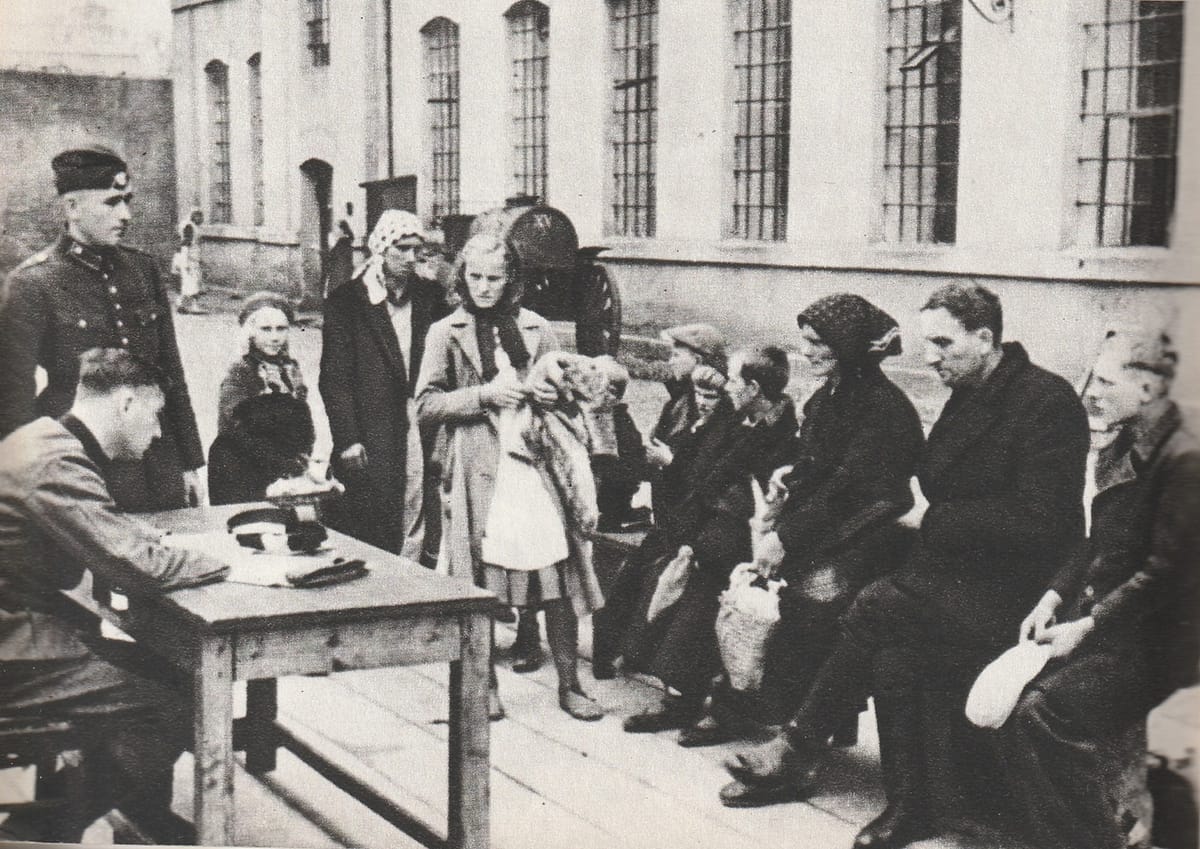 Peak Oil. Food. Fascism. Collapse.The era of abundant oil, resources and food is coming to an end, and with it, the world as we know it will change dramatically.
 Collapse 2050Sarah Connor
 Life in a DictatorshipWhat to expect. How to survive.
 Collapse 2050Sarah Connor
 What Happens When No One Stands?An excerpt from "They Thought They Were Free: The Germans, 1933-1945"
 Collapse 2050Sarah Connor
 Why Dictators FailFirst the allure, then the collapse
 Collapse 2050Sarah Connor
One more thing:
I recently did a Q&A with author Scott Erickson about his book "Laughing at Our Self Destruction". Previously, his book was only available on Amazon. Many readers expressed desire to buy his book without supporting Amazon. The book is now available on Bookshop.org.
Original interview:
"Laughing at our self destruction"Q&A with author Scott Erickson Collapse 2050Sarah Connor
Please consider subscribing. The site is free for all, but paid subscribers and one-time contributors help to cover hosting and production costs.
How to survive one week [ 26-Jan-26 1:21am ]
The unspoken truth about humanity's frightening future.
Subscribe .nc-loop-dots-4-24-icon-o{--animation-duration:0.8s} .nc-loop-dots-4-24-icon-o *{opacity:.4;transform:scale(.75);animation:nc-loop-dots-4-anim var(--animation-duration) infinite} .nc-loop-dots-4-24-icon-o :nth-child(1){transform-origin:4px 12px;animation-delay:-.3s;animation-delay:calc(var(--animation-duration)/-2.666)} .nc-loop-dots-4-24-icon-o :nth-child(2){transform-origin:12px 12px;animation-delay:-.15s;animation-delay:calc(var(--animation-duration)/-5.333)} .nc-loop-dots-4-24-icon-o :nth-child(3){transform-origin:20px 12px} @keyframes nc-loop-dots-4-anim{0%,100%{opacity:.4;transform:scale(.75)}50%{opacity:1;transform:scale(1)}} Email sent! Check your inbox to complete your signup.No spam. Unsubscribe anytime.
Between the threat of martial law and current snowstorms, the social contract and infrastructure is unreliable. The slightest disruption puts you at risk. We must all become more self-reliant.
I'm not talking about prepping for the collapse - save that for another day. Right now, let's focus on getting through a week of snow or lockdowns. Start by building a base of stability that'll get you through a power outage or empty store shelves.
This is a short-term guide for a one-week isolation. It is meant to keep you alive until conditions improve.
Here's what you need:
1. WaterOne gallon per person, per day. For one week, you need 7 gallons per person. When the grid fails or pipes freeze, water stops flowing. You need water for hydration, hygiene, and to prepare food.
The cost is approximately $25-$40 for bottled water and storage containers. It is $0 if you fill your own containers. No special skills are required. If you can anticipate the disruption, fill your bathtub and every pitcher you own before the storm.
2. CaloriesStock food that requires no cooking. Aim for 2,000 calories per day per person. For one week, for one person you could buy:
- 1 large jar of peanut butter.
- 10 cans of protein (beans, tuna, or chicken).
- 2 large bags of mixed nuts.
- 2 bags of dried fruit.
- 1 box of granola or protein bars.
- 1 bottle of olive oil (add a tablespoon to canned food for easy, dense calories).
In a lockdown, hunger causes panic. If gas or electricity fails, you cannot cook. You need energy to maintain body temperature in the cold. With current food inflation, the cost is roughly $80-$120 per person for the week. No special skills are needed; just buy what you will eat.
3. HeatUse a "warm room" strategy. Have 1 sub-zero sleeping bag per person or 3-4 heavy wool blankets.
If the furnace stops, your home will get cold. You cannot heat a whole house without power. Pick one room, seal the windows with plastic or curtains, and stay there. Wool keeps you warm even if it gets wet. The cost for quality insulation gear is now $150-$300 per person. Hang blankets over doors to keep heat in.
To generate heat safely without a furnace, use chemical hand and toe warmers, or fill a sturdy bottle with hot water (if you have a way to heat it) and place it at the foot of your sleeping bag. Body heat is your most reliable resource; huddling together with family or pets significantly raises the temperature inside a confined space or tent.
Do not use a generator or outdoor grill inside the house. They produce carbon monoxide, which is odorless and lethal. Never use candles or open flames for heat; in a cold, dry room with blankets, the fire risk is too high. If you must use a portable heater, ensure it is rated for indoor use and that you have a battery-powered carbon monoxide detector in the room.
4. LightUse hands-free LED lighting. Have 1 LED headlamp per person and 8 spare batteries (AA or AAA).
Darkness causes accidents. A headlamp keeps your hands free to work or fix problems. Candles are a fire risk when emergency services cannot reach you. The cost is $30-$60 for reliable lights and lithium batteries. Practice battery management by using light only when you must.
5. CommunicationMaintain redundant information sources. Have 1 multi-power emergency radio (NOAA/AM/FM) and 1 large power bank (at least 10,000 mAh) or a portable solar charger.
You need information to know if orders have changed. When the internet fails, a radio is your only link to news. A power bank is best for immediate use, while a solar charger is useful if the skies are clear. To get both a reliable radio ($40-$70) and a high-capacity power bank ($30-$60), the total cost is $80-$150. You should know how to find local emergency frequencies and how to position a solar panel for maximum sun exposure.
6. Health and SanitationMaintain your medical needs and waste management. Have 30 days of medications and 1 standard first-aid kit.
Include 1 roll of heavy-duty trash bags and a bag of kitty litter or sawdust. If pipes freeze or the water is cut, do not flush the toilet. Line the bowl with a bag and use the litter to manage waste and odor. This prevents disease and structural damage.
During a lockdown, a small infection or a missed pill becomes a crisis. You must manage your health when roads are blocked. The cost is $60-$100 for basic supplies and kit restocking. You should know basic first aid, such as how to stop bleeding or manage a fever.
7. MoraleIsolation and darkness break the spirit. Have 1 physical book, a deck of cards, or a notebook.
Panic is as dangerous as the cold. Low-tech entertainment keeps your mind occupied and prevents the psychological decay that comes with total isolation. The cost is $10-$25. No skills are required beyond the discipline to stay calm.
The Reality CheckYou can do this in an afternoon. One trip to the store is enough. You must act before a lockdown begins. Once it is announced, stores will be empty.
The cost of survival for one person is around $450 to $900. Unfortunately, safety is a luxury that many cannot afford. One step at a time. Start with water.
Of course, this is a temporary fix. This plan lasts for one week. It does not fix crumbling infrastructure, decline into fascism, or breadbasket failure. This is about making it to next Monday.
Stay safe. Stay hydrated. Stay sane.
The site is free for all. No ads or corporate sponsors. Paid subscribers and one-time contributors help keep the site going. So do your kind words and comments. Thank you. Sarah. 6 Takeaways from an Actuarial Warning on Planetary Insolvency [ 20-Jan-26 5:45pm ]
In the world of finance and insurance, actuaries are pragmatists. They are highly trained professionals who analyze data, probability distributions, and long-term solvency. Their job is to look at the range of realities and calculate how much it will cost when things go wrong. Actuaries are probably one of the only groups of people embedded within the corporate world that are least tainted by optimism bias, politics, and shareholder demands.
A group of actuaries recently released a report on the fate of human survival called "Parasol Lost".
The report was produced by a collaboration between the Institute and Faculty of Actuaries (IFoA) and the University of Exeter. Led by authors including Sandy Trust, Oliver Bettis, James Orr, and Professor Sir David King (former Chief Scientific Adviser to the UK Government), the team brings together experts in climate science and risk management.
Sign up for Collapse 2050The unspoken truth about humanity's frightening future.
Subscribe .nc-loop-dots-4-24-icon-o{--animation-duration:0.8s} .nc-loop-dots-4-24-icon-o *{opacity:.4;transform:scale(.75);animation:nc-loop-dots-4-anim var(--animation-duration) infinite} .nc-loop-dots-4-24-icon-o :nth-child(1){transform-origin:4px 12px;animation-delay:-.3s;animation-delay:calc(var(--animation-duration)/-2.666)} .nc-loop-dots-4-24-icon-o :nth-child(2){transform-origin:12px 12px;animation-delay:-.15s;animation-delay:calc(var(--animation-duration)/-5.333)} .nc-loop-dots-4-24-icon-o :nth-child(3){transform-origin:20px 12px} @keyframes nc-loop-dots-4-anim{0%,100%{opacity:.4;transform:scale(.75)}50%{opacity:1;transform:scale(1)}} Email sent! Check your inbox to complete your signup.No spam. Unsubscribe anytime.
6 things you need to know:1. The Termination Shock of Cleaner AirSulphate aerosols from fossil fuel burning have acted as a hidden sunshade, reflecting sunlight and cooling the Earth by roughly 0.5°C. As we clean up air pollution, we lose that cooling. This unmasking is contributing to a termination shock—a rapid, violent spike in warming that we are already starting to feel.
2. A 50% Drop in Global GDPTraditional economic models have often treated climate change as a manageable speed bump. The actuaries disagree, using reverse stress testing (a technique used to see what would ruin a bank or insurance company) to look at the real impact.
Unmitigated climate change could lead to a 50% drop in global GDP later this century. The higher the temperature anomaly, the closer we get to complete collapse.
A plausible scenario could cause a 15% to 20% global GDP contraction in just a five-year period—an economic shock far greater than the Great Depression or the 2008 Financial Crisis.
 3. We Are Approaching Planetary Insolvency
The report defines Planetary Insolvency as significant societal disruption driven by climate and nature risks. The decadal warming average is already at 1.4°C. At current rates, we are likely to hit 2°C mark before 2050. Once we pass 1.5°C, we enter the danger zone for irreversible tipping points, including the collapse of the West Antarctic ice sheet and the dieback of the Amazon rainforest.
 4. The Earth is Absorbing Energy at an Insane Rate
The Earth's Energy Imbalance (EEI) has doubled in recent decades. In early 2023, the rate of solar energy absorption was equivalent to every person alive on Earth continuously boiling 60 kettles. Since 1971, the Earth has accumulated 500 times more energy than the world's total primary energy consumption in 2024. 93% of this heat is currently being stored in the oceans, a thermal debt that will eventually be paid.
 5. The Human Cost: Mass Mortality and Migration
Beyond economic figures, the report warns of a severe humanitarian crisis. Unchecked climate change is expected to lead to mass mortality events and involuntary mass migration as populations are displaced by rising sea levels, heat stress, and the collapse of food and water systems. This is identified as a national security issue where the foundational stability of political systems is threatened by cascading failures in essential services.
6. The End of InsurabilityInsurance is the invisible lubricant of the global economy. Without it, you can't get a mortgage, start a business, or ship goods. Insured losses from natural catastrophes have nearly doubled in the last decade, from $77 billion in 2015 to $145 billion in 2024. These losses are currently doubling every 10 to 15 years. The report warns we are approaching a point where large swaths of the planet become simply uninsurable, leading to a total collapse of local economies. Insurance is the canary in the coalmine.
I won't waste your time adding in the usual "but here's what we can do" stuff that is obligatory for these kinds of reports. Still, it's worth the read.
Read the full report:Parasol-Lost-FinalParasol-Lost-Final.pdf10 MB.a{fill:none;stroke:currentColor;stroke-linecap:round;stroke-linejoin:round;stroke-width:1.5px;}download-circleThe site is free for all. No ads or corporate sponsors. Paid subscribers and one-time contributors help keep the site going. So do your kind words and comments. Thank you. Sarah.
Why an invasion of Greenland might cause the end of Canada [ 16-Jan-26 7:44pm ]
Until last week, the notion of the United States Marines storming the beaches of Nuuk seemed the stuff of bad Tom Clancy fan fiction.
Then came the Caracas raid.
The extraction of Nicolas Maduro by American special forces, an operation Washington hailed as a masterstroke against tyranny and everyone else decried as piracy, has recalibrated the global sense of the possible. If a sovereign head of state can be snatched from his palace in the tropics, a sparsely populated island in the Arctic hardly seems out of bounds.
Donald Trump has never made secret his desire to acquire Greenland. Having been rebuffed by Denmark during his first term, he now appears ready to dispense with the asking. The island is a treasure chest of dysprosium and neodymium, rare-earth elements essential for everything from iPhones to F-35s, and currently monopolized by China. It also sits atop the "GIUK gap", the naval choke-point through which Russian submarines must pass to threaten the Atlantic if a war with the West were to ever occur.
But for military planners in Washington, the Greenland operation is about more than just rare earths. As the Arctic melts, new shipping lanes are opening that offer Russia and China unpoliced backdoors into the Western Hemisphere, exposing North America to strategic vulnerabilities. In this context, the push north is the act of an empire scrambling to maintain its grip on hegemony.
For some, the operation also quietly represents a two-for-one gain. By provoking a crisis in the High North to maintain control over the GIUK gap and new arctic routes, the United States creates a dilemma that Ottawa cannot solve, turning Canada from a neighbouring ally into a vassal US state.
In Europe, the diplomatic mood is sour. Copenhagen has instructed its troops in Greenland to "shoot first and ask questions later" should American boots touch the ground. European allies, terrified of abandoning a NATO member but terrified equally of fighting the United States, have pledged a tripwire force of French and German troops to the island.
A clash over Greenland might remain a localized skirmish or cascade into a global conflagration. Such is the inherent unpredictability of war.
This puts Canada in an impossible position. Denmark is a NATO ally. If it invokes Article 5, Canada is treaty-bound to come to its aid. Yet Canada is geographically fused to the aggressor. If Ottawa honours its NATO obligations, it effectively declares war on the superpower next door. This is a suicidal gesture for a country whose military is chronically underfunded and whose population is clustered within a hundred miles of the American border.
If Canada refuses to honour its NATO obligations, declaring neutrality, it falls into another trap. Under the Hague Convention, a neutral state must prevent belligerents from using its territory. Realistically, Canada cannot do this and would be deemed unable or unwilling to enforce its neutrality. Canada would be at the mercy of American military strategy.
Either through force or cooperation, the US needs access to Canada to support any prolonged incursion into Greenland. To project power into Greenland effectively, the US Air Force needs to fly directly over Canada. Canada lacks the interceptors, surface-to-air missiles, or radar density to stop advanced American aircraft. Canada literally cannot close its own sky. Sustaining a war also requires massive logistics—fuel, munitions, staging grounds. The most efficient routes to the high north utilize Canadian rail, roads, and airbases (like CFB Goose Bay). Without Canadian cooperation, the US supply chain is stretched thin over open ocean; with forced cooperation, Canada becomes a forward operating base.
This becomes a precursor to annexation. Canada, trying to stay out of a war between NATO allies (US vs. Denmark), could refuse access to maintain neutrality. The US, deeming the Greenland mission critical to national security, ignores the refusal and uses Canadian airspace anyway. Once the US is actively ignoring Canadian sovereignty to move troops, it effectively controls the territory.
To secure these supply lines permanently against interference, Washington might decide it's safer to formalize that control, either by installing a compliant government or legally integrating the territory under defense acts. This effectively ends Canada as an independent sovereign entity.
Sign up for Collapse 2050The unspoken truth about humanity's frightening future.
Subscribe .nc-loop-dots-4-24-icon-o{--animation-duration:0.8s} .nc-loop-dots-4-24-icon-o *{opacity:.4;transform:scale(.75);animation:nc-loop-dots-4-anim var(--animation-duration) infinite} .nc-loop-dots-4-24-icon-o :nth-child(1){transform-origin:4px 12px;animation-delay:-.3s;animation-delay:calc(var(--animation-duration)/-2.666)} .nc-loop-dots-4-24-icon-o :nth-child(2){transform-origin:12px 12px;animation-delay:-.15s;animation-delay:calc(var(--animation-duration)/-5.333)} .nc-loop-dots-4-24-icon-o :nth-child(3){transform-origin:20px 12px} @keyframes nc-loop-dots-4-anim{0%,100%{opacity:.4;transform:scale(.75)}50%{opacity:1;transform:scale(1)}} Email sent! Check your inbox to complete your signup.No spam. Unsubscribe anytime.
Should Canada be designated a hostile entity the consequences would be immediate. The assets of Canadian banks in the United States could be frozen. Snowbirds in Florida might find their condos locked and their bank accounts inaccessible. The Canadian dollar and Canadian assets could collapse, wiping out savings and pensions, and raising the cost of living. An envelope of financial, legal, military aggression would rapidly squeeze the life out of Canada.
The timing is auspicious for Washington. Canada is currently politically brittle. The re-election of Trump has emboldened separatist movements that had been dormant. In Alberta, frustration with the federal Liberal government's policies and perceived hostility to the oil industry has boiled into a passionate conversation about separation.
The White House knows this. A two-for-one strategy would likely involve a side deal for Alberta: support the American play (or at least stay out of it), and face no tariffs, gain a new pipeline, and enjoy the protection of the American security umbrella. It is a seductive offer for a province that feels underappreciated by the rest of Canada.
Meanwhile, Quebec has long teased separation, a sentiment that could easily be re-inflamed. The province controls the St. Lawrence Seaway, the industrial artery of the continent. A deal that recognizes Quebec's distinct sovereign status in exchange for American military rights over the seaway would neuter Ottawa's control over its own economy.
Canada would be hollowed out, leaving a rump state of coastal provinces and Ontario, separated by large landmasses. This is both economically and politically unviable, with each remaining scrap of the country either allying with the US or forming it's own distinct country.
We don't know the precise outcome of the Whitehouse's desire to aquire Greenland. Perhaps its all bark and no bite.
But what was once unthinkable is now possible, so we must look at all hypotheticals. As of today, there is a possibility Canada ceases to exist and North America effectively becomes a US fortress.
Greenland is Canada's problem.
Thanks for reading. My name is Sarah and I run Collapse2050. It is a place for the collapse-aware community to learn, debate and connect. Please consider subscribing.
The site is free for all. No ads or corporate sponsors. Paid subscribers and one-time contributors help keep me going. Support also goes towards my shift to full time writing and helping people manage their future. Thank you. Sarah.
Are we just letting this happen again? [ 11-Jan-26 4:56am ]How do ordinary people rationalize the unthinkable? As authoritarianism knocks on the door of American democracy, the history of the Third Reich offers a haunting reflection not of monsters, but of ourselves.
It begins with a feeling of unease. A scroll through a newsfeed, a clip of a rally where the rhetoric feels sharper, the threats more explicit. Until the spear of fascism is pointed at your neck.
We aren't letting this happen again, are we?
For many Americans, the escalating political volatility of the last few years has moved the history of the 1930s from the dusty shelves of academic abstraction into the urgent territory of a survival guide. We watch the polarization, the scapegoating of minorities, and the testing of institutional guardrails, and we ask the inevitable question: Is this how it happens?
Sign up for Collapse 2050The unspoken truth about humanity's frightening future.
Subscribe .nc-loop-dots-4-24-icon-o{--animation-duration:0.8s} .nc-loop-dots-4-24-icon-o *{opacity:.4;transform:scale(.75);animation:nc-loop-dots-4-anim var(--animation-duration) infinite} .nc-loop-dots-4-24-icon-o :nth-child(1){transform-origin:4px 12px;animation-delay:-.3s;animation-delay:calc(var(--animation-duration)/-2.666)} .nc-loop-dots-4-24-icon-o :nth-child(2){transform-origin:12px 12px;animation-delay:-.15s;animation-delay:calc(var(--animation-duration)/-5.333)} .nc-loop-dots-4-24-icon-o :nth-child(3){transform-origin:20px 12px} @keyframes nc-loop-dots-4-anim{0%,100%{opacity:.4;transform:scale(.75)}50%{opacity:1;transform:scale(1)}} Email sent! Check your inbox to complete your signup.No spam. Unsubscribe anytime.
But the more haunting question is about those going along, and the millions staying quiet at home.
For decades we've comforted ourselves with the idea that the German people of 1933 were uniquely susceptible to hateful fascism. Brainwashed. Uninformed. Evil. We imagine that we would be different...that we would speak up, that we would resist.
Yet, Third Reich shows that the rise of fascism relies less on a nation of monsters and more on a nation of neighbors. It was built on the banal, terrifying architecture of social conformity, professional ambition, and the human need to belong. To understand how a modern democracy collapses, we must look away from Hitler and toward the ordinary citizen navigating the gray zone between complicity and survival.
The Seduction of the In-GroupIf you were a "pure" German in 1933, the onset of the dictatorship might have felt like the lights coming back on. After the humiliation of World War I and the crushing poverty of the Great Depression, the Nazis promised a return to order and the Volksgemeinschaft ("People's Community").
This was the regime's most potent psychological weapon. It offered a seductive bargain: equality, status, and belonging for the "in-group," purchased at the price of the "out-group's" exclusion. Participation was made to feel like a festival. The Winter Relief drives and the Strength Through Joy vacations were communal. They made the average citizen feel seen and valued.
But this belonging was brittle. It required constant maintenance through what sociologists call "ritualistic conformity." The "Heil Hitler" greeting was a social signal. To refuse it was to mark oneself as difficult, a grumbler, an outsider. Most people performed the salute because it was awkward not to. They did it to avoid the friction of social deviance. Over time, however, a psychological mechanism known as cognitive dissonance took hold. It is exhausting to act one way and believe another. Eventually, many aligned their internal beliefs with their external actions. They became what they pretended to be.
The Ordinary Men in the WoodsThe most chilling dismantling of the "monster" myth comes from a study of Reserve Police Battalion 101. This group was made up of middle-aged, working-class family men from Hamburg, too old for the front lines. In 1942, they were ordered to round up and execute the Jewish inhabitants of the Polish village of Józefów.
Their commander, Major Trapp, weeping and visibly shaken, made an extraordinary offer: any man who did not feel up to the task could step out of line and be assigned other duties. There would be no punishment.
Out of 500 men, only about a dozen stepped forward.
Why? They weren't all driven by a bloodthirsty antisemitism, though that was part of the cultural air they breathed. They were driven by the fear of looking weak in front of their friends. They didn't want to leave the "dirty work" to their comrades. They killed out of social deference and peer pressure. The same mundane social glues that keep a high school clique together.
This dynamic appeared even in the highest echelons of society. German doctors performed a psychological process called "doubling." An Auschwitz doctor could supervise the gas chambers by day, selecting thousands for death, and then return home to be a loving father and husband by night. He partitioned his soul, creating an "Auschwitz Self" to handle the horror, keeping his "Prior Self" unpolluted. It was a functional adaptation to evil.
For the millions who were neither killers nor true believers, the primary coping mechanism was Inner Emigration. This was the retreat into the private sphere. You stopped reading the papers. You focused on your garden, your music, your children. You told yourself that by not participating in the worst excesses, you were remaining decent.
The diaries of Victor Klemperer, a Jewish professor in Dresden, document how this silence felt from the other side. He recorded the "mosquito bites" of tyranny and the slow accumulation of indignities. A colleague crossing the street to avoid saying hello. The grocer who apologetically refused to sell him an apple. Fascism didn't require fanatics. Rather, it just needed the population to keep quiet, either through fear or complacency.
For those afraid the terror was real, but it was often self-inflicted. We often imagine the Gestapo as an omniscient surveillance state, but it was surprisingly understaffed and overworked. It relied almost entirely on rats. A neighbor settling a grudge over a shared laundry room, or a colleague eyeing a promotion. The regime weaponized petty envy. It turned the "community" into a panopticon where no one could trust anyone, enforcing a "spiral of silence" where dissent felt dangerous and singular, as if you were the only one who felt that way.
Perhaps the most insidious victory of the regime was its invasion of the family. Through the Hitler Youth, the state offered children power, a rare commodity for the young. It gave them uniforms, purpose, and authority over their parents.
The presence of indoctrinated children blocked the free-flow of communication even within the family home. Parents fell silent at the dinner table, afraid that a grumble about food rationing would be repeated by their son at a Hitler Youth meeting, leading to a knock on the door. Worse, some feared their children would purposefully sell them out. The family was no longer a fortress of truth against the state. Without that, bemoaning of circumstances gradually extinguished.
Was this descent inevitable?Looking back from the ruins of 1945, it seems so. But history is a series of choices, and there was a moment when the machine could have been stopped.
Consider the Kapp Putsch of 1920. When a right-wing faction tried to overthrow the Weimar government, the response was swift and unified. The trade unions called a general strike. Berlin stopped. Trains didn't run, water stopped flowing, bureaucrats refused to sign papers. The coup collapsed in days because the ordinary machinery of society refused to cooperate.
In January 1933, Hitler is appointed Chancellor. What if the unions had called a general strike then? By then, however, the voice of the opposition was fatally fractured. The Communists and Social Democrats hated each other more than they feared Hitler. With mass unemployment, workers were terrified of losing their jobs. The psychological moment for collective action had passed.
Also consider the Rosenstrasse Protest of 1943. In the depths of the war, the Gestapo rounded up nearly 2,000 Jewish men who were married to non-Jewish German women. These women marched to the detention center on Rosenstrasse and screamed for their husbands. They refused to leave, even when threatened with machine guns.
And they won. Goebbels, fearing public unrest in the capital, ordered the men released.
Leopold Gutterer, who was Goebbels's deputy at the Propaganda Ministry, later stated in an interview:
"Goebbels released the Jews in order to eliminate that protest from the world. That was the simplest solution: to eradicate completely the reason for the protest. Then it wouldn't make any sense to protest anymore. So that others didn't take a lesson [from the protest], so others didn't begin to do the same, the reason [for the protest] had to be eliminated. There was unrest, and it could have spread from neighborhood to neighborhood ... Why should Goebbels have had them [the protestors] all arrested? Then he would have only had even more unrest, from the relatives of these newly arrested persons." Gutterer also stated: "That [protest] was only possible in a large city, where people lived together, whether Jewish or not. In Berlin were also representatives of the international press, who immediately grabbed hold of something like this, to loudly proclaim it. Thus news of the protest would travel from one person to the next."
It was a demonstration that the regime was not impervious to public pressure, especially from "Aryans." It suggests that the point of no return was further away than we think. Perhaps peaceful, coordinated resistance could have jammed the gears of the Holocaust, had it happened earlier, and on a larger scale.
The tragedy of the Third Reich is that it could have been prevented if it was resisted early enough. Instead, ordinary people did nothing, or did just enough to get by, until the cost of resistance became fatal and complicity was the safest option.
The point of no return was the moment when the fear of social isolation outweighed the moral imperative to speak. It was the moment when the professional civil service decided that swearing an oath to Hitler was preferable to losing a pension. It was the moment when neighbors decided that the apartment of the deported Jewish family was an opportunity to steal their goods, space, job.
As we wonder why fascism is rising once again, the lesson from Germany is that we should look at the mirror. Authoritarian tendencies exist in any society that values order over justice, and comfort over courage. Occasionally socioeconomic circumstances deteriorate to a point at which these tendencies explode. We are not there yet, as we can see from the massive protests in Minneapolis. Resistance is still an option. A must. But it has a shelf life. It works when the press is still free, when the courts are still independent, and when the unions can still stop the trains.
Once those firewalls burn down, the cost of saying "no" rises from social awkwardness to physical destruction. That day is may come soon, unless we persist.
We'll know all is lost when people stop talking.
We are living through collapse. This blog is my personal project to deliver unadulterated information about humanity's final period. If you'd like to support my work, please subscribe or make a one time contribution. Thanks, Sarah


