
NATIONWIDE SCHEDULE
California Superbike School Announces 2027 Schedule The California Superbike School has announced its 2027 schedule, with classes at 16 racetracks across the United States. The school will have a full fleet of new 2027 BMW S1000RR motorcycles available for students. Founded in 1980, the California Superbike School has been training riders for more than four decades, with graduates going on to win 113 world and national championships. The complete 2027 schedule is now available at superbikeschool.com/schedule. California Superbike School on track at Barber Motorsports Park. Photo by Bob Hartman/etechphoto.com
Find your track. Choose your dates. Let's ride!
Register Online https://superbikeschool.com/schedule/ or call us at (800) 530-3350 with any questions.
2026 - 2027 Dates
CALIFORNIA SUPERBIKE SCHOOL 2026 - 2027 SCHEDULE OF SCHOOLS
Date: Track: Location: Type of School: Pricing: Own Bike/Rental Bike
2026
Nov 12 & 13, 2026 Las Vegas Motor Speedway North Las Vegas, NV 2-Day Camp/All Levels $2,895/$3,195
Nov 14 & 15, 2026 Las Vegas Motor Speedway North Las Vegas, NV 2-Day Camp/All Levels $2,895/$3,195
Nov 21, 2026 Podium Club Casa Grande, AZ Single Day/All Levels $675/$875
Nov 22, 2026 Podium Club Casa Grande, AZ Single Day/All Levels $675/$875
 A California Superbike School coach working 1-on-1 with a student, at Barber Motorsports Park. Photo by Bob Hartman/etechphoto.com
2027
March 6 & 7, 2027 Las Vegas Motor Speedway North Las Vegas, NV 2-Day Camp/All Levels $2,935/$3,235
March 27, 2027 Buttonwillow Circuit Track Buttonwillow, CA Single Day/All Levels $695/$895
March 28, 2027 Buttonwillow Circuit Track Buttonwillow, CA Single Day/All Levels $695/$895
April 3 & 4, 2027 Las Vegas Motor Speedway North Las Vegas, NV 2-Day Camp/All Levels $2,935/$3,235
April 15 & 16, 2027 Streets of Willow Springs CCW Rosamond, CA 2-Day Camp/All Levels $2,935/$3,235
April 17, 2027 Streets of Willow Springs CCW Rosamond, CA Single Day/All Levels $695/$895
April 18, 2027 Streets of Willow Springs CCW Rosamond, CA Single Day/All Levels $695/$895
May 3, 2027 Virginia International Raceway North Alton, VIR Single Day/All Levels $695/$895
May 4, 2027 Virginia International Raceway North Alton, VIR Single Day/All Levels $695/$895
May 5 & 6, 2027 Virginia International Raceway North Alton, VIR 2-Day Camp/All Levels $2,935/$3,235
May 10, 2027 National Corvette Museum Bowling Green, KY Single Day/All Levels $695/$895
May 11, 2027 National Corvette Museum Bowling Green, KY Single Day/All Levels $695/$895
 A California Superbike School student pays close attention to a coach on pit lane. Photo by Bob Hartman /etechphoto.com
May 17, 2027 New Jersey Motorsports Park Thunderbolt Millville, NJ Single Day/All Levels $695/$895
May 18, 2027 New Jersey Motorsports Park Thunderbolt Millville, NJ Single Day/All Levels $695/$895
May 19 & 20, 2027 New Jersey Motorsports Park Thunderbolt Millville, NJ 2-Day Camp/All Levels $2,935/$3,235
May 24, 2027 Motorsport Ranch Cresson, TX Single Day/All Levels $695/$895
May 25, 2027 Motorsport Ranch Cresson, TX Single Day/All Levels $695/$895
May 28 & 29, 2027 Barber Motorsports Park Birmingham, AL 2-Day Camp/All Levels $2,935/$3,495
May 30, 2027 Barber Motorsports Park Birmingham, AL Single Day/All Levels $695/$895
May 31, 2027 Barber Motorsports Park Birmingham, AL Single Day/All Levels $695/$895
June 1 & 2, 2027 Barber Motorsports Park Birmingham, AL 2-Day Camp/All Levels $2,935/$3,495
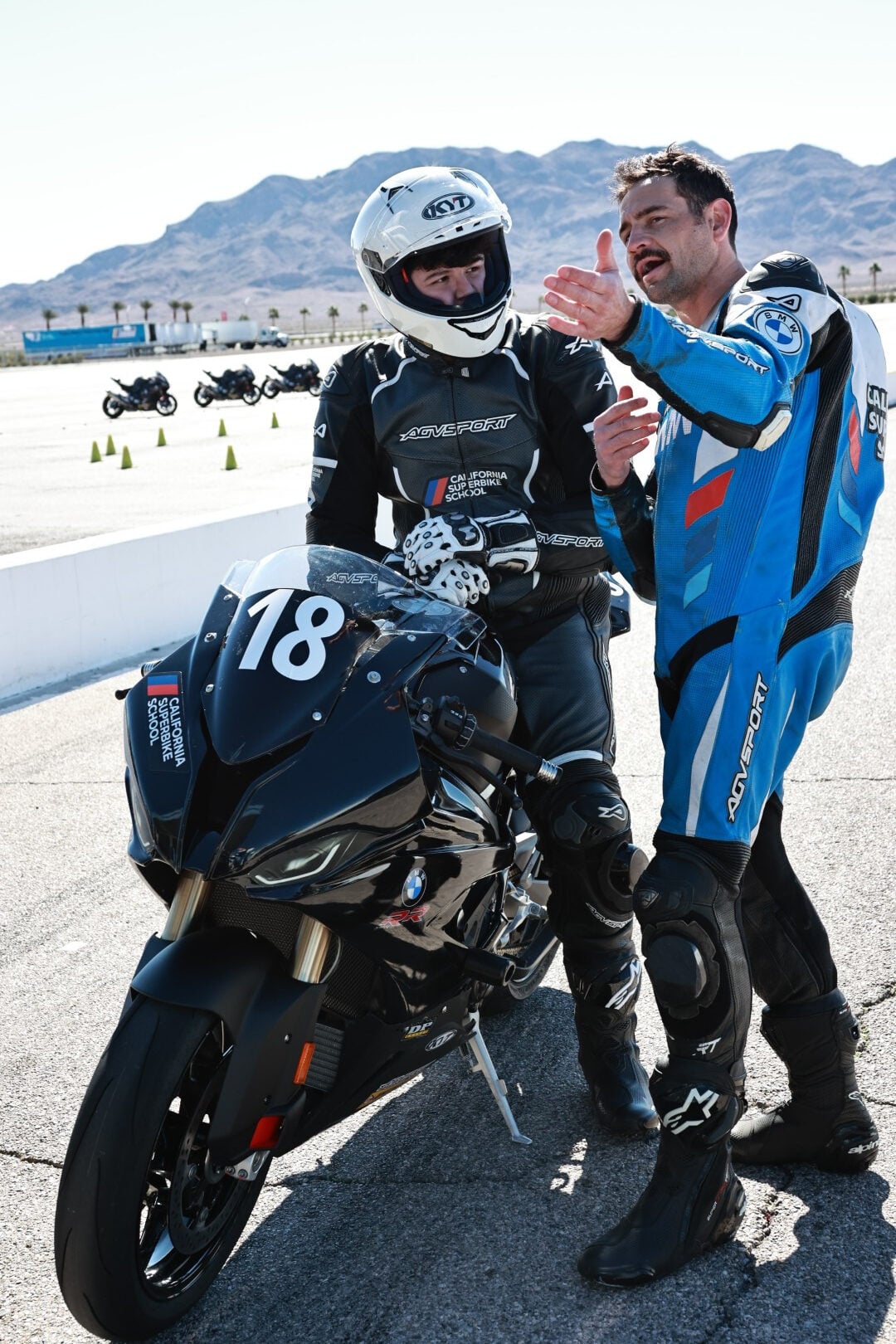 Another coach with a student on pit lane during a California Superbike School. Photo by Bob Hartman/etechphoto.com
June 7 & 8, 2027 Weathertech Raceway at Laguna Seca Monterey, CA 2-Day Camp/All Levels $3,695/$3,995
June 12, 2027 Thunderhill Raceway West Willows, CA Single Day/All Levels $695/$895
June 13, 2027 Thunderhill Raceway West Willows, CA Single Day/All Levels $695/$895
June 14 & 15, 2027 Sonoma Raceway Sonoma, CA 2-Day Camp/All Levels $2,935/$3,495
July 5, 2027 The Ridge Motorsports Park Shelton, WA Single Day/All Levels $695/$895
July 6, 2027 The Ridge Motorsports Park Shelton, WA Single Day/All Levels $695/$895
July 7 & 8, 2027 The Ridge Motorsports Park Shelton, WA 2-Day Camp/All Levels $2,935/$3,235
July 9, 2027 The Ridge Motorsports Park Shelton, WA Single Day/All Levels $695/$895
July 10, 2027 The Ridge Motorsports Park Shelton, WA Single Day/All Levels $695/$895
August 4 & 5, 2027 Mid-Ohio Raceway Lexington, OH 2-Day Camp/All Levels $2,935/$3,235
August 9, 2027 New Jersey Motorsports Park Thunderbolt Millville, NJ Single Day/All Levels $695/$895
August 10, 2027 New Jersey Motorsports Park Thunderbolt Millville, NJ Single Day/All Levels $695/$895
August 11 & 12, 2027 New Jersey Motorsports Park Thunderbolt Millville, NJ 2-Day Camp/All Levels $2,935/$3,235
August 16 & 17, 2027 Virginia International Raceway South Alton, VIR 2-Day Camp/All Levels $2,935/$3,235
August 23, 2027 High Plains Raceway Deer Trail, CO Single Day/All Levels $695/$895
August 24, 2027 High Plains Raceway Deer Trail, CO Single Day/All Levels $695/$895
September 11, 2027 Thunderhill Raceway West Willows, CA Single Day/All Levels $695/$895
September 12, 2027 Thunderhill Raceway West Willows, CA Single Day/All Levels $695/$895
September 13 & 14, 2027 Sonoma Raceway Sonoma, CA 2-Day Camp/All Levels $2,935/$3,495
September 26 & 27, 2027 Weathertech Raceway at Laguna Seca Monterey, CA 2-Day Camp/All Levels $3,695/$3,995
October 2, 2027 Streets of Willow Springs CCW Rosamond, CA Single Day/All Levels $695/$895
October 3, 2027 Streets of Willow Springs CCW Rosamond, CA Single Day/All Levels $695/$895
October 4 & 5, 2027 Streets of Willow Springs CCW Rosamond, CA 2-Day Camp/All Levels $2,935/$3,235
October 13 & 14, 2027 Chuckwalla Raceway Desert Center, CA 2-Day Camp/All Levels $2,935/$3,235
October 16, 2027 Podium Club Casa Grande, AZ Single Day/All Levels $695/$895
October 17, 2027 Podium Club Casa Grande, AZ Single Day/All Levels $695/$895
October 23 & 24, 2027 Las Vegas Motor Speedway North Las Vegas, NV 2-Day Camp/All Levels $2,935/$3,235
November 11 & 12, 2027 Las Vegas Motor Speedway North Las Vegas, NV 2-Day Camp/All Levels $2,935/$3,235
November 13 & 14, 2027 Las Vegas Motor Speedway North Las Vegas, NV 2-Day Camp/All Levels $2,935/$3,235
The post California Superbike School Releases 2027 Nationwide Schedule appeared first on Roadracing World Magazine | Motorcycle Riding, Racing & Tech News.

TL;DR: Give your fingers a break with VoiceType AI, a dictation tool that turns speech into polished text at up to 360 words per minute. Get unlimited monthly transcription for $39.97 (reg. $419) through November 8.
Your brain has already written the email, mapped out the project, and composed a devastatingly clever response to that one coworker. — Read the rest
The post Your keyboard can take a hike: VoiceType AI is just $40 appeared first on Boing Boing.
The next time you see a software engineer shaping silent words with their mouth, you may have to think twice before asking if they need a mental health day - they might just be wearing a pair of smart glasses that let them talk to their computer without uttering a sound.
Subvocal is a Y Combinator-backed startup aiming to produce these glasses, and already has working prototypes to show off in YouTube videos, including one with YC partner Dave Lieb trying them out and being impressed enough to offer funding. The headset isn't what the final version will look like, the company notes, which is good: The demo headset is obviously 3D printed and far from fashionable.
Once the final product is available it should look a lot sleeker, based on mockups on the company's website. It's not clear when they'll actually be released, though the preorder page says it'll be sometime in Q1 2027 at an early bird price of $499. It's not clear what the final full price will be.
As for how the glasses work, the founders, Georgia Tech computer science students Aarush Yadav and Arnav Kumar, explain in a launch post on YC that the device uses low-powered radio waves projected from the glasses toward a wearer's face. Those waves are distorted by muscle movements and the change in a person's face shape as they speak or simply mouth words, which the duo said can be picked up and translated into written text.
"We started working on this about four months ago after building the first version at a hackathon," the pair explained in their YC post. "Since then, we've gone from a table full of electronics and antennas taped to our face to a semi-portable board and sleek glasses that can decode open-ended speech at 200+ WPM and a reasonably low error rate even at a small dataset scale."
This is just a proof of concept, and many key details are still missing, like the accuracy rate, battery life, whether it will paired with an app, or what-have-you.
"The core thing we wanted to prove first was that the signal exists and that we can decode it," Yadav and Kumar said.
In a Hacker News post announcing the company, Yadav and Kumar explained that they started the project during the hackathon by focusing on using EMG electrodes attached to Yadav's face. They didn't win the hackathon, but apparently the demo was impressive enough to earn some initial funding from San Francisco VC firm Afore Capital.
Shortly after that, the pair pivoted from EMG to RF sensing, as a commercial dictation product that required sticking electrodes to one's face was unlikely to succeed.
"Despite prior academic research, getting this to work was a huge engineering challenge," Yadav said. "First we built an extremely low-noise RF sensing stack. Then we had to place antennas so their fields overlapped maximally with the articulators. Our first attempt on glasses failed completely, so we reverted to old habits and taped antennas on our face."
They eventually got to the functional prototype they have now, and pre-trained the AI models doing the speech recognition to minimize setup time. According to the company, Lieb only had to read 20 sentences to calibrate the headset to his speech patterns.
"We think silent speech can become the next interface for interacting with computers, replacing voice and the keyboard," the company says of its goal. "Emails, prompts, messages, code, notes, commands, all at the speed of speech without bothering anyone around you."
With just four months of work under their belts, Subvocal could be a massive hit, ushering in a new era of silent muttering productivity for workers in a variety of industries, or it could flop as it tries to scale.
Those interested in finding out can preorder a pair now for $199, with the other $300 not due until the glasses ship. ®
If AI can find the holes in programming code, it can do the same with legal code, paving the way for chaos.
Felix Ringe, a visiting fellow at Stanford Law School's liftlab and legal scholar, suggests large language models (LLMs) have become potent enough that they could break legal systems by identifying exploitable inconsistencies at scale.
"Legal systems encode the foundations of social order in natural language," Ringe and collaborator Linus Folkerts argued in a blog post last week. "Similar to computer systems, the written law can contain vulnerabilities that invite exploitation."
Ringe contends that while courts tend to pave over these text vulnerabilities through statutory interpretation, the ability to discover adversarially useful inconsistencies in the law in an automated way risks overwhelming the legal system's ability to bridge the gaps.
To buttress his thesis, he points to recent work by other legal scholars that frames laws as vulnerable code, such as "Legal Zero-Days: A Novel Risk Vector for Advanced AI Systems" and "Hardware and Software Bugs in the Legal System" [PDF].
The analogy dates back at least to 1999, with Lawrence Lessig's Code and Other Laws of Cyberspace [PDF] and Code Is Law: On Liberty in Cyberspace. Lessig credits William J. Mitchell, in City of Bits: Space, Place, and the Infobahn (1995), with the idea that code is cyberspace's law, adding that he "drew the metaphor from others as well."
Ringe has turned this on its head by proposing that law is code.
The analogy between programming code and legal code works reasonably well, up to a point. Law and code both have their share of formatting pedantry and ritual. The mapping breaks down when courts get cast as a runtime environment - non-deterministic trial outcomes don't work for production applications.
Discontinuities aside, Ringe's point is that AI models can surface statutory gaps at a scale that may bring the chaos currently seen in the software security ecosystem to the legal world.
To demonstrate that, Ringe and Folkerts cite several potential gaps in German law that they uncovered with the help of LLMs, noting that they're only sharing legal exploits they believe could not cause serious harm.
For example, an amendment to Germany's Occupational Diseases Regulation (BKV) is subject to a constitutional requirement to cite its statutory authority. But Ringe and Folkerts argue that the amendment omits a required reference. So, in theory, a journalist could request an unpublished statement submitted to Germany's occupational-diseases advisory council under freedom of information rules, challenging a confidentiality provision that the researchers argue may be invalid.
Another example cited describes a transit visa rule that may be invalid because the government failed to identify the authority under which the rule was made.
"We believe that with cheap legal reasoning proliferating, AI systems could jeopardize the functioning of today's legal systems," they wrote. "In such a world, lawmakers would need to significantly harden the process of legislation, for example by leveraging advanced AI themselves."
Wendy Musell, a San Francisco-based employment law attorney and partner, told The Register that the use of AI in the legal field is expanding rapidly.
"Some California Courts, including LA Superior Court, are testing the use of AI as law clerks," said Musell. "Generally law clerks would assist the Court by researching and drafting opinions for the judge's review. That means AI is serving that role in certain courts. Litigators now must consider how AI is analyzing motions and cases.
"This is the case even where I personally have found different AI sources to appear to have a slant or bias, and often fail to accurately analyze legal issues. It was just a matter of time before AI came for the legislative process."
Eric Goldman, associate dean for research and professor of law at Santa Clara University School of Law, told The Register that Ringe's argument has some merit.
"I think the methodology of using AI to identify potential statutory gaps is logical," said Goldman. "However, it will require careful human review to determine if the AI-identified gaps are in fact actually gaps. Statutory gaps also may have no legal consequence, or at least none of significance; and legislatures will often correct any major gaps once they are identified."
Goldman said the idea that legislators should use AI during the drafting process is ambitious, at least in the short term.
"Legislators often draft laws with a range of goals and priorities, and avoiding statutory gaps is rarely a high priority," he explained. "But many legislatures have legislative counsel who are responsible for converting draft bills into final legislative text, and I could see where legislative counsel could benefit from using AI to identify drafting gaps as part of their standard cleanup protocols." ®
A coalition of private-sector security firms working with Japan's National Police Agency has disrupted XCPE, a backdoor used to build a massive botnet comprising more than 1.3 million Android devices across more than 200 countries.
Google, Lumen, Human Security, Plume, Synthient, and TrendAI participated in the disruption.
"We assess with high confidence that the backdoor and botnet were intentionally developed, deployed, and operated for financial gain by Videostrong Technology," the Google Threat Intelligence Group (GTIG) said in a Monday blog.
Videostrong Technology is a hardware manufacturer based in Shenzhen, China. It builds Android devices, including home TV boxes and projectors. According to Google, Videostrong deliberately embedded the XCPE backdoor in device firmware and sold access to criminal affiliates, allowing them to install additional malware modules on devices shipped to unsuspecting customers. When buyers connected these devices to their home networks, the preinstalled backdoor allowed operators to create proxy networks and hide malicious traffic using the customers' internet connections without their knowledge.
The firmware's pre-installed management agent purported to be a standard remote-management client, according to TrendAI. It pulled updates from a GitHub page, and connected to a Message Queuing Telemetry Transport (MQTT) server that gave the operator full remote control of each box, allowing them to install and remove apps, change settings, and push updates to the infected devices.
Between June 3 and October 1, TrendAI documented more than 3.8 million distinct home and mobile IP addresses connected to the operation.
The coalition also disrupted the command-and-control domains used to manage the affiliate modules. "Because these affiliates each have diversified distribution channels for their modules beyond XCPE, we assess that taking down their C2 domains will sever access to at least 10 million additional compromised devices," according to GTIG.
Google said it had since cut ties with Videostrong, and banned the OEM from making devices with preloaded Google apps.
Videostrong did not immediately respond to The Register's inquiries.
This backdoor and botnet operation is part of the same ecosystem as BadBox 2.0, another notorious botnet that infected more than 10 million TV boxes and other devices before Human, Google, and TrendAI disrupted it in March 2025.®
Hoping to dominate the next phase of AI networking, Marvell Technology plans to acquire photonics giant Lumentum in an all-stock deal valued at $115 billion. The move will fill several key gaps in Marvell's photonics portfolio, particularly with regard to high-performance laser sources, optical transceivers, optical circuit switches, and specialized compound semiconductor manufacturing capabilities involving indium phosphide.
Higher speed interconnects combined with larger compute domains are the driving forces behind the move to photonics. As interconnects push beyond 400 Gbps per lane, copper interconnects are being pushed to their limit, necessitating denser, hotter rack systems. Optics offer a reprieve from these scaling laws.
Traditional copper wire can only maintain a 400 Gbps signal over about 1.25 meters. Every time the per lane speed doubles, the reach is halved. Photonics are largely immune to this and can push that signal over kilometers, enabling infrastructure providers to scale their systems across entire aisles, while also reducing the power and cooling requirements of each individual rack.
Due to close in the first half of 2028, the all-stock transaction comes as AI infrastructure builders, including Nvidia and AMD, eye larger rack-scale systems, which will rely heavily on optical interconnects to stitch hundreds and even thousands of GPUs together into a single compute domain for training or inference.
At Computex 2026 in Taipei earlier this year, Jensen Huang predicted that Marvell's long-term investments in photonics would catapult the IP house to a $1 trillion valuation. That hasn't happened just yet - the company's market cap currently sits at just $180 billion - but it seems Marvell isn't above buying its way to the finish line by snapping up optics vendors before the AI boom sends their valuations skyrocketing.
As we've previously reported, the move to optical scale up networks has fueled a flurry of investment in optics, silicon photonics development, and manufacturing. Nvidia itself invested $2 billion into Lumentum just eight months ago to bolster its optics manufacturing capacity.
The limiting factor up to this point has been power. When Nvidia unveiled its first Blackwell-based rack systems in 2024, Huang noted the company specifically avoided optics as they would have added 20 kW of additional power draw to a system that already consumed 120 kW under load.
In the years since then, Marvell has invested heavily in next-gen optics tech. One of the most notable acquisitions came in February 2026, when the company paid about $3.5 billion for photonic interconnect developer Celestial AI.
Celestial's tech opened the door to more efficient optics integrations including near- and co-packaged optical interconnects that used a fraction of the power of conventional pluggable optics used in scale out networks.
Marvell's Lumentum buy will position the IP house as a one-stop shop for AI infrastructure providers' photonics needs. ®
The week after promising to cap new borrowing at $20 billion until the end of its 2030 financial year, Oracle launched plans to borrow all that in one go.
In notices to investors on Monday, Big Red said it is offering bonds worth $10 billion together with $10 billion in shares of its common stock.
It said it could use the money for working capital, capital expenditures, contractual obligations, acquisitions, dividends, stock repurchases, debt repayments and other matters. The most likely candidate is financing datacenters, as the tech giant is in the middle of capex binge which saw $55.7 billion spent in fiscal year 2026, which ended in May. The company plans to spend between $90 billion and $95 billion in fiscal 2027.
Last week, the company told investors it would limit new borrowing to $20 billion until the end of its financial year 2030, which ends in May that year. It promised to get more revenue from customers by charging for AI usage on top of seat-based subscriptions.
CFO Hilary Maxson also told an analysts' event that Big Red would look to borrow the $20 billion during the remainder of fiscal 2027, which ends in May, implying there would be no new borrowing for the following two years.
Maxson confirmed this was correct. "That's a real commitment. We don't expect other forms of structured financing or other things using our Oracle credit out in the market," she said.
In July, Oracle said it could face more than $100 million a year in financing costs to guarantee the power commitments behind a nearly 1 GW datacenter campus it is developing in Wisconsin with Vantage and OpenAI.
In October, Oracle reportedly sent a force majeure notice to a Blue Owl Capital subsidiary developing Project Jupiter in New Mexico. Bloomberg reported that Oracle was seeking to defer payments if the campus failed to come online as planned, rather than withdraw from the project. Oracle says the development remains on schedule.
In September last year, Oracle's valuation rocketed after it boasted $455 billion in RPOs, $300 billion of which turned out to be for OpenAI, all largely based around leasing datacenters for AI compute. ®
Ericsson is bringing drone detection to mobile networks, analyzing radio signal reflections to identify and track low-altitude objects.
The telecoms infrastructure maker says its Integrated Sensing and Communication (ISAC) tech adds detection to existing mobile networks, closing a security gap in tracking low-flying, fast-moving objects such as drones.
Following tests over the past few months, Ericsson says it will introduce the tech commercially in phases. Small-scale, sensing-only pilots with selected customers will start in 2027, followed by broader deployments from 2028.
CCS Insight research director Ian Fogg, said told The Register:
"While sensing can be used for other things — like tracking boats in a port, traffic patterns or weather conditions — drone detection [in civilian areas] is the most pressing need which cannot easily be solved using other technologies.
"Mobile networks are useful as drone detection solutions because their antennas are already covering low elevations, close to ground level where drones often fly, unlike traditional radar."
Although it is possible to use 5G networks for sensing, a standards-based 6G method could improve precision by letting different suppliers' base stations "interoperate", alongside a mix of client devices, tracking the "smallest and fastest moving drones in difficult environments," Fogg added.
"The new spectrum that should arrive with 6G will also make it easier to deploy sensing on wide channels which further improves detection accuracy," he said.
Small, low-cost drones have emerged as a persistent threat, or at the very least a nuisance, closing down airports due to safety concerns - the latest incident was at Jersey Airport over the Halloween weekend. Drone activity has also been on the increase near to military bases and other sensitive sites.
Dedicated sensor systems were deployed to cover sensitive sites, and in the UK, military personnel have now been granted the authority to neutralize any unwanted flying intruders.
Scaling detection across larger areas, however, is more challenging, Ericsson said.
ISAC transforms mobile network infrastructure into a distributed sensor array. Using sensing-enabled 5G radios, edge computing and signal processing, a cell deployment can detect objects and track them across the coverage area, complementing radar and other sensors rather than replacing them.
Ericsson says the tech works by having multiple perspectives from a number of cell tower radio sites. When one transmits a signal, it reflects off the drone and is picked up by multiple receiving sites. The network then analyses the reflected signals to locate the drone and track it.
ISAC requires sensing-capable radio hardware, dedicated compute resources, and software, says Ericsson. The radios have to meet specific Massive MIMO (multiple-in, multiple-out) antenna and spectrum requirements.
AT&T tested ISAC at trials in Arlington, Texas, and with Erillisverkot, a state-owned special purpose company responsible for national critical communications in Finland. In both cases, the tech demonstrated it was able to detect multiple drones and track their movements, according to Ericsson.
Data from ISAC - we're told - can be securely shared through standardized interfaces with authorized external systems, including security and command and control systems. ®
By now it's likely you've heard of the whole concept of the AI paperclip maximizer problem — a hypothetical first put forth by Nick Bostrom — suggesting that a misaligned AI system that looks to optimize on the wrong single thing (in this case creating paperclips) could lead to the end of humanity. Specifically, the thought experiment is that if you have a sufficiently powerful AI tool that is told to "maximize" the creation of paperclips, it might decide the best way to do that is to seize control of all resources and dedicate them solely to making paperclips. And, naturally, that might include grinding up humans, either as raw material for paperclips or as fuel to power the paperclip factory.
The supposed "lesson" of this is to be cautious about these AI tools, though I think the actual lessons are twofold: (1) thought experiments can only take you so far and (2) never over optimize on a single metric. Indeed, this was part of what our recent series, The Metric is Not the Mission, was all about.
Anyway, everyone in the AI world knows about the whole paperclip thing. I guarantee you Sam Altman knows about it. He has praised the book where Bostrom put forth the hypothetical, claiming that it was "the best thing I've seen" on the topic of "will AI kill us all." And he's joked about it in a memey way:

But it's not clear that he truly has internalized that lesson regarding not optimizing on just a single thing. Last week he went on John Collison's (co-founder of Stripe) "Cheeky Pint" podcast to talk about the state of AI.
A bunch of the headlines focused on one specific thing that he said, however, that it's "quite terrible" for people to be wasting RAM in home machines over having them working full steam in a data center somewhere. The context here matters a bit. Collison catches Altman a bit off guard by asking "how's the compute shortage going?" just as Altman takes a big gulp from his pint of beer, and you see Altman try not to laugh/spit out his beer, before there's an obvious cut in the video, where he recomposes himself.
They then have a discussion about the increasing demand for compute, Altman talks about how they're working on having robots build "self-replicating data centers" (what?!?) to which Collison rightly interjects that the problem with data centers right now isn't the lack of labor available to build them. Collison then shifts the conversation back to the stuff that most people care about: the fact that RAM prices have increased dramatically recently, which is jacking up the price of everything from computers to phones.
Collison notes that people keep saying the market should take care of this: if prices keep going up, shouldn't Adam Smith's "invisible hand" motivate more companies to make more RAM and ease the shortage? Altman shows that he's not a big believer in the invisible hand of the market concept:
Collison: My observation, the compute stuff is they say: "The solution to high prices is high prices." And it's like, okay.
Step 1: We have the high prices for memory, and GPUs, and everything. The solutions should be here any moment now. How are we doing on the solutions front?Altman: Bad.
Collison: And I'm not saying this is OpenAI's job. I feel this is the invisible hand's job, right? Memory's gotten really expensive. So, new memory makers are going to flood the market any moment now.
Altman: I think the invisible hand is failing right now. I mean, the invisible hand… It has like a checkered track record at best. But, I think it's not quite working here.
He then points out that, for decades, DRAM was a commodity product with razor-thin margins and barely any profits. His argument is that memory makers aren't willing to expand much because they're afraid that the bubble might burst and they'd have overbuilt (which… might not be wrong?).
Of course, Altman leaves out of this the fact that OpenAI has basically tried to corner the market on RAM, trying to lock up 40% of the world's supply without even guaranteeing that it will follow through on the actual purchase orders. I mean, I think that alone would have at least some impact on the current price for RAM, wouldn't it?
Collison pushes a bit further, and still wants to know why others aren't getting into the memory market, and even (half jokingly?) suggests Intel could get into the market — a reference to one of the key parts of Intel's lore and mystique: the Andy Grove decision in 1985 to get completely out of the memory chip business to focus on processors, which got a bunch of recent attention when Intel's current CEO suggested the (struggling) company might reverse that decision 40 years later.
That brings Altman around to the critical quote regarding local RAM, in which he dismisses the argument that local inference is important, as a way of suggesting that the more efficient use of memory would be in large datacenters where it can be utilized at a much higher rate:
Oh, I think there are all of these ways where the supply chain—it's just super non-obvious.
An example of this is people…A lot of people want local inference. And somehow, they assume that the problem is solved now. Because, we are going to have open-source models. We're going to be able to run them on our computers. And so we're not going to need all the stuff in the data center.
But from a global allocation perspective, actually, it's quite terrible to have everybody have a bunch of the world's limited supply of DRAM sitting in their own computer. And, being used—Mm-hmm. 5% of the time. You want maximum utilization in the cloud if you're trying to deal with this very supply constrained environment.
And somehow everyone's… many people's intuition is the opposite of that.
So he's correct… in one very, very, very narrow sense of this quote. If you are only interested in dealing with the current "world's limited supply of DRAM" he's not wrong that it is more "efficient" to have that RAM be in a data center and then rented out to you. And he's not exactly wrong that if everyone just paid per token for remote compute, the cost of RAM in your own PC would matter a lot less.
But… he's kinda missing the larger point: that people are not just focused on optimizing for the most efficient use of memory. They're not just optimizing for what's best for "the global supply chain of RAM makers." They have other concerns — and other uses beyond AI — as well, such as their own sovereignty and control over their own tools and systems. There's a reason my essay on the need for decentralization (including in AI) went so viral a few months back.
And it's not because people think they're single-handedly going to solve the global supply crisis in DRAM by running everything locally. It's because we've seen what happens when a central provider controls key parts of our stack, and the results are very, very, very bad.
Using open weight models on local hardware may not be the most efficient for the exact price of RAM (which, again, Altman tried to corner the market on), but it certainly leads to much more actual user empowerment by people who want to use these tools, but without outsourcing control to someone like Altman.
In a pure "efficiency" model where you are solely optimizing on what's the most cost efficient way to use memory the answer would be to have it in datacenters where you'd benefit from both economies of scale as well as flexible utilization. But that has consequences. It's the same logic by which a fascist dictator may seem "more efficient" to those sick of democratic quirks and bureaucratic red tape. It only sounds good if your mental model is completely screwed up and simplistic.
In both cases, you're talking about a very simplified mental model, optimizing on a suboptimal point. Personal autonomy over our tools and our systems is more important than making your data center more efficient, Sam. The paperclip problem comes from focusing on a narrow metric and over optimizing on it. And in this clip, Sam is paperclipping RAM.
Recently, reports emerged that LG TVs are sniffing around your local network, and even listening to your local environment, even when the TV is purportedly "off." Some of those voice commands were then stored in plain text and uploaded to the internet. LG's response? To deny everything.
For decades now we've documented how while "smart" TV makers are obsessed with making money off of in-home surveillance (which is now more profitable than the actual TV), they do an abysmal job protecting the data they collect. They also routinely don't respect consumer choice when users say they don't want to participate in the full scope of hyper-commercialized mass surveillance.
That latter point is central to a new study out of Northeastern that conducted 5,943 experiments across twelve commercial "smart" TV devices. The researchers found that most smart TVs utilize automatic content recognition (ACR), a technology that captures audio or video snapshots of viewed content and then monetizes that data to help build personalized profiles of viewers.
TV makers insist that users are supposed to be able to opt out, but the choice simply doesn't work across a large segment of TVs. Companies like Vizio simply ignored the consumer requests entirely more often than not:
"We find that the advertised ACR opt-out fully suppresses ACR-attributable traffic on only four operating systems; on Samsung Tizen traffic consistent with ACR activity persists in more
than 60% of evaluated scenarios, and on Vizio SmartCast a content correlated endpoint hosted on Amazon Kinesis continues to receive traffic in 100% of opted-out scenarios."
These companies have been awful for a long while now, and U.S. regulation of the sector has varied between soggy and inconsistent. Many smart TV manufacturers fail to encrypt sensitive data, or remove features if you refuse to have your daily viewing habits measured and monetized (by say, disconnecting your TV from the internet).
Vizio was fined $2.2 million by the FTC back in 2017 for failing to tell customers that their televisions were spying on them. The company also wound up facing a $17 million lawsuit that wound up giving consumers somewhere between $13 and $31 (lawyers in the case saw $5.6 million in fees).
The researchers say since they can't see the precise scope of what's being collected due to encryption, they're unsure whether Vizio is technically violating its FTC agreement (not that we have a current FTC that would care if they were):
"The opt-out setting has no observable effect on traffic sent to this endpoint; however, we cannot inspect the payload due to encryption so we cannot confirm whether this violates the FTC settlement."
Results of whether opting out of ACR tracking actually stopped ACR tracking were all over the map. Roku, for example, ignores opt-out requests when users are watching Roku's own channels. None of the smart TV vendors track Netflix viewing for fear of violating agreements with the streaming giant. Samsung's opt out function was more likely to actually work when a user was watching antenna broadcasts.
On two Smart TV platforms, personal viewing data collected by ACR remains unencrypted, despite years of bad press and scandal on the subject. Many appear to be violating the law, but because U.S. regulatory oversight has been gutted, they see no meaningful accountability. That includes smart TV OS' like VIDAA, which is most prominently found on Hisense and Toshiba smart TVs:
"VIDAA OS sends ACR data to servers run by Unruly over MQTT without encryption, so anyone on the network path between the TV and those servers can read it. Each message carries a Client ID, a permanent identifier for the TV that can't be reset, along with the time zone, the app name, the input (antenna, HDMI), the antenna channel and an audio fingerprint.
The app name alone can be revealing. We saw ACR on apps such as VIDAA Kids, which raises concerns under the U.S. children's privacy law (COPPA), and Christianity and Money. VIDAA's own HOME OS app sent show and film titles in place of the app name."
Keep in mind these researchers just focused on ACR — or video, image, or audio snippets taken to track your viewing and build a profile on you. There are numerous other ways smart TVs can track you — and numerous other avenues via which your traffic is being surveilled by everybody along the chain, including your telecom provider.
This persists because companies do not fear U.S. regulators, because U.S. regulators have been largely lobotomized via corruption. The United States also remains too corrupt to base even a baseline privacy law for the internet era or regulate the data brokers that further monetize much of this data. Still the researchers were nice enough to provide regulators a path, should they someday choose to do their jobs.
Today, it is my privilege and honour to introduce Uwe Zahn as the next featured artist on Headphone Community, whom you, of course, already must know as the one and only Arovane. My personal journey with Arovane's music began during the DIN and City Centre Office years, with his monumental albums, Atol Scrap, Tides, and Lilies. We'll revisit these during Uwe's residency, with in-depth interviews…
The Australian firm Janus Electric has hooked up with Canada's Electrovaya to accelerate the electric truck conversion field in North America, regardless of the sharp U-turn in US electrification policy.
The post Swarm Of Electric Trucks Coming To US (Battery Swapping Included?) appeared first on CleanTechnica.

As Abdul El-Sayed's one-time primary opponent attempts to redirect closing arguments in the Michigan Senate contest to the topics of Israel and antisemitism, the Democratic nominee has entered the final stretch of the midterms against a barrage of bigoted attacks over his own race and religion.
President Donald Trump called him a "jihadist." Health and Human Services Secretary Robert F. Kennedy Jr. went on a racist rant against Arabs. According to Michigan state Sen. Mallory McMorrow, a mailer went out showing El-Sayed's face next to the World Trade Center's Twin Towers.
"They are running the most bigoted, hateful, Islamophobic campaign I've ever seen," McMorrow told a local TV outlet. McMorrow, who ran for the Democratic Senate nomination but dropped out before the August primary, is taking a far different tack than Rep. Haley Stevens, the Democratic primary runner-up who has spent the race's final days painting El-Sayed as an angry antisemite and crossed party lines Sunday to endorse Republican contender Mike Rogers.
 Related
Radical Centrists Like Haley Stevens Are the Real Extremists in the Democratic Party
Rogers has sought to portray El-Sayed as anti-American and repeatedly tried to tie his opponent to the Muslim Brotherhood. He insists the attacks have nothing to do with faith. But that is exactly how many observers see them, including Muslim Republicans who have been disgusted by the rhetoric.
As the election draws to a close, the Islamophobic attacks have taken a backseat to Stevens's claims of antisemitism — most prominently concerning a PAC ad that connected high grocery prices to U.S. spending on Israeli military aid — and a personal feud between the former primary opponents. And some of El-Sayed's allies worry that the Muslim and Arab-baiting attacks will work. One recent poll found that 38 percent of Michigan voters said they would be less likely to vote for a Muslim candidate.
Michigan's Muslim and Arab organizers have not been taking the attacks lying down, however. In interviews last month, two prominent leaders in Dearborn's Arab American community described widespread excitement over the opportunity to vote for the man who would be the first Muslim in the U.S. Senate.
"It very much feels like when President Obama was running and his whole campaign was around like hope. That's what it feels like," Layla Elabed, the organizing director at Arab Americans for Progress, told the Intercept on October 8.
Elabed, the sister of Rep. Rashida Tlaib, D-Mich., was one of the key movers in the Uncommitted movement, which urged Michigan voters to withhold their votes from Joe Biden during the 2024 primary in protest of his support for Israel's war on Gaza. The movement succeeded in making a statement, but also drew criticism from centrist Democrats for allegedly fracturing party unity.
 Related
The Democrats Don't Know Who They'll Be in 2028. Michigan May Offer an Answer.
Elabed's current group is an evolution of the Uncommitted movement. Its canvassers have been knocking on doors to turn out support for El-Sayed and other candidates.
"I don't think many people in Dearborn are surprised by Haley Stevens," Elabed told The Intercept on Monday. "Arab American Democrats in Michigan have been sounding the alarm about her for years, warning our fellow Democrats about a pattern of putting political interests ahead of the people she was elected to represent."
She believes the same coalition that came together for Uncommitted could help push El-Sayed over the top this election.
"Abdul has been able to really take a stand on all the issues that were really important to anti-war voters and anti-genocide voters," she said. "It's not a coincidence that that same coalition, that same base of Democratic voters are now all coming out to support us."
Hers is not the only group seeking to mobilize Muslim and Arab voters, who make up a sizable slice of the Michigan electorate. The Arab American Political Action Committee has also endorsed El-Sayed. Its president, Osama Siblani, said there is widespread enthusiasm for El-Sayed in areas with dense Arab populations such as Dearborn.
Siblani compared El-Sayed's potential victory to John F. Kennedy's pathbreaking election as the first Catholic president.
"First of all, he's qualified. Second of all, he's saying the right things, he has a good agenda," Siblani. "His opponent is an asshole. In addition to all of this, he is breaking the ceiling for our community and for other communities. That is a plus."
The goal of the Arab and Muslim-baiting attacks from El-Sayed's enemies is clear, according to Nazita Lajevardi, an associate professor of political science at the University of Michigan.
"Islamophobia is a tried and true strategy for garnering a candidate support and swaying the vote," she said.
"When political elites discriminate, it does mobilize people into action."
Yet it is also possible that the attacks on El-Sayed's identity will lead to greater turnout in places like Dearborn, she said.
"I think scholarship would tell us that when political elites discriminate, that it does mobilize people into action. Past scholarship would say yes, it would, but it's an open question," she said.
Elabed agreed that the attacks are nothing new. "We've watched it play out time and time again," she told The Intercept. Stevens's about-face isn't a major development, she said, "It's that the rest of the Democratic Party is finally seeing what our communities have been saying all along. We weren't wrong. We just weren't being listened to."
Siblani expressed a similar sentiment on Monday. "I'm not surprised, I'm disgusted," he wrote of Stevens in a text message, attaching an emoji of a person vomiting.
Stevens's choice to jump ship for the Rogers campaign appears to have galvanized El-Sayed's base. His campaign announced a one-day fundraising record after his fellow Democrat pulled her endorsement on Sunday.
The post Abdul El-Sayed Tests the Limits of Islamophobia in Michigan appeared first on The Intercept.

Michigan Senate candidate Abdul El-Sayed shared a fairly uncomplicated theory about Donald Trump and the people surrounding him: "We are being actively bullied by the dumbest people in the room." Speaking with Hasan Minhaj, El-Sayed called Trump an "idiot," while granting him "one genius": his ability to get attention. — Read the rest
The post Abdul El-Sayed: "We are being actively bullied by the dumbest people in the room" appeared first on Boing Boing.

Stanley Kubrick's personal archives are coming to auction for the first time. The auction will include props, scripts, equipment, and personal possessions from Kubrick's film archives. According to Bonhams, which is holding the auction, highlights from the sale include his director's chair, costumes from The Shining, and the original Star Child prop from 2001. — Read the rest
The post Stanley Kubrick's personal archives are coming to auction for the first time appeared first on Boing Boing.

McDonald's will have to explain the McRib, its occasional mystery meat sandwich, after failing to convince a federal judge to dismiss a class action lawsuit. The lawsuit contends that McDonald's "intentionally shapes" McRib patties, one of the fast-food giant's most expensive products, to lead diners to believe that they are made from actual rib meat. — Read the rest
The post Judge rules McDonald's must face McRib lawsuit appeared first on Boing Boing.

Annie says, "The Polar Bear Cams are live from Churchill, where hundreds of polar bears are gathering on the shore of Hudson Bay, waiting for the ice to freeze. It's like Fat Bear Week, except these bears are still waiting for dinner." — Read the rest
The post Watch hundreds of polar bears wait for Hudson Bay to freeze appeared first on Boing Boing.



As Miguel Parra Hernandez, a Mexican national, was fleeing from U.S. Immigrations and Customs Enforcement on foot last month, he turned into a parking lot. An unmarked government vehicle came screaming into the lot after him and struck him.
When a grand jury in Harris County, Texas, charged the U.S. Immigrations and Customs Enforcement officer behind the wheel last week, the indictment pointed to a broader pattern in the Trump administration's crackdown on immigrants and activists. The charge was assault with a deadly weapon; the weapon was the vehicle.
The Department of Homeland Security, ICE's parent agency, claimed Parra Hernandez ran in front of the government vehicle; surveillance footage of the incident shows him running away from the car moments before he is hit. (An attorney for the ICE officer accused of assault against Parra Hernandez told The Associated Press his client had not committed any crime.)
In the same month, an unmarked ICE vehicle speeding the wrong way down a one-way street in Long Beach, California, struck a bicycle ridden by Ricardo Gonzalez, whose daughter later said he was a U.S. citizen. An agent immediately drew their gun on Gonzalez, who was later hospitalized for his injuries. The government said the man was not struck, but video released by the New York Times showed the ICE vehicle swerving into the bicycle.
Three days later after the collision in Long Beach, Antonio Moreida stood in the street in Woodland, California, outside Sacramento, documenting an unmarked ICE vehicle when the black Chevy Tahoe accelerated toward him. When the SUV hit him, Moreida told a meeting at Woodland City Hall last week, he was knocked to the ground — and the driver of the Tahoe did not stop to check on him.
The Department of Homeland Security said Moreida jumped onto the hood of the unmarked car, but when video of the incident showed him standing in place, local police and the mayor publicly disputed ICE's account.
Weaponized VehiclesIn the national conversation about ICE's heavy-handed crackdown on immigrants across the country, much has been made of the Department of Homeland Security's claims that immigrants and activists "weaponized" their vehicles against federal agents. After immigration officers shot and killed Lorenzo Salgado Araujo, who was targeted by ICE, and community defender Renée Good in separate incidents, the government said the civilians had used their cars to attack agents — allegations that have not been borne out in criminal charges, or were called into question by witness accounts and video analysis.
What happened to Parra Hernandez, Gonzalez, and Moreida, however, was the opposite of what the government said about Good and Salgado Araujo: It was ICE agents who weaponized their vehicles against civilians.
 Related
Trump's National Killer Police Force
As the Trump administration ramped up deportations over the last year, federal agents have effectively turned their cars into massive, deadly blunt objects. Common tactics, known collectively as "offensive driving techniques," include ramming the cars of immigrant targets and activists; "brake-checking" volunteers trying to observe ICE activity; and, in some cases, outright driving into civilians. The Intercept reviewed two dozen cases of ICE using vehicles against civilians in these ways, including multiple incidents where victims were hospitalized or even died from their injuries.
"Vehicles are another tool ICE agents are using with unchecked force, just like their guns, Tasers, and pepper spray."
"Vehicles are another tool ICE agents are using with unchecked force, just like their guns, Tasers, and pepper spray," said Hannah Stauss, co-director of Hands Off NYC, a group that opposes ICE's presence in New York City. "ICE's deranged use of vehicles effectively weaponizes them against our immigrant neighbors and rapid responders, and will continue to kill people. We are witnessing in real time the results of a federal agency being allowed to operate with impunity, in secrecy, and with unfettered violence."
In a statement to The Intercept that compiled past responses to the incidents in this article, a spokesperson for the Department of Homeland Security said, "ICE is instituting additional training including, crowd control measures, additional training for high-risk vehicle stops, a live-fire cover course for officer safety, and medical training."
The spokesperson did not respond specifically to allegations about the incident involved Parra Hernandez; said Gonzalez was not struck by an ICE car; and blamed Moreida for the accident because he was in the roadway.
"Offensive Driving Techniques"In federal policies and memos, the maneuvers used in the incidents reviewed by The Intercept, along with testimony from rapid responders, are referred to by federal agents as "offensive driving techniques." They are part of a wider patten of aggressive driving by law enforcement officers across the country, but especially by federal agents with little accountability and nearly blanket backing from the Trump administration.
Last October, Leo Martinez was monitoring immigrations agents' activity as a volunteer with VC Defensa, a community defense group in Ventura County, California, when an unmarked ICE car rammed his pickup truck. ICE agents arrested Martinez and later released him without charge.
 Related
Documenting ICE Agents' Brutal Use of Force in LA Immigration Raids
In March, they did it again: Three unmarked government vehicles rammed Martinez's car as he sought to reverse away from them. The federal agents broke his window and dragged him out. Martinez, who was hospitalized from his injuries, was again released without charge. (The Department of Homeland Security spokesperson did not respond specifically to questions about the incidents involving Martinez.)
"They run stop signs, red lights, they'll cut off complete intersections, and they rarely turn on their lights," Martinez told The Intercept. "They'll slam on their brakes in the middle of the freeway, in the middle of the street. Sometimes they'll do sudden U-turns in the middle of nowhere and cut off traffic in both directions."
When activists are monitoring federal agents, one of the most common ways for ICE to leverage their vehicles as physical threats is the "brake check," a move where a car suddenly breaks to cause the car behind it to slow down — or slam into its rear bumper.
"Brake-checking" doesn't appear in official guidelines as an "offensive driving technique" with good reason: It is considered to be illegal in all 50 states, covered by various statutes like reckless driving or other anti-road-rage laws. Yet VC Defensa volunteers, who like Martinez monitor ICE activity, said that when they follow ICE vehicles to alert the community with horn-honking, they keep a distance of two to three car lengths because federal agents so frequently brake-check volunteers.
Federal agents use "offensive driving techniques" so often in Ventura County that VC Defensa volunteers sometimes identify the unmarked cars by the body damage that characterizes them.
Customs and Border Protection, another agency that, like ICE, is under the umbrella of the Department of Homeland Security, expanded its agents' discretion and ability to use these techniques during abduction operations after President Donald Trump took office for a second term.
A previous 2023 Customs and Border Protection pursuit policy largely prohibited officers from boxing in vehicles or making vehicle contact with another vehicle in motion. A partially redacted 2025 CBP directive gives officers broader discretion to use offensive driving techniques and ignore traffic laws.
"Most federal agencies are not well trained in police-citizen interactions, traffic stops, and pursuits."
"Most federal agencies are not well trained in police-citizen interactions, traffic stops, and pursuits," said Geoffrey Alpert, a criminology and criminal justice professor at the University of South Carolina who helped Customs and Border Protection rewrite their car-chase policy under the Biden and Obama administrations.
In December, ICE agents in Elgin, Illinois, chased a Venezuelan man until his car and the ICE vehicles crashed. State investigators found the ICE agents likely conducted an "unskilled precious immobilization technique ('PIT maneuver') and lost control of the vehicle." (The Department of Homeland Security spokesperson said the target of the raid rammed an ICE vehicle into a tree.)
In January, Christian Molina, a U.S. citizen, was preparing to pull over for an ICE traffic stop in Minneapolis when the agents rammed the back of his car, injuring his back. The agents said they would pay for the damage, but left without providing contact information. (The Department of Homeland Security spokesperson did not respond specifically to questions about the incident involving Molina.)
In June, agents conducted a high-speed chase through a residential neighborhood of Chicago, blowing through intersections until finally ramming their target's car. (The Department of Homeland Security spokesperson blamed the target of the immigration enforcement action for the accident because he fled from ICE.)
"It's disheartening to see some sort of federal agents or law enforcement driving so aggressively in a residential area," one neighbor told Block Club Chicago. "I have a kid who's two and we go out for walks all the time. We could have been crossing the street when they came through the intersection."
High-Speed ChasesFollowing the killings of Lorenzo Salgado Araujo and Johan Sebastián Durán Guerrero in July, the Department of Homeland Security ordered a temporary halt to traffic stops.
The day the directive was issued, ICE chased a group of roofers in Texas, blowing through a stop sign and over a speed bump without sirens. A mother driving her son to the theater was forced to swerve into a ditch to avoid a collision.
"They speeded right next to me," the mother told the Texas Observer. "They hit the speed bump so bad that, when they got in front of me at high speed, I had to go to the right."
If she had not swerved, she said, "they would have hit me."
Some of these car chases have turned deadly in the very places where local police are restricted from chasing suspects because of the attendant dangers.
In February, agents undertook a high-speed chase in pursuit of Oscar Vasquez Lopez outside of Savannah, Georgia. Vasquez Lopez's car struck a teacher, killing her.
The Savannah Police Department only allows pursuits when the suspect has committed or is attempting to commit a forcible felony, and the risk of not capturing someone outweighs the risk of the chase. Vasquez Lopez had no criminal record, only a civil deportation order from 2024.
Two immigration car chases in New Jersey, where police face similar restrictions at the statewide level, resulted in hospitalizations. (In the Texas case, the Georgia case, and the New Jersey case, the Department of Homeland Security spokesperson blamed the target of the immigration actions for causing unsafe conditions by fleeing.)
"They are not required to follow local agency policies (the same as other agencies), but they must be held responsible for their actions under state and federal law," Alpert, the criminology professor, said. "The failure to evaluate these behaviors in a full, complete and transparent manner leaves us all in the dark."
Earlier this month, the AP reported on an internal memo to ICE's Enforcement and Removal Operations division that banned agents from conducting high-speed car chases. The directive still allows trained agents to make traffic stops and undertake offensive driving maneuvers.

Read Our Complete Coverage
The War on Immigrants Ramming PedestriansICE agents' vehicles are not just recklessly pursuing and ramming vehicles driven by who they thought were targets for immigration enforcement. In multiple filmed interactions, agents have driven into pedestrian rapid responders and protesters.
 Related
Federal Agents Are Intimidating Legal Observers at Their Homes: "They Know Where You Live"
In Woodland, California, ICE agents crashed into Moreida as he sought to collect their license plate information. After a major workplace raid in Los Angeles in June 2025, a news helicopter filmed the moment a protester walked in front of several ICE vehicles. One slowly sped up until it knocked him to the ground.
"It's a disproportionate use of force. An individual is not going to win a fight with a vehicle," Alpert, the criminology professor, said. "I've never seen any state or local law enforcement ever use a vehicle properly to hit or to run into a civilian."
In other incidents, federal agents have weaponized their vehicles against crowds of activists. (Asked about the protests incidents mentioned in this article, the Department of Homeland Security spokesperson blamed "anti-ICE agitators.")
In the aftermath of an ICE shooting this month in the New York City neighborhood of Marble Hill, immigration agents were seeking to move a man with a gunshot wound — whose car, with his 5-year-old son in the back, smashed into a concrete barrier during the incident — from a hospital to a detention facility. As government vehicles left the hospital in a speeding caravan, a bicycle was nearly hit by an federal agent in a black vehicle, which honked its horn, according to video of the incident. In another social media post, an ICE agent in an unmarked vehicle continued driving even with six protesters walking in front of it.
In July 2025, in San Francisco, after ICE clashed with protesters while moving detainees from the immigration courthouse to unmarked vehicles, several protesters clung to the hood of the car until they were physically thrown off when the vehicle sharply accelerated.
"It is honestly only a matter of time until an ICE agent seriously injuries or kills a cyclist or pedestrian in New York City."
"I absolutely worry about ICE agents hurting people or killing people with these aggressive driving maneuvers," said a New York rapid responder. "In order to avoid having their movements in vehicles documented, ICE agents will dramatically accelerate far beyond safe speeds for a dense urban environment like New York City."
The organizer, who requested anonymity to avoid retaliation from the government, reported that agents drive at high speeds into oncoming traffic, run red lights, and abruptly turn without signaling. They rarely use emergency lights or sirens. These tactics align with the pattern of behavior described by Martinez in California — but in a city where rapid responders and neighbors are more often on foot or riding bicycles, not in their own vehicles.
 Related
Trump Wanted Minnesota 15 Case to Be Another Prairieland. Instead, Twin Cities Rallied Behind Anti-ICE Activists.
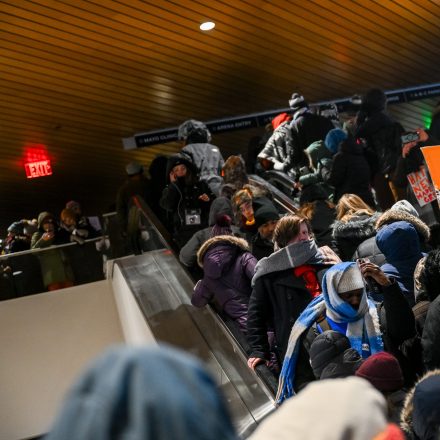
When ICE agents brought a detainee to a Brooklyn hospital after a violent arrest in May, hundreds protested outside the hospital. One TikTok video from the night captured the moment an unmarked ICE vehicle drove into several gathered people, accelerating sharply until they leapt out of the way.
"Given the frequency with which these agents are engaging in aggressive maneuvers to try and lose rapid responders or prevent documentation of their movements," the organizer said, "it is honestly only a matter of time until an ICE agent seriously injuries or kills a cyclist or pedestrian in New York City."
The post "Offensive Driving": ICE's Deadly Weaponization of Vehicles Against Civilians appeared first on The Intercept.

Enjoy this scan of a 1975 copy of the Konsument catalog, which advertised the offerings of East Germany's state-run retail cooperative. The catalog shows the fashions, tools, housewares, consumer electronics, and other glorious goods made during the grim, oppressive Russian occupation. — Read the rest
The post Flip through East Germany's 1975 mail-order catalog appeared first on Boing Boing.


