
 Ma Yongbo Poetry Road Trip — Summer Tour 2025 volume 34 [ 07-Feb-26 7:16am ]

Ma Yongbo 马永波, Reflecting on Dialectic Translational Poetics: the conversations of Bear and Kitten.
Reflections on Reading Helen's Many Poems for Me
观海伦诸多赠诗有感
Must you insist on stabbing
my body, which is already leaking everywhere
with your Western fountain pen
until it becomes a sieve of holes?
Yet I only sketch you with a soft brush
into spring mountains like ink-dark brows
and autumn waters rippling with sidelong gazes.
The West's mirage of the East
you've draped over my crumbling old house—
layered roofs, stacked floors, an extra storey
suddenly appearing from the empty sky,
yet unable to store my mouldy scrolls and ideals.
Yet I paint you only a water-ink Troy:
its walls are strokes of soaked black,
those galloping or overfed heroes are but tiny graffiti.
Meanwhile, you've long sailed away lightly
on an Eastern boat of light
through fallen leaves of generations.
The collars, rain, and darkness you penned
cut sharp as Cambridge's slanting rooftops.
I rewrite them with my brush
till they soften like rice paper,
can be folded into white Kongming lanterns
soaring higher and higher, until they turn to tangerine stars.
Dawn, March 27, 2025
Response Poetry By Ma Yongbo 马永波
Response Poetry Translated by Ma Yongbo 马永波
观海伦诸多赠诗有感
Reflections on Reading Helen's Many Poems for Me
你非得用你那西方的钢笔
把我本就四处漏风的身体
戳出无数个窟窿,才肯罢休吗
而我,只是用柔软的毛笔
把你描得春山如黛,秋水横波
西方对东方想象的海市蜃楼
被你盖在我年久失修的老房子上
叠屋架床,凭空多出一层
但又无法存放我那些发霉的卷轴和理想
而我只为你画一幅水墨的特洛伊
它的城墙是一块黑色饱墨
那些驰骋或吃撑了的英雄
不过是一些小小的涂鸦
而你,早已在纷纷世代的落叶中
乘坐来自东方的光之船飘然远引
你用钢笔写下的衣领、雨和黑暗
锋利如剑桥的屋脊倾斜向上
我用毛笔把它们又写了一遍
让它们像宣纸一样柔软
可以叠成一盏盏洁白的孔明灯
越飞越高,直到变成橘色的星辰
2025年3月27日晨
马永波
Tangerine stars
—for Yongbo
橘色的星星
——答永波
as the orange lanterns float higher, as tiny boats,
we two are lifted by a gentle warmth.
Light within paper has a sallow colour,
but the energy of our light is not muted;
a permanent brightness exists
and it is never extinguished;
heat and light transferring to everything
around us. We continue on our journey.
Two tangerine stars, can be sleepy dawn sailors,
who can also move counter clockwise on the deck;
drawing the curtain of night cover
in a flux of silver stars behind us
27th March 2025, early evening
Response Poetry By Helen Pletts 海伦·普莱茨
Response Poetry Translated by Ma Yongbo 马永波
橘色的星星
——答永波
Tangerine stars
—for Yongbo
当橘色的灯笼小船一样浮升,
我们俩被一股温柔的暖意托起。
纸中的光是灰黄色的,
但我们光的能量并未衰减;
一种恒久的明亮驻留,
永远不会熄灭。
将热与光向四周的一切
传递。我们继续我们的旅程。
两颗橘色的星星,可以是昏昏欲睡的黎明水手,
也可以在甲板上逆时针移动;
在我们身后
以银色的星流揭开夜的帷幕。
2025年3月27日傍晚
海伦·普莱茨
Translation as a dialogue in the key of Yeats
By Helen Pletts 25th January 2026
There is a tiny key which opens a tiny door to a corridor which incidentally runs between Harbin and Cambridge and that key is a long dead poet by the name of Yeats. He fits perfectly into this dynamic, although in his lifetime he could hardly foresee his own significance decades later.
It is roughly mid-evening in Cambridge, well slightly North of Cambridge, and if you count back 8 hours from 7pm you will find yourself in a white Harbin morning and you will need Yeats' key in order to do this.
There is a difficulty in that language translation, through any device, gives you a language without sentiment and gestures and until we found the Yeats' key we used to write to each other in the language of emotionless instructions for microwave dinners, shopping lists. In the pause after one microwave instruction, I felt I justified more praise for my translation attempts, more encouragement.
At that time, we were co-translating Yongbo's poem 'Wander around the Barren Mountain from Afternoon till Evening on the Sunny World Poetry Day Leaving the Dull Books Behind':
Wander around the Barren Mountain from Afternoon till Evening
on the Sunny World Poetry Day Leaving the Dull Books Behind
诗歌日阳光明媚的下午,抛开厌倦的书本,去荒山里游逛至晚
Those who venture into the mountains in the afternoon live an extra day,
they gaze up from this mountain to the higher ones,
rubbing their reddened hands, watching the changing mountain air,
or look down into the valley below
where a large white bird spreads its wings
and glides along the stream, capturing the invisible currents.
The empty mountains are silent, the first cicada chirps fading intermittently,
last year's wild roses haven't bloomed yet;
tiny wildflowers, no bigger than buttons, fall without wind.
The mountains are so still, it seems as if no one has ever been here,
those desolate paths don't lead to the world but to oblivion.
In the grass, it seems as if countless grasshoppers' legs,
are countless tiny saw-blades, sawing at various invisible things
and various enclosed locks. Poetry is ultimately futile;
it cannot reach the hearts of others,
like those continually diverging paths,
that can never return to their origin. Yet why do some still sing,
in unseen heights, in deep forests and secluded valleys,
his wind-swollen blue coat fluttering wildly?
Let's return to grass, trees, stones, and flowing water,
they make up the mountain, while the mountain itself
lies in even more distant mountains, like a mineral vein,
silent and still. Perhaps this is the only path,
though it is now desolate and deserted,
it allows you to find peace in everything that time brings.
March 21, 2016
Retranslation 31st January 2026 Ma Yongbo 马永波 and Helen Pletts 海伦·普莱茨
诗歌日阳光明媚的下午,抛开厌倦的书本,去荒山里游逛至晚
Wander around the Barren Mountain from Afternoon till Evening
on the Sunny World Poetry Day Leaving the Dull Books Behind
下午进山的人都会多活上一天
他们从这山望着更高的山
搓着通红的大手望山气变化
或是望着下面的山谷
那里有一只白色大鸟展开翅膀
沿溪流滑翔,捕捉无形的气流
空山寂寂,最初的蝉鸣断断续续
去年的野蔷薇还没有开
钮扣大小的草花无风自落
这山静得好像从未有人来过
那些荒芜的小径不是通往人世
而是通往遗忘
草丛中似乎有众多蚱蜢的大腿
无数把小锯条在锯着各种无形之物
和各种锁头。诗歌终究是徒劳的
它通达不了他人的心灵
像那些不断分岔的岐路
再回不到原处。可为什么还有人歌唱
在看不见的高处,在深林幽谷
把鼓满风的蓝布衫猎猎振动
还是回到,草木,石头,流水
它们组成了山,而山的本身
还在更远的山里,像矿脉
保持着沉默。也许这是唯一的道路
虽然已经荒芜,杳无人迹
却让你安于时间带来的一切
2016.3.21 马永波
Yongbo's poem 'Wander around the Barren Mountain from Afternoon till Evening on the Sunny World Poetry Day Leaving the Dull Books Behind', refers to a blue garment, and at this point we were calling it a 'dress'—the recognised attire of an ancient Chinese poet, is more like a long flowing blue robe, or coat—and I had a bizarre Yeats moment, I thought of this long blue flowing robe, pinned to the stick referred to by Yeats in 'Sailing to Byzantium'—a tattered blue 'dress', fluttering, from an old man's stick, instead of an old man's coat.
At this point the microwave dinner instructions descend into momentary chaos, as if the factory label printer is having a 'HAL' moment and something else gets printed instead. I write to Yongbo that he is actually "a grumpy tattered blue 'dress' upon a stick" and then, happily, the microwave dinner label printer runs out of ink—from this moment on we are just two friends having fun.
Because what returns in an email from Yongbo is this inspirational picture of him as a student at Xi'an Jiaotong University and an admission that he has historically been likened to an angry black bear. Translation is the loneliest job on the planet, it is just you against the language but if you have a genius in the shape of an angry black bear on your team you have a much better chance of succeeding.

Ma Yongbo 马永波, sent this image to Helen Pletts 海伦·普莱茨
describing himself as an 'angry black bear' during his student years at Xi'an Jiaotong University, 1982-86, and so she has called him Bear ever since.
Now we're in that secret Yeats' corridor creating our own language of jocularity and we have been continuously using this access route with remarkable success:
"i think you picked up on my Yeats reference to you being "like a tattered coat on a stick" with your blue poetry-dress, when I first guessed you were an angry black bear ha ! ha !
ALL OUR COSTUMES [ 07-Feb-26 7:15am ]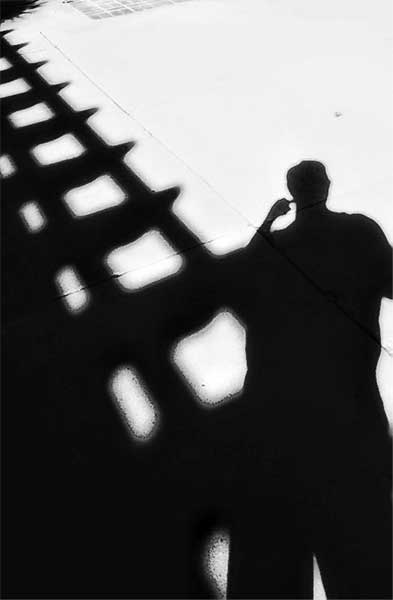
Suddenly all our costumes
are in the wash,
which means we
stand here
in our dirty underwear
holding the Sunday funnies
just below the stomach line,
a situation that makes
it impossible to
make a speech
or lecture the house plants
on how tall they should grow,
crooning baby talk to a cat
that will ignore you
or sit on your keyboard
because what you're writing
is jive anyway,
none of us
will open a toolbox
and remove the pliers,
without costumes
our cars
will not roar
with the attitude
Detroit promised
as we sped up the interstate ,
our language feels corrupted,
false, hollowed of verve,
I want my costume now
though it reeks,
we wear our costumes
as long as
we can get away
with it,
our armor
achieves a genuine scent of grease
and soapless months,
our costumes
and our postures
start to stink so bad
that fire alarms
go off in apartment buildings
across the street,
traffic lights shut down
at critical intersections,
diners lose
their appetites
in cabins in
distant mountain towns,
but yes,
clean clothes, clean slate,
a fresh aroma of detergent
and warmth comes off
the fabrics,
everything fits like a
tailored pair of gloves,
nattily dressed,
elegantly coifed,
perfumed
and flexing biceps
for no one
in particular,
we stop feeling
ridiculous
and plan our
patrol of the city
we call our own,
but first,
this fellow
will take a nap
when the last
pair of pants are hung
and the clock reads
2PM on any hour
It happen to be.
.
Ted Burke
.
SPEAKING {Reform UK [ 07-Feb-26 7:12am ]

It's a measure of my limitations that I can't remember the title (or author) of both the most important fictions I've read since the year started; the two books that have made the deepest impression on me. The novel I've just finished is by qntm (an internet presence) called There Is No Anti Memetics Division, and the other was recommended by Mick Herron, who writes the Slough House spy novels, in an interview I believe I read last year.
I bought and began reading this second novel which, among other things, examined the boundaries between human and non-human workers, and stopped because it was derailing thoughts I was pursuing in parallel with these ideas. It was brilliant.
Both books were brilliant. Borrow them or buy them.
In conjunction with these, I began listening to Roger Penrose, the philosopher and his ideas about consciousness and the philosophical thoughts around idealism (which are very different to our regular everyday thoughts about idealism.)
The primacy of consciousness over materialism (is how I understand it) and how this/these might interact with my political interests (which are essentially Marxian.) I believe I understood some of it. Other parts, I skimmed across.
At the same time, Starmer's Labour continued to unravel exponentially and become a corresponding incongruity. Their representatives increasingly reminded me of porridge gone cold. Abandoned. Congealing in a room that no one enters. A room that no one will ever enter.
I had already dismissed them because of their complicity in Gaza, but the ongoing infolding of their collective identities (into this whey grotesquerie) began to feel unearthly, as though their dead and deadening eyes held an external truth, a truth that mattered beyond their blank and venal self-interest. They were become flat abstractions.
I began to feel they (New Labour) were rather less than human, incapable of escaping their designations as exemplifiers of a world in which they had no emotional interest, involvement, or physical agency. They reminded me of both Mick Herron's employees, and qntm's mind cannibals.
Within this mash-up came the Gorton and Denton by-election.
I was born and raised in Hyde, immediately across the River Tame from Denton.
It used to be the second most polluted river in Europe. My family, on my father's side, going back to the early 19th century, were hatters and textile workers, sometimes living and frequently working in Denton. There was a connection. His grandfather, Garibaldi, was driven mad by the mercury used in hatting.
I have engaged, of an evening on discussion sites, with Reform supporters, many of whom are AI generated with no existence beyond an algorithm responding to my arguments and provocations. Many of them have numbers instead of names. Their unexistence isn't hidden.
And somehow, all these strands have come together in this twisted thread of illogic.
To quote directly from qntm's great novel (which gave me nightmares):
'Its malevolent gravity drags humanity and all human ideas into its orbit, warping them beyond recognition. Beneath it, within its context, everything becomes corrupted into the worst version of itself. It takes joy and turns it into vindictive glee; it takes self-reliance and turns it into solipsistic psychosis; it turns love into smothering assault, pride into humiliation, families into traps, safety into paranoia, peace into discontent. It turns people into people who do not see people as people. And civilisations, ultimately, into abominations.'
As spring approaches, if birdsong were battery operated, would it be less beautiful (or even beautiful at all.)
The two books -
There Is No AntiMimetics Division by qntm
The Employees: A Workplace Novel of the 22nd Century by Olga Ravn (although I can find no record of Mick Herron recommending this)
Steven Taylor
.
Immerse Yourself in the Exosphere [ 07-Feb-26 7:11am ]
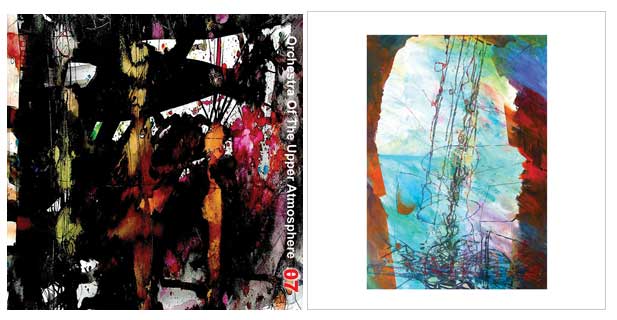
Theta 7, Orchestra of the Upper Atmosphere (Discus Music)
Immersion, Maggie Nicols, Robert Mitchell, Alya Al Sultani (Discus Music)
Theta 7 is, we're told, to be the last of the albums released by The Orchestra of the Upper Atmosphere. This is a shame, but I guess all projects have a shelf-life and there's nothing worse than bands, TV series, etc., going on past the date on the packet. At the risk of stating the obvious, Theta 7 is the seventh in a series of albums named after the Greek letter theta ('θ'). It got chosen, I'm guessing, because it's also used to describe one kind of brain wave ('theta rhythms') which are associated with relaxation, dreaming and effortless creativity: exactly the kind of rhythms orchestra members need to have pulsing through their heads on their journeys to the edge of space.
Inspired by their love of Sun Ra, Alice Coltrane, Stockhausen and Terry Riley, Sheffield-based sax player and electronic musician Martin Archer and his long-time collaborator, keyboard player Chris Bywater put OOTUA together in 2010. The idea was 'to create a large scale music which would be improvisation-based but would also feature arrangements for massed voices, strings and horns. A process which they … named "Improg".' The result was Theta 1. A core group - initially, a septet - was established which, with minor changes, went on to create the subsequent albums, drawing in other musicians as required (notably, but not on Theta 7, the 30-voice avant-garde choir Juxtavoices). What followed was described by Chris Cutler as music founded in 'a rock-rooted aesthetic, but with acres of space for improvisation, sonic exposition and studio manipulation. Assembled (a lot like Unrest-era Henry Cow) through a process of focused improvisation, extensive editing, customized composition, many overdubs and radical mixing - the results are persuasive and full of musical substance.'
If Theta 7 is your first encounter with OOTUA, it may well leave you with a desire to check out its predecessors. If it does, Sid Smith, writing in Prog Magazine, reckons Theta 4 is a good place to start. Having had a listen myself, I wouldn't argue with him.
As for Theta 7, I'd really recommend taking the option to listen to the album without track breaks (Track 12 on the Bandcamp page), as the tracks really do, for the most part, flow naturally one into the other. I'd save the seperate tracks for if I wanted to listen to a particular part. It begins with a duet for double bass and guzheng which makes striking use of the stereo space and slips effortlessly into a hypnotic groove entitled 'A Blessing in Azure'. A restless violin solo from Yvonna Magda introduces a hymn to the dawn (hearing the way the guzheng is used on this album, its hard not to think of Alice Coltrane's harp). This, in turn, morphs into a celebration of the deep sea: a world of darkness, strange creatures and hydrothermal vents and about as far as you can get on the Earth, physically, from the band's natural habitat of the upper atmosphere. They sound quite at home there, though. This gives rise to a rich groove, striking for its spiky, high speed glissandi. 'Cold Mariana', alluding to the Mariana Trench, is a musical evocation - or so it seems, to me - of the view from a bathysphere window. If we've not realised already, this album - perhaps because it's the last? - sets out to embrace the whole universe. There have been previous forays (one title on Theta 5 references, I suspect, the famous Hubble image of the Pillars of Creation) but what's going on here is far more systematic. We return to the surface, where the moon is rising. What follows is a hymn to Aether, the Primordial Titaness of the sky, no less. OOUTA name-check Stockhausen as an influence and I couldn't help being reminded here of the text of that composer's text-piece, Set Sail For the Sun, in which the performers are asked to gradually transform the music they're making 'until you arrive at complete harmony / and the whole sound turns to gold / to pure, gently shimmering fire.' After this we're plunged into an evocation of black holes, the darkest places imaginable (at least from the outside. On the inside, who knows?). The next track references the space rock Oumuamua, a visitor from another solar system, music that attempts to give shape to something we can only vaguely discern. The penultimate track is a stonking cover of Sun Ra's 'That's How I Feel' - an inspired, optimistic way to bring the OOUTA journey to an end. What follows is another duet, mirroring the first track, this time for Jan Todd's guzheng and violin. (Anyone who finds these duets interesting - and they are - should check out the OOUTA spin-off Private View 185CD (2024), also available on Discus Music, an album Jan Todd and Archer made together, without the rest of the band, although I think OOUTA bassist Terry Todd joins them for one track).
Theta 7 is quite something. Stockhausen and Alice Coltrane would've approved, I hope. Sun Ra would've been bowled over.
Free improv vocalists Maggie Nicols and Alya Al Sultani have worked together quite a lot in recent years. When, in 2024, they were working on their album Free, Free, Nicols brought along a poem by jazz pianist (and poet) Robert Mitchell, to see what they could do with it. The upshot was that they got together with Mitchell himself to make the album Immersion, recently released by Discus Music and described by Al Sultani as 'a sonic interpretation of three of Robert's books of poetry, three poems chosen by each of us'.
There is, a course, something of a tradition of improvising pianists writing poetry - Sun Ra and Cecil Taylor spring to mind. Anyone unfamiliar with Mitchell's writing should check out his poetry audiobook (available on Bandcamp), A Vigil For Justice, A Vigil For Peace. If, like me, you like to know a bit about a poet's work before you hear it used in a piece of music, you'll be interested to know that one of the poems he reads on it, 'You Are My World', also appears on Immersion (as 'My World Is You'). I was wondering how best to explain how his poetry relates to his music and then realised Mitchell had already done a better job than I could in the album notes that go with Immersion: 'As Wayne Shorter says 'Our instrument is our humanity'. Our most human job surely is to keep our antenna clean and functioning, and to keep as many channels open as possible. As a result - we might even receive the coordinates to the most important treasure: living in peace. The daily distractions, and thus the deliberate weakening of our abilities to work together while benefitting from our naturally occurring 'differences' - are some of the most pressing challenges of these times.'
The first track, 'Amongst a Trillion Fears', is all vocal. Mitchell recites the poem with some rhythmic elaboration while Nicols and Al Sultani weave improvisational paths around his words. From hereon in, Mitchell spends most - although not all - of his time on the piano. It soon becomes clear that the words are often hard to follow. It's best not to try. After all, what we're being offered is the essence of poetry rendered as music: to try to follow the poem in each case could be considered a distraction. A lot of the time, only the occasional phrase jumps out ('walk as one', 'full immersion: there is no division', 'we are free'). The style of the music ranges from the bluesy (especially in 'My World Is You' and 'Soul Speak') to the avant-garde. Although what's happening here is obviously on a much smaller scale, I was reminded more than once of the late operas of Michael Tippett and, indeed, the themes of Mitchell's poems and Tippett's libretti are not dissimilar.
Nicols' more natural voice with its wide-ranging vocal effects, Al Sultani's more trained voice and Mitchell's piano make a great trio. As I said, there's everything here from avant-garde pyrotechnics to great bluesy moments, but some of the most spellbinding music they make together (as in 'Inner Sanctum' and 'Where We Are') succeeds because, it manages to be complex without being dense. Do give it a go.
.
Dominic Rivron
LINKS
Theta 7: https://discusmusic.bandcamp.com/album/theta-seven-206cd-2026-2
Immersion: https://discusmusic.bandcamp.com/album/immersion-205cd-2026
Robert Mitchell's poetry - A Vigil For Justice, A Vigil For Peace:
https://robertmitchell.bandcamp.com/album/a-vigil-for-justice-a-vigil-for-peace-poetry-audiobook
.
CONSPIRACY DREAM ONE [ 07-Feb-26 7:09am ]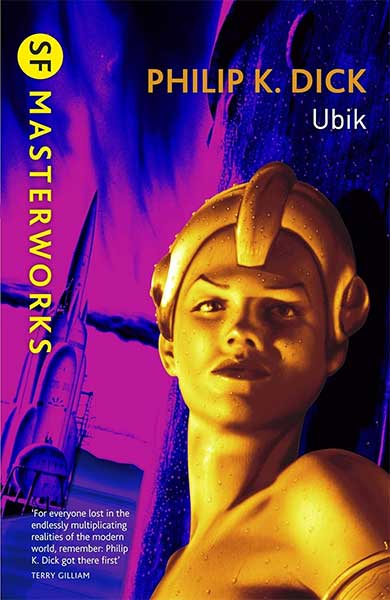
You smiled
crawled into my bed
syringed the love out of me
left my eyebrows wired to Langley
my heart in a silo aimed at Moscow
you had me crawling across a ledge
of broken glass
away from a dream
back into your arms
while downstairs
Philip K Dick
trilby tilted at 180 degrees
in the doorway
dripped darkness
like a leaking gasoline tank
emptying onto the sidewalk
he was later weeping in the joke shop
as the funny mask scowled back
his wife
the surf blonde
divorced him over the Kiss Me Quick
seaside hat
that had ruined their marriage
I'm trying to deal with the world's madness
fake news
there's lipstick on my collar
it provides co-ordinates for a kiss
the rifle left in the woods
has a garland of crocuses now
daydreams in the boot of a Buick
cockroaches listening
ears against the walls
to every word the mad politician
says
as he buttons up his trousers
tosses cash to the hooker
counting the pills
ripping out the wires
Singing the Body Electric
Philip K Dick steps off the planet
into space
and is gone forever
.
by Malcolm Paul
Tomorrow Never Knows [ 07-Feb-26 7:08am ]Experimentalism and Innovation in The Beatles Studio Practice

Experimentalism forms a central thread running through the recorded work of The Beatles and remains fundamental to understanding their cultural and musical significance. While the group is often celebrated for melodic songwriting and mass appeal, their sustained engagement with unconventional sound, recording technique, and compositional process situates them firmly within a broader history of twentieth century musical experimentation. Working in close collaboration with producer George Martin and Abbey Road engineers, The Beatles repeatedly tested the limits of what popular music could contain, both sonically and conceptually.
Experimental practices within The Beatles recordings were not isolated gestures or occasional stylistic flourishes. Instead, they emerged gradually through a process of accumulation, refinement, and increasing confidence. From the earliest years of their recording career, the band demonstrated a willingness to retain sonic accidents and unconventional sounds when they contributed to the emotional or textural impact of a song. This approach reflects a shift in attitude toward the recording studio, not as a neutral space for documentation, but as an active site of creative intervention.
It is important to recognise that musical experimentalism did not originate with The Beatles. Long before their emergence, artists working on the margins of Western art music had begun dismantling traditional ideas of harmony, timbre, and musical structure. One of the earliest and most influential movements was Italian Futurism, particularly the work of Luigi Russolo, which argued that the industrial environment required a new musical language capable of incorporating mechanical noise, urban sound, and sonic abrasion. Russolo's custom built noise instruments, intonarumori, and performances challenged the assumption that music must be organised around pitch and melody, proposing instead that sound itself could function as compositional material.
This early noise music developed further in other experimental strands. Edgard Varèse explored dense sound masses, percussion, and unconventional timbres, while John Cage destabilised the distinction between music and noise through chance procedures, prepared piano, and environmental sound. Karlheinz Stockhausen expanded these ideas through tape and electronic composition, manipulating spatial placement and nonlinear time. Other early experiments included the noise explorations of Pierre Schaeffer, using recorded environmental sounds and tape splicing, and the electronic manipulations of Daphne Oram with her Oramics system for drawn sound. These experiments provided a rich, albeit largely inaccessible, context for the avant garde ideas that would later influence The Beatles.
By the middle of the twentieth century, these experimental practices were no longer confined to academic or avant garde circles. Galleries, broadcast recordings, and publications made these ideas available to musicians outside traditional classical music institutions. Paul McCartney's growing engagement with contemporary art and experimental composition brought these ideas directly into The Beatles creative environment. His interest in avant garde music was practical and intuitive rather than purely theoretical. He recognised that recording technology could be used playfully, unpredictably, and expressively, rather than simply as a means of capture.
Among the members of The Beatles, McCartney frequently acted as a catalyst for experimentation within the studio. When songs were still loosely formed, he often proposed unconventional solutions that challenged established song structures. These suggestions did not always originate from musical necessity, but from curiosity about what might be possible within the recording process itself. This approach contributed to the significant differences often observed between early demos and final album versions.
The gradual emergence of this experimental sensibility can be traced through recordings predating the band's most overtly experimental work. The use of guitar feedback at the opening of I Feel Fine represents an early instance in which an unintended sound was deliberately retained and foregrounded. Similarly, the dense rhythmic emphasis and production choices on Ticket to Ride subtly disrupt the expected flow of a contemporary pop single. These moments indicate an increasing comfort with destabilising conventional listening expectations.
Revolver represents a decisive stage in this evolution. The album demonstrates a fully developed understanding of the recording studio as an instrument in its own right. Tape manipulation, artificial double tracking, reversed recordings, and unconventional microphone techniques are employed consistently across the album, forming part of its underlying aesthetic logic.
Tomorrow Never Knows exemplifies this approach. Early versions of the song reveal a comparatively direct structure, lacking the dense layering of the final recording. The transformation illustrates the extent to which studio intervention reshaped the composition. The static harmonic framework, relentless rhythmic repetition, and absence of traditional melodic development align the track more closely with drone based and tape music than with standard pop songwriting. The drum performance, recorded with close microphones and heavy compression, produces a forceful and almost mechanical presence that anchors the surrounding sonic activity. Tape loops introduce fragmented vocal and instrumental sounds that resist conventional interpretation, functioning instead as textural elements. The processed vocal further distances the track from familiar pop conventions, reinforcing its hypnotic quality.
Elsewhere on Revolver, experimentation manifests in multiple forms. Eleanor Rigby dispenses entirely with traditional band instrumentation, relying on a string ensemble octet to create a stark, emotionally restrained soundscape. Love You To engages fully with Indian musical structures, including tabla and sitar, moving beyond earlier gestures toward non-Western instrumentation. I'm Only Sleeping employs reversed guitar passages not merely as an effect but as a compositional tool, reinforcing the song's themes of disorientation. Here, experimentalism functions as both texture and narrative.
Following Revolver, Sgt Pepper's Lonely Hearts Club Band represents a further evolution of the band's experimental approach, framed around a loose conceptual premise that allowed for heightened studio creativity. The album integrates orchestral arrangements, tape loops, sound effects, and musique concrete techniques alongside conventional rock instrumentation, establishing a fully realised studio aesthetic. Tracks such as Being for the Benefit of Mr Kite employ tape collage and processed wind instruments to generate a carnival-like atmosphere, while A Day in the Life juxtaposes sparse orchestral dissonance with pop melody to create unprecedented structural contrast. Lucy in the Sky with Diamonds blends Mellotron textures, layered vocals, and unconventional chord progressions, producing a dreamlike soundscape that foregrounds sonic experimentation. Within Sgt Pepper, The Beatles demonstrated that experimentation could serve both expressive and conceptual purposes, bridging avant-garde techniques with accessible popular music.
Following Sgt Pepper, The Beatles (White Album) presents a deliberately eclectic and experimental approach. Unlike the cohesive frameworks of Revolver and Sgt Pepper, the album's diversity reflects both the individual members' creative autonomy and the increasing fragmentation of their collaboration. The album ranges from stripped down acoustic folk to hard rock extremes, avant garde tape collage, and non traditional sound effects. Revolution 9 exemplifies the band's most extreme engagement with tape loops, musique concrete techniques, and non musical sounds, creating a sprawling sonic tapestry that draws on Cage, Schaeffer, and Stockhausen. Helter Skelter demonstrates sheer volume, repetition, and aggressive sonic layering, anticipating developments in heavy and punk music. Happiness Is a Warm Gun, Wild Honey Pie, and Glass Onion experiment with abrupt tempo shifts, overlapping textures, vocal layering, and unconventional structures, while Back in the U.S.S.R incorporates playful production techniques and contrasting timbres. The album represents a continued expansion of the band's experimental vocabulary, pushing boundaries in rhythm, texture, and sonic unpredictability.
Following the white album, Abbey Road demonstrates a sophisticated integration of experimentalism into a more polished and unified production. Abbey Road illustrates a careful combination of classical instrumentation, studio effects, and compositional innovation across a commercial framework. The medley on side two represents a sequence of fragments linked through key relationships, tempo shifts, and harmonic continuity rather than a traditional suite. This approach allowed The Beatles to explore thematic development, musical montage, and tonal contrast within a popular context.
Tracks such as Because illustrate harmonic experimentation, with three layered vocal parts creating a choral texture, while the Moog synthesiser is employed in Maxwells Silver Hammer and I Want You (She's So Heavy) to generate otherworldly timbres and oscillations. Polyrhythms and tape edits are used creatively in Golden Slumbers and Carry That Weight to manipulate perception of time and pacing, while the extended guitar solo in I Want You (She's So Heavy) employs feedback and distortion to produce a sense of sonic excess approaching harsh noise music. The album demonstrates that by this point, The Beatles had fully internalised studio practice as a compositional resource.
Experimentalism on Abbey Road is not limited to instrumentation and effects. The band also experimented with texture and production. The crossfading of medley sections, the overlapping of vocal and orchestral layers, and the subtle use of tape compression and EQ reveal an unprecedented understanding of studio technology as a creative tool. Here, experimentation is both musical and technical, reflecting a cumulative process that began with early noise experiments by Russolo, Varèse, Cage, and others, and matured over successive albums.
Individual band members continued experimental work beyond the collective context. George Harrison's Electronic Sound uses the Moog synthesiser extensively, presenting unstructured sonic textures that mirror electronic and tape experiments in the avant garde. John Lennon explored extended vocal improvisation, noise collage, and minimalist structures, demonstrating that experimentalism extended into post Beatles activity.
In considering The Beatles relationship to experimental music, it becomes evident that their significance lies in mediation and translation. They absorbed techniques developed in avant garde and noise traditions and rendered them accessible within popular forms. Through this process, they expanded the conceptual and practical possibilities of popular music and transformed the recording studio into a space of artistic exploration.
Tomorrow Never Knows occupies a central position within this trajectory. The track crystallises the band's ability to integrate experimental technique with accessible musical form, serving both as a culmination of earlier practices and a foundation for future innovation. Through sustained engagement with noise, non-traditional instrumentation, studio technology, and structural experimentation, The Beatles established a model of creative exploration that continues to inform musicians, producers, and listeners across genres.
by Ade Rowe
.
The Full Moon Crafts Vistas New [ 07-Feb-26 7:07am ]

The snow moon peels off layer after layer
of
the overhanging dense dark, the gloomy visage
of hoary winter.
The silvery beams reveal core of
an infinite arch above a comatose
earth
buried under banks of pale snow;
the bared topaz-blue touched with the white
of the lunar breath
creates a tropical lake with a glowing heart,
up in those empyrean heights; waves faintly
heard by a passing ascetic.
The cumulus clouds massed on the serrated
edges of
the shimmering immensity,
stand forlorn and outcast, driven out there by
the
frigid winds to those liminal thresholds;
dim firs condensed together
as spatial shadows
from
the Fields of Mourning, first
witnessed by Virgil,
the diffused light, this late hour,
illuminates
the crooked trail to a hut on the hill
where tribal songs are echoed by the
pines with grey hairs, as the wolves
close in.
Sunil Sharma
Painting Ernest Lawson
Academic |Writer | Critic | Editor | Freelance Journalist | Reviewer | Literary Interviewer
Editor: Setu: http://www.setumag.com/p/setu-home.html
Website: https://sunilsharmawriter.com/
Twitter:https://twitter.com/drsunilsharma
Instagram:https://www.instagram.com/drsunilsharma/
LinkedIn:http://in.linkedin.com/in/drsharmasunil/
Pinterest: https://in.pinterest.com/
Amazon-author link: https://www.amazon.com/author/sunilsharma

.
Radio [ 07-Feb-26 7:05am ]The Members
RADIO
I listen to the radio, it's better than a stereo
We listen to the radio, radio stereo
Telephone is ringing, but, I can hardly hear
Though the man on the end of the line is speaking loud and clear
Somehow my mind is where, where exactly I don't know
Too busy tuning in the dial, portable radio
I know I'm alive, so you can all go ride a bike
The airwaves don't lie
I listen to the radio, its better than the stereo
We listen to the radio, radio stereo
Oh-oh-oh-oh radio, Oh-oh-oh-oh radio
Oh-oh-oh-oh radio
.
6 Snapshots: The Depths of the NY Winter [ 07-Feb-26 7:04am ]

bart plantenga
From NY Sin Phoney in Face Flat Minor
The Unloaded Camera Snapshots [Paris Scratch & NY Sin Phoney in Face Flat Minor] were launched as an exercise to document the not-quite prose poems, not-quite journal entries "snapshots" of everyday life in Paris with Paris Scratch. & this continued upon my return to NYC. The exercise consisted of every day "taking" a written "snapshot" - 365 of them. I, like other New Yorkers, had become, as Flora Lewis described it, "inured to the ravages around them they scarcely notice anymore." A deadening of our senses &, never mind our idealism, allows us to believe we're outwitting our environment. A.E. Housman noted: "Having drunk a pint of beer at luncheon, I would go out for a walk. As I went along, there would flow into my mind, with sudden & unaccountable emotion, sometimes a line or 2 of verse, sometimes a whole stanza …"
• The Fit of a SweaterI meticulously fold the sweater my mom had knit for me 1 Christmas that I never wore like I'd seen them do in Soho boutiques. I place it on top of a trashcan on a gift box with the idea that it's winter & maybe a homeless man could use it. A week later I see a guy wearing it & it looks pretty good & I think maybe I should tell him that my mom had knit that sweater for me! & that I wanted it back! But how: jump him, bribe him, coerce him, call the cops, embarrass him or simply wrestle it off his torso? I don't know. Maybe just take a picture of him instead. Send it to my mom.
• The Exhausted ParkThe park had gone through more than neglect; it had borne witness to murders & other unpleasantries. It wasn't really a park so much as a piece of land they couldn't figure out how to apportion profitably. Someone had pissed on & then torn down—was it?—the Yogi Berra statue. All the swings were already down for the winter. The seesaws could us a coat of paint. What's with the 4 shopping carts dumped over the ledge there where the walkway just ends like an nihilist's sidewalk design? Do people know the carts cost $175 a piece? Do people really ever sit on the 2 crumbling benches here to meditate or figure out how to beat the IRS?
• The City That Finally Fell AsleepThe 1st big snow is always magical. Everyone scurries about with a glee that only snow can bring. Giddy kids go aimless with their tongues catching flakes or rolling big ball torsos to build snowmen. Even the old man smiles & forgets he hasn't eaten for how many days. Even the guy hauling big boxes of food on a dolly has to pause & smile as he pushes through the stuff. Even the first snow-related fender bender couldn't kill the joy & as you walk, you hear the silence as an absence of noise but also as abandonment, quiescent as when the very last car of the guy who closes up the supermarket parking lot leaves at midnight. Everyone moves slower & with a sudden awareness of life all around them, however fleeting. Paralysis brings us back to life. The only beings who venture out into traffic at 10 mph are the cabbies & bus drivers. The city sounds like it has, indeed, finally gone to sleep for a night.
• Poster in the 13th SnowfallThe snowfall is massive, beautiful, but it is by now the 13th snowfall of the season, so all a bit redundant & tiring. The poster taped 4 side by side: INFORMATION WANTED CONCERNING A BIAS ATTACK LAST FRIDAY IN THIS AREA. At approximately 10 PM, several black men were attacked by a gang of white men, some of whom had baseball bats. The incident took place in the vicinity of Prince & Mott Streets. If you have any knowledge of this event or of any of the assailants, please call 212-312-****.
• Side Streets to Beer History
To investigate the mystery of those who line up nightly to get drunk at McSorley's Old Ale House I stand outside & just stare. I want to tell them that to drink there will not buy their way into any history, esteem, status—women were denied entry & it's motto was "Good Ale, Raw Onions & No Ladies" until mid-1970. At least it's better than McDonald's or TGIF or Bud Lite … That "Be Good or Be Gone" is it's new motto, is a sign of progress. But, lining up for 45 minutes of shivering & sleet before you get in the front door is the nature of the hype of the hype. I should work for a local bar, help reroute them to other incredible backstories for a fee …
• Blood of Ink of IceI stood on the rotting docks far west, just beyond the shadows cast by Wall Street. New Jersey's bitter shore about to crash into piers already collapsing into the neglect of all of us like a precarious plate of cheap, cold food left behind by a drunk in a diner. Few realize how many others realize how buildings that keep you out can make some of us so contemptuous that we end up spitting on their walls as we pass by. The cold made the ink in my pen stubborn & invisible. But I rub it between my hands to warm it up so that the ink will begin to flow again. I write about sheets of ice like rafts to float out an adventure on, floating down the Hudson, resembling crying panes of high-rise glass or the windshields of trashed sports cars, tossed from high cliffs (revolution, insurance or spite?), north of the city, outside of the kingdom, this side of Kingston.


Will Water-Powered Microgrids Work in the Real World? [ 07-Feb-26 4:59am ]Webinar Series Will Highlight How Researchers Test and De-Risk Marine Energy Microgrid Technologies in the Lab In remote places where water flows freely but electricity often does not, the potential to harness the power of waves, currents, and tides is palpable. But is it possible? Although marine energy technologies like ... [continued]
The post Will Water-Powered Microgrids Work in the Real World? appeared first on CleanTechnica.
Could Light Be Used To Drive Enzymes for Efficient Ammonia Production? [ 07-Feb-26 4:56am ]Nanocrystal-Nitrogenase Biohybrids Harvest Light To Reduce N₂ Gas. Abundant High-Energy Electrons Are Essential. By Justin Daugherty, NLR Ammonia, a key part of nitrogen fertilizers, is central to sustaining global food production. However, its manufacture is also energy intensive: ammonia production requires 2% of global energy to meet global demand. Fifty ... [continued]
The post Could Light Be Used To Drive Enzymes for Efficient Ammonia Production? appeared first on CleanTechnica.
From Airports to Elementary Schools, New Examples of Geothermal Heating & Cooling Sites Emerge [ 07-Feb-26 4:55am ]5 New Case Studies Add to Database of Geothermal Systems Installed Across the Nation By Becca Sweet, NLR The U.S. Department of Energy (DOE) Office of Geothermal (OG) has published five new case studies on a variety of geothermal heating and cooling applications. These case studies, researched and written by the ... [continued]
The post From Airports to Elementary Schools, New Examples of Geothermal Heating & Cooling Sites Emerge appeared first on CleanTechnica.
Ducati trying to find "right balance" of "completely revised" WorldSBK bike [ 07-Feb-26 6:00am ]
Benchmark raises $225M in special funds to double down on Cerebras [ 07-Feb-26 5:23am ]
How Flexibility, Not Nuclear, Can Secure Ontario's Electricity Future [ 07-Feb-26 4:58am ]Ontario is moving forward with planning for an entirely new nuclear generation site in Port Hope, 100 km east of Toronto, at a moment when its electricity system is already one of the most nuclear-heavy in the world. Nuclear power today provides roughly 55% of Ontario's electricity, with hydro adding ... [continued]
The post How Flexibility, Not Nuclear, Can Secure Ontario's Electricity Future appeared first on CleanTechnica.
Waymo Showers Us With More Information On Driving Simulation [ 07-Feb-26 4:57am ]It's been a busy week for Waymo. The California company, born out of Google many seasons ago, is at a critical point in its life and development. The company is on the verge of something, but that something is completely different depending on who you ask. This week, Waymo has ... [continued]
The post Waymo Showers Us With More Information On Driving Simulation appeared first on CleanTechnica.
Pecksniff: McSweeney's downfall would bring seismic changes to British politics [ 07-Feb-26 6:16am ]

My dears, where to start? When No.10 says the prime minister has full confidence in Morgan McSweeney, we know of course it's actually Morgan McSweeney declaring the prime minister has full confidence in Morgan McSweeney. The trouble is, he probably does: because Morgan McSweeney has advised him accordingly.
There are many ramifications in this complex political quadrille, but there is remarkable unanimity in the criticism levelled at how Keir Starmer runs his government. (Or, at the nub and as many would have it, the way Morgan McSweeney runs Keir Starmer's government.) That impression of the PM having outsourced almost everything except shaking hands with important foreigners begs the question: what then would happen to the PM and his government were Mr McSweeney to vacate his position?
 Morgan McSweeney
If we believe the rather persistent narrative, the whole shape of Labour strategy is down to MMcS. In particular that means the extraordinary volte face in making an internationalist party like Labour into Brexit-supporting Little Englanders; and coat-tailing Reform on opposing immigration, when they (and pedants in particular) know perfectly well that we need far more immigrants, not less fewer.
Would these positions change? Without the Machiavellian Mr McSweeney, why should they hold? And in the lack of his chief of staff, Sir Keir would become acutely vulnerable. Might his MPs demand he also looks at electoral reform as their price of keeping him in No.10?
*
Pecksniff is grateful for these acute observations from the Economist:

As your diarist has commented to the wise men: This is painful and dreadfully sad too. Keir Starmer increasingly looks like a good man lifted to a position not really of his choosing and for which he shows little aptitude. He has fallen foul of the ideology and the machinations of the henchmen who put him there and may well end his political career in arguably undeserved ignominy.
*
There are still three weeks before the by-election at Gorton and Denton, so still early days to play the raisonneur and pretend a prediction. But already we see the contest taking shape. There are five 'serious' parties involved, two of which we can discount here. Those two tell the story of how domestic politics are changing.
The Tories and Liberal Democrats are the snotty kids left outside the pub with a still orange and a packet of crisps, noses pressed to the window to watch the ruckus going on in the bar. Those two parties have been part of the warp and weft of our political culture, but are they sliding into irrelevance?
Labour of course are the crusty old warriors, holding half the vote here last time and looking to their local organisation (and - let's face it - a sense of privilege) to hold on. The challenge comes from the two new kids on the block, Reform and the Greens. Reform has also felt a sense of privilege over the past couple of years. Because of the execrable politics of both Labour and Tories, they are used to just walking into both council and parliamentary seats.
At the moment there is little evidence of the voters; opinions on the doorstep, but on the face of it any one of the three could take the seat. The Greens are, remarkably, the favourite of all the bookies, though all that tells us is that punters reckon they could make a few quid on them. The party has shown formidable organisation when they focus their resources, but this would be their first by-election win.

*

It is worth considering what the result of the by-election - however it goes - would mean for our politics. Labour support was in question before the Mandelson scandal broke: what has it done for their vote share now? We only have straws in the wind at the moment, but the wind blows cold. We have to say, in present circumstances, a Labour victory feels unlikely. Nevertheless, the presence of two parties of the left is bound to split the vote, and perhaps dramatically. So it is likely that one of Labour or Greens will come third.

Anything but a victory for Reform would bruise their amour propre, and dent the sense (partly engendered by shabby news reporting) that the party is unstoppable. As Pecksniff has frequently pointed out, that is a long way from the truth. If on the other hand Reform were to come third, any pretence of the unstoppable surge of the right would be punctured.

If Reform do win, then that is going to mean the Tory vote has been squeezed to the point of embarrassment, and no amount of bluster from Kemi Badenoch (NW Essex) will disguise the fact that she is leading her party towards oblivion. More grist to the mill of the new Prosper faction, the beginning at last of a moderate Tory fight-back.

A Green victory however would bring the most seismic shock. For the first time they would have beaten all other parties in a high profile by-election. The three traditional parties which have become ensconced in our political culture would have to face potentially existential questions.
*
 Image by Chatham House via Wikimedia Commons (CC BY 2.0)
By the way, we learn that Matt Goodwin, the Reform candidate in Gorton and Denton, suggests childless couples should be taxed for their impertinence. Would those infertile be exempt? How would you tax a couple who separate without children, and anyway how long would they be given in order to procreate? Would childless couples suddenly begin fostering simply as a means of avoiding tax? Would there be comparable rebates for those with large families? Presumably that would be reflected in increased social benefits? Then how does that fit in with his party's policy of restricting child allowance? Has freedom of choice any part to play here? No doubt Mr Goodwin will be pleased to address these issues.
*
In a former life, your diarist was engaged in arranging EU grants to encourage businesses within the bloc to merge with those, usually penurious, in emergent member states. But fast forward a couple of decades, and all that pump priming has worked. Those emergent economies of eastern and central Europe are standing on their own feet and providing lucrative export markets for the rest of the EU bloc.
EU now richer than UK
— Gunther Fehlinger-Jahn (@GunterFehlinger) February 1, 2026
Remember we took 100 Million very poor Eastern Europeans inside EU in last 20 years
UK was always significant richer in EU but leave EU made UK poorer first time in history @Keir_Starmer @Nigel_Farage
RejoinEU or drop down poor pic.twitter.com/dQ6uisizfn
Sadly of course, and because of Brexit, Britain's exports market has withered, along with the economy in general. So for the first time ever, because of the EU's foresight and Britain's lack of it, Britain is now poorer than the EU.
*
The astute reader - and at East Anglia Bylines we expect nothing less - will have noticed that Reform has throttled back on its anti-immigration rhetoric, since of course net immigration figures have plummeted. Instead, they are promoting the slogan that 'Britain is broken'. (Perhaps a difficult position to hold, since those trying to make the case these days would mostly be turncoats from the Tory party who broke it.)
This follows news that the Tories have accepted they can't outpace Reform in their contempt for immigration, and instead they are attacking them on their economic policies. If so, then it would appear that the only party still enthusiastically focusing on keeping down immigration is, er, Labour.
*
'Ah, did you once see Farage plain? / And did he stop and speak to you? / And did you speak to him again?'
Thus wrote Browning… well almost, and it is still the tenor of conversation in The Old Lifeboat House in Clacton. And if the gentleman at the bar had seen Farage plain, it would have been in a pub and, of course, during his election campaign: not since. (By the way, Nigel Farage is best known for bludging from anybody with money: do we know if he ever buys a round? I think we should be told.)
The point is, dear reader, the mystic power of his own respect for money increasingly suggests it is beyond his capabilities to behave with even comparative rectitude. These days he is only superficially invested with the characteristics of a public servant. He carries with him a perpetual air of being up to something furtive and not wholly within the canons of acceptable behaviour.
He claimed a six-figure sum in public money as furlough during the Covid years, and once it was safely trousered he blithely condemned the scheme. And he accepted a £50,000 trip to Davos from an Iranian billionaire. And so it goes on.
Yet still, in the Lifeboat and the Queens Arms and Tom Peppers, even as the punters continue to cough up his MPs' salary of £93,904 (plus expenses) and 'Nine Jobs' Nigel tarts himself around to earn another million quid on other jobs in the time he should be spending on his constituents, still all they want is to touch his raiment.
*

Nigel Farage is not a man one would usually associate with embarrassment. But social media this week must surely cause discomfort. Among the hysterical claims made on his behalf are that Mr Farage turned water into beer granted the grotesquely implausible last dying wish of a little girl with cancer for her hero, Nine Jobs himself, to visit her in the hospice. Another is that Clacton's finest has paid for and built a 'Nigel Farage Medical Center'. The give-away - if one were needed - is of course the word 'center' is spelt in the American fashion.
*
There was confusion among Reform MPs in the Commons this week, not (it has to be admitted) for the first time. Four of the party's MPs voted for what is understood to be Reform policy - keeping the two-child limit on benefits - while two voted to get rid of it. They were recent converts Suella Braverman and Robert Jenrick. Mr Jenrick was seen desperately trying to call his glorious leader on his phone, but Nigel Farage was not contactable. Nor was he anywhere to be seen in the lobbies.
Yes, he had ducked yet another vote, no doubt having a prior and no doubt more lucrative engagement.
*
With a happy disregard for veracity, last weekend Kemi Badenoch proclaimed she had been responsible for winning compensation for the ill-used sub-postmasters. "I got sub-postmasters their compensation," she says. "I fought and I won."
This is an assertion which of course entirely lacks the merit of being true. As Hansard shows, she failed even to mention the scandal until it became a public outrage with the TV drama. This is all the more remarkable, given that she was the secretary of state for business and trade, under whose auspices the scandal was played out.
*

Now who is that face? Didn't he used to be an MP? Indeed he did, dear reader, and wannabe leader of the Conservative Party too until his campaign team rather cocked up their tactics. They wanted to face Robert Jenrick in the play-offs, rather than Kemi Badenoch, you may recall, so they boosted his votes. Only it worked too well and it was - Yes! That's the name! - James Cleverly (Braintree) who lost out.
He's still an MP though, not for the first time this week courting ridicule. He claims Keir Starmer's judgement on Lord Mandelson is "deeply unsound". Yet what is this? Mr Cleverly using his own sound judgement to praise the qualifications of Liz Truss at the time she was busy bankrupting the economy.
*
Yasmin Gregory, Liz Crosbie, Malcolm Lynn, Helen Forte, James Porter, Stace Richards, Celina Błędowska, Karl Whiteman, Mary Marshall and David Patey.
<<< Previous Pecksniff's Diary
More from East Anglia Bylines
 Brexit
Who broke Britain?
byStephen McNair 1 February 2026
Brexit
Who broke Britain?
byStephen McNair 1 February 2026
 Blog
Is Nigel Farage Britain's Trump?
byLuke Tryl 2 February 2026
Blog
Is Nigel Farage Britain's Trump?
byLuke Tryl 2 February 2026
 Democracy
When 'The land of the free' stops being free
byGuy Anthony Ayres 6 February 2026
Democracy
When 'The land of the free' stops being free
byGuy Anthony Ayres 6 February 2026
 Cambridgeshire
24 live code of conduct cases rock council
byJohn Elworthy 4 February 2026
Cambridgeshire
24 live code of conduct cases rock council
byJohn Elworthy 4 February 2026
 Friends of Bylines Network
There has never been a greater need for grassroots journalism that investigates the stories that really matter, holds power to account and champions the voices of everyday citizens. We are proudly powered by volunteers but what we do isn't free.
STAND WITH US for independent, citizen-led journalism that makes democracy stronger, and you will even get some exclusive benefits.
BECOME A FRIENDThe post Pecksniff: McSweeney's downfall would bring seismic changes to British politics first appeared on East Anglia Bylines.
Waymo is Having a Hard Time Stopping For School Buses [ 07-Feb-26 6:05am ]
Yemen: The First Country to Run Out of Water [ 07-Feb-26 5:22am ]Yemen might be the first country to actually run out of water
I just made a video about Yemen and honestly learned some pretty disturbing stuff.
The country was already running out of groundwater before the war even started. This was not drought. It was decades of pumping ancient aquifers faster than they could recharge. Wells got deeper, water got more expensive, and people without money slowly lost access.
By the early 2000s, experts were warning Sana'a could become the first capital to physically run out of water.
Most of Yemen's water goes to farming, especially qat, which only sped things up.
Once water disappears, everything else follows.
The war did not cause this. The water crisis made Yemen fragile.
I made a short documentary style video breaking it down if anyone's interested. Just wanted to share because this feels like one of those slow disasters we do not notice until it is everywhere.
submitted by /u/redpillbjj[link] [comments]
western beats [ 07-Feb-26 5:00am ] "Chase" [ 07-Feb-26 5:00am ]
Reminder: Don't Believe The NFL's Lies About Its Super Bowl Trademarks [ 07-Feb-26 3:39am ]It's been several years since we last did this, but I'd like to remind you all that the National Football League plays a lot of make believe when it comes to what its trademarks for the "Super Bowl" do and do not allow it to do in terms of enforcement. Thanks largely to media outlets that repeat the false narrative the NFL puts out there, far too many people think that businesses, or even members of the public, simply cannot use the phrase "Super Bowl" in any capacity whatsoever if there is any commercial component to it.
TV companies advertising their goods and telling you to "be prepared for the Super Bowl"? Can't do it. A church holding a party for the game with invitations to the Super Bowl and a 5$ cover charge? Verboten. And this way of thinking is perpetuated by posts like this one from TVLine.
The term "Super Bowl" is an NFL trademark, and licensing that trademark is very, very expensive. After all, the NFL makes a lot of money from "Super Bowl" commercials - 30-second slots for this year's game have cost upward of $10 million.
Of course, there are ways around not being able to mention the Super Bowl in commercials. Brands that aren't willing or able to license the name will refer to it as "the big game" or something along those lines instead. What's more, the brands that pay to license the name still have to work within strict parameters. According to L.A. Tech & Media Law, parties that purchase Super Bowl ad spots can only mention the name of the event for a limited period of time.
In the past, the league has sent cease-and-desists to bars and even churches that host Super Bowl parties and charge an admission fee. In short, if an entity of any kind uses the term for commercial gain, they can expect a letter from the NFL's lawyers.
Yes, they can, but that shouldn't be the entirety of the post. The NFL can send whatever letters they like. What matters is whether they are asserting rights they actually have or not. Otherwise, posts like this leave the public with an, at best, incomplete idea of what rights the NFL has and what rights it doesn't.
The NFL certainly has a trademark on "Super Bowl." That does not automagically mean it can fully control all uses of that mark, even where there is money involved. Fair use defenses still apply, of course, as does the general standard that the use had to either confuse the public as to the source of the product or service, or falsely imply an association between the company and the NFL. Not all uses, even commercial, will do that.
Stop giving the NFL power it doesn't actually have. A restaurant putting out a sidewalk sign that says it will have the Super Bowl on its TVs is not trademark infringement by any sane reading of the law. An advertisement merely acknowledging the existence of the Super Bowl does not in and of itself make it infringing.
Yes, the NFL pulls overly protectionist crap with this trademark all the time. Yes, it would take coordinated pushback from more than one corporate entity with deep pockets to fight it. But it's a fight worth fighting and, at the very least, none of us have to pretend that the NFL has rights it doesn't have.
America Is Trying to Bully the World Over Climate Change [ 07-Feb-26 4:47am ]The last nuclear treaty between Russia and America has expired and neither Congress or the Duma have any interest in renewing or reformulating.
We (he) pulled out of the climate accords, later than we wish his father would have pulled out.
But I wanna talk about another issue, one that seems to be flying under the radar lately.
This recent article from Foreign Policy is primarily concerned with flagging - that is to say, when a ship uses literal false flags to operate in protected or contested waters. This may not immediately conjure images of collapse but it seriously compromises the estimates of the IPCC and other NGOs that are basing their models on the beautiful idea that nobody lies.
This is collapse related because just like methane and plastic pollution - this is yet another variable that is not taken into account or, perhaps, intentionally ignored.
Things are bad. That might be the most honest thing you can say about this decade. But they are far worse than what is presented by the "official" figures and studies.
*"It is worse - much worse than you think" *
- David Wallace-Wells
[link] [comments]
Waymo's Fully Autonomous Vehicles Have Fleet Response Agents in the Philippines [ 07-Feb-26 3:37am ]Waymo's confirmation that some of its autonomous vehicles receive assistance from remote human operators based in the Philippines has intensified a debate in Washington over how autonomous robotaxi systems truly are — and whether offshore human involvement introduces new safety, cybersecurity, and accountability risks. The issue first drew wider public ... [continued]
The post Waymo's Fully Autonomous Vehicles Have Fleet Response Agents in the Philippines appeared first on CleanTechnica.
Donald Trump Forgoes Enforcement of Toxic Coal Ash [ 07-Feb-26 3:30am ]Public Health Cannot Wait Almost Three Years Today, Donald Trump's Environmental Protection Agency gave a group of polluters a 33-month extension to clean up coal ash dump sites. This is twice as long an extension as what the EPA had proposed last year. According to the Sierra Club's Trump Coal Pollution Dashboard, ... [continued]
The post Donald Trump Forgoes Enforcement of Toxic Coal Ash appeared first on CleanTechnica.
Is Spain's Prime Minister Right Banning Social Media For Kids? And How To Do It? [ 07-Feb-26 2:20am ]Spain's prime minister, Pedro Sánchez, is looking to make a bold move and lead the way on an issue most of the world is struggling with but doesn't know how to handle. He wants to ban social media use by kids under 16 years old in Spain, calling social media ... [continued]
The post Is Spain's Prime Minister Right Banning Social Media For Kids? And How To Do It? appeared first on CleanTechnica.
Hollywood's AI Bet Isn't Paying Off [ 07-Feb-26 2:35am ]
Mandelson hides behind 'grieving family' clause to secretly demand end to Epstein scrutiny [ 07-Feb-26 12:27am ]
Disgraced former minister, peer and key Starmer adviser Peter Mandelson has tried to exploit editors' code clauses usually reserved for grieving families to demand freedom from media scrutiny over his ardent relationship with serial child-rapist Jeffrey Epstein. It hasn't worked out too well.
Mandelson told a representative to contact mainstream press pseudo-regulator IPSO invoking clauses in its editors' code intended to protect grieving families and other vulnerable people from harassment by pushy reporters. And he tried to keep it secret, marking it "strictly not for publication". But it came out anyway, after the National saw the public interest in publishing it. The notice was not sent to Skwawkbox or the Canary, which are properly regulated — and not by IPSO — so there are no issues with publishing it here.
Read IPSO's communication to 'mainstream' editors on Mandelson's demand in full below:
CONFIDENTIAL - STRICTLY NOT FOR PUBLICATION: Ipso has asked us to circulate the following advisory:
Ipso has today been contacted by a representative acting on behalf of Peter Mandelson.
Mr Mandelson's representatives state that he does not wish to speak to the media at this time. He requests that the press do not take photos or film, approach, or contact him via phone, email, or in-person. His representatives ask that any requests for his comment are directed to [REDACTED]
We are happy to make editors aware of his request. We note the terms of Clause 2 (Privacy) and 3 (Harassment) of the Editors' Code, and in particular that Clause 3 states that journalists must not persist in questioning, telephoning, pursuing or photographing individuals once asked to desist, unless justified in the public interest.
Please do not hesitate to contact me to discuss any Code issues on [REDACTED] or out of hours on [REDACTED].
If this cowardly 'hide behind the vulnerable' tactic looks familiar, it's because it is. Yesterday, Keir Starmer hid behind Epstein's victims to avoid disclosing documents showing just how much he knew (lots) about Mandelson's closeness to Epstein, Mandelson's insider trading with the paedophile and his leaking of sensitive government information.
Mandelson has mentored both Keir Starmer and Starmer's chief of staff Morgan McSweeney. It shows. On Friday, 6 February, Mandelson's properties were raided by police investigating his actions. If there's any justice, the same will soon be true of his two protégés.
Featured image via the Canary
By Skwawkbox
Former Federal Judge: ICE's Home Raiding Policy Violates A Basic Constitutional Right [ 06-Feb-26 11:41pm ]This article is republished from The Conversation under a Creative Commons license. Read the original article.
As Immigration and Customs Enforcement, or ICE, agents continued to use aggressive and sometimes violent methods to make arrests in its mass deportation campaign, including breaking down doors in Minneapolis homes, a bombshell report from the Associated Press on Jan. 21, 2026, said that an internal ICE memo - acquired via a whistleblower - asserted that immigration officers could enter a home without a judge's warrant. That policy, the report said, constituted "a sharp reversal of longstanding guidance meant to respect constitutional limits on government searches."
Those limits have long been found in the Fourth Amendment to the U.S. Constitution. The Conversation's Politics editor Naomi Schalit interviewed Dickinson College President John E. Jones III, a former federal judge appointed by President George W. Bush and confirmed unanimously by the U.S. Senate in 2002, for a primer on the Fourth Amendment, and what the changes in the ICE memo mean.
Okay, I'm going to read the Fourth Amendment - and then you're going to explain it to us, please! Here goes:
"The right of the people to be secure in their persons, houses, papers, and effects, against unreasonable searches and seizures, shall not be violated, and no Warrants shall issue, but upon probable cause, supported by Oath or affirmation, and particularly describing the place to be searched, and the persons or things to be seized." Can you help us understand what that means?
Since the beginning of the republic, it has been uncontested that in order to invade someone's home, you need to have a warrant that was considered, and signed off on, by a judicial officer. This mandate is right within the Fourth Amendment; it is a core protection.
In addition to that, through jurisprudence that has evolved since the adoption of the Fourth Amendment, it is settled law that it applies to everyone. That would include noncitizens as well.
What I see in this directive that ICE put out, apparently quite some time ago and somewhat secretly, is something that, to my mind, turns the Fourth Amendment on its head.
What does the Fourth Amendment aim to protect someone from?
In the context of the ICE search, it means that a person's home, as they say, really is their castle. Historically, it was meant to remedy something that was true in England, where the colonists came from, which was that the king or those empowered by the king could invade people's homes at will. The Fourth Amendment was meant to establish a sort of zone of privacy for people, so that their papers, their property, their persons would be safe from intrusion without cause.
So it's essentially a protection against abuse of the government's power.
That's precisely what it is.
Has the accepted interpretation of the Fourth Amendment changed over the centuries?
It hasn't. But Fourth Amendment law has evolved because the framers, for example, didn't envision that there would be cellphones. They couldn't understand or anticipate that there would be things like cellphones and electronic surveillance. All those modalities have come into the sphere of Fourth Amendment protection. The law has evolved in a way that actually has made Fourth Amendment protections greater and more wide-ranging, simply because of technology and other developments such as the use of automobiles and other means of transportation. So there are greater protected zones of privacy than just a person's home.
ICE says it only needs an administrative warrant, not a judicial warrant, to enter a home and arrest someone. Can you briefly describe the difference and what it means in this situation?
It's absolutely central to the question here. In this context, an administrative warrant is nothing more than the folks at ICE headquarters writing something up and directing their agents to go arrest somebody. That's all. It's a piece of paper that says 'We want you arrested because we said so.' At bottom that's what an administrative warrant is, and of course it hasn't been approved by a judge.
This authorized use of administrative warrants to circumvent the Fourth Amendment flies in the face of their limited use prior to the ICE directive.
A judicially approved warrant, on the other hand, has by definition been reviewed by a judge. In this case, it would be either a U.S. magistrate judge or U.S. district judge. That means that it would have to be supported by probable cause to enter someone's residence to arrest them.
So the key distinction is that there's a neutral arbiter. In this case, a federal judge who evaluates whether or not there's sufficient cause to - as is stated clearly in the Fourth Amendment - be empowered to enter someone's home. An administrative warrant has no such protection. It is not much more than a piece of paper generated in a self-serving way by ICE, free of review to substantiate what is stated in it.
Have there been other kinds of situations, historically, where the government has successfully proposed working around the Fourth Amendment?
There are a few, such as consent searches and exigent circumstances where someone is in danger or evidence is about to be destroyed. But generally it's really the opposite and cases point to greater protections. For example, in the 1960s the Supreme Court had to confront warrantless wiretapping; it was very difficult for judges in that age who were not tech-savvy to apply the Fourth Amendment to this technology, and they struggled to find a remedy when there was no actual intrusion into a structure. In the end, the court found that intrusion was not necessary and that people's expectation of privacy included their phone conversations. This of course has been extended to various other means of technology including GPS tracking and cellphone use generally.
What's the direction this could go in at this point?
What I fear here - and I think ICE probably knows this - is that more often than not, a person who may not have legal standing to be in the country, notwithstanding the fact that there was a Fourth Amendment violation by ICE, may ultimately be out of luck. You could say that the arrest was illegal, and you go back to square one, but at the same time you've apprehended the person. So I'm struggling to figure out how you remedy this.
Ensuring Affordable Beef for the American Consumer [ 07-Feb-26 12:59am ]Drought and wildfires continue to adversely affect US beef production. Ground beef prices specifically continue to rise. Since hamburgers are a fundamental part of the American diet and a god given right, the President is taking action to ensure that demand is met. Rather than admit that this is a direct result of climate change and adapting our consumption we'll just import more from Argentina.
Collapse related because this is how it's going to go, isn't it? As wealthy countries lose the ability to produce their own food due to climate change we'll just buy it from other countries. It'll be fine, right?
submitted by /u/martian2070[link] [comments]
The Metropolitan Machinists' Co, 1905 [ 07-Feb-26 12:01am ]Last month - courtesy of Bishopsgate Institute - I published the 1896 cycling accessories catalogue of the Metropolitan Machinists' Co of Bishopsgate Without and today I publish their catalogue from 1906 as an illustration of how rapidly cycling advanced into the new century, especially - as you will see - in the applied science of the 'Anatomical Saddle' which offered extra support to the ischial tuberosities.


Images courtesy Bishopsgate Institute
You may also like to take a look at
The Metropolitan Machinists' Co, 1896
An AI startup founder says he's planning a 'March for Billionaires' in protest of California's wealth tax [ 07-Feb-26 1:00am ]
The Crypto.com guy bought AI.com (and a Super Bowl ad) [ 06-Feb-26 11:43pm ]Kris Marszalek, CEO and co-founder of crypto and stock trading platform Crypto.com, has bought an expensive website. In this case it's AI.com, valued at one point at $100 million, which will serve as the online home for his new company of the same name. The website launch is being paired with a Super Bowl ad that will air this Sunday.
AI.com's main offering is an AI agent that "operates on the user's behalf — organizing work, sending messages, executing actions across apps, building projects, and more." It's a similar concept to what companies like OpenAI, Anthropic and Google are promising with their own agents and agentic features, and notably lacking in hard details. Users can make multiple agents with AI.com and have them do a variety of tasks — the company's press release mentions trading stocks and updating a dating profile, for example — while remaining permission-based and private. It's not clear if AI.com is offering its own AI models or licensing those offered by other companies, but clearly whatever it offers, both for free and via a planned paid subscription, will be flexible.
Like Crypto.com's big push into the mainstream during late 2021 and early 2022, AI.com is arriving at a particularly hype-filled time in the AI industry. Anthropic's Claude Code and Claude Cowork tools have been taken up as evidence that AI might actually make people more productive, so AI.com's decision to push an agent of its own is timely.
Of course, after Crypto.com's big Matt Damon ad in 2021, and Super Bowl ad in 2022, Bitcoin prices hit an all-time low in June 2022. Ironically, Marszalek's AI.com is also launching during a particularly nasty "crypto winter" which has lowered the price of Bitcoin to under $66,000, a steep drop from the $127,000 it cost in October 2025. That's not to suggest the AI.com CEO is a groundhog for deflating hype balloons. More likely, it's a sign that the future of AI could be as unpredictable and volatile as cryptocurrency.
This article originally appeared on Engadget at https://www.engadget.com/ai/the-cryptocom-guy-bought-aicom-and-a-super-bowl-ad-234325394.html?src=rss
Amazon's Tax Bill Plunges 87% After Tax Cuts [ 07-Feb-26 12:20am ]
'Industry' season 4 captures tech fraud better than any show on TV right now [ 07-Feb-26 12:06am ] Apple is working to make CarPlay compatible with AI chatbots like ChatGPT [ 06-Feb-26 11:53pm ]
Our New Combo Washer/Heat Pump Dryer Uses Less Than 1 kWh of Electricity Per Load [ 06-Feb-26 10:58pm ]Last year we bought a combination washer and heat pump dryer and have been pretty impressed. Not only does the machine offer significant convenience where you put a load of clothes in and literally two hours later it is both washed and dried, it also uses a small amount of ... [continued]
The post Our New Combo Washer/Heat Pump Dryer Uses Less Than 1 kWh of Electricity Per Load appeared first on CleanTechnica.
Jewish Chronicle worries more about antisemitism now than when Hitler was in power [ 06-Feb-26 10:25pm ]
The European Legal Support Center (ELSC) has posted a peer-reviewed study which shows a 'dramatic escalation' in the Jewish Chronicle (JC) crying antisemitism. The JC is a right-wing British newspaper with a history of having to make public retractions. Now, the ELSC have shown that the JC alleges antisemitism more often today than it did in 1938 (i.e. during the era of Nazi Germany).
These findings confirm widespread views that the JC uses the very real trauma of antisemitism to shield Israel. Furthermore, the findings provide evidence of how the hostile state and its Zionist supporters operate. They're using false antisemitism accusations to shut down the global protests supporting Palestinian liberation.
This is hardly a surprise. Obviously the Zionists and their colonialist buddies would want to use the victim-card to deflect from Israel's genocide. And the more war crimes Israel commits, the more they have to double down on the smears.
Our upcoming Britain Index of Repression documents the resulting patterns of repression across all sectors of society, revealing the institutionalised criminalisation of Palestine solidarity.
The consequences are real: careers derailed, students investigated, people referred to… pic.twitter.com/zoATHq5DqR
— European Legal Support Center (ELSC) (@elsclegal) February 5, 2026
The ELSC will release the full report on 26 February.
Jewish Chronicle — 'Zionist notion of antisemitism'The ELSC's analysis covered 100-years of the JC's output. The hate-rag is well known for churning out potentially career-ending allegations against activists, politicians, creatives, and other professionals. The ELSC concluded that the Jewish Chronicle deliberately uses a 'Zionist notion of antisemitism' to stir up a moral panic intent on diminishing solidarity with Palestinians. As a result, the ELSC have concluded that the pro-Israel paper plays an active role in the UK in working to repress support for Palestine liberation.
Below are just a couple of the pages showing findings of the peer-reviewed analysis by Professor Neve Gordon:


Michael Rosen, the beloved Jewish author and poet, has often spoken out against the alleged antisemitism crisis created by Zionists. Pointing to the Labour Party, Rosen recently stated:
At the height of the claim that the Labour Party was riven with antisemitism and/or institutionally antisemitic, I pursued a theory as follows: 'If people are combatting antisemitism only in the Labour Party and not in the Tory Party, they're not combatting antisemitism, they're combatting the Labour Party'.
To expand that slightly, I was in effect saying that it's hard to take such people's definition of antisemitism seriously if it's only directed at people in one organisation.
Rosen further added:
False victimisation: real abuse against PalestiniansCould it be, I wonder, that my theory - as expressed above - could in any way be possibly slightly true? Could it be that some kind of double standard or two-tier policing of antisemitism had been and perhaps still is in place?
The Zionist fury over the recent Fitton 6 acquittal underscores how Israel's protection drives these allegations. The defendants faced trial for their anti-genocide efforts as part of now-proscribed Palestine Action, a non-violent direct-action group. Nevertheless, the trial and subsequent acquittal by jury has led to yet more allegations of antisemitism. Seemingly, the intent now is to label the UK's criminal justice system as 'antisemitic'. Our own Skwawkbox wrote:
Of course we must never forget that Israel and its lobby are always the victim. Even when they're slaughtering innocent Palestinians and making up bollocks in court to imprison people trying to stop them.
We all know the story of the "boy who cried wolf". It's crucial that allegations of antisemitism come from genuine instances, or we risk exposing Jews to a backlash from people who equate Judaism with Zionism.
As we've reported, such a backlash is already happening within the American right. Over there, prominent figures like Nick Fuentes openly arguing that Israel has made a mockery of America, and that the correct response to this is antisemitism. We can't let such bigotry fester over here.
It's also crucial that Muslims and others are able to speak freely of their support for Palestine without fear of being harassed by the media.
Featured image via Facebook
Israel sends 55 mutilated bodies, 66 bags of skulls to Gaza hospital [ 06-Feb-26 9:15pm ]
The Israeli occupation sent a grisly delivery to what's left of the al-Shifa hospital in Gaza yesterday, 5 February. Bags were delivered containing dismembered bodies and body parts.
Speaking to al-Arabi, hospital director Dr Mohammed Abu Silmiya said that the occupation had delivered 66 bags of human body parts along with 55 Palestinian corpses to the hospital. On opening the bodies, shocked hospital staff found they contained skulls.
 One of the dismembered bodies at al-Shifa hospital.
None of the bodies or body parts bore any identification. The bodies returned showed clear signs of severe mutilation consistent with systematic organ theft and medical experimentation. Many of the skulls also bore surgical incisions.
View this post on Instagram
At least ten thousand Palestinians are detained indefinitely without charge in Israel, where many suffer starvation, rape and frequent torture. Thousands more are officially 'missing', many of them likely still buried under millions of tonnes of rubble. The occupation refuses to allow bulldozers and other clearance equipment into Gaza so that bodies can be recovered.
Abu Silmiya said that this latest horror is yet more evidence of Israel's serious and systematic violations of human dignity and international humanitarian law during the Gaza genocide.
No western 'mainstream' media have bothered to report it.
This is not the first such incident. Israel has routinely dumped large piles of its Palestinian victims' bodies on waste ground in Gaza. Many bear marks of torture, execution and organ theft.
Featured image via Aljazeera
By Skwawkbox
UK right-wingers quiet as Israel destroys graves of WW1 & WW2 soldiers [ 06-Feb-26 8:52pm ]
Israel has destroyed the graves of World War One and World War Two soldiers in Gaza. And as critics have highlighted, UK right-wingers would have had a very different response to this desecration if Palestinians had been responsible.
Nothing is safe from Israel's genocidal destructionAlthough an October 2025 ceasefire slowed the pace of Israel's ongoing genocide in Gaza, there have been almost daily attacks from the occupation forces. These have killed over 556 people and injured around 1,500. That's almost five murders for every day of the 'ceasefire' so far.
Israel, meanwhile, has accepted that it has killed over 70,000 people in Gaza since October 2023. Over 20,000 of these were children. Because of the extreme number of murders, and the colonial power's destruction of over a third of grave sites, mass graves have been necessary.
The graves of Israel's allies in the West have not been safe either. As the Guardian reported on 4 February 2026, Israeli occupation forces "bulldozed" largely British and Australian graves in 2025. These were in the previously pristine Gaza War Cemetery in the occupied Palestinian territory.
Military historian Peter Stanley called this a "deliberate" act from Israel, which hadn't informed its Western allies at the time:
Israeli occupation forces also destroyed or heavily damaged Canadian and Indian plots in the cemetery too.
According to the Guardian:
Essam Jarada, Gaza cemetery's former caretaker, whose home is also close by, said two bulldozing operations took place at the cemetery in April and May 2025.
A1 February Commonwealth War Graves Commission update on the cemetery had said:
the cemetery has suffered extensive damage to headstones, memorials, boundary walls, staff facilities and storage areas. Memorials with reported damage are the 54th (East Anglian) Division Memorial, the Hindu Section, Indian UN Memorial, the Turkish section and the Muslim section.
Israel has predictably sought to justify the destruction of graves by blaming Hamas. And the apartheid state's far-right cheerleaders in the West have been very quiet about the decimation of soldiers' graves.
This is something many online were fully conscious of:
Where is the outrage from Suella Braverman, Nigel Farage, Robert Jenrick, Robinson and the rest of the 'patriots' about this?
The National: 'Israeli military have bulldozed part of a Gaza cemetery containing the war graves of dozens of allied soldiers - including from the UK…
— Sangita Myska (@SangitaMyska) February 5, 2026
The Palestinians who did care for the gravesThere would have been global outrage if Palestinians had desecrated Commonwealth war graves. But because Israelis did it - crickets. https://t.co/4kAsgJXiiT
— Frances 'Cassandra' Coppola (@Frances_Coppola) February 6, 2026
In January 2023, Commonwealth War Graves Commission noted that:
Throughout its 100 year existence the cemetery has been lovingly tended by the Jaradah family with each generation passing its passion and knowledge onto the next. Now in its fourth generation, Head Gardener Ibrahim Jaradrah regards himself as 'a son of the cemetery' and leads a team of six staff in Gaza territory ensuring our cemeteries remain oases of calm despite the missile strikes, power cuts and make do and mend machinery.
Just reached 10 years with @CWGC. Proud to represent the fourth generation of my family.
Away from #Gaza celebration feels difficult.
Our photos there aren't just memories, but our connection and hope
As 'Scream 7' Arrives, Its Studios Fight to Own Ghostface's… Uh, Face [ 06-Feb-26 11:00pm ]
DOJ's Frivolous Boasberg Complaint Dismissed—While Nobody Can Explain How DOJ Got The 'Evidence' It Never Provided [ 06-Feb-26 9:41pm ]Back in August, we wrote about the Department of Justice's unprecedented decision to file a judicial misconduct complaint against D.C. Chief Judge James Boasberg. The complaint, which Attorney General Pam Bondi tweeted about in what was itself likely a violation of the law governing such complaints, accused Boasberg of violating judicial ethics by… privately expressing concerns to other judges that the Trump administration might not comply with court orders.
Concerns that, as we noted at the time, turned out to be entirely justified.
Let's back up and explain what happened. The DOJ's complaint centered on comments Boasberg allegedly made at a private Judicial Conference meeting on March 11, 2025, where he supposedly "push[ed] a wholly unsolicited discussion about 'concerns that the Administration would disregard rulings of federal courts, leading to a constitutional crisis.'" The complaint cited "Attachment A" as evidence of what Boasberg said.
There was just one small problem: the DOJ never actually provided Attachment A with the complaint. Actually, there were many, many problems, but we'll get to those.
The complaint has now been fully resolved, and it went about as well for the DOJ as you might expect. Sixth Circuit Chief Judge Jeffrey Sutton, to whom Chief Justice Roberts transferred the complaint, dismissed it in a brusque seven-page ruling that reads like a judge who is deeply unimpressed with having his time wasted.
As court-watcher Steve Vladeck put it in his detailed breakdown of the ruling:
Chief Judge Sutton's ruling is not just a tour de force in how a judicial ruling can persuasively give the back of its hand to a claim; it is, or at least ought to be, a humiliating smackdown for the Department of Justice—which bungled every single aspect of its misconduct complaint, from publicly announcing it to making spurious arguments about what the alleged misconduct actually was (the distinction between "public" and "private" really shouldn't be hard, nor should the fact that March 11 is prior to March 15) to refusing to provide the very evidence on which the complaint purported to rest.
Vladeck also noted, in discussing how the DOJ never actually followed through on the steps it would obviously take if it were a legitimate complaint,that this proved how it was all political in the first place:
It turns out, it was never about adjudicating Boasberg's behavior; it was about making splashy headlines and fueling right-wing attacks on the judiciary without regard to whether DOJ's specious charges would withstand meaningful scrutiny.
Besmirching a long-time judge… for the memes.
The problems with the DOJ's complaint were numerous, but let's start with the most embarrassing one mentioned above: the DOJ never actually provided the evidence it claimed supported its accusations.
The Department identified one source of evidence, Attachment A, for the judge's statement and for the setting in which it occurred. The complaint, however, did not include the attachment. The D.C. Circuit contacted the Department about the missing attachment and explained that, if it failed to submit the attachment, the circuit would consider the complaint as submitted. The Department did not supply the attachment.
In the absence of the attachment, the complaint offers no source for what, if anything, the subject judge said during the Conference, when he said it, whether he said it in response to a question, whether he said it during the Conference or at another meeting, and whether he expressed these concerns as his own or as those of other judges. Later in the complaint, to be sure, the Department refers to a Fox News clip discussing the same allegation. But it does not identify any source, contain any specifics, or answer any of the above questions. A recycling of unadorned allegations with no reference to a source does not corroborate them. And a repetition of uncorroborated statements rarely supplies a basis for a valid misconduct complaint
So the DOJ filed an unprecedented misconduct complaint against a sitting federal judge, made a huge public spectacle of it, and then when asked to actually produce the evidence supposedly supporting its claims… just didn't. Vladeck's assessment is appropriately blunt:
DOJ's failure to produce Attachment A is, frankly, mind-boggling…
But even putting aside the DOJ's failure to provide any actual evidence, Sutton methodically demolished every other theory in the complaint.
On the claim that Boasberg's comments at the Judicial Conference were somehow improper, Sutton pointed out that this is literally what the Judicial Conference is for:
A key point of the Judicial Conference and the related meetings is to facilitate candid conversations about judicial administration among leaders of the federal judiciary about matters of common concern. In these settings, a judge's expression of anxiety about executive-branch compliance with judicial orders, whether rightly feared or not, is not so far afield from customary topics at these meetings—judicial independence, judicial security, and inter-branch relations—as to violate the Codes of Judicial Conduct. Confirming the point, the Chief Justice's 2024 year-end report raised general concerns about threats to judicial independence, security concerns for judges, and respect for court orders throughout American history
(For what it's worth, as someone who had the privilege a couple years back of being invited to a judicial conference to give a talk, I can confirm firsthand that there were many fascinating informal conversations that occurred over the course of a few days among judges comparing notes and thinking through larger issues that might impact the judiciary).
On the DOJ's claim that Boasberg's comments constituted an improper "public comment" on a pending case, Sutton noted two rather obvious problems: the comments were private, not public, and the case the DOJ was concerned about hadn't even been filed yet:
The alleged comment does not refer to a case, and the J.G.G. action was not filed until four days later: March 15, 2025. Because the judge did not refer to a case, that all but guarantees that his comments did not "violate[] Canon 3A(6), Canon 2A, or the Judicial-Conduct Rules." In re Charges of Jud. Misconduct, 769 F.3d 762, 788 (D.C. Cir. 2014). The comment at any rate was not a "public" one, as it was made in a closed-door meeting in which the communications are off the record and confidential. The complaint, notably, does not claim that the judge made public what was said in private at the Conference or its related meetings.
As for the DOJ's argument that Boasberg's subsequent handling of the J.G.G. case (involving the shipping of Venezuelans to a Salvadoran concentration camp) somehow proved bias, Sutton wasn't having that either. The complaint, he noted, "does not explain how a Supreme Court ruling about a prior action by the judge necessarily shows willful indifference when the judge addresses a distinct set of circumstances in a later ruling."
Furthermore, Sutton points out that if the DOJ doesn't like Boasberg's rulings in a particular case, its remedy is… to appeal. Not claim misconduct:
When the executive branch's deep convictions about the law meet the judicial branch's deep convictions about the law in a trial court, the answer is to invoke the appellate process, not the misconduct process, to resolve the dispute.
And then, almost as an afterthought, Sutton reminded the DOJ that even if it had prevailed, the judicial misconduct process can't do what the DOJ apparently wanted it to do:
To the extent the complaint asks that the underlying case be reassigned to another judge, that is not a form of relief available through the complaint process.
In other words:
- the DOJ filed a complaint
- that was based on misleading evidence
- which it never produced
- alleging misconduct that (even if true) wasn't actually misconduct
- propped up with claims of bias based on actions that occurred later
- which could not be signs of bias, and finally
- sought relief that wasn't even available.
If the DOJ were capable of embarrassment, this would be the time for it.
In his initial post on the complaint last year when it was filed, Vladeck had noted that the entire complaint was supposed to be a warning to other judges to shut up about any concerns about the Trump admin. One hopes that this ruling by Judge Sutton will reverse that and embolden more judges to do what's right.
But wait, there's more.
Because we now have even more evidence of just how absurd this whole episode was, thanks to a FOIA lawsuit seeking the mysterious Attachment A that the DOJ never produced. And thanks to that lawsuit, we've learned something remarkable: neither the DOJ nor the judiciary can actually explain how the DOJ came to possess this document in the first place.
In a declaration filed in that case, DOJ Senior Counsel Vanessa Brinkmann reveals some truly remarkable details about this document that was supposedly central to the DOJ's case against Boasberg. First, the DOJ confirms the document exists and describes what it is:
Upon initial review of the document identified in this action as "Attachment A," OIP observed that the document is a memorandum that bears the markings of a United States Court, is authored by a Federal Judge, and discusses matters internal to the Judicial Conference of the United States.
So it's a document created by the judiciary, for the judiciary, about internal judiciary matters. And what does the judiciary think about the DOJ having this document? They're not happy:
AOUSC Counsel conveyed to OIP, in no uncertain terms, the Federal Judiciary's strenuous objection to the Department's release of "Attachment A." AOUSC Counsel further articulated that "Attachment A" was created to be an internal Judiciary document, for a specific Judiciary audience, concerning confidential Judiciary matters and is not now, nor was it ever an Executive Branch document. In sum, AOUSC Counsel advised OIP that it is the position of the AOUSC that "Attachment A" remains under the control of the Judicial Branch, is confidential, and is not subject to disclosure pursuant to the FOIA.
But here's where it gets really interesting. How did the DOJ get this internal judiciary document in the first place? Apparently, nobody knows:
AOUSC Counsel further stated that the Judiciary made efforts to identify how "Attachment A" ended up in the possession of the Department and has not been able to identify a source of transmission of "Attachment A" from within the Judiciary to the Department. AOUSC Counsel additionally articulated that the Judiciary did not officially transmit or authorize the transmission of "Attachment A" to the Department or any external recipient. Specifically, AOUSC Counsel explained that, given the privileged nature of the document, the Judicial Conference at large would be the only entity that could approve its official release, and that it is the view of the AOUSC that the document is not an Executive Branch record subject to FOIA disclosure, but rather, a judicial record that remains under the control of the Judicial Branch.
And the DOJ's own investigation into how it acquired this document?
Searches conducted of DOJ leadership office officials' Departmental email accounts using e-discovery software revealed no electronic trail indicating transmission of "Attachment A" into the Department, nor has OIP's point of contact within OAG been able to identify how "Attachment A" was received by the Department.
So let's recap again:
- the DOJ filed an unprecedented judicial misconduct complaint against a sitting federal judge based on a document that
- it never actually provided as evidence
- was created by the judiciary for internal purposes
- the judiciary never authorized to be shared with the DOJ, and
- neither the DOJ nor the judiciary can explain how the DOJ obtained in the first place.
This is the same DOJ that Attorney General Bondi claimed was acting to protect "the integrity of the judiciary."
All of this suggests that perhaps one of Vladeck's theories for why the DOJ refused to hand over Attachment A may have some weight behind it. He theorized that either Attachment A doesn't actually say what the DOJ claims or that they got it "through means that it's unwilling to have to identify—even confidentially as part of the judicial misconduct process." The declaration in the FOIA case would seem to bolster that last point.
As Vladeck notes, Sutton's dismissal should be the final word on this matter:
The outcome here should be seen for what it is: how a sober-minded jurist actually views these charges, versus how they're manipulated and broadcast by the Department of Justice and right-wing mouthpieces to serve partisan political ends.
As for the less sober-minded among the commentariat:
Anyone who continues to claim at this point that Chief Judge Boasberg has done anything worthy of further investigation and/or impeachment is telling on themselves.
But of course, that would require the people pushing this narrative to care about things like facts, evidence, and the rule of law. Based on the DOJ's conduct in this case, that seems like a lot to ask.
Never pay full price for Apple products again with this hack [ 06-Feb-26 10:00pm ]
TL;DR: Buy a refurbished Apple MacBook Air (2017) 13" for 80% off at just $199.97 (Reg. $999).
With livestream shopping, limited drops, and over-the-top activations, ecommerce brands are doing everything to get you to buy their products. However, novelty doesn't speak to quality. — Read the rest
The post Never pay full price for Apple products again with this hack appeared first on Boing Boing.
From Svedka to Anthropic, brands make bold plays with AI in Super Bowl ads [ 06-Feb-26 10:43pm ] It just got easier for Claude to check in on your WordPress site [ 06-Feb-26 10:04pm ]
AI video company arouses fury by boasting about replacing creative jobs [ 06-Feb-26 9:45pm ]The first rule of AI-generated job loss is you don't talk about AI-generated job loss ... if you're the company that caused it. Higgsfield.ai, a startup offering AI video creation tools, recently generated outrage when it claimed it had caused artists to hit the unemployment line.…
Waymo Catches World Model Fever, and the Only Prescription Is More World Models [ 06-Feb-26 10:15pm ] Crypto.com Founder Buys AI.com in 'Largest Domain Purchase in History' [ 06-Feb-26 10:05pm ] New Voice Assistants Are Officially a Whiff (for Now) [ 06-Feb-26 10:00pm ] 'Marriage Toxin' Is Bringing Romance to Shonen in a Big Way [ 06-Feb-26 10:00pm ]

