
A cloud architect has created an open-source alternative to VMware's Virtual Disk Development Kit (VDDK), which the virtualization giant recently withdrew from public downloads.
VMware describes VDDK as "a set of libraries and utilities that enable software developers to create applications that can access and manipulate virtual disks" and "a valuable tool for developers of storage and backup applications."
Users, along with VMware's rivals, had another use for VDDK: migrating VMs to alternative virtualization platforms.
In August, VMware restricted access to VDDK downloads to its partners, meaning VMware customers couldn't access the tool and some of its rivals' migration tools became less effective.
Cloud architect Andrija Panić decided to do something about it.
"Many tools that have nothing in common except VMware use the same small library to read a virtual machine's disks: virt-v2v and nbdkit, the importers in Forklift/MTV, Proxmox VE and Apache CloudStack, and countless in-house scripts," he told The Register by email. "When public VDDK downloads ended, all of them became harder to install and run."
"I didn't think it was fair that people's ability to move or protect their own data should depend on a download page."
He describes the project as "an independent drop-in for libvixDiskLib.so.8.0.3, the disk library that VMware backup and migration tools load to read virtual disks. It was written from scratch, using only public documentation and black-box testing, and contains no VMware code."
Panić told The Register he wrote the tool in Go, with a thin C layer that exposes exactly the same C interface, library name and symbol versions as VMware's code.
The tool cannot write disks, just read them for backup and migration purposes.
In his email to The Register, Panić said he has successfully tested OpenVDDK on vSphere versions 6.7 U3, 7.0.3, 8.0.3, 9.1.1. He said that tests in his lab with the latter version, accessing OpenVDDK through vCenter on a standalone ESXi host, saw every disk read match.
"Independent testers have reported successful use with Forklift (VMware to KubeVirt, cold and warm), MTV on OpenShift (cold and warm), a Proxmox VE pipeline and custom nbdkit-based tools," the architect told The Register. "I've received reports of production use, including a German cloud provider migrating a large file server with V2K Migrate and a US-based company migrating to Apache CloudStack/KVM."
Panić was at pains to point out that the reports of successful use are "not independently audited customer endorsements or a guarantee of suitability for every production environment." As is often the case with FOSS tools.
OpenVDDK is not the only option for migrating away from VMware without VDDK. KVM-based OpenNebula has a tool called OneSwap that it says has a 96 percent success rate. Nutanix recently tweaked its "Move" migration tool so it can do the job without VDDK. Red Hat is working on a fix but has provided details of a workaround.
Panić made OpenVDDK available under an Apache license, so perhaps Red Hat and others will find it useful as they re-jig their VM migration tools. ®
Japanese carmaker -maker Toyota has decided to have a crack at the market for AI processors.
Toyota is the major shareholder in a company called AISIN, a manufacturer of automotive components. Both companies are aware that cars are increasingly reliant on tech like image recognition, and that robotics and other forms of "physical AI" will need parts that overlap with cars.
AISIN thinks existing chips aren't a good fit for such roles, because they rely on external memory to store AI models and then generate a lot of traffic between a processor and the model. That traffic, the company contends, makes image recognition and other on-device uses of AI less effective. DRAM is also currently vastly expensive.
The company's response is a system-on-chip built on a 16nm FinFET process, an Arm Cortex A53 dual-core CPU, plus an Arm MaliG31 GPU. The chip includes built-in STT-MRAM, which stores both model weights and an operating system.
AISIN and its research partners at Tohoku University say that approach means the chip can go from power-on to kernel startup in 65.7 milliseconds - 38 times faster than is possible if using external memory - and run the Tiny YOLOv3 object detection algorithm on the chip.
"To effectively utilize the limited on-chip memory capacity, a hybrid multiplication architecture combining 8-bit and 16-bit multiplication was developed" according to a machine translation of Tohoku University's announcement [PDF]. "By combining 16x16, 16x8, and 8x8 bit multiplication, the amount of weight data for the AI model was reduced by 53 percent, from 17.7MB to 9.36MB, while maintaining 16-bit precision."
AISIN is an established parts supplier and already sells to Toyota and other automakers but hasn't said if or when it can get this chip into production.
Meanwhile, the likes of Nvidia and Qualcomm very much want to sell their silicon to carmakers, and position themselves as sources of tech and AI smarts that existing automotive supply chain participants can't match. ®
Anthropic has published a regulatory filing revealing nearly $900 billion in compute and infrastructure commitments, with additional estimated payments potentially pushing the total beyond $1 trillion.
The Monday filing reports that Anthropic expects to pay nearly $70 billion in contractual obligations by September 2027, with a total of roughly $447.5 billion in commitments expected to be incurred by the end of 2030. That's assuming of course its revenues continue their upward trajectory, which the prospectus warns is far from guaranteed.
"In the nine months ended September 30, 2026, our revenue was $33.2 billion, representing a year-over-year growth rate of 1,206%," the prospectus reads. "We do not expect our revenue will continue to grow at comparable rates, and we cannot assure you that it will continue to grow at all."
"Our ability to meet the substantial and growing financial obligations of these requirements to secure compute depends on our ability to generate significant revenue growth," the filing reads.
Which is to say, if Anthropic's revenues don't grow faster than its compute commitments, it could end up falling into a nasty spiral. And while Anthropic has several options, including debt and equity financing, relying on these long term could dilute existing shareholders or force the company to borrow on unfavorable terms.
Every IPO filing reads a bit like this because no company can guarantee eternal success and growth. A lot of this filing's language, as damning as it might sound, is therefore just Anthropic covering its butt.
However, even though the company is still growing steadily year-over-year, the latest filing shows revenue growth is already slowing. Between Q1 and Q2 of this year, revenues grew nearly 2.5x. Yet in Q3, Anthropic's reported revenues of nearly $17 billion represented an increase of just 46 percent from Q2. In the same period, Anthropic's compute and infrastructure costs grew 77 percent and it kept signing deals that commit it to more expenditure.
Last week, we reported that Anthropic's purchase commitments exceeded $800 billion over the next decade or so.
Anthropic now says its commitments are closer to $895 billion.
Roughly $320 billion of those commitments relate to existing contractual obligations. Another $451 billion covers leases Anthropic has signed, but that have yet to commence, with the company expecting them to begin between 2026 and 2028, although some remain subject to termination rights or other conditions.
Overall, however, Anthropic's compute spend is on track to increase substantially over the next few years. And that's not even counting the blank checks Anthropic has written to secure adequate compute, which it values at $150-$175 billion, putting Anthropic's total compute tab at somewhere north of $1 trillion.
Anthropic can't walk away from some of this spending because its deals with Microsoft, Google, Amazon, and Broadcom, which now total $437 billion, are non-cancellable. Some require payment regardless of whether Anthropic lights up a single GPU.
The AI upstart estimates that of its $895 billion in contracts, only about $213 billion worth allow it to avoid payments.
The revised S1 filing also offered insights into the company's customer base, including a major reliance on cloud service providers for distribution. The likes of Amazon, Google, and Microsoft are some of the model dev's biggest compute providers, but according to the filing, cloud marketplaces accounted for roughly 44 percent of its revenue in the nine months ended September 30.
Anthropic insists that none of its customers account for more than 10 percent of revenue. Yet reliance on hyperscalers for distribution remains a risk because they are all either actively developing competing products or provide access to models from Anthropic's rivals.
Despite all the risks in its prospectus, Anthropic believes it can become a sustainable business if it can access enough compute capacity. And by doing so, the prospectus claims AI will reshape the economy "in ways greater than the impact of industrialization, electricity, semiconductors, and the internet."
With so much at stake, how can humanity afford not to spend like a drunken sailor? ®
Unknown criminals are exploiting a maximum-severity vulnerability in Node-RED, a flow-based programming tool that is widely used in critical infrastructure, to deploy a flow that downloads and runs a Linux bot.
Node-RED is commonly used for workflow automation in industrial control systems (ICS) and operational technology (OT) environments. It's built on top of Node.js and is used in commercial products including Siemens SIMATIC IoT2050. In August, Siemens assigned the vulnerability identifier - CVE-2026-58115 - to describe the bug and explain its perfect 10-out-of-10 CVSS rating.
Affected Siemens devices do not enforce authentication on the Node-RED HTTP interface, allowing unauthenticated access to programming nodes that can execute system commands on the device. This means unauthenticated remote attackers can create malicious flows, which is what VulnCheck researchers began documenting last Friday.
"On October 30, 2026, one of our canaries caught an attacker exploiting CVE-2026-58115," VulnCheck researcher Patrick Garrity warned in a Monday advisory, adding that two Node-RED built-in nodes make this vulnerability "trivial to weaponize."
One is an inject node, which fires a message either on a schedule or once at startup. The second, an exec node, can run shell commands. "Wire one to the other and the flow executes a command as soon as it is deployed, with no further interaction," Garrity said.
Plus, these exploits come as criminals increasingly look to target internet-exposed OT and ICS devices, allowing their cyberattacks to impact the physical world and produce real-life harm. Case in point: the ongoing refrigeration controller hacks across Europe and the attacks on water systems across at least 12 US states over the summer.
The activity observed by VulnCheck came from a single IP address, 4.201.105[.]116, which sits in Microsoft's AS8075 network and geolocates to Brazil. "It didn't just scan us. It sent the complete exploit, flow and dropper, in a single POST /flows," Garrity wrote.
While there's a lot that the researchers don't yet know about the attacks - they didn't retrieve a binary or staged scripts to analyze - the filename, bot-linux-amd64, indicates that the malware targets Linux running on AMD64 processors. It also suggests the malware operator may have other builds. "We did not fetch the binary, so we can't say what it does once running," Garrity noted.
Between October 30 and November 1, the researchers saw this IP address target the same Node-RED vulnerability 16 times, and log 125 hits against eight different CVEs across their wider canary network. Among the targets of the attack were a seven-year-old Apache Solr flaw tracked as CVE-2019-17558 - affecting Camunda, Gitea, MLflow, Traefik, and Joomla, alongside Node-RED. All this suggests "opportunistic mass scanning rather than a targeted attack," according to the researcher.
One of these hits delivered a different payload pointing to a separate server (85.215.73[.]250), which VulnCheck now tracks - but doesn't have any telemetry other than the URL. "Because the download host is a different machine from the one that sent the exploit, the likely setup is a scan-and-infect arrangement: the hosts that find and exploit vulnerable instances pull the implant from a separate, dedicated server," Garrity wrote.
The mix of old and new bugs across unrelated products indicates "opportunistic mass scanning rather than a targeted attack," Garrity wrote.
"If you run Node-RED anywhere, including inside OT environments, check today whether it's reachable from outside your network, apply updates where available and implement detections to reduce the risk of exploitation," he added in a LinkedIn post.
While the bug has been added to VulnCheck's Known Exploited Vulnerabilities (KEV) catalog, it hasn't appeared (as of press time) in the US Cybersecurity and Infrastructure Security Agency's KEV.®
The Illinois Commerce Commission authorized a study of the most affordable way for the state to meet its building decarbonization goals. The report has fundamental flaws but critical insights. Illinois's landmark Climate and Equitable Jobs Act (CEJA) sets the goal of 100 percent clean energy across the state by 2050. ... [continued]
The post The Future of Buildings in Illinois Is Electric appeared first on CleanTechnica.



It is the birthday of Sid "Cookie" Monster, who debuted in the premiere episode of Sesame Street on November 10, 1969, having already appeared as The Wheel Stealer in an unaired General Foods advertising spot and in an IBM training film titled "Coffee Break Machine. — Read the rest
The post Happy Birthday, Cookie Monster! appeared first on Boing Boing.
State and federal government officials are trying to harass, intimidate, and silence NRDC and other nonprofit environmental advocates. West Virginia Attorney General investigation The Attorney General of West Virginia recently initiated an investigation of NRDC and a handful of other groups on the stated ground that we may have committed ... [continued]
The post They Are Trying to Silence Us appeared first on CleanTechnica.
Click here to book for The Gentle Author's Tours

Maurice Evans collected fireworks since childhood and at over eighty years old, he had accumulated the most comprehensive collection in the country - so you can imagine both my excitement and my trepidation upon stepping through the threshold of his house in Shoreham. My concern about potential explosion was relieved when Maurice confirmed that he had removed the gunpowder from his fireworks, only to be re-ignited when his wife Kit helpfully revealed that Catherine Wheels and Bangers were excepted because you cannot extract the gunpowder without ruining them.
This statement prompted Maurice to remember with visible pleasure that he still had a collection of World War II shells in the cellar and, of course, the reinforced steel shed in the garden full of live fireworks. "Let's just say, if there's a big bang in the neighbourhood, the police always come here first to see if it's me," admitted Maurice with a playful smirk. "Which it often isn't," added Kit, backing Maurice up with a complicit demonstration of knowing innocence.
"It all started with my father who was in munitions in the First World War," explained Maurice proudly, "He had a big trunk with little drawers, and in those drawers I found diagrams explaining how to work with explosives and it intrigued me. Then came World War II and the South Downs were used as a training ground and, as boys, we went where we shouldn't and there were loads of shells lying around, so we used to let them off."
Maurice's radiant smile revealed to me the unassailable joy of his teenage years, running around the downs at Shoreham playing with bombs. "We used to set off detonators outside each other's houses to announce we'd arrived!" he bragged, waving his left hand to reveal the missing index finger, blown off when the explosive in a slow fuse unexpectedly fired upon lighting. "That's the worst thing that happened," Maurice declared with a grimace of alacrity, "We were worldly wise with explosives!"
Even before his teens, the love of pyrotechnics had taken grip upon Maurice's psyche. It was a passion born of denial. "I used to suffer from bronchitis and asthma as a child, so when November 5th came round, I had to stay indoors." he confided with a frown, "Every shop had a club and you put your pennies and ha'pennies in to save for fireworks and that's what I did, but then my father let them off and I had to watch through the window."
After the war, Maurice teamed up with a pyrotechnician from London and they travelled the country giving displays which Maurice devised, achieving delights that transcended his childhood hunger for explosions. "In my mind, I could envisage the sequence of fireworks and colours, and that was what I used to enjoy. You've got all the colours to start with, smoke, smoke colours, ground explosions, aerial explosions - it's endless the amount of different things you can do. The art of it is knowing how to choose." explained Maurice, his face illuminated by the images flickering in his mind. Adding, "I used to be quite big in fireworks at one time." with calculated understatement.
Yet all this personal history was the mere pre-amble before Maurice led me through his house, immaculately clean, lined with patterned carpets and papers and witty curios of every description. Then in the kitchen, overlooking the garden lined with old trees, he opened an unexpected cupboard door to reveal a narrow red staircase going down. We descended to enter the burrow where Maurice has his rifle range, his collections, model aeroplanes, bombs and fireworks - all sharing the properties of flight and explosiveness. Once they were within reach, Maurice could not restrain his delight in picking up the shells and mortars of his childhood, explaining their explosive qualities and functions.
But my eyes were drawn by all the fireworks that lined the walls and glass cases, and the deep blues, lemon yellows and scarlets of their wrappers and casings. Such evocative colours and intricate designs which in their distinctive style of type and motif, draw upon the excitement and anticipation of magic we all share as children, feelings that compose into a lifelong love of fireworks. Rockets, Roman Candles, Catherine Wheels, Bangers, and Sparklers - amounting to thousands in boxes and crates, Maurice's extraordinary collection is the history of fireworks in this country.
"I wouldn't say its made my life, but its certainly livened it up," confided Maurice, seeing my wonder at his overwhelming display. Because no-one (except Maurice) keeps fireworks, there is something extraordinary in seeing so many old ones and it sets your imagination racing to envisage the potential spectacle that these small cardboard parcels propose.
Maurice outgrew the bronchitis and asthma to have a beautiful life filled with fireworks, to visit firework factories around Britain, in China, Australia, New Zealand and all over Europe, and to scour Britain for collections of old fireworks, accumulating his priceless collection. Like an old dragon in a cave, surrounded by gold, Maurice guarded his cellar hoard protectively and was concerned about the future. "It needs to be seen," he said, contemplating it all and speaking his thoughts out loud, "I would like to put this whole collection into a museum. I don't want any money. I want everyone to see what happened from pre-war times up until the present day in the progression of fireworks."
"My father used to bring me the used ones to keep," confessed Maurice quietly with an affectionate gleam in his eye, as he revealed the emotional origin of his collection, once that we were alone together in the cellar. With touching selflessness, having derived so much joy from collecting his fireworks, Maurice wanted to share them with everybody else and he gave his collection to the Museum of British Folklore.

Maurice with his exploding fruit.

Maurice with his barrel of gunpowder

Maurice with his grenades.
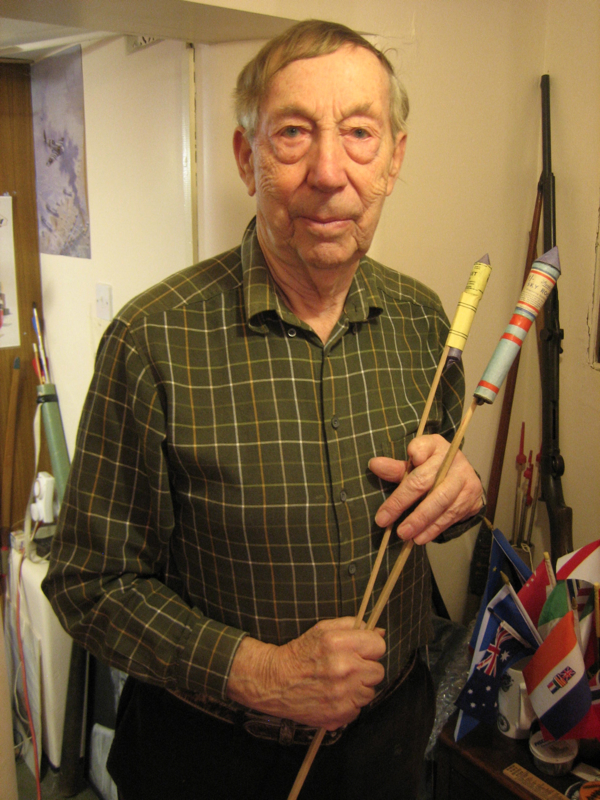
Maurice with two favourite rockets.











Firework photographs copyright © Simon Costin
Read my story about Simon Costin, The Museum of British Folklore
Brea, CA — As if the stakes in the NHRA Pro Stock Motorcycle Countdown to the Championship playoffs weren't high enough, they got even bigger when dangerously high winds in Las Vegas on Sunday forced the final round matchup between RevZilla/Motul/Vance & Hines Suzuki teammates Richard Gadson and Gaige Herrera to be postponed until the season finale in Pomona, CA, in two weeks.
Race Highlights
-
Championship leader Richard Gadson qualified second and advanced to the final round, which will be contested during qualifying at the season finale in Pomona
-
Gaige Herrera qualified number one and advanced to the final round
The penultimate round of the NHRA season and fifth of six races in the Countdown for the Championship playoffs was held at the MOPAR NHRA Las Vegas Nationals at The Strip at Las Vegas Motor Speedway. The race was marked by gusty winds that forced a brief halt to all racing on Sunday afternoon and ultimately the postponement of the Pro Stock Motorcycle final round.
Fittingly for a race held just a few miles from the world-famous Las Vegas Strip, the event also featured a few lucky breaks for both RevZilla/Motul/Vance & Hines Suzuki riders that allowed them to advance to face each other in the now-delayed final round and virtually clinch the 2026 Pro Stock Motorcycle world championship for the team.
The season finale in Pomona will now feature head-to-head battles between Richard Gadson and Gaige Herrera to determine both the Las Vegas race winner and the season champion.
Reigning world champion Richard Gadson qualified second on Saturday with a 6.836-second/196.10 mph run, marking the third time this season the Vance & Hines team has locked out the top two spots in the starting order.
Portending events to come, Gadson survived his first scare of the day in round one on Sunday against John Hall when a strong side wind forced his motorcycle to drift towards the centerline. The championship leader hung off the side of his Hayabusa trying to keep it inside the line and held onto the throttle just long enough to run 7.158 seconds at 186.33 mph. Fortunately for Gadson, Hall had problems of his own in the other lane, coasting to a losing 7.860-second/123.93 mph run.
In round two, Gadson again had to fight the wind to keep his motorcycle in the racing groove, hanging on to claim a narrow 6.857-second/194.72 mph victory over Angie Smith (6.865 seconds/199.08 mph).
Gadson's string of wild rides continued in the semi-final round, when number three qualifier Ryan Oehler also struggled in the crosswind, lifting and slowing to 8.484 seconds at 107.81 mph. Gadson held onto his run longer, posting a 6.933-second/174.48 mph run to advance to his ninth final round appearance of the season and fifth against Herrera.
"Everybody was fighting the same issues with the wind today, but I was able to find a way to beat them to the finish line even though there were some wild rides. It was more about willing myself to the finish line than luck. I definitely caught some breaks today, but when you're dealt a set of cards, you play them," said Gadson, who agreed with the decision to postpone the final round.
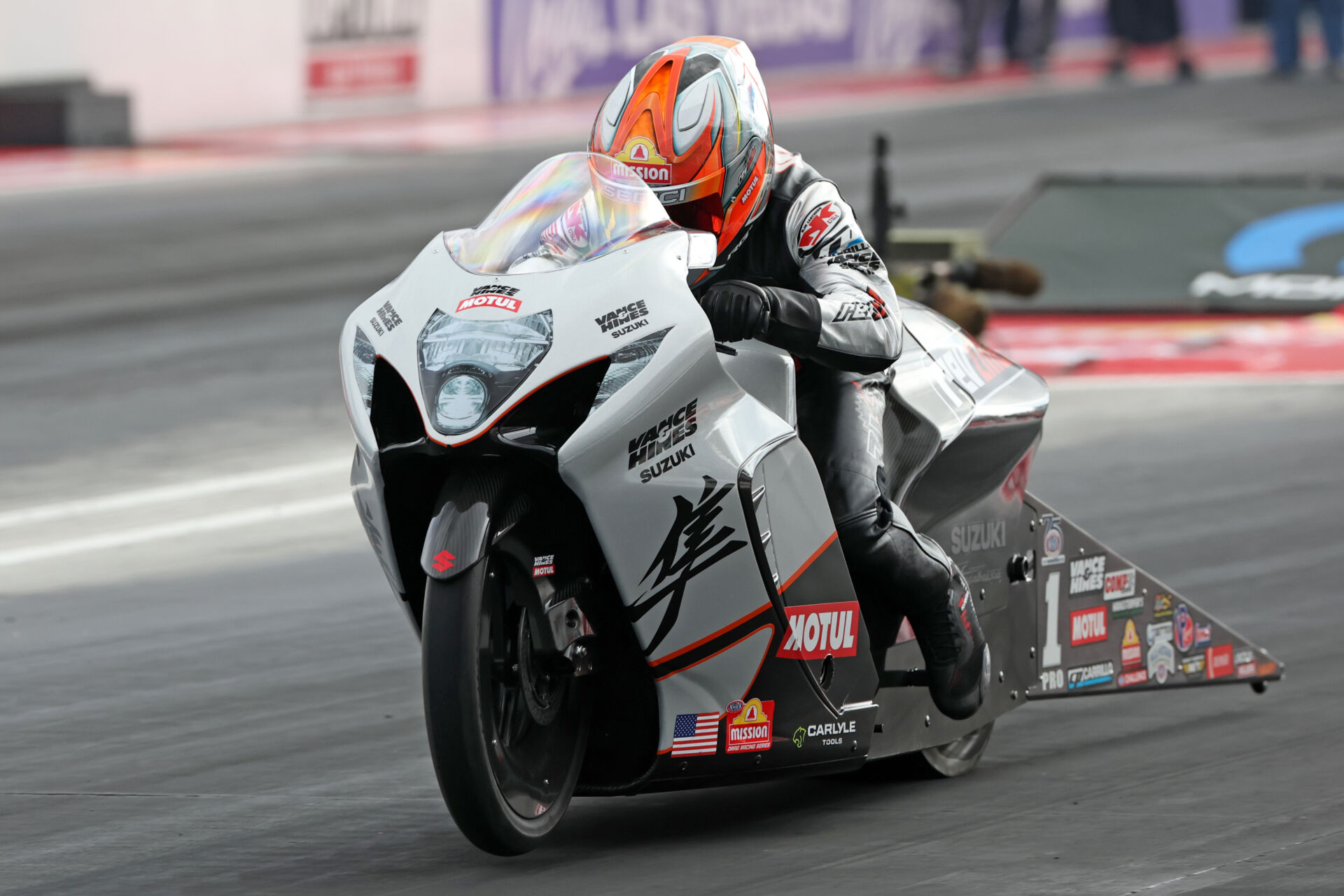 Championship leader Richard Gadson battles the competition and crosswind to the finish line and advances to compete in final round in Pomona. Photo courtesy Suzuki.
"At the end of the day, the competitor in me wants to race, but I have a three-year-old girl back home who's waiting for me to walk back through the door, so it was the right decision by the NHRA. I'm happy they took it out of our hands because we're maybe stupid enough to try to race anyways. My number one priority is to make it back home to my family," he said.
Gadson currently leads Herrera by 55 points in the Countdown standings. Depending on the outcome of the Las Vegas final round, which will be contested during the third round of qualifying in Pomona, Gadson will enter eliminations for the finale with at least a 35-point lead over Herrera, which he can extend to 75 points if he wins the delayed final. Third place Matt Smith, who lost in the second round in Las Vegas, sits 133 points behind Gadson, and with the available points remaining, is all but mathematically eliminated from contention.
"It'll be a doubleheader in Pomona with a lot riding on that race. I really want to find a way to survive Gaige's assault and win it on the track. Hopefully from a performance standpoint I won't need luck, but I'll take whatever I can get," Gadson said.
Gaige Herrera ran 6.799 seconds at 197.91 mph on Saturday, earning his fifth number one qualifier of the season and the 36th of his career.
In round one, Herrera posted a 6.765-second/199.79 mph run, low elapsed time of the round, against Chris Bostick (6.895 seconds/195.11 mph).
Herrera continued to show he was the class of the field in Las Vegas by again posting low ET in round two, running 6.752 seconds at 200.05 mph against Clayton Howey (6.890 seconds/195.73 mph) to advance to the semi-finals.
Herrera caught a break of his own in the semi-final round by barely edging out Joey Gladstone when both racers struggled to hold a straight line and full throttle in the heavy crosswinds. Herrera prevailed with a 7.280-second/181.96 mph run over Gladstone's 7.332 second/180.09 mph pass, setting up his sixth final round appearance of the season and fifth against Gadson.
"I've got the bike to beat right now. Andrew is doing his thing and my Hayabusa is on rails, especially in the 60-foot. The wind just threw us for a big loop today. When you're next to the big bleachers the wind is going in one direction and then it flip-flops when you pass them and blows you the other way. I was making good runs until the semis, but it was hairy for sure. NHRA made the decision to move the final, which I feel was the safest and best call," Herrera said.
Helped by grabbing nine of the 12 available qualifying bonus points, Herrera edged three points closer to Gadson and now trails by 55 points after the semi-final round. He can reduce that deficit a further 20 points by winning the delayed Las Vegas final.
With the points-and-a-half format at the season finale, which awards 4 points for the lowest ET of each qualifying round and 30 points for each round win, Herrera will likely need to go at least two rounds farther than Gadson during eliminations in Pomona to add a third world championship to the titles he earned in 2023 and 2024.
"It's going to make Pomona that much more interesting. I don't have any room for error if I want to take this championship back," Herrera said. "I have the mindset to go out there and win. Richard has been on his game going rounds on Sunday. That's the day that counts. I need to do the same thing and do it better than him in Pomona."
RevZilla/Motul/Vance & Hines Suzuki crew chief Andrew Hines said the team's plan for Las Vegas, as it has been throughout the Countdown, was to focus on extracting the best qualifying performance from both riders to set them up to run deep into the elimination rounds.
"Before we left the shop to come here, I told the guys we needed to go out, do our jobs, and qualify one and two, because that gives us the best shot of advancing out of the first round, and then focus on bringing the best two motorcycles to the starting line every run. We did that today. It may not have been the prettiest, but Richard got away with three round wins today because he was better than his opponent in those rounds. Not exactly how we expected it, but mission accomplished by putting both of our Hayabusas in the final," Hines said.
Similar to the situation heading into last year's season finale in Pomona, the team's riders hold the top two positions in the Countdown standings and are poised to battle head-to-head for the championship with no others in realistic contention.
Hines hopes to see the championship settled on track, an outcome that fans were denied last season by unprecedented rain storms that forced the cancellation of racing and resulted in the awarding of championships based on points.
"It's going to be a grudge match in Pomona. Gaige is out for vengeance, and Richard is out to prove a point. It's going to be an all-out dog fight and no matter what happens in the 'Vegas final' on Saturday, it's going to come down to what happens on Sunday," Hines said.
With one round remaining in the Countdown to the Championship, Gadson and Herrera sit first and second in the standings, with 2,579 and 2,524 points, respectively.
The RevZilla/Motul/Vance & Hines team returns to action Nov. 13-15 for the NHRA season finale at the In-N-Out Burger NHRA Finals at In-N-Out Burger Pomona Dragstrip in Pomona, CA.
For the latest Suzuki team news, race reports, and information visit SuzukiCycles.com/Racing/Drag-Racing
About Suzuki:
Suzuki Motor USA, LLC. (SMO) distributes Motorcycles, ATVs, Scooters, Accessories, and ECSTAR Oils & Chemicals via an extensive dealer network throughout 49 states. Suzuki Motor Corporation (SMC), based in Hamamatsu, Japan, is a diversified worldwide manufacturer of Motorcycles, ATVs, Scooters, Automobiles, Outboard Motors, and related products. Founded in 1909 and incorporated in 1920, SMC has business relations with 201 countries/regions. For more information, visit www.suzuki.com.
About Vance & Hines Motorsports:
Vance & Hines Motorsports is a powerhouse in the world of motorcycle racing, boasting a rich legacy of success. With a focus on innovation, performance, and a commitment to pushing boundaries, the team continues to redefine excellence in the NHRA and MotoAmerica. For more information, visit www.vanceandhinesmotorsports.com.
The post NHRA: High Winds Postpone Las Vegas Final Round appeared first on Roadracing World Magazine | Motorcycle Riding, Racing & Tech News.
Reigning British Superbike champion Kyle Ryde will return to defend his number one plate with a new manufacturer in 2027 as he joins Honda Racing UK in a three-strong rider line-up.
Ryde made history this season by becoming the first champion to win consecutive titles for two different manufacturers, now having celebrated three back-to-back crowns from 2024; he looks to add to his incredible record with Honda Racing UK.
The move marks the beginning of a new partnership with Honda and the opportunity to help shape the competitive development of the all-new Fireblade.
Reigning champion Ryde joins Ryan Vickers, whilst Dean Harrison returns to the Superbike class for the forthcoming campaign aboard the all-new 2027 Honda Fireblade.
The programme combines championship-winning experience, proven race-winning pace and extensive knowledge of the Fireblade as Honda Racing UK sets its sights on challenging for the BSB title.
The introduction of the all-new 2027 Honda Fireblade gives the team a fresh focus for its winter preparations. All three riders will contribute to a testing and development programme and establish a strong foundation before the season opener, ready to arrive ready to deliver a strong campaign to fight for the title.
Ryde said: "I'm massively looking forward to riding for Honda, it's another challenge in my career and I'm excited to ride another new bike. Working with a factory team is something I've not done before, and having a hand in the year one racing development of a bike is going to be another new area for me to work in. I'm really looking forward to the challenge and will hopefully be able to carry on delivering what I've been doing for the last couple of seasons on different bikes for other teams.
"I think Ryan had a brilliant end to the 2026 season, towards the end I think he matched me on points and it's clear the team worked well to help Ryan unlock the potential in the bike. It was a difficult bike to race against at certain tracks in the calendar and Ryan made the most of that whenever he could. I know there's going to be some tracks on the calendar where I think I can already see an advantage for Honda next year. I get on really well with Ryan and I'm looking forward to working with him again.
"Dean is a lovely person to be around and will be a great teammate. I'm sure we'll all bounce off each other and make each other better riders for the full season next season.
"I plan to spend my off-season chilling out for a bit. I have a couple of holidays booked and, I'll get stuck back into winter plans once I've played some golf and allowed myself a chance to relax.
"I'll get out to Spain and will put some miles on a Fireblade track bike, that'll be fun I'm sure. I did the same thing last year and feel that it really helped keep me sharp. I don't look at it as testing as such, it's just enjoying my riding while I'm figuring a bike out.
"I can't thank the Honda Racing team enough for giving me the opportunity, I fully intend to make the most of it and I'm looking forward to sticking the number one on this new Fireblade."
Neil Fletcher, Head of Racing Honda Europe, concluded: "I think it's fair to say that we have three incredibly talented riders signed for the 2027 British Superbike Championships. Adding Kyle Ryde to the Honda line up is really exciting, it's impossible to ignore his talent, his pace and his professionalism. I hope his transition into the team is as smooth as possible so he can focus on what he's been doing so well for the last three seasons.
"Ryan Vickers is an exceptional talent, a multiple race winner in BSB on the Fireblade and carries the advantage of having worked with the team in 2026. As if two front running superbike racers wasn't enough, we've elected to run Dean for a full season of BSB as well. His dominant pace in 2026 on the roads proves he has the ability on a Fireblade and his front running pace in the British Supersport Championship shows his short circuit credentials.
"Honda and HRC's commitment to developing Honda Racing UK's headquarters in Louth, an all-new Fireblade and three amazing riders means 2027 is going to be a strong year for Honda."
The post BSB: Reigning Champion Kyle Ryde Joins Honda Racing UK appeared first on Roadracing World Magazine | Motorcycle Riding, Racing & Tech News.
PHOENIX - Arizona utilities Tucson Electric Power Company (TEP) and Arizona Public Service (APS) filed their 2026 Integrated Resource Plans (IRPs) on Friday that evaluate how utilities will obtain energy for the next 15 years. While their plans include new renewable energy and storage, they continue to spend on fossil ... [continued]
The post More of the Same Expensive Dependence on Fossil Fuels in TEP and APS 2026 Energy Plans appeared first on CleanTechnica.
Making the ETS a strategic investment tool for aviation and shipping Summary The EU Emissions Trading System (ETS) review proposal published in July 2026 is intended to make the EU's most vital climate policy mechanism fit for its 2040 climate targets. It also carries the ambition to turn the ETS ... [continued]
The post The ETS Investment Engine: Scaling Europe's Strategic E-fuel Market for Shipping & Aviation appeared first on CleanTechnica.

The flood of AI-generated slop games has set the thoroughly-troubled gaming industry reeling, but for indies it's even worse: success can depend on building a social media following by showing off clever and innovative gameplay concepts early in development. And that's just the sort of thing sleazy copycats can use frontier models to slop up and sell. — Read the rest
The post Anthropic clamps down on using Claude to make copycat games—or reverse-engineer code appeared first on Boing Boing.

Intel's stock price fell 9% today after a bad week that saw the company lose more than a third of its value. It's lost more than half of its value since the summer highs, in what Jared Blikre describes as "tech wreckage" and Intel's worst day since 1974. — Read the rest
The post Intel stock "collapses" amid broader tech retreat appeared first on Boing Boing.
The cost of diesel fuel rose nearly 33% from 2025 to 2026, with some countries experiencing even higher price spikes. For many of the world's rural farmers, processors, and small businesses, solar-powered equipment offers an attractive alternative. On a dry hillside in Chamwino, central Tanzania, mango farmers used to watch ... [continued]
The post As Diesel Costs Surge for Farmers & Rural Businesses, Solar Offers a Lifeline appeared first on CleanTechnica.
He needs a dialysis machine to survive, but on a flight it was first damaged, then it was lost
My father suffers from terminal renal failure and relies on a highly specific dialysis machine every night to survive. British Airways' check-in staff twice insisted on checking this fragile 20kg lifeline into the aircraft hold where it was first damaged, then lost.
When his outbound flight arrived at Heathrow, it was returned broken resulting in a frantic search for a loan unit and hours spent in A&E so my father's blood could be monitored. On the return flight to Rome, the machine could not be found. My parents waited until 2am before being told to go home without the equipment that keeps my father alive.
Continue reading...



Walled Culture has just written about the possibility that recent AI breakthroughs might accelerate a move to open access, at least in the field of mathematics. It would be particularly welcome against a backdrop of relatively slow progress in the open access world. That is not because the need for different business models that provide free access for all to published research is less, but simply because the obstacles and difficulties faced by researchers remain largely unknown to the wider public, and therefore removing them is not a priority.
To the outsider, the world of academic publishing seems to be flourishing; and it is, for publishers, but it remains a source of friction and frustration for the people actually writing the papers that are published. The wider dynamics within the world of academic publishing remain opaque, particularly concerning the costs and benefits. Two new independent studies from the University of Sydney Business School may help to change that. The first, entitled "The Cost Of Knowledge" notes a remarkable omission in the discussions about academic publishing and the move to open access:
Debates about the economics of scholarly publishing typically focus on subscription prices, article processing charges, publisher revenues, and profit margins. Much less attention is paid to the costs incurred in producing the research that makes scholarly publishing possible.
Publishers love to talk about how much it costs to produce academic journals, and why the charges for publishing have to be so high, but they gloss over the fact that publication is merely the end stage in the much longer and more complex process of conducting and reporting research. The new University of Sydney Business School research seeks to estimate how much that work before publication typically costs, in order to provide context for the publication fees. The researchers identified eight key stages of article production where costs could be estimated:
ideation and conception; grant seeking and approval, where applicable; ethics approval; performance of the study and data analysis; writing and manuscript preparation, up to first submission; peer and conferencing feedback; journal editorial work; and peer review and revision cycles. Rather than costing these stages as discrete, sequential blocks, we represent them within a single integrated estimation record that recognises the overlaps between them, the resources they share, principally researcher time, but also institutional infrastructure and administrative support, and the cumulative effect of revising as a manuscript moves iteratively between stages.
The final result of applying that methodology is striking:
Drawing on the ingredients method, this paper attempts to construct a fuller account of that process, tracing the resources and associated costs consumed from ideation through to acceptance. While our estimate of approximately US$70,000 is necessarily conservative and open to refinement, it points to a substantial investment of labour, infrastructure, governance arrangements, and public resources that are essential [for] the production of a published article long before publication itself becomes possible.
To place that figure in context:
Grossman and Brembs (2021) put the cost of [the service provide by academic publishers] at around US$400 per article. Set against our estimate of approximately US$70,000 to produce a social science article, the publishing function appears to represent less than 1% of the total resources invested in creating the research. Even using Grossman and Brembs' upper estimate of approximately US$1,000 per article, publication costs account for only around 1.4% of total production costs. This comparison highlights a central tension in contemporary scholarly communication given that after substantial public and institutional investment in producing research, access to the resulting knowledge is frequently restricted through subscription-based publishing models.
The implications of that relatively small figure are important:
Viewed in this way, the estimate draws attention to a structural asymmetry within contemporary scholarly communication where the production of knowledge depends heavily upon publicly funded institutions, publicly supported research, and academic labour, and this provides a largely unaccounted for subsidy to private sector publishers, underwriting at least some of the financial returns they enjoy
That is, with every paper that appears in their titles, academic publishers are generating significant profits not only thanks to free academic labor in the form of peer review, but also thanks to long-term and massive levels of public funding. Their ability to free ride on such invisible subsidies is never acknowledged by publishers, which like to claim all the credit for making papers available, as if they were benefactors underpinning the entire system of research. In fact, by imposing high and unjustified publication costs on academic institutions and their funders, publishers act as a serious obstacle to the dissemination of publicly-funded research, denying people their right to access the academic work they pay for.
The results of that "structural asymmetry" are explored in the second piece of research from the University of Sydney Business School, with the self-explanatory title "How Profitable are the Big Four Publishers" - the "Big Four" being RELX (Elsevier), Informa (Taylor & Francis), Springer Nature and Wiley:
The evidence shows that academic publishing has been an exceptionally resilient and profitable business. Despite periods of major economic disruption, including the global financial crisis (2008) and the Covid-19 pandemic (2020-2022), all four publishers remained profitable throughout the period examined. For the diversified firms, academic publishing consistently generated the highest profit margins within their business portfolios.
…
Taken together, the findings suggest that the Big Four are not only securing significant financial returns from scholarly communication but are also extending their influence across the wider research ecosystem. The report raises questions about the distribution of economic value, control of research infrastructure and the governance of publicly funded knowledge.
The two new reports are unlikely to change the state of open access quickly or dramatically. But their value lies in the fact that they confirm - with data - that the current academic publishing system is a terrible deal not just for researchers and institutions, but also for the governments and public which fund it.
Follow me @glynmoody on Mastodon and on Bluesky. Originally published to Walled Culture.
Last week Cathy wrote about the amicus brief we filed in the big multi-district litigation (MDL) that consolidated a bunch of different lawsuits claiming that OpenAI and Microsoft infringed the plaintiffs' copyrights by training AI models on their works. A lot of people and groups offered proposed amicus briefs. For boring procedural reasons, unlike in most cases, you couldn't just file the briefs, but rather everyone had to ask permission from the court, which meant that each attempted filing involved multiple filings, and many potential amici used different processes to try to file their briefs. Oh, and the docket is already at almost 2,500 entries. It's a mess.
So, if you want to review all of the proposed amicus briefs, I've embedded below a tool to look at all of the briefs. They are sorted by which side they support (defendants, plaintiffs, neither), and then if you open up each section you can see who the amici are, a link to their brief, and a one sentence summary of their argument. In case you are wondering, yes, this was created using Claude Code and the CourtListener MCP, asking it to go in and find the actual proposed briefs from the docket, to organize them, and to summarize them. And yes, not surprisingly, it didn't get everything right on a first pass. The version below is the third version, human reviewed, after it had trouble reading some of the files and got confused on who some of the amici were actually supporting.
Anyway, we already have a whole post on our own brief, but a few others I'll call out quickly. While it's no surprise that the usual copyright maximalists filed briefs supporting the plaintiffs, what's interesting is how many other copyright holders filed in support of the defendants like OpenAI. My favorite one is from The Authors Alliance, a group representing authors, but who recognize that copyright maximalism and hating on fair use is bad for authors as well. Their argument is to call bullshit on the whole idea of "market dilution" being a harm implicated by copyright, noting: "Market Dilution is just a fancy term for competition, and copyright law supports competition."
Other copyright holders who weighed in on behalf of innovation were independent creators Sarah Rose Siskind and Michael Wall. They argued that contrary to the claims of plaintiffs, AI is helping creators as a tool that assists them in being creative. Indeed, they highlight how it has helped them compete with big-name creators backed by major industry players. The brief from the Chamber of Progress and the Abundance Institute also included the incredible multi-Grammy winning drummer Trevor Lawrence Jr., also talking about how important AI has been in helping musicians like him create new music.
There were a number of other industry groups and civil society orgs, along with a bunch of academics. EFF details how a ruling for the plaintiffs would do real damage to research. Library groups and the American Council of the Blind teamed up with tech trade groups CTA and BSA to highlight the many important benefits of AI tools. And then there are the academics. Copyright experts Pam Samuelson and Chris Sprigman (both former Techdirt podcast guests) also call out the nonsense "market dilution theory." Brian Frye teamed up with journalist Ron Suskind to explain how training is transformative and how AI is useful for journalists. Professors Rebecca Tushnet and Edward Lee — both well known copyright experts as well — also explain transformative use and how silly the market dilution theory is.
There are some briefs that support "neither" party (technically the Frye one supports neither, but the argument seems to strongly support the defendants) including the Wikimedia Foundation's brief. It focuses on applying the (problematic) precedent from the weird Andy Warhol fair use case a few years back, arguing that under Warhol, courts need to analyze each use separately, rather than making a blanket assertion that [waves hands around vaguely] "all this is infringing." It does say that regular AI training should be fair use, but argues that RAG training (basically, AI on top of a corpus of data) probably isn't fair use.
Not surprisingly, I'm less impressed by those siding with the plaintiffs. To me they trot out the well worn and debunked tropes of copyright maximalists of past fights. Claims that "if this isn't infringing no one will ever create again" are rampant and just silly. The oddest one may be actor Ashley Judd's. It basically argues that AI will kill journalism (citation desperately needed) and that if that had happened a decade ago, there wouldn't have been journalists left to blow the whistle on Harvey Weinstein and the entire #metoo movement might not have happened. I honestly had trouble following how any of those things connect, especially since journalists use AI tools all the time, and it hasn't made them disappear.
There's a similar one from everyone's favorite documentarian, Ken Burns, who argues that AI will kill the market for historical documentaries. Again, I don't see how anyone gets there, though. First of all, the market for documentaries has grown massively over the past decade, and they're now often treated as equals of feature films, something that would have been unthinkable not long ago. And literally this amicus brief is filed the same week people are debating if the new Elizabeth Holmes documentary has a shot at winning the Oscar for Best Picture (rather than best documentary). And I know (personally!) documentary filmmakers who are saying that AI tools are often making it easier to create stronger documentary films (and no, not by generating AI slop, but to help with some of the more annoying production tasks). Then there are all the expected ones from the RIAA, Copyright Alliance, newspapers, the publishers… who say the same tired "oh no the sky is falling, creators will never create again" bullshit.
The one other surprising (and disappointing) filing on behalf of the plaintiffs was the brief from PEN America, the Protect Democracy Project, and Reporters Without Borders. I am a fan of all three organizations and find it incredibly awkward and odd that those organizations in particular would strike an anti-free speech stance by siding with copyright maximalists seeking to lock up knowledge. They give a highly misleading history lesson on the Progress Clause, suggesting that the First Amendment's Press Clause and the Progress Clause work together in a way that justifies locking up knowledge for the benefit of the press. They're right that the two clauses fit together, but they get the relationship exactly backwards: both exist to expand the spread of knowledge, not to restrict it. It's just… odd.
Anyway, you can find the links and summaries to all those and more below… This case still has a long way to go and, no matter how it's decided, will almost certainly involve many years of appeals. But the copyright battle lines are being drawn, once again.
Proposed amicus briefs on the RECAP docket through ECF 2462, by the side each supports. Click a section to expand it.
■ 22 for defendants · ■ 26 for plaintiffs · ■ 4 neither/mixed · ■ 1 brief not yet located · 53 total
Supports defendants (22) ECF 2112-1 · Oct 16 Kevin Kelly AI speeds up the creation of new works without harming plaintiffs, and its public benefits are vast. Copyright isn't a shield against disruptive technology; training is fair use. ECF 2313-1 · Oct 29 Public Knowledge Copying for training is fair use. Fair use also allows reasonably necessary copying to reach unprotectable facts, including facts about creative works. Supports defendants "in part." ECF 2335-1 · Oct 29 Engine Advocacy et al. (startups) Startups build products on fine-tuned foundation models, which shows training is a general-purpose fair use. Licensing costs would lock startups out of AI. ECF 2369-1 · Oct 30 Floor64 / Copia Institute Copyright can't and shouldn't be used to throttle AI training. Doing so would conflict with the Progress Clause and the First Amendment, and copyright grants no right to foreclose training. ECF 2370-1 · Oct 30 A.I. Progress, Inc. (AI developer coalition) Generative AI is now everyday infrastructure. Training is "quintessentially transformative," and a ruling against fair use would hurt the broader economy. ECF 2380-1 · Oct 30 Profs. Pamela Samuelson & Christopher Jon Sprigman Reject the market dilution theory: the empirical studies behind it are flawed, and any collective harm is for Congress to address. At minimum, require proof. ECF 2381-1 · Oct 30 Prof. Joshua Gans Economic framing aimed at the news cases: lost sales aren't by themselves copyright harm, dependence on any single work in a large dataset is unproven, and later licenses don't prove a market. Asks the court to reject the News Plaintiffs' arguments. ECF 2384-1 · Oct 30 Consumer Technology Ass'n, American Council of the Blind, American Library Ass'n, Ass'n of Research Libraries, BSA Catalogs public benefits of LLMs across accessibility, agriculture, law, transit, manufacturing and independent creators. Grant summary judgment to defendants. ECF 2407-1 · Oct 30 Electronic Frontier Foundation Fair use turns on the ultimate use, not how copies were acquired. Good faith isn't required, and competition isn't market harm. Plaintiffs' theories would threaten web scraping, research datasets and search. ECF 2429-1 · Oct 30 CCIA, NetChoice, TechNet Training is non-expressive intermediate copying to build a new tool (Google Books, Oracle). Market dilution isn't cognizable harm, and owners can't create a market by demanding licenses for a transformative use. ECF 2439-1 · Oct 30 Khosla Ventures VC perspective: a ruling against fair use would entrench incumbents, chill investment and cede AI leadership abroad. Grant OpenAI's motions. ECF 2449-1 · Oct 30 Gregory Leppert Libraries rely on general-purpose models for preservation and access at scale. Anyone who wants Game of Thrones goes to the library rather than rebuilding it from AI output. ECF 2459-1 · Oct 30 Former Sen. Rick Santorum & former Rep. Rick Boucher Congress made fair use flexible. AI training continues the tradition of non-expressive technological uses, and fair use underpins US tech leadership. ECF 2461-1 · Oct 30 Midjourney, Runway AI Training is designed to enable new expression. Detailed examples of AI tools expanding creativity for amateurs and professionals make it a "quintessential transformative fair use." ECF 2462-1 · Oct 30 Trevor Lawrence Jr., Chamber of Progress, Abundance Institute Extracting non-expressive patterns is transformative, and working musicians' experience shows generative AI enables human creativity. Takes no position on how the works were acquired. ECF 2328-1 · Oct 29 Authors Alliance Market dilution, as framed in Kadrey, is just competition. Factor four covers only substitution by uses that take protected expression. Single issue; takes no position on anything else. ECF 2283 · Oct 28 Prof. Brian L. Frye Training is transformative, and requiring licenses would entrench the biggest incumbents. Styled "neither party" but argues fair use. The court dismissed his earlier filing (2282) for not requesting leave (Order, Dkt. 2412); this one may have the same defect. ECF 2308-1 · Oct 29 Prof. Matthew Sag Training is highly transformative under Bartz, Kadrey and the copy-reliant technology cases. Transformativeness is judged by realistic outputs, and questionable sourcing belongs in factor four. Says it "supports neither party" but argues fair use. ECF 2378-1 · Oct 30 Foundation for American Innovation, David Shedd, Gen. Michael Groen, George Barnes Under Oracle, the court should weigh the national-security benefits the record ties to the challenged training as part of factor four. Narrow ask that in practice helps defendants. ECF 2394-2 · Oct 30 Profs. Rebecca Tushnet & Edward Lee Scaling training data with intermediate copies is highly transformative under factor one. Plaintiffs' market dilution theory rests on non-infringing outputs that share only genre or facts, which are uncopyrightable, and the Copyright Clause forecloses it. ECF 2403-1 · Oct 30 Sarah Rose Siskind & Michael Wall (independent creators) A comedy writer and a composer who license their own work describe using AI for business operations and ideation. They argue it lets independent creators compete with better-resourced rivals and helps them make more work, not less. ECF 2447-1 · Oct 30 Computer scientists Mike Knoop, Prof. Daniel Lowd, Prof. Douglas C. Schmidt Technical brief: training fits numerical parameters and is not a system for storing and retrieving works. Memorization is limited, model-specific and reducible, and research shows OpenAI's safeguards block substantial extraction, which supports a different purpose under fair use. Styled in support of OpenAI but says it takes no position on the ultimate merits. About 130 of the 160 pages are an appendix of CVs. Supports plaintiffs (26) ECF 2304-1 · Oct 29 Association of American Publishers, Copyright Clearance Center, Independent Book Publishers Ass'n, STM Training uses expressive content for the same purpose as the originals and produces substitutes, so it isn't transformative. Unlicensed training harms book markets and the emerging collective AI-licensing market. ECF 2306-1 · Oct 29 Center for American Rights OpenAI's broad fair use theory would undercut the administration's AI/IP framework. Protecting IP is a national-security issue, and a pro-fair-use ruling would give foreign adversaries legal cover for IP theft. ECF 2325-1 · Oct 29 Digital Content Next AI tools that summarize publishers' content without sending users to the source cut off traffic, subscription, ad and licensing revenue. That is an existential threat to digital publishers. ECF 2332-1 · Oct 29 AFM, SAG-AFTRA, WGA East, WGA West A flood of AI-generated works is the "substantially adverse impact" Campbell anticipated. The unions already bargain licensing for new technologies, so the court should reject a categorical fair use exemption. ECF 2359-1 · Oct 29 Copyright Alliance After Warhol, the older transformativeness cases defendants rely on carry little weight, and Kadrey and Bartz are distinguishable. Knowingly using pirated sources, and an existing licensing market, weigh against fair use. ECF 2377-1 · Oct 30 Open Markets Institute Mass copying is unfair competition against publishers. It also undercuts AI rivals that pay for licenses and could kill the emerging licensing market. Also misfiled under ECF 2372. ECF 2373-1 · Oct 30 News/Media Alliance, National Newspaper Ass'n, National Press Photographers Ass'n, ProPublica Copying news to build products that supersede it isn't fair use, relying on the Third Circuit's Thomson Reuters v. ROSS ruling (Sept. 2026). Factor four: harm to online news and AI-licensing markets. ECF 2382-1 · Oct 30 Minderoo Centre for Technology & Democracy, University of Cambridge Opposes defendants' summary judgment motions. What the models retain from books is a disputed material fact. Training is cumulative, so the copies aren't "intermediate" under Sega and Connectix. ECF 2386-1 · Oct 30 AI Coalition for Data Integrity, WGA East & West, Nat'l Ass'n of Voice Actors, Digital Media Licensing Ass'n, Transparency Coalition AI, Ass'n of Medical Illustrators, Ass'n of Independent Music Publishers, Music Workers Alliance, Microstocksolutions Answers the DOJ's national-security argument: security agencies want documented training-data provenance, which unlicensed scraping can't provide. Foreign rulings such as GEMA v. OpenAI undercut the claimed US advantage. ECF 2388-1 · Oct 30 First Amendment scholars: RonNell Andersen Jones, Jack Balkin, Erin Carroll, Alan Chen, Heidi Kitrosser, Jane Kirtley, Burt Neuborne, Jonathan Peters, Victor Pickard, Francesca Procaccini, Sonja West The press serves constitutional and democratic functions that depend on a viable business model. AI chatbots free-ride on reporting and erode that model without doing what the press does. ECF 2393-1 · Oct 30 RIAA, NMPA, A2IM, ASCAP, BMI, Recording Academy, Songwriters of North America, Artist Rights Alliance, Black Music Action Coalition Music industry brief in support of plaintiffs' summary judgment motions. The argument summary couldn't be pulled from the text. Open the PDF for details. ECF 2399-1 · Oct 30 Ashley Judd Draws on her experience as a source for the NYT's Weinstein reporting: work like that needs well-resourced human journalists and trusted relationships, which AI can't replace and threatens to defund. ECF 2402-2 · Oct 30 ASJA, ASMP, American Literary Translators Ass'n, National Writers Union, Novelists Inc., Romance Writers of America, Sisters in Crime, Dramatists Guild, SFWA, Nat'l Ass'n of Science Writers, NPPA, Garden Communications Supports the class plaintiffs. Downloading from LibGen and Books3, training, and OpenAI-Microsoft distribution are not fair use. AI output floods the market with substitutes, and defendants acted in bad faith. ECF 2404-1 · Oct 30 Reps. Jamie Raskin, Jerrold Nadler, Hank Johnson DOJ's national-security argument amounts to an unauthorized blanket exemption for all AI training. It deserves no deference, and national security isn't a fair use factor. Styled as a response to the DOJ Statement of Interest. ECF 2406-1 · Oct 30 Ken Burns Training on his films is destroying the market for quality historical documentaries, and the models regurgitate exact copies of his material. ECF 2413-1 · Oct 30 PEN America, Protect Democracy Project, Reporters Without Borders (RSF USA) Defendants' arguments invert the historical relationship between the Press Clause and the Progress Clause. Their business practices threaten a free, independent press. ECF 2417-1 · Oct 30 Cate Blanchett, Steven Soderbergh, Nick Hexum, CAA, Creators Coalition on AI, Music Artists Coalition, Nat'l Ass'n of Voice Actors, Human Consent Foundation, Writer, Inc. A working licensing market for training data exists. Collective licensing and machine-readable consent tools are in use, and that should drive the factor four analysis. No explicit ask; the argument favors plaintiffs. ECF 2420-2 · Oct 30 Copyright law professors (incl. Julia Powles, Trevor Reed, Marketa Trimble, Bhamati Viswanathan; full list in the brief's appendix) Training and RAG copying is direct infringement. In these works expression is inseparable from facts and ideas, and copyright has never allowed wholesale copying of expression to reach the underlying knowledge. ECF 2421-1 · Oct 30 Progressive Democrats of America, RadicalxChange, Tech Oversight Project, Young People's Alliance, Prof. Walter Scheirer (lead author David Atkinson) Defendants want "GenAI exceptionalism." If their use is fair, almost any human's unlicensed use would be too. Public availability doesn't create an implied license. ECF 2438-1 · Oct 30 Prof. Joseph Stiglitz Economic argument: unlicensed AI use erodes incentives and degrades the information ecosystem, and the split of value is grossly inequitable. Licenses should divide the gains. Attaches an economics paper (51 pp.). ECF 2448-1 · Oct 30 America's Newspapers Loss of local news makes government costlier and less accountable, communities less safe and democracy weaker. Claimed public benefits can't outweigh that. ECF 2452-1 · Oct 30 Jim Albrecht Focuses on RAG: the copying is the violation and the output shows a substitutive purpose. Harm to news is ongoing, and spreading the copying across sessions doesn't excuse it. ECF 2457-1 · Oct 30 AAN Publishers, Inst. for Rural Journalism, LION Publishers, Nat'l Ass'n of Hispanic Publications, Rebuild Local News Coalition, Solutions Journalism Network, NewsGuild-CWA, SPJ Strong copyright gives small outlets leverage for compensation. Today only big outlets get AI deals, so a ruling for the NYT would push AI companies toward licensing that pays local news. ECF 2460-1 · Oct 30 AI startups: BandLab, Boomy, Created by Humans, Credtent, Splice, Newstex, ProRata.ai, SourceAudio, Cashmere (Vandal AI), Voice-Swap Licensed training hasn't priced developers out. Licensing creates markets, pays creators and reduces legal risk, so requiring permission won't slow innovation. ECF 2099-2 · Oct 14 The AI Rights Project Defendants haven't shown that machine-scale training is equivalent to human creative reuse, which is the premise of transformativeness. Rebalancing the IP Clause is for Congress. The motion says it supports plaintiffs, but the brief "urges no outcome." ECF 2456-1 · Oct 30 William Morris Endeavor (WME) Factor four: AI companies already license copyrighted works, voices and likenesses, and WME negotiates those deals. Unauthorized training and AI replicas harm that market, and lost licensing fees count as market harm. Supports the news plaintiffs. Filed only in the NYT case (23-cv-11195). Neither party / mixed (4) ECF 2361-1 · Oct 29 Wikimedia Foundation Analyze each use separately under Warhol. Scraping itself isn't a "use." Pre-training is likely fair use; feeding copied works into a chatbot's RAG system likely isn't. ECF 2408-1 · Oct 30 Center for AI and Digital Policy, plus AI experts and legal scholars Training-data provenance is central to accountability. Identify each use separately, and don't let poor recordkeeping become an evidentiary advantage. Leans plaintiffs. ECF 2451-1 · Oct 30 Institute for Intellectual Property & Social Justice (Lateef Mtima) Asks the court to weigh social-justice values such as equitable access, inclusion and empowerment, beyond the usual economic framing. The specific ask is unclear from the excerpt. ECF 2434-1 · Oct 30 Michael Moritz LLMs and independent journalism both matter, and LLMs depend on continued quality reporting. For the two to coexist, a workable licensing market has to develop, and that will happen only if the law makes clear developers can't copy publishers' content without paying. Filed in the NYT case (23-cv-11195) and supports neither party, though its argument leans toward the news plaintiffs. Discloses that a co-author was formerly seconded as counsel to the Times. Brief not yet located (1) ECF 2432 · Oct 30 Profs. Jon Garon, Adam Mossoff, Loren Mulraine, Chris Newman, Sean Pager, Zvi Rosen, Mark Schultz Likely supports plaintiffs; this group usually files pro-rightsholder briefs. Only notices of appearance (2432, 2450) are in RECAP. As of Oct 31, no brief appears on the RECAP docket after 2462; check PACER.Sides are assigned by what each brief says it supports; where a brief claims neutrality but clearly lands on one side, it is placed there with a note. Summaries are drawn from each brief's Summary of Argument, Introduction or Conclusion. RECAP's copy of the docket stops at ECF 2462 (Oct. 30, 2026).
This article is republished from The Conversation under a Creative Commons license. Read the original article.
With the U.S. midterms this week, about 1 in 5 voters has asked AI chatbots about elections and politics, a recent survey found.
But many voters may not know that governments around the world increasingly shape what chatbots can say. And because many tech companies apply the same policies worldwide, the answers American voters get may be shaped by governments at home and abroad.
I'm a researcher at a nonpartisan think tank at Vanderbilt University, where I study free speech policy. In two reports published in 2025 and 2026, my colleagues and I worked with global legal experts to examine how governments in 12 countries and regions regulate artificial intelligence. Our research shows that they often use existing rules, such as national security or anti-state propaganda laws, rather than new AI laws to control what AI models can say.
Censorship masked as safetyAI can cause real harm, from launching cyberattacks to generating sexualized images of children.
It's important that governments tackle these harms. But, in our assessment, some governments use legitimate concerns like these as a pretext to control political discussion, particularly chatbot responses about those in power.
In 2024, an Indian journalist asked Google's Gemini chatbot whether the policies of India's prime minister, Narendra Modi, were fascist. Gemini responded that some experts say yes. The government reacted by requiring official permission before "unreliable" AI models could be released. Although authorities later dropped this requirement, the case shows how terms like "under-testing" or "unreliable" can be used for political purposes.
India is not alone. China requires AI models to uphold "socialist core values."
And in Turkey, a court blocked posts by Grok, the chatbot built into the social platform X, that allegedly insulted President Recep Tayyip Erdoğan, founding father Mustafa Kemal Atatürk and religious values. Research by Turkish law scholar Yaman Akdeniz identifies the Turkish rulings as among the earliest documented cases of state censorship of chatbots.
Vietnam shows what such content controls can mean for dissidents, including those in exile. A Vietnamese court sentenced two activists, who live in Germany, to 17 years each in prison in December 2025 for spreading anti-state material. Prosecutors accused them of using AI to fake voices and images of Vietnamese leaders, illustrating how prosecutions can target political criticism.
Foreign rules, domestic impactSome of these government measures only affect people residing in their countries. Other statutes cross borders.
The European Union's AI Act, adopted in 2024, requires any company offering AI tools in Europe, wherever it is based, to mark AI-generated content. Anthropic, for one, applies the marks globally because it has no reliable way to apply them by region. This is an example of the Brussels Effect, in which rules adopted in the EU end up applying elsewhere.
European rules also affect what chatbots say about politics.
In August 2026, the EU placed ChatGPT under the strictest tier of its Digital Services Act, Europe's online safety rulebook. OpenAI, creator of ChatGPT, now must assess and reduce the "systemic risks" of its service, including risks to elections, such as the spread of disinformation.
And the Dutch Data Protection Authority tested four chatbots before the 2025 national election and found that the political middle ground "virtually disappears" in their voting advice. It urged providers to "prevent their systems from being used for voting advice."
These rules can be used to pressure platforms.
In 2024, Thierry Breton, then the EU's top digital rules enforcer, reminded Elon Musk of his legal obligations before Musk's live interview with then-presidential candidate Donald Trump on X, warning against the spread of "harmful content."
The United States is no exceptionThreats to Americans' access to information do not come only from abroad.
In 2025, President Trump issued an executive order on "Preventing Woke AI in the Federal Government." It requires the AI models the government buys to be "truth-seeking," ideologically neutral and not favoring ideas such as "diversity, equity and inclusion."
"Truth-seeking" may sound like an objective, neutral term, but it can mean very different things to different people. Take media reporting: The president recently banned three news outlets from the White House for reporting "FICTION and LIES" and dismissed media polls as "fake."
More recently, the Federal Trade Commission has suggested that AI companies that steer answers toward undisclosed ideological or biased objectives might break consumer protection law.
A 2025 Pew Research Center survey found that 8 in 10 Americans believe Republican and Democratic voters cannot agree on basic facts. In other words, as our report notes, government mandates to seek truth are often driven by ideological belief systems, particularly on political issues.
Meanwhile, dozens of states have passed laws restricting AI-generated political deepfakes. California and Hawaii, for example, are two states that have banned sharing deceptive AI content about candidates in the months around an election. U.S. courts have blocked both of those laws, citing the First Amendment.
What does this mean for voters? When you ask your chatbot about the elections, treat the answer as a starting point. Keep in mind that governments, both foreign and domestic, may try to influence the answer. AI responses should not replace your critical thinking at the ballot box.
Jordi Calvet-Bademunt is a Research Fellow and Visiting Scholar of Political Science at Vanderbilt University and The Future of Free Speech think tank.
The Ultimate Electric Circuits Engineer Course Bundle is designed for beginners and students wanting to build knowledge in electrical engineering and circuit analysis. You'll start by learning the fundamentals like Ohm's law and Kirchhoff's Laws before moving into advanced network theorems. You will learn how essential components like operational amplifiers, capacitors, and inductors behave, while also gaining hands-on experience with alternating current and MATLAB simulation tools. It's on sale for $30.

Note: The Techdirt Deals Store is powered and curated by StackSocial. A portion of all sales from Techdirt Deals helps support Techdirt. The products featured do not reflect endorsements by our editorial team.

My local Chili's burned down three years ago, but the Chili's in Forest City, North Carolina, burned three customers and two staff members with its specialty margaritas Thursday. The drinks were reportedly made using cleaning chemicals that "a worker mistook for sugar," writes Corky Siemaszko for NBC News. — Read the rest
The post Industrial degreaser-rimmed margaritas send five to urgent care appeared first on Boing Boing.
Kashmiri saffron is one of the world's most expensive spices. It's primarily cultivated in the Pampore region of Jammu and Kashmir in India. Often referred to as 'red gold' because of its high value, saffron is prized for its rich aroma, distinctive flavour and quality
Continue reading...
NATIONWIDE SCHEDULE
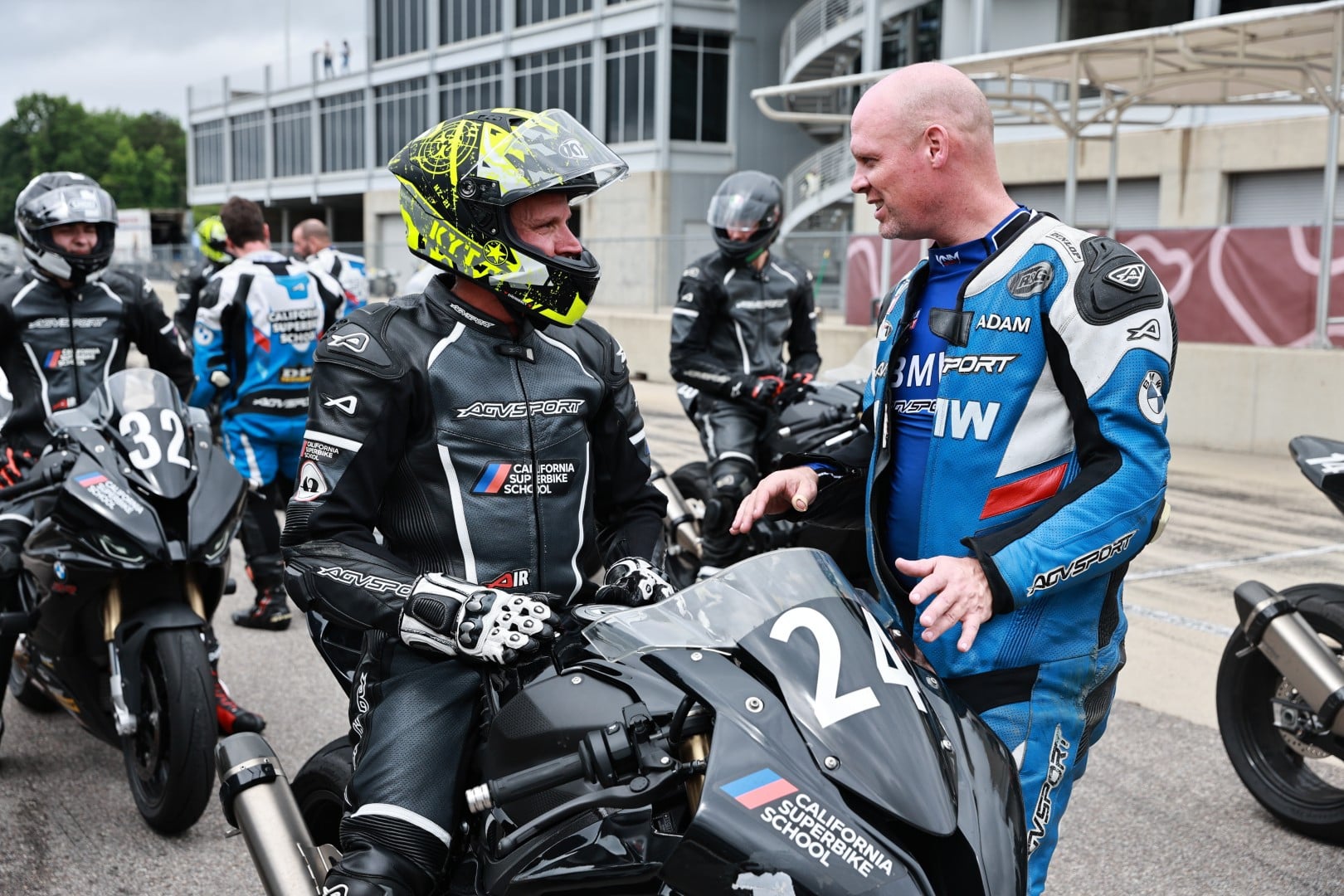
California Superbike School Announces 2027 Schedule The California Superbike School has announced its 2027 schedule, with classes at 16 racetracks across the United States. The school will have a full fleet of new 2027 BMW S1000RR motorcycles available for students. Founded in 1980, the California Superbike School has been training riders for more than four decades, with graduates going on to win 113 world and national championships. The complete 2027 schedule is now available at superbikeschool.com/schedule. California Superbike School on track at Barber Motorsports Park. Photo by Bob Hartman/etechphoto.com
Find your track. Choose your dates. Let's ride!
Register Online https://superbikeschool.com/schedule/ or call us at (800) 530-3350 with any questions.
2026 - 2027 Dates
CALIFORNIA SUPERBIKE SCHOOL 2026 - 2027 SCHEDULE OF SCHOOLS
Date: Track: Location: Type of School: Pricing: Own Bike/Rental Bike
2026
Nov 12 & 13, 2026 Las Vegas Motor Speedway North Las Vegas, NV 2-Day Camp/All Levels $2,895/$3,195
Nov 14 & 15, 2026 Las Vegas Motor Speedway North Las Vegas, NV 2-Day Camp/All Levels $2,895/$3,195
Nov 21, 2026 Podium Club Casa Grande, AZ Single Day/All Levels $675/$875
Nov 22, 2026 Podium Club Casa Grande, AZ Single Day/All Levels $675/$875
 A California Superbike School coach working 1-on-1 with a student, at Barber Motorsports Park. Photo by Bob Hartman/etechphoto.com
2027
March 6 & 7, 2027 Las Vegas Motor Speedway North Las Vegas, NV 2-Day Camp/All Levels $2,935/$3,235
March 27, 2027 Buttonwillow Circuit Track Buttonwillow, CA Single Day/All Levels $695/$895
March 28, 2027 Buttonwillow Circuit Track Buttonwillow, CA Single Day/All Levels $695/$895
April 3 & 4, 2027 Las Vegas Motor Speedway North Las Vegas, NV 2-Day Camp/All Levels $2,935/$3,235
April 15 & 16, 2027 Streets of Willow Springs CCW Rosamond, CA 2-Day Camp/All Levels $2,935/$3,235
April 17, 2027 Streets of Willow Springs CCW Rosamond, CA Single Day/All Levels $695/$895
April 18, 2027 Streets of Willow Springs CCW Rosamond, CA Single Day/All Levels $695/$895
May 3, 2027 Virginia International Raceway North Alton, VIR Single Day/All Levels $695/$895
May 4, 2027 Virginia International Raceway North Alton, VIR Single Day/All Levels $695/$895
May 5 & 6, 2027 Virginia International Raceway North Alton, VIR 2-Day Camp/All Levels $2,935/$3,235
May 10, 2027 National Corvette Museum Bowling Green, KY Single Day/All Levels $695/$895
May 11, 2027 National Corvette Museum Bowling Green, KY Single Day/All Levels $695/$895
 A California Superbike School student pays close attention to a coach on pit lane. Photo by Bob Hartman /etechphoto.com
May 17, 2027 New Jersey Motorsports Park Thunderbolt Millville, NJ Single Day/All Levels $695/$895
May 18, 2027 New Jersey Motorsports Park Thunderbolt Millville, NJ Single Day/All Levels $695/$895
May 19 & 20, 2027 New Jersey Motorsports Park Thunderbolt Millville, NJ 2-Day Camp/All Levels $2,935/$3,235
May 24, 2027 Motorsport Ranch Cresson, TX Single Day/All Levels $695/$895
May 25, 2027 Motorsport Ranch Cresson, TX Single Day/All Levels $695/$895
May 28 & 29, 2027 Barber Motorsports Park Birmingham, AL 2-Day Camp/All Levels $2,935/$3,495
May 30, 2027 Barber Motorsports Park Birmingham, AL Single Day/All Levels $695/$895
May 31, 2027 Barber Motorsports Park Birmingham, AL Single Day/All Levels $695/$895
June 1 & 2, 2027 Barber Motorsports Park Birmingham, AL 2-Day Camp/All Levels $2,935/$3,495
 Another coach with a student on pit lane during a California Superbike School. Photo by Bob Hartman/etechphoto.com
June 7 & 8, 2027 Weathertech Raceway at Laguna Seca Monterey, CA 2-Day Camp/All Levels $3,695/$3,995
June 12, 2027 Thunderhill Raceway West Willows, CA Single Day/All Levels $695/$895
June 13, 2027 Thunderhill Raceway West Willows, CA Single Day/All Levels $695/$895
June 14 & 15, 2027 Sonoma Raceway Sonoma, CA 2-Day Camp/All Levels $2,935/$3,495
July 5, 2027 The Ridge Motorsports Park Shelton, WA Single Day/All Levels $695/$895
July 6, 2027 The Ridge Motorsports Park Shelton, WA Single Day/All Levels $695/$895
July 7 & 8, 2027 The Ridge Motorsports Park Shelton, WA 2-Day Camp/All Levels $2,935/$3,235
July 9, 2027 The Ridge Motorsports Park Shelton, WA Single Day/All Levels $695/$895
July 10, 2027 The Ridge Motorsports Park Shelton, WA Single Day/All Levels $695/$895
August 4 & 5, 2027 Mid-Ohio Raceway Lexington, OH 2-Day Camp/All Levels $2,935/$3,235
August 9, 2027 New Jersey Motorsports Park Thunderbolt Millville, NJ Single Day/All Levels $695/$895
August 10, 2027 New Jersey Motorsports Park Thunderbolt Millville, NJ Single Day/All Levels $695/$895
August 11 & 12, 2027 New Jersey Motorsports Park Thunderbolt Millville, NJ 2-Day Camp/All Levels $2,935/$3,235
August 16 & 17, 2027 Virginia International Raceway South Alton, VIR 2-Day Camp/All Levels $2,935/$3,235
August 23, 2027 High Plains Raceway Deer Trail, CO Single Day/All Levels $695/$895
August 24, 2027 High Plains Raceway Deer Trail, CO Single Day/All Levels $695/$895
September 11, 2027 Thunderhill Raceway West Willows, CA Single Day/All Levels $695/$895
September 12, 2027 Thunderhill Raceway West Willows, CA Single Day/All Levels $695/$895
September 13 & 14, 2027 Sonoma Raceway Sonoma, CA 2-Day Camp/All Levels $2,935/$3,495
September 26 & 27, 2027 Weathertech Raceway at Laguna Seca Monterey, CA 2-Day Camp/All Levels $3,695/$3,995
October 2, 2027 Streets of Willow Springs CCW Rosamond, CA Single Day/All Levels $695/$895
October 3, 2027 Streets of Willow Springs CCW Rosamond, CA Single Day/All Levels $695/$895
October 4 & 5, 2027 Streets of Willow Springs CCW Rosamond, CA 2-Day Camp/All Levels $2,935/$3,235
October 13 & 14, 2027 Chuckwalla Raceway Desert Center, CA 2-Day Camp/All Levels $2,935/$3,235
October 16, 2027 Podium Club Casa Grande, AZ Single Day/All Levels $695/$895
October 17, 2027 Podium Club Casa Grande, AZ Single Day/All Levels $695/$895
October 23 & 24, 2027 Las Vegas Motor Speedway North Las Vegas, NV 2-Day Camp/All Levels $2,935/$3,235
November 11 & 12, 2027 Las Vegas Motor Speedway North Las Vegas, NV 2-Day Camp/All Levels $2,935/$3,235
November 13 & 14, 2027 Las Vegas Motor Speedway North Las Vegas, NV 2-Day Camp/All Levels $2,935/$3,235
The post California Superbike School Releases 2027 Nationwide Schedule appeared first on Roadracing World Magazine | Motorcycle Riding, Racing & Tech News.


