Single sheet calendar / Secret Mall Apartment / Data poems [ 08-Feb-26 4:00pm ]
Here's a daily calendar for 2026 that prints on a single sheet of paper. There's not much space to add appointments, but I'm using it to enter and see my family members' travel plans for the full year at a single glance. — MF
Arty documentaryYep, some years ago a band of artists really did build a secret apartment inside a mall and lived there for years. This cheerful and marvelous documentary, Secret Mall Apartment (on Netflix), reveals many more cool layers to the whole hijinks stunt. It is way more interesting and inspiring than first appears. It was a bold work of art, and I came away seeing art as a way of life. — KK
Data PoemsHere is a beautiful collection of data visualizations called Data Poems by Luke Steuber. Each piece transforms raw information—war casualties, language evolution, and UFO sightings—into contemplative visual experiences that feel more like meditation objects than charts. — CD
Why trees are goodRecent research shows that trees are like animals that can collaborate with each other, exhibit individual behavior, communicate with each other over large distances, and regulate the environment to a remarkable degree. All these marvelous abilities are revealed in the graphic novel version of the best-selling book The Hidden Life of Trees. The graphic novel is an easy pictorial read, with sketches and color drawings illuminating both the new ideas and the persistent beauty of our wooden allies. This book will give your brain the reasons why your soul finds trees so good. — KK
Text Behind ImageText Behind Image is a web app that does exactly what it promises to do. Upload an image to add text, and design and position it however you want—useful if you want to create social media or promotional graphics. It's free to use, and the finalized images have no watermarks and are high-res. — CD
Mighty keychain flashlightThe ThruNite Ti Mini keychain flashlight is surprisingly powerful for something that weighs under an ounce. The USB-C charging is a welcome upgrade from older micro-USB lights. It has four brightness levels, including a barely-there "firefly" mode, plus a magnetic tail for hands-free use. Double-clicking turns it on, preventing accidental draining in your pocket. — MF
Sign up here to get Recomendo a week early in your inbox.
Building a Budget Gaming PC in 2026 Is a Pain in the Ass [ 08-Feb-26 4:00pm ]
Cyber-Espionage Group Breached Systems in 37 Nations, Security Researchers Say [ 08-Feb-26 4:05pm ]
Why Scientists Are Rethinking 60 Years of Arctic Snow Data [ 08-Feb-26 3:44pm ]
How Music Helped Inspire the Not-Musical Stars of 'The Bride!' [ 08-Feb-26 3:30pm ]
'It's sacred and transformative': Somerset holds Saxon-inspired festival to embrace 'month of mud' [ 08-Feb-26 3:00pm ]Community organiser Jon Barrett says event, inspired by the tradition Solmōnaþ, aims to reconnect people with benefits of mud
A misty, rainy day in the uplands of Somerset and the mud was thick and sticky. In some patches, just putting one foot in front of the other without plunging into the mire felt like a win.
But Jon Barrett, a community engagement officer for the Quantock Hills national landscape, had a broad grin on his face as he negotiated the ooze.
Continue reading...
What we read last month [ 08-Feb-26 3:20pm ]
What Mark Brown read:
Cocktail Time by P. G. Wodehouse 1/3/2026
Melmoth the Wanderer by Charles Robert Maturin 1/14
The Night Life of The Gods by Thorne Smith 1/22
The Charwoman's Shadow by Lord Dunsany 1/29
Llana of Gathol by Edgar Rice Burroughs 1/31
What I read in January:
A Kiss for Damocles, J. Kenton Pierce.
Hellenistic Philosophy, John Sellars.
Red Heart, Max Harms.
Beyond Control, Jacob Sullum.
The Fourfold Remedy, John Sellars.
Forged for Destiny, Andrew Knighton.
As usual, the rest of you are invited to post in the comments about what you read last month.
The man pulling Starmer's strings has resigned in disgrace [ 08-Feb-26 3:02pm ]
Morgan McSweeney - the long-term enemy of the Canary - has resigned from government in disgrace. And to quote Canary head of content Maryam Jameela who just messaged me in Signal:
The man behind The Fraud Morgan McSweeney - offbye bye dickhead
As journalist Paul Holden covered in The Fraud, the Labour Together schemer Morgan McSweeney was the man who spent the last decade manoeuvring to:
- Bring down Jeremy Corbyn.
- Position the Labour right as the leaders of the Labour Party.
- Return to government.
McSweeney managed all three, but he hit step 3 more quickly than anticipated. This is why Labour ended up in power with the political vacuum that is Keir Starmer. It's also why they achieved a majority government with fuck all plan as to what to do next.
Regardless of the finer details, this Labour government is McSweeney's vision brought to life. This means he's lived to see how much the public despise his worldview, with voters leaving the party in droves:
Contrary to popular belief, Labour is not struggling in the polls because they're losing votes to Reform. Even if they recovered all the votes lost to Reform they'd still be on just 21%, down double digits since GE2024.
Instead, the bulk of votes lost have been to the LEFT.
— Stats for Lefties
Minister fails to convince when asked if he's done a Mandelson [ 08-Feb-26 2:57pm ]
This week, Labour politicians found themselves tasked with defending the Peter Mandelson Affair. As we've been pointing out for some time, Keir Starmer knew Mandelson was a wrong 'un when he made him the ambassador to the US, but journalists turned a blind eye. Now, the famously slow British media have woken up, and questions are being asked.
One particular question provoked a less-than-reassuring response from DWP boss Pat McFadden:
The Pat McFadden connectionIf your husband/wife asks if you've had an affair and you hadn't, you'd say no, right? You wouldn't say "I don't believe so" pic.twitter.com/RDUutdKwr9
— Saul Staniforth (@SaulStaniforth) February 8, 2026
Before we get to McFadden's worrying response, we should explain the context.
As noted, everyone knew that Mandelson maintained a relationship with Epstein after the paedophile was convicted. What we didn't know until the latest Epstein Files was that Mandelson was forwarding his paedo mate British secrets. He also worked with JP Morgan to bully the UK government into giving the bank a more favourable deal:
Mandelson was seemingly involved in insider trading, while helping Epstein, and by extension Jamie Dimon, intimidate his colleague, Alistair Darling, over a tax on bankers bonuses.
We've genuinely never seen anything like this in British politics before (on this scale).… https://t.co/nyDCgycEtj
— Aaron Bastani (@AaronBastani) February 2, 2026
Absolutely treasonous behaviour.
And there's a McFadden connection too. As Jody McIntyre wrote for the Canary on 6 February:
We now know that as Business Secretary, Peter Mandelson passed classified government information to likely Israeli intelligence asset Jeffrey Epstein, even messaging the notorious paedophile on the day former Prime Minister Gordon Brown "finally got him to go." But Mandelson had two deputies at the time, assisting him in his work: David Lammy and Pat McFadden.
Additionally:
In 2008, he was made Mandelson's right-hand man. Indeed, in a fawning article printed by the Guardian in September 2023, Mandelson waxes lyrical on his former assistant, saying: "Pat has seen it all. He is a walking encyclopedia of political and policy knowledge, and experience in government." But had McFadden "seen" Mandelson's communications with Epstein?
During the 2024 general election campaign, McSweeney and McFadden's desks were "right in the middle of the room" at Labour HQ. His wife, Marianna McFadden, was already McSweeney's no. 2. Mandelson said that McFadden and McSweeney would complement each other, opining that "Pat is cautious…[whereas] Morgan is a hard-driven street fighter." High praise all round from the Epstein-informant.
For more on Starmer's chief of staff Morgan McSweeney and how he used dodgy tactics to maneuver Starmer into power, read The Fraud by Paul Holden.
If you're not a Mandelson, just say noIn the clip at the top, the BBC's Laura Kuenssberg asks DWP boss Pat McFadden the following:
Did you ever forward emails about government business outside of government - to a private email or to someone else?
McFadden responds:
I don't believe so.
Sorry, come again?
You don't "believe" so?
As in you can't just say 'no'?
Fucking hell.
If you didn't watch the video, his face is ashen when he says this — his voice barely more than a whisper.
McFadden also said he could see why Starmer made the decision to appoint Mandelson — basically because he thought he'd get along with Trump. What goes unsaid, as always, is that Trump and Mandelson were both close friends with Epstein at one time or another:
They know it's overPat McFadden defending the decision to appoint Peter Mandelson as ambassador.
He has to, of course, because if he doesn't he's hanging the PM out to dry, and its clear the Labour right aren't ready to discard Starmer just yet. pic.twitter.com/L7ER9qeEpV
— Saul Staniforth (@SaulStaniforth) February 8, 2026
A tetchy McFadden also began to lose his temper when Kuenssberg pressed him:
McFadden is right, the media is just as culpable when it comes to Mandelson & that includes Kuenssberg (e.g. he was on #bbclaurak twice in 2024 & LK didn't ask him about Epstein either time)
This is a warning by McFadden, of course. Press me too much & I'll cover you in sh*t too pic.twitter.com/Nxk33SXWN2
— Saul Staniforth (@SaulStaniforth) February 8, 2026
It's almost as if he knows the jig is up, and he can't contain his resentment.
Oh, and shout out to Saul Staniforth who clipped the above. You can (and should) follow him on X.
Featured image via BBC
By Willem Moore
Reform urged to 'publish the proofs' following by-election letter scandal [ 08-Feb-26 2:23pm ]
As we reported yesterday, the police are investigating Reform UK. Their alleged crime is sending out a letter to the residents of Gorton & Denton which wasn't marked with the party's logo. A spokesperson for the party blamed a printing error, but people aren't buying it.
Now, a Tory councillor has pointed out there's a very simple way for Reform to quickly salvage their reputation:
Reform — LettergatePublish the print-ready proofs. https://t.co/603ATAWoqg
— Cllr. Matt Cowley (@matcow7) February 7, 2026
Reform UK blamed the absent logo on a printing error, with the printers themselves taking responsibility.
As people have highlighted, this exact same thing has happened to Reform before:
Reform have not made a "mistake" in Gorton and Denton as they did EXACTLY the same thing in Caerphilly last year. pic.twitter.com/IHISoAM9x0
— Socialist Opera Singer (@OperaSocialist) February 7, 2026
People also had a hard time believing the 'printing error' line:
The Reform UK @GoodwinMJ campaign and printer is blaming a "trimming error" for the imprint not being on the letter.
Bearing in mind the letter is A4, what exactly was trimmed.
And why would you print on A4 and trim it? The images show it clearly wasn't trimmed.
The lie is… pic.twitter.com/EJ7q8O118h
— Reform Party UK Exposed
Sony's Hawk-Eye Cameras Still Aren't Giving Football Fans the One Thing They Want [ 08-Feb-26 3:00pm ]
Supercross: Results From Glendale, Arizona [ 08-Feb-26 2:42pm ]GLENDALE, Ariz. (February 7, 2026) - The fifth round of the 2026 Monster Energy SMX World Championship was headlined by the largest audience ever for a Monster Energy AMA Supercross Championship race inside State Farm Stadium, which also included unprecedented attendance at FanFest. The record crowd was treated to a memorable night of racing that provided a shakeup of the early 450SMX Class title fight as Progressive Insurance Cycle Gear Suzuki's Ken Roczen became the fourth different winner in the first five races, while Honda HRC Progressive's Hunter Lawrence took over the points lead. It all unfolded after misfortune hindered entering points leader and Red Bull KTM Factory Racing rider Eli Tomac to a finish outside the top 10.
Ken Roczen Wins in Glendale to Become Fourth Different Winner in Five Races to Open 2026 Monster Energy Supercross Season.
The 450SMX Class Main Event began with ISRT MX4Christ Kawasaki's Vince Friese briefly out front for the holeshot before Lawrence grabbed the early lead ahead of Roczen and Monster Energy Yamaha Star Racing's Cooper Webb, the defending series champion and winner of last weekend's race in Houston. Behind them, Tomac was taken to the ground entering the first turn by Quad Lock Honda's Christian Craig, who lost traction and collided with his KTM-mounted counterpart. Tomac took his time to re-enter the race and resumed well back of the field in 22nd place. Back up front, Lawrence paced the field for the opening stint of the 20 Minutes + 1 Lap Main Event until Roczen went on the attack and seized control of the lead with about 16 minutes left on the race clock. The German's impressive pace allowed him to establish a lead of about 3.5 seconds, which he managed for the majority of the race. Lawrence asserted a firm hold of second, as Webb slowly lost touch with the lead duo and soon settled in all by himself in third. As the lead trio strengthened their respective positions, the attention shifted to Tomac and his recovery from the early misfortune. Once he caught the rear of the field, Tomac methodically worked his way up the running order, picking off riders one-by-one until he found himself on the cusp of the top 10 in the closing stages of the race.
Roczen went unchallenged en route to his fifth victory inside State Farm Stadium, where he took the checkered flag 3.3 seconds ahead of Lawrence, who captured a fourth straight runner-up finish. Webb followed up his win with a third-place effort, while Tomac climbed up to 12th and salvaged what could have been a devastating night in the championship.
Roczen's triumph was the 24th of his decorated career and he has now emerged victorious across seven consecutive seasons. It served as an emotional win for the veteran, following a Friday announcement from Pipes Motorsports Group that revealed esteemed team manager Larry Brooks has been diagnosed with cancer and has taken a leave from the races as he undergoes treatment.
Lawrence, whose fifth career runner-up is tied for the second-most without a win in series history, moved atop the 450SMX Class standings and took possession of the red plate for the first time in the premier division. He currently holds a five-point lead over Roczen, while Tomac dropped to third, eight points behind Lawrence.
 Progressive Insurance Cycle Gear Suzuki's Ken Roczen became the fourth different winner in five races with an impressive performance in Glendale. Photo courtesy Feld Motor Sports, Inc.
Ken Roczen - 1st Place - 450SMX Class: "This feels unreal. I got a good start and then Friese cut me off going into the first turn, which I expected, which slowed my momentum a little bit. [Eventually] I was able to pass Hunter [Lawrence] and I knew it was going to be a long Main Event because trying to put a gap [on the field] was really hard and the track was tricky. It was just so fast, and everything was built super tall. I'm just really happy. "I want to dedicate this win specifically to Larry [Brooks]. He hasn't been able to be with us here the last few races. It really hurts all of our hearts. He loves this more than anybody. This one goes out to him."
 With his fourth straight runner-up finish Honda HRC Progressive's Hunter Lawrence has moved atop the 450SMX Class standings for the first time. Photo courtesy Feld Motor Sports, Inc.
Hunter Lawrence - 2nd Place - 450SMX Class:
"It's bittersweet. I got a great start and was in a great position. Kenny [Roczen] was riding unreal tonight. He was riding a lot better than me in the first 10 minutes and opened that gap. I just didn't quite have it. I didn't feel amazing, just flat, but not bad. We'll take it. [Getting] the red plate is cool, but we've got a long season ahead."
 One week after his first win of the season defending champion Cooper Webb finished third aboard his Monster Energy Yamaha Star Racing machine. Photo courtesy Feld Motor Sports, Inc.
Cooper Webb - 3rd Place - 450SMX Class: "It was a good night overall. I think we know this hasn't always been my best place [results wise], so I was really happy with that result. Kenny [Roczen] was riding awesome and I was right there with Hunter [Lawrence] for a bit and then he started inching away. I fell into a bit of a no-man's land and took it for a third. I'm happy with that. Happy to leave here with good points. A podium here is a win for me."
 450SMX Class Podium (left to right) Hunter Lawrence, Ken Rcozen, and Cooper Webb. Photo courtesy Feld Motor Sports, Inc.
 Red Bull KTM Factory Racing's Eli Tomac endured through his toughest night of the young season and lost his hold of the points lead after a 12th-place finish. Photo courtesy Feld Motor Sports, Inc.
Eli Tomac - 12th Place - 450SMX Class: "I put myself in a position where bad things can happen. I started off a little bit pinched [by other riders] and then got taken out by Craig. I don't know what happened before that or why he crashed. All I know is Craig hit me and I was done. It took me a little while to get warmed up again, to get my body loosened up and going. That's what I had to get back to 12th. The good thing is we're not too far down [in the championship]. We'll just have to do some digging now."
Haiden Deegan Goes Wire-to-Wire for Fourth Straight 250SMX Class Victory.
The fifth race of the Western Divisional 250SMX Class was arguably the most dominant yet for Monster Energy Yamaha Star Racing's Haiden Deegan, the reigning West champion. He stormed out the gate to open the 15 Minutes + 1 Lap Main Event with a convincing holeshot that he turned into a multi-second lead just a couple laps into the race. From there, Deegan never looked back and continued to add to his advantage. Fellow Monster Energy Yamaha Star Racing rider Michael Mosiman gave chase from second, while Monster Energy Pro Circuit Kawasaki's Cameron McAdoo and Rockstar Energy Husqvarna Factory Racing's Ryder DiFrancesco battled for third. McAdoo held the position initially but gave way to DiFrancesco for several laps before the Kawasaki rider reclaimed the position and inched away from his rival. As the race wore on, all eyes centered on Monster Energy Pro Circuit Kawasaki's Levi Kitchen, who was on an incredible charge through the field after he rounded the first turn in 19th place. The Washington native made an improbable climb into the top five and then passed his teammate McAdoo to move into podium position with less than three minutes remaining. Kitchen's journey forward didn't end there as he caught and passed Mosiman for second with 90 seconds to go and even had Deegan in his sights on the final lap.
Deegan's command of the Main Event was never threatened, and he easily amassed a wire-to-wire performance for his fourth straight victory. He took the 11th win of his career by 4.1 seconds over Kitchen, who passed 17 riders to secure back-to-back runner-up finishes. McAdoo made a late charge to catch and pass Mosiman and finish third for the second consecutive race, which resulted in an identical podium from the previous race.
Deegan further solidified his command of the Western Divisional standings and has a lead of more than a single race, at 27 points over Mosiman, who finished fourth. DiFrancesco, who finished fifth, sits third, 29 points out of the lead. McAdoo and Kitchen sit fifth and sixth, respectively.
 Monster Energy Yamaha Star Racing's Haiden Deegan went wire-to-wire for his fourth straight Western Divisional 250SMX Class victory. Photo courtesy Feld Motor Sports, Inc.
Haiden Deegan - 1st Place - Western Divisional 250SMX Class: "These races have been solid. Lots of hard work with the family and the team. Thank you to Yamaha and the whole Star Racing team, my bike is amazing. This feels good. The hard work I put in this offseason, it's paid off. It shows who works hard and who doesn't."
 Monster Energy Pro Circuit Kawasaki's Levi Kitchen impressed in a runner-up effort that saw him pass 17 riders in a climb from 19th to second. Photo courtesy Feld Motor Sports, Inc.
Levi Kitchen - 2nd Place - Western Divisional 250SMX Class: "It's a good night with a lot of positives, but there's always a negative in my nights [as well]. I can't be doing that when [Deegan] is doing everything right. Track position is really important, and I didn't help myself there, but I feel good. I've just got to keep working and keep fighting."
 Monster Energy Pro Circuit Kawasaki's Cameron McAdoo earned his third podium finish in the past four races. Photo courtesy Feld Motor Sports, Inc.
Cameron McAdoo - 3rd Place - Western Divisional 250SMX Class: "I fought hard for that one. I got myself into third on the first lap and then in the option lane I chose the inside, which let Ryder [DiFrancesco] slingshot around me. Then I got him [back for third], then Levi [Kitchen] came and got me [for third]. With three to go I was fourth and I was pretty far from Michael [Mosiman], but I had been digging the whole time. I saw him and saw where I had some more in the tank and just made it happen."
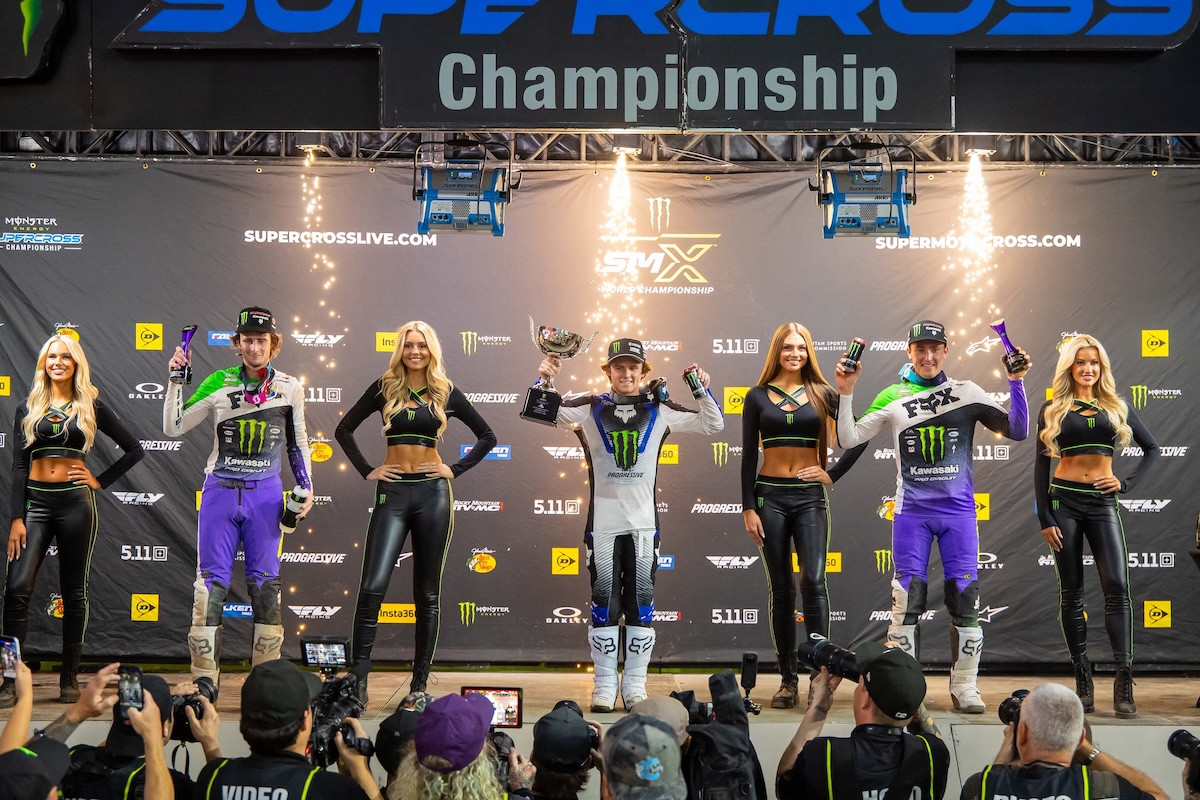 Western Divisional 250SMX Class Podium (left to right) Levi Kitchen, Haiden Deegan, and Cameron McAdoo. Photo courtesy Feld Motor Sports, Inc.
The Monster Energy SMX World Championship and Monster Energy AMA Supercross Championship will continue next Saturday for the sixth race of the season from Seattle's Lumen Field. Live broadcast coverage on Peacock will begin at 1 p.m. ET with Race Day Live, followed by the Gate Drop at 7 p.m. ET. Additionally, a domestic Spanish language broadcast is available on Pea cock while international viewers can choose from dedicated English, French, and Spanish broadcasts via SMX Video Pass (www.SMXVideoPass.com).
All 17 rounds of the 2026 Monster Energy AMA Supercross Championship and 11 rounds of the Pro Motocross Championship are on sale. Tickets for the SMX World Championship Playoff Rounds and Final will go on pre-sale Tuesday, Jan. 27, with general tickets on-sale to the public on Tuesday, Feb. 3 at Supermotocross.com. Saturday FanFest will take place at all postseason races, Friday FanFest and camping will be available in Columbus and Ridgedale, additional details to follow.
For information about the Monster Energy SMX World Championship, please visit www.SuperMotocross.com and be sure to follow all of the new SMX social media channels for exclusive content and additional information on the latest news:
- Instagram: @supermotocross
- Facebook: @supermotocross
- X: @supermotocross
- YouTube: @supermotocross
- TikTok: @supermotocross
The post Supercross: Results From Glendale, Arizona appeared first on Roadracing World Magazine | Motorcycle Riding, Racing & Tech News.
Three AI engines walk into a bar in single file... [ 08-Feb-26 3:00pm ]Developers looking to gain a better understanding of machine learning inference on local hardware can fire up a new llama engine.…
Newly released files keep suggesting Epstein isn't dead [ 08-Feb-26 12:59pm ]
The absolute last conspiracy theory you want to be entertaining is 'X person is actually still alive'; if nothing else, because it's such a cliche. We're at a point, however, where we need to acknowledge what's coming out of the Epstein Files, because god damn:
Why would the Trump administration draft a press release saying that Epstein died a day before he actually died?
Oh. Oh my. https://t.co/Cx2SHzqUCP
— PatriotTakes
Lammy has thrown Starmer under the Mandelson bus [ 08-Feb-26 12:32pm ]
Things are looking worse and worse for Keir Starmer. This is especially bad, because things were already about as terrible as it's possible to get for a sitting PM.
Lammy told StarmerIn the latest instance of the badness intensifying, the deputy PM David Lammy has apparently said he told Starmer not to appoint Mandelson. And of course, what we actually mean is "friends of the Deputy Prime Minister" told the Telegraph.
There's just one problem with all this:
WhispersThat's odd because here is David Lammy describing Peter Mandelson as a "man of considerable expertise" and the "right man" to be the US ambassador.
Looks like he is trying to save his own skin. https://t.co/V1vIlscNws pic.twitter.com/Ve8AoJLdMX
— Chris Rose (@ArchRose90) February 7, 2026
Here's what the Telegraph reported:
David Lammy turned on the Prime Minister as allies revealed he had warned against appointing Lord Mandelson as the ambassador to the US.
In a blow to Sir Keir Starmer, friends of the Deputy Prime Minister confirmed on Saturday night that he had not been in favour of bringing the "Prince of Darkness? back into government over his links to Jeffrey Epstein.
Mr Lammy is the first Cabinet minister to break openly with the embattled Prime Minister, whose future hangs in the balance over the Mandelson scandal.
If it was us, we wouldn't simply have 'warned' Starmer; we would have refused to serve in the same government as the 'Prince of Darkness'. They don't call him that for nothing, and finally the media is past pretending.
This is what slippery Lammy said in the video above (emphasis added):
Peter Mandelson is a man of considerable expertise. He's the right man for this moment to be out ambassador. He's been a business secretary, a Northern Ireland secretary, of course he's worked in the European Commission, and he brings all of that to bear working as our ambassador, and of course he's looking forwards to presenting his credentials to Donald Trump.
If Lammy is telling the truth, and he did warn Starmer, then he was lying when he said Mandelson was the "right man for this moment".
Either way, he's a liar.
And you can't trust a liar.
StarmfallThe Telegraph article also reports that Starmer is "devastated" and considering an exit. It further suggests Wes Streeting may have scuppered his own chances of replacing Starmer because of his links to Mandelson (links we've reported on). The problem for Labour is that most of the big players in the current government are connected to Mandelson, because he's been the puppet master behind Starmer's operation.
In other words, there's no obvious way out of this mess for Labour.
Featured image via BERR
By Willem Moore
What's the Difference Between SpaceX's Starlink, Amazon Leo, and Blue Origin's TeraWave? [ 08-Feb-26 12:00pm ]
Brookhaven Lab Shuts Down Relativistic Heavy Ion Collider (RHIC) [ 08-Feb-26 1:50pm ]
Poem: Road rage [ 08-Feb-26 1:23pm ]
Road Rage

We drove our car through Maldon
We didn't want to go
But the old A12 was all closed off
So the traffic couldn't flow.

We strayed into a bus lane
Apparently we did
We had a letter telling us
It's cost us thirty quid.

We didn't want to go there
We won't go there again
We're staying here in Suffolk
And sulking, in the rain.
More from East Anglia Bylines
 Culture
A review of East Anglia Bylines, as conceived by Miss Jane Austen
byEast Anglia Bylines 16 December 2025
Culture
A review of East Anglia Bylines, as conceived by Miss Jane Austen
byEast Anglia Bylines 16 December 2025
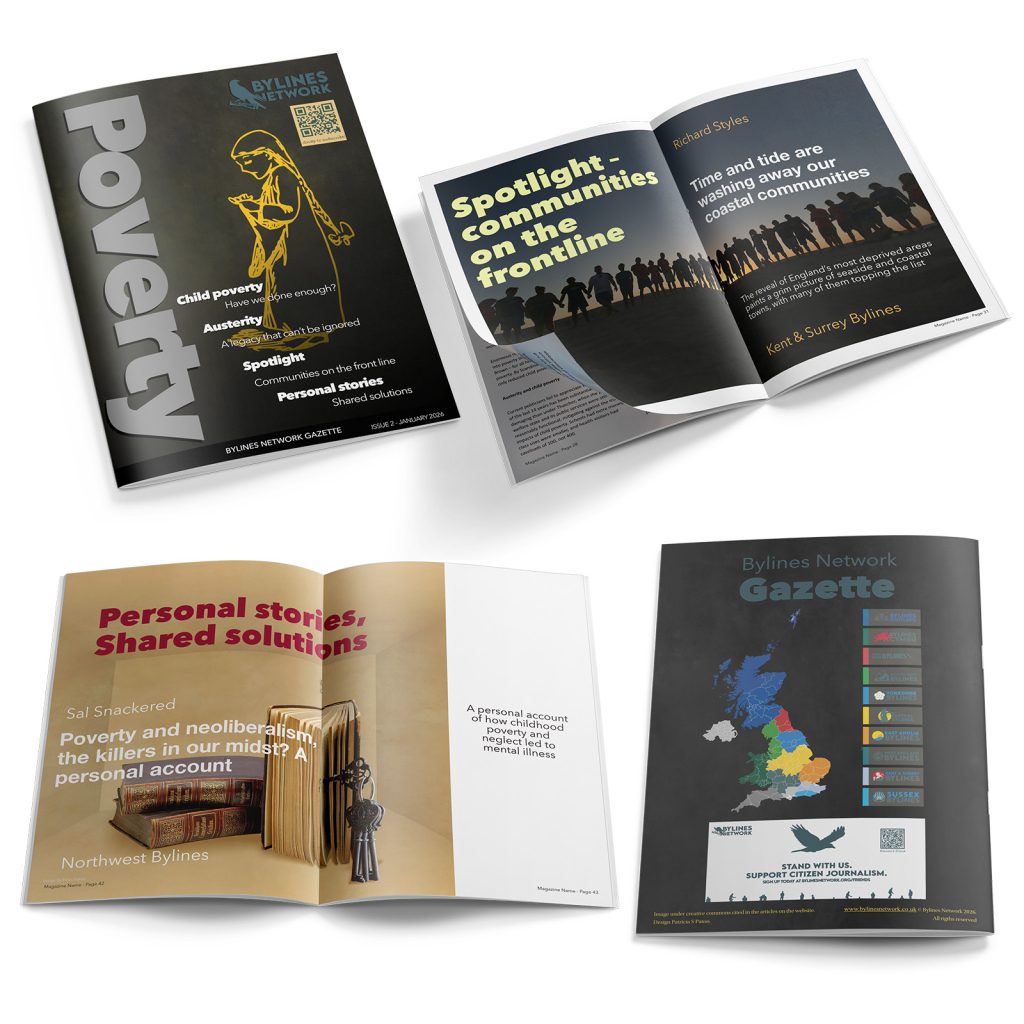 Bylines Network Gazette is back!
With a thematic issue on a vital topic - the rise child poverty, ending on a hopeful note. You will find sharp analyses on the effect of poverty on children's lives, with a spotlight on the communities that are on the front line of deprivation, with personal stories and shared solutions. Click on the image to gain access to it, or find us on Substack.
Journalism by the people, for the people.
The post Poem: Road rage first appeared on East Anglia Bylines.
Book Review: Me vs Brain - An Overthinker's Guide to Life by Hayley Morris ★★★★☆ [ 08-Feb-26 12:34pm ]
I bought this book for the title alone and I'm glad I did! I don't think I've seen any of Hayley Morris's comedy sketches. To be honest, you don't need to be a fan of her work to appreciate the humour and courage in this book. It could quite easily have been a cash-in celebrity autobiography - light on the details and full of charming anecdotes - and I'm sure her fans would have snapped it up.
Instead it is a darkly funny meditation on intrusive thoughts, panic, and acceptance.
Her prose is exceptionally good - I loved the way she described doing the washing up as "giving a dinner plate a little bubble bath" - it's also extremely relatable. Everyone occasionally thinks "what if I just ran away?" or "what would happen if I dropped this glass?" For most people it is just a passing moment; but for Hayley it is something more intense.
All of this is smuggled to the reader hidden within poop jokes, tales of teenage awkwardness, and millennial angst. It is consistently funny which makes the sudden switch to pathos all the more effective. It morphs into a tender tale of loss, loneliness, and something else beginning with L which will make me sound erudite.
I wouldn't describe it quite as a "self-help" book, but I think that's clearly part of the intention. Lots of people need to know that their (parasocial) friends find therapy useful. Having someone influential describe the journey to better mental health in such a relatable way will undoubtedly help others.
Office buzz: UK employers turn to beehives to boost workplace wellbeing [ 08-Feb-26 12:34pm ]Providers report rise in demand as companies seek mental health benefits and increased sense of community
In a growing number of workplaces, the soundtrack of the lunch break is no longer the rustle of sandwiches at a desk, but the quiet hum of bees - housed just outside the office window.
Employers from Manchester to Milton Keynes are working with professional beekeepers to install hives on rooftops, in courtyards and car parks - positioning beekeeping not as a novelty but as a way to ease stress, build community and reconnect workers with nature in an era of hybrid work and burnout.
Continue reading...
Last Week in Collapse: February 1-7, 2026 [ 08-Feb-26 12:48pm ]Hypernormalization, plastic pollution, Islamist attacks in Nigeria, the end to a nuclear treaty, and famine in (South) Sudan.
Last Week in Collapse: February 1-7, 2026
This is Last Week in Collapse, a weekly newsletter compiling some of the most important, timely, soul-crushing, ironic, amazing, or otherwise must-see/can't-look-away moments in Collapse.
This is the 215th weekly newsletter. The January 25-31, 2026 edition is available here if you missed it last week. These newsletters are also available (with images) every Sunday in your email inbox by signing up to the Substack version.
In Memoriam: Fellow Substacker (The Crisis Report), r/collapse member, and Doomer, Richard Crim, passed away on November 23, 2025. A post from the subreddit last week announced his passing, and also collected tributes from the Collapse community. Crim was an accessible, good faith, honest communicator, especially on issues relating to environmental science and climate change. RIP.
——————————
It was a mission filled with promise, but fumbled near the finish line. A research team studying Antarctica's mighty Thwaites Glacier (almost twice the size of Iceland) was collecting samples from just over one kilometer deep into a small borehole last weekend. A large chain, used to carry the sensors, was lowered deep into the hole, probably got stuck on the side of the hole, where it refroze in place and got permanently stuck. Weather and pre-arranged ship departures prevented the first-of-its-kind experiment (9 years in the making) from continuing. Preliminary data suggest that warm water is flowing deep below part of the Thwaites, although the necessary data to make informed predictions as to the Collapse of the Thwaites is lacking. It may be years more before we have the information.
Fundraising is ongoing to raise $10M USD to build a sea curtain around the Thwaites, which, when fully melted, is expected to cause sea level rise of more than two feet (61 cm). Prototype "sea curtains", made from a "reinforced tensile fabric" are being tested over the next three years near Norway.
As Central Asia's water security worsens, and the region warms twice as quickly as the global average, countries like Kazahkstan are pushing for early warning systems to prevent a breadbasket failure from catching Eurasia off-guard. A study on groundwater depletion in the Himalayas and Tibet found that "47% of GWS {groundwater storage} variability {is attributed} to direct climate drivers and an additional 15% to cryospheric processes, while human activities contribute up to 38% of declines." 69% of the region experienced GWS declines from 2003-2020. "These basins are characterized by persistent groundwater overexploitation, compounded by increasing evaporative demand under warming conditions. Totally, net groundwater loss across all basins amounts to −24.2 Gt yr−1….This decline indicates the vulnerability of downstream water systems, where storage and recharge is increasingly insufficient to offset intensive extraction and evapotranspiration losses."
On Tuesday, a group of agricultural leaders submitted a 4-page letter warning the U.S. Congress about a future "widespread collapse of American agriculture"
"Farmer bankruptcies have doubled, barely half of all farms will be profitable this year, and the U.S. is running a historic agriculture trade deficit….By placing tariffs on farm inputs -- from fertilizer, to farm chemicals, to machinery parts -- the Administration's tariffs have increased prices for farm inputs and have pushed the cost of production well above commodity prices….Today, whole U.S. soybeans represent just 24.4% {of the world soy market} - a 50% reduction in market share….mass deportations, removal of protected status, and failure to reform the H-2A visa program are wreaking havoc with dairy, fruit and produce, and meat processing…" -selections
A photo essay captures the horrors of the 2020 wildfires in Brazil's Pantanal, the largest wetland on earth (comparable in size fo the island Java). Estimates on Amazon deforestation predict 30% more deforestation by 2045, because a collection of multinational corporations has withdrawn from an agreement not to grow soy in part of the rainforest.
Why did atmospheric methane increase so much from 2019-2023? A study in Science says that it was due to a large drop in 'hydroxyl radicals," an OH free radical that helps to break down CH4 in the air. This side effect was partially caused by COVID lockdowns and temporarily reduced CO2 emissions. Also, a long La Nina wetted the tropics, leading to above average methane production in tropical wetlands.
The U.S. Virgin Islands felt its hottest night for February. Several parts of the UK felt their wettest January on record. The daily sea surface average temperature at the end of January was 0.15 °C warmer than 3 years ago. A flying fox colony in Australia was 80% killed off by a vicious heat wave. Storm Leonardo began battering Iberia, forcing evacuation of 100,000+ people and sweeping away one girl in the floods. Cyclone Mitchell escalated into a category 3 storm before striking the northwest coast of Australia.
Two weeks of heavy snow in Japan, bringing as much as two meters in some places, resulted in over 45 deaths and hundreds of injuries, as well as 1,700+ homes losing power. Gabon set a new February heat record at 35.7 °C (96 °F). A February 14 deadline looms for Colorado River Basin states to negotiate a new water-sharing agreement. Greenland ended its warmest January on record—almost 8 °C above their average January from 1990-2020.
A Nature Geoscience study concluded that "future West Antarctic Ice Sheet retreat is likely to decrease carbon uptake in the large Pacific sector of the Southern Ocean" because the iron delivered to the Southern Ocean from the West Antarctic Ice Sheet is in a form which makes it not easily able to be processed by nearby algae. The nearby waters may therefore not sequester as much carbon as predicted during the melting of the ice sheet, leading to another feedback loop in the region.
Climate disasters, global warming, and the resultant growing costs of buying a house have led 49% of Americans to consider moving—although 41% of that 49% is only considering relocating within their community or city. But surveys say 16% of U.S. homeowners are "extremely concerned" about climate change and/or extreme weather, 33% are "very concerned," and 29% are "moderately concerned." Hawai'i's 8-page annual climate report says the state had its second-driest year in over 100 years (after 2010).
——————————
A study of fish & microplastics in the Pacific found particularly high rates of microplastics (75%) in the fish off the coast of Fiji (pop: 935,000). A study from January indicates that bottled water (in the U.S., anyway) unsurprisingly has a higher concentration of microplastics than most tap water. "Bottled water had a high abundance of polyamide (PA), polyethylene terephthalate (PET), and polyethylene (PE), while treated drinking water was most abundant in PA and polyesters (PES including PET)."
A Nature op-ed argues that a new global plastics treaty may still be agreed upon—although its adoption requires surmounting hurdles relating to the "full life cycle of plastic," procedural issues, aligning national & corporate interests, as well as the interests of rich and undeveloped countries & minorities. In other words, it probably ain't happening.
Despite gloomy attitudes about the present & future economy, Americans are spending more, and the stock market continues to rise. Consumer sentiment has now dropped to lows lower than the worst of the COVID-19 pandemic, and the value of the USD has fallen to 4-year lows. Other writers warn about mass unemployment resulting mostly from AI proliferation and the hollowing out of cognitive labor jobs (call centers, paralegals, programmers, etc). What follows when most of today's white-collar jobs have dissolved?
Research into Long COVID and smoking determined that tobacco use results in some worse symptoms. Cigarette smokers "showed significantly higher odds for chest pain, dyspnea, and fatigue, while HTP {vape} users for dyspnea and sexual dysfunction." Other recent research suggests that COVID exposure to babies in utero (especially during the 3rd trimester) increased the chance of a "neurodevelopmental diagnosis" by about 7%. Small amounts of COVID can cross the placenta and also be present in amniotic fluid.
A pre-publication study in Nature Communications looked at the parasite Toxoplasma gondii, which lies dormant in about one third of humans. They found that—in mice, anyway—the parasite causes cysts in which the parasite may grow inside these cysts and re-emerge when immune systems are weakened. The parasite can theoretically only reproduce inside felines but can be spread to nearly any warm-blooded mammal. Symptoms begin similar to the flu. Malawi declared a polio outbreak.
A study in Science Advances estimates that, from 2006-2020, "Wildfire smoke PM2.5 was responsible for ~24,100 all-cause deaths per year in the contiguous {lower 48} United States….projections showing a global increase of extreme fires up to 50% by 2100." Another study suggests that the "urban heat island" effect (cities generally warm faster than other land) will cause ~81% of cities' land to heat up "faster than the surrounding area…Under a 2 °C global warming scenario….in India and China, mean LST {land surface temperature} is projected to increase by an additional 50-112% above ESM projections of the surrounding area."
Some economists are saying that Trump is positioning the economy for a Second Great Recession, triggered by many of the same causes. Home prices are rising, and would-be buyers are again turning to subprime loans to finance their homes. What's more—the current SEC Chair, and also former SEC commissioner in the years leading up to 2008, is pushing similar deregulations for banks to lend mortgage money again. Adjustable rate loans may surge back, destabilizing people's finances and leading to financial ruin. U.S. home prices are up more than 50% since 2019. Others believe spiraling government debt (approaching $39T in the U.S.) will set off a financial crisis leading to worse inflation and/or austerity policies. Also, U.S. unemployment claims his 2-month highs for the end of January, with 231,000 new unemployment claimants.
After SpaceX absorbed Elon Musk's AI company, xAI, Musk's wealth jumped to over $850B. The ongoing release of the Epstein Files has implicated many of the rich & famous in their associations with Jeffrey Epstein—including visits to his notorious island.
Bird flu was found in London's swans along the Thames. Over a thousand crows died from bird flu near Chennai (metro pop: 13M) in the first 5 weeks of the year. Over 4M birds in the U.S. have been affected by bird flu or subsequent cullings this year.
A flood at a wastewater plant in Wellington (pop: 430,000), New Zealand, resulted in sewage flowing directly into the ocean. Repairs are expected to take months. One person was confirmed dead from Nipah virus in Bangladesh.
——————————
162+ villagers were slain in western Nigeria in a couple jihadist attacks, allegedly after refusing commands to affirm their allegiance to sharia law. Assassins in Libya killed the son of Muammar Gaddafi in his home. A photo essay from Myanmar shares images from Myanmar's ongoing 5-year Civil War. Pakistan is intensifying operations against Balochi separatists behind recent suicide bombings; a couple days later a suicide bombing at a mosque in Islamabad (pop: 1.3M) killed 31 people, injuring 160+ others.
The U.S. shot down an Iranian drone near a U.S. aircraft carrier. Negotiations between both powers fell apart, and were then patched back together, to deal with Iran's alleged nuclear program.
President Trump's moves to cut off oil imports to Cuba (by threatening tariffs on countries selling oil to Cuba) is aggravating economic and energy unrest, and moving the country closer towards regime change. Moves to rescind protected status for hundreds of thousands of Haitians have hit resistance from federal judges, for the time being. European leaders are conceding that the United States is changing under Trump, and will not easily shift back in norms following the end of his presidency.
Russian strikes again targeted energy infrastructure in Kyiv on Monday, cutting off power to a large part of the city. The Russian economy is finally starting to sag, after many months of a mid-War boom. The UK and other European nations are getting more serious about checking and apprehending Russia's shadow fleet of oil tankers sailing through the Baltic Sea. President Zelenskyy claims that, in 2025, Russians were killed at a 47:1 ratio when compared to Ukrainian soldiers, of whom he says about 9,000 died in 2025—believe it if you want. The expiration of a key nuclear treaty has also raised the specter of future nuclear posturing, and conflict. "For the first time in more than half a century, we face a world without any binding limits on the strategic nuclear arsenals {of the U.S. and Russia}," said the UN Secretary-General. Watch the last known nuclear test of the U.S. here, from September 1992.
Strikes in Rafah, Gaza killed 18+ near a border crossing. Observers fear that Ethiopia will spiral back into War following the rebel Tigrayan forces (TPLF) attempting to occupy former Tigrayan lands within Ethiopia two weeks ago.
Fighting is reportedly escalating in South Sudan, and a 12-boat aid convoy was attacked and looted on its way to deliver some 1,500 tonnes of supplies to the hunger-stricken region. Not far away, in southern Sudan, thousands are fleeing towards the mountains to escape rebel forces (and bandits). All major supply routes have been severed. An RSF drone strike killed 24 people fleeing. Famine is worsening.
——————————
Select comments/threads from the subreddit last week suggest:
-The Collapse is Hypernormalization, if this popular self-post from last week is accurate for you. The system keeps grinding on even as the world around us spirals into breakdown. Or do things feel very much abnormal?
-You are underestimating the dangers from microplastics, according to this self-post from r/immortalists , a subreddit about health and longevity. Since (micro/nano)plastics aren't going away, and are projected to increase in number, you ought to inform yourself earlier rather than several years from now.
Got any feedback, questions, comments, upvotes, AI news, weather forecasts, off-grid maps, complaints, etc.? Last Week in Collapse is also posted on Substack; if you don't want to check r/collapse every Sunday, you can receive this newsletter sent to an email inbox every weekend. As always, thank you for your support. What did I miss this week?
submitted by /u/LastWeekInCollapse[link] [comments]
'Simply making it up' — Reform-led council invented supposed £40m saving [ 08-Feb-26 12:12pm ]
Reform-led Kent council — one of the far-right party's 'flagships' — has been exposed inventing a claim that it had saved tens of millions as part of its 'DOLGE' 'efficiency' drive. The programme is supposed to be based on the Trump-Musk 'Department of Government Efficiency' (DOGE), with the addition of 'local'. But it follows the DOGE model in different ways from what we're supposed to think.
Just as DOGE claimed huge savings that it then had to remove from its supposed 'achievements', Reform's claim that DOLGE had saved almost £40m from Kent council's budget has turned out to be made up. So clearly made up, in fact, that the council's DOLGE lead Matthew Fraser-Moate has resigned because the council:
DOLGE-IE stuff from Reform
Moate's colleague Paul Chamberlain, another councillor involved in Reform's DOLGE team, also quit. In January 2025, he had admitted publicly that there:
just weren't big cuts to make, because services had already been hacked away for years and years.
Well duh.
The claims have now been dismissed as a "blatant lie" after the savings — supposedly made on 'net zero', of course — were found to be entirely based on "hypothetical" projects whose existence is completely undocumented.
The £39.5m figure, part of a claimed £100m saving, was made up (literally!) of £32m from scrapping a scheme reducing properties' environmental impact and £7.5m by not switching to electric vehicles. After months evading transparency, the council eventually admitted that the projects didn't exist but were "potential capital projects" the council might have done in future but had not allocated any funding to.
Despite the admissions, a council spokesperson said that the council "categorically rejects any suggestion of impropriety, fabrication of figures or attempts to mislead".
While making up savings, Reform had been 'spaffing' large sums on parking spaces for its councillors — £600k.
Green party Kent councillor Stuart Jeffrey told the Canary he had been pursuing the matter for ages but there is "no record of savings". Worse, Reform has added to its spendthrift ways by creating a new cabinet position who will "burden" the council's strained finances:
I've been asking the finance team for the detailed impact of DOLGE and there is no record of savings. Reform are simply making it up.
Worse still is that they are doubling down on their personal pocket lining approach by appointing another cabinet member who will deliver nothing while being a burden himself on the council finances.
Featured image via KentLiveNews
By Skwawkbox
Whistleblower says intel chief Gabbard hid Trump circle's call with foreign intelligence [ 08-Feb-26 11:42am ]
A whistleblower's allegations against Trump's Director of National Intelligence (DNI) Tulsi Gabbard have finally been revealed. After a Washington process hid the details for a week following an unnamed whistleblower said he would publish them if they continued to be hidden, the allegations have finally been made public — and they are dynamite.
In spring 2025, the US National Security Agency (NSA) detected a call between a party identified as a foreign intelligence figure and a person described as very close to Trump. The NSA informed Gabbard, but instead of following normal distribution process, Gabbard blocked it. She then printed a copy and took it to Trump's chief of staff Susie Wiles — all according to Andrew Bakaj, the whistleblower's lawyer.
After meeting Wiles, Gabbard told the NSA to kill the report's publication and told it to send all information only to her office.
A spokesperson for Gabbard's office denied the accusation as "baseless" and claimed it was politically motivated. However, the communications between Gabbard and the NSA — and Wiles's receipt for the intelligence report — were sent directly to the Guardian. Gabbard was once a Trump critic, but changed her tune after Trump appointed her as DNI.
Joining the dots, many are publicly linking the 'foreign intelligence' service to confirmations in the latest Epstein file release that Donald Trump is "compromised by Israel", including former political candidate Melanie D'Arrigo:
Tulsi Gabbard and the White House killed a whistleblower report that someone close to Trump was talking to foreign intelligence.
Trump and his inner circle are in the Epstein files, and likely controlled through blackmail by foreign intelligence.
The whole Trump administration…
— Melanie D'Arrigo (@DarrigoMelanie) February 7, 2026
Featured image via the Canary
By Skwawkbox
Containers, cloud, blockchain, AI - it's all the same old BS, says veteran Red Hatter [ 08-Feb-26 12:30pm ]Opinion The real opponent of digital sovereignty is "enterprise IT" marketing, according to one Red Hat engineer who ranted entertainingly about the repeated waves of bullshit the industry hype cycle emits.…
Raul Fernandez relieved to finish "very important" Sepang MotoGP Test "destroyed" [ 08-Feb-26 12:18pm ]
Machine learning could yield faster, cheaper lithium-ion battery development [ 08-Feb-26 9:25am ]Scientists have developed a machine learning method that could dramatically slash the cost and energy required to develop new lithium-ion batteries that the modern world is becoming increasingly reliant.…
MotoGP Season Launch: Lights Up Kuala Lumpur [ 08-Feb-26 11:41am ]The Malaysian capital hosted an incredible 2026 Season Launch, full of fans, noise and headline acts - from the riders to the performers.
MotoGP descended on downtown Kuala Lumpur this weekend for an unforgettable Season Launch. Not just one, but TWO days of MotoGP's takeover in Malaysia's capital city culminated in an estimated 20,000 fans coming out to welcome their heroes to the show run and stunning stage finale.
First, the official opening party added some glitz and glamour, held in the Permata Sapura Tower on Friday evening - with a stunning view across the city. Fans greeted the riders on the red carpet as the paddock turned out in black tie before it was time to get suited and booted for the main event.
After the bikes headed around the city on display throughout Friday, on Saturday night it was time to fire up the engines and take them for a spin for the Show Run. Rain ahead of go time only added to the intensity before the weather calmed and the engines starting warming up. Team by team, the riders did two show laps - and added some flair - on their way to the stage to greet the crowd.
The show kicked off at 19:30 and the first bikes headed out through the fan-lined streets from 20:00. After each of the heroes of the 2026 grid had made their appearances, award-winning band The Script took to the stage - adding to performances from DJ PAWSA and Malaysian band DOLLA. The close of the show saw the riders join The Script on stage for their final photo op, signing off in style.
After a stunner to launch the 2026 season, fans don't have to wait long for more action from the most exciting sport on Earth. The Buriram Test is another two days of track action as the sporting storylines of the season continue to unfold, before it's finally time for the lights to go out on racing. Buriram, Thailand, March 1 - save the date and join us for the start of a season already guaranteed to make history as 22 Grands Prix await.
PHOTOS - SEASON LAUNCH:
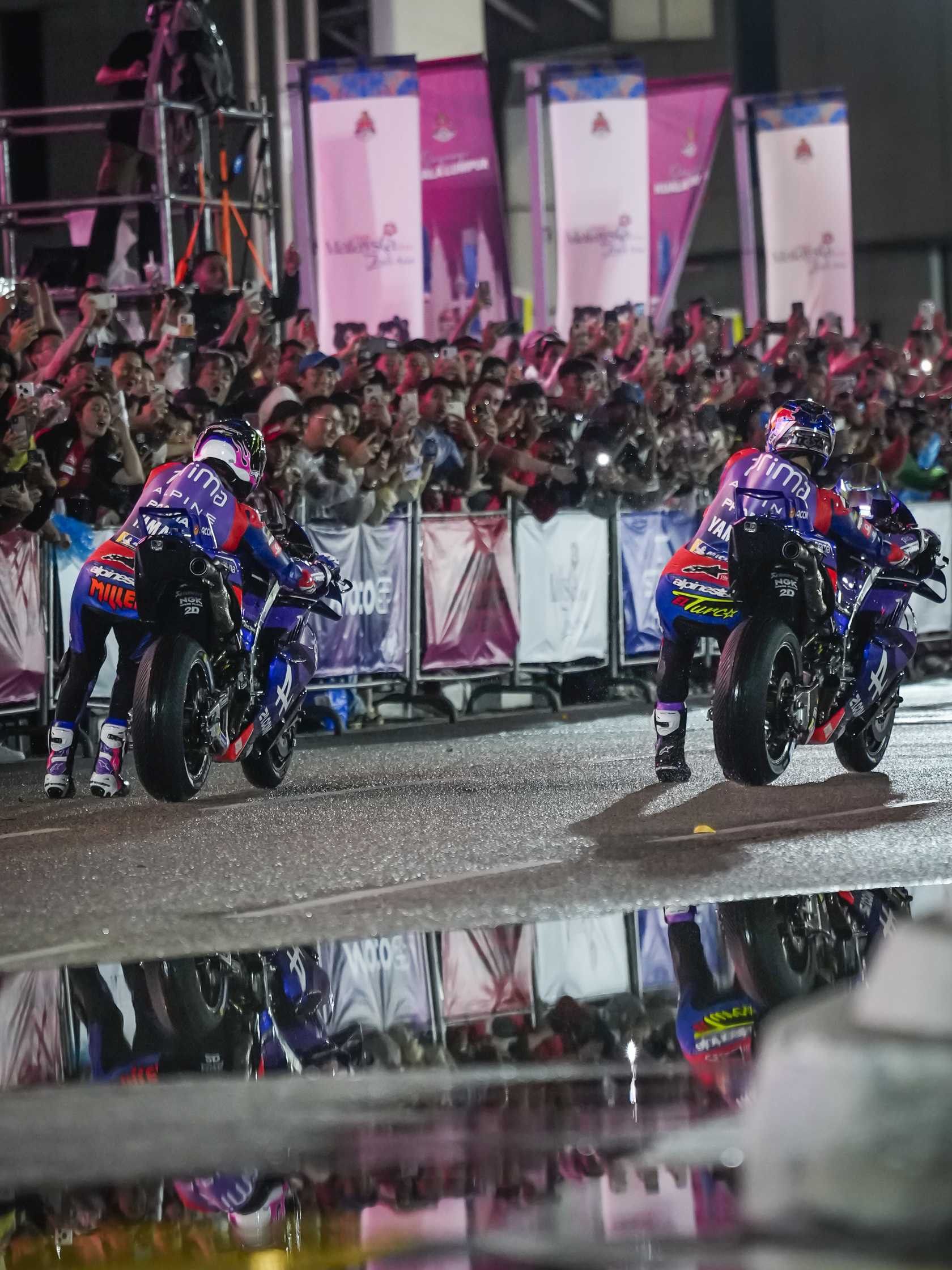 Jack Miller on the left and Toprak Razgatlıoğlu on the right. Photo courtesy Dorna
 Francesco Bagnaia (63) and Marc Marquez (93). Photo courtesy Dorna
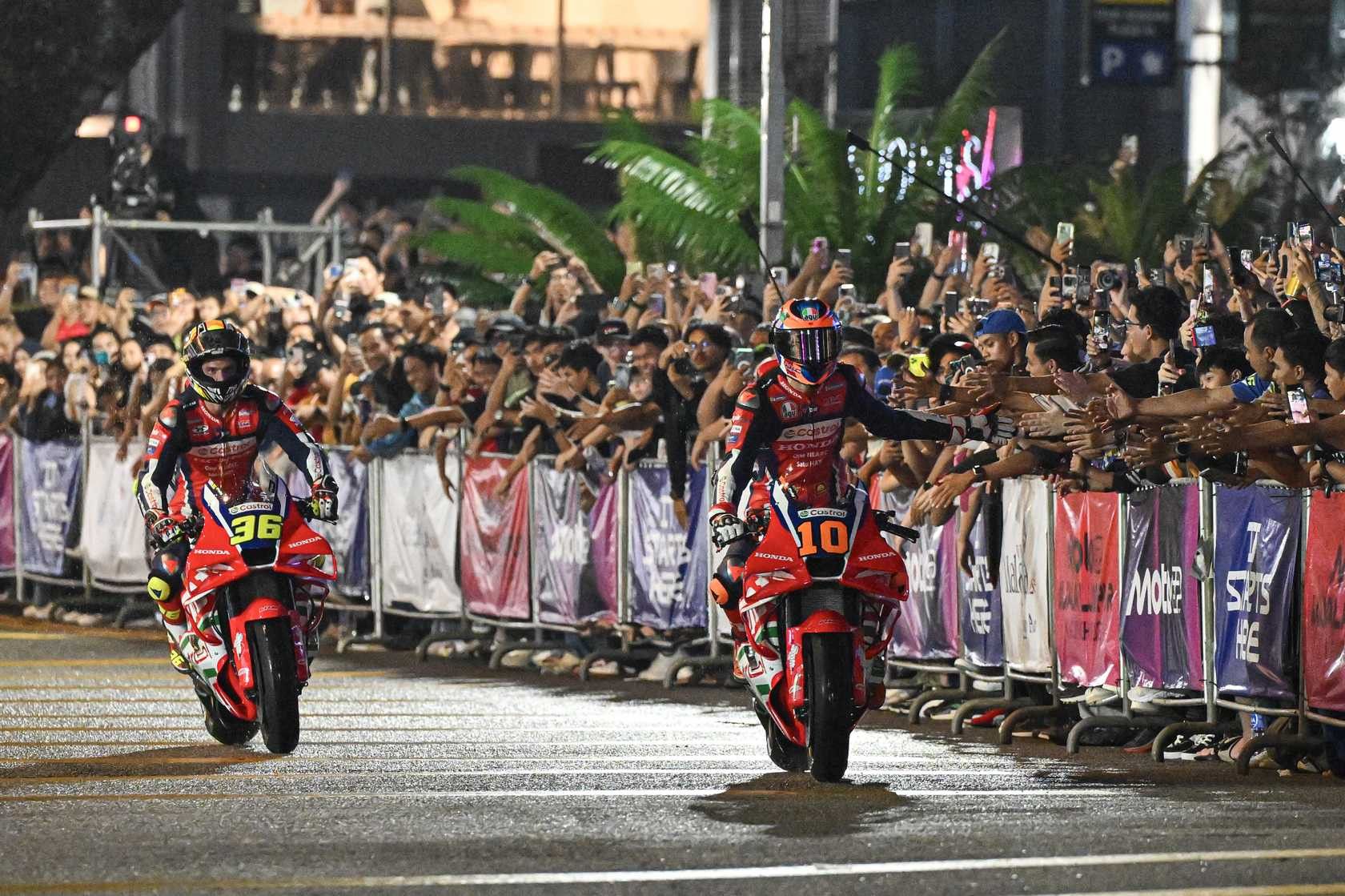 Joan Mir (36) and Luca Marini (10). Photo courtesy Dorna
 Alex Rins (42). Photo courtesy Dorna
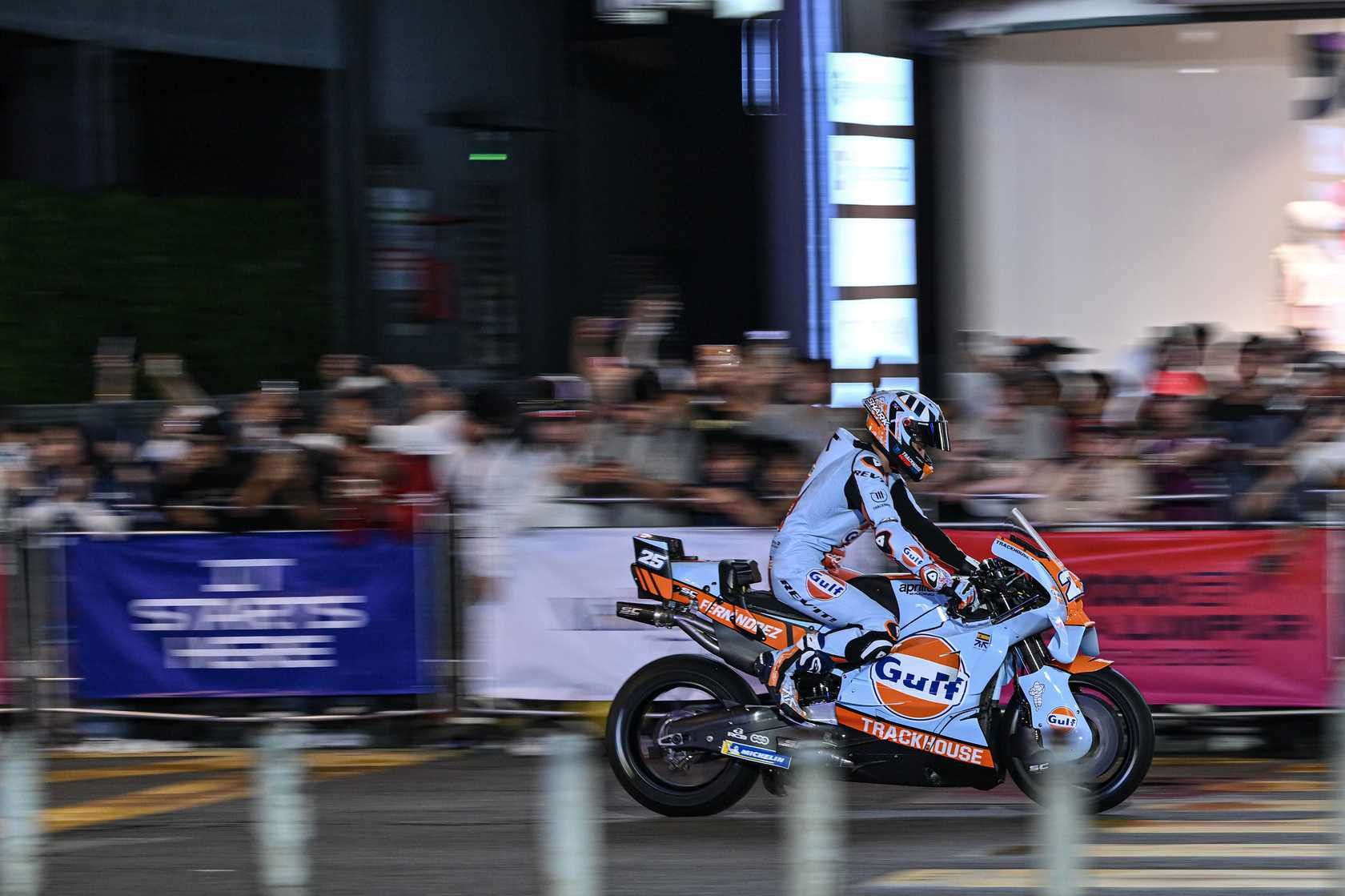 Raul Fernandez (25). Photo courtesy Dorna
 Marco Bezzecchi (on the left) and Jorge Martin (on the right). Photo courtesy Dorna
 Fabio Di Giannantonio (49) and Franco Morbidelli (21). Photo courtesy Dorna
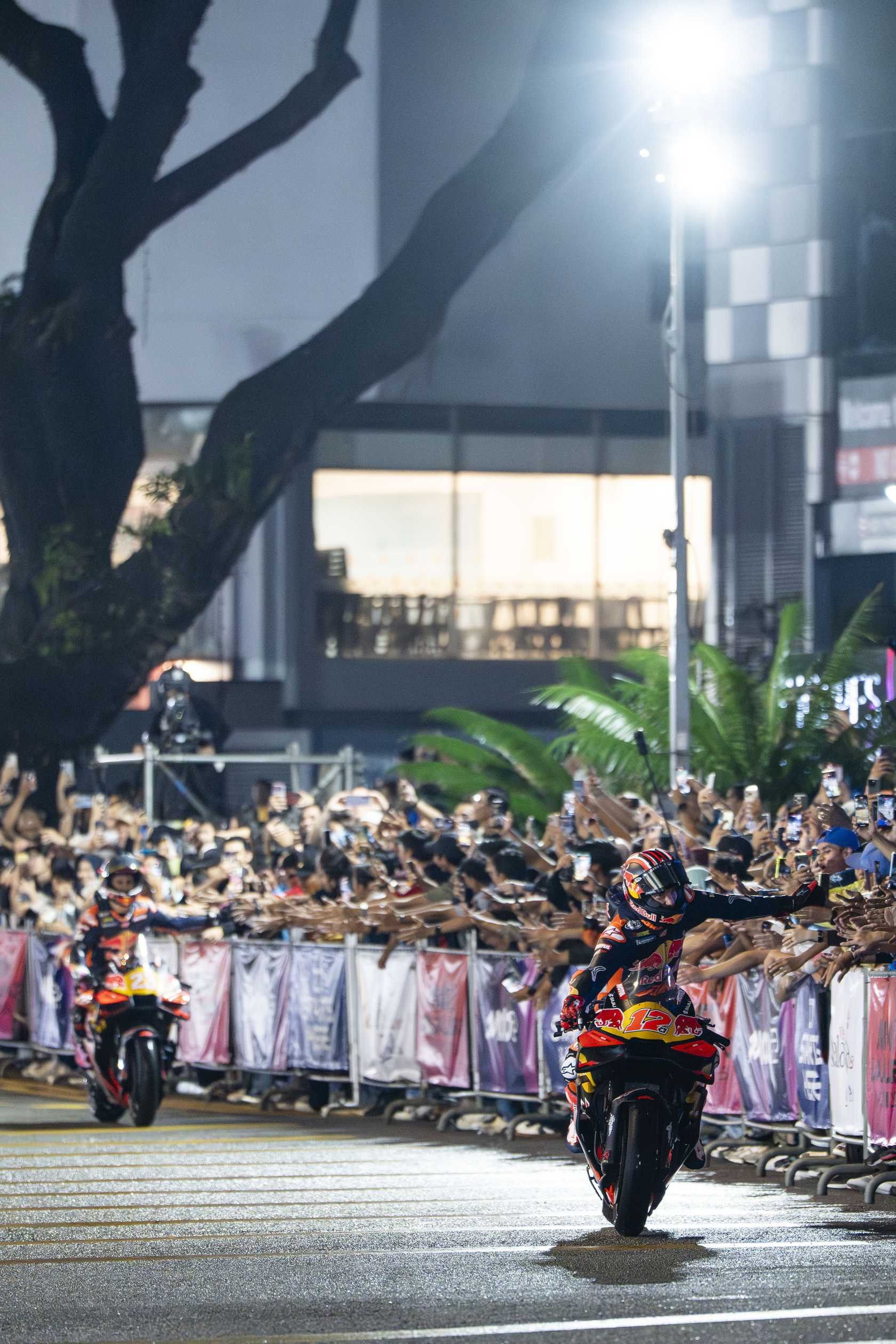 Maverick Viñales (12) and Enea Bastianini (23). Photo courtesy Dorna
 Alex Marquez (73). Photo courtesy Dorna
 Johann Zarco (5) and Diogo Moreira (11). Photo courtesy Dorna
The post MotoGP Season Launch: Lights Up Kuala Lumpur appeared first on Roadracing World Magazine | Motorcycle Riding, Racing & Tech News.
Dorna Press Release: MotoGP Lights Up Kuala Lumpur [ 08-Feb-26 9:48am ]After holding a spectacular launch of the 2026 MotoGP season in the center of downtown Kuala Lumpur in Malaysia, Dorna issued the following press release:
Season Launch: MotoGP lights up Kuala Lumpur
Press Release Sun, 08/Feb/2026 - 09:48
Ducati MotoGP rider finds good improvement with "biggest issue" at Sepang test [ 08-Feb-26 10:15am ]
RAW's Publishers, Part 2 [ 08-Feb-26 10:34am ]In our last episode, the OG was going on about Wilson's (ahem) unfavorable attitude toward publishers and editors, and "writing as business" in general. And while Pound had his great champion in James Laughlin, RAW had a few publishers who were champions of his work, too. But small publishers seem often colorful characters…
Aside from Playboy Press, Wilson published his Schrödinger's Cat trilogy with Dell, a major NY publisher. All the rest of his books were with small, marginal publishers, except his "conspiracy encyclopedia," Everything Is Under Control, which was with Harper/Collins and he said somewhere that their lawyers went over every line to make sure they couldn't get sued, which was a drag. He had very bad luck with the publishers for his projected five-part Historical Illuminatus Chronicles, which I will go into at some other time, but what's more striking to me is that when you publish with non-establishment publishers you tend to run into some very interesting characters.
This Substack is reader-supported. To receive new posts and support my work, consider becoming a free or paid subscriber.
Playboy Press also published his Book of Forbidden Words and The Book of the Breast; of the former RAW complained that it was a:
disaster and again proved my naivete about he publishing industry. The book was not my idea but that of an editor at Playboy Press, who asked me if I could write a history of foul language. I said sure, I could, since I knew a lot about linguistic history and also knew how to do research; we signed a contract and I went ahead — quickly producing a book of high erudition and (I think) some wit. It turned out that this was not what was wanted. The erudition and the linguistic history were excised, along with much of the wit, and in his hurry to turn my work into a more commercial production, the editor in many sections replaced correct grammar and syntax with the kind of pidgin English generally only encountered in TV advertisements.1
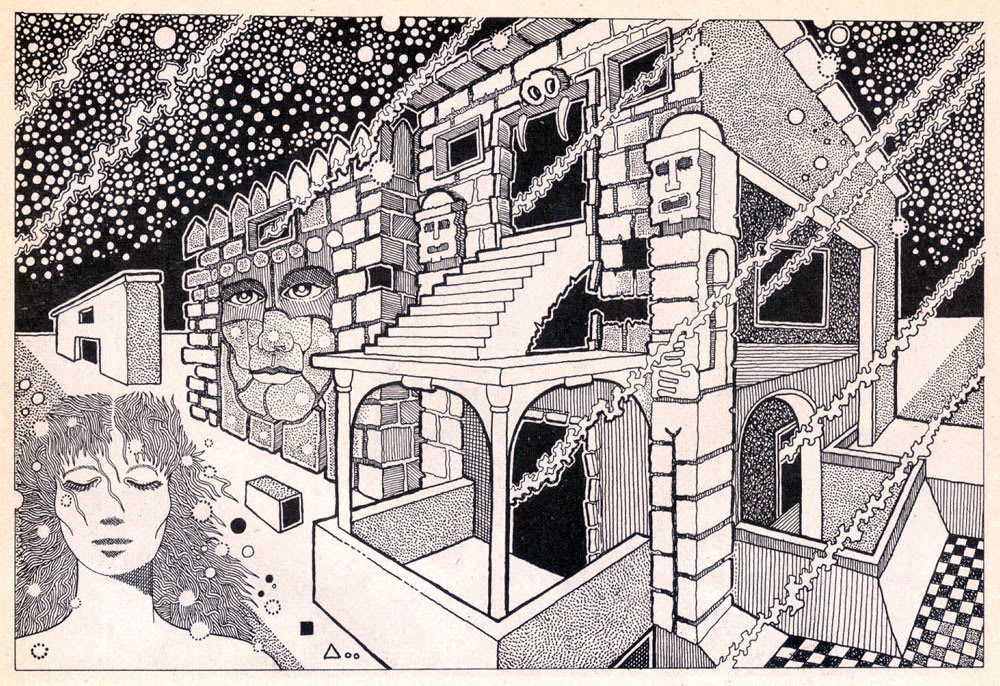
(artwork by John Thompson, who worked with Sebastian Orfali at And/Or Press)
And/Or and Sebastian OrfaliAnd/Or Press in Berkeley was founded by Sebastian Orfali, along with his brother John, and a psychedelic artist RAW thought was Blakean, John Thompson. They may have all been roommates in San Francisco and publishing for Last Gasp and/or an underground comix bookstore in North Beach, People's Comix in the early 1970s, when Sebastian, born Joseph Peter Orfali in Jerusalem, decided to start And-Or Press in 1974. Previously he earned a Master's in Philosophy at U. of New Mexico, and he worked as a teaching assistant there before moving to the West Coast. Orfali was a daring publisher: Marijuana Grower's Guide was banned in Canada and was used as a weed grower's bible by growers in the Emerald Triangle, which received a huge boost when Reagan had the Mexican cannabis field sprayed with paraquat, which provided a strong impetus for cannabis horticulturists in Northern California to develop stronger, seedless weed for the domestic market. Orfali's colleague Peter Beren says it sold more than 500,000 copies.2 Jay Kinney's Young Lust comix were banned in England as too pornographic. Orfali appears to be a character in one of Bill Griffith's "Zippy the Pinhead" strips; Orfali and Griffith probably knew each other from the early 1970s San Francisco scene.3 And/Or's Holistic Health Handbook sold 800,000 copies in 1978, according to Peter Beren, who worked with Orfali. Orfali was really a trailblazer for books on drugs, and And/Or's books were hot in head shops, which were gradually closed down under Reagan.
Orfali was probably influenced by Michael Horowitz's burgeoning collection of books about drugs, which eventually merged with two other collectors and named the Fitzhugh Ludlow Memorial Library. Orfali brought back into print a 1929 book titled Black Opium, by Claude Farrère (AKA Charles Bargone, 1876-1957), "featuring striking, exotic and evocative illustrations" by Alexander King. Orfali brought out a facsimile edition of this book, the earlier Paris edition was highly sought after by collectors. Horowitz likened the prose style to James Joyce's Dubliners. And/Or also brought out another book of classic drug literature, Cocaine (1921), by Pitigrilli (AKA Italian journalist Dino Segrė), which appeared a year before Crowley's Diary of a Drug Fiend, and, according to Horowitz's partner William Dailey, captured "a vivid picture of the cocaine-crazed demimonde of the Parisian 1920s," of which Stephen J. Gertz says is "an understatement in the extreme."4
And/Or, over the eight years they operated, put also out books by RAW (most notably: Cosmic Trigger, Vol 1, now a counterculture classic), and books by Jacques Vallee, Colin Wilson, and David Wallechinsky5. Paul Krassner and Timothy Leary also had books put out by And/Or. Terence and Dennis McKenna's Psilocybin: Magic Mushroom Grower's Guide was (and probably still is) a best-seller in that genre. No one had seen anything like it: the brothers published under pseudonyms, O.T. Oss and O.N. Oeric6, with line drawings by Kat McKenna.
As much as RAW found to carp about many publishers, I've never seen a harsh word for Orfali, and RAW has a very wise alchemist character in his Historical Illuminatus series named "Abraham Orfali." And/Or operated out of Berkeley, and, after what appears to be some sort of hostile takeover by a larger publishing consortium, morphed into Ronin Publishing, run by Orfali's life partner, Beverly Potter.7 "He loved telling of being busted on the Ides of March by the border patrol in Truth or Consequences, New Mexico, for three pounds of pot," Potter relates.8 His attorney got him off the rap, and later turned into a Buddhist priest.
The DEA at one point tried to obtain a list of And/Or/Ronin's customers who bought the cannabis horticulture book in Arizona, and they sued back.
Orfali died at the age of 51, and it's a horrible thing to read about: it seems to have started with teeth problems. Some dentist had inserted a small silver wire jacked into the root of one of his teeth, and this may have led to cancer of the mouth, and the gory, cascading ever-worse details are relayed by Bev Potter in a bizarre, maddening book I found in a used bookstore in Berkeley, Animal House On Acid: The Barrington Hall Saga: A Memoir, 2015.9 Barrington Hall was a notorious (insane!) student co-op near UC Berkeley, and Potter and Orfali lived next door to it. You've read about roommates from hell? The denizens of Barrington Hall terrorized the neighborhood and made me think, "I'd have moved out of there years ago!"10
Herb RosemanRAW seems to have known Herbert C. Roseman through co-editing of The School of Living's magazine Way Out. The School of Living was founded by Ralph Borsodi in 1928 and was one of the proto-hippie drop-out communal living sort of things, but it lasted. They were serious. They had a large library of anarchist (19th century America: "libertarian") books of all sorts, and Wilson seems to have read that entire library.
After leaving the School for New Jersey and then ending up in Chicago as an editor for Playboy, RAW thought Roseman's Revisionist Press would be the publisher of his book on Aleister Crowley, Do What Thou Wilt: An Introduction to Aleister Crowley, Gabriel Kennedy found RAW's manuscript of this book in Harvard's Houghton Library. It had been found by Harvard at Carl Willians Rare Books in London and bought in 2018. RAW had apparently written another book about Crowley titled Lion of Light, which appears to not be the version with the same title published by Hilaritas Press in 2023. Who knows where the original Lion of Light is?11
So, Roseman for some reason never put out Wilson's book on his Revisionist Press, which appears to have been a subsidiary of Gordon Press. They appear to have put out a red hardcover version of the Discordian bible, Principia Discordia. Revisionist once had a Wikipedia page, now gone. There were (paranoid?) rumors that their catalog of conspicuously high-priced books was a front for the CIA and/or the FBI, to gather names of subversives interested in ideas about the controversial, esoteric and revisionist history and the like. Someone online has quoted Roseman, "I wish it was true about the CIA! We might have made more money."12
What gets me is that RAW wrote this book on Crowley - what we read as Lion of Light (2023) - merely months after being introduced to Crowley and his difficult Modernist texts by Alan Watts. It's one of the most insightful books ever written about Crowley, was written quickly, and is a perfect example of the virtuoso "quick study" that Wilson was. No doubt his many years of reading dense, difficult Modernist text by Joyce and Pound prepared him for Crowley. It's a sort of reading that seems to be vanishing in 2026, a cultural reading scene that seems to be reverting to the days when only monks and priest actually read books and manuscripts for many hours of the day. That RAW sent this manuscript to Roseman, hoping to be paid at some point but seeming to forget about this text? There seems to be some missing information here.
My own copies of Proudhon's General Idea of the Revolution13 and Benjamin Tucker's Instead of a Book were put out by Gordon Press, but apparently Revisionist Press re-printed famous works by hardcore revisionist historians like Harry Elmer Barnes, who also were Holocaust revisionists. Gordon/Revisionist were a poorly run family publishing biz and they went kaput in 2001, sold to Run For Cover.14
Paul Krassner and Ralph GinzburgKrassner was one of the first to publish Wilson, in his The Realist, in 1959. They remained friends until Wilson's death. A fearless writer and editor, Krassner was at a nexus with the renegade publisher Lyle Stuart15, who Krassner worked for while he was still in college, was friends with Ed Sanders, Ken Kesey and Leary, knew Mae Brussell, and also wrote for High Times. He turned Groucho Marx onto LSD.16 Before taking the stand for the trial of the Chicago Seven (or Eight), Krassner took acid and testified.17
Ralph Ginzburg hired RAW to write for FACT, and in 1964-1965 Wilson published at least ten well-researched, pull-no-punches investigative journalism and analyses of subjects such as advertising, atheism, free love, the National Enquirer, MAD magazine, the KKK, and William S. Burroughs.18
Ginzburg, another fearless publisher, put out four copies of eros in 1962, got arrested for publishing porn, took it all the way to the Supreme Court, lost, was sentenced to five years, and did eight months, which he writes about in Castrated: My Eight Months In Prison (1973). I admire Ginzburg, who I can't help but mentally link to certain jewish radical publishers who seemed absolutely driven by both radical free speech, radical ideas, and money, probably roughly in that order. The list is long and I have much to say about these Jewish badasses, but will save it for another day. Krassner writes about a rift between Ginzburg and Lyle Stuart:
Stuart guided Ginzburg through the publishing of An Unhurried View of Erotica, "finding him a typesetter, a printer, a distributor, a mailing house - and when the Post Office seized Ginzburg's mailing piece, Lyle sent attorney Martin Scheiman to Washington to obtain release of the mailing. One day Lyle was giving Ginzburg help on his ad campaign.
"I'm publishing a book by Albert Ellis called Sex without Guilt," Lyle said. When you book some of your radio and TV things, could you suggest him as a fellow guest?"
"But the topic will be pornography."
"Ellis is a pornography expert. He's testified in many trials."
"I can't do that," Ginzburg said. "What's in it for me?"
Krassner ads: "Thus did Ralph Ginzburg make Lyle Stuart's permanent shit list in a single bound."19
Ginzburg put out The Housewife's Handbook on Selective Promiscuity, which was written by "Rey Anthony" who was actually popular sexual technique writer Lillian Maxine Harrison AKA Maxine Savant AKA Maxine Sanini, and this book was part of the obscenity trial that got Ginzburg time in slam, but she was never prosecuted. I have not yet seen a copy of this book, although I will. One day.
FACT published, in September-October 1964 - just in time for the election - an article titled "The Unconscious of a Conservative: A Special Issue on the Mind of Barry Goldwater," in which they - RAW was not involved - asked 1800 psychiatrists their opinion of Goldwater's fitness to be POTUS. In their professional opinions, Goldwater was manifestly unfit. Goldwater sued Ginzburg for $1 million; he got $1 in compensatory damages and $75,000 in punitive damages. Ginzburg took another one on the chin. This basically bankrupted Ginzburg. I note this because it reminds me of my reading of the 27 psychiatrists, mental health profesisonals, and psychologists, who contributed to The Dangerous Case of Donald Trump and declared him a "clear and present danger" to the US, in 2017. Psychiatrists have a professional "duty to warn" which seems to clash with the precedent of the "Goldwater Rule," which the American Psychiatric Association thought they violated. Anyway…what do these people know anyway, am I right? (cough)20
About Krassner, RAW wrote:
Paul Krassner's iconoclastic journal, The Realist, has published more of my writings than any other American magazine, and there was a period in the last 1950s and early 1960s when I might have given up writing entirely if Paul had not gone on publishing my work. I think everybody in the "counterculture" owes a great debt to Paul Krassner, but I perhaps owe him more than anyone else.21
At this point, given the quotes from Wilson in Part 1, we must realize his problems with editors and publishers were more with…guys who wore ties and worked in skyscrapers in Manhattan? Because clearly, there were radical, progressive, fearless publishers who published RAW's work…they just weren't issuing stock, etc. It's always more complex, isn't it? Aye, I think so: delightfully so.
Myron Fass: Schlockmeister ExtraordinaireI recently watched a documentary on the Pacifica Radio station WBAI-New York, Radio Unnameable (2012 Lovelace and Wolfson), which was about Bob Fass, friend of Krassner, Sanders and the Yippies, and a legendary radio man in New York FM radio. Bob Fass was born in 1933 in Brooklyn. Schlockmeister Kingpin Myron Fass was born in 1926 in Brooklyn. I did searches for both, reading for over an hour to confirm what the Google search AI said: they were brothers. I couldn't find anywhere where Bob talked about Myron or Myron mentioning Bob, or any of their friends or researchers pointing it out. I'm still in doubt, because so often AI has given me wrong answers, ut if it's true, I can see why neither talked about the other: Bob Fass was a progressive leftist while who knows what politics Myron was, but there are stories of him brutally beating a writer or editor for one of his periodicals. RAW wrote an expose of his own job for Fass that Krassner published in The Realist, "Anatomy of Schlock,"22 which starts out:
For three months, I have worked as an editor in the country's leading schlock factory. My boss assured me that our schlock reached 30,000,000 Americans every month, and that, brethren, is a lion's share of the schlock market. Let me define my terms. Schlock is the next level below kitsch. Kitsch is naive, maudlin, hokey, unsophisticated. Commercial folklore, so to speak […] Kitsch is " I Found God When My Doctor Told Me I Had Cancer," "Jackie Kennedy Tells Why She Will Not Re-Marry," "Should Wives Enjoy Sex?"
Schlock, on the other hand, is brutal, lumpen-prole, aggressive, hairy; like carnival hot-dogs, so spicy you might vomit if you're over-sensitive. Schlock is "He Beat He Grandmother to Death With Her Crutch," Love-Starved Arab Peasant Woman Raped Me Twenty Times," "The Disease That Liz Caught From Dick."
After FACT, Wilson found work at Fass Publications. Quite a leap!
He wrote astrology columns, just making stuff up and getting fan mail about how accurate he was. He edited "four girlie magazines simultaneously"23 andHe made up captions for the soft-core porn photos of girls, writing they were scientists, stewardesses, or typists, who like peyote and read William S. Burroughs. My favorite tabloid title that RAW made up was "Mad Hunchback Sells Hunch To Butcher/Woman Poisoned By Hunchburger."
Myron Fass had been influenced by Bill Gaines of Mad magazine, and so had Krassner, who knew Gaines and worked for him, and basically, started The Realist as a Mad magazine for grown-ups. Fass was influenced by Gaines in that the obscenity laws favored "magazines" over "comic books" and Gaines had published Mad as a magazine, not a comic, to evade the new Comics Code Authority. You can get away with more that way. And, my gawd, did he get away with a lot.24
Wilson never mentions Fass's name nor the name of the magazines, for understandable reasons. Eventually Fass gave RAW reign over one of his Playboy knockoffs, Jaguar. Fass wanted RAW to make it not too schlock and not too egghead, so RAW "revamped my table of contents several times, making it more schlocky each time. I kept two non-schlock articles, a factual piece about Cuba, and an interview with with a prominent novelist, and tried to make the rest of the pieces come out both schlock and non-schlock simultaneously. This I did by giving them schlock titles but sophisticated insides, or, in one case, a sophisticated title with schlock insides." Fass fired him anyway.25 RAW had published this exposé in The Realist under the pseudonym A. Nonymous Hack, but an editor at Playboy read it and was impressed, and he got hired there, the best paid job he ever had, editing the Playboy Forum with Robert Shea.26
Part 3 will be shorter, and include RAW on Falcon/New Falcon and a few further comments. Sorry for the length!
1Coincidance: A Head Test, pp. 37-38, Hilaritas ed.
2More True Than Strange: Collected Writing 1968-2018, Peter Beren, p. 202
3it's conceivable that a party at that time and place, in that circle, might have had in attendance Orfali, Griffith, R. Crumb, RAW, George Kuchar, and some of those gay LSD makers/distributors that Erik Davis wrote about in Blotter. Also Terence McKenna, Nick Herbert, Jeffrey Mishlove, Aline Crumb, Jacques Vallee, Grady McMurtry, and who knows who else.
4Dope Menace: The Sensational World of Drug Paperbacks 1900-1975, Stephen J. Gertz, p. 58
5Wallechinsky's book on nitrous oxide, Laughing Gas, still in print by Ronin, seems now a classic text on the subject. I bought a copy when I saw it in the old Loompanics catalog, and someone absconded with it.
6Two of my favorite noms de plume in effort to steer clear of The Man: "Otiose" is an arcane word meaning "lazy, serving no practical purpose," and "Oneiric" relates to dreams. Many of the drug-writers for And/Or used pen names.
7In a letter to Kurt Smith, RAW mentions waiting on $1500 from And/Or after their bankruptcy. I don't have all the details. Potter's Animal House On Acid has a confusing narrative about what happened; either that or I don't understand business workings well enough.
8Animal House On Acid, Beverly Potter, p.31. Potter gave a peculiarly bad reading of Cosmic Trigger, vol 1: "While waiting at the airport bookstore I picked up the Cosmic Trigger by Robert Anton Wilson and published by And/Or Press. It was a conspiracy with us in the future on Sirius, the Dog Star," she writes on ibid, p.29
9Potter's account of Sebastian Orfali's death: Animal House On Acid, pp. 348-356. Orfali's 1997 obituary at SF Gate.
10Erik Davis spent some time at Barrington Hall as a non-student at Berkeley, reading and taking in the scene, but when I told him about this book and the noise, deaths, the cops, the craziness, he said he wanted to know where I was getting this and I told him of Potter's book, which he hadn't heard about. Regarding And/Or, see Davis's High Weirdness: Drugs, Esoterica, and Visionary Experience in the Seventies, pp.219-220; p.258, and Vallee's Messengers of Deception, which was put out by And/Or, and which influenced RAW but Terence McKenna thought it was "paranoid." Also see More True Than Strange, by Peter Beren, pp.200-205, on RAW, Sebastian Orfali and And/Or Press. Beren worked with Orfali and knew RAW. Gabriel Kennedy touches on Orfali and John Thompson's Blakean artwork and And/Or in his Chapel Perilous:The Life and Thought Crimes of Robert Anton Wilson, pp.141-142
11Background narratives around this: Lion of Light: Robert Anton Wilson on Aleister Crowley, pp.9-13; Chapel Perilous, pp.111-113.
12Herbert C. Roseman's papers, 1950-1969, are at the U. of Wyoming's American Heritage Center. Revisionist Press.
13RAW wrote a very erudite review of Proudhon's classic that Gordon Press included as a sort of Foreword to their edition. It was originally printed in Way Out, so there's the Roseman connection, and I was delighted to see it included in the recent collection of Wilson's political writings, A Non-Euclidean Perspective: Robert Anton Wilson's Political Commentaries 1960-2005, put out by Hilaritas in 2025.
14Chapel Perilous, Kennedy, p.112, footnote.
15see Stuart's tiff after putting out a biography on Walter Winchell in Krassner's One Hand Jerking, pp.163-165. Stuart was the kind of editor-publisher that might have been a good fit for RAW, but it never happened.
16see chapter 5 of Confessions of a Raving Unconfined Nut. My two favorite bits: they're both way high when Groucho excuses himself to urinate. When he comes back he says, "You know, everybody is waiting for miracles to happen. But the whole human body is a goddamn miracle." Then, later, when it was found the FBI had published pamphlets, supposedly by the Black Panthers, that advocated killing cops, and opened a file on Groucho as a national security risk, Krassner phoned Groucho, who said, "I deny everything. Because I lie about everything. And everything I deny is a lie."
17Confessions of a Raving Unconfined Nut, Krassner, pp.190-201. "When my testimony was completed, in order to get centered, I asked myself, 'All right. Now why did you take LSD before you testified?' 'Because,' I answered myself, 'I'm the reincarnation of Gurdjieff.' This was slightly confusing, inasmuch as I didn't believe in reincarnation - I thought it was the ultimate ego trip - and besides, I had never even read anything by Gurdjieff."
18see Chapel Perilous, Kennedy, p.259 for a list of articles RAW published for Ginzburg's FACT, sometimes under the pen name "Ronald Weston."
19Confessions of a Raving, Unconfined Nut, Krassner, p.97, older edition; p.100 in the 2012 Soft Skull Press edition
20Wikipedia's entry on this case.
21Coincidance: A Head Test, p.121, Hilaritas ed. When RAW, working for Ginzburg, asked about a renegade Psychologist who had been kicked out of Harvard (or Leary's side: You can't fire me! I quit!), Ginzburg said he thought this whole LSD thing was a fad. Krassner sent RAW to Millbrook to interview Leary, and thus the beginning of a very long friendship.
22it's collected in The Best of The Realist, "The Anatomy of Schlock," pp.166-169.
23Starseed Signals, Wilson, pp.29-30.
24Maybe have a gander at some of the covers of Fass stuff HERE. Also see The Weird World of Eerie Publications, by Mike Howlett (Feral House).
25Gabriel Kennedy goes over RAW as a worker in Fass's tabloid sweatshop, in Chapel Perilous, pp. 70-72. The history of pulp magazines is a colorful one, and see Cheap Thrills: An Informal History of the Pulp Magazines, by Ron Goulart (1972), which covers the years 1920-1040, mostly. The novelist Robert Stone also wrote for Fass, and relates about it wonderfully in his Prime Greed: Remembering The Sixties, pp. 131-147. At least I think it's Fass. Here, you read between these lines: "The lord of this empire of the ersatz was a man called Fat Lou. Lou had half a dozen of these replicant outfits, ringer schlock magazines whose names were household words[…] Maybe his most successful publication was what Fat Lou's lawyers defined as 'a weekly tabloid with a heavy emphasis on sex.' It was an imitation of the National Enquirer, lacking the delicacy and taste of the original."
26Wilson relates this story in a few places; I'm relying on his audio interview with Michael Taft, collected in Robert Anton Wilson Explains Everything. But RAW pretty much tells the story in the same way in his first novel, The Sex Magicians, brought back into print by Hilaritas in 2024. See pp. 34-36 of that novel. RAW had written a scathing critique of Hefner and Playboy for The Realist, and RAW told Krassner at one point that was the article that impressed someone at Playboy. It still seems a tad murky to me. See HERE, including the comments.
(artwork by Bobby Campbell)
Shadows & Reflections: Dexter Petley [ 08-Feb-26 9:00am ]Dexter Petley reflects on the year his field became a forest.
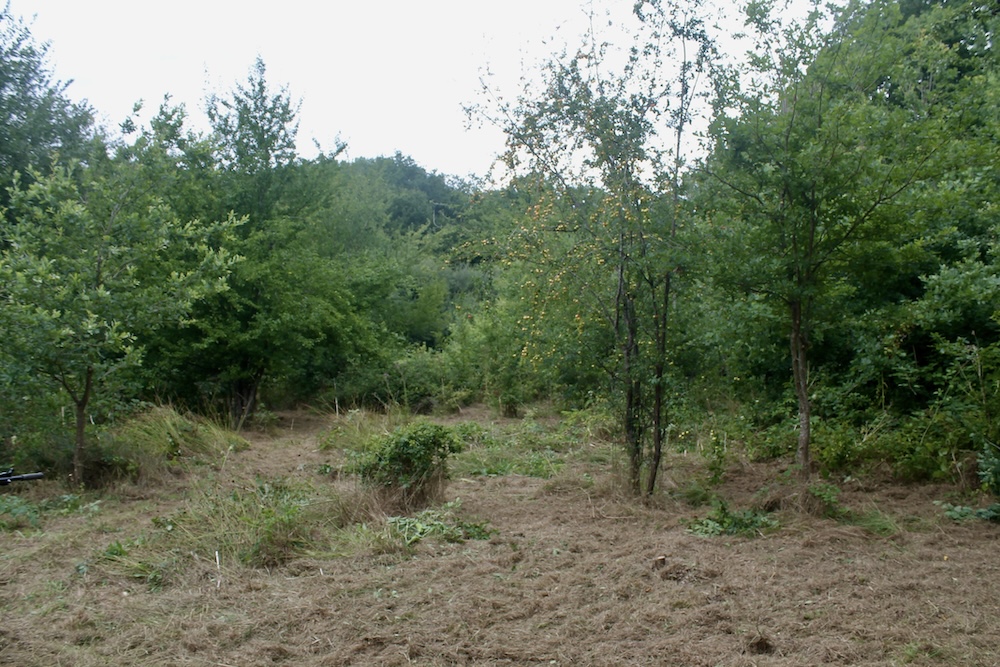
Put simply, 2025 has been the year during which my field became a forest. Hec est finalis Concordia.
This new forest is not on parchment or in the feet of fines. It is not a forest because of the trees. Arboriculturists, I should add for veracity, might argue the terms and stages of succession, that it is only a forest at the first tree felled. Purchased as naked agricultural flood pasture in 2010, its one dead ash stump sat in bramble fester, seven oaks lined the lane, a straggle of goat willow and hazel shoots sporadic along the nettle boundary, an aquifer one yard underground, according to the water diviner. Not a lot to go on, though homeward bound. It even had a topographical name from 1077, La Folie, feulliée, fullie, foille, folie, a shelter of leaves.
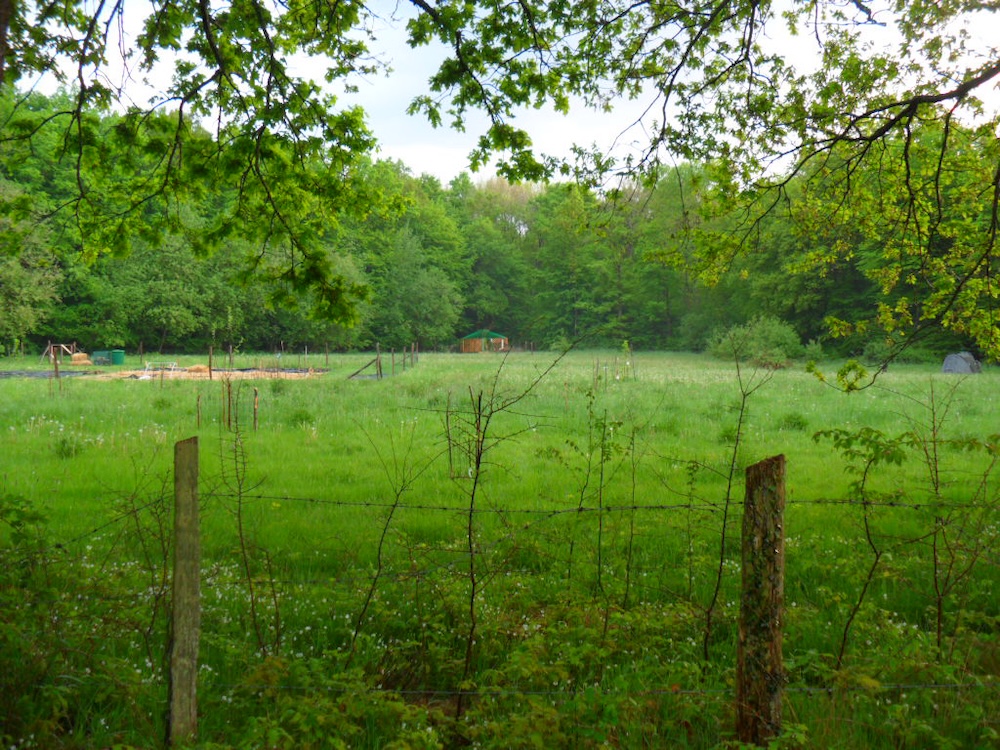
Technically cued to become an ecotone, I dislike the term, my palimpsest was nonetheless a transitional zone between two different habitats. The idea was for the eventual presence of both species and features from bordering habitats. Though triangular, I counted four; two forest, one pasture, one tillage.
From the beginning, it was out of my hands. By its second summer the farmer said it was too woody to cut for hay. Pioneer saplings were arriving from the mother forest either side. At one end, the potager struggled then sank in soaked clay and marsh grass. At the other I hoisted camo nets to conceal my illegal home from any passing collaborator. La Folie, also a cabane, or maison de campagne. I need not have worried. Today, even the Google plane cannot spot the yurt.
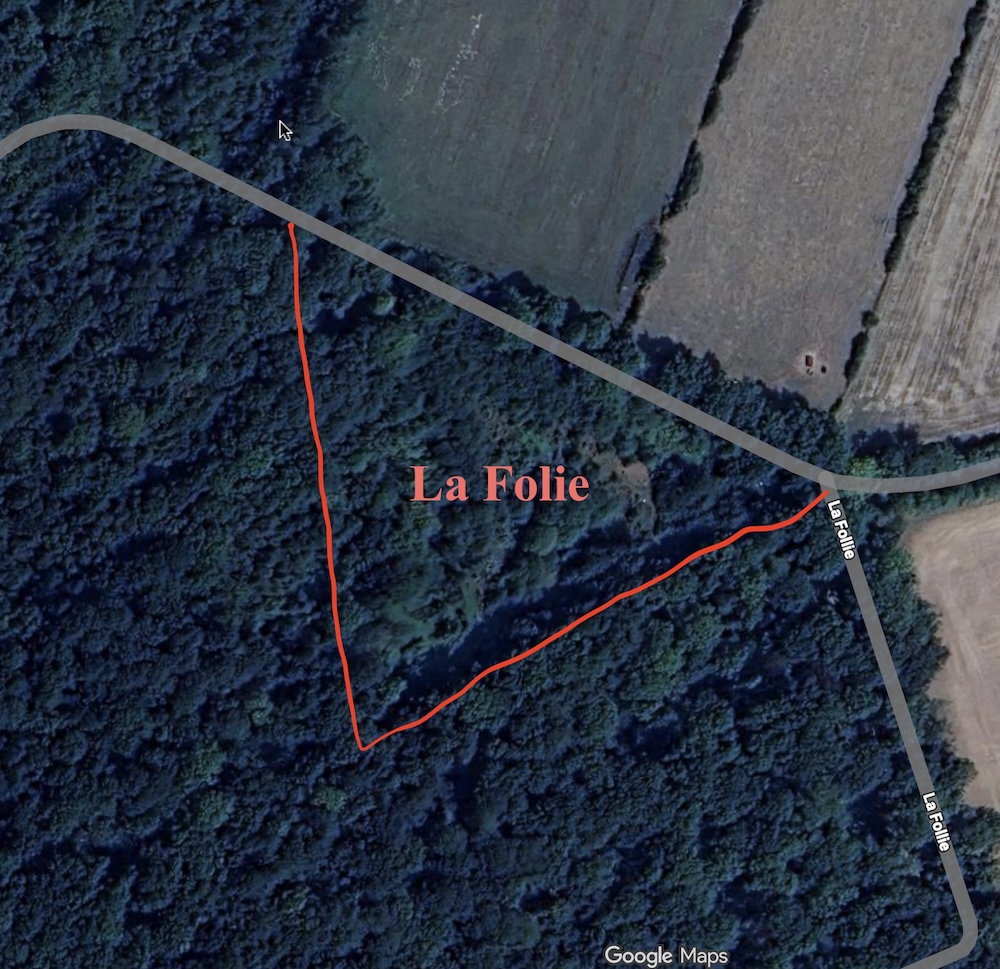
My first autumn act of 2010 was to plant a twenty-six-tree orchard of mixed fruit. Each tree hole filled with brown water as I dug them, months after the first garden crops had already rotted in the ground. La Folie, according to Le Robert, dictionnaire historique de la langue française, poor ground only a madman would cultivate. For years the saplings stunted at competition level, the campagnoles and musaraignes stripped their bark until, when finally they struggled into flower one spring, they'd reverted to their root stocks, mostly gender-neutral prunes. Good cherry, pears and apples, plums and greengages floundering in no mans land.
In the intervening years, the jays chipped in to save the day. By their raucous meanderings, bombing acorns hither and thither, the one-by-one became thousands. Stubby oaks rose above the height of rye grass and marsh thistle. The winds supplied the rest. Aspens and ash, hazel and willow, beach, hornbeam and gean, all spreading in moonlight, until this year the fruit trees, deciduous and mycelium became one place, habitat united, 3-in-1, a forest garden as I sat and watched. Neither Weald nor Anderida of my roots, just the coincidence of joined hands, my triangular hectare and a spit is now the meeting place for the offspring of old forest pushed in from either side. Naturally aspirated, seen from the air or the ground, a young forest not because of trees, which do not on their own make a forest, but because of the mushrooms.
This summer, they came, these mycological migrants, in their thousands, in rings and rows, ranks and in reams. At first, they seemed to map the animal passages, having come by hoof and claw from three sides, few edible species yet, just their harbingers and precursors, the edibles spored-in for the next rise, or the next. The mousseron, though technically a field species, showed up in both spring and autumn variant. Both were eaten to ritual, as blood-of-ground in a kind of coming-of-age omelette. And among the aspens, now trembling with anticipation, the true heralds of boletus, the fly agarics, up and at 'em, leaving their message poste restante. Cortinaires and pholiotes, lactaires and hygrophores, the latter at the first frosts, edible if mediocre. The fruit trees shared the evolution of good news. Dishevelled and unpruned, they flashed a show of April blossom which could only mean trouble come harvest. The orchard, having decided to fruit after 15 sterile autumns, was invisible once the blossom died, oaked-in and brambled over. Having witnessed this march of mushrooms and the blossom revival, I cleared a passage for the miracle as best I could. Though genus unconfirmed, they poured their summer hearts out into multi-coloured balls which bent the branches and filled the baskets.
Plums of a kind, mirabelles and greengages, apples and pears, wasps, hornets and pine martens in contention for the final. We picked and bottled and jarred, stuffed, swatted, spat and composted, like spenders at a jackpot. The hornets, sensing an end to famine, stayed until the end, making caves of the late Calvilles still on the tree, relinquished only at the first November frosts.
In these frosts I linger still, reluctant to pack down the outside kitchen, beside which hangs an old, enamelled metal sign with red lettering, LA FOLIE, once the name-plaque on a railway station platform. Somehow, through that mysterious passage of hands, it came to me this year, La Folie, an extravagant or dispendieuse construction. This modest sign, from the factory of Laborde, est.1900, merits personification for its place of witness, the times it saw, and those who saw it. Indeed, what's in a name? La Folie, a stone's throw from the Seine, was in 1690 a rich maison de plaisance, with all it implies, of boudoirs and alcoves and demi-mondaines. Underground, great caverns were created from mining the stone which built half of Paris. In 1809, La Folie became a factory producing chemicals. In 1837, a railway halt on the first line out of Paris. In 1900 the caves were rented to a champignonniste who produced the famous mushroom of Paris. An early camp d'aviation, La Folie in 1916 became a vital base where biplanes were stocked and repaired. In the Second World War the Camp de La Folie became Beutepark Luftwaffe n° 5 Nanterre, storage depot for Luftwaffe wrecks arriving by train, spare parts workshop, a black museum for shot-down allied planes dismantled for scrutiny in the laboratory of war. Swords into ploughshares, my enamelled plaque was still there on the post-war aero club platform when they built the University of Nanterre beside it. Perhaps torn down by students in the riots of 1968, La Folie being the very place where that whole thing began, or sold to a collector in 1972 when the station was rebuilt. In 2025, this old sign has been restored to camp, and the folly, also the madness, has been vindicated.

As daylight shrinks and the sun barely skirts the ground, the solar holds by touch and go, by twists and turns. Electricity is rationed to an hour per day, the power station tops the vital services, charging the fridge battery or laptop, bread dough mixer or electric bike, depending upon the weather or the task at hand. My old carp fishing barrow has converted to a mobile station, solar panel, battery and invertor, a constant standby which I wheel around the forest field as the sun pokes feebly into clearings, mostly just to keep a lamp lit above the stove. In August, the 1000 litre rain tank filled to its brim, now shut off and sealed with clean water, enough at 5 litres per week, my average total consumption, to last till doomsday. Coffee water comes from a spring in a nearby forest, the Fountain of Madame Jeanne, born 1378, daughter of Pierre II, the Comte d'Alençon. The spring was discovered by local monks in 1170 and reputed for its therapeutic properties. My old neighbour's father, a farmer, would cycle to the fountain every morning during the war to fill the baby's feeding bottles. Now just a bramble covered path, a plastic pipe sticks from a bank as water gushes into a gravel pool lined in brick, its 1880s thatched shelter a fenced off ruin, the thatch strewn in rough hanks along the path.

The point, it seems, of 2025, has been to complete that vision I had thirty years ago, of how life could be lived, by rain, and sun, and wood, by joined up history, wits and luck, risk and caution, sacrifice, even piety in the brunt of natural calamity, simplicity the overwhelming bounty, for in truth it's also been about how to live on a third of the minimum wage, the neglected writer's annuity, how nature pays your rent, fills your kettle, heats your free water. Poverty at its best, the woodshed full of logs from La Folie, the caravan-cum-pantry stocked with canning jars of La Folie, its cèpes and trompettes, green beans and born-again fruit. The palimpsest becomes botanical and bestiary, that old tin sign now turned the other way, from looking on at violence to face the sagacity of trees.
Chance of El Niño forming in Pacific Ocean may push global temperatures to record highs in 2027 [ 07-Feb-26 7:00pm ]One expert says 2027 could be even hotter than the last three years, which have been the top three warmest on record
Weather agencies and climate scientists have pointed to the possibility of an El Niño forming in the Pacific Ocean later this year - a phenomenon that could push global temperatures to all-time record highs in 2027.
Both the US government's National Oceanic and Atmospheric Administration (NOAA) and Australia's Bureau of Meteorology have said some climate models are forecasting an El Niño but both cautioned those results came with uncertainties.
Experts told the Guardian it was too early to be confident, but there were signals in the spread of sea surface temperatures in the Pacific that suggested an El Niño could form in 2026.
Sign up to get climate and environment editor Adam Morton's Clear Air column as a free newsletter
Continue reading... In your face: Close-up Photographer of the Year Awards 2026 - in pictures [ 08-Feb-26 9:00am ]Animals, insects, flora and fauna - the world photographed in close-up in the annual competition dedicated to micro and macro photography. Cupoty 7 was won by underwater photographer Ross Gudgeon, triumphing over 12,000 entries from 63 countries
Continue reading...
Joan Mir warns Honda "are far" after Ducati Sprint pace at Sepang MotoGP Test [ 08-Feb-26 9:07am ]
13 years ago Edward Snowden told the world that every single one of you is being watched [ 08-Feb-26 9:00am ]In 2013, before AI and bots worried us, a man named Edward Snowden shocked the world. To the silicon valley tech bros this wasn't that shocking, but it certainly was to the general public which, in all fairness, is technologically illiterate. And apparently the world has a short memory.
In 13 years the conversation around Snowden seems to have died. We can talk about Stuxnet, flame, duqu, crouching yeti - all the famous malware. But the internet itself is the virus. Blame social media, politics, AI. Blame whatever you want.
If you take extra steps to conceal your identity on the internet, you are extra interesting to the NSA, GCHQ, FSB, Mossad. To think you can actually hide in the modern world is absurd. This is collapse related because mass surveillance is a fact of life and it has been for decades, yet everyone keeps pretending to be surprised.
There might be 20 million people worldwide that know the future of markets and foreign policy and good for them.
Meanwhile billions of us are powerless, ignorant and irrelevant - as far as they're concerned.
Edward Snowden will never come back to America. The CIA and several "anonymous" sources in the intelligence community have said explicitly that they will kill him if he ever comes back.
He's a traitor and Donald Trump is president.
We are so fucked.
submitted by /u/Fast_Performer_3722[link] [comments]
Marco Bezzecchi on 2026 Aprilia MotoGP bike: 'Bigger step between 2024 and 2025' [ 08-Feb-26 9:00am ] Pedro Acosta "six out of ten happy" as "unexpected things appear" at Sepang MotoGP Test [ 08-Feb-26 8:25am ]
How men are? The Preposterously Testosterone-fuelled Taxi Driver turns 50 [ 08-Feb-26 8:00am ]
John Quin presents a hormonally loaded take on Martin Scorsese and Paul Schrader's classic of male alienation
We hear a festinating beat, those sinuous nocturnal saxophones, see a belch of street steam. A ghostly yellow cab glides across the screen in slow motion. The anxious driver's eyes are caught in a red light, then he's off again through wet Manhattan streets, the shimmering multicoloured neon reflected in black asphalt. A nervous mood is quickly set in place. Here be monsters. Male monsters.
Twenty-six-year-old Travis Bickle, as played by Robert De Niro, craves more work. He haggles with his supervisor, admits to insomnia, is told: "There's porno theatres for that."
Welcome to a preposterously testosterone-fuelled world, one we might call 'The Preposterone'. This is...
The post How men are? The Preposterously Testosterone-fuelled Taxi Driver turns 50 appeared first on The Quietus.
Have We Been Thinking About Exercise Wrong for Half a Century? [ 08-Feb-26 8:50am ]
New bus shelters [ 08-Feb-26 7:00am ]TfL trials new bus shelter designs at 27 locations across London
TfL is running a 12-month trial on new bus shelter designs to improve accessibility, safety and customer experience
It said that improvements include "better lighting and seating, priority spaces, a more sustainable modular construction approach, a new roof design, more robust anti-vandalism materials and CCTV". It said the trial began at the end of January and will run for 12 months. And it said the 27 locations would span Barking & Dagenham, Bexley, Camden, Croydon, Hackney, Havering, Hillingdon, Kingston-upon-Thames, Lambeth, Southwark, Wandsworth and Westminster, but it didn't say where any of the shelters were.
Thankfully when they sent the press release to trusted partners they attached three photos, one of which showed a bus shelter in situ beside an existing bus stop. And thankfully when Time Out regurgitated the words they included a big version of the photo so I could zoom in on the name of the stop, and so I've been to have a look.
And it looks good.

This is a new shelter in place at bus stop SB opposite Southwark station. I should have guessed it'd be here because this is the closest bus stop to TfL HQ on Blackfriars Road and they like to do a lot of their prototyping here. It's a lot easier to check how the trial's going if you can simply pop out and look, rather than having to troop out to Sidcup or wherever.

The thing passengers are most likely to notice are the seats. Normally they're red ribbed plastic but here they're polished wood, which instantly adds a touch more class. At one end are two distinct seats - again an innovation - one of which says 'This is a priority seat'. You would of course hide the sign by sitting down, but hopefully your conscience would be pricked if anyone in genuine need turned up. Alongside is a thin bench which I can confirm slopes gently forwards, so even if you're a very short thin homeless sleeper you're still going to roll off.

The roof is swooshy and red all the way round, not just at the ends. This flash of red should make the bus shelter easier to identify from a distance. The ends are thicker still, ensuring they stand out more. And crucially they allow the name of the bus stop to be written in larger letters than before, also aiding accessibility. I walked down the road to a normal bus shelter in an attempt to compare the two end designs, hopefully standing the same distance away each time. It's definitely an improvement.

The lighting inside the shelter is considerably brighter than before. Normally you wouldn't be able to tell mid-morning but yesterday was so damp and gloomy that the lights had come on, adding a homely glow to the interior. It's probably LED-based, collectively glowing through a mesh of tiny circles inside a long glowing strip. Better illumination is clearly a boon at night, especially with the safety of vulnerable passengers in mind, but also makes it easier for drivers to see if anyone's waiting so is doupleplus good.

As for information this particular stop still has a Countdown display so TfL aren't backing away from those. Yes there are electronic adverts on both sides of the panel at the far end but that's the case with a normal shelter too, plus they help fund the installation of a shelter in the first place. Alas what nobody's yet got round to adding here is a spider map, despite other bus stops on Blackfriars Road having one, but it is totally par for the course for maps to be an afterthought.

The shelter looks more vandalproof without being clumsily robust. The supporting poles seem a tad thicker. An extra metal bar connects the poles just below the roof. The roundel-patterned glass is likely stronger than usual. And because the roof slopes a little more it should be harder to lob things up there permanently, although I don't mean that as a challenge.

Importantly not all the trial bus shelters will look exactly like this. According to the press release "two different designs and four different configurations of features will be used to test the new approach, ensuring a broad range of criteria can be assessed throughout". CCTV is mentioned and I couldn't see any cameras here, so maybe that's part of Design Number Two. Reference is also made to "a dedicated waiting space", presumably for wheelchairs and pushchairs to line up better with the middle doors, and maybe that's part of the alternative design too.
We have no clues as to the other 26 locations, other than names of boroughs, so tracking them down would be extremely difficult. I did however hit gold by spotting a truck with a crane just up the road on the other side of TfL HQ. A team of three men were busy dismantling the existing shelter at Stamford Street, two of them up portable scaffolding wielding power tools. They had the roof off and lying on the ground, the innards already on the back of the truck and were preparing to disconnect the Countdown display. I note that the double-sided ad panel remains in place throughout the replacemet process, only the rest of the shelter has to be switched.

Before you get carried away, the trial is a mere drop in the ocean and is unlikely to crop up on any of your journeys. There are 14,000 bus shelters across London and only 27 are being tweaked, which is less than 0.2% of the overall total. Also there are 19,000 bus stops, only three-quarters of which have bus shelters, which lowers the percentage still further to 0.14%. TfL recognise how low this is.
Alongside the trial of new shelter designs, additional bus shelters will be introduced at locations that previously had no provision. Approximately 20 new Landmark London shelters are being installed at some of the network's highest demand stops, many of which have not had a shelter before. 11 refurbished shelters are being redeployed across the network to further improve waiting conditions for customers at unsheltered stops.You could read that as great news, or you could note that adding 31 bus shelters at unsheltered stops is a complete drop in the ocean, not even enough for one extra per borough.

Whatever, keep your eyes peeled and you might just spot a trial bus shelter somewhere, in which case do come back and tell us where it is. It wouldn't surprise me if researchers pop out over the forthcoming year and ask passengers at these stops what they think, joining feedback from disability focus groups, the RNIB, the Suzy Lamplugh Trust and London TravelWatch. And come 2027 or beyond we may start seeing more bus shelters that look like this, which would be nice, but only when they need replacing, repairing or if funding comes through to pay for new ones so don't get your hopes up prematurely.
For comparison purposes: [usual shelter design] [trial shelter design]
Vintage Japan Brochures: Yamaha YZ Range 2000 [ 08-Feb-26 6:00am ]%2001.jpg)
%2002.jpg)
%2003.jpg)
%2004.jpg)
%2005.jpg)
%2006.jpg)
Foto: Flickr (Tony Blazier)
Jack Miller shrugs off Yamaha V4 Sepang MotoGP Test "hiccup" as "par for the course" [ 08-Feb-26 7:15am ]
We all live in Jeffrey Epstein's world [ 07-Feb-26 11:02am ]A note on who I am: I'm an investigative journalist who's spent a decade reporting on the collision of technology and democracy including exposing the Facebook/Cambridge Analytica scandal for the Guardian and the New York Times. Two years ago, I called the alliance of Trump, Silicon Valley and a global axis of autocracy: a tech bro oligarchy, aka the Broligarchy. Please help me continue to expose it.
TW: Sexual assault and rape
This is not the piece on Jeffrey Epstein that I was going to write. I've struggled with that article all week. On Monday, I plunged into the three million-plus files which the Department of Justice dumped onto the internet a week ago and immediately surfaced a dozen or so gobsmacking emails that hadn't then been made public. (Many of them now have, but not all.)
By Tuesday, I had a scoopy piece almost ready to publish…but I've been unable to finish it. I have, to be perfectly honest, been overwhelmed. Some of the key stories it reveals are areas that have been my specialist interest for years. The Kremlin. Silicon Valley. MAGA and the European far right. Israeli intelligence. And there, slap bang in the middle of it is a man who I'd never wanted to pay any attention to, Jeffrey Epstein. Not only are they all connected. Epstein connects them.
So many of the names in the files are subjects of long-standing interest: Peter Thiel, Steve Bannon, Elon Musk, Oleg Deripaska, even Peter Mandelson. It's a gold mine of new evidence and connections and revelation after revelation. What I also realised diving deep into the mid 2000s to 2010s, is how I repeatedly almost crossed paths with Epstein.
I was drawn to some of the same milieus: not the island, obviously, but Moscow and especially Silicon Valley. I had the same curiosity about the disruptive new technologies that were emerging: cryptocurrencies and web 2.0. I even went to the same tech conferences.
I am still going to write that piece, it's sitting half-finished in my drafts, but it's been weighing on me in ways that are both obvious and submerged. One of the most popular insults used against me by both right-wing commentators and people who should know better was to call me a "conspiracy theorist". Well, guess what. This more than anything, I've ever written sounds like a conspiracy theory. It's just a criminal rather than a theoretical one.
There's been something else that's been holding me back. It's the geopolitics that's fascinated me, the files are like a door you didn't even know existed suddenly swinging open. But there's another subject in there that's manifestly Epstein's core interest, a subject I've covered, that underlies so much of my reporting, that I've both tried to expose and found myself hard up against: power.
And yesterday, I realised the first piece on Epstein I wrote has to tackle what I believe is the overwhelming revelation of the files. It speaks, I think, to our inability to even see the edges of this story, let alone process it. It's not just the rampant misogyny that oozes from the pages of these documents. Women as chattel. Women as objects. Women as objects of both hate and desire.
It's darker than that. Because it's something that we do not want to see, that we cannot comprehend, that's as sickening as it's pervasive.
What Epstein shows us is that we live in a paedophiliac culture.
It's not just Epstein. That's what these files reveal. Epstein is communicating with hundreds of men in these millions of pages. Men from every country and power structure: US finance, petrodollar royalty, Russian oligarchy, Hollywood, Palo Alto, Washington, Westminster. We know that more than 1,000 women and girls were trafficked and there are hundreds of Epstein survivors. As well as those who tragically didn't survive, such as Virginia Guiffre. We must keep them front and centre, always.
Epstein was a criminal. Whether any of the men named in these files are too is not something we can know: no charges or prosecutions have been brought. But it's not just Epstein. That's what we now have to realise. Obsessive, pervasive sexual interest in teenage girls - and to some degree, boys - is threaded insistently through our culture.
We just choose to ignore it. We redact it. It's a darkness that we cover with more darkness.
Are we going to reckon with that? Can we?
What percentage of legal porn features "teens" or "barely legal" content? I asked ChatGPT moments ago. I got no answer. "This content may violate our usage policies," it said. There's a prudish veil of respectability that Silicon Valley maintains even while most tech platforms derive a huge percentage of their profits from sexual interest in children.
Porn represents 1/4 of all internet searches and according to Pornhub, "teen" is the most searched-for term. Meanwhile, OnlyFans exploits a market for sexual content that from teenagers posting adult content at one minute past midnight on their 18th birthdays.
We all reacted with disgust to Elon Musk's Grok non-consensually undressing women and girls, but at least we knew about it. Musk had made it visible rather than as it is on most platforms politely hiding it just out of view.
Not all men are paedophiles, obviously. Very few are. But our culture eroticises teenagers for money. Our technology finds, exploits, amplifies what maybe passing impulses. It monetises them. In the dark corners of the internet, the recommender systems do their work. Instagram, the "safe" social media platform? Facebook's own internal documents show that it connects paedophiles to children.
We don't want to know. And/or we've forgotten. A friend commented earlier, "We all knew who the pervy teacher was at school." It's true. Ask any teenage girl or anyone who's ever been a teenage girl.
We block that out as we get older just as Google blocks the predictive text for porn terms in its search box. And that's why Epstein is not a 'scandal', not a news 'story', not a black redacted hole where we know Trump's name should be, it's us. It's our world. The culture we live and breathe but pretend not to see.
The question is: will we now?
Instead of finishing my Epstein article yesterday, I found myself googling a piece I wrote twenty years ago. It's from when an editor sent me to spend a day at Club 55, a legendary beachside restaurant in St Tropez, for a jolly travel feature, that took an unexpected turn.
There, I describe how I met:
"A sixtysomething Englishman called David Hamilton. That's David Hamilton as in 'you've probably heard of me - the photographer'. I nod. 'Sounds familiar,' I lie, although later I Google him and find that he is quite famous. But I'll come to that in a bit."
The article is mostly mid-2000s celeb spotting - Paris Hilton and Tamara Beckwick - and skewering myself as David makes a point of telling me how unattractive and over the hill I am. All while he gives me a 'who's who' rundown of the crème de la crème of the Cote d'Azur. I also witness an endless line of men come over to talk to him, many of them asking to buy his photography books. "'You promised me, David!' says one. 'We want five copies of the book and five of the catalogue.'"
Then, during a lull in the conversation, I ask if he has any of his photos on him and he digs a book out of his bag:
Contes Erotiques it says and the first few pages are Seventies-style soft-focus nudie shots of women with flowers in their hair. I flick on, though, and realise they're not women. Strictly speaking, they're girls, arranged in erotic poses, all looking moodily at the camera. The breasts get smaller and smaller until they disappear completely and I'm staring at a photo of a naked prepubescent girl. 'That's the one the Venezuelan wants to buy,' says David, looking over my shoulder and chuckling. 'Oh yes, they all like the girls. What about you? Did you have a Romeo when you were young? Hmm? Hmm? Was there some big amour? Were you ravished?'
I hand the book back. Later, I Google him and discover he is 'the most successful fine-arts photographer of all time', but a month ago a man pleaded guilty at Guildford Crown Court to possession of indecent photographs, including some of Hamilton's.
The piece is from 2005. Eleven years later, a French television presenter, Flavie Flament, accused David Hamilton of raping her when she was 13 years old. Three other women came forward to say that he had raped and sexually assaulted them too. Days later, the Guardian reported he was found dead in his Paris home. "Police reported that a bottle of medication was found nearby, and declared that Hamilton, 83, had taken his own life."
It hadn't occurred to me before writing this paragraph to look David Hamilton up in the DOJ's Epstein database. But, of course there he is. The references are tangential but he's there, nonetheless. In a series of emails, Epstein seeks, insistently, to buy an original David Hamilton photograph.
 MICHAEL LATZ/DDP/AFP via Getty Images: "English photographer David Hamilton stands in front of one of his photographs taken in the late seventies at an exhibition of his work in Stuttgart 15 March 2007. The 84 year old enjoyed world-wide acclaim for his erotic photographs."
In another, a redacted correspondent sends him a link to an article about Hamilton's death. There is no comment, just the link.
In a third he's corresponding with a 15-year girl who tells him about the fun party she just went to.
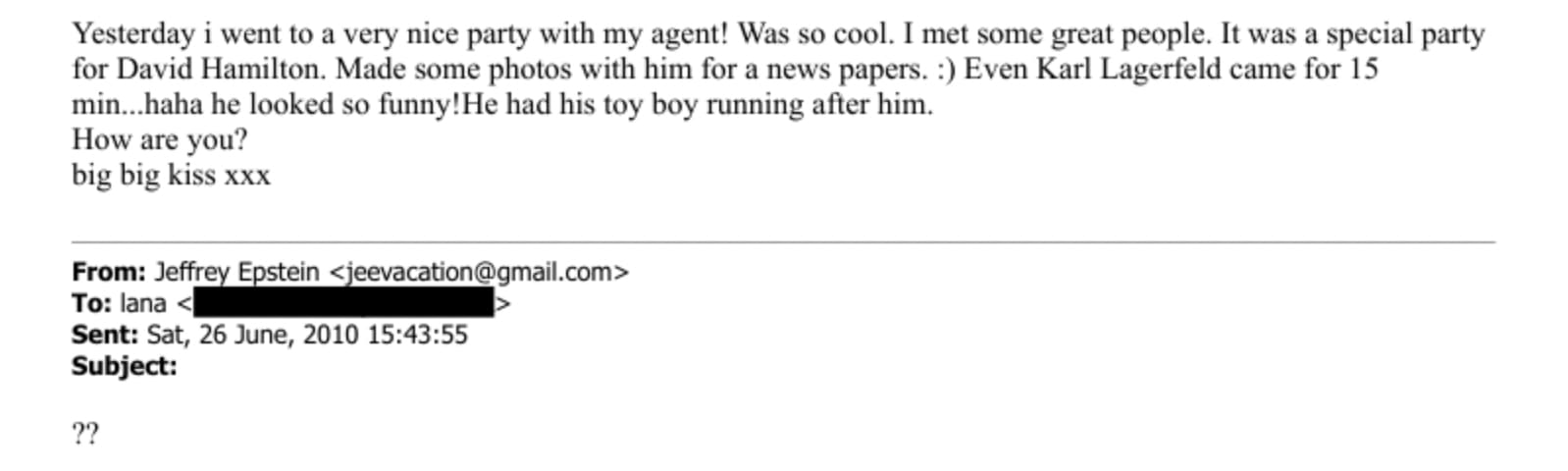
We know she's 15 because her name wasn't redacted (I've chopped it off the screenshot). But then, that's par for the course for these documents: only the men's identities have been diligently obscured. So here I am. Not writing about the FSB-trained government minister who Epstein repeatedly emails and various juicy revelations and connections that I could have scooped the mainstream outlets on.
Instead, I'm writing about David Hamilton, an (alleged) paedophile I once met, 21 years ago.
But I think that's the point. The revelations of the Epstein files are, I believe, momentous. (And if you're reading this in America, I have no idea what your press is doing, the New York Times, in particular, has been wholly missing in action.*)
Epstein has given us an extraordinary portal through which we can now see how hostile state influence, criminality and the impunity of the billionaire class are intimately enmeshed. That's the piece I still want to write. But we can't understand any of this until we realise that Epstein isn't just a doorway, he's also a mirror.
His culture is our culture.
In the UK, a press and political pack is providing a release by baying for the blood of Epstein's "best pal" Lord Peter Mandelson, but it's also a way of letting ourselves off the hook.
This was the second last paragraph of my piece in 2005:
"This incident more or less sums up my feelings about the Côte d'Azur, Paris Hilton, Tamara Beckwith, big fat yachts and fatter millionaires. Where's F Scott Fitzgerald when you need him? He's dead, that's where, and in his place there's only Heat and OK! and Hello!. There's only pap shots of people getting on and off yachts, and falling in and out of their bikinis. There's only arms dealers and nudie pics of young girls. It's all fabulous-fabulous right up to the moment you scratch the surface and something sleazy oozes out.
Today was not the first time I've googled David Hamilton in the 20 years since. I understood that he was a rupture, a chink. That's how I discovered he was an (alleged) child rapist who'd committed suicide. Though Hamilton in common with many predators had already told me exactly who he was.
He also told me that a culture which reveres female youth and innocence despises female age and experience. It disgusts them, scares them. That's our paedophiliac culture too; misogyny of adult women is the opposite of sexual desire for girls, an inverted mirror.
We are crones, hags, witches. Because we're a threat. Because we see these men for who they are. Because, except for rare exceptions - the monstrosity that is Ghislaine Maxwell - we are protectors. Of children. Of society. Of a world in which rich men don't get to act with impunity. Not on our watch.
In 2005, I played David Hamilton's insults for laughs. Later, those same lines became weapons used against me by the men I investigated in the course of my work. A fire hose of abuse, amplified at scale by technological tools, in what I came to understand - in my rational if not emotional brain - was a massive, relentless coordinated online operation. It was designed to depress and deter and deject me. And it did.
But I was also just another woman online who had it coming.
Epstein's world is our world. That's the darkest revelation of these files. He wasn't an aberration. He was our culture made flesh. A culture that's now encoded into 1s and 0s and is growing exponentially baked into the algorithms that power our social media platforms, replicated at scale and fed into the large language models that Epstein's friends are building which are powering our future.
Epstein was a paedophile. And this is Epstein's world now. We're all living in it. It's just that some of us knew that already. That, I think, is why my words wouldn't come this week. And why other women I know have struggled too. A dark shadow has been exposed that we already knew was there. And in a world in which brutal authoritarianism is the rising political system and the world's superpower is led by Jeffrey's friend, the possibility of justice for the victims - any victims - this week feels bleak.
Epstein's victims, Trump's victims, Russia's victims, Israel's victims. We are in mafia country now. A world of strong men where the rules-based order is dead. Jeffrey Epstein is the symbol of that. And, we now know, he also helped create it.
If you've read this far, thank you. Without this newsletter, I wouldn't have written this, and if I hadn't written it, I wouldn't have understood it.
We can fight back. We have to. But first we have to see it.
Thank you so much for reading and supporting my work, Carole x
PS. Seeing is believing. Not all of the latest emails have been processed, but if you haven't seen it an incredible open-source team (thank you Luke Igel, Riley Walz and team, you rock.) They've put all of the emails and documents into a mirror of Gmail…that they've called Jmail. It shows you the emails as if you are Jeffrey Epstein logged into your own Gmail account and makes it so much easier to search than the DOJ site:
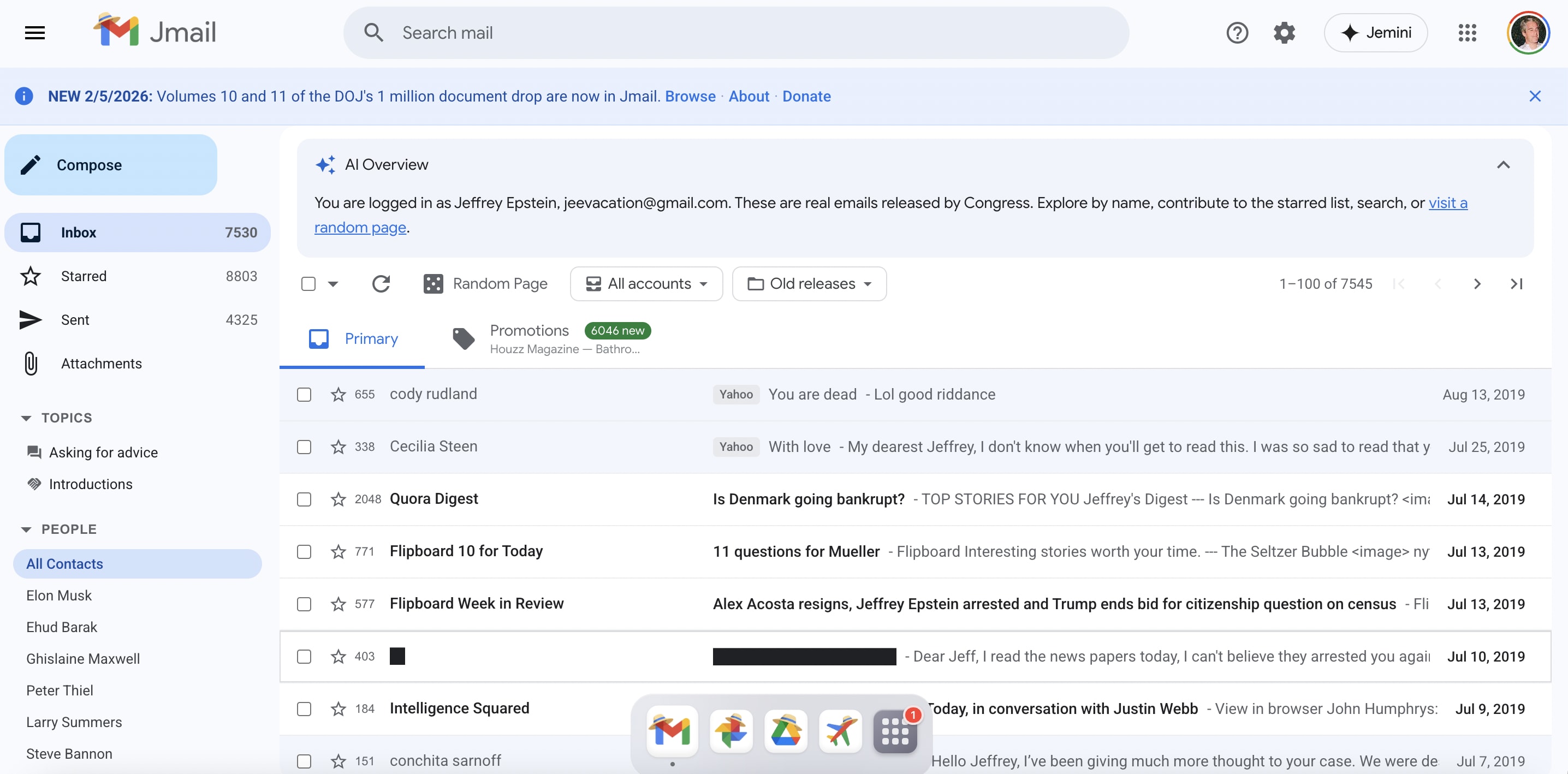
There's even Jflights and his Jamazon accounts.

Fight! [ 05-Feb-26 9:53pm ]A note on who I am: I'm an investigative journalist who's spent a decade reporting on the collision of technology and democracy including exposing the Facebook/Cambridge Analytica scandal for the Guardian and the New York Times. Two years ago, I called the alliance of Trump, Silicon Valley and a global axis of autocracy: a tech bro oligarchy, aka the Broligarchy. Please help me continue to expose it.
This is a quick newsletter to republish a piece that I've just written for Press Gazette, a UK-based trade mag for the media industry. I've been trying to write a complicated piece about Epstein for the last four days and what the files reveal about his relationship with the Kremlin and Silicon Valley and hopefully I will get that out tomorrow. But I've distracted by some distressing news in my world of journalism and I wanted to post about it here.
Yesterday, the Washington Post announced it is "laying off" 300 journalists, ie sacking them. It's devastating for the individuals, for the Washington Post, for America and, given that so many of them were foreign correspondents, the world.
Last night, I saw a deluge of tweet after tweet from brilliant and dedicated Washington Post journalists, editors, photographers. From the war reporter sacked while in a war zone:
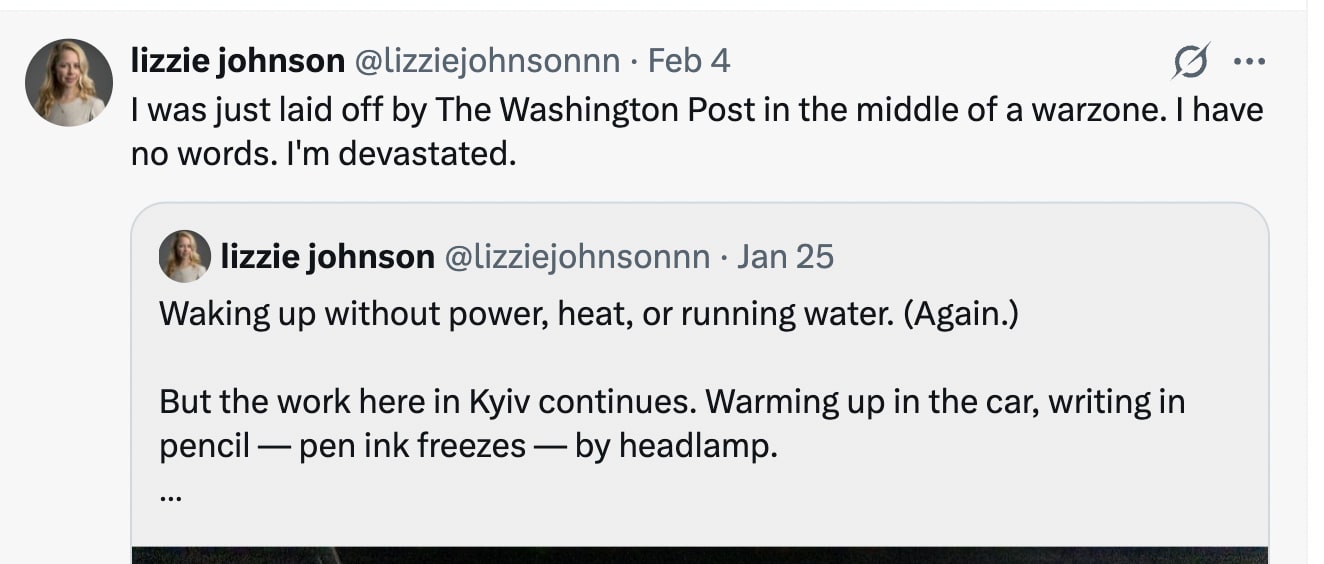
To the reporter whose job it was to track Jeff Bezos's business interests:
To Pulitzer prize winners:
And many many more.
This is entirely down to the actions of Jeff Bezos, a tech fuck boy* who's completely surrendered to a would-be dictator. His decision to not endorse Kamala Harris and then cleanse the opinion pages of any dissenting views caused a collapse in reader revenues. Now, his whipping boy, Will Lewis, a Brit schooled by the OG of the political-media dark arts, Rupert Murdoch, has purged the news organisation of its most vital resource: journalists.
(*Am pleased with this new term, feel free to "broligarch" it up.)
This is a bloodbath. The purging of 300 journalists from one of the most important news titles in America is an incalculable loss.
This kind of institutional knowledge and infrastructure has been nurtured over generations. And now it's gone. The DNA of Watergate has been passed down to the present generation of journalists. During Trump 1, it coined its "Democracy Dies in Darkness" slogan and did the hard yards of trying to hold the administration to account.
What I can't actually believe it has the barefaced gall to still have that phrase on its masthead though I liked this take from the Reductress, titled: The Washington Post Lays Off Half Its Slogan.

I bashed out a series of tweets when I saw the news because I know exactly how these journalists feel: sad, betrayed, angry, uncertain what the future holds. It's exactly what happened to us at the Guardian less than a year ago. In our case, it was down to the actions of an unaccountable executive management team but the effect was the same.
Anyway, I expanded that out today as a letter to the 300 sacked journalists for a piece for Press Gazette.
I'm going to reproduce that below. And underneath that I've pasted the Nerve's latest deep dive into Peter Thiel's Palantir.
But I've interrupted my other work to write about the Washington Post because the attack on press freedom is central to everything we see happening right now. It's not a coincidence. Trump's US coup is already in its advanced stages. And what is very certain right now is that the billionaires aren't going to save anyone. But journalists can and must save themselves and the one thing that I wanted to communicate to Post journalists is that they are not helpless.
I've experienced not just an attack on press freedom, but a direct assault. For a long time, it was all I could do to survive it. But that's also how I learned how to fight back. And that's the number one point I want to communicate right now. I wish their colleagues still in position would take collective action while the US still has labor laws that mean anything at all.
As I write in the piece, the experience of going on strike was foundational to what we did next step in setting up our own news outlet. Action is agency. And while I'm sure there will be big ticket efforts to start something new from the wreckage of the Post funded by big league Democrat funders (I certainly hope so),but my message is that you don't have to wait for the cavalry to arrive (not least because they may not come).
When this happened to us at the Guardian, I spoke to a lot of clever people about my next journalistic step. The no-brainer step for me, they said, was to focus on this newsletter and "build out" a brand. Instead, I took another route of joining forces with other journalists - experienced editors and a designer - because I still believe that journalism is a team sport. And you have to start somewhere.
From today's Press Gazette: A letter to the 300 axed Washington Post journalists
Dear Washington Post journalists,
Solidarity on a terrible day. A craven tech bro has sold you out.
The Post is a symbol, both for journalism and America, and for Jeff Bezos and Will Lewis to axe 300 of you in a single day, including those currently reporting in war zones, feels like an augury.
But as a journalist who worked for the Guardian for 20 years and who, alongside my colleagues, was binned in a similar fashion less than a year ago, I have important information to impart: do not give up.
When our management decided to dump our beloved newspaper, The Observer, we, as a news organisation, fought back: we went on strike. We didn't win - a board of mainly non-journalists led by a banker saw to that - but we went down fighting. It isn't over until it's over.
One week after 100 staff and freelance journalists were "banged out" of the Guardian's offices (an old Fleet Street tradition, don't ask), we started planning a phoenix project. What if we set up our own news outlet? Was that even possible?
[The Observerwas taken over by Tortoise Media Group in March 2025with at least 20 staff taking redundancy and many other long-serving freelances and casuals, including Cadwalladr, losing their jobs]
We were inspired by a crop of insurgent new outlets in the US (Zeteo, Drop Site News, The Contrarian, 404 Media, Status) and the UK (Byline Times, DoubleDown News, Declassified, Mill Media). And, also by the sense of agency that came from going on strike. Standing in solidarity for the journalistic values we believed in and having a laugh in the process was the genesis of the idea for what became The Nerve.
What if we could try to do journalism in a different way? What if we didn't have to ask permission? What if we could persuade a community of readers to build a new kind of journalism with us?
"We" are three senior editors. Jane Ferguson, (the former editor of the Observer New Review section), her deputy Sarah Donaldson (who's leading the project), Imogen Carter (another senior editor), The Observer's former creative director Lynsey Irvine and me, an investigative journalist and writer.
At the time, we assumed we needed money and investment. That's what everyone told us. Especially as I was the only writer and we had ambitions: for meaty investigations, for public interest reporting, for reviews by great critics, and to pay the paper's two most popular columnists - Stewart Lee and Philippa Perry - who'd elected to come with us.
But in the end we opted to simply just jump off the cliff. Our USP as a team is that we know how to execute - we've worked together for nearly 20 years - so that's what we did. The others invested their Guardian payoffs in the project and I was being supported by a Substack newsletter I'd hastily set up. We started with nothing.
It's why we chose the name, The Nerve, because you can't tell people to have nerve unless you can show it yourself. And having nerve we believe is the quality, more than any other, that's needed right now.
So, here's how it's going. We focus on what we believe are the three subjects that define our age: culture, politics and tech. We produce two beautifully curated newsletters a week, a website, thenerve.news, and a newly launched YouTube channel
We don't paywall but we offer membership benefits with live and virtual events.
We bust our three-month target in the first week.
We've landed several major investigations (a whole run of stories on a Russian spy ring, Larry Ellison's capture of Tony Blair and Palantir's dangerous enmeshment in the UK state).
We've published a pilot print product. Our Bluesky already has four times the followers (17,000) of our old newspaper. Our Instagram posts reach up to half a million people. We're paying for everything out of revenue. We've now received grants from two incredibly generous philanthropists to support our expansion into video and public interest investigations. And if we can maintain the same, modest rate of growth, we will be sustainable in a year.
For the number nerds: our monthly growth is in double digits. Our conversion rate (free to paying subscribers) is 12% - three times the industry standard of 3 to 4%. And the open rate of our newsletters is an incredibly high 60%.
I was a Guardian lifer. I would never have given up the reach of a global news platform. For the last decade, I have worked flat out to expose what I hope everyone can now see is a Silicon Valley-enabled global far-right insurgency. And what's mattered to me more than anything is for that work to have impact.
And here's the most stunning finding to report. Between the Nerve and my personal Substack - How to Survive the Broligarchy, which is just over a year old - I get up to 200,000 unique views per article. To put that into perspective, it's what the very best performing stories on the Guardian's website get outside breaking news.
We're only four months in and it could all go horribly wrong but speaking personally I don't care. The world is on fire. The entire media industry is a shitshow. And the only interesting, impactful thing to do in this moment, I believe, is to be bold and brave and to try something new.
What looks like "security" isn't. If a news organisation decides to dump an entire title or a broligarch can axe 300 journalists in a single day, it's not any sort of sustainable or reliable model.
You can't rebuild the Washington Post overnight but you can try. Beehiiv, the newsletter platform we use, put us on their media collective programme which includes paying for our monthly legal cover (in the US it also provides a medical insurance stipend). Mostly, we're excited and proud to be part of a growing independent network that's led by journalists and that understands why a free and independent press matters now more than ever.
To the battered and bruised journalists of the Washington Post, I have this to say: democracy doesn't have to die in darkness. There is another way.
Your ally in arms, Carole
PS If you do want to take the leap, get in touch: carole.cadwalladr@thenerve.news.
Palantir update
Here as promised is the first piece I wrote on Palantir, last week for the Nerve. It was a deep dive into Palantir's contracts with the UK government and new revelations about its total enmeshment in the UK's critical infrastructure. It's not just our National Health Service and the Ministry of Defence but also, wait for it, our nuclear weapons.
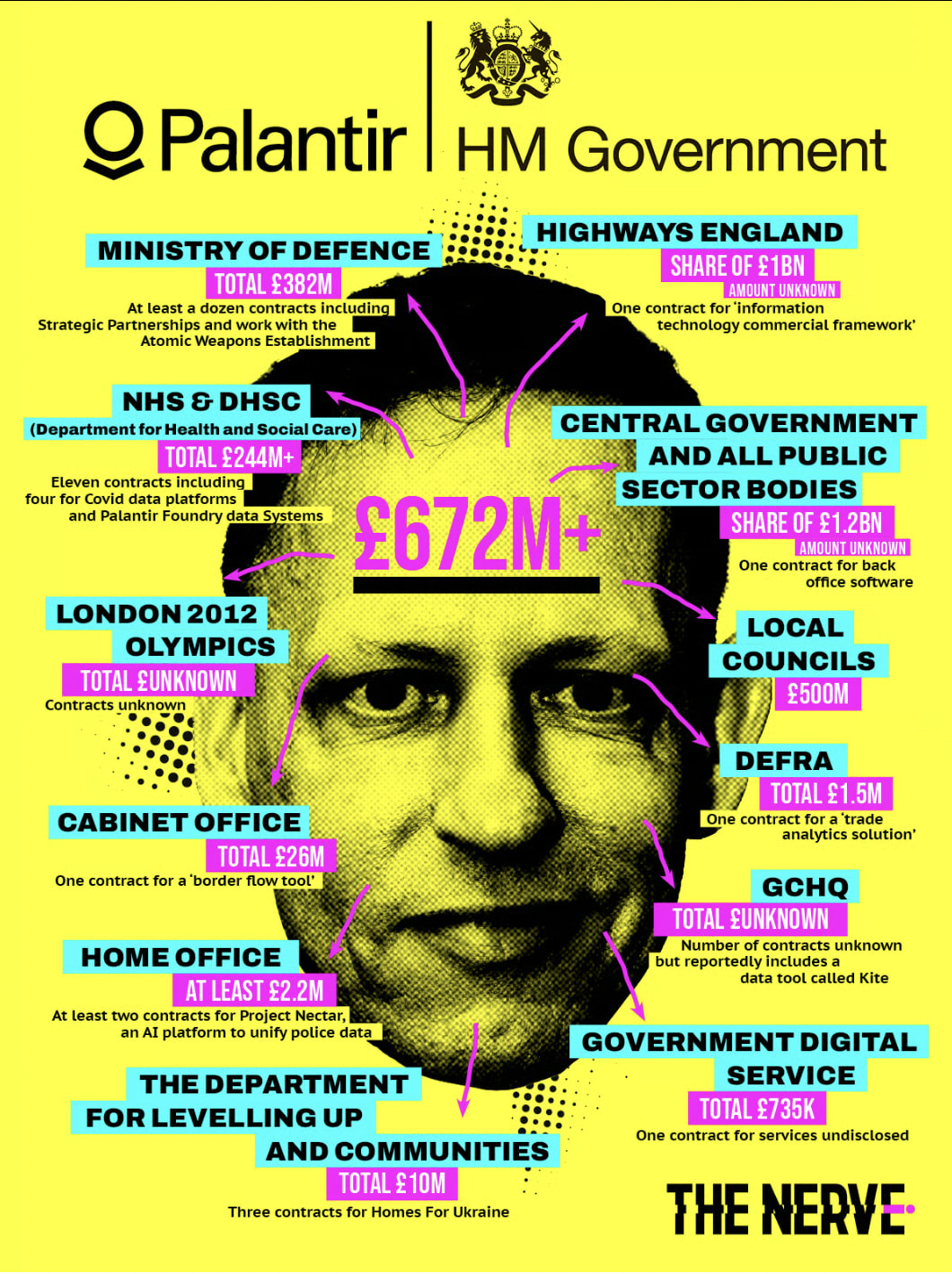
Peter Thiel is now centrally involved in what is supposed to be our ultimate deterrent. What could possible wrong?
There's another piece I wrote last week which I'm going to come back to but one of the key points, for me, is that Palantir's enmeshment in the UK is not just a risk to us - although it is - it also makes us complicit in what is happening in America right now.
The UK is Palantir's second biggest customer. It's activities are subsidised by nearly a billion dollars of UK taxpayers' money. It's a betrayal, I believe, of the American people.
We made a deliberate choice with the Nerve to focus on the three subjects that we believe are at the heart of everything that is happening right now: culture, politics and technology.
And Peter Thiel, embodies how those three subjects are not distinct spheres any more more than any other individual alive: They are one and the same.
I'm going to leave that here because Peter Thiel is right there in the Epstein files too and I want to get my interrupted piece out. The big scandal that's roiled the UK press this week is the disgrace of Lord Mandelson who as well as being Jeffrey Epstein's "best pal" was also…drum roll…Palantir's lobbyist.
Keir Starmer made Mandelson his ambassador to Washington and when Starmer went to visit Trump last year, the only other visit he made was to Palantir's office. That visit resulted in a £240m "strategic partnership" between the UK Ministry of Defence and, you guessed it, Palantir.
That visit was raised in a question in parliament yesterday. And that's just the tip of decades-long iceberg.
The Epstein story is such a mess. I've been on the tech platforms-Russian interference-political manipulation beat since 2016 and it's always felt like a relief when there are big stories that I can simply ignore. Epstein has been one of those. But no longer. That's the piece I've been struggling to write. He's right in the thick of everything I've been investigating and trying to expose for the last decade. What an absolute headfuck this week has been.
If you know any Washington Post journalists you know or follow, do share this piece. There's no magic bullet right now and nothing can replace one of America's most vital news organisations overnight, but repeat after me: the billionaires are not coming to save us.
Thank you to everyone who subscribes. It's free but paid subscriptions support my work. With thanks, Carole
Death Squads Execute Second Dissident [ 25-Jan-26 12:34am ]A note on who I am: I'm an investigative journalist who's spent a decade reporting on the collision of technology and democracy including exposing the Facebook/Cambridge Analytica scandal for the Guardian and the New York Times. Two years ago, I called the alliance of Trump, Silicon Valley and a global axis of autocracy: a tech bro oligarchy, aka the Broligarchy. Please help me continue to expose it.
I adapted that headline from a post on BlueSky. Thank you, Scott.
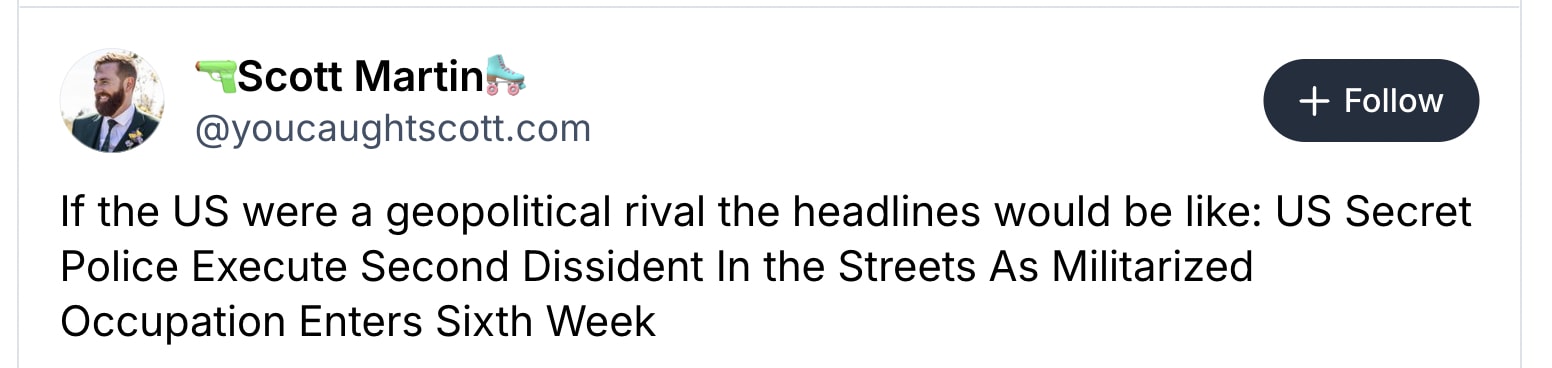
Because the killing of an unarmed civilian by masked paramilitary gunman on the streets of Minneapolis is murder. This was an execution.
An extrajudicial killing in cold blood of a registered nurse, Alex Pretti. I dearly hope that's how it'll be reported but I'm posting now, even in the noise of this moment because the shock value is the point of it. That's what political violence is. It's violence for political ends.
We know the playbook of what comes next because we've already seen it. We know that the news cycle will erupt in shock and fury. And we know that the Trump administration and its allies will lie. They will tell us not to believe the evidence of our eyes and we won't know what to do with what is state-sanctioned gaslighting of an entire nation and beyond.
But, there are things to hold onto and that's what this week - maybe one the most insane news cycle of my lifetime - has also taught us. The noise, the sturm-und-drang of this moment is not a coincidence. It's the point.
This has been a week of explosions from destroying the NATO alliance to this fascistic street killing. It's meant to stun us.
Has it really been only a week since Trump announced his intention to take Greenland by any means possible? Three days since he said "I'm a dictator…and sometimes you need one." Two days, since a board of international war criminals were inducted into the new inaugural "Board of Peace".
And they are all tests. Trial balloons. Can we focus long enough to fight back?
What is happening on the streets of Minneapolis is a test. The city a petri dish where administration is testing the limits of its power and the strength of the resistance it encounters. In Wednesday's newsletter I included video of the interview I'd done with conservative historian, Robert Kagan, in which he set out very clearly how the intention is to provoke street violence in order for Trump to invoke the Insurrection Act.
This is intended to provoke a reaction and it's the form that reaction takes, that's so critical.
And that's why again, I'm going to highlight Mark Carney's speech at Davos. I wrote a newsletter about it on Wednesday because here, finally there was someone with authority prepared to acknowledge what the fuck is going on and defend what we may one day describe as the reality-based order.
And I'm so glad I did, because if I'd waited until the end of the week, it would already have been eclipsed, another fleeting moment in a frantic news cycle that is never going to let up, that's also the point.
But I want, again, to highlight the text he quoted from, The Power of the Powerless, by Vaclav Havel the Czechoslovakian dissident poet turned president. A book that had helped fuel an uprising that had ultimately led to a wave of revolutions across Europe which had in turn led to the downfall of the Soviet Union.
In countries under the Iron Curtain, people felt powerless, but they weren't, that was Havel's message. And also, Carney's. The job of power is to make people believe they have no power, but it's a lie.
And it's the same in Minnesota. It's because these protestors have power that they have to be stopped, crushed, silenced. ICE is shooting unarmed civilians in cold blood and beating disabled military veterans to prove that they can.
But the more brutality they use, the more performative the violence, the more it reveals their own weakness.
There are other videos you should watch. I'm on shitty wifi and I can't upload them but I screen recorded of NYPD officers tearing off masks of ICE agents and I can tell you how weak and ashamed and pathetic they look.
The elites are cowed. That's what Robert Kagan also said when I interviewed him. Politicians, senators, CEOs, Hollywood royalty. They're weak and cowardly and silent. But the ordinary people of Minneapolis aren't. They're showing what it takes to stand up to power. And this killing only proves it.
I don't think it's a coincidence that the day after Carney's speech even the UK felt sufficiently embarrassed into pulling out of the Gaza's Board of and the head of NATO and various European leaders pretended they'd been brave all along.
Courage is contagious. Carney's words made a difference. That's what words do. And it's why the mass cowardice of America's rich and entitled and powerful is the real problem America is facing right now. A cowardice that's being normalised by the enabling actions of other world leaders.
"The powerful have their power. But we have something too: the capacity to stop pretending, to name realities, to build our strength at home, and act together."
That's what Carney said. He's right. And we have to keep on repeating it.
Davos is a cringefest even at the best of times. But, there was a value to crushing these leaders into a ski resort and forcing them to watch Trump up close rather than as pixels on a screen. More than that, they got to see each other, in the flesh, and their mirror neurons squirmed in collective embarrassment.
And guess what? Trump backtracked. Maybe he isn't going to invade Greenland, after all. I mean maybe he is. Who knows at this point but Trump may be the world's greatest shitposters but the physical world still matters. We are human animals. And, this week, the pack figured out that one of our own is weak and ill. He may have nukes but for all we know he may also have late stage Creutzfeldt Jacobs Disease. The other leaders sniffed the air and pulled back the curtain to find only whirring some cogs and wheels. The Wizard of Davos is ill and weak and unsteady on his hooves. This week could be a crisis but also a turning point.
Ask an awkward question
Davos has always been cringe but it used to be cringily hypocritical, hosting petrodollar-sponsored panels on climate change whereas it's now given up even that pretence.
There were 41 panels - I counted them. And one on democratic threats. And among the battalions of journalists who turn up to transcribe this stuff, one of the few who bothered to ask an unscripted question was Caolan Robertson, an ex-far-right influencer turned journalist now based in Ukraine.
I love a doorstep and watching Trump's Russia envoy, Steve Witkoff, desperately trying to get away from him went deservedly viral on social media.
Meanwhile the owner and editor-in-chief of my old newspaper was hosting a panel co-sponsored by the Saudi state oil company in which he interviewed the ex-commander of the IDF's notorious cyber intelligence Unit 8200.
One of these is a highly respectable mainstream editor. The other runs a YouTube channel. Maybe, it's not that journalism is failing to meet this moment, it's that it's happening elsewhere.
Havel was a poet trapped in a totalitarian state who became President. It's never hopeless. And it's pointless and absurd to be scared of Trump when he's scared of teenagers. Why do you think he got his pals to buy TikTok this week? The social media platform whose dumb dances and funny skits helped a generation get through a global pandemic? It's because he's the loneliest, most desperate man in the world.
He's waiting for Minnesotans to blink and they're not blinking.
He's the one who blinked this week. A sickened animal who surrounded by a pack thought twice about his big boy behaviour and backed down. You know the other person who ordered extrajudicial executions on his own people? President Duterte in the Philippines. He, like Trump, was elected in 2016. He waged a war not on immigrants but drugs. Last year he was arrested for crimes against humanity. It's never hopeless.
Thank you, as ever. I'm hugely grateful to everyone who supports my work, Carole x
The Rupture [ 21-Jan-26 1:14pm ]A note on who I am: I'm an investigative journalist who's spent a decade reporting on the collision of technology and democracy including exposing the Facebook/Cambridge Analytica scandal for the Guardian and the New York Times. Two years ago, I called the alliance of Trump, Silicon Valley and a global axis of autocracy: a tech bro oligarchy, aka the Broligarchy. Please help me continue to expose it.
A rupture, not a transition
Mark Carney's speech at Davos yesterday really is worth your time. It made some of the front pages today but the news cycle moves so fast that it's already yesterday's news. Part of the challenge of this moment - and I believe the job of journalists - is to focus on the signal, not the noise. And if you have time to take in one thing properly, this week, I'd suggest it's this.
It does what a great speech should do: it gives us the language to process and understand what is happening. It does so from a position of moral clarity. And it includes a call to action to what remains of the liberal world.
It's a huge relief to have a world leader simply naming what's happening. That is the first step. But, it actually goes further in that it calls out the "lie" of the "rules-based order" that the "rules" were for some but not all.
That's been so abundantly proved by the global response to what's happening in Gaza but it's also not an outlier. America has been the world's policeman and sometimes that's looked less like a Victorian bobby on the beat and more like a beat-the-shit-out-of-you ICE officer and calling that out is a refreshing blast of honesty.
He begins it with the story of a shopkeeper living under Communism from a book by Vaclav Havel, the Czech writer and dissident turned President. The news reports focussed on what Carney said about NATO's article five but it's what he has to say about truth that's even more urgent and important.
"Every morning, the shopkeeper places a sign in his window: "Workers of the world unite." He doesn't believe in it. No one does. But he places the sign anyway to avoid trouble, to signal compliance, to get along. And because every shopkeeper on every street does the same, the system persists — not through violence alone, but through the participation of ordinary people in rituals they privately know to be false.
"Havel called this living within a lie. The system's power comes not from its truth, but from everyone's willingness to perform as if it were true. And its fragility comes from the same source. When even one person stops performing, when the greengrocer removes his sign, the illusion begins to crack.
"Friends, it is time for companies and countries to take their signs down.
"For decades, countries like Canada prospered under what we called the rules-based international order. We join its institutions, we praised its principles, we benefited from its predictability. And because of that, we could pursue values-based foreign policies under its protection.
"We knew the story of the international rules-based order was partially false, that the strongest would exempt themselves when convenient, that trade rules were enforced asymmetrically, and we knew that international law applied with varied rigor, depending on the identity of the accused or the victim.
"This fiction was useful, and American hegemony in particular helped provide public goods, open sea lanes, a stable financial system, collective security, and support for frameworks for resolving disputes.
"So we placed the sign in the window. We participated in the rituals, and we largely avoided calling out the gaps between rhetoric and reality.
"This bargain no longer works.
Let me be direct. We are in the midst of a rupture, not a transition."
The end of the speech includes a call back to the Havel story:
"We are taking a sign out of the window.
"We know the old order is not coming back. We shouldn't mourn it. Nostalgia is not a strategy, but we believe that from the fracture we can build something bigger, better, stronger, more just. This is the task of the middle powers, the countries that have the most to lose from a world of fortresses and the most to gain from genuine cooperation.
"The powerful have their power. But we have something too: the capacity to stop pretending, to name realities, to build our strength at home, and to act together."
"The powerful have their power. But we have something too: the capacity to stop pretending…"
I lived in then-Czechoslavakia in 1990. It was less than a year after the Velvet Revolution, and inevitably I read a lot of Havel. I've been thinking about that time recently, not least because of the great historical fortune I had to be young and free in a hugely exciting moment in which the world was literally opening up before us.
So exciting that I took a year out of my degree to go and teach English to a bunch of sports journalists who worked for the newspaper affiliated with Havel's party.
It's why I found Carney's choice of story so interesting because I suspect that the book that this is taken from, The Power of the Powerless, is a text that is going to increasingly speak to us in the months and years to come.
Words matter.
That's one of the central points of Havel's essay. And also the outcome of it. After its publication in 1978, his idea that "living in truth" was both a radical and an achievable act reverberated across Eastern and Central Europe. This account, published by the Hannah Arendt Center for Politics and Humanities, describes its direct galavanizing impact on Polish factory workers:
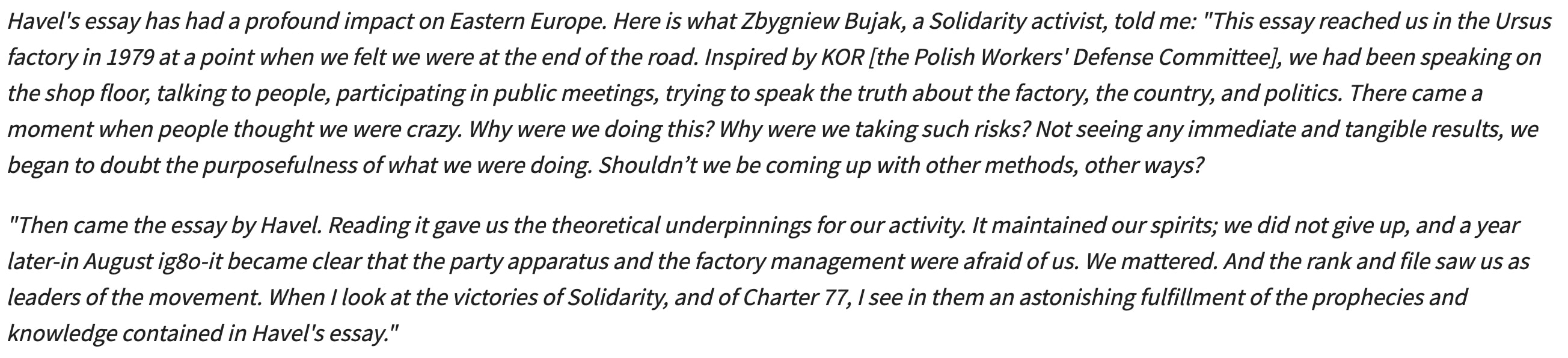
We can't respond and act to this hugely consequential geopolitical moment if we are complicit in the denial of our leaders and media. This is a week in which the world we have known has swung on its axis. We cannot simply carry on as if it's business as normal.
It's why Starmer's underplayed reaction is so deeply dangerous. We can all understand why, we see the reasons clearly, but not speaking the truth, now, is deeply corrosive. That is the subtext of Carney's speech. And there is a deep and dark hinterland behind it.
We've been lucky through a golden age of peace and prosperity but as he so clearly articulates, that age is gone. Ahead lies dragons.
It's why we have to listen to these voices from the past. In my newsletter on Monday, I said that the most powerful and on point thing I'd read or heard was an interview in the New Yorker by the conservative historian Robert Kagan.
Given the inadequacy of the UK response, I emailed Robert to see if he'd speak to me about what we should be doing in this moment.
This is the impromptu Zoom call I had with him which we published in The Nerve yesterday. It's a quick watch or listen - 17 minutes - (or there's a transcript here) but like Carney he names what's happening and he's very very clear on the risks: to both the US and Europe.
Thanks so much for the support & if you've seen or heard interesting articles/voices do please share in the comments. Thank you!
Full text of Mark Carney speech, World Economic Forum, January 20, 2026
Thank you very much, Larry. I'm going to start in French, and then I'll switch back to English.
(IN FRENCH)
It seems that every day we're reminded that we live in an era of great power rivalry — that the rules-based order is fading, that the strong can do what they can, and the weak must suffer what they must.
And this aphorism of Thucydides is presented as inevitable, as the natural logic of international relations reasserting itself. And faced with this logic, there is a strong tendency for countries to go along, get along to accommodate, to avoid trouble, to hope that compliance will buy safety.
Well, it won't. So what are our options?
In 1978, the Czech dissident Václav Havel, later president, wrote an essay called "The Power of the Powerless," and in it he asked a simple question: how did the communist system sustain itself?
And his answer began with a greengrocer.
Every morning, the shopkeeper places a sign in his window: "Workers of the world unite." He doesn't believe in it. No one does. But he places the sign anyway to avoid trouble, to signal compliance, to get along. And because every shopkeeper on every street does the same, the system persists — not through violence alone, but through the participation of ordinary people in rituals they privately know to be false.
Havel called this living within a lie. The system's power comes not from its truth, but from everyone's willingness to perform as if it were true. And its fragility comes from the same source. When even one person stops performing, when the greengrocer removes his sign, the illusion begins to crack.
Friends, it is time for companies and countries to take their signs down.
For decades, countries like Canada prospered under what we called the rules-based international order. We join its institutions, we praised its principles, we benefited from its predictability. And because of that, we could pursue values-based foreign policies under its protection.
We knew the story of the international rules-based order was partially false, that the strongest would exempt themselves when convenient, that trade rules were enforced asymmetrically, and we knew that international law applied with varied rigor, depending on the identity of the accused or the victim.
This fiction was useful, and American hegemony in particular helped provide public goods, open sea lanes, a stable financial system, collective security, and support for frameworks for resolving disputes.
So we placed the sign in the window. We participated in the rituals, and we largely avoided calling out the gaps between rhetoric and reality.
This bargain no longer works.
Let me be direct. We are in the midst of a rupture, not a transition.
Over the past two decades, a series of crises in finance, health, energy and geopolitics have laid bare the risks of extreme global integration. But more recently, great powers have begun using economic integration as weapons, tariffs as leverage, financial infrastructure as coercion, supply chains as vulnerabilities to be exploited.
You cannot live within the lie of mutual benefit through integration when integration becomes the source of your subordination.
The multilateral institutions on which the middle powers have relied — the WTO, the UN, the COP, the very architecture of collective problem solving — are under threat. As a result, many countries are drawing the same conclusions that they must develop greater strategic autonomy in energy, food, critical minerals, in finance and supply chains. And this impulse is understandable.
A country that cannot feed itself, fuel itself, or defend itself has few options. When the rules no longer protect you, you must protect yourself.
But let's be clear-eyed about where this leads. A world of fortresses will be poorer, more fragile, and less sustainable.
And there's another truth: if great powers abandon even the pretense of rules and values for the unhindered pursuit of their power and interests, the gains from transactionalism will become harder to replicate.
Hegemons cannot continually monetize their relationships. Allies will diversify to hedge against uncertainty. They'll buy insurance, increase options in order to rebuild sovereignty, sovereignty that was once grounded in rules but will increasingly be anchored in the ability to withstand pressure.
This room knows this is classic risk management. Risk management comes at a price, but that cost of strategic autonomy, of sovereignty, can also be shared. Collective investments in resilience are cheaper than everyone building their own fortresses. Shared standards reduce fragmentations. Complementarities are positive sum.
The question for middle powers like Canada is not whether to adapt to the new reality — we must.
The question is whether we adapt by simply building higher walls, or whether we can do something more ambitious.
Now, Canada was amongst the first to hear the wake-up call, leading us to fundamentally shift our strategic posture. Canadians know that our old, comfortable assumptions that our geography and alliance memberships automatically conferred prosperity and security, that assumption is no longer valid. And our new approach rests on what Alexander Stubb, the president of Finland, has termed value-based realism.
Or, to put it another way, we aim to be both principled and pragmatic. Principled in our commitment to fundamental values, sovereignty, territorial integrity, the prohibition of the use of force except when consistent with the UN Charter and respect for human rights.
And pragmatic in recognizing that progress is often incremental, that interests diverge, that not every partner will share all of our values.
So we're engaging broadly, strategically, with open eyes. We actively take on the world as it is, not wait around for a world we wish to be.
We are calibrating our relationships so their depth reflects our values, and we're prioritizing broad engagement to maximize our influence, given the fluidity of the world at the moment, the risks that this poses and the stakes for what comes next.
And we are no longer just relying on the strength of our values, but also the value of our strength.
We are building that strength at home. Since my government took office, we have cut taxes on incomes, on capital gains and business investment. We have removed all federal barriers to interprovincial trade. We are fast tracking $1 trillion of investments in energy, AI, critical minerals, new trade corridors and beyond. We're doubling our defence spending by the end of this decade, and we're doing so in ways that build our domestic industries. And we are rapidly diversifying abroad.
We've agreed to a comprehensive strategic partnership with the EU, including joining SAFE, the European defence procurement arrangements. We have signed 12 other trade and security deals on four continents in six months.
In the past few days, we've concluded new strategic partnerships with China and Qatar. We're negotiating free trade pacts with India, ASEAN, Thailand, Philippines and Mercosur.
We're doing something else: to help solve global problems, we're pursuing variable geometry. In other words, different coalitions for different issues based on common values and interests. So on Ukraine, we're a core member of the Coalition of the Willing and one of the largest per capita contributors to its defence and security.
On Arctic sovereignty, we stand firmly with Greenland and Denmark and fully support their unique right to determine Greenland's future.
Story continues below advertisement
Our commitment to NATO's Article 5 is unwavering, so we're working with our NATO allies, including the Nordic-Baltic Eight, to further secure the alliance's northern and western flanks, including through Canada's unprecedented investments in over-the-horizon radar, in submarines, in aircraft, and boots on the ground — boots on the ice.
Canada strongly opposes tariffs over Greenland and calls for focused talks to achieve our shared objectives of security and prosperity in the Arctic.
On plurilateral trade, we're championing efforts to build a bridge between the Trans-Pacific partnership and the European Union, which would create a new trading bloc of 1.5 billion people on critical minerals.
We're forming buyer's clubs anchored in the G7 so the world can diversify away from concentrated supply. And on AI, we're cooperating with like-minded democracies to ensure that we won't ultimately be forced to choose between hegemons and hyperscalers.
This is not naïve multilateralism, nor is it relying on their institutions. It's building coalitions that work issue by issue with partners who share enough common ground to act together. In some cases, this will be the vast majority of nations. What it's doing is creating a dense web of connections across trade, investment, culture on which we can draw for future challenges and opportunities.
Our view is the middle powers must act together because if we're not at the table, we're on the menu.
But I'd also say that great powers can afford, for now, to go it alone. They have the market size, the military capacity, and the leverage to dictate terms. Middle powers do not. But when we only negotiate bilaterally with a hegemon, we negotiate from weakness. We accept what's offered. We compete with each other to be the most accommodating.
This is not sovereignty. It's the performance of sovereignty while accepting subordination.
In a world of great power rivalry, the countries in-between have a choice: compete with each other for favour, or combine to create a third path with impact. We shouldn't allow the rise of hard power to blind us to the fact that the power of legitimacy, integrity, and rules will remain strong if we choose to wield it together.
Which brings me back to Havel. What does it mean for middle powers to live the truth?
First, it means naming reality. Stop invoking rules-based international order as though it still functions as advertised. Call it what it is: a system of intensifying great power rivalry where the most powerful pursue their interests using economic integration as coercion.
It means acting consistently, applying the same standards to allies and rivals. When middle powers criticize economic intimidation from one direction but stay silent when it comes from another, we are keeping the sign in the window.
It means building what we claim to believe in, rather than waiting for the old order to be restored. It means creating institutions and agreements that function as described, and it means reducing the leverage that enables coercion.
That's building a strong domestic economy. It should be every government's immediate priority.
And diversification internationally is not just economic prudence; it's a material foundation for honest foreign policy, because countries earn the right to principled stands by reducing their vulnerability to retaliation.
So, Canada. Canada has what the world wants. We are an energy superpower. We hold vast reserves of critical minerals. We have the most educated population in the world. Our pension funds are amongst the world's largest and most sophisticated investors. In other words, we have capital talent. We also have a government with immense fiscal capacity to act decisively. And we have the values to which many others aspire.
Canada is a pluralistic society that works. Our public square is loud, diverse and free. Canadians remain committed to sustainability. We are a stable and reliable partner in a world that is anything but, a partner that builds and values relationships for the long term.
And we have something else: we have a recognition of what's happening and determination to act accordingly. We understand that this rupture calls for more than adaptation. It calls for honesty about the world as it is.
We are taking a sign out of the window.
We know the old order is not coming back. We shouldn't mourn it. Nostalgia is not a strategy, but we believe that from the fracture we can build something bigger, better, stronger, more just. This is the task of the middle powers, the countries that have the most to lose from a world of fortresses and the most to gain from genuine cooperation.
The powerful have their power. But we have something too: the capacity to stop pretending, to name realities, to build our strength at home, and to act together.
That is Canada's path. We choose it openly and confidently, and it is a path wide open to any country willing to take it with us.
Thank you very much.
Stop Normalizing Fascism [ 19-Jan-26 11:18pm ]A note on who I am: I'm an investigative journalist who's spent a decade reporting on the collision of technology and democracy including exposing the Facebook/Cambridge Analytica scandal for the Guardian and the New York Times. Two years ago, I called the alliance of Trump, Silicon Valley and a global axis of autocracy: a tech bro oligarchy, aka the Broligarchy. Please help me continue to expose it.
I'm back to mocking up my own front pages
I did this in the first weeks after the inauguration last year when it felt like the mainstream media and the political establishment was wholly failing to meet the moment. It was the most graphic way I could think of to spell out what was happening.
That's overwhelmingly how I feel tonight after the news from the weekend and after getting off a Zoom with the historian Robert Kagan, more on that below.
I know it's hard in a roiling news cycle of daily new crises, but we have no hope of taking the actions necessary, if we refuse to see what's plainly before our eyes.
All through this year, moments of Trump-induced crisis have brought me a personal sense of relief: a relief that, at least, the crisis was now visible. That the stakes were now unignorable. And yesterday, that's what I thought would be the outcome of Trump's latest statement in which he said he would hold Europe financial hostage until Denmark bequeathed him Greenland. At least, I thought, we, here in Europe, would be shaken out of our stupor.
But today, it's been business as normal.
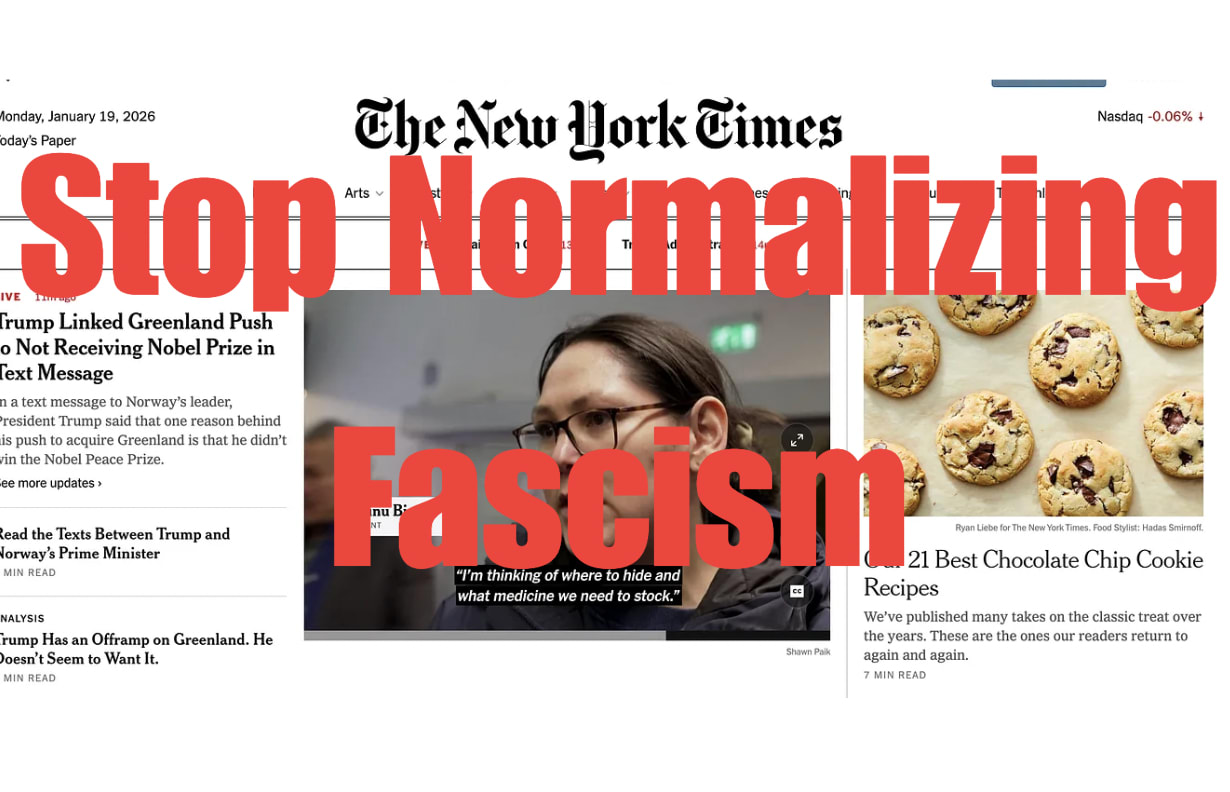
It's actually unfair to pick on the New York Times on this one though their strategy of making the chocolate chip cookie recipe as big the today-in-fascism story is not, I feel, a very helpful example of communicating news priorities.
Unfair, because the crisis today is squarely in Europe too and our newspapers are no better. We are in a profound geopolitical crisis. The world that we have known is no more. Not that you'd get this from the front page headlines.
We are now facing an aggressor in the East - Russia - and an aggressor in the West - the United States. Aggressors, who we now know beyond doubt, are not just aligned but working together.
And here we are in a crushing suicidal embrace with a country which has openly declared hostilities on us, its NATO allies.
Yet today, our prime minister announced a policy of appeasement.
And the newspapers have simply followed his lead.
Read his lips
If you heard the news on the radio or TV or saw a headline on a passing social media post, I recommend reading the actual text of Trump's Truth Social post.
Language matters. Tariffs will start at 10% and rise to 25%, he says, "until such a time as a Deal is reached for the Complete and Total purchase of Greenland."
I read it on Saturday night and woke Sunday morning from a dream in which I was fleeing a wildfire. Actually, it was the moment just before, when it engulfed a cliff above my house and I had to make the split-second decision on whether to run.
We have neither cliffs nor wildfires in North London. I don't even live in a house. Later, I found myself Googling "What did Hitler say about the Sudetenland?" and found this:
"My patience is now an end." The Fuhrer had made an offer to Herr Benes and it is now "peace or war in his hands".
Trump's patience is now at an end
Some people still believe and even quote Godwin's Law - the formulation that the longer an online discussion goes on, the higher the probability of someone invoking the Nazis. They would find the analogy above facetious.
I wish. For starters, Mike Godwin, the originator of that law, suspended that law back in 2017 when neo-Nazis paraded through Charlottesville with flaming tiki torches.
And while, it wasn't across the front banner headline, even the New York Times is now saying the F word. It ran a good piece this week headlined "The Resistance Libs were Right" by Michelle Goldberg (gift link).

It begins:
"For the last decade there's been a debate, among people who don't like Donald Trump, about whether he's a fascist," she begins. "It's striking how much the arguments that Trump is not a fascist have suffered in just the first few days of this year, in which we've plunged to new depths of national madness."
It was a historian of fascism who pointed out the article to me. A historian who's faced repeated online abuse and academic backlash over the last decade for warning about Trump and what he means.
I hope people have said sorry, I texted back.

This is true. And the New York Times's headline helpfully sums up the scathing language and ironic minimization that so many academics, historians, journalists and ordinary people who could see what was happening faced. In the US, they were "resistance libs", in the UK "remoaners".
And even now, there is still an inability to process what our eyes and ears are telling us. To take just one example of this, the extreme brutality of what is happening in Minneapolis is undercut by extreme ridiculousness.
Have you seen the man dressed as a fox being tackled to the ground and cuffed by masked militiamen?
Or the disabled US military veteran being dragged out of her car and beaten?
The absurdity is as hard to process as the brutality. But that's the point. The what-the-fuck-is-this of everything happening in Minneapolis is the point of it.
This outfit went viral on social media yesterday despite any half-decent scriptwriter telling you that dressing a violent militia commander in an SS trenchcoat is just too on-the-nose.
But that's where we are. In some weird fucked-up loop in the space-time continuum between an Internet meme and the clearing of the Warsaw ghetto. Back in 2017, many people couldn't get beyond the Charlottesville tiki torches. There were entire satirical columns about the lameness of the guys who'd shopped at Target for their klan accessories. That's what stuck in the memory not the violent white supremacy that's festered underground and that had now surged to the surface.
Godwin's new law: by all means call the shitheads, Nazis.
Please ignore the pundits
It's the Beltway "experts" and Westminster blowhards who've failed us. It's historians we need right now. This is the best thing I've listened to all week. It's an interview with Robert Kagan, a conservative historian and former Republican, who wrote a column about for the Washington Post in 2016 headlined "This is how fascism comes to America". It's an astonishingly prescient piece written before Trump had even won the nomination.
Kagan insists he wasn't prescient. He says he was just a historian who recognised what he was seeing. And he's the first person I've heard this week who's clearly and viscerally articulated the situation facing both America and Europe.
We are past the Trump is a "threat to democracy" stage. Kagan is clear that there will not be free and fair elections in 2026, because that is what Trump and his team is saying.
"Unless they got up on the rooftops and said they were going to subvert the 2022 election, they could not be more obvious."
And the danger of the current moment is the people who are still refusing to recognise what we are all now seeing.
"The world we've known is completely shattered. It will not be repaired until some global catastrophe that leads to some kind of reset."
Out on the fringes
That's where I am now. I'm here on Substack and with my ex-Guardian and Observer colleagues at our insurgent new news outlet, The Nerve (our indie grassroots response to the interlocking media and political crises we're facing).
Except, this isn't the fringe. 150,000 people read last week's newsletter on Palantir and the disastrous £240m deal that the UK government has just signed to embed Peter Thiel's data surveillance machinery at the heart of the our government.
To put that into context: it's substantially bigger than the circulation of the newspaper that used to employ me. And not a single national outlet has been on this story. It's perhaps not a shock, therefore, that the only vaguely mainstream figure to show an interest was the closest thing Britain has to Zohran Mamdani.
Zack Polanski is the new rising star of UK progressive politics. The 43-year-old leader of the Green party, Polanski is attracting a majority young audience with an unashamedly left-wing agenda. Last week, he invited me on his podcast, Bold Politics and among the subjects covered was Palantir and Starmer's disastrous tech deals.
There's a clip here though consider these words muted compared to what they'd have been if we'd recorded it this week:
The whole thing is here on YouTube:
On Apple, here, and here on Spotify:
It was frankly a bit weird to be interviewed by a politician rather than to do the interviewing but what Polanski is doing could be described as "podcast politics". He's on a listening brief and taking his audience on a journey. It's a clever show-not-tell strategy and it's clearly working.
Still, it could be worse. We could be Denmark. A commenter on last week's article (thank you!) also pointed out another user of Palantir's services: Denmark.
The country is in the extraordinary position of having the software owned by one of Trump's closest allies embedded into the heart of its intelligence operations. What could go wrong?
This is where we are now. And this is where the UK will be if Keir Starmer continues with the policies he's pursuing. An article in Intelligence Online this week says that Denmark is "discreetly" seeking options to replace Palantir. Let's hope so. And fast.
Especially since one military intelligence account I follow on Twitter is suggesting that the 11th Airborne Brigade, the 1,500 troops that reports say are being transferred to Minnesota, may actually be heading to Greenland. Let's hope not.
Your final reminder:
Please do leave thoughts/suggestions below. I read every one of them. And a huge thank you to everyone who's supporting my work.
Note: I removed an AI-generated video from this post after a reader correctly identified it.
Peter Thiel's New Model Army [ 11-Jan-26 9:47pm ]A note on who I am and what I'm doing: I'm an investigative journalist who's spent a decade reporting on the collision of technology and democracy including exposing the Facebook/Cambridge Analytica scandal for the Guardian and the New York Times. Two years ago, I coined a word to describe the alliance of Trump, Silicon Valley and a global axis of autocracy: Broligarchy. Please help me continue to expose it.
This newsletter is going to cover three crucial subjects today:
How Britain's national security is hopelessly compromised. We've sold out our military to a key Trump ally in what I believe is a catastrophically naive and dangerous deal. (If you're American, this affects you too.)
The global war on truth. And why sticking to the facts is now a radical act.
How we fight back. In which I post a whole smorgasbord of inspiring videos that I grabbed off social media that you didn't know you needed.
I've never started with a bulleted list before but then I can't remember a NATO country threatening to invade a NATO country before either. I figured you might need 3) after reading 1) and 2).
1) The UK's national security is hopelessly compromisedThis morning, the BBC ran an interview with Peter Mandelson, the self-described 'best pal' of Jeffrey Epstein and until he was sacked, the UK ambassador to Washington.
Mandelson's firm, Global Counsel, also represents Palantir, the US surveillance defence company founded by Trump ally, Peter Thiel. When Keir Starmer visited Washington, a trip arranged by Mandelson, he had only two meetings: one with Trump and one with Palantir.
If we never heard from Peter Mandelson again, it would be too soon. And yet here he is, all over the national broadcaster refusing to apologise to Epstein's victims and praising Trump's "graciousness".
But this was not all. Because also on the BBC this morning was his client, Louis Mosley, the CEO of Palantir UK and the grandson of British fascist leader Oswald Mosley.
I'm not linking to either of these videos because they were both absolutely abject failures of journalism. This is the second time Mosley has been invited onto this same Sunday morning show as some sort of legitimate political pundit.
He is no such thing. His company is an integral part of the US defence and homeland security apparatus and the illegal data gathering operation carried out by Elon Musk's DOGE to say nothing of its involvement in profiling kill targets for the IDF in Gaza. The only circumstance he should be on the BBC is to be subjected to a journalistic grilling, not asked a couple of softball questions on his views on global politics.
The UK Ministry of Defence has just signed a new £240 million contract with Palantir. Actually, it's not a contract, it's more than that. The UK government describes it as "a strategic partnership". A "partnership" entered into without any sort of competitive tender that was announced during Trump's visit to the UK and which disastrously compromises our entire national security infrastructure.
We have embedded a notorious US military surveillance company whose founder is a close ally of President Trump into the heart of our military at a moment in which the US is threatening to invade our NATO ally, Greenland.
If you're British and reading this, please send it to your MP. The level of understanding in UK politics and media about Silicon Valley's alliance with Trump and the geopolitical and security consequences of this appears to be non-existent.
If our national security rests on US technology, we have no national security.
It sounds like writerly hyperbole to describe the UK as a vassal state, but I mean it in its most literal sense. It's explicitly stated in the ur-text of Trump's White House's foreign policy, the National Security Strategy document, that US companies will be used as instruments of state power. There is no hidden agenda here: Trump has set it all out. (For a breakdown of this document and what it all means, see this week's piece in the Nerve by former British diplomat, Arthur Snell.)
What will it mean to embed American software into the UK military? Well consider, Tesla. You don't really buy a car when you buy a Tesla, you rent the software that remains the property of Elon Musk industries who can choose to immobilise your car or any feature of it at any time.
Palantir is the most terrifying of the US companies but it's also just one of a whole raft of compromising, self-sabotaging deals that the UK government has entered into. The UK 'Sovereign Cloud' has been contracted out to Oracle, owned by another key Trump ally, Larry Ellison, the man whose son is behind the disastrous buyout of CBS and the upcoming US TikTok takeover. And then there are deals with OpenAI, Microsoft, Google, Salesforce, Amazon, BlackRock, Nvidia and Scale AI.
And this was the "win", the brilliant triumph that Keir Starmer pulled from the jaws of defeat in the trade tariff negotiations. It is the opposite of that: it's surrender, the cost of which won't just be measured in pounds or dollars. I fear the cost could be much, much higher, paid in blood and pain.
It barely even registered this week that Trump announced he was increasing the US military's budget from $1 trillion to $1.5 trillion.
I wrote this in last week's newsletter, on Saturday morning, hours after the US attacked Venezuela and before America woke up:
"This should precipitate a whole new global crisis. It's an unprovoked military assault on a sovereign nation in breach of international law. What should worry us more is if it doesn't…
Trump isn't just a rogue, out-of-control president, America is a rogue state. And the longer we fail to acknowledge that, the more danger we are in."
Trump's actions should provoke a global crisis, I said. And it should worry us more if it doesn't. A week later, the news is in: prepare to be more worried.
2) The global war on truth..and what it means when your own PM joins it
I'm posting this interview between Gary Gibbons of Channel 4 News and Keir Starmer on Monday because it feels like a crucial moment that we should footnote and mark.
Starmer, an international human rights lawyer, is unable to say the attack on Venezuela was in breach of international law. This is the leader of a G7 nation, unable to confirm that black is black and white is white.
All week, pundits in the UK media have wanged on about how Starmer couldn't have his "Hugh Grant moment" - a reference to the scene in Love Actually in which he Prime Minister Grant stands up to President Billy Bob Thornton (after seeing him making moves on his lady crush) and missed the far bigger point.
It's the same pundits and journalists who applauded Starmer's actions in sucking up to Trump, laying on a state visit, a royal banquet, the full works and celebrating the "win", a deal that didn't land Britain with a disastrous trade tariff.
But what they failed to point out is that Starmer paid Trump's ransom - the disastrous, self-sabotaging tech deals detailed above. It's not that Starmer risks "offending" Trump or is "caught in a bind" or "is in a tricky position" or any of the other phrases I've read and heard all week, it's that he - and we - have been captured.
These deals represent the corporate capture of the UK state including, our cloud capacity, National Health Service, and now our military establishment. And the blindness, ignorance and ongoing denial is the most dangerous thing about this moment.
Starmer's inability to speak the truth is not diplomacy. It's evidence.
We are now a wholly-owned subsidiary of the Trump fascist project. We've sold out everyone in America who's trying to fight back against it. Worst of all, we can't even see it yet.
I'm not using the f-word lightly or facetiously. I've avoided it for a year. But what is so dangerous right now is the assault on truth, on facts, on the evidence of our own eyes. What is happening right now in America is fascism. And we, the UK, are now up to our necks in it too.
3) How to fight back
Congratulations! You've got through the depressing bit of the newsletter. This last section is a compendium of clips and images that I've seen this week that is the evidence you need that nothing is hopeless.
This is Jacob Frey, mayor of Minneapolis. He's using the f-word too.
A masked paramilitary gunman murdered a Minneapolis citizen in cold blood, and this is what the city's mayor told ICE at his press conference. "Get the fuck out of Minneapolis."
It's a painful contrast to Keir Starmer and a necessary corrective. What Trump is doing is meant to scare us. And not being scared, speaking the facts, taking the piss and recording it all on your phone are all radical acts. All week, I've been collecting individual responses to hard power ranging from the courageous to the creative to the comedic.
I loved this footage of an Uber driver that embodies all three of these qualities. Watch him taking on US border guards who asked to see his ID. Why, he asks them? You have an accent, one of them says. "You're going by accents now?" he says incredulously. "You guys need psychiatric checkups," he tells them when they ask where he was born. He satirically taunts them until they eventually give up.
This was how London greeted the news of the Venezuela strike. A "nonce" is Britspeak for "paedophile".
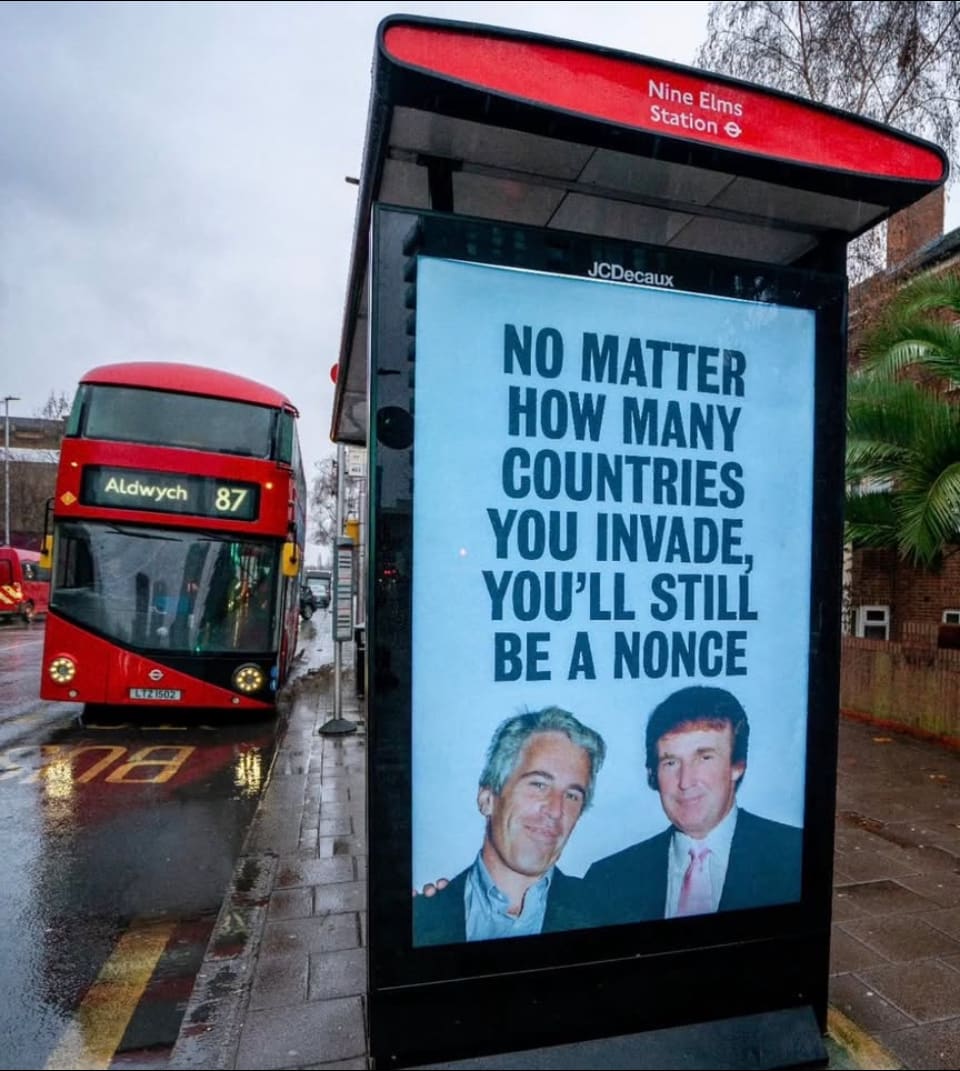
I also loved and admired this woman's response to ICE agents who stopped to threaten and intimidate her for following their vehicle. I don't want you to make a bad decision, the ICE agent tells her. "That's funny coming from you!" she says smiling away at him.
And this is another brilliant official, Rochelle Bilal, the sheriff of Philadelphia, pointing out all the ways that the actions of the ICE agent who shot Renee Nicole Good were in violation of both "legal law" and "moral law". ICE, she said, was "made-up, fake, wannabe law enforcement".
I know, I know, this is probably too much content. But consider this a public service, I'm saving you from the algorithmic scroll which threw up this for me: Canadian comedian Trent McClellan dressed up as a NICE agent to terrorise tourists in Halifax. His weapons are Canadian-levels of courtesy and free candy. It's from two months ago but I only just clocked it and I think it's a really useful reminder that none of this is normal. This is normal:
Finally, it's been extraordinary to witness what's happening on the streets of Iran. You'll have seen the incredible rivers of protestors flooding the streets of cities all across the country. That's what people power looks like. Is it finally the revolution that Iranians have been longing for? The world is holding its breath.
I'm not sure who this woman is but this week's newsletter is dedicated to her and the people of Iran and, especially, the incredible, gutsy, powerful women who have simply had enough.

Thank you to everyone who's reading this. It's one of my own personal rays of hope. If you like it, please share it with your friends and family and tell me in the comments whether I'm right, wrong, too doomery, not doomery enough, whether you like the vids and anything else that strikes you.
Thank you so much for subscribing (and bothering to care), Carole x
The Threat from America [ 03-Jan-26 2:11pm ]A note on who I am and what I'm doing: I'm an investigative journalist who exposed the 2018 Cambridge Analytica scandal for the Guardian and New York Times and I believe that we are in the grip of a new form of power: Broligarchy. The alliance of Silicon Valley, the US state and a global axis of autocracy is a threat that I'm committed to exposing.
I woke up this morning with a clear idea of something I wanted to write before 'back to school' Monday. But then I opened my phone and saw that the USA has gone full rogue state.
And since I started writing this, President Trump has claimed responsibility for a series of explosions on military bases across Venezuela. Even more extraordinarily, he announced via his social media platform, Truth Social, that he's captured President Maduro and his wife and exfiltrated them to the US.
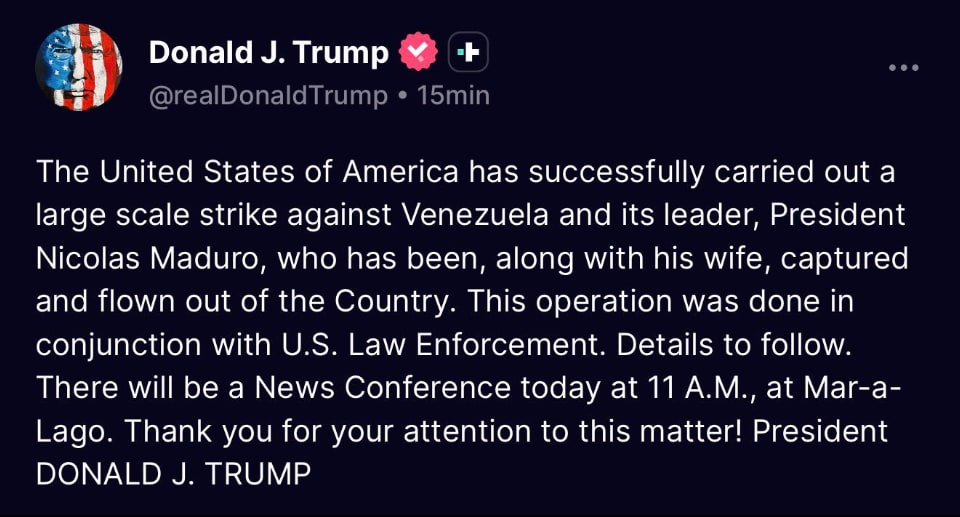
All while America slept.
What happens next is critical. Not in the US, your news cycle today is going to be a roiling thunderdome of noise. The US army uses the language of "theaters of war" but this is military theater. A son-et-lumière spectacular crossed with an action movie. Regime change meets the Bourne Identity. I have zero doubt that there will be POV real-time helmet footage from the stormtroopers who lifted him, and that it will be crack cocaine to cable news bulletins and social media algorithms. God knows what is waiting for Maduro in the US but your news cycle is going to be flooded by this for weeks; held in a chokehold that will block all other sources of heat and light.
The east coast is waking up and Trump has scheduled a press conference for 11am ET and I wish my poor American friends the very best of luck as they try to process what is happening in the face of a wall of jingoistic propaganda and false narratives.
(And this isn't even to mention what lies in wait for the poor people of Venezuela.)
But in America, the next 24 hours and the days and weeks to follow will be a national gaslighting event. It will be claimed a criminal narco regime has been busted by the US and the people must celebrate. Notice the language in Trump's tweet. This isn't an illegal invasion or even a military action. It's "law enforcement".
Update: after writing that paragraph, AG Pam Bondi released a criminal indictment for Nicolas Maduro on "Narco-Terrorism Conspiracy" and other Byzantine charges. He will "soon face the full wrath of American justice", another not-exactly-legal term.
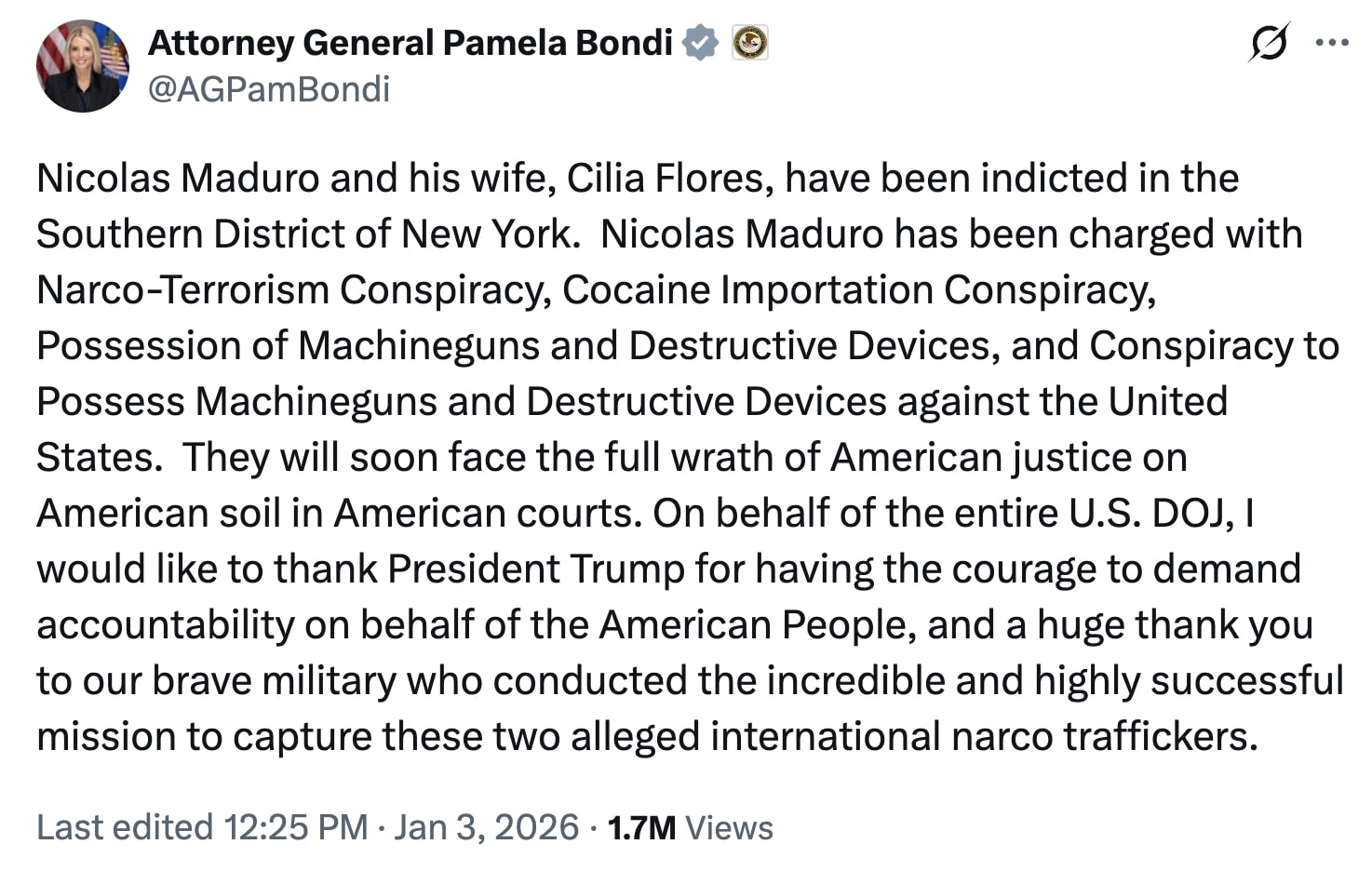
(If you want to understand the real background to this attack, there's a gift link here to a pretty comprehensive Dec 27 NY Times article on why Trump is attacking Venezuela and how this has been mapped out over the past year. TLDR: political expediency fomented by two of his closest consiglieri, Marco Rubio, the son of Cuban immigrants and a Venezuela hawk, and Stephen Miller, Trump's anti-immigration overlord who's embraced the chance to go after an entire demographic.)
But it's the rest of the world that should concern us.
America cannot constrain its president right now. It's been almost impossible to pick Trump's 'worst' acts, but the strikes on "narco boats", aka murdering people without any form of due process in extrajudicial executions have to be up there.
The fact is there are no real checks on Trump's power right now. Some of the courts are still holding on some of the executive orders but he's invaded a foreign state on the bogus pretext of "law enforcement" presumably to bypass Congress's approval and if this doesn't ram home what it means to be governed by a rogue, out of control president, then what will?
And if it doesn't, if that isn't the narrative that wins through, what will that tell us about the state of the US news and information ecosystem? The next days and weeks are a test. What, if anything, will survive the blast zone of what is not just a military campaign but a targeted disinformation strike?
What the US needs to understand is that hybrid warfare isn't simply a weapon used between and against states. It's a strategy being deployed by your very own government. This is both kinetic warfare - bombs and missiles - and information warfare - false constructs, false narratives, false justifications.
A mass propaganda event is about to engulf the US and what, if anything survives it, will be a lesson for our times.
But it's what the rest of the world does now that's key.
The Rest of the World
This should precipitate a whole new global crisis. It's an unprovoked military assault on a sovereign nation in breach of international law. What should worry us more is if it doesn't. The US bombed Nigeria at some point over the Christmas break and it barely broke the sound-news barrier.
How Europe and "the west" responds to Trump now and the actions that governments take downstream from that is going to set the path for 2026. Because Trump isn't just a rogue, out-of-control president, America is a rogue state. And the longer we fail to acknowledge that, the more danger we are in.
Key to all of this is understanding that US companies are explicitly going to be used to enforce US national security interests. And that includes the US technology companies that are at the heart of our national infrastructure and embedded into our everyday lives.
The attack on Venezuela couldn't be a clearer example of "when someone tells you who they are, believe them". Trump has set out America's new place in the world, in the startling new US National Security Strategy document. It's only the third day of January, but Trump has made it absolutely clear that this new world order is already under way.
I was in Colombia a couple of weeks before Christmas and was with Jaime Abello Banfi, the director of the Gabo Foundation, a brilliant nonprofit set up by the Nobel Prize-winning novelist, Gabriel García Márquez, when the National Security Strategy was published.
He pointed out all the language in the document that clearly set out the US's intention to treat Latin America not even as its sphere of interest; more like its property. Its stated number one priority is "the Western hemisphere". It's a manifesto that sets out US dominance of the Americas, including its governments, through military, commercial and other means with the unquestioned support of all US private companies.
"The United States must be preeminent in the Western Hemisphere as a condition of our security and prosperity - a condition that allows us to assert ourselves confidently where and when we need to in the region."
This isn't just about Venezuela or even its near neighbours, and not even about just Canada and Greenland, the ramifications of this document and this strategy are of consequence for us all.
When someone tells you who they are
When someone tells you who they are believe them. Donald Trump has told us what is coming for Europe. It's the same language of regime change that he's using for the Americas.
Here, it's not even just about America's national security or economic interests. The USA has a self-defined responsibility to prevent "civilizational erasure". The continent is under threat from migration, the EU, and "free speech censorship".
"We want Europe to remain European, to regain its civilizational self-confidence, and to abandon its failed focus on regulatory suffocation."
What we can see in Venezuela is how the US prepared over months for this moment: from deporting Venezuelan nationals to inhumane incarceration in El Salvador to the strikes on fishing vessels to blockading Venezuelan ports. And, what we need to see clearly is that a process has already begun in support of US foreign policy goals in Europe.
Those policy goals include the election of "patriotic European parties".
And as he points out in the National Security Strategy document, Trump has so many tools at his disposal.
I woke up this morning, before I'd seen any of this, thinking about just one of them. And that's where I want to end this. The UK government has been embarking on a disastrous and suicidal set of deals with US tech companies. I've written about that and will continue to write about that because it's a five-alarm fire that almost no-one in parliament seems to understand.
But what we've also learned is that Trump has a new weapon to use against anyone who stands in his way. On the night before Christmas Eve, Trump sanctioned five European citizens involved in disinformation policy and research. I wrote about that here but what I hadn't realised when that news dropped is what "sanctions" mean in an age when so much of our lives are dependent on US technology platforms.
Trump has already sanctioned six judges from the International Criminal Court and one of them, Nicholas Guillou, gave an interview to Le Monde in which he set out what that meant to his life.
This is the power that the US government can bring to bear on any individual anywhere in the world engaged in any activity it considers contrary to its national interest.
In my last newsletter, I wrote pretty personally about my efforts to overcome the attempts to silence my voice and prevent my work because I think they're directly relevant to what lies ahead. (And thank you so much to very many kind and supportive comments: thank you thank you.)
I did so because what happens to me will happen to you.
And I've been thinking about this latest, newest weapon because the targeted individuals come from a small community that tracks and investigates and attempts to regulate tech platforms; a community I'm part of.
And because my journalistic activity could be defined as contrary to the US national interest, certainly to the economic interests of its biggest companies.
And currently my income comes from this newsletter hosted on a US technology platform whose revenues come via a US payment provider. I feel the chill winds of that precarity. Just as I've felt the chill winds of reporting on Russian disinformation and sabotage. There is no difference.
On Christmas Eve, I said that America is not our enemy. It's not. We need a transatlantic alliance more than ever, but it needs to be between peoples not states. Your state is out of control. Our state is frozen in craven ignorance. And we're all, governments and people too, in a state of dangerous denial.
How to Survive the Broligarchy is a reader-supported publication. To receive new posts and support my work, please consider becoming a free or paid subscriber. Thank you!
PS I know there are alternatives to Substack. I went into this with eyes wide open and this certainly brings that into focus. But it's the larger point I'm trying to make here. Note too that even some of the "alternative" technology platforms such as Bluesky are American.
On Power [ 31-Dec-25 7:53pm ]Hello from deepest, wildest west Wales in what a friend of mine calls "The Perineum": aka the thin membrane of time between the twin peaks of Christmas and New Year. Normal service is suspended, the old year is ended, the new one is yet to begin…
I launched this newsletter in November 2024 in the week that Donald Trump was re-elected. Everything I'd been warning about for a decade was coming to pass, but I was energised. Reporting on information warfare had made me a target of information warfare which in turn had made me an expert in information warfare, in fighting back. And at least now, finally, the threat was visible.
A few weeks later, I distilled some of that experience into a Guardian column headlined "How to survive the Broligarchy: 20 lessons for the post-truth world".
I'm going to re-visit that column - and where we are now - in the next newsletter because when I wrote my original column, it was a prediction of what was to come. And now it has, just faster than anybody thought.
But this week, walking the dark, secret valleys of deepest west Wales, I wanted to look back before looking forward. Reculer pour mieux sauter, they say in French. Step back to jump better.
This time, a year ago, I had no idea I'd be returning to TED, the place where in 2019 I gave another TED talk that led to a debilitating lawsuit. And I can see that from the outside, it might seem like some sort of pre-ordained success. But it wasn't a pre-ordained anything.
And neither is what happens next.
The precipitating incident
In the first week of February, I went out for dinner to celebrate the release of the first episode of Stalked, a BBC podcast series I'd made with Hannah, the daughter of my ex. She was the central character in the podcast and it was a big deal: a highly personal story of how she'd been groomed and then targeted by a stalker.
It had taken us nearly four years to make and was only possible because of the extraordinary diligence and care of a BBC producer called Georgia Catt. She had guided Hannah through it as she opened up her entire life to scrutiny. But now, Hannah was giddy. "I just feel so light," she said.
We didn't know where the story would lead. How the man we'd named would react. What would happen. He'd hired an expensive London libel lawyer and had sent repeated letters denying all claims.
But she wasn't hiding any more. The shame and isolation had gone. She'd reclaimed her life, her story, a story that one in five women will experience in their lifetime. We toasted that and back home I doomscrolled the news and then my emails.
It was February, 2025, Elon Musk had just performed not one but two Nazi salutes at an inauguration rally and DOGE was breaking and entering into government offices to gain unlawful access to data. And TED had sent me an excitable marketing email about Sam Altman as a headline speaker in their upcoming conference.
I hit reply and tapped out an email on my phone. "You will have the bros and that's as it should be," I wrote to Helen Walters, the senior TED curator whose name was on the email. "But you also need the voices who will tell people how to navigate this shit."
Forty-eight hours later, she emailed back: Come.
Into the lion's den
I didn't reply to the email for days.
I hadn't expected her to say yes and although I understood why I should go back - it was why I'd sent the email - I didn't know if I could go back.
Another story: six months after my trial in the High Court in 2022, my editor invited me to a meeting at the Guardian offices.
Walking through the lobby with the posters on the walls about speaking truth to power, up the escalators, into the glass and steel heart of the building, I just had what felt like an out-of-body experience. The office was a corporate projection of money and legitimacy and authority, a symbol of the Guardian's institutional power and importance..that just hadn't been there for me.
Its decision to not support me in the lawsuit ultimately caused me more distress and anguish than the lawsuit itself. It wasn't the bad guys going after me that I found so debilitating. It was the good guys not sticking up for me. I said nothing in public because I already felt so weak and exposed. To acknowledge that publicly, would only have made me more so.
I'll spare you the details of what happened next, for now. It was, I learned afterwards, a classic PTSD episode. I'd had a similar experience right after my trial but this was six months on. It was meant to be over and it wasn't.
I'm telling this story because this TED talk is not another data point on an upwards trajectory of what from the outside could seem like validation and success. That's not what it was. I communicated fear in that talk because that talk came from fear.
The day before
I wrote a draft. And then, after feedback, another one. And then a third. The day before I was due to fly out, they came back a final time, Chris Anderson, the head of TED, was summoned. It still didn't work, he said.
Chris ripped into the talk, challenging me on multiple points, the final one of which was "Do you have to mention the lawsuit?" he said. "It means nothing to this audience." It means something to me, I said and I burst into tears. I fought for years to defend the facts, I said. They matter to me.
"Look," said Chris, softening. "These are suggestions. We invited you. It's up to you what you say."
That night, I went to the leaving party for the staff of the Observer. In the midst of the political tumult of Trump's re-election, we'd dealt with our own internal tumult: the oligarchic capture of our newspaper. I can't describe it in any other terms. We were being "transferred" from a non-profit to a private owner, backed by a group of investors some of whom they'd refused to disclose.
The party was a strange, bittersweet affair. Some of my colleagues were going, others - including me - weren't. We'd needed a spokesperson and I elected to be it. It had been my choice. I didn't regret it. But two weeks earlier, the new management had written to me: they would not be offering me a new contract.
The next day, I flew to TED.
Miss Shaky Hands
At the dress rehearsal, I physically trembled throughout. "Alright, Miss Shaky Hands," said Helen at the end of it.
I should have spent the next morning learning it. It's drilled into you that you need to know it word for word - you're delivering it to 1,000 people with no notes, under the pressure that it's going to live online forever. Instead, I spent it filling out a multi-page form in a last-minute attempt to get professional indemnity insurance.
But to do so, I needed the sign-off of a UK media lawyer. I emailed Tamsin Allen, my go-to expert. She knew the story back to front.
There's no completely safe way you can talk about the case at TED, she told me. It's not any one thing: it's that it's you and it's TED and it's this person. There's a risk that couldn't be underwritten away.
I didn't get the insurance.
In 2019, I'd had a full-on panic attack right before I'd gone on. The stage manager had handed me a brown paper bag and I'd stood in the wings breathing in and out of it, my heart pounding in my chest. This time around, it felt more like going out to face a firing squad. I felt total resignation.
But also power. In the front row, was a full complement of Silicon Valley bros. Or as I got to call them, data rapists and collaborators.
You have more power than you think
I wasn't sure when I began why I was writing this. But so many of the comments beneath the video on YouTube say how terrified I looked. And here in the perineum of the year, all I can say is that as fearful as I was, I am genuinely more fearful about what lies ahead. Everything I've feared would happen is happening.
America has fallen. NATO is teetering. Europe is on the brink of some new darkness. The Silicon Valley tech companies are now in an alliance with the worst people on the planet. But Hannah taught me a lesson. And I tried, as best as I could, to carry that forward. This newsletter is dedicated to the memory of Virginia Giuffre. It's only because of people like her that journalists can do what they do. She shone a light in the darkness.
We have more power than we think. That's the key line from the talk. Nothing is pre-ordained. We get to decide what happens next. But I didn't know that, until I proved it to myself. And maybe the real reason why I've written this today is that there is at least one person out there who needs to hear this. I hope it finds you where you are.
With a huge amount of thanks to everyone who's supported me through this year xx
PS This is what a road through slice of lost rainforest in a hidden Welsh valley looks like. I've since discovered it's the entrance to the Annwn in the Mabinogion, the earliest Welsh prose stories, an "Otherworld", a place beyond mortal understanding. Which sounds about right to me.
See you in the new year x