

At this point, everyone knows the wretched Peter Mandelson shared government information with Jeffrey Epstein. Mandelson wasn't the only Epstein associate with access to confidential UK info, however. The former prince Andrew Windsor served as a British trade envoy, and he was also feeding what he knew to the now-dead paedophile:
ConfidentialAndrew Mountbatten-Windsor shared confidential information with Jeffrey Epstein from his official role as a trade envoy. He forwarded an official report from his trips to Singapore, Vietnam, China, and Hong Kong to Epstein just five minutes after receiving it. pic.twitter.com/hpMD07ikFd
— Mukhtar (@I_amMukhtar) February 8, 2026
The screengrabbed email above is from the latest release of the Epstein Files. In it, you can see that Windsor received reports of visits to Vietnam, Singapore, Hong Kong, and Shenzen.
Did you receive these reports yourself?
Probably not, right; it would be weird if the trade envoy sent their reports to the general British public; it's even stranger to send them to a notorious international paedophile.
As reported by the BBC, Windsor served as trade envoy for ten years (2001-2011). The BBC additionally highlighted that:
Under official guidance, trade envoys have a duty of confidentiality over sensitive, commercial, or political information about their official visits.
In other words, he could (and should) get into trouble for this.
We'd be surprised if he faces any actual consequences, however, given the fact that he's escaped them all of his life. The Royals may have stripped him of his titles, but the entitlement remains. As the BBC report:
Earlier in February, Andrew moved out of his home in Windsor to the Sandringham Estate in Norfolk.
Buckingham Palace had announced in October that he would be moving from Royal Lodge, at the same time his title of prince was removed.
The former prince left the property on Monday night and is currently living at Wood Farm on the Sandringham Estate while his new permanent home undergoes renovations.
We don't know about you, but when we fuck up, our punishment isn't being sent to a managed country estate.
Keeping quietThe BBC also asked Andrew Windsor to comment on all this. Surprise, surprise; he refused to do so.
Funny that he's no longer so free and easy with the information he'll share.
For more on the the Epstein Files, please read our article on how the media circus around Epstein is erasing the experiences of victims and survivors.
Featured image via Epstein Files
By Willem Moore

On Sunday 8 February, Americans came together to enjoy their annual 'Superbowl'. And when we say 'came together', we of course mean they found new ways to fight the culture war.
Trump, of course, led the charge:
Trump crashes out over Bad Bunny's halftime show pic.twitter.com/XE2shbQRtm
— Aaron Rupar (@atrupar) February 9, 2026
Doesn't this guy have a country to run into the ground?
Superbowl stylingThe performer Trump is talking about is Bad Bunny, who released one of the best albums of 2025.
There's really no need for us to promote his album, because some of the tracks have had well over a billion listens in the past 12 months.
Many right-wingers are asking 'WhY iS a PuErTo RiCaN pErFoRmInG??', and the simple truth is because the Yanks fucking love him and his music.
Here's a video from his performance:

As we reported on 8 February, Keir Starmer's chief-of-staff Morgan McSweeney resigned in disgrace. What is it they say about rats and sinking ships?
How long will Starmer last now?Tim Allen - Blairite leaving the Labour right sinking ship. When self-serving careerists like Allen are crying off, you know Starmer is finished. The writing is on the wall.
— Simone (@Slimbo32) February 9, 2026
As Skwawkbox wrote for the Canary:
Keir Starmer's appalling chief of staff, Morgan McSweeney, has quit. According to 'mainstream' media, Starmer hopes this will ease the pressure that he has been under from the ongoing Mandelson scandal. If he really thinks this, he's more hopeless than we thought - and that's a tough bar to cross.
We don't think Allan going will help either. At the same time, it's certainly not going to hurt. Like most of his colleagues, Allan is another washed up Blairite with nothing to offer besides spite and failure.
People have highlighted that Allan is just one in a long line of comms directors:
Tim Allan - Keir Starmer's *fourth* director of communications since July 2024 - has quit his role.
He says: : "I have decided to stand down to allow a new No10 team to be built. I wish the PM and his team every success."
— Ashley Cowburn (@ashcowburn) February 9, 2026
A complete inability to hold on to a communications director hasn't done much for Labour's communications. Regardless of who's in charge, it's never reassuring to see four different people fighting over the steering wheel.
Here's what HG wrote for the Canary in September 2025:
Keir Starmer has appointed Tim Allan as Downing Street's new director of communications. Allan is a former trustee of Sex Matters - an anti-trans group.
According to the Financial Times, Allan has previously worked for Kazakhstan and Qatar, along with Vladimir Putin's government.
He also worked as the deputy director of communications for former Prime Minister Sir Tony Blair, under Alastair Campbell. Blair even called him 'more right-wing than me'.
A transphobic errand boy to Putin and Blair - this is who Starmer wanted in charge of his comms?
It's no wonder this ship is sinking.
Journalist Kevin Schofield said the following about Allan:
Tim Allan was brought in to No10 in September to replace the highly-effective and widely-respected Steph Driver and James Lyons.
Now gone. https://t.co/hEitd1A0g6
— Kevin Schofield (@KevinASchofield) February 9, 2026
We must have blinked and this period of 'effectiveness' and 'respect' that Starmer's operation enjoyed.
Chaos with KeirSpeaking of Starmer, it was rumoured that he planned to step down today. That no longer seems to be the case - not for the moment at least:
Wait, has he even done a U-turn on his own resignation? pic.twitter.com/rdqaA9hlIj
— Jonathan Pie (@JonathanPieNews) February 9, 2026
We don't know who'll step into the comms role next, but good luck selling this absolute clusterfuck of a government to the British public.
Featured image via Terry Ott (Wikimedia)
By Willem Moore
A Democrat running to pick up one of the party's top target House seats recently worked for two defense contractors looking to help the federal government use artificial intelligence for border surveillance and military projects.
Cait Conley, a Special Operations combat veteran and former national security adviser under former President Joe Biden, is running in the crowded Democratic primary to challenge incumbent Republican Rep. Mike Lawler in New York's 17th Congressional District. Her candidate financial disclosures show that she earned more than $80,000 between January 2024 and July 2025 from two companies, Primer AI and Hidden Level.
Both companies partner with far-right billionaire Peter Thiel's surveillance tech firm Palantir to help government agencies use AI. Both are military contractors; Hidden Level holds an active contract with the Department of War, and Primer's most recent one was paid out last year. Primer has also praised President Donald Trump's AI policy and advertises on its website that it "helps" the Department of Homeland security with data and intelligence work and that "Primer AI platforms support DHS missions," but it does not appear to have an active deal with the department in a federal contracting database.
"Cait believes AI can be both an opportunity and a risk to the middle class and is determined to shape AI policy so that it grows and strengthens middle-class New Yorkers, rather than being used to further enrich billionaires," said Conley campaign manager Emily Goldson in a statement to The Intercept. "She'll be a leader in Congress, ensuring working Americans are included in the growth created and aren't left behind."
Running in a swing district north of New York City, Conley has walked a fine line on matters of immigration and the national security apparatus, blasting Trump for deploying the military to U.S. cities and criticizing immigration agents for killing protesters. On her campaign website, she pledges to "stand strong on our national security priorities," including "defending the homeland, fighting crime, and fixing our broken immigration system."
Conley's close ties to companies at the intersection of AI and national security policy aren't a surprise given her military background. But her connections to the firms raise questions about how she might approach those policy sectors in Congress, said Albert Fox Cahn, a civil rights attorney who previously led the Surveillance Technology Oversight Project and is a lifelong resident of New York's 17th District.
"At a time when we see so many Silicon Valley companies having their technology weaponized against immigrant communities, these sorts of consulting roles raise questions about what exactly she did and what lines were drawn," Cahn told The Intercept.
It's unclear what exactly Conley did at the companies, according to her candidate disclosure filed with the House Clerk. She started consulting for Primer at some point after January 2024, when she left her previous job as an adviser for the Department of Homeland Security under Biden. In the period ending in July 2025, she earned $12,500 for her consulting work.
 Related
Lawmakers Pave the Way to Billions in Handouts for Weapons Makers That the Pentagon Itself Opposed
Related
Lawmakers Pave the Way to Billions in Handouts for Weapons Makers That the Pentagon Itself Opposed
Touting the candidate's military service, Goldson said that Conley "has worked with a range of private and public sector entities, either through her work at the Cybersecurity and Infrastructure Security Agency (CISA) or as a consultant, to help keep American families and American infrastructure, like stadiums and other public spaces and our energy grid, safe from terrorist attacks." The campaign did not comment on The Intercept's questions about whether Conely was still employed by either firm.
Between January 2024 and July 2025, Conley earned $68,000 from Hidden Level, which works in radio-frequency sensing and airspace security, including monitoring unauthorized drone activity. Hidden Level's data is used in Palantir's Maven platform, which Trump's Pentagon awarded a $480 million contract in May. When Trump announced his plan to build a "golden dome" missile defense system — described by one critic as "more of a political marketing scheme than a carefully thought-out defense program" — Hidden Level released a statement applauding his plan and saying it "stands ready to support this mission today." Of a White House directive to cut waste in commercial technology in April, the company said the "policy shift doesn't just validate the model Hidden Level was built on, it demands it."
"I get nervous when people are quick to invoke the language of national security and counter-terrorism. It raises more questions than it answers."
Both companies have received lucrative contracts from the federal government under previous administrations. Primer has won at least $7.2 million in contracts from the Department of Defense since 2021, according to federal spending records. Hidden Level earned just under $3 million in Pentagon contracts to monitor airspace and bolster the federal system that manages drone traffic between 2022 and 2024 under former President Joe Biden.
"We've seen just how brazenly people can manipulate the label 'national security and counterterrorism' and the ways it can mask government efforts aimed at people who never pose a threat to our country. As a civil rights lawyer and activist, I get very nervous when people are quick to invoke the language of national security and counter-terrorism," said Cahn, the civil rights lawyer. "It raises more questions than it answers."
The seat in suburban New York, which includes north Westchester, Rockland, Putnam, and Dutchess Counties, is a top priority for Democrats. It was one of four New York House seats the party lost to Republicans amid a slew of upsets in the 2022 midterms. The winner of the June Democratic primary will take on Lawler, a Republican who flipped the seat that cycle after a combination of redistricting and Democratic infighting helped him beat former Democratic Rep. Sean Patrick Maloney.
Conley is one of six candidates running for the Democratic nomination. Other contenders include local official and tech founder Peter Chatzky, who has funded his own campaign with more than $10 million; Rockland County Legislator Beth Davidson; lawyer and former television reporter Mike Sacks; nonprofit executive Effie Phillips-Staley; and Air Force veteran John Cappello.
Conley has campaigned on her military experience and highlighted the fact that the Russian government banned her from the country because of her work on Biden's National Security Council. She said she hopes voters in the swing district will see her lack of traditional political experience as a positive. "We need people who take public service seriously, who are not politicians, who are actual leaders and problem solvers," Conley told the New York Times in March.
Her campaign originally focused primarily on issues of affordability and improving Hudson Valley infrastructure, including criticizing Trump's economic policies. As the campaign progressed, Conley has become more aggressive in criticizing Trump's intensifying attacks on cities around the country and his nationwide crackdown on immigrants.
Goldson said that Conley believed in holding ICE accountable, investigating the officials responsible for the killings of Renee Good and Alex Pretti, and impeaching Homeland Security Secretary Kristi Noem. "Congress must pass legislation ensuring ICE operates lawfully like local law enforcement, including banning masks and requiring judicial warrants for arrest, and sending CBP back to the border where it belongs," she added.
Lawler, meanwhile, has urged immigration agents to "reassess their current tactics," while refraining from criticizing Trump.
Conley has faced criticism throughout the campaign — much of it from Republicans — for not voting in recent midterm elections and registering as a Democrat just before she launched her campaign. Critics attacked her for moving to the district in January from Virginia, though she grew up in the Hudson Valley.
Her detractors have pointed out that many of her donors come from outside the district, several of them from the defense and tech industries.
Conley has received $10,000 in contributions from Matt and Kimberly Grimm, the former of whom is the co-founder of Anduril Industries. Anduril, which was heavily backed by Thiel, builds autonomous drones, systems to surveil the border, andsurveillance towers powered by AI.
"There's a lot of questions to answer, and I think that this is true for candidates across the country who have worked for these companies in the past or who you know are receiving large donations from their employees," Cahn said. "There's a growing recognition that many of these tech firms are carrying out a mission that is fundamentally at odds with the values that Democrats hold and most Americans hold."
Conley's donors also include a vice president and other employees at the top Washington lobbying firm BGR group, which has represented the Saudi government - until it cut ties with the country in 2018 - and companies like defense giant Raytheon and the energy behemoth Chevron, as well as big pharmaceutical firms. BGR vice president Joel Bailey gave Conley's campaign $500 in July, while BGR principals Syd Terry and Fred Turner each also gave Conley's campaign $250. BGR senior director Hai Peng has given Conley's campaign $5,500 to Conley's campaign since May. None of the BGR donors listed residences in New York.
In a statement to The Intercept, Peng said he met Conley at Oklahoma's Fort Sill close to two decades ago and made the contribution in his personal capacity. "I genuinely believe she is the kind of leader our country needs right now," Peng said.
Conley has been endorsed by several political action committees including MD PAC, previously known as Majority Democrats PAC, which has given $90,900, VoteVets, Equality PAC, and Giffords PAC. She's also endorsed by several local officials and political leaders, as well as Rep. Pat Ryan, D-N.Y.
Cahn said he wasn't sure who, if anyone, he would vote for in the primary. But he sees the race as an example of the opportunity voters have to hold Democrats to a higher standard of accountability than in the past, particularly when it comes to policy issues like technology, surveillance and artificial intelligence.
"We're at a new moment of accountability within the tech sector more broadly, as we start to recognize that so many tech companies are part of the apparatus that is powering ICE's attacks," Cahn said. "This is especially notable for someone who's running based off of their time in military defense roles."
The post NY Democratic House Candidate Worked for Palantir Partners Pushing AI Border Surveillance appeared first on The Intercept.
It has rained in parts of the country every day of the year so far and downpours are expected to continue this week
In a "miserable and relentlessly wet" start to the year, rain has fallen somewhere in the UK every single day for weeks on end.
With more than 100 flood warnings in force across the country and further downpours forecast this week, scientists say the atmospheric forces behind Britain's endless drizzle are the same ones driving devastating floods across Spain and Portugal.
Continue reading...
Former Grand Prix crew chief Peter Bom traveled to Sepang for the first tests of the 2026 MotoGP season, and he sits down with Roadracing World MotoGP Editor Mat Oxley to share his first-hand insights in the latest edition of the Oxley Bom MotoGP Podcast.
Listen to the podcast here:
The post Oxley Bom MotoGP Podcast: What Happens In Sepang … appeared first on Roadracing World Magazine | Motorcycle Riding, Racing & Tech News.
The first PlayStation State of Play livestream of 2026 has been announced. The stream will take place on February 12 at 5PM ET. It will run for over an hour and feature PlayStation Studios titles as well as third-party projects and indie games that are bound for PS5. You can watch it on PlayStation's official YouTube channel (in English, Japanese or with English subtitles) or on Twitch.
As the first State of Play of the year, Sony is going to want to drum up some more hype for its upcoming release slate. Since Bungie's Marathon is due to arrive on March 5, that will surely make an appearance. MLB The Show 26, which is out on March 17, will likely get a look in too. We could also get another peek at Saros, the highly anticipated follow-up to Housemarque's Returnal, which will arrive on March 20. A new trailer for Marvel's Wolverine isn't out of the question, but Sony could wait until a summer showcase to give us another look at that one.
The last State of Play took place in November, but that one was focused solely on games coming out of Asia and Japan. Before that, Sony also had a showcase during Tokyo Game Show in September, which featured a first look at gameplay from the aforementioned Wolverine, which is due to arrive later in 2026.
This article originally appeared on Engadget at https://www.engadget.com/gaming/playstation/the-first-playstation-state-of-play-of-2026-will-air-on-february-12-145747775.html?src=rssA big day in streaming has finally arrived: HBO Max has finally announced it's coming to the United Kingdom and Ireland. The two countries join over 110 territories worldwide that already offer HBO Max. Some HBO shows, like Euphoria, have already been available in these regions through other platforms. HBO Max will bring titles like The Pitt, One Battle After Another and Sinners. It will also air the upcoming Harry Potter series.
An HBO Max subscription will be available in the UK and Ireland starting on Thursday, March 26. Plans will start at Basic with Ads for £5 per month, offering all titles except movies that first stream on HBO Max after a theatrical release. Then there's Standard with Ads for £6 per month, which includes those releases and 30 downloads. Both can stream on two devices at a time.
Anyone who wants an ad-free experience can purchase a Standard or Premium plan. The former has all titles available on two devices, up to 30 downloads and, of course, no ads. The Premium plan comes with four devices in 4K Ultra HD with Dolby Atmos — if the system has capabilities.
Interestingly, the expanded area comes as Netflix prepares to own Warner Bros., including HBO and HBO Max. While there's no indication of whether this had any influence, Netflix has long been available in the UK and Ireland.
This article originally appeared on Engadget at https://www.engadget.com/entertainment/streaming/hbo-max-is-finally-coming-to-the-uk-and-ireland-145126162.html?src=rss
The Dutch Data Protection Authority (AP) says it was one of the many organizations popped when attackers raced to exploit recent Ivanti vulnerabilities as zero-days.…
Microsoft suffered a service disruption over the weekend after a power incident at an Azure datacenter in the West US region affected Windows Update.…
Or both Monday and Tuesday?
If Saturday and Sunday are the weekend, why not call Monday the Weekstart?
Push to restart uranium mining in Patagonia has sparked fears about the environmental impact and loss of sovereignty over key resources
On an outcrop above the Chubut River, one of the few to cut across the arid Patagonian steppe of southern Argentina, Sergio Pichiñán points across a wide swath of scrubland to colourful rock formations on a distant hillside.
"That's where they dug for uranium before, and when the miners left, they left the mountain destroyed, the houses abandoned, and nobody ever studied the water," he says, citing suspicions arising from cases of cancer and skin diseases in his community. "If they want to open this back up, we're all pretty worried around here."
Continue reading...
Elon Musk says SpaceX has shifted its near-term priorities from Mars settlement plans to building what he called a "self-growing city on the Moon," arguing the lunar target is faster and more achievable. In a post on X, Musk claims the company could complete this in less than 10 years, while doing the same on Mars would take over 20 years.
This marks a major shift for the aerospace company, as Musk points out that the logistics of first completing a proof of concept on the moon are easier with respect to launch windows and proximity to Earth. The SpaceX founder is notorious for promising optimistic timelines that never come to pass, and said in 2017 that a base on Mars would be ready for its first settlers as early as 2024.
In subsequent replies to other posts Musk predicted "Mars will start in 5 or 6 years, so will be done parallel with the Moon, but the Moon will be the initial focus." He also said a manned Mars flight might happen in 2031.
Early last year Musk said in a post on X that SpaceX would be going "straight to Mars" and that "the Moon is a distraction." This was in response to Space industry analyst Peter Hague pointing out that among other considerations, lunar regolith, a material found on the surface of the moon, is about 45 percent oxygen. In 2023 NASA proved this oxygen could be extracted, which would yield enormous payload savings as opposed to shipping liquid oxygen between Earth and Mars.
NASA's Artemis missions, which SpaceX is a contractor for at certain stages, are planned to see humans back on the lunar surface by 2028. Artemis II, during which astronauts will circle the moon before returning to Earth, is set to launch in March of this year.
This article originally appeared on Engadget at https://www.engadget.com/science/space/spacex-is-pivoting-to-focus-on-a-moon-base-before-mars-141851264.html?src=rss
SpaceX resumed launching Falcon 9 rockets this weekend after last week's second stage incident. At the same time, CEO Elon Musk confirmed that the company has shifted its focus to "building a self-growing city on the Moon" within a decade.…
European spending on sovereign cloud infrastructure services is forecast to more than triple from 2025 to 2027 as geopolitical tension drives investment in homegrown services, according to Gartner.…
Taiwan's vice-premier has ruled out relocating 40 percent of the country's semiconductor production to the US, calling the Trump administration's goal "impossible."…
The good folks at Orico have sent me their latest power-strip to review. On the surface, the specs are pretty good - two UK sockets, two USB-C for PowerDelivery, and two USB-A for legacy devices.
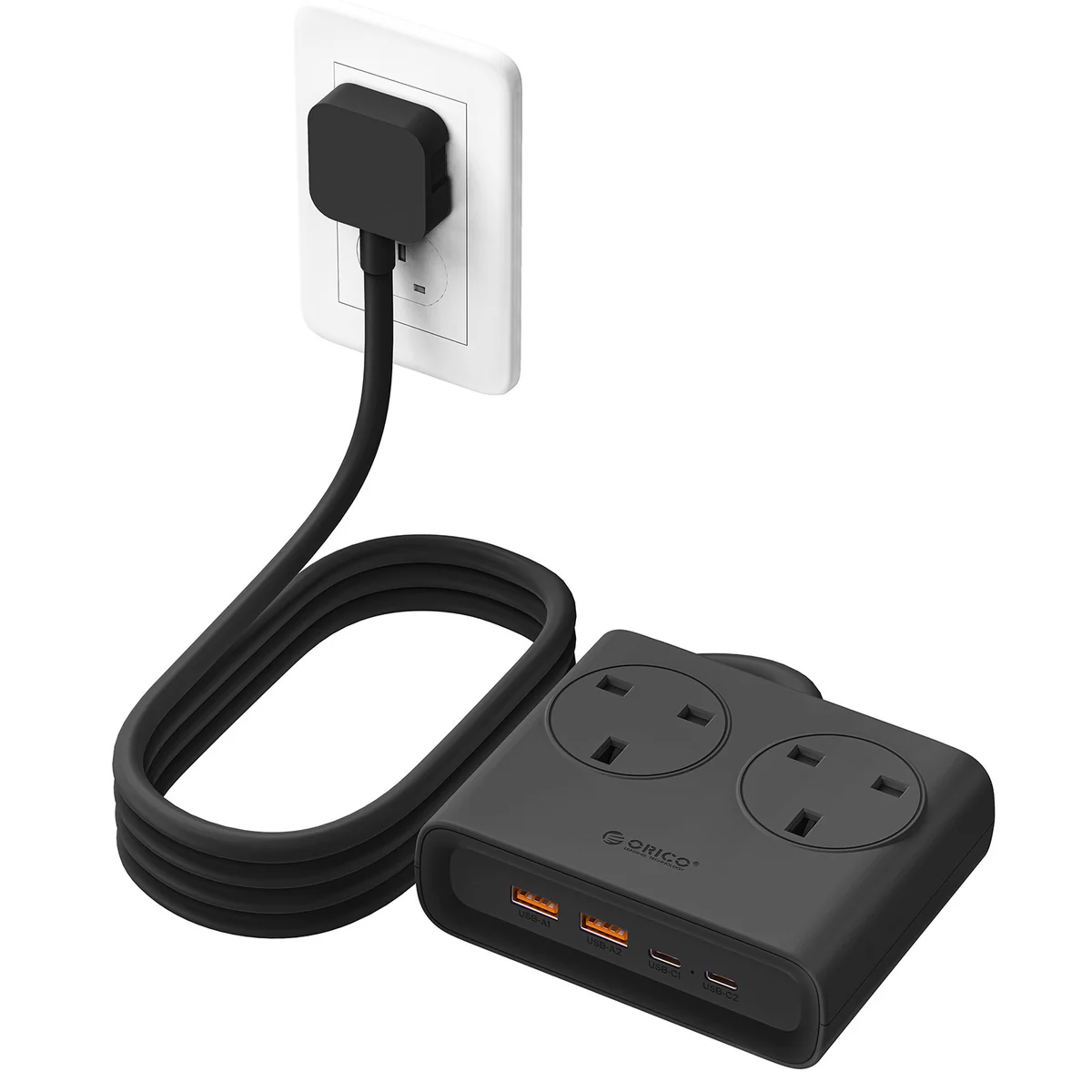
Let's put it though its paces!
SpecsPhysically, it is a little larger than I was expecting. The two UK sockets are far enough apart to easily get your fingers around the plugs. Similarly, the USB ports are well-spaced. There's a tiny LED to show that power is connected, but it isn't offensively bright.
The UK plug is tiny:

Even better, it comes with a proper fuse! The power cord isn't removable, but is long enough for most purposes.
How much power can it supply? This is what the spec sheet says:
V A W
USB-A 5 3 15
USB-A 9 2.22 20
USB-A 12 1.67 15
USB-C 5 3 15
USB-C 9 2.77 25
USB-C 12 2.08 25
But there is a fly in the ointment. While 25W is the most that a single USB-C port can output, the power drops once multiple devices are connected. If you have two or more plugged in, the total output is limited to a mere 15W. Not per-port; total!
25W is already fairly low by PowerDelivery standards, so you won't be using this to power your gaming laptop while charging your tablet and headphones.
Real World Testing
I used my Plugable USB-C Power Meter with some high-quality USB cables. The Orico mostly lives up to its promises.
When charging my laptop from either USB-C port, I was able to measure 22W (12V ⎓ 1.85A). Pretty close to the spec.
As soon as I plugged my phone into the other USB-C port, that dropped that down to just under 8W (4.8 ⎓ 1.65A) per port. Again, right on the promised 15W total.
The USB-A port happily delivered 7.5W (5V ⎓ 1.5A) - much lower than expected. That dropped to around 5W (5V ⎓ 1A) once a USC-C load was connected. The C port was only delivering ~10W which wasn't enough to meaningfully charge the laptop.
Final ThoughtsThe flat plug is handy for plugging this in to those hard-to-reach spaces. The cable is long enough for most uses. The mixture of ports isn't for everyone, but handy if you still have legacy devices you need to power.
It meets the promised specification - but the specs are a bit of a let-down. You can get smaller devices which will do 60W charging from USB-C, and they'll spread that out over all their ports.
The two UK sockets are a nice-to-have, but I can't help feeling that they'll mostly be used for adding additional chargers.
It is cheap-ish - US$30 / £20 - and comes in a range of colours. If you need a long cable and don't need ultra-fast charging, this will do.
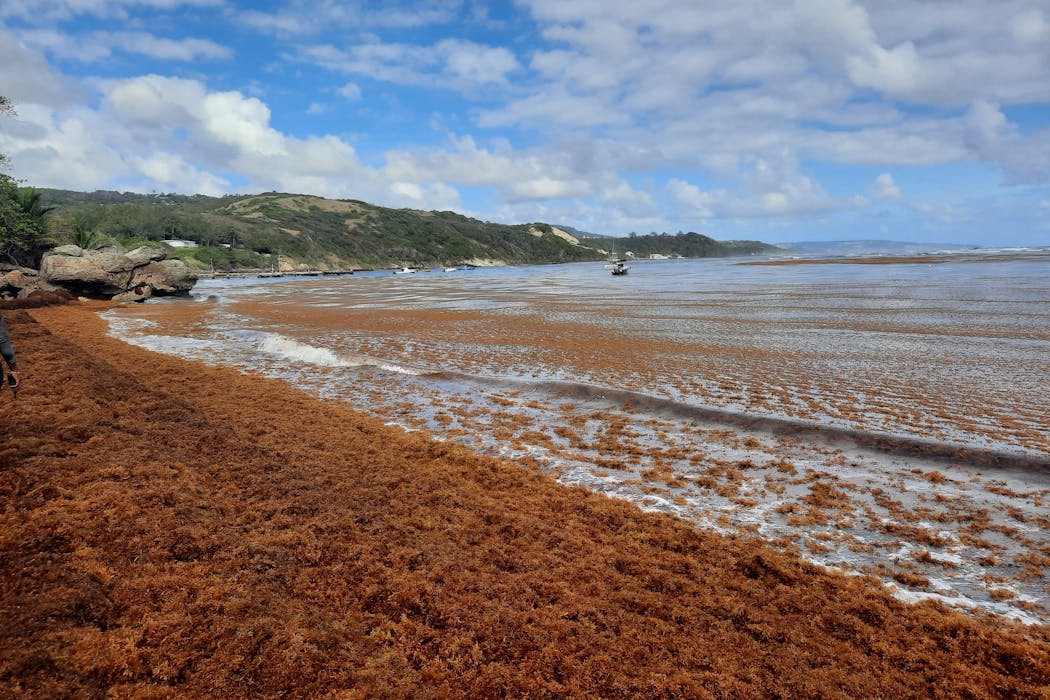 Sargassum seaweed on a beach in Barbados. Yanna Fidai, CC BY-NC-ND
Large blooms of seaweed are increasingly being reported along coastlines globally, from Europe and Asia to the tropics and beyond.
Both native and invasive (non-native) seaweeds are appearing in quantities that are hard to ignore and at unusual or surprising times of year.
As an earth observation and remote-sensing scientist, I track these blooms from space using high-resolution satellite imagery. My research shows that seaweed blooms are getting bigger.
My team's 2025 study reveals a significant rise in sargassum blooms in the north-eastern tropical Atlantic, with a staggering 2.6 million tonnes washing up in September 2020. This is the first long-term analysis of trends in seaweed blooms from 2011 to 2022 in this region.
These unpredictable tides of seaweed have serious consequences for West African coastal communities and marine ecosystems. Our research shows that warming sea surface temperatures link closely with peaks in seaweed growth. Essentially, warmer temperatures can promote seaweed growth and lead to bloom surges.
Seaweed blooms are not a new phenomenon. But over the past 15-20 years, their scale and persistence have increased noticeably.
Of particular concern are free-floating seaweeds: species that float at the ocean surface, either because they detach from the seabed or because they spend their entire lives drifting. Unlike seaweeds that are anchored to the seafloor, floating seaweed can travel long distances to new territories and accumulate in large mats or wash ashore in huge quantities.
One example I have spent much of my career studying is sargassum. Like something from a sci-fi movie, I've seen swathes of sargassum seaweed spreading across the tropical Atlantic, with mats reaching depths of 7 m and spanning hundreds of square miles.
 Sargassum fluitans collected on a beach in Mexico. The air-filled grape-like sacs help this seaweed to float on the surface of the ocean.
Yanna Fidai, CC BY-NC-ND
Sargassum fluitans collected on a beach in Mexico. The air-filled grape-like sacs help this seaweed to float on the surface of the ocean.
Yanna Fidai, CC BY-NC-ND
While most sargassum species are anchored to the seafloor, two species - Sargassum natans and Sargassum fluitans - are entirely free floating. They float freely at the surface of the ocean, kept buoyant by small air-filled grape-like sacs called pneumatocysts, which lift them up towards the surface for photosynthesis.
Our study shows that, since 2011, huge blooms of sargassum seaweed have appeared across the tropical Atlantic, piling up on coasts in the Caribbean, Gulf of Mexico and increasingly West Africa. This drifting seaweed makes fishing difficult and causes mayhem for coastal communities.
Read more: How seaweed is a powerful, yet surprising, climate solution
Seaweed plays an essential role in marine ecosystems, but excessive growth can disrupt them. Large floating mats block sunlight, limiting the growth of seagrasses and corals below. They also alter oxygen conditions in the water, and when seaweed decomposes, particularly in sheltered bays or on beaches, it can create low-oxygen environments that are harmful to marine life.
Some of the most striking consequences are seen on wildlife. In tropical regions, sargassum has accumulated on turtle nesting beaches, with recent studies suggesting that up to a quarter of nesting habitat can be affected. Hatchlings struggle to move through both sand and dense seaweed before eventually reaching the sea, exhausted. This reduces their chances of survival.
 Seaweed blooms make it more difficult for fishers in Ghana.
Yannai Fidai, CC BY-NC-ND
Across Europe
Seaweed blooms make it more difficult for fishers in Ghana.
Yannai Fidai, CC BY-NC-ND
Across Europe
Sargassum as an invasive species has actually found its way to UK waters, but sargassum blooms are not nearly as vast as in the tropical Atlantic. Blooms of other types of seaweed are becoming more noticeable in the UK and Europe. For example, ulva, a green seaweed known as sea lettuce regularly forms dense mats on the surface of the sea in places like Poole harbour, Dorset.
In small amounts, ulva is a native and largely harmless part of UK coastal ecosystems. But when it blooms excessively, it can start to cause problems. Thick mats at the surface reduce the amount of sunlight reaching seagrasses and other organisms below, while decomposition can reduce oxygen levels in the water, creating stressful conditions for fish and invertebrates and death of plants and animals as a result.
Across Europe, invasive seaweeds are becoming a growing concern. In the Mediterranean, species such as Rugulopteryx okamurae (originally from the northwest Pacific) have spread rapidly, likely introduced through shipping routes. These seaweeds can attach to the seabed, but then detach, float for long distances, and then reattach elsewhere, allowing them to spread efficiently along coastlines. In parts of Spain and Portugal, large accumulations are now washing up on beaches, with negative effects similar to those seen with sargassum in the tropics.
Even when blooms are smaller or more localised, their effects can still be disruptive. Seaweed accumulation can interfere with recreation, small-scale fishing and coastal tourism - all important parts of the UK's coastal economy.
Why is seaweed blooming?Seaweed growth is driven by a combination of triggers and favourable conditions, so there isn't a single cause.
In the case of sargassum in the tropical Atlantic, one important trigger appears to have been an anomaly in the large scale atmosphere-ocean pattern known as the North Atlantic Oscillation in 2009. This change in atmospheric pressure at sea helped redistribute seaweed from the Sargasso Sea. Once established in new regions, further seaweed growth was fuelled by access to nutrients.
Seaweed growth is limited by the availability of nutrients such as nitrogen and phosphorus. As long as those nutrients are available for them, they will grow. Nutrient-rich runoff from agriculture, rivers such as the Amazon and Congo, and sediment inputs all deliver these nutrients into the ocean - so human-caused pollution also plays a part.
Together, warming waters, nutrient enrichment and changing ocean circulation can create ideal conditions for blooms to persist and expand.
Seaweed blooms, while sometimes problematic, are fundamental to ocean ecosystems. They act as habitats to small fish and crustaceans. They absorb carbon dioxide through photosynthesis and transport it to deeper waters. They are also a valuable resource. They are used to make fertiliser and building materials, pharmaceuticals and potentially biofuels.
With effective monitoring, more accurate forecasting and better management, communities can live alongside seaweed blooms, harnessing their benefits while minimising environmental and economic consequences.
Don't have time to read about climate change as much as you'd like?
Get a weekly roundup in your inbox instead. Every Wednesday, The Conversation's environment editor writes Imagine, a short email that goes a little deeper into just one climate issue. Join the 47,000+ readers who've subscribed so far.

My previous research on sargassum has been supported by the Economic and Social Research Council GCRF (Grant number: ES/T002964/1), and the UK Natural Environment Research Council (grant number NE/W004798/1), a scholarship from Southampton Marine and Maritime Institute, University of Southampton, and the School of Geography and Environmental Sciences, University of Southampton.
Discord is the latest company looking to bolster its child safety (again). Starting in March, all users will have a "teen-appropriate experience" by default. Unlocking adult content and age-gated spaces will require a (usually one-time) verification process.
The platform's big safety update encompasses communication settings, restricted access to age-gated spaces and content filtering. Users who aren't verified as adults will see blurred sensitive content. In addition, age-restricted channels, servers and app commands will be blocked. DMs and friend requests from unknown users will be routed to a separate inbox.
If you're an adult, removing these restrictions will require one of two verification methods at launch. You can take a selfie video for age estimation or submit a government ID to Discord's vendor partners. (Let's just hope the age estimations work better than Roblox's.) The company stresses that the video selfies you submit for age estimation never leave your device. And it claims ID documents sent to its vendor partners are deleted quickly, "in most cases, immediately after age confirmation."
Although Discord says the process will be one-and-done for most people, some may be required to submit multiple forms of verification. It also says that additional verification options will arrive in the future, including an age inference model that runs in the background.
This isn't the company's first attempt at beefing up its child safety measures. In 2023, it banned teen dating channels and AI-generated CSAM. Later that year, it added content filters and automated warnings. Those changes followed an NBC News report that 35 adults had been prosecuted on charges of "kidnapping, grooming or sexual assault" that involved Discord communication.
Alongside today's changes, Discord is recruiting for a new Teen Council. The group will include 10 to 12 teens aged 13 to 17. The company says this "will help ensure Discord understands — not assumes — what teens need, how they build meaningful connections, and what makes them feel safe and supported online." This sounds like the corporate equivalent of the parenting advice: "Don't just talk to your children; listen to them, too."
The child safety changes will start rolling out globally in early March. Both new and existing users will be required to submit verification for adult content.
This article originally appeared on Engadget at https://www.engadget.com/social-media/discord-will-soon-require-age-verification-to-access-adult-content-140000218.html?src=rss
This story was supported by the Pulitzer Center.
KAMPALA, UGANDA — Ever since President Donald Trump was elected a year ago, sex workers in Kampala have suffered. The sex has suddenly become too painful.
For years, sex workers and public health workers in Uganda say condoms and sexual lubricant were plentiful. Usually paid for by American foreign aid programs such as USAID and PEPFAR, they were distributed "in bars, in hospitals, in hotels, anywhere people gathered," said Turinawe Samson, founder of Universal Love Alliance Clinic in Kampala. In a country where about 5 percent of the population has HIV — the tenth highest prevalence rate in the world — easy access was key to slowing the spread of the disease and saving lives.
But immediately after Trump's election in November 2024 — months before the Trump administration cut funding to USAID and PEPFAR — things began to change in Uganda.
Lube became stigmatized as "an immoral product used by sex workers and homosexuals," according to Samson. Uganda's Ministry of Health doesn't group it among "essential health commodities," meaning its import isn't subsidized. Few health facilities in Uganda are able to procure it. Where it can be commercially purchased, the product is either prohibitively expensive due to diminishing supply, being dangerously sold past its expiration date, or both.
This lack of lube and the broader shaming of sex in Uganda may well result in more vaginal and urinary tract infections, and more sexually transmitted infections — including HIV.
"We need to not be judged."
People have started using "cooking oil, unhygienic products" or "nothing at all," said Babu Ramahdan, an LGBTQ+ and human rights activist who is on his way to becoming an unlikely Ugandan lube manufacturer. "I've got all the ingredients," he says with pride, and he's already made some samples (including in different flavors). He even met with university researchers eager to help him produce it domestically. But for Ramahdan, getting his product through clinical trials may prove as difficult as finding funding: In Uganda, as in large swaths of the United States, gaining institutional approval to research anything seemingly related to LGBTQ+ health has become almost impossible.
Condoms, too, are harder to find. They are not being given away freely with the same frequency, so those who need them increasingly must buy them. But they are economically out of reach for those who need them most in a country where the average income is less than $100 a month. Interviews with 10 patients and practitioners at a clinic run for and by sex workers revealed the stark economics: Sex with a condom goes for as little as 2,000 shillings (less than 50 U.S. cents) and up to about 6,000 ($1.50). But a condom costs a sex worker 3,000 to 4,000 shillings (between 75 cents and $1) — meaning they might lose money having safe sex. Sex without a condom pays much more: up to 10,000 shillings (about $2.50).
The newfound scarcity of lube and condoms illustrates just one example of how Trump's policies have disincentivized safe sex and encouraged the transmission of disease in Uganda — not just among sex workers and their clients, but also among men who have sex with men, transgender people, those who use injection drugs, and poor people. In Uganda, these people are euphemistically called "key populations," or KPs, most at risk for HIV (terms that acknowledge or even hint at queerness have been long avoided, and since Trump was elected, that's the case even for euphemisms like "minority").
"We need to not be judged," one sex worker said, describing her health care needs. "We need to be asked by a doctor, 'What are your needs?' We need to feel safe answering about the kinds of sex we have. We need to be listened to, honestly."
 Related
Trump Gutted AIDS Health Care at the Worst Possible Time
Related
Trump Gutted AIDS Health Care at the Worst Possible Time
But since the stop work order came on January 20, 2025, for projects funded by the United States, the kinds of clinics where KPs like her will not be judged have either closed with little or no notice or become overburdened by a lack of resources, an influx of clients, or both. This has pushed KPs toward Uganda's public hospital system, where seeking care means putting themselves at risk of persecution from a homophobic government.
The sex worker who wished to not be judged is one of several who told The Intercept that women in Uganda who test positive for syphilis test three times at a public hospital are denied medication, accused of being a sex worker, or even turned over to the police. (The latter means she could be arrested, extorted, or raped.) People living with HIV report that if they seek antiretroviral medication at a public hospital, their privacy may not be respected and their HIV status may be exposed to their neighbors. Queer men, fearful of potentially being referred to the police for "aggravated homosexuality" and prosecuted under Uganda's Anti-Homosexuality Act, often skip seeking health care at public hospitals altogether.
These fears are not confined to so-called KPs: They are making patients who may be suffering from anal fissures, vaginal infections, or rectal cancer refrain from seeking care because they are too afraid. In a country where abortion is illegal and more than 1 million people are living with HIV, this campaign of anti-queerness will result in more people forced to have children they do not want, more people becoming infected with HIV, and without medication, more people eventually dying of AIDS.
In November 2025, almost a year after Trump's global stop work order, it was nearly impossible to drive anywhere in Kampala and avoid the profile of a mustached man in a white shirt and Panama hat against a stark yellow background.
It was the height of Uganda's election season, and President Yoweri Museveni was running for a seventh term as Uganda's president. His face — sometimes rendered several stories in height — was inescapable. At age 81 and already president for four decades, Museveni would soon secure another term after an election in which he shut down the internet and his opposition candidate claimed to have been abducted. Museveni will serve at least 45 years as president of Uganda, if he doesn't die in office.
Accompanying his 50-foot-high face was the phrase "Protecting the Gains — as we make a qualitative leap into high middle income status."
Seeing this propaganda spelled out over Uganda's unpaved roads (and even a UNICEF school made out a fraying tent) led Ugandans who spoke with The Intercept to ask: What gains?
Uganda is not without any resources. It is known as the "pearl of Africa," a term perhaps first coined by Winston Churchill while on a safari to describe Uganda's beautiful plants and animals. Today it applies to American, European, and Chinese interest in Uganda's bounty of rare earth minerals. Uganda is also the birthplace of the River Nile, which not only feeds Northern Africa with fresh water but also the foundations of Western religion — like the story of Moses in the reeds in Judaism, Christianity, and Islam.
 A motorist passes President Yoweri Museveni's campaign billboard in Kampala, Uganda, on Jan. 7, 2026. Photo: Hajarah Nalwadda/AP
But Uganda has been subjected to what Guyanese historian Walter Rodney has called the deliberate European underdevelopment of Africa. Largely falling historically into five Bantu kingdoms, modern Uganda was colonized in the 19th century, with the Imperial British East Africa Company claiming control of the region in the 1880s. (Anti-queerness was part of the colonial playbook: Despite local ways of living that today might be described as queer or trans, when the British Empire named Uganda a colony in 1894, it criminalized queer sexuality by way of Penal Code Section 377, which punished "whoever voluntarily has carnal intercourse against the order of nature with any man, woman or animal.")
Amid a wave of anti-colonial resistance in Africa, Uganda shook Britain off in 1962. But over the course of six decades of independence, Uganda's presidency has been defined mostly by two men.
Idi Amin, Uganda's third president, often cast as a brutal dictator in the West, is remembered, among other things, for expelling all British and 80,000 members of Uganda's Indian community. Locally, he is remembered as "Big Daddy." (Among those calling for recasting Amin as a more sympathetic anti-colonial figure is one of those Ugandans whom Amin expelled: Mahmood Mamdani, author of "Slow Poison: Idi Amin, Yoweri Museveni, and the Making of the Ugandan State" and father of the newly elected Uganda American New York City Mayor Zohran Mamdani).
"Why have we been relying on the United States for 20 years? Why hasn't my government made this a priority for us?"
Museveni, Uganda's ninth president, has ruled since 1985, coinciding with the AIDS era. He quickly became a major face of Uganda's "ABC" approach to HIV: Abstain before marriage, be faithful in marriage and — if you fail at those two — use a condom. Ugandan HIV prevention workers who did not wish to be named for fear of persecution describe Museveni as indifferent to the crisis and having outsourced all responsibility to foreign funding.
For instance, as one medical doctor put it, when PEPFAR began funding HIV medication in the early 2000s, "it was supposed to be an emergency plan. It's right there in the name," the President's Emergency Plan for AIDS Relief. "Why have we been relying on the United States for 20 years? Why hasn't my government made this a priority for us?"
As he managed to retain power for decades, Museveni increasingly turned a tactic of social control favored by political leaders from Vladimir Putin in Russia to Keir Starmer in England to Trump in the United States alike: Whipping up a moral panic about LGBTQ+ people.
All of this history made it so that when public health workers in Uganda encountered what they called the "three disasters" of their recent history, it was hard to recover.
The first occurred on March 21, 2020, when the first Covid-19 case was reported in Uganda, which led to strict lockdowns that made HIV care very difficult to provide.
 Related
Progressives Use Pentagon Budget to Protest Outrageous Anti-LGBTQ+ Law
Related
Progressives Use Pentagon Budget to Protest Outrageous Anti-LGBTQ+ Law
The second struck in the spring of 2023, with the passage of Uganda's Anti-Homosexuality Act. It made "aggravated homosexuality" punishable by death and "promoting homosexuality" — which could include gatherings of LGBTQ+ people, discussions to plan HIV prevention, and every meeting attended by The Intercept in reporting this story — punishable by up to 20 years in prison. The standard penalty for consensual same-gender sexual acts is life imprisonment.
The Anti-Homosexuality Act passed after evangelical missionaries from the United States spent years, and tens of millions of dollars, spreading homophobia in Africa in general and in Uganda specifically. Of the $54 million spent by more than 20 U.S. evangelical groups in Africa's 54 nations from 2007 to 2020 "to influence laws, policies, and public opinion against sexual and reproductive rights," about a third went to Uganda, according to OpenDemocracy.
And the third disaster came on November 5, 2024, when Trump was reelected. Not only did PEPFAR and USAID funds quickly disappear, but strict restrictions were also placed on the little aid that survived. For example, PrEP — pre-exposure prophylaxis, which prevents HIV infection — could no longer officially be given to those most at risk, such as sex workers or gay men, but only to pregnant and nursing mothers.
And yet, despite the "three disasters," dedicated queer and trans Ugandans — many who could flee to exile to secure their own personal safety — refuse to give up trying to protect the health of their community, even as they're being crushed.
Things are so bad under Trump, some Ugandan health care providers are pining for George W. Bush.
"George Bush Jr., is my best friend," Dr. Edith Namulema, chief of the HIV/AIDS Counseling and Home Care Department at Mengo Hospital in Uganda, told The Intercept.
Over the sound of chirping tropical birds, Dr. Namulema spoke in a large, breezy part of her ward that is mostly used to treat patients with tuberculosis, who slept on the other side of thin blue curtains. Just outside was an adjacent clinic room with a roof but no walls for treating people with HIV, where patients were having their blood drawn by smiling young phlebotomists in dark blue scrubs.
Namulema never met Bush. But despite his global trail of destruction spurred by his war on terror — and his generally homophobic domestic agenda — such effusive praise for "Bush Jr." is common among African AIDS researchers and doctors.
Namulema has worked with HIV since the 1990s, before there were medications that prevented an HIV diagnosis from becoming a guaranteed AIDS death sentence. For years, she buried one patient after another.
But when Bush made antiretroviral medication available circa 2001 via PEPFAR, she saw the deaths begin to slow within a week.
A nurse at Universal Love Alliance described a startling shift in the first year of Trump's second term. "I have seen people die with HIV before," she said. "But I rarely saw someone die because they could not adhere to their medications." Over the last decade, the nurse witnessed maybe one death per year due to a patient failing to take their medication. In 2025, she saw this happen 10 times.
Every nurse and HIV peer educator in a community clinic who spoke to The Intercept said they have seen an uptick in HIV-diagnoses and related deaths. Official statistics do not show this trend — sources say it's because they are not able to record "KP data." The Trump cuts have, predictably, caused a chaotic data scenario. The Uganda Ministry of Health predicts four Ugandans are becoming infected with HIV every hour. Meanwhile, the Uganda AIDS Commission reported a "sharp fall" in AIDS-related deaths of 64 percent to the Parliament in October.
One doctor interviewed by The Intercept at a large hospital said they have not seen an increase in HIV positivity, but attributed it to the fact that "KPs are in hiding" and the hospital lost all funding to hire people to go where KPs dare to live.
 A client waits to be seen by a doctor during an HIV clinic day at TASO Mulago service center on Feb. 17, 2025, in Kampala, Uganda. Half of TASO's funding was provided through USAID. Photo: Hajarah Nalwadda/Getty Images
En route to a "KP clinic" in Kampala, The Intercept rode in a four-wheel-drive Toyota. The passengers included Samson, who fled his rural village town for Kampala when he realized the other boys were trying to burn him with acid because he was gay, and Kukunda Sharon, a former school instructor who goes by "Teacher" and "had to escape" her village when her lesbianism was met with an attempt to coerce her into a forced marriage; she is now associate director of Universal Love Alliance.
Even in Kampala's center near the U.S. Embassy — an intimidating imperial outpost that takes 10 minutes to drive around — the roads are not great, but at least they are paved. But as the SUV sloped downhill, it traveled onto rough red clay roads lined by open gutters of untreated sewage. The buildings grew lower, then came single-story metal roofed shacks, where people live largely without electricity or plumbing.
Nearly 7 million people live in Kampala, and yet the city has no functional train or bus system. Kampalans move about in "taxis" (minivans that seat 14, which LGBTQ+ people consider too dangerous), or on the back of "boda boda" motorbikes. Such movement is difficult for people who are sick and, given the high price of petrol, it is economically prohibitive; gas is roughly the same price as in the United States, even though the average income in Uganda is just about 1 percent of America's average income. People walk long distances on roads without sidewalks to get where they need to go — nearly impossible for sick people.
Thus when it comes to treating HIV effectively, it is necessary to have many clinics spread throughout the city's poorest areas so that people living with HIV can come for their medical care, or have their medicine delivered. A year ago, the Ugandan Health Ministry announced it would be shutting all HIV/AIDS and tuberculosis clinics in the country. According to Sky News, one official said the closure of HIV clinics was a necessary response because of the loss of funding from USAID. Also shuttered were standalone pharmacies supplying antiretroviral drugs. Millions in Uganda, especially the more than 1 million people living with the virus, depend on these facilities to provide HIV treatments and preventative therapies. According to an International Planned Parenthood Federation survey published in December 2025, some 1,175 affiliated IPPF health sites closed across Africa, affecting 396 staff positions and 5.9 million clients due to the funding changes. Thousands of health workers in Uganda — including doctors, nurses, and community experts — have lost their jobs.
The Intercept visited one of the few "KP clinics" still operating, despite a government raid and threats of arrest for its staff. It sits in a compound behind a wall, just off of a busy street. It is extremely hot, without air conditioners or fans in any of the simple examination and testing rooms.
Staff members from three of the remaining KP clinics gathered here to speak with The Intercept in a room that usually hosts group therapy, whenever a trustworthy volunteer therapist can be found.
At first, the conversation was taciturn. The meeting is technically illegal, the gathered medical workers weren't all familiar with each other there, and there are always worries in such get-togethers that someone might be a spy. But after sitting on the floor and eating samosas, "the boys" — as these young men refer to themselves and each other — begin to open up.
They talk about the cuts. At one clinic, salaries were reduced by 50 percent. At another, the staff was trimmed from 15 to just four — a medic there says he's wracked with survivor's guilt. He tells a common story: He was a preacher's son who knew he was different. It wasn't until he went to the clinic looking for sexual health information that he could even talk to anyone like himself. He fell into a global pattern in queer health — largely destroyed by Trump — in which someone goes to a clinic for services, then becomes a volunteer, then starts working there and helping others.
"It was the only place I could just be … me," he said, with a heavy sigh, indicating he did not have to hide appearing gay. He loved working with "the boys" and was gutted that 11 co-workers lost their jobs. Most of them, he said, still show up at the clinic and work unpaid for three reasons: "They have nothing else to do," "There is nowhere else to go for them to be themselves with other people," and "for food" available at the facility.
When people with little or no money have to choose between food and HIV medications, they will always choose food.
Two suddenly gregarious medical assistants (also both preachers' kids) talk with candor about their shared situation: Being gay meant both had to leave their families and their churches. One said he's still happy to go to work despite seeing his wages cut in half, but is dismayed that the cuts mean he simply cannot offer the care that clients need. The number of people they treat has plummeted. This is in part because USAID cuts took away money for the clinic's staff to make outreach tours to sex work and gay "hot spots." It's also because the clinic used to feed clients who came in for the treatment. The free food helped mitigate the cost to patients for traveling to the clinic and is necessary because HIV medications don't work for people who aren't consistently eating enough. (When people with little or no money have to choose between food and HIV medications, they will always choose food.)
"We used to give away bags of food two times a week," he said. "Now, we have only given it out two times this whole year, which is basically nothing."
The Trump-era cuts have pushed KPs out of other medical settings, he said, which makes them wary of trusting any medical care. When USAID money was flowing, he said, patients told him that they were tolerated when they sought care at a public hospital because the workers there knew they would be compensated. But since the cuts, "some of our patients tell us they've been told, 'There's no money in you now. Go away.'"
Referring people to get viral load tests — an important step in managing HIV care — has also become nearly impossible in Kampala. It's not just that the U.S.-financed health care workers who did the tests were laid off; some of them took the equipment with them when they left.
Then, there's the issue of medication. The U.S. still pays for some antiretrovirals. But while The Intercept saw ample supplies of emtricitabine and tenofovir, the most common antiretrovirals, at most clinics visited, not everyone can take that treatment. When people fall out of treatment, they may grow resistant to specific medications and need a different combination should they survive long enough to restart medication in the future. But since the cuts, little aside from the common combo is available to treat HIV; doctors say it is almost impossible to get anything else.
"When someone comes looking for something they need" and a clinic doesn't have it — whether it's food, medicine, or just a kind ear to listen to them — "they usually won't come back," one of the medical assistants said.
Then, they'll become infectious and HIV will move throughout their networks.
The boys were already seeing bad trends. They used to see a positive HIV diagnosis every two or three months. Now they said they are seeing one a week.
Asked by The Intercept if they, or their patients, are able to use geolocation hookup apps like Grindr, the boys laugh.
"Yes," they answer.
"How?"
"VPNs. People have needs."
"But how do you know someone isn't a cop?"
"You don't!"
"What can you rely on to lessen the chances he's a cop?"
"Luck!"
"Sometimes," another health worker chimes in, "a guy will meet another guy on Grindr, have sex with him, and then arrest him." In theory, this kind of undercover sting could lead to prosecution for "aggravated homosexuality," but mostly, cops do this for extortion, which is rampant. By the end of 2025, Uganda's Human Rights Awareness and Promotion Forum had "handled a total of 956 cases involving actions specifically targeting LGBTQ+ persons," which have affected 1,276 individuals, since the implementation of the Anti-Homosexuality Act in 2023.
And that fear of prosecution and harassment keeps people who may have HIV or even signs of cancer from seeking medical treatment.
 Dilapidated signage outside the offices of Uganda Young Positives on Feb. 12, 2025, in Kampala. The organization's executive director said USAID cuts impacted 95 percent of his organization's programs and staff. Photo: Hajarah Nalwadda/Getty Images
"Here, we do not tolerate trans people," said Gabbie, who is trans. "It is as simple as that."
Ramahdan, the LGBTQ+ activist, along with Samson and Sharon of Universal Love Alliance, have set up a meeting with a dozen trans and gender-nonconforming people in a conference room at a hotel near the Gaddafi Mosque. It is not a "gay hotel" — no such thing exists in Kampala. It was chosen because it is trusted by the community to be friendly enough and discreet. Security is a huge concern for everyone. The trans Ugandans span late teens to mid-50s, and their body language reveals nervousness: Any time a waiter comes into the room through a swinging door, everyone falls silent until they leave.
Their fear is understandable. A show of hands reveals everyone has been arrested at least once. At the municipal jail, they said they have been tortured (forced to strip and humiliated in front of all the other detainees), sexually assaulted (sometimes under the pretense of checking their gender, sometimes not), and even raped. A Muslim trans woman (who wears both a hijab and also a mask to protect against Covid) was arrested on her first-ever date with a man. (People in the room chuckles knowingly when she shares that the date did not intervene when the police took her away, and she never saw him again.)
When arrested, trans women are often put into men's holding area, at least initially; they are terrified of becoming infected with HIV from rape. Most everyone has been kicked out of their families of origin or lost jobs (usually when a relative has outed them).
Fear of being subjected to the "queer tax" — when a landlord charges more or an employer pays less under threat of outing — was universal in the group. One young trans man, not yet 20, cried when describing his fear to even leave his house. His landlord figured out he is trans and was trying to evict him, but he cannot move until he pays off the extortion money. (The group took a collection to pay off his debt.)
The extortion threat has only grown with the collapse of USAID. At a follow-up meeting at a Kentucky Fried Chicken a few days later, Gabbie arrived after an expensive two-hour journey on a trans-friendly boda boda. "You cannot afford for random drivers to know where you live," she said. (Another trans person The Intercept interviewed in a homeless shelter said they would take three boda bodas from home to work, switching rides like a spy to keep anyone from being able to trace her.)
Gabbie has been pushed from her family to a queer church shelter, which was raided and evicted, to another group situation, that was also raided and evicted. She now shares a studio apartment with four trans women at the outskirts of Kampala. Their water and electricity are periodically turned off for non-payment, and they open the windows when they cook on a coal stove to avoid breathing carbon monoxide.
Gabbie dropped out of college when her family saw a video of her preaching in a queer-affirming church, cut her off, and told her never to come back. Six months later they invited her back, then locked the gate behind her; she was trapped in an exorcism and had to escape over the wall.
It was never easy to be trans in Uganda. Surgeries — even those performed abroad — are almost unheard of, and long before Trump it was difficult to source hormones. Since Trump's reelection, Gabbie has found that it's theoretically possible, if prohibitively expensive, to source hormones on the black market. There is the physical danger: Injecting hormones with unsterilized syringes from unverified sources without a doctor's supervision exposes trans people to HIV, hepatitis, and the possibility of dangerous, even lethal, side effects. But part of why Gabbie has stopped taking hormones and is now passing as a man in public is because sourcing hormones on the black market "opens you up to extortion" by anyone along the supply chain. She can't afford that. (While in the West, most trans people use the terms "passing" to refer to being accepted as their true gender, in much of Africa, many trans people use it to refer to "passing" for the gender assigned to them at birth.)
The cuts hit Gabbie's job at a trans-affirming nonprofit, where the staff was reduced from five people to just one: Gabbie. The office was abandoned, and she only works part-time, out of the studio she shares with four people.
"It was very painful, returning to this body, this body I do not want."
Gabbie is also a model, and hopes to feel free presenting as her true feminine self at least while at home with her roommates. But they've been raided doing that, too. On her phone, she showed The Intercept a series of photos. In the first few, she and her girlfriends are happy, decked out in high glam in their apartment. But in the last photo, in an image reminiscent of the 1969 Stonewall Riot arrest photos, she is crying in the back seat of a police car. Their house had been raided, presumably on a complaint from a neighbor. After six weeks in jail, she was released without charges. But the damage was done: She made the difficult decision to stop her transition — to "go stealth," as she put it, in public as a man.
"It was very painful," she said, "returning to this body, this body I do not want."
She hopes one day to transition again. "You can't not be yourself 24 hours a day," she said, sniffling slightly, her eyes darting around the KFC, hoping no one would notice her tears or hear us.
Two weeks later after the meeting at the Kampala KFC, Gabbie texts pictures of herself in a graduation robe. Without her family's help, it took her a few more years than she wanted. But she had graduated from university, with a degree in accounting — which she wants to use to secure more resources for LGBTQ+ work in Uganda.
Near a sex "hot spot," there is a clinic for sex workers. Inside the open garage door of a modest house, a half dozen sex workers were waiting for treatment. A medic draws a patient's blood. One patient bounced an infant gently to soothe its cries. Another laid her newborn gingerly on the floor on a blanket; he smiled up at all the faces smiling down at him.
Up until the Trump stop work order, this clinic was run by a team of 17, including medics, peer educators, and community health navigators. They went out and recruited patients, educated them on STIs, and followed up with people to keep them adherent on antiretrovirals. Ten people lost their jobs, and the number of medics dropped from 12 to five. Those who remain have seen steep pay cuts: Average earnings fell from 800,000 Uganda shillings a month (about $222 USD) to just 250,000 (about $70).
As a "stud lesbian," one sex worker tells The Intercept, this kind of clinic is the only place "where I can ask a doctor about my needs." Most doctors assume she has sex with men, and until she sought out this clinic, she had no idea what was safe, or not, in her ways of having sex.
The situation for lesbian women in Uganda is dire. "You are forced into a marriage you do not want. You are forced into getting pregnant with a baby you do not want. In a body you don't want. And you cannot get an abortion, and so you are forced into having a baby and raising a child you do not want," said one queer sex worker.
It has become harder to insist their customers use condoms — if they can even afford them.
Sex work has grown more difficult since the cuts. Beyond health expenditures, USAID paid for construction projects and conferences. "When people are in town for a conference, they have money to spend on entertainment: on restaurants, on hotels, on us," one sex worker put it. But USAID stopped most of that.
With laid-off people turning to sex work, more Ugandans are trying to sell sex to fewer customers. This is economically deleterious, making it harder for the workers to dictate the terms of their encounters. The result is that they have less power in the kinds of sex they are willing to have. It has become harder to insist their customers use condoms — if they can even afford them.
The clinic is struggling to keep up with their clients' urgent needs. There's a sudden lack of STI medication. HIV self-testing kits have become almost impossible to source, condoms are scarce, and lubricants "disappeared entirely," said the clinic's project manager.
"When you use too many men, you get dry," the project manner noted, "and you can't avoid the condom breaking."
 Related
Trump Would Rather Let Birth Control Expire Than Give It to Africans as Aid
Related
Trump Would Rather Let Birth Control Expire Than Give It to Africans as Aid
PrEP and birth control pills could theoretically help prevent HIV and pregnancy. Uganda adopted oral pre-exposure prophylaxis in 2016 and by the end of December 2023, over 550,000 clients had initiated the treatment. But since the cuts, PrEP is not officially available to most sex workers — only to pregnant women and nursing mothers. Birth control pills were paid for by USAID; now they are prohibitively expensive.
Trump isn't alone in his policy of foreign austerity. The United Kingdom and the Netherlands, along with some private funders, have followed Trump's lead in cutting off any money to Uganda that might help trans people. (We document this funding crisis in our short film "A Visit to the Homeless Shelter for Trans Ugandans.")
There is some hope on the horizon for more foreign aid, but questions remain about how much of it will reach the country's so-called KPs.
On December 10, the U.S. and Uganda signed "a five-year, nearly $2.3 billion bilateral health cooperation agreement that signifies the importance of the relationship between the two countries," in which "the United States plans to invest up to $1.7 billion to combat HIV/AIDS, tuberculosis (TB), malaria and other infectious diseases across Uganda while helping strengthen Uganda's health system."
No one who spoke with The Intercept spoke expected this money could undo the lost trust, unemployment, and damage of the last year — nor did they expect such efforts to make their way to KPs. One public health activist, who did not want to be named for fear of persecution, claimed that "that money is not for health, it was given a month before the elections. That money was for elections."
Dr. Peter Kyambadde, the senior program officer at the Ministry of Health, said, "Key populations still remain among the prioritized populations for epidemic control" but admitted that "how much of those resources will be committed to key populations" remains an open question.
"They consider us criminals."
Samson, of the Universal Love Alliance, did not believe any government resources will flow their way. "What you see Trump doing in the United States aligns with Uganda's goals. They consider us criminals."
The potential return of U.S. health funding comes as an injectable form of PrEP that lasts for six months called was just approved for use in Uganda. The medication is considered a breakthrough in HIV prevention that, if distributed widely enough, has the potential to eradicate the virus.
But only 1,000 doses of the shot have been delivered to Africa, and none to Uganda.
It costs $28,000 a year. A $40 generic version won't be ready until at least 2027. And the distribution channels in Uganda — namely the clinics where patients trust they could access such a drug without risk — have largely been undermined or destroyed.
This essay is part of the series Global Stop Work Order, featuring reporting about how the Trump administration's cuts are affecting LGBTQ+ health and HIV/AIDS around the world. The series is supported by a Pulitzer Center Global Reporting Grant and the Fund for Investigative Journalism.
The post By Slashing Foreign Aid, Trump Is Fueling the Spread of HIV in Uganda appeared first on The Intercept.

All comments in this thread MUST be greater than 150 characters.
You MUST include Location: Region when sharing observations.Example - Location: New Zealand
This ONLY applies to top-level comments, not replies to comments. You're welcome to make regionless or general observations, but you still must include 'Location: Region' for your comment to be approved. This thread is also [in-depth], meaning all top-level comments must be at least 150-characters.
Users are asked to refrain from making more than one top-level comment a week. Additional top-level comments are subject to removal.
All previous observations threads and other stickies are viewable here.
submitted by /u/AutoModerator[link] [comments]

The European Union has formally inaugurated NanoIC, a semiconductor pilot line backed by a €700 million investment under the European Chips Act. The facility aims to accelerate the development of advanced chip technologies and strengthen Europe's position in the global semiconductor landscape. Situated at the research hub imec in Leuven, NanoIC is designed as an open pilot line where companies, research institutes, and startups can prototype and test cutting-edge components before commercial deployment. Unlike traditional closed fabs, the facility offers access to beyond-2-nanometre system-on-chip (SoC) technologies, early-stage process design kits, and advanced toolsets that bridge the gap between laboratory research…
This story continues at The Next Web
Since Apple finally put its mysterious and long-suffering Project Titan out to pasture, we've wondered what a Jony Ive-designed Apple Car might have looked like. Today, we might have a clue. This, though, is no Apple Car. It's the Ferrari Luce ("light" in Italian), the actual name for the EV formerly known as Elettrica, and I'm fresh from getting a walkthrough of the thing from Sir Ive himself. At a glance things look like you might have expected, but there are a few surprises here.
While Ferrari has sold hybrids in some form or another since 2013's LaFerrari, Luce (née Elettrica) will be the company's first all-electric machine. We got our first look underneath back in October, when we saw the chassis, battery pack and other details that pointed to this being a larger, more family-friendly machine than your average Ferrari. Last week, I got a look at the next major component, the interior, which comes courtesy of LoveFrom.
LoveFrom is the house that Jony Ive founded after leaving Apple in 2019. The obsessive design firm, which currently numbers about 60 employees, was acquired by OpenAI for $6.5 billion last year. LoveFrom has thus far taken on a medley of projects, like the $60,000 Linn Sondek LP12 turntable, but the Luce could be among the company's biggest projects so far — at least in terms of literal dimensions.
If you're familiar with the designs that Apple produced under Ive's tenure, particularly in the era beginning with the iPhone 4, you'll feel right at home here. The overall aesthetic is one dominated by squircles and circles, all with absolute, minute perfection and symmetry.
 Ferrari Luce interior designed by LoveFromFerrari
At first blush, it's a bit clinical, but dig deeper, start poking and prodding, and you'll see there's a real sense of charm here. Fun little details and genuinely satisfying tactility begin to reveal themselves. The key, for example, has a yellow panel with an E Ink background. Push the key into the magnetized receiver in the center console, and the yellow on the key dims, moving across to glow through the top of the glass shifter. It's meant to symbolize a sort of transference of life.
The shifter isn't the only thing that's glass. There are 40-odd pieces of Corning Gorilla Glass scattered throughout the cockpit, everything from the shifter surround to the slightly convex lenses in the gauge cluster. What isn't glass is aluminum, much of it anodized in your choice of three colors: gray, dark gray and rose gold.
Yes, all that sure does sound like I'm writing about a new iPhone and not the latest Ferrari. But where Apple has been pruning every physical control it possibly can from its devices lately, LoveFrom will insert some great tactility in the Luce. The shifter moves through its detents satisfyingly, the air vents open and close with a clear snick and the paddles behind the steering wheel pop with a great feel.
My favorite feature is the windshield wiper control, a little dial in the upper-right of the steering wheel face. It features a tiny lens that magnifies the current setting. It's actually magnifying one of four custom OLED panels, 200 ppi units from Samsung, cut and shaped to deliver LoveFrom's ornate style.
 Ferrari Luce interior designed by LoveFrom
The gauge cluster behind the steering wheel, or binnacle as it's more formally called here, is two OLED displays stacked on top of each other, with a physical needle sandwiched between serving as a pseudo-tachometer for this car without an engine. The gauges change and morph as you move from one mode to the next.
The center display is a 10.12-inch OLED perforated with plenty of holes to allow some pleasingly chunky toggle switches through, plus a glass volume knob. The little clock in the upper-right can turn into a stopwatch or a compass, with its needles swinging about depending on the mode. The whole central control panel pivots and swivels. Just grab the big handle below and drag it where you want it.
The attention to detail on everything is astonishing. Even the rails that hold the seats to the floor are gently shaped and anodized to match the rest of the interior.
Ive was on hand to unveil the interior, clearly a little nervous about showing all this for the first time. After five years of working confidentially on this topic, Ive said he was "enormously excited" and "completely terrified" to provide our first real glimpse at the Luce.
Marc Newson, who founded LoveFrom with Ive, said: "Jony and I share a really, really deep interest in automotive things and vehicles. Actually, I'd go so far as to say that that is probably a hobby of both of ours."
Both Ive and Newson own many vintage machines, and Ive said that modern cars "are missing some things that we love about our old Ferraris." Things like tactility. "It was very clear to us that we needed to figure out as many ways as possible to viscerally and physically connect to the interface," Ive said.
 Ferrari Luce interior designed by LoveFrom
So, while the Luce does have that pivoting touchscreen, it's far from the vehicle's primary interface. Ive said he hopes that physical connection and all the clever touches create a uniquely charming vehicle.
Ive told me that the LoveFrom team has genuinely enjoyed working with Ferrari. "It's been really lovely," he said, and he praised Ferrari CEO Benedetto Vigna's dedication to this project and where it might lead down the road. "Benedetto is an amazing engineer," he said, "he's really interested in what can be learned more broadly."
The biggest challenge might have been working within the automotive industry. Here, design, form and function are key, but safety is of the utmost importance. "It's very hard," Ive told me. "I've never worked in an area that's so regulated. Some of it's great, because you understand why, and people's safety is certainly important, but some of it drives you nuts."
It's far and away the most exciting and fresh interior I've seen outside of the ultra-rare machines like the $4 million Bugatti Tourbillon. But it's so clinically precise and refined that it lacks the rough and raw feel that typifies many classic Ferraris. Whether that's a good or a bad thing will be debated endlessly, and I look forward to reading your comments, but I do figure it'll go a long way to delivering the kind of new clientele that Ferrari must be targeting with the Luce.
 Ferrari Luce interior designed by LoveFrom
Ultimately, whether anyone will want one is hugely dependent on how good the rest of the car looks and how much it will cost. Those are questions we still can't answer, at least not until May, when CEO Vigna says we can expect the Luce's full reveal.
For Ive, though, it seemed like that won't be the end of the road for this automotive journey. "At the end of a project, there are two products. There's what you've made, and there's what you've learned. I've always been fascinated by what you've learned," he told me. "And honestly, we've learned so much."
This article originally appeared on Engadget at https://www.engadget.com/transportation/evs/inside-ferraris-luce-ev-the-jony-ive-interior-is-here-130000211.html?src=rss
Brussels has accused Meta of breaking EU competition rules by locking rival AI chatbots out of WhatsApp, opening the door to emergency action that could force the tech giant to let competitors back onto the platform.…
Welcome to the latest Best of Bylines newsletter. This time, we bring you a powerful response to Prime Minister Kier Starmer's claim that the UK "will not look away" when women and girls are trafficked and abused by powerful men. He was talking about Jeffrey Epstein, following revelations about his ongoing relationship with Lord Mandelson. Yet, for several months, Bylines Network publications have carried stories from survivors of another powerful man - one based in the UK and whose victims are still seeking justice 30 years after the scandal of his abuses first became public.
Mohammed Al Fayed presided over the abuse of more than 400 women and girls whilst running his Harrods empire. Survivors have been bravely telling their stories and explaining why they feel the justice system has failed them, in Bylines Cymru, Central Bylines, Sussex Bylines and Yorkshire Bylines. MPs have championed their cause and on Friday, we published Isbella's immediate reply to the Prime Minister's statement that his government would "not shrug our shoulders" in the face of such atrocities:
Today, we bring you a response from another survivor - Shanta Sundarson, who reveals why she believes requests for a statutory inquiry into the allegations linked to Harrods, the late Mohammed Al Fayed, and associated institutions, have been deflected. It's a powerful article that raises far-reaching questions about this case and the commitment of the government to take action in support of abuse and trafficking survivors.
You can read Shanta's words or watch her video below, recorded the day after Kier Starmer's speech. Bylines Network is here to champion the voices of unheard citizens - if you think this story matters as much as we do, please share it and subscribe to receive the stories that matter directly to your inbox.
 By Kirsty O'Connor / No 10 Downing Street - Prime Minister Sir Keir Starmer arrives at Number 10 Downing St, OGL 3, Link
By Shanta Sundarson.
On 27 May 2025, I wrote to the prime minister, Keir Starmer MP, requesting the establishment of a statutory public inquiry under the Inquiries Act 2005 into allegations linked to Harrods, the late Mohamed Al Fayed, and associated institutions. An inquiry into systemic abuse, institutional failure, and state response failures. In other words, the failures that allow exploitation to persist not because of ignorance, but because power, proximity, and reputation are treated as a shield.
It was not a rhetorical appeal. It was not an attempt to weaponise public outrage. It was a formal request to invoke a legal mechanism designed specifically for moments when public confidence has been compromised and when systemic failures demand scrutiny.
What followed has not been a decision, but a deflection.
And the longer the government avoids providing a clear answer, the more serious the question becomes: has the prime minister effectively refused a statutory inquiry - and if so, why?
A request for accountability, not political theatre
I contacted Downing Street on behalf of survivors seeking justice and public accountability in relation to detailed and consistent allegations spanning over 30 years, that are increasingly difficult for Britain to ignore.
Hundreds of survivors have now come forward with credible accounts of:
a multi-decade system of organised sexual abuse and exploitation;
intimidation, threats of harm, and retaliation for disclosure;
the use of non-disclosure agreements (NDAs) and institutional pressure to suppress complaints;
failures within Harrods' management to intervene or safeguard;
failures by public bodies to investigate, prosecute, or meaningfully respond.
These allegations are not isolated. They describe patterns. And patterns matter because they point beyond individual perpetrators toward institutional ecosystems that enable harm.
The effective muting of survivors through these mechanisms describes an architecture of control that obstructs justice and prevents others from coming forward.
These are the dynamics that have surfaced in other national scandals. They are the dynamics of institutional abuse.
Trafficking allegations cannot be managed quietlyMy request also referenced deeply troubling reports involving human trafficking, covert surveillance, and intimidation of survivors and whistleblowers.
The allegations include the transportation of employees or prospective employees to and from Harrods or other locations, and recruitment into fabricated roles with proximity to Mohamed Al Fayed and members of his family, for the purpose of sexual exploitation.
Such tactics resemble coercive mechanisms associated with organised criminal networks: a blend of grooming, intimidation, dependency, isolation, and control. If these accounts are even partially true, they raise urgent questions not only about criminal conduct, but about institutional complicity and state failure.
The UK government cannot credibly claim that violence against women and girls is a national emergency while allowing allegations of this scale to be processed as though they are merely an employment dispute or a corporate reputational matter.
A specific and lawful requestThe Inquiries Act 2005 exists precisely because there are circumstances where public accountability cannot be achieved through criminal trials alone.
A statutory inquiry has powers that matter:
to compel witnesses
to require disclosure of documents
to take evidence under formal procedures
to examine institutional and regulatory failures
to establish a public record
The point of such an inquiry is not to replace criminal justice, but to confront systemic breakdown: the failures of organisations, regulators, police, and political decision-makers that allow abuse to persist.
I explicitly requested a survivor-centred inquiry to determine how abuse could allegedly continue within a high-profile British institution over decades, and to examine the actions and omissions of those in positions of responsibility.
The proposed scope included not only internal safeguarding failures at Harrods but potential criminal liability for acts not currently addressed under compensation mechanisms, such as unlawful surveillance, intimidation, harassment, drugging with intent to commit sexual abuse, false imprisonment, and trafficking for sexual exploitation.
I also urged examination of the knowledge, involvement, and potential culpability of Mohamed Al Fayed's estate and close associates, and the conduct of law enforcement and regulatory bodies, including whether there was corruption, misconduct, or wilful failure to act.
I further raised the issue of NDAs - how they may have been used not simply as private settlement tools, but as institutional instruments of suppression.
And I made clear that survivors and advocates were willing to participate in scoping discussions and provide supporting materials, including anonymised testimonies.
This was not a vague appeal. It was a structured request.
The Home Office replied - but did not answerOn 30 June 2025, I received a response from the Home Office Interpersonal Abuse Unit, referencing my letters to the Prime Minister.
The response began with standard acknowledgements of the devastating impact of sexual violence and trafficking, the importance of treating victims with dignity, and the expectation that investigations be thorough.
Then it pivoted to the familiar shield:
"The Government and its Ministers are unable to intervene in, or comment on, the circumstances of individual cases."
But I did not ask ministers to intervene in an individual case. I asked the prime minister to exercise a statutory power to establish an inquiry into systemic failures.
The reply then invoked the operational independence of police and courts, and claimed that inquiries require careful consideration, particularly where there may be ongoing proceedings.
This is neither a refusal nor an acceptance. It is a carefully constructed non-answer: a generic template response. It is not a clear response to a formal statutory inquiry request.
It is policy language in place of accountability.
Strategy has become a substitute for actionThe Home Office letter closed with statements about violence against women and girls being a top government priority and the development of a new cross-government strategy.
For decades, institutions have responded to scandal with new strategies, frameworks, and reviews - while survivors are left navigating hostile legal processes, private compensation schemes, and the quiet erosion of evidence.
Britain does not suffer from a lack of strategies. It suffers from a lack of consequences.
A national strategy cannot compel disclosure. It cannot subpoena documents. It cannot compel testimony. It cannot expose who knew what, when, and what was ignored.
A statutory inquiry can.
If the government genuinely views violence against women and girls as a national emergency, it must demonstrate that commitment not only through future strategy documents but through meaningful examination of historic institutional failures.
Otherwise, the phrase becomes empty: a headline without substance.
Help us give a voice to survivors
We're proud to enable citizens like Shanta to speak truth to power. We are free to publish and share stories like this because we are also proudly independent - no corporate owners or billionaire backers. But it costs us at least £150,000 a year to run our network. We're proud to give a platform to survivors of abuse and injustice. Support journalism by the people, for the people. Become a Friend of Bylines Network. For as little as £3.50 a month, you'll get behind-the-scenes insights, chances to engage with our editorial teams, access to special events, merchandise, and more. Sign up by clicking the button below, or upgrade your Substack subscription.
Become a Friend of Bylines Network
If survivors matter in New York, they matter in London
British political commentary is saturated daily with moral certainty about Jeffrey Epstein and his associates.
In the headlines about Peter Mandelson - whether he should testify, about who knew what and when - politicians speak with justified outrage about a system that enabled a powerful abuser abroad.
Epstein's survivors deserve seriousness, truth, and accountability.
But on British soil, hundreds of women have now come forward with consistent, credible accounts of exploitation linked to Mohamed Al Fayed and facilitated through Harrods, one of the most recognisable institutions in British public life.
Yet there seems to be no urgency, no calls for testimony, no political demand for a full public reckoning for them.
If politicians are sincere about accountability, then it cannot stop at the Atlantic.
If it is a scandal when powerful men exploit women through wealth, access, and institutional protection in New York, then it is also a scandal when it happens in London, operating openly for decades inside a flagship British institution.
If survivors matter in the Epstein case, then they matter here too.
Right now, it is hard to escape the impression that some scandals are treated as politically convenient to condemn, while others - closer to home, implicating British institutions - are quietly encouraged to fade into silence.
Four parliamentary questions that must be put on the recordOne of the most effective ways to force government accountability can be for MPs to table parliamentary questions - forcing the prime minister to place the government's position on the public record. Journalists, too, should be asking these same questions of government. The four questions that the prime minister needs to address are:
Decision Status: Has the prime minister considered a request dated 27 May 2025 for the establishment of a statutory public inquiry under the Inquiries Act 2005 into allegations of sexual abuse, institutional failure and state response failures linked to Harrods and Mohamed Al Fayed? On what date was that request considered?
Criteria Applied: Can the prime minister confirm what criteria were applied in deciding whether to establish a statutory public inquiry under the Inquiries Act 2005 in response to correspondence received on 27 May 2025 concerning allegations linked to Harrods and Mohamed Al Fayed?
Compulsion Powers: Can the prime minister describe what assessment was made of the necessity for statutory powers of compulsion under the Inquiries Act 2005 in relation to allegations of systemic abuse and institutional failure linked to Harrods and Mohamed Al Fayed?
Reasons (if refused): Can the prime minister say, if the Government has decided not to establish a statutory public inquiry under the Inquiries Act 2005 in relation to allegations linked to Harrods and Mohamed Al Fayed, what the legal basis for that decision is?
These questions do not demand political opinion. They demand administrative truth.
They are reasonable, restrained, and unavoidable.
A familiar pattern of delayBritain has seen this pattern repeatedly: Jimmy Savile. Rotherham. Hillsborough. Grenfell and others.
In each case, there were warnings. In each case, institutions denied, deflected, delayed, and minimised until public pressure became impossible to withstand. And in each case, the eventual inquiries exposed not only the original harm but the systemic failures that allowed it to continue.
The Harrods and Al Fayed allegations now sit firmly within that territory.
The question is no longer whether the allegations are 'serious enough'. The scale, duration, and reported methods of coercion and silencing make this an overwhelming matter of public interest.
The government must provide a clear decisionIf the British government is serious about violence against women and girls as a national emergency, then it cannot continue to respond to survivors with generic letters and strategy language. A letter from the Home Office is not a decision from the prime minister.
If the government intends to refuse a statutory inquiry, it must state so plainly, provide reasons, and identify the legal basis.
If it is actively considering the request, it must confirm that fact and provide a timeline.
If it has already considered the request, the public deserves to know when, by whom, and on what basis.
Silence is not neutral. Silence is a tactic.
Survivors know this. Institutions rely on it.
Delay exhausts victims, fragments evidence, and allows public interest to fade. It is one of the oldest tools of institutional self-preservation.
This is not a request for sympathy. It is a request for accountability.
The government must directly answer the question placed before it.
And it must answer it now.
Corteva will discontinue a mixture of Agent Orange and glyphosate, but another of its herbicides will still use Vietnam war-era defoliant
The chemical giant Corteva will stop producing Enlist Duo, a herbicide considered to be among the most dangerous still used in the US by environmentalists because it contains a mix of Agent Orange and glyphosate, which have both been linked to cancer and widespread ecological damage.
The US military deployed Agent Orange, a chemical weapon, to destroy vegetation during the Vietnam war, causing serious health problems among soldiers and Vietnamese residents.
Continue reading...Storm Marta sweeps Iberian peninsula just days after Storms Kristin and Leonardo brought deadly flooding and major damage
Spain and Portugal have endured another storm over the weekend, just days after the deadly flooding and major damage caused by Storm Kristin and Storm Leonardo last week. Storm Marta passed over the Iberian peninsula on Saturday, bringing fresh torrential rain and killing two people. Storm Kristin killed at least five people after it made landfall on 28 January with Storm Leonardo claiming another victim last Wednesday.
The outlook for this week is for more rain across Spain, Portugal and France, especially across north-west Portugal, where more than 100mm is possible during the first half of the week. Some of the heaviest of the rain will transfer to southern Italy and western parts of Greece and Turkey later in the week.
Continue reading...
The EU could take "interim measures" against WhatsApp as it investigates AI providers' access to the app. On Monday, the EU's regulatory arm announced its "preliminary view" that Meta, WhatsApp's parent company, violated antitrust laws by blocking third-party AI assistants from operating on WhatsApp.
The European Commission's is concerned that Meta's actions will limit competitors from entering the AI assistant market. "We must protect effective competition in this vibrant field, which means we cannot allow dominant tech companies to illegally leverage their dominance to give themselves an unfair advantage," Teresa Ribera, executive vice-president for Clean, Just and Competitive Transition said in a statement.
Ribera continued: "AI markets are developing at rapid pace, so we also need to be swift in our action. That is why we are considering quickly imposing interim measures on Meta, to preserve access for competitors to WhatsApp while the investigation is ongoing, and avoid Meta's new policy irreparably harming competition in Europe."
The issue arose in October when Meta announced updates to its WhatsApp Business Solution Terms. According to the European Commission, the January 15 update would "effectively" make Meta AI the only AI assistant available on WhatsApp. The regulatory agency opened an investigation into the matter on December 4.
Today's update stands as a warning to Meta that the European Commission initially believes the company has violated antitrust regulation. A final decision is still to come. It also gave Meta a chance to respond to the allegations — which it swiftly did.
"The facts are that there is no reason for the EU to intervene in the WhatsApp Business API," a Meta spokesperson told Reuters. "There are many AI options and people can use them from app stores, operating systems, devices, websites, and industry partnerships."
This article originally appeared on Engadget at https://www.engadget.com/big-tech/eu-warns-meta-over-blocking-rival-ai-chatbots-on-whatsapp-121708895.html?src=rss
FOSDEM 2026 The creators of security software have encountered an unlikely foe in their attempts to protect us: modern compilers.…
European techies looking for the biggest payday are far better off in Switzerland than anywhere else, with average salaries eclipsing all other countries on the continent.…
Brits will soon pay more to legally watch the BBC's output than to subscribe to some of the world's biggest streaming services, after the UK government confirmed the TV license fee will climb to £180 a year from April.…
Off the back of an incendiary debut record that was one of 2025's best rock albums, Leather.head speak to Cal Cashin about the importance of keeping things political, uncompromising collaborations with poet Zia Ahmed, the reclamation of emo and more
Leather.head's Mud Again, their incendiary self-released debut, was one of the finest and most fully realised rock albums of 2025. The real deal.
Across its 37 minutes, the South London rascals' fractured collage of blasted Slint guitars and explosive brass arrived perfectly formed. A cocktail of Midwest emo, jazzy post rock and hellfire punk rock, the album is made up of eight jagged sound-worlds that live and breathe and wheeze and writhe with the whims of the group creating them.
This chemistry, this...
The post Direct Action Gets the Goods: An Interview with Leather.head appeared first on The Quietus.
Lyft has officially introduced teen accounts for ages 13 to 17. This is a rideshare feature in which teenagers can request their own rides, which is similar to Uber's pre-existing platform.
Teens request the rides on their own, but parents can keep an eye on things every step of the way. Lyft says that parents or guardians can see every ride in real time and manage the account. They also get updates at pickup and drop-off and the app allows communication with the driver when needed.
This is a rideshare service for teens, so there are several new safety features. The drivers must "meet the highest standards" on the platform. Lyft says they get annual background checks and must have "proven safe driving records, positive passenger interactions and experience behind the wheel."
The teens have to enter a PIN to ensure the correct rider gets in the car, which is something Lyft has been experimenting with for adults. Audio recording of the ride is on by default, for an added layer of safety.
Lyft Teen is available right now, though not everywhere. The company has launched the platform in 200 markets, including New York City, Chicago, Atlanta and Miami, among others. It's coming to more cities as the year winds on.
This article originally appeared on Engadget at https://www.engadget.com/apps/lyft-rolls-out-teen-accounts-with-enhanced-safety-protections-110002761.html?src=rss
YouTube Music has started putting lyrics — a previously free feature introduced in 2020 — behind a paywall, according to multiple users and 9to5Google. In the latest update, the "Lyrics" tab in the Now Playing screen displays a warning message: "You have [x] views remaining. Unlock lyrics with Premium." Free users get lyrics for five songs, then after that, will only see a few lines before the rest of the song is blurred.
Google has been testing the feature since at least September with a limited number of users, according to previous reports. It's been speculated that YouTube may have made the change to recuperate costs spent with lyric aggregators like Musixmatch. Spotify also put lyrics behind its Premium paywall in 2024, but a user backlash forced it to reinstate the feature for free users.
Google has yet to confirm the change, and while it appears to be a larger rollout, the feature change could still be in testing. YouTube Music's Premium subscription costs $10.99 in the US with ad-free playback, offline downloads, AI features and more — the same as its main rivals Spotify, Apple Music and Amazon Music.
This article originally appeared on Engadget at https://www.engadget.com/entertainment/music/youtube-music-starts-limiting-lyrics-for-free-users-101258311.html?src=rssApple's AirTag makes it easy to keep tabs on everyday items like keys, wallets and bags, but the tracker itself is only part of the equation. The best AirTag accessories help you attach it securely, protect it from wear and tear and fit it naturally into how you carry your stuff. A good holder can make the difference between an AirTag that's always with you and one that's easy to forget.
Accessories range from slim wallet inserts and low-profile key rings to more rugged mounts designed for bikes, luggage or pet collars. Materials vary just as widely, from leather and silicone to hard plastic shells built for travel and outdoor use. Many options also come in multiple colors and finishes, making it easy to balance durability with a look that matches your gear. We've covered the best AirTag accessories available now, so you can find the right fit for how you use your tracker.
AirTag holder FAQs Why do AirTags need a holder?
AirTags need a holder because they do not have built-in keyring holes like Tile, Chipolo and other Bluetooth trackers do.
How do you attach an AirTag to things?You'll need a holder or case to attach an AirTag to your stuff. If you're comfortable slipping an AirTag into an interior pocket of a bag or coat, you can do so without an extra accessory. But if you want to use one to keep track of your keys, wallet, backpack or even your pet on their collar, you'll need an accessory that can accommodate that use case.
Do AirTag holders affect tracking performance?No, AirTag holders should not affect tracking performance.
Do AirTag holders protect against scratches and impacts?Yes, AirTag holders can protect against scratches and impacts. Many AirTag cases encircle the edge of the tracker only, leave the two disk sides exposed. For the most protection, look for an AirTag holder than goes around the entire Bluetooth tracker like a sleeve.
This article originally appeared on Engadget at https://www.engadget.com/computing/accessories/best-apple-airtag-cases-holders-accessories-123036404.html?src=rss
Brussels is digging into a cyber break-in that targeted the European Commission's mobile device management systems, potentially giving intruders a peek inside the official phones carried by EU staff.…
FOSDEM 2026 Amid growing interest in digital sovereignty and getting data out of the corporate cloud and into organizations' ownership, the Matrix open communication protocol is thriving.…


