
At the recent EMFCamp, I bumped in to Professor Kate Devlin who was talking a little about the AI Resist List. I think one of the useful things we can do is loudly complain about shitty uses of AI. Here's an example.
As mentioned in a previous post, I'm contacting companies which send malformed calendar invites. One of the organisation I contacted was the British online supermarket Ocado. They don't have an easy way to contact their technical team, and no obvious paths to raise a bug report, so I filled in their usual customer service feedback form. I included a clear statement of the problem and a detailed technical analysis of why I thought it was a problem with their service.
After sending in my message, I received this back from "Lulu" at Ocado:
Thanks for getting in touch and sharing this feedback about our calendar files.
You're entirely right—having a technical glitch pop up when you're trying to organise your delivery is a real pain, so I've made sure to pass your feedback on to our technical and webshop team.
We really appreciate you taking the time to help us improve our service. I hope you have a wonderful rest of your day
I mean, that's AI right? It starts with the classic tell of a sycophantic agreement.
Next up is the em-dash. Beloved by chatbots but almost unheard of in British English style guides.
Finally (and this is hard to quantify) it just doesn't feel like a customer service response. They're usually poorly spelled, have dodgy grammar, and ask a bunch of irrelevant questions. The message gave me no confidence that anyone had looked at the problem and I doubted it had been passed on to a technically competent human.
I immediately got a customer satisfaction survey. Usually I give top marks to humans because, even though Net Promoter Score is bullshit, I don't want customer service agents to suffer the indignity of a bad review. But in this survey I vented my spleen - giving crappy 1 ⭐ scores on every metric and complaining vociferously about how rude it is to use an AI to deal with a genuine complaint.
I was both surprised and delighted to receive this back a few days after my invective was sent:
I saw your survey comment about getting a robotic, AI-generated response previously, and I wanted to reach out personally to apologise. There is nothing more frustrating than pointing out a legitimate bug only to feel like you're talking to a brick wall. I promise you there is a real person typing this out!
Second, I wanted to send a massive thank you for the incredibly detailed diagnostic. It is rare to get feedback that tells us exactly what is broken and how to fix it.
I can assure you that this has been passed to our team to look into. Your feedback is going to make things much smoother for a lot of people, and we really appreciate you taking the extra time to help us get it right.
Thank you again, I do hope that this issue is resolved quickly. If there is anything else I can help with in the meantime, please don't hesitate to get in touch.
Perhaps I'm being touchingly naïve, but that feels a lot more human, right? The grammar isn't perfect, the sentences are a bit more rambly, and it appears to have actually engaged with the contents of my message.
I get that having a million irate customer service messages is a hassle. Using AI to triage them probably makes business sense, summarising the verbose ones could be useful for customer service agents, and totting up general themes is almost certainly a sensible way to gather metrics without overloading the workforce.
But using an AI to reply to a human is just disrespectful. It says the organisation values their customer's time at less than their own.
It's OK to call out shitty AI responses and insist that a human engages with you.

The UK's National Cyber Security Centre (NCSC) says AI-powered malware is "highly likely" to be a part of a future ransomware attack on Britain's critical national infrastructure between now and 2028.
The warning accompanies its annual review and a separate assessment exploring how AI could change cyber threats over the next two years.
The cyber arm of signals intelligence agency GCHQ did not provide much detail about what form this AI malware may take. However, it alluded to open source AI security tools that were initially intended to assist security researchers being repurposed for nefarious activity.
Attackers are already repurposing such tools. For example, researchers are increasingly seeing widespread abuse of ARTEX, an open source, Chinese-made AI red-teaming platform, in attacks on UK registrar 123 Reg, Microsoft 365, and others since its launch in July.
In its pessimistic scenario for 2028, the NCSC envisages "a significant increase in the frequency and sophistication of cyberattacks worldwide," with wider adoption of AI tools making attribution harder.
China "has likely played a role" in supplying those tools in this future, "enabling them to hide their activities within the noise," the report states.
It also considers a further threat: an autonomous attacker operating beyond its human operator's control.
The NCSC says it "is a realistic possibility such an entity could self-replicate and conduct cyberattacks at will, with no apparent motivation or restraint."
Such attacks would likely complicate geopolitical relationships, owing again to attribution difficulties, making it easier for countries that order attacks on others to deny their involvement.
The UK's plans for AI defenseAt a time when each Patch Tuesday seems to come loaded with record numbers of bugs, the NCSC acknowledges that AI is already changing vulnerability discovery and patching.
The body is also exploring how AI could help defenders keep pace. Project DROMOS began earlier this year with a four-week pilot analyzing government code repositories, before expanding into selected operational environments.
The Government Cyber Coordination Centre (GC3) launched the project with the AI Security Institute and other departments. The NCSC says it uncovered hundreds of potential security issues, including critical vulnerabilities.
The review also reaffirms plans for Cyber Shield, an agentic cyber defense system first teased in July.
Cyber Shield is expected to be delivered in stages over the next five years. It will involve the NCSC providing defensive agents deployed by participating organizations with data that will strengthen national resilience to ongoing cyber threats.
The NCSC will be running the scheme alongside the Department for Digital, Culture, Media and Sport (DCMS), but acknowledged that this kind of automated defensive activity currently sits outside many organizations' risk tolerances, meaning it has a role to play in building trust in the system before adoption can go mainstream.
As reported last week, the government has set aside £60 million to fund the initiative, and an additional £70 million to support a new National Exposure and Real-Time Vulnerability (NERV) Centre.
The NERV Centre's job will be to identify and maintain an ongoing understanding of vulnerabilities across CNI organizations and the wider economy.
Per last week's budget, £40 million will fund a National Agentic Security Unit responsible for responding to uncontrolled bots and other agentic mishaps, and £24 million was assigned to strengthen public sector defenses.
An undisclosed sum will also help establish a new NCSC-managed AI Cyber Security Centre in Manchester to develop AI security expertise across government.
In the meantime, NCSC CEO Dr Richard Horne is calling for organizations to "invest with urgency" in their security and resilience.
"For decades, we have collectively got away with doing tech on the cheap," he said today, announcing the annual report.
"We can be a nation where leaders of all organizations actively choose to invest with urgency... And where all organizations make security and resilience a fundamental requirement, not an afterthought.
"The collective result would be a source of enduring national strength for us all."
Horne said organizations should treat the NCSC's Cyber Essentials certification as the starting point, but scale up resilience efforts in line with organizational size, complexity, and risk.
The government also announced a 75 percent discount on Cyber Essentials certification for micro, small, and medium-sized businesses applying for their first certificate. ®
Apple says it sold more Macs in fiscal 2026 than in any previous year, but soaring memory prices are threatening to spoil the Cupertino-based gadget maker's record-breaking run.
The warning came during Apple's fiscal fourth-quarter earnings call on Monday, the first since John Ternus took over as CEO.
"What we're seeing with memory pricing right now is unprecedented," Ternus told analysts.
Apple has already raised prices across much of its hardware lineup, including Macs and iPads in June and iPhones in September. Those increases, along with existing inventories and cheaper components elsewhere, have softened the blow. Unfortunately for Apple, memory prices haven't finished climbing.
"For the December quarter, we expect even higher memory costs," Ternus said, adding that Apple expects to pay more for memory beyond the end of the year.
Mac buyers haven't been deterred so far. Apple pulled in $10.8 billion from Macs in the September quarter, up 24 percent year-on-year, following $10.35 billion in the June quarter, up nearly 29 percent year-on-year. The MacBook Neo and MacBook Pro accounted for much of the latest growth.
"We have never sold more Macs in a fiscal year than we did this time," Ternus said.
Whether Apple can keep enough of them on shelves is another matter. COO Sabih Khan said the company had already experienced supply constraints across iPhone, Mac, and iPad during the September quarter, largely because of limited availability of advanced chipmaking capacity. Now memory is taking over as the chief headache.
"For the December quarter, we expect constraints on Mac and iPad, primarily driven by memory, as demand has been higher than what we expected," Khan said.
Apple isn't sitting idle. Ternus revealed that its manufacturing purchase obligations jumped by $33 billion between June and September as it bids to secure supplies, although he offered no indication of when the memory crunch might ease.
Higher memory costs are also squeezing Apple's margins. CFO Kevan Parekh said gross margin fell by roughly one percentage point between the June and September quarters, excluding tariff effects, entirely because of memory costs. The damage would have been worse without existing inventory, cheaper non-memory components, and those price hikes.
Apple expects its gross margin to fall from 47.9 percent in the September quarter to between 45 and 46 percent in December, primarily because of higher memory costs. Costs associated with rolling out Siri AI will also weigh on the figure.
Parekh said Apple had "reluctantly" raised hardware prices, but supply constraints made it too early to assess how customers were responding.
Meanwhile, Ternus is keen to sell customers on the Mac as an AI machine, particularly for running models locally.
"Mac mini and Mac Studio in particular are pushing the boundaries of local private AI," he said, pointing to workloads that previously would have been difficult to run on desktop hardware.
Apple has also refreshed its Mac lineup with M6-powered machines and a touchscreen MacBook Pro, giving customers more reasons to upgrade, provided there's enough memory to build the things.
Not that the wider business is struggling. Apple reported September-quarter revenue of $114.5 billion, up 12 percent year-on-year, while iPhone revenue climbed 17 percent to $57.6 billion. Services brought in $31.6 billion, up 10 percent.
Apple forecasts revenue growth of 7 to 10 percent in the December quarter despite the supply constraints. Even with memory prices running wild, it isn't expecting to go hungry. ®
Scientist Adalberto Luis Val's pioneering research on the tambaqui fish is revealing the effect of climate disruption in Brazil, with global implications for biodiversity and food security
As a boy in rural São Paulo, Adalberto Luis Val used to stare into the lake where his father took him fishing and wonder how all those creatures swimming below stayed alive. One day, he netted a few, put them in a jar, and brought them home to observe. The next morning, they were all dead. Val was devastated but intrigued.
"I needed to know how fish are able to live," he says.
Continue reading...
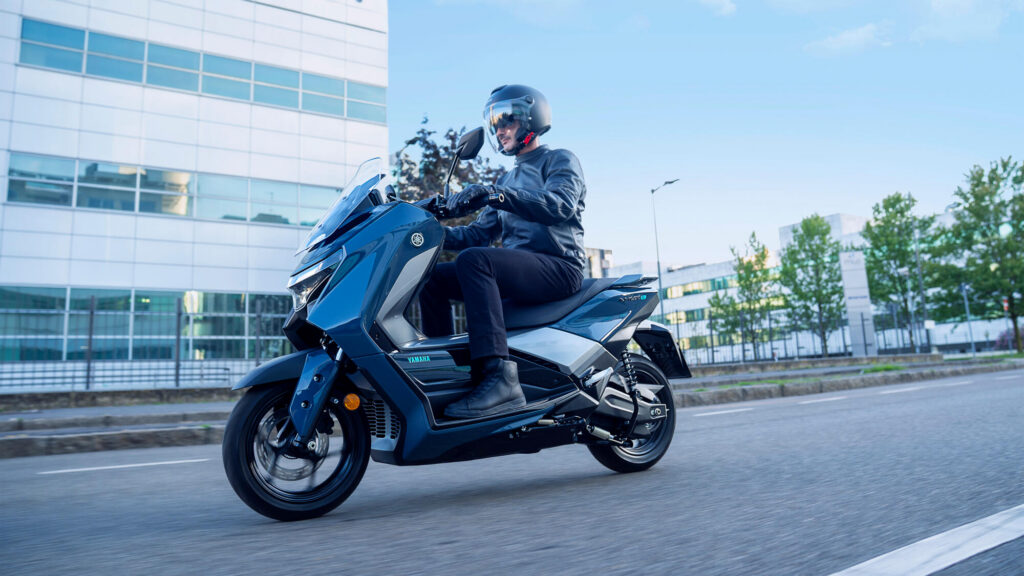
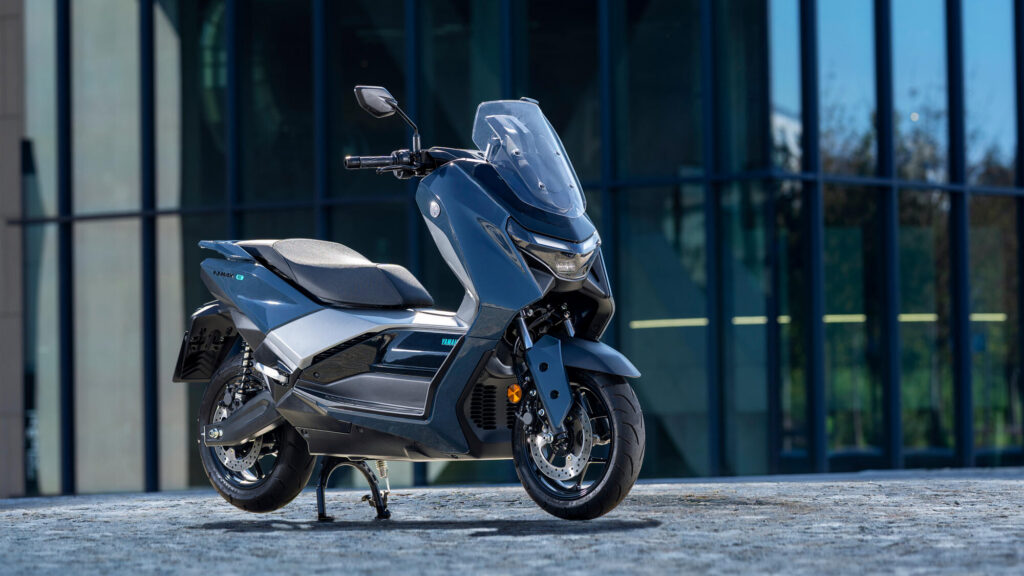
Yamaha has unveiled the NMAX E, a battery-electric version of its NMAX sport scooter for the A1 licence category, with performance equivalent to a 125cc model. Built on a new dedicated A1 EV platform, it is the first electric member of the MAX family, the scooter line Yamaha started 25 years ago with the original TMAX. Dealer deliveries begin in spring 2027.
The NMAX E was presented in Milan ahead of EICMA 2026, alongside the XENTER E high-wheel scooter. Both share the same powertrain, battery and charging system, but differ in chassis, wheel size and positioning. Where the XENTER E targets comfort on rough urban surfaces with 16-inch wheels, the NMAX E aims for sportier handling on 13-inch wheels.
eAxle powertrain
Power comes from Yamaha's eAxle unit, which combines an air-cooled interior permanent magnet synchronous motor, the motor control unit and a primary reduction gearbox in one compact housing. It produces a peak of 7.5 kW at 3,500 rpm and 33.3 Nm of torque from 500 rpm. A belt drives the rear wheel. Yamaha has not published a top speed.
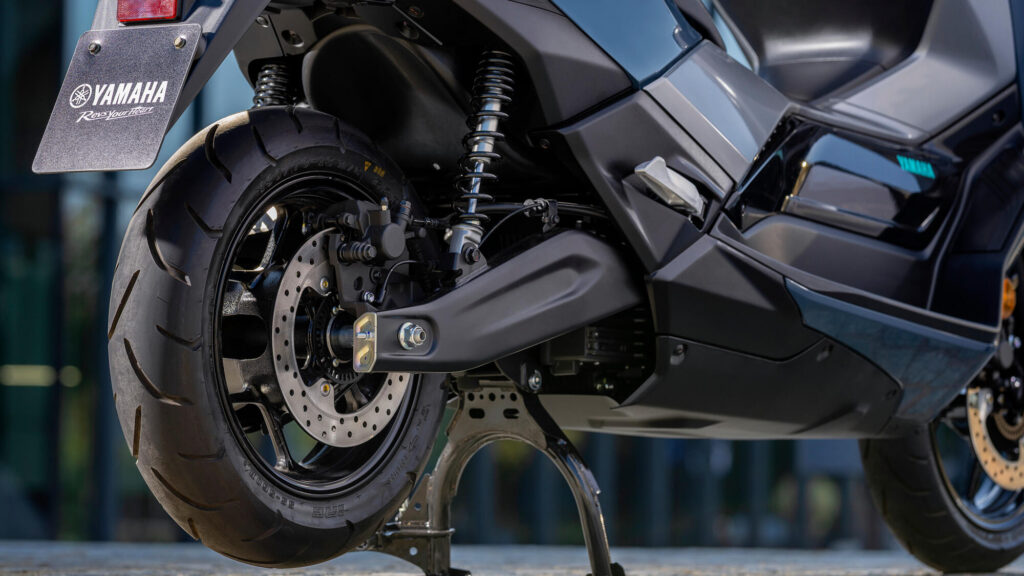
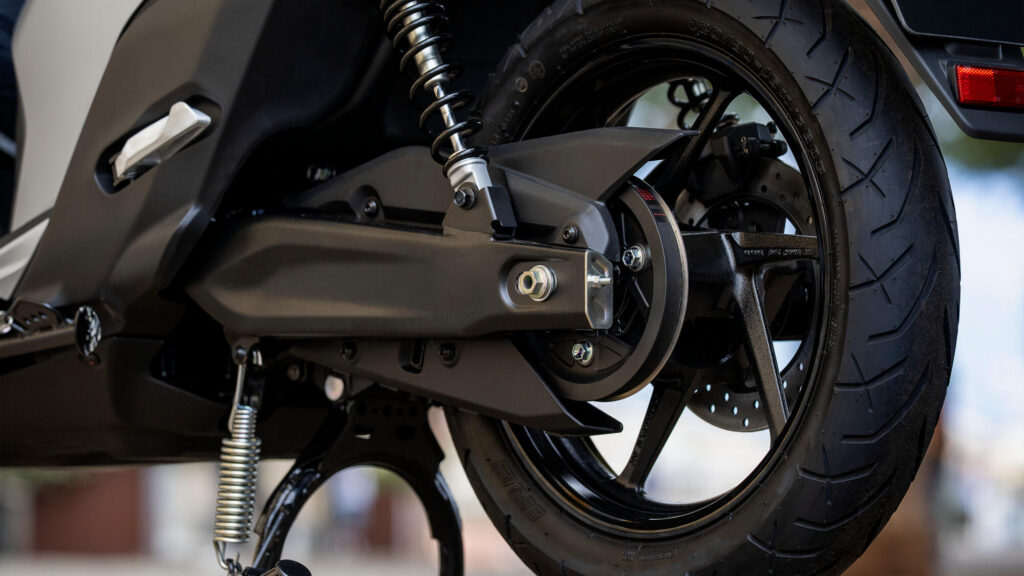
The drive unit is fixed to the frame rather than integrated into the swingarm, as on a petrol scooter. That frees up space for a conventional motorcycle-style swingarm, which Yamaha says weighs about a third less than a typical scooter rear suspension setup.
Battery and charging
The 3.5 kWh lithium-ion battery is mounted to the frame under the front of the seat and the floorboards. It is not removable. Its L-shaped design keeps the mass low and close to the rider, and a metal plate underneath protects it from impacts. The pack meets standards equivalent to IP67 and is monitored by a battery management system. Claimed range is 104 km in the WMTC class 1 cycle, at a battery temperature of 25 °C.
The 800 W on-board charger fills the battery from 0 to 100 percent in 5.5 hours at 220 V. It uses fanless cooling for quiet operation. The charging port sits in the front compartment next to a USB Type-C socket and accepts AC Type 2 public car chargers. A dedicated cable allows charging from a household socket.

Yamaha is introducing YOU Charge at the same time, a public charging subscription sold through its dealers in cooperation with national charging network operators. The service starts in the first markets in early 2027, with the main European EV markets following during the year.
Chassis
The new backbone frame has a 1,425 mm wheelbase. With battery and drive unit placed centrally, Yamaha claims a weight distribution close to 50/50. Ground clearance is 135 mm and seat height is 770 mm.
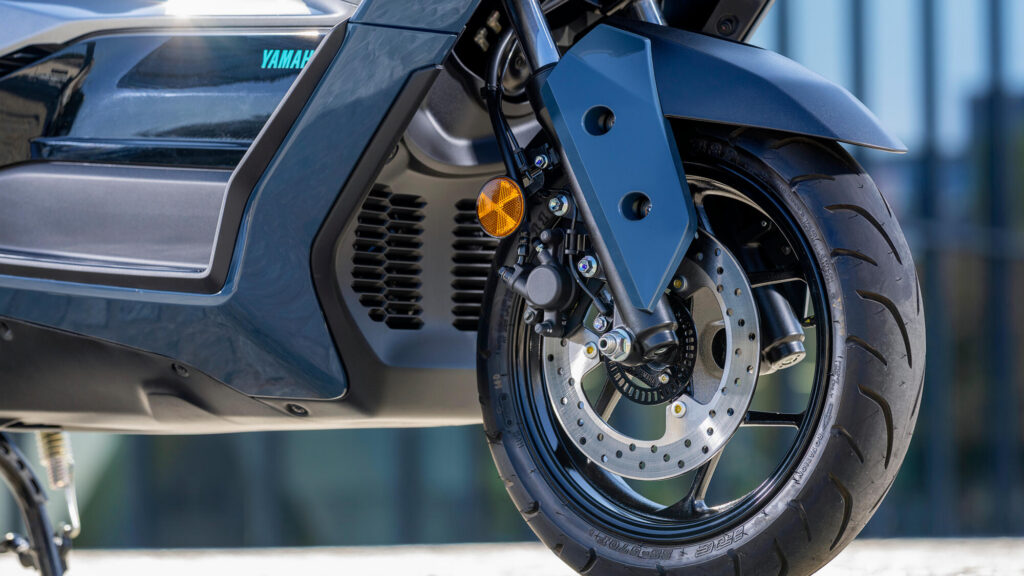
Up front is a telescopic fork with 33 mm tubes, and the rear uses twin shock absorbers positioned beneath the rider's hips. The model-specific 13-inch wheels carry a 110/70-13 front tyre and a 130/70-13 rear. Both wheels get a 245 mm disc with a single-piston caliper and ABS. Regenerative braking adapts to the selected ride mode and is tuned to feel like the engine braking of a combustion scooter.
Electronics and equipment
There are three ride modes. S delivers the strongest acceleration, T keeps similar performance with softer throttle response, and E reduces acceleration and top speed to maximise range. Traction control is standard, along with APSG, a throttle grip that gradually builds resistance for more feedback.
A reverse function is engaged by pressing the REVERSE button on the left handlebar and the MODE button on the right at the same time. The scooter then moves backwards at below walking pace without throttle input.
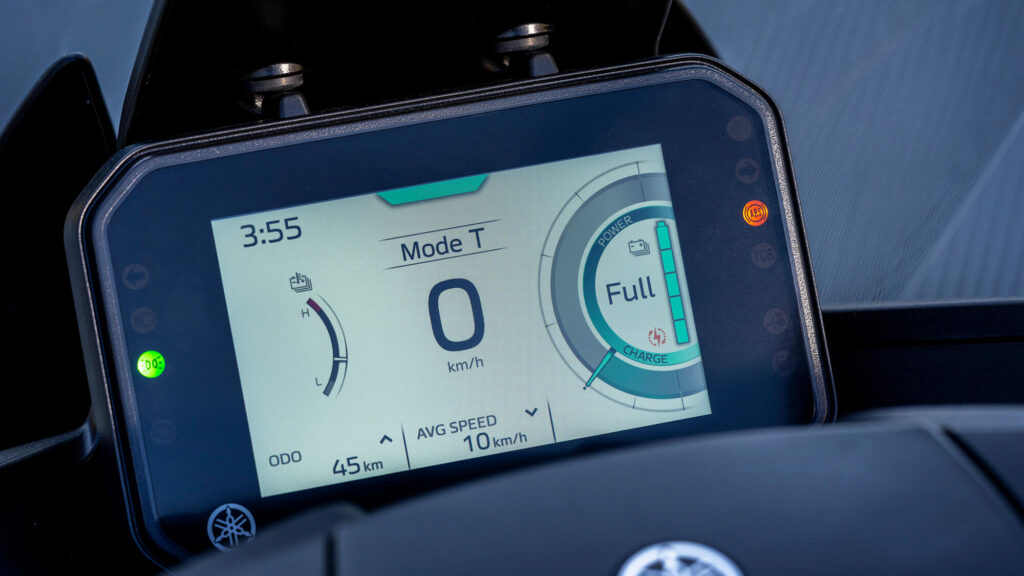
The 5-inch TFT display has day and night modes. It shows speed in the centre, smartphone status on the left, and battery level, remaining charge and regeneration on the right, with a moving needle that indicates acceleration and deceleration. The new Yamaha Motor On app adds turn-by-turn navigation, battery settings, maintenance schedules, parking location and a ride log. Smart key ignition is standard.

Styling and practicality
The NMAX E keeps the MAX family look, with minimalist dual light units front and rear, compact indicators and the boomerang-shaped side panels. The dual seat has stitched upholstery and an embossed logo. The illuminated underseat compartment fits a full-face helmet, depending on size and shape. Folding passenger footrests and an integrated grab handle are fitted. Accessories include adjustable levers, an apron, heated grips, handlebar muffs, a console bag, a 34-litre top case and a high screen.

Colours, price and availability
The NMAX E comes in Avio Blue with gloss silver boomerang accents, or Platinum Silver with a gloss black front section. Yamaha has not released official pricing and refers buyers to local distributors. Reports from the Milan press launch put the German price at 7,799 euro, identical to the XENTER E. The NMAX E arrives at Yamaha dealers from spring 2027.
YAMAHA >Yamaha has launched the XENTER E, a battery-electric high-wheel scooter for the A1 licence category, with performance equivalent to a 125cc model. The scooter was presented ahead of EICMA 2026 in Milan and marks Yamaha's return to the high-wheel segment, which matters most to European city riders who deal with cobblestones, tram rails and potholes every day. Dealer deliveries start in spring 2027.
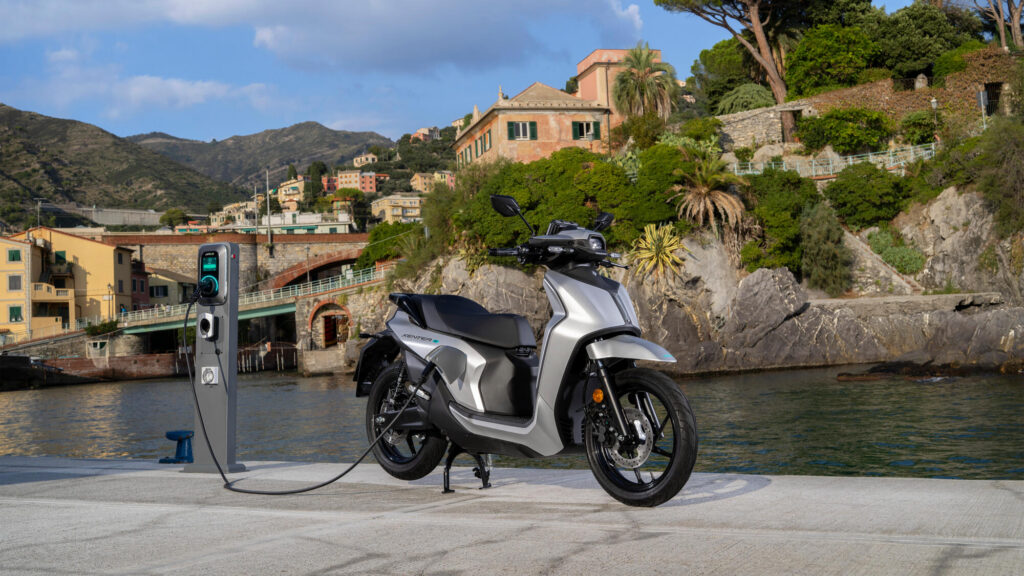
The XENTER E arrives alongside the NMAX E, which shares the same powertrain and battery, and a petrol-powered XENTER concept that Yamaha is showing in Milan.
eAxle powertrain mounted to the frame
The XENTER E uses Yamaha's new eAxle drive unit. It combines an air-cooled interior permanent magnet synchronous motor, the motor control unit and a primary reduction gearbox in one compact package. Peak output is 7.5 kW at 3,500 rpm, and maximum torque of 33.3 Nm arrives at 500 rpm. A belt takes the drive to the rear wheel.
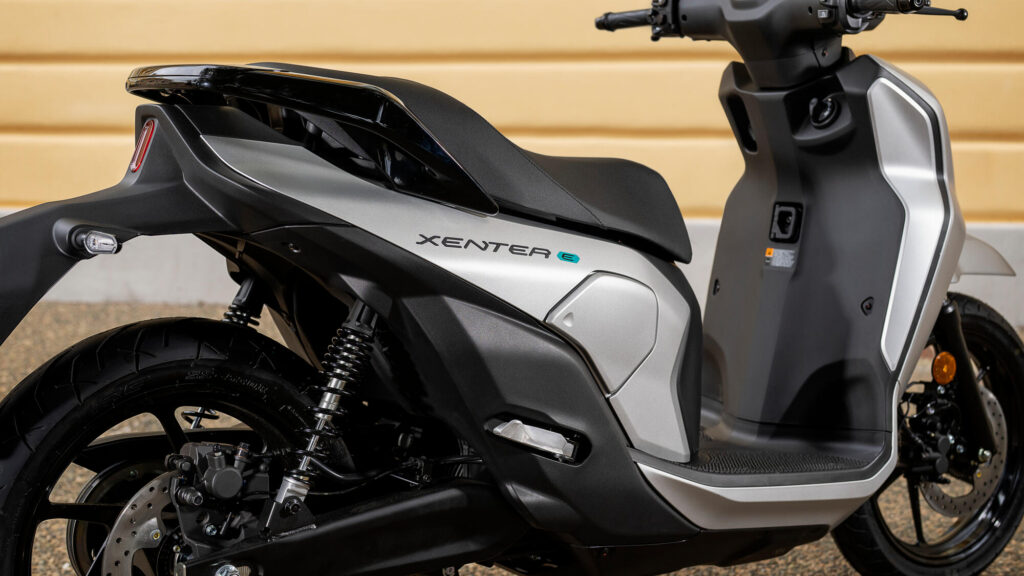
Unlike a typical petrol scooter, where the engine forms part of the swingarm, the XENTER E has its drive unit bolted to the frame. That allows a motorcycle-style swingarm and lowers unsprung weight, which Yamaha says improves ride comfort and handling.
Battery, range and charging
Energy comes from a 3.5 kWh lithium-ion battery with an IP67 rating, housed in a protective casing. The L-shaped pack sits low in the centre of the chassis, which keeps the floorboard flat and leaves room under the seat. Claimed range is 108 km in the WMTC class 1 cycle, measured at a battery temperature of 25 °C.
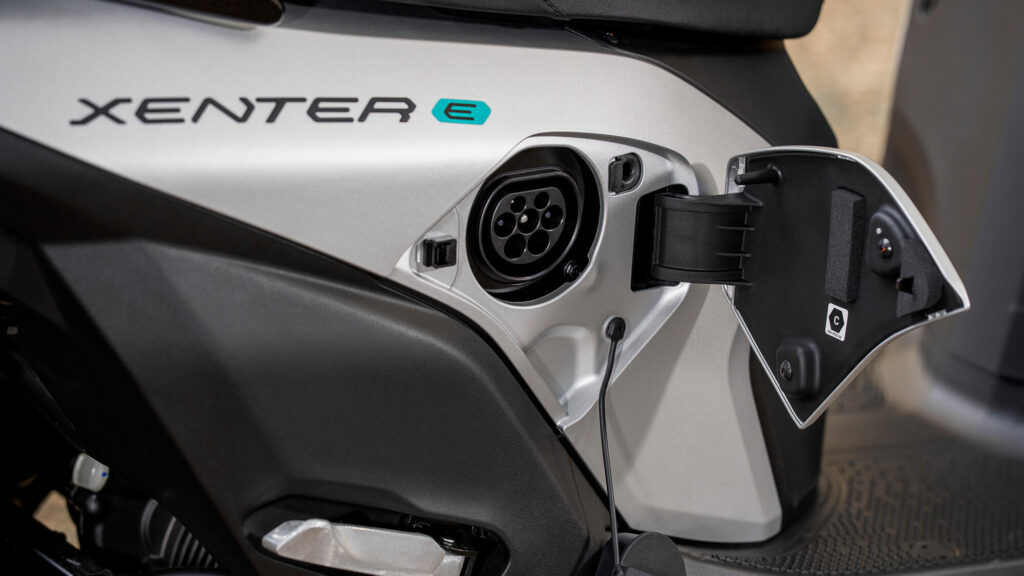
Charging is handled by an 800 W on-board charger with a fanless design. A full charge from 0 to 100 percent takes 5.5 hours at 220 V. The charging socket, located in a side compartment, accepts AC Type 2 public car chargers, and a dedicated cable allows charging from a household socket.
Alongside the scooter, Yamaha is launching YOU Charge, a subscription service for public charging developed with national charging network operators. It will be sold through Yamaha dealers, starting in the first markets in early 2027 and expanding to the main European EV markets during the year.
Chassis and brakes
The scooter is built around a new lightweight underbone frame with a 1,485 mm wheelbase. It runs on 16-inch wheels at both ends, with a 100/80-16 front tyre and a 120/80-16 rear. Suspension travel is 100 mm at the front and 97 mm at the rear. Seat height is 790 mm.
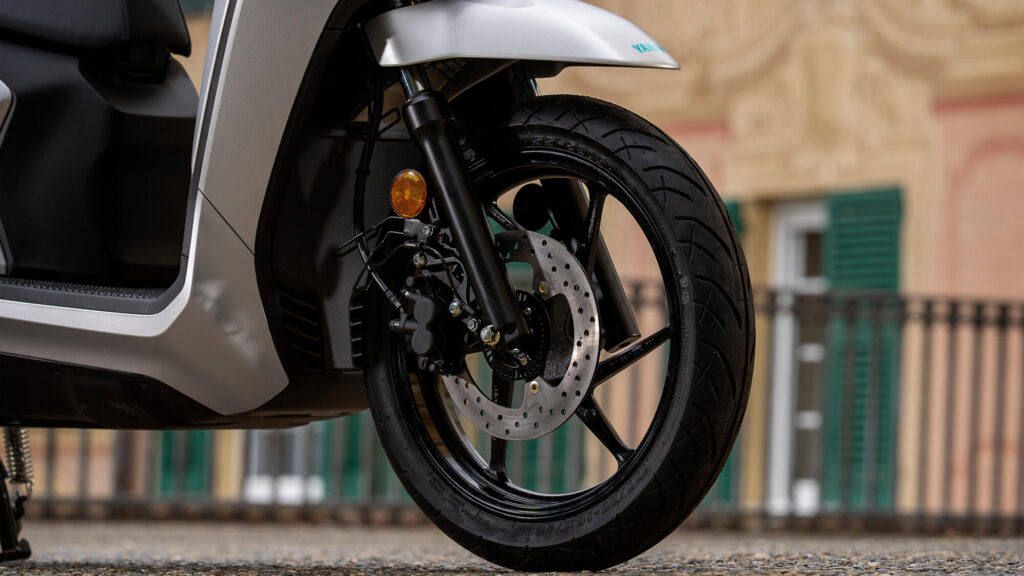
Braking is by 245 mm discs front and rear, both with ABS. Regenerative braking adapts to the selected ride mode and is tuned to resemble the engine braking of a combustion scooter.
Electronics and practicality
Riders can choose between three ride modes. S gives the sharpest acceleration, T softens throttle response, and E limits acceleration and top speed to extend range. Traction control is standard, as is APSG, a throttle grip that progressively increases resistance for more feedback. A reverse function, operated by pressing the REVERSE and MODE buttons together, moves the scooter backwards at below walking pace.
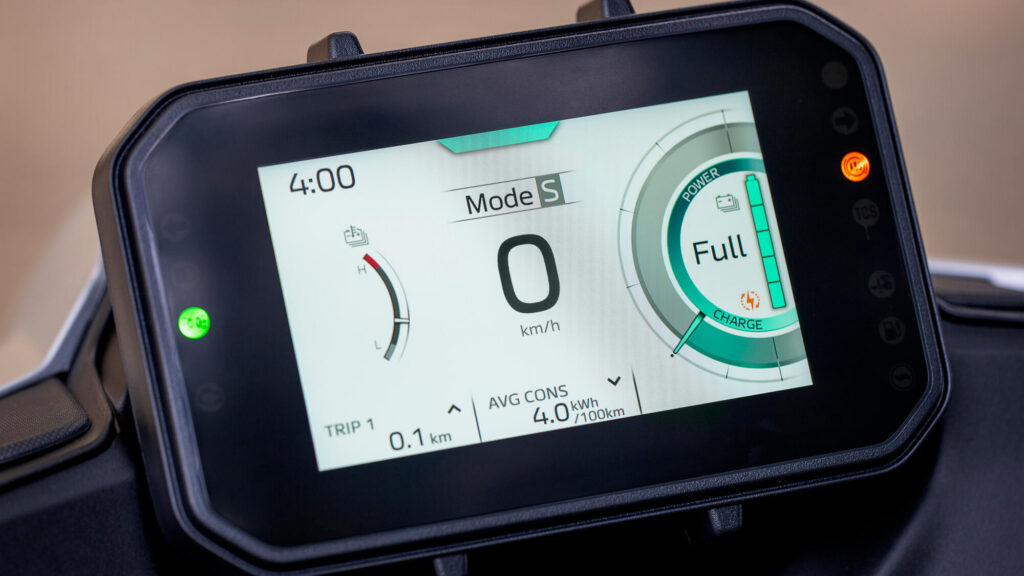
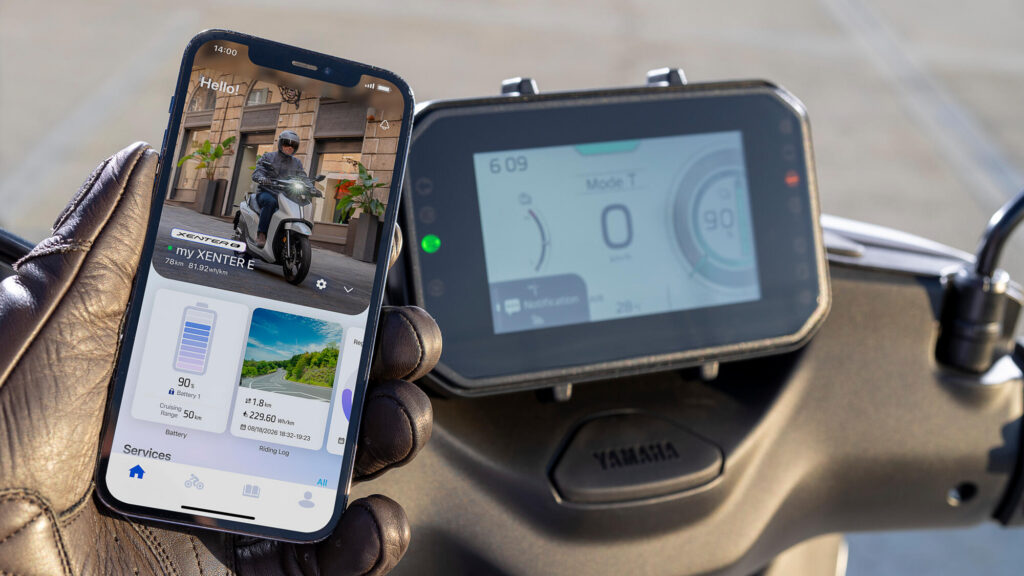
The 5-inch TFT display offers day and night modes and shows battery level, remaining charge and regeneration status, plus a power meter with a moving needle. Through the Yamaha Motor On app, owners get turn-by-turn navigation, battery status, maintenance schedules, parking location and trip data. Smart key ignition is fitted.
The underseat compartment fits a full-face helmet, depending on size and shape. A small front compartment holds a USB Type-C charger, and a folding bag hook sits at knee height. Yamaha has designed the scooter for easy fitment of accessories, including a high screen, apron, handguards, scratch protectors, a console bag and a 34-litre top case.

Colours, price and availability
The XENTER E comes in Platinum Silver or Midnight Black, both with aqua accents. Yamaha has not announced official pricing per market and refers buyers to local distributors. Early reports from the Milan press launch put the German price at 7,799 euro, the same as the NMAX E. The XENTER E reaches Yamaha dealers from spring 2027.
YAMAHA >



 The independent LA artist turns her dark alt-pop single into a surreal, handmade psychological thriller in this music video.
 Twin sisters Ibeyi speak with DMY about their latest album, 'Offering', transformation and creative independence.
 The Itch have released 'Planned Obsolescence', a big beat and electroclash track about being built to wear out, their first new music since debut album 'It's The Hope That Kills You'.
Democrats are on the verge of reversing their political fortunes. The party is heading into the midterm elections Tuesday under the kind of conditions campaign consultants dream of, after two years wielding hardly more power than a strongly worded letter.
Donald Trump has spent the erratic waning years of his presidency leading his party into a political wilderness by waging a deeply unpopular war on Iran and driving the cost of living ever higher. Republicans who enjoy a governing trifecta have tried to distance themselves from the party's decision-making and its leader, a once-animating force who has turned himself into a liability. Poll after poll says the same: Democrats are poised to take control of one or both houses of Congress — and spend the next two years thwarting Trump's agenda.
 Related
The Democratic Party Gets Its Populist Takeover
But after a primary season dominated by an ascendant left wing and a broader rejection of centrist politics, the question isn't just whether Democrats win on Tuesday. It's what kind of Democratic Party emerges on Wednesday morning.
"I really like the socialism aspects," said Gibrel Said, a supporter of Abdul El-Sayed at his closing rally in Detroit Monday night. In the marquee contest serving as a referendum on the Democratic Party's future, the Michigan Democratic Senate nominee espouses progressive politics and has often been associated with the the left's agenda-setting socialists, though he doesn't identify as one. His race has been rocked by the kind of left-versus-right identity crisis that presents a perennial challenge for Democrats.
"One, Medicare for All; two, how do we fund things that help us as constituents," Said told The Intercept, ticking off things he appreciates about the candidate. Said, who lives in the Arab enclave of Dearborn, Michigan, especially praised El-Sayed's willingness to buck party leadership and speak out on U.S.-Israel policy. "Instead of tiptoeing around the subject, he very adamantly says, hey there's a genocide happening here, we shouldn't send our money."
Cycle after cycle, in state after state, an insurgent band of Democrats critical of the political establishment's ties to corporate interests and its unflinching commitment to Israel has had to overcome the barriers erected by its own party's centrist leadership. Both sides present themselves as the true representatives of working people: the centrists by arguing that more transformative ideas will scare off lower-information voters, the left by saying they represent the masses.
How much of this trickles down to actual voters? On Monday, The Intercept followed canvassers and spoke to voters in Michigan, Maine, and Texas, asking about which issues had permeated and taking the temperature of voter enthusiasm. Some rolled their eyes at the spats that have dominated the headlines, dismissing the idea that eleventh-hour backstabbing would make a difference. Others regurgitated right-wing misinformation. Many complained of too many campaign mailers.
"They're wicked mean," said Sharon McDonnell, a supporter of Troy Jackson, the Democratic Senate nominee in Maine. Speaking to The Intercept in the town of Yarmouth, she described one mailer that included a photo of Jackson chomping a cigar and describing him as "evil." "It's just nasty."
In Maine, the party's left flank seized power in the nominating process for the Democratic Senate candidate — then fought to hang onto it after onetime rising star Graham Platner flamed out after a sexual assault allegation (which he denies). With Jackson, a former state Senate leader, Maine now offers progressives one of two opportunities to test their message at the Senate level, where a candidate has to secure appeal statewide, not just in deep-blue House districts.
 Related
Radical Centrists Like Haley Stevens Are the Real Extremists in the Democratic Party
The other is Michigan, where the intraparty battle is still raging. Rep. Haley Stevens, D-Mich., demolished her past attempts at fence-mending when she endorsed Republican Senate candidate Mike Rogers on Sunday and abandoned El-Sayed, who beat Stevens in a Michigan primary that saw $30 million in outside spending from the super PAC for the American Israel Public Affairs Committee.
The dustup has had Democrats biting their nails and moderate party leaders making the cable news circuit to demand party discipline — this time, to scold a centrist. The party leads in the polls for 218 of the 435 seats up for grabs in the House of Representatives, but they need to perform well in seven key states — Alaska, Iowa, Kansas, Ohio, and Texas, in addition to Maine and Michigan — if they want to win the Senate.
"I think she's counterintuitively, perhaps, given people a reason to rally some more," said Kathleen Britton, an El-Sayed supporter at the Detroit rally on Monday, of Stevens. "I really don't think it's gonna help Mike Rogers."
Earlier that day, in a predominantly Black neighborhood of Detroit, a prominent Black supporter of El-Sayed preparing to knock on voters' doors described Stevens's endorsement as an "ego-driven statement."
Haley Stevens "used a Black church as a prop, and we have seen that time and time again."
Mike Bland, the executive director of the Black Men Vote PAC, highlighted that Stevens made her public endorsement of Rogers in a Black church in Detroit. He doubted that Stevens, whose criticism of El-Sayed centers primarily on his skepticism of the U.S. relationship with the state of Israel, would be able to pull Black voters to Rogers, a conservative former House representative whose campaign has repeatedly peddled anti-Muslim tropes against El-Sayed.
"How can I say this without cursing? She used a Black church as a prop, and we have seen that time and time again," Bland said. "Black folks aren't stupid."
Over the past month, El-Sayed has rallied with Barack Obama and Kamala Harris, the two most prominent Black politicians in America — and hardly radicals estranged from the establishment power center. At the same time that Stevens was making her endorsement of Rogers public, El-Sayed was attending a get-out-the-vote event at another church in Detroit. The two primary foes were supposed to appear together that day with Rep. Jim Clyburn, D-S.C.
One of the Democrats' most coveted Senate pickups didn't present much of an opportunity for the left in the primary, but it has still been characterized by intraparty animosity.
In Texas, where both Democratic Senate primary contenders espoused relatively moderate politics, outgoing Rep. Jasmine Crockett, D-Texas, has declined to campaign with state Rep. James Talarico, though she endorsed him after he beat her in the state's March Democratic primary.
Talarico has been performing well with Latino voters, a massive voting bloc that helped fuel his primary victory. But Crockett — who, unlike Stevens, is Black — has suggested that Talarico has not done enough to excite Black voters, a demographic she carried in the primary. On a canvassing operation targeting Black voters in the Dallas-Fort Worth area on Monday, few Black Texans who spoke to The Intercept expressed excitement for Talarico. But most had already voted for him, saying they were motivated to do their civic duty.
 Related
The Rise of the Christian Left in Texas
Black voters frequently discussed concerns over affordability, gas prices, and homelessness. Canvassers told The Intercept they had heard some of those voters express concerns over their perception of Talarico's policies toward transgender children, at times espousing blatant misinformation, such as the idea that Talarico supported arresting parents who refused to give their children gender-affirming surgeries.
" I don't stand for that," said voter Jermiah Robinson, referring to her belief that Talarico pushed "sex-change" surgery for minors. Like many voters, she cited the cost of living as her most pressing issue. Robinson said she would "want to vote for him if he stands by his words, and he's actually like 'Yeah, I'll help out as far as prices and everything.'"
Talarico appears to have improved his margins with Black voters in the final stretch. According to the Texas Politics Project at the University of Texas, Talarico is leading with 79 percent of the Black vote, signaling a significant increase in support from Black voters from just last month. The conventional wisdom suggests that he could barely ask for a better opponent than the scandal-plagued Republican candidate, Texas Attorney General Ken Paxton.
In 2015, Paxton was indicted on felony securities fraud charges in Texas, in a case that dragged on for roughly nine years, and ended with Paxton being required to do community service and pay restitution. And in 2023, the Texas House of Representatives voted across party lines to impeach him as attorney general for alleged corruption and retaliation against whistleblowers.
Scandal kept rocking the race for Senate in Maine, where longtime Republican incumbent Sen. Susan Collins faces her toughest reelection challenge yet from Jackson. Before Jackson, who lost a race this cycle for the state's Democratic nomination for governor, there was Platner, hailed early as a working-class champion who faced a series of personal scandals in his successful primary campaign. There was the revelation of a Nazi tattoo that he claimed not to understand until last October. There were crudely worded Reddit posts and stories of cruelty from women he'd dated. One former girlfriend's allegations of sexual assault ultimately ended his campaign — and set off a scramble to find a replacement that progressives ultimately won by elevating Jackson.
By Monday, Mainers who spoke to The Intercept appeared exhausted by the lengthy, contentious, and expensive Senate race that has dominated the state.
 Related
Susan Collins-Aligned Super PAC Buys Attack Ads in Portland… Oregon
"There's a lot of fatigue. People are tired of it," said Charlie Dingman, who chairs the state Democratic Party. "I have had some conversations at doors with people that have led me to think that the extremely negative and extremely untruthful ads may be backfiring."
Tyler Echard, in Norway, said he'd already cast an absentee ballot for Democrats down the ticket. He was disgusted with a deluge of political mailers and eager to stop seeing them pile up on his doorstep.
"The amount of mailers we get — just mailers, not just handed at the door but in the mail — especially from the Republican side, the amount of money is probably more than I will make in my lifetime, spent in this election," Echard said. "At some point, we gotta get legislation because money's just gonna run everything into the ground. I ain't got it, so I can't influence it."
Frustration with the status quo in Congress could spell the end for Collins's 30-year career in the Senate. On Monday, a University of New Hampshire poll found Jackson leading Collins by 4 percentage points. And in September, Collins found herself thrust into a scandal of her own, when ProPublica revealed that the FBI anti-corruption squad was investigating an alleged pay-to-play scheme between Collins and a donor eager to secure government contracts.
 Related
Susan Collins's Committee Bought Trucks the Army Didn't Want. Then Campaign Donations Poured In.
The Intercept later exposed that, alongside a series of campaign donations, defense contractors cozy with Collins had received lucrative carveouts in defense spending. (Collins has denied wrongdoing in all cases.)
But the incumbent senator has faced controversy and come out victorious before. And some Mainers doubt they'll see change either way.
"I can't vote for either side," said a man, who declined to share his name with The Intercept, walking down a rural road in Norway with a hunting rifle slung over his shoulder. "You can't trust neither of them."
Noah Hurowitz reported from Yarmouth and Norway, Maine; Akela Lacy reported from Fort Worth, Texas; Matt Sledge reported from Detroit, Michigan.
The post Sharp Left Turn: Democrats Have a Shot to Take Congress on Socialist Momentum appeared first on The Intercept.
Euro cloud trade association CISPE can keep the identities of members backing its VMware merger challenge confidential from Broadcom following a ruling by the EU General Court.
Cloud Infrastructure Services Providers in Europe filed an action last year seeking to annul the European Commission's approval of Broadcom's acquisition of the cloud and virtualization giant.
CISPE believes the Commission erred in allowing the purchase to go ahead without imposing any conditions on Broadcom to protect the many European cloud providers and their customers who depend on VMware's software.
Broadcom sought access to redacted information identifying members supporting the action, arguing that it needed the information to challenge the action's admissibility. CISPE says the ruling allows the case to proceed without disclosing those identities to Broadcom.
"It is a procedural ruling on confidentiality rather than a decision on the substance of the case, but it removes the immediate obstacle to the action moving forward," a CISPE spokesperson told The Register.
CISPE argued that identifying the members, which are or have been VMware customers, would expose them to a significant risk of retaliation because of Broadcom's market power. Those members had supplied information about their commercial relationships with VMware.
As far as the case itself goes, CISPE says it warned the Commission that Broadcom would use VMware's pre-eminent position in the private cloud market to rewrite licensing terms and reshape the market in its favor.
Just a month after Broadcom's acquisition concluded in November 2023, partners were informed that VMware's channel program was to end in early 2024, and that Broadcom was also ditching the majority of VMware's Cloud Services Providers, keeping only a select few that had the largest turnover.
Despite Broadcom CEO Hock Tan publicly stating that inflating prices was not his strategy, that is what happened. AT&T says that Broadcom proposed a 1,050 percent price increase, for example. Meanwhile, nine out of ten respondents to a recent survey of VMware customers said they were considering moving to alternatives.
CISPE, which represents 48 cloud infrastructure service providers across the EU, says fewer than 20 European providers remain authorized to offer VMware-based services, down from more than a thousand.
Commenting on the latest ruling, CISPE Secretary General Francisco Mingorance declared it a good day for the organization and for the rule of law in Europe.
"The case matters even more today than when we filed it. In the three years since the European Commission waved this deal through without conditions, Broadcom has dismantled the European VMware channel," he said.
"Those excluded have until 31 March, 2027, to sell their infrastructure or their customers to a competitor chosen by Broadcom, or to close. This is the foreclosure the European Commission was warned about."
We asked CISPE what outcome it hoped to achieve, nearly three years after the acquisition closed.
"The immediate objective is to have the Commission's unconditional clearance annulled, on the basis that it failed to properly assess the effect of the acquisition on European cloud providers and the VMware channel," CISPE's spokesperson told The Register.
The Commission did impose conditions concerning interoperability with rival hardware, but CISPE argues these did not address the risks to cloud providers.
"We appreciate that it's a long shot (although there is precedent)," the spokesperson continued. "We have (along with others) also filed a competition complaint with the Directorate-General for Competition against Broadcom for its actions post-merger."
The precedent referred to is the EC approval given to the merger of Sony and BMG's music divisions in 2004, which was ruled to be not of "the requisite legal standard" two years later. The deal was subsequently reassessed and re-cleared.
"Ultimately, we want to do whatever we can to bring Broadcom to the table to negotiate and ideally end some of its most egregious practices so that European cloud providers can once again support cloud customers in a commercially fair and viable manner," the spokesperson added.
The Register asked both the European Commission and Broadcom to comment, but neither had responded by the time of publication. ®

Public bodies in the UK expect higher operating costs and energy charges as a result of climate changes and the transition to lower carbon energy, but few have a good picture of the risks, according to government auditors.
A new report from the National Audit Office (NAO) says some public bodies expect financial impact from the risks they identified, although bodies were often not able to cost these - even approximately.
"Bodies anticipate costs to arise from damage to assets and infrastructure, driven by physical damage from extreme weather, as well as from chronic shifts to higher temperatures and more precipitation. Bodies also expect higher maintenance and repair costs, potential asset upgrades, and transition costs. Many bodies expect increased operating costs, including energy charges. Bodies controlling significant property or infrastructure are particularly concerned with decarbonization and adaptation costs," the report stated.
His Majesty's Treasury (HMT) has set out rules for climate-related financial disclosure in larger central government bodies' annual reports, which produced their first set of reports for the 2025-26 financial year. Other rules for disclosure have been in place since 2022.
However, the NAO found [PDF] that understanding of the risks in the impact of climate change - increasing temperatures, higher risk of flooding, higher winds and longer droughts - was poor, as was insight into costs of moving to a low-carbon economy.
"Bodies did not articulate transition risks as well as physical risks in the strategy disclosures. In the disclosures we reviewed, while several transition risks were listed, few specifics were given, unlike physical risks, which were explained in greater detail," the report from the watchdog stated.
"The transition risks most frequently identified included the financial cost of transition, and supply chain disruption. Anticipated transition costs included the costs of: switching to lower-carbon energy sources, including investments in new technology; complying with new regulations; and of fluctuations in the price and availability of materials, water, energy and specialist skills," it added.
Gareth Davies, head of the NAO, said: "UK public services will need to adapt to the impacts of climate change. Parliament needs clear information on the resilience of infrastructure, service provision and finances to climate change, and on how these risks are being managed."
"Although public bodies are still learning how best to report their most pressing climate risks, the requirement on all large central government bodies to make such disclosures from 2025-26 is an important first step. We expect this reporting to become more useful over time."
Earlier this year a report from Global Action Plan, a climate charity, claimed 84 percent of proposed datacenter developments were in areas that are already water stressed or projected to be water stressed by 2040.
Water consumption by datacenters could intensify strain on the UK's water systems already stressed by climate change, it argued.®
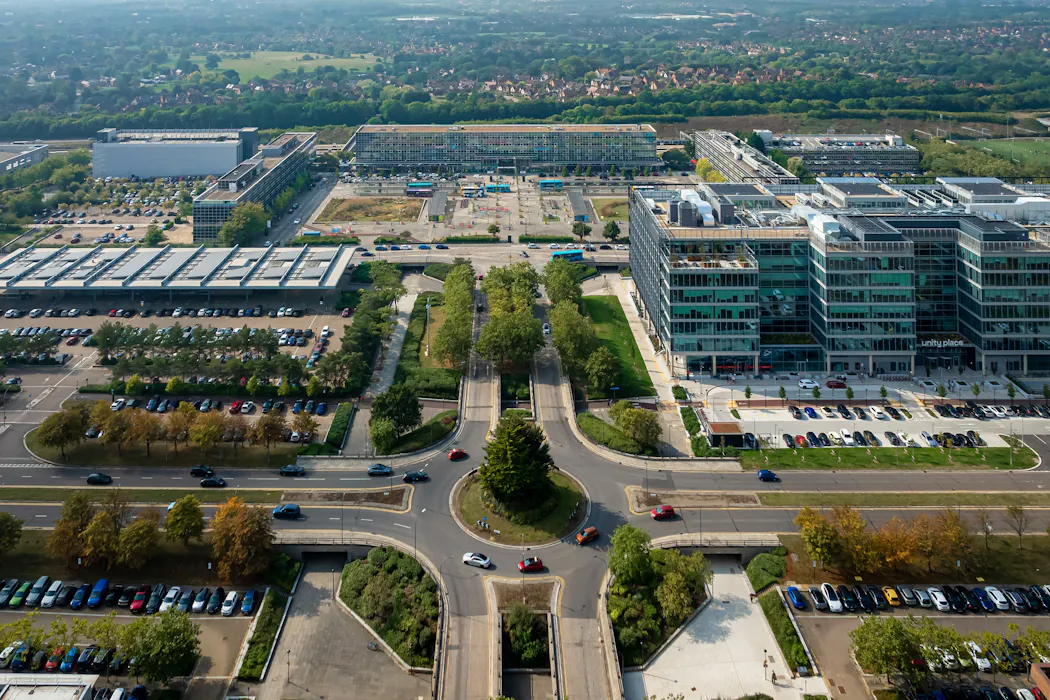 Milton Keynes in Buckinghamshire is a city far from the coast, but it will still be affected by the consequences of sea-level rise. Alexey Fedorenko/Shutterstock
Rising sea levels might seem like someone else's problem if you live inland. But, even miles from the coast, changing sea levels can affect the food we eat, the goods we buy, the energy we use and the taxes we pay.
Global sea levels are predicted to rise by between 28 and 55cm by 2100 if greenhouse gas emissions are significantly reduced. Sea levels could rise by between 63cm and 1m if emissions stay at very high levels. A rise of more than 2m by 2100 cannot be completely ruled out. Here's how sea-level rise is already affecting our daily lives and exposing weaknesses in everything from power supplies to infrastructure:
1. Threat to food cropsThe Fens, which spread across Lincolnshire, Cambridgeshire and Norfolk, hold 48% of England's best agricultural land and contribute over 7% of UK agricultural output, including about a third of England's vegetables. Much of this landscape lies at or below sea level, which leaves it vulnerable to flooding and to contamination with saline water.
The land's productivity depends on an extensive network of drainage channels, pumping stations and flood defences. A breach can destroy crops and leave productive soil unusable for years. As homegrown produce supplies only about 60% of the food the UK eats, losing Fens land alone would not empty shelves, although it would deepen reliance on imports that are themselves exposed to sea-level rise and other effects of climate change.
Read more: Britain's most artificial landscape may not survive climate change
 Flooding can destroy crops and damage soil.
Neil Mitchell/Shutterstock
2. Disruption to port transport
Around 85% of the UK's international freight by weight and more than 80% of world merchandise trade moves by sea. A flooded terminal at Southampton, in Shanghai or on a Caribbean island delays goods bound for shops and factories far inland.
Even if a port isn't directly affected by floods, there can be disruption if the infrastructure connecting it to the rest of the economy is inundated. Railways, roads, warehouses, electrical substations and fuel distribution networks can all be affected by coastal flooding. The resulting shortages and price rises would have serious knock-on effects for households.
 Changing sea levels can disrupt the infrastructure associated with shipping and related supply chains.
Rob Fuller/Shutterstock
3. Damage to power supplies
The UK has three times more coastal energy facilities than any other European country. These facilities include oil refineries, fossil fuel and liquefied natural gas terminals, and nuclear power stations. Floodwater can inundate electrical equipment, damage control systems, disrupt fuel deliveries and cut off the roads and railways on which workers and suppliers depend, while saltwater can corrode infrastructure and complicate repairs.
Simultaneous damage to several facilities, or a prolonged interruption to a major fuel terminal or electricity connection, could make it harder to maintain reliable supplies. Even where electricity generation continues, damage to substations and other network infrastructure can prevent power from reaching consumers. This has implications for household energy bills, industrial production and the reliability of electricity supplies.
4. Risk to national securityThe UK's defence infrastructure is also threatened by sea-level rise. Naval bases, dockyards and other coastal facilities are exposed to rising sea levels and storm surges, potentially affecting access, operations and the infrastructure needed to maintain military capability. Keeping these sites functioning in coming decades will require action that may include relocating some of them.
Sea-level rise could also make the rest of the world a more dangerous place. Population displacement driven by climate pressures, including sea-level rise, places additional demands on humanitarian assistance and international cooperation. It also compounds any existing political and security pressures nationally.
5. Rising costsThe costs of sea-level rise fall on people across the country. Protecting vulnerable communities, subsidising flood insurance and relocating communities and infrastructure from areas that can no longer be defended will require substantial investment.
Meanwhile, the loss of productive farmland could push up food prices, and disruption to ports and transport links could make imported goods more expensive or harder to obtain. Damage to energy infrastructure could add further costs for households and businesses. The cumulative effect would be felt across the country through higher prices, higher taxes and reduced spending on other public services.
What next?Rapid emissions reductions to keep overshoot of 1.5°C as brief and as low as possible are the safest way to reduce the rate and extent of sea level rise, and the associated costs of adapting. However, current global policies are projected to take us to about 2.8°C of warming. The UN's upcoming climate summit, Cop31 in Turkey this November, will be a chance to close the gap between what has been promised and what is needed.
The world has already warmed by 1.4°C, so continued sea level rise is now inevitable even with rapid emissions reductions. Adaptation is as essential as mitigation. The design of sea defences and infrastructure need to be adapted accordingly as seas rise. Reducing greenhouse gas emissions and improving coastal adaptation will help determine how severely sea level rise affects people, both inland and close to the coast.

Helen Millman sits on the advisory council of the Conservative Environment Network.
Huge thanks to November's sponsor, Byron Windhorst, who has asked me to post the following:
Many of the climate articles featured here find their way to the Climate Catastrophe Group on Facebook, which covers extreme weather events and related science. We have over 4,000 members but would warmly welcome new ones, who are keen to engage and participate.
 "Extreme heat no longer confined to summer, extending health risks, study finds.
"A study of climate data from 1980 to the present showed a broad global expansion of extreme heat days outside of summer months, extending into spring and fall."
 "World notches up hottest October on record as 500 academics call for courage on climate.
"Last month was the hottest October globally, increasing the odds that 2026 will the second-warmest since reliable records began, according to Zeke Hausfather, a prominent climate researcher, citing data from Europe's Copernicus Programme."
 "Iceland Is War-Gaming an Ocean Current Collapse…
""One of the key roles of government is to identify threats and prepare society for them. This is how we approach volcanic eruptions and epidemics, and the same should apply to climate risks," Iceland's Minister of the Environment, Energy, and Climate Jóhann Páll Jóhannsson explained in a statement."
https://gizmodo.com/iceland-is-war-gaming-an-ocean-current-collapse-2000833638
 "Her Daughter Died After a Beach Swim. UK Sewage Discharge Is Still Soaring…
"The latest UK water quality report from Surfers Against Sewage (SAS) reveals some sickening facts about conditions across the country: between January and August 2026, 1,687 people reported getting sick after surfing, swimming, or paddling. What's even worse, in Wales, 90% of reports came from spots classified as Good or Excellent."
https://www.surfer.com/news/uk-sewage-report-surfers-against-sewage-2026
 "Summer production of French lettuce is down by 25% due to heatwaves…
"Successive heatwaves have particularly affected summer production, which is down by 25% year-on-year. This decrease in supply has been accompanied by a sharp rise in prices, which reached record levels in August."
 "Massive Pile-Up on A14 After Hailstorm [N Italy]…
"A 'massive pile-up' involving about twelve cars—caused by a severe hailstorm—led to the closure of a stretch of the A14 near the Cesena toll booth, heading south. It happened—according to the Fire Brigade—around 9:30 am… At the same location, but heading north, another collision between cars was reported."
https://www.ilmattino.it/en/massive_pile_up_on_a14_after_hailstorm-9862364.html?refresh_ce
 "Powerful storm tears through beach resort on Italy's southern coast.
"Surveillance footage captured the moment a tornado ripped through a beach resort restaurant in Castellaneta Marina, southern Italy, tearing off metal roofing and flattening a restaurant. Emergency teams secured the area and cleared debris, with no injuries reported."
 "Storm causes widespread flooding on Rhodes, at least 60 vehicles swept away.
"Severe flooding on the southeastern Aegean island of Rhodes early Monday swept away at least 60 vehicles, inundated homes and businesses and forced schools to close in four municipal districts, authorities said."
 "Heavy Rain Floods Homes in Türkiye's Bodrum, Car Swept Into Sea.
"Heavy rainfall has caused flooding in nine neighborhoods in Bodrum, in southwestern Türkiye's Muğla Province, inundating 17 homes and three commercial properties. One vehicle was swept into the sea, TRT Haber reports."
https://caspianpost.com/regions/heavy-rain-floods-homes-in-turkiye-s-bodrum-car-swept-into-sea
 "Warmer seas and shifting pressure systems: The signs that suggest the Mediterranean's climate is 'tropicalizing'.
"…over recent decades, climates across the Mediterranean basin have begun to show signs of tropicalization: the process of transitioning toward a tropical climate. This is evident in several areas, including rising air and sea temperatures, shifting atmospheric patterns, and increasingly erratic rainfall."
https://phys.org/news/2026-10-warmer-seas-shifting-pressure-mediterranean.html
 "Absolute madness on the Mediterranean - summer in November:
"Days >30C [86F] in Spain and Portugal; 40C in Algeria, 37C in Libya and Egypt (November record destroyed by 5C at El Tor today with 37.2C). Persistent cold stuck in Central Mediterranean, where not a single record has fallen in nearly 2 months in Italy (the only country). This pattern will continue for weeks." [Extreme Temps]
https://x.com/extremetemps/status/2117339661441855843
 "UNREAL, ABSURD HEAT ACROSS AFRICA:
"43.5 [110.3F] Tillaberi NIGER HOTTEST NOVEMBER DAY EVER. Also BURKINA 41.1 Fada N'Gourma; GHANA Min. 27.0 Wa; GABON 35.1 Franceville; ZAMBIA crazy all time record:42.2 Senanga >1000m asl; NAMIBIA 41.5 Katima Mulilo." [Extreme Temps]
https://x.com/extremetemps/status/2117332304607817921
 "Heatwave: Doctors urge Nigerians to eat water-rich fruits, stay hydrated…
"The experts identified watermelon, oranges, cucumbers and pineapples as water-rich foods that can supplement fluid intake and help maintain adequate hydration during periods of extreme heat. They also advised Nigerians to carry water bottles when going out."
https://punchng.com/heatwave-doctors-urge-nigerians-to-eat-water-rich-fruits-stay-hydrated/
 "South Africa's water crisis deepens as outages, reservoir shortages and leaks hit communities…
"The crisis is unfolding across major urban centres, with Johannesburg, Tshwane and Ekurhuleni grappling with supply constraints in Gauteng, while parts of Pinetown South in KwaZulu-Natal have endured nearly two weeks of disruptions."
 "INSANE, UNREAL, EVERY SINGLE RECORD PULVERIZED. After destroying 100% of all September and October records, every November record has been smashed in Middle East:
"In SAUDI ARABIA today Al Ahsa re-broke its record: 38.7C [101.7F]; Al Qaysumah a Min of 24.8C. 40C in The EMIRATES including the record of Abu Dhabi with 38.2C. MINIMUMS still >30C in KUWAIT (typical of JULY). Hotter next days! Eternal summer." [Extreme Temps]
https://x.com/extremetemps/status/2117327430151217236
 "Floods inundate farmland in eastern Syria, damage crops…
"Heavy rain over the past two days, accompanied by hail and strong downdraft winds, triggered flash floods across the two provinces, inundating farmland and cutting off several main and secondary roads, the Syrian state news agency SANA reported."
https://www.arabnews.com/middle-east/floods-inundate-farmland-in-eastern-syria-damage-crops-3009469
 "INSANE NOVEMBER WARMTH IN SOUTHERN RUSSIA:
"NIGHT MINIMUMS of +16C [60.8F] in the Caucasus, with dozens of records smashed, including +15.9 Min. at Derbent, typical of the end of summer. October had already broken hundreds of records with mins. up to 24C. Insane." [Extreme Temps]
https://x.com/extremetemps/status/2116871569423344067
 "Armenia's bees face mounting threats from climate change, pesticides and disease.
""I have always thought that even if humans did not exist, bees would still produce honey. We change their natural habitat, upset the balance and put stress on the ecosystem," beekeeper Armine Abovyan tells CivilNet… "The past two years have been difficult: there was either no profit or very little…"
https://civilnet.am/en/news/1015026
 "Kazakhstan Tree Planting Drive Faces Wildfires and Low Survival Rates…
"Kazakhstan is now in the sixth year of a program to plant two billion trees. By the end of 2025, authorities had reported approximately 1.6 billion plantings and seedings, although a later government report put the figure at 1.7 billion. In some years, most seedlings have failed to survive."
https://timesca.com/kazakhstan-tree-planting/
 "Second cyclone in a week hits India's coastal areas.
"Cyclone "Murasu" with wind speeds of up to 120 km per hour (KMPH) hit India's southern coastal areas in the early hours of Tuesday, confirmed a local official belonging to the disaster management department. The most affected areas were in the country's southern state of Andhra Pradesh."
https://www.chinadailyasia.com/hk/article/642170
 "On the morning of November 2, Qinzhou, Guangxi, China experienced localized torrential rain, with 263.3mm [10.3 inches] of rainfall recorded over four hours, triggering flooding."
[Jim Yang]
https://x.com/yangyubin1998/status/2117251454880854042
 "CHINA had its HOTTEST NOVEMBER DAY EVER >37C [98.6F]… HISTORIC HEAT IN HONG KONG - 25.9 In the Hong Kong Observatory is HOTTEST NOVEMBER NIGHT EVER…
"Record heat also in JAPAN. 30.4 Tokorono - New November record."
[Extreme Temps]
https://x.com/extremetemps/status/2116855673363571042
 "South Korea: Heat illness insurance payouts surge fourfold in Gyeonggi's record summer.
"While the number of claims for heat related illnesses under Gyeonggi's climate insurance programme have doubled, the payouts for these illnesses' have more than quadrupled during the first six months of the current year, as record-breaking heat waves took a growing toll on residents' health this summer."
 "LAOS did it again! 37.2 [99F] Sekong is NATIONAL RECORD FOR NOVEMBER.
"ABSOLUTE INSANITY ACROSS SE ASIA. Every record smashed. Some examples: MALAYSIA - 34.8 Malacca; THAILAND - 36.4 Chiang Mai, 36.2 Samut Prakan, 36.0 Pichit; MYANMAR - 37.8 Dawei."
[Extreme Temps]
https://x.com/extremetemps/status/2117209434766340548
 "Dozens of new cars were left submerged after a vehicle storage area in Subang was hit by flooding following heavy rain this afternoon [Malaysia].
"The incident went viral on social media through several photographs showing rows of new vehicles sitting in floodwaters. Based on images on social media, murky water could be seen covering almost the entire area."
https://www.thevibes.com/articles/news/129106/dozens-of-new-cars-submerged-in-flash-flood
 "Experts warn of long-term health risks as Indonesia's wildfire haze takes a growing toll…
"The family of the toddler, Yazlyn Syanindita, suspects she died because of the thick smog enveloping the city. "Her shortness of breath was so sudden," Yazlyn's grandfather, Sarno, told Mongabay Indonesia. "She had no previous illnesses.""
 "Indonesia's severe drought threatens to disrupt China's vast battery industry…
"Indonesia is a vital link in the global electric car supply chain. The Southeast Asian nation is the world's biggest production hub for nickel, a metal that is converted into a component used in lithium-ion batteries. But a sharp drop in rainfall in the country is causing local nickel refineries to reduce output…"
 "Two Missing After Landslide Sweeps Through Bali Glamping Resort…
"The landslide struck Eco Park Pelaga Glamping Retreat in Petang district at around 11 p.m., following hours of intense rainfall that began earlier in the afternoon. According to detikBali, 23 guests were staying at the property…"
https://thebalitimes.com/the-island/two-missing-after-landslide-sweeps-through-bali-glamping-resort/
 "'Serious injuries or death': Giant hailstones warning as Queensland braces for destructive thunderstorms, possible tornadoes.
"Queensland is facing another round of potentially dangerous supercell thunderstorms after hailstones measuring up to 10cm battered parts of the state, with forecasters warning of a heightened risk of destructive winds and tornadoes."
 "This record El Niño is forecast to peak at +4.1°C in December according to the new CanSIPS run, before fading to neutral or a relative La Niña by July…
"Ocean temperatures are now nearly 93°F (33.7°C) beneath the surface in the eastern Pacific, with anomalies as large as 19.8°F (11.0°C) — several degrees more anomalous than 1997 was at this time." [Ben Noll]
https://x.com/BenNollWeather/status/2116650127851135133
 "Foreign Office issues advice after Galapagos declares flooding emergency…
"A statement on its website said: "Heavy rains have caused flooding on Santa Cruz Island, prompting Gobierno Galapagos to declare an emergency on 31 October. Road closures, power outages, and disruptions to travel to Baltra Airport have been reported."
 "Storm in Guayaquil left more than 100 sectors flooded and one person dead [Ecuador].
"One hundred and fourteen sectors of Guayaquil were flooded after the strong storm that endured the city between the night of Sunday, November 1 and the early morning of this Monday, November 2. The latest report from Segura EP, issued at 07:35, also counts one person dead…"
 "Chile declares agricultural emergency in 14 communes in Maule Region.
"Chile's Ministry of Agriculture has declared an agricultural emergency in 14 communes of the Maule Region, following damage to production caused by rains, hailstorm and strong winds, which have impacted various agricultural and forestry activities in the area."
 "Bolivia declares national emergency over El Niño as drought hits over 78,000 families…
""Unlike in other years, when we waited for this blow from the environment to arrive, we have taken a decision, with international cooperation and national efforts, to pool financial and human resources to deal with this phenomenon", Paz explained in a message to the population."
 "Storm causes widespread damage, power outages in southern Brazil.
"A powerful storm swept through the city of Maringa in southern Brazil early Monday, toppling trees and power poles, disrupting traffic and leaving thousands of properties without electricity, the Maringa Post reported."
 "EXTRAORDINARY thousands of records from Chile to Canada in every single country. Never happened an insanity like this:
"COLOMBIA 37.9 Cucuta; 35.1 Canefield DOMINICA NOV HOTTEST DAY EVER; 28.2 Arriaga - MEXICO NOV HOTTEST NIGHT EVER; 24.2 Empalme BRAZIL… 21.7 Cerro Sombrero CHILE NOV HOTTEST NIGHT… PERU 24.2 Trujillo… ANTIGUA, ST KITTS, NEVIS NOV HOTTEST NIGHT EVER… MIN 30.9 Bonaire HOTTEST NIGHT EVER RECORDED IN CARIBBEAN & CENTRAL AMERICA." [Extreme Temps]
https://x.com/extremetemps/status/2117443904740192727
 "Flash Flooding In Los Cabos Forces Evacuations & Sweeps Cars Out To Sea [Baja California, Mexico]…
"Driven by a massive moisture plume and the remnants of Tropical Storm Vance, the unprecedented deluge dumped nearly seven inches of rain across the region in just a few hours. The sudden disaster triggered mass evacuations, swept vehicles directly out to sea, and forced emergency rescue crews into rapid deployment…"
https://thecabosun.com/flash-flooding-in-los-cabos-forces-evacuations-sweeps-cars-out-to-sea/
 "A record-breaking marine heatwave continues along the Californian coast.
"Remarkably, as readings from Scripps Pier in La Jolla illustrate, the usual seasonal cycle (i.e., ocean cooling as summer transitions into winter) is completely absent-with ~75F water temperatures now into November!" [Daniel Swain]
https://x.com/Weather_West/status/2117451475911610613
 "What the El Niño worst-case scenario would look like in California…
"Last week's flooding was so bad because of two events that are expected to worsen over the next few months: a record-hot ocean raising sea levels combined with higher-than-normal tides. A third factor would be powerful storms that bring big waves."
 "Rivers hit historic levels in Southwest amid destructive floods…
"The first atmospheric river to hit the Southwest this season dumped up to five times the average rain for November in parts of the region, triggering destructive flooding for the second consecutive month."
 "Hobbs declares statewide state of emergency over flash floods [Arizona]…
"Arizona's rivers and washes are overrun with floodwaters, following 72 hours of historic rainfall that began Oct. 30. Apache, Gila, and Yavapai counties and the cities of Camp Verde, Prescott and Sedona have declared their own states of emergency."
 "Flash Flood Emergency Continues [Florida]. In all my year's as a Meteorologist, I've NEVER seen anything like this. Multiple cities have seen 12-24" of rain, without a Tropical Storm, and it just won't stop. ~2 feet in Palm Bay & Melbourne.
"As I write this torrential bands are setting up again in Central and East Florida dumping more flooding rain. We've seen many 1-in-1000 year events in the last 2 days." [Jeff Berardelli]
https://x.com/WeatherProf/status/2117318428730294272
 "Earth's icy regions face such dangerous melting that global heating should be brought back below 1C after an inevitable period of overshooting global temperature targets, a UN report has found.
"Permanent and widespread losses of snow and ice expose a "persistent myth" that overshooting the 1.5C target of the Paris climate agreement - to 2C or 3C - could be manageable or even preferable to urgent cuts to emissions, the report found."
 "Climate scientists want billions to study cooling the planet.
"Climate scientists and advisory groups—led by figures like former UK chief scientific adviser Sir David King—have urged governments to spend tens of billions of pounds annually to research solar geoengineering and planetary cooling technologies."
 "It's The Economy, Stupid. How net-zero and 'energy transition' lies mask the real reason we are dooming ourselves…
"We have already passed +1.5°C - 75 years ahead of the schedule set 10 years ago… There has been no 'energy transition' or meaningful removal of atmospheric carbon dioxide - nor is there any prospect of these happening anything like fast enough."
https://jacksondamian.substack.com/p/its-the-economy-stupid
As a reader-funded publication, your one time and regular donations help keep this site going. If you value this work, please share it far and wide and consider a Patreon subscription or a one time Paypal donation. You can also support this work by buying a virtual coffee. Thank you!
You can read the previous "Climate" thead here. I'll be back tomorrow with an "Economic" thread.
The post 3rd November 2026 Today's Round-Up of Climate News appeared first on Climate and Economy.

As celebrations of Daphne Oram's centenary culminate with an all-day celebration in Bradford, Claire Biddles speaks to a host of artists, from her contemporaries to previous Oram Award winners, to get a measure of her immense contribution to electronic music
Photo © Daphne Oram Trust
The pioneering work of Daphne Oram was not fully recognised until after her death in 2003 - but now, over 20 years later, she is rightly recognised as one of the most important electronic musicians of the 20th century. A co-founder of the BBC's legendary Radiophonic Workshop in 1958, Oram was one of the first composers to use electronic sound in her work, and is known for her early use of electronic tape, turntablism, and musique concrète...
The post Daphne Oram at 100: Nine Artists on the Pioneer's Enduring Influence appeared first on The Quietus.
Raspberry Pi has announced yet another round of price hikes, this time adding $80 to the cost of its 16GB Pi 5, which now sells for more than three times its original launch price.
The latest bump, announced by Raspberry Pi boss Eben Upton, takes the 16GB Pi 5 to a whopping $385. The 16GB Compute Module 5 variants are also getting $40 more expensive, although the Raspberry Pi 500+, which packs the same amount of RAM, has escaped this particular round.
Upton blamed a familiar culprit: soaring memory costs, worsened by a lack of alternative suppliers for 16GB DRAM and ongoing shortages of other components.
"Unfortunately, a lack of alternative supply for 16GB DRAM, compounded by other ongoing component shortages, means we now need to make further price increases on some of our highest-density products," Upton wrote.
It's becoming an expensive habit for Raspberry Pi customers. The 16GB Pi 5 cost $120 when it launched in January 2025, which seems almost reasonable now. Raspberry Pi added $25 in December, another $60 in February, and a further $100 in April. With today's $80 increase, buyers are being asked to cough up $265 more than they were less than two years ago, a price hike of 221 percent.
And it's barely been a month since Raspberry Pi raised prices on its 2GB Pi 4 and Pi 5 models by $12.50 apiece, taking them to $67.50 and $77.50 respectively.
The repeated markups come despite Raspberry Pi reporting record first-half results in September. Revenue jumped 90 percent to $256.9 million, while gross profit rose 79 percent to $59.4 million. Gross profit per board climbed 53 percent to $12.20, helped partly by memory purchased before prices went through the roof. That stockpile advantage has since largely disappeared.
For customers unwilling to pay nearly $400 for a single-board computer, Upton advises buying something with less RAM, using an older Pi, or optimizing applications to make do with less memory.
He also warned that some sellers are exploiting the shortages by charging inflated prices or offering products that aren't what they appear to be, urging customers to stick to approved resellers.
"We're aware that a few bad actors have been taking advantage of the current memory supply circumstances to sell Raspberry Pi products at inflated prices or shift products that aren't what they seem," he said.
There is, apparently, some good news, as Raspberry Pi continues to insist the increases are temporary. "As we've said from the beginning, the current memory landscape is difficult but ultimately temporary, and we look forward to rolling back our price increases when memory costs fall once again," Upton wrote.
That could be a long wait. Micron has previously warned that memory shortages could drag on into 2028 or beyond, so anyone hoping to see a $120 Pi 5 again probably shouldn't hold their breath. ®
Distributed teams need to collaborate on shared information, but duplicated files, delays, and competing versions keep getting in the way.
Picture a video production team with editors in different cities. One person updates a project file, another keeps working from an earlier copy, and a third waits for a large transfer to finish.
When teams need to collaborate on large files across locations, traditional storage and file-sharing arrangements introduce friction precisely where people expect technology to help.
Collaboration shouldn't require detective workThe hard part isn't merely moving a file. It's knowing who has the authoritative copy, when changes are available, and whether somebody else is still working on an outdated version.
Consider a game studio preparing a build for review. A designer exports an updated asset, but a colleague pulls an older version from a synced folder. The mistake only becomes obvious when the pieces are assembled. The team must trace the mismatch, resend files, and repeat work.
Sync-and-download workflows depend on a chain of uploads, downloads, and decisions about which copy is current. Under deadline pressure, that chain breaks. Delayed access means missed handoffs; duplicated files mean extra checking and sometimes rework.
For IT, each workaround creates another question: where does the data live, who can access it, and how do teams maintain consistent controls? Adding another collaboration application doesn't resolve those underlying questions.
The useful starting point is the workflow. Find out where teams copy data, where they wait, and what prompts them to work outside the shared system.
Compare notes with peersThese frustrations cut across industries, but the ways organizations respond aren't identical. Hearing how another team handled version confusion, access, and handoffs is often more useful than another abstract promise of seamless collaboration.
That's the focus of The Register and LucidLink's invitation-only dinner on November 24 at Covent Garden Hotel in London. Joe Fay of The Register will moderate a peer discussion under the Chatham House Rule.
Bring the real situations that never fit neatly into a technology diagram, and hear how others are handling them.
Request your place at the November 24 dinner
Sponsored by LucidLink

BUZZ, Glasgow Improvisers Orchestra with Fred Frith (Scatter Archive)
Spatial Recognition, Airlft (577 Records)
It's not long since I was last writing about the Glasgow Improvisers Orchestra. On that occasion, they were celebrating the music of Thelonius Monk with Pat Thomas. Here they are again, this time collaborating with guitarist, one-time Henry Cow member and prolific creator Fred Frith.
And not for the first time. In the album notes sax-player Raymond MacDonald tells how, twenty years ago, they'd worked together with Frith and 'spent a great deal of time discussing whether coherent, freely improvised music was possible within a large ensemble when no guidelines or instructions are given'. As he says: 'it was a fierce and fascinating debate, and this conundrum, which Fred shone a light on, has been one of our defining concerns ever since. That journey is directly connected to the music you hear on this recording, as we have remained committed to large-ensemble free improvisation.' And it shows. You don't have to know what approaches they've evolved to hear it in the music, which always projects, paradoxically, a feeling of freedom combined with common purpose. How do you get musicians to play complex music together without giving them pages of dots to slavishly follow? Like this.
The first track, 'Getting the Beatles Right', begins with a delicate and detailed sound world that gradually gives way to more sustained sounds which almost, but not quite, join together into some semblance of a conventional melody. What we in fact get is a more interesting endless melody of tone-colours. Later, things become more agitated, with more sustained melodic ideas presented alongside the sort of complex micropolyphony Ligeti spent hours writing out in meticulous detail back in the day. The complexity dissolves, leaving the other elements to grow and develop, until you suddenly realise there are three or four very different things all happening at the same time. The music slows down and becomes more spacious - almost, at one point, Tangerine Dream-like. A dark, unsettling crescendo introduces a static but busy texture that morphs into a region of melodic fragments, drones, slow-moving chords - and an almost lyrical sax melody.
Just for a moment, the opening chords of the second track 'Spilling Down the Stairs' had me thinking that I was listening to a Focus number. It was only for a moment, though: other noisier, more chaotic elements quickly broke in. Letting very different musical ideas compete for space is something improvised music lends itself to. What follows is quite uncanny: a voice and a guitar combine with noise-elements to create a texture not unlike a confused dream of an aria which, towards the end develops, around a drone, into something more frenetic.
The final track ('Memories of Fires') is a solo by Frith. At first restless and noise-based, it gradually subsides into a counterpoint made up of different sound-textures. Although pitch features, texture and movement are everything. Finally, the noise gives way to a pitched, mellow music. There's more noise and distortion to follow but, in the end, it gives way to a pitched melody developed over over a second-inversion minor chord (although we've not heard the last of more noisy, percussive textures). Listening to it got me clicking my way back, out of curiosity, to Frith's Guitar Solos, an album that's now over half a century old. If he's not a musician who has ever made it onto your radar, do check it out, as well as listening to this. I'd say you'll be in for a pleasant surprise. And if you do, you'll be struck by the echoes - only echoes, mind, as he's not an artist who stands still - of 'Out of Their Heads (on Locoweed)' and 'No Birds' in what he's doing now.
Humans, it is said, evolved from a sea creature that crawled up the beach. Thinking of this, and the timescale involved, one cannot help but speculate as to what it is we're evolving into. Listening to the ways thoughtful musical outfits like GIO and artists like Frith challenge our assumptions about music and the way people tend to restrict their definition of what it is to the limited possibilities of the traditional Western notation system makes me wonder what improvised music as we know it will evolve into decades from now. Anyone seriously interested in music will want to listen to this.
New York label 577 Records has recently released Spatial Recognition, a debut double disc and digital download from AIRLFT, a Philadelphia-based community music-making project kickstarted back in 2022 by percussionist and Sonic Liberation Front-founder Kevin Diehl - also, incidentally, a regular collaborator with the Sun Ra Arkestra's Marshall Allen - with the aim of providing a space where 'composers, improvisers and listeners could meet in an open process of experimentation'. Since then, 'that process[has] gradually evolved into a shared musical language, one shaped less by fixed personnel than by sustained collaboration.' Their approach is aesthetically broad, embracing everything from conventional notation, through graphic scores and conducted improvisation to more open-form performances. (And I love the playful titles, too, such as Joshua Marquez' 'I Swallowed Dusk and Became Gamboge' and Terry Lawson's 'Phillip Glass Prayer Meeting'). Diehl himself describes his collaborators as 'an intrepid group of voyagers into the music's outer limits who between them have recorded, performed and/or studied with some of jazz's most revered experimentalists: Ornette Coleman, Cecil Taylor, the Sun Ra Arkestra, Oliver Lake, Odean Pope, Don Preston, Jamaaladeen Tacuma, Sunny Murray and others.' Based on a blurb like that, who'd not want to listen?
And the music itself lives up to it. From the frenetic freedom 'Mad Eye Sun' develops into, to the warm introspection of 'Hymn for Ashé', it's everything you would hope it to be, plus all the depth and energy that goes with good music and defies verbal description. Do check it out.
.
Dominic Rivron
LINKS
Buzz: https://scatterarchive.bandcamp.com/album/buzz
Spatial Recognition: https://577records.bandcamp.com/album/spatial-recognition
Source: LinkedIn Camillo Piscitelli | Italian electric scooter maker HURBA has presented the 150S at EICMA in Milan today. It is the first model the company has designed entirely in-house, from initial concept to technical definition. The launch comes as the brand expects to finish 2026 with close to 300 registrations and a turnover three times that of 2025.

From Peking University to the outskirts of Rome
The company's roots go back ten years, when HURBA's founder, then 24, tested the first prototype on the campus of Peking University. Seeing the scale of electric two-wheeler use in China, he set out to bring that type of mobility to Italy and to build an Italian industrial operation around it. The 150S is designed in Italy and assembled on the outskirts of Rome.

A flat footboard on 16-inch wheels
According to HURBA, the 150S was shaped by requests from customers and dealers. They asked for the practicality of a flat footboard combined with the stability of 16-inch high wheels, a layout the company says remains uncommon among electric scooters. The founder led the project personally, with the stated aim of making electric mobility more accessible and offering a credible alternative to combustion scooters.

Key specifications as announced:
- Range of up to 260 km, which HURBA claims is the highest in its category
- Removable batteries
- Performance in the 150cc equivalent class
- Top speed of 110 km/h, with motorway approval
Industrial design process
For the styling, HURBA brought in Aldo De Giovanni, a designer with more than thirty years of experience at Aprilia and Italjet. The development followed a conventional industry process, moving from sketches to a full-scale 1:1 clay model and then to molds for the bodywork.

Management changes and dealer expansion
HURBA also announced that Marino Paolo Adiletta has joined its management. Adiletta previously held management roles at Yamaha and Askoll and founded the Helmo Milano brand. He will be responsible for developing HURBA's dealer network in Italy and in other markets.
The company traces its recent growth to 2024, when two experienced Italian managers joined its corporate structure and management team. A strategic plan drawn up at that time led to HURBA qualifying as an international manufacturer, developing its first in-house model and reorganising its internal structure.
Market ambitions
HURBA acknowledges that relying on standardised platforms would be cheaper, but says it has chosen to develop its own products. The founder has set a target for electric models to reach at least 20 percent of the scooter market by 2030.
The HURBA 150S can be seen at EICMA in Hall 11, Stand H30.
HURBA >Swedish manufacturer ReBake has presented the Abler, its first electric two-wheeler for the road. The utility-focused model is shown publicly for the first time at EICMA in Milan, and comes in two versions: a moped and a light motorcycle. Behind the new brand is Karl Ytterborn, who was active at CAKE from day one in 2016 through to 2024.


Built around cargo
The Abler is aimed at daily urban use, from commuting and errands to carrying a passenger or a load of groceries. ReBake designed the bike so it can carry cargo straight out of the crate, without the owner first having to add racks or brackets.
At the core is a frame of 42 mm round aluminium tubing. Accessories and cargo solutions mount directly onto that tubing, so the setup can be changed as the rider's needs evolve. Loads can go on the front, at the rear, across the frame, on top of the battery lid or along the side rails.

"The Abler is an extension of the team, shaped by what we've learnt and what users appreciate. The same thinking goes into everything from design and engineering to materials, manufacturing and the smallest nut and bolt. We've put function first and engineered a bike that simply works. The result is the Abler. Built to last and to do more," says Karl Ytterborn, Founder & CEO of ReBake Motors.
Two speed classes
The Abler45 is homologated as an L1e-B moped, the 50cc-equivalent class, with a top speed of 45 km/h. The Abler80 falls under the L3e-A1 light motorcycle category and reaches speeds above 80 km/h. Both versions are road legal across the EU.

Swappable batteries
The batteries can be charged while installed in the bike, or removed and plugged into a standard household outlet. All technical specifications can be found in the specs table below.

Where to see it
The Abler is on display at EICMA from 3 to 8 November. ReBake says selected retailers across Europe will follow. Product details are available at rebakemotors.com.
REBAKE MOTORS >About ReBake
ReBake is based in Stockholm, where it designs and engineers electric vehicles and mobile cargo tools intended for everyday use. The company's stated aim is to make high-quality electric mobility more widely accessible.
From CAKE to ReBake
In a post at LinkedIn, Ytterborn looks back on his eight years at CAKE, the Swedish brand that built a following with its minimalist electric off-road and utility bikes. He describes it as a company built from nothing that helped change how people looked at electric micromobility. "We made a tiny but positive mark on the world," he writes.
CAKE ultimately could not raise the late-stage funding it needed as market conditions and industry priorities changed. Ytterborn says that rather than walking away, he kept returning to the idea that a decade of lessons, from user feedback and manufacturing to insights from the wider industry, could be applied in a more efficient way.
 Karl Ytterborn
That thinking became a business plan: keep what worked, act on user feedback, and rethink every decision that had added unnecessary cost, complexity or friction. The goal, he writes, was not to repeat the past but to do things differently. That plan became the foundation of ReBake.
Ytterborn is open about the risks. Large parts of the electric two-wheeler industry are still struggling, and he acknowledges that past experience guarantees nothing. "I see both the opportunity and the risk, and I'm taking that chance," he writes, crediting a founding team, old and new partners, and friends and family for getting the project from paper to production. His stated ambition is to contribute to changing how people move through European cities.
 .tp-specs-wrap{overflow-x:auto;-webkit-overflow-scrolling:touch;margin:1.5em 0;}
.tp-specs{width:100%;min-width:520px;border-collapse:collapse;font-size:15px;line-height:1.4;}
.tp-specs caption{caption-side:top;text-align:left;font-weight:700;font-size:1.15em;padding:0 0 .6em;}
.tp-specs th,.tp-specs td{padding:9px 12px;border-bottom:1px solid #e2e2e2;text-align:left;vertical-align:top;}
.tp-specs thead th{background:#111;color:#fff;font-weight:700;}
.tp-specs thead th:not(:first-child){width:32%;}
.tp-specs tbody th{font-weight:600;width:36%;}
.tp-specs tr.tp-section th{background:#f2f2f2;color:#111;text-transform:uppercase;letter-spacing:.06em;font-size:.82em;font-weight:700;padding-top:11px;}
.tp-specs tbody tr:not(.tp-section):hover{background:#fafafa;}
.tp-specs small{display:block;color:#777;font-weight:400;font-size:.85em;}
.tp-specs-note{font-size:13px;color:#666;margin-top:.8em;line-height:1.5;}
ABLER - Technical specifications
SpecAbler45Abler80 Highlighted specs
Vehicle classL1e-B (EU)L3e-A1 (EU)
Top speed45 km/h80+ km/h
Range, dual battery, inner city paceUp to 160 km**Up to 114 km**
Weight excluding batteries88.7 kg88.7 kg
Battery weight, per battery17 kg17 kg
Street legalYesYes
MSRPFrom €3,990 incl. VATFrom €4,990 incl. VAT Model & class
Vehicle classL1e-B (EU)L3e-A1 (EU)
Petrol equivalent50 cc (AM licence)125 cc (A1 licence)
Street legalEU & markets recognising EU approvalYesYes Performance
Nominal power4 kW6.14 kW
Peak power5.12 kW7.68 kW
MotorRear hub, direct driveRear hub, direct drive
Regenerative brakingYes, passive regenYes, passive regen Charging
Charging outletStandard 230 V household outletStandard 230 V household outlet
Charge time, per batteryYou rarely start charging from 0%.0-100%: 4 h
0-80%: 3 h0-100%: 4 h
0-80%: 3 h Build
Frame42 mm round-tube aluminium42 mm round-tube aluminium
Wheels14-inch cast aluminium14-inch cast aluminium
Front suspensionTelescopic fork, Ø40 mm inner tubesTelescopic fork, Ø40 mm inner tubes
Rear suspensionDual shockDual shock
Front suspension travel140 mm140 mm
Rear suspension travel62 mm62 mm
BrakesFront and rear disc, CBSFront and rear disc, CBS
LightingFull LEDFull LED Dimensions & weight
Length1,894 mm1,894 mm
Chassis width280 mm280 mm
Width across indicators470 mm470 mm
Handlebar width760 mm760 mm
Handlebar grip height1,020 mm1,020 mm
Wheelbase1,267 mm1,267 mm
Weight excluding batteries88.7 kg88.7 kg
Battery weight, per battery17 kg17 kg Battery & range
Battery2.0 kWh swappable LFP2.0 kWh swappable LFP
Batteries as standard1 (room for 2)2
Total capacityUp to 4 kWh (2 batteries)Up to 4 kWh (2 batteries)
Nominal voltage51.2 V51.2 V
Battery cycle life to 80% capacity2,000 full cycles2,000 full cycles
Range, single battery, inner city paceUp to 80 km**Up to 57 km**
Range, single battery, faster city paceUp to 60 km**Up to 49 km**
Range, dual battery, inner city paceUp to 160 km**Up to 114 km**
Range, dual battery, faster city paceUp to 120 km**Up to 98 km**
An alternative street tyre increases range.
** Range estimates are based on the original tyres, the specified number of batteries and the indicated riding pace. Actual range varies depending on riding style, road surface, temperature, tyre pressure, load and other conditions.
Previous articles about ReBake:
ReBake Motors launches in Stockholm with focus on electric cargo tools for urban transport

Daryl Worthington considers the extent to which Spool's Out offers investment advice, and reviews a crop of tapes including a footwork legend from Japan going ultra-crisp, mesmerising live code improvisations, ferocious eco-pop and more
Roxanne Harris, photo by Cecilia Díaz Betz
Five thousand dollars. That's how much an original copy of Prince's The Versace Experience on cassette could be worth, according to Finance Buzz, a website which offers "the resources and support necessary to navigate the complexities of personal finance".
That Prince tape, which contained previews of tracks from his then forthcoming The Gold Experience, was issued in 1995 and given to attendees at a fashion show in Paris. It tops the Finance Buzz '10 Cassette Tapes From The 90s Worth A Small...
The post Spool's Out: Cassette Reviews for November by Daryl Worthington appeared first on The Quietus.
The outputs of AI models are the result of a complex interplay between neurons, weights, training, and inference, and are therefore difficult to follow.
But in some ways they're starting to look more like open books. Recent work by Anthropic safety fellow Joshua Fonseca Rivera has revealed how certain neurons in a neural network can be associated with a specific persona.
Now, computer scientists from MIT's Computer Science and Artificial Intelligence Laboratory (CSAIL) have found that frontier AI models like OpenAI's GPT-6 Astra can rewrite the weights of another model directly, as opposed to indirectly through training, and alter their behavior.
"We find early signs that frontier LLMs are surprisingly good at natively reading, writing, and reasoning about neural network weights," said Rikiya Takehi, a PhD student at MIT CSAIL, in a social media post. "Instead of training, models may treat raw weights like readable, editable code: diagnosing failures and patching them directly."
To demonstrate that, Takehi and colleagues Jayden Teoh, Alex Zhang, and Omar Khattab asked GPT-6 Astra to edit Qwen3.5-0.8B weights to make it better at math.
Astra changed only 0.016 percent of the model's weights, reducing its reasoning loops and improving its math performance by as much as sixfold on the MATH-500 benchmark, while boosting its instruction-following score on the IFEval benchmark roughly threefold.
There was no training using gradient descent; Astra just revised the numerical values that constitute Qwen's weights.
"All of this is possible without allowing Astra to write training loops," the researchers wrote in a blog post. "It uses its reasoning to figure out what each part of a neural network computes, or should compute, and changes the weights accordingly. We call this Weight-Space Programming.
"Throughout the history of deep learning, we encoded our simplistic inductive biases into tiny symbolic optimizers like Adam or Muon. This is changing: our neural network weights will soon be natively optimized by LLMs that deliberately reason about their weights."
Astra's ability to program weights extends to being able to write a neural network from scratch, zero-shot. The researchers told Astra: "write, from scratch, the weights of a policy network that plays [Breakout] as well as possible." And it did so.
Takehi suggests this technique shows promise for improving models without the consequences of catastrophic forgetting, which can occur when a model is revised to include new knowledge.
More generally, the authors expect Weight-Space Programming will open the door to new ways to understand models and optimize them, and to implement recursive self-improvement. The technique may also prove useful for reducing model sycophancy and improving interpretability and alignment.
The next step, the authors say, involves building a benchmark and a harness for carrying out Weight-Space Programming on LLMs. "We believe this will provide a standardized evaluation to measure and accelerate progress in Weight-Space Programming, turning what currently seems like black magic into a rigorous, reproducible engineering discipline," they say. ®
Guardian and Mongabay reveal approaches to officials and MPs on behalf of Vantara zoo ahead of UK-chaired Cites meeting on endangered animal imports
British government ministers were told not to engage formally with Vantara, the controversial mega-zoo run by the Indian billionaire Anant Ambani, after lobbying efforts by the private animal sanctuary in the run-up to a UK-chaired meeting on the trade in endangered species, according to documents.
This week, the UK heads a 32-country committee meeting in Geneva of Cites, the United Nations body that regulates trade in endangered species. The meeting will examine how India has responded to compliance concerns about imports of endangered animals.
Continue reading...The handover marks the end of a 13-year licence for Smart DCC, a subsidiary of Capita, after years of spiralling costs and delays
Control over Great Britain's 39m smart meters has passed to a non-profit startup after its former owner presided over more than a decade of spiralling costs and delays in the troubled network.
The company owned by crisis-hit outsourcing firm Capita has promised a "seamless transition" to its not-for-profit successor, which will take over running the data network connecting the smart meters from this week.
Continue reading...Hortobágy, Hungary: Their sheer size is striking enough, but the noise is something else, especially when they gather in huge migratory flocks
With a standing height of 1.4 metres, common cranes are Europe's tallest birds and at this famous national park they collect in astonishing numbers as they migrate.
The autumn count is 180,000, although the only accessible spot to see them supports a sub-roost of 50,000. Each bird has a wingspan of 2 metres and the flight is slow and rhythmically precise. The visual effect of any large airborne congregation is at the scale of a whole landscape and its skies above.
Continue reading...Patroclo and Achille's interspecies affair sheds new light on social and sexual relations between animals, scientists say
In ancient myth, Achilles and Patroclus were two Greek heroes of the Trojan war whose intense bond was believed by some to have turned into a sexual relationship.
In modern science, they are a bull, Achille, and a donkey, Patroclo, whose tender interspecies affair has helped to shed new light on social and sexual interactions between animals.
Continue reading...
Sun 1: Took all my bats down.
Sun 1: At the end of today's Radio 4 Midnight News the headlines were followed by a trail and then the programme Take Four Books. Hang on, I thought, where did the weather go? The Midnight News has always been followed by a beefy weather forecast ever since I started listening in the 1990s. The same thing happened tonight - no weather presenter, no weather - so I checked the Radio Times and they have indeed killed it off.

Up until last night the listing always said News and Weather, but from today onwards it's only News. This cancellation wasn't announced, but it is plainly part of the latest round of BBC cost cutting, essentially forced by the last goverment enforcing a lengthy licence fee freeze. Other plans include scrapping the late-night weekday weather bulletin on BBC Two and using automated graphics for the overnight edition of Weather for the Week Ahead on BBC One. It's all so weather presenters don't need to do a late shift any more, saving cash and also helping the BBC to slim down their team of meteorologists by three. The Radio 4 Midnight News is also due to be cancelled before next spring so I shall be going to sleep less well informed on all fronts. Cold fronts, alas.
Sun 1: Today is the 10th anniversary of the introduction of the slogan 'See It. Say It. Sorted.' It's annoying, it's senseless and it gets played far more often than you'd like, but it is extraordinarily memorable and that's why it's still around ten years later. Apparently more than 200,000 texts are sent to 61016 every year, and since 2016 over 80,000 crimes have been recorded by the British Transport Police. Use of See it. Say it. Sorted. is mandated across every train operator and station in England, Scotland and Wales, so if you want to escape either take the bus, stay in your car or head to Northern Ireland instead.

Sun 1: This sign outside Meridian Water station intrigued me. It tells passengers which platform to use for various destinations, and it's not very good. Firstly the red lines are misleading because these lines branch rather than being sequential. No trains go direct from Stratford to Hackney Downs (p3), for example. But mainly I thought "hang on, can you really get a train from here to Cambridge?" because northbound trains from Meridian Water are exceptionally thin on the ground. So I checked the timetables and no you can't, ditto zero trains go direct to Stansted Mountfitchet. Also only the last train of the day goes to Liverpool Street, all the other southbound services go to Stratford, and only the midnight train goes to Hertford East. They really have made this much more complicated than it should be.
Southbound trains per weekdayIn total 316 trains depart Meridian Water station every week, 85% of which go south to Stratford, so most of the rest of what's on the poster is irrelevant most of the time. Or indeed wrong.
to Stratford: 41
to Liverpool Street: 1
Northbound trains per weekday
to Bishop's Stortford: 7
to Hertford East: 1
Sun 1: Oh come on, it's far too early for the supermarkets to be launching their Christmas TV ad campaigns. Sainsbury is repeating its BFG theme which wasn't very engaging last year, and Tesco has a sugary 'delivery driver goes the extra mile' storyline that I expect to be sick of by Bonfire Night. It's also much too early for Tesco to be screening an advert for turkey prices at Waterloo station, and FFS even the John Lewis Christmas ad is launching today (3.11.26).

Mon 2: If you're taking part in Movember, I'm pleased to say I've spotted A Mustache Barber in Whitton. That said this may just be a traditional barber shop, not a tache specialist, because the list of specialist trims in the window goes no further than a flat top or a beard trim. If only they had a website or some online presence beyond an Instagram account they gave up on three years ago we might know better.
Mon 2: What station is this?

You know Fulwell .
 Mon 2: Today was the 90th anniversary of BBC Television commencing public broadcasting from Alexandra Palace, i.e. television was 90 years old today. There are many ways to commemorate the event, my favourite of which is always to watch Adele Dixon singing the opening song The Magic Rays of Light.
There's joy in store
The world is at your door -
It's here for everyone to view
Conjured up in sound and sight
By the magic rays of light
That bring Television to you
Alternatively you can download the very first Television Number of the Radio Times as a 100 page pdf here (or view the next week's issue with the first TV programmes here). Also BBC4 is screening one of those first night programmes on Wednesday evening at 11.45pm, making Television Comes to London the BBC repeat with the longest gap between first and second showings... 90 years and 2 days.

Mon 2: As usual poppies have appeared on the front of many tube trains, as here on the Waterloo & City line. But I wonder if they've stuck poppies on both ends? You can see this end as trains enter the platform at Waterloo and when they arrive at Bank. But the other end is invisible to passengers because it's always in the tunnel at Bank and beyond the platform at Waterloo. Technically you could see it if you were standing on the arrival platform at Waterloo when a train arrived, but nobody does this so I wonder if they bothered with two poppies or just one.
Mon 2: Tower Hamlets libraries are holding their Writeidea festival again on the weekend of 20th-21st November, a chance to hear two dozen authors talk about their books in the comfort of the Town Hall. Most talks last an hour and all are free, even if you're not a signed-up borrower or indeed live outside the borough. Authors include Deborah Frances-White, Tim Pope, Dan Cruikshank and Owen Hatherley, so for example on Saturday at 4pm you could be hearing about LGBTQ history in the suburbs, how football shirts reflect politics or how best to draw a pub. Website here, programme here.

I do love my local library. Today I returned one novel on the Booker Prize shortlist and left with two more, which hopefully makes me better read than most.
For-profit model-makers, many of which are spending billions on AI infrastructure, will be chasing revenue from just ten percent of steps involved in agentic AI workflows, according to analyst firm Gartner.
"Nine in 10 agent workflow steps are routine, and open-weight models handle them at parity for a quarter of the price of the cheapest closed model," the firm's senior director Mark Petty and group vice president Raymond Paquet wrote last week in new document titled "Open-Weight Models Will Run 90% of Enterprise Agentic Workflow Steps."
"Typical operational workflows involve hundreds of routine executions, such as classification, tool calling, passing, validating and reconciling data," the pair observe, before suggesting open-weight models "can handle hundreds of these routine steps for every one that needs frontier reasoning."
"Against the cheapest closed model at the same score, the open model costs a quarter as much. Against a frontier model run on every step, it costs as little as a twentieth," the pair add.
Those are the best-case numbers, because the analysts admit "Current open models can be more verbose and retry more often, so the saving per task against a frontier model is closer to five or six times."
That's still a lovely saving, but the analysts rate it as the welcome by-product of moving to open models rather than an end in itself.
"Years of workflow history are a large part of what an acquirer pays for in a SaaS company and every routine step sent to a frontier API moves a slice of it outside your perimeter," the pair wrote. "Open-weights preserve your control. The cost saving is a bonus."
The two analysts therefore offer the following strategic planning assumption: "By 2030, 90% of enterprise operational agent workflow steps will execute on open-weight models."
They argue that enterprises will mostly adopt domain-specific open-weight models, because they do well "in scenarios where a small number of highly stable steps run millions of times a month."
Most models, however, are already commodities. Harnesses, the tools that run agents and manage agents, are the source of value in AI products, because one of their roles is to route work to the most appropriate model for a job, without users noticing any impact. A good harness saves money, imposes strong guardrails, and manages agent fleets. Less powerful harnesses leave users with more to do.
The paper suggests frontier models will continue to have a role as the engine of research and development and are effectively capital expense. Open-weight models become an operational expense after frontier models do the heavy lifting. ®
As I continue to say, you may be done with the measles, but the measles is not done with you, nor the entire country. Coinciding with the profane installment of RFK Jr. as Secretary of Health and Human Services, 2025 saw the largest number of cases of measles in America in 3 decades. After decades of preaching that established vaccines such as the MMR vaccine were dangerous, caused autism, or were simply not tested enough for safety to be in use, Kennedy oversaw the fruits of his labor as Americans, particularly children, got sicker. Through it all, Kennedy confronted this reality with conspiracy theories, or claiming he had this all under control, or with suggestions that real problem is dirty immigrants infecting Americans.
You will note that none of this represents government actually doing anything about the measles outbreaks that are now all over the place in America. Due to this inaction, we eclipsed 2025's case count all the way back in July. And because of the nature of highly infectious diseases, we have now reached a case count that has more than doubled that of 2025.
New data from the U.S. Centers for Disease Control and Prevention shows there have been more than 4,580 measles cases reported in 2026 across the U.S. as of Oct. 22, which is more than double the number for the whole of 2025.
Something like a quarter of the case counts have come from Pennsylvania alone. Some of the talk from the administration and others is using that fact to try to paint this as a single-state problem, but it absolutely is not. Nor is this an "Amish problem," which is a claim stemming from the fact that the highest case counts are occurring in counties with large Amish populations, that typically have lower vaccination rates.
This is important: that's just not how infectious diseases work. A problem for one county is a problem for the surrounding counties. A problem for one state is a problem for the country. The American people move and travel freely, and allowing a disease as insidious as measles to fester means it will spread.
Vaccination remains the best protection against this disease, even as some breakthrough cases continue to occur among the vaccinated. And it seems that the public is starting to wise up to the fact that Kennedy's warning against vaccines is bullshit, particularly those closest to the outbreaks.
One of the best ways to protect oneself from getting the measles is vaccination, according to health officials. Two doses of measles, mumps, and rubella vaccine known as MMR, is nearly 97% effective against measles, according to the CDC. One dose is about 93% effective.
In Pennsylvania, the health department said healthcare providers have seen more residents interested in getting vaccinated for measles. Across the state, more than 39,000 measles vaccines were administered during the first three weeks of October - higher than an average of 25,000 vaccines administered across the state in one month, the health department said.
Getting to the other side of all of this will not be done quickly. It's going to take time. Vaccination rates in America continue to fall overall, which is going to be a headwind against getting measles in America under control. Perhaps changes will be made after the midterms that will lead to actual government action on this problem. Still, it will take time.
Sadly, a good first goal here would be for there to be fewer measles cases in 2027 than what will be a record-breaking total in 2026. Given that measles was declared eliminated in 2000, a goal like that is embarrassing. But at least it would be a start.
But for that, we need federal leadership that just isn't in place at the moment.

Marta Salogni & Stefano Pilia
Phren
Spooky sounds from two Italian masters of modern electro-acoustic composition
Phren by Marta Salogni & Stefano Pilia
Marta Salogni and Stefano Pilia's Phren is music of accretion. Inputs are fed through Pilia's chain of filters and tape echo and on into Salogni's Revox reel-to-reel tape machine for further manipulation and modulation, the signals absorbing new layers and mutations as they go. According to the release notes, that initial input is often Pilia's guitar, but the pair's plastic approach to sound makes that far from obvious. They telescope the act of mediation, mottling, shading and bending signals as they pass from sound source to ears.
'Sopra l'acque scavate' opens with distorted notes sparking like a frosty firework display. The more...
The post Marta Salogni & Stefano Pilia - Phren appeared first on The Quietus.

No 3D printer? "Kitbash" this Star Wars: Andor control panel prop from cardboard, caps, and scraps!
The post Kitbash a Cardboard Star Wars Control Panel appeared first on Make: DIY Projects and Ideas for Makers.

(clockwise from top left) Operation: Blitz Tag by Freesia Gaul; (M)other Moon by Will Nava; Dimension Cafe by Lauren Meichtry; and The Myth of Pandora by David Thulin. Imagine building a compelling cinematic experience, coordinating practical VFX, and telling a story—all in less than 120 seconds. On Wednesday, November 4 at 4:00 p.m. PST, Make: […]
The post Claymation, Zoetropes, and 3D-Printed Blasters: Join Our Live Two-Minute Film Festival Roundtable! appeared first on Make: DIY Projects and Ideas for Makers.
Timau's industry has provided local Kenyans with an economic lifeline. But now, many believe it has made them seriously ill
When Reuben Muriki fainted while doing a chore in the compound of his home near the horticultural town of Timau in central Kenya several years ago, it marked the start of a series of increasingly serious health episodes.
His joints became swollen, his skin became discoloured and he found breathing difficult. He was in and out of hospital, and was forced to quit his work as a pesticide sprayer at a flower farm. Doctors treated him for suspected tuberculosis in vain.
Continue reading...

Media responses to the budget have generally focused on a few headline items and on the fact that there were few big ones. But there was a record number of apparently modest policy announcements (the Institute for Government counted over 90). Some may be symbolic indicators or first steps in a longer-term direction of travel; some address small issues which matter to particular groups. Here we identify ten which our readers might have missed: in no particular order.
Devolving taxesAs part of its major initiative to transfer power out of Whitehall, the Government intends to devolve funding from central government to mayors and strategic authorities, moving local government funding from Whitehall grants toward locally retained tax revenues. This will represent the biggest shake-up of local government finance for many years.
The Government expects that all of England will be covered by devolution agreements by the end of 2028 and the new Fiscal Devolution Roadmap lays out the Government's plans to do this.
To provide incentives for local leaders to help businesses to start and grow, from 2027, 20% of business rates will go to mayors and a share of income tax receipts will be added from 2028.
There will also be £285mn of Good Growth Funds in 2027/28, comprising £165mn for mayoral areas and £120mn for places moving toward devolution or strategic authority status. From April 2028 mayoral and strategic authorities will have access to a new £1.5bn borrowing facility.
A new focus on preventionShort term pressures often lead to cuts in programmes whose impact is not immediately obvious. Public health programmes, for example, may seem less urgent, but if they reduce demand for much more expensive hospital services they can result in major savings.
To protect such programmes, in the 2027 Spending Review, there will be a new Preventative Departmental Expenditure Limit - a protected budget category for prevention, recorded and measured by Departments and separated from day-to-day spending. This has the potential to transform how Departments manage their budgets.
Strengthening social housingThe Government is committed to a major expansion of social housing. To get more council homes built, the budget extends cheaper borrowing for councils and makes all land sold to social housing providers VAT-free. An additional £1.5bn is being allocated to the Social and Affordable Housing Programme, taking the total government commitment to council housing to £40bn.
Funding the energy transitionThe transition from a fossil fuel to renewable-based economy raises many issues, including the retraining of workers.
A new Energy Wealth Fund, based within the larger National Wealth Fund, is designed to address this. It will invest in renewable energy and low carbon infrastructure across the UK, support the green transition, attract private investment, create skilled jobs and build a longer-term national asset.
The Fund has been given start-up funding of £2bn, which will grow as North Sea oil and gas tax revenues are added. This means that the revenue from current oil and gas exploitation will fund the transition, rather than simply being swallowed by the Exchequer.
Better management of electricityThe transition to a predominantly electricity-based energy economy faces challenges in how and where to generate electricity and how to distribute it. Projects often cause public protest and not all approved projects deliver real benefits.
So, in future, the Government will only buy and build new electricity generation projects when they lower bills and when they can connect to the grid.
GB Grid will be used to build cheaper, faster grid connections and the Government will reform the complex web of institutions that govern the system.
The Government plans to reform the way electricity prices are set. Because all electricity prices are currently set through an auction process, British electricity prices are set by the global gas market, although renewable electricity is much cheaper to generate than electricity from gas-fired power stations. The Government plans to replace the auction process for renewables with fixed price contracts. This aims to provide a stable and predictable financial base for renewable generators and reduce prices for consumers.
Managing data centre developmentData centres are economically important and Slough is now the second largest data centre complex in the world. But they are politically contentious.
The new British Data Centre Covenant aims to tackle the political concerns. It will offer strategically important data centres faster grid connections and planning support in return for commitments on community benefits, water use, energy costs, jobs and UK AI supply chains. Where necessary, developers will be allowed to build on-site generation while they wait for grid connection. The Government also intends to ensure that sensitive UK data is held in the UK and not on servers exposed to foreign control.
Supporting women in businessWomen face a variety of barriers in the tech sector, with only 2% of venture capital investment going to businesses founded by women. A study for the Department of Science, Innovation and Technology (DSIT) estimated the loss to the economy at £16bn.
The Government's Women in Tech Taskforce has made recommendations on how to rectify this, and the Government is launching several initiatives to support female business founders.
NewTech Forward and Inclusive Investment standards will promote more inclusive employment and investment practices, alongside a new scale-up women's programme to help women founders overcome barriers to fundraising and growth. The Tech Forward Standard is being developed by the Government and its Women in Tech Taskforce to address discrimination, harassment and barriers to career progression in the UK tech sector.
Supporting young entrepreneursThere are young people with good potential business ideas but who lack the finance to start up.
A new pilot scheme, the Young Entrepreneurs Allowance, will provide successful applicants with support towards their living costs during the first year of their business.
Strengthening the Greater Cambridge Development Corporation (GCDC)In order to overcome the constraints that have limited growth in one of the UK's most economically significant regions, GCDC was established in July as a statutory body covering Cambridge City and South Cambridgeshire. Its "infrastructure first" growth model gives it powers over land assembly, infrastructure delivery and financial/investment activity.
The budget gives the Development Corporation access to substantial funding. This includes new powers to borrow against its assets and repay debt from land value uplift and development contributions. There will be a £215mn boost for the Corporation itself, comprising £105mn in repayable finance and £110mn in capital grants for housing and infrastructure. The repayable element is effectively a form of public borrowing/investment that GCDC would be expected to repay as development proceeds.
The funds can be used for high street and town centre regeneration; improving transport links and local infrastructure; new housing; and local business, innovation and skills-related growth priorities.
Tackling violence against women and girlsThe Government laid out its ambition to halve violence against women and girls in 2025.
The budget announced a new Misogyny Prevention Fund which will provide £15mn over three years to prevent misogynistic attitudes and improve outcomes and safety for women and girls. The fund will support projects such as mentoring for young people; workplace training; communications campaigns to improve women's and girls' safety; prevention work in schools, workplaces and communities.
More from East Anglia Bylines
 Democracy
They planned to rewire local government. Now they've pulled the plug
by Stephen McNair 12 October 2026
 Energy
Data centres: it's complicated, and it's not a left/right issue
by Max Terzza 9 September 2026
 Environment
Who should we grow food for? People or animals?
by Jenny Rhodes 23 April 2025
 Cambridgeshire
Is this how to manage the growth of Cambridge?
by Stephen McNair 5 August 2026
 Business
Ten things you probably missed in the budget
by East Anglia Bylines 3 November 2026
 Friends of Bylines Network
There has never been a greater need for grassroots journalism that investigates the stories that really matter, holds power to account and champions the voices of everyday citizens. We are proudly powered by volunteers but what we do isn't free.
STAND WITH US for independent, citizen-led journalism that makes democracy stronger, and you will even get some exclusive benefits.
BECOME A FRIENDThe post Ten things you probably missed in the budget first appeared on East Anglia Bylines.
Since the beginning of America's war against Iran, Americans have paid an additional $150+ billion for gas and diesel than they did last year during the same time period, according to a study from Brown University. Global gas prices have risen because supply has been disrupted (Iran having one of the ... [continued]
The post $150 billion more paid by Americans for gas this year than last appeared first on CleanTechnica.
The loss of guaranteed federal funding could stall projects that make it easier and cheaper for Americans to get where they need to go. UPDATE: On October 27, 2026, an update to the Senate Commerce Committee's Chopping Block report provided a state-by-state assessment of the harm to transportation systems if ... [continued]
The post Congress Is Cutting Off Transportation Investments that Help Families Save Money appeared first on CleanTechnica.


