
Here's what's strange about Section 230 of the Communications Decency Act, the law that made the open internet possible: Both sides of the traditional political spectrum hate it. But for opposite reasons. That, alone, should highlight that something is wrong in their analysis.
Republicans hate it because they say it lets websites censor conservative speech. Democrats hate it because they say it lets websites host dangerous disinformation.
Read those two sentences again.
One side is furious that platforms can moderate. The other side is furious that platforms don't have to moderate. Both sides are attacking the same 26-word provision of a 30-year-old law—and if you understand why their complaints are contradictory, you understand what Section 230 actually does.
This weekend marked the 30th anniversary of the Telecommunications Act of 1996, which contained the mostly unconstitutional Communications Decency Act, which inexplicably contained Section 230. (If you want the full history, I hosted a podcast series about it last year.) And after three decades, there's now a concerted, bipartisan effort to kill it—by people who either don't understand what the law does, or understand perfectly well and see its destruction as a path to controlling the flow of information online.
Years back I wrote a piece debunking many of the myths about 230. The myths have only multiplied since.
Both critiques, stripped of their partisan framing, are about the same thing: who gets to control what speech appears where. And Section 230's answer to both sides is the same: pound sand.
That's what the law actually does. It doesn't mandate or prohibit "censorship." It doesn't require neutrality (that's a myth that won't die). It simply says: if you have a problem with content online, take it up with the person who created it, not the service hosting it. Platforms can moderate however they see fit—aggressively, lightly, inconsistently, politically—and they won't face ruinous liability for those choices. They also won't face liability for what they don't remove.
This is what makes an open internet possible. Without that protection, no service would risk hosting user content at all. Or if they did, every moderation decision would require a lawyer's sign-off, optimizing for liability reduction rather than healthy communities. The people who actually understand how to build good online spaces—trust and safety professionals, community managers—would be overruled by legal departments playing defense.
Almost all criticism of Section 230 is not actually about Section 230. It's about one of two things: (1) not liking something in society that manifests online, and incorrectly believing that changing the law will somehow fix it, or (2) wanting control over what content platforms host.
So what happens if critics get their way? There's a lobbying campaign right now claiming that reforming or repealing 230 will lead to "greater responsibility from tech companies."
This is exactly backwards.
Without 230's protections, smaller platforms—the ones that might actually compete with the giants—get destroyed first. They can't afford the vexatious lawsuits. They can't afford buildings full of lawyers. The big players survive, and their market position gets locked in even harder.
And those surviving giants won't become more responsible. They'll become less. Any competent legal team will tell them: the less you know, the less liability you have. Don't proactively look for harmful content. Don't research how your platform causes harm—those findings would be exhibit A in every lawsuit. Just stick your head in the sand and let the lawyers handle the subpoenas.
This is how liability regimes work, and America's exceptionally litigious legal culture makes these incentives even stronger. The critics either don't understand this or don't care, because their actual goal was never "responsibility." It was control. That they've duped some tech critics into thinking it's about "responsibility" or "safety" doesn't change that. Because it won't improve responsibility or safety. But it will give politicians tremendous power over online speech.
Thirty years ago, a 26-word provision buried in a mostly unconstitutional law kicked off the open internet. It let anyone build a platform, host a community, create something new—without needing permission from lawyers or regulators first. That era is now under direct attack by people who misrepresent what Section 230 does and misrepresent what killing it would mean.
The open web turned 30 this weekend. The bipartisan campaign to kill it was never about responsibility or safety, it was always about control. Whether the open web sees age 31 comes down to 26 words that tell both sides to pound sand.
Welcome to the world of seamless browsing with AdGuard Personal or Family plans. This intuitive ad blocker offers an unparalleled web experience, powered by its three core features: an advanced ad-blocking module, a comprehensive privacy protection tool, and a robust parental control system. Say goodbye to annoying banners, intrusive pop-ups, and disruptive video ads as AdGuard ensures a clutter-free browsing experience. Designed for Windows, Android, macOS and iOS, AdGuard is a versatile software that works seamlessly on your smartphones and mobile computers. A personal plan is on sale for $11 and a family plan is on sale for $15.97 (available for new users only).

Note: The Techdirt Deals Store is powered and curated by StackCommerce. A portion of all sales from Techdirt Deals helps support Techdirt. The products featured do not reflect endorsements by our editorial team.
The Telecommunications Act of 1996 became law thirty years ago today, on February 8, 1996. Buried in a corner of that sprawling law was Section 230, a law that says websites aren't liable for third-party content.

Section 230 didn't receive much attention when it was passed, but it has since emerged as one of Congress' most important media laws ever. Section 230 helped trigger the Web 2.0 era-where people principally talk with each other online, rather than just having content broadcast at them one-way. By enabling that discourse and other new categories of human interaction, Section 230 has thus reshaped the Internet and, by extension, our economy, our government, and our society.
To commemorate Section 230's 30th anniversary, this post considers Section 230's past, present, and future.
* * *
Section 230's Past
"Big Tech" Didn't Lobby for Section 230. Google and Facebook didn't exist in 1996; they emerged in the wake of Section 230's passage. In 1996, the Internet industry was small, especially as compared to other media industries like cable or telephony. However, AOL played a key role in Section 230's passage, as evidenced by the fact Section 230 uses statutory terms like "interactive computer service" and "information content provider" (a really terrible phrase) that mirror AOL's idiosyncratic jargon.
The Internet Industry Didn't Initially Celebrate Section 230's Passage. I'm not aware of any fetes in 1996 that celebrated Section 230's passage. That's because Section 230 was overshadowed by another part of the Telecommunications Act of 1996, the Communications Decency Act (CDA). The CDA imposed an unmanageable risk of criminal liability on Internet companies for user-generated content, so Internet executives were panicked that they might go to jail for the ordinary operation of their services. There was no time to get excited about Section 230's long-term implications in the face of the immediate threat of criminal prosecution.
A week after the act's passage, a district court enjoined the CDA, and the industry panic slightly abated. The industry relaxed a little more when the Supreme Court struck down the CDA as unconstitutional in 1997 (the Reno v. ACLU decision). However, that relief was short-lived because Congress quickly passed another law to criminalize user-generated content (the Child Online Protection Act of 1998, ultimately declared unconstitutional). So for years after Section 230's passage, the industry was preoccupied by Congress' UGC criminalization efforts.
Section 230's Impact Wasn't Immediately Clear. Section 230 includes some unusual and non-intuitive statutory language. As a result, the Internet industry wasn't initially sure exactly what it said. Section 230's potential scope only started to emerge after the district court ruling in Zeran v. AOL in March 1997. Then, after the Zeran v. AOL Fourth Circuit opinion in November 1997, it became clearer that Section 230 had reshaped the law of user-generated content. For more on the Zeran case, see this ebook.
Section 230 Left Open a Problematic "Copyright Hole." Section 230 expressly excludes intellectual property claims based on third-party content. As a result, even after Section 230 passed, Internet services still faced potential secondary copyright liability with no statutory protection from Congress.
In particular, vicarious copyright infringement turns on a service's "right and ability to control" the content on its servers, and plaintiffs can cite a service's content moderation efforts-including those otherwise immunized by Section 230-as inculpatory evidence. In other words, Section 230 didn't immediately legalize content moderation, because default copyright law still made those practices legally risky.
Two-plus years later, Congress partially plugged Section 230's copyright hole in the Digital Millennium Copyright Act of 1998. In contrast to Section 230's unconditional immunity for UGC, the DMCA created a notice-and-takedown liability scheme for user-caused copyright infringement. However, it took years for court cases to confirm that standard content moderation efforts didn't increase services' copyright liability for user-generated content.
Due to its unusual drafting and the legal context surrounding it, Section 230 didn't definitively resolve the legitimacy of user-generated content and content moderation efforts when it passed in 1996. That implication took several more years to emerge.
For more on Section 230's past, see Prof. Jeff Kosseff's book, The 26 Words That Created the Internet. See also the 15-year retrospective event we held at SCU in 2011.
* * *
Section 230's Present
Section 230 Offers Critical Procedural Benefits. Critics, politicians, and the media often focus their fire on Section 230's substantive scope, such as how it compares to the First Amendment and whether it strikes the right policy balances. However, much of Section 230's "magic" is procedural, not substantive. Section 230 provides courts with a helpful way of quickly dismissing unmeritorious cases. This, in turn, reduces defendants' costs and increases their confidence of winning in court; and this further emboldens services to optimize their editorial policies for their audiences, engage in content moderation to effectuate those policies, and legally defend individual items of user-generated content. Even if the First Amendment dictated all of the same substantive outcomes as Section 230 (it doesn't), Section 230 provides greater procedural predictability to the parties and thus achieves superior outcomes.
Section 230 Affects a Lot of Court Cases. According to the Shepard's citation service, Section 230 has been cited in over 1,700 cases. As this figure indicates, citations keep going up:

Section 230 Discourages Many Lawsuits From Ever Being Filed. Section 230 has largely extinguished the genre of lawsuits against Internet services for their individual content moderation decisions. Without Section 230, every content moderation decision might prompt a lawsuit, manufacturing millions of potential lawsuits every day.
Section 230's Drafters Future-Proofed the Law. Section 230 critics often highlight its adoption during the Internet's infancy, as if that's proof the law is not appropriate for the modern mid-2020s Internet. In 2020, Sen. Wyden and former Rep. Christopher Cox, the authors of Section 230, responded:
[Critics] assert that Section 230 was conceived as a way to protect an infant industry, and that it was written with the antiquated internet of the 1990s in mind - not the robust, ubiquitous internet we know today. As authors of the statute, we particularly wish to put this urban legend to rest…our legislative aim was to recognize the sheer implausibility of requiring each website to monitor all of the user-created content that crossed its portal each day…
The march of technology and the profusion of e-commerce business models over the last two decades represent precisely the kind of progress that Congress in 1996 hoped would follow from Section 230's protections for speech on the internet and for the websites that host it. The increase in user-created content in the years since then is both a desired result of the certainty the law provides, and further reason that the law is needed more than ever in today's environment.
* * *
Section 230's Future
[TL;DR:

The National Park Service has launched a "Special Resource Study" that puts a long stretch of Los Angeles County coastline in the federal crosshairs. From Will Rogers State Beach down to Torrance, with additional areas mapped inland, the Feds want to run the show. — Read the rest
The post The National Park Service sets its sights on California's busiest beaches appeared first on Boing Boing.
 A patched inflatable dinghy in the town hall [ 09-Feb-26 6:28pm ]
'Reduce, re-use, recycle' is a green slogan. It's often called the three R's of that worldview, echoing the traditional three R's of education (reading, [w]riting and [a]rithmetic). Much rhetorical power is ascribed to lists of three. The green imagination has difficulty limiting its R's to such a small number. Additional R's have come to abound: last time I looked, their number was confidently listed as ten. And one of those was 'repair'.
East Anglia Bylines has more than once written about repair cafés. Kate Moore last month praised Mark Stuckey's theatre event arising from TV's The Repair Shop. And Greg Walsh told us in the spring of 2023 how repair cafés were "a community response to a crisis."
An efficient system Repairer Ian with keyboard
Cambridgeshire is served by around forty repair cafés, all supported by Cambridge Carbon Footprint. The village of Burwell has one that started in the wake of lockdown. It runs around two or three half-day sessions a year, typically with 40 to 45 repair jobs, handled by eight or nine repairers. Users booking in at the repair café website are given a time slot. That allows the repairers to look at the task and decide whether any spare parts are needed or if they need a circuit diagram to work from.
The repairs themselves are done free of charge, but donations are always welcome. Clients are asked to supply spare parts, if these turn out to be needed.
And, as not everyone wants to book online or plan ahead, there's space for you if you want to turn up with a repair job that hasn't been planned.
Clare and I have used repair cafés for a few years now. We booked an electric piano in for repair at Burwell. It had lit up when switched on but delivered no sound. Repairer Ian's solution turned out to be embarrassingly simple - the batteries were running down faster than I'd expected. I set about turning the repair café experience to account for East Anglia Bylines.
 Lee, Gerri and Pat welcome new arrivals. Picture by Clare Sansom; used with permission
The success rate is high
Lee, Gerri and Pat welcome new arrivals. Picture by Clare Sansom; used with permission
The success rate is high
Repairer Lee explained that each customer completes a questionnaire, and the responses are very favourable. "They appreciate the service, and even if they don't get their item repaired, they appreciate the effort that's been made to keep it out of landfill."
Drop-ins, if they're lucky, will be seen on the day. "Sometimes," Lee told me, "we're just overwhelmed with bookings or with repairs that overrun a little bit, and then they might be unlucky, but the consolation is that while they're waiting, they can come into the café and buy the excellent cakes and sausage rolls and a cup of tea or coffee to while away the time. The vast majority of drop-ins do get seen." Repairers are happy to stay late. Normally they close at five, but often, there will still have people there after 5:30, finishing up jobs.
What was the oddest thing they'd had?"Two repair cafés ago," said Lee, "we had an inflatable dinghy, which was blown up in the hall here, took up a fair bit of room, and a suitable repair patch was applied and job done. Today's things being repaired weren't odd, but it's an interesting collection. There was a saucepan, an electronic keyboard, an iron, a vacuum cleaner, a toaster, a Hi-Fi system and another toaster. We get a lot of those."
The point of repair cafés is green. Their work keeps things out of landfill, and ensures that best use is made of the carbon emissions that went into making the things in the first place. I asked Lee what advice he had for people wanting to help in a repair café.
"Try your local one. They may be able to use your services. Or contact Cambridge Carbon Footprint. They'll make a note of your name and perhaps let other repair cafés know that you're available to assist. Repairers are the scarcest resource. The commonest category of broken items that come in that are electronics and electrical. But if your skills are more mechanical, be it glueing, sewing or just generally putting back together things that malfunction, then those skills are definitely required as well!"
Perhaps an East Anglia Bylines reader will be the next person to embarrass this contributor over a battery fail…
More from East Anglia Bylines
 Culture
The Repair Shop - Behind the scenes, secrets and stories
byKate Moore 29 January 2026
Culture
The Repair Shop - Behind the scenes, secrets and stories
byKate Moore 29 January 2026
 Activism
Repair Cafés - a community response to a crisis
byGreg Walsh 20 March 2023
Activism
Repair Cafés - a community response to a crisis
byGreg Walsh 20 March 2023
 Activism
A perfect circle: a recycling revolution in West Suffolk
byJanne Jarvis 22 April 2025
Activism
A perfect circle: a recycling revolution in West Suffolk
byJanne Jarvis 22 April 2025
 Activism
Cleaning up Britain
byJenny Rhodes 13 March 2024
Activism
Cleaning up Britain
byJenny Rhodes 13 March 2024

We are registered with easyfundraising! 8,000 brands will donate to us for free every time you use it.
It's super quick and easy to SIGN UP, and will never cost you anything whatsoever. It's FREE for you and HUGE for us!
The post A patched inflatable dinghy in the town hall first appeared on East Anglia Bylines.
Altitude, the world leading carbon dioxide removal (CDR) financier, has significantly expanded its purchases by partnering with Alcom for +360.000t of CDRs. Altitude has crossed more than 720,000 t CDRs in total procurement. In one of the largest individual off-take agreements to date, Altitude is procuring over 360,000 tonnes of ... [continued]
The post Altitude Partners With Alcom For +360.000t Carbon Removals appeared first on CleanTechnica.
On Friday, legal observers on an encrypted group call in Minneapolis received a desperate plea. A fellow observer was following federal agents who'd just loaded her friend into an unmarked vehicle. Now, she herself was boxed in.
"Please help," the woman said, again and again, her voice rising to a scream.
Then, her pleas stopped.
By the time support arrived, the observer was gone. All that remained was an empty SUV, engine running, abandoned in the middle of the city's snow-lined streets.
Referred to locally as abductions, it was at least the fourth such disappearance of the day — the third in a span of less than 30 minutes.
The observers call themselves commuters. They are locals who have organized to resist "Operation Metro Surge," a massive U.S. Immigration and Customs Enforcement and Border Patrol campaign targeting Minnesota's undocumented population, by monitoring federal operations in the Twin Cities. The Department of Homeland Security, which oversees both agencies, has called the incursion the largest immigration enforcement operation in history.
"She was so scared. The terror in her voice was really, really horrible."
Three days before the commuters were taken, the new head of Metro Surge, Trump administration border czar Tom Homan, announced a "drawdown" of 700 federal officers and agents. The president had tapped Homan to head the mission a week earlier, appointing the former ICE acting director to take over from Border Patrol commander Gregory Bovino, whose heavy-handed tactics culminated in three shootings in three weeks, including the killings of U.S. citizens Renée Good and Alex Pretti.
Homan has vowed to take a more "targeted" line of attack in Minnesota. His announced drawdown has fueled speculation that the civil rights abuses and unlawful arrests documented in viral videos and court filings during Bovino's tenure may be coming to an end. On the ground, the feeling is quite different.
In a message circulated among commuters Friday, the community group Defrost MN, which uses crowdsourced data to track federal immigration operations, warned residents of an "uptick in abductions" — which refer to arrests of both immigrant community members and legal observers — following Homan's takeover and an increase in the number of government personnel and vehicles involved in those operations.
"National attention on Minnesota has waned with the departure of Bovino and rhetoric by Homan that things are de-escalating," the group noted, but recent data and reports from commuters in the field did not support those conclusions. Despite orders to the contrary, the group continued, "Agents continue to draw their weapons and deploy chemical agents against observers."
Meanwhile, the deportation pipeline out of Minnesota continues to flow, with 66 shackled passengers loaded onto a plane the night of Homan's address — the highest total in nearly two weeks — according to evidence collected at the Minneapolis St. Paul Airport.
Friday's mid-afternoon disappearance of multiple commuters in quick succession provided visceral evidence that, despite the change in leadership, the struggle between President Donald Trump's federal agents and residents continues.
Commuter Kaegan Recher was among those who hurried to the scene of the observer who disappeared while on call.
"She was so scared," Recher told The Intercept. "The terror in her voice was really, really horrible."
Response to a SiegeIn Minneapolis and St. Paul, as well as the surrounding suburbs, tens of thousands of immigrant families are relying on churches and mutual aid for food and financial support. People have not left their homes for weeks. Local schools have reverted to Covid-era online measures to support immigrant students too terrified to come to class. Those students who still attend in person are transported by U.S.-born neighbors and family friends. Campuses at all grade levels are patrolled by volunteers in fluorescent vests, an effort aimed at deterring federal agents' practice of targeting parent pick-up and drop-off sites.

Read our complete coverage
Chilling DissentConservative estimates from local healthcare providers suggest emergency room and clinic visits in the Minneapolis area are down by 25 percent. City leaders report local businesses are losing upwards of $20 million a week. Immigrant-owned businesses have been devasted, with revenue losses hovering between 80 to 100 percent and many closing their doors for good.
These are the conditions commuters respond to. Their focus is two-fold: to document and alert. Some participate on foot, others by bicycle, many by car. They patrol neighborhoods, reporting suspicious vehicles, the license plates of which are run through a crow-sourced database of known or suspected Department of Homeland Security vehicles. When confirmations are made, commuters follow, honking their horns while observers on foot blow whistles at the passing vehicles. The Intercept has observed several such interactions in recent weeks.
Typically, federal agents try to lose the tail. If they are traveling in a caravan, one vehicle may drive slowly ahead of a commuter, allowing others to speed away. If commuters outnumber the agents, the maneuver can be difficult. Unable to shake their noisy entourage, agents will often head for the highway and, if the pursuit continues, retreat to federal headquarters.
Most commuters are careful to keep a distance between their vehicles and those of the agents. Sometimes, the authorities will pull over and stop. The commuters will stop behind them. Both vehicles will sit idling, waiting for the other to move, then carry on.
 Related
Federal Agents Keep Invoking Killing of Renee Good to Threaten Protesters in Minnesota
Related
Federal Agents Keep Invoking Killing of Renee Good to Threaten Protesters in Minnesota
Occasionally, agents, heavily armed and frequently masked, will exit their vehicles and warn commuters to cease their pursuit. Some commuters do; others don't. Sometimes, commuters come upon agents at a home, a business, or an apartment complex. Given the heated state of affairs — two Americans dead, immigrants living in terror, children unable to attend school, and sweeping social and economic impacts — the encounters are often raw with emotion. Nearly everything is recorded, by agents and commuters alike.
As these interactions have become a familiar, legal experts have noted that following and filming law enforcement is protected under the Constitution. With the federal government asserting sweeping and highly contested immigration authorities, they say those efforts are more important than ever.
The Trump administration has taken a different view. Officials argue Minnesota is infested with "agitators" impeding law enforcement. Mounting evidence suggests they are mobilizing resources to put their resistance down.
Homan's TakeoverMuch of the recent media attention surrounding Metro Surge has focused on Homan's reduction in forces, a move the border czar has linked to Minnesota expanding ICE's access to jails, thus reducing the number of federal personnel needed to meet the administration's immigration arrest quotas.
With some 2,000 officers and agents still on the ground, the current federal contingent is still 13 times larger than the agencies' normal footprint, outnumbering the Minneapolis Police Department three to one.
 Related
While Minnesotans Rejoice Over Greg Bovino's Ouster, His Replacement Is a Deportation Hard-Liner
Related
While Minnesotans Rejoice Over Greg Bovino's Ouster, His Replacement Is a Deportation Hard-Liner
While reducing the number of federal agents dominated headlines, it isn't the only talking point Homan has driven home since taking over.
Homan spent much of a press conference last week describing how ICE's full withdrawal hinges on the public acquiescing to the agency's mission, which, he stressed, is to achieve the president's promise of "mass deportations." The immediate goal in Minnesota is a complete federal drawdown, Homan explained, "but that is largely contingent on the end of the illegal and threatening activities against ICE and its federal partners that we're seeing in the community."
In the past month, Homan told reporters, 158 people have been arrested for interfering with federal law enforcement, a crime for which penalties range from one to 20 years in prison. Of those cases, he claimed, 85 have been accepted for prosecution. The rest are still pending.
In most cases, people arrested for interfering with ICE are taken to the Bishop Henry Whipple Federal Building, a seven-story edifice that is part of Fort Snelling, the historic site of government-run concentration camp during the U.S.-Dakota War of 1862.
Typically, commuters and other legal observers are held for around eight hours before being released. During that time, U.S. officials collect a range of identifying information. With ample evidence that the Department of Homeland Security is amassing a growing catalogue of the president's critics, and with Homan himself advertising his desire to include people who follow ICE's activities in a government "database," community concern is running high over what, exactly, the Trump administration is doing with its information on U.S. citizens.
In his address last week, Homan described an evolving effort by federal officials, including creation of a "multi-agency surge task force" and a new "unified joint operations center" that will allow the agency to "leverage joint intelligence capabilities to effectively target threats." He emphasized that there would be no reduction in security elements — often militarized tactical teams — assigned to guard deportation operations against "hostile incidents, until we see a change in what's happening with the lawlessness in impeding and interfering and assaulting of ICE and Border Patrol officers."
Homan reminded the press that he's long warned that the "hateful extreme rhetoric" of the president's opponents would lead to bloodshed. Now, he said, "there has been." Without acknowledging whose blood had been spilled, or by whom, Homan implored local leaders to urge calmness and "end the resistance."
"One Warning"Recher, the commuter who responded to Friday's observer disappearances, has been in the streets monitoring ICE's operations since early January. His busiest week was after Homan took over. He's since noticed that agents have been less prone to immediately jump out of their cars with guns drawn — a welcome change — but that a similarly unsettling directive appears to have gone out regarding ICE's engagement with the public.
A video he shot Friday appeared to confirm as much, with a deportation officer telling Recher that he and his colleagues have been ordered to give commuters a single warning before taking them into custody.
"You just got one warning, that's it," the officer said. "What we're told, that's all you need."
"I hear more and more about abductions of observers."
Recher heeded the officer's warning. He received the panicked and disturbing call for help from the vanished commuter soon after.
"I hear less and less about successful abductions, which I'm glad," he said. "But I hear more and more about abductions of observers."
For Recher, like so many others following ICE's operations in Minnesota, the point of commuting is the thousands of immigrant families living in hiding across the Twin Cities. It is an effort to push back against the pervasive fear at the heart of the Trump administration's occupation.
"How do you justify terrorizing an entire community?" he asked. "It is the most un-American thing I've ever experienced in my entire life."
The post "Uptick In Abductions": ICE Ramps Up Targeting of Minneapolis Legal Observers appeared first on The Intercept.

Someone decided to have fun spinning their truck out on an icy lake and recording it for the social medias. Naturally, the truck fell through the ice, but the driver didn't bother to notify local 'authorities,' and instead just left it there. — Read the rest
The post Gentleman puts search and rescue workers at risk for no reason appeared first on Boing Boing.
The "undervaluing" of nature by businesses is fuelling its decline and putting the global economy at risk, according to a major new report.
An assessment from the Intergovernmental Science-Policy Platform on Biodiversity and Ecosystem Services (IPBES) outlines more than 100 actions for measuring and reducing impacts on nature across business, government, financial institutions and civil society.
A co-chair of the assessment says that nature loss is one of the most "serious threats" to businesses, but the "twisted reality is that it often seems more profitable to businesses to degrade biodiversity than to protect it".
The "business and biodiversity" report says that global "finance flows" of more than $7tn (£5.1tn) had "direct negative impacts on nature" in 2023.
The new findings were put together by 79 experts from around the world over the course of three years, in what IPBES described as a "fast-track" assessment.
IPBES is an independent body that gives scientific advice to policymakers about biodiversity and ecosystems.
This is the "first report of its kind" to provide guidance on how businesses can contribute to 2030 nature goals, says IPBES executive secretary Dr Luthando Dziba in a statement.
Below, Carbon Brief explains four key findings from the "summary for policymakers" (SPM), which outlines the main messages of the report.
The full report is due to be released in the coming months after final edits are made.
.innerArt>ol { font-family: 'PT Serif'; font-size: 18px !important; }- Businesses both depend on, and harm, nature
- Current practices 'do not support' efforts to halt and reverse biodiversity loss
- Businesses can act now to address their impacts on nature
- Government policies can drive a 'just and sustainable future' for nature and people
Businesses of all sizes rely on nature in one way or another, says the report.
The SPM outlines that biodiversity provides many of the goods and services businesses need, such as raw materials from the environment or controlled water flows to reduce flooding during wet seasons and provide water in dry seasons.
Biodiversity also "underpins genetic diversity" that informs the development of products in many industries, including pharmaceuticals and cosmetics.
Individual businesses often do not address their impacts and dependencies on nature, "in part due to their lack of awareness", the SPM says.
They also often do not have the data or knowledge to "quantify their impacts on dependencies on biodiversity and much of the relevant scientific literature is not written for a business audience", the report claims. It adds:
"Lack of transparency across value chains, including of the risks and opportunities related to the sustainability of resource extraction, use, reuse and waste management, is a further barrier to action."
The report says it is well established that businesses depend on biodiversity, but also that the actions of businesses "continue to drive declines in biodiversity and nature's contributions to people".
(IPBES says it uses terms such as well established to express "how assured experts are about the findings". Well established findings, the highest level of confidence, have significant evidence and high agreement behind them. The three other terms used in IPBES reports are: unresolved (a lot of evidence but low agreement), established but incomplete (limited evidence but good agreement) and inconclusive (limited or no evidence and little agreement).)
The report notes that the size of a business "does not always reflect the magnitude of its impacts", with companies in sectors such as agriculture, forestry, fishing, electricity, energy and mining having "relatively high" direct impacts on nature.
A "failure" to account for nature as the economy has expanded over the past two centuries has "led to its degradation and unprecedented rates of biodiversity loss", the SPM says. It adds:
"The decline in biodiversity and nature's contributions to people has become a critical systemic risk threatening the economy, financial stability and human wellbeing with implications for human rights."
It is well established that nature loss as a result of "unsustainable use" threatens the "ability of businesses, local economies and whole sectors to function", the report details.
These risks and others - such as extreme weather events and critical changes to Earth systems - are "among the highest-ranked global risks over the next 10 years", it adds.
The SPM notes further that it is well established that risks around climate change and biodiversity loss "may interact to amplify social and economic impacts".
These risks have "disproportionate impacts on developing countries whose economies are more reliant on biodiversity and have more limited technical and financial capacity to absorb shocks", the report adds.
2. Current practices 'do not support' efforts to halt and reverse biodiversity lossThe SPM says that it is well established that current political and economic practices "perpetuate business as usual and do not support the transformative change required to halt and reverse biodiversity loss".
These practices have "commonly ignored or undervalued biodiversity, creating tension between business actions and the conservation and sustainable use of biodiversity", the report continues.
For example, the report says there is established but incomplete evidence that "time pressures on decision-making and timescales for investment returns and reporting by businesses - with an emphasis on quarterly earnings or annual reporting - are shorter than many ecological cycles".
This prevents businesses from "adequately" considering nature loss in decision-making, says the SPM.
There is well established evidence that businesses fail to assign adequate value to "biodiversity and many of nature's contributions to people, such as filtration of pollutants, climate regulation and pollination", it continues.
As a result, "businesses bear little or no financial cost for negative impacts and may not generate revenue from positive impacts on biodiversity", leading to "insufficient incentives for businesses to act to conserve, restore or sustainably use biodiversity".
Prof Stephen Polasky, co-chair of the assessment and a professor of ecological and environmental economics at the University of Minnesota, said in a statement:
"The loss of biodiversity is among the most serious threats to business. Yet the twisted reality is that it often seems more profitable to businesses to degrade biodiversity than to protect it. Business as usual may once have seemed profitable in the short term, but impacts across multiple businesses can have cumulative effects, aggregating to global impacts, which can cross ecological tipping points."
It is well established that policies from governments can "further accelerate biodiversity decline", the SPM says.
It notes that, in 2023, global public and private financial spending with direct negative impacts on nature was estimated at $7.3tn.
This figure includes public subsidies that are harmful to nature (around $2.4tn) and private investment in high-impact sectors ($4.9tn), says the report.
Industries harmful to nature include fossil-fuel extraction, mining, deforestation and large-scale meat farming and fishing.
In contrast, just $220bn in public and private finance was directed to activities that contribute to protecting and sustainably using nature in 2023, adds the report.
(In recognition of the need to address public spending on activities that are destructive to nature, countries agreed to reduce biodiversity-harming subsidies by at least $500bn by 2030 as part of a global pact made in 2022.)
There are additional "barriers to action" facing businesses, ranging from challenging social norms to a lack of capacity, data or technology. These are summarised in the table below.
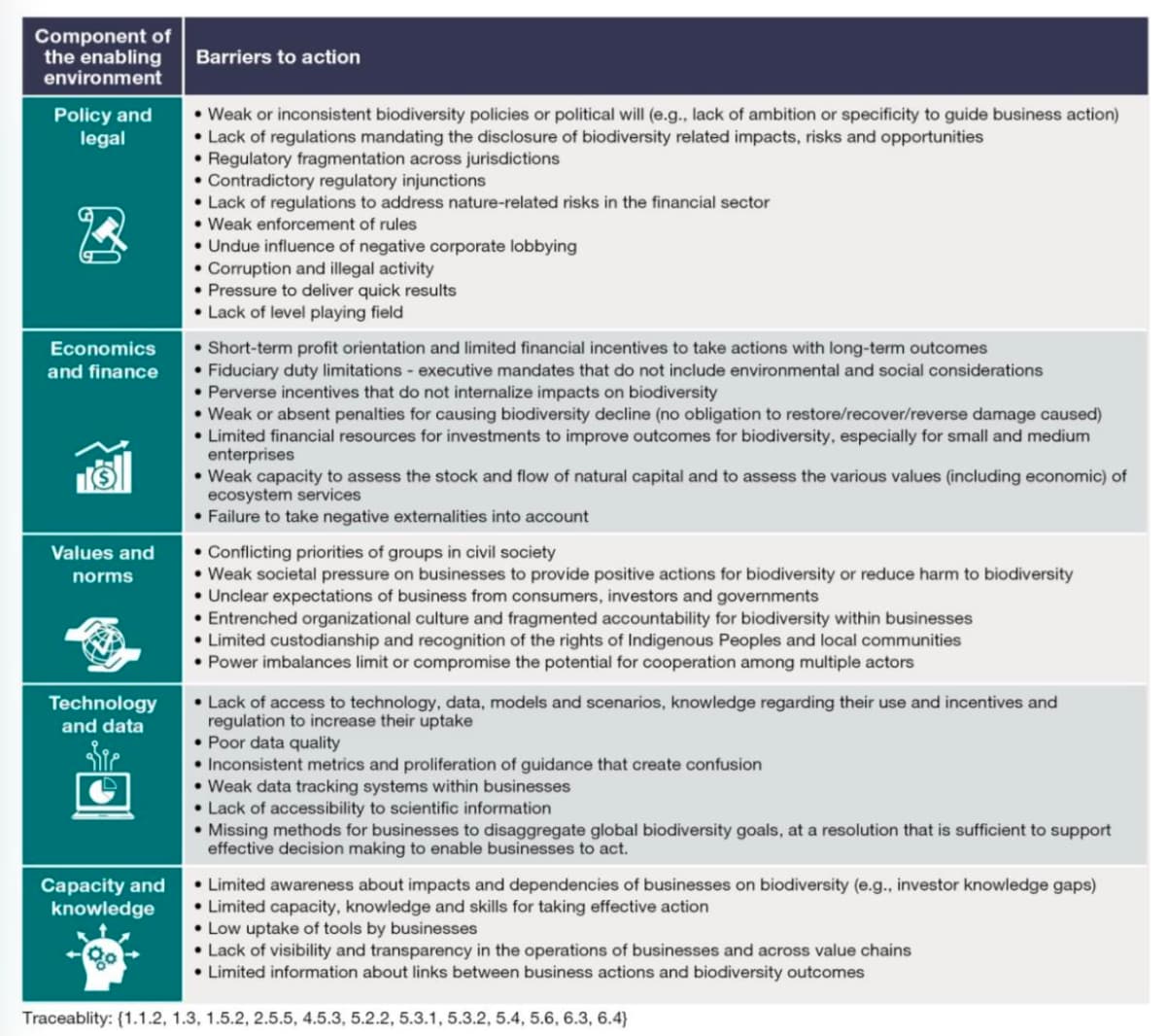 Barriers preventing businesses from taking action on biodiversity loss. Credit: SPM.4, IPBES (2026)
"These barriers do not affect all actors equally and may disproportionately affect small and medium-sized businesses and financial institutions in developing countries," adds the report.
3. Businesses can act now to address their impacts on natureThe SPM says it is well established that the "transformative change" required to halt and reverse biodiversity loss requires action from "all businesses".
However, the report continues that it is also well established that the current level of business action is "insufficient" to deliver this "transformative change". This is, in part, because the "enabling environment is missing", it says.
IPBES says all businesses have a responsibility to act, even if this responsibility is not shared "evenly".
"Priority actions" that businesses should take differ depending on the size of the firm, the sector in which it operates in, as well as the company structure and its "relationship with biodiversity", the report notes.
The exact actions businesses should pursue also depends on companies' "degree of control and influence over stakeholders", it says.
According to the report, firms can act across four "decision-making levels" - corporate, operations, value chain and portfolio - to measure and address impacts on biodiversity.
("Corporate" refers to decisions focused on overarching strategy, governance and direction of the business; "operations" to day-to-day activities; "value chain" to the system and resources required to move a product or service from supplier to customer; and "portfolio" to investments and business assets).
The SPM sets out a series of examples for how businesses can act across all four levels. These are summarised in the table below.
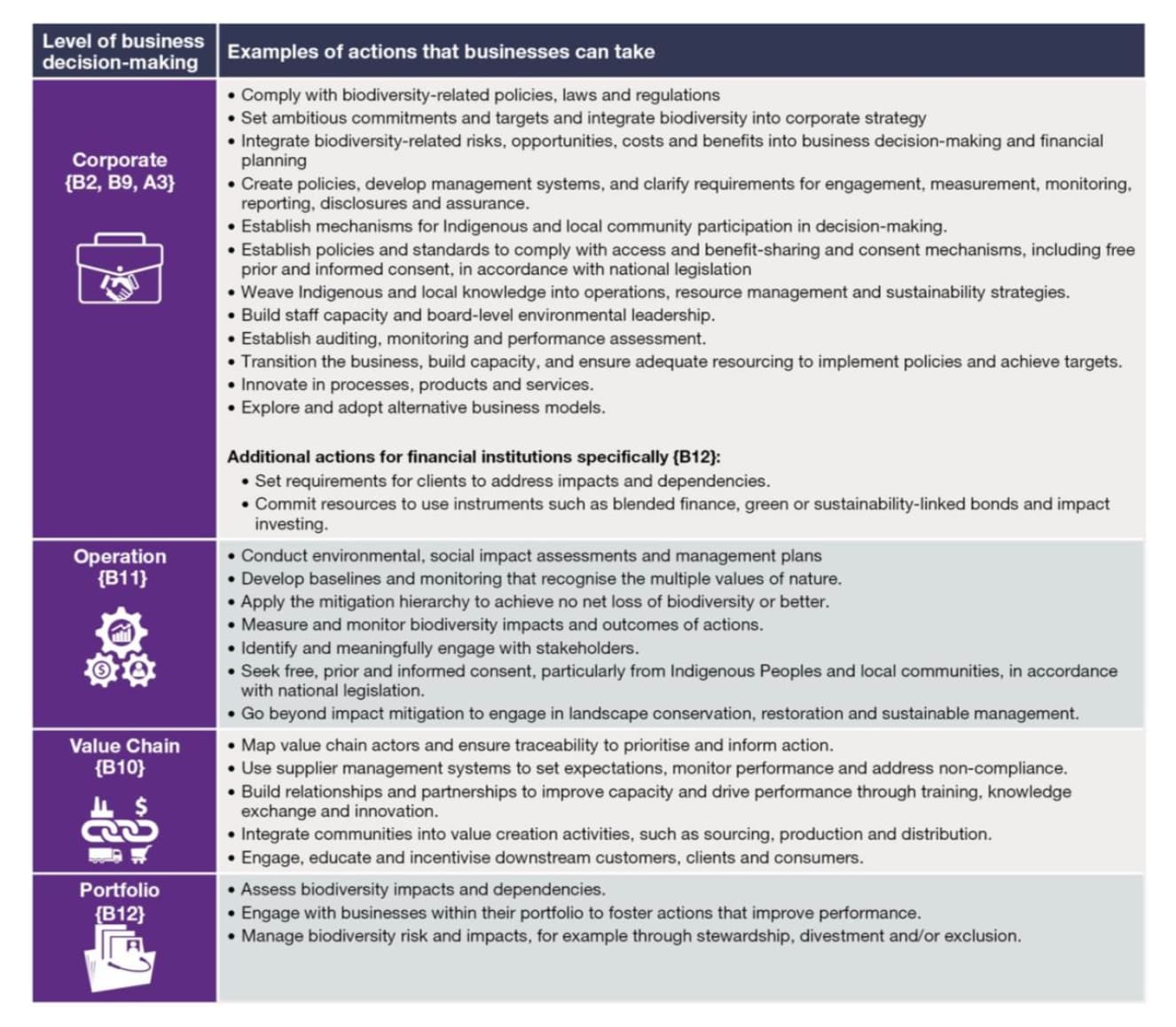 Actions that businesses can take now to address their impacts and dependencies. Credit: SPM.2, IPBES (2026).
At a corporate level, the report notes that firms can establish ambitious governance and frameworks that can then have a ripple effect across the other levels, according to the report. This includes the integration of biodiversity commitments and targets into corporate strategy.
The SPM says that corporate biodiversity targets are "most effective" when they are aligned with "national and global biodiversity objectives" and "take into consideration a business's impacts and dependencies on biodiversity and nature's contributions to people".
At an operations level, businesses should focus on ensuring that their operations are located and managed in a way that benefits biodiversity, IPBES says. Environmental and social impact assessments and management plans that are supported by "credible monitoring of both actions and biodiversity outcomes" can underpin this effort, the SPM notes.
It says it is well established that using the "mitigation hierarchy" framework can help businesses deliver "lasting outcomes on the ground". (The framework guides users towards limiting as far as possible the negative impacts on biodiversity from development projects by first avoiding, then minimising, restoring and offsetting impacts.)
Next, the report notes there are actions businesses can take to drive change within its broader spheres of influence, including suppliers, retailers, consumers and peers within industry. This is important, the SPM notes, as significant impacts and dependencies on biodiversity and nature "accrue" across the lifecycle of products or services, especially those that rely on raw materials.
The report notes there is established but incomplete evidence that efforts to "map" company value chains and improve traceability by linking products and materials to suppliers, locations and impacts can help "identify risks and prioritise actions".
While noting that "mapping" beyond direct suppliers "often remains challenging" for businesses, the report adds:
"Examples at the corporate and value chain levels exist, such as companies in the chocolate industry that have made advances in recording biodiversity dependencies to improve business decisions through full traceability of materials and improved supplier control mechanisms."
Elsewhere, the SPM notes that there is also established but incomplete evidence that consumer-focused measures - such as product labelling, education and incentives - can "shape behaviour and improve transparency". However, it cautions that the effectiveness of these strategies is "constrained by consumer scepticism, certification costs and business models reliant on unsustainable consumption".
The SPM also highlights that, at a "portfolio" level, financial institutions can shift finance away from harmful activities - for instance, companies whose products drive deforestation - and towards business activities with positive impacts for biodiversity and nature.
Speaking to Carbon Brief, Matt Jones, co-chair of the report, explains the rationale behind including options for how businesses can address biodiversity impacts in the document:
"Businesses and governments in different countries are coming at this from a very different perspective. So we can't present a set of really prescriptive 'how tos'…but we can present a huge number of options for action that businesses, governments, financial institutions and civil society and other actors can all take."
Elsewhere, the report says it is well established that "robust, transparent and credible reporting of actions and outcomes" is required to "inspire others".
4. Government policies can drive a 'just and sustainable future' for nature and peopleBoth governments and financial institutions can set policies and create incentives to protect biodiversity and stem its decline, says the SPM.
According to the report, the types of policies that governments can put in place that have an influence over business include:
- Fiscal policies, such as subsidies and taxes.
- Land use or marine spatial planning and zoning, such as designating new national parks or areas protected for nature.
- Permitting for business activities that affect nature - for example, by requiring environmental impact assessments.
- Public procurement policy (rules for how governments purchase goods and services).
- Controls on advertising and the creation of standards to prevent "greenwashing".
Governments can also promote action through paying for ecosystem services, creating environmental markets and through "multilateral benefit-sharing mechanisms", which set out rules for ensuring profits from nature are shared equally, says the SPM.
It says this includes the Cali Fund, a fund that businesses can voluntarily pay into after reaping benefits from genetic resources found in biodiverse countries.
(The fund was agreed in 2024 with expectations that it could generate up to billions of dollars for conservation, but it has so far only attracted $1,000.)
Governments could also promote action by phasing out or reforming subsidies that are harmful for nature, as well as fostering positive incentives, according to the report.
Overall, governments can work with other actors to create an "enabling environment" to "incentivise actions that are beneficial for businesses, biodiversity and society for a just and sustainable future", says the SPM. It adds:
"Creation of an enabling environment that provides incentives for the conservation and sustainable use of biodiversity and nature's contributions to people could align what is profitable with what is good for biodiversity and society.
"Creating this enabling environment would result in businesses and financial institutions being positive agents of change in transforming to a just and sustainable economic system, by addressing their impacts on biodiversity loss, climate change and pollution, which are all interconnected."

Cropped 28 January 2026: Ocean biodiversity boost; Nature and national security; Mangrove defence
Cropped
|28.01.26

Adopting low-cost 'healthy' diets could cut food emissions by one-third
Food and farming
|21.01.26

Brazil's biodiversity pledge: Six key takeaways for nature and climate change
Nature policy
|16.01.26
Cropped 14 January 2026: Wildfires scorch three continents; EU trade; Food and nature in 2026
Cropped
|14.01.26
jQuery(document).ready(function() { jQuery('.block-related-articles-slider-block_b4f006103142983c7da2fc5d1291de87 .mh').matchHeight({ byRow: false }); });The post IPBES: Four key takeaways on how nature loss threatens the global economy appeared first on Carbon Brief.
Korean crypto exchange Bithumb says it recovered nearly all of the more than $40 billion worth of funds it mistakenly handed out to customers as part of a promotional campaign.…

The criminalisation of peaceful protest against the use of animals in scientific testing and research is "draconian, unnecessary and almost certainly unlawful". That's the verdict of animal protection NGO Cruelty Free International, after the House of Lords voted to pass legislation.
Peers approved an amendment to the Public Order Act 2023. This now means that peaceful protest against animal testing facilities could lead to 12 months' imprisonment and unlimited fines. The measure passed with no further debate after the defeat of Natalie Bennett's fatal motion.
Parliament's approval of these changes to protest laws wasn't surprising, as the government used a 'statutory instrument'. But the debate by MPs in the lead up to the vote demonstrated a clear concern and opposition in parliament. This mirrors the vocal opposition that's come from civil society and the public.
Bennett's motion came after MPs passed the proposals to criminalise peaceful protest outside animal testing facilities by 301 to 110. The fatal motion went down by 295 votes to 62. But prior to that vote a number of peers had raised strong concerns about the appropriateness of the changes.
They sought clarity on the scope of activities intended to be criminalised and pressed the Minister for evidence that existing laws were not adequate. There were also several constitutional concerns that the measure was an overreach and an abuse of the statutory instrument procedure.
The amendments, which reclassify "life sciences infrastructure" (including animal testing and breeding facilities) as "key national infrastructure", will now become law on Wednesday 11 February.
Animal testing protest law is an overreachCruelty Free International, along with other animal protection organisations, believes that this definition is a significant overreach. It says it's not reasonable to regard such facilities as critical infrastructure.
The current list of key national infrastructure facilities includes those which support road, rail and air transport. Also harbours and the exploration, production and transportation of oil and gas. As well as onshore electricity generation and newspaper printing.
Set against this list, adding life sciences infrastructure is clearly inconsistent. The measures, therefore, will unreasonably restrict fundamental rights to protest which are protected under UK law and the European Convention on Human Rights.
The government had given two reasons for this change: pandemic preparedness and the need to protect life sciences companies. However, there does not appear to be any basis to the notion protesters would have interfered in any way with the development of coronavirus vaccines. And it's notable that pharma companies which have threatened to relocate away from the UK have said their concerns stem from regulatory or economic pressures, not protests.
Existing police powers already address protest-related concerns. And there's no evidence that these are inadequate. In developing these proposals, the government has failed to consult with animal protection or civil liberties organisations. That's despite this being an area where polling data demonstrates strong public interest.
Cruelty Free International's head of public affairs, Dylan Underhill, said:
We believe these regulations to be illiberal, draconian, unnecessary, and almost certainly unlawful. Criminalising peaceful protest against experiments on animals undermines fundamental freedoms and public accountability, and is an unjustified attack on democratic rights.
Whilst we appreciate the efforts of peers to stop these amendments becoming law and to scrutinise the detail of the measures, we remain deeply disappointed and angry that the government has pursued these highly consequential changes through a process which does not allow for substantive parliamentary debate or public scrutiny.
These amendments contravene fundamental rights to protest that are protected under UK law and the European Convention on Human Rights, and risk setting a dangerous precedent towards an ever-growing restriction of peaceful protest.
We now encourage parliamentarians to seek clarity on the scope of the activities which are being criminalised, and to question ministers on the lack of evidence, the discriminatory nature of the proposal, and its compatibility with the rights of the British people to carry out non-violent protest in relation to a topic on which opinion surveys have repeatedly demonstrated strong public concern.
Featured image via the Canary
By The Canary

Scottish Labour leader Anas Sarwar has stuck the knife into his former backer. Sarwar has called for Starmer to step down over his closeness to paedo-pal Peter Mandelson. And, Plaid Cymru leader Rhun ap Iorwerth said:
Heat grows on StarmerOf course Keir Starmer has to go. He's lost all moral authority and self awareness to do the right thing. It's now a question of when Labour Members will push the button.
Whilst the heat is certainly growing on the beleaguered prime minister, Sarwar's remarks have been met with scorn.
Sarwar, levered into his position by Starmer - called for Starmer to quit because, he said, the people of Scotland are "crying out for a competent government" and that Downing Street leadership is becoming a "huge distraction" from Labour's positive work across the country. No clues were provided as to where the 'positive work' might be located.
Sarwar went on:
The situation in Downing Street is not good enough. There have been too many mistakes. They promised they were going to be different, but too much has happened.
Sarwar claimed he had spoken to Starmer before his statement and said it was "safe to say he and I disagreed". He was immediately and rightly called out for his own closeness to "old friend" Mandelson:

He responded that "Mandelson is not someone or something I want to be associated with". Quite. I'm sure Starmer would wish not to be associated with in the public mind either.
But he certainly is. And, now that the Plaid Cymru leader has joined the growing calls for Starmer to go, the heat is very much on.
Featured image via the Canary
By Skwawkbox

Forces from Israel have kidnapped a Lebanese official close to the border and killed a father and child in an airstrike. Atwi Atwi of Islamic Group in Lebanon was captured in the village of al-Habbariyeh.
The New Arab reported:
Al-Jamaa al-Islamiya (the Islamic Group) said Israeli forces crossed into the village of al-Habbariyeh in the Hasbaya district after midnight and seized Atwi Atwi, who heads the group's Hasbaya and Marjaayoun areas.
The group said Atwi's family were assaulted during the raid and that they:
held the Israeli military responsible for "any harm that may befall Atwi", describing the abduction as part of "a series of daily violations and barbaric attacks on Lebanese sovereignty carried out by Israel".
They called on the Lebanese government to apply pressure to release Atwi and other detainees. The Lebanese state has not commented.
The Palestine Chronicle said:
The incident comes despite the ceasefire agreement between Hezbollah and Israel that entered into force in late November 2024.
Adding:
Lebanese and international sources say Israel has committed thousands of violations since then, killing and injuring hundreds and causing widespread material destruction.
The Israel military confirmed the raid in its own terms:
In a nighttime operation, forces from the 210th Division arrested a senior terrorist operative from the Islamic Group.
The New Arab described Atwi's group as:
a Sunni Islamist political party founded in 1964 as the Lebanese branch of the Muslim Brotherhood. It holds one seat in Lebanon's parliament and was recently designated a "terrorist organisation" by the United States, along with two other Muslim Brotherhood groups in Egypt and Jordan.
Members were reportedly killed:
Israel kill father and child in airstrikeafter joining Hezbollah in cross-border clashes with Israel in October 2023 in support of Gaza.
Israel also killed three people, including a father and child, in an airstrike in Yanouh - around four hours north of al-Habbariyeh. Lebanon's LBC International reported:
Three people were killed in a Monday strike in the town of Yanouh, local sources reported.
Adding:
Among the dead were a child and his father, who was a member of the Lebanese Internal Security Forces and happened to be passing nearby at the time of the attack.
But this was just the latest attack.
Chemical warfareIsrael was recently spraying the so-called Blue Line with potentially cancerous chemicals. The Blue Line is a 120km strip which marks the line of Israel withdrawal from south Lebanon in 2000. The UN and Lebanese army tested the chemicals. They found high concentrations of glyphosate, which can cause cancer.
Euro-Med Human Rights Monitor said the "deeply alarming" attack may constitute a war crime:
The deliberate targeting of civilian farmland violates international humanitarian law, particularly the prohibition on attacking or destroying objects indispensable to civilian survival.
They added:
Large-scale destruction of private property without specific military necessity amounts to a war crime and undermines food security and basic livelihoods in the affected areas.
Israel is routinely aggressive towards Lebanon. And between kidnap operations, dropping cancer chemicals and killing a child in an airstrike, it is certainly business as usually for the global pariah ethnostate.
Featured image via the Canary
By Joe Glenton

After sending a number of freedom of information (FOI) requests to the Department for Work and Pensions (DWP), the Canary has uncovered a shocking range of figures. Across the course of a year, privatised water suppliers across England and Wales robbed welfare claimants of £22.4m in Universal Credit (UC) payment deductions. This comes as the industry itself paid out more than £48.6m to its fat cat water bosses.
Specifically, the staggering sum suppliers deducted from vital social security payments would cover nearly half the executive and key management pay of the 13 largest companies for the 2024/25 financial year.
The damning figures come at a time when soaring water bills are forcing more than a third of households to ration water, and leaving two-fifths cutting back on other essentials.
DWP Universal Credit deductions: water companies raking it inAnalysis by the Canary of the chief executive pay of 13 major suppliers showed that for the 24/25 financial year, water bosses raked in more than £13m in salaries, pensions, bonuses, and other benefits. The data takes into account the bonus bans that industry regulator Ofwat announced in November 2025.
In total, including CEO pay, the 13 companies handed out over £48.6m to key management staff. This typically means a company's directors (including non-executive) and other senior personnel operating at the top of its payscale.
It was during a similar 12 month period that water companies deducted tens of millions from Universal Credit claimants.
Through an FOI request to the DWP, the Canary was able to obtain data for the period spanning the bulk of the financial year from April 2024 to the end of March 2025. The data showed that during this timeframe, water and sewerage suppliers in England and Wales had taken £22.4m from claimants' UC payments.
This was across the course of more than 1.1 million deductions.
In total, the Canary secured 18 months worth of water company deductions data from the DWP. This data spans two of the most up-to-date quarterly statistical releases for UC deductions. This showed that between March 2024 and August 2025, the UK's water and sewerage industry siphoned £32.4m in customers' Universal Credit.
Water companies robbing welfare from its poorest customersBased on the data provided, we were unable to ascertain how many households water companies robbed of UC. However, the data does reveal what they deducted from claimants each month on average. Overall, water suppliers took around £20 a month from people's Universal Credit payments.
For a single claimant over the age of 25, this was equivalent to approximately 5% of their standard allowance. The amount was below the average for third party deductions, and well below DWP advance payments and government deductions. Nevertheless, it would still be a major hit to claimants surviving on already inadequate payments.
Amid the soaring cost of living, as paltry as UC is, it's still a lifeline for many of the poorest households. Yet water companies are depriving some of the most vulnerable claimants of the vital social security they're entitled to.
Driving people into destitution: a feature, not a flawNaturally, it's all completely on brand for the UK water racket. Regional water monopolies preside over the UK public's access to one of the most basic essentials for life. And they are holding customers to ransom with ever-spiralling and unaffordable bills.
In 2024, private water companies pumped 4.7m hours of sewage into UK waterways. Across 2024 and 2025, they left more than a hundred thousand people without potable water due to infrastructure faults. In one instance, a water firm made residents sick from parasite-infested drinking water.
However, a handful of wealthy water company bosses still raked in millions in lavish payouts.
Now, we know that as they did all that, they were also levying punitive welfare deductions. In the process, they pocketed millions of pounds from some of the poorest, most vulnerable people.
Ultimately, big water companies driving people into destitution is a fundamental feature of their sweeping project of wealth extraction.
Galling double standardsAnd of course, there's another galling irony to all this where Thames Water is concerned in particular. The company has nearly 1,000 times the debt that the industry leached from low income households through UC deductions.
When a water company is swimming in debt due to years of profit-driven mismanagement, the government does nothing. By contrast, when poor customers struggling with extortionate bills are in debt to their water firm, the state actively facilitates the private utility giants parasitising their welfare payments.
Nationalising water holds some of the solutions. It will obviously go some way to fixing this rotten-by-design capitalist apparatus and make water an accessible, affordable, guaranteed right for all. However, alongside it, we also need to do away with the DWP's aggressive debt recovery programme. And more broadly, we need to dismantle the brutal DWP itself. Any welfare system that facilitates wealth-hoarders of private companies in order to plunge struggling households into deeper poverty to line fat cat pockets, is one utterly broken beyond repair.
£22.4m in DWP welfare payments is a drop in the ocean for big water firms. But for the hundreds of thousands among the UK's poorest losing out on it - it'll be a very different story.
Featured image via the Canary

Your Party's leadership elections have opened on the afternoon of 9 February. The vote closes at 5pm on 23 February.
Your Party - a tale of two 'slates'In the 'endorsements' phase, during which Your Party members could endorse candidates they wished to see on the ballot, Jeremy Corbyn's 'The Many' was leading in 12 seats, while Zarah Sultana's 'Grassroots Left' led in another 10, alongside two Independent candidates.
The Canary previously spoke to a number of the candidates.
There are 24 seats up for grabs on Your Party's Central Executive Committee. This will serve as the Party's collective leadership following a narrow vote at the start-up party's founding conference. Candidates from 'The Many' slate have announced they will elect Corbyn as the party's parliamentary leader if they win. Sultana has also expressed interest in taking this role [in an interview with Laura Kuenssberg - transcript here].
In the 'Public Office Holder' section, Corbyn topped the poll with 6,740 endorsements, and Sultana placed second with 5,124. Fellow MPs Shockat Adam and Ayoub Khan are standing with Corbyn as part of 'The Many'.
The 'Grassroots Left' slate has focused on the need for "maximum member democracy", as well as opposition to NATO and the monarchy. 'The Many' has emphasised the need for Your Party to face outwards and "campaign on the big issues" such as the cost-of-living and public ownership.
Over 350 candidatesCandidates in the English regions and Scotland and Wales had to gather 75 endorsements from fellow members in their area to pass to the ballot. Those in the public office holders' section such as MPs required 150.
In line with the Party's constitution, there are two seats for each of the nine English regions, alongside one each for Scotland and Wales (in addition to their own national structures). Members in the relevant region or nation may vote for candidates in that region / nation.
There are also four places for public office holders (Councillors, MPs etc), open to voting by all members. There are a total of 24 seats up for election.
11,414 members took part. Over 350 members put themselves forward as candidates. More than 80 progressed to the next stage, the majority of which are Independents.
The endorsements won't, however, be a straightforward guide to voting patterns. Members were able to cast endorsements in a different process to votes in the election.
Hustings for most membership positions took place on the weekend of the 7-8 February. You can see them on the party's YouTube channel. Details of the public office holder hustings, including the Party's four MPs, will appear here.
The elections come after a founding conference for Scotland Your Party, in which members voted to support Independence and stand candidates in the 2026 Holyrood elections.
A Your Party spokesperson said:
Labour have failed the country. To get Britain back on its feet and prevent the threat of a far-right government requires more than just a new face - it requires a new politics. That's what Your Party's leadership elections are all about.
Members from all walks of life have put themselves forward, a testament to the depth and diversity of our mass movement. From today, our members will vote on who leads Your Party into its next phase.
Featured image via the Canary
By The Canary

Police have raided the launch event of an anti-Zionist group and arrested two people. The force said it was "working to understand the plans of organisers". Police raids are to foster understanding now, apparently.
A woman was stopped - in her car - on the way to the event, on suspicion of "inciting racial hatred." Separately, police said they are investigating a social media post, but have not made clear whether the woman was alleged to have written the post, or if merely being en route to the event is considered incitement. The force claims she was the subject of an earlier arrest warrant for speeches and protests, but did not provide details.
West Midlands Police said its officers had also arrested a 42-year-old man outside the venue, but its description of events raises questions about UK police again dancing to the tune of pro-Israel counter-demonstrators. The police said the man:
was arrested on suspicion of a public order offence after a member of the public who had come to observe the event told us he had been threatened.
The Israel lobby has a long history of falsely claiming to have been in danger from peaceful protesters - and of pointing UK police officers to the people it wants arrested and events it wants stopped.
It looks very likely that this raid was a continuation of Starmer's ceaseless war on peaceful anti-genocide and anti-apartheid protest.
Featured image via the Canary
By Skwawkbox

An industrial 'on-site shredding' lorry has been photographed at Downing Street just three days after Keir Starmer warned that his officials needed to review "potentially hundreds of thousands" of pages of documents relating to Starmer's decision to appoint the disgraced Peter Mandelson as UK ambassador and senior Downing Street adviser despite knowing Mandelson had stayed close to serial child-rapist Jeffrey Epstein.
Starmer has promised full transparency, but is already hiding behind Epstein's victims to withhold sensitive information. The presence of the shredder van may be commonplace at Downing Street, but its arrival today - spotted by Sky News hack Sam Coates - will have many wondering.
Featured image via X
By Skwawkbox

Former French education minister Jack Lang has quit a "plum" job running France's Arab World Institute over his links with serial child-rapist Jeffrey Epstein. His appearances in the latest tranche of Epstein files have triggered a money-laundering investigation by French police. Prosecutors said on Friday that the investigation is a "preliminary" probe into "aggravated tax fraud laundering". It encompasses Lang's daughter Caroline as well as Lang himself.
Lang's name reportedly appears hundreds of times in the new files, though not in connection with sexual crimes. Caroline Lang appears as a beneficiary of a €5m bequest in Epstein's will. Both have denied any wrongdoing. Lang said that he wanted to avoid damage to the institute and would "calmly refute" the allegations before a planned extraordinary board meeting.
In December 2025, Lang joked that he would be in his role at the institute forever: "When I'm somewhere, I'm there for eternity". His resignation came after pressure from the board. He becomes the third senior figure linked to government to resign in less than a week. Keir Starmer senior adviser Peter Mandelson and Starmer's chief of staff Morgan McSweeney quit in the UK to try to protect Starmer.
Featured image via the Canary
By Skwawkbox

The Israel lobby, its political allies and its media actors have been pushing a farcical narrative that last week's acquittal of six anti-genocide activists from the Filton 24 was unsafe. The supposed 'reason' for this unsafe verdict was 'jury-tampering'. The supposed jury-tampering? Placards near the court that reminded jurors of their legal right to ignore the trial's biased judge and acquit.
Filton acquittal to be challenged?It's nonsense, and recent legal precedent shows it's nonsense. But nonetheless, the Crown Prosecution Service has announced that it will seek a retrial of the six who dared to defeat its first attempt to criminalise and imprison them for trying to stop Israel's Gaza genocide.
It's nonsense because this is not the first time the UK government has tried it - and it was laughed out of court. The dying Sunak government tried to prosecute pensioner Trudi Warner for holding up a placard outside the trial of climate activists. The placard read:
Jurors, you have an absolute right to acquit a defendant according to your conscience.
The government's barrister Aidan Eardley KC told the judge that the prosecution needed to go ahead "to maintain public confidence" in the independence of the jury system. He added that if Warner wasn't punished for holding up the sign, actions to remind juries of their rights were "likely to propagate".
The judge threw the prosecution case out of court, saying it was ridiculous to prosecute someone for reminding someone else of their legal rights. He also pointed out that the same reminder is on a placard on a wall inside the Old Bailey courthouse (emphasis added):
Overall, in my judgment, the claim is based on a mischaracterisation of what Ms Warner did that morning and a failure to recognise that what her placard said outside the court reflects essentially what is regularly read on the Old Bailey plaque by jurors, and what our highest courts recognise as part of our constitutional landscape.
Holding up a sign reminding juries of their right to acquit is not just legal. It is a right that "our highest courts recognise as part of our constitutional landscape".
If it's legal, it can't be jury-tampering - because jury-tampering is a crime. Case closed, except for the tame corporate media like Murdoch's Times.
Show trialsBut the reason that the Israel lobby in and out of Parliament and the CPS is trying to have it ruled as jury-tampering is that jury-tampering is one of the grounds that allows people to be prosecuted for an alleged offence despite being found not guilty. And the lobby - from Number 10 down - is desperate to get a conviction, both to cement Palestine Action as 'terrorists' and to deter future resistance to genocide. Canary CEO Steve Topple did an explainer video on how the double-jeopardy exception works:
View this post on Instagram
Based on legal precedent, the government/lobby (same difference) case is bollocks. But will the judge deciding whether to grant a re-trial care?
Featured image via the Canary
By Skwawkbox

Ghislaine Maxwell appeared virtually from a Texas prison today for her closed-door deposition with the House Oversight Committee. She declined to answer questions, invoking her Fifth Amendment right against self-incrimination, reports Politico.
Then came the ask. Maxwell's attorney reiterated that she would testify fully — if President Trump grants her clemency. — Read the rest
The post Maxwell pleads the Fifth at Epstein deposition, then her lawyer asks Trump for clemency appeared first on Boing Boing.
This was published on Eurekalert about an hour ago. It is a brief summary of a new study concerning arctic tourism.
The main author of the study argues that this activity is not "raising awareness" and is actually making the problem much worse. Collapse related because the number of people who took luxury arctic cruises in 2025 more than tripled from the year 2024. This year it could easily be over a million people - next year perhaps millions.
These cruises generate a shitload of waste (literally) as well as black carbon - soot that settles on ice, darkening it, accelerating melting.
The noise from these ships is very damaging to ocean ecosystems. The noise pollution interferes with migration, feeding, breeding and communication.
The article ends with a stark reminder that 60% of global ice cover will likely be gone by the end of the century.
That's 74 years from now. 74 years ago was 1952 - the year the world's first passenger jet service began. Time flies, ice melts and the world keeps on turning...
submitted by /u/Fast_Performer_3722[link] [comments]
It's a day with a name ending in Y, so you know what that means: Another OpenClaw cybersecurity disaster.…
Thousands of motorcycle riders again made their annual pilgrimage to Southland for the 19th annual Burt Munro Challenge festival this year and all were rewarded with special memories to cherish.
Perhaps the most special moments of all, however, belonged to Bay of Plenty racer Mitch Rees as he took his Honda CBR1000RR-R to a perfect run of wins in two separate elements of the week-long extravaganza.
The 33-year-old businessman from Whakatane, the multi-time and current champion in both the New Zealand Superbike Championships and the popular Suzuki International Series as well, proved to be almost unstoppable at the opening event of the multi-discipline four-day festival on Thursday, despite extra challenges being put in front of him.
Rees headed off Wakefield rider Angus Phyn in the series of sprint races to the top of Bluff Hill, recapturing the trophy he had also collected when he won the same race at the Bluff Hill event the last time he raced there in 2018.
His father, Tony Rees (on an identical Honda CBR1000RR-R) is currently recovering from an injury sustained while racing at Manfeild in December - he won the Bluff Hill race last season (and also in 2023, and 2024) - and he acted as his son's mechanic during this year's Burt Munro Challenge.
Meanwhile, the reigning national superbike champion was on a mission at the Teretonga Park, the venue hosting the second round of four in the 2026 New Zealand Superbike Championships (NZSBK), with this separate two-day event being included within the Burt Munro Challenge programme.
However, while the elite 1000cc Formula One and superbike class riders were being raced on the track simultaneously, the two classes were scored separately.
Even so, Mitch Rees qualified fastest rider over both categories at the weekend and, despite a massive delay between when the NZSBK riders were set off at the race start and the Burt Munro F1 riders were released, Rees made short work of powering through the entire gaggle of bikes, impressively winning the first combined race of the weekend.
Rees was further nobbled in the last race on Sunday, the delay increased further between when the NZSBK riders were started and the F1 Burt Munro categories were launched, and he was unfortunately unable to bridge the gap in the short eight-lap race.
Mitch Rees was unbeaten in his four F1 race category outings over Saturday and Sunday, with Richmond rider Heath Botica (Ducati V4S 1100) finishing F1 class runner-up.
"I was forced to start behind the superbike riders and then battle through traffic in all the races, but I had a lot of fun," said Rees afterwards.
"I set a new track record at the same time.
"I'm going international for the next wee while and that's why I'm not defending my superbike crown in the nationals this season," he explained.
"I have the Isle of Man races coming up in May and June, but, before that, I will race a couple of rounds of the British Superbike Championships in early May and also the North-west 200 in Northern Ireland that same month."
Meanwhile, as regards the off-road brigade, the popular beach race phase of the Burt Munro Challenge again attracted hundreds of riders to Oreti Beach from all over New Zealand and from overseas too.
Southlander Johnny Racz (Honda CRF450, from Otautau) was simply too quick for his rivals, winning the main 50-lap feature race, finishing two laps ahead of runner-up rider Matthew Davies (Husqvarna FC450), of Australia.
With these major event wins ticked off, the Honda brigade certainly had reason to celebrate the Burt Munro Challenge 2026.
The post Burt Munro Challenge: Honda Rider Rees Dominates the Field appeared first on Roadracing World Magazine | Motorcycle Riding, Racing & Tech News.
The 2026 season is officially underway for Bodie Paige and Jake Paige, as the brothers opened their Idemitsu Moto4 Asia Cup campaign with the first official test at Sepang International Circuit in Malaysia.
This season, the Paige brothers are racing both the Idemitsu Moto4 Asia Cup and the full MotoAmerica series.
Sepang Test Results - Day One (Combined Sessions)
Monday's combined morning and afternoon sessions delivered clear progress for both riders:
-
Bodie Paige - 9th overall
Fastest lap: 2:18.871
 Bodie Paige (12) at Sepang. Photo courtesy Moto4 Asia Talent Cup.
- Jake Paige - 20th overall
Fastest lap: 2:20.773
In a 22-rider international field, Bodie finished inside the top 10, less than two seconds from the fastest time, while Jake continued to build pace on a challenging circuit.
Highlights from Day One can be viewed HERE
The Idemitsu Moto4 Asia Cup is a key step on the Road to MotoGP, running alongside select MotoGP events across Asia and the Pacific region. The official 2026 series schedule can be found below.

The post Moto4 Asia Cup: Bodie & Jake Paige Open 2026 with Sepang Test appeared first on Roadracing World Magazine | Motorcycle Riding, Racing & Tech News.
When a customer chooses to reinvest after more than a year of successful operation, it sends a powerful signal. For european cleantech champion Syncraft, that signal now comes from long-time partner PurEnergy, which has decided to order a second climate-positive Syncraft power plant following the strong performance of their first ... [continued]
The post Syncraft Builds 2nd Climate-Positive Power Plant For PurEnergy In Austria appeared first on CleanTechnica.
VinFast is formally entering Indonesia's electric scooter market through partnerships with seven national level dealers. This is not a soft market test. It is a scale play aimed directly at a market long dominated by internal combustion engines. With its Subang manufacturing complex in West Java now operational, VinFast is ... [continued]
The post VinFast Accelerates Indonesia Green Transition With E-Scooter Launch appeared first on CleanTechnica.
The Philippine government has formally turned over operations of the Caliraya-Botocan-Kalayaan (CBK) Hydroelectric Power Plant complex in Laguna to the Aboitiz-led Thunder Consortium, completing one of the country's most consequential power sector privatizations at a time when grid flexibility is becoming just as important as sheer generation capacity. The Thunder ... [continued]
The post Philippines Hands Over Strategic Hydropower Complex to Private Consortium appeared first on CleanTechnica.
Ibiza-based Moroccan artist Affani teams up with Bart Ricardo and French producer John Fritz for 'Don't Know', set for release on his LClub Music label. The collaboration marks a return to Affani's imprint for both Ricardo and Fritz, bringing together producers with established histories across record labels including 1980 Recordings, Farris Wheel Recordings, and Robsoul […]
YouTube is launching YouTube TV Plans this week, after revealing the program back in December. These are genre-specific subscription packages that let users opt into a curated version of the service and save a few bucks in the process. Yeah. It's pretty much cable, proving you can't cut a cord if it's made out of invisible radio waves.
There more than ten plans available and they are all cheaper than the typical asking price of $83 per month. There's a Sports Plan that costs $65 per month and includes channels like FS1, NBC Sports Network and all of the ESPN networks. Subscribers will pay $72 per month to add some news channels like CNN and CSPAN to the sports package.
The Entertainment Plan costs $55 per month and includes networks like Bravo, Comedy Central, FX and the Food Network, among many others. There's a beefier version of this that costs $70 per month and adds in family channels like the Cartoon Network and Nickelodeon, along with news channels.
Signing up for one of these plans still provides various perks of a standard YouTube TV subscription. These include unlimited DVR, multiview and the ability to add up to six members on one account. Of course, those with deep pockets can spring for some premium add-ons like HBO Max, 4K Plus and the NFL Sunday Ticket.
Some plans are rolling out later in the week, but YouTube says it could take "several weeks" for every plan to become available. New customers receive a discount for the first three months, which is worth looking into.
This article originally appeared on Engadget at https://www.engadget.com/entertainment/tv-movies/youtube-tv-launches-curated-subscription-packages-this-week-170710000.html?src=rssMost microSD cards are fast enough for boosting storage space and making simple file transfers, but some provide a little more value than others. If you've got a device that still accepts microSD cards — whether it's an older gaming handheld, the new Nintendo Switch 2, a dash cam, a drone or an Android tablet — we've scoured the market and put close to 20 top contenders through a number of benchmark tests. You can find our recommendations for the best microSD cards below, alongside some general shopping advice worth knowing before you buy.
Best microSD cards of 2026
Best microSD Express cards for the Nintendo Switch 2
Read our full guide to the best microSD Express cards for the Nintendo Switch 2
Let's be clear about this: Unless you plan to own a Nintendo Switch 2 in the near future, you do not need a high-speed microSD Express card just yet. Nintendo's gaming handheld is the only popular device that natively supports this standard right now, and microSD Express cards themselves are highly expensive compared to more traditional options.
Still, if you do want to increase a Switch 2's storage, they're your only choice. Fortunately, determining exactly which model to buy for the console is pretty straightforward: Get whichever one you can find in stock, in the capacity you want, at a price you can stomach.
We benchmarked several microSD Express cards for a separate Switch 2 guide, and for the most part, the performance differences between them weren't great enough to justify paying extra for any particular model. Loading times weren't quite identical with every test we ran, but the cards were extremely close in most games and common scenarios. The few times when there was a notable gap — fast-traveling to a particularly resource-heavy region in Cyberpunk 2077, for instance — the gulf between the slowest and fastest card was only ever about four or five seconds at most. That's not nothing, but it's also not something most people are likely to fret over unless they have a stopwatch handy.
The only time you'd notice a major speed difference is if you transfer games to your Express card from the Switch 2's internal storage (and vice versa). In that case, the SanDisk microSD Express Card and Lexar Play Pro were generally the quickest, while PNY's microSD Express Flash Memory Card had particularly slow write speeds.
Moving Mario Kart World to the SanDisk and Lexar models, for example, took around four minutes and 35 seconds on average; with the PNY card, it took a little over seven minutes. That said, the PNY model was the fastest when it came to moving games back to the system storage. Walmart's Onn microSD Express Card was significantly slower to move games from the card to system storage, but it's also the most affordable card we've seen by a good distance. Either way, most people aren't constantly shuffling their games back and forth like this. Performance in actual games is more important, and in that regard the results were consistently much tighter.
What matters most is getting the most space for your budget. Unfortunately, stock for all microSD Express cards has been spotty since the Switch 2's launch. For your convenience, we'll list out all of the models we've tested thus far and their respective list prices below. Note that some lower-capacity versions — the 128GB SanDisk card, for one — advertise slower speeds than their more spacious counterparts.
SanDisk microSD Express Card: 128GB ($64), 256GB ($78), 512GB ($128)
PNY microSD Express Flash Memory Card: 128GB ($48), 256GB ($62), 512GB ($124)
Samsung microSD Express Card for Nintendo Switch 2: 256GB ($60)
GameStop Express microSD Card for Nintendo Switch 2: 256GB ($60), 512GB ($100), 1TB ($190)
Walmart Onn microSDXC Express Card: 256GB ($47), 512GB ($85)
Broadly speaking, we recommend getting at least 256GB of storage, as Switch 2 games tend to have much larger file sizes than games for Nintendo's previous handheld. But we also recommend holding off upgrading for as long as you can, if only because all of these cards should (tariff shenanigans aside) come down in price as time goes on.
There's no point in buying a microSD Express card for anything besides the Switch 2, but we did run the models above through our usual PC benchmarks as well. Unsurprisingly, they are miles faster than any traditional card on the market.
With the 256GB SanDisk card, for instance, sequential read speeds checked in just under 900 MB/s in CrystalDiskMark and ATTO, while sequential writes topped out around 650 MB/s. Sustained writes speeds were slower (around 210 MB/s), but that was still fast enough to move our 12GB test file to the card in 52 seconds on average. It took a mere 20 seconds to read the file back to our PC. The write test with our smaller 1.15GB test folder, meanwhile, averaged just 4.5 seconds.
It all adds up to performance that's at least twice as fast as the best UHS-I models we've tested in terms of sequential reads and writes, with three or four times the speeds in some cases. The gulf in random reads and writes is similar, and in some benchmarks even greater. But you need a pricey SD card reader to even see those increases on a PC, so only those with a Switch 2 in hand or serious cash to burn should consider one of these things.
Other notable microSD cardsThe Samsung Pro Ultimate was the closest competitor to the Lexar Professional Silver Plus across our benchmark tests, but it's tangibly worse in terms of sequential write speeds, typically costs more and doesn't offer a 1TB option. The Samsung Pro Plus is a bit slower for sequential reads, but it's close enough otherwise and usually easier to find at a lower price.
Lexar Professional GoldWe haven't used it ourselves, but if you're willing to pay for a more powerful UHS-II card built for heavy-duty video recording, the Lexar Professional Gold has tested well elsewhere and should deliver significantly faster sequential write speeds than our UHS-I picks above. It's one of the few UHS-II cards we could actually find in stock, but it's pricey, with a 128GB model normally priced in the $35 to $40 range.
The SanDisk Extreme effectively matched the Pro Plus in a few of our sequential tests, but that was partly due to us only being able to secure the 256GB model, which is higher-rated than the 128GB version. It's a fine choice if you see it on sale at a reputable seller, but it's broadly slower than our top pick and often costs more.
SanDisk GamePlayThe SanDisk GamePlay performs similarly to the SanDisk Extreme but costs a good bit extra as of our latest update. We couldn't get it to reach its advertised speeds with the company's own "Pro" card reader or other third-party options, so it fell short of our top picks.
SanDisk PokémonThe SanDisk Pokémon does outperform its advertised read and write speeds, but not by enough to outpace the Lexar Silver Plus or Samsung Pro Plus. It essentially charges extra for having a picture of Pikachu (or Gengar, or Snorlax) on a product you'll never look at.
The SanDisk Extreme Pro is a close analog to the Samsung Pro Ultimate but, as of this writing, is either unavailable at most trusted retailers or priced too high by comparison. The Lexar Professional Silver Plus has faster sequential write speeds as well.
PNY XLR8 GamingThe PNY XLR8 is an affordable card that comes with up to 512GB of space. Its sequential and random writes speeds checked in a little bit above those of Samsung's Evo Select, plus it comes with a lifetime warranty. But its sequential reads were much, much slower, putting it out of contention.
PNY Elite-XThe PNY Elite-X often goes for cheap and wasn't too far off the random read/write performance of Samsung's Pro Plus in CrystalDiskMark. Like the XLR8, it's also slightly above the Evo Select in write speeds. But its sequential reads were too far behind all of our top picks, and it no longer appears to be available in capacities above 256GB.
What to look for in a microSD card CapacityThe first thing to figure out when buying a microSD card is how much storage space you need. Modern cards are commonly available in sizes ranging from 32GB to 512GB, with several models now available in 1TB or 1.5TB capacities as well. The first 2TB cards from
An Anthropic researcher's efforts to get its newly released Opus 4.6 model to build a C compiler left him "excited," "concerned," and "uneasy."…
If you're running an online business, it helps to own a memorable domain. That's why a wealthy tech exec just paid $70 million to buy the hottest word you can own: AI.com.…
Salesforce has decided to stop developing new features for its Heroku platform-as-a-service.…
Carl Eschenbach has stepped down as Workday CEO and been replaced by co-founder and executive Aneel Bhusri following a round of job cuts and share price volatility.…


