

Australian police have been filmed viciously beating an anti-genocide protester after the protester was already immobilised, pinned to the floor and helpless:
View this post on Instagram
The attack came shortly after the Australian government passed new legislation, driven by the Israel lobby, classifying criticism of Israel as hate speech. It mirrors the legislation and egregious violence perpetrated by state forces against peaceful pro-Palestine protesters in Germany.
Australian authorities and institutions have discriminated heavily against Palestinians and pro-Palestinian speech since the December 2025 Bondi beach attack - which had nothing to do with Palestinians or Palestine.
Featured image via the Canary
By Skwawkbox

The Department for Work and Pensions (DWP) propaganda machine is working at top speed again. This time by making cuts to benefits sound like it's for disabled people's own good. The DWP released a shiny new press release bragging about how they plan to reform welfare to "support people into work".
DWP cutting UC health element by over £200This is, of course, the Universal Credit Bill, which comes into effect in April. The final amendments for which were laid out in parliament yesterday (Monday 9 February). I know what you're thinking, since when were amendments newsworthy? Well, since the DWP realised they needed to generate as much good press around these abhorrent cuts as possible.
What the press release does finally confirm is just how much the DWP will be fucking over new disabled Universal Credit (UC) claimants. And it's by over £200 a month. The department proudly gushed that they will be introducing a lower rate of the health element for new claimants. This means that instead of £429.80 a month, new claimants will get just £217.26. That's a loss of £212.54 a month and £2550.48 a year.
Don't worry, though, standard allowance is going up too and it's higher than inflation for the first time ever! Aren't the government good to us?! For under 25 year olds it'll go up by a whole £21.60 a month or £259.20 a year. For over 25s it'll be going up by a whopping £24.76 a month or £297.12 a year. So you'll only need to make up an extra £2291.28 or £2253.36 a year.
Painting cuts as a good thing and benefit claimants as fakersEven more cruelly, the DWP is selling this cut as a good thing that will help disabled people.
The press release said:
The system inherited from the previous Government means people receiving Universal Credit for health reasons are paid more than twice as much as a single person looking for work and aren't given the support to move closer to - or into - jobs.
A reminder that disabled claimants get double what a non disabled claimant does is because the DWP have already judged them unfit for work. They know that these people can't find a job without it being detrimental to their health.
The DWP continued:
The reforms - coming into force in April - will tackle these perverse incentives by introducing a lower Universal Credit health element
Because nothing incentivises you like the prospect of starvation and homelessness, does it?
The deserving and undeserving disabledThe government also didn't pass up an opportunity to paint a clear divide between the fakers and the real disabled people. They assured the public that people with the "most severe, lifelong conditions" would still receive the higher rate. Though when they get to decide who fits that criteria, it's obvious that many will suffer. This rate also applies to those with a terminal illness and current claimants.
By not including current claimants, the government clearly hopes disabled people will keep quiet and play nice. This shows just how selfish and vile they are if they expect the community to turn its back on newly disabled people to save our own skins. That sounds much more like politician behaviour.
DWP chief Pat McFadden said:
The benefits system we inherited was rigged with the wrong incentives and wrote people off instead of backing them. We are changing this.
It's absolutely vile that the government are still pushing this narrative that disabled people choose not to work because it pays better. When it's clear to see that many find work inaccessible in a system that cares more about profits than people.
He continued:
These reforms put more money in the pockets of working people on Universal Credit, while ensuring those who can work get the support they need to do so.
This is such a fucking lie, it's insulting. McFadden knows full well that the health element means people are too sick or disabled to work. So to say the DWP wants to support those who can work is implying they're faking it.
Overwhelming evidence that the DWP isn't fit for purposeTo try and make it look like they care, the DWP refers once again to all their bullshit plans to push disabled people back into work. This is despite the overwhelming evidence that the department is a complete farce.
Recently, the DWP was crowing about the rollout of WorkWell, which sells work as a cure for disability. This is despite there being no proof of it actually working at all, never mind well. There's also the fact the Public Accounts Committee absolutely ripped the DWP a new one over their ability to support people into work.
The PAC also drew attention to the fact that the DWP doesn't publish data on work coach numbers. So while the DWP brags that 100,000 advisors will be redeployed in Pathways to Work, we don't actually know how many there are. And if they're planning on putting them in GP offices and moving them onto the skills brief we really need to know how many there are to go around.
The DWP doesn't give a fuck about disabled peopleWhat is clear, despite the DWP saying otherwise, is that they couldn't give a fuck about disabled people.
If they actually wanted to support those of us who could work, there'd be proper detailed plans. Not just passing disabled people around work coaches. They also wouldn't be quietly cutting Access to Work whilst spaffing on about wanting to help us. If they actually cared about people who were out of work because of disability they'd be ensuring we could live our lives without fear.
More than anything, if the DWP actually cared about disabled benefits claimants, they wouldn't be doing everything in their power to demonise us in the press. But then if all of this was true they wouldn't need to use the press to further their agenda by bragging about fucking amendments.
Featured image via the Canary

The Canary has received reports of an alleged backroom deal between Jeremy Corbyn, The Many, and Redbridge Independents. In January 2025, Corbyn announced his endorsement of the Redbridge Independents, declaring:
we are the alternative, we are the community.
However, this excited endorsement has been challenged by anonymous insiders. And, this revelation comes just as The Many accused Grassroots Left of undermining member decisions at the fledgling party's inaugural conference.
But, the Canary have received a report from a source that was present in a meeting between Corbyn, Redbridge Independents, and candidate on The Many slate on Tuesday 26 January — one day before Corbyn declared his public support for Redbridge Independents. The source alleges that Corbyn traded his public endorsement for a commitment from Redbridge Independents to deliver votes for The Many.
If accurate, this would represent a clear attempt to exert political influence behind closed doors.
Corbyn pushes The ManyAs Your Party gears up for its Central Executive Committee (CEC) elections that will determine leadership of the party, internal rifts are evident. Whilst Corbyn endorsed The Many, Zarah Sultana has endorsed the Grassroots Left slate.
An anonymous source told the Canary that Noor Begum and Tahir Mirza, two candidates on The Many slate, were present at the alleged meeting with Corbyn and Redbridge Independents. If Corbyn has indeed traded public endorsement for assurances of support for The Many, there must be serious questions over the erosion of democratic principles during the course of these elections.
Furthermore, according to our source, Begum confessed she had been told by Laura Alvarez, Corbyn's wife, that it was imperative that both candidates be elected in the London region. If not, Corbyn and his allies would not have ultimate control of the CEC. As a result, they would not control the party itself.
These are hardly the actions of people committed to member-led democracy. Instead, they are the actions of a group of people clinging to shady Westminster-style backroom politics where what matters is who you know.
Accusations against Grassroots LeftAs we mentioned earlier, these revelations come as The Many accuse Grassroots Left of undermining the principle of one member, one vote:
NEW: Some on the Grassroots Left want to overturn conference & abolish one-member-one-vote in Your Party.
The Many will defend OMOV.
Power with the members, not the sects. pic.twitter.com/uQvBb7mq3m
— The Many (@TheManyYP) February 8, 2026
For months, Corbyn and his allies have briefed against Zarah Sultana and those in her team. Namely, the allegation is that Sultana is attempting to take control of the party. As these allegations swirl, it is clear that Your Party is far from guaranteeing member-led democracy.
A party divided: democracy undermined from withinIn February 2026, members of Your Party will vote nationwide to elect candidates to its Central Executive Committee (CEC), the body responsible for carrying forward the membership's will through democratic debate and decision-making. Since the party's inception, both sides have accused each other of attempting to seize ultimate control. Furthermore, Zarah Sultana claimed she was pushed out of the process. She denounced it as a "sexist boys club" dominated by unelected bureaucrats.
Reports suggest these struggles for control have been present from the very beginning. Corbyn's team reportedly opposed Sultana's involvement and resisted the proposed co-leader model. However, the announcement of that model inspired hundreds of thousands of people across the country to take notice.
Jeremy Corbyn's Zarah Sultana's YourParty has reached 800,000 and heads toward a million signs up's and has 6 MP's (Independence Alliance MP's are party of it) and counting.
You can join the Biggest Party in UK here.https://t.co/wqcecuaaK2
— JmRoyle #LFC #YNWA #BLM #RejoinEU (@MyArrse) August 12, 2025
Members should have put this divide to rest in November, when Your Party's inaugural conference overwhelmingly backed dual membership and collective leadership. Yet the back and forth accusations suggest that the democratic mandate from members is not being treated as such.
We have already reported how candidates aligned with Jeremy Corbyn have allegedly had to commit to overturning conference decisions regarding leadership model and dual membership. We even exposed the controversial reality that Corbyn's aide, Karie Murphy, chose to block a sortition member once becoming aware of their socialist credentials. Nevertheless, the group appear willing to sink to ever greater depths of shadiness.
NEW: Our Proposals to Empower Members & Get Your Party Back On Track

Over 1,500 UK students, academics, researchers and university staff have signed an open letter demanding UK universities cut ties to the arms trade. The letter claims the links are fuelling "global instability, injustice, and environmental harm".
Demilitarise Education (dED), puts the value of arms-linked partnerships at approximately £2.5bn. This figure represents the combined value of partnerships held by universities in arms companies, including investments, research and academic partnerships, over the past eight years.
This data is held on the Universities and Arms Database, which dED developed and hosts.
Demilitarise Education's arms trade campaigndED is running a national campaign highlighting the deep and ongoing ties between UK universities and the arms trade.
The campaign has already garnered widespread support. 1,595 academics, researchers, university staff, and students have signed an open letter. It calls for an end to institutional partnerships with arms manufacturers and military-linked organisations.
Through rigorous research, advocacy and collective action, the organisation calls for transparency, ethical funding and an education system with policies committed to peace, social justice and the public good.
Dr Iain Overton, executive director at Action on Armed Violence, said:
Participants not bystandersUK universities cannot credibly claim to be solely serving the public good while taking billions from the arms trade. These are not neutral partnerships. Defence money shapes research priorities, it legitimises militarisation, and it binds centres of learning into often hidden and distant systems of violence that produce very real civilian harm.
But what this open letter shows is that such institutional consent is not uncontested. Staff and students are no longer willing to accept such complicity as the price of funding. They refuse to allow those who have profited from well-recorded civilian deaths in places like Gaza and Yemen to end up funding our Universities.
The £2,556,647,429 figure exposes higher education institutions as active participants in military supply chains, rather than neutral bystanders. Signatories argue that these relationships implicate universities directly in systems that sustain war, militarisation and global violence. And often there's no transparency, democratic oversight or meaningful consent from university communities.
This intervention comes amid intensifying global conflicts from the devastating genocide in Gaza and Russia's invasion of Ukraine, to the ongoing civil war in Sudan and rising geopolitical tensions elsewhere.
These conflicts have caused widespread civilian suffering, resulting in numerous crises across the stated locations, with millions displaced, health systems collapsing and education infrastructure destroyed.
dED argues that university arms trade partnerships form part of the same global architecture that enables and sustains such violence.
BAE SystemsOne of the most involved arms companies in UK universities is BAE Systems. At the University of Manchester, BAE is partnering on research to accelerate combat air systems, including research projects aimed at improving fighter jets.
BAE Systems' weapons and technology have been linked to serious violations of international law. In 2019, the company was accused of "aiding and abetting" war crimes in Yemen.
Components manufactured by BAE for F-35 fighter jets have seen use in Israeli bombing campaigns in Gaza, resulting in thousands of deaths, including hundreds of children.
By supplying regimes engaged in indiscriminate violence, BAE has contributed directly to war crimes, mass civilian casualties, and extensive environmental destruction. Despite reporting on production emissions and business travel, BAE does not account for the catastrophic environmental damage caused by its weapons, including toxic pollution, infrastructure collapse, and long-term ecological harm.
The dED Universities and Arms Database tracks UK university links to arms companies listed in the SIPRI and Defense News top 100. So far, 90 UK universities have been identified as having direct ties. The database allows users to explore how individual universities contribute to arms company activities.
The open letter marks a clear break with institutional consent, as staff and students publicly challenge the normalisation of defence-funded research, arms-linked partnerships and military recruitment pipelines within higher education.
Arms trade 'incompatible' with uni aimsCampaigners argue that universities' stated commitments to the public good, social responsibility and global justice are fundamentally incompatible with their material involvement in the arms trade. As militarism expands internationally, staff and students increasingly identify universities as a key node within the military-industrial complex.
The letter contends that research collaborations, weapons-linked funding streams and defence-aligned innovation programmes play a material role in enabling arms production and export, including into active conflict zones. They also embed militaristic logics within institutions historically understood as spaces of independent thought and public good.
Aleks Palanac from the University of Leicester says:
Stop the recruitment driveUK universities cannot legitimately claim to be places of sanctuary for refugee students whilst continuing to actively contribute to the causes of their forced migration in the first place through their involvement in the global arms trade.
The campaign also responds to mounting pressure on universities to function as recruitment and talent pipelines for the defence sector. The UK government's 2025 Strategic Defence Review outlines plans to align higher education with military and defence industries more closely. This includes the creation of a Defence Universities Alliance and targeted investment in STEM disciplines to support military technologies and defence roles.
dED criticises the government's proposed "whole of society" approach to defence. This includes increased exposure to military careers among school-aged children and initiatives such as paid armed forces "gap years" for under-25s. The organisation says this risks normalising military service as a default life trajectory for young people. And particularly so in the context of widening inequality and shrinking civilian opportunities.
Jinsella Kennaway, the co-founder and executive director of dED, says:
Over 1,500 members of the UK knowledge community have put their names to this open letter. This is no fringe view - it is a clear mandate from within our universities. This is a stand against the use of education to fund, legitimise and supply the war machine.
Universities must honour their duty to serve the public good by choosing partnerships that build the conditions for peace, not profit from conflict. No ethical integrity can be claimed while arms industry partnerships amplify the lethality of war and stakeholder calls for change are met with silence.
The letter calls on universities to realign their policies and practices with the dED Treaty framework. It demands full transparency over defence-linked funding, research and partnerships, alongside formal commitments to exclude arms companies from university collaborations.
It further calls for an end to recruitment ties with the armed forces and arms manufacturers. And it looks for a renewed commitment to research and teaching that prioritises peace-building over warfare.
Campaigners argue that universities must remain spaces of critical inquiry and humanistic values, not extensions of the military-industrial complex.
Featured image via the Canary
By The Canary
Abbeydale, Sheffield: I'm genuinely scared when I wake at 2am to the sound of screaming. Then I see two male badgers in an almighty scrap
Fast asleep, my dreamworld takes an unexpected swerve as raucous screaming erupts outside the open bedroom window. For a moment, I assume this is imagined, some emotional outburst from my subconscious. Then I realise that I'm awake. This is real. I check the time: 2am. The screaming continues. In fact, it's now louder and somehow more intense. The back of the house is woodland, and noises off are common enough. A fox barking. Robin song that eases those anxious, wakeful stretches of the night. But this is something else altogether. This is violence.
My heart is racing now. I fear someone is being attacked, and from the pitch of the screaming, a woman. Mercifully, I soon discount this. My startled mind then suggests a catfight, but the sound I'm hearing is too big for that. So, despite the freezing cold beyond the duvet, I hop out of bed, pull back a curtain and stick my head outside.
Continue reading...
The 2026 MOTUL FIM Superbike World Championship will once again take place over 12 rounds and 36 races. The season will start in Phillip Island with the Australian Round on February 21st and while there are many changes for the coming campaign one thing remains constant, WorldSBK is Pure Motorsport.
Armed with the fastest production derived motorcycles in the world the 22 rider field will deliver excitement at every round. History has proven that in this championship that the rider has been the biggest factor in making the difference between success and failure. For the six manufacturers on the grid they'll be hoping that their line-up proves pivotal in getting the most from their machinery and delivering success throughout the campaign.
 Miguel Oliveira (88) during the Jerez test. Photo courtesy Dorna.
The ROKiT BMW Motorrad WorldSBK Team enters the season as the reigning Riders' Championship holder but with a new line-up. Miguel Oliveira joins the series following a successful Grand Prix career that included race victories in all three classes, while three-time WorldSBK race winner Danilo Petrucci switches manufacturers after three seasons aboard Ducati machinery.
 Alvaro Bautista (19) during the Jerez test. Photo courtesy Dorna.
Ducati will once again be led by 2025 title runner-up Nicolo Bulega. The 26-year-old returns to the Aruba.It Racing - Ducati squad for his third Superbike season and will aim to become the first rider to win both Supersport and Superbike world titles. After finishing second in last year's championship despite 14 race wins, Bulega enters 2026 as the title favourite. Nicolo Bulega will line up alongside a new teammate in 2026, with Iker Lecuona replacing Alvaro Bautista in the Ducati factory squad. After four seasons with Honda HRC, Lecuona has shown encouraging form during pre-season testing aboard the updated Panigale V4 R. Ducati will also boast a formidable Independent line-up, headed by Bautista following the double World Champion's move to Barni Spark Racing Team. Sam Lowes will look to continue his upward momentum with the Elf Marc VDS Racing Team after securing a pole position last season.

Yamaha heads into the new season with a revamped rider line-up, adding Xavi Vierge and reigning WorldSSP Champion Stefano Manzi. Manzi steps up to WorldSBK following his title-winning campaign, while Vierge arrives from Honda. After securing a race win last season through Andrea Locatelli, Yamaha will look to the Italian to lead its challenge, supported by former Moto2 World Champion Remy Gardner as he enters his fourth year in the championship.
 Garrett Gerloff (31) during the Jerez test. Photo courtesy Dorna.
Bimota and Kawasaki will retain unchanged line-ups for 2026. Alex Lowes delivered a strong return season for bimota, finishing sixth in the standings and claiming four podiums. The Italian marque will aim to build on that progress, with Axel Bassani targeting further gains. Kawasaki will again be represented by Garrett Gerloff as the sole rider for the brand.
 Jake Dixon (96) during the Jerez test. Photo courtesy Dorna.
Honda has bolstered its WorldSBK effort with the signing of two Moto2 race winners. Jake Dixon returns to Superbike competition after seven years in Grand Prix racing to contest his first full WorldSBK season, having previously appeared as a wildcard at Donington Park in 2017. He will be joined by Somkiat Chantra on the Honda CBR1000RR-R SP. Chantra is set to make history as the first full-time Thai rider in WorldSBK, though a pre-season injury will rule him out of the opening round.
WorldSBK boasts a rich heritage and celebrated its landmark 1,000th race last season. With only one Superbike World Champion on the grid for 2026, the stage is set for a new name to be written into the history books.
WorldSBK is back for more in 2026, with the season getting underway at the Australian Round at Phillip Island on 20-22 February.
2026_WorldSBK_AUS_Event_Schedule_10Jan2026
With WorldSSP entering the fifth year of its "Next Generation" regulations, the series continues to grow in stature. This season, eight manufacturers will take to the grid, with ZXMOTO joining in 2026. The Chinese manufacturer has partnered with the World Championship-winning Evan Bros Racing team and will field two bikes for Valentin Debise and Federico Caricasulo. The regulations allow a wide range of machinery to be competitive, with the grid featuring two-, three-, and four-cylinder machines. Last year, four manufacturers claimed victories, and with double WorldSSP champion Dominique Aegerter returning to the class, Kawasaki will be confident of winning races for the first time since 2023.
Last year's champion, Manzi, has been promoted to the Superbike class, but the majority of last year's front-runners will be back for 2026. Can Oncu replaces Manzi at the Pata Yamaha Ten Kate Racing squad, and having proven himself with six victories last year, the Turkish rider will be the early-season favourite. Jaume Masia (Orelac Racing Verdnatura) and Tom Booth-Amos (PTR Triumph Factory Racing) return to the class this year and will be confident of adding to their race-winning pedigree, while former champions like Lucas Mahias (GMT94 Yamaha) and Aegerter will look to return to the front of the field.

WorldSBK will feature a new class in 2026, with the FIM Sportbike World Championship making its debut at the Portuguese Round. With six manufacturers competing, the new class has already proven very popular, with Aprilia and Suzuki returning to the paddock.
The Portuguese Round will also be the first round of the WorldWCR season, with Maria Herrera returning as the defending champion.
The post WorldSBK Set for a Wide-Open 2026 Season appeared first on Roadracing World Magazine | Motorcycle Riding, Racing & Tech News.
Nearly 17,000 Volvo employees had their personal data exposed after cybercriminals breached Conduent, an outsourcing giant that handles workforce benefits and back-office services.…
London-based energy software company Tem has closed a $75 million Series B round led by Lightspeed Venture Partners, with additional funding from AlbionVC, Atomico, Hitachi Ventures, Schroders Capital, Voyager Ventures, Allianz, and others. The round reportedly values the company at more than $300 million and will fund its expansion into the United States and Australia. Tem builds an AI-native energy platform designed to automate the pricing, matching, and execution of electricity transactions, a market that has long relied on manual processes and legacy infrastructure. Its core system uses machine learning to forecast supply and demand, match buyers with suppliers, and…
This story continues at The Next Web

Earned media has always been hailed as the holy grail of PR due to its unparalleled ability to build trust. Most recent surveys state that 40%-60% of the population still trusts organic content the most, depending on the country. However, I see significant business risks in relying on organic PR only, especially now that various AI systems are on the rise. Robots don't distinguish between earned and paid content when using it to generate answers. And that's a wake-up call for us all to revise our PR strategies. The potential dangers of earned-only PR strategies The primary advantage of earned media,…
This story continues at The Next Web
London will lose its dominance in colocation datacenters this decade with Frankfurt claiming the top spot by 2031, according to the EU Data Centre Association (EUDCA).…
VR headsets are impressive gadgets on their own, but the right accessories can significantly improve comfort, usability and immersion. From controller grips that offer better handling to upgraded head straps that balance weight and extend battery life, these add-ons can make long sessions more enjoyable and less fatiguing. Some accessories focus on convenience, like charging docks and storage stands, while others enhance how virtual experiences feel through haptic feedback or more secure fits.
As VR continues to expand beyond gaming into fitness, productivity and mixed reality experiences, accessories are starting to serve a wider range of functions. Whether you're looking to fine-tune comfort, improve tracking or add realism to your virtual world, these are the VR accessories worth considering in 2026.
Best VR accessories: Headsets
Best VR accessories: Fitness
Best VR accessories: Cables, chargers and batteries
VR accessories FAQs What equipment do you need for VR?
What you need depends on the VR headset you buy. Some devices, like the Meta Quest 3, are entirely standalone, which means you don't need anything but the headset itself to use it. Other VR headsets need to be connected to a system from which it can draw power and run software. Some systems, like the HP Reverb G2, must connect to a PC, while others like the PS VR2 can connect to gaming consoles like the PS5. Most VR headsets come with the basic controllers you'll need to control actions and movement in virtual worlds.
What's the difference between PC VR, Smartphone VR and Gaming Console VR?The main difference between those three VR systems is the main machine that allows the VR headset to run. PC VR headsets require a PC, like a gaming laptop or desktop, to run, while smartphone and gaming console VR systems require smartphones and gaming consoles, respectively, to work.
Do all VR headsets need a phone?No, not all VR headsets need a phone to work. Many VR headsets have build in displays that sit in front of your eyes and basically act as your window into the virtual world.
This article originally appeared on Engadget at https://www.engadget.com/ar-vr/best-vr-accessories-150021126.html?src=rss
British soldiers are to get an array of AI-ready kit that should mean they don't have to wait to see the "whites of their eyes" before pulling the trigger.…
Xavi Vierge makes the move from Honda while Stefano Manzi joins as the WorldSSP Champion alongside Andrea Locatelli and Remy Gardner
I'm a longtime lover of pen and paper, so E Ink tablets have been intriguing to me ever since they started becoming more widely available. After having hundreds of half-filled notebooks over the years, I, at some point, turned to digital tools instead because it was just easier to store everything on my phone or laptop so I always had my most important information at my fingertips.
E-Ink tablets seem to provide the best of both worlds: the tactile satisfaction of regular notebooks with many of the conveniences found in digital tools, plus easy-on-the-eyes E-Ink screens. These devices have come a long way in recent years — now you can find them in multiple sizes, some have color E Ink screens and others double as full-blow ereaders with access to ebook stores and your local library's offerings. I've tested out close to a dozen E Ink tablets over the past few years to see how well they work, how convenient they really are and which are the best tablets using E Ink screens available today.
Are E Ink tablets worth it?
An E Ink tablet will be a worthwhile purchase to a very select group of people. If you prefer the look and feel of an e paper display to LCD panels found on traditional tablets, it makes a lot of sense. They're also good options for those who want a more paper-like writing experience (although you can get that kind of functionality on a regular tablet with the right screen protector) or a more distraction-free device overall.
The final note is key here. Many E Ink tablets don't run on the same operating systems as regular tablets, so you're automatically going to be limited in what you can do. And even with those that do allow you to download traditional apps like Chrome, Instagram and Facebook, E Ink tablets are not designed to give you the best casual-browsing experience. This is mostly due to the nature of E Ink displays, which have noticeable refreshes, a lack of vibrant colors and lower picture quality than the panels you'll find on even the cheapest iPad.
Arguably the biggest reason why you wouldn't want to go with an iPad (all models of which support stylus input, a plethora of reading apps, etc) is because it's much easier to get distracted by email, social media and other Internet-related temptations.
What to look for in an E Ink tablet Writing and latencyArguably the most important thing to consider when looking for an E Ink tablet is the writing experience. How good it is will depend a lot on the display's refresh rate (does it refresh after every time you put pen to "paper," or at a different regular interval) and the stylus' latency. Most of the tablets I've tested have little to no latency, but some are certainly better than others. Finally, you should double check before buying that your preferred E Ink tablet comes with a stylus, or if you need to purchase one separately.
ReadingHow much will you be reading books, documents and other things on this tablet? E Ink tablets come in many sizes, but most of them tend to be larger than your standard e-reader because it makes writing much easier. Having a larger display isn't a bad thing, but it might make holding it for long periods slightly more uncomfortable. (Most e-readers are roughly the size of a paperback book, giving you a similar feeling to analog reading).
The supported file types for e-books can also make a big difference. It's hard to make a blanket statement here because this varies so much among E Ink tablets. The TL;DR is that you'll have a much better reading experience if you go with one made by a company that already has a history in e-book sales (i.e. Amazon or Kobo). All of the titles you bought via the Kindle or Kobo store should automatically be available to you on your Kindle or Kobo E Ink tablet.
Also with Kindle titles, specifically, since they are protected by DRM, it's not necessarily the best idea to try to bring those titles over to a third-party device. Unless the tablet runs an operating system like Android that supports downloads for apps like Kindle and Kobo, you'll be limited to supported file types, like ePUB, PDF, MOBI, JPEG, PNG and others.
Search functionalityMost E Ink tablets have some on-device search features, but they can vary widely between models. You'll want to consider how important it is to you to be able to search through all your handwritten notes and markups. I noticed in my testing that Amazon's and Kobo's E Ink tablets made it easy to refer back to notes made in books and files because they automatically save to the specific pages on which you took notes, made highlights and more.
Searching is less standardized on E Ink tablets that have different supported file types, but their features can be quite powerful in their own right. For example, a few devices I tested supported text search in handwritten notes along with handwriting recognition, the latter of which allows you to translate your scribbles into typed text.
Sharing and connectivityWhile we established that E Ink tablets can be great distraction-free devices, most manufacturers understand that your notes and doodles aren't created in a vacuum. You may want to access them elsewhere, and that requires some form of connectivity. All of the E Ink tablets I tried have Wi-Fi support, and some support cloud syncing, companion mobile apps and the ability to export notes via email so you can access them elsewhere.
None of them, however, integrate directly with a digital note taking system like Evernote or OneNote, so these devices will always be somewhat supplementary if you use apps like that, too. I'd argue that, if you already lean heavily on apps like OneNote, a standard tablet with a stylus and screen protector might be the best way to go. Ultimately, you should think about what you will want to do with the documents you'll interact with on your E Ink tablet after the tablet portion is done.
PriceE Ink tablets aren't known for being cheap. They generally fall into the $300-$800 price range, which is what you can expect to pay for a solid regular tablet, too. A key factor in price is size: cheaper devices with E Ink displays are likely to have smaller screens, and stylus support isn't as much of a given. Also, those types of devices are generally considered e-readers because of their size and may not be the best for note-taking, doodling and the like.
E Ink tablets have gone up in price recently. Supernote and Onyx Boox increased prices, as did reMarkable. The former said it was due to "increased costs," and a reMarkable representative confirmed this to Engadget and provided the following statement: "We regularly review our pricing based on market conditions and operational costs. We've communicated an upcoming adjustment for the US market effective in May to provide transparency to our customers. Multiple factors influence our pricing decisions, including supply chain dynamics and overall operational costs in specific markets."
As a result, the reMarkable Paper Pro jumped from $579 to $629 (that's for the bundle with the standard Marker and no Folio). This isn't great, considering the Paper Pro was already on the expensive side of the spectrum for E Ink tablets. It's also worth noting that Supernote and Onyx Boox have raised prices in the past few months as well.
Other E Ink tablets we've tested Onyx Boox Tab X CThe Boox Tab X C is a color-screened version of the Tab X, the company's all-purpose e-paper Android tablet. The Tab X C has a lovely 13.3-inch Kaleido 3 E Ink color display, an octa-core processor, 6GB of RAM and it runs on Android 13, making it one of the most powerful tablets in Boox's lineup. I've used the Tab X in the past and this color version runs similarly, if not better, and at 5.3mm thick, it's impressively svelte even when you pair it with its folio keyboard case. As someone who loves legal-pad sized things to write on, I also like how the Tab X C is most akin to A4-size paper. But at $820 for the bundle with the standard case (or a whopping $970 for the tablet and its keyboard case), it's really only best for those who are ready to go all-in on a premium E Ink tablet.
Lenovo Smart PaperLenovo made a solid E Ink tablet in the Smart Paper, but it's too pricey and too married to the company's companion cloud service to warrant a spot on our top picks list. The hardware is great, but the software isn't as flexible as those of competitors like the reMarkable 2. It has good Google Drive integration, but you must pair it with Lenovo's cloud service to really get the most use out of it — and in the UK, the service costs £9 per month for three months, which is quite expensive.
Onyx Boox Tab UltraThe Boox Tab Ultra has a lot of the same features we like in the Note Air 2 Plus, but it's designed to be a true, all-purpose tablet with an E Ink screen. Running Android 11 and compatible with a magnetic keyboard case, you can use it like a standard 2-in-1 laptop, albeit a low-powered one. You can browse the web, check email and even watch YouTube videos on this thing — but that doesn't mean you should. A standard 2-in-1 laptop with a more responsive screen and better overall performance would be a better fit for most people who even have the slightest desire to have an all-in-one device. Like the rest of Onyx's devices, the Tab Ultra is specifically for those who put reading and eye comfort above all else.
This article originally appeared on Engadget at https://www.engadget.com/mobile/tablets/best-e-ink-tablet-130037939.html?src=rss
Edinburgh councillors have torpedoed plans for a massive "green" AI datacenter, voting it down despite city planners recommending approval.…
(that's old Southgate by The Green, not the upstart civic centre by the tube station)

1) Village stocks!
Time was when every village had its stocks for punishing local miscreants by chucking stuff at them, indeed a statute in 1351 insisted on it. Such behaviour is now deemed unacceptable and has been since 1872 when stocks were last used in anger in Berkshire, but who's to say they'll never come back into use. Southgate's alas aren't the original because those went missing during WW2 and are instead a Coronation gift in 1953, themselves heavily restored in 2002 because the oak had rotted heavily. Other London locations with stocks include Havering-atte-Bower, Ickenham and anywhere else someone might know about.
2) A nice fingerpost!
Everyone loves a good fingerpost and Southgate Green has an excellent one. It marks the junction of the A1003 and the A1004, two distinctly minor A roads, and dates from an era when quarter miles were still a significant distance measurement. One finger points towards New Southgate which is very much not old Southgate like what this is. From my wanderings I'd say there are far more nice fingerposts in north London than south, notably in the boroughs of Enfield and Barnet, and I wonder if future generations with satnavs will one day wonder why we ever needed to know where towns are.

3) Blue Plaques!
Rarely have I been more disappointed by a blue plaque than the inscription on the cottage at 40 The Green. As I got closer I saw it read 'In 1881 this house became the first seat of local government in Southgate', and sorry but the separation of Southgate from the Edmonton Board of Health is not an exciting heritage fact. Of more interest is the plaque down the road marking the house where Benjamin Waugh lived in 1884 when he founded the NSPCC. Admittedly Waugh was honorary director under Lord Shaftesbury as Chairman, and admittedly the NSPCC was founded at Mansion House rather than here, and admittedly Waugh's house has been demolished and replaced by a bank which is now a nursery, but it's still more interesting than the blue plaque at number 40.
4) A Very Old Pub!
The Cherry Tree has had the plum spot opposite The Green for over 300 years. The former coaching inn now has Victorian brick frontage and a Mock Tudor porch but at its heart is a much earlier timber-framed building. If you ever need a dull fact about Southgate, be aware that the Loyal Adelaide Lodge of Manchester Unity of Oddfellows held their meetings here for over 100 years. Until last year it was a proper pub but then Mitchells & Butlers turned it into a generic brasserie called Brown's, not Ye Olde Cherry Tree, and local drinkers were nonplussed. A Telegraph journalist even published an article subtitled "The 17th-century inn has lost all of its character, with no chance of a decent cask ale or even an interesting bottle", and if nothing else a grey hard-to-read inn sign has since been added bearing the proper name.

5) That postwar typeface
You see a lot of that nice 1950s typeface around Southgate Green, the slanting serif much used on postwar buildings, for example on this block of flats and on this sign referencing H Miller & Sons, longstanding Plumbers and Decorators. But what precisely is it called? I went down a font-based wormhole and it turns out there are lots of very similar styles including Stymie Bold Italic, Clarendon Bold Italic, Profil, Egyptian Italic and Festival Egyptian (an official style of the Festival of Britain). But I'm not sure any of these perfectly match the As and Os I saw here in Southgate, so maybe I'll just go on calling it That Nice 1950s Typeface and at least you'll still know what I mean.
6) Dionysus!
Pre-Crossrail if you wanted fried sustenance at the end of a West End night out you stopped by Dionysus, the Greek chippie in the prime corner spot outside Tottenham Court Road station. Many's the hangover quelled by one of their special kebabs or salty bags. But in January 2009, in advance of station redevelopment, they were sadly forced to close. As I blogged at the time, "I watched as staff gutted the interior, then piled sinks and ovens into the back of a hired van and drove off to start anew elsewhere." Well, likely that elsewhere was Southgate because here they are in a smart cafe with the precisely same logo above the door. Given they were "established 1969" this may alternatively be the original Dionysus and TCR was merely a branch, but if you ever fancy a nostalgic takeaway then head straight to N14.
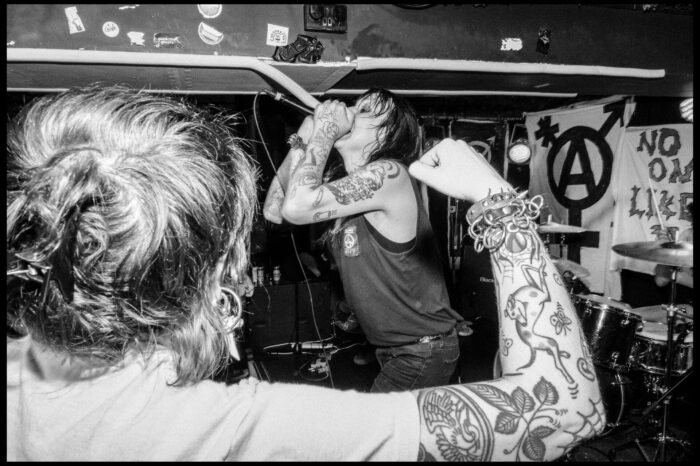
Ahead of Traidora's appearance at Supersonic festival, Stephanie Phillips speaks to experimental guitarist and Crass collaborator Eva LeBlanc about her need to see herself reflected in sound
Eva LeBlanc has always been direct. Those closest to the Chilean artist have often noticed this trait of bold naivety she jokingly tells me over Zoom from her London home. "My friends and my partner will say, 'You're not shy. You just go and ask people for stuff,' and I'm like yeah why not."
Why not indeed, as when LeBlanc decided she wanted to work with her hero Penny Rimbaud, co-founder of the legendary anarcho punk band Crass, she simply messaged him on X (formerly Twitter). "I gave my Bandcamp [and said] I would love...
The post Keep It Punk, Keep it Simple: Eva LeBlanc of Traidora Interviewed appeared first on The Quietus.
As AI training and inference clusters grow larger, they require bigger, higher-bandwidth networks to feed them. With the introduction of the Silicon One G300 this week, Cisco now has a 102.4 Tbps monster to challenge Broadcom's Tomahawk 6 and Nvidia Spectrum-X Ethernet Photonics.…
Born of student disquiet after the 2008 crash, the group says it reshaping economists' education
As the fallout from the 2008 global financial crash reverberated around the world, a group of students at Harvard University in the US walked out of their introductory economics class complaining it was teaching a "specific and limited view" that perpetuated "a problematic and inefficient system of economic inequality".
A few weeks later, on the other side of the Atlantic, economics students at Manchester University in the UK, unhappy that the rigid mathematical formulas they were being taught in the classroom bore little relation to the tumultuous economic fallout they were living through, set up a "post-crash economics society".
Continue reading...The beautiful game has a fast fashion problem, with clubs bringing out multiple kits every season. But a move towards upcycling old shirts and wearing vintage garments is on the rise
It may have been a quiet January transfer window, but even so, thousands of new shirts will be printed for Lucas Paquetá, returning to his former Brazilian club Flamengo, while his West Ham shirt instantly feels old. Not to mention the thousands of other players moving from one club to another. Uefa estimates that up to 60% of kits worn by players are destroyed at the end of the season, and at any one time there are thought to be more than 1bn football shirts in circulation, many of which are discarded by fans once players leave.
The good news is that lots of designers are bringing their upcycling skills to old kits, taking shirts and shirring them, sewing them or, as in the case of designer and creative director Hattie Crowther, completely transforming them into one-of-a-kind headpieces. "I'm not here to add more products into the mix, I'm here to reframe what's already in circulation and give it meaning, context, and longevity while staying culturally relevant," says Crowther, whose creations involving the colours and emblems of Arsenal, Liverpool and Paris Saint-Germain, are, she says, "a response to how disposable football product has become".
Continue reading...
And this time I headed to Southgate (in Enfield).
The Minchenden Oak (800? years old)
Middlesex was once awash with country seats and one of these was Minchenden House, just along the ridge from Arnos Grove. It was built in the 1660s and passed through a succession of gentry before one particular daughter married above herself becoming the Duchess of Chandos. The house had a classical pillared dome, a premier location on The Green and was said to have one window for every week of the year. The estate was sold off in 1853 to the neighbouring brewing tycoon in an attempt to stall the advance of suburban housing, a fate which befell his amalgamated 300 acres in 1928, and today the Arnos Grove estate smothers the slopes above the Pymmes Brook. Minchenden House may have been demolished but locals campaigned to save the enormous medieval oak round the back of the parish church so that's still here, and huge, and tad on the secret side.

To find the Minchenden Oak look for the brick archway down Waterfall Road, inconveniently labelled Minchenden Oak Garden on a small copper plaque. What lies beyond is a small space barely 30m wide with lawn and shrubbery, also paved paths that don't quite go anywhere and on the far side a whopping ancient oak tree. It has a gnarled bulbous trunk like some great cloven leg, and a fairly scraggly top with several thick upright branches that end with an abrupt cut. It's hard to reach a ripe old age with all your bits intact, thus the Minchenden Oak has been fighting a long battle against nature and gravity. Two limbs succumbed to a storm in 1899, others later needed propping up, then in 2013 considerable decay was discovered within the timber and fifteen tonnes of wood had to be lopped off to protect the central trunk. It's hard to square the current tree with the 1873 claim that it had the largest canopy of any tree in England (38m across and 'still growing') but still an impressive sight.

"Its boughs bending to the earth, with almost artificial regularity of form and equidistance from each other, give it the appearance of a gigantic tent; with verdant draperies, drawn up to admit the refreshing breezes that curl the myriads of leaves which form altogether a mass of vegetable beauty and grandeur, scarcely to be equalled by any other production of the same nature in the kingdom. It is a magnificent living canopy, impervious to the day."(Sylva Britannica, 1826)The Minchenden Oak Garden was officially opened on 12th May 1934 in a ceremony involving the local choir and various borough dignitaries, including two hymns and the singing of Psalm 23. The garden screams 1930s with its rustic stone pillars and low decorative walls, as if a magnificent tree wasn't sufficient in itself, and has a small sunken terrace at one end with a broken pedestal in the centre. In a lovely touch the benches around the garden are made from wood removed from the tree in 2013, these replacing a seat that once circled the great trunk because nobody's allowed that close any more. Even the surround of the main information board comes from the old oak, ditto an arty selection of sliced stumps where a small group of children might sit.

The Minchenden Oak is a warning that great old trees don't always survive, and a triumph in that much of it somehow has. But how much better to have seen it at its zenith in the 19th century, long before suburbia turned up, a tree that was already ancient when the first rich man built a house here.
This was published today on Phys. It concerns a new study also recently published in Nature Communications.
I think the last sentence shows why this is collapse related -
"The widespread slowdown may indicate that the internal engines of biodiversity are losing momentum due to the depletion of regional life"
The researchers are very worried about shrinking species pools - a polite way of saying global bioviversity is collapsing.
submitted by /u/Fast_Performer_3722[link] [comments]

Label: Apapachoa Records Release: Chambers Date: March 1st, 2026 Mastered By: Antonio Pulli at Saal 3 Artwork By: Dan Isaac Wallin aukaimusic.com | Bandcamp This morning, I'm delighted to share my time with the music of Markus Sieber, who has been enchanting my studio space with the sounds of his charango (and sometimes ronroco) as Aukai since the release of Branches of Sun in 2018.

Daniel O'Sullivan & Richard Youngs
Persian Carpets
The second collaboration between Daniel O'Sullivan and Richard Youngs is a very different beast to their last: a pair of minimal improvisations for zither and piano
Persian Carpets by Daniel O'Sullivan & Richard Youngs
Experimental music doyens Daniel O'Sullivan and Richard Youngs have teamed up once before, on 2020's Twelve of Hearts, a set of alluringly off-key songs. Persian Carpets, released by the excellent VHF, is entirely different. The prolific pair take a pair of aging instruments - an upright piano and a zither, both dating from 1915 - which they use to perform two improvised 20-minute pieces, filling either side of the LP. It is an exercise in exploring repetition and tiny, gradual variations. The resulting...
The post Daniel O'Sullivan & Richard Youngs - Persian Carpets appeared first on The Quietus.
Systems Approach Last year a couple of people forwarded to me the same article on a new method of finding shortest paths in networks.…
In Creating the Factory of the Future, Lucid's Manufacturing Vision Puts People Ahead of Machines At Rockwell Automation Fair 2025 three months ago, one of the most quietly consequential conversations about the future of manufacturing did not revolve around artificial intelligence, robotics, or automation speed. Instead, it centered on a ... [continued]
The post Lucid VP for Engineering Says: Technology is Finite, Human Creativity Infinite appeared first on CleanTechnica.
US President Donald Trump swept back into office on a mission to stop the domestic offshore wind industry in its tracks. That is actually something any idiot could accomplish with the swipe of a pen. All you need to do is yank the federal leases that offshore developers depend on, ... [continued]
The post Canada Blows A Big, Fat Offshore Wind Raspberry At Trump appeared first on CleanTechnica.
Since we cover electric vehicles continuously and are often analyzing market trends, we have focused a lot of time in recent months covering the huge EV sales hit in the United States. Of course, it's just natural — if you are going to take away a $7,500 subsidy, people are ... [continued]
The post Electric Cars Are Simply Better — Subsidies Or Not appeared first on CleanTechnica.
Way back in 2018, a series of events in Samoa brought about the country's worst measles outbreak in years. It started in July of that year when two 1-year old children who were given a measles vaccine subsequently died. While anti-vaxxers around the world gleefully jumped into action to blame the vaccine for those deaths, it turns out that the vaccine didn't kill the children at all. Instead, medical professionals had accidentally mixed the vaccine with a muscle relaxer solution instead of sterilized water like they were supposed to. Despite that fact, the anti-vaxxers sowed all kinds of fear and disinformation throughout the country, whipping up negativity around measles vaccines. As a result of that, the government put a 10 months ban in place on the vaccine.
In June of 2019, RFK Jr. visited Samoa. He met with anti-vaxxer crusaders and government officials. Despite that, he has said publicly and in testimony before Congress that his trip there had nothing to do with vaccines and was instead about a medical records and tracking system the country was interested in. You can see an example of that claim in his own confirmation hearing.
Lots of people questioned that claim. And rightly so. The people he was meeting with, the timing in conjunction with the vaccination ban, it all lined up to yet another anti-vaxxer visiting the country to push their anti-vaxxer message.
Two months later, Samoa experienced a massive measles outbreak.
An outbreak began in October 2019 and continued for four months. Before seeking proper medical treatment, some parents first took their children to 'traditional healers' who used machines purchased that claimed to produce "immune-protective" water.
As of 22 December, there were 79 deaths. This was 0.4 deaths per 1,000 people, based on a population of 200,874, an infection fatality rate of 1.43%. There were 5,520 cases, representing 2.75% of the population.61 of the first 70 deaths were aged four and under. All but seven of the deaths were from people aged under 15.
At least 20% of babies aged six to 11 months contracted measles. One in 150 babies died.
This past week, documents and emails obtained by The Guardian and The AP show that everyone on the Samoan government's side of the house understood Kennedy's visit to be explicitly about vaccines, contrary to his statements, including statements before Congress. He was sworn in for that confirmation hearing, to be clear.
Documents obtained by The Guardian and The Associated Press undermine that testimony. Emails sent by staffers at the U.S. Embassy and the United Nations provide, for the first time, an inside look at how Kennedy's trip came about and include contemporaneous accounts suggesting his concerns about vaccine safety motivated the visit.
The documents have prompted concerns from at least one U.S. senator that the lawyer and activist now leading America's health policy lied to Congress over the visit. Samoan officials later said Kennedy's trip bolstered the credibility of anti-vaccine activists ahead of the measles outbreak, which sickened thousands of people and killed 83, mostly children under age 5.
The AP post has a ton of details further down the article, but here is an example of the content.
Embassy staffers got a tip about Harding's involvement in the trip from Sheldon Yett, then the representative for Pacific island countries at UNICEF, the United Nations Children's Fund.
"We now understand that the Prime Minister has invited Robert Kennedy and his team to come to Samoa to investigate the safety of the vaccine," Yett wrote in a May 22, 2019, email to an embassy staffer based in New Zealand. "The staff member in question seems to have had a role in facilitating this."
Two days later, a top embassy staff member in Apia wrote to Scott Brown, then the Republican U.S. president's ambassador to New Zealand and Samoa, alerting him to Kennedy's trip and Harding's involvement.
"The real reason Kennedy is coming is to raise awareness about vaccinations, more specifically some of the health concerns associated with vaccinating (from his point of view)," the embassy official, Antone Greubel, wrote. "It turns out our very own Benjamin Harding played some role in a personal capacity to bring him here." Greubel wrote that he told Harding to "cease and desist from any further involvement with this travel," though the rest of the sentence is redacted.
Now, I have zero problem believing that Kennedy is lying about all of this. Lying is just what he does. And regularly. I also put the blood of all those dead children, and any long term health issues in the thousands of others, partially on Kennedy's ledger. This is all simply common sense.
But the real travesty is something quite similar is happening right here, right now. The measles outbreak in America is speeding up, not slowing down. Kennedy, as with Samoa, is taking zero responsibility for it. If he's taking any real concrete actions to combat it, I don't know what those would be, nor would I understand why they've been hidden so completely from public visibility. Kennedy once opined that maybe it would be better if everyone just got measles.
If that is his real goal, it appears we're on our way. But somebody besides a couple of press outlets should be investigating Kennedy for lying to Congress, at a minimum. And perhaps having a hand in the deaths of children, as well.


