
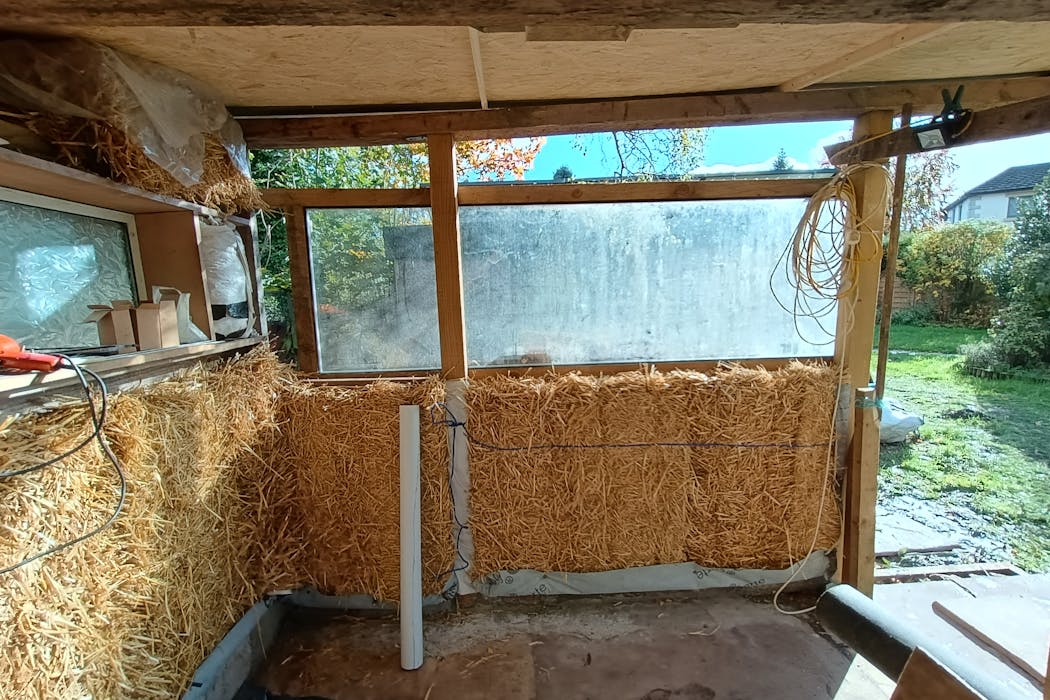
 The garden office from the inside. Lorna Jackson, CC BY-NC-ND
When we moved into our house, there was a shed in the garden. Its timbers were rotten, the floor had long since disappeared into the ground, there was no door, the window had fallen out and various creatures had moved in.
I decided to rebuild it out of a material that has been used around the world for hundreds of years, but is less commonly seen in modern buildings: straw bales. A year later, and the "work shed" is now nearly finished.
As sustainability assessment lead at Sheffield University's Grantham Centre for Sustainable Futures, I wanted to make sure my garden office had the lowest possible embodied carbon (a term used to describe the amount of carbon contained, or "embodied" in the materials used to make a product), and low energy use once it was up and running.
That meant the office would need to be very well insulated to avoid using lots of energy to heat it, and made of materials with low carbon content.
Due to its structure, straw is a fantastic insulating material. It's also cheap, easy to work with, and since the straw absorbs carbon dioxide from the atmosphere as it grows, straw buildings act as carbon stores. If we use this in a building, the carbon remains stored for the lifetime of the building, and can even be returned to the soil at the end of life.
My first real involvement with straw building was through the design of a low carbon cold room in Kenya, working with energy efficiency experts from the Energy Saving Trust and Solar Cooling Engineering, and architects from Switzerland and Kenya. A cold room is an easy-to-build and cheap alternative to a large fridge, enabling farmers in developing countries to store produce at a market, improving incomes and reducing food waste.
 Stuart Walker working on his straw bale office.
Lorna Jackson., CC BY-NC-ND
Stuart Walker working on his straw bale office.
Lorna Jackson., CC BY-NC-ND
This cold room is now operating at Homa Bay market on the shores of Lake Victoria, Kenya. It has cement-free foundations, solar panels and batteries, water storage, low energy cooling units, a timber structure and straw bale walls. The project showed me that straw bale structures can provide good insulation without the environmental impact of expanded polystyrene.
Natural materials like mud, earth and dung, as well as fibrous materials such as straw were used to build homes for centuries.
Straw bale housing historyStraw in bale form has been used for buildings since the 1800s. After the invention of mechanical baler in the US, straw bales were used to construct homes in places where timber and stone were hard to find.
Some of these early buildings still exist, but most straw bale houses in the US were built since the 1970s. These buildings offer warm comfortable homes and were the inspiration for a new wave of UK straw bale builders in the 1990s.
Read more: How we can recycle more buildings
Straw works well for single or two-storey buildings, but requires careful design to avoid water leaking into it. Provided the bale buildings are protected from rain splash at the bottom and have an overhanging roof at the top, water isn't really a problem. Fire requires oxygen and fuel, so a compressed straw bale is fire resistant, and straw bale buildings have met all fire, planning, and building regulations, and even achieved Passivhaus - extremely high standards of insulation, thermal performance and energy use.
 The straw bale 'fridge' built in Kenya.
Francis Maina, CC BY-NC-ND
The straw bale 'fridge' built in Kenya.
Francis Maina, CC BY-NC-ND
My new garden office has 40cm thick walls and double glazed windows, it's clad on the outside with reclaimed timber (some of which came from the original shed) and the roof, windows, doors and underfloor insulation are all secondhand. The final step is cladding the inside.
Here I've adopted another traditional building practice and used cob. Cob is a mixture of clay, water, sand and chopped straw. After digging the clay from our garden and mixing it, I've applied the cob by hand, via an incredibly messy but very satisfying process.
I know that the lifetime greenhouse gas emissions of my shed will be about 20 tonnes lower than they would have been if I had used expanded foam insulation and plasterboard.
People who live in straw bale houses talk about how the irregular shape and natural materials of straw bale buildings also have a positive impact on them, and say that buildings like my shed create a connection with the builder particular to the use of natural materials.
This concept, known as biophilic design, is challenging to quantify but I look forward to finding how it feels to sit inside it.

Stuart Walker is affiliated with The Grantham Centre for Sustainable Futures, University of Sheffield. He receives funding from the Grantham Foundation for the Protection of the Environment.
It takes time for novel designs to catch on. But even so, I am still wondering why the Zenbook Duo hasn't had a bigger impact on the market after ASUS released its first true dual-screen laptop two years ago. Notebooks like these provide the kind of screen space you'd typically only get from a dual monitor setup, but in a much more compact form factor that you can easily take on the road. It could be that people were wary of an unfamiliar design, shorter battery life or buying a first-gen product — all of which are understandable concerns. However, now that ASUS has given the ZenBook Duo a total redesign for 2026, the company has addressed practically all of those barriers to entry while making it an even more convincing machine for anyone who could use more display space. Which, in my experience, is pretty much everyone.
Editor's note: The 2026 ASUS Zenbook Duo is expected to be available for pre-order sometime in late February, with general availability slated for March.
Design
For the new model, ASUS didn't mess with the laptop's basic layout too much. Instead, the company polished and tightened everything up, resulting in a system that weighs about the same (3.6 pounds) while reducing its overall size (12.1 x 8.2 x 0.77 to 0.92 inches) by five percent. Critically, you still get a built-in kickstand on the bottom and a detachable keyboard that you move wherever you want. There's also a decent number of ports, including two USB-C with Thunderbolt 4, one USB-A 3.2 jack, HDMI 2.1 and a combo audio port. That said, I do wish ASUS had found room for an SD card reader of some kind, though given the Zenbook Duo's unique design, I get why that didn't make it.
 The Zenbook Duo's detachable keyboard gives users a ton of flexibility when it comes to utilizing both of the laptop's displays.
Sam Rutherford for Engadget
The Zenbook Duo's detachable keyboard gives users a ton of flexibility when it comes to utilizing both of the laptop's displays.
Sam Rutherford for Engadget
One of the Zenbook Duo's most important design upgrades is a new "hideaway" hinge that reduces the gap between the laptop's two screens. Not only does this make the laptop easier and more pleasant to use in dual-screen mode, it also allows the entire system to lay flat on a table, which is nice for drawing or sharing your screen with someone sitting opposite you. The sad part is that while the Zenbook Duo is compatible with the the forthcoming ASUS Pen 3.0, it doesn't come included (at least in the US). So if you want one, be prepared to pay extra.
Another small but appreciated improvement is the new pogo pins below the lower display, which provides a more secure and reliable way of keeping the laptop's detachable keyboard topped up. In my experience, even after running multiple rundown tests that completely drained the Duo's battery, I never had to charge up the keyboard on its own. It was always smart enough to sip electricity from the main system in the background, though it also has a built-in USB-C port for power just in case. On the flipside, if you're not scared of typing on glass, you can still use the lower screen as a keyboard and touchpad, or as a place to display widgets for news, the weather, performance and more.
Displays As someone who loves a desktop with dual monitors, I can't overstate how nice it is to have similar built-in functionality on a laptop.
Sam Rutherford for Engadget
As someone who loves a desktop with dual monitors, I can't overstate how nice it is to have similar built-in functionality on a laptop.
Sam Rutherford for Engadget
The standout feature on the Zenbook Duo continues to be its dual displays, and now for 2026, they look better than ever. Both OLED panels have a 144Hz refresh rate with a 2,880 x 1,800 resolution while also covering 100 percent of the DCI-P3 spectrum. And while its nominal brightness of 500 nits for SDR content is just OK, ASUS makes up for that with peaks of up to 1,000 nits in HDR. And to make both screens even more enjoyable, ASUS managed to shrink the size of their bezels down to just 8.28mm. That's a reduction of 70 percent compared to the previous model, so now there's even less getting in the way of you utilizing these screens to their fullest.
PerformanceThe Zenbook Duo can be configured with a range of new Intel Core Ultra 7 and Core Ultra 9 processors, including the X9 388H chip used on our review unit. For general use and productivity, the laptop is super smooth and responsive, though that shouldn't be a surprise coming from Intel's latest top-of-the-line mobile CPU. However, for those seeking max performance, some of the benchmark numbers aren't quite as impressive as you might expect. That's because ASUS has limited the Duo's TDP (thermal design power) to 45 watts — which is shy of the chip's 80-watt turbo power limit.
 The kickstand in back adds a bit a bulk, but it's better than not having one at all like with Lenovo's Yoga Book.
Sam Rutherford for Engadget
The kickstand in back adds a bit a bulk, but it's better than not having one at all like with Lenovo's Yoga Book.
Sam Rutherford for Engadget
In PCMark 10, the Zenbook Duo only managed a score of 7,153 compared to 9,651 from a Dell XPS 14, despite the latter having a lower-tier Intel Core Ultra X7 358H processor. That said, in other tests like Geekbench 6, the Duo had no trouble staying on top with a multicore score of 17,095 versus 9,651 for the Dell.
Another pleasant surprise is that because the Duo's chip comes with Intel's upgraded Arc B390 integrated GPU, this thing has plenty of oomph to game on, let alone edit videos or other similar tasks. In Elden Ring at 1,920 x 1,200, the Zenbook maintained a relatively stable framerate between 55 and 60 fps on high settings, which is great considering this thing doesn't have discrete graphics. This means as long as you don't mind fiddling with game options a bit, you should be able to play newer AAA games without too much trouble.
Battery life The left side of the Zenbook Duo features a full-size HDMI connector along with a USB-C port, plus a backup USB-C jack for charging the detachable keyboard.
Sam Rutherford for Engadget
The left side of the Zenbook Duo features a full-size HDMI connector along with a USB-C port, plus a backup USB-C jack for charging the detachable keyboard.
Sam Rutherford for Engadget
You'd think a laptop with two displays would be super power hungry. However, by increasing the capacity of its cell from 75WHrs to 99WHrs, ASUS has made the Zenbook Duo's endurance (or lack thereof) a complete non-issue. On PCMark 10's Modern Office rundown test, the laptop lasted 18 hours and 33 minutes in single-screen mode. Granted, that's nearly four hours less than what we got from MSI's Prestige 14 Flip AI+, but considering that's the longest-lasting notebook we've ever tested, I'm not bothered. When compared to ASUS' own Zenbook A14 (18:16), things are basically a wash, which I think is a win for the Duo, as the A14 is meant to be an ultralight system with an emphasis on portability and longevity.
Obviously, battery life takes a hit when you're using both displays. However, when I re-ran our battery test with its two displays turned on, the Duo still impressed with a time of 14:23. This is more than enough to give you the confidence to set this thing up in dual-screen mode even when an outlet isn't close at hand. Thankfully, for times when you do need a power adapter, the charging brick on ASUS' cable is rather compact, so it's not a chore to lug it around.
Wrap-up The Zenbook Duo's battery life is good enough you won't always need its power brick. Thankfully, when you do, ASUS' 100-watt adapter is relatively compact.
Sam Rutherford for Engadget
The Zenbook Duo's battery life is good enough you won't always need its power brick. Thankfully, when you do, ASUS' 100-watt adapter is relatively compact.
Sam Rutherford for Engadget
I'm a believer that one day people will eventually embrace typing on screens with laptops just like they have for smartphones. However, even if you're not willing to make that jump just yet, the Zenbook Duo still has all of its bases covered. Its detachable keyboard gives you a pleasant experience while freeing up the bottom of the notebook to be a second display. This allows you to have something similar to a traditional dual-monitor desktop but in a chassis that you can easily take on the road without any major compromises.
The 2026 Zenbook Duo combines a compact design with strong performance, plenty of ports and surprisingly good battery life. Sure, it's a touch heavier than a typical 14-inch laptop, but its two screens more than make up for a little added weight and thickness. That leaves price as the Duo's remaining drawback, and starting at $2,100 (or $2,300 as reviewed), it certainly isn't cheap.
However, when you consider that a similarly equipped rival like a Dell XPS 14 costs just $50 less for a single screen, that price difference is rather negligible. Alternatively, if you opt for a more affordable ultraportable and then tack on a decent third-party portable monitor, you're still likely looking at a package that costs between $1,500 and $1,800. Plus, that setup is significantly bulkier and more annoying to carry around. So while the Zenbook Duo might be an unconventional pick right now, it has all the tools to deliver unmatched portable productivity and I don't think it will be too much longer until the masses catch on.
This article originally appeared on Engadget at https://www.engadget.com/computing/laptops/asus-zenbook-duo-2026-review-two-screens-really-are-better-than-one-140000982.html?src=rss

The boss of one of the UK's biggest education unions - the University and College Union (UCU) - faces a hearing by statutory regulator the Certification Officer.
Whistleblowers have given evidence that Jo Grady used union resources, staff, and software to rig her own re-election. Grady won the March 2024 election by just 182 votes out of 114,310 members - 0.157% - on a 15.1% turnout. UCU union blocked any recount and would not allow candidates to attend the count.
UCU allegationsTwo other 2024 candidates, Vicky Blake (Leeds) and Prof Ewan McGaughey (King's College London), have asked the Certification Officer (CO) to order a re-run of the election. They say that O'Grady breached breached union rules and should be ordered to step down. The hearing takes place today, 10 February 2026.
UCU rules on the election of officers, executive members, and trustees expressly prohibited the use of union resources for campaigning. This includes staff, social media and email lists:

However, UCU whistleblowers came forward to the applicants with evidence that the rules had been broken. Certification Officer Stephen Hardy will review the evidence today.
Key complaints include that:
- Grady instructed UCU's senior management WhatsApp group that "every single decision we make/thing we do has to be seen through the… lens… [of] Re-elect GS [general secretary]".
- Grady said she would "destroy" people in the union who opposed her.
- According to witnesses, staff were repeatedly told by Grady and senior managers that their work should focus on re-electing her and that jobs were at risk if she lost. In her initial witness statement to the Certification Officer, - before WhatsApp screenshots came to light - Grady "vehemently" denied it.
- UCU's social media accounts and mass email lists were used for campaigning by Grady, far beyond the four emails to members permitted to each candidate, including around 13 additional emails from Grady to the membership. Grady is also accused of using union property, a union contractor and union software to produce and host campaign videos.
- Candidates had unequal access to put their case to members: Grady spoke alone at events at Bristol, Aberdeen, and Northumbria, which were advertised to members using official union email lists, where other candidates were not invited.

Under UK law, union members can ask the Certification Officer (CO) to determine whether union rules have been breached. If breaches are found, the CO can make enforcement orders to address them. Potential remedies include a declaration that rules were breached and an order to rerun an election.
Blake said:
This case is about the basic principle that union elections must be run fairly and in line with the rules that apply to everyone. Members need to be confident that union resources are not used to give any candidate an unfair advantage, and that staff who raise concerns are protected, not punished.
McGaughey said:
We are bringing this case because UCU members have a right to a union that works for them, not a union used by an incumbent to enrich herself. We are members of trade unions to improve each other's working lives, and transform society, with fair pay, equality and democracy. The WhatsApp messages showing Grady ordering UCU staff in the middle of a dispute to get herself re-elected shows how far we must go to rebuild universities and further education for good.
For further information, or to share relevant evidence in confidence about the conduct of the 2024 election, please contact ewan.mcgaughey@kcl.ac.uk and v.blake@leeds.ac.uk.
Featured image via the Canary
By Skwawkbox
Concerns over changes to Oracle's Java licensing strategy are hitting more than nine out of ten users as businesses struggle to adapt to the regime, according to research.…
Singapore spent almost a year flushing a suspected China-linked espionage crew out of its telecom networks in what officials describe as the country's largest cyber defense operation to date.…

Florida man Pascual Santana, 79, was arrested Friday and charged with armed assault after threatening a Walmart worker with a gun from the seat of his mobility scooter. Miami-Dade County Sheriff's Department told media that Santana had called the woman "derogatory names" aggressively before revealing the handgun and asking "are you scared now?" — Read the rest
The post Florida man pulls gun on Walmart worker: "Are you scared now?" appeared first on Boing Boing.

...and pick five highlights from their time at the South London heavy doof haven ahead of final outing this month
As most of you will know, London venue Corsica Studios is to close in its current incarnation later this year - a cruel loss for those of us who love a room where clarity of high volume makes for euphoric experience. Some of the best those came courtesy of the nights put on by James Tec and Luke Handsfree of Plex, the techno / acid / bass / you name it promoters who's regular events (often alongside fellow travellers such as Colony, Machine, Them and Bleed) a decade-and-a-bit ago showcased the best of a particularly good moment in techno - adjacent...
The post Plex say Farewell to Corsica Studios appeared first on The Quietus.
Last year the UK declared that Apple and Google were a duopoly with "strategic market status" in the mobile platforms market, making them subject to special regulations. However, the UK's Competition and Markets Authority (CMA) will not regulate Google and Apple's app stores like the EU has done. Rather, government plans to enforce its own digital markets rules in a "pragmatic" way by accepting "commitments" from Apple and Google in areas like app rankings, the CMA announced.
Google and Apple agreed to work with the CMA to address concerns on the following matters: app review, app ranking, use of data and interoperability process. Effectively, regulators require the tech giants to treat developers fairly, particularly when they compete against Google and Apple's own apps. However, the UK's rules are more like suggestions and "not legally binding in any case," former CMA director Tom Smith told the Financial Times.
This is in stark contrast to Europe's Digital Markets Act, which forced Apple to make changes to open up iOS features and data to rivals, allow app installations from outside its Store and reduce fees collected on purchases.
That could change if the companies fail to comply with its measures, though. The CMA plans to check metrics like the number of apps approved or rejected, app review times and developer complaints received. New requirements could then be brought forward if deemed necessary. "For example, if we find Apple is routinely declining interoperability requests without good reason... we could bring forward specific interoperability requirements. Non-compliance would also mean we would be unlikely to consider commitments as a similar approach in [the] future."
Google said in a blog today that it "welcomed the opportunity to resolve the CMA's concerns collaboratively." Apple, meanwhile, seemed similarly pleased with the deal. "The commitments announced today allow Apple to continue advancing important privacy and security innovations for users and great opportunities for developers," an Apple spokesperson told Bloomberg.
The UK is possibly taking a light touch on app store rules to avoid antagonizing the Trump administration. Earlier today, French President Emmanuel Macron predicted that the US could go after the EU on areas like data privacy, digital taxation and the plan of multiple EU countries to ban children from social media. "The US will, in the coming months — that's certain — attack us over digital regulation," Macron said at a special summit yesterday.
This article originally appeared on Engadget at https://www.engadget.com/big-tech/uk-takes-light-touch-approach-to-regulating-apple-and-googles-app-stores-131119575.html?src=rssThe first Pony.ai bZ4X robotaxi, made in partnership with Toyota, has just rolled off the production line and is ready to be deployed. It's the first of many, if the companies stick to their plan, which is to produce more than 1,000 bZ4X robotaxis this year. The bZ4X is one of the three autonomous vehicle models Pony.ai intends to use for commercial services in Tier 1 Chinese cities, including Beijing and Shanghai. The other two vehicles are already being used for Pony.ai's ride-hailing service, while the bZ4X robotaxis will be gradually integrated into its fleet. Pony.ai's goal is to operate 3,000 vehicles by the end of 2026.
Toyota introduced the new bZ4X last year, and the non-autonomous versions are available for purchase to the public. Pony.ai's version comes equipped with the company's Gen-7 autonomous driving system, which features Bluetooth-based automatic vehicle unlocking and in-cabin voice interaction. It also comes integrated with online music services and braking patterns that can help minimize motion sickness for passengers. Pony.ai was founded in 2016 and has been testing and operating self-driving vehicles since then. It received permission from Beijing to offer self-driving car services to the general public back in 2022. While It's a Chinese company, it has headquarters in Silicon Valley and filed for an IPO in the US in 2024.
This article originally appeared on Engadget at https://www.engadget.com/transportation/evs/toyota-and-ponyai-start-mass-producing-robotaxis-for-china-130833065.html?src=rss

Why am I reading so much about death lately? This is a wryly funny and cosily charming book about council funerals.
Evie King conducts Section 46 funerals under the Public Health Act. If you die and there's no one else around who is able to arrange your funeral, the local council steps in. This could be a coldly bureaucratic process with no wiggle room for anything other than perfunctory sympathy. But humans are going to human. Why wouldn't you put some effort in to making people feel cherished in death?
In many ways, this is what Cameron's "Big Society" should have been about. Giving empathetic and passionate people a chance to serve their community and enrich all our lives. And, I guess, deaths. But austerity makes it hard to stay motivated when you're doing multiple people's jobs for a fraction of the pay.
This isn't to say King is a whinger - quite the opposite - but she is clearly frustrated that she cannot do more. People who interact with the state are rarely in a good emotional or financial place. Those interacting with Section 46 deserve more support than is available to them. What King does is marvellous - but necessarily limited. In effect, it is a series of short stories each taking a look at a different death and how she tried as hard as possible to make the funeral process as painless and uplifting as it can be.
The book is, naturally, a little upsetting in places. It isn't so much that people die; it is how society reacts which causes such emotional turmoil. Why are people sometimes abandoned? Why do reconciliations never happen until it is too late? How do we deal with trauma?
It is an excellent book but it is rather annoying that the publisher, Mirror Books only makes the eBook available via Amazon. There's no other way to read it - not even via a library! I resorted to borrowing the audiobook. This was the first audiobook I've ever listened to - and it was a rather curious experience. The author's voice was slightly hesitant at first, but gradually became more passionate and evocative. It was wonderful to hear her tell her story directly.

Water companies preying on benefits through the Department for Work and Pensions (DWP) deductions regime are compounding poverty amongst their most vulnerable customers.
Amid soaring bills, rampant pollution, and rank profiteering, privatised water firms are getting away with this at welfare claimants' expense.
And notably, it's all within the context of layers of DWP-facilitated debt deductions that are leaving claimants unable to afford the bare necessities.
DWP and water companies entrenching destitutionThe DWP enables private companies to chase people who owe them money via the welfare system. In August 2025 for instance, the department facilitated £24m in 'third party' deductions. These so-called third parties include landlords, energy companies, and local authorities (for council tax).
Water and sewerage companies can also do this. When an individual is in arrears to their water supplier, the company can apply to the DWP to deduct directly from their welfare payments. And as it stands, despite their appalling performance and rampant pollution, there are no restrictions on this.
Research has shown that the majority of Universal Credit claimants experiencing debt are in arrears with multiple parties. Notably, a report the previous Conservative government suppressed revealed in 2024 that nine in ten claimants with debt have more than one source of it. On average, they have four sources of debt. As many as half owe money to five or more different sources.
This is significant — because water bills are low on the pecking order for deductions. Notably, the DWP operates third party deductions on a priority list. It's based on what the department determines poses a greater risk to claimants when they're unable to pay. It puts water bills sixth, behind payments like rent arrears and gas and electricity bills.
Compounding layers of debtAs the Canary previously revealed, across an 18-month period, water companies have preyed on £32.4m in claimants' Universal Credit. For the most recent twelve months (between September 2024 to August 2025), they'd nabbed £21.7m.
In that same 12-month period, the DWP and government were also making deductions to around three-quarters of households with third party deductions.
DWP data doesn't provide an indication of how many households have multiple third party deductions. However, it's safe to say that water company deductions would rarely come in isolation.
In other words, water firms are stripping vital social security from people who are likely among those with multiple oppressive debts.
Pilfering profits from the welfare systemThe same suppressed DWP report also identified that more than two-thirds of Universal Credit claimants with debt had gone without food and essential items. Some claimants felt "so helpless" that they had considered suicide.
And water poverty statistics from Citizens Advice in September 2025 chimed with this. It found that companies had forced 42% of households to forego groceries and reduce their energy usage within the last year. Skyrocketing water costs caused more than a third to ration water during this time.
Of course, water firms continuing to ratchet up customer bills is driving all this. The report identified that more than a fifth got into debt with their supplier. Obviously, for welfare claimants, this is when the DWP's relentless debt chasing mechanism can kick into gear.
So in applying Universal Credit deductions, water companies will only be making all this worse. However, it's a cycle greedy utility firms are only too happy to maintain. Because at the end of the day, pilfering profits out of a public good is the privatised water industry in a nutshell.
Featured image via author
Scarcely a day goes by without an outage at a cloud service. Forget five nines - the way things are going, one nine is looking like an ambitious goal.…
Apple and Google have pledged to change how their app stores operate in the UK following scrutiny from the Competition and Markets Authority (CMA), which is trying to curb their control over the app distribution pipelines feeding UK phones.…
Spotify announced Tuesday that it hit 751 million total monthly active users (MAUs) for quarter-four of 2025. That record-high is an 11 percent jump from the year before and a significant bump from the third quarter's 713 million MAUs.
The quarterly earnings report also showed a 10 percent jump year-over-year in Premium subscribers, from 263 million to 290 million. Europe makes up the greatest number of the Swedish company's premium subscribers (36 percent), with North America coming second at 25 percent.
Spotify contributes a few factors to its growth, including AI. "We consider ourselves the R&D department for the music industry. Our job is to understand new technologies quickly and capture their potential, which we've done time and again," Gustav Söderström, Co-CEO of Spotify, said in a statement. The entire industry stands to benefit from this [AI] paradigm shift but we believe those who embrace this change and move fast, will benefit the most." In late 2025, Spotify announced it would get rid of some of the AI "slop" on its platform and have "artist-first AI music products" — though the specifics were very vague.
The company also claims that December's Spotify Wrapped was bigger than ever, with over 300 million engaged users and 630 million shares across 56 languages.
This article originally appeared on Engadget at https://www.engadget.com/entertainment/music/spotify-now-has-more-than-750-million-monthly-users-124103630.html?src=rssThe House Judiciary Committee wants the US Department of Justice to turn over all its communications with both Apple and Google regarding the companies' decisions to remove apps that shared information about sightings of US Immigration and Customs Enforcement officers.
Several apps were removed from both Apple's App Store and Google's Play Store in October. Politico reported that Raskin has contacted Attorney General Pam Bondi.
"The coercion and censorship campaign, which ultimately targets the users of ICE-monitoring applications, is a clear effort to silence this Administration's critics and suppress any evidence that would expose the Administration's lies, including its Orwellian attempts to cover up the murders of Renee and Alex," Raskin wrote to Bondi.
— Mat Smith
The biggest stories you might have missed
How to disable Ring's creepy Search Party featureSay goodbye to AI-assisted mass surveillance… for now.
 RINGRing
Ring's Super Bowl ad showcased its Search Party feature, scaring the pants off anyone concerned about a mass surveillance state and, well, the state of everything at the moment. Search Party turns individual Ring devices into a surveillance network. Each camera uses AI to detect pets running within its field of view, and feeds are pooled to help identify lost animals. If it can handle pups, why not people? Here's how to disable it.
Inside the Ive-designed interior of Ferrari's luxe EVThe Luxurious Luce.
 FerrariFerrari
On a lighter note, consumer tech! Ferrari's new car is no Apple Car. This is the Ferrari Luce ("light" in Italian), the actual name for the EV formerly known as Elettrica, and we (well, Tim Stevens) were lucky enough to get a walkthrough with Sir Jony Ive himself.
That's because the interior was designed by LoveFrom, founded by Ive after leaving Apple in 2019. OpenAI acquired the design firm for $6.5 billion, and while the company has had numerous projects, the Luce could be its biggest yet. It's filled with playful touches and a lot of, well, glass. If that tilting screen doesn't shout iPhone design, what does?
This article originally appeared on Engadget at https://www.engadget.com/general/the-morning-after-doj-may-face-investigation-over-removal-of-ice-agent-tracking-apps-121500737.html?src=rssWaymo has gotten a step closer to offering robotaxi rides to the public in Nashville, Tennessee. The company the city and making sure they can operate as fully autonomous rides before launching a paid service in the location. Waymo announced that it was planning to bring its robotaxis to Nashville in September 2025, with the intention opening up rides to the public sometime this year. The company has been testing its technology in Nashville since then, but it has yet say when it'll start accepting bookings for rides.
The company conducts extensive testing in every new city before deploying its robotaxi service. It starts by having safety drivers map the area and then updating its software with information learned from those tests, since each city has its own driving rules and conditions. Despite its testing, Waymo has had to issue a software recall several times in the past after its vehicles malfunctioned when faced with real hazards on the road. Its vehicles were previously seeing hitting gates, chains, telephone poles and stationary vehicles. Most recently, it issued a recall because its robotaxis failed to stop for school buses.
At the moment, Waymo vehicles are already open to the public in Los Angeles, San Francisco, Miami and Phoenix, as well as in Atlanta and Austin through a partnership with Uber. It's active in a lot more locations, including New York, New Orleans, Seattle and even Tokyo, Japan, but it's not serving riders in those locations yet. Nashville is in the list of new locations where Waymo is conducting or planning to conduct driverless trials, along with Boston, Dallas, Denver, Detroit, Houston, Las Vegas, Orlando, Sacramento, San Antonio, San Diego, Washington and London, UK.
This article originally appeared on Engadget at https://www.engadget.com/transportation/waymos-vehicles-are-now-fully-driverless-in-nashville-120412343.html?src=rss
Exclusive: only matter of time until decrepit ships cause spill bigger than Exxon Valdez disaster, analysts say
Decrepit oil tankers in Iran's sanctions-busting shadow fleet are a "ticking time bomb", with a catastrophic environmental disaster only a "matter of time", maritime intelligence analysts have warned.
Such an oil spill could be far bigger than the 1989 Exxon Valdez disaster that released 37,000 tonnes of crude oil into the sea, they said.
Continue reading...Birdwatchers flock to Montréal for rare sighting of 'vagrant' bird that has made its home during a bitterly cold winter
On a quiet Montréal street of low-rise brick apartment buildings on one side and cement barrier wall on the other, a crowd has gathered, binoculars around their necks and cameras at the ready. A European robin has taken up residence in the neighbourhood, which is sandwiched between two industrial areas with warehouses and railway lines and, a few blocks away, port facilities on the St Lawrence River.
Ron Vandebeek from Ottawa, Ontario, is here on a frigid February morning hoping to see the rare bird, which was first spotted at the beginning of January.
Continue reading...

Budapest-based robotics company Allonic has raised $7.2 million in a pre-seed round, marking what investors are calling the largest pre-seed funding round in Hungarian startup history. The raise was led by Visionaries Club with participation from Day One Capital, Prototype, SDAC Ventures, TinyVC, and more than a dozen angels from organisations including OpenAI and Hugging Face. Allonic's $7.2m pre-seed matters because it breaks a quiet rule in Europe: that truly hard hardware problems are supposed to wait until later rounds, or later continents. This is early money going into the physical layer of robotics, not the AI wrapper around it,…
This story continues at The Next Web
APRICOT 2026 Indonesia's Universitas Islam conducted experiments that found using generative AI vastly reduces the cognitive load on network pros during IPv4 to IPv6 migrations, but that organizations may not be ready for both AI and the new network protocol.…
Huge thanks to my February sponsor, John Rember, author of the three-book series Journal of the Plague Years, a psychic survival guide for humanity's looming date with destiny, shaped by his experiences living through the pandemic in his native Idaho. Thoughtful, wry and humane, Journal 1 is a pleasure.
 "Chance of El Niño forming in Pacific Ocean may push global temperatures to record highs in 2027.
"Experts told the Guardian it was too early to be confident, but there were signals in the spread of sea surface temperatures in the Pacific that suggested an El Niño could form in 2026."
https://www.theguardian.com/environment/2026/feb/08/global-weather-el-nino-pacific-ocean-high-temperatures-2027
 "Will the Pacific Decadal Oscillation turn neutral (or positive) this year?
"If the negative PDO was natural variability and has *relatively* limited regional and global heat uptake, the next positive (=not good) PDO will lead to further acceleration of global warming." [Leon Simons]
https://x.com/LeonSimons8/status/2020481216810492411
 "In the Arctic, the major climate threat of black carbon is overshadowed by geopolitical tensions
"A coalition of nations and environmental groups is lobbying the International Maritime Organization to create regulations around black carbon, or soot, that spews from ships and blankets parts of glaciers and snow."
https://www.independent.co.uk/news/arctic-donald-trump-iceland-greenland-reykjavik-b2916469.html
 "Hundreds of flood warnings and alerts in place across UK following days of non-stop rain.
"On Thursday, the Met Office announced that rain had fallen every day of 2026 in south-west England and South Wales.
Both have experienced a far wetter than average January, with 50% more On Thursday, the Met Office announced that rain had fallen every day of 2026 in south-west England and South Wales."
https://www.lbc.co.uk/article/flood-rain-warning-alert-uk-5HjdS2D_2/
 "Farmers report 'catastrophic' crop damage as Storm Marta sweeps Spain and Portugal.
"Farmers in Spain warned on Saturday that torrential rains and high winds had left fields submerged and caused millions of euros worth of damage to crops, as Spain and Portugal braced for more extreme weather."
 "Flash floods sweep northern Morocco, killing at least four including toddler…
"Provinces across northwestern Morocco have been battered by heavy rainfall over the past week. The national weather service forecast further bad weather through Tuesday."
 "NORTH AFRICA HEAT WAVE
Historic and unprecedented heat wave for early February.
"36.9C In Guezzam ALGERIA
34.2C Ghat LIBYA… This is just the beginning,this heat wave will cross all Asia from Middle East to end up in Japan."
https://x.com/extremetemps/status/2020162012827800061
 "Heat with no end: climate model sets out an unbearable future for parts of Africa.
"This is not just a slight warming; it is a fundamental change in how people will have to survive on the continent. Once regions in Africa enter a state of almost continuous heatwaves, the human body will have no window of time to recover."
https://www.modernghana.com/news/1469826/heat-with-no-end-climate-model-sets-out-an-unbear.html
 "Today's weather: Severe storms, extreme heat, and fire danger across South Africa.
"South Africa faces a day of hazardous weather, with severe thunderstorms in the east, extreme heat in the interior, and high fire danger across multiple provinces."
 "'Our children are next' fear Kenyans as drought wipes out livestock.
"In drought-hit northeastern Kenya, villagers have been forced to drag their dead livestock to distant fields for burning to keep the stench of death and scavenging hyenas away from their homes."
https://addisstandard.com/our-children-are-next-fear-kenyans-as-drought-wipes-out-livestock/
 "HISTORIC MIDDLE EAST HEAT WAVE:
"Records of Hottest February day in history pulverized: 33.6C Sedom ISRAEL; 33.4C Ghor El Safi JORDAN. Records also at Jericho PALESTINE."
https://x.com/extremetemps/status/2020577063653245426
 "Heavy rains trigger deadly floods in Syria, emergency teams mobilized.
"Syria's Ministry of Emergency and Disaster Management said Sunday its teams continued large-scale response operations late Saturday after heavy rainfall triggered flash floods across several western and northwestern provinces, causing casualties, displacement and widespread damage to civilian areas."
 "Forests are changing fast and scientists are deeply concerned…
"A massive global analysis of more than 31,000 tree species reveals that forests are becoming more uniform, increasingly dominated by fast-growing "sprinter" trees, while slow-growing, long-lived species are disappearing. These slower species act as the backbone of forest ecosystems…"
https://www.sciencedaily.com/releases/2026/02/260208233836.htm
 "Benguet hit by early forest fires [Philippines].
"Benguet and other parts of Cordillera are once again entering a season of forest fires, underscored by a blaze that hit Mount Posdo in Mankayan in Benguet last week—the latest in a string of fires recorded in the area over the past three years."
https://newsinfo.inquirer.net/2179212/benguet-hit-by-early-forest-fires/
 "'Basyang' dumps record rainfall as shear line worsens.
"Tropical storm ''Basyang'' has dumped extremely rare volumes of rain that exceeded Northern Mindanao's 100-year return period and contributed to flooding in Iligan City due to overwhelmed rivers and drainage systems."
 "Darkwaves research allows scientists to measure impact of 'underwater blackouts' on marine life [Australia]…
"As recovery efforts continue, Mr Ridgley said watching Cyclone Mitchell develop along WA's Pilbara coast was making him anxious."
 "Avian flu behind mass skua die-off in Antarctica, scientists say.
"H5N1 was detected at three sites and diagnosed as the cause of death of nearly all dead skuas at Beak Island. The birds rapidly died of multi-organ necrosis (tissue death).
 "Torrential rain not normally seen at this time of year left at least 13 people dead across Colombia this week, according to officials.
"The country has experienced a surge in rainfall after a cold front pushed south from the north of the Americas towards Colombia's Caribbean coastline."
 "El Salvador declares national emergency: more than 600 forest fires reported so far this year.
"Reports from the Ministry of Environment and Natural Resources (MARN) indicate that the presence of numerous hot spots and the abundance of dry vegetation have created a conducive environment for the fire's expansion."
 "This winter's snow drought is shaping up to be the worst on record for the Upper Colorado River Basin…
"Both Colorado and Utah are experiencing their lowest snowpack on record. In the Colorado River headwaters, snow-water equivalent is just 54% of median…"
 "Western Canada Glaciers Record Second Worse Ice Loss…
""We have to understand that it's not a question of if the glaciers are going to disappear, they are going to disappear. What we're finding is that these glaciers are disappearing much faster than previously projected.""
https://planetski.eu/blog/western-canada-glaciers-record-second-worse-ice-loss/
 "Breaking News! Code Yikes!
"The 36-month running average for total column precipitable water just hit a new record high … for the 15-th consecutive month! The Climate 8-ball is moving to higher ground." [Prof Eliot Jacobson]
https://x.com/EliotJacobson/status/2020518426842722698
 "The 3-year running mean for the global surface temperature anomaly is now at 1.53°C above the 1850-1900 IPCC pre-industrial baseline.
"Meanwhile, the Climate 8-ball is snookered again." [Prof Eliot Jacobson]
https://x.com/EliotJacobson/status/2020136061297361348
 "There May Be No Turning Back This Climate Crisis.
"…there is a growing fear that climate change in the future won't, as it has until now, happen gradually. It will happen suddenly, as formerly stable planetary systems transgress tipping points—thresholds beyond which things cannot be put back together again."
 "'Stark warning': pesticide harm to wildlife rising globally, study finds.
"Synthetic chemicals that kill pests have increased the productivity of farmland, allowing more food to be grown on the same area, but have harmed the ecosystems in which they are used."
 "Economic growth is still heating the planet. Is there any way out?
"Rising GDP continues to mean more carbon emissions and wider damage to the planet. Can the two be decoupled?"
I rely on donations and tips from my readers to keep the site running. Every little bit helps. Can you chip in even a dollar? Buy me a coffee or become a Patreon supporter. A huge thank you to those who do subscribe or donate.
You can read the previous "Climate" thread here. I'll be back tomorrow with an "Economic" thread.
The post 10th February 2026 Today's Round-Up of Climate News appeared first on Climate and Economy.
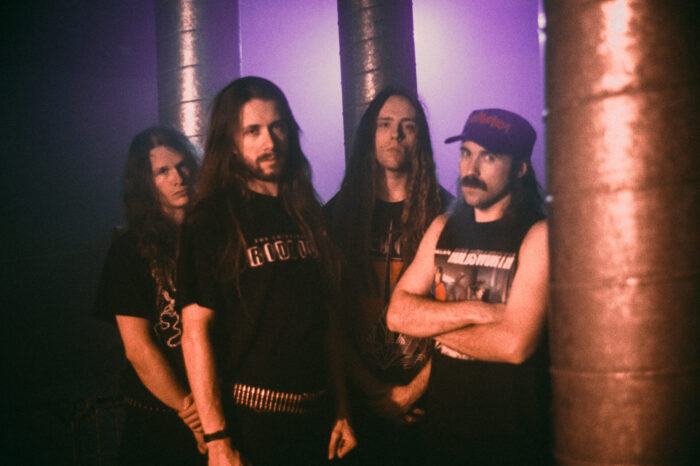
From a visceral return to roots from Converge to Cryptic Shift's epic new death metal space opera, Kez Whelan reviews his first batch of great new metal for 2026
Cryptic Shift, photo by Murry Deaves
As we hurtle into yet another new year, I'm still catching up on great records from the end of the last one - or great tapes, to be precise, with a couple of essential releases landing on cassette after even the tardiest music publications had finalised their year end lists.
Nottingham psych-sludge legends Dead In The Woods returned out of nowhere with a self-titled album, almost 13 years since the band had originally called it a day. The members have all been active in other projects since of...
The post Columnus Metallicus: Heavy Metal for February Reviewed by Kez Whelan appeared first on The Quietus.

Australian police have been filmed viciously beating an anti-genocide protester after the protester was already immobilised, pinned to the floor and helpless:
View this post on Instagram
The attack came shortly after the Australian government passed new legislation, driven by the Israel lobby, classifying criticism of Israel as hate speech. It mirrors the legislation and egregious violence perpetrated by state forces against peaceful pro-Palestine protesters in Germany.
Australian authorities and institutions have discriminated heavily against Palestinians and pro-Palestinian speech since the December 2025 Bondi beach attack - which had nothing to do with Palestinians or Palestine.
Featured image via the Canary
By Skwawkbox

The Department for Work and Pensions (DWP) propaganda machine is working at top speed again. This time by making cuts to benefits sound like it's for disabled people's own good. The DWP released a shiny new press release bragging about how they plan to reform welfare to "support people into work".
DWP cutting UC health element by over £200This is, of course, the Universal Credit Bill, which comes into effect in April. The final amendments for which were laid out in parliament yesterday (Monday 9 February). I know what you're thinking, since when were amendments newsworthy? Well, since the DWP realised they needed to generate as much good press around these abhorrent cuts as possible.
What the press release does finally confirm is just how much the DWP will be fucking over new disabled Universal Credit (UC) claimants. And it's by over £200 a month. The department proudly gushed that they will be introducing a lower rate of the health element for new claimants. This means that instead of £429.80 a month, new claimants will get just £217.26. That's a loss of £212.54 a month and £2550.48 a year.
Don't worry, though, standard allowance is going up too and it's higher than inflation for the first time ever! Aren't the government good to us?! For under 25 year olds it'll go up by a whole £21.60 a month or £259.20 a year. For over 25s it'll be going up by a whopping £24.76 a month or £297.12 a year. So you'll only need to make up an extra £2291.28 or £2253.36 a year.
Painting cuts as a good thing and benefit claimants as fakersEven more cruelly, the DWP is selling this cut as a good thing that will help disabled people.
The press release said:
The system inherited from the previous Government means people receiving Universal Credit for health reasons are paid more than twice as much as a single person looking for work and aren't given the support to move closer to - or into - jobs.
A reminder that disabled claimants get double what a non disabled claimant does is because the DWP have already judged them unfit for work. They know that these people can't find a job without it being detrimental to their health.
The DWP continued:
The reforms - coming into force in April - will tackle these perverse incentives by introducing a lower Universal Credit health element
Because nothing incentivises you like the prospect of starvation and homelessness, does it?
The deserving and undeserving disabledThe government also didn't pass up an opportunity to paint a clear divide between the fakers and the real disabled people. They assured the public that people with the "most severe, lifelong conditions" would still receive the higher rate. Though when they get to decide who fits that criteria, it's obvious that many will suffer. This rate also applies to those with a terminal illness and current claimants.
By not including current claimants, the government clearly hopes disabled people will keep quiet and play nice. This shows just how selfish and vile they are if they expect the community to turn its back on newly disabled people to save our own skins. That sounds much more like politician behaviour.
DWP chief Pat McFadden said:
The benefits system we inherited was rigged with the wrong incentives and wrote people off instead of backing them. We are changing this.
It's absolutely vile that the government are still pushing this narrative that disabled people choose not to work because it pays better. When it's clear to see that many find work inaccessible in a system that cares more about profits than people.
He continued:
These reforms put more money in the pockets of working people on Universal Credit, while ensuring those who can work get the support they need to do so.
This is such a fucking lie, it's insulting. McFadden knows full well that the health element means people are too sick or disabled to work. So to say the DWP wants to support those who can work is implying they're faking it.
Overwhelming evidence that the DWP isn't fit for purposeTo try and make it look like they care, the DWP refers once again to all their bullshit plans to push disabled people back into work. This is despite the overwhelming evidence that the department is a complete farce.
Recently, the DWP was crowing about the rollout of WorkWell, which sells work as a cure for disability. This is despite there being no proof of it actually working at all, never mind well. There's also the fact the Public Accounts Committee absolutely ripped the DWP a new one over their ability to support people into work.
The PAC also drew attention to the fact that the DWP doesn't publish data on work coach numbers. So while the DWP brags that 100,000 advisors will be redeployed in Pathways to Work, we don't actually know how many there are. And if they're planning on putting them in GP offices and moving them onto the skills brief we really need to know how many there are to go around.
The DWP doesn't give a fuck about disabled peopleWhat is clear, despite the DWP saying otherwise, is that they couldn't give a fuck about disabled people.
If they actually wanted to support those of us who could work, there'd be proper detailed plans. Not just passing disabled people around work coaches. They also wouldn't be quietly cutting Access to Work whilst spaffing on about wanting to help us. If they actually cared about people who were out of work because of disability they'd be ensuring we could live our lives without fear.
More than anything, if the DWP actually cared about disabled benefits claimants, they wouldn't be doing everything in their power to demonise us in the press. But then if all of this was true they wouldn't need to use the press to further their agenda by bragging about fucking amendments.
Featured image via the Canary

The Canary has received reports of an alleged backroom deal between Jeremy Corbyn, The Many, and Redbridge Independents. In January 2025, Corbyn announced his endorsement of the Redbridge Independents, declaring:
we are the alternative, we are the community.
However, this excited endorsement has been challenged by anonymous insiders. And, this revelation comes just as The Many accused Grassroots Left of undermining member decisions at the fledgling party's inaugural conference.
But, the Canary have received a report from a source that was present in a meeting between Corbyn, Redbridge Independents, and candidate on The Many slate on Tuesday 26 January — one day before Corbyn declared his public support for Redbridge Independents. The source alleges that Corbyn traded his public endorsement for a commitment from Redbridge Independents to deliver votes for The Many.
If accurate, this would represent a clear attempt to exert political influence behind closed doors.
Corbyn pushes The ManyAs Your Party gears up for its Central Executive Committee (CEC) elections that will determine leadership of the party, internal rifts are evident. Whilst Corbyn endorsed The Many, Zarah Sultana has endorsed the Grassroots Left slate.
An anonymous source told the Canary that Noor Begum and Tahir Mirza, two candidates on The Many slate, were present at the alleged meeting with Corbyn and Redbridge Independents. If Corbyn has indeed traded public endorsement for assurances of support for The Many, there must be serious questions over the erosion of democratic principles during the course of these elections.
Furthermore, according to our source, Begum confessed she had been told by Laura Alvarez, Corbyn's wife, that it was imperative that both candidates be elected in the London region. If not, Corbyn and his allies would not have ultimate control of the CEC. As a result, they would not control the party itself.
These are hardly the actions of people committed to member-led democracy. Instead, they are the actions of a group of people clinging to shady Westminster-style backroom politics where what matters is who you know.
Accusations against Grassroots LeftAs we mentioned earlier, these revelations come as The Many accuse Grassroots Left of undermining the principle of one member, one vote:
NEW: Some on the Grassroots Left want to overturn conference & abolish one-member-one-vote in Your Party.
The Many will defend OMOV.
Power with the members, not the sects. pic.twitter.com/uQvBb7mq3m
— The Many (@TheManyYP) February 8, 2026
For months, Corbyn and his allies have briefed against Zarah Sultana and those in her team. Namely, the allegation is that Sultana is attempting to take control of the party. As these allegations swirl, it is clear that Your Party is far from guaranteeing member-led democracy.
A party divided: democracy undermined from withinIn February 2026, members of Your Party will vote nationwide to elect candidates to its Central Executive Committee (CEC), the body responsible for carrying forward the membership's will through democratic debate and decision-making. Since the party's inception, both sides have accused each other of attempting to seize ultimate control. Furthermore, Zarah Sultana claimed she was pushed out of the process. She denounced it as a "sexist boys club" dominated by unelected bureaucrats.
Reports suggest these struggles for control have been present from the very beginning. Corbyn's team reportedly opposed Sultana's involvement and resisted the proposed co-leader model. However, the announcement of that model inspired hundreds of thousands of people across the country to take notice.
Jeremy Corbyn's Zarah Sultana's YourParty has reached 800,000 and heads toward a million signs up's and has 6 MP's (Independence Alliance MP's are party of it) and counting.
You can join the Biggest Party in UK here.https://t.co/wqcecuaaK2
— JmRoyle #LFC #YNWA #BLM #RejoinEU (@MyArrse) August 12, 2025
Members should have put this divide to rest in November, when Your Party's inaugural conference overwhelmingly backed dual membership and collective leadership. Yet the back and forth accusations suggest that the democratic mandate from members is not being treated as such.
We have already reported how candidates aligned with Jeremy Corbyn have allegedly had to commit to overturning conference decisions regarding leadership model and dual membership. We even exposed the controversial reality that Corbyn's aide, Karie Murphy, chose to block a sortition member once becoming aware of their socialist credentials. Nevertheless, the group appear willing to sink to ever greater depths of shadiness.
NEW: Our Proposals to Empower Members & Get Your Party Back On Track

Over 1,500 UK students, academics, researchers and university staff have signed an open letter demanding UK universities cut ties to the arms trade. The letter claims the links are fuelling "global instability, injustice, and environmental harm".
Demilitarise Education (dED), puts the value of arms-linked partnerships at approximately £2.5bn. This figure represents the combined value of partnerships held by universities in arms companies, including investments, research and academic partnerships, over the past eight years.
This data is held on the Universities and Arms Database, which dED developed and hosts.
Demilitarise Education's arms trade campaigndED is running a national campaign highlighting the deep and ongoing ties between UK universities and the arms trade.
The campaign has already garnered widespread support. 1,595 academics, researchers, university staff, and students have signed an open letter. It calls for an end to institutional partnerships with arms manufacturers and military-linked organisations.
Through rigorous research, advocacy and collective action, the organisation calls for transparency, ethical funding and an education system with policies committed to peace, social justice and the public good.
Dr Iain Overton, executive director at Action on Armed Violence, said:
Participants not bystandersUK universities cannot credibly claim to be solely serving the public good while taking billions from the arms trade. These are not neutral partnerships. Defence money shapes research priorities, it legitimises militarisation, and it binds centres of learning into often hidden and distant systems of violence that produce very real civilian harm.
But what this open letter shows is that such institutional consent is not uncontested. Staff and students are no longer willing to accept such complicity as the price of funding. They refuse to allow those who have profited from well-recorded civilian deaths in places like Gaza and Yemen to end up funding our Universities.
The £2,556,647,429 figure exposes higher education institutions as active participants in military supply chains, rather than neutral bystanders. Signatories argue that these relationships implicate universities directly in systems that sustain war, militarisation and global violence. And often there's no transparency, democratic oversight or meaningful consent from university communities.
This intervention comes amid intensifying global conflicts from the devastating genocide in Gaza and Russia's invasion of Ukraine, to the ongoing civil war in Sudan and rising geopolitical tensions elsewhere.
These conflicts have caused widespread civilian suffering, resulting in numerous crises across the stated locations, with millions displaced, health systems collapsing and education infrastructure destroyed.
dED argues that university arms trade partnerships form part of the same global architecture that enables and sustains such violence.
BAE SystemsOne of the most involved arms companies in UK universities is BAE Systems. At the University of Manchester, BAE is partnering on research to accelerate combat air systems, including research projects aimed at improving fighter jets.
BAE Systems' weapons and technology have been linked to serious violations of international law. In 2019, the company was accused of "aiding and abetting" war crimes in Yemen.
Components manufactured by BAE for F-35 fighter jets have seen use in Israeli bombing campaigns in Gaza, resulting in thousands of deaths, including hundreds of children.
By supplying regimes engaged in indiscriminate violence, BAE has contributed directly to war crimes, mass civilian casualties, and extensive environmental destruction. Despite reporting on production emissions and business travel, BAE does not account for the catastrophic environmental damage caused by its weapons, including toxic pollution, infrastructure collapse, and long-term ecological harm.
The dED Universities and Arms Database tracks UK university links to arms companies listed in the SIPRI and Defense News top 100. So far, 90 UK universities have been identified as having direct ties. The database allows users to explore how individual universities contribute to arms company activities.
The open letter marks a clear break with institutional consent, as staff and students publicly challenge the normalisation of defence-funded research, arms-linked partnerships and military recruitment pipelines within higher education.
Arms trade 'incompatible' with uni aimsCampaigners argue that universities' stated commitments to the public good, social responsibility and global justice are fundamentally incompatible with their material involvement in the arms trade. As militarism expands internationally, staff and students increasingly identify universities as a key node within the military-industrial complex.
The letter contends that research collaborations, weapons-linked funding streams and defence-aligned innovation programmes play a material role in enabling arms production and export, including into active conflict zones. They also embed militaristic logics within institutions historically understood as spaces of independent thought and public good.
Aleks Palanac from the University of Leicester says:
Stop the recruitment driveUK universities cannot legitimately claim to be places of sanctuary for refugee students whilst continuing to actively contribute to the causes of their forced migration in the first place through their involvement in the global arms trade.
The campaign also responds to mounting pressure on universities to function as recruitment and talent pipelines for the defence sector. The UK government's 2025 Strategic Defence Review outlines plans to align higher education with military and defence industries more closely. This includes the creation of a Defence Universities Alliance and targeted investment in STEM disciplines to support military technologies and defence roles.
dED criticises the government's proposed "whole of society" approach to defence. This includes increased exposure to military careers among school-aged children and initiatives such as paid armed forces "gap years" for under-25s. The organisation says this risks normalising military service as a default life trajectory for young people. And particularly so in the context of widening inequality and shrinking civilian opportunities.
Jinsella Kennaway, the co-founder and executive director of dED, says:
Over 1,500 members of the UK knowledge community have put their names to this open letter. This is no fringe view - it is a clear mandate from within our universities. This is a stand against the use of education to fund, legitimise and supply the war machine.
Universities must honour their duty to serve the public good by choosing partnerships that build the conditions for peace, not profit from conflict. No ethical integrity can be claimed while arms industry partnerships amplify the lethality of war and stakeholder calls for change are met with silence.
The letter calls on universities to realign their policies and practices with the dED Treaty framework. It demands full transparency over defence-linked funding, research and partnerships, alongside formal commitments to exclude arms companies from university collaborations.
It further calls for an end to recruitment ties with the armed forces and arms manufacturers. And it looks for a renewed commitment to research and teaching that prioritises peace-building over warfare.
Campaigners argue that universities must remain spaces of critical inquiry and humanistic values, not extensions of the military-industrial complex.
Featured image via the Canary
By The Canary
Abbeydale, Sheffield: I'm genuinely scared when I wake at 2am to the sound of screaming. Then I see two male badgers in an almighty scrap
Fast asleep, my dreamworld takes an unexpected swerve as raucous screaming erupts outside the open bedroom window. For a moment, I assume this is imagined, some emotional outburst from my subconscious. Then I realise that I'm awake. This is real. I check the time: 2am. The screaming continues. In fact, it's now louder and somehow more intense. The back of the house is woodland, and noises off are common enough. A fox barking. Robin song that eases those anxious, wakeful stretches of the night. But this is something else altogether. This is violence.
My heart is racing now. I fear someone is being attacked, and from the pitch of the screaming, a woman. Mercifully, I soon discount this. My startled mind then suggests a catfight, but the sound I'm hearing is too big for that. So, despite the freezing cold beyond the duvet, I hop out of bed, pull back a curtain and stick my head outside.
Continue reading...
The 2026 MOTUL FIM Superbike World Championship will once again take place over 12 rounds and 36 races. The season will start in Phillip Island with the Australian Round on February 21st and while there are many changes for the coming campaign one thing remains constant, WorldSBK is Pure Motorsport.
Armed with the fastest production derived motorcycles in the world the 22 rider field will deliver excitement at every round. History has proven that in this championship that the rider has been the biggest factor in making the difference between success and failure. For the six manufacturers on the grid they'll be hoping that their line-up proves pivotal in getting the most from their machinery and delivering success throughout the campaign.
 Miguel Oliveira (88) during the Jerez test. Photo courtesy Dorna.
The ROKiT BMW Motorrad WorldSBK Team enters the season as the reigning Riders' Championship holder but with a new line-up. Miguel Oliveira joins the series following a successful Grand Prix career that included race victories in all three classes, while three-time WorldSBK race winner Danilo Petrucci switches manufacturers after three seasons aboard Ducati machinery.
 Alvaro Bautista (19) during the Jerez test. Photo courtesy Dorna.
Ducati will once again be led by 2025 title runner-up Nicolo Bulega. The 26-year-old returns to the Aruba.It Racing - Ducati squad for his third Superbike season and will aim to become the first rider to win both Supersport and Superbike world titles. After finishing second in last year's championship despite 14 race wins, Bulega enters 2026 as the title favourite. Nicolo Bulega will line up alongside a new teammate in 2026, with Iker Lecuona replacing Alvaro Bautista in the Ducati factory squad. After four seasons with Honda HRC, Lecuona has shown encouraging form during pre-season testing aboard the updated Panigale V4 R. Ducati will also boast a formidable Independent line-up, headed by Bautista following the double World Champion's move to Barni Spark Racing Team. Sam Lowes will look to continue his upward momentum with the Elf Marc VDS Racing Team after securing a pole position last season.
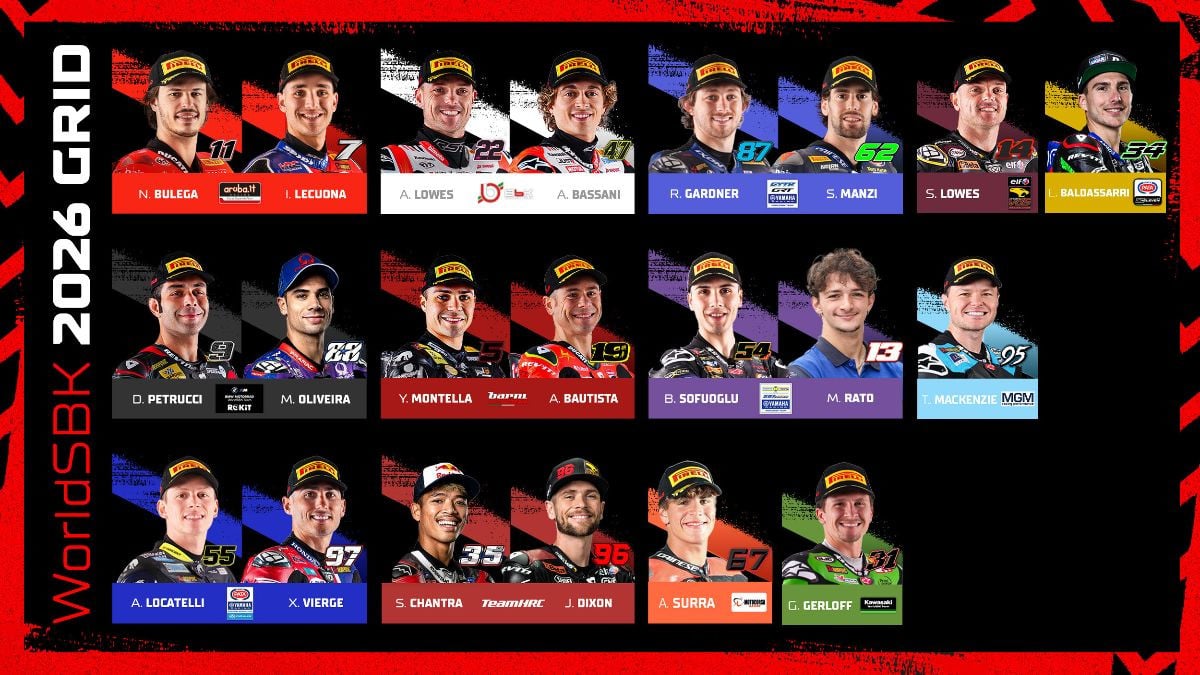
Yamaha heads into the new season with a revamped rider line-up, adding Xavi Vierge and reigning WorldSSP Champion Stefano Manzi. Manzi steps up to WorldSBK following his title-winning campaign, while Vierge arrives from Honda. After securing a race win last season through Andrea Locatelli, Yamaha will look to the Italian to lead its challenge, supported by former Moto2 World Champion Remy Gardner as he enters his fourth year in the championship.
 Garrett Gerloff (31) during the Jerez test. Photo courtesy Dorna.
Bimota and Kawasaki will retain unchanged line-ups for 2026. Alex Lowes delivered a strong return season for bimota, finishing sixth in the standings and claiming four podiums. The Italian marque will aim to build on that progress, with Axel Bassani targeting further gains. Kawasaki will again be represented by Garrett Gerloff as the sole rider for the brand.
 Jake Dixon (96) during the Jerez test. Photo courtesy Dorna.
Honda has bolstered its WorldSBK effort with the signing of two Moto2 race winners. Jake Dixon returns to Superbike competition after seven years in Grand Prix racing to contest his first full WorldSBK season, having previously appeared as a wildcard at Donington Park in 2017. He will be joined by Somkiat Chantra on the Honda CBR1000RR-R SP. Chantra is set to make history as the first full-time Thai rider in WorldSBK, though a pre-season injury will rule him out of the opening round.
WorldSBK boasts a rich heritage and celebrated its landmark 1,000th race last season. With only one Superbike World Champion on the grid for 2026, the stage is set for a new name to be written into the history books.
WorldSBK is back for more in 2026, with the season getting underway at the Australian Round at Phillip Island on 20-22 February.
2026_WorldSBK_AUS_Event_Schedule_10Jan2026
With WorldSSP entering the fifth year of its "Next Generation" regulations, the series continues to grow in stature. This season, eight manufacturers will take to the grid, with ZXMOTO joining in 2026. The Chinese manufacturer has partnered with the World Championship-winning Evan Bros Racing team and will field two bikes for Valentin Debise and Federico Caricasulo. The regulations allow a wide range of machinery to be competitive, with the grid featuring two-, three-, and four-cylinder machines. Last year, four manufacturers claimed victories, and with double WorldSSP champion Dominique Aegerter returning to the class, Kawasaki will be confident of winning races for the first time since 2023.
Last year's champion, Manzi, has been promoted to the Superbike class, but the majority of last year's front-runners will be back for 2026. Can Oncu replaces Manzi at the Pata Yamaha Ten Kate Racing squad, and having proven himself with six victories last year, the Turkish rider will be the early-season favourite. Jaume Masia (Orelac Racing Verdnatura) and Tom Booth-Amos (PTR Triumph Factory Racing) return to the class this year and will be confident of adding to their race-winning pedigree, while former champions like Lucas Mahias (GMT94 Yamaha) and Aegerter will look to return to the front of the field.

WorldSBK will feature a new class in 2026, with the FIM Sportbike World Championship making its debut at the Portuguese Round. With six manufacturers competing, the new class has already proven very popular, with Aprilia and Suzuki returning to the paddock.
The Portuguese Round will also be the first round of the WorldWCR season, with Maria Herrera returning as the defending champion.
The post WorldSBK Set for a Wide-Open 2026 Season appeared first on Roadracing World Magazine | Motorcycle Riding, Racing & Tech News.
Nearly 17,000 Volvo employees had their personal data exposed after cybercriminals breached Conduent, an outsourcing giant that handles workforce benefits and back-office services.…
London-based energy software company Tem has closed a $75 million Series B round led by Lightspeed Venture Partners, with additional funding from AlbionVC, Atomico, Hitachi Ventures, Schroders Capital, Voyager Ventures, Allianz, and others. The round reportedly values the company at more than $300 million and will fund its expansion into the United States and Australia. Tem builds an AI-native energy platform designed to automate the pricing, matching, and execution of electricity transactions, a market that has long relied on manual processes and legacy infrastructure. Its core system uses machine learning to forecast supply and demand, match buyers with suppliers, and…
This story continues at The Next Web


