
S is HTF in Johannesburg
SS: No water in large neighbourhoods for weeks; tankers are running out before everyone gets water even after waiting hours; water employees striking for not getting paid in full; protesters closing road, and unrest building up. We are witnessing a political failure leading to infrastructure collapse.
All of these articles are from today or the last few days:
https://allafrica.com/stories/202602100415.html
>•WaterCAN says Johannesburg residents already live in Day Zero conditions, with areas experiencing outages lasting close to 20 days.
>•The group calls on the government to declare Johannesburg a national disaster area and demands daily updates from Johannesburg Water.
>Johannesburg has run out of water, civil society group WaterCAN warns, as extreme heat makes the city's water crisis worse.
>Johannesburg Water has been hit by an unprotected strike by members of Cosatu-affiliate, the SA Municipal Workers' Union (Samwu), over performance bonuses not fully paid in December, as the city's water crisis deepens.
>"This is not a drought issue; it is a failure of infrastructure planning and accountability. Everyone has to take responsibility for the situation we're in right now. People are now queuing for tankers, fighting for water, and the vulnerable are being left with nothing."
SS:
https://www.joburgetc.com/news/midrand-water-outage-protest/
>Officials point residents to water tankers, but accessing them is far from simple. Without a car, collecting water can mean hours of waiting or relying on neighbours and friends. Some residents say they arrive at advertised tanker points only to find no trucks, no water and no updates.
>On the ground, even Joburg Water officials admit the problem. Tankers refill from fire hydrants in Midrand, but there simply aren't enough trucks to serve the growing population.
>On social media, anger has spilled over. Residents have shared images of long queues, empty buckets and even illegally opened fire hydrants a risky but desperate move by people who say they've been left with no alternatives.
https://allafrica.com/stories/202602100548.html
>Families in RDP housing in Arla Park Extension 2 and 3 of Nigel shut down the busy Balfour Road on Tuesday, demanding water be restored to the community immediately.
>Residents gathered from 7am. They were monitored by a large police contingent, and a few warning shots were fired. However, protesters said they would not leave until a representative of the Ekurhuleni mayoral office addresses them.
>According to residents, water supply has been unreliable for the past five years.
submitted by /u/IntoTheCommonestAsh[link] [comments]
In Lancashire, I met people living with dangerous levels of Pfas, including in their food. The government is failing them
Last week, on the morning the government published its Pfas action plan, I got a worried phone call from a woman called Sam who lives next door to a chemical factory in Lancashire. Sam had just been hand-delivered a letter from her local council informing her that after testing, it had been confirmed that her ducks' eggs, reared in her garden in Thornton-Cleveleys, near Blackpool, are contaminated with Pfas.
Pfas - per- and poly-fluoroalkyl substances, commonly known as "forever chemicals" due to their persistence in the environment - are a family of thousands of chemicals, and I have been reporting on them for years. Some, including those found in the eggs Sam and her family have been eating, have been linked to a wide range of serious illnesses, including certain cancers.
Continue reading...

Music can act on listeners in ways that Western modes of engagement and criticism overlook or erase, argues Moravian composer and vocalist Julia Úlehla in The Wire 505
I've just given a keynote presentation at Lines of Flight: Improvisation, Hope and Refuge, a conference hosted by the International Institute for Critical Studies in Improvisation. I'd been invited to talk about my performance research with Dálava, a cross-genre project that is influenced by animist, Slavic cosmology and a land-based folk song tradition that has been in my family for generations. After the presentation a woman approaches me. "There's something I need to tell you. A spirit entered my body while you were singing and has a message for you." She delivers the message and hugs me warmly. Once delivered, her demeanour transforms, as if a weight lifts. She promptly and politely says goodbye.
As this encounter suggests, singing is a devotional practice for me, one that connects me to my ancestors and other spirits, and affords an animist experience of reality. Music born of traditional and spiritual practice is increasingly visible in experimental and underground circles. But music of this kind is often at odds with the patriarchal colonial bias that constrains how music is written about and studied. Listeners, practitioners, teachers and writers need to find ways to move beyond this bias and avoid the harms of misrecognition, desacralisation, instrumentalisation, commodification and extraction.
The musical history of Canada, the nation state in which I live, is built on the extraction of Indigenous song and culture and erasure of Indigenous peoples and lifeways. In current music writing about artists who are women and people of colour, exotification, mischaracterisation and assumptions based on gender, race and ethnicity are common. In a letter in The Wire 424 in which she corrected inaccuracies arising from false assumptions based on her ethnic and racial identity, Amirtha Kidambi notes, "this kind of mischaracterisation and looseness with facts is much more common in stories about women and people of colour... we rarely get to dictate even the facts of our own stories, in the way many of our white male colleagues do, and are narrativised time and time again, in inaccurate and uncomfortable ways…"
Throughout my career I've seen women, queer, trans and racialised colleagues who work with voice prefer to situate themselves inside movement, dance, theatre or performance art milieus because of the patriarchal, colonial bias in music. During my PhD in ethnomusicology, I researched folk songs from Slovácko, a rural region at the western edge of the Carpathian mountains. In this tradition - which has been sung by generations of my family members - ancestor and other spirits, mountains, rivers, wind, weather, humans, animals and plants are understood as agentive, alive and interrelated. My advisor told me to keep my body, my family and my creative practice out of my research, adding that I should maintain a scholarly distance and satisfy his appetite for facts. He asked me to take spirit out of my writing, warning that it would unpalatable for colleagues.
These statements suggest that knowledge cannot arise in the body, and that one's family lineages and exploratory musical practices are not viable fields for research. Gatekeepers have appetites that can only be satisfied by facts obtained through the perceptions of an unaffected, distant observer. Spirits are the stuff of an (often feminised or racialised) Other's belief, fantasy or psychosis. To present them as part of a valid epistemological and ontological field invites ridicule.
I'll give a few examples of what people thinking outside this dominant ideology have told me that they perceive when listening. Neither platitudes nor praise, these comments open imaginative space for what language about music is, or could be. The encounters they describe bridge across alterity without collapsing difference, foregrounding embodied experience, spiritual encounter and collaborative wondering. These exchanges include modes of listening and giving language to musical experience that avoid reification and instead open towards relationship.
A young woman came up to me after a performance and told me that she "grew up inside a Hindu household where music, devotion and the domestic were inextricably linked". She continued, "The performance felt like being home. Your music lives in the heart. Depending on the relationship a person has to their own heart influences how they will hear you."
What if the way we respond to music has more to do with emotional flows and blockages than aesthetic preferences? What would happen if we knew we might be having our hearts worked on when we listened to music, or conversely, when we performed for someone, we might be engaging with their hearts? What does that do to accountability? Would we consent to that? What are we turning away from if we never think about it?
A Syilx woman told me that she palpably felt and saw the land that the folk songs I sing come from and was moved by how beautiful the land was. What if certain songs are inseparable from the lands they grew from, as though the songs themselves contained the land, or could bring the spirit of the land to them? In this diasporic world, what are we asking genus loci to do when we bring them across the world? What are the consequences when songs from faraway lands appear upon stolen, occupied, Indigenous land, and how is each context different? Are we, for example, introducing lands or ancestors to one another in generative ways? Who determines that? Or enacting another form of settler colonialism in the spirit world?
A Serbian woman told me that the performance allowed her to experience "the existential liberation of Slavic melancholy". She said, "If you travel down to the very bottom of suffering, on the other side lies freedom." What if songs are medicine, capable of bringing healing to suffering? What if we knew that when we gather to listen to music or perform for others, we could travel to the bottom of suffering and pass through it together?
And as the opening story reveals, song is a powerful way of communing with ancestors and other spirits. What if we went to concerts knowing that our ancestors were gathered in the room with us? What might we want to do together? Do we have issues to heal or celebrate within our lineages, or among those gathered? Do we know how to do this safely and responsibly, and are we all at equal risk?
These exchanges centre ways of knowing and listening that many academicised modes of engagement find hard to tolerate. Yet, many of us have had experiences like these through music; many of us long for them. Music helps us learn how to love, how to honour the land that sustains us, how to heal, how to grieve, how to visit with the dead, how to experience hierophany. No one is authority in these layered entanglements - not the musicians, not the audience, not the unseen. These relational encounters invite everyone to participate but don't work according to logics of control or distance. You have to let yourself be taken by something bigger. Can music criticism disarm itself enough to make space for this?
Julia Úlehla is a Moravian composer and vocalist. This essay appears in The Wire 505.
Pick up a copy of the magazine in our online shop. Wire subscribers can also read the essay in our online magazine library.

The Trump administration continues its AI push, working to defuse public opposition to datacenter energy and water consumption - while dangling a promise to exempt hyperscalers from chip tariffs to help them stock their facilities with GPUs and accelerators.…
Microsoft is introducing a raft of Windows security features that users and administrators alike might assume are already part of the operating system.…
If you're an iPhone user who likes to keep tabs on where your stuff is, you can't go far wrong with an AirTag. The second-gen model that Apple just released outpaces the original in every way (aside from the galling lack of a keyring hole, that is). While it's easy enough to replace the battery in both versions of the AirTag, you might not want to have to worry about the device's battery life for a very long time. Enter Elevation Lab's extended battery case for the AirTag, which is currently on sale at Amazon for $16.
The case usually sells for $23, so that's a 30 percent discount. It's not the first time we've seen this deal, but it's a pretty decent one all the same.
This is arguably one of the more useful AirTag accessories around for certain use cases. It won't exactly be helpful for an AirTag that you put in a wallet or attach to your keys, as it's too bulky for such a purpose — and it doesn't have a hole for a keyring anyway. Still, if you're looking for an AirTag case that you can place in a suitcase or backpack and not have to touch for years, this could be the ticket.
Elevation Lab says that, when you place a couple of AA batteries in the case, it can extend the tracker's battery life to as much as 10 years (the brand recommends using Energizer Ultimate Lithium batteries for best results). The AirTag is slated to run for over a year on its standard CR2032 button cell.
The case gives the AirTag more protection as well. It's sealed with four screws and it has a IP69 waterproof rating. What's more, it doesn't ostensibly look like an AirTag case, so someone who steals an item with one inside is perhaps less likely to realize that the object they pilfered is being tracked.
There are some other downsides, though. Since the AirTag is locked inside a case, the sound it emits will be muffled. Elevation Lab says the device's volume will be about two-thirds the level of a case-free AirTag. However, the second-gen AirTag is louder than its predecessor, which should mitigate that issue somewhat.
Follow @EngadgetDeals on X for the latest tech deals and buying advice.
This article originally appeared on Engadget at https://www.engadget.com/deals/elevation-labs-10-year-extended-battery-case-for-airtag-is-back-on-sale-for-16-151215952.html?src=rss
When U.S. Attorney General Pam Bondi declared that she would seek the death penalty against Luigi Mangione — the first capital prosecution announced during Donald Trump's second term — legal experts immediately raised the alarm. The decision was more propaganda than judicial process, with Bondi broadcasting the news in a press release and Instagram post before Mangione was even indicted.
"One of my biggest questions is whether the Department of Justice followed its own policies in making this decision," Robin Maher, head of the Death Penalty Information Center, told The Intercept at the time. The answer was no. "I've been handling capital cases for over 20 years, and I've never seen anything like it," a defense attorney in the Southern District of New York, told Vanity Fair. "There's a very detailed process that is supposed to be followed that is spelled out in the [DOJ] Justice Manual, and for the attorney general to just preempt that process is unheard of, as far as I know."
It was perhaps foreseeable, then, that the capital case against the alleged murderer of UnitedHealthcare CEO Brian Thompson might wither under scrutiny. The presiding judge tossed the death-eligible charge against Mangione last month — another high-profile setback for an administration whose mounting authoritarianism has driven out scores of DOJ prosecutors and overwhelmed the federal courts.
Yet while Mangione received frenzied attention from the start, Bondi has continued her heedless push for new death sentences mostly under the radar. To date, according to data collected by the Federal Capital Trial Project, Bondi has authorized federal prosecutors to seek the death penalty against at least 30 defendants in 24 cases.
This doesn't include cases in which Bondi has promised to seek death but has not yet filed an official notification, known as a "Notice of Intent." After Afghan national Rahmanullah Lakanwal allegedly gunned down two National Guard officers in Washington, D.C., Bondi vowed to "do everything in our power to seek the death penalty against that monster who should not have been in our country." But prosecutors told a federal judge last week that none of the charges they have filed allow them to seek the death penalty.
Trump had always vowed to ramp up the death penalty when he returned to the White House. After carrying out 13 executions in his first term, he started his second term furious over President Joe Biden's decision to spare the lives of 37 people on federal death row. Under Biden, Attorney General Merrick Garland paused federal executions and halted new capital prosecutions almost entirely.
Trump's response was a bloodthirsty executive order on Inauguration Day calling on prosecutors to seek the death penalty as often as possible. Before long, Bondi was fast-tracking capital prosecutions, running roughshod over procedural guardrails and upending the process that is supposed to govern such decisions at the Justice Department.
"What we're seeing with the death penalty is exactly what we're seeing with the extrajudicial use of violence."
This ham-fisted approach has largely backfired. Federal judges have taken the death penalty off the table in at least nine of Bondi's 30 individual authorizations so far — an emblem of the DOJ's recklessness. "Prosecutors are supposed to have a firm basis to seek the death penalty before they decide to authorize it," said Robert Dunham, director of the Death Penalty Project. "When you see a string of cases being deauthorized because they're not legitimate death penalty cases, that tells you that prosecutors are overreaching."
For its part, Trump's DOJ has argued that prosecutors have no obligation to its own protocols — and judges have no authority to enforce them. The rules and procedures that govern capital prosecutions are a mix of law and policy that Bondi is happy to dismantle, sowing chaos and curtailing defendants' rights.
Trump's death penalty agenda is inextricable from the violence he has unleashed in Minneapolis and beyond. The cases pursued by Bondi reflect Trump's wish to punish immigrants, people of color, and perceived political enemies — regardless of their alleged crimes. More than two-thirds of Bondi's death penalty authorizations have been filed against defendants who are Black, Latino, Asian, or Native American, with Black people comprising the largest share. And two-thirds target jurisdictions that, like D.C., don't have the death penalty — states like Vermont and Maryland, as well as territories like Puerto Rico and the Virgin Islands.
But perhaps most revealing are the authorizations driven by Trump's spiteful fixation on undoing the work of his predecessor. Of the 30 defendants Bondi has sought to punish with a death sentence, 15 are people whose cases were previously handled by Biden's DOJ, in which Garland decided against seeking death. Such decisions, known as "no-seeks," are filed in the vast majority of death-eligible cases. Yet Trump's DOJ has systematically sought to reverse Biden's no-seeks - an unprecedented move that has disrupted countless federal prosecutions.
The push has not gone very well so far. At least eight of the 15 authorizations in which Bondi reversed a no-seek have been thrown out by the presiding judge, with more likely to follow. Most of these cases have proceeded as non-capital trials. But one is pending before a circuit court, with DOJ lawyers insisting the judge did not have the authority to rule as he did.
"What we're seeing with the death penalty is exactly what we're seeing with the extrajudicial use of violence," said Dunham. "There's a belief that because the Trump administration wants to, they can do it — and the law be damned."
The extraordinary push to reverse Biden's no-seeks was spelled out in a memo sent to DOJ employees on February 5, 2025, the day after Bondi was confirmed. Written as a rebuke of Biden, Bondi vowed to restore the death penalty to its rightful place. "This shameful era ends today," she wrote.
The memo included a sweeping order to the DOJ's Capital Review Committee — the set of federal prosecutors who make death penalty recommendations to the attorney general. Within 120 days, the committee was to review every pending case in which Biden's DOJ had declined to pursue the death penalty. "This group shall reevaluate no-seek decisions and whether additional capital charges are appropriate," she wrote.
 Related
Despite Declining Support for the Death Penalty, Executions Nearly Doubled in 2025, Report Says
Related
Despite Declining Support for the Death Penalty, Executions Nearly Doubled in 2025, Report Says
Attorneys general have routinely reviewed cases inherited from prior administrations. In pending capital cases, a new AG has the discretion to take death off the table. Garland withdrew dozens of death penalty authorizations brought by his predecessors, while continuing prosecution of people like Robert Bowers, who was sentenced to death in 2023 for slaughtering 11 people at the Tree of Life Synagogue.
Reversing a no-seek, however, is virtually unheard of. While the 1994 Federal Death Penalty Act requires prosecutors to provide a reason to withdraw a Notice of Intent, the law did not account for a scenario in which they would decide against seeking death only to later change their minds. While prosecutors can amend charges against defendants in "superseding indictments"—making it possible that a prosecution could become a capital case — the law holds that they must give notice that they will seek the death "a reasonable time before the trial."
It wasn't immediately clear how many cases fit the scope of Bondi's ordered review. But one anonymous DOJ official gave the Associated Press an estimate of 459. The order to "reevaluate" hundreds of cases in just a few months was far-fetched — and seemingly rigged against certain people from the start. Bondi's memo instructed the Capital Review Committee to pay "particular attention" to specific types of defendants: undocumented immigrants, people affiliated with "cartels or transnational criminal organizations," and those whose alleged crimes occurred "in Indian Country or within the federal special maritime and territorial jurisdictions."
These marching orders fit neatly into Trump's broader agenda. But from a practical standpoint, reversing no-seeks would make a mess of prosecutions headed for a trial or plea deal. For lawyers, judges, and families on both sides, the result would be chaos and delay. For defendants, it would be an assault on their right to due process.
Capital cases and non-capital cases proceed along distinctly different tracks from the start. People facing the death penalty are entitled to specific legal protections, including the appointment of an experienced capital defense attorney known as "learned counsel," who must immediately investigate their client's life to uncover mitigating evidence - factors like mental illness, generational trauma, poverty, and childhood neglect or abuse. In death penalty cases, this evidence often decides whether a defendant lives or dies.
Mitigating evidence is not reserved for sentencing, however. Under well-established DOJ protocols, prosecutors weighing the death penalty must solicit such evidence from defense lawyers. The process generally begins with the local U.S. Attorney's Office and — should prosecutors recommend the capital case move forward — culminates in a presentation before the Capital Review Committee in Washington, D.C.
Most federal cases never make it this far. But the DOJ's Justice Manual makes clear that the meeting is a fundamental part of the process. "No final decision to seek the death penalty may be made if defense counsel has not been afforded an opportunity to present evidence and argument in mitigation," it reads.
The whole undertaking is time-consuming for defense attorneys and costly for the courts, which must budget for the significant resources a capital case demands: the appointment of learned counsel, as well as a mitigation specialist, psychological experts, and investigators. In part for this reason, prosecutors are expected to give notice early if they plan to pursue a death sentence, by a deadline set by the presiding judge. Once the government gives word that it will not seek death, a defendant is no longer entitled to the additional resources.
In the cases subjected to Bondi's memo, defense lawyers had been preparing for ordinary trials, without the legal and investigative tools afforded to capital defendants. They had not been doing what capital defense attorneys are obligated to do: prioritize the penalty phase of the trial, to prevent a client from being sentenced to die. "If you're in a no-death case and it suddenly becomes a death case, the entire life history of the defendant becomes relevant when it wasn't relevant before," Dunham explained.
A proper mitigation investigation can take years. "In cases involving foreign nationals — who are being disproportionately targeted by the Trump administration — it not only takes years, it takes investigations in foreign countries," Dunham points out.
Nonetheless, within days of the Bondi memo, defense teams began hearing from the Justice Department that they should prepare for a meeting with the Capital Review Committee.
It would not take long for judges to push back.
In May 2025, a federal judge in Nevada rejected the government's first attempt to undo a no-seek. The Biden DOJ had notified defense lawyers that they would not seek the death penalty, only for prosecutors to reverse course 12 days before the trial was set to begin. Although Bondi's memo had suggested that no-seek reversals would be based on "additional capital charges," prosecutors offered nothing to justify their move. There was no new evidence or major developments, U.S. District Judge Miranda Du wrote in a scathing order. "The government may not now unilaterally derail the course of proceedings with regard to this matter of clear procedural and constitutional weight."
Soon afterwards, a Trump-appointed judge in Maryland tossed Bondi's authorizations against three men accused of committing crimes as part of MS-13. "The government assured the Defendants and this Court, in writing, that it would not seek the death penalty," wrote U.S. District Judge Stephanie Gallagher. "This Court will not cast aside decades of law, professional standards, and norms to accommodate the government's pursuit of its agenda."
The judges highlighted a glaring problem with the DOJ's attempts to justify its actions. "Taken to its logical conclusion," Du wrote, "the government's position would mean that defense counsel and the Court would have to continue to treat every single capital-eligible case as a death case … lest the government attempt to reverse its decision at the last minute."
This would be untenable for obvious reasons. It could also bankrupt the judiciary. If a no-seek could be revoked at any moment, judges could never safely withdraw the additional resources defendants were required to receive. All death-eligible defendants would be entitled to enhanced funding and resources until trial. According to the National Association of Federal Defenders, the resulting cost would be "incalculable," with the average number of cases requiring such resources ballooning from an estimated seven per year to "roughly 150 additional cases annually."
"Jurors may be understandably hostile to a federal government that doesn't respect local views and decisions."
These warnings came at an auspicious time. As Bondi ramped up prosecutions over the summer, the program that pays private court-appointed attorneys to represent indigent clients in federal cases ran out of money, leaving lawyers working without pay. Then came the federal shutdown. Those most heavily impacted were the very same legal teams facing the wave of new death penalty cases. "Federal capital defense lawyers are under tremendous pressure to secure the time, resources, and funding they need to adequately defend these cases," said Maher, the director of the Death Penalty Information Center.
The situation was especially senseless given how few capital prosecutions actually culminate in a death sentence — let alone an execution. Public opinion has largely turned against capital punishment, with juries increasingly refusing to send people to death row. "Securing federal death sentences will be a very difficult task given the low level of public support for the death penalty and rising concerns about federal overreach and abuse," Maher said. It will be harder still in places that have rejected capital punishment. "Jurors may be understandably hostile to a federal government that doesn't respect local views and decisions."
All of this made the Trump DOJ's targeting of U.S. territories especially vexing. In Puerto Rico, whose Constitution banned capital punishment more than 70 years ago, U.S. prosecutors have failed to win a single death sentence despite some 19 authorizations over three decades. Yet Bondi, who has authorized at least one new death case in Puerto Rico, is determined to expand such efforts to a jurisdiction that has never seen a death penalty case: the U.S. Virgin Islands.
One year before the Bondi memo, federal prosecutors filed a no-seek in the case of Richardson Dangleben Jr., charged with killing a St. Croix police detective on the Fourth of July. Garland's DOJ "intends to proceed with either a non-capital trial or plea agreement in this matter and will not seek the death penalty," the local U.S. Attorney wrote in February 2024. This confirmed what prosecutors had told Dangleben's defense attorney, Federal Public Defender Matthew Campbell, more than six months earlier. At the time, this was to be expected. The U.S. Virgin Islands, Campbell would later point out in an affidavit, "had no history of authorizing or carrying out capital sentences."
In February 2025, however, Campbell got word that federal prosecutors might seek the death penalty after all. The presiding judge, U.S. District Judge Robert Molloy, swiftly appointed learned counsel, who warned that Dangleben's defense had already been severely compromised. "If this were a capital case from its inception, we would have hired a mitigation specialist and we would have been preparing a mitigation packet for the Department of Justice from day one," she said in a phone conference. Instead - more than a year and a half after prosecutors said that they would not seek the death penalty - the lawyers were scrambling to present before the Capital Review Committee in a matter of weeks.
In May, the DOJ filed a Notice of Intent to seek the death penalty.
The authorizations in the Virgin Islands didn't stop there. Over the next few months, the government filed Notices of Intent against two more men, co-defendants Enock Cole and Jiovoni Smith. As in Dangleben's case, prosecutors had previously said that they would not seek death only to reverse course after Trump returned to office. Even more shocking was an authorization in a third Virgin Islands case, that of Rosniel Diaz-Bautista. In his case, the DOJ had apparently decided to seek a death sentence "without granting the defense any opportunity to submit mitigating evidence, make a mitigation presentation, or otherwise participate in the capital-authorization process," as Campbell wrote in a court filing. This was "wholly unprecedented in the thirty-plus year history of the modern federal death penalty."
Judges struck down all four authorizations. Ruling in Dangleben's case, Molloy — a Trump appointee — echoed the federal judges who had previously refused to allow the DOJ to reverse its no-seeks. Prosecutors had said "unequivocally" that they would "proceed with either a non-capital trial or plea agreement in this matter," he wrote. The trial "will proceed as a non-death penalty case."
But prosecutors appealed Molloy's ruling to the Third Circuit Court of Appeals, which took the case. Just days before Dangleben's trial was set to start, Molloy abruptly canceled it.
 Luigi Mangione appears in Manhattan Criminal Court for an evidence hearing, Tuesday, Dec. 9, 2025, in New York. Photo: William Farrington/New York Post via AP, Pool
In December, lawyers on both sides of Dangleben's case appeared before a panel of Third Circuit judges in St. Croix for oral argument. It was the first time an order rejecting one of Bondi's no-seek reversals was being tested before an appellate court. The judges have yet to rule. But if the DOJ prevails, it would potentially turn decades of case law on its head.
The National Association of Federal Defenders filed an amicus brief in support of Dangleben, warning that the government was trying to erode the authority of district courts with arguments that were "novel and extreme." DOJ lawyers were increasingly claiming that judges lacked the power to enforce the deadlines prosecutors were supposed to follow when deciding whether to seek death — or to hold them to those decisions.
The panel seemed perplexed by the whole situation. "Do you have any cases where a no-seek notice was filed, whether formal or informal, and then the case proceeded to trial as a death case?" a judge asked William Glasser, one of two lawyers representing the Trump administration.
"Your Honor, I'm not aware of any off the top of my head," Glasser replied.
"So this would be the first," the judge said. He could see why some prosecutors might wish to change their minds after filing a no-seek, say, upon uncovering new evidence. But that didn't happen in this case.
Glasser pushed back. The government "reevaluated" the evidence, he said, and decided it merited death after all. "Was it really a reevaluation?" another judge asked. "Or was it more a policy change?"
Glasser insisted that the DOJ's actions were not as disruptive as they appeared. The panel seemed skeptical. "District court judges have not only the right but the duty to set up an orderly process," one judge said. In Dangleben's case, prosecutors filed their Notice of Intent just four months before the trial date.
"Four and a half months, your Honor," Glasser clarified. But in any given case, he maintained, a trial date could simply be pushed back.
"There's a level of game theory and gamesmanship here that seems to be inimical to what we want in trials generally and especially homicide trials," one judge remarked. Perhaps more concerning, there was no "limiting principle" to the government's position: The DOJ was essentially saying it could change its mind on a whim and everyone else would have to adapt.
Glasser suggested that courts could just appeal to the government's willingness to be reasonable. "I've seen district judges saying to the government, 'Look, tell me if you're going to [bring a superseding indictment]. I need to know that for planning purposes.' And that's perfectly legitimate."
Can judges really count on the government to honor such a claim?
Yes, Glasser said.
The judge asked the obvious question: Then why can't they count on the government when it says, "We're not seeking the death penalty?"
Glasser gave a lengthy response. But the real answer was obvious to anyone who has watched Trump's assault on the courts. The real answer is that the DOJ can't be trusted at all.
The post Pam Bondi Is Pushing Death Sentences for People Spared By Her Predecessor appeared first on The Intercept.

The kids are bringing back archaisms: old-timey language that's been out of use for decades, if not a century or more. Lummox, hoodwink, skedaddle, whence and hence… "Older slang is basically an earworm," an expert told the New York Times. — Read the rest
The post Thus spake whippersnapper: kids using old-timey terms again appeared first on Boing Boing.
The 2026 season is officially underway for Bodie Paige and Jake Paige, as the brothers opened their Idemitsu Moto4 Asia Cup campaign with the first official test at Sepang International Circuit in Malaysia.
This season, the Paige brothers are racing both the Idemitsu Moto4 Asia Cup and the full MotoAmerica series.
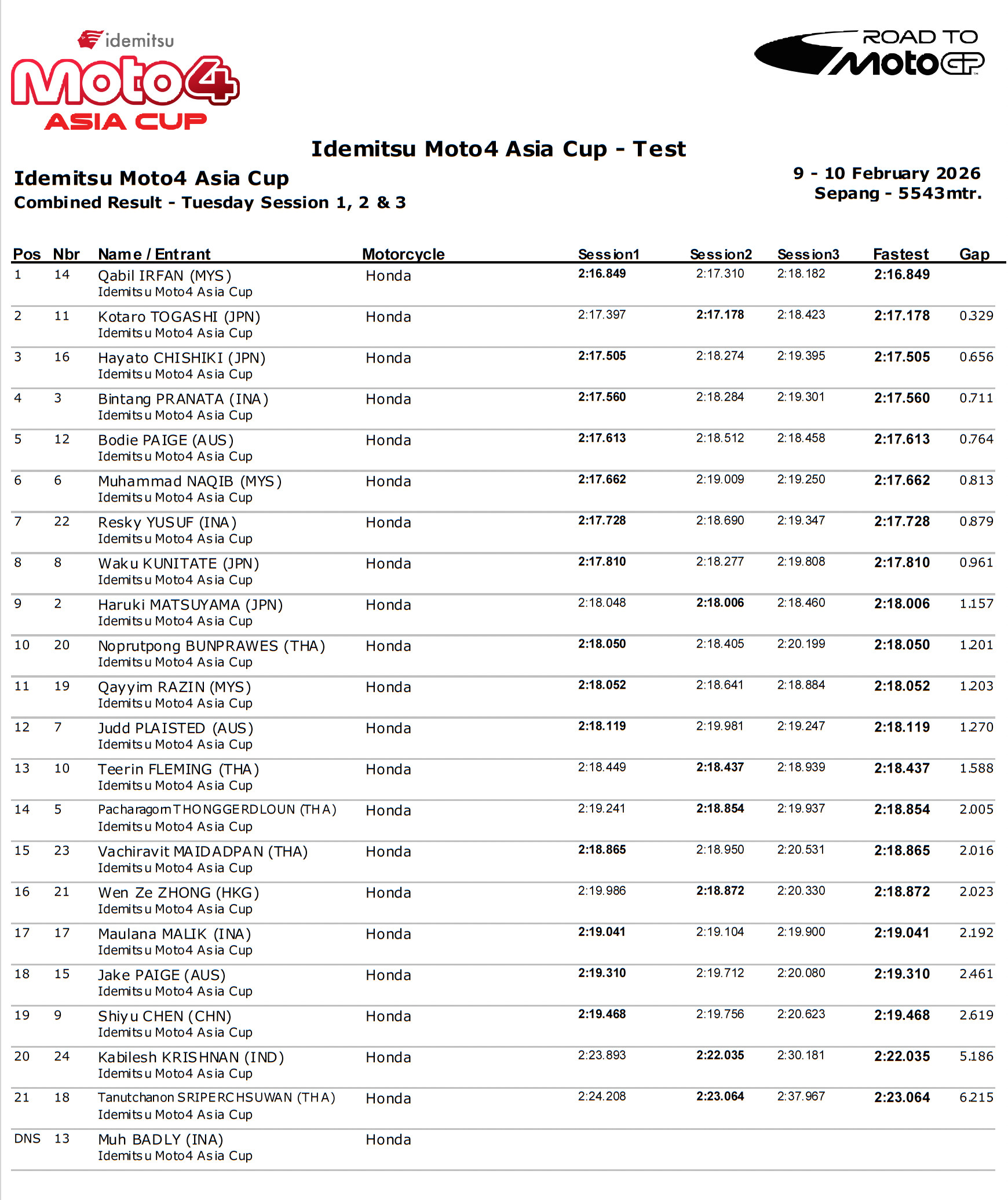
Sepang Test Results - Day Two (Combined Sessions)
Tuesday's combined morning sessions delivered clear progress for both riders:
-
Bodie Paige - 5th overall
Fastest lap: 2:17.613
 Bodie Paige (12) at Sepang. Photo courtesy Moto4 Asia Talent Cup.
 Jake Paige (15) at Sepang. Photo courtesy Moto4 Asia Talent Cup.
- Jake Paige - 18th overall
Fastest lap: 2:19.310
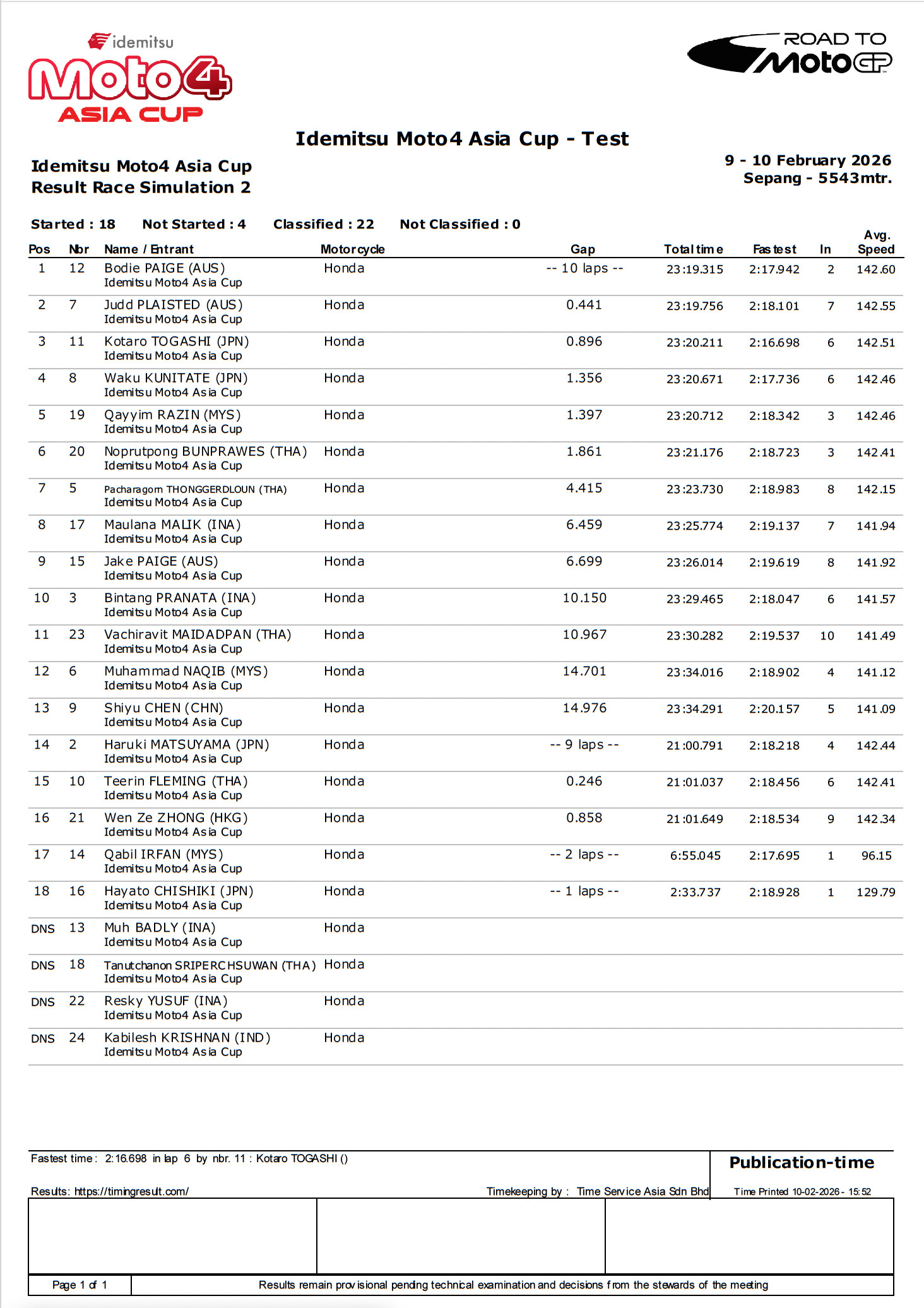
Tuesday afternoon, the Idemitsu Moto4 Asia Cup riders completed a 10-lap race simulation, where Bodie Paige delivered an impressive performance to take the win, while fellow Australian Jake Paige finished ninth as he continued building race pace and consistency.
The post Moto4 Asia Talent Cup: Positive Sepang Tests for Paige Brothers appeared first on Roadracing World Magazine | Motorcycle Riding, Racing & Tech News.
When I worked at an energy efficiency organization, a manager once said, "There are metrics and there are meaningful metrics." Some measuring yields numbers that may not be useful or applied productively. Lately while writing about electric vehicle chargers, one metric that stood out from the others was the fact ... [continued]
The post 200 Electric Trucks Can Be Charged At One Depot In A Day? appeared first on CleanTechnica.
Tesla used to absolutely dominate brand loyalty surveys in the United States, and elsewhere. The vast majority of Tesla buyers said they'd buy a Tesla again or buy a Tesla as their next vehicle. However, recent research has shown that Tesla brand loyalty has dropped a lot in the past ... [continued]
The post Tesla Buyer Loyalty Drops a Ton, But Still 3rd in USA appeared first on CleanTechnica.
US courts, scholars and Democrats are pushing back against the president's aggressive drive to boost fossil fuels
Donald Trump's aggressive drive to boost fossil fuels, including dirty coal, coupled with his administration's moves to roll back wind and solar power, face mounting fire from courts, scholars and Democrats for raising the cost of electricity and worsening the climate crisis.
Four judges, including a Trump appointee, in recent weeks have issued temporary injunctions against interior department moves to halt work on five offshore wind projects in Virginia, New York and New England, which have cost billions of dollars and are far along in development.
Continue reading...
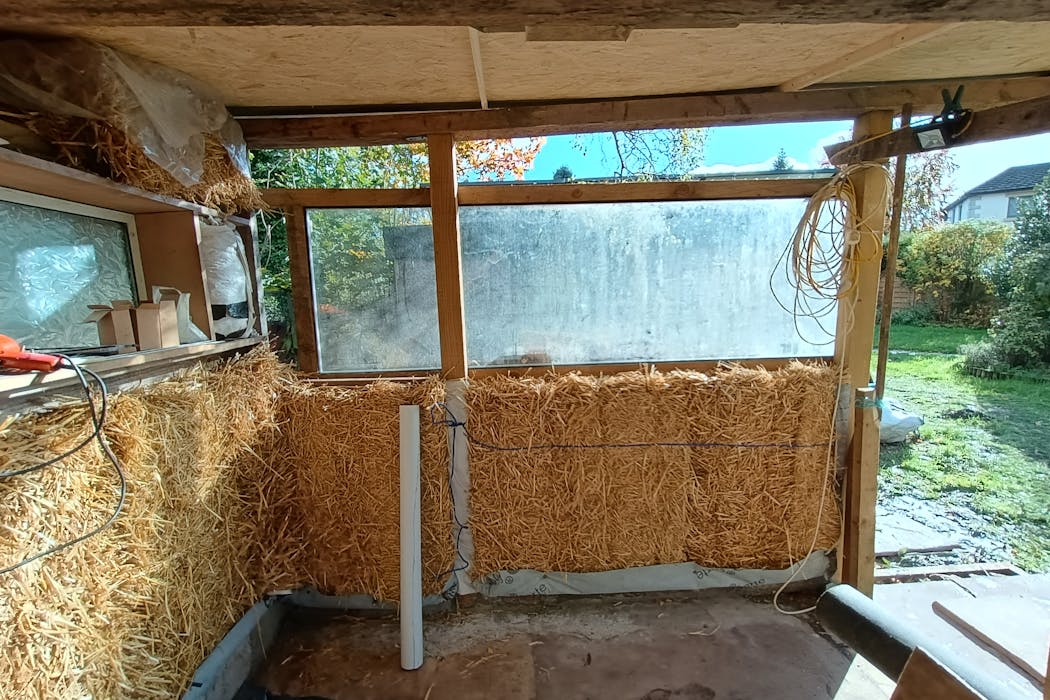 The garden office from the inside. Lorna Jackson, CC BY-NC-ND
When we moved into our house, there was a shed in the garden. Its timbers were rotten, the floor had long since disappeared into the ground, there was no door, the window had fallen out and various creatures had moved in.
I decided to rebuild it out of a material that has been used around the world for hundreds of years, but is less commonly seen in modern buildings: straw bales. A year later, and the "work shed" is now nearly finished.
As sustainability assessment lead at Sheffield University's Grantham Centre for Sustainable Futures, I wanted to make sure my garden office had the lowest possible embodied carbon (a term used to describe the amount of carbon contained, or "embodied" in the materials used to make a product), and low energy use once it was up and running.
That meant the office would need to be very well insulated to avoid using lots of energy to heat it, and made of materials with low carbon content.
Due to its structure, straw is a fantastic insulating material. It's also cheap, easy to work with, and since the straw absorbs carbon dioxide from the atmosphere as it grows, straw buildings act as carbon stores. If we use this in a building, the carbon remains stored for the lifetime of the building, and can even be returned to the soil at the end of life.
My first real involvement with straw building was through the design of a low carbon cold room in Kenya, working with energy efficiency experts from the Energy Saving Trust and Solar Cooling Engineering, and architects from Switzerland and Kenya. A cold room is an easy-to-build and cheap alternative to a large fridge, enabling farmers in developing countries to store produce at a market, improving incomes and reducing food waste.
 Stuart Walker working on his straw bale office.
Lorna Jackson., CC BY-NC-ND
Stuart Walker working on his straw bale office.
Lorna Jackson., CC BY-NC-ND
This cold room is now operating at Homa Bay market on the shores of Lake Victoria, Kenya. It has cement-free foundations, solar panels and batteries, water storage, low energy cooling units, a timber structure and straw bale walls. The project showed me that straw bale structures can provide good insulation without the environmental impact of expanded polystyrene.
Natural materials like mud, earth and dung, as well as fibrous materials such as straw were used to build homes for centuries.
Straw bale housing historyStraw in bale form has been used for buildings since the 1800s. After the invention of mechanical baler in the US, straw bales were used to construct homes in places where timber and stone were hard to find.
Some of these early buildings still exist, but most straw bale houses in the US were built since the 1970s. These buildings offer warm comfortable homes and were the inspiration for a new wave of UK straw bale builders in the 1990s.
Read more: How we can recycle more buildings
Straw works well for single or two-storey buildings, but requires careful design to avoid water leaking into it. Provided the bale buildings are protected from rain splash at the bottom and have an overhanging roof at the top, water isn't really a problem. Fire requires oxygen and fuel, so a compressed straw bale is fire resistant, and straw bale buildings have met all fire, planning, and building regulations, and even achieved Passivhaus - extremely high standards of insulation, thermal performance and energy use.
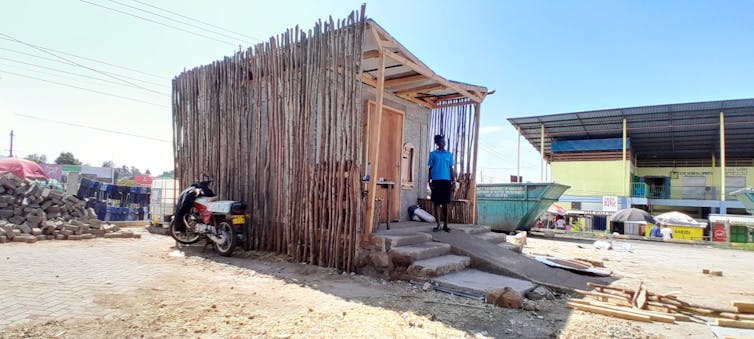 The straw bale 'fridge' built in Kenya.
Francis Maina, CC BY-NC-ND
The straw bale 'fridge' built in Kenya.
Francis Maina, CC BY-NC-ND
My new garden office has 40cm thick walls and double glazed windows, it's clad on the outside with reclaimed timber (some of which came from the original shed) and the roof, windows, doors and underfloor insulation are all secondhand. The final step is cladding the inside.
Here I've adopted another traditional building practice and used cob. Cob is a mixture of clay, water, sand and chopped straw. After digging the clay from our garden and mixing it, I've applied the cob by hand, via an incredibly messy but very satisfying process.
I know that the lifetime greenhouse gas emissions of my shed will be about 20 tonnes lower than they would have been if I had used expanded foam insulation and plasterboard.
People who live in straw bale houses talk about how the irregular shape and natural materials of straw bale buildings also have a positive impact on them, and say that buildings like my shed create a connection with the builder particular to the use of natural materials.
This concept, known as biophilic design, is challenging to quantify but I look forward to finding how it feels to sit inside it.

Stuart Walker is affiliated with The Grantham Centre for Sustainable Futures, University of Sheffield. He receives funding from the Grantham Foundation for the Protection of the Environment.
It takes time for novel designs to catch on. But even so, I am still wondering why the Zenbook Duo hasn't had a bigger impact on the market after ASUS released its first true dual-screen laptop two years ago. Notebooks like these provide the kind of screen space you'd typically only get from a dual monitor setup, but in a much more compact form factor that you can easily take on the road. It could be that people were wary of an unfamiliar design, shorter battery life or buying a first-gen product — all of which are understandable concerns. However, now that ASUS has given the ZenBook Duo a total redesign for 2026, the company has addressed practically all of those barriers to entry while making it an even more convincing machine for anyone who could use more display space. Which, in my experience, is pretty much everyone.
Editor's note: The 2026 ASUS Zenbook Duo is expected to be available for pre-order sometime in late February, with general availability slated for March.
Design
For the new model, ASUS didn't mess with the laptop's basic layout too much. Instead, the company polished and tightened everything up, resulting in a system that weighs about the same (3.6 pounds) while reducing its overall size (12.1 x 8.2 x 0.77 to 0.92 inches) by five percent. Critically, you still get a built-in kickstand on the bottom and a detachable keyboard that you move wherever you want. There's also a decent number of ports, including two USB-C with Thunderbolt 4, one USB-A 3.2 jack, HDMI 2.1 and a combo audio port. That said, I do wish ASUS had found room for an SD card reader of some kind, though given the Zenbook Duo's unique design, I get why that didn't make it.
 The Zenbook Duo's detachable keyboard gives users a ton of flexibility when it comes to utilizing both of the laptop's displays.
Sam Rutherford for Engadget
The Zenbook Duo's detachable keyboard gives users a ton of flexibility when it comes to utilizing both of the laptop's displays.
Sam Rutherford for Engadget
One of the Zenbook Duo's most important design upgrades is a new "hideaway" hinge that reduces the gap between the laptop's two screens. Not only does this make the laptop easier and more pleasant to use in dual-screen mode, it also allows the entire system to lay flat on a table, which is nice for drawing or sharing your screen with someone sitting opposite you. The sad part is that while the Zenbook Duo is compatible with the the forthcoming ASUS Pen 3.0, it doesn't come included (at least in the US). So if you want one, be prepared to pay extra.
Another small but appreciated improvement is the new pogo pins below the lower display, which provides a more secure and reliable way of keeping the laptop's detachable keyboard topped up. In my experience, even after running multiple rundown tests that completely drained the Duo's battery, I never had to charge up the keyboard on its own. It was always smart enough to sip electricity from the main system in the background, though it also has a built-in USB-C port for power just in case. On the flipside, if you're not scared of typing on glass, you can still use the lower screen as a keyboard and touchpad, or as a place to display widgets for news, the weather, performance and more.
Displays As someone who loves a desktop with dual monitors, I can't overstate how nice it is to have similar built-in functionality on a laptop.
Sam Rutherford for Engadget
As someone who loves a desktop with dual monitors, I can't overstate how nice it is to have similar built-in functionality on a laptop.
Sam Rutherford for Engadget
The standout feature on the Zenbook Duo continues to be its dual displays, and now for 2026, they look better than ever. Both OLED panels have a 144Hz refresh rate with a 2,880 x 1,800 resolution while also covering 100 percent of the DCI-P3 spectrum. And while its nominal brightness of 500 nits for SDR content is just OK, ASUS makes up for that with peaks of up to 1,000 nits in HDR. And to make both screens even more enjoyable, ASUS managed to shrink the size of their bezels down to just 8.28mm. That's a reduction of 70 percent compared to the previous model, so now there's even less getting in the way of you utilizing these screens to their fullest.
PerformanceThe Zenbook Duo can be configured with a range of new Intel Core Ultra 7 and Core Ultra 9 processors, including the X9 388H chip used on our review unit. For general use and productivity, the laptop is super smooth and responsive, though that shouldn't be a surprise coming from Intel's latest top-of-the-line mobile CPU. However, for those seeking max performance, some of the benchmark numbers aren't quite as impressive as you might expect. That's because ASUS has limited the Duo's TDP (thermal design power) to 45 watts — which is shy of the chip's 80-watt turbo power limit.
 The kickstand in back adds a bit a bulk, but it's better than not having one at all like with Lenovo's Yoga Book.
Sam Rutherford for Engadget
The kickstand in back adds a bit a bulk, but it's better than not having one at all like with Lenovo's Yoga Book.
Sam Rutherford for Engadget
In PCMark 10, the Zenbook Duo only managed a score of 7,153 compared to 9,651 from a Dell XPS 14, despite the latter having a lower-tier Intel Core Ultra X7 358H processor. That said, in other tests like Geekbench 6, the Duo had no trouble staying on top with a multicore score of 17,095 versus 9,651 for the Dell.
Another pleasant surprise is that because the Duo's chip comes with Intel's upgraded Arc B390 integrated GPU, this thing has plenty of oomph to game on, let alone edit videos or other similar tasks. In Elden Ring at 1,920 x 1,200, the Zenbook maintained a relatively stable framerate between 55 and 60 fps on high settings, which is great considering this thing doesn't have discrete graphics. This means as long as you don't mind fiddling with game options a bit, you should be able to play newer AAA games without too much trouble.
Battery life The left side of the Zenbook Duo features a full-size HDMI connector along with a USB-C port, plus a backup USB-C jack for charging the detachable keyboard.
Sam Rutherford for Engadget
The left side of the Zenbook Duo features a full-size HDMI connector along with a USB-C port, plus a backup USB-C jack for charging the detachable keyboard.
Sam Rutherford for Engadget
You'd think a laptop with two displays would be super power hungry. However, by increasing the capacity of its cell from 75WHrs to 99WHrs, ASUS has made the Zenbook Duo's endurance (or lack thereof) a complete non-issue. On PCMark 10's Modern Office rundown test, the laptop lasted 18 hours and 33 minutes in single-screen mode. Granted, that's nearly four hours less than what we got from MSI's Prestige 14 Flip AI+, but considering that's the longest-lasting notebook we've ever tested, I'm not bothered. When compared to ASUS' own Zenbook A14 (18:16), things are basically a wash, which I think is a win for the Duo, as the A14 is meant to be an ultralight system with an emphasis on portability and longevity.
Obviously, battery life takes a hit when you're using both displays. However, when I re-ran our battery test with its two displays turned on, the Duo still impressed with a time of 14:23. This is more than enough to give you the confidence to set this thing up in dual-screen mode even when an outlet isn't close at hand. Thankfully, for times when you do need a power adapter, the charging brick on ASUS' cable is rather compact, so it's not a chore to lug it around.
Wrap-up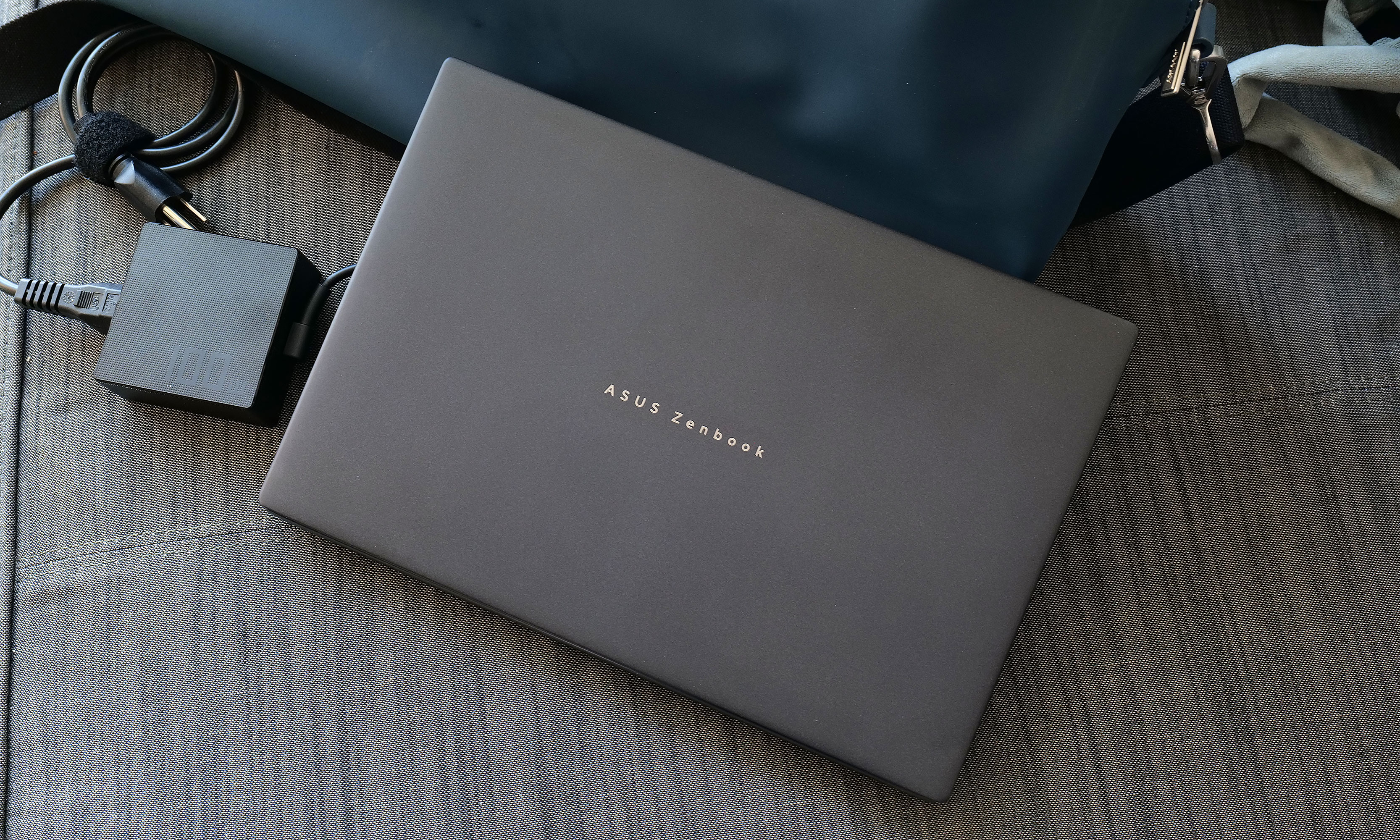 The Zenbook Duo's battery life is good enough you won't always need its power brick. Thankfully, when you do, ASUS' 100-watt adapter is relatively compact.
Sam Rutherford for Engadget
The Zenbook Duo's battery life is good enough you won't always need its power brick. Thankfully, when you do, ASUS' 100-watt adapter is relatively compact.
Sam Rutherford for Engadget
I'm a believer that one day people will eventually embrace typing on screens with laptops just like they have for smartphones. However, even if you're not willing to make that jump just yet, the Zenbook Duo still has all of its bases covered. Its detachable keyboard gives you a pleasant experience while freeing up the bottom of the notebook to be a second display. This allows you to have something similar to a traditional dual-monitor desktop but in a chassis that you can easily take on the road without any major compromises.
The 2026 Zenbook Duo combines a compact design with strong performance, plenty of ports and surprisingly good battery life. Sure, it's a touch heavier than a typical 14-inch laptop, but its two screens more than make up for a little added weight and thickness. That leaves price as the Duo's remaining drawback, and starting at $2,100 (or $2,300 as reviewed), it certainly isn't cheap.
However, when you consider that a similarly equipped rival like a Dell XPS 14 costs just $50 less for a single screen, that price difference is rather negligible. Alternatively, if you opt for a more affordable ultraportable and then tack on a decent third-party portable monitor, you're still likely looking at a package that costs between $1,500 and $1,800. Plus, that setup is significantly bulkier and more annoying to carry around. So while the Zenbook Duo might be an unconventional pick right now, it has all the tools to deliver unmatched portable productivity and I don't think it will be too much longer until the masses catch on.
This article originally appeared on Engadget at https://www.engadget.com/computing/laptops/asus-zenbook-duo-2026-review-two-screens-really-are-better-than-one-140000982.html?src=rss

The boss of one of the UK's biggest education unions - the University and College Union (UCU) - faces a hearing by statutory regulator the Certification Officer.
Whistleblowers have given evidence that Jo Grady used union resources, staff, and software to rig her own re-election. Grady won the March 2024 election by just 182 votes out of 114,310 members - 0.157% - on a 15.1% turnout. UCU union blocked any recount and would not allow candidates to attend the count.
UCU allegationsTwo other 2024 candidates, Vicky Blake (Leeds) and Prof Ewan McGaughey (King's College London), have asked the Certification Officer (CO) to order a re-run of the election. They say that O'Grady breached breached union rules and should be ordered to step down. The hearing takes place today, 10 February 2026.
UCU rules on the election of officers, executive members, and trustees expressly prohibited the use of union resources for campaigning. This includes staff, social media and email lists:

However, UCU whistleblowers came forward to the applicants with evidence that the rules had been broken. Certification Officer Stephen Hardy will review the evidence today.
Key complaints include that:
- Grady instructed UCU's senior management WhatsApp group that "every single decision we make/thing we do has to be seen through the… lens… [of] Re-elect GS [general secretary]".
- Grady said she would "destroy" people in the union who opposed her.
- According to witnesses, staff were repeatedly told by Grady and senior managers that their work should focus on re-electing her and that jobs were at risk if she lost. In her initial witness statement to the Certification Officer, - before WhatsApp screenshots came to light - Grady "vehemently" denied it.
- UCU's social media accounts and mass email lists were used for campaigning by Grady, far beyond the four emails to members permitted to each candidate, including around 13 additional emails from Grady to the membership. Grady is also accused of using union property, a union contractor and union software to produce and host campaign videos.
- Candidates had unequal access to put their case to members: Grady spoke alone at events at Bristol, Aberdeen, and Northumbria, which were advertised to members using official union email lists, where other candidates were not invited.

Under UK law, union members can ask the Certification Officer (CO) to determine whether union rules have been breached. If breaches are found, the CO can make enforcement orders to address them. Potential remedies include a declaration that rules were breached and an order to rerun an election.
Blake said:
This case is about the basic principle that union elections must be run fairly and in line with the rules that apply to everyone. Members need to be confident that union resources are not used to give any candidate an unfair advantage, and that staff who raise concerns are protected, not punished.
McGaughey said:
We are bringing this case because UCU members have a right to a union that works for them, not a union used by an incumbent to enrich herself. We are members of trade unions to improve each other's working lives, and transform society, with fair pay, equality and democracy. The WhatsApp messages showing Grady ordering UCU staff in the middle of a dispute to get herself re-elected shows how far we must go to rebuild universities and further education for good.
For further information, or to share relevant evidence in confidence about the conduct of the 2024 election, please contact ewan.mcgaughey@kcl.ac.uk and v.blake@leeds.ac.uk.
Featured image via the Canary
By Skwawkbox
Concerns over changes to Oracle's Java licensing strategy are hitting more than nine out of ten users as businesses struggle to adapt to the regime, according to research.…
Singapore spent almost a year flushing a suspected China-linked espionage crew out of its telecom networks in what officials describe as the country's largest cyber defense operation to date.…

Florida man Pascual Santana, 79, was arrested Friday and charged with armed assault after threatening a Walmart worker with a gun from the seat of his mobility scooter. Miami-Dade County Sheriff's Department told media that Santana had called the woman "derogatory names" aggressively before revealing the handgun and asking "are you scared now?" — Read the rest
The post Florida man pulls gun on Walmart worker: "Are you scared now?" appeared first on Boing Boing.


