
FOSDEM 2026 Michal Pleban knows his old kit inside out, and his talk on the CIDCO MailStation was one of the most interesting of FOSDEM for us - as well as the funniest.…
Bimota turned heads by landing podiums in their first season back in WorldSBK, now the Italian manufacturer's factory team look for sophomore success in 2026
Legacy IT issues are hampering key technical measures designed to prevent highly sensitive data leaks, UK government officials say.…
Excerpt:
submitted by /u/GravelySillyThe Federal Judicial Center has been established by statute as the "research and education agency of the judicial branch of the United States Government." As part of that role, it prepares documents that can serve as reference material for judges unfamiliar with topics that find their way into the courtroom. Among those projects is the "Reference Manual on Scientific Evidence," now in its fourth edition. Prepared in collaboration with the National Academies of Science, the document covers the process of science and specific topics that regularly appear before the courts, like statistical techniques, DNA-based identification, and chemical exposures.
When initially released in December, the fourth edition included material on climate change prepared by two authors at Columbia University. But a group of attorneys general from Republican-leaning states objected to this content. At the end of January, they sent a letter to the leadership of the Federal Judicial Center outlining their issues. Many of them focus on the text that accepts the reality of human-driven climate change as a fact.
"Nothing is 'independent' or 'impartial' in issuing a document on behalf of America's judges declaring that only one preferred view is 'within the boundaries of scientifically sound knowledge,'" the letter complains, while ignoring many topics where the document does exactly that. But the objections are only about one specific area of science: "The Fourth Edition places the judiciary firmly on one side of some of the most hotly disputed questions in current litigation: climate-related science and 'attribution.'"
[link] [comments]
Recently I learned of the Late Neolithic Collapse and think it has some interesting similarities with the current and near-future human situation. The wikipedia pages of Neolithic decline, 4.2-kiloyear event and the papers 'Repeated plague infections across six generations of Neolithic Farmers' and 'Emergence and Spread of Basal Lineages of Yersinia pestis during the Neolithic Decline' are some interesting sources.
I summarise the similarities as:
General technological slowdown and stagnation. The Neolithic Revolution slowed down or completely stopped in the Late Neolithic period, while the Moore's law failed around 2015. Since 2015, technological advance has become more marginal, speculative and much less paradigm-shifting. SpaceX just delayed Mars mission in February 2026.
Rise of a non-productive 'priest' class who discourage innovation and try to monopolise knowledge and power. The priest class dominated Late Neolithic city states and monopolised power by controlling knowledge and written material. Unfortunately we have a rising techno-feudalism who strives to achieve similar goals. They have been fairly successful in manipulating popular opinion by social media and algorithms.
Potential global crisis of climate and plague. Bubonic Plague spreaded through Late Neolithic Europe and Middle East and wiped out the majority of Anatolian Neolithic Farmers aka Early European Farmers. The 4.2-kiloyear event of global cooling was the final nail in the coffin of EEF, Longshan and Liangzhu culture. We seem to be safe from another devastating global plague but the antivax movement has gained momentum. The 2025 Texas measles outbreak can be partially blamed on decreasing vaccination rates.
Idiocracy: dumbing down of population due to significantly higher fertility rate of Ultra-religious and anti-science people. The plagues caused more devastation in the more educated Late Neolithic cities than the countryside, because the cities had higher population density and more foreign contact. The Bolivian Mennonites and Israeli Haredim have fertility rates of 6-7 and they mostly refuse to learn modern science or serve in the military. Places like Inner Melbourne have 1.0 fertility rate. The conversion rates of these Ultra-religious groups actually decreased so we can't count on them gradually assimilating into the urban population.
[link] [comments]
Smart plugs aren't the most complicated smart home device — they really just turn stuff off and on — but they do make life a little easier. Since using smart plugs, I've grown accustomed to having the living room lamps click on just before sunset and go off when I say goodnight to Alexa or the Google Assistant/Gemini (Siri can turn off a few of my lights, but isn't compatible with all of them). Most smart home device makers have a plug or two in their lineups, but finding one that's compatible with your chosen ecosystem, that's easy to set up and reliably connects can involve a little trial and error. That's why we tried more than a dozen models to find the best smart plugs you can buy right now..
Best smart plugs for 2026
The best outdoor smart plugs for 2026
Most people will likely use outdoor plugs for two things: patio lighting and holiday string lights. The devices are designed for the outdoors with a weatherproof protection rating of IP64 or higher, which means they're impervious to dust and can handle splashing water from rain and sprinklers. They have a longer Wi-Fi range than indoor plugs, for obvious reasons, and many have dual outlets, with individual control over each one.
Setup is the same as for indoor plugs: you'll use your phone to help the plug find your Wi-Fi using its companion app. The only tricky part is getting your phone within Bluetooth range of the plug (which it uses to initialize setup) and in Wi-Fi range at the same time. I had to awkwardly stand at a triangulated point in the middle of my driveway to get things communicating properly. Once set up, the plugs will communicate using your router for voice and app control and your phone needn't be anywhere near the plug.
Best uses for a smart plug
Before you buy one, it helps to know how a smart plug works best. They are designed for things that have an on/off switch, making them great for doing things like turning regular ol' lamps into smart lights. If you want a fan to move some air around before you get home, a smart plug can help. You can load a basic coffee maker with grounds and water the night before and wake up to a fresh pot in the morning. And instead of an air purifier running all day, you could set it to just run when you're away.
But gadgets that need to be programmed further, or require a stand-by mode, aren't ideal. If you want to control built-in lights, you'll need a smart light switch, which are more involved than smart plugs as they can involve in-wall installation. Smart bulbs are also an option for automation, and we have an entire guide devoted to those.
Some smart plugs can even monitor how much energy they use and display those figures within their companion app. That might not be much use on its own, as lamps with LED light bulbs consume very little energy, but it could help you keep tabs on your overall energy consumption.
What to consider when buying a smart plug Setup and useAdding a smart plug to your home is relatively simple. You'll use the manufacturer's app to initially connect, after which you can add the plug to a compatible smart home ecosystem so you can use voice control and other features. Both the brand's app and your smart home app will let you name the plug, set schedules and program "routines" which provide automation for multiple smart devices at once. But as you can guess, a manufacturer's app only lets you control products from that brand. If you want whole-home automation, operating, say, a plug from TP-Link's Kasa, a smart bulb from Philips Hue, a smart thermostat from Honeywell and a camera from Arlo without switching apps, you'll need to use a smart home platform, which means you'll need to consider compatibility.
CompatibilitySmart home devices connect through wireless protocols, often using more than one to communicate with your phone, smart speaker, router and in some cases, one another. The majority of smart plugs use Wi-Fi, but some have recently incorporated Matter, a relatively new wireless standard intended to solve integration issues between different brands and manufacturers, while also improving security and reliability.
More of these smart plugs are coming to market and, for now, most Matter devices work via Wi-Fi, Bluetooth and a low-power mesh network called Thread. Matter requires a controller that stays at home, like a hub or smart speaker, to manage things when you're out and about.
As for Bluetooth, most plugs, including all Matter plugs, use the short-range protocol to get the device set up for the first time. Some can continue to run on Bluetooth in the absence of another option, but the connection isn't as reliable and you won't be able to control the plug when you're away from home, or perhaps even just on the other side of the apartment.
Because Matter is relatively new, it may be easier to consider the manufacturer's system you'd use the most. There are four major "branded" smart home platforms: Amazon's Alexa, Google Home, Apple's HomeKit and Samsung's SmartThings. The first two work with the widest range of brands and are compatible with both iOS and Android devices. HomeKit not only limits app access to Apple devices, but it's also compatible with fewer plugs. You can also turn to open-source software like Home Assistant or go with the larger functionality of IFTTT if you want to, say, have your lights turn off when your Uber arrives. For the purposes of our testing, we stuck with the four big players. Nearly every plug we looked at clearly stated which platforms it works with, both on the packaging and retail product pages.
Of course, there's no rule that says you have to stick with one home assistant. You might have an Echo Dot in the basement, a HomePod in the living room and a Google Nest Mini in the kitchen, each controlling any compatible devices. My kid has a great time telling Alexa to turn on a light then asking Google's Gemini to turn it back off.
All of our top picks recommended here don't require a hub and connect directly to your home's Wi-Fi router. That means if you already have wireless internet and a smartphone or tablet, you can quite literally plug and play. The exception is Apple's HomeKit. If you want to pair up a compatible plug with that platform, you'll need a HomePod speaker, Apple TV or an iPad that stays in your home to enable remote control when you're away.
Some smart plugs require a hub regardless of which platform you use. For our guide, we focused on the simplicity (and lower cost) of options that work on their own, but hub-dependent devices may make sense in certain situations. Some companies, like Aqara and Lutron for example, make a vast range of smart home products, adding automatic shades, window sensors, smart locks and air quality monitors to the more traditional cameras and plugs. If you're going all-in on one brand and plan to get a plethora of connected devices, a hub can keep your Wi-Fi network from getting too crowded and provide a more seamless setup with reliable connectivity. Zigbee devices use their own protocol (different from Wi-Fi or Bluetooth) and also requires a hub.
SharingOnce a plug is set up with your platform and voice assistant of choice, anyone can control the plug just by talking. If someone else wants to control things with their phone, things get more complicated. Google makes it easiest, allowing you to invite another person just by tapping the + button within the Home app. Whomever you invite will have full access to your connected devices - including cameras - so this is only for people you trust the most.
HomeKit makes it similarly easy to grant app access to someone else, but as with most things Apple, it only works for other iOS users. Amazon only allows you to share access to your Echo, not your connected home devices.
Many smart plug manufacturers allow you to share control through their app by inviting another person via email. But this only grants access to devices of that brand. Hopefully as Matter expands, multi-admin features will become more widespread.
If you get a new Wi-Fi networkMost people will wirelessly connect their smart plugs to their home's Wi-Fi router. Matter, Z-Wave, Thread and other smart home protocols can work over local networks, but for most setups, the signals telling your plugs what to do will be dispatched through your router. If you happen to get a new one (like I did when it became clear my very basic gateway could not handle the number of smart home devices being tested) you'll need to take a few steps to get everything reconnected.
Depending on the brand, the steps may simply involve using the plug's companion app to update your credentials (network name and password). Or it will require deleting the device in the companion app, doing a factory reset (typically by pressing the onboard button for 10 seconds) and setting up the plug like it's brand new. GE Sync and Emporia plugs allow for a credentials update via their apps, others, like TP-Link Kasa and Meross plugs require deletion and a factory reset to get along with your new network. Amazon's smart plug updates automatically after updating the associated Echo device.
How we tested the best smart plugsBefore I decided which smart plugs to test, we considered brands Engadget staffers have had the best experiences with, both in review capacity and personally. We also checked out other online reviews. I then looked at factors like price, compatibility and relative popularity. Then, I tested about a dozen plugs using their companion apps and the four major smart home ecosystems. With lamps, lights, heaters, fans and more plugged into them, I set schedules, create routines, use voice control and generally live with the devices to evaluate them. I and continue to test good candidates as new models hit the market.
Other smart plugs we tested Eve Energy StripThe Eve Energy Strip only works with HomeKit and it's a bit more expensive than our pick for a smart strip. But it's an exceedingly attractive device complete with an aluminum frame and easy-to-read LED buttons. Those act as both indicators and manual switches for each of the three, individually controlled and nicely spaced plugs. Setup happens through the HomeKit app but after that, you can control the plug (and curiously, many other smart home devices active in your HomeKit profile) through the Eve Energy app. Here, you'll be able to create schedules and automations as well as monitor the plug's energy usage.
Meross Matter plug (MSS115)I wasn't able to test the Meross Matter plug fully. It requires Wi-Fi splitting, a process that's certainly possible for the average consumer, but more involved than it should be, considering the more than dozen other plugs I've tested don't require such a step. The plug itself also blocked the other outlet. Meross has an updated version of the Matter device on the way, one that looks to solve both issues and we'll update this guide accordingly once we've had a chance to test it.
Roku Smart PlugRoku's smart home gear is basically Wyze equipment with an app and packaging that are more purple. The Roku smart plug performed just fine with both compatible voice assistants (Alexa and Gemini). The companion app doesn't offer scheduling that revolves around the timing of the sunset in your area, but the plugs go for less than $10 each and if you've got a Roku TV or streaming device set up and want to keep everything on-brand, it could be a fit.
Aquara Smart PlugThe Aqara plug requires an Aqara hub. In tests, the connectivity was solid and the companion app allowed for useful if/then automations that can rope in other Aqara devices like locks, window shades, cameras and more. The plug also worked well with voice assistants from Amazon, Google and Apple. As a stand-alone plug, however, it's tough to recommend the nearly $100 combo to anyone who isn't planning to get a complete Aqara smart home setup.
Smart plug FAQs What are the disadvantages of a smart plug?While they're great when everything is working properly, smart plugs can be frustrating, adding a layer of complication to the simple act of turning on a light, if something goes wrong. For example: If your Wi-Fi goes out, your smart plug won't work. If the smart plug loses its connection to your router, it won't work. If you change your Wi-Fi password or provider, you'll have to re-program your smart plugs. If you forget what you named a particular plug during setup, you may be faced with an irritating conversation with your voice assistant. The best way to avoid some of those problems is to get a plug that works reliably, which is one of the features we considered for this guide.
How much power does a smart plug draw?Smart plugs don't draw much more power than whatever you're plugging into them. True, they remain on standby to await instructions from your smart assistant or other controller, so they're always using a small amount of power. But if, for example, you set a light to automatically turn off at night, and that light would otherwise stay on unnecessarily, the smart plug will save far more energy than the watt or two extra that it draws.
Do smart plugs use Bluetooth?Some smart plugs use Bluetooth to connect to your phone during setup. After that, most connect to your home's Wi-Fi network.
What appliances should not be plugged into a smart plug?Common sense will help you determine what not to plug in. Obviously anything dangerous like power tools should not be plugged into a smart plug. Appliances that require supervision, such as space heaters and curling irons, shouldn't be set to turn on automatically if no one will be around. You also shouldn't bother with anything that needs further programming. Simple on/off appliances like lamps and fans work best.
This article originally appeared on Engadget at https://www.engadget.com/home/smart-home/best-smart-plug-131542429.html?src=rss
Last month it was Heineken but now it's Guinness.
Cheers?

The latest ad-splash is a week-long campaign for Guinness, specifically the new brewery experience in Covent Garden which the King opened just before Christmas. Two tube stations have had a makeover, one minimally and the other more map-based. And while one aspect of the campaign is creatively brilliant, overall it's just an expensive tourist attraction overselling itself.
Here's the clever bit.

Eleven Northern line maps at Tottenham Court Road station have been 'inverted' so the line is white and the background is black, thus resembling a pint of Guinness with a white frothy top. Where the stairwells meet the platform it looks like two pints side by side. Full marks to the creative team for that idea.
It can't be a coincidence that the TfL blog sprang into rare action yesterday with a post entitled Commercial Partnerships at TfL: A balancing act. It asserts that commercial income is an essential part of TfL's wider strategy to grow and diversify revenue. It recognises they haven't always got it right ("Following the Burberry activation at Bond Street, which created some unintentional customer confusion, we reviewed and improved our approach"). And it lists three guiding qualities every time an activation like this goes live. Only one is a positive - raising money - whereas the other two are essentially 'we promise not to muck up'.
• Revenue generation - aiming to infuse colour and fun into the network while generating essential incomeThe inverted map is certainly accessible, indeed arguably clearer than the normal black on white. The only branding is a small harp beside the name of one station, assuming passengers will make the Guinness connection for themselves. Tellingly they've had to add a drinkware.co.uk URL at the bottom of the map, even at the bottom of the Central and Elizabeth line diagrams in the ticket hall, lest the tiny harp drive you to drink.
• Customer clarity - carrying out essential planning to ensure no customer is ever confused or misdirected
• Accessibility - embedded at every stage of planning and delivery, so no customer is disadvantaged

Yes they've changed some roundels, don't they always? Three on each platform have been swapped, a gold harp substituting for the red circle. Yes they've plastered a few corridors and slapped some Guinness ads up an escalator. Yes they've used black and gold along the top of the platform, though only partially. Yes there is a small toucan perched in the ticket hall, in fact two if you look carefully. No they haven't touched the Elizabeth line, not as far as I saw, because why waste extra money unnecessarily? And yes there is a large exhortation just before you leave the station to go and sample "The Home of Guinness in London", so I did.

And here's the stupid thing, Tottenham Court Road isn't the closest station to the Guinness Brewery. It isn't even the closest Northern line station, which is Leicester Square, but 95% of the marketing budget has still been spent here. The closest station is actually Covent Garden and all that has is half a dozen roundels - hardly any statement at all - but I guess the last thing TfL wants is more tourists at the deep awkward station with the busy lifts. Instead it's a 9 minute walk from Tottenham Court Road to the brewery, as the smallprint up the escalators attests, and that's assuming you know which convoluted way to go.
The Guinness Open Gate Brewery is an oddly-unfocused attraction tucked behind the streets of Covent Garden. It's partly based in historic buildings around Old Brewery Yard but also sprawls along an access corridor to a separate piazza, filling whatever floors the developers could get their hands on. Guinness was never brewed here, despite what the heritage murals might hint, and indeed isn't brewed here now. Instead the on-site microbrewery team explore "the new frontier of beer flavours", "from classic cold lagers to innovative low-percentage brews and sours with a tropical twist", "brewed to bubble at the centre of your conversations". If you manage to find a bar where they sell proper Guinness, it's all shipped in from Ireland.

And they'd rather you didn't just come for a Guinness but were tempted by alternative purchases. The most prominent door leads to a restaurant where £14 gets you a sausage and £6 a side of chips, while a more expensive seafood restaurant lurks upstairs. A portentous stairwell leads to a basement events space available for hire. If you hang around the main yard after the tables have been set out a black van will sell you a bespoke pie with a smidgeon of Guinness in the gravy. Don't try looking for a pub, there is no pub, all the better to help pay off the £73m development costs.
A separate building, opposite where Stanford's map shop ended up, hosts the experiential part of the experience. Here you can book tours to view the non-Guinnesses being brewed, take part in a tasting session and in the final room try your hand at pulling the perfect pint. I imagine the finale is seriously Insta-friendly ("come on Jason, don't let it all froth up") and that drinking said pint occupies a fair proportion of the 90 minute tour duration. Meanwhile downstairs is a Guinness store specialising in merch rather than beer, should you genuinely have need of a branded umbrella, branded beermat, limited edition tank top or weird designer creation invented for the sake of it. The supposed must-have is a personalised glass with the engraving carried out on site by faux heritage staff wearing black and gold braces, and the whole place reeks of the fundamentally unnecessary.

I'm not averse to a Guinness souvenir, my fridge is bedecked with a tortoise magnet purchased 25 years ago at the St James's Gate Brewery in Dublin. But that felt like a proper tour whereas this is just windowdressing masquerading as heritage with a price tag to match, not so much celebrating a beer as pimping a brand. And that's also why Guinness have splashed themselves across a busy tube station this week, a siren call to the neo-proletariat to visit WC2 for an extended black and white experience. Londoners won't be getting lower tube fares as a result but some marketing executives will be very happy, and that's the only pure genius frothing up here.
As OpenAI walks the advertising tightrope to balance revenue gains against credibility and safety, ad kingpin Google is roaring ahead to use AI to improve its advertising products.…
Plans by the Donald Trump administration to fund right-wing groups in Europe have been slammed by policymakers and campaigners as an effort to "usurp European democracy".
According to the Financial Times, the U.S. State Department plans to bankroll think tanks and charities in the UK and Europe which share President Trump's agenda, with particular focus on blocking attempts to regulate U.S. social media platforms.
Daniel Freund, Member of the European Parliament (MEP) for the Greens, told DeSmog that the funding had "one clear aim: to divide and destabilise Europe."
"We must clearly name, criticise, and reject such foreign interference," he added.
Sarah Rogers, U.S. under secretary of state for public diplomacy, is leading this effort, having visited the UK, France, and Italy in early December.
Her visit coincided with the publication of a new U.S. national security strategy, which called for "cultivating resistance" in Europe to liberal, democratic politics.
"The U.S. has a long history of covert manipulation of politics across the globe. But to see it happen in Europe is new, and we should be worried," said Kenneth Haar of the transparency watchdog Corporate Europe Observatory. "Big Tech regulation is set to be the first testing ground of the new American way of imposing their will on Europe."
Subscribe to our newsletterStay up to date with DeSmog news and alerts
Email Address What content do you want to subscribe to? (check all that apply) All International UK Sign Up (function($){ $('.newsletter-container .ijkidr-us').click(function() { $('.js-cm-form').attr('data-id', '2BE4EF332AA2E32596E38B640E905619D07B21962C5AFE16D3A2145673C82A3CEE9D9F1ADDABE965ACB3CE39939D42AC9012C6272FD52BFCA0790F0FB77C6442'); $('.js-cm-email-input').attr('name', 'cm-vdrirr-vdrirr'); }); $('.newsletter-container .ijkidr-uk').click(function() { $('.js-cm-form').attr('data-id', '2BE4EF332AA2E32596E38B640E905619BD43AA6813AF1B0FFE26D8282EC254E3ED0237BA72BEFBE922037EE4F1B325C6DA4918F8E044E022C7D333A43FD72429'); $('.js-cm-email-input').attr('name', 'cm-ijkidr-ijkidr'); }); })(jQuery);The new U.S. fund would be the latest attempt by Trump and his allies to thwart EU regulations. DeSmog last week reported on a gathering of pro-Trump groups in the European Parliament, during which they turned their fire on the EU's Digital Safety Act, which aims to tackle the harms caused by social media.
Trump was re-elected in November 2024 following a $270 million donation from the owner of social media platform X Elon Musk, and received $1 million each from the heads of Meta, Apple, Google, Microsoft and Amazon for his inauguration fund.
The event in Brussels was attended by the Heritage Foundation, the radical right-wing think tank which drafted Project 2025 - the authoritarian, anti-climate blueprint for Trump's second term.
The Heritage Foundation has been one of the key MAGA ("Make America Great Again") groups attempting to influence European politics since Trump's re-election.
As reported by DeSmog, the group gathered hardline conservative groups last year to discuss ideas for dismantling the EU. It also attempted to influence Albania's election in favour of its conservative candidate in May 2025.
The group has been joined by the Heartland Institute, which has been leading the campaign to spread climate science denial across the UK and EU. The group claims to be advising Nigel Farage's anti-climate party Reform UK, while it has been forging alliances with far-right parties and campaigners in an attempt to gain a foothold in Europe.
Both groups lobbied aggressively - and successfully - for the dilution of EU laws designed to hold large companies, including U.S. firms, to account for their environmental impacts. They also forcefully oppose the EU's digital safety laws.
Raphael Kergueno, senior policy officer at Transparency International, said that the new pro-Trump fund adds to growing concern about MAGA's influence over EU laws.
"Transparency loopholes are allowing the MAGA movement's illiberal organisations to usurp European democracy from the inside," he said. "As a matter of urgency, the rules must be changed to compel them to register on the EU's lobby register and declare their funding, so that their blatant attempts to bring authoritarianism to Europe can be scrutinised, and thwarted."
Patrick ten Brink, secretary-general of the European Environmental Bureau, added: "The reporting in the Financial Times confirms what many civil society organisations have been warning about for some time: there is a coordinated effort to import US-style culture-war politics into Europe, using funding, think-tanks and so-called 'charitable' fronts to weaken democratic safeguards.
"Europe's response should be clear-eyed and proportionate. Defending transparency, independent NGOs and evidence-based policymaking is essential to the EU's democratic resilience and its ability to govern in the public interest. EU policymakers should take care not to weaken environmental and social protections or undermine public well-being in ways that ultimately serve external deregulation agendas."
MAGA UKMAGA's influence is also being felt in the UK, where climate and digital safety regulations are likewise under fire.
Farage is a close Trump ally, stating repeatedly that he is the "bravest man".
The Reform leader has also been helping to import the architects of Trump's agenda into the UK, having urged the Heartland Institute to set up a branch in the UK and Europe.
As revealed by DeSmog, Farage has received £150,000 from his donors to attend pro-Trump events or cheerlead for his agenda since he was elected to Parliament in July 2024.
A new Reform-linked think tank, the Centre for a Better Britain, was launched last year by James Orr, a close friend of U.S. vice president J.D. Vance and now a senior Reform advisor. The Centre for a Better Britain, set up by Reform donors, is reportedly seeking to raise millions from Trump backers.
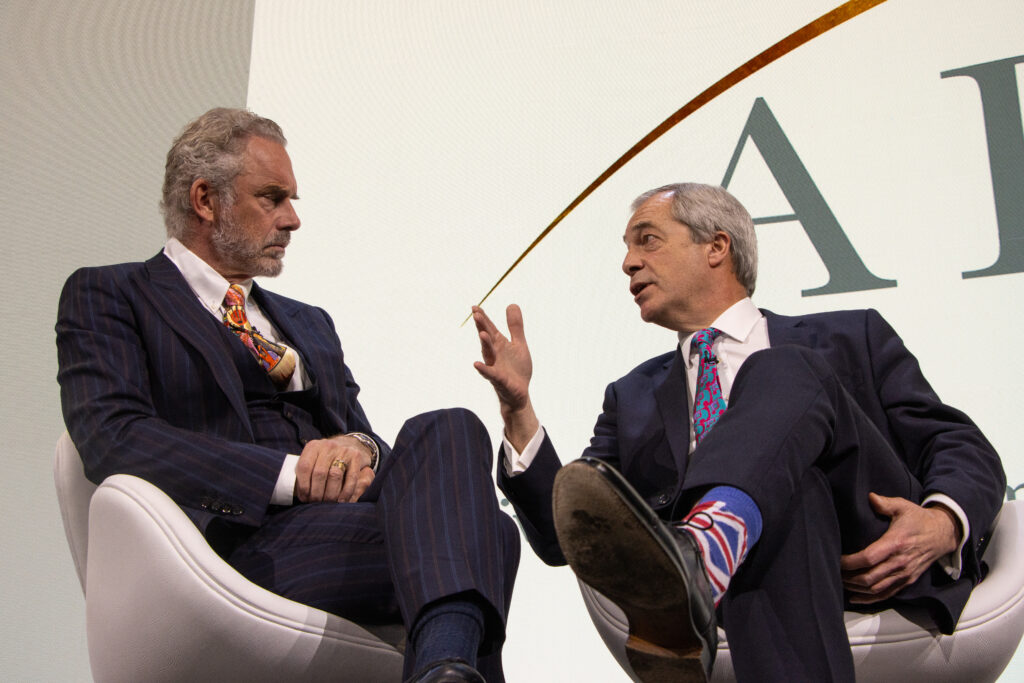 Jordan Peterson speaks with Reform UK leader Nigel Farage at ARC. Credit: Marc Fawcett-Atkinson
During her visit to the UK in December, head of the new U.S. fund, Sarah Rogers, was hosted at an event by the Prosperity Institute (formerly Legatum Institute). The conservative think tank is run by UAE-based investment firm Legatum Group, which co-owns right-wing broadcaster GB News, Farage's principal employer.
The event related to the UK's Online Safety Act (OSA), which requires U.S. social media companies to remove illegal content such as child pornography. Along with the EU's DSA, the OSA has been attacked by the Trump administration for what it calls the "censorship" of Americans' free speech.
Rogers spoke at the event alongside Zia Yusuf, Reform's head of policy, and Conservative peer Toby Young, who runs the Free Speech Union, a conservative pressure group.
It is not clear which groups Rogers met with in France or Italy. In Washington D.C. in December she hosted Markus Frohnmaier, a Member of the German Parliament for the far-right Alternative für Deutchland (AfD) party, according to a post she shared on social media platform X.
The Legatum Group also helps to run the Alliance for Responsible Citizenship (ARC), a radical right-wing network group led by Canadian activist Jordan Peterson. ARC has been a key platform for MAGA figures and far-right European politicians, with its latest London conference planned for this summer.
Speakers at ARC events have included U.S. energy secretary Chris Wright, Republican House speaker Mike Johnson, and Republican donor and Palantir founder Peter Thiel. Last year's ARC event in London was also attended by several oil and gas executives.
"It is time to consider what can be done legally," Haar of Corporate Europe Observatory said. "When it comes to China or Russia, there are measures in place to defend the public from undue influence. We really need to figure out quickly how the American threat can be handled effectively.
Dieter Plehwe, an academic at the Berlin Social Science Center likewise called for stronger transparency laws, stating: "It would be wise to increase the opportunities for investigative journalists, academic researchers and the public at large to understand who is behind think tank and media campaigns."
The post Trump Accused of Trying to 'Divide and Destabilise' Europe Through New MAGA Fund appeared first on DeSmog.
The Trump administration just employed the U.S. Environmental Protection Agency (EPA) and the Clean Air Act to discourage coal plant closures in Colorado — repurposing measures initially intended to safeguard public health and prevent pollution to reboot the dirtiest, deadliest fossil fuel.
Michael Hiatt, deputy managing attorney at the environmental legal nonprofit Earthjustice, told DeSmog that the EPA's action was not what the Clean Air Act intended. "In our view, it's plainly illegal," he said.
Furthermore, Hiatt said the EPA's move may have implications beyond Colorado, indicating that the agency could take similar actions that affect coal and gas plants elsewhere.
"It's clearly EPA indicating a policy preference," he said. "They are communicating that they're not going to look favorably on future state plans that include coal or gas plant closures."
As aging, inefficient coal plants barrel toward obsolescence across the U.S., the Trump administration seems dead-set on coming to their rescue. In 2025, the U.S. Department of Energy issued orders to keep five coal plants online past their planned retirement dates. The orders often came against their operators' wishes and cost customers millions in the process. Federal officials, including Energy Secretary Chris Wright, frequently cited increasing energy demands, including for artificial intelligence. Now, the EPA has stepped in.
Subscribe to our newsletterStay up to date with DeSmog news and alerts
Email Address What content do you want to subscribe to? (check all that apply) All International UK Sign Up (function($){ $('.newsletter-container .ijkidr-us').click(function() { $('.js-cm-form').attr('data-id', '2BE4EF332AA2E32596E38B640E905619D07B21962C5AFE16D3A2145673C82A3CEE9D9F1ADDABE965ACB3CE39939D42AC9012C6272FD52BFCA0790F0FB77C6442'); $('.js-cm-email-input').attr('name', 'cm-vdrirr-vdrirr'); }); $('.newsletter-container .ijkidr-uk').click(function() { $('.js-cm-form').attr('data-id', '2BE4EF332AA2E32596E38B640E905619BD43AA6813AF1B0FFE26D8282EC254E3ED0237BA72BEFBE922037EE4F1B325C6DA4918F8E044E022C7D333A43FD72429'); $('.js-cm-email-input').attr('name', 'cm-ijkidr-ijkidr'); }); })(jQuery);In late January, the EPA issued its final published rule rejecting Colorado's Regional Haze State Implementation Plan, filed as part of longstanding Clean Air Act rules intended to increase visibility in national parks and wilderness areas. As part of the plan, Colorado had outlined its goal of closing its six remaining coal plants by 2031. Coal plants release multiple smog-forming pollutants that threaten the state's outdoor recreation industry and harm human health. The utilities involved had voluntarily agreed to this target over the past decade.
It could have been a routine approval. But at some point in 2025, Colorado Springs' city-owned utility told the EPA it no longer wanted to shut down the lone coal-fired generator at the Ray D. Nixon Power Plant, as initially proposed.
The EPA used that development to justify throwing out the entire plan, jeopardizing pollution controls and retirement timelines for industrial sites across the state — from fossil fuel plants and the state's only oil refinery to the Denver International Airport. In its final rule, the EPA argued the single "forced closure" of a coal-fired unit showed Colorado hadn't been careful to make sure its plan respected the constitutionally enshrined private property rights of energy providers.
"The state did not properly consider and explain whether the nonconsensual closure of Colorado Springs Utilities' Nixon Unit 1 power plant would be an act of taking private property without compensation," the agency wrote in a press release explaining its decision. "EPA legally cannot approve Colorado's [plan].
Critics took issue with that assessment.
"Colorado had done such a very thorough job working with utilities, and those retirements were voluntarily proposed," said Ulla Britt-Reeves, clean air program director at the nonprofit National Parks Conservation Association. "So for EPA to come in and essentially say that Colorado was forcing those retirements is simply not true."
Earthjustice's Hiatt told DeSmog that the EPA's decision was "unreasonable, irrational, and illegal under the Clean Air Act."
He added that, "What this EPA action shows is this Trump administration taking an ideologically motivated stance that it is not going to do anything that might prove or even allow a coal plant to retire under its watch."
RELATED: These 15 Coal Plants Would Have Retired. Then Came AI and Trump.
Hiatt hopes the EPA's broad disapproval in Colorado won't impact the many other agreed-upon plant closures and pollution controls covered by the plan. But he expressed worry that the EPA's action gives the state's utilities and industrial operators an opportunity to "backtrack" on environmental commitments in the coming years.
In a proposed rule issued in July, the EPA initially emphasized a different rationale for its pending decision: that closing the coal-fired unit at Nixon would threaten grid reliability — in large part due to a supposed surge in electricity demand, including from artificial intelligence. The agency accused Colorado of not taking grid reliability seriously. Under President Trump, the EPA has listed artificial intelligence (AI) development as one of the top priorities guiding its strategy, as well as restoring "American Energy Dominance," which Trump has tied specifically to oil, coal, and natural gas.
"This Administration has found as a matter of national interest, national security, and energy policy that power generated from coal resources is critical to addressing this surging demand," it wrote.
Throughout 2025, Trump administration officials, including DOE Secretary Wright, used a purported rise in energy demand driven by AI to justify fossil fuel expansion, and prevent scheduled coal plant retirements. A December 2025 analysis by DeSmog found that at least 15 coal plants pushed back their retirement dates since Trump took office — with plants often remaining open voluntarily due to projected data center demands, but sometimes due to DOE executive orders. After DeSmog's story published, the DOE issued a flurry of new executive orders forcing additional coal generators to remain online, including plants in Indiana and Washington that were targeted for the first time.
RELATED: Q&A: Tech Billionaires' AI Space Empire Fantasies Are 'An Insidious Form of Climate Denial'
In its public comments, the State of Colorado argued it had in fact assessed reliability, in conjunction with utilities statewide, and that planned closures weren't projected to contribute to an energy shortfall.
"EPA cites nothing in the record regarding this alleged 'rise in electricity demand' or 'resurgence of domestic manufacturing' or even the 'construction of artificial intelligence data processing centers," the state's Air Pollution Control Division wrote." The record before EPA … provides no basis to conclude that these issues materially affect Colorado or are impacted by the specific units with Closure Dates."
The EPA backtracked slightly in its final rule in January, insisting that grid reliability was not part of its legal determination — only private property considerations. And yet it seemed to warn Colorado against including power plant closures in any future plan, citing the rise in domestic manufacturing and "the construction of artificial intelligence data processing centers."
"Power generated from coal resources is critical to addressing this surging demand and a matter of national interest, national security, and energy policy," it wrote. "The EPA does not encourage electric generating facilities to close in the face of this energy demand."
It added that "the EPA does not expect any state to encourage or force an electric generating facility to close in order to comply with the [Clean Air Act's] regional haze second planning period requirements."
Earthjustice's Hiatt said that statement shows EPA going beyond its disapproval of Colorado's regional haze plan. "It's difficult to say how this will play out," he said, "but it does clearly indicate EPA's policy preference — they do not want to see coal or gas closures in regional haze plans."
"There are a lot of still outstanding haze plans that this EPA needs to act on," Britt-Reeves, of the National Parks Conservation Association, said. "Are they going to let good plans that actually reduce pollution be approved? That would a great place to go from here — but I don't expect that that's where this administration is heading." She said the language in the final rule indicates that EPA may have "its sights on deregulating the rule itself, which is extremely concerning."
An EPA spokesperson declined to provide comment or arrange an interview for this story. In a press release announcing its decision on Colorado's haze plan, EPA cited "turning the United States into the Artificial Intelligence capital of the world" as part of its rationale.
But though EPA spoke of a "forced closure" of the Nixon plant, Colorado Springs Utilities had in fact voted to retire the plant voluntarily by December 31, 2029 — which Colorado had simply noted in its plan. In comments to DeSmog, Danielle Nieves, a spokesperson for Colorado Springs Utilities, confirmed that the utility had reversed course and asked EPA for "non-enforcement" at some point in 2025, years after the plan had been filed.
Matt Gerhart, a Sierra Club attorney, questioned whether it was appropriate for the EPA to disapprove an entire state plan based solely on an 11th-hour change of heart — a precedent that he said could give EPA an excuse to sit on plans it doesn't like until it found some grounds for dismissal.
"There's nothing in EPA guidance that says what the state was supposed to do to guard against the hypothetical possibility that, five years later, a source might change its mind about a retirement," he said. "I think EPA is really faulting the state for following the agency's own guidelines here."
Jeremy Nichols, a senior advocate for the environmental nonprofit Center for Biological Diversity, expressed concern that the EPA's actions would set a troubling precedent, undercutting the legality of environmental regulation itself.
"What's next? Is any kind of clean air regulation going to be deemed to infringe upon a private property right by virtue of making it more costly and potentially forcing a company to have to shut down?" he said. "I mean, it's a very dangerous and scary slippery slope."
In a statement to DeSmog, Colorado's Senior Director of Air Quality Programs Michael Ogletree said the EPA's ruling would damage environmental protections in Colorado, which already has some of the worst air quality problems in the nation, and that the state was exploring next steps.
"Coal plant retirement dates remain in state regulation, and many facilities have already closed or are on track to retire voluntarily because cleaner energy is more affordable and makes economic sense for consumers," he wrote. "Colorado has demonstrated that it is possible to protect public health, reduce pollution, and maintain a reliable energy system at the same time."
The post Trump's EPA Just Used the Clean Air Act to Prop up Coal Power appeared first on DeSmog.
Kincraig, Badenoch: The Loch Insh Old Kirk is a compelling place, and yet, like the copious wildlife here, it is on the edge of existence
The snow has retreated to the tops of the Cairngorms and the last fragments of ice are crumbling at the edges of Loch Insh. In a muddy landscape, an old white church rises on a knoll on the northern shore. The simple stone building with its bell tower and arched windows dates to 1792, though the site was established by early monks from Iona, probably as far back as the seventh century. Indeed, some sources claim this as the site of longest continuous Christian worship in Scotland.
Those early monks would have built a stone cell here as a dwelling and a base for evangelising. A later chapel was dedicated to St Adamnan - the ninth abbot of Iona and Columba's biographer - and a rough granite font remains from that time. The monks rang a bell to announce worship and the kirk still holds a bronze bell dating to AD900, one of only five left in Scotland. Resonant with legends, the bell was believed to have the power of healing and was once stolen and carried to Scone Palace - but it flew home, tolling the chapel's name all the way over the Drumochter Pass.
Continue reading...
An article title caught my attention today for a couple of reasons. The title of the article is: "Major Automakers Have Written Off $55 Billion After Overestimating EV Demand." Hmm…. First of all, the thing that jumped out to me was $55 billion. That's a lot of freakin' money! The ... [continued]
The post Why Have Automakers Written Off $55 Billion In EV Investments? appeared first on CleanTechnica.
The following article was published yesterday by the University of Sitrling.
Reforestation is a noble endeavor but it seems to come with a lot of practical issues. As much as I want to rant about monoculture and the death of old growth forests, the article is actually talking about the loss of carbon-storing soil.
Soil stores roughly 2,500 gigatons of carbon - compared to 800 gigatons in the atmosphere and nearly 600 gigatons in terrestrial vegetation. But you can't see it happening, not really, so it is often ignored by climate models and even environmentalist groups.
Collapse related because our tree planting schemes are failing - to say nothing of fancier methods of CCS - and this is likely to cause major environmental problems for future generations.
submitted by /u/Fast_Performer_3722[link] [comments]
Toyota City, Japan — Toyota Motor Corporation (Toyota) announced that it will expand its battery electric vehicle (BEV) lineup in North America as part of its multi-pathway approach toward achieving a carbon-neutral society. As part of this effort, Toyota Motor North America (TMNA), Toyota's North American business entity, premiered a ... [continued]
The post Premiere of 3-Row Highlander BEV in North America appeared first on CleanTechnica.
NASHVILLE, Tennessee — Combining all-electric convenience for daily commutes with the familiar flexibility of a gasoline engine for longer journeys, the 2026 Nissan Rogue Plug-in Hybrid will reach dealerships in February with a Manufacturer's Suggested Retail Price1 starting at $45,990 for the SL grade. The 2026 Nissan Rogue Plug-in Hybrid offers an estimated ... [continued]
The post 2026 Nissan Rogue Plug-in Hybrid Pricing Starts at $45,990 appeared first on CleanTechnica.
Waymo is hitting so many milestones these days that it's not even highlighting some of them. It keeps entering city after city, scaling up different stages of testing and commercial rides there, and then becoming many residents' favorite mode of transport in those places. The news today is that Waymo ... [continued]
The post Waymo 100% Driverless in Nashville appeared first on CleanTechnica.
Huge thanks to my February sponsor, John Rember, author of the three-book series Journal of the Plague Years, a psychic survival guide for humanity's looming date with destiny, shaped by his experiences living through the pandemic in his native Idaho. Thoughtful, wry and humane, Journal 1 is a pleasure.
 "Global economy must move past GDP to avoid planetary disaster, warns UN chief…
"For decades, politicians and policymakers have prioritised growth - as measured by GDP - as the overarching economic goal. But critics argue that endless, indiscriminate growth on a planet with finite resources is driving not only the climate and nature crisis but increasing inequality."
 "Climate risk threatens credit ratings for dozens of countries.
"Developing nations face a growing financial crisis due to climate change. Countries least responsible for pollution are most vulnerable to disasters. High debt and poor credit ratings make it harder to secure funds for protection and clean energy."
 "Weaponizing the dollar: Could Trump's trade war backfire on American prosperity?
"Tariffs help no one. They have nudged supply chains away from US, dented their reputation as a reliable partner, triggered an affordability crisis, and created virtually no jobs…"
 "Gilt yields soar again as No10 turmoil rocks the markets… sparking fears of a Liz Truss-style financial crisis.
"The boss of one of Britain's biggest banks has called for 'stability' and 'certainty' as doubts over Sir Keir Starmer's future wreaked havoc on the bond markets."
 "Lower-income families face 137-year wait for living standards to double, says UK thinktank…
"A two-decade stagnation in disposable incomes has created a "mood of unease" across the country, the Resolution Foundation says, warning of the risk of "further political disruption" unless pay growth accelerates."
https://www.theguardian.com/uk-news/2026/feb/10/lower-income-families-living-standards
 "French President Emmanuel Macron said in remarks published on Tuesday that Europe is facing a serious political and economic crisis.
"Speaking to several newspapers ahead of a European Union (EU) leaders meeting on Thursday, the French president said the bloc risks being "swept aside" in the face of competition from the United States and China."
https://www.dw.com/en/macron-warns-europe-faces-political-and-economic-crisis/a-75890865
 "Dark fleet expansion looms as EU seeks to cut maritime lifelines for Russian oil.
"Russia's shadow tanker fleet faces greater pressure, although it is forecast to rise in numbers, if the European Commission's proposed a 20th sanctions package gets voted through later this month."
 "Ukrainian Strikes Take a Heavy Toll on Russia's Oil Refineries.
"Ukrainian attacks on Russian oil refineries cost Russia's oil and gas sector as much as $12.9 billion (1 trillion Russian rubles) last year, according to a local insurance broker."
 "In Ukraine, deaths from hypothermia rise as Russia attacks energy system…
"Dozens of attacks since 2022 have deprived millions of people throughout Ukraine of heat, power and running water as winter temperatures have dropped far below minus 10 degrees Celsius (14 degrees Fahrenheit), covering roads and the Dnipro, Europe's fifth largest river, with thick ice."
 "China Urges Banks to Curb Exposure to US Treasuries…
"Communicated verbally to some of the nation's biggest banks in recent weeks, the guidance reflects growing wariness among officials that large holdings of US government debt may expose banks to sharp swings, the people said. The worries echo those made by governments and fund managers elsewhere…"
 "China property sales forecast cut by S&P as market slump deepens.
"S&P Global Ratings has downgraded its forecast for China's property sales in 2026, now predicting a 10% to 14% decline compared to its earlier October estimate of a 5% to 8% drop."
 "China steps up dangerous air encounters near Taiwan.
""It is not the behaviour you expect from a professional fighter pilot but more resembles a gangster swinging his gun around as they walk down the street," said one person familiar with the incidents."
https://www.ft.com/content/66a59c7c-5a22-482c-9363-71cb016ceb01
 "Beware of 'right-wing spiral' driven by interaction between Japanese politics and internet rightwingers…
"Among the many factors contributing to Takaichi and the LDP's victory in the House of Representatives election, a core strategy was leveraging the online right-wing group and releasing even more right-wing rhetoric and adopting populist practices."
https://www.globaltimes.cn/page/202602/1355129.shtml
 "Internet shutdown in Manipur's Ukhrul for 5 days following arson, communal unrest [India].
"The Manipur government on Tuesday suspended internet and data services across Ukhrul district for five days, citing a volatile law and order situation following fresh violence in the area."
 "Early warning report flags emergency hunger risk in parts of Afghanistan…
"Poor households in these provinces have exhausted food stocks from their own production and are expected to rely almost entirely on markets, despite extremely weak purchasing power…"
 "Turkey Says It Could Be Dragged Into Nuclear Arms Race Over Iran.
"Turkey would consider joining a regional nuclear arms race over concerns about Iran's nuclear weapons ambitions, Turkish Foreign Minister Hakan Fidan said late Monday."
 "Turkey's army chief says 'no plans to withdraw' from Syria…
"The precise figures remain undisclosed by Turkey, but at least 10,000 Turkish troops are believed to be deployed across northern Syria. Last year, the pro-government Daily Sabah estimated the number of Turkish soldiers in the country at 20,000."
https://www.al-monitor.com/originals/2026/02/turkeys-army-chief-says-no-plans-withdraw-syria
 "Lebanese group accuses Israel of abducting its leader in raid…
"The al-Jamaa al-Islamiya accused Israel on Monday of seizing its official Atwi Atwi from his home in the Hasbaiyya district and taking him to an unknown location."
 "Ethiopia hosts covert training base for Sudan's RSF fighters: Reports.
"Ethiopia is reportedly hosting a covert camp in its western Benishangul-Gumuz region to train thousands of Rapid Support Forces fighters for Sudan's civil war, with sources alleging UAE funding and support."
 "Algeria accuses the UAE of interference in elections…
"Algeria and the UAE have faced off against each other in North Africa repeatedly in recent years, with Tebboune accusing the Emiratis of playing a destabilising role in a number of countries in the region."
https://www.middleeasteye.net/news/algeria-accuses-uae-interference-elections
 "US seizes Venezuela-linked oil tanker in Indian Ocean.
"The Pentagon said on Monday that it captured the tanker as part of a campaign by US President Donald Trump to cut off Venezuela's oil exports, which critics have slammed as "theft" and international piracy."
https://www.aljazeera.com/amp/news/2026/2/9/us-seizes-venezuela-linked-oil-tanker-in-indian-ocean
 "Cuba's capital airport declares jet fuel unavailable as energy crisis deepens.
"Cuban authorities have formally notified that the island nation's main airport has run out of aviation fuel. "Havana airport has issued a NOTAM effective 10 February which states that Jet A-1 fuel is "not available"."
 "Alphabet Embarks on Global Bond Spree to Fund Record [AI] Spending…
"It's also planning debut deals in Switzerland and the UK, including a rare sale of 100-year bonds — marking the first time a tech company has tried such an offering since the dotcom frenzy of the late 1990s."
https://finance.yahoo.com/news/alphabet-looks-raise-15-billion-133028283.html
 "AI Doesn't Reduce Work—It Intensifies It…
"In an eight-month study of how generative AI changed work habits at a U.S.-based technology company with about 200 employees, we found that employees worked at a faster pace, took on a broader scope of tasks, and extended work into more hours of the day…"
https://hbr.org/2026/02/ai-doesnt-reduce-work-it-intensifies-it
I rely on donations and tips from my readers to keep the site running. Every little bit helps. Can you chip in even a dollar? Buy me a coffee or become a Patreon supporter. A huge thank you to those who do subscribe or donate.
You can read the previous "Economic" thread here. Panopticon hopes to be back tomorrow with a "Climate" thread.
The post 11th February 2026 Today's Round-Up of Economic News appeared first on Climate and Economy.
Emissions have plunged 75% since communist times in the birthplace of big oil - but for some the transition has been brutal
Once the frozen fields outside Bucharest have thawed, workers will assemble the largest solar farm in Europe: one million photovoltaic panels backed by batteries to power homes after sunset. But the 760MW project in southern Romania will not hold the title for long. In the north-west, authorities have approved a bigger plant that will boast a capacity of 1GW.
The sun-lit plots of silicone and glass will join a slew of projects that have rendered the Romanian economy unrecognisable from its polluted state when communism ended. They include an onshore windfarm near the Black Sea that for several years was Europe's biggest, a nuclear power plant by the Danube whose lifetime is being extended by 30 years, and a fast-spreading patchwork of solar panels topping homes and shops across the country.
Continue reading...Vast flocks of birds return to Somerset and a rare grebe turns an ordinary walk into something special
After weeks of heavy rain, Cheddar reservoir in Somerset is finally full again - of water, and of birds. Thousands of coots, hundreds of gulls and ducks, and dozens of great crested grebes crowd the surface, some already moulting into their smart breeding plumage, crests and all.
They feed almost constantly, building up energy reserves for the breeding season. Among the throng are some less familiar visitors: a flock of scaup, the males bulkier than the nearby tufted ducks, with pale grey backs that catch the light. Flocks of goosanders dive frequently for food, the colourful males looking like a cormorant in extravagant drag.
Continue reading...
EFF is against age gating and age verification mandates, and we hope we'll win in getting existing ones overturned and new ones prevented. But mandates are already in effect, and every day many people are asked to verify their age across the web, despite prominent cases of sensitive data getting leaked in the process.
At some point, you may have been faced with the decision yourself: should I continue to use this service if I have to verify my age? And if so, how can I do that with the least risk to my personal information? This is our guide to navigating those decisions, with information on what questions to ask about the age verification options you're presented with, and answers to those questions for some of the top most popular social media sites. Even though there's no way to implement mandated age gates in a way that fully protects speech and privacy rights, our goal here is to help you minimize the infringement of your rights as you manage this awful situation.
Follow the DataSince we know that leaks happen despite the best efforts of software engineers, we generally recommend submitting the absolute least amount of data possible. Unfortunately, that's not going to be possible for everyone. Even facial age estimation solutions where pictures of your face never leave your device, offering some protection against data leakage, are not a good option for all users: facial age estimation works less well for people of color, trans and nonbinary people, and people with disabilities. There are some systems that use fancy cryptography so that a digital ID saved to your device won't tell the website anything more than if you meet the age requirement, but access to that digital ID isn't available to everyone or for all platforms. You may also not want to register for a digital ID and save it to your phone, if you don't want to take the chance of all the information on it being exposed upon request of an over-zealous verifier, or you simply don't want to be a part of a digital ID system
If you're given the option of selecting a verification method and are deciding which to use, we recommend considering the following questions for each process allowed by each vendor:
- Data: What info does each method require?
- Access: Who can see the data during the course of the verification process?
- Retention: Who will hold onto that data after the verification process, and for how long?
- Audits: How sure are we that the stated claims will happen in practice? For example, are there external audits confirming that data is not accidentally leaked to another site along the way? Ideally these will be in-depth, security-focused audits by specialized auditors like NCC Group or Trail of Bits, instead of audits that merely certify adherence to standards.
- Visibility: Who will be aware that you're attempting to verify your age, and will they know which platform you're trying to verify for?
We attempt to provide answers to these questions below. To begin, there are two major factors to consider when answering these questions: the tools each platform uses, and the overall system those tools are part of.
In general, most platforms offer age estimation options like face scans as a first line of age assurance. These vary in intrusiveness, but their main problem is inaccuracy, particularly for marginalized users. Third-party age verification vendors Private ID and k-ID offer on-device facial age estimation, but another common vendor, Yoti, sends the image to their servers during age checks by some of the biggest platforms. This risks leaking the images themselves, and also the fact that you're using that particular website, to the third party.
Then, there's the document-based verification services, which require you to submit a hard identifier like a government-issued ID. This method thus requires you to prove both your age and your identity. A platform can do this in-house through a designated dataflow, or by sending that data to a third party. We've already seen examples of how this can fail. For example, Discord routed users' ID data through its general customer service workflow so that a third-party vendor could perform manual review of verification appeals. No one involved ever deleted users' data, so when the system was breached, Discord had to apologize for the catastrophic disclosure of nearly 70,000 photos of users' ID documents. Overly long retention periods expose documents to risk of breaches and historical data requests. Some document verifiers have retention periods that are needlessly long. This is the case with Incode, which provides ID verification for Tiktok. Incode holds onto images forever by default, though TikTok should automatically start the deletion process on your behalf.
Some platforms offer alternatives, like proving that you own a credit card, or asking for your email to check if it appears in databases associated with adulthood (like home mortgage databases). These tend to involve less risk when it comes to the sensitivity of the data itself, especially since credit cards can be replaced, but in general still undermine anonymity and pseudonymity and pose a risk of tracking your online activity. We'd prefer to see more assurances across the board about how information is handled.
Each site offers users a menu of age assurance options to choose from. We've chosen to present these options in the rough order that we expect most people to prefer. Jump directly to a platform to learn more about its age checks:
- Meta - Facebook, Instagram, WhatsApp, Messenger, Threads
- Google - Gmail, YouTube
- TikTok
- Everywhere Else
If Meta can guess your age, you may never even see an age verification screen. Meta, which runs Facebook, Threads, Instagram, Messenger, and WhatsApp, first tries to use information you've posted to guess your age, like looking at "Happy birthday!" messages. It's a creepy reminder that they already have quite a lot of information about you.
If Meta cannot guess your age, or if Meta infers you're too young, it will next ask you to verify your age using either facial age estimation, or by uploading your photo ID.
Face ScanIf you choose to use facial age estimation, you'll be sent to Yoti, a third-party verification service. Your photo will be uploaded to their servers during this process. Yoti claims that "as soon as an age has been estimated, the facial image is immediately and permanently deleted." Though it's not as good as not having that data in the first place, Yoti's security measures include a bug bounty program and annual penetration testing. Researchers from Mint Secure found that Yoti's app and website are filled with trackers, so the fact that you're verifying your age could be not only shared to Yoti, but leaked to third-party data brokers as well.
You may not want to use this option if you're worried about third parties potentially being able to know you're trying to verify your age with Meta. You also might not want to use this if you're worried about a current picture of your face accidentally leaking—for example, if elements in the background of your selfie might reveal your current location. On the other hand, if you consider a selfie to be less sensitive than a photograph of your ID, this option might be better. If you do choose (or are forced to) use the face check system, be sure to snap your selfie without anything you'd be concerned with identifying your location or embarrassing you in the background in case the image leaks.
Upload IDIf Yoti's age estimation decides your face looks too young, or if you opt out of facial age estimation, your next recourse is to send Meta a photo of your ID. Meta sends that photo to Yoti to verify the ID. Meta says it will hold onto that ID image for 30 days, then delete it. Meanwhile, Yoti claims it will delete the image immediately after verification. Of course, bugs and process oversights exist, such as accidentally replicating information in logs or support queues, but at least they have stated processes. Your ID contains sensitive information such as your full legal name and home address. Using this option not only runs the (hopefully small, but never nonexistent) risk of that data getting leaked through errors or hacking, but it also lets Meta see the information needed to tie your profile to your identity—which you may not want. If you don't want Meta to know your name and where you live, or rely on both Meta and Yoti to keep to their deletion promises, this option may not be right for you.
Google - Gmail, YouTube Inferred AgeIf Google can guess your age, you may never even see an age verification screen. Your Google account is typically connected to your YouTube account, so if (like mine) your YouTube account is old enough to vote, you may not need to verify your Google account at all. Google first uses information it already knows to try to guess your age, like how long you've had the account and your YouTube viewing habits. It's yet another creepy reminder of how much information these corporations have on you, but at least in this case they aren't likely to ask for even more identifying data.
If Google cannot guess your age, or decides you're too young, Google will next ask you to verify your age. You'll be given a variety of options for how to do so, with availability that will depend on your location and your age.
Google's methods to assure your age include ID verification, facial age estimation, verification by proxy, and digital ID. To prove you're over 18, you may be able to use facial age estimation, give Google your credit card information, or tell a third-party provider your email address.
Face ScanIf you choose to use facial age estimation, you'll be sent to a website run by Private ID, a third-party verification service. The website will load Private ID's verifier within the page—this means that your selfie will be checked without any images leaving your device. If the system decides you're over 18, it will let Google know that, and only that. Of course, no technology is perfect—should Private ID be mandated to target you specifically, there's nothing to stop it from sending down code that does in fact upload your image, and you probably won't notice. But unless your threat model includes being specifically targeted by a state actor or Private ID, that's unlikely to be something you need to worry about. For most people, no one else will see your image during this process. Private ID will, however, be told that your device is trying to verify your age with Google and Google will still find out if Private ID thinks that you're under 18.
If Private ID's age estimation decides your face looks too young, you may next be able to decide if you'd rather let Google verify your age by giving it your credit card information, photo ID, or digital ID, or by letting Google send your email address to a third-party verifier.
Email UsageIf you choose to provide your email address, Google sends it on to a company called VerifyMy. VerifyMy will use your email address to see if you've done things like get a mortgage or paid for utilities using that email address. If you use Gmail as your email provider, this may be a privacy-protective option with respect to Google, as Google will then already know the email address associated with the account. But it does tell VerifyMy and its third-party partners that the person behind this email address is looking to verify their age, which you may not want them to know. VerifyMy uses "proprietary algorithms and external data sources" that involve sending your email address to "trusted third parties, such as data aggregators." It claims to "ensure that such third parties are contractually bound to meet these requirements," but you'll have to trust it on that one—we haven't seen any mention of who those parties are, so you'll have no way to check up on their practices and security. On the bright side, VerifyMy and its partners do claim to delete your information as soon as the check is completed.
Credit Card VerificationIf you choose to let Google use your credit card information, you'll be asked to set up a Google Payments account. Note that debit cards won't be accepted, since it's much easier for many debit cards to be issued to people under 18. Google will then charge a small amount to the card, and refund it once it goes through. If you choose this method, you'll have to tell Google your credit card info, but the fact that it's done through Google Payments (their regular card-processing system) means that at least your credit card information won't be sitting around in some unsecured system. Even if your credit card information happens to accidentally be leaked, this is a relatively low-risk option, since credit cards come with solid fraud protection. If your credit card info gets leaked, you should easily be able to dispute fraudulent charges and replace the card.
Digital IDIf the option is available to you, you may be able to use your digital ID to verify your age with Google. In some regions, you'll be given the option to use your digital ID. In some cases, it's possible to only reveal your age information when you use a digital ID. If you're given that choice, it can be a good privacy-preserving option. Depending on the implementation, there's a chance that the verification step will "phone home" to the ID provider (usually a government) to let them know the service asked for your age. It's a complicated and varied topic that you can learn more about by visiting EFF's page on digital identity.
Upload IDShould none of these options work for you, your final recourse is to send Google a photo of your ID. Here, you'll be asked to take a photo of an acceptable ID and send it to Google. Though the help page only states that your ID "will be stored securely," the verification process page says ID "will be deleted after your date of birth is successfully verified." Acceptable IDs vary by country, but are generally government-issued photo IDs. We like that it's deleted immediately, though we have questions about what Google means when it says your ID will be used to "improve [its] verification services for Google products and protect against fraud and abuse." No system is perfect, and we can only hope that Google schedules outside audits regularly.
TikTok Inferred AgeIf TikTok can guess your age, you may never even see an age verification notification. TikTok first tries to use information you've posted to estimate your age, looking through your videos and photos to analyze your face and listen to your voice. By uploading any videos, TikTok believes you've given it consent to try to guess how old you look and sound.
If TikTok decides you're too young, appeal to revoke their age decision before the deadline passes. If TikTok cannot guess your age, or decides you're too young, it will automatically revoke your access based on age—including either restricting features or deleting your account. To get your access and account back, you'll have a limited amount of time to verify your age. As soon as you see the notification that your account is restricted, you'll want to act fast because in some places you'll have as little as 23 days before the deadline passes.
When you get that notification, you're given various options to verify your age based on your location.
Face ScanIf you're given the option to use facial age estimation, you'll be sent to Yoti, a third-party verification service. Your photo will be uploaded to their servers during this process. Yoti claims that "as soon as an age has been estimated, the facial image is immediately and permanently deleted." Though it's not as good as not having that data in the first place, Yoti's security measures include a bug bounty program and annual penetration testing. However, researchers from Mint Secure found that Yoti's app and website are filled with trackers, so the fact that you're verifying your age could be leaked not only to Yoti, but to third-party data brokers as well.
You may not want to use this option if you're worried about third parties potentially being able to know you're trying to verify your age with TikTok. You also might not want to use this if you're worried about a current picture of your face accidentally leaking—for example, if elements in the background of your selfie might reveal your current location. On the other hand, if you consider a selfie to be less sensitive than a photograph of your ID or your credit card information, this option might be better. If you do choose (or are forced to) use the face check system, be sure to snap your selfie without anything you'd be concerned with identifying your location or embarrassing you in the background in case the image leaks.
Credit Card VerificationIf you have a credit card in your name, TikTok will accept that as proof that you're over 18. Note that debit cards won't be accepted, since it's much easier for many debit cards to be issued to people under 18. TikTok will charge a small amount to the credit card, and refund it once it goes through. It's unclear if this goes through their regular payment process, or if your credit card information will be sent through and stored in a separate, less secure system. Luckily, these days credit cards come with solid fraud protection, so if your credit card gets leaked, you should easily be able to dispute fraudulent charges and replace the card. That said, we'd rather TikTok provide assurances that the information will be processed securely.
Credit Card Verification of a Parent or GuardianSometimes, if you're between 13 and 17, you'll be given the option to let your parent or guardian confirm your age. You'll tell TikTok their email address, and TikTok will send your parent or guardian an email asking them (a) to confirm your date of birth, and (b) to verify their own age by proving that they own a valid credit card. This option doesn't always seem to be offered, and in the one case we could find, it's possible that TikTok never followed up with the parent. So it's unclear how or if TikTok verifies that the adult whose email you provide is your parent or guardian. If you want to use credit card verification but you're not old enough to have a credit card, and you're ok with letting an adult know you use TikTok, this option may be reasonable to try.
Photo with a Random Adult?Bizarrely, if you're between 13 and 17, TikTok claims to offer the option to take a photo with literally any random adult to confirm your age. Its help page says that any trusted adult over 25 can be chosen, as long as they're holding a piece of paper with the code on it that TikTok provides. It also mentions that a third-party provider is used here, but doesn't say which one. We haven't found any evidence of this verification method being offered. Please do let us know if you've used this method to verify your age on TikTok!
Photo ID and Face ComparisonIf you aren't offered or have failed the other options, you'll have to verify your age by submitting a copy of your ID and matching photo of your face. You'll be sent to Incode, a third-party verification service. In a disappointing failure to meet the industry standard, Incode itself doesn't automatically delete the data you give it once the process is complete, but TikTok does claim to "start the process to delete the information you submitted," which should include telling Incode to delete your data once the process is done. If you want to be sure, you can ask Incode to delete that data yourself. Incode tells TikTok that you met the age threshold without providing your exact date of birth, but then TikTok wants to know the exact date anyway, so it'll ask for your date of birth even after your age has been verified.
TikTok itself might not see your actual ID depending on its implementation choices, but Incode will. Your ID contains sensitive information such as your full legal name and home address. Using this option not only runs the (hopefully small, but never nonexistent) risk of that data getting accidentally leaked through errors or hacking. If you don't want TikTok or Incode to know your name, what you look like, and where you live—or if you don't want to rely on both TikTok and Incode to keep to their deletion promises—then this option may not be right for you.
Everywhere ElseWe've covered the major providers here, but age verification is unfortunately being required of many other services that you might use as well. While the providers and processes may vary, the same general principles will apply. If you're trying to choose what information to provide to continue to use a service, consider the "follow the data" questions mentioned above, and try to find out how the company will store and process the data you give it. The less sensitive information, the fewer people have access to it, and the more quickly it will be deleted, the better. You may even come to recognize popular names in the age verification industry: Spotify and OnlyFans use Yoti (just like Meta and Tiktok), Quora and Discord use k-ID, and so on.
Unfortunately, it should be clear by now that none of the age verification options are perfect in terms of protecting information, providing access to everyone, and safely handling sensitive data. That's just one of the reasons that EFF is against age-gating mandates, and is working to stop and overturn them across the United States and around the world.
Republished from the EFF's Deeplinks blog.
Wake up to smoked trout crepes, giant pancakes with caramelised pears and dark chocolate, and a lady marmalade cocktail
Give me breakfast in bed over a bunch of limp supermarket roses any day. Nothing says "I love you" more genuinely than a decadent tray of delicious things to savour between the sheets. Because V-Day falls on a weekend this year, you can do better than just buttered toast and an unbidden cup of tea. Whether it's sweet or savoury (or even a cheeky cocktail), I've got you!
Continue reading...
 The will of the rich and powerful: Brexit and the Epstein files [ 11-Feb-26 5:27am ]
Comment on the Epstein files has naturally focused on the more salacious details, and to a lesser extent, the evidence of political corruption. But analysis by the political commentator, Rob Groves, shows that they also tell us a lot about Brexit. He has used the Epstein files to follow the money, the data operations, the propaganda pipelines, and the elite social networks of which Epstein was an integral part. They show that Brexit was not the will of the people but the will of the rich and powerful - Putin, Trump, the autocrats, the billionaire oligarchs, the libertarians and Farage.
The files show that Brexit was the outcome and instrument of a transnational network of oligarchs, data‑operations firms and authoritarian‑leaning actors. All stood to profit from destabilisation, low regulation, and weak democratic checks. A decade after the referendum, Brexit is still actively harming the UK's economy, culture, security and international standing, and each new tranche of files clarifies how that vote sat in a wider ecosystem of anti‑EU nationalism, dark‑money politics and data‑driven voter manipulation.
The revolt of the powerfulThe Epstein files show that Brexit was never a "plucky British revolt". In reality, Brexit was fed, and empowered, by an entire class of oligarchs and autocrats, who thrive on chaos, weak regulation and brittle institutions. We see Epstein celebrating Brexit, as a return to "tribalism" in messages to Peter Thiel, the South African‑born co‑founder of Palantir and PayPal. He is an archetypal tech oligarch, aligned with Donald Trump and fellow billionaires like Elon Musk, Jeff Bezos, Mark Zuckerberg, and Sam Altman. Their shared worldview sees democracy as messy, regulation as an irritant, and the state as something to be re‑engineered to serve "winners" in defence‑adjacent technology, social media and AI.
All this is built on mass data extraction and opaque influence over governments. Yes, the files show rich, connected people combining to tolerate or conceal abuse of young women, but, they also reveal a British cabinet minister texting government secrets to Epstein, in a global network routinely trading access, information and opportunities.
Brexit: the proving groundGroves suggests that Brexit was an early proving ground for the nationalist politics later deployed in Trump's America. Palantir's controversial UK public sector and NHS‑related contracts symbolise the creep of unaccountable data power into the heart of the state. And, around this, sits a US‑led media and political constellation - Breitbart, Steve Bannon, J D Vance, MAGA, the Heritage Foundation, and Tufton Street groups.
The Russian factorGroves condemns the UK state's failure to respond to the threat from Russia. The Intelligence and Security Committee's Russia report did not conclusively prove Russian interference in Brexit - not because there was no evidence, but because government and security agencies were afraid of seeming to meddle in politics. When they chose not to investigate interference around the referendum and Scottish independence, they could hide behind the line that there was "no evidence".
Had they seriously looked, they might have found Nathan Gill, Reform UK's former leader in Wales, now convicted of accepting money to deliver pro-Russian scripted lines in the European Parliament. He was part of a wider culture where politics is seen as a tool for personal gain. And a key player in this ecosystem is Nigel Farage. He is the link between British grievance politics and this international project: anti‑EU, anti‑human‑rights and anti‑regulation, yet relaxed about murky funding so long as it benefits the far right. A fragmented and toothless EU is precisely the outcome Putin wanted, and Farage helped deliver.
Convergence, not conspiracyBut this is not an organised conspiracy. There is no single mastermind. What there is, is a common agenda for tech oligarchs and autocrats along with racists, nostalgists, deregulators, tax avoiders, foreign influence operations and political charlatans. All stand to benefit from low taxes, low regulation, culture wars and impunity for donors and insiders. The models are Hungary, Turkey, Argentina, Belarus, Russia, and Trump's United States, with captured courts, cowed media, politicised policing and corruption masked as patriotism. Each group has its own agenda, but all converge on a weaker, poorer, more isolated Britain. And the very anarchy which they provoke feeds the anger, division and distrust with politics that Reform UK feeds off.
What next?Groves argues that genuine security, stability, and sovereignty requires moving closer to Europe and consciously distancing the UK from Trump's America and predatory tech oligarchs. He calls for a comprehensive overhaul of rules on political finance and influence, highlighting opaque, foreign‑linked money around Reform UK as an existential threat to democracy.
But the very networks he describes exist to prevent this happening, and this government has proved nervous of serious major moves on these issues. If Keir Starmer, with an albeit tarnished reputation as an honest public servant committed to overthrowing corruption, is not able or willing to tackle this, are we confident that someone else could to it?
More from East Anglia Bylines
 Foreign Policy
The Carney Doctrine: 'live in truth' not illusion
byEast Anglia Bylines 21 January 2026
Foreign Policy
The Carney Doctrine: 'live in truth' not illusion
byEast Anglia Bylines 21 January 2026
 Brexit
: can Starmer seize this demographic opportunity?
byEast Anglia Bylines 10 December 2025
Brexit
Brexit: can Starmer seize this demographic opportunity?
byEast Anglia Bylines 10 December 2025
 Environment
Inside MAGA's worldwide campaign to undermine climate science
byGeoff Dembicki 5 January 2026
Environment
Inside MAGA's worldwide campaign to undermine climate science
byGeoff Dembicki 5 January 2026
 Economics
Where did the money go - we offer some answers
byAndrew Curry 11 January 2026
Economics
Where did the money go - we offer some answers
byAndrew Curry 11 January 2026
 Brexit
The will of the rich and powerful: Brexit and the Epstein files
byStephen McNair 11 February 2026
Brexit
The will of the rich and powerful: Brexit and the Epstein files
byStephen McNair 11 February 2026
 Bylines Network Gazette is back!
With a thematic issue on a vital topic - the rise child poverty, ending on a hopeful note. You will find sharp analyses on the effect of poverty on children's lives, with a spotlight on the communities that are on the front line of deprivation, with personal stories and shared solutions. Click on the image to gain access to it, or find us on Substack.
Journalism by the people, for the people.
The post The will of the rich and powerful: Brexit and the Epstein files first appeared on East Anglia Bylines.
WASHINGTON, D.C. — Today, the Trump administration's Department of Transportation announced a new proposal to repeal an existing waiver and dramatically raise the domestic content requirement for electric vehicle charging stations-from 55 to 100 percent-for federal-aid highway projects, including the National Electric Vehicle Infrastructure Formula Program (NEVI). NEVI is a $5 billion federal ... [continued]
The post Trump Administration's 100% "Buy America" EV Charging Requirement Is Anti-EV Policy appeared first on CleanTechnica.
COLUMBIA, S.C. — The Sierra Club appealed the EPA's approval of South Carolina's do-nothing plan to reduce air pollution at our country's most wild and scenic national parks and wilderness areas. The Congressionally-approved Regional Haze program of the Clean Air Act is intended to reduce air pollution, including from coal ... [continued]
The post Sierra Club Appeals EPA Approval of South Carolina's Do-Nothing Pollution Plan appeared first on CleanTechnica.
The Open Compute Project (OCP) wants to develop specs for distributed datacenters and has decided the all-optical Innovative Optical and Wireless Network (IOWN) stack can make them possible.…


