
 On A Lark [ 11-Feb-26 11:50am ] Crazy Town: Episode 119. Getting Real about Resiliency with Emily Schoerning [ 11-Feb-26 11:05am ]
Mullvad VPN review: Near-total privacy with a few sacrifices [ 11-Feb-26 1:00pm ]
On A Lark [ 11-Feb-26 11:50am ] Crazy Town: Episode 119. Getting Real about Resiliency with Emily Schoerning [ 11-Feb-26 11:05am ]
Mullvad VPN review: Near-total privacy with a few sacrifices [ 11-Feb-26 1:00pm ]Mullvad, a virtual private network (VPN) named after the Swedish word for "mole," is often recognized as one of the best VPNs for privacy. I put it on my best VPN list for exactly that reason. I've got huge respect for the extra lengths Mullvad goes to in order to ensure its user's privacy.
To give you a preview, Mullvad is one of the few VPNs — other than my normal privacy recommendation, Proton VPN — that lets users pay entirely in cash. But even Proton VPN asks for an email address to make an account and uses a few marketing cookies on its own website. Mullvad represents every account as a randomly generated 16-digit code and uses no marketing cookies whatsoever.
That's just one example of how Mullvad goes beyond the call of duty to keep users private. But while privacy is the most important aspect of a VPN alongside security, it's not the only thing that matters. For this review, I set out to investigate whether Mullvad pairs its rights-protecting bonafides with versatile, convenient and enjoyable VPN apps. Using our rigorous VPN testing procedure, I'll rate Mullvad in 11 areas. You can find a summary of my results in the table below, skip to the sections that matter most to you or just read my final advice in the conclusion.
Editor's note (2/11/26): We've overhauled our VPN coverage to provide more detailed, actionable buying advice. Going forward, we'll continue to update both our best VPN list and individual reviews (like this one) as circumstances change. Most recently, we added official scores to all of our VPN reviews. Check out how we test VPNs to learn more about the new standards we're using.
Findings at a glance
Category
Notes
Installation and UI
All apps share roughly the same user interface
Apps are responsive and easy to navigate, with no design choices that would threaten beginners
Lack of "fastest server" button is an issue
Browser extension is only available on Firefox and still in beta
Speed
Reasonably good average latency
Reduces download speeds by 26 percent and upload speeds by 17 percent
Speed declines are consistent and chartable
All speed metrics are quite good on nearby servers
Security
Only uses WireGuard protocol
No IP address leaks, even when switching servers
Packet test showed successful encryption
Pricing
Always costs 5 Euro per month, though prices outside Europe depend on exchange rates
No auto-renewal — membership lasts until money runs out
Can pay using cash or by purchasing scratch-off vouchers on Amazon
14 day money-back guarantee, except on cash payments
Bundles
Only app besides the VPN is the free Mullvad Browser, which removes the tracking habits of typical web browsers
Allows several smaller VPNs to use its servers in their networks
Privacy policy
No vague lines or loopholes in privacy policy
Only saves account numbers and expiration dates for each user
Uses an extremely limited range of cookies with no marketing trackers
Has undergone a total of 17 audits of different aspects of its service
Swedish police demanded customer information in 2023; Mullvad couldn't comply because the data wasn't logged
Virtual location change
Unblocked Netflix 13 out of 15 times
When it failed, virtual location was still changed
Server network
90 locations in 50 countries, majority in North America and Europe
No virtual servers whatsoever
Features
DAITA conceals traffic patterns that might let an AI identify what sites you visit
Uses quantum-resistant encryption on WireGuard
Can choose your own multihop entry and exit points
Several options for getting around nation-level firewalls
Can block ads, trackers, malware and other unwanted content using predetermined DNS block lists
Supports IPv6 traffic
Kill switch and stronger lockdown mode
Split tunneling by app
Customer support
Help center includes useful filters to find the topic
Well-written articles with good internal linking
No live chat support, but staff answers emails quickly
Can view app logs at any time
Background check
Founded in 2009 in Sweden; still owned and operated by initial founders
User account numbers were exposed in a 2023 incident, but Mullvad quickly closed the leak
Installing, configuring and using MullvadLet's start by examining how Mullvad feels as a piece of software. In this section, I'll be testing its desktop apps for Windows and Mac, its mobile apps for Android and iOS and its browser extension for Firefox. To start with the installation process, Mullvad downloads and installs in a snap on mobile. On desktop, installation requires a few more steps than is typical, but the app guides you quickly through everything.
Across the board, my only serious complaint is that there's no option for automatically choosing the fastest server. You can usually assume that the nearest one to you will be the fastest, but there's always the chance of an unusual server overload. It's a bizarre oversight for an app that otherwise goes out of its way to be usable.
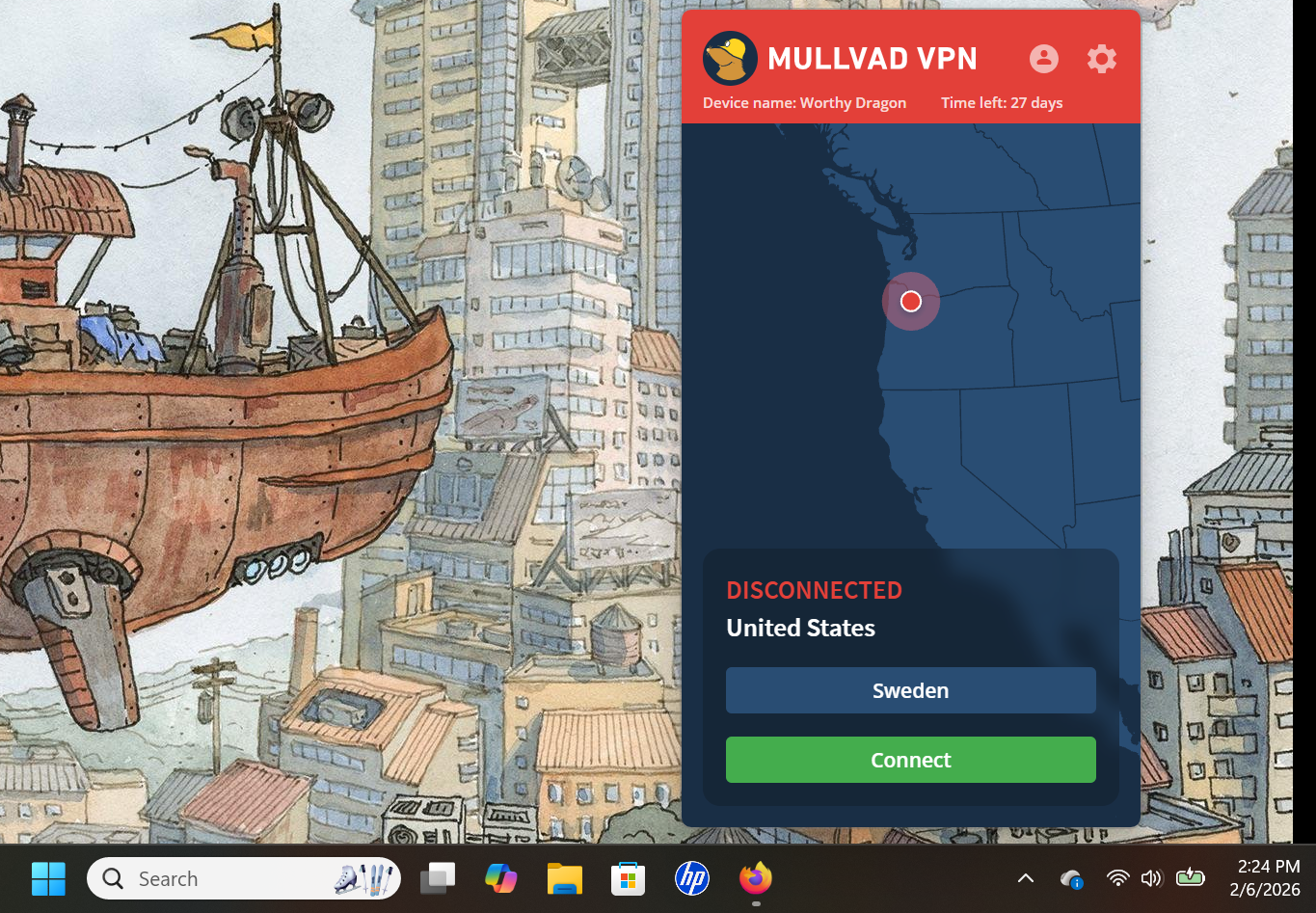
WindowsMullvad's Windows app has a slim UI that uses space efficiently without being too cramped. It doesn't give you a lot of information, such as live speed tests or data in transit, but I've mostly found that to be needless filler on VPN apps.
 Mullvad on Windows.
Sam Chapman for Engadget
Mullvad on Windows.
Sam Chapman for Engadget
Speaking of needless filler, the map may be a little bigger than it needs to be, but maps on VPN clients aren't just about teaching you geography — they do a lot to make the apps more welcoming to casual users who might not otherwise fire up security software. In fact, Mullvad's UI is admirably beginner-friendly, befitting its focus on privacy for everybody rather than just the tech-savvy.
All the settings are accessed by clicking the gear in the top-right. Here, you can turn on DAITA (Mullvad's defense against AI traffic scanning), activate multihop and control Mullvad's other features. There are also some quality-of-life features for the UI itself, such as whether it remains pinned to the taskbar or operates as a standalone window. Some options, especially under the VPN settings tab, are a bit technical, but don't need to be touched for a good experience.
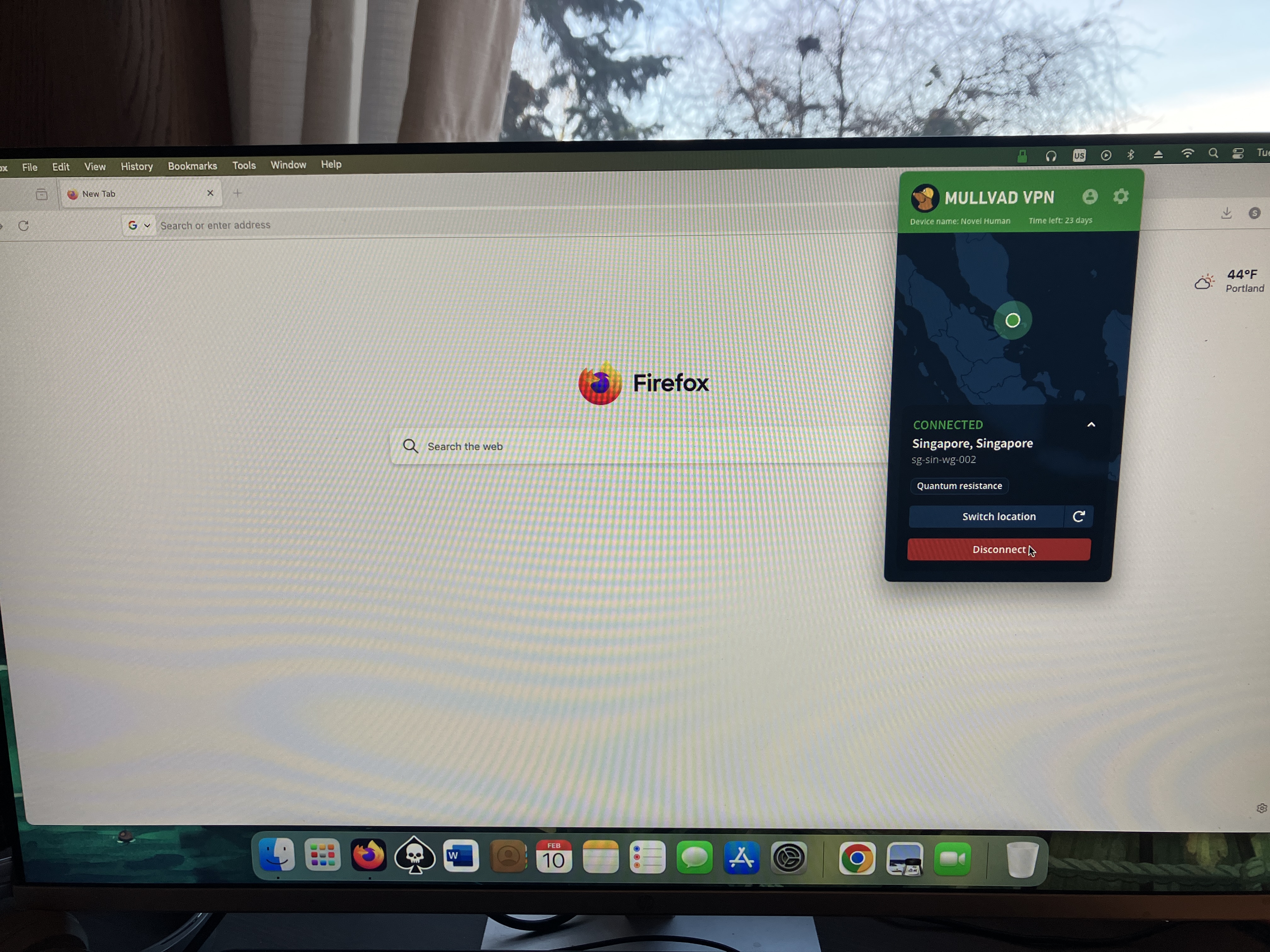
MacMullvad's macOS app is quite similar to its Windows app, both in terms of the interface and the features offered. The big difference used to be that macOS lacked split tunneling, but that's been added in a recent update. The only serious distinction now is that the Mac client can't be unpinned from the taskbar, which is just a little bothersome.
 Mullvad on Mac.
Sam Chapman for Engadget
Mullvad on Mac.
Sam Chapman for Engadget
Other than that, you'll find every setting you need under the gear, just like on Windows. Similarly, connections to VPN servers happen quickly, and selecting locations from the menu is very straightforward. While connected on either app, you can click the circular arrow by your location to swap to another server in the same location — highly convenient if you're trying to unblock Netflix.
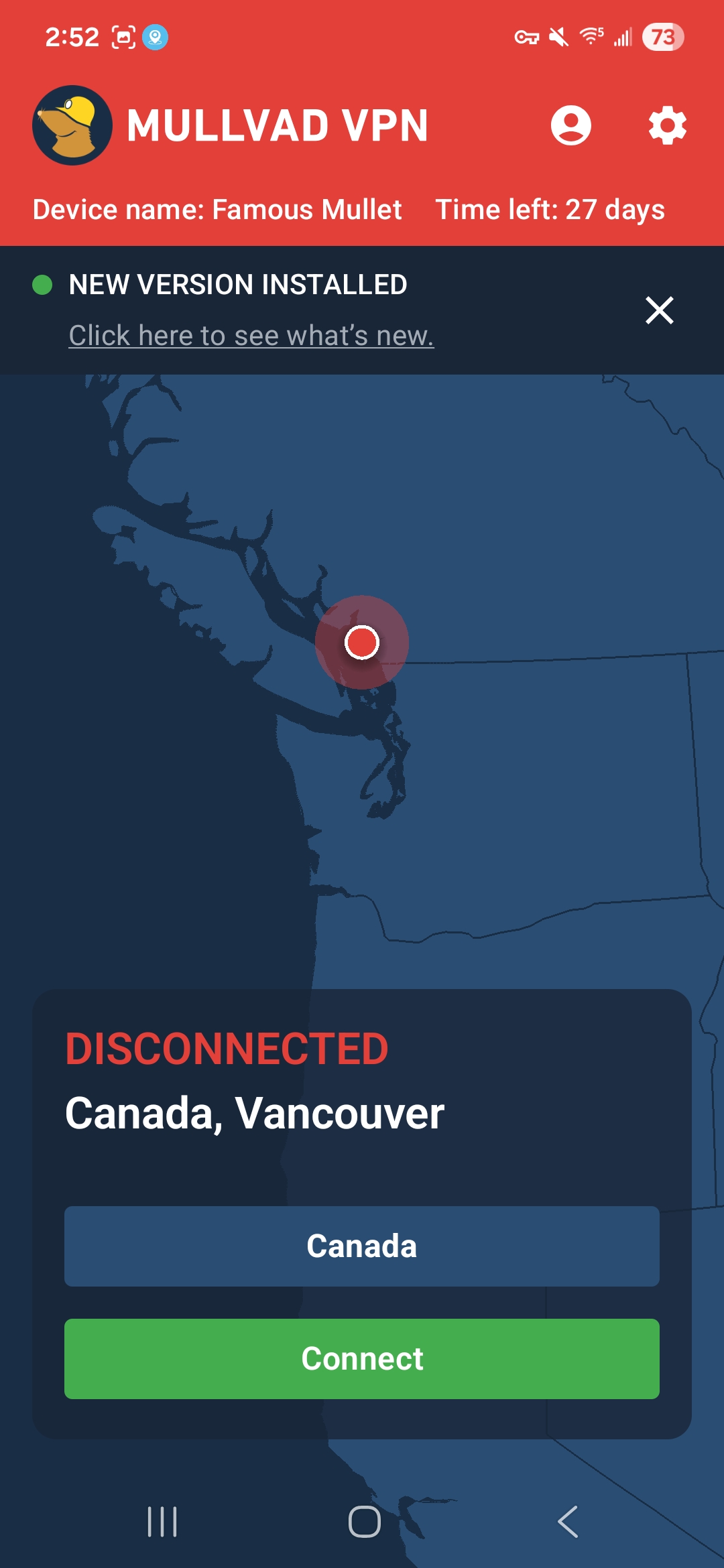
AndroidMullvad's Android app has the same nearly-perfect design approach as all its other apps. The main page has nothing on it but the connect/disconnect button, the choice of server locations, a map and the buttons for your account information and preferences. Those preferences are a manageable set of options that are almost all managed with simple on-off switches. It's all highly responsive and annoyance-free.
 Mullvad on Android.
Sam Chapman for Engadget
iOS
Mullvad on Android.
Sam Chapman for Engadget
iOS
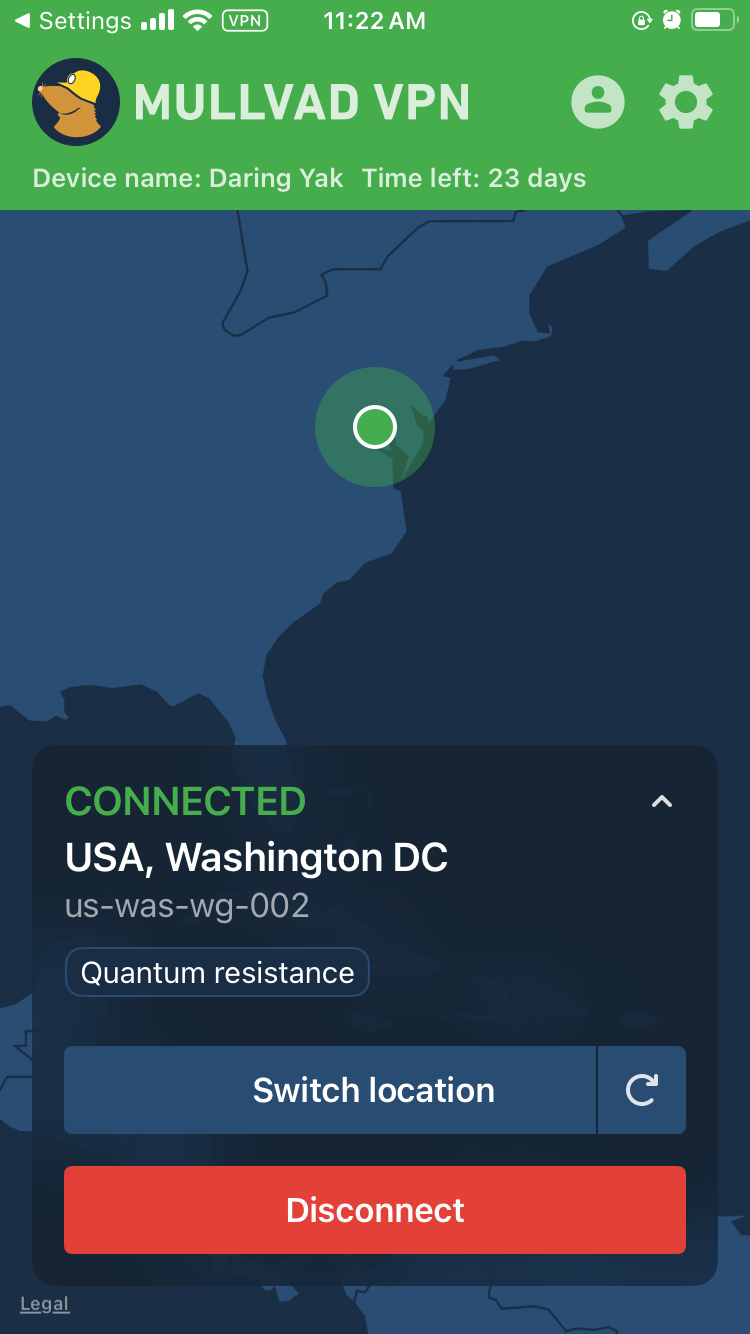
Mullvad's iOS app looks very similar to its apps on every other platform. The front page is kept simple, with large controls in the foreground and a map taking up most of the space. Everything else is located in the menu accessed through the gear icon at top right. Neither mobile app has the options for toggling the UI itself that the desktop apps have, but it's mostly free of quality-of-life problems to start with.
 Mullvad on iPhone.
Sam Chapman for Engadget
Browser extensions
Mullvad on iPhone.
Sam Chapman for Engadget
Browser extensions
Mullvad's browser extension is only compatible with Firefox. You can't actually connect to the VPN through this extension. Its main functions are to tell you whether you're connected to a Mullvad server and to connect to a SOCKS5 proxy in a Mullvad location. If you do this while connected to Mullvad through the desktop app, you'll get a second layer of protection, similar to the multi-hop feature.
The Firefox extension is a rare misfire for Mullvad — perhaps fair, since it's still in beta. Its only real feature is something that the desktop app already does perfectly well, and it looks like a software malfunction to boot. However, given Mullvad's track record, I'm confident they'll figure out what to do with it in time.
Mullvad speed testA VPN almost always slows browsing speeds and increases latencies. It's unavoidable, given the extra steps a VPN protocol adds to the process of getting online. The trick is to find VPNs that keep the slowdown to a minimum, using a combination of regular maintenance, good planning and smart load balancing.
For this test, I used speedtest.net to check how six of Mullvad's server locations influenced three key speed metrics. Ping measures latency, the time in milliseconds (ms) that one data packet needs to travel between a client device and an ISP. Download speed measures the amount of data in Megabits that a web browser can download in one second. Upload speed tracks how much data can be uploaded in a second. We're looking for low latencies and high download and upload speeds.
Server location
Ping (ms)
Increase factor
Download speed (Mbps)
Percentage drop
Upload speed (Mbps)
Percentage drop
Portland, USA (unprotected)
15
—
58.96
—
5.85
—
Seattle, USA (fastest location)
23
1.5x
55.07
6.6
5.51
5.8
Montreal, Canada
165
11.0x
44.28
24.9
4.62
21.0
Fortaleza, Brazil
307
20.5x
40.96
30.5
4.65
20.5
Prague, Czechia
368
24.5x
43.17
26.8
5.47
6.5
Lagos, Nigeria
528
35.2x
37.41
36.6
4.61
21.2
Bangkok, Thailand
473
31.5x
39.76
32.6
4.13
29.4
Average
311
20.7x
43.44
26.3
4.83
17.4
I'll start with the bad news: the tests didn't exactly make Mullvad look like a speed demon. Its speeds have gone up and down in the years I've been using it, and right now they appear to be on the downswing. If you use locations all around Mullvad's server network, you can expect your download speeds to decrease by about 26 percent and your upload speeds to decline by 17 percent.
However, it's important to put those numbers in perspective. First, Mullvad's numbers aren't markedly worse than the ones I got when testing CyberGhost. Its speeds are average, but by definition, most things are average. Its average worldwide latency is actually better than Surfshark, the current champion of download and upload speeds.
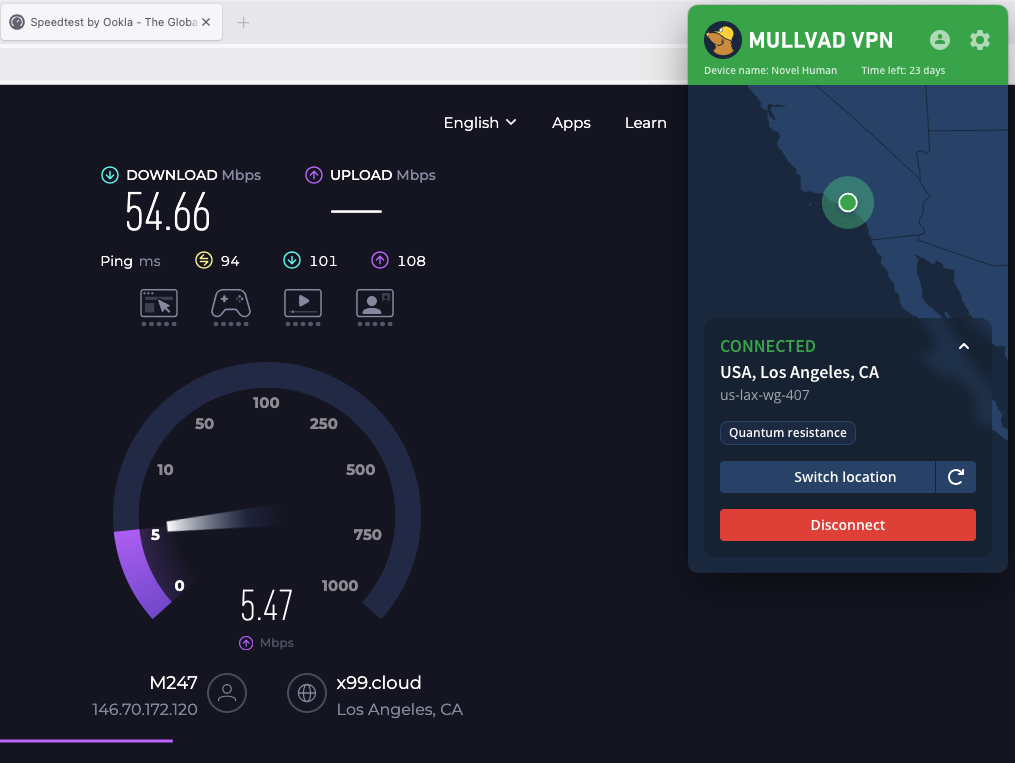 Speed-testing a Mullvad server in Los Angeles.
Sam Chapman for Engadget
Speed-testing a Mullvad server in Los Angeles.
Sam Chapman for Engadget
It's also nice that Mullvad's speed drops follow a predictable curve. Lots of VPNs have unexpectedly sharp declines in certain locations, frequently in Africa. By contrast, Mullvad's speed decreases pretty much as a direct function of how far from the server you are. This not only makes speed drops easier to plan around, but also means you can expect very good speeds on nearby servers.
This property of being fastest on servers near the user is another sign of Mullvad's focus on its core privacy mission. If anonymity is your main reason for using a VPN, it doesn't matter what your IP address is, so long as it's not your real one. Using a nearby Mullvad server should guarantee you an internet connection that's both fast and private.
Mullvad security testTo be secure, a VPN has to check two critical boxes. It must provide you with a secondary IP address without leaking your real one, and it must encrypt your communications with its servers so your activity can't be traced. In the sections below, I'll see whether Mullvad meets those requirements.
VPN protocolsVPNs use protocols to mediate between end devices, ISPs and their own servers. The first step is to ensure that the service you're considering uses protocols that have expert confidence. Mullvad has kindly made this step easy for me by using only WireGuard on all its apps, with no OpenVPN, IKEv2 or in-house unique protocols.
There's no question that WireGuard is a solid protocol. It uses the ChaCha20 stream cipher for symmetric encryption and Poly1305 for authentication, both uncrackable with current technology. Mullvad has even added its own fix for WireGuard's one flaw, its need to save static IP addresses — the Mullvad implementation is set up to delete the IP address if it goes 10 minutes without being used.
Even so, it's unfortunate to lose the ability to change protocols, which is one of the most common steps for troubleshooting a VPN connection. I understand Mullvad's reasoning for cutting out OpenVPN (it claims the cryptography isn't strong enough) but don't agree. It's one of this provider's few unforced errors.
Leak testThere's a straightforward test to determine if your VPN is leaking. Load up any website that shows your IP address — I personally use ipleak.net — and see what IP and location it reveals without your VPN active. Then activate the VPN and refresh the page. If you see your real IP address anywhere, your VPN is leaking.
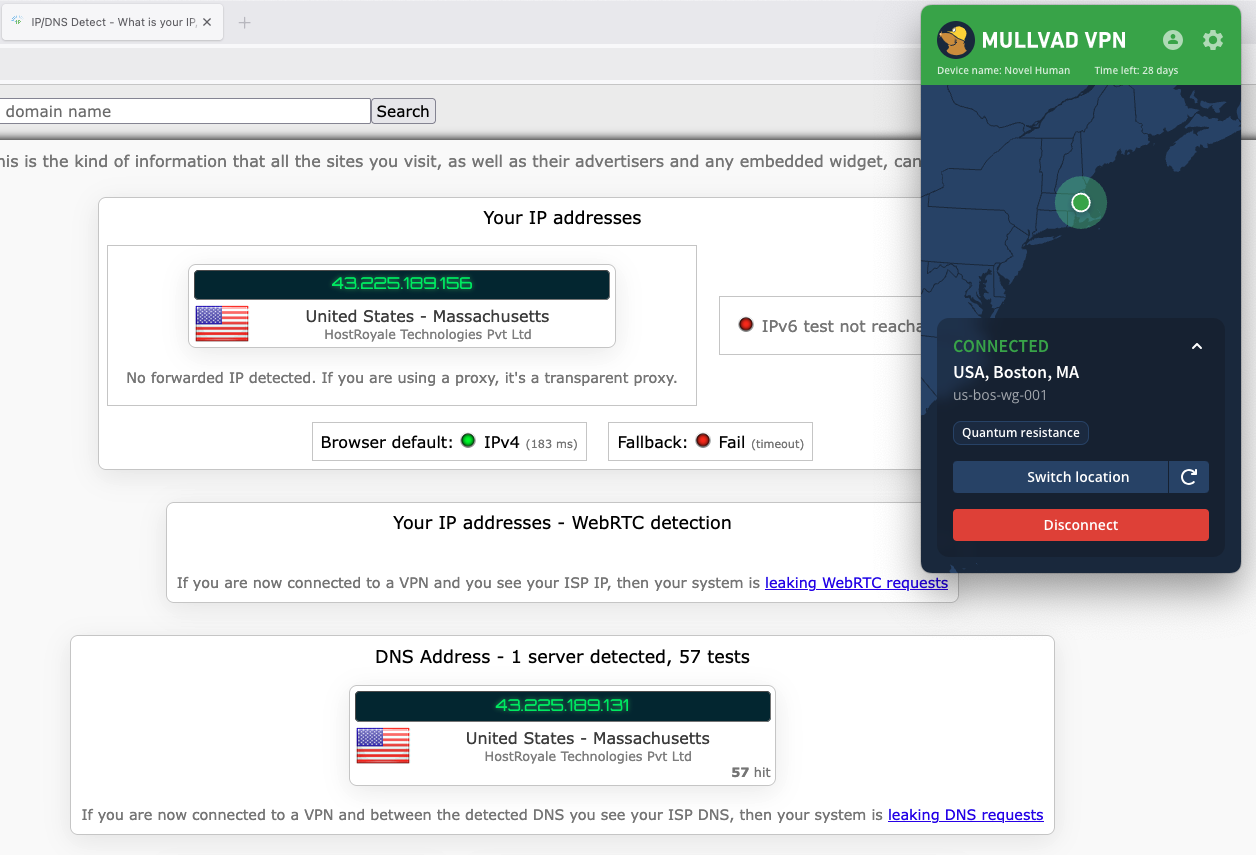 Testing Mullvad for IP leaks.
Sam Chapman for Engadget
Testing Mullvad for IP leaks.
Sam Chapman for Engadget
I ran that test on five Mullvad servers. Each time, the website showed me the IP address of the VPN server, concealing my real one. To keep things simple, I ran the initial tests with IPv6 blocked via the Mullvad client. When I turned it on and tried again, the IPv6 traffic didn't leak any more than the IPv4 did. I also saw no signs of WebRTC leaks. Unless you set up a custom DNS server, Mullvad also uses its own DNS, which remains entirely within the VPN tunnel.
I had one more leak test to try. Frequently, VPNs are leak-proof when maintaining a connection to one server but drop encryption when switching between servers. That problem is why I ultimately couldn't recommend Norton VPN. Luckily for me, Mullvad has a button that lets you shuffle to another server in the same location, so I used that to see if it stayed leak-proof.
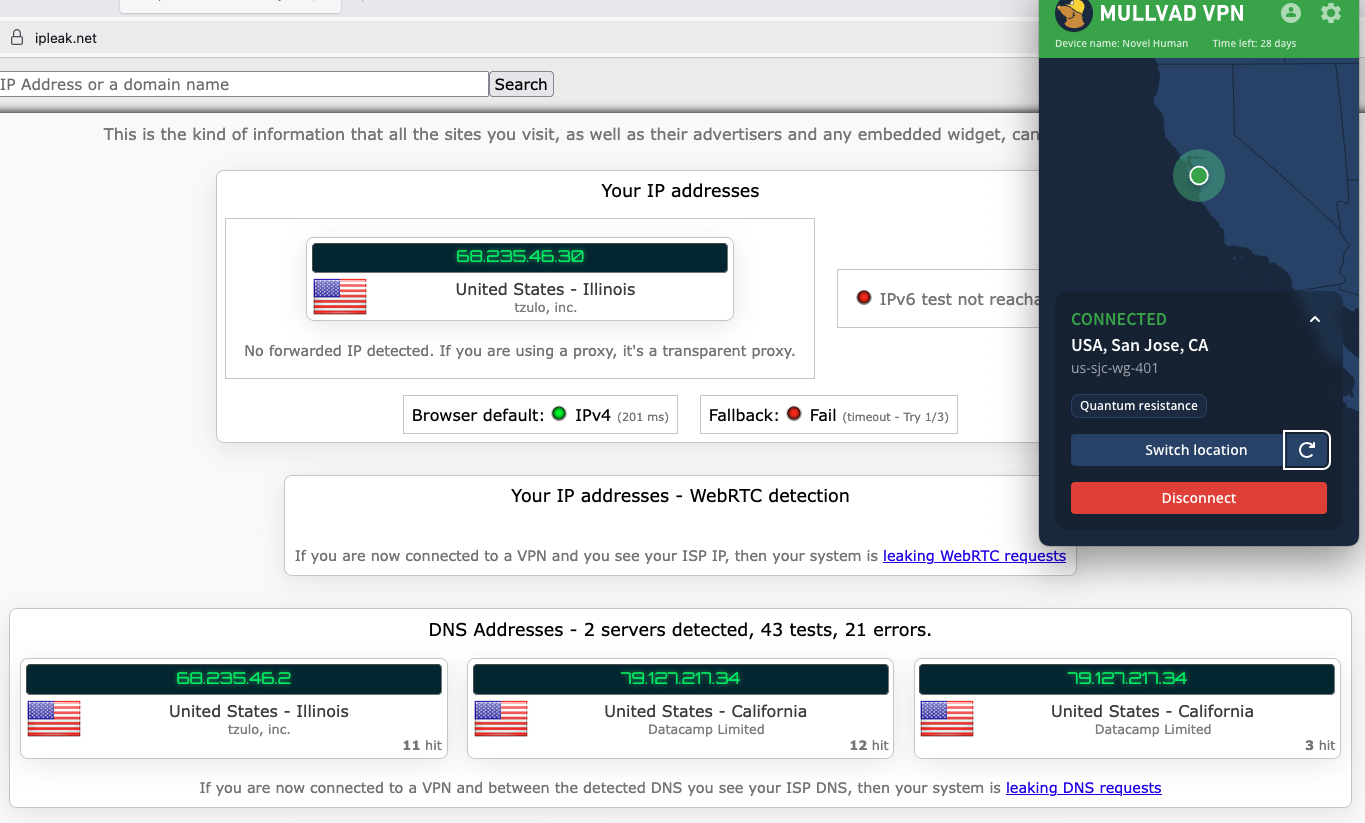 Mullvad doesn't leak your IP even while changing servers.
Sam Chapman for Engadget
Mullvad doesn't leak your IP even while changing servers.
Sam Chapman for Engadget
As you can see in the screenshot, Mullvad jumped seamlessly from one server to another without showing my real location in-between. On a practical level, that's enough for me to declare Mullvad leak-proof.
Encryption testFor one final experiment, I used the WireShark packet sniffer to see whether the data Mullvad sent from my computer to my ISP was encrypted. After capturing a few packets, I was gratified to see that they were totally unreadable to interlopers. Most established VPNs pass this test, but it's still important for due diligence.
How much does Mullvad cost?Mullvad's pricing structure is one of the most unusual things about it. This is normally the section where I untangle 47 different Pro+ and Business- accounts that are all sold at three different durations. Mullvad couldn't be further from that. It costs 5 Euro a month — that's it. Each 5-Euro subscription can be used on five devices at once.
It manages payments through a system inspired by parking meters. When you sign up for Mullvad, you'll buy as much time as you want. That time will count down until it expires, unless you top it up with more 5-Euro payments. If you run out of money, Mullvad won't charge you a new subscription fee because you didn't tell it not to. It'll just stop working until you pay again. Every payment also comes with a 14-day money-back guarantee, except for payments made in cash.
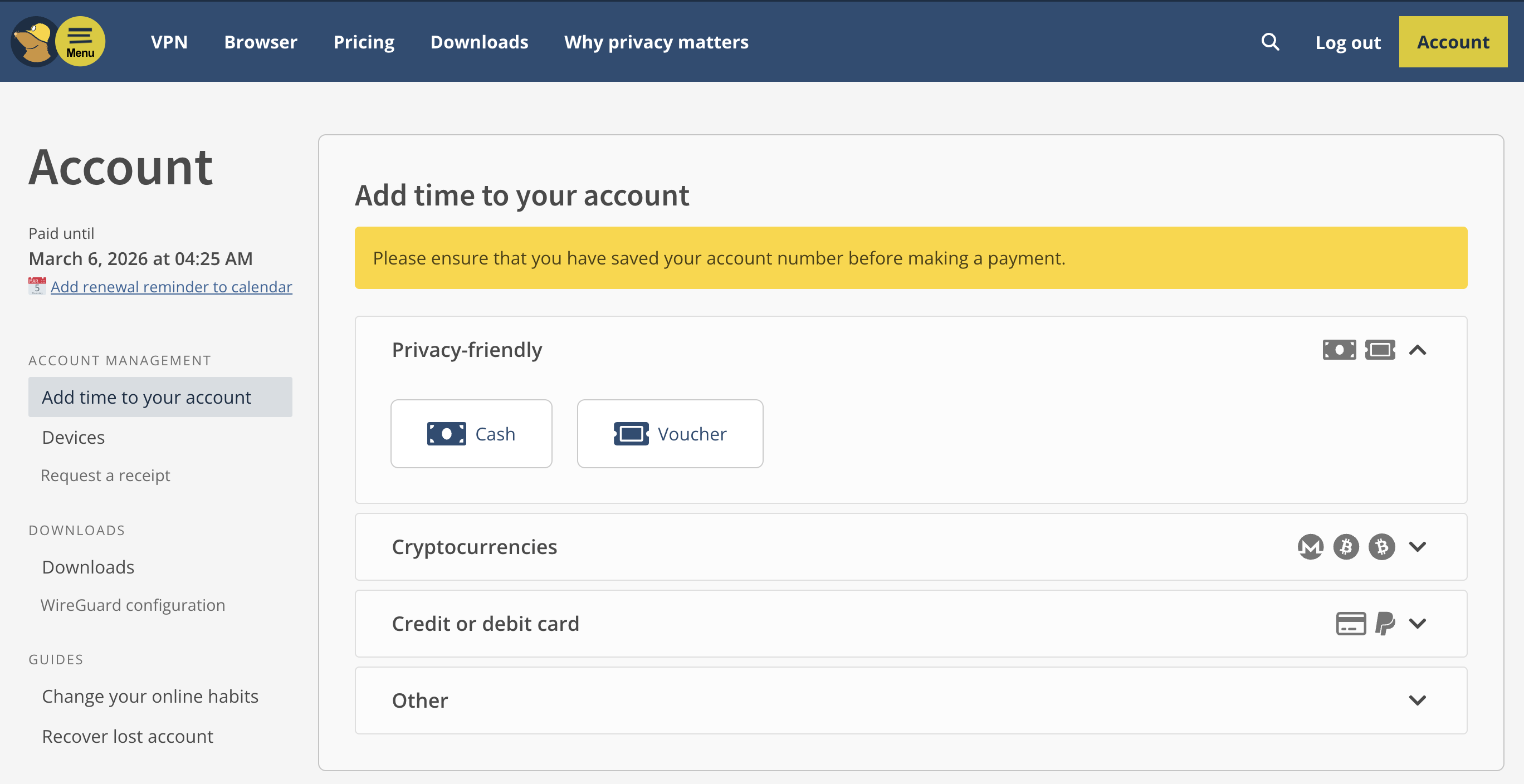 The Mullvad account dashboard.
Sam Chapman for Engadget
The Mullvad account dashboard.
Sam Chapman for Engadget
The only real complexity in the process is that Mullvad always figures out its prices in Euro, so outside the EU, the cost per month is affected by exchange rates. If you happen to live in a country where the government's economic policy shuttles between capricious and arbitrary, you might want to grab a few months in advance.
The other most interesting thing about Mullvad's pricing is the options you can use to pay. For maximum privacy, you can pay with cash using the payment token you'll find on your account page. Note that this is not the same as your account number. To find it, log into your dashboard on Mullvad.net, click Add time to your account in the left-hand bar, then click the button labeled Cash and scroll down. Make your cash payment by writing the token on an envelope and mailing it to Sweden (full instructions here).
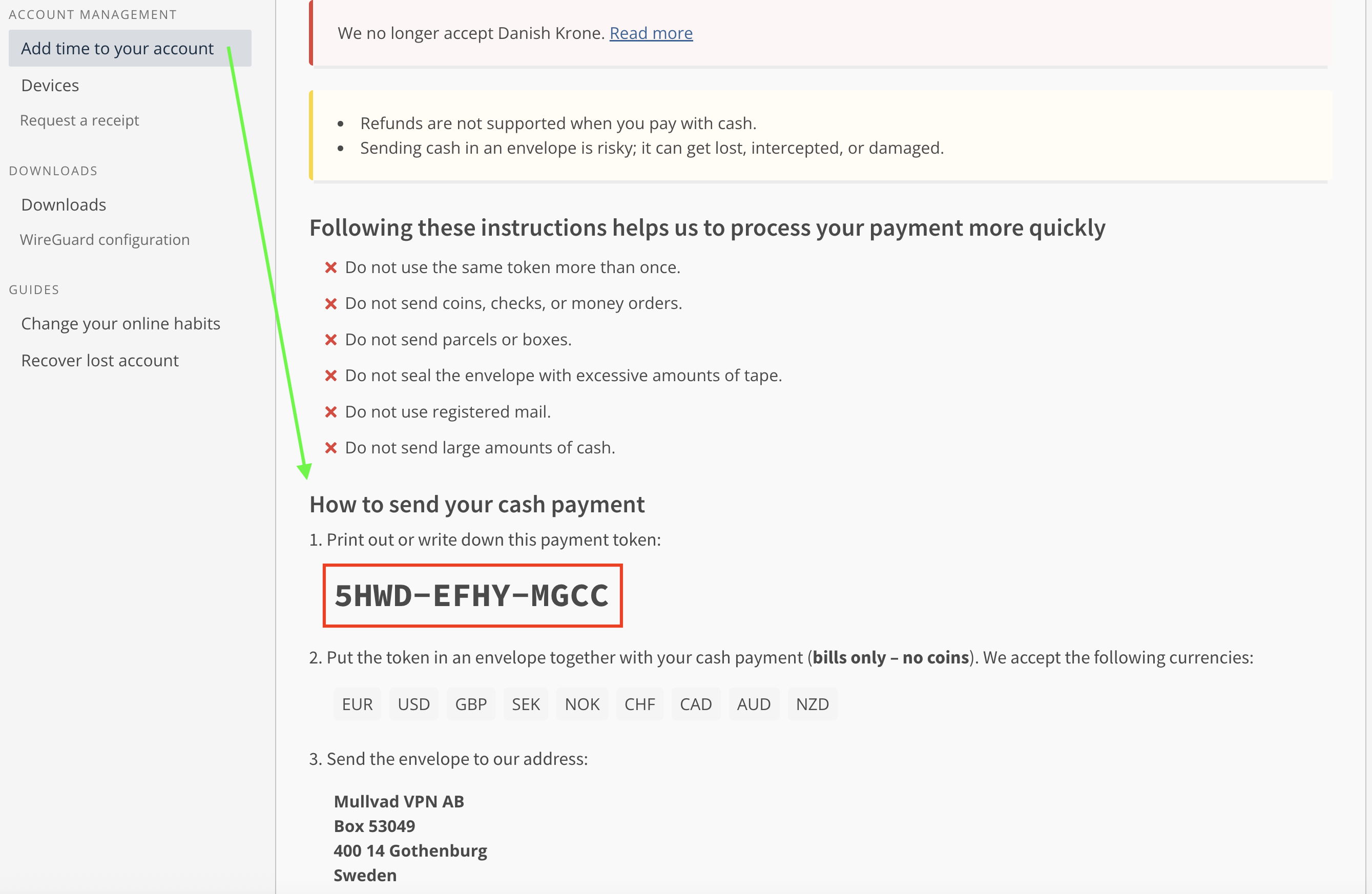 Unredacted, in case any hackers out there want to buy me some more time.
Sam Chapman for Engadget
Unredacted, in case any hackers out there want to buy me some more time.
Sam Chapman for Engadget
You can also get untraceable Mullvad vouchers by paying cash at participating retail locations. Most of them are in Europe, but you can order them from Amazon. While your payment to Amazon won't be private, the voucher can't be linked directly to your VPN account, since the actual number is hidden behind a scratch-off panel. It's actually pretty ingenious.
Of course, you can also pay using any of the normal methods, including credit cards, cryptocurrency and bank wires (though not PayPal). But the more private methods are always there for people who need them.
Mullvad side apps and bundlesMullvad is that rare VPN that's still content to be a VPN and not an all-inclusive security suite. No shade to NordVPN or Surfshark, whose extra features are generally quite good, but it's nice to see at least one of the top providers staying focused.
Although Mullvad doesn't have any partners that sell their products alongside its VPN, it does have several partnerships with other VPNs who use its network as the basis for their own products. MalwareBytes Privacy VPN, Mozilla VPN, Tailscale and Obscura can all be considered Mullvad side apps if you squint.
Mullvad BrowserMullvad's only product other than the VPN is Mullvad Browser, which is free to download and works on Windows, macOS and Linux. Mullvad Browser works in the background, blocking common methods of browser fingerprinting that can be used to deduce your identity even when you have a VPN running.
For example, it automatically reports your time zone as UTC, disguises personal preferences like font and window size, scrambles information sent by APIs and conceals your browser version and computer operating system. It's also in private mode by default, which doesn't hide what your ISP sees but is useful for concealing your activity from other people that might use your computer.
Close-reading Mullvad's privacy policySince privacy is Mullvad's main selling point, this section is even more important than usual. Loopholes in the privacy policy of the privacy VPN would be deeply ironic. Fortunately, Mullvad's privacy policy backs up its high-flying rhetoric. It's a short, pointed and readable document with no problems I could discern. Mullvad has no parent company or subsidiary it might use as a loophole, and no clauses in its policy are left open to interpretation. It's a masterpiece of the privacy-policy genre.
The document is actually three policies: a privacy policy, a no-logging policy and a cookie policy. The privacy policy lists all the times Mullvad might collect data about a user. That's exactly two situations — using financial information to process payments (which will be entirely anonymous if you use cash or a voucher) and using your email address to track support tickets you open. That's it.
The no-logging policy is a bit longer, but mostly because it's explaining exactly how Mullvad manages to run a VPN service with so little information on individual users. For each account, it stores a number and an expiration date, plus public keys and tunnel addresses if you're using WireGuard (deleted at most 10 minutes after your session ends). Everything else is completely anonymized. Mullvad even claims that its 500,000 or so user accounts could have been created by the same user 500,000 times, which I suppose is one way to spend 2.5 million Euro.
The cookie policy is the shortest because Mullvad uses exactly five cookies. One saves your login status in your browser, one saves your language preferences, one protects its site from being used in a specific kind of forgery hack and the other two are for handling Stripe payments.
Independent privacy auditsMullvad corroborates its privacy policy with regular audits of various aspects of its service. Currently, there are 17 audits listed on its website, including four infrastructure audits by Cure53. All of its apps have been separately audited and found to be solid. It has been a couple of years since the last full infrastructure audit in 2024, but given how many other targeted reviews Mullvad has gone through since then, it's hard to be too upset about the pause.
In 2023, Mullvad achieved the holy grail of VPN privacy: being ordered by subpoena to turn over customer information and not being able to comply because that information didn't exist. Nothing compares to a VPN's privacy being tested in the wild like this.
Can Mullvad change your virtual location?Sometimes, a VPN appears to be working, but still reveals your real location to websites. Netflix is a useful proxy for this. To unblock a streaming site like Netflix, a VPN needs to change your virtual location while not appearing to do so — if Netflix sees any hint of VPN traffic, you'll get blocked with the hated proxy error. I used five different locations to check whether Mullvad is up to the streaming task.
Server location
Unblocked Netflix?
Changed content?
Vancouver, Canada
3/3
3/3
Gothenberg, Sweden
2/3
2/3
Istanbul, Turkey
3/3
3/3
Johannesburg, South Africa
3/3
3/3
Singapore, Singapore
2/3
2/3
Mullvad did well for streaming, but it didn't manage a perfect score like its fellow anti-establishment VPN Windscribe did. Two of the 15 servers I tested failed to unblock Netflix, one in Singapore and one in Mullvad's hometown of Gothenburg. I also had trouble logging into Netflix while connected to a Vancouver server, though that server did unblock the site consistently once I got inside.
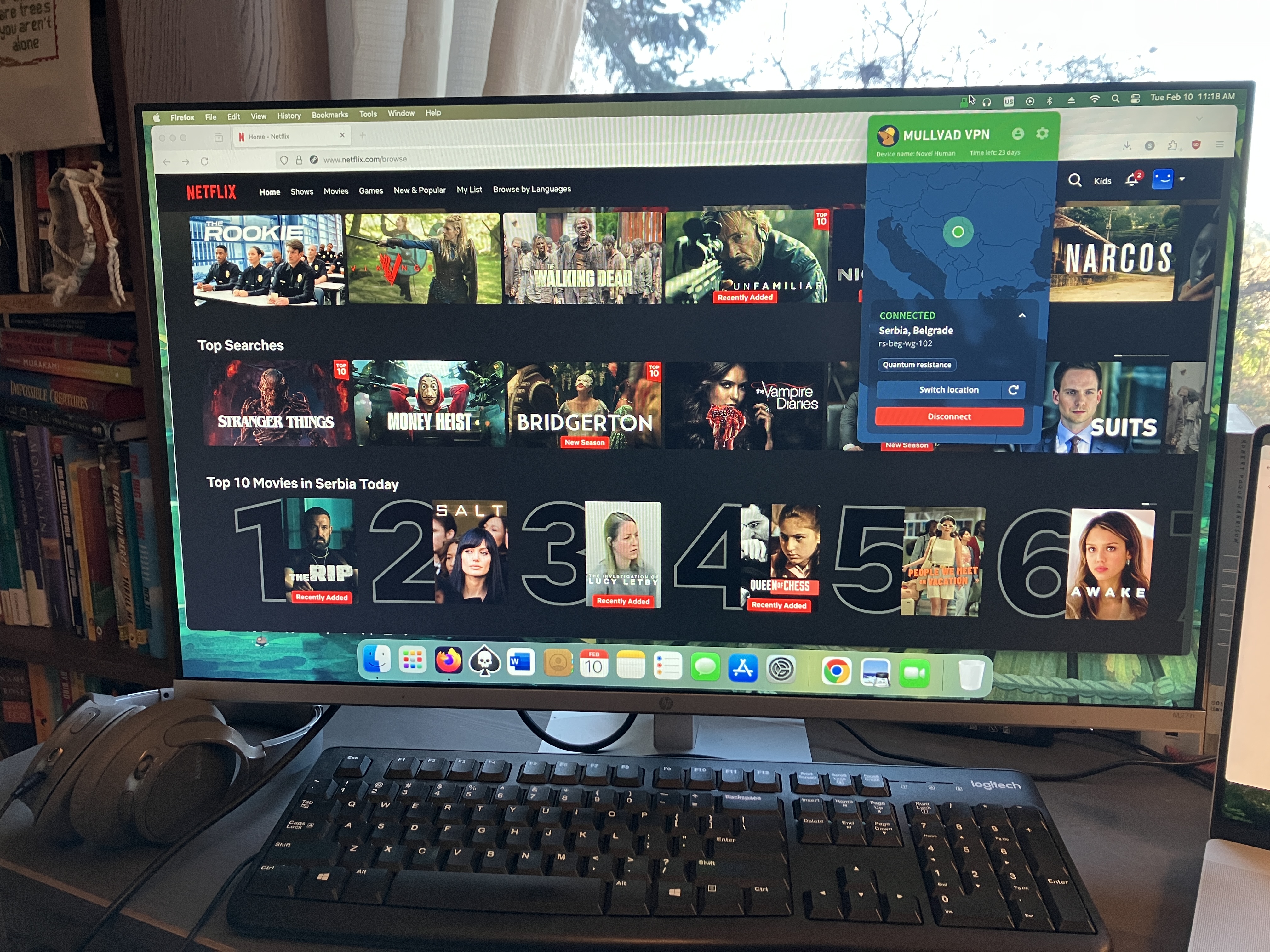 Mullvad's servers all tricked Netflix into believing my new location.
Sam Chapman for Engadget
Mullvad's servers all tricked Netflix into believing my new location.
Sam Chapman for Engadget
In Mullvad's defense, no location failed more than once. It's completely possible to get good streaming performance out of this VPN; you just have to be willing to click the server refresh button a few times. Privacy is still the main use case for Mullvad, but it's fine for streaming too.
Investigating Mullvad's server networkMullvad has 90 server locations in 50 countries and territories. Unusually for a VPN, users can choose between all 590 of its total servers, including several in each location. There's even a list on its website that shows you the status of every server.
Mullvad does not use virtual server locations, so every server is physically located in the place where it claims to be. Here's how they're distributed.
Region
Countries with servers
Total server locations
North America
3
25
South America
5
6
Europe
29
41
Africa
2
2
Middle East
2
2
Asia
7
8
Oceania
2
6
Total
50
90
Over half the countries with servers are in Europe and over two-thirds of the cities with servers are in either Europe or North America. That lopsided network is a limitation of Mullvad's refusal to use virtual server locations, since its real servers have to be concentrated in nations developed enough to host data centers. With an all-real network, it's easier to tell which servers will give you the fastest performance, but you can't simulate as much of the world as you can with larger services like ExpressVPN.
The good news is that there's at least two real server locations on every continent. Mullvad has a surprisingly robust presence in South America and two bare-metal servers in Africa, which is more than some other VPNs have. In the end, though, the best application of Mullvad is to protect the online privacy of users in North America, Europe and eastern Asia.
Extra features of MullvadMost of Mullvad's features are augmentations to the VPN itself, rather than side options that do other things. Some of them are bread-and-butter, like the kill switch and split tunneling, but a few you won't find anywhere else. Note beforehand that Mullvad does not support port forwarding, so if you depend on that for your torrenting, try another VPN.
DAITA AI defensesMullvad's most novel feature is a recent one. DAITA, which stands for Defense against AI-guided Traffic Analysis, can be toggled on and off in the Mullvad app. According to Mullvad, certain patterns in how browsers communicate with websites can be analyzed by AI to reveal the truth behind encrypted internet history. DAITA hides those packets by filling communications with background noise so the AI won't know what's real.
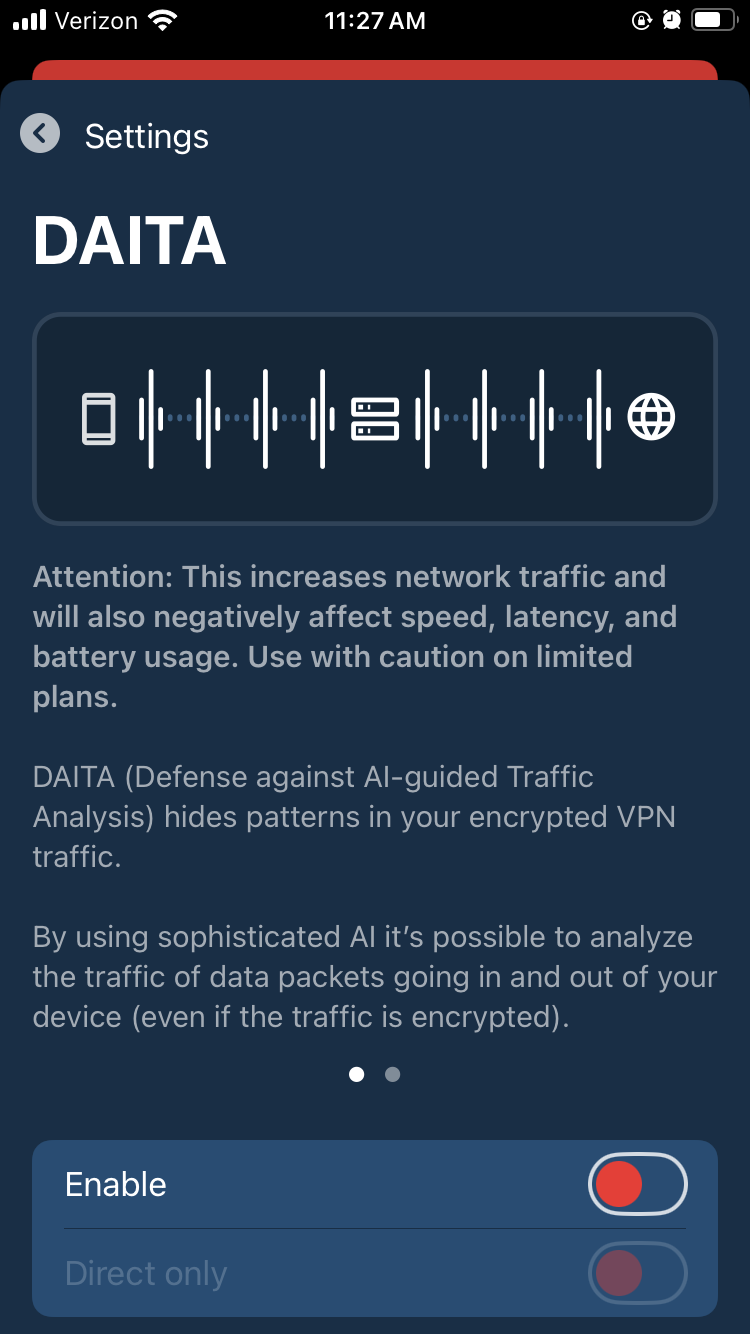 Mullvad's anti-AI settings.
Sam Chapman for Engadget
Mullvad's anti-AI settings.
Sam Chapman for Engadget
DAITA is a laudably forward-looking feature, but as Mullvad itself admits, it will make your browsing speeds slower and drain your battery. I recommend only using it for activities you really want to hide.
Quantum resistanceMullvad's desktop apps establish quantum-proof WireGuard tunnels by default. Quantum computing isn't yet a threat to WireGuard, but it may become dangerous in the future, so Mullvad is getting ahead of the problem (along with a few other services like NordVPN). When quantum resistance is active, Mullvad encapsulates its keys using the current standard mechanism, ML-KEM.
Anti-censorshipIf you find yourself in a country where government censorship makes it hard to access the internet, Mullvad has options that might help. These anti-censorship features can be used to get around firewalls that block visible VPN traffic. You have several options, including changing your WireGuard port, randomizing your port number, disguising your VPN traffic as an ordinary HTTPS connection or using an obfuscated Shadowsocks proxy.
Mullvad's anti-censorship involves more features than most VPNs have in this area. This makes it a bit less user-friendly, but a lot more likely to work. If you're new to getting around censorship, Mullvad's help center has a helpful page about using its anti-censor settings.
MultihopMany VPNs offer a double-hop connection that routes your traffic through two servers instead of one, adding a redundant layer of encryption in case one server malfunctions. Mullvad pulls ahead of the competition (except Surfshark, which also does this) by allowing you to choose your entry and exit servers. When you activate the multihop option and open the server list, you'll be prompted to pick two locations instead of one.
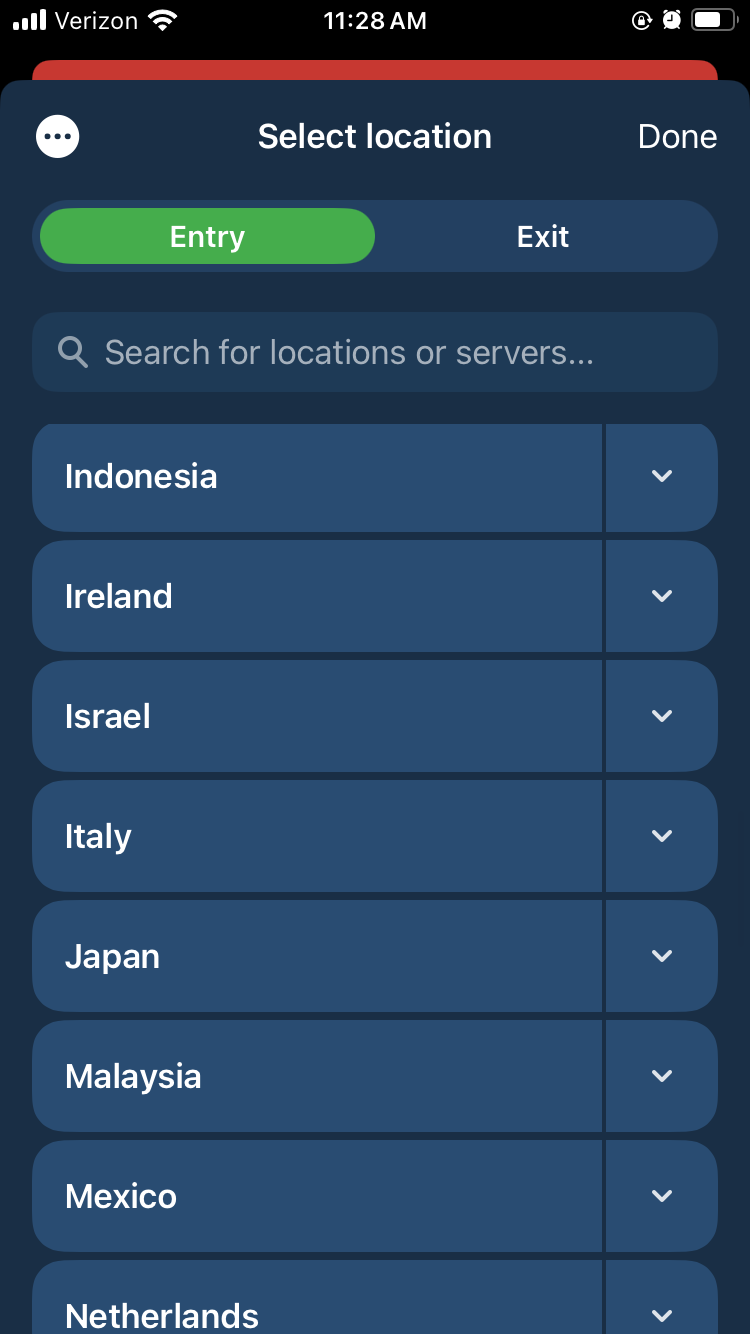 Mullvad's server list with multihop enabled.
Sam Chapman for Engadget
Mullvad's server list with multihop enabled.
Sam Chapman for Engadget
This means you can select an entry server that's close to you and an exit server in any country whose location you want to spoof, letting you fine-tune your own performance. It's way nicer than being railroaded into certain paths.
DNS content blockersMullvad includes six blocklists that can keep you or your family members from looking at unwanted content: ads, trackers, malware, gambling, adult content and social media. These lists can't be customized like Windscribe's R.O.B.E.R.T. blocks can, so you're limited to just turning them on and off.
IPv6 supportThe internet is gradually transitioning from the old IPv4 standard over to IPv6, which will allow many more addresses to be shared out. Mullvad is one of a few VPNs looking ahead to the IPv6 era. You can leave it to block all IPv6 traffic, but if you do need IPv6 for any reason, you can enable it while still being connected to a Mullvad server.
Kill switch and lockdown modeMullvad comes with two features that protect against unexpectedly losing your VPN defenses. The first is a kill switch, a common VPN option that cuts off internet access if the VPN tunnel ever fails. This simple measure helps guard against accidental leaks.
Lockdown mode is the stronger option. While it's active, you will be unable to get on the internet unless you connect to a Mullvad server first. This will remain true if you turn the connection off yourself and even if you quit the app.
Split tunnelingSplit tunneling is available on Mullvad's apps for every system except iOS. It lets you send some apps outside the VPN tunnel so they get online with your normal IP address. It's helpful if you have some apps that don't work with the VPN active — this is common with online banking, as an example. Another common application is to protect a torrenting client in the background while using your browser unprotected for better speeds.
Mullvad customer support optionsMullvad makes two forms of support available in the app. You can report a problem by going to Settings -> Support -> Report a problem, typing your question (requested to be in either English or Swedish, though they'd probably be able to read a question run through Google Translate) and optionally providing your email. You can also view the app's logs at any time, which can be useful to help a technician diagnose your problem.
If you'd rather search for a solution at your own pace, you can go to that same page and click FAQs and Guides instead. This opens the help center in a browser.
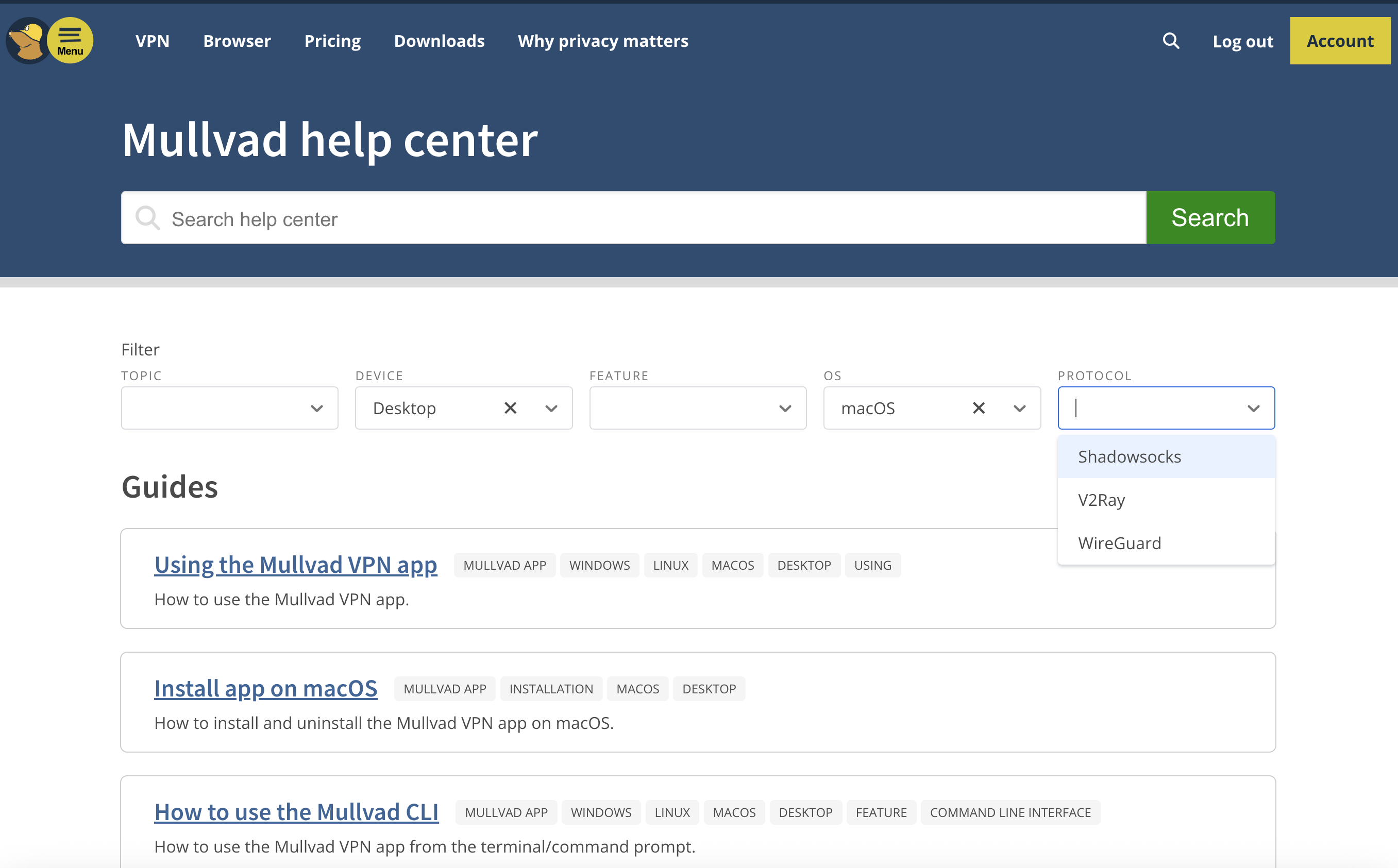 Mullvad's help center, including the dropdown filter menus.
Sam Chapman for Engadget
Mullvad's help center, including the dropdown filter menus.
Sam Chapman for Engadget
I love Mullvad's approach to laying out its FAQs. Instead of crowding topics into five or six categories and making you guess whether your problem falls under setup, usage or troubleshooting, Mullvad gives you a set of dropdown filters to narrow down the articles which might relate to your problem.
By the time you've named which device, OS and protocol you're dealing with, you won't have many articles left to sift through. There is an annoying tendency for certain sets of filters to reduce the number of surfaced links to zero, but for those cases, there's a search bar that also works well.
The articles themselves are good enough that I referred to them several times while writing this review. Some of them are a bit overlong, but they're diligent about including both internal and external links to get you where you're going fast.
Live support experienceThis is normally where I cover how it feels to get live chat support from the VPN I'm reviewing. However, Mullvad doesn't have live chat support. That's unfortunate, although it's still better than Windscribe's approach of forcing you to banter with a sarcastic robot. Instead, I sent a question via email to Mullvad's support team, and got a response within 24 hours.
Mullvad background checkMullvad was founded in 2009 in Sweden. It's still owned and operated by its original founders. According to a detailed timeline on its website, its 16-year history has been as uneventful as any user could ask for, with not much changing except updates to stay on the technological leading edge. The only controversy mentioned in Mullvad's own materials is the 2023 police raid of its headquarters, which (as I covered in the privacy section) only makes them look better.
So as not to take Mullvad at its word, I scoured the last 16 years of news items and user reports to search for any other blemishes on its record. Based on that research, I found no reason to doubt Mullvad's honesty about its location, owners or team.
I found just one leak that wasn't noted on Mullvad's own site. In 2023, a security research group called ZATAZ alleged that it found anonymized information on Mullvad users saved on an Internet Archive page, including account numbers (linked article is in French). According to ZATAZ, Mullvad contacted the Archive and got the page deleted.
To my mind, the only mistake Mullvad made in response to the ZATAZ allegations was not making a public statement about the incident. I can see why they didn't think it was a big deal, since even logging into someone else's Mullvad account wouldn't show you their browsing history, but it's always better to communicate about these things.
Final verdictMullvad is a VPN that knows what it wants to be and achieves that goal with flying colors. It's not trying to be an everything app — it does privacy and does it well. That's not to say it has nothing going on outside the VPN itself, as its DNS blockers, AI defenses and split tunneling all work smoothly. But if you want a VPN that's not ashamed to be a VPN, Mullvad is the right choice.
Of course, it has its own compromises. It's solidly in the middle of the speed pack and occasionally trips up when unblocking streaming sites. The lack of any protocols other than WireGuard grates on me a bit, since it reduces the user's options for troubleshooting. With all that said, those are minor hiccups on a VPN that does such a thorough job keeping you anonymous online.
This article originally appeared on Engadget at https://www.engadget.com/cybersecurity/vpn/mullvad-vpn-review-near-total-privacy-with-a-few-sacrifices-130000056.html?src=rss
Moderna Says FDA Refuses To Review Its Application for Experimental Flu Shot [ 11-Feb-26 1:35pm ]
7 Weird Space Phenomena That Only Make Sense if Dark Matter Exists [ 11-Feb-26 1:30pm ] Hubble Zooms in on the Mysterious Egg Nebula, and It's More Spectacular Than Ever [ 11-Feb-26 1:05pm ] Nicolas Cage Explains the Allure of Watching 'Spider-Noir' in Black and White [ 11-Feb-26 1:00pm ]
Doctors told to give Palantir's NHS data platform the cold shoulder [ 11-Feb-26 1:03pm ]British doctors are being urged to pull back from the NHS Federated Data Platform (FDP) after their union called on members to stop non-clinical use of the Palantir-built system.…
Payroll pirates are conning help desks to steal workers' identities and redirect paychecks [ 11-Feb-26 1:00pm ]Exclusive When fraudsters go after people's paychecks, "every employee on earth becomes a target," according to Binary Defense security sleuth John Dwyer.…
Apple's Creator Studio creates a subscription where free apps used to live [ 11-Feb-26 12:47pm ]Apple fanbois are realizing what the Creator Studio subscription means for its productivity apps, and many are unhappy with the direction of travel.…
Lawmakers say US justice department covering for billionaires and exposing Epstein's victims [ 11-Feb-26 12:26pm ]
US members of Congress who viewed the latest Epstein files unredacted have accused the US department of justice (DOJ) of covering up for billionaires and exposing victims. US lawmakers are entitled to view the original files under US legislation on the investigation.
The same legislation says that federal officials can only redact to protect the identity of victims and explicitly excludes protecting others. However, the DOJ has obscured many names of Epstein associates and perpetrators.
Epstein cover-upRepresentative Jamie Raskin, ranking member of the congressional judiciary committee, said that the DOJ is "in a cover-up mode". He added that the chaotic and illegal nature of the redactions is either "spectacular incompetence" or, more likely, deliberate illegality:
I went over there, and I was able to determine, at least I believe, that there were tons of completely unnecessary redactions, in addition to the failure to redact the names of victims, and so that was troubling to us.
They violated that precept [of redacting only to protect victims] by releasing the names of a lot of victims, which is either spectacular incompetence and sloppiness on their part, or, as a lot of the survivors believe, a deliberate threat to other survivors who are thinking about coming forward, that they need to be careful because they can be exposed and have their personal information dragged through the mud as well.
I saw the names of lots of people, who were redacted for mysterious or baffling or inscrutable reasons.
Lawyers have said US law is unclear whether it's legal to reveal the redacted names. However, Raskin's Democrat colleague Ro Khanna used his congressional privilege to read out the powerful names he had seen:
Raskin also named Victoria's Secret founder Les Wexner, as a wealthy figure whose name had been blacked out. He added that he was going to demand that Trump's attorney general Pam Bondi will correct the redactions when she testifies to his committee on Wednesday 11 February:
We're going to start by posing questions directly to attorney general Bondi about the process that produced such flawed results, and that has created such mystery. But also, we want to get a commitment from the Department of Justice to clean it up as quickly as possible, and to get them to release the millions of other documents that are still out there.
The DOJ has released only about half of the Epstein files. It has admitted that it is withholding the worst, and that this includes footage of rapes, torture and murder of helpless victims.
For more on the the Epstein Files, please read the Canary's article on how the media circus around Epstein is erasing the experiences of victims and survivors.
Featured image via YouTube screenshot/Forbes Breaking News
By Skwawkbox
Epstein wrote in prison "JAIL OUT = 10". Guess what date he 'died'? [ 11-Feb-26 12:13pm ]
Handwritten notes made in prison by serial child-rapist Jeffrey Epstein show him writing "jail out = 10". It may well indicate that Epstein expected to be out of prison on the 10th day of a month, which is, of course, the day he allegedly died. Or, it could be the ramblings of a predatory child rapist who was becoming increasingly unhinged.
Epstein's handwritten notes: clues or ramblings?Epstein's 'death' has now been cast into doubt by evidence found in the latest release of US government files. Prosecutors prepared an announcement of his supposed suicide a day before it happened. A subpoena revealed that an anonymous message board post describing Epstein's removal from prison - posted before his 'death' was announced - had been written by a prison guard on duty that night.
The latest discovery will only fuel suspicions that Epstein is still alive.
File EFTA00134596 and its adjacent release EFTA00134597 contain notes scribbled on a yellow pad in Epstein's spidery handwriting. While much of it is either coded or difficult to read, much also is not.
One of the pages, alongside sketches that may show containers or building layouts, has clear mentions of:
• Israel
• Jet - US prop
• Guards
• govt clear
• Niger/Nigeria
• Visa
• Red notice (a request to law enforcement worldwide to locate and provisionally arrest a person pending extradition, surrender, or similar legal action).
• Gangsters
• Banks
• Computer
• Tourist
• Gaza
• Muslim
Along with several names:

But the other is briefer. Shown upside down in the file, when rotated it shows, among initials:
• JAIL OUT = 10

What all of this means when put together is unclear - but it could be that Epstein was laying out his train of thought around some kind of plan. Or, it could be the desperate and deranged scribblings of a man who, even then, did not care about his victims - only himself. All of this will only add to speculation the child rapist's death was not all that it seemed.
For more on the the Epstein Files, please read our article on how the media circus around Epstein is erasing the experiences of victims and survivors here.
Featured image via the Canary
By Skwawkbox
"In Somalia, we execute paedos": Ilhan Omar's Trump burn was felt by his ancestors [ 11-Feb-26 11:59am ]
US politician Ilhan Omar has burned Donald Trump so hard that it was felt by an ancestor in the small town of Kallstadt in Germany's Rhineland in 1608.
Omar has often clashed with Trump. Proudly Muslim, left-wing, and Somali, the firebrand Minnesota democrat embodies everything Trump and his goons despise. She has never been cowed before The Mighty Hairpiece and today was no exception.
Omar was commenting on a new Fox interview in which Trump was once again putting the boot into Somali-Americans - including Omar specifically. The president has often singled out the group to whip up hatred in his second term.
Trump told Fox News:
Somalia has come in here — what they've done to our country, these people — they've come into our country, and what they've done with that fake congresswoman. She's so bad.
Trump: "Somalia has come in here — what they've done to our country, these people — they've come into our country, and what they've done with that fake congresswoman. She's so bad." pic.twitter.com/SX5idZqV3R
— Aaron Rupar (@atrupar) February 10, 2026
Omar spotted the clip and noted:
The leader of the Pedophile Protection Party is trying to deflect attention from his name being all over the Epstein files. At least in Somalia they execute pedophiles not elect them.
The leader of the Pedophile Protection Party is trying to deflect attention from his name being all over the Epstein files.
At least in Somalia they execute pedophiles not elect them. https://t.co/xC3Ype3zXI
— Ilhan Omar (@IlhanMN) February 10, 2026
Trump is under pressure over the small matter of his name cropping up literally thousands of times in the Department of Justice's (DOJ) Epstein files.
In case you've been cut off in a mineshaft for a few months, Trump's long association with the dead child-rapist Jeffrey Epstein is causing him no end of bother.
He's also been framing Somali people as some sort of enemy within, not least in Minnesota where his paramilitary goons have executed two people this year.
Ilhan's fun day out gathering Trump togetherWhat follows is simply series of GIFs because no words can describe how hard this went:
"At least in Somalia they execute pedophiles not elect them." https://t.co/smDgJahPTF pic.twitter.com/yEmoPu01o2
— TTCA - The Musical (@Brosnan_in_1997) February 11, 2026
Also this one:
GET THEMMMMMM https://t.co/yjuCYAaPIU pic.twitter.com/yz1ozGLDQV
—

 Op-Ed: VinFast is Refocusing on Asia, Planning to Sell 300,000 Vehicles [ 11-Feb-26 12:28pm ]
VinFast's Retreat From America Was Inevitable A recent Nikkei Asia report said that Vietnamese carmaker VinFast was targeting a 300,000 annual vehicle sales in the coming years, with India and Southeast Asia positioned as core growth markets. That global total still has Europe and North America in mind, and underscores ... [continued]
The post Op-Ed: VinFast is Refocusing on Asia, Planning to Sell 300,000 Vehicles appeared first on CleanTechnica.
'The normal should be darkness': why one Belgian national park is turning off 'pointless' streetlights [ 11-Feb-26 12:00pm ]The radical project is an attempt to preserve wildlife in one of Europe's most light-polluted countries, but can they persuade local people they will still feel safe?
Two yellowing street lamps cast a pool of light on the dark road winding into the woods outside Mazée village. This scene is typical for narrow countryside roads in Wallonia in the south of Belgium. "Having lights here is logical," says André Detournay, 77, who has lived in the village for four decades. "I walk here with my dog and it makes me feel safe and gives me some protection from theft."
Belgium glows like a Christmas decoration at night, as witnessed from space. It is one of the most light-polluted countries in Europe, with the Milky Way scarcely visible except in the most remote areas.
Continue reading...
Aerska raises $39M to help RNA medicines reach the brain [ 11-Feb-26 11:33am ]
For families living with neurodegenerative disease, the hardest part is not always the diagnosis. It is the slow erosion that follows: memory fading, personality shifting, independence shrinking. It unfolds quietly. First, forgotten appointments. Then repeated questions. Then moments when a familiar face no longer feels familiar. The illness does not isolate itself to one body. It rearranges the lives around it. Partners become caregivers. Children become decision-makers. Conversations grow shorter. Patience grows thinner. Guilt creeps in, for being tired, for wishing things were easier, for missing the person who is still physically there. Neurodegeneration is rarely a single patient story.…
This story continues at The Next Web
The 2027 Toyota Highlander is fully electric and has a 320-mile range [ 11-Feb-26 11:58am ]Toyota has unveiled the 2027 Highlander, the first fully electric version of the vehicle and the automaker's fourth EV in the US. It's also the company's first EV assembled in the country and the first electric model with three rows of seats. The automaker already sells the electric C-HR crossover and the electric bZ SUV in the US. While the 2027 Highlander resembles its predecessors, its lines look sharper and it has broader fenders. In addition, it features flush door handles similar to Tesla's, which were designed for aerodynamics but which China recently banned out of safety concerns.
The new Highlander will be available in several varieties, specifically in Limited and XLE (Executive Luxury Edition) grades with either front-wheel or all-wheel drive configuration. If you get the Limited edition all-wheel drive with a 95.8 kWh battery, you can get a range of 320 miles on a single charge, based on Toyota's estimates. Take note that range estimates by manufacturers and the EPA could be different from each other. It would be more accurate to compare EPA ranges between vehicles across brands, because they were determined using the agency's testing methodologies.
The 2027 Highlander in XLE front wheel drive configuration with a 77 kWh battery has a manufacturer-estimated range of 287 miles. Meanwhile, the all-wheel drive XLE variant comes with either a 77 kWh battery that can power it for 270 miles or a 95.8 kWh battery that has an estimated range of 320 miles, similar to the Limited edition vehicle. The all-wheel drive variants have a total maximum power output of 338 horsepower, whereas the front-wheel models have a power output of 221 hp.
All the EV's versions can seat seven, with the third row being able to fold flat if you need it for cargo. They come with heated front seats, but you can also get ventilated and heated second row seats for an additional fee. Toyota will start selling the 2027 Highlander in late 2026, with some regions getting it early next year. The automaker says it will announce pricing for the EV model closer to its release date.
This article originally appeared on Engadget at https://www.engadget.com/transportation/evs/the-2027-toyota-highlander-is-fully-electric-and-has-a-320-mile-range-115828463.html?src=rss
Paramount Wants to Shell Out on 'Teenage Mutant Ninja Turtles' [ 11-Feb-26 12:00pm ]
A Sofia Kourtesis DJ Kicks Is on the Way [ 11-Feb-26 11:54am ]
VMware scores early win in Siemens software licensing dispute [ 11-Feb-26 11:39am ]VMware appears to have secured an early procedural win in the case it brought against German industrial giant Siemens over its alleged use of unlicensed software.…
The Cribs' Jarman Brothers on Their Love of Boxing [ 11-Feb-26 10:31am ]
The Wakefield brothers spar with Fergal Kinney about the unlikely - and mutual - love affair between The Cribs and the combat sport.
Gary Jarman (R) spars with Andy Lee
When Amy Winehouse died in July 2011, the singer's passing was a personal tragedy that also called time on a whole era. "It was a real stark moment," reflects The Cribs' bassist and vocalist Gary Jarman, speaking over Zoom from his home in Portland, Oregon. "It was a real wake-up call because of how not-unexpected it was that ultimately there would be casualties from that period. Because it was so intense."
For his twin brother, guitarist and vocalist Ryan Jarman, the shock was closer to home. "I used to hang out with her...
The post The Cribs' Jarman Brothers on Their Love of Boxing appeared first on The Quietus.
Mayhem - Liturgy of Death [ 11-Feb-26 9:59am ]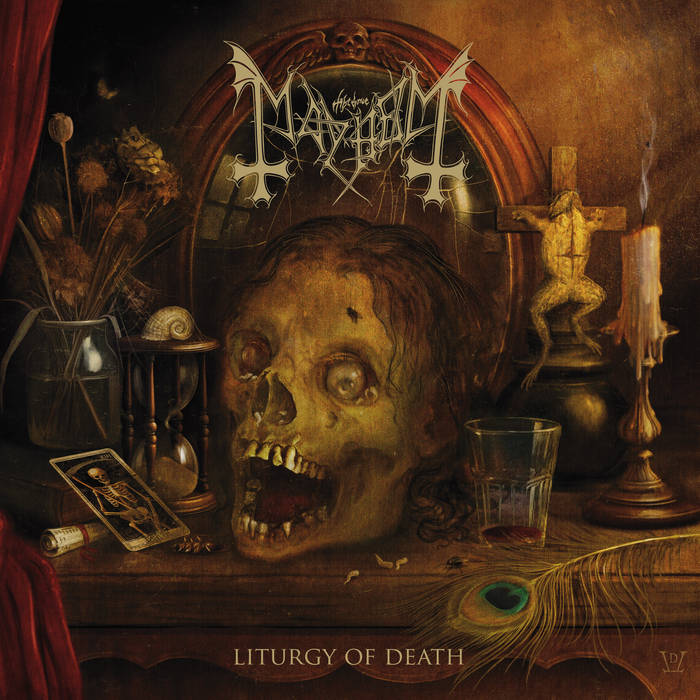
Mayhem
Liturgy of Death
Dense and textural, the reinvigorated Norwegian group's seventh studio album finds them on iconoclastic form
Liturgy of Death (24-bit HD audio) by Mayhem
Norway's prominence in extreme metal can be attributed not only to the dark, saturnine winters of Scandinavia, but also to deep-seated pagan traditions and the rebellious anti-Christian black metal counter-culture that emerged in the 1980s and 1990s. These elements intensified conditions necessary for the development of genres such as Death and Black metal.
As pioneers of the Norwegian Black Metal scene in the 1980s, Mayhem have continued to reign for over four decades in death and black metal, releasing new material roughly every five to seven years. Their seventh studio album, Liturgy of Death, is their "most commercial...
The post Mayhem - Liturgy of Death appeared first on The Quietus.
Karshni - Buck Wild [ 11-Feb-26 9:54am ]
Karshni
Buck Wild
Debut album from the Indian solo artist is as visceral as it is ethereal
Everyone who proselytises will eventually tell you that the truth sets you free. On her debut album Buck Wild, Indian (Pune-based) artist Karshni splits herself open: sometimes with a surgeon's meticulousness, sometimes like a violent, rabid cannibal, utterly disinterested in suturing herself back shut, intent on ravaging the person she once was - all in the service of 'getting real', both with herself and her listeners.
In the last eight-odd years that she has been making music, Karshni has developed an indie-darling, melancholia laden sound-bed, then abandoned it, floated across collaborations with her peers, lending her voice to records that span the distance between avant-garde hiphop and shoegaze,...
The post Karshni - Buck Wild appeared first on The Quietus.
Elon Musk's latest scheme is a satellite catapult on the Moon [ 11-Feb-26 11:34am ]With his newfound focus on the Moon, Elon musk is making some wild new plans. In an xAI meeting with employees, Musk said the company needed to build an AI satellite factory on the moon with a gigantic catapult to launch them into space, according to audio heard by The New York Times.
All of that would be part of the billionaire's plans to create a massive orbiting AI "data center" that uses satellites powered by the sun and kept cool by the vacuum of space (a bad plan, some experts say). Any satellites launched from the Moon would presumably orbit the Moon as well, though Musk didn't provide any additional details.
"You have to go to the moon" in order to build the required AI capabilities, Musk told employees. "It's difficult to imagine what an intelligence of that scale would think about, but it's going to be incredibly exciting to see it happen."
Such a catapult would certainly need to be powerful — though the Moon has only one-sixth the gravity of Earth, the minimum escape velocity required for orbit is still around 3,800 MPH or five times the speed of sound. That's currently possible with electromagnetic railguns that launch projectiles at speeds up to Mach 8.8, though any satellite launched by such a device would need to withstand acceleration forces around 10,000 g or more.
It's fun to think about it, but there are a few tiny steps required first. That starts with orbiting the Moon and eventually landing on the surface. Then you'd need to build a colony, followed by a factory, all of which would require a large number of manned and unmanned expeditions. As a reminder, we haven't been to the moon for over 50 years and none of the colony or factory stuff has ever been done.
Early last year Musk said in a post on X that SpaceX would be going "straight to Mars" and that "the Moon is a distraction." However, the CEO apparently shifted his near-term priorities to building a "self-growing city on the Moon" because it's a more achievable target. In a post on X, Musk said the company could complete this in less than 10 years, while doing the same on Mars would take over 20 years.
Any estimates from Musk himself certainly need to be treated skeptically, though. Elon once said in 2017 that SpaceX would send cargo missions to Mars by 2022 aboard a rocket that's still being tested in 2026.
This article originally appeared on Engadget at https://www.engadget.com/science/space/elon-musks-latest-scheme-is-a-satellite-catapult-on-the-moon-113403143.html?src=rss
Saudis challenge William over UK 'royal' Epstein links [ 11-Feb-26 11:01am ]
The Saudis have castigated 'heir to the throne' William for his Epstein-linked uncle during his visit to Saudi Arabia this week. Saudi Arabia is an absolute monarchy with an appalling human rights record, but it is still able to look down on the UK and US establishment's cosiness with murderous paedophiles.
Saudi media challenged the royal in Riyadh, with a reporter demanding to know whether the Windsors have "done enough around the Andrew and Epstein issue". He ignored the question and walked off. That'll be a 'no', then.
The US justice department's latest, intentionally-chaotic release of Epstein files show further disturbing images of Andrew with anonymised girls. They also show Andrew leaking confidential information and Epstein trafficking another young woman to the UK for him. Mountbatten-Windsor paid now-deceased Epstein victim Virginia Giuffre around £12m in an out-of-court settlement. This was funded by the monarchy and therefore by UK taxpayers.
Mountbatten-Windsor was stripped of all titles in December 2025. The public has repeatedly challenged his brother Charles in recent weeks for his failure to take more serious action against him. Charles has now said he will 'support' the police investigation.
It remains to be seen how exactly the royal family intends to make any sort of amends to the victims and survivors shoved into the spotlight during this debacle.
Featured image via FCDO
By Skwawkbox
Hapless DWP don't know which water companies pocketed £22.4m in Universal Credit deductions [ 11-Feb-26 10:33am ]
The Canary has revealed how during a 12-month period, water companies leached £22.4m from customers' Universal Credit via the Department for Work and Pensions (DWP).
However, in obtaining the figure, we also discovered that the DWP has no record of what each company has been seizing from welfare claimants. When already vulnerable benefits claimants are in debt to water companies, the DWP will then allow these privatised water companies to deduct benefits from desperate claimants.
Apparently it needs saying: water is not a luxury
DWP doesn't know the scale of water companies' Universal Credit deductionsThe Canary submitted freedom of information (FOI) requests to the department for regional and parliamentary constituency data on water deductions. In order to comply with the request, it appeared that the DWP had to collate this data from its records. In other words, until the Canary queried the proportion of third party deductions the water industry had made, it was not information the DWP had already calculated.
What's more, through a series of further FOIs, the DWP admitted to the Canary that it doesn't know how much each water company has deducted individually.
The DWP said that this was because:
data on deduction requests from specific organisations or the date a deduction request was made is not readily available for Universal Credit.
As such, it told the Canary that to "explore the available datasets" and "collate the relevant data" would take it over the cost limits in the FOI Act. But the admission ultimately underscored how the DWP has made no efforts to assess the scale of individual companies clawing back aggressive arrears through the benefits system.
What water companies took £22.4m in Universal Credit?The Canary also attempted to find out how this divided up for water versus sewerage services. But in response to a further FOI, the DWP said that:
The Universal Credit deductions data does not state the name of a water company owed money, or reason for the debt, and as the water arrears data is not broken down, we cannot determine whether any deduction is for water supply or sewerage.
Unfortunately, outside official statistics, it's really difficult to get a read on individual water company deductions.
The first reason for this is that water supplier coverage overlaps in some constituencies. So, while we can use obtainable data showing coverage by constituency, companies don't actually always supply water services to all postcodes within these electoral boundaries.
It's also not the case constituencies always have the same sewerage providers to their water suppliers. In other words, the deduction could come from either company administering these services. That further complicates calculating what each company is deducting.
However, under the Universal Credit priority order, the water supplier makes deductions first for any arrears. The company providing wastewater services can only start taking deductions once the water debt is cleared.
Because it comes first in the order of priority, it's probable that the lion's share of these deductions is for water supply services. Ultimately though, it's not possible to establish from the data available how much is for water, and how much for sewerage arrears.
Water companies won't say, naturallyThe Canary contacted 13 of the largest water and sewerage companies. We asked them directly to provide figures on their Universal Credit deductions. Predictably, not a single company offered this information. By and large, despite a few initially responding that they would look into this, water firms ignored our query. Only two companies eventually came back to confirm that they were not willing to supply these figures.
A spokesperson for Pennon Group, South West Water's parent company, responded saying that:
The information you have requested is commercially sensitive but all Universal Credit deductions are managed in line with DWP guidelines.
Meanwhile, Dwr Cymru came back with a similar dismissal:
We're unable to provide specific figures for Universal Credit deductions received by Dŵr Cymru for 2024 and 2025 as this information is commercially sensitive.
However, we can confirm that deductions are managed in line with the Department for Work and Pensions (DWP) guidelines, including the Fair Repayment Rate and deduction cap changes, which aim to ensure affordability for customers.
Our focus remains on supporting customers in financial difficulty with affordable payment arrangements.
In both instances then, water firms leaned on the claim it's "commercially sensitive" information to refuse the data.
In reality, it's nonsense for them to suggest this. For one, water companies already publish data about their 'bad debt'. As just one example, they will include financial information on County Court Judgements (CCJ) against their customers in annual reports.
More likely, firms fear the reputational fallout of the public learning just how much they're hammering their poorest customers.
The DWP should turn its attention to the real fraudstersThe Labour government continues to justify brutal disability benefit cuts and dystopian surveillance with nonsense rhetoric around the so-called 'benefits bill'. Yet, the DWP couldn't put figures to the welfare it's funnelling into the pockets of privatised water firms.
Perhaps it's time the DWP turned its attention to the corporate criminal water corporations draining the welfare system for profits they neither need, nor deserve.
Featured image via the author
Notepad's new Markdown powers served with a side of remote code execution [ 11-Feb-26 11:31am ]Just months after Microsoft added Markdown support to Notepad, researchers have found the feature can be abused to achieve remote code execution (RCE).…
One in five Euro datacenters AI-ready as builders battle land and labor blues [ 11-Feb-26 11:17am ]Only 20 percent of datacenters are considered AI-ready across Europe and the Middle East, despite the growing demand for infrastructure to accelerate AI processing.…
First Look: Livery for Valentino Rossi's 2026 Bathurst 12 Hours revealed [ 11-Feb-26 10:42am ]
The next Renaissance: Why creativity is the currency of the AI age [ 11-Feb-26 10:24am ]
We stand at one of history's most exhilarating crossroads. Artificial intelligence is rewriting the rules of work, business, and human potential at breathtaking speed. The very capabilities that make us most human, our creativity, our imagination, our ability to dream up what doesn't yet exist, are becoming our most valuable assets. This is not a story about humans versus machines. It's a story about human potential unleashed. It's about a future where technology handles the tedious so we can focus on the transcendent. Where the dreamers, the questioners, the bold thinkers who color outside the lines are not just welcomed,…
This story continues at The Next Web
Vance & Hines Motorsports Announces AFT Contingency Program [ 11-Feb-26 10:44am ]BROWNSBURG, IN — Vance & Hines Motorsports is proud to announce its 2026 Progressive American Flat Track Contingency Program, offering nearly $20,000 in payouts across both KICKER AFT Singles and Mission AFT SuperTwins classes.
This comprehensive program rewards top performance while reinforcing Vance & Hines Motorsports' commitment to the sport and its riders.
PROGRAM DETAILS (16 RACES):
- KICKER AFT Singles: $550 Per-Event Payout
(Using One Qualifying Product / PowerPak OR VHM Exhaust)
- 1st $150
- 2nd $100
- 3rd $75
- 4th $50
- 5th $25
Championship Bonus $1,000
- KICKER AFT Singles Double-Up BONUS (* Paid in addition to the single-product payout noted above)
(Using Both Qualifying Products / PowerPak AND VHM Exhaust)
- 1st +$50
- 2nd +$50
- 3rd +$50
Championship Bonus +$1,000
- Mission AFT SuperTwins: $400 Per-Event Payout
(Using One Qualifying Product / VHM Exhaust)
- 1st $150
- 2nd $100
- 3rd $75
- 4th $50
- 5th $25
Championship Bonus $1,500
 Vance & Hines exhaust on Brandon Robinson's (4) Harley-Davidson XG750R. Photo by Kristen Lassen for AMA Pro Racing.
About VANCE & HINES MOTORSPORTS
Backed by five decades of championship-winning experience, Vance & Hines Motorsports delivers race-bred performance. From cutting-edge cylinder head services, engine components, and race exhausts to the PowerPak Engine Data Management System and our purpose-built XG750R race motorcycles, everything we do is driven by a passion for racing excellence.
Be Sure to Visit Our Site: vanceandhinesmotorsports.com
Social Media: @vanceandhinesmotorsports
About Progressive American Flat Track
Progressive American Flat Track is the world's premier dirt track motorcycle racing series and one of the longest-running championships in the history of motorsports. Sanctioned by AMA Pro Racing in Daytona Beach, Fla., the series is highly regarded as the most competitive form of dirt track motorcycle racing on the globe. Progressive American Flat Track is televised on FOX Sports and streams live via FloRacing. For more information on Progressive American Flat Track, please visit us on the web, like us onFacebook, follow us on X, and check us out on Instagram.
About AMA Pro Racing
AMA Pro Racing is the premier professional motorcycle racing organization in North America, operating a full schedule of events and championships for a variety of motorcycle and ATV disciplines from its headquarters in Daytona Beach, Fla. Learn more about AMA Pro Racing at www.amaproracing.com.
The post Vance & Hines Motorsports Announces AFT Contingency Program appeared first on Roadracing World Magazine | Motorcycle Riding, Racing & Tech News.
River project swims against the Wayland tide with modular window management [ 11-Feb-26 11:00am ]FOSDEM 2026 Isaac Freund's River compositor brings a little old-fashioned modularity and customizability to the brave new Wayland world.…
Apple's MacBooks don't need much help out of the box, but the right accessories can make a noticeable difference in how you use them day to day. Whether that means adding more ports, creating a cleaner desk setup or making your laptop easier to travel with, there's a growing ecosystem of gear designed to fill in the gaps Apple leaves behind. A good accessory should feel like an extension of your MacBook, not a workaround.
The picks below are meant to work smoothly with macOS and today's USB-C-only reality, whether you're using a lightweight MacBook Air or a higher-end MacBook Pro. From practical essentials to quality-of-life upgrades, these accessories are meant to help you get more done without adding unnecessary bulk or friction.
Best MacBook docking stations and hubs
Best MacBook charging gear
Best MacBook keyboards and mice
Best MacBook stands
This article originally appeared on Engadget at https://www.engadget.com/computing/accessories/best-macbook-accessories-150014737.html?src=rss
FOSDEM 2026 Michal Pleban knows his old kit inside out, and his talk on the CIDCO MailStation was one of the most interesting of FOSDEM for us - as well as the funniest.…
Bimota turned heads by landing podiums in their first season back in WorldSBK, now the Italian manufacturer's factory team look for sophomore success in 2026
Legacy IT issues are hampering key technical measures designed to prevent highly sensitive data leaks, UK government officials say.…
Excerpt:
submitted by /u/GravelySillyThe Federal Judicial Center has been established by statute as the "research and education agency of the judicial branch of the United States Government." As part of that role, it prepares documents that can serve as reference material for judges unfamiliar with topics that find their way into the courtroom. Among those projects is the "Reference Manual on Scientific Evidence," now in its fourth edition. Prepared in collaboration with the National Academies of Science, the document covers the process of science and specific topics that regularly appear before the courts, like statistical techniques, DNA-based identification, and chemical exposures.
When initially released in December, the fourth edition included material on climate change prepared by two authors at Columbia University. But a group of attorneys general from Republican-leaning states objected to this content. At the end of January, they sent a letter to the leadership of the Federal Judicial Center outlining their issues. Many of them focus on the text that accepts the reality of human-driven climate change as a fact.
"Nothing is 'independent' or 'impartial' in issuing a document on behalf of America's judges declaring that only one preferred view is 'within the boundaries of scientifically sound knowledge,'" the letter complains, while ignoring many topics where the document does exactly that. But the objections are only about one specific area of science: "The Fourth Edition places the judiciary firmly on one side of some of the most hotly disputed questions in current litigation: climate-related science and 'attribution.'"
[link] [comments]
Recently I learned of the Late Neolithic Collapse and think it has some interesting similarities with the current and near-future human situation. The wikipedia pages of Neolithic decline, 4.2-kiloyear event and the papers 'Repeated plague infections across six generations of Neolithic Farmers' and 'Emergence and Spread of Basal Lineages of Yersinia pestis during the Neolithic Decline' are some interesting sources.
I summarise the similarities as:
General technological slowdown and stagnation. The Neolithic Revolution slowed down or completely stopped in the Late Neolithic period, while the Moore's law failed around 2015. Since 2015, technological advance has become more marginal, speculative and much less paradigm-shifting. SpaceX just delayed Mars mission in February 2026.
Rise of a non-productive 'priest' class who discourage innovation and try to monopolise knowledge and power. The priest class dominated Late Neolithic city states and monopolised power by controlling knowledge and written material. Unfortunately we have a rising techno-feudalism who strives to achieve similar goals. They have been fairly successful in manipulating popular opinion by social media and algorithms.
Potential global crisis of climate and plague. Bubonic Plague spreaded through Late Neolithic Europe and Middle East and wiped out the majority of Anatolian Neolithic Farmers aka Early European Farmers. The 4.2-kiloyear event of global cooling was the final nail in the coffin of EEF, Longshan and Liangzhu culture. We seem to be safe from another devastating global plague but the antivax movement has gained momentum. The 2025 Texas measles outbreak can be partially blamed on decreasing vaccination rates.
Idiocracy: dumbing down of population due to significantly higher fertility rate of Ultra-religious and anti-science people. The plagues caused more devastation in the more educated Late Neolithic cities than the countryside, because the cities had higher population density and more foreign contact. The Bolivian Mennonites and Israeli Haredim have fertility rates of 6-7 and they mostly refuse to learn modern science or serve in the military. Places like Inner Melbourne have 1.0 fertility rate. The conversion rates of these Ultra-religious groups actually decreased so we can't count on them gradually assimilating into the urban population.
[link] [comments]
Smart plugs aren't the most complicated smart home device — they really just turn stuff off and on — but they do make life a little easier. Since using smart plugs, I've grown accustomed to having the living room lamps click on just before sunset and go off when I say goodnight to Alexa or the Google Assistant/Gemini (Siri can turn off a few of my lights, but isn't compatible with all of them). Most smart home device makers have a plug or two in their lineups, but finding one that's compatible with your chosen ecosystem, that's easy to set up and reliably connects can involve a little trial and error. That's why we tried more than a dozen models to find the best smart plugs you can buy right now..
Best smart plugs for 2026
The best outdoor smart plugs for 2026
Most people will likely use outdoor plugs for two things: patio lighting and holiday string lights. The devices are designed for the outdoors with a weatherproof protection rating of IP64 or higher, which means they're impervious to dust and can handle splashing water from rain and sprinklers. They have a longer Wi-Fi range than indoor plugs, for obvious reasons, and many have dual outlets, with individual control over each one.
Setup is the same as for indoor plugs: you'll use your phone to help the plug find your Wi-Fi using its companion app. The only tricky part is getting your phone within Bluetooth range of the plug (which it uses to initialize setup) and in Wi-Fi range at the same time. I had to awkwardly stand at a triangulated point in the middle of my driveway to get things communicating properly. Once set up, the plugs will communicate using your router for voice and app control and your phone needn't be anywhere near the plug.
Best uses for a smart plug
Before you buy one, it helps to know how a smart plug works best. They are designed for things that have an on/off switch, making them great for doing things like turning regular ol' lamps into smart lights. If you want a fan to move some air around before you get home, a smart plug can help. You can load a basic coffee maker with grounds and water the night before and wake up to a fresh pot in the morning. And instead of an air purifier running all day, you could set it to just run when you're away.
But gadgets that need to be programmed further, or require a stand-by mode, aren't ideal. If you want to control built-in lights, you'll need a smart light switch, which are more involved than smart plugs as they can involve in-wall installation. Smart bulbs are also an option for automation, and we have an entire guide devoted to those.
Some smart plugs can even monitor how much energy they use and display those figures within their companion app. That might not be much use on its own, as lamps with LED light bulbs consume very little energy, but it could help you keep tabs on your overall energy consumption.
What to consider when buying a smart plug Setup and useAdding a smart plug to your home is relatively simple. You'll use the manufacturer's app to initially connect, after which you can add the plug to a compatible smart home ecosystem so you can use voice control and other features. Both the brand's app and your smart home app will let you name the plug, set schedules and program "routines" which provide automation for multiple smart devices at once. But as you can guess, a manufacturer's app only lets you control products from that brand. If you want whole-home automation, operating, say, a plug from TP-Link's Kasa, a smart bulb from Philips Hue, a smart thermostat from Honeywell and a camera from Arlo without switching apps, you'll need to use a smart home platform, which means you'll need to consider compatibility.
CompatibilitySmart home devices connect through wireless protocols, often using more than one to communicate with your phone, smart speaker, router and in some cases, one another. The majority of smart plugs use Wi-Fi, but some have recently incorporated Matter, a relatively new wireless standard intended to solve integration issues between different brands and manufacturers, while also improving security and reliability.
More of these smart plugs are coming to market and, for now, most Matter devices work via Wi-Fi, Bluetooth and a low-power mesh network called Thread. Matter requires a controller that stays at home, like a hub or smart speaker, to manage things when you're out and about.
As for Bluetooth, most plugs, including all Matter plugs, use the short-range protocol to get the device set up for the first time. Some can continue to run on Bluetooth in the absence of another option, but the connection isn't as reliable and you won't be able to control the plug when you're away from home, or perhaps even just on the other side of the apartment.
Because Matter is relatively new, it may be easier to consider the manufacturer's system you'd use the most. There are four major "branded" smart home platforms: Amazon's Alexa, Google Home, Apple's HomeKit and Samsung's SmartThings. The first two work with the widest range of brands and are compatible with both iOS and Android devices. HomeKit not only limits app access to Apple devices, but it's also compatible with fewer plugs. You can also turn to open-source software like Home Assistant or go with the larger functionality of IFTTT if you want to, say, have your lights turn off when your Uber arrives. For the purposes of our testing, we stuck with the four big players. Nearly every plug we looked at clearly stated which platforms it works with, both on the packaging and retail product pages.
Of course, there's no rule that says you have to stick with one home assistant. You might have an Echo Dot in the basement, a HomePod in the living room and a Google Nest Mini in the kitchen, each controlling any compatible devices. My kid has a great time telling Alexa to turn on a light then asking Google's Gemini to turn it back off.
All of our top picks recommended here don't require a hub and connect directly to your home's Wi-Fi router. That means if you already have wireless internet and a smartphone or tablet, you can quite literally plug and play. The exception is Apple's HomeKit. If you want to pair up a compatible plug with that platform, you'll need a HomePod speaker, Apple TV or an iPad that stays in your home to enable remote control when you're away.
Some smart plugs require a hub regardless of which platform you use. For our guide, we focused on the simplicity (and lower cost) of options that work on their own, but hub-dependent devices may make sense in certain situations. Some companies, like Aqara and Lutron for example, make a vast range of smart home products, adding automatic shades, window sensors, smart locks and air quality monitors to the more traditional cameras and plugs. If you're going all-in on one brand and plan to get a plethora of connected devices, a hub can keep your Wi-Fi network from getting too crowded and provide a more seamless setup with reliable connectivity. Zigbee devices use their own protocol (different from Wi-Fi or Bluetooth) and also requires a hub.
SharingOnce a plug is set up with your platform and voice assistant of choice, anyone can control the plug just by talking. If someone else wants to control things with their phone, things get more complicated. Google makes it easiest, allowing you to invite another person just by tapping the + button within the Home app. Whomever you invite will have full access to your connected devices - including cameras - so this is only for people you trust the most.
HomeKit makes it similarly easy to grant app access to someone else, but as with most things Apple, it only works for other iOS users. Amazon only allows you to share access to your Echo, not your connected home devices.
Many smart plug manufacturers allow you to share control through their app by inviting another person via email. But this only grants access to devices of that brand. Hopefully as Matter expands, multi-admin features will become more widespread.
If you get a new Wi-Fi networkMost people will wirelessly connect their smart plugs to their home's Wi-Fi router. Matter, Z-Wave, Thread and other smart home protocols can work over local networks, but for most setups, the signals telling your plugs what to do will be dispatched through your router. If you happen to get a new one (like I did when it became clear my very basic gateway could not handle the number of smart home devices being tested) you'll need to take a few steps to get everything reconnected.
Depending on the brand, the steps may simply involve using the plug's companion app to update your credentials (network name and password). Or it will require deleting the device in the companion app, doing a factory reset (typically by pressing the onboard button for 10 seconds) and setting up the plug like it's brand new. GE Sync and Emporia plugs allow for a credentials update via their apps, others, like TP-Link Kasa and Meross plugs require deletion and a factory reset to get along with your new network. Amazon's smart plug updates automatically after updating the associated Echo device.
How we tested the best smart plugsBefore I decided which smart plugs to test, we considered brands Engadget staffers have had the best experiences with, both in review capacity and personally. We also checked out other online reviews. I then looked at factors like price, compatibility and relative popularity. Then, I tested about a dozen plugs using their companion apps and the four major smart home ecosystems. With lamps, lights, heaters, fans and more plugged into them, I set schedules, create routines, use voice control and generally live with the devices to evaluate them. I and continue to test good candidates as new models hit the market.
Other smart plugs we tested Eve Energy StripThe Eve Energy Strip only works with HomeKit and it's a bit more expensive than our pick for a smart strip. But it's an exceedingly attractive device complete with an aluminum frame and easy-to-read LED buttons. Those act as both indicators and manual switches for each of the three, individually controlled and nicely spaced plugs. Setup happens through the HomeKit app but after that, you can control the plug (and curiously, many other smart home devices active in your HomeKit profile) through the Eve Energy app. Here, you'll be able to create schedules and automations as well as monitor the plug's energy usage.
Meross Matter plug (MSS115)I wasn't able to test the Meross Matter plug fully. It requires Wi-Fi splitting, a process that's certainly possible for the average consumer, but more involved than it should be, considering the more than dozen other plugs I've tested don't require such a step. The plug itself also blocked the other outlet. Meross has an updated version of the Matter device on the way, one that looks to solve both issues and we'll update this guide accordingly once we've had a chance to test it.
Roku Smart PlugRoku's smart home gear is basically Wyze equipment with an app and packaging that are more purple. The Roku smart plug performed just fine with both compatible voice assistants (Alexa and Gemini). The companion app doesn't offer scheduling that revolves around the timing of the sunset in your area, but the plugs go for less than $10 each and if you've got a Roku TV or streaming device set up and want to keep everything on-brand, it could be a fit.
Aquara Smart PlugThe Aqara plug requires an Aqara hub. In tests, the connectivity was solid and the companion app allowed for useful if/then automations that can rope in other Aqara devices like locks, window shades, cameras and more. The plug also worked well with voice assistants from Amazon, Google and Apple. As a stand-alone plug, however, it's tough to recommend the nearly $100 combo to anyone who isn't planning to get a complete Aqara smart home setup.
Smart plug FAQs What are the disadvantages of a smart plug?While they're great when everything is working properly, smart plugs can be frustrating, adding a layer of complication to the simple act of turning on a light, if something goes wrong. For example: If your Wi-Fi goes out, your smart plug won't work. If the smart plug loses its connection to your router, it won't work. If you change your Wi-Fi password or provider, you'll have to re-program your smart plugs. If you forget what you named a particular plug during setup, you may be faced with an irritating conversation with your voice assistant. The best way to avoid some of those problems is to get a plug that works reliably, which is one of the features we considered for this guide.
How much power does a smart plug draw?Smart plugs don't draw much more power than whatever you're plugging into them. True, they remain on standby to await instructions from your smart assistant or other controller, so they're always using a small amount of power. But if, for example, you set a light to automatically turn off at night, and that light would otherwise stay on unnecessarily, the smart plug will save far more energy than the watt or two extra that it draws.
Do smart plugs use Bluetooth?Some smart plugs use Bluetooth to connect to your phone during setup. After that, most connect to your home's Wi-Fi network.
What appliances should not be plugged into a smart plug?Common sense will help you determine what not to plug in. Obviously anything dangerous like power tools should not be plugged into a smart plug. Appliances that require supervision, such as space heaters and curling irons, shouldn't be set to turn on automatically if no one will be around. You also shouldn't bother with anything that needs further programming. Simple on/off appliances like lamps and fans work best.
This article originally appeared on Engadget at https://www.engadget.com/home/smart-home/best-smart-plug-131542429.html?src=rss
Last month it was Heineken but now it's Guinness.
Cheers?

The latest ad-splash is a week-long campaign for Guinness, specifically the new brewery experience in Covent Garden which the King opened just before Christmas. Two tube stations have had a makeover, one minimally and the other more map-based. And while one aspect of the campaign is creatively brilliant, overall it's just an expensive tourist attraction overselling itself.
Here's the clever bit.

Eleven Northern line maps at Tottenham Court Road station have been 'inverted' so the line is white and the background is black, thus resembling a pint of Guinness with a white frothy top. Where the stairwells meet the platform it looks like two pints side by side. Full marks to the creative team for that idea.
It can't be a coincidence that the TfL blog sprang into rare action yesterday with a post entitled Commercial Partnerships at TfL: A balancing act. It asserts that commercial income is an essential part of TfL's wider strategy to grow and diversify revenue. It recognises they haven't always got it right ("Following the Burberry activation at Bond Street, which created some unintentional customer confusion, we reviewed and improved our approach"). And it lists three guiding qualities every time an activation like this goes live. Only one is a positive - raising money - whereas the other two are essentially 'we promise not to muck up'.
• Revenue generation - aiming to infuse colour and fun into the network while generating essential incomeThe inverted map is certainly accessible, indeed arguably clearer than the normal black on white. The only branding is a small harp beside the name of one station, assuming passengers will make the Guinness connection for themselves. Tellingly they've had to add a drinkware.co.uk URL at the bottom of the map, even at the bottom of the Central and Elizabeth line diagrams in the ticket hall, lest the tiny harp drive you to drink.
• Customer clarity - carrying out essential planning to ensure no customer is ever confused or misdirected
• Accessibility - embedded at every stage of planning and delivery, so no customer is disadvantaged

Yes they've changed some roundels, don't they always? Three on each platform have been swapped, a gold harp substituting for the red circle. Yes they've plastered a few corridors and slapped some Guinness ads up an escalator. Yes they've used black and gold along the top of the platform, though only partially. Yes there is a small toucan perched in the ticket hall, in fact two if you look carefully. No they haven't touched the Elizabeth line, not as far as I saw, because why waste extra money unnecessarily? And yes there is a large exhortation just before you leave the station to go and sample "The Home of Guinness in London", so I did.

And here's the stupid thing, Tottenham Court Road isn't the closest station to the Guinness Brewery. It isn't even the closest Northern line station, which is Leicester Square, but 95% of the marketing budget has still been spent here. The closest station is actually Covent Garden and all that has is half a dozen roundels - hardly any statement at all - but I guess the last thing TfL wants is more tourists at the deep awkward station with the busy lifts. Instead it's a 9 minute walk from Tottenham Court Road to the brewery, as the smallprint up the escalators attests, and that's assuming you know which convoluted way to go.
The Guinness Open Gate Brewery is an oddly-unfocused attraction tucked behind the streets of Covent Garden. It's partly based in historic buildings around Old Brewery Yard but also sprawls along an access corridor to a separate piazza, filling whatever floors the developers could get their hands on. Guinness was never brewed here, despite what the heritage murals might hint, and indeed isn't brewed here now. Instead the on-site microbrewery team explore "the new frontier of beer flavours", "from classic cold lagers to innovative low-percentage brews and sours with a tropical twist", "brewed to bubble at the centre of your conversations". If you manage to find a bar where they sell proper Guinness, it's all shipped in from Ireland.

And they'd rather you didn't just come for a Guinness but were tempted by alternative purchases. The most prominent door leads to a restaurant where £14 gets you a sausage and £6 a side of chips, while a more expensive seafood restaurant lurks upstairs. A portentous stairwell leads to a basement events space available for hire. If you hang around the main yard after the tables have been set out a black van will sell you a bespoke pie with a smidgeon of Guinness in the gravy. Don't try looking for a pub, there is no pub, all the better to help pay off the £73m development costs.
A separate building, opposite where Stanford's map shop ended up, hosts the experiential part of the experience. Here you can book tours to view the non-Guinnesses being brewed, take part in a tasting session and in the final room try your hand at pulling the perfect pint. I imagine the finale is seriously Insta-friendly ("come on Jason, don't let it all froth up") and that drinking said pint occupies a fair proportion of the 90 minute tour duration. Meanwhile downstairs is a Guinness store specialising in merch rather than beer, should you genuinely have need of a branded umbrella, branded beermat, limited edition tank top or weird designer creation invented for the sake of it. The supposed must-have is a personalised glass with the engraving carried out on site by faux heritage staff wearing black and gold braces, and the whole place reeks of the fundamentally unnecessary.

I'm not averse to a Guinness souvenir, my fridge is bedecked with a tortoise magnet purchased 25 years ago at the St James's Gate Brewery in Dublin. But that felt like a proper tour whereas this is just windowdressing masquerading as heritage with a price tag to match, not so much celebrating a beer as pimping a brand. And that's also why Guinness have splashed themselves across a busy tube station this week, a siren call to the neo-proletariat to visit WC2 for an extended black and white experience. Londoners won't be getting lower tube fares as a result but some marketing executives will be very happy, and that's the only pure genius frothing up here.
As OpenAI walks the advertising tightrope to balance revenue gains against credibility and safety, ad kingpin Google is roaring ahead to use AI to improve its advertising products.…


