

Late Tuesday, the FAA ordered every aircraft out of the sky over El Paso — commercial flights, cargo, private planes, medevac helicopters, police — for 10 days, citing "national defense" and threatening to shoot down anything that flew. No one in city government, Congress, or airport operations got advance warning, El Paso Matters reported. — Read the rest
The post FAA ordered a 10-day shutdown of El Paso's airspace, then reversed it hours later appeared first on Boing Boing.
XPENG has aggressively overhauled its Southeast Asian strategy in early 2026, transitioning from a niche importer to a regional powerhouse with localized manufacturing and an integrated infrastructure backbone. Central to this shift is a blueprint established in Indonesia: the integration of world-class ultra-fast charging to eliminate the primary barrier to ... [continued]
The post XPENG Isn't Just Entering ASEAN—It's Assembling an Operating System appeared first on CleanTechnica.

The government has released its official response to the report, Time to Deliver, which the Autism Act Committee released at the end of 2025. It's perhaps unsurprising to see that the response avoids accountability and refuses to place any care or timelines on the recommendations given across the report.
What is the Time to Deliver report, and why does it matter?The Autism Act 2009 specifically mandated that there must be a national strategy around autism, and produced statutory guidance. The strategy should have been updated in 2019, which was delayed until 2021. And whilst it made significant commitments, it only accounted for a single year. At this point in time, the government said it was prioritising updating the statutory guidance.
The House of Lords Autism Act Committee was appointed to consider the impact of the Act, and recommend necessary changes. To many, the report is imperfect: it doesn't acknowledge some of the true systemic natures of ableism and neuronormativity. And arguably it doesn't go far enough. But it does include the views of many autistic people and their advocates. And it does make extensive recommendations for the future.
Time to Deliver argues that the government must begin to develop a new all-age, cross-government strategy which can replace the current version went it expires in July 2026. The authors argue this should be based on the six themes they use in the report. These themes formed the basis of the questions the public could respond to:
- Improving acceptance.
- Identification and assessment.
- Reducing health inequalities.
- Education and transitions.
- Employment.
- Criminal justice.
They also call for the involvement of autistic people at every stage, a costed plan for implementation of the new strategy, an accountable minister, and the strategy to set out how the government will give services the support they need. These elements are particularly crucial in this austerity version of society where there's not enough funding reaching services. You can't make recommendations when no one can afford to make them happen.
The House of Lords Autism Act Committee said:
The government response is feebleThe Committee recommends that the government must develop the new autism strategy now, so it is ready to launch when the current one expires in July 2026. The government must identify priority outcomes, produce a costed, deliverable plan to achieve them, and make clear who is responsible and accountable for delivery.
Too often, decisions about autistic people's lives are made for them, not by them. This must change. Autistic people and those who support them must be meaningfully involved in every stage of the development and delivery of the new strategy.
Thousands of autistic people and those supporting them took part in this inquiry. It's apparently a record number of written submissions for any House of Lords committee. This shows how significantly issues of support and care for autistic people are having an impact across the UK. And it's extremely disappointing that the government has effectively dismissed this in its response.
In direct contrast to the careful recommendations of the committee, the government's response lacks any real substance at all. It commits to almost nothing, apart from the existing 10 Year Health Plan for England, which does not mention autistic people once in its entirety, and to the existing commitments of work.
This notably includes the independent review into 'prevalence and support' for autism, ADHD and mental health conditions. This is of course the highly problematic review into the fallacy of 'overdiagnosis'.
The response is flimsy, and says it welcomes the recommendations without any real intention to act upon them. There is seemingly no commitment to any timelines for a new national strategy. It would be a breach of statutory process if there is no follow-up action.
On the topic of meaningful engagement, the government response says:
We recognise that meaningful engagement will take time, so a balance will need to be struck as to what level of further engagement is required, and the current strategy will remain in force while we do this.
Co-production and engaging with the community cannot function as an excuse not to produce and act on a new strategy. Although engagement is important, action needs to happen effectively, efficiently and in a timely manner. Considering how much meaningful engagement the House of Lords Committee achieved in a relatively short time, it's not impossible.
Autism charities are not happy with the responseA collection of the UK's autism charities (National Autistic Society, Ambitious About Autism, Autistica, Autism Action and Autism Alliance UK) released a joint statement after the official release of the response, arguing that the response is unacceptable. They argue there is no evidence that the government intends to develop a new national strategy or:
do anything meaningful in compliance with the Autism Act.
Their statement says:
Vague commitments will do nothing to address the real barriers autistic people face… Once again, autism is lost in generic strategies, despite clear evidence of the distinct risks autistic people face and the need for specific, targeted, joined-up action. The House of Lords' report articulates these risks powerfully…
Every day the Government delays meaningful action, autistic children, young people and adults will continue to face shorter life expectancy, higher risk of suicide, mental health crisis, exclusion from education, family breakdown, long-term confinement in mental health hospitals, and one of the lowest employment rates of any group in society. These outcomes are shameful.
The charities note that harm is happening right now, in every sector of society. Advocates, charities and autistic people are disappointed by the response, but more importantly, it allows for autistic lives to continue to be placed into danger across various sectors.
Delaying a new national strategy is not just about paperwork. Although we know that things like statutory guidance and strategies do not liberate us, they are a part of how action happens. And issues of harm in systems like healthcare or psychiatric care are ongoing for thousands of autistic people.
The damage our community faces is not going anywhere. This committee report could have been a moment to commit to real change. It's unsurprising, but disappointing, that the response to a report full of genuine views and recommendations could fall so flat.
Featured image via the Canary

US plans to fund MAGA-aligned think tanks in Europe could reshape debates over Britain's Online Safety Act and global platform regulation.
A new transatlantic political debate is emerging around Britain's Online Safety Act. The issue is now being shaped not only in Westminster but also in Washington.
Reporting by the Financial Times says the US State Department plans to fund MAGA-aligned think tanks and charities across Europe. The programme links to the upcoming 250th anniversary of American independence. Officials say it will promote what they describe as "American values," including free speech.
A "freedom of speech tour" for MAGAAccording to the report, US Under-Secretary of State for Public Diplomacy Sarah B. Rogers travelled to London, Paris, Rome, and Milan last year. Officials described the trip as a "freedom of speech tour." During the visit, she met right-wing think tanks and political figures and discussed how grant funding could support their activities.
The MAGA-linked programme is expected to focus in part on opposing online-regulation laws such as the UK's Online Safety Act and the EU's Digital Services Act. US officials argue these rules threaten American technology companies and free expression online.
Across Europe, governments are tightening rules aimed at protecting children and reducing harmful online content. Countries such as Australia have also introduced tougher limits on children's access to social media. This shows how global regulation in this area is moving in a stricter direction.
At the same time, Washington has increased criticism of these measures, arguing that they unfairly target US-based platforms.
State Department responseIn response to questions from the Canary, a State Department spokesperson said the MAGA think tank funding represents "a transparent, lawful use of resources to advance U.S. interests and values abroad." The spokesperson added that officials were "not shy" about supporting American aims overseas. They rejected claims the programme was a "slush fund," stating that every grant would be publicly disclosed and accountable.
Campaigners and digital-policy researchers take a different view. Dr. Elinor Carmi of City St George's, University of London, told the Canary:
A growing influence debateJust like any democratic society, freedom must be regulated so people are not harmed." She added that the same principle should apply to digital platforms, where regulators have taken years to address harms affecting children and other vulnerable users.
The issue is especially sensitive in Britain, where the Online Safety Act has already generated intense political debate between those calling for stronger protections and those warning about the risks of expanding state oversight of online speech.
For the UK, the question is no longer only how the Online Safety Act will be enforced. It is also whether state-funded international MAGA-linked networks will begin to play a more visible role in shaping domestic regulatory debates. As these efforts expand, some observers ask a broader question: are we seeing routine diplomatic advocacy, or the gradual normalisation of what critics once described as dark-money politics, now operating more openly through state-backed influence campaigns?
Featured image via the Canary

Jewish activists from Jewish Anti-Zionist Action, and other grassroots groups within the Jewish Bloc for Palestine have protested and interrupted the launch event of the "Reform Jewish Alliance".
As Reform UK leader Nigel Farage took the stage to address the launch event's attendees at London's Central Synagogue, a group of protesters in the audience disrupted his speech. They loudly accused him and members the Reform party of "inciting attacks" on refugees and minority groups. And they claimed that Farage's party "would have deported" the protesters' ancestors when they arrived in Britain as Jewish refugees in the first half of the 20th century.
Jewish protesters criticise synagogue for hosting ReformProtesters also gathered outside the Central Synagogue to picket the launch event and protest against the use of Jewish religious spaces to host such events. They accused the venue of providing a platform for racism, xenophobia and antisemitism. And protesters held signs highlighting a series of high-profile controversial quotes by Reform UK-affiliated politicians. Several referenced antisemitic remarks which Nigel Farage allegedly made during his time at Dulwich College.
Max Hammer, a spokesperson for the Jewish Bloc for Palestine, said:
It's not surprising to see disgraced right-wing provocateurs and former spokespeople for Israel's genocidal government make overtures to Farage's Reform.
But we're dismayed and disgusted to see the Central Synagogue play along. How can a synagogue provide a platform to a man who allegedly spent his school days saying that Hitler was right?
We cannot stay silent when known antisemites use our sacred spaces to try and launder their reputation. Farage and his ilk are dangerous to Jews, dangerous to Muslims, and dangerous to all minority groups in the UK. No one in our community should let him forget that.
A coalition of progressive Jewish groups had previously decried the launch of Reform Jewish Alliance. Reporting suggests the group will aim to provide members with a programme of regular events featuring senior politicians from the far-right party and figures in the Jewish community.
The Jewish Bloc for Palestine previously released a statement denouncing the Synagogue's plans to host the Reform Jewish Alliance launch. They called it a "desecration of [the synagogue's] purpose" and encouraged Jewish community leaders to condemn the event.
The Reform Jewish Alliance was reportedly initiated by noted right-wing Jewish activist Gary Mond. And its leader will be Jason Pearlman, a former advisor to Israeli president Isaac Herzog.
Amid the high-profile accusations of antisemitism against Farage, the controversy surrounding its launch symbolises the growing political polarisation within the UK Jewish community. Recent polling by the Institute for Jewish Policy Research indicates that support for Reform UK has risen sharply among Jews in the past year. Although at 11%, it remains substantially below the levels of support in the overall British population.
Featured image via Talia Woodin / Jewish Anti-Zionist Action
By The Canary

Novara Media's Ash Sarkar has laid bare the blatant double standard in the Labour Party's vetting process:
Labour have one rule for one lot, another for the restWorth remembering that Faiza Shaheen was deselected as a Labour candidate for liking tweets from the Greens *before* she was ever a Labour member.
What could possibly explain such an intensive vetting process for the left, and such an apparently shoddy one for the right? https://t.co/hSxjZfYKfN
— Ash Sarkar (@AyoCaesar) February 11, 2026
Sarkar's interjection followed a post from the Times assistant political editor Geri Scott. Scott referred to a comment from Education minister Georgia Gould, who insisted the government were 'unaware' of Matthew Doyle's links to Sean Morton when announcing his peerage.
Doyle reportedly campaigned for Morton, a former Moray Labour councillor. A court sentenced Morton in 2018 for possessing Child Sexual Abuse Materials (CSAM). Authorities brought charges against him in 2016, yet Labour waited a year before suspending him from the party. A recent investigation found that Doyle was jailed for further similar offences last year, shining a spotlight on Labour's selective vetting.
Despite Gould's deflection, Scott has pointed out the government were aware prior to the letters patent being sealed and passed to the King, adding:
A govt source says: "There is no established precedent for withdrawing a peerage nomination after the announcement stage."
An X account responded and challenged Gould's links to Mandelson herself:
Georgia Gould? daughter if Philip Gould? Appointed by Peter Mandelson ? See? dots dots dots all joining up
Sarkar points out this double standard by referring to the Labour party's treatment of Faiza Shaheen. The party suspended Shaheen prior to the general election. The scandalous suspension came after old posts showed Shaheen liking content from the Green Party. Sarkar astutely points out those likes were prior to being a member of the Labour Party, whilst shining a light on what is (or isn't) a 'sackable offence' in the eyes of Labour leader and PM Keir Starmer.
One X account commented:
You can't say they're not thorough when investigating things they are bothered about, it's such a shame they have really bad priorities.
They can hardly say they weren't warned, with the leader of the SNP tabling a motion 4 weeks ago in response to Doyle's peerage:
Vetting process clearly works, but the boss shouldn't get to decideIt's just 4 weeks since I tabled a motion opposing this very appointment to the House of Lords.
Why did Keir Starmer ignore the warnings, and the victims, and appoint him anyway?https://t.co/oBXOdUm9hF https://t.co/NJxMbFujGm pic.twitter.com/IiVFNQwt6O
— Stephen Flynn MP (@StephenFlynnSNP) February 10, 2026
This issue once again exposes a blatant double standard at the heart of government. It also reveals the autonomy afforded to those in charge when it comes to deciding what 'issues' matter to them.
Sexual offences against children should really be on that list of concerns. And Starmer must answer why it doesn't seem to actually bother him in the first place.
Featured image via the Canary

The release of another tranche of documents from the Epstein Files by the US Department of Justice may have led the mainstream media in another direction, towards Jeffrey Epstein's espionage connections. Corporate media has also failed to frame the victims and survivors as being central to his and countless others' crimes.
However, another part of this story remains unexamined: Epstein was the linchpin in a full-on criminal enterprise that involved financial crimes as well as sexual abuse and exploitation.
This enterprise involved money laundering, art theft and fraud, currency and market manipulation, insider trading, banking and property fraud, racehorse switching and doping, on top of human trafficking and sexual slavery. And this list is by no means exhaustive.
Investigative journalist Carole Cadwalldr talks about the "broligarchy", and she's not wrong. Epstein counted an all-male coterie of billionaires among his circle. They were invited to lunches, dinners, and "conferences" at Epstein's various properties around the world.
Epstein's host of shell and "front" companies is the stuff of legend - certainly too many to list here. Thanks to his publicist Peggy Siegel, Epstein was hailed as a "financial wizard" in some quarters, but in reality, his wealth was down to two men - Victoria's Secret owner Les Wexner, who gave Epstein his $56m New York townhouse, and Leon Black, who gave him a reported $158m.
What's clear from the new release of files is the extent to which he sought social and financial legitimacy by courting high-net-worth individuals - and the richer, the better.
Here are the richest individuals who are central to this.
Elon Musk and EpsteinNet worth: $850bn
No. of times mentioned in the Epstein Files: 1084
Reported as the world's richest man, Musk has previously said that Epstein had invited him to his island but he had declined.
While he has not been accused of any wrongdoing in the case, the documents released include emails showing Musk had discussed travelling there on more than one occasion - there's a proposed 2012 trip in which he asked Epstein, "What day/night will be the wildest party on your island?"
The emails from November 2012 show Epstein asked how many people Musk would need transporting by helicopter to the island and Musk replies that it would only be himself and his then-wife, Talulah Riley.
Meanwhile, an email from Musk to Epstein on Christmas Day in 2012 shows Musk asking whether the financier had any parties planned because he needs to "let loose".
"I've been working to the edge of sanity this year and so, once my kids head home after Christmas, I really want to hit the party scene in St Barts or elsewhere and let loose," he writes, adding that a "peaceful island experience" is the opposite of what he's looking for.
In another batch of emails from 2013, Musk and Epstein discuss a visit to the paedophile's island, working on logistics and dates.
There is no evidence that Musk did take a trip to his island.
On X, Musk posted that he was "well aware that some email correspondence with [Epstein] could be misinterpreted and used by detractors to smear my name".
He added: "I don't care about that, but what I do care about is that we at least attempt to prosecute those who committed serious crimes with Epstein, especially regarding heinous exploitation of underage girls."
Jeff BezosNet worth: $249bn
No. of times mentioned in the Epstein Files: 189
In 2004, literary agent John Brockman hosted a dinner at a restaurant in Monterey, California, where he hoped to introduce the scientist authors he represented to wealthy individuals. Among those invited included Google co-founder Larry Page, Jeff Bezos and Jeffrey Epstein. The annual event was known colloquially as the "billionaires' dinner".
Whatever passed between Bezos and Epstein at the dinner, Bezos extended an invitation to Ghislaine Maxwell to attend his exclusive Campfire Event in 2018. Maxwell would attend the event three times, on one occasion taking tech firm CEO Scott Borgerson. When Maxwell went on the run after Epstein's arrest on child trafficking charges, it would be Borgerson's property she would take refuge in.
Bill GatesNet worth: $168bn
No. of times mentioned in the Epstein Files: 2512
Two emails from July 2013 drafted by Epstein suggest that Gates may have caught a sexually-transmitted disease and sought advice on how to secretly give his wife Melinda antibiotics. But it is unclear if these emails were sent. Both were sent from Epstein's email account and back to the same account, while no email account associated with Gates is visible.
Gates visited his properties a number of times, including his island, Little St James. Epstein tried to broker a venture between Gate's foundation and JP Morgan Chase Bank but it fizzled out. Meanwhile, Epstein inserted himself into the picture when Gates' chief advisor Boris Nikolic was negotiating his departure with a $14m payout.
A spokesperson for the Microsoft co-founder told the BBC:
These claims - from a proven, disgruntled liar - are absolutely absurd and completely false.
They added:
Sergey BrinThe only thing these documents demonstrate is Epstein's frustration that he did not have an ongoing relationship with Gates and the lengths he would go to entrap and defame.
Net worth: $255bn
No. of times mentioned in the Epstein Files: 258
Epstein was in contact with at least 20 prominent tech executives and investors. Musk, Bezos and Google co-founder Brin attended a dinner during the TED conference in California in March 2011. Brin visited Epstein's private island and emails show that the pair made plans to dine out.
He also corresponded frequently with Ghislaine Maxwell, and in the files there's an email about meeting up with Epstein and Maxwell during a trip to New York in 2003. "Let me know what works for you and Jeffrey," Brin writes.
Obsessed with transhumanism. Epstein was especially interested in Brin's fiancée at the time, Anne Wojcicki, biotech entrepreneur and 23andMe co-founder. The company filed for bankruptcy last year.
Richard BransonNet worth: $2.8bn
No. of times mentioned in the Epstein Files: 635
There are numerous pictures of the British Virgin Group founder with Epstein, including on Branson's island, Necker (as a friend of Branson's daughter, Holly, Kate Middleton holidayed here with her family and reportedly asked Branson for business advice). Meanwhile, in an email exchange from 2013, he appears to tell him that it was "really nice" seeing him, before adding: "Any time you're in the area would love to see you. As long as you bring your harem!"
Virgin Group has claimed that "harem" referred to three adult members of Epstein's team, adding:
Any contact Richard and Joan Branson had with Epstein took place on only a few occasions more than twelve years ago, and was limited to group or business settings, such as a charity tennis event.
However, the pictures paint a different story and point to a more intimate relationship between the two men. Branson was also a fan of Prince William's charity, Wild Aid, currently under fire for accepting a $50,000 donation from him.
Epstein's links need to be dismantledWhile being mentioned in the Epstein Files is not an indication of wrongdoing, it certainly begs the question of why anyone would go to an Epstein function more than once. What were they getting in return? Was a relationship with Epstein really worth risking everything? For example, if Google co-founder Sergey Brin has used his own search engine, he would have found Epstein's widely reported conviction for child sex offences.
The files story is one of systemic failure and draws attention to the inability of law enforcement agencies around the world to deal with criminals when they are wealthy and influential. But Epstein was no "kingpin", merely a cog in a global wheel of male patriarchal supremacy - one that must be dismantled finally and completely.
For more on the the Epstein Files, please read our article on how the media circus around Epstein is erasing the experiences of victims and survivors here.
Featured image via the Canary

Winter is not yet over by a long shot, and these knitted goose gloves might put you in a right frame of mind for the rest of the cold season. They're inexpensive and you can find them all over (Etsy, Amazon) in white or black. — Read the rest
The post Goose gloves appeared first on Boing Boing.
 Highlighting a new autism charity in Norfolk [ 11-Feb-26 2:53pm ]
As readers might know, I am 11 and I have autism. It took my parents five years to get my autism diagnosis, and they ended up going to a private organisation for my assessment. Once I got the diagnosis, there was still no extra help that the NHS or local councils could give me or my parents.
Today, average waiting times for an autism assessment on the NHS is 3-5 years which does not help families or their children and, in the meantime while waiting, they do not receive any help.
I would like to introduce a new charity that was set up in 2024 called Thrive Autism. I have become an ambassador for them, and I am so happy to be doing this role and promoting the services they offer.

Thrive Autism's purpose is to help people aged 0-25 with autism and their families. They are helping people in the Norfolk and Waveney area. Their long-term goal is to have a facility that will hold therapy, recreation and training to help families and their young people.
In the meantime, they are offering therapy sessions, rest and relaxation breaks, coffee and cake session for parents and carers and an opportunity to get an autism assessment quicker.
I think this charity will be a big help to families across Norfolk and Waveney. I want to help spread the word about this charity and what they offer.
If anyone wants to know more about this charity or requires any help from them then please visit their website.
Thank you for reading this, and I look forward to writing my next article.
More from East Anglia Bylines
 Health
Different, not less: my life as a 10-year-old with autism
byAmaya Edwards 2 April 2025
Health
Different, not less: my life as a 10-year-old with autism
byAmaya Edwards 2 April 2025
 Environment
The danger of flying rings to seals: a young campaigner's advice
byAmaya Edwards 3 August 2025
Environment
The danger of flying rings to seals: a young campaigner's advice
byAmaya Edwards 3 August 2025
 Environment
This simple solution stops pollution going into the sea
byAmaya Edwards 9 February 2025
Environment
This simple solution stops pollution going into the sea
byAmaya Edwards 9 February 2025
 Environment
The best way to help the plovers nest safely
byAmaya Edwards 28 June 2025
Environment
The best way to help the plovers nest safely
byAmaya Edwards 28 June 2025
 Bylines Network Gazette is back!
With a thematic issue on a vital topic - the rise child poverty, ending on a hopeful note. You will find sharp analyses on the effect of poverty on children's lives, with a spotlight on the communities that are on the front line of deprivation, with personal stories and shared solutions. Click on the image to gain access to it, or find us on Substack.
Journalism by the people, for the people.
The post Highlighting a new autism charity in Norfolk first appeared on East Anglia Bylines.
If I'm being brutally honest, I never really got the appeal of mechanical keyboards. There was always someone in the office who made a godawful racket hammering on their keyboard and then waxed lyrical about the merits of various switches. I'd mostly just dismissed them as cranks. I'm in love with my old Microsoft 4000 ergonomic keyboard. What use could I have a mechanical keyboard festooned with lights?

The good folks at Epomaker want me to see the error of my ways and have sent me a couple of devices to review. Today I'm trying out the TH87 and it is surprisingly lovely!
Blinken lights!Here's a quick video showing some of the effects.
https://shkspr.mobi/blog/wp-content/uploads/2026/02/th87-new.mp4Is this necessary? No! But it is jolly good fun. Probably a bit distracting - especially if you're in a dark space or a crowded office - but rather pleasing nevertheless. Switching between the effects means remembering the correct key combo - there's no way to do it programatically, you just have to cycle through them all.
Linux CompatibilityThe TH87 comes with a USB-C to A cable. Personally, I'd've preferred straight C-C, but this does the job. Flick the switch at the back to USB mode, plug it in, and Linux instantly detected it. No drivers to configure.
Rather cheekily, lsusb shows it as 05ac:0250 Apple, Inc. Aluminium Keyboard (ISO) - there's another switch for changing between Mac and PC mode. That doesn't change how the keyboard presents itself; just the keycodes it sends.
Oddly, there was this warning in dmesg:
apple 0003:05AC:0250.0010: Fn key not found (Apple Wireless Keyboard clone?), disabling Fn key handling
However, the function keys worked and I was able to control screen brightness etc using Fn and the F1-12 keys.
There's also a Bluetooth option. Again, Linux use was a breeze - although you'll have to remember what the pairing combo is and which device it is paired to.
There's also a 2.4GHz option. Hidden under one of the feet is a little USB-A receiver. Again, pairing is simple - just plug it in and flick the switch.
As expected, it also plays well with Android. The Bluetooth connection worked as did USB-OTG. Of course, quite why you'd want a giant heavy keyboard paired to your tiny phone is an exercise left to the reader.
Clunk Click Every Trip
So let's talk about noise. This keyboard is noisier than some of my other typing surfaces, but not aggressively so. Apparently it is "pre-lubricated" and has some noise suppression. The travel on the switches is excellent, they aren't stiff, and the whole contraption is sturdy.
It was easy to remove the caps with the enclosed tool. I didn't bother trying to extract a switch because I'm afraid of buggering it up.
Other ThingsBattery life is excellent - as you'd expect from a 10,000 mAh unit. It recommends charging by attaching to a computer and warns a regular charger might damage it. But, frankly, it seemed to cope just fine.
There's no software for customising the colours or functionality. Apparently lots of mechanical keyboards run an Open Source firmware - but this appears to be proprietary. There is some question about whether Epomaker comply with the GPL when it comes to the QMK source. They appear to have some source code available but it is hard to tell whether it exists for this specific model. I've contacted them for clarification.
There's a lot of technobabble on the website. Apparently it uses "5-Layer Sound Optimizing Design with PORON Sandwich Foam, IXPE Switch Pad, Sound Enhancement Pad, EPDM Switch Socket Pad, and Silicone Bottom". I've no ideas what it means, but it appears important to some people.
There's no number-pad, which is a bit of a shame. However the keyboard has a proper UK layout and is reasonably compact. Although at 1Kg it is almost as heavy as my laptop!
CostI have no internal benchmark for something like this. It's around £60 from AliExpress or £80 on Amazon UK depending on whether you have pleased The Algorithm. That seems pretty reasonable for a hefty keyboard with lots of customisability.
If you want ALL THE LIGHTS and value the ability to hot-swap various keys and switches, I think this is a nifty bit of kit.
The UK government has secured a record 7.4 gigawatts (GW) of solar, onshore wind and tidal power in its latest auction for new renewable capacity.
It is the second and final part of the seventh auction round for "contracts for difference" (CfDs), known as AR7a.
In the first part, held in January 2026, the government agreed contracts for a record 8.4GW of new offshore wind capacity.
This makes AR7 the UK's single-largest auction round overall, with its 14.7GW of new renewable capacity being 50% larger than the previous record set by AR6 in 2024.
In AR7a, 157 solar projects secured contracts to supply electricity for £65 per megawatt hour (MWh) and 28 onshore wind projects were contracted at £72/MWh.
This means they will help cut consumer bills, according to multiple analysts.
Energy secretary Ed Miliband welcomed the outcome of the auction, saying in a statement that the new projects would be "50% cheaper" than new gas:
"These results show once again that clean British power is the right choice for our country, agreeing a price for new onshore wind and solar that is over 50% cheaper than the cost of building and operating new gas".
In addition to cutting costs, the new projects will help reduce gas imports.
In total, AR7 will cut UK gas demand by around 95 terawatt hours (TWh) per year, enough to cut liquified natural gas (LNG) imports by three-quarters, according to Carbon Brief analysis.
Below, Carbon Brief looks at the seventh auction results for onshore wind, solar and tidal, what they mean energy for bills and the impact of the UK's target of "clean power by 2030".
- What happened in the latest UK renewable auction?
- What does the solar and onshore wind auction mean for bills?
- What does it mean for energy security, jobs and investment?
- What does the auction mean for clean power by 2030?
The latest UK government auction for new renewable capacity is the second and final part of the seventh auction round, known as AR7a.
It secured a record 4.9GW of new solar capacity across 157 projects, as shown in the figure below, as well as 1.3GW of onshore wind across 28 projects.
In addition, four tidal energy projects totalling 21 megawatts (MW) secured contracts, included within "other" in the figure below.
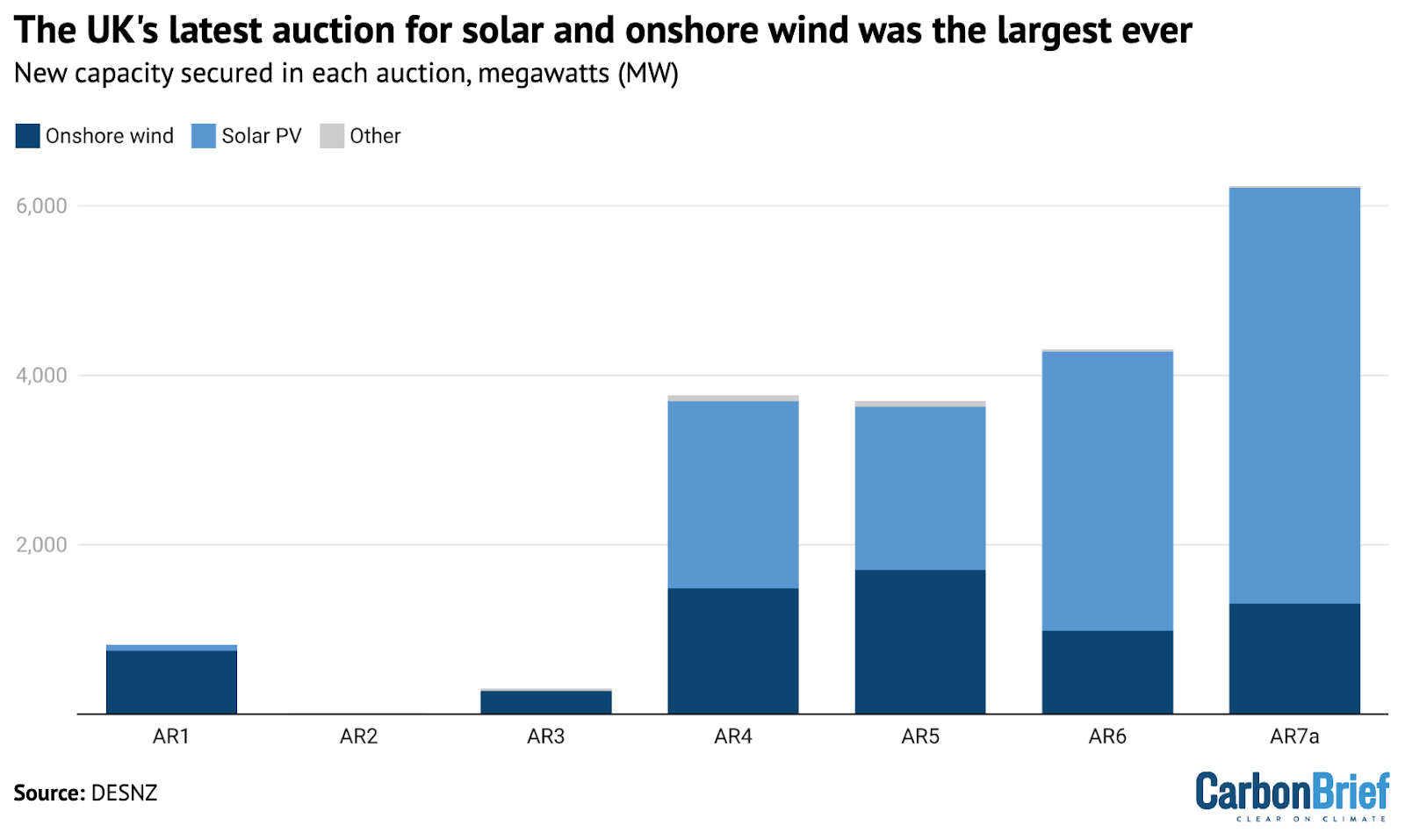 Capacity of solar, onshore wind and other technologies (including tidal) secured at each CfD auction in megawatts. Source: Department of Energy Security and Net Zero.
Most of the solar that secured a contract has a capacity of less than 50MW. This is the cut-off point for projects to be approved by the local council. Larger schemes must instead go through the "nationally significant infrastructure project" (NSIP) process, subject to approval by the secretary of state for energy.
For the first time, one 480MW solar project - approved via this NSIP process - won a CfD in AR7a. The West Burton Solar NSIP is being developed in Lincolnshire and Nottinghamshire by Island Green Power. It is named after the grid connection it will use, freed up by the shuttering of the coal-powered West Burton plant.
However, Nick Civetta, project leader at Aurora Energy Research notes on LinkedIn that this site was only one of four eligible solar NSIPs to secure a contract.
Civetta adds that "wrangling these large projects into fruition is proving more painful than expected".
Solar projects secured a "strike price" of £65/MWh in 2024 prices, some 7% cheaper than the £70/MWh agreed in the previous auction round.
In previous auction rounds CfD contracts were expressed in 2012 prices. For comparison, AR6 and AR7a solar contracts stand at £50/MWh and £47/MWh in 2012 prices, respectively.)
Alongside solar, 28 onshore wind projects secured contracts in the latest CfD auction, with a total capacity of 1.3GW.
This includes the Imerys windfarm in Cornwall, which at nearly 20MW is the largest onshore wind farm in England to secure a contract in a decade.
(Shortly after taking office in 2024, the current Labour government lifted a decade-long de facto ban on onshore wind in England.)
Overall, Scotland still dominated the auction for onshore wind, with 1,093MW of projects in the country in comparison to 38MW in England and 185MW in Wales.
.cb-tweet{ width: 65%; box-shadow: 3px 3px 6px #d3d3d3; margin: auto; } .cb-tweet img{ border: solid 1.25px #333333; border-radius: 5px; } @media (max-width:650px){ .cb-tweet{ width:100%; } }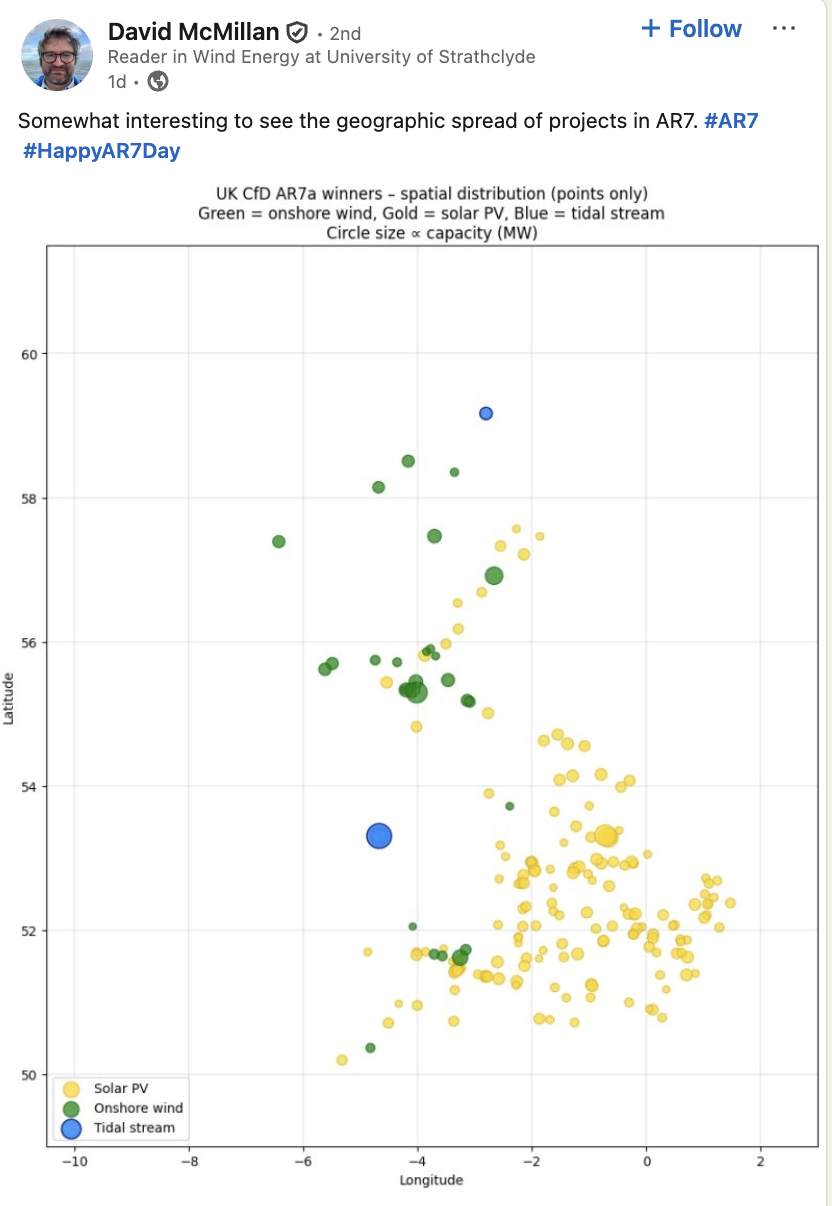
This includes the Sanquhar II windfarm in Dumfries and Galloway in Scotland, which will become the fourth-largest onshore wind farm in the UK at 269MW.
In total, Wales secured contracts for 20 renewables projects in AR7a, with a capacity of more than 530MW. This is the largest ever number of Welsh projects to get backing in a CfD auction, according to a statement from the Welsh government.
Onshore wind secured a strike price of £72/MWh, up slightly from £71/MWh in the previous auction in 2024.
The prices for solar and onshore wind were 13% and 21% below the price cap set by Department of Energy Security and Net Zero (DESNZ) for the auction, respectively.
In its press release announcing the results, the government noted that the results for solar and onshore wind were less than half of the £147/MWh cost of building and operating new gas power stations.
Finally, four tidal energy projects secured contracts with a total capacity of 21MW at a strike price of £265/MWh, up from £240/MWh in 2024.
In total, taken together with the 8.4GW of offshore wind secured in the first part of the auction, AR7 secured a total of 14.7GW of new clean power, as shown in the chart below.
This is enough to power the equivalent of 16 million homes, according to the government. It also makes AR7 the single-largest auction round by far, at more than 50% larger than the previous record set by AR6 in 2024.
This means that the two auction rounds held since the Labour government took office in July 2024 - AR6 and AR7 - have secured a total of 24GW of new renewable capacity. This is more than the 22GW from all previous auction rounds put together.
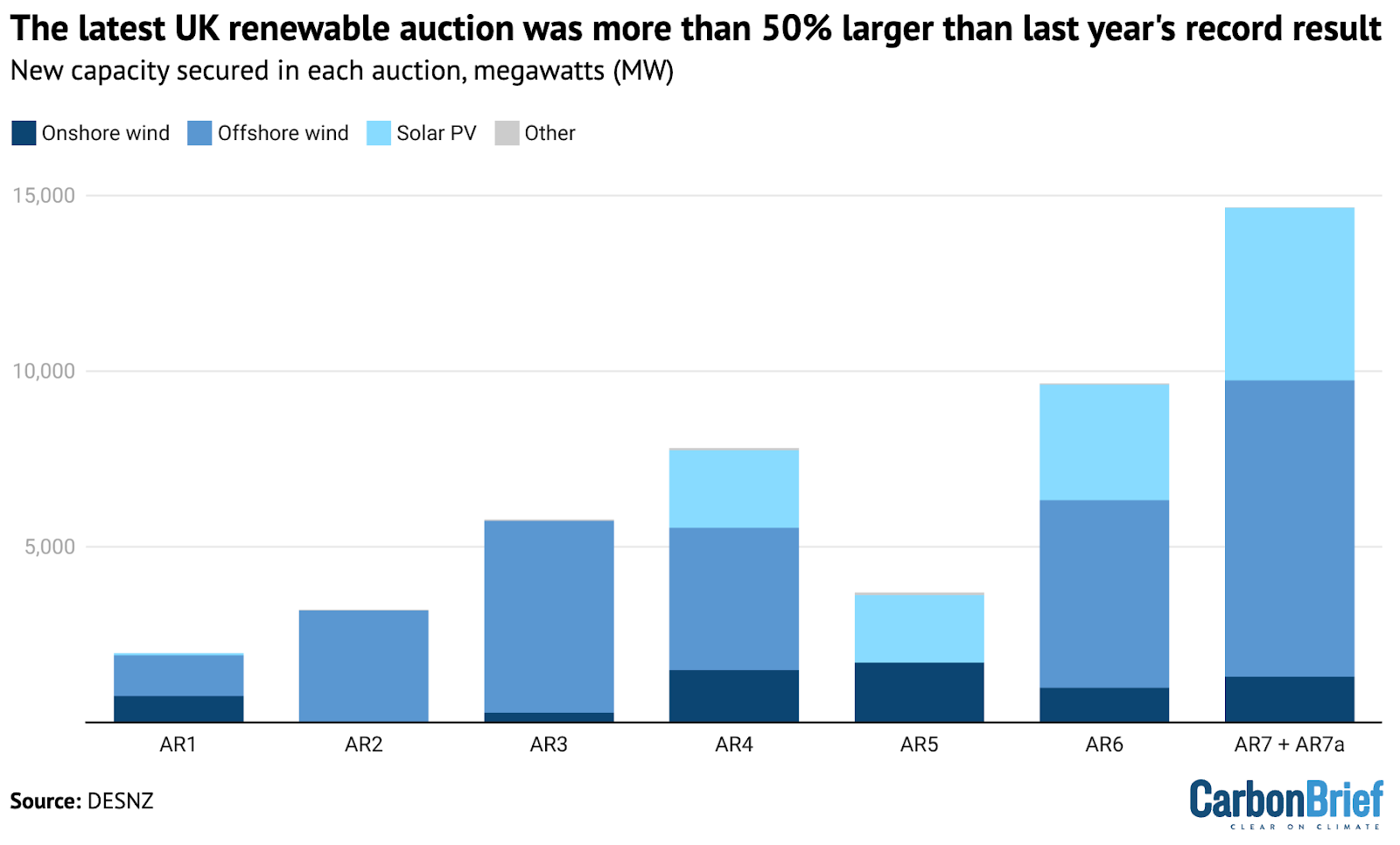 New onshore wind, offshore wind, solar PV and other technologies' capacity secured in each CfD auction, in megawatts. Source: DESNZ.
However, several analysts noted that the AR7a results did not include any old onshore windfarms looking to replace their ageing turbines with new equipment - so-called "repowering projects" - despite the auction being open to them for the first time.
What does the solar and onshore wind auction mean for bills?Onshore wind and solar are widely recognised as the cheapest sources of new electricity generation in almost every part of the world.
The latest auction shows that the UK is no exception, despite its northerly location.
The prices for onshore wind and solar in the latest auction, at £72/MWh and £65/MWh respectively, are comfortably below recent wholesale power prices, which averaged £81/MWh in 2025 and £92/MWh in January 2026.
This means that the new projects will cut costs for UK electricity consumers, according to multiple analysts commenting on the auction outcome.
.cb-tweet{ width: 65%; box-shadow: 3px 3px 6px #d3d3d3; margin: auto; } .cb-tweet img{ border: solid 1.25px #333333; border-radius: 5px; } @media (max-width:650px){ .cb-tweet{ width:100%; } }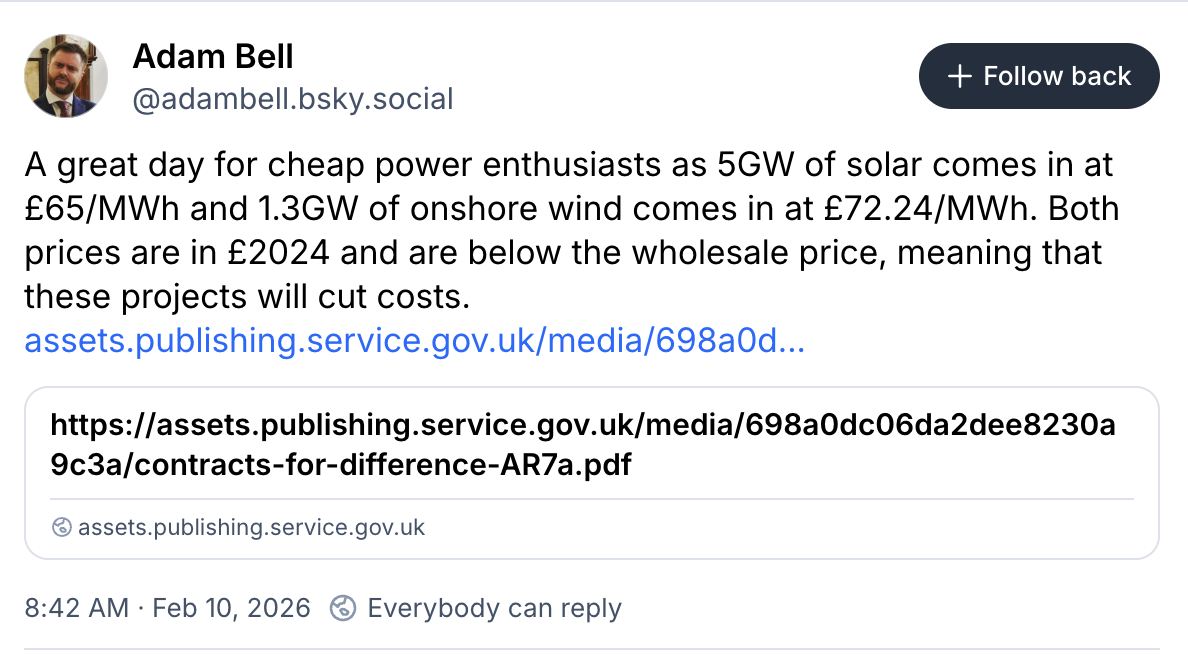
The government lauded the results of AR7a for securing "homegrown energy at good value for billpayers - once again proving that clean power is the right choice for energy security and to meet rising electricity demand".
In a statement, Miliband added:
"By backing solar and onshore wind at scale, we're driving bills down for good and protecting families, businesses, and our country from the fossil fuel rollercoaster controlled by petrostates and dictators. This is how we take back control of our energy and deliver a new era of energy abundance and independence."
As noted in Carbon Brief's coverage of the offshore wind results under AR7 in January, electricity demand is starting to rise as the economy electrifies and many of the UK's existing power plants are nearing the end of their lives.
Therefore, new sources of electricity generation will be needed, whether from renewables, gas-fired power stations or from other sources.
In his statement, quoted above, Miliband said that the prices for onshore wind and solar were less than half the £147/MWh cost of electricity from new gas-fired power stations.
(This is based on recently published government estimates and assumes that gas plants would only be operating during 30% of hours each year, in line with the current UK fleet.)
Trade association RenewableUK also pointed to the cost of new gas, as well as the £124/MWh cost of the Hinkley C new nuclear plant, in its response to the auction results.
In a statement, Dr Doug Parr, policy director for Greenpeace UK, said:
"These new onshore wind and solar projects will supply energy at less than half the cost of new gas plants. Together with the new offshore wind contracts agreed last month, these cheaper renewables will lower energy bills as they come online."
Strike prices for solar dropped by 6% compared to last year and while onshore wind prices rose, this was by less than 2% despite a "difficult environment for wind generation", according to Bertalan Gyenes, consultant at LCP Delta.
In a post on LinkedIn, he noted that "extending the contract length [for onshore wind projects] by five years seems to have helped keep this increase low".
The January offshore wind round secured 8.4 GW at £91/MWh, as such, the onshore and solar projects are 25% cheaper per unit of generation.
(The offshore wind projects secured in January are nevertheless expected to cut consumer bills relative to the alternative, or at worst to be cost neutral.)
Parr added that while the AR7a auction results "show we're getting up to speed" ahead of the clean power 2030 target (see below), "an even faster way for the government to make a really big dent in bills would be to change the system that allows gas to set the overall energy price in this country". He adds:
What does it mean for energy security, jobs and investment?"That would allow us to unshackle our bills from unreliable petrostates and get off the rollercoaster of volatile gas markets once and for all."
The onshore wind and solar projects secured in the latest auction round will generate an estimated 9 terawatt hours (TWh) of electricity, according to Carbon Brief analysis.
This is equivalent to roughly 3% of current UK electricity demand.
Combined with the estimated 37TWh from offshore wind secured during the first part of the auction, AR7 projects will be able to generate 46TWh of electricity, 14% of current demand.
If this electricity were to be generated by gas-fired power plants, then it would require around 95TWh of fuel, because much of the energy in the gas is lost during combustion.
This is several times more than the 25TWh of extra gas that could be produced in 2030 if new drilling licenses are issued, according to thinktank the Energy and Climate Intelligence Unit (ECIU). As such, AR7 will significantly cut UK gas imports, ECIU says, reducing exposure to volatile international gas markets.
Furthermore, ECIU says that the impact of renewables in driving down gas demand - and subsequently electricity prices - is already being seen in the UK.
Five years ago, gas was setting the wholesale price of power in the UK 98% of the time due to the way the electricity market operates.
This price-setting dominance is being eroded by renewables, with recent analysis from the UK Energy Research Centre showing that gas set power prices 90% of the time in 2025.
A further effect of new renewables is that they push the most expensive gas-fired power plants out of the system, reducing prices. This is known as the "merit-order effect".
Recent analysis from ECIU found that large windfarms cut wholesale electricity prices by a third in 2025.
Lucy Dolton, renewable generation lead at Cornwall Insight, said in a statement that the AR7a results will provide a "surge in momentum as [the UK] pushes toward secure, homegrown energy", adding:
"These investments ultimately strengthen the UK's position against volatile gas markets. If the past few years have shown us anything, it's that remaining tied to international energy markets comes with consequences."
The projects that secured CfDs will help the UK avoid burning significant quantities of gas, "the bulk of which would have been imported at a cost which the UK cannot control", said RenewableUK in its statement.
Together with previous CfD auction rounds, the latest new renewable projects are expected to generate some 153TWh of electricity once they are all operating, according to Carbon Brief analysis. This is around half of current UK demand.
Generating the same electricity from gas would require some 311TWh of fuel, which is similar to the 339TWh of gas produced by the UK's North Sea operations in the most recent 12-month period for which data is available. This figure can also be compared with the 130TWh of gas that was imported by ship as liquified natural gas (LNG) in the same period.
The government added that the AR7a projects will support up to 10,000 jobs and bring £5bn in private investment to the UK.
(In total, the new projects secured via AR7 are expected to bring investments worth around £20-23bn to the UK, according to Aurora.)
Additionally, the onshore wind projects are expected to generate over £6.5m in "community benefit" funds for people living near them, according to RenewableUK.
The AR7a results were released alongside the publication of the Local Power Plan by the government and Great British Energy.
This is designed to provide £1bn in funding for communities to own and control their own clean energy projects across the UK.
What does the auction mean for clean power by 2030?The AR7a results put the UK "on track for its 2030 clean power target", according to the government.
Over AR6 and AR7, several changes have been made to the CfD process to help facilitate more projects to secure contracts.
A total of 24GW has been secured over the last two auction rounds - which have taken place under the current Labour government - compared to 22GW across the five auction rounds previously.
As part of its goal for clean power to meet 100% of electricity demand by 2030 and to account for at least 95% of electricity generation, the UK government is aiming for 27-29GW of onshore wind and 45-47GW of solar by the end of the decade.
As of September 2025, the UK had 16.3GW of installed onshore wind capacity and more than 21GW of solar capacity. Taken together, the onshore technologies therefore need to double in operational capacity over the next four years to reach the 2030 targets.
Analysis by RenewableUK suggests that the government will need to procure between 3.85GW to 4.85GW of onshore wind in the next two auctions for the 2030 goal to remain possible.
Writing on LinkedIn, Aurora's Civetta said that the onshore clean power 2030 targets "remain a long way off".
He continued that the gap for solar to reach its 45-47GW target is still a "whopping 18GW", but added that there may be other ways for new capacity to be secured, beyond the CfD auctions.
He said these included a growing market for corporate "power purchase agreements" (PPAs), economic incentives for homes and businesses to install solar and the government's recently released "warm homes plan", all of which "should drive further procurement".
.cb-tweet{ width: 65%; box-shadow: 3px 3px 6px #d3d3d3; margin: auto; } .cb-tweet img{ border: solid 1.25px #333333; border-radius: 5px; } @media (max-width:650px){ .cb-tweet{ width:100%; } }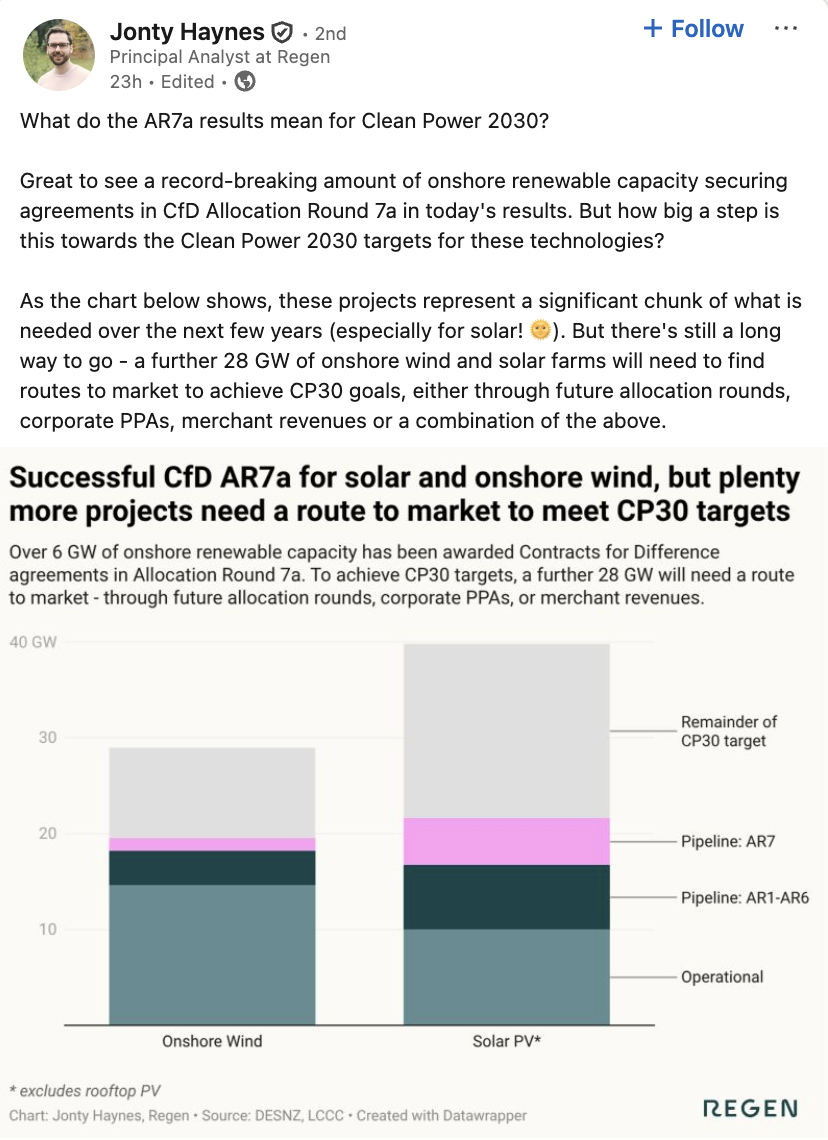
Dolton from Cornwall Insight adds that "the challenge now is delivery", continuing:
"2.5GW of the winners have a delivery year of 2027/28, and over half - 3.7GW - have a delivery year of 2028/29, which brings them very close to the government's 2030 clean power target.
"Historically, renewable projects in the UK have faced delays, often due to grid connection backlogs and planning holdups. With AR7 and some of AR8 representing the only realistic pipeline for pre-2030 capacity, keeping to schedule will be essential."
When built, the projects announced today will help to bring the total capacity of CfD-supported wind and solar to 50.6GW, according to Ember.
While solar and onshore wind are expected to play an important role in decarbonising the electricity system, offshore wind is set to be the "backbone".
The government is targeting 43-50GW of offshore wind by 2030, up from around 17GW of installed capacity today.
This leaves a gap of 27-34GW to the government's target range.
Prior to the AR7 auction, a further 10GW had already secured CfD contracts, excluding the cancelled Hornsea 4 project.
The 8.4GW secured in January brings the gap to reach the minimum of 43GW over the four years to just 7GW.
G7 'falling behind' China as world's wind and solar plans reach new high in 2025
International policy
|10.02.26
Five key climate and energy announcements in India's budget for 2026
Explainers
|04.02.26
Analysis: EVs just outsold petrol cars in EU for first time ever
Energy
|27.01.26

Q&A: What UK's 'warm homes plan' means for climate change and energy bills
Energy
|23.01.26
jQuery(document).ready(function() { jQuery('.block-related-articles-slider-block_99e53f1f9dc00f79a153af73a2fd69dd .mh').matchHeight({ byRow: false }); });The post Q&A: New UK onshore wind and solar is '50% cheaper' than new gas appeared first on Carbon Brief.
The Trump administration's decision to withdraw the US from the intergovernmental science panel for nature "harms everybody, including them", according to its chair.
Dr David Obura is a leading coral reef ecologist from Kenya and chair of the Intergovernmental Science-Policy Platform on Biodiversity and Ecosystem Services (IPBES), the world's authority on the science of nature decline.
In January, Donald Trump announced intentions to withdraw the US from IPBES, along with 65 other international organisations, including the UN climate science panel and its climate treaty.
In an interview with Carbon Brief, Obura says the warming that humans have already caused means "coral reefs are very likely at a tipping point" and that it is now inevitable that Earth "will lose what we have called coral reefs".
A global goal to halt and reverse biodiversity loss by 2030 will not be possible to achieve for every ecosystem, he continues, noting that a lack of action from countries means "we won't be able to do it fast enough at this point".
Despite this, it is still possible to reverse the "enabling drivers" of biodiversity decline within the next four years, he adds, warning that leaders must act as "our economies and societies fully depend on nature".
The interview was conducted at the sidelines of an IPBES meeting in Manchester, UK, where governments agreed to a new report detailing how the "undervaluing" of nature by businesses is fuelling biodiversity decline and putting the global economy at risk.
- On US leaving IPBES: "Any major country not being part of it harms everybody, including themselves."
- On reversing nature loss by 2030: "We won't be able to do it fast enough at this point."
- On the value of biodiversity: "Nature is really the life support system for people. Our economies and societies fully depend on nature."
- On coral reefs: "We will lose what we have called coral reefs up until this point."
- On nature justice: "The places that are most vulnerable don't have the income, or the assets, to conserve biodiversity."
- On IPBES's latest report: "One of the key findings is all businesses have impacts and dependencies on nature."
- On the next UN nature summit: "We need acceleration of activities and impact and effectiveness, more than anything else."
Carbon Brief: Last month Trump announced plans for the US to exit IPBES and dozens of other global organisations. You described this at the time as "deeply disappointing". What are your thoughts on the decision now and what will be the main impacts of the US leaving IPBES?
David Obura: Well, part of the reason that I've come to IPBES is because, of course, I believe in the multilateral process, because we bring 150 countries together, we're part of the UN and the multilateral system and we're based on knowledge [that provides] inputs to policymaking. We have a conceptual framework that looks from the bottom up on how people depend on nature. I'm also doing a lot of science on Earth systems at the planetary level, how our footprint is exceeding the scale of the planet. We have to make decisions together. We need the multilateral system to work to help facilitate that. It has never been perfect. Of course, I come from a region [Kenya] that hasn't been, you know, powerful in the multilateral process.
But we need countries to come together, so any major country not being part of it harms everybody, including themselves. It's very important to try and keep pushing through with the knowledge and keep doing the work that we're doing, so that, over time, hopefully [the US will] rejoin. Because, in the end, we will really need that to happen.
CB: This is the first IPBES meeting since Trump made the announcement. Has it had an impact so far on these proceedings and is there any kind of US presence here?
DO: This plenary is like every plenary that we have had. The current members are here. Some members are not. And, of course, we have some states here as observers working out if they're going to join or not. And then we have a lot of private sector observers and universities and so on. The impact of a country leaving - the US in this case - has no impact on the plenary itself, because they're not here making decisions on the things that we do.
We, of course, don't have US government members attending in technical areas, but we do have institutions and universities and academics here attending as they have in the past. So, in that sense, the plenary goes on as it goes on - the science and the knowledge is the same. The decision-making processes we have here are the same. And, as I said earlier, what has an impact is the actual action that takes place afterwards, because a lot of the recommendations that we make are based on enabling conditions that governments put in place, to bring in place sustainability actions and so on. When governments are not doing that, especially major economic drivers, then the whole system suffers.
CB: When you were appointed as chair of IPBES more than two years ago, you said that your aim was to strengthen cohesion and impact and also get the findings of IPBES in front of more people. So how would you rate your progress on this now that it's been about a couple of years?
DO: Well, like any intergovernmental process, we have a certain amount of inertia in what we do and it takes a few years to consult on topics for assessments and then to do them and to improve them and get them out.
One of the main things we're discussing right now is we have had a rolling work programme from when IPBES started until 2030 and we need to decide on the last few deliverables and how we work in that period. We are asking for a mandate to spend the next year really considering the multiple options that we have in proposing a way forward for the last few years of this work programme. I feel that the countries are very aligned. We have done a lot of work, produced a lot of outputs. It is challenging for governments and other stakeholders to read our assessments and reach into them to find what's useful to them. They make constant calls for more support, in uptake, in capacity building and in policy support.
The second global assessment in 2028 will be our 17th assessment [overall]. We would like to focus on really bringing all this knowledge together across assessments in ways that are relevant to different governments, different stakeholder groups, different networks to help them reach into the knowledge that's in the assessments. And I think the governments, of course, want that as well, because many of them are calling for it. Many of the governments that support us financially, of course, want to see a return of investment on the money that they have put in.
CB: Nations agreed to halt and reverse biodiversity loss by 2030. Back in 2023 we had a conversation for Carbon Brief and you said that you were "highly doubtful" this goal could be achieved for every ecosystem by that date. Where do you stand on this now?
DO: I work on coral reefs and part of the reason I've come to IPBES platform is because the amount of climate change we're committed to with current fossil fuel emissions and the focus on economic growth means that corals will continue to decline 20, 30, 40 years into the future. I think of that there's no real doubt. The question is how soon we put in place the right actions to halt climate change. That will then have a lag on how long it takes for corals to cope with that amount of climate change.
We can't halt and reverse the decline of every ecosystem. But we can try and bend the curve to halt and reverse the drivers of decline. So, that's some of the economic drivers that we talk about in the nexus and transformative change assessment, the indirect drivers and the value shifts we need to have. What the Global Biodiversity Framework [GBF, a global nature agreement made in 2022] aspires to do in terms of halting and reversing biodiversity decline - we absolutely need to do that. We can do it and we can put in place the enabling conditions for that by 2030 for sure. But we won't be able to do it fast enough at this point to halt [the loss of] all ecosystems.
We're now in 2026, so this is three years plus after the GBF was adopted. We still need greater action from all countries and all stakeholders and businesses and so on. That's what we're really pushing for in our assessments.
CB: Biodiversity loss has historically been underappreciated by world leaders. As the world continues to be gripped by geopolitical uncertainty, conflict and financial pressures, what are your thoughts on the chances of leaders addressing the issue of biodiversity loss in a meaningful way?
DO: What are the chances of addressing biodiversity loss? I mean, we have to do it. It's really our life support system and if we only focus on immediate crises and threats and don't pay attention to the long-term threats and crises, that only creates more short-term crises down the line, we make it harder and harder to do that. I hope that what I'm hoping we get to understand better through IPBES science, as well as others, is that we're not just reporting on the state of biodiversity because it's nice to have it, but it's [because] diversity of nature is really the life support system for people. Our economies and societies fully depend on nature. If we want them to prosper and be secure into the long-term future, we have to learn how to bring the impact and dependencies of business, which is a focus of this assessment, in line with nature. And until we do that, we will just continue to magnify the potential for future crises and their impacts.
CB: You mentioned already that your expertise is in coral reefs. A report last year warned that the world has reached its first climate tipping point, that of widespread dying of warm water coral reefs. Do you agree with that statement and can you discuss the wider state of coral reefs across the world at this present moment?
DO: The report that came out last year in 2025 was a global tipping point report and it's actually in 2023 the first one of those [was published]. I was involved in that one and we basically took what the IPCC [Intergovernmental Panel on Climate Change] has produced, which [is] compiled from the [scientific] literature [which said] that 1.5-2C was the critical range for coral reefs, where you go from losing 70-90% to 90-99% of coral reefs around the world. [It is] a bit hard to say exactly what that means. What we did was we actually reduced that range from 1.5C-2C to 1-1.5C, based on observations we've already made about loss of corals. In 2024, the world was 1.5C above historical conditions for one year. The IPCC number requires a 20-year average [for 1.5C to be crossed]. So, we're not quite at the IPCC limit, but we're very close. Also, with not putting in place fast enough emission reductions, warming will continue.
Coral reefs are very likely at a tipping point. And, so, I do agree with the statement. It means that we lose the fully connected regional, global system that coral reefs have been in the past. There will still be some coral reefs in places that have some natural protection mechanisms, whether it's oceanographic or some levels of sedimentation in green water from rivers can help. And there's resilience of corals as well. Some corals will be able to adapt somewhat, but not all - and not all the other species too. We will lose what we have called coral reefs up until this point. We'll still continue to have simpler coral ecosystems into the future, but they won't be quite the same.
It is a crisis point and my hope is that, in coming out from the coral reef world, I can communicate that this is, this has been a crisis for coral reefs. It's a very important ecosystem, but we don't want it to happen to more and more and more ecosystems that support more [than] hundreds of millions and billions of people as well. Because, if we let things go that far, then, of course, we have much bigger crises on our hands.
CB: Something else you've spoken about before is around equity being one of the big challenges when it comes to responding to biodiversity loss. Can you explain why you think that biodiversity loss should be seen as a justice issue?
DO: Well, biodiversity loss is a justice issue because we are a part of biodiversity and - just like the loss of ecosystems and habitats and species - people live locally as well. People experience biodiversity loss in their surroundings.
The places that are most vulnerable and don't have the income, or the assets, to either conserve biodiversity, or need to rely on it too much so they degrade it - they feel the impacts of that loss much more directly than those who do have more assets. Also, the more assets you have, the more you can import biodiversity products and benefits from somewhere else.
So, it's very much a justice issue, both from local levels experiencing it directly, but then also at global levels. We are part of it [biodiversity], we don't own it. It's a global good, or a common public good, so we need to be preserving it for all people on the planet. In that sense, there are many, many justice issues that are involved in both loss of biodiversity and how you deal with that as well.
CB: How would you say IPBES is working towards achieving greater equity in biodiversity science?
DO: One of the headline findings of our values assessment in 2022, which looked at multiple values different cultures have and different worldviews around the planet, [was that] by accommodating or considering different worldviews and different perspectives, you achieve greater equity because you're already considering other worldviews in making decisions.
So, that's an important first step - just making it much more apparent and upfront that we can't just make decisions, especially global ones, from a single worldview and the dominant one is the market economic worldview that we have. That's very important.
But, then, also in how we do our assessments and the knowledge systems that are incorporated in them. We integrate different knowledge systems together and try and juxtapose - or if they can be integrated, we do that, sometimes you can't - but you just need to illustrate different worldviews and perspectives on the common issue of biodiversity loss or livelihoods or something like that.
We hope that our conceptual framework and our values framework really help bring in this awareness of multiple cultures and multiple perspectives in the multilateral system.
CB: When this interview is published, IPBES will have released its report on business and biodiversity. What are some of the key takeaways from this?
DO: Our assessments integrate so much information that the key messages are actually, in retrospect, quite obvious in a way. One of the key findings it will say is that all businesses have impacts and dependencies on nature.
Of course, when you think about it, of course they do. We often think, "oh, well ecotourism is dependent on nature", but even a supermarket is dependent on nature because a lot of the produce comes from a natural system somewhere, maybe in a greenhouse or enhanced by fertiliser, but it still comes from natural systems. Any other business will have either impacts on the nature around it, or it needs tree shade outside so people can walk in and things like that.
So, that's one of the main findings. It's not just certain sectors that need to respond to biodiversity loss and minimise their impacts. All sectors need to. Another finding, of course, is that it's very differentiated depending on the type of business and type of sector.
It's also very differentiated in different parts of the world in terms of responsibilities and also capabilities. So small businesses, of course, have much less leeway, perhaps, to change what they're doing, whereas big businesses do and they have more assets, so they can deal with shifts and changes much better.
It's a methodological assessment, rather than assessing the state of businesses, or the state of nature in relation to businesses [and] they pull together a huge list of methodologies and tools and things that businesses can access and do to understand their impacts and dependencies and act on them. Then [there is] also guidance and advice for governments on how to enable businesses to do that with the right incentives and regulations and so on. In that sense, it helps bring knowledge together into a single place.
It has been fantastic to see the parallel programme that the UK government has organised [at the IPBES meeting in Manchester]. It has brought together a huge range of British businesses and consultancies and so on that help businesses understand their impacts on nature. There's a huge thirst.
To some extent, I would have thought, with so much capacity already in some of these organisations, what would they learn from our assessments? But they're really hungry to see the integration. They really want to see that this really does make a big difference, that others will do the same, that the government will really support moving in these directions. There's a huge amount of effort in the findings coming out and I'm sure that that will be felt all around the world and in different countries in different ways.
CB: As we're speaking now, you're still in the midst of figuring out exactly what the report will say and going through line-by-line to figure this out. Something we've seen at other negotiations…has been these entrenched views from countries on certain key issues. And one thing I did notice in the Earth Negotiations Bulletin discussion of yesterday's [4 February] negotiations was that it said that some delegations wanted to remove mentions of climate change from the report. Has this been a key sticking point here or have there been any difficulties from countries during these negotiations?
DO: The nature of these multilateral negotiations is that the science is, in a way, a central body of work that is built through consensus of bringing all this knowledge together. It's almost like a centralising process. And, yes, different countries have different perspectives on what their priorities are and the messages they want to see or not.
We still, of course, deal with different positions from countries. What we hope to do is to be able to convene it so that we see that we serve the countries best by having the most unbiased reporting of what the science is saying in language that is accessible to and useful to policymakers, rather than not having language or not having mention of things in in the agreed text.
How it'll work out, I don't know. Each time is different from the others. I think one of the key things that's really important for us is that you do have different governance tracks on different aspects of the world we deal in. So, the [UN] Sustainable Development Goals, as well [as negotiations] on climate change - the UNFCCC, the climate convention, is the governing body for that. There's two goals on nature - the Convention on Biological Diversity and other multilateral agreements are the institutions that govern that part.
We have come from a nature-based perspective, with nature's contributions to a good quality of life for people…We start in the nature goals, but we actually have content that relates to all the other goals. We need to consider climate impacts on nature, or climate impacts on people that affect how they use nature. The nexus assessment was, in a way, a mini SDG report. It looked at six different Sustainable Development Goals.
We try and make sure that while on the institutional mechanisms, certain countries may try and want us to report within our mandate on nature, we do have findings that relate to climate change that relate to income and poverty and food production and health systems [and] that we need to report [outwardly] so that people are aware of those and they can use those in decision-making contexts.
That's a difficult discussion and every time it comes out a little bit differently. But we hope we move the agenda further towards 2030 in the SDGs. We have an indivisible system that we need to report on.
CB: The next UN biodiversity summit COP17 is taking place later this year. What are the main outcomes you're hoping to see at that summit?
DO: The main outcomes I would hope to see from the biodiversity summit is greater alignment across the countries. We really need to move forward on delivering on the GBF as part of the sustainable development agenda as well. So there will be a review of progress. We need acceleration of activities and impact and effectiveness, more than anything else.
That means, of course, addressing all of the targets in the GBF. Not equally, necessarily, but they all need progress to support one another in the whole. We work to provide the science inputs that can help deliver that through the CBD [Convention on Biological Diversity] mechanisms as well. We hope they use our assessments to the fullest and that we see good progress coming out.
CB: Great, thank you very much for your time.
Prof Ben Santer: Trump administration is 'embracing ignorance' on climate science
Interviews
|15.01.26
Interview: How 'mid-level bureaucrats' are helping to shape Chinese climate policy
China energy
|09.12.25

The Carbon Brief Interview: UK Met Office chief executive Penny Endersby
In Focus
|23.10.25
The Carbon Brief Interview: UK Climate Change Committee's Emma Pinchbeck
Interviews
|16.10.25
jQuery(document).ready(function() { jQuery('.block-related-articles-slider-block_9e2ddb3c7a408710af03dd93037138ec .mh').matchHeight({ byRow: false }); });The post IPBES chair Dr David Obura: Trump's US exit from global nature panel 'harms everybody' appeared first on Carbon Brief.
The hot, dry and windy weather preceding the wildfires that tore through Chile and Argentina last month was made around three times more likely due to human-caused climate change.
This is according to a rapid attribution study by the World Weather Attribution (WWA) service.
Devastating wildfires hit multiple parts of South America throughout January.
The fires claimed the lives of 23 people in Chile and displaced thousands of people and destroyed vast areas of native forests and grasslands in both Chile and Argentina.
The authors find that the hot, dry and windy conditions that drove the "high fire danger" are expected to occur once every five years, but that these conditions would have been "rarer" in a world without climate change.
In today's climate, rainfall intensity during the "fire season" is around 20-25% lower in the areas covered by the study than it would be in a world without human-caused emissions, the study adds.
Study author Prof Friederike Otto, professor of climate science at Imperial College London, told a press briefing:
'Significant' damage"We're confident in saying that the main driver of this increased fire risk is human-caused warming. These trends are projected to continue in the future as long as we continue to burn fossil fuels."
The recent wildfires in Chile and Argentina have been "one of the most significant and damaging events in the region", the report says.
In the lead-up to the fires, both countries were gripped by intense heatwaves and droughts.
The authors analysed two regions - one in central Chile and the other in Argentine Patagonia, along the border between Argentina and Chile.
For example, in Argentina's northern Patagonian Andes, the last recorded rainfall was in mid-November of 2025, according to the report. It adds that in early January, the region recorded 11 consecutive days of "extreme maximum temperatures", marking the "second-longest warm spell in the past 65 years".
Dr Juan Antonio Rivera, a researcher at the Argentine Institute of Snow Science, Glaciology and Environmental Sciences, told a WWA press briefing that these weather conditions dried out vegetation and decreased soil moisture, which meant that the fires "found abundant fuel to continue over time".
In the northern Patagonian Andes of Argentina, wildfires started on 6 January in Puerto Patriada and spread over two national parks of Los Alerces and Lago Puelo and nearby regions. These fires remained active into the first week of February.
The fires engulfed more than 45,000 hectares of native and planted forest, shrublands and grasslands, including 75% of native forests in the village of Epuyén, notes the study.
At least 47 homes were burned, according to El País. La Nación reported that many families evacuated themselves to prevent any damage.
In south-central Chile, wildfires occurred from 17 to 19 January, affecting the Biobío, Ñuble and Araucanía regions.
They started near Concepción city, the capital of the Biobío region, where maximum temperatures reached 26C. In the nearby city of Chillán, temperatures reached 37C.
From there, the fires spread southwards to the coastal towns of Penco-Lirquen and Punta Parra, in the Biobío region.
The event left 23 people dead, 52,000 people displaced and more than 1,000 homes destroyed in the country, according to the study.
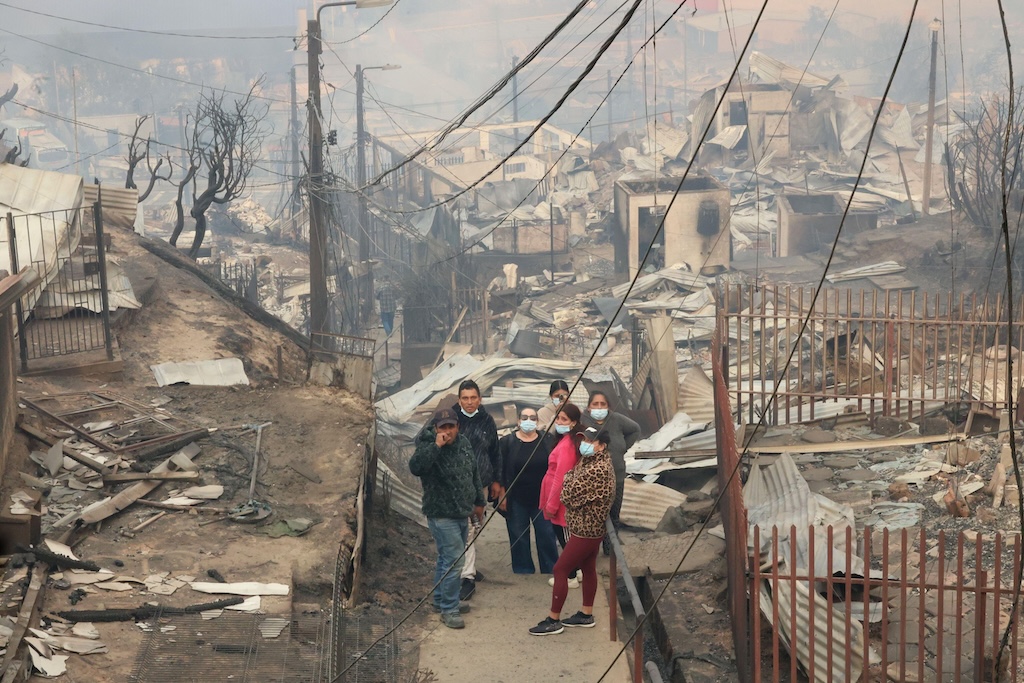 Inhabitants of Lirquen, in Chile, walk through the homes consumed by the flames in January 2026. Credit: UNAR Photo / Alamy Stock Photo.
These wildfires burnt more than 40,000 hectares of forests, "tripling the amount of land burned in 2025" across the country, reported La Tercera.
The study adds that more than 20,000 hectares of non-native forest plantations, including Monterey pine and Eucalyptus trees, were consumed by the blaze and critical infrastructure was affected.
A WWA press release points out that the expansion of non-native pines and invasive species "has created highly flammable landscapes in Chile".
Hot, dry and windyWildfires are complex events that are influenced by a wide range of factors, such as atmospheric moisture, wind speed and fuel availability.
To assess the impact of climate change on wildfires, the authors chose a "fire weather" metric called the "hot dry windy index" (HDWI). This combines maximum temperature, relative humidity and wind speed.
While this metric does not include every component that could contribute to intense wildfires, such as land-use change and fuel load data, study author Dr Claire Barnes from Imperial College London told a press briefing that HDWI is "a very good predictor of short-term, extreme, dry, fire-prone conditions".
The authors chose to analyse two separate regions. The first lies along the coast and the foothills of the Andes around the Ñuble, Biobío and La Araucanía regions in central Chile. The second sits across the Chilean and Argentine border in Patagonia.
These regions are shown on the map below, where red circles indicate the wildfires recorded in January 2026 and pink boxes represent the study areas.
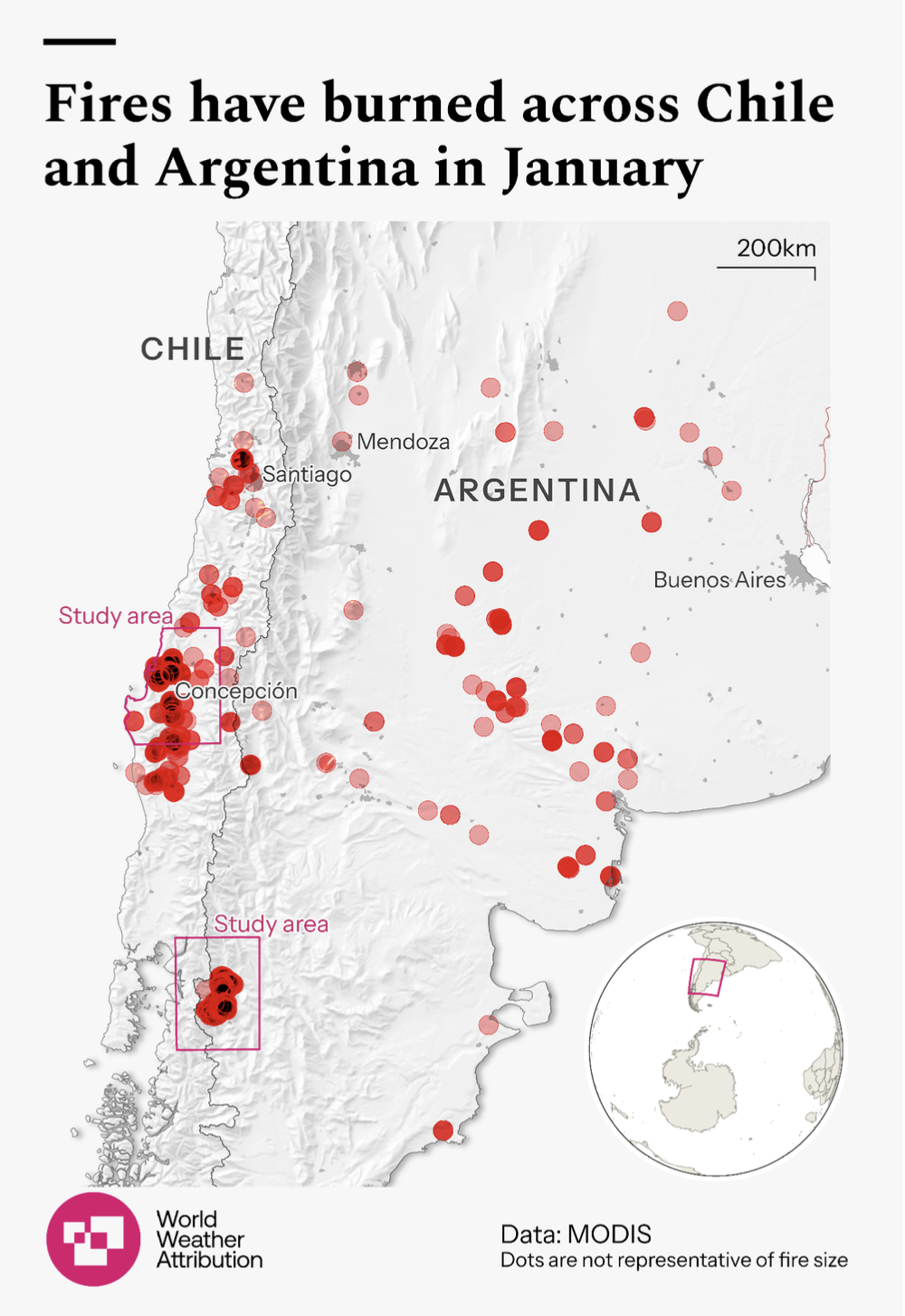 Location of forest fires in Chile and Argentina in January 2026 (red circles) and the study areas (pink boxes). Source: WWA (2026).
The authors also selected different time periods for the two study regions, to reflect the "different lengths of peak wildfire activity associated with the fires in each region".
For the central Chilean study area, the authors focus their analysis on the two most severe days of HDWI, 17-18 January. For the Patagonian region, they focus on the most severe five-day period, which took place over 2-6 January.
To put the wildfire into its historical context, the authors analyse data on temperature, wind and rainfall to assess how HDWI over the two regions has changed since the year 1980.
They find that in both study regions, the high HWDI recorded in January is not "particularly extreme" in today's climate and would typically be expected roughly once every five years. However, they add that the event would have been "rarer" in a world without climate change, in which average global temperatures are 1.3C cooler.
The authors also use a combination of observations and climate models to carry out an "attribution" analysis, comparing the world as it is today to a "counterfactual" world without human-caused climate change.
They find that climate change made the high HDWI three-times more likely in the central Chilean region and 2.5-times more likely in the Patagonian region.
The authors also conduct analysis focused solely on November-January rainfall.
Both study regions experienced "very low rainfall" in the months leading up to the fires, the authors say. They find that fire-season rainfall intensity is around 25% lower in the central Chilean region and 20% lower in the Patagonia region in today's climate than it would have been in a world without climate change.
Finally, the authors considered the influence of climatic cycles such as the El Niño-Southern Oscillation (ENSO), a naturally occurring phenomenon that affects global temperatures and regional weather patterns.
They find that a combination of La Niña - the "cool" phase of ENSO - combined with another natural cycle called the Southern Annular Mode, led to atmospheric circulation patterns that "favoured the hot and dry conditions that enhanced fire persistence and severity in parts of the region".
However, they add that this has a comparably small effect on the overall intensity of the wildfires, with climate change standing out as the main driver.
(These findings are yet to be published in a peer-reviewed journal. However, the methods used in the analysis have been published in previous attribution studies.)
Vulnerable communitiesThe wildfires affected native forests, national parks and small rural and tourist communities in both countries.
A 2025 study conducted in Chile, cited in the WWA analysis, found that 74% of survey respondents did not have appropriate education and awareness on wildfires.
This suggests that insufficient preparedness on early warning signs, response measures and prevention can "exacerbate the severity and frequency of these events", the WWA authors say.
Aynur Kadihasanoglu, senior urban specialist at the Red Cross Red Crescent Climate Center, said in the WWA press release that many settlements in Chile are close to flammable pine plantations, which "puts lives and livelihoods at risk".
Additionally, the head of Chile's National Forest Corporation pointed to "structural shortcomings" in fire prevention, such as lack of regulation in lands without management plans, reported BioBioChile.
In Argentina, the response to the fires has been hampered by large budget cuts and reductions in forest rangers, according to the WWA press release. Experts have criticised Argentina's self-styled "liberal-libertarian" president Javier Milei for the cuts and the delay to declaring a state of emergency in Patagonia.
According to the Associated Press, "Milei slashed spending on the National Fire Management Service by 80% in 2024 compared to the previous year". The service "faces another 71% reduction in funds" in its 2026 budget, the newswire adds.
Argentinian native forests and grasslands are experiencing "intense pressure" from wildfires, according to the study. Many vulnerable native animal species, such as the huemul and the pudú, are losing critical habitat, while birds, such as the Patagonian black woodpecker, are losing nesting sites.
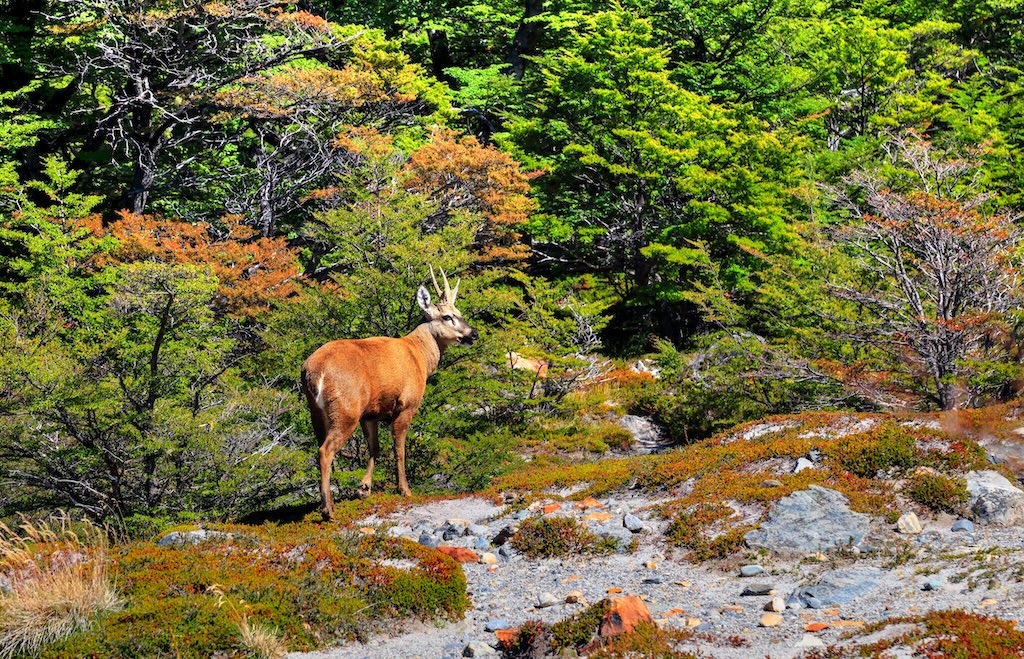 Huemul deer in Argentine Patagonia, one of the vulnerable animal species to wildfires in the region. Credit: Bernardo Galmarini / Alamy Stock Photo.
Climate change and La Niña made 'devastating' southern African floods more intense
Attribution
|29.01.26

Analysis: What are the causes of recent record-high global temperatures?
El Niño
|10.12.25

Met Office: Ten years of naming UK storms to warn the public
Guest posts
|13.11.25
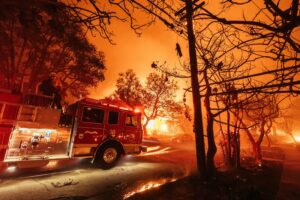
Global wildfires burned an area of land larger than India in 2024
Land and soils
|16.10.25
jQuery(document).ready(function() { jQuery('.block-related-articles-slider-block_61678c92e1affd8869aa7a79297160f3 .mh').matchHeight({ byRow: false }); });The post Climate change made 'fire weather' in Chile and Argentina three times more likely appeared first on Carbon Brief.
If there's any area of your life that you might be willing to introduce more AI into, it's likely something as mundane as grocery shopping. That's what Uber is betting on with its new AI-powered feature in the Uber Eats app.
Cart Assistant lets you "build grocery baskets faster and with less effort" by using AI to automatically fill your basket with items included on your shopping list. To use it, you search for a supported grocery store on the home screen of the app and tap the new Cart Assistant icon that appears at the top of the screen.
From there, you can either manually type out a shopping list or upload a photo of a handwritten one, and Cart Assistant will fetch your requested items and add them to your basket. A screenshot of ingredients needed for a recipe will also suffice.
Uber says its AI assistant will factor in availability before selecting an item and will also display prices and any available promotions. If you don't want something it recommends, you can delete or swap it for something else. Anything you forgot to add in the original list can be added later, and if you've purchased something in the past, these familiar items will be prioritized so you're less likely to need to make changes. Uber advises users that the new shopping feature is in beta right now, so might not perform perfectly.
Cart Assistant is the latest development in the gradual AI-ification of Uber Eats. Last summer, Uber added a suite of new features to the app, including AI-enhanced food images, AI menu descriptions and AI summaries or restaurant reviews.
This article originally appeared on Engadget at https://www.engadget.com/ai/uber-eats-new-cart-assistant-feature-is-an-ai-hack-for-your-grocery-shopping-145733478.html?src=rss
In Europe: Elon Musk Must Answer for Grok's "Spicy" Algorithm [ 11-Feb-26 2:36pm ] France Will Electrify with Renewables and New Nuclear [ 11-Feb-26 2:03pm ]
Trump DOJ Launches Bunk Investigation Of Netflix Merger As a Favor To Larry Ellison [ 11-Feb-26 1:21pm ]We told you this was coming months ago.
The Trump Department of Justice (DOJ) says it has initiated a broad investigation of Netflix's business practices and it's planned $82.7 billion merger with Warner Brothers. The Trump DOJ's pretense is that they're just suddenly really concerned about media consolidation and monopoly power (you're to ignore the U.S. right wing's generational and indisputable quest to coddle and protect monopoly power across telecom, energy, air travel, banking, and countless other industries):
"Questioning how Netflix competes with rivals suggests the department is looking at whether its planned Warner deal could entrench its market power, or lead to a monopoly in the future. U.S. law gives enforcers broad power to oppose mergers that could lead to a monopoly."
In reality, the Trump administration has made it extremely clear they're hoping to scuttle the Netflix deal to help Larry Ellison acquire Warner Brothers, CNN, and HBO. If they can't kill the deal, they aspire to at least leverage the merger approval process to force Netflix executives to further debase themselves before the Trump administration, which I suspect they'll all be happy to do.
It's part of a longstanding trend by Trumpism to pretend that they're engaged in populist antitrust reform, claims historically propped up by a long list of useful idiots across the partisan spectrum, and parroted by a growing coalition of right wing propaganda outlets. This bogus populism helps obfuscate what's really just some of the worst corruption America has ever seen (which is really saying something).
The original (paywalled) Wall Street Journal report (and this aggregated Reuters recap) dutifully help sell the claim that the DOJ is also "investigating" Ellison's Paramount/Skydance, whose Warner Brothers acquisition bid was repeatedly rejected by the Warner board over worries about dodgy financing and Saudi money involvement:
"The WSJ reported that the DOJ is also reviewing Paramount's proposed acquisition bid, which Warner Bros' board unanimously rejected by labeling it "inadequate" and "not in the best interests" of shareholders."
The outlets fail to remind you that there is generous reporting discussing how Larry Ellison and Trump have had extensive meetings discussing who Larry Ellison would fire on Trump's behalf should he take control of CNN. They also fail to remind you that the right wing "press," with Trump's help, has been engaged in a broad effort to undermine the Netflix merger chances using false claims.
After Warner Brothers balked at Larry's competing bid and a hostile takeover attempt, Larry tried to sue Warner Brothers. With that not going anywhere, Larry, MAGA, and the Heritage Foundation (of Project 2025 fame) have since joined forces to try and attack the Netflix merger across right wing media, falsely claiming that "woke" Netflix is attempting a "cultural takeover" that must be stopped for the good of humanity:

More recently that included scripted questions provided by the Heritage Foundation at a Congressional hearing, where lawmakers like Republican Senator Josh Hawley resorted to bogus trans panic attacks to try and paint Netflix as some sort of vile leftist cabal.
As we keep noting, ideally a functional regulator would block all additional media consolidation, since these megadeals are consistently terrible for labor, consumers, and product quality (see: Warner Brothers entire corporate history since 2000).
That's clearly not happening under a Trump administration that has lobotomized all key regulators. So ideally, while not great, Netflix acquiring Warner Brothers is the best of a bunch of bad options. It's arguably notably better than furthering Larry Ellison's obvious plan to gobble up CBS, TikTok, and CNN, and turn what's left of America's already dodgy corporate media into Hungary-esque state television that lavishes hollow praise on our mad idiot king.
Because we've already let media consolidation run amok (thanks to the Trump administration's attack on bipartisan media consolidation limits), our shitty corporate press is incapable of explaining to the public that the Trump DOJ inquiry into Netflix isn't being conducted in good faith. It's a perfect circle of corruption, greed, regulatory capture, and corruption that will ramp up in the weeks to come.
Razer's oldest mouse is new again, and $1337 [ 11-Feb-26 2:33pm ]
Though "leet" never made word of the year (Merriam-Webster selected "woot" instead), it was the language of a generation, said to be destroying their literacy. Now it's a charming memory of a time when the internet was cool rather than a vile and infested wasteland of brain rot and resurgent fascism. — Read the rest
The post Razer's oldest mouse is new again, and $1337 appeared first on Boing Boing.
Will artificial snow save the ski industry in the long run - or curse it? [ 11-Feb-26 1:16pm ]At the Winter Olympics, athletes race down immaculate white slopes. The snow looks perfect. But it is largely manufactured.
In Italy, where rising temperatures and declining snowfall were felt earlier than in other Alpine regions, technological fixes began in the 1990s. Today, reliance on artificial snow is widespread: around 95% of Italian ski resorts use snowmaking, and more than 70% of slopes are covered by artificial snow during the season.
Modern snowmaking uses a large fan-like "snow canon" to spray tiny droplets of water into cold air, where they freeze before landing on the ground. Vehicles known as piste bashers (in Europe) or snowcats (in North America) then compress and groom that new snow until it forms a more stable base. The process does not rely on chemical additives. It has become so effective that it can now guarantee competition-grade conditions even when natural snowfall is increasingly unreliable.
Together with colleagues at the Universities of Oxford and Trento, I have been part of the Hot Snow project, investigating what all this means for the ski industry.
 A 'snow canon' blasts tiny droplets into the air, where they freeze into snowflakes before landing.
Gherzak / shutterstock
A 'snow canon' blasts tiny droplets into the air, where they freeze into snowflakes before landing.
Gherzak / shutterstock
We know that continuous innovation - often referred to by the industry as "technical snow" - has helped protect winter sports. Yet we found it also carries a less visible risk: successful adaptation through artificial snow can make the ski industry complacent about climate change.
How artificial snow really worksIn leading resorts, artificial snowmaking process is data-driven and highly automated. At the touch of a tablet, operators can adjust the quality and density of new snow, depending on temperature, humidity and the sort of surface they want to create. This produces snow that can be more controllable and durable than natural snowfall.
Snowmaking systems have become more energy efficient over time. Production is optimised to exploit the coldest possible weather windows, reducing energy use per cubic metre of snow. In regions such as the Dolomites, where the Olympic ski races are being held, resorts largely rely on renewable electricity and rainwater stored in artificial basins.
 A snow cannon fires out water mist that will fall as snow.
Beekeepx / shutterstock
A snow cannon fires out water mist that will fall as snow.
Beekeepx / shutterstock
Even so, artificial snow remains energy intensive. In Italian ski resorts, snowmaking accounts for around 30-40% of total energy consumption, with annual costs of €50 million to €100 million (£44 million to €88 million). Across the Alps, total energy demand for artificial snow is estimated at around 2,100 gigawatt-hours per winter season - roughly equivalent to the total annual domestic electricity use of Milan.
The water footprint is just as significant. Artificial snow production in Italy alone consumes around 100-150 million cubic metres of water each year - roughly equivalent to the annual water use of between 1 million and 1.5 million people.
In regions where winter precipitation is becoming less reliable and summers are growing hotter and drier, this growing competition for water adds another layer of pressure, particularly for mountain communities and downstream users. For this reason, ski resorts increasingly rely on artificial reservoirs to store water which, though useful in dry seasons, are often harmful to mountain landscapes and ecosystems.
When adaptation becomes a trapThe effectiveness of snowmaking is both a blessing and a curse.
Across Europe, artificial snow now underpins much of the ski industry. In many regions, slopes depend on it to open at all. This technological success creates what economists call a lock-in effect. Resorts continue to invest heavily in snow cannons, reservoirs and grooming vehicles, even in areas where artificial snow may soon become unviable.
 In a dry or warm winter, snowmaking is crucial. This photo was taken in the Dolomites in January 2018: a bare mountainside with machine-made snow.
Stefano Politi Markovina / shutterstock
In a dry or warm winter, snowmaking is crucial. This photo was taken in the Dolomites in January 2018: a bare mountainside with machine-made snow.
Stefano Politi Markovina / shutterstock
At the same time, rising infrastructure costs requires a constant increase in consumer prices. Ski pass prices have increased by around 40% since 2021, further turning skiing into a sport accessible only to those with deep pockets. Each new investment further entrenches this trajectory, making it progressively harder to step back and rethink alternatives for the future of these resorts.
The illusion of controlSome snowmaking systems can technically operate even when air temperatures rise above freezing, albeit at a very high energy cost. One manufacturer has demonstrated technology capable of producing snow at ambient temperatures of up to 20°C. That possibility reinforces a dangerous narrative: that innovation alone will solve the problem.
But climate projections suggest there will come a point when even artificial snow cannot compensate for warming conditions at many altitudes. In Italy, most resorts located around 1,000 metres above sea level have abandoned hopes of operating consistently, while skiing in the Apennines - once a preferred destination for central and southern Italy - has largely shut down.
When artificial snow stops being viable, the transition is often abrupt. Resorts are left with stranded assets and communities face sudden economic shocks. This is what we describe as an "expiring industry", one that can appear economically healthy today while facing a clear climate-driven end date.
The danger is not collapse tomorrow, but delay today. As long as slopes remain open and bookings stay strong, there is little incentive to invest in alternatives. After all, winter tourism is still worth over €11 billion (£9.6 billion) a year to the Italian economy alone.
What should changeThose who benefit from the status quo are unlikely to propose alternative futures. Public policy therefore plays a crucial role in shaping which futures remain possible.
Continuing to subsidise ski infrastructure may keep slopes open for a few more seasons, but it also deepens reliance on winter snow in places where long-term viability is increasingly uncertain. It risks diverting public money, attention and political capital away from transitions that could actually endure.
A different approach would make public support conditional. Resorts could be required to disclose water and energy use transparently, and to present credible plans to diversify beyond winter-only tourism rather than simply extending it. This would also mean scrutinising claims that lift infrastructure can function as sustainable, year-round transport — a justification often used to secure public funding, but rarely realised in practice.
I'm a passionate skier myself. As a Veneto native, the Dolomites are my favourite place to ski. So this is not about blaming skiers or dismissing snowmaking technology, which has helped sustain jobs in the mountain communities of my region.
The problem is mistaking successful short-term adaptation for a viable long-term strategy. When technological fixes stand in for long-term planning, they delay investment in alternatives and leave regions more exposed when climate limits are finally reached.
As long as artificial snow keeps slopes white against an increasingly green landscape, it is easy to believe alpine skiing will always be there. But this is not simply kicking the can down the road. It is pushing it uphill. And metre by metre, the slope is getting steeper.

Paolo Aversa works on the Hot Snow project with professor Juliane Reinecke at the University of Oxford and professor Alberto Nucciarelli and Dr Edoardo Trincanato at the University of Trento. The research has been supported by The Center of Sustainable Business at King's Business School, The Fondazione CARITRO, and the Center for Sports and Business at the Stockholm School of Economics.
Kim Gordon Resists "Dirty Tech" in New Video [ 11-Feb-26 2:09pm ]
Faraday Future Follows Tesla's EV Playbook, Only Better [ 11-Feb-26 2:09pm ]The US startup Faraday Future is positioning its new Super One BEV as a stepping-stone to more affordable EVs, targeting the domestic market among others.
The post Faraday Future Follows Tesla's EV Playbook, Only Better appeared first on CleanTechnica.
Brussels drafts blueprint to spot and swat rogue drones [ 11-Feb-26 1:51pm ]The European Commission wants to see stronger EU-wide cooperation over malicious drones via a new action plan. Proposals include a central counter-drone test facility, changing the current rules governing civilian use, and a development boost to Europe's own drones and counter-drone systems.…
The New 'Stargate' Is Adding a Familiar Face in a Surprising Way [ 11-Feb-26 2:14pm ]
Premiere: Conor CC - Air [ 11-Feb-26 11:41am ]Following the kinetic rush of Hidden Allure, Conor CC returns to his Origin CC imprint with Air, a darker, more deliberate cut that trades peak-time velocity
Continue Reading
The post Premiere: Conor CC - Air appeared first on Inverted Audio.
Pokemon Pokopia is so damn cozy [ 11-Feb-26 2:00pm ]Pokémon Pokopia can be described as a pocket monster-themed take on Animal Crossing with a hint of Stardew Valley thrown in for good measure. And if you're like me, that alone is probably enough to sell you on the game. However, after getting a chance to play a preview of it for around half an hour, it became immediately clear that the game's coziness levels are off the charts, but it also offers some fun twists on the genre.
Co-developed by The Pokémon Company, GAME FREAK and KOEI TECMO, instead of playing as a generic trainer, you take control of a lonely Ditto who wakes up in a cave only to be greeted by Professor Tangrowth, the last surviving inhabitant of what used to be a bustling town. While the professor might look like an extra-large version of the original pokémon with glasses, its role is to guide you as you rebuild and hopefully repopulate the surrounding area.
 One of the best things about Pokopia is actually being able to talk to the other 'mons.Nintendo
As a Ditto, you naturally have the ability to transform into other Pokémon, though the process is sort of incomplete, meaning you can only learn one skill from the monsters you befriend instead of their entire moveset like in the mainline games. This is where the first twist on the traditional life sim comes in. Instead of crafting them or earning money to buy tools, you can transform into other Pokémon (like Lapras or Dragonite) to use their abilities to traverse obstacles or shape the world around you. For example, turning into a Squirtle lets you shoot a water gun that will revitalize dry patches or thirsty plants, while transforming into a Scyther lets you slice through objects similar to the HM Cut.
From there, you can use these skills to do things like create clusters of shrubs that will serve as homes for other Pokémon, allowing you to entice fellow creatures to return to the once desolate landscape. Another twist I really appreciate is that after appearing, new monsters will give you quests or just hang out. They will even talk and respond, and I don't mean like the 8-bit cries from other Pokémon games. They speak in full sentences, which is a wonderful departure from previous titles that really gives you the feeling that you're making friends and rebuilding a community instead of just being on a crusade to catch them all.
The Stardew Valley part of the equation comes into play after you leave the first tutorial area and you come upon an abandoned Pokémon Center that's in dire need of a renovation. You can do things like collect materials and do more quests to clean up the area to eventually turn the building in the heart of the town. Unfortunately, that's where my preview ended, aside from quickly hopping into a multiplayer session where I was able to see a much more developed village, complete with multiple buildings, roads and benches. You know, all the sorts of things you used to furnish and decorate your island with in Animal Crossing.
This gave me a nice glimpse at just how many things you can build in Pokopia and how easy it is to visit other people's towns. However, it didn't answer some of my bigger questions about the game, like what's the deal with Peakychu and Mosslax, whom we've seen before in previous trailers. Are they just one-off versions of existing 'mons with unusual typings (i.e. ghost and grass) only for this game, or are they going to be a bigger part of the Pokémon world going forward? Perhaps more importantly, it was hard to tell if there will be any sort of PVE content like The Mines or Skull Cavern in Stardew Valley. I'm really hoping there is because it seems like Ditto's abilities could translate quite seamlessly to spelunking or battling your way through dungeons in search of rare items or building materials.
 I love how derpy Ditto looks when it transforms into other Pokémon. Nintendo
That said, just being able to build a community of friendly monsters while injecting life back into a forgotten town has good vibes radiating from every corner. So if you need a super cozy game to keep you busy this winter/spring, Pokémon Pokopia is shaping up to be the digital version of a fluffy blanket and a cup of hot chocolate filled to the brim with all of your favorite 'mons.
Pokémon Pokopia is available for pre-order now, with official sales slated for March 5.
This article originally appeared on Engadget at https://www.engadget.com/gaming/nintendo/pokemon-pokopia-is-so-damn-cozy-140000954.html?src=rss
T-Mobile Will Live Translate Regular Phone Calls Without an App [ 11-Feb-26 2:05pm ]
Texas "Antifa Cell" Terror Trial Takes on Tough Questions About Guns at Protests Against ICE [ 11-Feb-26 1:28pm ]A group of activists gathered outside the Prairieland Detention Center near Dallas last July 4 with fireworks and plans to mount more than a polite protest.
They were there for less than an hour before things took a turn: A police officer was wounded by a gunshot.
Only one member of the group is accused of pulling a trigger, but 19 people went to jail on state and federal charges. Attorney General Pam Bondi labeled the defendants terrorists, and FBI Director Kash Patel bragged that it was the first time alleged antifa activists had been hit with terror charges.
Months later, the Trump administration recycled the label to smear Renee Good and Alex Pretti, Minneapolis residents who were shot and killed by federal immigration agents. They were supposedly dangerous left-wing agitators, in Pretti's case legally carrying what the government said was a "dangerous gun." The videos of Good and Pretti's killings disproved the administration's lies.
Unlike the Minneapolis shootings, the full events at Prairieland were not caught on video. Instead, a jury in federal court will hear evidence against nine defendants at a trial starting next week, which will serve as the first major courtroom test of the Trump administration's push to label left-wing activists as domestic terrorists.
"I wonder how they are going to make it stick when their attempts at framing Alex Pretti didn't work."
Court hearings in the case have taken place under heavy security, with police caravans whisking defendants to and from an Art Deco courthouse in downtown Fort Worth, Texas. Inside the courtroom, straight-backed officers maintain a perimeter.
The odds once looked long for the Prairieland group given the conservative jury pool and the seven defendants who pleaded guilty before trial, including several who are cooperating with the prosecution. The protests, crackdowns, and killings in Minneapolis, however, may have shifted perceptions of what happened seven months earlier in Texas.
"When they were crafting this indictment, they came up with that there is such a thing as a 'north Texas antifa cell,'" said Xavier de Janon, a lawyer representing one defendant in state court. "I wonder how they are going to make it stick when their attempts at framing Alex Pretti didn't work, fell flat on its face."
Jurors in the Prairieland case will be faced with key questions about protest in the Trump era. Are guns at protests a precaution or a provocation? Can the government succeed in using First Amendment-protected literature, such as anarchist zines, to win convictions? And how far can activists go when they believe their country is sliding into fascism?
Making NoiseFederal investigators and a support committee for the defendants offered starkly different takes on the purpose of the late-night gathering at the Prairieland Detention Center in Alvarado, Texas.
For the feds, it was a planned ambush of law enforcement staged with guns, black garb, and bad intentions. Prosecutors described the defendants as "nine North Texas Antifa Cell operatives." Supporters of the defendants say the protest was an attempt to conduct a noise demonstration, of the sort that have since become common outside U.S. Immigration and Customs Enforcement buildings in places like Chicago and Minneapolis.
 Related
"Antifa" Protesters Charged With Terrorism for Constitutionally Protected Activity
Related
"Antifa" Protesters Charged With Terrorism for Constitutionally Protected Activity
The Prairieland facility, which was built to hold 700 people, housed over 1,000 by the spring of 2025. The privately operated detention center was in the news again this week, when the family of a Palestinian woman detained there since last year on alleged visa violations said she had been hospitalized after weeks of deteriorating health.
On July 4 last year, a larger group of protesters had staged a traditional demonstration of the conditions inside the lockup. That night, a group of people who had conferred on an encrypted chat app arrived outside the detention center.
Around 10:37 p.m., the fireworks started flying, according to the testimony of an FBI agent at a pretrial hearing. Some of the group of a dozen or so slashed tires on cars in the parking lot near the detention center and sprayed "ICE Pig" on one car.
Guards called 911. Local police showed up. Within minutes, an Alvarado police officer who answered the call had been shot in the neck.
The U.S. attorney's office alleges that the shooter was Benjamin Song, a former Marine Corps reservist who was a fixture in local left-wing organizations such as the Socialist Rifle Association and Food Not Bombs.
At a preliminary hearing in September, prosecutors painted a dramatic picture of the shooting: Minutes after police arrived, Song allegedly shouted "get to the rifles" and let loose with an AR-15 that had a modified, binary trigger designed to fire at a fast rate.
At the same hearing, however, defense attorneys poked holes in the government's narrative that the shooting had been planned.
Prosecutors' case that the group wanted to commit violence depends heavily on messages that members of the group allegedly sent through the encrypted messaging app, Signal, or at an in-person "gear check" before the action.
"I'm not getting arrested," Song allegedly said at one point.
Defense attorneys objected to the idea that such ominous-sounding statements were proof that the group planned an attack.

Read our complete coverage
Chilling DissentUnder questioning from a defense attorney, an FBI agent acknowledged that no one had talked about killing police that night in the Signal group. Meanwhile, in addition to guns and black clothes, the protesters brought bullhorns.
One defense attorney asked an FBI agent on the case whether the group's members might have thought they needed guns for self-defense from police.
"A person peacefully protesting, I would say there's no risk to be killed by law enforcement," said the agent, Clark Wiethorn.
When asked whether he would acknowledge that at least some of the protesters had no plans to commit violence, the agent pushed back.
"I would say every person out there had the knowledge of the risk of violence," Wiethorn said.
While the government has portrayed the group as a disciplined team of antifa attackers, the messages show members of the group squabbling.
"All this stuff was kind of ad hoc," said Patrick McLain, the attorney for defendant Zachary Evetts. "When I'm reading these texts, they were just all over the place, and they're getting into stupid arguments with each other."
Casting a Wide DragnetSong, the former Marine accused of shooting the officer, managed to escape a massive police response that night. According to testimony at a pretrial hearing, they hid in brush for 24 hours before supporters whisked them away.
Shawn Smith, an assistant U.S. attorney, said at the hearing that the fact that so many people were willing to help Song "speaks to the kind of personality of Mr. Song and what he can motivate." At another point, he likened Song to a cult leader.
In the weeks that followed, investigators arrested and charged people with far looser connections to the action at Prairieland.
One of them was Dario Sanchez, a soft-spoken teacher who lives in a Dallas suburb. He was at home on the morning of July 15 when officers ripped open his door and tossed flashbangs to gain entrance.
In an interview with the Intercept, Sanchez said he was taken away in handcuffs. Law enforcement attempted to question him in a car, warning him that he faced decades in prison if he did not cooperate. Sanchez said he told his interrogators that he knew nothing about the July 4 protest - but that did not stop them from arresting him.
The allegations, Sanchez would later learn, centered on the claim that he purposefully booted a defendant accused of helping Song out of a Discord group chat operated by the Socialist Rifle Association.
Sanchez was arrested twice more, once when he was rearrested on a new charge, and another time on an alleged probation violation.
He faces only state charges in Johnson County, Texas, and he plans to take his case to a trial that has been set for April, after the federal proceeding is over.
Law enforcement has delved deep into messages among the protesters that night that appear to show allegiance to antifascism.
To boost their case against the defendants, the government has secured the services of a witness who works at a right-wing think tank, the Center for Security Policy, that was founded by Islamophobic conspiracy theorist Frank Gaffney.
 Related
The Feds Want to Make It Illegal to Even Possess an Anarchist Zine
Related
The Feds Want to Make It Illegal to Even Possess an Anarchist Zine
Prosecutors also highlighted the pamphlets and zines that two of the defendants were publishing from a garage printing press, and the membership of some defendants in a local leftist reading group, the Emma Goldman Book Club.
The titles the government spotlighted at the September hearing include "Safer in the Front," "Our Enemies in Yellow," and "Why Anarchy."
One defendant faces charges solely for ferrying such materials from one residence to another at the request of his wife, which advocates say essentially criminalizes the possession of materials protected by free speech.
"I think what they're going to be poring through in those things is any writings in there that advocate violence or harm, and somehow they are going to try to stretch that out," McLain said. "They are really stretching."
Judging by the Signal messages obtained by the government, many of the Prairieland defendants self-consciously distanced themselves from more mainstream protesters. Still, the case could have implications beyond the Dallas-Fort Worth anarchist and socialist scenes - even though at the September court hearing, a prosecutor appeared to express surprise at schisms on the left.
"They actually don't like these liberal protesters who are out there just holding signs?" Shawn Smith, the prosecutor, asked the FBI agent, who agreed with him.
"These people can't imagine that someone would care about someone else."
The Trump administration cited Prairieland as part of a supposed wave of antifascist terrorism backed or encouraged by nonprofits and Democrats. In his National Security Presidential Memorandum-7, or NSPM-7, issued in September, Trump cited both the assassination of Charlie Kirk and the Prairieland action as proof of a wave of organized political violence from the left.
"A new law enforcement strategy that investigates all participants in these criminal and terroristic conspiracies — including the organized structures, networks, entities, organizations, funding sources, and predicate actions behind them — is required," Trump said.
Although many of the Prairieland defendants had already been arrested by the time of NSPM-7 was issued, it was only in October that the government obtained its first indictment charging some of them with material support of terrorism.
Sanchez believes prosecutors have pursued the case so aggressively because of a "weird antifa delusion."
"These people can't imagine that someone would care about someone else, really," Sanchez said. "Why the hell would a bunch of people show up to protest outside an ICE detention center? Why would anyone care about these people? They can't fathom that people would have that amount of empathy, and so in their minds, they have to cook up the idea that this has to be some kind of weird conspiracy."
The post Texas "Antifa Cell" Terror Trial Takes on Tough Questions About Guns at Protests Against ICE appeared first on The Intercept.
Pokémon Pokopia Could Be the Switch 2's Biggest Sleeper Hit [ 11-Feb-26 2:00pm ]
Perspective: MotoGP opens 2026 with aplomb under Malaysian monsoon [ 09-Feb-26 3:16pm ]By Adam Wheeler. Photos by www.motogp.com
MotoGP certainly nailed its second annual official championship launch in two aspects and chuckled at the best attempts of the Malaysian tropical weather to drown proceedings.
Firstly, it looked stunning. The downtown Kuala Lumpur location, in the beaming light of the PETRONAS Twin Towers, gave power and prominence. The vast proscenium setup and neon branding also transmitted the impression of a major show. Watching the stream, it radiated through a screen and clearly wowed the public on the ground, despite the awkward rainy conditions. MotoGP gained a sense of elevated significance; you only had to look at the expressions and reactions of the riders themselves when they took their turn to come on stage. There were mixes of elation, bemusement, a little surprise and perhaps some appreciation. The 'thank yous' flowed freely from almost everyone who had a microphone shoved into their face.
It was also an 'in-your-face' reminder of the emotion and the fandom towards their endeavours. The Grand Prix paddock had just completed a week of draining testing activity 37 miles south at the Sepang International Circuit and in front of empty grandstands, and the launch was a splendid way of breaking that intense bubble. Of momentarily throwing away the blinkers.

The second distinction was the appearance of the Grand Prix bikes, as each team took their turn to motor up a small 'urban circuit'. "What better noise is there?" new Red Bull KTM Tech3 Team Principal Gunther Steiner admitted to the presenters while Maverick Viñales and Enea Bastianini gingerly revved the RC16s along the street. The rainfall had put a dampener on things and nullified the chance of any burnouts or stoppies but the thunder of MotoGP bikes bounced off the skyscrapers to such an effect that it could be felt through the livestream. Placing two of the most charismatic riders on the grid - Jack Miller and Toprak Razgatlıoğlu - into the run first was a shrewd choice as the Australia and Turk decided to slide side-saddle. The soaking street did deprive us of another one-handed Marc Marquez sliding burnout however.
In 2025 the riders steered road models of their respective brands in central Bangkok which was a commercial and convenient workaround, but the multi-million-pound prototype race bikes are as much a character of the series as the riders and it was a smart move to have them included. This has to be an essential ingredient for the future.
The 2026 launch was shown through the MotoGP App, YouTube (where it logged over 200k views) and through respective TV broadcast partners like DAZN so it was easy to find. It happened before lunch CET and early morning EST (middle of the night PST) and the aped the weather in terms of flooding social media channels. The teaser of the MotoGP grid group photo in front of the PETRONAS towers on Friday whet the appetite and underlined that the series has ambition to scale.

Kuala Lumpur was 'safe' territory. MotoGP is popular in the country, and the Malaysian Grand Prix is a reliable hotbed of attendance with a record 191,000 spectators in 2025, building on another record-buster of 184,900 in 2024. The fans were there in their thousands, even with the troublesome skies.
For 2026 KL was also practical. The logistics and the costs for the teams were relatively low. Bikes and staff were already in the country, and the launch required only a few extra nights in a central hotel. By using Malaysia, Dorna have now tapped into two of their prime Asian fanbases in two years and perhaps only Jakarta remains on the shelf in terms of the full canon of guaranteed public, willing hosts and partners and cost-effective solutions (all potential barriers to a European-based equivalent, outside the power-foundations of Spain and Italy).
Shows of this ilk can tend to drag but the production pace was swift, questions to riders were brief and humorous and the transitions from stage to bikes were seamless. Yes, the continuous hype of the native presenters can grate (my personal favourite was the query to the laconic 12-season veteran Franco Morbidelli if he was familiar with the Sepang International Circuit. "Yeah, I'm familiar with the track," the Italian smirked) but their job is to sensationalise…and it was all in English. Perhaps a more sensitive blend between whipping up the crowd and sustaining the interest of the larger streaming audience should be a goal for 2027?
Noises from the teams and paddock staff were very complimentary, even if behind-the-scenes there was more chaos than anticipated when it came to communication and planning. But, apparently, Dorna hustled admirably as a unified crew to cope with the ruinous appearance of the rain. Spectacles of this size should be treated accordingly - Dorna should invest further in a specialised organisational team and experienced event staff - to minimise any 'seat-of-the-pants' risk, and to foster collaboration with all the parties involved.
Ducati CEO Claudio Domenicali and Head of MotoGP Communication, Artur Vilalta, told me in Italy in January that the Ducati Lenovo Team launch needs six months of planning between the respective groups and people like Madonna di Campiglio, Audi, Ducati Corse, sponsors and other stakeholders. The Italians have been running the three-day 'Campioni in Pista' gathering for four years in a row now. Kuala Lumpur was Dorna's second attempt and undoubtedly there will an internal debrief. What could have been better? More national or regional emphasis might have been engaged with more warning. As an example, how can someone like Honda Malaysia allocate budget and resources within their annual event schedule for large activation, and piggyback MotoGP without the earliest possible warning?
Why does this matter? Perhaps it doesn't but more hands to the pump might lead to a better pump.
Emails for the 'MotoGP 2027' fixture should be drafted now.
The MotoGP launch also lacked a commercial presence through the stream. Yes, promotional slots for the series' main partners may have overinflated a near two-hour ceremony but there are surely other creative ways to give some exposure to key groups?
One of the salient questions in the wake of social media footage still dripping into people's feeds is: who is the launch for? All that expense and effort for an already partisan market? Is it a TV bonanza? If so, what can be done to harness that further? To hammer home MotoGP's messaging, brand and potential?
Conjuring a ceremony that wows fans in a city centre but that also hold the attention of those watching internationally is a tricky elixir to perfect. After Kuala Lumpur 2026 it's clear that bringing MotoGP (and those motorcycles) outside of a circuit and into an 'alien' setting is a great conduit to make the series more accessible. In my opinion, the TV side is important - of course - but the launch should now be seen as Dorna's premium ticket for the uninitiated to hear and see what the technology and the people are about. These touchpoints sometimes happen throughout the season with proactive companies using their tie-in to MotoGP for regional marketing purposes (getting riders and bikes to signings in non-motorcycling settings) but nothing matches the now established size of the official 'opener'.
Thanks for reading! Subscribe for free to receive new posts and support our work.
The launch needs assets like more renowned musical acts (how can MotoGP work more with the likes of Monster Energy and Red Bull?) and then strong local promotion (pop-ups, flash-mobs, media deals etc) months before it happens. Why not aim for a Grand Prix-esque attendance on the streets?
2025 and Bangkok was a lunge in the right direction. 2026 in Kuala Lumpur showed that MotoGP can create sufficient 'wow' away from race asphalt and has further solidified the championship launch as a crucial date in the calendar. It created genuine buzz ahead of a season that many ingrained fans already know could be quite formulaic as the 1000cc era dwindles.
Where (and how) will Dorna and MotoGP take this flagship next?
MXGP: Yamaha say Renaux could be 'dangerous' for Grand Prix glory [ 06-Feb-26 12:02pm ]
By Adam Wheeler. Photos by Yamaha Racing/shotbybavo
"If he is healthy then he is one of the candidates." Monster Energy Yamaha Factory Racing Team Principal Hans Corvers offers an apt summary of 25-year-old rider Maxime Renaux over a WhatsApp call. The amiable and straight-talking Belgian has already told us how Yamaha have made organisational changes to arrest a decline of results and a spell that has delivered just one MXGP win in two seasons, earned by Renaux (three in total since he moved into the premier class as MX2 world champ in 2022). He is now extoling the potential impact once more of his long-term athlete - the 2022 MXGP rookie of the year - as the Argentine Grand Prix draws closer.
The reorganisation for 2026 by Yamaha and team led to the initiative to employ former Honda stalwart Tim Gajser to sit alongside Renaux. The Slovenian is the most prolific MXGP world champion from the last ten years. His signature represents the first time Yamaha have signed a premier class title winner since Stefan Everts in 2000.
Gajser has coveted plenty of attention since his switch from red to blue (he rode for Honda since 2014) but Corvers, smartly dressed in his team sweatshirt ahead of the crew's first race appearance of 2026 in Sardinia, needs no prompting to talk about Renaux.
The #959 came into the Kemea team to win the MX2 2021 title and has been their lynchpin in MXGP after spending his entire Pro career on YZ machibery. There was a phase last summer where Renaux's frustration with his spate of injury problems and the waning competitive state of the YZ450F (neither Calvin Vlaanderen nor Jago Geerts were able to consistently fight for podium trophies; the South African making three 3rd positions throughout the course of the 20-round campaign) caused rife speculation that he wanted to end his Yamaha contract a year early. Allegedly discussions were held with Ducati and options were explored for Renaux to extradite himself from his deal but Yamaha held firm. The off-season brought a turnover and placated Renaux's concerns.
If Gajser and Renaux are fit and satisfied with the state of the 2026 YZ450FM then Yamaha have the best combination of experience and results, narrowly shading the titles and wins tallied by Kawasaki's Romain Febvre and Pauls Jonass. HRC and KTM will both draft rookies into the fray this season.
Corvers believes the recruitment of Gajser will give his French charge a 'poke' due to the equal billing. Renaux was eclipsed for wins and podiums by former teammate Jeremy Seewer in 2022 and 2023, but Gajser's slot in joint-P4 for the all-time list of titles (and 5th for career victories) is another level.
Thanks for reading! Subscribe for free to receive new posts and support our work.
"He's strong now and he has a 'gun' next to him," the Belgian says. "People have said to me 'there will be an internal fight' but, and I've said this before: I like this! I've known Maxime for many years and it was the same in 2020 and 2021 when Jago [Geerts] should have been the main guy for the [MX2] title, no discussion, and Max was the underdog. We know what happened. Max is our gun, beyond doubt, and Tim is not coming in above him or below but by the side and we believe strongly in him. The eyes are now on Gajser…and that will make Maxime dangerous. I think he needs it and it's the right moment. He will make a really strong season."
Yamaha have won just 12 Grands Prix in the six seasons since 2020 and one in the last two years. The MXGP team will focus on just two riders for the first time this decade but the potency of Gajser and Renaux - even if the former is new to Iwata technology - means they are well placed to boost the figures. Corvers acknowledges the high level of the competition. "Romain [Febvre], Gajser, [Jeffrey] Herlings, Maxime and [Lucas] Coenen for me are the top five guys that are a little bit higher," he opines. "Then you have [Ruben] Fernandez, [Pauls] Jonass and the new guys like [Tom] Vialle, [Kay] De Wolf and [Andrea] Adamo. [Kevin] Hormgo, at the beginning of last year was good as well, and [Thibault] Benistant is coming in. It's amazing; hard to know which way it will go…and I'm a long time in motocross!"
Interview: Ducati Corse's MotoGP situ for 2026 and beyond…according to Gigi Dall'Igna [ 05-Feb-26 6:12pm ]
By Adam Wheeler. Photos by Ducati Corse/Falex
Gigi Dall'Igna wanders to an unoccupied high table and a couple of stools with a replenished glass of wine in hand. He graciously waits while I grab a quick refill at the adjacent bar. The location for our chat is in the furthest corner of the Chalet Spinale restaurant, atop one of the snowy Dolomite peaks in the resort of Madonna di Campiglio for the 2026 MotoGP Ducati Lenovo Team launch. We have escaped to this enclave to try and avoid the hubbub of Ducati/Audi/Madonna di Campiglio's many guests and the live music that is pre-facing the evening dinner.
The angle for our talk revolves around Ducati's use of technology in Grand Prix for a story for The Telegraph. We were supposed to sit down at the public presentation of the 2026 livery and, of course, Marc Marquez and Pecco Bagnaia, in the icy village centre of Madonna di Campiglio a few hours earlier but the 59-year-old hadn't been feeling too well after a full day of interviews and media duties.
He is in better form now and still prepared to tackle a few questions.
To call Dall'Igna the 'Adrian Newey' of MotoGP is not too much of an exaggeration. Since he was fished from Aprilia in 2013, he has helped shape Ducati Corse to become the proactive and innovative powerhouse at the top of MotoGP and WorldSBK.
At the team unveiling inside the Pala di Campiglio conference hall earlier in the day he commented about his department's prolificacy, and told host Gavin Emmett about the pride in the eight-year-old ride height device that helped revolutionise MotoGP perceptions of downforce and electronics for corner-exit grip. Along with mass damper technology, 'scoops', holeshot devices and experimentation with aerodynamics (that was swiftly adopted and employed to further extremes by other brands like Aprilia and KTM), Ducati can claim to be the most influential manufacturer at the peak of motorcycle sport and since HRC refined their seamless gearbox in the early '10s.
There are several topics that I would have loved to dissect with Dall'Igna, such as his fascination with Marc Marquez, his real thoughts on the causes of Pecco Bagnaia's torrid 2025 season, and his opinions on the next MotoGP regulations window that has been designed to reel back many of the loophole solutions that Ducati Corse forged. But we have a tight time frame, and I'm also well aware from previous interviews with Gigi that I'm unlikely to pluck the ripest fruit, so the discourse heads in a particular direction.
Before jumping in the dark ski lift to ascend to Chalet Spinale, I had spoken with Ducati Motor Holdings CEO Claudio Domenicali. "Luckily with Gigi, since we met, we had a fantastic alignment because he really likes to innovate…" the Italian told me. For a man accustomed to secretive projects, it's little surprise that Dall'Igna - tall, wiry and busy-faced - can squint, smile and get away with some non-committal comments. Still, his words carry stock. He is an authority. A record 88 consecutive Grand Prix podium finishes for Ducati machinery, a streak stretching back to the summer of 2021, is quite the haul. And, based on the recently closed 2026 Sepang International Circuit pre-season test in Malaysia, where his unofficially monikered GP25 and GP26s filled five of the top seven fastest positions, 2026 is going to be another season of glimmering trophies.
You talked about the ride height device in the presentation. Seeing as 2026 is the last year for the technology, has there been much investment in it?
Yes, still. We started back with the ride height in, probably, 2018 some time, and every single year we improved it. Either the system, the stroke or the system for how it works. Now it is really quite complex. It's [improvement for 2026] not about reliability but performance.
The Desmosedici GP24 won all but one Grand Prix in 2024 and is regarded as one of the best motorcycles in the modern era of MotoGP. Will you be sad to see the current edition of the bike and its 2025 and 2026 derivatives moved to the museum in a matter of months?
Absolutely…but the rules have been the same for I-don't-remember-how-long, so, now it is time to change. Above all because of the speed of the bikes. 360kmph? It's quite high, and I think it is important to reduce it because the tracks now cannot really permit this. We have to remember now that these rules will stay until 2032, so, from tomorrow, there is plenty of time to improve and increase the speed [of the 850] again.
Do you see possibilities with the new technical rules for 2027 onwards? Or restrictions?
Hmmm, previously there did not seem to be opportunities either but then we came up with new ideas, new concepts and new solutions. I think it will be the same [for 2027]. For sure, in the beginning, the possibilities will be a bit less than today but anyway people's brains rise to the challenge.
The Ducati Corse group has a mixture of engineering talent. Some of which have flowed to other brands in recent years…
I think we are the only ones that don't try to catch from other manufacturers. We build the people internally. We bring the young ones from university and grow them in the system and, honestly speaking, I am really happy about this philosophy. We have a lot of really clever young people that can become a good platform for the future.
How do you find working with the current generation of young technicians? How do you see the differences in attitude?
This [pointing to the iPhone on the table] is the new reality. You have to move with the tools now. I am surprised about young people. I'm really happy to work with them because their attitude is fresh. It helps us to stay younger! More or less like Valentino [Rossi]; he build the academy with young riders and also took profit himself. It is the same for us.
In your view what has been one of the biggest changes for R&D in racing and MotoGP? Is it the influx of AI?
One of the keys is to understand better the tyres. Ten years ago, you didn't really fully understand what the tyre needs to then understand the performance of the system. I think in the last years the goal was to know how you can get the best from them. For sure using AI…but this is normal, it's a tool of the job. Still, AI needs the idea. It needs you to tell it what you want or to look for. The human side has to steer the system in the proper direction.
Thanks for reading! Subscribe for free to receive new posts and support our work.
88 MotoGP podiums in a row: that's quite some feat…
88 podiums is really a lot. For sure sooner or later the day will come when it doesn't happen. Sport moves like this. But I hope it will be far away.
How will you and the Ducati Corse team manage the 2026 championship and developing the new 850 at same time?
Everything depends on the result of the Sepang test. If it goes quite well then you can have time to spend on the 2027 project. Otherwise, you have to keep concentration and focus on the '26. For a small manufacturer like us it is necessary to understand what is going on and steer things accordingly. No quiet life for us yet!
MXGP: Yamaha MXGP management talk Gajser signing & adaptation after "disaster" of 2025 [ 03-Feb-26 2:21pm ]
By Adam Wheeler. Photos by Yamaha Racing/shotbybavo
Jeffrey Herlings might have made more impact but Tim Gajser has been the first to post race mileage this winter, and the 29-year-old's runner-up finish to Lucas Coenen in the opening round of the brief Internazionali d'Italia in Sardinia last weekend was evidence of the four-times MXGP world champion's swift acclimatisation to Yamaha blue.Herlings and Gajser occupied most of the scant off-season MXGP chatter with the first unveiling of their new colours last month. The Dutchman and Slovenian - ten world titles between them - had been with their previous brands for 16 and 11 years respectively and had taken all their accolades with those teams and manufacturers. Herlings' first appearance in HRC guise and Gajser's initial airing with the blue Yamaha YZ450F represented two of the biggest shifts in the premier class landscape this century.
Herlings is hardly a publicity hound although his video interviews and photoshoots meant that HRC won the PR 'duel' compared to Yamaha's somewhat understated communication with Gajser's unveiling. Tim was the first to compete however, and the decent outing in the chilly Sardinian sand at Alghero was encouraging, a week before Herlings makes his Honda bow at Mantova for round two of the Italian campaign on February 8th.
Both champions are still in the 'honeymoon' phase of their fresh career chapters (everything is going 'well', 'positive' and 'motivating'), but the pre-season international events before the Argentine Grand Prix in one month will provide more critical data in race conditions. By all accounts Gajser has been able to make some shortcuts with the new factory YZ450FM.
"We know that every good guy who gets on a [new] bike says 'wow'…but what stood out [for Tim] was his happiness with the power and he felt immediately comfortable with the chassis," team owner Hans Corvers told us. "He said he felt more stable than with his previous brand. He's almost a month with the bike now and he gets faster and faster with the suspension work: something that is normal. We are now only onto [small] details, and the two he wanted improvement for were the footpegs and the front brake. They were too sharp, and he really likes a really strong front brake so we just changed the calliper and then it was OK! The pace is fine. It's nice."
Corvers also says that "Yamaha have worked hard on the bike and on many things." The 61-year-old Belgian has presided over Yamaha's MXGP effort since 2024 after earning MX2 GP wins with five different riders, the rider's crown with Maxime Renaux in 2021 and four manufacturer's titles with the YZ250F. The former Kemea team's transition from 250s to 450s also came during an unstable period for Yamaha Motor Europe's motocross racing programme in terms of their structure, teams, riders and resources. "In the last few years they tried to do their best but it was difficult," Corvers admits reluctantly but with typical honesty. "Moving up from MX2 was not my goal at that moment [at the end of 2023]," he adds. "But we did it, and there were things that could have been better and needed changing for organisation and R&D. Also, my team's organisation…"
2024 and 2025 delivered slim pickings for results. Calvin Vlaanderen posted two 3rd positions in '24 while Renaux missed the campaign through a foot injury, and although the Frenchman won the 2025 Argentine Grand Prix he was again hit by physical problems. Vlaanderen brought another three trophies as Geerts toiled on the bigger bike without success. Both Vlaanderen and Geerts moved on for 2026. "2025 was a disaster," Covers admits. "My worst season in 30 years with Kemea and with Yamaha. We've been in the world championship since 2012, so I think I have some experience. So, the internal organisation changed. Andrea Dosoli came on top for the technical side, Paolo [Pavesio] moved to MotoGP and the R&D team changed a bit. In the team we also changed the Crew Chiefs and other things. If it will work? I will tell you in a year!"
Yamaha's re-evaluation, together with Corvers and the YRRD development group (the technical wing of Michele Rinaldi's old racing division) and YME's reorientation meant new perspective. The plan to emulate KTM's profitable flow for talent through European championship achievement all the way to MXGP (Herlings, Jordi Tixier, Pauls Jonass, Jorge Prado, Rene Hofer, Tom Vialle, Simon Laengenfelder, Liam Everts and the Coenen brothers all emerged from different levels of KTM backing in EMX) was put on hold, and led to dialogue with a 'big hitter' like Gajser.
Corvers describes the process. "We talked a lot and had many meetings and many discussions and we changed our approach. Normally it should have been [former MX2 charge] Thibault Benistant that should have grown and been the next MXGP guy next to Maxime but things went differently. We were heading in that 'line' but when you are as multi-national as Yamaha and in the top five of the world and you want to compete for the title then sometimes you have to look at it differently. Sometimes in football or cycling they also take the good guys to win."
"It was time for all of us to make a move like this because our riders in the line-up were not ready to give us what we needed and expected," he adds. "Nothing against the youngsters…but we also had a lot of bad luck because Maxime started the season so nicely in Argentina and while he's in shape and healthy now it meant three years with the same story [of injury] and we could not take the risk to have a fourth year like that."
Yamaha now have arguably the most formidable MXGP roster with Gajser and Renaux both multiple winners and bringing fourteen accumulative seasons of experience in the category. Corvers insists that Renaux is "happy' with the alterations. Post-2025 Motocross of Nations there was a sustained period during the off-season where the 25-year-old was allegedly looking to break his contract early and join the factory Ducati effort.
It seems Yamaha have responded to the malaise of the past two years and are scrambling to crest the series they last ruled in 2015. "What's nice is that there was a loud bell ringing: not just from the riders, but inside the team, from Monster and everywhere, and Yamaha reacted in a proper way and I'm thankful that they did," Corvers says. "It was hard in the beginning but now there is calm and everybody knows what to do and there is a nice structure."
Thanks for reading! Subscribe for free to receive new posts and support our work.
Analysis: Pedro Acosta's next move… [ 30-Jan-26 12:12pm ]
By Adam Wheeler. Photos by KTM.
We've had two Aprilia teams, two Yamaha teams and three Ducati teams declaring that 2026 is a go up until this week but KTM's 1 minute unveiling video, followed by several hours of post-presentation online media sessions with all four riders - Pedro Acosta, Enea Bastianini, Brad Binder and Maverick Viñales - as well as three main management figures was the definition of new season 'box-ticking' for this last twilight rays of MotoGP as we know it.Acosta's fate, and the plans of the Austrians (and their mainly-British-owned French associate team Tech3) for what should be their third five-year contract chapter for MotoGP were the more prominent themes from the activation. Sure, Binder - looking even more trim for his seventh MotoGP term, all on the RC16, and twelfth as a Red Bull KTM athlete - was being asked about his new Crew Chief Phil Marron and Viñales was probed repeatedly on his unusual union with Jorge Lorenzo but it was the words and demeanour of both Pedro and KTM Motorsports Director Pit Beirer that gathered the most attention.
With gossip already swirling about Fabio Quartararo jumping from one Japanese camp to another and Jorge Martin continuing his tour of MotoGP motorcycles by allegedly considering a Japanese bike for the first time (and for the first time in any class since 2018), Acosta's re-up with KTM or leap into new waters has increased in urgency, especially with Marc Marquez pausing on his commitment to MotoGP in the wake of his shoulder injury but unlikely to deviate from factory Ducati status.
Acosta showed expert ability in deflecting enquiries about his future while holding a video call with the press. "I think today is not the day to talk about that, I mean, we are in the KTM presentation…" he said when asked about his time frame for 2027 and beyond.
DARK ORANGE
The general feeling is that Acosta sees his path away from the factory that brought him to prominence since he first entered the Red Bull Rookies series in 2019 (he finished runner-up in his first two races). The impression comes from the cloud surrounding Pedro in the early phases of the 2025 season where speculation was rife that he would escape his KTM contract prematurely and steer a Ducati for 2026. That breakaway did not happen, but it stemmed from the-then 20-year-old's grump with the competitiveness of the RC16 and the wavering period of uncertainty for KTM; not only for their continuance in MotoGP but their existence as a brand and position as Europe's largest motorcycle manufacturer.
Acosta crashed in the first Grand Prix in Thailand. Then finished 8th, 7th and then 8th in Qatar; where he was upstaged as the company's leading rider by new recruit Viñales (and at the Lusail Circuit where Acosta had debuted with the fastest lap and even performed an audacious overtaking move on Marquez twelve months previously). During that spell he struggled with grip and vibration and swapped between bikes with the mass damper and without, until he eventually claimed to be using his GASGAS settings from 2024. "I mean, it's already a topic every time that I entered into the box," he said of the vibration issue that affected his Americas Grand Prix and round three DNF. "For this we need to find a solution because we already one year like this…"
Thanks for reading OTOR! Subscribe for free to receive new posts and support our work.
"We have to be better. Need to be closer," he had urged on Thursday at Austin. Acosta then stirred the pot by gifting his manager, Albert Valera, a signed helmet that featured the phrase 'turning point'. "When you have a bad situation, you need to make a turning point, let's say. You know what I mean?" he said, somewhat vaguely, at the following Grand Prix in Qatar. "It's about everything: the bike, learning how to push, how the brand is understanding what is going on. Everybody has to go in the same direction. It is not only the rider pushing for one and the factory pushing for another, let's say. In the end I understand that every manufacturer wants something new but sometimes it is clever to go back and understand what is going on."
Further comments, and a general air of being fed-up, only increased the sensation that Acosta's impatience for competitiveness was darkening his tenure in orange. "It's frustration," he said in Jerez. "It's not easy to ride like this, to compete like this or achieve a target like this. I hope we can make the flip."
The story of 2025 showed that Acosta, Crew Chief Paul Trevathan and KTM managed to zero-in for set-up and become a regular rostrum threat. The second half of the campaign delivered 5 podiums and 7 Sprint medals. But Pedro remains one of only five riders on the current grid to have not sampled MotoGP success (the others are Luca Marini and Ai Ogura as well as the two rookies for 2026). Watching countryman and former rival Fermin Aldeguer coast to victory in Indonesia by almost seven seconds must have been nibbled at his anxiety.
From the cool and pressure-less climes of 2026 pre-season, Acosta was reflective. "At the beginning of last year, maybe my expectation was too high, and it was not easy to accept the bad moments," he admitted to us. "Thailand, Argentina, Austin, even Jerez was not easy at all…."
"Maybe the key this year will be to be much more calm, maybe also try to be much more cold, let's say, in the way that doesn't make things [crazy] just for my feelings," he added.
TIPPING POINTS
Pit Beirer later said that KTM were "busy talking to our current four riders to keep them on board", and Acosta seemed to indicate that the door was not closed on another KTM agreement. The company and the MotoGP team seem to be in far more settled phase compared to the beginning of 2025; even if all the brands are juggling various pistons, for 2026 formidability and 2027 optimisation with the 850s, Pirellis, less aero and ride-height-free grand prix. Acosta might have the race-winning package he craves after all and the first rounds will be revealing.
"At the end of last year, we go to Malaysia [pre-season test] with some updates of my 2024 bike, but [there] was not really anything new, until mid-season," Acosta revealed this week. "And this year I see a big step, you know? And this makes you super-confident. Also, it's true that the general situation of the factory is not the same than one year ago. You can feel it in the faces of the people, everyone is more calm and more confident. This makes you breathe."
In Trevathan and his team (with several hand-picked members) top-billing at KTM and Red Bull favour, Acosta has almost all of the ingredients an elite-level athlete requires. The subject of the motorcycle remains loose in the equation. This means KTM could have a few weeks, laps and a couple of races to secure their generational talent. "I have to say that I'm impressed," Pedro also claimed in the wake of his visit to the factory for the official photoshoot and the traditional start-of-year bike-build for the race team "but we never know how much the other brands was working, knowing that in one year a new regulation will come."
Acosta's youth and his family's roots (we cannot underestimate the allure of a paycheck from another brand that doubles the salary) as well as his competitive thirst do not cloud his intelligent awareness that timing and strategy are critical to career progress. "It's quite difficult to know who will be the manufacturer to beat," he understated. "But it's true that I'm quite optimistic, after seeing how much KTM was working."
He is linked to Ducati, and that means a sensible bet in joining the current powerhouse of the series and a manufacturer with sharp experience of Pirelli tyres in WorldSBK. But it means ditching Red Bull and sliding into the pitbox next to Marquez; who has successfully vanquished every single teammate in his MotoGP stint, ending the careers of two. And, as a result of 2025, edging a Ducati legend like Pecco Bagnaia out of the factory team frame. Yes, Acosta is billed as Marquez's successor, but good luck as his main rival for the next 24 months while also developing a fledgling technical platform.
KTM POISED TO RETURN
Beirer did not carry the air of a man resigned to losing the rider that finished P4 in the world in 2025. The German has plenty of meetings in the agenda for the coming weeks as KTM need to agree terms with Dorna to continue in MotoGP (as do the other brands and satellite teams), rubber stamp the plan for the 850's development and investment and also bank Gunther Steiner's Tech3 squad association for the same term. Somewhere at the top of that pile has to come Acosta but also the other three racers… and all in-and-around a hectic phase of tests in Malaysia and Thailand, a championship launch in Kuala Lumpur and the first Grand Prix in the final week of February. The activities in Sepang will be crucial for all 11 teams in the series…but extra significant to how KTM can balance their assets.
"He made no secret that he expects still another step on the bike [before] we're in the situation to give him a contract for the future," Pit told us. "We made a very clear plan how we're going to phase the beginning of the season and how we're going to phase the Sepang test. I'm pretty sure that also the Sepang test will be important to show not just Pedro but all our riders what we've delivered over the winter."
Thanks for reading OTOR! Subscribe for free to receive new posts and support our work.
"Now it's also time to make the framework on the contract side," Beirer continued. "I feel in the next four weeks everybody really needs to be sure that 'this is my partner who produces material which costs a lot of money and the resources…'. In the next 4 weeks I feel really important things need to be decided."
The fact that KTM were one of the first to display their 850 engine for MotoGP 2027, and shared video images of the bike's early rolling chassis testing during December 2025 is a positive sign that they will indeed be part of the grid until the end of 2031. "Even in all the difficulties for the company, don't expect that we could've built an 850 just because I wanted to build one,' he stressed. "I had to get permission from the board of directors and supervisory board to do so. That commitment was there a long time ago otherwise there'd have been no bike on track in December."
"Thanks to Bajaj we're still here," he admitted. "With their strong commitment, they saved the company. They gave us the chance to work, to repair and we are on a really good way to repair this company. Now we have all their backing to go into the future of MotoGP."
If Acosta does join the flurry of social media silly season chatter in the coming weeks, even before he'd raced the 2026 RC16, then KTM can still look to Binder's resilience and Viñales rejuvenation and perhaps even Enea Bastianini's unpredictable speedbursts. And then there is the matter of the KTM 'pipeline' and a certain 19-year-old by the name of David Alonso who could easily gobble some of Pedro's hype in the coming years of MotoGP.
Thanks to Neil Morrison and David Emmett.
Opinion: What about Marc? [ 21-Jan-26 10:55am ]
By Adam Wheeler. Photos by Falex/Ducati Corse.
Well-fed and watered, we were among the first to leave the mountaintop Spinale chalet on the second night of the 'Campioni in Pista' Ducati Lenovo Team launch, held in the snowy peaks of the Dolomites in northeastern Italy. Outside the restaurant that was populated by Ducati senior management and associated guests from sponsors and significant groups like Audi as well as a healthy media attendance, was a frozen 44,000-euro Panigale V4 R. Wallets were aching. Two of us entered the first ski lift capsule for the dark descent and return to the resort town of Madonna di Campiglio. Surprisingly, the second batch of people to exit the station at the bottom was 2022 and 2023 world champion Pecco Bagnaia, accompanied by his sister and PA Carola and his manager from the VR46 set-up.
It's possible that the recently turned 29-year-old was tired after long day of promotion duties showing off the new Ducati Corse factory colours for what will be his sixth campaign in that distinctive 'red'. But the fact that he left his teammate, Marc Marquez, shuffling on the small restaurant dancefloor under the illumination of content creators' mobile phones and with the bonhomie of figures like Ducati Corse General Manager Gigi Dall'Igna and Ducati Motor Holding CEO Claudio Domenicali for company was a stark contrast of circumstances. Speculation about Bagnaia's fate with the team and brand wafted invisibly over the first official day of 'Campioni in Pista', especially with recent rumours of Pedro Acosta's imminent deal with the Italians popping up online in the preceding days. Marquez, who has not raced a Grand Prix bike since October 5th, meanwhile revelled in the attention befitting of the company's third different world champion in four years and with the assurance of a man that is clearly feted and wanted by the Bologna-based firm.
It was hard not to draw a parallel with the glistening, icy Panigale outside the restaurant doors and Bagnaia's apparent future with the Ducati Corse flagship effort. Bewilderment of the Italian's erratic competitiveness in 2025 after three glorious seasons has still not thawed either. From the entire MotoGP grid, only Fabio Quartararo and Brad Binder have been with their respective teams (seven years) longer than Bagnaia with Ducati Corse's flagship. Once again Marquez has dwarfed a teammate, even one as entrenched and celebrated as Pecco with his native brand.
2026 is a bridge year for MotoGP technology, the end of a contract window for the five manufacturers on the grid with Dorna Sports as well as satellite teams and brands. Of course, it will also be the final Grand Prix term for riders, either in the championship itself or with their current employees. As the series sorts itself out for the next five and two-year phases, the transfer stories and narratives arcs will be as fascinating and fervent as any of the -on-track action in the coming months. "2026 will be tricky, not on track, outside the track," Marc said to us in the post-presentation press conference. The clamour for confirmation of plans and the changes to the fabric of MotoGP means that a raft of announcements could surface earlier than expected, so teams and riders can dispel with endless questions and conjecture while they get on with the business of succeeding in the last volley of the current 1000s and then also charting progress of the development of the 850s.
Marquez, the second oldest rider in MotoGP, sits in the familiar position of being 'first' in this mire of mixture. The Catalan's eventual decision will arrange the subsequent spaces, the budgets, the priorities and the possibilities for his peers.
In Madonna di Campiglio Marc's replies to enquires about what he will do were not the first and will not be the last. A seasoned veteran of the game, he was giving little away but the team launch press conference was the opening salvo of questions for his timeline and considerations for possible fifteenth and sixteenth seasons in MotoGP and that Valentino Rossi-eclipsing tenth title bid.
Why go again? Marc is clearly nestling comfortably in a plump Ducati bosom; voluptuous with potential for 2027 thanks to Ducati Corse's extensive experience with Pirelli tyres through their achievements in WorldSBK. Domenicali allegedly said to Sky Sports Italia that re-upping with their star was the priority. His seventh MotoGP championship and the glut of 11 GP victories in 2025 has not quenched the thirst. "I have a big passion about riding a bike," he had said on stage for the presentation. "But not [just] riding a bike, about competition. It's the best fuel I have in my body. And a season like 2025 just creates more motivation."
In the press conference he was more revealing. "I'm happy with my life, I'm happy with my work, if you can say 'work'," he added. "The most difficult challenge of my career I have already done, that was to come back [from his broken right arm]. Now if something [more success] arrives, it's welcome."
A final one-year sortie with the GP26 is unlikely, even if Marquez answered "nothing" to TNT commentator Gavin Emmett's question about what would be at the top of a wishlist for the forthcoming Sepang test. He might be content with his race bike based on the GP25 and with electronics and aero upgrades and final revision to Ducati's masterful rear ride height device to come for 2026, but if Marc continues as a Grand Prix rider then it will be for both 2027 and 2028. "If we decide to go forward, it will be a two-year contract…" he said. "The project of manufacturers are by two years. If not, it will not be a big benefit for the team and the manufacturer."
Why call it a day? As much as Marc blurs the separation between work and passion, 2026 will be a busy year for him. His profile means a loaded calendar of promotion requirements for his employer as well as MotoGP itself. The requests will be dizzying. You have to wonder why he isn't already tired with the periphery of the circus before then contending with the pressures of the paddock and the demands of the travel. Then, there is the physical wear and tear of 107 crashes in the last five years and the nagging doubt that his right shoulder is still not quite ready. "If you asked me two weeks ago, I would say, 'hmm, so so'," he said, earnestly, about the current state of the joint. "But as [with] every rehabilitation or recovery, we have some ups and downs, and now I start to feel better and better. I don't know which percentage I am, because I don't know what will be my 100%. I think it will be the same as before, but I need to analyse this and try to discover."
Marc also hinted at the drain of yet another circle of recovery. Something he's already frustratingly familiar with after the four operations it took to get him race ready between 2020 and 2024. "Yeah, another year we did a long winter, tough winter, about the mental side because a lot of physiotherapy sessions," he half-sighed "and a lot of gym sessions with low weights."
Ducati deservingly flaunted their MotoGP feats in numbers through the presentation: 1-2 in the championship, a third Triple Crown (Rider, Constructor, Team titles), 17 GP wins from 22 in 2025 (and 44 podiums) and 6 of the first 8 riders in the standings. Although its unlikely, there is the slim possibility that they don't hit the mark with the 850 for 2027. Ducati Corse could get it wrong. 2027 will scramble the paint palette of MotoGP and the dominant hue of scarlet could well turn another shade. Marc might re-enter the basin of frustration that he found in his last two years with HRC. "Nobody can promise the best bike," he warned. "You have to feel and follow your instinct what is the best project for yourself."
Thanks for reading ! Subscribe for free to receive new posts and support our work.
Realistically, where could he go? A reunion with a resurgent HRC seems the most imaginable factory move. Aprilia would not sit right, KTM would struggle for budget and Yamaha is a different type of project. Marquez speaks in glowing terms of his one-year experience alongside brother Alex at Gresini, so that would be the next most logical choice if he wants to copy Rossi's graceful ease into retirement outside of 'works' status, but it would also make little sense for arguably the series' all-time greatest rider.
Marc's sensitivity to Bagnaia's situation led him to lament the speediness with how 2027 and 2028 will undoubtedly be cemented. He said of the pecking order: "It's not fair, but it's like this."
"I would like to go more forward and wait a bit more and decide our future mid-season," he added. "[But] I think some riders will close already before the first race. It's true that I'm one of them, we are in conversations, but I need to analyse everything, what is the best for my professional and personal life."
Bagnaia could already be out of Ducati Lenovo. If not, then he might only have a handful of races to prove that 2025 was a brief mind-bend. Thanks to 31 GP wins to-date and those two titles he is already a Ducati 'legend' but six years could be the point where both rider and team need to refresh. Pecco's career prospects with Ducati will endure if he takes the easy option of steering a Desmosedici from the VR46 squad because if MM93 sticks around for another brace of seasons then it's quite clear who will be bringing the heat.
First reaction: Aprilia 2026 MotoGP Launch [ 15-Jan-26 12:22pm ]

