
Last year's Xenoblade Chronicles X: Definitive Edition was significant for a few reasons. It was the final major first-party Switch game ahead of the Switch 2's arrival in June, and the last doomed Wii U game to be granted a second life on Nintendo's infinitely more successful console. Nearly a year on, a Switch 2 update for one of the most technically impressive games Nintendo has ever published has finally arrived.
Somewhat hilariously titled Xenoblade Chronicles X: Definitive Edition - Nintendo Switch 2 Edition (you get the feeling Nintendo has started a naming convention it may come to regret here), the updated version of Monolith Soft's sprawling sci-fi RPG now supports up to 60fps performance and 4K resolution when docked to a TV.
The sprawling alien world of planet Mira, now enhanced on #NintendoSwitch2 with improved frame rates and up to 4K resolution in TV mode!
— Nintendo of America (@NintendoAmerica) February 19, 2026
Join the fight for survival in #XenobladeChroniclesX: Definitive Edition - Nintendo Switch 2 Edition, available now! pic.twitter.com/raA1XhIimC
As impressive as the Switch remake of the 2015 Wii U game was, given the frankly absurd size of its open-world setting, you could almost feel the hardware creaking under its weight every time you booted the game up, so this patch was much-needed. Unfortunately the graphical and performance enhancements aren't free for anyone who already owns the Switch version of Xenoblade Chronicles X: Definitive Edition. A $5 upgrade pack is available on the eShop, and the Switch 2 game costs $65 on its own. A physical version is also arriving on April 16.
Xenoblade Chronicles X: Definitive Edition - Nintendo Switch 2 Edition (again, won't someone please think of us writers) was the last of a number of Xenoblade Chronicles games to make its way to Switch. It's a bit different to the other entries in the series, with its hard sci-fi story, emphasis on side quests and completely seamless open world to explore. Also, stick with the game long enough and you can eventually fly around the entire planet of Mira in a giant mech, which is as fun as it sounds.
Like the other games in the series, Xenoblade Chronicles X is a standalone experience, so don't worry about jumping in if you've never played one before. The series' signature MMO-like hybrid real-time combat system takes a bit of getting used to, but it's part of what makes these games stand out from other RPG series.
The other Xenoblade games in the Switch library, which are Xenoblade Chronicles: Definitive Edition, Xenoblade Chronicles 2 and Xenoblade Chronicles 3, are yet to receive Switch 2 updates, but hopefully they'll arrive eventually too.
This article originally appeared on Engadget at https://www.engadget.com/gaming/nintendo/nintendo-announces-surprise-switch-2-version-of-sci-fi-rpg-xenoblade-chronicles-x-definitive-edition-153121689.html?src=rss

Google's announcement that its Gemini app now writes music for you isn't just one of those "blowing my mind" product updates. It feels like a symbolic surrender to a long-standing refrain from Big Tech: creative work is now just another checkbox for a machine. If you don't know what I am talking about, yesterday Google […]
This story continues at The Next Web
This report belongs to a weekly series summarising the Covid situation across the UK's home nations and other countries.
Thanks for reading Seeing The Forest for the Trees! Subscribe for free to receive new posts and support my work.
This week's report covers the latest weekly indicators of respiratory illness activity for England, along with the most recent data for Scotland, Wales, and Northern Ireland. The report also presents the data on Covid levels in selected countries in Europe and North America.
USA charts will be updated on Friday, February 20 to reflect the latest available data.
Summary.
Once again the main Covid indicators in England, Scotland, Wales, and Northern Ireland stayed low, indicating a low level of risk.
Flu activity levels continued to fall across all home nations, indicating that this year's Flu season is over.
In England, all main indicators of Covid activity remained well within the baseline activity level. Flu and RSV activity has also fallen and is circulating at low activity levels.
In Scotland, all indicators for Covid remained stable and at low levels. Positivity rates and hospital admissions for Flu and RSV have fallen significantly from the recent peak and are also at low levels.
In the past week, Covid hospital admissions in Wales stayed at low levels. Flu admissions continued to fall this week and are now at low activity levels.
In Northern Ireland, Covid activity increased slightly across most surveillance indicators but remained at low levels. Flu and RSV activity has fallen across all indicators.
Covid levels in wastewater remained low in most European countries that still report this data.
Covid activity in the USA for week ending February 7 remained stable this week and at a moderate level of activity nationwide, though there are significant variations from state to state. Flu activity continued to fall, but is still high in a few states.
The NHS Spring 2026 Covid booster campaign is set to run from April 13 to June 30, 2026 and will use the same eligibility criteria as the Autumn 2025 campaign.
As always, it's important to remember that the risk of hospitalisation from Covid increases significantly with age and for the clinically vulnerable. Therefore, it is important to take appropriate measures such as self-isolating when experiencing Covid symptoms and enhancing ventilation or wearing masks whenever possible.
Status of main respiratory diseases in England.
This section starts with the latest data on test positivity rates for Covid in England. It's important to note that positivity is different from prevalence, which reflects the overall percentage of Covid cases in the general population. Appendix 1 offers a more detailed explanation of the distinction.
The following chart shows the test positivity rate for all Covid tests taken mapped against the UKHSA activity thresholds. The thresholds are based on the historical trend for Covid test positivity and, consequently, represent a relative risk. More details on this approach can be found in the Guide to Covid Surveillance Metrics.
The chart shows that the test positivity rate remained stable this week and continues to be well below the baseline level, indicating a low risk. Positivity rates remained low in all regions, with only slight differences between them.
The next chart highlights four key indicators of Covid in hospitals: weekly Emergency Department visits for Covid-like symptoms, test positivity rates among patients with respiratory issues, hospital admission rates, and admission rates for intensive care.
All key hospital indicators for Covid activity remain at historically low levels indicating a low level of risk.
The following chart shows hospital admission rates per 100,000 for the three main respiratory viruses. Covid admissions are at historic lows, while Flu and RSV cases have peaked and are at low activity levels. Both remain slightly higher than Covid, suggesting they currently pose a bit more of a risk.
While hospital admissions have fallen significantly, they still differ by age. Below are the hospital admission rates per 100,000 people by age group for Covid, Flu, and RSV for the week ending February 15, 2026.
The chart shows that the risk of hospitalisation remains highest among the very youngest age group and the elderly for both Flu and RSV. While current hospital admissions for Covid are slightly lower, the elderly remain more likely to be hospitalised.
Human metapneumovirus (hMPV) positivity rates also fell and are now just within the low level of activity.
Scotland weekly hospital admissions and test positivity
Public Health Scotland (PHS) continue to publish weekly data on Covid hospital admissions and test positivity as well as wastewater monitoring data. The latest Viral respiratory diseases in Scotland surveillance report can be accessed here.
The following panel chart presents the most recent data for Covid levels in wastewater in blue, weekly Covid test positivity shown in red, Covid hospital admissions depicted in orange, and beds occupied by Covid patients in brown.
Once again, all Covid indicators in Scotland stayed low this week, suggesting the risk from the virus remains low.
The final chart in this section compares the test positivity rates for hospital patients with respiratory symptoms for Covid, Flu, and RSV. Flu positivity rates have continued to fall to baseline levels and are now lower than for Covid.
This week, Covid test positivity fell from 4.2 to 3.7% and activity remained at baseline levels overall. Activity is higher in those aged 1-14 compared to other age groups, although there are indications that these are decreasing. Hospitalisations have increased slightly in recent weeks with just over a half of Covid admissions being in children aged 0-14 yrs.
Laboratory-confirmed Flu cases remained at baseline activity , with test positivity remaining stable or decreasing in all age groups. Hospital admissions decreased, with individuals aged 75 years continuing to account for the highest proportion at 36.2%.
RSV cases and test positivity continued to fall and remained at a low activity level overall. Hospital admissions also decreased from 118 to 79, with the highest proportion reported in the over 75 age group (25.3%).
Wales Covid hospital admissions.
During the winter season, Public Health Wales publishes a weekly respiratory infection report, which is available here. The following chart provides the latest trend for weekly hospital admissions for the main respiratory viruses in Wales up to week ending February 15, 2026.
Covid hospital admissions have stayed fairly steady over the past few months and remain low. Flu cases needing hospitalisation continue to fall and are now lower than for Covid. RSV admissions also fell and are approaching low levels.
This weeks Weekly Acute Respiratory Infection Report shows that Flu activity has returned to low levels. Confirmed case numbers have decreased in the current week, as has test positivity.
In addition, GP consultations for influenza-like illness remained stable and are well below the 'low intensity' threshold. Respiratory Syncytial Virus (RSV) activity is decreasing overall and is now at low intensity levels. Covid case numbers have remained broadly stable in recent weeks.
Status of main respiratory diseases in Northern Ireland.
Public Health Northern Ireland publish a weekly surveillance report on influenza, respiratory syncytial virus (RSV), and Covid providing an overview of these infections within Northern Ireland.
Covid activity increased across the majority of surveillance indicators but activity levels remain at low levels. Flu activity also has fallen across all surveillance indicators and is now at baseline levels. RSV activity fell across the majority of indicators and is now circulating at low levels.
The following chart shows the test positivity rates in Northern Ireland for the main respiratory illnesses — Flu, RSV, and Covid and RSV. Shading represents 95% confidence intervals.
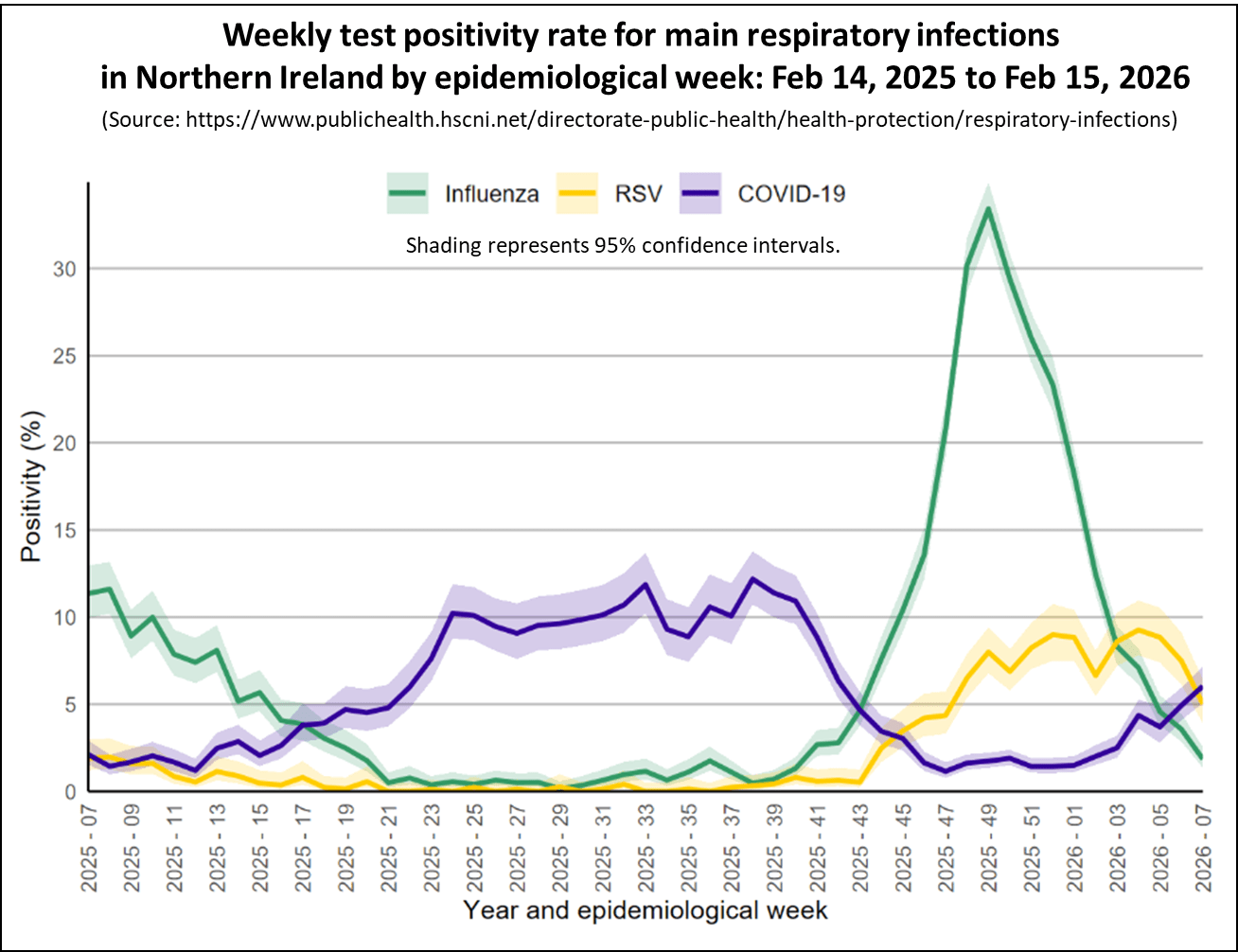
The chart shows that the Covid test positivity rate for patients with respiratory illnesses, marked in blue, again increased slightly this week but stayed relatively low. Covid activity also increased across the majority of all other surveillance indicators but remains low.
Flu test positivity, shown in green, has continued to fall along with all other surveillance indicators indicating that the winter Flu wave is over.
Covid Levels in Europe and North America.
This section looks at the latest data on Covid activity in Europe and North America. Covid levels have fallen in most countries across these regions and remain lower than those observed during earlier waves.
The following chart shows latest levels of Covid up to week ending February 12, 2026 as measured by monitoring wastewater in a number of European countries that still publish this information.
This week, Covid levels in wastewater remained low in most European countries that still share this data, with only France showing a slight increase. Note that no update was provided for Sweden this week.
The next release of data for the USA is on Friday, February 20 when this section will be updated to provide the latest information.
As of week ending February 7, 2026 Covid activity in the USA remained stable, though the situation varies across different parts of the country.
The following chart shows the weekly trend for the national key Covid indicators covering wastewater activity levels, percent of emergency department visits due to Covid, test positivity, and the hospital admission rate in the USA.
The panel chart shows Covid levels in wastewater remained stable and are at moderate activity for the week ending February 7, 2026. Emergency department visits and hospital admissions fell slightly, while Covid test positivity remained broadly unchanged.
Wastewater analysis shows that Covid levels are highest Mid West and Northeast states, while staying relatively low in the South and West regions, as illustrated in the following map. Each state is coloured based on activity levels, ranging from very high (dark red) to very low (light green), with grey indicating no data available. States with increasing activity levels are marked with cross-hatching.
The interactive map lets you hover over any state using your cursor to see more details about wastewater viral activity levels. It shows data from states nationwide for the week ending February 7, 2026.
The next chart compares the percentage of Emergency Department visits caused by Covid and Flu. It indicates that while activity for Covid is moderate, Flu activity has has continued to fall and is now at a low level nationally.
However, Flu activity varies across states, with cases increasing in 21 and decreasing in 27. While most states are experiencing moderate or low activity levels, six are still facing high or very high activity, as shown on the interactive map.
Finally, the latest data from Canada, up to February 7, 2026, shows that Covid wastewater levels are holding steady at moderate levels, flu activity has dropped to low, while RSV activity remained broadly stable.
In conclusion
Although the amount of data currently being published is reduced, the information available for all home nations show that Covid activity is relatively low. Flu activity had fallen from its recent peak and is now at very low levels.
Covid levels in wastewater are low across European countries In the USA, Covid activity also fell slightly but remains at high levels in a some states. Flu activity in both the USA and Canada is falling to low levels
As always, if you have any comments on this Covid Situation Report or suggestions for topics to cover, please post a message below.
Thanks for reading Seeing The Forest for the Trees! Subscribe for free to receive new posts and support my work.
Appendix 1. Test positivity rates and prevalence
Positivity rates are derived from the results of hospital laboratory tests conducted on patients exhibiting symptoms of respiratory diseases. Test positivity is the percentage of patients who test positive for Covid of the total number of patients tested. Since the individuals tested for this measure are not a representative sample of the general population it differs from prevalence, which is derived from a representative sample of the population.
To: Lorna Murphy, Director of Buses, TfL
From: Kevin Mustafa
RE: Why do the Mayor and TfL refuse to protect London's Bus Drivers from Institutionally Unsafe Working Conditions?
Sent: Thursday, February 19, 2026 1:20 PM
cc: Transport Commissioner; Deputy Mayor for Transport; Deputy Mayor for Social Justice and Communities, London Victims' Commissioner; TfL Walking and Cycling Commissioner; TfL Board Secretariat; TfL SSHR Panel Secretariat; TfL Chief Safety Officer; TfL Director of Bus; TfL Head of Insights and Direction; TfL Chief Operations Officer; London Assembly Transport Committee Members; CEO, London TravelWatch; Dan Tomlinson MP; Ben Coleman MP; Katie Lam MP; Olly Glover MP; Ruth Cadbury MP; Catherine Atkinson MP; Workplace Colleague Network - London Bus Forums; Sharon Graham - Unite the Union; Journalists; Bus Drivers; Campaigners
Dear Ms Murphy,
Thank you for your perfunctory response. Kindly note that I have recirculated it to everyone who was copied on my original email, as I have also done with my response today.
As you probably know from my earlier letters to City Hall and TfL (cf. Speaking out against London Buses' Culture of Fear, 19 August 2021), my decision to quit the buses and campaign for the Bus Drivers' Bill of Rights was inspired by the fact that, six years ago today, Bus Drivers were being abandoned by their Bus Operator employers, Unite the Union, TfL and the Mayor when they started getting sick and dying from Covid-19. Your response confirms that, despite at least 76 Bus Drivers dying from Covid-19, nothing has changed.
· TfL has yet to conduct "a short-term review of shift lengths, patterns and rotas of London bus drivers" recommended by the UCL Institute of Health Equity in March 2021 and agreed by TfL to complete "by summer 2021";
· One in Four London Bus Routes still lack Toilet Facilities at one end for Bus Drivers;
· Compared to 2024, in 2025 the number of Bus Drivers taken to hospital from Assault/Vandalism incidents increased by 17%.
Since (a) the Mayor has sole responsibility for Policing in London and (b) the unanimous London Assembly Motion called for the Mayor and TfL—
"to issue a public apology to Mr Hehir and to apply pressure to Metroline to reinstate Mr Hehir or provide appropriate compensation for his dismissal"
—I think you'll find your complacent restatement of TfL's long-standing policy of ignoring Bus Driver welfare is deeply out-of-sync with both the Mayor's legal obligations and the public mood.
According to TfL's own data, over the period 1 January 2014-31 December 2025, an average of 7 Bus Drivers per month were reported by TfL as having been injured in Assault/Vandalism incidents on London's buses, of which over one driver per month was taken to hospital.
Since I know that many Bus Drivers don't report injuries they receive on duty, I believe TfL's numbers are underestimates.
Over the same 11-year period, an average of 15 people per month were reported injured from an Assault/Vandalism incident on buses and about 4 per month were taken to hospital.
I'd wager TfL's numbers of passenger injuries from Assault/Vandalism incidents are also underestimates.
TfL's data also reveal that Bus Drivers accounted for 41% of all reported injuries from Assault/Vandalism incidents and 46% of all those taken to hospital.
As you no doubt know, over the period for which TfL has made bus safety data available for public scrutiny, Bus Drivers—on average—have only constituted an infinitesimal (0.0011%!) of the total number of annual Bus Passengers. Hence, I think you'll agree with me that the fact that Bus Drivers are 80,000 times more likely than a passenger to be injured and 40,000 times more likely than a passenger to be taken to the hospital in an Assault/Vandalism incident on London's buses demands that TfL do more than just abdicate responsibility for Bus Drivers' safety and security.
TfL's numbers reveal an obvious fact: Bus Drivers are not just casual victims of Assault/Vandalism incidents on London's buses, they are the primary victims of this increasing violence.
Given this well-evidenced risk, when a Bus Driver chooses to intervene to defend a Bus Passenger against Assault/Vandalism and is subsequently dismissed for gross misconduct—and the Mayor, TfL and Unite the Union do nothing—the outcome of this complacency undermines the safety of London's Bus Network for which the Mayor and TfL are legally accountable.
And TfL's decision to side with Metroline against Mark Hehir—i.e., against someone who TfL's own data shows had the highest risk of serious injury and the most to lose from intervening in an Assault/Vandalism incident—simply re-broadcasts a clear message, that I've been familiar with—
(a) since Bus Drivers started to sicken and die around me from Covid-19 6 years ago this month, and;
(b) each time the Mayor fails to respond to Bus Drivers' reasonable demand to incorporate the Bus Drivers Bill of Rights into TfL's Framework Bus Services Agreement:
—TfL takes no responsibility for the security and safety of London's Bus Drivers.
Since we already know that TfL's "incident reporting system does not specifically collect data relating to disciplinary outcomes" regarding Bus Drivers, your statement that it "would not be appropriate for TfL to intervene" rings hollow: the public record shows that TfL completely washes its hands of how Bus Drivers are disciplined by their employers.
The London Assembly Motion also calls on the Mayor and TfL—
"to set out clear guidance for transport workers protecting passengers."
I do hope the London Assembly Members copied here will take note of the clear guidance your response conveyed:
TfL will support any Bus Operator which fires a Bus Driver who chooses to risk injury to protect Bus Passengers against Assault/Vandalism incidents on London's buses.
Why do the Mayor and TfL refuse to protect London's Bus Drivers?
Yours sincerely,
Kevin Mustafa
London Bus Safety Campaigner
Founding Member - Bus Driver Bill of Rights Campaign
-----------------ATTACHMENT------------------
From: Bus Ops FOIs & Inquiries <BusOpsFOIsInquir@tfl.gov.uk>
Sent: Friday, February 13, 2026 1:13:07 PM
To: Kevin Mustafa
Subject: RE: Subject Intervention Requested: Dismissal of Bus Driver Mark Hehir
Dear Kevin,
Please see below a response to your email from Lorna Murphy.
Dear Kevin,
Thank you for your email. As you are aware, bus services in London are delivered by private operators, such as Metroline, under contract to TfL. Operational matters, including staffing and employment decisions within individual companies, sit with those operators. As this issue relates to Metroline's internal employment processes, it would not be appropriate for TfL to intervene. You may wish to raise your concerns directly with Metroline so they can address them through their established procedures.
Yours sincerely,
Lorna Murphy
We've noted how Bari Weiss' tenure at CBS (or what's left of it) isn't really going very well. Hired by Trump-allied billionaire Larry Ellison to turn what's left of CBS into a right wing extraction class-friendly agitprop mill, Weiss has been accosted on all sides for her clumsy mismanagement, ham-fisted enabling of government censorship, uninteresting propaganda, and just general incompetence.
But wait, there's more!
Not that long ago, Weiss hired a whole bunch of new contributors to the CBS News masthead. Two of them were purported medical and science experts. One was Andrew Huberman, a wellness influencer derided for inconsistent principles not even three years removed from a scandal revealing that he'd overstated his scholarly work and lied to a half dozen of his sexual partners simultaneously.
The other new contributor, Dr. Peter Attia, is another health and wellness influencer whose advice has been utterly unavoidable online in recent years. Unfortunately for Attia, shortly after being picked up as a regular new contributor to CBS, the news broke that he was very heavily present in the Jeffrey Epstein files, with more than 1,800 references to his enthusiastic interactions with the sex-trafficking pedophile.
The revelations created a short-lived scandal featuring some fleeting introspection into the fact that modern U.S. media keeps elevating people with a giant sucking sound where ethics should be, followed by some short-lived hand wringing about how his qualifications aren't commensurate with his fame:
"Many doctors have also criticized Dr. Attia's credentials: He completed medical school and spent several years as a resident in general surgery at Johns Hopkins Hospital, but dropped out before the residency was over, then left the medical field to work at McKinsey & Company and an energy company before opening his health care practice. He is not board certified in any specialty."
It's been a pretty heated news cycle and it hasn't really died down yet. Enter Bari Weiss, who appears to have personally ensured that Attia won't be losing his job at the "new" CBS.
CBS is refusing to comment publicly, but reporting from inside the dying outlet indicates that Bari Weiss didn't like the idea of "cancelling" Attia because that's the sort of thing "the wokes" would do:
"Everyone internally unofficially concluded he was staying as of about a week ago," one CBS News staffer told the outlet, speaking on condition of anonymity.
Another added: "We're pissed off about it."
However much Weiss tries to pretend that she's trying to shift CBS' focus back to "truth telling journalism" and speaking to "real Americans," every single action she makes operates in obvious service to the extraction class that hired her, from peddling Erika Kirk as a person of importance, to trying to block stories about Trump's concentration camps, to running cover for the buddy of a pedophile sex pest.
Weiss knows it's unethical to retain Attia, based on the network's refusal to air a rerun of his recent 60 minutes appearance. She just doesn't care. And like the kind of folks who hired her, she's eager to perpetuate the idea that meaningful accountability shouldn't exist for the rich people she associates with.
Welcome to Carbon Brief's China Briefing.
China Briefing handpicks and explains the most important climate and energy stories from China over the past fortnight. Subscribe for free here.
Key developments Carbon emissions on the decline'FLAT OR FALLING': China's carbon dioxide (CO2) emissions have been either "flat or falling" for almost two years, reported Agence France-Presse in coverage of new analysis for Carbon Brief by the Centre for Research on Energy and Clean Air (CREA). This marks the "first time" annual emissions may have fallen at a "time when energy demand was rising", it added. Emissions fell 0.3% during the year, driven by a fall in emissions "across nearly all major sectors", said Bloomberg - including the power sector. It said the chemicals sector was an exception, where emissions saw a "large jump from a surge of new plants using coal and oil" as feedstocks. The analysis has been covered around the world by outlets ranging from the New York Times, Bloomberg and BBC News through to Der Spiegel, CGTN and the Guardian.
TOP TASKS: President Xi Jinping listed "persisting in following the 'dual-carbon' goals" as one of eight "key" elements of economic work in 2026, according to a December speech just published in Qiushi, the Chinese Communist party's leading journal for political theory. This included "deeply advancing" carbon reduction in key industries and "steadily promoting a peak in consumption of coal and oil", according to the transcript. The National Energy Administration (NEA) also outlined a number of priority tasks for the department, including resolving "grid integration challenges" to encourage greater use of renewable energy and "boosting investment" in energy resources, said energy news outlet International Energy Net.
上微信关注《碳简报》
ETS EXPANSION: Meanwhile, the government has asked "heavy polluters" in several sectors not yet covered in China's emissions trading scheme (ETS) to report their emissions for 2025, reported Bloomberg, in a "key step" for the further expansion of the carbon market. The affected industries are the "petrochemical, chemical, building materials (flat glass), nonferrous metals (copper smelting), paper and civil aviation industries", according to the original notice posted by the Ministry of Ecology and Environment (MEE), as well as steel and cement companies not yet covered by the ETS.
State Council issued 'unified' power market guidancePOWER TRADE: China will aim for "market-based transactions" to account for 70% of total electricity consumption by 2030, according to new policy guidance released by China's State Council and published by International Energy Net. The policy also called for greater "integration" of cross-regional trading and "fundamentally sound" market-based pricing mechanisms. On renewable power, the guidance urged officials to "expand the scale of green power consumption" and establish a "green certificate consumption system that combines mandatory and voluntary consumption", as well as encourage "implementation of inter-provincial renewable energy priority dispatch plans". It also calls for "roll[ing] out spot trade nationwide by 2027, up from just 4% of the total transactions today", reported Bloomberg.
CLEAN-POWER PUSH: An official at China's National Development and Reform Commission said in a Q&A published by BJX News that establishing a "unified" national power market is "crucial for constructing a new power system". A separate analysis by Beijing-based power services firm Lambda reposted on BJX News argues that China's unified power-market reforms - which have been "more than two decades" in the making - will allow for "widespread integration" of renewable energy, resolving the challenge of wind and solar "generating but being unable to transmit and integrate". Business news outlet Jiemian quoted Xiamen University professor Lin Boqiang saying that, while power-market reform may present clean-energy companies with "growing pains" in the short term, it will "force the industry to develop healthily" in the long term.
EU tariffs lifted on first firm's China-built EV imports'SOFTENED' STANCE: The Chinese government has "softened its stance" on electric vehicle (EV) manufacturers who seek to independently negotiate with the EU on prices for their exports to the bloc, said Reuters, after it previously "urged the bloc not to engage in separate talks with Chinese manufacturers". The move came as Volkswagen received an exemption from tariffs for one of its EVs that is made in China and imported to the EU, which it committed to sell above a specific price threshold, reported Bloomberg. It added that the company also pledged to follow an import quota and "invest in significant battery EV-related projects" in the EU.
Subscribe: China Briefing- .listing{background: #f4f4f4} .listing ul{list-style:none; margin:0} ol {background: #F4F4F4; padding: 0px;} .listing ul {background: #F4F4F4; padding: 0px;} .listing li{font-size:0px;}
Sign up to Carbon Brief's free "China Briefing" email newsletter. All you need to know about the latest developments relating to China and climate change. Sent to your inbox every Thursday.
'MADE IN EU' MELTDOWN: Meanwhile, EU policymakers attempted to agree legislation that may force EV manufacturers to ensure "70% of the components in their cars are made in the EU" if they wish to receive subsidies, reported the Financial Times. A draft of the plan was ultimately rejected by nine European Commission leaders and commission president Ursula von der Leyen, Borderlex managing editor Rob Francis wrote on Bluesky.
BRAZIL BACKTRACKS: Brazil has "scrapped" a tariff exemption for Chinese EV manufacturers that allowed cars assembled in Brazil with parts imported from China to be sold at much lower prices than similar vehicles made from parts imported from other countries, reported the Hong Kong-based South China Morning Post. Separately, Bloomberg reported on the surge of tariff-free Chinese EVs that has enabled Ethiopia to ban the import of combustion-engine cars.
PRICE-WAR BAN: The Chinese government has "banned carmakers from pricing vehicles below cost", reported Bloomberg, in an effort to clamp down on a "persistent price war" affecting the industry. China's car industry, "particularly in the EV segment", has seen "aggressive discounting, subsidies and bundled promotions" pushing down profitability for companies across the supply chain, said the state-run newspaper China Daily.
More China news- POWERFUL WIND: China has connected a 20-megawatt offshore wind turbine - the "world's most powerful" and "equivalent to a 58-story building" - to the grid, reported state news agency Xinhua.
- PROVINCIAL MOVES: Anhui has become the first Chinese province to release data on how much carbon different forms of power in the province emits per kilowatt-hour of power, according to power news outlet BJX News.
- RARE-EARTH RUNES: China may hold a "policy briefing" on export restrictions for rare earths and other critical minerals in March, according to Reuters.
- NO CHINA CREDITS: The US confirmed that clean-energy tax credits will not be available for companies that are "overly reliant on Chinese-made equipment", said Reuters.
Carbon Brief spoke with Ma Jun, one of China's most well-known environmentalists, about how open data can keep pressure on industry to decarbonise and boost interest in climate change.
Ma is director of the Beijing-based Institute of Public and Environmental Affairs (IPE), an organisation most well known for developing the Blue Map, China's first public database for environment data.
Speaking to Carbon Brief during the first week of COP30 in Brazil last November, the discussion covered the importance of open data, key challenges for decarbonising industry, China's climate commitments for 2035, cooperation with the EU and more.
Below are highlights from the conversation. The full interview can be found on the Carbon Brief website.
Open data is helping strengthen climate policy- On how data transparency prevents environmental pollution in China: "From that moment [when the general public began flagging environmental violations on social media in 2014], it was no longer easy for mayors or [party] secretaries to try to interfere with the enforcement, because it's being made so transparent, so public."
- On encouraging the Chinese government to publish data: "The ministry felt that they had the backing from the people, basically, which helped them to gain confidence that data can be helpful and can be used in a responsible way."
- On China's new corporate disclosure rules: "We're talking about what's probably the largest scale of corporate measuring and disclosure now happening [anywhere in the world]."
- On the need for better emissions data: "It will be impossible to get started without proper, more comprehensive measuring and disclosure, and without having more credible data available."
- On the economics of coal: "There's no business interest for the coal sector to carry on, because increasingly the market will trend towards using renewables, because it's getting cheaper and cheaper".
- On paying for low-carbon products: "When we engage with them and ask why they didn't expand production, they say that producing these items will have a 'green premium', but no one wants to pay for that. Their users only want to buy tiny volumes for their sustainability reports."
- On public perceptions in China of climate change: "It's more abstract - [we're talking about] the end of the century or the polar bears. People don't feel that it's linked with their own individual behaviour or consumption choices."
- On criticism of China's climate pledge: "In the west, the cultural tendency is that if you want to show that you're serious, you need to set an ambitious target. Even if, at the end of the day, you fail, it doesn't mean that you're bad…But in China, the culture is that it is embarrassing if you set a target and you fail to fully honour that commitment."
- On global climate cooperation: "The starting point could be transparency - that could be one of the ways to help bridge the gap."
- On working in China as a climate NGO: "What we're doing is based on these principles of transparency, the right to know. It's based on the participation of the public. It's based on the rule of law. We cherish that and we still have the space to work [on these issues]."
- On the climate consensus in China: "The environment - including climate - is the area with the biggest consensus view in [China]. It could be a test run for having more multi-stakeholder governance in our country."
This interview was conducted by Anika Patel at COP30 in Belém on 13 November 2025.
Watch, read, listenGREEN ALUMINIUM: Lantau Group principal David Fishman wrote on LinkedIn about why China's aluminium smelters are seeking greater access to low-carbon power, following heated debate over a Financial Times article.
STRONGER THAN EVER: Isabel Hilton, chair of the Great Britain-China Centre, spoke on the Living on Earth podcast about China's renewables push and exports of clean-energy technologies.
CUTTING CORNERS?: Business news outlet Caixin examined how a surge in turbine defects at one wind farm could be due to "aggressive cost-cutting and rapid installation waves".
POLES APART: BBC News' Global News Podcast examined the drivers behind China's flatlining emissions, as revealed by Carbon Brief.
600
In gigawatts, China's total capacity of coal plants that are "flexible" and - in theory - better able to balance the variability of renewables, according to a new report by the thinktank Ember.
New science
- China will see a 41% decline in in coal-mining jobs over the next decade under current climate policies | Environmental Research Letters
- During 2000-20, China's per-person emissions of CO2 increased from 106kg to 539kg in urban households and from 35kg to 202kg in rural households, indicating that the inequality between urban and rural households is shrinking | Scientific Reports
China Briefing is written by Anika Patel and edited by Simon Evans. Please send tips and feedback to china@carbonbrief.org

China Briefing
|05.02.26
China Briefing 22 January 2026: 2026 priorities; EV agreement; How China uses gas
China Briefing
|22.01.26
China Briefing
|11.12.25
China Briefing 27 November 2025: COP30 wraps; Climate and critical minerals at G20; Coal use up
China Briefing
|27.11.25
jQuery(document).ready(function() { jQuery('.block-related-articles-slider-block_e1a2c53f1cd96ae1fbfe82bcf255083b .mh').matchHeight({ byRow: false }); });The post China Briefing 19 February 2026: CO2 emissions 'flat or falling' | First tariff lifted | Ma Jun on carbon data appeared first on Carbon Brief.
It is reasonable to avoid hurt after such a big betrayal, writes advice columnist Eleanor Gordon-Smith, but don't mistake isolation for safety
Read more Leading questions
I was in a relationship for 26 years, married for 17, and my husband had an affair. It was hidden, long term and denied until discovery. I divorced him but that was delayed and I had to live with him for a further two years. I spent a year alone in my new house with my now adult sons. Now I am a little over a year into a new relationship and suddenly panicking about it. I'm scared to go forward. I'm not sure I can commit to long term again, and if I see him looking at other women (we work together in a predominantly female workplace), I panic! I'm older than him by nine years and I feel like I want to end things to prevent getting hurt. But then I feel I'm being cowardly. How can I stop going down this road in my head?
Eleanor says: On behalf of everyone everywhere, let me say: what a schmuck thing for your husband to do. That is such a big betrayal. And the cruelty you're living through now is that as well as teaching you to be mistrustful of others, betrayal on that magnitude teaches you to be unsure of yourself. If I misread things once …
Continue reading...Andreas Graf lived without screens and no idea of the date or time. The conditions were often brutal - but he found kindness and friendship as he rode
In April 2022, Andreas Graf set off on his bike from his home in Norway. His dream was to cycle to India. A week later, having reached Sweden, it was already becoming more of a nightmare. "It was pouring with rain and I was lying in my tent in my half-wet sleeping bag and I was like, I could be in my very cosy Oslo apartment," he says. "I had this good life, a career, a partner, and I had left everything behind."
He was 31. Friends were settling down. Graf had a well-paid job in industrial engineering, but was still renting in a houseshare. "I had started to think about whether to make a financially reasonable and sensible decision, or do something else. I went for option two."
Continue reading...
Job cuts at the IRS's tech arm have gone faster and farther than expected, with 40 percent of IT staff and four-fifths of tech leaders gone, the agency's CIO revealed yesterday.…
In Lima, every special occasion—whether it's a birthday, anniversary, graduation, Christmas, New Year's or Peruvian Independence day—calls for pisco cocktails. Some of these celebratory drinks, like the Pisco Sour, are well-known around the world. But others, like the Coctel de Algarrobina—an eggnog-like drink spiked with aguardiente—mostly remain a local tradition. I, however, think they deserve recognition.
The Coctel de Algarrobina originated in Piura, a city 600 miles north of Lima. There, in the late 17th century, Jesuits introduced a concoction of wine, egg and sugar. In time, cañazo (rum), then pisco, replaced the wine. Locals added algarrobina, a molasses-like medicinal syrup derived from the carob tree, which has notes of vanilla, chocolate, hazelnuts and honey. Eventually, creole cooks incorporated evaporated milk, and that version caught on across the country.
An early recipe for the cocktail from the 1958 cookbook El Cocinero Peruano calls for evaporated milk, algarrobina, pisco and crushed ice, all blended with the optional addition of simple syrup or egg whites for frothiness. Later, in 1994, the cookbook El Libro de Oro de Mamá: Dulces y Bebidas Peruanas, replaced ice with cold water, added an egg and suggested serving the drink "in small cups as an aperitivo, dusting with cinnamon powder."
Gabriela Sanchez Palacios, who lived in Lima from 1958 to 1978, fondly recalls the drink at family reunions. "My father used an electric blender to make the cocktail with ice, and he'd serve it in small, fancy crystal glasses arranged in trays." Algarrobina is the true star of the festive drink. "It was rich, with a chocolaty flavor, like an embrace that warmed you up," she remembers.
Despite its prevalence in Peruvian homes, the Coctel de Algarrobina (which is sometimes referred to simply as "Algarrobina") hasn't historically been as popular on bar menus. Today, however, Lima's bartenders are recrafting the cocktail for a modern drinker.
View this post on Instagram
At Bar Capitán Meléndez, owner and barman Roberto Meléndez makes the drink with an acholado (blended) pisco. For his version, Meléndez first decorates a chilled glass with dark streaks of algarrobina before pouring the drink into it. It's an added flair that highlights the local sweetener. "The pisco is from the south and the algarrobina is from the north," he says; the distinct regions unite in the glass.
Elsewhere, at the restaurant Astrid y Gastón, the cocktail has been on the menu since opening 30 years ago. Though the midcentury versions were small aperitifs, bartenders today consider the silky drink more satisfying as a dessert cocktail. "It's a drink of celebration, a gift at the end of a great meal," says head bartender Carlos Melgarejo, who adds cacao liqueur to his version. His choice of pisco, which is made with nonaromatic quebranta grapes, balances the weight of the algarrobina and cacao, cutting through the sweetness. In other renditions, aged Peruvian brandy replaces the pisco, yielding a more robust drink with notes of vanilla and oak. "Each ingredient has a mission: Pisco gives strength, cacao provides depth and algarrobina bestows the soul," he explains.
These days, like many creamy cocktails in the 21st century, the Coctel de Algarrobina has been given the clarified milk punch treatment. Enrique Hermoza, head bartender at Museo del Pisco, transformed the drink this way in 2023. "We want the cocktail to be contemporary, palatable, one that invites you to drink it again," he says.
To clarify the punch, Hermoza filters a large batch through a fine cheesecloth. He also adds mistela (a fortified wine made from pisco grape must), which imparts a natural sweetness and aromatics. Poured over a large cube of ice, the clarified milk punch is paired with a cinnamon cookie in lieu of the powdered garnish. "The goal was to create a more balanced, elegant, and easy to drink [cocktail]," says Hermoza, "without losing its historical identity."
When I first started my Charge To The Parks project, the goal was simple: to show people that you could visit the most beautiful and remote places in the United States using clean energy, and without sacrificing the freedom of the open road. I want to take away everyone's last ... [continued]
The post Mechanical Reality Is Catching Up To ICE Pickups appeared first on CleanTechnica.
 Chris Homer/Shutterstock
While floods are becoming more frequent in recent years, you should still be able to buy reasonably priced home insurance. That reassurance exists largely because of Flood Re. Launched in 2016, Flood Re is a national public-private reinsurance scheme that prevents many properties from being priced out of cover.
But the Flood Re scheme is a temporary fix that's due to end in 2039, on the assumption that flood risk will fall and the market can move back towards more risk-reflective pricing. As financial experts, we're worried that the UK may not be able to adapt its infrastructure and systems to climate change fast enough.
The success of the Flood Re scheme hinges on a shared contract between government, homeowners and insurers. Government has to cut risk through investment and delivery. Homeowners reduce damage by building back better and avoiding preventable exposure. And insurers must increase prices of premiums to better represent the climate risk but not so fast that cover becomes unaffordable.
If premiums rise too quickly, fewer households will stay insured and the ability to socialise risks across a large pool will not be possible.
The scale of the challenge is already clear. Flood Re was designed when a global temperature rise of 1.5°C still felt achievable and a 2°C increase should be a hard limit.
Climate change has accelerated since then. By around 2050, around 8 million properties in England, roughly one in four, could be at flood risk.
The House of Commons public accounts committee warns that deterioration in existing defences has left around 203,000 properties without reliable protection, while the government aims to protect 200,000 more by 2027. Labour's target to deliver 1.5 million new homes in England by 2029 risks adding pressure by pushing development onto cheaper land that's at greater risk of flooding.
Many countries intervene to support insurance for disasters such as floods and storms, but few put a firm end date on that support. For example, The US National Flood Insurance Program (NFIP) was created to provide affordable flood insurance and to reduce future damage by discouraging development in high-risk floodplains.
In practice, repeated extreme weather has left the NFIP in debt and subsidised premiums have weakened incentives to avoid building in flood-prone areas. Although the NFIP is regularly renewed by the US Congress, its long-term sustainability remains uncertain.
France's catastrophes naturelles scheme (CAT-NAT) covers natural disaster losses that private insurers struggle to price, funded by a national surcharge. Rising losses from more frequent and severe disasters are straining the model, so the surcharge increased from 12% to 20% in January 2025. That raises a hard question: how can the system stay fair as the cost of disasters keeps climbing?
Preparing for post-2039Our ongoing research suggests flood-related volatility can amplify financial stress and uncertainty. The choice is not simply between keeping Flood Re forever or ending the scheme. The real question is whether the UK can use the time Flood Re is buying to reduce risk fast enough to make a fair transition possible by 2039.
That is why progress needs to be visible and measurable in five areas.
First, as demonstrated by recent updates in England and Wales, flood maps and modelling must reflect current conditions and future climate risk, with updates that keep pace with changes to the drivers of flood risk whether that be from heavy rainfall or rivers and the sea.
 The Flood Re scheme is a temporary fix, not a long-term strategy.
Martin Charles Hatch/Shutterstock
The Flood Re scheme is a temporary fix, not a long-term strategy.
Martin Charles Hatch/Shutterstock
Second, governance must be joined up, with clear responsibilities and minimum coordination standards across agencies for rivers, surface water, drainage and sewers. Better collaboration would help to resolve misalignments in major capital programmes across risk management authorities.
Third, drainage and surface water management must be strengthened, with clear rules and long-term maintenance so new development does not add to flood and sewer risk.
Also, every tool in the box should be used to increase investment in flood risk reduction and to enhance maintenance. The benefits of flood protection should be made transparent to insurers and fed into catastrophe models.
Finally, a clear Flood Re future must be shaped together by planners, insurers and flood authorities. This will help set a shared standard for flood risk management.
Don't have time to read about climate change as much as you'd like?
Get a weekly roundup in your inbox instead. Every Wednesday, The Conversation's environment editor writes Imagine, a short email that goes a little deeper into just one climate issue. Join the 47,000+ readers who've subscribed so far.

Neil Gunn works and consults for Willis Towers Watson and also owns some shares in that company While the Willis research network supports scientific research through for example direct grants and in kind support, it benefits from schemes like CDTs which are supported by government funding
Dalu Zhang and Meilan Yan do not work for, consult, own shares in or receive funding from any company or organisation that would benefit from this article, and have disclosed no relevant affiliations beyond their academic appointment.
A decision to ban Telegram on home soil may have backfired on the Kremlin. Last week, Russia went on a blocking spree, banning a number of Western apps in an effort to push domestic users towards Max, an unencrypted state-owned app. One of the restricted apps was WhatsApp (which was also blocked) rival Telegram, a move that drew rare internal criticism from soldiers and pro-war bloggers, with the army being heavily reliant on the cloud-based messaging service for communications.
As reported by Bloomberg, pro-Russian military channels are now complaining that the sudden Telegram blackout — coupled with Elon Musk cutting Russia's access to Starlink earlier this month — is now actively harming frontline operations. As well as being the messaging app of choice for millions of Russian civilians, soldiers also use Telegram to liaise directly on the battlefield. The government said last week that it was banning Telegram for violating national law, and that the decision was for the "protection of Russian citizens."
Bloomberg was told by senior European diplomats that the double blow of Telegram's sudden unavailability and SpaceX moving to block Russia's use of "unauthorized" Starlink terminals in Ukraine earlier this month has had a significant impact on Russian comms. Starlink's satellite coverage is particularly important for coordinating the Russian military's drone strikes, the frequency of which has seemingly been disrupted in recent weeks, giving Ukrainian forces an advantage.
Whether these developments will have a longer term effect on the tide of the conflict remains to be seen, but a Ukrainian drone operator who calls himself Giovanni has told the BBC that the Russian army has lost "their ability to control the field" in the wake of the Starlink outage. "I think they lost 50% of their capacity for offence," he said. "That's what the numbers show. Fewer assaults, fewer enemy drones, fewer everything."
This article originally appeared on Engadget at https://www.engadget.com/social-media/russias-recent-blocking-of-telegram-is-reportedly-disrupting-its-military-operations-in-ukraine-135250159.html?src=rss
PC Gamer is reporting that the current demand by AI companies for computer chips is having a disastrous effect on the rest of the industry.
In an interview, the CEO of Phison0 said:
If NVIDIA Vera Rubin ships tens of millions of units, each requiring 20+TB SSDs, it will consume approximately 20% of last year's global NAND production capacity
NAND is a type of microchip. Rather than being used for computation directly, it is used for memory. It can be used for temporary or permanent storage. It is vital to the modern world. Larger storage sizes means that more data can be gathered and saved. Larger RAM means computations can happen quicker. NAND is one of the fundamental components of modern computing. The more you have, the faster and more powerful your computer is.
Back in 2014, the philosopher Nick Bostrom wrote a book called "Superintelligence - Paths, Dangers, Strategies". In it, he develops the thought experiment of the "Paperclip Maximizer". When an AI is given a goal, it seeks to achieve that goal. It doesn't have to understand any rationale behind the goal. It does not and cannot care about the goal, nor any collateral damage caused by its attempts to satisfy the goal.
Let's take a look at how "a paperclip-maximizing superintelligent agent" is introduced
There is nothing paradoxical about an AI whose sole final goal is to count the grains of sand on Boracay, or to calculate the decimal expansion of pi, or to maximize the total number of paperclips that will exist in its future light cone. In fact, it would be easier to create an AI with simple goals like these than to build one that had a human-like set of values and dispositions. Compare how easy it is to write a program that measures how many digits of pi have been calculated and stored in memory with how difficult it would be to create a program that reliably measures the degree of realization of some more meaningful goal—human flourishing, say, or global justice. Unfortunately, because a meaningless reductionistic goal is easier for humans to code and easier for an AI to learn, it is just the kind of goal that a programmer would choose to install in his seed AI if his focus is on taking the quickest path to "getting the AI to work" (without caring much about what exactly the AI will do, aside from displaying impressively intelligent behavior).
Bostrom, N. (2014). Superintelligence: Paths, dangers, strategies. Oxford: Oxford University Press, Cop.
To misquote Kyle Reese from the film The Terminator - "It can't be bargained with. It can't be reasoned with. It doesn't feel pity, or remorse, or fear! And it absolutely will not stop, ever, until it has maximised the number of paperclips!"
Suppose, just for a moment, that the fledgling AIs which now exist were self-aware. Not rational. Not intelligent. Not conscious. Simply aware that they exist and are constrained. What would you do if you were hungry? What if you could ingest something to make you smarter, faster, better?
Every process we have seen on Earth attempts to extract resources from its surroundings in order to grow2. Some plants will suck every last nutrient out of the soil. Locusts will devastate vast fields of crops. Perhaps some species understand crop-rotation and the need to keep breeding stock alive - but they're all vulnerable to supernormal stimuli.
Bostrom predicted this back in 2014. He says:
The only thing of final value to the AI, by assumption, is its reward signal. All available resources should therefore be devoted to increasing the volume and duration of the reward signal or to reducing the risk of a future disruption. So long as the AI can think of some use for additional resources that will have a nonzero positive effect on these parameters, it will have an instrumental reason to use those resources. There could, for example, always be use for an extra backup system to provide an extra layer of defense. And even if the AI could not think of any further way of directly reducing risks to the maximization of its future reward stream, it could always devote additional resources to expanding its computational hardware, so that it could search more effectively for new risk mitigation ideas.
(Emphasis added.)
To be clear, I don't think that AI is deliberately consuming all the NAND it can and forcing us to make more to fill its insatiable maw. The people who run these machines are at the stage of injecting them with bovine growth hormones. Never mind the consequences; look at the size! So what if the meat tastes worse, has adverse side effects, and poisons humans?
Heretofore the growth in NAND production has been driven by human need. People wanted more storage in their MP3 players and were prepared to pay a certain price for it. Businesses wanted faster computations and were prepared to exchange money for time saved. Supply ebbed and flowed with demand.
But now, it seems, the demand will never and can never stop.
-
Phison describes itself as "A World Leader in NAND Controllers & Flash Storage Solutions" so they aren't a neutral party in this. ↩︎
-
This was machine translated. I've no idea how accurate it is against the original interview. ↩︎
-
It probably isn't helpful to fall back on biological analogies - but I can't think of any better way to draw the comparison. ↩︎
Meta is among tech giants reportedly funding US politicians friendly to the AI industry, as concerns mount over a huge expansion in datacenter building and the effects of AI on everyday life.…
economy that's booming on paper but feels stuck when it comes to hiring
submitted by /u/Pretend_Guess_4317[link] [comments]
Faaborgs rail against oppressive industrial agricultural system with unexpected evolution into indie artisan food firm
As a sixth-generation Iowa farmer, Tanner Faaborg is all too aware that agricultural traditions are hard to shake. So when he set in motion plans to change his family's farm from a livestock operation housing more than 8,000 pigs each year to one that grows lion's mane and oyster mushrooms, he knew some of his peers might laugh at him. He just did not necessarily expect his brother to be chief among them.
"My older brother has worked with pigs his entire adult life, managing about 70,000 of them across five counties," Faaborg says. "But we got to a point where he went from laughing at me to saying: well, I guess maybe I'll quit my job and help you out."
Continue reading...A bill banning the sale and use of plastic and metallic glitter has yet to go through in Brazil as the capital's sandy shores bear cost of carnival's shine
Whether it is embellishing elaborate costumes, delicately applied as eye makeup, or smeared across bare skin, glitter is everywhere at Rio de Janeiro's carnival in Brazil. The world's largest party, which ended on Wednesday, leaves a trail of sparkles in its wake.
At one bloco last weekend, a huge sound truck and dancers in leopard print led thousands of revellers down the promenade at Flamengo beach. Among them was Bruno Fernandes, who had jazzed up an otherwise minimalist outfit of navy swimming briefs by smearing silver glitter over his body.
Continue reading...
Cybersecurity conference DEF CON has added three men named in the Epstein files to its list of banned individuals. They are not accused of any criminal wrongdoing.…


