
This started as a response to Zach's recent article asking "Why Have Automakers Written Off $55 Billion In EV Investments?" Zach encouraged me to flesh it out a little and post it as a followup article. Here are a few reasons why Detroit automakers were able to rack up such ... [continued]
The post Reasons For The Legacy EV Retreat appeared first on CleanTechnica.
There's a feeling of powerlessness we all feel while staring into the climate/war/violence abyss of our smartphone screens. We tend to ask "What can I do?" before succumbing again to despair and distraction. This is becoming more and more fraught as civil liberties are being taken away and surveillance reaches new technological highs.
I wrote the following arguments as one answer to the question "What can I do?" I would love to hear others' thoughts.
Please note: I know that individual needs vary tremendously. The scale of this strategy is obviously different for everyone (e.g. those with dependents, those with disabilities, etc).
Voluntary participation in capitalism
- The powerful perpetuate systemic misery through the voluntary engagement of people in Western markets.
- Voluntary engagement continues because we all tend to desire what capitalism provides - comfort, convenience, entertainment, numbing. Capitalism has also walled off or monetised many previously free activities, thus fostering dependence.
- Obviously, some participation in the system is needed to 'get by' - to support ourselves with food, shelter and medicine, particularly because these are only available through the system. But we participate far beyond this - we partake in luxury, comfort, entertainments.
- This voluntary engagement is a massive contributor to the global crises we see. An obvious example is social media - the common people build the wealth of the owners of these platforms through their voluntary engagement. Less obvious is fossil fuels - much of fossil fuel use is for necessities such as food production or medicine, but we also make these businesses even more powerful through unnecessary consumption.
Necessities and strategies for change
- The current state of the world demands some sort of behavioural change from the average person. Either this occurs voluntarily, or change will be involuntary and far worse, 10, 20, 30 years hence.
- Challenging state and corporate power directly has become ineffective, if not suicidal, due their fusion with eachother (centralisation) and with technological advances. Protests and even democratic processes are largely akin to therapy to assuage the feelings of powerlessness and guilt of the participants. They do little to cause real-world change at the scale needed.
- Non-violence must be essential in any opposition, from both an ethical and tactical standpoint. The violent will be killed and their violence will be used in state propaganda to destroy any movement.
- The only leverage that remains, therefore, is a mass of people removing themselves as much as is feasible from that system. This is the only way to undermine globalized capital, slow the economy and ease environmental destruction.
Non-participation as a strategy
- Non-participation is a strong, ethical, and necessary use of one's agency for collective purposes. At scale, it is also effective for changing the future in a positive direction.
- It is similar to a strike. However, unlike a strike, there are no demands as there is no belief that the current system in place can provide what people really need. We are not looking for higher wages to buy things we don't need. We are looking for freedom from exploitation, and to have agency over our lives. Additionally, unlike a strike, it can be done individually. One does not need to wait for others to get on board to start living in a better way.
- An underlying principle is the recognition that the system largely does not provide what we need, after basics are met. It fills our time with work or vapid entertainments and isolates us from those around us. Once one lets go of capitalistic dreams of 'success' or 'fame' or 'wealth' or even Hollywoodized 'love', one is free to change one's lifestyle to something more aligned with reality. Much of this is simply ending behaviours that we already know are destructive.
- Self-removal from the system can include:
- Reduced work hours as much as possible
- Reducing most luxury consumption
- Reducing debt (e.g. refusal to enter the housing market)
- Ceasing most or all social media use
- Engaging in lower-stimulation leisure activities (e.g. art or reading or socialising instead of gaming, social media and Netflix)
- Refusing to work for national or multinationals corps
- Living in sharehouses instead of alone
- Self removal at a collective scale opens up more options such as rental strikes, boycotts, community planning and mutual aid.
- Such behaviour change would require or lead to the dismantling of remaining habits, belief systems and dreams that keep one tied to the system. Such beliefs include:
- My safety can be guaranteed by wealth (e.g. in retirement)
- Money/success/fame will lead to my satisfaction or happiness or wellbeing
- My prime value in life is how much I earn or own
- I need [insert addiction here] to function (e.g. alcohol, social media, online gaming)
- I need to be working to be useful or worthy or 'deserving'.
Benefits
- Mass non-participation, paired with thoughtful use of one's individual time, would have unbelievable benefits on the mental, physical and cultural health of individuals and communities. Given the unpredictability of future society, the strength of one's circle and wider community may be the biggest factor in determining one's outcomes in the decades ahead.
- Mass non-participation would wreak havoc on the economy and productivity, forcing a response. One option that the powerful could take would be to force people to consume and work. While this is not out of the question, it is anathema to the principles of capitalism's mythical "free market", and could destroy any remaining credibility in the past system.
- Mass non-participation would lower energy use and climate destruction.
- Even solo non-participation is a far healthier and happier lifestyle than the alternative (speaking from experience!)
[link] [comments]
Artificial intelligence promises to change not just how Americans work, but how societies decide which kinds of work are worthwhile in the first place. When technological change outpaces social judgment, a major capacity of a sophisticated society comes under pressure: the ability to sustain forms of work whose value is not obvious in advance and cannot be justified by necessity alone.
As AI systems diffuse rapidly across the economy, questions about how societies legitimate such work, and how these activities can serve as a supplement to market-based job creation, have taken on a policy relevance that deserves serious attention.
From Prayer to Platforms
That capacity for legitimating work has historically depended in part on how societies deploy economic surplus: the share of resources that can be devoted to activities not strictly required for material survival. In late medieval England, for example, many in the orbit of the church made at least part of their living performing spiritual labor such as saying prayers for the dead and requesting intercessions for patrons. In a society where salvation was a widely shared concern, such activities were broadly accepted as legitimate ways to make a living.
William Langland was one such prayer-sayer. He is known to history only because, unlike nearly all others who did similar work, he left behind a long allegorical religious poem, Piers Plowman, which he composed and repeatedly revised alongside the devotional labor that sustained him. It emerged from the same moral and institutional world in which paid prayer could legitimately absorb time, effort, and resources.
In 21st-century America, Jenny Nicholson earns a sizeable income sitting alone in front of a camera, producing long-form video essays on theme parks, films, and internet subcultures. Yet her audience supports it willingly and few doubt that it creates value of a kind. Where Langland's livelihood depended on shared theological and moral authority emanating from a Church that was the dominant institution of its day, Nicholson's depends on a different but equally real form of judgment expressed by individual market participants. And she is just one example of a broader class of creators—streamers, influencers, and professional gamers—whose work would have been unintelligible as a profession until recently.
What links Langland and Nicholson is not the substance of their work or any claim of moral equivalence, but the shared social judgment that certain activities are legitimate uses of economic surplus. Such judgments do more than reflect cultural taste. Historically, they have also shaped how societies adjust to technological change, by determining which forms of work can plausibly claim support when productivity rises faster than what is considered a "necessity" by society.
How Change Gets Absorbed
Technological change has long been understood to generate economic adjustment through familiar mechanisms: by creating new tasks within firms, expanding demand for improved goods and services, and recombining labor in complementary ways. Often, these mechanisms alone can explain how economies create new jobs when technology renders others obsolete. Their operation is well documented, and policies that reduce frictions in these processes—encouraging retraining or easing the entry of innovative firms—remain important in any period of change.
That said, there is no general law guaranteeing that new technologies will create more jobs than they destroy through these mechanisms alone. Alongside labor-market adjustment, societies have also adapted by legitimating new forms of value—activities like those undertaken by Langland and Nicholson—that came to be supported as worthwhile uses of the surplus generated by rising productivity.
This process has typically been examined not as a mechanism of economic adjustment, but through a critical or moralizing lens. From Thorstein Veblen's account of conspicuous consumption, which treats surplus-supported activity primarily as a vehicle for status competition, to Max Weber's analysis of how moral and religious worldviews legitimate economic behavior, scholars have often emphasized the symbolic and ideological dimensions of non-essential work. Herbert Marcuse pushed this line of thinking further, arguing that capitalist societies manufacture "false needs" to absorb surplus and assure the continuation of power imbalances. These perspectives offer real insight: uses of surplus are not morally neutral, and new forms of value can be entangled with power, hierarchy, and exclusion.
What they often exclude, however, is the way legitimation of new forms of value can also function to allow societies to absorb technological change without requiring increases in productivity to be translated immediately into conventional employment or consumption. New and expanded ways of using surplus are, in this sense, a critical economic safety valve during periods of rapid change.
Skilled Labor Has Been Here Before
Fears that artificial intelligence is uniquely threatening simply because it reaches into professional or cognitive domains rest on a mistaken historical premise. Episodes of large-scale technological displacement have rarely spared skilled or high-paid forms of labor; often, such work has been among the first affected. The mechanization of craft production in the nineteenth century displaced skilled cobblers, coopers, and blacksmiths, replacing independent artisans with factory systems that required fewer skills, paid lower wages, and offered less autonomy even as new skilled jobs arose elsewhere. These changes were disruptive but they were absorbed largely through falling prices, rising consumption, and new patterns of employment. They did not require societies to reconsider what kinds of activity were worthy uses of surplus: the same things were still produced, just at scale.
Other episodes are more revealing for present purposes. Sometimes, social change has unsettled not just particular occupations but entire regimes through which uses of surplus become legitimate. In medieval Europe, the Church was the one of the largest economic institutions just about everywhere, clerical and quasi-clerical roles like Langland's offered recognized paths to education, security, status, and even wealth. When those shared beliefs fractured, the Church's economic role contracted sharply—not because productivity gains ceased but because its claim on so large a share of surplus lost legitimacy.
To date, artificial intelligence has not produced large-scale job displacement, and the limited disruptions that have occurred have largely been absorbed through familiar adjustment mechanisms. But if AI systems begin to substitute for work whose value is justified less by necessity than by judgment or cultural recognition, the more relevant historical analogue may be less the mechanization of craft than the narrowing or collapse of earlier surplus regimes. The central question such technologies raise is not whether skilled labor can be displaced or whether large-scale displacement is possible—both have occurred repeatedly in the historical record—but how quickly societies can renegotiate which activities they are prepared to treat as legitimate uses of surplus when change arrives at unusual speed.
Time Compression and its Stakes
In this respect, artificial intelligence does appear unusual. Generative AI tools such as ChatGPT have diffused through society at a pace far faster than most earlier general-purpose technologies. ChatGPT was widely reported to have reached roughly 100 million users within two months of its public release and similar tools have shown comparably rapid uptake.
That compression matters. Much surplus has historically flowed through familiar institutions—universities, churches, museums, and other cultural bodies—that legitimate activities whose value lies in learning, spiritual rewards or meaning rather than immediate output. Yet such institutions are not fixed. Periods of rapid technological change often place them under strain-something evident today for many-exposing disagreements about purpose and authority. Under these conditions, experimentation with new forms of surplus becomes more important, not less. Most proposed new forms of value fail, and attempts to predict which will succeed have a poor historical record—from the South Sea Bubble to more recent efforts to anoint digital assets like NFTs as durable sources of wealth. Experimentation is not a guarantee of success; it is a hedge. Not all claims on surplus are benign, and waste is not harmless. But when technological change moves faster than institutional consensus, the greater danger often lies not in tolerating too many experiments, but in foreclosing them too quickly.
Artificial intelligence does not require discarding all existing theories of change. What sets modern times apart is the speed with which new capabilities become widespread, shortening the interval in which those judgments are formed. In this context, surplus that once supported meaningful, if unconventional, work may instead be captured by grifters, legally barred from legitimacy (by say, outlawing a new art form) or funneled into bubbles. The risk is not waste alone, but the erosion of the cultural and institutional buffers that make adaptation possible.
The challenge for policymakers is not to pre-ordain which new forms of value deserve support but to protect the space in which judgment can evolve. They need to realize that they simply cannot make the world entirely safe, legible and predictable: whether they fear technology overall or simply seek to shape it in the "right" way, they will not be able to predict the future. That means tolerating ambiguity and accepting that many experiments will fail with negative consequences. In this context, broader social barriers that prevent innovation in any field-professional licensing, limits on free expression, overly zealous IP laws, regulatory bars on the entry to small firms-deserve a great deal of scrutiny. Even if the particular barriers in question have nothing to do with AI itself, they may retard the development of surplus sinks necessary to economic adjustment. In a period of compressed adjustment, the capacity to let surplus breathe and value be contested may well determine whether economies bend or break.
Eli Lehrer is the President of the R Street Institute.

Sky News has run a frankly deranged — and antisemitic — article that attempts to demonise Brighton's anti-genocide activists. To the educated eye, it reads like an extract from an Israel lobby playbook. This should perhaps not surprise. Antisemitism is rife in the British media — just not in the way audiences are routinely told to expect.
The article features a seven-minute video that Sky also shared on its social media. The video barely bothers even to 'both-sides' the issue. It gives no more than a cursory nod to the idea that activists asking Brighton households to boycott Israeli products might not be antisemitic. Then it goes on to showcase, at length, the 'fears' — its interviewees seem anything but afraid, of course — of 'the Jewish community' at these supposedly terrifying young people and their clipboards:
Sky's @LisaAtSky reports from Brighton, where volunteers are going door-to-door asking people to boycott Israeli products.
Brighton's Jewish community fear the actions of these volunteers could encourage antisemitism.
 An ablative heat shield is a protective system that jettisons material to dissipate heat from the underlying structure. They're used on oil rigs and spacecraft. And in politics.
Boris Johnson used Matt Hancock as one. After failing to turn up at Cobra meetings, Johnson and his government discharged Covid-infected patients into care homes, causing thousands of early deaths. His callous "let the bodies pile high" comments and corrupt VIP WhatsApp lanes left him in the firing line. So he sacked health secretary Matt Hancock. Not for incompetence, but in a conveniently leaked video where Hancock snogs a woman he was having an affair with in his office. He'd appointed her to a £15,000 paid non-exec director role, too. Johnson could then jettison the Hancock liability without drawing attention to the Covid fiascos.
Hancock kept his £91,346 MP's salary. And took his £16,000 ministerial resignation payout. And £320,000 for going on I'm a Celebrity. If you'd been sacked for corruption, inappropriate behaviour in the workplace, and lethal incompetence, how much would your golden parachute be?
An ablative heat shield is a protective system that jettisons material to dissipate heat from the underlying structure. They're used on oil rigs and spacecraft. And in politics.
Boris Johnson used Matt Hancock as one. After failing to turn up at Cobra meetings, Johnson and his government discharged Covid-infected patients into care homes, causing thousands of early deaths. His callous "let the bodies pile high" comments and corrupt VIP WhatsApp lanes left him in the firing line. So he sacked health secretary Matt Hancock. Not for incompetence, but in a conveniently leaked video where Hancock snogs a woman he was having an affair with in his office. He'd appointed her to a £15,000 paid non-exec director role, too. Johnson could then jettison the Hancock liability without drawing attention to the Covid fiascos.
Hancock kept his £91,346 MP's salary. And took his £16,000 ministerial resignation payout. And £320,000 for going on I'm a Celebrity. If you'd been sacked for corruption, inappropriate behaviour in the workplace, and lethal incompetence, how much would your golden parachute be?
We should ask the same question about Morgan McSweeney.
McSweeney: gone but not forgottenThose rich donors colonising our public services will see him right. His media mates are trying to rehabilitate him already - Guardian articles saying he was the genius who "masterminded landslide 2024 election win". What rubbish. Johnson created chaos without any help from McSweeney. A lettuce beat Liz Truss. The Tories handed Labour their loveless landslide. McSweeney's efforts lowered the Labour vote.
The whole Starmer project, engineered by the likes of Mandelson and McSweeney, is a big gravy train of corruption. Starmer is right in the middle of it. They were aided and abetted by client journalists.
Do you remember when Keir Starmer was "forensic"? That didn't last long. Then they were the "grown ups". Making "tough decisions". Like accepting £100,000 of freebies. They're trying to rehabilitate him how. He is a "decent" man who was "lied to" by that nasty Peter Mandelson. How could they have known that a man who resigned twice for corruption was corrupt?
After Mandelson's second ministerial resignation, Tony Blair appointed him as Britain's EU Commissioner. In 2008 the story broke about Mandelson meeting billionaires Oleg Deripaska and Natheniel Rothschild on an £80 million yacht. Along with George Osborne. Deripaska owned the world's largest aluminium business. Mandelson had lowered EU tariffs on aluminium from 6% to 3%, worth tens of millions of pounds to Deripaska. I found that in a Google search.
What a geniusIn 2023 the McSweeney faction manoeuvred to stop Labour members from being allowed to select me to continue as Mayor. Starmer said "we want the highest quality of candidates." A lobby journalist told me, "It's amazing - they're blocking you who's actually done some good and Peter Mandelson, who's best mates with Jeffrey Epstein, still has influence." That was 18 months before Starmer appointed Mandelson as ambassador to the US. If journalists knew, the Cabinet Office Security Vetting service knew. Which meant Starmer knew.
So what they will try next is to say it's just one rotten apple. Mandelson was dodgy. And while McSweeney was ambitious, he was just serving his party. And Starmer, when he resigns, will be rehabilitated as a decent chap, just too honest and straight laced. Which is total hogwash. They are all up to their elbows in it. And have normalised it. These are not merely three weak individuals, unable to control their greed. The system attracts and rewards and promotes these characters. The Labour right is a machine that transfers our money to very rich people.
The Tony Blair Foundation took £257 million from Larry Ellison, whose Oracle firm is hawking AI to governments. Shortly afterwards, Starmer announced 18,000 NHS England redundancies, which would be filled by AI. There are legions of other examples.
Governments will struggleI was on BBC Politics North this weekend. I was asked about why left behind towns in the North East were struggling.
Low wages, poor transport and a shortage of good jobs persist year after year. The underlying cause, I said, it the money being taken out of these places. In the North East alone, Northumbria Water made £291 million profit last year. All disappears off to a Hong Kong billionaire. Northern PowerGrid North East, £333 million profit last year, all disappears off to a North American billionaire. That money reinvested here would create more work, more jobs, more money circulating in our local economy. That's just two privatised utilities. Add in banks, finance, land ownership, care homes, big tech - and we're a debt farm built to enrich billionaires. Our money is going to people on big yachts, not small boats.
No government will be popular until this is fixed. They only reason Starmer is still in post is Labour MPs are waiting until after May's local election wipe out to jettison him like an ablative heat shield. No new leader wants a catastrophic defeat in their inbox.
Public ownership is immensely popular. It would be simple to do. It costs effectively nothing - just enforce the regulations, and the share price will plummet to zero. So the real question is why won't a struggling Labour government do it?
The only way is Green after McSweeney and LabourI joined the Green Party because they will. Over 130,000 people have made the same decision. In Newcastle we'll take swathes of seats from Labour. It's shaping up to be a straight fight between the Greens and Reform, just like the Gorton and Denton by-election. The Greens will reverse wealth extraction. Reform will turbocharge it, like a vacuum hose sucking money from your bank account.
The cracks in the neo-Labour edifice are growing. So one cheer for the demise of Mandelson and McSweeney. But I'll keep the other two back for when we get a government that serves the people.
Featured image via the Canary
 Pictured: Sophie Luskin (left); Jason Persaud '27 (right)
Sophie Luskin is an Emerging Scholar at the Princeton Center for Information Technology (CITP) conducting research on regulation, issues, and impacts around generative AI for companionship, social and peer media platforms, age assurance, and consumer privacy to protect users and promote responsible deployment. Her research has been conducted across policy, legal, journalistic, and communications spaces. Luskin's writing on these topics has appeared in a variety of outlets, including Corporate Compliance Insights, National Law Review, Lexology, Whistleblower Network News, Tech Policy Press, and the CITP Blog. Recently, Luskin sat down with Princeton undergrad Jason Persaud to discuss her research interests.
Jason Persaud: Could you begin by telling us a little bit about yourself and some of the work that you do here at the CITP?
Sophie Luskin: I am a researcher in the Emerging Scholars Program here at CITP. I mostly work with Mihir Kshirsagar through the center's Tech Policy Clinic but have ongoing projects with various people connected to the Center. This is my second year at CITP, and I was working at a whistleblower law firm prior to starting here. I was doing work initially as a communications fellow, which then became explicit tech policy work. So I feel like that really informs my research interests.
I see my interests as a mixture of public interest and consumer protection. It's exciting to work on that, specifically around tech policy, because that has been my area of interest for a while, so it was less explicit before coming here.
Jason: Nice. Could you talk a little bit more about how your background has informed your current research?
Sophie: I got into tech policy because I had an interesting path through history. At University of California, Davis [UC Davis], I had a professor named Omnia El Shakry, and a lot of her classes' themes discussing colonialism and global interconnectivity centered around technologies of control like surveillance, etc. Those were major themes brought up through history, and were ones that I could connect to social media and the internet. Then UC Davis had a science and technology studies program, which I discovered my junior year of undergrad. And so I minored in science technology studies from there.
And then I ended up at the law firm because when I was interviewing I saw that it was the broadest opportunity I had to explore different areas of interests, and they were excited that I was interested in tech policy.
Jason: Okay, so, you mentioned right before [the interview] that you just came from a meeting about an AI project. Could you talk more about that?
Sophie: Yeah, so this project is a survey of products that are AI mental health chatbots. And it's specifically looking at the language they use to market themselves; so it's looking at claims like '24/7 availability', 'non-judgmentality', 'personalization' (gets to know you), etc. What's interesting there is that this is a widely discussed topic now in the news because there have been cases of how sycophancy has impacted people's mental health, livelihoods, etc.
These are all general-purpose products. These stories are coming out of interactions with OpenAI's ChatGPT. But when people talk about why people are turning to that, they say, '24/7 availability,' 'non-judgmental,' and things like that. And that's not necessarily the language coming from the companies and products themselves. So it's just trying to analyze and kind of pick up themes of the major mental health products - products designed to be tools for that, and analyzing what language they are using and how that may still be harmful.
Jason: Could you tell us a little bit more about another project you're working on?
Sophie: Aside from the therapy chatbot project, I am working on a survey with Madelyne Xiao and Mihir, inspired by New York's SAFE for Kids Act.
It's about what people's preferences are around age assurance methodology. The act is designed to prevent kids from being fed algorithmic personalized feeds without parental consent. And so, for that to happen, one would have to prove they are over 18 if they didn't receive parental consent to be shown that kind of feed.
If they're under 18, they'll still have access, but it would be a chronological feed. So, it's not like they'd be cut off from the product entirely - it's just steering them away from features that are deemed harmful or addictive.
Our angle is: this is going to happen, the act passed, and now they're looking into implementation. What are the ways people are most comfortable with age assurance being conducted, and why? What demographic features relate to that?
Specifically, we're trying to get at whether people are most comfortable with biometric methods - like face scanning or voice analysis to estimate age - or with a more "hard verification", like uploading a photo of a driver's license. And beyond those methods, where do they want that verification to occur? On each platform? Within a device's operating system? At the app store level? In the browser?
We want to know: when people are fully informed of their options, what do they choose? That way implementation can be as smooth as possible, because there's going to be a lot of tension around this. So that project is currently in the design stage. It complements a year-long course from last year where three SPIA juniors (now seniors) did a report on age assurance methods and where they can be performed within the tech stack, to submit as a comment to the New York Attorney General's office. We just submitted that recently, actually.
Jason: Great, thank you for giving us an opportunity to discuss your work with you.
Jason Persaud is a Princeton University junior majoring in Operations Research & Financial Engineering (ORFE), pursuing minors in Finance and Machine Learning & Statistics. He works at the Center for Information Technology Policy as a Student Associate. Jason helped launch the Meet the Researcher series at CITP in the spring of 2025.
The post Meet the Researcher: Sophie Luskin appeared first on CITP Blog.
Amid its ongoing promotion of AI's wonders, Microsoft has warned customers it has found many instances of a technique that manipulates the technology to produce biased advice.…

California Representative Ted Lieu (D-CA) was clearly exhausted by Attorney General Pam Bondi's evasive, non-answers to questions, but he wouldn't stand for her lies.
The Attorney General evaded nearly every question and used her time as a campaign pitch for Donald Trump. — Read the rest
The post Congressperson tells Pam Bondi he believes she is lying to Congress appeared first on Boing Boing.
China's carbon dioxide (CO2) emissions fell by 1% in the final quarter of 2025, likely securing a decline of 0.3% for the full year as a whole.
This extends a "flat or falling" trend in China's CO2 emissions that began in March 2024 and has now lasted for nearly two years.
The new analysis for Carbon Brief shows that, in 2025, emissions from fossil fuels increased by an estimated 0.1%, but this was more than offset by a 7% decline in CO2 from cement.
Other key findings include:
- CO2 emissions fell year-on-year in almost all major sectors in 2025, including transport (3%), power (1.5%) and building materials (7%).
- The key exception was the chemicals industry, where emissions grew 12%.
- Solar power output increased by 43% year-on-year, wind by 14% and nuclear 8%, helping push down coal generation by 1.9%.
- Energy storage capacity grew by a record 75 gigawatts (GW), well ahead of the rise in peak demand of 55GW.
- This means that growth in energy storage capacity and clean-power output topped the increases in peak and total electricity demand, respectively.
The CO2 numbers imply that China's carbon intensity - its fossil-fuel emissions per unit of GDP - fell by 4.7% in 2025 and by 12% during 2020-25.
This is well short of the 18% target set for that period by the 14th five-year plan.
Moreover, China would now need to cut its carbon intensity by around 23% over the next five years in order to meet one of its key climate commitments under the Paris Agreement.
Whether Chinese policymakers remain committed to this target is a key open question ahead of the publication of the 15th five-year plan in March.
This will help determine if China's emissions have already passed their peak, or if they will rise once again and only peak much closer to the officially targeted date of "before 2030".
'Flat or falling'The latest analysis shows China's CO2 emissions have now been flat or falling for 21 months, starting in March 2024. This trend continued in the final quarter of 2025, when emissions fell by 1% year-on-year.
The picture continues to be finely balanced, with emissions falling in all major sectors - including transport, power, cement and metals - but rising in the chemicals industry.
This combination of factors means that emissions continue to plateau at levels slightly below the peak reached in early 2024, as shown in the figure below.
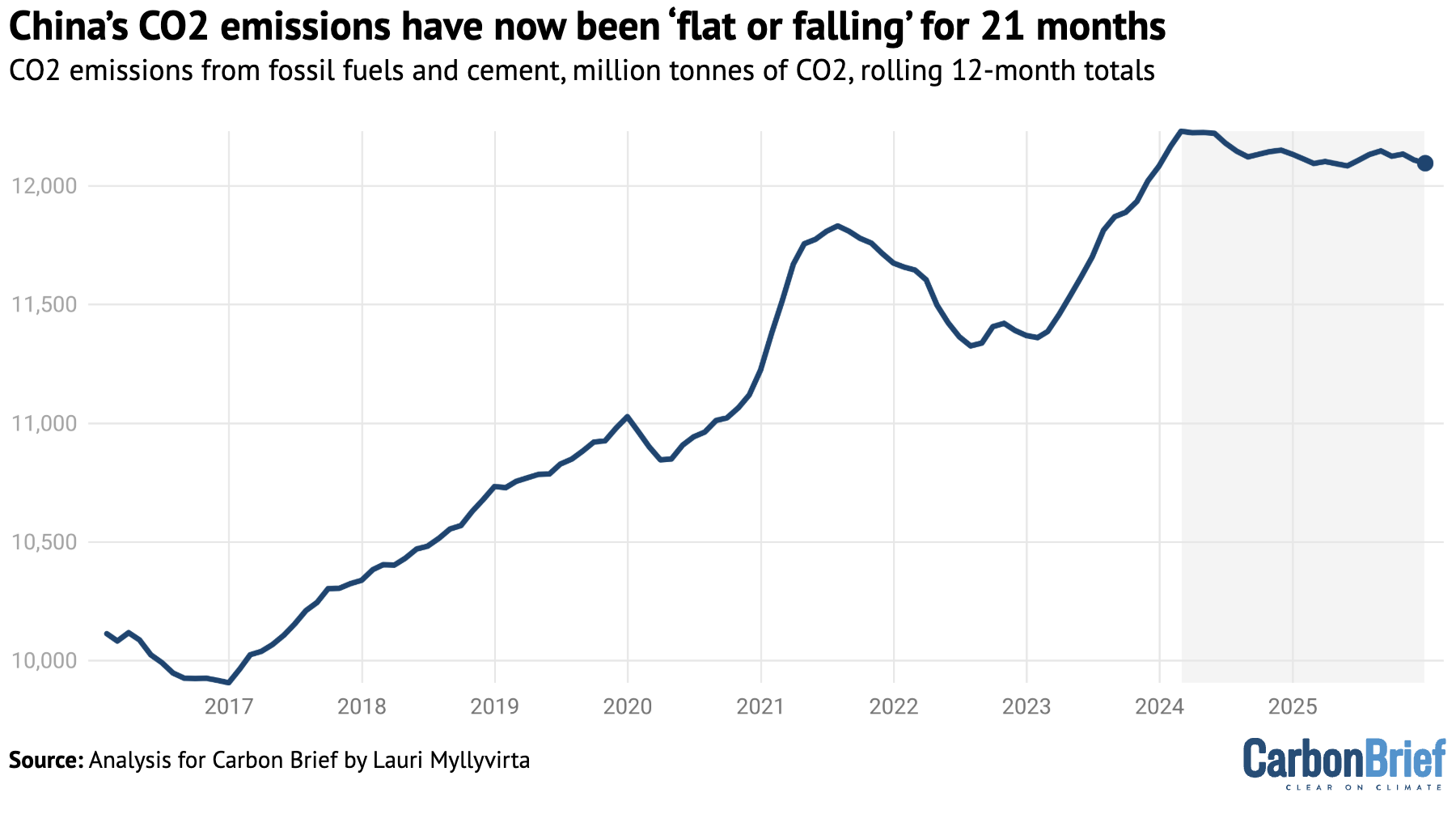 China's CO2 emissions from fossil fuels and cement, million tonnes of CO2, rolling 12-month totals until September 2025. Source: Emissions are estimated from National Bureau of Statistics data on production of different fuels and cement, China Customs data on imports and exports and WIND Information data on changes in inventories, applying emissions factors from China's latest national greenhouse gas emissions inventory and annual emissions factors per tonne of cement production until 2024. Sector breakdown of coal consumption is estimated using coal consumption data from WIND Information and electricity data from the National Energy Administration. The consumption of petrol, diesel and jet fuel is adjusted to match quarterly totals estimated by Sinopec.
Power sector emissions fell by 1.5% year-on-year in 2025, with coal use falling 1.7% and gas use increasing 6%. Emissions from transportation fell 3% and from the production of cement and other building materials by 7%, while emissions from the metal industry fell 3%.
These declines are shown in the figure below. They were partially offset by rising coal and oil use in the chemical industry, up 15% and 10% respectively, which pushed up the sector's CO2 emissions by 12% overall.
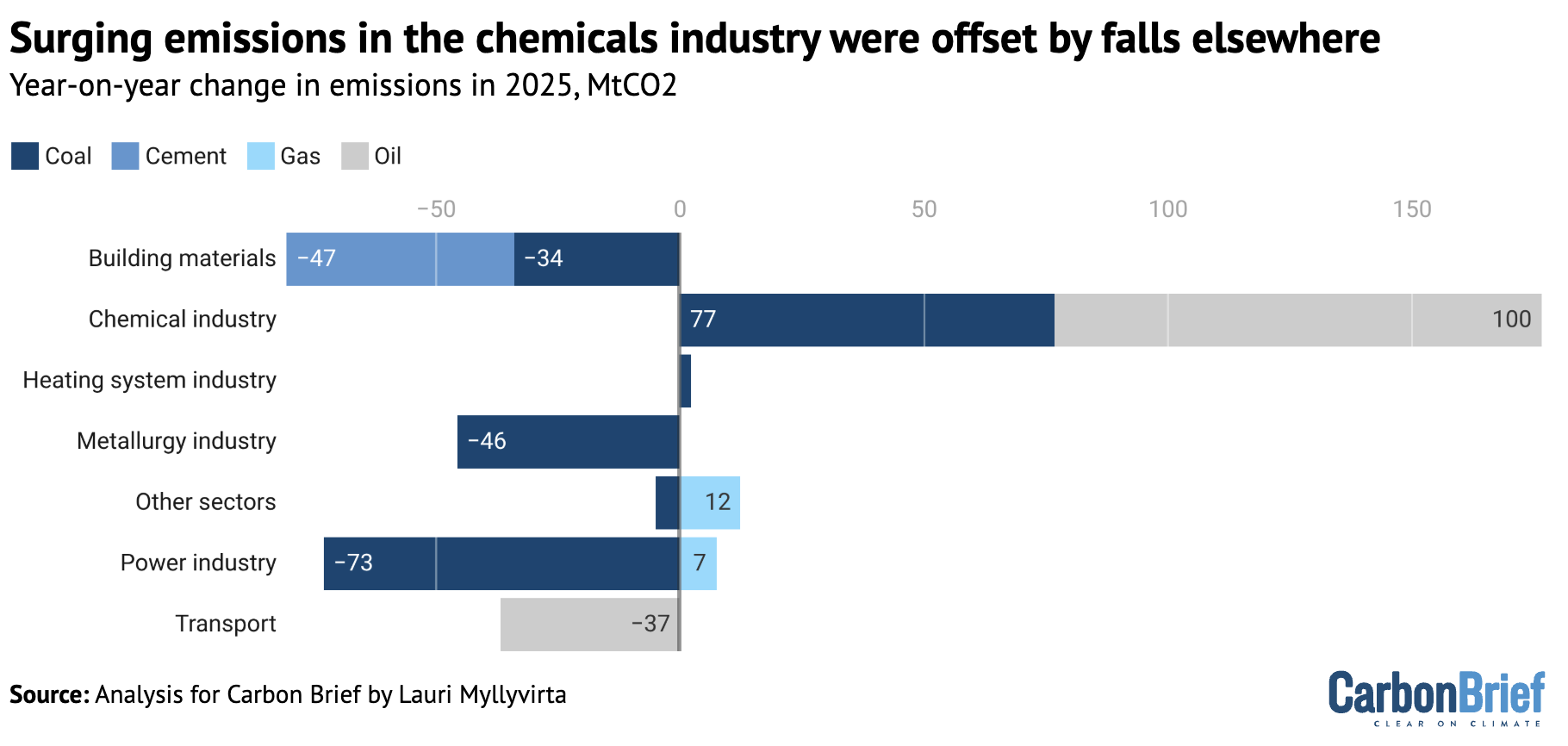 Year-on-year change in China's CO2 emissions from fossil fuels and cement, for the period January-September 2025, million tonnes of CO2. Source: Emissions are estimated from National Bureau of Statistics data on production of different fuels and cement, China Customs data on imports and exports and WIND Information data on changes in inventories, applying emissions factors from China's latest national greenhouse gas emissions inventory and annual emissions factors per tonne of cement production until 2024. Sector breakdown of coal consumption is estimated using coal consumption data from WIND Information and electricity data from the National Energy Administration. The consumption of petrol, diesel and jet fuel is adjusted to match quarterly totals estimated by Sinopec.
In other sectors - largely other industrial areas and building heat - gas use increased by 2%, more than offsetting the reduction in emissions from a 3% drop in their coal consumption.
Clean power covers electricity demand growthIn the power sector, which is China's largest emitter by far, electricity demand grew by 520 terawatt hours (TWh) in 2025.
At the same time, power generation from solar increased by 43% and wind power generation by 14%, delivering 360TWh and 130TWh of additional clean electricity. Nuclear power generation grew 8%, supplying another 40TWh. The increased generation from these three sources - some 530TWh - therefore met all of the growth in demand.
Hydropower generation also increased by 3% and bioenergy by 3%, helping push power generation from fossil fuels down by 1%. Gas-fired power generation increased by 6% and, as a result, power generation from coal fell by 1.9%.
Furthermore, the surge in additions of new wind and solar capacity at the end of 2025 will only show up as increased clean-power generation in 2026.
On the other hand, the growth in solar and wind power generation has fallen short of the growth in capacity, implying a fall in capacity utilisation - a measure of actual output relative to the maximum possible. This is highly likely due to increased, unreported curtailment, where wind and solar sites are switched off because the electricity grid is congested.
If these grid issues are resolved over the next few years, then generation from existing wind and solar capacity will increase over time.
Developments in 2025 extended the trend of clean-power generation growing faster than power demand overall, as shown in the top figure below. This trend started in 2023 and is the key reason why China's emissions have been stable or falling since early 2024.
In addition, 2025 saw another potential inflection point, shown in the bottom figure below. It was the first year ever that energy storage capacity - mainly batteries - grew faster than peak electricity demand in 2025 and faster than the average growth in the past decade.
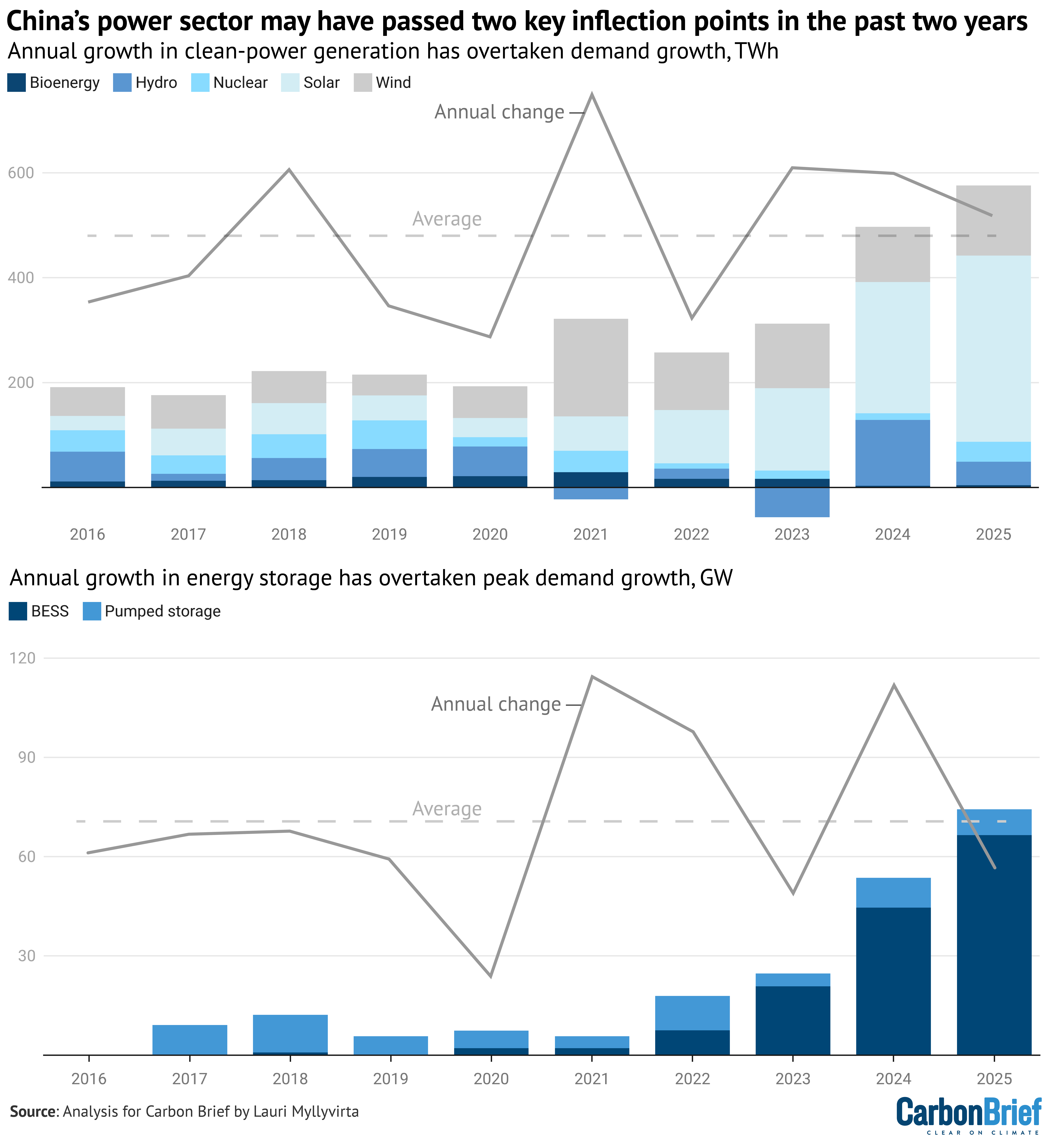 Top columns: Year-on-year change in annual electricity generation from clean energy excluding hydro, terawatt hours. Left solid and dashed line: Annual and average change in total electricity generation, TWh. Bottom columns: Year-on-year change in energy storage capacity, gigawatts. Right solid and dashed line: Annual and average change in peak electricity demand. Sources: Power generation and demand from Ember; peak loads from China Electric Power News since 2020; peak loads until 2019 and pumped hydro capacity from Wind Financial Terminal; battery storage capacity from China Energy Storage Alliance; analysis for Carbon Brief by Lauri Myllyvirta.
China's energy storage capacity increased by 75GW year-on-year in 2025, while peak demand only increased by 55GW. The rise in storage capacity in 2025 is also larger than the three-year average increase in peak loads, some 72GW per year.
Peak demand growth matters, because power systems have to be designed to reliably provide enough electricity supply at the moment of highest demand.
Moreover, the increase in peak loads is a key driver of continued additions of coal and gas-fired power plants, which reached the highest level in a decade in 2025.
The growth in energy storage could provide China with an alternative way to meet peak loads without relying on increased fossil fuel-based capacity.
The growth in storage capacity is set to continue after a new policy issued by China's top economic planner the National Development and Reform Commission (NDRC) in January.
This policy means energy storage sites will be supported by so-called "capacity payments", which to date have only been available to coal- and gas-fired power plants and pumped hydro storage.
Concerns about having sufficient "firm" power capacity in the grid - that which can be turned on at will - led the government to promote new coal and gas-fired power projects in recent years, leading to the largest fossil-fuel based capacity additions in a decade in 2025, with another 290GW of coal-fired capacity still under construction.
Reforming the power system and increasing storage capacity would enable the grid to accommodate much higher shares of solar and wind, while reducing the need for new coal or gas capacity to meet rising peaks in demand.
This would both unlock more clean-power generation from existing capacity and improve the economics and risk profiles of new projects, stimulating more growth in capacity.
Peaking power CO2 requires more clean-energy growthChina's key climate commitments for the next five-year period until 2030 are to peak CO2 emissions and to reduce carbon intensity by more than 65% from 2005 levels. The latter target requires limiting CO2 emissions at or below their 2025 level in 2030.
The record clean-energy additions in 2023-25 have barely sufficed to stabilise power-sector emissions, showing that if rapid growth in power demand continues, meeting the 2030 targets requires keeping clean-energy additions close to 2025 levels over the next five years.
China's central government continues to telegraph a much lower level of ambition, with the NDRC setting a target of "around" 30% of power generation in 2030 coming from solar and wind, up from around 22% in 2025.
If electricity demand grows in line with the State Grid forecast of 5.6% per year, then limiting the share of wind and solar to 30% would leave space for fossil-fuel generation to grow at 3% per year from 2025 to 2030, even after increases from nuclear and hydropower.
Such an increase would mean missing China's Paris commitments for 2030.
Alternatively, in order to meet the forecast increase in electricity demand without increasing generation from fossil fuels would require wind and solar's share to reach 37% in 2030.
Similarly, China's target of a non-fossil energy share of 25% in 2030 will not be sufficient to meet its carbon-intensity reduction commitment for 2030, unless energy demand growth slows down sharply.
This target is unlikely to be upgraded, since it is already enshrined in China's Paris Agreement pledge, so in practice the target would need to be substantially overachieved if the country is to meet its other commitments.
If energy demand growth continues at the 2025 rate and the share of non-fossil energy only rises from 22% in 2025 to 25% in 2030, then the consumption of fossil fuels would increase by 3% per year, with a similar rise in CO2 emissions.
Still, another recent sign that clean-energy growth could keep exceeding government targets came in early February when the China Electricity Council projected solar and wind capacity additions of more than 300GW in 2026 - well beyond the government goal of "over 200GW".
Chemical industryThe only significant source of growth in CO2 emissions in 2025 was the chemical industry, with sharp increases in the consumption of both coal and oil.
This is shown in the figure below, which illustrates how CO2 emissions appear to have peaked from cement production, transport, the power sector and others, whereas the chemicals industry is posting strong increases.
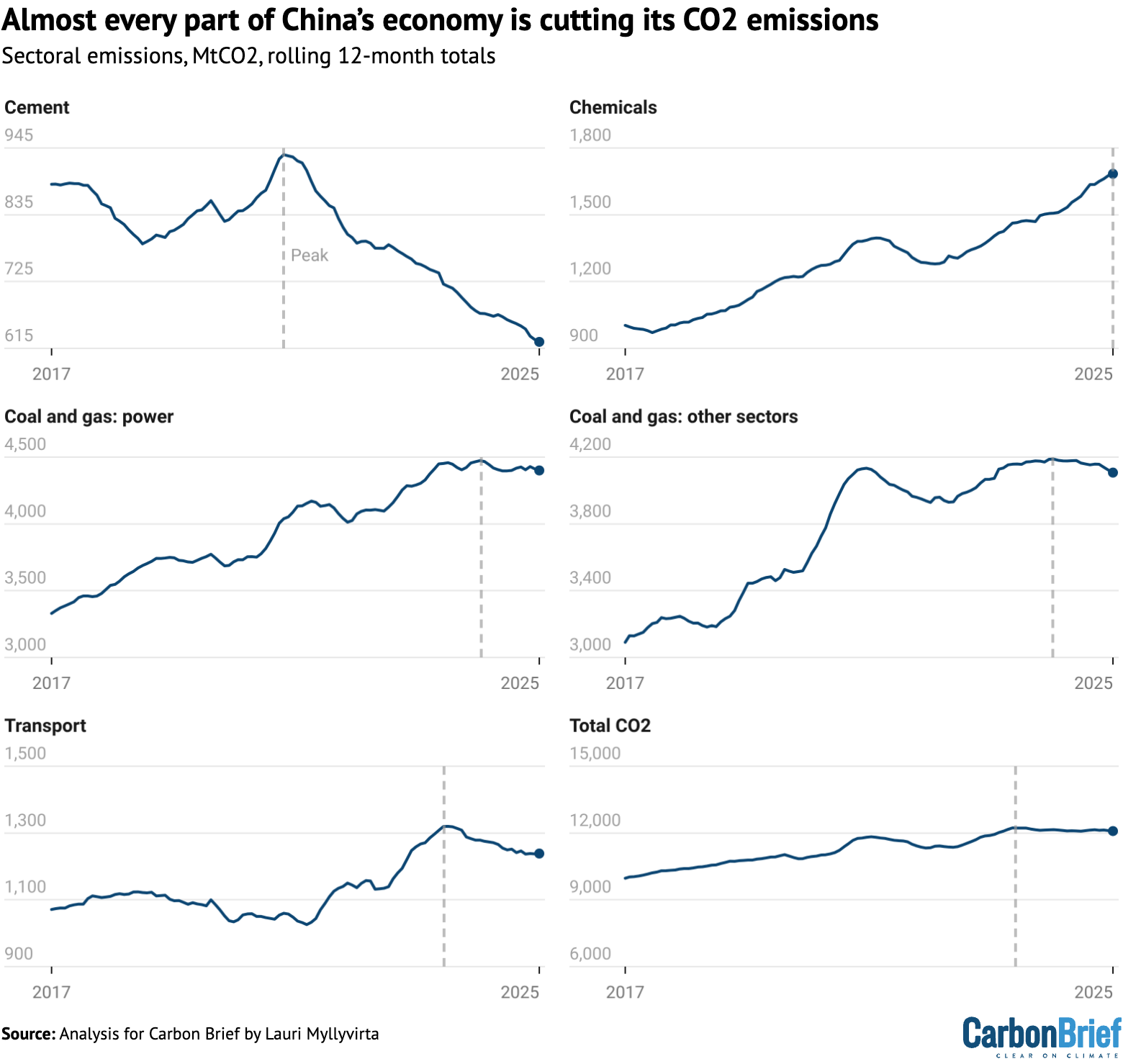 Sectoral emissions from fossil fuels and cement, million tonnes of CO2, rolling 12-month totals. Source: Emissions are estimated from National Bureau of Statistics data on production of different fuels and cement, China Customs data on imports and exports and WIND Information data on changes in inventories, applying emissions factors from China's latest national greenhouse gas emissions inventory and annual emissions factors per tonne of cement production until 2024. Sector breakdown of coal consumption is estimated using coal consumption data from WIND Information and electricity data from the National Energy Administration.
Even though chemical-industry emissions are small relative to other sectors - at roughly 13% of China's total - the pace of expansion is creating an outsize impact.
Without the increase from the chemicals sector, China's total CO2 emissions would have fallen by an estimated 2%, instead of the 0.3% reported here.
Without changes to policy, emission growth is set to continue, as the coal-to-chemicals industry is planning major increases in capacity.
Whether these expansion plans receive backing in the upcoming five-year plan for 2026-30 will have a major impact on China's emission trends.
Another key factor is the development of oil and gas prices. Production in the coal-based chemical industry is only profitable when coal is significantly cheaper than crude oil.
The current coal-to-chemicals capacity in China is dominated by plants producing higher-value - and therefore less price-sensitive - chemicals such as olefins and aromatics, as feedstocks for the production of plastics.
In contrast, the planned expansion of the sector is expected to be largely driven by plants producing oil products and synthetic gas to be used for energy. For these products, electrification and clean-electricity generation provide a direct alternative, meaning they are even more sensitive to low oil and gas prices than chemicals production.
Outlook for China's emissionsThis is the latest analysis for Carbon Brief to show that China's CO2 emissions have now been stable or falling for seven quarters or 21 months, marking the first such streak on record that has not been associated with a slowdown in energy demand growth.
Notably, while emissions have stabilised or begun a slow decline, there has not yet been a substantial reduction from the level reached in early 2024. This means that a small jump in emissions could see them exceed the previous peak level.
China's official plans only call for peaking emissions shortly before 2030, which would allow for a rebound from the current plateau before the ultimate emissions peak.
If China is to meet its 2030 carbon intensity commitment - a 65% reduction on 2005 levels - then emissions would have to fall from the peak back to current levels by 2030.
Whether China's policymakers are still committed to meeting this carbon intensity pledge, after the setbacks during the previous five-year period, is a key open question. The 2030 energy targets set to date have fallen short of what would be required.
The most important signal will be whether the top-level five-year plan for 2026-30, due in March, sets a carbon intensity target aligned with the 2030 Paris commitment.
Officially, China is sticking to the timeline of peaking CO2 emissions "before 2030", which was announced by president Xi Jinping in 2020.
According to an authoritative explainer on the recommendations of the Central Committee of the Communist Party for the upcoming five-year plan, published by state-backed news agency Xinhua, coal consumption should "reach its peak and enter a plateau" from 2027.
It says that continued increases in demand for coal from electricity generators and the chemicals industry would be offset by reductions elsewhere. This is despite the fact that China's coal consumption overall has already been falling for close to two years.
The reference to a "plateau" in coal consumption indicates that in official plans, meaningful absolute reductions in emissions would have to wait until after 2030. Any increase in coal consumption from 2025 to 2027, before the targeted plateau, would need to be offset by reductions in oil consumption, to meet the carbon intensity target.
Moreover, allowing coal consumption in the power sector to grow beyond the peak of overall coal use and emissions implies slowing down China's clean-energy boom. So far, the boom has continued to exceed official targets by a wide margin.
In addition, the explainer's expectation of further growth in coal use by the chemicals industry indicates a green light for at least a part of its sizable expansion plans.
The Xinhua article recognises that oil product consumption has already peaked, but says that oil use in the chemicals industry has kept growing. It adds that overall oil consumption should peak in 2026.
Elsewhere, the article speaks of "vigorously" developing non-fossil energy and "actively" developing "distributed" solar, which has slowed down due to recent pricing policies.
Yet it also calls for "high-quality development" of fossil fuels and increased efforts in domestic oil and gas production, suggesting that China continues to take an "all of the above" approach to energy policy.
The outcome of all this depends on how things turn out in reality. The past few years show it is possible that clean energy will continue to overperform its targets, preventing growth in energy consumption from fossil fuels despite this policy support.
The key role of the clean-energy boom in driving GDP growth and investments is one key motivator for policymakers to keep the boom going, even when central targets would allow for a slowdown. It is also possible that the five-year plans of provinces and state-owned enterprises could play a key role in raising ambition, as they did in 2022.
About the dataData for the analysis was compiled from the National Bureau of Statistics of China, National Energy Administration of China, China Electricity Council and China Customs official data releases, as well as from industry data provider WIND Information and from Sinopec, China's largest oil refiner.
Electricity generation from wind and solar, along with thermal power breakdown by fuel, was calculated by multiplying power generating capacity at the end of each month by monthly utilisation, using data reported by China Electricity Council through Wind Financial Terminal.
Total generation from thermal power and generation from hydropower and nuclear power were taken from National Bureau of Statistics monthly releases.
Monthly utilisation data was not available for biomass, so the annual average of 52% for 2023 was applied. Power-sector coal consumption was estimated based on power generation from coal and the average heat rate of coal-fired power plants during each month, to avoid the issue with official coal consumption numbers affecting recent data.
CO2 emissions estimates are based on National Bureau of Statistics default calorific values of fuels and emissions factors from China's latest national greenhouse gas emissions inventory, for the year 2021. The CO2 emissions factor for cement is based on annual estimates up to 2024.
For oil, apparent consumption of transport fuels - diesel, petrol and jet fuel - is taken from Sinopec quarterly results, with monthly disaggregation based on production minus net exports. The consumption of these three fuels is labeled as oil product consumption in transportation, as it is the dominant sector for their use.
Apparent consumption of other oil products is calculated from refinery throughput, with the production of the transport fuels and the net exports of other oil products subtracted. Fossil-fuel consumption includes non-energy use such as plastics, as most products are short-lived and incineration is the dominant disposal method.

China energy
|05.02.26
Analysis: Clean energy drove more than a third of China's GDP growth in 2025
China energy
|05.02.26

'Rush' for new coal in China hits record high in 2025 as climate deadline looms
China energy
|03.02.26

Explainer: Why gas plays a minimal role in China's climate strategy
China energy
|22.01.26
jQuery(document).ready(function() { jQuery('.block-related-articles-slider-block_f2f428e18d17c60b86ceb33db0d653ab .mh').matchHeight({ byRow: false }); });The post Analysis: China's CO2 emissions have now been 'flat or falling' for 21 months appeared first on Carbon Brief.
Blizzard announced today that it is introducing the Warlock as a playable character to Diablo II: Resurrected. It brings the first new class in 25 years to this remaster of the original RPG. It's part of the Reign of the Warlock DLC, which is available today and will run you $25. It also includes some other updates to the base game, including new items and a new pinnacle boss encounter against the Colossal Ancients. For those players who don't already own the base game, you can also pick up the Infernal Edition of D2R for $40, which includes the new content.
When D2R launched in 2021, it was an impressively faithful recreation of the game that so many Blizzard fans continued to adore over the years. Bringing in a whole new player class is a big win for those players who have stuck with the game in its contemporary era.
If D2R isn't your jam, though, Warlock is also being added to both Diablo 4 in its upcoming Lord of Hatred expansion this April and to Diablo Immortal. So aside from Diablo 3 not getting much love, just about all fans of the franchise will have a chance to get into the demon-summoning groove. Blizzard's 30th anniversary showcase video has all the details about what the other Diablo titles have in store during this year.
Blizzard has been keeping the news and updates rolling over the past few weeks in honor of the company's 35th anniversary. One of the more notable updates came for team hero shooter Overwatch, which lost the 2 in its name, but gained five more heroes in its big update yesterday.
This article originally appeared on Engadget at https://www.engadget.com/gaming/diablo-ii-resurrected-is-adding-warlock-as-a-brand-new-player-class-000130003.html?src=rss

I'm still getting used to this life. Walking through Birmingham International train station at 8am on Wednesday 4 February to the NEC, sleep-deprived. A stranger clocks me. A double-take. I'm imagining things. Oh wait. No. He's following, phone raised, snapping pictures. Earpiece? Check. ID? None. A plain-clothes somebody, or nobody.
We're expecting trouble later
A flimsy justification when challenged before scuttling off. I wish I'd thought to record it, but like I say, I'm getting used to this still.

I was at the National Exhibition Centre (NEC) in Birmingham. In-between hosting Springfair and The Artisanal Food and Ice Cream Show 2026, management are desperately trying to pull off the most delicate and audacious of audacious magic tricks. They're both trying to host the SDSC Arms Convention whilst simultaneously making sure nobody notices.
Of course, local activists were intent on shining a light on proceedings. The arms fair has moved from Telford due to protests - but where the arms go, the people follow. And, based on how hard it was to even find, the NEC was clearly aware of the PR implications.

Security was obviously tight. I arrived on Tuesday to find protesters, quite literally penned in on a piece of grass outside. Security took turns escorting them to the toilets every half hour, and one person was periodically chaperoned to get hot drinks. At one point, it wasn't clear if I'd even be permitted back through the building to the station. Fortunately, sense prevailed so I abused my press pass to visit the ice cream convention on the way back through.
Birmingham NEC: murder in the morning. Ice cream in the arvo.It was surreal: just a couple of walls stood between people peddling death and the best pistachio ice cream I've ever eaten.
People posed for pictures with the Ben & Jerry's cow, tens of metres away from… well, that's part of the problem. It's hard to say what's going on in there. I applied for a press ticket but never got a reply. Walking through the centre, the silence was deafening: Springfair branding everywhere, toys and games. The ice cream convention spelled out in huge gold lettering…
But nothing for the weapons fair. How odd! Almost like they were ashamed…


It was a theme. The sheer number of people who told me they were 'there for the ice cream', only to duck into the weapons convention, was laughable. If you're going to a weapons fair, own it. If you're ashamed, why go? And it's the same for Birmingham NEC. If they are ashamed of hosting it, why do it? Do they believe in the cause? Do they think it's okay to sell munitions that blow up people on the other side of the world? If so, why not write it in three-foot gold letters? Why did security ask me - belatedly - not to photograph the welcome sign in the window?

Scared of some hippies and drums
And why police a protest of tree-huggers and hippies as if they're a dire threat? It was ridiculous. Security seemed genuinely surprised people weren't grateful to be herded to the toilets. Since when is that normal? I've been going to protests for years. I've never seen a venue behave this way.
On Wednesday, arriving protesters were met by security escorts. They "didn't want people to get lost." Okay.
By 9:30am, several activists were physically carried out for handing out leaflets and dumped at the entrance.
EMBED VIDEO
Security in general was farcical. Please don't photograph those windows? Bit late for that bud. You honestly think the first thing I did when I landed Tuesday wasn't to take a picture of the huge fuck off "welcome" sign?
EBMED VIDEO
I want to the very clear, I don't think that people wearing yellow bibs, earning minimum wage while standing in the cold should be the target. It's not their fault their bosses are shit. Most probably agree that bombing kids is a shitty thing to do. People don't get an option about their engagement with a coercive capitalist system that demands blood sacrifice every week in exchange for the basic necessities needed to keep existing.


The ones sharing photos with the police; the ones laughing while making propeller motions at a staged die in highlighting the use of drones in the genocide ongoing in Gaza? That's another matter. When, as was relayed to me, one of the security managers went out of his way to tell protesters he knew where they are from because he saw them in a right wing auditors videos… When another walks up to an NUJ journalist and tries to intimidate them by quietly telling them how much they enjoyed the pictures on their Instagram? Yeah, fuck those guys. Royally and sideways. They deserve some shit being flung at them.
Back to the protestIn the pen, the XR drummers arrived. The promised snow hadn't materialised and spirits were high, waiting for reinforcements. The final straw for security arrived just after one o'clock from Birmingham New Street; The Red Rebel Brigade. Once they had made their way through the centre and reached the protest site, the doors slammed shut. Clearly too much publicity. Apparently there were now "too many people". Who the fuck is that scared of 7 people in velvet bath robes?

A bus arrived. Protesters were huddled and told there would be no more access; everyone would have to walk the long way around or be driven. The day was cut short. Those who walked were led through car parks out of sight of the public to the station. Everything organised to avoid anyone ever realising that theres death being bought and sold here or that anyone was opposed to that notion.

That's what this is about. The Birmingham NEC; a British institution trying desperately to eat its cake and then still have it; to host these events but avoid any scrutiny for having done so. Nestled in one of the most authentically working-class areas of the country; being pimped out to the highest bidder. Hiding its complicity behind free spoons of gelato. What would Ben & Jerry's say? We couldn't reach them for comment, but I think it's a fucking disgrace.
Industrial levels of incompetence on display for all to see at Birmingham NECThe handling of this protest is a recurring theme. The decision-makers aren't bad people by default - generally they are just really bad at their jobs. How anyone thinks this is the way to manage PR is beyond me. I find myself screaming "Barbara Streisand" in my head a lot.
It's all so counter-productive. All this bollocks about "facilitating a protest"… You're trying to minimise and hide it. And worse - attempting to intimidate journalists? What would have happened if you'd just allowed it? Some people would have banged drums, walked around in red gowns, and caught a train home. There isn't much to write about there.
But when you go out of your way to hide it, badly, you turn it into a story. When you stalk a journalist's Instagram, it's pretty weak. This is snowflake behaviour. From people hosting international arms dealers.

If the Birmingham NEC is hosting the SDSC Arms Convention, they should be proud enough to shout it from the rooftops. It should be on flags, banners, and their website. It shouldn't be hidden between plush toys and Ben & Jerry's.
And they shouldn't be afraid of people asking basic questions about the ethics of hosting an event that sells weapons. Those weapons aren't getting made for shits and giggles. They aren't getting made for fun; they are made to be used. To be dropped on people in Gaza and to be shot at people in Kashmir and Sudan. They kill people and the Birmingham NEC has their blood on its hands.
The NEC had not responded to a request for comment at the time of publication.
Featured images via Barold
By Barold
Model-maker and SaaS-y AI outfit Anthropic has committed to covering any increases in energy prices paid by consumers caused by its power-hungry datacenters.…

As the world boos US government officials at the Olympics, and our athletes decry government abuse at home, Immigration and Customs Enforcement wants the world to know they'll be at the FIFA World Cup.
Acting ICE Director Todd Lyons told a congressional committee Tuesday that Immigration and Customs Enforcement, through its Homeland Security Investigations unit, will remain "a key part of the overall security apparatus" for the 2026 FIFA World Cup, as the tournament faces mounting controversy over immigration enforcement and travel restrictions.
The post ICE gives the world another reason to skip the U.S. World Cup appeared first on Boing Boing.

While masked government thugs slay citizens legally observing their over-zealous and perhaps extra-judicial immigration enforcement, Tennessee Republican congressperson Andy Ogles has found the real National emergency: Bad Bunny's hips.
The gentleman from Tennessee has formally demanded that the House Energy and Commerce Committee examine whether the NFL and NBC properly vetted what he calls "widespread twerking, grinding, pelvic thrusts, and other sexually suggestive content" during the NFL Superbowl half time show. — Read the rest
The post Congressman demands a federal probe into 13 minutes of televised twerking appeared first on Boing Boing.

In another glaring contradiction, the oft-repeated insistence by convicted felon Donald Trump and Amazon film star Melania that Jeffrey Epstein didn't introduce the two lovebirds has taken a shot across the bow.
FBI documents in the Epstein files show a sworn statement by one of Epstein's former assistants, who insists Trump's longtime pal, Jeffrey, "introduced MELANIA TRUMP to DONALD TRUMP," in files reviewed by The Daily Beast. — Read the rest
The post FBI file claims Epstein introduced Melania to Trump, contradicting the fairy tale appeared first on Boing Boing.

The Social Justice Party (SJP) has been supportive of Your Party (YP). But it has also raised some concerns about accountability for rule-breaking, telling the Canary it wants YP to:
urgently conduct an internal investigation into a serious allegation that a Your Party conference organiser abused their authority and deliberately broke the sortition rules.
The SJP clarified that its own elected representatives have:
been involved in discussions with like minded groups, such as The Collective, about building a new party of the left since 2024.
And it added that:
SJP members want Your Party to flourish and in order to do that it must operate in a manner that is fair, democratic and transparent.
The allegation of rule-breaking comes amid Your Party's elections for its first Central Executive Committee (CEC). There have also been concerns about transparency and accountability during this process.
Alleged rule-breaking at Your Party's founding conferenceMembers wanting to attend November's founding conference in Liverpool had to go through a sortition process, with YP's website saying this sought to:
assemble a representative group of people by effectively drawing lots, giving everyone an equal chance of being chosen
The SJP, however, discovered that one of its former members had:
received a personal invite from a conference organiser to attend Your Party's Founding Conference.
This was despite the sortition process not choosing this member.
The SJP undertook an internal investigation, which:
concluded that it was beyond reasonable doubt that a Your Party conference organiser had broken the sortition rules
SJP chair Eric Barnes told us that, when the member arrived at the conference, they were allegedly:
issued with a pre-written speech and advised where to sit in the conference hall - in the same section as sortitioned participants - in order to maximise their chances of being selected to speak during a conference debate
A conference organiser, meanwhile, had also:
SJP will officially complain after CEC electionarranged for them to stay in a hotel and offered to pay for their accommodation and travel expenses. Although the SJP member did not actually speak during a conference debate they said that they were aware of another non-sortitioned person, who also gained access to the conference floor via a personal invite, who did speak
The SJP told us that it doesn't currently "have confidence" that an official complaint to Your Party would receive fair and impartial attention, because:
At present Your Party is controlled by a small group of unelected people overseeing processes that as yet have not been formally agreed.
The party believed it was in YP members' interests to comment now because:
Your Party is intending to use sortition as a mechanism for future member voting purposes, therefore Your Party members need to be aware of potential interference.
And it confirmed it:
will be submitting a formal complaint to Your Party once the new CEC leadership team has been elected enabling them to carry out their own investigation.
It explained why, saying:
Rule 7.1 of Your Party's interim membership rules states 'Members must not act in any way that brings the Party into disrepute'.
The SJP are concerned that a Your Party conference organiser broke the sortition rule, which is clearly an act that would bring the party into disrepute, and will be pursuing this complaint until it is satisfactorily resolved.
Barnes also expressed concern that these rule breaches may not have been the only ones. And he insisted:
It is even more galling that properly sortitioned delegates were barred from conference because they were deemed to be members of another political party. We trust that the new CEC will bring an end to these backroom manoeuvres and set Your Party on a path of genuine democracy.
The Canary approached Your Party for comment on these allegations, but received no response by the time of publication.
Featured image via the Canary
By The Canary

As the US blocks countries from sending oil to Cuba, it has also made sure that Venezuelan oil gets to Israel for the first time in years.
US diverting Venezuelan oil away from Cuba, and towards IsraelAfter Washington's illegal invasion of Venezuela in early January 2026, during which it abducted the country's president Nicolás Maduro, the US took control of the oil leaving the Latin American nation. That meant it could ensure once and for all that Venezuelan oil wouldn't go to Cuba anymore.
But this imperialist oil game wasn't just about strangling Cuba, apparently. It was also about ensuring Venezuela's oil could go to US allies, like the genocidal settler-colonial state of Israel. As Drop Site News has reported, the US has now overseen:
a crude oil cargo to Bazan Group, Israel's largest refinery.
The US has also received oil, along with India, currently under the far-right government of Narendra Modi, and Europe.

Colombia's socialist president Gustavo Petro has been in the US's crosshairs since he denounced Trump and his "clan of paedophiles" for abducting Venezuelan leader Nicolás Maduro.
Today, he narrowly avoided assassination when attackers overran the planned landing site for the helicopter in which he and his family were travelling.
Petro later described how the family had to fly out to sea for hours before finding a safe place:
https://www.thecanary.co/wp-content/uploads/2026/02/ORTm4fT9muUgFGgt.mp4
No group has yet claimed responsibility, leaving open the likelihood of another US-sponsored murder attempt, ignored by most western media.
Featured image via the Canary
By Skwawkbox

No one loves the excessive use of force quite like Los Angeles' finest. In addition to recently having been asked by the City Council to back off the riot gear and immediately threatening responses to crowds, the LAPD also got the news that a federal judge is banning their favorite less-than-lethal 40mm foam projectile launchers. — Read the rest
The post Federal judge bans one "less-lethal" launcher, LAPD finds another appeared first on Boing Boing.

After reviewing unredacted Epstein files, Rep. Jamie Raskin (D-MD) told Axios that when he searched for Donald Trump's name, it appeared "more than a million times," and at least one document appears to directly contradict Trump's public claims about the extent of his relationship with Jeffrey Epstein. — Read the rest
The post Unredacted Epstein files contain a whole lot of "Donald J. Trump" appeared first on Boing Boing.

Most high school shop programs produce birdhouses and bruised thumbs. In Sandpoint, Idaho, students spent their Saturdays building two full-scale aircraft, earned FAA airworthiness certificates, and then watched one of their own take them into the sky.
The morning of October 4, 2025, marked a turning point for the North Idaho High School Aerospace Program.
The post Idaho high schoolers build two airplanes, then go fly them appeared first on Boing Boing.

In a big win for the local dairy industry, the United Kingdom's Supreme Court today affirmed a law that "milk" refers only to the stuff that comes out of animals. It ruled against the oat milk brand Oatly, effectively banning the marketing of dairy-free alternatives as "milk." — Read the rest
The post UK Supreme Court: oat milk can't be called milk appeared first on Boing Boing.

John the Fox, 1978
Half a century ago, documentary photographer Joyce Edwards (1925-2024) took these tender portraits of the squatters who inhabited empty houses in the triangle of streets next to Victoria Park which had been vacated for the sake of a proposed inner city motorway that was never built. Her pictures are now being shown publicly for the first time at Four Corners in Bethnal Green in an exhibition entitled, Joyce Edwards: A Story Of Squatters, which opens tomorrow and runs until Saturday 20th March.

Joyce Edwards, 1980

Harold the Kangaroo, painter, with his dog Captain Beefheart, 1978

Billy Cowden, Joy Rigard & Jamie, 1978

Henry Woolf, actor, 1974

Beverly Spacie, 1977

Anthony & Andrew Minion, 1980

Elizabeth Shepherd, actor, c. 1970

John, painter,1979

Gary Chamberlin, Beverly Spacie & Howard Dillon, 1977

Julia Clement, 1978

Vanessa Swann & Baz O' Connell, 1979

Matthew Simmons, 1978

Shirley Robbins, 1977

Tosh Parker, 1977

Sue, 1977

Father & son, 1976

103 Bishops Way E2, Co-op headquarters, 1978

Attempted eviction, 1978

Joyce Edwards, 2012
Photographs copyright © Estate of Joyce Edwards
Joyce Edwards: A Story Of Squatters is at Four Corners, 121 Roman Rd, E2 0QN. Friday 13th February until Saturday 20th March (Wednesday to Saturday, 11am - 6pm)
You may also like to take a look at
Donald Trump has a handful of clear areas of focus in his second term as president. One of those is to force old, polluting, expensive fossil fuel power plants on the American people. And he's taking it to new extremes this week. "Based on reporting, today Donald Trump will give ... [continued]
The post Donald Trump to Give Coal Industry Another Massive Handout — via Department of Defense appeared first on CleanTechnica.
Peter Mandelson—the former UK cabinet minister who was just sacked as Britain's ambassador to the United States over newly revealed emails with Jeffrey Epstein—has found a novel way to avoid answering questions about why he told a convicted sex offender "your friends stay with you and love you" and urged him to "fight for early release." He got the UK press regulator to send a memo to all UK media essentially telling them to leave him alone.
The National published what they describe as the "secret notice" that went out:
CONFIDENTIAL - STRICTLY NOT FOR PUBLICATION: Ipso has asked us to circulate the following advisory:
Ipso has today been contacted by a representative acting on behalf of Peter Mandelson.
Mr Mandelson's representatives state that he does not wish to speak to the media at this time. He requests that the press do not take photos or film, approach, or contact him via phone, email, or in-person. His representatives ask that any requests for his comment are directed to [REDACTED]
We are happy to make editors aware of his request. We note the terms of Clause 2 (Privacy) and 3 (Harassment) of the Editors' Code, and in particular that Clause 3 states that journalists must not persist in questioning, telephoning, pursuing or photographing individuals once asked to desist, unless justified in the public interest.
Clauses 2 and 3 of the UK Editor's Code—the privacy and harassment provisions—exist primarily to protect genuinely vulnerable people from press intrusion. Grieving families. Crime victims. People suffering genuine harassment.
Mandelson is invoking them to avoid answering questions about his documented friendship with one of history's most notorious pedophiles—a friendship so extensive and problematic that it just cost him his job as ambassador to the United States, days before a presidential state visit.
According to Politico, the UK Foreign Office withdrew Mandelson "with immediate effect" after emails showed the relationship was far deeper than previously known:
In a statement the U.K. Foreign Office said Mandelson had been withdrawn as ambassador "with immediate effect" after emails showed "the depth and extent" of his relationship with Epstein was "materially different from that known at the time of his appointment."
"In particular Peter Mandelson's suggestion that Jeffrey Epstein's first conviction was wrongful and should be challenged is new information," the statement added.
So we have a senior political figure who just got fired over revelations that he told a convicted sex offender his prosecution was "wrongful" and should be challenged, who maintained this friendship for years longer than he'd admitted, and his response is to invoke press harassment protections?
The notice does include the important qualifier "unless justified in the public interest." And it's hard to imagine a clearer case of public interest: a senior diplomat, just sacked from his post, over previously undisclosed communications with a convicted pedophile, in which he expressed support for challenging that pedophile's conviction. If that's not public interest, the term has no meaning.
But the mere act of circulating this notice creates a chilling effect. It puts journalists on notice that pursuing this story could result in complaints to the regulator. It's using the machinery of press regulation as a shield against legitimate accountability journalism.
Now, to be fair, one could imagine scenarios where even a disgraced public figure might legitimately invoke harassment protections—it wasn't that long ago there was a whole scandal in the UK with journalists hacking the voicemails of famous people. But that's not what's happening here. Mandelson is invoking these provisions to avoid being asked questions at all. "Please don't inquire about why I told a convicted pedophile his prosecution was wrongful" is not the kind of harm these rules were designed to prevent.
This is who Mandelson has always been: someone who sees regulatory and governmental machinery as tools to be deployed on behalf of whoever he's serving at the moment. Back in 2009, we covered how he returned from a vacation with entertainment industry mogul David Geffen and almost immediately started pushing for aggressive new copyright enforcement measures, including kicking people off the internet for file sharing. As we wrote at the time, he had what we called a "sudden conversion" to Hollywood's position on internet enforcement that happened to coincide suspiciously with his socializing with entertainment industry executives.
Back then, the machinery was deployed to serve entertainment executives who wanted harsher copyright enforcement. Now it's being deployed to serve Mandelson himself.
There's a broader pattern here that goes beyond one UK politician. The Epstein revelations have been remarkable not just for what they've revealed about who associated with him, but for how consistently the response from the powerful has been to deflect, deny, and deploy every available mechanism to avoid genuine accountability. Some have used their media platforms to try to reshape the narrative. Some have simply refused to comment.
Mandelson is trying to use the press regulatory system itself.
It's worth noting that The National chose to publish the "confidential - strictly not for publication" memo anyway, explicitly citing the public interest. Good for them. Because if there's one thing that absolutely serves the public interest, it's shining a light on attempts by the powerful to use the systems meant to protect the vulnerable as shields for their own accountability.
Mandelson's representatives say he "does not wish to speak to the media at this time." That's his right to request—but no media should have to agree to his terms. Weaponizing press regulation to create a cone of silence around questions of obvious public interest is something else entirely. It's elite impunity dressed up in the language of press ethics.

At first, the idea of selling a flat can seem straightforward. You catalogue it, locate a buyer and anticipate a quick turnaround. Flat sales can lag behind housing sales, and the reasons aren't always clear. Many delays stem from things buyers and sellers hadn't considered, or don't think about until the process is already underway. Knowing these things early can help you avoid frustration and make the best choices when time is of the essence.
Legal and Paperwork Issues That Slow Things DownOne of the biggest foot-draggers is related to paperwork associated with leasehold ownership. Unlike houses, most flats demand extra paperwork before a sale can proceed.
The management packs are a perfect example. The freeholder or managing agent supplies them and they contain information such as service charges, building insurance and planned works. They are indispensable for the buyer's solicitor, but are sometimes requested late and can take weeks to arrive. Some managing agents also levy hefty fees, which can add to delays while costs are negotiated.
Ground rent clauses may also prove problematic. Some terms could raise concerns for mortgage lenders, particularly if the ground rent balloons over time. If picked up by legal checks, buyers might pause or even walk away entirely.
Then there are building safety forms. Dozens of flat sales now hinge on new safety regulations to confirm fire safety and the presence of cladding. If the correct form is not provided on time or is incomplete, solicitors may decline to continue until it is corrected.
Practical and Timing Challenges Sellers Often MissBut beyond paperwork, timing is a significant factor in how quickly a flat sale closes. Property chains also play a part. If your buyer's buyer has a property to sell and there's yet another buyer involved, it can drag on significantly longer. Flats are often in long chains, meaning that if one link fails, the entire row collapses.
Delaying for this interval can be pretty frustrating, especially when there is a personal or financial deadline. Job changes, relationship breakups, or repeated costs, such as service charges, can make waiting unbearable. In such a scenario, some sellers seek to minimise uncertainty and think "I'd better look to sell my flat fast", prioritising speed over receiving the best price for the property. Finding a cash buyer can help them proceed without relying on prolonged chains or legal processes.
Preparation is another area sellers often overlook. Missing documents, murky histories of service charges, or unresolved disputes with managing agents can all slow the process once a buyer has been identified. Buyers are wary, and anything that appears questionable can prompt additional questions or renegotiation.
Flat sales are often delayed for a mix of legal and practical reasons. The management packs, the terms of the ground rent, and the forms for building safety and property chains all play a part but are easy to overlook initially. Sellers who know about these issues in advance can prepare, prevent unnecessary delays, and take the best course of action for their circumstances. A less bumpy experience begins with understanding where problems typically arise and addressing them before your sale is impacted.

The Department for Work and Pensions' (DWP) own figures show that the number of Work Capability Assessments (WCA) will be higher than ever in 2031. This is despite the DWP and it's chief Pat McFadden insisting the WCA will be abolished by then
How exactly does the DWP plan to save money?Benefits and Work sent the Treasury and DWP a Freedom of Information (FOI) request in December. They wanted a breakdown of the savings vaguely alluded to in the autumn budget.
Back in November, Reeves had announced that the DWP would: Improve operations by increasing face-to-face assessments, increasing WCA reassessment capability, and PIP award review changes, starting from April 2026.
She then said the DWP's annual total savings would be 1.9 billion, but there was, of course, no breakdown of this in the autumn budget document.
Benefits and Work asked the DWP to:
Government not keen to be transparent, shockerPlease give a detailed breakdown of how the £1.9 billion is to be saved, including:
a) Any additional assessment costs created by increasing the number of WCA reassessments
b) Any savings resulting from a reduction in the number of claimants found to no longer have LCWRA due to the increased number of WCA reassessments
c) Any savings in assessment costs caused by extending the time between PIP reviews
d) Any additional assessment costs caused by increasing the proportion of PIP face-to-face assessments
e) Any savings in PIP costs caused by increasing the proportion of PIP face-to-face assessments, due to the lower success rate for PIP applicants when assessed face-to-face rather than remotely.
The government was, naturally, hesitant to give details about a figure they'd probably pulled out of their arses. The Treasury ridiculously told Benefits and Work it would cost too much to answer their request.
The DWP refused to answer repeated requests from both the Liberal Democrats and Disability News Service on where the savings would come from.
However, in December the DWP put out a press release about increasing face-to-face assessments. It said PIP face-to-face assessments would increase from 6% to 30% and WCAs would increase from 13% to 30%.
At first glance, it's not clear how more work would mean savings. But this feels like a deliberate attempt to insinuate that so many people are getting benefits because it's easier to "fake" over the phone.
Finally, some clarity — well….Finally, this week, after more pressure from Benefits and Work, the DWP replied to their FOI:
The £1.9bn comprises the following figures shown in Table 1:
This £1.9bn figure does not include any additional assessment costs. This is because the reduced number of assessments for PIP releases resource to increase WCA reassessments and face-to-face assessments, and there is no assumed net increase in the number of health care professionals employed by DWP's contracted providers as a result of these policies.

Benefits and Work have estimated that a huge proportion of the savings will come from reducing admin costs.
57% of savings over the next five years (£1.12 billion) will come from extending the amount of time between PIP reassessments, from 3 years to 5. 31% (£609 million) of the savings will be from increasing WCA assessments. Some of this saving will come from the health element of Universal Credit moving to PIP, meaning, in theory, fewer assessors are needed. But it's also probably assuming many will get the new lower rate.
8% (£164 million) of the savings will come from face-to-face PIP assessments increasing, and just 3% (£58 million) will come from more face-to-face WCA assessments.
So, despite the DWP saying otherwise, it's actually a very small amount that will come from kicking vulnerable people off benefits.
But the WCA is supposed to be gone?What's even weirder here, however, is that the WCA will still be taking place at all post 2030. This is because in the Pathway's to Work Green Paper, the DWP planned to have it abolished by 2029. This is because the paper set out that the UC health element would be moved over to PIP and claimants would need to score so many points on the daily living component.
However, this paper was also reliant on PIP cuts going through and PIP eligibility changing so that you had to score at least 4 points in one activity to get the daily living element. But then PIP had to be completely written out of the cuts after huge campaign efforts saw Labour MPs rebel. So until the Timms Review concludes, both claimants and the DWP haven't got a fucking clue what's happening there.
Despite this, DWP chief Pat McFadden still hasn't definitively said the WCA won't be abolished, just that it'll be delayed.
The Work and Pensions Committee asked him in December if he still intended to abolish the WCA. His response was, of course, vague as fuck:
DWP — just more proof that the Timms Review is a shamDue to its link with the PIP assessment, WCA abolition will not happen until after the Timms Review into the PIP assessment has concluded and any recommendations have been made. In the meantime, work is continuing to determine the detail of how this reformed system would work and discussions are also ongoing with the Scottish Government regarding the interactions between the devolved and reserved systems. We will outline further details on the reformed system, and the timing of WCA abolition, in due course.
As Benefits and Work point out, it could be that McFadden knows exactly what will happen with the WCA, but to say otherwise would let slip what we already know. That the Timms review and any notions of helping disabled claimants is just smoke and mirrors when they're already working so hard to turn the public against us. At the end of the day the department give a fuck whether disabled people live or die.
Featured image via the Canary
- Announcement confirms eight returning models for 2026, 2027
- Represented categories include adventure, miniMOTO, scooter and trials
American Honda announced today the return of eight beloved two-wheel models for the 2026 and 2027 model years. The collection of motorcycles represents a broad variety of categories, including adventure, miniMOTO, scooter and trials, reaffirming the brand's commitment to riders of all styles and skill levels. The legendary Africa Twin adventure-touring platform continues its journey with four versions, all boasting refined purpose and familiar capability. Meanwhile, enthusiasts of classic fun and urban mobility can look forward to the timeless, retro-inspired Trail125, Dax 125 and Monkey miniMOTO machines, plus the approachable Navi. The ever-popular PCX and ADV160 scooters return with their blend of comfort, efficiency and style, and the competition-proven Montesa Cota platform—comprising two trim levels—makes a triumphant showing for riders passionate about the sport of trials. Together, these returning models highlight Honda's broad appeal and dedication to delivering memorable riding experiences.
"From adventure touring to urban commuting and pure fun on two wheels, the eight returning models included in this announcement reinforce Honda's commitment to enjoyable experiences for a wide variety of riders," said Colin Miller, Manager of Experiential Marketing at American Honda. "Each of these motorcycles reflects the diverse passions of our customers and our dedication to meeting riders wherever their journey begins."
 Honda Africa Twin. Photo courtesy Honda
- 2026 Africa Twin:
Few motorcycles embody the spirit of adventure like Honda's Africa Twin. Developed for riders who see the world as a network of possibilities rather than paved limits, the legendary model continues to deliver Honda's "True Adventure" philosophy through its rare balance of comfort, performance and capability. Whether carving through winding highways or exploring rugged dirt roads, the Africa Twin rewards curiosity with confidence—offering proven engineering, advanced technology and an unmistakable connection between rider and machine. Available in a nimble, off-road-focused standard version and the mileage-eating Adventure Sports ES trim level (both of which are offered with a manual transmission or Honda's high-tech automatic DCT), the Africa Twin remains the ultimate expression of go-anywhere freedom, backed by Honda's uncompromising reliability and global adventure heritage.
- Colors
- Africa Twin: Pearl White; Matte Black Metallic
- Africa Twin DCT: Pearl White; Matte Black Metallic
- Africa Twin Adventure Sports ES: Pearl White
- Africa Twin Adventure Sports ES DCT: Pearl White
- MSRP
- Africa Twin: $15,199
- Africa Twin DCT: $15,999
- Africa Twin Adventure Sports ES: $17,799
- Africa Twin Adventure Sports ES DCT: $18,599
- Available: February
- Info
 Honda Trail 125. Photo courtesy Honda
 Honda Trail 125. Photo courtesy Honda
- 2026 Trail125
Paying homage to Honda's beloved Trail models of the '60s, '70s and '80s, the Trail125 blends classic miniMOTO design with modern engineering. With its timeless silhouette, automatic centrifugal clutch and fuel-efficient engine, the Trail125 feels equally at home on city streets and casual backroads. Carrying forward the adventurous spirit that made the original CT line legendary, this model delivers fun and practicality in equal portions.
- Colors: Glowing Red; Black Metallic
- MSRP: $4,199
- Available: April
- Info
 Honda Dax 125 Pearl Black. Photo courtesy Honda
- 2026 Dax 125
With its playful personality and unmistakable retro design, Honda's Dax 125 is a fun, easygoing machine that blends nostalgia with everyday usability. Its iconic T-shaped pressed-steel frame, chunky styling and approachable ergonomics make it instantly familiar to those who remember the original CT70, also known as the Trail 70, while newer riders appreciate its smooth 123.9cc engine, automatic centrifugal clutch and friendly handling. Equal parts playful and practical, the Dax 125 offers unique design, approachable performance and timeless Honda charm—perfect for reliving old memories or creating new ones.
- Color: Pearl Black
- MSRP: $4,199
- Available: April
- Info
 Honda Monkey Matte Black Metallic. Photo courtesy Honda
- 2026 Monkey
Honda's beloved Monkey offers an irresistible blend of classic charm and modern performance that has made it a favorite among a diverse array of riders. Its compact size and plush suspension make it approachable for new enthusiasts, while its capable fuel-injected engine, five-speed transmission and ABS braking deliver practical everyday usability. With a throwback silhouette, chrome accents and refined engineering, the Monkey continues to celebrate Honda's heritage while offering fun, accessible mobility for today's streets.
- Color: Matte Black Metallic
- MSRP: $4,399
- Available: March
- Info
 2026 Honda Navi White unpainted RR34. Photo courtesy Honda
 2026 Honda Navi Blue Metallic RHP. Photo courtesy Honda
- 2026 Navi
In just a few years on the U.S. market, Honda's Navi has become one of the nation's best-selling motorcycles, thanks to its unique blend of scooter-like simplicity and motorcycle-inspired styling. The model's smooth, fuel-efficient 109cc engine, easy-to-use V-Matic automatic transmission and lightweight chassis make it an easy choice for riders of all skill levels, while bold styling cues and practical touches—like a convenient lockable storage pod—add everyday usefulness. Affordable, fun and confidence-inspiring, the Navi is an effortless option for enjoying two-wheel mobility.
- Colors
- Non-painted: White
- Painted: Arctic Silver Metallic; Pearl Red; Blue Metallic
- MSRP
- Non-painted: $2,199
- Painted: $2,349
- Available: February
- Info
 2026 Honda PCX Pearl Gray. Photo courtesy Honda
- 2026 PCX
One of the most stylish and practical scooters on the road, Honda's PCX offers an easy, comfortable way to move through city streets and beyond. Its efficient engine, automatic transmission and Honda Selectable Torque Control deliver smooth, confidence-inspiring performance, while conveniences like generous under-seat storage, LED lighting and a USB-C charging port simplify everyday commuting. Blending modern capability with premium touches, the PCX continues to set the standard for dependable, affordable urban mobility.
- Color: Pearl Gray
- MSRP: $4,349
- Available: April
- Info
 2027 Honda ADV160 Matte Black Metallic. Photo courtesy Honda.
- 2027 ADV160
Continuing to redefine what a scooter can be, Honda's ADV160 combines everyday practicality with genuine adventure-inspired versatility. As comfortable on the daily commute as it is exploring rougher roads, this scooter delivers efficient, responsive performance and features that support confidence beyond smooth pavement. With its 157cc engine, durable chassis, ample ground clearance, long-travel suspension and distinctive ADV styling, the ADV160 is engineered to handle a wider range of riding environments than a traditional urban scooter. From smart technology to utility-focused details, every feature is purpose-built to optimize comfort, control and versatility, making it a compelling option for riders seeking adventure-ready flexibility in a compact, approachable package.
- Color: Matte Black Metallic
- MSRP: $4,499
- Available: June
- Info
 2026 Honda Montesa Cota 4RT 260R. Photo courtesy Honda
 2026 Honda Montesa Cota 4RT 301RR. Photo courtesy Honda
- 2026 Montesa Cota Models
Developed and refined through years of elite competition, including substantial input from perennial FIM World Champion Toni Bou, the Montesa Cota platform continues to set the benchmark in trials performance. The precision-focused Cota 4RT 301RR represents the pinnacle for riders tackling the most demanding sections, while the Cota 4RT 260R delivers a more accessible entry point with proven capability for those progressing in the sport. With lightweight construction, smooth four-stroke power and exceptional balance, both models make navigating technical terrain easier and more controlled than ever.
- Colors
- Montesa Cota 4RT 260R: Red
- Montesa Cota 4RT 301RR: Light Green
- MSRP
- Montesa Cota 4RT 260R: $9,849
- Montesa Cota 4RT 301RR: $12,949
- Available: February
- Info
The post Honda Revives Eight Iconic Motorcycle Models for 2026-2027 appeared first on Roadracing World Magazine | Motorcycle Riding, Racing & Tech News.
The Environmental Protection Agency has approved pesticides containing PFAS "forever chemicals" for widespread use on American crops, and scientists, environmental advocates, and public health experts are sounding alarms about what this means for food safety and environmental contamination.
Since the Trump administration took office, the EPA has already approved two PFAS pesticides and is looking to give the thumbs-up to a total of five before the year is out. The newly approved pesticides, cyclobutrifluram and isocycloseram, will be used on a wide range of food crops.
submitted by /u/thehomelessr0mantic[link] [comments]
In Gallup's final measure of Donald Trump's approval rating, Trump was stuck at 36%—his lowest since the end of his first term in office. The president won't have to worry about the famed pollster's next set of numbers, as it will no longer bother. — Read the rest
The post After 88 years, Gallup will no longer poll presidential approval ratings appeared first on Boing Boing.
Less than a week after Valve admitted that the current shortage (and growing prices) of RAM were affecting its hardware plans, the Steam Deck is completely sold out. The Steam Deck has gone in and out of stock in the past, but as Kotaku notes, the timing does raise the question whether Valve's RAM issues could also be impacting its Linux handheld.
The 256GB Steam Deck LCD, and both the 512GB and 1TB models of the Steam Deck OLED, are completely sold out on Steam. Valve announced that it was discontinuing the LCD versions of its handheld and selling through its remaining inventory in December 2025, so the fact that the 256GB Steam Deck model is currently sold out isn't surprising. That both OLED versions are also unavailable at the same time, though, is a bit more unusual.
Engadget has contacted Valve for more information about the availability of the Steam Deck. We'll update this article if we hear back.
When Valve announced the Steam Machine, Steam Controller and Steam Frame, the company notably left pricing and availability off the table, presumably because tariffs and access to RAM were leaving those details in flux. The company's announcement last week that the memory and storage shortage had pushed back its plans and would likely impact prices more or less confirmed that. At no point did Valve mention that the Steam Deck would be similarly affected, but maybe it should have.
The rising cost of RAM has already forced other PC makers to adjust the pricing of their computers. Framework announced in January that it was raising the price of its Framework Desktop by as much as $460. Some analysts assume that the memory shortage driven by the AI industry could lead to higher prices and even an economic downturn in the wider PC industry. Ideally, the Steam Deck being out of stock is a temporary issue rather than a sign that Valve is doing something drastic. If things continue as they are, however, changes to the Steam Deck likely won't be off the table.
This article originally appeared on Engadget at https://www.engadget.com/gaming/pc/the-great-ramaggedon-of-2026-might-have-just-claimed-the-steam-deck-211958306.html?src=rss
They know where you've been and they're going to share it. A security researcher has identified 287 Chrome extensions that allegedly exfiltrate browsing history data for an estimated 37.4 million installations.…

The Pentagon's new high-energy laser works great against party balloons.
The airspace shutdown over El Paso grounded every flight at the international airport and forced medevac planes to reroute 45 minutes to Las Cruces, New Mexico. The administration blamed Mexican cartel drones breaching U.S. — Read the rest
The post "Cartel drone threat" that shut El Paso's airport was a party balloon appeared first on Boing Boing.


