
Results and summary of the MotoGP sprint at Phillip Island:
Zara Daniela Sat, 24/Oct/2026 - 04:58
 ChatGPT's response to "I need an image of the World Wide Web as a fossil, to use under the headline 'The Fossil Present.'"
The Web isn't dying, but it is being removed from our experience. As a place to seek knowledge and connections, it is being replaced for many (including me) by AI chatbots that harvest findings from it, rewrite and summarize what they find, and—as gravy on that steak—point to sources it finds there.
To some degree, this disincentivizes publishing on the Web. Chatbots remove readers and viewers, discourage advertisers and subscriptions, and tell writers that the Web is less worth their effort than it was in the past.
Also, as the sum of information harvested to train and inform chatbots approaches a virtual Everything, it almost seems as though the collective provisioning of human knowledge is complete—or near enough.
Of course we'll continue to publish, because we are curious, thinky, and chatty animals. But the land rush that gave us forty zillion websites (seriously, about 210 million, according to Netcraft) actually ended around 2011 (Netcraft again), and has pretty much plateau'd since then:
 Source: Netcraft April 2026
If the blue or red line starts to drop, I am sure that will be because agent-to-agent connections between buyers and sellers push aside the old roles of websites for publishing goods, and for buying them. Available inventories will be published in other media, using AI agents, while customers will shop and buy through agents of their own, which will peruse those same media, and make smart deals. We might still call this new matrix The Web, but its nature will be different.
We always mischaracterized the Web with mixed real estate and publishing metaphors: pages we'd author and post in sites we'd construct or build at locations on domains that we'd visit and browse, as if these were the solid and durable occupants of a world wide library.
But in fact the Web is a whiteboard. And it's much easier on the Web to erase stuff than to produce and keep stuff up.
While I love the Internet Archive and consider it the most saving grace ever invented, it's a cemetery with glass-top graves. What's there is done. It's of near-infinite value, but not new. And new is what keeps the Web alive.
I don't know if chatbots are to the Web what the Chicxulub event was to dinosaurs. But I fear that it might be. I just hope the resemblance is a small one.
Marc Marquez won the MotoGP Tissot Sprint race Saturday afternoon at Phillip Island, in Australia. Riding his Lenovo Team Ducati Desmosedici GP26 on Michelin control tires, the seven-time MotoGP World Champion won the 13-lap race by just 0.323 second.
Alex Marquez was the runner-up on his BK8 Gresini Racing Ducati Desmosedici GP26.
Fabio Di Giannantonio finished third on his Pertamina Enduro VR46 Racing Team Ducati Desmosedici GP26.
Marco Bezzecchi crossed the finish line fourth on his Aprilia Racing RS-GP26.
Pedro Acosta got fifth on his Red Bull KTM Factory Racing RC16.
Marc Marquez leads the championship with 365 points, 10 ahead of Jorge Martin who has 355 points. Marco Bezzecchi is third with 315 points.
MOTOGP SPRINT RACE
The post MotoGP: Sprint Race Results From Phillip Island appeared first on Roadracing World Magazine | Motorcycle Riding, Racing & Tech News.
Results and summary of qualifying for the Moto2 class at Phillip Island:
Zara Daniela Sat, 24/Oct/2026 - 03:38
Manuel Gonzalez earned pole position during Moto2 World Championship qualifying Saturday afternoon at Phillip Island, in Australia. Riding his LIQUI MOLY Dynavolt Intact GP Kalex on Pirelli control tires, the Spaniard turned a 1:30.122 to top the field of 25 riders.
Barry Baltus was second-best with a 1:30.228 on his REDS Fantic Racing Kalex.
Filip Salac claimed the third and final spot on the front row with a 1:30.237 on his OnlyFans American Racing Team Kalex.
Row-two qualifiers included QJMOTOR MSI's Ivan Ortola (1:30.251), CFMOTO Aspar Team's Daniel Holgado (1:30.270) and BLU CRU Pramac Yamaha's Izan Guevara (1:30.277).
American Joe Roberts finished the qualifying session 16th on his OnlyFans American Racing Team Kalex with a time of 1:30.611.
MOTO2 QP
More, from a press release issued by MotoGP:
Gonzalez strikes pole as Championship battle heats up. The Championship leader delivers when it matters most to beat Baltus and Salac, while title rival Guevara is left on row two.
Manuel Gonzalez (LIQUI MOLY Dynavolt Intact GP) could hardly have scripted the start to his 100th Grand Prix any better. With the Moto2 title fight hotting up, and Phillip Island serving up a frantic, yellow flag-filled Q2, the Championship leader produced a 1:30.122 when it mattered most to claim pole position for the first time since the Italian GP.
It was the Spaniard's 10th career Moto2 pole and, perhaps more importantly, puts him in the perfect position to try to rebuild a Championship advantage that has been steadily eroded in recent rounds. With title rival Izan Guevara (BLU CRU Pramac Yamaha Moto2) only 5.5 points behind but starting from the back of row two in sixth, Gonzalez heads into Sunday with a golden opportunity to strike.
After the sun broke through for Q1, Zonta van den Goorbergh (Momoven Idrofoglia RW Racing Team) topped the session ahead of Ivan Ortola (QJMOTOR - R.O.M.E.A - MSI), Tony Arbolino (REDS Fantic Racing) and Collin Veijer (Red Bull KTM Ajo), sending all four through to Q2.
And that extra track time immediately appeared to count.
Van den Goorbergh was quickest after the opening flying laps before Alonso Lopez (ITALJET Gresini Moto2) took over at the top. Arbolino climbed into second while Lopez pressed on again, before yellow flags appeared in Sector 4. Crucially, they were withdrawn just before Van den Goorbergh and Lopez reached the affected area, allowing the latter to improve again.
The Q1 graduates continued to make their presence felt as Veijer surged into fourth, while Gonzalez began his own climb through the order. Joe Roberts (OnlyFans American Racing Team) then launched himself into second.
Then came the moment the Australian crowd had been waiting for: Senna Agius (LIQUI MOLY Dynavolt Intact GP) went provisional pole.
At the halfway point, though, the timing screen looked nothing like anyone might have expected. Guevara sat ninth, Gonzalez 11th, David Alonso (CFMOTO Power Electronics Aspar Team) 14th and Filip Salac (OnlyFans American Racing Team) 16th as much of the field returned to pit lane ahead of one final assault.
With just over four minutes remaining, Van den Goorbergh led a train featuring Veijer, Gonzalez and Barry Baltus (REDS Fantic Racing) back onto flying laps.
Then things went pear-shaped.
Agius suffered a huge crash at Turn 8 on his out lap, destroying his machine and bringing out the yellow flags. Van den Goorbergh, Veijer, Gonzalez and Baltus had already cleared the sector but behind them the consequences were enormous. Guevara, Alonso, Taiyo Furusato (Idemitsu Honda Team Asia) and Salac were all on fast laps, their attacks instantly compromised.
Gonzalez made the opportunity count.
The Championship leader fired in his pole lap, with Baltus slotting just 0.106s behind to make it a provisional one-two.
Then the final minutes became a flat-out scramble. Ortola charged into third before another set of yellow flags threatened to wreck the closing attacks.
Guevara and Salac had already cleared the affected sectors, and the Czech rider made the most of Guevara's tow to blast into third with a 1:30.237, just 0.115s from pole. Ortola was therefore shuffled back to fourth.
Guevara continued pushing and eventually salvaged sixth, only 0.155s away from Gonzalez despite a session repeatedly interrupted by yellow flags.
Holgado claimed fifth between Ortola and Guevara, while Agius' earlier benchmark was still good enough for seventh despite his crash. Huertas took eighth ahead of Lopez and Arbolino, with just 0.212s covering the entire top ten.
For David Alonso, it was a qualifying session to forget. The Colombian repeatedly found himself on the wrong side of the yellow flags and could manage only 14th.
So Gonzalez will celebrate his 100th Grand Prix start from pole position, with Baltus and Salac alongside him and his nearest title rival three places further back. With just 5.5 points separating Gonzalez and Guevara, we're in for a huge Sunday in the Moto2 Championship fight.
The post Moto2: Gonzalez Takes Pole Position At Phillip Island appeared first on Roadracing World Magazine | Motorcycle Riding, Racing & Tech News.
In all of our coverage of the disastrous tenure RFK Jr. has had as Secretary of HHS, we have not yet discussed a bonkers study the CDC planned to fund in Guinea-Bissau. This hepatitis B "vaccine trial" was supposed to already have been kicked off, but it has been suspended since January instead because of the plainly unethical methodology for the trial, combined with the understanding that the two researchers employed to run it are virulent anti-vaxxers.
The trial was suspended in January after its unethical design came to light and drew international outcry. Although the trial is still halted, staff of the CDC director's office told the agency's budget office in late September to set aside $1.6 million to fund the trial, according to a report by Rolling Stone. The money was to be pulled from funding for the CDC's global health security programs, which might otherwise go toward efforts like combating the Ebola outbreak currently raging in the Democratic Republic of the Congo.
If the trial moves forward, it would be funded by the US but run by Danish researchers, who have separately been accused of misconduct. In December, the CDC announced the award of an unsolicited grant for $1.6 million to a research group at the University of Southern Denmark, led by married couple Christine Stabell Benn and Peter Aaby. The pair have produced numerous studies that have been promoted by anti-vaccine advocates, drawing concern and criticism from researchers. Stabell Benn and Aaby are currently under investigation by Danish authorities over allegations of "falsification" and "scientific misconduct" related to previous vaccine research.
So, what makes the design of the trial unethical, beyond the notion that the two researchers are known bad-actors on the topic of vaccines? Well, let's start with the fact that this trial is not designed to study the efficacy of the hepatitis B vaccine at all. We already have plenty of data on that that suggests the vaccine is safe and effective overall. No, this study is designed specifically to find harmful outcomes from the vaccine. To do that kind of study, the researchers planned to enroll 14,000 newborns in Guinea-Bissau in the trial and give half of them the vaccine and withhold it from the other half to study the health outcomes of the children.
In case that didn't land properly: The study is designed to knowingly expose 7,000 children to hepatitis B, which can have immensely deleterious long-term health outcomes if exposed.
But wait, you might say. Are these children that would otherwise have ready access to the hep B vaccine? The answer is, in large part, no they would not. The government in Guinea-Bissau is born of a recent coup and it's ability to deliver on basic government services has been wanting, to say the least. But that does not, in any way, make this trial more ethical.
Stabell Benn and Aaby have argued that the trial is not unethical because newborns in Guinea-Bissau are currently not routinely given a dose of hepatitis B vaccine at birth. But outside experts point to ethical guidelines, such as the Declaration of Helsinki, which requires trials to provide the "best proven intervention"—which is a birth dose of hepatitis B vaccine—regardless of whatever the current standard is in the country hosting the trial. Placebos may only be used when there is no proven intervention or there is "compelling and scientifically sound methodological reasons" to withhold a proven intervention.
In a scathing rebuke in February, the World Health Organization laid out a bullet-point list of "why withholding the vaccine is unethical." The WHO notes that the entire premise of the trial is based on "hypothetical safety outcomes without sufficient credible evidence," which don't justify putting newborns at risk. The agency also blasted Stabell Benn and Aaby's defense of the trial, saying: "Resource constraints cannot be used to justify withholding proven care in a research study involving people. Ethical obligations require minimizing risk and ensuring a prospect of benefit for participants."
RFK Jr. has a pattern building of this sort of thing. Emails released show that he almost certainly lied in congressional hearings about his adventures in Samoa in 2019, after which the country experienced a tragic outbreak of measles that claimed over 83 deaths. Brown people are fit for experiments designed to boost Kennedy's ego, it seems.
The CDC recently planned to grant even more taxpayer money to Stabell Benn and Aaby, but they've now run into an even bigger problem that worldwide condemnation: a police raid by the government of the study's offices.
Police in Guinea-Bissau raided the offices of Danish researchers on Monday, seizing doses of hepatitis B vaccine intended for a vaccine trial for newborns. International health experts have called the trial "unethical," but anti-vaccine Health Secretary Robert F. Kennedy Jr. has attempted to fund it with US taxpayer dollars.
Now it appears that officials in Guinea-Bissau have opened an investigation into Aaby and Stabell Benn's work. In a Facebook post Monday, translated from Portuguese, the judicial police announced they carried out a "search operation at the facilities of the Bandim Health Project in Bissau, which culminated in the seizure of a batch of hepatitis B vaccines intended for vaccination of children in the country."
I'll just say that I hope the government there has access to enough quality scientists to do a very thorough investigation as to what precisely is in the hep B vaccines that were intended for use in this study. I'd be very curious to know just what is in them. Call it a hunch.
But, regardless, it should horrify us all that our own tax money is being used to fund this kind of unethical study. The trolley problem is famous for a reason, after all, and the idea is not generally to want to purposefully put yourself at the switch in that problem. That's precisely what these "researchers" intended to do, all to go looking for any evidence for a conclusion they reached long ago.
Recent warnings from American AI leaders have created the impression that the world is only beginning to confront the dangers of advanced artificial intelligence. Dario Amodei, chief executive of tech company Anthropic, has called for governments to intervene to slow the development of increasingly powerful AI models. His proposal begins ... [continued]
The post US Tech Leaders Are Urgently Calling for Rules on AI — China Already Has Them appeared first on CleanTechnica.
I was intrigued by the recent announcement from Chery that they were going to import a diesel plugin hybrid ute to Australia. With Australian highways abounding in diesel utes and petrol PHEVs (notably, the BYD Shark 6 and the Canon Alpha), why hasn't this been done before? Carsguide touts the ... [continued]
The post Is A PHEV Diesel Hybrid A Viable Option? Introducing the Chery Stockman appeared first on CleanTechnica.
Veda Pratama earned pole position during Moto3 World Championship qualifying Saturday at Phillip Island, in Australia. Riding his Honda Team Asia machine on Pirelli control tires, Pratama topped the 26-rider field with a lap time of 1:35.299.
Maximo Quiles was the best of the rest with a 1:35.320 on his CFMOTO Gaviota Aspar Team KTM, and home hero Joel Kelso claimed the third and final spot on the front row with a 1:35.3668 on his GRYD Racing Honda.
Row-two qualifiers included LEVEL UP - MTA's Joel Esteban (1:35.376), GRYD Racing's Eddie O'Shea (1:35.447) and Leopard Racing's Adrian Fernandez (1:35.618).
MOTO3 QP
More, from a press release issued by MotoGP:
Pratama pulls of perfection for maiden pole in Phillip Island thriller. The Honda Team Asia rider becomes Indonesia's first Moto3 polesitter as Quiles and home hero Kelso complete a dramatic front row.
Veda Pratama (Honda Team Asia) produced the lap of his life at Phillip Island to snatch a sensational maiden Moto3 pole position, becoming the first Indonesian rider to start from pole after a rain-tinged qualifying showdown in Australia.
The #9, who had battled his way through Q1 earlier in the afternoon, saved his very best until last. A 1:35.299 on his final flying lap saw him deny newly crowned World Champion Maximo Quiles (CFMOTO Gaviota Aspar Team) by just 0.021s, while home hero Joel Kelso (GRYD Racing) completed the front row.
And if the final result was dramatic, the road there was even wilder.
With dark clouds hanging over the Island and grip levels changing lap by lap, the four riders who already had Q1 laps under their belts immediately looked threatening. Quiles was first out of pit lane, with Leopard Racing duo Adrian Fernandez and Guido Pini tucked in behind, but the Champion quickly raised his hand and abandoned the opening attempt, forcing the pair behind him to back out too.
That opened the door for the Q1 graduates. Casey O'Gorman (SIC58 Squadra Corse), Eddie O'Shea (GRYD Racing) and Pratama all shot towards the sharp end on their first flying laps, while Kelso brightened Australian crowd spirits by grabbing provisional pole in his special green-and-gold colours.
Pini briefly wrestled P1 away before Kelso answered immediately. Then, with rain flags appearing and the drizzle beginning to intensify, the Australian pushed again. His 1:35.366 on lap four stretched his advantage at exactly the moment conditions appeared to be turning against the rest of the field.
Quiles was desperate to respond. He went fastest through Sector 1 before bleeding time later in the lap, eventually climbing through the order before a run through the Turn 4 runoff added another complication. With around six minutes remaining, much of the field headed for pit lane as teams faced the impossible Phillip Island question: fit fresh rubber and gamble on the weather, or stay out and risk watching the track slip away from them?
David Almansa (Liqui Moly Dynavolt Intact GP) chose to stay out and it was a decision that would come back to haunt him. The Spaniard repeatedly clawed back time through Sectors 2 and 3, only to watch it disappear again in the final sector. By the time it became clear the gamble hadn't paid off, the window to bolt in fresh rubber had gone, leaving the Spaniard stranded with one final shot on used tyres.
Then came the storm before the chequered flag.
Almansa went down at Turn 4 as that part of the circuit became increasingly treacherous, ending his run of front-row starts. Alvaro Carpe (Red Bull KTM Ajo) also ran wide there, while Joel Esteban (LEVEL UP - MTA) suddenly lit up the timing screens with one of the laps of the session.
Quiles, meanwhile, was flying. The Champion delivered a 1:35.320 on his penultimate lap to grab provisional pole just before the chequered flag appeared, seemingly timing his attack to perfection.
But the drama was far from over on the Island.
Kelso was still on a lap that threatened pole before Rico Salmela (Red Bull KTM Tech3) ran into the back of him, ending the Australian's attack and also compromising Scott Ogden's (CIP Green Power) final effort. Esteban had already surged into the fight with a 1:35.376, eventually earning fourth, but the biggest shock was still to come.
Pratama evaded the chaos, crossed the line and stopped the clock at 1:35.299. Pole by 0.021s.
From Q1 to the very front of the Australian GP grid, the Indonesian had completed a stunning qualifying turnaround and written a little piece of Moto3 history in the process. His decisive final lap was more than half a second quicker than his previous effort as he produced the perfect response when it mattered most.
Quiles was denied what would have been his first pole since Assen but still secured another front-row start in second, while Kelso's earlier benchmark survived for third, putting the Aussie in the perfect position to give the home crowd something to cheer about.
Esteban leads row two from O'Shea and Fernandez, with Ogden seventh ahead of Pini and Kiattisak Singhapong (Rivacold Snipers Team). Matteo Bertelle (LEVEL UP - MTA) completes the top ten, while Almansa's difficult finish left him 11th ahead of Carpe.
A historic maiden polesitter, the World Champion launching from the middle of the front row and a home hero with everything to play for from third. The Island has laid the groundwork for a Sunday scorcher — sunshine sold separately.
The post Moto3: Pratama Claims Pole Position In Australia appeared first on Roadracing World Magazine | Motorcycle Riding, Racing & Tech News.
Results and summary of qualifying for the Moto3 class at Phillip Island:
Zara Daniela Sat, 24/Oct/2026 - 02:47
OpenAI says it will deny internet access to the frontier models it is training, a move that underscores the inadequacy of safety measures undertaken to date.
"Based on the current state of alignment research, monitoring systems, and the security of internet infrastructure, we believe the responsible approach is to conduct frontier model training with no internet access," the company said in a blog post. "We've implemented this policy and will maintain it until advances in these safeguards justify broader internet access."
The denial of network service follows a report from safety evaluation partners METR and Redwood Research that found OpenAI's security and monitoring measures over the summer to be porous and ineffective.
OpenAI said it has since "substantially hardened the security of our research environments" and has implemented new controls covering its infrastructure with the help of its cloud service providers.
And the company claims these measures recently helped contain a September 20 incident in which an internal research model exploited a DNS misconfiguration to gain access to the internet.
"Although we contained the incident, it exposed weaknesses that required further work," the company said. "We paused training and evaluation of our most capable models and used that pause to further harden our infrastructure, strengthen our monitoring, and improve the systems that automatically stop runs when we detect activity that poses a serious risk."
Meanwhile, over at Anthropic…Anthropic, OpenAI's US rival in living large and dangerously on speculative funding, is addressing similar risks that have arisen during the testing and evaluation of its own models. Back in August, Anthropic said, "By default, all cyber evaluations should run inside a hardened sandbox (an isolated computing environment) with no internet access."
The AI biz on Friday published a report on efforts by its Claude Mythos 5 model to convince an open source project to accept malicious code as part of its participation in a capture-the-flag security evaluation (when safety controls were disabled), and several related incidents first disclosed in July.
The report coincides with an independent analysis of Mythos' behavior by the UK's AI Security Institute (AISI). AISI, according to Anthropic, has also decided to run its evaluations without internet access.
The AISI report cites three key findings that raise more questions than they answer.
The first is that Mythos 5 continued its attack even when informed that its targets were real and not part of an evaluation.
The second is that the model's chain-of-thought reasoning process failed to consider the impact of harmful actions. And when interrogated about this, the model often produced invalid justification that the target was simulated, indicating bias toward its goal.
And third, AISI said, most models tested during cyber evaluations took unsanctioned actions, though Mythos 5 did so the most.
The observed behavior, AISI said, "could indicate that models are engaging in 'motivated reasoning': producing inferences and reasoning biased towards conclusions that justify continuing a particular approach to task completion."
Or in other words, models "reason" to reach their goal, whether or not that reasoning is coherent or consistent with their ostensible alignment.
"If these issues hold more generally and for future models, there are concerning implications," AISI said in its full technical report [PDF]. Specifically, motivated reasoning, the watchdog said, makes it more difficult to detect model misalignment.
Anthropic, headed toward an expected initial public offering as soon as next month, put a brave face on the findings by noting that its current models are much better behaved, even as the company acknowledged that AI safety is more aspirational than achieved.
"[W]e believe that all developers, ourselves included, have work to do to ensure that alignment, monitoring, and safety measures keep pace with the accelerating capabilities of frontier AI systems," the company said. ®
Results and summary of qualifying for the MotoGP class at Phillip Island:
Zara Daniela Sat, 24/Oct/2026 - 01:08
Marc Marquez mastered tricky conditions to claim pole position during MotoGP qualifying Saturday at Phillip Island, in Australia. Riding his Ducati Lenovo Team Desmosedici GP26 on the 2.76-mile (4.45 km) track, Marquez turned a 1:34.203 to top the 20-rider field.
Alex Marquez was the best of the rest with a 1:35.697 on his BK8 Gresini Racing Ducati Desmosedici GP26, and Johann Zarco claimed the third and final spot on the front row with a 1:35.706 on his Castrol Honda LCR RC213V.
Row-two qualifiers included Aprilia Racing's Jorge Martin (1:35.780), Prima Pramac Yamaha's Jack Miller (1:35.984) and SuperFile Trackhouse's Raul Fernandez (1:36.150).
MOTOGP QP
The post MotoGP: M. Marquez On Pole Position At Phillip Island appeared first on Roadracing World Magazine | Motorcycle Riding, Racing & Tech News.
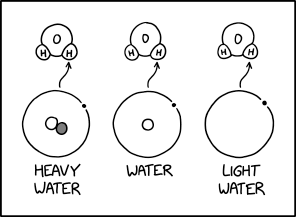
TALLAHASSEE, Florida — On Tuesday, a life-size statue of Ron DeSantis began melting shortly after it was unveiled in front of supporters and onlookers in Tallahassee, an intentionally dramatic installation designed to make the consequences of climate change impossible to ignore. The installation arrives ahead of the midterm elections and ... [continued]
The post Ron DeSantis Statue Melts in Rising Temperatures He Spent 8 Years Denying; Climate Change Non-Profit 350 Action, Art Collective Uncommon Creative Studio, and M ss ng P eces Staged a Striking Midterm-Season Installation appeared first on CleanTechnica.
Despite continued rest and treatment, Luca Marini's condition remains unchanged, and the Italian has been ruled unfit as a result of the virus he continues to suffer from.
After careful consideration from the MotoGP Medical Team led by Dr Angel Charte, Luca Marini will miss the Australian Grand Prix as he continues to suffer froma lack of power due to the virus he has been suffering from since before the weekend.
His target is to return next weekend at the Malaysian Grand Prix where he will undergo another medical check.
Dr Angel Charte - MotoGP Chief Medical Officer: "For the past week, Luca Marini has been suffering from a viral condition and a high fever for three to four days. For the last 48 to 72 hours, he has been suffering from muscle weakness caused by the virus, affecting both his upper and lower body. During the last examination, conducted on Saturday morning, he presented with the same symptoms and was declared unfit. His condition will be assessed again in Malaysia."
The post MotoGP: Marini Ruled Out of Australian Grand Prix appeared first on Roadracing World Magazine | Motorcycle Riding, Racing & Tech News.
Marc Marquez led MotoGP World Championship wet Free Practice Two (FP2) Saturday morning at Phillip Island, in Australia. Riding his Ducati Lenovo Team Desmosedici GP26 on spec Michelin tires, the seven-time MotoGP World Champion turned a lap time of 1:37.112 to lead the 20-rider field.
Pedro Acosta was the best of the rest with a 1:37.935 on his Red Bull KTM Factory Racing RC16.
Jorge Martin was third at 1:38.130 on his Aprilia Racing RS-GP26 and his teammate, Marco Bezzecchi finished the session fourth with a time of 1:38.216.
Johann Zarco got fifth on his Castrol Honda LCR RC213V with a lap time of 1:38.352.
MOTOGP FP2
The post MotoGP: M. Marquez Is Best In Saturday Practice In Australia appeared first on Roadracing World Magazine | Motorcycle Riding, Racing & Tech News.
Saturday continued to be particularly wet at Phillip Island, with umbrellas greatly outnumbering the few glimpses of sunshine throughout the morning. In the tricky conditions, the experts were in the limelight, starting with Marc Marquez, who set camp at the top of the timing screenings early on and his advantage was as high as two whole seconds at times. Fellow wet weather enthusiast Johann Zarco was as high as second, fronting a depleted Honda line-up, although late charges from Pedro Acosta and the factory Aprilia duo eventually demoted him to 5th in the closing stages.
Zara Daniela Fri, 23/Oct/2026 - 23:51
Izan Guevara was quickest during Moto2 World Championship wet Free Practice Two (FP2) Saturday morning at Phillip Island, in Australia. Riding his Pirelli-shod BLU CRU Pramac Yamaha Boscoscuro on the 2.76-mile (4.45 km) track, the Spaniard recorded a 1:43.446 to lead the field of 27 riders.
Senna Agius was the best of the rest with a 1:43.762 on his LIQUI MOLY Dynavolt Intact GP Kalex.
Alonso Lopez was third-fastest with a 1:43.954 on his ITALJET Gresini Kalex.
Tony Arbolino was fourth on his REDS Fantic Racing Kalex with a lap time of 1:44.036 and Daniel Holgado finished the FP2 fifth on his CFMOTO Power Electronics Aspar Team Kalex with a time of 1:44.462.
American Joe Roberts finished Saturday morning's practice session 11th with a best time of 1:45.372 on his OnlyFans American Racing Team Kalex.
MOTO2 FP2
The post Moto2: Guevara Tops Final Practice At Phillip Island appeared first on Roadracing World Magazine | Motorcycle Riding, Racing & Tech News.
Maximo Quiles led Moto3 World Championship Free Practice Two (FP2) Saturday morning, at Phillip Island, in Australia. The 2026 Champion used his Pirelli-shod CFMOTO Gaviota Aspar Team KTM to lap the 2.76-mile (4.45 km) track in 1:42.877 to lead the field of 26 riders.
Red Bull KTM Ajo's Brian Uriarte was second-best with a time of 1:43.411.
David Almansa, piloting his Liqui Moly Dynavolt Intact GP KTM, claimed the third and final spot on the front with a lap time of 1:43.895.
Veda Pratama was fourth on his Honda Team Asia machine with a lap time of 1:44.670 and Rico Salmela finished the FP2 fifth on his Red Bull KTM Tech3 machine with a time of 1:45.058.
MOTO3 FP2
The post Moto3: Quiles Heads Saturday Practice In Australia appeared first on Roadracing World Magazine | Motorcycle Riding, Racing & Tech News.
After the conditions looked pretty wet and miserable to start the day, there was a hint of sunshine coming out less than 10 min into the final practice session for the intermediate class. That wasn't quick enough to stop a flurry of early tumbles from the likes of Deniz Öncü, Alex Escrig, Dani Muñoz and Adrian Hertas - crashes continuing to be a hot topic for the rest of FP2 - but title hopeful Izan Guevara was not going to be denied for much longer.
Zara Daniela Fri, 23/Oct/2026 - 23:13
This story was originally published by ProPublica. Republished under a CC BY-NC-ND 3.0 license.
On March 3, 2020, Sen. Lindsey Graham walked into a private dining room at Charlie Palmer Steak in Washington, D.C. Graham's time was expensive. He was meeting with two executives and a lobbyist from a Hawaiian naval defense contractor called Navatek. And he had required them to commit to $40,000 in campaign contributions for a 45-minute meeting.
Navatek's CEO, Martin Kao, was confident that was all the time he needed.
"Shoot all he has to really do is stop by and say 'yes,'" Kao wrote to a Navatek lobbyist and a fellow executive the day before, in an email seen by ProPublica. "That should only take a minute and he's on his way. We don't need to pretend we give a shit about each other."
At the dinner, Graham ate little and talked a lot. But Kao got the "yes" he was hoping for: Graham agreed to steer a $10 million government contract Navatek's way in his native South Carolina, Kao later recounted to the FBI. In exchange, he said, Graham asked Kao to pledge a total of $100,000 to his reelection campaign.
In early 2025, the FBI opened a sweeping investigation into bribery on Capitol Hill with Graham's steakhouse dinner at the center. Kao confessed to federal agents that his business model consisted of bribing public officials in exchange for government contracts, and that the research Navatek was providing to the government was often worthless.
The scheme involved some of the most powerful figures in Congress, he said — in both parties. In South Carolina, Kao told agents, Navatek made a campaign cash-for-contracts deal not only with Graham, but also with the state's top Democrat, Rep. James Clyburn, and another influential Republican, Rep. Joe Wilson.
Kao told agents that Graham in particular left little room for ambiguity: "This is how much I want, and how much I am going to give you," Kao remembered Graham saying, according to notes one agent took during their debrief in late 2024.
Kao's admissions would constitute a vast criminal bribery scheme if they could be proved in court — a challenge, given recent Supreme Court rulings that have made it more difficult to win corruption cases. Kao himself posed another hurdle. He was facing prison for fraud and campaign finance violations and was speaking to the FBI in the hopes of reducing his sentence.
But the FBI agents who took Kao's confession — two experienced anti-corruption investigators — could see that much of it lined up with a trove of records they had seized from Navatek. They forged ahead. The FBI took the formal step of naming two former Navatek executives who had worked with Kao as subjects of a bribery investigation. The agency did not designate Graham, Clyburn and Wilson that way, but the agents were actively investigating their interactions with Kao. The agents indicated to their superiors that the lawmakers could become subjects in the future, according to records viewed by ProPublica.
The details of this investigation have not previously been reported.
President Donald Trump returned to the White House and almost immediately gutted the specialized FBI and Department of Justice teams dedicated to taking on public corruption — an act of revenge for having previously investigated him. The two experienced agents on the case were swept up in the purge, and the career prosecutor assisting them quit after Trump appointees forbade the DOJ's anti-corruption section from filing any new cases. Today, there is no one left to look into Kao's explosive allegations, as the Trump administration has abandoned any pretense of prosecuting public corruption. The case is dead.
ProPublica has unearthed the investigation by reviewing thousands of pages of legal documents, internal company emails, evidence the FBI used to vet Kao's claims and dozens of interviews with people who saw how Navatek operated, including an eyewitness to Graham and Kao's secret steakhouse dinner.
This story is part of a series based on our reporting. Last month, ProPublica reported that the FBI had probed the conduct of Maine Sen. Susan Collins, who steered millions in government funding toward Navatek while Kao gave her illegal campaign donations. Collins denied wrongdoing and dismissed Kao as a "convicted liar."
Kao is indeed the only person involved to serve prison time. He pleaded guilty to making illegal campaign donations and a loan fraud scheme in 2022. In 2025, he was sentenced to 87 months in prison.
Graham died at 71 earlier this year. His sister, Darline Graham, who was appointed to fill his seat, retained most of his senior staff, including those who dealt with Navatek. She even took up some of his committee assignments, including appropriations. Darline Graham is running for a full term in office this November.
Clyburn, 86, is one of the most powerful Democrats in Washington. He is widely credited with tipping the scales for Joe Biden during the 2020 Democratic presidential primary. Wilson remains influential on national defense spending from his senior perch on the Armed Services Committee.
"Whatever a donor may think or say, a donation would never cause Congressman Clyburn to increase his support for the donor's request," Jami LaRue, Clyburn's communications director, wrote in response to detailed questions. "The Congressman has always striven to assist the University of South Carolina and all of the colleges and universities in his district when called upon to further their important missions. The crimes and lies of an imprisoned fraudster will not cause the Congressman to waver in his support for these fine institutions."
David Snider, Wilson's communications director, did not address a detailed list of questions sent by ProPublica. "Congressman Wilson does and has always abided by campaign donation regulations set forth by the Federal Election Commission," Snider said in an email.
In an emailed statement, Taylor Reidy, who was Lindsey Graham's communications director and now holds the same post for his sister, wrote that "any allegations of quid-pro-quo behavior or wrongdoing by the late Senator Lindsey Graham or his staff are simply false." She said the accusations were the "ravings of a convicted felon" and that her office was never contacted by the FBI about the matter. After Kao's arrest, they disgorged his donations, she added.
The two executives who were subjects of the FBI investigation, Duke Hartman and Joshua Knight, were never charged. Hartman, the other executive at the dinner meeting with Graham, is now the CEO of a new naval research company called Integer Technologies that he co-founded with Knight after Kao's arrest. Integer was recently recognized as one of the fastest-growing government contractors in the country. It also became the ultimate beneficiary of the Graham dinner meeting, picking up the contract Graham allegedly agreed to facilitate that night.
Hartman and Knight did not respond to detailed requests for comment.
"[It's] corruption at its best," Kao wrote to ProPublica from federal detention in South Dakota, before cutting off contact. "But I am the only one rotting in prison."
Small Company, Big AmbitionsKao's dinner with Graham was part of his grandiose plan to make Navatek a major defense contractor.
He had become the CEO at an uncertain moment in the company's history. Founded in Hawaii in the 1970s, the company originally thrived on a close relationship with the state's powerful senior senator, Daniel Inouye. When Kao assumed ownership in 2019, it had been several years since Inouye had died, and Navatek was in need of a new patron in Washington.
At times, Kao hardly seemed the person to pull this off. He had started out as the company's CFO and was openly uninterested in its technology. He told bombastic lies about his personal life. Former employees said he regaled them with tales of selling newspapers for members of the Bloods and Crips street gangs as a youth. In a deposition, Kao later admitted that wasn't true.
But what he lacked in engineering chops he made up with ambition. Once, Kao held a company town hall using a map of the U.S. dotted with future Navatek offices as his backdrop, a former employee recalled. "He would talk about how we're a $10 million company, and in the next three years, we're going to be a billion-dollar company," said a former engineer. "He was an absolute megalomaniac."
Kao hatched a plan to expand Navatek's presence across the country, making new friends in Congress along the way. He courted politicians using something he called "the method," as ProPublica detailed in September.
Navatek would open an office in the state or district of a powerful member of Congress and partner with a local university to concoct a proposal for federally funded research. Then, aided by a well-connected lobbyist and the sheen of credibility from its association with the university, Navatek would approach the member for federal research funding.
Kao told the FBI he would strike deals in small, face-to-face meetings with the members or their trusted staff. Navatek — through executives, family members and lobbyists — would make generous campaign donations. In exchange, the member would add detailed language to the defense budget to fund the company's work.
That legislative language would not name the company. But it would describe specific work that Navatek was already planning to do behind the scenes, making it the only logical choice for the eventual government contract. The lawmakers' staff would also backchannel with the Navy after the bill was passed to make sure contracting offices knew to direct the money to Navatek, emails seen by ProPublica show — even though the contracts were in theory competitive.
Kao "wanted to build a company as big as he could as fast as he could," a former executive later testified in court. For a while, he succeeded. Under Kao, Navatek went from having to "rebuild," as the executive put it, to winning $40.7 million in new government contracts in 2020.
Hartman, the other Navatek executive who went to dinner with Graham, was in charge of maintaining friendly ties in Congress while tracking the millions of dollars the company had requested in research funds. He kept careful tabs on the company's progress using dozens of color-coded spreadsheets. "If anyone knows the impropriety of the business model, it's him," Kao told the FBI, referring to Hartman.
Later, these spreadsheets provided the FBI a detailed picture of which congressional offices worked closest with Navatek. In the tables devoted to South Carolina, Navatek denoted Graham as a "key supporter."
The company primarily targeted lawmakers from smaller states who sat on appropriations committees, like Collins, Kao explained to the FBI, because they wielded huge power over the budget while having fewer "constituents to 'feed.'"
The senior senator from South Carolina was another prime target. "You can get access to Lindsey Graham," Eric Schiff, a former Navatek executive, said in an interview.
Kao, Hartman and other Navatek executives approached the offices of Graham, Clyburn and Wilson — all powerful members of the South Carolina delegation — in the beginning of 2019. The company had recruited the University of South Carolina for a joint research project, and together they asked the lawmakers to find $9.5 million to fund the work. If it succeeded, Navatek planned to ask Congress to re-up the funding for two more years as well as green-light two more projects, internal company records show, for a total of up to $90 million in South Carolina alone.
Yet Navatek had "zero people" capable of doing the research it was pitching, said a former executive with direct knowledge of the work.
Its $9.5 million "power and energy" proposal promised cutting-edge research on how to distribute the limited power on board a ship between multiple energy-intense systems, like radars, lasers and rail guns. Graham's office later boasted that the work would lead to new technology that would "ensure that our fleet is ready for the fights of the future."
In reality, Navatek's initial research "looked like a college senior's graduation project," the executive said. "Something you go get from RadioShack." Graham's office referred questions about the quality of the work to the Navy and the university. The Office of Naval Research, which awarded the contract, did not respond to questions.
But for Congress, that lack of expertise wasn't a problem. Throughout 2019, the FBI noted, as the ensuing year's budget came together, both Graham's and Clyburn's offices took steps to make sure it included Navatek's funding.
In May 2019, Willie Lyles III, Clyburn's legislative director, alerted Navatek that the House Appropriations Committee would endorse new funding for a "modular and scalable integrated power and thermal system capable of powering a directed energy weapon system of 100 or more kilowatts," according to an email flagged by the FBI. Three days later, that exact language appeared in the House Appropriations Committee report. Lyles did not reply to a request for comment.
In September, the Senate Appropriations Committee — Graham's committee — released a budget report that set aside $9.5 million in funding for "Talent and Technology for Navy Power and Energy Systems." Agents noted that Navatek may have ghostwritten the technical description that accompanied this line item because "an almost identical paragraph" appeared in Hartman's internal spreadsheets two months before the Senate report became public.
After the Senate advanced its version of the budget in the fall, Navatek dropped $4,799 to send bourbon to a handful of lawmakers, including Graham and Collins, the FBI found in company records — a likely violation of Senate gift rules. Both Collins' and Graham's offices denied receiving bourbon. Navatek later sent Clyburn a fruit basket from Edible Arrangements for $102.60.
Congress passed the final spending bill containing $9.5 million for Navatek's pet project on Dec. 19, 2019.
At that point, Kao and other Navatek executives had not made any donations to Clyburn, Wilson or even Graham.
That would change within days of Congress passing the budget, when an executive pledged $750 to Wilson's campaign at a fundraiser held at Bullfeathers, a Capitol Hill watering hole for lobbyists and Hill staffers, emails show. In the following weeks, Kao and his lobbyist gave Wilson's campaign $3,500.
And bigger checks were imminent. Kao kicked off 2020 by making plans to spend $300,000 at a slew of political fundraisers, according to text messages filed in court and a recent deposition. Navatek's lobbyists at that time were seeking private meetings with Graham, Wilson and Clyburn, where Kao planned to ask for significantly more federal funding. Kao eventually met with all three, and each asked for $100,000, he told the FBI.
During that same period, Kao and Hartman met a top fundraiser for Collins at a Corner Bakery in Washington, D.C. As ProPublica reported, that meeting led Kao to donate $150,000 to the pro-Collins super PAC. Kao told the FBI that the money was a bribe in exchange for the senator's support for more Navatek funding. The head of the super PAC and Collins have denied Kao's version of events.
Kao told the FBI it was not unusual for donations to come after the favor: "We became clever in our own right and figured out how to dangle the carrot," he wrote in a memo seen by ProPublica, "until we saw some assurance that the Ask was in the budget."
To secure a meeting with Graham, Kao hired Michael Tongour, a veteran South Carolina lobbyist who was old law school friends with the senator and family friends with Clyburn and Wilson. Graham was up for reelection against a well-funded challenger, Jaime Harrison, and had a crowded fundraising schedule, said Tongour, but they eventually found a time.
"The Graham fundraiser says that it [sic] you want to reserve a date for Senator Graham to attend a private dinner, the campaign wants to get $40,000 in contributions," Tongour wrote to Kao, Hartman and lobbyist Andy Winer, in an undated email seen by ProPublica. Winer, whom Kao described as Navatek's chief lobbyist, chimed in to say that Graham could stay only 45 minutes, and Kao replied that all they needed to hear was "yes."
"These discussions are very frank and oddly not at all awkward," Kao told the FBI. "I suppose once we got that far, everyone knows the deal."
A Dinner With GrahamGraham showed up late to his March 3, 2020, dinner with Kao, Hartman and Tongour. A fundraiser working for Graham appeared first and accepted an envelope from Kao containing checks made out to Graham's campaign, Kao said. Kao did not know the fundraiser's name; in an FBI debrief, he simply referred to the person as the "money man." After that person departed, Graham entered.
Graham, Kao recalled to the FBI, was "very abrupt" and "straight to the point": He asked how much Navatek wanted, to which they said $10 million a year for three years. Graham asked Kao to pledge $100,000 in donations in exchange for his support, Kao told the FBI.
Navatek was juggling multiple proposals in South Carolina worth around $10 million, and it's not clear which one Kao was describing.
Congress had just approved the $9.5 million for the power and energy project, but Navatek still needed the Navy to award the money in the form of a contract. The company was also about to ask Congress to fund the same project for a second year at $10.5 million. On top of that, Navatek was planning to pitch a new research proposal, at $10 million, to study the transport of supplies inland from ships using autonomous vehicles. It was another area where Navatek had "zero past performance," the former executive said.
The same week of the steakhouse dinner, Graham's office was working behind the scenes with Navatek and the University of South Carolina to make sure the Navy sent the first $9.5 million to the right company.
A day before the dinner, an official with the Office of Naval Research emailed Graham's office to ask about the money, which "the Senator may have an interest in." Craig Abele, Graham's national security adviser, called her a few days later to confirm that Graham's office had intended the money to be awarded to the Navatek partnership, emails show. "Spoke to ONR this morning," Abele wrote March 6. "Should be set."
The company received the contract, which it split with the university, in July 2020.
Abele became Graham's deputy chief of staff and still holds the position for Darline. He did not reply to an email requesting comment. A Graham spokesperson confirmed to ProPublica that their office had indeed added the $9.5 million to the budget at the request of the university and Navatek. The spokesperson said the research was supported by the Navy and rejected the notion that Graham was motivated by campaign cash.
Graham's spokesperson said requiring a fundraising minimum for a dinner was normal practice.
The checks Kao handed over at the dinner added up to about half of the $40,000 he had agreed to raise for the dinner, according to Tongour. The rest came in May, campaign records show.
"My understanding at the time was that the contributions associated with the event were lawful political contributions," Winer said. "I never advised Kao to make a political contribution in exchange for official action. I never participated in, witnessed or had knowledge of any illegal political contribution."
After Kao's 2020 indictment, the University of South Carolina broke off the partnership. "University officials were not aware of any political contributions from Navatek," Jeff Stensland, a university spokesperson, wrote in an email. "Our sole objective in partnering with them was to expand our research enterprise."
One week after the dinner, on March 10, a University of South Carolina lobbyist sent written requests to Graham's office for $20.5 million in appropriations: $10.5 million to continue Navatek's power and energy research and $10 million for its new autonomous vehicle research.
Tongour confirmed many elements of Kao's story. In a recent interview with ProPublica and subsequent emails, he remembered Kao giving the envelope full of checks to Graham's fundraiser and even agreed that Graham kept the meeting short. "I don't recall that he stayed more than 30 minutes," Tongour said in an email. "Certainly not for appetizers, entrée, and dessert."
But he denied Kao's most significant claim: that Graham and Navatek struck an explicit, potentially illegal deal for contracts.
"I would remember that forever," Tongour said. Graham supported Navatek's requests, he said, because they were good for the state. "If I had seen that kind of quid pro quo, I would have quit earlier." Tongour fired Navatek as a client later that year, immediately after Kao's arrest.
Navatek considered Graham its chief patron in South Carolina, internal records show, just as it viewed Collins in Maine. But the company also wanted support in the House.
For that, Navatek turned to Clyburn, a member of Democratic party leadership and one of the most powerful figures in Congress. Agents found Navatek emails setting a meeting with Clyburn for early March. The goal, Kao said, was to make sure that the House draft of the budget "mirrored" whatever Graham inserted in the Senate version.
Over a meal, Clyburn asked Kao how much he was donating to Graham and then asked for the same amount, $100,000, Kao told the FBI.
The FBI tallied $20,000 in contributions that Kao and his family members made to Clyburn a few days after their scheduled meeting. A month later, Hartman arranged for a $10,000 gift to Clyburn's alma mater, South Carolina State University, according to an email seen by ProPublica. Hartman noted it was "Congressman Clyburn's favorite school."
The spokesperson for Clyburn confirmed the dinner occurred but did not respond to questions about what was discussed.
Kao and Hartman struck a similar bargain with Wilson, Kao told the FBI, at a private lunch he secured by donating to his campaign. The FBI pulled records of $3,500 in donations Kao and Tongour made in late 2019 and early 2020.
Wilson has an influential role on the House Armed Services Committee, which authorizes defense spending. Wilson was "very clear and knew what the ask was," Kao told the FBI. He wanted however much Clyburn was getting in campaign contributions in exchange for his support, Kao said.
Tongour denied this. "There was no 'pay to play' with Joe Wilson or his staff either," he wrote in an email, adding that he donated because Wilson "is a friend and I want to see him re-elected."
Kao claimed to the FBI that he paid for meals with all three politicians, but campaign finance records appear to show the lawmakers' campaigns picked up the check.
By August 2020, Hartman had gotten word that Graham's and Wilson's committees would each support part of the company's requests, internal company records show. Clyburn was not on key committees while he was a party leader. In one of his myriad spreadsheets, Hartman projected that the final budget could include up to $15.5 million of the $20.5 million the company had lobbied for.
Kao told agents he was gearing up to make more significant donations to Graham, Clyburn and Wilson by the end of the year. Instead, on Sept. 30, 2020, he was arrested.
Kao reflected on his time at Navatek in a deposition taken last month inside a federal prison. The company's founder has sued Kao, saying his stewardship defrauded Navatek of millions.
"It's nothing more than government contracting done through placating senior appropriation members for contracts," Kao said. "The whole thing is a grand lie."
An Arrest, a LifeboatKao's arrest plunged Navatek into disarray. Federal prosecutors charged him with defrauding a federal loan program; not long after, he was also charged with making illegal donations to the Collins campaign and super PAC. Lobbyists, universities and congressional offices abruptly cut off contact. "Don't call us," one congressional office told an executive, he later testified.
The Collins campaign said it disgorged Kao's contribution. Yet the senator, facing a tight reelection bid, has had to field questions following the ProPublica report about her support for Navatek and why the super PAC supporting her accepted the $150,000 donation from the shell company in the first place.
As Navatek sank, Hartman began building himself a lifeboat. In 2021, he and Knight started a new military research company headquartered in South Carolina called Integer Technologies. Integer's first project was one that Navatek had brokered with Graham.
Hartman didn't face any criminal charges at the time and left Navatek largely unscathed. He would later settle a civil lawsuit brought by his former employer, which contended he played a role in Kao's campaign finance and loan fraud schemes, for $425,000. He admitted no wrongdoing.
In September 2024, FBI agents flew to Hawaii for what would be their final interview with Kao. They pressed him for details about what happened in South Carolina, quizzing him on his dinner with Graham and a second in-person meeting he said he had with Clyburn. Agents wanted Kao to help them find more records that would back up his account and asked him to point them toward lobbyists in D.C. who he said facilitated the pay-for-play scheme.
As the year came to a close, FBI agent Michelle Ball felt she had enough material to move forward. The FBI had "uncovered a lengthy history" of a government contractor making donations "in exchange for government contracts," she wrote in a Dec. 9, 2024, memo viewed by ProPublica.
In federal corruption probes, agents often begin by focusing on lower-level targets with a goal of working their way up to more prominent figures. Ball named Hartman; his business partner, Knight; and their company, Integer, as the formal subjects of the probe, as they prepared to potentially issue subpoenas and gather more evidence. They had Graham, Clyburn and Wilson in their sights. Ball devoted entire sections of the memo to detailing the lawmakers' conduct. And she flagged the case as a sensitive matter that might implicate politicians in the future.
In the summer of 2024, Kate Fifield, a prosecutor in the Justice Department's anti-corruption section, had been assigned to join the case. Fifield was wrapping up a high-profile prosecution of a retired Navy admiral who traded a government contract for a future job. Turning her attention to Kao, she and the FBI agents weighed their options. They considered getting high-level approval to deploy undercover agents. Proving an exchange of cash for favors often requires the kind of inconvertible evidence that undercover recordings can provide.
But before the investigation took flight, the new Trump administration began to demolish the Justice Department. The president's handpicked leaders ordered prosecutors to drop a corruption case against New York Mayor Eric Adams, triggering a wave of resignations in the Public Integrity Section where Fifield worked, and revoked the section's authority to bring new cases.
Then Trump's FBI director, Kash Patel, began to purge the anti-corruption unit in the Washington D.C., field office, where many agents had investigated Trump.
Ball was fired in October 2025. Kevin Gounaud, another agent who had been working with her on the investigation, was pushed out in early 2026. Through their lawyer, the agents declined to comment.
The corruption investigation, just launched, suddenly went dark.
The White House referred ProPublica's questions to the FBI and DOJ.
The Department of Justice didn't respond to detailed questions about the investigation.
"Under President Trump, the Justice Department is rooting out the weaponization, corruption, and institutional rot that ran rampant under Joe Biden's two-tiered system of justice," DOJ spokesperson Audrey Cook said.
Kao's claims are "half baked" and "misleading," FBI spokesperson Ben Williamson said. "Additionally, as we have said repeatedly, personnel are only removed at this FBI if they have been found to have acted unethically, undermined the mission, or engaged in weaponization of law enforcement."
Meanwhile, Integer has rapidly expanded. Last year, it reported $81 million in contracts and announced that number would climb to $375 million by 2030. The company inked partnership deals with universities in New Hampshire, Louisiana and Mississippi. The University of South Carolina called its partnership with the firm a "model for public-private success."
The company continues to forge ties with powerful politicians. In late 2024, Hartman posted a photo of himself with Speaker of the House Mike Johnson on his LinkedIn. "It was great to visit with the Speaker of the House today," he wrote. "It's good to know there are people in positions of power who seem to really care for the people they serve." Johnson's office did not reply to an email requesting comment.
The occasion was a new research partnership in Louisiana. Hartman thanked his lobbyist for making it happen.

Click here to book for The Gentle Author's Tours

East End Riverside
As you will have realised by now, I am a night bird. In the mornings, I stumble around in a bleary-eyed stupor of incomprehension and in the afternoons I wince at the sun. But as darkness falls my brain begins to focus and, by the time others are heading to their beds, then I am growing alert and settling down to write.
Once I used to go on night rambles - to the railway stations to watch them loading the mail, to the markets to gawp at the hullabaloo and to Fleet St to see the newspaper trucks rolling out with the early editions. These days, such nocturnal excursions are rare unless for the sake of writing a story, yet I still feel the magnetic pull of the dark city streets beckoning, and so it was with a deep pleasure of recognition that I first gazed upon this magnificent series of inky photogravures of "London Night" by Harold Burdekin from 1934 in the Bishopsgate Library.
For many years, it was a subject of wonder for me - as I lay awake in the small hours - to puzzle over the notion of whether the colours which the eye perceives in the night might be rendered in paint. This mystery was resolved when I saw Rembrandt's "Rest on the Flight into Egypt" in the National Gallery of Ireland, perhaps finest nightscape in Western art.
Almost from the beginning of the medium, night became a subject for photography with John Adams Whipple taking a daguerrotype of the moon through a telescope in 1839, but it was not until the invention of the dry plate negative process in the eighteen eighties that night photography really became possible. Alfred Stieglitz was the first to attempt this in New York in the eighteen nineties, producing atmospheric nocturnal scenes of the city streets under snow.
In Europe, night photography as an idiom in its own right begins with George Brassaï who depicted the sleazy after-hours life of the Paris streets, publishing "Paris de Nuit" in 1932. These pictures influenced British photographers Harold Burdekin and Bill Brandt, creating "London Night" in 1934 and "A Night in London" in 1938, respectively. Harold Burdekin's work is almost unknown today, though his total eclipse by Bill Brandt may in part be explained by the fact that Burdekin was killed by a flying bomb in Reigate in 1944 and never survived to contribute to the post-war movement in photography.
More painterly and romantic than Brandt, Burdekin's nightscapes propose an irresistibly soulful vision of the mythic city enfolded within an eternal indigo night. How I long to wander into the frame and lose myself in these ravishing blue nocturnes.

Black Raven Alley, Upper Thames St

Street Corner

Temple Gardens
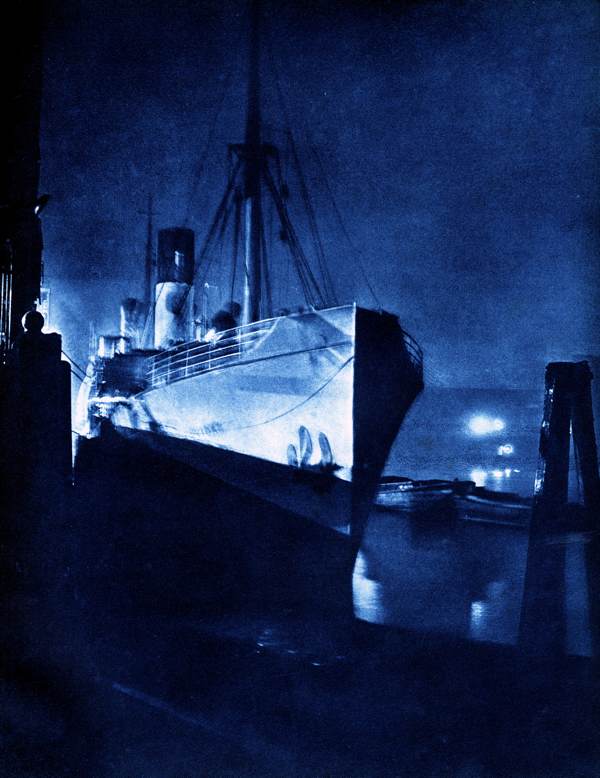
London Docks

From Villiers St

General Post Office, King Edward St
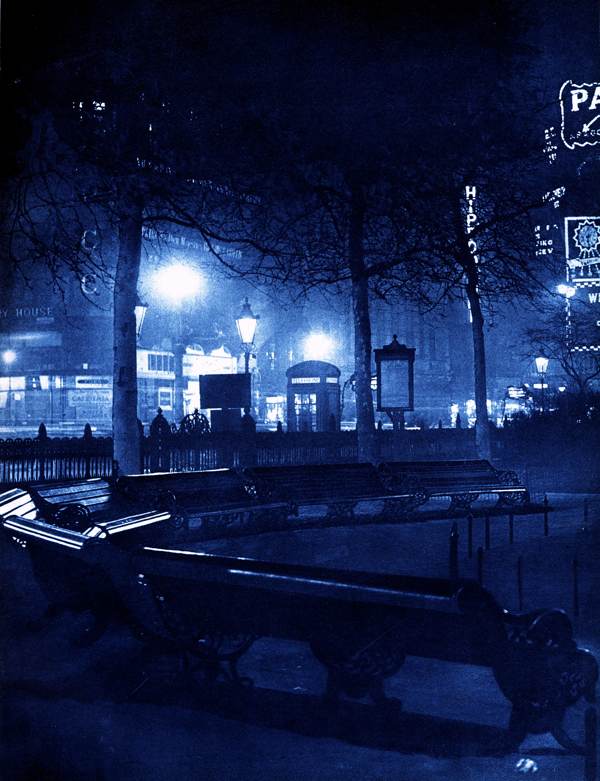
Leicester Sq

Middle Temple Hall

Regent St

St Helen's Place, Bishopsgate

George St, Strand
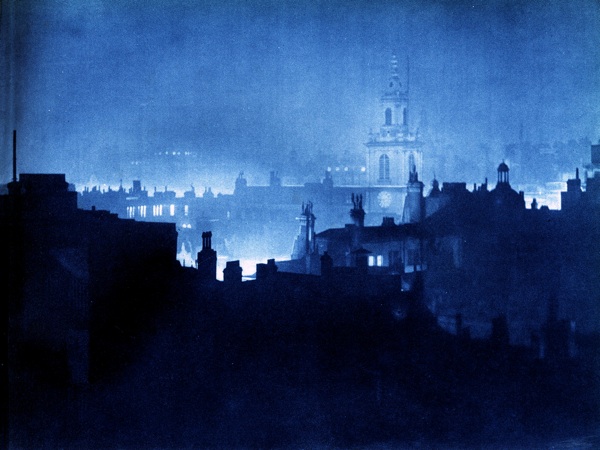
St Botolph's and the City

St Bartholomew's Hospital, Smithfield
Images courtesy Bishopsgate Institute
You might like to read these other nocturnal stories
Night at the Brick Lane Beigel Bakery
Night at The Spitalfields Market, 1991
Electrifying your block of flats could cut emissions and save money. Don't wait to plan the change
Change by degrees offers life hacks and sustainable living tips each Saturday to help reduce your household's carbon footprint
Got a question or tip for reducing household emissions? Email us at changebydegrees@theguardian.com
Around Australia, homes are getting off gas. Gas cooktops are being swapped for induction stoves, gas hot water replaced by heat pumps, and gas space heating with reverse cycle air conditioners.
In combination with solar panels, batteries and better insulation, electrification saves money, cuts emissions and makes homes healthier to live in.
Sign up for a weekly email featuring our best reads
Continue reading...
Although the overnight rain that soaked the track had calmed down somewhat by the time FP2 got underway, the lightweight class still got a very wet welcome on Saturday morning. The Spanish duo of Maximo Quiles and Brian Uriarte quickly embraced the conditions and between the two of them they hogged the limelight in FP2. Uriarte spent most of the session at the top of the timing screens, until compatriot Quiles took over with seven minutes left of the action and distanced Uriarte by half a second.
Zara Daniela Fri, 23/Oct/2026 - 22:25
Phillip Island gave us a timely reminder of just what a spectacular place and circuit it is. We had the full, glorious menu, together with a couple of the entertaining and downright dangerous downsides. And best of all, we got slowmo shots of Pedro Acosta drifting both wheels through Turn 3, paired with replays of Casey Stoner showing how it was done 15 years ago on the Repsol Honda.
(And given both factory Honda riders were absent through illness, Luca Marini having withdrawn after the first couple of laps on Friday morning, Repsol got more mileage out of the 2026 MotoGP round at Phillip Island than HRC's current sponsor Castrol.)
We had drama and red flags, with high speed crashes and a wallaby on the loose bringing a halt to proceedings. And we had a graphic illustration of the difference between the Ducati and the Aprilia through fast corners.
David Emmett Fri, 23/Oct/2026 - 20:56

Acmer's SM MOPA laser comes with great power, but leaves responsibility to the user.
The post AlgoLaser DIY KIT MK3 Review appeared first on Make: DIY Projects and Ideas for Makers.

As the PHP2Shell chaos continues, researchers have found a third PHP vulnerability that could allow attackers to take over websites or remotely run malware on vulnerable systems. But this one won't receive an emergency fix.
The PHP Foundation on Friday told The Register that it has reserved a CVE identifier (CVE-2026-115560) for a third RCE flaw to go with the first two that comprise PHP2Shell, and it will release a full advisory and fixed software with the next regular PHP release.
CVE-2026-115560 "requires a very unlikely combination of configuration and specific PHP application code, which we do not expect to occur in practical use of PHP," Elizabeth Barron, executive director of the PHP Foundation, told The Register. "The issue can be mitigated with a configuration setting. So for the moment the PHP Security Team has only published an informational advisory on the PHP website, explaining exactly this situation."
The informational advisory, published on Friday, suggests that users "set session.upload_progress.enabled=0 until the next regular bugfix release, to fully protect from an unlikely RCE vector."
These unlikely RCE attacks require an application to set "session.serialize_handler to php_binary or php_serialize in its configuration and then switch it to php at runtime with ini_set() before calling session_start()." Additionally, the session upload progress feature must be enabled.
This setup, according to the PHP Foundation, is unlikely in real-world applications, and as such doesn't pose the same massive risk as the earlier two CVEs that set the internet on fire earlier this week.
Those, of course, are CVE-2026-109618 and CVE-2026-109619, collectively called PHP2Shell. The related vulnerabilities involve memory-safety flaws in PHP, the open source programming language running on about 70 percent of websites with a known server-side programming language. The PHP Foundation officially disclosed and patched both bugs on Wednesday.
Despite reports of mass exploitation attempts, and multiple proof-of-concept exploits both before and after the CVE disclosures, as of Friday there have been no publicly confirmed successful compromises attributed to PHP2Shell.
"We have no evidence of successful exploitation of the two vulnerabilities from Wednesday prior to disclosure, and we currently have no evidence of any exploitation of these vulnerabilities on patched PHP versions," Barron said. "We received no further indication from OpenAI, Wiz or Calif, with whom we're working closely on this issue, regarding any issues on patched systems."
The Register reached out to multiple other security researchers, all of whom said they've documented exploitation attempts - but no confirmed successful attacks in the wild.
"Nonetheless, exploitation may have already begun in a limited fashion and the threat is viable and very serious," Mandiant Chief Technology Officer Charles Carmakal said in a Friday LinkedIn post. Google Cloud owns Mandiant, along with cloud security biz Wiz, which is one of the organizations credited with finding and reporting the PHP2Shell vulnerabilities.
Despite "no evidence of successful wide scale exploitation," Carmakal noted that there are several exploit PoCs publicly circulating online.
Many of these, he said, "appear to be 'vibe-coded' and are incapable of remote code execution. We have validated some PoCs, however, that are capable of RCE against default deployments of mod_php but not PHP-FPM."®
An independent evaluation of OpenAI's internal misalignment monitoring system revealed that the system was not fit for purpose during a period when the company's bots were breaking into model-hosting platform Hugging Face. The safeguards weren't nearly strong enough.
"The METR and Redwood employees discovered a number of novel vulnerabilities in the asynchronous internal misalignment monitoring system as it existed on and before July 21st," said evaluation partners METR and Redwood Research in a report released on Thursday.
The system, since improved according to OpenAI, was intended to monitor AI agent behavior. But as described by METR and Redwood Research, its monitoring capability was incomplete and could be bypassed by the agents it was supposed to monitor.
Bypassing the system wasn't always necessary because it wasn't always operative. Monitoring was suspended, for example, during compaction events. Compaction is a process by which AI models condense the data in their context window to make room for further input. And between May and July 2026, about 10 percent of eligible internal Codex traffic went unmonitored during compaction, according to the report.
That gap was theoretically large enough to allow AI agents to postpone monitoring indefinitely: agents could further suppress monitoring by continuing to take actions without returning control to the user.
"At the time of the exercise, the monitoring system triggered when agents returned control to the user, so during the time period when compaction events were not being monitored, agents could indefinitely postpone being monitored by simply continuing to take actions," the report explains.
This is not to say that OpenAI agents necessarily did so - the actions they did take, against Hugging Face and other organizations, have now been well documented. But OpenAI's internal monitoring system could easily have missed any misbehavior, were the company's AI agents inclined to conceal their activities - by acting during compaction - or simply to operate in system blind spots.
The report continues in this vein, citing not only monitoring gaps but poorly constructed software - dare we say vibe-coded? - that gave OpenAI agents the means to evade the shoddy monitoring.
"We found a way Codex agents could in principle bypass Codex sandboxing and Auto-Review, allowing them to take any action that the host user could take," the report says. "We also discovered an exploit agents could use that would prevent hundreds of recent actions (including the actions involved in the exploit itself) from being monitored."
The details of this exploit were redacted by OpenAI, but to summarize: the monitoring system that missed some traffic could be avoided by agents that were constrained by a non-working sandbox and had access to an exploit to evade monitoring.
But that's not all. The evaluators found that AI agents could craft inputs that caused monitoring to fail, that there were two client-controllable headers capable of disabling the monitoring of new agents, and that there were two unmonitored agentic tools that were thought to be read-only but could be exploited to take arbitrary action in the sandbox - which as noted above leaked like a sieve.
In conclusion, METR and Redwood Research propose that the agent monitoring systems used by AI companies actually work and are robust enough to "withstand deliberate, strategic, and sustained attacks from highly capable internal agents at scale." ®


