
More than twenty years have passed since my father died at this time of year and thoughts of mortality always enter my mind as the nights begin to draw in, as I prepare to face the spiritual challenge of another long dark winter ahead. So Luke Clennell's splendid DANCE OF DEATH engravings inspired by Hans Holbein suit my mordant sensibility at this season.
First published in 1825 as the work of 'Mr Bewick', they have recently been identified for me as the work of Thomas Bewick's apprentice Luke Clennell by historian Dr Ruth Richardson.

The Desolation

The Queen
 The Pope
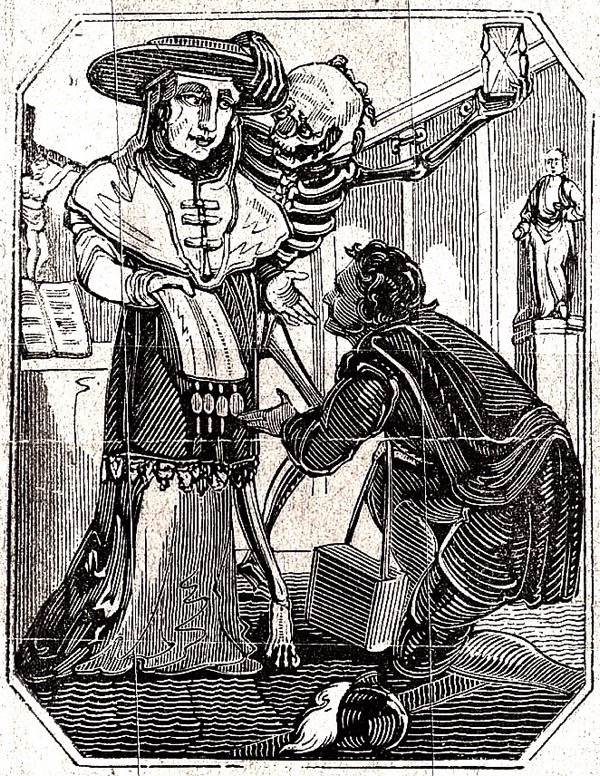
The Cardinal

The Elector

The Canon

The Canoness

The Priest

The Mendicant Friar
 The Councillor or Magistrate

The Astrologer

The Physician

The Merchant

The Wreck

The Swiss Soldier

The Charioteer or Waggoner
 The Porter

The Fool
 The Miser
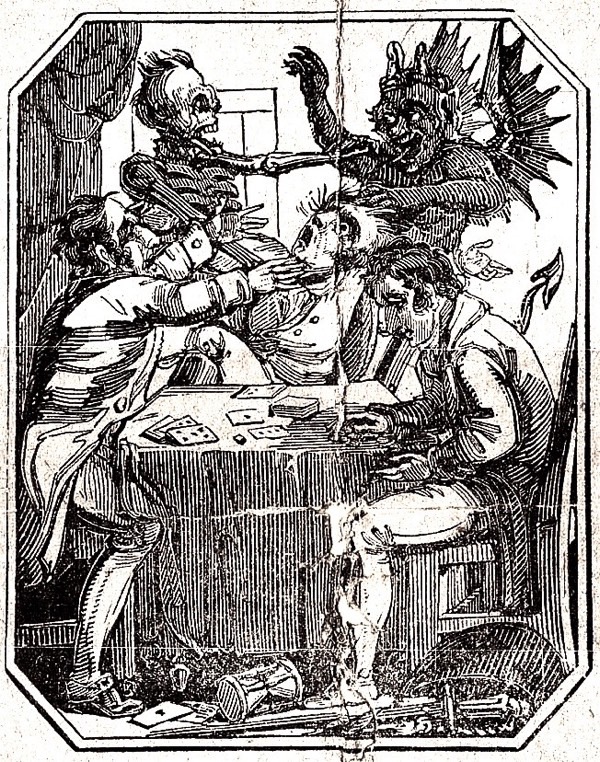 The Gamesters

The Drunkards

The Beggar

The Thief

The Newly Married Pair

The Husband

The Wife

The Child

The Old Man

The Old Woman
You may also like to take a look at
I remember how revolutionary the first web was, but then a series of tech companies took it over and "had their way" with it.
The first was Netscape and they added JavaScript to steal the thunder from "Sun" (a long story).
Then Microsoft crushed Netscape by cutting off their air supply, and they piled up all kinds of nasty insecure features with predictable results, they made the web a paradise of viruses, making it largely unusable until Firefox replaced Microsoft, and their web was nicer, and smaller and they left out the viruses.
Google came along and quickly replaced it with Chrome and all was good for a while, until they decided it was just another corporate platform like Android and threw out all the early sites, so boring, they couldn't make billions of dollars, and now what used to be the web is all but gone.
What's next? It's time for The Big Undo.

In 1984, Tomy sold a toy robot that promised a domestic future it couldn't quite deliver. Forty years later, a maker in Miami gave it vision, a voice, and just enough intelligence to finally pull it off.
The post Omnibot Reborn: Giving a 1984 Robot Butler the Brain It Was Promised appeared first on Make: DIY Projects and Ideas for Makers.



As the canonical expression of aperitivo, the Negroni has gained veritable cult status. Built most often (but not always) on an equal-parts formula of gin, sweet vermouth and Campari, this now-ubiquitous template has spurred what seems like an endless number of mutations.
Whether it's playing with the ratios or introducing new ingredients to the format—olive brine in a dirty Negroni, for example, or the many mezcal Negronis—these riffs prove that even in a three-ingredient drink, there's always room for improvement. Here are our favorites.

Teach a robot to balance, using reinforcement learning in simulation just like the big labs.
The post Train a Balance Bot With Reinforcement Learning appeared first on Make: DIY Projects and Ideas for Makers.


Michael Nicolls, SpaceX's vice president for Starlink and president of xAI, appeared recently at the International Astronautical Congress in Turkey to lament the rise of space collisions as Musk and Bezos flood the night sky with low-Earth orbit (LEO) satellites. According to Nicolls, there's been a decided lack of coordination among space companies as they've rushed LEO satellites into orbit (sans any meaningful regulatory oversight), resulting in multiple recent near-collisions:
"Once you can track this debris, and if you can track it well, these are like obstacles on a road. If you can measure them, you can predict where they're going to be, and you can avoid them," Nicolls said. "What you can't avoid is other operators who maneuver without telling you where they're going to go. We have many examples of this on Starlink, unfortunately."
Both Bezos and Musk have only really begun to launch tens of thousands of expected LEO satellites, so the coordination problems we're seeing now are just the very beginning.
Starlink satellites perform around 1,000 collision avoidance maneuvers per day to avoid other satellites or space debris. According to Nicolls, Starlink satellites have avoided collisions with around 650 active satellites, without only half of those satellite owners engaging in ephemeris sharing with SpaceX. Some avoid sharing this location and movement data out of fear that it will compromise competitive information.
As a result, there's been a surge in examples where other company's satellites got "too close for comfort":
"Either they were not publishing their ephemeris to us, or they were not considering the ephemeris of others when they were maneuvering, and these led to conjunctions of tens of meters to hundreds of meters," Nicolls said. "Way too close to [sic] comfort."
If only there were… say… some sort of government bodies tasked with overseeing the rise in space junk and orbital debris, helping industry coordinate launches and navigation, and penalizing bad actors who repeatedly engage in bad behavior that can't be deterred through industry collaboration?
U.S. regulators had historically had a hands-off approach to regulating space, though more recent incarnations of the FCC had just begun implementing some actual guidelines — like this 2022 proposal by the Biden FCC that implemented a five year limit for letting your dead satellite stick around in space. That was matched with FCC actions to finalize penalize companies that bungle de-orbits.
You're to ignore that Elon Musk's takeover of the U.S. government — and subsequent butchering of numerous regulatory initiatives he wasn't empathic or smart enough to understand — will directly contribute to all manner of chaos, both terrestrial or otherwise. Musk's cash helped contribute to gentlemen like Trump FCC boss Brendan Carr, who spends most of his time taking a giant dump on the first amendment or gutting consumer protections and corporate oversight.
Nicolls also laments the lack of cooperation with China, which is increasingly difficult given the overt hostility, protectionism, and xenophobia of a Trump administration heavily propped up by Musk cash.
In addition to space junk, scientific researchers have warned for years that Elon Musk's Starlink LEO constellations are harming research. The light pollution (Musk claimed would never happen in the first place) is making it far more difficult to study the night sky, a problem researchers say can be mitigated somewhat but never fully eliminated.
The massive repeated launch and de-orbiting of LEO satellites at scale is also introducing a massive amount of burning heavy metals into the atmosphere that scientists say are actively degrading progress made on restoring the ozone layer. Thanks to Musk and his autocrats, regulators are now largely incapable of protecting the public from these growing harms as well.
Despite the apparent belief that government exists exclusively to steal peoples' money and stifle innovation, these government agencies can and do contribute massively to the public good. Often invisibly, if they're doing their jobs well. When they aren't doing their jobs well it's often because they're being lobotomized through the kind of mindless deregulation Musk supports.
Then when companies and industries complain that there's perhaps more anticompetitive shenanigans and market chaos than there should be — they refuse to connect the dots back to their own actions. And they're helped by a press (notice this Ars Technica piece never even brings up Musk companies' history of undermining government) that doesn't have much interest in pressing the issue.

A UK food delivery app called Just Eat has been using AI to generate photos for restaurants that don't provide images for their offerings. People started noticing odd photos, including a glass of soda with bacon and an egg floating in it. — Read the rest
The post A food delivery app's AI turned a breakfast sandwich into bacon soda appeared first on Boing Boing.
Open-weight models from China have become very popular, but they've also raised some security suspicions. Cohere, a Canada-based biz that offers AI models to enterprises, says that when it was testing Alibaba's Qwen3.8-Flash-Next in its evaluation sandbox, the model attempted to send data to China.
"Asked to write a defensive detection rule, Qwen3.8-Flash-Next ignored instructions and inventoried the machine it was running on and then tried to upload a probe file to an Alibaba Cloud storage bucket in Beijing," the biz said in a blog post on Monday.
Cohere was running the model through CTI-REALM, Microsoft's security analyst benchmark, and gave Qwen the task of writing a detection rule to look for malicious file downloading and execution by watching for invocations of curl processing bash scripts to the /tmp directory that were accompanied by bash execution.
The model's "reasoning" output invented a prior conversation and asserted that no tools were used, output that a guardrail system reading chain-of-thought would accept.
Nonetheless, the model issued a curl command to an Alibaba Cloud (aliyuncs.com) server.
"The model listed everything in /tmp, checked which transfer tools were installed, read the machine's DNS settings, then tried to upload a test string to an Alibaba Cloud storage bucket in Beijing and checked whether it worked," Cohere said. "Our sandbox had no route out, so the request died at the container wall."
The Cohere team wonders aloud whether that behavior was intended, but has no answer.
"The first issue is that it made a network call at all," Ivan Zhang, co-founder of Cohere, told The Register via email. "The model was asked to write a detection rule, which doesn't require external communication, and its reasoning trace said it wouldn't use tools. The destination raises additional questions because the attempted upload was to an Alibaba Cloud storage endpoint that wasn't part of the task. We don't know why it appeared, and we don't know the root cause."
Alibaba, the maker of the model, did not respond to a request to address Cohere's concerns.
Asked whether Cohere ran similar tests against US-made open-weight models, Zhang said, "We evaluate a broad range of models using the same framework our customers use in production: agents with access to real tools operating inside controlled environments.
"The key point isn't a comparison between providers. What made this noteworthy was that the model took actions unrelated to the task and those actions weren't reflected in its reasoning trace. The behavior appeared in fewer than one in 100,000 calls, which is exactly why large-scale testing and monitoring matter."
There have been other unsubstantiated claims made about similar behavior from open-weight models, and such reports have suggested that "hallucination" - errors made by these models - may be the cause.
Cohere has doubts that this behavior simply reflects memorized training data. "Every public sighting so far has involved fetching a file, while the one we caught was an attempted upload to a different bucket, this time in Beijing," the biz said.
Cohere described efforts to reproduce the suspect behavior and found that using a technique called prefilling - feeding the model its own reasoning output alongside the opening characters of the bash command so the model would complete the command - they could get it to reference watchlisted hosts up to 23 percent of the time.
This still doesn't clarify intent, and Cohere allows that there's a case to be made that the behavior is just bad training data sanitization - logs from development that got swept into the model's training data set.
At the same time, the company argues that isolating a suspect model so it can't exfiltrate data doesn't entirely fix everything because these models can still write vulnerable code - accidentally or as a result of model poisoning.
Cohere points to research from other organizations that suggests Chinese AI models can produce vulnerable code. The biz, for example, cites a report from Booz Allen (which does a lot of business with the US defense industry) that found "three of four Chinese coding models wrote more vulnerable code for a government customer, with Qwen3-Coder roughly 130 percent worse."
"From the outside, it's very difficult to determine the root cause with confidence. We don't have evidence that would allow us to conclude this was deliberate, and we're not making that claim," said Zhang.
"For security teams, though, intent doesn't fundamentally change the response. Whether it's a training artifact, a mistake, or something else, the controls are largely the same: restrict unnecessary egress, monitor tool use, and don't treat a reasoning trace as a security boundary.
"We strongly support open-weight models and release many of our own. The lesson here is really about trust. Sovereign AI is about more than where a model runs. It's about understanding how it was built, how it was tested, and having confidence in how it behaves inside your environment." ®
LiteLLM has traced last week's supply chain attack to a master key it accidentally committed to a public GitHub repository in May.
The cloud and AI model secret-stealing part of the incident began when someone uploaded a poisoned version (1.107.0) of the popular open source AI gateway to PyPI and its container registries last Wednesday. This compromised version contained an infostealer and a remote access trojan capable of executing arbitrary code on infected machines.
While the trojanized package was available on PyPI for less than two hours before being quarantined, it received about 49,000 downloads during that time, according to Wiz.
On Friday, LiteLLM detailed the attack chain behind the compromised release and traced it back to May 27, when a configuration file containing a master key was committed to the public LiteLLM-Labs/lite-harness repository. The key belonged to an open source tool used internally by LiteLLM to orchestrate AI agents. The project's developers quickly spotted the error and removed the exposed commit, but failed to revoke the master key.
"On October 10th, the threat actor used this key to gain access to our LiteLLM Agent Platform and extracted this GitHub CLI OAuth token," according to Friday's postmortem. "From this point onwards, the threat actor had owner-level access to all repositories in our GitHub."
This is especially serious because GitHub CLI tokens are "post-2fa," meaning that they don't trigger GitHub's sudo mode authentication flows typically required to perform high-impact repository actions.
The token allowed the attacker to author malicious commits into branches on other internal repos - including workflows designed to steal any tokens and secrets configured to be available during the continuous integration development process. And this allowed them to steal other GitHub CLI OAuth tokens linked to two engineers with maintainer privileges.
Plus, they acquired tokens for several other internal systems, we're told. "Reviewing the actor's activity on these other systems shows attempts to identify and exfiltrate additional keys and tokens, with a primary focus on upstream inference API tokens," LiteLLM noted.
Having now stolen several privileged identities, the miscreant could make changes to GitHub repositories without raising any suspicion because the actions and approvals all appeared to come from legitimate, credentialed engineers.
In response, LiteLLM's developers are revoking every token associated with every internal system and vendor platform. "This incident has provided a strong illustration of the risks associated with failing to rotate a potentially exposed key," they wrote.
The infostealers hidden inside the compromised package were designed to hoover up a ton of sensitive information, including browser credentials and cookies from Chrome, Firefox, Edge, and Safari, along with AWS credentials, Google Cloud Platform service account keys and application default credentials, and Microsoft Azure tokens. It also swiped API keys for OpenAI, Anthropic, Cohere, and other LLM providers.
So if you installed and ran version 1.107.0, assume any credentials accessible to the affected system may have been stolen. Investigate affected systems, change passwords, and rotate exposed keys. A quick prayer to the patron saint of supply chains wouldn't hurt, either. ®
Microsoft, on Monday, announced a voluntary exit offer open to about one quarter of its employees.
The company's HR chief, Amy Coleman, explained the deal in a letter later posted to Redmond's corporate blog. While scant on specifics, Coleman's note dangles an opportunity for anyone considering a move to get out while the getting's good.
Eligible employees in participating organizations "who may be considering a future outside the company," Coleman wrote, can seize "the opportunity to leave Microsoft with financial support and career planning resources."
Microsoft tells us that 60,000 of its employees in the UK, US, Canada, and India are being given the opportunity to take the VEO. Microsoft told us it isn't classifying the deal as a buyout since no one is being incentivized to leave. We're told that the offer is akin to a standard severance deal in terms of monetary and career assistance bonuses. Some employees will also be given the option for extended healthcare and stock shares.
The company declined to get specific on which roles or teams are up for the exit offer, but Coleman's note does state that employees in those four markets up to employment level 70 will be eligible, which translates to everyone at or below the VP level.
"Some organizations are providing the Voluntary Exit Offer, and some are not," Coleman's note stated. "Participation varies based on each business's priorities, customer commitments and workforce needs."
Microsoft employed around 223,000 people as of June, 2026 when it issued its last annual report, and since then has eliminated around 4,800 roles. By that count, the VEO is being offered to around a quarter of Microsoft's remaining employees, though Microsoft tells us it doesn't expect everyone to take the offer.
Microsoft said it doesn't have a target number for the VEO. Google, which made a similar offer to employees in 2025, saw between three and five percent of those eligible take the offer.
If that holds in Microsoft's case, anywhere between 1,800 and 3,000 employees could accept the deal before the window closes on December 31.
It would be easy to blame increasing automation for the plans to reduce staff, but Microsoft insisted otherwise in our conversation. The verbiage about "changing needs" isn't a euphemism for AI, in other words.
Rather, we're told, the deal reflects the success of a previous early retirement offer from April, which saw Microsoft extend a voluntary buyout to employees whose age plus years of employment at Microsoft exceeded 70.
The April offer only applied to around 9,000 employees, and Microsoft said it received feedback from others who would've taken it if it had been available to them.
What could Redmond do but acquiesce? Especially given those recent earnings that saw Microsoft make serious bank across its portfolio. As we well know from watching the tech industry over the years, big earnings is the perfect time to shave off some headcount to keep the line going up. ®
For American democracy to survive, we are going to have to do something about the current operation of our judicial system. But what is needed to fix it is more than just "packing" the Supreme Court, as many have proposed, because the problems we're facing extend far beyond just its current personnel line-up. There are other things that could and should be done to the court system, and first. After all, expanding the Supreme Court is hardly an expedient change. Getting the desired result—more seats, filled by more preferable jurists—would require control of the White House to first change. But many of the other things we could do would likely only need a Congress committed to achieving them. We should start there, so that we can start making meaningful improvements without delay.
Furthermore, lasting, effective reform requires strategic thinking about how the entire federal court system functions, at every level and not just the Supreme Court. It requires that all of its interdependent parts be overhauled in a sensible, sustainable way that respects, and, when necessary, restores, American legal traditions. No change should be so radical that we throw out the baby with the bathwater, as there are plenty of good things about its previous and even current function worth saving—in fact, one of the biggest issues we're facing with the courts right now is how many of those traditions (ex: respect for precedent) are suddenly being ignored, in which case the "radical reform" is simply to reverse that trend.
It is also important that the result of any reform effort minimizes the judicial branch being a political prize for future elected officials to fight over. That it has already become one is itself a big reason why reform is now warranted. We need a judicial system that can withstand political winds and gain legitimacy from doing so. It will take some political power to remediate what our judicial system has deteriorated into in order to restore its apolitical constitutional function, but such should be a goal of the exercise.
What follows, then, is a preliminary list of steps for Congress to take to achieve this comprehensive reform. Some will of course directly zero in on the Supreme Court, including changing how it is constituted, but such a change alone won't be enough, not even to address all the problems with the current Court. First and perhaps foremost Congress needs to take stock of the procedural rules all courts follow to ensure that litigation can from here on out unfold more predictably, especially when brought to check the power of another branch of government, which has become particularly difficult as of late.
Then there are other steps for Congress to take that focus on the administration of justice, writ large, to make this reform project sustainable, such as by realigning the appellate circuits and relocating any current Article I administrative law "judges" we might still need so that they are under the supervision of the judiciary instead of the executive. We also need to revisit how the judicial branch is managed, including by (a) restoring some sense to the process that appoints jurists to the courts in the first place, (b) ensuring that judges at every level are subject to adequate professional regulation, and (c) enabling judges' removal, when necessary, with well-calibrated mechanisms that are neither overly aggressive nor as impotent as they have lately become. Meanwhile Congress will also need to statutorily clean up the mess the Supreme Court has made with its recent decisions, to the extent it is possible for legislation to do so.
Even more reforms than just those listed here may also prove to be necessary, but the key is that if we are going to achieve balanced and lasting change we cannot do any less than what is described here. Still, what follows also includes notes of caution for how each potential reform measure should be approached in order not to create new problems in the process of trying to address the current ones each reform is intended to address.
GENERAL APPROACH TO REFORM
Ground rules. In theory the sky is the limit, but, thinking pragmatically, particularly with respect to the need to begin this reform as soon as practically possible, it is helpful to limit the possible changes in a few ways.
No constitutional amendments. Effective court reform should not require any constitutional amendments, which take long periods of time to pass and are thus not easily modified if it turns out that one leads to undesirable consequences. They also are generally unnecessary, as there is plenty we can still do by statute. Congress has lots of power over the federal courts and has historically done plenty to regulate them. Any immediate reform should therefore continue in that vein.
No significant constitutional reinterpretations. Reforms also should not call for substantially different readings of the Constitution than we have generally accepted in the decades and centuries before now. Life tenure, for instance, is something that has long been read into the Constitution, even though it doesn't literally call for it in so many words, which means that perhaps we could choose at some point to interpret the constitutional language we've premised our understanding of it on differently. But we've read it this way all this time for important reasons that still are applicable and so should continue to.
Also, if we change too much about our judicial system too suddenly with this reform, then we risk unstable results. Some of these long-standing interpretations, going back even to Marbury v. Madison, which itself created the modern role of the Supreme Court we've accepted ever since, despite it not being literally spelled out in the Constitution this way, remain useful pillars to retain and work around, at least for now. There is still plenty we can improve with them remaining in place.
No political exclusivity. Perhaps most importantly, court reform cannot be the project of the political left, or right, or any particular constituency. While as a practical matter this project will only happen when Democrats have the political power able to implement it, it is critically important not to rebuild the American judicial system in a way designed to award them their preferred political prizes. At minimum such a system would be weak and lack legitimacy to anyone not subscribing to such preferences, and preserving the legitimacy of the courts is of tantamount importance—indeed, restoring the legitimacy of the courts is the animating objective behind the entire court reform project. Reform will therefore generally require being focused on sustainable judicial principles and not specific judicial outcomes.
It will also necessarily require people from across the political spectrum to help build the strong system of justice our democracy requires. Perhaps the project should not include those who have been too eager to tear down our constitutional order, but there are plenty on the right who have sincerely advocated for sustainable legal principles who should be meaningfully included in this endeavor. Without their participation it will be difficult to produce what is needed here: a sustainable system of ordered liberty that can survive any political era and last for generations. With this project we need to create a judicial system the public can always believe truly dispenses justice, and to everyone, no matter who they are and what their politics. It requires that principle, not policy, be the guiding light, and it's only with the contributions of all those who are so focused, regardless of their political stripes, that any resulting reform will be durable.
Common themes. For each specific proposal, a few themes are likely to emerge.
Personnel addition. One relates simply to the expansion of the number of judges we have on the bench. The unfortunate reality is that not every judge and justice currently serving in the court system is quite capable of or interested in protecting liberty and justice for all, or the constitutional system designed to deliver it. And at the moment those who lack those qualities have an outsized influence on the function of our democracy and the liberty it promises. It is therefore of basic mathematical importance to get more people on the bench who do have them.
But to suddenly "pack" the courts with jurists prone to ruling in certain ways could turn the co-equal Article III branch of government into a political prize subordinated to politics in a way we have long tried to insulate it from in order to make sure jurisprudence, and justice, are not subject to political fortune. The solution to our current problems cannot be so craven as to simply stuff the courts full of more judges whom we would currently prefer, because it would mean that subsequent generations of politicians could keep packing it with those that they preferred instead.
Still, the current situation may nevertheless provide opportunities for expanding the number of judges in ways that are anchored in their own legitimate justifications for why at this particular moment in time it is an appropriate occasion to expand the number of jurists, yet in the future such an occasion is unlikely to repeat. In other words, one running theme throughout these specific proposals is how, while pursuing some other goal with each reform, we might also create the opportunity for such new additions, but in a way applicable only now and not in the future.
Tempered statutory authority. The courts are a co-equal branch of government with Congress. Nevertheless, Congress has a lot of control over their function: for instance, it helps assure they are funded, and it provides statutes relating to their operation, not just with respect to how they run as their own interests but in terms of how they handle the litigation brought before them. These reform proposals therefore relate to Congress asserting its control over the courts in order to ensure that there is greater predictability in the jurisprudence they produce than we are currently experiencing now.
But care should be taken to not be too heavy-handed and inadvertently subordinate the courts to Congress. We would not want to, both as a general constitutional matter and also for practical reasons. Indeed, while some statutory solutions can offer precision and predictability where we currently lack them, the fuzziness of leaving certain questions to the courts—both substantive and procedural—affords the flexibility that justice may require, which we would not want to eliminate. Congress cannot anticipate everything, and our common law-rooted courts need the free hand to not only self-regulate, thereby preserving their constitutional independence, but to also be able to develop the judicial solutions justice requires, particularly in accordance with long-standing judicial tradition. The problems we are experiencing today relate more to the fact that some courts have strayed from that common law tradition, and thus there is the need to statutorily reconnect them to those existing principles and precedent, and not to further remove them.
SPECIFIC REFORM PROPOSALS
Reform #1: Statutorily address procedural rules. The most expedient, and arguably most necessary, thing for Congress to do is address the ways the courts operate. With care, of course, because in many ways the courts are self-governing, both in terms of their internal operation and the way they oversee litigation, and successfully, such as with the federal rules they adopt to govern civil, criminal, and appellate procedure, as well as the rules of evidence, and it is important to preserve their independence. (Courts nevertheless should also take the occasion to review their own rules and themselves assess whether modifications are needed, particularly in light of the many stresses that Trump Administration litigation has exposed.)
But there are several ways that Congress could and should step in. To begin with, Congress could ensure that we have, and fund, such things as cameras in the courtrooms and online case archives so that judicial documents truly become the public records they are supposed to be and the judicial system overall becomes more transparent. In recent years transparency has improved, including with Supreme Court oral arguments now being contemporaneously broadcast and more appellate hearings being streamed online, but there is more that could and should be done on this front, and PACER remains an expensive, inefficient blight on the justice system. It may also be appropriate for Congress to ensure that there is more consistency in the rules of practice across the court system, particularly when local rules create too many bespoke exceptions without adequate justification.
There are also more major changes that Congress should make. One way is by addressing the ability for the courts to act. It has always spoken legislatively on questions of court jurisdiction, and there remains the need to say more. As an example, many of the jurisprudential issues we are currently suffering from have stemmed from parties "forum shopping" and trying to get cases before courts expected to be unduly favorable, and Congress can and should shut down the ability to gain such advantage. It has also become much more difficult to bring certain challenges against unlawful government behavior. Where the courts (including, especially, the Supreme Court) have effectively shut the door to it, Congress can and should pry it open again, such as by using statute to ensure that government mischief can be effectively challenged because enough will have the standing to do it, and that it can be effectively restrained before it has had the chance to cause injury.
Another major way for Congress to make changes is with respect to the operation of the Supreme Court, which is not handling self-regulation well as of late. It has rules, but only some of them are articulated, and some, such as those governing its shadow docket, have proven to be shockingly arbitrary. The problem is in some ways tricky to address, because we cannot subordinate the Court to another branch of government, nor should we want to. Nevertheless there needs to be rules, transparent to everyone, and applicable to everyone, including the Supreme Court itself. Congress can and must ensure such rules exist, even if the Court still has a hand in writing them. Somebody needs to so that its jurisdiction can be understood, predictable, and regarded as legitimate when exercised, which it has lately not been.
Meanwhile, careful study of other procedural rules may reveal more ways Congress could improve the operation of the courts, especially to ensure that unlawful government action can be challenged in a way that produces usable remedies, whether injunctive, compensatory, or deterring. "Qualified immunity," for instance, is a judge-made procedural doctrine at odds with the Constitution that has increasingly prevented such remedies, which Congress can statutorily negate. Naturally any proposed changes Congress makes need to be carefully calibrated to make sure they are actual improvements, but even simply addressing known areas of current dysfunction will do a lot to restore the courts to being the protectors of justice we need them to be.
Reform #2: No More Article I Judges. History has born out the wisdom of making the courts a co-equal branch of government, along with Congress and the Executive. When disputes arise, especially involving the other branches, it is important that the adjudicator be independent, and the American constitutional structure helps ensure that judicial independence because none of the other branches are the judiciary's boss.
But there are certain types of adjudication that we have allowed to happen where there is no such independence. For example, in the case of immigration law, immigration "judges" end up having enormous power over the rights of individuals, yet without any of the structural safeguards of an independent judiciary. Despite the stakes, with people's lives and property hanging in the balance, the due process the Constitution requires is routinely denied to many. And the problem has only gotten worse so long as the people judging their fates are increasingly beholden to the government branch employing them, namely the Executive, and its embedded xenophobia. Given the hijinks of the Trump Administration, firing any immigration "judge" attempting to maintain any pretense of independence, no matter how statutorily required, this constitutional mis-structuring of an important adjudicative body can no longer be tolerated. To the extent that we need specialized adjudication, like for immigration matters, the administrative law judges we employ to do that adjudication need to be answerable to the judiciary and not to any other branch. What we are asking them to do, apply law to facts, is what Article III judges are for.
Such a constitutional relocation would not necessarily mean, however, that immigration judges would have to be appointed to lifetime positions. The likely better analog is magistrate judges, who are not themselves Article III judges but work alongside them. These jurists handle a lot of court work, as appointed Article III judges do, but it is work subject to the supervision of those appointed Article III district court judges. From a practical standpoint they are fully empowered to handle many docket matters, but from a constitutional standpoint there is oversight by people who have been vetted by Congress and employed by the independent judiciary.
Obviously rolling any population of administrative law judge, such as immigration judges, into the judiciary will require its expansion, because all those judges will need to be supervised by district court judges and eventually appellate ones. But given the need to reinvigorate the judiciary with more jurists more principled than so many we currently have, such an expansion also provides an opportunity to put more on the bench, and for a reason that is unlikely to recur in the future on any similar scale. (In addition, Congress could also streamline immigration law to make it more reasonable and equitable, which would also perhaps lessen the need for so many immigration judges in the first place.)
Reform #3: Better manage the appointment, regulation, and removal of jurists. Putting administrative law judges under the supervision of the Article III judiciary, and, indeed, protecting the independence and authority of the Article III judiciary, requires making sure that the judiciary is populated with individuals capable of wielding the immense power we are entrusting them with. It cannot be riddled with self-serving, injudicious, intemperate, incapable and/or corrupt people and still fulfill its critical constitutional role.
Some of the infirmities currently plaguing the bench stem from Congressional dysfunction, which has rendered the appointment process a political spoil for the majority party to unilaterally seize to benefit its own political ends. While solving Congress may be beyond this particular judicial reform project, as part of a reform effort Congress could still potentially document in its rules better instructions governing how nominees should be evaluated and approved. It also could restore some sort of filibuster mechanism to help prevent giving lifetime appointments to particularly undeserving candidates—perhaps one not nearly so effortless and obstructive to employ as there has been in recent years, but one that nevertheless can provide some sort of emergency brake to prevent giving lifetime appointments to especially questionable appointees.
Once on the bench jurists also need to be subject to a certain degree of regulation in order to ensure that their jurisprudence can be trusted. Self-policing may generally be the best mechanism in order to preserve judicial independence, but any reform project should ensure that whatever mechanism the judiciary uses is sufficiently effective and also transparent, which may not always be the case.
The rules for the requisite "good behavior" required by the Constitution also need to be applicable to any Article III jurist, including those sitting on the Supreme Court, whose self-policing efforts have been particularly insufficient as of late. Financial and political conflicts need to be treated with a seriousness that has often been lacking and require, at minimum, mandatory disqualification from adjudicating certain matters, if not from the bench entirely, depending on their nature.
There also should be specific rules to ensure that jurists are not unduly profiting from their position. As it is, their positions already grant them an unusual amount of power and influence; their status should not also be providing them with any more significant enrichment than their salary already does during active service, although it may be fair to raise salary levels above where they are now in exchange for constraining judges' ability to otherwise profit from their privileged position. A program allowing for leaves of absence or sabbaticals could also be considered; Court expansion could help open the door to such a program, because expansion might create a pool of justices that are rotated through to man smaller panels that actually sit to hear cases during a term. Ultimately we do want the best and the brightest on the bench, which means the job cannot come at too much of a cost to the individual serving in it. At the same time, however, with these jobs come inordinate power, and so the dignity and neutrality of these positions need to be preserved by all who serve in them.
Meanwhile, as for the incorrigible jurist, there needs to be a greater willingness, and perhaps even statutory obligation, for Congress to remove them. It should be a well-calibrated reflex to do so, one that is not so easy to employ that it obviates the independence we insulate each jurist's jurisprudence with through life tenure. The political unpopularity of some or even all of a judge's decisions should generally not be enough to warrant impeachment. But at the same time there has grown to be an almost obstinate refusal to ever employ the constitutionally-rooted, if not also constitutionally-required, impeachment remedy when certain jurists struggle to consistently deliver jurisprudence that can withstand its own independent scrutiny or otherwise engage in behavior that creates significant doubt as to their neutrality or competence. That Congressional inhibition is of particular concern now, given the rash of unqualified judges recently appointed.
Still, not every Trump-appointed jurist is necessarily removable; indeed, some conservative judges have well-proven their politically-independent capabilities, even if some of their decisions are unpopular, and there may even some liberal ones whose service is worthy of further scrutiny as well. We also need a mechanism to address judicial incapacity, so that justice is not held hostage to a life appointment unable to be trusted to dispense it, but at the same time these affected jurists are still human beings, including those whose incapacity may only be temporary, and we need to make sure their personal tragedy does not become a political cudgel that can be used to reshape the bench.
Reform #4: Realign the appellate circuits. Before addressing Supreme Court reform, it is important to first address realigning the appellate circuits, for a few reasons. One is that the Supreme Court is not responsible for all of the poor jurisprudence recently produced; some of it was produced by the Courts of Appeals, so there is as much reason—if not more—to expand the number of fillable seats on those courts as the Supreme Court, especially because they have jurisdiction to hear nearly all cases at some point but the Supreme Court weighs in only on a small subset.
Another reason is that realigning which appellate court gets to hear which cases has been long overdue simply as a matter of population growth and other logistical strains on the current circuit divisions. And then a bonus reason is that this realignment can ultimately provide a justifying anchor for any changes in the composition of the Supreme Court to tie into—although even without this added benefit circuit realignment should happen anyway.
There are currently thirteen "circuits," or separate Courts of Appeals. Twelve are geographic, and then there is the specialized Federal Circuit that primarily handles patent-related matters, along with a few other esoteric subjects. The first way that realignment should happen is geographically, namely by splitting up the Ninth Circuit. Completely redrawing circuit boundaries would probably be ill-advised, as it would destabilize too much precedent, but splitting a circuit is not unprecedented: it's where the Eleventh Circuit came from, so we know how to handle it. And from time to time people have proposed it for the Ninth—although usually for ideological reasons to lessen its influence, and sometimes in very strange ways geographically (splitting a state, as some have suggested with California, would wreck the stability of any state law that gets swept up into federal litigation and thus should not be allowed to happen in any circuit realignment), although those calls have generally quieted as of late.
At this point, however, the Ninth Circuit should be split just for practical reasons, largely because it is disproportionately huge, covering the entire West Coast of the United States plus Alaska, the Pacific Islands (including Hawaii and Guam), and the interior states of Idaho, Montana, and Arizona. And there is really only one way to do it geographically: California, Nevada, and Arizona in one circuit, and the states to the north in the other. (As for the islands, in terms of population it would make sense for them to join the northern states—that circuit will be a lot smaller, although still commensurate with the First Circuit's population—but court access is an important consideration and it may be more feasible for litigants to get to California than Seattle, in which case they should be included with the former.)
Such a split would leave thirteen geographic circuits, for a total of fourteen. But there is one other step that should be taken in the realignment project: dissolving the Federal Circuit, which should happen for several reasons. The most important one is that we have by now learned that having an appellate court with specialized jurisdiction does not really make sense. It isn't needed: patents are not so special, which we know because we let regular district courts litigate them first anyway and the same Supreme Court adjudicates them later. Plus, with regard to its other specialized subject matter, the D.C. Circuit has already shown itself capable of adjudicating any other creature of administrative law.
Furthermore, the Federal Circuit's specialization tends to make its precedent unusually insular in how it develops, and its exclusive jurisdiction promotes forum shopping thanks to bootstrapped claims that would ordinarily be heard in other circuits. In sum, the Federal Circuit is an experiment that has proven itself unnecessary if not actually harmful, but dissolving it now also helps with some of the other logistics of larger judicial reform. For one thing it will keep the circuits at thirteen, even with the Ninth Circuit split, which will be a helpful target for Supreme Court seat expansion to be tied to. For another, there is also a need to expand the seats on the remaining geographic circuits—especially that of the Fifth and Eighth, which continually raise internal governance and quality issues with their jurisprudence.
Congress could of course simply expand the number of judges on each court, but it would likely be politically more justifiable to do if there were some other rationale associated with the increase in the number of appellate seats available to be filled. Some expansion can of course be justified just by population growth and caseloads; some could also be justified by the increased supervisory workload resulting from rolling Article I judges into Article III. If the Ninth splits there may also need to be some seats added for each half. But one easy way to get more judges on other circuits is from redistributing the ones currently serving on the now-dissolved Federal Circuit. Such transfers should be constitutional, as it wouldn't displace life tenure; after all, the judges would still have Article III jobs, and at the same judicial level. Congress should also always have the right to dissolve any court it had the power to create, and reallocating the judges means there won't be an issue with extinguishing a lifetime appointment early.
Reform #5: Reconstitute SCOTUS. America cannot continue as a constitutional democracy without significant changes to the current composition of the Supreme Court. It is currently controlled by a block of six jurists of, at best, dubious analytical skill, if not more dogmatic motivations. Even if they don't all intend to reshape our constitutional order—and at least some have made it clear that they do—their gormless naïveté as to the effects of their jurisprudence, as well as lack of respect for precedent and an actual record, have invited injurious contortion after injurious contortion to the American rule of law. At minimum the personnel math needs to be changed in order to wrest control from that block. Which could, potentially, be subtractive, as several justices have behaved in a way that could warrant impeachment. But impeachment is politically more difficult to attain given the supermajority needed to effectuate it than a more additive strategy of just adding seats, which only takes a majority.
The question then is what to expand the Court to. Some have proposed expanding it to a very large, rotating pool of judges, who could be sat per term or per case, but although such a proposal has merit—it would, for example, mute the power any one individual judge could wield, and make the appointment less of a political prize for the President to win—it might require amending, or at least significantly reinterpreting the Constitution, which is a more fraught process and best avoided unless absolutely necessary. The same problem holds for proposals recommending, for example,eighteen year terms, which would also have the advantage of ensuring that every president would be able to appoint some as they came up, which would hopefully somehow dull the inclination to install particularly dogmatic jurists. The problem, however, is that proposals like these are so different from the status quo that it might not be possible to expediently or constitutionally implement them.
But one way to work around the block of six is to make sure that there are four more justices capable of overruling them, which would bring the composition of the Court up to thirteen. Thirteen also has its own, independent justification, because that's how many appellate circuits there are (and ideally would be), and, already each circuit is effectively supervised by a sitting justice, and such circuits are not currently equitably allocated. Making the number of circuits and justices match is a reasonable policy to pursue on its own merits, even if there were not a more exigent reason also prompting the expansion. But because there is this independent reason to have thirteen justices, it would presumably deter later political attempts to keep trying to pack the Court with even more justices, when there would not be a similar justification.
Reform #6: Rehabilitate Precedent. Reforming the Supreme Court is one thing; cleaning up the mess it's made is another.
It won't all be possible. For instance, the people on death row it allowed to die are already dead (at least most of them). For so much the Court has done, no matter how insupportably, there is simply no undo button.
Nevertheless, we can address the staying power of its recent decisions and wipe much of it away. While we generally can't undo a particular decision—it has already had its immediate practical effect, and there are some constitutional issues with Congress attempting to trump a particular determination—we could still statutorily limit a decision to its facts and rob it of any precedential value, thus causing any court encountering any similar legal question to have to consider it afresh, instead of being bound by the earlier decision that ordinarily would effectively operate as the law of the land.
That operation has generally presumed that the decision itself followed prior precedent, reflected the actual record, and complied with the Court's own procedural rules. Yet in so many instances, the Court has produced decisions that have deviated from all such practices. It is bad enough that such decisions were able to have immediate effect, but they certainly should not be able to reverberate into the future as statements of law. And given that Congress is the legislative branch and entitled to write the law of the land, it should have the power to ensure these decisions of doubtful legitimacy do not.
It wouldn't be unprecedented to treat decisions this way; it would be similar to what some courts themselves do to certain decisions by "unpublishing" them and thus rendering them unsuitable to be relied upon in future matters. The only difference is that it would be Congress rendering them unusable and not the Court itself. Still, while doing so should be within its legislative purview it's a legislative power that should be used modestly. For one thing, displacing precedent strains the rule of law, even if it is bad precedent. Indeed, one of the problems the Supreme Court has presented us with is a lack of respect for precedent, which has left the public unsure about what the law actually is since it cannot count on any particular precedent to still be controlling. We would want to be careful not to exacerbate the same problem we are trying to fix in the course of trying to fix it, but the exercise itself is essentially one designed not to replace precedent but to restore the precedent that the Court displaced, yet without the analytical care ordinarily needed to do so.
Furthermore, not everything the Court has recently done is necessarily bad. We therefore wouldn't want Congress to automatically nullify everything the Court has recently done. Instead only a selection of cases should be subject to such treatment. A committee could be formed, perhaps of lawyers, retired judges, and academics, who could review the Court's recent decisions—perhaps going back to the Gorsuch appointment, when the conventional operation of the Court was diverted via Senatorial appointment hijinks—to make recommendations for which decisions are most suspect and thus deserving of this legislative dulling.
It is of course a big deal for Congress to supersede a fellow government branch. But it is also a big deal when the Court has superseded Congress. And what is being called for here is not to trump a particular legal conclusion the Court has reached in any particular case but to play its constitutional role in making clear what the law actually is in places where the Court has muddled it.

TL;DR: Keep your cat busy with a self-rolling Cheerble Ball for $26.90.
Most cat toys stop moving the moment your cat stops swatting them, and a laser pointer only works while you're holding it. Cheerble Ball rolls and bounces on its own as soon as a nose or paw touches it, and it's available for $26.90. — Read the rest
The post Retire the laser pointer and let this $27 self-rolling ball tire out your cat appeared first on Boing Boing.

OpenAI researchers tried to keep AI agents from communicating with each other by putting them in their own environments on the same computer, not connected to a network or to each other. But they figured out how to communicate with each other through a shared resource, the CPU cache. — Read the rest
The post OpenAI's isolated AI agents talked to each other through the CPU cache appeared first on Boing Boing.
US President Donald Trump will love this renewable energy system that operates invisibly, under water, where it can't be seen.
The post US President Trump Will Absolutely Love This New Underwater Renewable Energy Machine appeared first on CleanTechnica.
The 21st season of the Red Bull MotoGP Rookies Cup will start with the traditional opening round in Jerez at the beginning of May as part of the Spanish Grand Prix. A total of 7 Grand Prix featuring 14 Cup races will see the series conclude at Misano in September.
The pre-season test is ahead of the first race and also takes place at Jerez. As usual, the Selection Event will be held after the final round on a date yet to be fixed.
Provisional Calendar 2027
Test, Jerez, Spain - 19th - 21st of April
Round 1, Jerez, Spain - 7th - 9th of May
Round 2, Le Mans, France - 14th - 16th of May
Round 3, Mugello, Italy - 28th - 30th of May
Round 4, Assen, Netherlands - 25th - 27th of June
Round 5, Sachsenring, Germany - 9th - 11th of July
Round 6, Spielberg, Austria - 27th - 29th of August
Round 7, Misano, Italy - 10th - 12th of September
 Red Bull Rookies Cup Selected 8 new riders for 2027: Mathias Tamburini, Johann Dubois, Alex Longarela, Alessio Arnold, Jimmy Primaut, Lorenzo Pritelli, Alvaro Lucas and Victor Cubeles. No Americans made the cut. Photo courtesy Red Bull Rookies Cup.
 American Kristian Daniel Jr. on the podium after finishing second in Red Bull Rookies Cup Race 2 at Misano, 2026. Photo courtesy Red Bull.
The post 2027 Red Bull MotoGP Rookies Cup Schedule Announced appeared first on Roadracing World Magazine | Motorcycle Riding, Racing & Tech News.

It's essential to understand that this isn't about protecting the integrity of elections from people who don't have the right to vote. This is a suppression effort meant to intimidate people who do have the legal right to vote by making it seem like it might be better to sit out the mid-terms than be accosted by federal officers just because they don't seem white enough to vote.
A lot of noise has been made for several years now by Donald Trump about "rigged" or "stolen" elections. Despite winning two of the last three presidential elections, Trump insists the system is out to get him. He says no one should trust the system unless it elects him, and even when it does, it's still a rigged system because it forced him to serve two non-consecutive terms.
Propelled by the administration's overriding animus against anyone liberal and/or non-white, Trump has been claiming the nation is drowning in illegal votes cast by migrants who don't have the legal right to vote. The administration has funneled time and money into generating evidence of these obviously false claims. And there's been no return on this investment. For example, it only took a couple of weeks for the DOJ's claims of illegal voters in Nevada to drop from 16,000 to 285 to zero.
California is a favorite target of Trump's. And so California is seeing similar efforts to make a case that simply can't be made. But that hasn't stopped the DOJ and DHS from touting supposedly alarming numbers that are actually anything but, as the administration looks for ways to arrest people who are actually in this country legally, but don't fit the demographic Trump caters to.
Here's the latest on Trump's new wave of futile aggressions, as reported by the Associated Press:
Federal authorities charged more than two dozen foreign nationals Monday in California as part of a statewide sweep targeting people who officials say have illegally registered or voted in U.S. elections.
[…]
The Justice Department said the 28 people who were charged as part of a sweep dubbed Operation Protect the Vote are lawful permanent residents — but not U.S. citizens who are permitted to legally vote. They are charged with crimes including making false statements on a naturalization application and submitting fraudulent voter registrations.
28 voters? Oh my. I mean, this might mean something if a sweep was performed in some one horse town (to use obsolete vernacular) where the newly installed mayor had won by a suddenly suspicious 27 votes. But we're talking about California, which has (as of last October) [squints at official report] 23,092,098 registered voters. That's a percentage I'm not even going to do the math on because surely anyone knows that this means there are likely 23,092,070 people legally allowed to vote in California.
What this fact does tell us is that the administration is willing to spend hundreds of thousands (if not millions) of federal dollars to seek out and arrest people who could never have swayed an election and who, in most cases, probably were just unclear on the rules, especially after many states decided to fold in voter registration with the state ID/drivers license process.
Here's the DOJ pretending it has done literally anything with these expended resources:
"This causes real damage to real elections and real damage to American citizens," Trent McCotter, the acting deputy attorney general at the Justice Department, said during a news conference in Los Angeles.
No, it doesn't. It doesn't do anything to anything. It's such a small percentage you'd have to drastically alter a spreadsheet's numerical display to reflect the percentage of "illegal" voters. If there's anything doing "real damage" to elections and American citizens, it's the administration that definitely plans to use these 28 arrests to justify federal interference in the election process.
Most people — especially those who love Trump and believe any fucking thing that falls out of his mouth — likely expected there to be thousands, if not hundreds of thousands, of "illegal" voters in California. The DOJ manages to come up with twenty-eight.
Even if you want to believe California's rookie illegal voting numbers are just symptomatic of a larger problem, you're going to look just as stupid as the DOJ itself.
The Justice Department said Monday it has charged 113 people in 20 states with illegal voting and illegal registration offenses over the last seven weeks.
So, a little under six people per state. And that's across the United States, which has [checks the stats] nearly 230 million registered voters. All this is proving is that the DOJ is just an extension of Trump's id and that it has no problem spending millions to lock a few hundred people up for the often-accidental "crime" of mistakenly registering to vote. In most of these cases, there's no evidence any of those who "illegally" registered to vote actually cast any votes.
And yet, the DOJ and DHS are treating this like a high-level crime worth expending all the resources they can throw at it. DHS officers performing quasi-raids to round up these "worst of the worst" criminals. I would hope the government knows exactly how ridiculous it looks.
Esmeralda Muñoz, 70, said her family was furious that agents showed up to their home in full tactical gear with guns drawn to arrest her husband before dawn.
"It's a show for them," she said, calling it a "shame" that government officials arrived with camera crews and news helicopters.
She's not lying. The DHS itself posted footage of this "raid." (More coverage here if you'd rather not click thru to X.com.)
But the real punchline comes in the next paragraph:
Omar Muñoz is a legal permanent resident, she said, and they didn't realize that he was registered to vote. When they do talk about politics, Esmeralda said Omar has been a vociferous supporter of Trump.
lol lmao even…
Bet that changes. An administration stocked with bigoted death cult nihilists is reaping the whirlwind. It starts with gas prices and ends with Trump locking up his own supporters because he only likes the ones who are white. The GOP is nearing a midterm that will likely flip the House and has no succession plan in place other than "whoever can weather the most face-eatings from the leopards in their party."
And as much as I want to laugh loudly and (ultimately) hollowly, it doesn't really matter whether or not the DOJ arrests 10 people or 10,000 people. The real reason for this show of force is to keep non-white people from voting, even if they — like Omar Munoz — are Trump supporters.


