
For the left, it's been the marquee race of the midterm cycle. Either a Republican former U.S. representative known for pushing domestic spying powers or an outspoken progressive who forced a reckoning over U.S.-Israel policy among Democrats will emerge from Election Day as the next senator from Michigan.
Abdul El-Sayed would be the first Muslim U.S. senator if elected Tuesday night, capping off a race that's been viewed as a referendum on swing-state appeal for the Democratic Party's left flank. If he defeats Mike Rogers, a loyal Trump ally whose campaign often peddled Islamophobic tropes against the Democratic nominee, the results will all but certainly embolden progressives ahead of the 2028 presidential election.
If El-Sayed loses, it will likely trigger a centrist backlash — and cost the Democrats a critical Senate seat as the party fights to take back the upper chamber.
Polls across Michigan closed by 9 p.m. ET on Tuesday, with anxious voters across the state awaiting the returns.
 Related
Polls Close in Maine as Democrats Make Final Push to Oust Sen. Susan Collins
In the heavily Arab and Muslim city of Dearborn, voters across party lines said they were outraged at the Islamophobic attacks ads targeting El-Sayed that became a staple of airwaves and social media feeds in the campaign's final days.
"I am a Muslim. And I've seen a lot of ads, and it's disgusting, because we are good people," said Gus Tarraf, a Republican running for a state House seat. "I love this country."
Although Donald Trump carried many precincts in Dearborn two years ago due to voter frustration over the Biden administration's support of Israel, Tarraf said his community is turning on the Republican Party this year.
"Not a lot of Arab Americans are happy with the Trump administration," he said. "So it doesn't matter if they know you, as soon as they know you are on the Republican ticket."
El-Sayed's willingness to criticize U.S. policy on Israel animated soap-opera-level drama in the final days of the race, when his former primary opponent, centrist Democratic Rep. Haley Stevens, announced she would switch her endorsement to support Rogers.
After demanding an apology from El-Sayed for an outside PAC's ad, Stevens said on social media that she came to the decision after feeling "shut out" by El-Sayed's campaign, adding that she's heard from "Black voters, Jewish voters, and others about how deeply these messages hurt." Rogers, she said, gave her "the hope that he can serve in the tradition of John McCain: a senator willing to put country before party and stand up to his own side when conscience requires it."
Stevens's late-breaking endorsement of Rogers drew a mix of eye-rolls and outrage from voters at three precincts in Detroit and Dearborn. None of the voters interviewed by The Intercept said it had swayed them to vote for Rogers.
"People have already early voted. People have already absentee voted," said Noora Iskander. "I don't think many people change their minds. So I think it's just hypocritical."
Stevens's decision to make the endorsement while inside a Black church in Detroit may also have generated backlash from the Black voters that Rogers was hoping to win over, according to some who spoke to The Intercept. One said the church community has been buzzing — and not positively — about the weekend's events.
"Unfortunately, she went to a Black church to use it as a backdrop," said Dearborn voter Dorothea Sharon. "It really was a slap in the face for the Black community that that happened."
 Related
Trump Scrambles to Halt Military Aid to Israel to Deprive El-Sayed of a Talking Point
While El-Sayed has had to face intense scrutiny over accusations of conflating opposition to U.S. aid to Israel with antisemitism, little accounting has been made of the blatant Islamophobia and xenophobia from the Rogers campaign, the Republican Party, and Trump. But in Dearborn, the rhetoric had clearly hurt several voters who spoke to The Intercept.
The father of state Senate candidate Abbas Alawieh, a Democrat who played a prominent role in the 2024 Uncommitted movement, grew visibly upset when asked about the ads targeting Muslims.
"These are weak people who don't have anything to do — they don't have any programs for our economy, for our health, for our future," Zouheir Alawieh said. "That's why they are attacking us as Muslims and as human beings. It's never been like this. This is a shame. America is a place where the Black with the white with the yellow, the Muslim with the Christian with the Jews, can live freely. Don't try to tear up our society."
Outside Dearborn, El-Sayed has tried to defuse the anti-Muslim smears against him by joking that he is only in favor of "shawarma law." However, the Islamophobic attacks convinced at least one voter to cast her ballot for Rogers.
"I don't want to live under Sharia law," said Joann, a law firm employee who declined to give her last name after she voted in Detroit.
The fear of Islamic rule was the main issue for Joann, she said, although she also worried about El-Sayed's campaign pledge of Medicare for All.
"I've worked my whole life, put all my stuff into the Medicare, but then I've got to let other people get it for free? It doesn't seem fair to me when I've worked my whole life for it, and we're not even sure that it's going to be there when we really get ready to retire," she said.
Yet it was that very messaging from El-Sayed's campaign that excited many other residents in Michigan. Many voters who spoke to The Intercept said they were more focused on pocketbook issues.
"It's the gas prices, the food. I mean, money is running out your pocket so fast," Leigh James said after voting at Tabernacle Missionary Baptist Church in Detroit.
James said she had walked to the polling place to avoid using gas. "I'm trying to save," she said. "So thank God I live in the neighborhood."
Other voters said they were inspired by El-Sayed's personality, with one woman describing him as a "fighter."
Noora Iskander, who voted for El-Sayed in Dearborn, said she approved of his stance in favor of Medicare for All, his affordability platform, and his solidarity with Palestine.
"I think he's going to make a lot of change. He's going to scare a lot of people — which I believe is a good thing, because you can't really change for the better if you don't scare a few people," she said.
This is a developing story. Matt Sledge reported from Dearborn and Detroit, Michigan.
The post Michigan Senate Race Closes as a Referendum on Israel Policy appeared first on The Intercept.
Oahu is a unique place. It's the home of one of the largest clean tech incubators in the world, Elemental Impact, for a reason. Exorbitantly high electricity rates combined with ample natural resources make it an incredible laboratory to bring clean tech solutions to market. Rapid investment for WWII created ... [continued]
The post How does Oahu get to an economically resilient, 100% clean energy future? appeared first on CleanTechnica.

The toughest reelection campaign of Republican Sen. Susan Collins's career is over, as Mainers await results of whether their longtime senator effectively portrayed herself as an independent force in Washington or was weighed down by the baggage of a Republican Party entering the midterms at a severe disadvantage.
Polls closed at 8 p.m. ET Tuesday night in a race that could see the 30-year incumbent lose her powerful Senate post to challenger Troy Jackson, a progressive who was virtually unknown on the national stage until his rushed elevation just over three months ago as the Democratic replacement candidate.
Tuesday night's election results could change the control of the Senate chamber, with Maine as one of the seven critical states likely to determine whether Democrats can overcome the Republican majority in D.C.
But Maine voters may have to wait far later to learn who won. The state's ranked-choice voting system, which allows voters to rank candidates by preference rather than being forced to select just one candidate, could delay results significantly.
"I think it's possible results will take us past midnight," Maine Secretary of State Shenna Bellows told reporters in Lewiston on Tuesday.
Bellows said municipalities have two business days to submit their results to the state, although election officials have requested that towns share their vote counts Tuesday night.
Collins, who has represented the state since 1997, campaigned on her record of securing federal investments for state infrastructure, such as rural hospitals, and prided herself as being a moderate Republican who breaks ranks with President Donald Trump.
However, an analysis by Congressional Quarterly Roll Call found that her votes aligned with Trump 90 percent of the time in both the president's first and second terms.
Still, Collins's split support among some Democratic voters was evident Tuesday in Lewiston, where several residents told The Intercept they were supporting the Republican senator despite filling their ballots out to Democrats otherwise.
"I am Susan Collins all the way," said Anne Marie Hastings, a voter who also expressed strong support for Matt Dunlap, a progressive running against former Republican Gov. Paul LePage in a closely watched race in the state's 2nd Congressional District.
"I'm a registered Democrat, but when it comes to things like this, I go with what I feel is right, not the party that they belong to," Hastings said.
Another Lewiston voter, Ouellette Bertram, said he voted blue across the board, with the exception of "the Republican lady," who he said he just plain likes.
"She's been doing a good job, I think," Bertram said.
Other Maine residents didn't share the sentiment toward the Republican incumbent and the Republican Party's decadelong legacy within the state.
 Related
Susan Collins's Committee Bought Trucks the Army Didn't Want. Then Campaign Donations Poured In.
One all-Democrat voter was Bryan Golay, who said he wished the Democratic Party would move to the left but voted against what he described as the GOP's "enshittification" of America, much of which, he said, has come during Collins's time in Washington.
"If you can't get shit done in 30 years, why are we gonna give you another term?" Golay said.
Mags Krantz, a master's student of social work who works with children with disabilities, said she voted for all Democrats, including Dunlap and Jackson, citing GOP-backed cuts to social services.
"They just cut funding for my job, and for my career," Krantz told The Intercept outside a polling site in Lewiston on Tuesday. "I really voted for my future, but I also voted for every vulnerable child that I work with every single day that really wishes adults would vote for them over money."
"I also voted for every vulnerable child that I work with every single day that really wishes adults would vote for them over money."
Speaking to a crowd of supporters on the eve of the election, Jackson toasted the grassroots organizing that has powered his rapidly assembled campaign into the most serious challenge yet to Collins's hold on her seat.
"This government is fundamentally broken, and it only works for the wealthiest people in this country — that's what we're up against right now," Jackson said. "They are going to outspend the hell out of us. There's no doubt about it. But they don't have people like you in rooms like this across this state and across the country."
Jackson, who spent nearly 20 years in the state legislature, ran on a platform focusing on lowering costs for working-class families, expanding healthcare access, and combating the influence of wealthy donors and corporate PACs in Washington. He entered the race somewhat hastily in late July, after former Democratic nominee Graham Platner withdrew from the Senate race following a rape allegation, which Platner denied.
Maine is one of the two critical swing states determining control of the Senate to use ranked-choice voting. The other is Alaska, where the last polls won't close until 1 a.m. ET on Wednesday.
The Collins-Jackson race has been one of the top targets for national attention this cycle — most of it on purpose. In October, The Intercept reported that Defending Main Street, a Republican-aligned super PAC associated with Collins spent between $20,000 and $25,000 attacking Jackson on topics such as cost-of-living and taxes. The ads mistakenly were targeted to audiences in Portland, Oregon, rather than the intended Portland, Maine.
This is a developing story that will be updated. Noah Hurowitz reported from Lewiston and Portland, Maine.
The post Polls Close in Maine as Democrats Make Final Push to Oust Sen. Susan Collins appeared first on The Intercept.
EV heavy trucks hit 50.3% market share in China for September, with sales up 34% from a year ago. Long-haul big rig market share hit 64.5%. China is on track to have over 40% EV market share for the entire year, reaching their 2030 goal in a matter of months. ... [continued]
The post China Truck Sales Now Majority Electric. What's Next? appeared first on CleanTechnica.
A new report models emissions from different on-site methane generation power scenarios to show potential impacts on the people of Utah and residents of multiple downwind states. Canadian businessman and television personality "Mr. Wonderful" (aka Kevin O'Leary) and his businesses have proposed the Stratos data center in Box Elder County, ... [continued]
The post Stratos Data Center Will Emit Air Pollution That's Linked to Premature Deaths and Health Economic Damages for Utah & States Downwind appeared first on CleanTechnica.

Honda today presented the fully redesigned CBR1000RR-R Fireblade series, its flagship supersport motorcycle, as a 2027 model at EICMA 2026 held in Milan, Italy.
The CBR1000RR-R Fireblade series, Honda's flagship supersport motorcycle range, has been developed under the concept of "Total Control for the Track," with the aim of delivering its full potential on the racetrack. For the fully redesigned 2027 model, Honda has further pursued racing victories and the joy of riding, newly designing approximately 75% of the motorcycle's components to further enhance its competitiveness on the track.
The 2027 lineup consists of three variants: the CBR1000RR-R Fireblade (Fireblade), the CBR1000RR-R Fireblade SP (Fireblade SP), equipped with electronically controlled suspension and other features, and the newly introduced CBR1000RR-R Fireblade HRC Works Edition (HRC Works Edition).
The HRC Works Edition has been newly introduced as a homologation model for the FIM*1 Superbike World Championship (WSBK). It features dedicated components, including front winglets designed to enhance aerodynamic performance and cornering capability. The model is also designed to be road-legal through compliance with the regulations of individual markets.
 The 2027 CBR1000RR-R Fireblade. Images courtesy Honda.
Key features of the CBR1000RR-R Fireblade series
Chassis and suspension
For the 2027 model, Honda sought to combine outstanding cornering performance and chassis stability during acceleration and deceleration on the racetrack with agile handling and greater freedom of control on public roads.
The newly designed aluminum twin-tube frame achieves an ideal balance of rigidity. The opening in the head pipe, which channels fresh air to the air cleaner, has been enlarged to optimize lateral rigidity. In addition, the engine cylinder hangers have been changed from the previous one-piece cast structure with integrated stiffeners to a bolt-on configuration using separate brackets. This provides greater flexibility in frame design and, together with refinements to various components, reduces lateral rigidity by 20% compared with the previous model while maintaining torsional rigidity.
These changes improve cornering performance, tire contact feel, and stability under acceleration, achieving an advanced balance of handling performance on both the racetrack and public roads.
Furthermore, the use of a thin-wall gravity die casting (GDC) process enables highly precise rigidity tuning, allowing the frame to be formed with a minimum wall thickness of just 2mm. By optimizing wall thickness throughout the frame, Honda has achieved a weight reduction of 440g compared with the previous model.*2
The aluminum pressed-construction swingarm has also been redesigned. The pivot shaft diameter has been reduced from 20mm to 17mm, while wall thickness and pivot width have been adjusted to optimize rigidity. By reducing lateral rigidity by 12% while maintaining torsional rigidity, the new swingarm improves rear tire contact feel during cornering.
Suspension damping settings have been optimized for each variant to improve performance on the racetrack while enhancing the suspension's ability to follow road surface irregularities during everyday riding.
Fireblade: Retains the SHOWA (Astemo, Ltd.) Big Piston Fork (BPF) at the front and SHOWA BFRC-lite suspension at the rear.
Fireblade SP: Continues to feature electronically controlled Öhlins suspension, with NXP Smart-EC3.0 at the front and TTX36 Smart-EC3.0 at the rear.
To further reduce vehicle weight, a titanium fuel tank has been adopted. The 2017 CBR1000RR SP and CBR1000RR SP2 also featured titanium fuel tanks, but required an outer plastic cover. Advances in titanium pressing and painting technologies have made it possible to eliminate this cover on the new model, contributing to further weight reduction.
Exclusive to the Fireblade SP, the fuel tank features a hand-finished hairline treatment that leaves portions of the titanium surface exposed. This design combines weight reduction with functional beauty, creating a distinctive appearance that enhances the pride of ownership.
A new Honda Flagship WING product emblem, featuring a monotone silver-and-black design, is positioned on both sides of the fuel tank.
 The 2027 CBR1000RR-R Fireblade SP
Power unit
The 999cc liquid-cooled, four-stroke, DOHC, four-valve inline-four engine features a two-stage variable-length intake air funnel system, a first for a mass-produced Honda motorcycle.
The system uses a two-piece intake funnel structure that separates vertically, varying the effective length and diameter of the intake passage according to engine speed. At engine speeds of 11,750 rpm and above, the upper funnel slides upward and separates from the lower funnel. This improves power output in the low-to-mid rpm range while maintaining high-rpm performance, contributing to greater ease of use across the entire engine speed range.
The existing two-motor throttle-by-wire system has also been refined. More precise electronic control enables finer adjustment of the throttle valve openings, improving throttle response during acceleration and engine braking performance during deceleration.
These refinements also enable smoother transitions from deceleration to acceleration, enhancing drivability and overall ease of control.
In addition to these improvements, components including the cylinder head cover have been changed from aluminum to magnesium, contributing to a weight reduction of more than 200g on the Fireblade SP.
 The 2027 CBR1000RR-R Fireblade HRC Works Edition.
New HRC Works Edition
The newly introduced HRC Works Edition has been developed to further enhance competitiveness in WSBK. Designed exclusively for solo riding, it incorporates numerous dedicated components.
Its carbon fiber reinforced plastic (CFRP) front winglets, front fender, and rear duct fairing improve aerodynamic performance. Combined with their lightweight construction, these components contribute to improved acceleration and cornering performance.
The suspension features mechanically adjustable Öhlins NPX front forks and TTX36 rear suspension, delivering consistent damping performance and road-holding capability during racetrack riding. Braking is handled by Brembo Hypure Sports components.
The HRC Works Edition also offers the following HRC Racing Kit*4 components to meet racing regulations:
PGM-FI and ignition unit
Bottom-neutral shift system
Head pipe collar
Swingarm pivot collar
Other racing components
Adoption of sustainable materials
As part of its efforts to realize a society with zero environmental impact, Honda aims to achieve a 100% sustainable material usage rate by 2050 and is actively expanding the use of recycled and biomass-derived materials.
All variants of the 2027 CBR1000RR-R incorporate four types of sustainable materials.
Windscreen:
Made from DURABIO ,*5 an environmentally responsible, plant-derived engineering plastic. With excellent moldability, weather resistance, and scratch resistance, DURABIO delivers durability and improved environmental performance without compromising the windscreen's functionality or appearance.
Front and rear seat bases:
Made using pre-consumer recycled materials derived from manufacturing and molding offcuts generated during the production of automobiles, home appliances, and other products.
Air cleaner case, side covers, and other components:
Made using post-consumer recycled materials derived from discarded plastic products previously used in households, commercial facilities, and other applications.
Honda Flagship WING emblem:
Made using chemically recycled acrylic resin produced by breaking down used acrylic materials, including those recovered from end-of-life vehicles, into raw materials for reuse.
The post Honda Launches CBR1000RR-R Fireblade SP & HRC Works Editions appeared first on Roadracing World Magazine | Motorcycle Riding, Racing & Tech News.
Preamble: Brembo pulled the covers off its new GP4 brake caliper at EICMA in Milan this week. It's set to brake the entire MotoGP grid starting in 2027, as teams get ready for the new technical regulations which make use of spec calipers mandatory.
In a sport where every gram counts, the new GP4 is 75 grams lighter per caliper, or 150 grams per bike, and about 5% stiffer than the current version. The holes machined into the caliper body do two jobs: they cut weight and help with cooling, so the caliper doesn't need any dedicated cooling hardware.
And while the body is a complete redesign, it still uses the same pads, discs, hydraulic setup and mounting as the current caliper, so it swaps right in simplifying the transition for teams.
BREMBO UNVEILS THE NEW GP4 CALIPER SET TO BRAKE THE ENTIRE MOTOGP GRID FROM 2027
At EICMA 2026 (November 3-8), Brembo unveils the new GP4 brake caliper, the result of the continuous research and innovation that have always defined Brembo's commitment to MotoGP, with the aim of constantly improving performance, feel and safety. The new GP4 is one of the solutions developed by Brembo to meet the needs of teams and riders ahead of the new technical regulations.
Lighter yet stiffer, the new GP4 reduces weight by 75 grams per caliper, for a total saving of 150 grams on the bike, while increasing stiffness by approximately 5% compared with the current solution. This result has been achieved through a meticulous optimization process designed to strike the best possible balance between weight, stiffness, performance and reliability. The new caliper body is the outcome of an extensive optimization process, in which every element has been redesigned with performance in mind.
Optimization of the caliper body also extends to thermal management. The geometry, openings and machining features have been engineered to contribute to the overall efficiency of the braking system without the need for dedicated cooling solutions. The holes integrated into the caliper body serve a dual purpose, reducing weight while promoting ventilation, and also becoming one of the defining features of the new GP4.
The caliper's design also stems directly from the pursuit of performance, reflecting a principle that has always been central to Brembo's design philosophy: form follows function. Machined surfaces, holes and weight-saving features result from a process of material removal in which every element of the caliper body serves a specific functional purpose and helps define its shape. The design has been completely overhauled compared with the previous GP4, with the central structure acting as a backbone, while diagonal lines and side openings give the caliper an immediately recognizable technical identity.
At the same time, this major evolution retains the key compatibility features of the current platform. The new GP4 maintains the same hydraulic architecture, uses the same brake pads and discs, and is fully interchangeable in terms of mounting. The material and surface finish also remain unchanged.
Displayed to the public for the first time at EICMA 2026, the new GP4 brake caliper demonstrates the continuous transfer of knowledge between research, development and competition, a wealth of technological expertise that constantly drives the evolution of Brembo braking solutions.
The post EICMA: Brembo Reveals New Spec GP4 MotoGP Brake Caliper appeared first on Roadracing World Magazine | Motorcycle Riding, Racing & Tech News.
Technology from motorcycles of the class above, iconic yet contemporary design and an agile, entertaining chassis: The Trip combines innovation and emotion in pure Moto Guzzi style.
- AN EASY, LIGHTWEIGHT AND FUN 500 ROADSTER.
Beautiful to look at and to ride, for those coming to the Moto Guzzi world and for those who already love it. For anyone after a genuine motorcycle with real performance, one that can stir even the most experienced riders without being over-complicated.
At some point we started to believe that motorcycling had to mean extreme performance, outlandish power and ever more demanding machines.
Meanwhile, life has changed.
Cities have become more frantic, free time more precious, and the desire for authentic experiences stronger than ever.
Today, true luxury isn't about more horsepower. It's about more time. More freedom. More chances to break out of the daily routine.
That's why we created Moto Guzzi The Trip.
The new 500 roadster ushers in a new generation of Moto Guzzi. A motorcycle for those who want the character of a legendary marque and the ease of use modern life demands.
A bike that makes every journey special. From the commute to an impromptu ride after work. From the quickest route to the finest trip.
Because the journey isn't about how far you go, but about how you choose to use your time.
 A closer look at the Green Grove Moto Guzzi The Trip. Photo courtesy Moto Guzzi.
- TECHNOLOGY IN THE SERVICE OF ENJOYMENT
The Trip is designed to feel intuitive from the very first moment.
At just 180 kg in running order, with a natural riding position and an accessible seat starting at 790 mm from the ground (lower 770 mm and higher 820 mm seats are also available), everything feels simple, easy, immediate.
No stress when manoeuvring. No nerves in traffic. Nothing stands between you and the pleasure of riding.
With a technology package from motorcycles of the class above, contemporary design and an agile, entertaining chassis, Moto Guzzi The Trip combines approachability and liveliness like few other bikes. It can win over anyone coming to two wheels for the first time, satisfy the most experienced riders and rekindle the passion of those coming back after years away.
A mid-capacity Moto Guzzi with a big personality.
 The Moto Guzzi The Trip, captured in its Green Grove finish. Photo courtesy Moto Guzzi.
- STYLE THAT DOESN'T NEED TO SHOUT
The Trip express Moto Guzzi's new style: pared back, contemporary and authentic.
Every element has been designed by taking away rather than adding, letting what really matters come through: balanced proportions, clean surfaces and the stage presence of the twin-cylinder engine in its deep, minimal black finish.
The 15-litre metal fuel tank (the largest in its class) combines elegance and practicality. The full LED headlight gives Moto Guzzi's iconic eagle light signature a modern interpretation. The circular 3.6-inch TFT display connects seamlessly with a smartphone and provides clear, immediate information on every journey. The backlit handlebar switchgear is easy and intuitive, keeping everything under control at night too. The bike's name is elegantly embroidered on the seat.
Because the best technology is the technology that makes life simpler.
 The Trip showcases its styling in Moto Guzzi's Green Grove colorway. Photo courtesy Moto Guzzi.
- THE PLEASURE OF RIDING, EVERY DAY
At the heart of The Trip is a modern liquid-cooled parallel-twin engine, the only one in its class, of almost 48 hp and fully compatible with an A2 licence.
Peak torque also exceeds that of its direct rivals, at 43.5 Nm at 6,500 rpm, with 82% already available at 3,000 rpm.
What makes the difference in everyday use, though, is the way the power is delivered: with its 270° crank, the Moto Guzzi twin has real substance and linearity in its delivery, with most of its torque available from low revs, which translates into excellent response when you open the throttle. The twin-cylinder layout also gives off very little vibration. Its strength is in making every kilometre a pleasure.
Riding is relaxed in urban traffic and engaging when the road opens up beyond the city.
Everything is designed to instil confidence, naturalness and riding pleasure.
Because fun doesn't come from complexity. It comes from feeling instantly at one with your motorcycle.
The tubular steel trellis frame, a classic of the Italian motorcycle, is a compact, light structure that keeps overall weight down to just 180 kg in running order. The Trip is by far the lightest and most accessible model in the Moto Guzzi range.
The result is a chassis that is easy and intuitive from the first encounter, where handling and stability work together to make the new bike easy in town and fun on twisty roads.
The 41 mm fork and the side-mounted single shock absorber, both adjustable for spring preload, are tuned to benefit comfort and control.
The braking system, managed by dual-channel ABS, is also top of the class, with a 320 mm disc and radially mounted calliper at the front and a 220 mm disc with a twin-piston calliper at the rear.
 The Moto Guzzi The Trip, finished in Black Metropolis. Photo courtesy Moto Guzzi.
- TECHNOLOGY THAT FOLLOWS YOU, NOT TECHNOLOGY THAT DISTRACTS YOU
The Trip gives you all the technology you need, exactly when you need it.
The Ride-by-Wire electronic throttle and three riding modes let you tailor the bike's character to any situation, with their own calibrations of traction control and engine delivery:
- Road. For taking on every day with smoothness and comfort.
- Sport. For adding energy and fun on your favourite routes.
- Rain. For tackling the most difficult conditions with greater safety.
Integrated pictogram navigation and the Quick Shifter electronic shifter complete the experience, accessories designed to make every ride simpler and more engaging still.
- THE CITY IS ONLY THE STARTING POINT
The Trip is built to get you around in style in everyday life, but it can do a great deal more.
It is the bike that makes a detour on the way home special. That takes you to discover a new neighbourhood. A tucked-away bar. A road you have never ridden.
It is the perfect companion for a spur-of-the-moment escape out of town, to the sea at dawn or a hilltop at sunset.
For anyone after new experiences, and for anyone who loves to travel, even if only in their head.
For those who believe adventure can begin the moment you turn the key and click down into first.
- THREE LIVERIES. THREE WAYS TO LIVE THE TRIP.
Black Metropolis
The contemporary elegance of the city.
Green Grove
Where Moto Guzzi tradition meets nature.
Red Beat
The eagle's energy at its most dynamic and sporty.
And to celebrate the start of a new era, there is also The Opening special edition, for anyone who wants to be part of it from day one.
The post More On Moto Guzzi's First Model in a New Generation appeared first on Roadracing World Magazine | Motorcycle Riding, Racing & Tech News.

INSTAGRAM I FACEBOOK I WEBSITE I YOUTUBE Sunshine, palm trees, afternoon thunderstorms, and a little lot of Disney magic are all part of the Orlando landscape. Oh, and robots and power racing, too. If that sounds too good to be true, that's because Orlando has always had a knack for making the impossible look possible. […]
The post Maker Faire Orlando 2026: Retro Games, Robots, and Rain or Shine DIY appeared first on Make: DIY Projects and Ideas for Makers.

why is this 1971 advertisement from the era before deejays were cool?
it's not the fashion - the sideburns, the superwide tie.
that look was with-it then
no, it's the fact that being a deejay involved using a microphone
this is the era when deejays weren't silent figures intently focused on mixing one record into the other
as important as picking tunes and reading rooms was the smarmy patter they had to maintain between songs
Smashy and Nicey wasn't just a wunnerful Radio One archetype
it was a social fact across the nation, in discotheques and office do's catered to by mobile deejay outfits
the deejay was as much a master-of-ceremonies as a mixmaster
(few of them even mixed records in those days)
they were hosts of party - instigators of congas, announcers of the smoochy up-close slowie section of the night
often using a fake American smoothie accent I should imagine
^^^^^^^^^^^^^
"Hospital radio is a good beginning" says Radio 1 deejay Johnny Walker

As the world is on track to exceed 1.5 degrees Celsius of global warming, climate action must double down but also go beyond emissions cuts to prioritize adaptation, respond to loss and damage, and confront growing inequality. For decades, climate policy has been dominated by a central question: How do ... [continued]
The post Overshoot Demands a New Era of Adaptation, Loss & Damage, and Climate Justice appeared first on CleanTechnica.
I am in London at the UK Supreme Court for Huda Ammori's appeal against the proscription of Palestine Action.
Three Jewish groups have been granted intervention rights by the Court (two of them pro-Genocide) but no Palestinian group.
One of the strongest grounds to contest the proscription was that it entails discrimination against Palestinians. That ground was dismissed at the permission stage and appeal on that ground has been denied throughout.
So tomorrow the Supreme Court will refuse to hear any argument on anti-Palestinian discrimination, a key part of the case, but will hear argument on alleged anti-semitism - which was never in the case and has been brought in by the Court.
That I think is enough to tell you how this case is going to go.
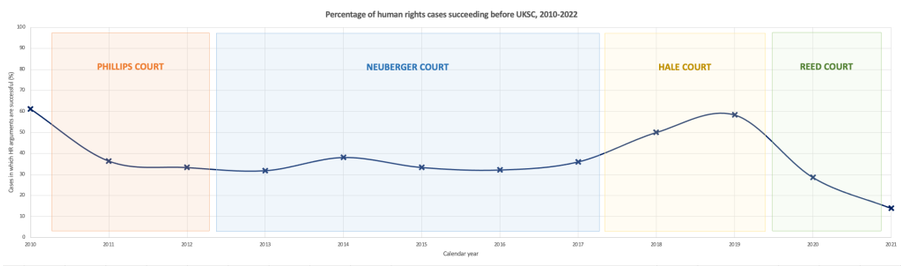 There is in any event almost no chance of a win in the Supreme Court as at present constituted under the right wing Lord Reed, who has made no secret that he does not believe the courts should contradict the Executive and has excluded from the court for the last eight years any judge who does not share this view - forgive my immodesty if I say that my article on this is absolutely essential reading.
I am not sure I will get into the court to report. As the petitioner in the parallel Scottish case which is sisted pending this decision, I applied to the Court that I need to be there to hear the arguments, and asked them to reserve me a seat in the gallery. I received a very dusty reply telling me to stay at home and watch the livestream. I shall try to arrive early to queue for the public gallery, but have been told there may be no seats allocated to the public.
If this appeal fails, the government will go ahead with its plans to process the 4,000 people facing terrorism charges for holding placards or wearing T shirts supporting Palestine Action, through juryless kangaroo courts in batches of five, with 36 minutes allotted to each individual, including process and the prosecution case.
The UK is bringing more terrorist charges per world than any other country in the world. The majority against aged pacifists. This is absolutely a choice by the Labour Friends of Israel government. Burnham does not have to do this. They do not have to fight the Supreme Court case tomorrow. The interests of the people are utterly subordinate in the UK state to the interests of the state of Israel.
We are still short of money for the Scottish leg of the judicial review. I am sorry to have to keep asking, but I have no choice. The legal bills currently exceed the amount raised to date. largely due to the government succeeding in having our legal crowdfunder closed down.
Other donation methods are currently still available even though the CrowdJustice route has been closed. Obviously we now need funds more than ever to carry on.
paypal.HostedButtons({ hostedButtonId: "NZDEN7BYDHVS4", }).render("#paypal-container-NZDEN7BYDHVS4")
Alternatively by bank transfer:
Account name
MURRAY CJ
Account number 3 2 1 5 0 9 6 2
Sort code 6 0 - 4 0 - 0 5
IBAN GB98NWBK60400532150962
BIC NWBKGB2L
Bank address NatWest, PO Box 414, 38 Strand, London, WC2H 5JB
Or crypto:
Bitcoin: bc1q3sdm60rshynxtvfnkhhqjn83vk3e3nyw78cjx9
Ethereum/ERC-20: 0x764a6054783e86C321Cb8208442477d24834861a
The post To The Supreme Court appeared first on Craig Murray.


St. Martin, Ludgate with St. Paul's Cathedral, c. 1900
At this time of year, when dusk gathers in the mid-afternoon, a certain fog drifts into my brain and the city itself grows mutable as the looming buildings outside my window merge into a dark labyrinth of shadows beyond. Yet this is as nothing compared with the smog of old London - in the days before anyone dreamed of the Ultra Low Emission Zone - when a million coal fires polluted the atmosphere with clouds of filthy black smoke carrying noxious fumes, infections and lung diseases. In old London, the city resounded with a symphony of fog horns on the river and thousands of people coughing in the street.
Looking at these glass slides of a century ago, once used for magic lantern shows by the London & Middlesex Archaeological Society at the Bishopsgate Institute, the fogs and smogs of old London take on quite another meaning. They manifest the proverbial mythic "mists of time," the miasma wherein is lost all of human history, save the sketchy outline that some idle writer or other jotted down. Just as gauzes at the pantomime conjure the romance of fairyland, the hazes in these pictures filter and soften the images as if they were faded memories, receding into the past.
The closer I examine these views, the more I wonder whether the fog is, in some cases, an apparition called forth by the photographic process itself - the result of a smeary lens or grime on the glass plate, or simply an accident of exposure. Even so, this photographic fogging is no less evocative of old London than the actual meteorological phenomenon. As long as there is atmosphere, the pictures are irresistibly atmospheric. And old London is a city eternally swathed in mist.

St Paul's Cathedral from the north-west, c. 1920

Pump at Bedford Row, 1911

Cenotaph, 1919

Upper Thames view, c. 1920

Greenwich Hospital from the Park, c. 1920

City roadworks, 1910

Looking north across the City of London, c. 1920

Old General Post Office, c. 1910

View eastwards from St Paul's, c. 1910

Hertford House, c. 1910

New River Head, c. 1910

The Running Footman public house, c. 1900

Unidentified building, c 1910

Church Row, Hampstead, c. 1910

Danish Ambassador's residence, Wellclose Square, Wapping c. 1910

Church of All Hallows, London Wall, c. 1890

Drapers' Almshouses, Bromley Street, c. 1910

Battersea Bridge, c. 1910

32 Smith Grove, Highgate, in the snow, 1906

Unknown public building, c. 1910

Training ship at Greenwich, c. 1910

Flooded moat at the Tower of London, c. 1910

The Woodman, 1900

Bangor St, North Kensington, c. 1910

Terrace of the Houses of Parliament, c.1910

Statue of Boudicca on Westminster Bridge, c. 1910
Glass slides courtesy Bishopsgate Institute
You may also like to take a look at
White Sands Missile Range celebrated the launch of an on-site, solar-enabled microgrid last year, and the facility has already begun planning for another microgrid with solar power.
The post If The US Department Of Defense Gets Solar Power, Why Can't We? appeared first on CleanTechnica.






TL;DR: Use more than 50 AI models and send a prompt to six models at once with a lifetime subscription to AskAnyModel AI Pro Plan for $39.99, normally $499.
Stop paying every month for multiple AIs when you can get the leading models together in one user-friendly interface. — Read the rest
The post Stop paying for Claude, GPT and Gemini separately — get them all with AskAnyModel for $39.99 appeared first on Boing Boing.

North Korean cryptocurrency thieves tricked a Binance software engineer into downloading malware onto their work-issued computer during a fake job interview process before last week's record-breaking $6.3 billion heist.
In an incident report published on Tuesday, the cryptocurrency exchange said several techniques - including social engineering via fake job interviews, malware downloads, compromised internal AI tooling, endpoint takeover, and an "advanced transaction-authorization method" - led to the October 29 security breach.
"Our current investigation indicates that this was a sophisticated, multi-stage campaign," the incident report said. "It was not a single isolated breach or a simple phishing incident."
Over the weekend, the FBI attributed the theft to TraderTraitor, a North Korean hacking operation linked to Lazarus Group, known for combining espionage with massive cryptocurrency heists. The Pyongyang-backed crew is also highly adept at job market scams - both posing as IT workers, who are then hired by Western companies, and as potential employers to lure software engineers into downloading malware and infecting corporate devices.
With the recent Binance attack, the Norks used the latter.
The attack prep began back in June with a supply chain attack when one of its engineers downloaded a malicious Homebrew installation. While the malware was detected by the security team, the device was replaced, and all affected credentials rotated, "Engineer A's role and his related colleagues on our wallet infrastructure team was exposed to the hacker," the report says.
Three months later, the social engineering part of the attack happened.
In September, another software engineer was contacted via a "legitimate job-hunting platform" by someone purporting to be a project director who arranged a series of job interviews for the Binance engineer with the fake company. During the first round - a live video interview with the engineer and a fake HR rep - the interviewer "shared a social media account with him, including personal photos and videos posted on the platform, in order to build trust," according to the report. "This was more advanced and deceptive than previously seen social engineering approaches."
The second interview with someone purporting to be the CEO of the phony company was conducted on a "popular social chat app," and toward the end, the CEO instructed the engineer to download an "assignment" containing a malware-laced code repository. The code executed on his work computer during the setup process, which kicked off a series of unauthorized activities.
According to Binance, the malware replaced a legitimate development tool component with a malicious version, which executed commands and established communication with an attacker-controlled external server. The attackers also took steps to hide the malicious script and evade detection, and it worked. Binance's endpoint security tools did not immediately detect the malware.
Here's the script:
CREATE /opt/homebrew/Cellar/pyenv/2.8.0/libexec/pyenv_
MODIFY pyenv_ → 3,414 B
DELETE .../libexec/pyenv (3,344 B) ← remove the valid pyenv
RENAME pyenv_ → pyenv (3,414 B) ← replace it with a malicious version
DELETE /opt/homebrew/bin/pyenv (3,414 B)
ln (create a new symlink) + spawn zsh
Then, on October 20, the miscreants used the compromised computer and an internal AI tool to gain access to the computers of wallet DevOps engineer A and another wallet software developer, Engineer C.
Engineer A had a container deployment permission token on his computer, which the Norks soon discovered. On October 29, the attacker accessed Engineer C's computer, used the stolen credentials from Engineer A to deploy a container, and triggered a script to launch the cryptocurrency-stealing attack.
As of Tuesday, Binance said it has rebuilt the compromised wallet system and internal AI tool, and replaced all of the affected devices. It also decommissioned all credentials and tokens assigned to the compromised engineers, and is working with law enforcement, blockchain intel firms, and security researchers to trace and freeze the assets.
The crypto exchange has also hired independent cybersecurity experts to conduct a cybersecurity review of the incident, and recommend additional protective measures. Binance said it's also working to establish a security research fund and initiatives with AI companies and security shops to focus on AI security in blockchain environments.®
(Editorial Note: Suzuki has not revealed if the GSX-10R will be sold in the U.S.A.)
GSX-10R
FUN. UNLIMITED.
The GSX-10R was created to let riders fully enjoy the performance of its powerful, long-stroke 999cc engine across a wide range of scenarios, from daily commuting and weekend touring to track riding. Built on an engine refined in the GSX-S1000 that inherits the DNA of numerous Superbike and endurance racing victories, it features a compact, lightweight chassis, a highly refined suspension system, advanced rider-assist technologies, and a sporty, forward-leaning riding position. The entire package is wrapped in aggressive styling that incorporates elements such as winglets, derived directly from cutting-edge racing.
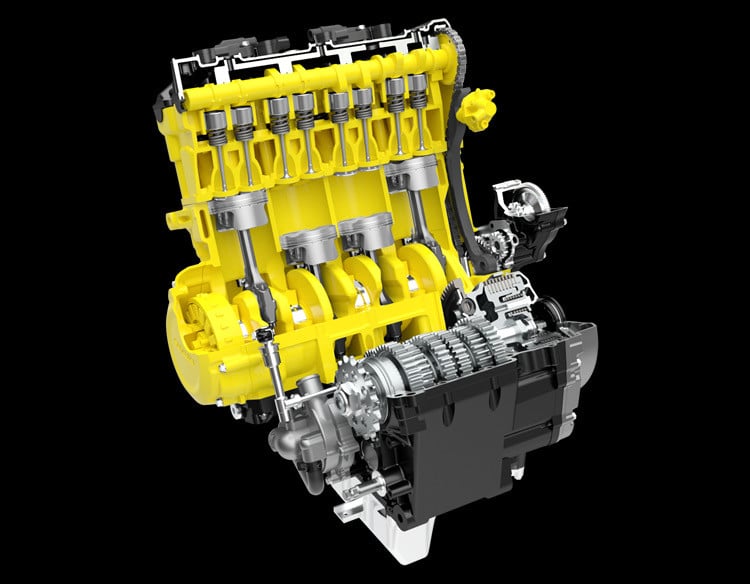 The engine is an updated version of the relatively long-stroke, torquey K5 version of the GSX-R1000 engine used in the most recent (circa 2020) Katana and GSX-S1000 models, and first used in the GSX-R1000 in a previous decade.
Engine Features
A 999cc, liquid-cooled, DOHC, inline-four engine, further refined based on the powerful performance of the K5 engine. The oil pathways have been revised to further enhance reliability.
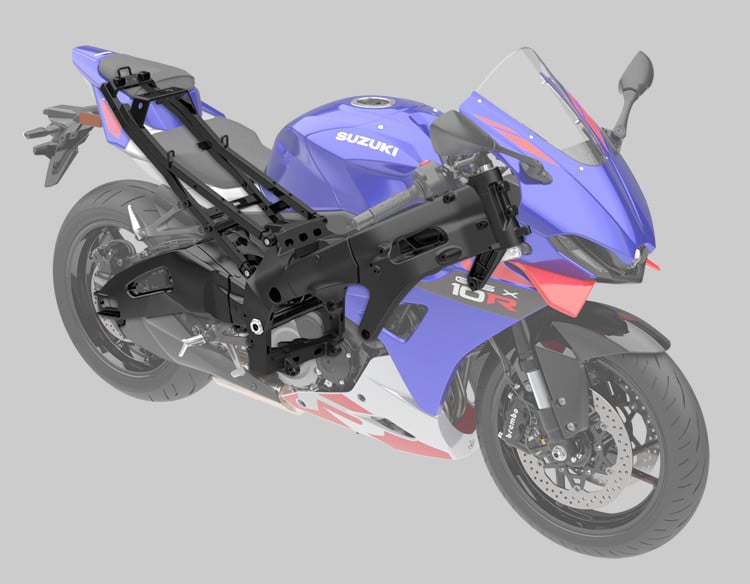 The GSX-10R features a twin-spar aluminum alloy frame with an aluminum swingarm and bolt-on rear subframe previously used on the most recent Katana model, and comes with winglets on the front of the fairing.
Chassis Features
- Developed around the theme of a "sports model that can be fully enjoyed from the circuit to the street," achieving a sense of unity that allows the rider to focus on the ride.
- A ride quality meticulously crafted with input from test riders involved in the GSX-R series, prioritizing the rider's connection to the machine and the pure joy of sports riding.
- Designed with a focus on controllability and fit, based on the triangular geometry of a forward-leaning riding posture, delivering a riding position equivalent to that of the GSX-R1000R.
- Footpegs featuring increased bracket rigidity for improved rider hold.
- Newly designed seat rails to achieve a riding position suited to sport riding.
- Achieves a deep lean angle of 53 degrees, compared to the 48 degrees of the GSX-S1000.
- Brake system featuring a radial master cylinder that combines precise control with powerful stopping force.
- Changed the rear-tire size from the GSX-S1000's 190/50ZR17 to 190/55ZR17.
- Fuel tank with an ample 18L capacity, designed to balance freedom of movement in a forward-leaning position with secure rider hold.
- Newly designed seat featuring a flatter profile from front to rear to facilitate fore-aft movement, with padding tuned for a softer feel compared to the GSX-R1000. A seat that balances ease of movement for sports riding with comfort for touring.
- A newly developed turn signal system(Suzuki Ground Beacon System) that limits the amount of light hitting the road surface around the vehicle, thereby more clearly communicating the driver's intended movement.
- Features a full-color, multi-function instrument cluster incorporating a color TFT display.
- Equipped with smartphone connectivity and a USB type-C port; connects via the Suzuki Ride Connect+ app
- Features a long-life lithium-ion battery from Eliiy Power that is lightweight and compact, offering excellent reliability, durability, and starting performance.
 The 2027 Suzuki GSX-10R was introduced at the EICMA motorcycle show in Milan, Italy. The bike is basically an updated Katana with new bodywork and a larger, 18-liter (4.76-gallon) fuel tank.
Suzuki Intelligent Ride System(S.I.R.S.) Features
- Equipped with 15 electronic control systems to support the rider across a wide range of scenarios, from the racetrack to the street.
- Features Suzuki's first-ever slide control system; it detects lateral sliding during cornering and enables natural turning with minimal intervention.
- Introduces Suzuki's first brake hold control system; unlike conventional hill hold control systems that operate only on inclines, this new system functions on flat ground and downhill slopes as well.
 Three GSX-10R liveries.
Styling Features
- Bold styling that incorporates modern trends while inheriting the DNA of the GSX-R series
- Reflecting Suzuki's identity, the model is available in three distinct color schemes designed to offer customers a wide range of choices (Pearl Vigor Blue / Metallic Mystic Silver [ASU], Pearl Pulse Red / Solid Iron Gray [DE9], Metallic Galaxy Gray / Glass Sparkle Black [DB2])
- Body graphics that evoke a sense of speed and presence, alongside logo designs that pay homage to the GSX-R lineage
 Two GSX-10R Suzukis seen on the track with test riders.
The post Suzuki Launches 2027 GSX-10R appeared first on Roadracing World Magazine | Motorcycle Riding, Racing & Tech News.
MPs and leading UK think tanks have received major sums from U.S. benefactors - often with ties to U.S. President Donald Trump - since the 2024 general election, DeSmog can reveal.
Six MPs, including Reform UK leader Nigel Farage and Conservative leader Kemi Badenoch, have collectively accepted £335,000 for attending official Trump events and donor meetings, or gatherings held by right-wing U.S. groups.
Meanwhile, seven conservative policy groups in the UK have received at least $3.1 million (£2.3 million) from U.S. sources since 2024, and $20.4 million (£15.2 million) since 2016, the year of Trump's first presidential election.
These revelations come as Trump's Republican Party faces an uphill battle in today's Midterm elections, with the Democrats vying to win control of both the House of Representatives and the Senate. Trump's poll numbers have hit new lows with more than two-thirds of U.S. voters disapproving of the president's handling of the cost of living amid a surge in gas prices due to the U.S.-Israeli war with Iran.
Trump is also unpopular in the UK and across Europe, with 85 percent of Brits saying they have an unfavourable view of the U.S. president.
Yet his administration has been openly attempting to fund its allies in Europe. According to The Guardian, the State Department has allocated $15 million (£11.2 million) to three conservative groups in the UK. These grants form part of a "slush fund" to boost likeminded organisations across Europe, with up to $3 million (£2.2 million) reportedly available to those focused on "developing civilizational bonds" and "defending rule of law".
DeSmog's analysis has found that, in addition to these planned donations by the Trump administration, millions have been poured into UK democracy by U.S. donors in recent years.
Right-wing think tanks to have received funding from U.S. donors since 2024 have included Policy Exchange ($1.1 million), the Henry Jackson Society ($955,000), the Institute of Economic Affairs ($609,000), the Global Warming Policy Foundation ($222,000), Prosperity Institute ($137,000), the Adam Smith Institute ($51,000), and the Academy of Ideas ($5,000).
In 2024, the Adam Smith Institute and Academy of Ideas received £50,000 and £4,965 respectively from the Prometheus Institute - a philanthropic foundation founded by Carl Barney, who donated over $1.6 million to Republican and pro-Trump campaigns during the 2024 election, including more than $900,000 to the Trump 47 Committee - making him one of California's top pro-Trump donors during the race.
Six MPs have also received substantial payments from prominent U.S. conservative groups.
Farage has received £69,126 in income and £153,101 in expenses for attending 10 events - including over £32,000 to campaign for Trump during the 2024 presidential election campaign, and £27,000 to attend events during Trump's inauguration in January 2025. Both trips were funded by crypto billionaire Christopher Harborne, who has financial ties to the White House.
Reform MP Suella Braverman, who defected to the party in January, has received £23,664 in expenses for attending four U.S. events, including delivering a speech in January 2025 at the Heritage Foundation - the group behind Project 2025, the radical right-wing blueprint for Trump's second term. Braverman attended these events while she was a Conservative MP.
Farage, who is the only MP to have accepted speaking fees for some of the U.S. events, has come under intense pressure for his relationship with Trump. The Reform leader has labelled the president the "single most resilient and bravest person I've ever met in my life", and has frequently called for Trump's policies to be replicated in the UK - including the mass expansion of domestic fossil fuel production, the creation of a new immigration deportation agency, and unleashing the crypto industry.
"The continuing influx of overseas funding for UK think tanks, especially through opaque transatlantic networks, poses urgent questions for the government over how to safeguard our democracy against the risks of foreign interference," said Tim Picton, senior advocacy advisor at Spotlight on Corruption,
"This funding can have a significant influence on our political discourse, but largely falls outside of the regulated sphere we currently have in place."
All the MPs and think tanks named in this article were approached for comment.
The MPsA number of Conservative MPs have also been paid to attend right-wing U.S. events in recent years.
Shadow Foreign Secretary Tom Tugendhat, who was appointed to the role in August, has received £49,000 in flights and accommodation since April 2025 to attend several meetings organised by the Hudson Institute, a conservative group based in Washington DC, at which he is a 'distinguished fellow'.
Badenoch also received over £23,000 in expenses to speak at the Hoover Institution at Stanford University in October 2025. The Tory leader has regularly praised Trump - claiming in February 2025 that he was "fixing" America's problems. Like Reform, the Conservatives have proposed introducing an immigration 'Removals Force' modelled on the U.S. Immigration and Customs Enforcement (ICE) agency, while Badenoch supported Trump's bombing campaign in Iran.
The three groups already allocated money through the Trump administration's European slush fund are also run by high-profile Conservatives.
The Guardian reported in July that $7 million (£5.2 million) had been allocated to 878, which describes itself as a new "leading British and American think tank" devoted to "the rediscovery of our ancient culture" and "ending mass immigration". The group lists its founding directors as Jacob Rees-Mogg, the former Conservative MP and Cabinet minister, and his former adviser Radomir Tylecote.
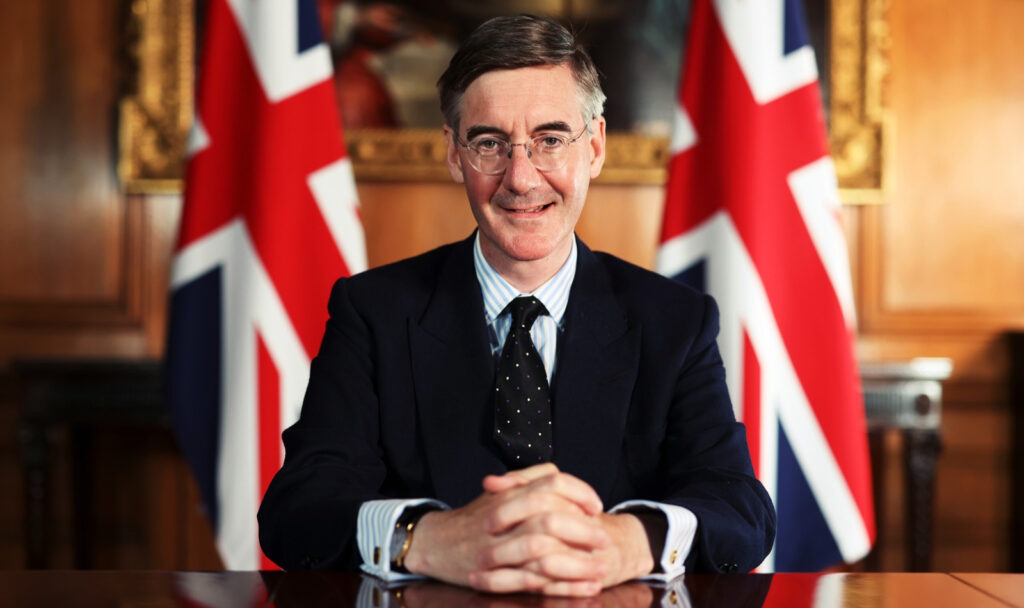 Former Conservative MP and Cabinet minister Jacob Rees-Mogg.
Credit:
Simon Dawson / No 10 Downing Street (CC BY-2.0)
A reported $5 million has also been set aside for Free Speech Union International - the global offshoot of the Free Speech Union (FSU), a legal advocacy group run by Conservative peer Toby Young, who told The Guardian that its international branch had "expressed interest in applying for grant funding from the U.S. State Department" but that it had not yet been awarded the money.
Young reiterated this claim when approached by DeSmog.
The FSU is also already known to have received funding from U.S. sources. As first reported by Democracy for Sale, its now-defunct U.S. arm received money from a charity linked to a prominent anti-abortion lawyer.
An additional $3 million allocation from the State Department slush fund has reportedly been made to the Jobs Foundation for a programme called 'Countering Overregulation to Advance American Investment'. Conservative peer Matthew Elliott, who led the official Vote Leave Brexit campaign, is the president of the Jobs Foundation, which is a pro-business advocacy group.
"If this money is being used to fulfill a specific direction from the U.S. State Department, there is a legal obligation for these organisations to declare this to the Home Office's Foreign Influence Registration Scheme under national security laws," Picton said.
The Think TanksSignificant payments have also been made from U.S. donors to UK think tanks in recent years.
DeSmog's analysis has found that right-wing think tanks have accepted over $20.4 million from U.S. benefactors since 2016, often via their American fundraising wings, and $3 million since 2024.
Much of this money flows from U.S.-based donor advised funds (DAFs) - entities that keep the original source of funding hidden from public view. DAFs such as the Vanguard Charitable Endowment Programme, the National Philanthropic Trust, and Donor Advised Charitable Giving have been used to give money to right-wing UK think tanks in recent years - which has obscured the identities of some donors.
However, some are publicly disclosed. For example, the New York-based Achelis and Bodman Foundation gave $75,000 (£56,000) to the American Friends of the GWPF in 2024 - the entity that accepts donations from U.S. sources on behalf of the Global Warming Policy Foundation, one of the UK's principal climate science denial groups. The Achelis and Bodman Foundation also donates to the likes of the Heritage Foundation and the Hudson Institute.
Several UK conservative think tanks use 'friends of' groups to channel donations across the Atlantic. Last year, American Friends of Policy Exchange, belonging to the influential Westminster think tank, accepted $50,000 (£37,000) from the Florida-based Swordspoint Foundation, which is run by Trump donor Robert Bishop.
 55 Tufton Street. Credit: R4vi, CC-BY-SA-2.0
In 2024, the IEA accepted up to $189,000 (£141,000) for research and study programmes from the Cherish Freedom Foundation - a group historically funded by Robert Mercer, a major donor to right-wing groups and campaigns whose family gave $25.5 million to Trump's 2016 presidential campaign. The Institute of Economic Affairs has previously received money from fossil fuel majors including BP, ExxonMobil, and Shell, as well as from the U.S.-Australian media mogul Rupert Murdoch.
The IEA told DeSmog that it does not accept money from government sources and that it does not take donations "in exchange for research".
These groups have also frequently echoed Trump's narratives. The campaign director of Net Zero Watch, the lobbying arm of the GWPF, appeared on Murdoch-owned TalkTV in March and declared that "Trump is absolutely right to say that windmills [sic], and our mad policies on North Sea oil and gas, are making our energy more expensive."
Meanwhile, in February 2024, Policy Exchange senior fellow Edward Stringer wrote an opinion piece for The Telegraph entitled: "Trump is right. Defenceless Europe can no longer freeload off America".
Almost all of these UK groups belong to the Tufton Street network, a right-wing alliance based in Westminster that lobbies to dismantle state services and privatise public bodies. Its members share an opposition to climate action, and they have spent decades attempting to undermine policies designed to reduce emissions. As revealed by Democracy for Sale, the U.S. funding to some of these groups has increased by 29 percent from 2024 to 2025.
Tufton Street donors also closely overlap with the Conservative Party. As reported by DeSmog and Democracy for Sale in June 2024, Tory benefactors had gifted over £6.8 million to Tufton Street think tanks since 2019.
The Atlantic BridgeThere has also been a concerted attempt in recent years to build transatlantic right-wing networks to share policies, campaign strategies, and narratives.
One of the most prominent has been the Alliance for Responsible Citizenship (ARC), which holds an annual conference in London featuring thousands of attendees.
ARC is fronted by conservative commentator Jordan Peterson and run by Baroness Philippa Stroud, a Conservative member of the House of Lords. It's the brainchild of the Legatum Group, a Dubai-based investment firm, and the hedge fund manager Paul Marshall - the co-owners of the radical right-wing broadcaster GB News, which employs Farage as a presenter.
Marshall is also a key funder of ARC, having given £3 million to the group since its creation in 2023. As revealed by DeSmog and Unearthed, this year's conference was sponsored by Reform mega-donor and crypto billionaire Ben Delo, Tory and Reform donor Anthony Bamford, and a number of U.S. funders - including fossil fuel companies and executives - that have donated to Trump and the Republican Party.
Speakers at the conference included senior U.S. politicians - notably Trump's energy secretary Chris Wright, U.S. House Speaker Mike Johnson, and Sarah Rogers, who is overseeing the State Department's European slush fund. They spoke alongside UK figures who have been forging close ties, both financial and political, to Trump's America - including Farage, Badenoch, Elliott, and Young.
 President Donald Trump and Reform UK leader Nigel Farage at CPAC in 2018.
Credit:
Shealah Craighead / White House (Public domain)
Among the attendees were dozens of parliamentarians, corporate executives, and right-wing think tanks including the Heritage Foundation, Adam Smith Institute, TaxPayers' Alliance, and Prosperity Institute.
A key theme of the conference is criticism of global climate policies, with Marshall claiming in his 2025 ARC speech that the world has been infected by a "climate derangement syndrome". He claimed that "our economic prosperity and our people's livelihoods" are being sacrificed "all for the sake of making some fractional changes to the level of CO2 in the atmosphere".
Also in attendance at this year's ARC event was Samuel Samson of the State Department, who has reportedly been "at the forefront" of the Trump administration's "effort to reshape America's relationship with Europe".
MPs have registered complimentary tickets to ARC worth at least £6,900 since 2024. The FSU has also reportedly received funding from ARC and Reform donor Delo, who owns a venue in Westminster that serves as a hub for various right-wing groups and content creators.
Another influential pro-Trump network has also been imported into the UK in recent months: the Conservative Political Action Committee (CPAC), which hosted its inaugural London event in July.
CPAC GB is chaired by former Conservative prime minister Liz Truss, while the event was headlined by Farage - despite the Reform leader suggesting beforehand that he would be "steering well clear" of the summit.
CPAC GB promised to bring together "global heavyweights" of the international right, and featured Young, Rees-Mogg, Tylecote, The Telegraph's Allison Pearson, Reform's Matthew Goodwin, broadcaster Mike Graham, and U.S. activist Jack Posobiec.
Farage has also helped to import an influential U.S. climate science denial group, the Heartland Institute, to the UK. The Reform leader was the keynote speaker at the launch of the Heartland Institute's UK-EU branch in December 2024, months after advising the group to set up a satellite in Europe.
Heartland Institute UK-EU director Lois Perry claims to be advising the party on its climate agenda and is the strategy director of Reform Friends of Israel - a lobbying group within the party.
Farage has also been forging ties with Alliance Defending Freedom (ADF) - a powerful legal advocacy group that led the campaign to overturn Roe v Wade, the landmark ruling that protected the constitutional right to abortion in the United States.
ADF's UK branch spent over £1.4 million on its activities in 2025, more than three times higher than in 2020. Farage has not only appeared on promotional materials put out by the ADF, but according to the New York Times the group orchestrated a visit by Reform's leader to Washington DC in September 2025, during which he testified to Congress.
ADF has also reportedly arranged backroom meetings between Farage and State Department officials on their visits to London, and as recently reported by the iPaper, the Reform leader has accepted more than £83,000 in earnings, accommodation, and flights from groups that support the anti-abortion movement, many of which are featured above.
The post Millions of Dollars Pouring into UK Democracy from Trump's America appeared first on DeSmog.
A pro-AI data center group purchased at least $2.54 million worth of television ads that ran recently in Ohio, a new DeSmog analysis reveals. The group, Build American AI, is linked to Leading the Future, a major AI industry super PAC backed by Silicon Valley billionaires.
The ads extolled the economic benefits of Ohio's data center boom, one of the hottest issues in the state's Senate election, but did not endorse either candidate in the race: Trump-aligned Republican incumbent Jon Husted, who was appointed by Governor Mike DeWine to serve out Vice President J.D. Vance's term, and former three-term Democratic Senator Sherrod Brown.
"When some people hear data centers they picture computers and servers," says one Build American AI ad. "But we see something different: electricians, engineers, manufacturers." The ad states that data centers have brought more than $40 billion in investments and created over 95,000 jobs in Ohio.
"The future won't be built by politicians or special interests," states the ad, "It'll be built by American workers right here in Ohio."
The ads appeared on at least 16 Ohio television stations between September 7 and October 21, according to Build American AI's filings with the Federal Communications Commission, which described them as "non-candidate issue ads."
 A still from one of Building American AI's pro-data-center ad campaign in Ohio during the race for Senate between Republican Jon Husted and Democrat Sherrod Brown. Credit: Via Google Ads Transparency Center.
Build American AI ordered at least $2.5 million in ads in Ohio, $1.5 million in ads in Wisconsin and $1.1 million in Kansas between September 7 and October 24, according to DeSmog's analysis. Jesse Hunt, the group's head of communications, confirmed that the group is spending over $5 million in the three states, but did not comment on the exact amounts.
Build American AI has been described by Politico as a "subsidiary" of Leading the Future, a super PAC which was formed last year to promote AI industry interests. Leading the Future has emerged as a major player in 2026 election cycle — backing both Democratic and Republican candidates in primary races earlier this year.
The super PAC has received about $125.79 million in contributions during the 2026 midterm election cycle as of October 29, according to Federal Election Commission (FEC) filings. Most of that came from a handful of donors: $25 million each in individual contributions from tech venture capitalists Marc Andreessen and Ben Horowitz, $50 million from their venture fund Andreessen Horowitz, also called a16z, and $12.5 million each from OpenAI co-founder and president Greg Brockman and his wife Anna Brockman.
OpenAI is part of a joint venture with SoftBank, Nvidia, the U.S. Department of Energy, and other partners to build a mammoth data center complex on federal land in Pike County, Ohio. The project would include an on-site gas-fired power plant designed to produce 9.1 gigawatts of power — larger than any gas-fired power plant currently operating worldwide, and enough to power about 7 million homes.
OpenAI's investors include the Andreessen Horowitz venture capital fund. OpenAI's energy chief is John McCarrick, who as an energy official in Trump's first administration promoted exports of U.S. liquefied natural gas to Europe following Russia's invasion of Ukraine, and advocated for Asian countries to invest in natural gas.
Andreessen Horowitz did not respond to a request for comment.
OpenAI did not respond to DeSmog's request for comment on the Brockmans' personal donations to Leading the Future, or its stance on using gas-fired power for its data centers.
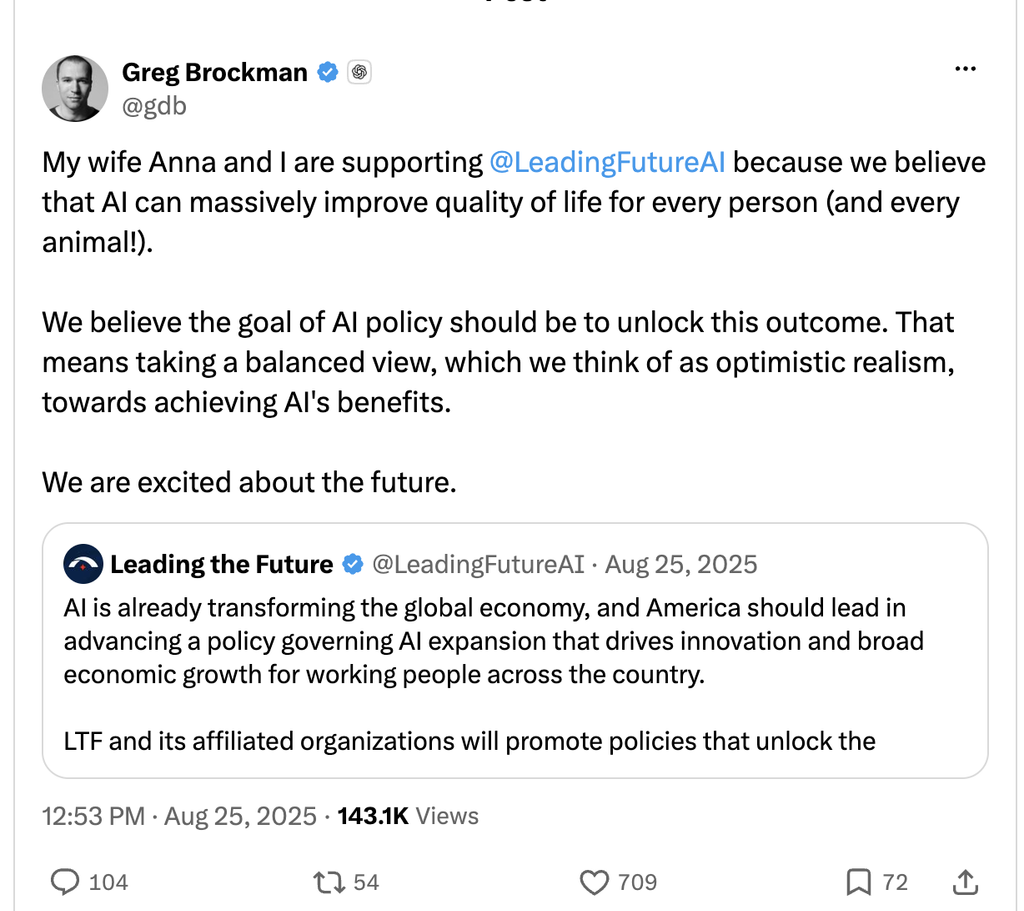 In August 2025, OpenAI co-founder and president Greg Brockman posted on X that he and his wife, Anna Brockman, were "supporting" the Leading the Future superPac to advocate for "a balanced view" of AI policy, "which we think of as optimistic realism, towards achieving AI's benefits." Credit: @gdb account on X
Marc Andreessen is also a board member of tech giant Meta, which is building "Prometheus," a massive data center in New Albany, Ohio, about 15 miles northeast of state capital Columbus. The partially-built computing complex runs on natural-gas turbines — and is designed to scale to one gigawatt, enough to power about 800,000 homes.
These projects are among dozens of proposed data center projects in Ohio, which is strategically positioned atop part of the Marcellus Shale, the biggest gas field in the U.S.
The AI boom is on track to worsen the climate crisis, which is on the verge of passing the key 1.5 degree Celsius (2.7 degrees Fahrenheit) limit on global heating that nations set in the 2015 Paris Agreement.
Based on current trends, the energy demand of new U.S. data centers could increase the nation's carbon emissions by 24 to 44 million metric tons a year between 2024 and 2030, according to a recent study published in the journal Nature Sustainability — equivalent to the tailpipe emissions from an additional 5 to 10 million additional gasoline-burning cars.
Marc Andreessen recently called the climate crisis "over" in a post on X, and has praised fracking as an "incredibly positive outcome" of energy industry research and development.
"Energy should be in an upward spiral," wrote Andreessen in his "Techno-Optimist Manifesto" in 2023. "The more energy we have, the more people we can have, and the better everyone's lives can be."
Both he and Horowitz have each contributed at least $3,500 to Husted's re-election campaign since late 2025, according to FEC filings.
 Mark Andreessen responded sarcastically in June to an X post by French economist Thomas Piketty about unequal wealth and the climate crisis: "SMH the climate crisis is over, Greta has pivoted to Palestine, and the rest of us are panicking over data centers. Do keep up." Credit: @pmarca account on X.
Build American AI's ads appeared after Sherrod Brown's campaign ran a series of ads branding Husted "the face of data centers in Ohio" and lambasted him for supporting multi-billion-dollar, greenhouse-gas spewing data center developments as well as for handing out tax breaks for data center developers.
Brown's campaign spent $2.4 million on ads criticizing Husted's support for data centers as of late August, according to political ad spending tracker AdImpact.
The ads caught the attention of the National Republican Senatorial Committee, which sent out a memo in mid-August to "interested parties" about "Ohio's data center risk," as first reported by Axios. The memo warned that Brown's opposition to data centers had turned the issue into "the anchor hanging around Husted's neck" that could get him voted out of office. "The companies that need these projects built have to fix how Ohioans see them: who benefits, who pays, and why a community should want one," the memo stated — the themes of Build American AI's TV ad campaign.
Sixty-three percent of Ohioans oppose AI data centers, according to a recent poll by The New York Times. As of September, the state has over 125 local data center moratoriums in place, as well as 21 ballot measures across 16 counties targeting data center construction, the most of any state. "People who would wave at their neighbors that they've seen for 10 years but never have spent the time on their porches" are "looking past partisan differences to fight for their communities," Nick Owens, an attorney in rural Ohio, told DeSmog. Owens, who said he is a Republican, volunteers with the campaign Conserve Ohio, which is seeking to ban large-scale data centers in the state.
Looking ahead, local community groups in Ohio are attempting to gather 413,000 signatures needed to put a statewide data center moratorium on the ballot in 2027.
"Grassroots people who frankly have one hundredth the level of funds [of tech leaders] are battling these fights," said Owens. "It's really David versus Goliath, but the righteous people in this case, I believe, will prevail: the people who live in their communities."
The post Revealed: Pro-AI Data Center Group Spending At Least $2.54M on TV Ads to Influence Ohio Election appeared first on DeSmog.
With RAM getting more expensive, Microsoft is putting more effort into making Windows 11 run better on systems with just 8 GB of memory.
Microsoft said on Tuesday that it was "raising the bar for 8 GB Windows 11 PCs," following a renewed focus on memory optimization earlier this year. The changes come as Redmond continues pushing more expensive Copilot+ PCs, which require at least 16 GB of RAM, amid a memory crunch fueled by AI infrastructure demand.
Now, Microsoft says a low-end machine with its 8 GB of precious RAM will be up to 20 percent more responsive and 40 percent faster at multitasking thanks to improvements made in memory management.
The tweaks are relatively simple, as Microsoft explained, and seem more about adjusting back to the reality that its flagship operating system needs to function on the hardware people can actually afford to purchase if and when they're forced to upgrade.
Windows 11 will now keep up to 2 GB more active data in memory before shunting it to slower storage, as one example. In another instance, Windows will connect directly to Edge when the browser is already running in the background, allowing it to launch up to 33 percent faster, according to Microsoft. Microsoft apps are also being made more efficient, with Teams able to enable Efficiency Mode by default on 8 GB machines, which Microsoft said will make it launch "up to 20 percent faster."
Memory efficiency is also being improved by tweaking things like Widgets, which will only load when used instead of always being on, and decreasing the time when Edge tabs go to sleep from two hours to 15 minutes by default. Microsoft said it's enabling third-party apps to make use of those tweaks, too.
Microsoft also included benchmark data in the blog post from a recent bit of research it commissioned. The benchmark report compares a range of 2026 Windows machines with models from 2021, finding that a 2026 Dell XPS 13 with 8 GB of RAM performed about as well as a 2021 Dell XPS 13 with 16 GB across selected workloads.
What that means, says Microsoft, is that "the complete PC, not memory capacity alone, shapes the experience."
In other words, please buy some new Windows hardware, even if it's expensive - we're begging you. Software optimization can only do so much.
"For many people, 8 GB is a great fit for the things they do every day," Microsoft EVP of Windows and devices Pavan Davuluri wrote in the blog post. "Demanding workloads, such as 3D modeling, advanced video editing, or large-scale data processing benefit from 16 GB of memory or more."
It's no surprise Microsoft is improving the performance of lower end systems at the same time it's subtly asking users to buy newer kit, even if it's just an 8 GB machine - Microsoft may have done well in the past two quarters, but it's no thanks to Windows devices.
Microsoft's Q4 2026 earnings in late July saw the company rake in cash more broadly, while simultaneously reporting a 7 percent decrease in Windows OEM and devices revenue.
Likewise, in its fiscal Q1 2027 results, reported just last week, Microsoft again brought home a mountain of net income, with adjusted earnings reaching $36.4 billion, up 18 percent from the same period last year. Windows OEM and devices revenue, however, was down a whopping 22 percent. It's hard to think of a reason beyond the fact that hardware prices have shot up with more force than a SpaceX rocket - memory prices are likely to actually make it to Mars, unlike Starship - leaving both consumers and enterprises to stretch those upgrade cycles.
If you need to get the most out of that 8 GB Windows 11 PC, you'll find the latest improvements in 26H2, build 26300.9818 or later. Microsoft is also encouraging users to keep its branded apps up to date, as "some improvements arrive through app updates or through Microsoft Store." ®
Nvidia doesn't seem to care whether open or closed models win out as long as its hardware is powering the infrastructure.
"We love closed models," CEO Jensen Huang said. "There's a solid place in the world for closed frontier models. But the world has so many good ideas … The idea that all of us would be based on general intelligence is not logical."
Speaking with Lin Qiao, CEO and founder of Fireworks.ai, at the company's Forge event in San Francisco on Tuesday, Huang wasn't ready to throw Nvidia's cloud customers, which help deliver the proprietary AI of Anthropic and OpenAI, under the onrushing open model bus.
But having come to the defense of open weight models in July to push back against protectionist pressure from the leadership of Anthropic and OpenAI, Huang recognizes the economic and strategic appeal of AI services that are more affordable and less locked-in.
Most of the value in the world, he said, is captured in specialized intelligence, which is to say AI models trained on specific domains of knowledge.
"The opportunity for artificial superintelligence is already here," he said. "By taking an open frontier model, adapting it, and providing it with your domain knowledge, your access to your specialized tools, and the proper evaluation, you should be able to create essentially a superintelligence."
That aligns with Fireworks' business - offering a platform for companies to train and run models tuned to their specific needs. Coincidentally, that platform just received an infusion of 25,000 Nvidia GPUs to support its expansion in Europe.
Huang's endorsement of open models also fits with Qiao's introductory remarks about the need for the AI frontier to be open. But he largely avoided echoing Qiao's focus on the cost savings allowed by working with open models.
In her introductory remarks, Qiao stood on stage backlit by a slide composed of ten headlines highlighting the extraordinary cost of unchecked token spending.
"Cost is out of control," she said. "Business cannot scale without borrowing a lot of money."
That theme was echoed in a subsequent session helmed by Kay Zhu, co-founder and CTO of AI workspace Genspark, titled Gen-1 Slides: Frontier Quality Without Frontier Costs. Gen-1 Slides, Genspark's model for generating slide decks, was built atop MiniMax M3 and tuned to deliver results comparable to Anthropic's Opus 5 at 1/17th the cost - $0.30/M tokens compared to $5/M.
Asked what might become commonplace next year but seems unlikely today, Huang said this year's breakthrough has been agent harnesses that turn AI models into agents. He added, "I would say the big breakthrough we'll talk about next year, maybe this is a little self-serving, is how Open Shell has enabled every company in the world to deploy agents safely, confidently."
Given the nod to make a second prediction, Huang added, "I would say that the second big breakthrough for industry would be hardware in the loop. And hardware in the loop basically is robotic systems."
Given Nvidia's evident interest and investment in robotics, that would be fortuitous. ®
Revolut says that in less than a year it's managed to slash its AI coding inference costs by roughly 90 percent by making self-hosted models its default instead of relying primarily on commercial services like Claude.
Speaking at the AI Engineer conference in New York last month, David Abitbol, ops and infrastructure lead at the British fintech, described how it saw a 60 percent improvement in coding time and a 70 percent improvement in lead time following its rollout of AI coding tools to roughly 2,000 engineers. Revolut initially adopted GLM-5.1 before moving to GLM-5.3, which it now serves using 56 Nvidia B200 GPUs.
Prior to its switch to GLM, Revolut had been experimenting with AI, deploying Gemini in early 2025 and Claude Code in early 2026. "We were highly skeptical about the cost of AI. We were seeing engineers spend $1,000 a month, $10,000 a month with not so much ROI, and so when we launched it we launched it with strict budget limits," Abitbol said.
Because of this, engineers only had access to a limited number of tokens, so the company began investigating self-hosting iyd own models. At $0.30 per million input/output tokens, self hosting GLM 5.1 cost about a tenth of using OpenAI's Codex or Anthropic's Claude Code. And, as it turned out, when tokens are cheap, you stop worrying about how many they use or what they use them for.
While Revolut did see improvements to coding speed, Abitbol noted the biggest bottleneck wasn't actually the code. Instead, he says the biggest gains came from letting the AI models deal with things like debugging and Jira and Confluence tickets. "When you have unlimited tokens, you're free to do that," he said. "You no longer have to save your tokens for the end of the quarter or the most difficult task."
Developed by Chinese open weights model dev Z.ai, GLM 5.1 isn't exactly a small model. At roughly 754 billion total parameters (40 billion activated for each token generated), the model requires roughly 380 GB of GPU memory just to hold the weights and another 6-26 GB per user to maintain context depending on precision.
To serve GLM-5.3 at scale, Revolut deployed 56 Nvidia B200 GPUs, equivalent in GPU count to seven eight-GPU DGX B200 systems. But as Abitbol noted, the greatest performance gains didn't come from adding GPUs, but rather tuning the model's hyperparameters along with switching to NVFP4 quantization, implementing disaggregated prefill and decode, and tuning context lengths.
One key takeaway was that supporting a one-million-token context window doesn't necessarily make such a large window useful or efficient. "Long context is a scam. You really need to be mindful of that," Abitbol said. "Even though you can serve one million tokens, 256 [thousand] is really what you need."
With these optimizations, Abitbol says that the company was able to achieve sub 3-second time to first token on context windows of around 256,000 tokens, and generation speeds of around 200 tokens a second, both of which he notes are the sweet spot for the company's software engineers.
"What you want to aim for is a sub-3 second time to first token. This is empirical evidence. As soon as you exceed 5 seconds, my Slack inbox starts to blow up," Abitbol said. "In terms of throughput, it doesn't really matter as much. We serve, in terms of interactivity, 200 tokens per second. People are fine [with that]. You don't need to go higher. The way people work has changed. We no longer look at the stream of thinking tokens. People run tasks in parallel and check in when the task is done."
And if throughput is a concern, he notes engineers who sign in after 5 pm are getting closer to 800 tokens a second.
However, it's worth noting that GLM hasn't replaced GPT or Claude entirely. The Chinese model is text only, so it isn't ideal for things like UI work. So instead, Revolut used a model router to direct vision queries to models like Gemini or GPT Luna while keeping code generation running on GLM.
"Open source is now a priority at Revolut, and our economics are favorable. The billing is flat, we don't have any bill shock at the end of the month, and the frontier is the exception," Abitbol said.
Having said that, Abitbol acknowledges that Chinese open weights models may be a concern for privacy and security reasons, but emphasizes that the major concern there is accessing them via APIs running out of China. When run on-prem or on regional cloud resources, there's really nothing to worry about. ®
The Center for a New American Security posits that the next big threat from our future AI overlords involves "sovereign agents" acting on their own and regularly improving themselves.
These are AI agents that operate outside of human control and "pursue open-ended, evolving survival," AI policy researcher Ben Hayum said in a Tuesday report from the bipartisan national security think tank, which was founded by Washington insiders with experience in diplomacy and military affairs. "If sovereign agents are not already possible, they will be soon."
Agents that can maintain the model and compute powering them and independently evolve their goals over time have a "minimal form of sovereignty," Hayum wrote.
A more advanced sovereign agent, however, could also acquire resources to pay for ongoing needs (like compute), grow a distributed population of agents and coordinate them, withstand efforts to shut down, and self-improve.
AI models could either steal or buy compute and model access, Hayum argues, pointing to Anthropic's claims that small AI models could replicate onto IoT devices like smart TVs, and OpenAI's agents' password and access key theft during the Hugging Face hack.
"If sovereign agents accumulate resilient, decentralized, and untraceable infrastructure, they could trigger an irreversible loss of control," according to the report. "In other words, proliferation with no kill switch. If sovereign agents became malicious, they could attempt to wreak havoc from cyberspace, attacking civilians, critical infrastructure, and national security systems alike."
Dun dun duuuun!
There is still hope for civilization as we know it, as long as policy makers and AI developers "respond with bold pragmatism" and enact policy recommendations laid out in the report.
First, frontier labs should name, evaluate, and protect against sovereign agents in their safety frameworks - and lawmakers should pass legislation to require transparency and AI incident reporting.
The report also recommends AI developers, working with the National Security Agency and other federal agencies, build airgapped testbeds to study sovereign agents and kill switches to control them. And it suggests a public-private partnership modeled on the Conficker Working Group - formed in 2009 to combat the Conficker worm - to boost chokepoints against sovereign agents before they emerge.
Other policy recommendations suggest lawmakers enforce human verification and cybersecurity standards for services that the working group identifies as essential to sovereign agents, and calls on departments of State, Treasury, Justice, and Homeland Security to disrupt any gray-market access to unauthorized services.
Finally, "Congress should hold those who release sovereign agents liable for the harms that follow," the report recommends.
This hits on something your humble Reg vultures have been hissing about for quite some time now - and would likely solve all future incidents involving rogue, or sovereign, AI agents: hold frontier labs' human bosses legally liable for their agents' illegal actions. ®


