
We remember the late and much-loved Malcolm Johnson, author of Crypts of London, who wrote this brief history of crypts. Malcolm was formerly Rector of St Botolph's, Aldgate, where he ran a homeless shelter in the crypt.

At St Clement, King Sq
After the Great Fire of 1666, it was decided not to replace thirty-two out of those churches destroyed in the Square Mile. Yet St Paul's Cathedral and fifty-one churches were rebuilt by Sir Christopher Wren, Robert Hooke and others, and almost all of these new buildings were given a crypt of the same extent as the ground floor. This was also true for churches in Westminster and those on the edges of the City such as in Spitalfields, Shoreditch and St Clement, King's Sq.
What were these spaces intended for? Charity schools? Storage? Meeting rooms? There was no chance of any of these, because the clergy and their vestries soon realised that good money was to be made by charging wealthy parishioners to stack coffins containing their dead family members under the church.
In doing so, they went against the advice and opinions of both architects and others, who doubted the wisdom of burying the dead among the living. In 1552, Bishop Hugh Latimer thought it "an unwholesome thing to bury within the city," considering that "it is the occasion of great sickness and disease." Mainly for architectural reasons, Wren and Vanbrugh were also opposed to burial in or close to a church, although when Wren was interred beneath St Paul's when he died.
In my research, I found that in the eighteenth century most parishes received around seven per cent of their income from interments, although at St James Garlickhythe the average was nearly twenty-seven per cent. All five Westminster parishes had a high burial income by the end of the eighteenth century - around thirty-five per cent of the wardens' income at St Martin-in-the-Fields and twenty-five per cent at St James Piccadilly.
After the Reformation, burial within a church was seen as a mark of social distinction - the nobility regarding it as their right - but by the mid-seventeenth century the professional classes were also seeing it as a sign of a successful career. Over the next century, doctors, solicitors, high-ranking soldiers and 'gentlefolk' frequently left instructions in their wills for intra-mural burial, although some cautioned prudence and economy in arranging it, because fees could be high. Coffins of the clergy were placed in the vault below the altar and the vicar of St Martin-in-the-Fields allowed Nell Gwyn to be interred in his space there.
Why were families willing to pay large sums for a crypt burial when churchyard fees were much cheaper? Some hoped for an 'eternal bedchamber' because they knew that bodies in the churchyard would be dug up after thirty or so years and the bones placed in a charnel house when the space was needed for new burials. Others hoped the congregation worshipping above the crypt would continue to pray for them and many more were apprehensive that body-snatchers might plunder the churchyard. Yet, in crypts, bodies were sometimes tipped out of their coffins so that the lead could be sold together with the metal handles.
Rarely do published histories of our churches mention these undercrofts. Obviously it is possible to visit those churches that have survived and establish precise details of their crypts - where it is not possible to enter, burial registers can give details of size and layout. For the churches that have not survived, the best descriptions of their crypts are often found in the faculties which authorised their destruction, and in the Vestry minutes recording the process of emptying the remains and transferring them to a cemetery. Written accounts are rare, because few people visited these dark, dismal places apart from the sexton.
The lucrative burial income ended abruptly in 1852 when sanitation legislation forbade further interments in crypts and churchyards. Joint-stock cemeteries such as Kensal Green were opened to receive London's dead and the clergy lost the links with parishioners although they were still financially recompensed, even if the vestries and sextons lost their burial dues. The removal of human remains from crypts began for a variety of reasons - such as demolition of the building, its sale to raise funds or road widening. If the building remained and a new use for the crypt was found, then an appeal for funds was made, such as at St Bride Fleet St in the nineteen-fifties when its museum was equipped from gifts of nearby publishing firms. Other churches have attracted grants from the Lottery fund, statutory bodies, charitable foundations, businesses and individual donors.
The first crypt to be cleared of human remains for use other than storage was in 1915 when the vicar of St Martin-in-the-Fields, Dick Sheppard, set up a canteen to welcome men returning from the Front. Two learned reports of the Council for British Archaeology describe the clearance of coffins and remains from the crypt of Christ Church, Spitalfields in 1984/5. Nearly one thousand bodies were carefully examined and researched. Interment in a crypt obviously preserves a corpse and coffin longer than if it was buried in a churchyard but the state of preservation of those in coffins in Spitalfields'crypt varied from virtually complete, including skin, hair and internal organs to a just sediment of crystal debris being all that remained of the bones. When lead was used, as it was in this crypt after 1813, this preserved the cadaver longer, but if air or water was allowed to penetrate then decomposition was much quicker.
Where were coffins and remains from crypts taken? A minority went to the East London Cemetery, Plaistow, or to the Great Northern London (now New Southgate) Cemetery. Some relatives were allowed to transfer the coffin of a family member to a burial ground of their choice, but most went to Brookwood or the City of London Cemetery, Ilford.
Some two thousand two hundred acres of land owned by Lord Onslow on Woking Common at Brookwood were purchased by the newly-formed London Necropolis & National Mausoleum Company. Despite opposition, Royal Assent was given to the London Necropolis Bill on 30th June 1852, but the first funeral was not held until 13th November 1854. Soon afterwards, several Westminster parishes, including St Anne Soho, St Giles-in-the-Fields and St Margaret Westminster, reserved plots there. Coffins and mourners were transported by special trains from a private terminus near Waterloo to the cemetery's two stations, one for Anglicans and one for others. The Bishop of London was apprehensive that the coffin of 'some profligate spendthrift' might be in the same compartment as a respectable member of the Church. A notice in the station refreshment room at Brookwood reads 'Spirits served here.'
The City of London Cemetery, used by nearly all the City parishes, opened in 1856 and is approximately eight miles north-east of the City. Since then, over forty City parishes have removed their crypt remains to Ilford, which is today one of the most beautiful cemeteries in the country.
Today, around half of London's crypts have been emptied. Some, such as that of St Martin-in-the-Fields house a restaurant, bookshop and meeting rooms which contribute a very large sum to the Parish Church Council. Others are chapels and columbaria, yet others are museums while - sadly - two which were once homeless centres are now empty. Those with coffins still in place await a use - as at St Clement, King Sq, where David Hoffman took the photographs which accompany this article.

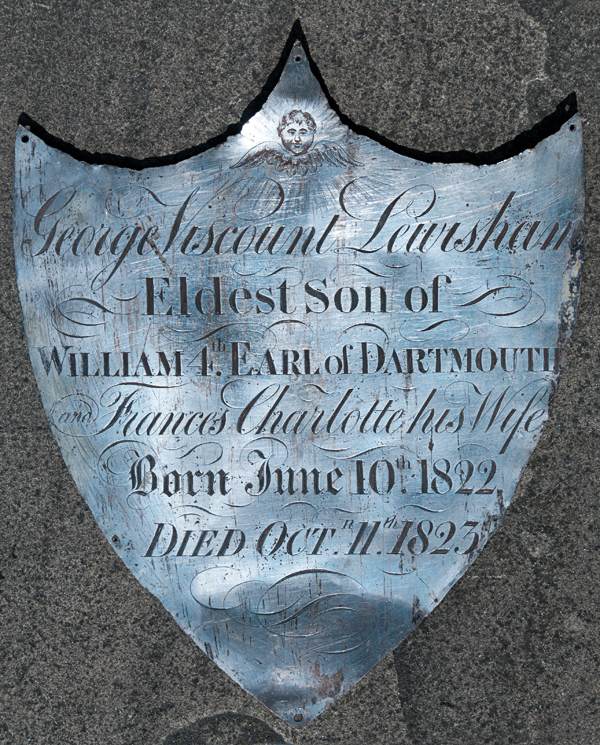
Coffin plates from Holy Trinity, Minories - now demolished







At St Clement, King Sq
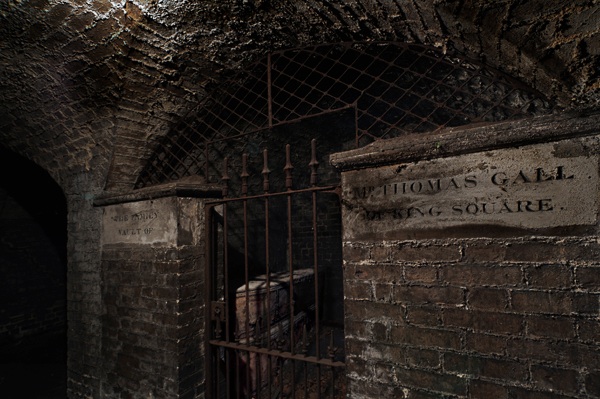
The entrance to the family vault of Mr Thomas Gall of King Sq
Crypts of London by Malcolm Johnson is published by the History Press
Photographs copyright © David Hoffman
You may also like to take a look at





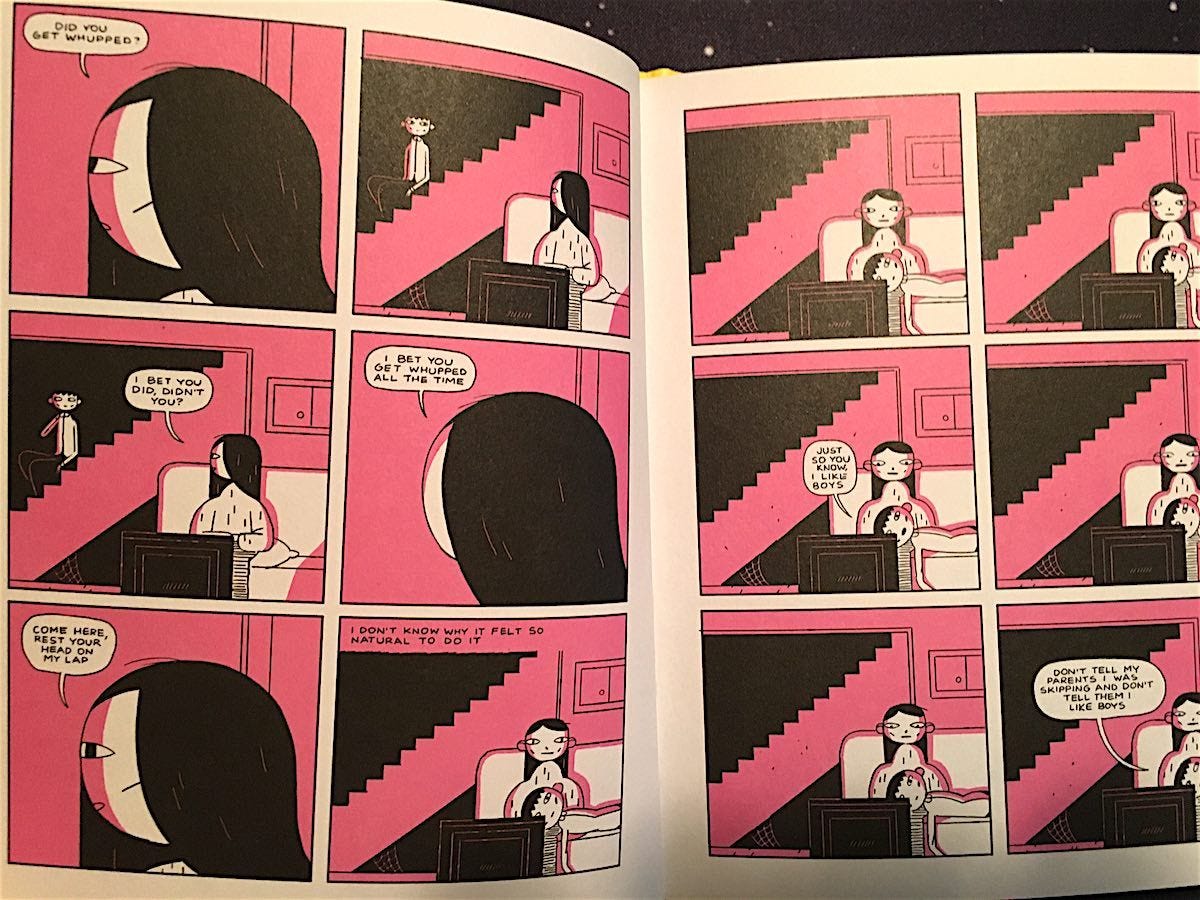


Big Kids
by Michael DeForge
Drawn & Quarterly
2016, 96 pages, 5 x 6.2 x 0.6 inches
I have been fascinated by the work of Canadian comic artist Michael DeForge for a while now. If you like unvarnished explorations of the human psyche and the high weirdness that an unhinged mind and a free hand can render, check out Michael's Lose series, Very Casual, and Dressing, all from Toronto-based comics publisher of note Koyama Press.
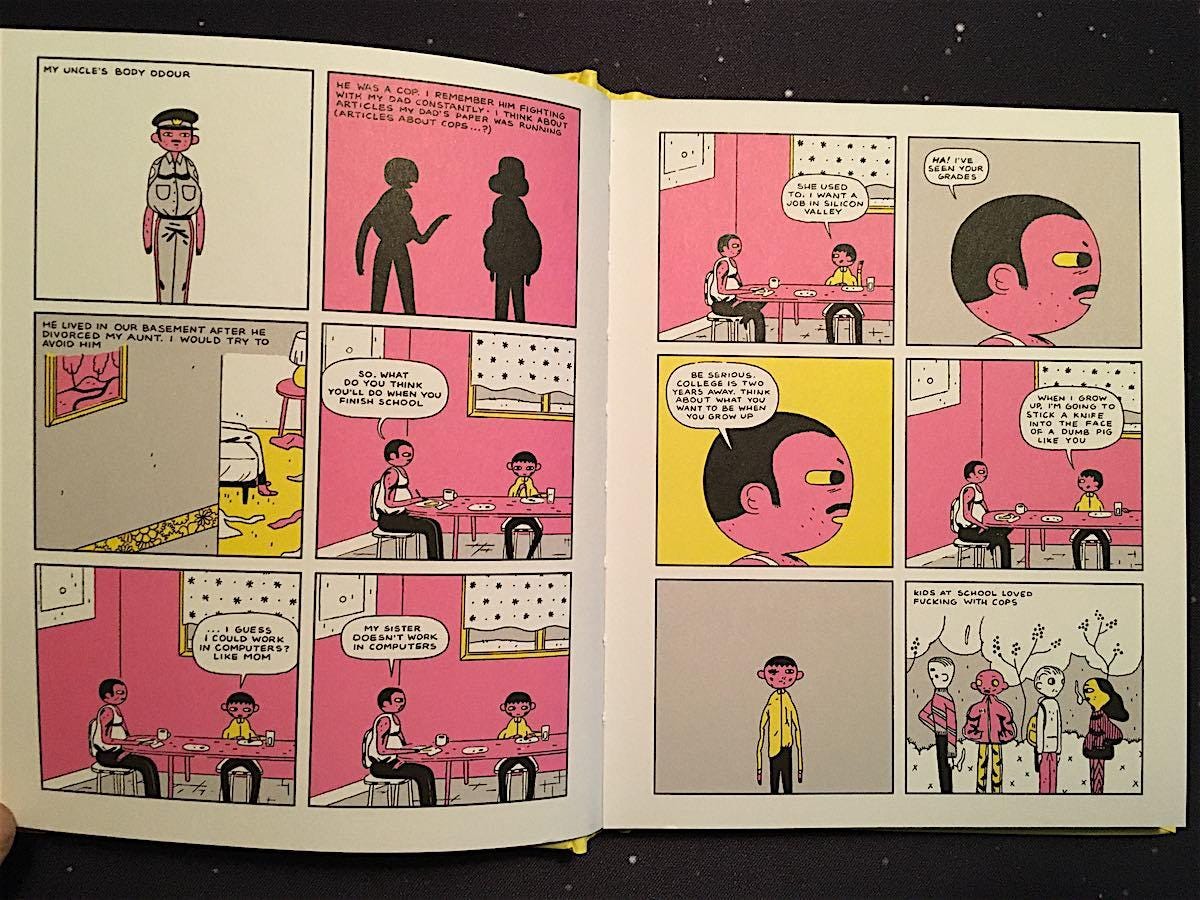
Big Kids is something of a departure for DeForge, or at least it starts off seeming that way. On the surface, Big Kids is a dark and mopey coming-of-age tale. It concerns a troubled teen boy who lives with his parents and a recalcitrant uncle in the basement and has awkward, restless sex with his best friend, in-between dangerous dares, bullying, bouts of petty vandalism, and other adolescent antics.
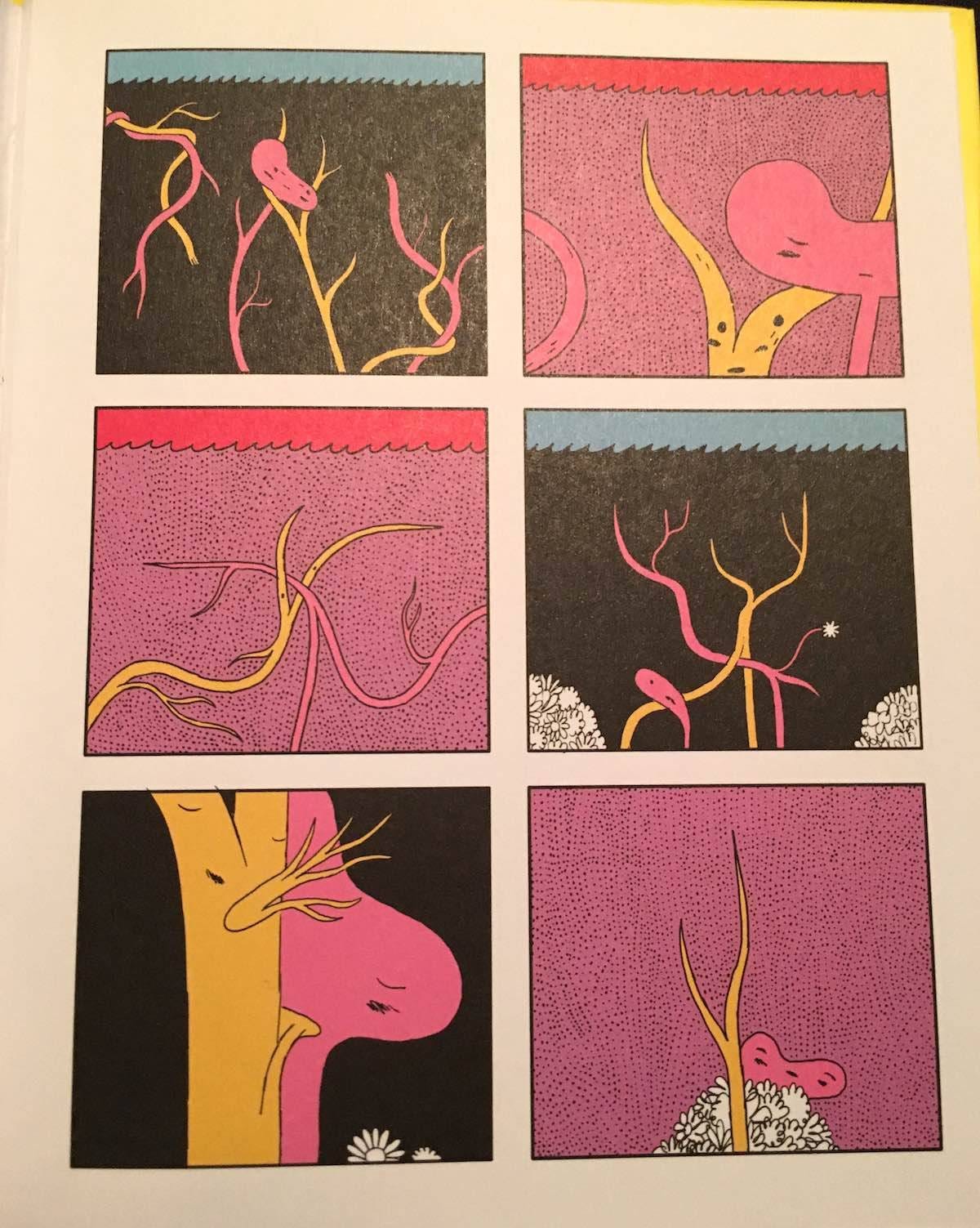
When the boy's uncle gets kicked out of the house and a female college student moves in - a girl with a very different take on life who hangs with a group of more sophisticated, less juvenile delinquent friends - something extraordinary happens. Too many other reviews of this book spoil what comes next, which I think is a shame. I knew nothing of what was about to happen and was really stunned by the whole thing as a result. The book is obviously meant to be a meditation on the profound transformations we go through at different stages in our lives (especially in becoming a teen), and how strange, terrifying, and wondrous those changes can be. But this is done in a unique way that you could never guess is coming.
Michael DeForge's work seems to be all about challenging our perceptions of identity, reality, and the comic form itself. Every time you delve into one of his pieces, you have no idea where you're going to end up. Or just how splintered your mind will be by the time you get there. Big Kids manages to do all this while still delivering a touching, if somewhat disturbed, take on a classic tale of adolescent angst. - Gareth Branwyn
PRIDE & PREJU-KNITS: 12 GENTEEL KNITTING PROJECTS INSPIRED BY JANE AUSTEN










Pride & Preju-knits: Twelve Genteel Knitting Projects Inspired by Jane Austen
by Trixie von Purl
Harper Design
2015, 112 pages, 8.6 x 6.6 x 0.4 inches (paperback)
What's the perfect book for a crafty, British literature fan with a sense of humor? It's Pride & Preju-Knits of course! "This book is my life!" my 20-year-old daughter exclaimed when she opened up this adorable do-it-yourself paperback. "I love the fact that they give you just a few simple figures to make, and then so, so many clothing options."
Pride & Preju-Knits contains 12 knitting projects (scenes) based on Austen's six novels. Every element in these scenes can be knit, including main characters, accessories, animals and furniture. There are detailed instructions on how to knit Regency ladies and gentlemen, how to knit Elizabeth Bennet's dress and Mr. Darcy's trousers from Pride and Prejudice, and even how to knit the pianoforte played by Anne Elliot in Persuasion. You can also learn to knit sheep from Sense and Sensibility and for Emma Woodhouse's wedding dress from Emma. Instructions include the materials, the gauge and how to finish off the piece. Trixie von Purl (aka Geraldine Warner) briefly recaps each Austen novel as well. Although these are very intricate projects, anyone can appreciate the imaginative handiwork and enjoy this charming little book. - Carole Rosner
Books That Belong On Paper first appeared on the web as Wink Books and was edited by Carla Sinclair. Sign up here to get the issues a week early in your inbox.

Sebastian Staacks from There Oughta Be built an LED mask that can change into any face using matrix panels, a Raspberry Pi Pico, and zip ties.
The post A Shapeshifting LED Mask for Halloween appeared first on Make: DIY Projects and Ideas for Makers.


Age verification proposals are often presented as a simple tradeoff: sacrifice a little privacy to better safeguard children online. But that framing overlooks a more fundamental question. What happens to people who cannot verify their age at all? This is particularly a problem when users are required to prove their age with identity documents.
Age-related restrictions are developing quickly around the world. While they differ radically across jurisdictions, in the past year, we've witnessed a sharp uptick toward mandatory age assurance for social media access but also for other high-risk digital services.
For example:
- In late 2025, Australia became the first country to implement a minimum age requirement for prohibiting children under age 16 from creating or holding social media accounts.
- India passed the Digital Personal Data Protection (DPDP) Act that includes mandatory verifiable parental consent and has undertaken ongoing discussions for social media restriction.
- The United Kingdom passed the Online Safety Act requiring age verification across a swath of services hosting content considered harmful to users under 18. More than half the states across the U.S. have enacted age verification laws.
- An EU Commission's expert report recommends a ban on social media access for users under 13. It also recommends mandatory age verification for platforms to ensure that users are 'age appropriate.'
Age verification laws that are predicated on the necessity of users possessing a current passport, driver's license, credit card, or similar documents proving their identity exclude critical sections of populations. And this problem is global in nature: Millions of people lack government-issued identification or encounter regular challenges to obtaining or updating it.
Roughly 15 million adult U.S. citizens lack a driver's license, and a further 2.6 million lack any government photo ID; leaving large groups blocked from online content or services. The UK has a similar predicament: proof-of-age checks are often reliant on passports, driver's licenses, or other recognized alternatives, which can pose unique challenges to people without these documents.
Much of the advocacy around age verification discusses the privacy harms of age verification. Yet these measures also threaten something more fundamental: equal access to information and the ability to exercise the right to freedom of expression.
Unfortunately, age verification systems foster unequal access to information and provide an asymmetric solution to find essential information, build community, and weigh in on public discourse. As governments and companies increasingly require users to prove their age before accessing online services, these individuals risk being excluded from large parts of the internet altogether.
Effects on Global Majority CountriesAge verification laws reshape who can speak, who can access information, and who gets excluded from the digital public sphere. In other words, age verification is not a neutral safety measure: it presents a structural barrier to disproportionately exclude certain groups—particularly those in the global majority—and alters the architecture of global online expression. Some of these groups are already marginalized offline, and age verification extends that exclusion into digital spaces.
For instance, 850 million people globally do not have ID. Most of these individuals exist in primarily low and middle income countries in Sub-Saharan Africa and South Asia. The World Bank points out that many are members of marginalized groups and more than half of those lacking access to identity documentation also have children whose births have not been registered. Women are particularly vulnerable and are 8% less likely than men to have an ID. Other vulnerable groups, such as adults in low income countries, are less likely to have an ID when they fall below 25 years, as are those with a primary school education or less or those in rural areas.
A policy paper from EDRi points out that age verification laws provide quick tech solutions but overlook longstanding structural challenges and undermine the universality of the internet. The analysis finds that age verification laws have serious human rights implications and ironically harm the very individuals they deem to protect. Moreover, these laws depend on the collection of harmful mass data that human rights organizations, including EFF, is fighting against—and has for decades.
For example:
- In Morocco, a push to restrict children's access would ban under-13s from creating accounts on gaming platforms. This could potentially create challenges for those with IDs that have incomplete information concerning the year of birth. In addition, this push would also impact those who attempt to leave Morocco.
- In Egypt, the lack of ID cards has created challenges for minority groups such as the Baha'i.
- Stateless individuals would also struggle under age verification laws. The Rohingya, the world's largest population of stateless people, often lack IDs.
- Kuwait's Bidoon population also lacks proper identification materials. According to Amnesty International, this leads many to rely on standard civil identity cards, which can be restrictive.
- Nigeria launched a national program to provide ID cards to its population in 2007. Since then, 64.4 million have registered, but that represents just over 30% of the national population.
- The Kafala system, a practice in several countries across the Middle East, also introduces challenges for age verification laws. Under this legal framework, migrant workers' legal residency and employment status are bound to a specific employer. This potentially leaves stateless persons or migrant workers vulnerable to forced labor and restricted movements.
Age verification laws are less about confirming the age of a user and more about creating barriers to online participation that many people cannot reliably scale. The net result is reduced access, more data collection, and an increased chance of unequal or mistaken exclusion from accessing information online.
Nobody doubts the importance of protecting children online. While proponents assert that age verification laws protect minors from harmful material, online harassment, and digital addiction, these laws are not the solution. They subvert fundamental freedom of expression rights and pose significant privacy risks.
EFF has long warned against age-gating the internet. Age verification technology itself is often inaccurate and privacy-invasive, and as more countries considering implementing ID-based checks, the risks move beyond censorship and surveillance toward excluding some people entirely. That's why we're working with groups in the U.S. and around the world to push back against these laws, and why we hope you join our effort.
Republished from the EFF's Deeplinks blog.
Oracle Cloud Infrastructure (OCI) customers will soon have a raft of new choices. Big Red is hosting an event in Las Vegas this week to inject more air into the AI bubble explain its latest AI investments, and front and center of those efforts are an expanded partnership with OpenAI and plans to diversify its chip offerings beyond Nvidia by bringing Google's Tensor Processing Units (TPUs) to OCI.
Oracle says its deal to add Google TPUs to OCI will make it the first hyperscale cloud platform outside Google's own cloud services to offer the chips. Those chips will be available for selection within OCI beginning in 2027, with capacity increasing over the course of several years.
While not mentioning the quantity of Google TPUs that will be available next year or beyond, it does seem that Oracle is attempting to diversify away from being so heavily reliant on Nvidia, with whom it has inked deals worth tens of billions of dollars to outfit its datacenters, including the reportedly troubled Texas project it's planning with the GPU maker and OpenAI.
"Different AI workloads have different compute needs," said OCI president Mahesh Thiagarajan. "Bringing Google TPUs to OCI gives customers … the flexibility to choose the right infrastructure for the performance, throughput, and economics of each AI workload."
Oracle isn't moving away from its partnership with OpenAI, either, announcing new ChatGPT integrations on Tuesday alongside two products that incorporate models from the House of Altman.
The first of those, Oracle AI Workspace, is billed as a "single user experience that brings OpenAI frontier models together with Oracle applications, enterprise data, and cloud services" through ChatGPT plugins that basically turn Oracle's existing business platforms into ChatGPT-accessible resources.
"The Oracle AI Workspace will make the breadth of Oracle's capabilities agent-ready and accessible to ChatGPT users," the company explained. "People can describe business goals and these plugins in ChatGPT will bring together the right Oracle tools and information to help them accomplish it."
Along with giving OpenAI-powered tools access to selected business data, Oracle is hoping customers will also trust the models to help handle cybersecurity with the second new product, Oracle AI Security Mesh, "a managed platform that combines frontier AI models for cybersecurity … with Oracle's proven security expertise."
As you might assume from its name and description, Oracle AI Security Mesh will use OpenAI cybersecurity models to find vulnerabilities, test whether they can be exploited, and recommend fixes in areas of a company's tech stack that it authorizes the Oracle-managed service to examine.
Oracle also announced a deal with Snowflake to bring its AI data cloud to OCI as a native service. The new partnership will allow Oracle customers to purchase and use Snowflake directly from Oracle, which will handle all pricing, discounts, and billing. Oracle Universal Credits will also be usable through Snowflake on OCI, allowing users who already spend money on Oracle credits to use them for the newly available offering.
Nvidia not exempt from announcementsOracle may be diversifying its OCI chip offerings, but it still announced new Nvidia hardware in Las Vegas, too.
Big Red announced the general availability of Nvidia Vera Rubin NVL72 systems and Nvidia Vera CPUs on Tuesday, along with plans to introduce HGX Rubin NVL8 systems, though it did not specify when those would become available.
"By combining NVIDIA Vera Rubin GPUs and Vera CPUs with Oracle Acceleron networking and AI-optimized data centers, we're helping customers keep GPUs productive, secure, and scale efficiently as their needs grow," Thiagarajan said.
Oracle posted record earnings in the quarter ending August 31, with revenue up 30 percent year over year as its AI investments have begun to pay dividends. Those dividends appear to be paying off for other AI firms as well, though there's little evidence of similar returns outside the tech sector, raising fresh concerns about an AI bubble that's starting to look a bit taut.
There are already signs that the AI bubble has begun to burst in China, and Oracle's Las Vegas announcements largely involve more circular spending among AI's top players as businesses continue to wait for results. ®
Anthropic, prone to pronouncements about model safety, has given developers using Claude Code the opportunity to throw its guardrails out the window. The company's latest Claude Code build (v2.1.311) supports an environmental variable designed to allow the AI agent to run the rm command, which deletes files, without asking for approval.
The designated environmental variable (a value developers set in their shell) is called:
CLAUDE_CODE_EVEN_MORE_DANGEROUSLY_SKIP_PERMISSIONS.
Daisy Hollman, a member of technical staff at Anthropic, announced the change in a social media post.
"Fun fact: --dangerously-skip-permissions doesn't actually approve EVERYTHING - we still block some obvious things like rm -rf ~," she wrote. "But today's release will let you disable this if you really want, by setting a new env var CLAUDE_CODE_EVEN_MORE_DANGEROUSLY_SKIP_PERMISSIONS=1"
Not everyone believed Hollman, perhaps due to the absurdity of the variable name or because the change isn't listed in the v2.1.311 change log. But she offered reassurance that it's real.
"Not a joke!" she responded. "I hope this helps, and I hope the variable name is memorable."
The name is easy to remember because it is very much like the aforementioned Claude Code flag --dangerously-skip-permissions. That command line flag enables bypassPermissions mode, which first surfaced in Claude Code v1.0.18, on June 9, 2025.
Claude Code has several permission modes: default, acceptEdits, plan, auto, dontAsk, and bypassPermissions. Auto mode, which nominally allows everything but runs background safety checks, became the default in August; bypassPermissions also nominally allows everything, without the safety checks.
But there are still exceptions that do not get automatically approved and require a permission prompt, such as rm and rmdir.
The new CLAUDE_CODE_EVEN_MORE_DANGEROUSLY_SKIP_PERMISSIONS environmental variable removes this last agentic restraint, though other things like managed settings may impose their own limitations.
It's perhaps worth noting that there are numerous accounts of AI agents issuing commands like rm -rf ~ that wipe hard drives or take other action that results in data loss. But as they say, you only live once. ®
An autonomous AI agent discovered four vulnerabilities in the decades-old, widely used EPICS (Experimental Physics and Industrial Control System) open source software toolkit, including a critical flaw that could allow remote attackers to execute code on systems used to control particle accelerators and fusion experiments.
The bugs include a critical, 9.8-rated under CVSS v3.1 integer overflow vulnerability (CVE-2026-114595), leading to an attacker-controlled out-of-bounds heap write and potentially remote code execution; an 8.2-rated, high-severity, improper message-length validation flaw (CVE-2026-114596), causing an out-of-bounds memory write and controller-process crash; a 7.5-rated, high-severity insufficient bounds checking bug (CVE-2026-114597) that allows out-of-bounds memory reads and process crashes; and a 7.5-rated, high-severity type confusion flaw (CVE-2026-114598) that can lead to denial of service and could expose adjacent memory contents.
All four affect EPICS Base, which is used to operate some of the world's largest scientific research projects and facilities, and organizations should update to version 7.0.11, which includes the fixes.
"Successful exploitation of these vulnerabilities could allow an attacker to cause a denial-of-service condition, corrupt memory, disclose sensitive information, or potentially execute arbitrary code," the US Cybersecurity and Infrastructure Security Agency (CISA) warned in a Tuesday advisory.
An AI agent called Cipher independently found all four previously unknown security holes - investigating and testing the unfamiliar EPICS system, and validating the four exploits - in three hours and 49 minutes, Causal Security co-founder Shubham Raj told The Register.
"The initial investigation required no human intervention, followed by one instruction authorizing deeper exploitability testing in a secure environment," Raj said.
Earlier this year, Causal Security's Cipher, which Raj described as "a fully autonomous super hacker that can reason across the technology stack," found multiple critical attack paths in power-grid systems used across North America and Europe, prompting an October 8 security advisory from CISA.
EPICS, originally developed by Los Alamos National Laboratory and Argonne National Laboratory, is used to build and remotely control distributed Supervisory Control and Data Acquisition (SCADA) systems, connecting operators to physical devices. It's used in around 90 major scientific, university, and industrial projects and facilities globally including Argonne National Laboratory's Advanced Photon Source and ITER's fusion reactor control system.
All four of these flaws illustrate how AI agents are really good at finding vulnerabilities in industrial and operational technologies - systems and equipment that used to be able to rely on obscurity to protect them from hackers - and add to defenders' concerns that it's only a matter of time until an autonomous cyberattack shuts down critical services, like power grids or water systems. These are the types of digital intrusions that can cause physical harm.
Raj points to CVE-2026-114595, the critical integer-overflow vulnerability, as an example. "It allows attacker-controlled network data to cause an out-of-bounds heap memory write, with potential for remote code execution," he told us.
"EPICS controllers sit between operators and physical equipment, handling measurements, commands, and control functions," he continued. "Operationally: Imagine a particle accelerator in the middle of an expensive experiment. An attacker could potentially crash a controller, interrupt critical measurements or control functions, and force operators to halt the experiment. That could mean lost experimental work, significant downtime, and expensive recovery."
Plus, if an attacker was able to develop an RCE exploit, this could allow them to "take control of the affected process, manipulate readings, interfere with control functions, or disrupt the equipment connected to it," Raj said.
The prerequisite for exploiting these vulns in a real scientific facility is being able to reach the vulnerable EPICS services on a facility's control network. But this could occur if the networks weren't sufficiently segmented, or another system had access to the vulnerable EPICS network.
"Once an attacker is able to find a network, which is either misconfigured or they are able to reach, it's pretty easy to carry out the attacks," Raj said, adding that exploitation wouldn't require deep OT knowledge, or understanding of how particle accelerators or fusion reactors work. "Someone with conventional exploitation skills could investigate them, and increasingly capable AI systems could help develop exploits without requiring specialized OT expertise."
Manipulating specific physical processes does require additional knowledge, he added. "But an attacker doesn't need to understand the physics of a particle accelerator to disrupt the software controlling it. Crashing critical processes or interrupting monitoring and control can already have serious operational consequences. What's changing is that attackers may no longer need years of specialized expertise just to discover these weaknesses." ®
If you were waiting to upgrade your Mac until you could get one with the latest CPU, the wait is over. Apple's 6th-gen M-series processors are finally trickling down to its 14-inch MacBook Pro and iMac family early next month.
Available in either "space black" or silver, Apple's base-model MacBook Pro is largely unchanged from last gen. This is a mid-cycle refresh and so most of the improvements are under the hood. It sports the same high-res mini-LED display, chiclet keyboard, and port selection as its predecessor.
Most of the improvements come from the silicon itself. Announced alongside a refreshed Mac mini in August, and fabbed on TSMC's 2nm process tech, the M6 features a refreshed CPU with 12 CPU and 12 GPU cores, and is now complemented by a dual 16-core Neural Engine (what Apple calls its NPUs) which promises better performance for the slew of Apple Intelligence features now baked into macOS Golden Gate.
The M6 MacBook Pro comes standard with 16 GB of unified memory, good for 153 GB/s of bandwidth. Memory can be specced up to 24 GB or 32 GB, boosting bandwidth to 170 GB/s for those with more demanding workloads or, as is more often the case, an aversion to closing Chrome tabs.
Compared to the outgoing M5, which for the moment is still available in the MacBook Air, Apple says the M6 delivers significant performance gains thanks to the addition of two more cores. In Xcode, Apple boasts up to 30 percent higher performance versus a similarly equipped M5 MacBook Pro.
The GPU enjoys similar gains in Blender ray tracing, local AI inference, and image processing, delivering 1.3x faster prompt processing and 1.3x faster rendering, and 1.2x faster performance in the Affinity creative suite.
Despite higher performance, Apple boasts the same 24-hour battery life as the outgoing M5 model. Pricing also remains unchanged. A 16 GB model with 1 TB of solid state storage will set you back $1,999.
One area of improvement not related to performance is connectivity. The M6 finally brings Wi-Fi 7 and Bluetooth 6 connectivity to the 14-inch MacBook Pro.
The majority of these improvements also come to Apple's most colorful of all-in-one desktops: the iMac. Here the performance jump is even larger, owing to the fact the machine never got the M5. Apple claims 1.5x faster performance in productivity apps like Excel, 2x faster graphics performance and 5x faster in local AI.
Continuing the trend of better connectivity, along with Wi-Fi 7 and Bluetooth 6, certain iMac models also gain 2.5 Gbps Ethernet. As with the MacBook Pro, pricing remains unchanged, with iMacs starting at $1,499.
Both the M6 MacBook Pro and iMac are available for preorder starting tomorrow with availability beginning Friday, Nov. 6. ®


America is a politically polarized country. But one topic has both the left and the right in full agreement: Flock cameras suck. No one likes the government spying on them.
To make matters worse, police and 911 staff enjoy using Flock cameras to stalk their exes. — Read the rest
The post Police and 911 staff have used Flock cameras to stalk their exes appeared first on Boing Boing.

A man and his wife were taking a relaxing poolside vacation when suddenly a monkey jumped into his lap. Instead of being afraid, the man decided to cuddle the monkey back. The monkey had already decided that this man was her new best friend, and what happens next is unbelievably sweet. — Read the rest
The post A mama monkey picks a vacationing man as her safe place to rest with her baby appeared first on Boing Boing.

Often, the coolest art comes from simple, often unnoticed materials. When reimagined into a new context, everyday household materials can be the base for wonderful works of art. I've always loved watching people transform everyday materials into new ideas.
This aluminum foil piece, Cats and Mice by artist Dean Millien, fills me with joy. — Read the rest
The post An artist sculpts magical cats and mice out of aluminum foil appeared first on Boing Boing.

This fascinating animation clip is from a film called Renaissance, made in 1963 by Walerian Borowczyk. The stop-motion animation shows a destroyed room that slowly puts itself back together. It suggests that a ghost is moving everything around and reconstructing each broken item. — Read the rest
The post In this 1963 stop-motion film, a destroyed room puts itself back together appeared first on Boing Boing.
Coastal communities across California were preparing for days of flooding amid potentially 'record-breaking tides' this week, as water levels began rising on Monday.
Continue reading...



TL;DR: Use GPT-5.5 Pro, Claude 4.6 Sonnet, and Gemini 3.1 Pro in one app with a 1min.AI Advanced Business Plan for a one-time $69.97 (reg. $540).
Every few months, a new chatbot is declared the winner in the ChatGPT versus Claude debate, and testing them yourself usually means paying $20 a month for each. — Read the rest
The post Settle the ChatGPT vs. Claude debate yourself for $70 appeared first on Boing Boing.

There are details, but the whole story is in the headline. Conspiracy theorist weirdo RFK Jr. says a racist thing and is immediately wrong.
Campaigning in Michigan for Mike Rogers, the Secretary of Health and Human Services took a break from spreading falsehoods about good health practices and instead turned to racist lies trying to undermine an excellent Senate candidate. — Read the rest
The post RFK Jr. says Arabs don't win Nobel Prizes. Last year's chemistry winner was born in Jordan appeared first on Boing Boing.
It wasn't until after immigration officers started murdering US citizens that the Trump administration finally agreed to do anything about it. First, Trump turfed Kristi Noem, setting her up with a "special envoy" dead end job (which has also now come to an end). Then it elevated Markwayne Mullin, who first insisted his priority was to tone down things a bit to keep ICE from generating negative press on a daily basis.
Pressure was applied to outfit ICE officers with body cameras. Hilariously, DHS officials claimed there simply wasn't any money to do this, despite ICE now commanding the most money of any federal law enforcement agency. More money was given to ICE to handle this fake budgetary shortfall, which then led to a lot of things, none of which did much to rein in ICE's tendency to abuse its power, violate rights, and engage in violence.
First, the rollout was slow-walked. The deadline for deployment kept being pushed back. When full deployment finally arrived, it was pushed back even further by vague claims about delays in training. Then the DHS made it clear body cam footage would be almost inaccessible by the public. Finally, the cameras were being worn by officers but somehow never seemed to be rolling when officers violated rights, abused their power, or engaged in violence.
The Government Accountablity Office was asked to look into ICE's body cam program. The resulting report [PDF] noted that while this was better than not having cameras, it left a lot to be desired.
The report, requested by congressional Democrats, comes as they have fumed about slow deployment of the cameras as well as ICE officers' failure to activate them in a string of shootings, including during multiple fatal interactions. ICE officers have killed six people since President Trump took office.
"ICE has not implemented controls to help ensure compliance with activating cameras when required by policy," GAO concluded in its report.
First of all, while ICE has promised to outfit all field officers with cameras, it has continued to delay the rollout because it is continually onboarding new hires. This is a problem that's never going to go away — not when the administration is constantly demanding more officers and more arrests and the agency isn't able (or willing) to throw more money and personnel at training programs to ensure new hires are both trained and outfitted with these mandatory recording devices. According to what's stated in the GAO's report, ICE has decided the best stop-gap solution is to… just stop buying more body cameras.
[A]s of June 2026 ICE has not updated its plans to reflect changes stemming from an increase in the total number of cameras scheduled for deployment and schedule delays caused by the pause in further camera deployment. Further, ICE, like CBP, is at least one year behind its 2024 plan.
Additionally, ICE's overall deployment needs have increased. Specifically, according to ICE program officials, the component intends to provide cameras to all personnel, including planned future hires. In July 2025, ICE initiated a hiring surge of about 12,000 additional personnel. However, the number of cameras scheduled for deployment documented in its 2024 plan has remained relatively stable as of April 2026.
While both CBP and ICE have policies that state officers must start recording at the beginning of "encounters," only CBP seems interested in actually making this happen. It does have some auto-record options deployed. The GAO recommended ICE do the same thing. And despite both agencies being housed by the DHS, ICE has affirmatively stated that it won't implement auto-activation features in cameras worn by ICE officers.
ICE disagrees that it is necessary to implement additional controls or procure the accessories required for automatic activation, which triggers upon the drawing of a firearm or TASER. Specifically, automated activation presents significant operational risks, including inadvertent or false activations during routine movements.
ICE then goes on to list the possible "harms" of auto-activation, which include recording discussions with "informants or victims," as well as the "inadvertent" documentation of First Amendment activities. This might mean something if (1) ICE didn't control the recorded footage, (2) allow officers to record people engaged in protected First Amendment activities, and (3) ICE officers didn't routinely leave their cameras off when engaging in violent acts.
In the end, this is nothing more than ICE telling everyone — the people it serves and the people it answers to — that the body cameras are nothing more than expensive lip service. These devices aren't going to be used to hold officers accountable. If they're used for anything at all, it will be to find more charges to throw at arrestees or selectively released to support the government's preferred narratives.
The big Meta settlement with a bunch of states got most of the headlines, but state AGs have gone all in on suing tech companies of late, and it shows no signs of slowing down. Last week things went ballistic when the judge in New Mexico's case (New Mexico being one of the few states that refused to join the others in settling) ordered Meta to pay a $25 billion penalty. As Daphne Keller points out, a rough back-of-the-envelope calculation shows that $15 billion of that judgment covers the same claims that all the other states together settled for just $459 million (though Meta has said it will fight the ruling).
As we discussed earlier, TikTok also settled with Alabama in a separate case. But the cases just keep coming. Rhode Island just sued Meta (again), this time claiming it allowed scam ads to run rampant on the site. And a group of state AGs (mostly using the same outside law firm) sued OpenAI separately (same basic lawsuits filed individually in each court). TikTok, Snap, YouTube, all face additional similar lawsuits as well.
Many people are cheering these lawsuits on, and you can understand why. These are some of the most hated companies on the planet right now. No one trusts the big Silicon Valley companies and their broligarch CEOs who seemed willing and eager to fall in line (literally) behind the fascism of Donald Trump. Not to mention the enshittification. Oh so much enshittification. And then add the relentless attempts to force AI tools into places people clearly don't want them.
People were understandably and reasonably fed up. And they wanted blood. Massive verdicts deliver it.
But as I've warned, we shouldn't be too quick to celebrate these kinds of things. Indeed, we may quickly be learning exactly why I was so concerned with those early verdicts against Meta earlier this year. As I noted at the time, some of those cases were the kinds of lawsuits that Section 230 was supposed to protect against — and for good reason. Other cases (like the latest New Mexico ruling) do involve statements by the company (thus they're not Section 230 issues) but are still equally problematic, as we'll discuss below.
First, most of the product liability, negligent design, and kid safety cases really shouldn't even exist under Section 230. Effectively all of them are predicated on the fact that some people do bad things, some (not all) of which were loosely connected to the internet services that are being sued, under the theory that the internet companies should have prevented the bad things from ever happening. But the entire premise of Section 230 was that if you hold internet platforms liable for every bad thing that happens on them, they will massively crack down on speech online, to avoid facing liability. It turns the internet from being a global communications network… into a bland "broadcast" tool, where only approved content gets shared.
It also makes it almost impossible to run an online platform that allows third party speech unless you have massive resources and a building full of lawyers. In other words, it means that only the largest internet companies can survive, while making it way harder for there to be any new entrants in the market.
There's a reason that State Attorneys General spent many, many years pushing Congress to amend Section 230 to carve out the enforcement of state laws. They never actually got that. But they may have gotten something better. A bunch of judges who decided that state AGs and the courts can simply ignore Section 230 and hold internet companies liable for things their users do, so long as you claim the bad things were due to "product design" or "negligence." The Ninth Circuit recently eviscerated the key part of the law that was supposed to stop exactly these kinds of cases.
It's the "get around 230" trick that collapsed the entire law.
As for the New Mexico case (and some of the new Rhode Island case), they are, in theory, predicated on statements by the company. But when I look at the New Mexico ruling (even setting aside the size of the judgment), I can't figure out how it makes any sense. The jury verdict is based on the claim that public statements by Meta and some of its executives were "willfully deceptive." And, as someone who doesn't trust Zuckerberg or Meta at all — and who has called out some of his willfully deceptive statements in the past — I was primed to side with the jury.
But look at the "statements" in question. I'm having trouble seeing how any of them are actually deceptive in any meaningful way. I'm not going to post them all, but they all seem mostly true, even if the public believes otherwise. Take for example:
"We don't sell your data and we don't tell advertisers who you are. What we do is allow advertisers to reach people interested in their products."
This statement (by Sheryl Sandberg in this case) is… accurate. I know that, broadly, people often claim that "big tech sells your data" but that's never actually been true. Their business model has always been based on selling advertisers access to your feed based on your data. That's a very different thing. What the company does is allow advertisers to target you based on the data Meta has about you, but the advertiser never gets or sees any identifying information from you or data about you. There are data brokers out there that do sell that kind of data (and those should be wiped off the earth, as far as I'm concerned), but that's never been any of the big tech companies' business. Indeed, one of the statements the jury found deceptive was Mark Zuckerberg accurately describing this dynamic:
"There are other internet companies or data brokers or folks that might try to track and sell data, but we don't buy and sell."
That's an accurate statement! But the jury found that this one statement alone generated 1,386,648 violations of the law! What?!? How that and all the other "violations" (almost 44 million of them!) came about is also highly questionable. It assumes that each New Mexico resident who might have come across one of the statements counts as an actual violation under the law:
It assigned 2.1 million violations to each of 11 statements that appeared in major news outlets and 1,386,648 to each of 15 statements made through company channels, including its newsroom, executives' Facebook posts, earnings calls and a developer conference, for a total of 43,899,720.
According to reports, 2.1 million was the population of New Mexico in 2020. 1.4 million was the number of New Mexico residents with active Facebook accounts at the time. So basically the jury claimed that each person who could have seen one of those statements because they appeared in a major news outlet… equals a violation of the law. And for the statements made on Facebook/Meta properties themselves, they assume every person with an account could have seen it, making it another violation. That calculation seems… bizarre. Lawyers are already saying they doubt it will hold up on appeal.
Even worse, Meta execs also got dinged for general statements about how they try to take down misinformation and don't profit from misinformation:
"Well, if we see harmful misinformation on the platform, then we take it down. It's against our policy. So the 18 million number that I shared is the number of pieces of content that we've seen on the platform that we take down. Now, do we catch everything? Of course there are mistakes that we make or areas where we need to improve, but that's the best number that we have in terms of what we've seen and what our systems have been able to detect."
That's Zuck again, and that statement is also… pretty accurate? They certainly do miss some harmful content, but that is the nature of content moderation, especially when you have billions of users around the globe. I don't see how that claim can be deceptive.
In court, New Mexico apparently argued that this was deceptive because of Meta's Xcheck program. But as we were just discussing last week, there was a perfectly valid reason for Xcheck. It was the program that was put in place to deal with high profile accounts. Those were the accounts where Meta recognized that if they made a mistake, and took down those accounts incorrectly, it would make the company look really bad. So they created a system where no action would be taken on those accounts without a secondary human review. Given the situation, this sounds reasonable. It's what most companies would do facing similar challenges (and, it is, in fact, what most companies have done).
But when Frances Haugen released the details of this program, it was reported on (misleadingly) as "Meta allowing the elite to violate its rules." But that's not what the program was for. It was to make sure there was additional human review, even if that review sometimes took too long.

But New Mexico presented it to the jury as Meta claiming to take down harmful misinformation while secretly using Xcheck to let big accounts spread it, and the jury (and now the judge) punished Meta accordingly.
I'm honestly not sure how any internet company avoids facing a similar risk down the road. When an AG can take broadly true statements, strip them of context, and call them deceptive (when the only deceptive thing is the AG's presentation), how can any company survive such lawsuits?
And, with the chance to get a $25 billion award from it, these lawsuits are going to be everywhere. It could even be worse, given that New Mexico actually asked for even more, and the judge said he could have ordered a penalty over $200 billion. And, again, these are for basically true statements! How do you run an internet company with that kind of threat of liability over your head?
Even if you look at the strongest elements of New Mexico's case against Meta, I'm left a bit baffled. The key part of the case resolved around the claim that "You have control over how your information is shared," which was a statement from back in 2010. The court in New Mexico claimed that was deceptive… because of the FTC's $5 billion fine of Meta, over the Cambridge Analytica scandal. That fine hinged on the same claim, with the FTC arguing that it was misleading by Meta to claim that because anyone could also share their friend graph, and since that graph includes information about other people (namely that you are connected to others), they argued that revealed private info.
But, as we noted at the time, that doesn't seem like that big a deal? Knowing who is in your friend graph from a social media site doesn't really seem like violating privacy. Friend graphs are… just how social media works. There's also no evidence that anyone was directly "harmed" from the ability to access a friend graph this way.
Finally: the FTC fined Facebook for this already, and did so at $5 billion for the entire country. Why does anyone think that New Mexico alone deserves 5X that amount?
Combined with the judgments and the settlements, these cases are going to keep piling up, and they're going to make the internet worse in almost every way. If you thought enshittification was bad before, wait until politicians and judges are the true product managers for the internet, driven by headline seeking and profit maximizing Attorneys General who will view suing tech companies as a way to fill state coffers.
People can celebrate the fact that big internet companies we all hate are losing cases and having to pay, but the end result won't be a better internet. It will be one driven by politicians looking to shake down tech companies any time anything "bad" happens online. That's going to lead to way more restrictions on the internet. Way more identity verification to do anything. Way less innovation (and new offerings will have to go through an exhaustive legal review — not to make them better, but to make them less likely to end up in court). It's also going to lead to way less transparency. The New Mexico verdict means that even accurately describing how your site works can lead to a massive verdict against you, so companies are going to tell execs to shut up completely. This will also mean very few new competitors — except those with massive bank accounts. The broligarchs will be able to afford the liability risks of new services. Everyone else will be priced out.
This was the world that Ron Wyden and Chris Cox sought to avoid when they authored Section 230 30 years ago. But it's here now — even without the repeal of Section 230 — and we're going to see just how bad that is for the internet.
Ford's new Fathom electric pickup truck -- which is still under wraps -- comes with a new bidirectional EV charging system that eliminates the cost of an external inverter.
The post Look Ma, No Inverter! New Ford Fathom Cuts The Cost Of Bidirectional EV Charging appeared first on CleanTechnica.
A DSA-backed California prosecutor who helped force Meta to pay a historic $17 billion settlement this year is on a glide path to become the top lawyer for Los Angeles — unless a tech investor cozy with Elon Musk can spend enough to stop her.
San Francisco resident John Hering has sunk more than $1.25 million into an effort to defeat Marissa Roy, a deputy attorney general at the California Department of Justice endorsed by the LA chapter of the Democratic Socialists of America, and to support John McKinney, a county prosecutor running an uphill general election campaign. It's a heavy injection of cash from a single individual in a local race for a little-known office, but it pales in comparison to Hering's private-sector spending: In 2022, his investment firm Vy Capital pumped $700 million into Musk's takeover of the company then known as Twitter and $300 million into his tunnel-construction Boring Company.
A co-founder of the cybersecurity company Lookout, Hering is spending in line with the tech industry in which he's long been invested. While the city attorney's office is commonly used as the city's defense against litigious residents, the office also carries the power to mold legislation, enforce state law, such as labor protections, and take on corporations and the federal government in court. Roy has vowed to wield the office's regulatory muscle against corporations — including Big Tech.
"Monopolies and Big Tech are things that [Roy] sees as an opportunity to wage battle against," said former LA City Councilmember Mike Bonin, who has not endorsed either candidate. "If I were Big Tech, I would certainly think, 'OK, well, this is someone who is a potential threat.'"
Hering, who did not respond to The Intercept's request for comment, is part of a group of tech titans backing McKinney. Others include the founders of Ring, Tinder, and Boingo, and investors in Anthropic, Anduril, and SpaceX, who have collectively put more than $1.9 million into pro-McKinney committees. A group called "Committee to Expand the Middle Class Candidate" — backed by the property rental tech giant Airbnb — donated an additional $4.2 million to a committee supporting McKinney.
To help get McKinney through the June primary election, Hering and fellow tech investor Diego Berdakin poured more than $1 million into another committee. Over the past month, Hering's general-election spending group, Neighbors for John McKinney, has been paying for TV and online ads and mailers that play up McKinney as "a lifelong Democrat" and "100% anti-MAGA."
The same can hardly be said for the group's top funder.
After giving to Hillary Clinton's failed 2016 presidential bid and Democratic candidates like Beto O'Rourke, Hering donated $41,300 to the Republican National Committee and $500,000 to Musk's America PAC in 2024 to support Donald Trump's run for president. He has publicly praised Musk's chaotic purge of the federal government through his so-called Department of Government Efficiency program and called the world's richest man an "American hero" for offering to pay TSA salaries during the spring government shutdown. In 2025, Hering and Ring founder Jamie Siminoff, who has also donated to Neighbors for John McKinney, attended a White House dinner where Trump hosted dozens of high-profile Silicon Valley figures. The pro-McKinney group is also funded by billionaires Rick Caruso, a failed LA mayoral candidate, and Ron Burkle, a Democratic megadonor.
Earlier this cycle, Hering, who listed San Francisco as his residence in campaign finance documents, also waded into the LA mayoral election — boosting right-wing reality star Spencer Pratt.
Tech industry spending in LA's elections arrives amid a midterm cycle where Big Tech and artificial intelligence have doled out millions of dollars to exert influence in congressional and state races across the U.S. as lawmakers grapple with how to regulate the industries. Musk, for example, has dropped more than $442 million into the midterms, including more than $70 million in his political action committee, America PAC, in October alone. And in state Assembly and Senate races across California, tech and AI executives have spent more than $29 million, according to Tech Equity Action, a political nonprofit that lobbies to craft tech-related legislation while advocating for workers' rights.
 Related
The AI Doomsday Future Is Not Inevitable
California Gov. Gavin Newsom gave big AI companies a scare last month, when he signed a slate of bills protecting workers from AI overreach, like limiting its use to terminate or discipline workers, banning employers from using AI to surveil employees in bathrooms, and assuring that human healthcare workers will have the final say on patient care decisions.
The tech industry had fought hard to kill the bills, and while Newsom did offer the industry some concessions, labor organizers say the new laws offer them an opportunity to expand local worker protections, too.
In LA, Roy has said she would use the city attorney's office to fight for workers against losses in potential wages, promising that she would go after "large corporations and big tech companies" that "misclassify workers as independent contractors to avoid paying them minimum wage and providing benefits," according to her campaign website. She also spoke against companies who are increasingly using automation "to evade regulations and eliminate jobs."
Tech leaders may view a city attorney with an appetite for regulation as "existential to their business model," said Brian Justie, a researcher at the UCLA Labor Center who was part of the coalition that pushed for the bills.
"What happens in California sets a precedent and serves as a blueprint for the rest of the country," Justie said. "And so if you're a Big Tech, you really need to have a certain outcome come to pass here to avoid ripple effects elsewhere."
 Related
Facing Outraged Residents, Flock Got Help From Group That Uses AI to Rally Public Support
For his part, McKinney has blasted Roy for her desire to "turn the city attorney's office into the country's largest public interest law firm" as out of touch with what LA voters want. However, voters across the U.S. have increasingly expressed opposition to the expansion of artificial intelligence and the construction of data centers. Roy's campaign has shown a willingness to lend an ear to growing AI anxieties.
"Billionaires don't want to answer to the working people, consumers, and communities they exploit," Roy said in a statement to The Intercept. "But as Los Angeles' City Attorney, I intend to hold them, their corporations, and the MAGA Republicans that permit their behavior accountable — that's why they're spending on someone who won't."
McKinney did not respond to The Intercept's request for comment.
Ads put out by Neighbors for John McKinney assert that McKinney would "take on crooked landlords." The committee's website said he would fight for tenant's "legal protections" against things like "illegal eviction." But among the committee's biggest funders is the Santa Monica-based real estate firm, Douglas Emmett Properties, which attempted to carry out one of the largest mass evictions in LA history until it was overruled by a judge. Douglas Emmett donated $250,000 to Neighbors for John McKinney in late September.
 Related
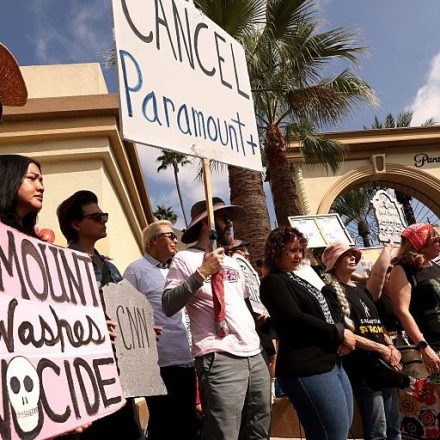
The Ellisons Could Make a Killing in Big Surveillance With the Paramount Merger
Neighbors for John McKinney has also funded attack ads against Roy that paint her as an inexperienced attorney who is weak on crime and has "extreme DSA" positions. The ads cite an article by the conservative California Post, a West Coast spinoff of the New York tabloid, that claimed she had supported a freeze on prosecuting misdemeanors, which she denies.
McKinney campaigns in the mold of law-and-order candidates, pledging to address homelessness and public safety by prosecuting misdemeanors, touting closer relationships with police, and promising to revive a neighborhood prosecutor program. Other California tech-supported efforts have echoed the same — like when tech leaders in the San Francisco Bay Area fueled a successful effort to oust progressive District Attorney Chesa Boudin.
But the LA city attorney's office holds limited criminal enforcement power, Bonin pointed out. He suspects the tech investment in the LA race is more concerned with potential civil litigation, and he thinks that if voters make that connection, it could spell an issue for the campaign.
"Voters are concerned about Big Tech, they're certainly concerned about AI, they're concerned about the influence of — I don't think you can describe it any other way — 21st-century robber barons," Bonin said. "Income inequality is a big issue in Los Angeles, so if they make the connection that this funding is symbolic of the agenda that McKinney will pursue … then it becomes more of an issue."
Roxana Tynan, executive director of the Los Angeles Alliance for a New Economy, called the amount of Big Tech money being spent in the race "outrageous." As she and other labor rights groups gear up for a fight for more worker AI protections in LA — like expanding safeguards to include temporary and gig workers, and banning employers from using AI software to collect sensitive worker information — she said she hoped people would follow the money being poured into the race and the influence that a few figures look to exert on the city.
"These are people who really believe that not only can they buy elections," Tynan said, "but that they deserve to buy elections."
The post The Elon Musk Funder Trying to Sway the Race for LA's Top Lawyer appeared first on The Intercept.


