

Apple has confirmed problems with the folding screen on its flagship iPhone Duo after reports of misbehaving displays spread among its customer base.
A company spokesperson told The Register, "We are aware of an issue impacting the inner display on a small number of iPhone Duo units."
"If users experience issues with their iPhone Duo display, they should contact AppleCare for a replacement."
That's the least the company can do. A borked screen on a brand-new device is something any customer would expect the warranty to cover.
The iPhone Duo went on sale last week and sold out almost immediately as loyalists rushed to hand over cash for Apple's foldable device. UK shoppers can expect to pay from £1,999 to £3,199 for the Duo, depending on configuration.
Complaints soon surfaced on social media, with a small number of customers reporting horizontal lines on their screens, and a crunching noise from the hinge. Some reports were undoubtedly the work of AI images, though iFixit speculated in a weekend teardown that dust ingress could be interfering with the complex hinge mechanism and stressing the screen.
Apple is far from the only foldable maker to stumble over production creases in its foldable phone hardware. Samsung's Galaxy Fold was delayed in 2019 after reports of dust creeping under the screen and borked displays, prompting swift design tweaks.
Francisco Jeronimo, veep of Worldwide Devices at IDC, said: "The early reports of inner display failures on the iPhone Duo show that even a company with Apple's engineering resources and supply chain discipline faces a steep learning curve in foldables."
Jermonimo noted Apple had not yet shared any figures or the scale of the problems. "Some of the images circulating online are recycled or altered, so caution is needed before drawing conclusions about the whole production run."
However, Samsung's "fast and transparent response" limited damage to the category, he added, and how Apple, "handles this first-generation issue will shape buyer confidence in the category well beyond its own sales."
Apple's statement to The Register indicates taking the problem seriously, and it will be eager to avoid a repeat of the iPhone 4, which was marred by the infamous "you're holding it wrong" furor.
With the iPhone Duo, the last thing Apple wants is to be accused of telling customers "you're folding it wrong." ®
Nobody sets out to build file infrastructure that makes employees less productive. Yet sensible technology decisions made years ago can leave organizations wrestling with systems that no longer suit how their teams work.
Take network-attached storage (NAS). It has long provided a dependable way to store and access files. But what happens when the people using those files are no longer sitting in the same building, or even the same country?
A project team can spend its morning waiting for a multi-gigabyte file to transfer over a VPN, then lose more time checking whether the copy they received is the latest. No single delay attracts much attention. Repeat that across projects and the cost starts to add up.
The price of working around the problemWhen shared access becomes difficult, employees find workarounds. They download local copies, duplicate folders, and transfer files between systems to keep projects moving.
Now imagine an architecture firm sharing a large building model between design offices. One team updates its copy while another works from yesterday's export. Before anyone can move forward, someone has to reconcile the differences. That's time spent managing files rather than designing the building.
Duplicated data consumes storage capacity and complicates oversight. Meanwhile, IT must keep legacy infrastructure running while addressing performance, cost, security, and governance requirements.
Replacing every storage system is rarely a practical first move. Organizations have invested in infrastructure, access controls, and established processes. The sharper question is whether the way people access and collaborate on files needs to change.
A conversation worth havingThe right starting point depends on which workflows create the most friction. Leaders need to identify the costs hidden in file transfers, local copies, and avoidable rework before choosing how to modernize.
Those are the issues The Register and LucidLink will put on the table at an invitation-only executive dinner in London on Tuesday, November 24. Moderated by The Register's Joe Fay, the roundtable will examine modernizing file infrastructure while protecting existing storage and governance investments.
It's a chance to compare practical experience with peers who have faced the same uncomfortable question: when does a familiar system start holding the business back?
Request your place at the November 24 dinner
Sponsored by LucidLink.
Neil Davidson, CEO and Design Innovation Director of Australian studio Clandestine Design Group, reached out to THE PACK to introduce the Cellcius C-01, an electric hypersport motorcycle concept the studio recently unveiled. Its defining feature is a modular battery system called "Hex-Core", which lets the rider decide how much battery the bike carries.

The C-01 received a 2026 Australian Good Design Award in the Concept Design category. According to Davidson, it has also earned a Silver Pin at the New Zealand Best Design Awards and a Tokyo Design Award.
The C-01 is a design concept. Clandestine Design Group has not announced a production partner, pricing, a timeline, or performance figures such as motor output, top speed or range.
Eight cells instead of one pack
The central idea is to stop treating the battery as a fixed part of the bike. In place of a single large pack, the C-01 takes up to eight hot-swappable hexagonal cells of 3 kWh each, for a maximum of 24 kWh. The rider decides how many to carry.

With two cells fitted, the studio quotes a weight of 160 kg, which positions the bike as a light urban machine. With all eight installed, it goes up to 220 kg for longer rides or track use. Those figures put each cell at roughly 10 kg.
The designers present this as their answer to a familiar trade-off in electric motorcycles: big batteries bring range but add weight, small batteries keep the bike light but limit how far it goes. Here the rider adjusts the balance from day to day.
Empty bays become storage
Cell slots that are not in use double as mounting points for hexagonal luggage, so the bike can carry bags without side cases. Removed cells are not dead weight either. Each one has AC and USB outlets and can be used as a portable power station, a vehicle-to-load function aimed at camping and off-grid use.

Charging without a garage
Clandestine Design Group designed the concept with apartment dwellers in mind. Cells can be carried indoors in a dedicated backpack and charged from a regular wall socket. For riders with a garage, a wall-mounted dock charges several cells at once so a fresh set is ready to swap in. On the road, a CCS fast-charging port is integrated flush into the top of the tank.

Chassis and hardware
Instead of a chain or hub motor, the C-01 uses an enclosed carbon shaft drive, which the studio describes as silent and maintenance-free with low unsprung weight. Cooling relies on airflow rather than fans or a heavy liquid system: intakes at the front and a low-pressure tail section are designed to pull hot air through the chassis at speed.

The concept specifies Brembo racing brakes and fully adjustable Öhlins suspension. Lighting includes switchback daytime running lights and a segmented rear LED that handles signalling without separate indicator stalks. A 5G-connected app covers keyless RFID or PIN entry, over-the-air updates and firmware tuning that adapts to the number of cells fitted.

What's next
For now, the C-01 exists as renders and an award-winning design study. Swappable batteries are not new in the light electric segment, but applying a scalable cell system to a hypersport motorcycle is a different proposition, and questions around cell weight, connector durability and real-world performance would only be answered by a working prototype. THE PACK will follow up if Clandestine Design Group moves the project beyond the concept stage.
Images: © Clandestine Design Group
Sources: Good Design Awards - Cellcius C-01

Our electronic music editor tunes out the latest online culture war, and instead reviews 10 recent releases of an auteur-ish bent, spanning avant-pop, experimental electronics, fractured club music, dubwise mutations and form-bending DJing
I've not yet jumped on the discourse bandwagon about 300SkullsAndCounting & Jenny Sparks, debates over whether its treatment of millennial aesthetics is an act of hackneyed recycling or innovative salvaging. Rather than participating in online battles (music heads love culture wars more than any other species), I spent most of early autumn listening to college rock trailblazers The Replacements. I somehow missed them in my formative years, but I am now all the more glad I did as I can savour their brilliance in my 30s. As they...
The post Hyperspecific: Electronic Music for October Reviewed by Jaša Bužinel appeared first on The Quietus.

Microsoft has released another out-of-band update for Windows, but this one isn't an emergency fix for the latest breakages. This time, it's all about certificates.
The non-security out-of-band release applies to supported OSes ranging from Windows 11 and Windows Server 2025, to Windows 10. It's all about updating the current certificate trust list (CTL) of devices that cannot access Microsoft's certificate-update service, or where automatic CTL updates are disabled.
It also contains everything in the October 13 update, including the ongoing VPN issues and the change that could break on-premises Exchange Servers.
There might also be oddities with Smart App Control, audio, and Remote Desktop connections for non-admin users, all of which are known issues in the October 13 update.
These problems are not resolved in this patch, so be aware of this when installing it.
It is also worth remembering that many devices will not need this version since the current certificate list updates usually come down through the update service. However, if that service isn't available or being used, it might be a good idea to get this out-of-band fix (while keeping the known issues in mind), since problems can occur when verifying certificates used by applications or websites.
The OOB update came after Microsoft laid out its response to the compromised eMudhra certificate keys. The Indian certification authority's private keys were compromised earlier this month, requiring a massive cleanup effort. According to Microsoft, "they could potentially be used to create certificates or sign content that appeared to come from a trusted CA [certificate authority]."
Like many other organizations, Microsoft moved swiftly to block the affected certificate authorities. It did so by updating its Windows Disallowed Certificate Trust List to block the affected certificates. There was also a separate CRLSet release for Edge and WebView2.
According to the Windows behemoth, "On October 26, Microsoft released an out-of-band Windows update that removes seven certificates associated with the affected hierarchies: six eMudhra G3 roots and an AAA Certificate Services cross-sign, from the Windows trust list."
Microsoft's out-of-band patches are usually released after the company breaks a product and needs to issue an emergency fix. This time, the revision is due to Somebody Else's Problem and a need to get a CTL update out to devices that are disconnected from CTL updates. ®
Boiler upgrade scheme, which provides grants of up to £9,000 for sustainable alternatives, expected to be slashed in budget
When Bill Tuck first started installing air source heat pumps six years ago, other heating engineers were skeptical the green technology would take off. "Now, the conversation is completely different," he said.
"I'm getting approached by them saying: 'Mrs Jones, my customer for 15 years, she's enquiring about a heat pump. What can you tell me?' The whole narrative has changed."
Continue reading...President has taken an axe to National Oceanic and Atmospheric Administration, stalling climate research on and response to extreme weather events
Sweeping cuts to the premier US climate agency under Donald Trump have severely hampered the country's capacity to forecast, research and respond to extreme weather events, former government officials and scientists have warned, as the US faces a cascade of hazards fueled by a potentially historic El Niño this winter.
From the start of his second term, the president has taken aim at the National Oceanic and Atmospheric Administration (Noaa), slashing staff levels, canceling contracts and grants, and shutting down databases and research laboratories. The agency that has long been considered a global crown jewel in climate science and forecasting, has lost roughly 20% of its staff since January 2025.
Continue reading...My mother was a keen swimmer, and she lived with depression. I wonder if she found the same respite in the water that has helped heal me since she passed away
It was early morning in late September, off the coast of Kaş in Turkey. Watching the slightly choppy sea from a boat, the last thing I felt like doing was embarking on another 5km (3-mile) swim. Mind fog had sapped my energy, and my mood was decidedly Eeyore-like. But as I pulled on my cap and flippers, adjusted my goggles and took the plunge, something shifted.
Head in the water, the knotted feeling in my throat began to loosen. Breathing came properly. There was respite.
Continue reading...Both private and public schools in tech regions are limiting the use of tech in classrooms. But will low-income districts be able to follow suit?
German Gil spends most of his waking hours looking at screens. Since moving to the San Francisco Bay Area in 2015, the software engineer has bounced between start-ups and giants including Netflix, Facebook and GitHub.
But when it came to the education of his daughter, Victoria, he wanted her to have a different experience, one in which his "kid could be a kid".
Continue reading...


The cyberattack on Alternative for Germany (AfD), the country's most prominent far-right political party, exposed hundreds of thousands of confidential emails and attachments, as well as more than 345,000 unique email addresses.
Have I Been Pwned confirmed the scale of the breach for the first time today, after AfD officially disclosed the September attack on its hosting provider last week.
AfD said in its statement that "only a few email accounts were illegally copied," but admitted a large amount of the data was taken from them, resulting in an extensive data breach.
The emails were added to what the party described as "an activist website," which summarised the email chains into searchable topics and has led to the publication of various revelations, such as a party co-leader's opinions on colleagues' "deeply problematic" racial discourse.
Per a report from investigative journalist Lilith Wittmann, citing conversations with the cybercriminals responsible for the hack-and-leak job and party sources, the attack was first spotted on September 9 and started with a compromise of a poorly protected WordPress site.
The same report claimed the criminals gained persistent access to the servers operated by the hosting provider, identified as AfD-owned Alternita Dienstleistungs GmbH, and exfiltrated more than a terabyte of data.
No official sources have verified the hackers' claims about how the attack unfolded. The Register contacted Alternita Dienstleistungs for its take.
AfD said the owners of the affected email accounts have been notified, and that it reported the attack to security authorities.
"We are deeply concerned by what has happened," the party said in an October 20 statement. "Such a digital attack is illegal and a criminal offense. Furthermore, it is an attack on the German party system and thus on democracy.
"We are extremely worried that, apparently, the content of the stolen documents was analyzed using a very rudimentary AI. This analysis focused on keywords, not the context. The alleged scandals published so far do not stand up to scrutiny - a fact that, thankfully, is being confirmed by a growing number of commentators on social media."
Among the AI-generated summaries compiled by the "activist site" are chains supposedly expressing views related to Holocaust denial, racist and antisemitic rants, the 9/11 disaster, forged documents, and more.
Der Spiegel sifted through the raw files and reported that party leader Alice Weidel seemingly knew about illegal donations related to the 2017 federal elections weeks before she previously said she did.
The AfD's position is that the AI summaries of the emails are not to be trusted, but it has not specifically commented on the veracity of the raw email files available for download via torrent.
It did not immediately respond to our request for input, but has told reporters previously that it will not comment on whether the emails, or the stories that have been written based on them, are to be trusted. ®
 Serenity Images23/Shutterstock
As winter approaches, many of us start clearing leaves and tidying up our gardens. But these jobs can remove vital winter habitats for wildlife, particularly with increasingly volatile weather conditions.
Residential gardens cover 4.6% of Great Britain's land area - over three times the size of the UK's National Nature Reserves - so they are important refuges for our biodiversity, particularly in urban areas.
There are many things you can do to make your garden wildlife-friendly, from installing a pond to establishing a compost heap or planting native, flowering plants and trees.
However, research has shown that there are obstacles to householders engaging in wildlife-friendly gardening practices, such as costs and the level of effort or knowledge involved. The effort needed to maintain a garden appears to discourage people to such an extent that almost half (42%) of residential gardens in the UK are now paved over. It even appears a growing number would prefer to cover their gardens in plastic artificial grass rather than (heaven forbid) have an unkempt lawn.
Whether you're motivated by the thought of encouraging more butterflies into your garden next year or just more time curled up on the sofa, wildlife-friendly gardening can involve less effort. Here is my argument for why you should do less in the garden this autumn.
Leave the leavesLeave some leaf litter, raked into a pile in a quiet corner for hedgehogs to use as nesting material for hibernation. Beetles, spiders, and other invertebrates will also shelter in leaf litter - in turn, providing food for foraging birds like robins and blackbirds.
However, leaf litter doesn't only provide shelter or hunting ground - it can also be an important food source itself. Detritivores, such as woodlice and millipedes, feed on decomposing plant matter and, in doing so, play a crucial role in nutrient cycling.
Winter refugeDedicate a patch to fallen twigs or a log pile.
Stacking logs creates nooks and crannies, with the centre and bottom of the pile staying wetter and rotting quicker while the top dries out. Although this does involve leaving the warm embrace of the living room, it could give you an easy place to abandon those leftover wood cuts and sweep loose twigs into.
 Ladybirds will appreciate log stacks left out in your garden.
Alex Polo/Shutterstock
The damp conditions in a log pile are ideal for beetles and woodlice, while ladybirds and butterflies tend to occupy the drier parts. These invertebrates then act as prey for other species, such as amphibians, small mammals, and birds. In this way, a log pile provides a variety of niches, offering refuge and food for a whole wildlife community.
Deadwood habitats are also vital for Europe's largest beetle: the stag beetle. They spend most of their life as a grub, feeding on rotten wood for several years, before emerging as an adult.
Finding cover as the temperature falls is particularly important for ectotherms, such as amphibians and reptiles, which rely on their surroundings to regulate their body temperature. Frogs, toads, newts, and lizards hide away under log piles, rocks, and vegetation - entering a state of dormancy known as brumation, which is similar to hibernation in mammals.
Procrastinate the pruningHang fire on deadheading spent flowers and cutting back perennial stems until the following spring. The seed heads are an important food source for birds, such as sparrows and finches, as well as small mammals like mice and voles. The hollow stems also provide shelter for solitary bees.
 Why deadhead the flowers when you can put it off til spring.
MargJohnsonVA/Shutterstock
If you're lucky enough to have a fruit tree in your garden, spare a few windfalls. Fallen apples and pears will be eaten by mammals, from small rodents through to badgers, and birds, like thrushes and tits. They are also a late-season source of sugar for butterflies, ants, and other invertebrates.
Resist the urge to tidy the garden on the first sunny day of spring. Many animals only emerge from dormancy once the days start to get longer or temperatures consistently rise. Early gardening may expose over-wintering wildlife to late-season frosts. This could also include delaying mowing the lawn, to leave the dandelions and clover as an early source of nectar for bees.
By simply doing less, we can promote habitat complexity and help increase species diversity in our gardens. So, we should embrace a "messy" garden as the new norm - and feel a little less guilty if we don't get around to ticking the gardening off our weekend chore list.

Kat Hamill does not work for, consult, own shares in or receive funding from any company or organisation that would benefit from this article, and has disclosed no relevant affiliations beyond their academic appointment.
After three years of development, Belgian manufacturer Trevor Motorcycles has handed over the first series-production DTRe Vince Track & Trail to a customer. The electric scrambler is priced at €11,995 including VAT, with the base DTRe Vince starting at €9,995.
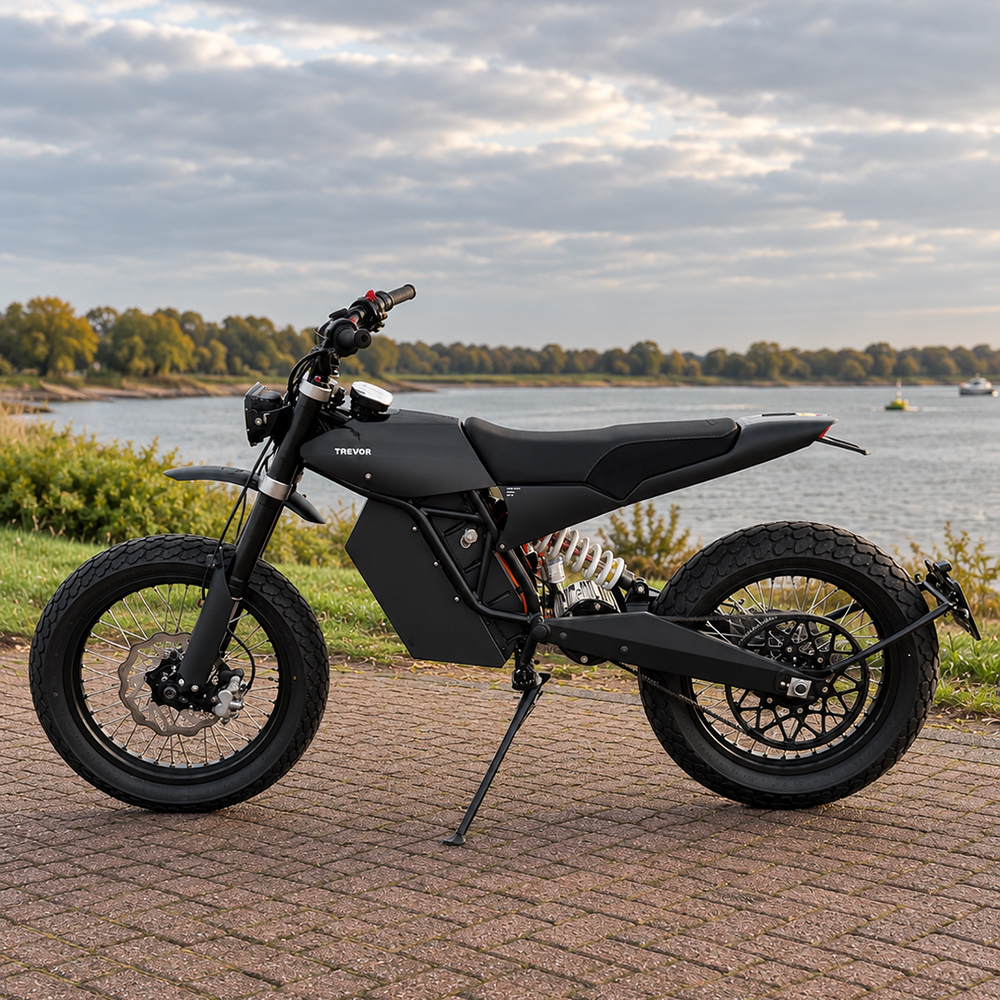
The milestone closes a development programme that began when Trevor announced the DTRe Vince in October 2023. At the time, the plan was to offer a more accessible alternative to the existing DTRe Stella. Along the way, the project turned into an almost entirely new electric motorcycle.
More than an updateThe Stella, whose powertrain was developed by fellow Belgian company Saroléa, shaped many of the technical decisions behind the Vince. The new model gets a completely revised electric powertrain, developed together with Danish specialist eRacing. It also has a new frame with revised geometry, a new steel swingarm and a reworked weight distribution.
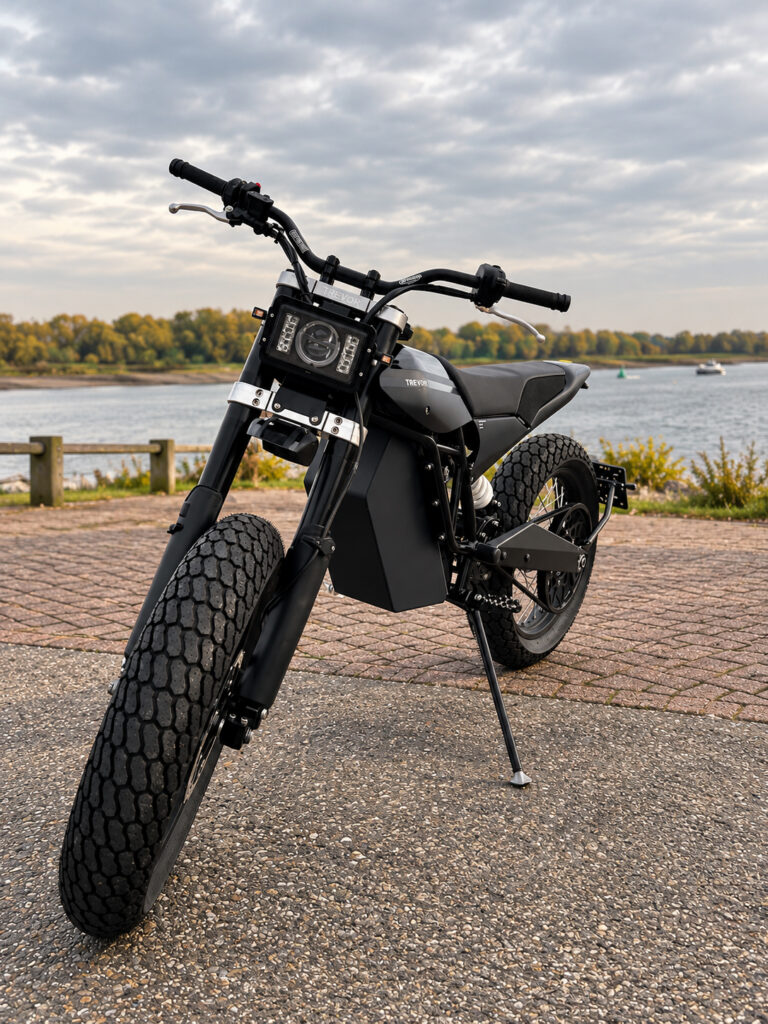
In Track & Trail form, the Vince uses an electric motor rated at 11 kW nominal and 22 kW peak. The 5.0 kWh battery gives a practical range of around 100 km, according to Trevor, depending on riding style and conditions. Final drive is by Gates belt.
Development on a smaller budgetVisually, the Vince keeps the minimalist flat-track and scrambler styling Trevor has been known for since its launch.
Trevor says the Vince was developed with a far leaner structure than its predecessor. According to co-founder and director Jeroen-vincent Nagels, total development costs came to roughly a third of those of the Stella.
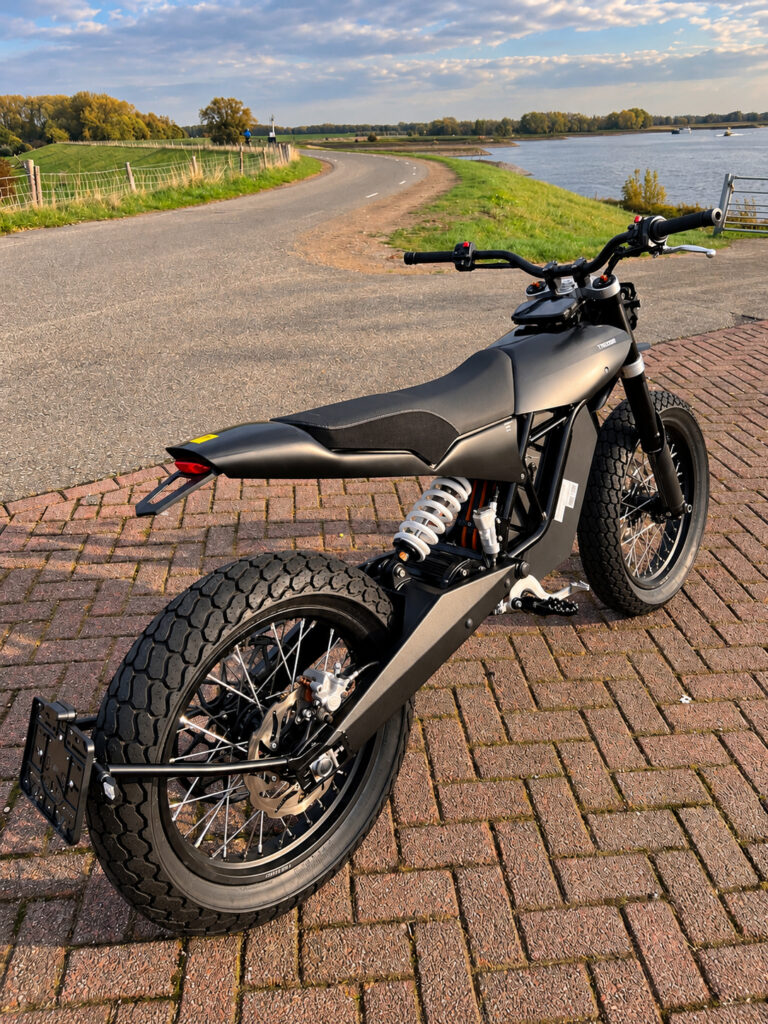
The first prototype was built by Nagels and former Belgian motocross champion Alain Maris, based on drawings by Nagels and Philippe Stella. Further development was mainly carried out by Nagels and Dutch chassis and engineering specialist Wido Veldkamp, supported by specialist suppliers, most of them European.
"Three years of development sounds like a long time, and of course we would have liked to get here sooner," Nagels said. "But big manufacturers often work for years behind the scenes before they present a new model. We did a large part of that work after the announcement, with a very small organisation and limited resources."
Trevor sees the result not only as a new model, but also as a technical base for future development.
 Focus on handling
With the Vince, Trevor Motorcycles puts the emphasis on how the bike rides rather than on outright power or top speed. The revised chassis geometry, a lower and more centrally placed battery and the adjusted weight distribution are intended to make the bike agile and predictable on both tarmac and unpaved roads.
Nagels, who has a long background in the motorcycle industry, is outspoken about the result. "By now I've ridden just about every competing electric motorcycle, and I can say without hesitation that, as far as I'm concerned, the Vince is the best-riding motorcycle in its class. Not because it has the most horsepower, but because of the overall package and especially the way it rides."
 From development to production
The first DTRe Vince Track & Trail left the production line in Gendt, the Netherlands, on 26 October and was delivered to its new owner. For Trevor, the focus now shifts from development to production, quality control and reliable delivery.
"Today we're no longer delivering a prototype or a promise, but a finished motorcycle to a customer," said Nagels. "We built a completely new product with very limited resources, and we can be proud of that. The next challenge is to show that we can repeat this process consistently and profitably."
Trevor DTRe Vince Track & Trail specifications:
- Type: electric scrambler / Track & Trail
- Nominal power: 11 kW
- Peak power: 22 kW
- Battery capacity: 5.0 kWh
- Practical range: approx. 100 km
- Final drive: Gates belt
- Front suspension: 43 mm upside-down fork
- Wheels: 19 inch front and rear
- Chassis: steel frame and swingarm
- Price: €11,995 incl. VAT (base DTRe Vince from €9,995)
- Production: small-scale European production

Johnny Marr
The Age of Everything
Former Smiths guitarist settles some scores - with himself, and others
When I spoke to Johnny Marr for Huck in 2019, all Morrissey talk was off the table. Marr is a very affable interviewee though, and given that the conversation was going so well, I couldn't resist slipping in a cheeky question about how an unnamed "certain person" was chipping away at the legacy of The Smiths with his increasingly unhinged pronouncements. "Honestly? I'm not concerned, is the answer," he replied, generously. "I'm just not. I'm concerned about so many other things in my day and in the living of my life, you know, that that just isn't one of my concerns. I go out and play...
The post Johnny Marr - The Age of Everything appeared first on The Quietus.

@
Autosmile
Philadelphia duo with an ungoogleable name create dreamy psychedelic worlds with Waterboys flutes adn Beach Boys harmonies
Autosmile by @
It's a great time and a nightmarish time to be an @ (pronounced 'at') fan. It's exciting that the Philadelphia art-folk band's second album has just been released, but it's also a faff trying to explain to friends who @ are. Victoria Rose and Stone Filipczak are making fresh, entrancing music that communicates places and mindsets in contemporary ways that can't quite be reduced to any generic label or category.
Selfishly, when you listen to the self-proclaimed SEO wet dream's latest album Autosmile you almost want to keep them to yourself, to simply eat your comforting slice of @ pie, and sit there...
The post @ - Autosmile appeared first on The Quietus.
The British government has been busy courting AI datacenter companies while apparently finding little time to speak to the people who will have to live next door to their enormous server farms.
That's according to a report published Tuesday by campaign group Spotlight on Corruption, which found that 84 percent of the stakeholders ministers met with to discuss datacenters between July 2024 and June 2026 were businesses or private-sector trade associations. Environmental groups, by contrast, didn't get a single meeting with ministers or senior officials.
The findings raise questions about who gets a say in Britain's AI Growth Zones, which the government hopes will attract billions of pounds in investment by making it easier and cheaper to build the infrastructure needed to power its AI ambitions.
According to the report, titled Zoned Out, ministers met representatives from 137 different businesses during the two-year period, while permanent secretaries and directors general held no meetings with community groups about datacenters.
Local residents didn't fare much better. Ministers met just two community groups, both after decisions had already been made to designate their areas as AI Growth Zones. In one case, the meeting took place on the very day the designation was announced.
The government also failed to conduct a national public consultation on its AI Growth Zone strategy, despite the potential consequences for electricity supplies, water consumption, and local communities. Spotlight found no independent consultations with residents in the selected areas, although some developers conducted their own.
Even local councils appear to have struggled to get a hearing. Of the ten local authorities and devolved governments affected by the five announced zones, half reported no communication with ministers or senior DSIT officials beyond their applications. Two had exchanged brief emails, while another secured a 15-minute meeting with a junior minister.
The government has been more accommodating to the companies building these facilities. AI Growth Zones offer developers faster planning decisions and better access to electricity infrastructure, with the aim of rapidly expanding Britain's computing capacity.
As we reported in March, the government has also been consulting on proposals that could allow strategically important datacenters to jump the electricity grid connection queue, potentially ahead of housing developments already waiting for power.
So while datacenter developers could soon find themselves jumping the grid connection queue, the people living near these facilities have had little say in the government's plans.
Spotlight also takes aim at the government's AI Energy Council, which includes representatives from Microsoft, Google, and Amazon Web Services but no environmental NGOs. Its Sustainability Working Group, established to examine the environmental impact of AI, managed just one meeting between April 2025 and July 2026.
Concerns also remain about who is influencing policy from outside government. Spotlight identified 38 appointments of former ministers and senior civil servants by AI companies between July 2024 and September 2026, including nine people who previously worked at DSIT.
Spotlight reckons Whitehall's transparency rules could make the picture even murkier. While ministers have to declare their meetings, unpaid advisers don't face the same requirements, even when they're helping shape government AI policy. So there's no way of knowing exactly who has been bending whose ear.
The campaign group wants the government to hit pause on new AI Growth Zones and datacenters until it tightens the rules on public consultation and forces developers to be more upfront about how much electricity and water their facilities will guzzle, and the emissions they'll produce.
The campaign group argues that Britain is falling behind countries including Germany, Canada, and Ireland, which have conducted national consultations on their datacenter strategies.
For a government determined to turn Britain into an AI powerhouse, there's clearly no shortage of companies willing to help build the infrastructure. But finding room at the table for the people expected to live alongside it seems like another matter. ®


Omarchy has already taken up plenty of our column inches, but a new tentacle is reaching into the hitherto untouched FreeBSD.
Daemonarchy brings Omarchy's Wayland-based desktop to the BSD world. It's an independent effort by Jordan Hubbard, one of the original founders of the FreeBSD project, and it's unaffiliated with the original Linux-based Omarchy.
We looked at Omarchy in August and didn't like it much. It isn't exactly a Linux distribution. That implies it's a coherent set of packages managed as a whole by uniform tools. Omarchy is a collection of apps and preconfigured settings, packaged up with the help of LLM bots and put up for download. You have to update it using its own special script, rather than the standard tools of the underlying Arch Linux - and in our testing, that update script fell over with error messages when running in a VM.
However, there's no such thing as a bad press, and Omarchy is popular and growing. It keeps on attracting sponsorship as well as new users migrating from Windows and macOS, who seem to relish its bizarre, inconsistent, and ad hoc UI as a challenge: trying to close a window in Hyprland, the tiling compositor that forms the core of Omarchy's UI. In Omarchy, windows don't have title bars, let alone anything as old-fashioned as window control buttons you can click. To close a window, you must use a keystroke. In most Linux windowing environments, that's the standard Alt-F4. Not here. Next, we tried Super+W - on a Mac, that's Command+W, which has meant "close the window" since 1984 or so. Still no. We found an answer on Reddit - it's Super + C.
Daemonarchy is not directly related. It's a collection of FreeBSD ports of the various tools and components that went into Omarchy, individually adapted to run on FreeBSD, and collected together into an installable ISO image. The current release is version 1.3.1.
Remarkably, in approximately 10 days, Daemonarchy has gone through 10 releases. Multiple packages are recent ports by jkh@freebsd.org - the email address of Jordan Hubbard. If the name rings a bell, he was one of the original founders of the FreeBSD project, and has had an interesting career in which he's worked at various companies.
The Register first mentioned him by name 25 years ago, when Wind River bought BSD/OS vendors BSDi. By the following year, Hubbard was at Apple, where he helped freshen up the BSD-based Unix layer underneath the new Mac OS X. In 2015, he helped launch the NextBSD project to modernize FreeBSD with Apple Darwin components, which as we reported in July was recently restarted.
The new NextBSD effort is being built with the help of LLM coding assistants. As you might surmise from 18 new FreeBSD ports of Linux tools in a month, as well as from ten releases of the new OS bundle in as many days, Hubbard too is using LLMs to assist in this rapid development process: Daemonarchy's GitHub repository contains both AGENTS.md and SKILL.md files, which point to Hubbard's own Literate AI project, whose repo describes it as a "A meta-harness for coding agents to follow proper Software Development Lifecycle practices", and says it is "Based on literate programming ideas from Donald Knuth".
There's quite a bit of documentation, including a project specification with a list of goals. Lots of formatted Markdown text is also something of an LLM bot hallmark, though, and it's not clear to us if this is intended for humans to read, or to guide the bots. Possibly, it's both.
It looks like the germ of inspiration was a LinkedIn post by UK IT consultant Sam Sheridan, in which he criticized the difficulty of configuring a new installation of FreeBSD 15.1 with an Nvidia card. He's right: we have written about how much work is involved ourselves. Sheridan's LinkedIn post provoked a comment from Ralph Kepper saying "I'm just gonna say it… omarchy for FreeBSD, its the ugly truth and no one likes it but there it is. omarchy will get us the youngsters and if we do it right we will inspire some great minds along the way". Hubbard had already commented in the thread, and it looks to us like that passing comment has prompted (if you will forgive us the obvious pun) this effort.
Daemonarchy is based on FreeBSD CURRENT, which means that it's built on top of what will become FreeBSD 16 - planned for December 2027. The intrepid can get run it now, though. Currently it targets the MacBookPro16,1, meaning the 2019 models of the 16-inch MacBook Pro - one of the final generations of Intel-based MacBooks. A couple of years ago, the Reg FOSS desk attended EuroBSDCon and we met several core project members. Apparently, running the development work-in-progress CURRENT branch is quite normal for hardcore FreeBSD types. If you need to ask how to get it or run it, then this is not the version of FreeBSD for you.
We do not personally like Omarchy much. We don't much like the visual design, or the choice of components - and we really didn't get on with the user interface. As mentioned, there are already established keyboard UIs for both macOS and MS Windows, and we're adept and comfortable with both. As Linux is an OS designed and built on the x86 PC platform, we feel that it should stick to the established Common User Access UI. Its core elements débuted in Windows 1.0, 41 years ago. It's quite a bit older than Linux itself, and led to widespread UI standardization across DOS, OS/2, all subsequent versions of Windows, and more or less all Linux GUIs… at least until the recent rash of Wayland compositors from young hackers who don't know how to drive windows efficiently. We are not saying it can't be improved upon, but re-inventing this particular wheel strikes us as a worked example of XKCD 927.
However, Kepper has a point: Omarchy is trendy, and a FreeBSD version - freed of the direct influence of its controversial creator - might win FreeBSD some new fans. Even if not, the Daemonarchy project could have wider impact.
For one thing, the effort could help the creation of an easy, graphical FreeBSD installer and a friendly desktop version. It's also very relevant to the ongoing debate about the use of AI coding assistants in the FreeBSD project. We mentioned this in September 2025 and there's been no public announcement of a decision yet.
In that article, we highlighted Sylve. The project GitHub describes this as a "lightweight GUI for managing Bhyve, Jails, ZFS, networking, and more on FreeBSD", but the project has even wider ambitions than that. The developers recently shared a video of their new graphical installer for FreeBSD, and we think it looks very good indeed.
We are less keen on the other impact that Daemonarchy seems likely to have. With the FreeBSD project's co-founder busily committing code to the project repositories that he is porting and developing with the assistance of Claude, then it seems highly unlikely that the core team will respond by banning AI contributions. ®
BootnoteOur thanks to Register reader Graham Perrin for drawing our attention to Daemonarchy - and the thread that inspired it.

2026 might not be the Year of Linux on the Desktop, but it is certainly the Year of Linux on the Beachfront, judging by some digital signage at the Spanish resort of Lloret de Mar.
Snapped by Rich Skuse, an aficionado of automotive shonk, this sign skips the town's attractions or useful information entirely. Instead, it gives away its Ubuntu and Firefox roots with an update prompt and a perky "Welcome back," suggesting someone has turned it off and on again.
As this signage is likely connected to the Internet, that Ubuntu update is probably a good idea. 26.04.1 is the latest LTS version and contains a raft of tweaks and improvements. Sadly, we expect beachgoers are probably more interested in sun, sand, and sangria than in keeping a Linux installation in tip-top shape.
The sign is a recent addition to the Passeig d'Agustí Font. Behind the photographer stand palm trees, with a beach and the azure waters of the Mediterranean Sea beyond.
Lloret de Mar underwent several renovations ahead of the 2026 summer season, and we guess the sign was one of them, since it wasn't there in April 2025 (according to a well-known ad slinger). According to Lloret Gaceta, a publication for the region, "The goal is to continue evolving into a more modern, sustainable, accessible, and higher-quality tourist destination, adapted to the new demands of residents and visitors."
Readers might be interested to learn that part of this evolution includes a ban on selling alcoholic beverages in containers larger than one liter at beach bars.
A few too many adult drinks could explain the configuration that led to this bork, or perhaps an engineer took one look outside, at another balmy day, and decided "that'll do" when it came to configuring the signage.
Either way, this is a tourist destination, and the last thing the average administrator wants to be reminded of on their vacation is the need to keep code up to date. As such, we suspect many will simply ignore the distressed digital display and instead seek out somewhere shady to sit, where the seafront can be admired, beverages consumed, and the bork…? Well, it's somebody else's problem. ®
For many members of the C-suite these days, sustainability is a top three agenda item alongside technology and AI adoption, according to research from Deloitte.
In fact, the report says, technology is considered a vital means of hitting organizational goals here, with the implementation of IT solutions being the most common approach for doing so.
The importance of tech's role in this context is reflected in the views of IT decision-makers themselves. A recent survey, conducted by Barco ClickShare, revealed that 96 percent of the 500 US tech leaders questioned consider their sustainability activities to make a significant and positive global contribution to strategy here.
A further 98 percent feel their departments should lead the way in such activities. Indeed, more than four out of five felt so strongly about the situation that they would turn down a job offer at a new employer if it did not have a strong sustainability track record, they said.
Yannic Laleeuwe is Marketing Director Workplace Collaboration at wireless conferencing and collaboration platform provider, Barco ClickShare.
She believes IT functions have this central role to play in tackling sustainability issues because many of their "day-to-day technology choices directly influence an organization's environmental footprint".
"Sustainability is about practical decisions: buying reliable technology, extending product life, reducing complexity, and ensuring devices can be managed, repaired and responsibly recycled," Laleeuwe explains.
Sustainability as a collaborative practiceBut given that technology-related decisions are rarely made by IT leaders alone, it is clear they cannot tackle sustainability challenges alone either. As Barco ClickShare's report indicates, a mere 6 percent of IT departments are the sole decision-makers on tech investments, which includes meeting room systems.
This means that collaboration with other stakeholders is vital. Such stakeholders include not only sustainability and environmental affairs teams. They also consist of procurement, finance, facilities management, operations, and executive leaders.
"Working together, it's possible to balance security, usability, cost, lifecycle impact, energy efficiency, repairability and end-of-life recovery before a purchase is even made," Laleeuwe points out.
In other words, by collaborating, it becomes much easier to embed sustainability considerations into day-to-day activities. This includes maintaining and upgrading equipment properly to extend its life. It is these everyday IT decisions that can make all the difference in shaping behavior in the digital workplace.
One example of this relates to the procurement process itself, which is often complex. But top of the list on any sustainable shopping list should be ensuring that technology in general, but meeting room equipment in particular, is secure, reliable, and easy to integrate with other systems. This is important because if kit is not durable and interoperable, it will come up for replacement sooner rather than later.
But such an approach not only generates waste, it also necessitates purchasing new items. These tend to have a high carbon footprint due to the required extraction of raw materials and high energy usage during both manufacturing and transportation processes.
Essential sustainable procurement considerationsAs for the key questions prospective buyers should be asking their suppliers upfront here, these include which methodologies their products are based on and what certifications they hold. Valid certifications in this context include TCO Certified's global sustainability for IT products marque and the US government's Energy Star symbol for energy efficiency.
In fact, sustainability certifications ranked joint second with cost as the most important factor when purchasing hardware, according to participants in Barco ClickShare's survey. They were topped only by security.
However, it is essential to ensure that certifications and carbon-neutral claims offer "transparency, not just reassurance", Laleeuwe warns. As such, "they should show how the product performs, which lifecycle stages are covered, how claims are validated, and what concrete design choices reduce impact," he says.
In other words, it is essential to understand whether suppliers have taken environmental factors into consideration across their entire product lifecycle. Such factors include product design, which should ideally be modular so that individual components can be repaired or replaced as required.
They also include which materials have been used in the manufacturing process and whether they are recyclable or at least have a low environmental footprint. The same rules apply to packaging.
Other essential considerations for IT leaders during the procurement process, meanwhile, include the energy consumption of their chosen conferencing and communication platform during usage.
Just as important is whether individual vendors offer take-back programs or other responsible disposal routes for products at end-of-life, such as repair and recycling. The aim here is to ensure that old equipment does not pollute the environment by ending up in landfill.
As Laleeuwe points out: "Prioritizing repair and recycling extends product life, avoids premature disposal and turns ESG [environmental, social, and governance] goals into repeatable IT practices."
Unfortunately, though, such activities tend to be all too frequently overlooked today. For example, Barco ClickShare's research reveals that only 42 percent of IT leaders currently select equipment that can be repaired by their manufacturer to extend its life. Even fewer (16 percent) rank repairability as a top concern.
The figures are even worse in terms of recycling (11 percent) being prioritized. Unsurprisingly then, just over a third of respondents indicated their department does not always go down this route.
A key problem here, says Laleeuwe, is that such activities are often simply "less visible at the initial point of purchase", which means they are rarely front of mind.
The problem with hybrid working
Another common challenge, meanwhile, relates to the ongoing shift towards hybrid and remote working.
But according to the Barco ClickShare report, some 95 percent of IT leaders believe such practices have had an impact on their organization's sustainability efforts, ultimately making them more complex. This is at least partially due to meeting room equipment now being spread across office, home, and flexible workspaces.
On the downside, this means it has become more difficult to manage and recycle e-waste from remote locations (48 percent). The growing use of personal devices has also made it trickier to ensure the adoption of energy-efficient hardware (46 percent).
But on the plus side, there has been an increase in uptake of more energy-efficient cloud services compared to on premise systems (63 percent of respondents). Even here though, things are not always clear cut.
As Laleeuwe explains: "IT teams need to look at the full setup: utilization, energy performance, device longevity, security, manageability and end-of-life recovery. The most sustainable choice is the one that delivers the required experience with the least avoidable footprint."
The benefits of standardization
One approach that does produce much more reliable results in sustainability terms though is standardizing equipment across the organization, especially in a meeting room system context.
In the past, individual business departments all too often purchased such kit without consulting IT, leading to the deployment of fragmented, siloed systems. But standardization has shown it can offer various benefits.
On the one hand, Laleeuwe explains: "It limits the number of device types, spare parts, support processes and replacement cycles IT has to manage, while making updates, remote management and lifecycle planning easier."
On the other, organizations can benefit from economies of scale - although to what extent depends on how much e-waste or energy usage they can cut based on the size of their IT estate, usage patterns, refresh cycles, and recycling processes.
A further benefit of standardization is that it provides organizations with "the control needed to measure, manage and reduce impact consistently", Laleeuwe adds.
Embedding sustainability goals into the day-to-dayWhat this demonstrates is that when ensuring sustainability goals are translated into day-to-day IT decision-making, routine choices matter. In other words, sustainability must become part of procurement requirements, implementation checklists, and lifecycle management as standard.
"That means setting shared criteria for certifications, energy efficiency, durability, repairability, recyclability, vendor take-back, and lifecycle reporting," Laleeuwe says. "It also means giving IT, procurement, facilities, finance and sustainability teams joint ownership of the process."
One organization that successfully embedded just this kind of approach into its workplace strategy is the Flemish Government. When renovating its Marie-Elisabeth Belpaire headquarters building in Brussels, Belgium, the Agency for Facility Operations took a multi-layered approach to sustainability.
For instance, the building itself became the first in Flanders to conform to circular construction practices. This included using 68 percent reclaimed, reused, or recycled materials from the original site in its renovation activities.
The building is also close to operating at net zero. This is partly due to its Thermal Energy Storage system, which captures and stores thermal energy for later use. It is also partly because of the introduction of solar panels on its roof and side walls.
But another key consideration in ensuring a sustainable headquarters was the widespread adoption of green ICT. This included the introduction of a hyper-efficient Wi-Fi network to help the Government save the equivalent of 550 households-worth of electricity each year.
Just as important was the standardization of the Government's meeting room technology using certified sustainable technology. To this end, more than 1,000 ClickShare wireless conferencing and collaboration devices were implemented in more than 1,000 different meeting spaces. The aim of standardizing equipment in this way was both to cut energy usage and the meeting room infrastructure's overall carbon footprint.
As Laleeuwe concludes: "The lesson is clear: sustainable meeting rooms work best when technology, workplace design, user experience and lifecycle management are all planned for together and implemented in tandem."
Sponsored by Barco
Oxfam says investing by rich in disaster recovery widens inequality and gives incentive to delay climate action
The world's wealthiest people are not just profiting from the polluting causes of climate breakdown, they are also increasingly cashing in on the catastrophic consequences, according to a study by Oxfam.
The global equality organisation has found that the richest 0.1% of the world's population are heavily invested in disaster preparedness, recovery and reconstruction - a market that is projected to grow from $70bn to $92bn a year by 2029.
Continue reading...Letter to PM argues series of wrong choices on North Sea oil, Heathrow, EVs and heat pumps will scupper net zero plans
Andy Burnham will "sleepwalk" into climate disaster if he fails to get a grip on a series of important policies whose combined impact could scupper plans to reach net zero, campaigners have said.
Big decisions on North Sea drilling, the expansion of Heathrow airport, electric vehicles (EVs) and grants for heat pumps are awaiting decisions from ministers.
Continue reading...Investigation finds dozens of ministers and civil servants moved into AI roles as government developed datacentre expansion plans
The UK's policy on datacentres and AI was developed without any meetings with environmental groups, an investigation has found.
The nonprofit organisation Spotlight on Corruption said a "considerable revolving door" shaped the government's development of "AI growth zones", a central plank of the former prime minister Keir Starmer's AI and economic policy, with 38 ministers, senior civil servants and special advisers hired to positions in AI companies between July 2024 and September 2026.
Continue reading...Calf of Man, Isle of Man: Such is the wealth of Manx fungi, a map is being built to plot it all. We took a special trip as part of that project
The bird observatory on the Calf of Man was sulking under a low cloud base as we stepped ashore at South Harbour. The dank mist was perfect for our surprise visit to the island, as it was not for the birds we had come across, but fungi - in particular, waxcaps.
My wife, Liz, and I had taken the chance to accompany Nev Kilkenny, a visiting mycologist, who would help identify and study some autumn mushrooms and toadstools - and contribute to a map that is being assembled of Manx fungi.
Continue reading...
The Club of Rome's discussion paper, Transformative Pathways towards Meaningful Collective Intelligence: AI in Service of People, Planet & Peace, asks a question that most AI discourse skips over: not simply how to manage the risks and potentials of artificial intelligence, but whether, for what, and for whom we need it at all.
It sets out the political economy behind current AI development — the concentration of computing power and data in a small number of corporations, the ecological costs of the infrastructure behind it, the uneven distribution of its benefits and harms, and the exclusion of pluriversal knowledge systems from how AI is designed and governed. It argues that a transformative approach is needed: one that questions the current trajectory of AI while building the conditions for its use in service of the common good of equitable wellbeing for all on a healthy and peaceful planet.
The Club of Rome is now opening a call for contributions to take this thinking further, test it against other perspectives, and surface ideas, evidence and voices that can shape a genuinely different direction for AI conception, design, co-creation and governance.
What we are looking forWe welcome contributions in any format, including papers, policy pieces, blogs, videos and podcasts. To help structure the discussion, the discussion paper groups its analysis into a number of thematic clusters, and we ask that contributions relate to one or more of them:
- The political economy and power structures behind AI
- Data dispossession and sovereignty as a collective right
- The ecological footprint of AI infrastructure
- Labour displacement and its uneven distribution
- Pluriversal and indigenous epistemologies as design principles for AI
- Alternative, commons-led governance architectures
Contributions do not need to agree with the paper's arguments. Constructive challenge, counter-evidence and alternative framings are all welcome.
Contributions will feed into two kinds of outcome. First, they will inform a range of outputs: a Club of Rome publication planned for 2027, alongside blogs, podcasts, videos and other multimedia pieces published on the Club of Rome website and channels. Second, they will help develop concrete actions: proposals for policy, governance and practice that the Club of Rome, its members and partners can take forward. The publication and its accompanying outputs will be supported by a broader programme of outreach, including workshops, policy interventions and discussions at conferences and other events. This is so that the ideas gathered through this call reach audiences beyond the report itself and translate into practical steps towards AI in service of people, planet and peace.
Who we are invitingThis call is open to members, partners and our wider community. Alongside the open call, we are making targeted invitations to reach beyond our usual circle, in particular AI experts and Global South networks whose perspectives are often missing from mainstream AI debates.
If you know people or networks we should approach directly, particularly those working on AI ethics, AI governance or digital rights in the Global Majority, please send your recommendations to contribute@clubofrome.org.
Use of artificial intelligence in submissionsContributors may use AI tools for supporting tasks such as translation, copyediting or research assistance. The analysis, arguments and conclusions in a submission must be the contributor's own original thinking. Any substantial use of generative AI in producing the content itself must be disclosed in the submission. Submissions that are wholly or predominantly AI-generated, without meaningful human authorship, will not be accepted.
How to submitPlease send contributions, or questions about the call, to contribute@clubofrome.org by 1 January 2027. Please follow the below guidelines for submissions:
Papers and policy briefsSubmit a 500 word abstract in a Word document, along with the contributor's name, affiliation (if any), and which of the thematic clusters above it addresses. Papers will be reviewed by a selection committee and successful contributors will be contacted in early 2027 with a request for a full paper.
BlogsSubmit a word document with the full article which should be a maximum 800 words written in a non-technical style. Provide the author's name, affiliation and which of the thematic clusters above it is related to. Submissions will be reviewed by the communications team, and accepted submissions will be published on the Club of Rome website. Please consult our blog guidelines for more details.
Multimedia formats (e.g audio podcasts, videos)Please submit a downloadable file and provide short summary of the contribution in addition to the contributor's name and affiliation. Submissions will be reviewed by the communications team on an ongoing basis.
SelectionA selection group will steer the process, reviewing contributions and helping shape how they feed into the organisation's ongoing work on AI governance. The selection committee is comprised of: Paul Shrivastava, Mariana Bozesan, Ryan Jackson, Petra Kuenkel, Liepollo Pheko, Douglas Rushkoff, Rica Viljoen and Junyi Zhang
QuestionsFor any questions about the call or the project, contact contribute@clubofrome.org.
The post Call for contributions: Transformative pathways towards meaningful collective intelligence appeared first on Club of Rome.


