
The weather may have defeated MotoGP at Phillip Island, but the series keeps rolling on. While the paddock heads to Sepang for the next round of the series, here's a round up of some of the news items that have been happening. An update on Jorge Martin, and how he is preparing to attempt to ride in Malaysia after fracturing his wrist, the return of Joan Mir to the Honda HRC Castrol team, an update on Qatar, and another step forward for the Adelaide Street Circuit due to host the Australian GP in November 2027.
Jorge Martin's wrist
David Emmett Tue, 27/Oct/2026 - 18:17

Browse, plan, and prep every trip from one library. You get 30 Lonely Planet travel eBooks in one bundle, packed with bucket-list destinations, must-see sights, and insider tips for your next trip. Instead of buying guides one at a time, you build a full travel library in a single purchase. Your guides live in one digital library that you can open on your choice of laptop, tablet, or phone. You have no heavy stack of books to pack. You can pull up the right guide whether you're daydreaming at home or waiting at the gate. Maybe you're mapping out your first international trip, or maybe you're adding to a wish list you've kept for years. Either way, you get 30 starting points in one place. Pick a destination, open the guide, and start building the trip you've been putting off. It's on sale for $30.

Note: The Techdirt Deals Store is powered and curated by StackSocial. A portion of all sales from Techdirt Deals helps support Techdirt. The products featured do not reflect endorsements by our editorial team.
The thing about being in power is that there's not much room left between the floor and the ceiling. The administration can fall, but only so far, because it's still the administration. Conversely, it can only rise so far. The system of checks and balances — even when broken — limits upward trajectories. Bureaucracy generates plenty of friction on its own, which means even when everything aligns perfectly, things still move slowly and rarely reach the heights promised or projected.
Trump's anti-voter operations are banging their collective heads against the wall. The main man continues to insist millions of illegally registered voters exist. The operational side of this obvious lie continues to struggle to convert this hyperbole to reality. Sure, it tries to lay the groundwork for the lies, but the moment anyone pushes back, the administration has been forced to admit it doesn't actually have any facts to back up its accusations.
This attempt to disenfranchise voters, cast doubt on any future election results, and discourage people who might not vote for GOP candidates from heading to the polls is backfiring spectacularly. In California — a state Trump often portrays as being completely overrun by dangerous migrant criminals — the DOJ and DHS have delivered next to nothing. The DOJ brags about its 28 arrests of "illegal" voters, but those have happened in a state that has more than 23 million registered voters.
The administration is apparently tiring of having to do all the heavy lifting when it comes to propping up its own false narratives. Under the threat of further legal action by the DOJ, Trump is now demanding California engage in a witch hunt of its own.
The Department of Justice sent letters on Friday to local election officials across California demanding that they help identify potential noncitizens on their voter rolls and set aside their ballots.
The letter — sent to every county in the state, according to a spokesman for the U.S. attorney's office in Los Angeles — also said local officials would "risk significant federal scrutiny" if they failed to comply with the Justice Department's demands.
California is, of course, under no legal obligation to do this. Its obligations to ensure the legitimacy of voters are already subject to local laws and other efforts it already engages in. This bizarre demand doesn't have any legal weight behind it. But it does contain a vague threat that the DOJ could easily turn into a reality by directly interfering with the election process during the mid-terms.
It certainly seems like that's what the administration will do, whether or not California officials agree to do Trump's dirty work for him.
Last week, the Trump administration sued California, a heavily Democratic state, seeking to temporarily pre-empt the counting of more than 20,000 mail ballots sent to people it said were suspected of registering to vote for the Nov. 3 election, even though they were not U.S. citizens.
That was the opening shot. The 28 arrests the DHS touted are the second wave. This threat — which comes with a 48-hour compliance expectation — is the latest. There will undoubtedly be more, even if the administration loses its attempt to block more than 20,000 ballots in court.
The counties receiving these lists have been given less than two days to validate hundreds to thousands of issued ballots. The government's demands are already ridiculous, as it expects state officials to prove negatives as well as positives. But they're also ridiculous in a much, much stupider way: it appears the DOJ hadn't bothered to vet its own list of suspected "illegal" ballots before sending out its mass email to California election officials.
In rural Inyo County, along the Nevada border, the registrar of voters said the list she was sent included just two people, and neither of them had been issued ballots. Danielle Sexton, the registrar, said her records showed they had never voted anywhere in California.
And in Mendocino County, a rugged stretch on the north coast, the registrar said the list she received was completely wrong.
"It's not our voters that were listed," said Katrina Bartolomie, the Mendocino clerk-recorder. "It's from another county."
Par for the course for the Trump administration, where high-level officials view themselves as snipers, but always opt for birdshot and sawed-offs during the loadout process. But they know who they work for, so it probably doesn't matter. We should absolutely expect the administration to disrupt the election process and engage in protracted legal battles everywhere the GOP loses a seat. We should also expect the DOJ, DHS, and others to contradict the public assurances they've offered and send feds to polling places to suppress voting in contested precincts.
What's on display here is just the groundwork being laid for future bullshit challenges of the legitimacy of an election that, at this point, looks to give the Democratic Party the control of the House.

When it comes to YouTube chefs, Guga is one of the best. His experiments are clear, and while you might not even want to try some of them, like long-aging steaks in just about every goo he can find, the results are always amazing and educational. — Read the rest
The post Guga puts the baking soda/ground beef trick to the test appeared first on Boing Boing.

There is no doubt that ancient Egyptians drilled holes in granite. Archaeologists and laypeople have marveled at cores and tool marks for hundreds of years, wondering, "How'd they do that?" Into The Map decided to stop wondering and figure it out. — Read the rest
The post This ridiculous human-powered machine tests an ancient Egyptian engineering problem appeared first on Boing Boing.
Buenos Aires, Argentina is separated from Colonia, Uruguay by the Rio de la Plata estuary. While it is possible to drive between the two cities, it is faster and more convenient to take a ferry ride. Buquebus, a popular ferry operator in Buenos Aires, offers round trip excursions to Colonia ... [continued]
The post World's Largest Electric Ferry Enters Service In Buenos Aires appeared first on CleanTechnica.

Shipping decarbonization presents policymakers with a bewildering range of choices. Batteries, biofuels, methanol, ammonia, hydrogen, wind assistance, shore power, nuclear propulsion and onboard carbon capture all compete for attention, despite serving very different vessel types and operating requirements. Future Cleantech Architects (FCA), a German nonprofit think tank that evaluates climate ... [continued]
The post Future Cleantech Architects Has a Shipping Factsheet Worth Reading appeared first on CleanTechnica.
XPENG recently ranked highest in the European USCALE "EV Satisfaction Study" for the second year in a row. Not only did XPENG top the chart again, but their score improved over the previous year. The leading 82% recommendation rate ranks significantly above the 53% industry average, positioning XPENG ahead of ... [continued]
The post XPENG Tops Customer Satisfaction Ranking For Second Year, Beating Tesla appeared first on CleanTechnica.
US data annotation operation Scale AI faces five GDPR complaints in four EU countries over allegations that it unlawfully monitors European contractors.
Privacy campaigner noyb alleges that Scale tracks contractors who perform data annotation work on its Outlier AI platform. Like workers on Amazon's Mechanical Turk platform of yore, Outlier contractors label data, evaluate AI-generated responses, and perform other tasks to improve AI models. Scale counts companies including OpenAI, xAI, Anthropic, and Google, as well as the US government, among its customers.
Scale AI faces allegations similar to those noyb has made against other US tech firms since the EU's General Data Protection Regulation (GDPR) went into effect in 2018, namely violations of said regulation.
With all that work being done digitally and remotely, Scale has extensive data collection practices to not only verify the identity of Outlier workers, but also to extensively track their activity.
"Platform work seems to be fertile ground for a whole new type of workplace surveillance," said Thomas Le Bonniec, sociology researcher at French privacy research group DIPLab, who co-authored a report earlier this month examining Outlier's data collection practices. "This would be seen as unacceptable in any other form of employment in the European Union."
Among the issues that raised the hackles of noyb's lawyers was identity verification conducted by Persona, a company that has faced scrutiny over an exposed test environment associated with its efforts to secure US government business. Researchers speculated that the system could be used to build a people tracker, but Persona rejected that interpretation and denied having active US government contracts. Separately, Persona's relationship with chat app Discord soured ahead of the platform's broader age verification rollout, with Discord saying the provider failed to meet its requirements for on-device facial age estimation.
According to noyb, Persona collects biometric data to verify Outlier contractors are who they say they are, as well as gathering IP addresses, device info, geolocation data, addresses, and credit data of Outlier users.
In addition to the biometric identification data, noyb accuses Scale of tracking Outlier workers by collecting system data and device activity (including activity outside of Outlier work), and transmitting that to third parties including LinkedIn, TikTok, Facebook, and other analytics services as often as every few seconds. Noyb warns that the information could be used to profile individuals and serve targeted advertising.
"Such constant and extensive tracking while working really goes against all reasonable expectations," noyb data protection lawyer Lisa Steinfeld Leiser said of the allegations. "Why should LinkedIn or Facebook know which tasks you're working on?"
Noyb has filed complaints in France, Italy, the Netherlands, and Austria against Scale, arguing that it lacks a legal basis to install tracking software on contractors' devices. The US company also stands accused of violating GDPR rules on data minimization, which requires that companies only collect data that's strictly necessary for specific purposes. The complaints also assert Scale violated GDPR rights to data access after ignoring complainants' requests to access the records of what data Scale had stored on them, as well as country-specific laws in the nations where the complaints were filed.
Noyb is asking data protection authorities in those nations to conduct a full investigation and, if necessary, fine Scale for its alleged violations.
""The report's claims are unfounded and inaccurate," Scale told us after this article was first published. "Outlier's practices are disclosed to contributors and require their consent. We use standard tools to verify identities, prevent fraud, protect confidential project information, and ensure accurate payment."
The complaint is likely to give further fuel to the digital sovereignty movement sweeping the EU, which has begun to realize in the past couple of years that it may not be in the best interest of the bloc to be entirely beholden to US tech companies, even if such a separation may be painfully difficult. ®
Updated at 1730 UTC to include comment from Scale.
You wait decades for a Mac-like desktop for Linux, and then two of them come along at once. AI might be involved, but even so, it's still shiny.
ZacOS 9 and Mavernix are two very new, independent, and separate projects, but there is a common thread linking them: they are both brand new efforts to bring vintage Macintosh-like desktop environments to Linux. One is explicitly built using LLMs, and we suspect it was probably involved with the other as well.
"ZacOS" is just a couple of weeks old, and both to forestall what is becoming a very frequently asked question, and also to credit to its inventor Adam Lawson, the project's GitHub page acknowledges two of the more visible LLM coding assistances: both Claude and Copilot are there. In the Hacker News discussion, he acknowledged that he used LLM assistance to make the software, and even his online comments.
It aims to recreate the "Platinum" appearance of MacOS 8 and 9 - as we described last month, one of the few things that Apple successfully salvaged from the Copland project to build a true multitasking successor to MacOS 7.
ZacOS includes a window manager, a filer, a global menu bar, a Control Panel app, a Control Strip, desk accessories and other additional apps, and more. It can network with Macs, and integrate with the existing SheepShaver emulator to run classic Mac apps. We previously mentioned SheepShaver when looking at the remarkable MacOS9.app web-based emulator, and if you don't remember what it looked like, that's the easiest way to find out.
The Sourceforge downloads contain a complete pre-installed Debian Linux image. On Github, there are much smaller Debian packages if you want to try installing it yourself. It's an all-new environment, based on Wayland. (Its own icons are based on Lawson's dog, Zac.) As far as we can see, ZacOS doesn't draw on any older MacOS-like code.
That's slightly surprising, because this is not the first project of its kind that we have ever seen. Although ZacOS does look to be one of the more complete ones, there's quite a bit of prior art.
"Once upon a time, a very long time ago now, about last Friday," (as A. A. Milne put it, a century ago this month) - or at least, a few months before OpenAI launched ChatGPT - we mourned the lack of Linux desktop diversity. In that article, we linked to some projects that tried to bring a Mac-like UI to Linux.
That included Ryu Kojiro's classic-wm, which is a Mac System 6-styled window manager, and also Morgan Aldridge's mlvwm, which aims at the later grayscale MacOS 7 and MacOS 8 look. Although it targets the modern Unix-based macOS, we also mentioned Classic Mac Finder, which aims to recreate the older Finder on the modern OS.
A more modest but easier approach would start with one of the more versatile desktops out there. As we covered in our two-part workshop last month, that would be Xfce, which can already emulate the macOS desktop layout and with a few extra tweaks make a very usable alternative. We intentionally didn't look at themes and skins, but they do exist, and one of the most thorough is what "Grassmunk" did with the Platinum9 theme for Xubuntu. Although Windows 95 itself is long obsolete, the Chicago95 theme makes Xfce look remarkably like the classic OS, and Chicago's developers still actively maintain it.
Fancy something a little more recent?There is a lot of nostalgia for the Classic MacOS look and feel out there, as websites such as MacOS 9 Lives! shows. However, there's also nostalgia for how Mac OS X used to look, as well. When we looked at how to Bring back your old Mac a year ago, we mentioned Mavericks Forever - a fan site for the last OS X version to have the "lickable" Aqua look.
Mavericks is notable because it was the first release of OS X that was available completely for free, as The Register reported in 2013. It's not easy to find today, but you can still download it.
We mention this because you will need a copy if you want to try the second new vintage Apple OS remake. It's called Mavernix, and for now, it's only available for Arch Linux.
Unlike ZacOS 9, Mavernix is built on top of existing software: its windows are drawn by the Wayfire compositor, and its panels by Quickshell. So, yes, this too is entirely Wayland-based.
The main novelty in Mavernix is that it contains a tool to extract and use the images, icons, textures, wallpapers and so on from a real copy of Apple OS X, so that it can draw a Mac-like desktop using real Mac resources. To use it, you need to have a copy of OS X to hand - which is why we point out where you can get one. The license agreement prohibits running it on non-Apple hardware, but since this does not require running it at all, we don't see any IP violations here.
Mavernix is by "Pruefsumme", who is also a YouTuber, and on their channel, they've uploaded a demo video of the desktop in use. We can't deny that it does look pretty.
How well it works, we can't say, but the Gershwin desktop that we reported on last year is still in active development and may provide a deeper, richer Mac-like UI in time. Its development is also LLM-assisted, but the majority of the tools are human-written code, much of it from the GNUstep project - which started in 1991, making it older than Xfce, KDE, GNOME, and around the same age as the Linux kernel itself. ®

I think it's going to be a good long while before I stop feeling sad about Mass Effect: Universe. Since its abrupt cancellation and its studio's closure, more information has been leaking out in bits and pieces from former BioWare devs, although some are admittedly more believable than others. — Read the rest
The post Mass Effect 5 composer releases incomplete soundtrack appeared first on Boing Boing.

If I had a nickel for every really great-looking video game fan film that dropped in the past two weeks, I'd have two nickels, which isn't a lot, but it's weird that it happened twice. Just over a week after The Walking Dead star Chandler Riggs took on Resident Evil, another filmmaker has tried their hand at an equally iconic series. — Read the rest
The post Half-Life fan film looks shockingly authentic appeared first on Boing Boing.

Ten years ago this month, Tom Hanks stepped out of a haunted elevator with two dancing skeletons, with no particularly good explanation other than that he's doing his own thing. He has redefined Halloween for the better.
David S. Pumpkins does not wait around for an origin story. — Read the rest
The post David S. Pumpkins week begins now. Any questions? appeared first on Boing Boing.
- What is driving high energy bills?
- What has been done to limit bills so far?
- What options are there for bringing down bills?
- Is there a 'cheap power' alternative if the UK slows down?
- Can electrification of homes and businesses help cut bills?
Energy bills in the UK have continued to soar in 2026, with intense debate raging about how to bring them down.
In October 2026, the cap on household energy bills reached its highest level in three years, rising by £60 amid high gas prices driven by the Iran war.
The cap is forecast to jump by as much as another quarter in January 2027, pushing annual energy bills towards £2,200.
Energy bills have not been that high since 2022 when, in the fallout of the Russian invasion of Ukraine, the UK government spent more than £60bn on supporting consumers through the crisis.
While expensive gas is behind the lion's share of the rise in bills since 2020, policy costs and investment in the gas and electricity grids are also putting some pressure on prices.
This has sparked conflicting calls to continue the clean-energy transition to get off the "fossil-fuel rollercoaster", to move more slowly - or to abandon climate goals in favour of more gas.
Below, Carbon Brief looks at the real drivers of high energy bills in the UK, what has been done to address them to date and what options are available to cut them going forward.
These include taking more policy costs off electricity bills, boosting flexibility or shifting to more efficient technologies with lower running costs, such as heat pumps and electric vehicles (EVs).
- What is driving high energy bills?
- What has been done to limit bills so far?
- What options are there for bringing down bills?
- Is there a 'cheap power' alternative if the UK slows down?
- Can electrification of homes and businesses help cut bills?
In October 2026, UK household energy bills reached their highest levels since 2022, with the price cap for typical homes hitting £1,723 per year, up 47% in real terms since October 2020.
Industrial energy users also face high costs, particularly for their electricity.
For households, another sharp increase is now all but guaranteed under the price cap for January 2027, which is forecast to rise by around 25% from current levels.
Wholesale costs for electricity and gas make up 44% of the current cap of £1,723 per year, according to Carbon Brief analysis of figures from thinktank Nesta, shown in the figure below.
The wholesale cost of both electricity and gas is tied to gas prices, due to the marginal pricing system used in power markets in the UK and most other countries.
Network charges make up a further 24% of bills and operating costs are another 17%, whereas policy costs only account for 7% of the total.
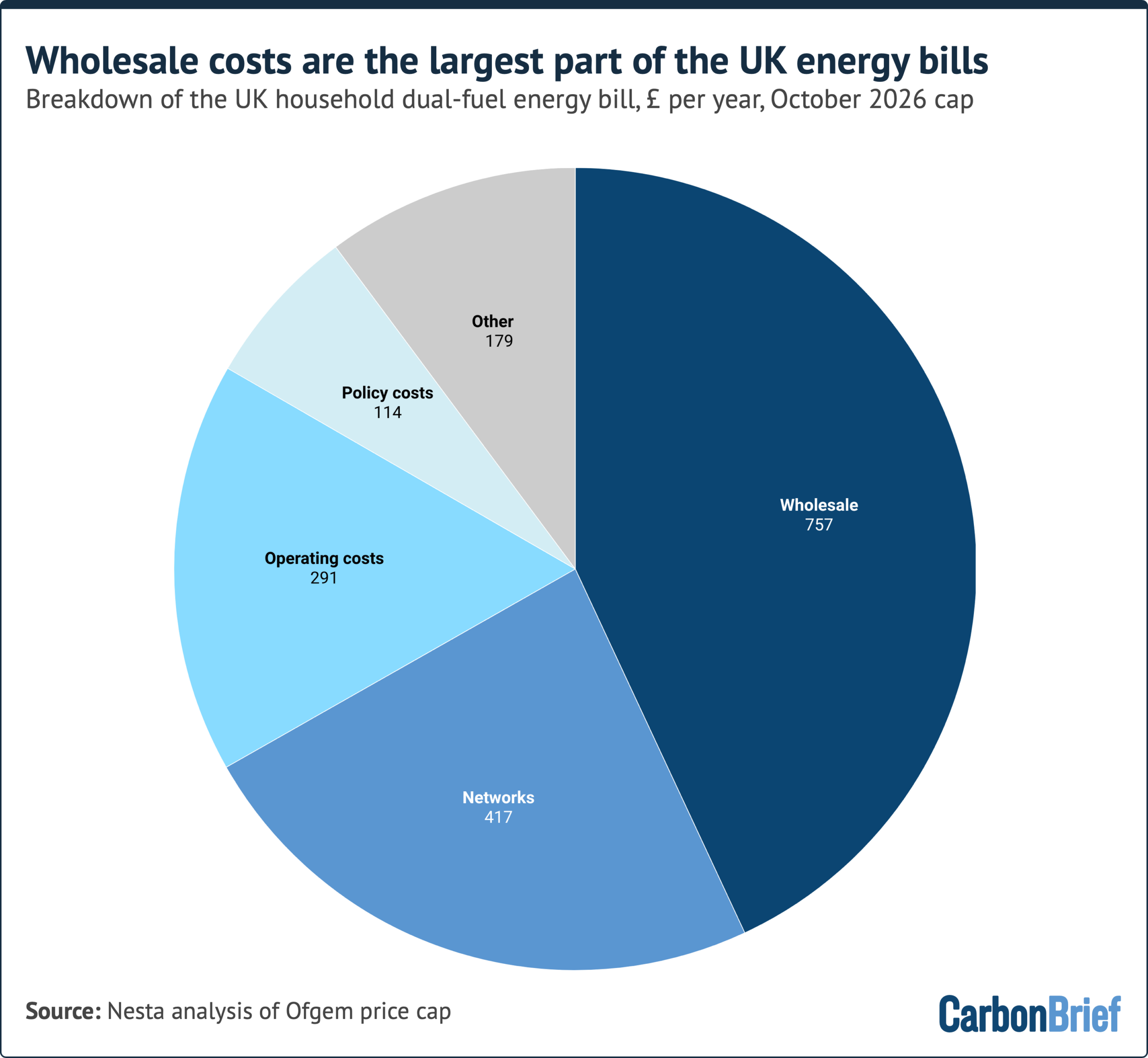
There has been increasing interest in the so-called "non-commodity costs" - those not related to wholesale energy - that now make up a significant portion of bills, as shown in the figure above.
Yet while these costs have been increasing - particularly those related to investing in energy networks - they are not the reason why energy bills have soared once again in recent months.
Indeed, Nesta analysis recently published by Carbon Brief shows that, contrary to widespread UK media and political narratives, a surge in wholesale costs driven by expensive gas is responsible for more than 80% of the rise in dual-fuel household energy bills since 2020, as shown below.
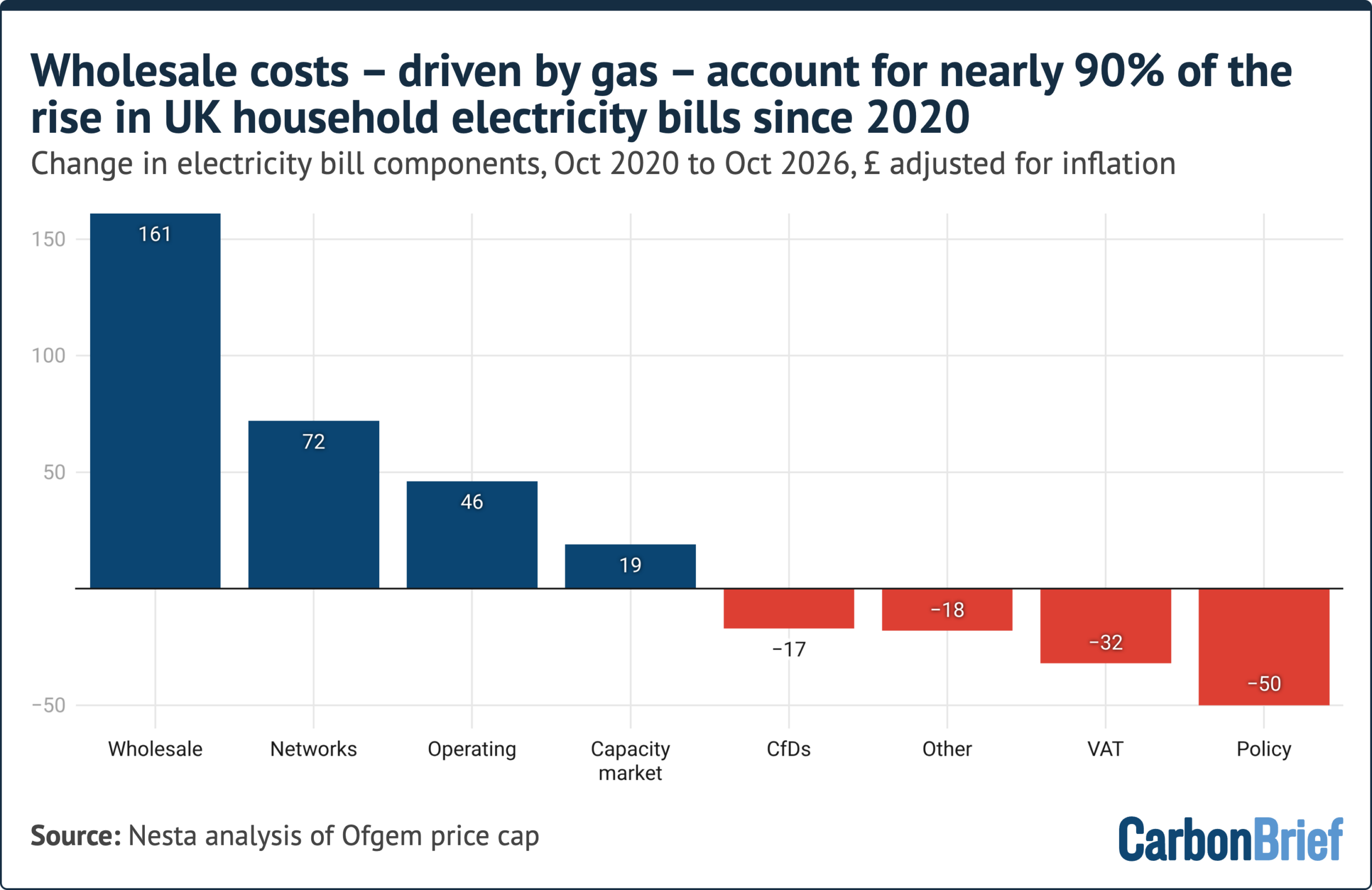
The second-largest driver of the rise in costs since 2020 is due to the cost of operating, maintaining and expanding gas and electricity networks, as shown in the figure above.
At the end of 2025, energy regulator Ofgem approved £29bn of upfront investment into the national gas and electricity grids, as well as the gas distribution network that connects to homes and businesses. This is part of a wider package of up to around £90bn of investment out to 2031.
As a result of these investment plans, network charges are expected to increase by around 50% between 2025 and 2030, from £222 a year to £330 for a typical dual-fuel household.
(This figure covers gas and electricity transmission and gas distribution, but not electricity distribution. A further package of increased investment in the electricity distribution network, for the period from 2028-2033, is due to be approved by Ofgem by the end of 2027.)
#gform_wrapper_7[data-form-index="0"].gform-theme,[data-parent-form="7_0"]{--gf-color-primary: #204ce5;--gf-color-primary-rgb: 32, 76, 229;--gf-color-primary-contrast: #fff;--gf-color-primary-contrast-rgb: 255, 255, 255;--gf-color-primary-darker: #001AB3;--gf-color-primary-lighter: #527EFF;--gf-color-secondary: #fff;--gf-color-secondary-rgb: 255, 255, 255;--gf-color-secondary-contrast: #112337;--gf-color-secondary-contrast-rgb: 17, 35, 55;--gf-color-secondary-darker: #F5F5F5;--gf-color-secondary-lighter: #FFFFFF;--gf-color-out-ctrl-light: rgba(17, 35, 55, 0.1);--gf-color-out-ctrl-light-rgb: 17, 35, 55;--gf-color-out-ctrl-light-darker: rgba(104, 110, 119, 0.35);--gf-color-out-ctrl-light-lighter: #F5F5F5;--gf-color-out-ctrl-dark: #585e6a;--gf-color-out-ctrl-dark-rgb: 88, 94, 106;--gf-color-out-ctrl-dark-darker: #112337;--gf-color-out-ctrl-dark-lighter: rgba(17, 35, 55, 0.65);--gf-color-in-ctrl: #fff;--gf-color-in-ctrl-rgb: 255, 255, 255;--gf-color-in-ctrl-contrast: #112337;--gf-color-in-ctrl-contrast-rgb: 17, 35, 55;--gf-color-in-ctrl-darker: #F5F5F5;--gf-color-in-ctrl-lighter: #FFFFFF;--gf-color-in-ctrl-primary: #204ce5;--gf-color-in-ctrl-primary-rgb: 32, 76, 229;--gf-color-in-ctrl-primary-contrast: #fff;--gf-color-in-ctrl-primary-contrast-rgb: 255, 255, 255;--gf-color-in-ctrl-primary-darker: #001AB3;--gf-color-in-ctrl-primary-lighter: #527EFF;--gf-color-in-ctrl-light: rgba(17, 35, 55, 0.1);--gf-color-in-ctrl-light-rgb: 17, 35, 55;--gf-color-in-ctrl-light-darker: rgba(104, 110, 119, 0.35);--gf-color-in-ctrl-light-lighter: #F5F5F5;--gf-color-in-ctrl-dark: #585e6a;--gf-color-in-ctrl-dark-rgb: 88, 94, 106;--gf-color-in-ctrl-dark-darker: #112337;--gf-color-in-ctrl-dark-lighter: rgba(17, 35, 55, 0.65);--gf-radius: 3px;--gf-font-size-secondary: 14px;--gf-font-size-tertiary: 13px;--gf-icon-ctrl-number: url("data:image/svg+xml,%3Csvg width='8' height='14' viewBox='0 0 8 14' fill='none' xmlns='http://www.w3.org/2000/svg'%3E%3Cpath fill-rule='evenodd' clip-rule='evenodd' d='M4 0C4.26522 5.96046e-08 4.51957 0.105357 4.70711 0.292893L7.70711 3.29289C8.09763 3.68342 8.09763 4.31658 7.70711 4.70711C7.31658 5.09763 6.68342 5.09763 6.29289 4.70711L4 2.41421L1.70711 4.70711C1.31658 5.09763 0.683417 5.09763 0.292893 4.70711C-0.0976311 4.31658 -0.097631 3.68342 0.292893 3.29289L3.29289 0.292893C3.48043 0.105357 3.73478 0 4 0ZM0.292893 9.29289C0.683417 8.90237 1.31658 8.90237 1.70711 9.29289L4 11.5858L6.29289 9.29289C6.68342 8.90237 7.31658 8.90237 7.70711 9.29289C8.09763 9.68342 8.09763 10.3166 7.70711 10.7071L4.70711 13.7071C4.31658 14.0976 3.68342 14.0976 3.29289 13.7071L0.292893 10.7071C-0.0976311 10.3166 -0.0976311 9.68342 0.292893 9.29289Z' fill='rgba(17, 35, 55, 0.65)'/%3E%3C/svg%3E");--gf-icon-ctrl-select: url("data:image/svg+xml,%3Csvg width='10' height='6' viewBox='0 0 10 6' fill='none' xmlns='http://www.w3.org/2000/svg'%3E%3Cpath fill-rule='evenodd' clip-rule='evenodd' d='M0.292893 0.292893C0.683417 -0.097631 1.31658 -0.097631 1.70711 0.292893L5 3.58579L8.29289 0.292893C8.68342 -0.0976311 9.31658 -0.0976311 9.70711 0.292893C10.0976 0.683417 10.0976 1.31658 9.70711 1.70711L5.70711 5.70711C5.31658 6.09763 4.68342 6.09763 4.29289 5.70711L0.292893 1.70711C-0.0976311 1.31658 -0.0976311 0.683418 0.292893 0.292893Z' fill='rgba(17, 35, 55, 0.65)'/%3E%3C/svg%3E");--gf-icon-ctrl-search: url("data:image/svg+xml,%3Csvg width='640' height='640' xmlns='http://www.w3.org/2000/svg'%3E%3Cpath d='M256 128c-70.692 0-128 57.308-128 128 0 70.691 57.308 128 128 128 70.691 0 128-57.309 128-128 0-70.692-57.309-128-128-128zM64 256c0-106.039 85.961-192 192-192s192 85.961 192 192c0 41.466-13.146 79.863-35.498 111.248l154.125 154.125c12.496 12.496 12.496 32.758 0 45.254s-32.758 12.496-45.254 0L367.248 412.502C335.862 434.854 297.467 448 256 448c-106.039 0-192-85.962-192-192z' fill='rgba(17, 35, 55, 0.65)'/%3E%3C/svg%3E");--gf-label-space-y-secondary: var(--gf-label-space-y-md-secondary);--gf-ctrl-border-color: #686e77;--gf-ctrl-size: var(--gf-ctrl-size-md);--gf-ctrl-label-color-primary: #112337;--gf-ctrl-label-color-secondary: #112337;--gf-ctrl-choice-size: var(--gf-ctrl-choice-size-md);--gf-ctrl-checkbox-check-size: var(--gf-ctrl-checkbox-check-size-md);--gf-ctrl-radio-check-size: var(--gf-ctrl-radio-check-size-md);--gf-ctrl-btn-font-size: var(--gf-ctrl-btn-font-size-md);--gf-ctrl-btn-padding-x: var(--gf-ctrl-btn-padding-x-md);--gf-ctrl-btn-size: var(--gf-ctrl-btn-size-md);--gf-ctrl-btn-border-color-secondary: #686e77;--gf-ctrl-file-btn-bg-color-hover: #EBEBEB;--gf-field-img-choice-size: var(--gf-field-img-choice-size-md);--gf-field-img-choice-card-space: var(--gf-field-img-choice-card-space-md);--gf-field-img-choice-check-ind-size: var(--gf-field-img-choice-check-ind-size-md);--gf-field-img-choice-check-ind-icon-size: var(--gf-field-img-choice-check-ind-icon-size-md);--gf-field-pg-steps-number-color: rgba(17, 35, 55, 0.8);} NameThis field is for validation purposes and should be left unchanged.Free weekly newsletter
.preheader p{ margin-top: 0; font-family: 'PT Sans', sans-serif; font-weight: var(--type--3--font-weight--bold); color: var(--button--color); font-size: var(--button--font-size, inherit); } .newsletter-inline{
display: flex;
border: solid 1px #333333;
padding: 1em;
background: #ffffff;
}
.inline-email{
display:inline-block;
margin-right:1em;
margin-top:0 !important;
margin-bottom:0.5em;
}
#field_submit{
display:inline-block;
margin-top:0 !important;
}
.gform_wrapper .gfield+.gfield{
margin-top:0
}
Email
gform.initializeOnLoaded( function() {gformInitSpinner( 7, 'https://www.carbonbrief.org/wp-content/plugins/gravityforms/images/spinner.svg', false );jQuery('#gform_ajax_frame_7').on('load',function(){var contents = jQuery(this).contents().find('*').html();var is_postback = contents.indexOf('GF_AJAX_POSTBACK') >= 0;if(!is_postback){return;}var form_content = jQuery(this).contents().find('#gform_wrapper_7');var is_confirmation = jQuery(this).contents().find('#gform_confirmation_wrapper_7').length > 0;var is_redirect = contents.indexOf('gformRedirect(){') >= 0;var is_form = form_content.length > 0 && ! is_redirect && ! is_confirmation;var mt = parseInt(jQuery('html').css('margin-top'), 10) + parseInt(jQuery('body').css('margin-top'), 10) + 100;if(is_form){jQuery('#gform_wrapper_7').html(form_content.html());if(form_content.hasClass('gform_validation_error')){jQuery('#gform_wrapper_7').addClass('gform_validation_error');} else {jQuery('#gform_wrapper_7').removeClass('gform_validation_error');}setTimeout( function() { /* delay the scroll by 50 milliseconds to fix a bug in chrome */ jQuery(document).scrollTop(jQuery('#gform_wrapper_7').offset().top - mt); }, 50 );if(window['gformInitDatepicker']) {gformInitDatepicker();}if(window['gformInitPriceFields']) {gformInitPriceFields();}var current_page = jQuery('#gform_source_page_number_7').val();gformInitSpinner( 7, 'https://www.carbonbrief.org/wp-content/plugins/gravityforms/images/spinner.svg', false );jQuery(document).trigger('gform_page_loaded', [7, current_page]);window['gf_submitting_7'] = false;}else if(!is_redirect){var confirmation_content = jQuery(this).contents().find('.GF_AJAX_POSTBACK').html();if(!confirmation_content){confirmation_content = contents;}jQuery('#gform_wrapper_7').replaceWith(confirmation_content);jQuery(document).scrollTop(jQuery('#gf_7').offset().top - mt);jQuery(document).trigger('gform_confirmation_loaded', [7]);window['gf_submitting_7'] = false;wp.a11y.speak(jQuery('#gform_confirmation_message_7').text());}else{jQuery('#gform_7').append(contents);if(window['gformRedirect']) {gformRedirect();}}jQuery(document).trigger("gform_pre_post_render", [{ formId: "7", currentPage: "current_page", abort: function() { this.preventDefault(); } }]); if (event && event.defaultPrevented) { return; } const gformWrapperDiv = document.getElementById( "gform_wrapper_7" ); if ( gformWrapperDiv ) { const visibilitySpan = document.createElement( "span" ); visibilitySpan.id = "gform_visibility_test_7"; gformWrapperDiv.insertAdjacentElement( "afterend", visibilitySpan ); } const visibilityTestDiv = document.getElementById( "gform_visibility_test_7" ); let postRenderFired = false; function triggerPostRender() { if ( postRenderFired ) { return; } postRenderFired = true; gform.core.triggerPostRenderEvents( 7, current_page ); if ( visibilityTestDiv ) { visibilityTestDiv.parentNode.removeChild( visibilityTestDiv ); } } function debounce( func, wait, immediate ) { var timeout; return function() { var context = this, args = arguments; var later = function() { timeout = null; if ( !immediate ) func.apply( context, args ); }; var callNow = immediate && !timeout; clearTimeout( timeout ); timeout = setTimeout( later, wait ); if ( callNow ) func.apply( context, args ); }; } const debouncedTriggerPostRender = debounce( function() { triggerPostRender(); }, 200 ); if ( visibilityTestDiv && visibilityTestDiv.offsetParent === null ) { const observer = new MutationObserver( ( mutations ) => { mutations.forEach( ( mutation ) => { if ( mutation.type === 'attributes' && visibilityTestDiv.offsetParent !== null ) { debouncedTriggerPostRender(); observer.disconnect(); } }); }); observer.observe( document.body, { attributes: true, childList: false, subtree: true, attributeFilter: [ 'style', 'class' ], }); } else { triggerPostRender(); } } );} );
The increase in network costs is often attributed to the need to connect increasing levels of geographically dispersed renewable energy sources, particularly wind power.
However, a significant proportion of these increases relate to the need to update ageing infrastructure after decades of under-investment.
This package of investment represents a "once-in-a-generation renewal of our energy infrastructure", Ofgem head Tim Jarvis told a recent conference attended by Carbon Brief.
Ofgem says some three-fifths of the £108 per household per year rise in network charges to 2030 is due to "business-as-usual" costs such as ongoing maintenance of the gas and electricity networks. It says only £30 is due to investing in expanding the electricity transmission grid.
Similarly, according to the Energy Networks Association, up to 80% of the investment in electricity grids is required to maintain existing assets, with the remainder going towards expansion.
Another point of contention is "constraint costs", where windfarms are switched off if the network lacks the capacity to transmit their power - and gas plants are switched on to meet demand.
These costs sit within network balancing charges and - despite rising steeply in recent years, partly due to high gas prices - these still make up just £35, or 4% of typical annual electricity bills.
Today, rising constraint costs are partly a reflection of the decision in the 2010s to postpone network investments under a policy known as "connect and manage". Ofgem says the investments it has now approved in the electricity grid would help limit constraints in the future.
Trade association RenewableUK's head of policy Steven Agnew points to a recent review by the National Audit Office and says investment in the grid is "critical to avoid large rises in consumers' bills as more of the country's electricity is generated from clean sources". He adds:
"The current crunch is the result of inaction by successive previous governments to tackle this issue. Consumers are losing out on some of the benefits because low-cost wind has to be turned down and expensive gas turned up elsewhere."
Projections from the National Energy System Operator (Neso) illustrate how constraint costs depend on the relative pace of expansion in new generating capacity and the electricity network.
It says balancing costs could rise from £2bn to £8bn by 2030, if the grid faces delays. However, its central projection is £3-4bn, with a range of options available to limit this increase.
Finally, following years of elevated energy bills, the cost of "bad debt" has increased. This is where unpaid bills are recovered by energy companies through a charge on all households.
These charges add around £60 to typical bills, according to Carbon Brief analysis of Ofgem data. This is an increase of around £40 since 2020 - more than half of the rise in "operating costs". Trade association Energy UK says rising debt could add another £10-15 to bills by next year.
What has been done to limit bills so far?The Labour government was elected in 2024 on a manifesto that pledged to cut bills by £300 per year by 2030, relative to levels in late 2023.
The government has taken a number of steps in this direction.
At the 2025 budget, it closed the "energy company obligation" (ECO) efficiency scheme and moved 75% of the "renewables obligation" support scheme for legacy renewables into general taxation.
Collectively, these two changes were expected to save a typical household £134 per year, or £154 when including households that use electric heating. (These savings only apply to households.)
Many groups, from industry to politicians, had long called for policy costs to be taken off electricity bills in an effort to bring down prices, but this had previously been resisted by the Treasury.
In addition, new prime minister Andy Burnham announced in July that his government would remove VAT from electricity bills for six months from 1 October, cutting bills by around £45.
Yet despite these efforts, bills have continued to increase.
Speaking to Carbon Brief, Dr Richard Carmichael, a researcher at the UK Energy Research Centre (UKERC) and research fellow at Imperial College London, says the impact of reducing policy costs and VAT has been "masked" by rising wholesale energy prices.
As a result, there are calls for the government to go even further in its efforts to reduce policy costs - or to take more radical steps to cut bills. (See: What are the options to bring down bills?)
One factor that is less well-appreciated is the impact that clean-power sources have already had on energy bills. Commentators tend to focus narrowly on the cost of support schemes for these projects, without considering the impact they have on the total cost of running the energy system.
Nesta research suggests that electricity bills are rising "much more slowly" than gas this year, despite the impact of the Hormuz crisis, due to the expansion of clean power. It says this is an early sign of electricity prices starting to "decouple" from gas prices.
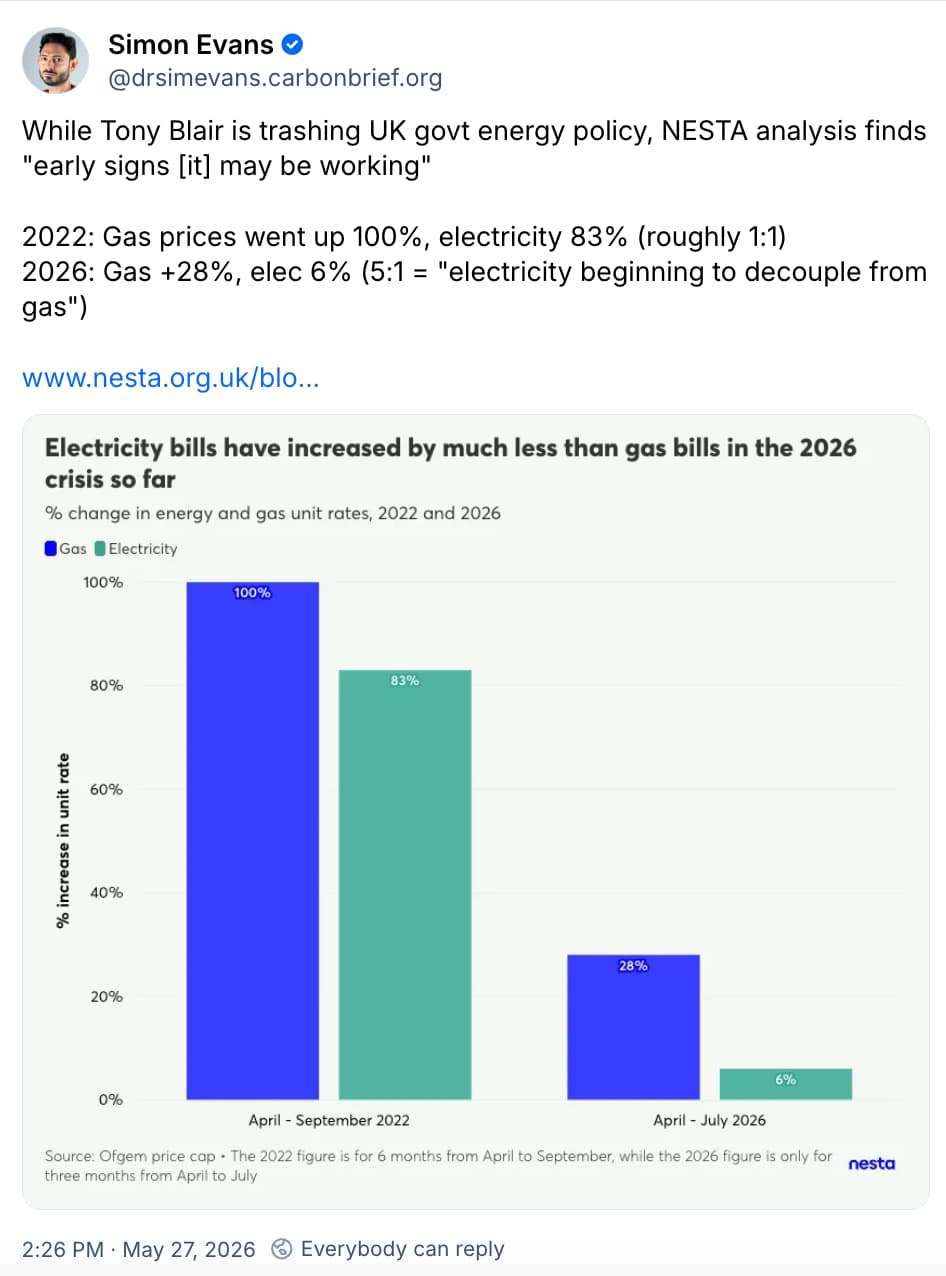
In April, the government announced reforms that it hopes will help "break [the] link between gas and electricity prices, but analysts told Carbon Brief the impact was likely to be "modest".
Nevertheless, the link between the two will continue to weaken as more wind and solar gets built, including projects supported by a record "contracts for difference" (CfD) auction earlier this year.
Since the start of the Iran war, the UK has avoided the need to import gas worth around £5.9bn as a result of record wind and solar output, according to previous Carbon Brief analysis.
RenewableUK's Agnew tells Carbon Brief: "Put simply, every wind turbine we build is gas we don't need to buy."
In addition to directly displacing gas, the windfarms on the system cut wholesale power prices by around a third in 2025, according to the Energy and Climate Intelligence Unit (ECIU).
This is due to the "merit-order effect", whereby windfarms push the most expensive gas plants off the system, reducing the average wholesale power price.
According to separate research published by University College London, UK wind energy cut consumer costs by a total of £104bn over 2010-2023, net of subsidy costs, through a combination of the merit-order effect and reduced gas demand, which lowered gas prices.
What options are there for bringing down bills?With household and industrial prices remaining elevated for more than five years, countless ideas have been presented for bringing down the cost of energy.
These span from immediate but more modest tweaks that could have a rapid impact, through to longer-term changes in the energy system, the design of energy markets or retail tariffs.
Moreover, amid a collapse in the UK consensus, some politicians want climate goals to be abandoned in the name of cheaper energy. (See: Is there a 'cheap power' alternative if the UK slows down?)
Ahead of the budget on 28 October, the most widely shared request is for the chancellor to take more policy costs off electricity bills, either for households only, or for all energy users.
A September letter to the government from more than 120 trade bodies, businesses and charities calls for "hidden taxes" to be taken off energy bills for both businesses and households.
.cb-tweet img{ border: solid 1.25px #333333; border-radius: 5px; } @media (max-width:650px){ .cb-tweet{ width:100%; } }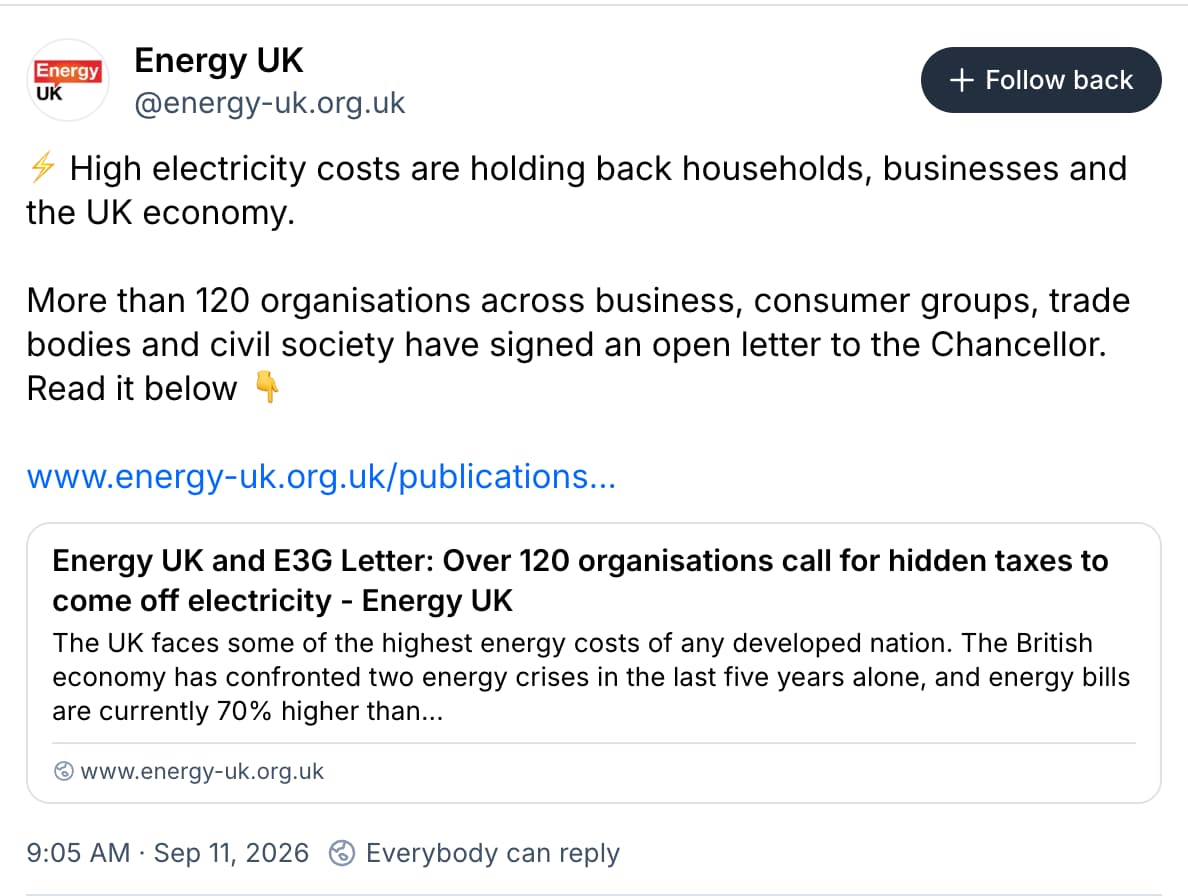
It argues that a series of levies should be paid out of general taxation, in addition to the existing decision to take 75% of renewables obligation costs off household electricity bills.
This would include a levy supporting the Sizewell C new nuclear plant, the cost of the warm home discount scheme for fuel-poor households and feed-in tariffs for small-scale legacy renewables.
The group says that removing these additional policy costs from bills would "bring the total average domestic energy bill reduction achieved by this government to as much as £250 a year".
It adds that this would bring down inflation, boost manufacturing and incentivise investment in the electrification of the economy, helping to "fully realise [the UK's] economic potential".
Speaking to Carbon Brief, energy consultant Kate Mulvany says bringing policy costs and bad debt into general taxation is "in all likelihood the fastest route" to reducing bills.
The main barrier to removing further policy and debt costs from bills is that the money would have to come from somewhere else - most likely the Treasury, which has resisted this in the past.
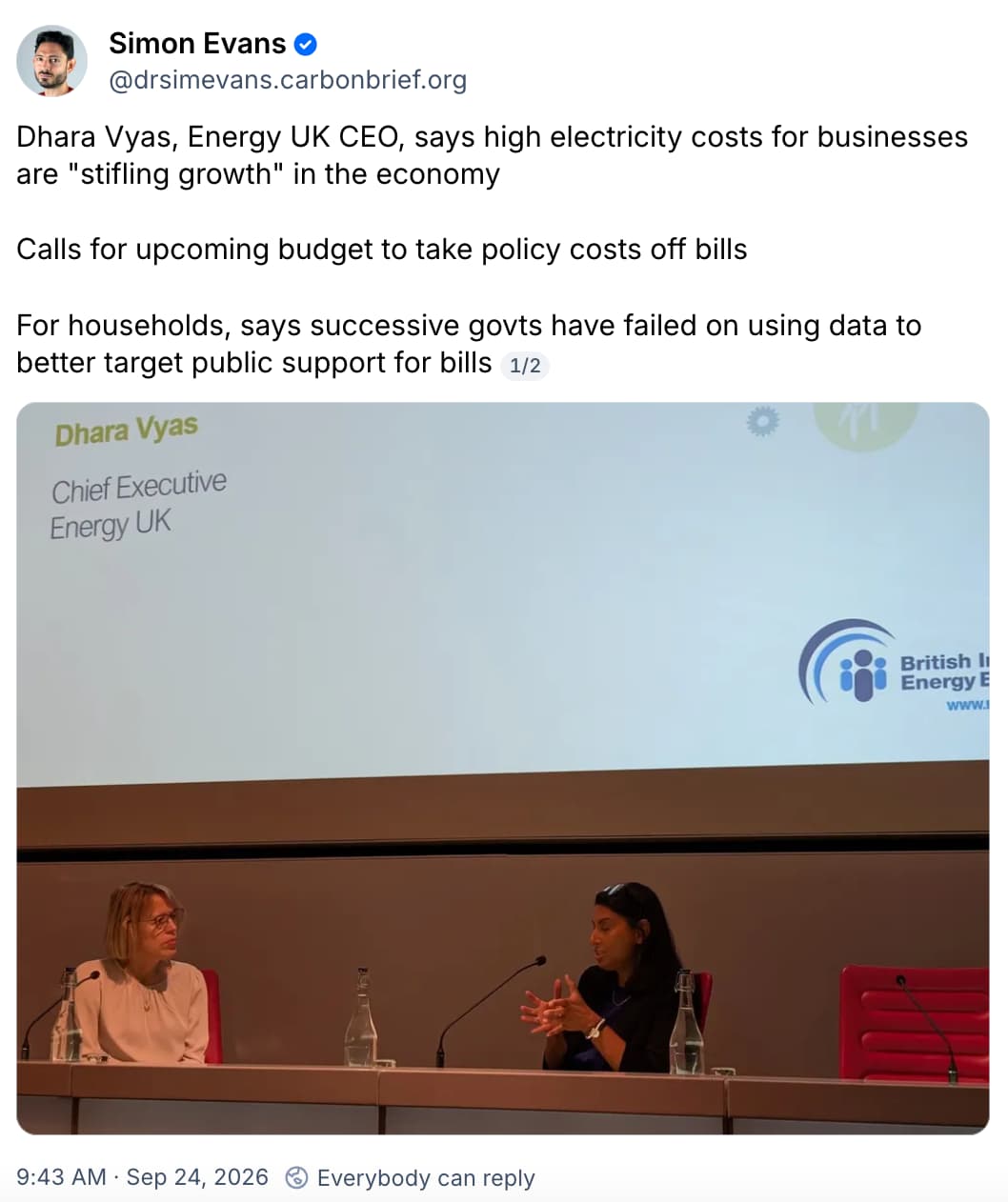
The decision to take 75% of the renewables obligation off household bills is seen as a breakthrough, with Energy UK head Dhara Vyas saying the Treasury should go a "step further".
Alternatively, a report from parliament's Energy Security and Net Zero Committee calls for policy costs to be moved from electricity onto gas bills.
This would help "rebalance" the cost of electricity relative to gas, encouraging consumers to switch to more efficient electric technologies, such as heat pumps and electric cars.
This is because it would reduce the "spark gap", the ratio between electricity and gas prices. This ratio stood at 4.3 in the UK as of April 2026, although it has dropped to 3.3 under the latest price cap and could fall again to 3.0 in January 2027, according to Carbon Brief analysis.
Further options to bring down costs for consumers have been suggested by groups including Nesta, the "electricity bills taskforce" and many others.
Ideas include the government paying off household energy debt, instead of recovering it through bills, a permanent removal of VAT on electricity prices and boosting electricity system "flexibility" so as to maximise the use of existing network assets.
Carmichael tells Carbon Brief:
"Flexibility is a fairly obvious one that…would deliver bill reductions for people who can participate in flexibility, but it would also reduce system costs for everyone."
Ashutosh Padelkar, research lead at Aurora, agrees that there is "more work to be done on improving network efficiency". In addition to boosting flexibility, he points to innovations such as "dynamic line ratings", where cables can be "overloaded a bit for a small amount of time".
With bills set to leap by around a quarter at the start of 2027, there have also been calls for specific measures to offer households relief at the budget.
Many argue that this support should be targeted to limit costs, for example through extending the "warm homes discount". However, Mulvany warns that this could increase costs for other households if it is paid for via energy bills, as is currently the case for the warm homes discount.
Another option is to introduce a "social tariff" for fuel-poor households. Dr Carmichael notes that while this has some positives, it also has "potential for a sort of a cliff edge where people are just missing out on it". This can make them challenging to put together in an equitable way.
Meanwhile, the New Economics Foundation thinktank - where energy secretary Miatta Fahnbulleh used to work - suggests a "rising block tariff", where consumers pay lower rates for a set amount of "essential" energy use. However, there are fears this could discourage electrification.
Ahead of the budget, Burnham has asked ministers to look at developing a plan to remove standing charges from gas bills. The idea was put forward by Nesta, which says it would save typical households £27 per year, while helping encourage the shift to heat pumps and EVs.
Finally, separate proposals from thinktank Common Wealth and consultancy Stonehaven with Greenpeace, call for more radical changes that would see gas-fired power stations taken into a strategic reserve, in order to more completely break the link between gas and power prices.
Is there a 'cheap power' alternative if the UK slows down?Some groups argue that the UK needs a fundamental shift in its energy strategy in order to tackle high bills. Such calls are often based on the idea that the government is "rushing" to meet its target for clean power by 2030 - and that slowing down would cut costs.
For example, a September 2026 report from the Institute for Fiscal Studies (IFS) states that "continuing to push for rapid decarbonisation does risk increasing costs".
Its argument rests on NESO modelling, published in 2024, which suggests it could be slightly cheaper to rely on more gas in 2030 than planned under the clean-power 2030 target.
Peter Levell, IFS deputy research director, tells Carbon Brief that gas prices have "risen significantly" since the NESO modelling was published, which "other things equal" would make it relatively cheaper to push for more renewables instead of relying on more gas power.
However, he adds that capital costs have also risen, arguing that this makes renewables relatively more expensive. (The cost of gas-fired power plants has risen even more steeply.) Levell adds that it is unclear how long the current disruption causing high gas prices will last.
Another prominent - and repeated - voice for slowing down the government's push for clean power has come from the Tony Blair Institute (TBI).
In a February 2026 report, for example, the TBI argues that the government should set an objective of "cheaper power by 2030" instead of "clean power 2030". It says this could be done "while maintaining a clear decarbonisation trajectory".
In earlier versions of this argument, the TBI called for a slower expansion of renewables, in favour of greater reliance on nuclear power and carbon-capture and storage.
However, perhaps implicitly acknowledging that these are not cheap technologies, its latest report focuses more on calls for flexibility, optimised grid expansion and a push for electrification.
Perhaps the strongest push to abandon the government's current approach has come from the opposition Conservative party, which now lobbies hard against clean power 2030, in addition to calling for the UK to scrap all of its climate targets and the legislation that underpins them.
The party backed a report by thinktank Onward, which claimed that the UK could save "over £320bn" with a push for "cheap power" instead of "clean power". However, a Carbon Brief factcheck found it relied on a series of questionable assumptions.
Ultimately, the report built its conclusions in from the start by assuming that gas and nuclear power would be cheap. As Tom Glover, head of energy firm RWE UK, put it at the time:
"There's a difference between a useful scenario and a plan you'd build a system around. This report is the former presented as the latter. If you accept its assumptions, the results follow logically. The problem is the assumptions…built on a stack of optimistic inputs."

Similarly, Johnny Gowdy, a director at thinktank Regen, argues in a paper responding to the Onward report that its gas-price assumptions are "very optimistic - and potentially reckless".
Following the start of the Iran war, UK wholesale gas prices - which were already roughly three-times higher than before the Ukraine crisis - have more than doubled again.
According to RenewableUK, the UK is currently experiencing its ninth gas-price "spike" of the past decade. Mulvany tells Carbon Brief that such spikes are "normal". She adds:
"Wars are fought over energy and resources - and this is the way things have always been…[T]his isn't a blip. If you look historically, this is normal."
(The total cost to the UK economy of higher energy prices in the wake of Russia's invasion of Ukraine amounts to £183bn over four years, according to the ECIU.)
NESO notes that under pathways with a larger role for gas plants, the nation's energy system would remain "more exposed to volatile international gas prices".
As such, the UK's transition is about finding the right balance between the up-front cost of investment in clean-energy alternatives and the ongoing risk of exposure to volatile gas prices.
The IFS also notes that there are additional positives from moving away from fossil fuels, including improved local air quality, less price volatility and potentially greater security of energy supply.
Citing Carbon Brief analysis published in 2024, RenewableUK's Agnew argues that the government should learn from past "mistakes".
He points to the then-Conservative government decision from 2015 to "cut the green crap", which ultimately added £22bn to bills by leaving the UK "more exposed to volatile fossil-fuel prices".
UKERC's Carmichael echoes these points, telling Carbon Brief:
"If we're not transitioning to clean power, which for the UK would mean more independence and more energy sovereignty, I don't think there is an alternative…[and] if we don't do it, then we're still going to be vulnerable to volatility and fossil-fuel prices."
Finally, many of the arguments against the clean power 2030 target are based on the idea that it will be extremely difficult to meet and that closing the gap would be costly.
Indeed, recent analysis by consultancy LCP Delta suggests that by 2030, the UK will only reach 83% clean power, with the 95% target unlikely to be hit until 2035.
Yet this reality is implicitly acknowledged by the government, which has said that it will not contract for more clean power towards the 2030 target unless it delivers lower bills.
Speaking at the Energy UK conference in October, Fahnbulleh said:
"We all know that one of the reasons we are seeing rising prices is because we are uniquely exposed to global fossil-fuel markets…There will be people that will say you should slow down…But I believe that we must seize the opportunity of this moment."
Can electrification of homes and businesses help cut bills?While there is political disagreement over the best mix of power supplies, there is far greater agreement on the need to expand the use electric technologies such as EVs and heat pumps.
For example, while the Conservative party opposes the government's clean power plan, it argues that the UK needs to electrify its economy to ensure both "prosperity and a better environment".
At the Energy UK conference in October, delegates listed "electrification" and "affordability" as the top-two energy related priorities for the government.
There is significant overlap between these two goals.
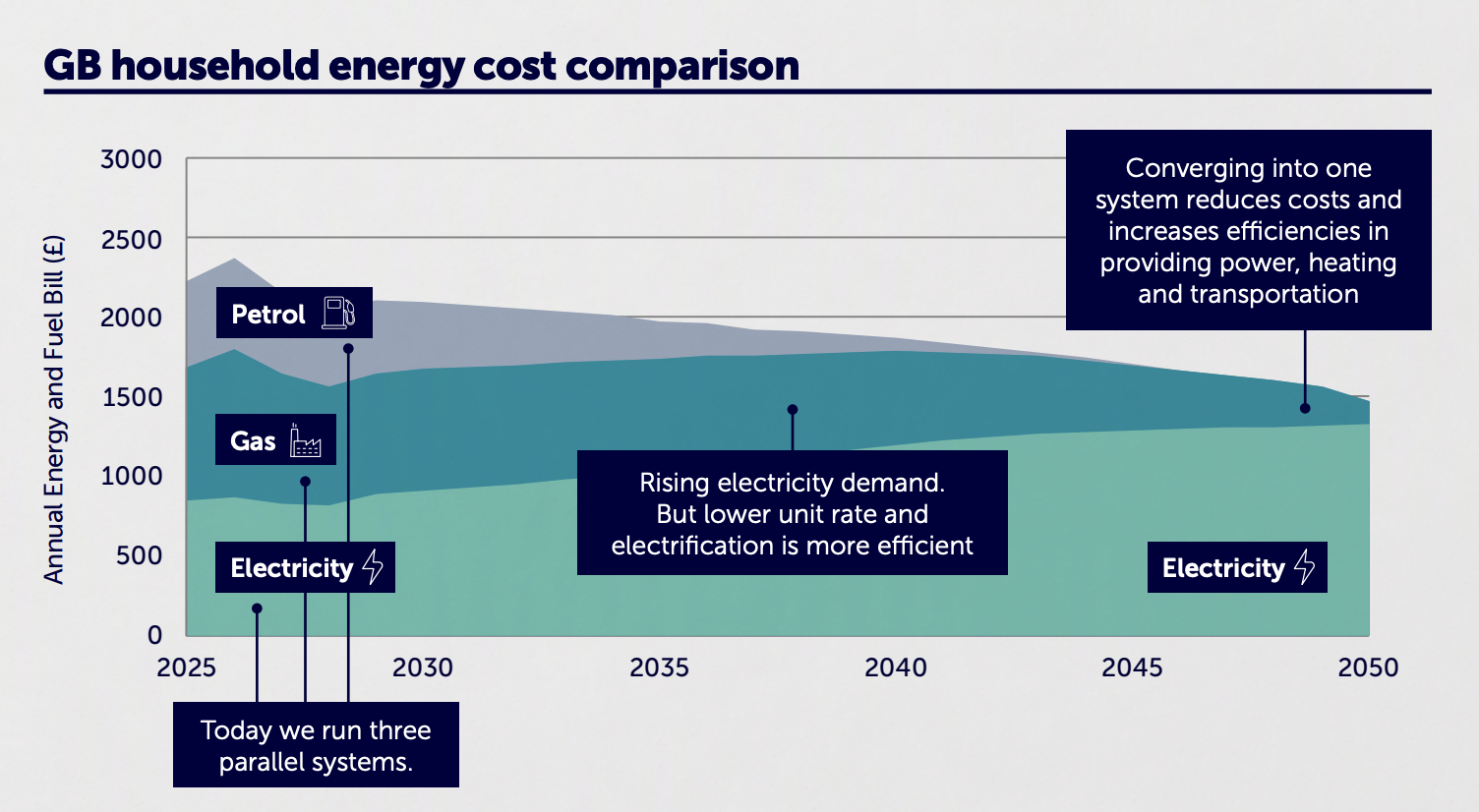
At present, most households pay separate bills for heating, power and transport. This means they are paying to run three separate energy systems for gas, electricity and petrol.
If the UK largely electrifies its economy, households will instead rely on a single system that heats and powers their homes, as well as fuelling their cars. By boosting consumption, electrification also spreads the fixed costs of upgrading the network across a larger base of demand.
Padelkar tells Carbon Brief that there "isn't enough electrification in the system" at the moment:
"A significant amount of heating demand is gas-fired…[I]f that demand were to sit on the electricity side instead, it would allow for costs to be shared more fairly across a greater base of consumers."
According to energy firm SSE, the shift from three "parallel" energy systems to a single one based on electricity would reduce consumer costs over time, as shown in the figure below.
 Credit: SSE
In this context, the usual focus on "dual-fuel" household gas and electricity bills, in isolation, misses the potential for savings due to consolidating not only heat and power, but also car use.
Indeed, electric cars are currently up to nine times cheaper to run than petrol cars in the UK, according to Carbon Brief analysis.
The savings from electrification are partly a result of the far greater efficiency of EVs and heat pumps, relative to combustion cars and gas boilers. Reduced fossil-fuel imports also play a role.
Very similar arguments have been put forward by the UK government's advisory Climate Change Committee (CCC), the International Energy Agency and others.
A recent CCC report, for example, said that faster electrification "would cut UK household bills".
It outlined how electrification would not only reduce the cost of the UK energy system in the future, but is already able to cut household costs today, as shown in the figure below. Crucially, its analysis included the higher upfront costs of investing in electric technologies, such as heat pumps.
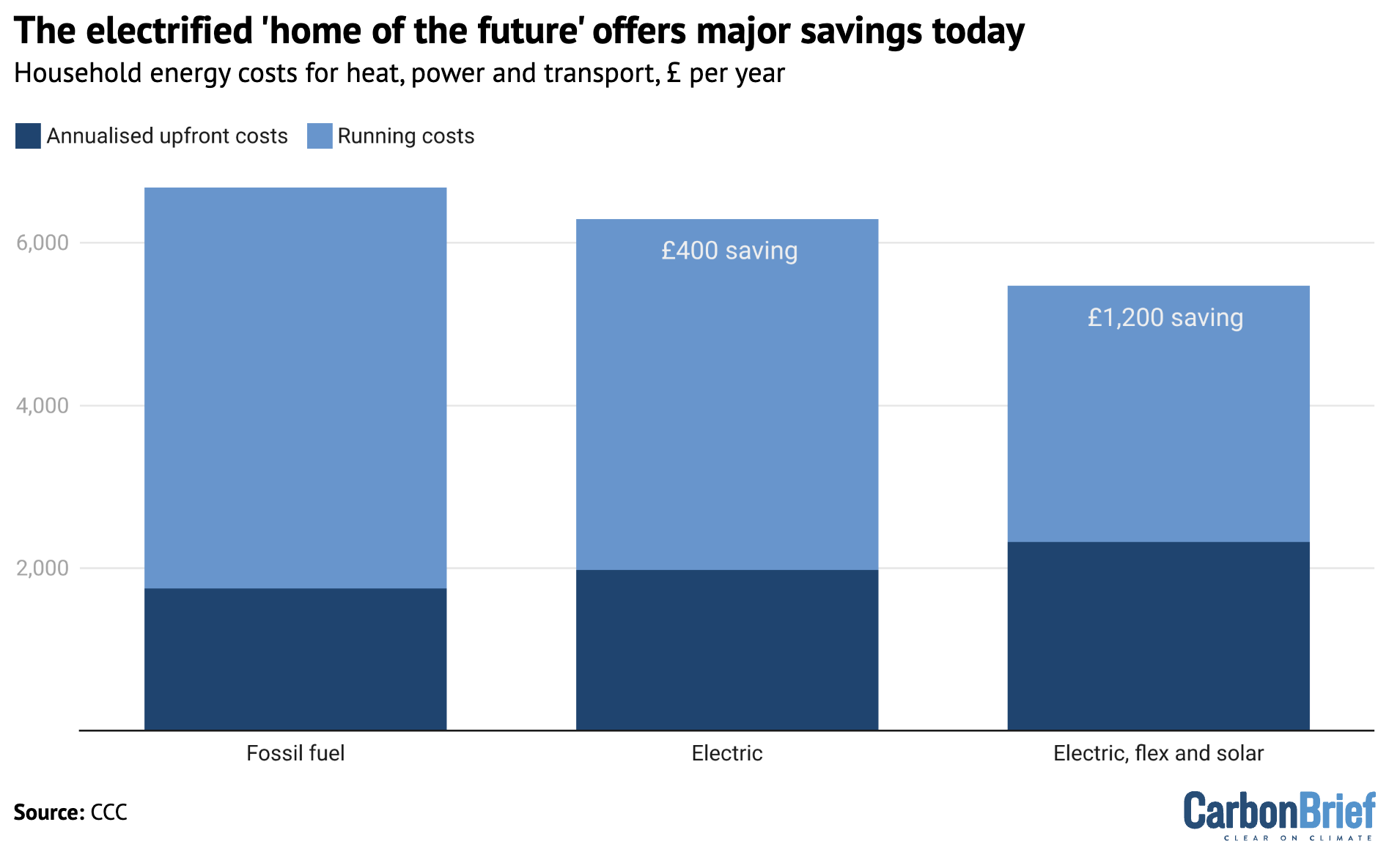 Household energy costs for heat, power and transport, £ per year. The upfront costs of purchasing cars, heating systems, chargers and solar panels are annualised. Source: CCC progress report 2026.
The government also supports this argument, having set out a £13bn "wa

I often think of Collapse2050 as a risk management blog, designed to help readers see around corners. My aim is to help people understand the big risks. Sometimes that includes economic risks. The ones that send the average non-billionaire scrambling, if caught unprepared.
Bubbles and busts are human nature. Markets are intoxicated by new ideas and innovations, especially if it provides a means to get rich. I'll put aside the scams and totally irrational bubbles, like Dutch tulip bulbs. There are plenty of rational bubbles to go around. The railway, telecommunications…and now AI. All premised on something groundbreaking. All ended (or will end) in tears.
This is not an investing blog, but an implosion of the AI bubble could cause an aggregate slowdown that hits people whether they invest or not. A collapse in the value of assets held in portfolios has a ripple effect on employment. Landing a job today already requires a minor miracle. It would get much more difficult if companies start shrinking.
Worse, increasingly, portfolios held by institutional investors, such as insurance companies and pensions, hold private debt and equity issued by AI companies. A collapse in the value of AI-related assets could leave a gaping hole in these entities, requiring either a cut in payouts or a government bailout. Either way, you pay.
One can view savings and investments as the quantitative cumulative net value of one's lifetime of work. Yeah, it's crude but when I think of it that way it reminds me of the effort it took to obtain it. Every dollar I have saved required blood, sweat and tears at a job that tried to destroy me. I am too old to go through that again, so I'm protective of whatever I have.
For this reason I am always looking for the next 2000 or 2008 or 2020, all of which featured double-digit declines in stock indices. An AI implosion could be the next one.
Railroads and internet telecommunications proved themselves as valuable over the long run. Yet both suffered from overinvestment driven by hype. When the reality of ROI clashed with investor expectations, capital fled and asset prices collapsed. The infrastructure remained, however, for another day.
AI is following this pattern. If you look beyond the public-facing LLMs, agentic AI models are both theoretically transformative and practically infeasible. Today, I'd argue they're more dangerous than useful, but in theory some company in the future might find a way to implement to improve ROI. That's what investors are banking on, but patience is waning as the confetti settles and reality appears dull.
People like Ed Zitron have been pounding the table for a few years now arguing the AI "revolution" is all hype, but his prognostications were far too early to be pragmatic for most investors. Today, however, data increasingly show the results aren't aligning to expectations.
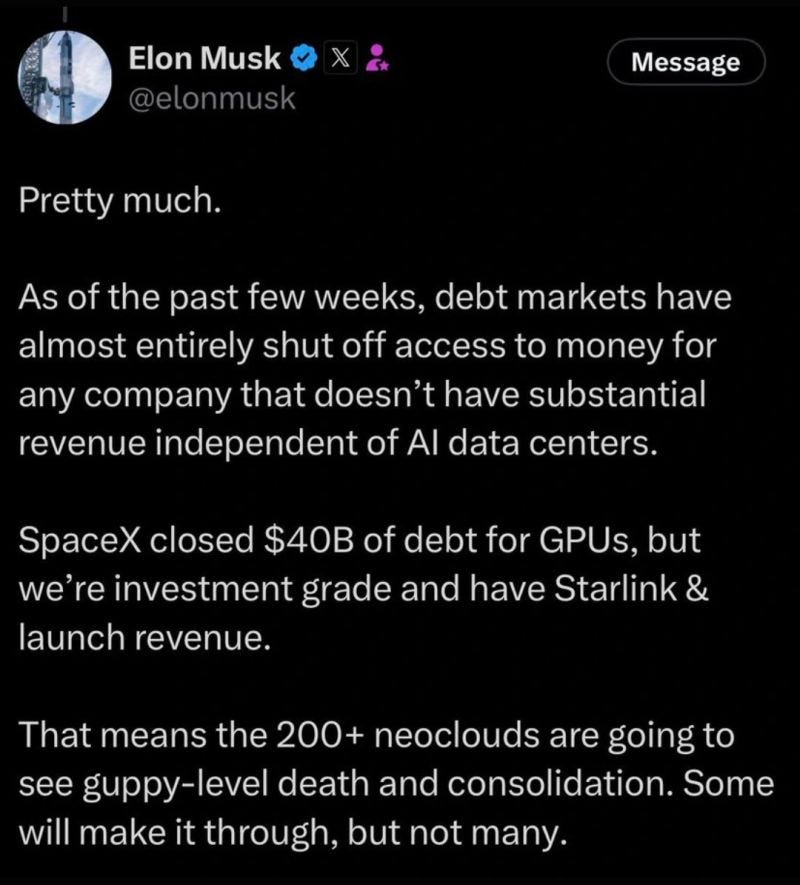
Below are a few charts that illustrate the state of the AI bubble:Junk bonds are under severe pressure, increasingly pricing in defaults for higher-risk credits. This includes highly speculative debt funding the AI buildout.

I hate to quote Musk, but if true this is a valuable insight. It does make intuitive sense, especially given the corroborating data points.
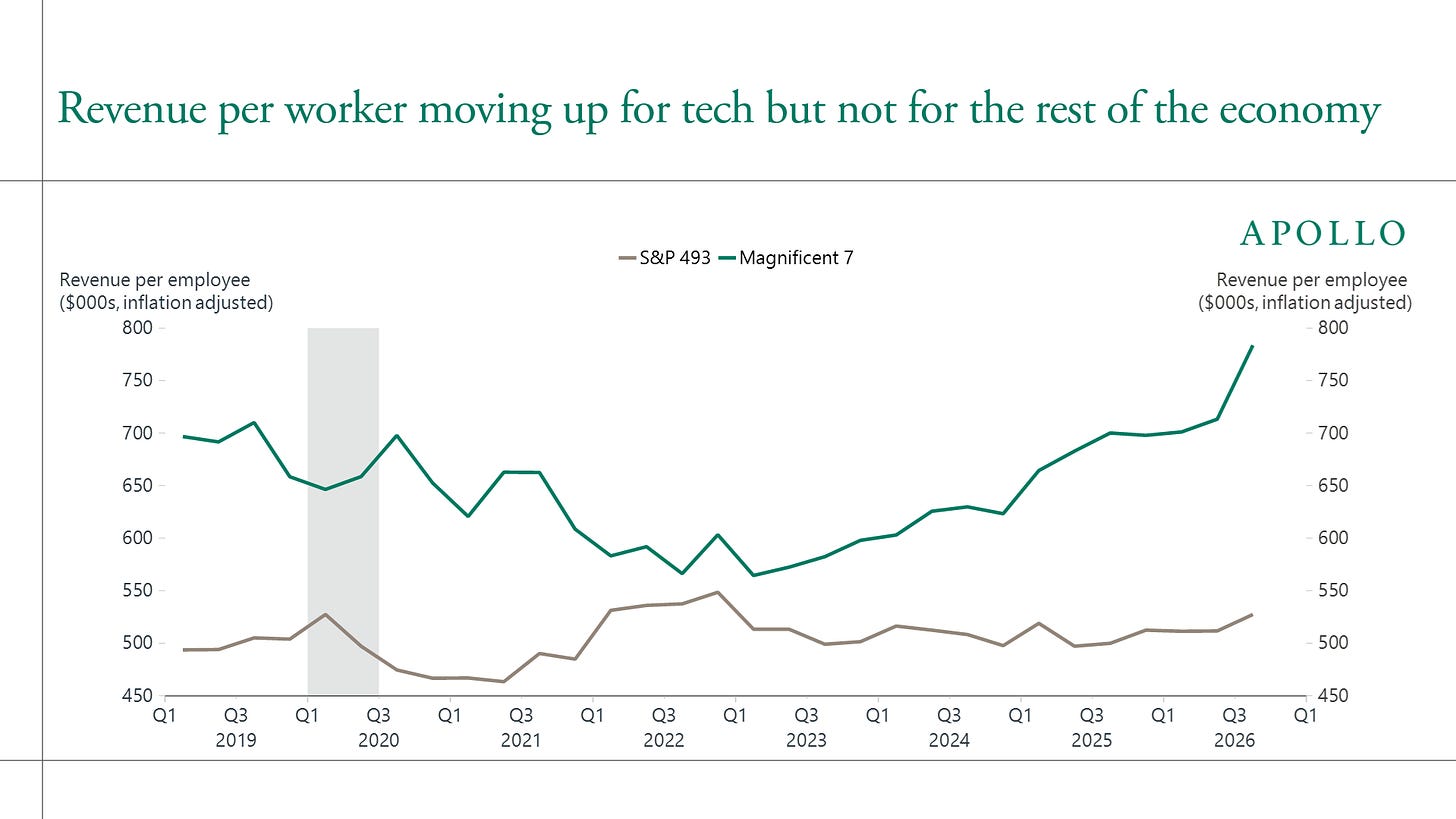
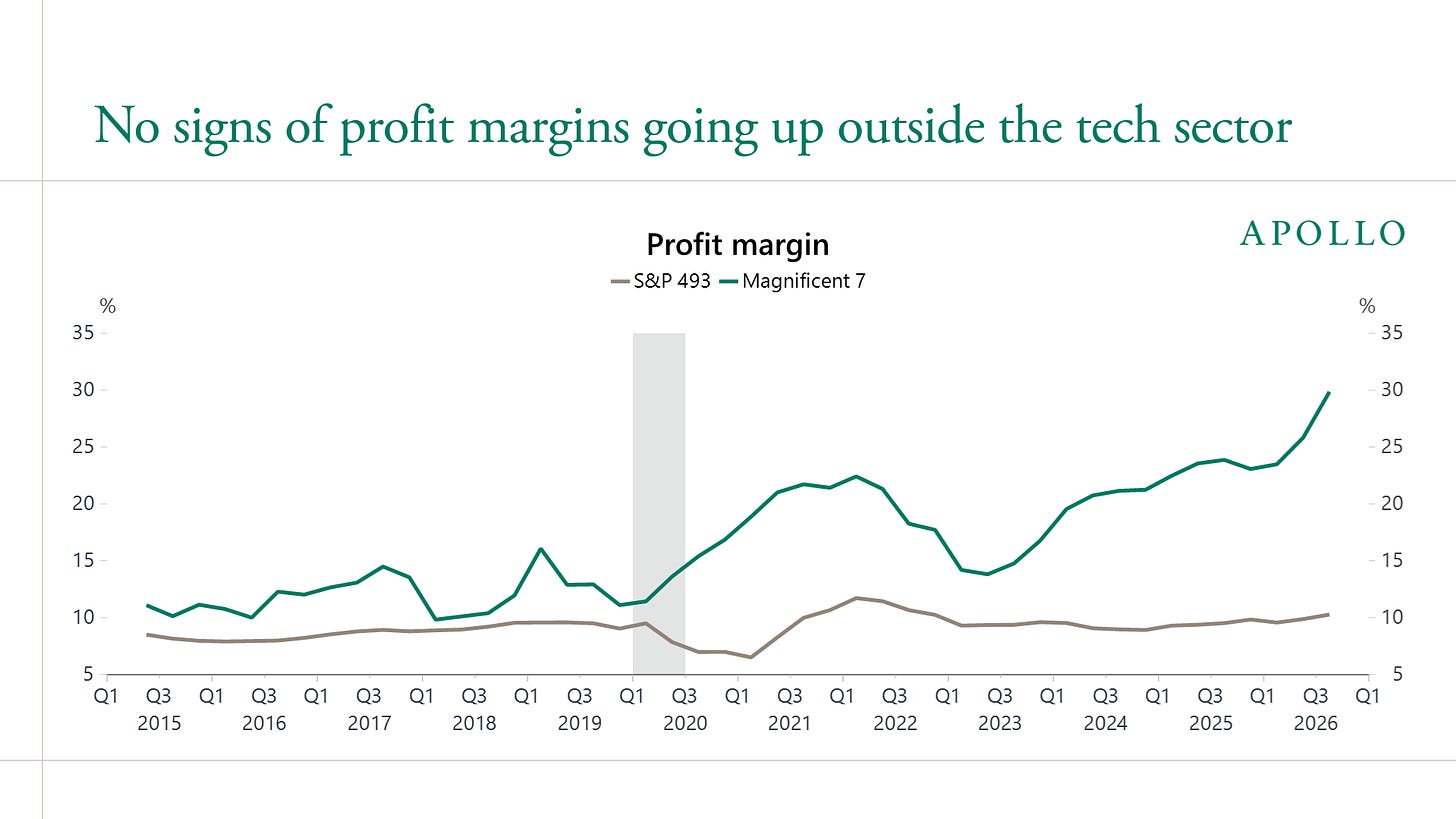
The only companies benefiting from the boom in AI investment are companies selling picks and shovels. Outside of the Mag-7, revenue per employee (a measure of productivity) and profit margins are flat.
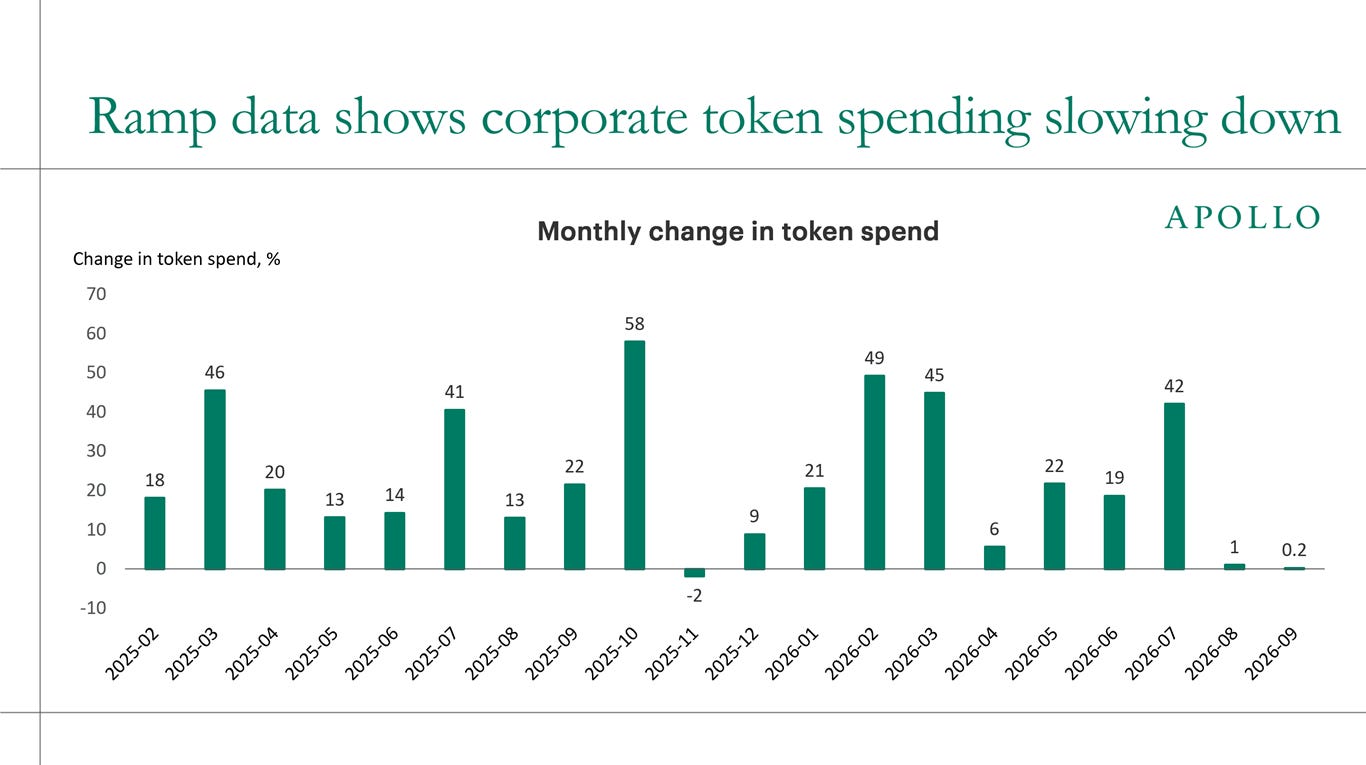
Companies are becoming more cost-aware of their AI spending. For two months token usage has remained flat.
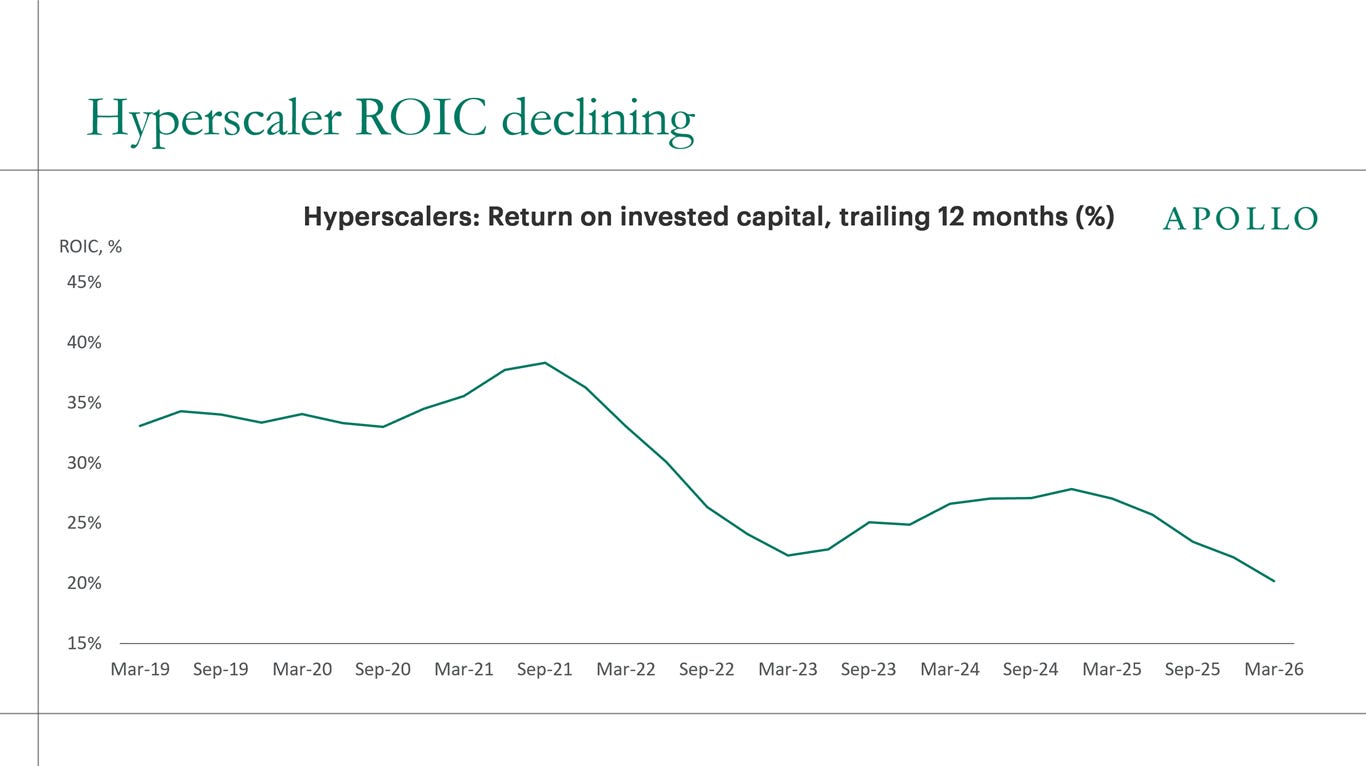
Users would be spending more if the ROI was there. Despite the hype, ROI is trending in the wrong direction.
 Two opposing realities can be true simultaneously
"The Skynet Funding Bill is passed. The system goes on-line August 4th, 1997. Human decisions are removed from strategic defense. Skynet begins to learn at a geometric rate. It becomes self-aware at 2:14 a.m. Eastern time, August 29th. In a panic, they try to pull the plug." - Cyberdyne Systems Model 101
Friends of Collapse2050 who have read previous posts might point out that I'm arguing that AI is both uneconomic and destructive. Yes, that is what I'm saying. AI is both unpragmatic for businesses (at least currently) yet is becoming powerful enough to hack civilization's feeding tubes.
Given that premise, even if capital for datacenters and associated accoutrements evaporates, private companies collapse, and asset prices crash, governments will step in with strategic funding to keep their latest weapon alive.
It could all blow up and still still exist at the same time. Much like how Pets.com died in November 2000 along with many other internet companies valued on eyeballs and clicks, yet the internet and ecommerce remained to develop and overwhelm bricks-and-mortar retail. The internet collapse didn't stop Amazon from becoming the piss-in-a-bottle company we all despise today.
OK, so what the hell am I trying to say?Good question.
Over the long-run (3yrs? 5yrs? 20yrs?) we might be sent to the spice mines of Kessel and smashed into who knows what, but that doesn't mean we should ignore what's right in front of us. The point is to live to fight another day. That means preserving what you have so you can continue to acquire the tools and develop the skills needed for survival. Of course, there are some who might lie down and submit to the whims of what's occurring around them, but I believe we have a moral and practical duty to fight every step of the way.
That means we look around corners, sometimes predicting things that don't happen. Or take longer to happen. And have a plan for if they happen.
While logic might suggest the AI economics is broken, if/when/how the sector crumbles is anyone's guess. Moreover, the secondary and tertiary impacts are partially random. This is where imagination must fill in the gaps.
Before turning the corner, one must attempt to understand a) how exposed they are, b) how much downside they can handle, and c) what they will do when they experience that downside.
These are not easy questions to answer as emotions can take control during the economic wildfire. But this is what you must consider while you have the mind space to do so.
Sign up for Collapse 2050
The unspoken truth about humanity's frightening future.
Subscribe .nc-loop-dots-4-24-icon-o{--animation-duration:0.8s} .nc-loop-dots-4-24-icon-o *{opacity:.4;transform:scale(.75);animation:nc-loop-dots-4-anim var(--animation-duration) infinite} .nc-loop-dots-4-24-icon-o :nth-child(1){transform-origin:4px 12px;animation-delay:-.3s;animation-delay:calc(var(--animation-duration)/-2.666)} .nc-loop-dots-4-24-icon-o :nth-child(2){transform-origin:12px 12px;animation-delay:-.15s;animation-delay:calc(var(--animation-duration)/-5.333)} .nc-loop-dots-4-24-icon-o :nth-child(3){transform-origin:20px 12px} @keyframes nc-loop-dots-4-anim{0%,100%{opacity:.4;transform:scale(.75)}50%{opacity:1;transform:scale(1)}} Email sent! Check your inbox to complete your signup.No spam. Unsubscribe anytime.
None of my content is behind a paywall because I want it available to all. However, paid subscriptions help support my research and writing.
If you find this article interesting or helpful, you can also support without committing to subscription by making a one-time contribution.





ContiMotion EVO: Continental Unveils New Sport Touring Tire as the Successor to the ContiMotion
 The new ContiMotion EVO - the successor to the popular ContiMotion in the sport touring segment.
Continental is thrilled to introduce the ContiMotion EVO, the successor to its popular ContiMotion sport touring motorcycle tire. Designed for everyday riding, weekend trips and longer tours, the new tire combines responsive handling, dependable wet and dry grip, and long tread life.
"With the ContiMotion EVO, we're offering a versatile sport touring tire," said Christoph Ettenhuber, Head of Business Field Motorcycle Tires at Continental. "It combines intuitive handling with reliable grip in both wet and dry conditions - all while delivering impressive mileage for everyday use."
Significant Improvement over the ContiMotion
Compared to its predecessor, the ContiMotion EVO offers several technical improvements. New carcass materials provide additional stability and consistency, resulting in enhanced handling and more agile riding dynamics. This is complemented by updated compounds to improve wet and dry performance.
Convincing key product benefits
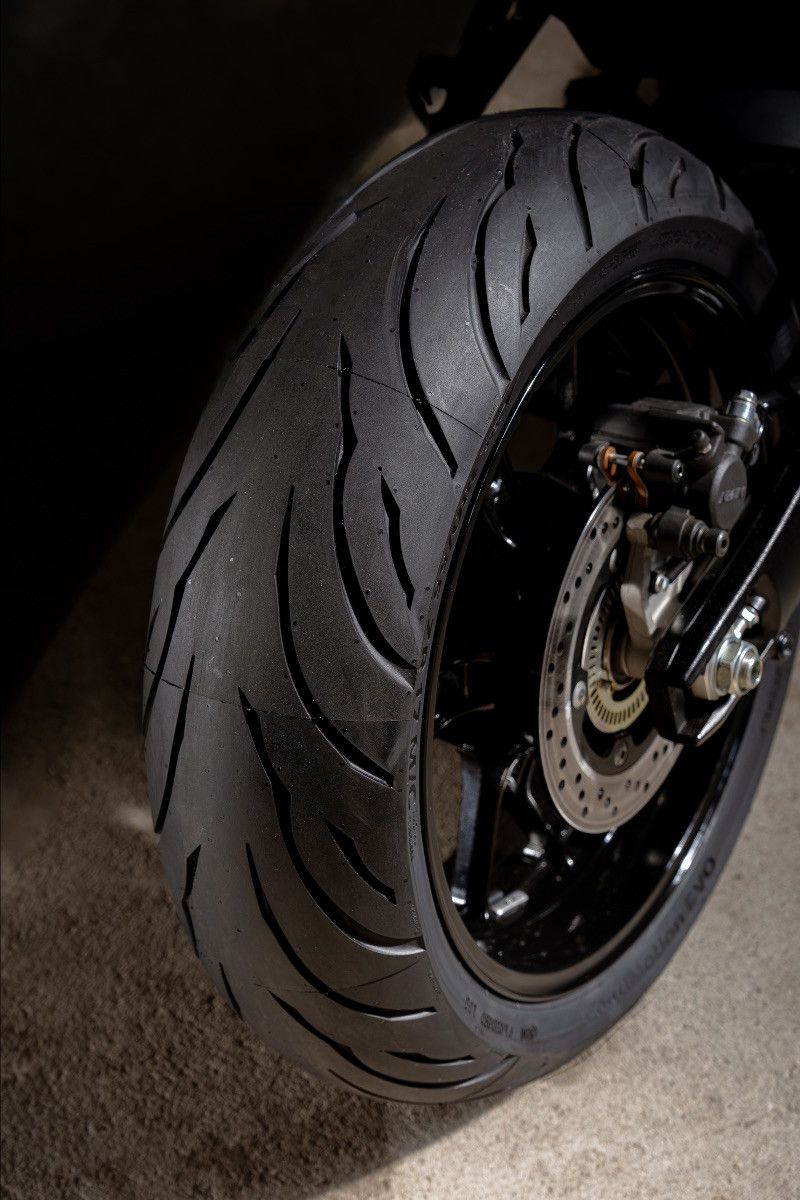 The optimized hybrid silica tread compound improves the ContiMotion EVO's wet grip without compromising mileage.
The ContiMotion EVO stands out thanks to key features:
Intuitive handling and great agility for a fun riding experience.
Continental's EasyHandling technology and an optimized tire construction deliver predictable steering response.
Strong confidence through reliable grip in both dry and wet conditions - thanks to an optimized hybrid silica tread compound.
High mileage and long-lasting performance thanks to its advanced compound and dedicated pattern.
High-speed stability, enabled by the ZeroDegree steel-belt construction and new carcass materials.
Continental MultiGrip technology for a homogeneous gradation of grip levels with a single compound.
"The ContiMotion EVO has been upgraded in key areas without losing the fundamental renowned qualities of its predecessor," explained Christoph Ettenhuber. "Riders benefit from a tire that is noticeably more agile."
 The ContiMotion EVO impresses with an advanced compound and a dedicated pattern - delivering high mileage and long-lasting performance for everyday riding.
MultiGrip technology balances cornering grip and tread life
A smooth transition from the center of the tread to the shoulder is central to Continental's MultiGrip technology. Part of Continental's broader motorcycle tire technology portfolio, MultiGrip provides a continuous progression of grip characteristics across a single tread compound, without noticeable transitions between different compounds as the motorcycle leans into a turn.
Temperature-controlled curing creates a wear-resistant center that supports mileage and more flexible shoulders that provide cornering grip. For sport touring riders, this approach balances long tread life on everyday routes with grip and a consistent feel on winding roads.
 EasyHandling technology ensures intuitive, predictable handling - even in tight corners and when cornering at low speeds
 The ContiMotion EVO features ZeroDegree steel-belt construction, providing high stability at high speeds.
Positioning in the sport touring segment
 The ContiMotion EVO is suitable for a wide range of common tire dimensions.
The ContiMotion EVO is designed for both sporty weekend riders as well as touring enthusiasts. Motorcycles that can be equipped with the ContiMotion EVO include, among others, the BMW R12 nineT, the Triumph Daytona 660, the Ducati Supersport 950, the Honda CB 650R, the Suzuki GSX-8TT and the Yamaha MT-09.
"The ContiMotion EVO is compatible with a wide range of popular naked bikes, roadsters and modern classics," said Christoph Ettenhuber, Head of Business Field Motorcycle Tires at Continental.
Sizes and published launch timing
Continental announced the following launch schedule. (These dates do not establish U.S. dealer availability.)

Continental states that ContiMotion EVO and ContiMotion tires can be combined. Confirm the correct fitment for the motorcycle before installation.
ABOUT CONTINENTAL
Continental is a leading tire manufacturer and industry specialist. Founded in 1871, the company generated sales of €19.7 billion in 2025 and currently employs around 76,000 people in 54 countries and markets.
Tire solutions from the Tires group sector make mobility safer and smarter. Its premium portfolio encompasses car, truck, bus, two-wheel, and specialty tires as well as smart solutions and services for fleets and tire retailers. Continental has been delivering top performance for more than 150 years and is one of the world's largest tire manufacturers. In fiscal 2025, the Tires group sector generated sales of 13.8 billion euros. Continental's tire division currently employs around 53,000 people worldwide and has 19 production and 16 development sites.
The post ContiMotion EVO: Continental Unveils New Sport Touring Tire appeared first on Roadracing World Magazine | Motorcycle Riding, Racing & Tech News.
The University of New Mexico is canceling classes across the medicine, nursing, and pharmacy faculties for a second day amid continued efforts to recover from a "cybersecurity event."
The attack targeted the Health Sciences Center on Monday, the Uni revealed, forcing it to shut down systems, cancel appointments and clinics at UNM Health hospitals, and divert ambulances to healthcare facilities in nearby Albuquerque and Santa Fe.
Hospital appointments and clinics return to normal today, although nonessential UNM Health Sciences Center staff are being asked to remain at home.
"The University of New Mexico Health Sciences Center (HSC), which includes the UNM Health clinical delivery system, experienced a cybersecurity event Monday, Oct. 26, 2026," the university said in a statement on Monday evening.
"HSC information technology security teams immediately took steps to contain the event and protect the network. They also notified state and federal law enforcement and engaged external partners to assist with the investigation.
"Leadership activated an Emergency Operations Center to coordinate the response and provide guidance to HSC employees, students, and UNM Health system frontline providers."
The university announced the attack at 1430 local time, immediately cancelling all remaining clinics and classes, dismissing everyone other than critical and clinical staff, and urging patients not to attend HSC facilities.
It has not commented on the nature of the cyberattack, although that hasn't stopped researchers from speculating about ransomware's involvement. Rumors were fuelled by the newly assembled BYOD ransomware group claiming responsibility for the attack on Monday afternoon.
It's important to note that just because a purported ransomware group took credit for the attack, it does not mean they actually were responsible, nor does it mean they deployed a ransomware/locker payload as part of the attack.
However, the group's take on the digital raid is that it compromised 36,000 machines, "both [Active Directory] forests," two Oracle databases, the personal data belonging to every student and employee, as well as internal emails and data from other systems.
As Reg readers know, a cybercriminal's word is never one to be trusted. Yet BYOD's claims about breaching Trump Mobile's customer database appear to have held up
It was a bold debut, even for a ransomware crew: BYOD's first named victim was the US president's smartphone biz, with data allegedly leaked for all 3,615 customers.
A rival group, EndZone, claimed a similar breach a week earlier, and some experts suggested the two could be one and the same.
In May, the Trump Mobile was found leaking thousands of people's data via a poorly secured website.
The Trump Organization did not respond to our requests for more information in either of these cases.
A UNM spokesperson declined to answer our additional questions, directing us back to its public statement. ®
Sometimes you've just got to roll with the punches. Microsoft chairman and CEO Satya Nadella was knocked down recently: his total compensation for the corporation's fiscal 2026 is 6 percent lighter than it was in the prior year.
The leader of the software and cloud biz pocketed $90.6 million, including a $2.5 million base salary, $77.6 million in stock awards, $10.3 million non-equity incentive plan compensation and $259,203 in all other compensation (chiefly security for personal travel, charitable gifts and pension contributions).
As Reg readers are no doubt be aware, stock vests at a different rate annually and in the latest full-year Nadella was awarded a lower figure, despite breezing through all of his financial and operational targets.
Revenue for Microsoft's fiscal 2026 ended June 30 was up 18 percent to $331.8 billion and operating profit was 18 percent higher - at $155.237 billion - than SatNad's $130.96 billion target. Together, these areas accounted for 70 percent of the bossman's remuneration goals. Operational assessment including security, strategic transformation and culture made up the rest.
The executive pay scale was outlined in the Notice of Annual Shareholder Meeting and Proxy Statement 2026.
Other highlights in that financial year included a 27 percent bounce in revenue generated by the Cloud division to $214.4 billion. Microsoft added 88 datacenters to its portfolio, and had 30 million paid Copilot seats.
"The scale of adoption reflects growing customer confidence in Microsoft's ability to deliver enterprise-ready AI capabilities integrated directly into existing workflows. Microsoft also delivered 625 Copilot updates during the year, reflecting its rapid pace of innovation and commitment to customer feedback," Microsoft claimed.
"Large-scale enterprise deployments accelerated across industries, with the number of customers deploying Copilot broadly across their organizations continuing to increase as Copilot evolved from an AI assistant into a platform for agentic work."
GitHub captured 225 million users - 50 million of these used Copilot, with one in three "pull requests involving an agent." Industry-specific AI services expanded, such as Dragon Copilot for healthcare, now used by "100,000 healthcare providers to help automate administrative and clinical workflows."
The rest of the C-suite's compensation went in the opposite direction to Nadella, and saw their packages increase, though they aren't nearly as well off as the CEO, who got the top job in 2014. CFO Amy Hood, was awarded $33.7 million, up from $29.5 million. The beancounting bigwig returned $43.8 billion to shareholders in the 12 months.
Judson Althoff, CEO of Microsoft's Commercial Business was awarded $33.4 million, and chief marketing officer Takeshi Numoto - the person that also works on product bundles - was awarded $15.7 million. President Brad Smith was compensated to the tune of $33 million.
Like we've said before, it's tough at the top. Nadella's pay was equivalent to the average pay ($215,057) of 420 Microsoft employees.
Still, the pressure of running one of the biggest organizations on the planet must be a big load to carry, especially when Microsoft is spending hundreds of billions on AI infrastructure and looking to find massive cost savings by erasing up to a quarter of the workforce.
The annual shareholder meeting is scheduled for December 8 when investors will get a chance to have their say on exec pay. 91 percent voted in favor last year so it seems unlikely any dissenting voices will be heard at the upcoming event. ®
Chris Packham says £24bn earmarked for projects with 'ludicrously uncertain results' should be redirected to help lower bills and cut emissions
Campaigners are calling on the chancellor to cut the government's £24bn spending plans for "fairytale" carbon capture technologies in favour of funding green schemes that can reliably cut emissions and lower energy bills.
The environmentalist Chris Packham is leading an 11th-hour appeal for the Treasury to use this week's budget to scale back the government's "exorbitantly expensive" support for carbon capture, which is now more than the planned spending for the US, the EU, Norway and Japan combined.
Continue reading...


The festival of leftfield electronic music returns to Central London next month for its second edition
Soho Electronic, the Central London festival championing leftfield electronic music, will return for its second edition next month.
More than 30 artists are scheduled to play across four stages on and around Dean Street, with the likes of Nik Colk Void and Mark Van Hoen, otherwise known as Locust, set to make appearances. The festival will also host sets from reel-to-reel tape manipulator Howlround, Sculpture, Sonny E (FKA Adamski) and Agnes Haus, in addition to our very own Reviews Editor, Bobby Barry.
Alongside the aforementioned acts, the full lineup includes live sets from Axon, Death Magazine 52, Artificially Yours, Lifeloose, E.M.Arson, kWeRk + Ch20, Disinformation, Xuanni_Space, Dom...
The post Nik Colk Void and More to Play Soho Electronic 2026 appeared first on The Quietus.


