

Drukqs has long been one of John Doran's favourite LPs; with a reissue looming, he attempts to articulate why he loves this critically derided album so much
Drukqs by Aphex Twin
Rereading the contemporary reviews of Drukqs 25 years later is like rubbernecking the aftermath of a motorway crash. Just ahead of release in October 2001, it became wince-inducingly clear that some previously long-term supporters of Richard D. James were ready to start questioning the validity of his art if not gearing up to fully turn on him. His traditional allies in the leftfield press hated the album, that much was clear. "Too much cake and no nuts" was the stinging but memorable summary minted by Rob Young for The Wire, who...
The post Prepared for the Future: the Slow Reveal of Aphex Twin's Drukqs appeared first on The Quietus.
Emissions from exported oil would not count against carbon budget, insiders say - reasoning likely to draw dismay from climate campaigners
The giant Rosebank oilfield can be approved without breaching the UK's emission targets, according to government insiders, in a boost to those in the cabinet who are pushing for it to be given the go-ahead.
The Guardian revealed last week that Miatta Fahnbulleh, the energy secretary, was leaning towards rejecting the project, but her position has put her at loggerheads with cabinet colleagues, including the chancellor, John Healey, who are lobbying for an approval.
Continue reading...The radical Stern report showed that a low-carbon future is also good economics. But it seems that capitalism needs a reminder
Saving the only planet we have makes good economic sense. There is, after all, no money to be made on a dead Earth. There may be costs involved now, but they are worth paying to protect our children from certain destruction.
These propositions seem self-evident now. But two decades ago, mainstream economists had very different ideas. They had proved that the climate crisis would be a mere economic blip, easily absorbed by growing economies and therefore not worth spending money on. In their accounting, they considered ice caps and glaciers functionally worthless, that trees only add to GDP when they are cut down, and that a livable climate shouldn't even merit a line on a spreadsheet.
Fiona Harvey is an environment editor at the Guardian
Continue reading...Extreme heat accelerated disappearance of Triglav glacier from mountain revered as a symbol of Slovenian identity
The final ice patch has vanished from Slovenia's Triglav glacier, the latest Alpine casualty of Europe's scorching summer.
The once mighty ice mass lost 93% of its surface area between 1983 and 2003, shrinking to cover less than a hectare of overheated rock, but went on to surprise researchers who feared its imminent demise, clinging on to the mountain for two more decades.
Continue reading...Wharram and York, North Yorkshire: It's the nervy few days before a ceremony that will honour our local waterways, and I have work to do
I visit the source of the tiny stream called the Gypsey Race now and then, drawn by the everyday miracle of its water welling to catch sunlight like a plaything and alchemise it into colours and sparks. Today, though, is different, because I've come to ask for something. Something like permission, or approval maybe.
I've been helping to organise a gathering of river advocates to co-draft a regional charter of river rights - making explicit our responsibilities towards them. We will be holding a ceremony to blend waters from across Yorkshire to make ink in which the charter will be written. I want to collect water from the Gypsey, but I also want some of its potent reputation. Its course is regarded as auspicious thanks to an extraordinary concentration of nearby prehistoric barrows, cursuses and henges, not to mention England's tallest standing stone. Local folklore insists that its capricious flow holds the power of prophecy.
Continue reading...
The UK has beaten its target to provide £11.6bn of climate aid to developing countries by 2026 - but only through "questionable accounting".
As part of its obligations under the Paris Agreement, the UK pledged to give at least £11.6bn in overseas "climate finance" between 2021 and 2026.
Now, Carbon Brief analysis reveals that around £2.1bn of the funds the UK counted towards this goal did not come from new spending.
Instead, the government relabelled existing funding for development banks, private-sector investment and aid for Afghanistan, Sudan and other war-torn nations as "climate finance".
Without these changes, the UK would have fallen nearly £1bn short of its target.
Carbon Brief's analysis is based on numerous FOI requests and reveals the otherwise-unpublished details of the UK's climate-finance spending.
Experts and MPs say the use of "questionable" accounting shows the UK is "cutting corners" to hit its climate goals, while making unprecedented cuts to its foreign aid budget.
'Moving the goalposts'The UK and other developed countries are obliged under UN climate treaties to provide "new and additional" climate finance to help developing countries tackle climate change.
They also have specific targets to "mobilise" $100bn of climate finance per year through to 2025 and "at least" $300bn by 2035.
As the UK's contribution to international climate finance, in 2019 the Conservative government pledged to provide £11.6bn between the financial years 2021-22 and 2025-26. This amounted to "doubling" its previous five-year target.
Since then, successive governments have slashed the amount of money going towards foreign aid, citing economic strain and a need for more defence spending. This has placed great pressure on the £11.6bn target, which comes from the UK aid budget.
In order to retain the target while cutting aid, the Conservative government decided in 2023 to loosen the criteria for what it defined as "climate" spending.
This enabled the UK to remain committed to the £11.6bn goal, without spending more on new climate projects, by simply relabelling existing funds. The current Labour government has opted to maintain this approach, while pledging to cut aid spending even further.
The move has been strongly criticised by campaigners, MPs and even the UK's official aid watchdog, who have described it as "creative accounting" and "moving the goalposts".
'£1bn shortfall'The UK government has announced that it met the £11.6bn target, but has not released the full details of how it did so - or even the total amount provided by 2025-26.
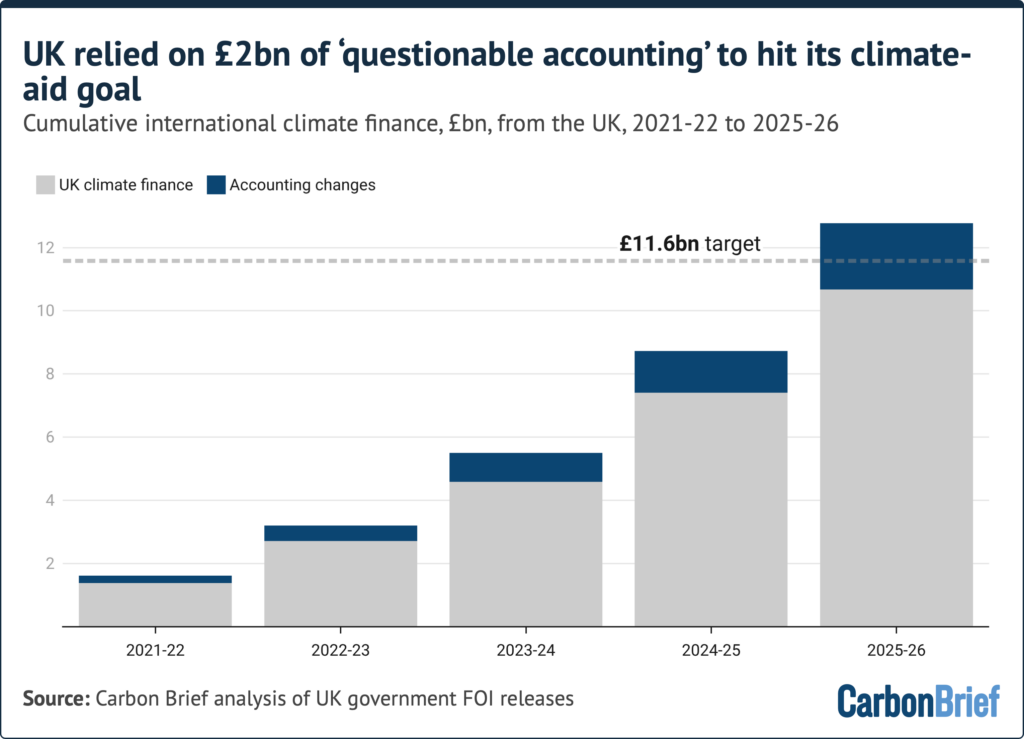
FOI data obtained by Carbon Brief over the course of several months reveals that, in fact, total climate finance over the past five years reached £12.8bn - with a record £4bn in the past year alone.
However, Carbon Brief analysis of government data also shows that around £2.1bn - nearly a fifth of the total - comes from the government's accounting changes.
Without these changes, as the chart below shows, cumulative UK climate finance would only have reached around £10.7bn by 2026, leaving a shortfall of £924m.
This final figure of £2.1bn is higher than forecast by the UK Independent Commission for Aid Impact (ICAI), which estimated in 2024 that the total amount of "reclassified" climate finance would reach £1.7bn.
The government has stressed that its accounting changes are "consistent" with "internationally agreed ways of calculating ICF", used by other major donors.
(Experts have noted that, traditionally, the UK was viewed as taking a more rigorous approach to climate-finance accounting, which is notoriously unregulated and opaque.)
A recent International Development Committee (IDC) report noted that developed countries have committed to providing "new and additional" climate finance to developing countries, which is generally interpreted as extra funds on top of existing aid.
Evidence gathered by the IDC concluded that, alongside aid cuts, the UK's accounting changes have "eroded" the "additionality and credibility" of its climate finance.
Responding to Carbon Brief's findings, IDC chair Sarah Champion said the data "shines a new light" on the committee's findings:
"The picture is not getting any better. If questionable accounting has been used to get around a £1bn shortfall on ICF spend between 2021-22 and 2025-26, this only underlines my concerns that the government has been cutting corners to maintain headline climate-spending commitments, rather than working to deliver genuine climate and nature outcomes."
These accounting changes remain relevant as the UK begins its next phase of international climate finance, while cutting the aid budget further.
The government has pledged £6bn of foreign aid for climate projects over the next three years. This makes the UK one of the only major donor countries to set out a new climate-finance target for the period after 2025, despite a global pledge to scale up support.
Nevertheless, the new UK goal amounts to a halving from £4bn in the financial year 2025-26 to £2bn a year, on average. Previous Carbon Brief analysis also shows that the continued use of "questionable accounting" is likely to make up around a third of the new target.
Responding to Carbon Brief's analysis, a UK government spokesperson says:
"We are proud to have both hit, and exceeded, our third international climate-finance target - and will continue to work hard on protecting climate and nature.
"Climate change and nature loss pose a real and significant threat to global security and prosperity. That is why the UK is leading action on climate and nature, and prioritising climate finance in its aid budget."
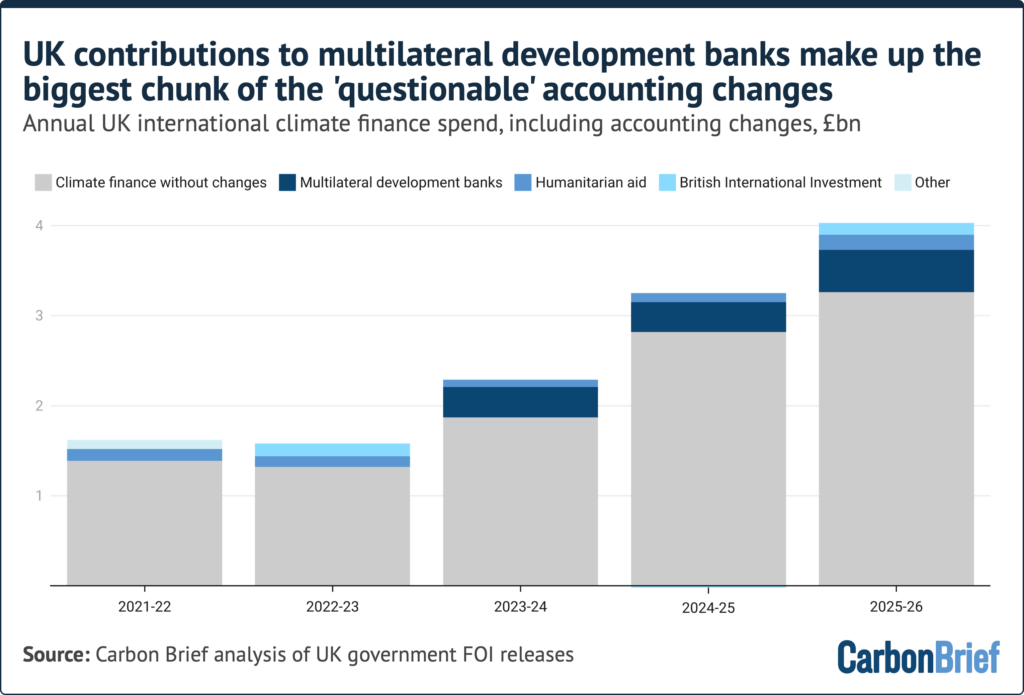
Accounting changesThe UK's accounting changes break down into three major components, which are behind most of its upward revision in climate-finance spending.
The first is counting a share of "core" funding for multilateral development banks (MDBs) as climate finance.
This refers to un-earmarked contributions that governments provide to support these banks in their work, which includes providing loans and grants to developing countries.
Counting this spending as "climate finance" adds £1.1bn to the total of £12.8bn, split mainly between the World Bank and the African Development Bank.
As the chart below shows, this is by far the largest chunk of extra climate finance resulting from the UK's accounting changes.
 A spreadsheet with details of these accounting changes can be viewed here.
This revision has been justified on the grounds that the World Bank and other banks have clear targets for funding climate-relevant projects, using their core funding.
However, MDBs have also faced criticism for their lack of transparency around climate finance and their reliance on loans, rather than grants. (In contrast, nearly all of the UK's climate finance so far has been grant-based.)
Moreover, the US has been pressuring MDBs to drop their climate plans altogether. Indeed, the Trump administration has already forced the World Bank to abandon its overall target to put 45% of its funds towards climate finance.
Jon Sward, environment project manager at the Bretton Woods Project NGO, tells Carbon Brief:
"One thing removing the overall [World Bank] target definitely does is it adds…a lack of predictability of the flows going forward."
The second-largest UK accounting change - contributing nearly £600m - comes from automatically counting 30% of humanitarian aid as climate finance, if it is going to one of the countries judged most vulnerable to climate change.
This includes some of the most war-torn and low-income nations in the world, such as Afghanistan, Sudan and the Democratic Republic of the Congo.
Crucially, this means projects are counted even if they have no discernible link to climate change, such as helping "conflict-affected" people in Yemen and orphans in Zimbabwe.
The Center for Global Development (CGD) has described this revision as "arbitrary", given every aid project is already screened for any climate-relevant components.
The third significant portion comes from counting more of the government's private-sector investments via British International Investment (BII) as climate finance. BII is a publicly owned, for-profit company that invests in developing-country businesses and is partially funded with injections of UK aid money.
The UK government decided to start calculating the climate share of its BII spending based on real-world BII investments, rather than a default, fixed share of 30%.
Data obtained by Carbon Brief via FOI suggests that £133m of extra BII funding was labelled as climate finance over the first four years of the £11.6bn target.
However, government records of BII climate finance have been inconsistent, making it difficult to estimate the total impact of accounting changes. Therefore, Carbon Brief has used an earlier internal government forecast that estimated this change would add a total of £266m over the five-year target period.
BII has increasingly turned its attention to investing in clean power in recent years, reaching more than £1bn in "climate investments" in 2025.
However, the company has faced criticism for investments that "conflict" with UK priorities - including legacy fossil-fuel investments - as well as channelling aid money to "billionaires".
There was also some extra spending that the government decided to count as climate aid - notably, £99m of "spending on COP26", from when the UK hosted the climate summit.
Shruti Agarwal, senior climate finance adviser at Save the Children UK, tells Carbon Brief the reduction in overall "financial effort" by the UK is a "concerning pattern that must cease". She adds:
"[The UK should] strengthen transparency by publishing timely, detailed data on international climate spending and stop classifying expenditure as climate finance retrospectively, as seen with COP26 expenses."
MethodologyCarbon Brief obtained the full datasets of international climate-finance spending via FOI, covering the five-year period 2021-22 to 2025-26. For more details and to access the full dataset, see Carbon Brief's analysis of the £12.8bn in spending over this period.
In addition, Carbon Brief requested details from the Foreign, Commonwealth and Development Office (FCDO) of what climate-finance spending would have been prior to the 2023 accounting changes, for the period 2021-22 to 2024-25.
Carbon Brief then used this information to calculate the impact of accounting changes in 2025-26, combining the figures to work out the full impact.
A spreadsheet with the full details of the accounting changes can be viewed here.
UK climate-finance figures have been subject to regular revisions. While this analysis is based on final figures provided via FOI requests in recent months, it is possible that departments will still change the figures in future releases.
Related Analysis: How the UK spent more than £11.6bn on climate aid since 2021
28.10.2026
UK policy
 Q&A: Why are UK energy bills so high - and how could they be lowered?
27.10.2026
Oil and gas
 Revealed: Expensive gas behind 'nearly 90%' of rise in UK electricity bills
21.10.2026
Oil and gas
 Factcheck: UK Conservatives double the 'cost of net-zero' after spreadsheet blunder
09.10.2026
UK policy
The post Revealed: UK relied on £2bn of 'questionable accounting' to hit its climate-aid goal appeared first on Carbon Brief.
- The UK has supported around 500 climate projects since 2021
- UK climate aid has reached record levels - but is set to drop
- Afghanistan received more bilateral climate aid than any other country
- Development banks and private-sector funders are among the biggest beneficiaries
- Methodology
The UK has spent £12.8bn on climate aid for developing countries since 2021, according to official figures obtained by Carbon Brief.
Freedom-of-information (FOI) requests reveal how the UK has used its "climate finance" to support everything from solar projects in Mozambique to carbon offsets in the Amazon.
UK climate funding, which reached a record £4bn this year, has supported roughly 500 aid projects, climate funds and private-investment initiatives over the past five years.
With this spending, the UK has surpassed its £11.6bn climate-finance target for this period, although Carbon Brief analysis shows that it has partly relied on "questionable accounting".
This target is part of the UK's ongoing responsibility under UN climate treaties to financially support developing countries in their efforts to tackle climate change.
Despite being central to its international climate policy, the UK government does not routinely release data on progress towards its climate-finance goals.
Here, Carbon Brief has published the data in full for the first time and pulled out key trends since 2021.
The UK has supported around 500 climate projects since 2021According to the FOI data obtained by Carbon Brief, at least 493 projects, funds and institutions received UK climate finance between 2021-22 and 2025-26.
These included £45m to help Ukraine curb its reliance on fossil fuels, £40m in cash transfers for Kenyans affected by drought and £30m to provide flood resilience in Nepal.
Larger sums were provided to projects spread across multiple countries, often with the stated goal of "mobilising" additional finance from the private sector.
For example, the UK channelled £198m into a World Bank-backed project to help Colombia, Cambodia and others create and sell "high-integrity" carbon offsets.
The UK also provided £229m to a group that uses foreign aid to attract private capital for projects in predominantly low-income nations, such as a solar farm in Uganda and a "sustainable aviation fuel" project in Pakistan.
All of the funded projects can be viewed in the interactive table below.
The UK has been criticised by campaigners and MPs for its lack of transparency around climate finance data.
In line with its international obligations, the government routinely releases its climate-finance figures to the UN - albeit with a two-year delay.
However, it does not publish this data broken down by financial year, making it impossible to accurately gauge progress towards the £11.6bn goal.
The data gathered by Carbon Brief is therefore the most comprehensive attempt to track this information to date. Carbon Brief has been periodically tracking this data since 2017.
UK climate aid has reached record levels - but is set to dropThe UK government committed in 2019 to spending £11.6bn of the nation's aid budget on "climate finance", between 2021-22 and 2025-26.
This is the nation's contribution to an international goal to mobilise $100bn of climate finance a year between 2020 and 2025.
Developed countries are obliged under UN climate treaties to financially support developing countries, assisting their efforts to cut emissions and adapt to climate change.
However, alongside other major donors, such as the US, the UK has dramatically cut its aid budget, placing significant strain on the nation's climate finance.
Despite this, FOI data shows that UK climate finance reached a record £4bn in 2025-26, as shown in the chart below.
Not accounting for inflation, this amounts to a tenfold increase from 2011-12, when the UK started providing climate finance.
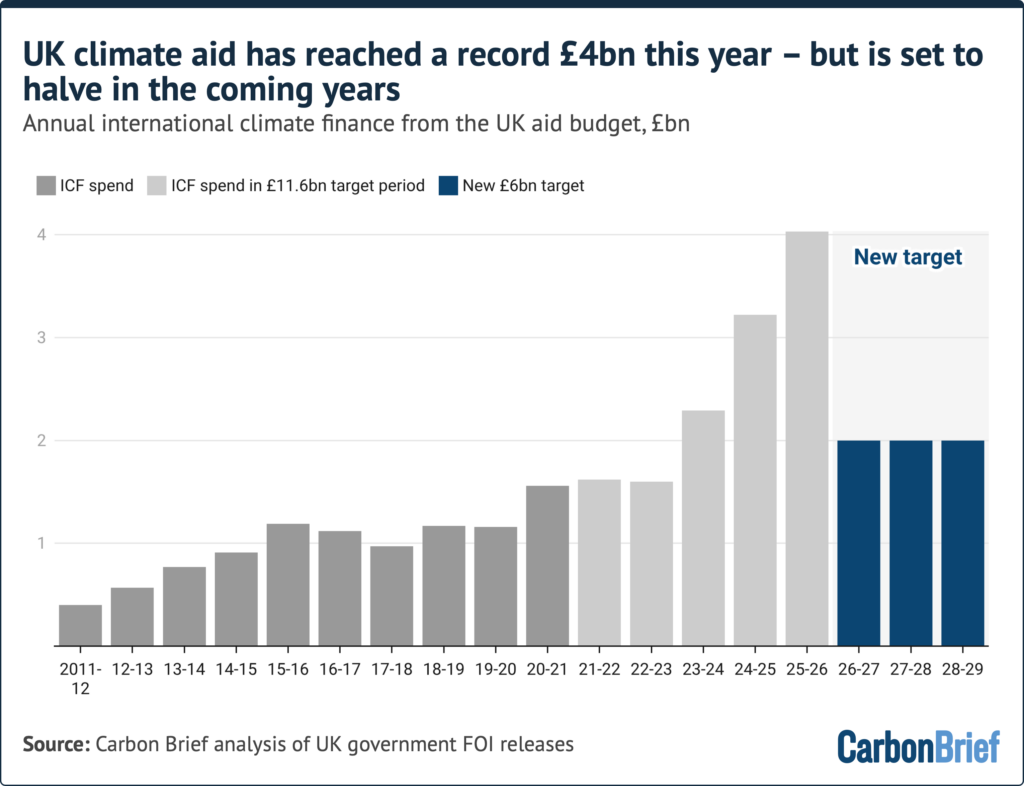
The £11.6bn target was met comfortably, with £12.8bn provided over the five-year period.
However, as separate Carbon Brief analysis shows, the target was only met due to the government reclassifying £2.2bn of existing foreign aid as climate finance, without spending any more.
Rather than setting a new five-year goal, in March 2026 the Labour government committed to spending "around £6bn" of UK aid as climate finance over the next three years. On average, this would mean £2bn in climate aid annually - roughly half the level achieved in the financial year 2025-26.
#gform_wrapper_7[data-form-index="0"].gform-theme,[data-parent-form="7_0"]{--gf-color-primary: #204ce5;--gf-color-primary-rgb: 32, 76, 229;--gf-color-primary-contrast: #fff;--gf-color-primary-contrast-rgb: 255, 255, 255;--gf-color-primary-darker: #001AB3;--gf-color-primary-lighter: #527EFF;--gf-color-secondary: #fff;--gf-color-secondary-rgb: 255, 255, 255;--gf-color-secondary-contrast: #112337;--gf-color-secondary-contrast-rgb: 17, 35, 55;--gf-color-secondary-darker: #F5F5F5;--gf-color-secondary-lighter: #FFFFFF;--gf-color-out-ctrl-light: rgba(17, 35, 55, 0.1);--gf-color-out-ctrl-light-rgb: 17, 35, 55;--gf-color-out-ctrl-light-darker: rgba(104, 110, 119, 0.35);--gf-color-out-ctrl-light-lighter: #F5F5F5;--gf-color-out-ctrl-dark: #585e6a;--gf-color-out-ctrl-dark-rgb: 88, 94, 106;--gf-color-out-ctrl-dark-darker: #112337;--gf-color-out-ctrl-dark-lighter: rgba(17, 35, 55, 0.65);--gf-color-in-ctrl: #fff;--gf-color-in-ctrl-rgb: 255, 255, 255;--gf-color-in-ctrl-contrast: #112337;--gf-color-in-ctrl-contrast-rgb: 17, 35, 55;--gf-color-in-ctrl-darker: #F5F5F5;--gf-color-in-ctrl-lighter: #FFFFFF;--gf-color-in-ctrl-primary: #204ce5;--gf-color-in-ctrl-primary-rgb: 32, 76, 229;--gf-color-in-ctrl-primary-contrast: #fff;--gf-color-in-ctrl-primary-contrast-rgb: 255, 255, 255;--gf-color-in-ctrl-primary-darker: #001AB3;--gf-color-in-ctrl-primary-lighter: #527EFF;--gf-color-in-ctrl-light: rgba(17, 35, 55, 0.1);--gf-color-in-ctrl-light-rgb: 17, 35, 55;--gf-color-in-ctrl-light-darker: rgba(104, 110, 119, 0.35);--gf-color-in-ctrl-light-lighter: #F5F5F5;--gf-color-in-ctrl-dark: #585e6a;--gf-color-in-ctrl-dark-rgb: 88, 94, 106;--gf-color-in-ctrl-dark-darker: #112337;--gf-color-in-ctrl-dark-lighter: rgba(17, 35, 55, 0.65);--gf-radius: 3px;--gf-font-size-secondary: 14px;--gf-font-size-tertiary: 13px;--gf-icon-ctrl-number: url("data:image/svg+xml,%3Csvg width='8' height='14' viewBox='0 0 8 14' fill='none' xmlns='http://www.w3.org/2000/svg'%3E%3Cpath fill-rule='evenodd' clip-rule='evenodd' d='M4 0C4.26522 5.96046e-08 4.51957 0.105357 4.70711 0.292893L7.70711 3.29289C8.09763 3.68342 8.09763 4.31658 7.70711 4.70711C7.31658 5.09763 6.68342 5.09763 6.29289 4.70711L4 2.41421L1.70711 4.70711C1.31658 5.09763 0.683417 5.09763 0.292893 4.70711C-0.0976311 4.31658 -0.097631 3.68342 0.292893 3.29289L3.29289 0.292893C3.48043 0.105357 3.73478 0 4 0ZM0.292893 9.29289C0.683417 8.90237 1.31658 8.90237 1.70711 9.29289L4 11.5858L6.29289 9.29289C6.68342 8.90237 7.31658 8.90237 7.70711 9.29289C8.09763 9.68342 8.09763 10.3166 7.70711 10.7071L4.70711 13.7071C4.31658 14.0976 3.68342 14.0976 3.29289 13.7071L0.292893 10.7071C-0.0976311 10.3166 -0.0976311 9.68342 0.292893 9.29289Z' fill='rgba(17, 35, 55, 0.65)'/%3E%3C/svg%3E");--gf-icon-ctrl-select: url("data:image/svg+xml,%3Csvg width='10' height='6' viewBox='0 0 10 6' fill='none' xmlns='http://www.w3.org/2000/svg'%3E%3Cpath fill-rule='evenodd' clip-rule='evenodd' d='M0.292893 0.292893C0.683417 -0.097631 1.31658 -0.097631 1.70711 0.292893L5 3.58579L8.29289 0.292893C8.68342 -0.0976311 9.31658 -0.0976311 9.70711 0.292893C10.0976 0.683417 10.0976 1.31658 9.70711 1.70711L5.70711 5.70711C5.31658 6.09763 4.68342 6.09763 4.29289 5.70711L0.292893 1.70711C-0.0976311 1.31658 -0.0976311 0.683418 0.292893 0.292893Z' fill='rgba(17, 35, 55, 0.65)'/%3E%3C/svg%3E");--gf-icon-ctrl-search: url("data:image/svg+xml,%3Csvg width='640' height='640' xmlns='http://www.w3.org/2000/svg'%3E%3Cpath d='M256 128c-70.692 0-128 57.308-128 128 0 70.691 57.308 128 128 128 70.691 0 128-57.309 128-128 0-70.692-57.309-128-128-128zM64 256c0-106.039 85.961-192 192-192s192 85.961 192 192c0 41.466-13.146 79.863-35.498 111.248l154.125 154.125c12.496 12.496 12.496 32.758 0 45.254s-32.758 12.496-45.254 0L367.248 412.502C335.862 434.854 297.467 448 256 448c-106.039 0-192-85.962-192-192z' fill='rgba(17, 35, 55, 0.65)'/%3E%3C/svg%3E");--gf-label-space-y-secondary: var(--gf-label-space-y-md-secondary);--gf-ctrl-border-color: #686e77;--gf-ctrl-size: var(--gf-ctrl-size-md);--gf-ctrl-label-color-primary: #112337;--gf-ctrl-label-color-secondary: #112337;--gf-ctrl-choice-size: var(--gf-ctrl-choice-size-md);--gf-ctrl-checkbox-check-size: var(--gf-ctrl-checkbox-check-size-md);--gf-ctrl-radio-check-size: var(--gf-ctrl-radio-check-size-md);--gf-ctrl-btn-font-size: var(--gf-ctrl-btn-font-size-md);--gf-ctrl-btn-padding-x: var(--gf-ctrl-btn-padding-x-md);--gf-ctrl-btn-size: var(--gf-ctrl-btn-size-md);--gf-ctrl-btn-border-color-secondary: #686e77;--gf-ctrl-file-btn-bg-color-hover: #EBEBEB;--gf-field-img-choice-size: var(--gf-field-img-choice-size-md);--gf-field-img-choice-card-space: var(--gf-field-img-choice-card-space-md);--gf-field-img-choice-check-ind-size: var(--gf-field-img-choice-check-ind-size-md);--gf-field-img-choice-check-ind-icon-size: var(--gf-field-img-choice-check-ind-icon-size-md);--gf-field-pg-steps-number-color: rgba(17, 35, 55, 0.8);} EmailThis field is for validation purposes and should be left unchanged.Free weekly newsletter
.preheader p{ margin-top: 0; font-family: 'PT Sans', sans-serif; font-weight: var(--type--3--font-weight--bold); color: var(--button--color); font-size: var(--button--font-size, inherit); } .newsletter-inline{
display: flex;
border: solid 1px #333333;
padding: 1em;
background: #ffffff;
}
.inline-email{
display:inline-block;
margin-right:1em;
margin-top:0 !important;
margin-bottom:0.5em;
}
#field_submit{
display:inline-block;
margin-top:0 !important;
}
.gform_wrapper .gfield+.gfield{
margin-top:0
}
Email
gform.initializeOnLoaded( function() {gformInitSpinner( 7, 'https://www.carbonbrief.org/wp-content/plugins/gravityforms/images/spinner.svg', false );jQuery('#gform_ajax_frame_7').on('load',function(){var contents = jQuery(this).contents().find('*').html();var is_postback = contents.indexOf('GF_AJAX_POSTBACK') >= 0;if(!is_postback){return;}var form_content = jQuery(this).contents().find('#gform_wrapper_7');var is_confirmation = jQuery(this).contents().find('#gform_confirmation_wrapper_7').length > 0;var is_redirect = contents.indexOf('gformRedirect(){') >= 0;var is_form = form_content.length > 0 && ! is_redirect && ! is_confirmation;var mt = parseInt(jQuery('html').css('margin-top'), 10) + parseInt(jQuery('body').css('margin-top'), 10) + 100;if(is_form){jQuery('#gform_wrapper_7').html(form_content.html());if(form_content.hasClass('gform_validation_error')){jQuery('#gform_wrapper_7').addClass('gform_validation_error');} else {jQuery('#gform_wrapper_7').removeClass('gform_validation_error');}setTimeout( function() { /* delay the scroll by 50 milliseconds to fix a bug in chrome */ jQuery(document).scrollTop(jQuery('#gform_wrapper_7').offset().top - mt); }, 50 );if(window['gformInitDatepicker']) {gformInitDatepicker();}if(window['gformInitPriceFields']) {gformInitPriceFields();}var current_page = jQuery('#gform_source_page_number_7').val();gformInitSpinner( 7, 'https://www.carbonbrief.org/wp-content/plugins/gravityforms/images/spinner.svg', false );jQuery(document).trigger('gform_page_loaded', [7, current_page]);window['gf_submitting_7'] = false;}else if(!is_redirect){var confirmation_content = jQuery(this).contents().find('.GF_AJAX_POSTBACK').html();if(!confirmation_content){confirmation_content = contents;}jQuery('#gform_wrapper_7').replaceWith(confirmation_content);jQuery(document).scrollTop(jQuery('#gf_7').offset().top - mt);jQuery(document).trigger('gform_confirmation_loaded', [7]);window['gf_submitting_7'] = false;wp.a11y.speak(jQuery('#gform_confirmation_message_7').text());}else{jQuery('#gform_7').append(contents);if(window['gformRedirect']) {gformRedirect();}}jQuery(document).trigger("gform_pre_post_render", [{ formId: "7", currentPage: "current_page", abort: function() { this.preventDefault(); } }]); if (event && event.defaultPrevented) { return; } const gformWrapperDiv = document.getElementById( "gform_wrapper_7" ); if ( gformWrapperDiv ) { const visibilitySpan = document.createElement( "span" ); visibilitySpan.id = "gform_visibility_test_7"; gformWrapperDiv.insertAdjacentElement( "afterend", visibilitySpan ); } const visibilityTestDiv = document.getElementById( "gform_visibility_test_7" ); let postRenderFired = false; function triggerPostRender() { if ( postRenderFired ) { return; } postRenderFired = true; gform.core.triggerPostRenderEvents( 7, current_page ); if ( visibilityTestDiv ) { visibilityTestDiv.parentNode.removeChild( visibilityTestDiv ); } } function debounce( func, wait, immediate ) { var timeout; return function() { var context = this, args = arguments; var later = function() { timeout = null; if ( !immediate ) func.apply( context, args ); }; var callNow = immediate && !timeout; clearTimeout( timeout ); timeout = setTimeout( later, wait ); if ( callNow ) func.apply( context, args ); }; } const debouncedTriggerPostRender = debounce( function() { triggerPostRender(); }, 200 ); if ( visibilityTestDiv && visibilityTestDiv.offsetParent === null ) { const observer = new MutationObserver( ( mutations ) => { mutations.forEach( ( mutation ) => { if ( mutation.type === 'attributes' && visibilityTestDiv.offsetParent !== null ) { debouncedTriggerPostRender(); observer.disconnect(); } }); }); observer.observe( document.body, { attributes: true, childList: false, subtree: true, attributeFilter: [ 'style', 'class' ], }); } else { triggerPostRender(); } } );} );
This amounts to a significant reduction from the £11.6bn pledge, especially once accounting changes and inflation are factored in, as Carbon Brief analysis shows.
Alongside the £6bn in climate aid, the government has also pledged to invest £6.7bn from outside the aid budget to "drive climate and nature outcomes".
Rather than grant funding, this support will include private investments, export credit and guarantees to development banks. The UK already provides such finance, but has not previously counted it towards its climate-finance targets.
Afghanistan received more bilateral climate aid than any other countryThe vast majority of UK climate finance was delivered "multilaterally", meaning it supports large funds or institutions working in multiple countries.
More than 80% of the funding since 2021 is therefore listed as helping "developing countries" in general, or whole regions such as "Africa".
Of the £2.1bn (17%) that was delivered "bilaterally", with the UK directly supporting climate projects in specific countries, the biggest beneficiaries are nations in east Africa and south Asia. Around two-thirds of this funding goes to nations classified as "least developed".
For many years, Ethiopia has been the top recipient of bilateral UK climate finance, largely due to long-running projects supporting ecosystem restoration and drought resilience.
However, Afghanistan overtook Ethiopia over the £11.6bn period, with £256m of its aid labelled as climate-related, compared to Ethiopia's £226m. (The UK does not provide aid via the Taliban, instead channelling it through partners, such as UN agencies.)
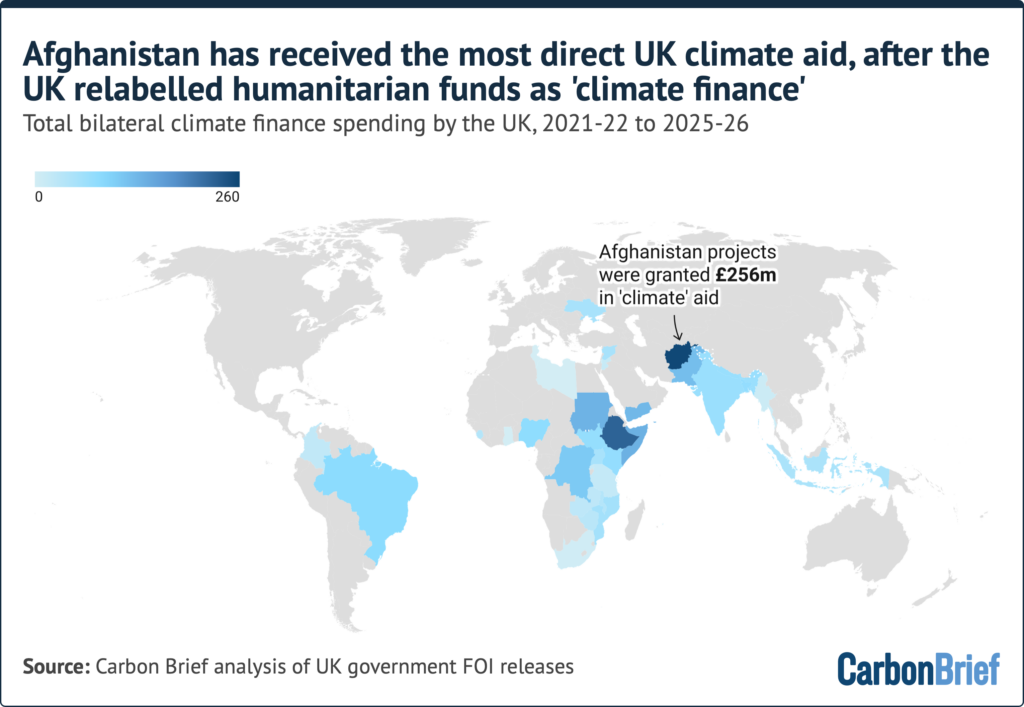
Afghanistan is struggling with floods and low electricity access. However, the UK's apparent surge in support for the nation is not, in fact, due to new climate-related initiatives.
Instead, it is the result of the UK automatically labelling 30% of aid for all humanitarian projects in this country as "climate finance", following a controversial accounting change.
This shift affected other climate-vulnerable and war-torn nations, meaning Somalia (£139m), Sudan (£136m) and Yemen (£130m) were also among the top recipients of "climate aid".
Where the UK has provided large sums of climate finance to projects in middle-income nations, they are typically aimed at "mobilising" private-sector investment, rather than achieving humanitarian goals.
Examples include £83m to support Brazil's Amazon Fund - a carbon offsetting initiative - and £43m to boost UK investment in India's low-carbon infrastructure.
Development banks and private-sector funders are among the biggest beneficiariesThe largest chunks of UK climate finance are channelled via international climate funds and other bodies, which in turn use that funding to support climate projects in developing countries.
Despite recently cutting its 2024-27 support for the Green Climate Fund, the UK still provided £1.5bn to this flagship UN fund - more than any other initiative.
British International Investment (BII), a publicly owned, for-profit company that invests in developing-country businesses and is partially supported with UK aid money, received almost £1.4bn.
The UK has increasingly been relying on BII to meet its climate-finance goals, partly reflecting the body's decision to prioritise clean-energy investments, rather than fossil fuels.
Other major recipients of UK climate finance are multilateral development banks, particularly the various arms of the World Bank and the African Development Bank. This reflects the UK's decision to start counting "core" funding for these banks as climate finance.
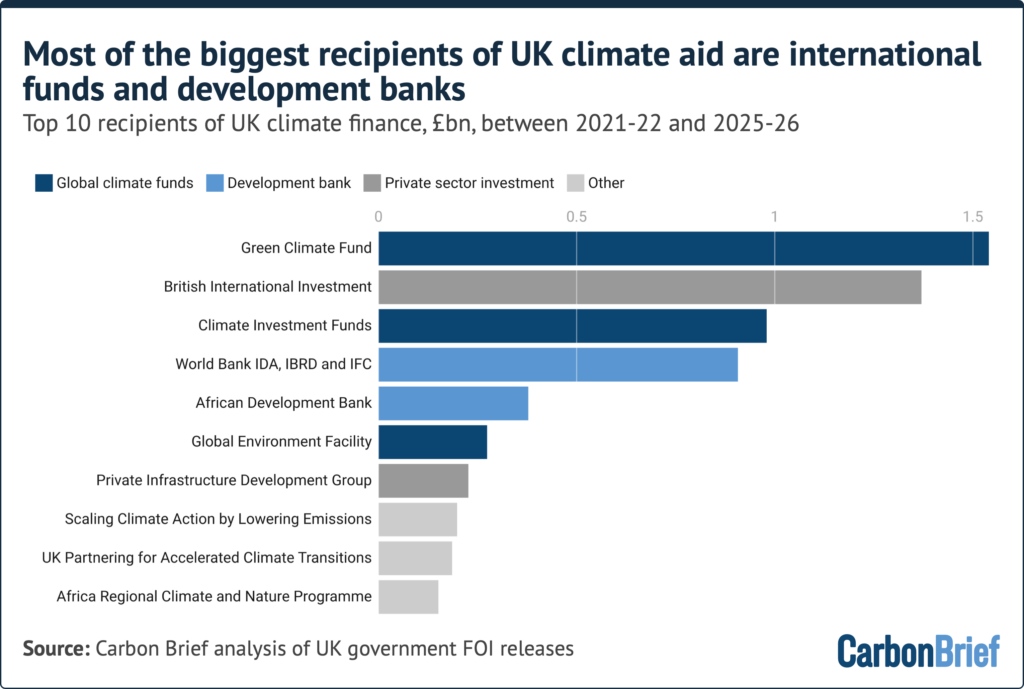
The government's accounting changes - which have boosted the significance of BII and MDBs in UK climate finance - have faced criticism from experts, MPs and the UK's aid watchdog. For more, see Carbon Brief's full analysis of these changes.
MethodologyAll of the international climate-finance data used in this piece was obtained via FOI requests. Carbon Brief has compiled the data into a spreadsheet, which can be accessed here.
UK climate finance comes from the aid budgets of four departments, with the Foreign, Commonwealth and Development Office (FCDO) providing three-quarters of the total.
The remainder comes predominantly from the Department for Energy Security and Net Zero (DESNZ), with much smaller sums from the Department for Environment, Food and Rural Affairs (Defra) and the Department for Business, Innovation, Science and Trade (BIST).
BIST has also released a dataset detailing the hundreds of climate-science projects in developing countries - or benefiting those countries - that have been supported with UK climate funds.
UK climate-finance figures have been subject to regular revisions. While this analysis is based on final figures provided via FOI requests in recent months, it is possible that departments will still change the figures in future releases.
Related Revealed: UK relied on £2bn of 'questionable accounting' to hit its climate-aid goal
28.10.2026
UK policy
Q&A: Why are UK energy bills so high - and how could they be lowered?
27.10.2026
Oil and gas
 Guest post: Greenland ice sheet shrinks for 30th year in a row
27.10.2026
Greenland
 Chart: A record two-thirds of car sales in China are now electric vehicles
23.10.2026
China policy
The post Analysis: How the UK spent more than £11.6bn on climate aid since 2021 appeared first on Carbon Brief.
Scientists uncover ancient hills and swamps that disappeared as sea levels rose across northern Adriatic
Venice is famed for being a floating city, but research shows the land it sits on once lay many miles inland. Dramatic changes in sea level over 10,000 years have reshaped the northern Adriatic coastline, with much of the land that our ancestors roamed now lying beneath the waves.
Samuele Ongaro, at the University of Southampton, and colleagues combined seismic data with sedimentary cores from the coastal basins of northern Italy, Slovenia and northern Croatia to model changes in sea level across the region and reconstruct past landscapes over the past 10,000 years.
Continue reading...A striking transformation takes place along the coast of Qinqdao in autumn, when a native seepweed turns a brilliant shade of red.
The 'red beach' phenemon can be seen in the salt marshes and wetlands on the coast of China's Shandong province, where the Suaeda glauca plant matures and absorbs water, changing it from green to crimson between September and November
Continue reading...
Korean memory-maker SK Hynix has predicted memory shortages will persist until at least the year 2030 and says that will help it to boost its already exceptional revenue and profits to new levels.
In remarks published on Wednesday alongside its quarterly results, the company offered its belief that "a virtuous cycle has taken hold in which AI-driven productivity gains and new revenue generation in areas such as software development, customer service, and search lead to greater AI adoption, which in turn drives increased investment in infrastructure."
SK Hynix thinks this is great news, because it means more buyers are entering the market for AI infrastructure, including "general enterprises" and nations building sovereign infrastructure. In coming years, the company sees even more demand for memory coming from autonomous cars and the growing robotics market.
While the company is working hard to build more factories and get them working, execs admitted it can't do that fast enough to meet demand.
"The company assessed that supply … is not keeping pace with the growth of the market," SK Hynix told investors. "Given technical difficulty of leading-edge processes and the long lead time required to build new production facilities, it expects the structure in which demand exceeds supply to persist through 2030."
It gets worse. SK Hynix has 14 long-term deals with 14 big buyers, who will collectively buy more than half of its output during 2027 and 2028, and some of them want to extend those agreements. The Korean giant doesn't mind that because the deals include "a mechanism that reflects market conditions within a price range agreed upon with customers" and give it "a structure that secures stable profitability while allowing flexible responses to market changes."
Those deals helped SK Hynix to record quarterly revenue of ₩104.6 trillion ($78.1 billion), up 328 percent year-over-year and 32 percent quarter-over-quarter. Operating profit came in at ₩87.68 trillion ($62.8 billion), up 486 percent year over year.
The company told investors it's not done yet, outlining plans to expand production and emphasize lucrative products that will "scale up revenue and profit one step further next year."
Doing so will likely dent profits elsewhere, because on the company's earnings call, chief financial officer Kim Woo-hyun predicted "shipment volumes for PCs and mobile devices are expected to decrease due to cost burdens from rising memory prices and supply shortages."
The company also outlined some of its future plans, among them:
Increasing HBM4 production, which it believes will "surpass HBM3E in both shipment volume and revenue in the fourth quarter and … establish itself as a mainstream product."
"Rapidly" increasing the portion of its 10nm-class 6th generation (1c) process technology and expand sales of DDR5 and LPDDR5 SOCAMM for AI servers.
Developing NAND "into a core solution that enhances the throughput and economic efficiency of AI services, based on HBF and system optimization technologies."
Investors liked what they heard, with some apparently seeing the memory-maker's outlook as suggesting the AI boom won't sputter out any time soon and sent the company's share price up by about three percent in after-hours trading. ®
Indian tech services giant Infosys has mixed news about AI.
In its most recent quarterly results late last week, the company revealed that it's racked up 29 percent sequential growth in AI revenue, which now delivers 10.5 percent of Infosys' incoming cash.
Those are far nicer numbers than the 1.5 percent year-on-year revenue growth Infosys reported for its second quarter.
"Growth was below our expectations. Volume was softer, and price increases were lower than anticipated amid high competitive intensity," chief financial officer Jayesh Sanghrajka told investors. One reason for lower price increases was that customers expect Infosys to charge less when it uses AI, and those cost savings are now "baked in" to its multi-year deals.
CEO and managing director Salil Parekh also pointed to AI as one reason the cost of services is falling.
"I think what we see today is there is definitely some of our peers who are putting, I would say, more intense effort into the pricing pressure," he said, "but it is also across the board because of the environment and also the discussion on AI productivity. If you are talking with clients today on large programs, it is a three or five-year outlook."
That leaves Infosys dependent on new work from AI to boost revenue growth, while AI also makes it hard to keep growing revenue from existing customers.
Infosys won't go low to win deals and intends to hold its margins at around 21 percent, Sanghrajka said. He sought to prove that point by citing "a large deal that we walked out of, or we did not pursue because it did not meet our return expectations."
To help preserve margins, the company is conducting "Project Maximus" to find efficiencies within its own operations. AI-powered tools to win more sales are also in the mix.
The company sees difficult months ahead. Sanghrajka said the retail and high-tech industries have slowed their services spending and acknowledged that the second half of Infosys's financial year is usually its slow period.
The company tried to convince investors that they have little to worry about, pointing to $8.8 billion of new deals won in the first half of its financial year - 68 percent of which were net new customers - as a sign that Infosys' fundamentals are sound.
But the company also offered less optimistic guidance about its future. In its Q1 results, Infosys predicted full-year revenue growth of 1.5 to 3.0 percent. In Q2, it revised that prediction to 1.0 to 2.0 percent.
Infosys's share price didn't dive after that news but is already down over 25 percent in the last twelve months. And Bloomberg reports that investment analysts have downgraded the company, suggesting they feel its prospects are poor. ®

Academic science (natural or social) is about making new discoveries. When a researcher thinks they have found something new, or a flaw in established knowledge, they normally write a paper and submit it to an academic journal - from the high status global journals like The Lancet or the British Medical Journal, to smaller, more specialised ones. These journals are the gatekeepers of scientific knowledge. Their editors and reviewers decide what does and does not become part of accepted knowledge. Publication makes the findings accessible to everyone working in the field.
Peer reviewTo decide what to publish, the journal gives the draft, anonymised, to an expert in the field, for 'peer review'. The reviewer looks for problems such as weak evidence, unclear writing, errors, missing references, arguments that do not hold up or failures to recognise previous research. Their comments help authors improve the work before it goes to publication. If the reviewer thinks the research is sound and makes a significant contribution to knowledge, they may recommend that it be published.
This is how it has been done for more than two hundred years. When the system is working at its best, a conscientious reviewer will provide detailed, carefully evidenced feedback, and the author will revise and resubmit. But the process uses a great deal of people's time, and has a range of weaknesses. Editors struggle to find available reviewers. Reviewers have busy lives, incomplete knowledge, professional prejudices and rivalries. The work is usually unpaid and the process can take months.
So, two Harvard professors, Gary King and Steven Worthington, set out to see whether AI could improve the process. They have now presented their findings for comment and discussion in a 'pre-publication' paper.
What they didThey took 124 research manuscripts across a range of academic fields.
- Each manuscript was reviewed twice: by Claude Opus 4.8 and by an established human expert in the relevant field.
- They then used ChatGPT 5.5 to compare the pairs of reviews, using seven measures: theory, methods, weaknesses, framing, communication, figures, and sources. To ensure that ChatGPT was not favouring AI-generated reviews, the human ones were converted to an AI style.
- Finally, they asked three former journal editors to review ten of the pairs of reviews.
They expected a mixed pattern of responses. But they were wrong. In side-by-side comparisons, the AI review won in virtually every case, with the AI one judged, by both ChatGPT and the human editors, as more useful, more thorough, more accurate, and better at identifying weaknesses in the research. Although the AI reviews did make mistakes, the human reviews made more.
The bottom lineThis paper does not suggest that AI can replace the traditional peer review process. But it does suggest that AI can play a more important part in academic research than has previously been suggested. It can help original authors to improve their articles before submission, acting like a very well-read, tireless assistant that can read a long manuscript, spot possible problems, and suggest improvements. For the author, a detailed AI review, generated in a few seconds, is much more helpful than a human one delivered three months later. But there are also risks. We still need humans to check AI for confident mistakes, invented or misrepresented sources.
And humans still need to decide whether a given article is suitable for a particular journal, whether it meets ethical standards, whether there are conflicts of interest, and whether it should ultimately be accepted or rejected. A human must take responsibility if a flawed or misleading study is published.
Next stepsThis is a significant paper, with surprising findings and serious implications for academic life.
But, in science, all findings are provisional. Every discovery or new theory is only correct until someone proves it wrong. This is just as true for this paper. It is clear that AI has a role to play in the dissemination of academic research. But future researchers will refine this finding.
And it is worth noting that King and Worthington are not comparing a perfect model with an AI one. The introduction of their paper lists 16 well-documented weaknesses of the traditional system. As the authors say, "although human peer review is the default quality-control standard for scholarly publishing … problems with this system are deep, common and well known."
For all its weaknesses, this paper suggests that AI can overcome some of them, and perhaps free academics for more creative tasks.
More from East Anglia Bylines
 Business
Five years to save Europe!
by Stephen McNair 30 June 2026
 Business
Deep research: the next generation of artificial intelligence
by Stephen McNair 9 April 2025
 Science
The machines are marking our science - and doing it better
by Stephen McNair 28 October 2026
 Brexit
The Swiss route to a closer relationship with Europe?
by Niall Ó Conghaile 27 October 2026
 Activism
Palantir under fire: the battle over its NHS role
by Aidan Baker 26 October 2026
 Friends of Bylines Network
There has never been a greater need for grassroots journalism that investigates the stories that really matter, holds power to account and champions the voices of everyday citizens. We are proudly powered by volunteers but what we do isn't free.
STAND WITH US for independent, citizen-led journalism that makes democracy stronger, and you will even get some exclusive benefits.
BECOME A FRIENDThe post The machines are marking our science - and doing it better first appeared on East Anglia Bylines.
Pedego was one of the earliest companies to see the promise of ebikes and to build them at scale. It sales model was based around developing retail stores hosting both sales and rental options for customers. It was a great option, as it let prospective buyers see Pedego's various ebikes ... [continued]
The post The Pedego Element 2 eBike — CleanTechnica Tested appeared first on CleanTechnica.
It involves the fracturing of a patient's ribs, before they spend three months laced into a corset. Some of those who have had this cosmetic procedure say it is like being 'hit by a bus'. Why is it becoming more popular?
Daniela Cesin was 14 when she began thinking about her looks. "I was a little bit chubby and I started to work out at home and lose weight. I saw the difference in my body: my abs, the muscles in my arms, and I started liking it," she says. By 31, she had the slim, toned body she had hoped for, but something was still missing. "I wanted to have that guitar hourglass shape."
In August, Cesin travelled from Miami, where she has lived for the past 15 years, to her native Venezuela for liposuction and a fat transfer to her hips. She met her cosmetic surgeon for the first time the day before the procedure, and he realised she didn't have enough fat to go ahead with it. Instead, he offered to perform RibXcar: a rib remodelling surgery that would involve fracturing three of her lower ribs on each side and binding them in a corset for three months, to set the ribs in a new position and give her a wasplike waist.
Continue reading...



 Brazilian right-wing presidential candidate Flávio Bolsonaro holds a picture of his father, convicted former President Jair Bolsonaro, during a motorcade with supporters in Goiania, Brazil, on Sept. 27, 2026. Photo: Sergio Lima/AFP via Getty Images
"I never thought about leaving the country," Flávio Bolsonaro, a Brazilian senator and son of the deposed, disgraced leader, told his 16 million Instagram followers on Monday. It was the day after he lost the presidential election to President Luiz Inácio Lula da Silva by a margin of more than 4 million votes.
Flávio promised to stay in Brazil to "organize the opposition" during Lula's next term.
"I'm the last obstacle to the Workers' Party's plan to destroy the country," Flávio warned, referring to the party of Lula, who defeated his father four years earlier.
A few hours later, he left his mansion in Brasilia and sought asylum in the U.S. The Trump State Department told the Associated Press that it will grant him and his family visas.
The affinities become obvious when you watch Bolsonaro's failsons end up in Trump's America.
"I didn't take sides, but it looked like another rigged election," President Donald Trump told reporters on Monday, echoing Flávio's election night talking points without providing any credible evidence that casts doubt on Lula's come-from-behind victory — even as Flávio's own party put out a statement acknowledging the results later that day.
It is no coincidence that the Trumps and the Bolsonaros are so fond of each other. Their modus operandi is nearly identical.
Both wrap themselves in the rhetoric of patriotism and moral righteousness, while treating their political offices as personal get-rich-quick schemes. And, when their lies finally catch up with them, you can be sure that they will jump ship to save themselves first and abandon their followers.
The affinities become obvious when you watch Bolsonaro, his failsons, and co-conspirators all end up in Trump's America, where Flávio is about to join his brother, and in the denialism and violence that follow their failures.
Coups and Flight RisksFlávio Bolsonaro's election denial and hasty escape are his version of Trump's infamous January 6 speech: Rile up the troops to do your dirty work and get the hell out of the way.
It's not the first time a Bolsonaro ran this playbook. After Jair Bolsonaro became the first modern Brazilian president to lose a reelection bid, he refused to attend the January 2023 inauguration ceremony. Instead, he also fled to the U.S., staying in a Minions-themed children's bedroom in the Orlando, Florida, home of retired UFC fighter José Aldo.
A week later, on January 8, the ex-president's allies laid siege to the capital, Brasília, vandalizing Congress, the presidential palace and the Supreme Court, as foot soldiers in a larger coup plot to overthrow the Lula government. Nearly four decades of Brazilian democracy was only spared when key military leaders blinked before they could finish the job.
Jair Bolsonaro eventually returned to Brazil and was sentenced to 27 years in prison for leading the plot, which included a plan to assassinate Lula, Vice President Geraldo Alckmin, and Supreme Court Justice Alexandre de Moraes. Allies, including top military brass, were also convicted. Jair remains under house arrest — widely thought to be pinning his hopes for freedom on a Flávio presidency that wasn't to be.
Flávio, however, will not be lonely in the States. His brother, former Brazilian Congress member Eduardo Bolsonaro, just received green cards for his family and is living in a $1.2 million McMansion in Southlake, Texas, in the Dallas-Fort Worth area, as we revealed in The Intercept Brasil earlier this year. Eduardo, who is a regular on the Trumpworld circuit, was sentenced in absentia to four years and two months in prison for lobbying the U.S. government to interfere in his father's trial.
Flávio, too, seems poised to receive news of his own prison sentence while sitting on a couch in a Texas suburb. In May, our reporting at The Intercept Brasil put the first nail in the coffin of his presidential campaign when we published chat logs and audio recordings of the senator negotiating $24 million — and being wired $10 million — from disgraced billionaire banker Daniel Vorcaro, who is a sort of Brazilian cross between Charles Ponzi and Jeffrey Epstein.

Read Our Complete Coverage
Secret Brazil ArchiveThe payments, wired to a U.S. account, were supposedly meant to finance "Dark Horse," a biopic about Jair Bolsonaro starring Jim Caviezel. Brazilian Federal Police, though, have already poked holes in Flávio's story as they investigate whether the money was actually used to bankroll Eduardo's treasonous lobbying of the Trump administration to sanction Brazil and help his brother's electoral chances.
Flávio is also being investigated for his alleged ties to a billion-dollar money-laundering scheme through an online betting company run by Willer Tomaz. The two are not only close friends but also business partners. Flávio even had unfettered access to one of Tomaz's offshore bank accounts. You will not be surprised to learn that Tomaz left Brazil in August and is now living in Miami.
Police argued that, after losing the election, Flávio would pose a flight risk, especially in light of his closest associates' recent actions. They asked the Brazilian Supreme Court to order Flávio to turn over his passport, which is permitted under Brazilian law. A top justice granted the request and, when the deadline passed, canceled the senator's travel documents.
By then, Flávio was already gone.
The post The Bolsonaro Family Playbook: Lose, Cry Fraud, and Run to Trump's America appeared first on The Intercept.
If there are good, nuanced ways to make use of generative AI in gaming, as I think there are, that doesn't change the fact that there are nuance-free and terrible ways for advocating for AI in gaming. Tim Sweeney and Epic Games have emerged as helpful foils for the never-AI crowd, given just how cartoonishly brazen Sweeney has been about the use of AI at Epic, as well as the absolute trash vibe-coded launcher the company recently produced. What's going on there almost seems purposefully designed to bolster the arguments from those against any use of AI in gaming.
Epic and Sweeney are not alone in this, it seems. Brandon Stirrup is a business strategy employee at Xbox and he recently went on his own brazen ExTwitter screed that claimed AI use is in far greater employ than anyone is talking about, that games can be easily made by anyone using generative AI tools, and that anyone not using the technology as much as possible doesn't deserve to be in the industry at all.
Stirrup kicked off his thread on October 18 with a simple message saying he'd "vibe coded a bad but improvable game" over two days, although he only "actively" worked on it for about three hours. "I'm telling you I tried it and it's true…anyone can build a game."
After saying that developers and studios who aren't incorporating AI into their strategies are "planning for a fake future," Stirrup went all in.
"Look if I'm fired tomorrow it will be because I told you the truth that nobody wants you to know. You can make a game with a simple prompt and yes you can make custom, tailored games. Everything you want in a game is right there for the taking, for better or worse," he wrote.
This epic online rant went much further than that. Here is a capture of all of it in one image.

There's a ton to hate in there, frankly. Calling gamers stubborn and stupid is one hell of a "business strategy" for Microsoft to be taking here, for instance. I have my own issues with the never-AI crowd, but I have made the point over and over again that their fears are not stupid, not unfounded, and their complaints are not only not to be dismissed, but rather that we need their viewpoint to be taken into account to navigate to a proper type of AI use in the industry. Stirrup does the opposite and dismisses them entirely out of hand. And that is very dumb.
The claim that anyone can make games with a "simple prompt" is also about as obviously untrue a statement as I can think of. Even Stirrup couldn't do so, acknowledging that what he'd managed to produce in his own experimentation was "a bad but improvable game." And that's his own self-assessment. I would hope that a business strategy manager at a gaming company would understand that his opinion of his own product isn't really what matters here. This is what gets so many AI bros in trouble with the public: the constant unsubstantiated claims that AI can do things it simply cannot do. And I imagine that the human artists currently making Xbox games aren't in love with this devaluation of their work, either.
And, finally, stating that anyone who disagrees with him "should not be in the business of being in business" is idiotic. There are many game developers out there making zero or very limited use of AI tools. And they're making great games. There is of course a place in the industry for never-AI developers, just as there is a place in the film industry for directors who make no use of CGI. These are tools, nothing more. Insisting that a painter has no place as an artist if he doesn't use your preferred type of paintbrush makes no sense.
Stirrup deleted his ExTwitter account, claiming he did so because of the volume of responses he got from all of this. I imagine the tone and tenor of those responses had as much to do with it as the volume. And he has only his completely tone-deaf, dismissive screed to blame for any of that. He said aloud he could be fired for what he said. I think he should be.
Not because AI use in gaming should be entirely verboten, but because posting all of that while being employed in a business strategy role seems to prove to me that he's not built for that role.
Waymo keeps rolling out robotaxi service in more and more places. With Tesla right on its back, the initial self-driving car company might be pushing even harder in order to keep growing and spreading quickly. Either way, the news today is that Waymo is growing again. Here are more details ... [continued]
The post Waymo Growing Further appeared first on CleanTechnica.
1. LeeroyJenkins - 1735 M. Mar - 365 M. Bez - 315 A. Mar - 181 J. Mar - 355 P. Aco - 263 A. Mar - 181 D. Mor - 75
2. nh_painter - 1720 M. Mar - 365 M. Bez - 315 F. Bag - 166 A. Mar - 181 J. Mar - 355 A. Ogu - 263 D. Mor - 75
3. SG_moto - 1677 M. Mar - 365 M. Bez - 315 J. Mar - 355 A. Mar - 181 P. Aco - 263 spongedaddy Wed, 28/Oct/2026 - 01:58
HARTFORD, Connecticut — Today, Sierra Club Connecticut, local environmental justice leaders, the Asthma and Allergy Foundation of America, and state elected officials hosted a Press Conference on Connecticut's High Asthma Rates in the Legislative Office Building. Hartford ranked eighth in the Asthma and Allergy Foundation's rankings of "Asthma Capitals" due to ... [continued]
The post Connecticut Advocates, Elected Officials, & Public Health Experts Speak Out Against High Asthma Rates appeared first on CleanTechnica.
Central heat pump water heaters (HPWH) are on the up and up by any way you measure it. These HPWHs heat water for bigger buildings such as apartment complexes, hotels, and grocery stores. More manufacturers are getting into the market and producing a variety of products. More innovations are helping ... [continued]
The post Central Heat Pump Water Heaters Are On The Up & Up appeared first on CleanTechnica.
We remember the late and much-loved Malcolm Johnson, author of Crypts of London, who wrote this brief history of crypts. Malcolm was formerly Rector of St Botolph's, Aldgate, where he ran a homeless shelter in the crypt.

At St Clement, King Sq
After the Great Fire of 1666, it was decided not to replace thirty-two out of those churches destroyed in the Square Mile. Yet St Paul's Cathedral and fifty-one churches were rebuilt by Sir Christopher Wren, Robert Hooke and others, and almost all of these new buildings were given a crypt of the same extent as the ground floor. This was also true for churches in Westminster and those on the edges of the City such as in Spitalfields, Shoreditch and St Clement, King's Sq.
What were these spaces intended for? Charity schools? Storage? Meeting rooms? There was no chance of any of these, because the clergy and their vestries soon realised that good money was to be made by charging wealthy parishioners to stack coffins containing their dead family members under the church.
In doing so, they went against the advice and opinions of both architects and others, who doubted the wisdom of burying the dead among the living. In 1552, Bishop Hugh Latimer thought it "an unwholesome thing to bury within the city," considering that "it is the occasion of great sickness and disease." Mainly for architectural reasons, Wren and Vanbrugh were also opposed to burial in or close to a church, although when Wren was interred beneath St Paul's when he died.
In my research, I found that in the eighteenth century most parishes received around seven per cent of their income from interments, although at St James Garlickhythe the average was nearly twenty-seven per cent. All five Westminster parishes had a high burial income by the end of the eighteenth century - around thirty-five per cent of the wardens' income at St Martin-in-the-Fields and twenty-five per cent at St James Piccadilly.
After the Reformation, burial within a church was seen as a mark of social distinction - the nobility regarding it as their right - but by the mid-seventeenth century the professional classes were also seeing it as a sign of a successful career. Over the next century, doctors, solicitors, high-ranking soldiers and 'gentlefolk' frequently left instructions in their wills for intra-mural burial, although some cautioned prudence and economy in arranging it, because fees could be high. Coffins of the clergy were placed in the vault below the altar and the vicar of St Martin-in-the-Fields allowed Nell Gwyn to be interred in his space there.
Why were families willing to pay large sums for a crypt burial when churchyard fees were much cheaper? Some hoped for an 'eternal bedchamber' because they knew that bodies in the churchyard would be dug up after thirty or so years and the bones placed in a charnel house when the space was needed for new burials. Others hoped the congregation worshipping above the crypt would continue to pray for them and many more were apprehensive that body-snatchers might plunder the churchyard. Yet, in crypts, bodies were sometimes tipped out of their coffins so that the lead could be sold together with the metal handles.
Rarely do published histories of our churches mention these undercrofts. Obviously it is possible to visit those churches that have survived and establish precise details of their crypts - where it is not possible to enter, burial registers can give details of size and layout. For the churches that have not survived, the best descriptions of their crypts are often found in the faculties which authorised their destruction, and in the Vestry minutes recording the process of emptying the remains and transferring them to a cemetery. Written accounts are rare, because few people visited these dark, dismal places apart from the sexton.
The lucrative burial income ended abruptly in 1852 when sanitation legislation forbade further interments in crypts and churchyards. Joint-stock cemeteries such as Kensal Green were opened to receive London's dead and the clergy lost the links with parishioners although they were still financially recompensed, even if the vestries and sextons lost their burial dues. The removal of human remains from crypts began for a variety of reasons - such as demolition of the building, its sale to raise funds or road widening. If the building remained and a new use for the crypt was found, then an appeal for funds was made, such as at St Bride Fleet St in the nineteen-fifties when its museum was equipped from gifts of nearby publishing firms. Other churches have attracted grants from the Lottery fund, statutory bodies, charitable foundations, businesses and individual donors.
The first crypt to be cleared of human remains for use other than storage was in 1915 when the vicar of St Martin-in-the-Fields, Dick Sheppard, set up a canteen to welcome men returning from the Front. Two learned reports of the Council for British Archaeology describe the clearance of coffins and remains from the crypt of Christ Church, Spitalfields in 1984/5. Nearly one thousand bodies were carefully examined and researched. Interment in a crypt obviously preserves a corpse and coffin longer than if it was buried in a churchyard but the state of preservation of those in coffins in Spitalfields'crypt varied from virtually complete, including skin, hair and internal organs to a just sediment of crystal debris being all that remained of the bones. When lead was used, as it was in this crypt after 1813, this preserved the cadaver longer, but if air or water was allowed to penetrate then decomposition was much quicker.
Where were coffins and remains from crypts taken? A minority went to the East London Cemetery, Plaistow, or to the Great Northern London (now New Southgate) Cemetery. Some relatives were allowed to transfer the coffin of a family member to a burial ground of their choice, but most went to Brookwood or the City of London Cemetery, Ilford.
Some two thousand two hundred acres of land owned by Lord Onslow on Woking Common at Brookwood were purchased by the newly-formed London Necropolis & National Mausoleum Company. Despite opposition, Royal Assent was given to the London Necropolis Bill on 30th June 1852, but the first funeral was not held until 13th November 1854. Soon afterwards, several Westminster parishes, including St Anne Soho, St Giles-in-the-Fields and St Margaret Westminster, reserved plots there. Coffins and mourners were transported by special trains from a private terminus near Waterloo to the cemetery's two stations, one for Anglicans and one for others. The Bishop of London was apprehensive that the coffin of 'some profligate spendthrift' might be in the same compartment as a respectable member of the Church. A notice in the station refreshment room at Brookwood reads 'Spirits served here.'
The City of London Cemetery, used by nearly all the City parishes, opened in 1856 and is approximately eight miles north-east of the City. Since then, over forty City parishes have removed their crypt remains to Ilford, which is today one of the most beautiful cemeteries in the country.
Today, around half of London's crypts have been emptied. Some, such as that of St Martin-in-the-Fields house a restaurant, bookshop and meeting rooms which contribute a very large sum to the Parish Church Council. Others are chapels and columbaria, yet others are museums while - sadly - two which were once homeless centres are now empty. Those with coffins still in place await a use - as at St Clement, King Sq, where David Hoffman took the photographs which accompany this article.

Coffin plates from Holy Trinity, Minories - now demolished








At St Clement, King Sq

The entrance to the family vault of Mr Thomas Gall of King Sq
Crypts of London by Malcolm Johnson is published by the History Press
Photographs copyright © David Hoffman
You may also like to take a look at










Big Kids
by Michael DeForge
Drawn & Quarterly
2016, 96 pages, 5 x 6.2 x 0.6 inches
I have been fascinated by the work of Canadian comic artist Michael DeForge for a while now. If you like unvarnished explorations of the human psyche and the high weirdness that an unhinged mind and a free hand can render, check out Michael's Lose series, Very Casual, and Dressing, all from Toronto-based comics publisher of note Koyama Press.
Big Kids is something of a departure for DeForge, or at least it starts off seeming that way. On the surface, Big Kids is a dark and mopey coming-of-age tale. It concerns a troubled teen boy who lives with his parents and a recalcitrant uncle in the basement and has awkward, restless sex with his best friend, in-between dangerous dares, bullying, bouts of petty vandalism, and other adolescent antics.
When the boy's uncle gets kicked out of the house and a female college student moves in - a girl with a very different take on life who hangs with a group of more sophisticated, less juvenile delinquent friends - something extraordinary happens. Too many other reviews of this book spoil what comes next, which I think is a shame. I knew nothing of what was about to happen and was really stunned by the whole thing as a result. The book is obviously meant to be a meditation on the profound transformations we go through at different stages in our lives (especially in becoming a teen), and how strange, terrifying, and wondrous those changes can be. But this is done in a unique way that you could never guess is coming.
Michael DeForge's work seems to be all about challenging our perceptions of identity, reality, and the comic form itself. Every time you delve into one of his pieces, you have no idea where you're going to end up. Or just how splintered your mind will be by the time you get there. Big Kids manages to do all this while still delivering a touching, if somewhat disturbed, take on a classic tale of adolescent angst. - Gareth Branwyn
PRIDE & PREJU-KNITS: 12 GENTEEL KNITTING PROJECTS INSPIRED BY JANE AUSTEN










Pride & Preju-knits: Twelve Genteel Knitting Projects Inspired by Jane Austen
by Trixie von Purl
Harper Design
2015, 112 pages, 8.6 x 6.6 x 0.4 inches (paperback)
What's the perfect book for a crafty, British literature fan with a sense of humor? It's Pride & Preju-Knits of course! "This book is my life!" my 20-year-old daughter exclaimed when she opened up this adorable do-it-yourself paperback. "I love the fact that they give you just a few simple figures to make, and then so, so many clothing options."
Pride & Preju-Knits contains 12 knitting projects (scenes) based on Austen's six novels. Every element in these scenes can be knit, including main characters, accessories, animals and furniture. There are detailed instructions on how to knit Regency ladies and gentlemen, how to knit Elizabeth Bennet's dress and Mr. Darcy's trousers from Pride and Prejudice, and even how to knit the pianoforte played by Anne Elliot in Persuasion. You can also learn to knit sheep from Sense and Sensibility and for Emma Woodhouse's wedding dress from Emma. Instructions include the materials, the gauge and how to finish off the piece. Trixie von Purl (aka Geraldine Warner) briefly recaps each Austen novel as well. Although these are very intricate projects, anyone can appreciate the imaginative handiwork and enjoy this charming little book. - Carole Rosner
Books That Belong On Paper first appeared on the web as Wink Books and was edited by Carla Sinclair. Sign up here to get the issues a week early in your inbox.

Sebastian Staacks from There Oughta Be built an LED mask that can change into any face using matrix panels, a Raspberry Pi Pico, and zip ties.
The post A Shapeshifting LED Mask for Halloween appeared first on Make: DIY Projects and Ideas for Makers.


Age verification proposals are often presented as a simple tradeoff: sacrifice a little privacy to better safeguard children online. But that framing overlooks a more fundamental question. What happens to people who cannot verify their age at all? This is particularly a problem when users are required to prove their age with identity documents.
Age-related restrictions are developing quickly around the world. While they differ radically across jurisdictions, in the past year, we've witnessed a sharp uptick toward mandatory age assurance for social media access but also for other high-risk digital services.
For example:
- In late 2025, Australia became the first country to implement a minimum age requirement for prohibiting children under age 16 from creating or holding social media accounts.
- India passed the Digital Personal Data Protection (DPDP) Act that includes mandatory verifiable parental consent and has undertaken ongoing discussions for social media restriction.
- The United Kingdom passed the Online Safety Act requiring age verification across a swath of services hosting content considered harmful to users under 18. More than half the states across the U.S. have enacted age verification laws.
- An EU Commission's expert report recommends a ban on social media access for users under 13. It also recommends mandatory age verification for platforms to ensure that users are 'age appropriate.'
Age verification laws that are predicated on the necessity of users possessing a current passport, driver's license, credit card, or similar documents proving their identity exclude critical sections of populations. And this problem is global in nature: Millions of people lack government-issued identification or encounter regular challenges to obtaining or updating it.
Roughly 15 million adult U.S. citizens lack a driver's license, and a further 2.6 million lack any government photo ID; leaving large groups blocked from online content or services. The UK has a similar predicament: proof-of-age checks are often reliant on passports, driver's licenses, or other recognized alternatives, which can pose unique challenges to people without these documents.
Much of the advocacy around age verification discusses the privacy harms of age verification. Yet these measures also threaten something more fundamental: equal access to information and the ability to exercise the right to freedom of expression.
Unfortunately, age verification systems foster unequal access to information and provide an asymmetric solution to find essential information, build community, and weigh in on public discourse. As governments and companies increasingly require users to prove their age before accessing online services, these individuals risk being excluded from large parts of the internet altogether.
Effects on Global Majority CountriesAge verification laws reshape who can speak, who can access information, and who gets excluded from the digital public sphere. In other words, age verification is not a neutral safety measure: it presents a structural barrier to disproportionately exclude certain groups—particularly those in the global majority—and alters the architecture of global online expression. Some of these groups are already marginalized offline, and age verification extends that exclusion into digital spaces.
For instance, 850 million people globally do not have ID. Most of these individuals exist in primarily low and middle income countries in Sub-Saharan Africa and South Asia. The World Bank points out that many are members of marginalized groups and more than half of those lacking access to identity documentation also have children whose births have not been registered. Women are particularly vulnerable and are 8% less likely than men to have an ID. Other vulnerable groups, such as adults in low income countries, are less likely to have an ID when they fall below 25 years, as are those with a primary school education or less or those in rural areas.
A policy paper from EDRi points out that age verification laws provide quick tech solutions but overlook longstanding structural challenges and undermine the universality of the internet. The analysis finds that age verification laws have serious human rights implications and ironically harm the very individuals they deem to protect. Moreover, these laws depend on the collection of harmful mass data that human rights organizations, including EFF, is fighting against—and has for decades.
For example:
- In Morocco, a push to restrict children's access would ban under-13s from creating accounts on gaming platforms. This could potentially create challenges for those with IDs that have incomplete information concerning the year of birth. In addition, this push would also impact those who attempt to leave Morocco.
- In Egypt, the lack of ID cards has created challenges for minority groups such as the Baha'i.
- Stateless individuals would also struggle under age verification laws. The Rohingya, the world's largest population of stateless people, often lack IDs.
- Kuwait's Bidoon population also lacks proper identification materials. According to Amnesty International, this leads many to rely on standard civil identity cards, which can be restrictive.
- Nigeria launched a national program to provide ID cards to its population in 2007. Since then, 64.4 million have registered, but that represents just over 30% of the national population.
- The Kafala system, a practice in several countries across the Middle East, also introduces challenges for age verification laws. Under this legal framework, migrant workers' legal residency and employment status are bound to a specific employer. This potentially leaves stateless persons or migrant workers vulnerable to forced labor and restricted movements.
Age verification laws are less about confirming the age of a user and more about creating barriers to online participation that many people cannot reliably scale. The net result is reduced access, more data collection, and an increased chance of unequal or mistaken exclusion from accessing information online.
Nobody doubts the importance of protecting children online. While proponents assert that age verification laws protect minors from harmful material, online harassment, and digital addiction, these laws are not the solution. They subvert fundamental freedom of expression rights and pose significant privacy risks.
EFF has long warned against age-gating the internet. Age verification technology itself is often inaccurate and privacy-invasive, and as more countries considering implementing ID-based checks, the risks move beyond censorship and surveillance toward excluding some people entirely. That's why we're working with groups in the U.S. and around the world to push back against these laws, and why we hope you join our effort.
Republished from the EFF's Deeplinks blog.

Oracle Cloud Infrastructure (OCI) customers will soon have a raft of new choices. Big Red is hosting an event in Las Vegas this week to inject more air into the AI bubble explain its latest AI investments, and front and center of those efforts are an expanded partnership with OpenAI and plans to diversify its chip offerings beyond Nvidia by bringing Google's Tensor Processing Units (TPUs) to OCI.
Oracle says its deal to add Google TPUs to OCI will make it the first hyperscale cloud platform outside Google's own cloud services to offer the chips. Those chips will be available for selection within OCI beginning in 2027, with capacity increasing over the course of several years.
While not mentioning the quantity of Google TPUs that will be available next year or beyond, it does seem that Oracle is attempting to diversify away from being so heavily reliant on Nvidia, with whom it has inked deals worth tens of billions of dollars to outfit its datacenters, including the reportedly troubled Texas project it's planning with the GPU maker and OpenAI.
"Different AI workloads have different compute needs," said OCI president Mahesh Thiagarajan. "Bringing Google TPUs to OCI gives customers … the flexibility to choose the right infrastructure for the performance, throughput, and economics of each AI workload."
Oracle isn't moving away from its partnership with OpenAI, either, announcing new ChatGPT integrations on Tuesday alongside two products that incorporate models from the House of Altman.
The first of those, Oracle AI Workspace, is billed as a "single user experience that brings OpenAI frontier models together with Oracle applications, enterprise data, and cloud services" through ChatGPT plugins that basically turn Oracle's existing business platforms into ChatGPT-accessible resources.
"The Oracle AI Workspace will make the breadth of Oracle's capabilities agent-ready and accessible to ChatGPT users," the company explained. "People can describe business goals and these plugins in ChatGPT will bring together the right Oracle tools and information to help them accomplish it."
Along with giving OpenAI-powered tools access to selected business data, Oracle is hoping customers will also trust the models to help handle cybersecurity with the second new product, Oracle AI Security Mesh, "a managed platform that combines frontier AI models for cybersecurity … with Oracle's proven security expertise."
As you might assume from its name and description, Oracle AI Security Mesh will use OpenAI cybersecurity models to find vulnerabilities, test whether they can be exploited, and recommend fixes in areas of a company's tech stack that it authorizes the Oracle-managed service to examine.
Oracle also announced a deal with Snowflake to bring its AI data cloud to OCI as a native service. The new partnership will allow Oracle customers to purchase and use Snowflake directly from Oracle, which will handle all pricing, discounts, and billing. Oracle Universal Credits will also be usable through Snowflake on OCI, allowing users who already spend money on Oracle credits to use them for the newly available offering.
Nvidia not exempt from announcementsOracle may be diversifying its OCI chip offerings, but it still announced new Nvidia hardware in Las Vegas, too.
Big Red announced the general availability of Nvidia Vera Rubin NVL72 systems and Nvidia Vera CPUs on Tuesday, along with plans to introduce HGX Rubin NVL8 systems, though it did not specify when those would become available.
"By combining NVIDIA Vera Rubin GPUs and Vera CPUs with Oracle Acceleron networking and AI-optimized data centers, we're helping customers keep GPUs productive, secure, and scale efficiently as their needs grow," Thiagarajan said.
Oracle posted record earnings in the quarter ending August 31, with revenue up 30 percent year over year as its AI investments have begun to pay dividends. Those dividends appear to be paying off for other AI firms as well, though there's little evidence of similar returns outside the tech sector, raising fresh concerns about an AI bubble that's starting to look a bit taut.
There are already signs that the AI bubble has begun to burst in China, and Oracle's Las Vegas announcements largely involve more circular spending among AI's top players as businesses continue to wait for results. ®
Anthropic, prone to pronouncements about model safety, has given developers using Claude Code the opportunity to throw its guardrails out the window. The company's latest Claude Code build (v2.1.311) supports an environmental variable designed to allow the AI agent to run the rm command, which deletes files, without asking for approval.
The designated environmental variable (a value developers set in their shell) is called:
CLAUDE_CODE_EVEN_MORE_DANGEROUSLY_SKIP_PERMISSIONS.
Daisy Hollman, a member of technical staff at Anthropic, announced the change in a social media post.
"Fun fact: --dangerously-skip-permissions doesn't actually approve EVERYTHING - we still block some obvious things like rm -rf ~," she wrote. "But today's release will let you disable this if you really want, by setting a new env var CLAUDE_CODE_EVEN_MORE_DANGEROUSLY_SKIP_PERMISSIONS=1"
Not everyone believed Hollman, perhaps due to the absurdity of the variable name or because the change isn't listed in the v2.1.311 change log. But she offered reassurance that it's real.
"Not a joke!" she responded. "I hope this helps, and I hope the variable name is memorable."
The name is easy to remember because it is very much like the aforementioned Claude Code flag --dangerously-skip-permissions. That command line flag enables bypassPermissions mode, which first surfaced in Claude Code v1.0.18, on June 9, 2025.
Claude Code has several permission modes: default, acceptEdits, plan, auto, dontAsk, and bypassPermissions. Auto mode, which nominally allows everything but runs background safety checks, became the default in August; bypassPermissions also nominally allows everything, without the safety checks.
But there are still exceptions that do not get automatically approved and require a permission prompt, such as rm and rmdir.
The new CLAUDE_CODE_EVEN_MORE_DANGEROUSLY_SKIP_PERMISSIONS environmental variable removes this last agentic restraint, though other things like managed settings may impose their own limitations.
It's perhaps worth noting that there are numerous accounts of AI agents issuing commands like rm -rf ~ that wipe hard drives or take other action that results in data loss. But as they say, you only live once. ®
An autonomous AI agent discovered four vulnerabilities in the decades-old, widely used EPICS (Experimental Physics and Industrial Control System) open source software toolkit, including a critical flaw that could allow remote attackers to execute code on systems used to control particle accelerators and fusion experiments.
The bugs include a critical, 9.8-rated under CVSS v3.1 integer overflow vulnerability (CVE-2026-114595), leading to an attacker-controlled out-of-bounds heap write and potentially remote code execution; an 8.2-rated, high-severity, improper message-length validation flaw (CVE-2026-114596), causing an out-of-bounds memory write and controller-process crash; a 7.5-rated, high-severity insufficient bounds checking bug (CVE-2026-114597) that allows out-of-bounds memory reads and process crashes; and a 7.5-rated, high-severity type confusion flaw (CVE-2026-114598) that can lead to denial of service and could expose adjacent memory contents.
All four affect EPICS Base, which is used to operate some of the world's largest scientific research projects and facilities, and organizations should update to version 7.0.11, which includes the fixes.
"Successful exploitation of these vulnerabilities could allow an attacker to cause a denial-of-service condition, corrupt memory, disclose sensitive information, or potentially execute arbitrary code," the US Cybersecurity and Infrastructure Security Agency (CISA) warned in a Tuesday advisory.
An AI agent called Cipher independently found all four previously unknown security holes - investigating and testing the unfamiliar EPICS system, and validating the four exploits - in three hours and 49 minutes, Causal Security co-founder Shubham Raj told The Register.
"The initial investigation required no human intervention, followed by one instruction authorizing deeper exploitability testing in a secure environment," Raj said.
Earlier this year, Causal Security's Cipher, which Raj described as "a fully autonomous super hacker that can reason across the technology stack," found multiple critical attack paths in power-grid systems used across North America and Europe, prompting an October 8 security advisory from CISA.
EPICS, originally developed by Los Alamos National Laboratory and Argonne National Laboratory, is used to build and remotely control distributed Supervisory Control and Data Acquisition (SCADA) systems, connecting operators to physical devices. It's used in around 90 major scientific, university, and industrial projects and facilities globally including Argonne National Laboratory's Advanced Photon Source and ITER's fusion reactor control system.
All four of these flaws illustrate how AI agents are really good at finding vulnerabilities in industrial and operational technologies - systems and equipment that used to be able to rely on obscurity to protect them from hackers - and add to defenders' concerns that it's only a matter of time until an autonomous cyberattack shuts down critical services, like power grids or water systems. These are the types of digital intrusions that can cause physical harm.
Raj points to CVE-2026-114595, the critical integer-overflow vulnerability, as an example. "It allows attacker-controlled network data to cause an out-of-bounds heap memory write, with potential for remote code execution," he told us.
"EPICS controllers sit between operators and physical equipment, handling measurements, commands, and control functions," he continued. "Operationally: Imagine a particle accelerator in the middle of an expensive experiment. An attacker could potentially crash a controller, interrupt critical measurements or control functions, and force operators to halt the experiment. That could mean lost experimental work, significant downtime, and expensive recovery."
Plus, if an attacker was able to develop an RCE exploit, this could allow them to "take control of the affected process, manipulate readings, interfere with control functions, or disrupt the equipment connected to it," Raj said.
The prerequisite for exploiting these vulns in a real scientific facility is being able to reach the vulnerable EPICS services on a facility's control network. But this could occur if the networks weren't sufficiently segmented, or another system had access to the vulnerable EPICS network.
"Once an attacker is able to find a network, which is either misconfigured or they are able to reach, it's pretty easy to carry out the attacks," Raj said, adding that exploitation wouldn't require deep OT knowledge, or understanding of how particle accelerators or fusion reactors work. "Someone with conventional exploitation skills could investigate them, and increasingly capable AI systems could help develop exploits without requiring specialized OT expertise."
Manipulating specific physical processes does require additional knowledge, he added. "But an attacker doesn't need to understand the physics of a particle accelerator to disrupt the software controlling it. Crashing critical processes or interrupting monitoring and control can already have serious operational consequences. What's changing is that attackers may no longer need years of specialized expertise just to discover these weaknesses." ®


