
 Why did I get a £100 parking fine when charging my electric car? [ 16-Feb-26 7:00am ]
The charger firm claimed the site operated 24 hours a day, but the parking operator had different ideas
I charged my electric car at the 24-hour Mer EV charging station in my local B&Q car park.
I then received a £100 parking charge notice (PCN) from the car park operator, Ocean Parking. It said no parking is allowed on the site between 9pm and 6am.
Continue reading...
CLEAN SWEEP: Bulega tops both Official Test sessions in Australia, Bassani P2 as Montella, Baldassarri shine 'Down Under' [ 16-Feb-26 7:06am ]Italian rider Nicolo Bulega got his trip to Australia off to the perfect start on Monday at Phillip Island as he claimed top spot in both sessions
Trump EPA Abandons Climate Working Group Report in Endangerment Finding Repeal [ 13-Feb-26 9:37pm ]In a massive blow to the handful of scientists and academics who still dispute widely-accepted climate science, the Trump administration discarded a signature report by its own "Climate Working Group." It comes as the U.S. Environmental Protection Agency (EPA) officially scrapped the government's endangerment finding — the official recognition that greenhouse gases harm human health and the environment.
In an online version of the final rule, the EPA revealed late Thursday that it "is not relying on" a Department of Energy (DOE) report by the Climate Working Group, a hand-picked team composed of academics with a long history of publicly downplaying or rejecting the urgency of the climate crisis, partly "in light of concerns raised by some commenters about the draft."
Starting last year, the Climate Working Group and their Energy Department handlers had toiled to produce a report that the Trump administration could use to scientifically justify rolling back climate regulations, emails from the group made public in late January show. Energy Secretary Chris Wright, a former fracking executive who has downplayed the threat from extreme weather, took special interest in the group's efforts, which were kept under wraps. The endangerment finding has long been a target of fossil fuel trade associations such as the American Petroleum Institute (dating back to 1999), policymakers, and industry-backed groups.
The group of climate crisis deniers — Steve Koonin, John Christy, Ross McKitrick, Judith Curry, and Roy Spencer — took particular aim at the EPA's 2009 endangerment finding, which provided the legal foundation for major U.S. climate policies regulating the fossil fuel industry.
The Climate Working Group's rejection isn't just a black mark for the climate crisis deniers. Without a clear-cut scientific basis to dispute the endangerment finding, Trump's EPA was forced to take a less favorable legal position, environmental attorneys told DeSmog, potentially opening the door for states, counties, or cities to take significant action of their own to curb greenhouse gases — setting up a nightmare scenario for businesses, from oil companies to automakers, that fear a patchwork of regulations.
DeSmog has reached out to all five members of the Climate Working Group and a Cato Institute official who organized their work for the Energy Department for comment.
"The EPA decided to proceed independently and we were not involved in the rulemaking process," Climate Working Group member Ross McKitrick told DeSmog. "Our remit was to prepare a report for the DOE, which we did."
As it announced its decision, the EPA noted that Administrator Lee Zeldin "continues to harbor concerns regarding many of the scientific inputs and analyses underlying the Endangerment Finding."
Last August, the Environmental Defense Fund and Union of Concerned Scientists sued over the Climate Working Group's lack of transparency — and obtained, under a court order, over 100,000 pages of documents and emails revealing the process by which the report was created. Roughly 700 pages of those documents were made public by the environmental groups on January 22, with the remainder expected to be posted within the next few weeks.
The Climate Working Group's final report, released on July 29, was met with widespread condemnation from other scientists, including a devastating 435-page point-by-point critique assembled by 85 climate scientists and experts, including MacArthur "Genius" Fellows, members of the National Academy of Sciences, and authors of papers the Climate Working Group cited, scientists who said their studies were misrepresented.
"Notably, the Climate Working Group's membership are the cream of the crop of climate contrarians," Texas A&M University climate scientist Andrew Dessler, who helped to organize that critique, told DeSmog. "The DOE report therefore represents the best case against mainstream science. That they produced a report that is so lacking in credibility actually demonstrates how strong mainstream climate science actually is."
Dessler and his peers were hardly the first to criticize the group's work, the emails show.
Before the report was released, the Climate Working Group asked an artificial intelligence (AI) tool to review its draft scientific report for "scientific accuracy and potential bias." The AI agent returned a cheerful mix of praise and warnings.
One section was "heavy-hitting" and "packed with technical nuance" but suffered from a "misinterpretation of NOAA projections." On "scientific accuracy," the AI rated another section "Mixed Quality" and dubbed some of the draft's reasoning "Flawed but Thought-Provoking." The AI flagged issues like "cherry-picked references" to studies by Climate Working Group members McKitrick and Christy, adding that contrary studies were "omitted."
"This is amazing, far better than what we would get from 'real' scientists," Curry, another member, wrote to the rest of the group.
Human readers would prove to be far more damning.
"Not your best work," was the feedback from University of Sussex professor Richard Tol, Curry told the others on July 30.
"I thought Tol was on 'our side," replied Spencer. "Was i mistaken?" [sic]
Tol went on to become one of the 85 scientific commenters who joined the critique.
Inexpert TestimonyMembers of the five-person Climate Working Group team have held a wide range of prestigious roles. Spencer is a former NASA scientist, Curry, a professor emerita from the Georgia Institute of Technology; McKitrick, a Canadian economist. Koonin was formerly the chief scientist for BP and served in the Obama administration and Christy, until recently, served as the Alabama State Climatologist.
While these academics, like much of the oil and gas industry today, acknowledge that climate change is happening, their views veer far outside the mainstream majority of practicing climate scientists. In addition, three of the group's members have close ties to the oil and gas industry, either having directly worked with fossil fuel firms or working with think tanks that have received backing from the industry.
Dating back to the 1990s, Spencer's and Christy's attacks on mainstream climate science were routinely cited and promoted by the Global Climate Coalition, whose members included the American Petroleum Institute (API). The coalition was created to spread public doubt about global warming and block climate regulations. In one infamous memo from 1998, API and others described an action plan where "victory will be achieved when average citizens 'understand' (recognize) uncertainties in climate science."
The internal emails reveal the Climate Working Group repeatedly offered itself high marks while dishing out scorn for mainstream experts, including the world's most accomplished climate scientists.
"In short the climate assessment system is really broken," Curry wrote in June as the group discussed the National Climate Assessment, a Congressionally-mandated report to the president and Congress issued every four years, "a RFK Jr style purge is needed, IMO."
"The email records show a really deep animus, I would say, from the [Climate Working Group] members directed at the broader scientific community," Environmental Defense Fund attorney Erin Murphy told DeSmog. "You see arrogance and flippancy about dismissing other scientists and many well-respected scientific institutions."
Many of the emails themselves apparently were never supposed to see the light of day, with the scientists and politicos largely communicating through their personal Gmail and hotmail accounts. "We should be mindful that our email communications that go to DOE addresses are subject to FOIA," wrote Koonin in a "high priority" August 4 email with the subject: "keeping it to ourselves."(FOIA refers to the Freedom of Information Act, which sets the rules for when federal agencies must make records public.)
"I cannot stress enough the importance of our silence and restraint pending completion of this process," Seth Cohen, a lawyer from the Department of Energy's headquarters wrote to the group on June 25.
The Cato Institute's Travis Fisher, who temporarily joined the Department of Energy and organized the Climate Working Group's efforts, sent lengthy emails to the group detailing what might help EPA make a legal case to repeal the endangerment finding.
"[W]e have renewed buy-in that EPA will wait for this work and include it in its rulemaking," he told the group on April 24. Since it was co-founded by now-billionaire Charles Koch in 1977, Cato has historically taken millions in funding from fossil fuel companies and Koch-related foundations.
The EPA's decision to abandon the Climate Working Group and its signature report comes shortly after a federal court ruled that the Climate Working Group had violated the Federal Advisory Committee Act (FACA), which sets baseline standards for advice provided to the federal government.
David Pettit, a Center for Biological Diversity attorney who is leading the group's legal challenges on the endangerment finding, told DeSmog that the EPA's decision likely reflects doubts about whether the Climate Working Group was able to muster enough expertise for a court to allow them to offer expert testimony.
"In federal court, there are ways to keep out what's commonly called 'junk science,' that has to meet a certain level before you can submit it into a proceeding," Pettit said. "You have to qualify an expert as an expert. You can't just pull somebody off the street and say, oh, 'Mr. Pettit, you're an expert in Dodgers baseball?' 'Well, I am a fan.' That doesn't work."
"They've been so embarrassed by the whole FACA thing and those emails," he added.
"Until Their Limbs Stop Twitching"As they worked to prepare their trademark Department of Energy report, Climate Working Group members aired deep frustrations with the state of consensus climate science, the emails show.
"The extreme weather alarmism angle has been non-stop for years," McKitrick wrote in a May 10, 2025 email, as the Climate Working Group discussed the draft of the executive summary of their work. "At this point, I want to hold the readers' faces in it until their limbs stop twitching and then they'll be receptive to the rest of the material."
"Yes!" replied Koonin.
The emails also suggest other frustrations and a sense of isolation.
In July, Curry sent a note suggesting the group try to "depersonalize" its critique of the Fifth National Climate Assessment (NCA-5), which offers foundational regional science tailored for decisionmakers, by relying less on references to their own prior work.
"We would love to cite other authors who do these NCA-5 type analyses using the proper methods…there just aren't that many out there," Christy replied (ellipses in original).
"About all I can hope is that what we write will provide sufficient 'reasonable scientific doubt' … to call into question the original reasoning for the EPA Administrator's decision that CO2 presents a threat to human health and welfare," Spencer wrote in an April 19 email. "But if the science argument is decided upon by a vote, or by the number of published citations, we lose the science argument."
"Again, I will say, if we treat all studies the same, we lose the war because the other side will always have more publications than us," Spencer added in a May 9 email.
The Climate Working Group didn't focus exclusively on the endangerment finding, the emails reveal. The group was also asked to criticize the NCA-5 head on.
"I can already tell this is going to be a whopper of an assignment (but fun, in a dark and twisted way)," Fisher wrote on June 3.
The group had already broached the topic in April, as they drafted their signature report — but the emails show some members found little to critique.
"There's very little of the foundational science in its 1834 pages (!) that's amenable to serious scientific critique," Koonin wrote as he circulated a link to the NCA-5 report, its review by the National Academy of Sciences, Engineering and Medicine (NASEM), and the criteria for scientific work under President Trump's widely criticized "gold standard" executive order.
"Without even reading the NASEM report I assume it's useless," replied McKitrick. "The problem is they draw experts from govt agencies and universities."
Earlier, members of the group expressed reservations about the wisdom of trying certain attacks on the National Climate Assessment. "I still think it is a tough case to make that 5 scientists decide an assessment report authored by 500 scientists and reviewed by NASEM is scientifically inadequate, no matter how much cherry picking we identify," Curry wrote on June 2.
"Everyone Involved Knows the Stakes"There are, of course, times when there are big truths that no one is willing or able to confront, when a lone voice in the wilderness turns out to be right.
But not every iconoclast is iconic. History is littered with professed and self-professed brilliant minds who split from accepted wisdom — and proved over-confident. Stockton Rush, the Princeton-educated engineer, built his carbon-fiber-hulled submersible using a design so unique that U.S. regulators had never devised safety standards that would apply. Rush went to his death inside his Titan submersible, along with his four passengers, during a dive to tour the Titanic wreck — often itself cited as a symbol of the perils of hubris.
One of the tools that scientists use to prevent catastrophic errors from making it into their final product is the process of peer review. Before a paper is published, experts in the field are asked to independently review it and call out any problems they spot. It's not a perfect process, but it offers a chance to catch weaknesses large and small.
The emails reveal that members of the Climate Working Group sought to shield their work from independent external reviews, debating ideas for hand-picked reviewers they might consult, while insisting on retaining final say over the draft.
The group had some reason for confidence that their work would carry significant impact. The emails describe repeated meetings with top Trump cabinet members, particularly Secretary of Energy Wright. President Trump has said "stupid people" were behind the types of climate projections the Climate Working Group sought to debunk.
Ultimately, the DOE sent the Climate Working Group's draft report through a rushed internal review, the emails show, with anonymous reviewers from DOE and the national labs given two business days to assess the report. The Climate Working Group then spent a day and a half responding to those comments, the documents show.
"First of all, they didn't substantively grapple with critiques of the report," EDF's Murphy told DeSmog. "They rejected a lot of substantive feedback from the DOE internal reviewers. You see that the DOE internal reviewers did a very impressive job in the tight time that they had to give some very thorough feedback and a number of critiques of the report. And the CWG members — there's some email traffic indicating that they appreciated the review — but then ultimately, did they make substantive changes to the analysis, which is what really matters?"
"No, they didn't," she said.
That outcome seemed to be predetermined by another major issue, Murphy added. Before it was published in July, Fisher asked the group not to change the pagination from their May draft, which EPA planned to cite to. That, Murphy told DeSmog, suggests portions of the draft report that EPA wanted to cite were effectively locked in before the review was done.
And then, of course, there was the AI review, which the group appears to have responded to by changing the tone of the draft to, as one group member put it, "take out the snarkiness" in the text.
In response to questions from DeSmog, McKitrick pushed back on the notion that the Climate Working Group had failed to engage substantively with critical comments.
"We fully responded to the internal DOE expert review comments," McKitrick told DeSmog. "As to the public comments, the FACA lawsuit blocked us from responding to them or publishing a revised report. We have nonetheless engaged with many of our scientific critics directly. If we are able eventually to release a revised report people will see that we are prepared to deal constructively with all the criticisms."
The emails show the group approached their work playfully at times, despite the gravity of the topics involved, from heatwaves to rising seas.
After McKitrick, a Canadian citizen, wrote "As a non-US citizen, I am probably not eligible to run the NCA process. Drat," the Department of Energy's Fisher responded, "The easy answer is to annex Canada."
"don't underestimate the paranoia of climate alarmists :)" Curry wrote to the group on July 8.
An extended back and forth shows they debated whether to call themselves "renowned" or "eminent," after Christy objected that "'Renowned' sounds a little like a circus performer."
They also fretted over how the work might be received as political.
The emails show Climate Working Group members insisting that the work of other scientists be held to high standards, while also demanding their own drafts be given a pass.
Ultimately, the emails show, the Climate Working Group gave themselves high grades as they worked in secrecy — just before an ocean of criticism began to flood in.
Diane Bernard and Ashley Braun also contributed reporting.
The post Trump EPA Abandons Climate Working Group Report in Endangerment Finding Repeal appeared first on DeSmog.
Michigan Sues Fossil Fuel Companies While Alberta Protects Them [ 13-Feb-26 4:11pm ]Has the fossil fuel industry been engaged in a decades-long illicit conspiracy to kneecap the accelerating transition to clean energy?
The government of Michigan thinks so. State Attorney General Dana Nessel recently filed a 126-page lawsuit against the American Petroleum Institute and four of the biggest oil companies, Exxon, BP, Chevron and Shell, alleging they acted as an anti-competitive cartel to limit consumer choice and protect their polluting industry from cheaper and cleaner alternatives.
According to Nessel, higher energy costs imposed on residents and businesses in her state "are not the result of natural economic inflation, but due to the greed of these corporations who prioritized their own profit and marketplace dominance over competition and consumer savings."
Rather than focusing on the environmental impacts of the fossil fuel sector, the state is alleging oil companies and their lobbying associations engaged in an anti-competitive conspiracy that limited consumer choice and drove up energy costs for taxpayers and businesses.
Michigan's lawsuit alleges that without decades of oil industry effort to repress clean technology, EVs "would be a common sight in every neighborhood - rolling off assembly lines in Flint, parked in driveways in Dearborn, charging outside grocery stores in Grand Rapids, and running quietly down Woodward Avenue"
Many of these same companies such as Exxon, Shell and Chevron are significant players in the Alberta oil patch. How are we to make sense of efforts of the Alberta government to intentionally scupper the previously thriving renewable energy industry in the province, or impose decades of ignored oil industry cleanup costs onto taxpayers?
While Michigan lawmakers are trying to protect taxpayers from alleged oil industry collusion, the Alberta government seems to be an active participant in limiting competing technologies and offloading industry liabilities onto the public.
Subscribe to our newsletterStay up to date with DeSmog news and alerts
Email Address What content do you want to subscribe to? (check all that apply) All International UK Sign Up (function($){ $('.newsletter-container .ijkidr-us').click(function() { $('.js-cm-form').attr('data-id', '2BE4EF332AA2E32596E38B640E905619D07B21962C5AFE16D3A2145673C82A3CEE9D9F1ADDABE965ACB3CE39939D42AC9012C6272FD52BFCA0790F0FB77C6442'); $('.js-cm-email-input').attr('name', 'cm-vdrirr-vdrirr'); }); $('.newsletter-container .ijkidr-uk').click(function() { $('.js-cm-form').attr('data-id', '2BE4EF332AA2E32596E38B640E905619BD43AA6813AF1B0FFE26D8282EC254E3ED0237BA72BEFBE922037EE4F1B325C6DA4918F8E044E022C7D333A43FD72429'); $('.js-cm-email-input').attr('name', 'cm-ijkidr-ijkidr'); }); })(jQuery);Premier Danielle Smith dropped a surprise moratorium on the previously booming renewable energy sector in August 2023. This regulatory rug-pull was followed by onerous land use restrictions on wind and solar that drove almost 11 gigawatts of proposed renewable electricity projects out of the province. Albertans now pay the highest electricity rates of any province by a wide margin with almost eight times the emissions per kilowatt hour compared to Ontario.
Smith's government later brought in new reclamation rules for wind and solar installations that are the most burdensome out of 27 other jurisdictions in North America and around the world. "The Alberta government's efforts to stunt the growth of the most promising renewable energy market in the country has been a deeply regrettable success," Stephen Legault of the non-profit Environmental Defence lamented at the time.
The stated rationale for weaponizing regulations to target clean energy developers was the alleged end-of-life environmental burdens of wind farms and solar installations. "Our government will not apologize for putting Albertans ahead of corporate interests," stated Alberta Utilities Minister Nathan Neudorf at the time with no apparent hint of irony.
This laudable sentiment seems laughable when looking at the comparative regulatory scrutiny directed towards the oil patch. The Alberta Energy Regulator (AER) is entirely funded by the oil, gas and coal companies it is supposedly overseeing, and it is an understatement to say that these polluters are getting value for their money.
Under the AER's lax leadership, highly profitable fossil fuel companies have racked up enormous environmental deficits while contributing almost nothing towards the eventual cleanup of bitumen tailings ponds and abandoned wells.
These unfunded environmental liabilities total at least $55 billion for tailing pond reclamation and another $60 billion for pipelines and abandoned and orphaned wells, of which the AER has collected only 0.5 percent in security deposits. This shocking situation grows worse every day meaning that every Alberta household is on the hook for about $70,000 in oil industry cleanup costs and counting.
Oil sands operators have contributed only a single dollar to the Mine Financial Security Program (MFSP) meant to protect Albertans from footing the bill for oil sands and coal mine clean-up costs that have doubled from an estimated $28 billion in 2018. AER rules do not require companies to make additional deposits until they have 15 years of profitable bitumen reserves remaining. What could go wrong?
The actual numbers could be much worse. Internal documents from 2018 obtained through freedom of information requests revealed the former AER Vice-President of Closure and Liability pegged the true liabilities as likely exceeding $260 billion. For math enthusiasts, that works out to about $160,000 per Alberta household. Even David Yager, Smith's special advisor and AER board member recently described the province's abandoned well problem as a "giant stinking pile of shit."
Such massive regulatory capture need not be the norm. The Michigan state government is courageously using the law to take on the most powerful oil companies in the world to lower energy costs for taxpayers and fight anti-competitive conduct.
Meanwhile, the Alberta government is politicizing the legal system to the point that the Court issued a rare public warning that "The rule of law means no one is above the law, everyone is treated equally before the law, and power is not used arbitrarily." This statement by leading Alberta Justices was an apparent response to Smith publicly musing about her desire to "direct the judges", and later threatening to withhold funding to the courts unless Alberta is granted greater oversight of federal judicial appointments.
And what would Danielle Smith do with even more power? Likely dispense more favours to her friends in the oil patch at the expense of taxpayers and the climate.
The post Michigan Sues Fossil Fuel Companies While Alberta Protects Them appeared first on DeSmog.
BBC Under Fire for Airing MAGA Climate Denial [ 13-Feb-26 3:46pm ]The BBC has been slammed for allowing a pro-Trump figure to express climate science denial on one of its flagship programmes.
This morning (13 February), the Today programme gave a platform to Diana Furchtgott-Roth, a former Trump advisor and staff member at the Heritage Foundation.
On the show, which has a listenership of 5.6 million people, Furchtgott-Roth was asked to comment on the Trump administration's decision to repeal the U.S. government's endangerment finding, a ruling introduced in 2009 which stated that a range of greenhouse gases are a threat to public health.
Furchtgott-Roth brushed off Trump's decision, which is being described as a "gift to big polluters", stating that "a lot of people like it a bit warmer."
She was not challenged on this statement by the Today programme's presenter, who instead tried to steer her onto a different angle of discussion, despite her claim not being supported by the scientific evidence.
The interview was preceded by a short clip from former U.S. Secretary of State John Kerry, who said that Trump's decision was like "putting a lit match on the kindling of climate-exacerbated hurricanes, fires, droughts, that now kill people and now rig up an annual bill of $182 billion in climate disasters."
The latest research from the Lancet Countdown on Health and Climate Change - a collaboration of more than 300 experts from around the world - stated that our failure to curb the warming effects of climate change has seen the rate of heat-related deaths surge by 23 percent since the 1990s, to 546,000 a year globally.
Furchtgott-Roth also claimed that "the harms of climate change are risks for the future" - a misleading statement that was not challenged by the presenter.
Subscribe to our newsletterStay up to date with DeSmog news and alerts
Email Address What content do you want to subscribe to? (check all that apply) All International UK Sign Up (function($){ $('.newsletter-container .ijkidr-us').click(function() { $('.js-cm-form').attr('data-id', '2BE4EF332AA2E32596E38B640E905619D07B21962C5AFE16D3A2145673C82A3CEE9D9F1ADDABE965ACB3CE39939D42AC9012C6272FD52BFCA0790F0FB77C6442'); $('.js-cm-email-input').attr('name', 'cm-vdrirr-vdrirr'); }); $('.newsletter-container .ijkidr-uk').click(function() { $('.js-cm-form').attr('data-id', '2BE4EF332AA2E32596E38B640E905619BD43AA6813AF1B0FFE26D8282EC254E3ED0237BA72BEFBE922037EE4F1B325C6DA4918F8E044E022C7D333A43FD72429'); $('.js-cm-email-input').attr('name', 'cm-ijkidr-ijkidr'); }); })(jQuery);Meanwhile, the UN's Intergovernmental Panel on Climate Change (IPCC) - the world's foremost climate science body - has said that "heat is a growing health risk" due to more people living in cities, an "increase in high temperature extremes", and ageing populations. This issue is set to become even more acute in low-income, high-population urban areas in Africa, Asia, Central and South America, and southern Europe.
"The idea that 'a lot of people like it a bit warmer' ignores a devastating and well‑documented reality: rising temperatures are already killing hundreds of thousands of people every year. Any suggestion that warmer temperatures are something to embrace is profoundly out of step with the evidence, including in the United States," said Dr Marina Romanello, executive director of the Lancet Countdown.
"Climate change policy rollbacks will only extend this devastation - driving more extreme heat, and in turn more preventable deaths, more pressure on health systems, and pushing communities towards the limits of human physiological tolerance."
Scientists also predict that climate change will exacerbate a wide range of extreme weather events - including droughts, flooding, and storms - not just extreme heat.
The BBC's failure to meaningfully challenge Furchtgott-Roth is potentially a breach of the broadcaster's editorial code, which states that "minority views or those less supported by evidence, should not necessarily be given similar prominence or weight to those with more support, to the prevailing consensus, or to those better evidenced."
It also states that "serious factual errors should normally be acknowledged and corrected quickly, clearly, and appropriately."
The BBC declined to comment on the record.
Furchtgott-Roth served on Trump's transition team following his victory in the 2016 presidential election, and was subsequently appointed as the assistant secretary of transportation for research and technology during his first term.
From 2022 to 2026 she ran the Heritage Foundation's Center for Energy, Climate, and Environment - authoring a chapter of Project 2025, the blueprint for Trump's second term agenda.
The document urged Trump to "dismantle the administrative state", reverse policies on climate action, slash restrictions on fossil fuel extraction, scrap state investment in renewable energy, and gut the Environmental Protection Agency.
The post BBC Under Fire for Airing MAGA Climate Denial appeared first on DeSmog.
Reform Candidate Matthew Goodwin's MAGA Network [ 13-Feb-26 11:06am ]Matthew Goodwin, Reform UK's candidate in the upcoming Gorton and Denton by-election, has ties to influential groups in the orbit of U.S. President Donald Trump.
Goodwin, a GB News presenter and former University of Kent professor, is standing for Parliament on 26 February, presenting himself as a champion of ordinary people against "the elites".
However, despite his rhetoric, Goodwin's profile has been boosted by a global network of pro-MAGA ("Make America Great Again") groups, some of which have been backed by fossil fuel money.
Reform, which is leading the polls ahead of UK-wide elections in May, has echoed Trump's "drill, baby, drill" agenda - campaigning for new fossil fuel extraction and to scrap clean energy targets.
However, Trump is deeply unpopular in the UK - even among Reform voters - and there are growing concerns about his attempts to interfere in European politics.
Goodwin has ties to a number of pro-Trump groups, including the Heritage Foundation, the U.S. think tank behind the radical Project 2025 blueprint for Trump's second term; the Alliance for Responsible Citizenship (ARC), a conservative network advised by Trump's senior allies; and the National Conservatism (NatCon) movement, which has close ideological ties to the current U.S. regime.
The Financial Times reported last week that the U.S. State Department plans to bankroll "MAGA" think tanks and charities in the UK and EU which share Trump's agenda - a plan criticised by campaigners as an effort to "usurp European democracy".
Goodwin's party leader Nigel Farage, one of Trump's closest UK allies, has extensive ties to MAGA groups. Farage has been helping to import the architects of Trump's agenda into the UK, and has received £150,000 from donors to attend pro-Trump events or cheerlead for his agenda since July 2024.
"Reform are a lobby shop for polluting industries. They get millions from fossil fuel interests, polluters and climate sceptics, while their by-election candidate is a fixture at think tanks bankrolled by oil and gas," said Ami McCarthy, head of politics at Greenpeace UK.
"Like their friend Donald Trump, they want to unleash more oil drilling and fracking, undermine climate science and sabotage our cheapest, cleanest energy sources and the thousands of jobs they support. Reform's plan to scrap net zero won't take a penny off your energy bills - it'll just hand your wallet over to the gas giants and markets controlled by dictators like Putin.
"When voters in Gorton and Denton see Farage and Goodwin necking pints down the pub, they'd do well to ask: who's buying the rounds?"
Subscribe to our newsletterStay up to date with DeSmog news and alerts
Email Address What content do you want to subscribe to? (check all that apply) All International UK Sign Up (function($){ $('.newsletter-container .ijkidr-us').click(function() { $('.js-cm-form').attr('data-id', '2BE4EF332AA2E32596E38B640E905619D07B21962C5AFE16D3A2145673C82A3CEE9D9F1ADDABE965ACB3CE39939D42AC9012C6272FD52BFCA0790F0FB77C6442'); $('.js-cm-email-input').attr('name', 'cm-vdrirr-vdrirr'); }); $('.newsletter-container .ijkidr-uk').click(function() { $('.js-cm-form').attr('data-id', '2BE4EF332AA2E32596E38B640E905619BD43AA6813AF1B0FFE26D8282EC254E3ED0237BA72BEFBE922037EE4F1B325C6DA4918F8E044E022C7D333A43FD72429'); $('.js-cm-email-input').attr('name', 'cm-ijkidr-ijkidr'); }); })(jQuery);In his previous career as an academic, Goodwin had been affiliated with a range of mainstream institutions and had often been critical of radical right-wing politics. But, as he has moved into political activism, he has increasingly been a fixture of right-wing groups with ties to fossil fuel interests.
Goodwin joined GB News as a presenter at the start of 2025, having previously been a frequent guest pundit. The loss-making broadcaster - Farage's principal employer - is co-owned by Paul Marshall, whose hedge fund Marshall Wace had $2.2 billion (£1.8 billion) invested in fossil fuel firms, including Chevron, Shell and Equinor, as of June 2023.
Marshall owns GB News alongside the Legatum Group, an investment firm based in the United Arab Emirates (UAE), an autocratic petrostate that derives its wealth from oil and gas.
Goodwin has criticised what he calls "the fanatical obsession with net zero", which he blames for high energy prices. In reality, high wholesale gas prices are largely responsible for the billions in extra spending borne by the government and households since Russia's 2021 invasion of Ukraine.
Between the 2019 and 2024 general elections, Reform received 92 percent of its funding from fossil fuel investors, climate science deniers, and major polluters.
Carys Boughton, campaign co-ordinator at Fossil Free Parliament, said: "Reform presents itself as the party for ordinary, working people, but look just a bit closer and it becomes shockingly clear that they really represent the interests of the one percent: the individuals, organisations and companies that are exploiting people and planet for their personal gain.
"Should Matthew Goodwin win this by-election, he'll become another mouthpiece in Parliament for the fossil fuel industry and other mega-polluters, all the while scapegoating the most vulnerable in our society to distract from the ultra rich asset-stripping our collective resources."
Reform and Goodwin were approached for comment.
MAGA TiesDespite his avowed nationalism, Goodwin has ties to a range of pro-Trump groups attempting to influence politics across the world.
In 2023 and 2025, he spoke at conferences organised by the Alliance for Responsible Citizenship (ARC), a radical right-wing network run and funded by Marshall and the Legatum Group.
Fronted by Canadian activist Jordan Peterson, speakers at ARC events have included Trump's Energy Secretary Chris Wright, Republican House Speaker Mike Johnson (who's also on the ARC advisory board), as well as Republican donor and Palantir founder Peter Thiel. Last year's ARC event in London was attended by a number of oil and gas executives, as well as far-right politicians from across Europe.
Goodwin has also been feted by the architects of Trump's authoritarian second term agenda.
In July 2024, he gave a speech at the Heritage Foundation, the group behind Project 2025, a document which urged Trump to "dismantle the administrative state", reverse policies on climate action, slash restrictions on fossil fuel extraction, scrap state investment in renewable energy, and gut the Environmental Protection Agency.
It also proposed limiting reproductive rights, including further limiting access to abortions as well as access to contraceptives.
As reported by DeSmog, the Heritage Foundation gathered hardline conservative groups last year to discuss ideas for dismantling the EU. It also attempted to influence Albania's May 2025 election in favour of the conservative candidate.
In 2024, Goodwin gave a speech about Brexit at a conference in Brussels hosted by National Conservatism (NatCon), another group with ties to the Trump administration.
NatCon is run by U.S. think tank the Edmund Burke Foundation, which received $250,000 in 2024 for its "general operations" from the Heritage Foundation.
The NatCon movement is closely associated with U.S. Vice President JD Vance, who gave a speech to the group's Washington D.C. conference in July 2024.
The 2024 NatCon Brussels event was attended by Nigel Farage, former Conservative home secretary (and now Reform MP) Suella Braverman, and Hungarian Prime Minister Viktor Orbán. The event was sponsored by Mathias Corvinus Collegium (MCC), a Hungarian think tank funded by Orbán's government.
Orbán's HungaryAs well as being associated with MAGA groups, Goodwin has extensive ties to allies of Orbán's autocratic regime.
He was previously a visiting fellow at MCC, and has spoken at its last two summer festivals. The group is primarily funded via a 10 percent stake in Hungary's national oil company, MOL, gifted to it by Orbán's government.
At the 2025 summer event, Goodwin praised the Hungarian government as a "counterexample" to what he called the ideology of "national self-loathing" in Britain.
In a 2024 interview with Mandiner, a pro-government Hungarian outlet, he insisted that Western critics misunderstand Hungary.
He claimed that it is simply resisting a "liberal agenda" imposed by a "narrow minority" of Western countries. He praised Orbán's stance on Ukraine, despite the regime's record of blocking EU military aid and opposing sanctions on Russian oligarchs.
After MCC's 2024 summer festival, Goodwin tweeted: "I just spent 4 days in Hungary, a conservative country criticised by elites across the West. I saw no crime. No homeless people. No riots. No unrest. No drugs. No mass immigration. No broken borders. No self-loathing. No chaos. And now I've just landed back in the UK."
 Nigel Farage at the 2024 National Conservatism conference in Brussels.
 Credit: Belga News Agency / Alamy
Goodwin has also recently appeared at several other events connected to the Hungarian government - including the Roger Scruton Symposium in October at the Hungarian Embassy in London alongside MCC Brussels executive director Frank Furedi.
He also spoke at the Budapest Global Dialogue in June, co-hosted by the Hungarian Institute of International Affairs and the Observer Research Foundation.
The Hungarian Institute of International Affairs is funded by Orbán's government and speakers at the event included Viktor Orbán's political director (and MCC chair) Balázs Orbán, several Hungarian government ministers and advisors, former UK Prime Minister Liz Truss, as well as representatives from MCC and the Prosperity Institute, a think tank run by the Legatum Group.
Goodwin was previously a senior fellow at the Legatum Institute (now the Prosperity Institute), where he wrote a briefing paper in March 2024 called Who Votes Reform?, an analysis of the party's polling. The institute hosted a launch event for Goodwin's book, Bad Education, in February 2025.
Orbán's regime has been condemned by international watchdogs for restricting democratic freedoms and persecuting opposition groups.
According to Reporters Without Borders, the Hungarian prime minister has built a "media empire subject to his party's orders". Recent constitutional amendments have allowed the government to ban LGBT events, and revoke the citizenship of dual nationals if they are deemed to constitute a threat to "public order, public safety, or national security".
The government has banned pro-Palestine protests and has tightened abortion rules, making it "harder to access a legal and safe abortion" according to Amnesty International.
In 2018, Hungary passed a law - later ruled to be incompatible with EU law - that made it a crime to help asylum seekers.
Tessa Khan, executive director of the research and campaign group Uplift said: "The organisations Goodwin is cosying up to are the same ones that are, right now, dismantling climate action in the U.S., all to boost the bottom line of a handful of polluters.
"Just like Trump, Reform wants to do everything it can to keep us hooked on expensive fossil fuels while holding back the UK's shift to homegrown clean energy, with all that means for the climate and jobs.
"Whether in Gorton and Denton or national governments around the world, we urgently need politicians that are prepared to stand up to the anti-science, anti-renewable agenda of Donald Trump and his paymasters in the oil and gas industry, not parrot their misinformation."
The post Reform Candidate Matthew Goodwin's MAGA Network appeared first on DeSmog.
The Oil Industry's Latest Disaster: Trillions of Gallons of Buried Toxic Wastewater [ 12-Feb-26 11:30am ]This story is published in partnership with Rolling Stone.
A cache of government documents dating back nearly a century casts serious doubt on the safety of the oil and gas industry's most common method for disposing of its annual trillion gallons of toxic wastewater: injecting it deep underground.
Despite knowing by the early 1970s that injection wells were at best a makeshift solution, the U.S. Environmental Protection Agency (EPA) never followed its own determination that they should be "a temporary means of disposal," used only until "a more environmentally acceptable means of disposal [becomes] available."
The documents include scientific research, internal communications, and talks given at a December 1971 industry and government symposium. And they come from multiple federal agencies, including the EPA, the U.S. Department of Energy, and the U.S. Geological Survey (USGS).
The documents show there may be little scientific merit to industry and government claims that injection wells are a safe means of disposal — putting drinking water and other mineral resources in communities across the country at risk of contamination, and jeopardizing local economies and public health.
The U.S. oil and gas industry produces 25.9 billion barrels of wastewater each year (or 1.0878 trillion gallons), according to the most recent data available, according to the most recent data available, a 2022 report from Groundwater Protection Council that relies on 2021 data. That's enough to form a line of waste barrels to the moon and back 28 times.
This wastewater — variously referred to by the industry as "produced water," "brine," "salt water," or simply "water" — comes to the surface naturally during extraction of oil and gas. Some 96 percent, 24.8 billion barrels, is disposed of by injecting it back underground.
In 2020, there were 181,431 injection wells (referred to in some regions as saltwater disposal wells or SWDs) in the United States, according to an EPA fact sheet — roughly 11 injection wells for every Starbucks across the country. If you drove from New York City to Los Angeles at 65 miles per hour and lined the highway with them, you would pass an oil and gas wastewater injection well every nine-tenths of a second.
These injection wells dispose of a complex brew of wastewater by shooting it deep underground. According to one oil and gas industry explanation of the wastewater disposal process, liquid waste is injected underground at high pressure into an "injection layer," a targeted layer of rock containing a considerable amount of "pore space": gaps between the rock grains that compose it. This injection layer fills up with the wastewater, while surrounding layers of impermeable rock act as seals to prevent the waste from leaking out.
But oil and gas industry wastewater can contain toxic levels of salt, carcinogenic substances, and heavy metals, and often far more than enough of the radioactive element radium to be defined by the EPA as radioactive waste. Radium has been described by researchers as a bone-seeker because it can mimic calcium and once inside the body may be incorporated into bones — it's what killed the early 20th century factory workers known as the Radium Girls, who used a radium-based radioactive paint to make watches glow in the dark and kept their brushes firm by licking the tips.
 Five of the "Radium Girls," photographed after settling their lawsuit against the U.S. Radium Corporation, Newark, New Jersey, 1928. (Credit: Underwood Archives/Getty Images)
"These contaminants pose serious threats to human health," says Amy Mall, director of the fossil fuels team at the Natural Resources Defense Council (NRDC). "Every day in the U.S., the oil and gas industry generates billions of gallons of this dangerous wastewater."
Other industries also use injection wells to dispose of dangerous waste, such as the pharmaceutical and steel industries, slaughterhouses, and pesticide manufacturers.
While the USGS has linked injection wells to damaging earthquakes, both the oil and gas industry and government regulators claim they are safe to use for wastewater disposal. But these historic documents suggest that they have long known otherwise.
Deep-well injection is "a technology of avoiding problems, not solving them in any real sense," stated Stanley Greenfield, the EPA Assistant Administrator for Research and Monitoring, in a 1971 talk at the "Underground Waste Management and Environmental Implications" symposium in Houston, Texas. "We really do not know what happens to the wastes down there," Greenfield said. "We just hope."
A Hundred Years of Alarm BellsWastewater has plagued the petroleum industry since its earliest days in western Pennsylvania 150 years ago. For its first century, drillers directed wastewater into pits dug beside the well, or intentionally dumped it into ditches, streams, swamps, or bayous. In one instance in 1920s Mississippi, wastewater was stored in a wood-sided swimming pool for children.
The first allusion to disposal by underground injection appeared in a 1929 report from the U.S. Department of the Interior: "The disposal of oil-field brines by returning them to a subsurface formation, from the information thus far obtained, appears to be feasible in isolated instances." However, the next lines warned: "Not only is there danger that the water will migrate to fresh-water sands and pollute a potable water supply, but also there is an ever-present possibility that this water may endanger present or future oil production."
By the mid-20th century, the industry realized that injecting wastewater could be useful in another way: for pushing hard-to-reach oil lingering in some rock formations up to the surface. This technique, called waterflooding or enhanced oil recovery, generated a significant fraction of the oil produced in the U.S. from the 1950s through the early 1990s.
With the passage in 1972 of the Clean Water Act, industries were forced to stop dumping their wastes into rivers, where it poisoned wildlife, fouled fresh water supplies, and caused ugly slicks that occasionally caught fire. This directly drove massive growth in underground disposal, a transition captured in the EPA documents of the era.
"Little attention was given this technique until the 1960s," stated a 1974 EPA report on injection wells, "when the diminishing capabilities of surface waters to receive effluents, without violation of standards, made disposal and storage of liquid wastes by deep well injection increasingly more attractive."
In 1950, there were just four industrial injection wells in the United States, and in 1967 there were 110. That number would increase more than 1,000-fold in the coming decades, despite the concerns of some prominent early critics. In October 1970, David Dominick, the commissioner of the Federal Water Quality Administration (which would be merged into the EPA two months later), warned that injection was a short-term fix to be used with caution and "only until better methods of disposal are developed."
Late the following year, in December 1971, some of the 50-odd speakers at the four-day "Underground Waste Management and Environmental Implications" symposium in Houston expressed optimism about injection wells. Vincent McKelvey, a USGS research director and the symposium's keynote speaker, said he believed the subterranean earth represented "an underutilized resource with a great potential for contribution to national needs."
Many more at the event, which was organized by the American Association of Petroleum Geologists and the USGS, were not so sure. In hindsight, the reservations they shared during the symposium are accurate predictions of injection well problems to come.
One Utah geologist warned that injecting chemical-filled waste deep into the earth could affect the strength of rocks and how they interact with one another. "The result could be earthquakes," he said, that would create fractures which could channel waste out of the injection zone. A Department of Energy researcher said the disposal of radioactive liquid wastes, even in low concentrations, posed "a particularly vexing problem."
A Wyoming law professor offered "not a cheerful" message: "If you goop up someone's water supply with your gunk; if you render unusable a valuable resource a neighboring landowner might have recovered; or if you 'grease' the rocks, cause an earthquake, and shake down his house — the law will make you pay."
USGS hydrologist Robert Stallman conjectured — with some accuracy, as it has turned out — that the consequences of injecting large amounts of liquid waste underground would include pollution of groundwater and surface water, changes to the permeability of rocks, cave-ins, earthquakes, and contamination of underground oil and gas deposits.
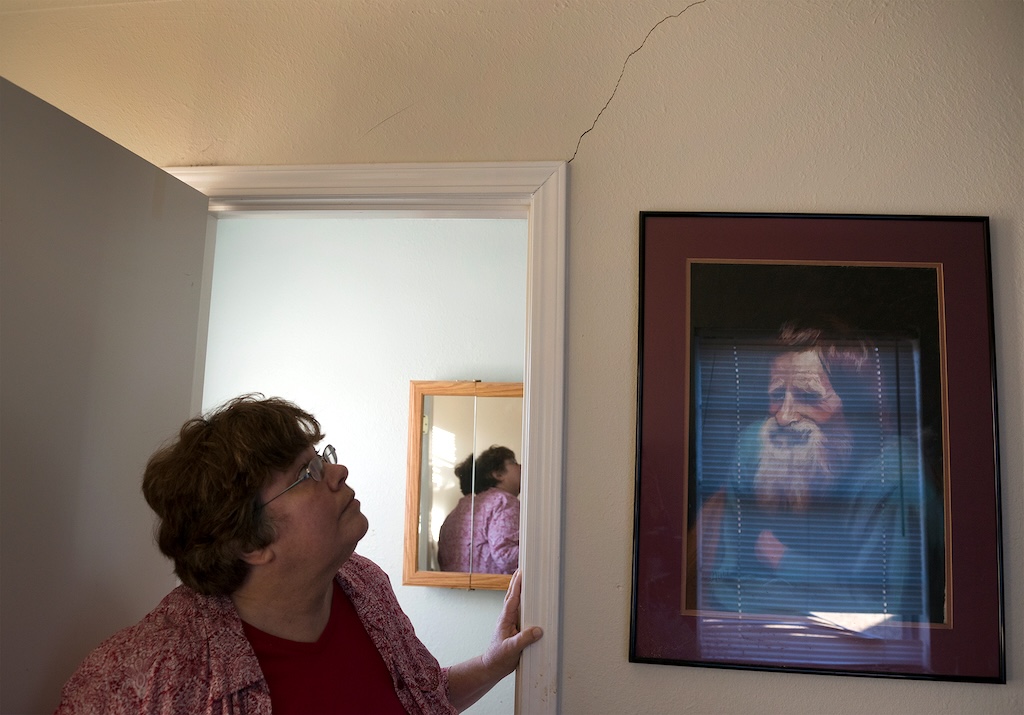 Environmental scientist Lisa Griggs looks at one of many cracks in her Guthrie, Oklahoma home, on Jan. 26, 2015, damage caused by ongoing earthquakes in the area. Researchers subsequently found that injection wells were causing the quakes. (Credit: Linda Davidson/The Washington Post via Getty Images)
No one at the conference critiqued the practice of injection as meticulously as a USGS hydrologist named John Ferris.
"The term 'impermeable' is never an absolute. All rocks are permeable to some degree," Ferris told the symposium. Wastewater would inevitably escape the injection zone, he continued, and "engulf everything in its inexorable migration toward the discharge boundaries of the flow system," such as a water well, a spring, or an old oil or gas well.
While the advancing front of waste might initially cause wells and springs to surge with freshwater, the contamination "would become apparent at ever-increasing distances from the injection site," he concluded.
"Where will the waste reside 100 years from now?" asked Orlo Childs, a Texas petroleum geologist, in his closing remarks. "We may just be opening up a Pandora's box."
"It is clear," said Theodore Cook of the American Association of Petroleum Geologists, in his forward to a roundup of the symposium's presentations in 1972, "that this method is not the final answer to society's waste problems."
'Industry Attacked the Rules'Initially, at least, the EPA seemed to heed these warnings. In a 1974 policy proposal, the agency echoed David Dominick's concerns, stating in an internal memo that they considered "waste disposal by [deep] well injection to be a temporary means of disposal" until "a more environmentally acceptable means of disposal" became available.
In June 1980, the EPA began regulating injection wells under the Underground Injection Control (UIC) program. While this meant there would be federal oversight, the rules transformed a disposal technique once critiqued by the agency and with questionable scientific merits, into one that was now enabled by the country's top environmental regulator. Immediately the EPA faced multiple lawsuits by industries, including oil and gas, mining, and steel, which complained underground waste injection regulations would cost them billions.
"Industry attacked the rules on the grounds that they were too complex and too costly," observed a 1981 Oil & Gas Journal article.
The resulting settlement did away with some of the testing requirements related to injection wells, and reduced the number and frequency of the reports that industry must file. Industry also made a concerted and largely successful effort to wrest regulatory control of injection wells from the EPA and give it to states. The EPA has since given 33 states permission to regulate injection wells themselves, including Ohio, Texas, and Oklahoma.
"I think at best they had a back-of-the-envelope calculation as to the capacity of these formations to take this waste, at worst it was just a rubber stamp," says Ted Auch, a researcher with the oil and gas watchdog Fieldnotes who has spent over a decade investigating the extent and impact of oil and gas industry waste production.
The 1980s nonetheless saw some critical government injection well research, despite eight years of generally pro-industry and anti-environmental protection policies under President Ronald Reagan.
A 1987 report from the EPA's Kerr Environmental Research Lab in Ada, Oklahoma, found that "hazardous wastes are complex mixtures of materials" and "subsurface environments often take many years to reach chemical and biological equilibrium." This made it "difficult to predict exactly the action or fate of wastes after their injection," if not "nearly impossible."
Another 1987 report, prepared jointly by the EPA and the Department of Energy and published by the National Institute for Petroleum and Energy Research in Bartlesville, Oklahoma, warned of several ways waste might escape the rock layer it had been injected into and move through the earth to contaminate groundwater, which is typically held in rock formations much closer to the surface. Waste, the report stated, could fracture rocks deep in the earth, "whereby a communication channel allows the injected waste to migrate to a fresh water aquifer." The injection well itself could corrode, enabling "waste to escape and migrate." Further, older oil and gas wells could provide "an escape route whereby the waste can enter an overlying potable ground water aquifer."
Subscribe to our newsletterStay up to date with DeSmog news and alerts
Email Address What content do you want to subscribe to? (check all that apply) All International UK Sign Up (function($){ $('.newsletter-container .ijkidr-us').click(function() { $('.js-cm-form').attr('data-id', '2BE4EF332AA2E32596E38B640E905619D07B21962C5AFE16D3A2145673C82A3CEE9D9F1ADDABE965ACB3CE39939D42AC9012C6272FD52BFCA0790F0FB77C6442'); $('.js-cm-email-input').attr('name', 'cm-vdrirr-vdrirr'); }); $('.newsletter-container .ijkidr-uk').click(function() { $('.js-cm-form').attr('data-id', '2BE4EF332AA2E32596E38B640E905619BD43AA6813AF1B0FFE26D8282EC254E3ED0237BA72BEFBE922037EE4F1B325C6DA4918F8E044E022C7D333A43FD72429'); $('.js-cm-email-input').attr('name', 'cm-ijkidr-ijkidr'); }); })(jQuery);Since the early 2000s, when new technologies spurred the fracking boom, drillers have been able to tap into once-inaccessible rock formations for oil and gas, often located close to communities — and sometimes, as in the Denver-Julesburg formation in Colorado, or the Marcellus and Utica Shale formations in Pennsylvania and Ohio, right in the middle of them. In addition to the flood of wastewater that these wells create, with elevated levels of naturally-occurring salts, carcinogens, metals, and radioactivity, there's a second waste stream unique to fracking: flowback, the toxic regurgitation of sand and chemicals shot down a well in the fracking process.
These fracking chemicals are specifically designed to generate cracks in rock, and to lubricate and fracture formations, in order to get at the oil or gas they hold. It's entirely unknown how these chemicals react, and interact, in the high pressure, high temperature subterranean environment of the injection zone, says Anthony Ingraffea, an engineering professor emeritus at Cornell University who has spent his career studying the oilfield.
This ever-growing tsunami of oil and gas wastewater has to go somewhere, and most of it will continue to go to injection wells. "One might be tempted to believe that well construction designs, materials, and techniques on wells constructed decades ago were vastly different than those of today," says Ingraffea. "This is false."
America's top environmental regulator vigorously defends reliance on injection wells, stating on its website that they have "prove[n] to be a safe and inexpensive option for the disposal of unwanted and often hazardous byproducts."
In response to questions about the agency's historic concerns about the long-term use of injection wells, EPA Press Secretary Brigit Hirsch says that the agency "is committed to supporting American energy companies and industry that are seeking permits for underground injection of fluids associated with oil and natural gas production," in order to "[advance] progress on pillars of its Powering the Great American Comeback initiative."
Early Warnings RealizedAfter 90 years of using injection wells to bury wastewater, including the past 13 years as the world's biggest producer of oil and gas, the United States has a profound pollution crisis. The oil and gas industry and its regulators are facing a long-stalled reckoning on injection wells in both the courts, and the court of public opinion.
In May 2022, a rural Ohio oil and gas operator named Bob Lane filed a lawsuit in the Washington County Court of Common Pleas against area injection well operators, alleging these companies' "infiltrated, flooded, contaminated, polluted" his oil and gas wells and property with waste containing hazardous materials "known or reasonably anticipated to be human carcinogens," and "harming the commercial viability" of his "oil and gas reservoirs." Defendants in the case include Tallgrass Operations, a Colorado-based energy infrastructure company, and DeepRock Disposal Solutions, a company formerly owned by Ohio state senator Brian Chavez, who chairs the Ohio Senate Energy Committee. The case is now before the Ohio Supreme Court and being followed closely by regional attorneys.
"We want to respect the process of the ongoing litigation, so we will not comment on it at this time," says Tallgrass spokesperson John Brown.
Brown says his company adheres to Ohio Department of Natural Resources (ODNR) rules and that its injected wastewater is contained within its permitted injection zone and does not impact drinking water. "It's important to note that underground injection is a long-established and proven method of disposal for many U.S. industries," says Brown, "and that it plays an essential role in supporting the low-cost, reliable energy systems that are critical to millions of Ohio families and communities across the country."
DeepRock has not replied to questions.
ODNR spokesperson Karina Cheung says the agency has suspended operations at six injection wells that present "an imminent danger to the health and safety of the public and is likely to result in immediate substantial damage to the natural resources of the state." A 2023 ODNR report called this leakage "potentially catastrophic" and warned of "extensive environmental damage and/or aquifer contamination," admitting that Ohio's long history of oil and gas drilling has left "numerous penetrations that may serve as pathways for fluid to migrate." In November, Buckeye Environmental Network, an Ohio advocacy group, filed a lawsuit in Ohio's Tenth District Court of Appeals against ODNR for permitting a pair of injection wells operated by DeepRock that would be within two miles of a zone meant to protect the source of drinking water for Marietta, Washington County's largest city.
"I can think of nothing more important than to protect the city's water," says Marietta City Council President Susan Vessels. "There is no just looking the other way, I want to help our city avoid an environmental catastrophe, which I believe is eventually going to happen if we continue down this path." In October, the council passed a resolution urging Ohio state legislators to introduce legislation imposing a three-year moratorium on new injection wells in Washington County.
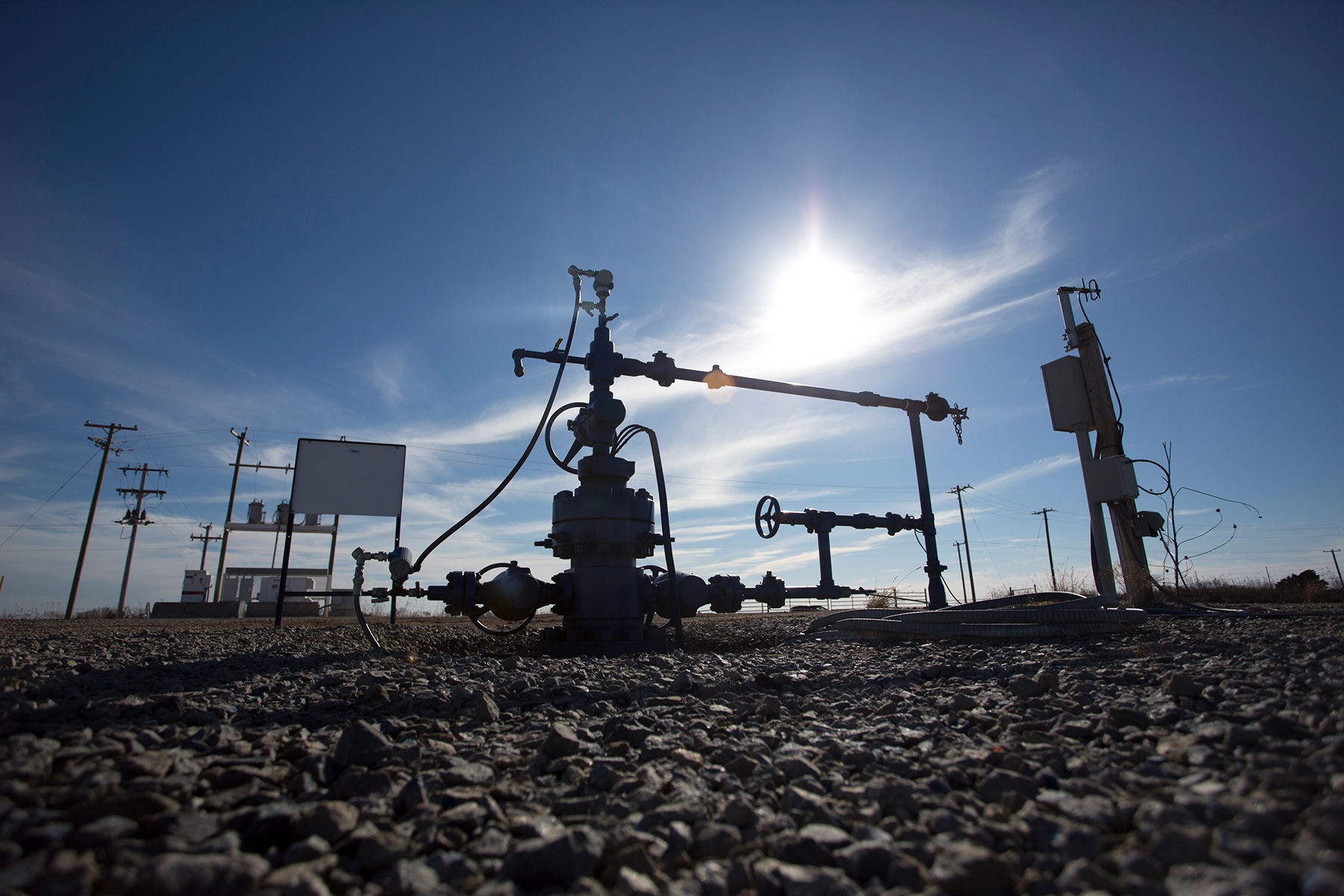 An injection well pumps wastewater into the ground in Coyle, Oklahoma, Jan. 24, 2016. (Credit: J Pat Carter/Getty Images)
Meanwhile, in Oklahoma, a stunning expose co-published in October by ProPublica and the Oklahoma-based newsroom Frontier documented a "growing number of purges," where oil field wastewater has been injected at "excessively high pressure" and cracked rock deep underground, freeing it to travel uncontrolled for miles, sometimes returning to the surface via abandoned wells. In one instance, a spew of brine from a defunct well contaminated a watering hole for livestock, killing at least 28 cows.
The story features Danny Ray, a whistle-blowing former state regulator and long-time petroleum engineer, who is worried that given Oklahoma's vast number of unplugged oil and gas wells, the state is ripe for more of these sorts of disasters. However, the Oklahoma Corporation Commission, the state's oil and gas regulator, discounted Ray's concerns, saying in a statement that it remains "committed to protecting Oklahoma and supporting the state's largest industry to perform its role in a safe and economic manner."
"These goals are not mutually exclusive," according to the agency.
In West Texas, Bloomberg reported in September, a growing number of the state's over 2,000 defunct oil and gas wells — locals call them "zombie wells" — are spouting unpredictable geysers of fracking waste. One blowout in Crane County shot wastewater 100 feet high into the air in 2022, releasing around 24 million gallons of toxic fluids before it was capped about two weeks later.
A spokesperson with the Railroad Commission of Texas, the state's oil and gas regulator, told Bloomberg that it had instituted a set of protective new rules regarding oil and gas wastewater injection wells, but recognized "the physical limitations of the disposal reservoirs" as well as the risks to oil production and fresh water.
Just last month, Inside Climate News reported on a new lawsuit filed by a Crane County landowner claiming "catastrophic impacts" from injection well blowouts.
The impacts of injection well leakage and blowouts have become visible from space. In a 2024 study using satellite observations, a team of Southern Methodist University scientists found that so much wastewater has been injected underground that it has raised land in one area of the Permian Basin by 16 inches in just two years, and created a high-pressurized underground lake that will lead to more sky-high wastewater gushers. "We have established a significant link between wastewater injection and oil well blowouts in the Permian Basin," the authors wrote in the academic journal, Geophysical Research Letters.
Once "a little cottage industry of mom and pops," injection wells have become "a much bigger business," says Kurt Knewitz, a consultant who runs an injection well information site called BuySWD.com. A case in point, says Knewitz, is Pilot Water Solutions, which operates injection wells in Texas and is a division of Berkshire Hathaway Inc.'s Pilot Travel Centers, the multinational energy and logistics company owned by Warren Buffet.
"You look at the Permian Basin and you think it's a huge oil play, but it produces three to four times as much produced water as oil," says Knewitz. "So the Permian is really a produced water play that on the side produces some oil and gas."
Still, the industry has not acknowledged the toxic reality on the ground, and continues to defend its favorite waste disposal practice. A recent report from the American Petroleum Institute (API), the nation's largest oil and gas lobby, states that injection wells are "safe and environmentally reliable" and "serve a vital role by supporting the responsible and sustainable development of O&G resources."
The API did not respond to specific questions regarding the merits of early critiques of injection wells, or whether they remain valid today. "Our industry is committed to the responsible management of produced water," spokesperson Charlotte Law said in the group's response. "Operators continuously invest in advanced treatment technologies, recycling, and reuse practices to minimize freshwater use, protect ecosystems, and ensure safe operations."
The USGS and DOE did not respond to questions for this story.
Advocacy groups that have spent decades tracking the EPA's oil and gas waste rules point out that the business model of the U.S. fracking industry depends on operators being able to get rid of waste cheaply.
"The inadequate regulation and enforcement of waste disposal wells across the country represents a financial giveaway to the oil and gas industry," says the NRDC's Mall, with NRDC. "Experts have known for generations this method threatens the environment."
For queries about republishing this story, please contact editor@desmog.com.
The post The Oil Industry's Latest Disaster: Trillions of Gallons of Buried Toxic Wastewater appeared first on DeSmog.
Industry Pushes Back on UK Ad Bans [ 11-Feb-26 11:22am ]In a speech to UK advertising executives last week, Lord Ed Vaizey had nothing good to say about a new ban on junk food ads aimed at children.
Nor did the Conservative peer mention a petition signed by more than 110,000 people calling on parliament to impose a tobacco-style ban on ads for fossil fuels.
Instead, Vaizey used his keynote at the annual Advertising Association conference to call for as little regulation as possible.
"I see a political class that is tempted to ban what it doesn't like rather than use the power of advertising to change behaviour," Lord Vaizey told the crowd at the start of the one-day event.
The ad industry is facing scrutiny for its role in the climate crisis — from bombarding the public with ads for unsustainable products such as frequent flying and fuel-guzzling sports utility vehicles, to protecting the reputations of the world's biggest polluters.
With cities such as Edinburgh and Sheffield imposing some restrictions on fossil fuel ads, and Amsterdam enshrining a blanket ban, campaigners want to persuade more towns and cities to follow suit in the hope of winning national bans as well.
Yet talks at the conference — which took place in London on February 5 — barely touched on the climate crisis. Discussions centred instead on the rise of artificial intelligence and rebuilding public trust in advertising, eroded by concerns over online scam ads and misinformation.
Vaizey's speech focused on advertising's role in powering the economy and included a swipe at the junk food ad ban, which came into effect on January 5 following years of cross-party support. The new rules stop high sugar, fat and salt foods being advertised online or on television before 9pm.
Vaizey told the conference that such bans did not have "really any clear effect" on health.
However, a February 2022 peer-reviewed study published in PLoS medicine found that London households reduced the amount of calories consumed from high fat, salt and sugar foods by almost 7 percent after a ban on junk food ads on public transport, with calorie intake from chocolate and sweets falling almost 20 percent.
"There is clear academic evidence that ad bans are highly effective at reducing consumption of harmful products such as unhealthy foods," said Victoria Harvey, an academic researcher on the advertising industry.
"Vaizey's speech…fits with the Advertising Association's opposition to junk food advertising legislation as well as their continued opposition to banning ads for fossil fuels," Harvey added.
An Advertising Association spokesperson said that Lord Vaizey was speaking in a personal capacity and the views he expressed on junk food advertising were his own. The spokesperson referred DeSmog to a review by consultancy SLG Economics — funded by the Advertising Association and other trade groups — that contended that the February 2022 research contained "clear and obvious discrepancies."
Industry Lobbies Against BansVaizey, who served as culture minister under former Conservative prime minister David Cameron, has pushed back against a junk food ad ban for years.
The peer led a call in 2022 to delay the ban by a year, according to reporting by the Grocer. Vaizey also proposed a "sunset clause" that would have scrapped the law after five years if it was not shown to be effective.
The Advertising Association and Food and Drink Federation backed Vaizey's calls — reflecting a wider pattern of industry lobbying to defeat or dilute proposed ad bans.
Paris-based JCDecaux, the world's largest outdoor advertising operator, attempted to block passage of Amsterdam's fossil fuel ad ban by emailing city councillors directly the day before the vote. JCDecaux, which controls ad space on bus shelters, billboards, and street furniture, claimed that the ban would have "far-reaching financial and legal consequences", and warned officials against creating restrictions based on "incorrect and incomplete information."
Amsterdam adopted the ban on January 22, becoming the first capital city to ban fossil fuel ads.
London Mayor Sadiq Khan, who introduced the ban on junk food ads on the city's public transport in 2019, has stopped short of slapping a similar ban on fossil fuel ads — saying more guidance from the government is needed before he can make a decision.
Hundreds of advertising campaigns by oil and gas companies have run on London's public transport network TfL in recent years, a DeSmog investigation found.
A week before the Advertising Association conference, a group of 15 senior ad executives sought to foreground their industry's role in the climate crisis and other harms by publishing an anonymous memo accusing the sector of "funding hate, legitimising environmentally destructive companies" and "paying little more than lip service" to addressing critical issues.
In the memo, which was coordinated by the UK group Inside Track, the executives said the industry was "helping polluting industries such as oil and gas rebuff public scrutiny."
The Advertising Association spokesperson said that in response "We contacted them on the day the memo was published and said we would be open to a meeting to hear more about the findings. We have since been offered a meeting date in March."
Lord Vaizey did not respond to a request for comment.
The post Industry Pushes Back on UK Ad Bans appeared first on DeSmog.
Will Tech Giants Just Use AI Interactions to Create More Effective Ads? [ 16-Feb-26 7:05am ]
Vintage Japan Brochures: Honda CR-CRF 2005 [ 16-Feb-26 6:00am ]%2001.jpg)
%2002.jpg)
%2003.jpg)
%2004.jpg)
%2005.jpg)
%2006.jpg)
Foto: Flickr (Tony Blazier)
New step for Peter Hickman as British championship announces ownership change [ 16-Feb-26 5:55am ]
Cisco set to release home-brew hypervisor as a VMware alternative [ 16-Feb-26 5:39am ]Cisco is getting close to releasing its own hypervisor, as an alternative to VMware for users of its calling applications - software like the Unified Communications Manager it suggests as an alternative to PBXs and other telephony hardware.…
Now animal rights protesters are in Labour's sights [ 16-Feb-26 5:36am ]
The Labour Party has a problem with animal rights campaigners. During the Blair Government, Labour famously wrestled frequently with finding the balance between the freedom of activists to voice their concerns with animal testing and the economic investment brought by the pharmaceutical industry (often favouring the latter). The current Labour Government has inherited this aversion to animal rights protesters, but has done away with all pretence of seeking to facilitate protest. Against the background of extending the Conservative Government's anti-protest legislation, Kier Starmer's Government now represents the greatest challenge to the freedom of assembly yet.
On 14 January 2026, the Commons voted to approve an amendment which would restrict protests outside "life sciences infrastructure", including specifically infrastructure used for animal testing. The amendment was introduced on 27 November 2025 by the Minister for Policing and Crime, Sarah Jones. It sought to classify "life science infrastructure" as a "key national infrastructure" under section 7 of the Public Order Act 2023.
Section 7 criminalises the "interference with use or operation", defined broadly as preventing the infrastructure from being used or operated to any extent for any of its intended purposes, of a list of now ten "key national infrastructures". The maximum sentence for contravening section 7 is twelve months' imprisonment, a fine, or both. Since section 7(7) of the Public Order Act 2023 allows the Secretary of State to add a new kind of key national infrastructure using secondary legislation, the Government has avoided full parliamentary scrutiny of its legislative amendment.
The motivations behind the amendmentSarah Jones presented the amendment as necessary to aid police in responding to "disruptive protest activity that is undermining our national health resilience", highlighting the Government's goal for the UK to become a "global beacon for scientific discovery".
According to Jones, the life science industry informed the Government that it cannot currently function in some cases due to protests. Jones' defence of the amendment was concerning. Jones did not use a single example of a recent animal rights protest which had actually impacted an animal testing facility, merely pointing out that at the 135 facilities which are licensed to do animal testing, there is only "potentially"the possibility of "protests of different degrees".
In any case, her justification that such measures must be taken to ensure vaccines can be produced in the event of a pandemic fall flat since many of these facilities have absolutely nothing to do with vaccine production.
The only current animal rights protest campaign targeting animal testing seems to be "Camp Beagle", a protest camp stationed in Cambridgeshire outside MBR Acres, a company which breeds up to 2000 beagles a year for animal testing. Camp Beagle has been established since June 2021 and grew after the Daily Mirror had published photographs of poor conditions at the premises.
 Beagle is the world's longest-running, permanent grassroots animal rights protest camp. It is situated outside the entrance of MBR Acres in Huntingdon, Cambridgeshire. Image by Camp Beagle
Just two days before the Commons voted to approve the amendment, a jury at Cambridge Crown Court acquitted four protesters for burglary after they had broken into MBR acres to rescue beagle puppies in December 2022. To classify MBR acres as a 'key infrastructure' is significant overreach; in the words of Labour MP Kerry McCarthy, "I do not think that the country will grind to a halt if MBR Acres is occasionally obstructed from supplying beagles to laboratories for testing".
Déjà vu? The Blair yearsOn 11 November 2025, the Government introduced its road map to phase out animal testing in line with its manifesto commitment. The first act of the Government in 2026, however, has been to criminalise protests outside animal testing facilities. There is an element of déjà vu here. Before the 1997 election, Tony Blair promised a Royal Commission to examine animal testing and possible alternatives. After elected as Prime Minister, Blair, whose premiership oversaw a heightened period of animal rights protests, instead decided the way forward was to clamp down on animal rights activists.
The most significant campaign during this period was by Stop Huntingdon Animal Cruelty (SHAC). SHAC was formed as a direct action group which aimed to shut down Huntington Life Science, an animal testing facility based in Cambridgeshire. Members became well known for their method of intimidatory "home visits", where activists would target the homes of scientists and staff of HLS and particularly their suppliers, shareholders and customers, with the aim of isolating HLS economically.
The growth of the animal rights movement in the early 2000s meant that by 2004, CEOs of major Japanese pharmaceutical companies based in the UK put increasing pressure on the UK Government to deal with protests under the threat that they would exit the country, leaving a £18.5 billion black hole in the economy in their wake.
In response, the Government legislated for section 145 (offence of "interference with contractual relationships so as to harm animal research organisations (AROs)") and section 146 ("threatening someone that they will be the victim of a crime or tortious act causing loss or damage, because they are linked to an ARO") of the Serious Organised Crime Act (SOCA) 2005. Both offences have a maximum term of imprisonment of five years.
The SOCA also added Section 42A to the Criminal Justice and Police Act 2001 which created a free-standing offence of harassing someone in the vicinity of their home. These legislative amendments, in addition to a ramped up police response, of which particularly encouraged pharmaceutical companies to use civil injunctions against protesters, led to a dramatic decline of animal rights activity by the end of the 2000s.
Lowering the threshold of acceptable protestDuring the debate on the amendment in December 2025, Matt Vickers MP mentioned that accompanying documents to the draft regulations held that police had requested more powers because sections 145 and 146 SOCA did not go far enough to deal with current animal rights protests. The police had not explained why.
The simple matter is that current animal rights protesters, such as those at "Camp Beagle" do not engage anymore with those controversial tactics covered by those offences. Instead of recognising this, and maintaining space for peaceful protest, the Government, potentially unnerved by a recent string of life science industry disinvestments in the UK totalling £1 billion (down to domestic economic malaise, Brexit and US policies, not protests), has decided to dramatically lower the threshold of acceptable dissent, and criminalise peaceful protest.
Labour has put aside its previous concerns with the anti-protest legislation ushered in by previous Conservative Governments. Sarah Jones has gone from criticising the Conservative legislation provisions as "draconian" and "disproportionate" to a position of using them in full force against peaceful protesters now she is in government.
The move to criminalise animal rights protests takes place against the background of a concerted effort to micromanage and curtail protest. Beyond animal rights protests, Labour have pushed further in legislating for more protest-related restrictions in the Crime and Policing Bill which is currently passing through the House of Lords.
 Many of those arrested at a Palestine Action protest were elderly - police have said about half were over 60.
Worryingly, on 15 January 2025, the Lords agreed an amendment to the Bill put forward by the Government which would allow police to consider the cumulative impact of frequent protests when imposing conditions. This represents the greatest threat yet to the freedom of assembly. In effect, police will be able to introduce conditions on protests if they deem protesters have had sufficient opportunity to voice their concerns.
The amendment, in fact, had been repackaged from secondary legislation introduced by the former Home Secretary Suella Braverman in 2023 which was ruled subsequently unlawful by the Court of Appeal.
Clearly, notwithstanding the change in government, the zeal to limit peaceful protest persists. At this current pace, this begs the question: what will remain of the freedom of assembly at the end of this Labour Government?
This article originally published on LSE Blogs is reproduced under a Creative Commons licence (CC BY 4.0). Read the original here.
More from East Anglia Bylines
 Activism
Apathy or alienation? Finding the lost art of protest
byStacey Richards 15 April 2025
Activism
Apathy or alienation? Finding the lost art of protest
byStacey Richards 15 April 2025
 Activism
Just Stop Oil: do radical protests turn the public away from a cause?
byProf Colin Davis 23 October 2022
Activism
Just Stop Oil: do radical protests turn the public away from a cause?
byProf Colin Davis 23 October 2022
 Activism
How International Women's Day protests sparked the Russian Revolution
byCameron Holloway 9 March 2022
Activism
How International Women's Day protests sparked the Russian Revolution
byCameron Holloway 9 March 2022
 Activism
Protest songs: the political message in the Magnificat
byRevd Selwyn Tillett 5 January 2022
Activism
Protest songs: the political message in the Magnificat
byRevd Selwyn Tillett 5 January 2022
 Bylines Network Gazette is back!
With a thematic issue on a vital topic - the rise child poverty, ending on a hopeful note. You will find sharp analyses on the effect of poverty on children's lives, with a spotlight on the communities that are on the front line of deprivation, with personal stories and shared solutions. Click on the image to gain access to it, or find us on Substack.
Journalism by the people, for the people.
The post Now animal rights protesters are in Labour's sights first appeared on East Anglia Bylines.
DOUBLING UP: Masia makes it two from two on WorldSSP's Monday in Australia, Triumph shine with Bayliss and Vostatek [ 16-Feb-26 5:15am ]Home hero Oli Bayliss (PTR Triumph Factory Racing) took P2 on the day, splitting Ducati riders Masia and Oettl for the day's top three finishers
Asia In Brief The United States may be about to change its policies regarding Chinese technology companies.…
Remember the MiBot, that tiny Japanese EV predicted by many EV pundits to be the next spawn of electric mobility in Japan because of its affordable ¥1 million (~$7000) price tag? Well, MiBot manufacturer KG Motors delivered the first completed MiBot units on December 30, 2025, after some delays which ... [continued]
The post Japan's Smallest EV Gets Backing From One Of Its Largest Energy Companies appeared first on CleanTechnica.
It was an all-Italian affair at the top of the Free Practice 1 timesheets as Bulega lead Montella, Bassani and Baldassarri
Peter Steinberger, the creator of the tantalizing-but-risky personal AI agent OpenClaw, is joining OpenAI.…
To tie up loose ends before I get on with other topics…
Falcon Press/New Falcon/Original Falcon/Christopher HyattOne narrative - from Nick Tharcher of Original Falcon Press, recently1 related how Wilson was looking for a publisher for his Prometheus Rising, because Jeremy Tarcher had expressed interest in it but had dragged his feet, and Israel Regardie had told Hyatt about RAW, and they talked on the phone for about 10 minutes and made a deal: Prometheus Rising would be published on Falcon Press. This would have been early in 1983, because the first edition of Prometheus Rising came out later that year, and 1983 letters from RAW as late as August imply Jeremy Tarcher was still sitting on the manuscript. Soon after they had a deal, Tarcher told RAW he wanted to go ahead with it, but RAW told him too little, too late, he'd just made a deal with someone else, and then in the ensuing years Hyatt and Nick Tharcher put out a long string of Wilson's non-fiction books, including books that had appeared at And/Or Press, who had (apparently?) not paid royalties, had undergone a hostile takeover and/or (pun!) was mismanaged, and went bankrupt. I'm still not sure I have the straight story with And/Or, who I covered previously in this series.
This Substack is reader-supported. To receive new posts and support my work, consider becoming a free or paid subscriber.

In 1995 Wilson did a long and fascinating email interview with Alex Burns for REVelation magazine. It was later updated by Burns in 1997 and showed up at the Disinformation website in 20012, and Burns wrote, "In the mid-1980s, after leaving his work published by a range of major and independent publishers, RAW became involved with New Falcon Publications, a loose cabal of similarly minded authors, spearheaded by Dr. Christopher Hyatt, who wrote the seminal Undoing Yourself With Energized Meditation (1989). New Falcon reprinted his (RAW's) earlier work along with tracts by Leary, Crowley, and other proponents of brain change. Currently New Falcon3 is one of the leading publishers of such modern grimoires, differing from other New Age publishers in jettisoning pompous academia or hazy cosmic foo foo."
"Believe it or not, I don't understand how New Falcon came about or even why it does much of what it does," RAW admitted. "All I know is that Dr. Hyatt was a Jungian therapist, decided Jung didn't cover everything and became a Jungian-Reichian therapist, and then for some reason became a publisher on top of that. He's also the Outer Head of the Hermetic Order of the Golden Dawn. I think his major concern is to publish books that he considers important, especially if they contain the kind of ideas that the Establishment publishers in New York won't touch with a ten-foot pole."4
I'm one of those readers who, when they discover a writer they find exceedingly interesting, must read everything by them. I immediately did a special order for a number of Wilson's books at a local bookstore and most of them were on Falcon Press. And I loved Wilson even more after reading these, but found they were edited poorly. It was conspicuous. Tharcher said he thinks this might be because, when they first went into business, Hyatt (AKA Alan Miller) did the typesetting and was a "somewhat dyslexic." The reason for typos and errors seems more complex to me, but they are revealing, because RAW often got proper names wrong, and Falcon didn't do that sort of editing. We can have no doubts that when RAW first talked to Hyatt about publishing Prometheus Rising he emphasized he didn't want editors fucking with his text! As I wrote earlier in this series: RAW wanted a laissez faire editor/publisher. But I also think he'd have wanted typos fixed. Nay, we know he did, and chalked it up to the earliest computerized typesetting: (Prometheus) "emerged with a phalanx of typos that have embarrassed me considerably over the years."5
Tharcher says he and Hyatt realized people weren't complaining about the poor editing of their books, so they didn't care.6 One person who did care about the editing was Wilson's wife, Arlen Riley Wilson. And New Falcon cared enough about editing to pay her.
In a July 20th, 1989 letter from Arlen to RAW's friend and benefactor Kurt Smith, she notes some problems with RAW's publishers for his Historical Illuminatus series of books, RAW's depression, Wilson family news, RAW's heavy lecture touring, and other things. Here's an interesting line from Arlen: "I've been doing some editing work for Falcon Press (boy do the need it!). Between that and Trajectories and secretarial stuff for Bob I keep busy." Later in the same letter she notes that, because of the various problems with the publishers of RAW's Historical Illuminatus fiction series, "It's not too easy for him to get up the enthusiasm to complete the next one, The World Turned Upside Down. He's awfully busy with other things anyway, so maybe it's just as well. He's got a contract from Falcon (not all their stuff is crap, only most) to do a book which has the working title Quantum Psychology. When he gets a chance to do it, which looks to me won't be until midwinter. He's too good for them, much too good. On the other hand I shouldn't bitch since they are paying me these editing jobs right now and I hope to get more bucks out of them as time goes on. Hard to find another employer to let me work from home, which they do. I loathe offices, and besides I'm needed here."78
Jeremy TarcherTarcher started in publishing in the early 1960s, getting book deals for TV stars like Buddy Hackett, Johnny Carson, and Joan Rivers. Then he went to Esalen and had a revelation of sorts: he wanted to publish books from the Human Potential Movement, but no one in the New York publishing circles he knew was interested in those ideas or subjects. In James Fadiman's non-fictionalistic "novel," The Other Side of Haight, he quotes Tarcher9 on the New York publishing industry never "getting" the West Coast thinking in the 1960s, an idea that was repeated by not only Wilson, but Ferlinghetti, Leary, Rexroth, Robert Stone and many others. When I was 17 or so, someone told me I had to read some book called The Aquarian Conspiracy, by Marilyn Ferguson, so I did. I still think of that book as the sort of bible for the new Esalen/West Coast human potential epoch. It's a good book about heavy Generalist-type thinkers. It was issued by Jeremy Tarcher, whose wife was Shari Lewis and sister Judith Krantz. The word "conspiracy" in the title proved to be provoking to reactionaries who to this day use "the Sixties" as the reason why we must do away with democracy.
RAW had written a long PhD thesis for his alternative university, "The Evolution of Neuro-Sociological Circuits: A Contribution to the Sociobiology of Consciousness." He rewrote the dissertation into a more popular form, which became Prometheus Rising. He offered it to Jeremy Tarcher, who "held it for a full year of meditation before rejecting it; his only explanation for the rejection concerned the mixture of technologese and 'counter culture' slang that has since become my most frequent style in nonfiction. (It's based on the way I actually speak.) When I tried Falcon next, they accepted it within 48 hours, and I received the advance check within the next 48 hours. 'Oh frabjous day!'" Wilson then mentions Tarcher changed his mind, and RAW says he had to restrain himself from telling Tarcher to go fuck himself: RAW had been living in poverty while Tarcher sat on the manuscript for a year. RAW adds that Falcon "has always served as an alternative to establishment publishing."10
On February 12th, 1983, RAW wrote to Kurt Smith, "Prometheus (with Oui material rewritten) is to be published this summer. German rights were just sold. No English publisher interested yet." In this same letter RAW does some considerable complaining about publishers not paying in time: "It is 'bad form' for a writer to go around his agent and nudge a publisher personally. And/Or owed me 3700 in July, paid 400 between July and October in 5 installments, hasn't paid anything since October, still owes me 3200. End of complaints. Just want you to know I don't get depressed without cause." In an undated letter to Smith, sometime in late February to early March 1983, he quotes Smith: "'What the hell is Tarcher doing?', you ask. I wish I knew. Arlen thinks he is trying to drive me to despair. Whatever the hell he is doing, I assume it makes sense to him. It makes no sense to me. However, the latest word from my agent is that Tarcher is trying to get a paperback sale on Earth, which does make sense to me, at this point. At least, some of my fans might see the paperback. Based on sales, I gather they never browse in the hardback section."
August 3rd, 1983 letter to Kurt Smith from RAW in Dublin: "Tarcher, ideally, shd be portrayed by Peter Lorre, not Vincent Price. A very nervous, insecure, timid and therefore treacherous type. He is afraid to gamble, but is in a business that is always a gamble, and that explains him thoroughly. For the sake of the poor bastards who will sign contracts with him in the future, I wish he would read Nietzsche."11
Let's be clear: RAW only published one book with Tarcher, the hardcover version of The Earth Will Shake, and distributed by Houghton Mifflin. Paperback versions of that were put out by Blue Jay and then Lynx. But I think Tarcher's distribution would have helped RAW. Maybe. This letter was written the year Falcon first produced Prometheus Rising. From the venom in the August 3rd letter it seems the Falcon deal had yet to go down.
The drama around Tarcher "sitting" on Prometheus Rising, coupled with Tarcher's perceived role in the long sad nightmare of the publishers involved with the Historical Illuminatus Chronicles (Tarcher abandoned his involvement once The Earth Will Shake bombed in hardcover) seems to have made RAW concentrate his invective toward him, and nowhere is this discussed more pertinently than by RAW's longtime friend, D. Scott Apel, in his memories of Wilson, from Beyond Chaos and Beyond. When Apel got a journalist assignment to interview Shari Lewis in 1985: "I never saw Bob Wilson hate anyone, before or since, but he clearly hated Jeremy Tarcher (and by association, anyone who would marry Jeremy Tarcher). He thought he'd been treated poorly, unfairly, dishonestly, and all the other disrespectful ways in which a publisher can abuse an author. From that time until Shari's passing in 1998, I could never mention either of their names in RAW's presence. At one point I had to bite my tongue from saying, 'Sorry, Bob, I can't come down this Saturday — Shari Lewis is in The City and wants to see me.' Divided loyalties, for sure…but to this day I have no idea if Tarcher actually screwed Bob over — he always impressed me as an intelligent, ethical individual, even if he was a publisher— or if Bob's imagination had bested his objective analysis of the situation."12
Mike Hoy of LoompanicsScott Apel transcribed a brilliant stand-up philosophy talk by Wilson in October 1987. At one point he started riffing around one of his key points that run throughout his work: that we ought to have doubt about our ideas, and that belief seems unnecessary, that living with only tentative beliefs in models keep us intellectually exhilarated and open-minded and emotionally alive. He talked about the Correct Answer Machine that people seem to get installed in their nervous system at some point: when you have this "machine" you don't need to think anymore about any phenomena. You already know all the answers. And you're a fucking fool, too. He attributed the term "Correct Answer Machine" to Mike Hoy, who ran Loompanics publishing out of Port Townsend, Washington state. Hoy published RAW's sparkling broadside, Natural Law: Or Don't Put a Rubber on Your Willy (1987). I bought quite a lot of books from Loompanics13, and I always looked forward to their yearly catalog, which they would send to anyone who bought a book from them. I still have most of them. Here's RAW in 1987:
Hilaritas PressMike Hoy is my favorite publisher. He publishes Loompanics books — books on how to cheat on your income tax how to pick locks, how to grow your own marijuana in the closet, how to rip off automatic bank machines, all sorts of controversial books. He recently brought forth what may be the ballsiest book he's ever published: How To Cheat a Professional Dope Dealer. I travel so much that among my circle of acquaintances there's one of everything, so I know a professional dope dealer in New York. And I told him about that book - or at least I thought I did. He said, "Are you kidding? I bought the first copy!" That's the great thing about Loompanics books: the people who need them get them. [Laughter] Michael Hoy wrote an article recently for a magazine called Critique, in which he gave a little parable. Supposing somebody told you I've got a "Correct Answer" machine, and you say, "Let's see how it works." So he starts feeding into the machine all the questions you asked, and the machine came back with a great deal of what was straight, hard-line Marxist propaganda and regular Marxist jargon. And after five or ten questions you say, "Hey, that's not a Correct Answer machine - that's a Marxist propaganda machine."And the inventor says, "Oh, no. This is a Correct Answer machine. It seems the Marxists have the correct answer. The machine is just giving the correct answer, because the correct answer just happens to be the Marxist answer." And you think, "Ah, this guy's just trying to kid me. He's just a propagandist for Marxism." So you leave in a disillusioned mood, and the guy in the next window says, "Psst. Hey, I've got the real Correct Answer machine." So you go in and you ask the machine ten questions and you get ten answers of straight Libertarian Party philosophy in standard Libertarian jargon. And you say, "You don't have a Correct Answer machine either — you've just got a Libertarian propaganda machine." And he says, "Oh, no. The Libertarian Party line happens to be the correct answer to everything."
The strange thing is we wouldn't believe in such machines, but most of us think we do have a Correct Answer machine in our heads.14
RAW, on his death bed, told his daughter Christina to keep his books in print. And this small press has done so. Run by Richard Rasa and Christina Pearson, they have done very heavy lifting and I think Wilson would be proud. [Full disclosure: I've gotten essays printed in some of Hilaritas's books.] The terrain in publishing since RAW's death has seemed to mirror increasing income inequality in the population, and many are opting to self-publish. I briefly discussed the New York-based "Big Five" and what a drag they are on writing culture these days: they only want best-sellers.
RAW once dreamed of having his own press, which he'd call Ho House, with a laughing Buddha as the logo, but it never happened. "Hilaritas" is traced back to medieval philosopher Scotus Erigena, who seemed to define the term as something like "cosmic humor." A cosmic "Ho." Even in "sad" things there is humor; in humorous things there is some sadness. Ezra Pound liked the term, and that's probably where RAW first encountered it.
Hilaritas's editions are on better paper stock, with far better bindings, contain much supplementary material, have wonderful artwork, were scrutinized by a large group of editors for typos and mistakes, etc. They did/do not change any word of RAW's thought. If something seems too obscure and the current editing team can't agree what he may have meant, they just leave it alone. Still, an editor friend who worked with RAW at And/Or Press, Peter Beren, thought, "The Robert Anton Wilson Trust, which had established a strong presence online, began to seem more and more like a cult with Bob as the Prophet. The eye in the triangle, sign of the Illuminati, was its symbol and the main slogan" "Keep The Lasagna Flying." This profound but surreal and absurdist cult still exists online."15
I leave us here, with much left unwritten about Wilson, his publishers, his would-have-been publishers (Llywelyn, Weiser, Soft Skull, M.I.T. Press), his wailing and gnashing over editors, his difficult writing life. Previous parts of this story are HERE and HERE.
I will comment in general on these affairs in some future blogspew.
1Hilaritas Press podcast, Dec 23, 2025, c. 08:20-09:20 or so
2"In the raw: necessary heresies," RAW's interview with Alex Burns. It can be accessed HERE.
3It had become New Falcon after just plain Falcon after a legal dispute, or so it seems. Then, after Hyatt died, his son created a stir and Tharcher and Hyatt's widow converted the official publisher's name to Original Falcon, which is what they are today. Also: sorry about the Jeremy Tarcher and Nick Tharcher situation, but those really are those guys' names.
4Re: Hyatt as Outer Head of the Golden Dawn: In a 1988 interview with David Banton, broadcast on KFJC Los Altos Hills, California, Banton asks, "Recently, Falcon Press has been reprinting a lot of your books, and there's a little joke in the list of Falcon books. With so many of them by Robert Anton Wilson, it asks, is Falcon Press owned by Robert Anton Wilson? Well, is it?" RAW replies:
"No, that's just one of the publisher's little jokes. Falcon Press is owned by the Hermetic Order of the Golden Dawn, which was the English branch of the Illuminati, according to some conspiracy buffs. Of course, it wasn't really, that's just what some nutty people say. And I want to deny Mae Brussell's claim, uh, no it's not Mae Brussell, it's Lyndon Larouche. Lyndon Larouche claims I'm the head of the Illuminati; there's no truth in that whatsoever. Mae Brussell is the one who said I'm an agent of the Rockefeller conspiracy. That is the truth, I can't deny that one! Actually, my whole cellar is full from floor to ceiling with bars of gold sent to me personally by David Rockefeller for all the services I provide for the Rockefeller Conspiracy."
(see also pp. 983-1079, Infinite Jest)
5Prometheus Rising, Hilaritas ed, p.ii
6Listen to an interview with Nick Tharcher from two years previous to the interview citedin footnote #1, above. Start at around 33:00 and go to 34:50 or so. Since the rights to almost all of RAW's non-fiction have reverted to his family and Hilaritas Press, a small army of editors - including yours truly - have cleaned up those books significantly, although RAW's erudition, combined with his misremembering of proper names and their spelling, and some book titles, have created a huge challenge, but I think we've made a very significant dent.
7I bought a bunch of books from the Falcon/New Falcon catalog written by other authors, simply because RAW had written the Foreword of Introduction. And when I read those books, I often found them wanting. Just not my taste. But there are definitely some very interesting minds put out by that publisher. RAW did an Intro for Hyatt's aforementioned Undoing Yourself. He did similar for Wayne Saalman' Dream Illuminati and Illuminati of Immortality; Madeleine Singer's Psychology of Synergy; David Jay Brown's Brainchild; Hyatt/Duquette/Ford's Taboo: The Ecstasy of Evil; Rodolfo Scarfalotto's The Alchemy of Opposites; Donald Holmes's The Illuminati Conspiracy; Constantin Negoita's Cybernetic Conspiracy: Mind Over Matter. There was a volume with Hyatt's name on it, but many contributors Rebels and Devils, that RAW also wrote for. There are probably a few others I've mis-shelved on my own shelves. All these books were worth buying, for me, simply because of RAW's introductions and contributions.
8Let's get this straight: Arlen was writing Kurt Smith from Los Angeles to Smith's home in San Francisco. It's 1989. RAW was on a lecture tour, but Arlen was trying to assure Smith that RAW wasn't mad at him, and that Bob had been very busy, but when this correspondence gets published one day it will become clear that RAW was probably depressed also. "You have nothing to worry about…You are still in the Aces. Elite, Primo. Gold Card category, believe me." Why didn't they email? Probably because this was just a year or two before everyone had an email address. Why didn't they call? Probably because you had to pay per minute for calling outside your area code number, on what was called a "land line". I mean, think about how radically different communication was in just 1989!
9The Other Side of Haight, Fadiman, pp.239-240. Fadiman's cousin was William James Sidis, who was a freakish genius. Fadiman was turned on to psilocybin by Richard Alpert, was Stewart Brand's guide on Brand's first LSD trip, and lived near Ken Kesey in Menlo Park. He's since become associated with microdosing and set and setting, and all things Transpersonal. His uncle was Clifton Fadiman, a 1960s TV intellectual; his cousin is writer Anne Fadiman.
10Prometheus Rising, pp.i-ii of the Hilaritas Press ed. According to Hilaritas, this book continues to sell well, 19 years after RAW's death, and for me, it's still the ABC/Baedeker/enchiridion for the Eight Circuit Model of consciousness.
11This seems to me a transparent projection by RAW. At least he acknowledges that publishing is a gamble. The Peter Lorre bit tickles me.
12Beyond Chaos and Beyond: The Best of Trajectories, vol 2, D. Scott Apel, pp.438-439
13One of my favorites was How To Start You Own Country, by Erwin Strauss. It was books like this - and no one published more of them than Loompanics - that made me realize the heavy strain of what I call "Walter Mitty Syndrome" in my reading life and personal makeup since childhood. I will happily read the most insane, "dangerous" books while sitting like some milquetoast, knowing I'd never do anything like what's going on in the book. Hey! I want to know about other reality tunnels! And so I read "Uncle Fester"'s book on starting your own LSD lab, Practical LSD Manufacture, all the while realizing I have a tough time making instant oatmeal. Or The Turner Diaries. Or Hit Man, by "Rex Feral," who was really a female mystery novelist who was having difficulty with sales. Her book brought down Paladin Press. Uncle Fester, The Turner Diaries (by "Andrew Macdonald"), and "Rex Feral" were all available through Loompanics. Thus did non-fiction forever seen coterminous with fiction to me.
14Beyond Chaos and Beyond: The Best of Trajectories, vol.2, D. Scott Apel, p.270 This gedankenexperiment by Hoy, as related by Wilson, reminded me of John Searle's "Chinese Room" thought experiment about AI. And, decades later, with widespread talk about scary AI taking over the world, this seems even more pertinent. Who is programming your "reality"? This idea runs, of course, through RAW's entire oeuvre. It's just that he appreciated the shaded nuance of Hoy's rhetoric about why we must, doubt…and find our own light. I can't help but feel strongly that, had more people read RAW and understood his ideas around Model Agnosticism and "Maybe" logic, that we wouldn't be in the rapidly disintegrating apocalyptic collapse that now seems to be accelerating. On other days it rains.
Hoy quit Loompanics in 2006: "Outlaw Publisher Calls It Quits"
15More True Than Strange: Collected Writing 1968-2018, Peter Beren, p.205 When I emailed Richard Rasa about this, he replied "I wish it was a cult! Then we'd have better sales!" I don't think Beren had the hilaritas, but then I'm biased. Or… stuck in a cult? Which, if so, I wouldn't know, right? Help! Help?

(above graphic done by artist Bobby Campbell)

In December 2023, Steve Bannon and Boris Epshteyn allegedly activated a backdoor mechanism in a cryptocurrency they controlled, freezing investor wallets while exempting their own. A class action lawsuit filed February 12 in DC federal court alleges the pair had secretly acquired the token — called "Let's Go Brandon Coin," or $FJB — in December 2021, paying nothing. — Read the rest
The post Steve Bannon sued over MAGA crypto scheme appeared first on Boing Boing.

Conservative podcast host Tim Dillon called FBI Director Kash Patel a "big fat liar" and demanded his resignation. Candace Owens said he should step down. Joe Rogan amplified the criticism. The backlash — from the same right-wing media that once championed Patel — centers on what Salon describes as a pattern of "premature announcements and theatrical incompetence." — Read the rest
The post MAGA turns on "Keystone Kash" Patel over botched investigations appeared first on Boing Boing.
The UK is putting up 1 billion pounds to promote local clean energy projects that will provide benefits to communities, not investors.
The post In The UK, "Power To The People" Is Latest Clean Energy Trend appeared first on CleanTechnica.

Attorney General Pam Bondi told Congress on Saturday that the Justice Department has released all documents required by the Epstein Files Transparency Act. The lawmakers who wrote the law disagree.
In a six-page letter, Bondi and Deputy AG Todd Blanche listed more than 300 "politically exposed persons" whose names appear in the files — Trump, Clinton, Gates, Prince Andrew, and, for reasons the DOJ didn't explain, Princess Diana, Elvis Presley, and Janis Joplin. — Read the rest
The post Bondi says all Epstein files are released. Lawmakers say she's lying. appeared first on Boing Boing.

Walter Donohue by Sarah Ainslie
We are delighted to announce that - due to popular demand - script editor, producer and luminary of the British cinema, Walter Donohue has agreed to teach another two-day screenwriting course at Townhouse in Spitalfields on the weekend of 18th and 19th April.
Here are some comments by students on Walter's previous course:
"I just want to say thank you for putting on such a fantastic weekend - it was so, so interesting speaking with like-minded people who share such a love for film and to be able to speak to the wonderful Walter and Mike Figgis and glean some of their vast knowledge. The food was delicious and the setting was ideal, I really appreciate the effort that you put into making it such a fantastic weekend." MN
"The course itself exceeded my expectations - I learned so many invaluable lessons about screenwriting and the film industry itself. I will take all the new skills into my career. Both Mike Figgis and Walter led an incredibly useful course and truly took their time with each student." GE
"The weekend spent in the Townhouse was nothing short of wondrous. Walter's passion for writing and storytelling is infectious. For every story that the students had, Walter had suggestions that took that story to a new level. The man's knowledge of what is needed in screenwriting and how to pitch, for me, was invaluable. The weekend was two days that I will never forget. I now have the tools and ammunition to start my own personal project. The visit by Mike Figgis was insightful. His views on Hollywood and filmmaking were blunt, informative and most importantly, honest! I could have listened to him talk all day." JL
WALTER'S EXPERIENCE
In the eighties, Walter began working as a script editor, starting with Wim Wenders' Paris, Texas and Sally Potter's Orlando. Since then he has worked with some major filmmakers including Joel & Ethan Coen, Wim Wenders, Sally Potter, David Byrne, Mike Figgis, John Boorman, Viggo Mortensen, Alex Garland, Kevin Macdonald, and László Nemes.
For the past thirty years he has been editor of the Faber & Faber film list, publishing Pulp Fiction and Barbie, and screenplays by Quentin Tarantino, Wes Anderson, David Lynch, Sally Potter, and Greta Gerwig & Noah Baumbach, Joel & Ethan Coen, and Christopher Nolan among many others.
Walter also published Scorsese on Scorsese, and edited the series of interview books with David Lynch, Robert Altman, Tim Burton, John Cassavetes, Pedro Almodovar and Christopher Nolan.
THE COURSE
Walter's course is suitable for all levels of experience from those who are complete beginners to those who have already written screenplays and seek to refresh their practise. The course is limited to sixteen students.
APPROACHES TO SCREENWRITING
Walter says -
"My course is about approaches to writing a screenplay rather than a literal step-by-step technique on how to write.
The objective of my course is to immerse participants in the world of film, acquainting them with a cinematic language which will enable them to create films that are unique and personal to themselves.
There are four approaches - each centred around a particular film which will be the focus of each of the four sessions.
The approaches are -
Structure: Paris, Texas
Viewpoint: Silence of the Lambs
Genre: Anora
Endings: Chinatown
Participants will be required to have seen all four films in advance of the course."
This is a unique opportunity to enjoy a convivial weekend with Walter in an eighteenth century townhouse in Spitalfields and learn how to approach your screenplay.
Refreshments, freshly baked cakes and lunches are included in the course fee of £350.
Please email spitalfieldslife@gmail.com to book your place.
Please note we do not give refunds if you are unable to attend or if the course is postponed for reasons beyond our control.

Photographs copyright © Sarah Ainslie
The Official Test Down Under is underway!
Infosec in Brief The former General Manager of defense contractor L3Harris's cyber subsidiary Trenchant sold eight zero-day exploit kits to Russia, according to a court filing last week.…
Hideki Sato, who led the design of Sega's beloved consoles from the '80s and '90s, died on Friday, according to the Japanese gaming site Beep21. He was 77. Sato worked with Sega from 1971 until the early 2000s, but he's best known for his involvement in the development of the Sega arcade games and home consoles that defined many late Gen X and early millennial childhoods, starting with the SG-1000 to the Genesis, Saturn and Dreamcast.
— Beep21 (@Beep2021) February 14, 2026
Sato went on to serve as Sega's president from 2001 to 2003. In the post announcing his death, Beep21, which interviewed Sato numerous times over the years, wrote (translated from Japanese), "He was truly a great figure who shaped Japanese gaming history and captivated Sega fans all around the world. The excitement and pioneering spirit of that era will remain forever in the hearts and memories of countless fans, for all eternity." Sato's passing comes just a few months after that of Sega co-founder David Rosen, who died in December at age 95.
Typically, when people talk about electric vehicles, the metrics they focus on are price, range, energy efficiency, charging speed, battery size, and so on. For EV chargers, the focus may first be on charging speed, cost per charging session, and charger availability where one drives. However, there are also broader ... [continued]
The post Over 100 Million EV Charging Sessions Conducted On ChargePoint Chargers In Last Year appeared first on CleanTechnica.
This is a youtuber I've become a big fan of for the way he shows, not tells, the audience about climate change. He does a lot of on-site photography, and shows before and after photos to give you a visual representation of just how bad things are getting for Lake Powell.
I think the wildest part of this video is seeing just how low the water levels have fallen; there are house boats still afloat in the lake, but the entry points where a person would normally back their trailer to the water is now several hundred feet away from a safe ramp. According to the video, without substantial snowpack and melt this winter, the lake could fall below replenishment levels by Winter of 2026. This lake and the surrounding dam provides power to millions of people, and its failure could represent one of the first areas to experience complete access to fresh water and power.
submitted by /u/CyberSmith31337[link] [comments]

Rishi Sunak was the UK's last ever Tory PM. At least we hope that's the case, anyway.
After leaving office, Sunak did what most successful politicians do now, and swanned off to work with the worst that the private sector has to offer. This has now seen standards activist Hugh Grant accuse Sunak and the Times of blatant malpractice:
Every CEO can do oneI think that if you're going to write a piece in the Times urging the government to use and boost more AI, the fact that you are paid by a major AI company should be in the first sentence, or at least first paragraph.
I also think that the best scenario for AI is that it… pic.twitter.com/XZ9f0Ltwu1— Hugh Grant (@HackedOffHugh) February 14, 2026
First things first, CEOs don't exist to improve quality; they exist to improve profitability (as Sunak well knows):
Rishi Sunak (now employed by an AI company) implies that AI must have value, just because "CEOs are talking about it"
Putting the merits (or not) of AI aside, I'm 37yrs into an engineering career and I've yet to hear of a CEO who wasn't an uninformed, meddling idiot. pic.twitter.com/YrS1IthcWi
— Carl Doran

Javier Milei is the libertarian leader of Argentina. If you're unfamiliar with 'libertarianism', it's the childlike belief that everyone can just get their own way all the time, and that people shouldn't look out for one another - just for themselves.
In practice, libertarianism means cutting 'red tape' for businesses so they face no restrictions on how poorly they can treat their workers. This is how that's currently working out in Argentina (complete with quotes from the UK leaders who wish to emulate this chaos):
Nigel Farage on Milei "Doing all the things he's done, that's leadership, he is amazing"
Kemi Badenoch "Javier Milei would be 'template' for my government"
He just cut holiday days to 0, employers can pay in food and 12 hour work days. The result: pic.twitter.com/WgoFxN9EX9
— Jake

Palestinian political prisoners in Ofer prison, near Ramallah in the West Bank, have been brutally abused by the Israeli occupation's repression units. This happened under the instruction and in the presence of criminal far-right National Security Minister Itamar Ben Gvir.

The units fired stun grenades and broke into the cells. They violently assaulted the Palestinian hostages, throwing them onto the ground after confiscating their mattresses and bed sheets. Ben Gvir was wearing a hangman's noose badge on his shirt at the time, aiming to show Palestinians, once again, that the Israeli occupation has control over them.
February 2026 figures from the Palestinian Prisoners' Society (PPS) show the total number of arrests in the West Bank, including Jerusalem, since the start of the genocide in Gaza has risen to approximately 22,000. These arrests are ongoing and escalating.
On 9 February, Israeli occupation forces detained over 20 Palestinians during a large-scale detention campaign across the occupied West Bank. From the night of 11 February 2026 until the morning of 12 February alone, occupation forces arrested at least 40 civilians across the West Bank.
Between 6 and 12 February 10 Palestinian women were arrested, including one minor across the occupied West Bank. This brings the total number of Palestinian female political prisoners in Israeli occupation jails to 66, including three minors. Since October 2023, more than 680 women have been arrested in the West Bank and occupied Jerusalem.
Most common reason for arbitrarily detaining women is "incitement" via social mediaAccording to the PPS, the most common "charge" against Palestinian women is "incitement"' via social media posts. Most female prisoners are held in Damon prison. In addition to the usual abuse suffered by prisoners at the hands of the occupation, they are also denied contact with their children and families, adding to their trauma. Since the start of the genocide in Gaza, female prisoners endure increased humiliation, including forced nostrils searches
The PPS claims these arrests are accompanied by unprecedented crimes and violations. These include "severe beatings, systematic acts of terror against detainees and their families, widespread destruction of homes, confiscating of vehicles, money and gold jewellery, demolition of prisoner's family homes, and the taking of family members as hostages."
44 Palestinian journalists from the West Bank, occupied Jerusalem and Gaza, are currently being detained by the occupation. Most are being held without charge and trial, under what the occupation calls "administrative detention". These detention orders are indefinite, and renewed every six months.
Israeli occupation's policy of daily arrests aimed at undermining any form of resistanceArrests are exploited as a cover to expand settlement activity in the West Bank and, according to the PPS, the policy of daily arrests is "one of the most prominent colonial tools employed by the 'Israeli' system, to target Palestinians and undermine any form of mobilisation or resistance." This policy has affected all segments of Palestinian society.
Under international law, Palestinians have a legal right to resist their occupier, in any way they wish, including by using armed resistance. These resistance fighters are fighting against Zionist colonisers who are intensifying their campaign of illegally displacement, imprisonment, ethnic cleansing and killing against Palestinians. And their struggle against illegal occupation and repression is more important than ever before.
Prisoner's, released prisoners, and their families are also targeted by discriminatory legislation. Netanyahu has recently signed deportation orders against two Jerusalem Palestinians. The first was released from prison in 2024, after serving 23 years in Israeli occupation prisons. The second is still currently in prison, serving an 18 year sentence, and is set to be deported once released.
The decision is based on a racist law, which aims at undermining Palestinian presence in the territories occupied in 1948 and in occupied Jerusalem. This is known as the Citizenship and Residency Revocation Law, approved by the occupation in 2023. The announcement marks the first time that this law is being implemented to remove citizens from the state of 'Israel'.
Palestinian detainees are subjected to systematic torture, medical neglect and deliberate starvation. And the Israeli occupation is now preparing to implement the so called "prisoners execution law". The Palestinian Centre for Prisoner's Advocacy says that proposing the death penalty under occupation lacks fair trial guarantees, and contravenes international restrictions governing the use of capital punishment.
Thousands of Palestinian prisoners' lives threatened by "prisoner execution law", thanks to Ben GvirAccording to the Hebrew News Channel 13 "Implementation of the law will initially apply to Nukhba [Palestinian resistance fighters and Palestinian hostages] who were involved in the 7 October "attack", and will later apply to those [Palestinian resistance fighters and Palestinian hostages] "convicted of serious attacks" [against colonial Zionist settlers and the Israeli occupation army] in "Judea and Samaria" [the West Bank]."
Channel 13 also said the Israeli Prisoner's Service is expected to travel soon to a country in East Asia to "study the legal and organisational aspects of implementing the [death] penalty." Thousands of Palestinian detainees lives will be threatened by this dangerous escalation.
The systematic torture of these prisoners is an extension of the genocide and ethnic cleansing that occurs openly, on a daily basis against Palestinians. And it is the silence of the international community which empowers the Zionist regime to continue committing these crimes. Urgent action is needed to ensure the Israeli occupation is held to account. International silence only ensures the continuation of this never ending cycle of violence.
Featured image via the Canary
By Charlie Jaay

Yet another UK institution has caved in to the bullying of the Israel lobby. The British Museum has removed the word "Palestine" from its displays after demands from the notorious "apartheid lobby" group UK Lawyers for Israel (UKLFI).
The British Museum caves to the Zionist lobbyLike its fellow lobby group CAA, UKLFI is under investigation for using vexatious lawsuits for political ends. The group was humiliated in January 2026 in its tenth attempt to get Palestinian surgeon Ghassan Abu-Sitta struck off the medical register. The malicious case failed. But that wasn't all.
The case judge derided UKLFI's argument as biased, unreasonable and unevidenced - adding for good measure that it couldn't even meet the lowest legal standard.
But despite this discrediting judgment, the British Museum folded rather than stand its ground against racist intimidation. UKLFI boasted that the museum is in the process of changing its displays to replace "Palestinian" with "Canaanite". The group's ludicrous argument was that using "Palestine" is "historically inaccurate" and:
erases historical changes and creates a false impression of continuity…
…For example, the information panels in the Levant gallery, covering the period 2000-300 BC, have all been updated to describe in some detail the history of Canaan and the Canaanites and the rise of the kingdoms of Judah and Israel using those names. A revised text devoted to the Phoenicians was installed in early 2025.
Supposedly, the British Museum changes are for "neutrality". Zionists, who support the racist colony established in 1948 by violently expelling at least 700,000 Palestinians from their homes ancestral lands, claim that Palestine never existed. Its adherents even claim that the indigenous people simply simply "abandoned" their homes in 1948.
The group is also being investigated by lawyers' professional body the SRA for "vexatious and baseless" threats to silence support for Palestine.
Featured image via the Canary
By Skwawkbox

TL;DR: Try your luck at Bitcoin mining without the noise, heat, or four-figure commitment. The BlockChance Bitcoin Ticket Miner is $49.97 (reg. $149.99) and lets you participate in real Bitcoin mining like a digital scratch-off ticket. Deal ends Feb. 22 at 11:59 p.m. — Read the rest
The post Bitcoin mining, but make it a $50 experiment appeared first on Boing Boing.
This week, our first place winner on the insightful side is MrWilson with a comment about MAGA doing things "for the children":
If conservatives stopped thinking about children so much, the children would be better off and much safer.
In second place, it's an anonymous comment inserting a little optimism into the fear that Section 230 is not long for this world:
Keep in mind that a lot of commenters here did just the same at the 25th anniversary. (Myself included, but not publicly.) All is not yet lost.
For editor's choice on the insightful side, we start out with the comment that sparked the first place winner above, which was actually a reply to Heart of Dawn's comment listing some examples:
Between this, Epstein and his cohorts, being anti-vax and anti-science, doing nothing about gun control, preventing queer kids from learning about themselves and getting support, the abolishment of the Department of Education- when these people "think of the children" it's in the most cruel and callous way possible.
Next, it's a comment from Citizen about the 5th circuit ruling that only citizens get due process rights:
Catch-22?
So if ICE grabs me and whisks me off to a detention center in Texas, how exactly would I go about proving my citizenship and getting released? According to ICE in this hypothetical scenario, I'm not a citizen, and according to the Fifth Circuit, that means I have no due process rights, meaning I can't contest ICE's claim, correct? Unless I'm missing something here, in this hypothetical scenario, any citizen grabbed by mistake-or, God forbid, grabbed by "mistake"-can only be released if ICE chooses to admit that they're a citizen.
Over on the funny side, our first place winner is Mars42 with a comment about the disastrous data leak by an AI toy company:
I have always been told that the "S" in IOT stands for security.
In second place, it's an anonymous comment from one of several people who were not a fan of a guest post from R Street this week:
How do we flag an article for being trolling/spam?
For editor's choice on the funny side, we start out with another anonymous comment, this time on our post about RFK Jr. apparently lying to congress about his 2019 trip to Samoa:
Maybe it will save time to just note when the US government tells the truth
Finally, it's Thad with a quip on our post about NBC hiding the crowd reaction that JD Vance garnered at the Winter Olympics:
Fake boos.
That's all for this week, folks!
Longtime NPR host David Greene sues Google over NotebookLM voice [ 15-Feb-26 10:07pm ]
Climate change could expose 1.1 billion people to hunger by 2100 (but there's good news too) [ 15-Feb-26 9:54pm ]This recent article comes from a quantitative ecologist that has orchestrated an AI-assissted model. Their model predicts over a billion people will face food insecurity within the next century. The "good news" is probably only good to the people who survive this, or want to. I didn't want to editorialize the headline so I left it as it is.
This article is collapse related because the best case scenario is still horrific.
I love reading debates between people who say this is the best time to be alive VS the worst time.
Debates around the value & quality of life are interesting but all too often a necessary distraction from problems we face today - problems that are far from abstract.
Hundreds of millions of people are going to starve to death and if I posted this on any main sub - I already know everything people would say. Its kind of scary how well I can imagine every comment chain playing out.
A thousand years wasn't that long ago for our species. If you told anyone in 1026 AD that tens of millions of people would be starving and that is a *good* year... they would be speechless. They wouldn't be capable of imagining the scale of misery.
submitted by /u/Fast_Performer_3722[link] [comments]
Sam Bankman-Fried Requests New Trial in FTX Crypto Fraud Case [ 15-Feb-26 10:05pm ]
Ice Dancing Break: French Duo Wins Gold in a Performance you Must See [ 15-Feb-26 8:30pm ]
Terminator Zero showrunner confirms the Netflix anime has been canceled after one season [ 15-Feb-26 9:16pm ]If you've been wondering what's next for Netflix's Terminator Zero in the time since its first season, we finally have an update, and it's a bummer. Responding to a fan on social media, showrunner Mattson Tomlin said this weekend that the show has been canceled. Despite being generally well received, Tomlin noted that "at the end of the day not nearly enough people watched it."
It was cancelled. The critical and audience reception to it was tremendous, but at the end of the day not nearly enough people watched it. I would've loved to deliver on the Future War I had planned in season's 2 and 3, but I'm also very happy with how it feels contained as is. https://t.co/Dh7G6gkBF7 pic.twitter.com/dqCSXHIytg
— mattson tomlin (@mattsontomlin) February 13, 2026
Season one of Terminator Zero was released in August 2024 and focused on the events around Judgment Day — August 29, 1997, as established in Terminator 2 — and its aftermath, jumping forward to 2022, more than two decades into a war between humans and machines. In the post about the show's cancellation, Tomlin wrote, "I would've loved to deliver on the Future War I had planned in season's 2 and 3, but I'm also very happy with how it feels contained as is."
Tomlin went on to praise the marketing team in additional replies for "trying to really make the show work," as well as the hundreds of people who worked on the show. Offering a bit of insight, Tomlin wrote, "Generally speaking, anime audiences skew younger. Terminator audiences skew older. Terminator Zero asked them to meet in the middle, and they didn't in the way the corporation needed to justify the spend to continue. I'm extremely grateful to the people who have watched it."
The US coup: one year on [ 15-Feb-26 9:21pm ]A note on who I am: I'm an investigative journalist who's spent a decade reporting on the collision of technology and democracy including exposing the Facebook/Cambridge Analytica scandal for the Guardian and the New York Times. Two years ago, I called the alliance of Trump, Silicon Valley and a global axis of autocracy: a tech bro oligarchy, aka the Broligarchy. Please help me continue to expose it.
One year on
Today, I'm republishing my entire post from one year ago. Please read it. It was my attempt to state clearly what the US press was not: that the US was in the grips of a coup. And that if coordinated action was not taken fast, it would be too late.
It's not that there wasn't excellent reporting in the US press. There was. But there was a total absence of simple, bold labelling of what was actually happening. The major US news organisations could or would not call it what it was.
The event that triggered my nervous system was Elon Musk's DOGE illegally entering the US treasury and gaining access to the entire nation's personal and financial data: a system-level hack on the entire US population.
This was a power grab that could not be undone. Data is like a genie. It cannot be put back in the bottle. That one act - that was then replicated across the federal government - was the beginning of what I believed, still believe, is a technoauthoritarian state.
I also channelled the voices of key experts: historians of authoritarianism, Ruth Ben-Ghiat and Tim Snyder. They also said it loudly and clearly: it's a coup.
It's important to mark these moments, I believe. It's one year on. And this week, it's become distressingly clear that everything these historians have been warning about then, have warned about for nigh-on a decade, has now happened.
Thank you to everyone who commented on that and shared it.I never imagined it would meet with such a heartfelt response from so many people.
This week I was invited on Democracy Now, an indie American news station that punches well above its weight to talk about the Epstein piece I wrote and published here last week. I was blown away by the response to that piece and I just went to find the YouTube link to the show and I'm blown away again by the response to the interview: it's reached 1m views in just a few days.
In the interview, I say that the extraordinarily muted response of the US media to the Epstein files is evidence that America is more broken than it realises.
It's the same problem I wrote about (below) a year ago. It's not that there aren't still incredible journalists doing excellent reporting, there are. It's that US news organisations lack guts and leadership. They're failing to frame and make sense of what is in the files and what it means, failing to spell it out in headlines, failing to give it front page real estate. And of course, above all, it's failing the victims who've been failed so many times before.
A year ago, it failed to communicate the jeopardy of those first days and weeks of Trump's administration, a fast and furious illegal blitzkrieg that laid the groundwork for a surveillance state rooted in violence that we now see ICE consolidating.
And I think it's the same problem in this moment. The US media is pre-surrendering, self-censoring. That's what the historian Timothy Snyder warned against. It was the first and most important point on his list of how to avoid the authoritarian backslide: do not obey in advance. Yet, here we are.
Half the press has been captured by Trump allies and what remains is cowed, unable to meet the moment, impotent in the face of the abundant evidence that's revealed a paedophiliac cabal comprising individuals from every major US institution from universities to banks alongside tech bro billionaires, foreign agents and the US president. A cabal that disgusts almost everyone. And yet, it's barely even troubled the front pages of America's major newspapers.
In the clip, I talk about morality. It's not a fashionable or much-used word in the media. But in a world in which lies replace truth and black becomes white, we need something to hang on to. A line that we do not cross. And that line, if it's anything, is surely the rape and abuse of children? In Europe, at least, that line is holding. The revelations in these documents have caused political noise and heat and actual consequences. A long list of scalps across Europe and in Norway, in the last few days, the former PM Thorbjørn Jagland, a prominent figure in the files, has been arrested and charged.
But America, it honestly feels like you are lost. Broken. Not any of you. Not the little people. It's your storied paedophile-adjacent institutions that are failing you. The people named in these documents are still running your banks, they're teaching at your universities, they make up half the government. Where is the outrage? Where are the thundering op-eds? I've seen better headlines in Reddit than I've seen in the New York Times. Even in class-ridden Britain, we've booted out a Lord and there is serious heat for a police investigation of the King's brother.
The frog is boiling. You're in the water so maybe you can't feel it. But Epstein needs to be your wake-up call. I spent last week genuinely baffled by the US media's muted non-response to the files. But now I realise: it's the dog that didn't bark.
The silence is compliance. And the conditions for the Donald Trump's coup to be fully executed are now in place. The mid-terms are the final test. But nothing is inevitable. There is everything to fight for. But stop and really listen. The dog that's not barking now? If it's not barking now, it won't bark then either.
If you're unable to call out a coup in progress, or the cover-up of an entire cohort of paedophiles and their accomplices in positions of power across every sector of the US government and economy, it's not going to be able to summon the scare headlines needed to prevent an illegal assault upon an election.
You need to build your own alarm system. Your own media. You need to find new leaders. The billionaires are not coming to the rescue, nor their news organisations or networks or their political candidates. It's time to build your own. The call is coming from inside the house.
From one year ago this week:
 What's not on the front page of the New York Times right nowIt's a coupThis is what should be on every front page in 150 point banner headlines. All I have is this Substack but I lay it beneath your feet and pray to a higher power that I'm wrong.
Feb 10, 2025
Let me say this more clearly: what is happening right now, in America, in real time, is a coup.
This is an information war and this is what a coup now looks like.
Musk didn't need a tank, guns, soldiers. He had a small crack cyber unit that he sent into the Treasury department last weekend. He now has unknown quantities of the entire US nation's most sensitive data and potential backdoors into the system going forward. Treasury officials denied that he had access but it then turned out that he did. If it ended there, it would be catastrophic. But that unit - whose personnel include a 19-year-old called "Big Balls" - is now raiding and scorching the federal government, department by department, scraping its digital assets, stealing its data, taking control of the code and blowing up its administrative apparatus as it goes.
This is what an unlawful attack on democracy in the digital age looks like. It didn't take armed men, just Musk's taskforce of boy-men who may be dweebs and nerds but all the better to plunder the country's digital resources. This was an organised, systematic, jailbreak on one of the United States' most precious and sensitive resources: the private data of its citizens.
In 2019, I appeared in a Netflix documentary, The Great Hack. That's a good place to start to understand what is going on now, but it wasn't the great hack. It was among the first wave of major tech exploits of global elections. It was an exemplar of what was possible: the theft and weaponization of 87 million people's personal data. But this now is the Great Hack. This week is when the operating system of the US was wrenched open and is now controlled by a private citizen under the protection of the President.
If you think I've completely lost it, please be advised that I'm far from alone in saying this. The small pools of light in the darkness of this week has been stumbling across individual commentators saying this for the last week. Just because these words are not on the front page in banner headlines of any newspaper doesn't mean this isn't not happening. It is.
In fact, there has been relentless, assiduous, detailed reporting in all outlets across America. There are journalists who aren't eating or sleeping and doing amazing work tracking what's happening. There is fact after fact after fact about Musk's illegal pillaging of the federal government. But news organisation leaders are either falling for the distraction story - the most obviously insane one this week being rebuilding Gaza as a luxury resort, a story that dominated headlines and political oxygen for days. Or…what? Being unable to actually believe that this is what an authoritarian takeover looks like? Being unsure of whether you put the headline about the illegal coup d'etat next to a spring season fashion report? Above or below the round-up of best rice cookers? The fact is the front pages look like it's business as normal when it's anything but.
This was Ruth Ben-Ghiat on Tuesday. She's a historian of fascism and authoritarianism at New York University and she said this even before some of this week's most extreme events had taken place. (A transcript of the rest of her words here.)
"It's very unusual. In my study of authoritarian states, it's only really after a coup that you see such a speed, such obsessive haste to purge bureaucracy so quickly. Or when somebody is defending themselves, like Erdogan after the coup attempt against him, massive purge immediately. So that's unusual.
I don't have another reference point for a private individual coming in, infiltrating, trying to turn government to the benefit of his businesses and locking out and federal employees. It is a coup. I'm a historian of coups, and I would also use that word. So we're in a real emergency situation for our democracy."
A day later, this was Tim Snyder, Yale, a Yale professor and another great historian of authoritarianism, here: "Of course it's a coup."
History was made this week and while reporters are doing incredible work, to understand it our guides are historians, those who've lived in authoritarian states and Silicon Valley watchers. They are saying it. What I've learned from investigating and reporting on Silicon Valley's system-level hack of our democracy for eight long years and seeing up close the breathtaking impunity and entitlement of the men who control these companies is that they break laws and they get away with it. And then lie about it afterwards. That's the model here.
Everything that I've ever warned about is happening now. This is it. It's just happening faster than anyone could have imagined.
It's not that what's happening is simply unlawful. This is what David Super, an administrative law professor at Georgetown Law School told the Washington Post.
"So many of these things are so wildly illegal that I think they're playing a quantity game and assuming the system can't react to all this illegality at once."
And he's right. The system can't and isn't. Legal challenges are being made and even upheld but there's no guarantee or even sign that Musk is going to honour them. That's one of the most chilling points my friend, Mark Bergman, made to me over the weekend.
Last week, I included a voice note from my friend, tech investor turned tech campaigner, Roger McNamee, so you could hear direct from an expert about the latest developments in AI. This week I've asked Mark to do the honours.
He's a lawyer, Washington political insider, and since last summer, he's been participating in 'War Game' exercises with Defense Department officials, three-star generals, former Cabinet Secretaries and governors. In five exercises involving 175 people, they situation-tested possible scenarios of a Trump win. But they didn't see this. It's even worse than they feared.
"Those challenges have been in respect of shutting down agencies, firing federal employees and engaging in the most egregious hack of government. It all at the hand hands of DOGE, Musk and his band of tech engineers. DC right now is shell-shocked. It is a government town, USA, ID, the FBI, the Department of Justice, Department of Homeland Security, CIA, no federal agency will be spared the revenge and retribution tours in full swing, and huge numbers have been put on administrative leave, reassigned or fired, and the private sector is as much at risk, particularly NGOs and civil society organizations. The more high-profile violate the law, which is why the courts have been quick to enjoin actions.
"So yes, we've experienced a coup, not the old fashioned kind, no tanks or mobs, but an undemocratic and hostile takeover of government. It is cruel, it is petty. It can be brutal. It is at once chaotic and surgical. We said the institutions held in 2020 but behind institutions or people, and the extent to which all manner of power structures have preemptively obeyed is hugely worrying. There are legions ready to carry out the Trump agenda. The question is, will the rule of law hold?"
Last Tuesday, Musk tried to lay off the entire CIA. That's the government body with the slogan 'We are the nation's first line of defense'. Every single employee has been offered an unlawful 'buyout' - what we call redundancy in the UK - or what 200 former employees - spies - have said is blatant attempt to rebuild it as a political enforcement unit. Over the weekend, the Washington Post reports that new appointees are being presented with "loyalty tests".
Musk's troops - because that's what they are, mercenaries - are acting in criminal, unlawful, unconstitutional ways. Organisations are acting quickly, taking lawsuits, and for now the courts are holding. But the key essential question is whether their rulings can be enforced with a political weaponized Department of Justice and FBI. What Mark Bergman told me (and is in the extended note below) is that they've known since the summer that there would be almost no way of pushing back against Trump. This politicisation of all branches of law enforcement creates a vacuum at the heart of the state. As he says in that note, the ramifications of this are little understood outside the people inside Washington who study this for a living.
And at least some of what DOGE is doing can never be undone. Musk, a private citizen, now has vast clouds of citizens' data, their personal information and it seems likely, classified material. When data is out there, it's out there. That genie can never be put back into the bottle.
Itt's what it's possible to do with that data, that the real nightmare begins. What machine learning algorithms and highly personalised targeting can do. It's a digital coup. An information coup. And we have to understand what that means. Our fleshy bodies still inhabit earthly spaces but we are all, also, digital beings too. We live in a hybrid reality. And for more than a decade we have been targets of hybrid warfare, waged by hostile nation states whose methodology has been aped and used against us by political parties in a series of disrupted elections marked by illegal behaviour and a lack of any enforcement. But this now takes it to the next level.
It facilitates a concentration of wealth and power - because data is power - of a kind the world has never seen before.
Facebook's actual corporate motto until 2014 taken from words Mark Zuckerberg spoke was "Move fast and break things". That phrase has passed into commonplace: we know it, we quote it, we also fail to understand what that means. It means: act illegally and get away with it.
And that is the history of Silicon Valley. Its development and cancerous growth is marked by series of larcenous acts each more grotesque than the last. And Musk's career is an exemplar of that, a career that has involved rampant criminality, gross invasions of privacy, stock market manipulation. And lies. The Securities and Exchange Commission is currently suing Musk for failing to disclose his ownership stock before he bought Twitter. The biggest mistake right now is to believe anything he says.
Every time, these companies have broken the law, they have simply gotten away with it. I know I'm repeating this, but it's central to understanding both the mindset and what's happening on the ground. And no-one exemplifies that more than Musk. The worst that has happened to him is a fine. A slap on the wrist. An insignificant line on a balance sheet. The "cost of doing business".
On Friday, Robert Reich, the former United States Secretary of Labor, who's been an essential voice this week, told the readers of his Substack to act now and call their representatives.
"Friends, we are in a national emergency. This is a coup d'etat. Elon Musk was never authorized by Congress to do anything that he's doing, he was never even confirmed by Congress, his so-called Department of Government Efficiency was never authorized by Congress. Your representatives, your senators and Congressmen have never given him authority to do what he is doing, to take over government departments, to take over entire government agencies, to take over government payments system itself to determine for himself what is an appropriate payment. To arrogate to himself the authority to have your social security number, your private information? Please. Listen, call Congress now."
It's a coup
I found myself completely poleaxed on Wednesday. I read this piece on the New York Times website first thing in the morning, a thorough and alarming analysis of headlined "Trump Brazenly Defies Laws in Escalating Executive Power Grab". It quoted Peter M. Shane, who is a legal scholar in residence at New York University, "programmatic sabotage and rampant lawlessness." It was displayed prominently on the front page of the New York Times but it was also just one piece among many, a small weak signal amid the overpowering noise.
There's another word for an "Executive Power Grab", it's a coup. And newspapers need to actually write that in big black letters on their front pages and tell their tired, busy, overwhelmed, distracted, scared readers what is happening. That none of this is "business as usual."
 Random women with better headlines than any editor in America
Over on the Guardian's UK website on Wednesday, there was not a single mention on the front page of what was happening. Trump's Gaza spectacular diversion strategy drowned out its quotient of American news. We just weren't seeing what's happening in the seat of government of our closest ally. As a private citizen mounted a takeover of the cornerstone superpower of the international rules-based order, our crucial NATO ally, our biggest single trading partner, the UK government didn't even apparently notice.
The downstream potential international consequences of what is happening in America are profound and terrifying. That our government and much of the media is asleep at the wheel is a reason to be more not less terrified. Musk has made his intentions towards our democracy and national security quite clear. What he hasn't yet had is the backing of the US state. That is shortly going to change. One of the first major stand-offs will be UK and EU tech regulation. I hope I'm wrong but it seems pretty obvious that's what Musk's Starmer-aimed tweets are all about. There seems no world in which the EU and the UK aren't headed for the mother of all trade wars.
And that's before we even consider the national security ramifications. The prime minister should be convening Cobra now. The Five Eyes - the intelligence sharing network of the US, UK, New Zealand, Australia and Canada - is already likely breached. Trump is going to do individual deals with all major trading partners that's going to involve preposterous but real threats, including likely dangling the US's membership of NATO over our heads all while Russia watches, waits and knows that we've done almost nothing to prepare. Plans to increase our defence spending have been made but not yet implemented. Our intelligence agencies do understand the precipice we're on but there's no indication the government is paying any attention to them. The risks are profound. The international order as we know it is collapsing in real time.
It's a coup
We all know that the the first thing that happens when a dictator seizes power is that he (it's always a he) takes control of the radio station. Musk did that months ago. It wasn't that Elon Musk buying Twitter pre-ordained what is now happening but it made it possible. And it was the moment, minutes after Trump was shot and he went full-in on his campaign that signalled the first shot fired in his digital takeover.
It's both a mass propaganda machine and also the equivalent of an information drone with a deadly payload. It's a weapon that's already been turned on journalists and news organisations this week. There's much more to come.
On Friday, Musk started following Wikileaks on Twitter. Hours later, twisted, weaponized leaks from USAID began.

This is going to get so much worse. Musk and MAGA will see this as the opening of the Stasi archive. It's not. It's rocketfuel for a witchhunt. It's hybrid warfare against the enemies of the state. It's going to be ugly and cruel and its targets are going to need help and support. Hands across the water to my friends at OCCRP, the Overseas Crime and Corruption Reporting Project, an investigative journalism organisation that uncovers transnational crime, that's been in Musk's sights this weekend, one of hundreds of media organisations around the world whose funding has been slashed overnight.
It's a coup
By now you may feel scared and helpless. It's how I felt this week. I had the same sick feeling I had watching UK political coverage before the pandemic. The government was just going to ignore the wave of deaths rippling from China to Italy and pretend it wasn't happening? Really? That's the plan?
This is another pandemic. Or a Chernobyl. It's a bomb at the heart of the international order whose toxic fallout is going to inevitably drift our way.
My internal alarm bell, a sense of urgency and anxiety goes even further back. To early 2017, when I uncovered information about Cambridge Analytica's illegal hack of data from Facebook while the company's VP, Steve Bannon, was then on the National Security Council. That concept of highly personalised data in the control of a ruthless and political operator was what tripped my emergency wires. That is a reality now.
The point is that the shock and awe is meant to make us feel helpless. So I'm telling a bit of my own personal story here. Because part of what temporarily paralyzed me last week was that this is all happening while my own small corner of the mainstream media is collapsing in on itself too. The event that I've spent the last eight years warning about has come to pass and in a month, 100+ of my colleagues at the Guardian will be out of the door and my employment will be terminated. I will no longer have the platform of the news organisation where I've done my entire body of work to date and was able to communicate to a global audience.
But then, it's all connected. We are living through an information crisis. It's what underpins everything. In some ways, this happening now is not surprising at all. Moreover, many of the people who I see as essential voices during this crisis (including those above) are doing that effectively and independently from Substack as I will try to continue to do.
And, the key thing that the last eight years has given me is information. The lawsuit I fought for four years as a result of doing this work very almost floored me. But it didn't. And I've learned essential skills during those years. It was part of what powered me to fight for the rights of Guardian journalists during our strike this December.
The next fightback against Musk and the Broligarchy has to draw from the long, long fight for workers rights which in turn influenced the fight for civil rights that must now power us on as we face the great unknown. What comes next has to be a fight for our data rights, our human rights.
This was former Guardian journalist Gary Younge on our picket line and I've thought about these words a lot. You have to fight even if you won't necessarily win. Power is almost never given up freely.
If you value any of this and want me to be able to continue, I'd be really grateful if you signed up, free, or even better, paid subscription. And I'd also urge you to sign up also for the Citizen Dispatch, that's the newsletter from the non-profit I founded that campaigns around these issues. There is much more it can and needs to do.
With huge thanks as ever and solidarity & support to friends & strangers in the US, Carole
PS: I rang Mark Bergman to get him to do a longer version of the note. It repeats some of the one above but it's an added extra in case you want to hear more…


