
Just two weeks after launching Gemini 4 Argon, Google has announced a better-performing version of the model that it will sell for the same price, at least temporarily.
Koray Kavukcuoglu, SVP at Google DeepMind and chief AI architect at Google, said Gemini 4 Carbon represents the company's strongest model yet, particularly in terms of cybersecurity and long-running tasks.
There's some irony in the name "Carbon", given the Chocolate Factory plans a carbon-dioxide-free future. Given Google's political timidity when it comes to names on maps, Gemini 4 Americium might be more representative of management's worldview. Gemini 4 Silicon is another missed opportunity — the chemical symbol is Si, a bobbleheaded nod to "Super Intelligence."
Priced initially at $2 per million input tokens and $10 per million output tokens, Gemini 4 Carbon sells for the same amount as its predecessor Argon during an indeterminate introductory period. When that period expires, Google will lift prices to $4 per million input tokens and $20 per million output tokens.
That's the same as Anthropic's Claude Opus 5.5, which Google clearly sees as Carbon's competition.
Last month, Google's ability to compete in the wake of the leadership change at its DeepMind AI subsidiary looked less certain.
But Carbon has posted impressive benchmark scores, taking the lead in SEC-bench Pro, ExploitGym, and CWE-bench, while landing at fourth place on WebDev Arena, behind Opus 5.5, GPT-6.1 Astra, and Sonnet 5.5. Carbon currently ranks second, behind Opus 5.5, in Arena.ai's leaderboard for Best Overall Agent.
Model ratings biz Artificial Analysis says Google's new model tops its newly formulated Artificial Analysis Intelligence Index v5 and comes in second to Claude Code Opus 5.5 on its Coding Agent Index.
Kavukcuoglu emphasized Carbon's cybersecurity capabilities, which will be available this week to an unspecified set of cybersecurity defenders and more eventually through the company's Fairwind access program. "On internal benchmarks, Carbon achieves more than 2x uplift in success rate for generating secure code over Argon," he wrote. "As another example, the Chrome team has reported that Carbon performed more than 10x better than another lab's large frontier model when generating high quality patches."
"Gemini 4 Argon and Carbon are now leading at the frontier," said Sundar Pichai, CEO of Google and Alphabet, in a statement [PDF] accompanying Alphabet's Q3 2026 earnings. "Overall, our first-party model APIs are now processing nearly 32 billion tokens per minute, more than four times what we processed a year ago."
While Google may hope to surpass Anthropic and OpenAI in terms of model performance and usage, it's already ahead in revenue. Pointing to the company's strong Q3 earnings, Emarketer principal analyst Nate Elliott in a statement told The Register, "In a sly nod to the way AI-only companies talk about their revenue, Google bragged about its half-trillion dollar run rate - almost ten times more than either OpenAI or Anthropic."
Google will release Carbon this week to select cybersecurity defenders. The company aims to make the AI model more broadly available "as soon as possible." ®
A scientist working on data gathered by the Rubin Observatory has found a strong candidate for our solar system's sixth known dwarf planet.
The Observatory is run by the USA's National Science Foundation and Department of Energy, who built it on a remote hilltop in Chile and equipped it with the 3200-megapixel Legacy Survey of Space and Time (LSST) Camera, which came online in June 2026.
As explained in a Tuesday announcement, Rubin Operations team member and project contributor Matthew Holman, of the Center for Astrophysics (CfA) at Harvard & Smithsonian, used search code he developed with CfA colleague Kevin Napier to analyze data captured before LSST operations commenced.
The Observatory says Holman's and Napier's code "is built to look at billions of detections of moving objects, compare them, and find the detections that correspond to the same object."
On October 13, the code spotted an object so bright and distant that it is likely unusually large.
"My first reaction was one of excited disbelief," Holman said. "Objects like this are very rare, so I immediately started checking whether I or the code had done something wrong."
Other astroboffins sprang into action, dug into other records, and soon found ten years' worth of relevant data.
Once they all checked their sums, the Minor Planet Center reviewed their work and announced the discovery of the romantically named 2026 ED138 and published lots of data about its orbit, which is at around 46 astronomical units (au). A single au is the distance from Earth to the Sun, and Pluto's orbit averages 40 au.
Rubin Observatory revealed its part in the effort and declared that 2026 ED138 is a good candidate for certification as a dwarf planet.
The 2026 International Astronomical Union defines a dwarf planet as "an object in orbit around the Sun that is large enough to pull itself into a nearly round shape but has not been able to clear its orbit of debris."
The Union's definition of a full planet includes having "an important influence on the orbital stability of the other objects in its neighbourhood." Dwarf planets whirl about the solar system in relatively close company with many rocky and/or icy objects that orbit under the influence of other bodies, not the nearby dwarf planet.
Rubin boffins think ED138 is between 600 and 1500 kilometers across. If the lower number is correct, it's the smallest dwarf planet yet observed. Should the larger number be correct, it would be smaller than Pluto, Eris, and Haumea, but larger than Makemake and Ceres.
Scientists at the observatory think ED138 has evaded detection to date because it was found in a region of sky close to the plane of the Milky Way — meaning observers had to pick it out from light cast by billions of stars.
"Rubin Observatory's regular and continuous monitoring of the entire Southern Hemisphere sky, combined with powerful algorithms that sift through millions to billions of points of light to identify those corresponding to small moving objects, enabled the team to spot ED138 within the crowded field," the facility boasted. ®
Japan's Fujifilm has decided the tape market has so much upside that it needs to boost production of its Linear Tape-Open (LTO) products by five times.
LTO is the sole surviving non-proprietary tape format and is kept alive by HPE, IBM, and Quantum Corp, who head the LTO Program.
As The Register recently reported, shipments of LTO cartridges went backwards during 2025, when buyers shelled out for 160.3 exabytes worth of LTO compared to the record 176.5 exabytes; worth of tape cartridges sold in 2024.
The LTO program attributed the 2025 result to difficult macro-economic conditions, noted that sales picked up strongly in the second half of the year, and predicted record sales in 2026.
Fujifilm seems to agree with that optimistic outlook, as it today announced a plan to spend ¥10 billion ($64 million) over the next two years to expand a tape plant in the Japanese city of Odawara.
The company said AI has made this a sensible investment.
"The rapid spread of generative AI and cloud services is driving exponential growth in the volume of data generated worldwide," the company's statement reads. "As a result, establishing environments in which the enormous amounts of data accumulated through AI training and inference as well as the digitalization of business activities can be stored and utilized securely and efficiently is becoming increasingly important in supporting the digital society."
Fujifilm says its investment will go towards building more tenth-gen LTO tapes, which come in variants that boast native storage capacity of either 30TB or 40TB, and transfer data at 400 MB/s. Many LTO users employ data compression to more than double the capacity of each tape cartridge. Decompressing data takes time, and shifting data off tape doesn't happen in a hurry. Tape users, however, nearly always use it for offline or nearline archives, and understand that access times are not the medium's strong point.
The LTO Program has already defined four more generations of its format and delivers updates about every four years. LTO 11 is therefore due in about 2029 and will reach 70TB capacity. Version 12 will climb to 120TB, before unlucky version 13 shoots up to 210TB. Version 14 will jump to 365TB per cartridge!
The LTO program used to insist that tape drives could read the current past generations of cartridges. That ended with LTO-10 devices, which can only read the current generation of tapes. ®

An absence of women scientists featured in UK exam board specifications for science could be a factor in the disproportionate number of girls dropping STEM subjects at 16, and contributing to the gender gap in STEM careers, new research from the University of Cambridge has found.
The study, which analysed the UK's six main exam boards' specifications across science subjects, found that of 86 scientists mentioned at Key Stage 4 (KS4), which covers GCSE and equivalent qualifications, just one was a woman - Rosalind Franklin. Even then, Franklin, whose work on X-ray crystallography contributed to the discovery of the double helix structure of DNA, featured in only one specification.
In some cases, students are learning about discoveries to which women made important contributions without learning the names of the women themselves. The researchers looked at specifications for biology, chemistry, environmental science, geology, physics, and astronomy, and found that several major scientific breakthroughs included in UK specifications involved women, but those women are not explicitly included in the compulsory learning material. Instead, it is left to individual teachers to highlight their achievements in the classroom.
The paper, published in the British Educational Research Journal, notes that many of the foundations of modern science were developed during the 19th and early 20th centuries, when scientific and mathematical practice was largely dominated by men. However, women also made significant contributions to major scientific breakthroughs which the researchers say are rarely acknowledged in current specifications.
A growing divide after GCSEThe Cambridge team - Dr Greg J Cooke, Skyla B White, and Stephanie Buttigieg, working with the IncludeHer movement - argues that relatively small changes could bring these contributions into existing teaching frameworks, including the achievements of Nobel Prize-winning women scientists. Greater visibility, they suggest, could encourage more girls to continue with STEM subjects, particularly physics and mathematics, at Key Stage 5 (KS5), which covers A-level and equivalent qualifications, and beyond.
Despite girls typically outperforming boys in the majority of STEM subjects at KS4, physics, mathematics, and further mathematics have significantly higher uptake among boys at KS5. The percentage of girls choosing mathematics and further mathematics is now lower than it was in 2005.
The researchers found what they describe as a 'compelling' correlation between the gender representation of scientists students encounter at KS4 and the STEM subjects girls subsequently choose at KS5. They found a 'saturation' of male scientists in compulsory physics learning materials, alongside much lower numbers of girls continuing with physics after 16. Biology and chemistry, which are slightly more popular with girls at KS5, feature fewer individual scientists overall in KS4 exam specifications.
While women's under-representation in STEM has many complex causes, the researchers argue that the marked change in gender disparity between KS4 and KS5 makes the point at which students choose their post-16 subjects particularly important. Stephanie Buttigieg says research had already shown that relatable role models could help girls develop a stronger sense of belonging in science and more positive attitudes towards scientific careers.
"When school science specifications leave out women's names, they miss a real opportunity to help girls see a future for themselves in science and continue to reinforce the harmful stereotype that science is mainly for men," she says.
The women behind the scienceThe team has identified places in existing exam specifications where women scientists could be incorporated without major changes to what students are required to learn. Rosalind Franklin, for example, could be included in all biology specifications, while Marie Skłodowska-Curie - who won two Nobel Prizes, discovered polonium and radium, and coined the term 'radioactivity' - could be included in discussions of atomic structure and isotopes in KS4 chemistry.
Skyla B White points to another example: students learn about the Hertzsprung-Russell diagram, used to classify stars, without necessarily encountering Annie Jump Cannon, whose work helped make it possible.
"It's fantastic that students learn about the Hertzsprung-Russell diagram, for example, but it was built on the work of Annie Jump Cannon, who is not mentioned. You can't tell one story without the other," White says.
Lise Meitner, a nuclear physicist involved in the discovery of nuclear fission who provided the first theoretical explanation of the process but was controversially excluded from a Nobel Prize, is suggested for inclusion in KS4 physics.
Cambridge itself has a striking example. In 1967, while studying for her doctorate at the university, Jocelyn Bell Burnell discovered the first pulsars. The discovery led to the 1974 Nobel Prize in Physics for her supervisor Antony Hewish and fellow radio astronomer Martin Ryle, but Bell Burnell was not included.
The imbalance in the number of women scientists named in exam specifications continues beyond GCSE. The researchers also analysed KS5 exam specifications and found that only three of the 181 scientists mentioned were women - Rosalind Franklin, geologist Marie Tharp, and seismologist Inge Lehmann. They suggest, among others, including Dorothy Hodgkin, who won a Nobel Prize for using X-ray crystallography to determine the structures of biologically important molecules, including insulin, when students study protein structure in KS5 biology.
Dr Greg J Cooke says the women proposed for inclusion had "helped shape the modern world", but that science education can concentrate on facts and outcomes at the expense of the people and processes behind discoveries.
"We often find ourselves obsessing over scientific facts and outcomes rather than the human journeys and rigorous methods that produced them," he says. "It is important that students understand the iterative history of science and the context behind these discoveries to frame their knowledge when assessing the bigger picture."
Cooke points to the stories of Susan Solomon's role in understanding ozone depletion and Meitner's contribution to the science that led to the nuclear age. "It is long overdue that we teach these inspiring stories about women."
This article is based on a piece by Stephen Bayer for the University of Cambridge, and is republished under a Creative Commons licence (CC BY-NC-SA 4.0). Read the original here.
More from East Anglia Bylines
 History
Ada Lovelace: how her triumph in STEM made history
by Kate Viscardi 3 October 2024
 Cambridgeshire
The truth about the women locked up by Cambridge University
by Jenny Rhodes 19 January 2025
 Activism
From aviators to activists: Essex commemorates its outstanding women
by Jenny Rhodes 2 July 2026
 Subscribe to our newsletters
Each of our Bylines sends a newsletter every month and we also send out a 'Best of Bylines, featuring a selection of the best articles from across the network
SubscribeThe post Where are the women? Scientists missing from school science first appeared on East Anglia Bylines.
Campaigners backing attempts to sue Shell over a typhoon in the Philippines have launched an online archive showing that the British oil major knew that burning fossil fuels could harm the climate as early as the 1960s.
ExposeShell.com features documents including a 1966 memo Shell commissioned from British scientist James Lovelock and the 'Greenhouse Effect', a confidential 1988 report predicting that human-caused warming could trigger "dramatic" changes in sea level, ocean currents, weather and precipitation — "larger than any that have occurred over the last 12,000 years." [Read these and other documents in the DeSmog series #ShellKnew]
The interactive site went live as Shell was due to announce its latest third-quarter earnings — which are expected to rise on the back of surging oil prices due to the U.S.-Israeli war with Iran.
"We don't need any more reports to us that this big oily industry has been creating disaster," Robin Wells, director of Fossil Free London, one of the groups behind the website, said in a statement. "Shell researched the reality but tore up the truth and locked it in the dark. Now, we are all facing the disastrous consequences."
Fossil Free London protesters took to the streets outside Shell's head office in London on Thursday, dressed in 1960s-style suits and holding banners that read "Shell Knew."
ExposeShell.com is also backed by The Odette Case, a campaign group supporting more than 100 survivors of Typhoon Rai — known in the Philippines as Typhoon Odette — who began seeking damages from Shell last December in a first-of-its-kind case in the UK courts.
The typhoon tore through the Philippines in December, 2021, killing 400 people, injuring more than 1,000, and forcing almost 3.2 million people from their homes.
The survivors argue that Shell should be held liable for its historic contribution to the greenhouse gas emissions fuelling extreme weather events and its support for climate science denial via its past membership of industry groups such as the Global Climate Coalition — despite its early knowledge of the risks posed by burning its products.
Filed by UK law firm Hausfeld, the case draws on recent advances in attribution science that enable scientists to assess the degree to which climate change has contributed to an extreme weather event. Through Shell's contribution of more than 2.5 percent of historical global greenhouse gas emissions, the suit alleges that Shell contributed to both the likelihood and severity of Typhoon Rai. It is the first civil claim to link the climate impacts of an oil and gas company's activities with death, personal injury, and damage to property that has already occurred in the Global South.
Shell has dismissed the lawsuit as "baseless" and said that it had no "unique knowledge about climate change."
The post Interactive Archive Shares Secrets of Shell's Early Climate Research appeared first on DeSmog.
Canada's already battered reputation on curbing climate emissions has become drastically worse under the leadership of Prime Minister Mark Carney according to a recent report card from Climate Action Tracker, approaching levels of inaction comparable to the "drill baby drill" Trump Administration.
"Prime Minister Mark Carney has so far been unwilling to recommit to either the 2030 or 2035 targets and has conceded that, under his energy plan, Canada's emissions will be higher in the near term than previously projected," warned the report. "If Canada were to officially abandon its 2030 and 2035 targets, it would be the first country after the United States to do so."
The emissions watchdog didn't mince words about the pace and scale of Canada's climate rollbacks.
"What is shocking to us is the true extent to which Prime Minister Carney has rolled back climate policies, largely in favour of the fossil fuel industry," Bill Hare, CEO of Climate Analytics, a CAT partner, said in a release.
"This Carney climate carnage, while not quite as bad as Trump's, is rapidly heading in the same direction, despite the country being hit by record wildfires and other devastating climate impacts," he added.
While Canada's planned policies were expected to cut emissions by 30 percent below 2005 levels by 2030 two years ago, since Carney has come into office Climate Action Tracker estimates this planned reduction has been cut in half. Current policies are on track to only deliver a 14 percent decrease in emissions.
Carney's oil-friendly government has swept aside a suite of climate regulations aimed at reducing the massive and growing emissions from the oil sands, which have ballooned by 178 percent since 2005 and now almost equal the entire passenger transport sector.
Subscribe to DesmogGet the weekly intelligence you need to hold polluters accountable
Email Address Sign Up Send me intelligence from: All US/Global team UK/Europe team (function($){ $('.newsletter-container .ijkidr-us').click(function() { $('.js-cm-form').attr('data-id', '2BE4EF332AA2E32596E38B640E905619D07B21962C5AFE16D3A2145673C82A3CEE9D9F1ADDABE965ACB3CE39939D42AC9012C6272FD52BFCA0790F0FB77C6442'); $('.js-cm-email-input').attr('name', 'cm-vdrirr-vdrirr'); }); $('.newsletter-container .ijkidr-uk').click(function() { $('.js-cm-form').attr('data-id', '2BE4EF332AA2E32596E38B640E905619BD43AA6813AF1B0FFE26D8282EC254E3ED0237BA72BEFBE922037EE4F1B325C6DA4918F8E044E022C7D333A43FD72429'); $('.js-cm-email-input').attr('name', 'cm-ijkidr-ijkidr'); }); })(jQuery);Perhaps the single fig leaf remaining to cover this naked climate failure is the long-touted and still not-built Pathways carbon capture and storage (CCS) project.
But this project is nothing more than a boondoggle in waiting, with rapidly diminishing expectations of what Pathways would accomplish and growing estimates of what it would cost.
"These technologies are nowhere near the scale and commercial viability needed to deliver on the needed emission reductions," Climate Action Tracker concluded.
Pathways was originally hyped by bitumen producers as the largest CCS project in the world that would eliminate 68 million tonnes (MT) of emissions a year, or three-quarters of the oil sands' entire output. That dubious goal has since been quietly rolled back to 16 MT by 2050, a decline of 76 percent.
The first phase of the Pathways project was supposed to be completed by 2030 to store 22 MT per year, now revised down to 6 MT sometime after 2032. Dilling bravely characterized these massive decreases in sequestered emissions as "slightly smaller".
Six years into this alleged climate saving megaproject, no design proposals have been made public and not a single shovel has been stuck in the ground. The only things that have tangibly changed are the steadily diminishing projections about what Pathways could achieve if it ever gets built, and the mounting costs of doing so.
Originally budgeted at $16.5 billion, the current costs of building a potentially dangerous 650 km CO2 pipeline to Cold Lake and injecting CO2 into an underground reservoir three times larger than Prince Edward Island have ballooned to as high as $30 billion. Guess what? The same companies that are on track to pocket $100 billion in war-related profits this year expect the Canadian taxpayer to foot most of the bill.
It is increasingly clear that the Pathways project is less about carbon sequestration and more about political leverage. The so-called grand bargain between Ottawa and Alberta explicitly links Pathways with a new pipeline approval to the west coast to further boost bitumen production that has already increased almost 40 percent since 2015, undoing any climate benefits.
"The Pathways project… will not come close to compensating for the new west coast oil pipeline, which could add up to 28 MTA of greenhouse gas emissions every year," Aly Hyder Ali, Environmental Defence Canada's senior program manager for oil and gas told DeSmog. "It will require tens of billions of dollars in public support, while capturing only a small portion of the emissions from oil sands production."
Carbon capture and storage has long been held up as a way to slow down climate consequences while still burning fossil fuels. Despite much industry-funded hype and $40 billion so far spent around the world, CCS only sequesters a puny proportion of global greenhouse gases.
A recent peer-reviewed study of the technology warned, "continued reliance on CCS is a high-cost gamble that risks delaying the deployment of truly effective climate solutions… Despite decades of promotion and investment, [CCS] remains technologically constrained, economically inefficient, and strategically misapplied."
Even if Pathways worked perfectly it would do nothing to mitigate the tailpipe emissions once bitumen is refined into transportation fuel, which are four times higher than production emissions.
The Pathways project is a diminishing technological fix for a problem that industry has refused to deal with. Alberta oil sands operators have repeatedly stalled taking action, demanded more taxpayer largess, and allowed their emissions to grow north of 92 MT per year - an increase of more than three percent over the previous year due to ballooning production.
The oil patch is Canada's biggest climate laggard while banking massive profits. Alberta's bitumen producers raked in $13.3 billion in the first three months of 2026. Yet such wealthy companies still expect the beleaguered Canadian taxpayer to foot most of the bill for another pipeline to the Pacific and the expensive CCS project that makes the pipeline politically possible. Perhaps oil patch lobbyists deserve a raise. To gaslight a country into shelling out billions in subsidies to a wildly profitable sector that is also fuelling an accelerating climate crisis is no small feat. Pathways' diminishing targets and mounting costs make this outlandish accomplishment even more outrageous.
The post Carney Almost as Bad as Trump on Climate, Emissions Watchdog Warns appeared first on DeSmog.
Countries should be willing to overlook "mild amounts of corruption" in government if it serves the larger goal of political stability, according to a U.S. lawyer and political activist closely aligned with U.S. President Donald Trump's MAGA movement.
"This may be the most provocative thing I say," explained Will Chamberlain during a speech earlier this month at the National Conservatism Conference (NatCon) in Jerusalem, an event that brought together far-right figures from Europe and Israel along with MAGA leaders closely linked to the Trump administration.
Chamberlain is vice president for external affairs at the Edmund Burke Foundation, which organizes NatCon, a conference that in previous years has been hosted in cities across the U.S. and Europe.
He is also senior counsel with the Article III Project, a MAGA group set up to fight against "lawfare," which it describes as efforts by "Marxist" Democrats to weaponize the justice system against Trump and his political allies. The group has recently targeted what it calls "climate lawfare," which refers to lawsuits that aim to hold oil and gas companies accountable for misleading the public about climate change
"Corruption is bad," Chamberlain said during his Oct. 8 speech at NatCon. "But I think in general, countries should be willing to tolerate mild amounts of corruption in order to avoid lawfare."
Chamberlain, through the Article III Project, works with the conservative political strategist and lawyer Mike Davis, who claims credit for helping win the nomination fights of conservative U.S. Supreme Court justices Neil Gorsuch and Brett Kavanaugh. Chamberlain's comments come as the U.S. approaches midterm elections on Nov. 3 where voters have identified government corruption as a defining issue.
He argued that efforts to impeach and prosecute politicians for corruption have driven up the stakes of elections to the point where candidates either win or risk going to jail, citing the example of Jair Bolsonaro, the former Brazilian president serving a jail sentence for planning a coup following his 2022 election loss.
He also cited Israeli Prime Minister Benjamin Netanyahu, who is on trial for corruption charges including fraud and accepting bribes. Earlier this year, Trump said Netanyahu should be pardoned. Chamberlain defended that position, arguing that pardons are a useful tool for reducing political tensions.
"People shouldn't be afraid of them," he said. "I think too many people are so obsessed with the idea that no one can ever be above the law that they'll let their country tear itself apart."
He added, "There's another old maxim, 'let justice be done though the heavens fall.' I think that's a bad impulse."
Chamberlain didn't respond to questions from DeSmog.
'Climate Lawfare'This year's National Conservatism Conference in Israel featured speeches from senior White House official Sebastian Gorka, as well as Kevin Roberts, head of the Heritage Foundation, which authored the Trump policy blueprint Project 2025.
It took place as Chamberlain's legal group, the Article III Project, turned its attention to the dozens of lawsuits filed by cities, counties and states across the U.S. against Big Oil.
In early October it co-hosted a Washington, D.C., event where conservative legal experts argued that efforts to hold oil and gas companies legally liable for misleading the public about climate change is a form of "climate lawfare," which one participant defined as "trying to basically drag these fossil fuel companies into court to get access to their documents and, of course, their pockets."
The occasion for the event was the U.S. Supreme Court agreeing to hear oral arguments from the oil companies Suncor and Exxon, which are trying to get the court to invalidate a lawsuit against them currently proceeding in Colorado state court.
That Colorado lawsuit alleges, based on extensive historical documentation, that these and other oil companies engaged in multi-decade campaigns to stave off climate regulation by running disinformation campaigns around their key role in global temperature rise.
Democratic Sen. Sheldon Whitehouse has framed this history of climate denial as large-scale deception meriting federal investigations and lawsuits. In 2024, Whitehouse described the Trump administration's reported offering of political favors to the oil industry in exchange for $1 billion in campaign contributions as "the definition of corruption as the founding fathers would have used the term."
From the perspective of MAGA legal activists such as Chamberlain, "lawfare is worse than corruption."
"I mean, corruption's bad. I kind of imagine it is like a slow-growing cancer that can undermine ultimately and eventually really hurt your country," he said.
"But lawfare — and reciprocal, brutal lawfare against heads of state, especially — is kind of like having a gushing, gaping bullet wound in your chest," he added.
'Openly Corrupt'That position appears out of step with many U.S. voters. A recent Fox News poll suggested that 88 percent of voters are "extremely/very concerned" about "corruption in government," making it the top issue ahead of cost of living, healthcare, and the Iran war.
That poll came out following reporting in the Wall Street Journal that Kimberly Guilfoyle, then U.S. ambassador to Greece, had asked a Trump donor for $100,000 to pay off her credit card bill in exchange for favorable access to the administration.
That seemed to cross a line even for Chamberlain and his colleagues.
After Guilfoyle resigned on Oct. 13, Chamberlain questioned on X whether her resignation message was written by AI, while another senior counsel at the Article III Project described her as "an absolutely stupid pick for U.S. Ambassador to Greece in the first place."
Yet, Chamberlain argued at NatCon that civil and criminal efforts in recent years to hold Trump legally accountable for alleged financial fraud, defamation, his role in the Jan. 6 U.S. Capitol insurrection, and other legal violations have been "an enormous strain on the president's time and resources, as well as everybody else."
Chamberlain claimed that without unique features of the U.S. legal system, including the lack of an attorney general independent from the White House, "I think Trump would be in jail," adding that "the Western world would be worse for it."
Meanwhile Trump has reaped $2.2 billion in 2025 revenues alone from his cryptocurrency holdings and other personal business interests. This has led former general counsel at the Federal Election Commission Larry Noble to describe Trump's second term as potentially "the most openly corrupt administration in our history."
The post As Midterms Loom, MAGA Lawyer Defends 'Mild Amounts of Corruption' in Governments appeared first on DeSmog.
It's probably a good thing for Tim Sweeney that Epic Games is a privately held company and he has a majority ownership stake, because I can't imagine any Board of Directors would appreciate this AI rager he's been on as of late. And, somehow, it keeps getting worse. It all started with Sweeney absurdly claiming that Steam, Epic's chief rival, requiring AI use disclosures on game pages was somehow "irresponsible." In an arena in which many among gaming consumers care very much about whether games use generative AI or not, advocating for those same consumers to be willfully less informed is quite the choice. Then Epic leadership dictated to its staff that heavy use of AI in games was compulsory, rather than just another tool to be used by artists. And then Epic hit the AI idiocy trifecta by bragging about a new vibe-coded game launcher that largely sucked and, for the areas the company claimed had largely been improved, those gains were outpaced by Steam one short update later.
None of this has deterred Sweeney from his AI soapbox of stupid. In fact, he's come full circle to once more complain about Steam's AI disclosures, but this time he's gone even further.
On Friday, AI bro Matt Workman posted to his X account that "the premise of an AI Generated Content Disclosure is ABSURD in 2026," calling it "truly embarrassing for a Valve and Steam." Sweeney enthusiastically replied.

If you can't see that, it's Sweeney saying:
Forcing developers to write a political statement to be used against them by the hate mob they're helping organize is abhorrent.
A political statement? Really? Under no reasonable definition is the disclosure of the use of AI — a factual statement — a political statement. The disclosures say nothing about what should be, only what is.
I have very little respect for Kotaku when it comes to its content concerning the use of AI in gaming, but on this particular matter, its analysis is spot on. Sweeney is attempting to rope politics in where it doesn't belong to hand-wave away the dissent from the very gaming public he seeks to make more ignorant about what they're buying.
Calling things a "political statement" is a fun game played by those who like to suggest that anything with which they disagree must by necessity be some wack-a-doo extreme political position. Presumably Sweeney also considers the listing of ingredients on a food wrapper to be a "political statement," forced by the wokies who demand consumers know if their dinner contains anthrax or worms.
Sweeney is suggesting that the required AI disclosures are causing "hate mobs" to go after developers who post them, adding later that "there is a real economic cost to Valve's foray into forced political disclosures. Beside taking 30%, they're also taking a potentially even larger fraction of developers' revenues and livelihood by undermining their businesses with these AI hate campaigns." For important context, Steam's AI declarations are buried at the bottom of a store page in small text, alongside any content warnings. The word "potentially" is doing an awful lot of work in that statement.
There is a way Sweeney could have been an AI advocate for gaming, even if you think the technology has no place in the industry. There are grounds for a conversation here. But just like the never-AI crowd takes themselves out of that conversation by the very nature of their stance, so too do clowns like Sweeney remove themselves from the conversation when they are so absurdly planted on the other end of the spectrum. The moment you're suggesting that customer concerns and desires should be addressed by non-disclosure of the facts they care about, and then further likening them to a mob because they don't agree with you, you've lost the plot. And lost it badly.
And when you have to warp yourself into a logical pretzel to explain away your own hypocrisy, well, it looks all the worse.

That's Sweeney brushing away someone pointing out that Epic's own Fab marketplace requires AI disclosure, saying:
This is a business to business marketplace. Many Fab customers are operating under contracts that require them to understand the providence [sic] of all content in their game (including Steam's own contract that I've complained about) and they cannot buy assets without this info.
The point isn't that Sweeney is wrong about those nuanced circumstances. The point is that lots of people can make arguments of that sort, including Steam, which is offered no quarter by Sweeney.
Again, there are right ways to have this conversation. Sweeney's antics ain't it. Instead, he's become perhaps the number one avatar for all the things the anti-AI crowd says they're worried about. And when it comes to Sweeney and Epic, it's hard to argue with them.
Shares in Google's parent company Alphabet dived by almost ten percent on Wednesday, after the web giant admitted AI-powered searches earn it less money than it earns by serving ads with its old-school search engine.
Alphabet on Wednesday reported its Q3 results, which included news that its year-over-year search query growth rate is the highest it's been in the last five years. Some of that growth comes from users adopting "AI Mode" - Google's latest LLM-powered search system.
Google's revenue from search rose 12 percent year-over-year to $63.25 billion, a little lower than the 14.5 percent growth the company reported in last year's Q3.
During Alphabet's earnings call, chief business officer Philipp Schindler said the slowdown was caused by "lower monetization we were seeing in AI Mode."
That's a worry given that Google is spending enormous sums on infrastructure. $51.4 billion went out the door in Q3, around two thirds of it going towards servers and networking equipment. The rest funded datacenter builds.
That spending appears to have impacted profitability, as Alphabet reported $26.17 billion net income for the quarter. Last year's Q3, during which Google revenue was $102.35 billion, produced $35 billion net income.
Schindler argued that AI search will pay off.
"On AI Mode, many of these queries are upper funnel queries, allowing us to capture new, high-value commercial intent," he told investors. "In addition, the majority of AI Mode queries are incremental, creating more monetization opportunities over time."
Google tried to seize one of those opportunities today, by turning on ads alongside AI Mode searches around the world, after first testing them in the US only.
But for now, AI Mode searches aren't as lucrative as Google's existing search business, which brought in just under half of Alphabet's $125.8 billion quarterly revenue.
Google's cloud is its next-best earner, at $24.75 billion for the quarter, but it has troubles too because the Big G doesn't have enough capacity to serve all its customers. The company has started to offload some customer workloads to third parties, and warned that will dent its future margins.
Thomas Kurian, Google Cloud's CEO, said the company has over 100 companies using its TPU silicon, adding that "All of the inventory for TPU systems are associated with committed contracts" - meaning Google can see some revenue to cover some capex. The company expects to book revenue from TPU sales to third parties in coming quarters.
CEO Sundar Pichai was full of optimism for future AI revenue, noting that Google's Gemini app has won a billion users faster than any other product in the company's history, and praising the performance of its models. He said Google is moving fast to create agentic AI tools, but will focus on business customers for starters, "because the bar for security, safety, and governance is extremely high."
"As a next step, we are bringing these features to Search and also, of course, to our billion users on the Gemini app," he added.
Pichai didn't say when agentic AI will come to search or if he expects it will avoid the monetization issues AI Mode has already caused.
Yet the company also stuck to its $195-$205 billion capital expenditure forecast for this year and said it intends to spend "significantly" more in 2027. ®
 Ships abandoned at San Francisco during the 1949 California Gold Rush.
There have been five tech booms since Gordon Moore coined his eponymous Law in 1965:
- Mainframes (IBM, the BUNCH and minicomputers (1965-1982)
- PCs (1978-1985)
- Internet (aka "dot com") (1995-2000)
- Smartphones (2007-present)
- AI (2023-present)
In my long experience, the AI boom is the biggest of all. Tom Friedman calls it "the second big bang." Watch that. I think he's right.
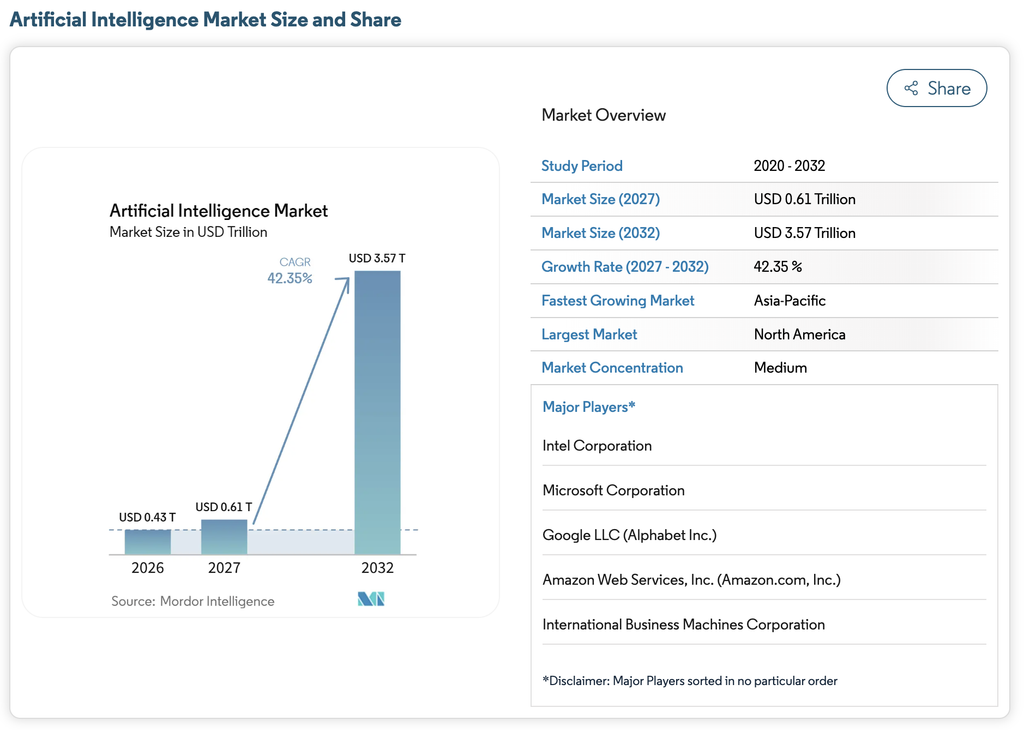
Business-wise, we get a lot of sky-pie, naturally. This, for example, from Mordor Intelligence:
Meanwhile, AI conferences are thick on the ground:
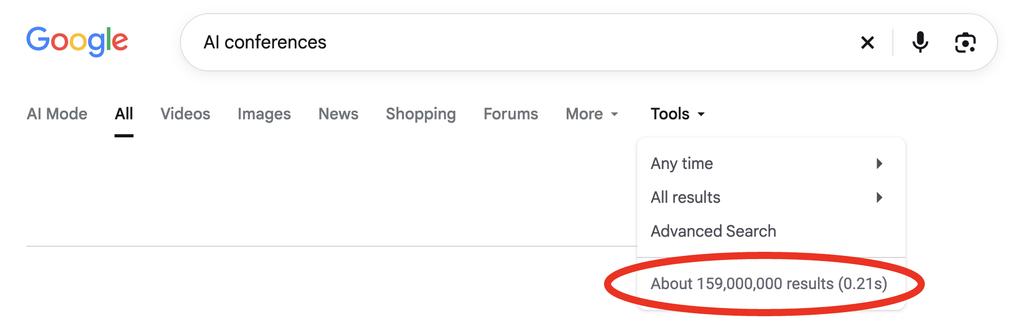
I have a feeling that's one reason why I've been hearing that non-AI conferences are seeing less attendance. AI is a gold rush, like the one that left ships abandoned in San Francisco's harbors in 1849 (the image above).
So I'm here to call your attention to three events next week that will all deal with AI, but in a deeply pragmatic way.
Chief among those is IIW, the Internet Identity Workshop, which has been going since 2005 and is about whatever participants want to work on. It's an open space unconference, with no booths, speeches, or panels. It's about what people want to work on and move forward. Wikipedia describes it pretty well. No doubt lots of the breakouts will be on AI, especially the personal kind. (Expect at least one from Liam Broza and Companion Intelligence. If you're going to be there, I'll add you and your work to this post.)
We have two IIWs every year, and the next one will be our 43rd. It happens next week, Tuesday to Thursday, 3 to 5 November, at the Computer History Museum in Silicon Valley.
The day before, Monday the 2nd, is VRM Day, where we'll be focusing on MyTerms, personal AI, and much more. Love to see you there too.
And the day after, Friday the 6th, is AIW, the Agentic Internet Workshop. Same format as IIW, but just one day and about agentic whatever (literally: you bring the topic, just like at IIW).
So register and mark your calendars.
Last week, I attended Greenbuild International Conference + Expo 2026 in the North Hall of the Javits Center here in NYC. After being overwhelmed by shows like CES and InterSolar Europe, the smaller scale of Greenbuild was a welcome break. At the show, there were a few heat pumps and ... [continued]
The post Construction Materials Stand Out At Greenbuild 2026 appeared first on CleanTechnica.
The highly anticipated first round of the CVMA 2026/2027 Winter series roared to life, attracting exhilarating racing talent from all corners of the country, all eager to bask in the California sunshine.
As other racing clubs wrapped up their seasons, the CVMA Winter series kicked off a thrilling new chapter, promising fierce competition and heart-pounding action.
The atmosphere buzzed with excitement as racers pushed their limits on the track, battling wheel to wheel. Lap records shattered under the pressure of fierce competition, while every rider poured their heart and soul into claiming double championship points.
The weekend kicked off with a spirited Friday practice session, setting the stage for what was to come. Among the participants, the New Racer School proudly celebrated the graduation of four determined newcomers, who bravely stepped up from their training to compete in the amateur ranks.
Their journey marked the beginning of an unforgettable weekend filled with adrenaline, camaraderie, and unforgettable moments on the track.
- Saturday Qualifying
The morning qualifying sessions started with moderate temperatures, clear skies, and little wind, perfect conditions for laying down fast laps.
The fastest of all in Saturday morning qualifying was Brenden Ketelsen on his middleweight bike, posting a 1:45.445 lap time.
Bryce Kornbau was quickest in the open-class qualifying session with a 1:46.151 lap time, two seconds ahead of the next rider.
Gio Alvarez was fastest on a lightweight bike with a 1:48.533 lap time.
Alex George was fastest on an ultra-lightweight bike with a 1:55.362 lap time.
Joel Ohman was fastest on a CVMA Hooligan bike with a 1:48.852 lap time.
- Saturday Races
Highlights from Saturday included:
● Mallory Dobbs and Gio Alvarez exchanged first and second place in tight battles across two separate races. Both riders set lap records over the weekend.
● Bryce Kornbau won two open-class races.
● Evan Esposito won two amateur-class races.
Saturday night CVMA hosted the awards banquet for the 2025/2026 Winter Series. Perfect weather made a large tent in the paddock the perfect setting to hand out awards for class championships and the top ten number plates. The club provided dinner and everyone in the pits was invited to attend.
- Sunday Shootouts
In the premier race of the day, The Shootout, Michael Gilbert took the holeshot and led Bryce Kornabu through the first lap, both riding Yamaha YZF-R1s. After dropping down to fourth at the start Eugene McMahel (Ducati Panigale V4S) made a pass on Luis Arredondo (Yamaha YZF- R9) at the end of the first lap to retake third place. Bryce Kornbau stayed in touch with Gilbert as they went into the second lap. Kornbau maximized the drive out of the turn 11/12 complex to get alongside Gilbert and pass him on the brakes on the entry to turn 10. Kornbau then streaked away at the front as McMahel and Gilbert fought for the remaining podium positions. McMahel caught Gilbert and, at one point, was within a couple of bike lengths, but Gilbert upped the pace on the penultimate lap and held off McMahel. Kornbau finished the race with a commanding win, followed by Gilbert in second and McMahel in third.
The Middleweight Shootout started with high drama right after the lights went out. Luis Arredondo got an excellent launch from P4 and looked like he had taken the holeshot, but as Arredondo and Haydn Meng rubbed fairings on the entry to turn 16 their bikes got stuck together, which resulted in both of them running straight off track into the dirt. Both riders kept their bikes upright and rejoined the race, with Arredondo fighting back to P6 and Meng retiring partway through.
Jack Roach (Kawasaki Ninja ZX-6R) took advantage of the chaos ahead of him to take the lead, with Brenden Ketelsen (Kawasaki Ninja ZX-6R) right behind him. Ketelsen quickly lined up a pass while on the brakes on the way into turn 10 where he took the lead and didn't look back for the rest of the race.
While Ketelsen and Roach streaked away at the front, a four-way battle for the final podium position broke out behind them. Aden Sandlin (Yamaha YZF-R6) briefly took P3, but he had to roll off the throttle to avoid highsiding, opening the door for Parker Mayer, Edgar Zaragoza, and
Sawyer Lafayette to take control of the fight for P3 as Sandlin hung back for the remainder of the race. Mayer, Zaragoza, and Lafayette battled it out in an exhilarating fight. After multiple attempts to pass, Zaragoza took control down the main straight and passed Lafayette into turn 17. Zaragoza pulled out a comfortable gap as Lafayette and Mayer engaged in a two-mandogfight for the rest of the race, which Lafayette won. Ketelesen took his first shootout victory of the season, followed by Roach in second and Zaragoza in third.
At the start of the Formula Ultra Lightweight Shootout, Alex George wheelied off the line, making it seem like Nathan Gravelle would take the holeshot, but as they charged through turn 16, the race was red-flagged because a bike was stuck and stalled on the start line. On the second start, George put the power down more smoothly, took the holeshot, and led for the rest of the race. Chris Binker (Kawasaki Ninja 400) caught up and passed Quinn Swift (Kawasaki Ninja 400) at the end of the first lap. While the rest of the field spread out for the rest of the race, Swift and Binker were nose-to-tail for the next few laps. Binker slowly pulled a gap on Swift as he closed in on Nathan Gravelle (Kawasaki Ninja 400). George took a commanding first place, with Gravelle holding off Binker for second and Binker finishing third.
In the final shootout race of the day, the Formula Lightweight Twins Shootout, Mallory Dobbs and Gio Alvarez met for a rematch on their Aprilia RS 660s in their back-and-forth weekend rivalry. Once again, Dobbs rocketed from P2 to take the holeshot into turn 17. Alvarez tried to pass Dobbs on the outside of turn 15, but Dobbs held her line and got a stronger drive off the exit. Alvarez stayed tight on Dobbs' tail, with less than a bike length separating them at multiple points throughout the race. Dobbs and Alvarez traded race-lap records as they pushed each other into the 1:48s. Alvarez closed the gap on the brakes into corners, and Dobbs opened it back up with better mid-corner speed through the turn 13 bowl. While Alvarez and Dobbs pulled away from the pack, Justin Bordonaro was locked in a tight, four-way fight for third. Dobbs resisted Alvarez's pressure to take first, and Bordonaro held off Geiser Hernandez's attacks to finish third, beating Hernandez to the line by one tenth of a second.
Full race results can be found on Speedhive: https://speedhive.mylaps.com/events/3759961
Come out and join us for the next round of the CVMA 26/27 Winter Series on November 13-15, 2026.
CVMA offers two full days of racing every race weekend and also includes Saturday qualifying for grid position in all classes, amateur, and expert, as well as a wide variety of classes to choose from.
CVMA offers free reciprocity as a means of encouraging racers from other clubs to come out and compete. CVMA also offers a New Racers School for those starting in racing on the Friday before each race weekend. Log on to www.cvmaracing.com to sign up or for more information.
CVMA. Built for racers by racers and offering the best racing experience around!
CVMA would also like to thank the 2026/2027 Winter Series Sponsors: Support Moto Racing, Apex Assassins, Ryder Gear, CaliPhotography, Racers Edge/Dunlop, Bridgestone - Pro J's Cycle, Honu Marshals, The California Superbike School, CT Racing/Pirelli, aRacer.
NRS Sponsors: Alpinestars, 6D Helmets, Five Gloves, and Racers Edge/Dunlop
About CVMA:
The Chuckwalla Valley Motorcycle Association (CVMA) hosts the premier winter motorcycle road racing series in North America. With a racer-first focus and a mission of constant improvement, CVMA provides safe, competitive, and fun racing for riders of all levels.
The post CVMA: Results From Round 1 of the 2026/2027 Winter Series appeared first on Roadracing World Magazine | Motorcycle Riding, Racing & Tech News.
After the washout at Phillip Island, MotoGP heads into the final stretch. With just four rounds to go, the MotoGP championship is still wide open. But maybe it's three rounds to go, if Qatar is dropped. Or maybe Sepang is the last round, if MotoGP heads to Qatar and the US-Iran war kicks off again, and the paddock gets stuck in Qatar.
The end of the 2026 MotoGP season is turning into a horrible mess. Most of it is largely out of the hands of the MotoGP Group. Though the weather at Phillip Island is often atrocious in October, the chances of a race actually being canceled are low. But not zero, as we saw last weekend. And the military and political conflict between the US and Israel on one side and Iran on the other is happening on a level way beyond anything MotoGP can impact.
David Emmett Thu, 29/Oct/2026 - 00:50
BRUSSELS — Almost half of EU cities exceed air pollution limits set by a landmark EU clean air law, according to a new report from ClientEarth and World Resources Institute (WRI). The report raises concerns about the level of preparedness in cities across the bloc and outlines the changes needed ... [continued]
The post Nearly Half of EU Cities Do Not Yet Meet New Clean Air Standards: Report Shows Collaboration Is Key appeared first on CleanTechnica.
The Trump administration has already delayed implementation of the critical standards for year+ Washington, DC — Last night during a rally in Texas, Donald Trump announced that the U.S. Environmental Protection Agency would roll back safeguards finalized in 2024 to limit methane pollution from the oil and gas sector. This ... [continued]
The post Trump Rolling Back Methane Pollution Safeguards appeared first on CleanTechnica.
Today, we're announcing that Waymo for Business is integrated with Ramp, making it easier for organizations and their employees to manage expenses when using our fully autonomous ride-hailing service. For over a year, Waymo for Business has offered 24/7 reliability and convenience directly to organizations embracing Waymo for their transportation ... [continued]
The post Waymo for Business | Ramp appeared first on CleanTechnica.
Reliable, affordable electricity is essential for many of the products and services that underpin the modern economy. But the sources of that electricity—and their respective merits and risks—are increasingly the subject of debate and polarization. A flood of narratives and counternarratives is rising in the media and public conversation about ... [continued]
The post The Truth About Renewable Electricity: Your Questions, Answered appeared first on CleanTechnica.
SUPERIOR, Wisconsin — Today, Dairyland Power Coop announced the cancellation of plans for NTEC, which was proposed to be built on the shores of Lake Superior, and asked the Wisconsin Public Service Commission (PSC) to withdraw its permits. The Nemadji Trail Energy Center (NTEC), a 625 MW natural gas plant, has ... [continued]
The post After Years-Long Community Objection, Dairyland Power Pulls the Plug on NTEC Gas Plant appeared first on CleanTechnica.
Over the last few months, we've been running the wonderful ten part series on "The Metric is Not the Mission" by Konstantinos Komaitis. It's a deep exploration of how Big Tech moved from building and expanding the open internet to increasingly shaping it around its own metrics, incentives and assumptions. The resulting series explores how things went from building a better, more open, more beneficial internet… to whatever it is that we have now.
In the latter half, it also explores what happens next, the reckoning that the big companies face from regulators and litigation, and points towards a way to think through what comes next: hopefully bringing back a better internet for all of us.
From the beginning, we said that once the series was published, we'd publish a combined version in PDF form, and that's what we have here: The Metric is not the Mission, in full as a single PDF file (also embedded at the end of this post).

If you didn't read it while it was coming out in serialized fashion, you can now read the whole thing in one sitting. Or if you did read it, but want to read the whole thing again. Or even better, if you think there are other people who should read it, feel free to send it to them.
We've heard tremendous feedback from people who really enjoyed the series, and said it made them think. Thanks to Konstantinos for writing it and agreeing to have it published here.

Click here to book for The Gentle Author's Tours
.
Monument to Lady Elizabeth Nightingale, Westminster Abbey, c.1910
What could be more appropriate to the season of spooks and spirits than a virtual tour of the tombs of old London, courtesy of these glass slides once used by the London & Middlesex Archaeological Society for magic lantern shows at the Bishopsgate Institute?
We can admire the aesthetic wonders of statuary and architecture in these magnificent designs, and receive an education in the history and achievements of our illustrious forbears as a bonus.
In my childhood, no festival or national occasion was complete without a visit to some ancient abbey or cathedral. Yet while ostensibly we went to pay our respects, my interest was always drawn by the stone tombs and ancient monuments.
It is a human impulse to challenge the ephemeral nature of existence by striving to create monuments, even if the paradox is that these attempts to render tenderness in granite will always be poignant failures, reminding us of death rather than life. Yet there is soulful beauty in these overwrought confections and a certain liberating consolation to be drawn, setting our personal grief against the wider perspective of history.
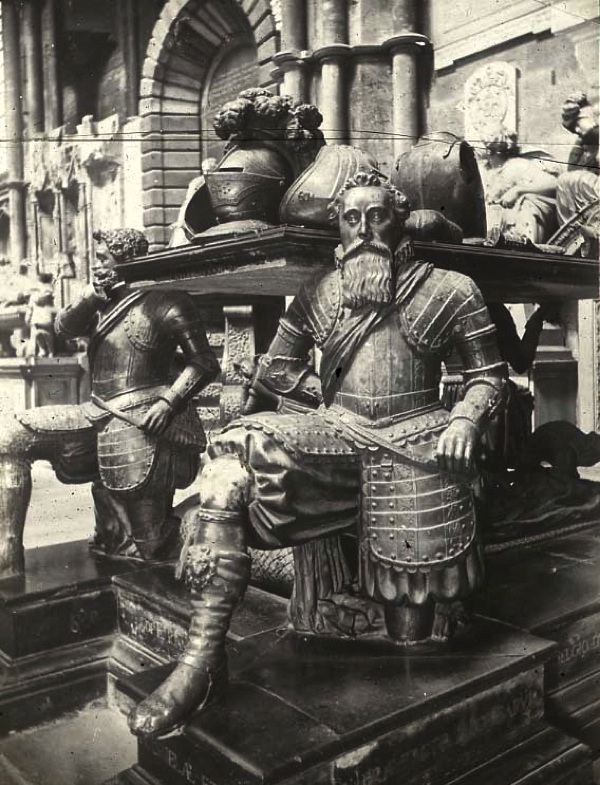
Tomb of Sir Francis Vere, Westminster Abbey, c. 1910
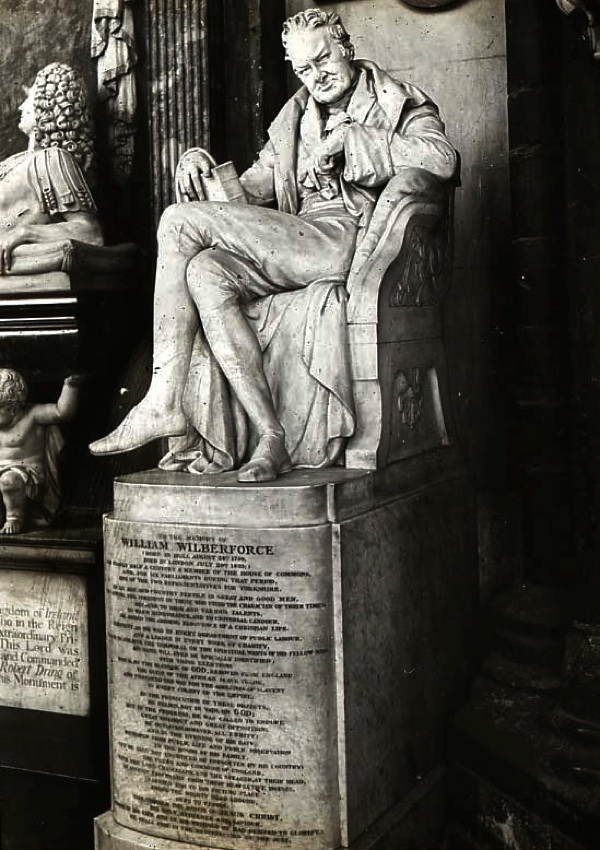
Monument to William Wilberforce, Westminster Abbey, c.1910
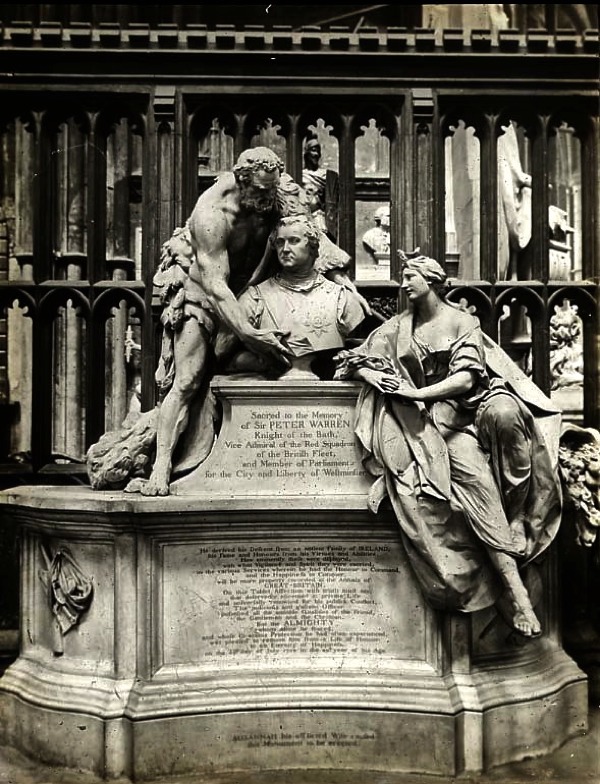
Memorial to Admiral Sir Peter Warren, Westminster Abbey, c.1910
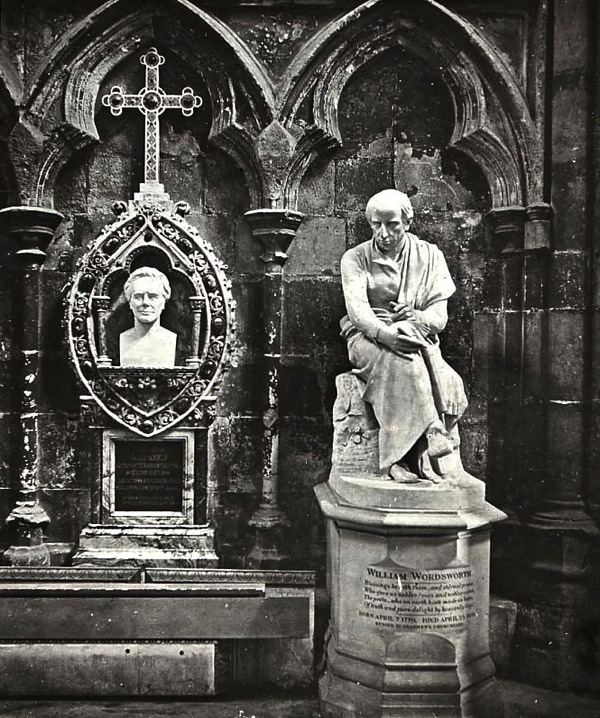
Monument to William Wordsworth in Baptistery, Westminster Abbey, c.1910

St Benedict's Chapel, Westminster Abbey, c.1910
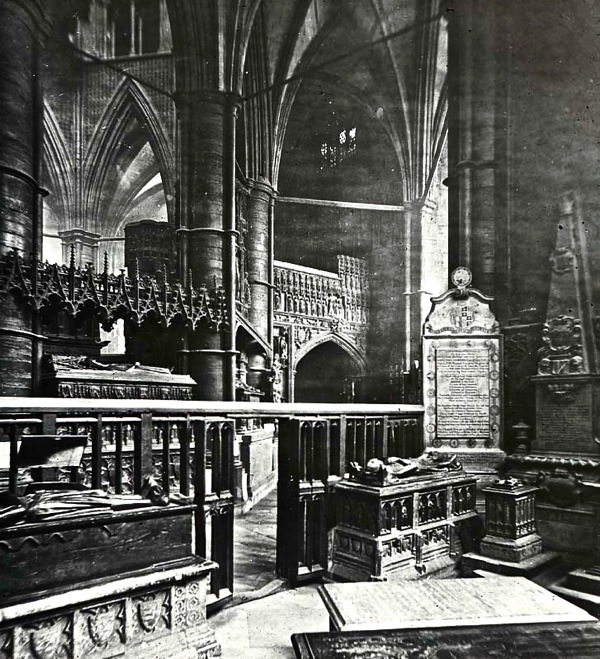
Chapel of St Edmund, Westminster Abbey, c.1910

Tombstone of Laurence Sterne, St George's Hanover Sq, c.1910 - Buried, grave-robbed and reburied in 1768, subsequently removed to Coxwold in 1969 due to redevelopment of the churchyard.

Hogarth's tomb, St Nicholas' Churchyard, Chiswick, c.1910

Sir Hans Sloane and Miller Monuments in Old Chelsea Churchyard, c. 1910

Stanley's Monument in Chelsea Church, c. 1910

Sanctuary at All Saint's Church, Chelsea, c. 1910
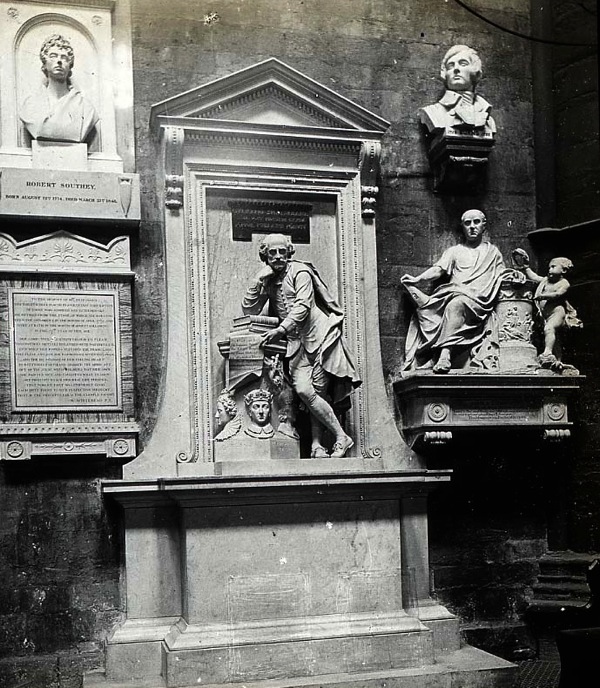
Shakespeare's memorial, Westminster Abbey, c. 1910
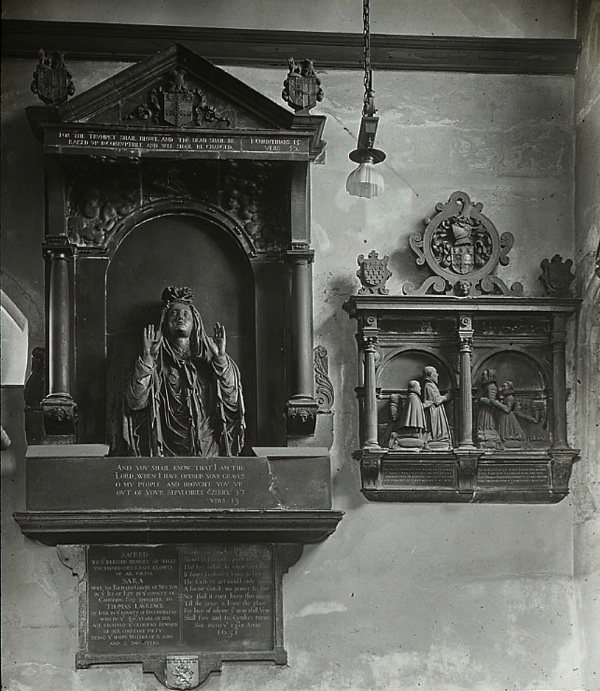
Colville Monument in All Saint's Church, Chelsea, c. 1910

Tomb of Daniel Defoe at Bunhill Fields Burial Ground, c. 1910

At the gates of Bunhill Fields, c. 1910

Tomb of John Bunyan, Bunhill Fields Burial Ground, c. 1910

North Transept of Westminster Abbey, c. 1910

North Ambulatory, Westminster Abbey, c. 1910

Ambulatory, Westminster Abbey, c. 1910

Monument to John Milton, St Giles, Cripplegate, c. 1910

Offley Monument, St Andrew Undershaft, c. 1910

Pickering Monument, St Helen's Bishopsgate, c. 1920

Plaque, Christ Church, Newgate, 1921

Tombs in Temple churchyard, c. 1910

King Sebert's Tomb, Westminster Abbey, c. 1910
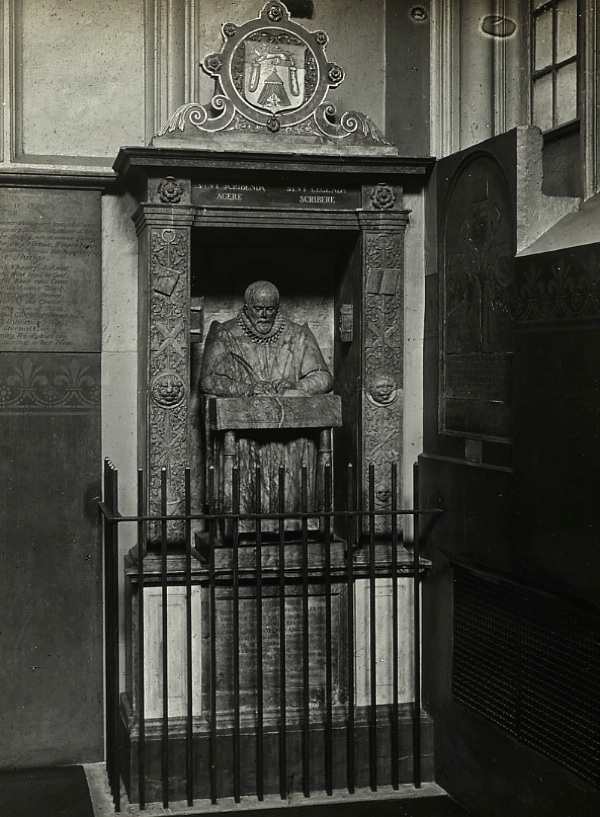
Monument to Historian John Stow in St.Andrew Undershaft, c. 1910
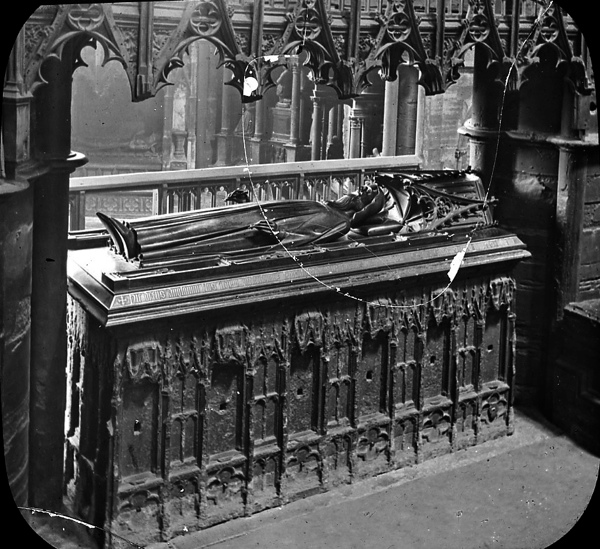
Tomb of Edward III, Westminster Abbey, c. 1910

Queen Elizabeth I's Tomb, Westminster Abbey, c. 1910

Tomb of Henry VII and Elizabeth of York, Westminster Abbey, c. 1910

Monument to Charles James Fox, Westminster Abbey, c. 1910
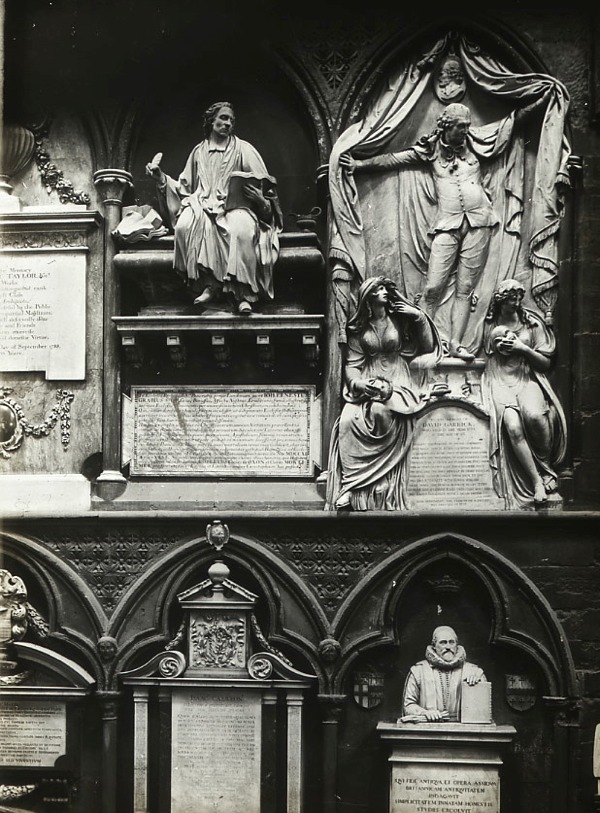
Poets' Corner with David Garrick's Memorial, Westminster Abbey, c. 1910

Memorial to George Frederick Handel, Westminster Abbey, c. 1910
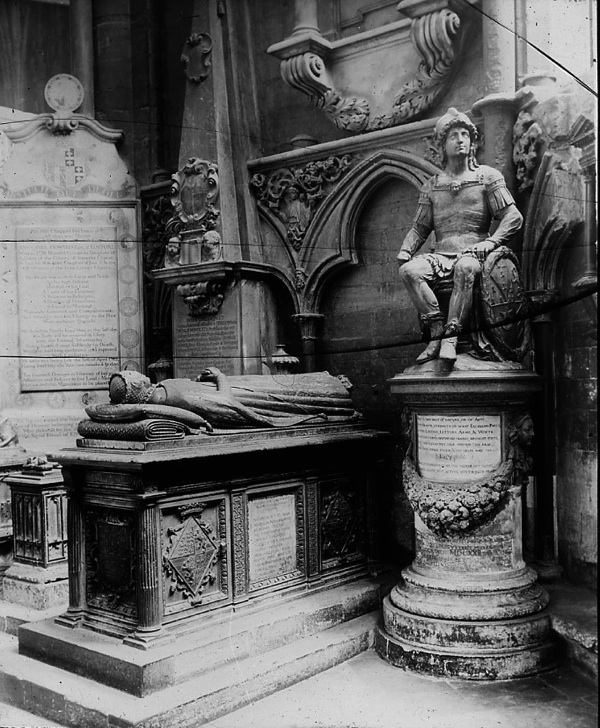
Monument to Francis Holles, Westminster Abbey, c. 1910

Tombstone of the Kidney family, c. 1910

Cradle monument to Sophia, Daughter of James I, Henry VII's Lady Chapel, Westminster Abbey, c. 1910

Tomb of Sir Francis Vere, Chapel of St John the Evangelist, Westminster Abbey, c. 1910

Tomb of John Dryden, Westminster Abbey, c. 1910
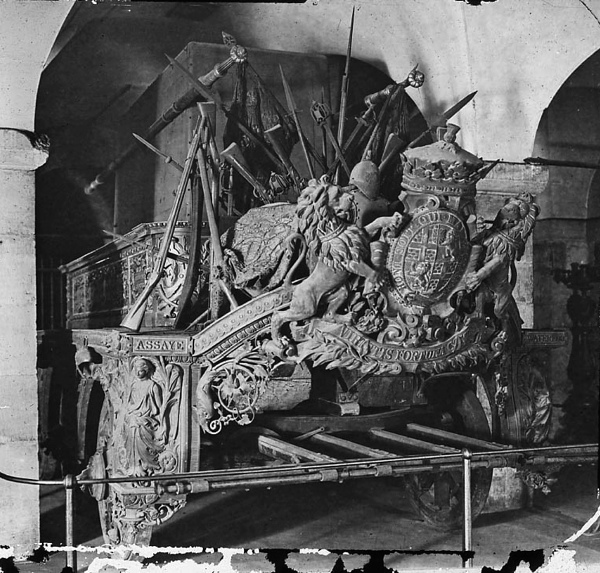
Wellington's Funeral Carriage, St Paul's Cathedral,c. 1910

Robert Preston's grave stone, St Magnus, c. 1910

Tomb of Henry VII, Westminster Abbey, c. 1910
Glass slides courtesy Bishopsgate Institute
You may also like to take a look at
HOT HEADLINES: momentum could be everything as MotoGP lands in Malaysia.
More twists and turns await in the finely-poised battle for the crown as we arrive at fabulous Sepang.
And so, it's onto Malaysia. After a weather-affected Sunday saw the cancellation of the Australian Grand Prix race, the 2026 MotoGP title race thriller heading into this weekend's PETRONAS Grand Prix of Malaysia is how it was after the barnstorming - and dramatic - Sprint at Phillip Island.

10 points in it. Marc Marquez (Ducati Lenovo Team), the leader. Walking wounded Jorge Martin (Aprilia Racing), the chaser. And Marco Bezzecchi (Aprilia Racing), the underdog. The setting for Round 19? The wonderful Petronas Sepang International Circuit, scene of many a clash and decisive showdown.
Donaldsonville, Louisiana — Yesterday, the Louisiana Department of Environmental Quality (LDEQ) posted the final, approved air permit for Hyundai's proposed steel plant. Hyundai promised a state-of-the-art, clean facility, but the proposed plan falls short of those promises and would still bring thousands of tons of pollution to Cancer Alley, a ... [continued]
The post Louisiana DEQ Issues Rushed, Controversial Air Permit to Proposed Hyundai Steel Facility appeared first on CleanTechnica.
7 years ago, I paid Tesla $6000 for a permanent subscription to "Full Self Driving" for my new Model 3. At the time, FSD would navigate and drive automatically on limited access highways (mostly Interstates), but that was about it. I'm currently driving a 2026 base Model Y with FSD ... [continued]
The post Tesla's Full Self Driving Has Now Dramatically Reduced the Number of Reasons to Intervene or Complain appeared first on CleanTechnica.
This Heat Pump Water Heater Week, Jetson dropped some big news. They are bringing a heat pump water heater (HPWH) to market using the same model of vertical integration that they use with heat pump installations, where they procure all equipment as well as install and monitor the HPWHs, all ... [continued]
The post Jetson Launches Fixed Price Heat Pump Water Heater with Installation Included appeared first on CleanTechnica.


Adam Lawson's Zac-OS-9 is a completist recreation of the classic Mac desktop experience for Debian Linux, "drawn pixel by pixel from scratch." Modeled on the last versions before the switch to Mac OS X (more than 25 years ago!) it's not just a skin: it replicates the window manager, file browser, menu bar and every control panel. — Read the rest
The post How to turn modern Linux into an old Mac appeared first on Boing Boing.


