

Content warning: this article contains extensive discussion of suicide
The Good Law Project (GLP) have published the results of a freedom of information (FOI) request which showed that suicides among trans youth spiked massively in 2021. This was immediately after the UK government suddenly halted almost all gender-affirming care for young trans people.
This is particularly significant given that, in 2024, the government published an 'independent' review dismissing the increase in suicides as statistically insignificant.
The review acknowledged 5 suicides. However, thanks to the FOI, we now know that there were at least 22. 22 young people took their own lives because their healthcare was suddenly ripped away by a bigoted, ideologically driven government.
In the week following the GLP's publication of its findings, the BBC has remained completely silent on the government's utter betrayal of trans youth. Instead, it chose to publish an interview with Dr. Hilary Cass, the woman responsible for continuing to deny healthcare to young trans people.
She claimed that children have been "weaponised" by both sides of the trans debate. She also denied preventing kids getting the medical care they needed.
At this point, I can hardly even blame her. I'd probably try to deny everything and blame everyone else too, if I had contributed to deepening the crisis for trans youth.
Tavistock, Bell, CassBack in 2020, the UK High Court ruled that it was "unlikely" that trans children could give informed consent to treatment with puberty blockers. Immediately afterwards, the NHS almost completely ceased puberty-blocking treatments.
A year later, the Court of Appeal overturned that decision. However, the NHS refused to resume its previous treatments. Instead, the then-Conservative government criminalised the prescription of puberty blockers for trans healthcare.
Following a review by Dr. Hilary Cass, the new Labour government also chose to uphold the criminalisation of puberty blockers in 2024. Dr. Cass is not a gender specialist. She had absolutely no experience or publications in trans healthcare, until the government chose her to decide the fate of trans youth.
Her report ignored basic scientific principles, applied impossible evidence standards, and was underpinned by the idea that being trans was itself undesirable. Rishi Sunak appointed her to the House of Lords for her trouble.
WhistleblowersIn 2024, the GLP raised whistleblowers' alarms that the number of suicides among patients at the Tavistock clinic - the UK's youth gender clinic - had risen sharply following the withdrawal of care. At the time, the whistleblowers stated that:
the seven years before the High Court decision there was one death of a young person on the waiting list for Gender Identity Development Services (GIDS). In the three years afterwards, there were 16.
In response, the government commissioned yet another independent review. The reviewer, Professor Louis Appleby, acknowledged just seven deaths in the three years following 2020-2021. The Appleby Review also criticised the GLP and other reporting on the issue, stating that:
Cover-upThe way that this issue has been discussed on social media has been insensitive, distressing and dangerous, and goes against guidance on safe reporting of suicide.
However, the GLP's recent FOI request revealed that the actual number of suicides among trans youth surged to 22 in the year 2021-2022. That's compared to just 5 and 4 in the two years immediately prior to the Bell ruling.
The GLP's press release explained that:
This new data was released via a freedom of information request made to the NHS-funded National Child Mortality Database (NCMD). The NCMD revealed that 46 trans children died by suicide from 2019-2025: 5 in 2019-20; 4 in 2020-21; 22 in 2021-22; and 10 in 2022-23. The NCMD adds "the numbers reported in more recent years will likely be underestimated, due to a higher proportion of child death reviews that have not yet been completed".
It went on to state the the Appleby report's sample size was notably small, focusing on a subset of children who were already at the Tavistock:
'People at the extremes'Forty-four of these deaths were within the time frame analysed for the government report by Professor Louis Appleby on suicides and gender dysphoria. That's almost four times more than the number accounted for by the Appleby report, which stated that only 12 young people (over and under 18) who were current or former patients of the Tavistock took their own lives from 2018-2024.
The Appleby review chose to focus specifically on some - the review itself is not clear - patients connected to the Gender Identity Development Service service at the Tavistock, so would not have accounted for all 44 deaths recorded by the NCMD.
To put that another way, the government massively under-reported the suicides that resulted directly from its decisions. Then, it also blamed whistleblowers for drawing attention to the crisis.
In a normal country, such a massive betrayal of public trust and basic human decency might at least make a single headline.
Instead, the BBC chose to publish a puff-piece interview with Cass, one of the architects of the pitiful state of trans youth healthcare in the UK. In the interview, Cass repeated the spurious claim that children become trans because of gender stereotyping and homophobia:
I think what has kind of misled children is the belief that if you are not a typical girl, if you like playing with trucks, or boys who like dressing up or that you have same-sex attraction that means that you're trans and actually it's not like that but those are all normal variation.
And, following the Appleby report's example, she bent over backwards to point the finger at trans-positive campaigners. The BBC reported that:
The vast majority of people in the middle of the debate were silent while the "people at the extremes" and rhetoric in the media had been "frightening for young people," the clinician said.
She added that some activists for trans rights had been "so strident that it's made it more difficult for trans people themselves who are just trying to live under the radar", while equally people who had taken the view no-one should ever transition had "similarly made it difficult".
What people like Cass will never acknowledge is that trans people shouldn't have to live under the radar. They equate trans people advocating for ourselves with obnoxious activism because they can't abide our speaking up. Our extremist belief is that trans kids are not an aberration, and they deserve healthcare like everyone else.
The issue is that trans adults don't get to look away. We don't get to turn our faces from the trans kids being treated as political punching bags. We can't ignore the suicides within our community.
Those deaths resulted directly from the decisions of the High Court, the Tories and the NHS. Cass and the Labour government upheld those same decisions. If I believed these people had a conscience to speak of, I would hope that knowledge never let them sleep again.
We won't roll over and be silent, because we remember what it was like to be trans kids ourselves. Cass would know that, if she ever had any intention of listening to trans people. But then, listening to us would involve acknowledging our humanity.
Featured image via the Canary

Are you fascinated by the stars, meteors, the aurora borealis? The Orwell Astronomical Society founded in the late 1960s at the height of the 'space-race' offers an opportunity to develop a passion for astronomy. As a registered charity (no. 271313) it exists to promote the science of astronomy in Suffolk. This is done by organising meetings and running occasional night, and sometimes day, observing sessions.
The society has done a great deal of work to uncover the astronomical history of Suffolk and the work of a number of amateur astronomers whose influence on science has been profound.
The Orwell Park ObservatoryThanks to the eccentric Colonel George Tomline (1813-1889), Ipswich has an observatory.
 The Observatory, Orwell Park School image by N Chadwick. CC BY-SA 2.0
Tomline was elected to Parliament for the constituency of Sudbury (Suffolk) in 1840. During a period out of office, Tomline purchased Orwell Park estate from Sir Robert Harland for £102,500 in 1848. He subsequently demolished part of the mansion house and replaced it with the beautiful red-brick structure that stands nowadays. A bachelor his whole life, Tomline liked to entertain weekend guests at Orwell Park and kept a steam yacht moored at the bottom of the gardens for their use. He was fabulously wealthy and built the Felixstowe branch railway entirely from his own pocket.
His interest in the sciences encompassed astronomy, which was at the time was a very fashionable and a rapidly advancing science. In the early 1870s, during a major extension to Orwell Park mansion, he indulged his interest by commissioning the Orwell Park Observatory. His enormous wealth enabled him to demand the best, including employing a professional astronomer, John Isaac Plummer (1845-1925).
The telescope Tomline refractor telescope. Credit OAS(I). Used with permission
Central to the Grade II Listed observatory is a refracting telescope that dates from 1874. It was impressive for its age, boasting a ten-inch (250mm) aperture and a 3.9m focal length. The telescope sits on a German equatorial mount. This means it can reach all points of the sky and needs only a single motor to drive it as it tracks objects as they move across the sky.
The society assists Orwell Park School (the current owners) in maintaining and operating its historic observatory. Much of our early work was in renovating the telescope after a period of several decades of neglect.
Suffolk's amateur astronomersThe society continues to encourage astronomers to follow in the footsteps of past influential Suffolk astronomers. Alice Grace Cook (1877-1958), a lady of leisure, discovered Nova Aquilae in 1918 and was one of the first women to be made a Fellow of the Royal Astronomical Society. So accomplished an amateur astronomer was Cook that she taught John Philip Manning Prentice (1903-81) astronomy. Prentice, another amateur, was a key member of Sir Bernard Lovell's team of (professional) scientists. Their work together led to Lovell building Jodrell Bank - in its day, the largest radio telescope on earth.
Roland Clarkson (1889-1954) 'the Trimley Moon Man' is another. Clarkson had a particular interest in the Moon and was a prolific contributor to lunar studies and mapping the surface.
The Orwell Astronomical SocietyIn addition to weekly meetings at Orwell Park Observatory, the society meets in the Village Hall in Newbourne twice a month. Membership is open to all. We have around one hundred paid-up members, whose annual subscriptions help fund our activities.
Members' images of deep sky and solar system objects are published both on our website and in an emailed monthly newsletter. We have a library and a collection of instruments available for loan to members.


 Aurora Borealis captured by the author from Orwell Park at 10pm 10.10.2024. / The corona and diamond ring of the sun from 2.7.2019 eclipse. Credit Paul Whiting. Used with permission
One of our members has a slot on a local community radio station where he discusses what can be seen in the night sky each month. Our WhatsApp and Facebook groups enable the rapid dissemination of information, for instance when there is a display of the aurora borealis (northern lights). This has been particularly useful over the past year or so, when, due to significant activity on the Sun, these displays have been unusually strong and numerous.
We have an 'eclipse chaser' in our midst who regularly travels the world to record total solar eclipses. These spectacular events, which occur when our Moon completely obscures the Sun, are still the only chance ground-based astronomers get to observe the Sun's corona or atmosphere.
The corona image shows the Sun's "atmosphere", which cannot normally be seen because of the glare form the photosphere. The ray structure that can be seen in the corona is caused by the solar magnetic field lines attracting the charged material or plasma being emitted by the Sun. The diamond ring image shows the last vestige of sunlight before it is totally masked by the Moon. You can also see some activity in the the Sun's chromosphere around the "diamond and opposite it. These are flares or eruptions on the solar surface.
Want to know more?Our lecture meetings are open to the public, with nationally known amateur and professional astronomer speakers.
During the winter months we hold monthly 'taster evenings'. Visitors are invited to tour the Orwell Park Observatory and learn about the various forms of telescope available. If the weather is clear you may even have a chance to view a celestial object using Colonel Tomline's Telescope.
More information about The Orwell Astronomical Society's event may be found here. All are welcome.
More from East Anglia Bylines
 Science
Strange new worlds
byProf Chris Impey 20 September 2022
Science
Strange new worlds
byProf Chris Impey 20 September 2022
 Anglia
The Fermi Paradox and UFOs over Rendlesham Forest
byMartin Waller 2 January 2023
Anglia
The Fermi Paradox and UFOs over Rendlesham Forest
byMartin Waller 2 January 2023
 Featured
How one remarkable Suffolk woman helped shape modern astronomy
byKate Mooreand1 others 11 February 2026
Featured
How one remarkable Suffolk woman helped shape modern astronomy
byKate Mooreand1 others 11 February 2026
 Culture
The haunting cry that brings a creature from another world
byPeter Thurlow 30 December 2025
Culture
The haunting cry that brings a creature from another world
byPeter Thurlow 30 December 2025
 Bylines Network Gazette is back!
With a thematic issue on a vital topic - the rise child poverty, ending on a hopeful note. You will find sharp analyses on the effect of poverty on children's lives, with a spotlight on the communities that are on the front line of deprivation, with personal stories and shared solutions. Click on the image to gain access to it, or find us on Substack.
Journalism by the people, for the people.
The post Spectacular astronomy in Suffolk: past, present, and future first appeared on East Anglia Bylines.
Manu Gonzalez has his Moto2 challenge back on track at the final test of the 2026 preseason. After a washed out test at Portimão, the Moto2 class got a full day of running at the Jerez circuit.
David Emmett Mon, 16/Feb/2026 - 17:02
Other than the new Rivians, the most anticipated new fully electric vehicle may be the Slate pickup truck. There have been many photos of the prototypes and test vehicles, but not a lot of video footage of the Slate being driven. Jay Leno, the noted car enthusiast and collector, got ... [continued]
The post Jay Leno Drives A Slate Pickup Truck (Video) appeared first on CleanTechnica.
All this year, we'll be exploring the many reasons to love heat pump water heaters (HPWHs). Perhaps the top reason is that they save so much money on utility bills. In fact, besides heat pumps for space heating, HPWHs are the appliance with the most potential savings across all household ... [continued]
The post Heat Pump Water Heaters Can Save Over $500/Year On Utility Bills appeared first on CleanTechnica.

Does anyone know how to make the now playing bar at the bottom of the lock screen linger for longer after music has been paused? I keep being annoyed having to reopen the app to press play again when I've quickly taken off my headphones while at the store or something similar. I have attached a picture pointing to the bar in question. Thank you so much in advance
submitted by /u/burschlein[link] [comments]

By Tracy Harms
Special guest blogger
Deep in the roots of Science Fiction are the pulps, disreputable depths from which visions of zombie hordes emerged. Pulp magazines were a most lowbrow medium. This was a medium where SF and Horror smudged together too closely to bother sorting one from the other.
A bit more recently, SF took to centering tales of apocalyptic futures. This subgenre has offered more of a mix between coarse titillations and sophisticated social commentary, and has proliferated so much for so long as to make one wonder whether Science Fiction is always and only portrayals of wildly disastrous futures. It's not, but that's been a sweet spot for sales, exactly as the pulp heritage of SF makes unsurprising. It meshes well with zombies, too.
28 Years Later: Bone Temple is the new release in a film franchise that has all the superficial hallmarks of a comic book. I went in expecting a zombie flick and a gory action flick and a civilization-struggling-in-collapse flick. In these regards I wasn't disappointed, but to my surprise some viewers were. They wanted more zombies and more cathartic sprayings of blood and bones. Tough luck for them. They unwittingly stumbled into a strikingly crafted storyline, a highbrow Science Fiction tale that earns its place among other SF works that insert serious thematic implications where ticket-buyers thought they were choosing pulp shallowness. Such is life.
We're not done with the stereotypes, though. Bone Temple hinted strongly, from the conclusion of the prior film, 28 Years Later, that it would be riffing on Anthony Burgess' A Clockwork Orange, and/or the infamous film version of that story. That classic work of UK SF put an overt eye towards "the future," and particularly to puzzles regarding social cohesion in the face of modern transformations. Might children wind up feral in the absence of adequately civilizing influences? The answer in the world of the Bone Temple is strongly affirmative, most distressingly so.
People, unlike zombies, entail all sorts of complications. People bring moral problems that outweigh mere violent death. The street gangs in A Clockwork Orange were counterposed against establishment institutions. While the police, courts, and psychiatric wards in Burgess' tale were apparently inadequate to prevent gangs from forming and wilding, they were present and poised to intervene and suppress. The world of 28 lacks any such taming powers. The gang that fleshes out most of Bone Temple is in social free-fall.
As a result, 28 Years Later: Bone Temple may be the most alarming horror film I have seen in years. As in: could the world of our future send us to Hell? Not literally the mythological spiritual abode, of course, but a simple human pattern of suffering, ignorance, and evil which easily passes as its namesake. One in which people come to expect, accept, and enact the worst.
Last year's 28 Years Later laid the groundwork and context for Bone Temple. The premise of these movies gives a more blatant origin for the horrid brats who rove in gangs than does Burgess' future. The world was yanked out from under them in their tender years. These films draw us into thoughts about childhood, childhood trauma, and what happens when children are deprived of a decent future. The youthful gangsters clutch to their memories of children's television entertainment. It was the sparkly portion of their past, now cemented in their minds with no mature art to supersede it. Kids' TV is superficial and infantile and so are its post-apocalyptic fans. The global disaster which forms the premise of the 28 franchise implies a generation that was stunted in its development. The tensions between childhood and maturity, between innocence and depravity, are magnified through brazen reference to Jimmy Savile, a UK TV celebrity whose reputation collapsed in a sexual abuse scandal. Do these damaged youngsters know he became thought of as a monster? Perhaps; and perhaps that's why they emulate him. Perhaps not. There's no internet to inform them. I suspect they would not care. To emulate is to honor a past, even a horrid past, whereas indifferent ignorance is the mark of civilizational erasure.
My interest in this film and in its 2025 predecessor started with knowing it's written by Alex Garland. Garland has written some of the best on-screen SF I've seen over recent years. I'm particularly enamored with Annihilation. I thoroughly enjoyed both Ex Machina and the television series Devs. Garland's screenwriting is so consistently strong that I will sit down for anything he pens. The storyline of Bone Temple exceeded my expectations. I was expecting something adequate, like the 2025 film that is its set-up. I got a good deal more.
In my enthusiasm I may have given the impression that this is A Most Weighty Film, which would miss the fact that it doesn't take itself too seriously. Bone Temple is very much crafted to provide an entertaining couple of hours in the theatre, assuming you're eager to see icky stuff, as lots of moviegoers are. It's more in the vein of a graphic novel than a work of literature. Yet, it has stuck with me for its character interactions and its plentiful implications. Strong SF concocts fantastical scenes and, through them, pokes at the human condition. That's everything I wanted from the Pulps, and more.
The Vatican is leaning into AI. AI-assisted live translations are being introduced for Holy Mass attendees — the holy masses if you will. The Papal Basilica of Saint Peter in the Vatican has teamed up with Translated, a language service provider, to create live translations in 60 languages.
"Saint Peter's Basilica has, for centuries, welcomed the faithful from every nation and tongue. In making available a tool that helps many to understand the words of the liturgy, we wish to serve the mission that defines the centre of the Catholic Church, universal by its very vocation," Cardinal Mauro Gambetti, O.F.M. Conv., Archpriest of the Papal Basilica of Saint Peter in the Vatican, said in a statement. "I am very happy with the collaboration with Translated. In this centenary year, we look to the future with prudence and discernment, confident that human ingenuity, when guided by faith, may become an instrument of communion."
Visitors to the Vatican will have the option to scan a QR code. They will then have access to live audio and text translations of the liturgy. It doesn't require an app and should work right on a web page.
The technology stems from Lara, a translation AI tool Translated launched in 2024. Translated claims that Lara works with the "sensitivity of over 500,000 native-speaking professional translators."
This article originally appeared on Engadget at https://www.engadget.com/ai/the-vatican-introduces-an-ai-assisted-live-translation-service-163014907.html?src=rss
Oracle has promised a "decisive new approach" to MySQL, the popular open source database it owns, following growing criticism of its approach and the prospect of a significant fork in the code.…
Academics say they found a series of flaws affecting three popular password managers, all of which claim to protect user credentials in the event that their servers are compromised.…
On 12 February, US president Donald Trump revoked the "endangerment finding", the bedrock of federal climate policy.
The 2009 finding concluded that six key greenhouse gases, including carbon dioxide (CO2), were a threat to human health - triggering a legal requirement to regulate them.
It has been key to the rollout of policies such as federal emission standards for vehicles, power plants, factories and other sources.
Speaking at the White House, US Environmental Protection Agency (EPA) administrator Lee Zeldin claimed that the "elimination" of the endangerment finding would save "trillions".
The revocation is expected to face multiple legal challenges, but, if it succeeds, it is expected to have a "sweeping" impact on federal emissions regulations for many years.
Nevertheless, US emissions are expected to continue falling, albeit at a slower pace.
Carbon Brief takes a look at what the endangerment finding was, how it has shaped US climate policy in the past and what its repeal could mean for action in the future.
- What is the 'endangerment finding'?
- How has it shaped federal climate policy?
- How is the finding being repealed and will it face legal challenge?
- What does this mean for federal efforts to address climate change?
- What has the reaction been?
- What will the repeal mean for US emissions?
The challenges of passing climate legislation in the US have meant that the federal government has often turned instead to regulations - principally, under the 1970 Clean Air Act.
The act requires the EPA to regulate pollutants, if they are found to pose a danger to public health and the environment.
In a 2007 legal case known as Massachusetts vs EPA, the Supreme Court ruled that greenhouse gases qualify as pollutants under the Clean Air Act. It also directed the EPA to determine whether these gases posed a threat to human health.
The 2009 "endangerment finding" was the result of this process and found that greenhouse gas emissions do indeed pose such a threat. Subsequently, it has underpinned federal emissions regulations for more than 15 years.
In developing the endangerment finding, the EPA pulled together evidence from its own experts, the US National Academies of Sciences, Engineering and Medicine and the wider scientific community.
On 7 December 2009, it concluded that US greenhouse gas emissions "in the atmosphere threaten the public health and welfare of current and future generations".
In particular, the finding highlighted six "well-mixed" greenhouse gases: carbon dioxide (CO2); methane (CH4); nitrous oxide (N2O); hydrofluorocarbons (HFCs); perfluorocarbons (PFCs); and sulfur hexafluoride (SF6).
A second part of the finding stated that new vehicles contribute to the greenhouse gas pollution that endangers public health and welfare, opening the door to these emissions being regulated.
At the time, the EPA noted that, while the finding itself does not impose any requirements on industry or other entities, "this action was a prerequisite for implementing greenhouse gas emissions standards for vehicles and other sectors".
On 15 December 2009, the finding was published in the federal register - the official record of US federal legislation - and the final rule came into effect on 14 January 2010.
At the time, then-EPA administrator Lisa Jackson said in a statement:
"This finding confirms that greenhouse gas pollution is a serious problem now and for future generations. Fortunately, it follows President [Barack] Obama's call for a low-carbon economy and strong leadership in Congress on clean energy and climate legislation.
How has it shaped federal climate policy?"This pollution problem has a solution - one that will create millions of green jobs and end our country's dependence on foreign oil."
The endangerment finding originated from a part of the Clean Air Act regulating emissions from new vehicles and so it was first applied in that sector.
However, it came to underpin greenhouse gas emission regulation across a range of sectors.
In May 2010, shortly after the Obama EPA finalised the finding, it was used to set the country's first-ever limits on greenhouse gas emissions from light-duty engines in motor vehicles.
The following year, the EPA also released emissions standards for heavy-duty vehicles and engines.
However, findings made under one part of the Clean Air Act can also be applied to other articles of the law. David Widawsky, director of the US programme at the World Resources Institute (WRI), tells Carbon Brief:
"You can take that finding - and that scientific basis and evidence - and apply it in other instances where air pollutants are subject or required to be regulated under the Clean Air Act or other statutes.
"Revoking the endangerment finding then creates a thread that can be pulled out of not just vehicles, but a whole lot of other [sources]."
Since being entered into the federal register, the endangerment finding has also been applied to stationary sources of emissions, such as fossil-fuelled power plants and factories, as well as an expanded range of non-stationary emissions sources, including aviation.
(In fact, the EPA is compelled to regulate emissions of a pollutant - such as CO2 as identified in the endangerment finding - from stationary sources, once it has been regulated anywhere else under the Clean Air Act.)
In 2015, the EPA finalised its guidance on regulating emissions from fossil-fuelled power plants. These performance standards applied to newly constructed plants, as well as those that underwent major modifications.
This ruling noted that "because the EPA is not listing a new source category in this rule, the EPA is not required to make a new endangerment finding…in order to establish standards of performance for the CO2".
The following year, the agency established rules on methane emissions from oil and gas sources, including wells and processing plants. Again, this was based on the 2009 finding.
The 2016 aircraft endangerment finding also explicitly references the vehicle-emissions endangerment finding. That rule says that the "body of scientific evidence amassed in the record for the 2009 endangerment finding also compellingly supports an endangerment finding" for aircraft.
The endangerment finding has also played a critical role in shaping the trajectory of climate litigation in the US.
In a 2011 case, American Electric Power Co. vs Connecticut, the Supreme Court unanimously found that, because greenhouse gas emissions were already regulated by the EPA under the Clean Air Act, companies could not be sued under federal common law over their greenhouse gas emissions.
Widawsky tells Carbon Brief that repealing the endangerment finding therefore "opens the door" to climate litigation of other kinds:
How is the finding being repealed and will it face legal challenge?"When plaintiffs would introduce litigation in federal courts, the answer or the courts would find that EPA is 'handling it' and there's not necessarily a basis for federal litigation. By removing the endangerment finding…it actually opens the door to the question - not necessarily successful litigation - and the courts will make that determination."
The official revocation of the endangerment finding is yet to be posted to the federal register. It will be effective 60 days after the text is published in the journal.
It is set to face no shortage of legal challenges. The state of California has "vowed" to sue, as have a number of environmental groups, including Sierra Club, Earthjustice and the National Resources Defense Council.
Dena Adler, an adjunct professor of law at New York University School of Law, tells Carbon Brief there are "significant legal and analytical vulnerabilities" in the EPA's ruling. She explains:
"This repeal will only stick if it can survive legal challenge in the courts. But it could take months, if not years, to get a final judicial decision."
At the heart of the federal agency's argument is that it claims to lack the authority to regulate greenhouse gas emissions in response to "global climate change concerns" under the Clean Air Act.
In the ruling, the EPA says the section of the Act focused on vehicle emissions is "best read" as authorising the agency to regulate air pollution that harms the public through "local or regional exposure" - for instance, smog or acid rain - but not pollution from "well-mixed" greenhouse gases that, it claims, "impact public health and welfare only indirectly".
This distinction directly contradicts the landmark 2007 Supreme Court decision in Massachusetts vs EPA. (See: What is the 'endangerment finding'?)
The EPA's case also rests on an argument that the agency violated the "major questions doctrine" when it started regulating greenhouse gas emissions from vehicles.
This legal principle holds that federal agencies need explicit authorisation from Congress to press ahead with actions in certain "extraordinary" cases.
In a policy brief in January, legal experts from New York University School of Law's Institute of Policy Integrity argued that the "major questions doctrine" argument "fails for several reasons".
Regulating greenhouse gas emissions under the Clean Air Act is "neither unheralded nor transformative" - both of which are needed for the legal principle to apply, the lawyers said.
Furthermore, the policy brief noted that - even if the doctrine were triggered - the Clean Air Act does, in fact, supply the EPA with the "clear authority" required.
Mark Drajem, director of public affairs at NRDC, says the endangerment finding has been "firmly established in the courts". He tells Carbon Brief:
"In 2007, the Supreme Court directed EPA to look at the science and determine if greenhouse gases pose a risk to human health and welfare. EPA did that in 2009 and federal courts rejected a challenge to that in 2012.
"Since then, the Supreme Court has considered EPA's greenhouse gas regulations three separate times and never questioned whether it has the authority to regulate greenhouse gases. It has only ruled on how it can regulate that pollution."
However, experts have noted that the Trump administration is banking on legal challenges making their way to the Supreme Court - and the now conservative-leaning bench then upholding the repeal of the endangerment finding.
Elsewhere, the EPA's new ruling argues that regulating emissions from vehicles has "no material impact on global climate change concerns…much less the adverse public health or welfare impacts attributed to such global climate trends".
"Climate impact modelling", it continues, shows that "even the complete elimination of all greenhouse gas emissions" of vehicles in the US would have impacts that fall "within the standard margin of error" for global temperature and sea level rise.
In this context, it argues, regulations on emissions are "futile".
(The US is more historically responsible for climate change than any other country. In its 2022 sixth assessment report, the Intergovernmental Panel on Climate Change said that further delaying action to cut emissions would "miss a brief and rapidly closing window of opportunity to secure a liveable and sustainable future for all".)
However, the final rule stops short of attempting to justify the plans by disputing the scientific basis for climate change.
Notably, the EPA has abandoned plans to rely on the findings of a controversial climate science report commissioned by the Department of Energy (DoE) last year.
This is a marked departure from the draft ruling, published in August, which argued there were "significant questions and ambiguities presented by both the observable realities of the past nearly two decades and the recent findings of the scientific community, including those summarised in the draft CWG ['climate working group'] report".
The CWG report - written by five researchers known for rejecting the scientific consensus on human influence on global warming - faced significant criticism for inaccurate conclusions and a flawed review process. (Carbon Brief's factcheck found more than 100 misleading or false statements in the report.)
A judge ruled in January that the DoE had broken the law when energy secretary Chris Wright "hand-picked five researchers who reject the scientific consensus on climate change to work in secret on a sweeping government report on global warming", according to the New York Times.
In a press release in July, the EPA said "updated studies and information" set out in the CWG report would serve to "challenge the assumptions" of the 2009 finding.
But, in the footnotes to its final ruling, the EPA notes it is not relying on the report for "any aspect of this final action" in light of "concerns raised by some commenters".
Legal experts have argued that the pivot away from arguments undermining climate science is designed with future legal battles over the attempted repeal in mind.
What does this mean for federal efforts to address climate change?As mentioned above, a number of groups have already filed legal actions against the Trump administration's move to repeal the endangerment finding - leaving the future uncertain.
However, if the repeal does survive legal challenges, it would have far-reaching implications for federal efforts to address greenhouse gas emissions, experts say.
In a blog post, the WRI's Widawsky said that the repeal would have a "sweeping" impact on federal emissions regulations for cars, coal-fired power stations and gas power plants, adding:
"In practical terms, without the endangerment finding, regulating greenhouse gas emissions is no longer a legal requirement. The science hasn't changed, but the obligation to act on it has been removed."
Speaking to Carbon Brief, Widawsky adds that, despite this large immediate impact, there are "a lot of mechanisms" future US administrations might be able to pursue if they wanted to reinstate the federal government's obligation to address greenhouse gas emissions:
"Probably the most direct way - rather than talk about 'pollutants', in general, and the EPA, say, making a science-specific finding for that pollutant - [is] for Congress simply to declare a particular pollutant to be a hazard for human health and welfare. [This] has been done in other instances."
If federal efforts to address greenhouse gas emissions decline, there will likely still be attempts to regulate at the state level.
Previous analysis from the University of Oxford noted that, despite a walkback on federal climate policy in Trump's second presidential term, 19 US states - covering nearly half of the country's population - remain committed to net-zero targets.
Widawksy tells Carbon Brief that it is possible that states may be able to leverage legislation, including the Clean Air Act, to enact regulations to address emissions at the state level.
However, in some cases, states may be prevented from doing so by "preemption", a US legal doctrine where higher-level federal laws override lower-level state laws, he adds:
What has the reaction been?"There are a whole lot of other sections of the Clean Air Act that may either inhibit that kind of ability for states to act through preemption or allow for that to happen."
The Trump administration's decision has received widespread global condemnation, although it has been celebrated by some right-wing newspapers, politicians and commentators.
In the US, former US president Barack Obama said on Twitter that the move will leave Americans "less safe, less healthy and less able to fight climate change - all so the fossil-fuel industry can make even more money".
Similarly, California governor Gavin Newsom called the decision "reckless", arguing that it will lead to "more deadly wildfires, more extreme heat deaths, more climate-driven floods and droughts and greater threats to communities nationwide".
Former US secretary of state and climate envoy John Kerry called the decision "un-American", according to a story on the frontpage of the Guardian. He continued:
"[It] takes Orwellian governance to new heights and invites enormous damage to people and property around the world."
An editorial in the Guardian dubbed the repeal as "just one part of Trump's assault on environmental controls and promotion of fossil fuels", but added that it "may be his most consequential".
Similarly, an editorial in the Hindu said that Trump is "trying to turn back the clock on environmental issues".
In China, state-run news agency Xinhua published a cartoon depicting Uncle Sam attempting to turn an ageing car, marked "US climate policy", away from the road marked "green development", back towards a city engulfed in flames and pollution that swells towards dark clouds labelled "greenhouse gas catastrophe".
.cb-tweet{ width: 65%; box-shadow: 3px 3px 6px #d3d3d3; margin: auto; } .cb-tweet img{ border: solid 1.25px #333333; border-radius: 5px; } @media (max-width:650px){ .cb-tweet{ width:100%; } }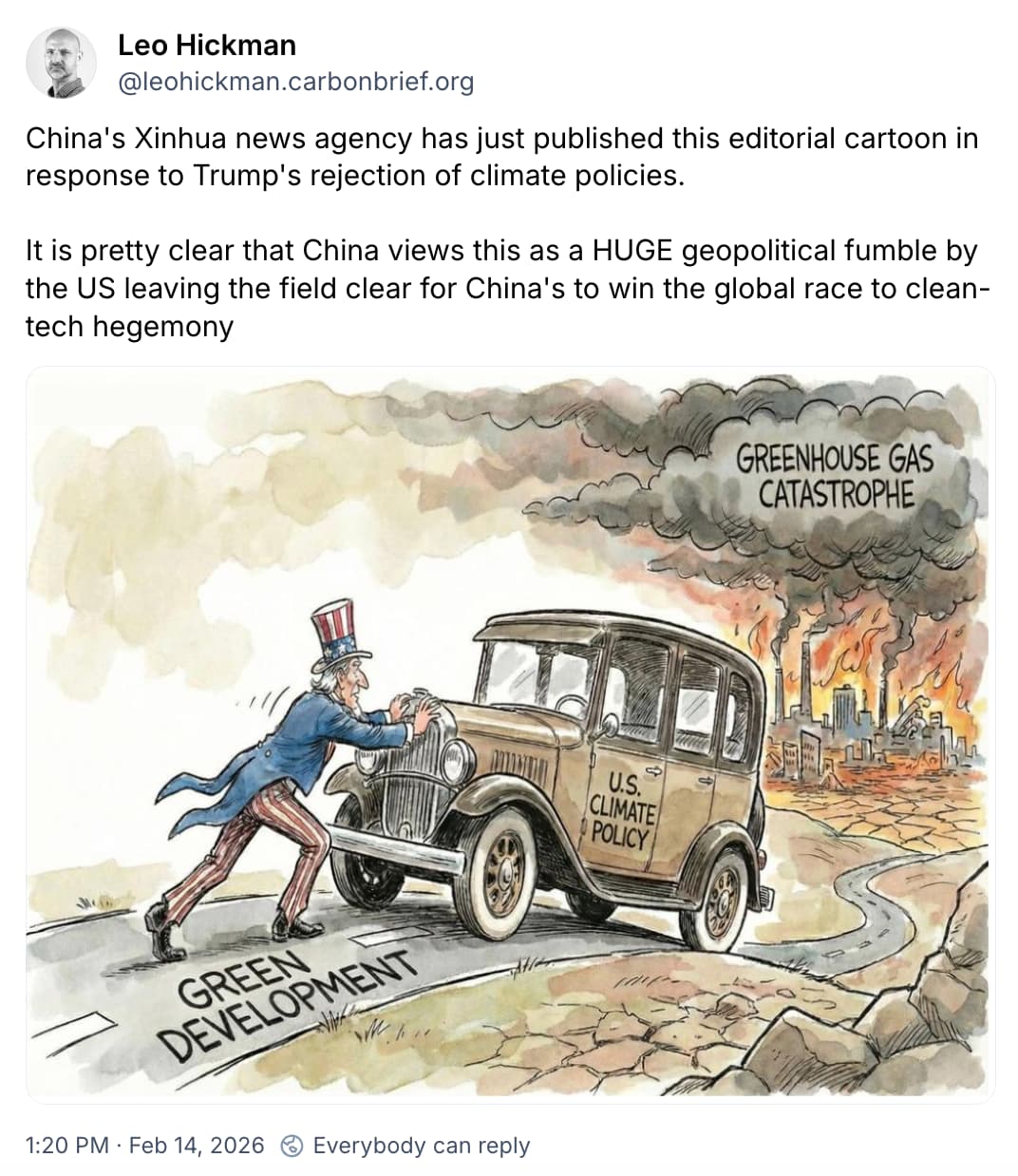
Conversely, Trump described the finding as "the legal foundation for the green new scam", which he claimed "the Obama and Biden administration used to destroy countless jobs".
Similarly, Al Jazeera reported that EPA administrator Zeldin said the endangerment finding "led to trillions of dollars in regulations that strangled entire sectors of the US economy, including the American auto industry". The outlet quoted him saying:
"The Obama and Biden administrations used it to steamroll into existence a left-wing wish list of costly climate policies, electric vehicle mandates and other requirements that assaulted consumer choice and affordability."
An editorial in the Washington Post also praises the move, saying "it's about time" that the endangerment finding was revoked. It argued - without evidence - that the benefits of regulating emissions are "modest" and that "free-market-driven innovation has done more to combat climate change than regulatory power grabs like the 'endangerment finding' ever did".
The Heritage Foundation - the climate-sceptic US lobby group that published the influential "Project 2025" document before Trump took office - has also celebrated the decision.
Time reported that the group previously criticised the endangerment finding, saying that it was used to "justify sweeping restrictions on CO2 and other greenhouse gas emissions across the economy, imposing huge costs". The magazine added that Project 2025 laid out plans to "establish a system, with an appropriate deadline, to update the 2009 endangerment finding".
Climate scientists have also weighed in on the administration's repeal efforts. Prof Andrew Dessler, a climate scientist at Texas A&M University in College Station, argued that there is "no legitimate scientific rationale" for the EPA decision.
Similarly, Dr Katharine Hayhoe, chief scientist at the Nature Conservancy, said in a statement that, since the establishment of the 2009 endangerment finding, the evidence showing greenhouse gases pose a threat to human health and the environment "has only grown stronger".
Dr Gretchen Goldman, president and CEO of the Union of Concerned Scientists and a former White House official, gave a statement, arguing that "ramming through this unlawful, destructive action at the behest of polluters is an obvious example of what happens when a corrupt administration and fossil fuel interests are allowed to run amok".
In the San Francisco Chronicle, Prof Michael Mann, a climate scientist at the University of Pennsylvania, and Bob Ward, policy and communications director at the Grantham Research Institute, wrote that Trump is "slowing climate progress", but that "it won't put a stop to global climate action". They added:
What will the repeal mean for US emissions?"The rest of the world is moving on and thanks to Trump's ridiculous insistence that climate change is a 'hoax', the US now stands to lose out in the great economic revolution of the modern era - the clean-energy transition."
Federal regulations and standards underpinned by the endangerment finding have been at the heart of US government plans to reduce the nation's emissions.
For example, NRDC analysis of EPA data suggests that Biden-era vehicle standards, combined with other policies to boost electric cars, were set to avoid nearly 8bn tonnes of CO2 equivalent (GtCO2e) over the next three decades.
By removing the legal requirement to regulate greenhouse gases at a federal level from such high-emitting sectors, the EPA could instead be driving higher emissions.
Nevertheless, some climate experts argue that the repeal is more of a "symbolic" action and that EPA regulations have not historically been the main drivers of US emissions cuts.
Rhodium Group analysis last year estimated the impact of the EPA removing 31 regulatory policies, including the endangerment finding and "actions that rely on that finding". Most of these had already been proposed for repeal independently by the Trump administration.
Ben King, the organisation's climate and energy director, tells Carbon Brief this "has the same effect on the system as repealing the endangerment finding".
The Rhodium Group concluded that, in this scenario, emissions would continue falling to 26-35% below 2005 levels by 2035, as the chart below shows. If the regulations remained in place, it estimated that emissions would fall faster, by around 32-44%.
(Notably, neither of these scenarios would be in line with the Biden administration's international climate pledge, which was a 61-66% reduction by 2035).
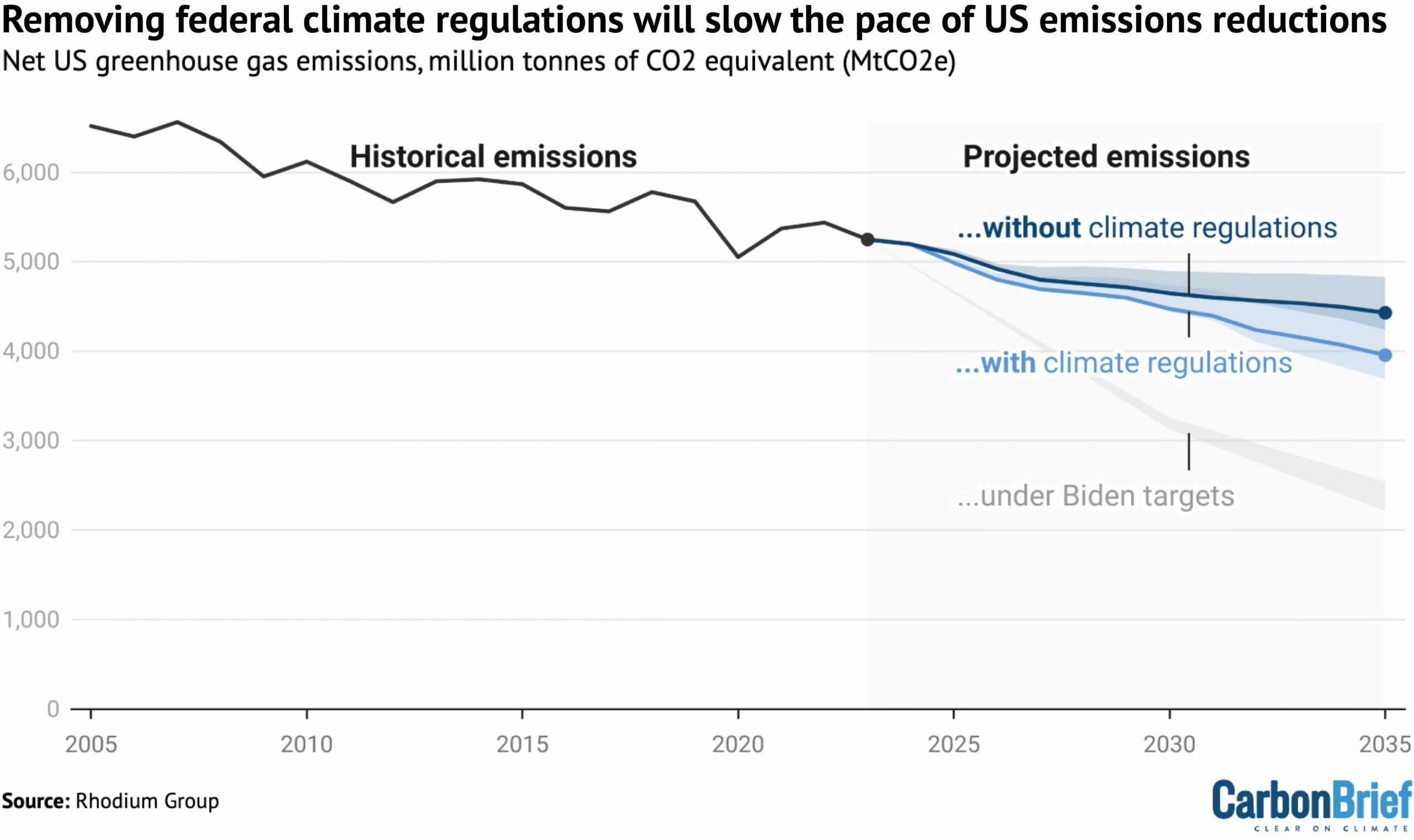 US emissions, MtCO2e, under a "current policy" scenario in which the EPA removes key federal climate regulations ("without climate regulations") and a "no rollbacks" scenario in which regulations remain in place ("with climate regulations"). High, mid and low ranges reflect uncertainty around future fossil-fuel prices, economic growth, clean-energy technology costs and growth in liquified natural gas (LNG) export capacity. Source: Rhodium Group.
There are various factors that could contribute to continued - albeit slower - decline in US emissions, in the absence of federal regulations. These include falling costs for clean technologies, higher fossil-fuel prices and state-level legislation.
Despite Trump's rhetoric, coal plants have become uneconomic to operate in the US compared with cheaper renewables and gas. As a result, Trump has overseen a larger reduction in coal-fired capacity than any other US president.
Meanwhile, in spite of the openly hostile policy environment, relatively low-cost US wind and solar projects are competitive with gas power and are still likely to be built in large numbers.
The vast majority of new US power capacity in recent years has been solar, wind and storage. Around 92% of power projects seeking electricity interconnection in the US are solar, wind and storage, with the remainder nearly all gas.
The broader transition to low-carbon transport is well underway in the US, with electric vehicle sales breaking records during nearly every month in 2025.
This can partly be attributed to federal tax credits, which the Trump administration is now cutting. However, cheaper models, growing consumer preference and state policies are likely to continue strengthening support.
Even if emissions continue on a downward trajectory, repealing the endangerment finding could make it harder to drive more ambitious climate action in the future. Some climate experts also point to the uncertainty of future emissions reductions.
"[It] depends on a number of technology, policy, economic and behavioural factors. Other folks are less sanguine about greenhouse gas declines," WRI's Widawsky tells Carbon Brief.

Analysis: Trump has overseen larger coal decline than any other US president
Coal
|12.02.26

Analysis: China's CO2 emissions have now been 'flat or falling' for 21 months
China energy
|12.02.26

Q&A: New UK onshore wind and solar is '50% cheaper' than new gas
Renewables
|11.02.26

G7 'falling behind' China as world's wind and solar plans reach new high in 2025
International policy
|10.02.26
jQuery(document).ready(function() { jQuery('.block-related-articles-slider-block_4bdaa7bce4cf442df312e36ed007fad0 .mh').matchHeight({ byRow: false }); });The post Q&A: What does Trump's repeal of US 'endangerment finding' mean for climate action? appeared first on Carbon Brief.

A coalition of Greater Manchester groups has announced a major campaign calling for opposition to Britain First's upcoming 'March for Remigration' in the city.
The far-right fascist party, has previously announced its intention to host the march in Manchester city centre on 21 February 2026.
'Resist Britain First'Organisations from across Greater Manchester have launched a campaign, 'Resist Britain First', to oppose this march. It's calling for people and groups across the country to stand together and oppose the march.
A spokespserson for Resist Britain First said:
Britain First's 'March for Remigration' is a racist dogwhistle calling for a white supremacist ethnic cleansing of the United Kingdom by the forced expulsion of non-white people.
Britain First's previous march led to multiple recorded instances of racism, homophobia, and violence by attendees of the march.
We call on people across the UK to come to Manchester to resist this racism on our streets and show that you do not support this bigotry.
Britain First is led by Paul Golding and Ashlea Simon, both of whom have made horrific racist statements in the past.
Simon once stated that "English people can't be black" as "English blood is white". Meanwhile Golding, a former member of the National Front, was convicted for his vile harassment of a mosque. Golding has also previously been accused of sexually assaulting one of the attendees of his marches.
Amongst those that organised Britain First's last 'March for Remigration' in August was Lee Twamley, someone who himself has a conviction for people smuggling.
Golding publicly attended a Remembrance Sunday event at the Cenotaph drunk wearing women's underwear on his head. Resist Britain First believes that all this information makes it clear that the party's claim to be 'Britain First' is steeped in inconsistencies. They are racist thugs.
This comes against the backdrop of the Gorton and Denton by-election in Greater Manchester. Reform UK is happily amplifying the racist rhetoric of job-slashing Man United owner Jim Ratcliffe.
The full list of Greater Manchester based groups in Resist Britain First includes:
- Young Struggle Manchester.
- RS21 Manchester.
- Manchester Feminist Coalition.
- Greater Manchester Tenants Union, South Branch.
- No Borders Manchester.
- Northern Police Monitoring Project.
- Red Roots Collective.
- Anti-Fascist Action Manchester.
- South Asian Liberation Movement.
- Manchester Trans Liberation Assembly.
- Salford Anti-Fascists.
- Stockport Anti-Fascists.
Featured image Resist Britain First
By The Canary

Marco Rubio, the U.S. Secretary of State and a bulwark of the Trump administration, gave a "disquieting" imperialist speech at the Munich Security Conference on Saturday to deflect from the Epstein files fallout.
Journalist Ben Norton called the speech "a blatant call" by the US empire to resuscitate Western colonialism and recolonise the Global South.
Marco Rubio peddles neocolonialismThis is insane.
US Secretary of State Marco Rubio just gave one of the most explicitly pro-colonialist speeches I have seen in the 21st century.
The US empire wants Europe to help it recolonize the Global South.
Rubio praised Western colonialists for "settl[ing] new… pic.twitter.com/tl4NojNdmP
— Ben Norton (@BenjaminNorton) February 15, 2026
Rubio appealed to the UK far-right by explicitly crediting "English settlers" for America's language, political system, and legal framework. He also appealed to German nationalists by praising "German farmers and craftsmen" for building the American heartland and jokingly upgrading beer quality.
Our story began with an Italian explorer whose adventure into the great unknown to discover a new world brought Christianity to the Americas - and became the legend that defined the imagination of a our pioneer nation. Our first colonies were built by English settlers, to whom we owe not just the language we speak but the whole of our political and legal system. Our frontiers were shaped by Scots-Irish - that proud, hearty clan from the hills of Ulster that gave us Davy Crockett and Mark Twain and Teddy Roosevelt and Neil Armstrong.
Our great midwestern heartland was built by German farmers and craftsmen who transformed empty plains into a global agricultural powerhouse - and by the way, dramatically upgraded the quality of American beer.
The reaction to Rubio's imperial nostalgia and his thirst for a new wave of colonisation has been swift and daming.
Lebanese-American journalist Rani Khalek damned Rubio for American exceptionalism:
"What the US empire did to Gaza, Venezuela, and currently Cuba is what it wants to do to the entire Global South." https://t.co/wpQpa7xSNe
— Rania Khalek (@RaniaKhalek) February 15, 2026
Author Joe Guinan warned that the U.S. is building a neo-fascist movement in Europe:
And the National Security Strategy of the United States Government is to promote the rise of allied far right movements in European countries - a neofascist International organized around white supremacy and eugenics. https://t.co/9FIrMiCnGr
— Joe Guinan (@joecguinan) February 15, 2026
Former Indian diplomat Kanwal Sibal stated that the speech was effectively a declaration of war against the non-Western world:
This is effectively a declaration of war against the non- West.
What Rubio is saying is that the world's pressing matters will be identified by the US, the US will use its power to deal with them and the outcomes will be determined by US national interest.
Very disquieting… https://t.co/nTHiW6DrX4
— Kanwal Sibal (@KanwalSibal) February 14, 2026
Professor Matteo Capasso quipped: "Average proud representative of Rubio's 'civilization' speech in Munich," tagging a picture of disgraced paedophile Jeffrey Epstein:
Average proud representative of Rubio's speech civilization in Munich… pic.twitter.com/X1aDSWwovL
— Matteo عمر 马韬 (@capassomat) February 15, 2026
Academic Dan Kervick called for resistance to the growing fascism.
UK's Rubio Also Drumbeats WarRubio delivered a fascist supremacist manifesto in the birthplace of the Third Reich and they all rose to cheer.
We must resist.
— Dan Kervick (@DanMKervick) February 15, 2026
Starmer, the UK's gutless fraud, called the US an "indispensable power" in his Munich speech on the same day.
The US remains an indispensable power. Its contribution to European security over 80 years is unparalleled. And so is our gratitude.
At the same time, we recognise that things are changing. The US National Security Strategy spells out that Europe must take primary responsibility for its own defence. That is the new law.
Starmer's subordination to the US was clear. He told Europe it must be "ready to fight" and "stand on our own two feet" - not as an independent strategy, but as a response to US demands:
Starmer also appeared to target the UK Green Party's ambivalence towards NATO. He dismisses those who question NATO or the US alliance as "peddlers of easy answers… on the extremes of left and right" who are "soft on Russia" and "weak on NATO."
How did the right wing respond?In the 1930s, leaders were too slow to level with the public about the fundamental shift in mindset that was required.
So we must work harder today to build consent for the decisions we must take to keep us safe.
Because if we don't, the peddlers of easy answers are ready on the extremes of left and right and they will offer their solutions instead.
It's striking that the different ends of the spectrum share so much. Soft on Russia. Weak on NATO. If not outright opposed. And determined to sacrifice the relationship we need on the altar of their ideology.
A MAGA fan account celebrated Rubio receiving a standing ovation in Germany after telling Europe to return to Christianity and oppose migration from the Global South:

Keir Starmer has told the Munich Security Conference that he'll send the navy's aircraft carrier group to the Arctic. The move is meant to appease US president Donald Trump who recently threatened to annex Greenland. In his speech on 14 February Starmer said:
I can announce today that the UK will deploy our Carrier Strike Group to the North Atlantic and the High North this year led by HMS Prince of Wales, operating alongside the US, Canada and other NATO allies in a powerful show of our commitment to Euro-Atlantic security.
Starmer also said he would increase the number of Royal Marines in Norway, alongside other measures:
Doubling our deployment of British commandos in the Arctic. Taking control of NATO's Atlantic and Northern Command in Norfolk, Virginia. And transforming our Royal Navy by striking the biggest warship deal in British history with Norway.
You can listen to the full speech here:
Right on cue, defence minister Al Carns - a former marine and rumoured coup candidate for Labour leadership - appeared 200 miles above the Arctic Circle:
-30°C. 200 miles above the Arctic Circle.
In the strategically vital High North, Britain's Surveillance and Reconnaissance Squadron train where few others can.
Minister for the Armed Forces, Col @AlistairCarns, joined them in Norway.

If you checked X today expecting the usual stream of hot takes, memes, and AI spats, you probably saw… nothing. A widespread outage hit the platform today, leaving feeds blank, timelines unresponsive, and users staring at the digital equivalent of an empty room. Outage trackers such as Downdetector logged a dramatic surge in problem reports […]
This story continues at The Next Web

Martin died earlier this year aged 39
Photo by Simon Kallas
Tributes have been paid to Oliver Martin of Ghold, one of tQ's favourite heavy bands, who died recently following a serious illness, aged 39. Donations in his memory are asked to be made to helpmusicians.org.uk.
News of Martin's death was shared by his bandmates on social media on 2 February, where they said: "We lost our best friend, our brother, comrade & companion recently. We do and will continue to miss him so dearly. Love and power to an incredible person and musician whose influence on us will never leave."
Martin was born in Bexley on 27 August 1986. He met his future bandmates Paul Antony and Al Wilson in 2013, who were...
The post Tributes Paid to Ghold's Oliver Martin appeared first on The Quietus.
AIpocolypse A partner at accounting and consultancy giant KPMG in Australia was forced to cough up a AU$10k ($7,084/ £5,195) fine after he used AI to ace an internal training course on... AI.…
China's national carbon market has reached another expansion point, and the signal is larger than it first appears. The Ministry of Ecology and Environment has extended mandatory carbon reporting beyond the original heavy sectors to include petrochemicals, chemicals, flat glass, copper smelting, papermaking, and civil aviation. That move does not ... [continued]
The post China's Carbon Market Expands Into Heavy Industry As USA Regresses appeared first on CleanTechnica.
Elon Musk-owned social media platform X is experiencing an outage, with users worldwide reporting that their timelines no longer show the usual information flow.…

I love Acemagic's ad for its NES-styled mini PC, with posters for AI Slop Mario and Legend of Slop and a depressing neon sign exhorting you to "Relive your Glory Days." You'll be needing the Retro X5's AMD Ryzen AI 9 HX 370 processor and AMD Radeon 890M iGPU if you want to get good frame rates in Frievatass JE or Zeriagic. — Read the rest
The post Acemagic's NES clone is a powerful modern mini PC appeared first on Boing Boing.

Mike King is a brilliant but accidental graphic designer who started as a late-70s punk rocker in Portland, Oregon, making show posters for his own bands and other acts at small venues. Before he knew it, he was creating gorgeous, fascinating concert posters as a career for some of the world's biggest musical acts. — Read the rest
The post From punk rocker to poster king: Mike King's 5-decade journey appeared first on Boing Boing.
Bloober Team has revealed Layer of Fear 3 following a Valentine's Day countdown that started at the beginning of 2026. The new chapter will include not only a game but a novel and music, the company said in a press release.
The developer revealed the new IP via a live-action teaser, with an actor reading lines from William Blake's poem, The Sick Rose. A painting then fell from the wall, and the actor then turned over an hourglass with red sand, with a tagline stating "The door won't stay closed." No gameplay or other information like the release date was revealed.
What Bloober did say, though, is that it would launch new Layer of Fear non-game content, including a novel by horror writer, poet and vocalist Marta Bijan. The company also announced that it would release the soundtracks for Layer of Fear, The Medium and Cronos both in digital and physical (CD and vinyl) editions.
The new title is likely to be eagerly anticipated given Bloober's form of late. The company recently released its Silent Hill 2 remake, Cronos: The New Dawn and a new Switch 2 Layers of Fear 2 version called Layers of Fear: The Final Masterpiece Edition. The original Layers of Fear came out back in 2016 and is considered one of the better horror titles of recent years, thanks to an expertly crafted narrative and psychedelic thrills and chills. The sequel moved to a creepy ocean liner and was equally well-received.
This article originally appeared on Engadget at https://www.engadget.com/gaming/layers-of-3-revealed-via-a-mysterious-trailer-and-poem-153021903.html?src=rss

On 12 February, the Ministry of Justice announced plans to use predictive policing to overhaul the youth justice system. Tucked away in the 25-page document was a proposal to use "machine learning and advanced analytics" to "support early, appropriate intervention" in youth crime.
Whilst the white paper was vague on the particulars, only promising further news in the spring, a Times article went into greater detail on the plans. Beneath an inflammatory headline promising machines that would predict "the criminals of the future", the column explained that:
Artificial intelligence (AI) could be used to predict the criminals of the future under government plans to identify children who need targeted interventions to stop them falling into a life of crime. […]
Academic research has found patterns can emerge from data collected by health visitors checking on newborn babies, although it has not been decided whether the government programme would go back so far to determine whether someone was at risk.
Now, it would be easy here to point out that this pre-crime policing is horrifyingly dystopian. It sounds like a crude mashup of phrenological skull-measuring and Minority Report.
And that's true, it is horrifyingly dystopian. But it's also a present reality that racialised individuals in the UK have been subject to for decades.
Predictive policing and 'criminals of the future'Regarding the AI plans, a government source stated that:
We are looking at how we can better use AI and machine learning to essentially predict the criminals of the future, but to do so ethically and morally. It's about ensuring the data from the NHS, social services, police, Department for Work and Pensions and education is used effectively, and then using AI so you can go above and beyond what we can currently do.
This is going to be pretty transformative on how we put money and resources into prevention. We keep getting the same profiles of criminals in the justice system but we're intervening far too late.
This isn't about criminalising people but making sure the alarms in the system are better understood and data and AI modelling can do that much better.
Minister for youth justice Jake Richards explained further:
I'm determined to harness the power of artificial intelligence and machine learning to gain better insights into the root causes of crime. This will allow us to focus on the earliest of interventions for individuals and families, offering better outcomes for children and keeping our communities safer.
But we must hold and use this personal data carefully, and that's why I've commissioned this specialist expert committee to look at the efficacy of this work, but also the ethical and legal consequences.
The Times goes on to state that data show that neurodivergent, poor, and ethnic minority kids are more likely to commit crimes. Four in every five children in youth detention are neurodivergent. Before they're even 18, 33% of kids with a care background receive a police caution.
The article states all of this that neutral tone that only the discerning bigot's newspaper of choice can manage. And, of course, it's a deeply misleading abuse of the truth.
Biases past and biases futureIn reality, these marginalized kids are the ones who are more likely to be picked up by police, cautioned, or prosecuted. Police profile their arrestees - they have a (racist, discriminatory) idea of who a criminal is, and then police people accordingly. And surprise surprise, the people treated as criminals keep getting arrested.
That's a world away from being "more likely to commit crime".
Whilst AI decision-making is sometimes perceived as unbiased and emotionless, this couldn't be further from the truth. Rather, it simply hides the - very human - biases in its training dataset behind a veneer of cold 'fairness'.
In her report on AI biases in policing, the UN's Ashwini K.P. - special rapporteur on contemporary forms of racism - specifically called out predictive policing. Back in 2024, Ashwini explained that:
Pre-crime criminalisationPredictive policing can exacerbate the historical over policing of communities along racial and ethnic lines. Because law enforcement officials have historically focused their attention on such neighbourhoods, members of communities in those neighbourhoods are overrepresented in police records. This, in turn, has an impact on where algorithms predict that future crime will occur, leading to increased police deployment in the areas in question. […]
When officers in overpoliced neighbourhoods record new offences, a feedback loop is created, whereby the algorithm generates increasingly biased predictions targeting these neighbourhoods. In short, bias from the past leads to bias in the future.
However, as I mentioned earlier, this feedback loop isn't a problem specific to AI itself. Rather, it's inherent to the very idea of pre-crime policing - and it's an oppression that racialised individuals in the UK have been dealing with for decades.
Take, for example, the Met Police's 'Operation Trident' of the 1990s. This sought to prevent gang-related violence in London, and instead resulted in the mass racial profiling of Black youth. An Amnesty International report on Trident's 'Gangs Matrix' database stated that:
The type of data collection that underpins the Gangs Matrix focuses law enforcement efforts disproportionately on black boys and young men. It erodes their right to privacy based on what may be nothing more than their associates in the area they grow up and how they express their subculture in music videos and social media posts. Officials in borough Gangs Units monitor the social media pages and online interactions of people they consider to be 'at risk' of gang involvement, interfering with the privacy of a much larger group of people than those involved in any kind of wrongdoing.
Later, in 2003, the UK government created the Prevent counter-terrorism strategy. Ostensibly, it seeks to prevent people from being radicalised into extremist ideologies. In reality, it disproportionately targets Muslims - including Muslim children - for surveillance and hostile treatment as a dangerous 'other'.
Then, in 2023, the Shawcross Review of Prevent baselessly claimed that the strategy should target Muslims to an even greater degree, rather than far-right extremism. In itself, this was a perfect microcosm of bias-confirmation in action. At the time, the Canary's Maryam Jameela wrote that:
Pre-crime strategies like Prevent presume full agency and power at all times, for all Muslims. In order for such a thing to happen, there needs to be a cultural belief that Muslims are figures of suspicion because they always hold the potential to be terrorists. Underpinning this presumption is that Islam itself harbours something sinister. Repeated governments have, over the years, created a culture of criminalisation that only views Muslims as being in a constant state of pre-crime.
Now, and for all Jake Richards' protestations that his AI plans will use data ethically to create better outcomes for children, it certainly sounds like more of the same discriminatory dross. We've seen already what these people's ethics and care look like.
There is no way to predict criminality that isn't driven by our previous biases - machine learning or not. All that this 'new' strategy can do is push yet more marginalised youth into the no-man's-land of pre-criminality. And all the while, vulnerable kids will be shown directly that their every move was always already under scrutiny.
Featured image via the Canary

New TUC analysis reveals that the average woman effectively works for 47 days of the year for free and only starts earning from 15 February compared to the average man. The analysis reveals that the gender pay gap currently stands at 12.8%, the equivalent of £2,548 a year for the average woman worker.
That means that at current rates of progress, it will take 30 years - until 2056 - to close the gender pay gap.
The union body says a number of factors are driving the pay gap - including women having to work part-time to accommodate for extended caring responsibilities throughout their lives, therefore taking a significant pay cut.
The TUC says the government needs to do more if it wants to meet its ambition to close the gender pay gap. More opportunities for people to share caring responsibilities, improved access to flexible working and better access to childcare must all be part of the solution.
Gender pay gap spans across industriesThe pay gap persists across different industries, and even in jobs dominated by female workers, such as education and care:
- In health care and social work the earning gap is 12.8%. This means that the average woman effectively works for free for 47 days.
- In education the earning gap is 17%. So the average woman effectively works for free for 62 days.
- In wholesale and retail the earning gap is 10.5%, meaning 38 days that the average woman effectively works for free.
- The longest wait for Women's Pay Day comes in finance and insurance. The gender pay gap (27.2%) is the equivalent of 99 days, meaning women work for free until 9 April 2026.
The TUC analysis shows that the gender pay gap affects women throughout their careers, from their first step on the ladder until they take retirement. The pay gap is widest for middle-aged and older women:
- Women aged 40 to 49 have a gender pay gap of 16.2%. So they work 59 days for free until 28 February 2026.
- Women aged between 50 and 59 have the highest pay gap of 19.7% and work the equivalent of 72 days for free, until 13 March 2026.
- Women aged 60 and over have a gender pay gap of 17.7%. They work 65 days of the year for free and effectively start earning from 7 March 2025.
The TUC says the gender pay gap widens as women get older, due to women being more likely than men to take on unpaid caring responsibilities throughout their lives, limited childcare and social care provision, and too few good quality flexible jobs.
Older women take a bigger financial hit for balancing work alongside unpaid caring responsibilities throughout their lives - often looking after children, older relatives, and/or grandchildren.
Need for changeGender pay gap reporting: the TUC says government plans through the Employment Rights Act to make employers publish action plans to tackle the gender pay gap are welcome. But it says they must be more ambitious and robust to make a real difference.
The union body also says these plans will serve as a blueprint for broader action on forthcoming ethnicity and disability pay gap reporting, which the government has pledged to introduce. And it stresses the importance of getting the framework right from the outset.
Parental leave: the TUC says that the government must ensure the parental leave review delivers increased access to paid parental leave so that mums and dads can share care better.
TUC general secretary Paul Nowak said:
Women have effectively been working for free for the first month and a half of the year compared to men.
Imagine turning up to work every single day and not getting paid. That's the reality of the gender pay gap. In 2026 that should be unthinkable. With the cost of living still biting hard women simply can't afford to keep losing out. They deserve their fair share.
The Employment Rights Act is an important step forward for pay parity for women. It will ban exploitative zero hours contracts, which disproportionately hit women and their pay packets. And it will make employers publish action plans for tackling their gender gaps. But these plans must be tough, ambitious and built to deliver real change, otherwise they won't work.
Let's be clear - the government needs to turbo-charge its approach, or women will continue to lose out.
Featured image via the Canary
By The Canary

The Pentagon deployed AI technology linked to Palantir to kidnap Venezuelan president Nicolas Maduro. The AI program concerned, Claude, is integral to Palantir systems used by the US military. The settler-colonial state of Israel is Claude's biggest per capita user.
Tech firm Anthropic developed the program. Claude is used within Palantir systems wielded by the Pentagon. Sources told the Wall Street Journal (WSJ) on 15 February the use of AI in the 3 January raid showed how:
AI models are gaining traction in the Pentagon.
But there is a problem. Anthropic has strict rules on military usage:
Anthropic's usage guidelines prohibit Claude from being used to facilitate violence, develop weapons or conduct surveillance.
The sources said:
The deployment of Claude occurred through Anthropic's partnership with data company Palantir Technologies, whose tools are commonly used by the Defense Department and federal law enforcement.
Anthropic's programs can be used:
for everything from summarizing documents to controlling autonomous drones.
But could Anthropic's 'ethics guidelines' have been breached?
Questions are being asked of PalantirQuestions were asked within the firm after the Caracas raid:
Following the raid, an employee at Anthropic asked a counterpart at Palantir how Claude was used in the operation, according to people familiar with the matter.
An Anthropic spokesperson said:
We cannot comment on whether Claude, or any other AI model, was used for any specific operation, classified or otherwise.
They added:
Any use of Claude—whether in the private sector or across government—is required to comply with our Usage Policies, which govern how Claude can be deployed. We work closely with our partners to ensure compliance.
The Open Tools tech website said Claude is a chatbot:
Claude, a chatbot developed by Anthropic, has seen diverse adoption patterns across the globe, with notable variances based on national economic statuses and technological infrastructure.
Open Tools reported that Israel in the highest per capita user of the program:
The Anthropic AI Usage Index (AUI) places Israel at the top of the leaderboard for Claude usage per capita, signifying not just a quantitative but qualitative edge in how AI is utilized across sectors in the country.
The WSJ reported Anthropic's strict rules on 'defence' use might see the Pentagon divest. Chief Pentagon spokesman Sean Parnell said the US military's relationship with Anthropic was "under review":
Our nation requires that our partners be willing to help our warfighters win in any fight.
Sources told WSJ the guidelines might endanger the $200mn contract awarded in summer 2025. Anthropic Chief Executive Dario Amodei has:
publicly expressed concern about AI's use in autonomous lethal operations and domestic surveillance.
These are the "two major sticking points"
Defence secretary Pete Hegseth has said the US doesn't want to use:
AI models that won't allow you to fight wars.
Donald Trump's shadow war in Latin America isn't over, despite attention moving elsewhere after the 3 January Caracas raid.
Drones, raids and IsraelNicolas Maduro is in a New York jail. Vice-president Delcy Rodriguez is running Venezuela in his absence. Venezuela's left-wing government is still in power - if only in theory. Venezuela is shipping oil to Israel, for example.
The US was still hitting 'narco' boats in the Caribbean as of 13 February:
On Feb. 13, at the direction of #SOUTHCOM commander Gen. Francis L. Donovan, Joint Task Force Southern Spear conducted a lethal kinetic strike on a vessel operated by Designated Terrorist Organizations. Intelligence confirmed the vessel was transiting along known… pic.twitter.com/y50Pbtexfi
— U.S. Southern Command (@Southcom) February 14, 2026
The US boarded another tanker loaded with Venezuela oil on 15 February. This time in the Indian Ocean:
The vessel tried to defy President Trump's quarantine —hoping to slip away. We tracked it from the Caribbean to the Indian Ocean, closed the distance, and shut it down. No other nation has the reach, endurance, or will to do this.
We defend the Homeland forward. Distance does not protect you.
Overnight, U.S. forces conducted a right-of-visit, maritime interdiction and boarding of the Veronica III without incident in the INDOPACOM area of responsibility.
The vessel tried to defy President Trump's… pic.twitter.com/Tran3cLR9g
— Department of War

One of London's last local newsagents has been forced to close, after Transport for London (TFL) raised its rent by over three times. Brixton News has operated within Brixton tube station for 36 years, until TFL skyrocketed their rent from £40,000 a year to £125,000.
TFL putting profit over peoplePritesh Patel, who owns and runs the kiosk with his brother, told The Londoner that the lease was originally £8,000 a year in 1990. Since then, it's increased every three years.
Patel told The Londoner:
at some point, in five to ten years, we would have got to a point where we'd have to say, 'we've got to walk away', because the rents would've just kept increasing.
He explained that their profits aren't enough to keep up with ever-increasing rents. Despite being a newsagent's, most of their income comes from drinks and snacks. Which is also a sad statement about the decline of print media.
Patel said
You can't pay stupid rent when you're taking that.
While Brixton News stood alone until closure, it wasn't always that way. When they first moved in there was also a record store, a camera and photo shop, a cafe, and dry cleaners within the ticket hall. Upstairs used to be home to an arcade which housed a Chinese supermarket, hairdressers, and a pharmacy.
This all changed in 2000 when TFL kicked out all of the businesses as part of the station's redevelopment. Though the arcade upstairs has remained closed and empty. Brixton News was only allowed to stay because TFL shut the ticket hall, so passengers needed a place to top up their Oyster cards in person.
Pure greedTFL have insisted that the rent hike was to accommodate an increase in premises size. This doesn't appear to be something the Patels wanted or the kiosk needed.
TFL told The Londoner that they:
have the opportunity to increase the size of the retail unit currently occupied by the newsstand, and asked Pritesh in January 2024 if he'd be interested in the larger space. He decided not to stay, and we wish him all the best in his future endeavours and would welcome him elsewhere on our estate.
So basically, rather than keep a longstanding business in the station, they're going to increase it anyway to see who else they can attract. Probably a big business that can afford the ridiculous rent.
Patel said:
I've interacted with nearly everyone in the area at some point: sometimes I've done them a favour, and we've chatted, we've talked. It's just having somewhere you can come and have a conversation. Something local.
Because it's more than just a kiosk, Brixton News is a focal point for the community of Brixton. Having been there so long, Pritesh knows the faces and the regulars. In turn, customers told The Londoner about their sadness at the shop's closure.
Community is an obstacle for TFLAs London increasingly becomes a hollowed-out shell of faceless corporations, local run businesses that the community can trust are vital.
There's no justification for taking away such an integral part of the community. Except for the fact that for a conglomerate like TFL, community gets in the way of profits. So instead of connection and sense of belonging, they see something that needs to be stamped out. Which is an absolutely vile way to run a company which is literally supposed to connect London.
Featured image via the Canary
fosdem 2026 Open source registries are in financial peril, a co-founder of an open source security foundation warned after inspecting their books. And it's not just the bandwidth costs that are killing them.…

Wendy's plans to close 5%-6% of its restauraunts in the United States within months and allow others to skip breakfast. With 6,000 outlets, that means more than 300 "underperforming" venues will soon be gone.
Wendy's interim CEO Ken Cook: "By closing consistently underperforming restaurants, we are enabling our franchise partners to increase focus on locations with the greatest potential for profitable growth. — Read the rest
The post Wendy's to close hundreds of restaurants appeared first on Boing Boing.
A camera trap in a tiger reserve captured footage of something never seen before: six Amur tigers in one frame.
In footage from the Northeast China Tiger and Leopard National Park, an adult tigress walks past the camera on a dirt road. — Read the rest
The post Amazing camera trap footage represents hope for endangered tigers appeared first on Boing Boing.

During Brett Kavanaugh's 2018 Supreme Court fight, Epstein coached Steve Bannon on how to undermine Christine Blasey Ford, who alleged that then-Supreme Court nominee Kavanaugh had sexually assaulted her — specifically, that she should be accused of using medications that impair memory. — Read the rest
The post Epstein advised Bannon to smear Blasey Ford during Kavanaugh fight, and more fallout appeared first on Boing Boing.
Apple has lined up its first event of the year. The company has invited members of the press to an "Apple Experience" that's taking place in New York City on March 4 at 9AM ET. It hasn't yet confirmed whether it will stream the event publicly. According to MacRumors, versions of this Apple Experience will also take place simultaneously in London and Shanghai.
It seems likely that Apple will take this opportunity to unveil its latest slate of iPads and MacBooks. Bloomberg's Mark Gurman reported earlier this month that Apple was planning to make a number of hardware announcements "as early as the week of March 2."
 Apple
AppleThis is expected to include a new MacBook Air and refreshed 14- and 16-inch MacBook Pros, with the M5 Pro and M5 Max making their debuts (a MacBook Pro with the base M5 chip arrived in October). There's also speculation that Apple will announce a new entry-level MacBook that will be available in light yellow, light green, blue and pink colorways.
In addition, we may see new iPads here (or perhaps a little farther down the line), including an entry-level model with an A18 chip that's capable of supporting Apple Intelligence features. The iPad Air could be in line for an upgrade as well with the introduction of the M4 chip to that line. Apple is also expected to roll out updated versions of the Mac Studio, Studio Display and Mac mini later this year.
This article originally appeared on Engadget at https://www.engadget.com/computing/laptops/apples-next-event-is-set-for-march-4-145931890.html?src=rss
Dorna Sports, S.L., the company which has run grand prix motorcycle racing since 1992, has been renamed. From now on, the company will be known as MotoGP Sports Entertainment Group, though much of the current organizational structure will remain intact.
Renaming the company is a commercial decision, and one aimed at giving the company a more global appeal. In a commercial environment, the name Dorna Sports always needed an explainer as to what they did. MotoGP Sports Entertainment Group does exactly what it says on the tin.
According to the press release issued on the name change, this is the next step in the rebranding process started back in 2024. That was before the takeover by Liberty Media, and part of a growing awareness that the growth of MotoGP had plateaued, was stuck at its current level and needed to find a new impulse to grow. Liberty has since picked up that objective and is pushing it forward.
David Emmett Mon, 16/Feb/2026 - 13:49
Sales of refurbished PCs are on the up amid shortages of key components, including memory chips, that are making brand new devices more expensive.…

Texas-based pet microchip registry Save This Life abruptly shut down earlier this month, potentially leaving hundreds of thousands of pets unprotected.
Microchipping is vital for protecting pets. Pets run away or get lost, and collars and tags can fall off. A microchip can be the difference between getting a pet back and losing them forever. — Read the rest
The post Pet microchip company went out of business and took your pet's info with it appeared first on Boing Boing.
A few days ago I asked Manton Reece if he could add a feature that gave me a feed of replies to me on his service, micro.blog.
- I post a lot of stuff to micro.blog via my linkblog RSS feed. Every one of those items can be commented on. But unless I visit micro.blog regularly, I don't see the comments. I guess people have mostly figured out that I'm an absent poster, and don't say anything. Even so, there are some replies. Wouldn't it be great if the responses could show up in my blogroll. And of course if there was an RSS feed of the replies, I would see them when I was looking for something possibly interesting, one of the main reasons I have a blogroll, and keep finding new uses for it.
The feed is there now, I'm subscribed and new comments are posted in the feed and Murphy-willing I will see them. Bing!
It's a killer feature for sure. But the best part of it is this -- here are two developers working together. This is how the web works when it's working.
BTW a suggestion. Right now the title on my feed is:
- Micro.blog - dave mentions
That's a problem in the limited horizontal space in the blogroll. A more useful title would be:
- "dave" mentions on micro.blog
For most adventure games, the long-term goal can often focus on solving a grand mystery or chasing a lost artifact of the past. But for the upcoming Mixtape, from publisher Annapurna Interactive, it sets its sights on the misadventures of young friends enjoying their last days together before moving on. It's the type of narrative adventure game that shines a light on how good music can bring people together, and how much fun getting into trouble can be.
From developer Beethoven and Dinosaur, the Australian creative team behind The Artful Escape, Mixtape is, in many ways, a tribute to classic '90s Americana and an ode to the rebellious youth of the average suburb. I recently got to play the latest build of Mixtape and spoke with game director Johnny Galvatron about the making of their latest game. Along with sharing his favorite '80s and '90s films that helped shape his vision, he also explained how tough yet rewarding it is to make "idleness" in video games compelling.
"Idleness is hard to explore as a video game, and one of the interesting things about being a teenager is you just hang out a lot, and sometimes it just sucks," said Galvatron. "So I love that we made a game that shows that idleness."
"I think it can be a really hard balance to make something that is based on what is really a hangout film, something like Wayne's World or Richard Linklater's Dazed and Confused, but to have that be paced well and to be exciting for a video game was a real challenge."
Set in the 1990s, Rockford and her friends Slater and Cassandra prepare for one last hurrah before heading into adulthood. With Rockford deciding to make a daring move to New York City to hopefully connect with her music idol, the crew reminisces on the good times they had going for late-night fast food runs, evading the police in shopping carts, and first kisses with their crushes - and all to the tune of their favorite songs.
On the surface, Mixtape is an interactive coming-of-age story about a crew of rebellious teens, with memories serving as playable mini-games and interludes that capture their feelings at the time. But that's actually what makes this interactive trip down memory lane so compelling. These segments are presented as exaggerated memories of the past, fueled by the music of Devo, Joy Division, and Siouxsie and the Banshees. They're emotional, poignant moments for these characters, tapping into the idea of how moments from our youth seemed bigger and grander than they actually were.
One section I enjoyed playing was an interactive head-bobbing segment where the crew drove across town to get fast food. Different buttons corresponded to fist-pumping and head-bobbing actions, but there were no specific directions, so I just had to go with the flow. This scene was a great bit of comedy that showed off how goofy Rockford and her friends could get while vibing, but it was also a fun callback to films like Pulp Fiction, which used rear-projection sets to simulate car driving scenes (the memory even plays out on a film set). Another segment focused on a photo booth with Rockford and Slater, which put them in a position to capture the best or funniest shots.
But it's not all fun and games with the crew. One segment focused on the friends tossing toilet paper rolls around their school principal's home, which quickly takes a turn for the worse when one of them decides to take the blame to spare Rockford from expulsion. It's a surprisingly heartfelt and sad moment, but it also foreshadows a simmering conflict for these characters.
It's clear that Mixtape seeks to capture the experiences of a particular era, and that the developers themselves had a particular fondness for American movies and pop culture of the time. It captures the feeling of the so-called MTV generation and the intersection of media and the emotional expression of youth during this period. This is also evident in the game's use of a "mixed media, liquid television" editing style, which intercuts clips from TV shows and movies to emphasize emotional and comedic beats.. Rockford even does a Ferris Bueller-style narration for the players.
Given that video game-to-movie adaptations have never been more popular, game director Johnny Galvatron has also had some talks about a potential movie adaptation.
"Obviously, Annapurna is also a film company, and they have those kinds of connections, and let me tell you, those meetings are fun as fuck," said the director. "When people pitch you stuff, it's super cool. I would just say that, yes, I can see it coming. I would probably be totally hands-off on it."
"When you develop video games, you should be changing them to work better within the medium," he continued. "I think when they try to adhere too closely to the way a game works, that can sometimes break down. But yeah, I think if there were to be some adaptation stuff for Mixtape, probably, and I will stay clear of it."
Mixtape feels like a heartfelt tribute to the '90s. While nostalgia bait is increasingly common these days, I felt there's a much deeper message under the hood, and getting to take part in these larger-than-life days of being a young adult has really got me excited for what's to come. I'm hoping the final game will deliver an adventure where I can really savor those listless hangouts with friends.
Mixtape is set to be released on PC, PlayStation 5, and Xbox Series X|S later this year.
This article originally appeared on Engadget at https://www.engadget.com/gaming/the-creators-of-mixtape-want-to-make-a-great-hangout-video-game-140026928.html?src=rss
The Government of the Canary Islands has declared a state of pre-alert for the whole archipelago due to an imminent weather phenomenon which poses a health risk.
submitted by /u/Big_Statistician2566[link] [comments]


