

On 12 February, the government announced that it will soon publish guidance for schools regarding trans pupils. The press release states that schools must take a "very careful approach" when a pupil "asks to socially transition".
'Social transition' refers to the non-medical aspects of transitioning. It can include changing one's name, wearing different clothes, and using different pronouns.
The press release goes on to state that:
It clearly sets out that single sex spaces must be protected. Without exception, no child should be made to feel unsafe through inappropriate mixed sex sport, and there should be no sharing of school and college toilet facilities over eight years old or mixed sex sleeping arrangements on trips.
It is also vital that schools and teachers are aware of any child's birth sex to be able to take appropriate action where needed, so the guidance will also make clear that this must be accurately recorded in school and college records.
Single sex spaces "must be protected" — with the 'from trans kids' left implicit. No child should be made to feel unsafe — with the 'no cis child' unsaid but clearly in mind. These statements frame trans children as a threat, and as potential deceivers.
Even the framing of "asking" to transition socially implies that it's not utterly ridiculous for a school to refuse to use a pupil's chosen name and pronouns. But then, that's the level that the UK has sunk to. Any aspect of transness is now considered a legitimate topic for debate.
'Political football'Joining in on the game of political football that is trans existence, education secretary Bridget Phillipson said:
Parents send their children to school and college trusting that they'll be protected. Teachers work tirelessly to keep them safe. That's not negotiable, and it's not a political football.
That's why we're following the evidence, including Dr Hilary Cass's expert review, to give teachers the clarity they need to ensure the safeguarding and wellbeing of gender questioning children and young people.
Likewise, the draft guidance itself also states repeatedly that it is supported by Dr Hilary Cass. Cass wrote the Cass report, which was filled with spurious abuses of science in the name of denying healthcare to trans children.
The press release stated that the draft guidance was:
Backed by Baroness Cass, whose review warned that strong evidence about the impact of social transition remains limited, the guidance says children's wellbeing and safeguarding must be at the centre of every decision and schools cannot take a one size fits all approach.
Cass was completely inexperienced with trans healthcare before she was chosen to write her review. However, she was at least a medical doctor. By contrast, her expertise regarding social transition - which has nothing to do with gender medicine - is less than worthless. It follows that Labour set so much store by her opinion.
'Losing any hope'Meanwhile, experts and campaigners who are actually invested in the wellbeing of trans youth have condemned the draft guidance.
Cal Horton, a researcher specialising in trans youth, stated that:
Trans children need to be supported and respected in order to be safe at school, in order to access their right to education, in order to enjoy their childhood.
Instead, we are seeing a complete ban on access to appropriate toilets, PE, accommodation on school trips, a complete erosion of their rights.
It will lead to children avoiding the bathroom, avoiding exercise, missing out on school trips, dropping out of school, losing any hope of education, equality, friendship, happiness.
Likewise, advocacy organisation Trans Actual was scathing in its reaction:
It's absurd for this Government's proposed guidance to suggest that schools need to seek clinical advice if a young person wants to change their name, uniform or hairstyle.
Being trans is not a medical condition nor is it an unwanted life outcome to be guarded against, it is a healthy way that many people choose to express themselves.
All young people need safe and supportive schools yet this Government's proposed guidance risks leading to trans young people being outed to their families against their wishes.
As it stands, this guidance does nothing to help schools to include trans pupils - nor to address the epidemic of anti-trans bullying promoted by misogynist influencers.
The guidance will not become law until September of this year. However, if this draft is anything to go by, the final document will continue Labour's current streak of kicking trans people and calling it fair play.
At its heart, this document refuses to treat trans schoolchildren as the vulnerable minority they are, and instead figures them as an active threat to the cis majority.
Featured image via the Canary

The fallout from the Epstein files has been relentless. Those implicated in the dirty saga include UK Royals, members of our political class, the mainstream media, the "broligrachy," and others.
Still, one area corporate media coverage has ignored is the convicted sex-trafficker's feigned interest in polio eradication in the Global South. But why would a notorious predator and trafficker bother to involve himself with healthcare management in South Asia?
No champion of polio eradicationAmong the tranche of files released by the US Department of Justice (DOJ) Epstein appears in a video speaking with an off-camera interviewer whose voice resembles Steve Bannon's. Responding to the interviewer, Epstein justifies his ties to "dirty money," claiming to have helped with polio eradication in India and Pakistan — a convenient cover for a sex predator.
The Epstein files also include confidential reports on polio eradication efforts in Afghanistan and Pakistan, marked "CONFIDENTIAL — DO NOT CIRCULATE."
The emerging pattern is one the Canary has repeatedly reported on. Epstein used his deep pockets to court Western diplomats, global philanthropists, and political figures. His alleged interest in polio work was another power grab. He was using cash to climb the ranks. It was never about vaccines.
He positioned himself in global health by feigning noble interests. The release of the DOJ files proves this was nothing more than a mask to hide his predatory depravity.
Epstein-Gates connectionThe DOJ files show that the Gates Foundation was implicated in these lobbying efforts. The organisation — long at the forefront of global polio immunisation efforts — provided substantial funding for these IPI-led campaigns. An email exchange between Rod-Larsen and Epstein in September 2013 showed them discussing how to structure Gates Foundation funding for IPI's polio work. And another email from the same year, sent by a senior program officer at the Gates Foundation, the IPI was described as well placed to:
identify potential influencers/high-level contacts that can move the work forward and recommendations for how/whether BMGF, GPEI UN partners (UNICEF/WHO) and others should engage with such contacts.
The same email chains shows Epstein committing to $1 million per year for polio programmes in Pakistan, Afghanistan, Northern Nigeria, and Somalia — a whopping $15 million over five years. He instructed that Bill Gates' name should not appear on a proposed peace center.
But by March 2015, the relationship had run its course, due to the reputational risk attached to Epstein's criminal behaviour, and the funds Epstein promised which Gates never received.
Leveraging polio eradication for political gainEpstein's interest in polio projects in Pakistan was enabled through associates at the International Peace Institute (IPI), including senior staff.
Terje Rød-Larsen, its former president and ex-diplomat to Norway, is mentioned multiple times in the files. He stepped down from his role in disgrace after his ties to the convicted child-rapist made global headlines. Moreover, Rød-Larsen, as the DOJ files suggest, was a key ally of Epstein. He is currently under investigation by Norwegian police.
Rød-Larsen and IPI director, Andrea Pfanzelter, received intelligence briefings from a Pakistan-based field operative Nasra Hassan. They forwarded these reports to Epstein. The paper trail begins in April 2013. Emails from Hassan to Rød-Larsen describe meeting with Pakistani tribal leaders and government officials, and their changing position on polio eradication. Commenting on a chat had with a senior member of the Taliban, Hassan said:
It appears that religion-based refusal [of polio vaccination] is a very tiny.
However, the declassified files suggest interest in polio eradication ranked second to political ambitions. In June 2013, Hassan sent an email warning that Bill Gates' public outreach to Pakistan's ex-prime minister and opposition figure, Imran Khan, for polio support could jeopardise back-channel talks with the Pakistani Taliban:
This will harden the Pak[istani] Taliban's position.
She noted that while the Taliban appeared more receptive to polio programmes, they remained opposed to Western involvement. She reminded Rød-Larsen that the group banned polio vaccinations in the Waziristan region in 2012:
alleging the campaign was a cover for espionage.
Hassan reiterated the need for discreet talks, stating that:
Epstein names Imran Khan a "threat"This opposite effect [the possibility of losing Taliban support] emphasizes the IPI position that polio related efforts by politicians MUST be discreet and low-key.
Hassan's warnings about Imran Khan's public role — specifically his rejection of US imperialism — were echoed years later by Epstein himself. That's little surprise given Epstein's infiltration of Western diplomatic circles. He wooed politicians who cosied up to US — cue Peter Mandelson, Ehud Barak, among a long list of politicians he collected.
That's little surprise given [stuff about Epstein's political interference]"
Hassan's warnings about Imran Khan's public role were echoed years later by Epstein himself.
In 2018, as Drop Site News reporter Ryan Grim noted, Epstein described Khan as "very bad news."
Grim linked this to Khan's political downfall, noting that the US State Department, with help from the Pakistani military, pushed him out of office in 2022.
Khan is subject to ongoing persecution by the military establishment in Pakistan. His party has been suppressed, and he remains behind bars.
Among his opponents, former Indian diplomat, Hardeep Singh Puri, now a senior BJP official in Prime Minister Narendra Modi's party, also features in the DOJ files. There were email exchanges between Puri and Epstein. There were five scheduled appointments between June 2014 and January 2017. Unsurprisingly, Puri has defended himself against alleged ties to the sex predator.
Unanswered QuestionsJeffrey Epstein in 2018 was claiming that @ImranKhanPTI was "really bad news," citing Pakistan's nuclear weapons. The State Dept pushed him out of office with help from the Pakistani military in 2022. pic.twitter.com/isDA4dePMj
— Ryan Grim (@ryangrim) November 14, 2025
Despite the documentary trail exposing Epstein's attempts to insert polio-related initiatives, by leveraging his wealth, many questions — as raised by Pakistan's Express Tribune remain unanswered. What was Epstein's actual role in this network? Did he have ties to intelligence agencies? And why were detailed reports on Taliban leadership and polio access appearing in his inbox?
In the words of Express Tribune reporter, Shireen Qasim:
The emails raise a fundamental question: was the polio work undertaken by operatives like Hassan genuine humanitarian effort that happened to provide access to sensitive locations and information, or was the humanitarian work itself a cover for intelligence gathering - with field reports being systematically forwarded through institutional channels to someone like Epstein who had no public health credentials?
Consider the March 2013 email from Boris Nikolic, Epstein's science adviser, asking how to deal with violence in Nigeria and Pakistan, who could mediate with the Taliban and Boko Haram, and whether these groups might ever be open to polio eradication.
It is not a stretch to imagine that was no humanitarian angle to Epstein's interference in South Asia. A man with no background in public health, no government position, a documented history of manipulation and blackmail, and a suspicious interest in polio eradication? Added to that, a sickeningly powerful man with the connections to manoeuvre political instability? The red flag is flaming
Featured image via the Canary
By The Canary

TL;DR: Get control of your data with 91% off a 10TB subscription to Internxt Cloud Storage for just $249.97 (Reg. $2,900).
You pay for your phone, so why are you renting to keep your own files on it? Tired of paying monthly fees for phone storage, email storage, photo storage, and more? — Read the rest
The post Tired of paying to store your own files? Get 91% off secure cloud storage appeared first on Boing Boing.

A neighborhood Facebook page called Montco Community Watch had been doing what neighborhood pages do — posting tips about ICE sightings near specific streets and landmarks in Montgomery County, Pennsylvania, in English and Spanish, for its roughly 10,000 followers. In September, DHS served Meta with an administrative subpoena for the names, email addresses, and postal codes of whoever ran it. — Read the rest
The post DHS sent hundreds of subpoenas to Google, Meta, and Reddit demanding names of people who criticize ICE appeared first on Boing Boing.
MP13 Doubles Up For Daytona 200 & Supersport Season With Ella & Avery Dreher On MV Agustas Supported By One Cure
MP13 Racing's Ella Dreher will be joined by her brother Avery as they both compete in the 2026 Supersport Championship, beginning with next month's Daytona 200. Photo courtesy MP13 Racing.
Here's proof that, when you've got one very talented rider named Dreher on your team, you've just gotta have two.
Team owner Melissa Paris is delighted to introduce MP13 Racing's 2026 MotoAmerica team, featuring incumbent rider Ella Dreher and her brother Avery. Both riders will compete in the 2026 Supersport Championship, including next month's Daytona 200.
Also, Paris and MP13 Racing are proud to represent One Cure through the generous support of David and Maxine Pierce. One Cure's mission is "to improve the prevention, diagnosis, and treatment of cancer in pets, and to translate their research and knowledge to also benefit people with cancer."
"Working with Ella in 2025 was the realization of a dream that was several years in the making," Paris said. "I was impressed by her work and tenacity every single weekend. To be able to have Ella back, and to have her brother Avery also join the team for the 2026 Supersport Championship, is unreal. I'm so grateful for their trust in me and our team, and together, we are looking forward to seeing what we can achieve with our MV Agusta F3 800 machines."
Last year, Ella competed for MP13 Racing in the inaugural MotoAmerica Talent Cup Championship, and she is set to take the next step in her road racing career. Currently 15 years old, Ella will turn 16 at the end of February, which will make her eligible for MotoAmerica's Supersport Championship. As a result, the Florida native is poised to become the youngest rider ever to race in the Daytona 200, in this, the 84th running of the "Great American Motorcycle Race."
"I'm more than excited to be racing again this year with the MP13 team, Ella said. "Better yet on a Supersport bike alongside my brother as my teammate this year. I can't wait to start the season at the Daytona 200. Racing the 200 has been a dream of mine, and I'm ready to push through the challenges and start the 2026 season."
Avery, who is 19 years old and raced in last year's Twins Cup Championship, will also move up to Supersport as he teams up with his sister on MP13 Racing MV Agustas.
"I am so thankful and stoked for this opportunity," commented Avery. "Huge thanks to Melissa and the entire MP13 Racing team for believing in me. This truly feels like a dream come true. Racing in the Daytona 200 and the Supersport Championship has been a goal of mine for a long time, and I'm ready to embrace the challenge and get to work. I'm also stoked to be teammates with my sister again. It's going to be a fun time and a great year!"
Additional team sponsors for 2026 include Rock Solid and MV Agusta Los Angeles, along with Maxima, Spider, STM, GHD, Accossato, LighTech, Essex Moto, Speedcell, Akrapovic, SBS, Mikanik Moto, Matt Racing, ESP, and Macklin Motorsports.
The post MotoAmerica: Ella & Avery Dreher Racing MVs At Daytona appeared first on Roadracing World Magazine | Motorcycle Riding, Racing & Tech News.
The WorldSBK field was put through their paces in near perfect conditions on the opening day of testing at the Phillip Island Grand Prix Circuit. Under blue skies and with a light breeze cooling the temperatures slightly the four hours of running for Superbike and Supersport classes offered a stark contrast to the winter testing undertaken in Europe.
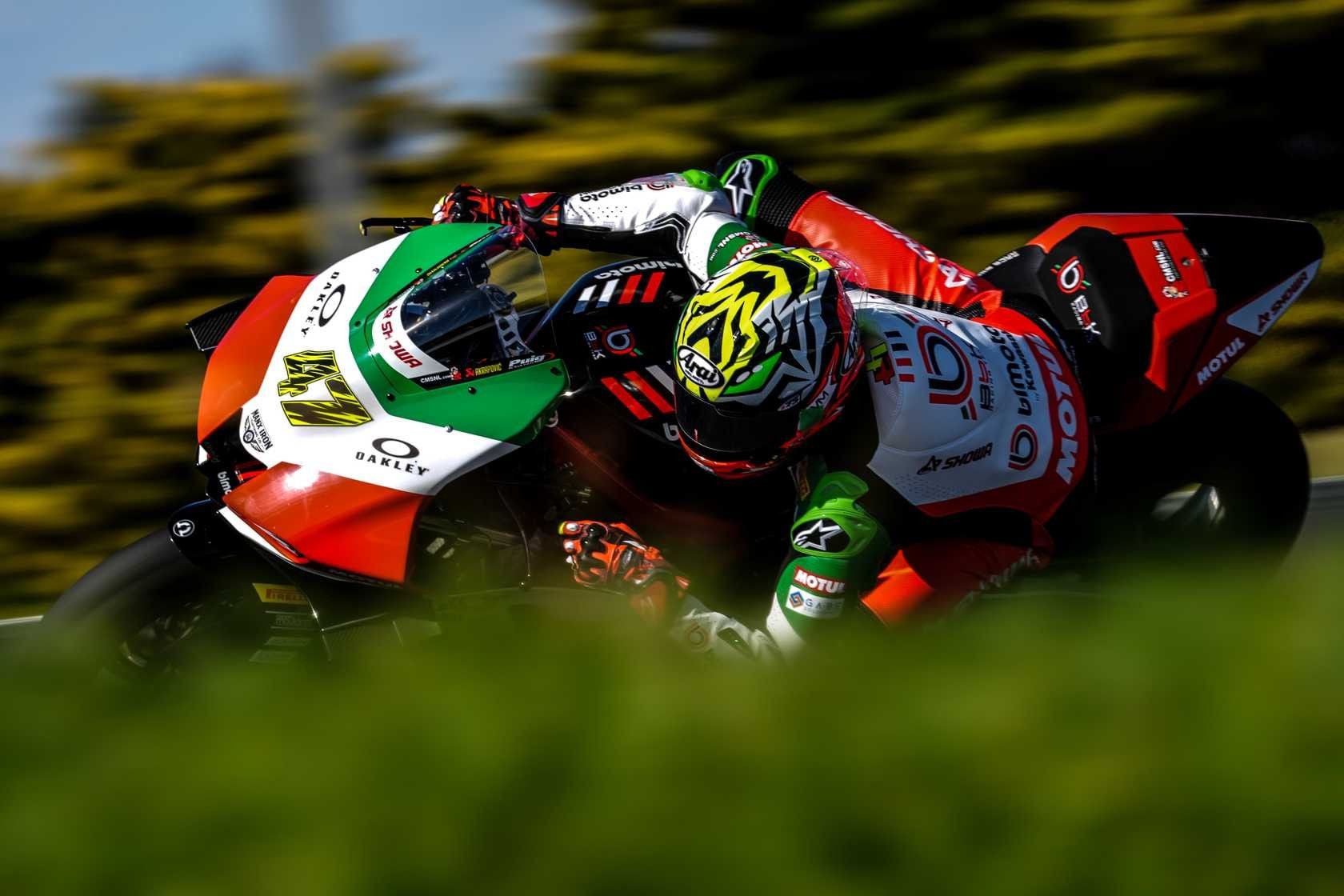 Axel Bassani (47) at Phillip Island. Photo courtesy Dorna
- Pre-season title favourite Nicolo Bulega dominated the opening day of testing, leading both sessions for the Aruba.It Racing - Ducati squad. The Italian completed 72 laps. His pace was impressive with over 30 laps under 1m30s. The 90 second barrier was broken by only three other riders with Axel Bassani the closest challenger. The bimota by Kawasaki Racing Team rider ended the day just 0.291s adrift.
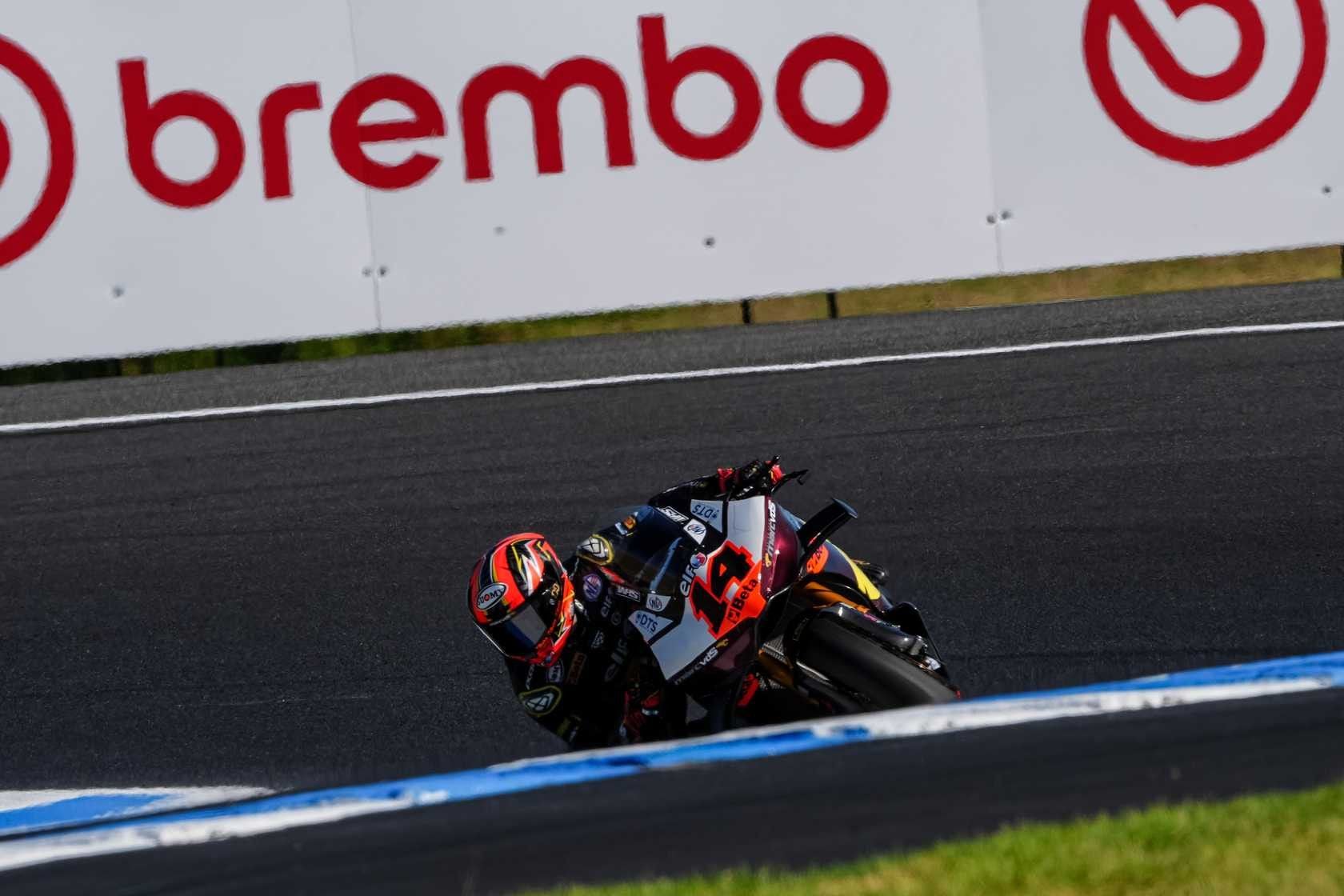 Sam Lowes (14) at Phillip Island. Photo courtesy Dorna
- It was an action-packed day for Sam Lowes. The ELF Marc VDS Racing Team rider suffered a technical issue in the morning before crashing in the afternoon. The Brit responded strongly, setting his fastest time late in the day during a six-lap stint.
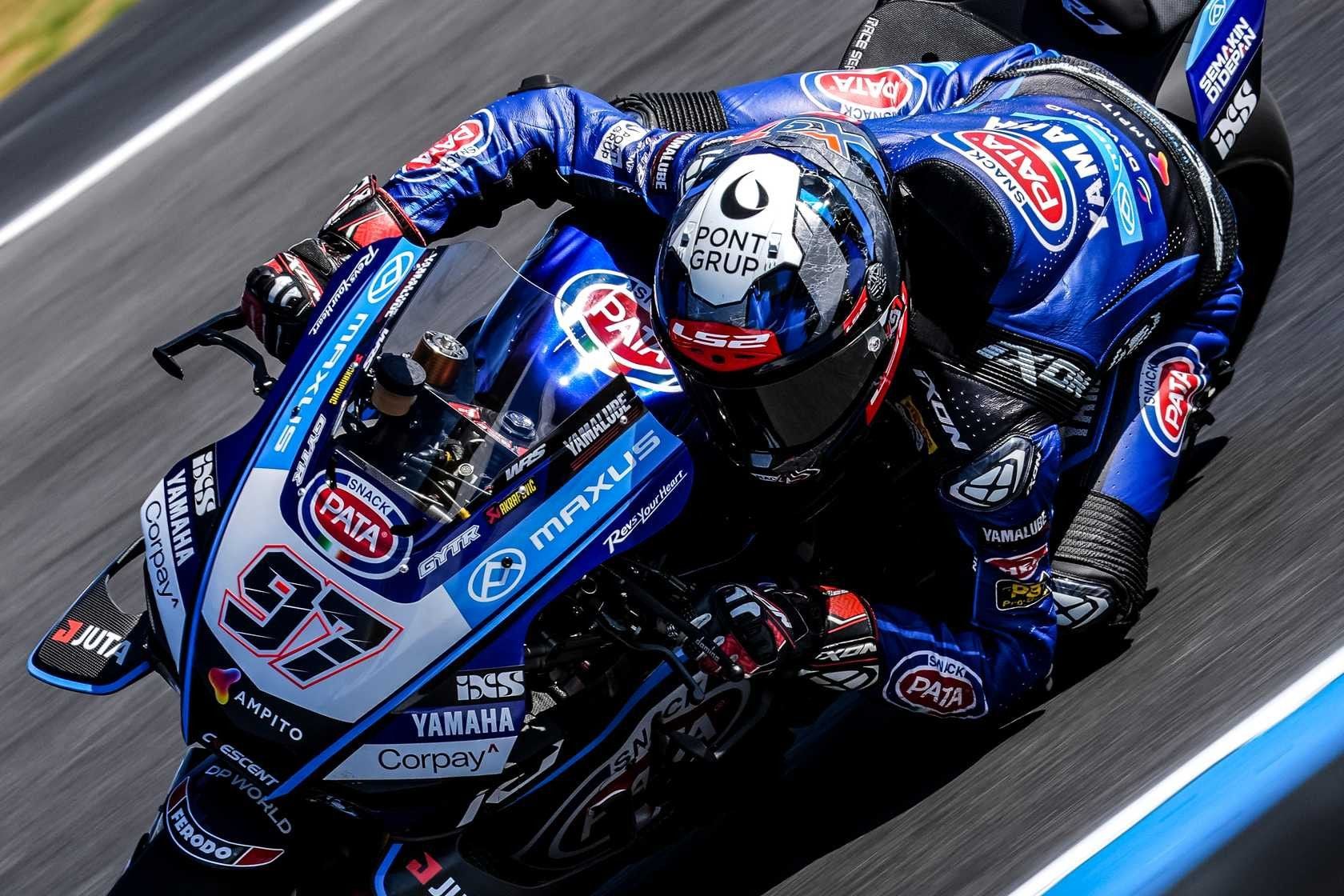 Xavi Vierge (97) at Phillip Island. Photo courtesy Dorna
- After limited dry running over the winter, Xavi Vierge impressed as the fastest Yamaha rider, placing the Pata Maxus Yamaha ninth overall. A morning crash failed to derail Stefano Manzi, the reigning Supersport World Champion, who was just two tenths of a second slower than Vierge as he continues to adapt to the GYTR GRT Yamaha WorldSBK Team machine.
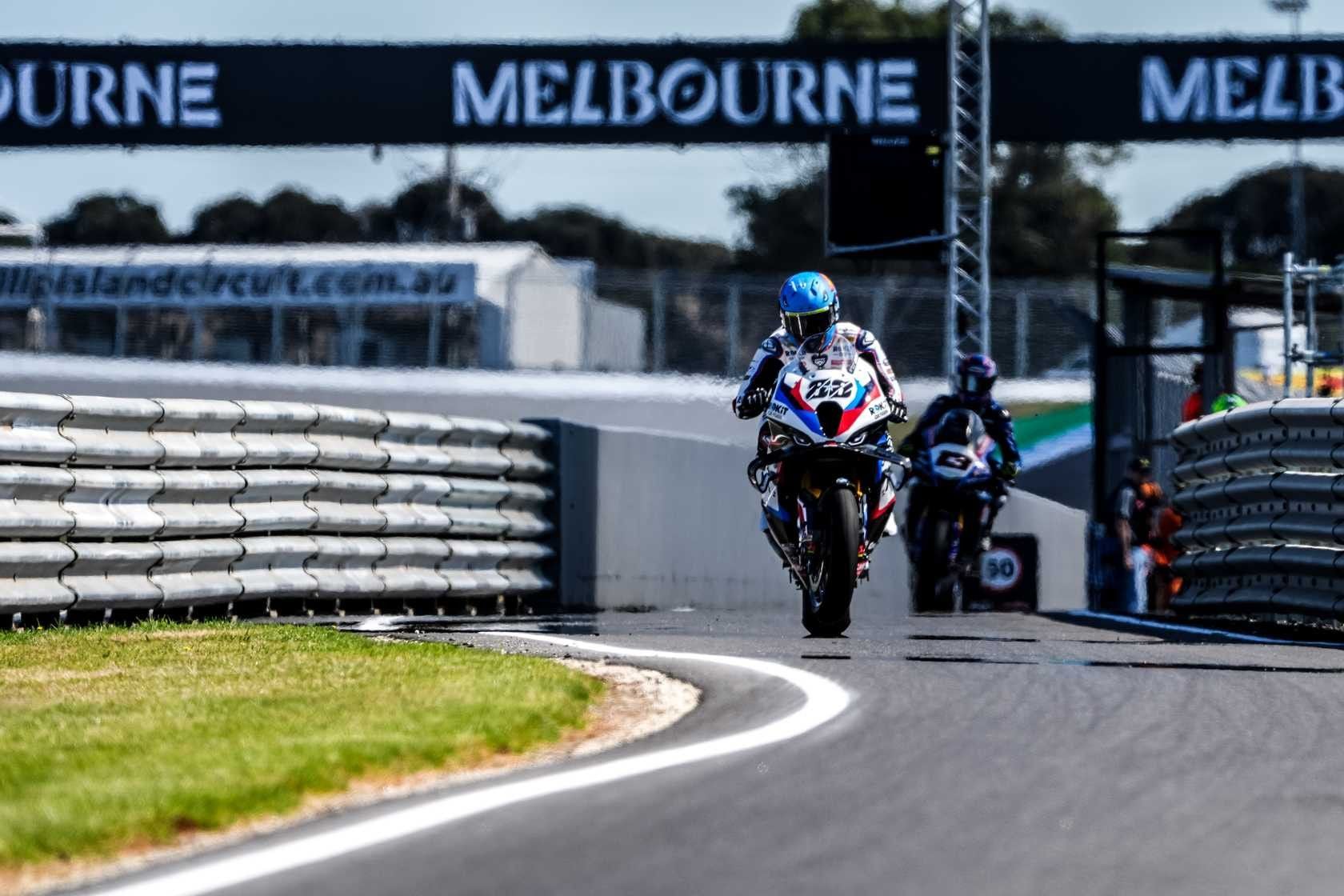 Miguel Oliveira (88) at Phillip Island. Photo courtesy Dorna
- Jake Dixon (Honda HRC) led the rookie contingent. The former Moto2 rider finished tenth at the close of play, ahead of Miguel Oliveira (ROKiT BMW Motorrad WorldSBK Team) and Manzi.
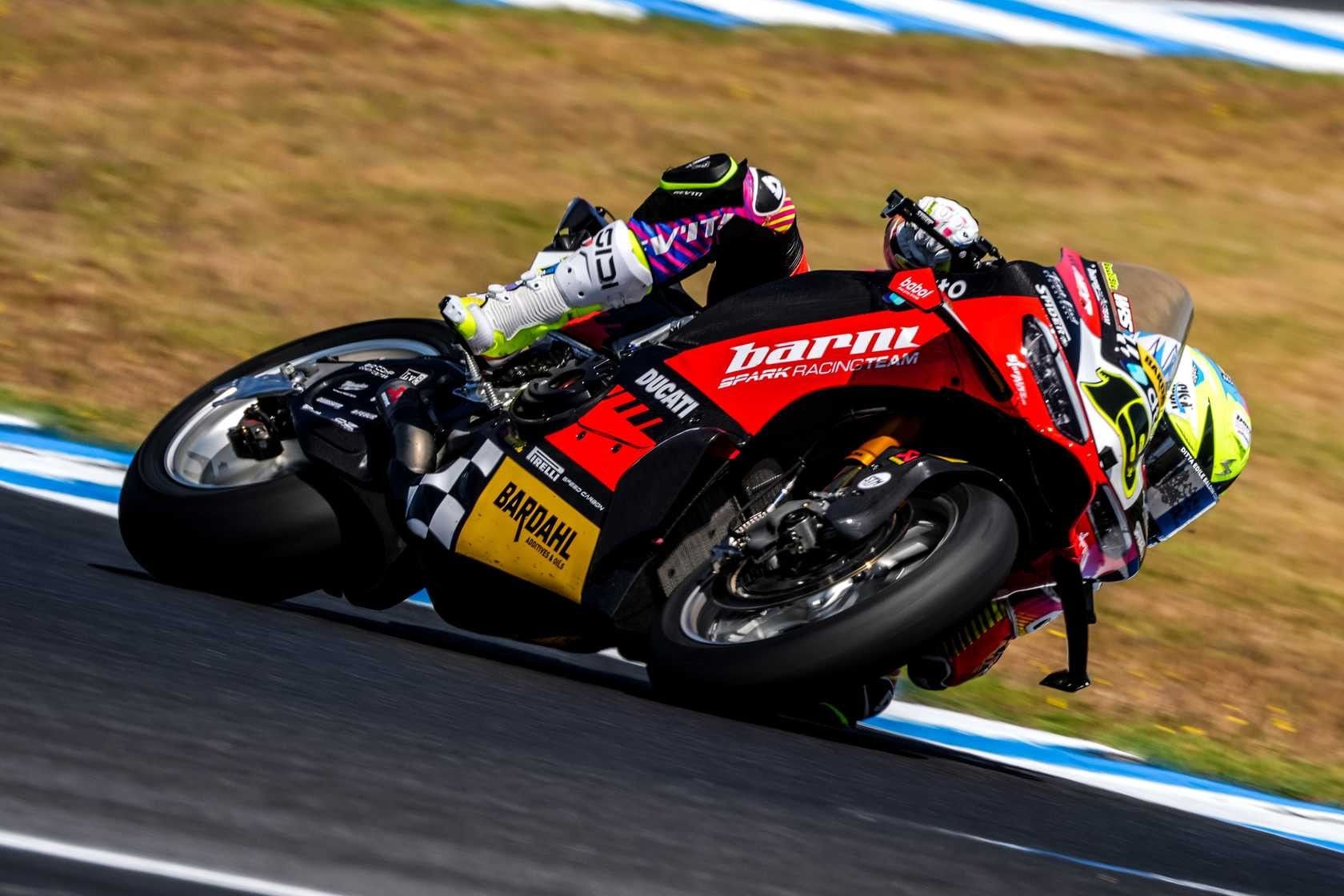 Alvaro Bautista (19) at Phillip Island. Photo courtesy Dorna
-
There were eight crashes during Superbike running, including an early-afternoon fall for Alvaro Bautista (Barni Spark Racing Team) at Turn 5. The double world champion, an eight-time winner at Phillip Island, ended the day eighth fastest, almost a second shy of Bulega's benchmark, but will expect to make gains heading into the next session.
Nicolo Bulega (Aruba.It Racing - Ducati): "It was important to start like this. We have a new bike and during the winter we weren't able to test properly because of the weather. This meant that today was really our first proper day on track. It was important to ride as much as possible and I completed a lot of laps, so I'm happy. We did a good job and we've started the weekend well. Last year the winter testing conditions were better and we arrived in Phillip Island with two or three full test days already completed. This time we're not starting from zero but we have a new bike to understand. It was very hot today so that means we're a few tenths slower than we expected. I'm quite happy with the setup but we can improve in some areas. Tomorrow we'll try to take another step forward and see if we can be competitive for the race weekend."
21_WorldSBK_2026_AUS_Free_Practice_2_Results
Masia leads the way in Supersport
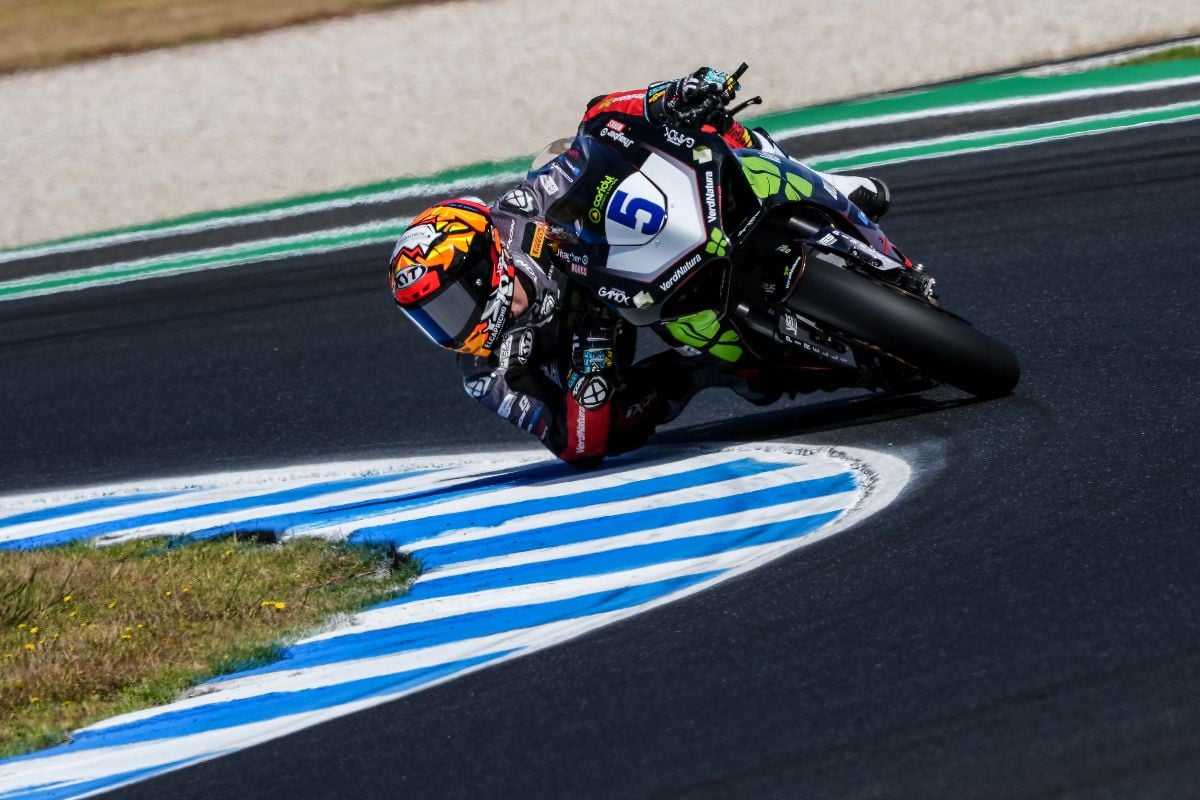 Jaume Masia (5) at Phillip Island. Photo courtesy Dorna
-
Jaume Masia (Orelac Racing Verdnatura) completed 50 laps across both sessions and topped the times in both the morning and afternoon. The two-time race winner in 2025 looked comfortable throughout, completing short stints typically consisting of five laps.
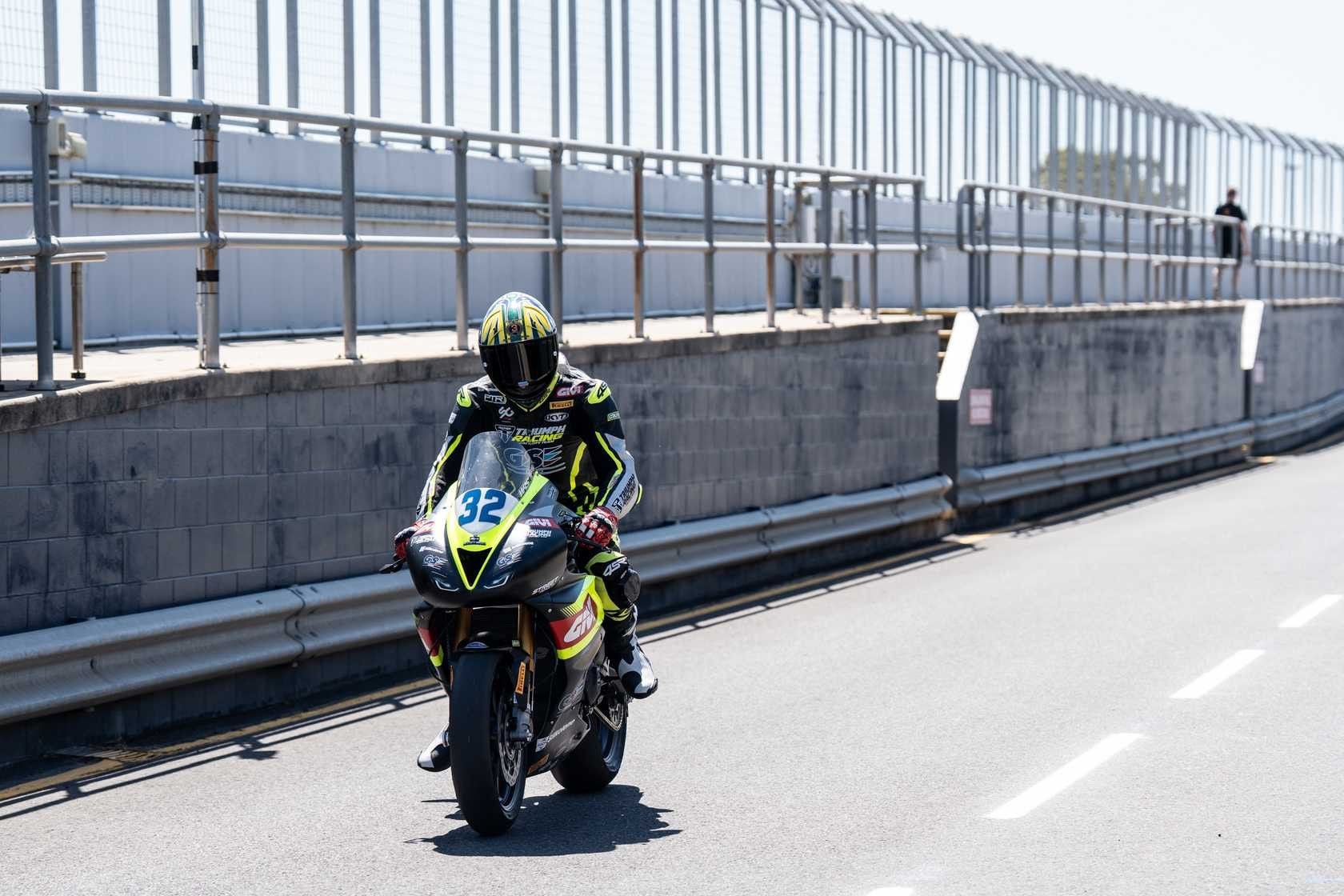 Oli Bayliss (32) at Phillip Island. Photo courtesy Dorna
- Oli Bayliss (PTR Triumph Factory Racing) performed well at his home round. The Australian ended the day second fastest, 0.344s slower than Masia, while Philipp Oettl (Feel Racing WorldSSP Team) was third fastest after completing 64 laps on his Ducati.
- Josh Whatley (Orelac Racing Verdnatura) and Lucas Mahias (GMT94 Yamaha) were the only riders in the top ten to set their fastest times of the day in the afternoon session. The track temperature rose by 15°C, so their improvement was noteworthy, with Whatley ending the day eighth fastest.
-
Double WorldSSP champion Dominique Aegerter returns to the class this year. The Kawasaki WorldSSP Team rider completed 59 laps and set his fastest time on his penultimate lap as he continues to gain experience on the Kawasaki ZX-6R 636.
21_WorldSSP_2026_AUS_Free_Practice_2_Results
The post WSBK: Bulega Sets The Tone on Day 1 of Testing appeared first on Roadracing World Magazine | Motorcycle Riding, Racing & Tech News.
Bullet items for the Fediforum conference in March.
- Subscribing must be easy.
- Some things will work better if they're slightly centralized, esp subscribing.
- Use DNS for naming people.
- Support RSS in and out, and test it once you add the feature, so many easy things to fix remain broken (like titles of the feeds, look terrible in a list of feed titles). RSS is how you earn the "web" in your name. "Web" means something, it's just an intention, there are rules.
- You don't need "open" if you have "web." The web is by definition open. Water is wet. Raises question re what the not-open web is. (Silo.)
- Support the basic features of text in the web. If you shut off the writing features of the web, as Twitter did, you're not really part of the web. Especially linking.
- Listen to users, listen to other developers.
- Automattic is doing heroic work connecting WordPress to ActivityPub. This means that WordPress APIs are now ActivityPub APIs. Not a small thing.
- Look at text coming out of WordPress into Mastodon, the HTML used definitely could be improved. Seems pretty simple things to fix, the simple things matter. Example: WordPress version. Mastodon version of the same post. Let's make this beautiful!
- Keep trying fundamentally new architectures.
- Learn from past mistakes.
- Interop is paramount.
- Don't re-invent.
BTW, this can be read on my blog, on Mastodon, in WordPress and of course my feeds (and thus can be read in any app that supports inbound RSS).
Garrett Gerloff and his Kawasaki WorldSBK Team, plus Jeremy Alcoba and Dominique Aegerter from the Kawasaki WorldSSP Team, will soon take part in a final official pre-season test at the 4.445km-long Phillip Island. Shortly before, they unveiled the full 2026 colours and sponsorship packages of the Kawasaki Ninja ZX-10RR and Ninja ZX-6R 636.
After finding some challenging wet weather conditions in recent winter tests in Europe, the entire Kawasaki WorldSBK and WorldSSP team set-up is now looking forward to two days of dry and settled climatic conditions on which they will take to the track on 16 and 17 February.
Before the testing action took place, the team revealed its WorldSBK and WorldSSP liveries, which feature Kawasaki's green colour scheme extensively, but also an additional touch of blue this time around.
The 2026 sponsor and partner line-up had their logos on prominent display on the latest machines, with a refreshed team and ambitions for a new campaign.
Gerloff enters the 2026 season reunited with a former crew chief, Les Pearson, while Aegerter is a new rider to the Kawasaki WorldSSP Team set-up alongside 2025 rider Alcoba. Dominique is no rookie, however, as he re-enters WorldSSP racing as a double WorldSSP champion from recent years gone by.
After the two days test, the 2026 FIM Superbike World Championship season begins for real at Phillip Island in Australia, between 20-22 February.
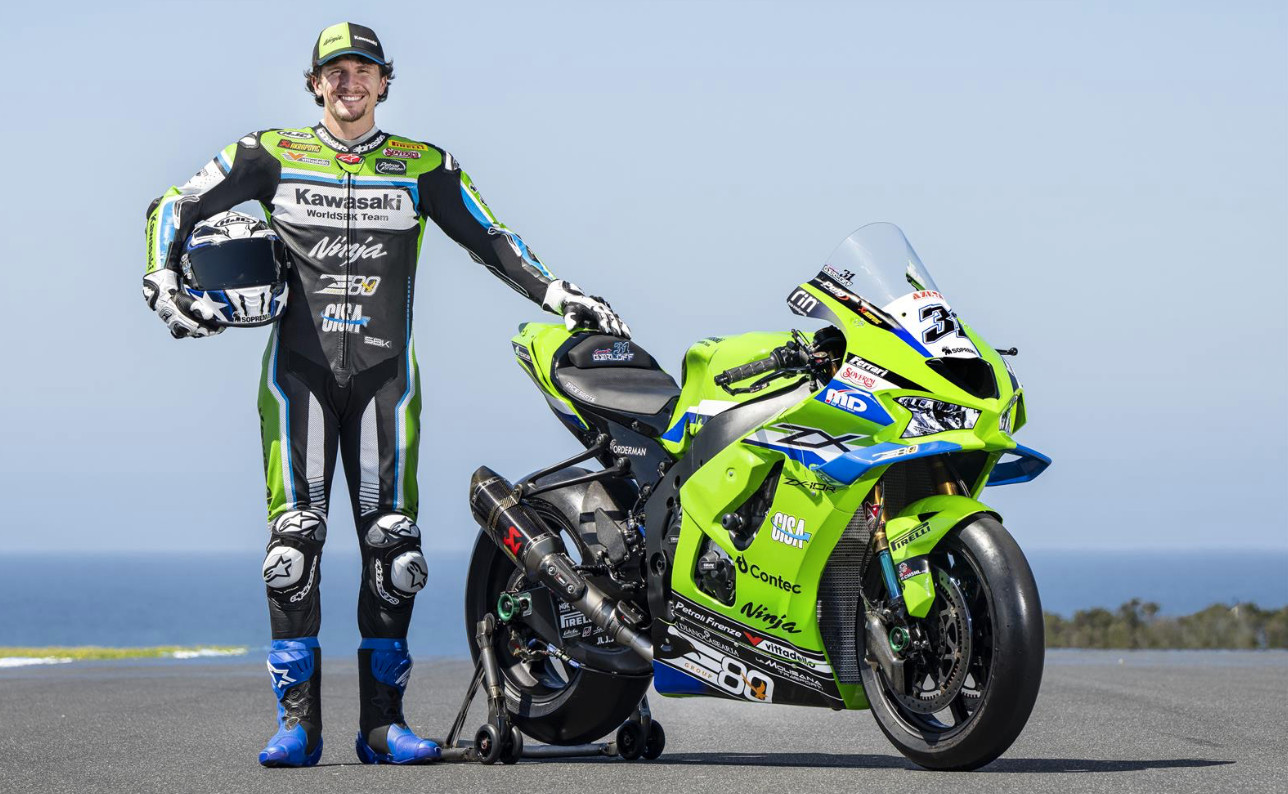 Garrett Gerloff (31). Photo courtesy Kawasaki
Garrett Gerloff stated: "We've travelled a long way to reach Phillip Island, but we can finally enjoy some solid testing time here. I'm confident in my team and in the new Ninja ZX-10RR. That's why I think we can see good results in the official test and, more importantly, in the first round, even though we weren't able to complete the work programme we'd laid out for the winter tests. A lot of time has passed since my last race, and I can't wait to line up on the grid in Australia."
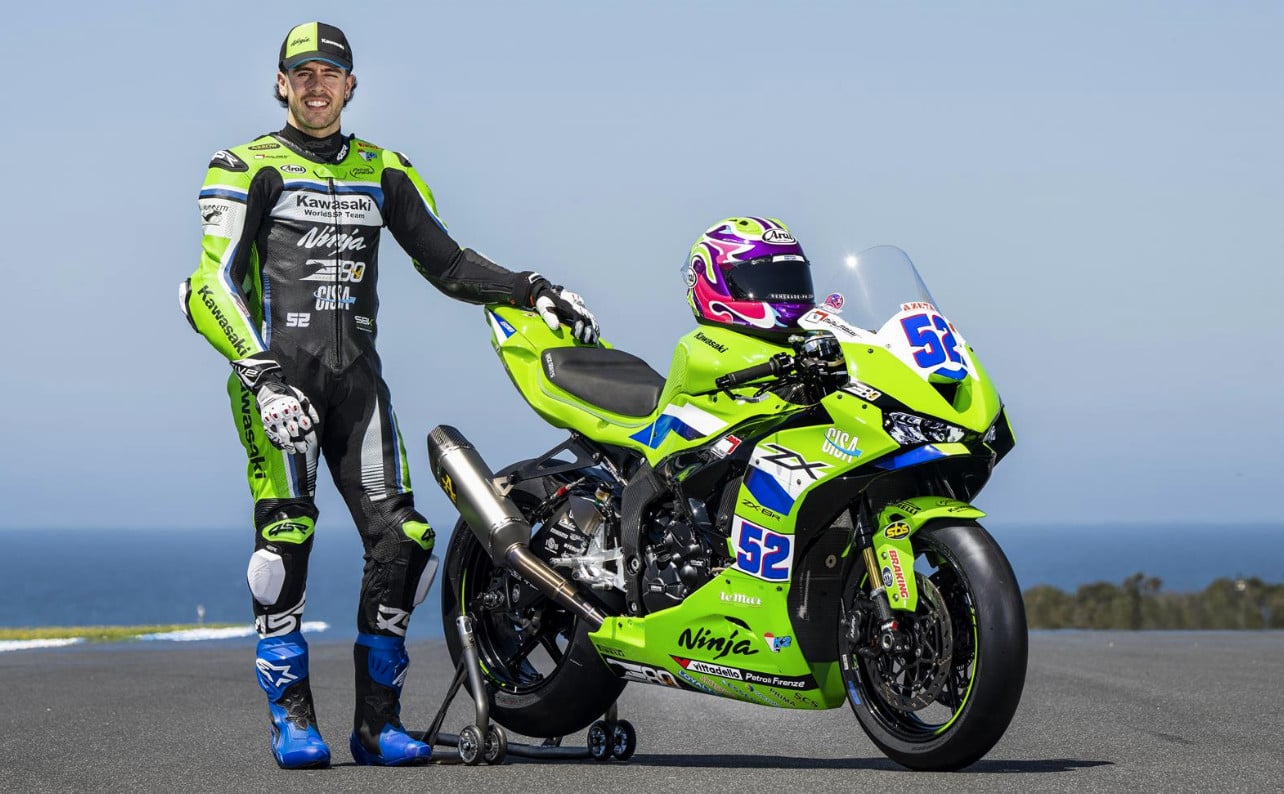 Jeremy Alcoba (52). Photo courtesy Kawasaki
Jeremy Alcoba, stated: "I'm really excited and can't wait for the championship to start. I've trained very hard over the winter and even though we've barely tested on a dry track, the bike feels like mine. I have a great feeling with both my Ninja ZX-6R 636 and my team. We're a very close-knit squad and this is key. I'm keen to get to Phillip Island and start testing, finally making the most of a dry track and pushing to the max with my bike."
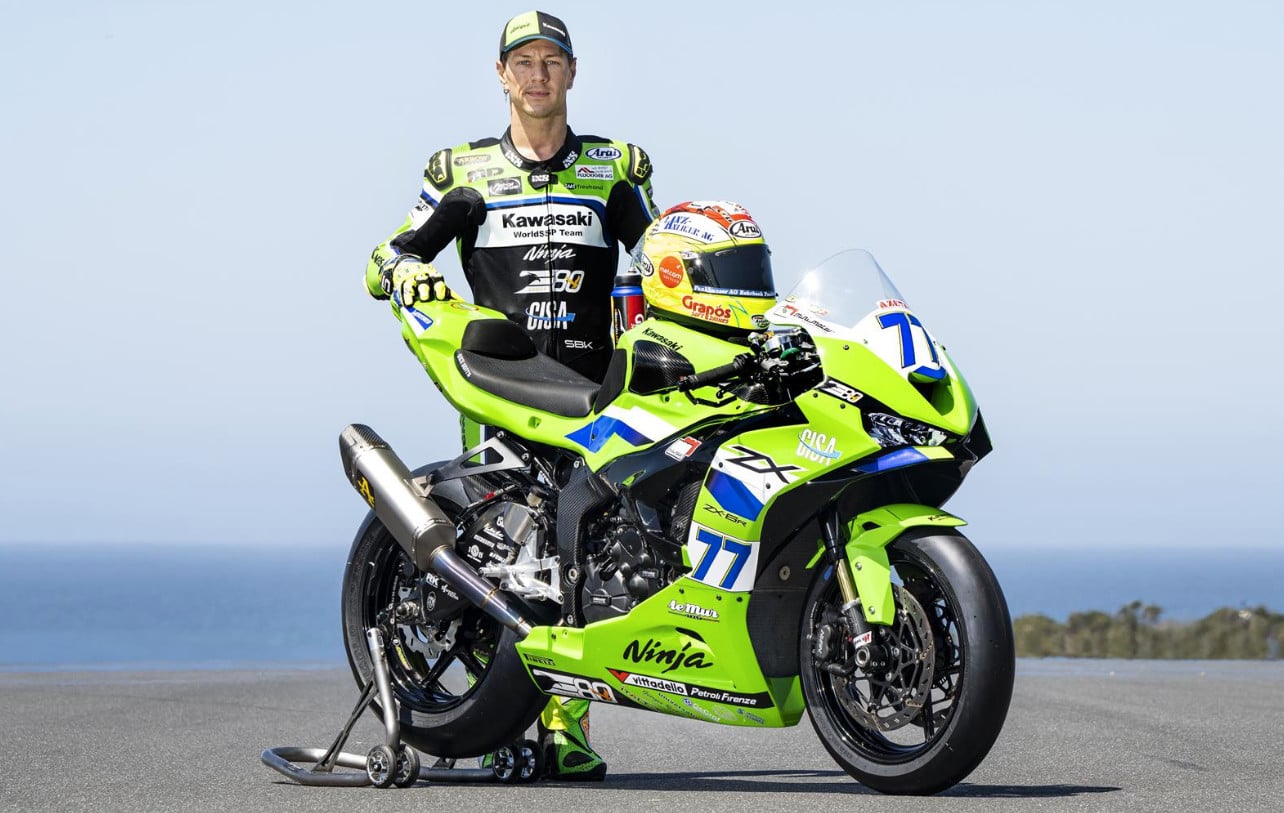 Dominique Aegerter (77). Photo courtesy Kawasaki
Dominique Aegerter, stated: "It's a long way to Australia but it's worth it because the track is amazing and the place itself is beautiful. I can't wait to see my team again and work with my technicians. Because of the bad weather during winter testing I don't yet have a setup to suit my riding style with which to start the tests, and I still need to adapt to riding a Supersport bike again. But the motivation is high and I'm totally ready, both mentally and physically. I can't wait to get testing so that we're all set for the first WorldSSP round."
Manuel Puccetti, Team Principal, stated: "We can't wait to start working and test on a dry track at last. This test will be important in helping us to make the best possible start to the season. The whole team is highly motivated, and we have a lot of work to get through, with many technical updates for both Superbike and Supersport machines. The aim is to complete the full programme to be ready for the first race weekend, which will start just a few days later."
The post WSBK: Kawasaki WorldSBK Team Reveals Final Livery appeared first on Roadracing World Magazine | Motorcycle Riding, Racing & Tech News.

Pressure group Northants Crips Against Cuts has told us of an upcoming protest against Reform-led West Northamptonshire Council. Despite promises of tax cuts, the local manifestation of Nigel Farage's constantly chaotic outfit is planning to raise council tax and slash services.
Campaigners will protest in Northampton on Saturday 21 February from 2pm at the top of Abington Street outside BBC Northampton.
Statement from Northants campaignersWhen Reform UK took control of West Northamptonshire Council (WNC) in 2025, the party promised national tax cuts worth £90bn a year. Eight months later, that pledge lies in tatters. WNC under Reform is no different from when the Tories were in charge.
WNC now plans to raise council tax by 4.95%, meaning the average Band D home will have to shell out nearly £2,000 a year. This brazen U-turn brings more financial misery to people across West Northants.
£32.1m in council cuts and new chargesWNC aims to cut £32.1m from its budget by slashing funding for services and putting up charges, including £10.9m from adult social care. Among these are £2m axed from adult services, £900,000 from learning disability, and £300,000 from temporary housing, as well as new parking charges and insufficient funds to fix the roads.
The council claims that these cuts are "efficiencies," but we see them for what they really are. WNC is launching bare-faced attacks on vulnerable people. The council plans to bring in a handful of one-off grants to appease outraged residents, but these grants will soon run out, leaving our local services in a dire state.
Reform UK, like all the major parties, has chosen to balance the books on the backs of ill and disabled people. Under its new budget, WNC plans to rake in an extra £4.4m by raising charges for social care. People who rely on these services, shamefully referred to as "clients", have already been squeezed to near breaking point by year after year of brutal cuts.
The council cynically claims that people:
have a choice about whether they wish to use these services or not.
More lies. For vulnerable people, these resources are not a choice, they're a vital lifeline. For some, access to adult services is a matter of life and death.
Scapegoating ill and disabled peopleWNC loves to blame disabled adults and children for its failures. This year, the council is set to go £10.5m over budget, and has been quick to point the finger at adult social care, housing, and special educational needs.
What they don't talk about are the millions wasted on town centre vanity projects, many of which were hit by poor planning, delays, and were never needed in the first place. The council has overspent £5.1m on the market square revamp alone, and loaned £3m to H&M to move back into the Grosvenor Centre. Reports say they wasted nearly £200,000 on the ice rink, then misreported the figures. Yet somehow, their shortfall is the fault of vulnerable people.
Councillors insist government legislation blocks them from using capital from one-off projects to fund vital services. If that's the case, why doesn't Reform UK launch a national campaign to scrap those restrictive laws and give councils more autonomy over their finances? This is supposed to be the party's whole argument. Reform claims it wants to get rid of excessive legislation, slash red tape, and bring in "common sense" politics.
Councils like WNC have shown that this is nothing but empty rhetoric. Reform only wants to cut red tape when it allows them and their wealthy mates to get even richer, or to launch more vile attacks against asylum seekers. But when the red tape lets them shirk their responsibility to tackle the cost-of-living crisis, suddenly it's their new favourite excuse. Once again, this is pure hypocrisy from our Reform-run council.
We need full funding nowLocal groups have proposed a brief pause to WNC's budget cuts. Of course, none of us wants these cuts to go ahead. But a pause is not enough. After years of austerity, most local resources are severely underfunded. What good is a year or two of no cuts when so many services are already on their knees?
This plan relies on the council spending its reserves. But what happens when the money runs out? WNC will be free to pass even more severe cuts, only now we will have lost our safety net, leaving us even more vulnerable than we were before.
The only way to solve the cost-of-living crisis is to fight for full funding for all local services.
We are not asking for anything lavish. Healthcare, housing, education - these are basic human rights. We live in one of the world's richest countries. Our council spends millions on town centre vanity projects. Our government spends billions funding wars and genocide abroad. Billions are lost to tax avoidance. So why do we have 14.3 million people living in poverty?
We call for all West Northants councillors to take urgent action. Stop the cuts. Full funding now. No more pointing fingers at sick and disabled people.
Featured image via the Canary
By The Canary
If you have been reading the recent takes on the "legacy EV retreat," including at least one piece published here last week, you have likely seen the narrative that Detroit is just lazy, lobby-happy, and getting exactly what it deserves for dragging its feet. The argument generally goes that if ... [continued]
The post It Isn't That Simple: Why "Free Trade" Needs A New Playbook appeared first on CleanTechnica.
In my recent article on America's new maritime plan, I argued that it was competing for the wrong century by anchoring itself to legacy fuels and industrial logic that made sense when gasoline and diesel dominated global energy demand. A reader asked a question regarding the fuel cost variance for ... [continued]
The post The End Game Economics of Maritime Fuels appeared first on CleanTechnica.
The Highlander was still at the show in the hybrid form. Toyota focused instead on the crowd favorite RAV-4 Hybrid Toyota's push toward full electrification took an unusual turn at the 2026 Chicago Auto Show, where the brand's newest battery-electric SUV — the Highlander BEV — dominated headlines without ever ... [continued]
The post The Highlander BEV: Toyota's Missing Debut at the 2026 Chicago Auto Show appeared first on CleanTechnica.
This isn't about whether 3I/ATLAS is an alien probe. This is about what happens when institutions encounter data they can't control. Every claim below is sourced.
Jan 30 — We break the blackout story. NASA silent.
Feb 3 — Hubble data from the blackout window shows brightness signature "not a standard feature of comets." (arXiv:2601.21569)
Feb 12 — NASA quietly confirms the blackout in a technical paper on arXiv — 13 days after we reported it. Describes data processing methodology matching our December prediction. (arXiv:2602.12364)
Feb 16 — We independently verify the raw telescope data. It's publicly available at MAST. We publish that finding because we follow the data.
Regardless of what this object is, this is classification, data management, and gatekeeping operating across multiple agencies simultaneously, documented in real time.
submitted by /u/TheSentinelNet[link] [comments]
Cycloptery
Seventy-two hours since my cataract surgery and nothing is better. The cornea of my left eye is still swollen and I'm essentially blind (meaning my vision is 20/infinity. It also feels better closed than open, which I'm not sure is a good thing. I'm still wearing a bandana over it. My surgeon says relief will gradually come in a few days. I eagerly await. Meanwhile, if you're depending on me to get work done (and there is lots in my queue), have patience.
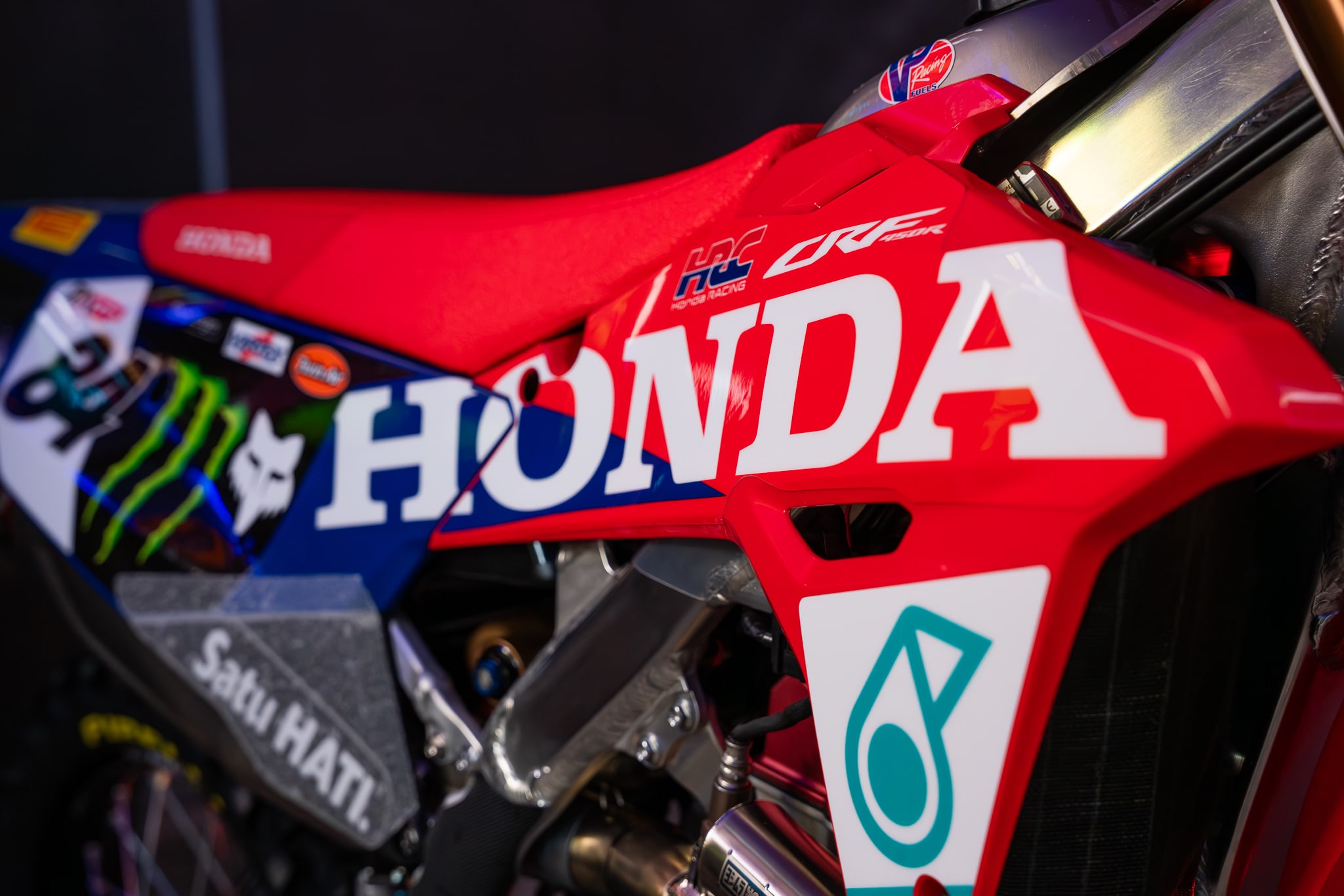
By Adam Wheeler. Photos by HRC/Shotbybavo
In 2019, shortly before society would be ravaged by the fallout of the pandemic and long before KTM Sport Motorcycles lunged into a financial crisis, the Red Bull KTM Factory Racing team entered the MXGP series with the might of Tony Cairoli, defending champion (but absent through injury) Jeffrey Herlings and reigning MX2 #1 Jorge Prado. 14 titles and some of the most impactful dirtbike racers of their generation. And also…Tom Vialle.
The 18-year-old earned his slot on the most decorated Grand Prix squad this century through a late winter 'try-out', overseen by then-Motocross Director Joel Smets. The Belgian felt that this son-of-a-former-racer had the technique and the character to make the step from an inexperienced and middling European Championship runner to a potential MX2 star. It was a brilliant call. Vialle scored a top-three moto result and his first podium finish in only his second Grand Prix with the orange 250 SX-F, after classifying a respectable 7th overall in Argentina - the furthest afield the teenager had ever raced from his base in southern France.
For the rest of 2019 the rookie blended quiet determination and maturity with his natural balance and ability to rank 4th in the world; it was the best performance by a debutant in the class and since the formation of 'MX2' in 2004 (Ken Roczen was 5th in 2009 but had missed the first four rounds until he reached his 15th birthday). Vialle had the runaway stats of Prado as a target, but also as a crutch to remove any elevated pressure or expectation. His union with Smets as a trainer and advisor also brought considerable benefits and the pair would collaborate further for two world titles in 2020 and 2022. Smets would continue to lend counsel as Vialle then scooped two AMA 250SX East titles in the U.S. Four crowns in seven seasons is impressive.
During his four-year blast of MX2, Tom baffled us with his surge of learning. He was a lightning starter on that KTM, and his skinny and diminutive frame helped in this aspect. Sacha Coenen is following the same template. Unlike Coenen (so far), Vialle showed racecraft and race-smarts. He won from the front but also with urgency and ruthlessness when required. He endured and prevailed in two tense neck-and-neck title disputes with Yamaha's Jago Geerts, and continually gave the impression of a young athlete in progression. Even his English language skills and media awareness soared at a rapid rate.
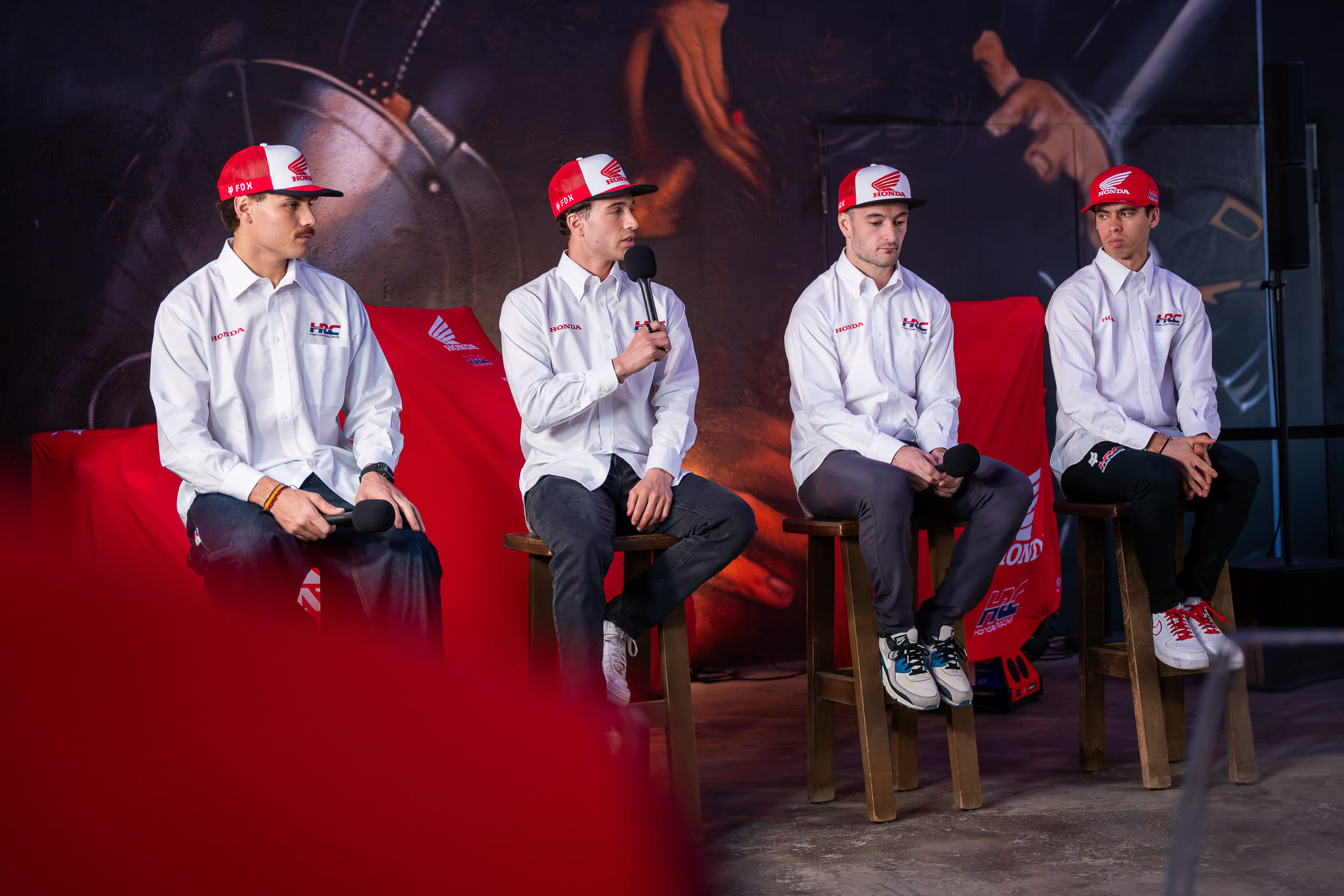
For a racer that moved quickly and achieved quickly, it was ironic that Tom' first career success came in Sweden with a 'solid' 2-2 scorecard. But the attitude and capacity to assess and capitalise would unpin a lot of what he would attain in the United States, where he was often not the fastest but proved to be the wiliest against far more experienced competition, and while throttling up the side of a steep learning curve.
The seven-year association with KTM ended (and supercross 'itch' was scratched) with the lure of factory HRC support for a crack at MXGP for 2026. Before Honda knew they had a chance of acquiring Herlings last summer, the bet on Vialle was hardly a risk and represented something of a coup. His formation in MX2 and his progress stateside provided plenty of evidence that the-now 25-year-old had the intelligence to wade through his third major career adaptation. On paper there are few more 'solid bets' for MXGP transition than Tom Vialle.
True, he can no longer have KTM Team Manager Smets on speed-dial, but he always had his family in back-up mode (they even emigrated with him to the U.S.) and he won't lack resources with Giacomo Gariboldi's Honda set-up. To-date he has had a Jeremy Seewer-esque talent for avoiding major injury setbacks.
As we know, Vialle made his first laps as a Honda rider at the 2025 Paris SX. He then classified 2nd overall to Yamaha-shod Tim Gajser at last week's Internazionali d'Italia at a cold and rainy Mantova, four positions ahead of an underwhelming (but with nine more years of KTM institution to shed) Herlings.
Tom and Jeffrey know each other well having shared an awning for four years and there will be little mutual underestimation. To everyone else, Herlings, 32 in September, is undoubtedly the one with headline billing for 2026 and has been signed to win, rather than develop. Again, this gives Vialle a little wiggle room to make mistakes and to glean HRC's culture, as well as evolve in terms of being a factory employee expected to deliver a modicum of technical feedback for product R&D. If you think this is a moot point then consider the plight of second teammate Ruben Fernandez in 2025, who had to compete in the latter half of the season with the new CRF prototype ("it was still a little bit early for the bike to jump on [in] GPs maybe…but, in the end, it was a lot of good information," the Spaniard admitted.)
Last week HRC fabricated an offline press conference 'event' with journalists invited to submit questions. Tom's reposts were largely lip service, with the usual cliches and platitudes about education, step-by-step and acknowledgements of the difficulty of the class. (Don't forget his 2026 MXGP rookie peers will be former MX2 foes in the shape of Andrea Adamo and Kay de Wolf, two title winners in his absence). His ambition has been emboldened perhaps by the fact that his CV already carries major distinction: no other Grand Prix rider has bagged two MX2/250 world titles and two supercross titles (Marvin Musquin managed three as did Christophe Pourcel so did Roczen). "The goal is to be obviously - in the next year - try to be as successful as I did in the 250 class, so yeah I'm trying to work as hard as I can to get there," he said as part of the HRC transcript, and with understandable conviction.
Thanks for reading! Subscribe for free to receive new posts and support our work.
Tom's status is not without some anticipation, and that is driven by the past exploits of his predecessor Tim Gajser, Romain Febvre, Herlings and Lucas Coenen: all of whom either bagged the premier class championship or ranked runner-up at their first attempts.
Context counts though. Fans should expect some inconsistency and weirdness as an icon like Herlings wades through his transition and Vialle is in the same predicament. He also must readjust to the demands of Grand Prix, which will be far easier for him compared to anybody else from the trenches of SMX but might still need some acclimatisation, as he confessed: "We all know the tracks in the US and in Europe are a little bit different," he said. "The good thing is I know the tracks…but I have to get a little bit back in the rhythm, and get to know again the type of tracks. It's a long weekend in MXGP, we have two days of racing so [it's] a couple things that I have to adapt again."
Herlings is an MXGP monster and HRC have signed attention and profile as much as an athlete born to chase victory, but it is Jeffrey who is the rookie when it comes to significant change. It's quite possible that the lead Honda - at some point this season - could be the #16 compared to the #84. Another stat to support? After his 2019 debut campaign, Vialle won a GP within the first three fixtures each year until, he disembarked to the U.S.
Slow starts and stasis is not his thing.
Apple is planning a major update for its Podcasts app. The entire app is switching to the company's HTTP Live Streaming (HLS) video technology. Previously, it streamed video in various formats like MOV, MP4 and M4V.
This provides several benefits for the end user. It lets people switch seamlessly between watching and listening, in addition to offering a horizontal full display option. It'll also make both video and audio streams available to download for offline viewing. This wasn't possible with the previous streaming method, which pulled content from an RSS-like feed.
The technology integrates picture-in-picture for multitasking on products like the iPad. Finally, the updated app will automatically adjust the picture quality to ensure smooth playback in various network conditions, including both Wi-Fi and cellular.
The update will be available on most platforms, including iOS, iPadOS, visionOS and the web. It's in beta right now, but the company plans a major rollout this spring as part of the upcoming 26.4 operating systems.
This article originally appeared on Engadget at https://www.engadget.com/apps/the-apple-podcasts-app-is-switching-to-http-live-streaming-video-technology-182605612.html?src=rss
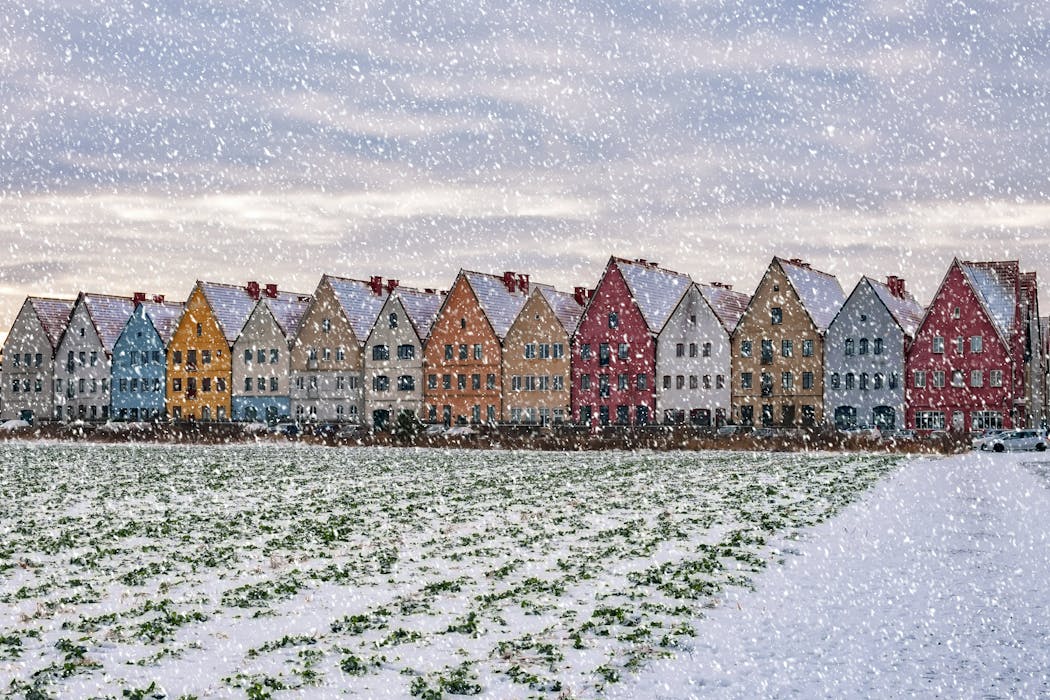 Swedish homes are among the warmest in Europe, reflecting high levels of insulation and longstanding strategies that have kept heating costs low for most households. Antony McAulay/Shutterstock
The new year in Sweden began with some record-breaking cold temperatures. Temperatures in the village of Kvikkjokk in the northern Swedish part of Lapland dropped to -43.6°C, the lowest recorded since records began in 1887.
Yet for the majority of Swedish households, heating is not an issue. Those living in the multi-household apartment blocks that characterise Sweden's towns and cities enjoy average temperatures of 22°C inside their homes, thanks to communal heating systems that keep room temperatures high and costs low. For many households, heating is charged at a flat rate and included in the rent they pay.
*Some interviewees in this article are anonymised according to the terms of the research.
In the UK, meanwhile, home temperatures average just 16.6 degrees, the lowest in all of Europe. At least 6 million UK households fear the onset of cold weather because they are living in fuel poverty - unable to afford to heat their home to a safe and comfortable level.
The problem is exacerbated by the UK's reliance on natural gas to heat its homes - a fuel which suffers from escalating price volatility. They are also the most poorly insulated in Europe, making them difficult to keep warm.
In Britain, home heating isn't just a political hot potato; it has been shown to cost lives. In the winter of 2022-23, 4,950 people were estimated to have died earlier than expected (known as "excess winter deaths") because of the health effects of living in cold homes - including lung and heart problems as well as damage to mental health. In contrast, despite having a much colder winter climate, Sweden's excess winter deaths index was around 12%, one of the lowest rates in Europe and considerably below the UK's 18% figure.
The Insights section is committed to high-quality longform journalism. Our editors work with academics from many different backgrounds who are tackling a wide range of societal and scientific challenges.
So how did two countries that are geographically quite close end up so far apart when it comes to home heating outcomes? As two professors of energy studies - one British, the other Swedish - we have long puzzled over the stark contrast in how winter is experienced inside our homes in the north of England (Sheffield) and southern Sweden (Lund).
For the last three years, we have been researching the modern histories of home heating in both countries (plus Finland and Romania), gathering nearly 300 oral accounts of people's memories of the daily struggle to keep warm at home for long periods each year.
By charting these experiences of home heating in both countries since the end of the second world war, we show how Britain now finds itself struggling to keep its citizens warm in winter while also facing an uphill battle to meet its environmental targets. The stories from Sweden, on the whole, suggest how different things could have been.
Post-war memoriesThe second world war changed many things but not, immediately, the way homes were heated. In the UK coal remained the primary domestic fuel, while Sweden stuck mainly with wood, although coal was becoming more common in cities. Cold homes were still considered normal in both countries, as Majvor* (who is now in her 80s and lives in the Swedish city of Malmö) recalled of her post-war childhood living in a one-room flat:
There was a stove in the room and that was the only source of heat - I have a memory of it being so cold in the winter that my mother had to put all three children in the same bed to keep warm. In the winter, all the water froze to ice, so you had to … heat it on the stove to get hot water.
Despite the cold, many of our interviewees remembered the burning of wood and coal to heat their homes with great affection - although less so the drudgery and dirt that went with it.
"There's just something about a fire, isn't there," Sue (now in her 60s and living in Rotherham, England) told us. "The warmth, the smell, the laughter. It's that family memory and it was just wonderful. Anyone 'round here will tell you the same: life was hard but it was wonderful. We felt loved."
Mary (now in her 70s and also living in Rotherham) is among a very small minority who still heat their home using a coal fire. Her reflections were less positive:
I remember going to fetch coal when I was pregnant. I gave birth two days later … It's the dirt that gets you down, the dirt from the fire. It's disheartening when your walls are always dirty. That's why I had them tiled because I was painting them every six months before that.
Carolina* (now in her mid-30s and living in Malmö) also had a negative recollection of her wood-burning childhood - but for a very different reason. She described how her mother had once "got the axe in her foot … She continued to chop wood anyway - but I kind of got PTSD [post-traumatic stress disorder] from her doing that. So I can't do it, I'm really scared of it."
In Sweden, home heating was seen as key to improving social conditions after the war. The emphasis was on good-quality homes for everyone as the social welfare concept of folkhem ("the people's home") finally gained traction. The idea had first been articulated by future prime minister Per Albin Hansson in a speech to the Swedish parliament back in 1928, as a way of expressing his vision for a fair and equal society.
From 1946, housing construction was regarded as a key political issue for improving public health and achieving Sweden's other social welfare goals. In several cities, municipally owned public housing companies played an important role in the initial phase of new district heating systems, in part by guaranteeing a secure market. The introduction of the varmhyra ("warm rent") policy meant heating and sometimes other utilities were included in the rent - an arrangement that continues to this day in many Swedish apartment blocks.
The UK, like Sweden, suffered the blight of cold homes during the 1940s, exacerbated by fuel rationing that extended long beyond the war. So it is difficult to explain why Britain's new post-war welfare state did not explicitly address home heating.
Instead, the focus was on public health, with the birth of the National Health Service and recognition that the mass burning of coal was leading to fatal air pollution and unhealthy homes. Heavy city smogs, triggered by widespread coal burning in homes and factories, became increasingly common. The problem reached a climax when the "great smog of 1952" killed approximately 12,000 people, primarily in London, over just five days.
The justification for rapidly phasing out coal as the UK's primary fuel for homes and industry was centred around ending the public health crisis of these killer smogs, rather than on changing the way homes were heated - leading to the introduction of the Clean Air Act (1956). And as the UK scrabbled for a cleaner form of heating, a game-changing discovery was made. Huge reserves of "natural gas" (methane) were found off the Yorkshire coast in 1965, offering the huge advantage of reducing visible air pollutants compared with coal.
One man in particular, Kenneth Hutchison, saw and seized the opportunity to present natural gas as the panacea the UK had been waiting for. As incoming president of the National Society for Clean Air, Hutchison hailed the gas industry as the driving force in Britain's "smokeless revolution". From the late 1960s, he drove the rollout of networks piping natural gas into UK households at an incredible rate, demanding: "We must convince the public that central heating by gas is best" over the grime and drudgery of coal fires.
A 1965 advert for 'high-speed' British gas. Video: Anachronistic Anarchist.The chairman of British Gas, Denis Rooke - not an objective witness, admittedly - described the rollout as "perhaps the greatest peacetime operation in the nation's history". Between 1968 and 1976, around 13 million UK homes (of a total of about 15 million) were made ready for connection to the gas network. The cost of converting domestic heating and cooking systems from coal to gas was largely borne by the national gas supplier, making it effectively free to most households.
Our research suggests this transition was presented to UK households as a fait accompli. But most of our UK-based interviewees remembered the advent of natural gas as a major step forward in cleanliness, comfort and convenience. As 75-year-old Rita from Rotherham recalled of moving into a new council estate with gas heating in 1967:
It was like another universe! It was comfortable, everything became less intense - you didn't need so much clothing … The days of cooking on the fire were gone. Fabulous! The boiler didn't have to go all the time - the gas fire could take the chill off.
Britain's gas rollout not only brought gas central heating but other appliances such as gas fridges and fires that further lightened the domestic load. For Rita's and many other families, it felt like a cascade of liberations which made homes brighter and more enjoyable to live in.
Yet half a century later, Hutchison's faith in gas appears less justified. While it certainly cleaned up the UK's visible air pollution, natural gas is methane by another name - a powerful greenhouse gas.
How Sweden 'futureproofed'With a much smaller population and less crowded cities, air quality in Sweden had been less of a concern than in the UK in the immediate post-war period. But in the 1960s, proposals for a mass home-building programme raised fears this could worsen air pollution.
Without the option of "clean" natural gas, Sweden turned to district heating - an idea which had originated in New York in the 19th century. But Sweden committed to it in a big way during the 1960s and '70s, deciding it was the best way to meet the heating needs of the 1 million homes now being built. This decision shaped the way homes in Sweden are heated: today, some 90% of its multi-family apartment blocks are connected to district heating systems - with heat distributed from power plants (usually on the edge of cities) as hot water via a network of pipes.
Upon its introduction, district heating was celebrated for its efficiency, affordability for households (especially when combined with the warm rent policy), and flexibility - it is easy to change the fuel source. For some municipalities, district heating plants opened up opportunities to produce cheap electricity. Whereas UK households were (and remain) largely individually responsible for paying for their heating, in Sweden it was seen as a collective good.
Even the 1973 oil crisis - when geopolitical tensions in the Middle East quadrupled the price of oil - failed to dent public trust in the Swedish approach to home heating. In response to the oil crisis, Sweden moved quickly to change the fuels used to power district heating, introducing more domestic waste and biomass into the mix - a move that, from a climate perspective, now appears a highly prescient shift.
According to Kjell* (now in his 60s, living in a small town in south-west Sweden), 1973 was "when the whole concept changed because suddenly fossil fuels became expensive". He explained:
The expansion of nuclear power [meant] electricity became very cheap … The government promoted the idea that 'now we should use electricity, we should use direct electric heating' … All you had to do was turn a thermostat, press a button, and it was warm.
As well as nuclear power expansion, Sweden doubled down on hydropower production and was among the earliest European countries to invest in other renewable energy sources. Its government was also an early proponent of the now-familiar concept of energy efficiency - encouraging both households and industry to conserve energy and invest in insulation. By the mid-1990s, every Swedish home was rated by the EU as having comprehensive insulation and double glazing as a minimum. The equivalent figure in the UK in 2025 was only around 50%.
The flagship initiative "Seal up Sweden" encouraged households to insulate homes and restrict room temperature to 20 degrees (still almost four degrees warmer than the average UK home today). And the warm rent system gave landlords a vested interest in improving the energy performance of their properties.
Whether it was realised at the time or not, in the defining moment of the oil crisis, Sweden was futureproofing its urban heating systems - and laying the foundations for its enduring reputation as a leader in clean energy and climate policy. Sweden eschewed energy imports in favour of harnessing its own energy assets through expansion in hydropower, waste and nuclear energy - although this latter commitment would soon be tested by the major 1979 accident at Pennsylvania's Three Mile Island nuclear power plant in the US.
The era of power cutsIn stark contrast, the UK's rapid natural gas rollout couldn't move fast enough to protect households from the twin effects of the oil crisis and miners' strikes in the 1970s. Electricity - mostly still generated by coal and oil - was rationed via rolling blackouts. Many workplaces were required to restrict their operations to a three-day week.
With the average British home heated to 13.7 °C at this time (compared with 20-21 °C in Sweden), there was little scope to ask households to cut back further, so nationwide power cuts were imposed instead. Homes were regularly plunged into darkness. Tony (now in his early 70s, from the English town of Whiston on Merseyside) worked as a social worker during this period. He recalled seeing many interiors without doors or bannisters - they had been burnt to keep the family warm.
Extra candles were imported into Britain in 1972 to cope with power cuts. Video: AP Archive.Nonetheless, "clean" gas pioneer Hutchison was feeling vindicated as the UK enjoyed an era of falling gas prices throughout the 1980s. Climate change was still, at most, a nascent agenda, so it didn't seem to matter that British households were living in some of the least energy-efficient (and worst insulated) homes in Europe.
Gas remained affordable through the miners' strike of 1984-85 and privatisation of the gas industry in 1986, with the average household gas bill six times cheaper in real terms than today. Yet British households continued to modestly heat their homes, with average internal home temperatures slowly rising from 16.1 °C in 1990 to 17.8 °C by 1999.
Over the same period, Sweden went through several momentous changes as concern for the environment grew - amid recognition of the greenhouse effect (the build-up of gases trapping heat in the Earth's atmosphere) and acid rain (rainfall made acidic by air pollution). This resulted in another pioneering move: the world's first carbon tax on fossil fuels in 1991, which further galvanised its move away from oil.
Amid Sweden's dash for energy independence, electric-powered home heat pumps increasingly came to be viewed as something of a status symbol. Even households living in multi-family urban apartments were growing increasingly concerned about the monopolistic nature of district heating. They started opting out in favour of individual heat pumps, undermining these collective systems that rely on everyone contributing.
Short-lived progress in the UKBritain was much slower to embrace the need to address the world's climate crisis. One promising intervention finally came in 2006, when Tony Blair's New Labour government required all newly built homes to meet stringent environmental design standards (although this did little to lessen the environmental burden of existing homes).
In turn, higher standards of environmental design in new homes helped establish a market for more environmentally friendly, electric-powered heat pumps in Britain. Installations accelerated from 2004, mainly in social housing. The following year, gas connections peaked at 95% of UK households - then slowly started to fall, down to the current level of 74% across England and Wales.
With this reduction of reliance on gas, the level of emissions associated with heating UK homes also began to decline. Those urging Britain to do something about its position as one of Europe's least environmentally conscious nations celebrated, if cautiously. But this progress, such as it was, proved short-lived.
From 2010, the new Conservative-Lib Dem coalition government began dismantling key initiatives aimed at domestic energy efficiency, including New Labour's Code for Sustainable Homes as well as financial incentives to install heat pumps and renewables such as solar panels. Sales of these technologies started to fall away.
Since then, initiatives to promote adoption of renewable forms of home heating in the UK have been dogged by controversies - such as the renewable heat incentive in Northern Ireland, which resulted in the suspension of senior government officials.
Heat pump technology explained. Video: Nesta.Ambitious plans (driven by the UK's legally binding emissions reduction targets) to install 600,000 heat pumps a year have been met with public suspicion. Uptake is currently at around 50,000 per year - far below the government target.
Since coming to power, the current Labour government has rolled back its manifesto pledge to ban the sale of gas boilers in homes by 2035 - to the consternation of many environmental pressure groups and climate scientists. And while its recent announcement of more comprehensive investment in domestic energy efficiency (as part of the Warm Homes Plan) is a step in the right direction, many experts still consider the level of investment inadequate to secure the scale of change required to meet the UK's net zero climate targets.
A sizable majority (74%) of UK homes are still heated by gas boilers - which emit around twice as much CO₂ each year as some electric-powered heat pumps.
The clean heating conundrumThe volatile political scene in the UK is hampering its transition to clean energy. Reform UK, which has adopted a strident anti-net zero position, has made strong gains with disenfranchised voters, according to numerous polls. Should it gain power at the next general election in 2028 (even if as part of a coalition), Reform is likely to double-down on fossil fuel extraction and use, dealing a severe blow to efforts to wean the UK off its enduring gas dependency.
However, a shift to electric heating would not be an overnight panacea to the UK's energy bill woes. Depending on the energy efficiency of the homes in which they are installed, heat pumps could push bills up in the short-to-medium term, because electricity remains up to five times more expensive than gas.
But as more and more of the UK's electricity is generated from renewable sources, these costs will fall, with some commentators forecasting that from 2028, the UK will start to see positive price impacts of more electricity being generated from renewables. Most UK households will not be able to take advantage of the cheaper clean electricity coming on stream for their heating, though, because they remain locked into their gas boilers.
In contrast, outside Sweden's cities and towns, heat pumps have seen exponential growth since the 1990s, such that it now has one of the world's highest penetration rates, with over a third of homes equipped with them. And the heat generated from these sources is effectively conserved within the country's well-insulated housing stock.
But Sweden is not immune to political controversies around heating. Electricity price spikes in southern Sweden in recent winters have exposed households reliant on direct electric heating (mainly heat pumps) to affordability concerns. These price spikes were driven by a combination of high wholesale electricity prices, the country's limited transmission capacity between price zones, and periods of low wind generation.
At the same time, energy-efficient district heating networks continue to be challenged by the rapid adoption of heat pumps.
The public debate about the future of nuclear power in Sweden also continues to rage. In recent years, political signals have shifted towards maintaining and potentially expanding nuclear capacity, which has increased uncertainty about whether a full phase-out remains a credible policy objective.
The Swedish city of Lund boasts the world's largest low-temperature district heating network. Video: Alfa Laval. Thermal comfort vs thermal restraintThe UK's gas habit has not served it well in terms of securing thermal comfort for its households, with average indoor temperatures of 16.6°C lagging far behind the European average of 19°C. In contrast, Swedish homes are among the warmest in Europe, reflecting both affordability for many and a cultural expectation of thermal comfort.
But these contrasting expectations could yet play an intriguing role in the two countries' home heating strategies. Both countries are entering a new phase where electrification via heat pumps may test the resilience of national grids and the fairness of pricing structures.
Despite greater precarity in the UK, an established tolerance of lower indoor temperatures may mean that, as electricity prices are lowered by increased renewable energy production, UK households can achieve warmer homes using heat pumps than they have been able using gas. Heat pumps have been found to produce up to four times more heat than a gas boiler, using the same energy input.
Conversely, Sweden's cultural expectation of uniformly high indoor temperatures may challenge its future energy sufficiency targets and climate goals, particularly if electrification accelerates as more people - including those living in cities and large towns - seek the independence of heat pumps.
Sweden's traditional system of cost-sharing through varmhyra (warm rent) and district heating has historically promoted equity, but growing societal disconnections and price variations risk eroding that solidarity.
In contrast, Britain has tended to rely on individual responsibility and market-led solutions when it comes to home heating. The UK Warm Homes Plan, launched in January 2026, makes clear that heat pumps are the government's (and many scientists') favoured route to decarbonising domestic heating, with the exception of district heating schemes in a relatively small number of areas. But this requires incentivising households to move to heat pumps while removing short-term financial pain from this move.
Ultimately, our research suggests that many UK households now understand that change needs to come. As Trevor from Whiston told us firmly:
We just can't be doing that now [burning fossil fuels for heating] … Greenhouse gases - it's not on … We've got to find another way, haven't we?
For you: more from our Insights series:
To hear about new Insights articles, join the hundreds of thousands of people who value The Conversation's evidence-based news. Subscribe to our newsletter.

Aimee Ambrose receives funding from the Arts and Humanities Research Council and Horizon Europe.
Jenny Palm receives funding from Forte under CHANSE ERA-NET which has received funding from the European Union's Horizon 2020 Research and Innovation Programme.

There are a lot of changes at Yamaha this year. Rider changes and crew chief changes take the headlines, but will there be a change of fortunes in 2026? That's a lot harder to forecast because while the YZF-R1 is a very capable machine, it is also a very traditional Superbike when compared to some of the other animals on the grid.
Motorcycle racing in general, and WorldSBK in particular, is predatory. Everyone is out for themselves and out to maximise their advantages. In production racing that means starting with the most advanced bike possible. Yamaha has taken a different tact and made a road bike that's capable of being a competitive racing machine. Other manufacturers have taken a different approach and it has allowed their base packages to be more competitive.
This difference is one of the reasons that making Superbike racing more akin to Superstock regulations has always been difficult to envision. If you make everything as standard as possible, as close to the road bike as possible, you also accentuate the differences and deficiencies of one machine versus another.
Steve English Mon, 16/Feb/2026 - 18:00
Canada Goose says an advertised breach of 600,000 records is an old raid and there are no signs of a recent compromise.…
Dutch police have arrested a man for "computer hacking" after accidentally handing him their own sensitive files and then getting annoyed when he didn't hand them back.…
Do not forget about our Annual Awards Banquet next Saturday February 21st, held together with ASRA Racing!
This is one of our favorite gatherings of the year, where riders, families, and friends all come together to celebrate the season in a warm and relaxed setting. You do not need to have won anything to attend. This night is for every rider, every parent, and everyone who has supported MiniGP throughout the 2025 season. WE WILL NOT BE HAVING THE CHILI COOK-OFF. We have catered a lot of food. Date: February 21, 2026 Time: Doors open at 5:00 PM Location: Kathedral Event Center, 499 S Egg Harbor Rd, Hammonton, NJ 08037 Discounted tickets are available online: https://asraracing.com/events/njminigp-atlantic-region-banquet-january-24 Tickets will be more expensive at the door. Cash bar all night. The Martinn, located on the same property, will have rooms available for anyone staying overnight. Room information and reservations: https://themartinn.com/ We hope you'll join us, alongside ASRA Racing, for an evening of good food, awards, and time spent with the people who make this community so special.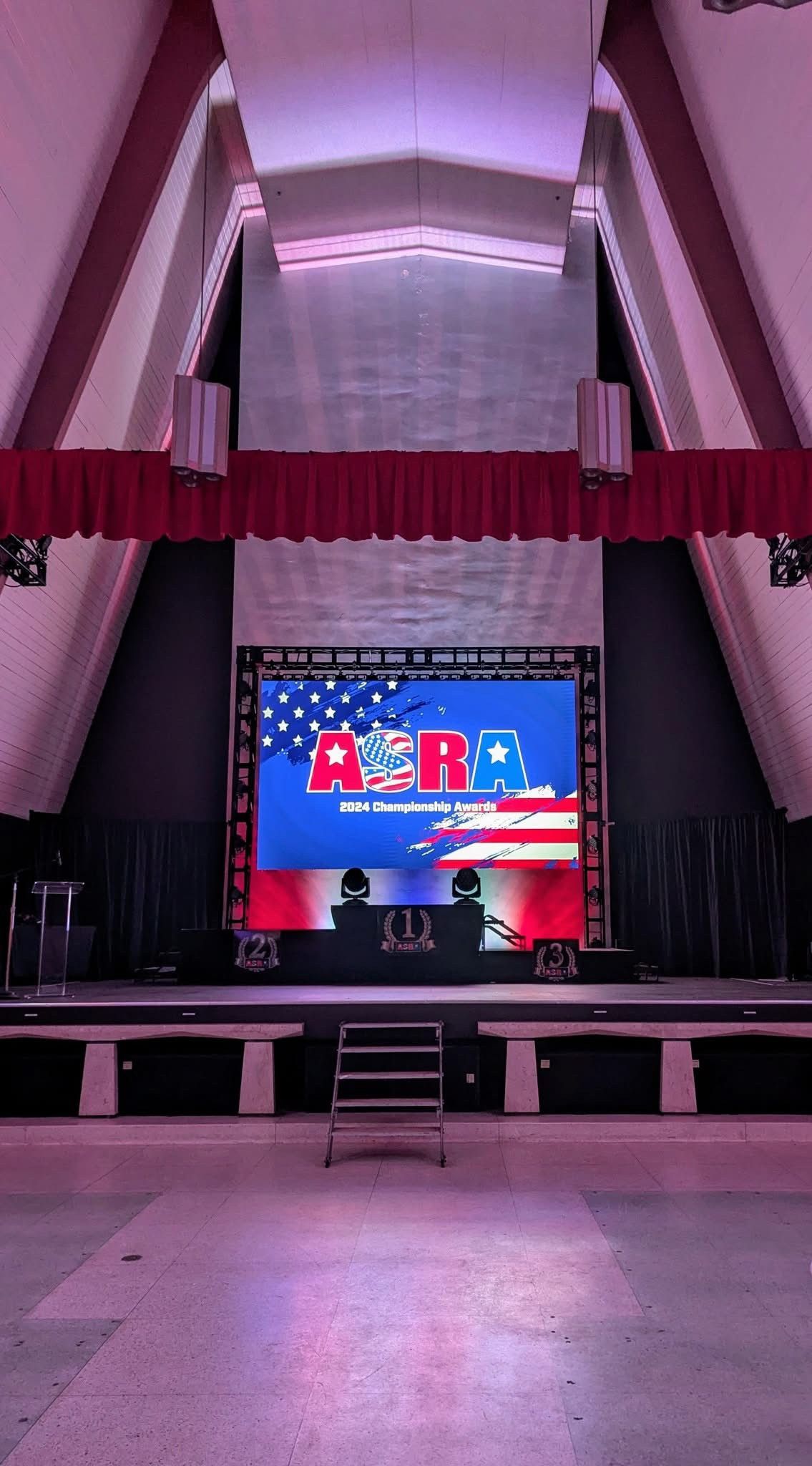 Interior view of the Kathedral Event Center set up for the 2024 ASRA Awards Banquet.
The post ASRA/NJMiniGP Banquet Set for February 21 appeared first on Roadracing World Magazine | Motorcycle Riding, Racing & Tech News.

One of the leading institutes for the training of psychologists, psychotherapists and counsellors is facing a raft of claims from former members of staff. They accuse it of victimisation, whistleblowing and constructive dismissal because they stood up to racism.
The Metanoia Institute in West London has 1,500 students in its undergraduate, postgraduate, and research programmes.
It claims on its website to be:
known for delivering relational, high quality, part-time, university-validated and professionally accredited training in counselling, psychotherapy, counselling psychology, and related disciplines.
Many of its former students have gone on to work in NHS services.
Legal challenge against Metanoia InstituteFive former members of professional staff, Dr Eiman Hussein, Dr Maya Mukamel, Dr Malgorzata Milewicz, Dr Jane Hunt and Cathy Lasher, will commence their legal challenges against Metanoia Institute in a hearing at London Central Employment Tribunal on 24 February 2026, which is due to last for 18 days.
A further claim of racial discrimination was ruled out of time at a preliminary hearing, because the claimants did not originally have expert representation. But the five claimants, psychological therapists, researchers, and trainers, will give evidence that during their time at Metanoia Institute they raised serious concerns about practices that they:
believed and experienced as harmful to students and staff of colour.
Psychotherapist and claimant Dr Eiman Hussein said:
Despite our efforts to address the racism that exists in Metanoia Institute internally, the responses we received were profoundly disappointing with devastating impacts. This Employment Tribunal is our last option to ensure what happened is truly seen, heard and legally tested.
Psychologist, psychotherapist and claimant Dr Maya Mukamel said:
What we both experienced and witnessed at Metanoia Institute speaks to a broader pattern within psychotherapy training institutions, where racism is rife but where the realities and impacts of it are rarely named openly and too often denied or swept under the carpet in an attempt to isolate and silence those who speak up about it.
Psychologist, psychotherapist and claimant Dr Malgorzata Milewicz said:
Our group of claimants, which includes some of us who are white and white presenting, recognises our responsibility to challenge racism within our institutions and professional communities.
Standing alongside our Black, Brown and colleagues of colour is an ethical obligation grounded in anti-oppressive practice. We must examine power, confront our own complicity, and listen when harm is named without defensiveness or retreating into neutrality.
Zita Holbourne, chair and co-founder of Black Activists Rising Against Cuts (BARAC) UK said:
The tenacity and determination of these five courageous women in the face of the most horrific treatment by their former employer because they 'dared' to stand up to Metanoia Institute is to be applauded.
But this case is about more, it is about putting psychotherapy training organisations on notice that we will not allow them to create discriminatory and hostile environments for students and workers and they must be accountable and take urgent action to root out and prevent harmful discriminatory practices.
The Metanoia Institute claimants have received support in their legal challenge from their trade union, the Psychotherapy and Counselling Union, the Black, African and Asian Therapy Network and Black Activists Rising Against Cuts (BARAC) UK and have gained widespread support from others.
The union has pointed out that there is often a "structural imbalance" in such cases. Institutions tend to have the security of insurance and pre-existing legal support. However claimants face huge financial risk and emotional burden.
A crowd funder has generated over £30,000 towards legal fees to date. This is an indication of the shared concern about racism at Metanoia Institute and interest in this case.
Featured image via the Canary
By The Canary

Green leader Zack Polanski says a Green government would sign up to NATO's Article 5 and go to war if necessary. A Sky News interviewer challenged Polanski in an attempted gotcha rather reminiscent of the Corbyn-era.
Polanski told interviewer Trevor Phillips that he took national security very seriously:
That's the first job of a prime ministers, and its the first job of a party leader.
"I would absolutely commit to that."
Green Party leader Zack Polanski tells @TrevorPTweets he would sign up to NATO's Article 5, despite Keir Starmer's claims that he wouldn't.#TrevorPhillipshttps://t.co/9zBRF9VlR2

Content warning: this article contains extensive discussion of suicide
The Good Law Project (GLP) have published the results of a freedom of information (FOI) request which showed that suicides among trans youth spiked massively in 2021. This was immediately after the UK government suddenly halted almost all gender-affirming care for young trans people.
This is particularly significant given that, in 2024, the government published an 'independent' review dismissing the increase in suicides as statistically insignificant.
The review acknowledged 5 suicides. However, thanks to the FOI, we now know that there were at least 22. 22 young people took their own lives because their healthcare was suddenly ripped away by a bigoted, ideologically driven government.
In the week following the GLP's publication of its findings, the BBC has remained completely silent on the government's utter betrayal of trans youth. Instead, it chose to publish an interview with Dr. Hilary Cass, the woman responsible for continuing to deny healthcare to young trans people.
She claimed that children have been "weaponised" by both sides of the trans debate. She also denied preventing kids getting the medical care they needed.
At this point, I can hardly even blame her. I'd probably try to deny everything and blame everyone else too, if I had contributed to deepening the crisis for trans youth.
Tavistock, Bell, CassBack in 2020, the UK High Court ruled that it was "unlikely" that trans children could give informed consent to treatment with puberty blockers. Immediately afterwards, the NHS almost completely ceased puberty-blocking treatments.
A year later, the Court of Appeal overturned that decision. However, the NHS refused to resume its previous treatments. Instead, the then-Conservative government criminalised the prescription of puberty blockers for trans healthcare.
Following a review by Dr. Hilary Cass, the new Labour government also chose to uphold the criminalisation of puberty blockers in 2024. Dr. Cass is not a gender specialist. She had absolutely no experience or publications in trans healthcare, until the government chose her to decide the fate of trans youth.
Her report ignored basic scientific principles, applied impossible evidence standards, and was underpinned by the idea that being trans was itself undesirable. Rishi Sunak appointed her to the House of Lords for her trouble.
WhistleblowersIn 2024, the GLP raised whistleblowers' alarms that the number of suicides among patients at the Tavistock clinic - the UK's youth gender clinic - had risen sharply following the withdrawal of care. At the time, the whistleblowers stated that:
the seven years before the High Court decision there was one death of a young person on the waiting list for Gender Identity Development Services (GIDS). In the three years afterwards, there were 16.
In response, the government commissioned yet another independent review. The reviewer, Professor Louis Appleby, acknowledged just seven deaths in the three years following 2020-2021. The Appleby Review also criticised the GLP and other reporting on the issue, stating that:
Cover-upThe way that this issue has been discussed on social media has been insensitive, distressing and dangerous, and goes against guidance on safe reporting of suicide.
However, the GLP's recent FOI request revealed that the actual number of suicides among trans youth surged to 22 in the year 2021-2022. That's compared to just 5 and 4 in the two years immediately prior to the Bell ruling.
The GLP's press release explained that:
This new data was released via a freedom of information request made to the NHS-funded National Child Mortality Database (NCMD). The NCMD revealed that 46 trans children died by suicide from 2019-2025: 5 in 2019-20; 4 in 2020-21; 22 in 2021-22; and 10 in 2022-23. The NCMD adds "the numbers reported in more recent years will likely be underestimated, due to a higher proportion of child death reviews that have not yet been completed".
It went on to state the the Appleby report's sample size was notably small, focusing on a subset of children who were already at the Tavistock:
'People at the extremes'Forty-four of these deaths were within the time frame analysed for the government report by Professor Louis Appleby on suicides and gender dysphoria. That's almost four times more than the number accounted for by the Appleby report, which stated that only 12 young people (over and under 18) who were current or former patients of the Tavistock took their own lives from 2018-2024.
The Appleby review chose to focus specifically on some - the review itself is not clear - patients connected to the Gender Identity Development Service service at the Tavistock, so would not have accounted for all 44 deaths recorded by the NCMD.
To put that another way, the government massively under-reported the suicides that resulted directly from its decisions. Then, it also blamed whistleblowers for drawing attention to the crisis.
In a normal country, such a massive betrayal of public trust and basic human decency might at least make a single headline.
Instead, the BBC chose to publish a puff-piece interview with Cass, one of the architects of the pitiful state of trans youth healthcare in the UK. In the interview, Cass repeated the spurious claim that children become trans because of gender stereotyping and homophobia:
I think what has kind of misled children is the belief that if you are not a typical girl, if you like playing with trucks, or boys who like dressing up or that you have same-sex attraction that means that you're trans and actually it's not like that but those are all normal variation.
And, following the Appleby report's example, she bent over backwards to point the finger at trans-positive campaigners. The BBC reported that:
The vast majority of people in the middle of the debate were silent while the "people at the extremes" and rhetoric in the media had been "frightening for young people," the clinician said.
She added that some activists for trans rights had been "so strident that it's made it more difficult for trans people themselves who are just trying to live under the radar", while equally people who had taken the view no-one should ever transition had "similarly made it difficult".
What people like Cass will never acknowledge is that trans people shouldn't have to live under the radar. They equate trans people advocating for ourselves with obnoxious activism because they can't abide our speaking up. Our extremist belief is that trans kids are not an aberration, and they deserve healthcare like everyone else.
The issue is that trans adults don't get to look away. We don't get to turn our faces from the trans kids being treated as political punching bags. We can't ignore the suicides within our community.
Those deaths resulted directly from the decisions of the High Court, the Tories and the NHS. Cass and the Labour government upheld those same decisions. If I believed these people had a conscience to speak of, I would hope that knowledge never let them sleep again.
We won't roll over and be silent, because we remember what it was like to be trans kids ourselves. Cass would know that, if she ever had any intention of listening to trans people. But then, listening to us would involve acknowledging our humanity.
Featured image via the Canary

Are you fascinated by the stars, meteors, the aurora borealis? The Orwell Astronomical Society founded in the late 1960s at the height of the 'space-race' offers an opportunity to develop a passion for astronomy. As a registered charity (no. 271313) it exists to promote the science of astronomy in Suffolk. This is done by organising meetings and running occasional night, and sometimes day, observing sessions.
The society has done a great deal of work to uncover the astronomical history of Suffolk and the work of a number of amateur astronomers whose influence on science has been profound.
The Orwell Park ObservatoryThanks to the eccentric Colonel George Tomline (1813-1889), Ipswich has an observatory.
 The Observatory, Orwell Park School image by N Chadwick. CC BY-SA 2.0
Tomline was elected to Parliament for the constituency of Sudbury (Suffolk) in 1840. During a period out of office, Tomline purchased Orwell Park estate from Sir Robert Harland for £102,500 in 1848. He subsequently demolished part of the mansion house and replaced it with the beautiful red-brick structure that stands nowadays. A bachelor his whole life, Tomline liked to entertain weekend guests at Orwell Park and kept a steam yacht moored at the bottom of the gardens for their use. He was fabulously wealthy and built the Felixstowe branch railway entirely from his own pocket.
His interest in the sciences encompassed astronomy, which was at the time was a very fashionable and a rapidly advancing science. In the early 1870s, during a major extension to Orwell Park mansion, he indulged his interest by commissioning the Orwell Park Observatory. His enormous wealth enabled him to demand the best, including employing a professional astronomer, John Isaac Plummer (1845-1925).
The telescope Tomline refractor telescope. Credit OAS(I). Used with permission
Central to the Grade II Listed observatory is a refracting telescope that dates from 1874. It was impressive for its age, boasting a ten-inch (250mm) aperture and a 3.9m focal length. The telescope sits on a German equatorial mount. This means it can reach all points of the sky and needs only a single motor to drive it as it tracks objects as they move across the sky.
The society assists Orwell Park School (the current owners) in maintaining and operating its historic observatory. Much of our early work was in renovating the telescope after a period of several decades of neglect.
Suffolk's amateur astronomersThe society continues to encourage astronomers to follow in the footsteps of past influential Suffolk astronomers. Alice Grace Cook (1877-1958), a lady of leisure, discovered Nova Aquilae in 1918 and was one of the first women to be made a Fellow of the Royal Astronomical Society. So accomplished an amateur astronomer was Cook that she taught John Philip Manning Prentice (1903-81) astronomy. Prentice, another amateur, was a key member of Sir Bernard Lovell's team of (professional) scientists. Their work together led to Lovell building Jodrell Bank - in its day, the largest radio telescope on earth.
Roland Clarkson (1889-1954) 'the Trimley Moon Man' is another. Clarkson had a particular interest in the Moon and was a prolific contributor to lunar studies and mapping the surface.
The Orwell Astronomical SocietyIn addition to weekly meetings at Orwell Park Observatory, the society meets in the Village Hall in Newbourne twice a month. Membership is open to all. We have around one hundred paid-up members, whose annual subscriptions help fund our activities.
Members' images of deep sky and solar system objects are published both on our website and in an emailed monthly newsletter. We have a library and a collection of instruments available for loan to members.


 Aurora Borealis captured by the author from Orwell Park at 10pm 10.10.2024. / The corona and diamond ring of the sun from 2.7.2019 eclipse. Credit Paul Whiting. Used with permission
One of our members has a slot on a local community radio station where he discusses what can be seen in the night sky each month. Our WhatsApp and Facebook groups enable the rapid dissemination of information, for instance when there is a display of the aurora borealis (northern lights). This has been particularly useful over the past year or so, when, due to significant activity on the Sun, these displays have been unusually strong and numerous.
We have an 'eclipse chaser' in our midst who regularly travels the world to record total solar eclipses. These spectacular events, which occur when our Moon completely obscures the Sun, are still the only chance ground-based astronomers get to observe the Sun's corona or atmosphere.
The corona image shows the Sun's "atmosphere", which cannot normally be seen because of the glare form the photosphere. The ray structure that can be seen in the corona is caused by the solar magnetic field lines attracting the charged material or plasma being emitted by the Sun. The diamond ring image shows the last vestige of sunlight before it is totally masked by the Moon. You can also see some activity in the the Sun's chromosphere around the "diamond and opposite it. These are flares or eruptions on the solar surface.
Want to know more?Our lecture meetings are open to the public, with nationally known amateur and professional astronomer speakers.
During the winter months we hold monthly 'taster evenings'. Visitors are invited to tour the Orwell Park Observatory and learn about the various forms of telescope available. If the weather is clear you may even have a chance to view a celestial object using Colonel Tomline's Telescope.
More information about The Orwell Astronomical Society's event may be found here. All are welcome.
More from East Anglia Bylines
 Science
Strange new worlds
byProf Chris Impey 20 September 2022
Science
Strange new worlds
byProf Chris Impey 20 September 2022
 Anglia
The Fermi Paradox and UFOs over Rendlesham Forest
byMartin Waller 2 January 2023
Anglia
The Fermi Paradox and UFOs over Rendlesham Forest
byMartin Waller 2 January 2023
 Featured
How one remarkable Suffolk woman helped shape modern astronomy
byKate Mooreand1 others 11 February 2026
Featured
How one remarkable Suffolk woman helped shape modern astronomy
byKate Mooreand1 others 11 February 2026
 Culture
The haunting cry that brings a creature from another world
byPeter Thurlow 30 December 2025
Culture
The haunting cry that brings a creature from another world
byPeter Thurlow 30 December 2025
 Bylines Network Gazette is back!
With a thematic issue on a vital topic - the rise child poverty, ending on a hopeful note. You will find sharp analyses on the effect of poverty on children's lives, with a spotlight on the communities that are on the front line of deprivation, with personal stories and shared solutions. Click on the image to gain access to it, or find us on Substack.
Journalism by the people, for the people.
The post Spectacular astronomy in Suffolk: past, present, and future first appeared on East Anglia Bylines.
Manu Gonzalez has his Moto2 challenge back on track at the final test of the 2026 preseason. After a washed out test at Portimão, the Moto2 class got a full day of running at the Jerez circuit.
David Emmett Mon, 16/Feb/2026 - 17:02
Other than the new Rivians, the most anticipated new fully electric vehicle may be the Slate pickup truck. There have been many photos of the prototypes and test vehicles, but not a lot of video footage of the Slate being driven. Jay Leno, the noted car enthusiast and collector, got ... [continued]
The post Jay Leno Drives A Slate Pickup Truck (Video) appeared first on CleanTechnica.
All this year, we'll be exploring the many reasons to love heat pump water heaters (HPWHs). Perhaps the top reason is that they save so much money on utility bills. In fact, besides heat pumps for space heating, HPWHs are the appliance with the most potential savings across all household ... [continued]
The post Heat Pump Water Heaters Can Save Over $500/Year On Utility Bills appeared first on CleanTechnica.

Does anyone know how to make the now playing bar at the bottom of the lock screen linger for longer after music has been paused? I keep being annoyed having to reopen the app to press play again when I've quickly taken off my headphones while at the store or something similar. I have attached a picture pointing to the bar in question. Thank you so much in advance
submitted by /u/burschlein[link] [comments]

By Tracy Harms
Special guest blogger
Deep in the roots of Science Fiction are the pulps, disreputable depths from which visions of zombie hordes emerged. Pulp magazines were a most lowbrow medium. This was a medium where SF and Horror smudged together too closely to bother sorting one from the other.
A bit more recently, SF took to centering tales of apocalyptic futures. This subgenre has offered more of a mix between coarse titillations and sophisticated social commentary, and has proliferated so much for so long as to make one wonder whether Science Fiction is always and only portrayals of wildly disastrous futures. It's not, but that's been a sweet spot for sales, exactly as the pulp heritage of SF makes unsurprising. It meshes well with zombies, too.
28 Years Later: Bone Temple is the new release in a film franchise that has all the superficial hallmarks of a comic book. I went in expecting a zombie flick and a gory action flick and a civilization-struggling-in-collapse flick. In these regards I wasn't disappointed, but to my surprise some viewers were. They wanted more zombies and more cathartic sprayings of blood and bones. Tough luck for them. They unwittingly stumbled into a strikingly crafted storyline, a highbrow Science Fiction tale that earns its place among other SF works that insert serious thematic implications where ticket-buyers thought they were choosing pulp shallowness. Such is life.
We're not done with the stereotypes, though. Bone Temple hinted strongly, from the conclusion of the prior film, 28 Years Later, that it would be riffing on Anthony Burgess' A Clockwork Orange, and/or the infamous film version of that story. That classic work of UK SF put an overt eye towards "the future," and particularly to puzzles regarding social cohesion in the face of modern transformations. Might children wind up feral in the absence of adequately civilizing influences? The answer in the world of the Bone Temple is strongly affirmative, most distressingly so.
People, unlike zombies, entail all sorts of complications. People bring moral problems that outweigh mere violent death. The street gangs in A Clockwork Orange were counterposed against establishment institutions. While the police, courts, and psychiatric wards in Burgess' tale were apparently inadequate to prevent gangs from forming and wilding, they were present and poised to intervene and suppress. The world of 28 lacks any such taming powers. The gang that fleshes out most of Bone Temple is in social free-fall.
As a result, 28 Years Later: Bone Temple may be the most alarming horror film I have seen in years. As in: could the world of our future send us to Hell? Not literally the mythological spiritual abode, of course, but a simple human pattern of suffering, ignorance, and evil which easily passes as its namesake. One in which people come to expect, accept, and enact the worst.
Last year's 28 Years Later laid the groundwork and context for Bone Temple. The premise of these movies gives a more blatant origin for the horrid brats who rove in gangs than does Burgess' future. The world was yanked out from under them in their tender years. These films draw us into thoughts about childhood, childhood trauma, and what happens when children are deprived of a decent future. The youthful gangsters clutch to their memories of children's television entertainment. It was the sparkly portion of their past, now cemented in their minds with no mature art to supersede it. Kids' TV is superficial and infantile and so are its post-apocalyptic fans. The global disaster which forms the premise of the 28 franchise implies a generation that was stunted in its development. The tensions between childhood and maturity, between innocence and depravity, are magnified through brazen reference to Jimmy Savile, a UK TV celebrity whose reputation collapsed in a sexual abuse scandal. Do these damaged youngsters know he became thought of as a monster? Perhaps; and perhaps that's why they emulate him. Perhaps not. There's no internet to inform them. I suspect they would not care. To emulate is to honor a past, even a horrid past, whereas indifferent ignorance is the mark of civilizational erasure.
My interest in this film and in its 2025 predecessor started with knowing it's written by Alex Garland. Garland has written some of the best on-screen SF I've seen over recent years. I'm particularly enamored with Annihilation. I thoroughly enjoyed both Ex Machina and the television series Devs. Garland's screenwriting is so consistently strong that I will sit down for anything he pens. The storyline of Bone Temple exceeded my expectations. I was expecting something adequate, like the 2025 film that is its set-up. I got a good deal more.
In my enthusiasm I may have given the impression that this is A Most Weighty Film, which would miss the fact that it doesn't take itself too seriously. Bone Temple is very much crafted to provide an entertaining couple of hours in the theatre, assuming you're eager to see icky stuff, as lots of moviegoers are. It's more in the vein of a graphic novel than a work of literature. Yet, it has stuck with me for its character interactions and its plentiful implications. Strong SF concocts fantastical scenes and, through them, pokes at the human condition. That's everything I wanted from the Pulps, and more.
The Vatican is leaning into AI. AI-assisted live translations are being introduced for Holy Mass attendees — the holy masses if you will. The Papal Basilica of Saint Peter in the Vatican has teamed up with Translated, a language service provider, to create live translations in 60 languages.
"Saint Peter's Basilica has, for centuries, welcomed the faithful from every nation and tongue. In making available a tool that helps many to understand the words of the liturgy, we wish to serve the mission that defines the centre of the Catholic Church, universal by its very vocation," Cardinal Mauro Gambetti, O.F.M. Conv., Archpriest of the Papal Basilica of Saint Peter in the Vatican, said in a statement. "I am very happy with the collaboration with Translated. In this centenary year, we look to the future with prudence and discernment, confident that human ingenuity, when guided by faith, may become an instrument of communion."
Visitors to the Vatican will have the option to scan a QR code. They will then have access to live audio and text translations of the liturgy. It doesn't require an app and should work right on a web page.
The technology stems from Lara, a translation AI tool Translated launched in 2024. Translated claims that Lara works with the "sensitivity of over 500,000 native-speaking professional translators."
This article originally appeared on Engadget at https://www.engadget.com/ai/the-vatican-introduces-an-ai-assisted-live-translation-service-163014907.html?src=rss

