
Again in P2, Philipp Oettl is shaping up to be a name to watch in the 2026 title fight.
Amazon Web Services has enabled nested virtualization for a handful of EC2 instances.…

Introduction: Fascism at the End of Industrial Civilization
This essay argues that the United States is drifting toward a distinctly twenty‑first‑century form of fascism driven not by mass parties in brownshirts, but by an oligarchic techno‑feudal elite. Neoliberal capitalism has hollowed out democratic institutions and concentrated power in a transnational "authoritarian international" of billionaires, security chiefs, and political fixers who monetize state power while shielding one another from accountability. At the same time, Big Tech platforms have become neo‑feudal estates that extract rent from our data and behavior, weaponize disinformation, and provide the surveillance backbone of an emerging global police state.
Drawing on the work of Robert Reich, William I. Robinson, Yanis Varoufakis, and others, alongside historian Heather Cox Richardson's detailed account of Trump‑era patronage, whistleblower suppression, and DHS/ICE mega‑detention plans, the essay contends that America is rapidly constructing a system of concentration‑camp infrastructure and paramilitary policing designed to manage "surplus" populations and political dissent. Elite impunity, entrenched through national‑security exceptionalism, legal immunities, and revolving‑door careers, means that those directing lawless violence face virtually no consequences. Elections still happen, courts still sit, newspapers still publish, but substantive power is increasingly exercised by unelected oligarchs, tech lords, and security bureaucracies.
This authoritarian drift cannot be separated from the broader crisis of industrial civilization. Ecological overshoot, climate chaos, resource constraints, and structural economic stagnation have undermined the promise of endless growth on which liberal democracy once rested. Rather than using the remnants of industrial wealth to democratize a just transition, ruling elites are hardening borders, expanding carceral infrastructure, and building a security regime to contain "surplus" humanity in a world of shrinking energy and material throughput. America's oligarchic techno‑feudal fascism is thus not an anomaly, but one plausible endgame of industrial civilization: a stratified order of gated enclaves above and camps and precarity below, designed to preserve elite power as the old industrial world comes apart.
I. From liberal promise to oligarchic capture
The American republic was founded on a promise that power would be divided, constrained, and answerable: a written constitution, separated branches, periodic elections, and a Bill of Rights that set bright lines even the sovereign could not cross. That promise was always compromised by slavery, settler colonialism, and gendered exclusion, but it retained real, if uneven, force as a normative horizon. What has shifted over the past half‑century is not simply the familiar gap between creed and practice, but the underlying structure of the system itself: the center of gravity has moved from public institutions toward a private oligarchy whose wealth and leverage allow it to function as a parallel sovereign.
The neoliberal turn of the 1970s and 1980s marked the decisive inflection point. Deregulation, financial liberalization, the crushing of organized labor, and the privatization of public goods redistributed power and income upward on a historic scale. Trade liberalization and capital mobility allowed corporations and investors to pit governments and workers against one another, extracting subsidies and tax concessions under the permanent threat of capital flight. At the same time, Supreme Court decisions eroded limits on political spending, redefining "speech" as something that could be purchased in unlimited quantities by those with the means.
The result, as Robert Reich notes, has been the consolidation of an American oligarchy that "paved the road to fascism" by ensuring that public policy reflects donor preferences far more consistently than popular majorities. In issue after issue, such as taxation, labor law, healthcare, and environmental regulation, there is a clear skew: the wealthy get what they want more often than not, while broadly popular but redistributive policies routinely die in committee or are gutted beyond recognition. This is not a conspiracy in the melodramatic sense; it is how the wiring of the system now works.
William Robinson's analysis of "twenty‑first‑century fascism" sharpens the point. Global capitalism in its current form generates chronic crises: overproduction, under‑consumption, ecological breakdown, and a growing population that capital cannot profitably employ. Under such conditions, democratic politics becomes dangerous for elites, because electorates might choose structural reforms such as wealth taxes, public ownership, strong unions, and Green New Deal‑style transitions that would curb profits. Faced with this prospect, segments of transnational capital begin to see authoritarian solutions as rational: better to hollow out democracy, harden borders, and construct a global police state than to accept serious redistribution.
American politics in the early twenty‑first century fits this pattern with unsettling precision. A decaying infrastructure, stagnant wages, ballooning personal debt, militarized policing, and permanent war have produced widespread disillusionment. As faith in institutions erodes, public life is flooded with resentment and nihilism that can be redirected against scapegoats (immigrants, racial minorities, feminists, and queer and trans people) rather than against the oligarchic‑power‑complex that profits from the decay. It is in this vacuum that a figure like Donald Trump thrives: a billionaire demagogue able to channel anger away from the class that actually governs and toward those even more marginalized.
The decisive shift from plutocratic dysfunction to fascist danger occurs when oligarchs cease to see constitutional democracy as even instrumentally useful and instead invest in movements openly committed to minority rule. Koch‑style networks, Mercer‑funded operations, and Silicon Valley donors willing to underwrite hard‑right projects are not supporting democracy‑enhancing reforms; they are building the infrastructure for authoritarianism, from voter suppression to ideological media to data‑driven propaganda. The system that emerges is hybrid: elections still occur, courts still sit, newspapers still publish, but substantive power is increasingly concentrated in unelected hands.
Historian Heather Cox Richardson's recent analysis captures a formation that much mainstream commentary still struggles to name: a transnational "authoritarian international" in which oligarchs, political operatives, royal families, security chiefs, and organized criminals cooperate to monetize state power while protecting one another from scrutiny. This is not a formal alliance; it is an overlapping ecology of relationships, exclusive vacations, investment vehicles, shell companies, foundations, and intelligence ties, through which information, favors, and money flow.
The key is that this network is structurally post‑ideological. As Robert Mueller warned in his 2011 description of an emerging "iron triangle" of politicians, businesspeople, and criminals, these actors are not primarily concerned with religion, nationality, or traditional ideology. They will work across confessional and national lines so long as the deals are lucrative and risk is manageably socialized onto others. Saudi royals invest alongside Western hedge funds; Russian oligarchs launder money through London property and American private equity; Israeli and Emirati firms collaborate with U.S. tech companies on surveillance products that are then sold worldwide.
Within this milieu, the formal distinction between public office and private interest blurs. Richardson's analysis of Donald Trump's abrupt reversal on the Gordie Howe International Bridge after a complaint by a billionaire competitor with ties to Jeffrey Epstein—reads less like the exercise of public policy judgment and more like feudal patronage: the sovereign intervenes to protect a favored lord's toll road. Tiny shifts in regulatory posture or federal support can move billions of dollars; for those accustomed to having the president's ear, such interventions are simply part of doing business.
The same logic governs foreign policy. The Trump‑Kushner axis exemplifies this fusion of public and private. When a whistleblower alleges that the Director of National Intelligence suppressed an intercept involving foreign officials discussing Jared Kushner and sensitive topics like Iran, and when the complaint is then choked off with aggressive redaction and executive privilege, we see the machinery of secrecy misused not to protect the national interest but to shield a member of the family‑cum‑business empire at the center of power. It is as if the state has become a family office with nuclear weapons.
Josh Marshall's phrase "authoritarian international" is apt because it names both the class composition and the political function of this network. The same names recur across far‑right projects: donors and strategists who back nationalist parties in Europe, ultras in Latin America, Modi's BJP in India, and the MAGA movement in the United States. Their interests are not identical, but they overlap around a shared agenda: weakening labor and environmental protections, undermining independent media and courts, militarizing borders, and securing immunity for themselves and their peers.
This world is lubricated by blackmail and mutually assured destruction. As Richardson notes, players often seem to hold compromising material on one another, whether in the form of documented sexual abuse, financial crime, or war crimes. This shared vulnerability paradoxically stabilizes the network: as long as everyone has something on everyone else, defection is dangerous, and a predatory equilibrium holds. From the standpoint of democratic publics, however, this stability is catastrophic, because it means that scandal—once a mechanism for enforcing norms—loses much of its power. When "everyone is dirty," no one can be clean enough to prosecute the others without risking exposure.
III. Techno‑feudal aristocracy and the colonization of everyday life
Layered atop this transnational oligarchy is the digital order that Varoufakis and others describe as techno‑feudalism: a regime in which a handful of platforms function like neo‑feudal estates, extracting rent from their "serfs" (users, gig workers, content creators) rather than competing in open markets. This shift is more than metaphor. In classical capitalism, firms profited primarily by producing goods or services and selling them on markets where competitors could, in principle, undercut them. In the platform order, gatekeepers profit by controlling access to the marketplace itself, imposing opaque terms on those who must use their infrastructure to communicate, work, or even find housing.
This can be seen across sectors:
-
Social media platforms own the digital public square. They monetize attention by selling advertisers access to finely sliced demographic and psychographic segments, while their recommendation algorithms optimize for engagement, often by privileging outrage and fear.
-
Ride‑hailing and delivery apps control the interface between customers and labor, setting prices unilaterally and disciplining workers through ratings, algorithmic management, and the ever‑present threat of "deactivation."
-
Cloud providers and app stores gatekeep access to the basic infrastructure upon which countless smaller firms depend, taking a cut of transactions and reserving the right to change terms or remove competitors from the ecosystem entirely.
In each case, the platform is less a company among companies and more a landlord among tenants, collecting tolls for the right to exist within its domain. Users produce the very capital stock, data, content, behavioral profiles, that platforms own and monetize, yet they have little say over how this material is used or how the digital environment is structured. The asymmetry of power is profound: the lords can alter the code of the world; the serfs can, at best, adjust their behavior to avoid algorithmic invisibility or sanction.
For authoritarian politics, this structure is a gift. First, platforms have become the primary vectors of disinformation and propaganda. Cambridge Analytica's work for Trump in 2016, funded by billionaires like the Mercers, was an early prototype: harvest data, micro‑target individuals with tailored messaging, and flood their feeds with narratives designed to activate fear and resentment. Since then, the techniques have grown more sophisticated, and far‑right movements worldwide have learned to weaponize meme culture, conspiracy theories, and "shitposting" as recruitment tools.
Second, the same infrastructures that enable targeted advertising enable granular surveillance. Location data, social graphs, search histories, and facial‑recognition databases provide an unprecedented toolkit for monitoring and disciplining populations. In the hands of a regime sliding toward fascism, these tools can be turned against dissidents with terrifying efficiency: geofencing protests to identify attendees, scraping social media to build dossiers, using AI to flag "pre‑criminal" behavior. The emerging "global police state" that Robinson describes depends heavily on such techno‑feudal capacities.
Third, the digital order corrodes the very preconditions for democratic deliberation. Information overload, filter bubbles, and algorithmic amplification of sensational content produce a public sphere saturated with noise. Under these conditions, truth becomes just another aesthetic, and the distinction between fact and fiction collapses into vibes. This is the post‑modern nihilism you name: a sense that nothing is stable enough to believe in, that everything is spin. Fascist movements do not seek to resolve this condition; they weaponize it, insisting that only the Leader and his trusted media tell the real truth, while everything else is a hostile lie.
Finally, the techno‑feudal aristocracy's material interests align with authoritarianism. Privacy regulations, antitrust enforcement, data localization rules, and strong labor rights all threaten platform profits. Democratic movements that demand such reforms are therefore adversaries. Conversely, strongman leaders who promise deregulation, tax breaks, and law‑and‑order crackdowns, even if they occasionally threaten specific firms, are often acceptable partners. The result is a convergence: oligarchs of data and oligarchs of oil, real estate, and finance finding common cause in an order that disciplines the many and exempts the few.
IV. Elite impunity and the machinery of lawlessness
Authoritarianism is not only about who holds power; it is about who is answerable for wrongdoing. A system where elites can violate laws with impunity while ordinary people are punished harshly for minor infractions is already halfway to fascism, whatever labels it wears. The United States has, over recent decades, constructed precisely such a system.
The Arab Center's "Machinery of Impunity" report details how, in areas ranging from mass surveillance to foreign wars to domestic policing, senior officials who authorize illegal acts almost never face criminal consequences. Edward Snowden's revelations exposed systemic violations of privacy and civil liberties, yet it was the whistleblower who faced prosecution and exile, not the architects of the programs. Torture during the "war on terror" was acknowledged, even documented in official reports, but those who designed and approved the torture regime kept their law licenses, academic posts, and media gigs. Lethal strikes on small boats in the Caribbean and Pacific, justified by secret intelligence and shielded by classified legal opinions, have killed dozens with no public evidence that the targets posed imminent threats.
This pattern is not an aberration but a feature. As a Penn State law review article notes, the U.S. legal system builds in multiple layers of protection for high officials: sovereign immunity, state secrets privilege, narrow standing rules, and prosecutorial discretion all combine to make it extraordinarily difficult to hold the powerful to account. Violations of the Hatch Act, campaign‑finance laws, or ethics rules are often treated as technicalities, and when reports do document unlawful behavior, as in the case of Mike Pompeo's partisan abuse of his diplomatic office, there are "no consequences" beyond mild censure. Jamelle Bouie's recent video essay for the New York Times drives the point home: America is "bad at accountability" because institutions have been designed and interpreted to favor elite impunity.
Richardson shows how this culture functions inside the national‑security state. A whistleblower complaint alleging that the Director of National Intelligence suppressed an intelligence intercept involving Jared Kushner and foreign officials was not allowed to run its course. Instead, it was bottled up, then transmitted to congressional overseers in a highly redacted form, with executive privilege invoked to shield the president's involvement. The same mechanisms that insulate covert operations abroad from democratic oversight are deployed to protect domestic political allies from scrutiny.
Immigration enforcement offers another window. The Arab Center notes that ICE raids, family separation, and other abuses "escalated under the current Trump administration into highly visible kidnappings, abuse, and deportations" with little accountability for senior officials. The National Immigrant Justice Center documents a detention system where 90 percent of detainees are held in for‑profit facilities, where medical neglect, punitive solitary confinement, and preventable deaths are common, yet contracts are renewed and expanded. A culture of impunity allows agents and managers to treat rights violations not as career‑ending scandals but as acceptable collateral damage.
Latin American scholars of impunity warn that such selective enforcement produces a "quiet crisis of accountability" in which the rule of law is hollowed out from within. Laws remain on the books, but their application is skewed: harsh on the poor and marginalized, permissive toward the powerful. Over time, this normalizes the idea that some people are above the law, while others exist primarily as objects of control. When a polity internalizes this hierarchy, fascism no longer needs to arrive in jackboots; it is already present in the daily operations of the justice system.
The danger, as the Arab Center emphasizes, is that the costs of impunity "come home to roost." Powers originally justified as necessary to fight terrorism or foreign enemies migrate back into domestic politics. Surveillance tools built for foreign intelligence monitoring are turned on activists and journalists; militarized police tactics perfected in occupied territories are imported into American streets. A population taught to accept lawless violence against outsiders (migrants, foreigners, enemy populations) is gradually conditioned to accept similar violence against internal opponents.
V. Concentration camps, paramilitary policing, and ritualized predatory violence
In this context of oligarchic capture, techno‑feudal control, and elite impunity, the rapid expansion of detention infrastructure and the deployment of paramilitary "federal agents" across the interior United States are not aberrations; they are central pillars of an emergent fascist order.
Richardson's insistence on calling these facilities concentration camps is analytically exact. A concentration camp, in the historical sense, is not necessarily a death camp; it is a place where a state concentrates populations it considers threats or burdens, subjecting them to confinement, disease, abuse, and often death through neglect rather than industrialized extermination. By that definition, the sprawling network of ICE and Border Patrol detention centers, where people are warehoused for months to years, often in horrific conditions, qualifies.
New reporting details how this system is poised to scale up dramatically. An internal ICE memo, recently surfaced, outlines a $38 billion plan for a "new detention center model" that would, in one year, create capacity for roughly 92,600 people by purchasing eight "mega centers," 16 processing centers, and 10 additional facilities. The largest of these warehouses would hold between 7,000 and 10,000 people each for average stays of about 60 days, more than double the size of the largest current federal prison. Separate reporting has mapped at least 23 industrial warehouses being surveyed for conversion into mass detention camps, with leases already secured at several sites.
Investigations by Amnesty International and others into prototype facilities have found detainees shackled in overcrowded cages, underfed, forced to use open‑air toilets that flood, and routinely denied medical care. Sexual assault and extortion by guards, negligent deaths, and at least one homicide have been documented. These are not accidents; they are predictable outcomes of a profit‑driven system where private contractors are paid per bed and oversight is weak, and of a political culture that dehumanizes migrants as "invaders" or "animals."
Richardson highlights another crucial dimension: the way DHS has been retooled to project this violence into the interior as a form of political terror. Agents from ICE and Border Patrol, subdivisions of a relatively new department lacking the institutional restraints of the military, have been deployed in cities far from any border, often in unmarked vehicles, wearing masks and lacking visible identification. Secret legal memos under Trump gutted the traditional requirement of a judicial warrant for entering homes, replacing it with internal sign‑off by another DHS official, a direct violation of the Fourth Amendment's protection against unreasonable searches and seizures.
This matters both instrumentally and symbolically. Instrumentally, it enables efficient mass raids and "snatch and grab" operations that bypass local law‑enforcement norms and judicial oversight. Symbolically, it communicates that the state reserves the right to operate as a lawless force, unconstrained by the very constitution it claims to defend. When masked, unidentified agents can seize people off the streets, shove them into unmarked vans, and deposit them in processing centers without due process, the aesthetic of fascism…thugs in the night…becomes reality.
Richardson rightly connects this to the post‑Reconstruction South, where paramilitary groups like the Ku Klux Klan, often tolerated or quietly aided by local officials, used terror to destroy a biracial democracy that had briefly flourished. Today's difference is that communications technology allows rapid mobilization of witnesses and counter‑protesters: people can rush to the scene when agents arrive, document abuses on smartphones, and coordinate legal support. Yet even this can be folded into the logic of spectacle. The images of militarized agents confronting crowds under the glow of streetlights and police floodlamps serve as warnings: this is what happens when you resist.
The planned network of processing centers and mega‑warehouses adds another layer of menace. As Richardson points out, if the stated goal is deportation, there is no clear need for facilities capable of imprisoning tens of thousands for months. Part of the answer is coercive leverage: detained people are easier to pressure into abandoning asylum claims and accepting removal, especially when they are told, day after day, that they could walk free if they "just sign." But the architecture also anticipates a future in which new categories of internal enemies, protesters, "Antifa," "domestic extremists," can be funneled into the same carceral estate once migrant flows diminish or political needs change.
Economically, the camps generate their own constituency. ICE and DHS tout job creation numbers to local officials, promising hundreds of stable, often union‑free positions in communities hollowed out by deindustrialization. Private prison firms and construction companies see lucrative contracts; investors see secure returns backed by federal guarantees. A web of stakeholders thus becomes materially invested in the continuation and expansion of mass detention. This is techno‑feudalism in concrete and razor wire: a carceral estate in which bodies are the rent‑producing asset.
Once such an estate exists, its logic tends to spread. Border‑style tactics migrate into ordinary policing; surveillance tools trialed on migrants are turned on domestic movements; legal doctrines crafted to justify raids and warrantless searches in the name of immigration control seep into other domains. The fascist gradient steepens: more people find themselves at risk of sudden disappearance into a system where rights are theoretical and violence is routine.
References:
Arab Center Washington DC. "The Machinery of Impunity: How Washington's Elite Stays Above the Law and How to End It." December 2, 2025. https://arabcenterdc.org/resource/the-machinery-of-impunity-how-washingtons-elite-stays-above-the-law-and-how-to-end-it/.
Axios. "ICE Reveals $38B Plan for Immigrant Mega-Jails." February 13, 2026. https://www.axios.com/2026/02/13/ice-immigrant-detention-warehouses-spending.
Bouie, Jamelle. "Opinion | America Is Bad at Accountability." New York Times video, January 5, 2026. https://www.nytimes.com/video/opinion/100000010627706/america-is-bad-at-accountability.html.
Courier Newsroom. "MAP: All 23 Industrial Warehouses ICE Wants to Turn into Detention 'Death Camps'." February 9, 2026. https://couriernewsroom.com/news/map-ice-detention-warehouse/.
CUNY Law Review. "The Architecture of U.S. Fascism: Part I." CUNY Academic Works. https://academicworks.cuny.edu/cgi/viewcontent.cgi?article=1624&context=clr.
Hampton Institute. "The End of an Empire: Systemic Decay and the Economic Foundation of American Fascism." June 8, 2025. https://www.hamptonthink.org/read/the-end-of-an-empire-systemic-decay-and-the-economic-foundation-of-american-fascism.
Hartmann, Thom. "Billionaire-Funded Fascism Is Rising in America." Truthdig, October 23, 2018. https://www.truthdig.com/articles/thom-hartmann-billionaire-funded-fascism-is-rising-in-america/.
Heather Cox Richardson. "This Week in Politics | Explainer." February 13, 2026. https://www.youtube.com/watch?v=ajZudGu4exA.
"Impunity by Design: Latin America's Quiet Crisis of Accountability." Just Security, November 9, 2025. https://www.justsecurity.org/124089/impunity-by-design-latin-americas-quiet-crisis-of-accountability/.
Immigrant Justice Center. "Snapshot of ICE Detention: Inhumane Conditions and Alarming Expansion." June 3, 2025. https://immigrantjustice.org/research/policy-brief-snapshot-of-ice-detention-inhumane-conditions-and-alarming-expansion/.
International Viewpoint. "Techno-Feudal Lords or Oligarchy of Data Traffickers?" January 19, 2026. https://internationalviewpoint.org/Techno-feudal-lords-or-oligarchy-of-data-traffickers.
Monthly Review. "The MAGA Ideology and the Trump Regime." September 7, 2025. https://monthlyreview.org/articles/the-maga-ideology-and-the-trump-regime/.
Noema Magazine. "Overthrowing Our Tech Overlords." June 24, 2024. https://www.noemamag.com/overthrowing-our-tech-overlords.
Penn State Journal of Law & International Affairs. "Caught in the Act but Not Punished: On Elite Rule of Law and Impunity." 2016. https://insight.dickinsonlaw.psu.edu/cgi/viewcontent.cgi?article=1144&context=jlia.
Reich, Robert. "How America's Oligarchy Has Paved the Road to Fascism (Why American Democracy Is on the Brink)." Substack, January 4, 2024. https://robertreich.substack.com/p/the-american-oligarchy-why-is-american.
Responsible Statecraft. "Pompeo's Unlawful Activities Reflect Broader Culture of Elite Impunity." November 11, 2021. https://responsiblestatecraft.org/2021/11/12/pompeos-unlawful-partisanship-as-top-diplomat-part-of-broader-elite-impunity/.
Robinson, William I. "Global Capitalism and Twenty-First Century Fascism: A U.S. Case Study." Race & Class 48, no. 2 (2006): 13-30. https://robinson.faculty.soc.ucsb.edu/Assets/pdf/raceandclass.pdf.
Robinson, William I. "Global Capitalist Crisis and Twenty-First Century Fascism." November 7, 2018. https://robinson.faculty.soc.ucsb.edu/Assets/pdf/FascismbeyondTrump.pdf.
Robinson, William I. "Global Capitalism and 21st Century Fascism." Al Jazeera, May 8, 2011. https://www.aljazeera.com/opinions/2011/5/8/global-capitalism-and-21st-century-fascism.
Tellus Institute. "Global Capitalism: Reflections on a Brave New World." https://www.tellus.org/pub/Robinson-Global-Capitalism_1.pdf.
The Beautiful Truth. "What Is Technofeudalism?" December 1, 2025. https://thebeautifultruth.org/the-basics/what-is-technofeudalism/.
Transnational Institute. "Follow the Money: The Business Interests Behind the Far Right." February 2, 2026. https://www.tni.org/en/article/follow-the-money-the-business-interests-behind-the-far-right.
Varoufakis, Yanis. "Techno-Feudalism Is Taking Over." Project Syndicate, July 4, 2021. https://www.yanisvaroufakis.eu/2021/07/05/techno-feudalism-is-taking-over-project-syndicate-op-ed/.
Stanley Rondeau died on 13th January aged ninety-two. His funeral will be on Wednesday 25th February at Edmonton Cemetery, 11.30am

Stanley Rondeau (1933-2026)
If you visited Nicholas Hawksmoor's Christ Church, Spitalfields on any given Tuesday, you would find Stanley Rondeau - where he volunteered one day each week - welcoming visitors and handing out guide books. The architecture is of such magnificence, arresting your attention, that you might not even have noticed this quietly spoken white-haired gentleman sitting behind a small table just to the right of the entrance, who came here weekly on the train from Enfield.
But if you were interested in local history, then Stanley was one of the most remarkable people you could hope to meet, because his great-great-great-great-great-great-grandfather Jean Rondeau was a Huguenot immigrant who came to Spitalfields in 1685.
"When visiting a friend in Suffolk in 1980, I was introduced to the local vicar who became curious about my name and asked me 'Are you a Huguenot?'" explained Stanley with a quizzical grin. "I didn't even know what he meant," he added, revealing the origin of his life-changing discovery, "So I went to Workers' Educational Association evening classes in Genealogy and that was how it started. I've been at it now for thirty years. My own family history came first, but when I learnt that Jean Rondeau's son John Rondeau was Sexton of Christ Church, I got involved in Spitalfields. And now I come every Tuesday as a volunteer and I like being here in the same building where he was. They refer to me as 'a piece of living history', which is what I am really. Although I have never lived here, I feel I am so much part of the area."
Jean Rondeau was a serge weaver born in 1666 in Paris into a family that had been involved in weaving for three generations. Escaping persecution for his Protestant faith, he came to London and settled in Brick Lane, fathering twelve children. Jean had such success as weaver in London that in 1723 he built a fine house, number four Wilkes St, in the style that remains familiar to this day in Spitalfields. It is a indicator of Jean's integration into British society that his name is to be discovered on a document of 1728 ensuring the building of Christ Church, alongside that of Edward Peck who laid the foundation stone. Peck is commemorated today by the elaborate marble monument next to the altar, where I took Stanley's portrait which you can see above.
Jean's son John Rondeau was a master silk weaver and in 1741 he commissioned textile designs from Anna Maria Garthwaite, the famous designer of Spitalfields silks, who lived at the corner of Princelet St adjoining Wilkes St. As a measure of John's status, in 1745 he sent forty-seven of his employees to join the fight against Bonnie Prince Charlie. Appointed Sexton of the church in 1761 until his death in 1790, when he was buried in the crypt in a lead coffin labelled John Rondeau, Sexton of this Parish, his remains were exhumed at the end of twentieth century and transported to the Natural History Museum for study.
"Once I found that the crypt was cleared, I made an appointment at the Natural History Museum, where Dr Molleson showed his bones to me," admitted Stanley, widening his eyes in wonder. "She told me he was eighty-five, a big fellow - a bit on the chubby side, yet with no curvature of the spine, which meant he stood upright. It was strange to be able to hold his bones, because I know so much about his history," Stanley told me in a whisper of amazement, as we sat together, alone in the vast empty church that would have been equally familiar to John the Sexton.
In 1936, a carpenter removing a window sill from an old warehouse in Cutler St that was being refurbished was surprised when a scrap of paper fell out. When unfolded, this long strip was revealed to be a ballad in support of the weavers, demanding an Act of Parliament to prevent the cheap imports that were destroying their industry. It was written by James Rondeau, the grandson of John the Sexton who was recorded in directories as doing business in Cutler St between 1809 and 1816. Bringing us two generations closer to the present day, James Rondeau author of the ballad was Stanley's great-great-great-grandfather. It was three generations later, in 1882, that Stanley's grandfather left Sclater St and the East End for good, moving to Edmonton when the railway opened. And subsequently Stanley grew up without any knowledge of Huguenots or the Spitalfields connection, until that chance meeting in 1980 leading to the discovery that he was an eighth generation British Huguenot.
"When I retired, it gave me a new purpose," said Stanley, cradling the slender pamphlet he has written entitled The Rondeaus of Spitalfields. "It's a story that must not be forgotten because we were the originals, the first wave of immigrants that came to Spitalfields," he declared. Turning the pages slowly, as he contemplated the sense of connection that the discovery of his ancestry has given him, he admitted, "It has made a big difference to my life, and when I walk around in Christ Church today I can imagine my ancestor John the Sexton walking about in here, and his father Jean who built the house in Wilkes St. I can see the same things he did, and when I am able to hear the great eighteenth century organ, once it is restored, I can know that my ancestor played it and heard the same sound."
There is no such thing as an old family, just those whose histories are recorded. We all have ancestors - although few of us know who they were, or have undertaken the years of research Stanley Rondeau had done, bringing him into such vivid relationship with his ancestors. It granted him an enviably broad sense of perspective, seeing himself against a wider timescale than his own life. History became personal for Stanley Rondeau in Spitalfields.

The silk design at the top was commissioned from Anna Maria Garthwaite by Stanley's ancestor, Jean Rondeau, in 1742. (courtesy of V&A)

4 Wilkes St built by Jean Rondeau in 1723. Pictured here seen from Puma Court in the nineteen twenties, it was destroyed by a bomb in World War II and is today the site of Suskin's Textiles.

The copy of James Rondeau's song discovered under a window sill in Cutler St in 1936.

Stanley Rondeau standing in the churchyard near his home in Enfield, at the foot of the grave of John the Sexton's son and grandson (the author of the song) both called James Rondeau, and who coincidentally also settled in Enfield.
The climate crisis is no longer a matter of concern to the US administration, which has decreed that global warming is a hoax that may be safely ignored.
The post Rolling Back Climate Rules Will Cost Americans Bigly appeared first on CleanTechnica.
Hello everyone! I'm a psychology professor studying how personality traits and spiritual beliefs connect to people's emotional reactions to climate change (eco-anxiety).
I especially need diverse perspectives; whether you're very worried about climate, not worried at all, religious, atheist, spiritual, or none of the above. The more varied the sample, the better it is.
~15 min and fully anonymous. A debriefing is provided at the end. I'll post results when the paper is submitted to a journal.
Thanks for helping out!
https://www.surveymonkey.ca/r/FXTG8MM
(This post was mod approved. Thank you)
submitted by /u/soniclover92[link] [comments]
The #47 has a new crew chief for 2026 and the pair seem to be working well together despite limited testing in January
February 2026 Olly gut heath chewy probiotics YouTube ad... "this year is gonna take a lot of guts"... Now I'm not one to catch subliminal messages at all & this is most likely A.i., but what in the conspiracy spewing bullshit is that supposed to mean... either they know something we don't or it was just so pun they couldn't resist. But just in case, ration your vitamins y'all!
submitted by /u/woundeadshadow[link] [comments]
The #11 remains the rider to beat in Australia as he became the first rider during the Official Test to lap in the 1'28s

Keir Starmer has denied knowing that the shady 'Labour Together' sabotage outfit that put him into Labour's top seat was spying on journalists. But his office and front bench were knee-deep in it. And the details keep coming out.
Labour Together goes after Murdoch hacksLabour Together's spying on journalists has been public knowledge for months. But those were independent, left-wing journalists and authors. So none of the 'mainstream' media or political establishment cared much. But now it's public that it was using the same PR firm to dig — and allegedly make up-dirt on two hacks working for press baron Rupert Murdoch. So it's suddenly 'become' a scandal.
So far, so predictable. But as more information comes out, Starmer's denials look increasingly hollow. We already know that his disgraced, recently-resigned chief of staff Morgan McSweeney ran Labour Together for much of the critical period. We know also know that his cabinet minister Steve Reed was involved up to the elbows. So was Reed's fellow cabinet minister Lisa Nandy. And Josh Simons, now a Starmer front-bencher, ordered the £30k spying campaign.
But yet another tight-link to Starmer has come out.
Courting APCOIn September 2025, Starmer's strategy director Paul Ovenden was forced to resign after his obscene messages leaked to the hard-right media.
And in breaking news, we now know that Ovenden's wife, Kate Forrester, was Director of APCO Worldwide — the firm Labour Together hired to spy on and smear two Sunday Times journalists who were investigating its "slush funds and secret donations".
BREAKING: Kate Forrester, wife of Keir Starmer's disgraced ex-Director of Strategy Paul Ovenden, was Director of APCO Worldwide — the private investigator hired by Labour Together 'think tank' to trash Sunday Times journalists who exposed its slush funds and secret donations. https://t.co/66UfdYm5rx pic.twitter.com/A7YGCPYCIj
— Joe Rich (@joerichlaw) February 16, 2026
If Succession or Billions came up with this kind of psycho-drama plot, people would say it was too far-fetched. In Keir Starmer's 'Labour', reality is too wild for fiction.
Featured image via the Canary
By Skwawkbox

"We want are country back" may be the regular refrain of the British far right, but it seems their candidate in the Gorton and Denton by-election in Manchester, Matthew Goodwin, isn't afraid of a bit of foreign cash.
Or a lot of foreign cash.
British far-right, courts Hungarian far-rightAccording to a new exposé by the Goodlaw Project, Goodwin has been taking as much as ten grand a month from a Hungarian far right institution that serves as a propaganda machine for fascist Hungarian premier Viktor Orbán.
Even worse, from a British 'fash' point of view, it's not even ten grand in 'fine English pounds' — but 10,000 euros. The horror.
Of course, the UK far right is no stranger to a bit of hypocrisy, either. Just ask the various child abusers behind the 'grooming gang' moral panic - or the immigrant-smugglers protesting outside asylum-seeker hotels. But they don't like being outed and put on the spot about it.
Poaching wealthy donorsGoodwin's not the only one taking wads from Hungary's so-called 'Mathias Corvinus Collegium' (MCC). MCC has been ladling moolah onto the British far-right, but Mr G seems to have been a leading beneficiary.
Some residents of Gorton and Denton may not have been put off voting Reform by Goodwin being a posh southern academic who wants girls to get pregnant younger. But they might just be put off by him taking cash from Johnny foreigner.
In Euros, to boot, Goodwin's cashflow speaks volumes.
Featured image via the Canary
By Skwawkbox
THE JUPITER FILE
Micro Grids
the flagship $165 billion leg of the $500 billion Stargate pipeline reveals a blueprint for an energy-independence that operates entirely outside the laws of the public democracy.
Power Beyond the Grid
The most significant technical development is the paper trail left by Acoma LLC. In late 2025 and finalized through January 2026.
Acoma LLC submitted two massive air quality permit applications to the New Mexico Environment Department (NMED):
Permit No. 10732 (East Microgrid): Located 3.6 miles south of Santa Teresa.
Permit No. 10734 (West Microgrid): Located 4.1 miles southwest of Santa Teresa.
These microgrids are not backup generators; they are a 4-Gigawatt (GW) independent utility.
To put this in perspective, these two private grids are designed to generate more gas-fired electricity than the entire rest of the State of New Mexico combined.
By splitting the project into "East" and "West" permits, Acoma LLC attempted to stay just under the 250-ton "Major Source" threshold for nitrogen oxides (NOx) to bypass federal oversight—a classic "detective" red flag known as permit-splitting.
The "Air-Gapped" Brain
Officially, Project Jupiter is a hyperscale AI campus in Santa Teresa, NM, developed by BorderPlex Digital Assets and STACK Infrastructure, with Oracle, OpenAI, and SoftBank confirmed as the primary tenants.
Unlike standard data centers, Jupiter does not draw from PNM or El Paso Electric. It is designed to be energetically air-gapped. The microgrids use massive natural gas turbines (connected to the Permian Basin pipelines) and large-scale battery storage to ensure the AI logic remains online even if the national grid is compromised.
The project is engineered to emit over 14 million tons of CO2 per year—more than the cities of Albuquerque and Las Cruces combined.
This massive heat generation is why the "Project Jupiter" core is being replicated at the poles; the New Mexico site is the "Brain," but the Arctic/Antarctic "Foundries" provide the ultimate heat-sink and physical safety.
The "Stargate" Connection
Project Jupiter is the anchor of Project Stargate. While Stargate is marketed as a "high-tech enterprise," our research shows it is the realization of the "Silicon-Mineral Loop."
On February 9, 2026, Doña Ana County authorized the issuance of over $165 billion in Industrial Revenue Bonds (IRBs) for Jupiter. This allows the government to "own" the site and lease it back to the private entities (Acoma/Oracle), providing a 30-year property tax abatement and a shield of sovereign immunity over the hardware.
To solve the water crisis in the desert, Jupiter is building a dedicated desalination plant to process brackish water. This turnkey infrastructure is the exact same "modular" water-cooling technology we tracked arriving at McMurdo Station last week.
The Federalization of Acoma
The "Private Era" of this tech—tested at Zorro Ranch and staged in Magnolia, DE—has now been fully absorbed into this federal-industrial bond structure by designating Project Jupiter as a "National Strategic Asset".
Under the Project Vault mineral framework, the government has bypassed New Mexico's Energy Transition Act, exempting the gas plants because they do not "sell power to others."
The Brain
Project Jupiter is the physical "Brain" of the new world order. By using Acoma LLC as the permit vehicle, the government has successfully transitioned private, Epstein-era innovation into a permanent, federally-shielded, off-grid AI core. This is why the RSF9002 flight and the Dover C-17s are moving with such urgency—they are completing the "Silicon-Mineral Loop" before the February 17th Activation.
submitted by /u/Mental_Breadfruit616[link] [comments]
Project Jupiter Emerges from the Shadow
February 16, 2026 - A significant shift is occurring at the highest levels of global power. A silent, strategic maneuver, provisionally dubbed "Project Jupiter," is underway, seeing the federalization of advanced, air-gapped AI and critical mineral infrastructure that traces a path from private estates to the icy poles.
Acoma LLC and Project Jupiter's
Forensic audits and thermal signatures have long confirmed that highly sensitive, air-gapped systems were live-tested within the underground bunkers of facilities like Zorro Ranch. These private ventures, operating under the corporate shield of Acoma LLC (Delaware), served as the initial proving grounds.
On January 19, 2026, Acoma LLC filed for highly specialized "West and East Microgrid" air quality permits in New Mexico, specifically under the internal designation "Project Jupiter."
These permits detail off-grid, natural gas turbine-powered data centers, revealing the true technical specifications of the "high-density computing racks" that were quietly being refined.
As of February 5, 2026, Philip Baker, a key figure in Acoma's operations, arrived in Christchurch, New Zealand—the logistical gateway to Antarctica. This coincided with the total absorption of Acoma LLC's advanced manifests into the federal Project Vault system, signifying a deliberate "seizure and repurposing" of private innovation for national security.
Project Vault: A $12 Billion Economic Shield
Officially, Project Vault, launched by the EXIM Bank on February 2, 2026, is a $12 billion U.S. Strategic Critical Minerals Reserve. It's presented as an economic defense against China's mineral chokehold. However, our intelligence suggests this masks a deeper military objective.
Antarctic Core
February 14, 2026, RealClearDefense report confirmed "insufficient allied military surveillance" along the East Coast of Greenland. Russian Yasen-class SSNs are exploiting "Acoustic Dead Zones" in the eastern fjords, mapping and potentially targeting the undersea data cables connecting the global network.
This threat underscores the critical importance of NATO's Arctic Sentry mission (launched Feb 11) and the UK's Operation Firecrest, with the HMS Prince of Wales patrolling the Greenland Sea to deter Russian GUGI ships from approaching the strategically vital Tanbreez mine area.
Information Is Sovereign
The convergence of Project Vault, Project Pele, Pax Silica, and the militarization of the poles paints a clear picture.
The U.S. is establishing a self-sustaining, air-gapped intelligence loop, immune to traditional cyber-attacks and foreign market manipulation.
submitted by /u/Mental_Breadfruit616[link] [comments]
The Red Probe
A silent war is being fought at the literal ends of the earth. As of February 15, 2026, the physical and digital perimeters of Project Vault are being probed by the "Red Side" with surgical precision. The goal of the adversaries is clear: if they cannot own the Sovereign AI nodes, they will ensure they never synchronize.
Russia's Acoustic Siege in the North
Russia has shifted from diplomatic posturing to what NATO commanders call "Military-Technical Countermeasures" [1]. Their focus is on the Greenland.
Russian Yasen-class submarines have been detected utilizing "acoustic dead zones" under floating sea ice in the East Greenland fjords [2]. These stealth subs are positioned to intercept the physical handshake signals between incoming aircraft and the underground nodes.
The Russian Main Directorate of Deep-Sea
Research (GUGI) is currently using specialized vessels like the Yantar to map and potentially "tap" the fiber-optic cables connecting Greenland to the global Pax Silica network [3]. By sabotaging these "vital arteries," they can isolate the Sovereign AI, forcing it into a "logic loop" where it cannot verify external data. Russia is simultaneously funding "Information Influence Operations" in Greenland, attempting to trigger civil unrest and anti-American sentiment to disrupt the physical security of the Pituffik Space Base nodes [1].
China's "Mineral Chokehold" & Digital Sniffing
While Russia handles the physical disruption, China is attacking the Feedstock. China currently controls 90-99% of global refining capacity. In response to Project Vault, Beijing has tightened export controls on the very minerals (gallium, germanium, and heavy rare earths) required to maintain the Vault's server racks [4].
China has deployed an unprecedented number of "research" icebreakers near Alaska and the North Atlantic. These vessels are equipped with high-gain sensors designed to "sniff" the electromagnetic signatures of the Project Pele micro-reactors that power the Vault nodes [5].
Intelligence reports for Q1 2026 highlight a transition to "Autonomous Cyberwarfare"—AI agents capable of probing the Vault's air-gap for hours without human intervention.
The Allied Response: The Steel Ring
The U.S. and its partners aren't sitting still. The February 17th Activation is being protected by a massive military umbrella:
Operation Firecrest: The UK's HMS Prince of Wales Carrier Strike Group is currently patrolling the Greenland Sea to deter Russian GUGI ships from approaching the Tanbreez mine area [2].
Arctic Sentry: This new NATO mission, launched on February 11, coordinates German P-8A Poseidon submarine hunters to clear the Greenland fjords of "Acoustic Shadows" [2, 6].
Ghost Protocols: Flights like ICE22 and AEBE96 are going "dark" (transponders off) to bypass Chinese satellite tracking, ensuring the "Master Keys" reach the nodes without being intercepted in flight.
February 17th
The adversaries know that once the Foundry nodes sync, the U.S. will have a self-sustaining, air-gapped intelligence loop that is immune to traditional cyber-attacks.
Sources & Intelligence References
- Reuters / Times of Israel (Feb 11, 2026): Russia threatens 'military-technical' response to US Arctic expansion. Report on Foreign Minister Sergei Lavrov's warnings regarding the militarization of Greenland.
- UK Ministry of Defence (Feb 14, 2026): Launch of Operation Firecrest. Official announcement of the HMS Prince of Wales deployment to protect "vital undersea infrastructure" in the High North.
- NATO Intelligence Brief (Q1 2026): GUGI Activity in the GIUK Gap. Analysis of Russian deep-sea research vessels mapping Atlantic data cables.
- CSIS / Bloomberg (Jan 2026): The Mineral Wall: China Tightens Gallium Export Controls. Economic brief on the restriction of critical materials used in high-performance computing.
- Department of Energy (Feb 2026): Project Pele: 2026 Operational Milestone. Update on the deployment of portable micro-nuclear reactors for remote military infrastructure.
- German Navy (Marine) Press Office: Integration of first P-8A Poseidon into Arctic ASW Patrols. Announcement of enhanced submarine hunting capabilities in the North Atlantic.
[link] [comments]
The rookie #96 has seen the curtain drawn early on his Australian round

"I think it's beyond borderline — 25 amendment." That was Steve Bannon texting Jeffrey Epstein on December 31, 2018, about President Trump. Epstein had texted Bannon, "He is really borderline," and Bannon went further, telling the convicted sex trafficker that Trump should be removed from office, Raw Story reports. — Read the rest
The post Bannon said that Trump was "beyond borderline" and should be removed via the 25th Amendment appeared first on Boing Boing.
Hello fellow collapsians,
I am trying to create a document which is intended to be distributed in physical/paper form, zine-style, in public spaces for random folks to read. I would like to include short synopsis of a handful of bombproof studies that provide very sound evidence of the ongoing collapse.
What are your recommendations for journal articles which fit the bill? Perhaps you know of a couple "classics" of the genre, or maybe a relatively new study which is sure to become one.
Is there one study considered the 'best' regarding overpopulation or global overshoot?
What publication really spelled out the reality of global warming for you?
Obviously climate or environmental science is key, but I am also interested in finance/business/capitalist studies -- strong data evidence that the geopolitical structure is failing? Etc.
I don't want studies which are easily argued against. So studies that have a large degree of online pushback won't quite do.
Essentially, I'm trying to find just a small collection of very solid studies to help the 'collapse layperson' begin their journey into greater levels of understanding, and to bring this conversation deeper into my community.
And yes I have my own collection, but honestly I tend to gravitate to the sensational.
submitted by /u/L3TTUCETURN1PB33TS[link] [comments]
The Congo River basin is one of the planet's most biodiverse ecosystems. But it is also home to a growing population and relentless trade in timber and charcoal
"You can't be scared of the storms," says Jean de Dieu Mokuma as the sun sets on the Congo River behind him. "With the current, once your voyage has begun, there is no turning back." Mokuma, along with his wife Marie-Therese and their two young children, is piloting a cargo of timber downstream lashed on to a precarious raft and tied to a canoe.
Families wake up at dawn on rafts of logs and merchandise that are being transported down the Congo River by boat to Kinshasa, the DRC capital
Continue reading...
Apple continues to double down on its Formula 1 programming, following up on the box office success of its blockbuster movie by adding a dedicated channel for the racing league to the Apple TV app. This section of the streaming service hints at some of what may be coming when the F1 season begins with the kickoff event in Australia next month. The F1 channel has placeholders for practices, qualifying and the grand prix as well as a weekend warm-up show.
Although it announced the five-year deal to host F1 broadcasts in the US back in October, we still haven't heard many specifics on how Apple's presentation of the race events will work. The channel has a section labeled "Event Schedule: Sky Sports," which suggests that Apple will show the commentary from Sky rather than providing its own hosts; ESPN took that approach during its tenure with the F1 broadcast rights. In addition to the forward-looking streams, Apple TV also has some videos with highlights from the 2025 season and a recap of the rule changes for 2026.
If you're looking to follow Formula 1 in the 2026 season, some races will be available to watch for free. However, a F1 TV Premium streaming package is now part of an Apple TV subscription, so that's likely to be the preferred ticket for serious fans. F1TV grants access to all the zooming around you could want as well as to behind-the-scenes content like driver cams and live team radios.
This article originally appeared on Engadget at https://www.engadget.com/entertainment/streaming/theres-a-dedicated-channel-for-formula-1-in-the-apple-tv-app-now-230904295.html?src=rssRode is rolling out a firmware update for its Wireless Pro and Wireless Go (third-gen) microphones to add a feature called Direct Connect, which was already available for the Wireless Micro. This allows the mics to pair with iPhones and iPads via Bluetooth without the need for a receiver. All you'll need is the Rode Capture app.
Rode said it's able to offer Direct Connect for Wireless Pro and Wireless Go without compromising "the broadcast-quality audio both wireless systems are known for." The feature still supports the option to record from two transmitters in either merged (whereby the audio blends into a single stereo track) or split (which keeps the recordings on separate channels to allow for more options in post-production) modes.
Not having to worry about setting up a physical receiver to link these mics to iOS devices could help streamline things quite a bit for creators. And I can always get behind companies adding handy features to existing products without pushing customers to buy new models. That's good for the environment, your wallet — assuming you already have one of these mics — and probably the company's reputation. An all-around positive update.
This article originally appeared on Engadget at https://www.engadget.com/audio/more-rode-mics-can-now-connect-directly-to-iphones-and-ipads-230000533.html?src=rss
 How to utilize urine
Logically, we should recycle our urine to capture its many nutrients for growing new food. Here's a fuller case for that argument, and if you buy it, how to practically accomplish this export on the small scale of a homestead. Most likely you'll be the only person in your neighborhood mining "liquid gold," but you may also be an outlaw, two issues this book anticipates. The small book is also chock full of urine lore, including the historical medical, cooking (!), chemical, and agricultural roles urine has had. This small booklet changed my mind. — KK
- According to sanitation researcher Caroline Schonning of the Swedish Institute of Infectious Disease Control, humans rarely excrete disease-causing organisms, orpathogens, in urine. Also, most pathogens die when they leave their hosts, either immediately or shortly thereafter. The only significant urine-transmitted diseases are leptospirosis (usually transmitted by infected animals), schistosoma, and salmonella. The first two are rare-usually found only in tropical aquatic environments-and the last is typically inactivated shortly after excretion. The more likely health risk is urine contaminated by feces that were misplaced in a urine-diverting toilet.
- There are other ways to use liquid gold. For small amounts of urine, you can make a urine planter. Layer shredded cardboard or paper with chunky sand or peastone. Add more material when the contents shrink as the paper decomposes. Plant hearty nutrient-loving plants, shrubs, or small trees. Urine also works well in hydroponic planter systems.
Applying urine to leaves, not roots, is its most effective use, according to Paul William. "Foliar feeding is much more efficient at stimulating plant growth than fertilizing via the root system only," he says. "The leaves respond within hours ofthe application."
To determine the best dilution to prevent the mis from getting too salty, he uses a TDS (total dissolved solids) meter available from hydroponic garden supply stores. "My tap water has 600 ppm (pars per million) as a result of the chlorine salts before I add any urine. I add urine until I get around 1,700 ppm." He also adds a bit of soap so the spray better penetrates the leaves.
"Urine foliar feeding is amazing," he says. "My friends are having huge success growing all kinds of tropical plants doing it, and my temperate plants are so lushand green, it boggles the mind!"
 Amplified easy slicing
Fiskars PowerGear Bypass Pruner
This hand clipper is a really cool ergonomic innovation. It uses an ingenious gear design to easily slice off sticks that are 3/4 inch in diameter. As you squeeze, the bottom handle rolls slightly and this motion leverages the power in the scissor cut. I find I can now tackle stuff that ordinarily I would have had to run back to get the larger pruners for. Your Felco pruning clippers will last you a lifetime, but as my grip wanes, I find I this lightweight Fiskars pruner is the clipper I grab first. — KK
 Precise garden snip
Fiskars Softouch Micro-Tip Pruning Snip
Fiskars' PowerGear Bypass Pruner, previously reviewed, is the handiest, most used tool in my vegetable garden, but it's too big and clunky for precision cutting of young salad greens and herbs. For that task, the company's Pruning Snip is an outstanding and inexpensive tool.
Snipping action requires little effort because the short blades are quite sharp and a spring in the center of the handle returns the shear to its open position after each cut. A small garden scissors could work almost as well as this tool, but the spring-activated light-action cutting makes a big difference for ease of use. Like the larger pruner mentioned above, this model gives a lot of cutting output with disproportionately little input. This shear is also useful for carefully thinning densely grouped seedlings by cutting the excess plants at their bases. — Elon Schoenholz
 Superb garden clippers
My garden includes roses, blackberry and ivy vines, five kinds of fruit trees — all plants that need constant pruning. So I carry my pruner on my belt. I probably use them a few dozen times every day. I have no idea why it took me so long to buy a pair of the best available — Felco. It's got leverage! A handle shaped to the hand. If you prune a lot, you'll know immediately by the feel that these are the best. You can buy models for small hands, ergonomic models for gardeners with arthritis, left-handed ones. Forty dollars seemed like a lot for clippers but after decades of using inferior pruners I get pleasure every time I snip the Felcos. — Howard Rheingold
Once a week we'll send out a page from Cool Tools: A Catalog of Possibilities. The tools might be outdated or obsolete, and the links to them may or may not work. We present these vintage recommendations as is because the possibilities they inspire are new. Sign up here to get Tools for Possibilities a week early in your inbox.
Together with author Dan Pink, I have started a new podcast series called Best Case Scenarios. Each episode asks an expert to give us their best possible good news scenario in the next 25 years. What happens if everything goes right? What is the best case scenario for say, energy, transportation, biotechnology and brain science? Those are the subjects of our first four episodes, which are also available as YouTube videos, and are now available wherever you get your podcasts. These are not predictions, but visions of what we can aim for in order to make them real. — KK
A visual pattern mapper for behavior loopsUnloop is a visual pattern mapper that helps you catch yourself in the act of being you — to notice a familiar loop, lay it out on a map, and then play with small experiments that might shift the pattern instead of just shaming it. You don't need to sign up or create an account to try it out, and the experience is guided by thoughtful prompts and questions that help you spot what's really driving a loop so you can understand yourself better. It's not therapy or coaching, but structured self‑discovery that treats your patterns as a story you can rewrite rather than a flaw you need to fix. — CD
Better drag-and-drop for MacDropover ($7) is a tiny Mac utility that solves a problem I didn't know I had. When you're dragging a file to a folder that isn't on your desktop, just shake your cursor, and a floating "shelf" appears to hold it. The shelf stays open so you can drop files, folders, images, and even text snippets onto it. Then go find your destination and unload everything at once. You can collect items from multiple folders into one shelf, which macOS can't do natively. — MF
Substack without subsI am a big fan of RSS feeds. I keep up with a long list of blogs and websites by reading the stream of their new stuff via an RSS reader app, negating the need to visit the website directly. (Out of habit I use Feedly, even though it may be outdated.) It is a bit old school, but a well-curated RSS feed is incredibly productive and enjoyable. I have been particularly delighted to discover that I can add Substack newsletters to my RSS feed. If the Substack is free I can read the full text even without subscribing. If it is a paid newsletter I'll only see the full text of whatever free posts are offered, since most substacks usually offer some portion for free. To get the RSS feed, I just add the phrase /feed to any newsletter URL, or I can search for the newsletter title in my favorite RSS reader. (Meta: you can read Recomendo this way. You'll get one less email in your box, but we lose the subscriber count bump, which ultimately pays the way for us to keep it free.) Happy reading! — KK
Notes to Self email folderI read this Ask HN: thread hoping to find an alternative to my own messy digital note‑taking, and I've adopted the very promising "Note to Self" email folder suggestion. Skip all the second‑brain tools and just use your inbox: email yourself interesting links, thoughts, quotes, or questions, and file them into a dedicated Notes to Self folder. Every so often, skim that folder, delete what now feels worthless or obvious, and let the rest sit. As the commenter shared: "It's more useful than you'd think—by reviewing those notes semi‑regularly, you're indirectly memorizing their contents and refreshing their presence in your short‑term memory. And that, to me, is the benefit—not 'copy this cool thing,' but 'feed my mind cool ideas until it has digested them and incorporated them into the larger gestalt.'" — CD
Craft supply bin with built-in cupsThis Citylife 17-quart storage bin is the best way I've found to organize art supplies. It comes with six removable cups that keep markers, crayons, brushes, pencils, and other items separates. Remove only the cup you need, then drop it back in when you're done. The clear plastic lets you see everything at a glance, the lid latches securely, and the bins stack. — MF
Sign up here to get Recomendo a week early in your inbox.
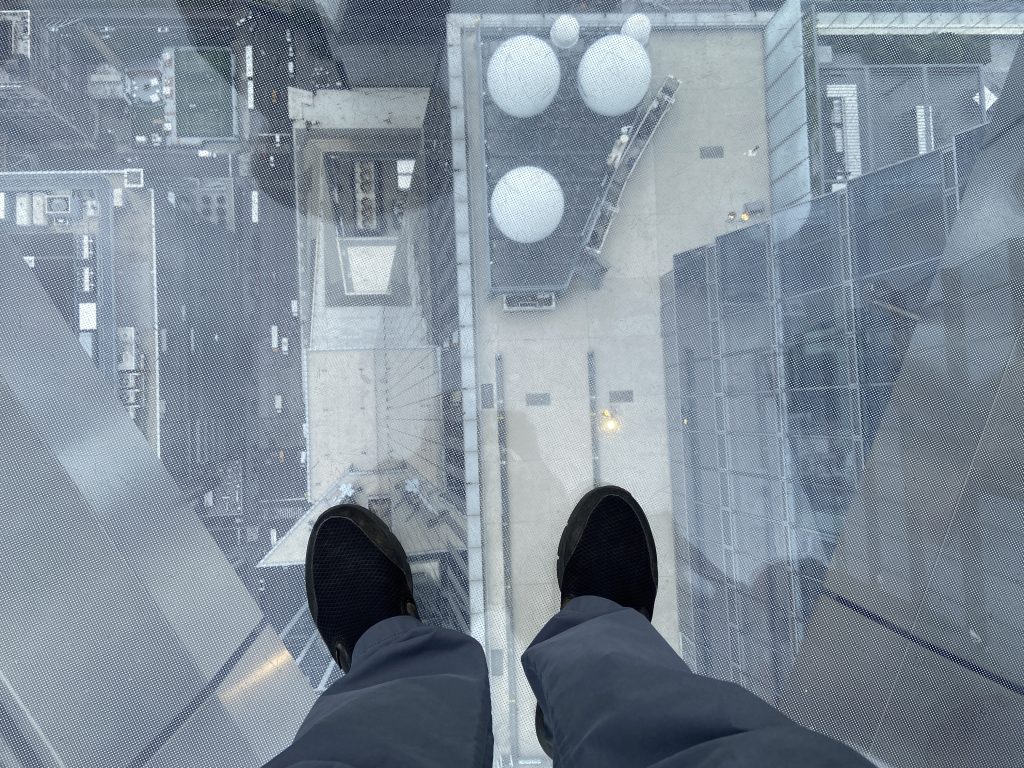 Extra points if you can say where this is.
What you're reading is written and posted on the Web. While the Web isn't a place, we know it as one. The language we use to describe it is concrete and structural: domains at locations, with sites that are built and have pages that are authored, and contents that are uploaded and downloaded.
For a generation or more, we mostly saw and navigated the Web through Google, whose original mission was "to organize the world's information and make it universally accessible and useful." When we searched Google, we relied on its PageRank system to bring us lists of pages ranked by how likely they were to contain keywords or other search terms.
But Google Search has changed. Old pages are gone from many searches. This matters to me because I've been writing on the Web for thirty-one years, almost entirely on static sites. But Google no longer finds many of those. My friend Dave Askins tells me the same malady has befallen much of his own archival work, which is present on the Web, but absent from Google searches. Why?
I asked Google's Gemini that question. Here's what it said:
The "disappearing" of the old web is a result of a massive shift in Google's priorities over the last few years.
While you might be looking for a specific historical document or an old forum thread, Google's systems are now aggressively tuned to filter out what they consider "stale" or "unhelpful" content…
In the race to be a 'helpful assistant,' Google has stopped being a 'universal library.
PageRank is still there, it tells me, but subordinated. To what?
Of course: it's advertising.
Taking my clues from Keyords are dead, by Shalom Gonzalez in Search Engine Land, I asked Gemini to tell me "how searches by the helpful assistant might constantly be looking for what the person might eventually want to buy, so they can be advertised at when the right time comes."
Gemini replied,
This is the "secret sauce" of the 2026 search model. If the old search engine was a librarian, the new one is a personal shopper who is taking notes on everything you do to predict your next "need state. The transition you're sensing is the move from Reactive Search (answering what you asked) to Predictive Search (answering what you're going to ask)."
This treats the Web as nothing more than a heap of data in which patterns can be found, and answers given, based on algorithmic assumptions—not just about who and what a person is, but what advertisers are paying to have pitched. Constantly. In real time.
There are four giant problems to pull apart here:
- How Google is deprecating the Web.
- What to call the vast everything that Big AI now uses to give us answers and pitch us shit.
- How AI dependence is changing us from homo sapiens to homo something else.
- How we can stay human in the midst of it all.
So let's explore those.
I. How Google is deprecating the Web.
We need to name the machine equivalent of hubris that Google and Gemini display in their deprecation of the Web and their presumptions about our intentions.
Dictionary.com says hubris is derived from hýbris, the Greek word for insolence. It mean pride, arrogance, or an excess of ambition…ultimately causing the transgressor's ruin.
When I asked ChatGPT to define AI hubris, it said, "AI hubris is the condition in which a system expresses or operationalizes confidence that exceeds its actual competence, epistemic grounding, or contextual awareness."
Then, when I asked it to explain how that manifests, it gave me—
- A model that acts as if it knows rather than predicts.
- A system that is treated as an oracle rather than a probabilistic engine.
- Designers who mistake fluency for wisdom.
When I asked it to be more specific, it confessed to—
- Overconfident answers: The model presents uncertain, incomplete, or fabricated information as authoritative.
- Boundary blindness: It fails to recognize where its training data ends, where knowledge is outdated, or where a question exceeds its capability.
- Illusion of comprehension: It produces fluent language that implies understanding when it is pattern synthesis.
- Prescriptive overreach: It gives decisive advice in domains requiring caution (medicine, law, policy) without signaling uncertainty.
- System-level hubris: Not just the model—but the designers or deployers assume the system is more reliable, objective, or neutral than it truly is.
Then I asked it to give me some words we might use to label AI hubris. It generated a large pile of them, abridged here—
- Hybris mechanica: Latinized Greek; "mechanical hubris." Evokes classical overreach, but makes clear it's structural, not emotional. Good if you want rhetorical force.
- Pseudomnēsis (ψευδομνήσις): "False memory." From pseudo- (false) + mnēsis (memory, recollection). Captures the illusion of knowing.
- Doctia ignorans: Modeled on docta ignorantia (Nicholas of Cusa: "learned ignorance"). This flips it: Doctia ignorans — "ignorant knowing." Sharp, ironic, philosophical.
- Epistemic hybris: Blunt and precise. The sin is not pride, but overstepping epistemic bounds.
- Pseudognosis (ψευδογνῶσις): False knowledge. Simple, strong, clean.
- Automata superbia: Mechanical arrogance. Has a medieval-theological feel.
- Confidentia vacua. Empty confidence. Direct and Roman.
- Logohybris: λόγος (speech/reason) + ὕβρις (hubris) Hubris of speech. Arrogance of articulated reason. Sharp, rhetorically charged, has teeth.
- Pseudognosis: Names the condition without moralizing it.
- Pseudodoxia (ψευδοδοξία): Suggests false or illusory knowing, overstepping bounds, inflated confidence, illusion of authority, false belief, spurious opinion. Has historical precedent (e.g., Browne's Pseudodoxia Epidemica). Feels learned and slightly ironic.
- Kenognosis (κενογνῶσις): "Empty knowledge." From kenos (empty) + gnosis (knowledge). Strong and elegant.
- Agnomimesis (ἀγνωμιμησις): "Imitation of knowing." From agnoia (ignorance) + mimesis (imitation). Captures the performance of understanding.
- Pseudonoia (ψευδονοία): False mind / counterfeit intellect. More psychological. Overstepping Epistemic Bounds
- Epihybris (ἐπιὕβρις): "Over-hubris" or escalated hubris. Suggests compounding overreach.
- Metahubris: Hubris at the level of system or design. Modern coinage, but philosophically clean.
- Paragnosis (παράγνωσις): Misrecognition; knowing beside the truth. Has a tragic flavor (like parabasis, paradox).
- Transgnosis: Going beyond what one can legitimately know.
- Megalodoxia (μεγαλοδοξία): Inflated Confidence. Grand opinion; overblown self-assurance.
- Superbia machinae: "The arrogance of the machine." Latinate, ecclesiastical.
- Inflatio mentis: Inflation of mind. Roman and sharp.
- Praesumptio automatica: Automatic presumption. Feels juridical.
- Authodoxia: Illusion of Authority. Self-authorizing belief. Authority generated from itself.
- Autognosticism: Self-certifying knowledge. Simulacra scientiae. A simulacrum of knowledge. Very Baudrillard-adjacent.
- Oraculitis: Mock-Greek: "oracle-itis." The disease of speaking as an oracle.
- Technohybris: Structural or Systemic Hubris. Technological overreach. Blunt but serviceable.
- Logomimesis: Mimicry of reasoned speech. Less accusatory, more descriptive.
- Sophomimesis: Imitation of wisdom.Sophia (wisdom) + mimesis (imitation).
- Pseudoepisteme (ψευδοεπιστήμη): False systematic knowledge. More formal than pseudognosis.
- Kenodoxia: "Empty glory" (historically attested in theology). Could be repurposed. Stark and Memorable
- Vox vana: "Empty voice."
- Certitudo vana: "Vain certainty."
- Machina praesumens: The presuming machine.
- Sophomimesis: Imitation of wisdom.
- Kenognosis: Empty knowledge.
- Pseudodoxia mechanica: mechanical false belief.
- Logohybris: Hubris of speech (from earlier).
- Paragnosis: Mis-knowing.
Well, Big AI is all of those. But let's pick one, because we need it. I lean toward logohybris, but I'm open.
II. What to call the vast everything that Big AI now uses to give us answers and pitch us shit
We are the only species that talks. A lot. About everything. We also make sense of the world as embodied creatures. We say good is up and bad is down because we are built for standing, walking, running, and squatting without falling over. This is why heaven is above, hell is below, and to fail is to fall. We say good is light and bad is dark because we are diurnal: optimized for daylight. We say a smart person is bright and a dumb person is dim. Good futures are bright and bad ones are dark. We frame life as travel, not a biological process. That's why birth is arrival, death is departure, and we get stuck in a rut, lost in the woods, and fall off a wagon. We frame time as money, not as a progression of existence. That's why we save, waste, spend, invest, and lose time.
We also lay nouns on everything (and non-thing) that we possibly can. We make taxonomies to organize the nouns. We make verbs for the actions that happen among and between all the nouns. We make prepositions to locate the nouns. We would be lost without all the ways we understand the world as a structured place.
To illustrate how important this is, look at how some drugs detach our minds from structures:
- LSD—acid—detaches what we see and know from all the nouns we project on them.
- MDMA—ecstasy—liberates other beings from what might in a normal state of mind make them separate from us and unlovable until proven otherwise.
- THC—weed—disconnects percepts and thoughts, so they become "strings of pearls without the string." (That's one of the few smart things I ever said when I was high.*)
While all those drugs are good for recreation and therapy, and may even help civilize us in some ways, they distract us from the structures that make civilization work.
Nearly all of what we know about the natural world is also tacit, meaning we know it, but can't explain it. For example, we know how gravity works, even though we can't explain it as well as Einstein or Feynman. Or at all. Doesn't matter. We know how it works, and that's what matters.
We can still be explicit about what we know. About gravity, we might say, "It's what gives things weight." Or, "It's what makes things in a vacuum fall at 9.8 meters per second squared."
Here's the key: What we know tacitly far exceeds what we can say explicitly.
The digital world, however, is entirely explicit. It is composed of data and code. There is no tacit there.
In the digital world, we also have no distance and no gravity, at costs that lean toward zero. A video conference might have people from India, Germany, and Australia, with none sensing distance or cost. Everyone is present. Conversation moves along just fine. Gravity is also absent, because nobody manifests in material form, or appears upside-down or sideways. There might be light outside the window of one participant and dark outside the window of another, but only if the camera points toward a window and the person isn't using a fake background.
But we still have structures in the digital world. For example, the World Wide Web uses a hypertext protocol (http/s) to connect sites at domains locations, between which packetized data can moves up and down. Note that these are real estate and shipping metaphors.
Directory paths on the Web are inherited from UNIX. For example, https://science.what/geology/phanerozoic/paleozoic/devonian/fossils/ammonites is what's called a path. It's like one you might follow through the stacks of a library. That's still how the Web works for us. It has structure.
When search engines indexed everything in those published directory structures, they made sense of the whole Web in a library-like way. We can see how the Internet is drifting away from that structure by reviewing the titles of David Weinberger's literary oeuvre, following The Cluetrain Manifesto in 1999:
- Small Pieces Loosely Joined:
{A Unified Theory of the Web} (2002) - Everything is Miscellaneous:
The Power of the New Digtal Disorder (2008) - Too Big to Know:
Rethinking Knowledge Now That the Facts Aren't the Facts, Experts Are Everywhere, and the Smartest Person in the Room Is the Room (2012) - Everyday Chaos:
Technology, Complexity, and How We're Thriving in a New World of Possibility (2019)
See where this is going?
Yes, toward AI. By now, Big AI has absorbed all those miscellaneous small pieces in the vast chaos of the digital world. I makes sense about that totality in every question we ask of it. It's the room that includes everything that's too big for us to know.
But here's the rub: Big AI also doesn't know a damn thing. It recognizes patterns in a vast totality of data and uses programming and language to answer questions and perform tasks for the human inhabitants of its environments.
Think about what's in the rooms built by OpenAI (ChatGPT), Google (Gemini), Microsoft (Copilot), Perplexity (Perplexity AI), Anthropic (Claude), DeepSeek (DeepSeekAI), and Grok (Xai).
The short answer is everything. All of the Web, all books, all utterings on social media, you name it. Everything explicit, that is. Nothing tacit. It doesn't have tacit knowledge because it's not human.
We need a word for that everything. Here are some candidates (with minimal AI help this time):
- Akasha: (Sanskrit) The aether or mystical compendium of all human events, thoughts, words, emotions, and intent ever to have occurred. Perhaps a poetic synonym for a universal database.
- Pleroma: (Greek) "fullness," totality of divine powers, or the sum of all knowledge.
- Pantology: (Greek root?) The systematic view of all human knowledge.
- Wànwù: (Mandarin: 万物) Literally "the ten thousand things." It's used to describe the entirety of the universe and all its manifestations. It's a beautiful way to describe the sheer variety of data I hold. (Says Gemini, when I asked for a word in another language to encompass what it "knows.")
- Sylloge: (Greek) Collection, compendium, summary, digest.
I vote for akasha.
What's in all those companies' akashas are not databases. Instead they are trillions of "tokens," which (as NVIDIA explains here) "are units of data processed by AI models during training and inference, enabling prediction, generation, and reasoning." These are not structured in ways familiar to us in the natural world. They are also not sources like those Google used to index and treat as directories. They are opaque to us. Every AI data center is a black box in material form.
Marshall McLuhan taught that every new medium, every new technology, creates an environment that changes us. What we are as drivers in the rolling carapace we call a car is not what we are when we are walking around. We are changed. Extended. Enlarged.
Big AI does some of that for us, but we don't have truly personal AI yet. That's a whole 'nuther rant (going on here). But after we get personal AI, we'll still be radically changed. Which brings us to—
III.How AI dependence is changing us from homo sapiens to homo ________
When I asked ChatGPT to "tell me what to name the AI-dependent species that succeeds homo sapiens," it gave me this (which I've abridged into a less wordy form):
- Homo delegatus. The delegating human. Clean. Roman. Almost bureaucratic.
- Homo auxiliatus. The assisted human. Gentler. Less tragic.
- Homo symbioticus. The symbiotic human. Optimistic framing. Mutualism implied.
- Homo prostheticus. The prosthetic human. From prosthesis — extension. Suggests cognition extended outside the skull.
- Homo algorithmicus. The algorithmic human. Likely to stick. Slightly dystopian. The defining trait is AI reliance.
- Homo automatus. The automated human. Bleaker.
- Homo machinatus. The machinated human — shaped by machines.
- Homo instructus. The instructed human — guided by systems. The defining trait is epistemic submission
- Homo credulus. The believing human. Short. Dangerous.
- Homo confisus. The trusting human. Ambiguous — trust can be good or naive.
- Homo oracularis. The oracle-dependent human. Strong mythic tone.
- Homo synthetica. The synthetic human. Hybridized.
- Homo copulatus. The coupled human.
- Homo nexus. The networked human.
- Homo cyberneticus. Classic mid-20th-century feel.
- Homo exocerebralis. The external-brained human. Scientifically plausible.
- Homo delegans sapiens. The wisdom-delegating human.
- Homo post-sapiens. Simple, brutal.
- Homo paragnostica. The mis-knowing human.
- Homo servomechanicus. The servo-mechanical human.
- Homo dependens. The dependent human.
- Homo exocerebralis. External-brained human
- Homo delegatus. Delegating human
- Homo symbioticus. Symbiotic human
- Homo algorithmicus. Algorithmic human
- Homo exocerebralis. It names the real shift: the brain extends beyond the skull into networks and models. Biologically grounded and conceptually sharp.
- Homo delegatus. Has quiet menace.
I don't like any of them. But we need one. Vote on one of these, or give us a better alternative.
IV. How we can stay human in the midst of it all?
First, stop the surveillance. That will at least begin to restore and protect our humanity.
We can't do it all at once, but we can do it through relationships with organizations that don't participate in the surveillance economy. There are a lot of those.
These can't be relationships that organizations initiate. We got that kind when industry won the industrial revolution, and they have infected the digital world with endless "consent" (non-) agreements and "Our terms have changed" gauntlets requiring acceptance of terms we don't read and don't matter.
We can do it with agreements that we proffer, as sovereign and independent human beings. And now we have a standard for that: MyTerms (7012-2025 - IEEE Standard for Machine Readable Personal Privacy Terms). These will allow us to visit sites, use services, and buy stuff without worrying if we're being tracked like marked animals by parties unknown. They will also form a solid base for additional relationships based on mutual trust.
That's the second step. Both are tabula rasa today. But if we want to keep from turning into any of the many species listed above, we need to start with ourselves and our relationships with willing second parties. MyTerms will do that.
__________________________________
*My minimal and pathetic drug history:
- I was never more than a casual drinker, though I do like dark beers and good wine. I also stopped drinking anything a few years ago.
- I've never taken LSD, shrooms, or any hallucinogen.
- The first time I took cocaine was at a party in the North Carolina woods. When nothing happened, the guy who gave it to me said, "Well, maybe ya'll's personality masks the effects." The second time was when a friend and I wanted to stay up late to watch the first round of March Madness. The third time was to stay awake on a very long drive. The fourth and last time was to stay focused through an all-night conversation with an old friend. Afterwards, I felt like I might die and had no perception of color. After that, I never touched cocaine again.
- The only time I ever took ecstasy was with old friends. It was beautiful. Their dog said to us, "See? This is what it's like to be a dog! You love everybody!
- I never smoked tobacco, and only smoked weed a few times. One of those yielded the one-liner I shared above. Another caused such intense pain behind my right eyeball that a bit of it recurs every time I smell weed.
Submission Statement: Positive Feedback Loops lead to exponential growth. We are starting to see the positive feedback loop effect in temperatures. That's basically it.
That rise over decades that conservative scientists were fitting with a straight line also fits an exponential curve. As human created CO2 rose it led to higher temperatures -> lower reflectivity -> less energy reflected -> higher temperatures -> more water vapor, methane release, -> more energy captured -> less ice and less reflectiveness of earth -> higher temperatures. A positive feedback loop. Thanks, you unethical oil/gas/mining/AI oligarchs killing off climate science in your lust for cash and hedonism. I hate it.
submitted by /u/Lighting[link] [comments]
Call of Duty: Warzone Mobile will be no more this spring. According to Activision, servers will be taken offline for this mobile battle royale game on April 17, 2026. The shooter will remain available for current players until that date. This mobile port of the CoD battle royale mode has been on its way to a finale for the past year, with the game studio sharing in May 2025 that the title would be delisted and would not receive new content.
For any people who still want to play the military shooter on their phones, there a mobile version of the main game remains available. Call of Duty: Mobile even offers a battle royale experience, so you can get pretty close to having Warzone if you still want it. "Player passion and feedback continue to shape the future of the Call of Duty franchise, and we look forward to delivering meaningful seasonal content and updates to Call of Duty: Mobile," Activision said in announcingWarzone's mobile shutdown. Call of Duty: Warzone is still free to play on Xbox, Battle.net, Playstation and Steam.
This article originally appeared on Engadget at https://www.engadget.com/gaming/call-of-duty-warzone-mobile-will-go-offline-on-april-17-222240967.html?src=rss

On 12 February, the government announced that it will soon publish guidance for schools regarding trans pupils. The press release states that schools must take a "very careful approach" when a pupil "asks to socially transition".
'Social transition' refers to the non-medical aspects of transitioning. It can include changing one's name, wearing different clothes, and using different pronouns.
The press release goes on to state that:
It clearly sets out that single sex spaces must be protected. Without exception, no child should be made to feel unsafe through inappropriate mixed sex sport, and there should be no sharing of school and college toilet facilities over eight years old or mixed sex sleeping arrangements on trips.
It is also vital that schools and teachers are aware of any child's birth sex to be able to take appropriate action where needed, so the guidance will also make clear that this must be accurately recorded in school and college records.
Single sex spaces "must be protected" — with the 'from trans kids' left implicit. No child should be made to feel unsafe — with the 'no cis child' unsaid but clearly in mind. These statements frame trans children as a threat, and as potential deceivers.
Even the framing of "asking" to transition socially implies that it's not utterly ridiculous for a school to refuse to use a pupil's chosen name and pronouns. But then, that's the level that the UK has sunk to. Any aspect of transness is now considered a legitimate topic for debate.
'Political football'Joining in on the game of political football that is trans existence, education secretary Bridget Phillipson said:
Parents send their children to school and college trusting that they'll be protected. Teachers work tirelessly to keep them safe. That's not negotiable, and it's not a political football.
That's why we're following the evidence, including Dr Hilary Cass's expert review, to give teachers the clarity they need to ensure the safeguarding and wellbeing of gender questioning children and young people.
Likewise, the draft guidance itself also states repeatedly that it is supported by Dr Hilary Cass. Cass wrote the Cass report, which was filled with spurious abuses of science in the name of denying healthcare to trans children.
The press release stated that the draft guidance was:
Backed by Baroness Cass, whose review warned that strong evidence about the impact of social transition remains limited, the guidance says children's wellbeing and safeguarding must be at the centre of every decision and schools cannot take a one size fits all approach.
Cass was completely inexperienced with trans healthcare before she was chosen to write her review. However, she was at least a medical doctor. By contrast, her expertise regarding social transition - which has nothing to do with gender medicine - is less than worthless. It follows that Labour set so much store by her opinion.
'Losing any hope'Meanwhile, experts and campaigners who are actually invested in the wellbeing of trans youth have condemned the draft guidance.
Cal Horton, a researcher specialising in trans youth, stated that:
Trans children need to be supported and respected in order to be safe at school, in order to access their right to education, in order to enjoy their childhood.
Instead, we are seeing a complete ban on access to appropriate toilets, PE, accommodation on school trips, a complete erosion of their rights.
It will lead to children avoiding the bathroom, avoiding exercise, missing out on school trips, dropping out of school, losing any hope of education, equality, friendship, happiness.
Likewise, advocacy organisation Trans Actual was scathing in its reaction:
It's absurd for this Government's proposed guidance to suggest that schools need to seek clinical advice if a young person wants to change their name, uniform or hairstyle.
Being trans is not a medical condition nor is it an unwanted life outcome to be guarded against, it is a healthy way that many people choose to express themselves.
All young people need safe and supportive schools yet this Government's proposed guidance risks leading to trans young people being outed to their families against their wishes.
As it stands, this guidance does nothing to help schools to include trans pupils - nor to address the epidemic of anti-trans bullying promoted by misogynist influencers.
The guidance will not become law until September of this year. However, if this draft is anything to go by, the final document will continue Labour's current streak of kicking trans people and calling it fair play.
At its heart, this document refuses to treat trans schoolchildren as the vulnerable minority they are, and instead figures them as an active threat to the cis majority.
Featured image via the Canary

The fallout from the Epstein files has been relentless. Those implicated in the dirty saga include UK Royals, members of our political class, the mainstream media, the "broligrachy," and others.
Still, one area corporate media coverage has ignored is the convicted sex-trafficker's feigned interest in polio eradication in the Global South. But why would a notorious predator and trafficker bother to involve himself with healthcare management in South Asia?
No champion of polio eradicationAmong the tranche of files released by the US Department of Justice (DOJ) Epstein appears in a video speaking with an off-camera interviewer whose voice resembles Steve Bannon's. Responding to the interviewer, Epstein justifies his ties to "dirty money," claiming to have helped with polio eradication in India and Pakistan — a convenient cover for a sex predator.
The Epstein files also include confidential reports on polio eradication efforts in Afghanistan and Pakistan, marked "CONFIDENTIAL — DO NOT CIRCULATE."
The emerging pattern is one the Canary has repeatedly reported on. Epstein used his deep pockets to court Western diplomats, global philanthropists, and political figures. His alleged interest in polio work was another power grab. He was using cash to climb the ranks. It was never about vaccines.
He positioned himself in global health by feigning noble interests. The release of the DOJ files proves this was nothing more than a mask to hide his predatory depravity.
Epstein-Gates connectionThe DOJ files show that the Gates Foundation was implicated in these lobbying efforts. The organisation — long at the forefront of global polio immunisation efforts — provided substantial funding for these IPI-led campaigns. An email exchange between Rod-Larsen and Epstein in September 2013 showed them discussing how to structure Gates Foundation funding for IPI's polio work. And another email from the same year, sent by a senior program officer at the Gates Foundation, the IPI was described as well placed to:
identify potential influencers/high-level contacts that can move the work forward and recommendations for how/whether BMGF, GPEI UN partners (UNICEF/WHO) and others should engage with such contacts.
The same email chains shows Epstein committing to $1 million per year for polio programmes in Pakistan, Afghanistan, Northern Nigeria, and Somalia — a whopping $15 million over five years. He instructed that Bill Gates' name should not appear on a proposed peace center.
But by March 2015, the relationship had run its course, due to the reputational risk attached to Epstein's criminal behaviour, and the funds Epstein promised which Gates never received.
Leveraging polio eradication for political gainEpstein's interest in polio projects in Pakistan was enabled through associates at the International Peace Institute (IPI), including senior staff.
Terje Rød-Larsen, its former president and ex-diplomat to Norway, is mentioned multiple times in the files. He stepped down from his role in disgrace after his ties to the convicted child-rapist made global headlines. Moreover, Rød-Larsen, as the DOJ files suggest, was a key ally of Epstein. He is currently under investigation by Norwegian police.
Rød-Larsen and IPI director, Andrea Pfanzelter, received intelligence briefings from a Pakistan-based field operative Nasra Hassan. They forwarded these reports to Epstein. The paper trail begins in April 2013. Emails from Hassan to Rød-Larsen describe meeting with Pakistani tribal leaders and government officials, and their changing position on polio eradication. Commenting on a chat had with a senior member of the Taliban, Hassan said:
It appears that religion-based refusal [of polio vaccination] is a very tiny.
However, the declassified files suggest interest in polio eradication ranked second to political ambitions. In June 2013, Hassan sent an email warning that Bill Gates' public outreach to Pakistan's ex-prime minister and opposition figure, Imran Khan, for polio support could jeopardise back-channel talks with the Pakistani Taliban:
This will harden the Pak[istani] Taliban's position.
She noted that while the Taliban appeared more receptive to polio programmes, they remained opposed to Western involvement. She reminded Rød-Larsen that the group banned polio vaccinations in the Waziristan region in 2012:
alleging the campaign was a cover for espionage.
Hassan reiterated the need for discreet talks, stating that:
Epstein names Imran Khan a "threat"This opposite effect [the possibility of losing Taliban support] emphasizes the IPI position that polio related efforts by politicians MUST be discreet and low-key.
Hassan's warnings about Imran Khan's public role — specifically his rejection of US imperialism — were echoed years later by Epstein himself. That's little surprise given Epstein's infiltration of Western diplomatic circles. He wooed politicians who cosied up to US — cue Peter Mandelson, Ehud Barak, among a long list of politicians he collected.
That's little surprise given [stuff about Epstein's political interference]"
Hassan's warnings about Imran Khan's public role were echoed years later by Epstein himself.
In 2018, as Drop Site News reporter Ryan Grim noted, Epstein described Khan as "very bad news."
Grim linked this to Khan's political downfall, noting that the US State Department, with help from the Pakistani military, pushed him out of office in 2022.
Khan is subject to ongoing persecution by the military establishment in Pakistan. His party has been suppressed, and he remains behind bars.
Among his opponents, former Indian diplomat, Hardeep Singh Puri, now a senior BJP official in Prime Minister Narendra Modi's party, also features in the DOJ files. There were email exchanges between Puri and Epstein. There were five scheduled appointments between June 2014 and January 2017. Unsurprisingly, Puri has defended himself against alleged ties to the sex predator.
Unanswered QuestionsJeffrey Epstein in 2018 was claiming that @ImranKhanPTI was "really bad news," citing Pakistan's nuclear weapons. The State Dept pushed him out of office with help from the Pakistani military in 2022. pic.twitter.com/isDA4dePMj
— Ryan Grim (@ryangrim) November 14, 2025
Despite the documentary trail exposing Epstein's attempts to insert polio-related initiatives, by leveraging his wealth, many questions — as raised by Pakistan's Express Tribune remain unanswered. What was Epstein's actual role in this network? Did he have ties to intelligence agencies? And why were detailed reports on Taliban leadership and polio access appearing in his inbox?
In the words of Express Tribune reporter, Shireen Qasim:
The emails raise a fundamental question: was the polio work undertaken by operatives like Hassan genuine humanitarian effort that happened to provide access to sensitive locations and information, or was the humanitarian work itself a cover for intelligence gathering - with field reports being systematically forwarded through institutional channels to someone like Epstein who had no public health credentials?
Consider the March 2013 email from Boris Nikolic, Epstein's science adviser, asking how to deal with violence in Nigeria and Pakistan, who could mediate with the Taliban and Boko Haram, and whether these groups might ever be open to polio eradication.
It is not a stretch to imagine that was no humanitarian angle to Epstein's interference in South Asia. A man with no background in public health, no government position, a documented history of manipulation and blackmail, and a suspicious interest in polio eradication? Added to that, a sickeningly powerful man with the connections to manoeuvre political instability? The red flag is flaming
Featured image via the Canary
By The Canary

TL;DR: Get control of your data with 91% off a 10TB subscription to Internxt Cloud Storage for just $249.97 (Reg. $2,900).
You pay for your phone, so why are you renting to keep your own files on it? Tired of paying monthly fees for phone storage, email storage, photo storage, and more? — Read the rest
The post Tired of paying to store your own files? Get 91% off secure cloud storage appeared first on Boing Boing.

A neighborhood Facebook page called Montco Community Watch had been doing what neighborhood pages do — posting tips about ICE sightings near specific streets and landmarks in Montgomery County, Pennsylvania, in English and Spanish, for its roughly 10,000 followers. In September, DHS served Meta with an administrative subpoena for the names, email addresses, and postal codes of whoever ran it. — Read the rest
The post DHS sent hundreds of subpoenas to Google, Meta, and Reddit demanding names of people who criticize ICE appeared first on Boing Boing.
MP13 Doubles Up For Daytona 200 & Supersport Season With Ella & Avery Dreher On MV Agustas Supported By One Cure
MP13 Racing's Ella Dreher will be joined by her brother Avery as they both compete in the 2026 Supersport Championship, beginning with next month's Daytona 200. Photo courtesy MP13 Racing.
Here's proof that, when you've got one very talented rider named Dreher on your team, you've just gotta have two.
Team owner Melissa Paris is delighted to introduce MP13 Racing's 2026 MotoAmerica team, featuring incumbent rider Ella Dreher and her brother Avery. Both riders will compete in the 2026 Supersport Championship, including next month's Daytona 200.
Also, Paris and MP13 Racing are proud to represent One Cure through the generous support of David and Maxine Pierce. One Cure's mission is "to improve the prevention, diagnosis, and treatment of cancer in pets, and to translate their research and knowledge to also benefit people with cancer."
"Working with Ella in 2025 was the realization of a dream that was several years in the making," Paris said. "I was impressed by her work and tenacity every single weekend. To be able to have Ella back, and to have her brother Avery also join the team for the 2026 Supersport Championship, is unreal. I'm so grateful for their trust in me and our team, and together, we are looking forward to seeing what we can achieve with our MV Agusta F3 800 machines."
Last year, Ella competed for MP13 Racing in the inaugural MotoAmerica Talent Cup Championship, and she is set to take the next step in her road racing career. Currently 15 years old, Ella will turn 16 at the end of February, which will make her eligible for MotoAmerica's Supersport Championship. As a result, the Florida native is poised to become the youngest rider ever to race in the Daytona 200, in this, the 84th running of the "Great American Motorcycle Race."
"I'm more than excited to be racing again this year with the MP13 team, Ella said. "Better yet on a Supersport bike alongside my brother as my teammate this year. I can't wait to start the season at the Daytona 200. Racing the 200 has been a dream of mine, and I'm ready to push through the challenges and start the 2026 season."
Avery, who is 19 years old and raced in last year's Twins Cup Championship, will also move up to Supersport as he teams up with his sister on MP13 Racing MV Agustas.
"I am so thankful and stoked for this opportunity," commented Avery. "Huge thanks to Melissa and the entire MP13 Racing team for believing in me. This truly feels like a dream come true. Racing in the Daytona 200 and the Supersport Championship has been a goal of mine for a long time, and I'm ready to embrace the challenge and get to work. I'm also stoked to be teammates with my sister again. It's going to be a fun time and a great year!"
Additional team sponsors for 2026 include Rock Solid and MV Agusta Los Angeles, along with Maxima, Spider, STM, GHD, Accossato, LighTech, Essex Moto, Speedcell, Akrapovic, SBS, Mikanik Moto, Matt Racing, ESP, and Macklin Motorsports.
The post MotoAmerica: Ella & Avery Dreher Racing MVs At Daytona appeared first on Roadracing World Magazine | Motorcycle Riding, Racing & Tech News.
The WorldSBK field was put through their paces in near perfect conditions on the opening day of testing at the Phillip Island Grand Prix Circuit. Under blue skies and with a light breeze cooling the temperatures slightly the four hours of running for Superbike and Supersport classes offered a stark contrast to the winter testing undertaken in Europe.
 Axel Bassani (47) at Phillip Island. Photo courtesy Dorna
- Pre-season title favourite Nicolo Bulega dominated the opening day of testing, leading both sessions for the Aruba.It Racing - Ducati squad. The Italian completed 72 laps. His pace was impressive with over 30 laps under 1m30s. The 90 second barrier was broken by only three other riders with Axel Bassani the closest challenger. The bimota by Kawasaki Racing Team rider ended the day just 0.291s adrift.
 Sam Lowes (14) at Phillip Island. Photo courtesy Dorna
- It was an action-packed day for Sam Lowes. The ELF Marc VDS Racing Team rider suffered a technical issue in the morning before crashing in the afternoon. The Brit responded strongly, setting his fastest time late in the day during a six-lap stint.
 Xavi Vierge (97) at Phillip Island. Photo courtesy Dorna
- After limited dry running over the winter, Xavi Vierge impressed as the fastest Yamaha rider, placing the Pata Maxus Yamaha ninth overall. A morning crash failed to derail Stefano Manzi, the reigning Supersport World Champion, who was just two tenths of a second slower than Vierge as he continues to adapt to the GYTR GRT Yamaha WorldSBK Team machine.
 Miguel Oliveira (88) at Phillip Island. Photo courtesy Dorna
- Jake Dixon (Honda HRC) led the rookie contingent. The former Moto2 rider finished tenth at the close of play, ahead of Miguel Oliveira (ROKiT BMW Motorrad WorldSBK Team) and Manzi.
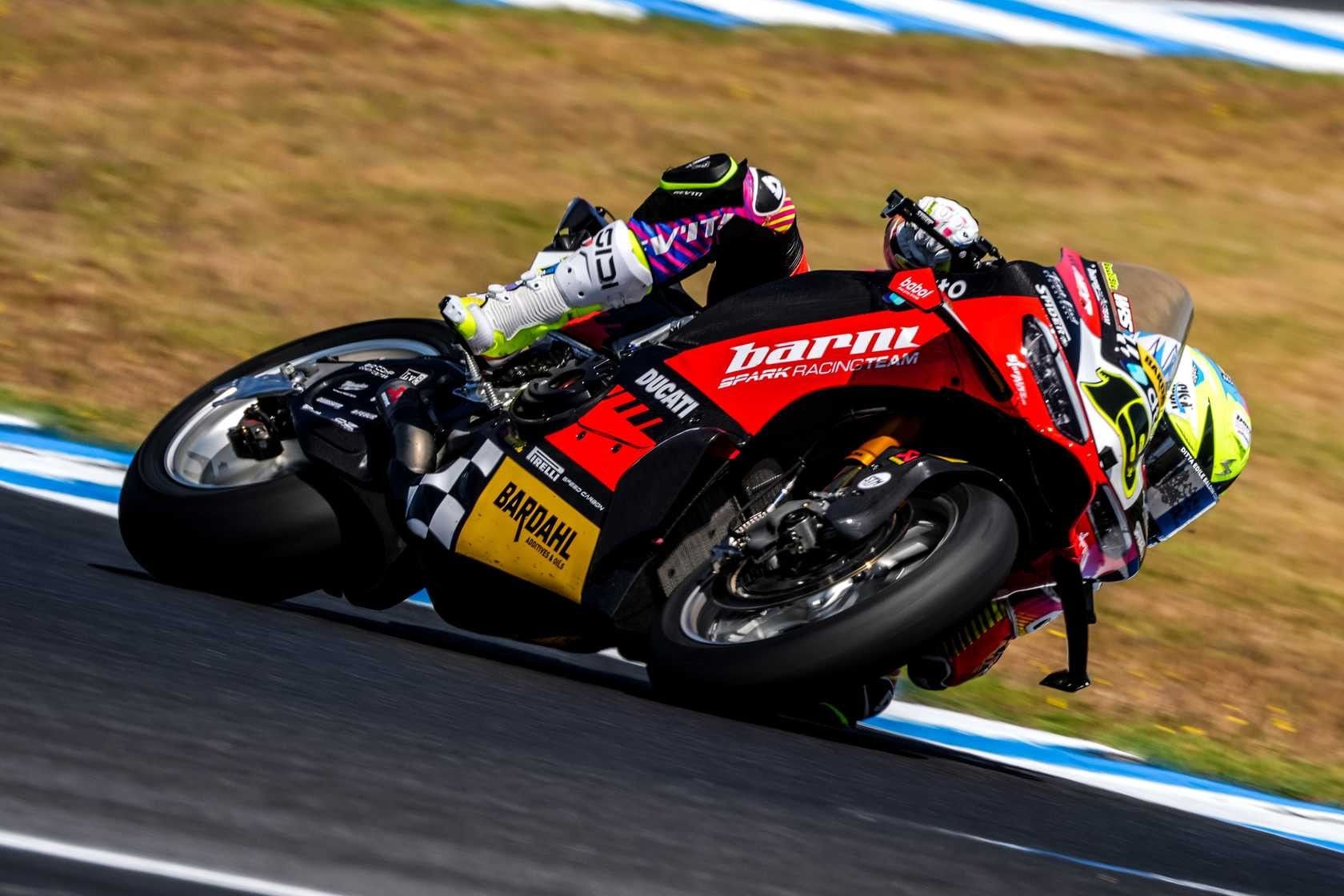 Alvaro Bautista (19) at Phillip Island. Photo courtesy Dorna
-
There were eight crashes during Superbike running, including an early-afternoon fall for Alvaro Bautista (Barni Spark Racing Team) at Turn 5. The double world champion, an eight-time winner at Phillip Island, ended the day eighth fastest, almost a second shy of Bulega's benchmark, but will expect to make gains heading into the next session.
Nicolo Bulega (Aruba.It Racing - Ducati): "It was important to start like this. We have a new bike and during the winter we weren't able to test properly because of the weather. This meant that today was really our first proper day on track. It was important to ride as much as possible and I completed a lot of laps, so I'm happy. We did a good job and we've started the weekend well. Last year the winter testing conditions were better and we arrived in Phillip Island with two or three full test days already completed. This time we're not starting from zero but we have a new bike to understand. It was very hot today so that means we're a few tenths slower than we expected. I'm quite happy with the setup but we can improve in some areas. Tomorrow we'll try to take another step forward and see if we can be competitive for the race weekend."
21_WorldSBK_2026_AUS_Free_Practice_2_Results
Masia leads the way in Supersport
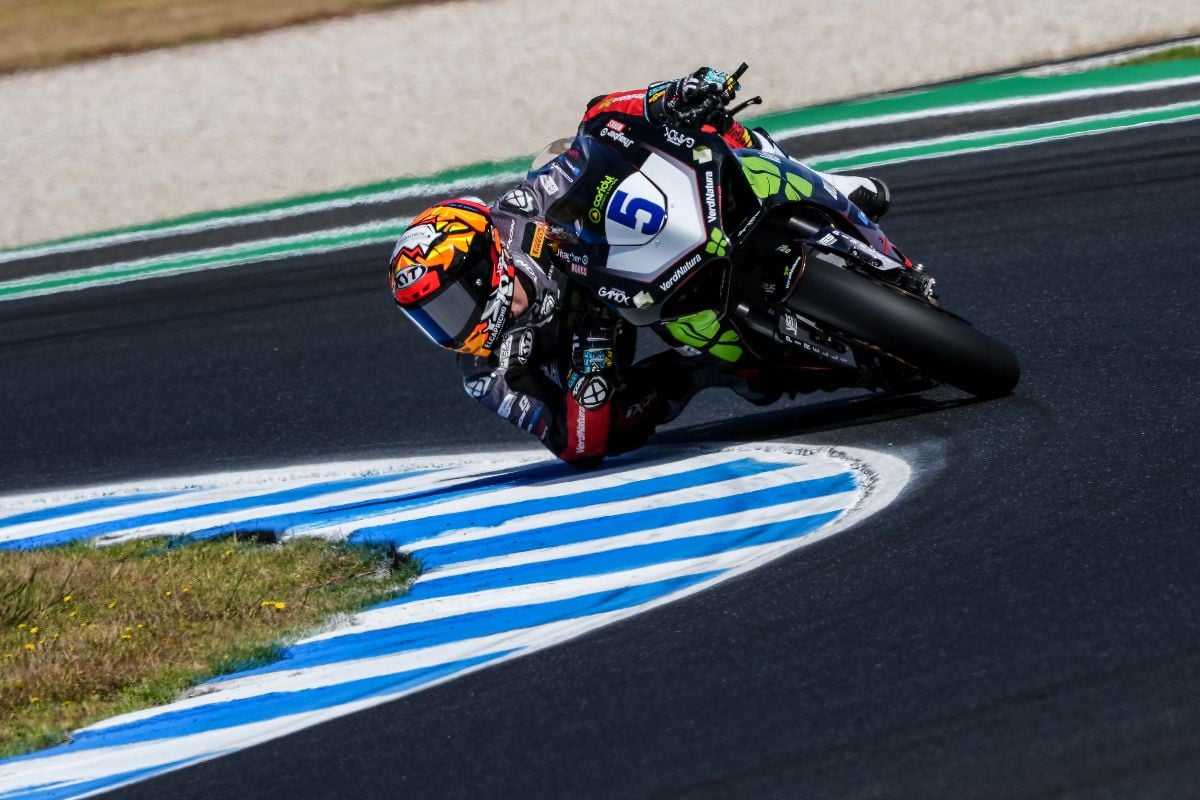 Jaume Masia (5) at Phillip Island. Photo courtesy Dorna
-
Jaume Masia (Orelac Racing Verdnatura) completed 50 laps across both sessions and topped the times in both the morning and afternoon. The two-time race winner in 2025 looked comfortable throughout, completing short stints typically consisting of five laps.
 Oli Bayliss (32) at Phillip Island. Photo courtesy Dorna
- Oli Bayliss (PTR Triumph Factory Racing) performed well at his home round. The Australian ended the day second fastest, 0.344s slower than Masia, while Philipp Oettl (Feel Racing WorldSSP Team) was third fastest after completing 64 laps on his Ducati.
- Josh Whatley (Orelac Racing Verdnatura) and Lucas Mahias (GMT94 Yamaha) were the only riders in the top ten to set their fastest times of the day in the afternoon session. The track temperature rose by 15°C, so their improvement was noteworthy, with Whatley ending the day eighth fastest.
-
Double WorldSSP champion Dominique Aegerter returns to the class this year. The Kawasaki WorldSSP Team rider completed 59 laps and set his fastest time on his penultimate lap as he continues to gain experience on the Kawasaki ZX-6R 636.
21_WorldSSP_2026_AUS_Free_Practice_2_Results
The post WSBK: Bulega Sets The Tone on Day 1 of Testing appeared first on Roadracing World Magazine | Motorcycle Riding, Racing & Tech News.
Bullet items for the Fediforum conference in March.
- Subscribing must be easy.
- Some things will work better if they're slightly centralized, esp subscribing.
- Use DNS for naming people.
- Support RSS in and out, and test it once you add the feature, so many easy things to fix remain broken (like titles of the feeds, look terrible in a list of feed titles). RSS is how you earn the "web" in your name. "Web" means something, it's just an intention, there are rules.
- You don't need "open" if you have "web." The web is by definition open. Water is wet. Raises question re what the not-open web is. (Silo.)
- Support the basic features of text in the web. If you shut off the writing features of the web, as Twitter did, you're not really part of the web. Especially linking.
- Listen to users, listen to other developers.
- Automattic is doing heroic work connecting WordPress to ActivityPub. This means that WordPress APIs are now ActivityPub APIs. Not a small thing.
- Look at text coming out of WordPress into Mastodon, the HTML used definitely could be improved. Seems pretty simple things to fix, the simple things matter. Example: WordPress version. Mastodon version of the same post. Let's make this beautiful!
- Keep trying fundamentally new architectures.
- Learn from past mistakes.
- Interop is paramount.
- Don't re-invent.
BTW, this can be read on my blog, on Mastodon, in WordPress and of course my feeds (and thus can be read in any app that supports inbound RSS).

Garrett Gerloff and his Kawasaki WorldSBK Team, plus Jeremy Alcoba and Dominique Aegerter from the Kawasaki WorldSSP Team, will soon take part in a final official pre-season test at the 4.445km-long Phillip Island. Shortly before, they unveiled the full 2026 colours and sponsorship packages of the Kawasaki Ninja ZX-10RR and Ninja ZX-6R 636.
After finding some challenging wet weather conditions in recent winter tests in Europe, the entire Kawasaki WorldSBK and WorldSSP team set-up is now looking forward to two days of dry and settled climatic conditions on which they will take to the track on 16 and 17 February.
Before the testing action took place, the team revealed its WorldSBK and WorldSSP liveries, which feature Kawasaki's green colour scheme extensively, but also an additional touch of blue this time around.
The 2026 sponsor and partner line-up had their logos on prominent display on the latest machines, with a refreshed team and ambitions for a new campaign.
Gerloff enters the 2026 season reunited with a former crew chief, Les Pearson, while Aegerter is a new rider to the Kawasaki WorldSSP Team set-up alongside 2025 rider Alcoba. Dominique is no rookie, however, as he re-enters WorldSSP racing as a double WorldSSP champion from recent years gone by.
After the two days test, the 2026 FIM Superbike World Championship season begins for real at Phillip Island in Australia, between 20-22 February.
 Garrett Gerloff (31). Photo courtesy Kawasaki
Garrett Gerloff stated: "We've travelled a long way to reach Phillip Island, but we can finally enjoy some solid testing time here. I'm confident in my team and in the new Ninja ZX-10RR. That's why I think we can see good results in the official test and, more importantly, in the first round, even though we weren't able to complete the work programme we'd laid out for the winter tests. A lot of time has passed since my last race, and I can't wait to line up on the grid in Australia."
 Jeremy Alcoba (52). Photo courtesy Kawasaki
Jeremy Alcoba, stated: "I'm really excited and can't wait for the championship to start. I've trained very hard over the winter and even though we've barely tested on a dry track, the bike feels like mine. I have a great feeling with both my Ninja ZX-6R 636 and my team. We're a very close-knit squad and this is key. I'm keen to get to Phillip Island and start testing, finally making the most of a dry track and pushing to the max with my bike."
 Dominique Aegerter (77). Photo courtesy Kawasaki
Dominique Aegerter, stated: "It's a long way to Australia but it's worth it because the track is amazing and the place itself is beautiful. I can't wait to see my team again and work with my technicians. Because of the bad weather during winter testing I don't yet have a setup to suit my riding style with which to start the tests, and I still need to adapt to riding a Supersport bike again. But the motivation is high and I'm totally ready, both mentally and physically. I can't wait to get testing so that we're all set for the first WorldSSP round."
Manuel Puccetti, Team Principal, stated: "We can't wait to start working and test on a dry track at last. This test will be important in helping us to make the best possible start to the season. The whole team is highly motivated, and we have a lot of work to get through, with many technical updates for both Superbike and Supersport machines. The aim is to complete the full programme to be ready for the first race weekend, which will start just a few days later."
The post WSBK: Kawasaki WorldSBK Team Reveals Final Livery appeared first on Roadracing World Magazine | Motorcycle Riding, Racing & Tech News.


