

Danny L Harle
Cerulean
PC Music wunderkind packs up his donk in order to flame on with the alt-pop Avengers: Caroline Polachek, Clairo, Oklou and PinkPantheress
Cerulean by Danny L Harle
Fans of The Devil Wears Prada will remember Miranda Priestly's tirade about cerulean blue and that colour's important influence on fashion from Yves Saint Laurent to the clearance bins of a budget shop: "That blue represents millions of dollars and countless jobs."
So, perhaps it's unsurprising that one of the pivotal members of PC music, whose influence has trickled down through pop music and no doubt made "millions of dollars and countless jobs" for the genre, has named his latest album after that same shade of blue.
Cerulean is the follow up to his 2021...
The post Danny L Harle - Cerulean appeared first on The Quietus.

Though eclipsed by what came in its wake, The Colour Of Spring, at the heart of Talk Talk's catalogue, is no less astonishing. Forty years on, Wyndham Wallace commends the inaugural rebirth of Mark Hollis' synthpop band
Every story has a beginning, a middle and an end, but, as contemporary narratives demand, Talk Talk's has come to be told in reverse, caring little for distractions. There are 'wannabe' years and 'we-made-it' years, but it opens with the death in 2019 of their inscrutable mastermind, when an unforeseen outburst of respect and affection for singer Mark Hollis rivals tributes to Prince and David Bowie. Unexpectedly, these eulogies dwell not on the conventional success of early endeavours, nor his biggest hits. Instead their...
The post "It's About Time We Brought Art In, Innit?" Talk Talk's The Colour Of Spring at 40 appeared first on The Quietus.
Noel Gardner returns once more from Britain's sonic undergrowth, with an improv-dominated edition of New Weird Britain that also includes epic fringe folk, shuddering static from London via Beijing, and much much more
Tim Hill's Leviathan Whispers
Improvisation tends to be a lurking possibility in these columns, even if not actively being practised, but for the first New Weird Britain of 2026 it's the dominant theme. No reason that my conscious is aware of, and this February edition mops up a few releases from late 2025 (the last 'proper' NWB column having been in October) such as Enough, the debut LP of rafter-rattling, all-improv loft doom by Long Swan Tongues.
LST are a duo of bassist Al Wilson, who also released albums with...
The post New Weird Britain in Review for February by Noel Gardner appeared first on The Quietus.
Keir Starmer could ramp up the UK's defense spending plans faster than planned as the MoD reeled off new purchases for Britain's armed forces.…
Huge thanks to my February sponsor, John Rember, author of the three-book series Journal of the Plague Years, a psychic survival guide for humanity's looming date with destiny, shaped by his experiences living through the pandemic in his native Idaho. Thoughtful, wry and humane, Journal 1 is a pleasure.
 "Hey everybody! It's mid-month global mean surface temperature snapshot time!
"And yes, that's right, do not adjust your television: at the height of the current La Nina, 2026 year-to-date is more than 1.51°C over the pre-industrial baseline."
[Prof Eliot Jacobson]
https://x.com/EliotJacobson/status/2023048514700521505
 "Upper-ocean heat content data for January showed that the West Pacific Warm Pool was ninth warmest on record, despite a chunk of its heat already being discharged eastward.
"This warmth raises the ceiling on the potential strength of El Niño later this year."
[Ben Noll]
https://x.com/BenNollWeather/status/2023404500044959928
 "A Greenland sled dog champion fears for his culture as climate change melts the ice…
"For more than a thousand years, dogs have pulled sleds across the Arctic for Inuit seal hunters and fishermen. But this winter, in the town of Ilulissat, around 300km (186 miles) north of the Arctic Circle, that's not possible."
https://www.independent.co.uk/news/donald-trump-greenland-arctic-unesco-antarctica-b2921625.html
 "'Daunting but doable': Europe urged to prepare for 3C of global heating…
"Such a dramatic rise in temperatures - the prospect of which has left some leading climate scientists feeling hopeless - would be double the level of global heating that world leaders promised to aim for when they signed the Paris agreement in 2015."
https://www.theguardian.com/environment/2026/feb/16/europe-climate-advisory-board-3c-global-heating
 "UK at risk of more flooding 'for months to come' after record-breaking January…
"The monthly statistics from the UKCEH confirm that Northern Ireland and the southwest of England had their wettest January on record, with 170% of their normal rainfall."
 "Why is sewage spilling into homes and gardens? [UK]
"While each incident has its own trigger, water companies say most sewer flooding is caused by a small number of factors, including blocked pipes, ageing infrastructure and drainage systems overwhelmed by heavy rain."
https://www.bbc.co.uk/news/articles/cr45641y742o
 "Record flooding across France as storms fall on saturated ground.
"Storms have left large parts of France underwater, with record levels of flooding after heavy rain fell on already saturated soil. In Paris, the Seine is four metres above its normal level, forcing the closure of the riverside motorway and some commuter rail stations."
 "Malaga emergency: strong winds fuel bush fire in urban industrial area [Spain].
"…the fire originated in some bushes and the strong winds are hampering extinguishing efforts. The emergency services received at least ten calls reporting the fire around 1.30pm on Monday. The smoke was visible from several parts of the city."
 "Italy's Lovers' Arch Collapses In Storm On Valentine's Day…
"For centuries, the arch had stood as a symbol of romance and enduring love, drawing in thousands of couples, tourists, and hopeful romantics from across the globe. Its sudden disappearance has left locals and visitors alike reeling…"
https://evrimagaci.org/gpt/italys-lovers-arch-collapses-in-storm-on-valentines-day-529677
 "Severe Storms Split Roads, Set Rainfall Record in Corfu.
"Heavy storms have caused widespread flooding, landslides, and road collapses across western and northern Greece, including record rainfall in Corfu, prompting emergency closures and safety warnings for residents and travelers."
https://www.tovima.com/society/severe-storms-split-roads-set-rainfall-record-in-corfu/
 "Antalya endures a year's rainfall in single 40-day stretch [Turkey]…
"For nearly six weeks, these intermittent but intense downpours have ravaged homes, workplaces and greenhouses, prompting local authorities to launch urgent damage assessment efforts across the region. Heavy rain also triggered landslides and road collapses."
https://www.hurriyetdailynews.com/antalya-endures-a-years-rainfall-in-single-40-day-stretch-218975
 "Cyprus appeals to residents to cut water use by two minutes a day amid drought.
"Authorities in Cyprus have urged residents to reduce their water intake by 10% - the equivalent of two minutes' use of running water each day - as Europe's most south-easterly nation grapples with a once-in-a century drought."
 "EXTRAORDINARY HEAT IN AFRICA - 44c [111.2F] at Bokoro, in CHAD; 37c again in ALGERIA.
"Records have been falling for weeks everywhere in North and Central Africa and it will get worse."
[Extreme Temps]
https://x.com/extremetemps/status/2023104259299164639
 "Central Africa Urged to Unite on Early Warnings as Climate Risks Escalate…
"WMO Secretary-General Celeste Saulo delivered a clear message: fragmented approaches must give way to coordinated, science-driven action. "We cannot afford not to work together," she said…"
 "EXTRAORDINARY HEAT IN MOZAMBIQUE:
"42.0C [107.6F] at Beira right on the coast, it smashed its February heat record by 3C. It's one of the most extreme heat events ever seen in Southern African tropics."
https://x.com/extremetemps/status/2022748931558686835
 "Madagascar cyclone death toll rises to 59…
"It is the latest in a string of tropical storms to batter the southern African island in recent months, underscoring its vulnerability to increasingly extreme weather fuelled by climate change… Most of the fatalities were reported in the port city of Toamasina on the east coast, formerly known as Tamata."
https://www.france24.com/en/live-news/20260216-madagascar-cyclone-death-toll-rises-to-59
 "Fourth straight day of heavy air pollution as decades-old heat records broken in Israel.
"Temperatures topped 32°C [89.6F] in several areas, with mid-February records set in the Judean foothills, as dust from Jordan pushed pollution to very high levels nationwide."
https://www.ynetnews.com/environment/article/h1y11jhxubl
 "HISTORIC DAY in Middle East:
"Unprecedented heat for this time of the year with 37C [98.6F] Minagish KUWAIT, 36 Al Wafra, 35 Kuwait Int. AP; Record hot nights everywhere - min. 23.3 in Israel; first tropical night in February at Al Qaysumah SAUDI ARABIA."
https://x.com/extremetemps/status/2022692160802595045
 "Iraqi MPs push Baghdad to curb escalating water shortages.
"On Sunday, lawmakers from Dhi Qar province, southern Iraq, called for an emergency water plan, urging the government to use economic leverage to pressure Turkiye to increase Iraq's water allocations."
https://shafaq.com/en/society/Iraqi-MPs-push-Baghdad-to-curb-escalating-water-shortages
 "This is [central Asian] Russia; this is 1016m asl; this is February and it's 25C [77F] :Shorts, t-shirts and flips flops…
"WORLD RECORDS are being broken with temperatures reaching 33C [91.4F] on the Caspian Sea. Above July averages."
https://x.com/extremetemps/status/2023381768569856467
 "Water scarcity looms for Madhesh residents as wells run dry [Nepal]…
"Activists have protested, held sit-ins, and walked to Kathmandu to demand federal action. But continued encroachment and unregulated exploitation are lowering groundwater levels, turning fertile Madhesh soil into barren land…"
 "Hong Kong records hottest Lunar New Year's Eve on record at 27.9°C [82.2F].
"By around noon, temperatures across the territory generally rose to 26 degrees or above. As of 1.50pm, the Observatory recorded a maximum of 27.9 degrees, making it the hottest Lunar New Year's Eve since records began and breaking the 27.8-degree record set in 1953."
 "RECORD HEAT IN JAPAN - 19.8C [67.6F] Toimi on Sunday broke its February record of highest temperature. More record heat is expected next week
"From Spain to Japan through Mediterranean, North Africa, Middle East, Central & East Asia every single country except Italy has been breaking records."
https://x.com/extremetemps/status/2023219901117390856
 "Korea prepares for growth in subtropical crops…
""In a situation where subtropical fruit cultivation is rapidly expanding due to climate change, the heating energy demand prediction system will serve as a key foundation for reducing management uncertainty for farmers and enabling scientific management of energy use," Kim said."
https://www.fruitnet.com/asiafruit/korea-prepares-for-growth-in-subtropical-crops/270584.article
 "Extreme rainfall is worsening algal blooms along South Korea's coast.
"A new multi-year study, published in Frontiers in Marine Science, tracked water quality in and around a major river estuary and shows how intense downpours can shift where and when these blooms appear, with consequences for marine ecosystems and coastal communities."
https://phys.org/news/2026-02-extreme-rainfall-worsening-algal-blooms.html
 "EXTRAORDINARY HEAT IN SE ASIA. Record heat is all over Asia in every single country…
"39.3C [102.7F] in Thailand, 33C again in Taiwan, records in Indonesia, Philippines, Myanmar, Laos."
https://x.com/extremetemps/status/2023375987812233506
 "Forests are drying up and fires flaring up to the south of Chiang Mai [Thailand].
"…fires have begun spreading into the southern part of Chiang Mai over the past 1-2 weeks, moving north from Tak and Lamphun provinces. The most serious situation is currently in Doi Tao district and parts of Ob Luang National Park."
 "Riau declares emergency alert for forest fires Riau Police chief spokesman. [Indonesia]
"Sr. Comr. Zahwani Pandra Arsyad said all regional police forces had been instructed to increase patrols and surveillance in regions prone to forest fires to prevent them from spreading."
 "Massive Sinkhole Devours Farmland In Indonesia, Farmers Fear More Collapse…
"Central Aceh Regent Haili Yoga said the ground instability dates back years but accelerated after major flooding in late 2025… Geologists say the underlying mix of volcanic tuff and sand absorbs groundwater easily…"
 "The southern Indian Ocean off the west coast of Australia is becoming less salty at an astonishing rate, largely due to climate change, new research shows…
""We're seeing a large-scale shift of how freshwater moves through the ocean," said Weiqing Han, professor in the Department of Atmospheric and Oceanic Sciences."
https://phys.org/news/2026-02-ocean-saltiest-regions-freshening-circulation.html
 "Australian fire authorities say currents tools and methods not adequate to keep up with bushfires.
"Australia's leading fire authorities are warning that the country's bushfire detection and suppression systems must be radically modernized, arguing that climate‑driven fire behaviour is now outpacing traditional response models…"
 "'Too late to leave': Victorian towns told to take shelter.
"Emergency services have issued the ultimate warning to three communities trapped by bushfire: 'You are in danger and need to act immediately to survive.' Three central Victorian communities have been told it is too late to flee as an out-of-control bushfire burns amid extreme fire conditions across the state."
 "New Zealand hit by storms and widespread floods.
"[The storm's] arrival came after days of widespread flooding in the Ōtorohanga district, where a man was found dead after his vehicle became submerged in flood waters. Some areas recorded more than 100mm of rain in 24 hours on Thursday"
 "Beyond the beaches, Wellington's catastrophic sewage spill could be bad news for coastal ecosystems.
"Public concern over the total failure of the Moa Point wastewater treatment plant on Wellington's south coast has been growing, despite this week's announcement of an independent review."
 "Mapping tipping risks from Antarctic ice basins under global warming…
"A first threshold, potentially as low as 1-2 °C above pre-industrial levels, triggers the long-term collapse of ~40% of marine ice volume in West Antarctica."
https://www.nature.com/articles/s41558-025-02554-0
 "HISTORIC HEAT WAVE IN SOUTH AMERICA:
"It's like a never ending record heat with records broken and rebroken continuously, especially Between Bolivia and Paraguay. Today 39.7C [103.5] at Puerto Suarez, BOLIVIA: hottest February day in history."
https://x.com/extremetemps/status/2023597259993071771
 "Amazon rainforest flipped to carbon source during 2023 extreme drought, study shows…
"In 2023, the region experienced unusually high temperatures, reaching 1.5°C above the 1991-2020 average, accompanied by unusual levels of atmospheric dryness from September to November. These conditions were caused by warmer water temperatures in the Atlantic and Pacific Oceans…"
https://phys.org/news/2026-02-amazon-rainforest-flipped-carbon-source.html
 "Temperatures up to 40° above normal Tuesday across the Nation's middle [US].
"For example: Omaha NWS calling for 76°!! Normal high is 39°. Heat spreads east this week. Hundreds of records in jeopardy!" [Jeff Berardelli]
https://bsky.app/profile/weatherprof.bsky.social/post/3meznrz5l4c2u
 "Colorado sets record for warmest winter days as state braces for a blizzard and extreme fire danger.
"Colorado set a record this week for the most 60-degree days in a single winter season, and forecasters say the state's wild weather is far from over. Blizzard warnings in the mountains and extreme fire danger on the Eastern Plains are expected on Tuesday."
https://www.yahoo.com/news/articles/colorado-sets-record-warmest-winter-013328077.html
 "As a Colorado River deadline passes, reservoirs keep declining…
"Officials for the seven states have tried to boost reservoir levels via voluntary water cutbacks and federal payments to farmers who agree to leave fields dry part of the year. But after more than two years of trying to hash out new long-term rules for sharing water, they remain deadlocked…"
https://phys.org/news/2026-02-colorado-river-deadline-reservoirs-declining.html
 "We say snowmageddon as a joke, but if ever there was a time to use it, it's now!!
"Watch as the West Coast gets bombarded by at least 5 storms in 15 days, with up to 15 feet of snow in the high Sierra, and that may be an underestimate if the models verify. NWS says 8 feet possible by Wednesday. Incredible!" [Jeff Berardelli]
https://x.com/WeatherProf/status/2023194350138617970
 "High temperatures and low snowpack may mean less water for Nebraska this summer…
"Rivers like the Platte River rely on mountain snowmelt, with 60% to 80% of its annual streamflow coming from snowpack in Colorado and Wyoming. Johnson said the biggest concern is not the initial spring melt, but what will happen later in the season."
 "Data Centers Push Great Lakes Region to the Brink…
"The biggest data centers consume more than 365 million gallons of water annually, and data center water usage in the US tripled between 2014 and 2023, placing enormous strain on regional water resources."
 "Weeks after Toronto's record snowfall, some residents are still struggling to use sidewalks…
"In a statement to CBC Toronto, a spokesperson for the city said snow removal is an "intense, multi-step process" that includes many crews and heavy machinery. "Crews continue to remove snow on bikeways, narrow residential streets and sidewalks," Jas Baweja said."
https://www.cbc.ca/lite/story/9.7091852
 "Turtles breeding earlier, but half as often, due to climate change.
"The researchers found that warmer sea surface temperatures cause turtles to arrive and nest earlier in the season. However, the decline of ocean productivity along their West African feeding grounds, has meant females are taking longer breaks between seasons."
I rely on donations and tips from my readers to keep the site running. Every little bit helps. Can you chip in even a dollar? Buy me a coffee or become a Patreon supporter. A huge thank you to those who do subscribe or donate.
You can read the previous "Climate" thread here. I'll be back tomorrow with an "Economic" thread.
The post 17th February 2026 Today's Round-Up of Climate News appeared first on Climate and Economy.

Bimota's high-profile return to WorldSBK in 2025 proved far more than a symbolic comeback. When the project was announced, expectations were unclear. A Bimota chassis powered by a Kawasaki engine inevitably prompted questions: would it simply be a rebadged ZX-10RR?
Winter testing quickly answered that. This was an all-new machine and, for the Provec Racing squad, an ambitious project.
By season's end, it was a successful first chapter. Alex Lowes led the effort superbly, claiming four podium finishes on his way to sixth in the riders' standings. It might have been even better: the Brit crashed out of the lead at his home round and missed two races through injury.
As the year progressed, Lowes' confidence visibly grew. After five seasons aboard the Kawasaki, adapting to a new package required time, but once comfortable he began extracting increasingly strong performances as development momentum built through the summer. He relished the role of team leader.
Steve English Tue, 17/Feb/2026 - 09:00Ducati have dominated the second and final day of the WorldSBK test at Phillip Island. Once again, it is factory Aruba.it Ducati rider Nicolo Bulega with a big advantage, faster than MarcVDS Ducati's Sam Lowes by two thirds of a second, consolidating his position as favorite for the title. Lorenzo Baldassarri is third fastest on the GoEleven Ducati, while Yari Montella made it four Ducatis in the top four on the Barni machine.
David Emmett Tue, 17/Feb/2026 - 08:43
It is well understood that human-caused climate change is causing sea levels to rise around the world.
Since 1901, global sea levels have risen by at least 20cm - accelerating from around 1mm a year for much of the 20th century to 4mm a year over 2006-18.
Sea level rise has significant environmental and social consequences, including coastal erosion, damage to buildings and transport infrastructure, loss of livelihoods and ecosystems.
The Intergovernmental Panel on Climate Change (IPCC) has said it is "virtually certain" that sea level will continue to rise during the current century and beyond.
But what is less clear is exactly how quickly sea levels could climb over the coming decades.
This is largely due to challenges in calculating the rate at which land ice in Antarctica - the world's largest store of frozen freshwater - could melt.
In this article, we unpack some of the reasons why projecting the speed and scale of future sea level rise is difficult.
Drivers of sea level riseThere are three principal components of sea level rise.
First, as the ocean warms, water expands. This process is known as thermal expansion, a comparatively straightforward physical process.
Second, more water gets added to the oceans when the ice contained in glaciers and ice sheets on land melts and flows into the sea.
Third, changes in rainfall and evaporation - as well as the extraction of groundwater for drinking and irrigation, drainage of wetlands and construction of reservoirs - affect how much water is stored on land.
In its sixth assessment cycle (AR6), the IPCC noted that thermal expansion and melting land ice contributed almost equally to sea level rise over the past century. Changes in land water storage, on the other hand, played a minor role.
However, the balance between these three drivers is shifting.
The IPCC projects that the contribution of melting land ice - already the largest contributor to sea level rise - will increase over the coming decade as the world continues to warm.
The lion's share of the Earth's remaining land ice - 88% - is in Antarctica, with Greenland accounting for almost all of the rest. (Mountain glaciers in the Himalaya, Alps and other regions collectively account for less than 1% of total land ice.)
However, it is difficult to project exactly how much Antarctic ice will make its way into the sea between now and 2100.
As a result, IPCC projections cover a large range of outcomes for future sea level rise.
In AR6, the IPCC said sea levels would "likely" be between 44-76cm higher by 2100 than the 1995-2014 average under a medium-emissions scenario. However, it noted that sea level rise above this range could not be ruled out due to "deep uncertainty linked to ice sheet processes".
The chart below illustrates the wide range of sea level rise projected by the IPCC under different warming scenarios (coloured lines) as well as a possible - but unlikely - worst-case scenario (dotted line).
The shaded areas represent the "likely range" of sea level rise under each warming scenario, calculated by analysing processes that are already well understood. The worst-case scenario dotted line represents a future where various poorly understood processes combine to lead to a very rapid increase in sea levels.
The graph shows that sea level rise increases with warming - and would climb most sharply under the "low-likelihood, high-impact" pathway.
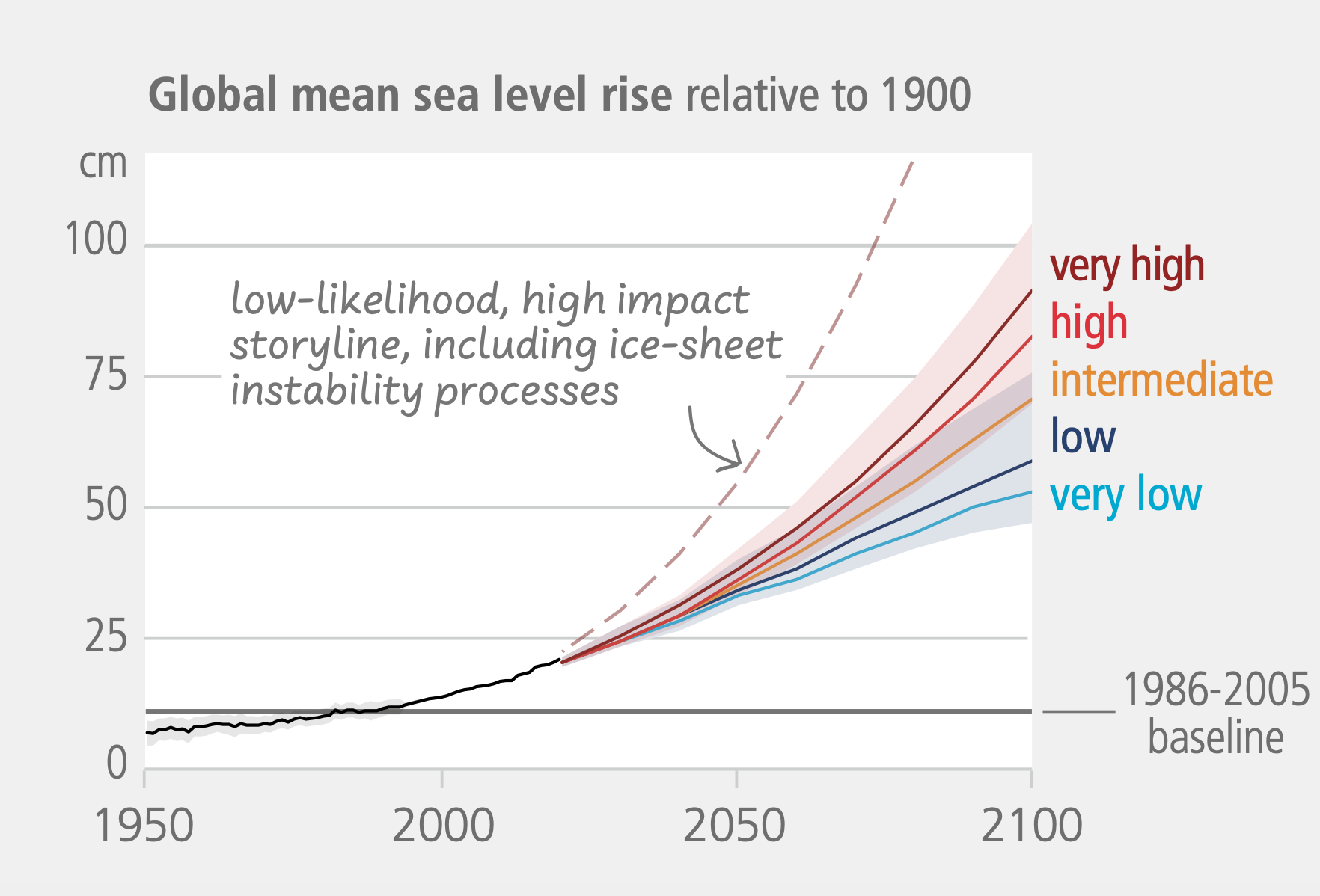 Projections of global sea level rise in very high (dark red), high (red), intermediate (orange), low (dark blue) and very low (light blue) warming scenarios, based on IPCC projections. The shaded areas represent the "likely range" of sea level rise, which only takes into account processes that are already well understood. The dotted line represents a worst-case scenario where various poorly understood processes combine. Adapted from IPCC (2023)
Retreat of glacier grounding lines
Projections of global sea level rise in very high (dark red), high (red), intermediate (orange), low (dark blue) and very low (light blue) warming scenarios, based on IPCC projections. The shaded areas represent the "likely range" of sea level rise, which only takes into account processes that are already well understood. The dotted line represents a worst-case scenario where various poorly understood processes combine. Adapted from IPCC (2023)
Retreat of glacier grounding lines
In Antarctica, the melting of ice on the surface of glaciers is limited. In many locations, warmer temperatures are leading to increases in snowfall and greater snow accumulation, which means the surface of the ice is continuously gaining mass.
Most of Antarctica's contribution to global sea level rise is, therefore, not linked to ice melt at the surface. Instead, it occurs when giant glaciers push from land into the sea, propelled downhill by gravity and their own immense weight.
These huge masses of ice first grind downhill across the land and then along the seafloor. Eventually, they detach from the bedrock and start to float.
These floating ice shelves then largely melt from below, as warm ocean water intrudes into cavities on its underside. This is known as "basal melting".
The boundary between grounded and floating ice is known as the "grounding line".
In many regions of Antarctica, grounding lines typically sit at the high point of the bedrock, with the ice sheet deepening inland. This is illustrated in the graphic below.
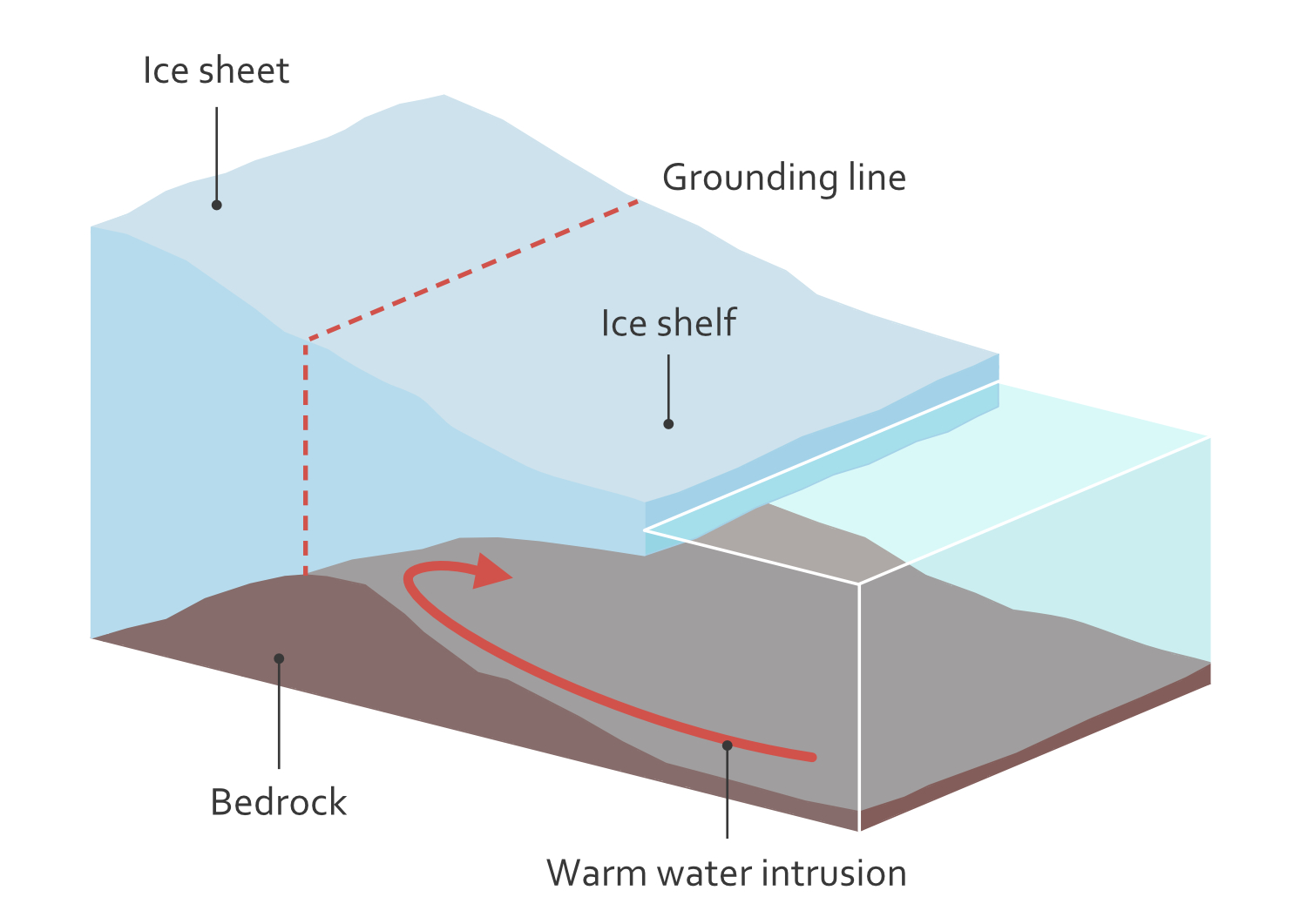 Illustration of an Antarctic ice sheet, showing the grounding line where grounded ice transitions to floating ice, and how warm ocean water intrudes beneath the ice shelf, melting it from below. Credit: Freya Sykes, iC3.
When a grounding line is at a high point of the bedrock, it acts as a block which limits the area of ice exposed to basal melting.
However, if the grounding line retreats further inland, warm water could "spill" over the high point in the bedrock and carve out large cavities below the ice. This could dramatically accelerate the retreat of grounding lines further inland across Antarctica.
There is evidence to suggest that the retreat of grounding lines might cause a runaway effect, in which each successive retreat causes the ice behind the line to detach from the land even more quickly.
Recent climate modelling suggests that many grounding lines are not yet in runaway retreat - but some regions of Antarctica are close enough to thresholds that tiny increases in basal melting push model runs toward very different outcomes.
Whether - and to what extent - grounding lines might retreat will depend on a wide range of factors, including the exact shape of the bedrock beneath the ice. However, the bedrock on the coast of Antarctica has not yet been precisely mapped in many places.
Ice shelvesOnce Antarctic ice detaches from the seabed, it floats on the ocean surface. These floating ice shelves slow the flow of ice from land towards the sea, acting as a brake as they wedge between headlands and little hills on the seafloor.
If these ice shelves break apart, the flow of glaciers towards the sea can accelerate.
The image below on the left shows a present-day ice shelf that is pinned in place by bedrock, which slows the flow of the ice into the sea.
The image on the right shows a future scenario in which ocean water continues to intrude under the ice, accelerating basal melting on the underside of the floating ice until it completely detaches from the "pinning point" that had previously held it in place.
In this scenario, the bedrock is no longer acting as a break on glaciers pushing to the sea and the ice shelf starts flowing into the sea more quickly and begins breaking up. Ice masses inland then begin to push more rapidly towards the sea.
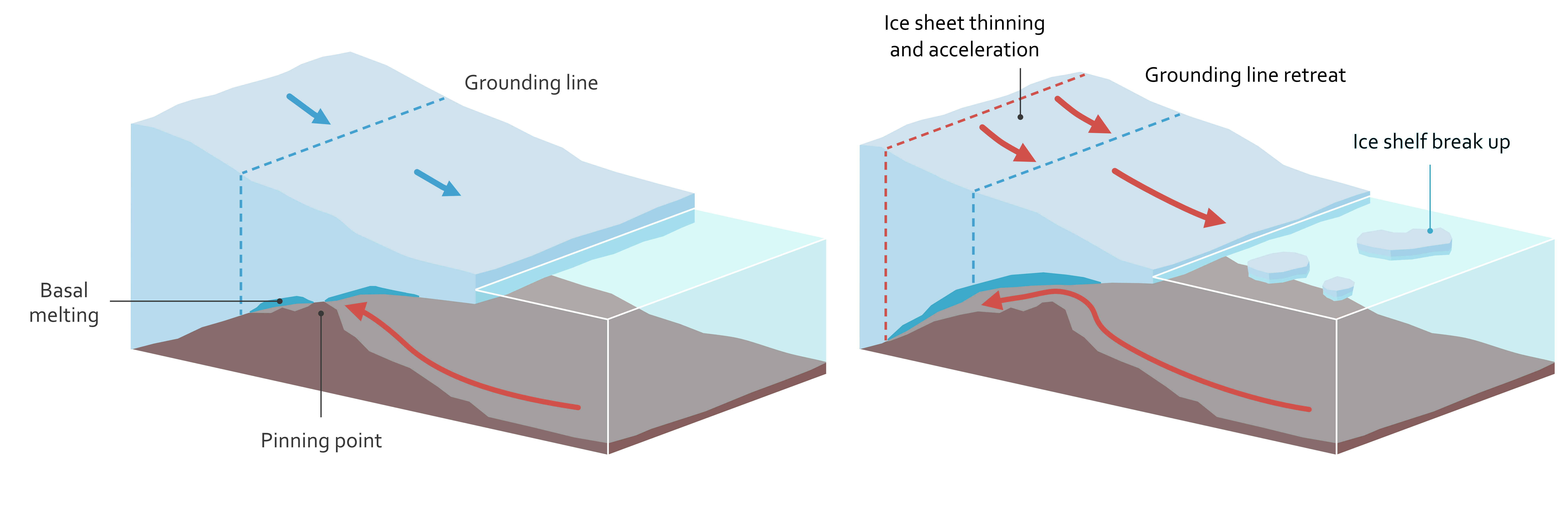 Illustration of an Antarctic ice shelf. On the left, the ice is being held in place by a "pinning point" - a bump in the bedrock which temporarily acts as an anchor. On the right, the ice shelf has detached from the pinning point, meaning that both the ice shelf and the masses of ice piled up behind it start flowing into the sea more rapidly. Credit: Freya Sykes, iC3.
This dynamic was directly observed during the collapse of the Larsen-B ice shelf on the Antarctic Peninsula in 2002, which led to accelerated glacial ice flow and is believed to have contributed to a dramatic glacial retreat two decades later.
However, the factors affecting the stability of the floating ice shelves around Antarctica's coast are complex. The strength of ice shelves depends on their thickness, how and where they are pinned to the seafloor, how cracks grow, as well as air and sea temperatures and levels of snow and rainfall. For example, meltwater at the surface can lever cracks further apart, in a process known as hydrofracturing.
A 2024 review of the stability of ice shelves found big gaps in scientific understanding of these processes. There is currently no scientific consensus on how rapidly various ice shelves might collapse - the pace is likely to vary greatly from one ice shelf to the next.
Ice-cliff collapseIf, and when, ice shelves collapse and drift away from the coast, they will expose the towering ice cliffs that loom behind them directly to the sea. These ice cliffs can be more than 100 metres tall.
This exposure could potentially lead to those cliffs to become structurally unstable and collapse in a runaway process - further accelerating the advance of the glaciers pushing towards the sea.
The images below illustrate how such a collapse might unfold. In the top image, a floating ice shelf buttresses the ice masses behind it. In the middle image, the ice shelf has largely broken apart and melted into the sea. In the bottom image, the ice shelf has completely disappeared, leaving a steep wall of ice towering over the sea. At this point, the exposed cliffs might collapse and crash into the water below.
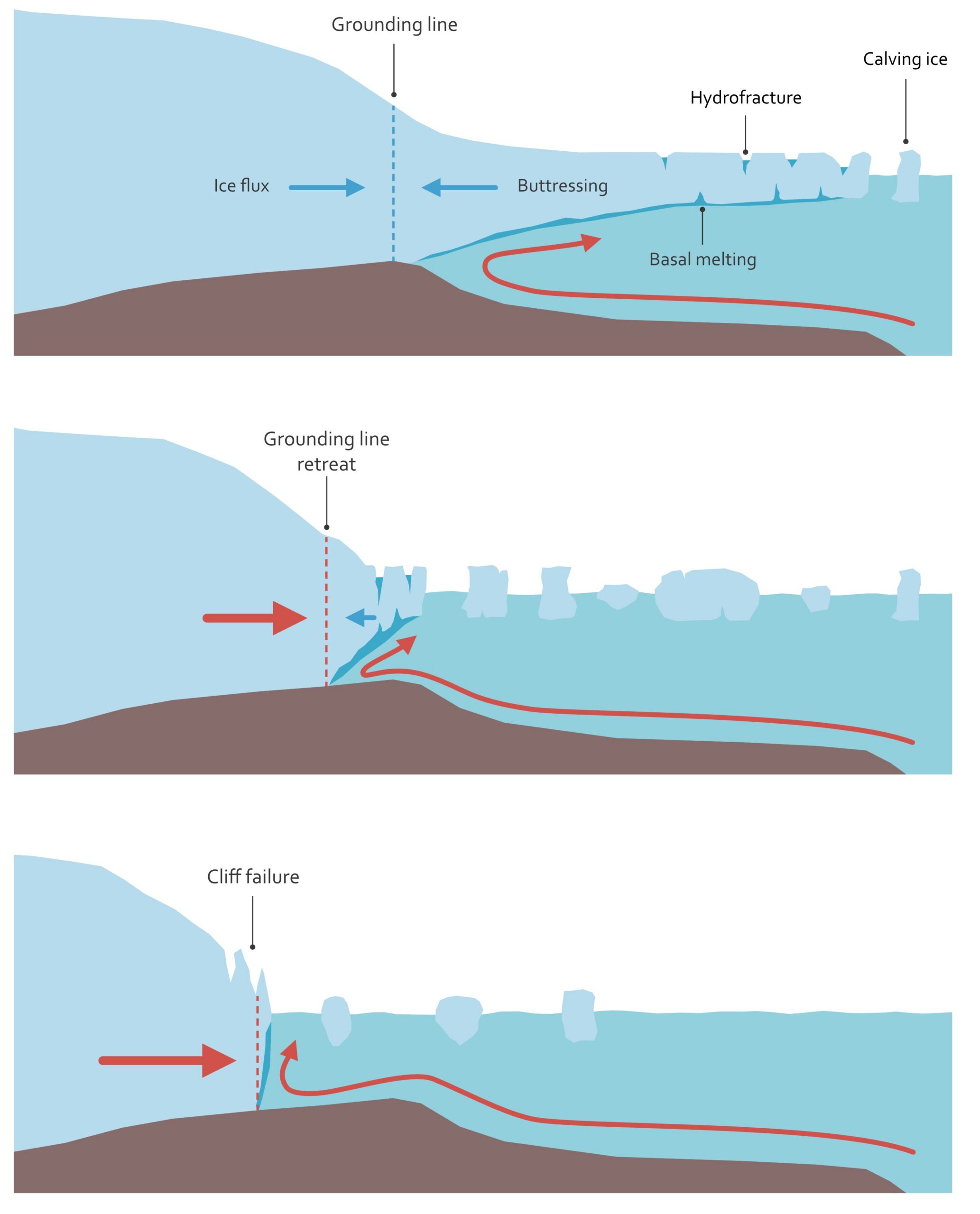 Progressive disintegration of ice shelves over time (top and middle) may leave ice cliffs exposed (bottom image). These tall cliffs might collapse and fall directly into the sea. Image credit: Freya Sykes, iC3.
Researchers are still debating whether or not this "marine ice cliff instability" is likely to happen this century.
Modelling ocean dynamicsThe speed at which grounding lines retreat, ice shelves collapse and ice cliffs cascade into the sea partially depends on complex ocean dynamics.
The temperature and speed of water intrusion underneath the ice depends on multiple factors, including ocean currents, winds, sea ice, underwater ridges and eddies. These factors vary from one location to the next and can vary by season and by year.
Once water reaches a given cavity, the ways in which turbulent flows and fresh meltwater plumes meet the ice can significantly affect melt levels - further complicating the picture.
In other words, predicting future melt depends on models that integrate macro-level ocean circulation with local-level turbulence. This remains a major modelling challenge that, despite ongoing progress, is unlikely to be conclusively resolved any time soon.
Planning for future sea level riseScientists agree that human-caused climate change is causing sea levels to rise and that the oceans will continue to rise during the current century and far beyond.
However, the combination of the complexity of modelling ice-ocean interactions and the threat of potential runaway processes means that, for the foreseeable future, there is considerable uncertainty about the magnitude of future sea level rise.
(While this article focuses on Antarctica, it is worth noting that Greenland's contribution to future sea level rise is also highly uncertain.)
To complicate matters further, the ocean does not rise like water in a bathtub, creeping up equally on all sides. Instead the Earth's surface is highly dynamic.
For example, during the last ice age, the immense mass of the glaciers that covered much of northern Europe pressed the Earth's surface downwards. Even though most of that ice disappeared millennia ago, much of Scandinavia is still rebounding today, causing the land to rise gradually.
In contrast, the city of Jakarta in Indonesia is sinking at a rapid pace of 10cm per year due to sprawling urbanisation and extraction of groundwater for household and industrial uses. That rate may increase or decrease over the coming decades, depending on urban planning and water management decisions.
This mix of natural and human-driven factors means that, even if researchers could perfectly predict average global sea level rise, calculating how much the sea will rise in any given location will remain challenging.
Another key unknown is around future levels of human-caused greenhouse gas emissions which drive climate change.
The scientific community is working to better understand the dynamics driving sea level rise and improve predictions, including through Antarctic sea bed mapping, field observations and improved models. Those advances in knowledge will not erase uncertainty, but they could reduce the range of possible outcomes.
Nevertheless, while that range may narrow, it will not completely disappear.
Plans drawn up by policymakers and engineers to prepare society for future sea level rise should never be based on a single point estimate.
Instead, they should take into account a range of possible "likely" outcomes - and include contingency plans for less likely, but entirely possible, scenarios in which the oceans rise far faster than currently expected.
Climate change made 'fire weather' in Chile and Argentina three times more likely
Extreme weather
|11.02.26
Met Office: A review of the UK's climate in 2025
Guest posts
|30.01.26
Climate change and La Niña made 'devastating' southern African floods more intense
Attribution
|29.01.26

Climate change could lead to 500,000 'additional' malaria deaths in Africa by 2050
People
|28.01.26
jQuery(document).ready(function() { jQuery('.block-related-articles-slider-block_bb9a1db44b5127857195e78f1a36a112 .mh').matchHeight({ byRow: false }); });The post Guest post: The challenges in projecting future global sea levels appeared first on Carbon Brief.
Jaume Masia ends the final World Supersport test as fastest, though the WorldSSP field is very close. Masia was just three hundredths of a second faster than Oli Bayliss on the Triumph 765, with Tom Booth-Amos moving up into third. Drops of rain disrupted the first part of the afternoon session, though it never persisted and the track remained mostly dry.
David Emmett Tue, 17/Feb/2026 - 08:39
Industry using 'diversionary' tactics, says analyst, as energy-hungry complex functions such as video generation and deep research proliferate
Tech companies are conflating traditional artificial intelligence with generative AI when claiming the energy-hungry technology could help avert climate breakdown, according to a report.
Most claims that AI can help avert climate breakdown refer to machine learning and not the energy-hungry chatbots and image generation tools driving the sector's explosive growth of gas-guzzling datacentres, the analysis of 154 statements found.
Continue reading...Advisory board member says Europe already paying price for lack of preparation but adapting is 'not rocket science'
Keeping Europe safe from extreme weather "is not rocket science", a top researcher has said, as the EU's climate advisory board urges countries to prepare for a catastrophic 3C of global heating.
Maarten van Aalst, a member of the European Scientific Advisory Board on Climate Change (ESABCC), said the continent was already "paying a price" for its lack of preparation but that adapting to a hotter future was in part "common sense and low-hanging fruit".
Continue reading...President says it is inappropriate for UK to be dealing with Gavin Newsom after Ed Miliband meets governor in London
Donald Trump has vented his fury against a green energy deal between the British government and California's governor, Gavin Newsom, a likely future Democratic presidential candidate.
"The UK's got enough trouble without getting involved with Gavin Newscum," Trump said in an interview with Politico, using the derogatory nickname he reserves for Newsom. "Gavin is a loser. Everything he's touched turns to garbage. His state has gone to hell, and his environmental work is a disaster."
Continue reading...Buxton, Derbyshire: From those who planted them, to those who pruned them, to the pollinators and the mosses, it's a long, collective endeavour
As I prune one of our pears - a black Worcester, incidentally, a British variety from the 13th century - I ponder the linguistic connections that arise from our garden "acre" in a place called "Hogshaw". The first word derives from Old English æcer, meaning an "acorn". It was linked to wildwood, where the people would fatten their swine on wild pears, apples and oak mast. An acre of pig woodland (or hog shaw) was probably the land required to feed one beast for the winter. I wonder, therefore, how many pigs were put to pannage in our original Hogshaw for it to have acquired its name permanently?
Another thought arising as I clip away the three Ds - dead, diseased or damaged wood - is how much orchards are founded on connection and sharing. I'm not just thinking of the veilwort (a liverwort) on many branches, nor the bristle moss that gives colour and body to every lovely limb, but also the fact that we relied on previous owners to plant trees and their successors to prune them. We also depend totally for our fabulous pear harvest on pollinators, which I've mainly found here to be solitary bees. To date, we've recorded 19 bee species.
Continue reading...
Label: InFiné Release: Evaporator Date: February 20th, 2026 Bandcamp This morning, I am listening to Nathan Fake's upcoming album, and I'm happy to share one of my favourite tracks with you. Nathan is an English electronic musician from Norfolk, widely recognised for his particular fusion of ambient, IDM, and techno. I will not slot his music into a specific genre, but if you're into the…
There are just three models of Apple Watch — and $500 separates the most affordable from the premium model, with the flagship landing somewhere in between. Before the launch of the overhauled Apple Watch SE 3 in late 2025, it was pretty easy to direct most people to the Apple Watch Series 11. But with its new display and faster charging, the budget model makes a lot more sense now. There's also a case for recommending the refreshed Apple Watch Ultra 3 to diehard adventurers and outdoor enthusiasts. Here, we spell out just what differentiates the models as well as what you get when you buy any Apple Watch. Using insights gleaned from Engadget's own reviews, this guide will help you pick the best Apple Watch for you.
Best Apple Watch in 2026
What to look for in an Apple Watch
Like all Apple products, Apple Watches will only work with other devices from the brand's ecosystem. You won't be able to pair any Apple Watch to your Android phone. Note that you can pair other wearables (like a Garmin tracker or a Fitbit band) with your iPhone. There are some more features that are specific to Apple Watches and that set each of the three models apart from one another.
Chips and sensorsAll three models in the current lineup have the same S10 SiP (system in a package) chip with a four-core Neural Engine. The chip allows for on-device processing of Siri requests as well as dictation, translation, automatic workout detection and the double tap and wrist flick gestures that let you control your watch hands-free.
You get an optical heart rate sensor, temperature sensor, compass, altimeter, accelerometer, gyroscope and light sensor in every Apple Watch model, but the Series 11 and Ultra 3 have a more advanced heart monitor that in part enables the new hypertension detection feature. The two higher-end watches also have sensors that can generate an ECG and detect blood oxygen, water temperature and water depth. They also include an Ultra Wideband chip that works in conjunction with the latest AirTags to precisely find Apple's trackers.
Fall and crash detection come standard no matter which Apple wearable you pick and all support near field communication (NFC) for Apple Pay. If you opt for the cellular versions of the Series 11 or SE 3, your watch will have access to 5G networks. Cell connectivity comes standard on the Ultra 3 and the watch now also has satellite-enabled SOS, messaging and Find My abilities.
Every Apple Watch model now has an always-on display. The wide-angle OLED display on the Apple Watch 11 and Ultra 3 lets you see the always-on display from more angles. The SE can reach a maximum brightness of 1,000 nits, the Series 11 can get as bright as 2,000 and the Ultra 3 hits 3,000 nits. Both higher-end screens can dim to a single nit, making them less distracting in the dark. And the Ultra model has the added night mode feature on certain watch faces that turns the dial red to preserve your night vision.
As for case sizes, the SE 3 is available in 40 or 44mm. The Series 11 has a choice of a 42 or 46mm case. The Ultra 3 comes in just one size measuring 49mm. The SE 3 has an aluminum case in two colors (Starlight or Midnight). The Series 11 lets you pick from aluminum (in Rose Gold, Silver, Space Gray or Jet Black) or titanium (in Natural, Gold or Slate). And the Ultra 3 only comes in titanium (either Natural or Black).
Battery lifeThe Apple Watch Ultra 3 sports the biggest battery and can last for a claimed 42 hours on a charge. The Apple Watch 11 is rated to go for 24 hours and the SE 3 gets an estimated 18 hours before it needs a visit to the charger. Low power mode will get you many more hours, going for as long as 72 hours for the Ultra 3, 38 hours on the Series 11 and 32 hours on the SE 3. All three are now capable of fast charging and Apple states an 80 percent charge in 45 minutes for the SE 3 and Ultra 3 and 80 percent in 30 minutes for the Series 11.
All three Apple Watches have similar fitness tracking chops. The Activity app uses three "rings" to keep tabs on how much you're moving in a day: The Move ring tracks your active calories; the Exercise ring monitors the minutes you've spent walking, running, doing yoga and so on; and the Stand ring tells you how many hours in a day you've stood up and moved around for at least one minute.
Different internal sensors detect those activities, for example the accelerometer senses when you're moving versus sitting still, and the optical heart rate sensor judges how hard you're working out and how many calories you've burned. You can set your goals for each ring and you'll earn badges and animations when you hit them.
The Workout Buddy will work with all three watches, but you'll need to have an Apple Intelligence-enabled iPhone nearby as well as Bluetooth headphones to use it. All three can access offline maps, which could prove useful when hiking far from cellular coverage. But if going off-grid is something you plan to do often, you may appreciate the satellite connectivity of the Apple Watch Ultra 3.
SiriYou can get the weather, start a workout, identify a song and dictate a text just by asking Siri. All Apple Watch models support the Raise to Speak feature that bypasses the need to say "Hey Siri" and will instead listen for your request when you lift your wrist near your mouth.
Every Apple Watch model utilizes onboard processing of Siri requests now, too. That means executing simple requests like starting workouts and timers are quicker, as they won't need to access external networks. However, requests like sending texts or getting weather forecasts still need to communicate with Wi-Fi or cellular, so you'll need to have your phone nearby if you have a GPS-only model.
Apple declared the Series 9 with the aluminum case its first carbon neutral product. But has since dropped those claims, possibly due to legal challenges in a German court. Instead, Apple states that all three watches have been designed to "reduce environmental impact" and the company still maintains its commitment to becoming carbon neutral by 2030.
PricePerhaps the most surprising thing about the three new wearables was the lack of price increase from previous models. The Apple Watch SE still starts at $249, the Series 11 goes for $399 and up, and the Ultra 3 begins at $799. That puts a $550 difference between entry prices for the cheapest and most expensive Apple Watches.
For $250 you can get the 40mm Apple Watch SE 3 with GPS-only connectivity; adding cellular connectivity ups the price by $50. The Apple Watch Series 11 starts at $399 for the 42mm, non-cellular model in aluminum and goes as high as $749 for the 46mm titanium case (which comes with cellular). The Apple Watch Ultra 3 is $799 for a titanium 49mm case with both GPS and cellular, but the price goes up with different bands. You may also need a few Apple Watch accessories, if so, you can factor that into your purchasing decision.
Engadget has been reviewing Apple Watches since the first one came out in 2015. Since then, we've tested every subsequent model Apple has released, including the Ultra and SE models, spending at least a few days or even a couple weeks with one strapped to our wrists. During that time, we run, hit the gym, go on hikes and wear it while sleeping, all the while gauging how it tracks various metrics, integrates with the iPhone and performs every other trick Apple claims its smartwatches can do.
Since we also review smartwatches from other companies, such as Samsung's Galaxy Watches and Google Pixels, our editors can compare Apple Watches not just to previous generations, but also to other wearables on the market. Our buying guides and recommendations rely on first-hand testing by Engadget staff.
Apple Watch comparison chartProduct
Apple Watch Series 11
Apple Watch Ultra 3
Apple Watch SE 3
Release date
September 2025
September 2025
September 2025
Case sizes
42mm or 46mm
49mm
40mm or 44mm
Case material
Aluminum or titanium
Titanium
Aluminum
Display
LTPO3 OLED Always-On
LTPO3 OLED Always-On
LTPO OLED Always-on
Max brightness
2,000 nits
3,000 nits
1,000 nits
Chip
S10 SiP
S10 SiP
S10 SiP
Max battery life
24 h./38 h. low power
42 h./72 h. low power
18 h./32 h. low power
Water resistance
50 m.
100 m.
50 m.
Featured sensors
Electrical heart, optical heart (3rd gen), blood oxygen, temperature, compass, altimeter, accelerometer, gyroscope, light, depth gauge, water temp
Electrical heart, optical heart (3rd gen), blood oxygen, temperature, compass, altimeter, accelerometer, gyroscope, light, depth gauge, water temp
Optical heart (2nd gen), temperature, compass, altimeter, accelerometer, gyroscope, light
Apple Watch FAQs What are the best Apple Watch apps for fitness tracking?All three watches use the same Fitness and Workout apps to track your progress, and they all have sensors to track speed, cadence, distance and heart rate. But the Apple Watch Ultra 3 and the Apple Watch Series 11 have more sensors than the Apple Watch SE 3.
Additional tech includes an electrical heart rate sensor and a depth gauge. The two pricier watches also have a blood oxygen app and an ECG app, all of which may give you a better picture of your overall health. All three models are compatible with the AI-powered Workout Buddy from watchOS 26 (the feature also requires an AI-compatible iPhone).
Are any of the Apple Watch series waterproof?All three models are water resistant. But they can all handle immersion in water, including a swim. The Apple Watch SE 3 and Series 11 can handle a depth of up to 50 meters while the Ultra 3 can be submerged up to 100 meters.
This article originally appeared on Engadget at https://www.engadget.com/wearables/best-apple-watch-160005462.html?src=rss

Although we are not seeing the mass rallies and violence of fascism in the 1930s, there are certainly similar trends in many countries. So, is this fascism, or something new? In a new study, Mark Coeckelbergh, Professor of Philosophy of Media and Technology at the University of Vienna, argues we are seeing a new form - "technofascism".
What is fascism?Political theorists argue that fascism arises from mass alienation and atomisation. Individuals who feel themselves isolated and oppressed are vulnerable to emotional myths of national rebirth and victimhood. Fascism then suppresses pluralism, fuses the state and corporate power, and turns politics into a kind of entertainment. And capitalist democracies facing crisis, and visible inequality, are particularly vulnerable.
Coeckelbergh argues that we are seeing the rise of a new form of fascism, which he terms "technofascism". This has three components: the technology itself (Artificial Intelligence and platforms), the business context (Big Tech and surveillance capitalism) and a political context (right‑wing populism, authoritarianism, and illiberal democracy).
Where the fascism of the 1930s controlled people through mass rallies and open terror, technofascism uses algorithms that predict, nudge, and constrain behaviour, often invisibly. AI enables mass surveillance, emotional manipulation, information domination, and algorithmic governance that all erode autonomy, moral judgment and accountability.
The tech savioursAI and social platforms enable classic fascist patterns of myth‑making and emotional mobilisation. Personalised feeds amplify "us versus them" narratives. They polarise and dehumanise "others"; and platform owners can tweak algorithms with no need for overt censorship.
Myths about Artificial General Intelligence, the colonisation of Mars and life extension present tech billionaires as saviours of humanity. So extreme inequality and sacrifice are allowed in the name of a technological destiny. At the same time, AI chatbots and digital companions exploit loneliness and alienation by simulating intimacy, offering escape from isolation to a new sense of community.
This is aided by surveillance capitalism, corporate concentration and a "tech coup", where Big Tech gains power over regulations and politics. Where historic fascism dominated by fear, technofascism pacifies with pleasure, convenience and distraction, while AI‑driven platforms subtly steer preferences and suppress dissent. And behind libertarian rhetoric, Big Tech quietly embeds itself in states, militaries and intelligence agencies.
The fantasy of participationCoeckelbergh argues that this is what we are seeing in the rise of illiberal democracies and populism in the US and Europe. Leaders use digital media to bypass intermediaries, cultivate personality cults and turn politics into an emotional spectacle. Social media produces a "fantasy of participation": enabling people to endlessly express their political views online without having any influence on the underlying structural power. Algorithms amplify divisive content and encourage people to follow leaders, while democratic institutions, and checks and balances are hollowed out.
He does not claim that these tendencies are intentional. Many engineers and some tech leaders might not intend fascist outcomes, yet the opportunities offered by the technology, corporate incentives, capitalist crises, and illiberal politics, produce exactly that result. Digital infrastructures and AI align with authoritarian, corporatist and exclusionary politics, clothed in narratives of innovation and human benefit.
What to do?Coeckelbergh argues that conventional AI regulation and modest democratic reforms - transparency rules, impact assessments, anti‑concentration measures, better oversight, digital literacy and restrictions on political uses of AI - are all necessary, but insufficient. They do not address the deeper drivers: unregulated capitalism, entangling of corporations with the state, social atomisation, ideological myths and the vulnerabilities of liberal democracy.
So, he calls for a broader democratisation, by:
- rebuilding stronger constitutions and independent institutions
- limiting emergency powers
- reforming intelligence services
- tackling media ownership concentration
- strengthening welfare and community
- curbing the accumulation of capital and political power in Big Tech.
He also argues for "bottom‑up" resistance: the development of AI ethics, alternative technological architectures and platform co‑operatives, and education that cultivates democratic virtues and critical awareness of the risks of technofascism.
He is not a pessimist; he believes that technofascist systems also have potential internal weaknesses: complexity, infrastructural fragility, loss of expertise, environmental crises, and cyber‑vulnerabilities, which may make opposition possible.
So technofascism is not just a metaphor - it is a mutation of fascism in the new context. To prevent societies sliding further into this form of domination, he urges not just incremental regulation of AI but a much more radical transformation of both technology and society. We need new democratic narratives and "myths" that can mobilise political emotions towards egalitarian and emancipatory ends, rather than towards authoritarian futures.
More from East Anglia Bylines
 Brexit
The will of the rich and powerful: Brexit and the Epstein files
byStephen McNair 11 February 2026
Brexit
The will of the rich and powerful: Brexit and the Epstein files
byStephen McNair 11 February 2026
 Democracy
When 'The land of the free' stops being free
byGuy Anthony Ayres 6 February 2026
Democracy
When 'The land of the free' stops being free
byGuy Anthony Ayres 6 February 2026
 Politics
The great Ministry of Defence-to-Palantir pipeline
byEthan Shone 9 February 2026
Politics
The great Ministry of Defence-to-Palantir pipeline
byEthan Shone 9 February 2026
 Politics
The nature of fascism and why it differs from populism
byProf Paul Kenny 28 November 2025
Politics
The nature of fascism and why it differs from populism
byProf Paul Kenny 28 November 2025
 Democracy
Technofascism: AI, Big Tech, and the new authoritarianism
byStephen McNair 17 February 2026
Democracy
Technofascism: AI, Big Tech, and the new authoritarianism
byStephen McNair 17 February 2026
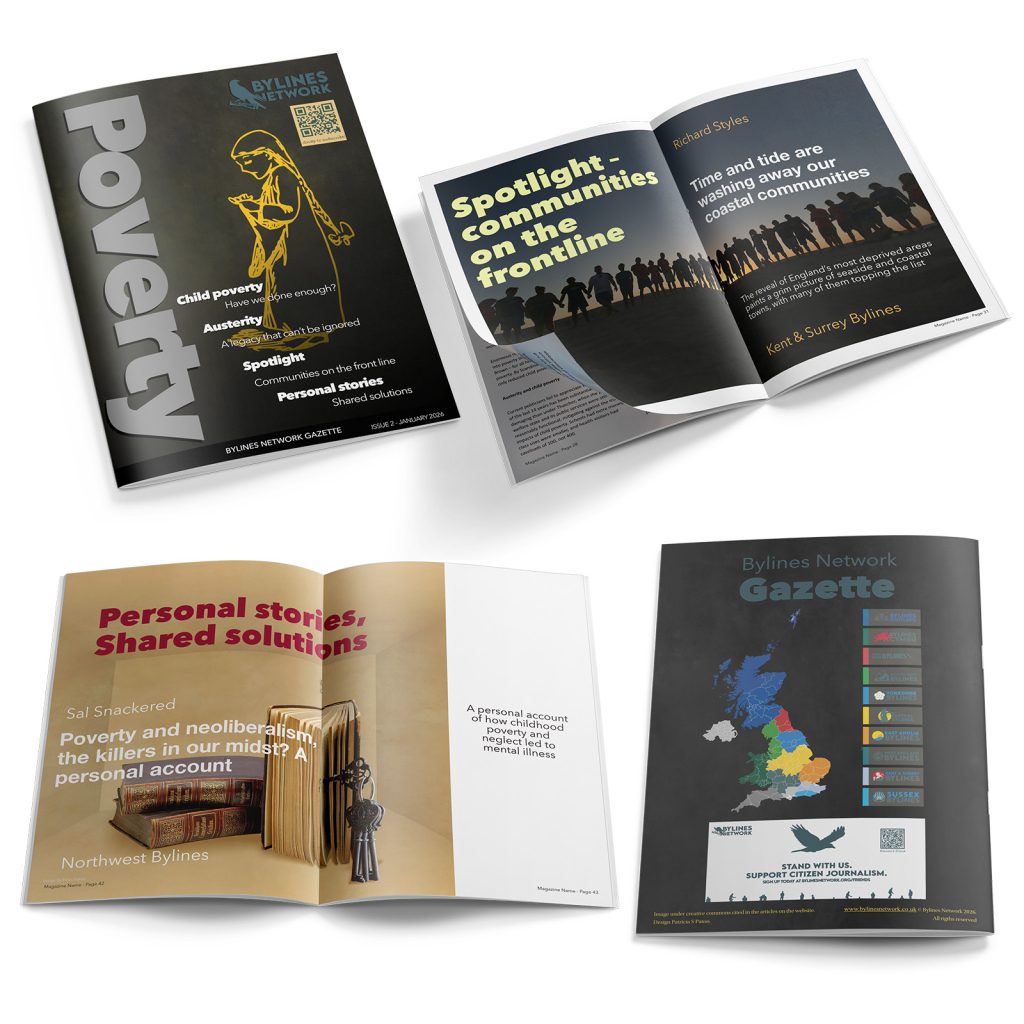 Bylines Network Gazette is back!
With a thematic issue on a vital topic - the rise child poverty, ending on a hopeful note. You will find sharp analyses on the effect of poverty on children's lives, with a spotlight on the communities that are on the front line of deprivation, with personal stories and shared solutions. Click on the image to gain access to it, or find us on Substack.
Journalism by the people, for the people.
The post Technofascism: AI, Big Tech, and the new authoritarianism first appeared on East Anglia Bylines.
Booth-Amos and Mahias land back up near the front to conclude the final test day of the 2026 preseason
The Italian rider was third-fastest on Day 2 of the Australia Test as he showcased his potential 'Down Under'
I hope to write a serious article shortly about the position of Venezuela, which is rather that of a hostage with a gun to their head, attempting to appease a psychopath.
But for now here are a couple of small videos illustrating that it is a lie that the country is failed, starving or repressive.
Obviously in this crisis the government is under some strain. I am however trying to work my way up to get a minister to talk to me on the record about the extent of economic liberalisation, how far it is being driven by the Americans, how the country's revolutionary principles can be preserved, and the prospects for the United States lifting its naval blockade of Venezuelan oil to non-US customers.
If I can't get the access we may reach the limit of how much I can usefully do here; there is still more to bring you from the ground, and simply showing you that long term Western propaganda has given an entirely false image of the country has its uses. A mini documentary on the commune system is in the edit.
As ever with an entirely individual donation and subscriber model, there is also a question of financial sustainability. We are employing a little local team here including Natalia our cinematographer, Andreina our journalist, Jonathan our editor and Greimar our assistant, and we are hiring an apartment. It takes time to get the production pipeline going and I do understand that the output does not yet justify the expense.
As ever we need to spread the load and please we are looking primarily to those who have never donated or contributed before. Our Gofundme link for the Venezuelan operation is here:
This is the same crowdfunding account we used for Lebanon so discount the first £35,000 raised as it was spent in Lebanon.
Anybody is welcome to republish and reuse, including in translation.
Because some people wish an alternative to PayPal, I have set up new methods of subscription payment including a Patreon account and a Substack account if you wish to subscribe that way. The content will be the same as you get on this blog. Substack has the advantage of overcoming social media suppression by emailing you direct every time I post. You can if you wish subscribe free to Substack and use the email notifications as a trigger to come for this blog and read the articles for free. I am determined to maintain free access for those who cannot afford a subscription.
Subscriptions to keep this blog going are gratefully received.
Choose subscription amount from dropdown box:
Recurring Donations
3 Pounds : £3.00 GBP - monthly5 Pounds : £5.00 GBP - monthly10 Pounds : £10.00 GBP - monthly15 Pounds : £15.00 GBP - monthly20 Pounds : £20.00 GBP - monthly30 Pounds : £30.00 GBP - monthly50 Pounds : £50.00 GBP - monthly70 Pounds : £70.00 GBP - monthly100 Pounds : £100.00 GBP - monthly

PayPal address for one-off donations: craigmurray1710@btinternet.com
Alternatively by bank transfer or standing order:
Account name
MURRAY CJ
Account number 3 2 1 5 0 9 6 2
Sort code 6 0 - 4 0 - 0 5
IBAN GB98NWBK60400532150962
BIC NWBKGB2L
Bank address NatWest, PO Box 414, 38 Strand, London, WC2H 5JB
Bitcoin: bc1q3sdm60rshynxtvfnkhhqjn83vk3e3nyw78cjx9
Ethereum/ERC-20: 0x764a6054783e86C321Cb8208442477d24834861a
The post Two Little Caracas Videos appeared first on Craig Murray.
The #55 is usually strong at Phillip Island but his testing times left him down the timesheets on both Monday and Tuesday
A quartet of Japanese organisations plan to build "advanced ambient internet of things systems" using a newly approved ISO standard.…
The #11 has been unbeatable in Australia throughout the Official Test as he secured top spot for the second day running
Shanghai, CHINA — XPENG showcased its AI-driven ADAS system to global delegates this week, hosting live road demonstrations during the UN/WP.29 Informal Working Group on Automated Driving Systems (IWG ADS) session in Shanghai. The international forum, which brings together stakeholders from regulators to industry experts and consumer groups to develop ... [continued]
The post XPENG Demonstrates Real-World AI Driving To Global Delegates At UN Vehicle Regulation Harmonization Forum In China appeared first on CleanTechnica.
The Florida firm AccuSolar is among the stakeholders supporting forward movement in the US floating solar industry, despite the sharp U-turn in federal energy policy.
The post The Evolution of the US Floating Solar Industry appeared first on CleanTechnica.
Again in P2, Philipp Oettl is shaping up to be a name to watch in the 2026 title fight.
Amazon Web Services has enabled nested virtualization for a handful of EC2 instances.…

Introduction: Fascism at the End of Industrial Civilization
This essay argues that the United States is drifting toward a distinctly twenty‑first‑century form of fascism driven not by mass parties in brownshirts, but by an oligarchic techno‑feudal elite. Neoliberal capitalism has hollowed out democratic institutions and concentrated power in a transnational "authoritarian international" of billionaires, security chiefs, and political fixers who monetize state power while shielding one another from accountability. At the same time, Big Tech platforms have become neo‑feudal estates that extract rent from our data and behavior, weaponize disinformation, and provide the surveillance backbone of an emerging global police state.
Drawing on the work of Robert Reich, William I. Robinson, Yanis Varoufakis, and others, alongside historian Heather Cox Richardson's detailed account of Trump‑era patronage, whistleblower suppression, and DHS/ICE mega‑detention plans, the essay contends that America is rapidly constructing a system of concentration‑camp infrastructure and paramilitary policing designed to manage "surplus" populations and political dissent. Elite impunity, entrenched through national‑security exceptionalism, legal immunities, and revolving‑door careers, means that those directing lawless violence face virtually no consequences. Elections still happen, courts still sit, newspapers still publish, but substantive power is increasingly exercised by unelected oligarchs, tech lords, and security bureaucracies.
This authoritarian drift cannot be separated from the broader crisis of industrial civilization. Ecological overshoot, climate chaos, resource constraints, and structural economic stagnation have undermined the promise of endless growth on which liberal democracy once rested. Rather than using the remnants of industrial wealth to democratize a just transition, ruling elites are hardening borders, expanding carceral infrastructure, and building a security regime to contain "surplus" humanity in a world of shrinking energy and material throughput. America's oligarchic techno‑feudal fascism is thus not an anomaly, but one plausible endgame of industrial civilization: a stratified order of gated enclaves above and camps and precarity below, designed to preserve elite power as the old industrial world comes apart.
I. From liberal promise to oligarchic capture
The American republic was founded on a promise that power would be divided, constrained, and answerable: a written constitution, separated branches, periodic elections, and a Bill of Rights that set bright lines even the sovereign could not cross. That promise was always compromised by slavery, settler colonialism, and gendered exclusion, but it retained real, if uneven, force as a normative horizon. What has shifted over the past half‑century is not simply the familiar gap between creed and practice, but the underlying structure of the system itself: the center of gravity has moved from public institutions toward a private oligarchy whose wealth and leverage allow it to function as a parallel sovereign.
The neoliberal turn of the 1970s and 1980s marked the decisive inflection point. Deregulation, financial liberalization, the crushing of organized labor, and the privatization of public goods redistributed power and income upward on a historic scale. Trade liberalization and capital mobility allowed corporations and investors to pit governments and workers against one another, extracting subsidies and tax concessions under the permanent threat of capital flight. At the same time, Supreme Court decisions eroded limits on political spending, redefining "speech" as something that could be purchased in unlimited quantities by those with the means.
The result, as Robert Reich notes, has been the consolidation of an American oligarchy that "paved the road to fascism" by ensuring that public policy reflects donor preferences far more consistently than popular majorities. In issue after issue, such as taxation, labor law, healthcare, and environmental regulation, there is a clear skew: the wealthy get what they want more often than not, while broadly popular but redistributive policies routinely die in committee or are gutted beyond recognition. This is not a conspiracy in the melodramatic sense; it is how the wiring of the system now works.
William Robinson's analysis of "twenty‑first‑century fascism" sharpens the point. Global capitalism in its current form generates chronic crises: overproduction, under‑consumption, ecological breakdown, and a growing population that capital cannot profitably employ. Under such conditions, democratic politics becomes dangerous for elites, because electorates might choose structural reforms such as wealth taxes, public ownership, strong unions, and Green New Deal‑style transitions that would curb profits. Faced with this prospect, segments of transnational capital begin to see authoritarian solutions as rational: better to hollow out democracy, harden borders, and construct a global police state than to accept serious redistribution.
American politics in the early twenty‑first century fits this pattern with unsettling precision. A decaying infrastructure, stagnant wages, ballooning personal debt, militarized policing, and permanent war have produced widespread disillusionment. As faith in institutions erodes, public life is flooded with resentment and nihilism that can be redirected against scapegoats (immigrants, racial minorities, feminists, and queer and trans people) rather than against the oligarchic‑power‑complex that profits from the decay. It is in this vacuum that a figure like Donald Trump thrives: a billionaire demagogue able to channel anger away from the class that actually governs and toward those even more marginalized.
The decisive shift from plutocratic dysfunction to fascist danger occurs when oligarchs cease to see constitutional democracy as even instrumentally useful and instead invest in movements openly committed to minority rule. Koch‑style networks, Mercer‑funded operations, and Silicon Valley donors willing to underwrite hard‑right projects are not supporting democracy‑enhancing reforms; they are building the infrastructure for authoritarianism, from voter suppression to ideological media to data‑driven propaganda. The system that emerges is hybrid: elections still occur, courts still sit, newspapers still publish, but substantive power is increasingly concentrated in unelected hands.
Historian Heather Cox Richardson's recent analysis captures a formation that much mainstream commentary still struggles to name: a transnational "authoritarian international" in which oligarchs, political operatives, royal families, security chiefs, and organized criminals cooperate to monetize state power while protecting one another from scrutiny. This is not a formal alliance; it is an overlapping ecology of relationships, exclusive vacations, investment vehicles, shell companies, foundations, and intelligence ties, through which information, favors, and money flow.
The key is that this network is structurally post‑ideological. As Robert Mueller warned in his 2011 description of an emerging "iron triangle" of politicians, businesspeople, and criminals, these actors are not primarily concerned with religion, nationality, or traditional ideology. They will work across confessional and national lines so long as the deals are lucrative and risk is manageably socialized onto others. Saudi royals invest alongside Western hedge funds; Russian oligarchs launder money through London property and American private equity; Israeli and Emirati firms collaborate with U.S. tech companies on surveillance products that are then sold worldwide.
Within this milieu, the formal distinction between public office and private interest blurs. Richardson's analysis of Donald Trump's abrupt reversal on the Gordie Howe International Bridge after a complaint by a billionaire competitor with ties to Jeffrey Epstein—reads less like the exercise of public policy judgment and more like feudal patronage: the sovereign intervenes to protect a favored lord's toll road. Tiny shifts in regulatory posture or federal support can move billions of dollars; for those accustomed to having the president's ear, such interventions are simply part of doing business.
The same logic governs foreign policy. The Trump‑Kushner axis exemplifies this fusion of public and private. When a whistleblower alleges that the Director of National Intelligence suppressed an intercept involving foreign officials discussing Jared Kushner and sensitive topics like Iran, and when the complaint is then choked off with aggressive redaction and executive privilege, we see the machinery of secrecy misused not to protect the national interest but to shield a member of the family‑cum‑business empire at the center of power. It is as if the state has become a family office with nuclear weapons.
Josh Marshall's phrase "authoritarian international" is apt because it names both the class composition and the political function of this network. The same names recur across far‑right projects: donors and strategists who back nationalist parties in Europe, ultras in Latin America, Modi's BJP in India, and the MAGA movement in the United States. Their interests are not identical, but they overlap around a shared agenda: weakening labor and environmental protections, undermining independent media and courts, militarizing borders, and securing immunity for themselves and their peers.
This world is lubricated by blackmail and mutually assured destruction. As Richardson notes, players often seem to hold compromising material on one another, whether in the form of documented sexual abuse, financial crime, or war crimes. This shared vulnerability paradoxically stabilizes the network: as long as everyone has something on everyone else, defection is dangerous, and a predatory equilibrium holds. From the standpoint of democratic publics, however, this stability is catastrophic, because it means that scandal—once a mechanism for enforcing norms—loses much of its power. When "everyone is dirty," no one can be clean enough to prosecute the others without risking exposure.
III. Techno‑feudal aristocracy and the colonization of everyday life
Layered atop this transnational oligarchy is the digital order that Varoufakis and others describe as techno‑feudalism: a regime in which a handful of platforms function like neo‑feudal estates, extracting rent from their "serfs" (users, gig workers, content creators) rather than competing in open markets. This shift is more than metaphor. In classical capitalism, firms profited primarily by producing goods or services and selling them on markets where competitors could, in principle, undercut them. In the platform order, gatekeepers profit by controlling access to the marketplace itself, imposing opaque terms on those who must use their infrastructure to communicate, work, or even find housing.
This can be seen across sectors:
-
Social media platforms own the digital public square. They monetize attention by selling advertisers access to finely sliced demographic and psychographic segments, while their recommendation algorithms optimize for engagement, often by privileging outrage and fear.
-
Ride‑hailing and delivery apps control the interface between customers and labor, setting prices unilaterally and disciplining workers through ratings, algorithmic management, and the ever‑present threat of "deactivation."
-
Cloud providers and app stores gatekeep access to the basic infrastructure upon which countless smaller firms depend, taking a cut of transactions and reserving the right to change terms or remove competitors from the ecosystem entirely.
In each case, the platform is less a company among companies and more a landlord among tenants, collecting tolls for the right to exist within its domain. Users produce the very capital stock, data, content, behavioral profiles, that platforms own and monetize, yet they have little say over how this material is used or how the digital environment is structured. The asymmetry of power is profound: the lords can alter the code of the world; the serfs can, at best, adjust their behavior to avoid algorithmic invisibility or sanction.
For authoritarian politics, this structure is a gift. First, platforms have become the primary vectors of disinformation and propaganda. Cambridge Analytica's work for Trump in 2016, funded by billionaires like the Mercers, was an early prototype: harvest data, micro‑target individuals with tailored messaging, and flood their feeds with narratives designed to activate fear and resentment. Since then, the techniques have grown more sophisticated, and far‑right movements worldwide have learned to weaponize meme culture, conspiracy theories, and "shitposting" as recruitment tools.
Second, the same infrastructures that enable targeted advertising enable granular surveillance. Location data, social graphs, search histories, and facial‑recognition databases provide an unprecedented toolkit for monitoring and disciplining populations. In the hands of a regime sliding toward fascism, these tools can be turned against dissidents with terrifying efficiency: geofencing protests to identify attendees, scraping social media to build dossiers, using AI to flag "pre‑criminal" behavior. The emerging "global police state" that Robinson describes depends heavily on such techno‑feudal capacities.
Third, the digital order corrodes the very preconditions for democratic deliberation. Information overload, filter bubbles, and algorithmic amplification of sensational content produce a public sphere saturated with noise. Under these conditions, truth becomes just another aesthetic, and the distinction between fact and fiction collapses into vibes. This is the post‑modern nihilism you name: a sense that nothing is stable enough to believe in, that everything is spin. Fascist movements do not seek to resolve this condition; they weaponize it, insisting that only the Leader and his trusted media tell the real truth, while everything else is a hostile lie.
Finally, the techno‑feudal aristocracy's material interests align with authoritarianism. Privacy regulations, antitrust enforcement, data localization rules, and strong labor rights all threaten platform profits. Democratic movements that demand such reforms are therefore adversaries. Conversely, strongman leaders who promise deregulation, tax breaks, and law‑and‑order crackdowns, even if they occasionally threaten specific firms, are often acceptable partners. The result is a convergence: oligarchs of data and oligarchs of oil, real estate, and finance finding common cause in an order that disciplines the many and exempts the few.
IV. Elite impunity and the machinery of lawlessness
Authoritarianism is not only about who holds power; it is about who is answerable for wrongdoing. A system where elites can violate laws with impunity while ordinary people are punished harshly for minor infractions is already halfway to fascism, whatever labels it wears. The United States has, over recent decades, constructed precisely such a system.
The Arab Center's "Machinery of Impunity" report details how, in areas ranging from mass surveillance to foreign wars to domestic policing, senior officials who authorize illegal acts almost never face criminal consequences. Edward Snowden's revelations exposed systemic violations of privacy and civil liberties, yet it was the whistleblower who faced prosecution and exile, not the architects of the programs. Torture during the "war on terror" was acknowledged, even documented in official reports, but those who designed and approved the torture regime kept their law licenses, academic posts, and media gigs. Lethal strikes on small boats in the Caribbean and Pacific, justified by secret intelligence and shielded by classified legal opinions, have killed dozens with no public evidence that the targets posed imminent threats.
This pattern is not an aberration but a feature. As a Penn State law review article notes, the U.S. legal system builds in multiple layers of protection for high officials: sovereign immunity, state secrets privilege, narrow standing rules, and prosecutorial discretion all combine to make it extraordinarily difficult to hold the powerful to account. Violations of the Hatch Act, campaign‑finance laws, or ethics rules are often treated as technicalities, and when reports do document unlawful behavior, as in the case of Mike Pompeo's partisan abuse of his diplomatic office, there are "no consequences" beyond mild censure. Jamelle Bouie's recent video essay for the New York Times drives the point home: America is "bad at accountability" because institutions have been designed and interpreted to favor elite impunity.
Richardson shows how this culture functions inside the national‑security state. A whistleblower complaint alleging that the Director of National Intelligence suppressed an intelligence intercept involving Jared Kushner and foreign officials was not allowed to run its course. Instead, it was bottled up, then transmitted to congressional overseers in a highly redacted form, with executive privilege invoked to shield the president's involvement. The same mechanisms that insulate covert operations abroad from democratic oversight are deployed to protect domestic political allies from scrutiny.
Immigration enforcement offers another window. The Arab Center notes that ICE raids, family separation, and other abuses "escalated under the current Trump administration into highly visible kidnappings, abuse, and deportations" with little accountability for senior officials. The National Immigrant Justice Center documents a detention system where 90 percent of detainees are held in for‑profit facilities, where medical neglect, punitive solitary confinement, and preventable deaths are common, yet contracts are renewed and expanded. A culture of impunity allows agents and managers to treat rights violations not as career‑ending scandals but as acceptable collateral damage.
Latin American scholars of impunity warn that such selective enforcement produces a "quiet crisis of accountability" in which the rule of law is hollowed out from within. Laws remain on the books, but their application is skewed: harsh on the poor and marginalized, permissive toward the powerful. Over time, this normalizes the idea that some people are above the law, while others exist primarily as objects of control. When a polity internalizes this hierarchy, fascism no longer needs to arrive in jackboots; it is already present in the daily operations of the justice system.
The danger, as the Arab Center emphasizes, is that the costs of impunity "come home to roost." Powers originally justified as necessary to fight terrorism or foreign enemies migrate back into domestic politics. Surveillance tools built for foreign intelligence monitoring are turned on activists and journalists; militarized police tactics perfected in occupied territories are imported into American streets. A population taught to accept lawless violence against outsiders (migrants, foreigners, enemy populations) is gradually conditioned to accept similar violence against internal opponents.
V. Concentration camps, paramilitary policing, and ritualized predatory violence
In this context of oligarchic capture, techno‑feudal control, and elite impunity, the rapid expansion of detention infrastructure and the deployment of paramilitary "federal agents" across the interior United States are not aberrations; they are central pillars of an emergent fascist order.
Richardson's insistence on calling these facilities concentration camps is analytically exact. A concentration camp, in the historical sense, is not necessarily a death camp; it is a place where a state concentrates populations it considers threats or burdens, subjecting them to confinement, disease, abuse, and often death through neglect rather than industrialized extermination. By that definition, the sprawling network of ICE and Border Patrol detention centers, where people are warehoused for months to years, often in horrific conditions, qualifies.
New reporting details how this system is poised to scale up dramatically. An internal ICE memo, recently surfaced, outlines a $38 billion plan for a "new detention center model" that would, in one year, create capacity for roughly 92,600 people by purchasing eight "mega centers," 16 processing centers, and 10 additional facilities. The largest of these warehouses would hold between 7,000 and 10,000 people each for average stays of about 60 days, more than double the size of the largest current federal prison. Separate reporting has mapped at least 23 industrial warehouses being surveyed for conversion into mass detention camps, with leases already secured at several sites.
Investigations by Amnesty International and others into prototype facilities have found detainees shackled in overcrowded cages, underfed, forced to use open‑air toilets that flood, and routinely denied medical care. Sexual assault and extortion by guards, negligent deaths, and at least one homicide have been documented. These are not accidents; they are predictable outcomes of a profit‑driven system where private contractors are paid per bed and oversight is weak, and of a political culture that dehumanizes migrants as "invaders" or "animals."
Richardson highlights another crucial dimension: the way DHS has been retooled to project this violence into the interior as a form of political terror. Agents from ICE and Border Patrol, subdivisions of a relatively new department lacking the institutional restraints of the military, have been deployed in cities far from any border, often in unmarked vehicles, wearing masks and lacking visible identification. Secret legal memos under Trump gutted the traditional requirement of a judicial warrant for entering homes, replacing it with internal sign‑off by another DHS official, a direct violation of the Fourth Amendment's protection against unreasonable searches and seizures.
This matters both instrumentally and symbolically. Instrumentally, it enables efficient mass raids and "snatch and grab" operations that bypass local law‑enforcement norms and judicial oversight. Symbolically, it communicates that the state reserves the right to operate as a lawless force, unconstrained by the very constitution it claims to defend. When masked, unidentified agents can seize people off the streets, shove them into unmarked vans, and deposit them in processing centers without due process, the aesthetic of fascism…thugs in the night…becomes reality.
Richardson rightly connects this to the post‑Reconstruction South, where paramilitary groups like the Ku Klux Klan, often tolerated or quietly aided by local officials, used terror to destroy a biracial democracy that had briefly flourished. Today's difference is that communications technology allows rapid mobilization of witnesses and counter‑protesters: people can rush to the scene when agents arrive, document abuses on smartphones, and coordinate legal support. Yet even this can be folded into the logic of spectacle. The images of militarized agents confronting crowds under the glow of streetlights and police floodlamps serve as warnings: this is what happens when you resist.
The planned network of processing centers and mega‑warehouses adds another layer of menace. As Richardson points out, if the stated goal is deportation, there is no clear need for facilities capable of imprisoning tens of thousands for months. Part of the answer is coercive leverage: detained people are easier to pressure into abandoning asylum claims and accepting removal, especially when they are told, day after day, that they could walk free if they "just sign." But the architecture also anticipates a future in which new categories of internal enemies, protesters, "Antifa," "domestic extremists," can be funneled into the same carceral estate once migrant flows diminish or political needs change.
Economically, the camps generate their own constituency. ICE and DHS tout job creation numbers to local officials, promising hundreds of stable, often union‑free positions in communities hollowed out by deindustrialization. Private prison firms and construction companies see lucrative contracts; investors see secure returns backed by federal guarantees. A web of stakeholders thus becomes materially invested in the continuation and expansion of mass detention. This is techno‑feudalism in concrete and razor wire: a carceral estate in which bodies are the rent‑producing asset.
Once such an estate exists, its logic tends to spread. Border‑style tactics migrate into ordinary policing; surveillance tools trialed on migrants are turned on domestic movements; legal doctrines crafted to justify raids and warrantless searches in the name of immigration control seep into other domains. The fascist gradient steepens: more people find themselves at risk of sudden disappearance into a system where rights are theoretical and violence is routine.
References:
Arab Center Washington DC. "The Machinery of Impunity: How Washington's Elite Stays Above the Law and How to End It." December 2, 2025. https://arabcenterdc.org/resource/the-machinery-of-impunity-how-washingtons-elite-stays-above-the-law-and-how-to-end-it/.
Axios. "ICE Reveals $38B Plan for Immigrant Mega-Jails." February 13, 2026. https://www.axios.com/2026/02/13/ice-immigrant-detention-warehouses-spending.
Bouie, Jamelle. "Opinion | America Is Bad at Accountability." New York Times video, January 5, 2026. https://www.nytimes.com/video/opinion/100000010627706/america-is-bad-at-accountability.html.
Courier Newsroom. "MAP: All 23 Industrial Warehouses ICE Wants to Turn into Detention 'Death Camps'." February 9, 2026. https://couriernewsroom.com/news/map-ice-detention-warehouse/.
CUNY Law Review. "The Architecture of U.S. Fascism: Part I." CUNY Academic Works. https://academicworks.cuny.edu/cgi/viewcontent.cgi?article=1624&context=clr.
Hampton Institute. "The End of an Empire: Systemic Decay and the Economic Foundation of American Fascism." June 8, 2025. https://www.hamptonthink.org/read/the-end-of-an-empire-systemic-decay-and-the-economic-foundation-of-american-fascism.
Hartmann, Thom. "Billionaire-Funded Fascism Is Rising in America." Truthdig, October 23, 2018. https://www.truthdig.com/articles/thom-hartmann-billionaire-funded-fascism-is-rising-in-america/.
Heather Cox Richardson. "This Week in Politics | Explainer." February 13, 2026. https://www.youtube.com/watch?v=ajZudGu4exA.
"Impunity by Design: Latin America's Quiet Crisis of Accountability." Just Security, November 9, 2025. https://www.justsecurity.org/124089/impunity-by-design-latin-americas-quiet-crisis-of-accountability/.
Immigrant Justice Center. "Snapshot of ICE Detention: Inhumane Conditions and Alarming Expansion." June 3, 2025. https://immigrantjustice.org/research/policy-brief-snapshot-of-ice-detention-inhumane-conditions-and-alarming-expansion/.
International Viewpoint. "Techno-Feudal Lords or Oligarchy of Data Traffickers?" January 19, 2026. https://internationalviewpoint.org/Techno-feudal-lords-or-oligarchy-of-data-traffickers.
Monthly Review. "The MAGA Ideology and the Trump Regime." September 7, 2025. https://monthlyreview.org/articles/the-maga-ideology-and-the-trump-regime/.
Noema Magazine. "Overthrowing Our Tech Overlords." June 24, 2024. https://www.noemamag.com/overthrowing-our-tech-overlords.
Penn State Journal of Law & International Affairs. "Caught in the Act but Not Punished: On Elite Rule of Law and Impunity." 2016. https://insight.dickinsonlaw.psu.edu/cgi/viewcontent.cgi?article=1144&context=jlia.
Reich, Robert. "How America's Oligarchy Has Paved the Road to Fascism (Why American Democracy Is on the Brink)." Substack, January 4, 2024. https://robertreich.substack.com/p/the-american-oligarchy-why-is-american.
Responsible Statecraft. "Pompeo's Unlawful Activities Reflect Broader Culture of Elite Impunity." November 11, 2021. https://responsiblestatecraft.org/2021/11/12/pompeos-unlawful-partisanship-as-top-diplomat-part-of-broader-elite-impunity/.
Robinson, William I. "Global Capitalism and Twenty-First Century Fascism: A U.S. Case Study." Race & Class 48, no. 2 (2006): 13-30. https://robinson.faculty.soc.ucsb.edu/Assets/pdf/raceandclass.pdf.
Robinson, William I. "Global Capitalist Crisis and Twenty-First Century Fascism." November 7, 2018. https://robinson.faculty.soc.ucsb.edu/Assets/pdf/FascismbeyondTrump.pdf.
Robinson, William I. "Global Capitalism and 21st Century Fascism." Al Jazeera, May 8, 2011. https://www.aljazeera.com/opinions/2011/5/8/global-capitalism-and-21st-century-fascism.
Tellus Institute. "Global Capitalism: Reflections on a Brave New World." https://www.tellus.org/pub/Robinson-Global-Capitalism_1.pdf.
The Beautiful Truth. "What Is Technofeudalism?" December 1, 2025. https://thebeautifultruth.org/the-basics/what-is-technofeudalism/.
Transnational Institute. "Follow the Money: The Business Interests Behind the Far Right." February 2, 2026. https://www.tni.org/en/article/follow-the-money-the-business-interests-behind-the-far-right.
Varoufakis, Yanis. "Techno-Feudalism Is Taking Over." Project Syndicate, July 4, 2021. https://www.yanisvaroufakis.eu/2021/07/05/techno-feudalism-is-taking-over-project-syndicate-op-ed/.
Stanley Rondeau died on 13th January aged ninety-two. His funeral will be on Wednesday 25th February at Edmonton Cemetery, 11.30am

Stanley Rondeau (1933-2026)
If you visited Nicholas Hawksmoor's Christ Church, Spitalfields on any given Tuesday, you would find Stanley Rondeau - where he volunteered one day each week - welcoming visitors and handing out guide books. The architecture is of such magnificence, arresting your attention, that you might not even have noticed this quietly spoken white-haired gentleman sitting behind a small table just to the right of the entrance, who came here weekly on the train from Enfield.
But if you were interested in local history, then Stanley was one of the most remarkable people you could hope to meet, because his great-great-great-great-great-great-grandfather Jean Rondeau was a Huguenot immigrant who came to Spitalfields in 1685.
"When visiting a friend in Suffolk in 1980, I was introduced to the local vicar who became curious about my name and asked me 'Are you a Huguenot?'" explained Stanley with a quizzical grin. "I didn't even know what he meant," he added, revealing the origin of his life-changing discovery, "So I went to Workers' Educational Association evening classes in Genealogy and that was how it started. I've been at it now for thirty years. My own family history came first, but when I learnt that Jean Rondeau's son John Rondeau was Sexton of Christ Church, I got involved in Spitalfields. And now I come every Tuesday as a volunteer and I like being here in the same building where he was. They refer to me as 'a piece of living history', which is what I am really. Although I have never lived here, I feel I am so much part of the area."
Jean Rondeau was a serge weaver born in 1666 in Paris into a family that had been involved in weaving for three generations. Escaping persecution for his Protestant faith, he came to London and settled in Brick Lane, fathering twelve children. Jean had such success as weaver in London that in 1723 he built a fine house, number four Wilkes St, in the style that remains familiar to this day in Spitalfields. It is a indicator of Jean's integration into British society that his name is to be discovered on a document of 1728 ensuring the building of Christ Church, alongside that of Edward Peck who laid the foundation stone. Peck is commemorated today by the elaborate marble monument next to the altar, where I took Stanley's portrait which you can see above.
Jean's son John Rondeau was a master silk weaver and in 1741 he commissioned textile designs from Anna Maria Garthwaite, the famous designer of Spitalfields silks, who lived at the corner of Princelet St adjoining Wilkes St. As a measure of John's status, in 1745 he sent forty-seven of his employees to join the fight against Bonnie Prince Charlie. Appointed Sexton of the church in 1761 until his death in 1790, when he was buried in the crypt in a lead coffin labelled John Rondeau, Sexton of this Parish, his remains were exhumed at the end of twentieth century and transported to the Natural History Museum for study.
"Once I found that the crypt was cleared, I made an appointment at the Natural History Museum, where Dr Molleson showed his bones to me," admitted Stanley, widening his eyes in wonder. "She told me he was eighty-five, a big fellow - a bit on the chubby side, yet with no curvature of the spine, which meant he stood upright. It was strange to be able to hold his bones, because I know so much about his history," Stanley told me in a whisper of amazement, as we sat together, alone in the vast empty church that would have been equally familiar to John the Sexton.
In 1936, a carpenter removing a window sill from an old warehouse in Cutler St that was being refurbished was surprised when a scrap of paper fell out. When unfolded, this long strip was revealed to be a ballad in support of the weavers, demanding an Act of Parliament to prevent the cheap imports that were destroying their industry. It was written by James Rondeau, the grandson of John the Sexton who was recorded in directories as doing business in Cutler St between 1809 and 1816. Bringing us two generations closer to the present day, James Rondeau author of the ballad was Stanley's great-great-great-grandfather. It was three generations later, in 1882, that Stanley's grandfather left Sclater St and the East End for good, moving to Edmonton when the railway opened. And subsequently Stanley grew up without any knowledge of Huguenots or the Spitalfields connection, until that chance meeting in 1980 leading to the discovery that he was an eighth generation British Huguenot.
"When I retired, it gave me a new purpose," said Stanley, cradling the slender pamphlet he has written entitled The Rondeaus of Spitalfields. "It's a story that must not be forgotten because we were the originals, the first wave of immigrants that came to Spitalfields," he declared. Turning the pages slowly, as he contemplated the sense of connection that the discovery of his ancestry has given him, he admitted, "It has made a big difference to my life, and when I walk around in Christ Church today I can imagine my ancestor John the Sexton walking about in here, and his father Jean who built the house in Wilkes St. I can see the same things he did, and when I am able to hear the great eighteenth century organ, once it is restored, I can know that my ancestor played it and heard the same sound."
There is no such thing as an old family, just those whose histories are recorded. We all have ancestors - although few of us know who they were, or have undertaken the years of research Stanley Rondeau had done, bringing him into such vivid relationship with his ancestors. It granted him an enviably broad sense of perspective, seeing himself against a wider timescale than his own life. History became personal for Stanley Rondeau in Spitalfields.

The silk design at the top was commissioned from Anna Maria Garthwaite by Stanley's ancestor, Jean Rondeau, in 1742. (courtesy of V&A)

4 Wilkes St built by Jean Rondeau in 1723. Pictured here seen from Puma Court in the nineteen twenties, it was destroyed by a bomb in World War II and is today the site of Suskin's Textiles.

The copy of James Rondeau's song discovered under a window sill in Cutler St in 1936.

Stanley Rondeau standing in the churchyard near his home in Enfield, at the foot of the grave of John the Sexton's son and grandson (the author of the song) both called James Rondeau, and who coincidentally also settled in Enfield.
The climate crisis is no longer a matter of concern to the US administration, which has decreed that global warming is a hoax that may be safely ignored.
The post Rolling Back Climate Rules Will Cost Americans Bigly appeared first on CleanTechnica.
Hello everyone! I'm a psychology professor studying how personality traits and spiritual beliefs connect to people's emotional reactions to climate change (eco-anxiety).
I especially need diverse perspectives; whether you're very worried about climate, not worried at all, religious, atheist, spiritual, or none of the above. The more varied the sample, the better it is.
~15 min and fully anonymous. A debriefing is provided at the end. I'll post results when the paper is submitted to a journal.
Thanks for helping out!
https://www.surveymonkey.ca/r/FXTG8MM
(This post was mod approved. Thank you)
submitted by /u/soniclover92[link] [comments]
The #47 has a new crew chief for 2026 and the pair seem to be working well together despite limited testing in January
February 2026 Olly gut heath chewy probiotics YouTube ad... "this year is gonna take a lot of guts"... Now I'm not one to catch subliminal messages at all & this is most likely A.i., but what in the conspiracy spewing bullshit is that supposed to mean... either they know something we don't or it was just so pun they couldn't resist. But just in case, ration your vitamins y'all!
submitted by /u/woundeadshadow[link] [comments]
The #11 remains the rider to beat in Australia as he became the first rider during the Official Test to lap in the 1'28s

Keir Starmer has denied knowing that the shady 'Labour Together' sabotage outfit that put him into Labour's top seat was spying on journalists. But his office and front bench were knee-deep in it. And the details keep coming out.
Labour Together goes after Murdoch hacksLabour Together's spying on journalists has been public knowledge for months. But those were independent, left-wing journalists and authors. So none of the 'mainstream' media or political establishment cared much. But now it's public that it was using the same PR firm to dig — and allegedly make up-dirt on two hacks working for press baron Rupert Murdoch. So it's suddenly 'become' a scandal.
So far, so predictable. But as more information comes out, Starmer's denials look increasingly hollow. We already know that his disgraced, recently-resigned chief of staff Morgan McSweeney ran Labour Together for much of the critical period. We know also know that his cabinet minister Steve Reed was involved up to the elbows. So was Reed's fellow cabinet minister Lisa Nandy. And Josh Simons, now a Starmer front-bencher, ordered the £30k spying campaign.
But yet another tight-link to Starmer has come out.
Courting APCOIn September 2025, Starmer's strategy director Paul Ovenden was forced to resign after his obscene messages leaked to the hard-right media.
And in breaking news, we now know that Ovenden's wife, Kate Forrester, was Director of APCO Worldwide — the firm Labour Together hired to spy on and smear two Sunday Times journalists who were investigating its "slush funds and secret donations".
BREAKING: Kate Forrester, wife of Keir Starmer's disgraced ex-Director of Strategy Paul Ovenden, was Director of APCO Worldwide — the private investigator hired by Labour Together 'think tank' to trash Sunday Times journalists who exposed its slush funds and secret donations. https://t.co/66UfdYm5rx pic.twitter.com/A7YGCPYCIj
— Joe Rich (@joerichlaw) February 16, 2026
If Succession or Billions came up with this kind of psycho-drama plot, people would say it was too far-fetched. In Keir Starmer's 'Labour', reality is too wild for fiction.
Featured image via the Canary
By Skwawkbox


